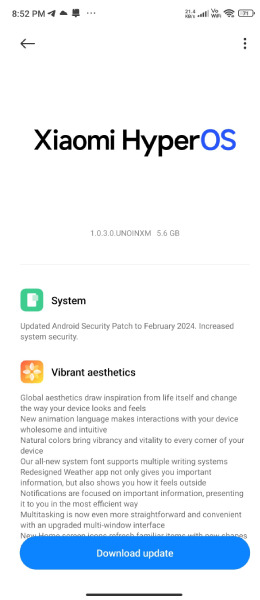
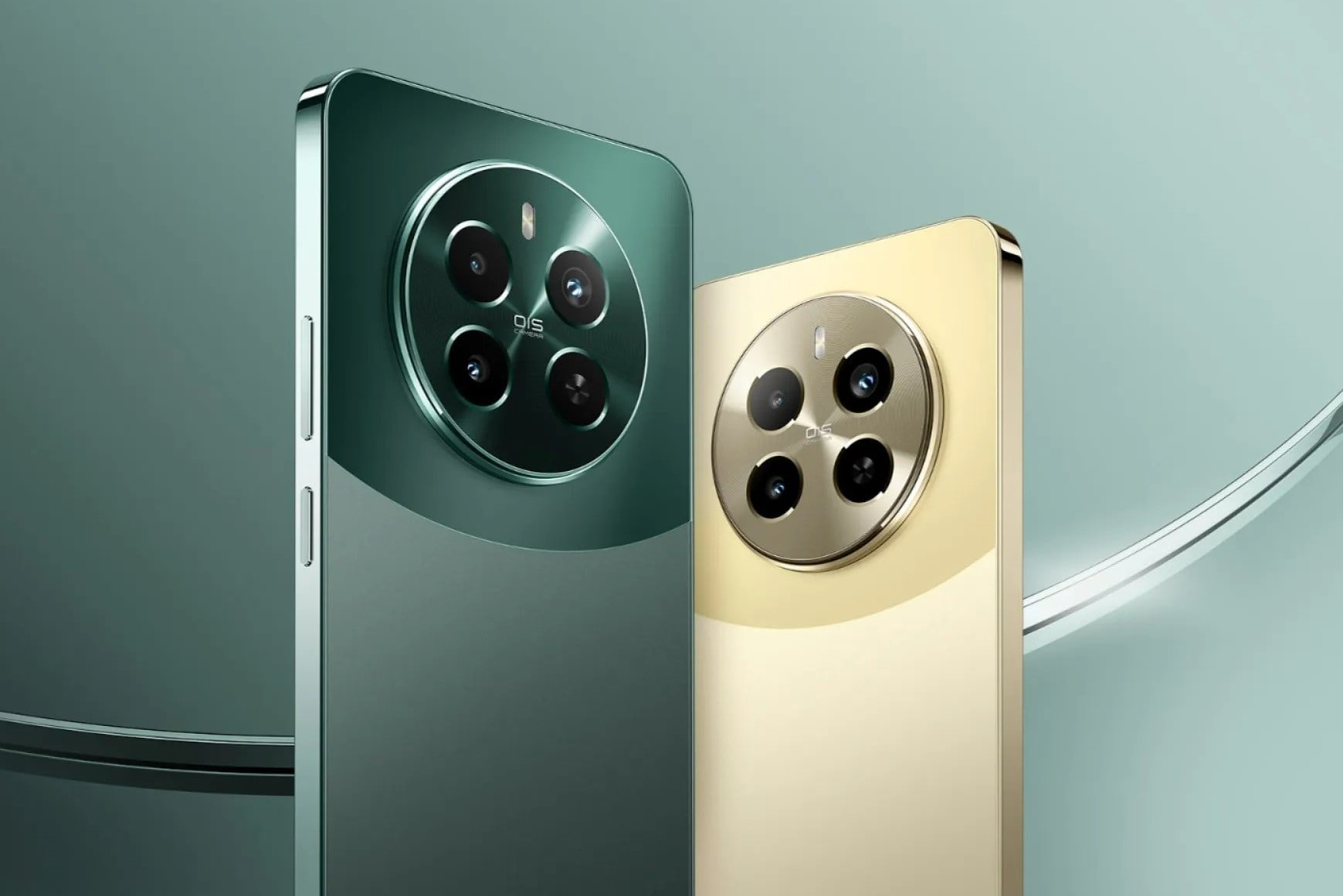
Last month, Xiaomi confirmed that the HyperOS update would come to Redmi Note 13 Pro Plus in March. Keeping their promise, the update is now rolling out, bringing Android 14-based HyperOS along with the February 2024 Android security patch.
The HyperOS update for Redmi Note 13 Pro Plus 5G comes with firmware version “1.0.3.0.UNOINXM” and has a size of 5.6GB. Alongside the February 2024 Android security patch, it also includes improvements to system aesthetics.
The update brings visual changes, an improved memory management system, and various UI optimizations, as detailed in the changelog below:
System
Updated Android Security Patch to February 2024. Increased system security.
Vibrant aesthetics
Global aesthetics draw inspiration from life itself and change the way your device looks and feels.
New animation language makes interactions with your device wholesome and intuitive.
Natural colors bring vibrancy and vitality to every corner of your device.
Our all-new system font supports multiple writing systems.
Redesigned Weather app not only gives you important information, but also shows you how it feels outside.
Notifications are focused on important information, presenting it to you in the most efficient way.
Multitasking is now even more straightforward and convenient with an upgraded multi-window interface.
New Home screen icons refresh familiar items with new shapes and colors.
In addition to the Note 13 Pro Plus, Note 13 Pro and Note 13 are also scheduled to receive the update in March. The update will also be available for Xiaomi 12 Pro, Redmi Note 12 Pro+, Redmi Note 12 Pro, and Note 12 in March, as revealed by the company.
As expected, Xiaomi has launched the latest iteration of its popular children’s smartwatch, the Mitu Kids Smartwatch 7X. The smartwatch comes in Pink and Blue colors and is available for pre-sale in China from Xiaomi Youpin for a starting price of 599 yuan ($83).
Xiaomi Mitu Kids Smartwatch 7X Specifications:
The Mitu Kids Smartwatch 7X prioritizes child safety with its upgraded positioning features. It boasts dual-frequency GPS for more accurate location tracking and supports multi-scene positioning, including indoor, mall, and AI positioning. This allows parents to see their child’s location in real time and receive alerts if they deviate from their usual route or stay in a particular location for too long.
Furthermore, the watch boasts a 90-day high-precision trajectory, enabling parents to view their child’s walking history for the past three months. It also features 3D floor positioning 2.0, which leverages a barometer and dual-frequency GPS to pinpoint the child’s floor level within a building. Additionally, the watch can store location data even without a network connection, allowing parents to view the child’s offline movements once the watch is connected again.
The smartwatch is equipped with a 1.68-inch IPS TFT HD screen and has 18 sports modes and 5 physical exam functions. The watch is also 20 meters waterproof, allowing kids to wear it while washing their hands or playing in the rain.
The Mitu Kids Smartwatch 7X comes with upgraded video calling features. The watch boasts dual cameras, an 8MP side camera, and a 5MP front camera, offering improved clarity and fluency compared to the previous generation. This allows parents to see their kids clearly and get a glimpse of their surroundings during video calls.
The watch also caters to a child’s social life. It supports WeChat (children’s watch version) and QQ, enabling them to connect with friends using the same platform or other brands of children’s watches with these apps. Additionally, it supports the Xiao Ai assistant, providing interactive features like weather updates, storytelling, and smart home connectivity.
Xiaomi has equipped the smartwatch with a 950mAh battery, promising long-lasting usage. The watch is powered by a low-power system and power-saving algorithms to ensure it stays charged throughout the day. The watch also boasts 4GB of storage, allowing parents to install various educational apps to enrich their child’s learning experience.
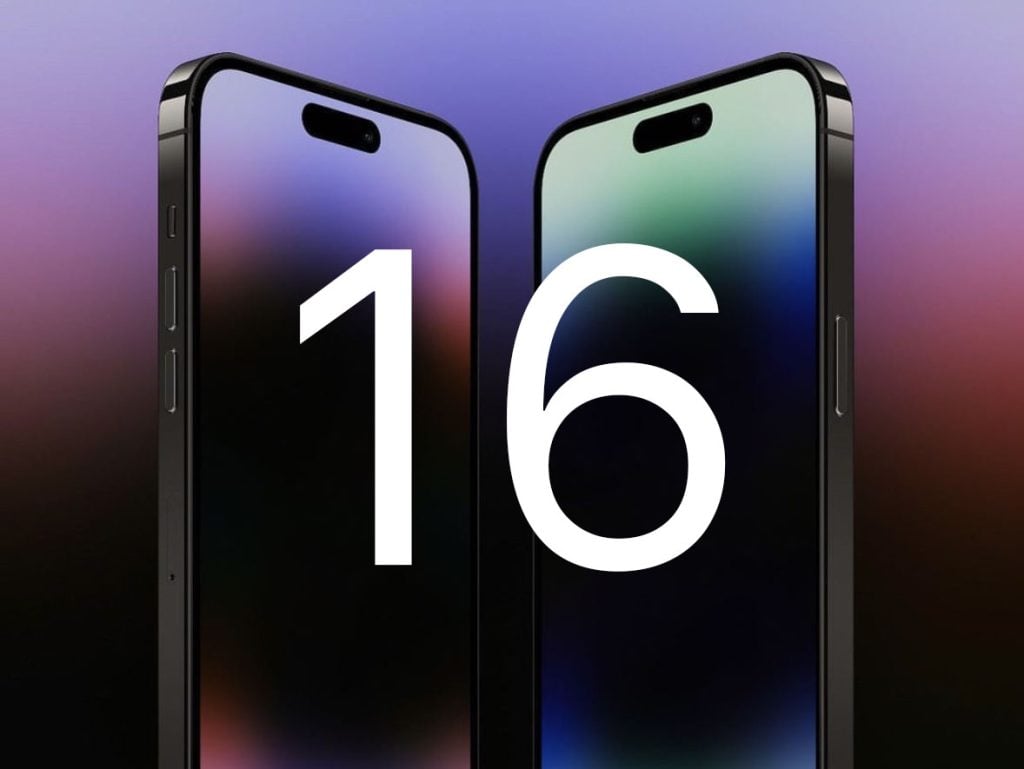
BRS stands for Border Reduction Structure. This technology specifically aims to reduce the bottom bezel or the chin of all four models of the iPhone 16 series. Notably, this technology focuses on minimizing the bottom bezel by rolling up copper wires underneath the panel.
Slightly bigger display for the Pro iPhones
Korean source Sisa Journal notes that Samsung Display, BOE, and LG Display, who will supply panels for the iPhone 16 series, all have acquired the technology. However, the yield rate of the production will be an important factor. An industry official said “The entry barrier to the technology itself is not high, but the volume situation may change for each company once it actually enters mass production.”
Aside from the slimmer bezel, the regular iPhone 16 and iPhone 16 Plus will reportedly get the same size and type of panel as last year’s non-Pro models. The iPhone 15 and iPhone 15 Plus offers a 6.1-inch and 6.7-inch 60 Hz LTPS (Low Temperature Polycrystalline Silico) panel respectively.
However, there might be a slight increase in display size for the iPhone 16 Pro and iPhone 16 Pro Max. According to market research agency Omdia, the iPhone 16 Pro could have a 6.3-inch display (last year’s model had 6.1″) and the iPhone 16 Pro Max could offer a 6.9-inch display (iPhone 15 Pro Max had a 6.7″ panel). In terms of display technology, these bigger panels will be the same LTPO ones as offered by last year’s Pro models.
If you are expecting the rumored under-display tech (UDC) to hide some of the sensors from the Dynamic Island, keep patience. Kang Min-soo, a senior researcher at Omdia said, “Apple is trying to change the form of the display once again by hiding the camera behind the display or hiding Face ID, but UDC technology continues to be delayed.” He added that it could be delayed even to 2027.
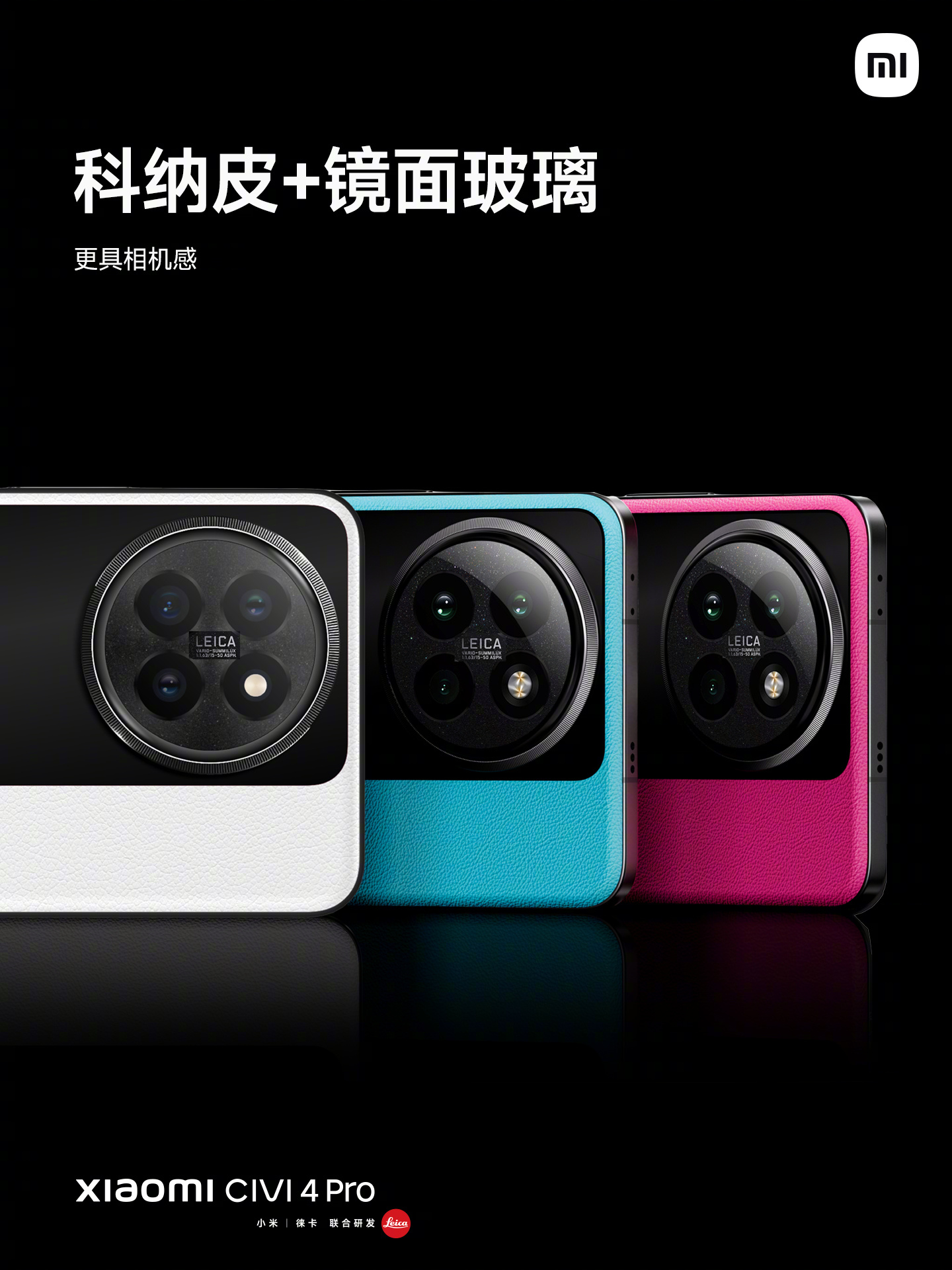
Xiaomi has released the CIVI 4 Pro smartphone in its home market today as scheduled. This device is the newest addition to the CIVI lineup, initially designed for the female demographic, but now appealing to a broader audience. Its success is due to its attractive design and powerful premium hardware. Let’s look at what the CIVI 4 Pro has in store.
Design & display
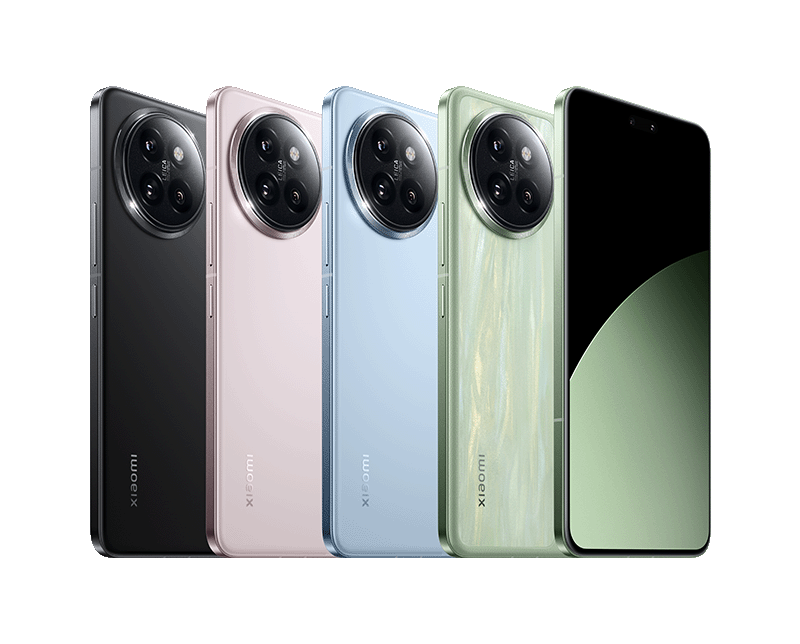
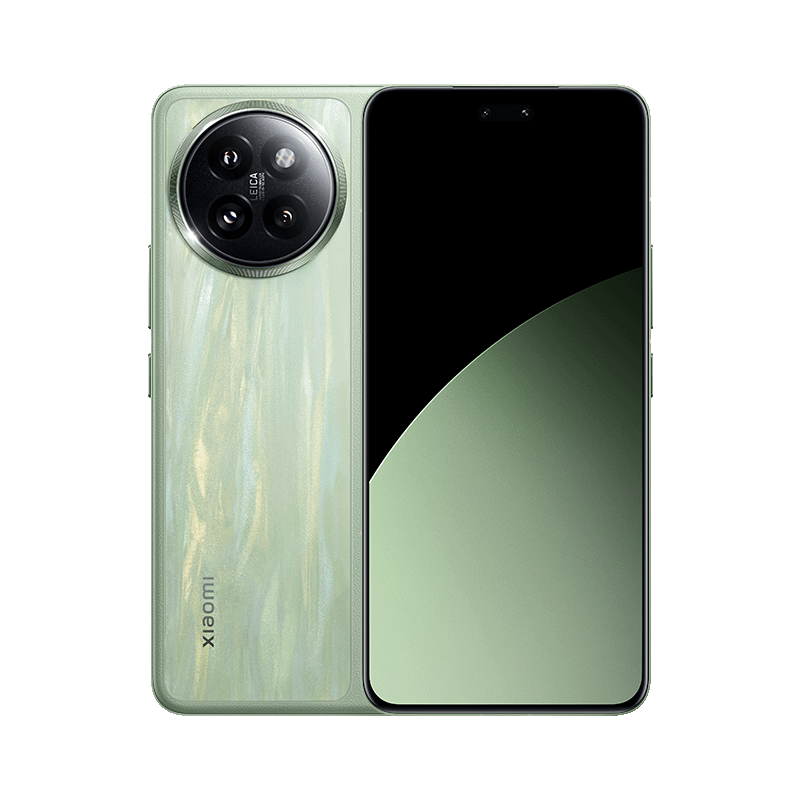
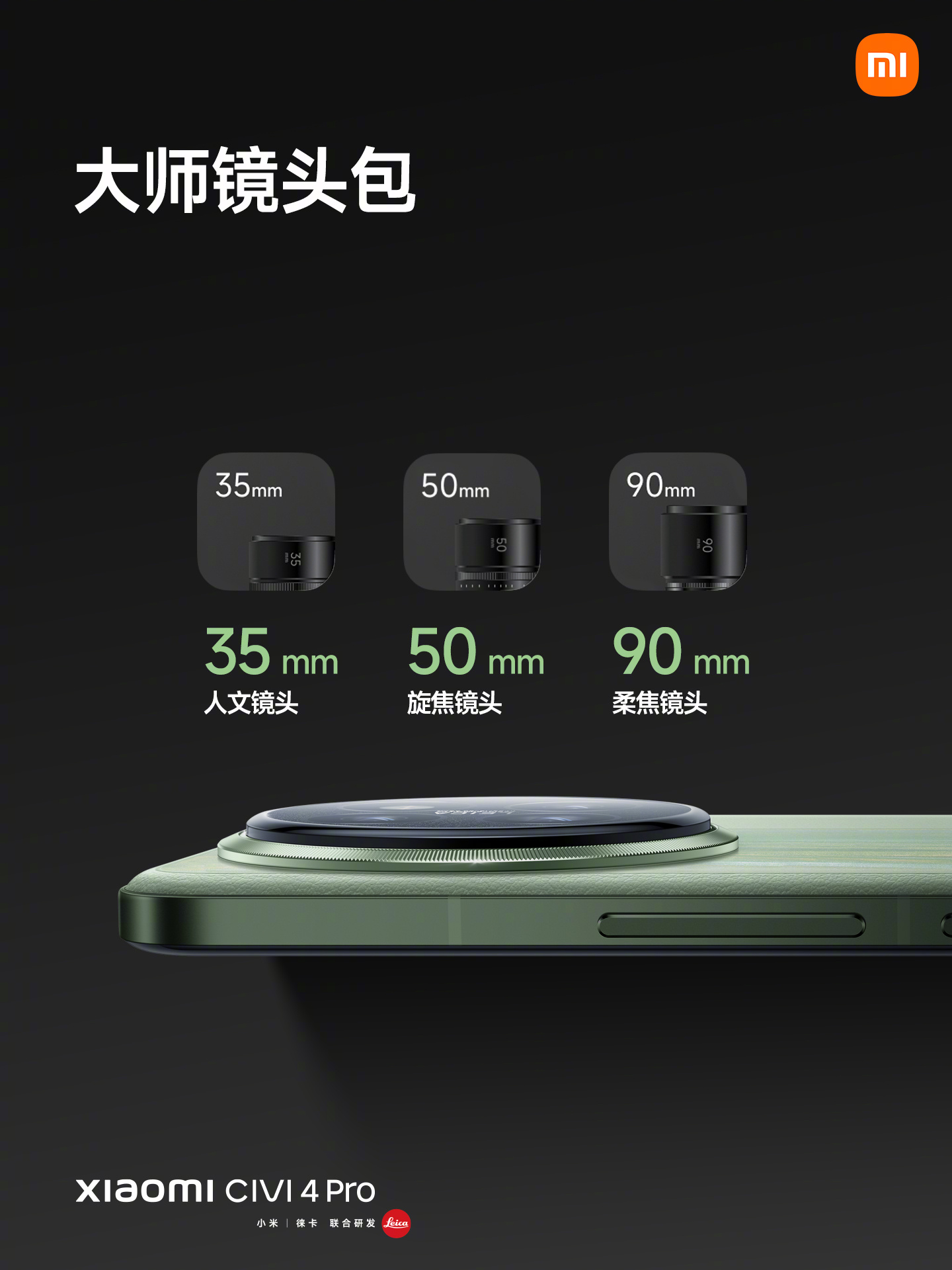
The CIVI 4 Pro builds upon the design of the CIVI 3, without making any drastic changes. The back of the device has a round camera island on the back that holds three lenses and an LED flash module. The camera island is surrounded by a textured metal ring that matches the color of the back. When it comes to colors, the CIVI 4 Pro gives you four options (other than the special edition colors): Spring Field Green, Soft Mist Pink, Breeze Blue, and Black. Among them, Spring Field Green stands out with its glossy finish, offering lively spring tones and patterns resembling flowing water, achieved through a unique “colorful gilding” process. The Spring Field Green variant also features a textured back, possibly made of vegan leather.
Spring Field GreenSpecial Edition colors
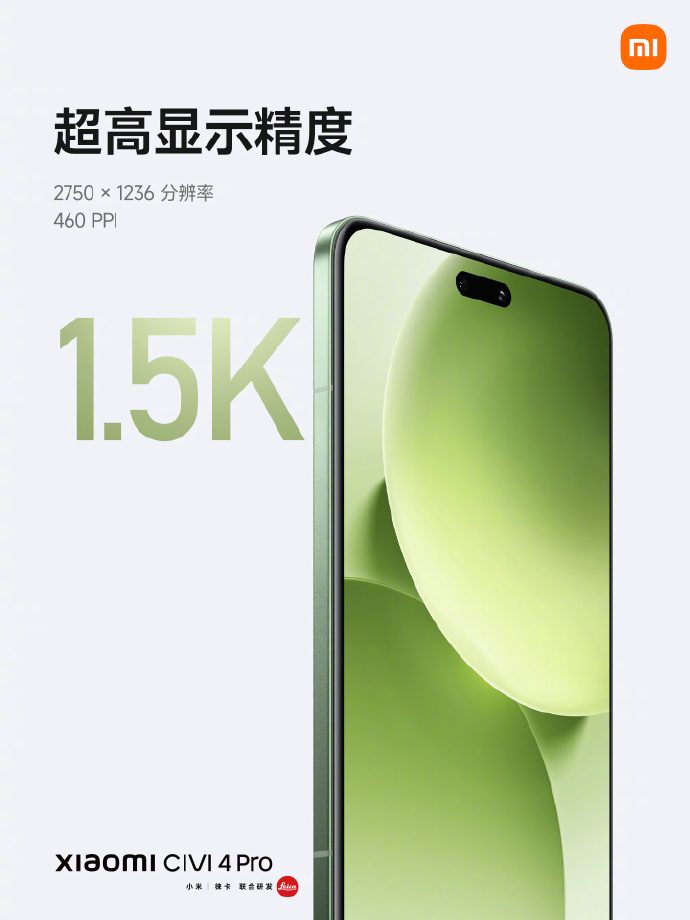
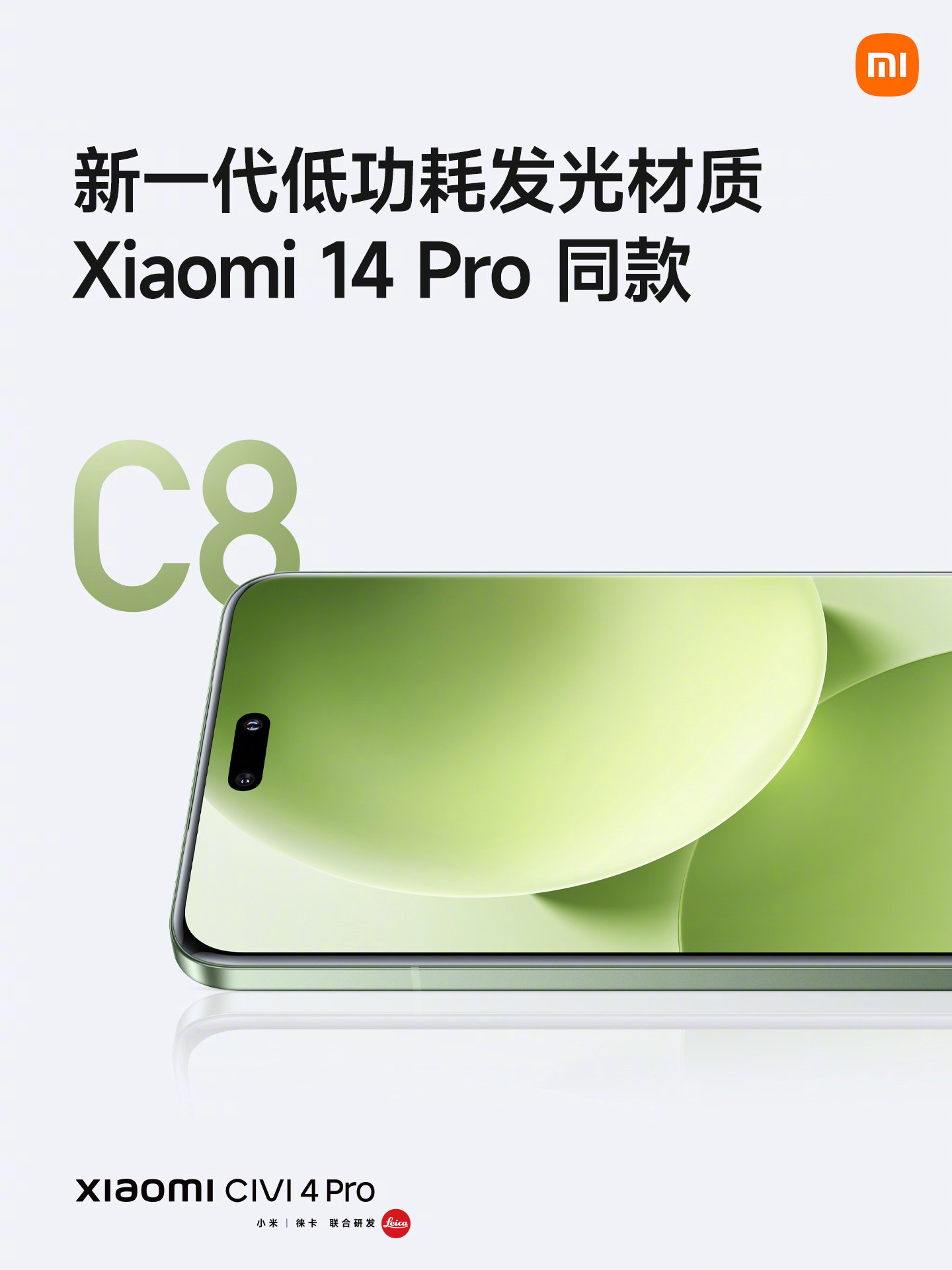
The sides of the device are flat, with curved ends to make it more comfortable to hold. Up front, it features a slightly curved display that has ultra-narrow bezels, measuring 1.6mm, 1.44mm, and 2.02 mm for the top, sides, and bottom, respectively. The display measures 6.55 inches offering a resolution of 2750 x 1236 pixels, and a 460 PPI pixel density. It offers complete coverage of the DCI-P3 color gamut, up to 120Hz refresh rate, and can reach a peak brightness of 3000 nits.
It also supports HDR10+, Dolby Vision, and has a Wet Touch feature that eliminates ghost touches when your display is wet. It also has a pill-shaped cutout that holds two cameras inside. The display is protected by Corning Gorilla Glass Victus 2 and has an under-screen touch sensor for easy unlocking. As for audio, the CIVI 4 Pro has a stereo speaker setup. The device has an overall thickness of 7.45mm and weighs 179 grams.
Performance
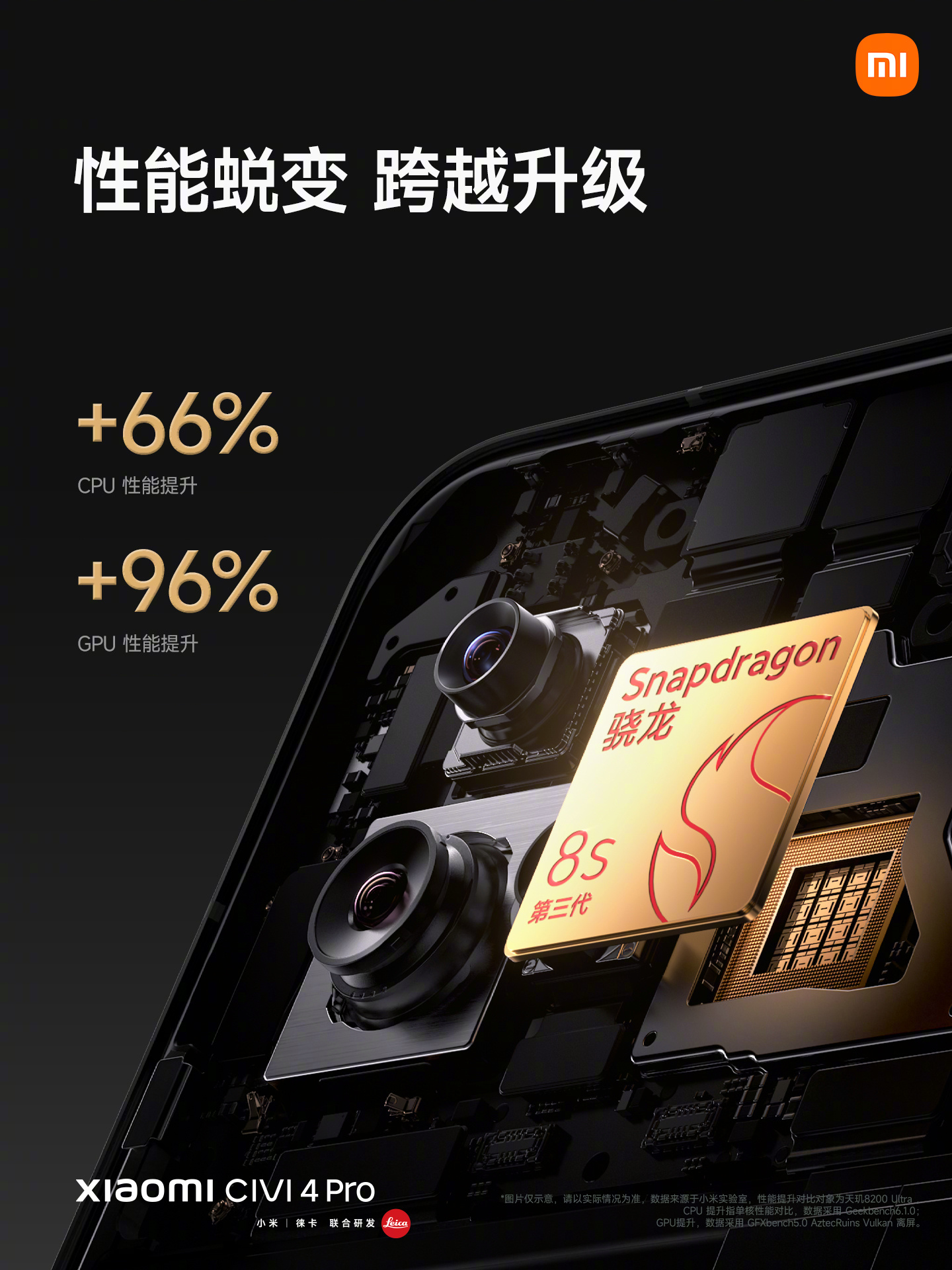
Under the hood, the CIVI 4 Pro features the newly launched Snapdragon 8s Gen 3 octa-core processor, which is manufactured on TSMC’s 4nm node, offering a peak clock speed of 3.0GHz on its Cortex-X4 prime core. The processor is paired with up to 16GB of LPDDR5X RAM and 512GB of UFS 4.0 storage. Xiaomi claims that the device can maintain an average frame rate of 59.4 FPS during a 30-minute run of Genshin Impact. The Snapdragon 8s Gen 3 also provides a massive boost to AI-based applications.
The device features a 4700mAh battery that supports 67W fast charging, claiming to fill up the device in 40 minutes. To keep the temperatures under control, the device uses a 4184mm² vapor chamber cooling system. As for software, the device runs on Android 14-based HyperOS.
For connectivity, the phone supports 5G, dual-band WiFi 6, and Bluetooth 5.4 with AAC/LDAC/LHDC support. It also has NFC and Infrared. For navigation, the device offers Beidou, GPS, Galileo, GLONASS, QZSS, and AGNSS-assisted positioning.
Camera
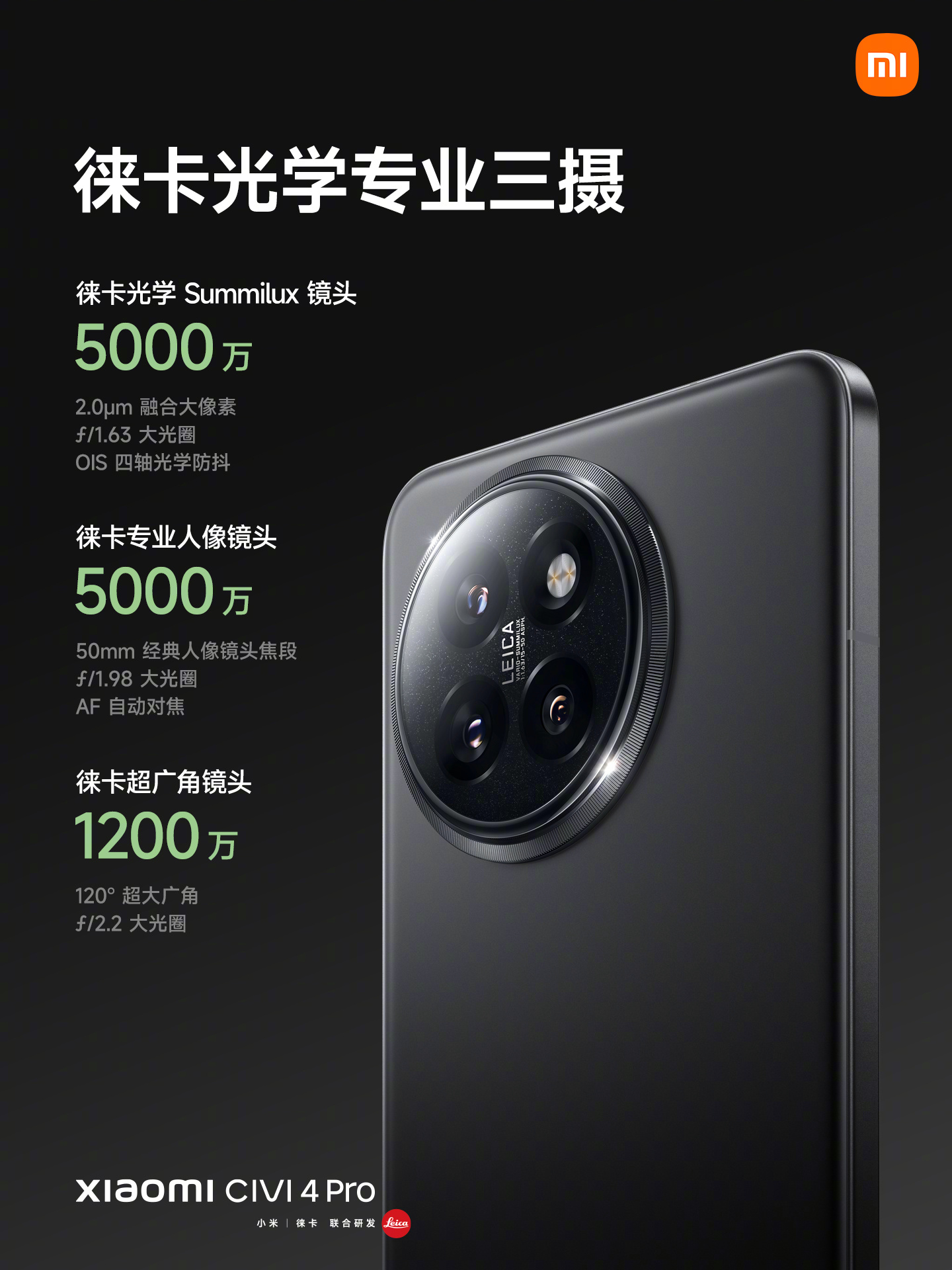
The camera system is another key area where the brand has made some major improvements. The CIVI 4 Pro has an OIS-stabilized 50MP f/1.63 OmniVision Light Fusion 800 primary sensor behind a Leica Summilux lens. The phone also includes a 50MP Samsung JN1 portrait + telephoto camera with f/1.98 aperture and autofocus. The third camera on the back holds a 12MP Ultra-wide sensor with a 120° field of view and an f/2.2 aperture.
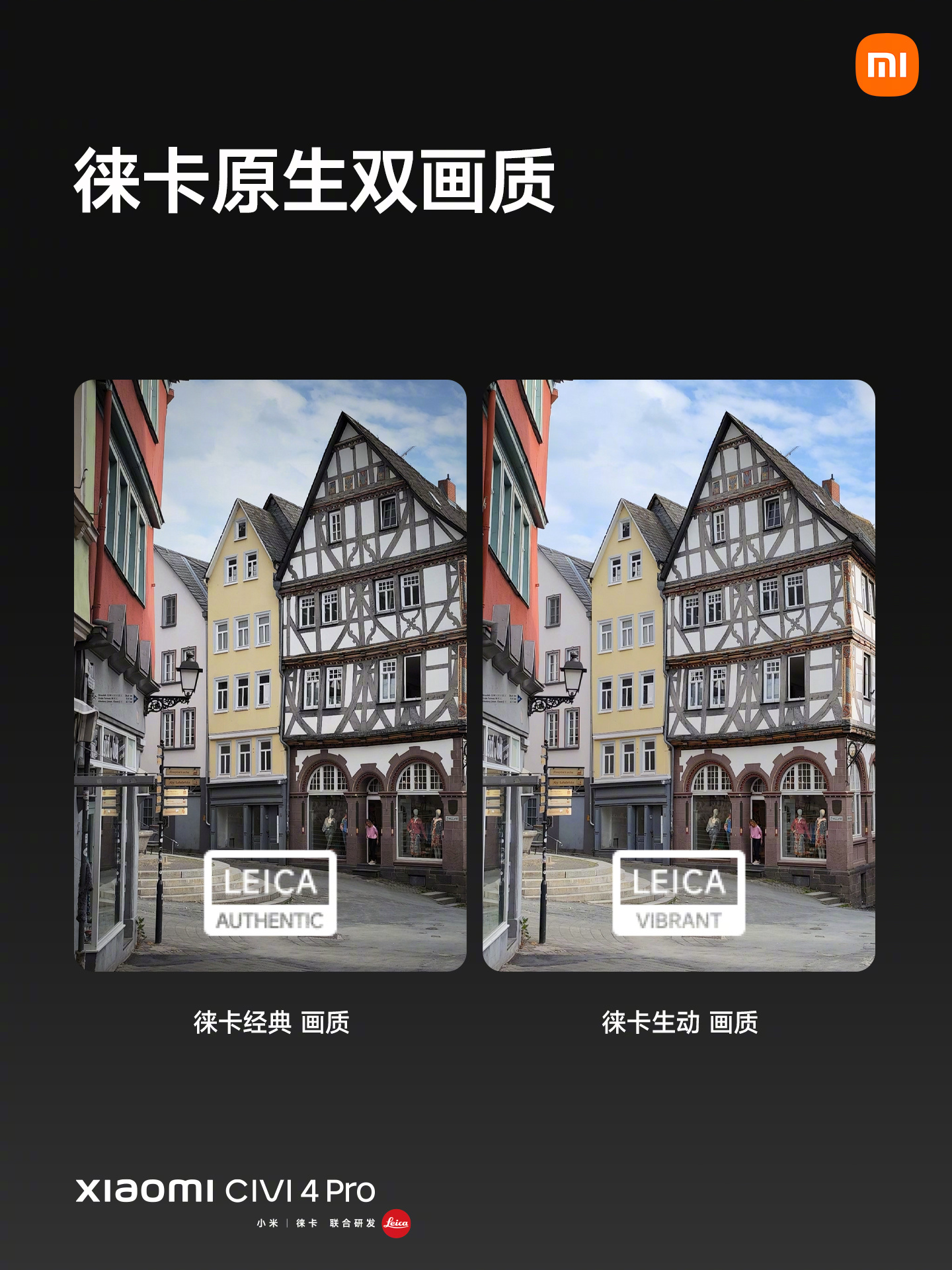
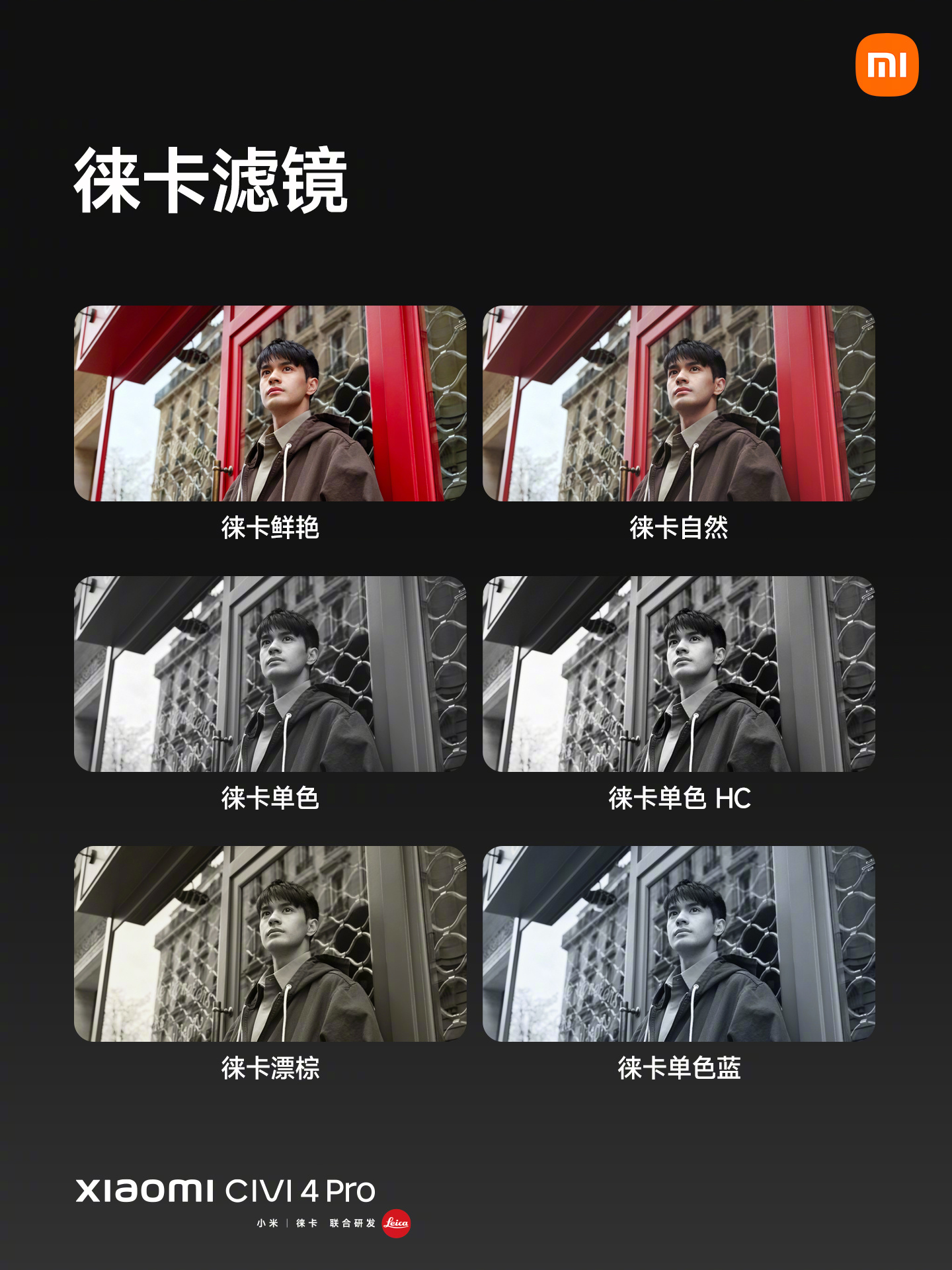
On the front, the device comes with a dual-camera setup, featuring a 32MP main sensor with 78° FOV, f/2.0 aperture, 2X portrait close-up, and autofocus. The second camera has a 32MP ultra-wide sensor with a 100° ultra-wide viewing angle, 4K ultra-clear image quality, AI distortion correction algorithm, f/2.4 aperture, and EIS video anti-shake. All cameras on the device feature Leica’s custom tuning and special Leica photography modes.
Pricing & availability
The Xiaomi CIVI will go on sale on March 21st at 15:30 and will be open for reservation on March 26th at 10:00, with its first sale scheduled for April 1st at 10:00. The pricing for the different models is as follows: the 12GB + 256GB version is priced at 2999 Yuan ($417), the 12GB + 512GB version at 3299 ($458), and the 16GB + 512GB Special Edition will be available for 3599 ($500). Currently, there is no word on the global availability. However, a recent report indicates that the phone could soon come to India.
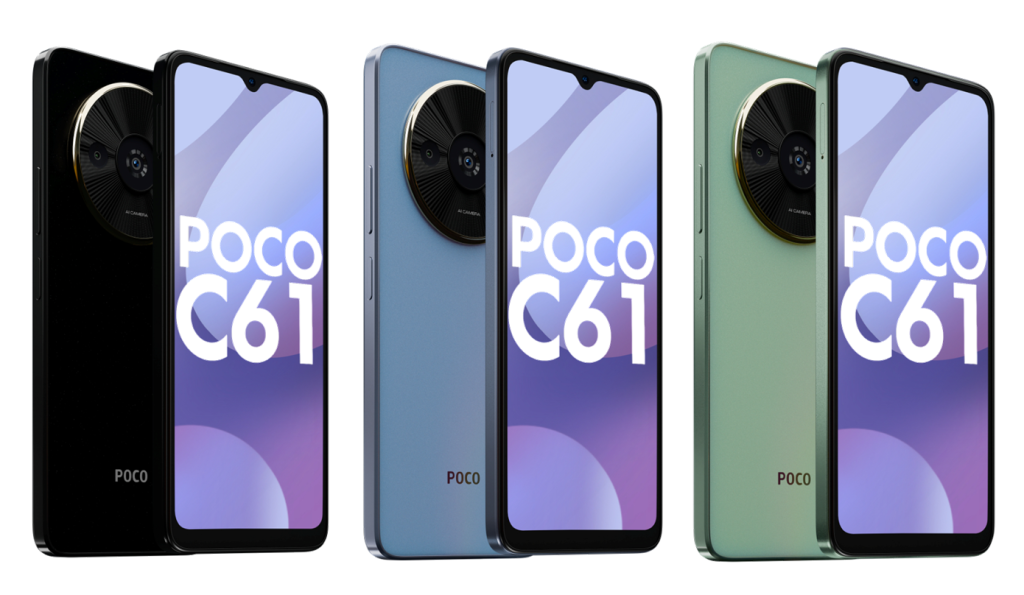
Recent reports have revealed that Poco’s next C-series phone will be called the Poco C61 when it debuts on the market. The device recently received approval from certification platforms, such as India’s BIS and the Bluetooth SIG. It was also listed in the database of the Google Play Console. These listings have claimed that it will be a rebranded version of the Redmi A3, which recently debuted in India. Now, a report, courtesy of Appuals, has leaked the key specifications and price of the Poco C61, along with its renders.
Poco C61 price, renders (rumored)
Poco C61
According to the report, the Poco C61 will come in two choices, such as 4GB RAM + 64GB storage and 6GB RAM + 128GB storage. The reported prices for these variants in India are Rs 7,499 (~$90) and Rs 8,499 (~$102), respectively. The above image showcases the black, blue, and green editions of the C61. Readers can visit the source link to see more images of the device.
Poco C61 key specifications (rumored)
According to the publication, the Poco C61 will have a 6.71-inch IPS LCD display that offers an HD+ resolution of 1650 x 720 pixels, a 90Hz refresh rate, a 180Hz touch sampling rate, and a peak brightness of 500 nits. The screen will be shielded by a layer of Gorilla Glass 3.
The Poco C61 will have the Helio G36 chipset, 4 GB / 6 GB of RAM, 64 GB / 128 GB of storage, and a microSD card slot. It will have a 5,000mAh battery with 10W charging support via a USB-C port.
The C61 will have a side-facing fingerprint scanner and a 3.5mm audio jack. For selfies, it will have a 5-megapixel camera and an 8-megapixel (main) + 0.08-megapixel dual-camera unit on the back. Last year, the C51 was announced in April. Hence, it is likely that the C61 may break cover in the coming month.
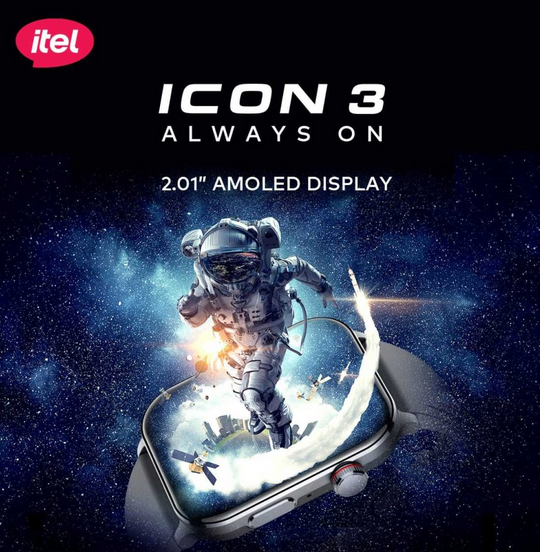
Itel is apparently working on a successor to the Icon 2, which launched earlier this month. The company shared a new teaser that confirmed that a new Icon 3 is set to launch in the Indian market soon. Some of its key specs were also revealed, so let’s check it out.
Itel Icon 3 teased with an Apple Watch Ultra-like design
Itel is expanding its smartwatch product lineup with the Icon 3. The latest teaser showcases the smartphone with a 2.01-inch AMOLED display that is taller than the Icon 2’s 1.83-inch LCD panel and thinner bezels. This means that the Itel Icon 3 has an upgraded display over its predecessor. Furthermore, the upcoming smartwatch also supports Bluetooth Calling feature that promises to offer a dedicated chip for quick and seamless connectivity.
The Icon 3 has a design that is similar to the Icon 2 with a rectangular screen and a rotating crown with a function button. This is quite similar to the Apple Watch Ultra and its Action button. We can expect this model to offer various health related sensors like SpO2 blood oxygen and heart rate tracking. As of right now, finer details are still unclear but the newer smartwatch will likely offer similar specs as the Icon 2.
For those unaware, the Icon 2 arrives with Bluetooth 5.3 and supports AI voice assistants for camera and music controls. It offered over 150 watch faces for customization and sported a 2.5D curved glass. The model was also rated IP68 for water and dust resistance. The launch date for the Itel Icon 3 is still at large, but the device is expected to be released soon.
Xiaomi manufactures and sells smartphones with some of the most advanced camera hardware you can get on the market. But looks like the company wants its influence in the imaging industry to extend beyond hardware. Xiaomi is now taking the lead in developing a new HDR image standard.
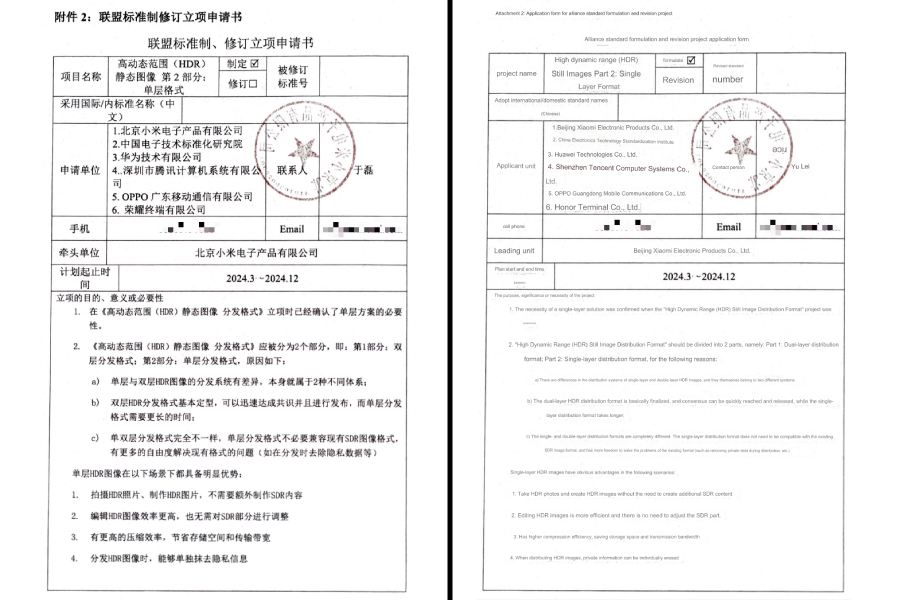
Recently, the World Ultra-HD Video Industry Alliance (UWA Alliance) approved a project titled “High Dynamic Range (HDR) Still Images Part 2: Single-Layer Format” which will focus on creating a single-layer format for High Dynamic Range (HDR) still images.
Xiaomi is spearheading this initiative in collaboration with the China Electronics Technology Standardization Institute, Huawei, Tencent, OPPO, and Honor.
Original (Left) | Translated (Right).
The project has a completion date of late 2024 and aims to establish a standardized framework for HDR image handling.
The approval certificate from UWA Alliance shows that the project sets standards for two kinds of HDR still image formats — single-layer and double-layer.
The double-layer format combines HDR with Standard Dynamic Range (SDR), while the single-layer format exclusively features HDR.
According to the Alliance, the development of the dual-layer HDR distribution format is nearly complete and can be swiftly agreed upon and released.
However, the single-layer distribution format will require more time, and this is where Xiaomi is directing its efforts.
UWA lists the following advantages of single-layer HDR images:
1. Take HDR photos and create HDR images without the need to create additional SDR content.
2. Editing HDR images is more efficient and there is no need to adjust the SDR part.
3. It has higher compression efficiency and saves storage space and transmission bandwidth.
4. When distributing HDR images, private information can be individually erased
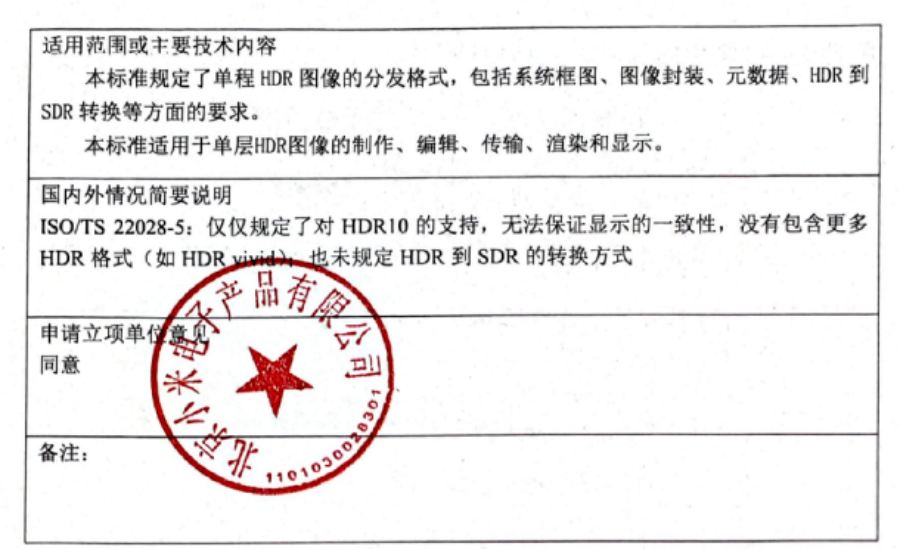
Once completed, the new standard is said to define how the distribution format of single-layer HDR images. It covers image formatting, metadata, HDR to SDR conversion, and guidelines for producing, editing, transmitting, and viewing single-layer HDR images.
Tecno has officially revealed the launch date for its highly anticipated Pova 6 Pro smartphone model in India. The smartphone was first unveiled at the MWC 2024 global event and now it is arriving in the Indian market. So here are all the details.
Tecno Pova 6 Pro India Launch
The smartphone brand has officially confirmed that the upcoming device is set to launch in the region on 29th March 2024. For those unaware, this launch arrives in collaboration with Playground Season 3, which is a series on Amazon miniTV. The company will even share the very first unboxing of this handset during the premiere of this show. To recall, the Pova 6 Pro was unveiled as a mid-range smartphone that features semi semi-transparent design with a lithography precision texture.
Furthermore, the back also features LED light strips, similar to the Nothing Phone lineup. As per official notes, there are 210 mini LEDs on the back that offer nine lighting modes. The back also features a 108-megapixel dual camera setup. Meanwhile, the front sports a tall 6.78-inch AMOLED display that has a Full HD+ resolution, a 32-megapixel selfie shooter, and a 120Hz refresh rate.
Under the hood, this smartphone is equipped with the MediaTek Dimensity 6080 SoC that is paired with up to 12GB of RAM with virtual RAM expansion support and 256GB of internal storage. A massive 6,000mAh battery pack powers this device, which supports 70W wired fast charging and 10W wireless reverse charging. This device is available in two color options, namely Meteorite Grey and Comet Green. So stick around for more, as we will be covering the launch next week.
As scheduled, the Vivo T3 goes official in India today. The latest budget smartphone from the company is almost identical to the recently released iQOO Z9. The only difference is that it arrives with three rear cameras instead of two.
The Vivo T3 succeeds the Vivo T2 from last year. For the unaware, the T2 was again nearly identical to iQOO Z7x.
Vivo T3 Specifications
The Vivo T3 features a plastic build like its predecessor and most other devices in the segment. It has a flat frame and the triple rear cameras are placed on a slightly raised rectangular island.
The handset is built around a 6.67-inch centered punch-hole AMOLED display. This panel comes with a resolution of 2400 x 1080 pixels,394 PPI, and a 120Hz refresh rate. The screen can reach up to 1800 nits peak brightness level.
Under the hood, the phone houses a MediaTek Dimesnity 7200 chip paired with LPDDR4x RAM and UFS 2.2 storage. It draws energy from a 5,000mAh battery and supports 44W wired charging.
The device’s triple camera setup consists of an OIS-assisted Sony IMX882 primary sensor, a 2MP depth sensor, and a flicker sensor. On the front, it has a 16MP shooter.
Further, the smartphone arrives with dual stereo speakers, an in-screen fingerprint sensor, a MicroSD card slot, and an IP54 rating. On the connectivity front, it offers dual SIM, 5G, WiFi 6, Bluetooth 5.3, GNSS, and USB Type-C.
Last but not least, the handset boots Funtouch OS 14 based on Android 14.
Vivo T3 Price in India
The Vivo T3 carries the following price tags in India.
8GB + 128GB – ₹19,999 (~$240)
8GB + 256GB – ₹21,999 (~$265)
It comes in two color options, namely Cosmic Blue and Crystal Flake.
The product will be available for purchase starting at 12 PM IST on March 27. It will be sold via Vivo.com, Flipkart, and retail stores across the country.
Buyers can avail of a ₹2,000 instant discount on transactions made through credit cards issued by HDFC Bank and SBI.
Xiaomi Smart Ecosystem officially announced its new Mijia smart audio glasses will be launched on March 25. The official poster contains an image of a glass note “Mirror Enjoy Listening” (translated from Chinese). So, it appears that the product is going to have some notable audio features.
Xiaomi’s new Mijia Smart Audio Glass
Features offered by last year’s Mijia Smart Audio Glasses
Xiaomi launched its Mijia Smart Audio Glasses last year for a price tag of 799 Yuan (~$110) with support for a noise reduction feature during calls. It was available in a total of five frame and sunglass styles including a square half-frame style, a full frame style.
Last year’s Mijia smart audio glass uses “open sound field technology” and is able to offer a 360-degree surround sound effect. This smart glass product comes with a dual-mic AI call noise reduction function and also supports intelligent enhancement for calls. In addition to that, it supports dual device connection and a 30mm long touchpad on both sides which enables seamless implementation of tough gesture functions. It also comes with an IP54 dust and water resistance rating, which means protection from normal environmental dust and more importantly, protection from water splashes.
In terms of battery life, this smart glass can reportedly last 1 week on standby, more than 22 hours in regular usage, and more than 10 hours with continuous music listening or more than 7 hours of calling. Not to mention, the successor to this product, which is just four days away from launch at this point, is expected to perform with even better power efficiency.
Samsung introduced a range of AI features on the Galaxy S24 series as a part of the Galaxy AI umbrella. These features will also be included in the One UI 6.1 update for owners of the Galaxy S23 series, Galaxy S23 FE, Fold 5, Flip 5, and Tab S9 series.
But there were rumors that the Galaxy S22 series, Samsung’s 2022 flagship lineup, wouldn’t receive this AI upgrade. However, recent statements from Samsung executives suggest that there might still be hope for the S22 family.
TM Roh, President of Samsung’s Mobile Division, mentioned during a general shareholders’ meeting that the company is actively exploring ways to bring Galaxy AI to older devices.
The challenge seems to lie in the fact that while some Galaxy AI features depend on cloud processing, others rely on on-device processing. And the Galaxy S22 series might lack the necessary hardware capabilities to support these AI features.
However, despite sharing the same chipsets as the S22, the S23 FE is expected to receive Galaxy AI features with the One Ui 6.1 update. So chipset shouldn’t specifically be an issue for the Galaxy S22 series, although Roh didn’t delve into the specifics.
Still Roh emphasized that overcoming these limitations will require “a lot of effort,” but Samsung is committed to investing resources to make it happen.
Whether the Galaxy S22 series will eventually gain these AI features remains uncertain. But learning that Samsung is not ruling out the hope entirely is certainly promising.
In another interesting development, TM Roh also confirmed that Samsung is working on its innovative foldable and rollable devices.
Roh’s statements suggest that Samsung is evaluating the commercial viability of such form factors and working to secure necessary patents for their development to progress.
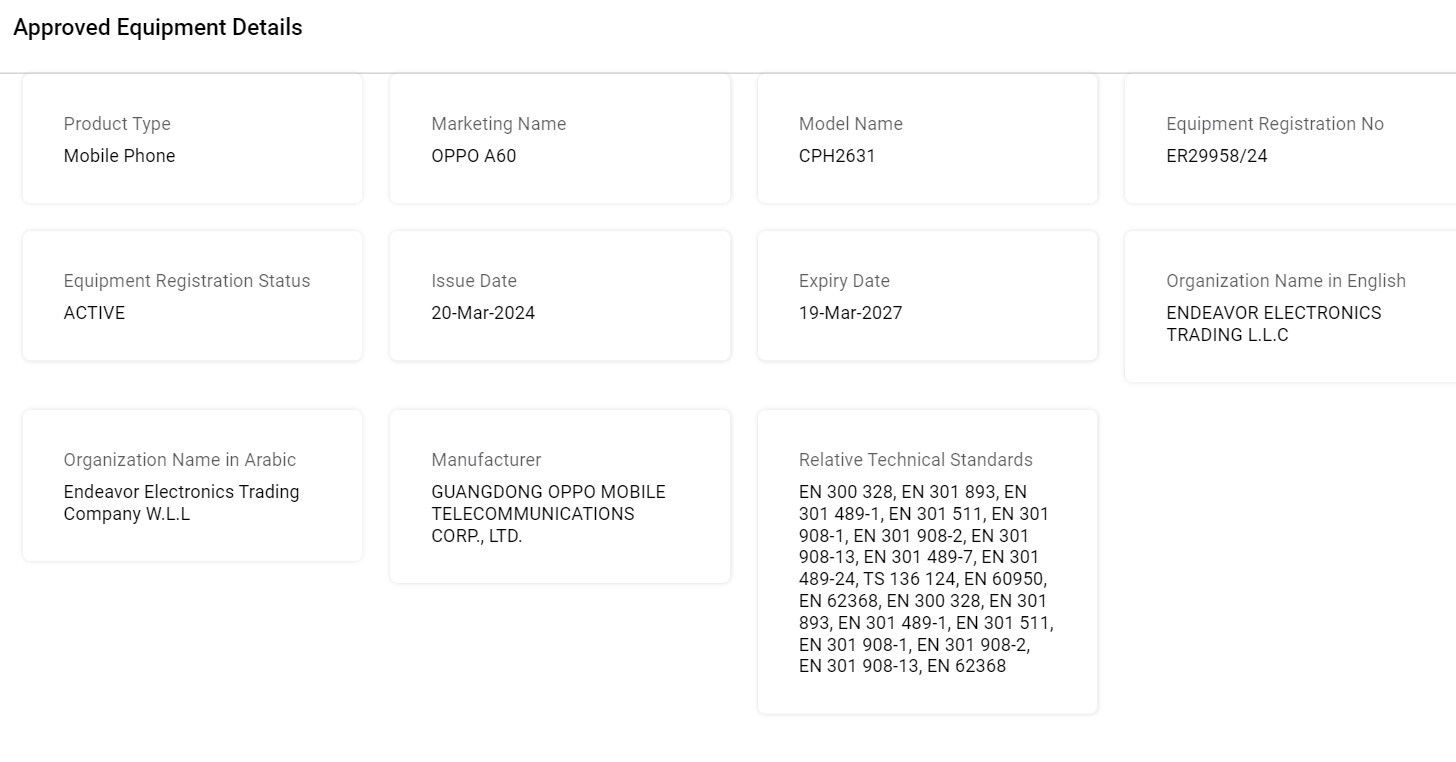
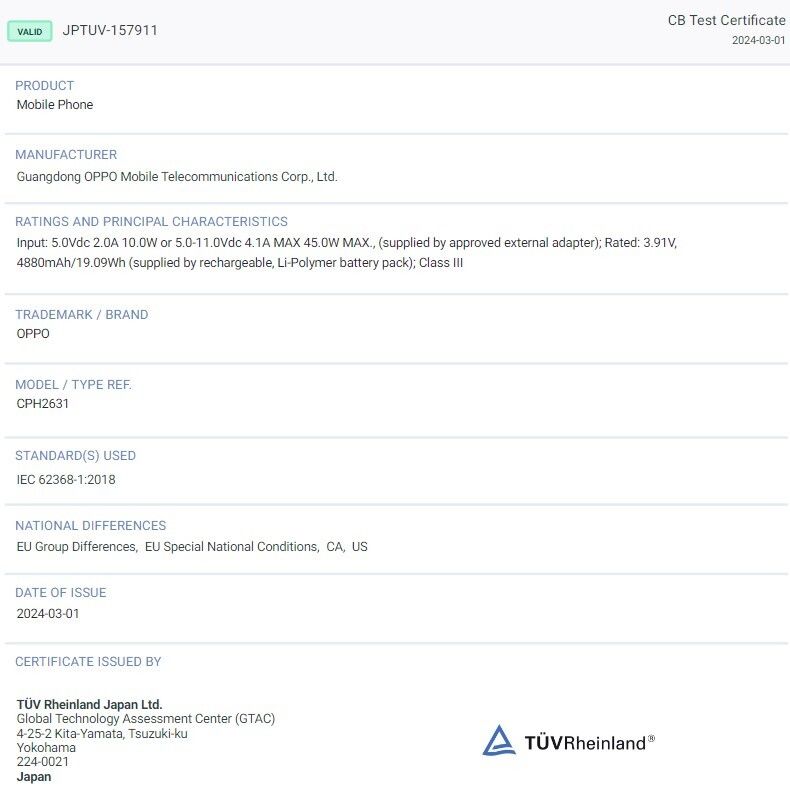
The Oppo A60 could be the next A-series phone from the brand. The device bearing the model number CPH2631 has received approval from different certification platforms, such as Thailand’s NBTC, Indonesia’s SDPPI and TKDN, and the UAE’s TDRA. In addition, it has also emerged in the databases of TUV Rheinland and Camera FV-5.
Oppo A60 first details emerge
The Oppo A60’s certifications (via MySmartPrice) in Thailand, Indonesia, and the UAE only confirm its name and model number. The TUV certification of the device suggests that it may pack a 5,000mAh battery with 45W fast charging support.
The Camera FV-5 listing reveals that it may arrive with a 50-megapixel primary camera and an 8-megapixel front-facing camera. Both cameras appear to support EIS stabilization. The other details of the device remain a mystery.
The moniker of the device suggests that it will succeed the Oppo A59, which debuted in 2023. To recall, the device featured a 6.56-inch LCD panel that offers an FHD+ resolution and a 90Hz refresh rate. It came with a 13-megapixel dual-camera system and an 8-megapixel front camera. It came preloaded with Android 13 and ColorOS 13.1.
The A59 has the Dimensity 6020 chipset, 4 GB of RAM, 128 GB of storage, and a 5,000mAh battery with 33W fast charging. For security, it has a side-facing fingerprint reader. The device came with other features, such as dual 5G SIM support, a microSD card slot, dual stereo speakers, a 3.5mm audio jack, a side-facing fingerprint scanner, and an IP54-rated chassis.
In a groundbreaking move, EHang, the Chinese manufacturer of electric vertical take-off and landing (eVTOL) vehicles, has announced the launch of its EH216-S flying taxi on Alibaba’s online shopping platform, the Taobao marketplace. With a price tag of 2.39 million yuan (US$332,000), the EH216-S is set to revolutionize urban transportation and mark a significant milestone in the era of autonomous passenger-carrying aircraft.
source: Ehang
EHang’s EH216-S has garnered immense attention and acclaim, having completed over 42,000 successful test flights across more than 14 countries. Notably, it became the world’s first recipient of a Type Certificate and Standard Airworthiness Certificate for pilotless eVTOLs from the Civil Aviation Administration of China (CAAC), underscoring its safety and reliability.
The introduction of the EH216-S on Taobao signifies EHang’s strategic move to tap into the burgeoning market for urban air mobility solutions. With a suggested retail price of US$410,000 for international buyers, slated to commence on April 1st, EHang is poised for global expansion.
Hu Huazhi, Founder, Chairman, and CEO of EHang, expressed profound confidence in the EH216-S, highlighting the transformative impact of receiving airworthiness certification. This achievement has fueled a surge in demand and propelled revenue growth, with fourth-quarter earnings soaring by 260.9% compared to the same period in 2022.
Key specifications of the EH216-S include a top speed of 130 kilometers per hour, a cruising speed of 100 kilometers per hour, and a maximum altitude of 3,000 meters. With a range of 30 kilometers and a flight time of 25 minutes, coupled with a recharge time of 120 minutes, the EH216-S promises unparalleled efficiency and convenience for urban commuters.
EHang envisions diverse applications for the EH216-S, ranging from air taxi services and aerial tourism to airport shuttles and cross-island transport. The company has inked strategic partnerships with various municipal governments, to bolster the development of low-altitude economy ecosystems.
The commercialization of flying taxis on Taobao heralds a new era of accessible urban air mobility, aligning with China’s strategic vision for emerging industries. With about 20 provinces prioritizing the development of the low-altitude economy, EHang’s EH216-S is now standing at the forefront of innovation, poised to reshape the future of transportation.
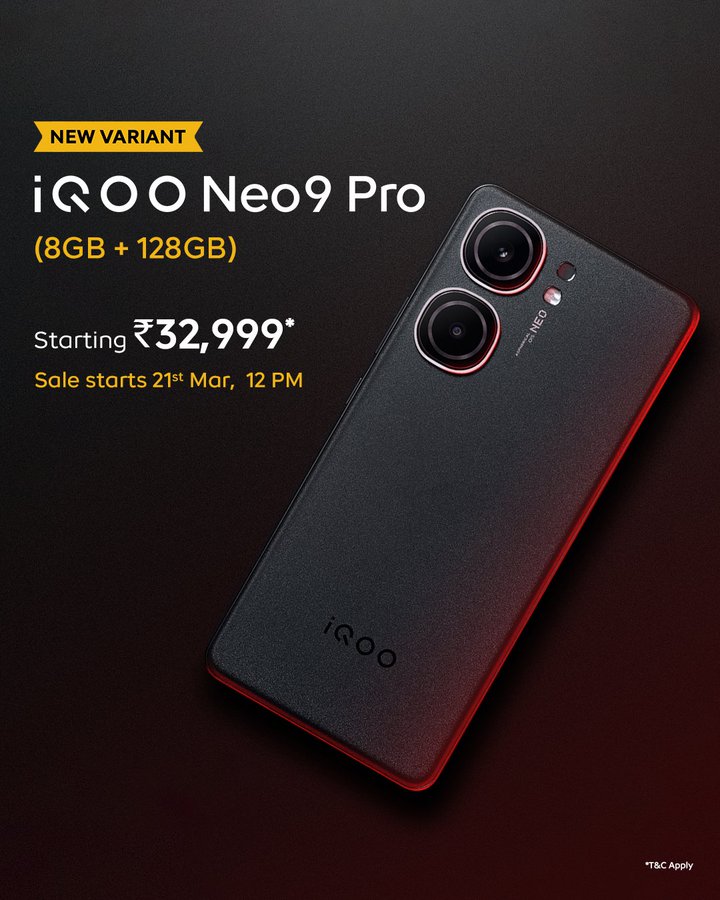
On Feb. 22, iQOO unveiled the iQOO Neo 9 Pro in India. While the company unveiled the phone in three configurations, it only sold its 8GB+256GB and 12GB+256GB variants. Starting today, the 8GB+128GB edition of the device is available for purchase in the country.
iQOO Neo 9 Pro’s new variant goes on sale in India
iQOO Neo 9 Pro’s new variant
The price of the 8GB+128GB variant of the iQOO Neo 9 Pro is Rs 35,999 (~$433). Buyers can benefit from offers like up to Rs 2,000 (~$24) discount using an ICICI credit card or an exchange bonus of up to Rs 4,000 (~$48). The phone can be bought in two shades, such as Fiery Red and Conqueror Black. The new variant is available for purchase through Amazon and iQOO India’s e-store.
iQOO Neo 9 Pro specifications
The iQOO Neo 9 Pro has a 6.78-inch AMOLED display that offers a 1.5K resolution and a 144Hz refresh rate. Under the hood, the device has the Snapdragon 8 Gen 2 chipset, LPDDR5x RAM, and UFS 4.0 storage. It houses a 5,160mAh battery with 120W fat charging support.
The Neo 9 Pro has a 16-megapixel camera for selfies and video calls. The back panel of the device has an OIS-enabled 50-megapixel Sony IMX920 main camera and an 8-megapixel ultra-wide lens.
The device runs on FunTouch OS 14-based Android 14. It is confirmed to receive three Android OS upgrades and four years of security updates. It has some other exciting features, such as dual speakers, an in-screen fingerprint sensor, an x-axis linear motor, an IR blaster, and a 6K VC liquid-cooled 3D heat dissipation system. It measures 7.99mm in thickness and weighs around 190 grams.
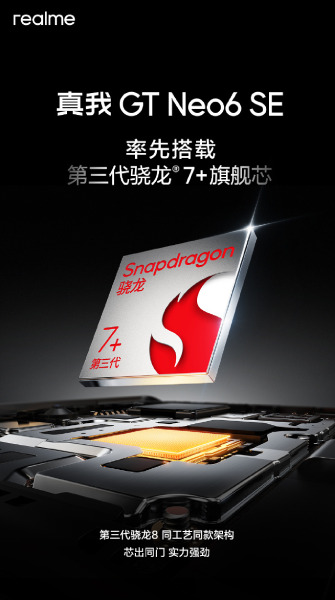
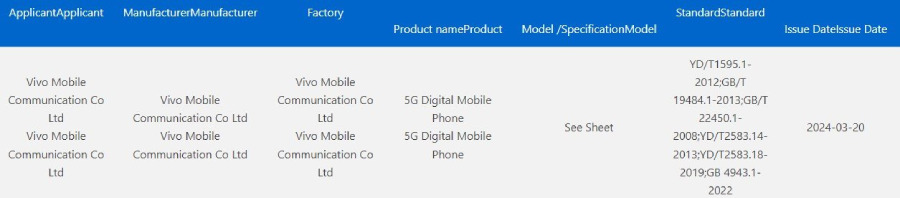
The Realme GT Neo 6 SE is expected to launch in China sometime in late March or April. The upcoming smartphone has now been spotted on the 3C certification site, revealing some details about its features.
While it’s not officially confirmed, the device with model number RMX3850 is strongly believed to be the Realme GT Neo 6 SE.
The RMX3850 listing reveals it will use a SUPERVOOC charger with the model number VCBAOBCH. This confirms that the GT Neo 6 SE will support 100W wired charging technology.
Moreover, aside from supporting 5G connectivity, the certification doesn’t reveal any further specifications for the device.
However, the company has confirmed that the smartphone will run on the Snapdragon 7+ Gen 3 chipset. Qualcomm was expected to unveil this SoC alongside the Snapdragon 8s Gen 3, but that didn’t happen. So we could directly see the chip in action in the upcoming smartphones.
The Snapdragon 7+ Gen 3 (SM7675) is said to feature a core cluster comprising 1 x 2.9 GHz Cortex-X4 + 4 x 2.6GHz Cortex-A720 + 3 + 1.9GHz Cortex-A520. For graphics, it comes with the Adreno 732 GPU.
Earlier this week, schematics of the smartphone have also surfaced online, revealing a design akin to its predecessor. Upfront, it’s rumored to flaunt an 8T LTPO AMOLED display. And the phone is said to have a 5500mAh battery, with support for 100W charging.
Apart from the Neo 6 SE, Realme is also working on the GT Neo 6, which is rumored to be powered by the Snapdragon 8s Gen 3 chip.
As details of the Realme GT Neo 6 series are starting to surface, more information is expected to become available in the coming days. Realme should also announce the launch date of the devices pretty soon.
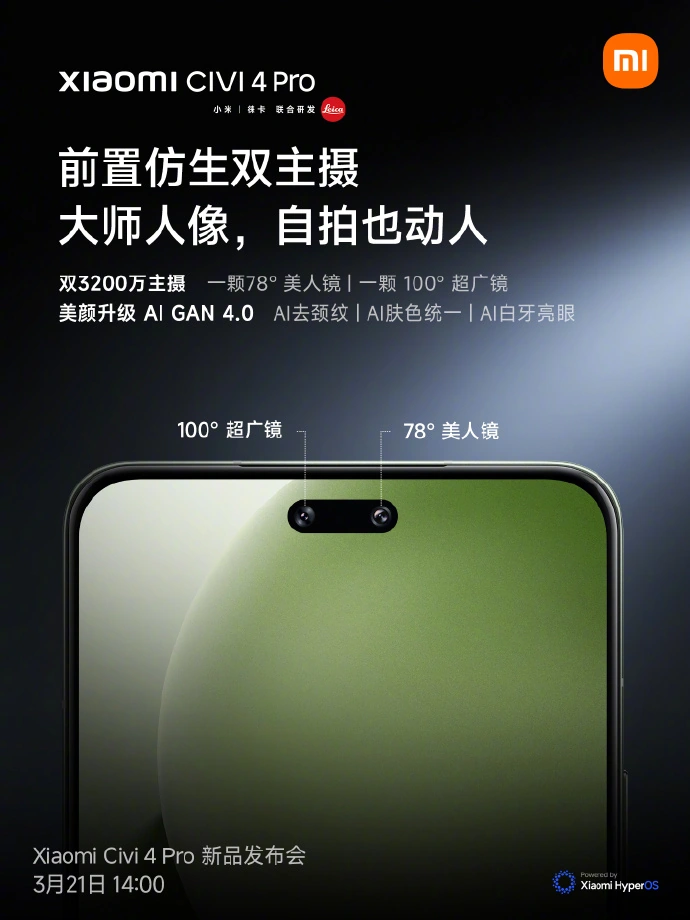
The Xiaomi Civi 4 Pro will be released at 14:00 PM in China today. Just hours before the launch, the company teased the 32MP dual front camera setup of this device. Xiaomi notes that these two cameras have different fields of view – one comes with a 78-degree FOV while the other offers a wider 100-degree FOV.
Xiaomi Civi 4 Pro “bionic dual main camera”
A 32MP dual front camera setup with AI features
A special feature of the front cameras of this phone is going to be the AI GAN 4.0 AI neck wrinkle removal. Notably, Neck wrinkles, also known as necklines, are a common sign of aging that appear as horizontal creases on the neck. This, if done right, could be one of the notable applications of AI in photography so far.
There are some other AI features associated with the imaging capabilities of this device as well, such as the skin tone unification or the ‘AI white teeth and bright eyes’. The phone reportedly offers the “Master Portrait function of the Xiaomi 14 Ultra.
We previously reported that the lenses for the Xiaomi Civi 4 Pro’s cameras are jointly developed in collaboration with Leica, a German company that specializes in camera lens manufacturing. The rear main camera comes with a wide f/1.63 aperture and an OmniVision Light Hunter 800 sensor behind the custom-made lenses.
The Light Hunter 800 sensor supports a dynamic range of 13.2 EV. For context, the Sony a7S III has a maximum dynamic range of 14 stops (13.91 EV) at its lowest ISO settings. This Light Hunter 800 was previously used in the Redmi K70 Pro, which was released towards the end of last year.
Vivo is gearing up to introduce its latest products in China this week, including the Vivo X Fold 3 series, a new tablet, and a TWS. However, there’s more in the pipeline from Vivo. Rumors suggest that the company is also working on new smartphones under the X100 series.
A new Vivo smartphone, possibly the Vivo X100s, has now received certification from the 3C certification website. The device carries the model number V2359A and will support 120W fast charging.
Apart from this detail, there isn’t much information available about the Vivo X100s from the certification.
If indeed it’s the Vivo X100s, tipster Digital Chat Station has been consistently sharing specifications of the upcoming device for several months now.
The insider has revealed that the device will come in Black, White, Green, and Titanium color options.
It’s rumored to sport a flat OLED display on the front, with minimal bezels, and a 1.5K resolution. The smartphone’s frame is expected to be flat and made of metal, while the back will feature a glass panel.
As for the processor, the X100S might be powered by a MediaTek Dimensity 9300 Plus SoC manufactured on a 4nm process. The notable difference between the regular Dimensity 9300 and the Plus model could be faster clock speeds.
For reference, the 9300 has one Cortex-X4 core clocked at 3.25GHz, three Cortex-X4 cores at 2.85GHz, four Cortex-A720 cores at 2.0GHz, and a Mali-G720 Immortalis MP12 GPU.
The upcoming flagship from Vivo is rumored to debut in China later this month. However, the company has yet to officially confirm any details about the smartphone’s release to date, making a March launch seem unlikely.
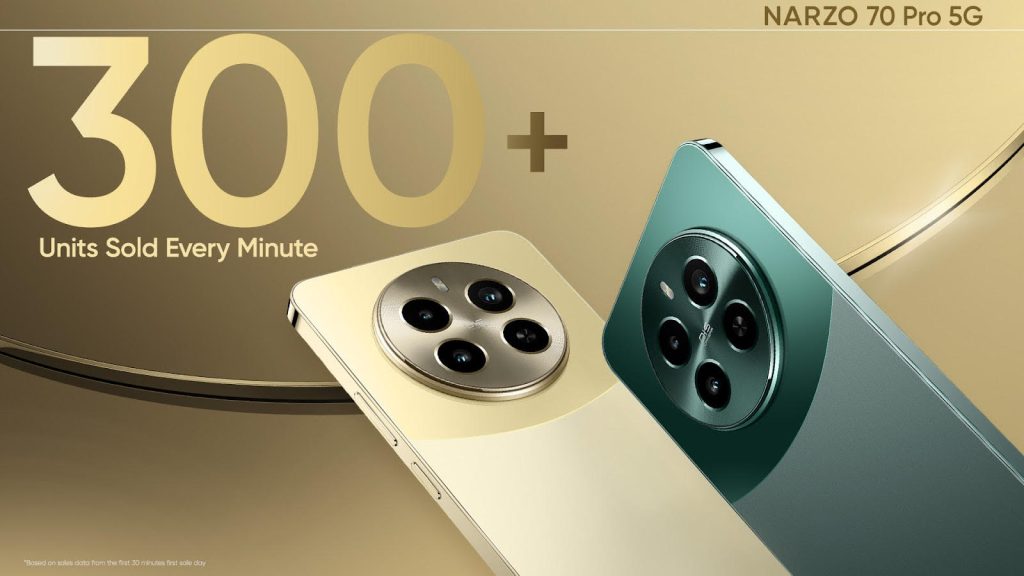
Earlier this week, Realme unveiled the Realme Narzo 70 Pro 5G in India. While the first sale of the smartphone is scheduled for tomorrow (March 22) in the country, it was made available for an early bird sale on the launch day (March 19) at 6pm for a limited period. Today, the brand rolled out a press release to confirm the sales figure it achieved through the early bird sale.
Realme Narzo 70 Pro 5G’s first sale report
Realme-Narzo-70-Pro-5G-first-sale report
Realme confirmed that it sold over 300 units of the Narzo 70 Pro 5G per minute during the early bird sale. It further said that sales of the device skyrocketed by 338 percent as compared to the Narzo 60 Pro 5G from last year.
The Realme Narzo 70 Pro 5G is an impressive device, packing many good features at an affordable price. The 8GB+128GB and 8GB+256GB editions of the device are priced at Rs 19,999 (~$240) and Rs 21,999 (~$265), respectively. You can purchase the device in Glass Green and Glass Gold editions.
Realme Narzo 70 Pro 5G specifications
The Realme Narzo 70 Pro 5G has a 6.67-inch AMOLED display that offers an FHD+ resolution, a 120Hz refresh rate, a rainwater smart touch feature, and an in-screen fingerprint sensor. The device runs on Realme UI 5-based Android 14. It is confirmed to receive two Android OS upgrades and three years of security updates.
The Narzo 70 Pro 5G has the Dimensity 7050 chip, 8 GB of LPDDR4x RAM, 8 GB of virtual RAM, 128 GB / 256 GB of UFS 3.1 storage, and a 5,000mAh battery with 67W fast charging. It has a 16-megapixel front camera, a 50-megapixel (Sony IMX890, OIS) + 8-megapixel (ultra-wide) + 2-megapixel (macro) triple camera unit.
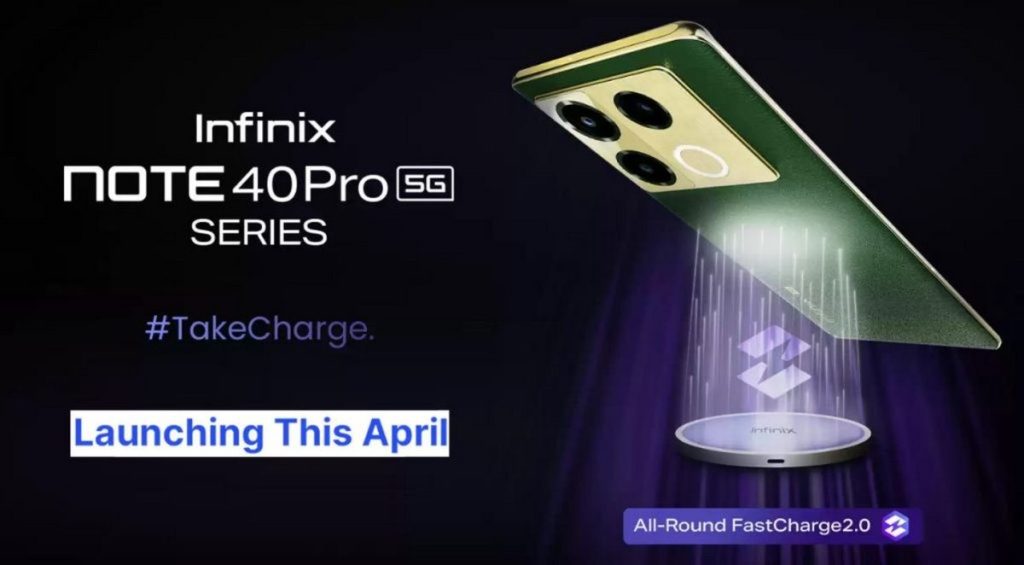
Recently, Infinix held a global launch event in Malaysia to announce the Infinix Note 40 series of smartphones. The company unveiled multiple devices, such as the Note 40 series of smartphones, the XBuds 3 WE, and the XWatch 3 WE smartwatch. Today, the brand officially confirmed the imminent release of the Note 40 Pro 5G series in India.
As can be seen in the above screenshot taken from a landing page that has appeared on Flipkart, the Infinix Note 40 Pro 5G series will be launching in April in India. The Note 40 lineup has four models, such as the Note 40, Note 40 Pro, Note 40 Pro 5G, and Note 40 Pro+ 5G. However, it seems that the country will only release the 5G variants. Here is a look at the specifications of both phones.
Infinix Note 40 Pro+ 5G, Note 40 Pro 5G specifications
Infinix Note 40 series April launch
The Infinix Note 40 Pro+ 5G has a 6.78-inch AMOLED display with curved edges. It offers a Full HD+ resolution, a 120Hz refresh rate, and an in-screen fingerprint sensor. It features the Dimensity 7020 chip, 12 GB of RAM, 256 GB of storage, and a 4,600mAh battery. The phone supports 100W wired charging and 20W MagCharge magnetic wireless charging.
The Note 40 Pro+ 5G has a 108-megapixel (main, with OIS) + 2-megapixel + 2-megapixel triple camera unit with quad-LED flash on the back and a 32-megapixel front-facing camera. It comes preloaded with XOS 14-based Android 14.
The Note 40 Pro 5G packs the same specs as the Pro+ variant, but differs in departments, such as battery size, wired charging, and RAM. The device ships with 8 GB of RAM and a 5,000mAh battery with 45W charging. The company has confirmed that it will receive two Android OS upgrades and three years of security updates.
Both devices should cost well under Rs 25,000 (~$300) in India. It is speculated that the smartwatch and buds will also make it to the Indian market.
The sub-20K INR price segment (~$250) continues to be the hottest category in the Indian smartphone market in terms of sales. However, the products aren’t as interesting to tech enthusiasts as they used to be earlier.
The Redmi Notes were once the de facto option for no matter who. While the Realme numbers were an alternative.
With an increase in prices, these product lineups left a big shoe to fill in for others. But that never happened until now
Recently, Realme Narzo 70 Pro 5G went official in India. Historically, Narzo phones have offered better value than their cousin Realme number series.
That’s no different this time either. In fact, I would say the Narzo series has one-upped its game.
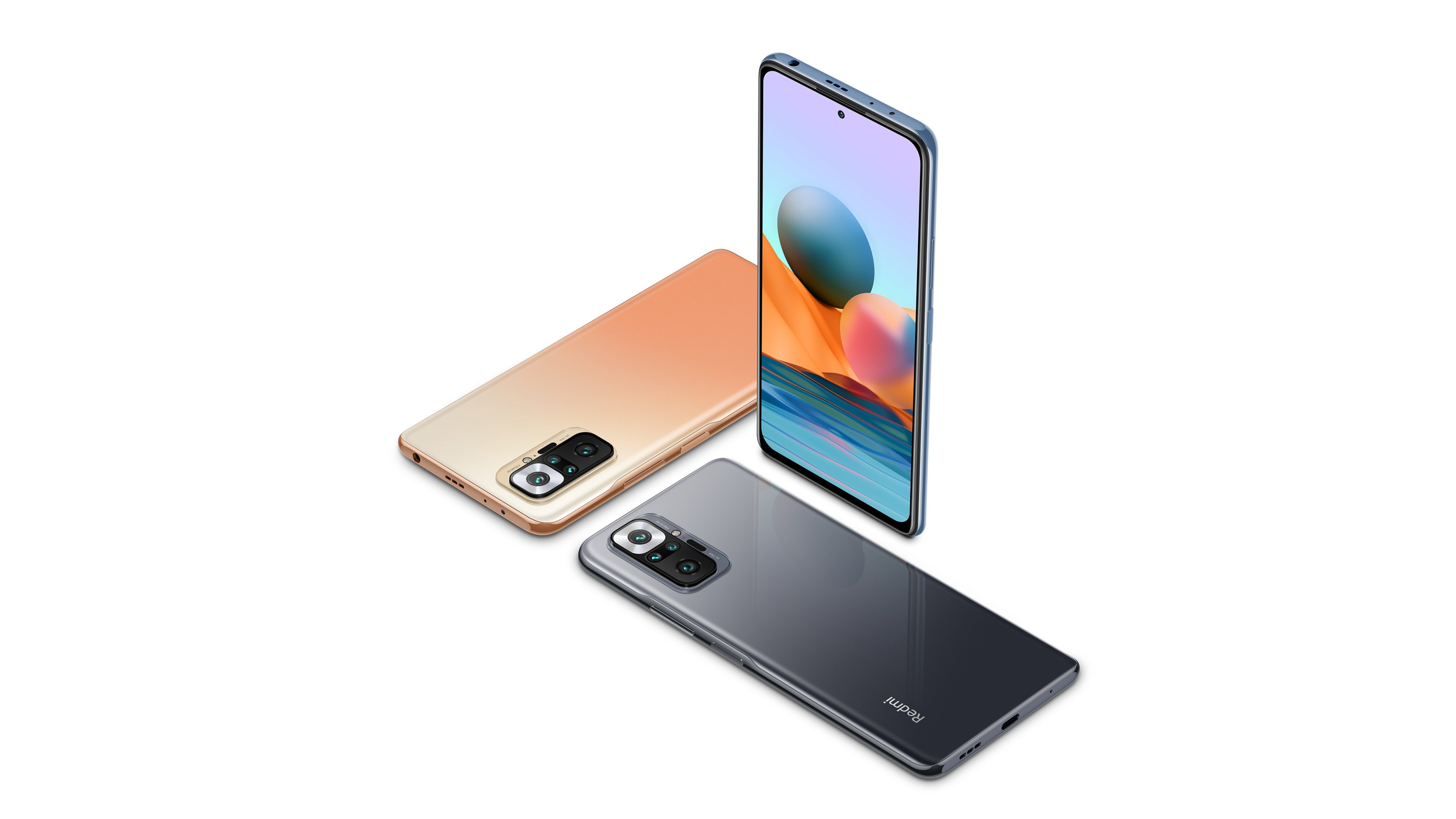
In my opinion, Realme Narzo 70 Pro 5G is the first interesting sub-20K INR smartphone after the hugely popular Redmi Note 10 Pro from 2021. Here’s why I think this way.
Most premium smartphones are best at everything the brand can offer. On the other hand, in the budget category, phones shine in one or a few categories.
Therefore, you get lots of options as each device caters to a different audience. But once in a while, there are some products that excel in almost everything in their segment. The Redmi Note 10 Pro was one of those handsets.
It not only just had an AMOLED display but one with a 120Hz refresh rate, 1200 nits peak brightness level, and HDR10+ support. The device was powered by the most powerful 4G-only Qualcomm mid-range chipset — Snapdragon 732G.
Further, it came with a 108MP primary camera and a 5MP telemacro camera. Both these sensors were unheard of in this segment. It also housed Doldby Atmo-supported dual stereo speakers and a large 5,020mAh battery with support for 33W wired charging.
Finally, it had a premium look and feel with a frosted glass back build.
2. Realme Narzo 70 Pro 5G is similar to Redmi Note 10 Pro in many ways
What we said about the Redmi Note 10 Pro also applies to Realme Narzo 70 Pro 5G to a great extent. Simply put, we can consider Narzo as the 5G version of Note.
The Narzo 70 Pro 5G has the brightest display in its segment with 2000 nits local peak brightness level. The screen-to-body ratio is not the best but not so far behind at 92.65% compared to Redmi Note 13’s 93.3%.
The handset’s primary highlights are its design and cameras. It is one of the few phones in the segment with a glass back and that too with a dual-tone finish (matte and glossy).
Most importantly, it has a flagship-grade Sony IMX890 primary camera with OIS. It is the first and the only device in its segment to feature this sensor.
The handset is powered by a Dimensity 7050 chip, which is only slower than the Dimensity 7200 SoC present inside its direct competitor iQOO Z9 5G. While in other departments, Narzo aces over iQOO with features like 67W wired charging and others mentioned above.
In other words, just like the Redmi Note 10 Pro, the Realme Narzo 70 Pro 5G caters to all types of consumers, including enthusiasts.
3. But there’s one notable difference
The Redmi Note 10 Pro was a multi-channel product. In simpler words, it was available widely across both offline and online channels. Thus, it not only had more reach but also several financing options to make it approachable to more consumers.
Whereas the Realme Narzo 70 Pro 5G is an online-esclusive product. It is only sold through Realme.com and Amazon. Thus, its reach is about half as that of Redmi Note 10 Pro.
Therefore, I don’t think that the Realme smartphone will be as popular as Redmi despite being the best product in the sub-20K INR price segment
We use cookies on our website to give you the most relevant experience by remembering your preferences and repeat visits. By clicking “Accept”, you consent to the use of ALL the cookies.
This website uses cookies to improve your experience while you navigate through the website. Out of these, the cookies that are categorized as necessary are stored on your browser as they are essential for the working of basic functionalities of the website. We also use third-party cookies that help us analyze and understand how you use this website. These cookies will be stored in your browser only with your consent. You also have the option to opt-out of these cookies. But opting out of some of these cookies may affect your browsing experience.
Necessary cookies are absolutely essential for the website to function properly. This category only includes cookies that ensures basic functionalities and security features of the website. These cookies do not store any personal information.
Any cookies that may not be particularly necessary for the website to function and is used specifically to collect user personal data via analytics, ads, other embedded contents are termed as non-necessary cookies. It is mandatory to procure user consent prior to running these cookies on your website.