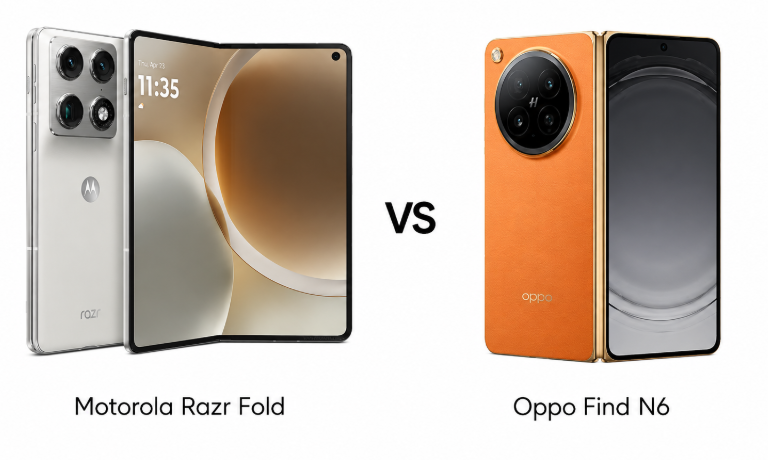
Motorola Razr Fold and Oppo Find N6 are two of the most ambitious foldables yet, but they take completely different approaches. Motorola focuses on flashy displays and a polished user experience, while Oppo pushes raw hardware, durability, and flagship-grade engineering. With both targeting premium buyers, this comparison reveals which foldable truly delivers the better overall package.
Major Features:
Feature
Motorola Razr Fold
Oppo Find N6
Winner
Main Display
8.1-inch LTPO P-OLED, 120Hz, 6200 nits peak
8.12-inch LTPO OLED, 120Hz, 2500 nits peak
Motorola – Much brighter display with stronger outdoor visibility
Cover Display
6.6-inch LTPO P-OLED, 165Hz, 6000 nits
6.62-inch LTPO OLED, 120Hz, 3600 nits
Motorola – Smoother cover display and higher brightness
Display Features
Dolby Vision, HDR10+
Dolby Vision, HDR10+, HDR Vivid, 2160Hz PWM
Oppo – Better eye comfort and richer display tuning
Build Quality
IP48/IP49, Gorilla Glass Ceramic 3
Titanium hinge, Nanocrystal Glass, IP58/IP59
Oppo – More advanced durability and hinge engineering
Chipset
Snapdragon 8 Gen 5
Snapdragon 8 Elite Gen 5
Oppo – Faster and more powerful chipset
GPU
Adreno 829
Adreno 840
Oppo – Better gaming and graphics performance
Software Support
7 Android upgrades
Android 16 with ColorOS 16
Motorola – Longer software commitment
RAM & Storage
Up to 16GB RAM, 1TB UFS 4.1
Up to 16GB RAM, 1TB UFS 4.1
Tie – Similar flagship memory setup
Main Camera
50MP triple setup
200MP + dual 50MP setup
Oppo – More flagship-grade photography hardware
Telephoto Camera
50MP 3x periscope
50MP 3x periscope
Tie – Similar zoom hardware
Ultrawide Camera
50MP ultrawide
50MP ultrawide
Tie – Comparable ultrawide performance
Video Recording
8K Dolby Vision, 4K120fps
4K120fps Dolby Vision
Motorola – Better video recording capabilities
Selfie Cameras
20MP inner + 32MP cover
Dual 20MP cameras
Motorola – Better cover selfie camera
Battery
6000mAh
6000mAh
Tie – Same battery capacity
Charging
80W wired, 50W wireless
80W wired, 50W wireless
Tie – Similar charging performance
Reverse Charging
5W reverse wireless
Reverse wireless + reverse wired
Oppo – More versatile charging features
Connectivity
Wi-Fi 7, USB 3.2
Wi-Fi 7, IR Blaster, satellite connectivity
Oppo – More premium connectivity features
Audio
Stereo speakers tuned by Bose
Dolby Atmos stereo speakers
Motorola – Better audio tuning experience
Overall Experience
Entertainment-focused foldable
Productivity-focused foldable
Oppo – More complete flagship foldable overall
Price
$1900 / ₹1,50,000
$1800 / ₹1,40,000
Oppo – Better hardware package at a lower price
Disclaimer: Specs are based on available data. Actual performance may vary. Verify details from official sources before buying.
The Motorola Razr Fold and Oppo Find N6 both represent the latest generation of premium foldables, but they focus on very different experiences. Motorola takes a flashier approach with extremely bright displays, polished styling, and a cleaner Android experience that feels immediately familiar. The hinge mechanism appears refined, and the overall finish gives the device a futuristic flagship personality. Stylus support and strong water resistance also add flexibility for everyday use.
The Oppo Find N6 feels more engineering-focused. Its titanium alloy hinge, aircraft-grade aluminum frame, and self-healing internal display technology make it feel designed for long-term durability. The foldable crease is also less noticeable, giving the inner screen a cleaner tablet-like appearance during multitasking. Oppo’s design language feels slightly more mature and productivity-oriented overall.
Display Quality
Motorola dominates brightness with up to 6200 nits peak brightness and a smoother 165Hz cover display. Oppo counters with better PWM dimming, HDR Vivid support, and more natural color calibration.
Verdict
Motorola delivers the more visually striking display experience, while Oppo feels more refined and durable. Motorola wins slightly for media consumption, but Oppo feels more premium in day-to-day foldable usage.
2. Specifications Including Battery
Performance
The Motorola Razr Fold uses the Snapdragon 8 Gen 5 chipset with the Adreno 829 GPU, delivering flagship-level gaming and multitasking performance. Motorola’s lighter Android experience also helps the phone feel smooth and responsive during heavy usage. Combined with seven years of Android upgrades, the device feels built for long-term reliability rather than just raw benchmark numbers.
The Oppo Find N6 pushes performance further with the newer Snapdragon 8 Elite Gen 5 and Adreno 840 GPU. The newer chipset offers stronger AI capabilities, improved graphics, and slightly better efficiency under demanding workloads. ColorOS 16 also feels heavily optimized for foldable multitasking, making split-screen workflows and floating apps more seamless. Oppo’s tuning feels more aggressive and productivity-focused overall.
Battery and Charging
Both devices pack large 6000mAh silicon-carbon batteries with 80W wired and 50W wireless charging. Battery endurance should be excellent on both, though Oppo adds broader charging protocol support and better reverse charging flexibility.
Verdict
Oppo takes a narrow lead in overall hardware performance and multitasking optimization, while Motorola offers a cleaner and more consistent software experience for long-term users.
3. Camera
Main and Secondary Lenses
Motorola uses a balanced triple 50MP setup with a large primary sensor, a 3x periscope lens, and a high-resolution ultrawide camera. The setup feels versatile and reliable across photography and videography. Motorola also stands out with 8K Dolby Vision recording and strong stabilization features, making the device especially appealing for creators who prioritize video quality.
The Oppo Find N6 focuses more heavily on photography with its 200MP primary camera and Hasselblad color tuning. Images are expected to look richer, sharper, and more dynamic, especially in daylight and portrait photography. Oppo’s processing style feels more dramatic and flagship-like, while the ultrawide and telephoto cameras remain consistently strong.
Selfie Camera
Motorola offers a stronger cover selfie camera with a 32MP sensor, giving folded selfies and video calls an advantage. Oppo keeps things more balanced with dual 20MP sensors.
Verdict
Oppo feels slightly stronger for photography enthusiasts, while Motorola offers a better overall video experience. The difference is small, but Oppo takes a narrow edge in overall camera hardware.
4. Pricing
The Motorola Razr Fold is priced at approximately ₹1,50,000 ($1900), while the Oppo Find N6 is expected to launch around ₹1,40,000 ($1800).
Motorola justifies its pricing with extremely bright displays, long software support, polished video features, and a cleaner Android experience. The device feels tailored toward users who want a premium foldable that remains simple and dependable during everyday use.
Oppo, however, feels positioned as the more ambitious flagship. The combination of the Snapdragon 8 Elite Gen 5, titanium hinge, self-healing display, and Hasselblad camera system gives the Find N6 a stronger flagship appeal at its expected pricing.
Verdict
At $1800, Oppo becomes the stronger value proposition overall. Motorola still delivers a polished flagship experience, but Oppo feels harder to ignore in the ultra-premium foldable category.
Disclaimer: Prices are approximate and may vary based on country, region, launch timing, and applicable taxes. Always check whether the listed price is for a China unit or a global/international variant when purchasing.
5. Conclusion
The Motorola Razr Fold stands out with its incredibly bright displays, smoother 165Hz cover screen, cleaner Android experience, long-term software support promise, and advanced video recording capabilities. It feels polished, entertainment-focused, and easier to recommend for buyers moving into foldables for the first time. Motorola’s software experience also feels more straightforward and less overwhelming during daily use.
The Oppo Find N6 feels more like a showcase of foldable engineering. The titanium hinge, self-healing internal display, stronger chipset, satellite connectivity option, and Hasselblad-tuned cameras create a device that feels highly advanced and productivity-focused. Oppo’s multitasking experience also appears more refined for heavy users who plan to fully utilize the foldable form factor.
Verdict
Oppo Find N6 feels like the better overall foldable. At $1800 / ₹1,40,000, it delivers the stronger chipset, more advanced hinge and display technology, better durability engineering, a more flagship-grade camera system, and a foldable experience that feels more complete for both productivity and premium usage. The Motorola Razr Fold still has the better displays for brightness, cleaner software support, and stronger video features, but overall, the Oppo package feels more impressive and harder to beat at that price.
Disclaimer: This comparison is based on the specifications provided and is intended for general informational purposes. Actual performance, camera results, battery life, and overall experience may vary depending on real-world usage, software updates, and individual preferences.
Kynooe has officially launched its new AI-powered robotic arm on Kickstarter, introducing a fully modular robotic arm designed for everyday users rather than just engineers or robotics experts.
Built for home assistance, smart automation, content creation, and creative workflows, Kynooe combines modular hardware, AI-powered interaction, and app-based controls into a more consumer-friendly robotics platform. The project focuses on making robotics more accessible through a no-code experience and a flexible modular ecosystem.
Beginner-Friendly Setup Without Coding
One of the key highlights of Kynooe is its beginner-focused setup process. The system uses a plug-and-play modular design and can be controlled through a companion app with an interface designed to feel as intuitive as using a smartphone.
Instead of relying on traditional robotics programming or complex engineering setups, users can control and customize the robot through visual interface tools, AI-assisted interactions, and simplified workflows. The no-code approach is designed to lower the barrier to entry for users who are new to robotics.
Fully Modular Design With Expandable Accessories
Unlike traditional robotic arms built for fixed functions, Kynooe features a fully modular architecture that supports interchangeable tools, accessories, and attachments. The platform is compatible with precision instruments, custom modules, and even 3D-printed extensions for specialized use cases.
The company sums up the concept with the tagline “One arm. Infinite applications,” emphasizing the system’s adaptability across diverse workflows and environments. Depending on the configuration, the robot can shift seamlessly between creative assistance, intelligent filming, automation tasks, and productivity-focused applications.
AI Features and Natural Interaction
Kynooe also integrates AI-powered interaction features aimed at making the experience feel more conversational and intuitive. Users can interact with the robot through natural language commands instead of relying entirely on manual controls or traditional programming methods.
One of the major built-in features is on-device AI face tracking. The feature is aimed at content creators and smart filming setups. The robotic arm can automatically track faces and adjust camera movement for smoother recording and hands-free filming support. The company also plans to introduce additional on-device AI features in the future, aiming to improve user experience while maintaining user privacy.
Built for Everyday Scenarios
Rather than focusing solely on industrial or engineering applications, Kynooe is positioned as a robotics platform for real-world, everyday use cases. The system is designed for household assistance, entertainment, smart filming, creative projects, and interactive experiences with family and friends.
The robotic arm adapts across different scenarios depending on the selected modules and accessories, allowing users to customize the system around their own workflows and creative needs.
Open Ecosystem and Kynooe Robot Hub
Beyond hardware, Kynooe is also building an ecosystem focused on embodied AI and community-driven robotics development. The company plans to release an open-source SDK on GitHub that will provide developers and advanced users with access to everything from AI integrations to low-level robotic joint controls.
The ecosystem also includes the Kynooe Robot Hub, a platform where users can train, customize, publish, and share robotic behaviors and workflows with the broader community. The company envisions a future where robotic skills can be shared, downloaded, and deployed as easily as mobile apps.
Development Progress and Manufacturing Timeline
According to the company, Kynooe has already completed structural design work, hardware validation, and small-batch trial production. The project is currently moving toward certification, production validation testing, and mass production preparation ahead of planned shipments later in 2026.
The current roadmap includes ongoing tooling optimization, manufacturing preparation, and compliance testing as the company scales toward full production.
Shipping Plans and Kickstarter Offers
Kynooe is scheduled to officially launch on Kickstarter on May 20. The campaign will feature a range of launch-day discounts, limited-edition rewards, and multiple pledge options designed for different types of users, including creator-focused bundles and modular accessory packages.
According to the company, the first batch of shipments is currently expected to begin around September 2026, followed by ongoing fulfillment and second-batch deliveries planned for October 2026.
More information about the project is available on the official Kickstarter campaign page.
Verdict
Rather than building yet another industrial robotic arm, Kynooe aims to reimagine robotics as a flexible everyday companion for creators, smart homes, and personal automation. Its combination of modular hardware, AI-powered interaction, and beginner-friendly controls makes it one of the most ambitious consumer robotics projects currently entering the crowdfunding space.
Starting this September, multiple brands are expected to launch their next-generation flagship phones. Among these brands, Honor is expected to announce the Magic 9 lineup around October and the Win 2 series by the end of the year. While the Magic 9 series will focus on delivering a top-notch photography experience, the Win 2 models will be performance-driven devices aimed at gaming enthusiasts.
In a Weibo post shared today, tipster Digital Chat Station claimed that the Win 2 series will offer an exclusive combination of specifications that may not be available from any other brand for quite some time.
Honor Win 2 series key details tipped
DCS claims that the upcoming Honor Win 2 series could become the only smartphone lineup this year to combine a next-generation 2nm flagship chipset, which appears to be the forthcoming Snapdragon 8 Elite Gen 6, with a massive 10,000mAh battery. According to the leak, this combination may remain exclusive to Honor for quite some time, giving the brand a unique advantage in the performance-focused flagship smartphone segment.
Apart from the above-mentioned specifications, the Win 2 series is also expected to feature a built-in cooling fan, similar to the original Win series. The tipster recently claimed that the new lineup will launch sooner than expected in China. It is expected to compete with devices such as the OnePlus 16, iQOO 16, and Redmi K100 series.
Honor Win Turbo incoming
Meanwhile, the brand is currently teasing the arrival of the Honor Win Turbo in China. This upcoming phone is believed to be a rebranded or slightly tweaked version of the existing Honor Power 2.
As a result, the Honor Win Turbo is expected to feature a 6.79-inch AMOLED display with a 120Hz refresh rate, a Dimensity 8500 Elite chipset, 12GB of RAM, and up to 512GB of storage. It is also expected to pack a massive 10,080mAh battery with 80W charging support. For photography, the phone may include a 50-megapixel primary camera, a 5-megapixel ultra-wide sensor, and a 16-megapixel front-facing camera.
For more daily updates, please visit our News Section.
Oppo is all set to unveil the Reno 16 and Reno 16 Pro on May 26 in China. As usual, the company is expected to introduce several other products alongside its Reno smartphones. This time too, the brand will unveil a couple of new devices, including the Oppo Pad 6 tablet and the Oppo Bubble accessory for the Reno 16 series.
Oppo Pad 6: What to expect?
Oppo Pad 6 key details confirmedOppo Pad Air 5 new color variant
The Oppo Pad 6 is expected to arrive as a premium tablet focused on entertainment and productivity. The device will feature a 12.1-inch LCD panel offering a 3K resolution of 3000 x 2120 pixels, a 144Hz refresh rate, and a 7:5 aspect ratio. The tablet is also tipped to feature a slim 5.99mm chassis while weighing around 577 grams.
Under the hood, the Oppo Pad 6 is said to be powered by the Dimensity 9500s chipset. It may pack a 10,420mAh battery with support for 67W fast charging. The upcoming tablet is also expected to arrive in grey, silver, and blue shades.
Oppo Bubble: A selfie-focused accessory
Oppo Bubble
The Oppo Bubble is a selfie display accessory that comes with a small circular screen that can magnetically attach to the back of a phone and can be used as a selfie preview display. It also appears to support custom emojis and images, allowing users to use it as a decorative mini display on the rear of the phone.
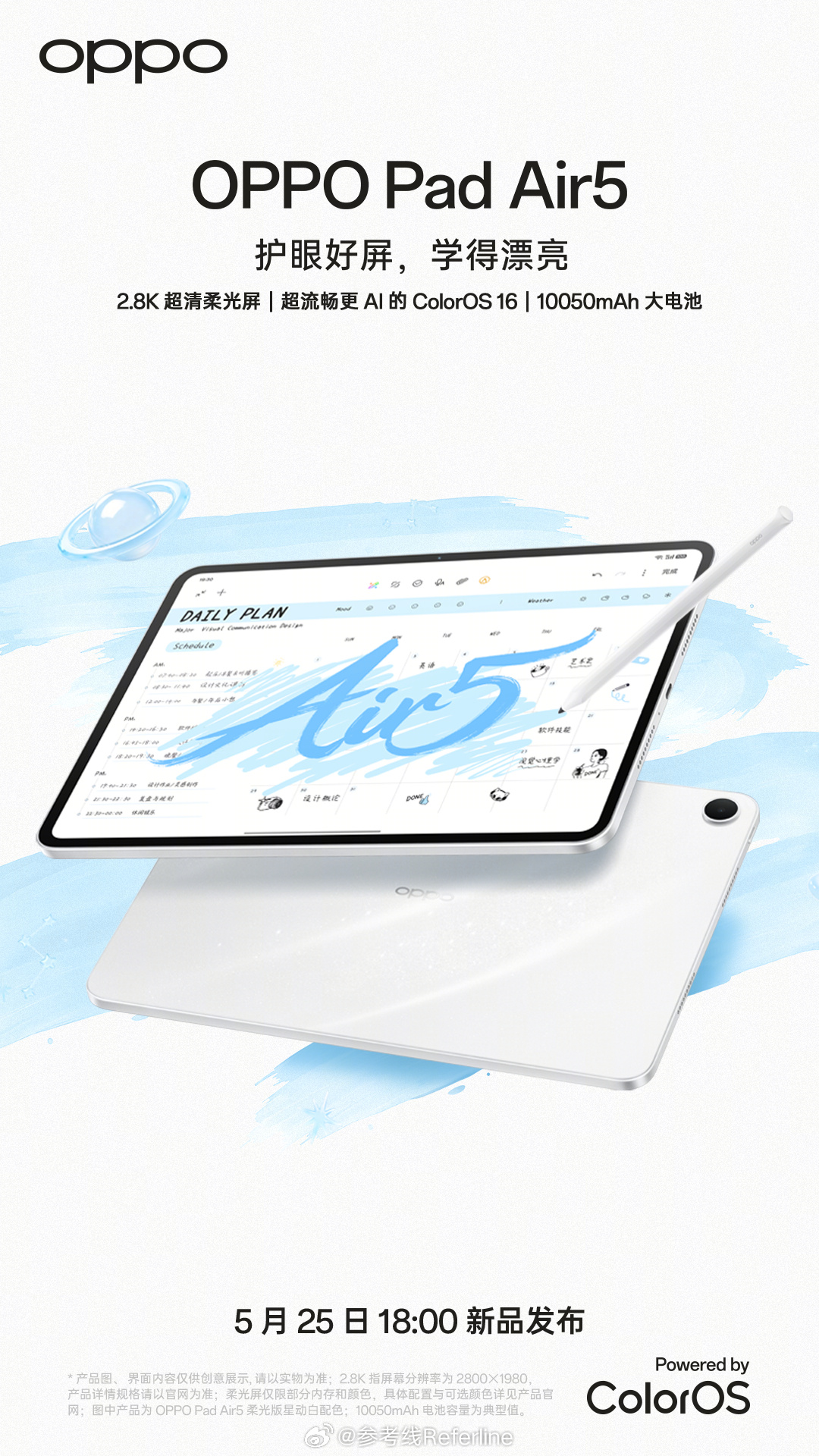
Alongside the Pad 6, Oppo is also expected to unveil the OPPO Enco Air 5s earbuds. However, nothing is known about the upcoming earbuds at the moment. The company is additionally preparing to introduce a new color option for the Oppo Pad Air 5, which originally launched in China in December 2025. The official poster suggests that it could be a white variant.
The Oppo Pad Air 5 features a 12.1-inch 2.8K LCD display with a 120Hz refresh rate and a 7:5 aspect ratio. It is powered by the Dimensity 7300-Ultra chipset and packs a 10,050mAh battery with 33W charging support. The tablet measures 6.83mm in thickness and weighs 597 grams. The new shade will reportedly join the existing Starlight Pink and Space Gray colour options.
For more daily updates, please visit our News Section.
Realme has been gradually revealing key details about the Realme 16T, which is all set to launch on May 22 in India. Recently, the company confirmed the battery size and charging capabilities of the device. Today, the brand has confirmed its camera capabilities, promising improved portrait photography and AI-powered imaging features.
Realme 16T camera features confirmed
The Realme 16T 5G features a 50-megapixel Sony IMX852 AI camera paired with an F1.8 aperture, autofocus support, and the company’s LumaColor IMAGE Engine. According to Realme, the setup is designed to improve portrait sharpness, texture details, and color accuracy in everyday photography.
The camera system also includes RAW HDR processing and customized white balance tuning to deliver better highlights, shadows, and natural-looking portrait shots. AI Portrait Glow is another key feature aimed at improving portraits captured in low-light and backlit environments through automatic lighting optimization and multiple lighting effects.
Apart from the camera hardware, the Realme 16T 5G also introduces several AI-based photography and editing tools. The phone includes a rear Selfie Mirror feature that lets users preview selfies while using the rear camera. It also supports AI Popout Collage for frame-breaking photo effects, along with AI StyleMe tools such as AI Profile Portrait and AI Football Star. In addition, AI Instant Clip can automatically turn photos and videos into short cinematic clips within seconds for social media sharing.
Realme has previously confirmed that the Realme 16T will feature a 6.8-inch flat AMOLED display with a 144Hz refresh rate and 1,200 nits peak brightness. The device will pack an 8,000mAh battery with 45W charging and bypass charging support. It will be available in Aurora Green, Starlight Red, and Starlight Black color options. For durability, the device will carry an IP69 rating for dust and water resistance, along with military-grade shock resistance.
Apart from the Realme 16T, the brand will also launch two other products, namely the Buds Air 8 Pro and the Watch S5. Readers can visit this post to learn more about these devices.
For more daily updates, please visit our News Section.
Samsung’s rollout of the May 2026 security update is underway following a brief delay. The update first arrived on some mid-range Galaxy A-series models before it started expanding to premium Galaxy S-series and XCover models.
We’ve prepared a list of Galaxy devices that have started receiving the May security update. Check out the list below to see if yours is included.
These Samsung devices are receiving the May 2026 security update
Galaxy S series
Galaxy S26
Galaxy S26+
Galaxy S26 Ultra
Galaxy A series
Galaxy A57
Galaxy A56
Galaxy A55
Galaxy A54
Galaxy A06
Galaxy XCover series
Galaxy XCover 7 Pro
Galaxy XCover 6 Pro
The list is short because the rollout began only recently. It should grow over the coming days as more Galaxy devices receive the update. We’ll update the list regularly to ensure it’s fresh. To check whether the update is available on your device, go to Settings > Software updates, then tap Download and install.
According to Samsung’s Security Updates page, the May 2026 security patch for Galaxy devices includes fixes for a total of 37 vulnerabilities. It includes 30 fixes from Google, which include 2 critical-level fixes, 27 high-level fixes, and 1 fix doesn’t apply to Samsung devices. The latest security patch also contains seven Samsung-specific fixes (SVEs).
Samsung’s software team is likely extremely busy at this point. The One UI 8.5 stable rollout is ongoing, and the One UI 9.0 beta program has also begun recently. The company is rumored to have also begun working on One UI 9.5.
With a lot of work in progress, it’s not surprising to see a delay in the monthly security update release. Anyway, the May security update has started to expand to more Galaxy devices, and we’ll likely see it rolling out to other devices at a better pace from here on.
We’ll keep bringing you the latest One UI updates in our Samsung section. You can bookmark the page to visit it later or join our Telegram channel to get notified when we post new stories.
Reports have suggested that Samsung’s upcoming Galaxy Unpacked event, which is expected to be held on July 22, may see the arrival of three foldable phones. These could include the all-new Galaxy Z Fold 8 Wide (tentative name) with a wide-foldable design, alongside the regular Galaxy Z Fold 8 and Galaxy Z Flip 8. A new update from a Weibo tipster now suggests that Samsung may abandon the Galaxy Z Flip lineup next year.
Samsung Galaxy Z Flip 9 not in development, claims tipster
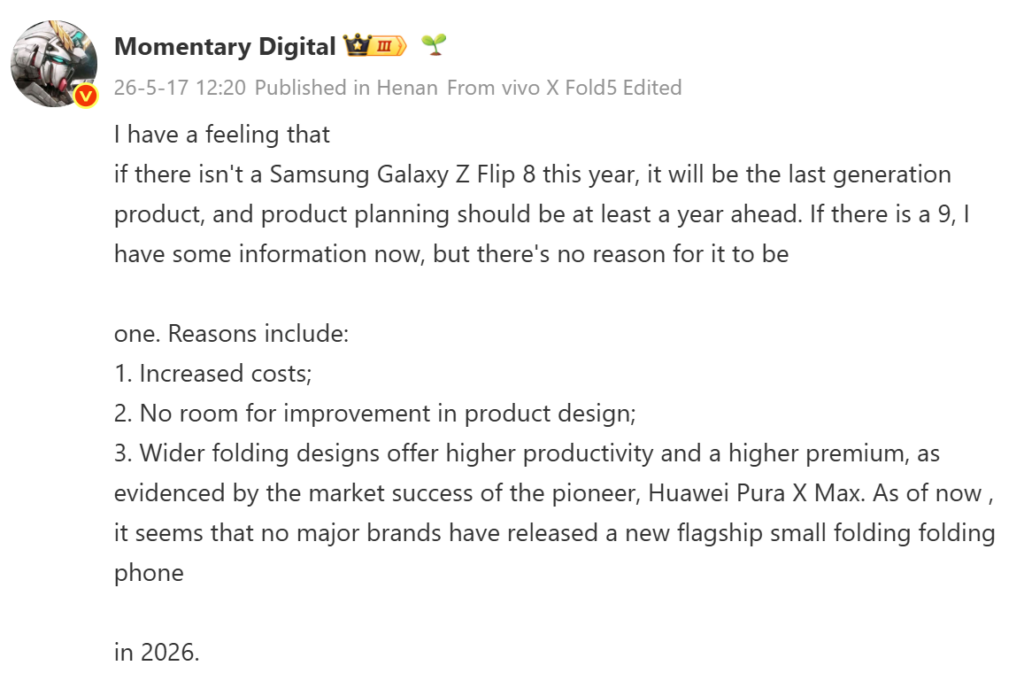
Tipster Momentary Digital claims that Samsung may not launch the Galaxy Z Flip 9 next year, and even if the Galaxy Z Flip 8 arrives this year, it could end up being the final generation in the Galaxy Z Flip lineup. According to the tipster, smartphone product planning usually begins at least a year in advance, and the absence of any early information regarding a possible Galaxy Z Flip 9 raises doubts about the future of Samsung’s clamshell foldable series.
The tipster cited three major reasons behind this speculation. First, rising production costs are said to be making compact foldable phones less attractive for manufacturers. Second, the current clamshell foldable design is believed to have reached a stage with limited room for major innovation or design improvements. Third, larger foldable phones are reportedly offering better productivity experiences and higher profit margins.
Momentary Digital also pointed to the market response for Huawei’s Pura X Max, claiming its popularity highlights growing consumer interest in larger foldable devices. The tipster further noted that, so far in 2026, most major smartphone brands have not introduced new flagship flip phones, which could indicate a broader shift in strategy within the foldable smartphone market.
So, what Samsung foldables are expected in 2027? With the Galaxy Z Flip 9 reportedly not in development, Samsung’s foldable lineup next year could include the Galaxy Z Fold 9 and the Galaxy Z Fold 9 Wide. As usual, readers are advised to take this report with a pinch of salt while waiting for more updates regarding the future of the Galaxy Z Flip series.
For more daily updates, please visit our News Section.
Motorola has started teasing a new Edge series smartphone for the Indian market. The company has now revealed the phone’s design language, camera styling, finish options, and availability details through a dedicated Flipkart microsite ahead of the official launch announcement. While the brand has not confirmed its name yet, the URL of the microsite confirms that the upcoming phone will be called the Motorola Edge 70 Pro+.
Motorola Edge 70 Pro+ teasers released
The teaser images confirm that the Motorola Edge 70 Pro+ will feature a triple rear camera setup placed inside a square-shaped camera module. Motorola is also highlighting portrait photography as one of the key camera experiences on the upcoming phone. Promotional images shared by the company showcase portrait samples with varying focal lengths and depth effects.
The camera module carries Sony LYTIA branding along with optical image stabilisation support. Motorola has also confirmed an 81mm focal length sensor, indicating that the phone may include a dedicated portrait or telephoto camera. However, the complete camera specifications have not yet been officially revealed.
Design appears to be another major focus for the Edge 70 Pro+. The company has teased three different rear panel finishes, including Satin-Luxe, Sculpted Wood, and a Twill-inspired texture. The phone is shown in brown, red, and teal color options, each carrying a distinct texture and finish aimed at offering a more premium in-hand feel. These color options are completely different from the regular Edge 70 Pro.
The teasers further confirm that the smartphone will feature a hole-punch display design on the front, while the frame appears to have a metallic finish. Motorola has also confirmed that the device will be available for purchase in India via Flipkart once it launches.
Motorola has not yet announced the official launch date or pricing details for the Edge 70 Pro+. A recent report revealed that apart from featuring a periscope telephoto camera, wireless charging and 16GB RAM will be key distinguishing features that will set the Pro+ variant apart from the Pro edition. In terms of pricing, the device may carry a sub-Rs 50,000 price tag.
At the moment, the company has only confirmed the design, colourways, camera styling, and Flipkart availability through teaser materials. More hardware specifications and launch details are expected to be revealed in the coming days.
For more daily updates, please visit our News Section.
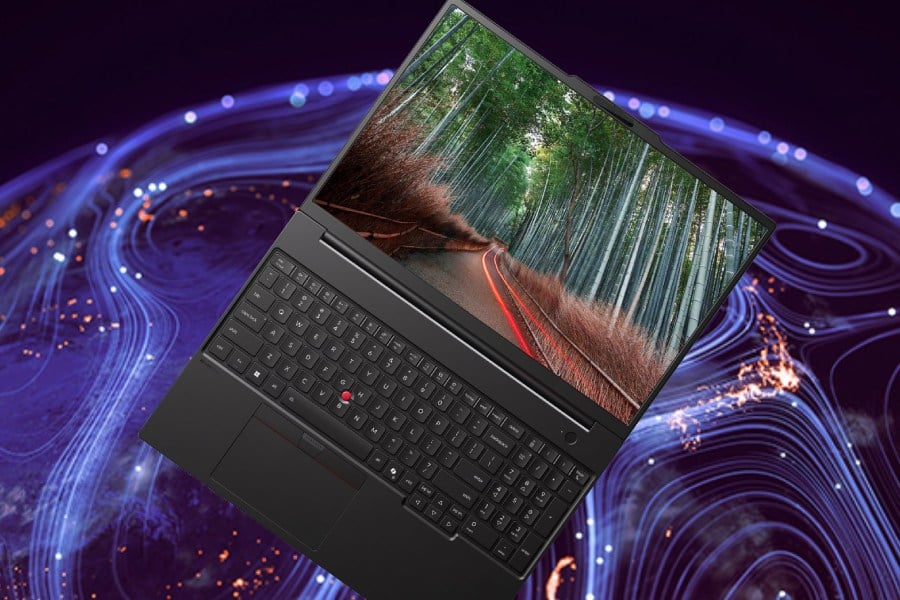
Lenovo has announced the AMD version of the ThinkPad P16s Gen 5 laptop for European markets shortly after unveiling the ThinkPad P14s Gen 7. The new mobile workstation brings updated AMD Ryzen AI Pro processors, LPCAMM2 memory, optional NVIDIA RTX Blackwell graphics, and a larger 90Wh battery option. The laptop starts at AU$2,979.
Lenovo ThinkPad P16s Gen 5 Specifications
The ThinkPad P16s Gen 5 AMD model comes with selections for AMD’s latest Ryzen AI Pro processors. You can choose between the Ryzen AI 5 Pro 440, Ryzen AI 7 Pro 450, and the top-end Ryzen AI 9 HX Pro 470 chip. The highest configuration offers 12 cores and 24 threads with boost speeds reaching up to 5.2GHz.
For graphics, the laptop includes integrated AMD Radeon graphics by default, but users upgrading the processor can also configure the system with discrete NVIDIA RTX Pro Blackwell GPUs. Available options include the RTX Pro 1000 and RTX Pro 2000 Laptop GPUs with 8GB GDDR7 memory.
One of the major upgrades is the use of LPCAMM2 memory. Lenovo offers memory configurations ranging from 16GB to 96GB LPDDR5X memory. The installed memory runs at LPDDR5X-7500 speeds due to platform limitations, although the hardware itself is rated for LPDDR5X-8533.
The ThinkPad P16s Gen 5 AMD also includes three 16-inch display options. The entry-level model uses a WUXGA IPS panel with 400 nits brightness, while a higher-end WUXGA version adds touch support, 500 nits brightness, and variable refresh rate support between 30Hz and 60Hz. The top configuration features a 16-inch OLED display with a 2880 x 1800 resolution, 500 nits peak brightness, Dolby Vision support, and a variable refresh rate ranging from 30Hz to 120Hz.
The storage is available up to 512GB PCIe 5.0 NVMe SSD, while battery choices include a standard 60Wh pack or an optional 90Wh battery with support for Rapid Charge technology.
The laptop also includes a 5MP webcam with an optional IR camera, Dolby Atmos stereo speakers, Wi-Fi 7 support, dual Thunderbolt 4 ports, HDMI 2.1, Ethernet, and an SD Express 7.0 card reader.
In terms of design, the ThinkPad P16s Gen 5 AMD measures 23.3mm at its thickest point and starts at 1.75kg. It features an aluminium top cover paired with a PC-ABS bottom chassis and retains Lenovo’s signature TrackPoint navigation system and spill-resistant keyboard.
For more daily updates, please visit our News Section.
The Red Magic 11S Pro series has officially launched in China as the company’s latest gaming-focused flagship lineup. The new models bring notable upgrades in performance, cooling technology, display quality, and battery capacity, while also introducing features aimed at PC-style gaming experiences on smartphones.
Red Magic 11S Pro series specifications and features
Red Magic 11S Pro / 11S Pro+
On the front, the Red Magic 11 Pro series features a 6.85-inch 1.5K OLED display with a 144Hz refresh rate and 95.3 percent screen-to-body ratio. The panel uses BOE’s X10 under-display lighting material and integrates a 16-megapixel under-display selfie camera. The display also supports SGS and TÜV Rheinland eye protection certifications, along with a 3D ultrasonic fingerprint scanner.
The Red Magic 11S Pro series is powered by the Snapdragon 8 Elite Gen 5 Leading Version chipset, featuring a peak CPU clock speed of 4.74GHz. According to the company, the phone crossed 4.6 million points on AnTuTu benchmarks. The lineup also includes the self-developed Red Core R4 gaming chip, designed to improve graphics rendering, frame interpolation, touch response, and overall gaming performance.
To handle sustained gaming workloads, RedMagic has equipped the phones with a dual cooling system that combines liquid and air cooling. The setup includes a redesigned liquid cooling channel, a 24,000rpm cooling fan, and a new 43-blade internal fan structure. The company says the cooling fan supports IPX8 water resistance, while the device itself also carries an IPX8 rating.
The standard Red Magic 11S Pro packs an 8000mAh battery with 80W wired charging, while the Pro+ model includes a 7500mAh battery with 120W wired charging and 80W wireless charging support. The Pro+ model also includes the full liquid cooling module, which is aimed at users who want more aggressive sustained gaming performance and thermal management during long gaming sessions.
The phones also feature dual 50-megapixel rear cameras, Wi-Fi 7, NFC, infrared remote control, and a 3.5mm headphone jack. Another highlight is Steam direct connectivity, allowing users to access supported PC games directly through the built-in gaming space.
Red Magic 11S Pro series price and availability
The Red Magic 11S Pro starts at 5,499 Yuan (~$760) for the 12GB+256GB model, whereas the RedMagic 11S Pro+ starts at 6,199 Yuan (~$860) for the 12GB+256GB version, while the 16GB + 512GB and 16GB+1TB variants are priced at 6,999 Yuan (~$970) and 7,999 Yuan (~$1,110), respectively. As of this writing, there is no clarity on whether the series will be released globally.
For more daily updates, please visit our News Section.
Lenovo is announcing a new Snapdragon machine for the global market. Called the Lenovo IdeaPad 5 2-in-1 14Q8Y11, it is a lightweight convertible laptop that boasts great battery life thanks to the ARM platform.
Lenovo IdeaPad 5 2-in-1 14Q8Y11 Specifications
The new IdeaPad model is powered by the 3nm Snapdragon X2 Plus X2P-42-100 processor with a 6-core CPU. This is paired with either 16GB or 32GB of LPDDR5X memory. However, Lenovo is also offering up to 1TB of PCIe 4.0 SSD storage, while the base configuration includes 16GB RAM and 512GB storage.
In terms of battery, Lenovo says the device can deliver up to 33 hours of usage with its 60Wh cell. You can charge the device via a 65W USB-C adapter.
On the front, the laptop is built around a 14-inch touchscreen display and comes in two panel options. Buyers can choose an OLED version with a 1200p resolution, 60Hz refresh rate, HDR peak brightness of 600 nits, and full DCI-P3 color coverage.
Lenovo is also offering a more affordable IPS panel option with the same resolution and refresh rate, but with 400 nits brightness and 45% NTSC color gamut coverage.
The I/O option includes one HDMI, a 3.5mm headphone jack, two USB-C with 65W PD support, two USB-A, and a microSD card reader. Wireless connectivity isincludes up to Wi-Fi 7.
Pricing and Availability
As for pricing, the IdeaPad 14Q8Y11 starts at £1,110 in the UK. In Australia, the starting price is listed at AUD 2,199. Across all regions, the entry-level variant includes 16GB of RAM, 512GB of SSD storage, and an IPS display.
For more daily updates, please visit our News Section.
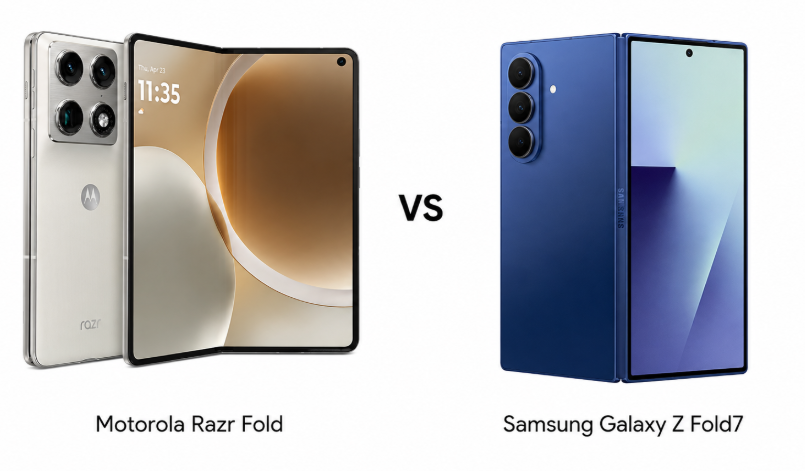
Motorola Razr Fold and Samsung Galaxy Z Fold7 take two very different approaches to the premium foldable experience. Samsung focuses on refinement, productivity, and software polish, while Motorola pushes bigger hardware upgrades with brighter displays, faster charging, and a larger battery. With both devices targeting flagship buyers, this comparison highlights which foldable actually delivers the better overall experience for everyday use.
Major Features:
Feature
Motorola Razr Fold
Samsung Galaxy Z Fold7
Winner
Display
8.1-inch LTPO P-OLED, 120Hz, 6200 nits
8.0-inch Dynamic AMOLED 2X, 120Hz, 2600 nits
Motorola – Brighter and more immersive display
Cover Display
6.6-inch LTPO P-OLED, 165Hz
6.5-inch AMOLED 2X, 120Hz
Motorola – Smoother and brighter outer screen
Processor
Snapdragon 8 Gen 5
Snapdragon 8 Elite
Samsung – Slightly stronger peak performance
RAM & Storage
Up to 16GB RAM, UFS 4.1
Up to 16GB RAM, UFS 4.0
Motorola – Faster storage standard
Software Support
Android 16, 7 upgrades
Android 16, 7 upgrades, One UI 8
Samsung – Better foldable software optimization
Main Camera
50MP + 50MP Periscope + 50MP Ultrawide
200MP + 10MP Telephoto + 12MP Ultrawide
Motorola – More balanced flagship camera setup
Zoom Camera
50MP periscope, 3x optical
10MP telephoto, 3x optical
Motorola – Higher quality zoom hardware
Video Recording
8K Dolby Vision, 4K120fps
8K30fps, 4K60fps
Motorola – Stronger video capabilities
Selfie Camera
20MP inner + 32MP cover
10MP inner + 10MP cover
Motorola – Higher-resolution selfie setup
Battery
6000mAh
4400mAh
Motorola – Much larger battery
Charging
80W wired, 50W wireless
25W wired, 15W wireless
Motorola – Far faster charging
Durability
IP48/IP49, stylus support
IP48, Armor aluminum frame
Motorola – Better protection and stylus support
Audio
Stereo speakers with Dolby Atmos, Bose tuning
Stereo speakers, high-bitrate audio
Motorola – Richer audio branding and tuning
Productivity Features
Stylus support
Samsung DeX, UWB support
Samsung – Better productivity ecosystem
Price
Approx ₹1,50,000
Approx ₹1,75,000
Motorola – Better hardware value for money
Overall
Hardware-focused foldable flagship
Refined productivity-focused foldable
Motorola – Better overall value and hardware package
Disclaimer: Specs are based on available data. Actual performance may vary. Verify details from official sources before buying.
The Motorola Razr Fold takes a more aggressive approach toward premium foldables with its sharper styling, stylus support, and stronger durability claims. The combination of IP48/IP49 resistance and Gorilla Glass Ceramic 3 on the cover display gives it a rugged flagship personality. Samsung’s Galaxy Z Fold7, meanwhile, focuses on refinement. The lighter body, Advanced Armor aluminum frame, and polished hinge mechanism make it feel more mature and easier to carry daily. Samsung also adds DeX and Ultra Wideband support, which quietly improves the productivity experience.
Display Quality
Motorola pushes display hardware harder with a brighter inner panel, brighter cover screen, and a smoother 165Hz outer display. Content consumption and gaming feel more dramatic here, especially with Dolby Vision support across both screens. Samsung’s AMOLED tuning still looks incredibly natural and color-accurate, and One UI remains one of the best optimized foldable interfaces available. However, the Razr Fold feels more futuristic on paper and in everyday use.
Verdict
Samsung delivers the cleaner and more polished foldable experience, but Motorola wins on raw display ambition and feature richness. The Razr Fold feels designed for users who want a foldable to stand out rather than simply blend in.
2. Specifications Including Battery
Performance
Both devices sit comfortably in flagship territory, but they target performance differently. The Motorola Razr Fold uses the newer Snapdragon 8 Gen 5 paired with faster UFS 4.1 storage and up to 16GB RAM. Heavy multitasking, gaming, and AI-driven tasks should feel exceptionally fast here. Samsung’s Snapdragon 8 Elite still remains extremely powerful, and One UI 8 is known for stable long-term optimization. Samsung also benefits from a stronger productivity ecosystem thanks to DeX support and better app continuity.
Battery and Charging
Battery life is where Motorola creates a huge gap. The 6000mAh battery, combined with 80W wired and 50W wireless charging, makes the Razr Fold feel significantly more practical for power users. Samsung’s 4400mAh battery and 25W charging setup now feels conservative in comparison. Faster top-ups genuinely change the foldable experience because these devices are often used heavily throughout the day.
Verdict
The Galaxy Z Fold7 offers smoother software maturity and productivity advantages, but the Razr Fold clearly wins for hardware power, battery endurance, and charging convenience. Motorola simply feels more future-ready in this department.
3. Camera
Main and Secondary Lenses
Samsung continues to lean heavily into computational photography with its 200MP primary camera. Images are expected to have stronger dynamic range, better night processing, and more consistent social-media-ready output. Samsung’s camera software remains one of the safest options for point-and-shoot photography. Motorola counters with a more balanced triple 50MP setup, including a stronger periscope telephoto sensor and a much higher-resolution ultrawide camera. The camera hardware feels more versatile overall, especially for zoom and landscape photography.
Selfie Camera
Motorola again pushes higher numbers with a 20MP inner selfie camera and a 32MP cover shooter. Samsung keeps things simpler with dual 10MP sensors focused more on consistency and natural tones. Video creators may appreciate Motorola’s stronger recording flexibility, especially with Dolby Vision support and 4K120 recording capabilities.
Verdict
Samsung still feels safer for effortless flagship photography, but Motorola offers a more exciting and flexible camera package. Users who enjoy experimenting with zoom, ultrawide shots, and high-end video recording may find the Razr Fold more rewarding.
4. Pricing
The Motorola Razr Fold is expected to launch at around ₹1,50,000, while the Samsung Galaxy Z Fold7 sits closer to ₹1,75,000 despite offering slower charging and a smaller battery. Samsung’s pricing partly reflects its stronger brand value, foldable software maturity, and ecosystem integration. Features like DeX, long-term optimization, and Samsung’s foldable experience still hold major appeal for productivity-focused buyers.
Motorola, however, appears far more aggressive with hardware value. The brighter displays, larger battery, faster charging, stylus support, and upgraded camera hardware make the Razr Fold look unusually competitive for its price. It feels like Motorola is targeting users who want maximum specifications without crossing into ultra-premium pricing territory.
Verdict
Samsung justifies its premium mainly through software polish and ecosystem advantages. Motorola offers stronger value for money overall and delivers noticeably more hardware for a lower asking price.
Disclaimer: Prices are approximate and may vary based on country, region, launch timing, and applicable taxes. Always check whether the listed price is for a China unit or a global/international variant when purchasing.
5. Conclusion
The Motorola Razr Fold stands out with its massive battery, ultra-fast charging, brighter displays, stylus support, and highly versatile camera hardware. It feels designed for users who want cutting-edge hardware without compromise. Samsung’s Galaxy Z Fold7 focuses more on reliability, ecosystem integration, and refined usability. Features like Samsung DeX, optimized multitasking, and One UI’s foldable polish continue to make it one of the most complete productivity foldables available.
The difference between these devices ultimately comes down to preference. Samsung prioritizes balance and maturity, while Motorola pushes hardware innovation more aggressively. That distinction becomes noticeable in daily use, especially for power users and content creators.
Verdict
The Galaxy Z Fold7 remains the safer premium foldable for long-term software confidence and productivity workflows. The Motorola Razr Fold, however, feels like the more exciting flagship overall, delivering stronger value, better battery life, superior charging, and a more ambitious hardware package for less money.
Disclaimer: This comparison is based on the specifications provided and is intended for general informational purposes. Actual performance, camera results, battery life, and overall experience may vary depending on real-world usage, software updates, and individual preferences.
The Vivo X300 FE is a great-looking high-end smartphone with premium hardware, including a Snapdragon 8 Gen 5 processor, a 50MP triple rear camera setup, and an excellent 6,500mAh battery with fast charging. While it’s a solid pick in the INR 70-90K segment, it’s far from being the only showstopper in this segment.
There are some excellent alternatives to the Vivo X300 FE that offer more value for the same price, including one that’s a no-brainer pick over the X300 FE.
This is the one we were referring to. The Vivo X300 (review) is a far better option than the X300 FE in terms of hardware. To begin with, the X300 is powered by a MediaTek Dimensity 9500, which is about 15-20% faster than the Snapdragon 8 Gen 5 inside the X300 FE. (Read the full chip comparison here)
The X300 also offers a much better rear camera setup, particularly the primary and ultrawide sensors. They are higher-resolution sensors that capture greater clarity and more detail. The ultrawide lens also has a greater field of view.
The X300’s battery capacity is the only weak link here, but it’s just a difference of 500 mAh, which isn’t very concerning. The charging capabilities, however, remain the same.
What surprises me most is that the more premium X300 still costs less than the X300 FE. It currently retails at INR 83,999 against the FE’s INR 86,999, and bank offers regularly bring the effective price down further. That makes the Vivo X300 one of the best options at this price, and a far better buy than the X300 FE.
Another excellent option is the OnePlus 15, which gives the Vivo X300 FE a run for its money. One of its biggest advantages is the Snapdragon 8 Elite Gen 5 processor, which offers more than 30% faster CPU and about 30-40% better gaming performance, along with a more robust ISP and connectivity upgrades.
The OnePlus 15 also offers a larger 6.78-inch AMOLED screen with a higher refresh rate and stronger screen protection. The device also integrates a robust camera setup with a higher resolution ultrawide sensor and a more capable telephoto shooter.
The OnePlus 15 also excels in higher battery capacity and faster charging (both wired and wireless). It also supports the newer Bluetooth v6.0 standard and offers much faster data transfer over a wired connection.
OnePlus has raised the price twice since launch, so the 12GB variant now sits at INR 85,999, roughly the same money as the X300 FE. You are no longer saving much, but you are getting meaningfully faster hardware for it.
The Find X9 (review) closely matches the Vivo X300 on the spec sheet and is therefore a better option than the X300 FE. This one features a Dimensity 9500 processor and a larger screen with Ultra HDR image support.
The rear camera setup also outperforms the one on the Vivo X300 FE, particularly the 50MP ultrawide sensor (vs. an 8MP on the X300 FE). The Oppo Find X9 also features a higher battery capacity of 7,025 mAh, with support for 80W wired and 50W wireless charging, as well as 10W reverse wireless charging.
On top of better hardware, you’ll also save at least INR 5,000 with the Oppo Find X9, making it a stronger pick over the Vivo X300 FE.
If clean software and dependable cameras matter more to you than spec sheet wins, the Pixel 10 is the pick here, and it now sells in India for well under the X300 FE. Google finally gave the base Pixel a telephoto camera, a 10.8MP periscope with 5x optical zoom, sitting next to a 48MP main sensor and a 13MP ultrawide. Add Google’s processing on top and you get a camera that handles tricky light, high contrast scenes, and skin tones better than most phones at this price.
The Tensor G5 chip will not beat the Snapdragon 8 Gen 5 in benchmarks, but it stays smooth in daily use and powers the Pixel’s on-device AI features. Software is the bigger win. The Pixel 10 ships with Android 16 and gets seven years of OS updates, two more than the X300 FE, and Pixel owners receive new Android versions before everyone else.
Battery is the trade-off. The 4,970mAh cell is much smaller than the 6,500mAh unit in the X300 FE, and charging tops out at 29W wired plus 15W Qi2 magnetic wireless. It comfortably lasts a day, just not two.
At INR 67,369, and with a discount of INR 5,000 running until the end of December, the Pixel 10 undercuts the X300 FE by nearly INR 20,000. That gap buys a lot of forgiveness.
Google Pixel 10 specs:
Display: 6.3-inch Actua OLED, Full HD+, 120Hz refresh rate, 2000nits (high brightness mode), Gorilla Glass Victus 2
Processor: Google Tensor G5 (3 nm)
Software: Android 16, up to seven major Android upgrades
The Galaxy S26 is another solid flagship phone, offering premium hardware at a price cheaper than the Vivo X300 FE. The device is offered with a Snapdragon 8 Elite Gen 5 processor in the US and Canada, while the rest of the world, including India, gets the Exynos 2600 variant. Both variants offer more than 20% faster performance than the Snapdragon 8 Gen 5 inside the Vivo phone.
Software support is another big plus for the S26, as it will continue to receive OS updates through Android 23, while the X300 FE will receive two fewer upgrades. The battery capacity, however, may be disappointing, as it houses only a 4,300mAh battery, which is lower than the 6,500mAh on the X300 FE. The charging speeds aren’t faster, either.
As for the optics, it features a triple rear camera setup with a 50MP primary shooter, a 10MP telephoto lens with 3x optical zoom, and a 12MP ultrawide sensor. It has a 12MP camera for selfies and video calls.
While the Galaxy S26’s spec sheet doesn’t outperform the Vivo X300 FE, it’s a reliable non-Chinese alternative that offers better performance, excellent camera outputs, and longer software support.
Swedish audio technology company Atonemo has officially entered the Indian market with a new product aimed at simplifying home audio setups. Called the Atonemo Streamplayer, the compact device is designed to add modern wireless streaming features to almost any speaker system, regardless of its age or brand compatibility.
Atonemo Streamplayer specifications and features
Atonemo Streamplayer
Developed in Stockholm, the Streamplayer is built to bridge the gap between older wired audio systems and modern streaming platforms. The device supports AirPlay 2, Google Cast, Spotify Connect, and Tidal Connect, allowing users to stream music wirelessly to speakers, amplifiers, and hi-fi systems without being restricted to a single ecosystem.
The Streamplayer also supports high-resolution 24-bit / 192kHz audio playback and comes with Wi-Fi 6 connectivity for improved wireless performance. It features 3.5mm analog and optical S/PDIF outputs, making it compatible with both vintage and modern audio equipment. The device also supports gapless playback and multi-speaker synchronization across different speaker brands.
Atonemo Streamplayer
Atonemo says the Streamplayer has been designed with simplicity in mind, especially for users who want to continue using their existing speaker setups instead of replacing them with newer wireless products. The company has partnered with Luxury Personified LLP to handle distribution and operations in India.
Atonemo Streamplayer price and availability
The Atonemo Streamplayer is scheduled to launch in India in May 2025. While the company has not yet revealed the official India pricing, the device will be available through Amazon India and authorised premium audio and consumer electronics retailers across the country.
For more daily updates, please visit our News Section.
Oppo has officially confirmed the launch date of the Oppo Reno 16 series in China. The upcoming lineup is scheduled to debut on May 25 at 6 PM local time and is expected to include the Reno 16 and Reno 16 Pro. Ahead of the launch, several details about the design, cameras, battery, and performance specifications have surfaced online.
Oppo Reno 16 series specifications (expected)
Oppo Reno 16 series launch date (China)
According to leaked information, the Oppo Reno 16 series may adopt a dual-size flat display strategy. The Reno 16 is tipped to feature a 6.32-inch 1.5K OLED flat display, while the Reno 16 Pro could arrive with a larger 6.78-inch 1.5K OLED panel with LTPO adaptive refresh rate support. Reports also suggest that both phones may feature metal middle frames and multiple colour options.
The Reno 16 Pro is expected to be powered by the MediaTek Dimensity 9500s chipset, whereas the standard Reno 16 may ship with the Dimensity 8550 processor. Battery capacity could become one of the biggest highlights of the lineup, with the Reno 16 tipped to pack a 6,700mAh battery and the Pro variant expected to feature a 7,000mAh battery. Both models are said to support 80W wired fast charging, while the Pro edition may additionally support 50W wireless charging.
For photography, the Reno 16 series is rumored to feature a triple-camera setup consisting of a 200-megapixel Samsung HP5 primary camera, a 50-megapixel ultra-wide lens, and a 50-megapixel periscope telephoto camera. The Reno 16 will arrive in Fairy Purple, Lucky Clover, Black Horse, and Heartbeat Star color options, whereas the Reno 16 Pro is tipped to launch in Dream Blue, Black Horse, and Heartbeat Star shades.
Reports also hint at a new accessory called “Oppo Bubble”, which may feature a smart electronic display with support for custom wallpapers and remote photography controls.
As far as global launch is concerned, it is expected to happen in June or July.
For more daily updates, please visit our News Section.
Last year, OnePlus launched the OnePlus 15 and OnePlus Ace 6 together in China. This year, the brand is expected to follow a similar strategy by unveiling the OnePlus 16 and Ace 7 simultaneously for the Chinese market. While the rumor mill has already revealed several details about the OnePlus 16 over the past few weeks, fresh information about the Ace 7 lineup has now surfaced as well.
OnePlus Ace 7 key specifications tipped
OnePlus Ace 7 key specs tipped
According to DCS’s Weibo post, the engineering prototype of the alleged OnePlus Ace 7 will feature the Snapdragon 8 Elite Gen 5 chip. The device will be equipped with a 6.78-inch flat OLED screen that offers a 1.5K resolution along with an ultra-high refresh rate, which could be as high as 240Hz, although the minimum guaranteed refresh rate is said to be 185Hz.
The OnePlus Ace 7 will reportedly house a massive 9,000mAh battery with 100W charging support. The testing unit also includes a cooling fan, but there is no clarity on whether the feature will make it to the final retail version of the phone.
The leak does not mention the camera specifications of the Ace 7, but since it is expected to be a performance-focused phone, it may not feature a versatile camera setup. The Ace 6 arrived with a 16-megapixel front camera and a 50-megapixel + 8-megapixel dual-camera system. It would not be surprising if the successor retains a similar camera setup with minor sensor improvements.
The OnePlus Ace 6 remained exclusive to the Chinese market. Hence, it remains unclear whether the Ace 7 will launch outside China.
For more daily updates, please visit our News Section.
Vivo is preparing to launch the Vivo S60 series in China later this month. The upcoming lineup is expected to include the Vivo S60 and Vivo S60e, while there is still no confirmation regarding the rumored S60 Pro Mini.
Ahead of the launch, Vivo has started teasing key details of the series through official promotional material. Fresh teasers that have emerged today have confirmed new details about the S60 series.
Vivo S60 front design, key specs confirmed
Vivo Product Manager Han Boxiao recently shared new teaser images confirming several specifications of the Vivo S60 lineup. The images reveal the phone’s flat display design and confirm that the entire series will feature an ultrasonic in-display fingerprint scanner. Vivo claims the sensor supports unlocking speeds as low as 0.1 seconds, while fingerprint registration can reportedly be completed in just 1 second.
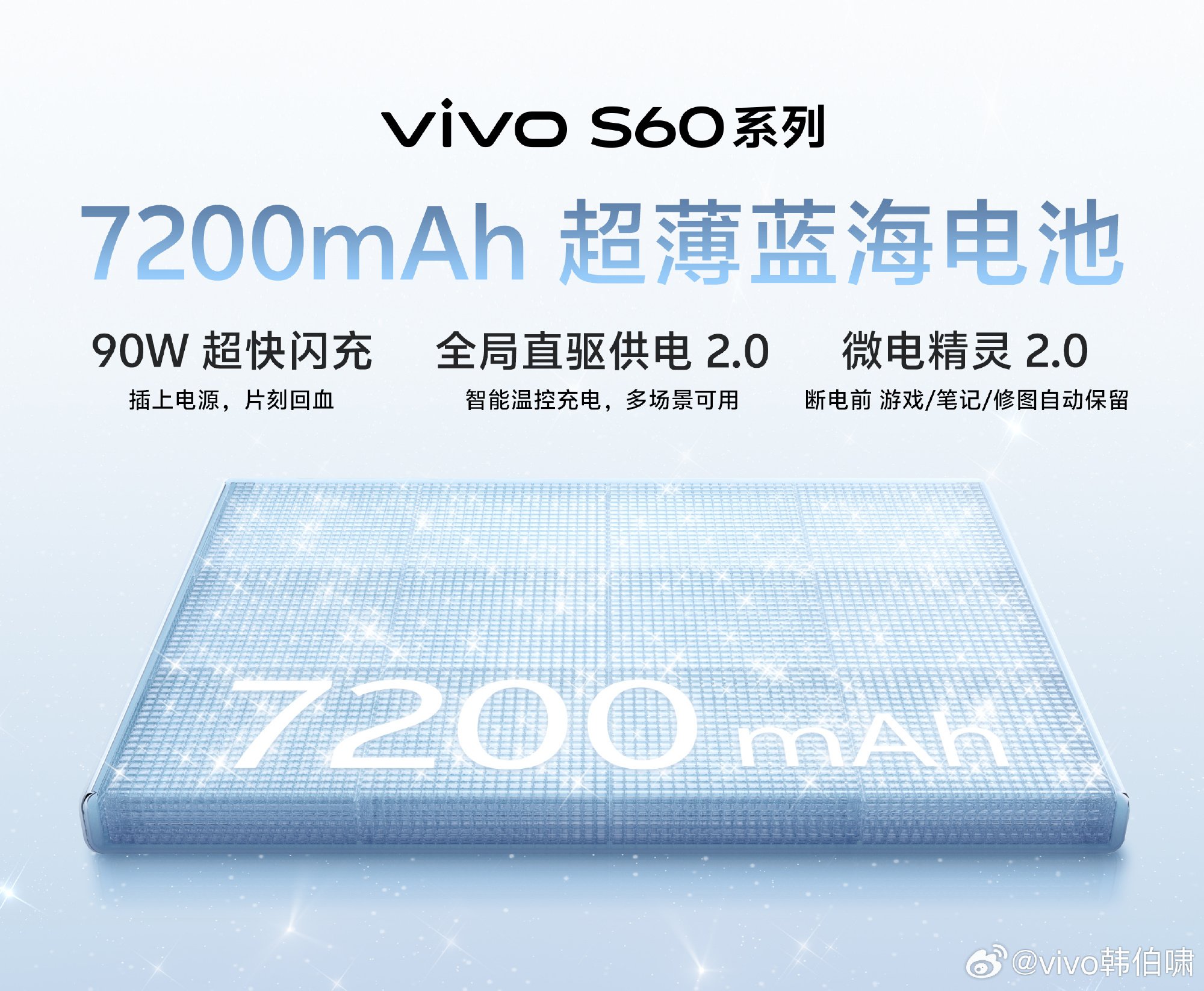
The company has also confirmed that the Vivo S60 series will feature a large 7,200mAh battery paired with 90W fast charging support. Other confirmed features include stereo dual speakers, an X-axis linear motor, an IR blaster, and IP68/IP69-rated dust and water resistance.
Vivo S60
Another official image circulating on Chinese social media platforms reveals the rear design of the device, showcasing a triple-camera setup. Reports suggest the lineup may include a Sony IMX8-series periscope telephoto camera.
Recent leaks have further revealed that the Vivo S60 could feature a 6.59-inch OLED display with 1.5K resolution support. The device is also tipped to be powered by the Snapdragon 8s Gen 3 chipset. In addition, reports claim the phone may support magnetic accessories and launch in multiple colour options, including a pink variant.
For more daily updates, please visit our News Section.
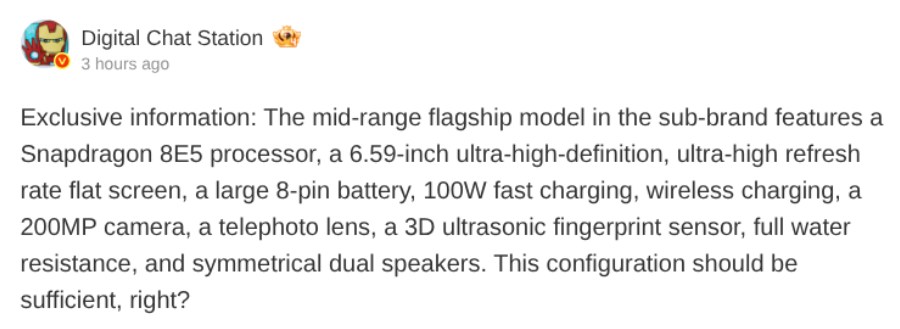
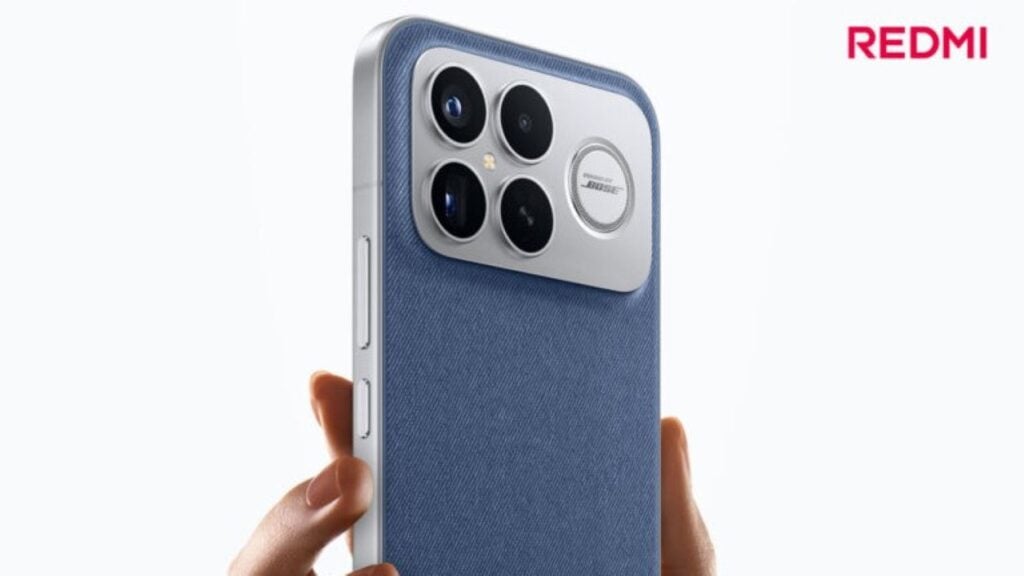
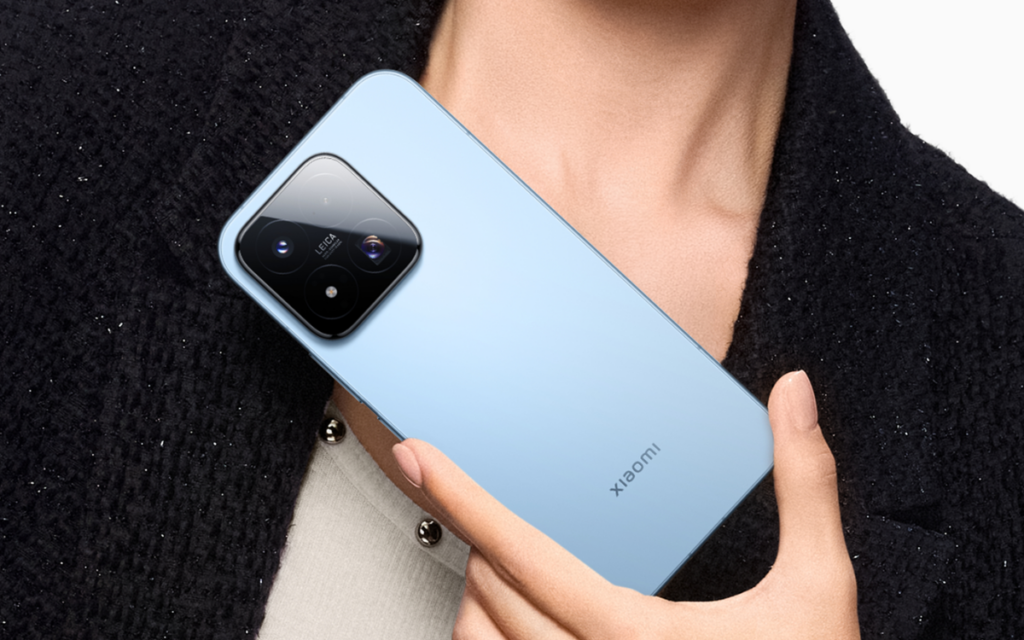
A new leak has revealed key specifications of the upcoming Redmi K100 months ahead of its expected launch in the fourth quarter of 2026. The information comes from a well-known tipster, Digital Chat Station, who is known for sharing accurate details about upcoming devices.
Redmi K100 Specifications (Rumored)
According to the leak, the Redmi K100 will feature a 6.59-inch flat display with 1.5K resolution and a high refresh rate.
Under the hood, the device is expected to use Qualcomm’s current top-end Snapdragon 8 Elite Gen 5, rather than the upcoming 2nm Snapdragon 8 Elite Gen 6. On the camera side, the leak mentions a 200MP main camera paired with a telephoto lens.
The Redmi K100 is also said to pack an 8000mAh battery and support 100W fast charging, along with wireless charging.
Other expected features include IP68/IP69 water and dust resistance, a 3D ultrasonic fingerprint sensor, and symmetrical dual speakers.
For context, earlier reports from the same tipster also mentioned the Redmi K100 Pro Max, which is expected to go even further. That device is rumored to use a 2nm Snapdragon 8 Elite Gen 6 chip and a more advanced camera system, including a 200MP main sensor, a 50MP ultrawide lens, and a 50MP periscope telephoto camera. It is also expected to be rebranded globally as the POCO F9 Ultra.
Redmi K90 Pro Max
Moreover, another leak suggests Xiaomi is also working on another Redmi K100 series device with a 7-inch display offering 2K resolution. It will reportedly be powered by a 10,000mAh+ battery and come equipped with flagship features such as an ultrasonic in-screen fingerprint sensor, a metal frame, and an IP68/IP69-rated dust and water-resistant chassis.
The Redmi K100 series is likely to launch in China around October 2026, while global versions under the POCO brand may arrive later, possibly in early 2027.
As always with early leaks, these specifications should be taken with caution, as final retail versions may change before launch.
For more daily updates, please visit our News Section.
Honor announced the Honor 600 and Honor 600 Pro in global markets last month. The company is now gearing up to launch them in China, but with a different design and much larger batteries.
A new leak from tipster Fixed Focus Digital also hints at a detachable secondary screen accessory for the phones.
Honor 600 (Global)Honor 600 (China)
According to the leak, the secondary display may attach magnetically to the back of the device. It can reportedly work as a remote camera controller, a fill light, or even as a small secondary display for photo transfers and wallpapers. The tipster also shared a blurred image showing the attachment on the rear panel of the phone.
Honor 600 and Honor 600 Pro Specifications
Globally, both phones come with a 6.57-inch AMOLED display with a 120Hz refresh rate and very high peak brightness. The Honor 600 is powered by the Snapdragon 7 Gen 4, while the Honor 600 Pro uses the more powerful Snapdragon 8 Elite chip.
The camera specs include a 200MP main sensor and a 50MP front camera on the vanilla. The Pro version adds a 50MP telephoto lens with 3.5x optical zoom. As for the battery, both have a 7000mAh cell, or a smaller 6400mAh option in Europe. The Pro also supports 50W wireless charging.
For China, the biggest upgrade could be the battery. According to another tipster, Smart Pikachu, the Honor 600 will feature an 8600mAh battery, while the Honor 600 Pro comes with an 8000mAh unit, both larger than the global versions. The rest of the hardware specs are pretty much the same as the global models.
The Honor 600 will be available in China in 12GB/256GB and 12GB/512GB variants and in Lucky Star, Obsidian Black, Light Feature Blue, and Green Apple colors.
Meanwhile, the Honor 600 Pro adds a 16GB/512GB model and has the same shades as the vanilla.
After a brief teaser campaign, Xiaomi has officially announced that the new Xiaomi 17 Max, Xiaomi YU7 GT, Xiaomi Band 10 Pro, and several other products will launch on May 21 in China.
The YU7 GT will obviously be the star of the show. It’s an electric SUV that is being marketed as a “purebred GT car” designed to deliver sports car-like driving while still being suitable for long-distance travel.
The numbers are impressive, too. The YU7 GT reportedly offers up to 1003 horsepower, a top speed of 300km/h, and a CLTC-rated electric driving range of up to 705 kilometers.
Here’s what else is coming
Then there is the Xiaomi 17 Max, a large-screen smartphone featuring a 6.9-inch display with ultra-thin bezels and a flat panel design. Xiaomi says the device uses a four-curved wraparound frame with heavily rounded corners.
The 17 Max will be home to Xiaomi’s first Leica-branded 200-megapixel main camera. The phone is also expected to carry an 8000mAh battery.
On the audio side, Xiaomi is announcing its first clip-on earbuds. They have an open-ear design and weigh just 5.5 grams per earbud. The company says the earbuds use memory titanium wire and an 11mm driver paired with a microcrystalline metal-coated diaphragm. Xiaomi is also advertising support for LHDC 5.0 audio and Hi-Res Gold certification.
And for the fitness enthusiasts, we have the Xiaomi Smart Band 10 Pro. It will arrive with a thin 9.7mm body and a lightweight aluminum alloy build that weighs 21.6 grams.
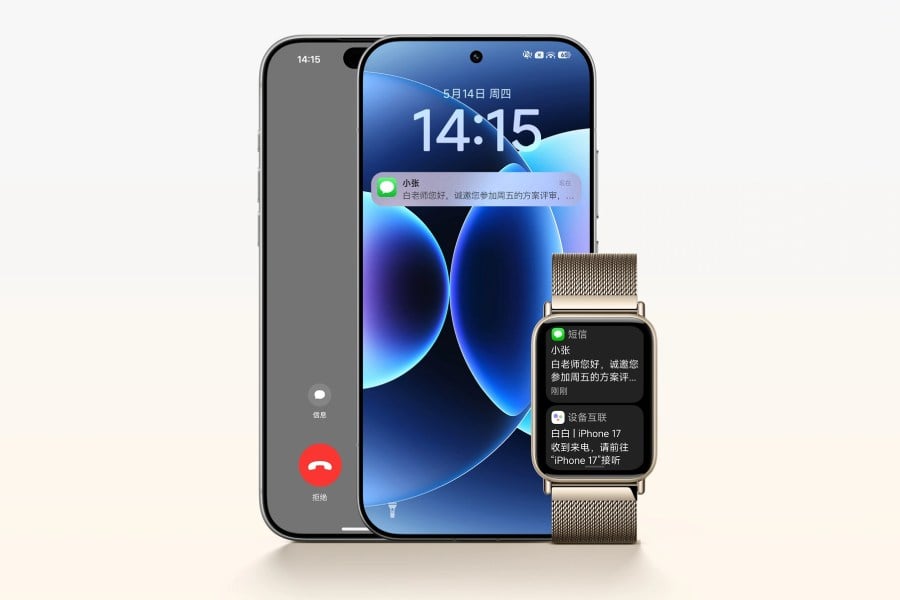
Xiaomi says the fitness band supports advanced sports tracking and health management features while delivering up to 21 days of battery life. It also has deeper integration with the Apple ecosystem, with support for real-time syncing of notifications for calls and text messages with an iPhone.
The Band 10 Pro will launch in black, silver, pink, and possibly white, orange, and a ceramic variant.
For more daily updates, please visit our News Section.
We use cookies on our website to give you the most relevant experience by remembering your preferences and repeat visits. By clicking “Accept”, you consent to the use of ALL the cookies.
This website uses cookies to improve your experience while you navigate through the website. Out of these, the cookies that are categorized as necessary are stored on your browser as they are essential for the working of basic functionalities of the website. We also use third-party cookies that help us analyze and understand how you use this website. These cookies will be stored in your browser only with your consent. You also have the option to opt-out of these cookies. But opting out of some of these cookies may affect your browsing experience.
Necessary cookies are absolutely essential for the website to function properly. This category only includes cookies that ensures basic functionalities and security features of the website. These cookies do not store any personal information.
Any cookies that may not be particularly necessary for the website to function and is used specifically to collect user personal data via analytics, ads, other embedded contents are termed as non-necessary cookies. It is mandatory to procure user consent prior to running these cookies on your website.