boAt recently announced the Lunar Tigon smartwatch in India. Now the company has launched a new Bluetooth speaker in India. The homegrown brand has partnered with OTT streaming giant Netflix for its latest limited edition offering. It is the boAt Stone Majestic Riverdale Rocker connecting to The Archies universe’s music theme with the brand’s founder dancing to the boAt jingle. Read on to know what the speaker has in store for us.
boAt Stone Majestic Riverdale Rocker specifications and features
The boAt Stone Majestic Riverdale Rocker has a retro design and looks a bit similar to Marshall’s speakers. The device has a rectangular form factor with a dual-toned design where the half portion at the back has a wood surface and the front half has a black-colored textured pattern. It appears that there is a rotating control knob at the front whereas the top panel has six physical buttons that is reminiscent of vintage speakers.
In terms of audio, the boAt Stone Majestic Riverdale Rocker is equipped with 30W dual speakers and a 4-inch 30W built-in sub-woofer. The speaker is capable of outputting 90W sound. It also has dual EQ modes for movies and music. The audio device offers connectivity options including Bluetooth, AUX, USB, and HDMI. It is claimed to offer up to 7 hours of battery life.
The boAt Stone Majestic Riverdale Rocker carries a price tag of Rs 9,999. It is up for pre-orders from the brand’s official website.
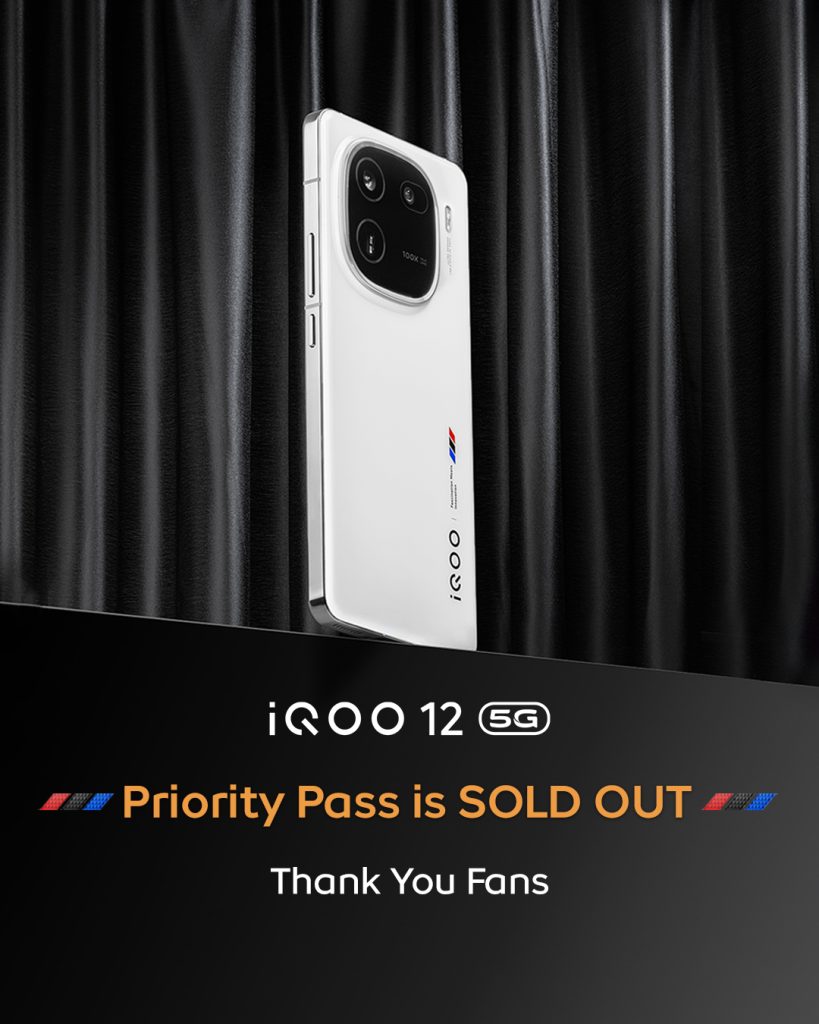
Last week, iQOO officially revealed the launch of their flagship smartphone, the iQOO 12, in India. Alongside this announcement, they introduced an Exclusive Priority Pass.
The priority passes in India were in high demand and sold out within nine hours of their release, even though they were supposed to be available from December 5th to 7th. Holders of these passes will get the opportunity to purchase the iQOO 12 on December 13th, a day before its official sale date. The device is scheduled to launch on December 12th at 5 PM.
iQOO 12 Specifications
The phone’s specifications are already known as it was launched in China last month. The iQOO 12 features a 6.78-inch 1.5K flat LTPO AMOLED display with a 144Hz variable refresh rate and impressive brightness levels of up to 1400 nits in HBM mode and up to 3000 nits peak brightness.
It is powered by the Octa-Core Snapdragon 8 Gen 3 chipset with an Adreno 750 GPU and offers RAM options of 12GB or 16GB along with storage choices of 256GB, 512GB, or 1TB (UFS 4.0).
Running on Android 14 with OriginOS 4.0 in China or Funtouch OS 14 globally, it supports dual SIM cards and boasts a versatile camera setup, including a 50MP primary camera, a 50MP ultra-wide-angle camera, and a 64MP telephoto camera with 3x zoom. On the front, it features a 16MP camera.
The device comes with an in-display Ultrasonic fingerprint sensor and offers USB Type-C audio, stereo speakers, and Hi-Fi audio quality. In terms of connectivity, it supports 5G SA/NSA, dual 4G VoLTE, Wi-Fi 7, Bluetooth 5.4, GPS, and NFC.
The iQOO 12 is equipped with a 5000mAh battery and supports rapid charging with 120W ultra-fast flash charging, 50W wireless charging, and 10W reverse wireless charging.
Pricing and Availability
Yesterday, the pricing details of the iQOO 12 were inadvertently leaked through an Amazon listing. The prices are briefly shown as Rs 52,999 for the 12GB + 256GB version and Rs 57,999 for the 16GB + 512GB model, although these listings have now been taken down. The launch-day promotions and potential bank discounts could further lower the smartphone’s cost.
The Oppo Find X7 Pro is the brand’s next gen flagship smartphone, which is set to launch in China soon. A recent leak showcased its design which included a large octagonal camera module. But a renowned tipster has claimed that this might not be the case.
Oppo Find X7 Pro to retain circular camera module
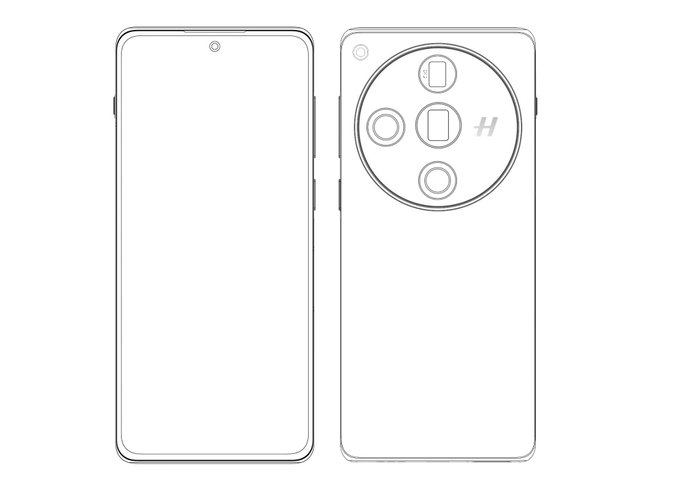
For those unaware, the Chinese tech giant is rumored to debut the Find X7 Pro model in China next month, which is January 2024. The hands-on images leak that surfaced earlier this week showcased the Find X7 Pro with an octagonal camera module, but known tipster Digital Chat Station refuted these claims. Apparently, the Oppo Find X7 Pro model will feature a circular camera module similar to its predecessor, the Find X6 Pro.
Thanks to new design schematics, we have a better idea regarding the design of the upcoming flagship phone. The front houses a center aligned punch hole cutout for the selfie camera. On the other hand, the rear has a massive camera island that houses multiple camera sensors as well as the Hasselblad branding. To recall, the Find X7 Pro is expected to feature a 1-inch Sony LYT900 50-megapixel primary camera.
This camera will be paired with the 50-megapixel ultra wide angle lens, and two 50-megapixel periscopic telephoto shooters that offer 3x and 6x optical zoom respectively. The device will sport a Samsung E7 or BOE AMOLED display that offers 2K resolution and high refresh rate. Other notable features include, satellite connectivity and Qualcomm Snapdragon 8 Gen 3 SoC. This is all the information we have at the moment, so stick around for more updates.
Hong Kong, traditionally known for its financial infrastructure, is now making significant strides in the field of advanced manufacturing. This shift comes as semiconductor companies announce their plans to invest billions in the region, signalling a promising diversification of Hong Kong’s economy.
The company is planning an investment of HK$3 billion in the next 5 years
The recent Advanced Manufacturing Forum, hosted in Hong Kong, shed light on this new direction. Key government officials and industry experts discussed the city’s potential as a hub for research, development, and production of high-tech products, especially in the semiconductor sector.
Among the notable developments is the commitment from Horizon Robotics, a leading automotive chip designer. Their planned investment of HK$3 billion in the next five years, alongside similar pledges from other Chinese chip companies, marks a significant boost to the local economy.
These investments are not just about financial numbers; they represent a strategic shift towards embracing advanced technologies like AI, robotics, and the Internet of Things. This move is expected to create over 4,000 local jobs and spur further innovation in Hong Kong.
Despite the challenges of limited land and historical focus on other sectors, Hong Kong is uniquely positioned to support this new wave of advanced manufacturing. The city boasts a strong talent pool, close connections to mainland China, and robust fundraising opportunities through its stock exchange.
Government support plays a crucial role in this transition. Initiatives like setting aside HK$10 billion in funds for emerging industries and offering substantial subsidies to eligible companies underscore the seriousness of Hong Kong’s reindustrialization efforts.
As Hong Kong embraces this new industrial era, it stands at the forefront of technological advancement. The focus on advanced manufacturing, particularly in the semiconductor field, is not just about economic growth; it’s about positioning Hong Kong as a key player in the global tech landscape, especially in a place where other competitors are gaining up quickly.
Yesterday, Rockstar Games shattered the suspense surrounding the much-awaited Grand Theft Auto 6 (GTA 6), as the game’s first trailer was leaked ahead of its official release, leading to a wave of disappointment and frustration among the developers at Rockstar Games. This unexpected leak has brought to light the emotional investment and anticipation that game developers often have for their projects.
The leak forced the developers to drop the trailer a whole day early
The GTA 6 trailer, a key milestone in the game’s development, was meant to be a moment of pride and collective celebration for the Rockstar team. Instead, it turned into a scenario of dismay as the trailer surfaced prematurely on social media, complete with a distracting crypto-related watermark. The situation compelled Rockstar to expedite the official release of the trailer, urging fans to watch the ‘real thing’ on YouTube.
The response from the game’s developers was a mix of sadness and frustration. Many of them expressed their anticipation of experiencing the trailer together with their colleagues, a sentiment echoed by programmer Angel Ortiz, who planned to watch it in the office with fellow developers. This shared disappointment underlines the sense of camaraderie and teamwork that often defines game development.
Industry peers also voiced their concerns over the leak. Joshua Stein from Xbox and Michael Douse from Larian Studios highlighted the negative impact of leaks on marketing strategies and developer-community dialogue. Their statements underline a broader issue in the gaming industry, where leaks can disrupt carefully planned rollouts and diminish the creators’ control over their narrative.
Despite the unconventional release, the official GTA 6 trailer has become a sensation on YouTube, breaking viewership records. It’s a testament to the game’s massive fan base and the popularity of the Grand Theft Auto series. While the leak was a setback, it inadvertently heightened the anticipation and buzz around the game, showcasing the spirit of both the gaming community and the developers at Rockstar Games.
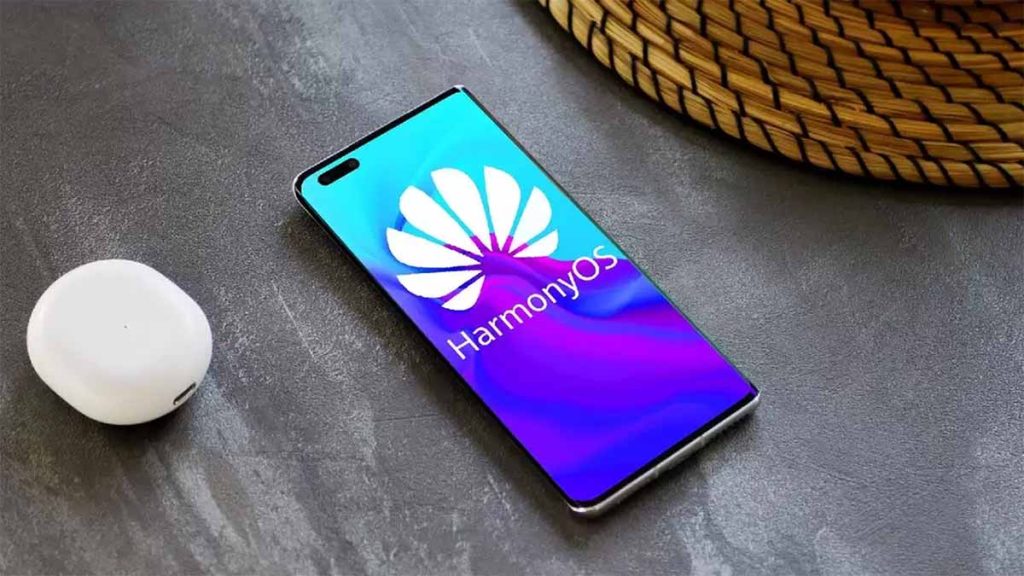
For quite some time, there has been an ongoing battle between iOS and Android in the realm of mobile operating systems, and Huawei joined this competition at some point. Despite HarmonyOS being available for a while, it hasn’t gained much popularity beyond China and doesn’t seem likely to do so. The main reason for this lack of traction is the absence of many popular apps on the AppGallery. This implies that users who switch from Android or iOS may need to forgo even the simplest applications.
While it’s not impossible to install these apps, the technicalities involved may not be of much interest to the average user. However, it appears that this issue is gradually becoming a thing of the past as McDonald’s has begun developing a native app for Huawei HarmonyOS. Here are the details….
A Chinese blogger has claimed that McDonald’s has started developing a native Huawei HarmonyOS app. The blogger shared photos of a signing ceremony and launch event between Huawei and McDonald’s China. However, Huawei has not yet officially confirmed the news. If you believe there’s nothing remarkable about the McDonald’s app, think again. McDonald’s is a US-based restaurant and it is very important that it made such a decision despite the US pressure.
As we mentioned above, HarmonyOS faces a notable challenge beyond China due to the lack of commonly used everyday applications. This could be just the beginning, and we might witness global companies stepping in to contribute to HarmonyOS. Their involvement could boost its competitiveness by expanding the array of applications available on the platform. In September, the companies CEO Richard Yu announced that HarmonyOS NEXT, the next version of HarmonyOS, is ready for release.
He said that native HarmonyOS apps will bring a historic leap forward for the mobile app ecosystem, with smoother, smarter, and more secure experiences. Huawei has said that companies and developers from a variety of industries, including finance, travel, and social media, have already joined the HarmonyOS ecosystem and are developing native HarmonyOS apps. However, this is expected to increase further
Google has officially rolled out an update to the Pixel Camera with version 9.2 to the supported Pixel devices through the Play Store. This update includes some notable improvements, one of which is exclusive to the latest Google Pixel 8 and Google Pixel 8 Pro. This update comes ahead of the anticipated December 2023 Pixel Feature Drop.
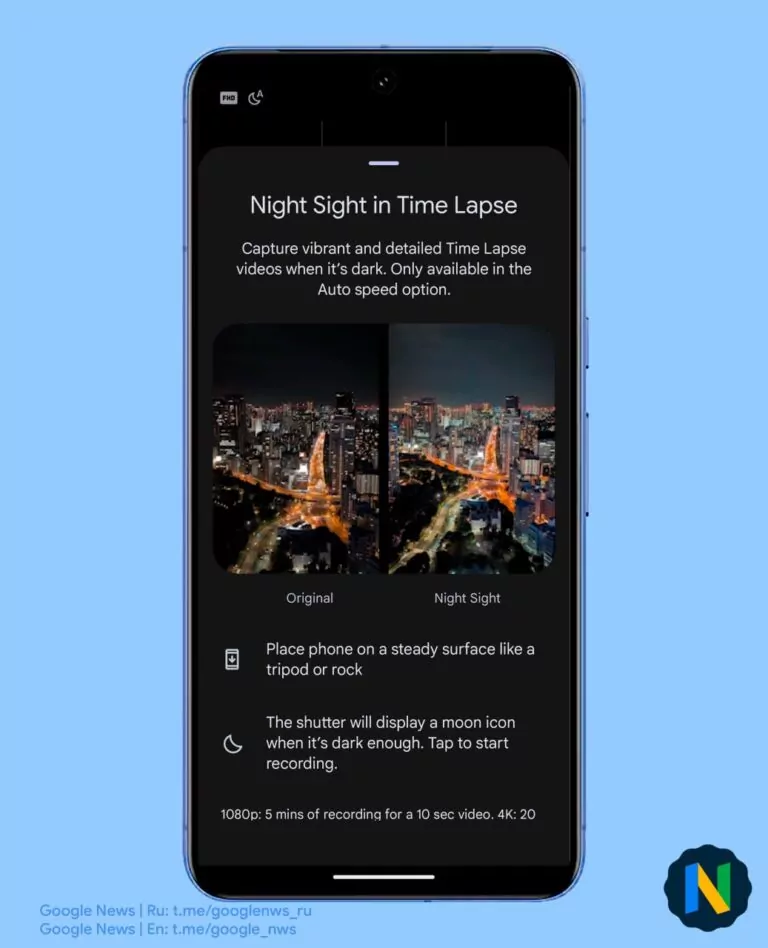
The “Night Sight in Time Lapse” feature is exclusive to the Pixel 8 series
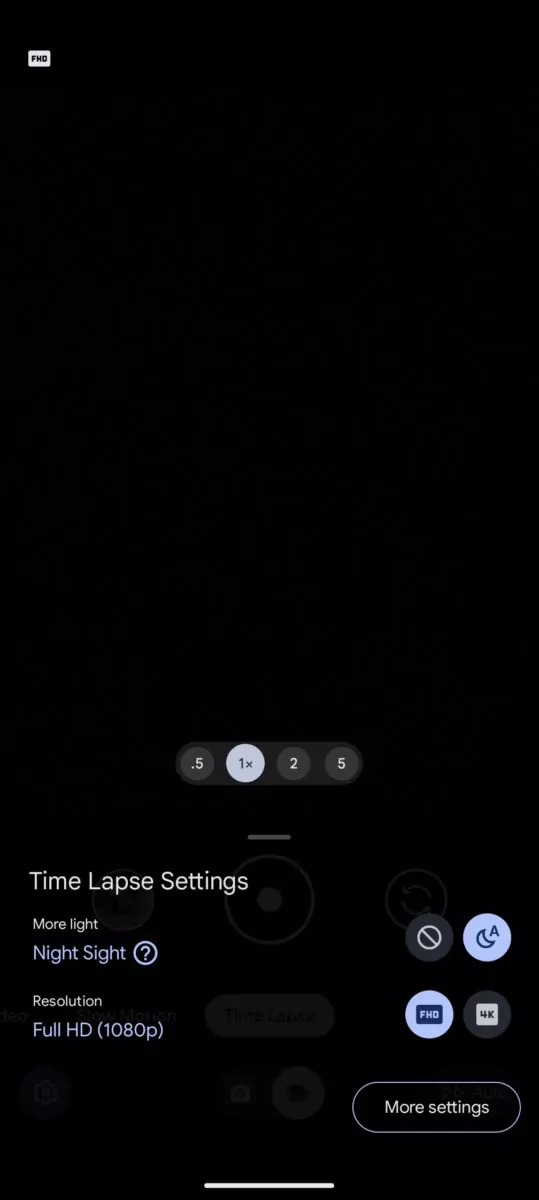
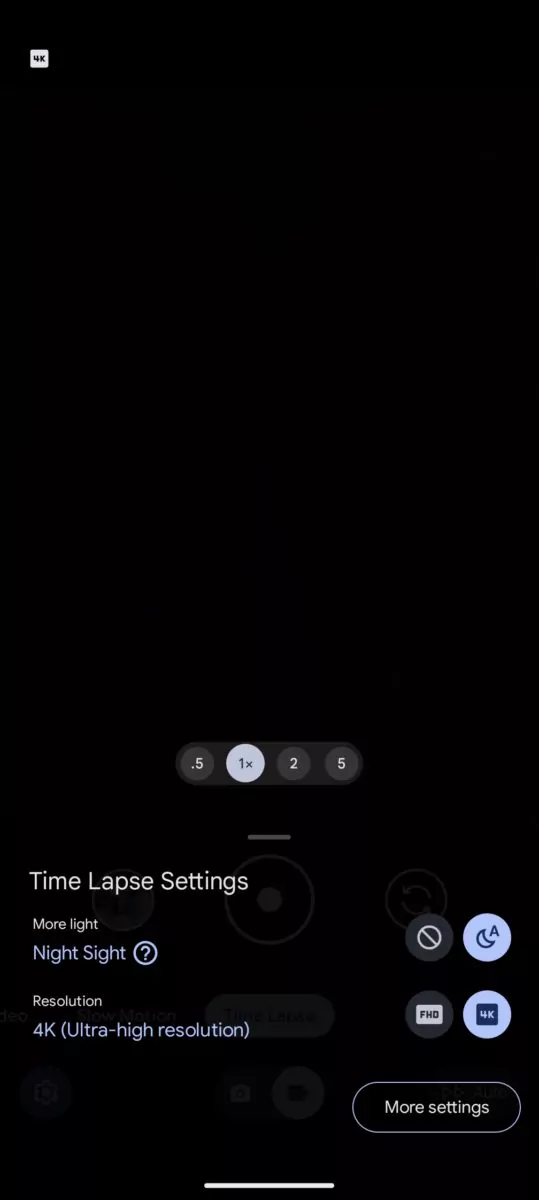
One standout feature in this update is the Pixel 8-exclusive Night Sight Time Lapse enhancement. Pixel 8 and Pixel 8 Pro users can now capture longer Night Sight Time Lapse videos. This update allows for the recording of five minutes of 1080p video or 20 minutes of 4K video, resulting in a captivating 10-second time-lapse video in Night Sight mode. It’s a unique addition that leverages the power of Night Sight for mesmerizing nighttime visuals.
Additionally, the “Palm Timer” feature gets a customization boost. Users now have the flexibility to set it to “Always on” or activate it “Only when the timer is active.” This enhancement enhances user control and convenience, adapting to individual preferences.
The update also brings a streamlined user interface, relocating key options like Brightness, Shadow, and White balance to a compact carousel at the bottom-right corner of the viewfinder. The preferences panel, featuring flash, Top Shot, Timer, Ratio, and more, is now accessible through a swipe-up action on the viewfinder, consolidating camera controls at the bottom for improved accessibility.
This update extends the new UI changes for users of older Pixel devices left on version 9.0, ensuring a more consistent and improved experience across Pixel phones. The Pixel 8 Pro is also expected to benefit from Video Boost and other enhancements in the upcoming feature drop.
While the Pixel Camera 9.2 update is gradually rolling out through the Play Store, Pixel users can also opt for sideloading the official APK from APKMirror for immediate access to these exciting features.
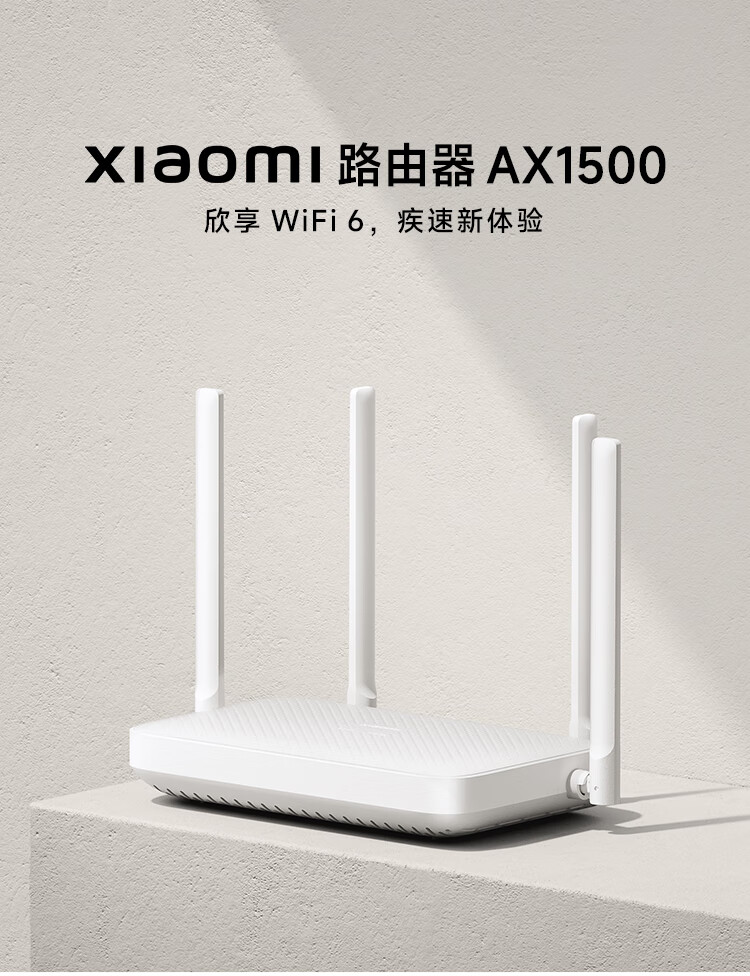
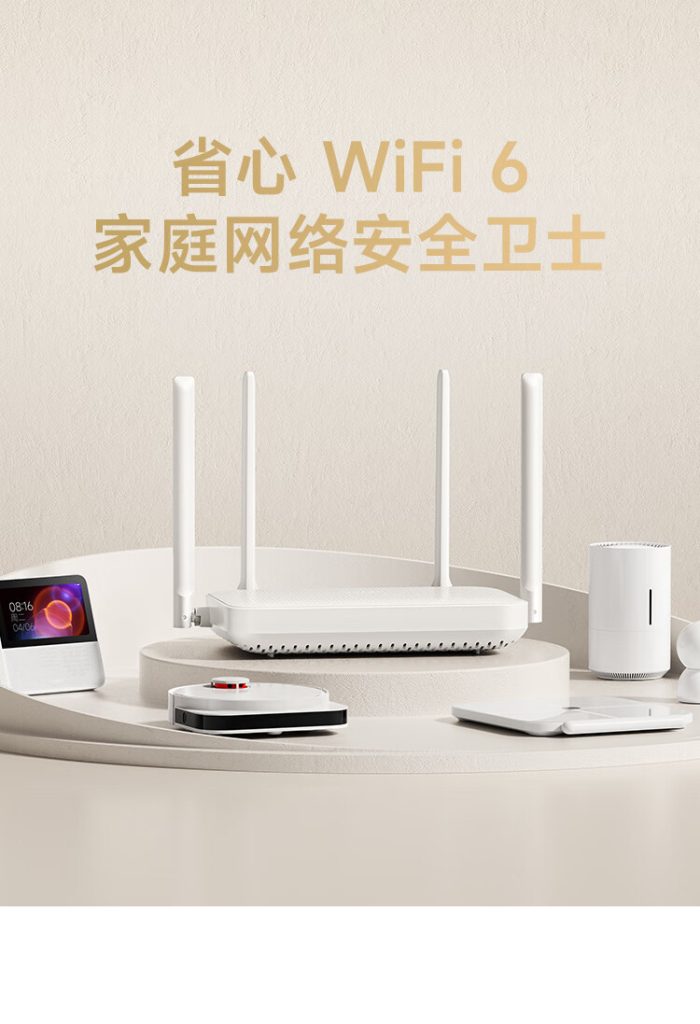
Xiaomi has introduced the Router AX1500, which is currently available for pre-sale on JD.com at a price of 129 yuan ($18) and is scheduled to go on sale on December 12th.
Xiaomi Router AX1500 Specifications:
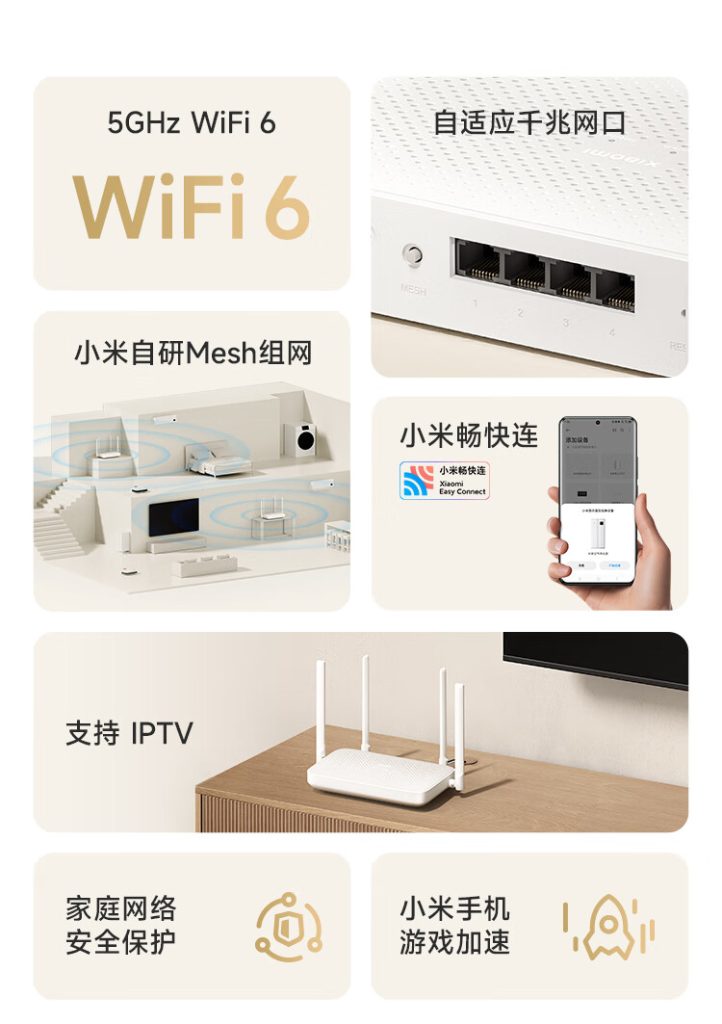
In terms of networking capabilities, the AX1500 supports both 5GHz and 2.4GHz frequencies. The 5GHz band ensures faster speeds while the 2.4GHz band offers better wall penetration. The router intelligently switches between these bands based on actual usage, providing an optimized internet experience.
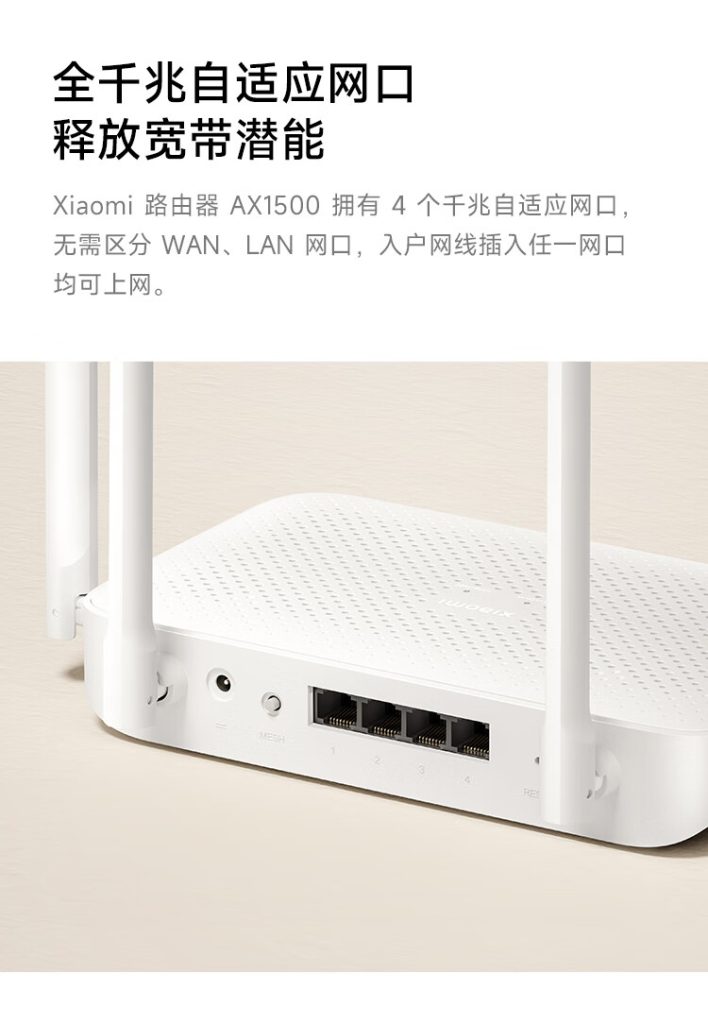
This router achieves dual-frequency concurrent speeds of up to 1501Mbps with WiFi 6 on the 5GHz band and features four gigabit adaptive Ethernet ports. It also includes Xiaomi’s self-developed Mesh networking technology, allowing the connection of up to 10 routers for extensive coverage and seamless roaming throughout a home. The AX1500 router boasts OFDMA technology, enabling simultaneous data transmission for multiple devices, ensuring smooth internet access for households with multiple users.
It also features Xiaomi’s “Changkuailian” (Fast Connect) technology, simplifying the connection of Xiaomi smart devices without the need for passwords and facilitating automatic reconnection with synchronized WiFi password changes. “Xiaomi Changkuailian” is an upgraded version of Xiaomi’s smart home software, streamlining the setup of Xiaomi smart home products through the Mi WiFi mobile app, making it user-friendly.
For gamers, particularly those using Xiaomi or Redmi phones, the router offers an exclusive acceleration channel in gaming scenarios to reduce latency and improve responsiveness. Moreover, the AX1500 supports IPTV, which assists in setting up network television more easily.
In terms of security, the AX1500 includes features like network usage management and child safety protection, alongside anti-hogging protection and a dedicated guest network. It also incorporates WPA3 for enhanced security encryption and BSS Coloring to optimize airwave allocation and reduce WiFi network interference.
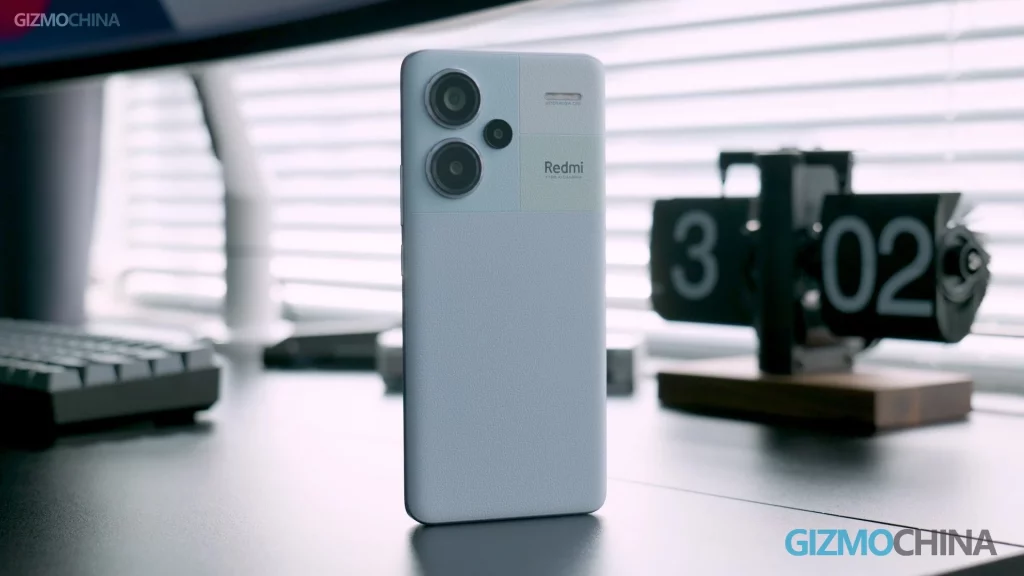
Earlier today (6th December 2023), Xiaomi unveiled the Redmi 13C and the Redmi 13C 5G in the Indian market. Now, it appears to be gearing up to launch a new Redmi smartphone in the region, this time from the popular Note 13 lineup. The device in question is the Redmi Note 13 Pro+ 5G (Review). So here’s everything you need to know about its Indian release.
Redmi Note 13 Pro+ 5G India Launch
In a new teaser, the Chinese tech giant revealed the launch timeline of the Redmi Note 13 Pro+ 5G in the Indian market. The smartphone will be announced in the region in January 2024, which is next month. Unfortunately, the teaser image poster does not reveal whether the brand will release any other Note 13 series devices alongside the top end Note 13 Pro+ 5G model.
Although, there will likely be multiple products, if not handsets, that will be showcased during the launch event next month. For those unaware, the Redmi Note 13 series includes the base Note 13, Note 13 Pro, and the Note 13 Pro+ models. Just recently, the global launch of the Redmi Note 13 Pro and Note 13 Pro+ surfaced on TDRA certification, which hints at an imminent global launch.
Similarly, the recent pricing leak of the Note 13 Pro series in the European market also gave us an idea regarding its overseas pricing. To recall, the two phones will be offered in a single 12GB RAM + 512GB storage option in Europe. The Redmi Note 13 Pro will reportedly cost around 450 Euros while the Note 13 Pro+ will cost around 500 Euros. This roughly translates to around 40,000 to 45,000 Indian Rupees. Although, the Indian pricing is still at large, so stick around for more updates.
As our reliance on devices like smartphones, wireless headphones, smartwatches, laptops, and tablets grows, so does the need to charge them daily. This is where the significance of power banks becomes increasingly apparent. However, the idea of adding one more device to our daily carry can be a deal breaker for many. Luckily, Urbn has introduced Nano, the world’s smallest charging power bank. With a hefty 20,000mAh capacity and 22.5W charging capability, Nano aims to address this problem by offering a compact solution. Here are the details…
Urbn Nano Launches the Smallest 20,000mAh Power Bank with 22.5W Charging
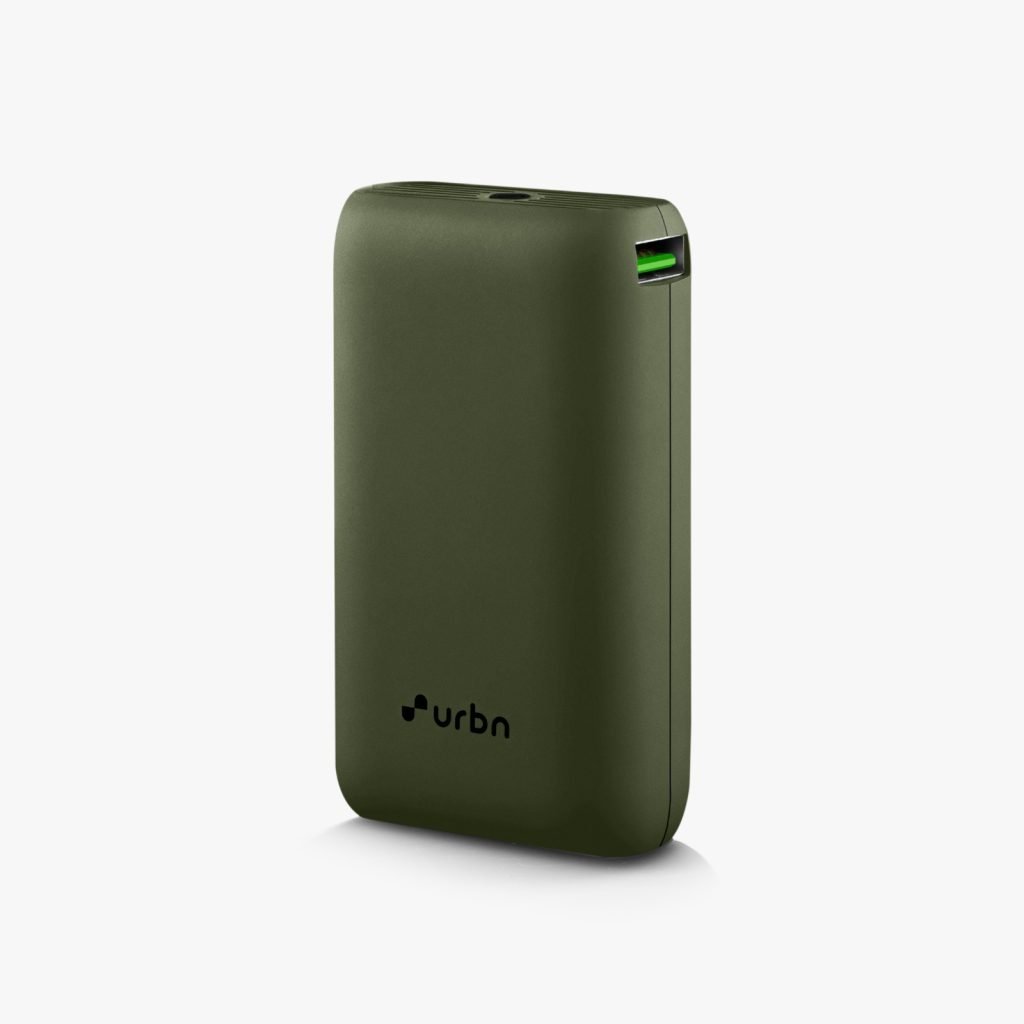
Urbn, a well-known brand for its successful products like power banks, headphones, and cables, has recently introduced the world’s smallest power bank. This tiny powerhouse is available in two different battery capacities: 20,000mAh and 10,000mAh. The prices are quite reasonable at INR 2,499 and INR 1,699, respectively.
Urbn Nano 20.00 mAh power bank
What’s impressive is that both variants can charge a phone from 0-50% in just 30 minutes. However, the actual charging time may vary depending on the device’s size and its charging capacity in watts. Despite this, considering the average size of phones, you’re likely to be pleased with the charging speed. You can find these innovative products on popular platforms such as Amazon, Croma, and Urbn’s website.
The Urbn Nano Power Bank, with a 20,000 mAh capacity, stands out for its 22.5W charging support. What sets it apart is the triple port design, accommodating multiple devices simultaneously. You’ll find one USB-A and two USB-C ports, making it versatile for charging items like headphones and phones concurrently, saving you time.
And if you concerned about safety? Urbn addresses this with BIS certification and a 12-layer protection system, alleviating worries about carrying a battery in your pocket. Its compact size, measuring 10.8 * 2.8 * 6.9cm, makes it an ideal portable powerhouse for on-the-go charging. The 10,000 mAh model boasts efficient 20W charging with two-way capabilities, ensuring speedy recharges
Honor is gearing up to launch new GT series smartphones in China. One of the brand executives just teased the arrival of these devices last week.
As per leaks, there will be two devices, namely Honor 90 GT (previously Honor 100 GT) and Honor X50 GT. These phones will be centered around performance.
We only know a few tidbits about these products. Today, a couple more crucial details have emerged. Let’s go through them.
According to Digital Chat Station, the upcoming Honor 90 GT and Honor X50 GT will come with up to 24GB RAM. They will be the brand’s first smartphones to offer this huge amount of RAM.
Further, the tipster claims that the main camera of these handsets will have OIS (Optical Image Stabilization). He also adds that why will be powered by three different chipsets and will flaunt an eye-catching display.
Previously, the same source had revealed that the 90 GT and X50 GT will be powered by Snapdragon 8 Plus Gen 1 and Snapdragon 888 chips, respectively. But this is the first time we are hearing about three chipsets.
Currently, it is not known which one of these two phones will be housing the third silicon. We think that the 90 GT could come in two variants offering different chips.
As for displays, the handsets are said to sport flat screens. It is not known whether they will be equipped with LCD or OLED panels. There’s a chance that they may arrive with OLED displays after all.
We are looking forward to learning more about the Honor 90 GT and the Honor X50 GT in the coming days. Perhaps, the brand may finally start teasing the features officially as an executive has already hinted that GT will be spun off into a new separate lineup of devices from the existing number and X series.
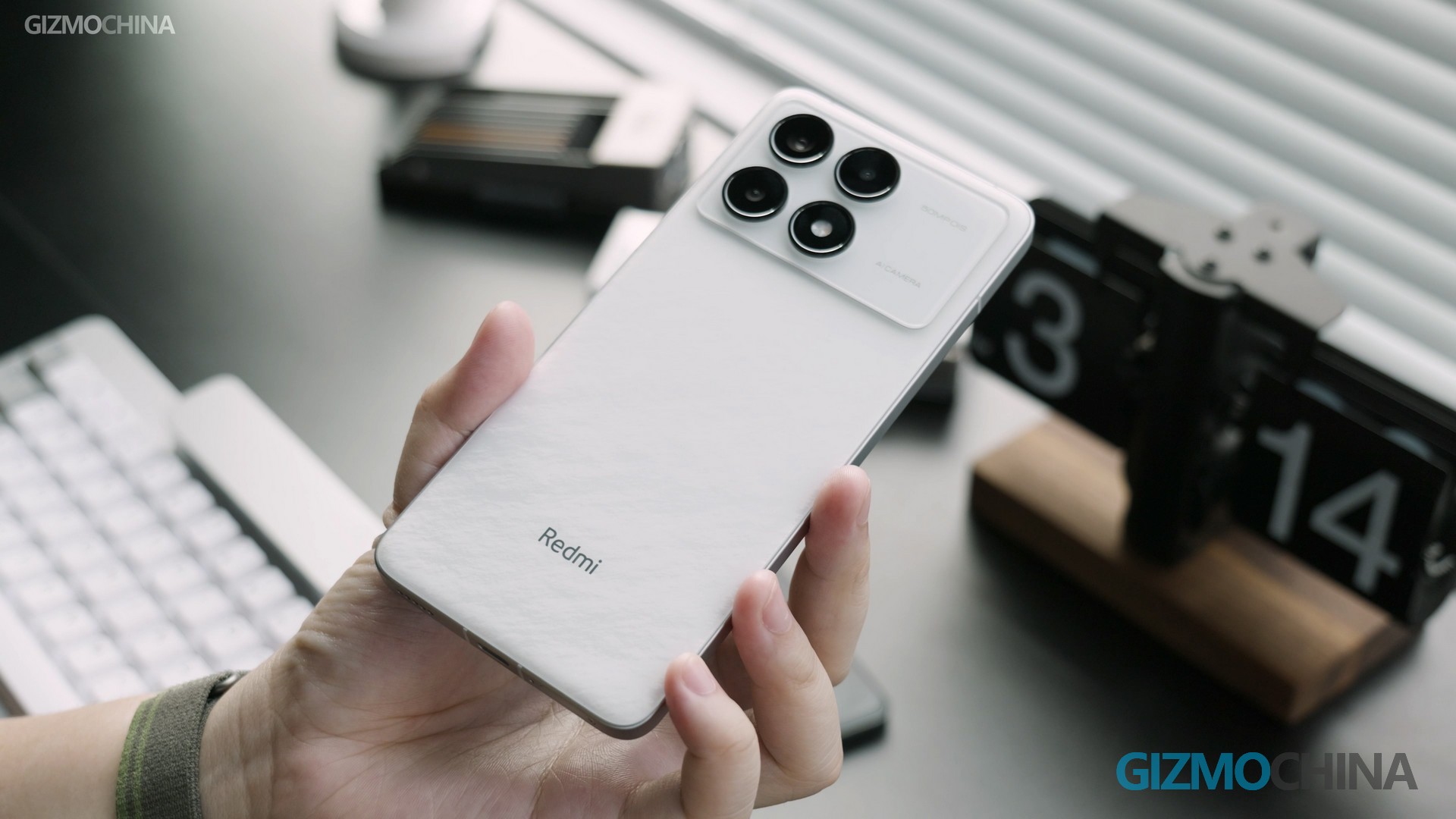
Unsurprisingly, the K70 series was another big seller in China. Compared to the K60 series, this K70 doubled the so-called “sales in five minutes”. While many people trolled it in our unboxing video for this phone getting uglier, it’s also true that it’s more popular. So why exactly do people love both phones here so much? After my two days of experience, I probably know what the answer is.
Design
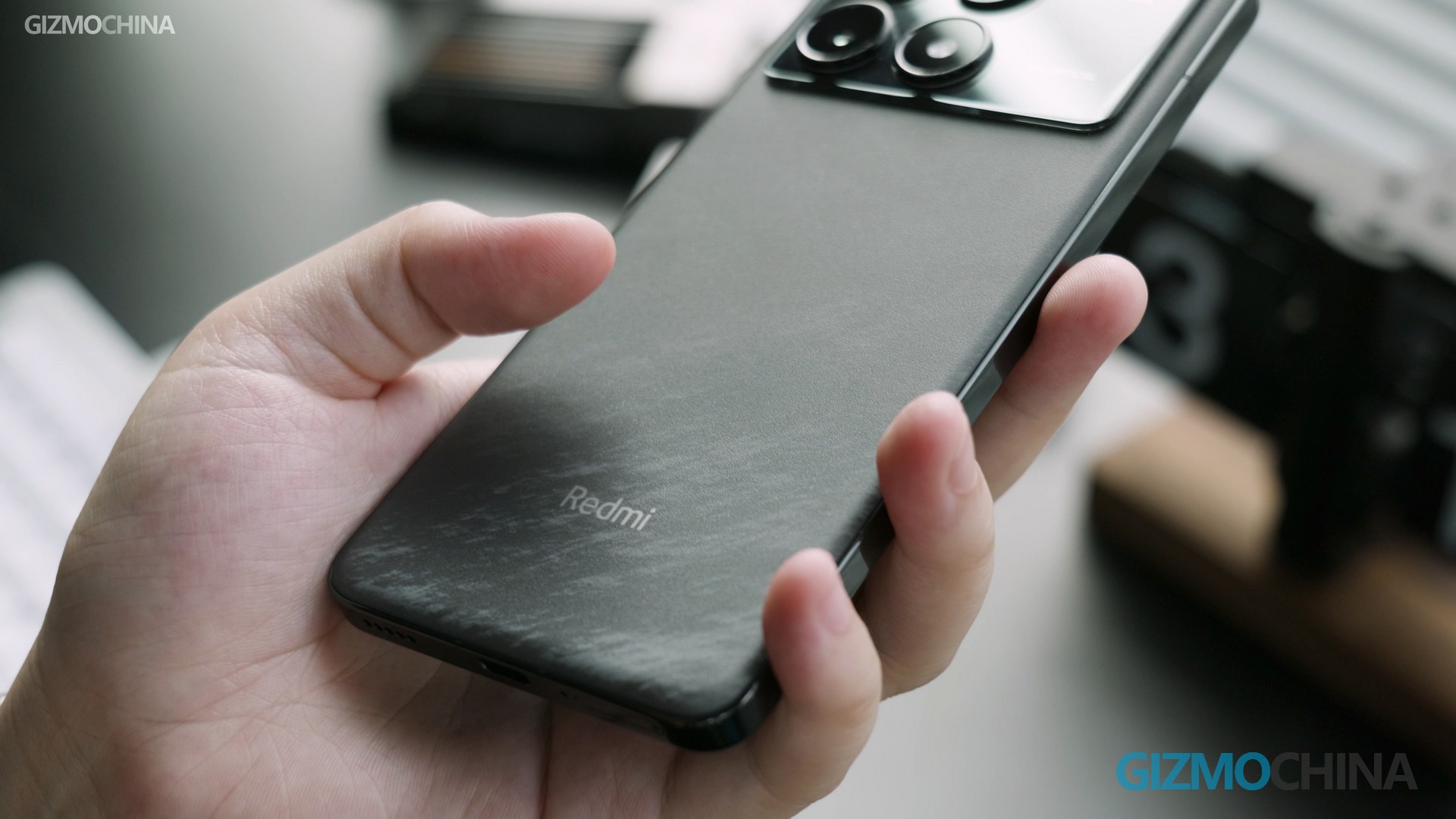
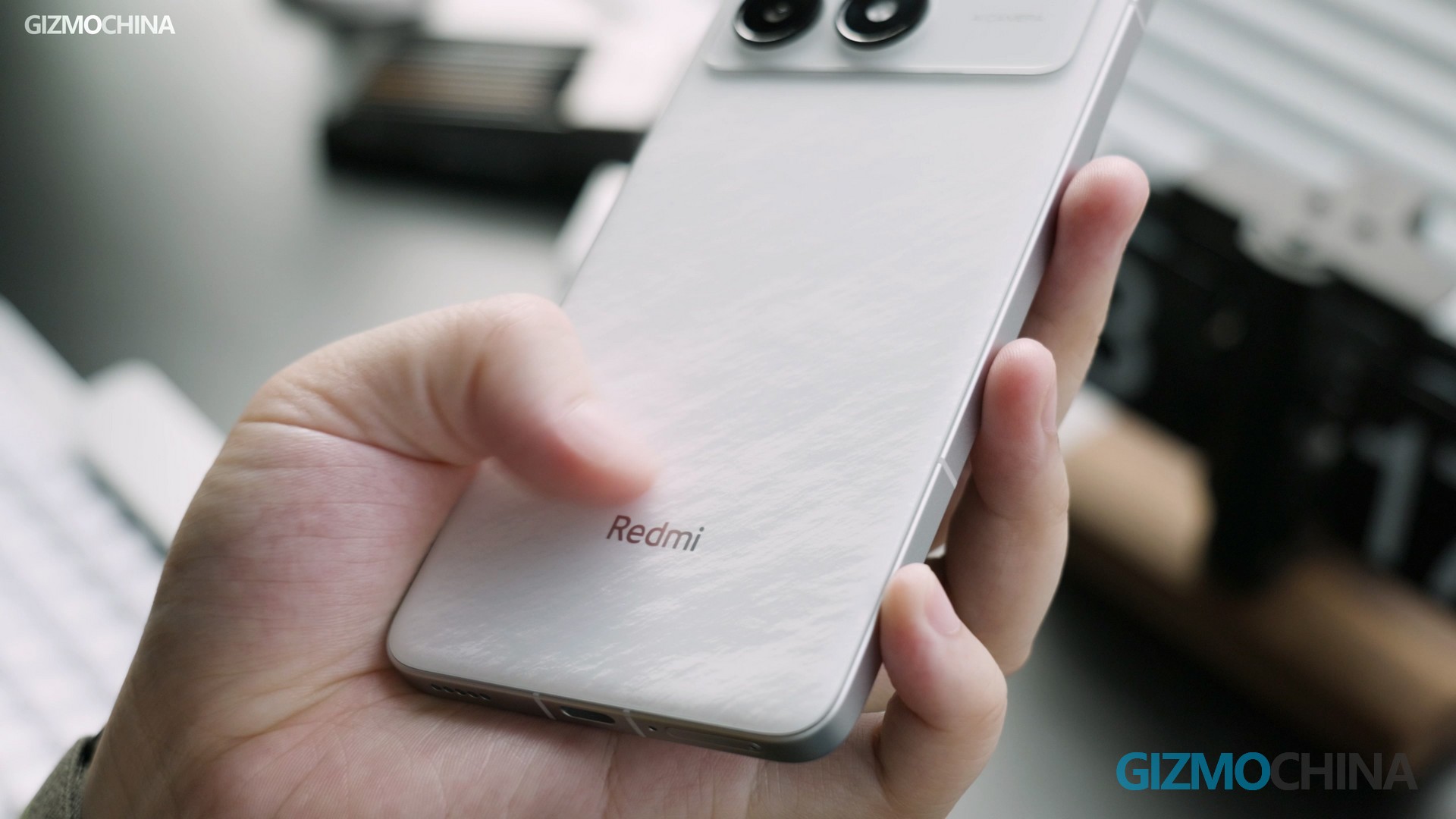
I admit, if you just look at the appearance, the K70 is not as good as the K60. Are people stupid for buying it even though it’s ugly? Of course not, it’s just because a lot of people were overwhelmed by the texture of both phones after actually getting their hands on them. I was one of them, and the K70 is definitely better to the touch than to look at.
After so many years, it’s still quite impressive that we’re finally seeing aluminum frames again in a budget phone. I would recommend buying the black or white version, they are the only two colors with frosted back covers, which are less prone to fingerprints. By the way, the black frosted back cover is as rough as sandpaper to the touch, while the white one is like silk and smoother.
After all the good points, it’s time for some complaints. No IP68. no wireless charging. That’s right, this is the Redmi we’re all familiar with. So K60 series users, hold dear to your phones because Redmi phones probably won’t have these two features in the future.
Display
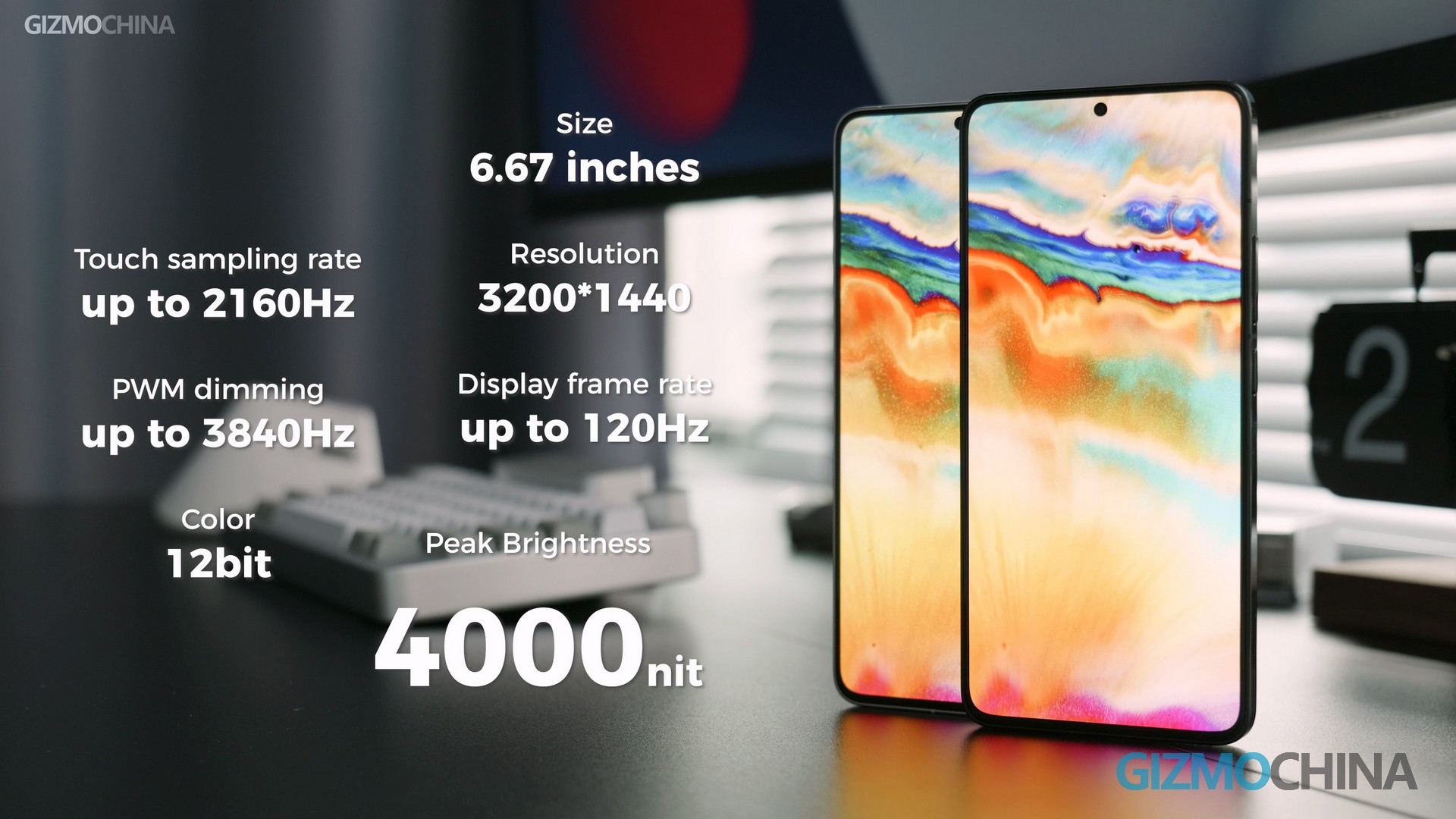
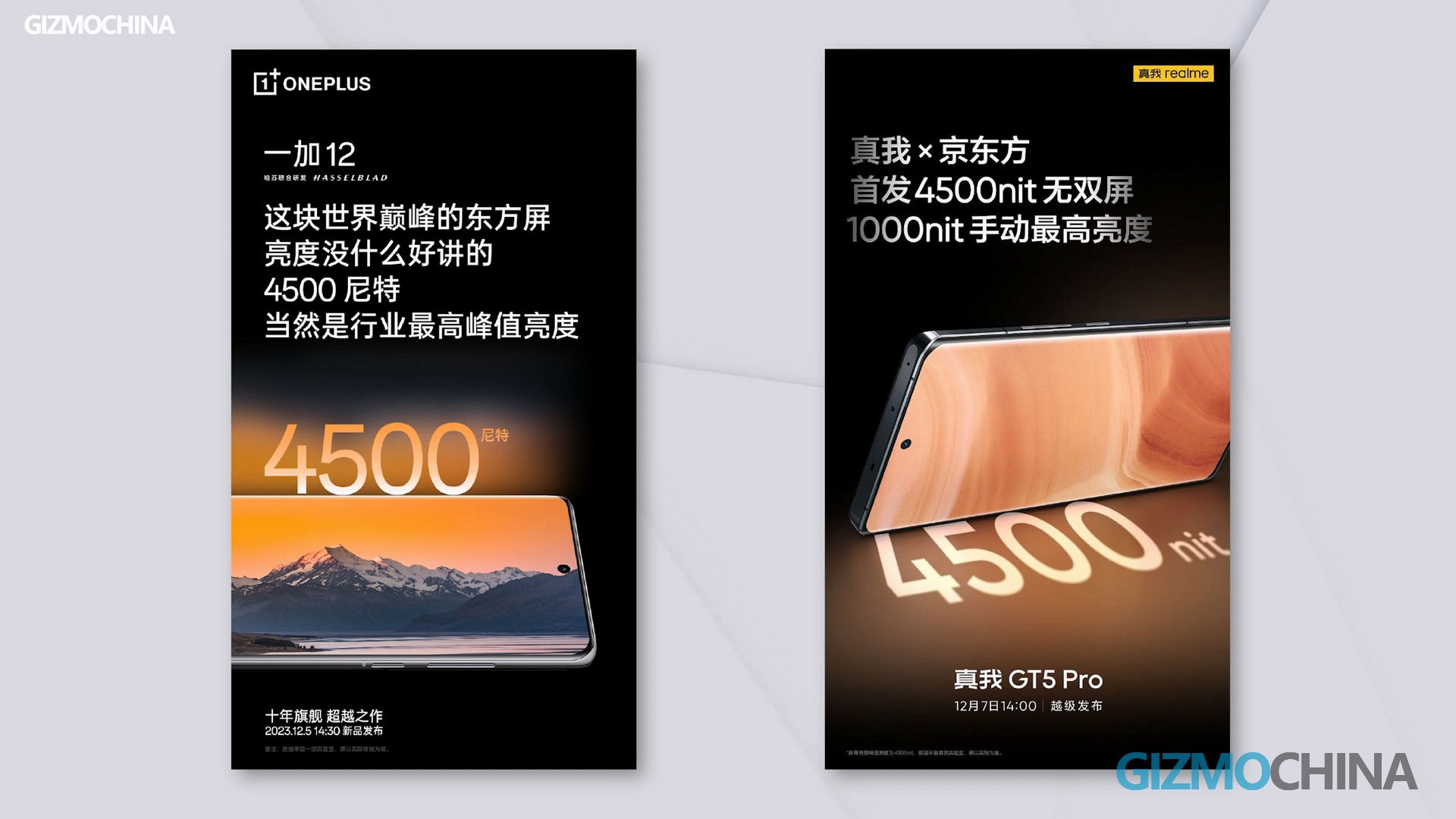
The K70 and K70 Pro use the same screen, both 2K straight screens from TCL. Shockingly, this C8 panel has a 3000nit peak brightness on the Xiaomi 14, and it didn’t take long for its maximum brightness to rise to another level. In fact, the manual full-screen maximum brightness is probably only 670nit, and in sunlight, it can reach up to 1200nit. it’s quite nice to use, but it’s certainly not as exaggerated as it’s claimed to be.
Don’t think Redmi is the only one who likes to use such promotional tactics because there are a couple of phones with a peak brightness of 4500nit that will be released soon.
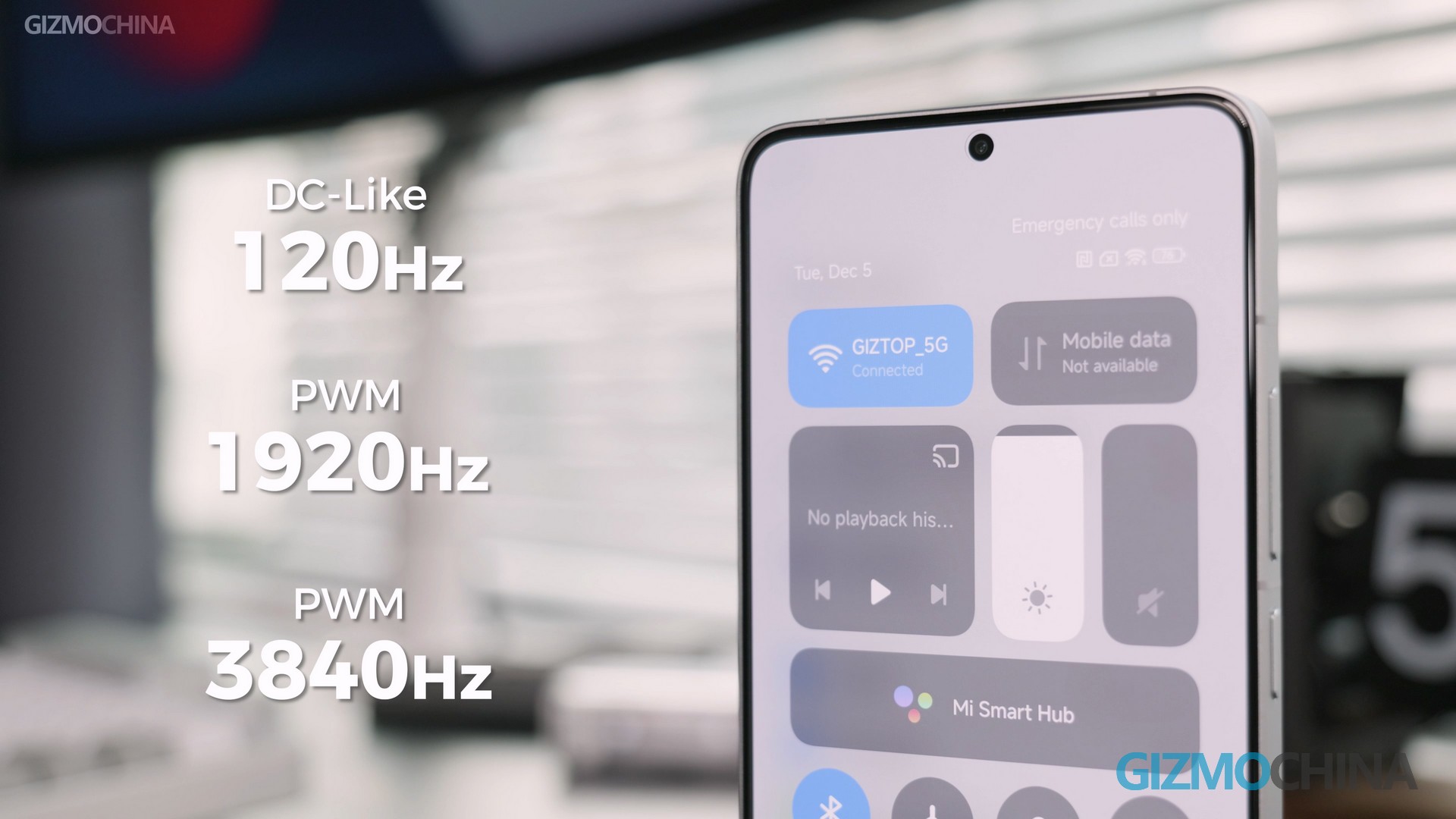
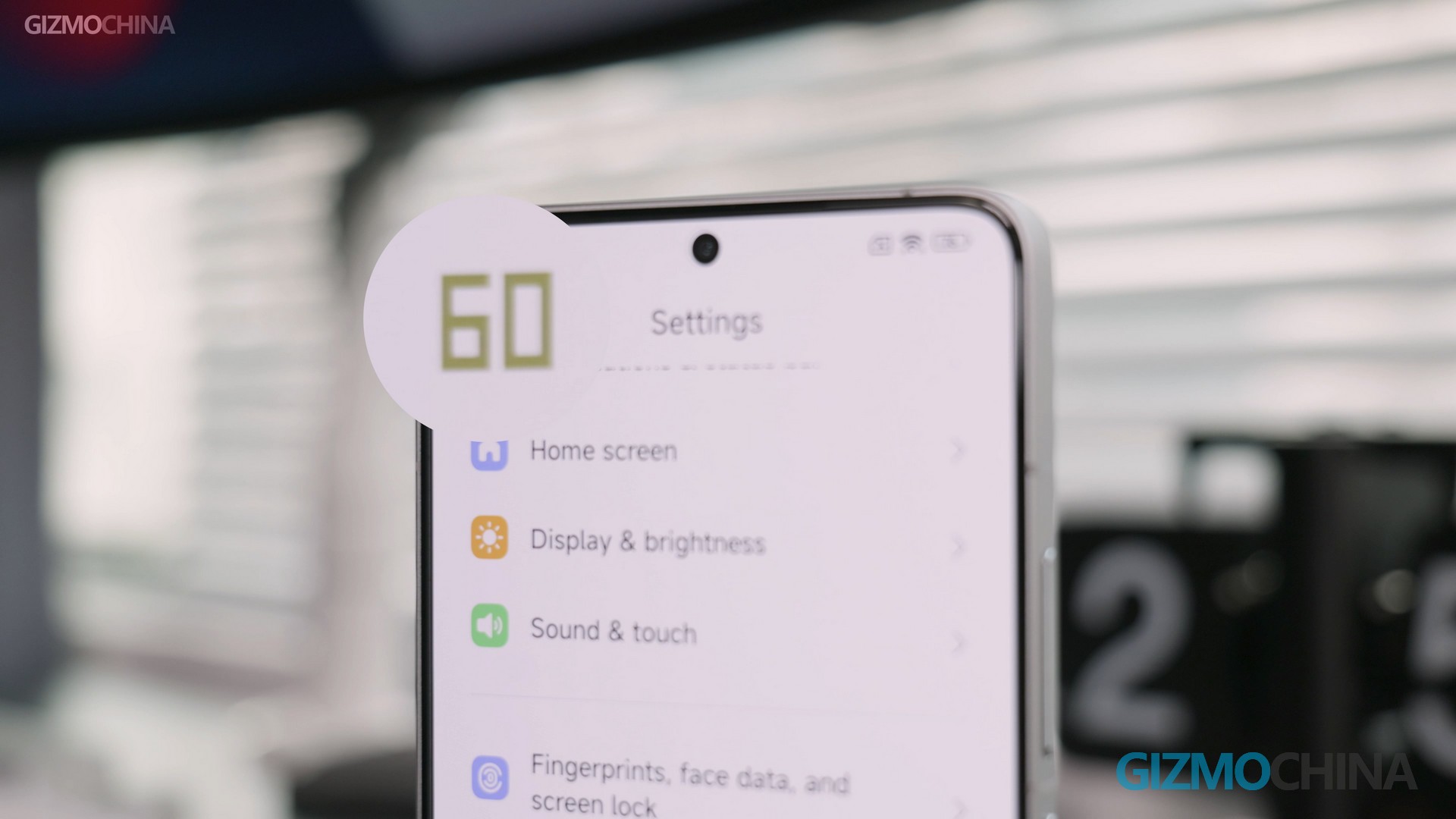
Compared to the peak brightness which seems like a gimmick, the increase in PWM dimming frequency is what we really need. 120Hz DC-like dimming at high brightness, 1920Hz PWM at medium brightness, and 3840Hz at low brightness. Even though they don’t support LTPO, they are able to do the same with the refresh rate automatically reduced to 60Hz when you are not using the phone. It will drop the dimming frequency, but I think it’s acceptable.
We also tested the touch sampling rate. It’s 240Hz under normal conditions, and 480Hz with Enhanced touch turned on. There’s no doubt that the K70 series has won big again this year in the screen part. Especially with the K70 Standard, you’ll never find a phone with a better screen for under $400, I’m sure of it.
Benchmark & Gaming
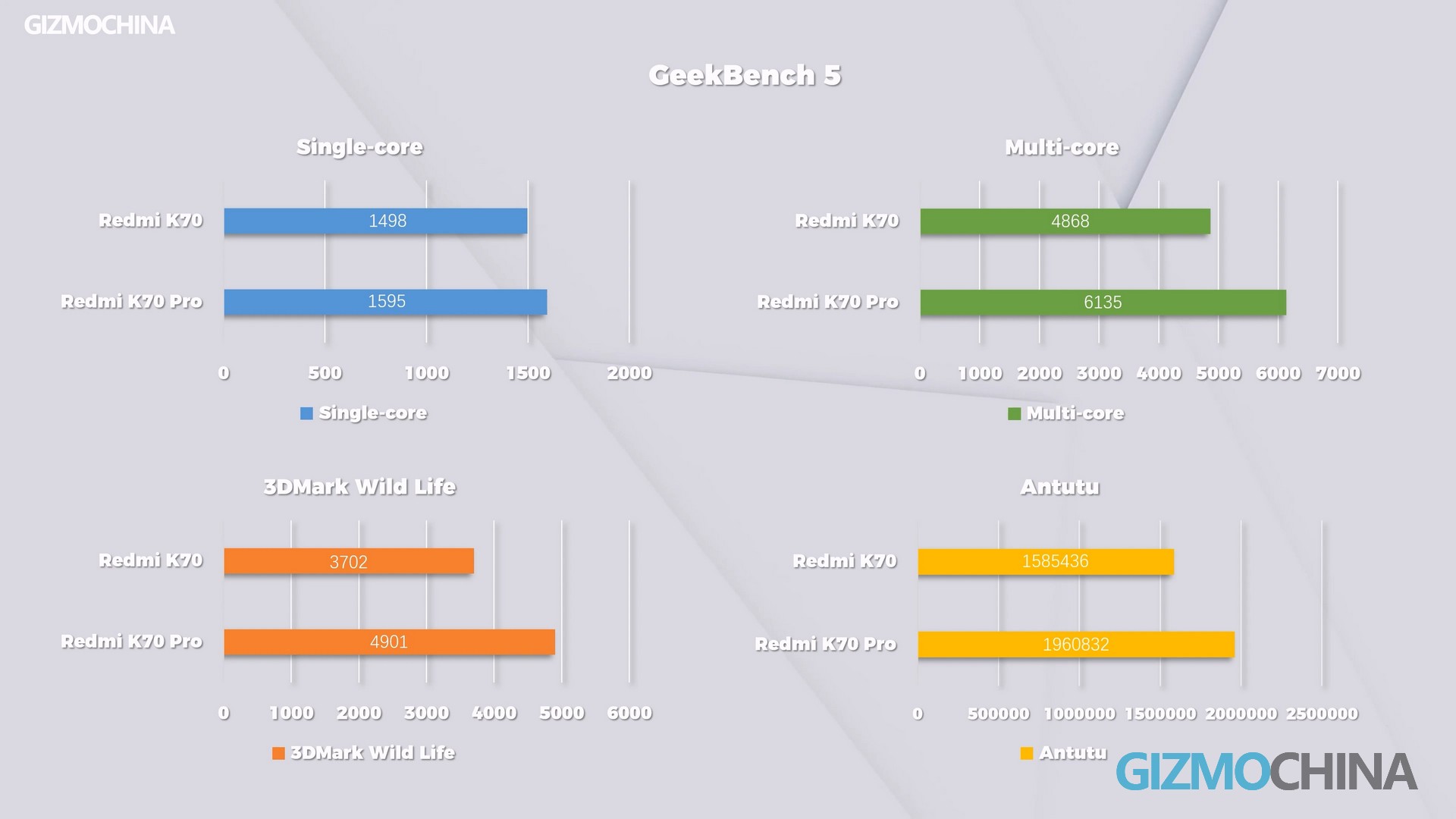
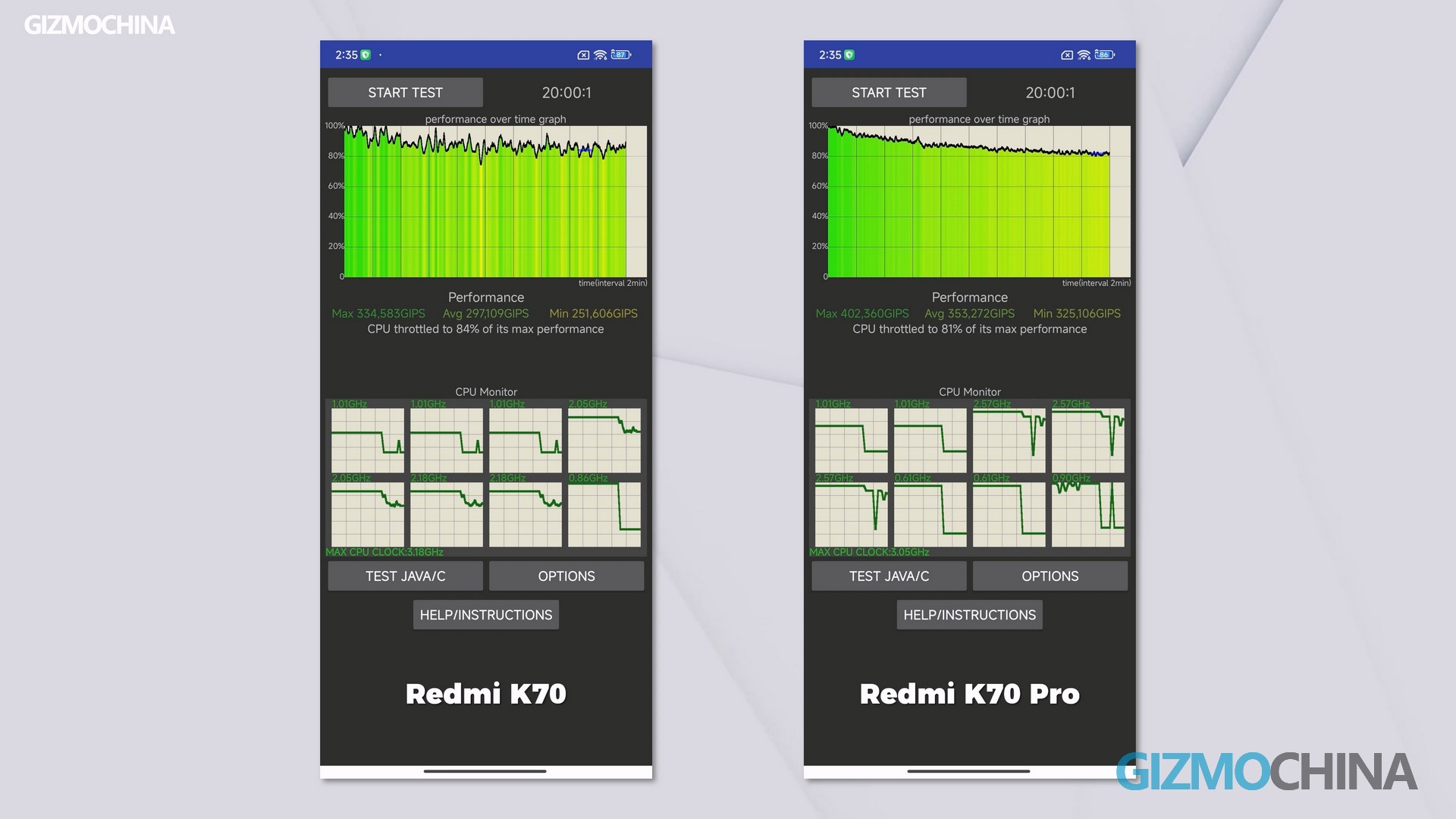
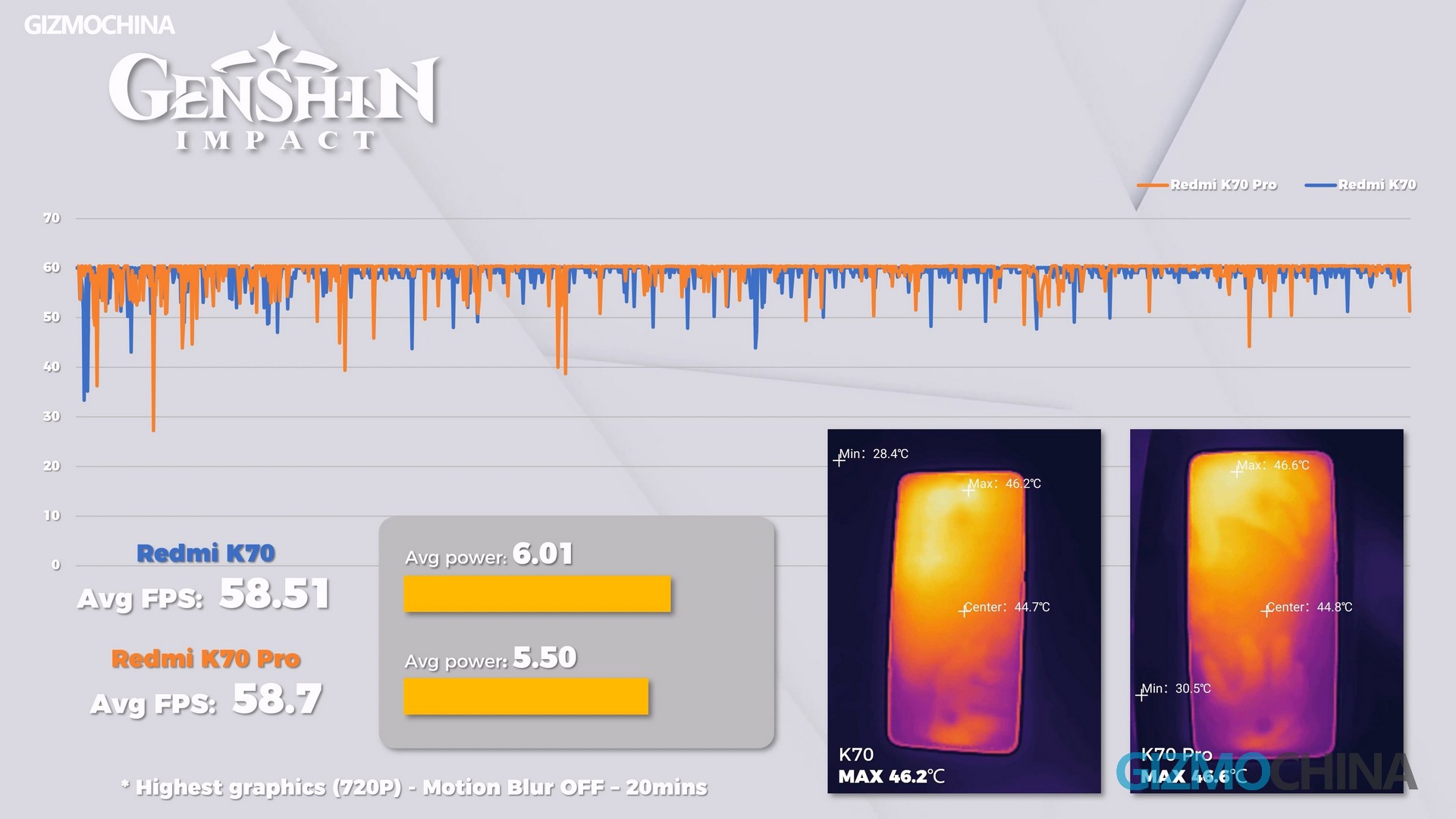
One of the biggest differences between the Standard and Pro versions is the processor. One is the latest 8 Gen 3 and the other is 8 Gen 2. Obviously, there is a real gap in performance between them. But don’t worry too much about the gaming experience on the standard version, as the 8 Gen 2 is still a very good processor. We tested them both in Genshin Impact at a room temperature of 22 degrees Celsius. The frame rate curves for both the Standard and Pro versions are almost identical, with a straight line. The maximum temperature is also kept below 47 degrees Celsius.
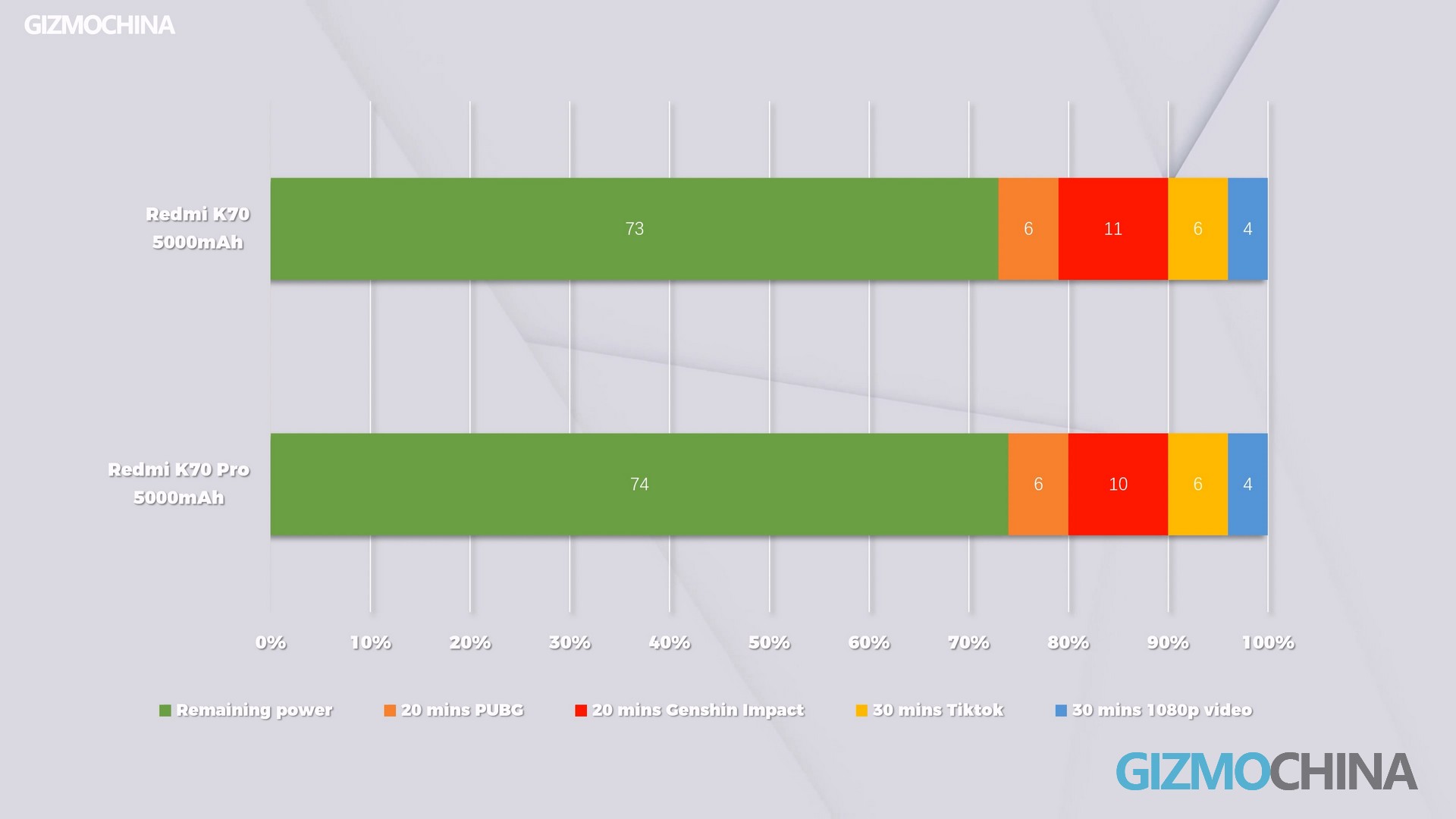
Doesn’t seem like there’s much need to buy the Pro, but in fact, looking at the power consumption you can see that the Pro version is definitely the one that handles it more calmly. The standard version will consume 1% more power than the Pro after 20 minutes of gaming. If battery life is important to you, then the K70 Pro is better for you.
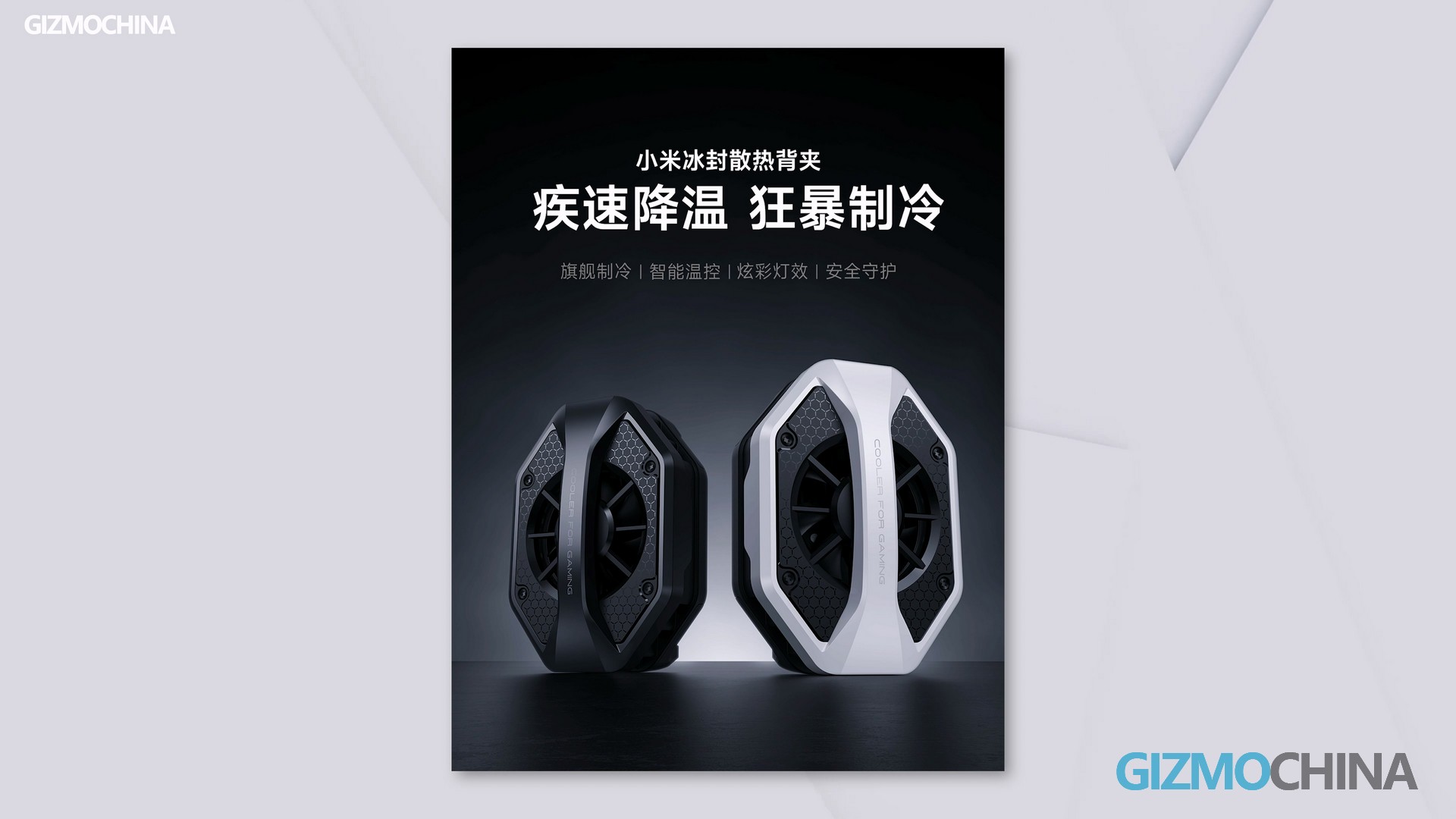
By the way, if you want to play Genshin Impact in 2K resolution at 60fps on your phone, without frame insertion or AI enhancement, then only the three phones in the Redmi K70 series can do it at the moment. But there’s a pre-condition: you have to buy their COOLING BACK CLIP, otherwise you can only play at 30fps in 2K resolution.
Camera
The second major difference between the K70 and K70 Pro is the camera. Aside from the main camera, the Pro version comes with upgrades to the other two cameras.
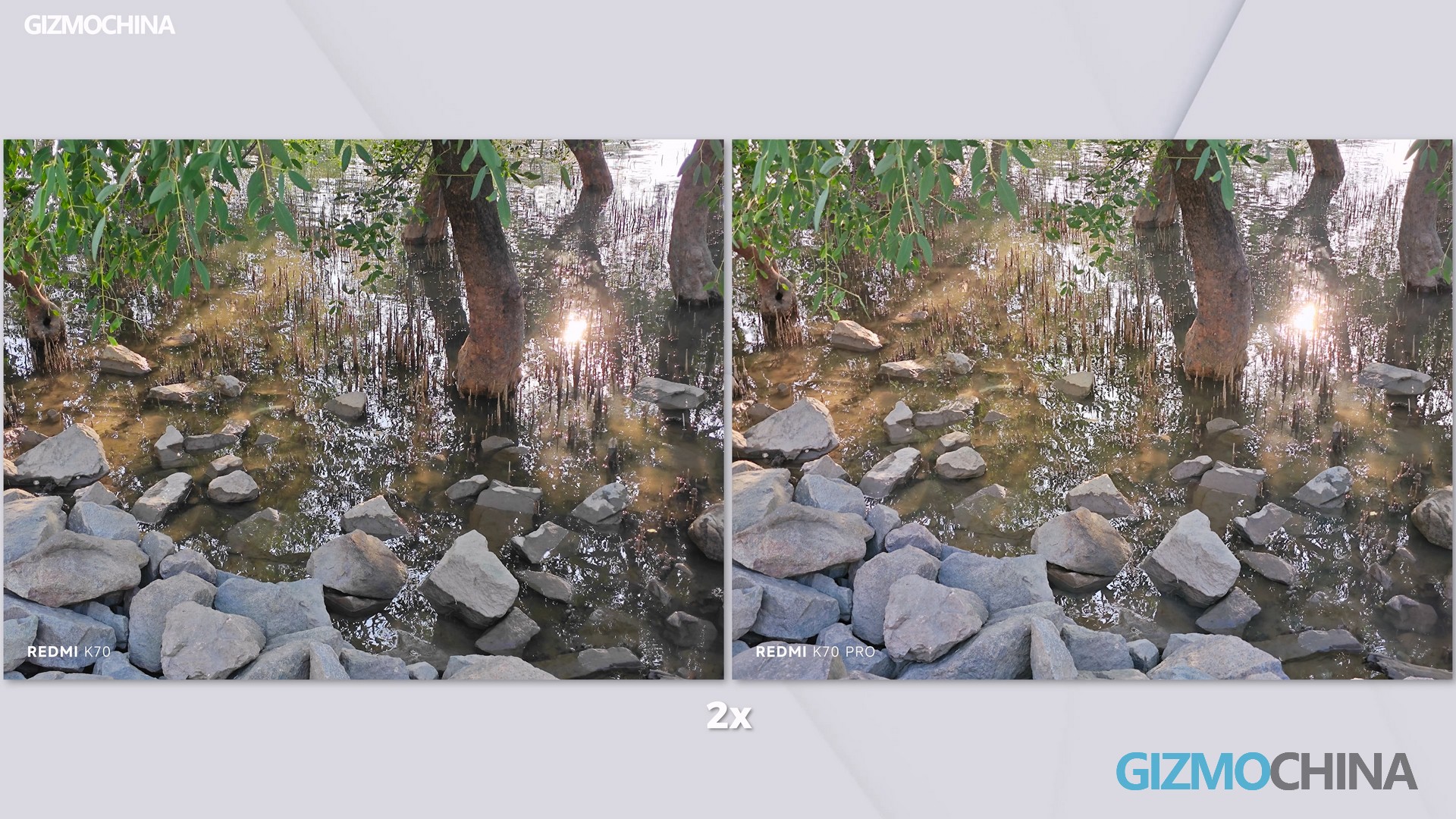
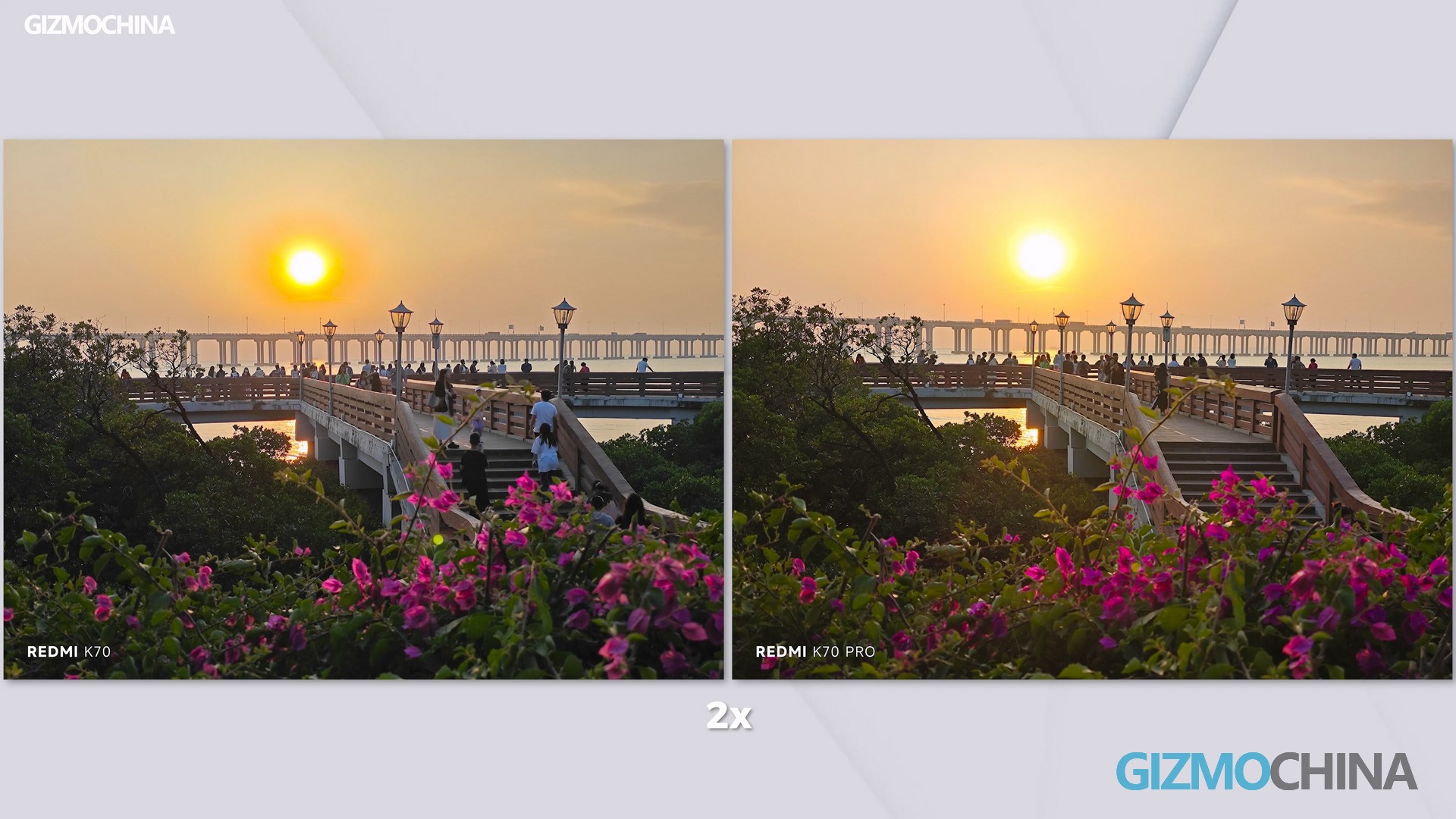
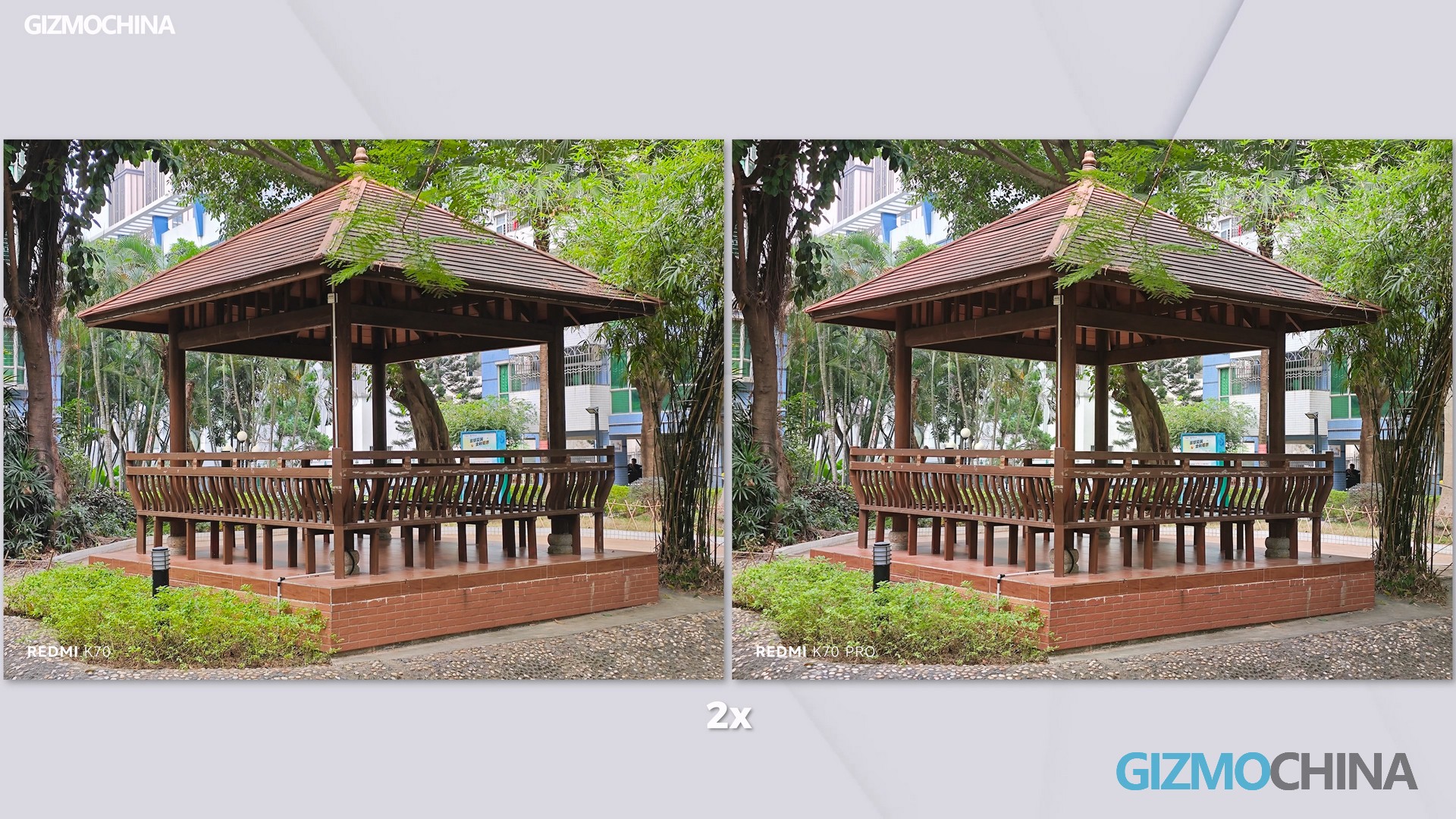
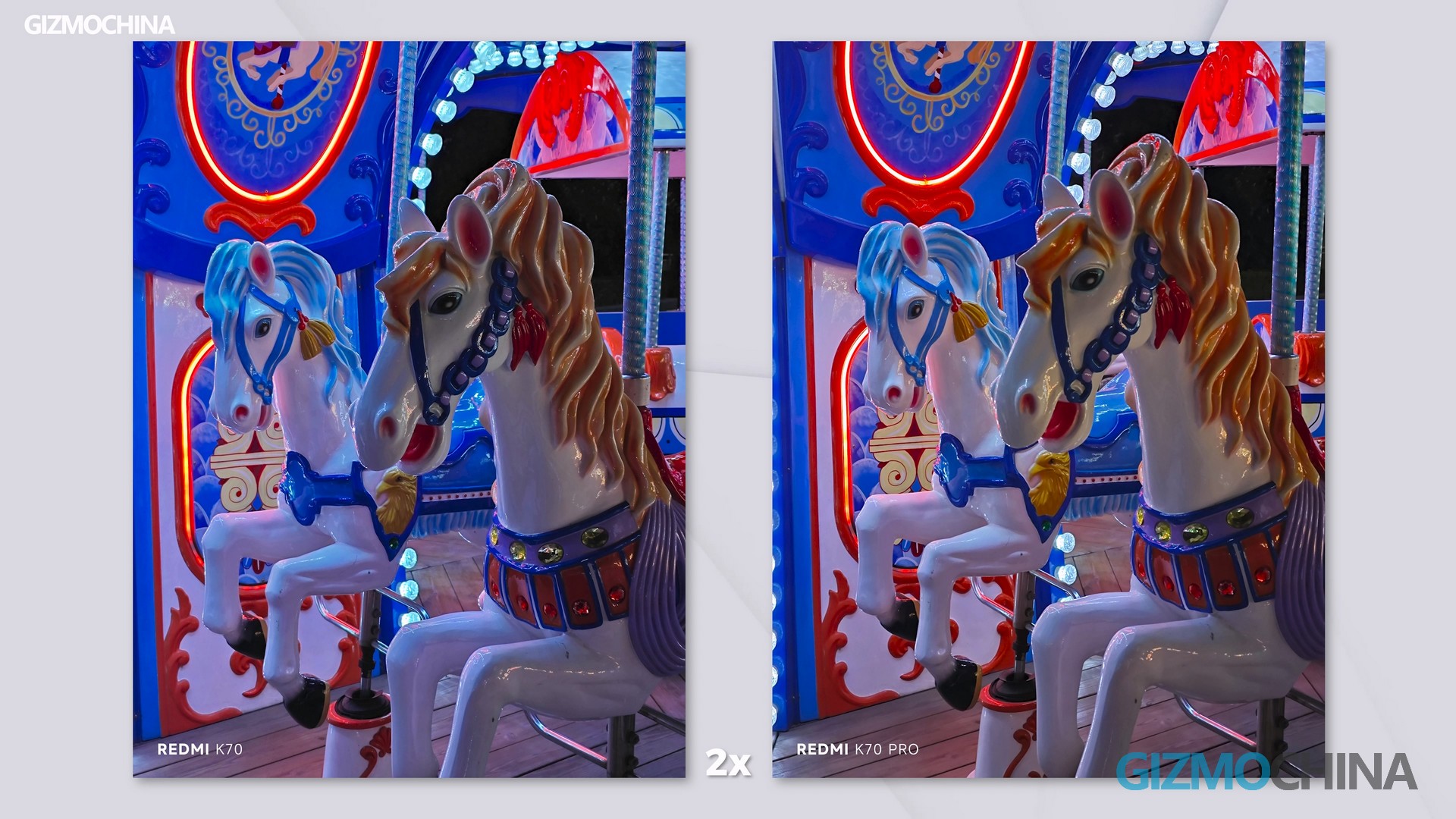
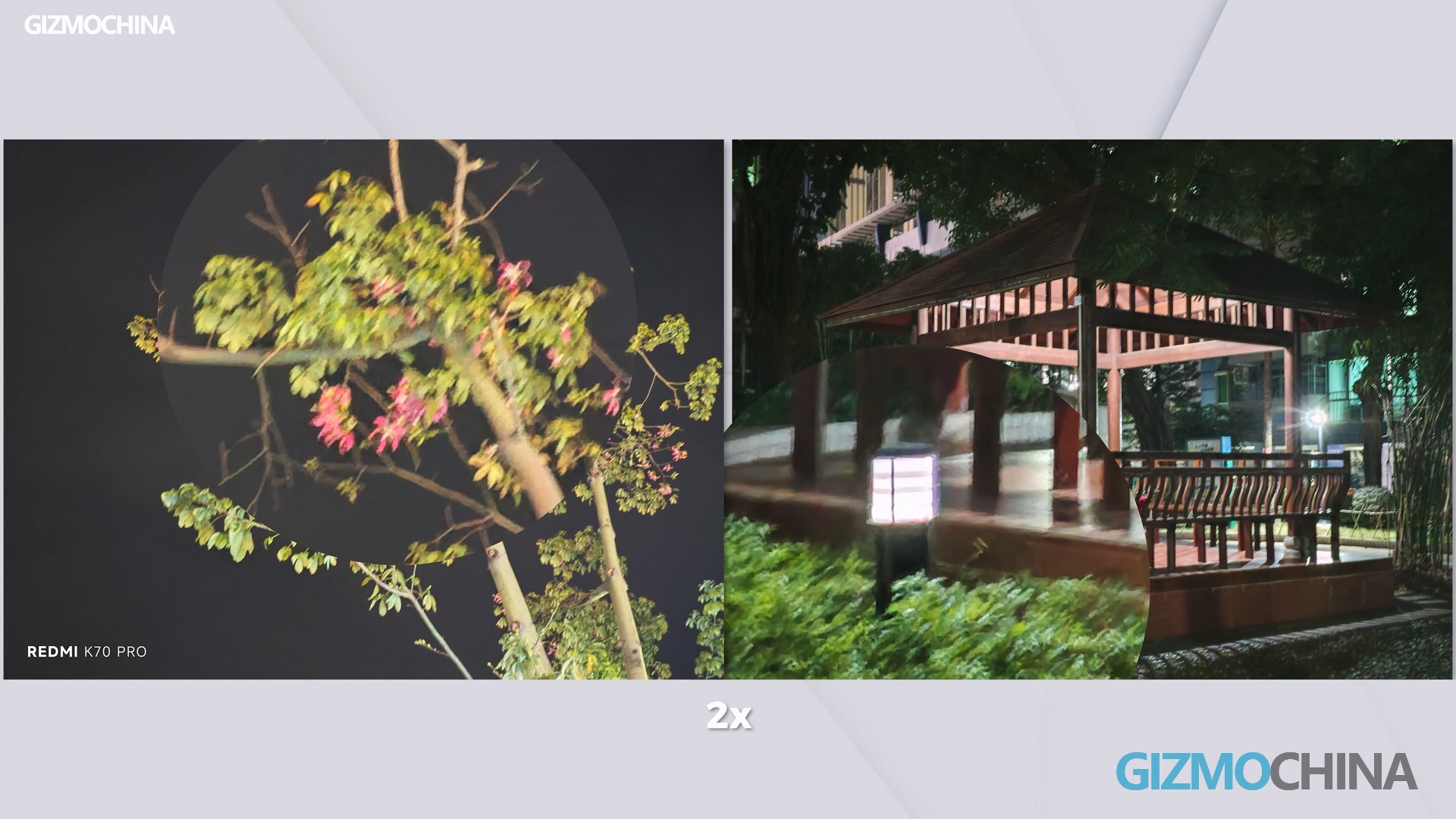
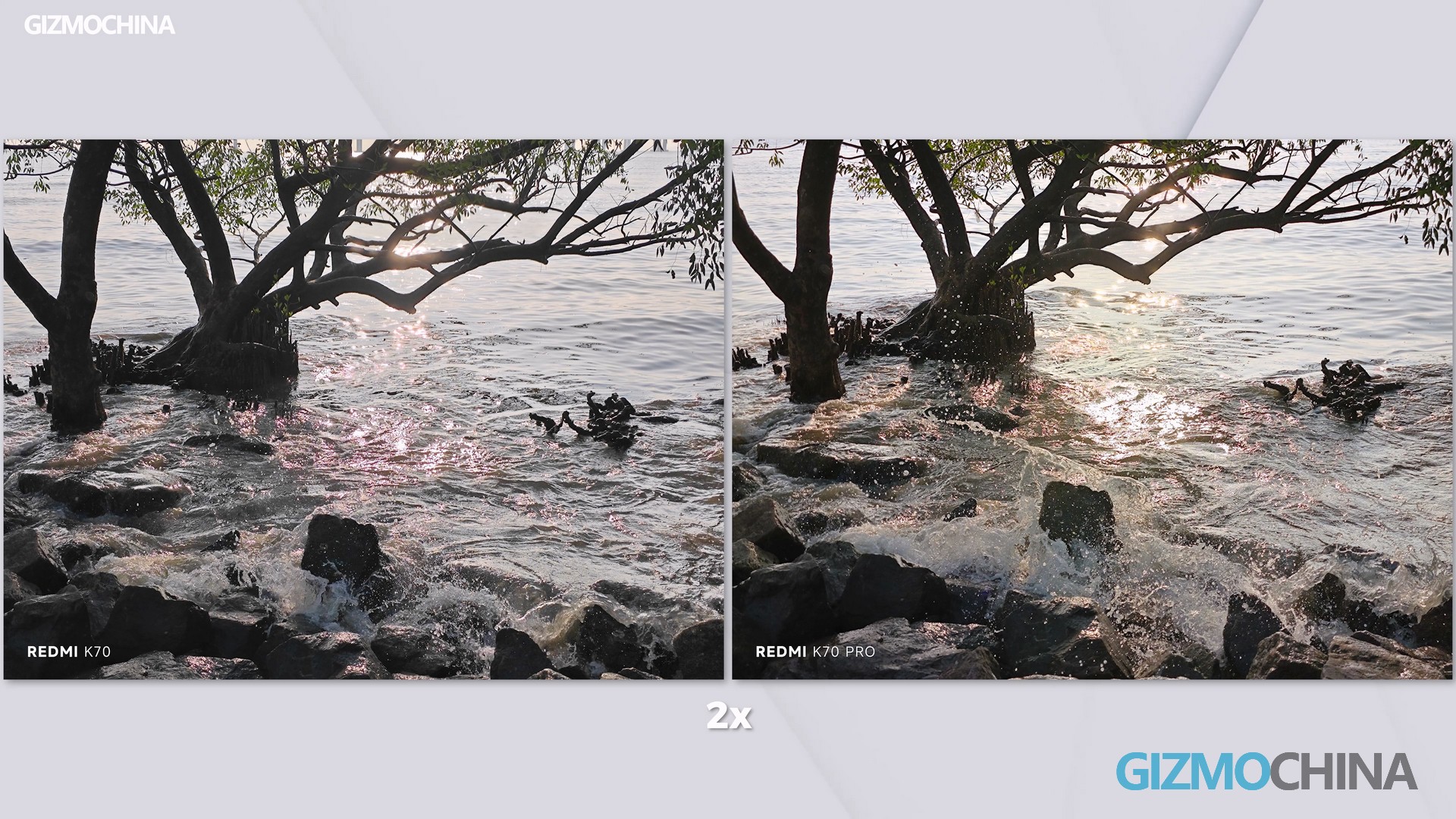
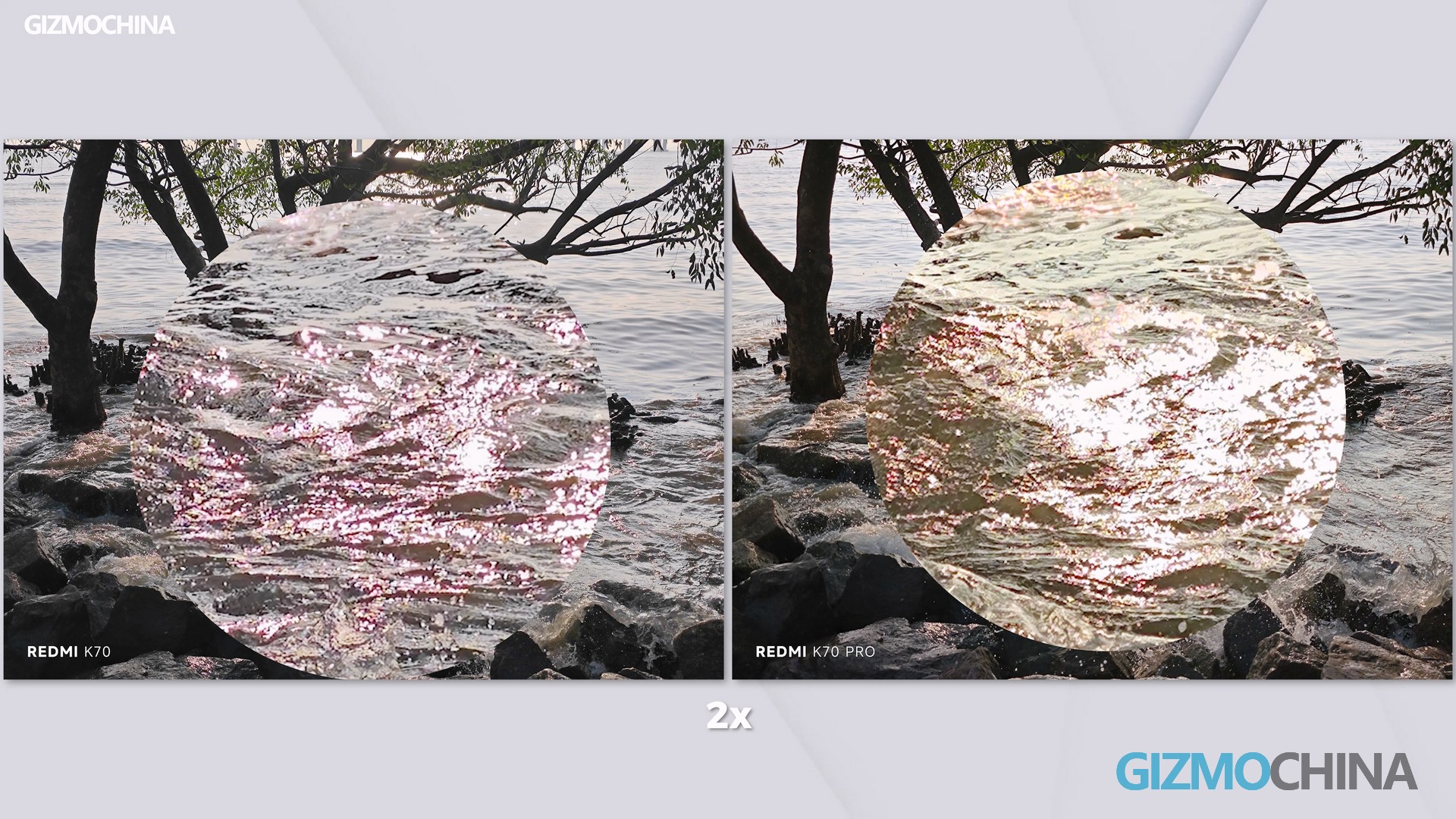
Let’s look at this new 2x telephoto camera first. Unfortunately, it doesn’t live up to my expectations. As you can see compared to the standard version that crops the shots with the main camera, the Pro version doesn’t have a significant advantage. Even for photos taken at night, you’d be hard-pressed to say which one is better. And the fact that this telephoto camera doesn’t have OIS means there is a higher possibility of getting a blurry photo. I’m not satisfied with this telephoto anyway, so I might as well have the macro camera back.
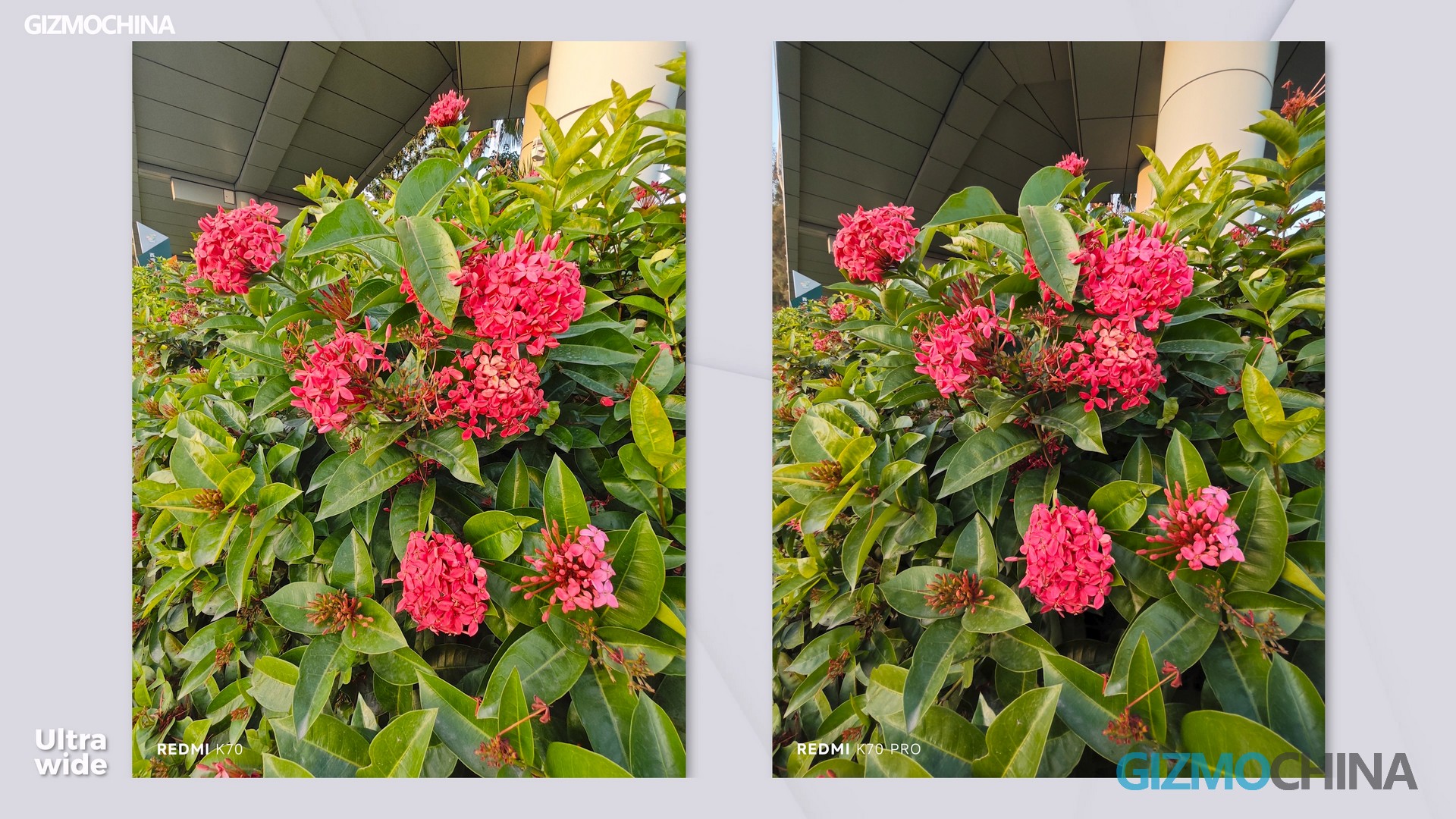
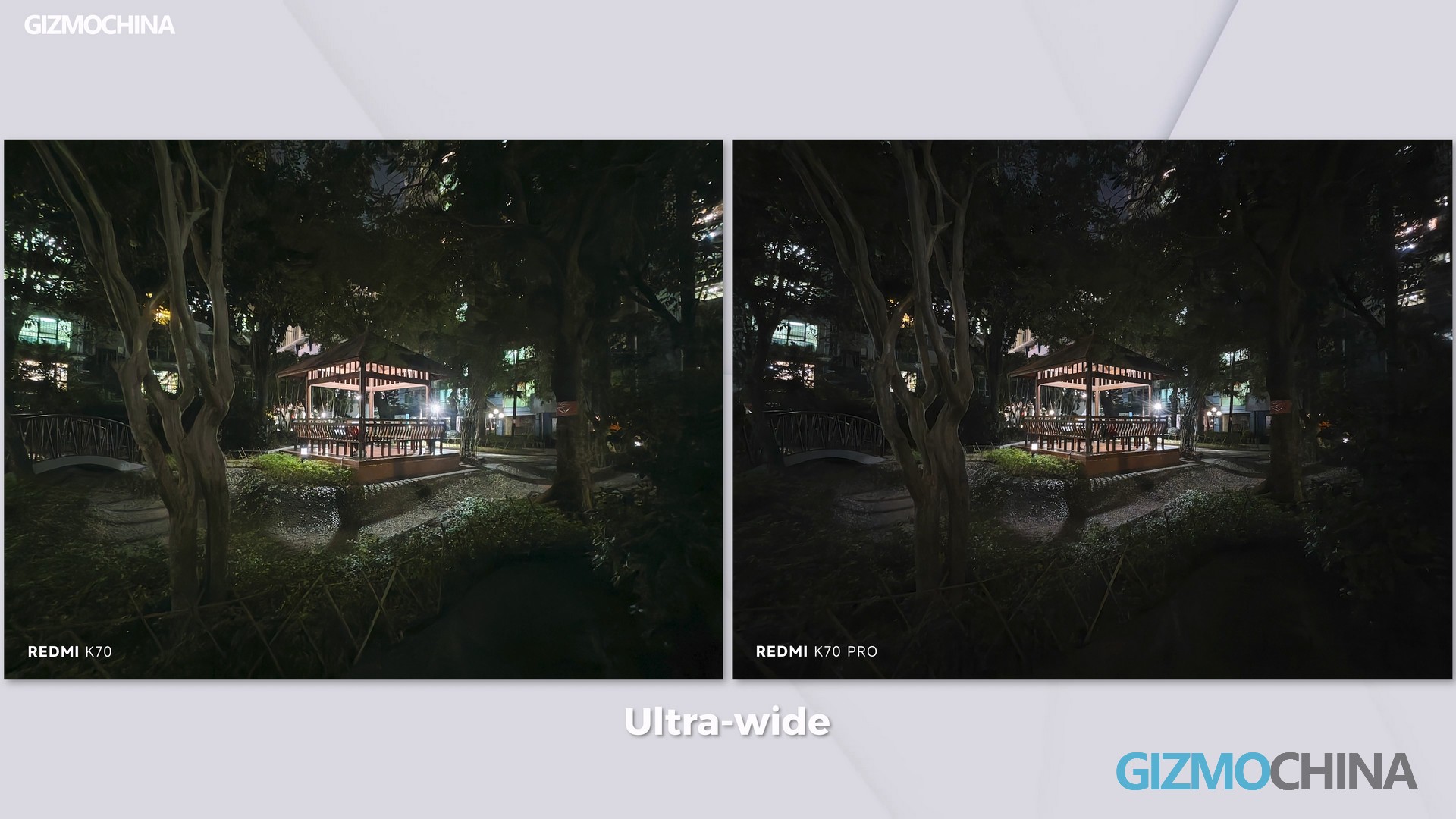
The Ultra-wide camera isn’t much better. Despite the increased amount of pixels, the sharpness isn’t significantly better. Only the white balance in dark-light conditions is a bit more accurate. So the Pro version is the same as the standard version, other than the main camera, don’t expect any really good photos from the other two cameras.
As for the standard version, my biggest complaint is that the highlighted areas get reddish. It makes all of my sea shots look like red wine, it just does not make any sense. Let’s hope they fix this bug with a system upgrade.
The K70 standard version only supports recording 4K resolution videos on the main camera. But the Pro version not only supports 4K on all three cameras, but you can switch cameras during recording. Redmi has that sneaky thought to make you buy the K70 Pro.
Battery & Charging
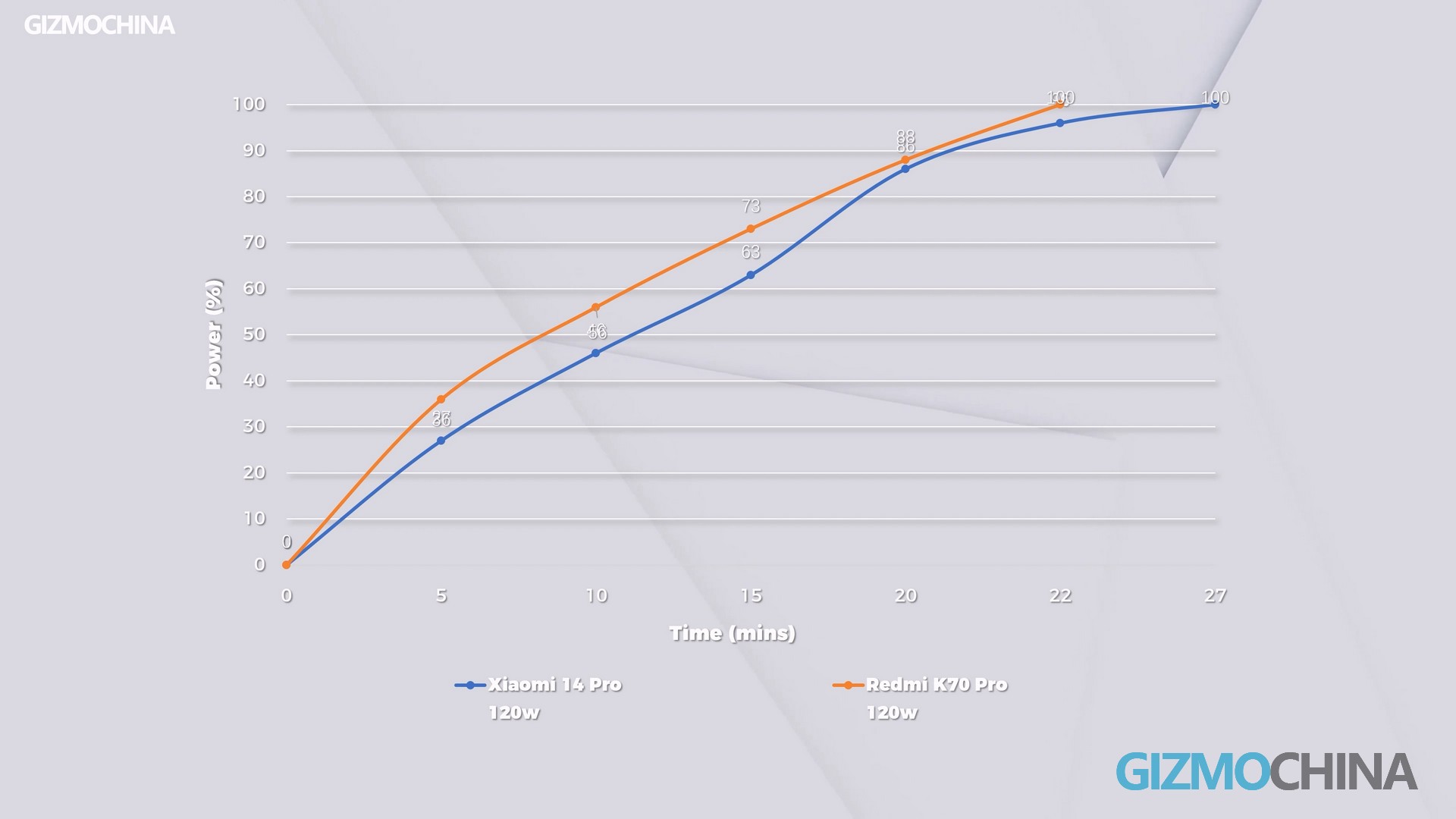
The two phones have the same battery capacity and the same charging power, so we only tested the charging time on the Pro. In fact, I prefer the combination of 67W plus 5500mAh, the battery capacity can be much more important than the charging speed, but unfortunately, there is no choice for now. Battery life is also average level, there’s not much to say about it. Plus there’s no wireless charging, so the two K70s are a step back in this charging and battery part.
Conclusion
It’s clear that the K70 doesn’t have much of an improvement in specs, and even regresses in some parts. Why are people clamoring for them? I think that’s what makes Redmi great. Every year they get rid of features that their target users don’t like much, like wireless charging. Keep the popular features, like the 2K straight screen. Then add some new selling points like metal frames and better cameras. As long as the price stays the same, or is cheaper, then they will keep selling well. If you like the K70, then buy it. Because there might be certain features you like on the K70, but won’t show up on the K80.
Vivo is gearing up to unveil the Vivo S18 series of smartphones in China soon. However, these won’t be the only products announced during the launch event. The company will also unveil the Vivo TWS 3e earbuds as well. Now, the key specs of the truly wireless earbuds have been teased ahead of the official release.
Vivo TWS 3e Specs
For those unaware, the upcoming hearables and S18 series are set to be unveiled on 14th December 2023. Previously, the Vivo TWS 3e was spotted on the TDRA, SIRIM, and SDPPI certification platforms, which hinted at its near launch. A recent teaser even revealed the color options of the new wireless earphones, which will launch in a Blue and White color option.
Now, the latest teaser has confirmed other details regarding the Vivo TWS 3e. The earbuds will offer a long 44 hour battery life on a single full charge when paired with its charging case. It will even come with support for fast charging. Another notable feature is the support for intelligent ANC (Active Noise Cancellation) along with immersive surround sound quality.
Looking at the images, the Vivo TWS 3e features a pebble-like charging case and earbuds with an in-ear design (including silicone tips). Unfortunately, this was all the information available regarding the new wireless earbuds. So stick around for more as we will be covering any new teaser as well as the launch event later this month.
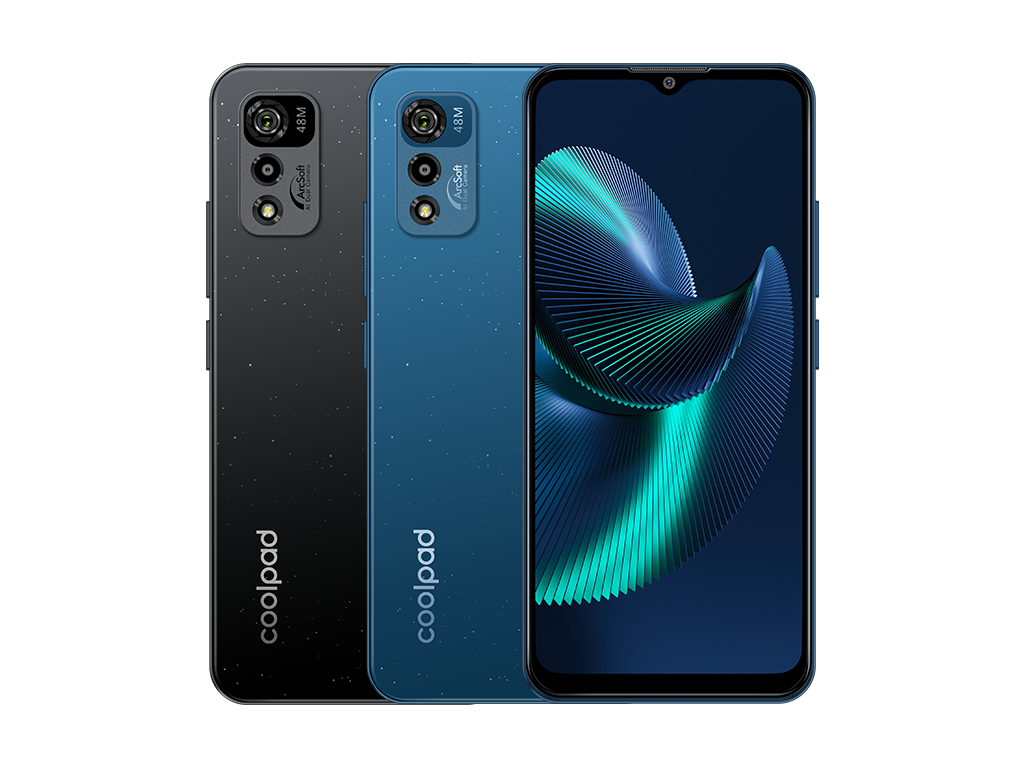
Coolpad has recently introduced the Cool 20+ in the Chinese market, marking the fourth addition to their 20 series lineup. This follows the previous releases of the Cool 20, Cool 20 Pro, and Cool 20s, all targeting the budget-conscious audience over the course of three years. Let’s check out the specifications of the Cool 20+ smartphone.
Coolpad Cool 20+ Specifications:
Cool 20+ boasts a 6.52-inch IPS LCD HD+ waterdrop display with a screen-to-body ratio of 89.2% and a resolution of 1600×720. The display features double-sided 2.5D glass and offers a pixel density of 259 PPI. The back panel is made out of scratch-resistant glass.
The device is powered by Mediatek Helio G85 chipset with Mali-G52 MC3. The device comes in three variants: 4GB RAM with 64GB/128GB storage and 6GB RAM with 128GB storage. The internal storage can be expanded up to 256GB using a microSD card. Out of the box, the device runs on Android 11 with CoolOS 2 on top.
Coming to the optics, the Cool 20+ is equipped with a dual-camera setup on the rear. This setup consists of a 48 MP primary lens with an f/1.8 aperture, accompanied by a 0.3 MP portrait blur secondary camera. For selfies and video calls, it sports a 5 MP front-facing camera.
The Cool 20+ smartphone offers Hybrid Dual SIM support with 4G LTE compatibility and Bluetooth 5.0. It has a height of 164.3mm, a width of 75.66mm, and a slim 8.5mm thickness, weighing approximately 180g with the battery included. Under the hood, it packs a 4500mAh battery with 10W charging capability.
Pricing and Availability
Coolpad Cool 20+ comes in Black and Blue colors. The specific pricing for the Cool 20+ has not been disclosed. It was previously launched in the Philippines and the 6GB + 128GB variant was offered at a price of 736 yuan, equivalent to approximately $103.
A couple of months ago, Nothing unveiled its new sub-brand CMF, which released a bunch of new products. This included the CMF Watch Pro model. However, it appears that a security vulnerability plagues the CMF Watch app that is featured on the partnered smartphone.
CMF Watch App may lack encryption, posing a security risk
The news was shared by Dylan Roussel, who is an Android developer. In a tweet, the dev claimed that Nothing is garnering attention for its glary security risks. He adds that the latest example of a vulnerability in their system comes from their new sub-brand, CMF. Apparently, the company’s CMF Watch app suffers from a major security flaw that is related to the encryption of user data. The investigations have revealed that the brand’s encryption process for the user’s email address and password is not functioning properly.
This means that the sensitive information is at risk. Dylan adds that the major security risk is still affecting the CMF Watch app, with user’s login credentials still being vulnerable. Nothing’s current app system lacks robust encryption for sensitive information, enabling easy access to decryption data with the application. This vulnerability was first discovered by Roussel back in September.
Let's talk about Nothing… again.
Before the Sunbird/Nothing chaos, I reported another vulnerability to them back in September… and another one back in August.
Let's talk about the one from September. It's about the CMF Watch app.
Nothing has worked on fixing this issue, but it seems that the encryption for the email and password are still vulnerable. The Android developer had even reached out to the brand directly, although there was no proper communication established after the first exchange. It remains to be seen how the company addresses these glaring security risks or whether it continues to become infamous for security flaws, since even the Nothing Chats feature was recently removed from the Google Play Store over security concerns.
A new leak has revealed some key details regarding Xiaomi‘s next gen flagship smartphone, the Xiaomi 14 Ultra. A tipster has leaked the specs of the upcoming device’s camera, battery, and charging. So here are all the details.
Xiaomi 14 Ultra Specs
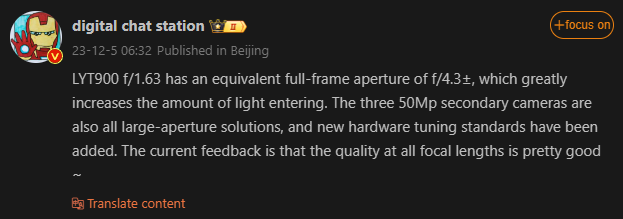
The information arrives from known tipster Digital Chat Station, who shared the news on Weibo (a Chinese microblogging website). For those unaware, the company has already announced the Xiaomi 14 and Xiaomi 14 Pro, which makes the Ultra variant the third entry in the flagship series. Now, DCS has claimed that the upcoming smartphone will feature a Sony LYT900 f/1.63 primary sensor that is equivalent to a f/4.3 ± full frame aperture.
This would also mean that the Xiaomi 14 Ultra will be able to take in more light than its predecessor. This is in line with the tipster’s previous leak, which also hinted at the Sony LYT900 sensor. The handset is believed to pack four 50-megapixel shooters on the rear of varying focal lengths. Furthermore, the tipster also talked about the battery capacity that powers the Xiaomi 14 Ultra as well as its charging capabilities.
Previously, Digital Chat Station had revealed how a mysterious device dubbed Venti will house a 5,180mAh battery pack that supports 90W wired and 50W wireless fast charging. Initial reports had hinted at a larger 5,500mAh battery pack, but the latest leak also backs the 5,180mAh rating. The Xiaomi 14 Ultra is expected to launch next year around April, which matches the launch timeline of the Vivo X100 Ultra. Unfortunately, this is all the information that we have at the moment, so stick around for more updates.
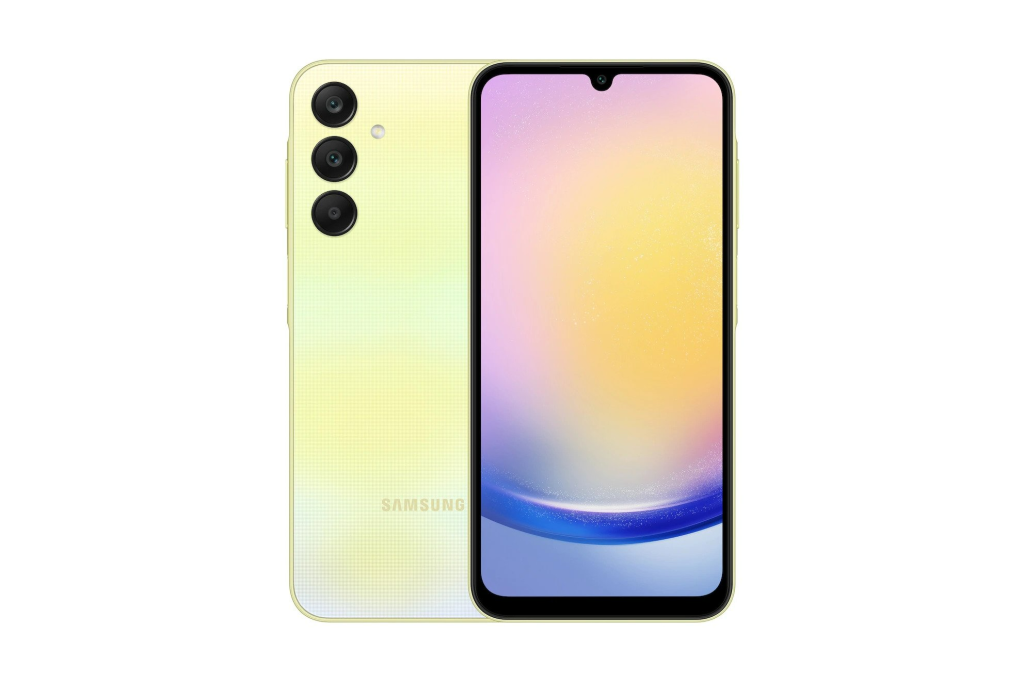
We first heard about the Galaxy A25 5G back in June. The smartphone’s design was leaked via 3D CAD renders.
Then, in August, the device’s camera specs were leaked. Finally, more details started pouring in from the beginning of November.
Now, the screenshots of the product’s official listing page on Samsung’s website have emerged. Let’s go through the details.
Samsung Galaxy A25 5G
The new leak does not reveal anything new about the Samsung A25 5G. That’s because almost everything about it is already out via several leaks over the past few days.
The product listing suggests that Samsung may announce this phone anytime now. The listing in the images is in Italian, so there’s a chance that it might go official in Europe first.
However, it is worth noting that Samsung is known to roll out budget smartphones gradually across different markets. So it may release in some market after all. Either way, the handset should be available globally.
As per leaks so far, the Galaxy A25 5G will flaunt a 6.5-inch dewdrop-notched Super AMOLED display with an FHD+ resolution, a 120Hz refresh rate, and a 1000 nits peak brightness level. It will be powered by an Exynos 1280 chip paired with up to 8GB RAM and 256GB of internal storage.
The phone will feature a triple camera setup on the rear comprising an OIS-assisted 50MP primary sensor, an 8MP ultrawide unit, and a 2MP macro snapper. On the front, it will sport a 13MP shooter for selfies and video calls.
As for software, the device will ship with Android 14-based One UI 6. On top of that, it will receive four generations of OS updates and five years of security updates.
The handset will also come with additional features, such as Samsung Knox security and Samsung Wallet. Finally, it will be backed by a 5,000mAh battery with support for 25W charging.
As scheduled, Xiaomi has launched the Redmi 13C series in India today. The lineup consists of two devices, namely Redmi 13C and Redmi 13C 5G.
The 5G model makes its global debut in the country. On the other hand, the 4G-only version is already official in some markets.
Here in this article, let’s take a look at the LTE variant. To learn about the 5G version, check out our coverage on the same.
Redmi 13C Specifications
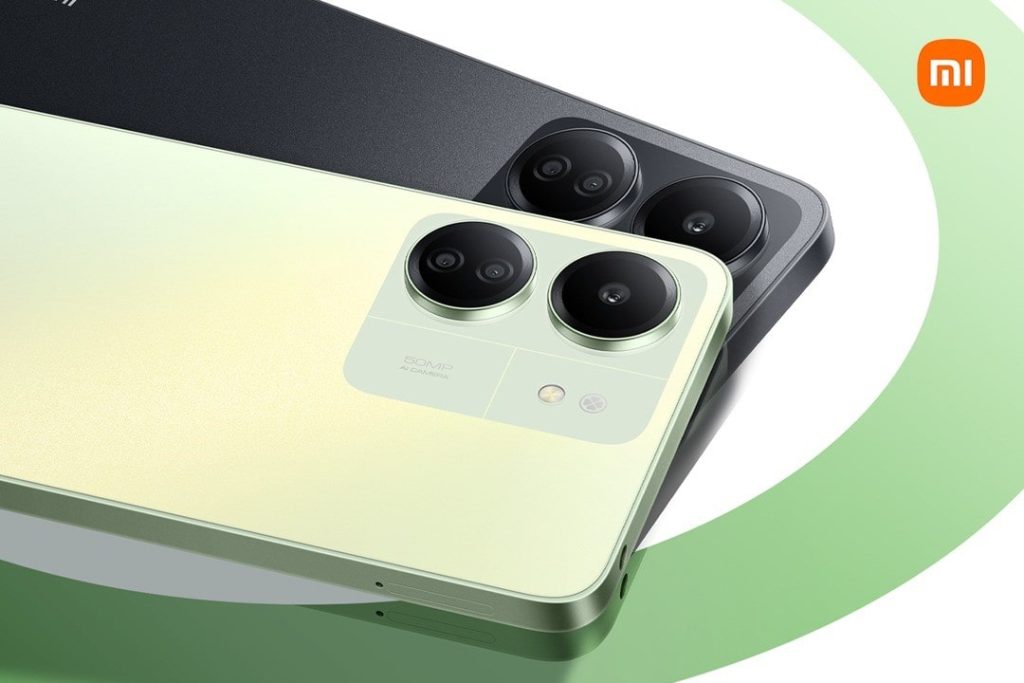
The Redmi 13C features a flat frame design and a dewdrop notched screen on the front. It measures 8.09mm in thickness and weighs 192g.
The device is powered by a MediaTek Helio G85 chip paired with LPDDR4x RAM and eMMC 5.1 storage. It boots MIUI 14 based on Android 13.
The handset sports a 6.74-inch display with a waterdrop notch. This LCD panel offers a resolution of 1600 x 720 pixels (HD+), a 90Hz refresh rate, and 600 nits peak brightness level. The screen supports DC dimming and is protected by Corning Gorilla Glass.
The phone comes with a triple camera system on the rear comprising a 50MP primary sensor, a 2MP macro snapper, and an unspecified sensor. It has an 8MP shooter on the front for selfies and video calls.
The smartphone provides multiple connectivity options, such as dual SIM, 4G, dual-band WiFi, Bluetooth 5.3, GNSS, and USB Type-C. It also arrives with a 3.5mm headphone jack, a MicroSD card slot, and a side-mounted fingerprint sensor.
Last but not least, the Redmi 13C draws energy from a 5,000mAh battery and supports 18W charging (ships with a 10W charger).
Redmi 13C India Price
The Redmi 13C carries the following price tags in India.
4GB + 128GB – ₹8,999 (~$110)
6GB + 128GB – ₹9,999 (~$120)
8GB + 256GB – ₹11,499 (~$140)
The handset can be availed in either Stardust Black or Starshine Green color options. It is scheduled to go on sale from 12 PM IST on December 12 via Mi.com, Amazon India, and Xiaomi retail stores.
Xiaomi debuted the Redmi 13C series in India today as scheduled. The company announced two devices, such as Redmi 13 and Redmi 13 5G.
The 4G-only variant already went official in some markets earlier this month. On the other hand, the 5G version makes its global debut.
Let’s go through what the Redmi 13C 5G has to offer in this article. If you are interested in learning about the regular Redmi 13C, you can check out our coverage on the same here.
Redmi 13C 5G Specifications
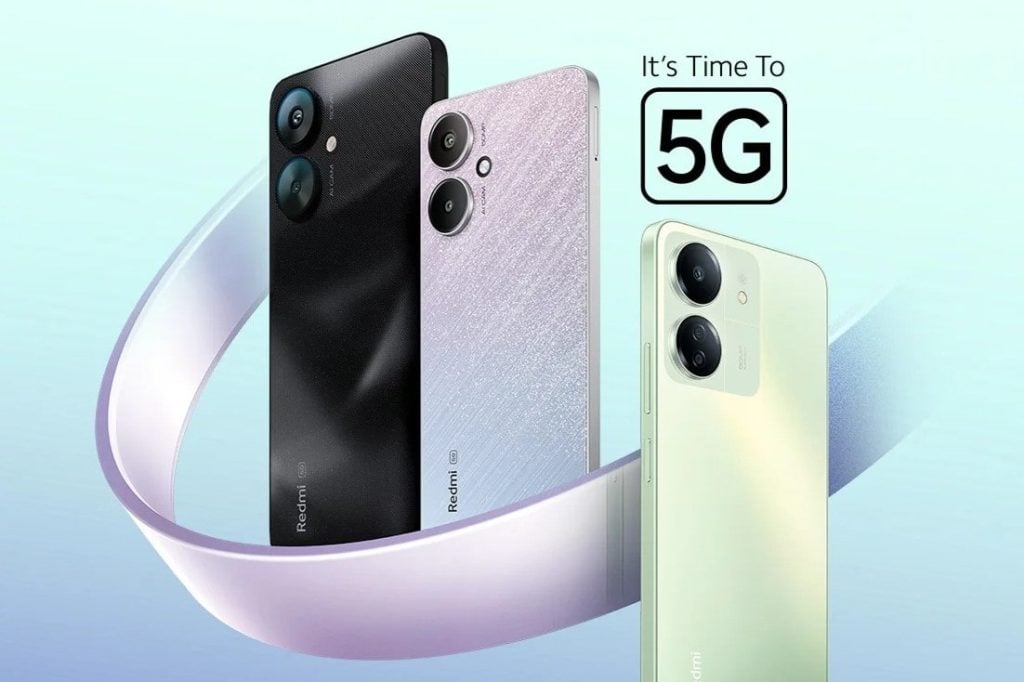
The Redmi 13C 5G arrives with a flat frame design as the vanilla Redmi 13C. However, the colors and the textures on the rear panel are different.
It retains the same 6.74-inch display with a dewdrop notch and HD+ (1600 x 720 pixels) resolution. Apart from DC dimming, this Corning Gorilla Glass-protected LCD screen also supports up to a 90Hz refresh rate and a 600 nits peak brightness level.
The phone has a 50MP main camera on the rear paired with an unspecified secondary sensor. On the front, it sports a 5MP snapper for selfies and video calls.
The connectivity options on the handset include dual SIM, 5G, dual-band WiFi, Bluetooth 5.3, GNSS, and USB Type-C. It also offers other features, such as a side-mounted fingerprint sensor, a MicroSD card slot, and a 3.5mm headphone jack.
Finally, the smartphone is backed by a 5,000mAh battery and supports 18W charging (ships with a 10W charger).
Redmi 13C 5G Price
The Redmi 13C 5G comes in following two memory configurations in India.
4GB + 128GB – ₹10,999 (~$130)
6GB + 128GB – ₹12,499 (~$150)
8GB + 256GB – ₹14,499 (~$175)
It can be availed in either Startrail Black, Startrail Silver, or Startrail Green color options. The device will be available for purchase starting 12 PM IST on December 16. It will be sold via Mi.com, Amazon India, and Xiaomi retail stores.
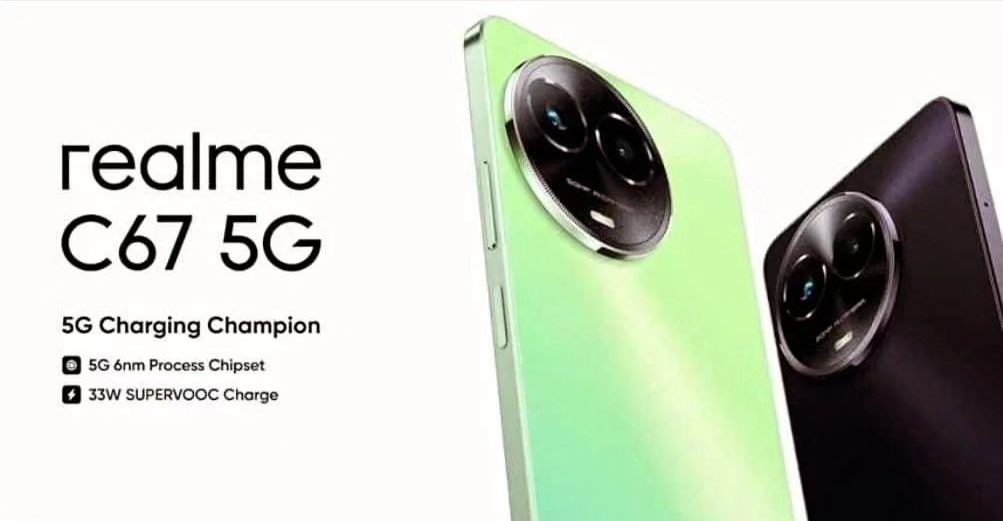
Realme has just confirmed that it will be launching the Realme C67 5G in India. However, a leak reveals that the brand could be planning to launch a 4G version of the device in some Southeast Asian markets. A leak reveals that the Realme C67 (4G) will debut soon in Indonesia. The source has also leaked the key specifications of the device.
Realme C67 specifications (rumored)
Realme C67 (4G) leaked teasers
According to reports, the Realme C67 will have an IPS LCD panel that offers a Full HD+ resolution and a 90Hz refresh rate. However, the exact screen size is not known yet. The source has shared some teaser images of the C67, which can be seen above.
Realme C67 5G launch date
While the 5G version of the Realme C67 is speculated to feature the Dimensity 6100 Plus chip, the 4G model may ship with the Snapdragon 685 SoC. The device will arrive with 8 GB of LPDDR4x RAM and 128 GB / 256 GB of storage.
On the front, the Realme C67 will have an 8-megapixel camera. Its rear panel will be equipped with a 108-megapixel Samsung ISOCELL HM6 sensor as the primary camera and a 2-megapixel auxiliary lens. The device will be backed by a 5,000mAh battery that supports 33W fast charging.
The Realme C67 4G will ship with Realme UI E edition-based Android 14, which will support the Mini Capsule notifications feature. The device will also offer other features, such as a side-facing fingerprint sensor, a 3.5mm audio jack, dual speakers, NFC, and an IP54-rated chassis with a thickness of 7.9mm. It is likley to be priced at around ~$135 in Indonesia.
We use cookies on our website to give you the most relevant experience by remembering your preferences and repeat visits. By clicking “Accept”, you consent to the use of ALL the cookies.
This website uses cookies to improve your experience while you navigate through the website. Out of these, the cookies that are categorized as necessary are stored on your browser as they are essential for the working of basic functionalities of the website. We also use third-party cookies that help us analyze and understand how you use this website. These cookies will be stored in your browser only with your consent. You also have the option to opt-out of these cookies. But opting out of some of these cookies may affect your browsing experience.
Necessary cookies are absolutely essential for the website to function properly. This category only includes cookies that ensures basic functionalities and security features of the website. These cookies do not store any personal information.
Any cookies that may not be particularly necessary for the website to function and is used specifically to collect user personal data via analytics, ads, other embedded contents are termed as non-necessary cookies. It is mandatory to procure user consent prior to running these cookies on your website.