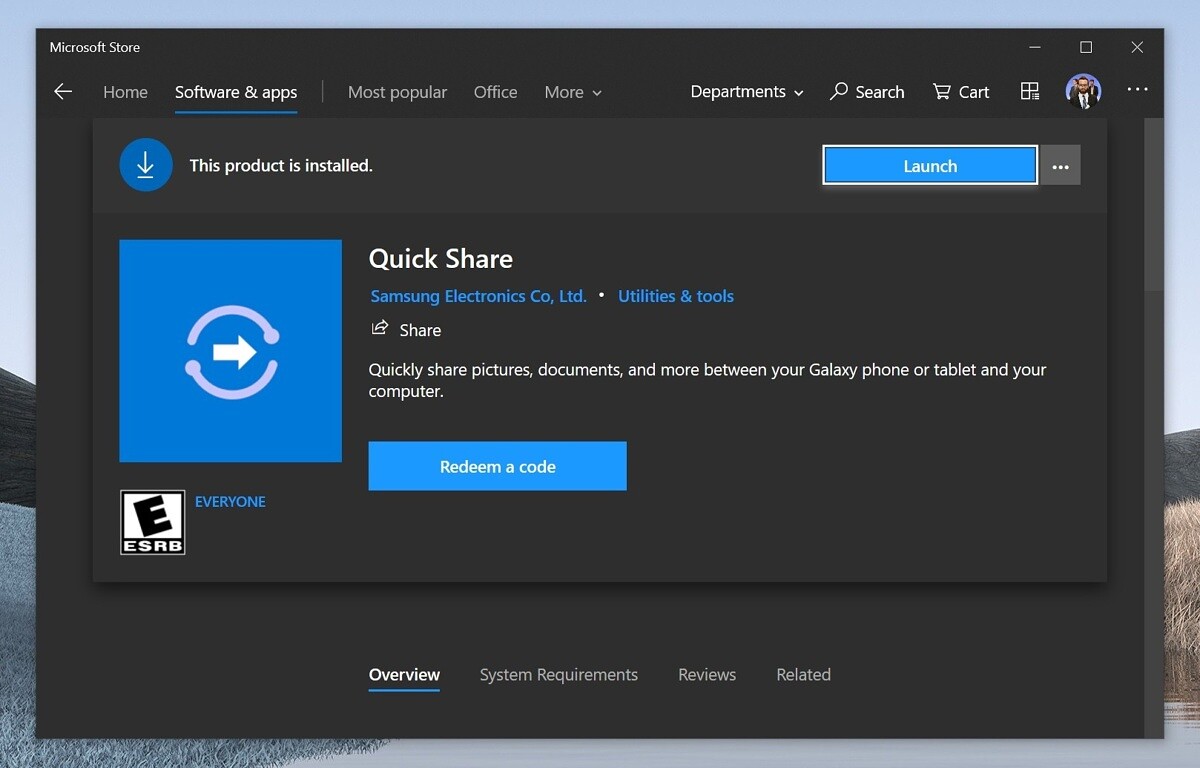
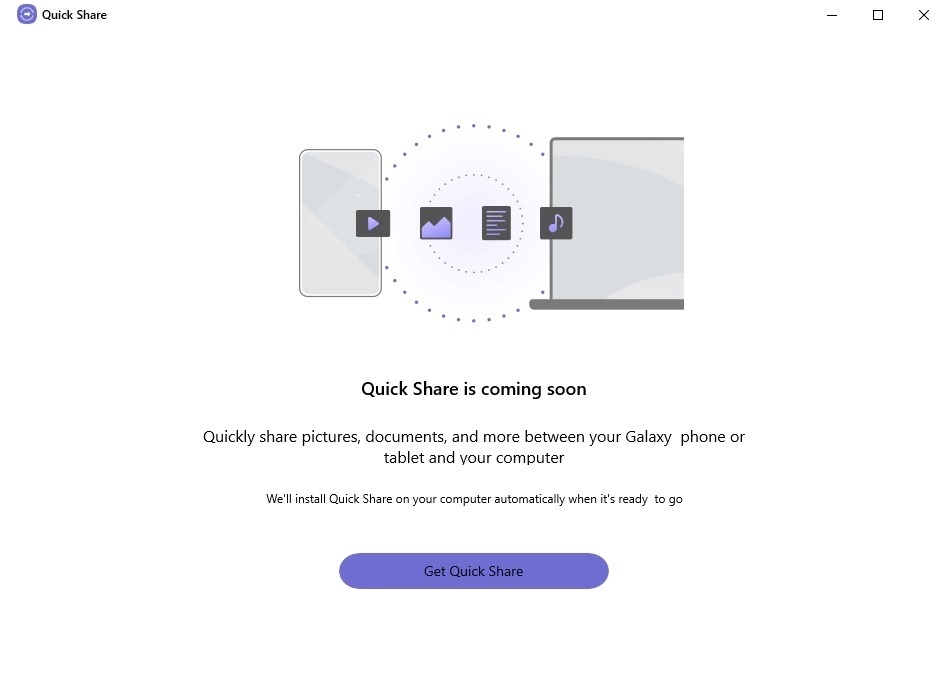
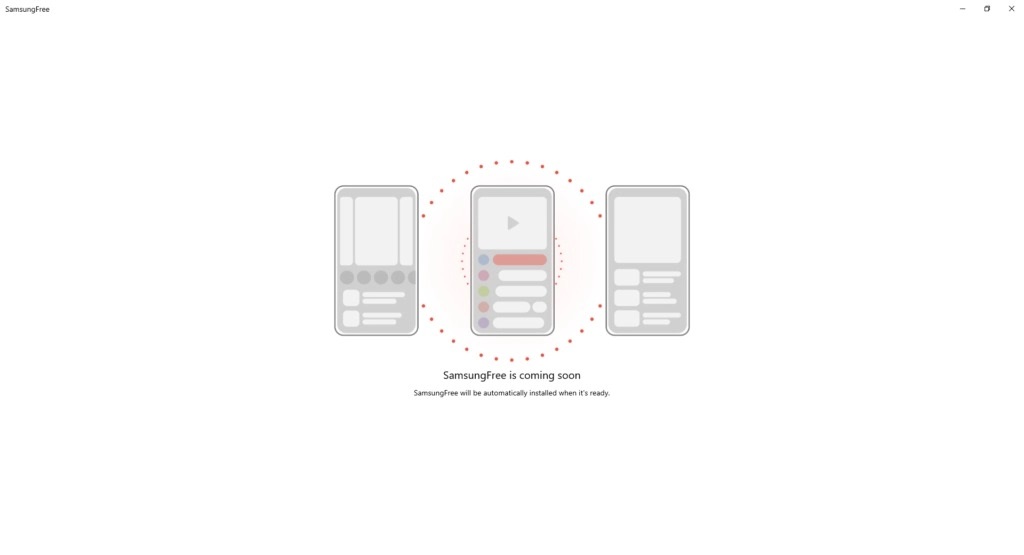
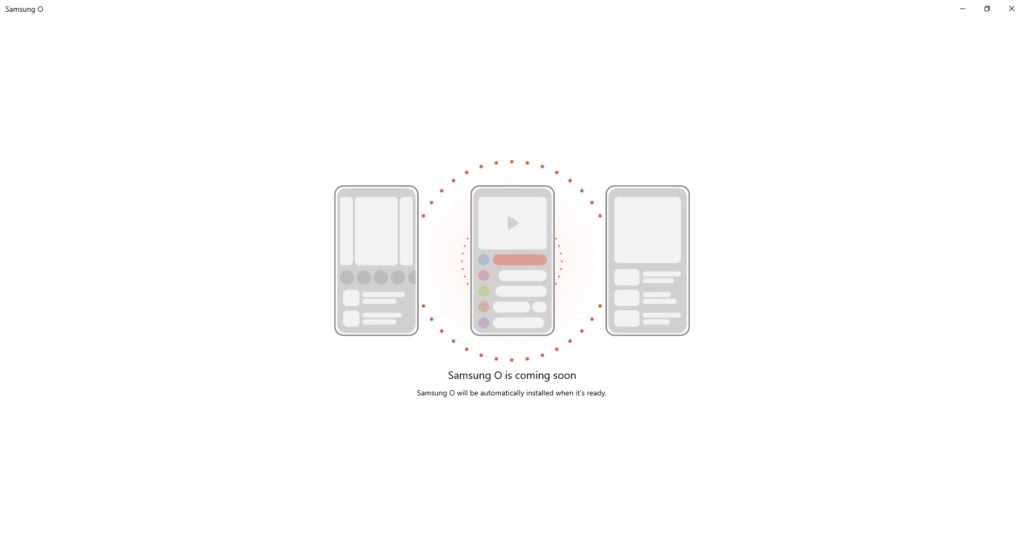
Samsung and Microsoft are long time partners. Recently, they had extended the partnership for further digital transformation in real estate and property management. Now, Samsung is bringing its services to Microsoft’s Windows 10 platform as a report by ALumia says Quick Share, Samsung Free, and Samsung O are coming to the Microsoft store.
Source: ALumia
Samsung’s Quick Share is an answer to Apple’s AirDrop. It allows seamless sharing of Photos, Videos, and Documents across devices. Now, this App is reportedly appearing on Microsoft Store for a few. Although it is yet to reach everyone, users who have One UI 2.0 and above on Galaxy devices can enjoy this feature.
Once available, you can use the Wi-Fi Direct, Bluetooth, or Samsung’s SmartThings platform(eligible ones) to share content from Phone to Laptop/Desktop.
In addition to the Quick Share, Windows 10 users will also get other apps like SamsungFree and Samsung O. Here, the Samsung Free was formerly called Samsung Daily. It is like a one-stop-shop for News, TV, and Play.
For the TV section, the App will reportedly show exclusive content that is available on the Samsung TV Plus. For the unware, this video rental service launched in 2016. However, it made the service and expanded to more galaxy phones last year.
The Samsung TV Plus includes a collection of Documentaries, and other entertainment services from over 150 channels. That said, the SamsungFree will also have a News section(News from Various sources compiled), and a Play section(Free Games).
That said, the Samsung O for Windows 10 is currently a mystery. The report says that this could be a clone app of some kind. This service is said to roll out on the Microsoft Store in a few days and let’s wait to find out what it brings to the Windows’ table.
Over the past couple of years, OPPO has focused on adding consumer pleasing attributes like a feature-rich camera setup and premium build quality on its Reno smartphones. However, the earlier models lacked the processing power to take on the flagships in the market. That changed in 2021 when OPPO released the Reno5 Pro 5G with the new Dimensity 1000+ 5G SoC which ensures CPU power is no longer an issue.
The Reno5 Pro 5G is already seeing better reception than the Reno4 Pro model with the phone registering 91% growth in the first week sales as compared to its predecessor. This isn’t surprising given how the new model is a much better upgrade as compared to its predecessor and retails at a similar price point.
So today, in this OPPO Reno5 Pro 5G review, let’s take a closer look at the phone and its features and see if the Dimensity 1000+ is worth the hype.
OPPO Reno5 Pro Inside the Box:
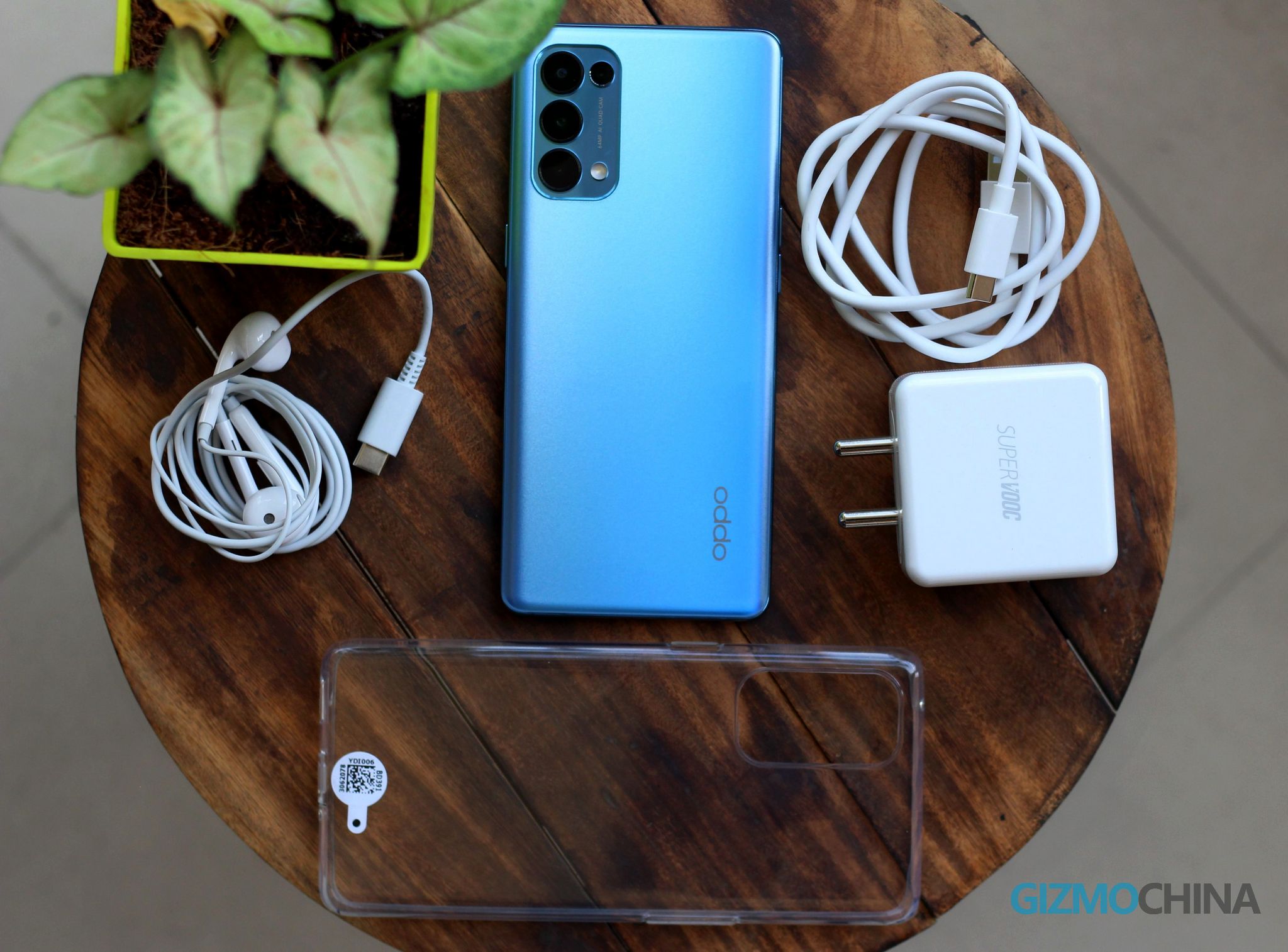
OPPO Reno5 Pro 5G box contents
The Reno5 Pro Box comes with the following items:
Handset
Charger
Earphone
USB Data Cable
SIM Ejector Tool
Quick Guide
Safety Guide
Protective Case
OPPO Reno5 Pro Review: Design
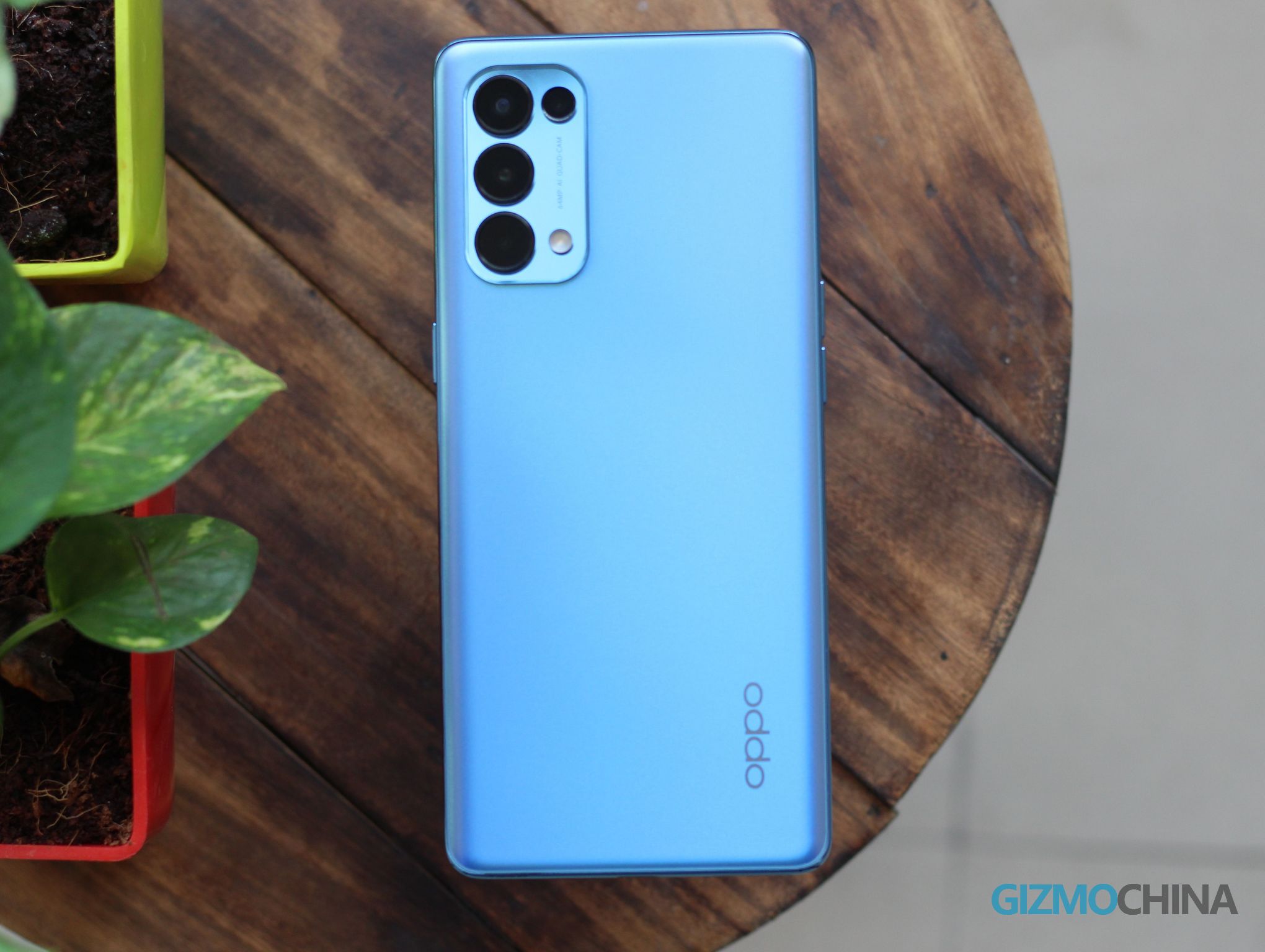
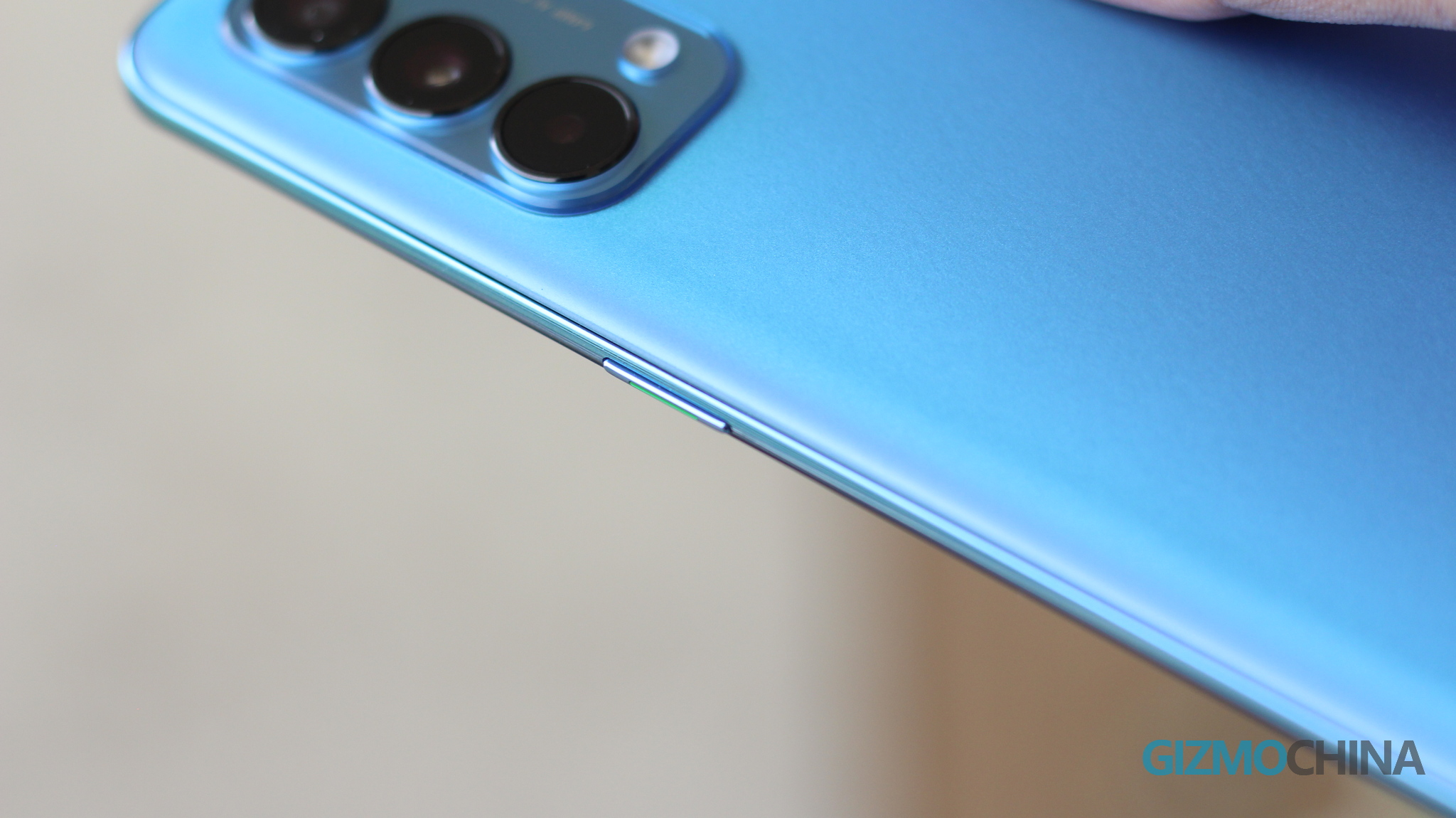
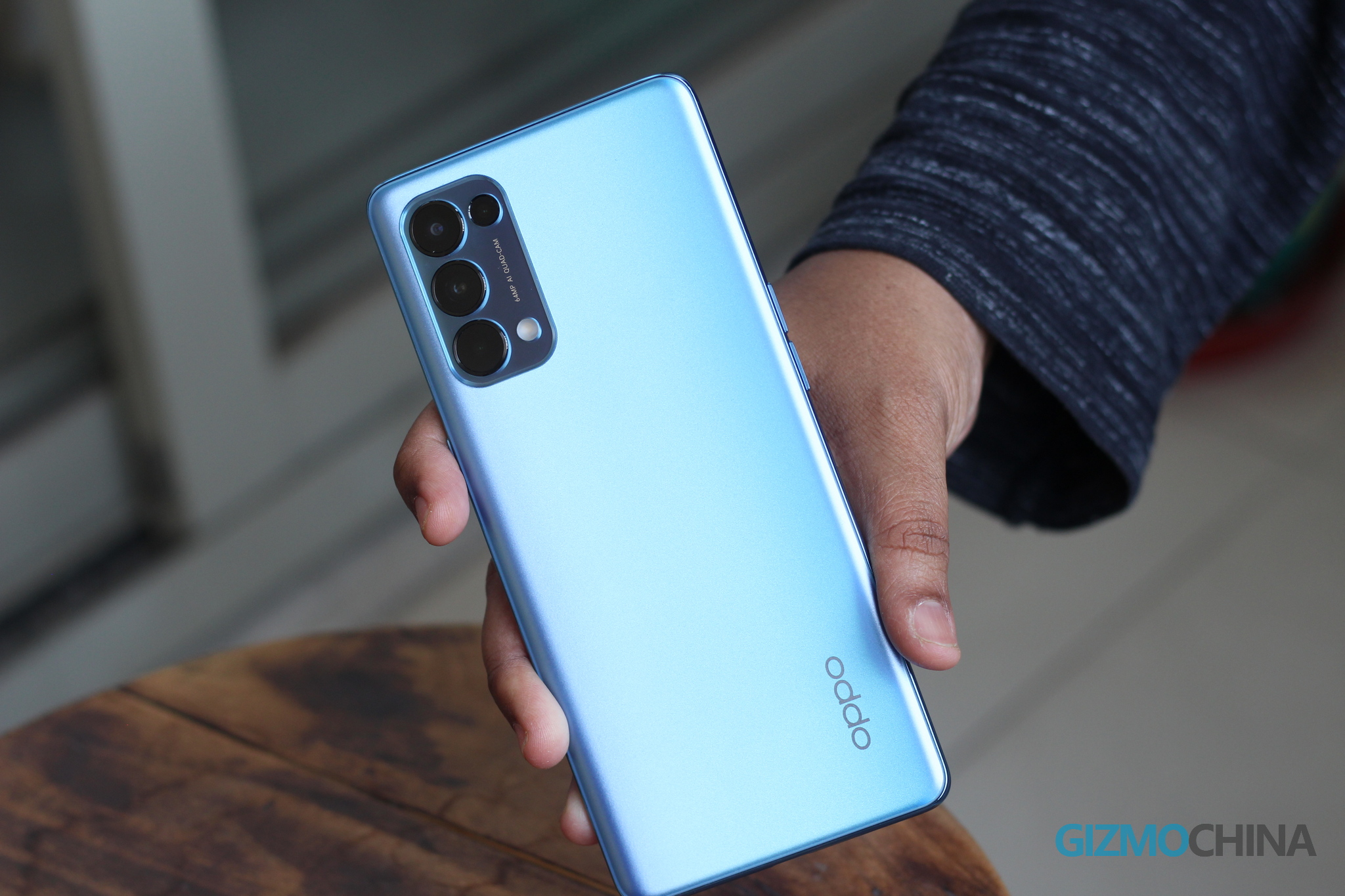
The biggest selling point of the OPPO Reno5 Pro is its premium design. I know a lot of people like to throw the word premium towards any phone with a decent design but the new Reno model definitely deserves this adjective. The phone stands out thanks to its extremely thin and lightweight design and a sparkly finish on the back.
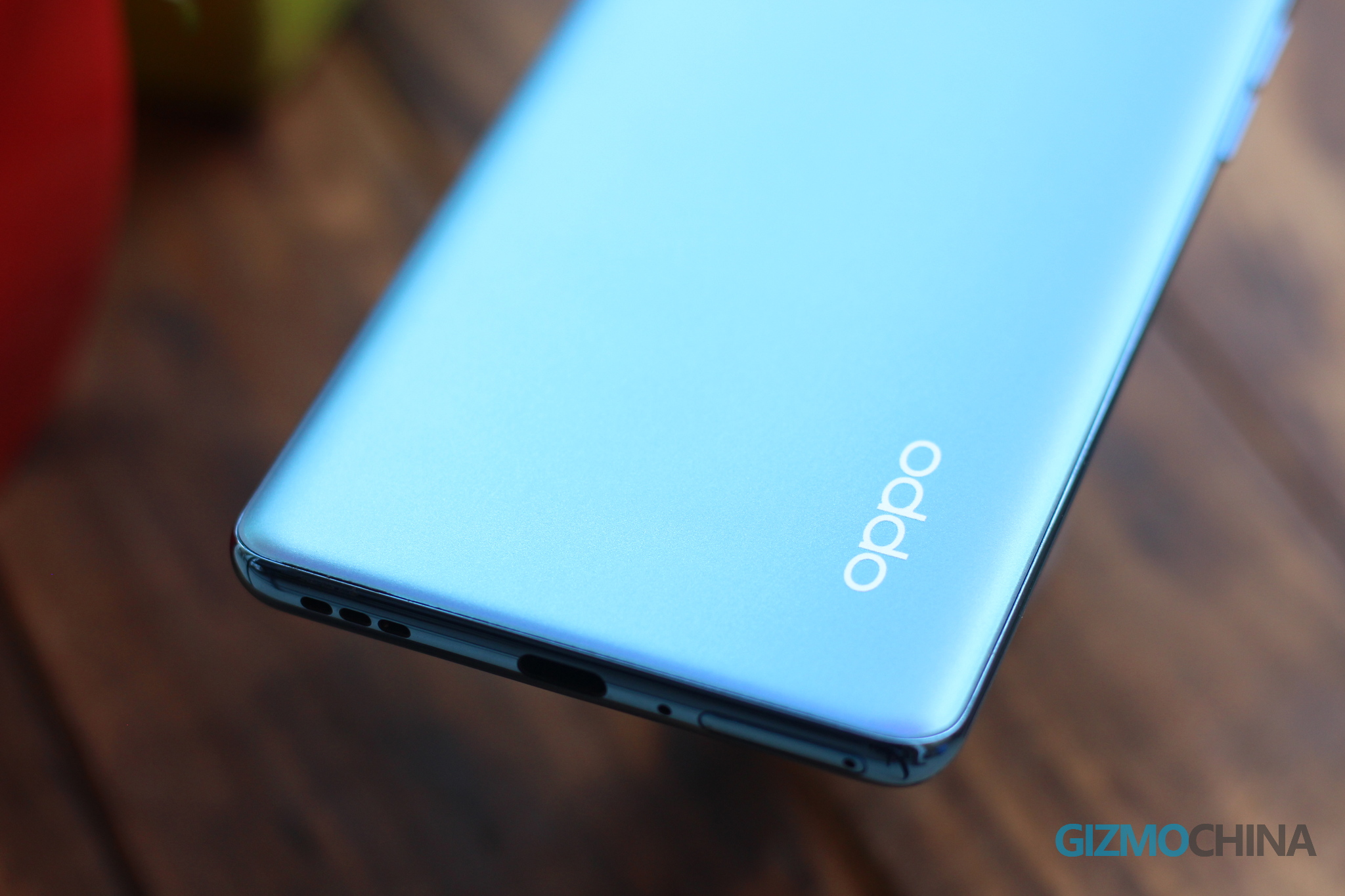
The unit I have is the Astral Blue variant. It sparkles at certain angles in a matte finish, which means you don’t have to worry about cleaning fingerprint smudges from its back. The blue color shifts to a shade of purple at certain angles. To top it off, the phone has a polished aluminum frame going around the body, adding to its elegant design.
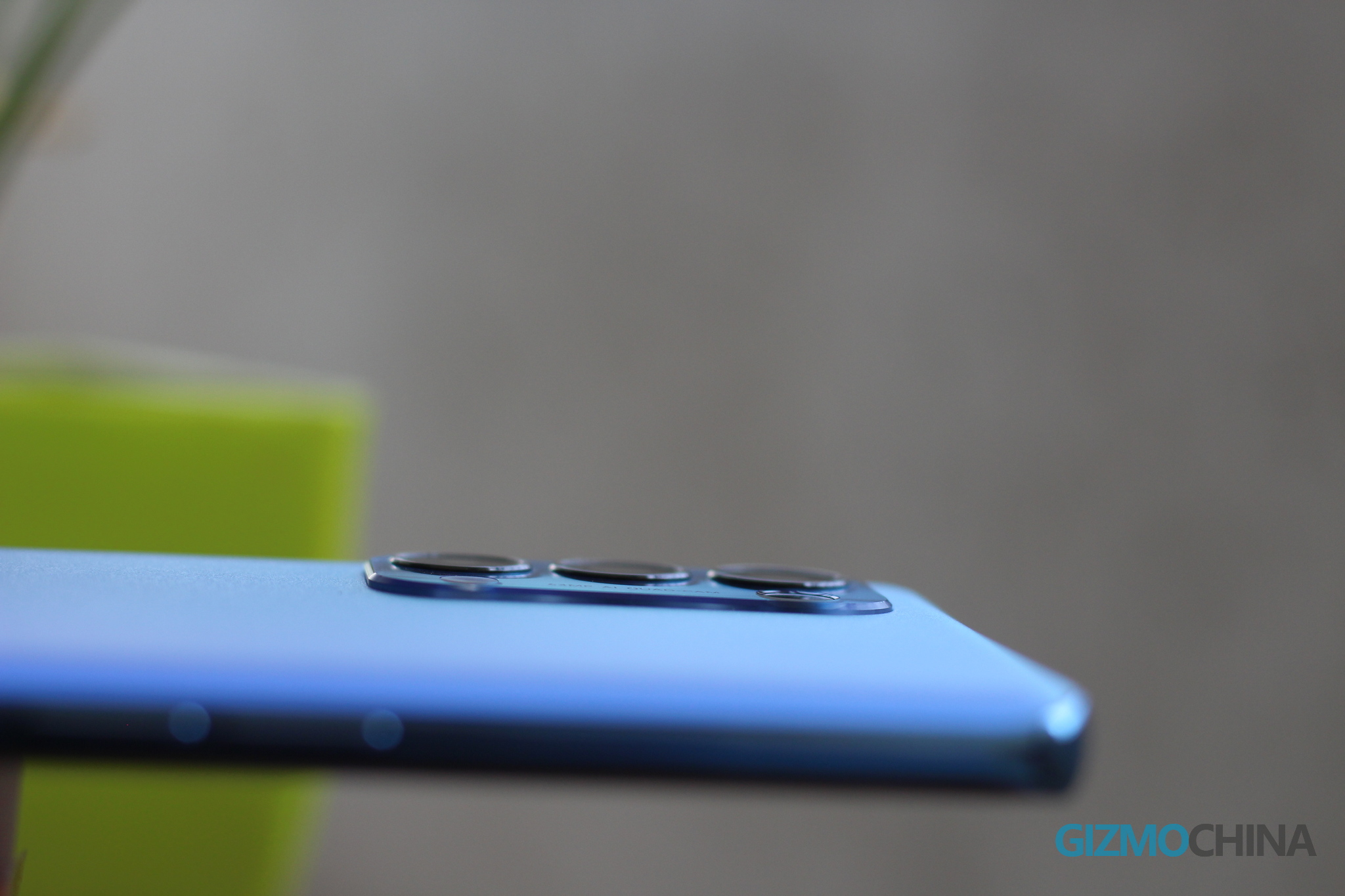
The phone is just 7.6mm thick
The Reno5 Pro is sleek at 7.6mm and weighs 173 grams. This polished design and the form factor is what makes the new Reno model special. The smooth edges make it comfortable to hold, even with one hand. Given that this is a 5G phone with a pretty decent 4350mAh battery, the design is definitely its stand out feature.
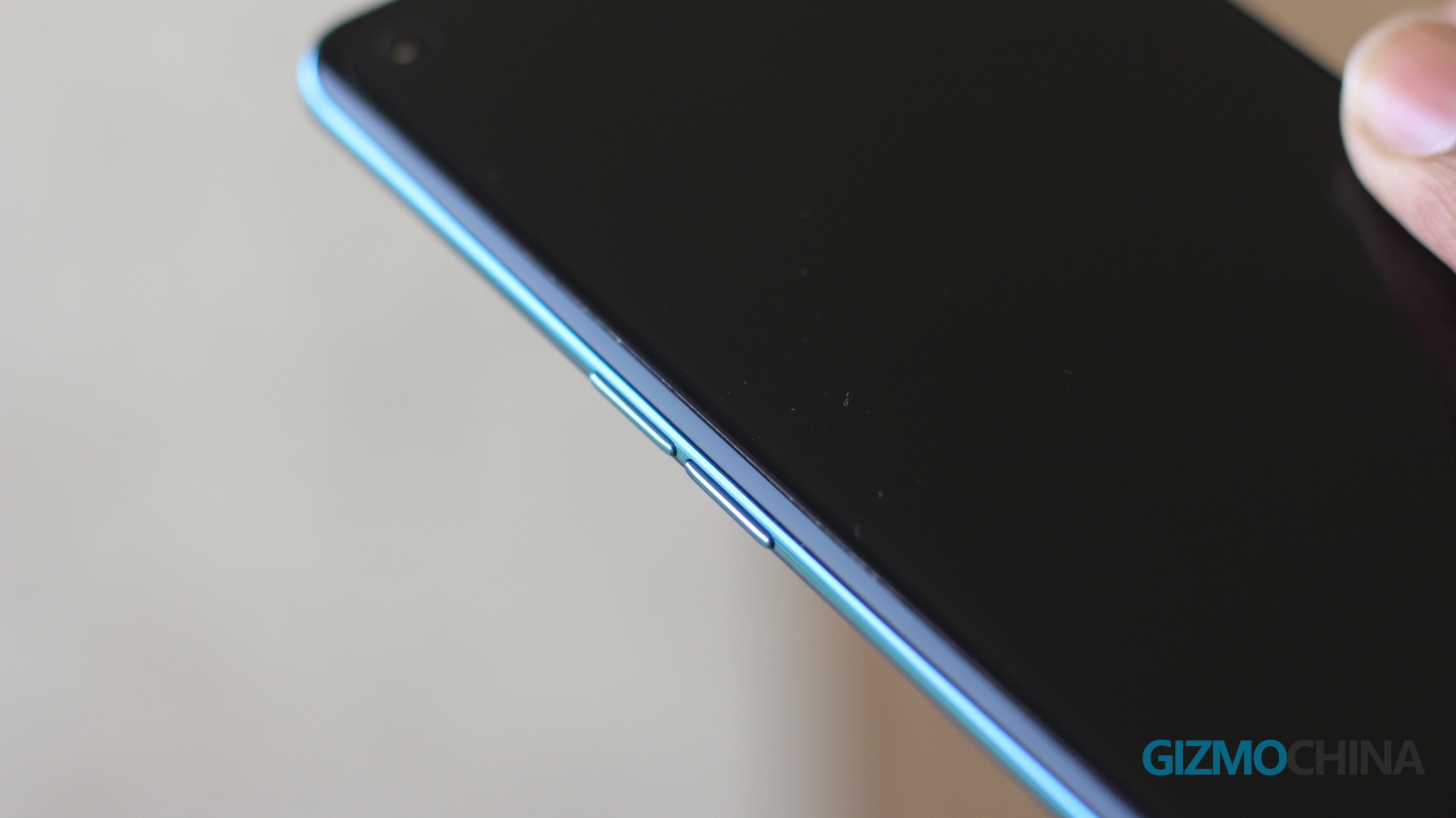
The aluminum frame feels solid and the power and volume buttons housed on the sides are clicky and easily accessible, as they are located around the middle of the frame instead of the upper half like other flagships.
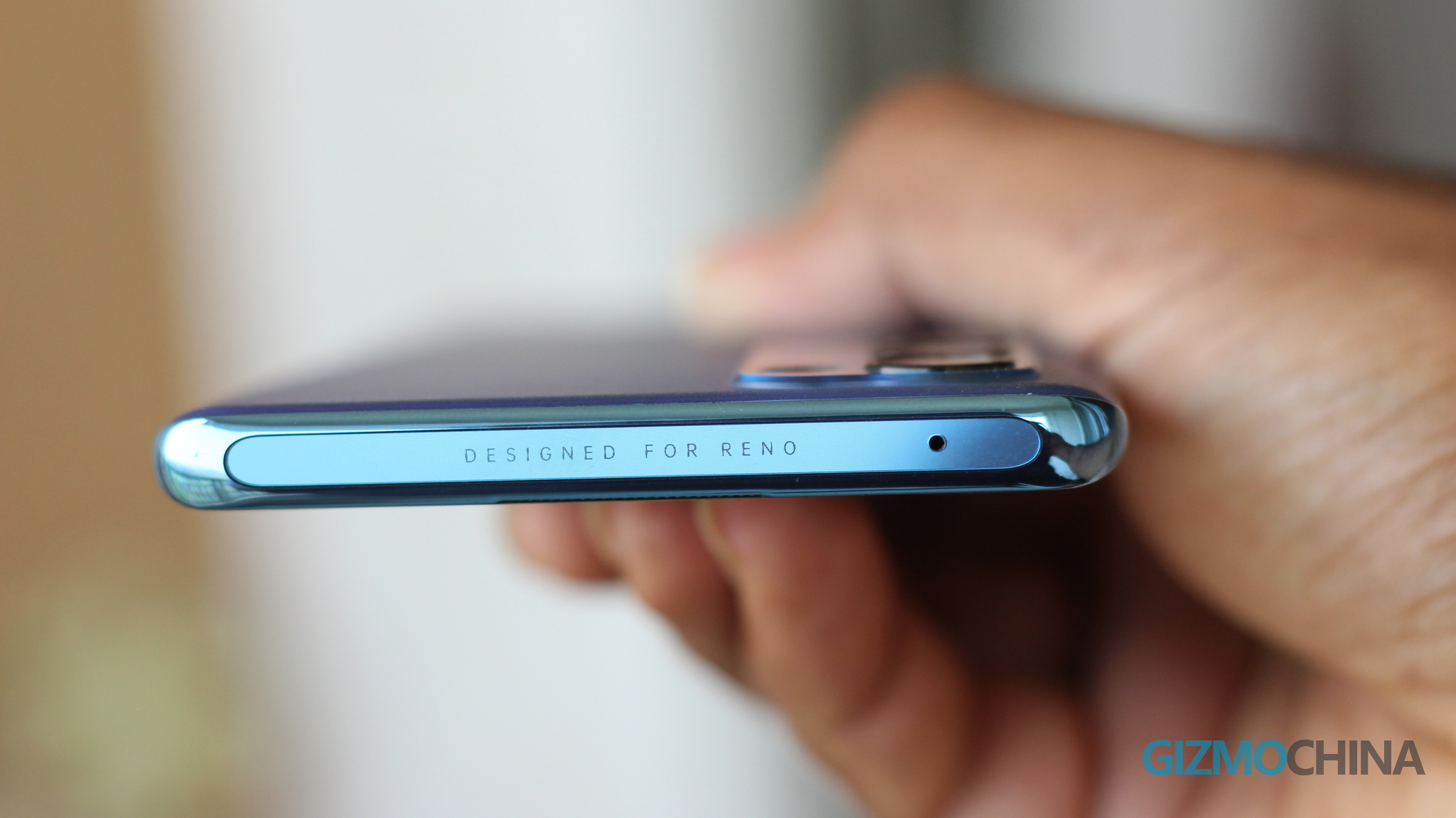
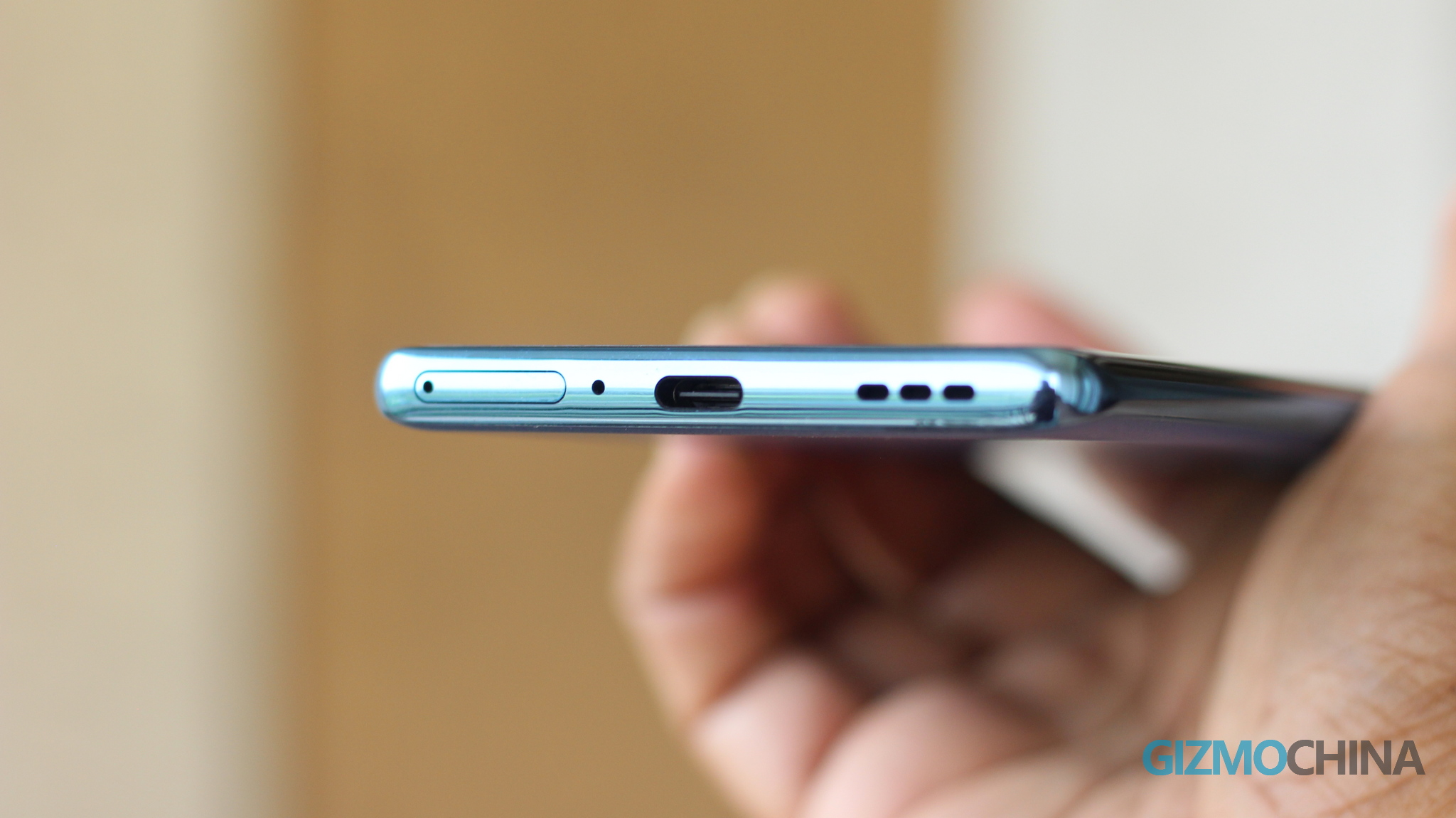
At the bottom, you get a USB-C port, microphone, single speakers, and dual SIM card slot. On the top, you have the ‘Designed for Reno’ branding along with another microphone opening.
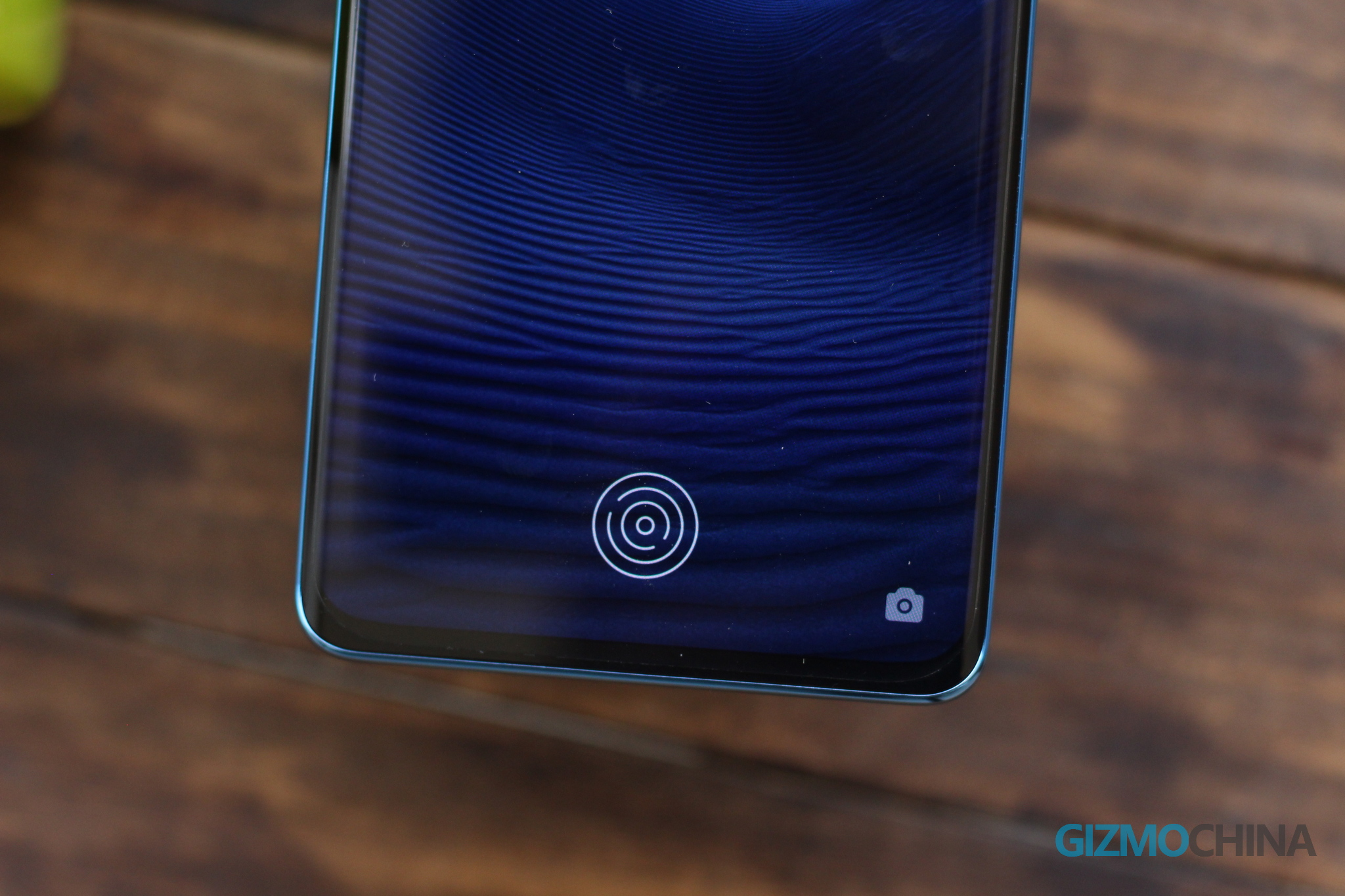
Like most other flagship smartphones, the OPPO Reno5 Pro 5G features an in-display fingerprint sensor. We’ve come to a stage where in-display sensors have evolved to be nearly as fast as a physical sensor and the new Reno’s sensor is no exception.
Unfortunately, the Reno5 Pro 5G does not have a certified IP rating so it’s best that you keep the phone away from water and moisture.
The single speaker setup is sufficiently loud and clear but you will end up missing stereo speakers, especially if you are going to rely on its loudspeakers regularly.
OPPO Reno5 Pro 5G Display
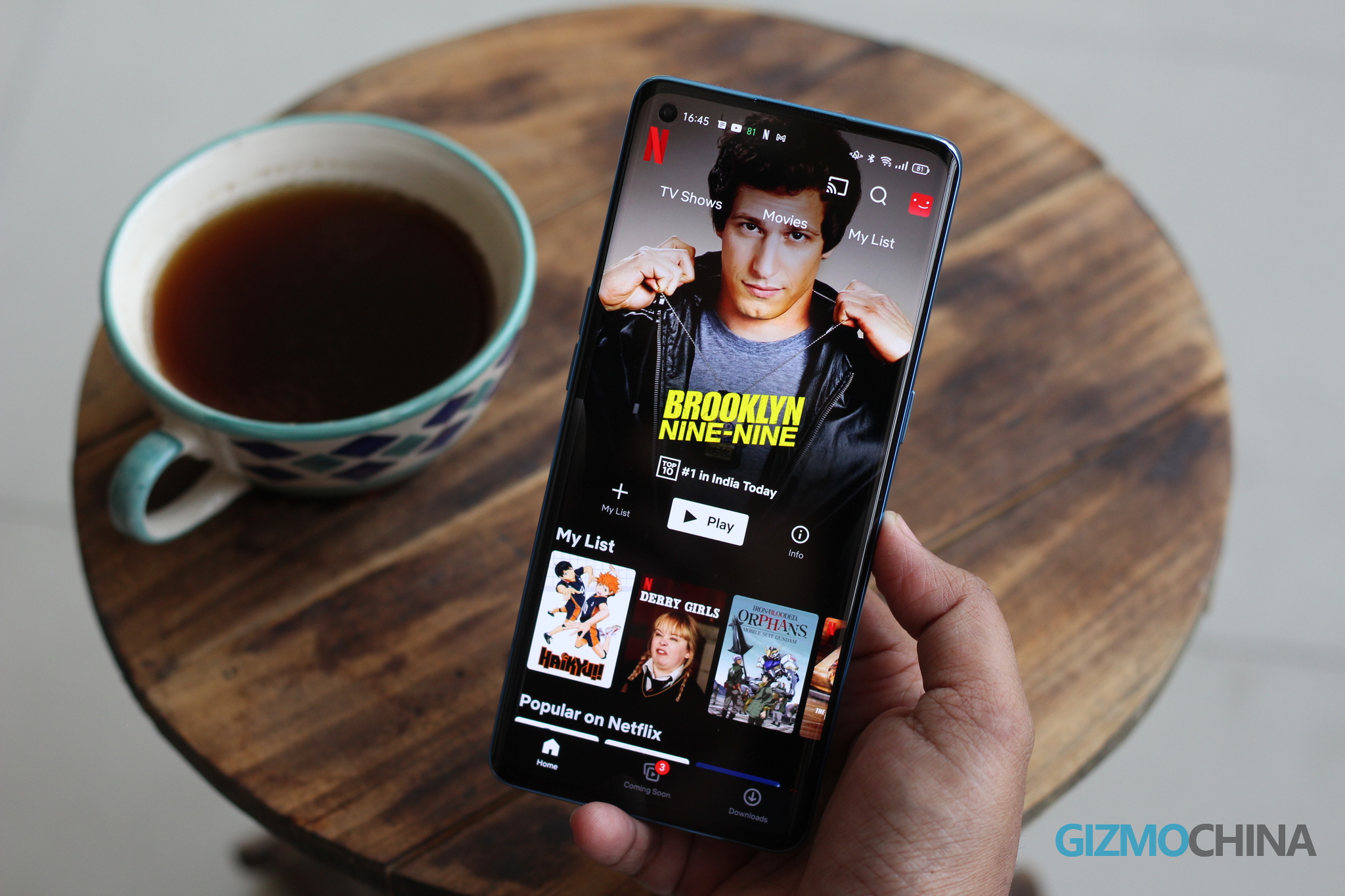
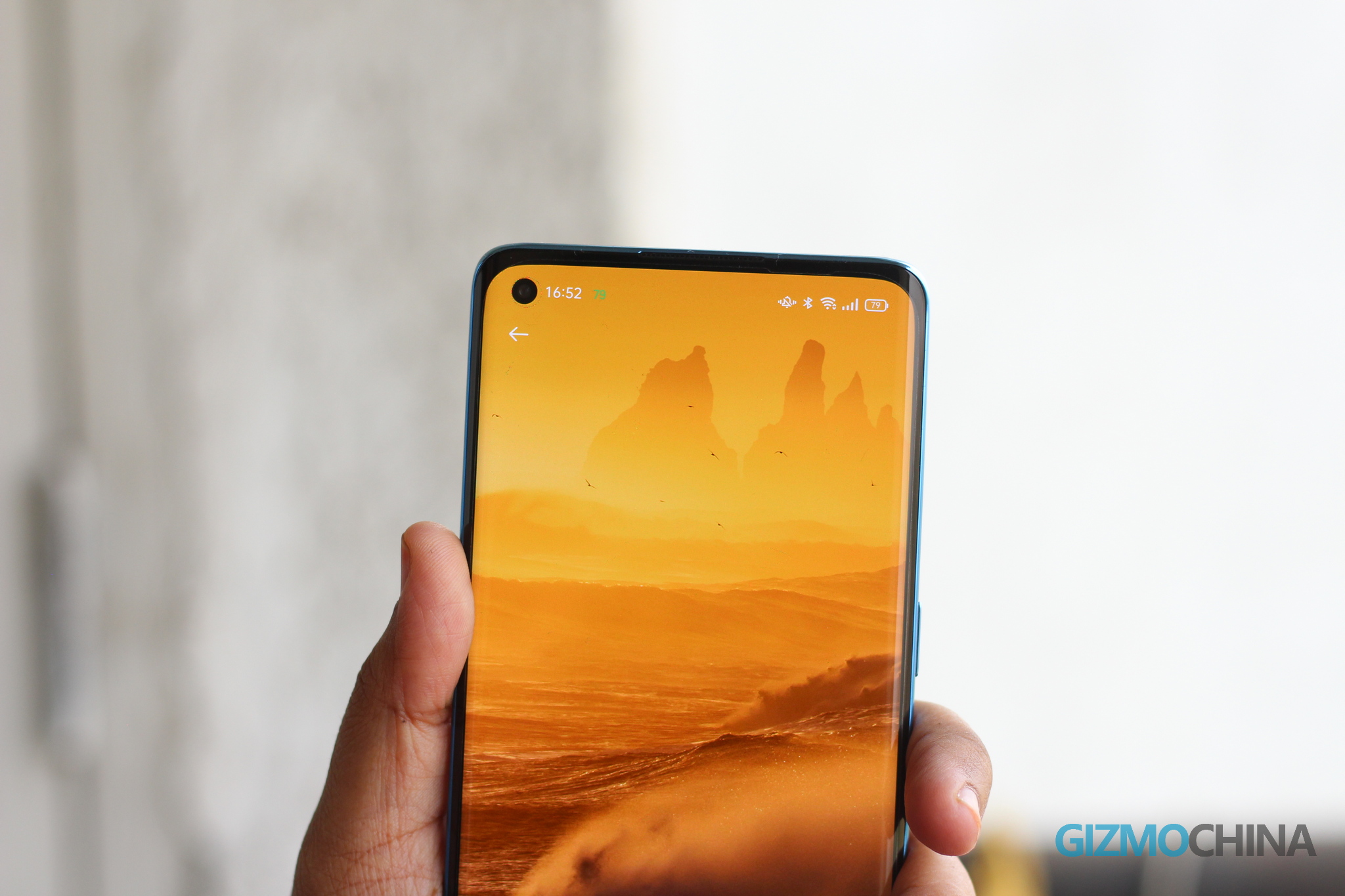
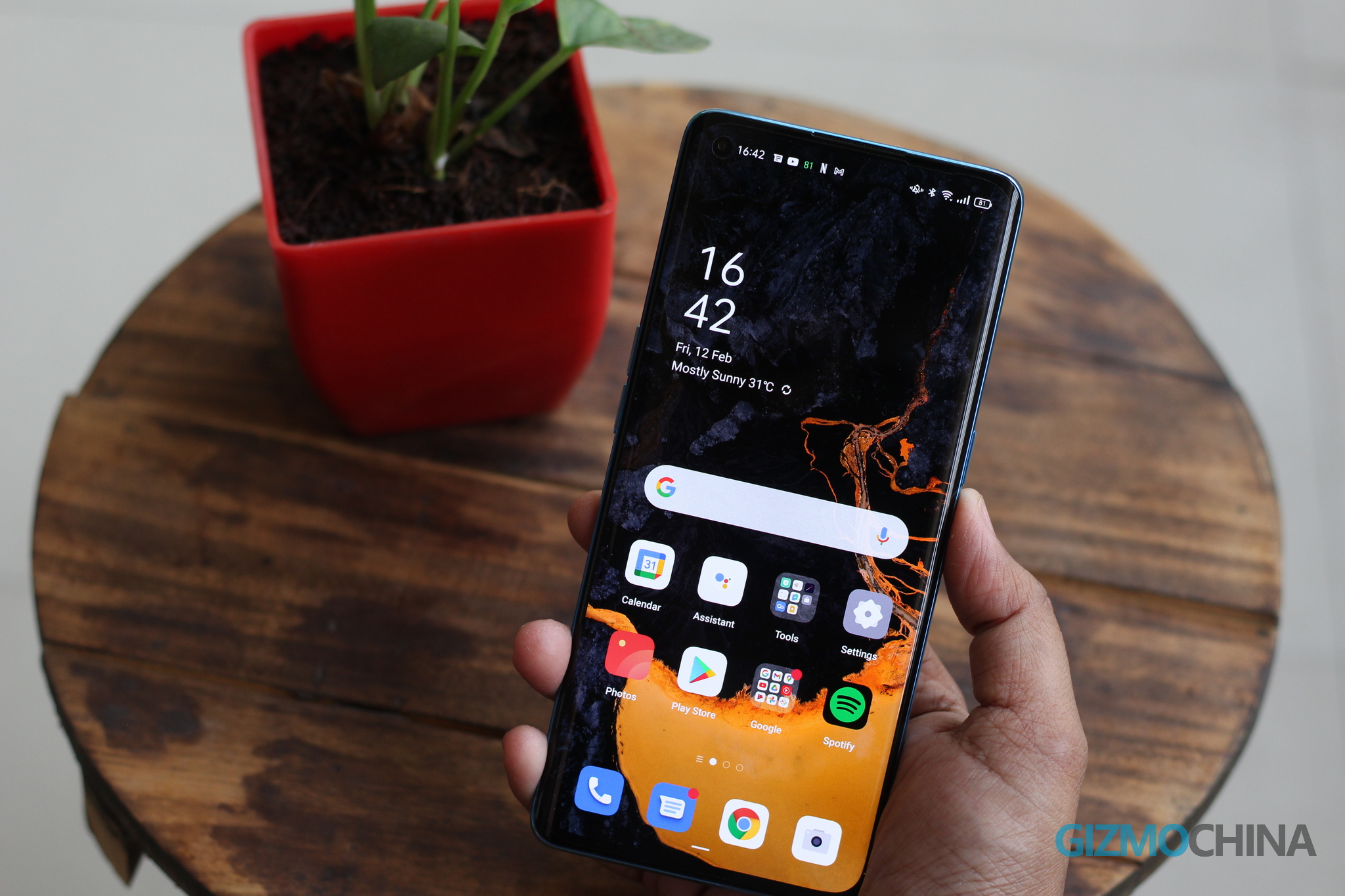
Another big highlight of the OPPO Reno5 Pro 5G is its 6.55-inch 2400 x 1080p Super AMOLED display. The panel is bright and well saturated, even when you use it outdoors, and comes with a 90Hz refresh rate and HDR10+ certification. An area where this phone shines is video playback. The super-thin top bezels and the edges which curve into the back, make for a truly immersive experience, whether it’s watching a video or playing games.
This Super AMOLED panel with its curved edges features vibrant colors and good viewing angles, making it a flagship worthy screen, even if it’s just 1080p. So whether it was watching a video on Netflix or browsing through the gallery, the 90Hz refresh rate display provided a smooth scrolling and viewing experience. The front and back are both protected by Corning Gorilla Glass 5.
Also, for those who are worried about the edges registering ghost touches, be assured that the software is smart enough to not allow the edges to come in between your experience.
The 32MP front camera is housed inside a punch-hole that’s located on the top-left corner. It small enough to ensure a distraction-free viewing experience and the software has now matured to smartly hide it in plain sight. Note that my review unit came with a scratch guard installed, so you don’t have to run off searching for one when you purchase the device.
Overall, the Reno5 Pro 5G shines in both display and design departments.
OPPO Reno5 Pro 5G Review: Performance & Gaming
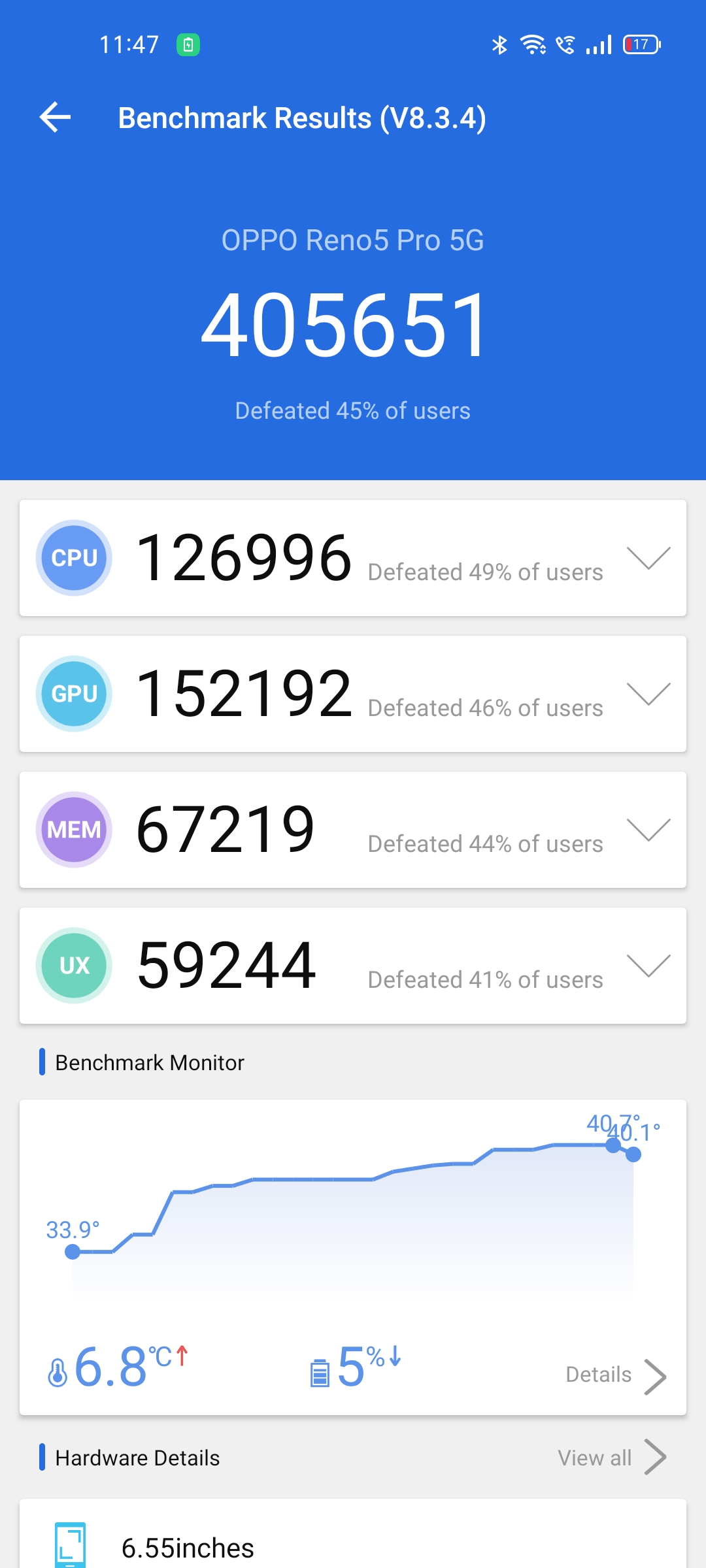
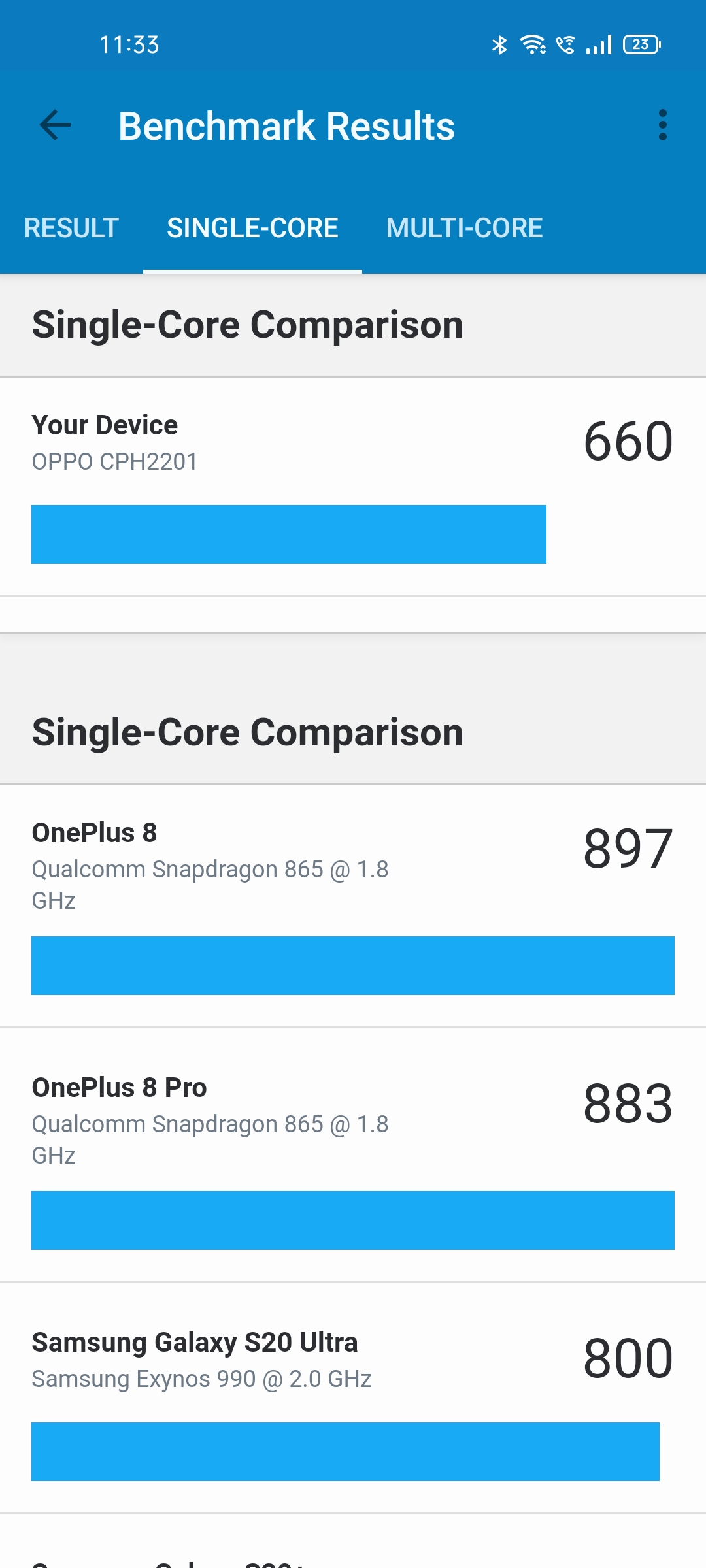
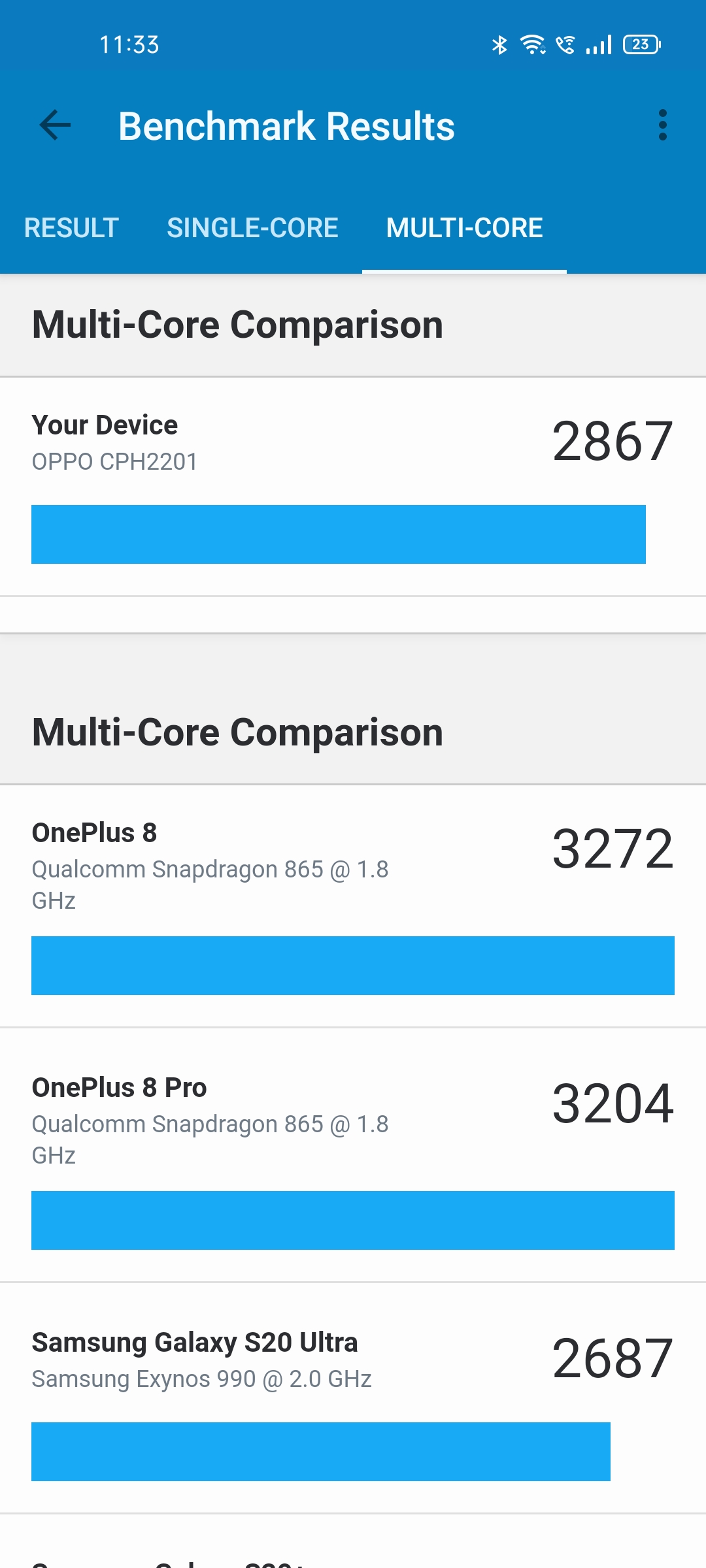
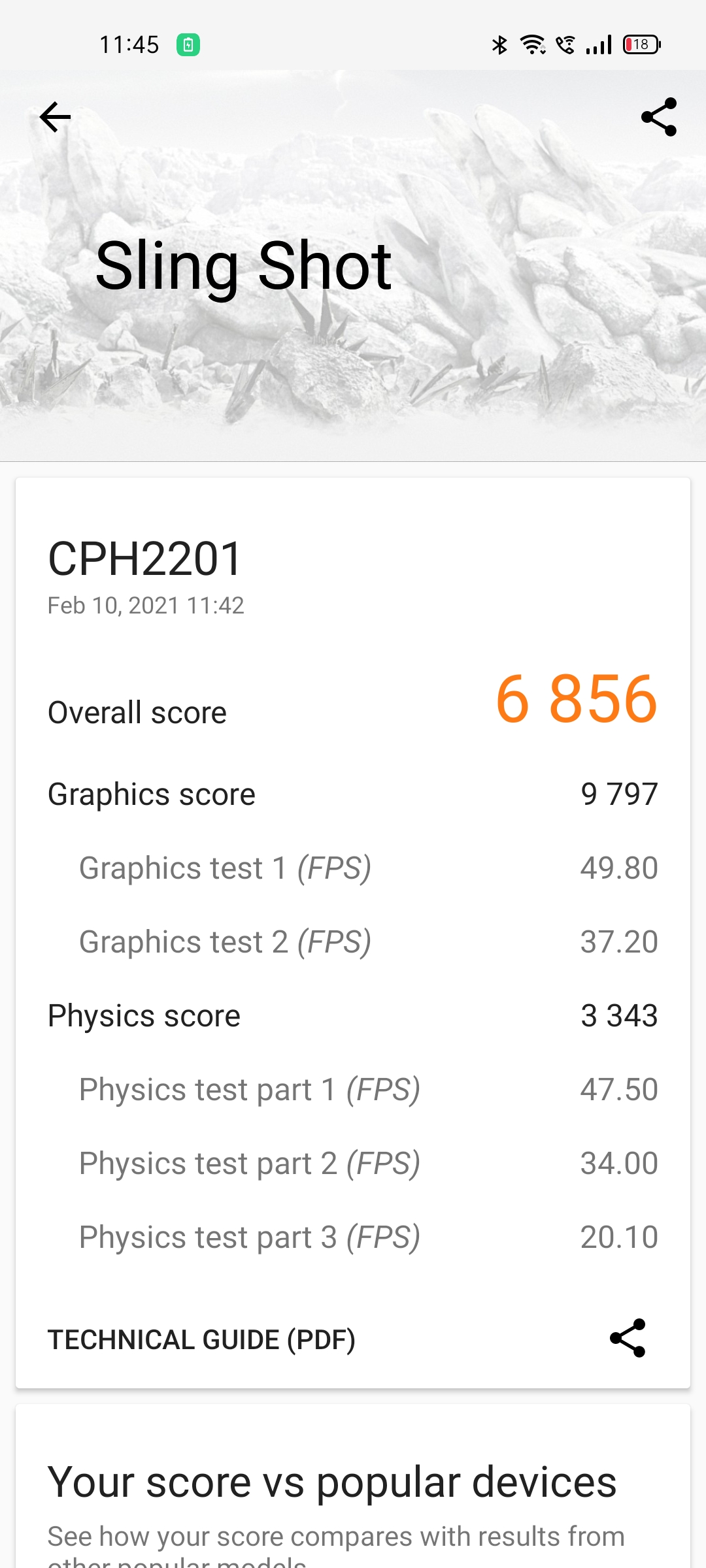
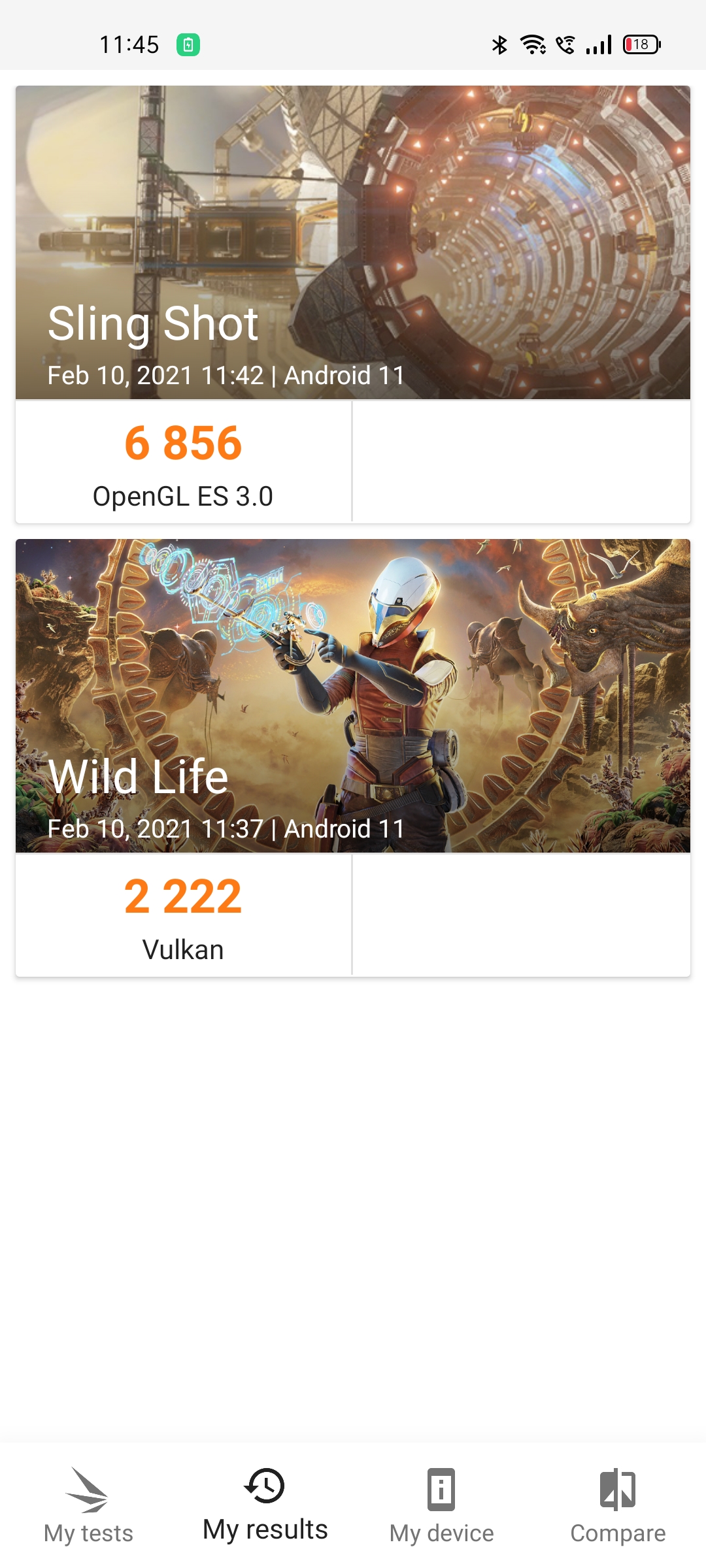
When it comes to benchmark the OPPO Reno5 Pro unit scored 405600 on Antutu 8.3.4 which was pretty good. The score may not be close to the flagship Snapdragon chips but it’s still a good indication that the chip should handle most of the processes that you throw at it. Other benchmark scores are given below, you can have a look at them if interested.
1 of 5
Reno5 Pro Antutu
Reno5 Pro 3DMark
The 7nm MediaTek Dimensity 1000+ is the chipmaker’s best SoC from 2020. It comes with four performance Cortex-A77 cores and a 9-core Mali G77 MP9 GPU. In real life, the chip ensures the Reno5 Pro 5G runs without any glitches or lags. The UI is fluid, animations are smooth, and even the gestures work properly. Multi-tasking is also a breeze on this phone so everyday tasks like watching videos, listening to music, editing a few photos on apps like snapseed, and browsing through websites for hours — all work very smoothly.
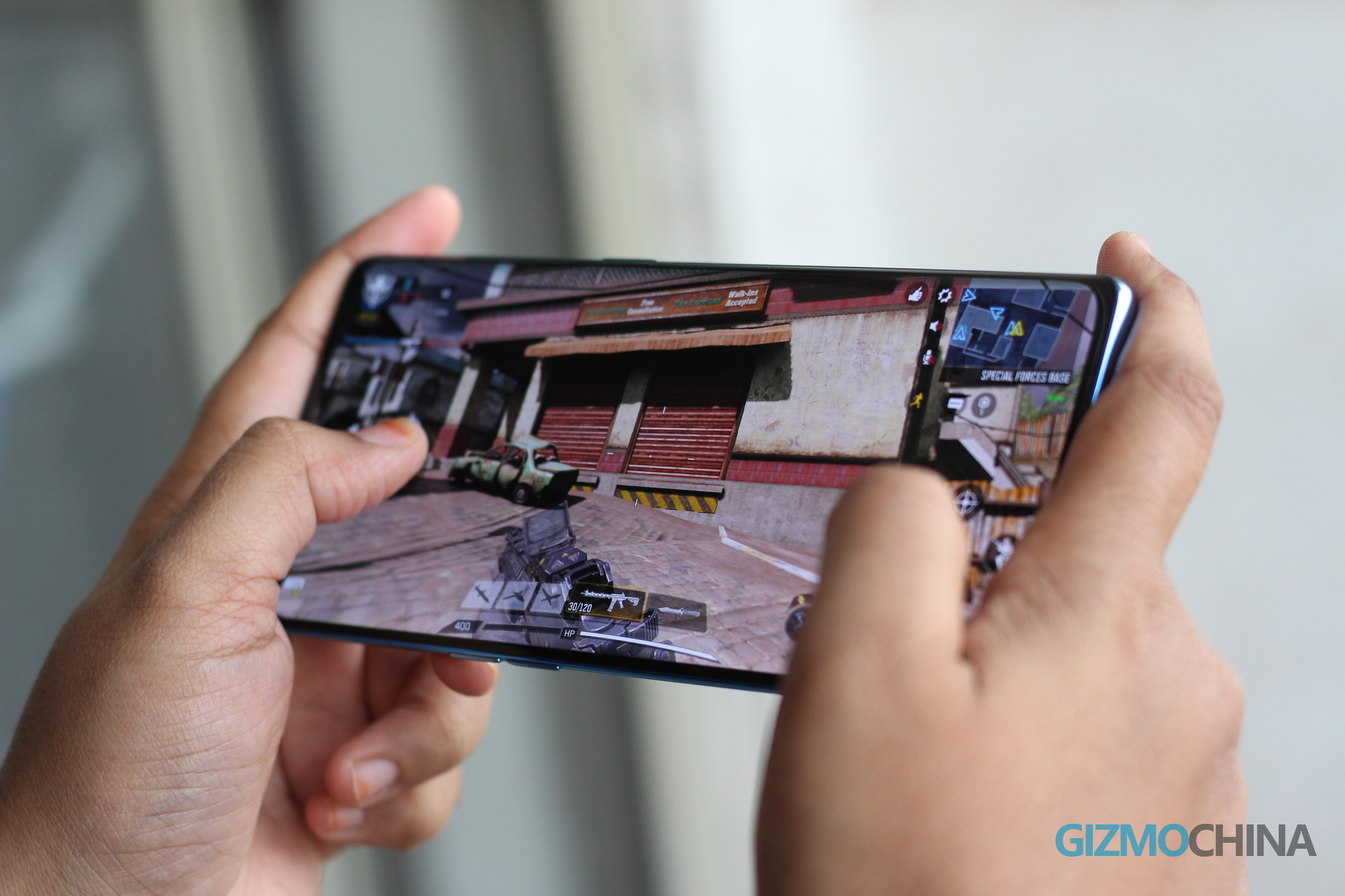
As for the gaming performance, I am not much of a mobile gamer, but I tried my luck with COD: Mobile and Asphalt 8, and both the games ran smoothly. COD Mobile in the highest graphics settings didn’t encounter any issues and the gameplay was smooth. As far as I could see, the touch inputs were fast and accurate as the 180Hz touch sampling rate may have aided in my gaming experience.
As for heating, the Reno5 Pro 5G heated up to around 42 degrees celsius when I was gaming for half an hour to 45 minutes but it never reached a level where it affected my gaming experience. Without a cover, the phone feels a bit warm to touch but with a cover on the back, this shouldn’t bother your gameplay.
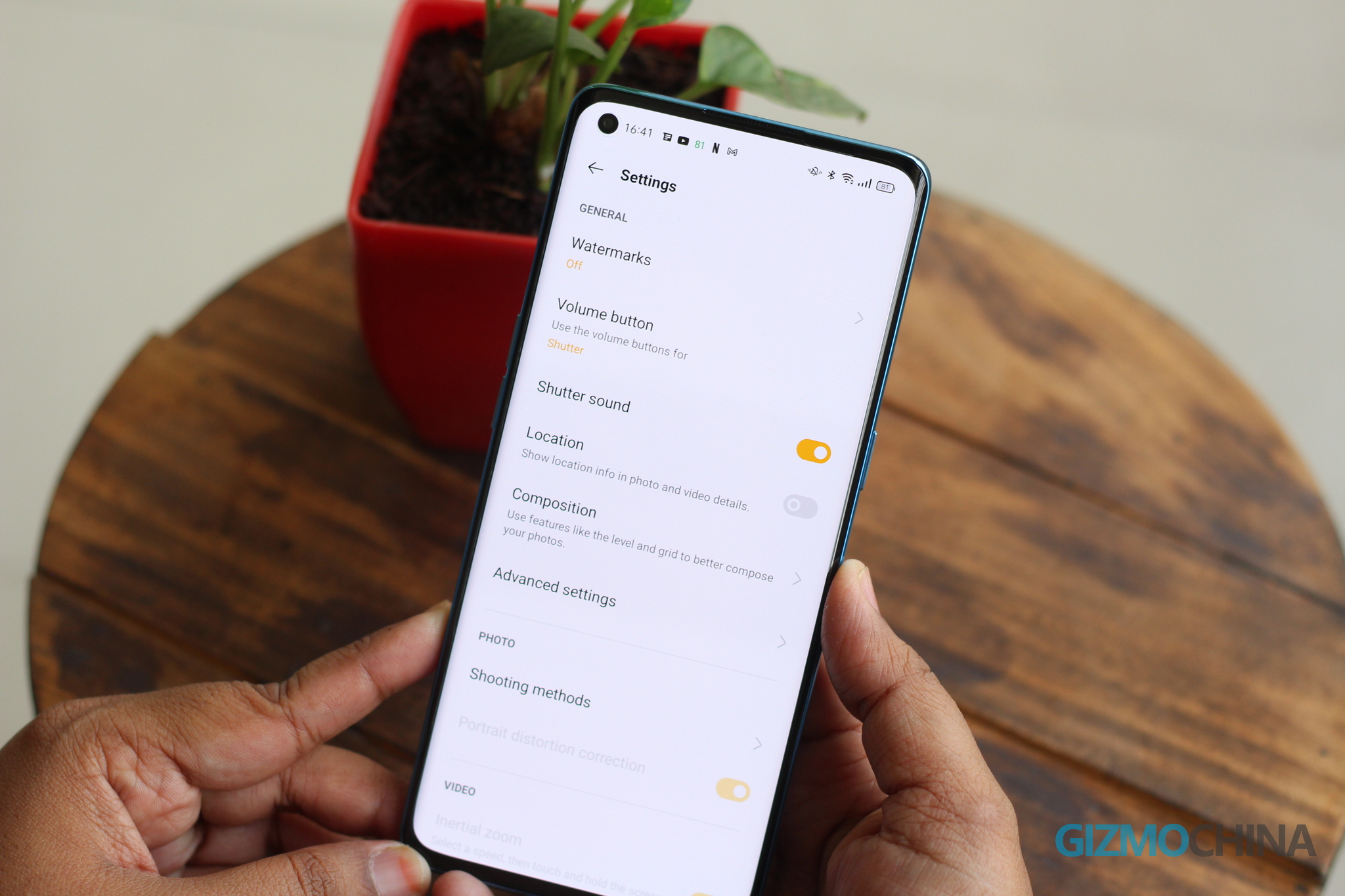
OPPO Reno5 Pro 5G Review: ColorsOS 11 UI
Over the past couple of years, ColorOS has evolved into a pretty good custom UI for Android. It’s been a while since I used ColorOS, so personally, the UI elements and design felt fresh and colorful.
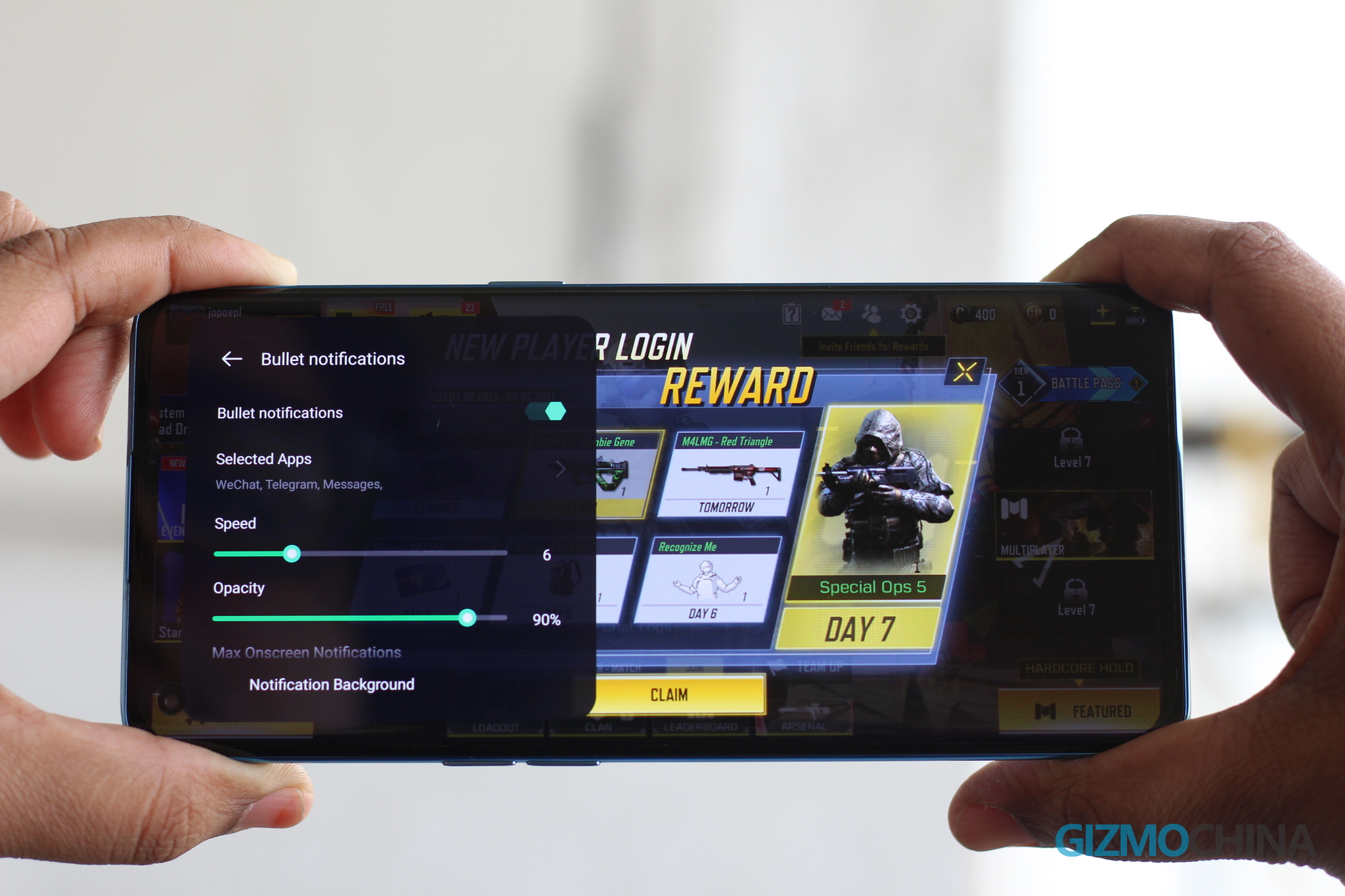
OPPO Reno5 Pro Gamespace
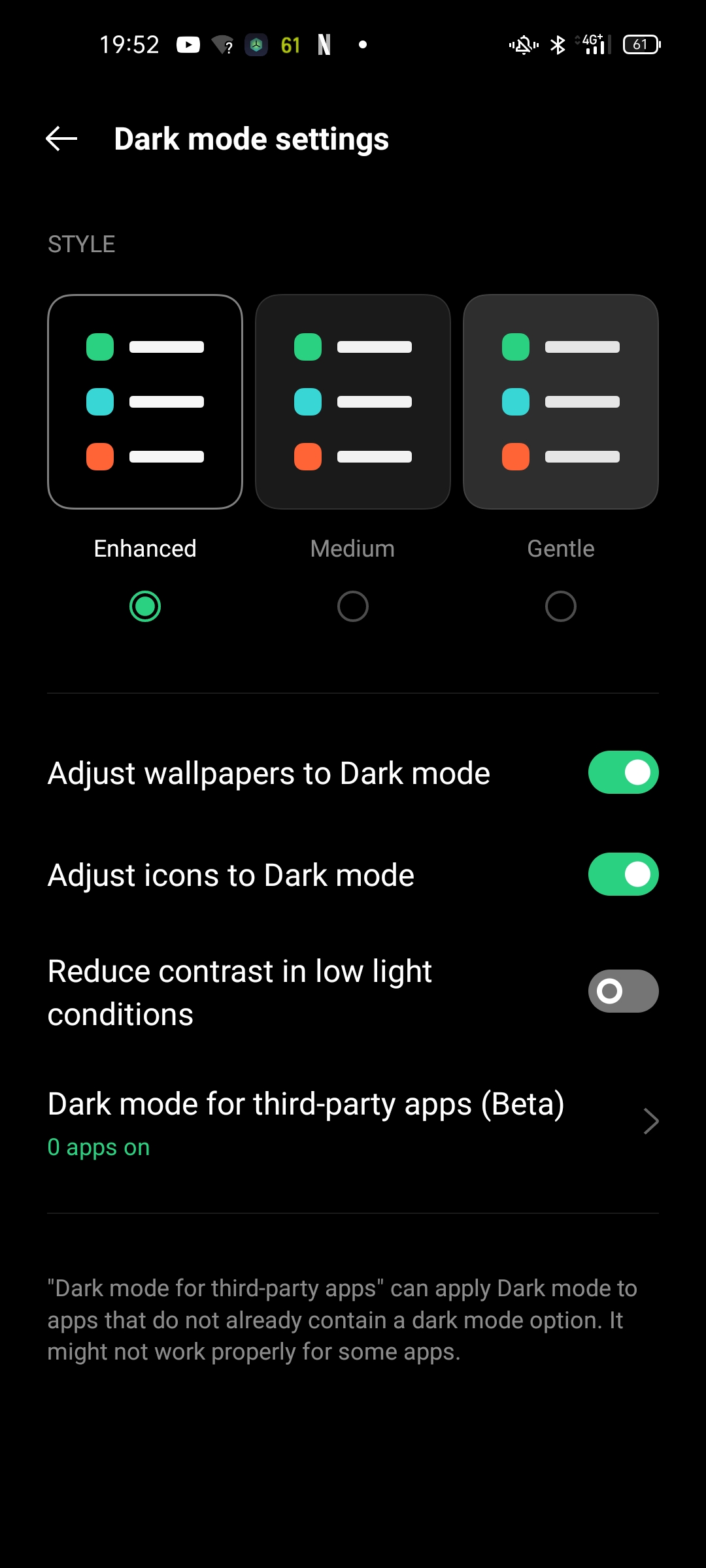
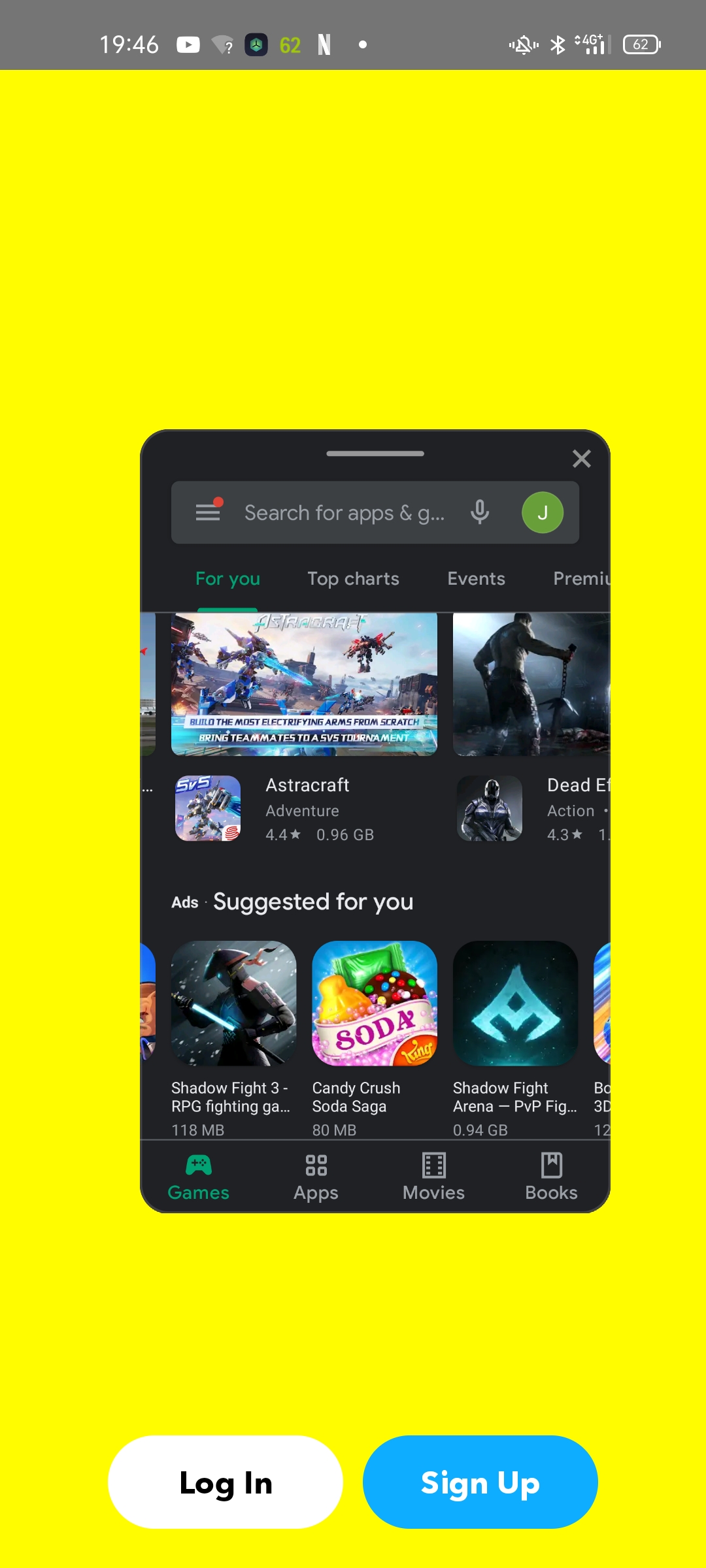
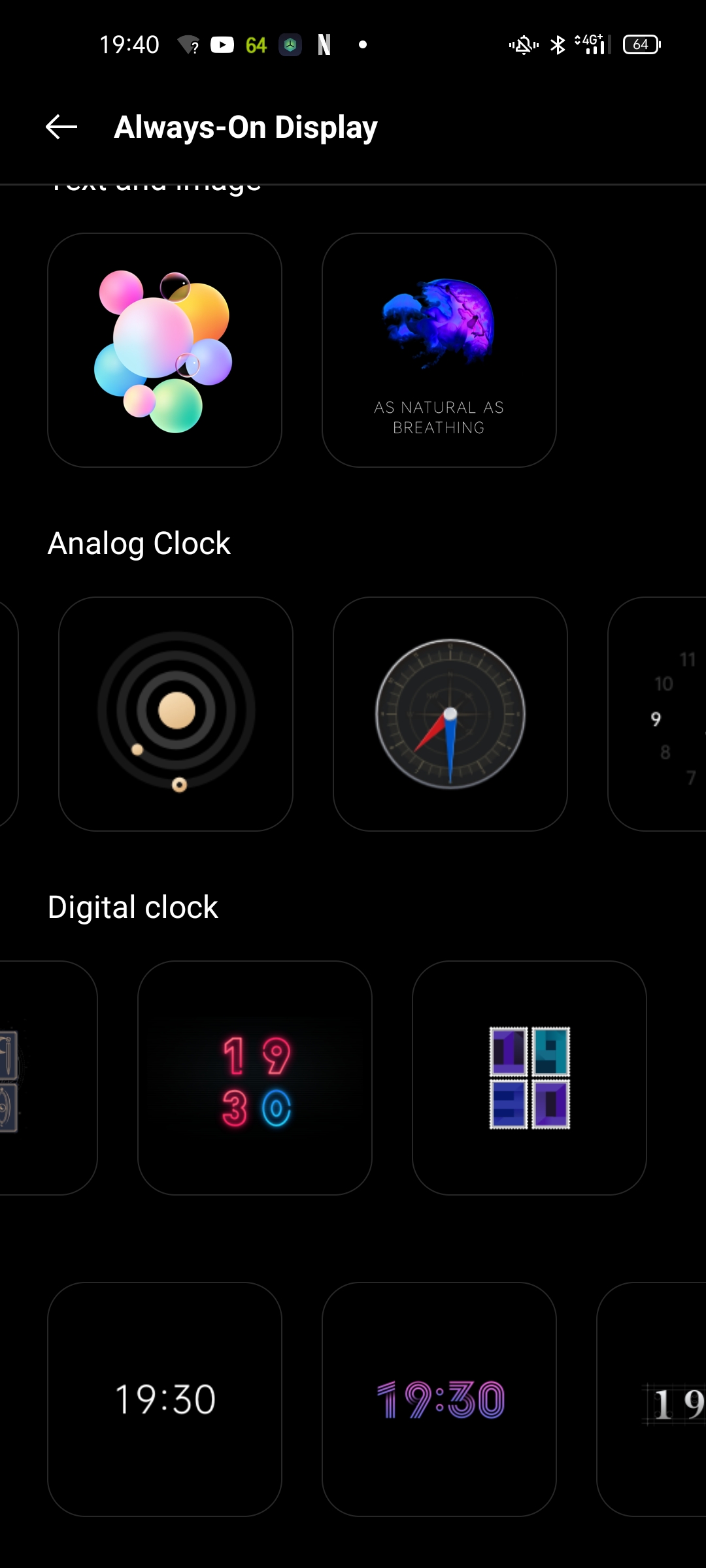
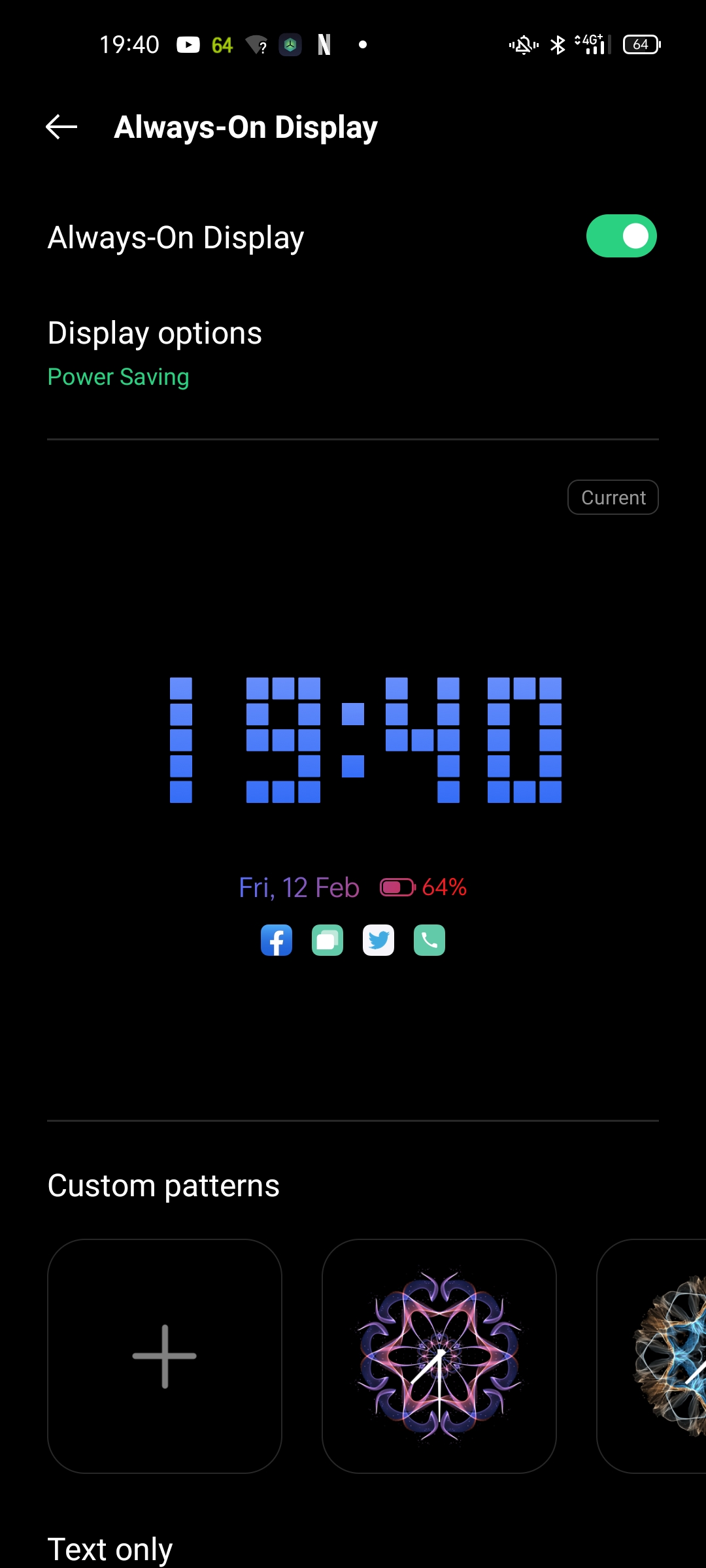
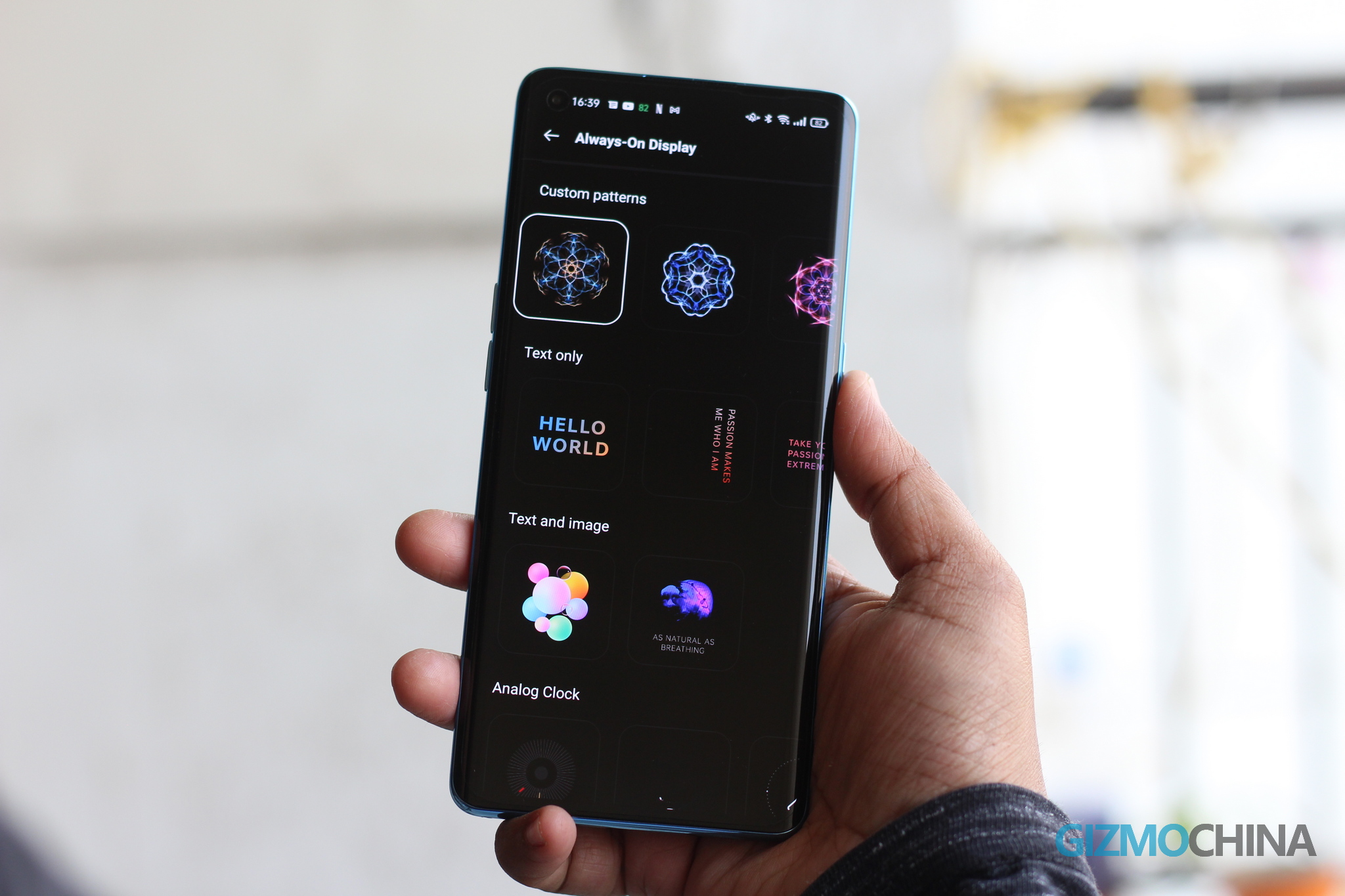
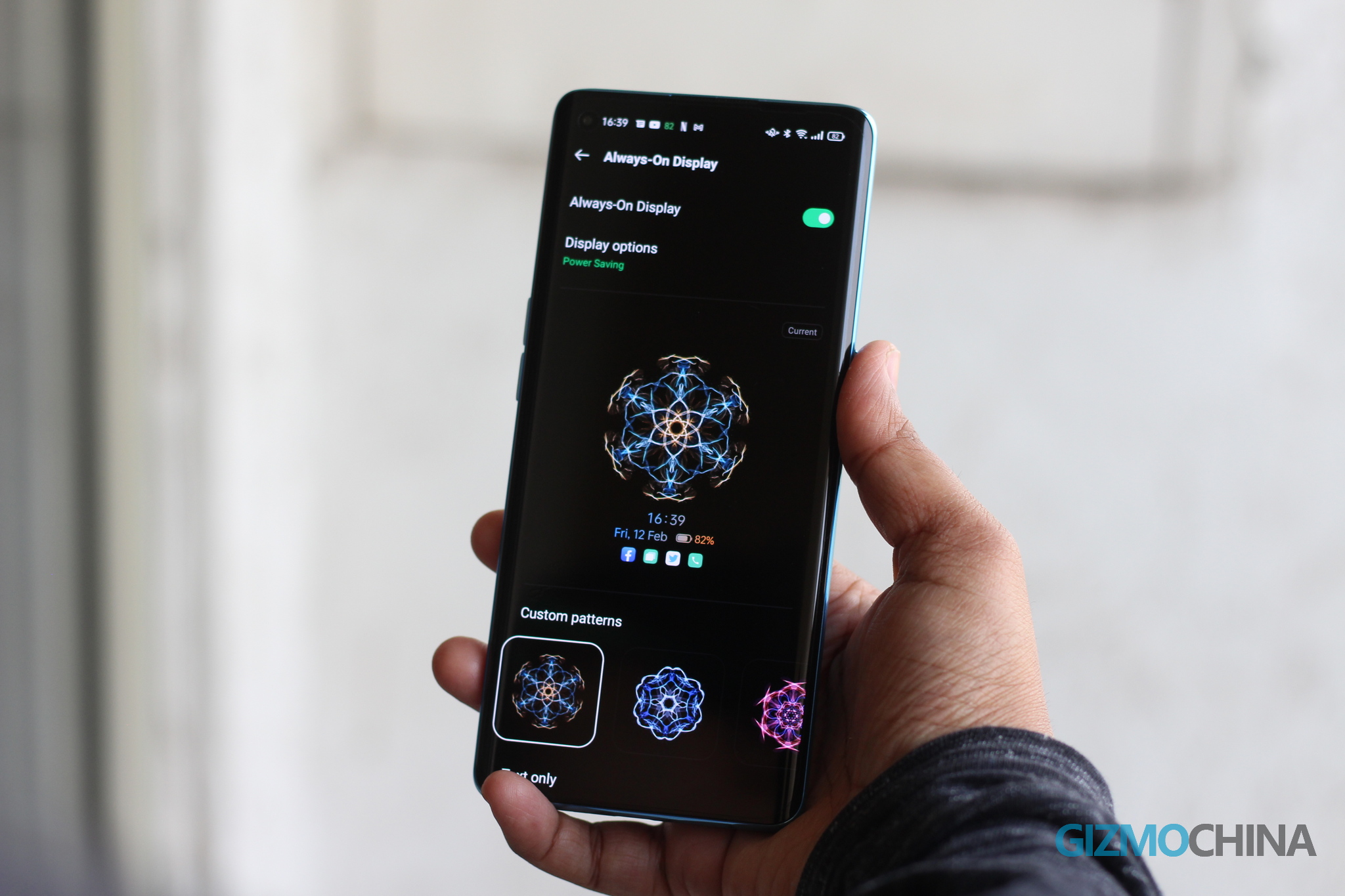
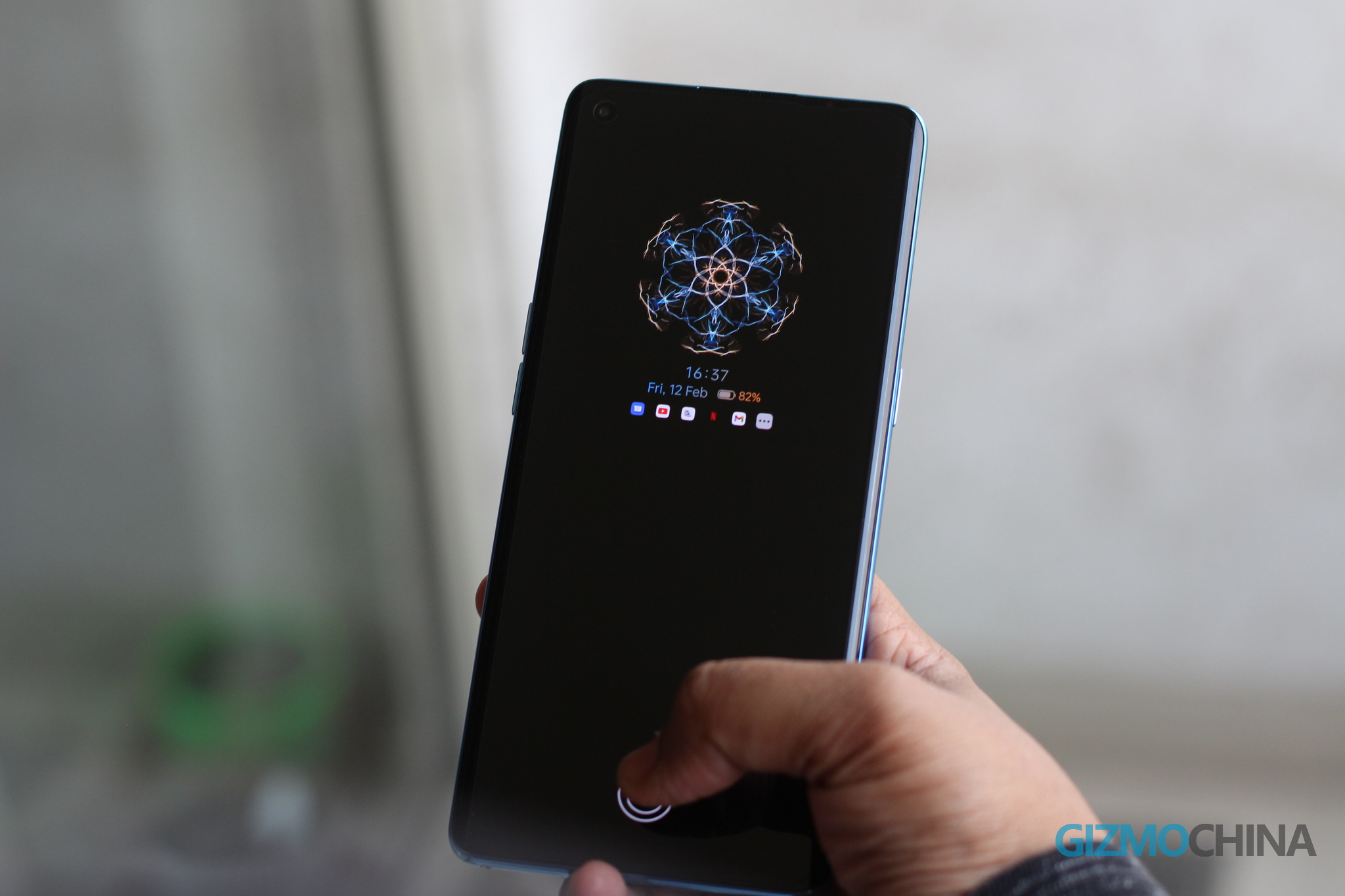
Some of the interesting ColorOS 11 features I found on the Reno5 Pro include the quick startup feature for games (via gamespace), the three levels of dark mode (enhanced, medium, and gentle), a number of customization options including animations for AOD, and flexdrop for multitasking – which worked pretty well when it did (some apps may have compatibility issues though).
1 of 4
Reno5 Pro AOD
Reno5 Pro Flexdrop Picture in Picture view
Reno5 Pro AOD
Reno5 Pro AOD
There are certain aspects of the UI like bloatware that can’t be helped, but still, the OS offers enough customization options to keep everyone interested.
1 of 3
OPPO Reno5 Pro 5G Review: Camera
The Reno5 Pro comes with the following camera setup.
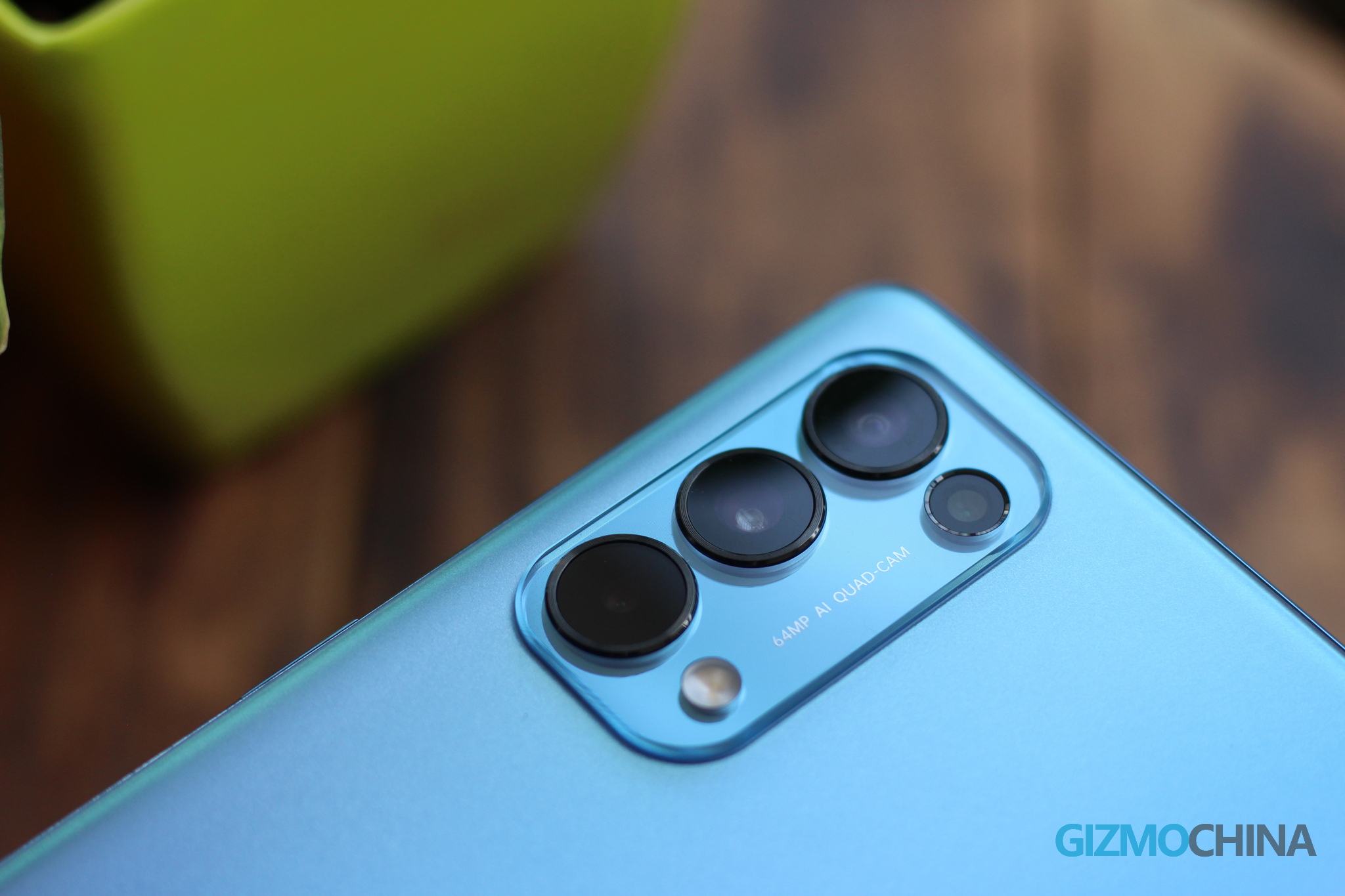
64MP f/1.7 primary camera sensor
8MP f/2.2 Ultrawide 115˚ sensor
2MP f/2.4 Macro camera
2MP f/2.4 Portrait Camera
Reno5 Pro 5G has a quad camera setup
64MP Primary Camera
The samples from the 64MP primary camera were sharp and saturated. Most of you should be happy with the output from the main camera and if you are someone who likes images to be more saturated, you can turn on the AI Highlight algorithm for your photography.
One peculiar thing I noticed was that the primary camera slightly overexposed some images, especially when it came to landscapes. Apart from that, the images came out clean and sharp with a good amount of details and an excellent dynamic range.
When the lighting goes down, there is some visible noise. But if you turn on the AI Highlight mode in the camera, you can get a visibly cleaner photo with good colors. The night time images were pretty bright too.
Let’s take a look at a few samples.
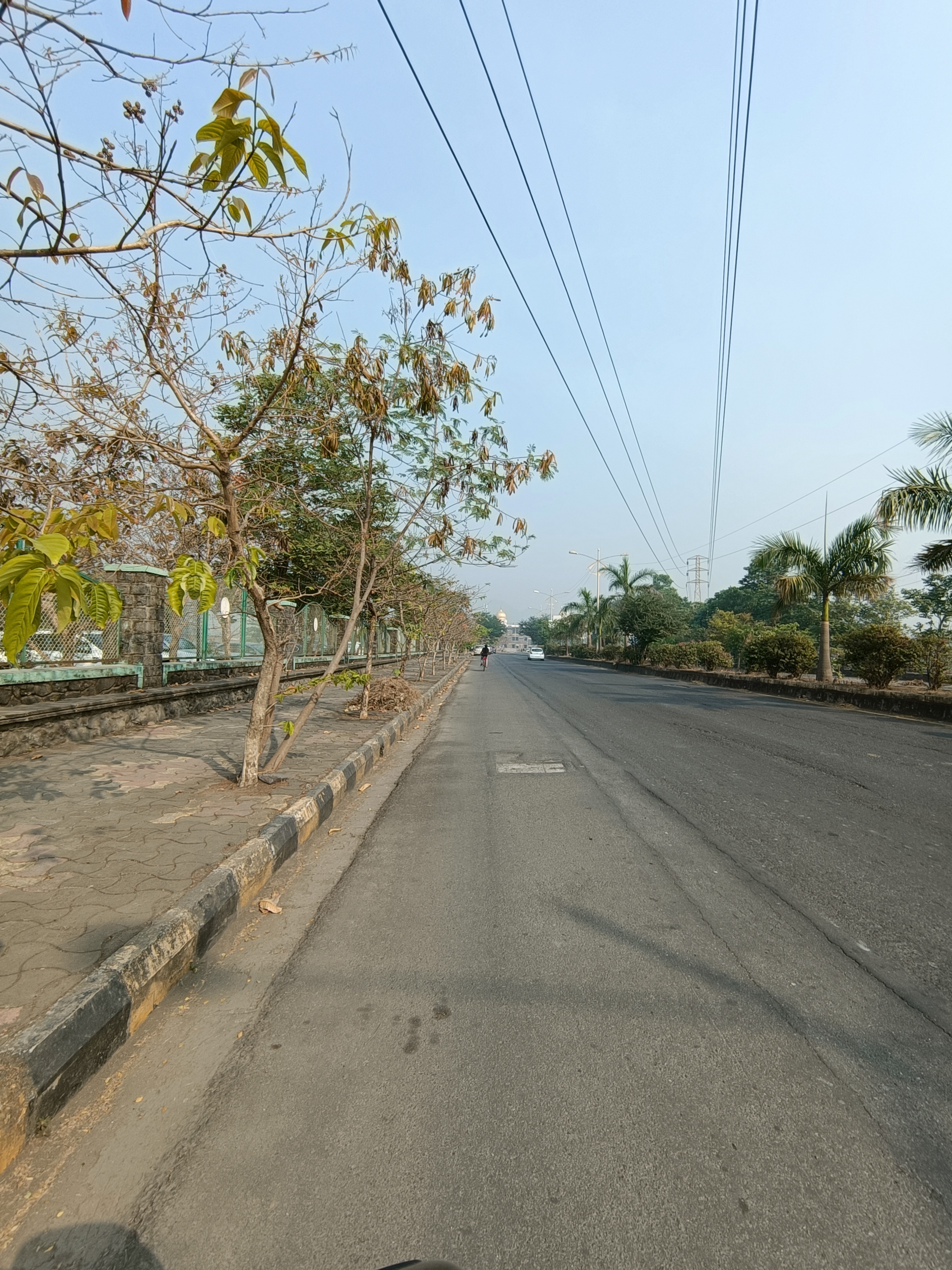
As you can see in the sample above, the photo features a good dynamic range and has colors that are very close to real life. The image also has a lot of details, including the textures on the footpath and the bark of the trees. If the exposure was slightly tweaked, I feel the image would have looked cleaner.
Take another example of a photo shot at 8 AM. The image has a really good dynamic range and the real orangish shade of the early morning sun is retained along with a good amount of details.
Further, the AI Highlight feature boosts the saturation to pretty good levels (see the difference in the samples below) ensuring that your photos are social media ready right out of the gallery.
Images taken indoors under good lighting were very crisp and saturated. OPPO’s scene recognition (via AI Highlight) was always spot on in identifying the correct scene in focus and applying appropriate tweaks.
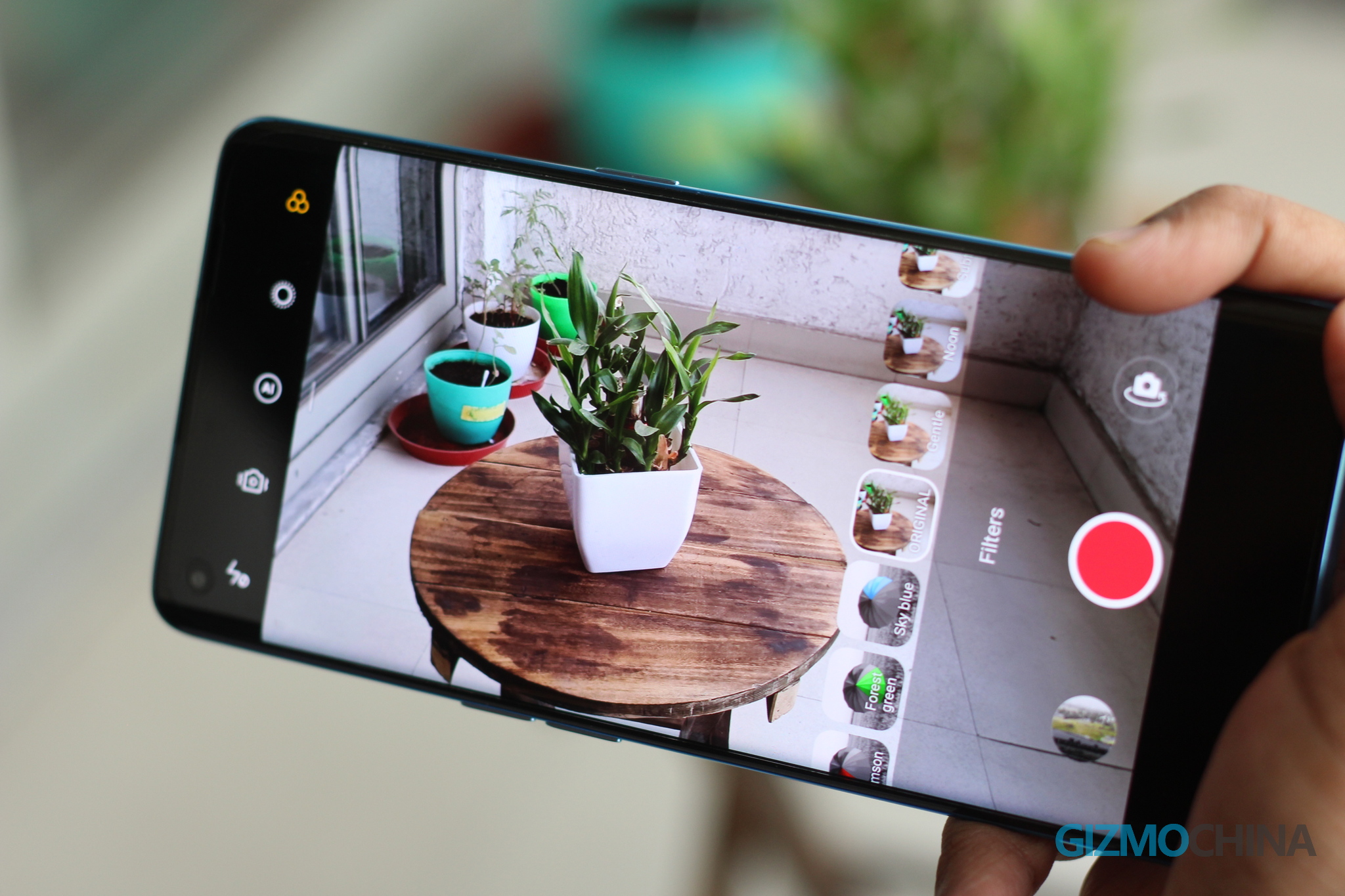
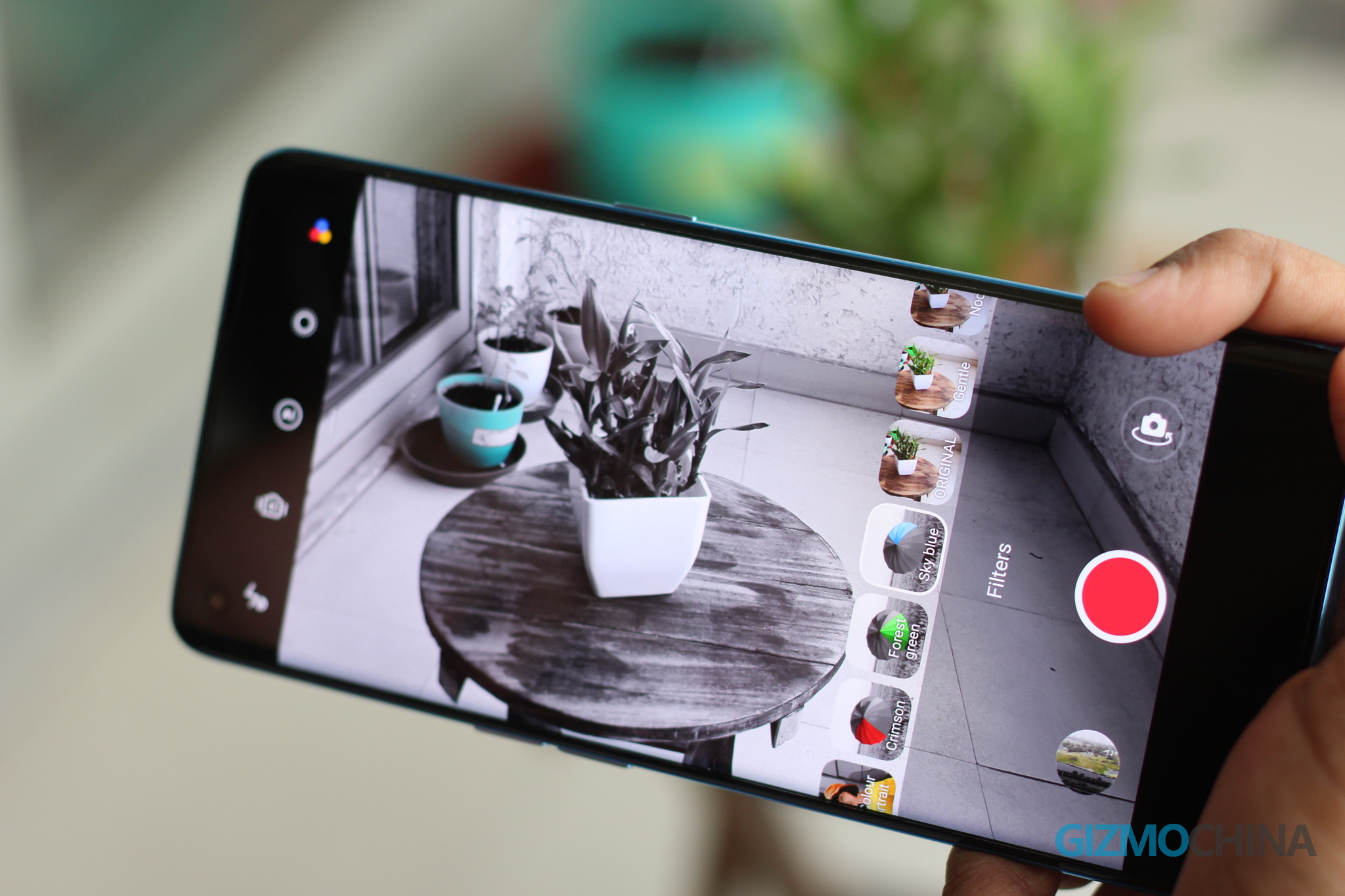
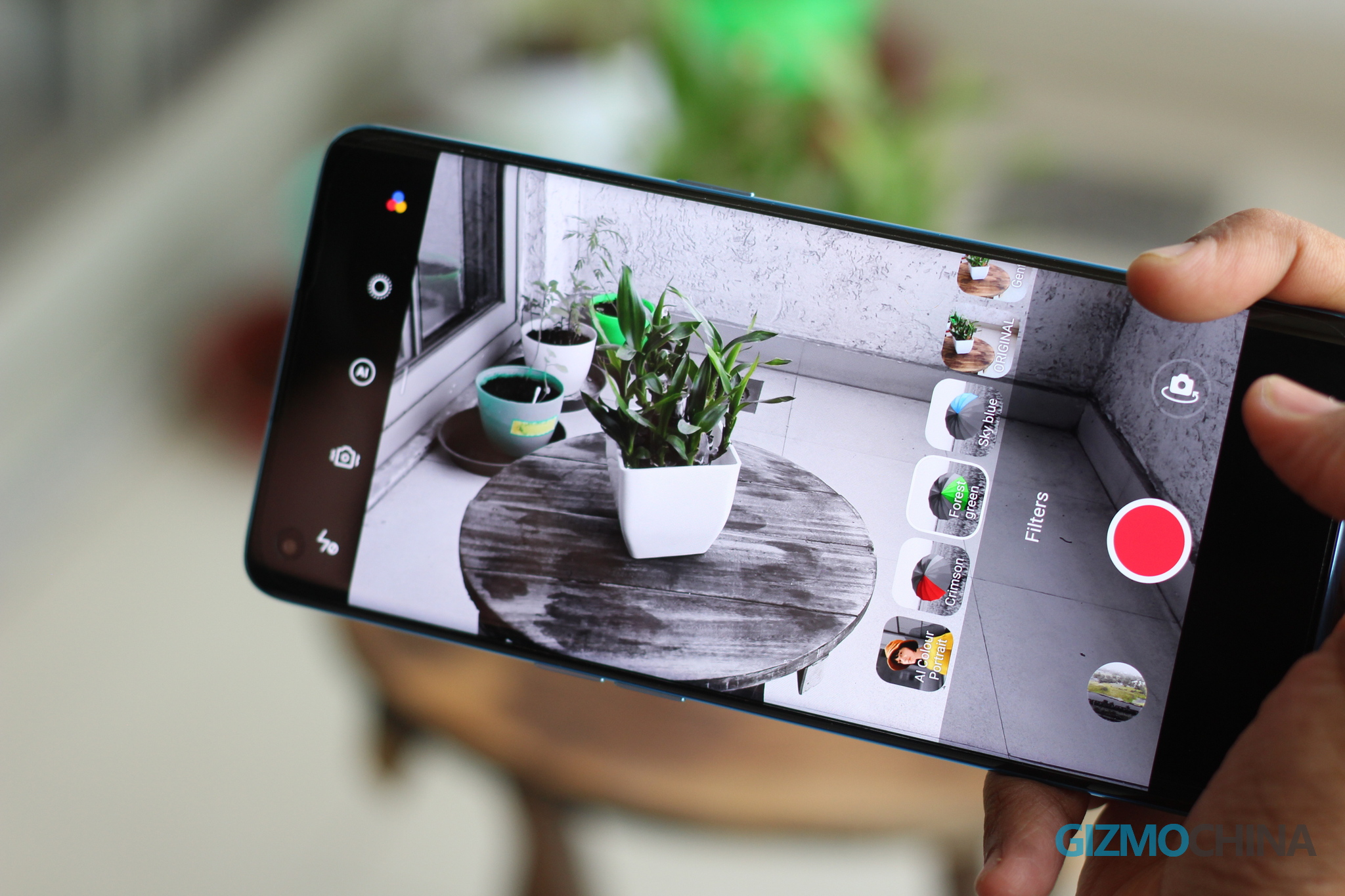
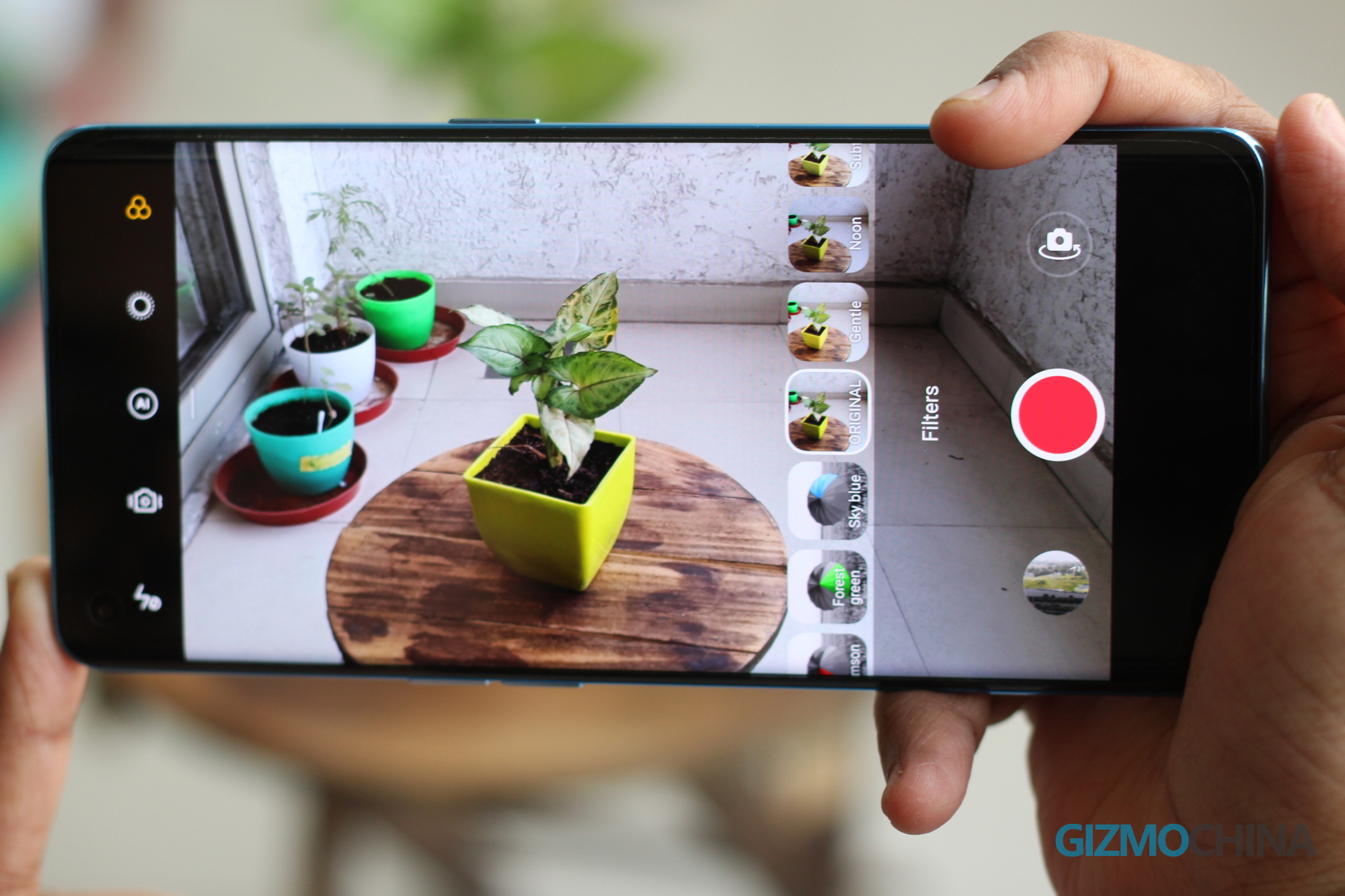
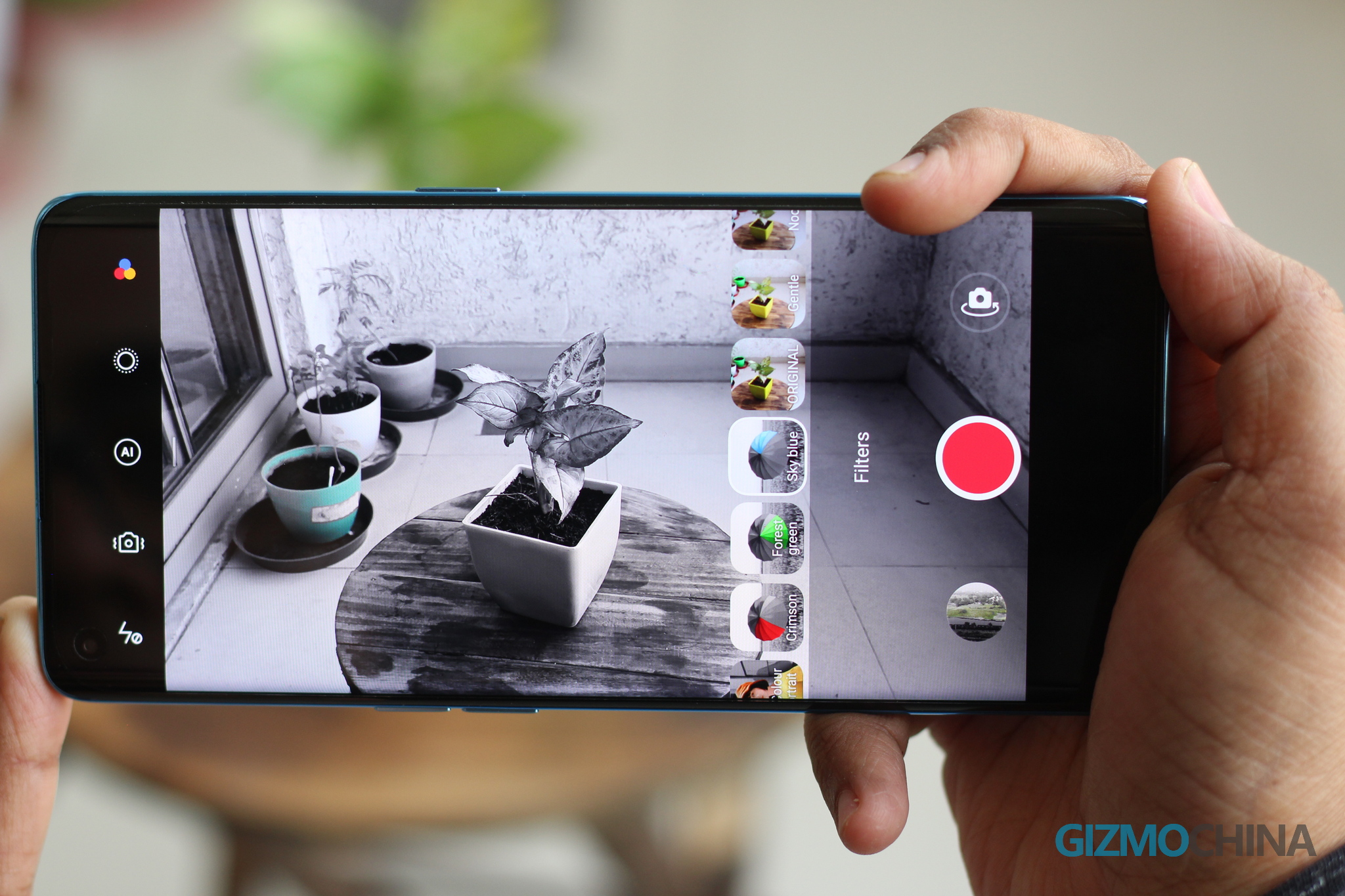
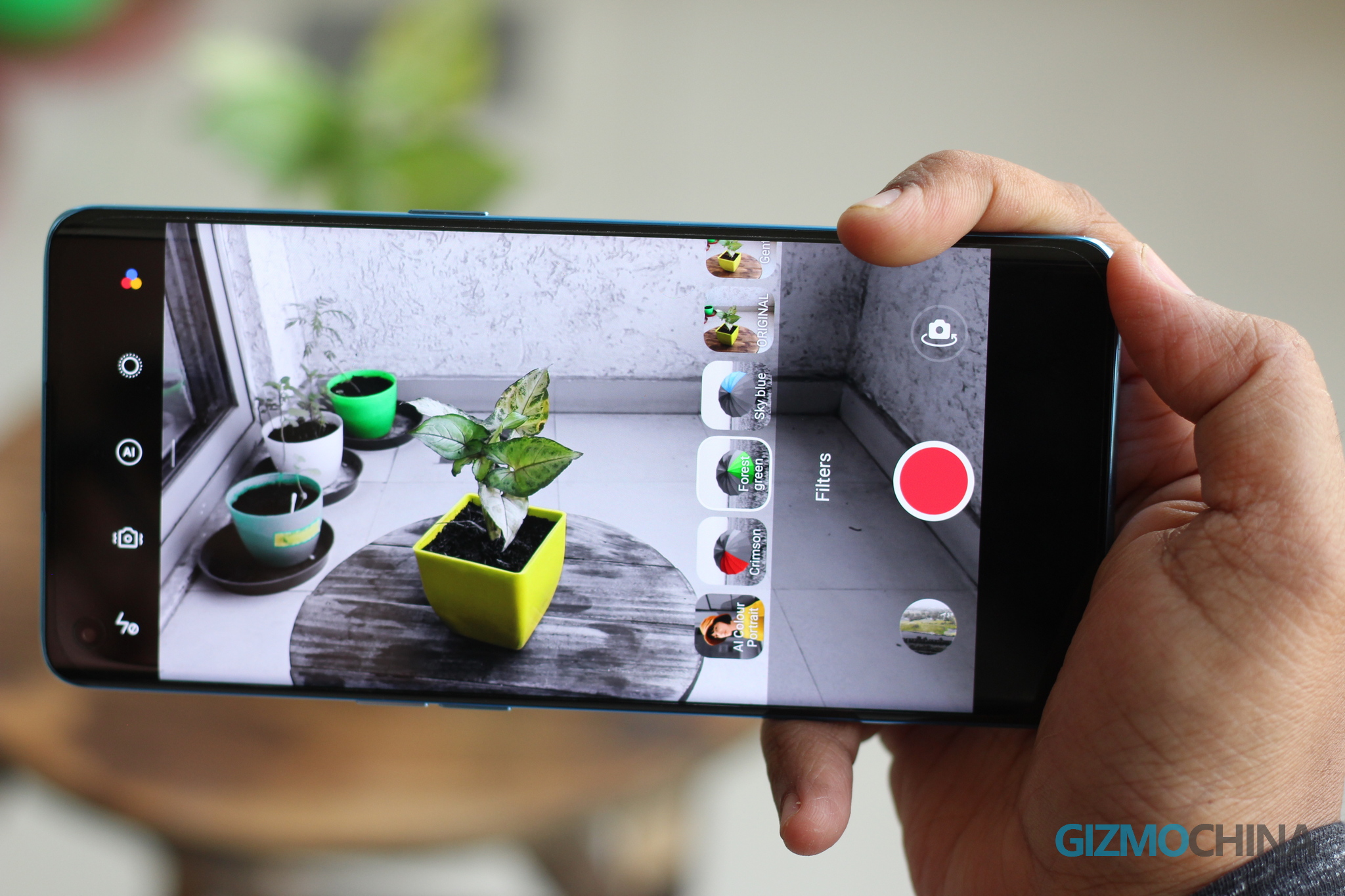
There are a bunch of filters and options to play around with as well which makes capturing photos from its 64MP camera quite fun.
Low Light Photography
As for low light images, I was pretty happy with the results. The noise levels were controlled and the 64MP camera still retained a good amount of details with real-life colors. Overall, it captures clean and saturated images, which most people will prefer.
Even when the lighting dims down significantly, the Reno5Pro impressed with the amount of details and range of colors it managed to capture. I found this to be consistent in all of the low light scenarios.
Some phones lose saturation when lighting goes down, but the Reno5 Pro did well to maintain the color and details.
The 8MP Ultra Wide Camera can capture decent wide angle shots with good colors. The AI Highlight feature further helps to boost the saturation levels, improving the quality of the samples.
But UW camera struggles in extremely low light situations which isn’t surprising given it’s an average 8MP sensor. Night mode does boost up the wide-angle image but with fewer details to spare, the images lose out their sharpness. However, I do have to mention that the noise control in these low light situations was impressive as I’ve seen phones with ultra-wide-angle sensors that take slightly brighter photos at the expense of additional noise, rendering the image useless.
So the UW mode is not really meant for night time photography. Stick to daylight conditions for your wide-angle shots and you should be satisfied with the experience.
It’s also worth adding that unless you are using an expensive flagship, the ultra-wide camera on your smartphone won’t likely perform well in extremely low light situations. So this result is in line with other phones in its price segment.
The 64MP camera in the standard mode was pretty good even when the lighting was extremely dim or nonexistent. Details were retained to a considerable extent and the image came out well balanced (not overexposed). The night mode can turn up the brightness to a considerable extent. However, as with other night modes, when u boost the brightness of an extremely low light image, some details are lost.
1 of 4
64MP OPPO Reno5 Pro standard Mode
64MP OPPO Reno5 Pro Night Mode
64MP OPPO Reno5 Pro standard mode
64MP OPPO Reno5 Pro Night Mode
Personally, I’d advise against using the night mode unless for scenarios when the scene is extremely dark as the standard mode is good enough for most low light situations.
Overall, I m pretty happy with the night time performance of the primary sensor without the night mode.
Portrait Camera
The front portrait is pretty good and you can get some good looking selfies. However, the rear portrait camera does not meet the expectations of a Rs. 35,000 smartphone. You can get decent shots if you try really hard but the amount of background blur was not very strong which didn’t allow the object in focus to get that special bokeh effect.
1 of 3
OPPO Reno5 Pro Portrait
Macro Camera
The Macro camera was even worse than the portrait camera. I couldn’t get a decent macro shot as the phone failed to focus when I was close to an object.
1 of 2
Macro mode
Macro mode
So, in conclusion, the 64MP f/1.7 primary camera is impressive while the 8MP ultra-wide-angle shooter also does a pretty good job at capturing decent quality wide shots. However, don’t expect much from the portrait and macro cameras.
VIDEOS
FDF Portrait Video system was heavily marketed by OPPO so I was curious to see its real-life improvements. I have to agree that the videos do have an edge when the algorithms work properly. The noise is well controlled, the dynamic range is good, and the overall video has good details and saturation too. However, I feel this algorithm needs to be a bit more consistent at low light conditions to guarantee better results all the time.
When the lighting goes down significantly, the algorithm tries to aggressively increase the brightness and as a result, there’s visible noise in the video. Personally, I would have preferred a slightly less bright but cleaner video sample. You can check out a couple of video samples from here.
So if you are shooting videos in good lighting conditions on the Reno5 Pro, the FDF Portrait Video system will slightly boost the quality of your videos, giving it an edge over other devices. OPPO also offers a bunch of filters and features such as AI Color Highlight which works pretty well to make your videography experience a lot more fun and interesting.
1 of 7
AI Color Highlight mode
OPPO Reno5 Pro 5G Review: Battery
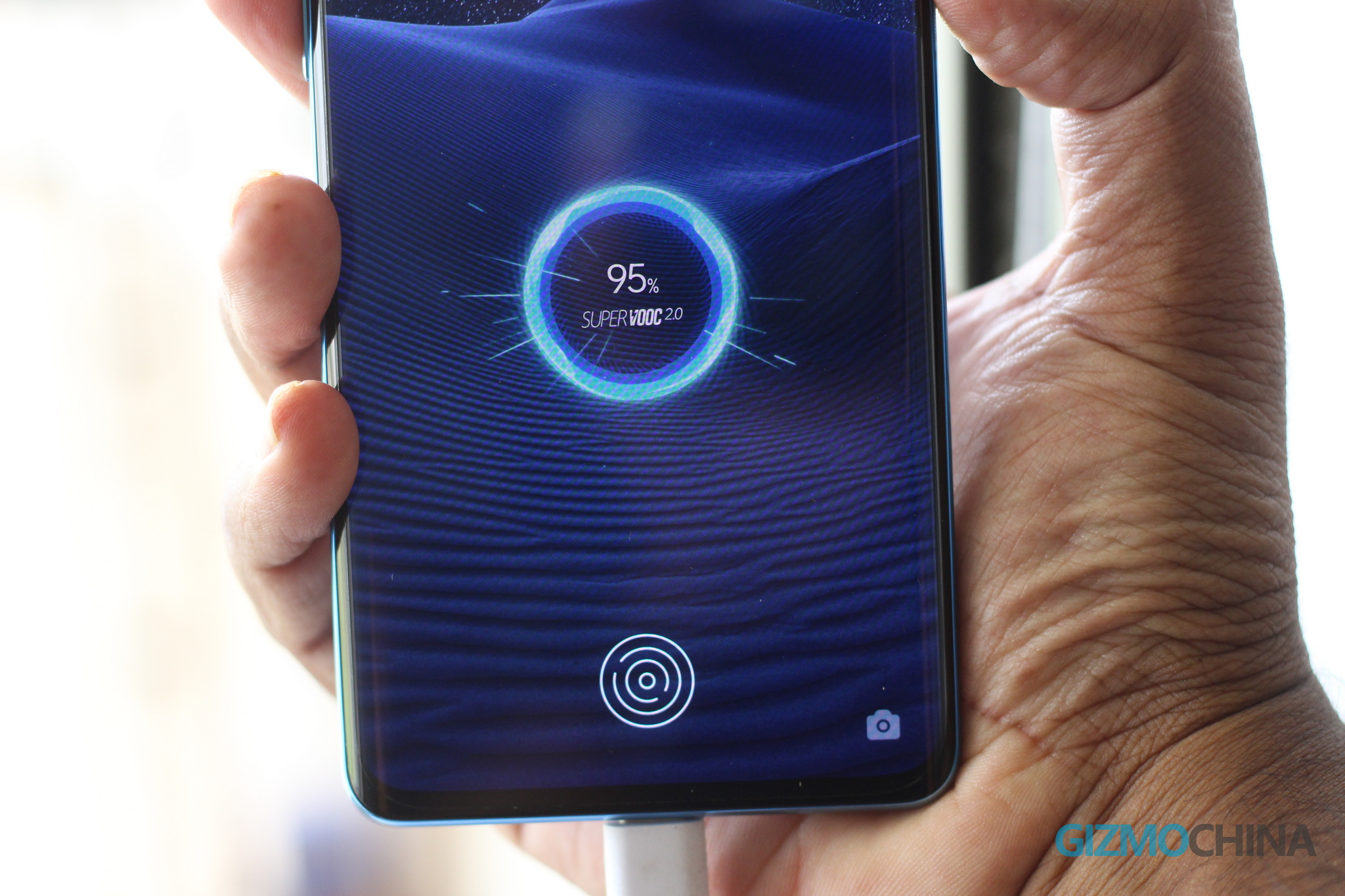
The Reno5 Pro 5G packs a dual-battery design with a total capacity of 4350mAh. The 65W charger is one of the fastest in the market and can juice up your battery at blazing fast speeds. You can go from 15% to 75% in just 15 minutes! Charge it for another 15 minutes and your battery is topped up to 100%. So charging your Reno phone will never be an issue.
As for the battery consumption, the 7nm Dimensity 1000+ is not a battery hogger and provides an all-day battery life on the device. With AOD turned on, the battery consumption increases slightly but with a 65W charger in your bag, you never really have to worry about battery life on the phone.
Note that in India, we don’t have a live 5G network so all the tests were conducted over 4G and Wi-Fi networks.
OPPO Reno5 Pro 5G Review: Verdict
As I mentioned in my review, there are clear strong points for the Reno5 Pro 5G. It has a killer design and display, with a super-fast 65W charging that ensures a 4350mAh battery is more than enough for most consumers.
Dimensity 1000+ was the big question mark about the device but so far, having used the phone for over a month, I have found no perceivable difference in performance over say a Snapdragon 865 powered smartphone like the OnePlus 8. Gaming has been smooth, ColorOS has been fluid and responsive, and overall, Dimensity 1000+ has delivered.
As for the cameras, the Reno5 Pro 5G has a pretty good setup for most of your needs. But portrait and macro cameras are practically useless. The wide-angle sensor turned out to be pretty decent despite its low resolution. That said, if you are a regular consumer, the 64MP primary camera will not disappoint. Just activate the AI Highlight algorithm to boost the saturation and your samples should be social media ready right out of the stock camera.
The FDF Portrait Video system with AI Highlight video is a feature that still needs work. It boosts the colors and reduces the noise in the video to a perceivable extent in most scenarios but it doesn’t really feel revolutionary. It’s more of an evolutionary upgrade to the Reno series this year but I’m excited to see how OPPO refines these complex algorithms to deliver a consistently improved videography experience on its phones.
For Rs. 35,990, the OPPO Reno5 Pro hits all the right notes for a smartphone in this price segment. So, if you are looking for a smartphone around this budget, you might want to check out the new Reno5 Pro model.
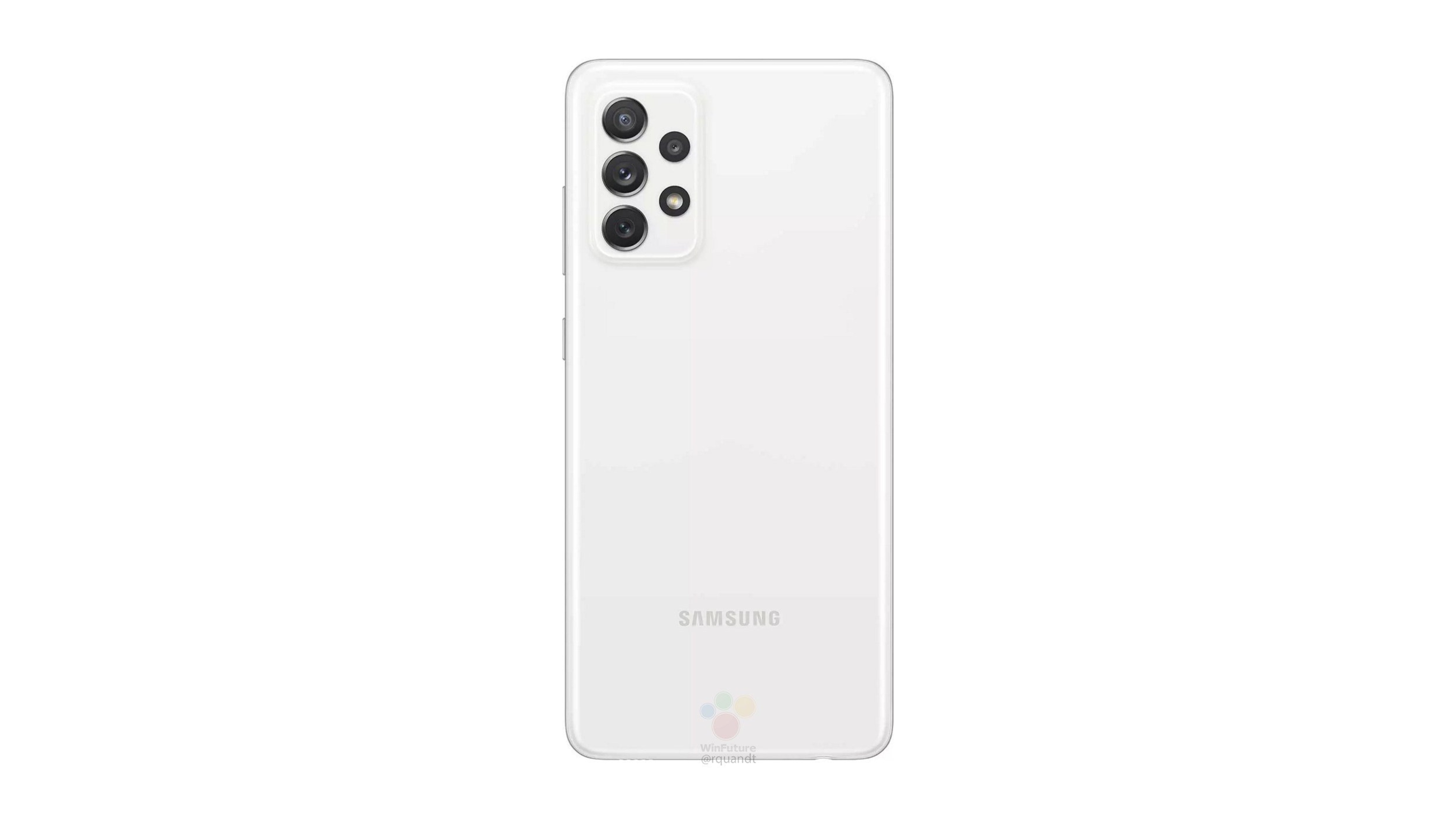
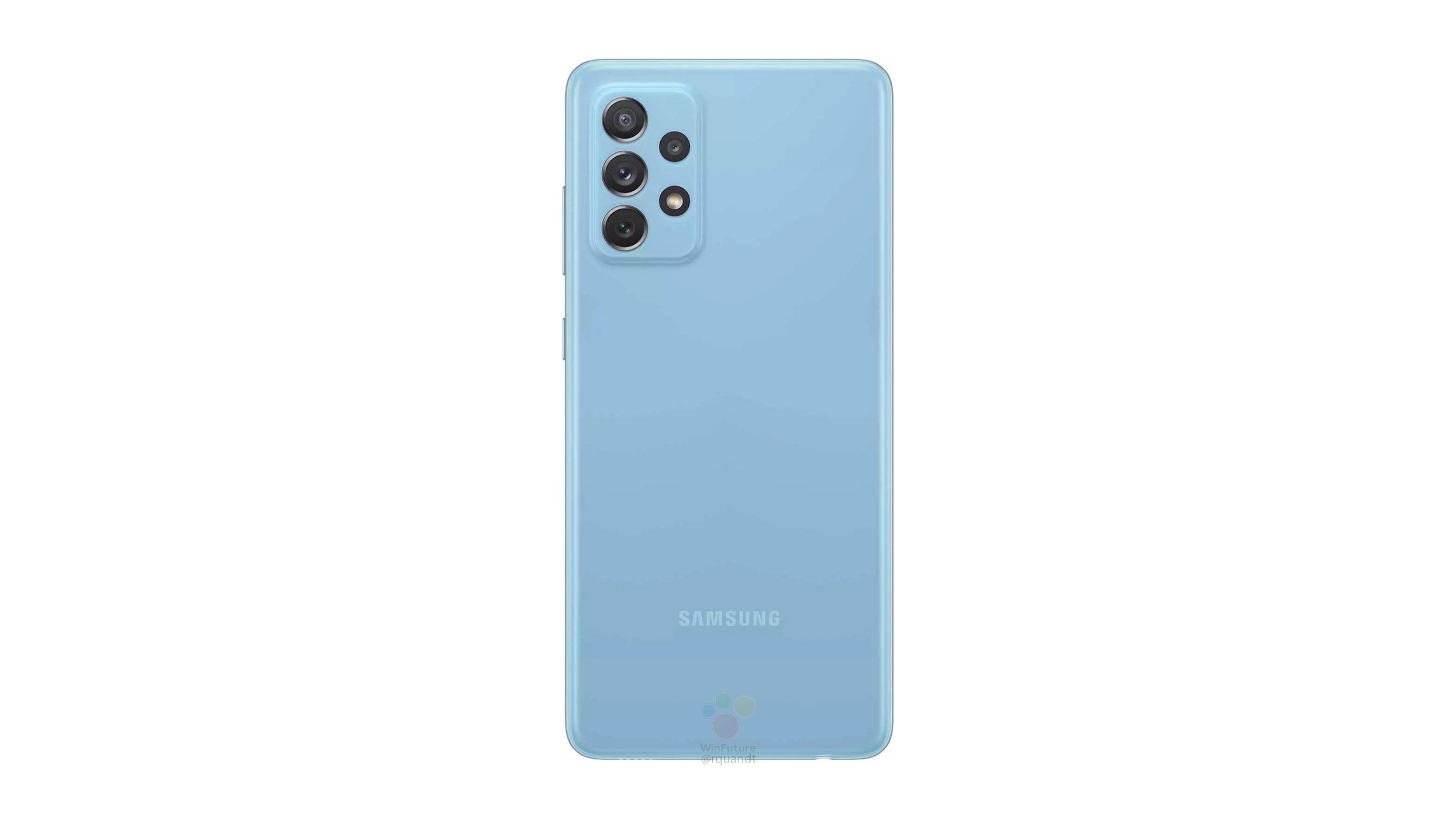
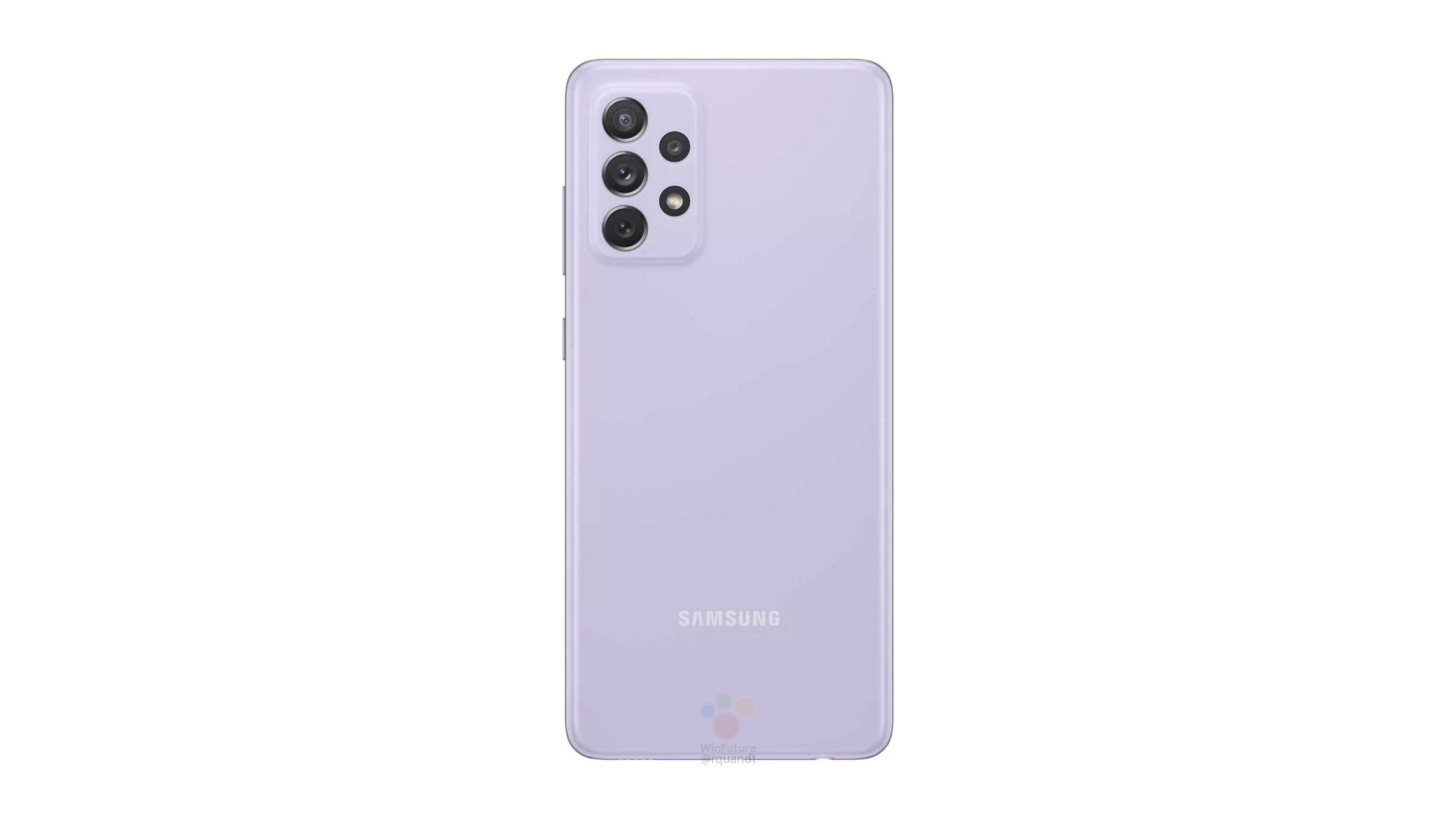
The Samsung Galaxy A72 is in the news since late September 2020. It is expected to come in two variants (4G, 5G), just like its predecessor Galaxy A71. According to a new leak, the South Korean tech giant will be only introducing the LTE version first. This leak not only reveals the entire specs but also press renders as well as price.
The new information regarding the Galaxy A72 4G comes from Roland Quandt of WinFuture. This leak exposes two things about the phone that we were not aware of earlier. And those are telephoto camera and IP certification.
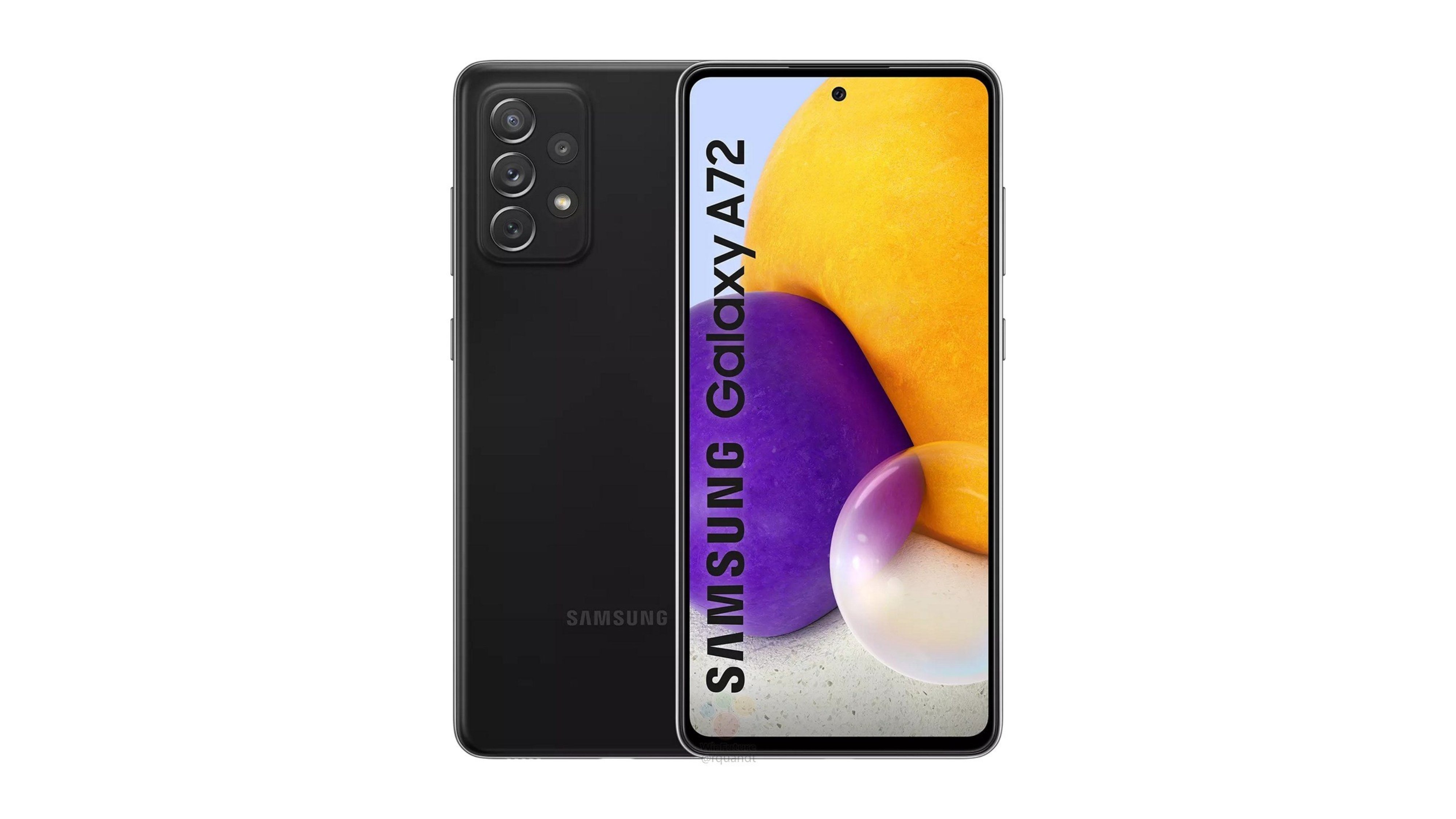
Staring with the screen, the device will flaunt a 6.7-inch Super AMOLED display with a resolution of 2400 x 1080 pixels (FHD+), 20:9 aspect ratio, and a 90Hz refresh rate. The panel will also include an in-screen fingerprint sensor and a centered punch hole for a 32MP selfie camera.
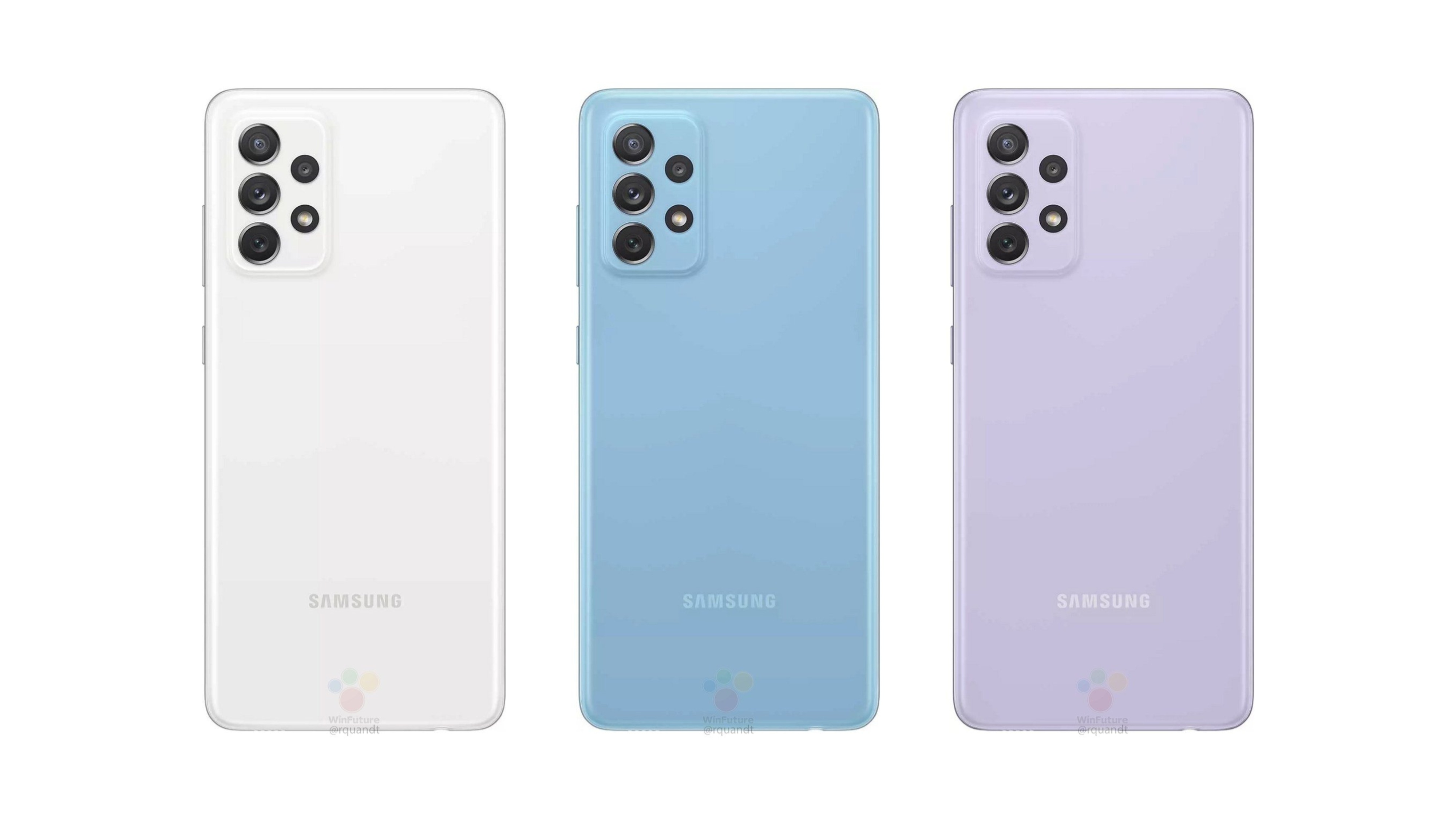
Further, the back of the handset will house a quad-camera setup consisting of a 64MP primary sensor, 8MP 2x telephoto shooter, 12MP ultra-wide unit, and a 2MP macro snapper. Previously, this device was reported to feature a penta-camera setup. Later, another report revealed it to not feature any zoom module.
Interestingly, the Galaxy A72 4G will also be IP67-certified for dust and water resistance. Its smaller sibling Galaxy A52 is also expected to have this feature. Other features of this smartphone will include a plastic build, dual-SIM, dual-band WiFi, Bluetooth, NFC, 3.5mm headphone jack, USB Type-C port, microSD card slot, Android 11 (One UI 3.x), and a 5,000mAh battery with support for 25W fast charging.
But unfortunately, despite packing a punch, this phone will be powered by a year-old Qualcomm Snapdragon 720G SoC whose performance is similar to the Snapdragon 730 present inside the Galaxy A71 4G. As for colors, the handset will be available in Black, White, Blue, and Violet.
1 of 3
Last but not least, the Samsung Galaxy A72 4G is said to retail for €449 and €509 for the 6GB + 128GB and the 8GB + 256GB variants respectively.
Recently, rumors are swirling around that Facebook is developing a clone version of the popular Voice-based app Clubhouse. Now, a new report by The Informationsays that the Californian giant is also entering into the world of Smartwatches.
Credits: Facebook
According to the report, Facebook is making a Smartwatch with emphasis on Messaging and Fitness. It may be called the ‘Facebook Watch’ but it’s just a guess and not confirmed yet. We already know that the company isn’t new to the world of Smart devices. In fact, it has launched a VR headset under its subsidiary Oculus VR.
Anyway, the company is said to focus on Message interaction in the Smartwatch. Users will be able to communicate with their friends on platforms like WhatsApp and Messenger. Now, you might wonder if it will require a Smartphone for integration and sync.
For this, Facebook seems to have a solution. The Watch will reportedly come with Cellular connectivity support so you don’t have to barge into your phone every time. This also suggests that the company is going to revamp the social media Apps for the tiny Wearable screens more.
Speaking of which, the report says that although the Watch will run on an Open-source version of Google’s Android, Facebook is working on its own Operating System. And the OS could debut in 2023 along with the Second-Generation of this Watch. In that year, the company is also reported to bring an AR Glass.
That said, apart from Messaging, Facebook is also said to be focussing more on Health features that will be present in the Smartwatch. Some of them are extensive Workout plans/Data, Track workouts, interact with Trainers, and integrate with Fitness services like Peloton.
The wearable segment is said to get a big boon in 2021 and beyond. Just like the report says, Facebook seems to have found the right choice of segment to venture into as Smartwatches are becoming equally important like Smartphones.
Going by the trend, we can also expect other features like Heart rate monitoring(PPG), Blood Oxygen(SpO2) and Stress monitoring, aggressive pricing(maybe around $399 to rival Apple Watch 6).
Facebook’s Smartwatch will reportedly go on sale sometime next year i.e., 2022 so we will have to wait for a few months to start seeing leaks about it.
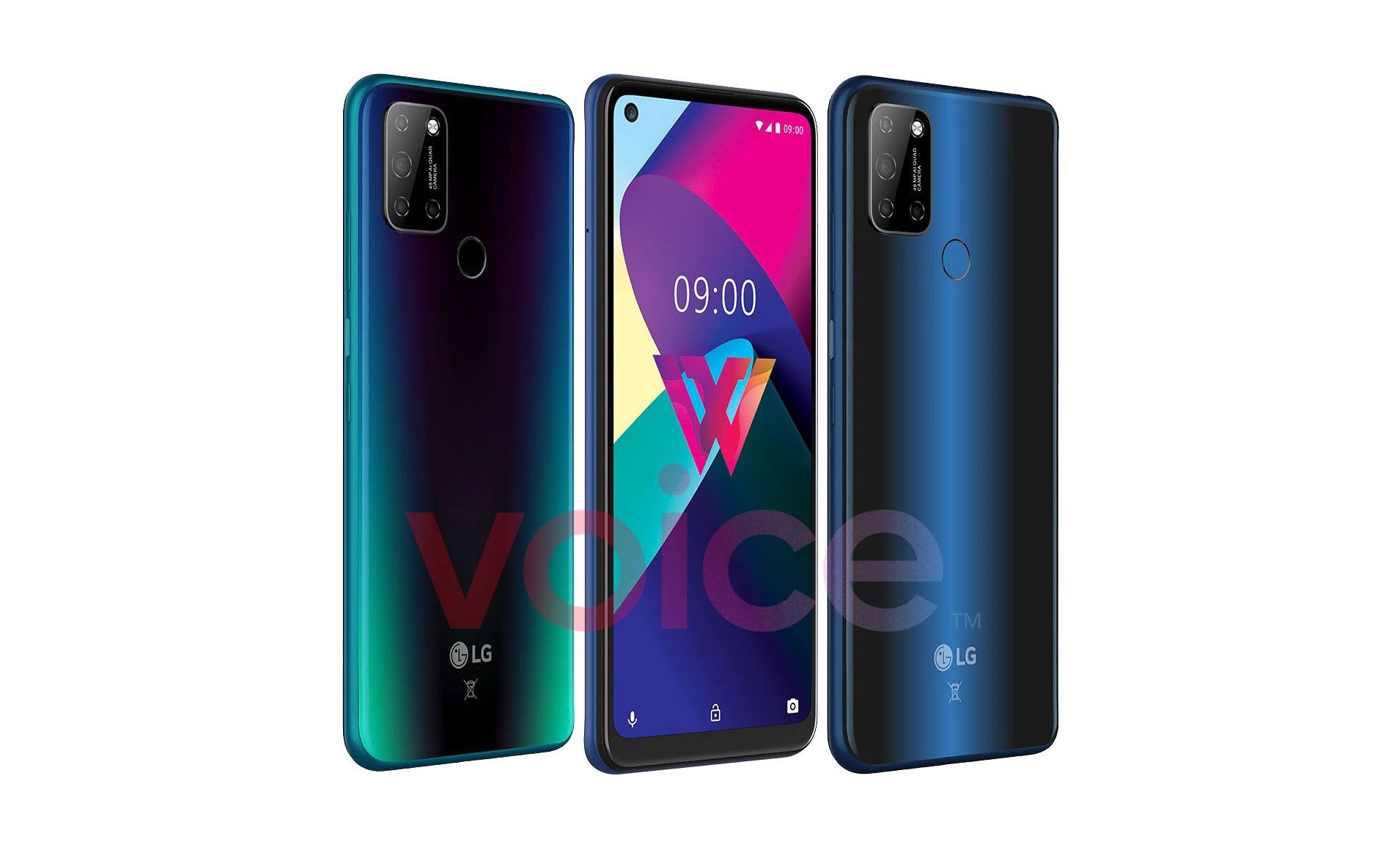
LG announced the LG W31 and LG W31+ smartphones in Q4 2020. The W-series of LG phones is exclusively available in India. It was introduced to rival mid-tier phones from popular brands like Xiaomi, Samsung, and Realme in the country. Yesterday, reputed tipster Evan Blas shared a leaked press render of the upcoming LG W41 smartphone to reveal its appearance.
The W-series of LG smartphones that have launched in the past has featured notched displays. As the render shows, the LG W41 will be the first W-series handset from the brand to sport a punch-hole design. Except for the slightly thick chin, the W41 has slim bezels on the other three sides.
Leaked render of the LGW41 by Evan Blass
The back panel of the LG 41 seems to be made from plastic. Its gradient-colored rear has a traditional fingerprint scanner and a rectangle-shaped camera module. The latter houses an AI-powered 48-megapixel quad-camera system and an LED flash. Apart from the volume rocker and a power key, the right side of the device seems to feature a dedicated button for accessing the voice assistant.
Blass also revealed that the model number of the LG W41 is LMK610. The handset will be accompanied by two other phones called the LG W41 Plus and LG W41 Pro. The leak has no information on the specifications of the W41 trio.
The LG W31 came a 6.52-inch IPS LCD HD+ display, and the Helio P22 SoC powered it. It featured an 8-megapixel front camera and a 13-megapixel + 5-megapixel (ultrawide) + 2-megapixel (depth) triple camera system. It housed a 4,000mAh battery. It came with 4 GB of RAM and 64 GB of storage. The LG W31+ offered identical specs to the vanilla model but offer a larger 128 GB of internal storage. These phones were introduced for Rs 10,990 (~$151) and Rs 11,990 (~$165), respectively.
Earlier this month, Realme announced the Realme X7 5G smartphone in India. It arrived as the rebranded version of the Realme V15 5G phone that went official in China in January. With a starting price of Rs 19,999 (~$276), the Realme X7 5G is the most affordable 5G smartphone in India. In a recent tweet, Realme India CEO Madhav Sheth asked followers, “Should we make 5G smartphones even more economical?” Hence, it appears that the company may soon a launch new phone that is cheaper than the Realme X7 5G. Probably, an upcoming Narzo 30 series phone may soon dethrone the X7 5G to become the cheapest smartphone of the country.
We made 5G smartphones affordable by launching the #realmeX7 at less than 20K.
Should we make 5G smartphones even more economical?
Realme has recently started teasing the Narzo 30 series. The lineup is expected to include three phones such as Narzo 30, Narzo 30A, and Narzo 30 Pro. Among the three phones, the Pro model is speculated to arrive with 5G support.
A new Realme phone with model number RMX3161 was approved by China’s TENAA telecom authority. The 5G-ready phone was found to be equipped with a 6.5-inch punch-hole display, a side-mounted fingerprint reader, a triple camera system, Android 11 OS, and a 4,880mAh battery. The other specifications of the device are under wraps.
There is no word on the launch date of the Narzo 30 series. If the Narzo 30 series indeed arrives with 5G support, it may affect the sales of the Realme X7 5G. Hence, the company may announce it after teasing it for a few more weeks.
Realme introduced the Narzo series in 2020 by Realme Narzo and Realme Narzo 10 in Q2. Hence, there is a possibility that the company may announce the Narzo 30 series in Q2.
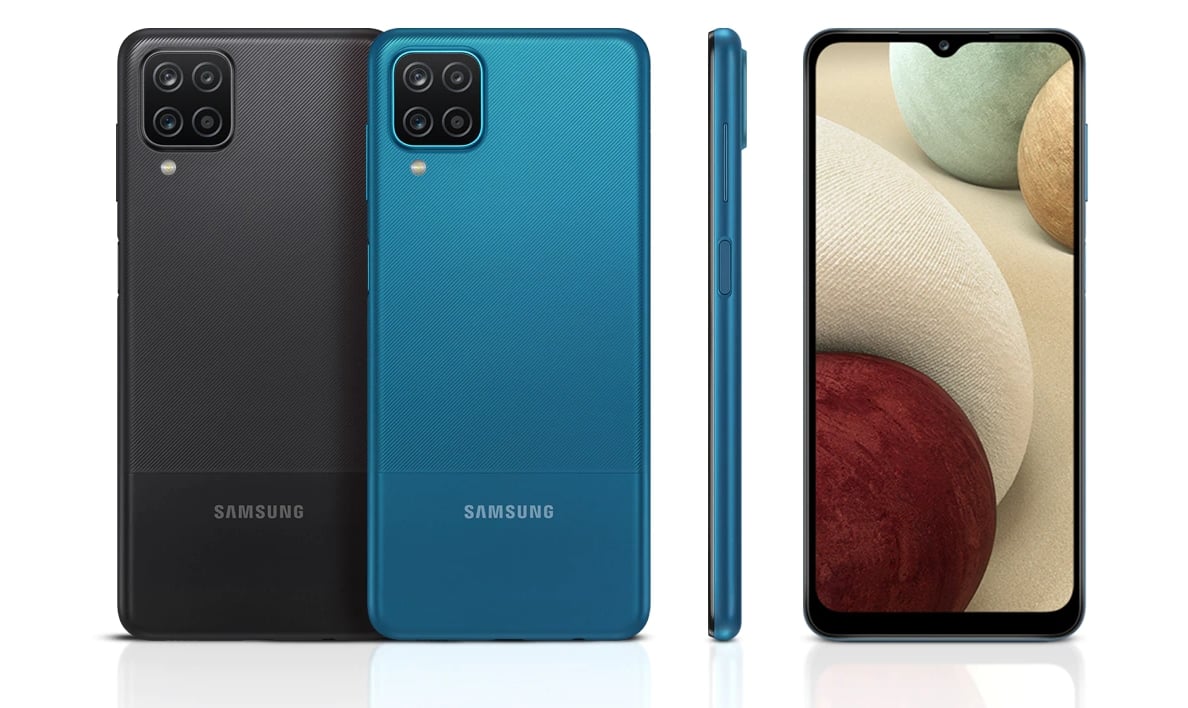
Recent reports have revealed that Samsung is gearing up to launch a new A-series smartphone in India. Yesterday, the support page and user manual of the unannounced Galaxy A12 was found listed on Samsung India’s website. Hence, it appears that the country will be soon treated with the Galaxy A12 smartphone, which originally debuted back in November 2020 in European markets. A fresh leak by tipster Abhishek Yadav has revealed all the important details of the Galaxy A12 smartphone.
The tipster seems to have shared shots of internal documents of the Samsung Galaxy A12. The images have revealed that the smartphone has a 6.5-inch Infinity-V notch display that produces an HD+ resolution and 20:9 aspect ratio. It has a social media-ready selfie camera of 8-megapixel. One of the major attractions of the Galaxy A12 is its quad-camera system that comprises a 48-megapixel primary camera, a 5-megapixel ultrawide lens, a 2-megapixel macro shooter, and a 2-megapixel depth sensor.
The Galaxy A12 promises all-day performance through its 5,000mAh battery. Like its global variant, the model heading to India supports 15W charging. The device has a side-mounted fingerprint scanner and Samsung KNOX for top-notch security. The smartphone supports 3D surround sound with Dolby ATMOS even through earphones. It comes with an internal storage of 128 GB and a microSD card slot for additional storage.
The name of the chipset that fuels the Galaxy A12 is not mentioned in the leaked shots. It seems to be driven by the Helio P35 SoC which fuels its global edition.
Samsung Galaxy A12
The leaked documents revealed that the Galaxy A12 will be available in 4 GB RAM + 64 GB storage and 4 GB RAM + 128 GB storage editions in India. It will be available in colors like blue, white, and black. A recent leak claimed that the device will cost under Rs 15,000 (~$206) in India.
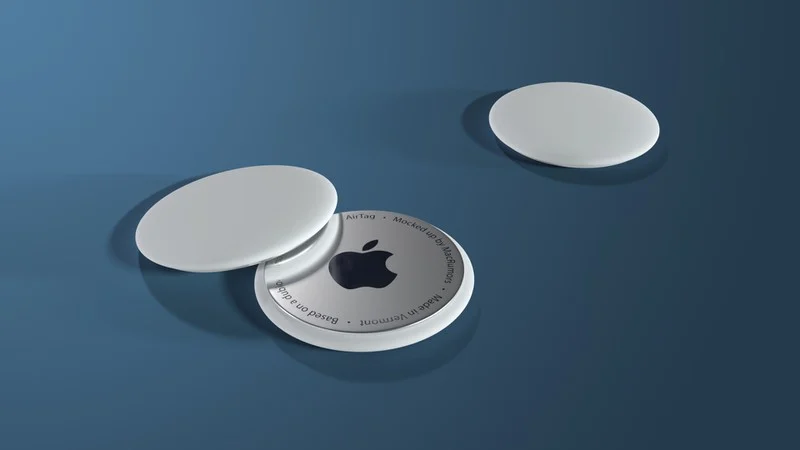
The name Jon Prosser may nor ring a bell but for us in the tech industry, we remember the tipster and his bunch of accurate details of the iPhone SE2, Apple’s next-generation mini smartphone released last year. The tipster has now come out with a juicy detail about the Apple AirTags. According to him, Apple AirTags will be released in March this year and that date doesn’t look like what will change.
Apple AirTags Mockup
Apple AirTags first leaked online in August last year via a patent filing, with the leak detailing the basic functionality of the device. It is location tracking device and is expected to pair seamlessly with a host smartphone or tablet. Appple had placed an emphasis on the functionality of the multi-interface transponder (MIT) device in the patent.
The multi-interface transponder (MIT) device is described as a portable and compact gadget with a simple processor, light and motion sensors, radio stack, and power core. It can even be attached to various objects like wallets, keys, and IDs. In other words, it’s a small location tracking device that can track down your important belongings or even smartphones when paired with an iPad or iPhone, for instance.
The functionality includes connectivity, communication with nearby electronics, power affordances, and more. Furthermore, the patents also outline a special power management feature that enables “intelligently boosting beacon transmission depending on determined location and proximity to nearby devices.”
Recall that Samsung recently announced the SmartTag and SmartTag+, a tile-like Bluetooth-LE tracker will help you find your lost objects. The Samsung model carries a starting price tag of $29. Going by Apple’s patent filing for the AirTags, we can conclude that it far eclipse the features of the Smart Tag, especially in the aspect of transmission.
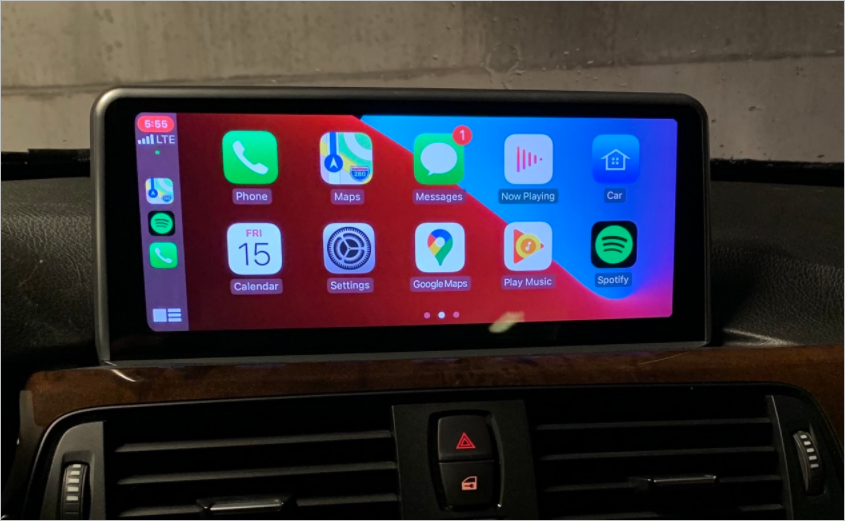
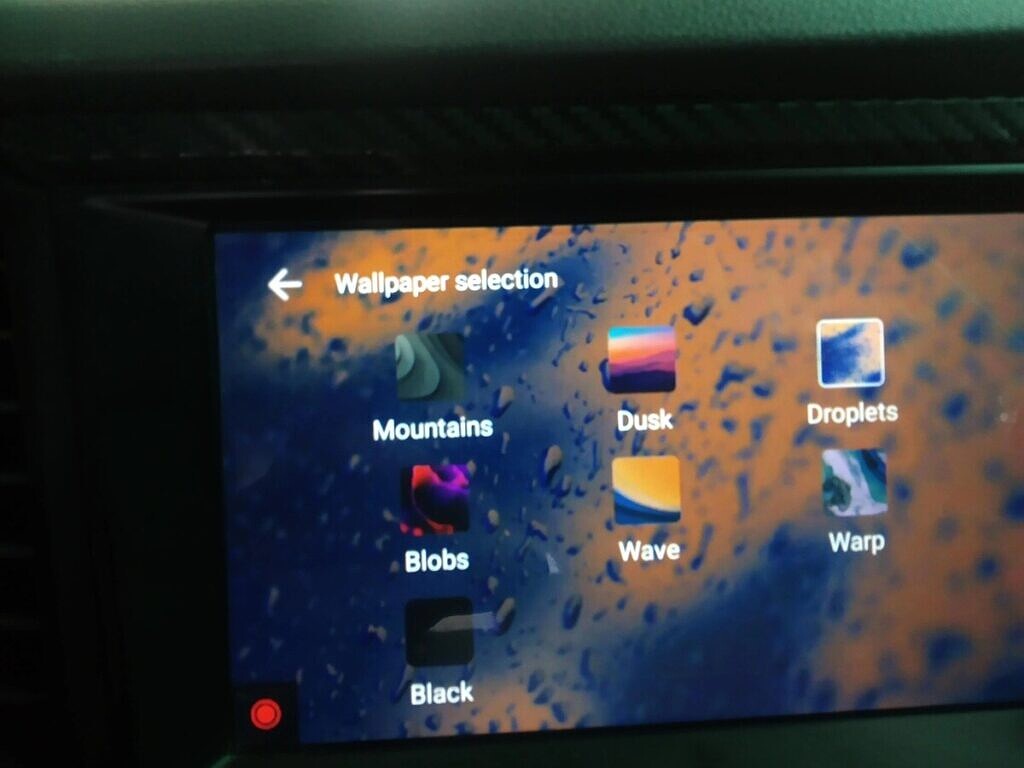
The most recent update of Google‘s Android Auto includes a couple of features that will further enhance its versatility as a mirror app of your Android smartphone for compatible dashboard systems. The update brings a shortcut to launch the Google Assistant feature on the app a couple of new wallpapers.
The new shortcut to the clever Assistant feature on Android Auto will allow users to easily add a shortcut to launch Google Assistant to do several tasks via the app. These include quickly calling a person on your phone contact or requesting navigational assistance, as well as many other activities that could trigger the action of the Assistant action. This new shortcut feature helps to fully integrate Android Auto to provide greater width and services as if you were using your Android smartphone itself, which is quite exciting.
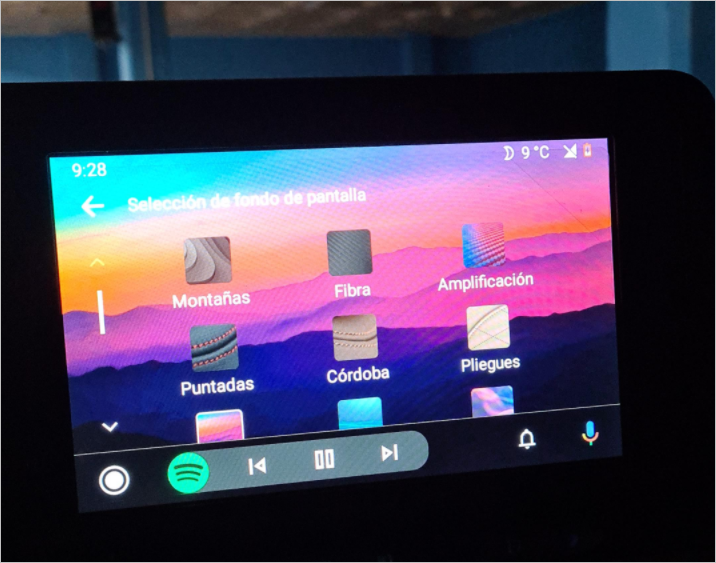
Late last year, some tipsters had predicted that Google was indeed working on adding wallpapers to an upcoming Android Auto update so that users of the app can get an array of beautiful wallpapers to use. Recent comments and screenshots released by users on social media platform Reddit show that indeed Google has started rolling out the feature, as the users provided screenshots as evidence of their claims. However, this new updated option for wallpapers does not allow users to choose photos from their camera gallery as wallpapers in Android Auto – at least with this current update.
The wallpapers feature a number of themes reflecting ambience and coolness and can be accessed via the settings of the Android Auto app. You can easily change your wallpaper by picking the Choose Wallpaper option under the settings menu.
In order to get these new additions, you must first update your app to the current version of Android Auto and see whether the new features are available.
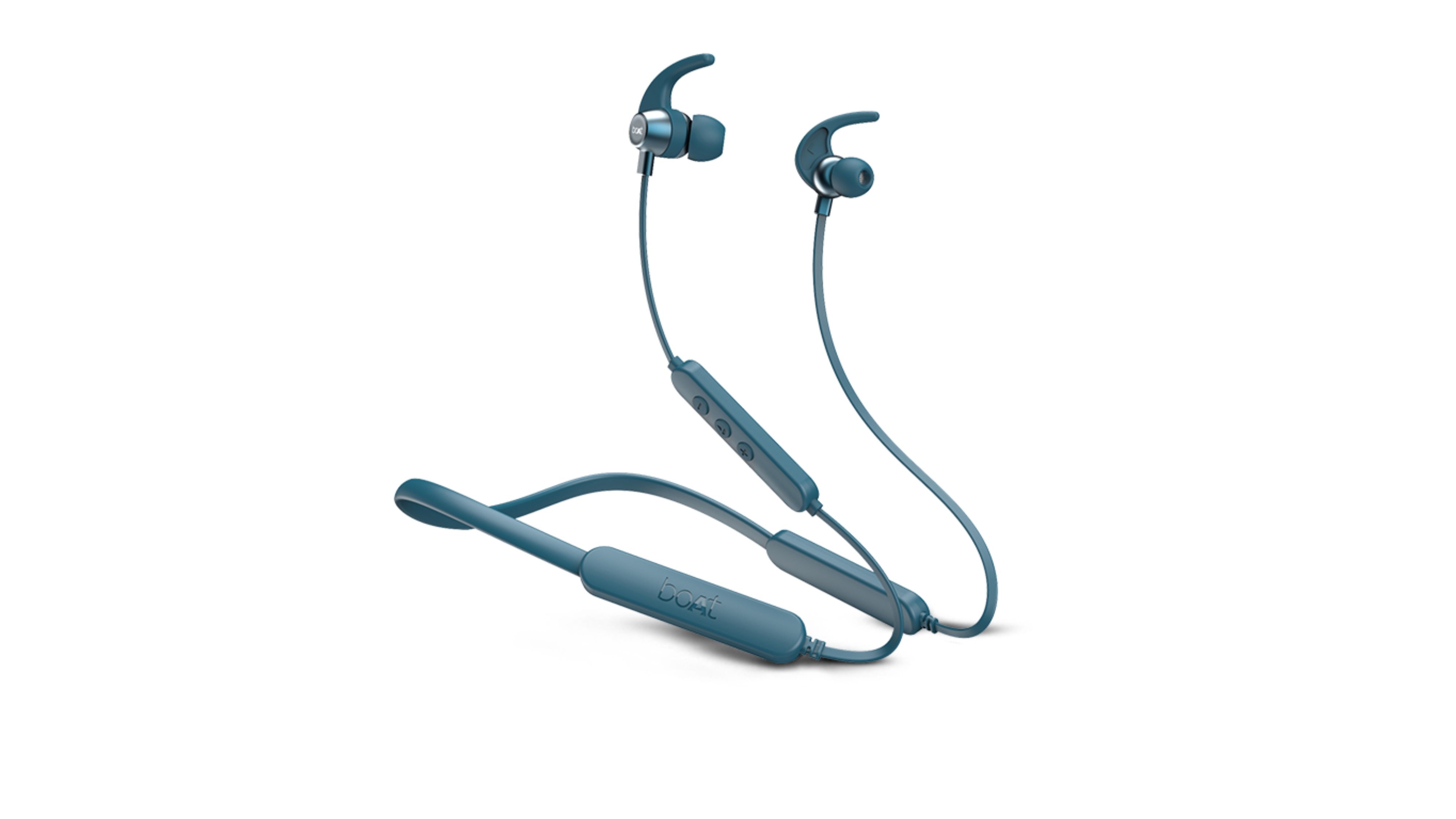
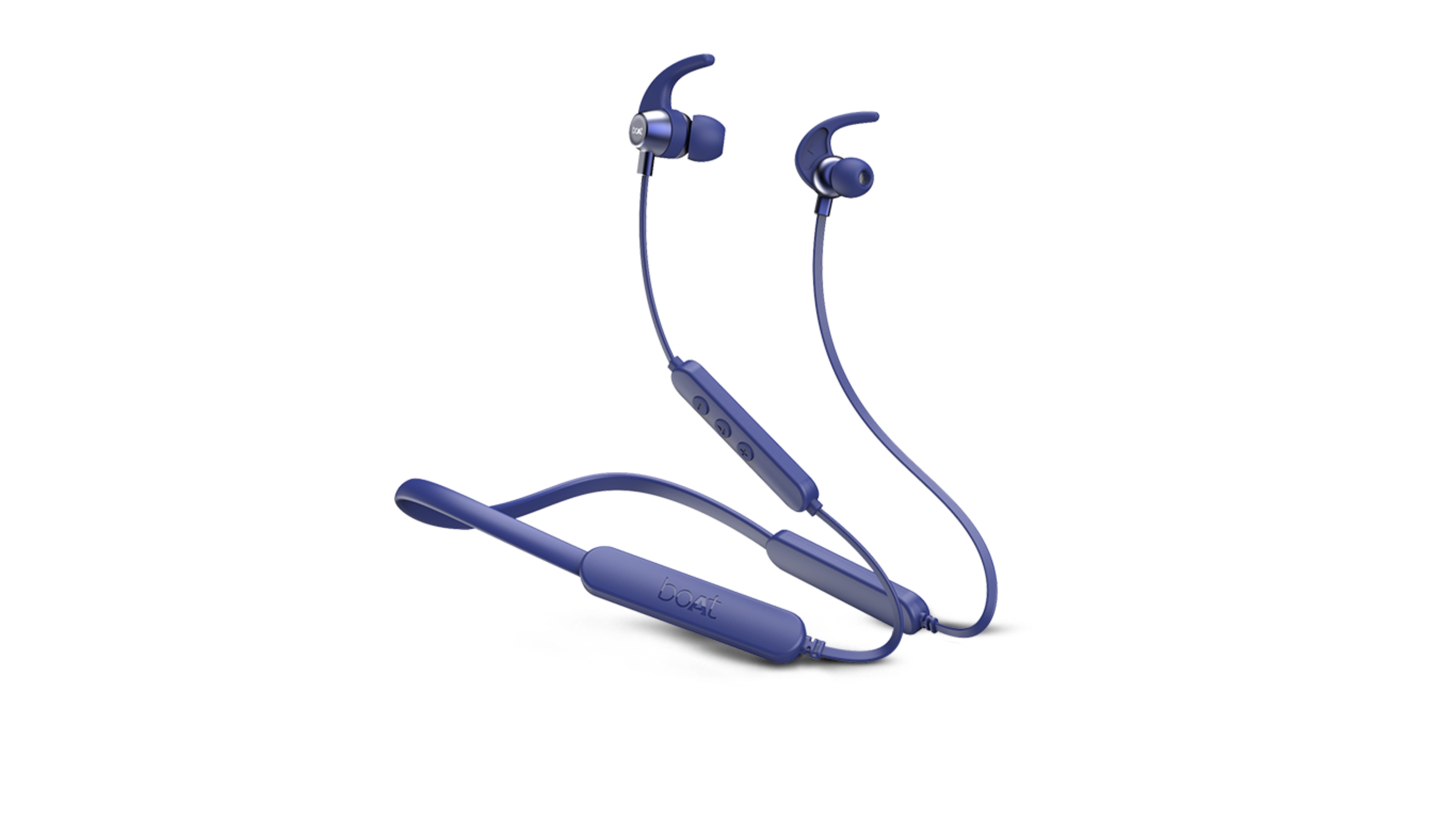
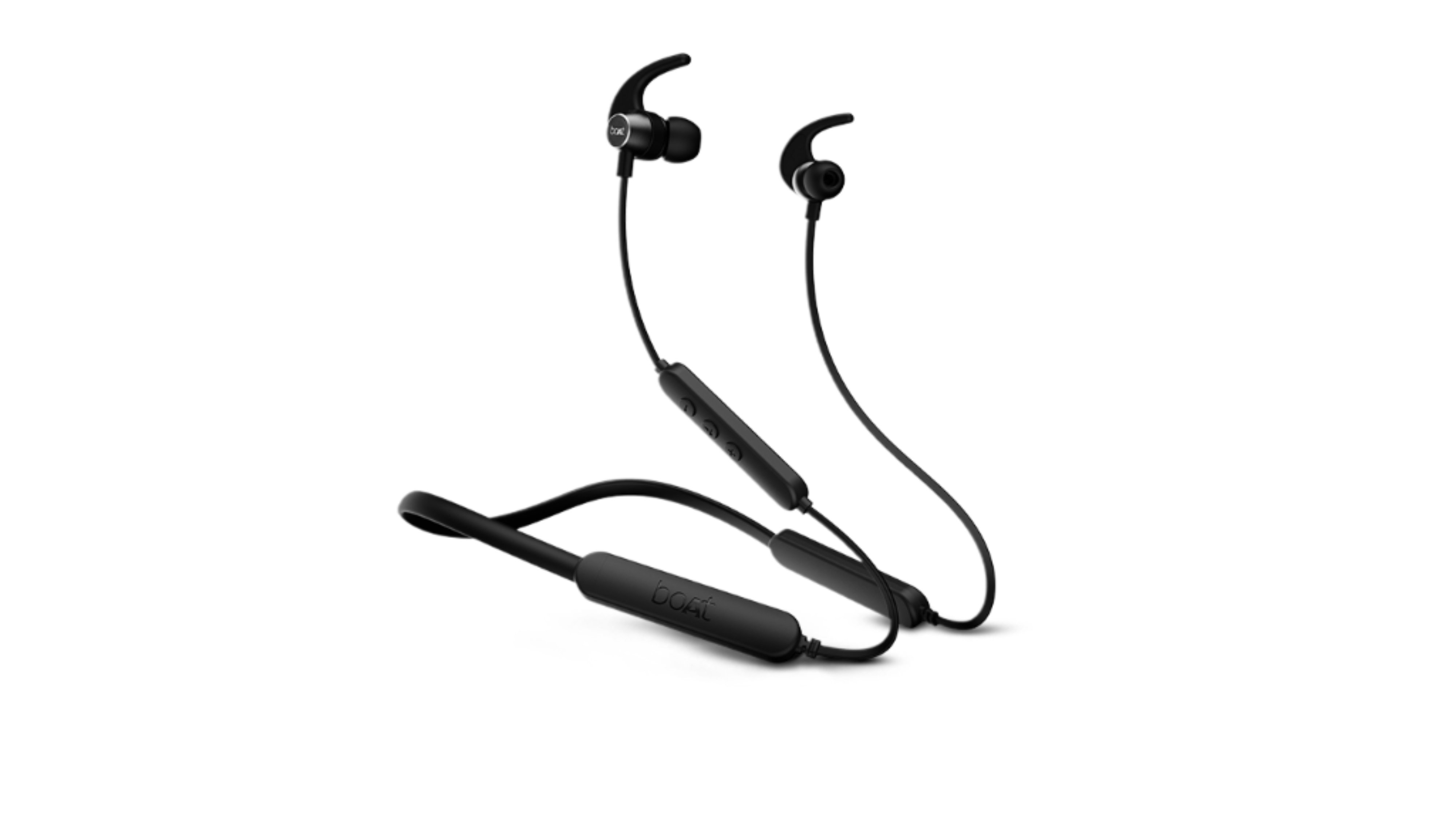
Indian tech lifestyle brand boAt has launched a new pair of neckband-style wireless earphones in the country called boAt Rockerz 255 Pro+. The new product from the company is priced at ₹1,499 (introductory). It is already up for sale on the firm’s official website (boat-lifestyle.com).
The all-new boAt Rockerz 255 Pro+ wireless earphones feature 10mm dynamic graphene drivers. They connect with devices via Bluetooth 5.0 with support for dual-pairing.
They are powered by a Qualcomm chipset. Hence, they come with support for Qualcomm aptX audio codec and cVc noise cancellation technologies. Apart from these two, the earphones also support SBC and AAC audio codecs.
Further, they come with inline remote control with buttons for music playback and voice assistant. Based on the connected devices, one of the keys can be used to wake up Google Assistant or Siri. Additionally, despite being an affordable pair of wireless earphones, they are also IPX7-certified for water resistance.
1 of 2
As for power, they are backed by a 300mAh battery, which the brand claims to offer up to 40 hours of playback time on a full charge. They charge via a USB Type-C port and even support a fast charging tech that can offer up to 10 hours of playback time with only 10 minutes of charging.
Last but not least, the boAt Rockerz 255 Pro+ neckband-style wireless earphones are available in three colors, namely Active Black, Navy Blue, and Teal Green.
Although it’s been months since NVIDIA announced the Acquisition of SoftBank-owned chipmaker Arm, the deal is yet to go through as it is under Scrutiny by authorities around the world. Now, Qualcomm has objected to this acquisition.
As reported by CNBC, Qualcomm has voiced its stance to US Govt’s Federal Trade Commission (FTC), the European Commission, the UK Competition and Markets Authority, and China’s State Administration for Market Regulation. Apparently, it believes that NVIDIA might prevent other companies from using Arm’s Intellectual Properties(IP) in the future.
For the unware, Arm, a British Chipmaker(Arm Holdings) is currently owned by Japan’s SoftBank Group. It specializes in Semiconductor, Software design and currently licenses its ARM architecture(via IP) to various chipmakers. Its chip architecture is currently used across the world in Consumer Electronics like Smartphones, Automation, Networking, etc.
In September 2020, after rounds of talks, NVIDIA said that it will acquire Arm for $40 billion. During this, both NVIDIA and Arm said that the deal will create a premier computing company for the age of AI. However, the deal is yet to be completed as it is under scrutiny as mentioned above.
Besides, Qualcomm is not the only company opposing this deal. Companies like Huawei and other Chinese tech firms had expressed their concerns. Among this, Lenovo’s Former Chief Engineer had said that China’s Anti-trust regulator would turn down the deal citing monopoly as reason.
Either way, FTC has now proceeded to the “second phase” of investigations according to the report. It has asked NVIDIA and Arm to produce more documents regarding the deal and the process is expected to continue for several months down the line.
As for NVIDIA, it has said to CNBC that it believes the regulators will see the benefits of this acquisition and approve it. However, industry sources say that it has a high chance of getting blocked by one of the regulators.
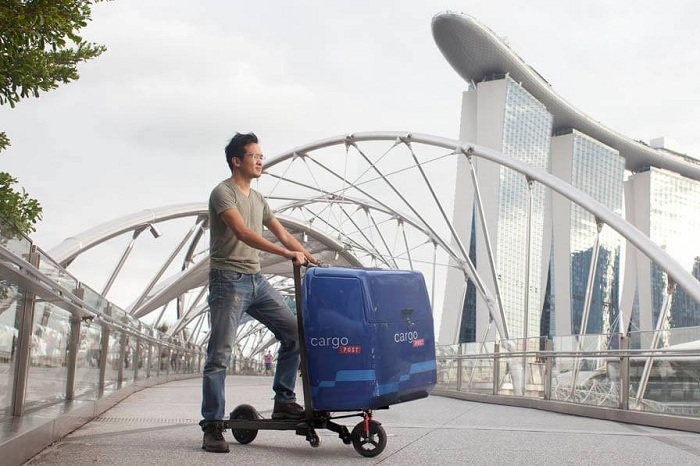
Electric scooters are gradually gaining ground as part of the daily commute of some persons in major cities around the world. But using an electric scooter usually comes with its limitation especially if you’ve got some load to carry like a grocery bag. Singaporean start-up Mimo has launched a product that looks to take care of that challenge.
The electric scooter dubbed Mimo C1 adopts a unique design that includes a convenient storage basket at the front of the scooter while retaining a wide, slip-resistant surface for the driver’s feet. The scooter also adopts a foldable design that allows the user to fold the rear part, thus converting it to just a trolley.
In terms of the configuration, the MIMO C1 packs a built-in lithium battery and has a single cruising range of 15 to 25 kilometers (9 to 16 miles). The e-scooter can also hit a speed of 25 kilometers per hour (16 mph).
There is a helical spring front suspension that helps to drive smoothly, while it utilizes a rear braking system. Mimo C1 provides users with open baskets or storage accessories of different sizes with seals, depending on your need.
Mimo C1 has a net weight of 17 kg (37 lb) without a basket. It can carry a maximum weight of 120 kg (265 lb) and ta maximum load weight is 70 kg (154 lb).
The Mimo C1 e-scooter carries an early bird price tag of $1,300 on Indiegogo. After the crowdfunding exercise, the price will likely start at $1806. If the crowdfunding exercise is successful, the product is expected to start shipping in August this year.
Earlier on Tuesday this week, CD Projekt Red disclosed via a tweet that it has been the victim of a ransomware attack that saw some of its critical security data including source code get stolen.
It has now been confirmed that the hackers have indeed auctioned parts of the stolen data to an unknown entity, apparently due to the inability of CDPR to meet the ransom demands of the hackers. This information was provided by cybersecurity company Kela who shared an extract from the conversations on Exploit, an infamous hacking forum frequently patronized by hackers. The suspected hackers stated that they received an offer for the stolen data from someone who was not part of the Exploit forum. After completing the purchase, the buyer then requested the hackers to end the auction, which was subsequently done.
In the aftermath of the cyberattack, CDPR had insisted it won’t pander to the demands of the attackers or even negotiate with them, notwithstanding the grave implication of their decision and the possibility of the stolen data being circulated online. The initial auction which is thought to include source codes for several of CDPR’s games, as well as internal company documents, was $1 million, but cybersecurity sources say that the buyer may have paid up to $7 million or more for the stolen data. The identity of the buyer is not yet known and since the purchase we have not seen any release online of the CDPR data.
The identity of the attackers is still yet to be released officially, although it is highly probable that the hackers used the HelloKitty ransomware, which has been used recently to hack a number of websites.
Qualcomm announced the Snapdragon 888 chipset at the Snapdragon summit last year. This flagship chipset has an Adreno 660 GPU promising 35% improved performance while its predecessor, the Snapdragon 865 has an Adreno 650 with 10% better Graphics rendering. Now, a Chinese Media Lei Technology has overclocked the GPU on the Snapdragon 865 on the Xiaomi Mi 10 and bid it against the 2021’s Mi 11.
According to the report, a GPU OVerclocking application named KonaBess has been used for this test. For this, the device has to be obviously rooted with Bootloader unlocked. Anyway, after doing it, they have compared the results of Xiaomi Mi 10 and Xiaomi Mi 11.
The report has used reference Theoretical benchmarks like AnTuTu, Geekbench, 3DMark, and some real-world gaming tests.
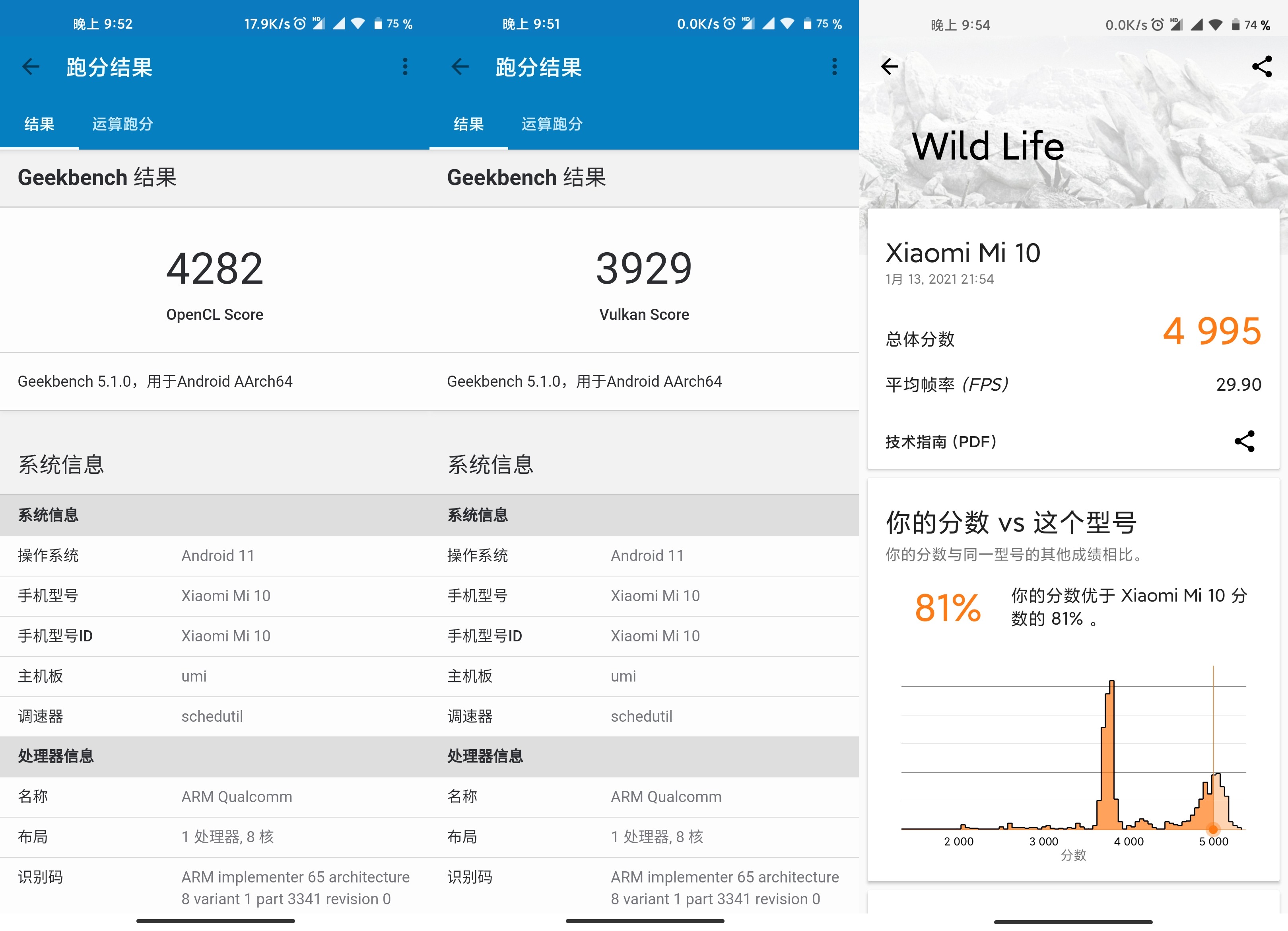
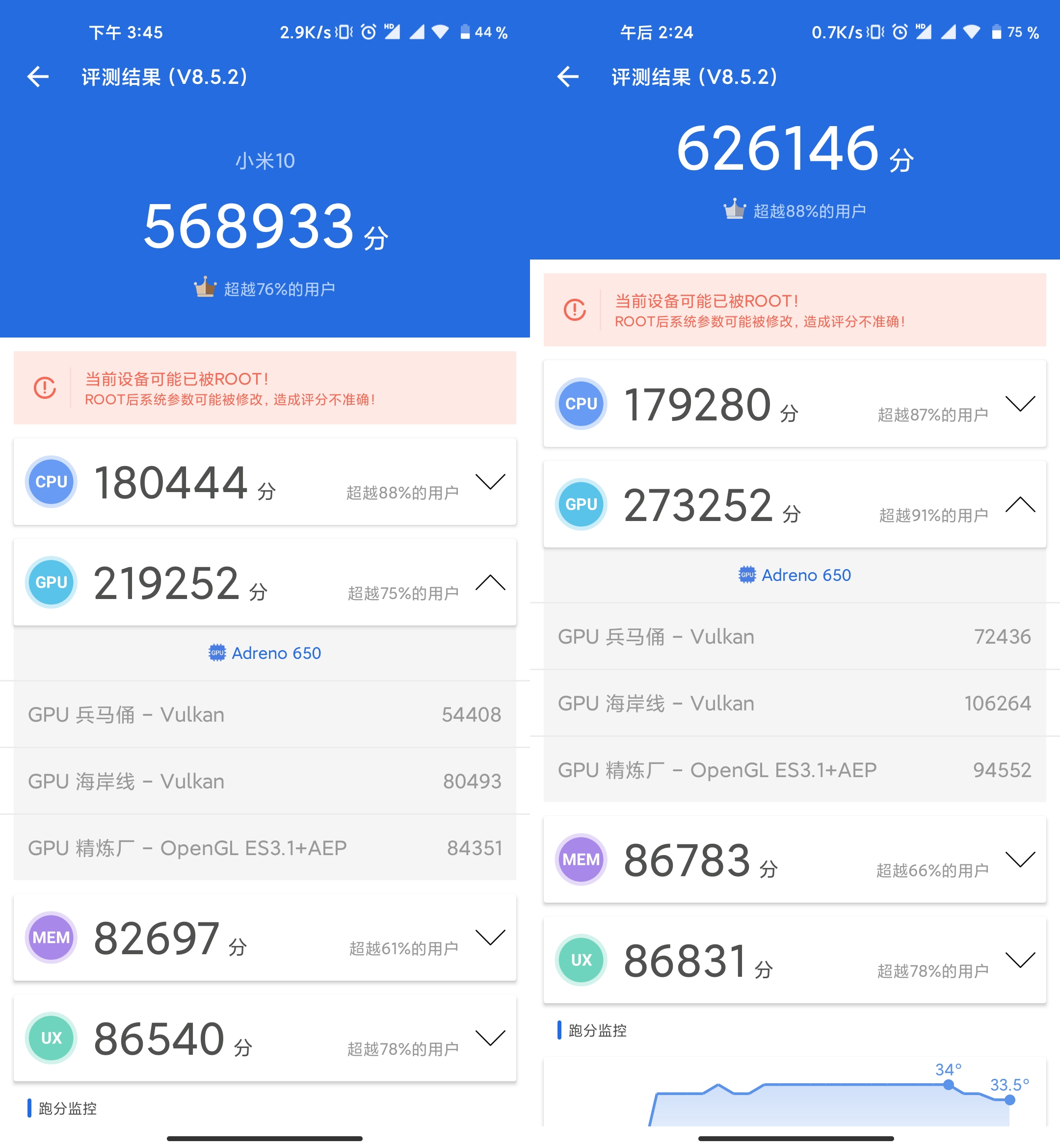
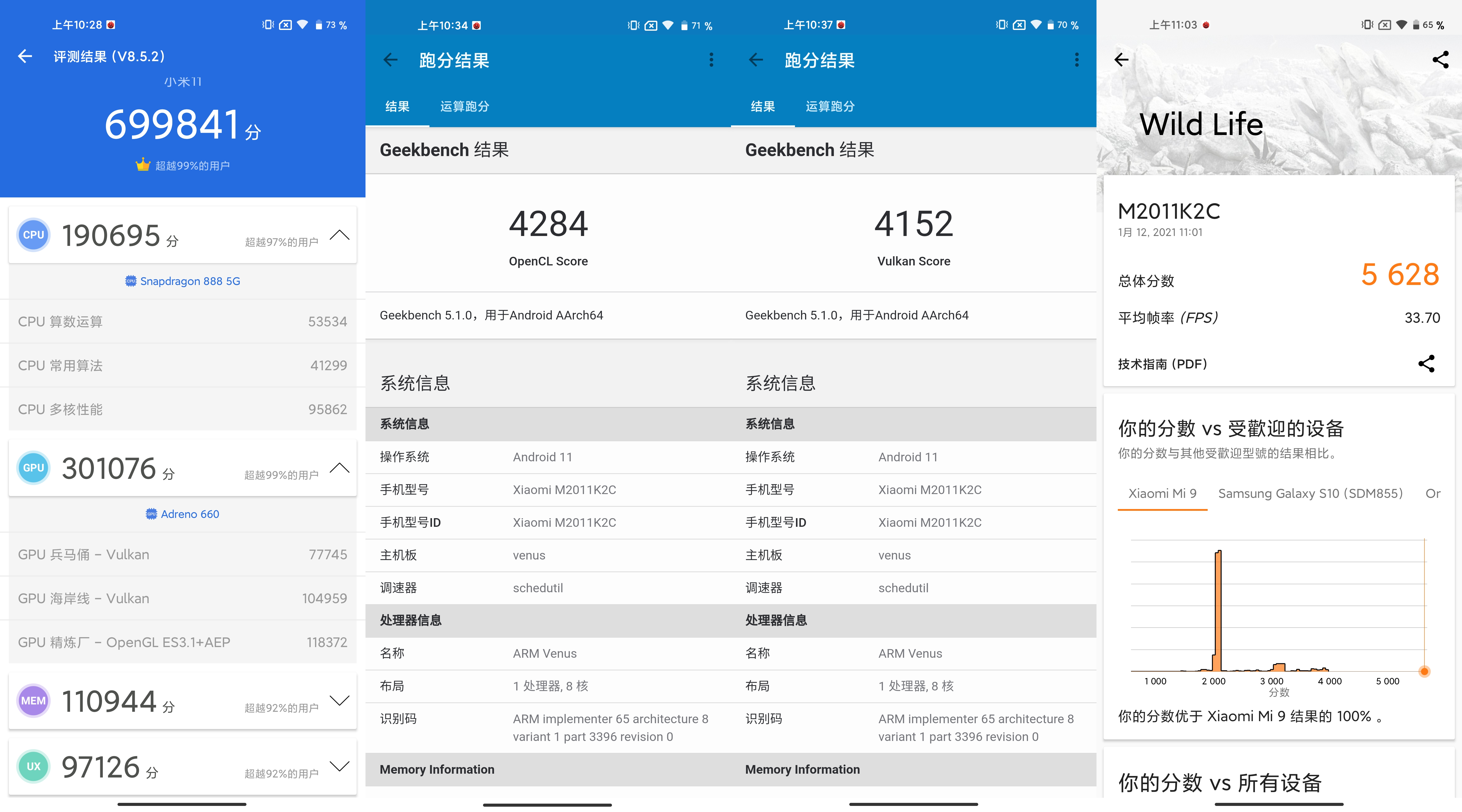
First off, the Mi 10 scores on AnTuTu jumps from 560,000 to 620,000 after overclocking the GPU. In the screenshots, you can see that the GPU score has specifically jumped from 219,252 to 273,252 which is a bit closer to Mi 11’s 301,076 GPU score. Similarly, in Geekbench 5, the device scored 4282(OpenCL), 3929(Vulkan), and 4995 in 3DMark tests.
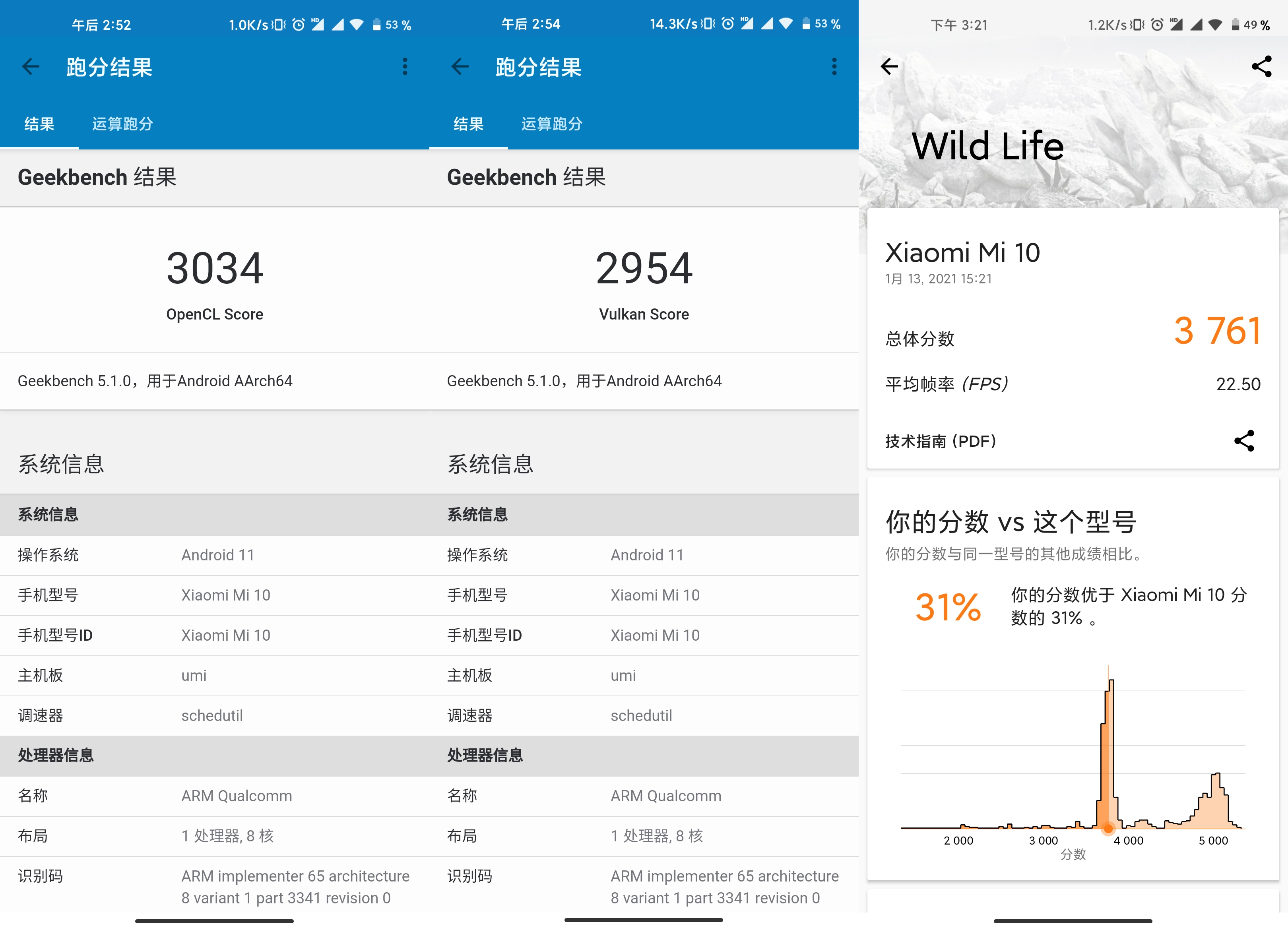
Before overclocking, it had scored 3034(OpenCL), 2954(Vulkan), 3761(3DMark) points respectively. In comparison, the Xiaomi Mi 11 scores 699,841 and 5,628 points in AnTuTu and 3DMark respectively.
1 of 4
Mi 10 Geekbench, 3DMark After Overclocking GPU
Mi 10 Geekbench, 3DMark Before OVerclocking GPU
Mi 10 AnTuTu Score- Before & After Overclocking GPU
Mi 11 Benchmark Scores- AnTuTu, Geekbench, 3DMark
In short, Overclocking the GPU brings about a 30% improvement in GPU performance on the Snapdragon 865-powered Xiaomi Mi 10. However, its theory scores are still away from the successor.
For real-world tests, the report says that they played decent graphic-intensive games like Glory of Kings, and demanding titles like Original God. In the 15-minute gaming period, Mi 10 rendered more fps, with fewer stutters, and ran fairly stable throughout.
Surprisingly, it also says that the Mi 11, despite running smoothly, experienced some heating issues on a high load. Just like the report says, this may be because of the older architecture of Adreno 660 GPU or samsung’s 5nm process.
Overall, the Snapdragon 865 on Xiaomi Mi 10 tries its level best to compete and gains improvement in GPU after overclocking. However, it still lacks in performance(at least from Benchmarks) compared to Snapdragon 888 on the Mi 11.
Parallelly, Xiaomi is said to be working on a Mi 10 with Snapdragon 870 chipset. This itself is an overclocked version of the Snapdragon 865 Plus. Let’s just hope that the Mi 10 reboots with more power in 2021.
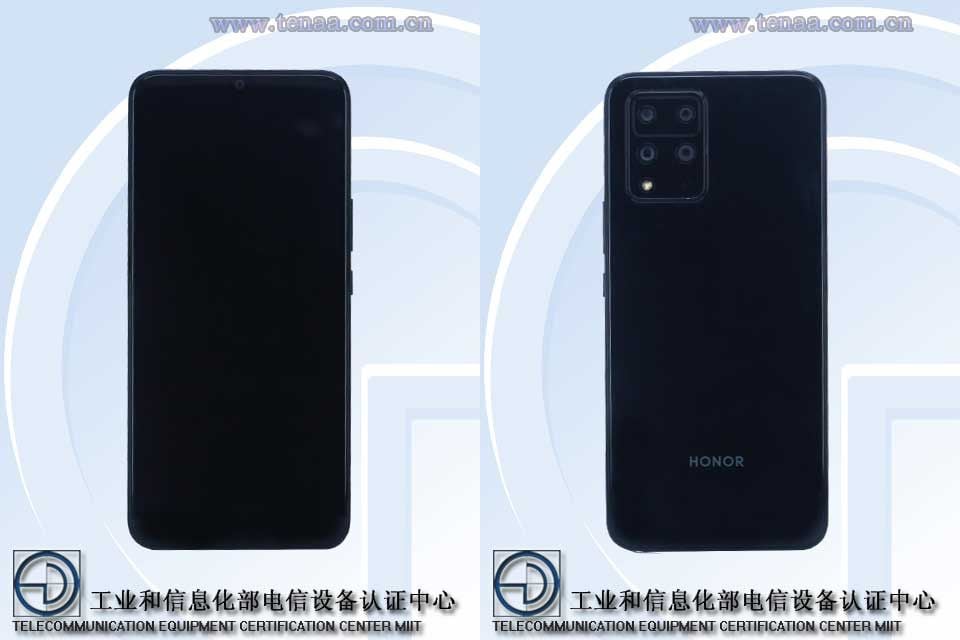
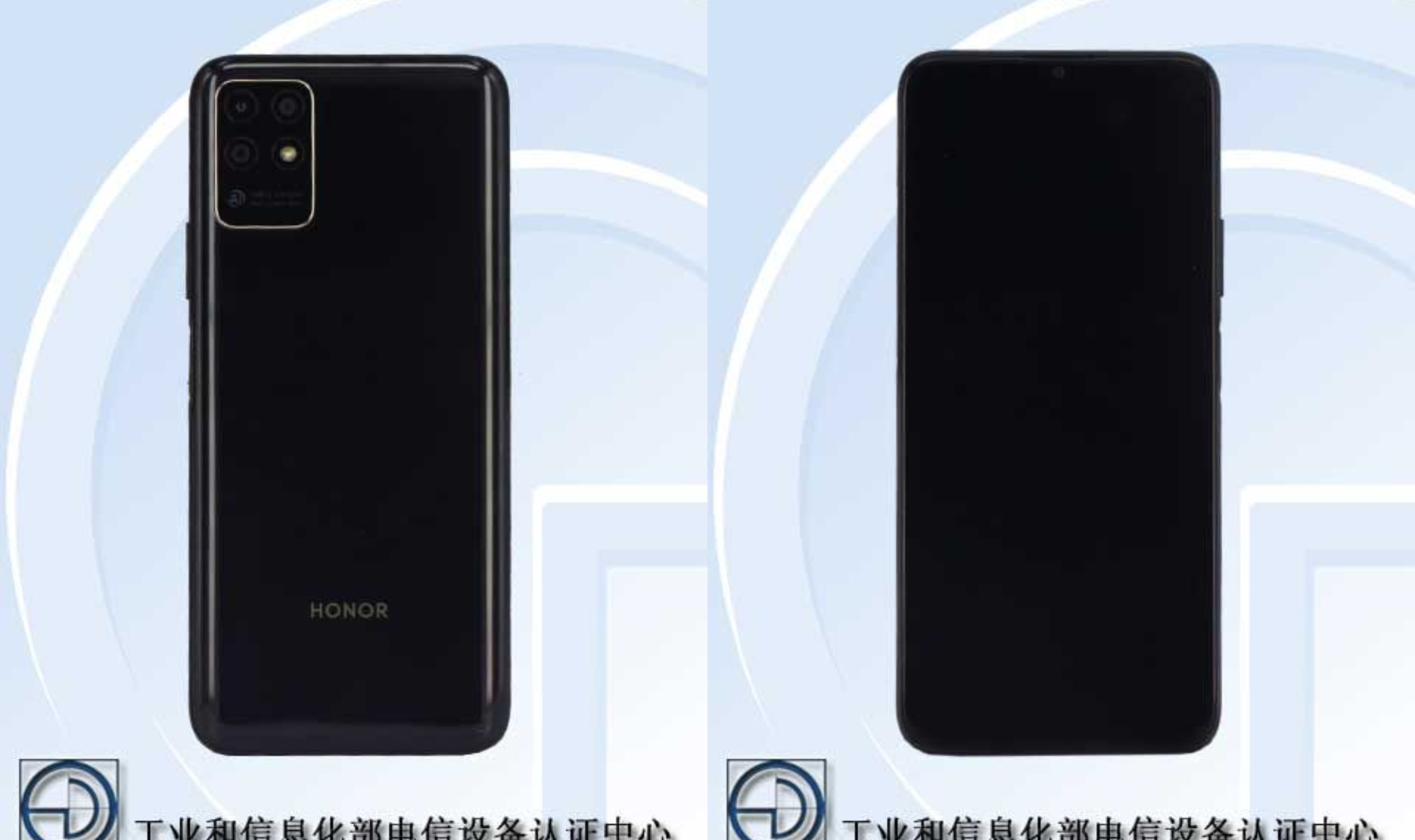
Back in November 2020, HUAWEI sold its sub-brand HONOR to Zhixin New Information Technology Co. Ltd, a consortium of over 30 agents, dealers, and the Shenzhen Smart City Development Group Co. Ltd. Since then, HONOR has only released a single smartphone in the form of HONOR V40 5G in China. This handset along with four other phones may soon launch in global markets.
Honor V40 5G
Last month, a tipster revealed that HONOR will be launching a number of mid-range and flagship smartphones in global markets. He even revealed that HONOR View40 (aka HONOR V40) will be debuting in spring, followed by HONOR 40 in summer. According to him, the brand will also release a new HONOR Magic device.
Now, weeks later, the following HONOR smartphones have cleared EEC certification.
HONOR YOK (HONOR View40)
HONOR CHL
HONOR HJC
HONOR NTN
HONOR NZA
Apart from HONOR V40, the other four devices are yet to go official. But we do know the specs and design of HONOR HJC and HONOR NZA, thanks to their TENAA certifications.
HONOR HJC Specifications
Talking about HONOR HJC, it will be a mid-range 5G smartphone powered by MediaTek Dimensity 800U SoC paired with 8GB RAM and 128GB/256GB internal storage. It will flaunt a 6.53-inch FHD+ AMOLED display with a 20:9 aspect ratio. Unfortunately, there’s no info on whether the panel will support a high refresh rate.
As for optics, the handset will sport a 16MP selfie camera in the display notch and a quad-camera setup on the back consisting of a 64MP primary sensor coupled with an 8MP sensor and two 2MP sensors.
Other features of this phone include an in-screen fingerprint sensor, MicroSD card slot, Android 10, 3,800mAh battery, 66W fast charging, and four colors (Magic Night Black, Iceland Fantasy, Titanium Silver, Emerald Blue).
HONOR NZA Specifications
Unlike the above handset, the HONOR NZA is a budget 5G smartphone powered by a 2.0GHz octa-core processor paired with 4GB/6GB RAM and 64GB/128GB internal storage. It will sport a 6.6-inch HD+ TFT LCD panel with a notch.
Other specs include a MicroSD card slot, 3.5mm headphone jack, Android 10, side-mounted fingerprint sensor, proximity sensor, accelerometer, ambient light sensor, 5,000mAh battery, and two colors (Black, Blue).
There’s no telling when and in which regions these phones will be launching in the coming days. Also, it is a mystery if they will come with GMS (Google Mobile Services) though the brand is in talks with the search giant.
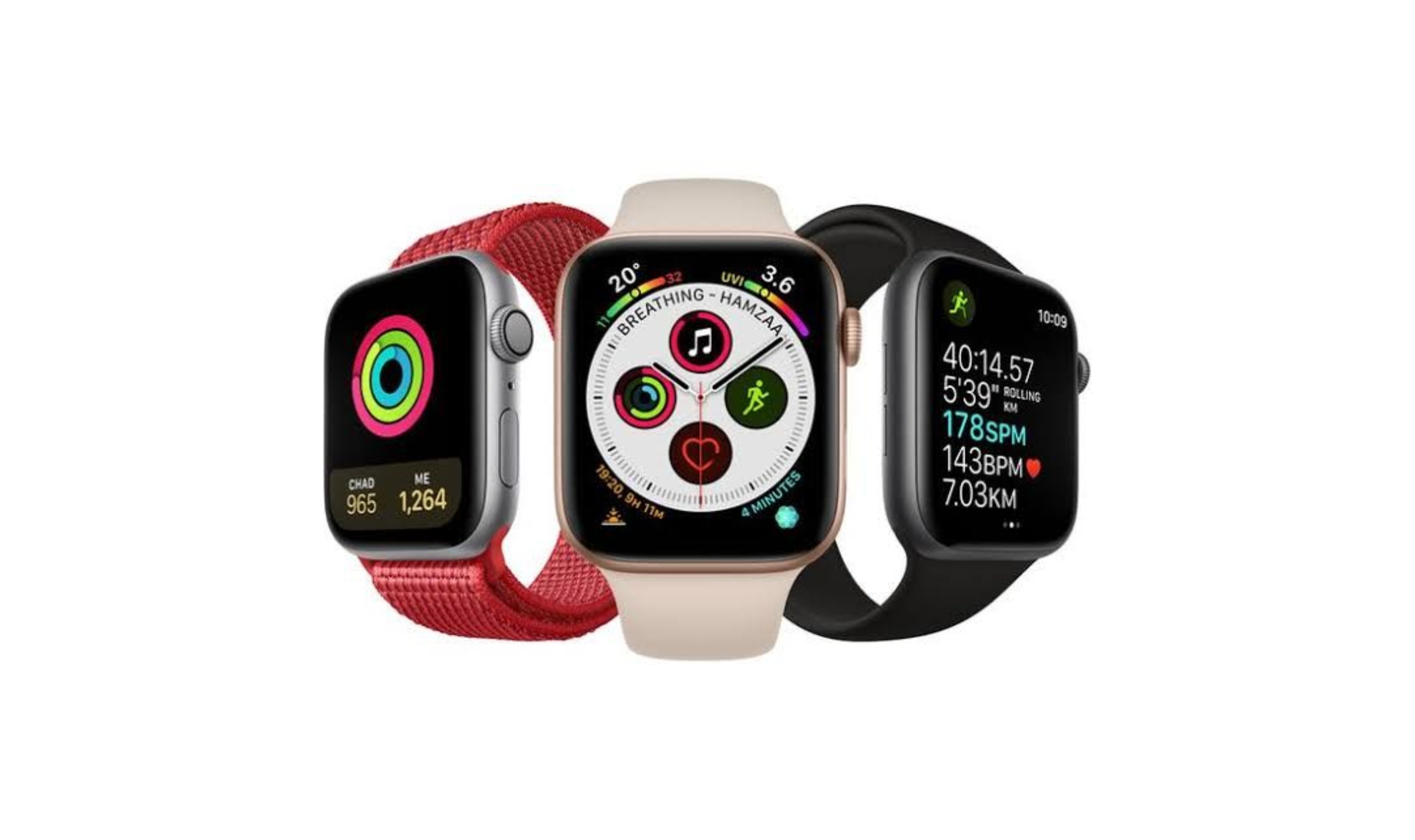
Last month, a report said that the next Apple Watch (Tentatively Apple Watch 7) could get the Blood Sugar Monitoring feature. Now, a series of patents unearthed by Apple Insider shows that Apple could be working on a new Terahertz Sensor for the non-invasive Glucose monitoring.
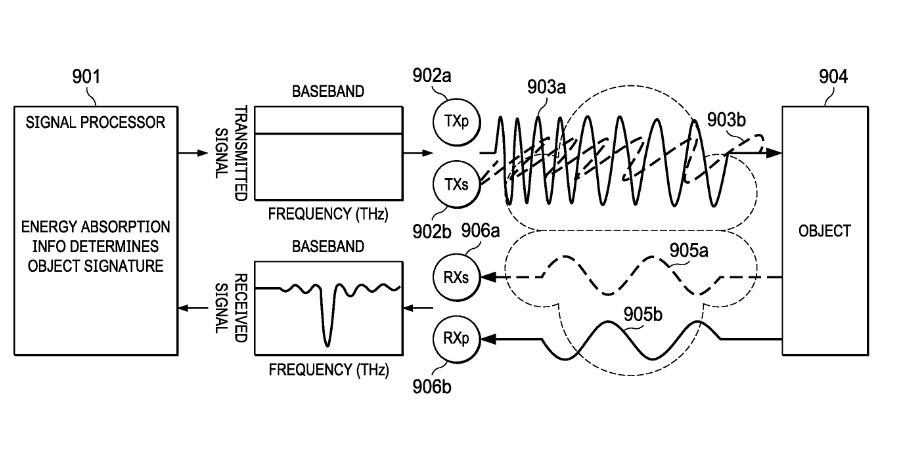
A total of four patients with one main and three other resembling ones(via AppleInsider)have been filed at USPTO(US Patent and Trademark Office). Although none have the word Glucose/Blood Sugar monitoring, they hover around the Absorption Spectroscopy on Electronic devices.
If you recall, a company named Quantum Operation showed off a “Spectrometer-based” prototype that works on the interaction of light with the wrist at CES 2021. Here, Apple’s patents delves on using Ambient Sensors for Terahertz Spectroscopy and Imaging in Dynamic Environments.
Apple begins with limitations like lack of Space for New Sensors with Aperture/opening, Degraded Water resistivity, overall cost increase, etc. of the previous ‘Gas Sensor’ design. Consequently, its new patent talks about using terahertz(THz) electromagnetic radiation(EMR) on previous spectroscopy methods.
A transmitter of the electronic device will emit EM waves in THz into a dynamic environment like a user’s skin. A receiver will then absorb the reflected wave back. Following this, a spectral response having absorption Spectra(data about the Obstacle) is compared with known Spectra(Fixed values).
Apple adds that this tech might go beyond the borders of non-invasive Glucose monitoring. It says that absorption spectroscopy will play a vital role in overall health including detecting skin cancers/disorders in the future.
Either way, the technology is new and immature so it needs a lot of studies as currently, it might have discrepancies with that of Hospital Monitoring techniques.
Tencent Games was granted the exclusive right to launch the Nintendo Switch gaming console in China. Thus, the Switch was launched in China in December 2019 despite already being a popular console outside China.
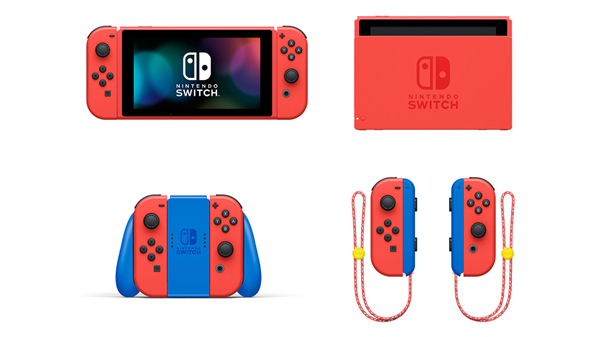
Tencent has now launched a limited edition model of the Nintendo Switch for the Chinese market. The limited-edition is themed after Super Mario. The new edition comes exactly one year after the original Switch was launched in the Asian country. Available records show that the firm has sold up to 1 million units of the handheld gaming console.
.The Nintendo Switch Super Mario Limited Edition will not be China-exclusive but will be sold in other regions. The version is presently on sale on the official WeChat store as well as Nintendo Switch’s official flagship stores on JD.com and Tmall as well as other official authorized channels. Interestingly, the customized edition retains the same price tag as the original Switch. It is priced at 2099 yuan (~$325). Outside China, it is available on Best Buy and Target for $300.
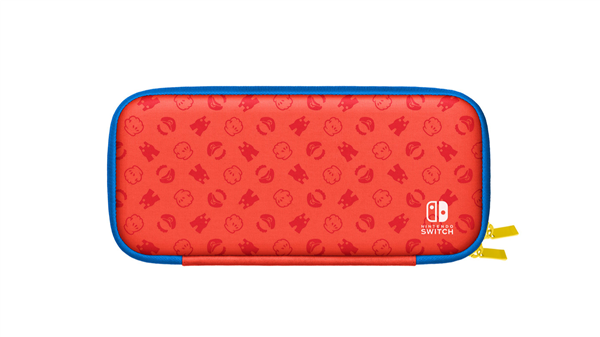
The Nintendo Switch Limited Edition is themed after the legendary Super Mario game. It is specially designed with Mario’s theme colors of red and blue. Nintendo also bundles a carrying case and a screen protector.
The main body of the Switch itself adopts a different color for the first time. It comes in red just like the other accessories. Not only that, in addition to the main unit, the base, joystick, Joy-Con wristband, and Joy-Con grip of the suit are all designed with Mario’s theme colors of red and blue, which are very recognizable. The carrying case also adopts the red and blue theme color with the zipper coming in blue while the case is red.
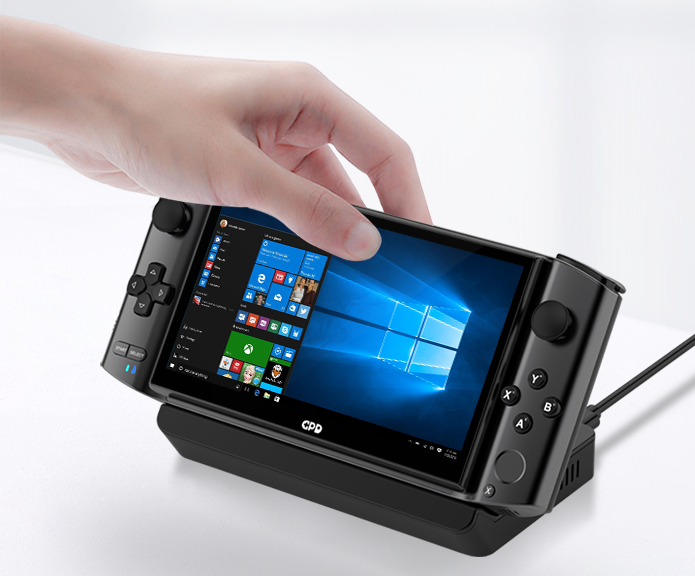
Around December last year, GPD went live with a landing page for the GD Win 3 on Indiegogo. The handheld gaming PC is expected to be a successor GPD Win 2 portable gaming console which has been one of the brand’s most successful products yet. The GPD Win 3 handheld Gaming PC has now been launched under crowdfunding on Indiegogo.
The GPD Win 3 handheld Gaming PC features a compact 5.5-inch display with an HD resolution of 720p. It is equipped with a physical keyboard under the display which can be used by sliding the screen upwards. One standout feature on the device is the presence of a gamepad. The gamepad features two joysticks, four triggers, a directional pad, and four action buttons.
In order to take care of heating, the gaming PC features intake air vents on the rear and an exhaust vent on the top. It also features a USB-A port, power key, headphone jack, and built-in microphone. At the bottom, there is a USB-C Thunderbolt 4.0 port and loudspeakers. The device also packs two customizable buttons on the rear side of the controller grips, which also contain rumble feedback.
The GPD Win3 will be powered by the latest 11th-generation Intel Core i5 (2.4 – 4.2GHz) while the higher version will feature a Core i7 (2.8 – 4.7 GHz) SoC. The processor is paired with 16GB of LPDDR4 RAM with 1TB of internal PCIe 3.0 SSD storage. An Intel Xe GPU will fire up the graphics. The portable laptop will also come with Wi-Fi 6, Bluetooth 5.0, and support for a microSD card. The setup is well suited to play the top AAA games around such as Cyberpunk 2077.
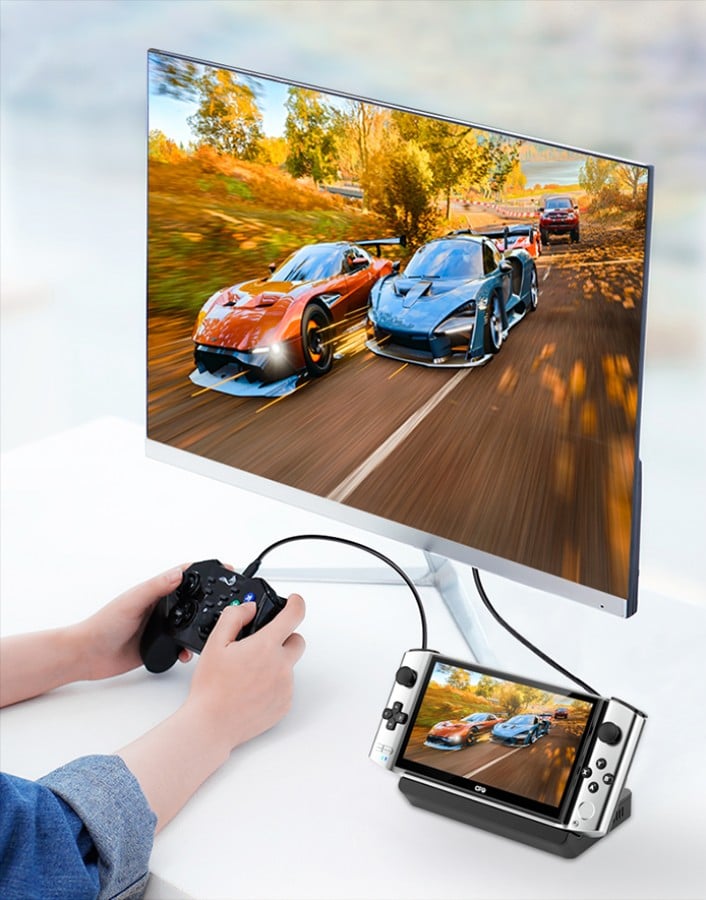
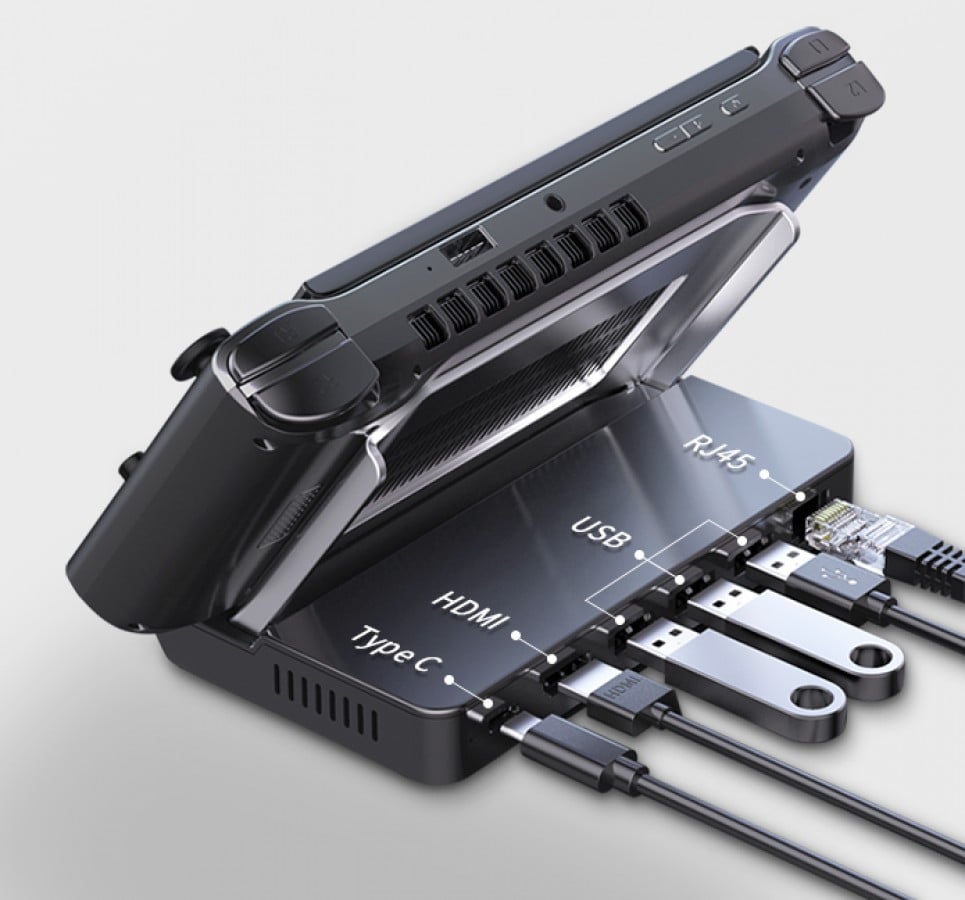
Apart from the ability to play games on the 720p screen while using the handheld mode, users can also make use of the dock offering a host of I/O connections. The dock will offer support for an external display via HDMI 2.0b, 1Gbps Ethernet, USB-C X1, USB-A X3.
The Win 3 will gets its power source from a battery of unknown capacity which is expected to last between 2 to 3 hours of intense gaming. For moderate use, it can last between 6 to 8 hours and light use will see it last up to 11 hours. The device charges via a 65W Power Delivery charger.
The GDP Win 3 carries a starting price of $799 and is up for backing on Indiegogo. The gaming PC will run on Windows 10 OS.
Early in January, Qualcomm had announced that Cristiano Amon would take over as the CEO of the company from June 30, 2021. Now, Amon has said that US sanctions against Huawei might help lessen the stress on semiconductor shortages.
Cristiano Amon | Image source: Qualcomm
In a webcast with Goldman Sachs analyst Rod Hall(via Bloomberg), he said that because of the hindrance on the chip manufacturing Huawei is facing, facilities at its partner TSMC would become free now. For the unware, TSMC had to halt Huawei’s orders in 2020 because of the tightened restrictions by the US Govt.
The Chinese Giant has henceforth not been able to make more of its HiSilicon Kirin chipsets lately. Anyway, Amon says that Although the facilities would now be available for others, difficulties in transfer of tech might delay the immediate benefits out of this.
Besides, Automakers around the world are facing Semiconductor shortages during the US-China Trade War and clamp down on Chinese tech firms. In fact, its worse in blooming Countries like Germany which has finally sought alternatives like Taiwanese firms.
Also, the demand in chip shortages has further increased the demand on key components Smartphones, Personal Computers, Automation, Networking, etc. This demand is expected to rise prices and persist till the end of H2 2021(Second-Half).
Coming back, Aman says that Qualcomm’s demands have surged than before. In fact, the company’s revenue in Oct.-Dec. 2020(marked as Q1 2021 in Fiscal Year) grew by a whopping 62%.
Qualcomm is eyeing the semiconductor manufacturing plants of TSMC and Samsung that are being planned to set up in the USA. Although it is barred from communicating with Huawei, it is trying its best to get in touch with the recently spun-off brand HONOR.
Finally, Amon said that the semiconductor dispute between US-China would take a long time to settle before reaching a resolution.
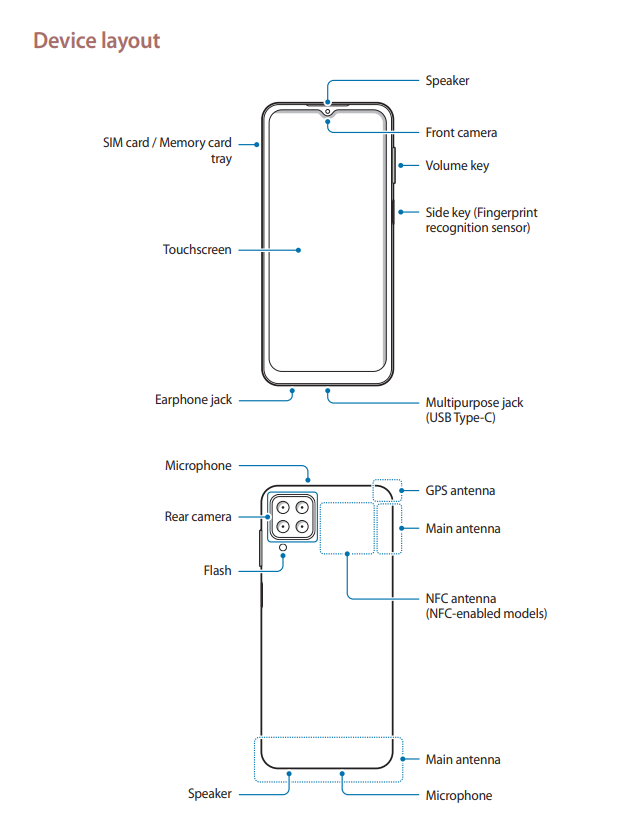
Samsung has a couple of new phones lined up for launch in India. The Galaxy F62 is slated to go official on Feb. 15 and a similar variant of the phone dubbed as the Galaxy M62 is likely to go official soon as its support page has appeared on Samsung India’s website. Fresh information reveals that the support pages of new A-series phones such as Galaxy A12, Galaxy A32, and Galaxy A52 5G have emerged on Samsung’s website.
Samsung Galaxy A12
1 of 2
The support page of the Galaxy A12’s 4 GB RAM variant (SM-A125F model number) is now available on Samsung India’s official site. A user manual of the phone is also available in the listing. Earlier today, popular tipster Mukul Sharma said India will be soon treated with a new A-series phone with 48-megapixel quad cameras. He did not reveal the name of the device but mentioned that it will cost under Rs 15,000 (~$206). It appears that the upcoming Galaxy A-series phone could be the Galaxy A12 smartphone.
Samsung Galaxy A32
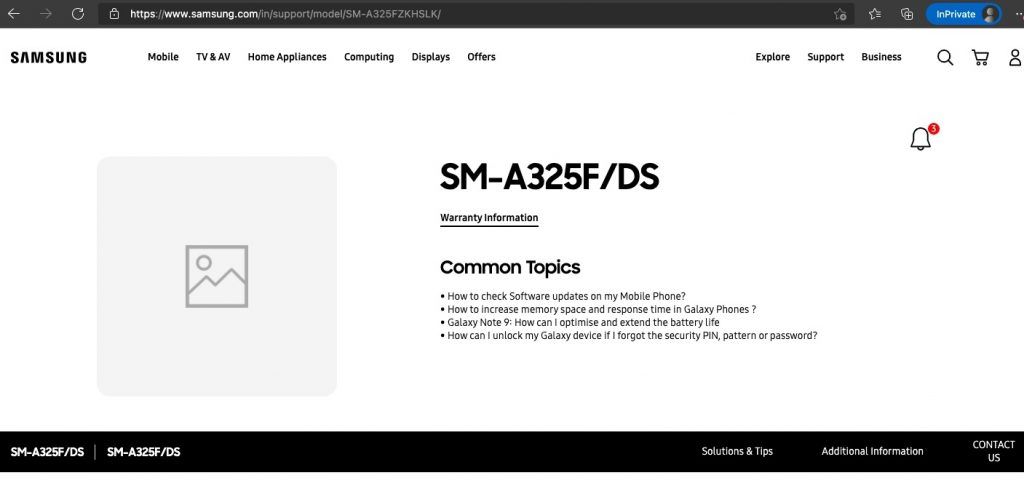
Samsung has already launched the Galaxy A32 5G as its cheapest 5G-ready smartphone. Some markets including India are expected to receive its 4G variant. The handset’s support page is now listed with its SM-A325F model number on the Indian site. It is speculated to be powered by the Helio G85 chipset.
We use cookies on our website to give you the most relevant experience by remembering your preferences and repeat visits. By clicking “Accept”, you consent to the use of ALL the cookies.
This website uses cookies to improve your experience while you navigate through the website. Out of these, the cookies that are categorized as necessary are stored on your browser as they are essential for the working of basic functionalities of the website. We also use third-party cookies that help us analyze and understand how you use this website. These cookies will be stored in your browser only with your consent. You also have the option to opt-out of these cookies. But opting out of some of these cookies may affect your browsing experience.
Necessary cookies are absolutely essential for the website to function properly. This category only includes cookies that ensures basic functionalities and security features of the website. These cookies do not store any personal information.
Any cookies that may not be particularly necessary for the website to function and is used specifically to collect user personal data via analytics, ads, other embedded contents are termed as non-necessary cookies. It is mandatory to procure user consent prior to running these cookies on your website.