Advertisement

Blackview BL6000 Pro- Rugged Smartphone with High-Speed 5G Compatibility

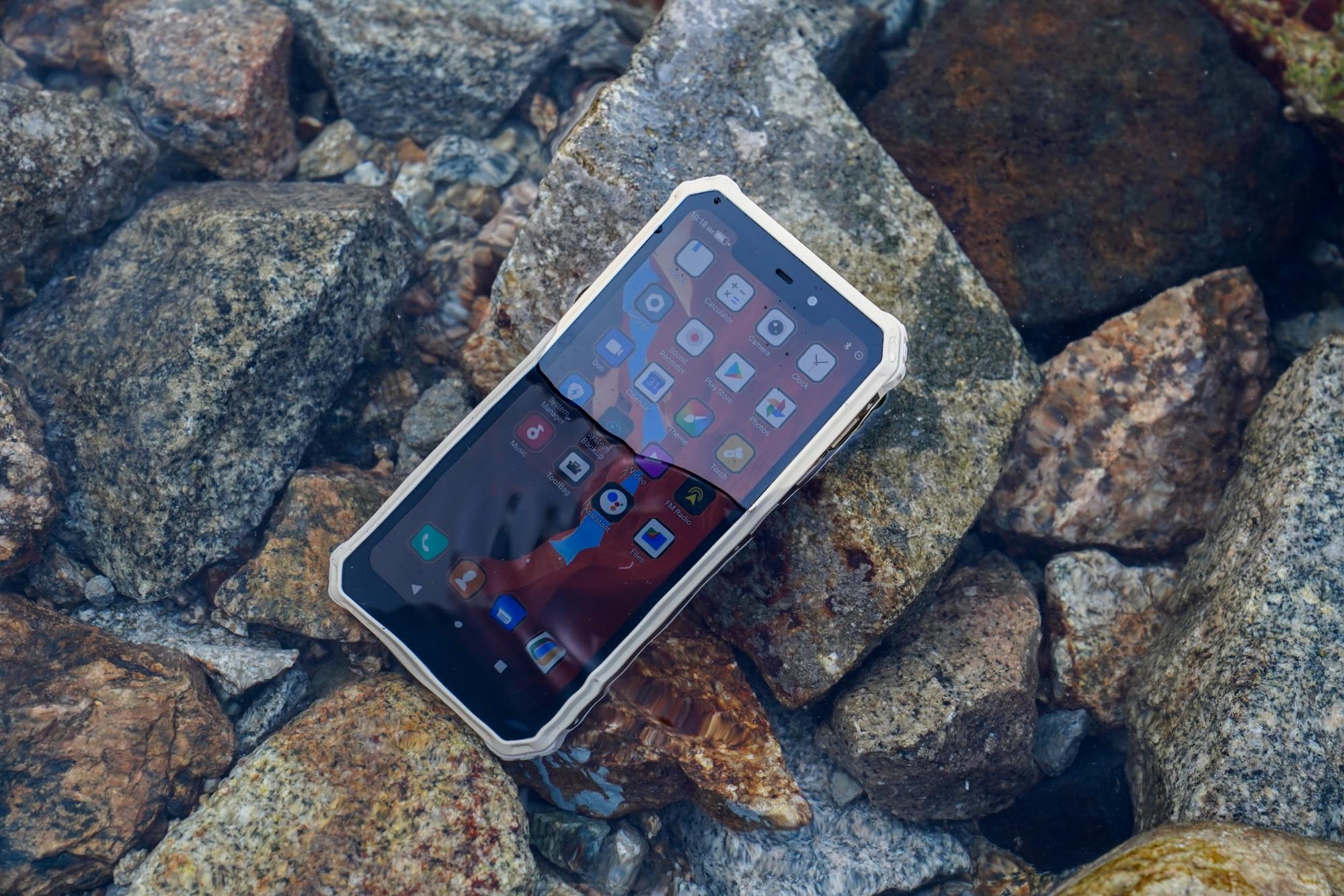
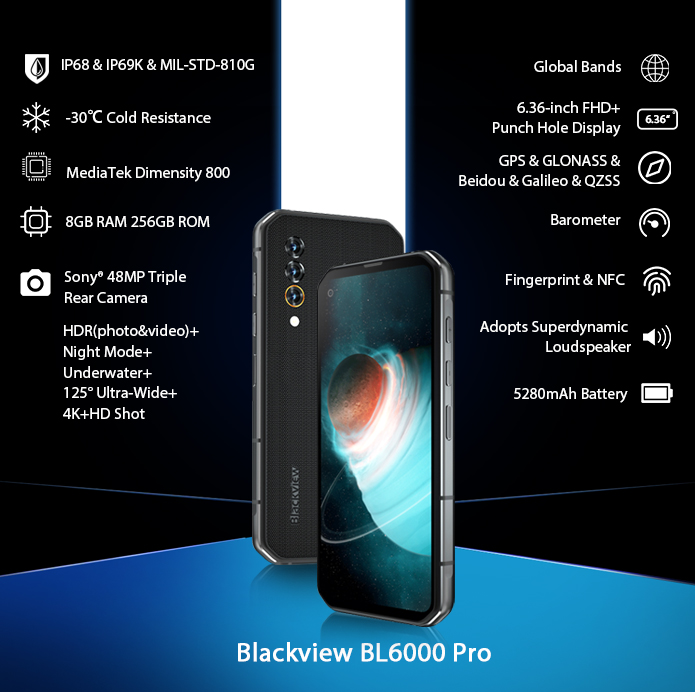
Of late rugged smartphones have become quite popular and are very well accepted by the audience. Blackview, a rugged smartphone manufacturer, recently launched BL6000 Pro 5G. The phone is highly durable with a decent camera and hardware configuration. This phone can be taken out to all outdoor adventures without worrying about harsh environmental factors. Let’s take a look at its features.Blackview BL6000 Pro-1-

Durability

BL6000 Pro 5G comes with an IP68 and IP69 rating and has a MIL-STD-810G military certification. This smartphone can withstand water immersion up to 1.5m for 30 minutes and is drop-proof from the height of up to 1.5m.

This rugged smartphone has a tough metal body to withstand rough use. The phone is also internally optimized and features a nano molding design, an all-new waterproof technology coupled with a sealing membrane. This upgrades the smartphone’s waterproof performance to the next level.

It has also optimized its battery to offer cold-resistance in the freezing winter. The phone can still perform basic functions like calling, messaging, and more in -30℃.

Specifications

Apart from its high durability and sturdy built, the other USP of BL6000 Pro 5G is its camera. It packs a Sony IMX582 triple-rear camera and has superior processing software with multiple modes like PortraitColor, HDR, Night Mode, Underwater, Ultra-Wide, 4K 30fps, HD shot. This allows the users to take their photography skills to the next level.

This rugged smartphone is powered by MediaTek Dimensity 800 chip and has 8GB RAM and 256GB ROM. Additionally, even if the phone is out of the 5G coverage area, it still offers a high-speed 4G network that is faster than the phones of the same network range.

Other Key Specifications include- 

  • Global 5G/4G/3G/2G bands
  • 5280mAh battery, liquid cooling technology
  • GPS & GLONASS & Beidou & Galileo & QZSS
  • Adopts super-dynamic loudspeaker
  • NFC, Android 10 OS
  • Antutu score: 340K+

Currently, Blackview BL6000 Pro 5G is up for sale on Blackview & Banggood store and is available at a discounted price of just $399.99 (original price- $699.99). The sale ends on January 4th, so make the most of it while it lasts.BL6000 Pro 5G
Bison 2021- Rugged Smartphone to be Launched by New Brand, F150

F150 is a smartphone manufacturing company that was established this year by a couple of colleagues and friends that are outdoor enthusiasts. Since their devices lacked some features that an adventure-friendly phone must have, they decided to create one of their own. After putting a lot of thought and hard work into it, the company came up with their first product- Bison 2021. This smartphone is built to be durable and is all set to launch in 2021.Bison 2021-1-
Bison 2021 boasts a 5.86-inch Corning Gorilla Glass 5 u-notch display and is powered by a MediaTek Helio G25 chipset. It runs on a uniquely optimized OS and features an 8000mAh battery. Other features include 6GB RAM, 64GB internal storage, NFC support, and much more.

With 2 different modes, this rugged smartphone is designed for both professional life and outdoorsy life. Plus the user can switch between the 2 modes by simply pressing and holding a key on the side.

Bison 2021 has a plastic body and instead of the regular rubber or aluminum that rugged phones generally boast. This has allowed Bison 2021 to come in colors like desert yellow.Bison 2021-2-

F150 has a unique vision and approach through which they intend to change the way people look at smartphones. To stay updated about their latest news and flagship launch, click here.

Samsung Galaxy Z Flip3 model number appears to point at an affordable pricing

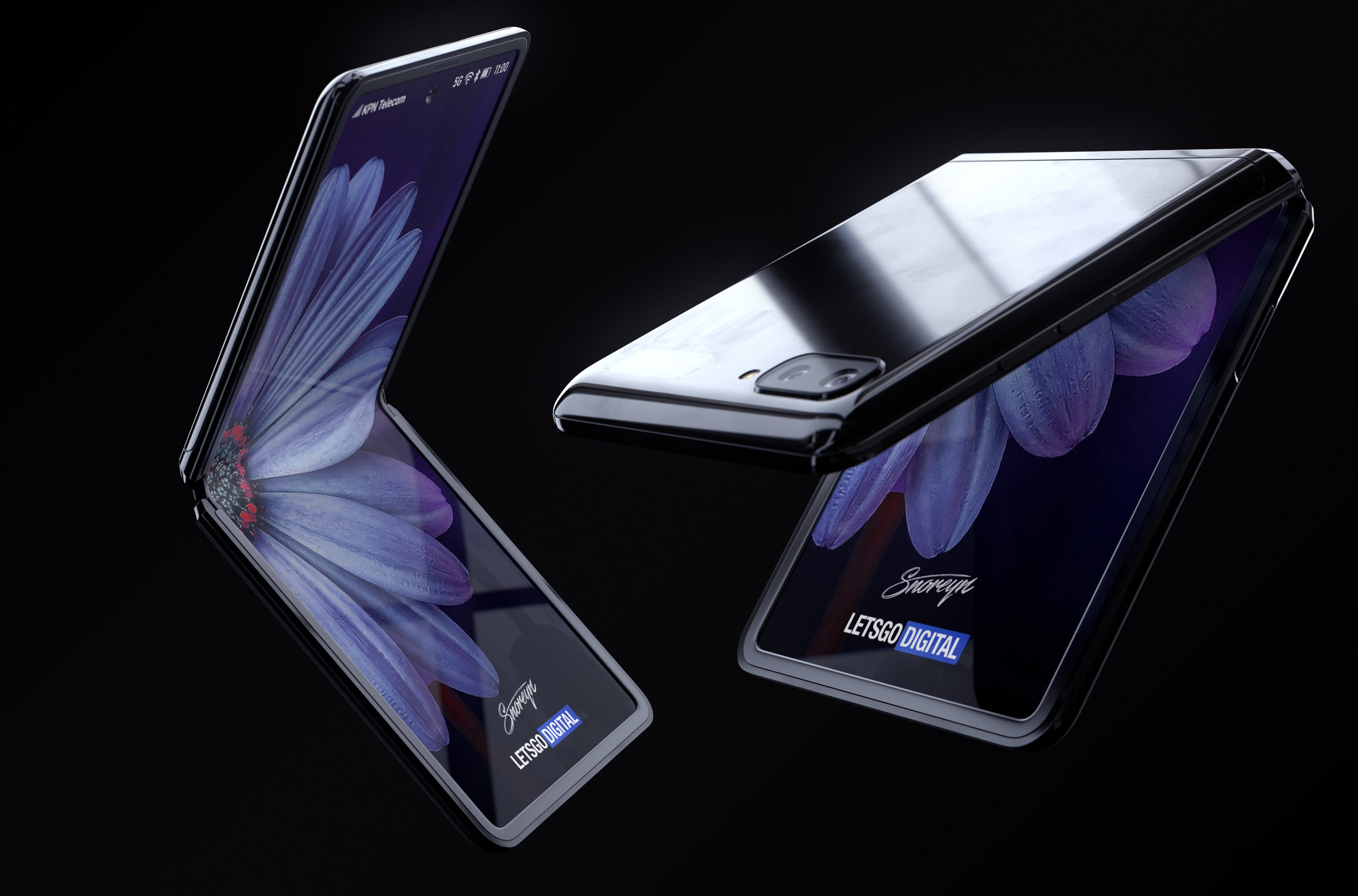
Samsung is introducing new measures in the design of its upcoming phone Galaxy Z Flip model from 2021. The measures are a clear departure from the current scenario of successor models ranking higher than the base models, and may be aimed at stabilizing the brand in the midst of an unfavourable and debilitating global business environment in 2020. The lineup of smartphones slated for release in 2021 begins with the Galaxy S21 slated for launch in January 2021, and the Galaxy Z Fold3 in mid 2020. The Z Fold3 will be the South Korean company’s flagship in H2, 2020.Samsung Galaxy Z Flip Renders

A recent report says Samsung’s Galaxy Z Flip, which would be a 5G compliant smartphone, may be equipped with a mid-range chipset that could significantly lead to a lower price tag, for the flagship device. and make it its most affordable foldable to date.

The report which emanated from Samsung’s Galaxy Club, highlights the proposed model number of the next Galaxy Z Flip model as SM-F720F. An explanation of the notation is necessary. While the “F” signifies that the specified model is an international variant, the absence of a “B” indicates that this new model will not have 5G capability. This implies that the Z Flip3 will be positioned lower than its base models and predecessors, including the Z Flip which all used the Snapdragon 800 range of chipsets.

Samsung’s Galaxy Z Flip was priced at $1,449 when it was released, and the Z Fold2 sells from $1,999. It is yet to be seen the level of price change that will go with the choice of the new chipset and how much lower the Z Flip3 will be priced.

Still, even if Samsung wanted to make “mid-range foldables” a thing, we can’t imagine prices falling to three digits in the current market.

UP NEXT: Motorola Capri Plus hits FCC, Geekbench, and TÜV Rheinland


(source)


Xiaomi 55W GaN charger compatible with the Mi 11 launched for 99 yuan (~$15)

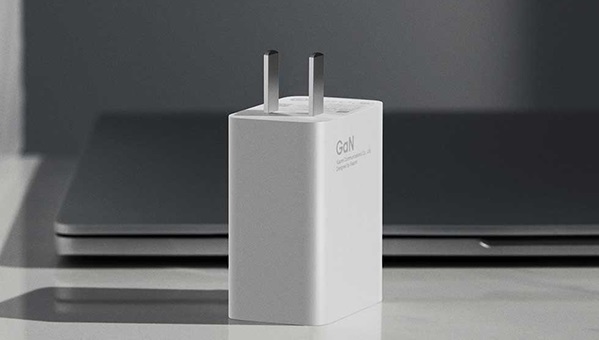
Yesterday, Xiaomi went oifficial with the Mi 11 flagship with the device adopting a decent starting price of 3999 yuan (~$612). One of the major highlight of the announcement was the disclosure that the standard edition won’t ship with a charging adapter in the retail box. To make up for the gap, Xiaomi has officially released a 55W GaN charger. The charging adapter is priced at 99 yuan and is presently on reservation on JD.com. The adapter will be officially released at 0:00 on January 1.


Just like other GaN chargers in the market, Xiaomi’s 55W GaN charger is manufactured using gallium nitride semiconductors. The use of gallium nitride semiconductor materials has the advantages of super thermal conductivity, high-temperature resistance, acid and alkali resistance, and greatly reduces the size of the charger.
The Xiaomi 55W GaN charger can provide 55W fast charging for the Mi 11, as well as fast charging support for the Mi 10 (30W), Redmi K30 Pro (33W), Redmi K30 5G (30W), etc. The original intention is to support environmental protection.Xiaomi 55W GaN charger

Xiaomi offers the Mi 11 in two options: a standard version and a package version. The package version is equipped with a 55W GaN charger. The price is the same as the standard version at 3999 yuan (~$612) for the 8GB RAM + 128GB storage.

Xiaomi pegs the reason for the removal of the adapter from the standard version to the need to protect the environment. This is the same reason Apple gave for shipping the iPhone 12 without an adapter. However, Xiaomi already has some chargers that are compatible with the Mi 11 like the Mi 10 Pro and Mi 10 Extreme Edition charger.  There is also a Mi 65w GaN charger already in the market which can also deliver 55W charge to the Mi 11.

UP NEXT: New users of Apple Watch and HomePod are facing iCloud Activation issues


Huawei Jimmy Smart Handheld Wireless Vacuum Cleaner 1S launched in China

Huawei Smart Selection has launched the Jimmy Smart Handheld Wireless Vacuum Cleaner 1S in China. The product’s pre-sale will start at 00:00 on December 30 and will be sold on January 8 via Vmall. The original price is 1,299 yuan (~$198) while the presale price is 1,199 yuan (~$183).

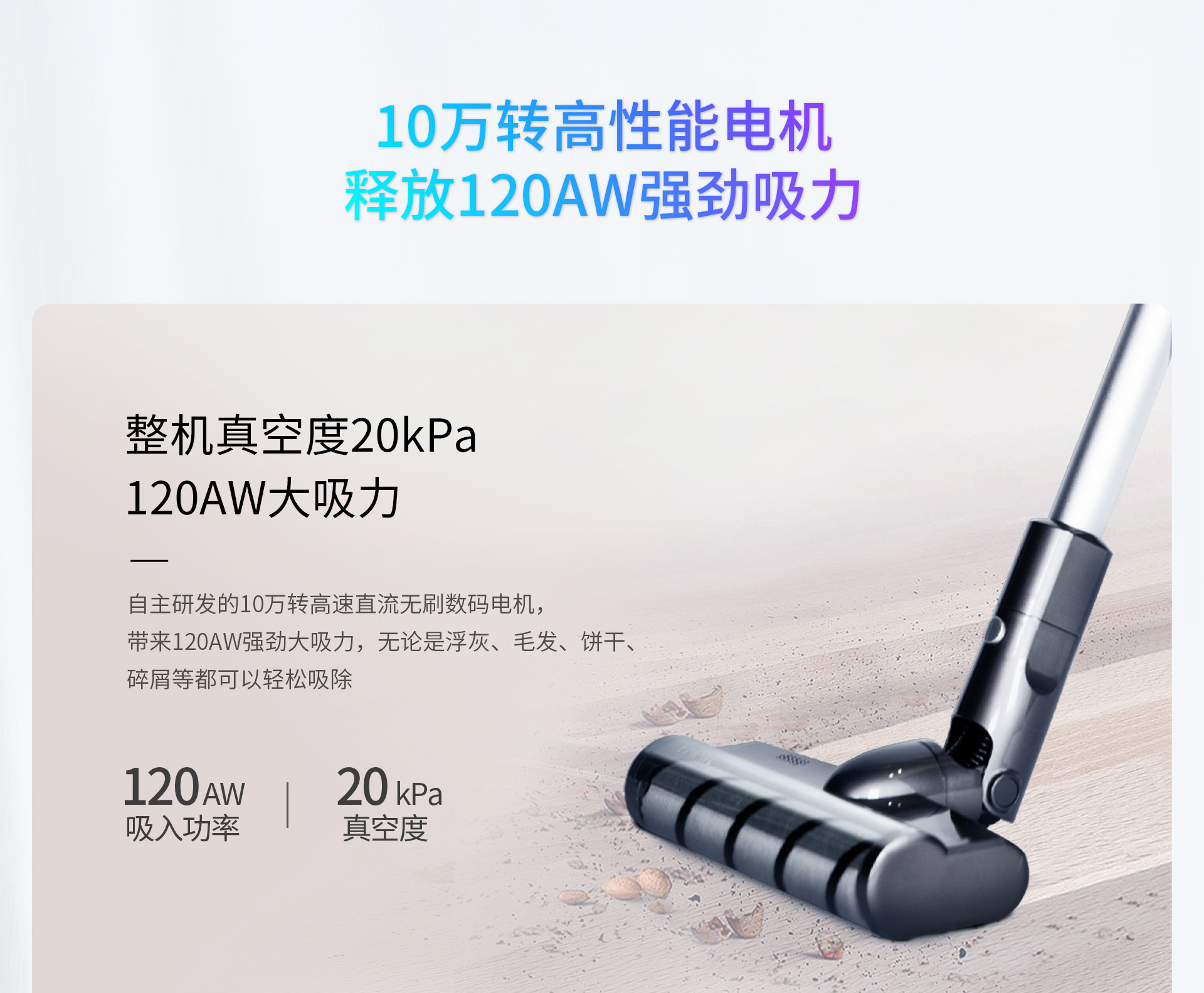
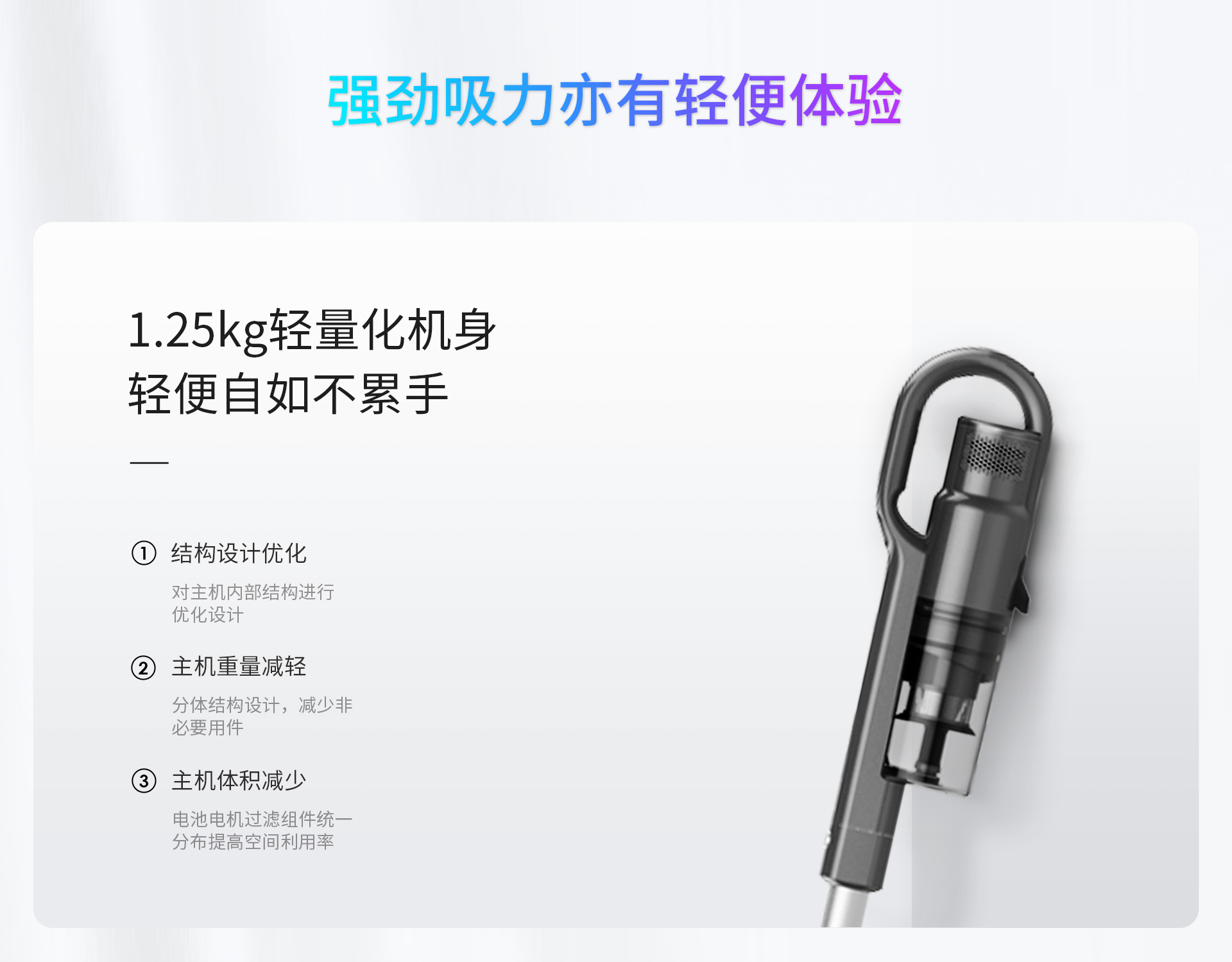
The vacuum cleaner comes with a 120AW high suction power as well as 6 built-in 3000mAh lithium batteries that can last for up to 60 minutes. The device has an ultralightweight build of just 1.25kg. It also comes with multiple brush heads, app support, and other features.Huawei Jimmy Smart Handheld Wireless Vacuum Cleaner 1S

The Huawei Smart Select Jimmy Smart Handheld Wireless Vacuum Cleaner 1S adopts a handle design, which conforms to the principle of ergonomics and labor-saving. Traditional vacuum cleaners are mostly designed with side handles, which require the arm to bend and exert force during use, which can easily cause sore hands.

With a five-stage filtration system, the filtration efficiency is nearly 99.9%. The suction power of the whole machine is always strong and does not attenuate. The component filter can be removed for washing, and the machine doesn’t get blocked easily.

In terms of performance, the Huawei Smart Select Jimmy Smart Handheld Wireless Vacuum Cleaner 1S is equipped with a self-developed 100,000-rpm high-speed DC brushless digital motor, with a maximum suction power of 120AW and a vacuum degree of 20Kpa. With such power, it can easily absorb the hard-to-clean dust in the deep layer of the carpet and the floor gap.

The vacuum cleaner comes with 4 types of brush heads, including electric floor brushes, electric mite removal brushes, two-in-one sofa suction, two-in-one flat suction, which are widely used for cleaning the floor, bed, sofa, car seat, and other scenes.

It is worth mentioning that it can also be connected to the Huawei Smart Life app, which allows users to view the work mode, power, status information, and calories burnt by the user during usage.

UP NEXT: OPPO Reno5 Pro New Year Edition goes on sale in China


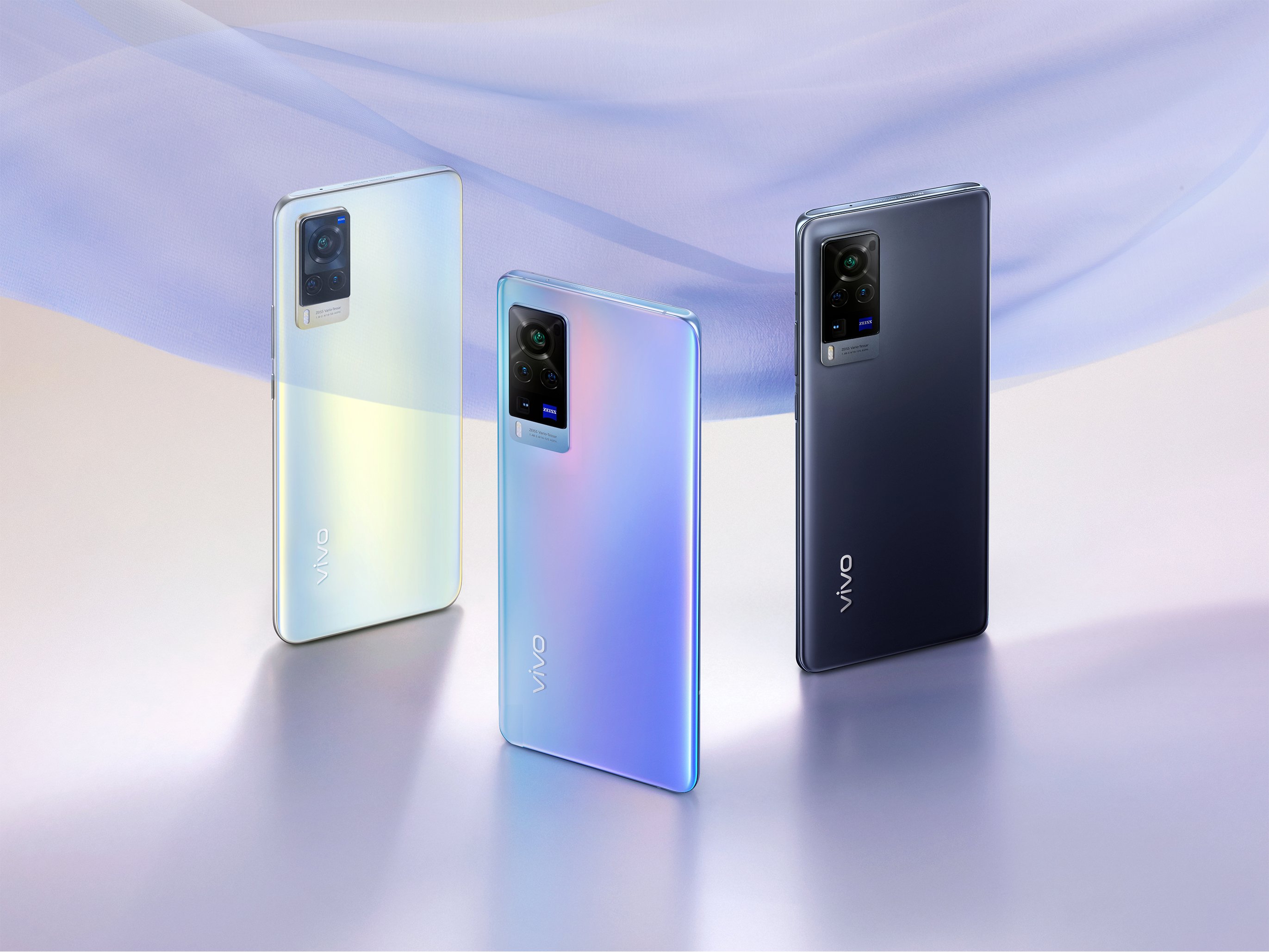
Vivo X60 series brings the Exynos 1080 to market while focusing on camera performance

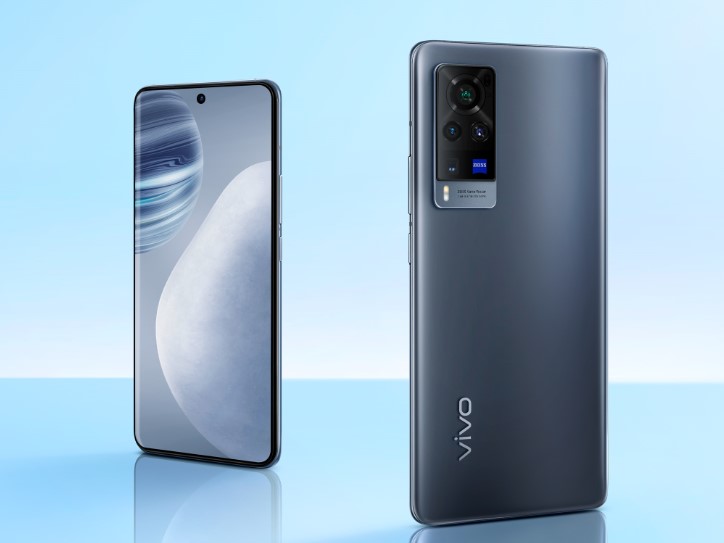
Vivo has announced two new smartphones today in China. The Vivo X60 and Vivo X60 Pro, as they are called, are the first smartphones in the world powered by the Samsung Exynos 1080 5nm chipset. The new chipset is not the only special feature. The X60 phones also have a slim design, a new operating system, and impressive cameras.

Vivo X60 Pro
Vivo X60 Pro

Vivo X60 and Vivo X60 Pro Design

For the design of the new phones, Vivo had one goal and that was to make them the slimmest 5G phones it has ever produced. The standard model is 7.36 millimeters thick while the pro model is a bit thicker at 7.59 millimeters.

Both phones have a curved back with an AG Glass Satin Finish for a silky touch. However, Vivo distinguishes both models not only with more cameras on the pro model but also by giving it a curved display while the standard model has a flat display. The design is finished with a dual-tone paint job that results in a color shift depending on the angle light rays hit the phones.

Vivo X60 and Vivo X60 Pro Specs and Features

The Vivo X60 and X60 Pro both have a 6.56-inch display with a 2376 x 1080 resolution and a 120Hz refresh rate. The AMOLED displays have a centered punch hole, a 19.8:9 aspect ratio, and are HDR10+ certified. Vivo says that the LTM Sunscreen display has been co-developed with Samsung and has been designed to be clear and bright even under strong light.

The Exynos 1080 chipset is paired with 8GB or 12GB of RAM and 128GB or 256GB of UFS 3.1 storage. Vivo includes an in-display fingerprint scanner, face unlock, Dual SIM support, Bluetooth 5.1, NFC, and dual-band Wi-Fi in both phones. They also come with the new OriginOS 1.0 operating system which is based on Android 11.

Vivo X60

The Vivo X60 has a 4300mAh battery while the Vivo X60 Pro has a 4200mAh battery. Both phones come with support for 33W fast wired charging.

EDITOR’S PICK: Upcoming Vivo Y31s could be first Snapdragon 4-series budget 5G chipset phone

Vivo X60 and Vivo X60 Pro Cameras

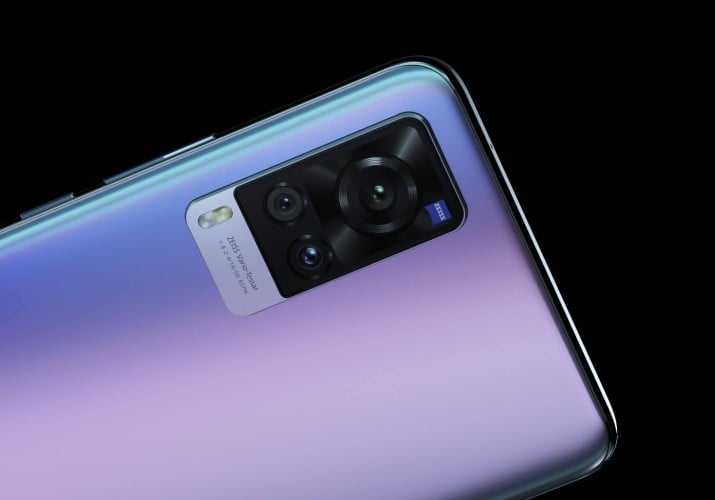
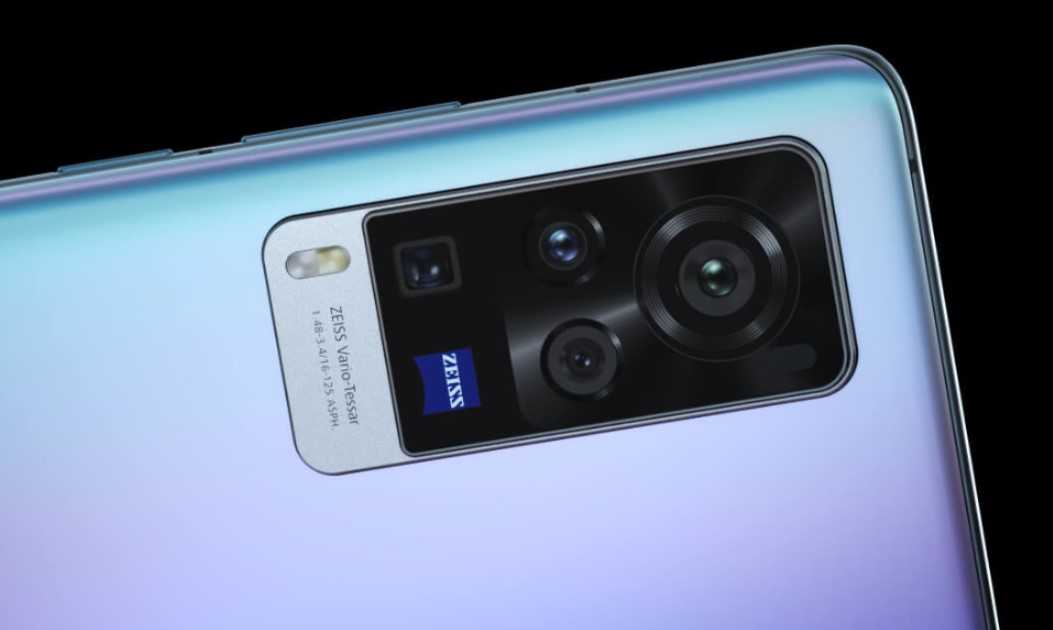
Cameras are a big deal for Vivo and it reinforces that with the new X60 series smartphones. This time around, it has partnered with ZEISS for their lens technology which is used in the new phones.

Vivo X60 cameras
Vivo X60 cameras

The standard Vivo X60 has a second-gen Sony IMX598 48MP f/1.79 gimbal camera with a 4-axis OIS anti-shake and a closed-loop motor for impressive stabilization. It comes along with a 13MP f/2.2 120° ultrawide angle camera and a 13MP f/2.46 50mm telephoto camera.

The Pro Model has the same Sony IMX598 48MP gimbal camera but with an f/1.48 aperture size and 7P lens. It also has 4-axis OIS and a closed-loop motor. The 13MP f/2.2 ultrawide angle camera has a distortion correction feature so the field of view after correction drops from 120° to 108°. Along with the 13MP telephoto camera, it also has an 8MP f/3.4 periscope camera that provides 5x optical zoom and up to 60x superzoom. Both phones have a 32MP f/2.45 selfie camera.

Vivo X60 Pro Cameras

Vivo has packed the two phones full of camera features. You can shoot not only standard, portrait, and wide-angle photos in night mode but also panorama photos. Vivo also says you can take photos of old Black and White photos and have the phone instantly restore the colors using AI. The cameras are also fast enough to capture fast-moving objects such as kids and pets.

Vivo X60 and Vivo X60 Pro Price and Availability

The Vivo X60 is available in three configurations and below are the prices:

  • 8+128GB = ¥3498 (~$535)
  • 8+256GB = ¥3798 (~$581)
  • 12+256GB = ¥3998 (~$612)

vivo X60 and vivo X60 Pro Featured 01

The Vivo X60 Pro comes in a single configuration and that is with 12GB of RAM and 256GB of storage. It is priced at ¥4498 (~$689) and it is already available for pre-order along with the 8GB variants of the standard model. The first sale is scheduled for January 8, 2021.


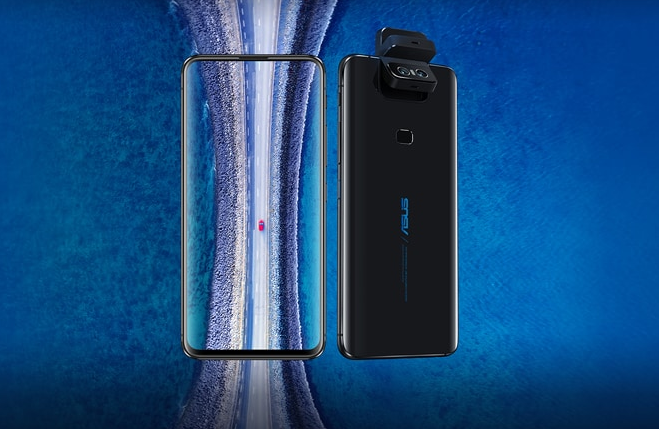
Asus Zenfone 6 gets Android 11 update

After three months of releasing the first Android 11 beta Build, Asus has finally started rolling out the stable update for the Asus Zenfone 6. The new update brings a revamped ZenUI along with other Android 11 goodies.

ASUS Zenfone 6
Zenfone 6

As reported by XDADevelopers, the stable Android 11 update with firmware version ZenFone 6_ZS630KL_TW_18.0610.2011.107 is rolling out. In this, the Model number and ‘TW’ indicates that it’s currently for Taiwan(home country). The update, apart from upgrading the OS from the old Android 10, brings changes like removing Avast Scan Engine, ZenUI interface, full-screen gestures, and more.

You can  take a look at the entire changelog here below:

  • Upgrade the system to Android 11
  • Back up your data before upgrading, and if you want to go back from Android 11 to Android 10, you can do so using an official package, but all your data will be purged.
  • Some third-party software is not yet compatible with Android 11
  • Remove private listening, ZenUI Help with one-handed mode.
  • The power man function is integrated into the battery settings. Remove the Avast scan engine.
  • The desktop removes options such as smart classification, alignment icons, icon suits, and more. Tap the screen space to spread the application icon.
  • Import the new ZenUI interface design
  • Adjust the quick set-up panel interface and support media control. Remove multi-window portals and add proximity sharing options (manually added)
  • The Wi-Fi Auto-Download and Install setting for system updates is turned on by default
  • Third-party desktop support uses full-screen gestures

Previously, Asus began the recruitment for Zenfone 6’s Beta Testing way before the Android 11’s official announcement. However, the first beta came a week later from September 9 when Google released the first Android 11 stable update.

The ZenTalk forum post says it’s seeding to a limited number of users(as of now) and it’s probably to ensure the build doesn’t have crazy bugs. Nevertheless, the update is here and is likely to expand to other regions in the near future.

Although Asus hasn’t voiced a definite rollout schedule, going by the chronology, the Zenfone 7 and event the ROG Phone 3 should get it soon now.


OxygenOS 10.5.10 for OnePlus Nord brings December 2020 security patch and OnePlus Store

OnePlus Nord is one of the most popular mid-range smartphones of 2020. It also happens to the brand’s first such handset after the OnePlus X from 2015. But this device was plagued with bugs at launch. Over the months, the company pushed a number of updates fixing almost all the known issues. Now, it is receiving its 10th system update in the form of OxygenOS 10.5.10.

OnePlus Nord Gray Onyx Featured

The latest OxygenOS build for the OnePlus Nord brings December 2020 security patch and updated GMS (Google Mobile Services) package – September 2020. It also brings general bug fixes and improved stability.

Further, the Indian variant of the phone also gets a new app called OnePlus Store with this update. This uninstallable application allows users to shop OnePlus products, discover exciting members-only benefits, manage OnePlus account, and get easy-to-access support.

That said, the new system update for the OnePlus Nord comes with the following build numbers for different regions.

  • IN: 10.5.10.AC01DA
  • EU: 10.5.10.AC01BA
  • Global: 10.5.10.AC01AA

OnePlus Nord OxygenOS 10.5.10 Official Changelog

  • System
    • Updated Android Security Patch to 2020.12
    • Updated GMS package to 2020.09
    • General bug fixes and improved stability
  • OnePlus Store
    • An intuitive and convenient way to manage your OnePlus account, get easy-to-access support, discover exciting members-only benefits, and shop for OnePlus products. (Please note that it can be uninstalled) – IN only

As always, the update is being pushed in batches, and therefore, it may take time to reach every unit.


Nitty-gritty of Xiaomi Mi 11 midframe, Harman Kardon engraving, leather back explained

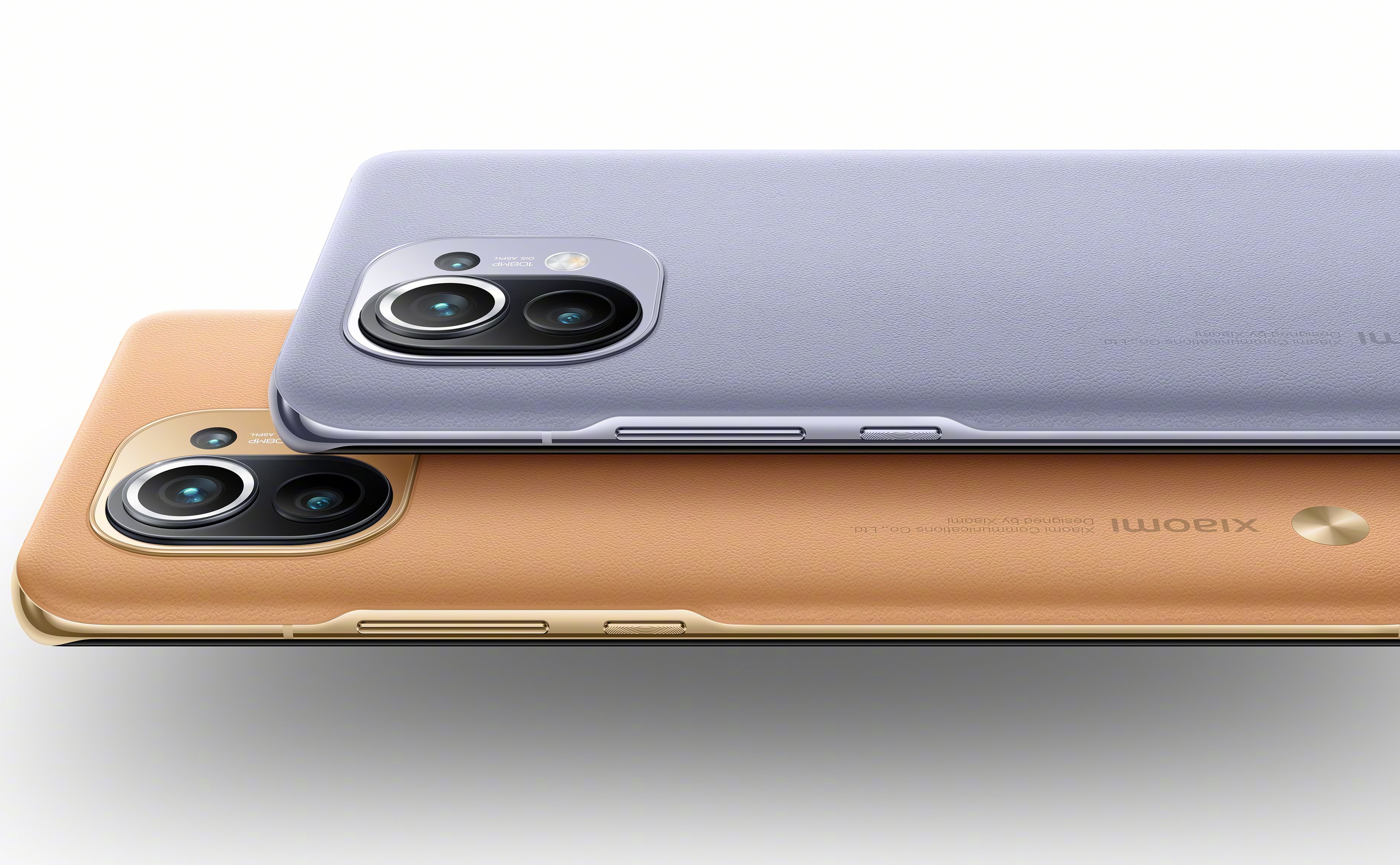
Xiaomi and BYD Electronic have long-standing roots of a strategic partnership in Contract manufacturing. Reports say that this joint venture has so far been able to churn out more than 30 phones. Today, the latter explains the important aspects of Xiaomi Mi 11’s mid-frame, the audio engravings, and the leather panel.

Xiaomi Mi 11 Leather - Smoke Purple and Khaki

As per the report, Xiaomi has sent a letter of Thanks to BYD Electronic Company Ltd., for working together on the Xiaomi Mi 11 project. For the unware, BYD is a Chinese smartphone component maker and contract manufacturer for various companies including Xiaomi. Recently, both have jointly developed a laboratory in Huizhou Park that oversees the design, R&D of metal materials.

Coming back, BYD says Xiaomi Mi 11’s midframe is thicker than the predecessor, the Mi 10. Precisely, it is 1.82mm thick whereas the Xiaomi Mi 10 has a smaller 0.9mm midframe. Now, this should improve the overall structural integrity because thicker the frame is, more will be the tensile strength.

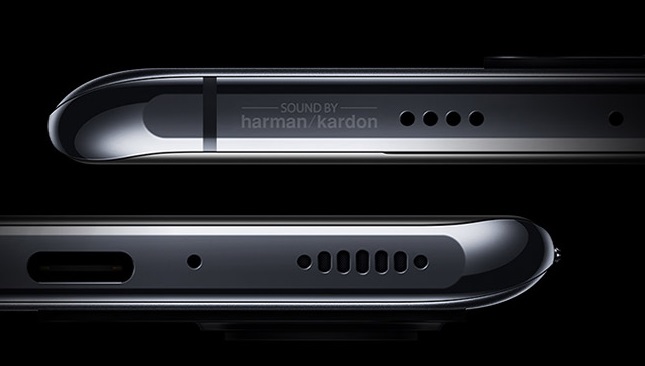
Moving on, BYD says that it has used a special laser engraving technology to imprint the “Audio by Harman Kardon” on the top of the device. The process, which is a first-ever for Xiaomi, ensures that it has fine lines, high accuracy, and matches the color of the frame. In case you don’t know Mi 11’s audio(speaker) is tuned by Harman Kardon.

Mi 11

Apart from this, BYD has also played its part in designing the leather back panel. Xiaomi’s flagship device has two versions of leatherback- Smoky Purple, and Khakhi. From the first-ever teardown video, we can see that they are extremely flexible and have support cushions inside for rigidity. Accordingly, BYD has used high-precision radium to carve the characters on it and the camera layout.

Xiaomi has kept the design language of the layout very strict that the degree of deviation is just ±0.05mm. As for the leather variant, the report says that the gap between the skin around the camera and the mold is very small at 0.1mm. Good to see Xiaomi paying attention to little details and doesn’t want to settle for less.


Samsung Galaxy M12 support page goes live as it reportedly enters mass production

Samsung is getting ready to bring budget 5G devices to countries like India in 2021. Before that, it is expected to refresh the M-series of devices and one strong entrant is the Galaxy M12. The support page for the same has gone live now, and accordingly, a report says it’s already under production.

An official Samsung support page(via MSP) for SM-F127G/DS model has gone live. If we recall, earlier certifications reveal that the model numbers SM-F127G and SM-M127G are associated with the Galaxy M12 moniker. Hence, we can safely say that the listing is indeed the upcoming M-series device.

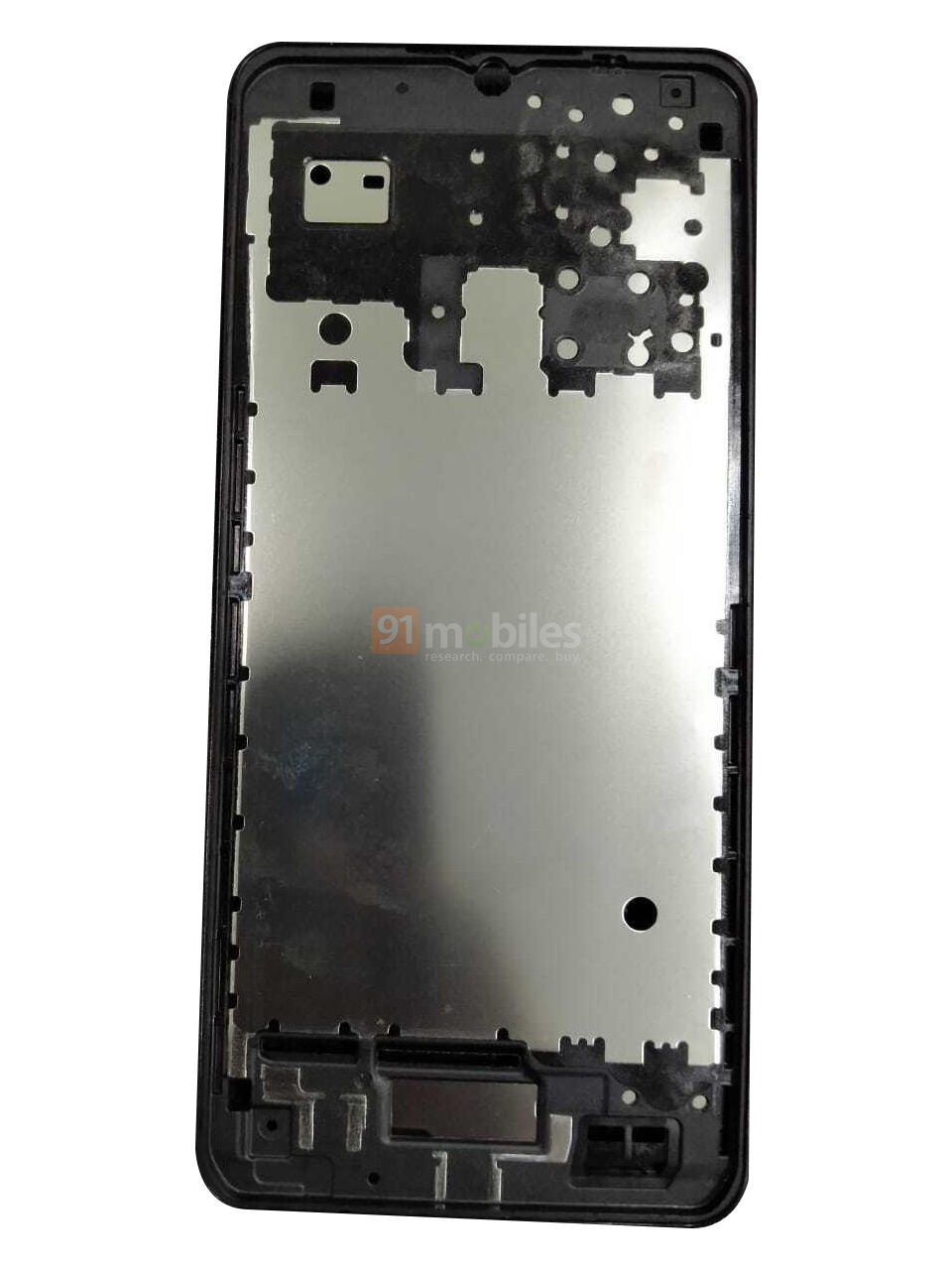
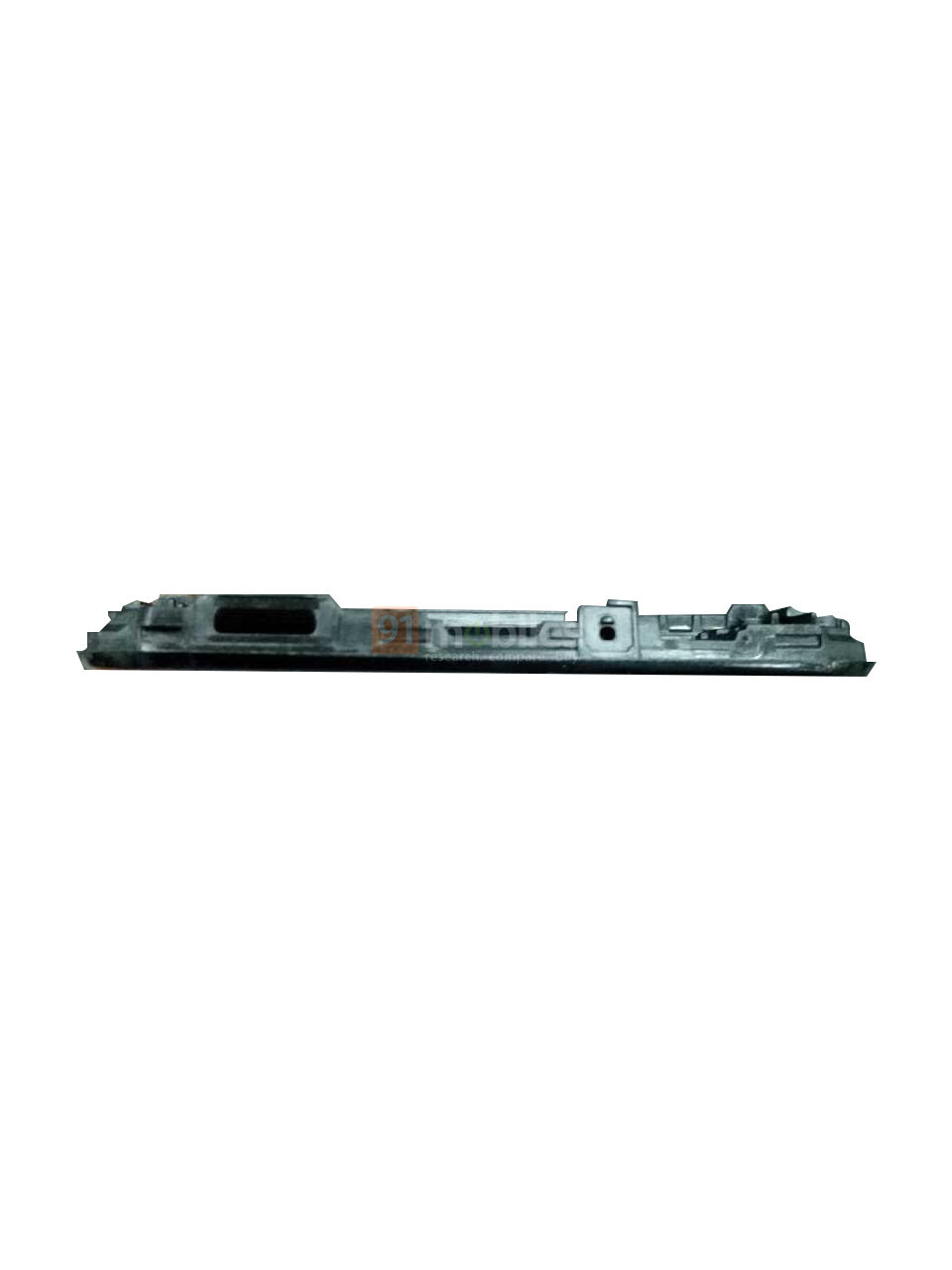
Moving on, a report by 91Mobiles says that Galaxy M12 is currently under mass production at a Samsung facility in Noida. Additionally, the report has shared images of the interior frame of the device. It shows a V-shaped cutout for the display confirming the previous CAD renders. Additionally, another live image shows a SIM-tray and a mic at the top.

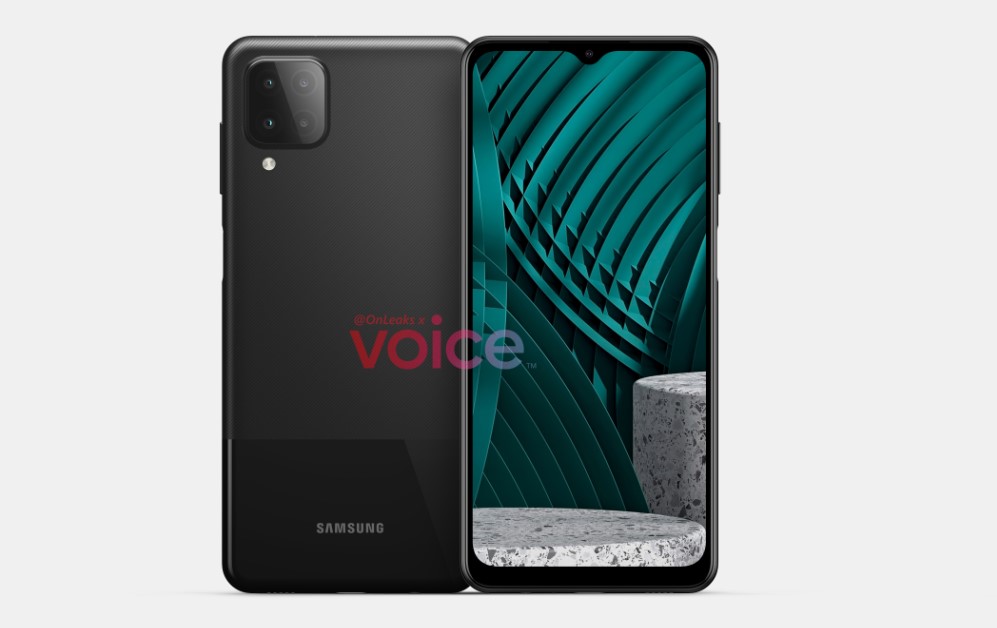
The Galaxy M12 has already received several certifications like India’s BIS, US’ FCC, Thailand’s NBTC. It is expected to feature a 6.5-inch display with an Infinity-V notch at the front. At the back, it will have a dual-tone finish and a squircle layout for the quad-cameras. Additionally, we can expect features like side-mounted fingerprint, 3.5mm audio jack, Dual SIM, etc.

The device is likely to feature an Exynos 850 4G SoC. Further, a Geekbench listing revealed that it will at least have a 3GB of RAM, run Android 11 OS. We can also expect Wi-Fi 2.4GHz, Bluetooth 5.0 connectivity courtesy of Network certifications.

Other expected specs include a 13MP main camera, 8MP selfie shooter, 6,000mAh battery with at least 15W charging support. Going by the report and other rumors, don’t be surprised if Samsung begins the year with this around mid-January in India.


OnePlus Nord N100 gets December 2020 security update with even more fixes

OnePlus Nord N100 is the brand’s cheapest smartphone of all time (as of now). This handset along with other devices released by the company in 2020 has been receiving multiple system updates since its release. This phone, in particular, is now getting its fifth OxygenOS build, and it’s only over a month old.

OnePlus Nord N100 Featured

The latest system update for OnePlus Nord N100 comes with build number OxygenOS 10.5.4 for the NA region and OxygenOS 10.5.5 for the EU region. Though the build numbers are different, they come with the common changelog.

Just like the previous updates, the new one also brings optimizations, fixes, and improvements, in addition to December 2020 security patch.


First of all, the new update optimizes system power consumption and Bluetooth device compatibility (NA only). It also fixes the phone not waking up under certain circumstances bug (NA only) and call noise issue.

Further, the latest update improves the camera’s shooting experience as well as the stability of communication functions. Last but not least, apart from adding a quick setting switch to adjust mute, ringtone, and vibration, it also brings an updated GMS (Google Mobile Services) package – September 2020 for the NA variant of the smartphone.

OnePlus Nord N100 OxygenOS 10.5.4/10.5.5 Official Changelog

  • System
    • Optimized system power consumption in some scenarios
    • Added a quick setting switch to adjust mute, ringtone, and vibration
    • Fixed the issue that the phone cannot wake up under certain circumstances (NA only)
    • Fixed a low probability call noise issue
    • Updated Android Security Patch to 2020.12
    • Updated GMS package to 2020.09 (NA only)
  • Camera
    • Improved the camera’s shooting experience
  • Network
    • Improve the stability of communication functions
  • Bluetooth
    • Optimize Bluetooth device compatibility (NA only)

Currently, like any other OTA update, the new OxygenOS builds for the OnePlus Nord N100 are being rolled out in batches. Therefore, it may take time to reach every unit out there.


Google patents a set of smartphone designs with a possible under-display camera

Last week, a design panted by Google revealed that the search giant could be working on a fitness tracker similar to Amazon Halo. Now, a set of design patents has appeared showcasing a smartphone without a front-facing camera.

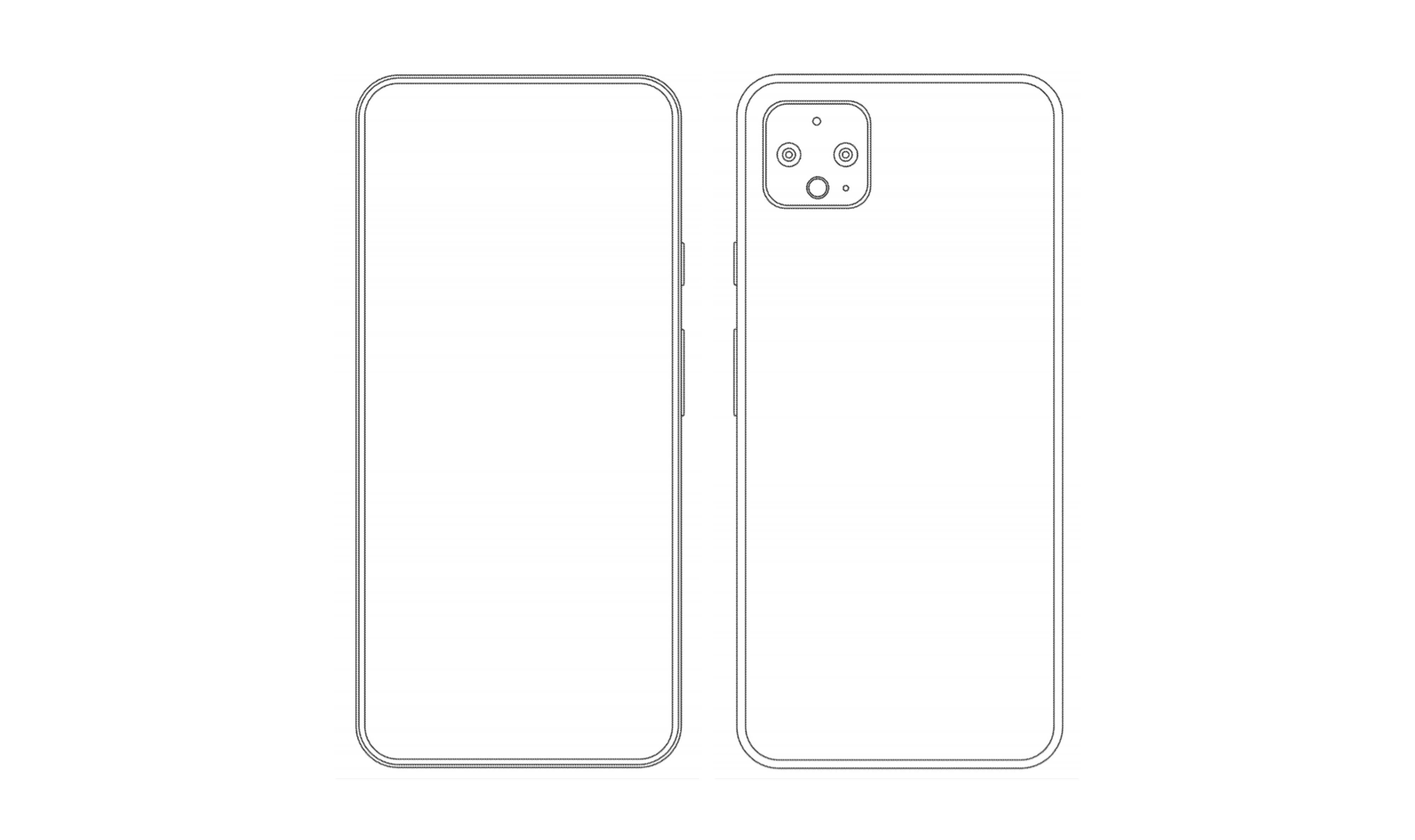
Google Smartphone Design Patent Under-Display Camera

These design patents were filed by Google with the USPTO (United States Patents and Trademarks Office). They were unearthed by Patently Apple. According to the publication, there are a total of four similar patents with slight variations and they go by the numbers – D903,618, D903,619, D903,620, and D903,622 respectively.

All of them have one thing in common and that is the smartphone in the sketches does not feature a display cutout for the selfie camera. But some of them do have an indication of an under-display earpiece.

Hence, the publication suggests these smartphone designs to feature an under-display camera. Further, none of these four patents show a rear-mounted fingerprint sensor as found on all the Pixels except Pixel 4 and Pixel 4 XL. Hence, we believe them to sport an under-display fingerprint sensor as well.

That said, apart from these two additions, the designs are similar to that of Pixel 5 and Pixel 4a 5G. They have the same button placements and an identical dual-camera setup array. The only difference is that the LED flash sits below as the secondary microphone is located at the top.

Anyway, we are not sure if any of these four design patents will ever end up as a final product just like numerous other patents.


First-ever Xiaomi Mi 11 Teardown reveals L-Shaped Cameras, Battery, and more

Another day, is it just another teardown video of a smartphone? Well, no. The Xiaomi Mi 11 which launched yesterday is the World’s first Snapdragon 888 SoC-powered flagship smartphone. Hence, let’s delve into see what Xiaomi has packed inside for us.

Xiaomi Mi 11 Leather - Smoke Purple and Khaki

Before we tear it apart, let’s look at what comes inside the box. Opening it up has documentation and the Mi 11 itself. As we all know, the Mi 11 doesn’t come with an in-box Adapter. However, Xiaomi is kind enough to give you the option of getting a free 55W GaN charger(limited time).

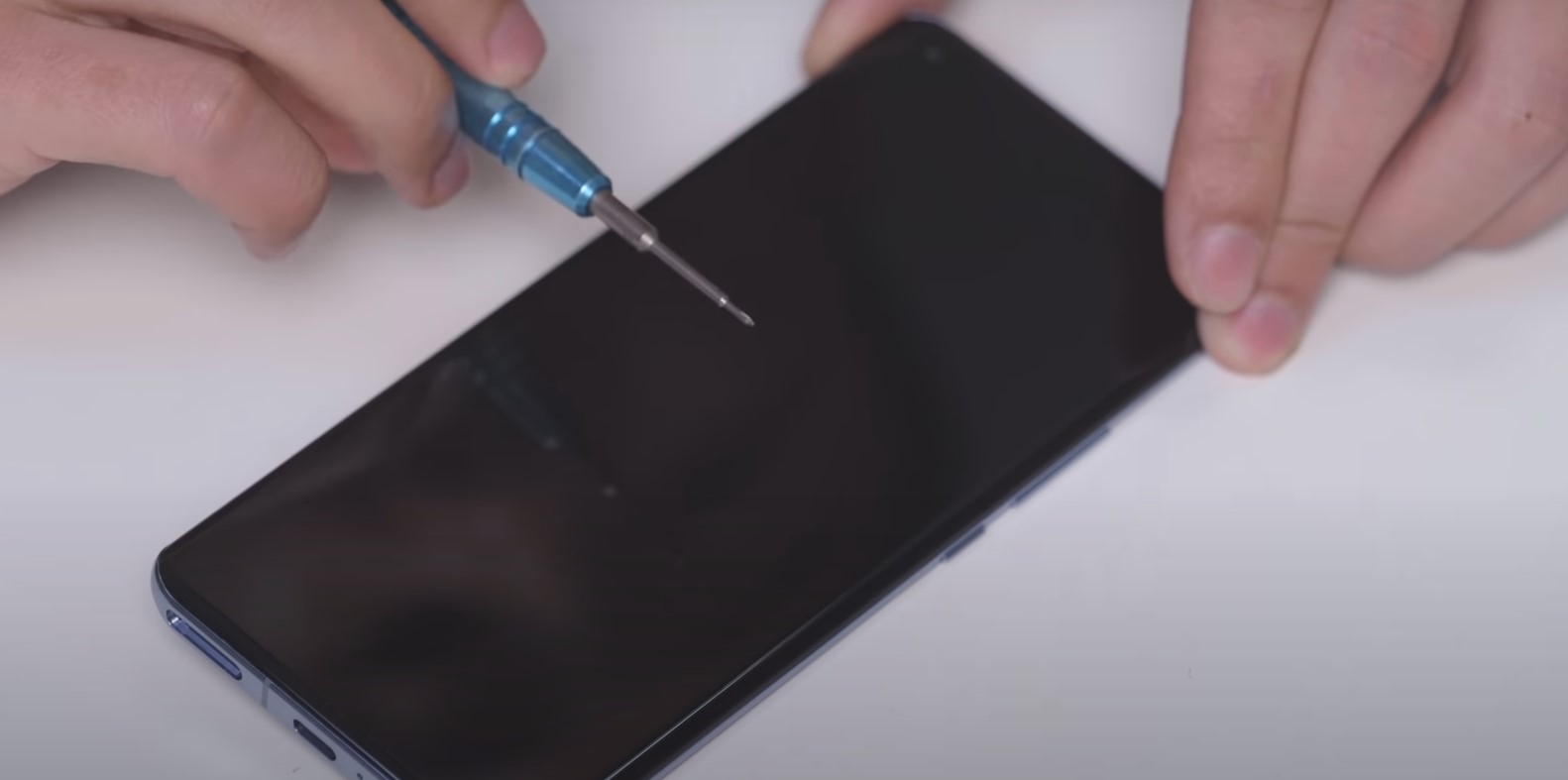
Moving on, the device in testing is a smoked Purple Leather Edition. The video by AIO Technology(via GSMArena) begins with a scratch test to get to know about the toughness of Corning Gorilla Glass Victus. Surprisingly, Xiaomi pre-installs a screen protector on the Mi 11 despite assuring 2x improved scratch resistance glass.

Rear Panel, Display

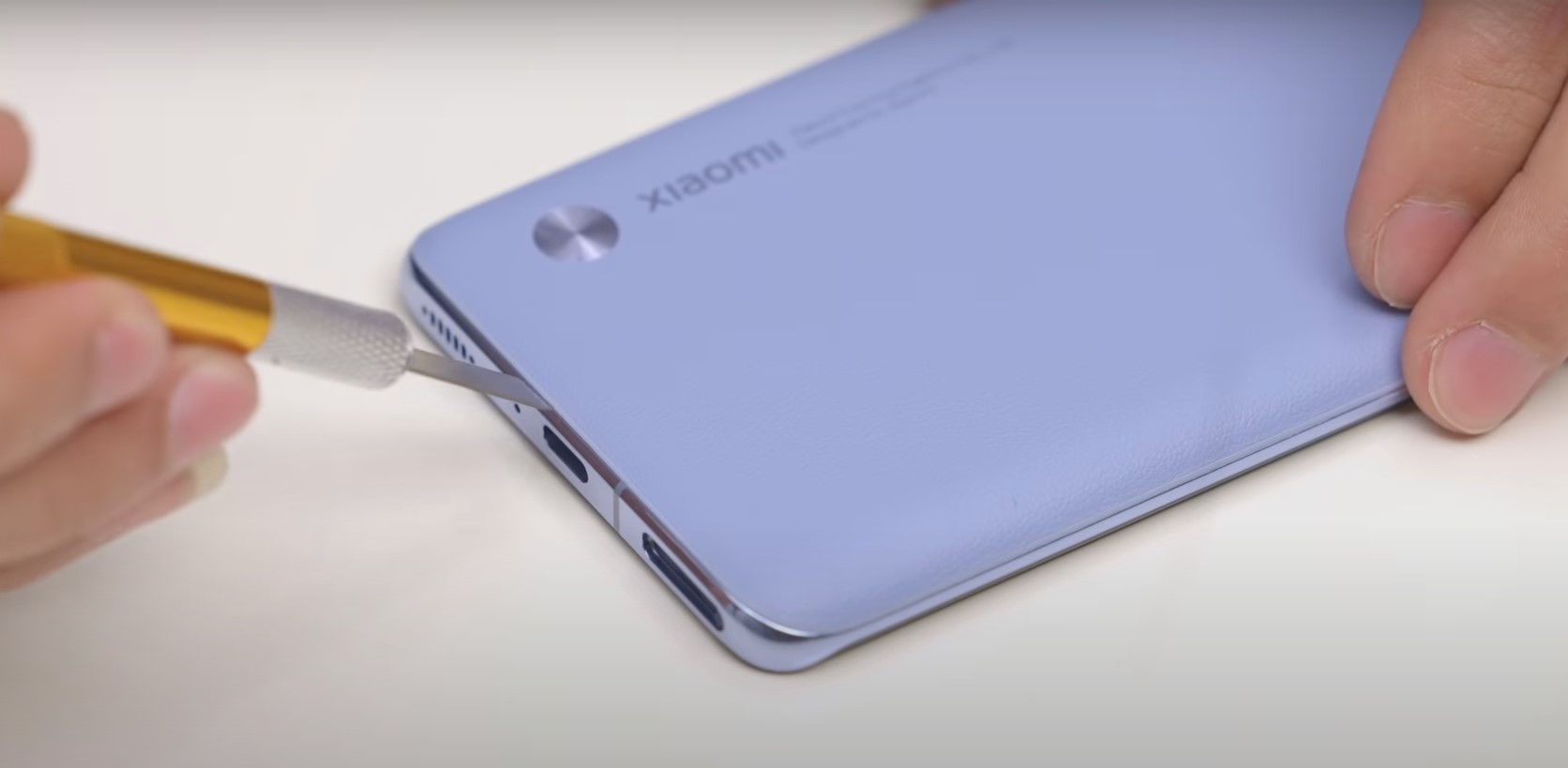
Although the screen survives keys, and sharp blades’ harm, it does give up on the Screwdriver as we see deeper grooves on harder scratch. At the bottom, there is the SIM-tray which, according to the video, has outer and inner mid-part made of metal but has a plastic frame.

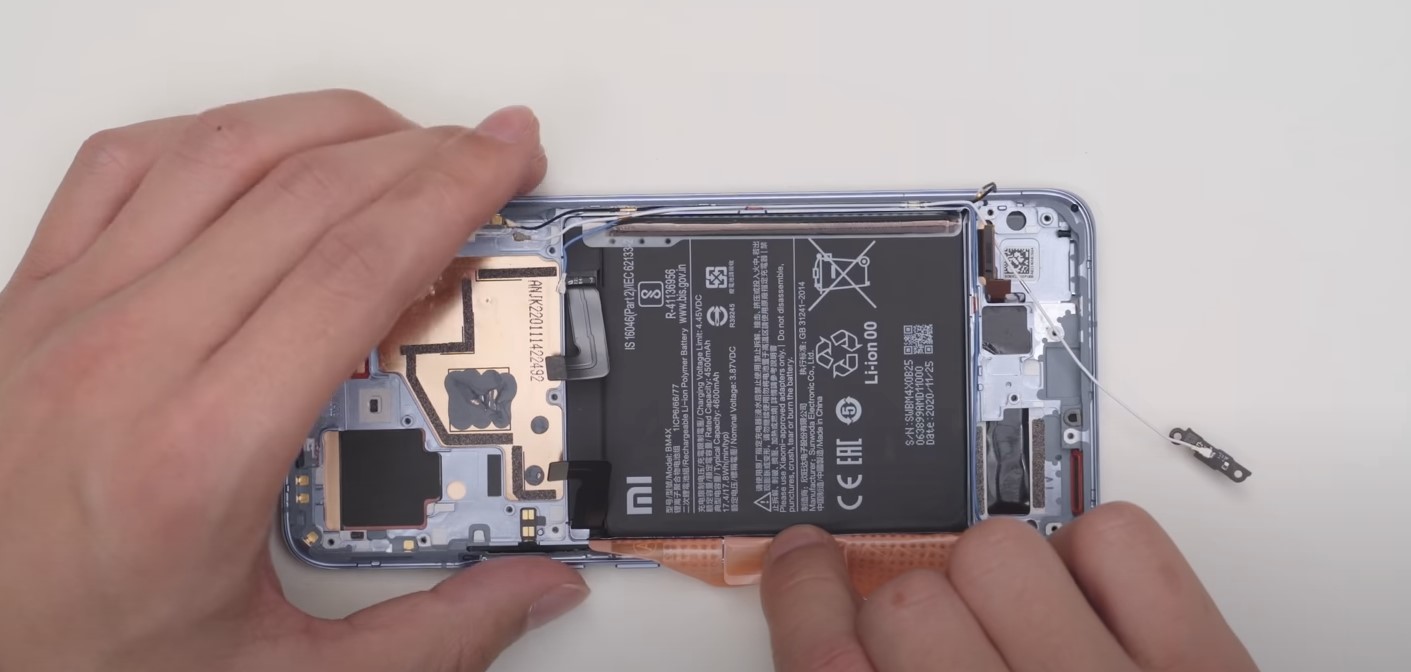
In case you don’t know, neither of the Mi 11 variants comes with an official IP rating. The flexible Vegan leather back on this edition becomes the icing on the cake for easy removal. Prying it open, you can see adhesives all over the other side of the back panel that is covered with cushion foam. Inside, we see the components arranged horizontally into three sections.

Camera, Motherboard

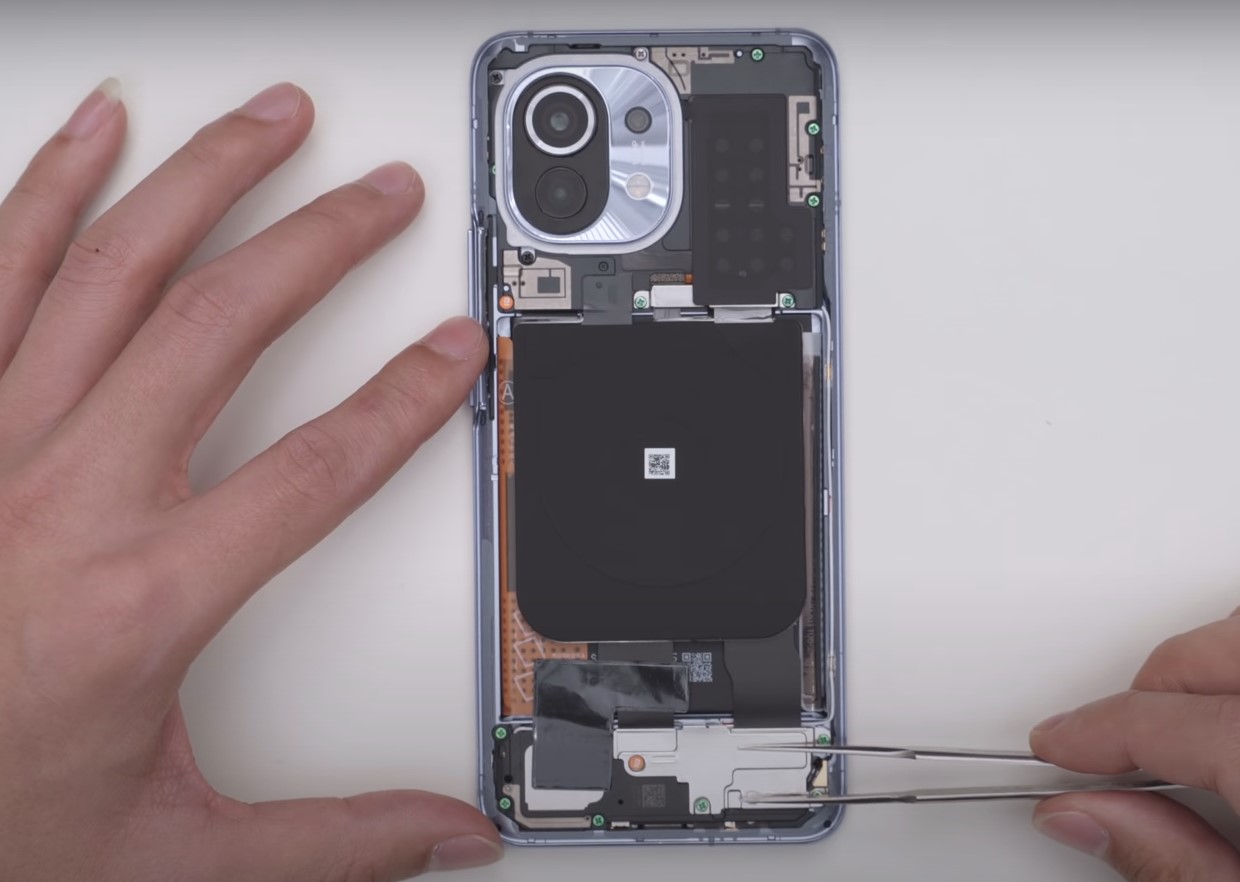
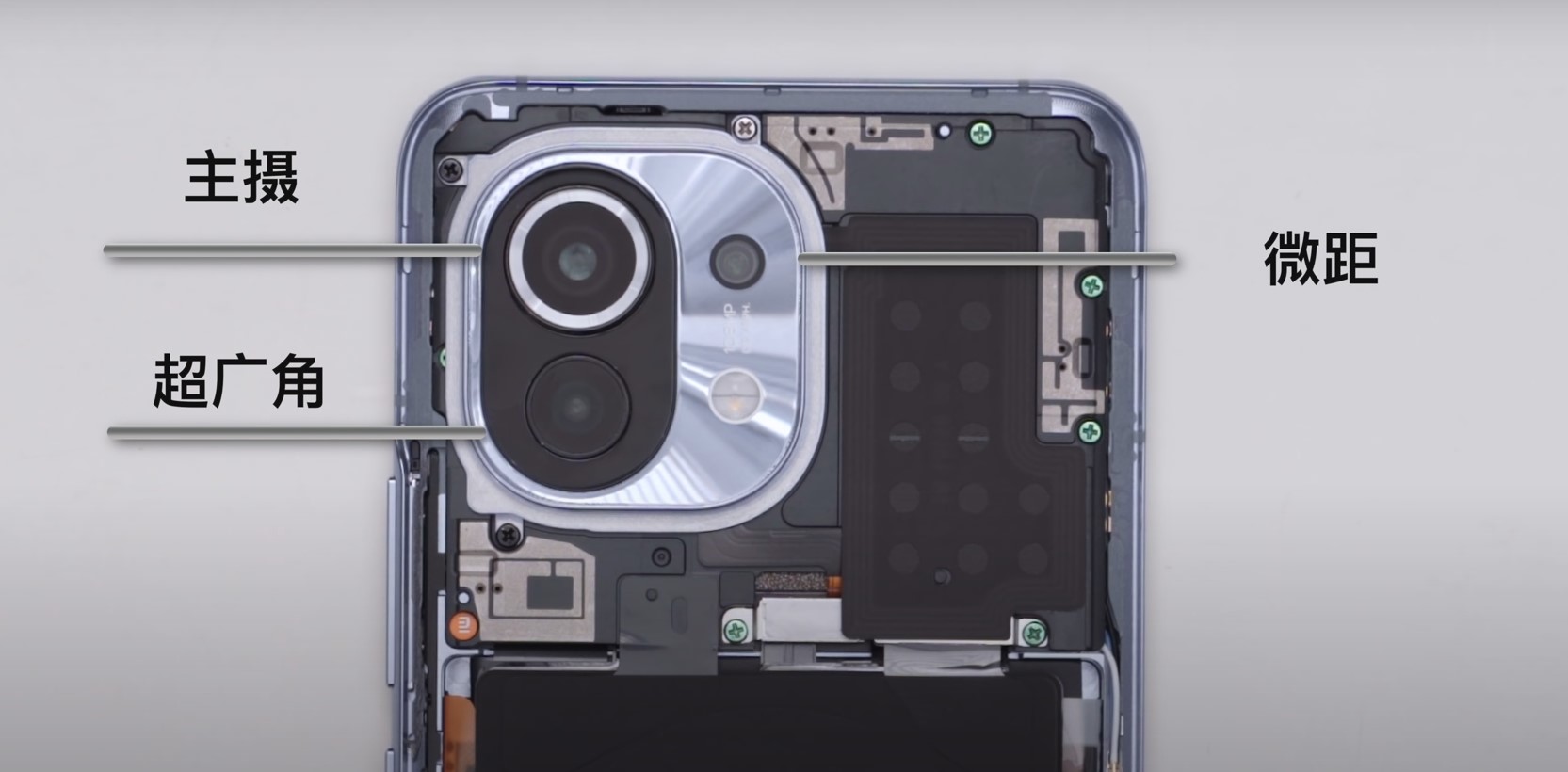
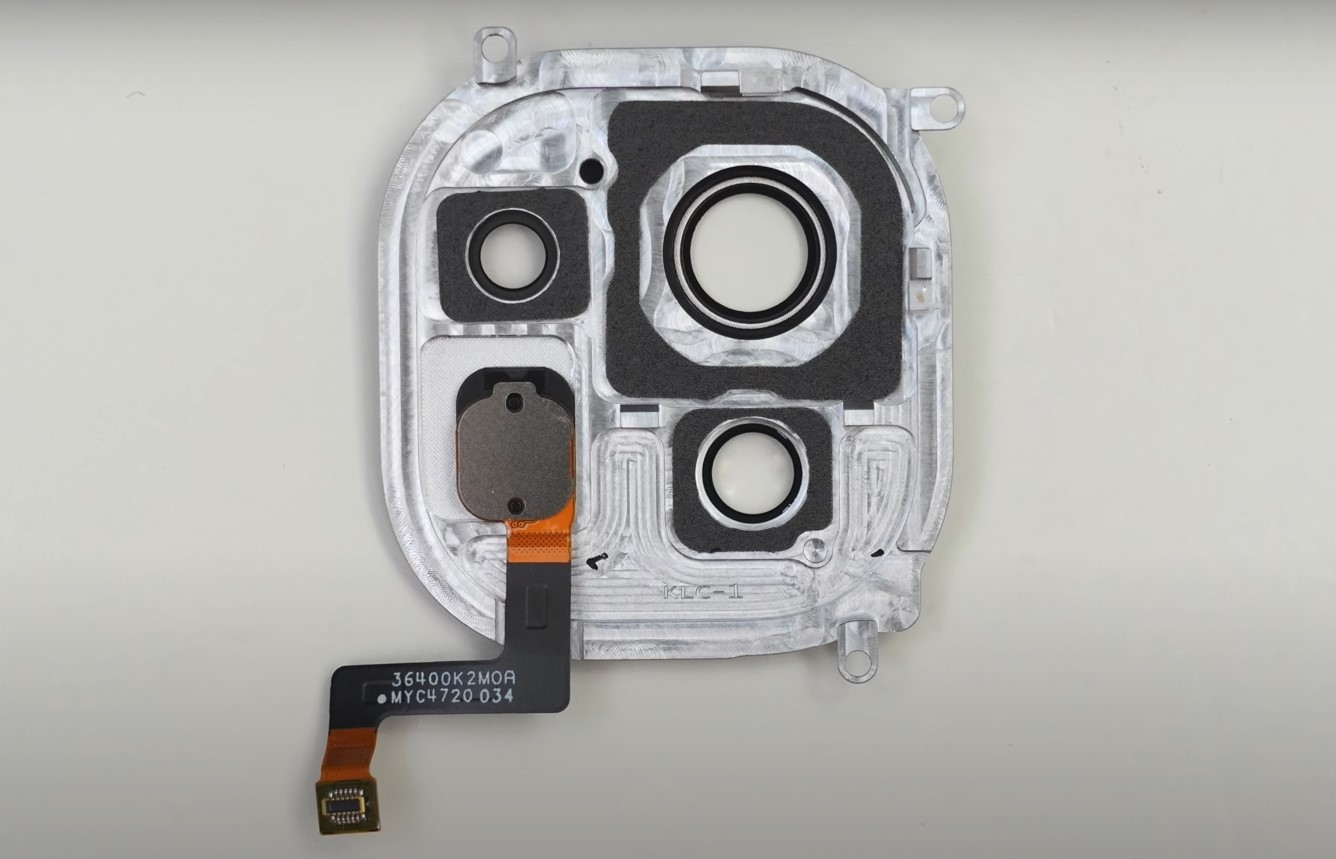
The first part shows the L-shaped Camera modules inside the squircle housing. This is a drastic change from the vertical strip on the predecessor, the Mi 10. Removing the screws(17-Total) and prying the layout reveals that Flashlight is independent and connects to the motherboard via a cable.

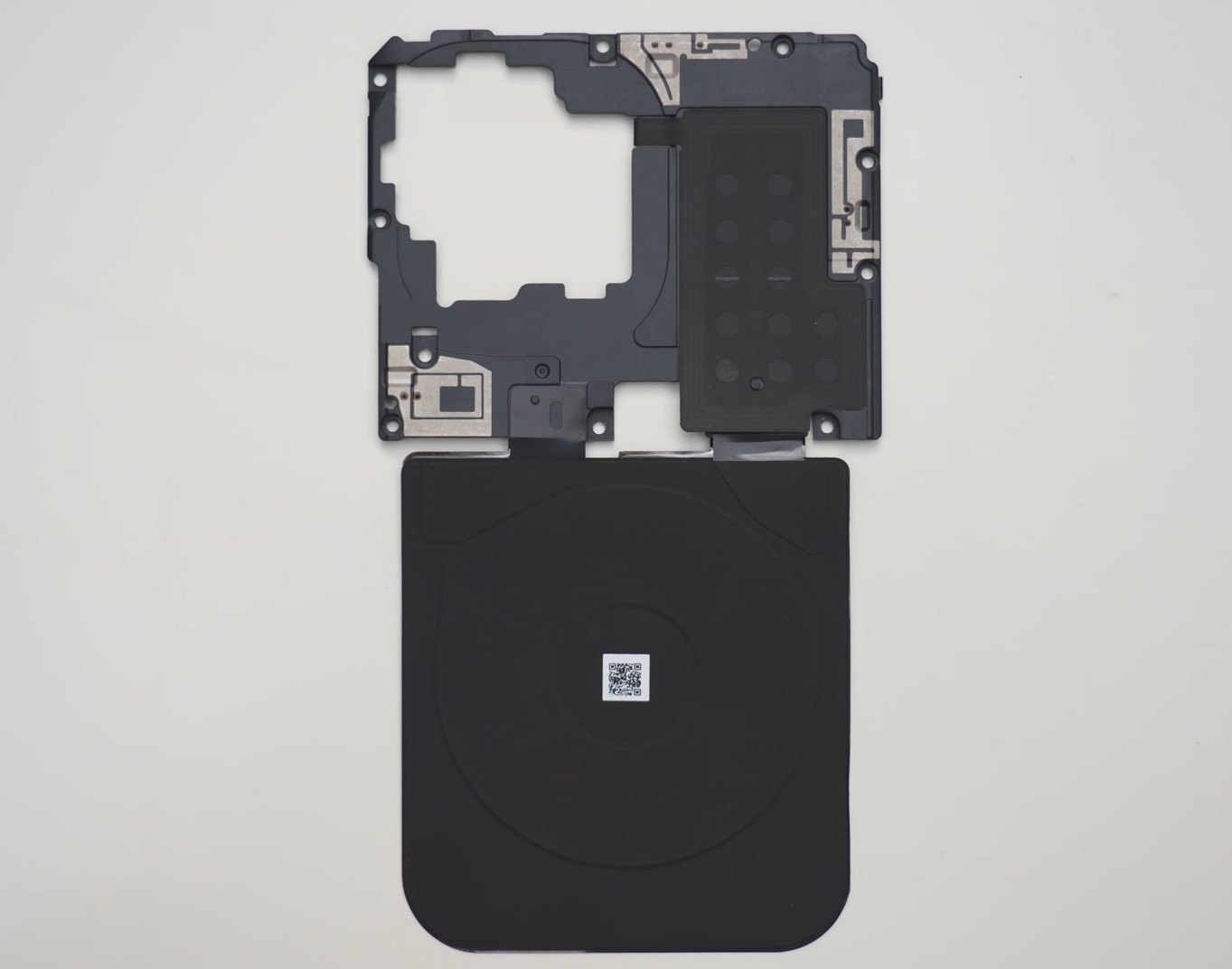
The back of the camera layout also has cushion foam for protection. Moving the cable clamps we see the Entire module(with 7 cushion foams on the back) consisting of an NFC Coil, A Conductive Cloth, and a Wireless Charging Coil(with heat dissipation layers).

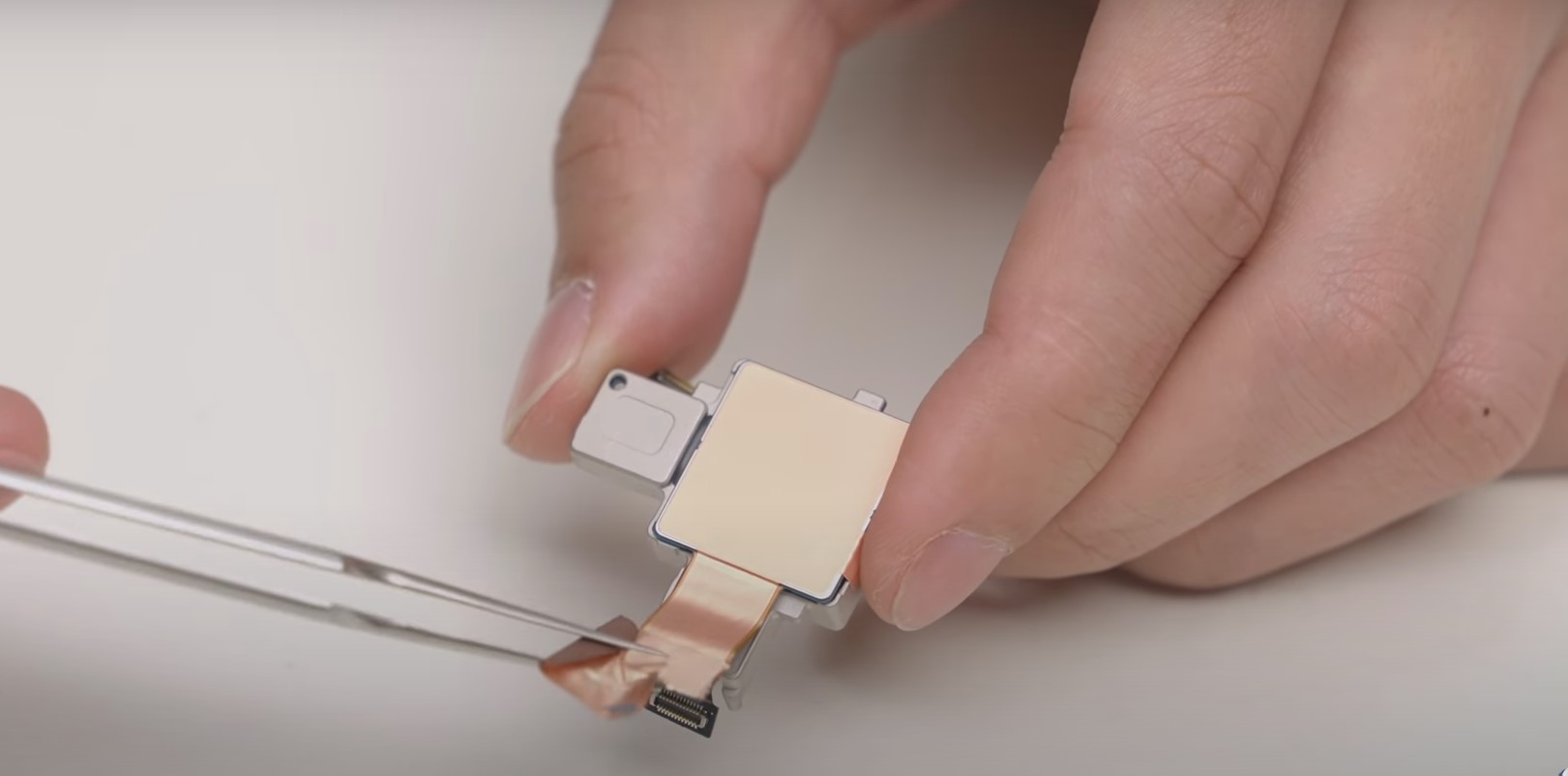
Removing this shows the motherboard and cameras. After disconnecting the battery, sub-board from the mainboard we see the entire Camera module is fused to a single cage. The main lens is a Samsung ISOCELL HMX, while the ultrawide and macro lenses are of OmniVision’s CMOS OV13B10 and Samsung S5K5E9 respectively.

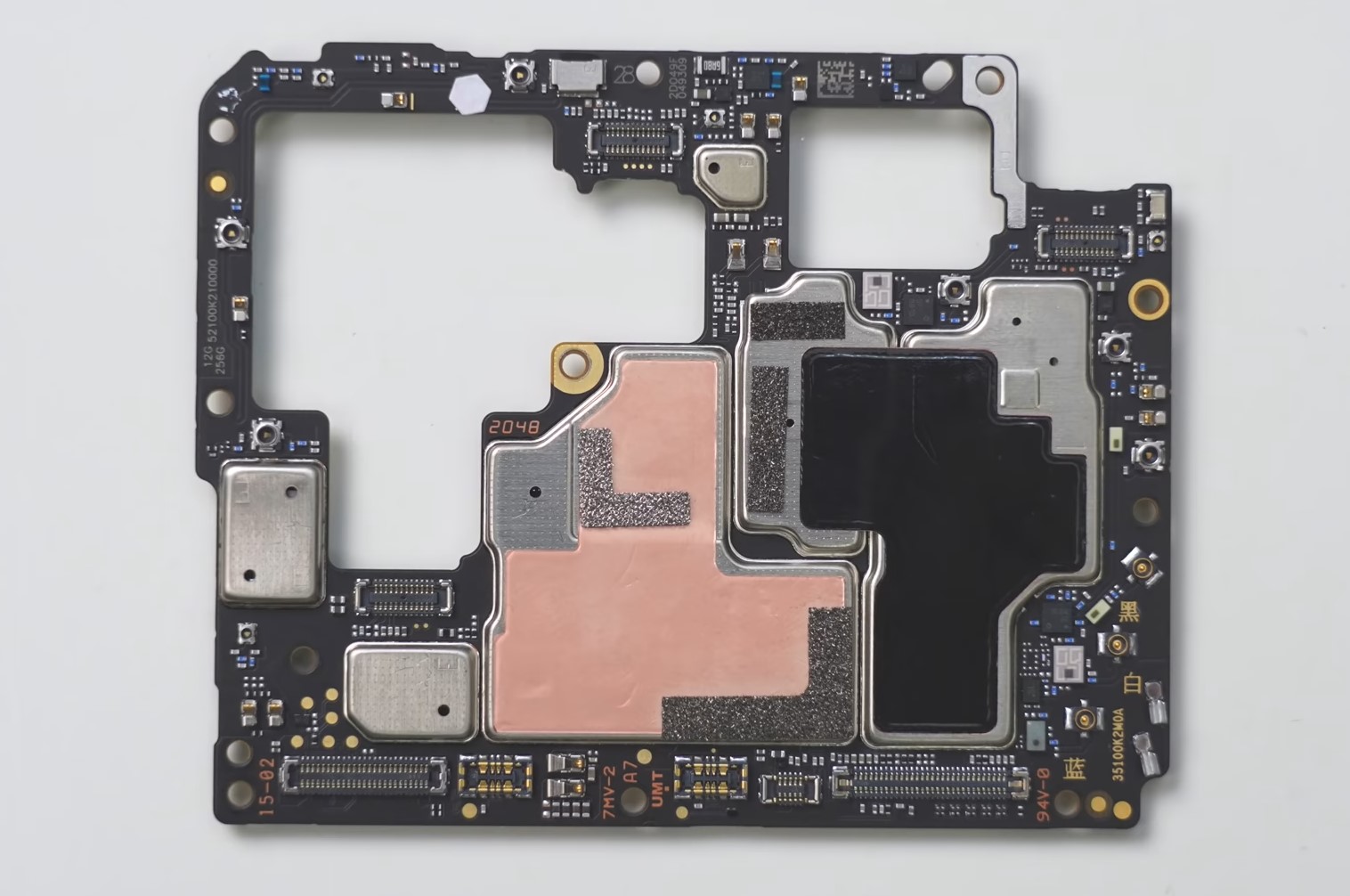
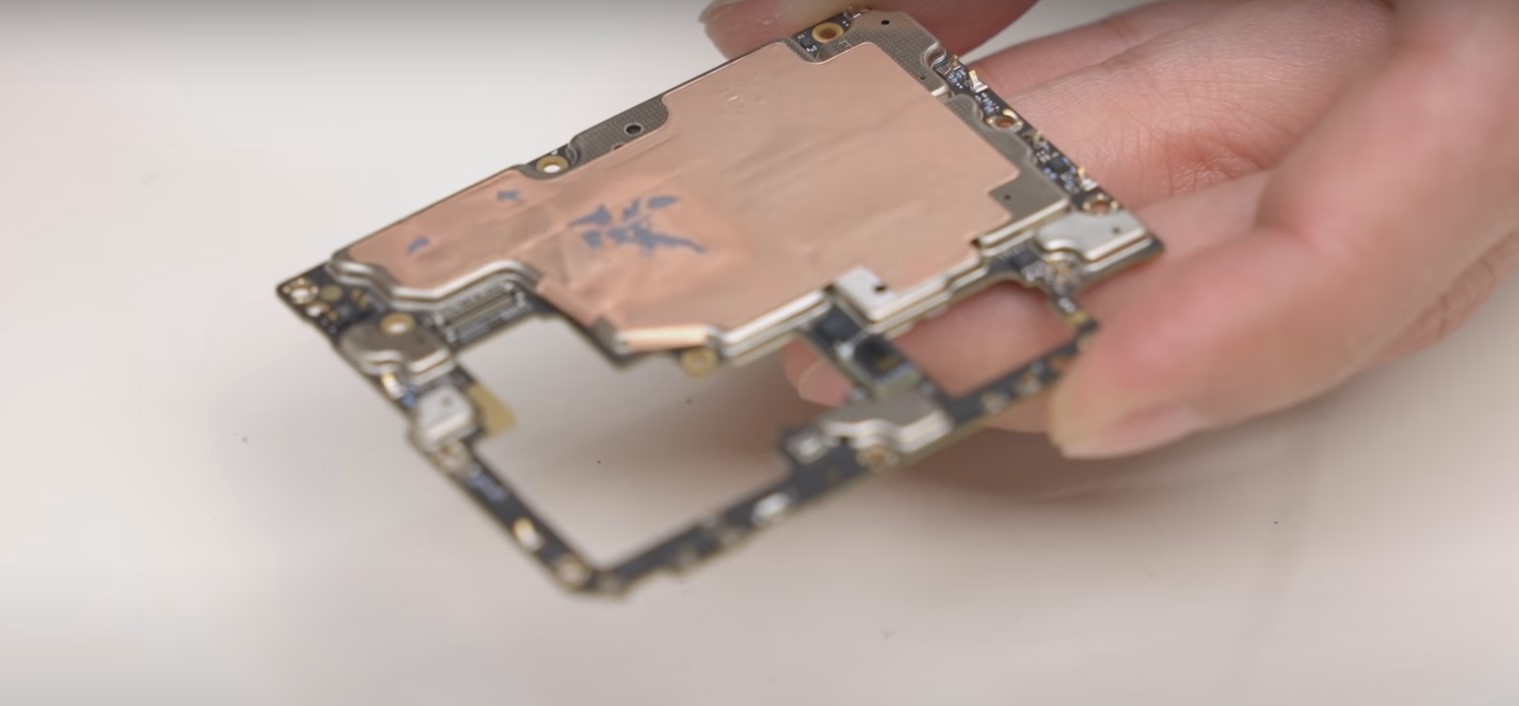
They also have copper foils attached to their cables as a heat sink. Speaking of which, the top and bottom portion of the motherboard also has copper foils for heat dissipation and the silver portion is the thermal paste that is applied over the Snapdragon 888 processor. Underneath the board, we see the Top earpiece that doubles as a stereo speaker and another VC plate for more cooling.

Battery, Rear portion

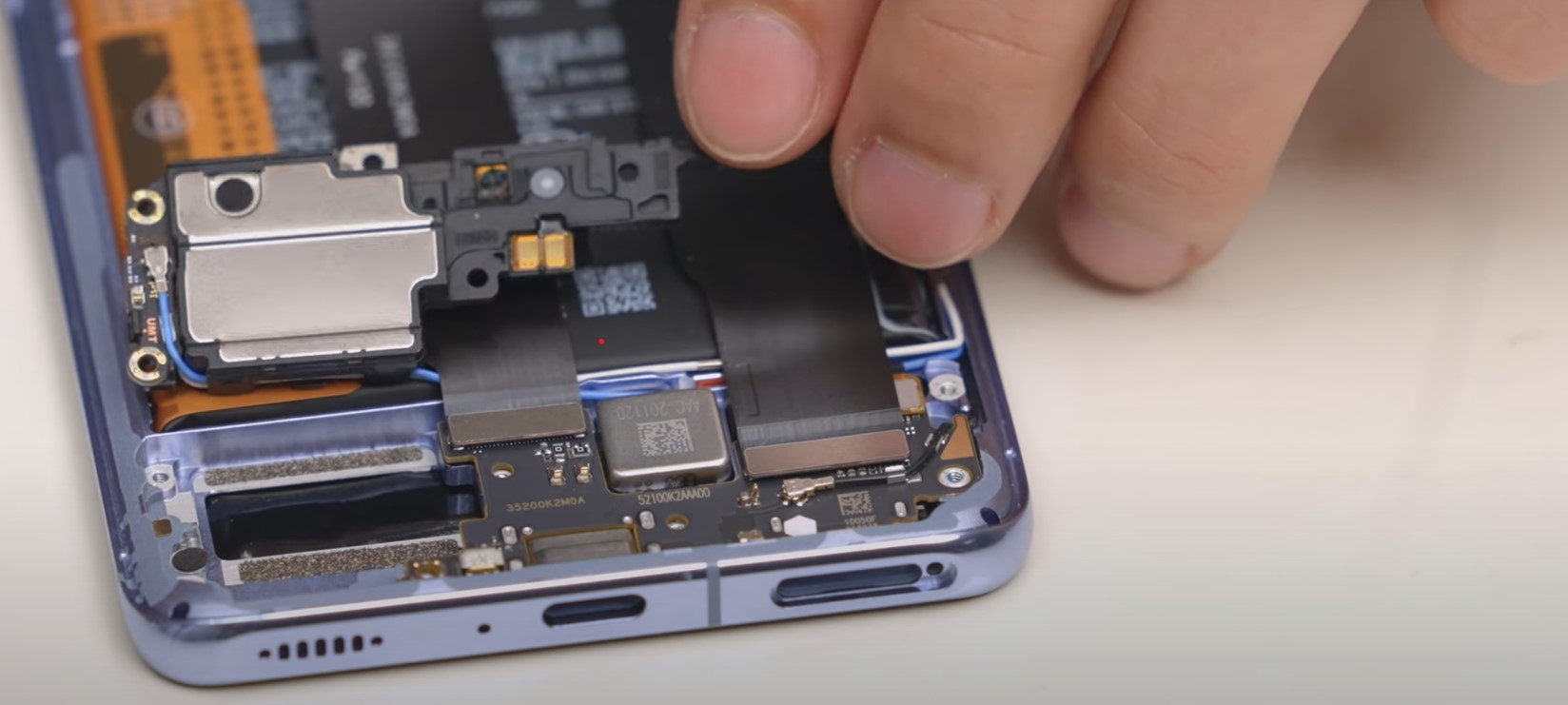
The below portion has an equally well-built enclosure around the components. Starting with the clamp that has cushion foams to hold the cables, it reveals the portion with Speaker(tuned by Harmon Kardon), Squared X-axis linear Vibration motor, SIM-tray, Type-C Port.

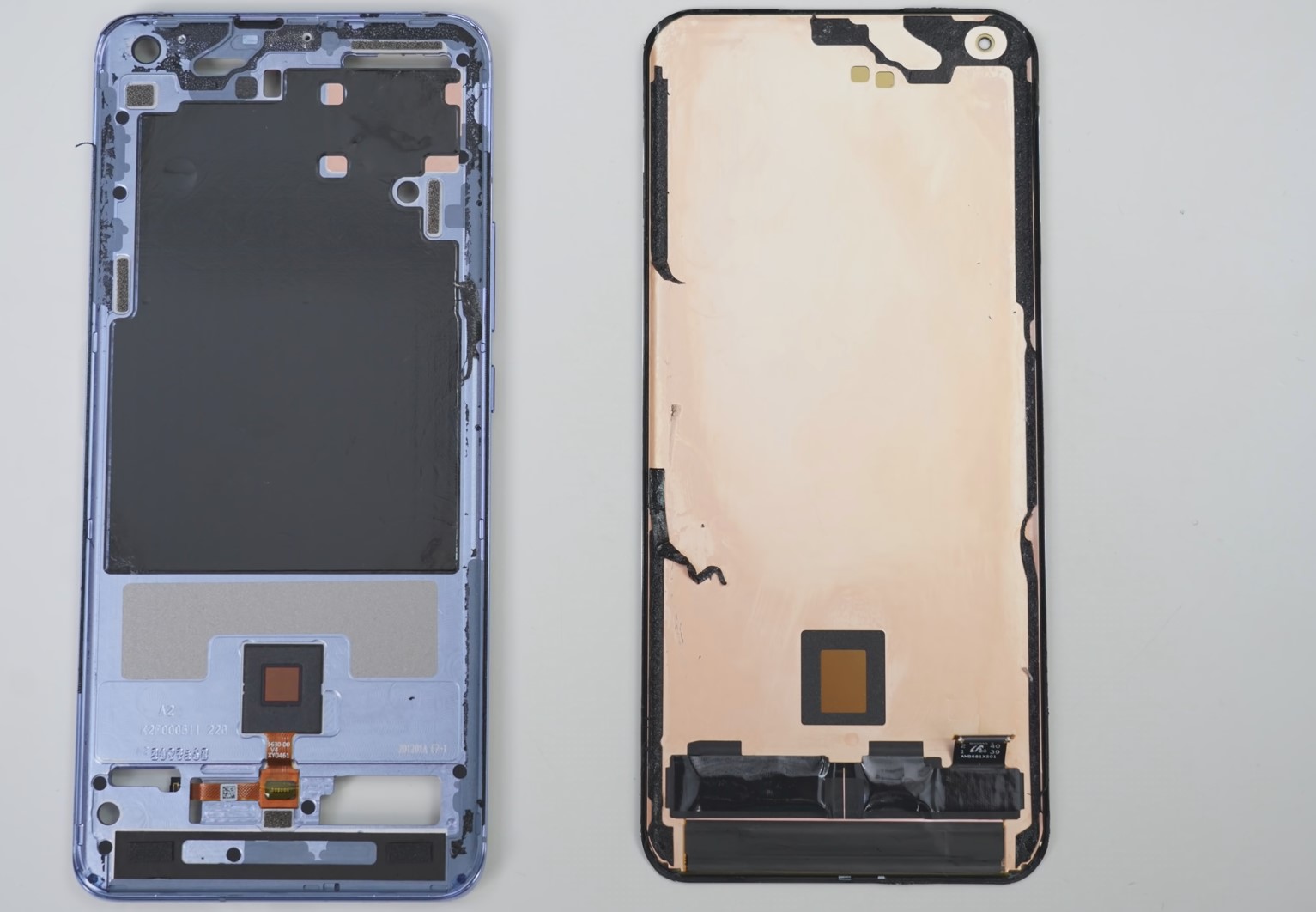
Finally, the 4,600mAh battery and mid-frame. Two pull tabs hold the BM4X Li-ion Polymer Battery that is made by Sunwoda Electronics Co Ltd. After this, removing the mid-frame reveals the Goodix’s in-display fingerprint sensor which also doubles as a heartrate sensor.


The Best Smartwatches and Fitness Trackers of 2020

This year was a big one for wearables as several smartwatches from various manufacturers and across different price categories were announced. We also had new players such as OPPO and Vivo make their entry into the wearables market with the OPPO Watch and Vivo Watch respectively. If you are on the search for a new smartwatch, then our list of the best smartwatches of the year should help you.

1Best Apple Watch – Apple Watch Series 6

Apple Watch Series 6 Aluminum
Apple Watch Series 6

If you want to grab an Apple Watch, it makes sense that you pick the best, and currently, that is the Apple Watch Series 6. It has a great display, new health features including blood oxygen level detection, ECG, and lots of sports functions. With a starting price of $399, you can’t go wrong with Apple’s latest offering.

Buy Now


Honorable Mention: Apple Watch SE

Apple Watch SE
Apple Watch SE

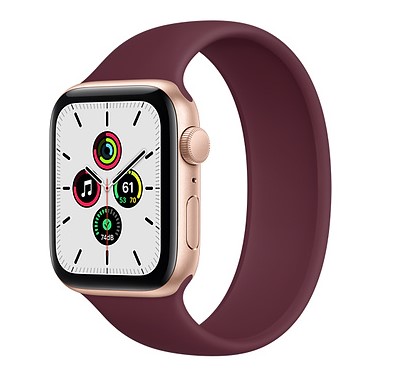
The Apple Watch SE is an alternative if your budget is under $300. It packs a lot of important features such as a retina display, fall detection, sleep tracking, and heart rate measurement but it drops others such as ECG and Blood Oxygen level detection to keep the price tag low. It starts at $279.

Buy Now

2Best non-Wear OS Smartwatches – Samsung Galaxy Watch3 and Huawei Watch GT 2 Pro

Samsung Galaxy Watch 3 and Huawei Watch GT 2 Pro

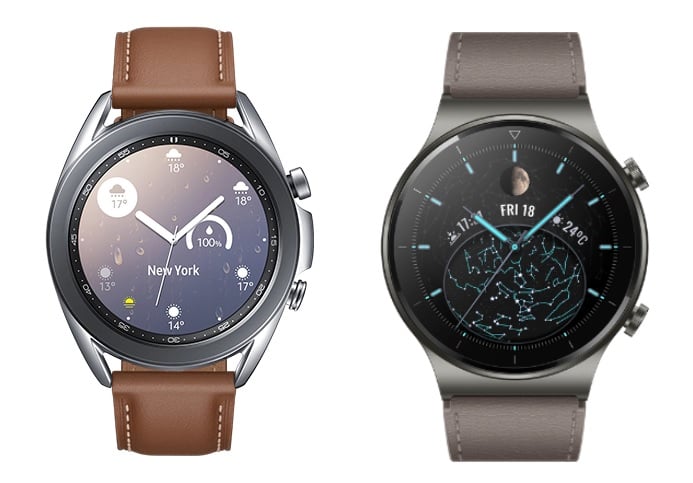
If you want a smartwatch that doesn’t run Wear OS, then you can choose between Samsung’s Galaxy Watch 3 and Huawei’s Watch GT 2 Pro. Both watches run their own proprietary operating systems – LiteOS on the Huawei watch and Tizen OS on the Samsung watch.

These two watches combine style and functionality and are made from premium materials including titanium. Both watches have ECG*, blood oxygen level measurement, sleep monitoring, and support for professional sports. The Galaxy Watch 3 starts at $399 while the Huawei Watch GT 2 Pro starts at €299.

Buy Now


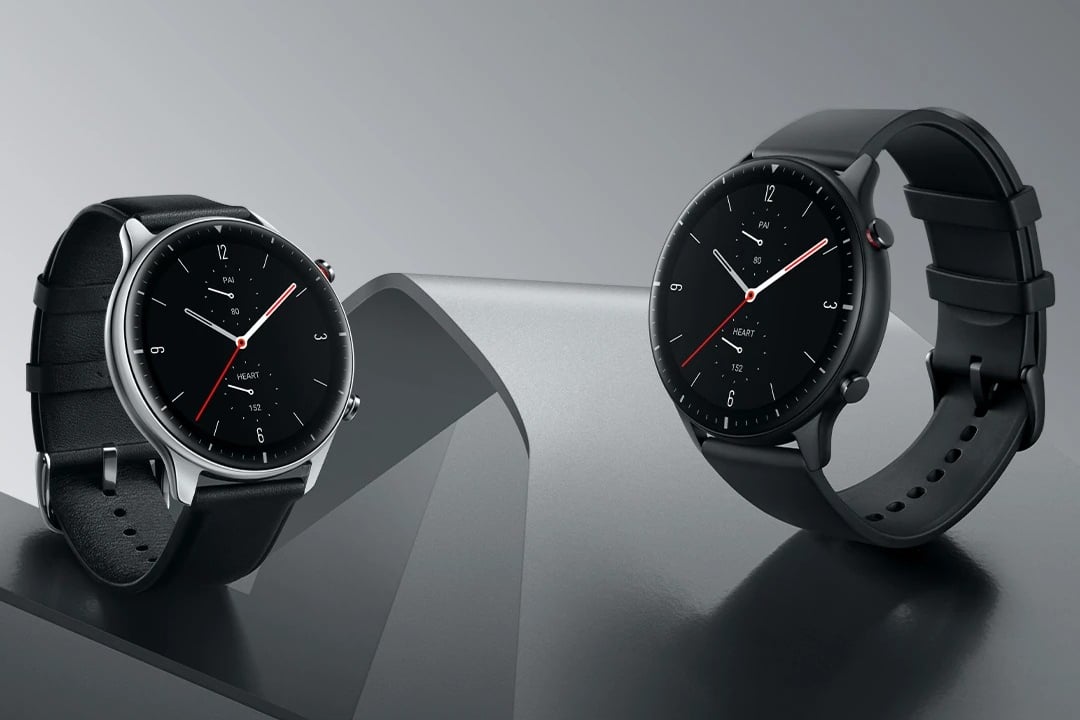
Honorable Mention – Amazfit GTR 2

Huami Amazfit GTR 2 Featured
Amazfit GTR 2

If you want something much more affordable than the Huawei Watch GT 2 Pro and the Samsung Galaxy Watch 3, the Huami’s Amazfit GTR 2 is a great choice. This round-faced watch has an AMOLED display, SpO2 sensor, heart rate monitor, sleep tracking, Amazon Alexa, support for Bluetooth calls, in-built storage, GPS, support for 90 sports modes, and 14-day battery life. It is priced at $179.99.

Buy Now


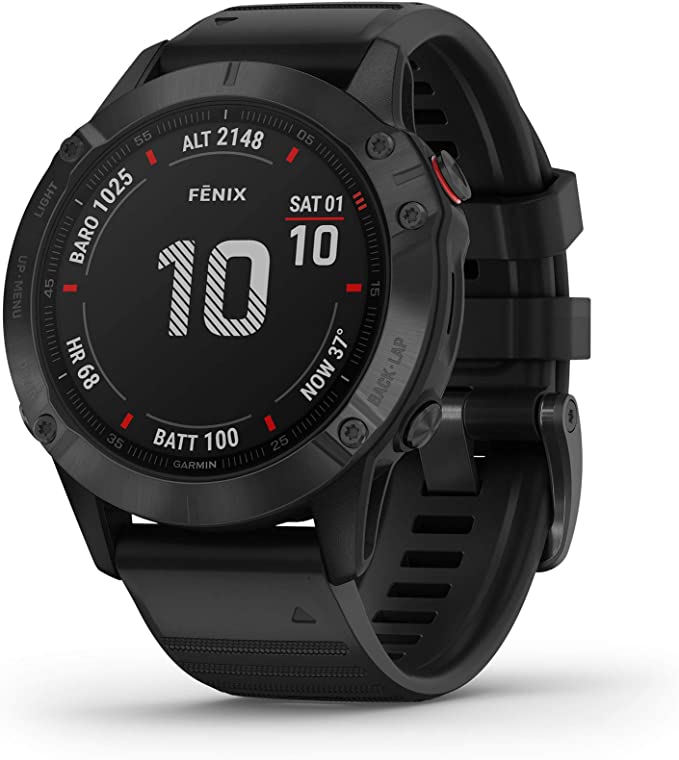
3Best Rugged Smartwatch – Garmin Fenix 6 Pro

Garmin Fenix 6 Pro

If you want an outdoor/rugged watch that does it all, then the $699.99 Garmin Fenix 6 Pro is the watch for you. It packs a 1.3-inch transflective display with a 260 x 260 resolution and Gorilla Glass DX or Sapphire Crystal. Alongside all you will expect from a standard smartwatch, the Garmin Fenix 6 Pro justifies its price tag with a lot of premium features you won’t find on most of the other watches on this list.

It allows you to add maps; store up to 2000 songs on its 32GB of built-in storage; provides support for pre-loaded activities such as skiing, trail running, rowing, and golfing; and provides access to CourseView maps for more than 41,000 golf courses across the world. It also has hydration tracking, body energy monitor, and advanced sleep monitoring that includes respiration data. Its battery life varies but in smartwatch mode, it goes up to 14 days on a single charge.

Buy Now


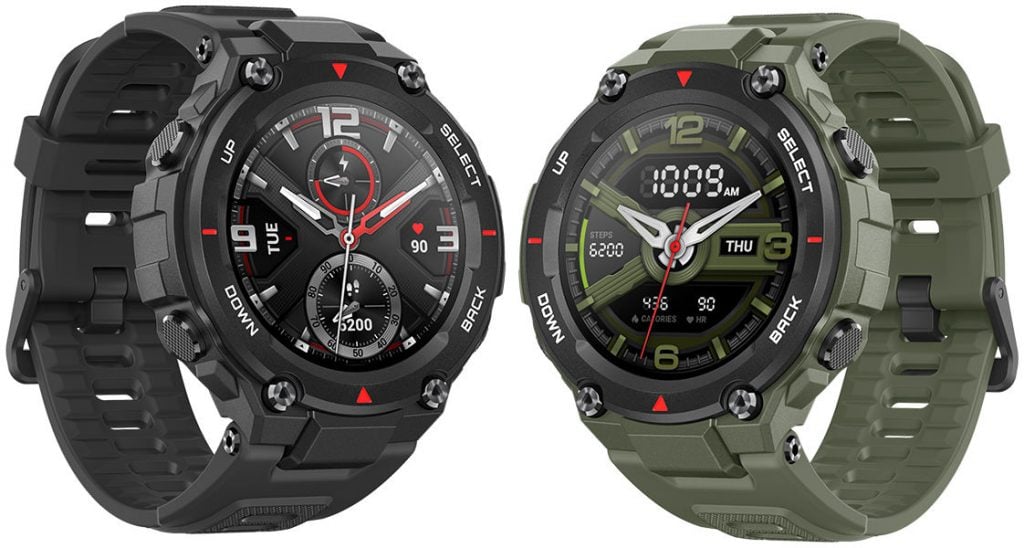
Honorable Mention – Amazfit T-Rex

At $699.99, the Fenix 6 Pro will definitely be out of the range of several folks, but you can pick up the Amazfit T-Rex rugged smartwatch for a fraction of that price, $139.99 to be precise. It misses out on several features of the Garmin watch but if all you want is a watch that will survive outdoors, then it will do.

Amazfit T-Rex

It has 12 military-grade certifications and will handle extreme temperatures and weather. The AMOLED screen is 1.3 inches in size just like that of the Fenix 6 Pro but it is sharper as its resolution is higher. There are fourteen supported professional sports modes, built-in GPS, and it has heart rate monitoring, a 20-day battery life, and a 5ATM water-resistant rating.

Buy Now


EDITOR’S PICK: OnePlus’ CEO says OnePlus Watch is coming early next year

4Best Budget Smartwatches – Amazfit GTS 2 Mini and Huawei Watch Fit

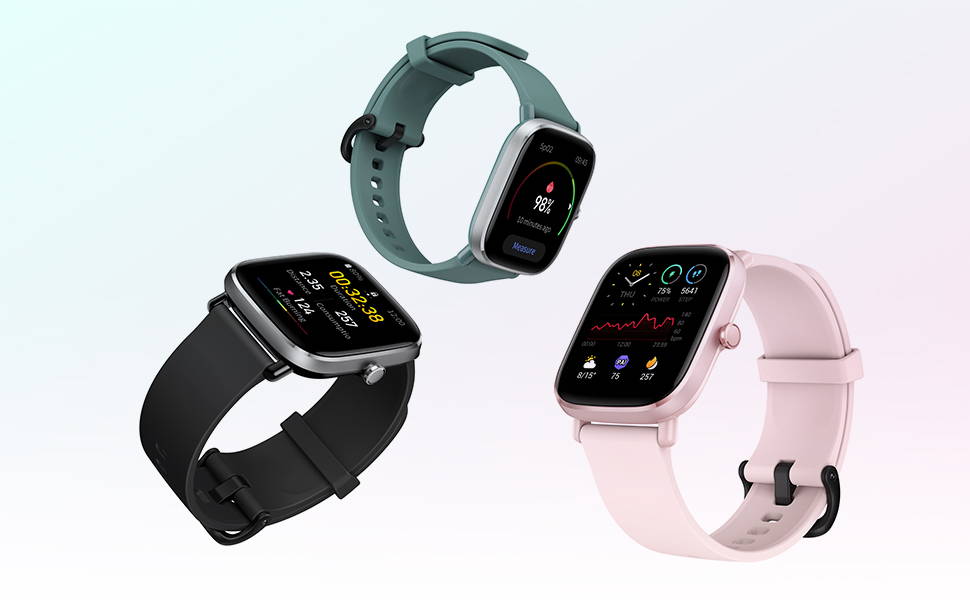
Amazfit GTS 2 Mini
Amazfit GTS 2 Mini

The Amazfit GTS 2 Mini is a cheaper version of the Amazfit GTS 2 but if you are on a budget, this is probably the smartwatch for you. At $99, this watch has a 1.55-inch AMOLED screen, 70 sports modes, SpO2 monitor, women’s health tracking, Amazon Alexa, GPS, and a battery life that lasts up to 14 days.

Buy Now

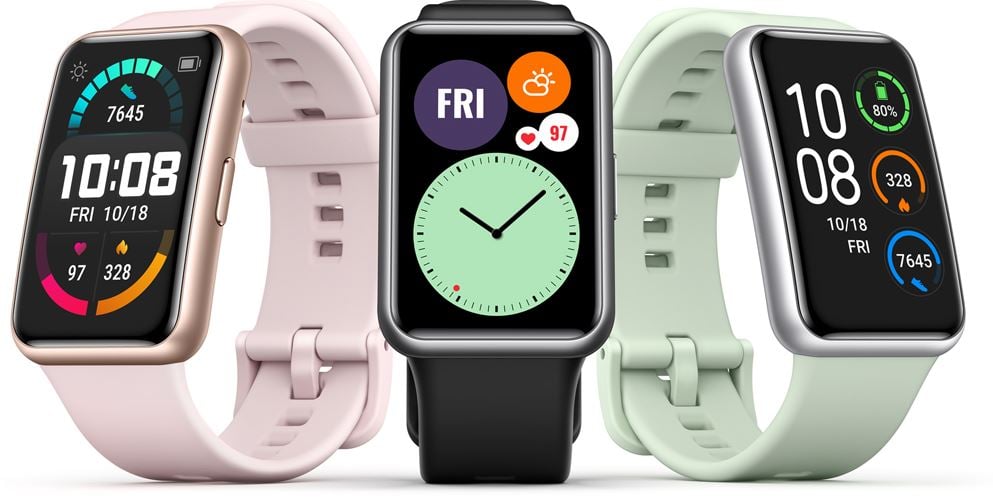
Huawei Watch Fit

The Huawei Watch Fit is also another option. Its elongated 1.64-inch AMOLED screen will definitely draw attention but that is not all it has got. It boasts more than 90 sports modes along with a built-in trainer and animated workouts. It also has a SpO2 sensor, GPS, 5 ATM water resistance, and a 10-day battery life. While it launched for €129, the watch can be purchased for €99 in a number of European countries.

Buy Now


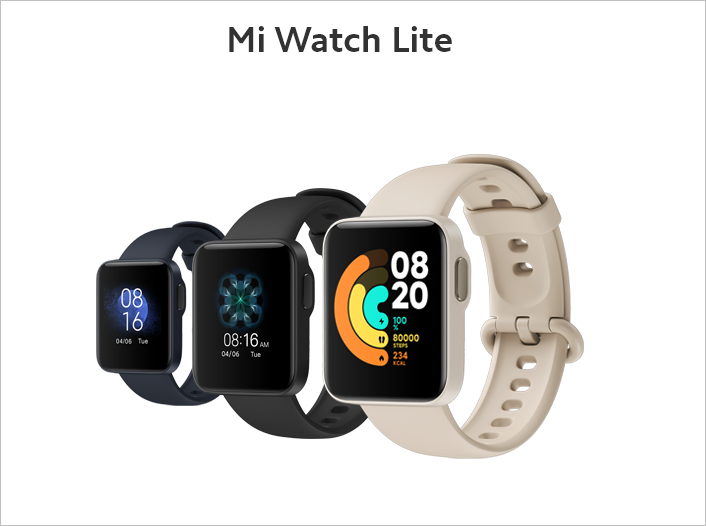
Honorable Mention – Mi Watch Lite

Mi Watch Lite
Mi Watch Lite

The Mi Watch Lite makes for an honorable mention. With a price tag of around $60, this is for those who want to save even more money. It doesn’t have SpO2 measurement and its sports modes are fewer at just 11. Nevertheless, you get a square 1.4-inch dial with more than 120 watch faces to choose from, heart rate measurement, a barometer, GPS, and a battery life of about 9 days.

Buy Now


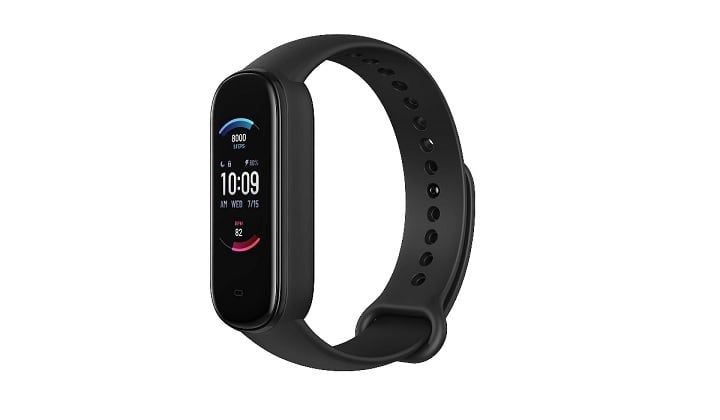
5Best Fitness Tracker – Amazfit Band 5

Amazfit Band 5
Amazfit Band 5

If you want a fitness tracker, then the $49.99 Amazfit Band 5 is our pick for the best fitness tracker. It packs a 1.1-inch AMOLED display; can measure blood oxygen level saturation alongside heart rate, sleep, and stress level. It also has Amazon Alexa, support for 11 sports modes, women’s health tracking, and a battery life that lasts up to 15 days in typical usage and up to 25 days in basic mode.

Buy Now


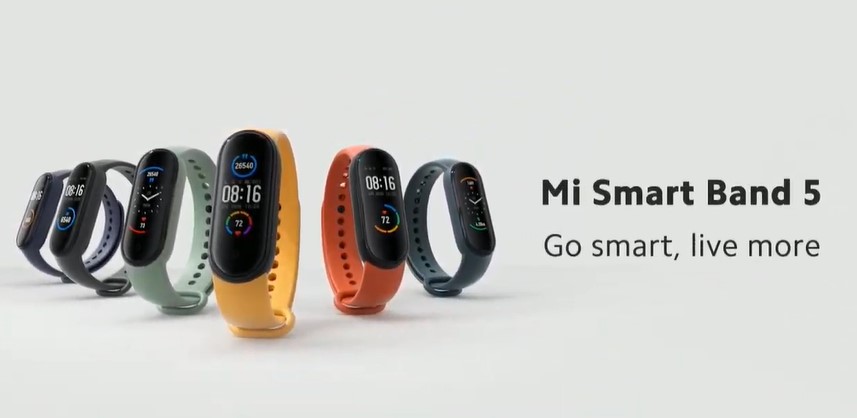
Honorable Mentions – Xiaomi Mi Band 5 and Honor Band 6

Mi Smart Band 5 featured

The Mi Band 5 is a cheaper alternative to the Amazfit Band 5. Both can pass for the same as they are made by the same manufacturer, Huami. However, Xiaomi’s own doesn’t have blood oxygen level detection, Amazon Alexa, and women’s health tracking. It currently goes for between $30 and $35.

Buy Now


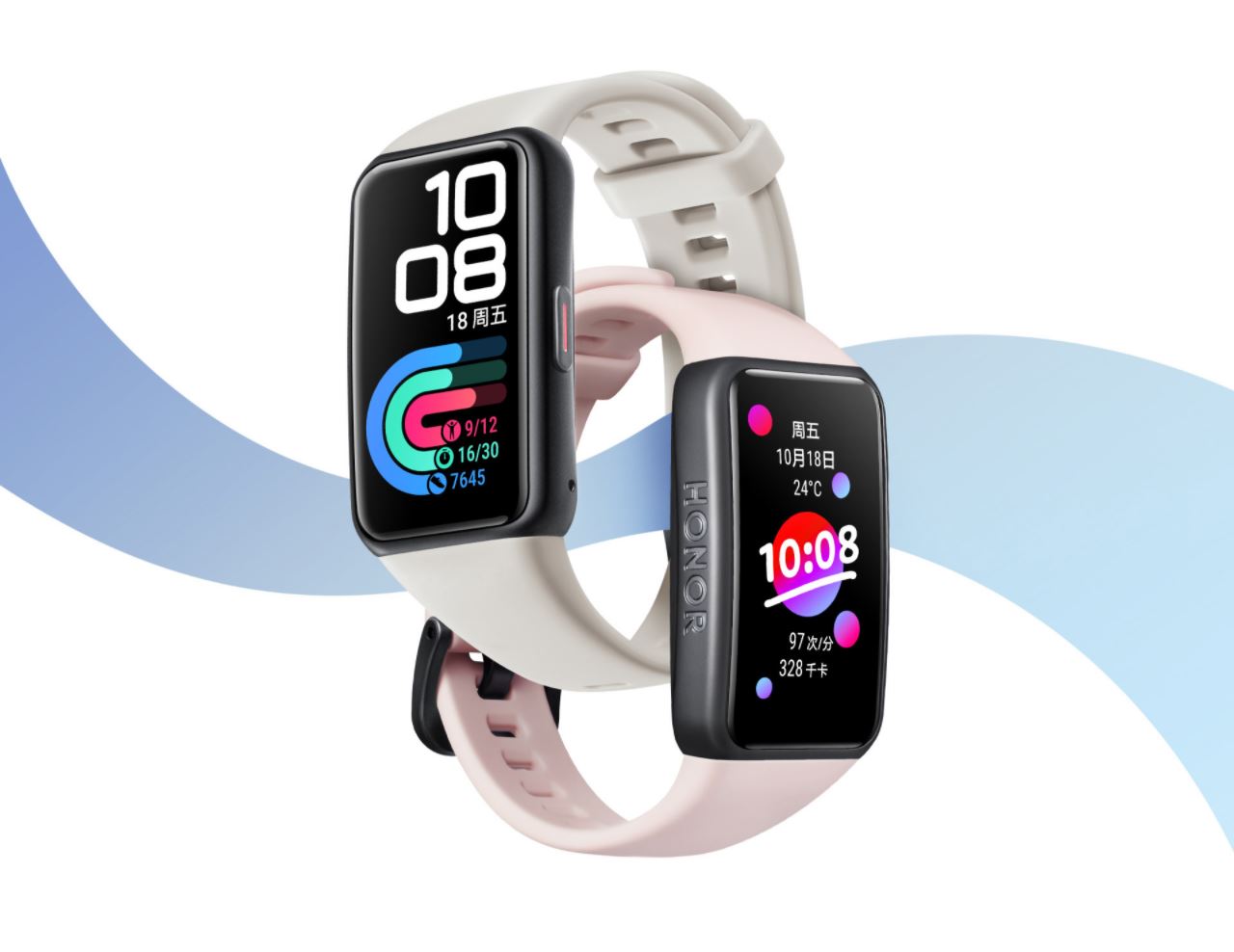
Honor Band 6
Honor Band 6

Priced at about ~$40 Honor Band 6 packs a much bigger display than the other two fitness trackers. It is a 1.47-inch AMOLED display with a 368 x 194 resolution. The fitness tracker has support for 10 sports modes, automatic workout detection, SpO2 measurement, 5 ATM water resistance rating, and 14-day battery life. Unfortunately, it doesn’t have GPS.

Buy Now


So these were our picks for the BEST Smartwatches and smartbands in 2020. Do you think any other watch deserves a mention in this list? Let us know in the comments down below!


Honor V40 tempered glass protector image leaked to reveal display design

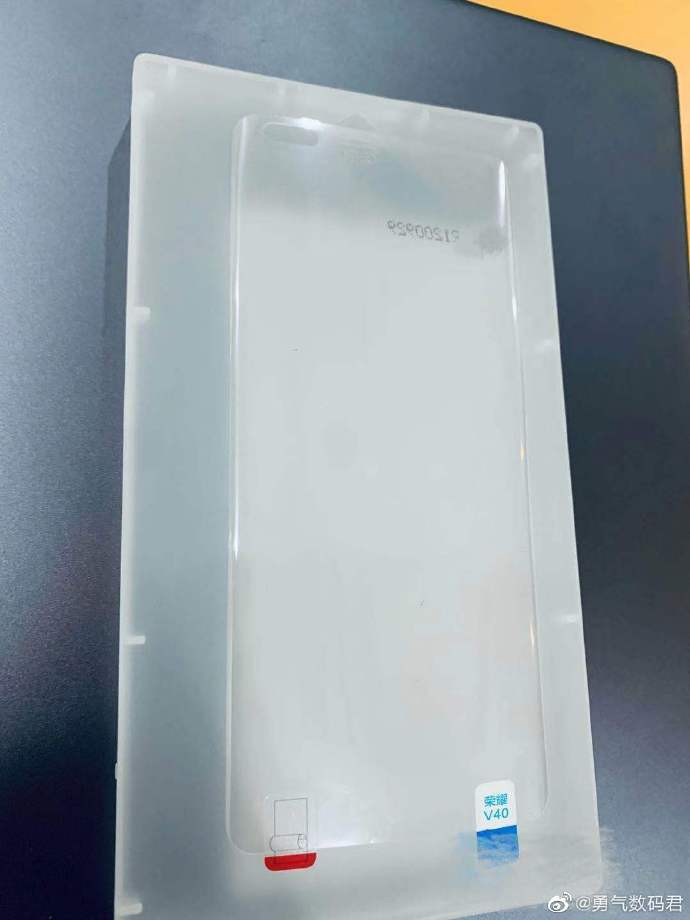
Honor is expected to unveil the Honor V40 smartphone in January. A Weibo user shared an image of the V40’s tempered glass protector to reveal the design of its display.

As can be seen in the image, the tempered glass of the Honor V40 has a pill-shaped cutout at the upper-left corner. This indicates that the phone will be sporting a dual selfie camera system.

The curvature on the tempered glass suggests that the Honor V40 has a curved display. The Weibo user who shared the image claims that the Honor V40 will be the first V-series phone by the brand to feature an OLED screen.

Honor V40 tempered glass protector image

There are speculations that the Honor V40 could be fitting with the same display that is available on the recently announced Huawei Nova 8 Pro smartphone. Hence, it is likely to arrive with a 6.72-inch OLED screen that produces a Full HD+ resolution, a 120Hz refresh rate, and a 300Hz touch sampling rate.

The Dimensity 1000+ chipset will be fueling the Honor V40. The capacity of the phone’s battery is not known yet. However, recent reports have suggested that the Honor V40 will carry support for 66W fast charging. It may also support 45W wireless charging.

Honor has recently confirmed that it will be holding its annual fan meeting on Jan. 13. Based on previous release patterns, it is speculated that the Honor V40 may debut a day before the meet. However, Honor is yet to confirm V40’s launch date.


Motorola Capri Plus hits FCC, Geekbench, and TÜV Rheinland

Earlier this month, the primary specifications of the upcoming Motorola Capri and Motorola Capri Plus were revealed. Last week, the former device was even spotted on FCC. Now, the latter also hits FCC along with Geekbench and TÜV Rheinland.

Motorola Capri mockup
Motorola Capri mockup by TechNik News

According to FCC, the forthcoming Motorola Capri Plus smartphone will come with model number XT2129. This goes in line with the previous report.

Further, as per the Geekbench listing, this handset will be powered by Qualcomm Snapdragon 662 paired with 4GB RAM and will run Android 11 out of the box. That’s not all, since this phone has also been certified by TÜV Rheinland, we know that it will be backed by a 5,000mAh battery with support for 20W fast charging.

As per the report from early December, the Motorola Capri Plus will flaunt an HD+ display with a 90Hz refresh rate. It will be available in two storage configurations – 4GB + 64GB and 6GB + 128GB respectively.

On the back, it will sport a quad-camera setup consisting of a 64MP OmniVision OV64B sensor (wide-angle lens), a 13MP Samsung S5K3L6 sensor (ultra-wide lens), a 2MP OmniVision OV02B depth sensor, and a 2MP GalaxyCore GC02M1 sensor (macro lens). Whereas, the front of the device will house a 13MP Samsung S5K4H7 sensor for selfies and video calls.

Other features of this handset will include NFC and dual-SIM, both of which will differ by region. Last but not least, it is not known when this smartphone will be officially unveiled.


Best Mid-Range smartphones of 2020 (India)

The mid-range smartphone segment drives maximum sales for the majority of the manufacturers, especially in India. Several mid-range smartphones were launched this year while ensuring a good price-performance ratio. We have hand-picked the best mid-range smartphones launched in India this year. However, Xiaomi and Realme are prominent manufacturers that rule this segment in India.

best mid-range smartphones india 2020 (Large)

Must See: Best Entry-Level Smartphones of 2020 (India)

Best mid-range smartphones in India (2020)

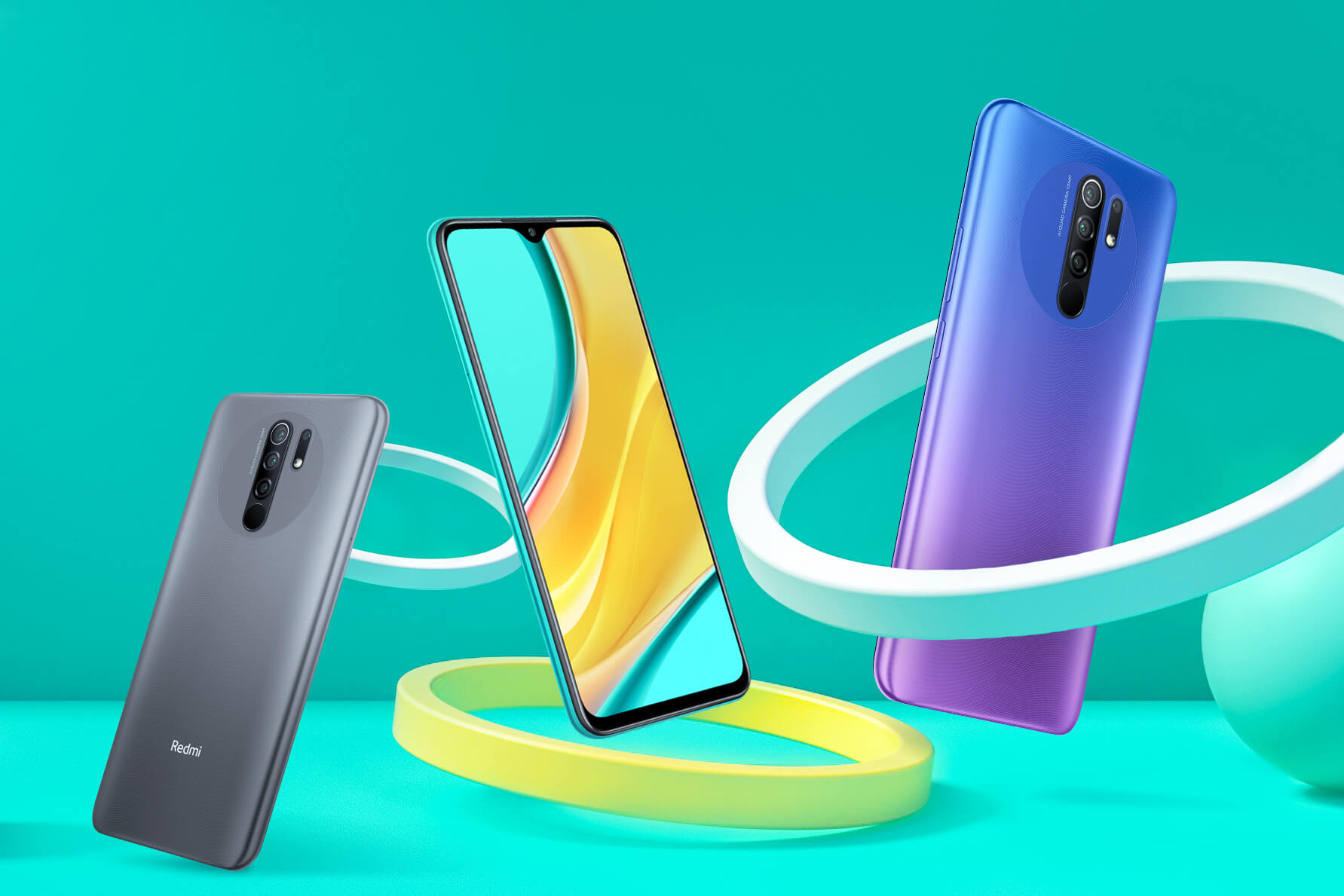
1Redmi Note 9 

Redmi 9 Redmi 9 Prime Featured

Xiaomi Redmi 9 packs a 6.53-inch IPS LCD display with 1080 x 2340 pixels resolution. It is powered with MediaTek Helio G80 SoC and Mali-G52 MC2 GPU. There’s a quad-rear camera packing a 13MP primary sensor, an 8MP ultrawide sensor, a 5MP macro lens, and a 2MP depth sensor. The smartphone features an 8MP front camera for selfies. The 5020 mAh battery is enough for a couple of days of battery backup. It is available in 3/4/6GB RAM and 32/62/128GB storage variants.

Price: Rs 8,999

Buy Now

2Realme Narzo 20 Pro

Realme Narzo 20 Pro
Realme Narzo 20 Pro

Realme Narzo series competes against the mid-range smartphones from Xiaomi and its subbrands while featuring MediaTek chipsets. It provides a better gaming experience for an affordable price. Realme Narzo 20 Pro features a 6.5-inch IPS LCD display supporting a 90Hz refresh rate and 1080 x 2400 pixels resolution. MediaTek Helio G95 is present with 6/8GB RAM and 64/128GB storage variants. There’s a quad-rear camera module featuring a 48MP primary camera, 8MP ultrawide sensor, a 2MP macro lens, and a 2MP depth sensor. A 16MP front sensor is placed on the punch-hole display. It comes with a 4500mAh battery with support for an ultra fast 65W SuperDart Charging.

Price: Rs 15,979

Buy Now

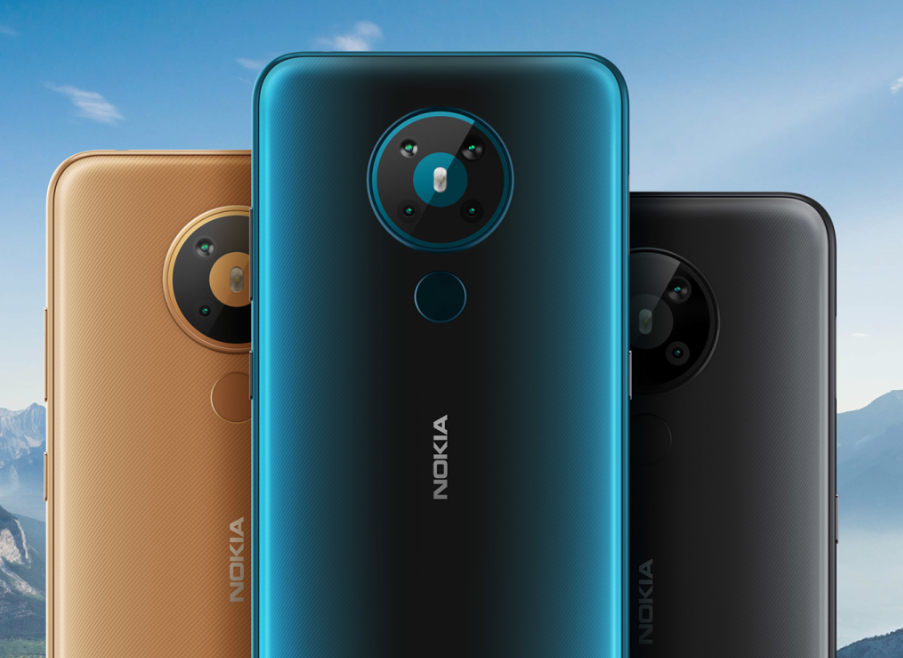
3Nokia 5.3

Nokia 5.3 featured

HMD-owned company – Nokia is diversifying its product catalog every year. The company unveiled Nokia 5.3 with 6.55 inch IPS LCD display featuring 720 x 1600 pixel resolution. It is powered with Snapdragon 655 SoC and Adreno 610 GPU. There’s a quad-rear camera on the rear device with a 13MP primary camera, a 5MP ultrawide sensor, a 2MP macro and a 2MP depth sensor. It carries a 4000mAh battery with 10W fast charging.

Nokia5.3 is available in three different storage options of 3GB RAM + 64GB, 4GB RAM + 64GB and 6GB RAM + 64GB.

Price: Rs 11,999

Buy Now

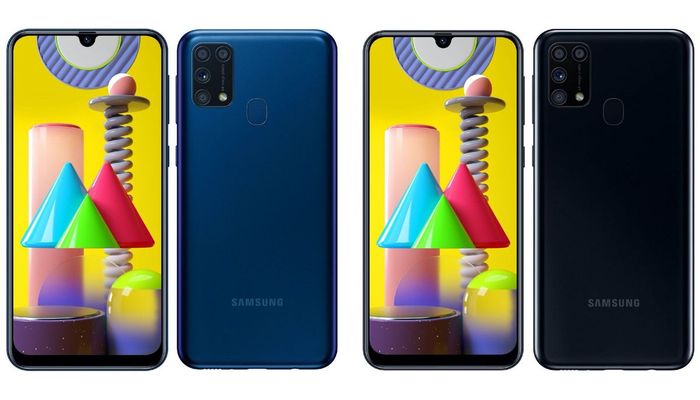
4Samsung Galaxy M31

Galaxy M31 Ocean Blue and Space Black-
Galaxy M31 in Ocean Blue and Space Black colors

Samsung Galaxy M31 is a value-for-money device as it offers a 6.4-inch Super AMOLED display featuring a 1080 x 2340 pixels resolution. It is coupled with Exynos 9611 SoC, 6/8GB RAM, and 64/128GB storage. There’s a quad-rear camera featuring 64MP + 8MP + 5MP + 5MP sensors for better photography. A massive 6000 mAh battery with 15W fast charging support makes it more worth the price.

Price: Rs 15,999

Buy Now 

5Realme 7i

It’s been just over a few days since the device launched globally. Realme 7i houses a Snapdragon 662 SoC and Adreno 610 GPU. A large 6.5-inch IPS LCD display is present with a resolution of 720 x 1600pixels. Realme 7i comes in 4/8GB RAM and 64/128GB storage. It sports a 64MP quad-rear camera module with an additional 8MP ultrawide sensor, a 2MP depth, and a 2MP macro lens. It comprises a 5000 mAh battery with 15W fast charging support.

Price: Rs 11,999

Buy Now

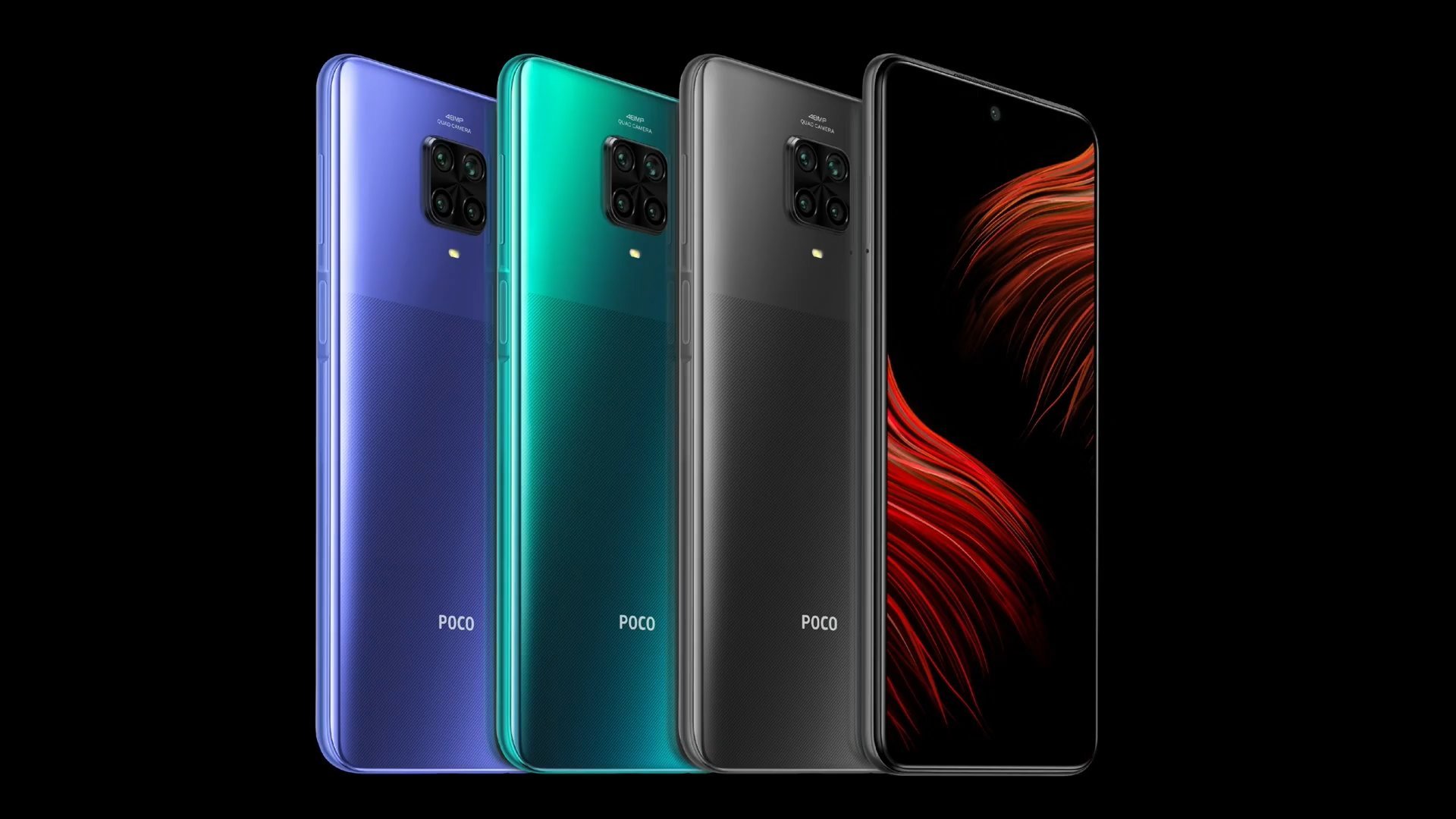
6POCO M2 Pro

Poco M2 Pro
Poco M2 Pro

It’s a rebranded version of the Redmi Note 9 Pro. Poco M2 Pro features a massive 6.67-inch IPS LCD display with support for 1080 x 2400 pixels resolution and 450 nits brightness. It is powered by the Qualcomm Snapdragon 720 chipset coupled with 4/6GB RAM and 64/128GB storage. There’s a quad-rear camera module featuring a 48-megapixel primary camera, an 8-megapixel ultrawide sensor, a 5-megapixel macro lens, and a 2-megapixel depth sensor. For selfies, there’s a 16-megapixel sensor encased inside the punch-hole display. It houses a 5000 mAh battery with 33W fast charging.

Price: 13,999

Buy Now

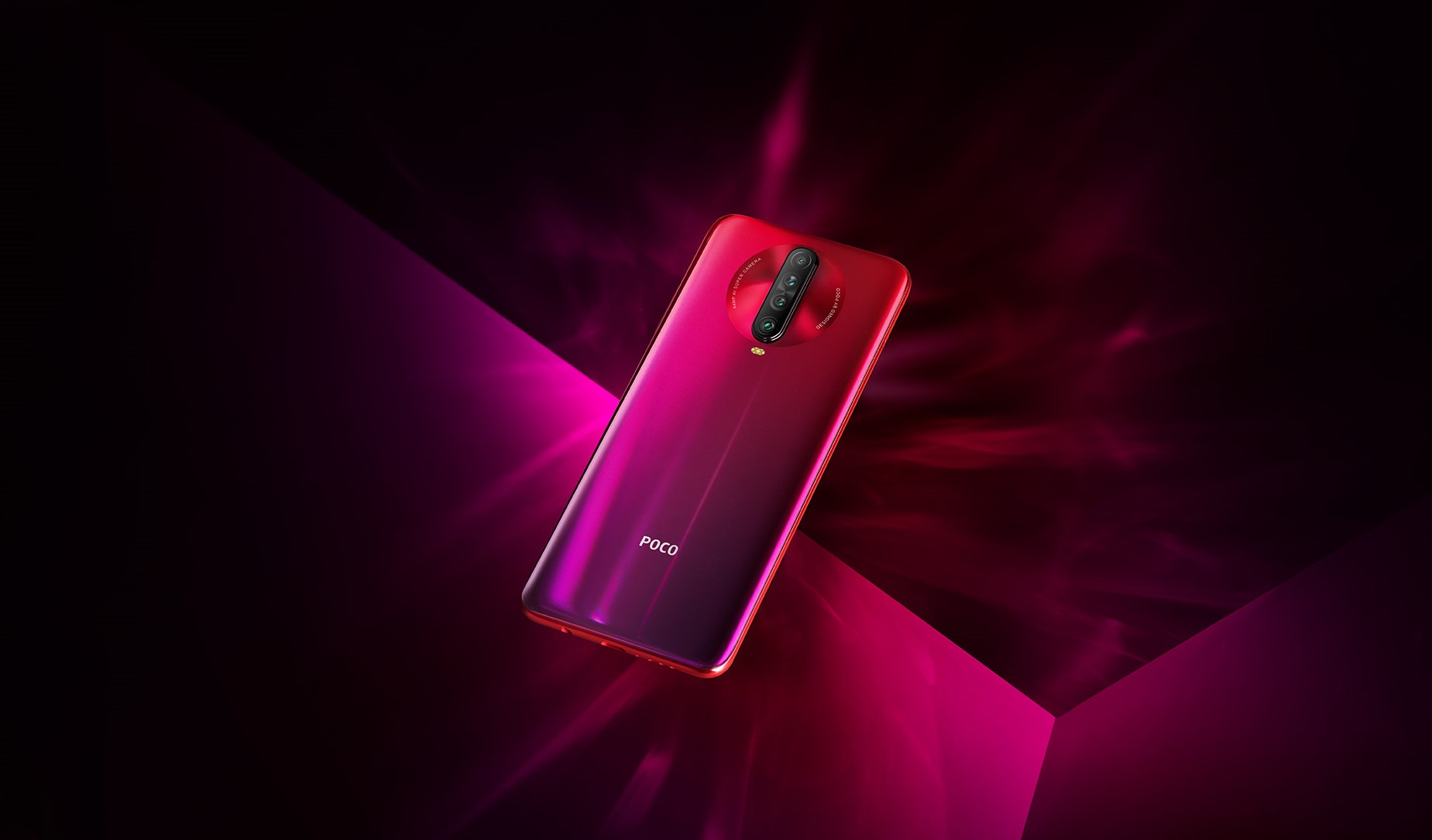
7POCO X2

Poco X2 Featured

Poco X2 features a Snapdragon 730G SoC with 6/8GB RAM and 64/128/256GB storage. It features a quad-rear camera module – 64MP + 8MP + 2MP + 2MP sensors. A dual-rear camera consisting of a 20MP primary and a 2MP depth camera sit in a capsule-shaped punch-hole display. The smartphone carries a 6.67-inch IPS LCD display with 1080 x 2400 pixels resolution. There’s a 4500 mAh battery with 27W fast charging support.

Price: Rs 17,499

Buy Now


As with the list of best entry-level smartphones, the Xiaomi and Realme prominence can be seen in the mid-range segment too. Stay connected with us for more!

What other devices do you think deserves to be on this list? Have we missed out on any other value for money model in the mid-range segment?


Related: Gizmochina’s Best Android Smartphones of 2020

Upcoming Vivo Y31s could be first Snapdragon 4-series budget 5G chipset phone

Last month, a Vivo phone with model number V2054A had appeared at China’s TENAA certification platform. The listing had revealed that it is a mid-range phone with 5G capabilities. The phone has now appeared in the database of China Telecom. It has revealed that it will be hitting the Chinese markets with Vivo Y31s moniker.

Vivo Y31s specification and price

The China Telecom listing of the Vivo Y31s states that it has a 6.58-inch IPS LCD display that produces a Full HD+ resolution of 1080 x 2408 pixels. The handset has a polycarbonate body that measures 165.15 x 75.35 x 8.4mm and weighs 185.5 grams.

The Vivo Y31s is preinstalled with Android 11 OS and it is powered by a mysterious Qualcomm chipset that is mentioned with its “sm4350” port number. The identity of the chip is not known yet. Could it be the Snapdragon 4-series 5G chipset that is expected to launch in Q1 2021? It is advisable to wait for the phone to go official to know which processor is present under its hood.

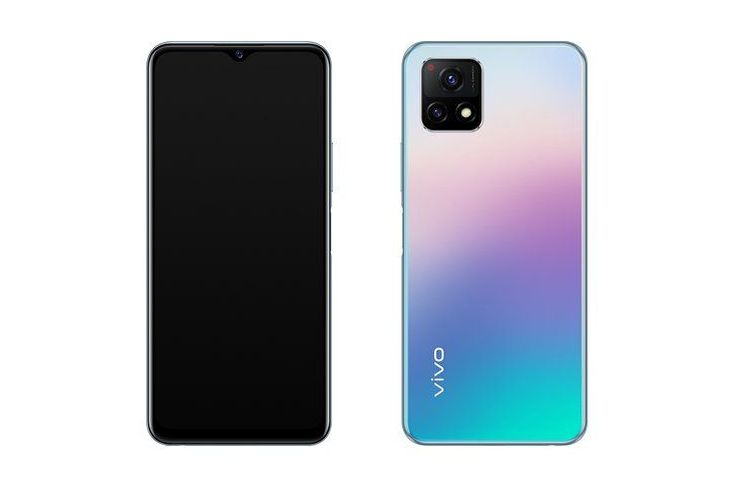
Vivo Y31s
Vivo Y31s

For photography, it has a selfie camera of 8-megapixel. The square-shaped camera module placed on the rear shell of the device has a 13-megapixel main camera, a 2-megpaixel lens, and an LED flash unit. The device is backed by a 4,910mAh battery.

The listing further states that the phone will come in two models such as 6 GB RAM + 128 GB storage and 4 GB RAM + 128 GB storage. The listing mentions that these models could be priced at 1798 Yuan (~$275) and 1,598 Yuan (~$248), respectively. The pricing information could be incorrect. It is expected to arrive in three colors like Titanium Gray, Monet, and Ruby Red.

In terms of specs and design, the Vivo Y31s is identical to the Vivo Y52s phone that went official in China recently. The only major difference is that the Y52s has the Dimensity 720 chipset onboard.


LG QNED TVs to feature up to 30,000 tiny LEDs behind the display

LG Electronics, the known OLED TV maker, is among other known panel and T manufacturers that are working on adopting the newer display technology, Mini LED. The company is expected to adopt this new breed of panels for its high-end LCD 8K and 4K TVs that will launch next year.

According to LG, Mini LED enables “a giant leap forward in LCD TV picture quality.” At the moment, the premium LCD TVs offer “full-array local dimming,” with LEDs (ranging up to hundreds in number) serving as the backlighting behind the display panel. These create zones that can be controlled, with each zone being able to be dimmed as per the dark scenes that are displayed on the screen. This helps in improving the black level and contrast, as per the TheVerge report.

LG

However, in the case of Mini LED, the LEDs are much smaller, but the number of LEDs is much greater. This enables better contrast than high end TVs that might offer only up to a couple of hundred dimming zones. LG has made this possible by creating a new backlight, which “comprises up to almost 30,000 tiny LEDs that produce incredible peak brightness and a contrast ratio of 1,000,000:1 when paired with up to 2,500 dimming zones and advanced local dimming zones.”

This results in better contrast, higher dynamic HDR, improved color accuracy over regular LCD TVs. Furthermore, these panels also feature a high refresh rate of up to 120Hz, which is common in the South Korean tech giant’s 2020 flagships. LG has branded these new televisions as QNED TVs, which is similar to TCL’s 8 Series that offers up to 25,000 LEDs as well in over 1,000 control zones. LG is expected to launch QNED in sizes up to 86 inches.

Notably, since it is the leading OLED TV brand, the company is still positioning its OLED lineup as the absolute best picture quality experience despite the advancements in LCD screens. Unfortunately, the pricing for the LG QNED TVs is currently unknown, although, it is expected to be less exorbitant than the MicroLED TVs that are out right now.


Google removes astrophotography mode for ultra-wide camera on Pixel 5 & Pixel 4a 5G

The Google Camera aka GCam app is part of the core Pixel smartphone experience. Over the years, the internet search giant has introduced useful features for this app with the release of new Pixel phones. Last year, the app got a feature called ‘astrophotography’ with the launch of the Pixel 4 series. This year, the company extended this feature for the ultra-wide camera present on Pixel 5 and Pixel 4a 5G. But now, within months after the release of these handsets, the firm has removed this ability.

Google Camera Astrophotography Mode on Pixels
Source: Google AI Blog

For those unaware, ‘astrophotography’ is a long exposure shot mode in the Google Camera app that allows users to click pictures of the stars. This feature requires a tripod or any stand of sorts to obtain great results.

This feature made its debut on Pixel 4 and Pixel 4 XL. It was even made available for other older Pixels. Google even added support for the ultra-wide camera with the launch of Pixel 5 and Pixel 4a 5G. Though everyone was excited, the results turned out to be poor.

It is a known fact that ultra-wide cameras on smartphones are mostly inferior to the primary sensor. Though the one on the latest Pixels performs well enough in the daylight, it struggles in low light just like on other phones.

Hence, pictures shot in astrophotography mode lack quality compared to the primary camera. Hence, Google has disabled this feature for the ultra-wide camera with the release of Google Camera v8.1.

What are your thoughts on Google removing ‘astrophotography’ for the ultra-wide camera on Pixel 5 and Pixel 4a 5G? Let us know in the comment section below.


(Via)