Ulefone recently introduced their first 5G rugged phone – Armor 10 5G. Since durability is one of the most significant factors of a rugged smartphone, the company released a video showing the consumers what this device looks like from the inside and why is it worth. This was done to show that ruggedness depends not only on the process of manufacturing or material but also on the internal structure. Let’s take a look at the video.
The above clip clearly shows the complete process of the teardown of Armor 10 5G. Its internal design is quite compact, reasonable, and well laid-out with no extra space. This rugged smartphone is made using a metal frame on both sides where its internals are well protected by a waterproof seal ring. Its 5800mAh battery, on the other hand, is protected by a metal plate on the back and is secured with numerous screws to prevent damage caused by accidental drops.Apart from its exceptional built and ruggedness, Armor 10 5G boasts hardware configurations like MediaTek Dimensity 800 5G SoC and 64MP quad-rear camera, and 16MP front camera. This smartphone runs on Android 10 and will upgrade to Android 11 via OTA next year. Other highlights include 8GB RAM and 128GB ROM, 15W wireless charging ICs, NFC antenna, 2 SIM card slots, and more.
Packed with an ideal combination of top-notch features and durability, Ulefone Armor 10 5G sets an ideal standard for smartphones. Currently, this rugged smartphone is up for sale at Banggood e-shop for just $399.99, where the first 700 buyers get a chance to win Ulefone Watch for free. So hurry and make the most of this opportunity.
OnePlus is known for making smartphones, which started its journey with “flagship killer” devices and then gradually started offering premium phones. However, in the recent past, the company has expanded its offerings to accessories and other products.
Now, the company has announced a new product — OnePlus Urban Traveler Backpack. It will be available in two color options — Black, and a combination of Black and White. The backpack is set to go on sale from 8th January but the company is giving away a few of them early as part of its User Festival.
It has a 20L capacity and comes with nine pockets. The main compartment has a partition and a zippered back. There are two pair of elastic bands which can hold water bottles. Towards the backside, there’s a separate compartment for a laptop, which the company says can hold a device with up to a 16-inch display.
On the front side, there’s a diagonal line that opens a small storage area. Interestingly, it also has a secret compartment at the bottom. For those who travel a lot, the backpack comes with a luggage pole belt.
The shoulder straps on the OnePlus Urban Traveler backpack have a plastic loop, which can be used for attaching items, such as sunglasses or keyrings. The company says that zippers and lining are waterproof and the white color has been treated to prevent stains.
After the much-anticipated wait, Khadas officially launched their latest Hi-Fi DAC, Tone 2 Pro on December 16th. It is an ultra-slim desktop DAC that features a high-end ES9038Q2M DAC chip from Sabre technologies along with four high-performance OPA1612 Operational Amplifiers. This unit is fully up to date with MQA decoding support to offer a high-quality audio experience. However, the highlight of Tone 2 Pro is the Balanced RCA plugs that have three layers to provide better connectivity and functionality while maintaining their compact size.
Just before the launch of Khadas Tone 2 Pro, the company released all its technical parameters; let’s check them out.
Built-in Intel Altera MAX V CPLD, Pre-shaping Technology
Accusilicon AS318-B Series Professional Audiophile Crystal Oscillator
OS Compatibility
Windows 7, 8, 10(Khadas USB ASIO driver required)
MacOS
Linux(with UAC2 compliant kernel)
Android(Support OTG function)
iPadOS & iOS
Rated Voltage
DC 5V
Compliances
CE, FCC, RoHS
High-Grade Output
Tone 2 Pro has a distortion rate of around 0.000126% (Bal RCA) /0.000158% (4.4mm) and low noise levels of less than 4.2uVrms to offer superior sound quality. One can expect a crisp output with ultra-low distortion and a pitch dark, noise-free background in their audio.
Compatible Gears
Tone 2 Pro has 4.4mm and 3.5mm output ports with 2.4Ω and 1.2Ω super-low output impedance. It can be conveniently paired with sensitive IEMs or headphones without facing any issues.
Sturdy Built
Each part of Tone 2 Prois made using high-grade materials to offer durability. Its volume knob and casing are constructed from aircraft-grade aluminum, while the bottom cover is built from ABS plastic and polycarbonate. With a silicone footpad, this unit retains its position and prevents scratching the surface. This Hi-Fi DAC comes in 3 colors- Black, Red, Blue.
Tone 2 Pro is already up for sale and can be pre-ordered for just $179.90 (early-bird price) till January 2nd, 2021. Post that, it will go up to its retail price of just $199. Shipments for the first batch will begin from 29th December. So hurry, and grab yours now.
Vivo is expected to launch the Vivo X60 series by the end of this month. While a recent leak claimed that it may go official on Dec. 28, the Chinese firm is yet to confirm it. Ahead of the launch, the official renders of the Vivo X60 and Vivo X60 Pro smartphones have surfaced once again.
The Vivo X50 series that debuted in June came with 6.56-inch Samsung E3 AMOLED displays that offered 1080 x 2376 pixels resolution. The same display is tipped to be available on the Vivo X60 with some changes. Instead of the top-left corner selfie camera cutout available on the X50 models, the successor editions will have a top-centered punch-hole. Instead of 90Hz, the Vivo X60 will support a higher refresh rate of 120Hz. The renders show that the Vivo X60 will have a flat-screen, whereas the Pro model’s display has curved edges.
The rear appearance of the Vivo X60 series is not hugely different from the X50 lineup. The Vivo X60 has a triple camera system that includes a 48-megapixel main camera with f/1.6 aperture, a 13-megapixel ultrawide lens, and a 13-megapixel portrait snapper.
On the other side, the Vivo X60 Pro will offer users a quad-camera setup that is said to include a 48-megapixel main camera with f/1.48 aperture, a 13-megapixel ultrawide lens, a 13-megapixel portrait lens, and an 8-megapixel periscope zoom lens. The Exynos 1080 chipset will be fueling the Vivo X60 and X60 Pro will up to 12 GB of RAM. The X60 series will be the first Vivo phones to come loaded with the all-new OriginOS flavored Android 11 OS.
The Vivo X60 family also includes the Vivo X60 Pro+, which is likely to be powered by the Snapdragon 888. While it may feature the same display as the other X60 models, it may come equipped with an advanced rear camera system. The X60 series phones could be coming with 33W fast charging.
The Amazfit GTS 2 wasn’t the only one that got a cheaper model this week, the round-faced Amazfit GTR 2 also did. The Amazfit GTR 2e, as the watch is called, is not only cheaper but has a significantly better life, though it does miss out on some key features of the standard version.
Amazfit GTR 2 (Classic) and Amazfit GTR 2e
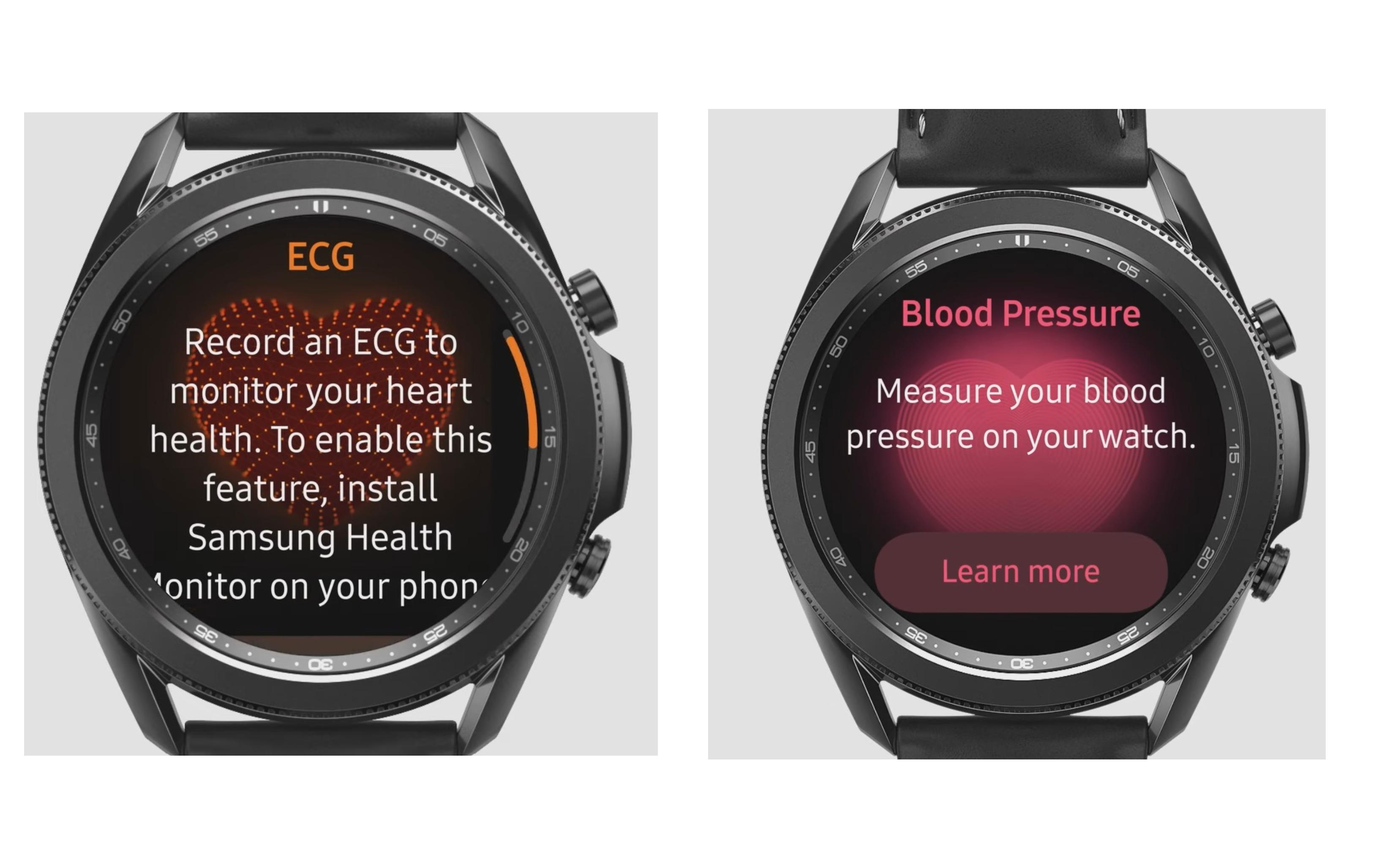
We already compared the GTS 2 series which has three models but if you have been waiting for a comparison between the Amazfit GTR and the new Amazfit GTR 2e, then this is for you. As usual, a spec-by-spec comparison of both watches comes first before we focus on the major differences:
Amazfit GTR 2
Amazfit GTR 2e
Display
1.39-inch AMOLED
454 x 454 resolution
3D curved glass
1.39-inch AMOLED
454 x 454 resolution
2.5D curved glass
Materials and finish
Stainless steel case (Classic version)
Aluminum alloy (sports version)
Optical Diamond-like carbon coating
Aluminum alloy case
Glass vacuum coating
No. of supported sports modes
90
12 built-in sports modes (will be upgraded to 90 via an OTA update in the future)
Heart rate measurement
SpO2 measurement
Sleep tracking
Temperature measurement
Battery capacity and battery life
471mAh
Typical Usage - 14 days
Basic Watch Mode - 38 days
471mAh
Typical Usage - 24 days
Basic Watch Mode - 45 days
Dimensions and weight
46.4 x 46.4 x 10.7 mm
31.5 grams (Sports model without strap)
39 grams (Classic model without straps)
46.5 x 46.5 x 10.8 mm
32 grams (without the straps)
Colors
Obsidian Black
Obsidian Black
Dolphin Gray
Ice Lake Green
Price
¥999
$179.99
¥799
Design and Display
The Amazfit GTR 2 comes in two versions – Classic and Sports. The Classic version has a stainless steel case and leather straps while the Sports version has an aluminum alloy case and silicone straps. Both are covered with 3D curved glass that fuses with the frame at the edges. The Amazfit GTR 2e is practically the sports version with 2.5D glass and a different finish when it comes to its design.
For the display, the Amazfit GTR 2 and GTR 2e have the same AMOLED screen. They have the same size and the same resolution too. So save for the glass on top, the Amazfit GTR 2 and Amazfit GTR 2e are identical when it comes to their displays.
When the Amazfit GTR 2 was announced, it supported only 12 sports modes but an update released later increased the number to 90. Huami has said that the Amazfit GTR 2e will get an OTA update that will increase the supported sports modes to 90 too.
Coming to other features, the Amazfit GTR 2 has built-in storage so that you can load up your watch with your songs and listen to them via a connected Bluetooth headset without the need for a phone when exercising. It also has a microphone and speaker, so owners can accept calls when the notification shows up on their watch without needing to bring out their phone to pick up a call.
Both the GTR 2 and GTR 2e have Xiaomi’s XiaoAI assistant but only the former has support for offline commands. We do not know if the global version of the Amazfit GTR 2e will come with Amazon’s Alexa assistant if and when it is announced in other countries.
The two smartwatches packed nearly the same senors but the Amazfit GTR 2e adds a temperature sensor for measuring ambient temperature and the temperature of the wearer’s skin.
Battery life
The Amazfit GTR 2 has a better battery life than its sibling, the Amazfit GTS 2, but the new Amazfit GTR 2e boasts an additional 10 days of usage over the GTR 2’s Typical Usage mode and extends the basic watch mode to 45 days.
Price
The Amazfit GTR 2 is priced at ¥999 (~$153) in China for the Sports Edition and ¥1099 for the Classic Edition. In the USA, the Sports Edition is $179.99 while the Classic Edition is $199.99. The Amazfit GTR 2e has an MSRP of ¥699 (~$122) and if it gets a global release, it is expected to cost a bit more but should still be under $150.
Conclusion
The Amazfit GTR 2e drops features such as built-in storage, Wi-Fi connectivity, and Bluetooth call support for a more affordable price tag but gets a significant boost in battery life. If you choose it over the standard variant, you won’t be missing much and its more affordable price tag makes it the easy choice.
However, if you want that built-in storage and support for Bluetooth calls, then you can choose the Amazfit GTR 2, though we will advise you to pick it up when it is on sale as it doesn’t pack enough features to justify its current price tag.
At the beginning of this week, GizmoChina carried an exclusive report to reveal that the Xiaomi Mi 11 series will debut in China on Dec. 29. While Xiaomi is yet to officially confirm the launch date of the Xiaomi Mi 11 and Mi 11 Pro handsets, Samsung has started receiving pre-orders of the Galaxy S21 series through its official website. It was reported in the previous week that Samsung began receiving blind orders of the Galaxy S21 lineup in India.
Users in China can participate in the advanced reservations for the Galaxy S21 series by paying 100 Yuan. This will allow customers to apply for discounts and participate in a lucky draw. As many as 21 units of the Galaxy S21 series will be given out for free through the lucky draw in China. Also, customers who participate in the reservations will have mysterious purchase rights and a 10 precent increased pricing for a trade-in handset.
Samsung is expected to officially announce the Galaxy S21 series on Jan. 14. It is likely that it will be arriving in various markets including China by the end of January. Hence, there is a possibility that Xiaomi could be the world’s first company to announce the Snapdragon 888 powered flagships.
China will be treated with the Snapdragon 888 version of the Galaxy S21 models. The U.S. and South Korea are believed to be other markets to receive SD88 editions of the Galaxy S21 series. The Exynos 2100 powered S21 models will be aimed towards markets like India and Europe.
The real-life images of the Huawei Nova 8 that had appeared recently had not only revealed its design, but also its specifications. The Nova 8 Pro also appeared in live shots recently, but its detailed specs were not revealed. A well-known Chinese tipster known as Digital Chat Station on Weibo has shared the specs sheet of the Nova 8 and Nova 8 Pro smartphones.
According to the leak, the Huawei Nova 8 Pro measures 163.3 x 74.1 x 7.85mm and it weighs 184 grams. The device is equipped with a 6.72-inch OLED panel with curved edges. It supports a custom resolution of 2676 x 1236 pixels, a 10-bit color depth, and a 120Hz refresh. The edges of the screen have an 80-degree curvature. The display is integrated with a fingerprint scanner. The Huawei Nova 8 has a 6.5-inch OLED screen with 1080 x 2340 pixels resolution, a 90Hz refresh rate, an in-screen fingerprint reader. The Nova 8 has 160 x 74.1 x 7.64mm dimensions and it weighs 169 grams.
At the top-left corner of the display is a pill-shaped cutout that features a 32-megapixel main selfie camera and a 16-megapixel secondary lens. The back panel of the phone has a quad-camera system featuring a 64-megapixel main camera, an 8-megapixel ultrawide lens, a 2-megapixel macro lens, and a 2-megapixel depth sensor. The same rear camera setup is available on the Nova 8. Its front features a 32-megapixel selfie camera.
The Kirin 985 chipset powers the Nova 8 and Nova 8 Pro smartphones. Both phones carry support for 66W fast charging. While the Nova 8 has a 3,700mAh rated battery, the Pro gets a bigger 3,900mAh rated battery. A recent leak had revealed that both phones could be available in 8 GB RAM + 128 GB storage and 8 GB RAM + 256 GB storage editions. The Nova 8 duo will go official on Dec. 23 in China.
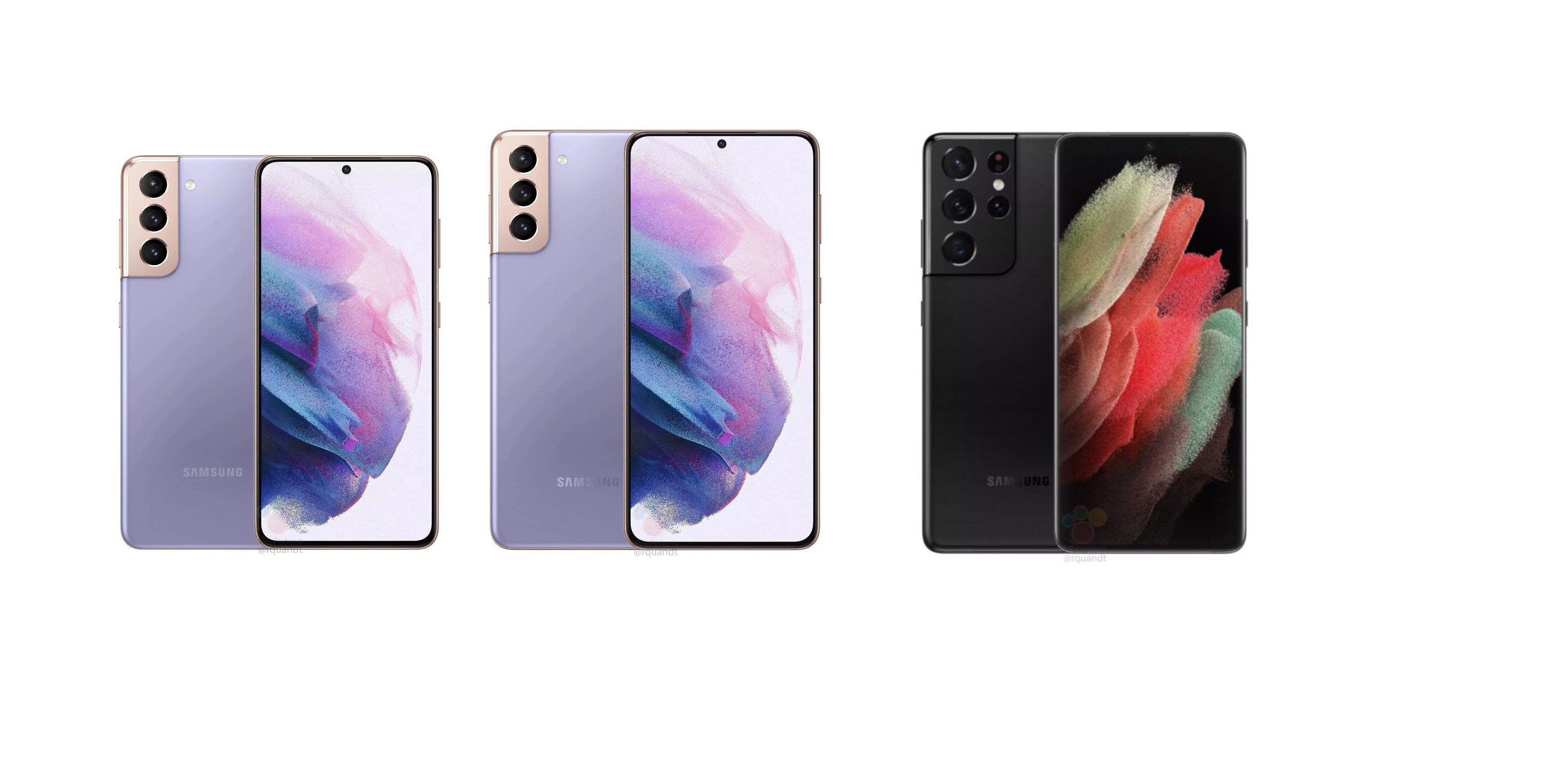
Samsung’s President and Head of the mobile division recently confirmed that the Galaxy S21 launch event will be held in January. However, the South Korean company is yet to confirm the specific launch date for the upcoming Galaxy Unpacked event. Even before its confirmation Winfuture.de andEvan Blass have shared the official images of the Galaxy S21, S21 Plus, and Galaxy S21 Ultra.
The official images of the Galaxy S21 and Galaxy S21+ were covered in a separate post. Shown in this post are the renders of the Galaxy S21 Ultra that will be arriving in two colors such as the Phantom Silver and Phantom Black. The Galaxy S20 Ultra featured a display with curved edges. However, the successor edition has a flat display like the S21 and S21+ phones. The Galaxy S21 Ultra has a massive 6.8-inch Infinity-O AMOLED screen at the front and a glass rear.
While the S Pen was previously reserved for the Galaxy Note series, but the S21 Ultra will be the first S-series handset to carry support for it. Like the S21 and S21+, the Ultra edition’s rear camera module fuses with its metallic frame. The camera module is said to include a 108-megapixel main camera with OIS and laser autofocus support, a 10-mgeapixel periscope telephoto lens with OIS and 10x optical zoom, a 10-megapixel telephoto lens with 3x optical zoom, and a 12-megapixel ultrawide lens. It could be featuring a 40-megapixel camera on the front.
The S21 Ultra arriving in markets like the U.S. and South Korea are expected to feature the Snapdragon 888 5G mobile platform. Other markets like Europe and India are expected to receive its Exynos 2100 CPU version. It could be coming with a 5,000mAh battery that supports 25W fast charging, wireless charging, and reverse wireless charging.
Phone manufacturers employ various methods to improve the cameras of their phones. From software optimizations to custom sensors to partnerships with big names in the camera industry: the goal is the same – to have a top-class camera phone.
Talking about partnerships with big players in the camera industry, OnePlus appears may be the latest phone manufacturer to do so if the information from a leaker turns out to be correct.
According to Teme (@RODENT950), the leaker known for Huawei-related leaks, OnePlus is partnering with Leica on the cameras for the OnePlus 9 series. The leaker had tweeted a list of phone manufacturers and the camera companies they have partnered with. It includes the familiar ones but also mentions a relationship between OnePlus and Leica, which is definitely new info.
One Twitter user then asks if OnePlus has collaborated with Leica, and Teme responds with “Op9 series” which of course means the OnePlus 9 series. This is definitely big news and one that is casually revealed in a tweet.
If OnePlus is indeed working with Leica on the cameras for the OnePlus 9 series, then we should expect a significant improvement in the camera performance of the next-gen flagships. Maybe we may even see the OnePlus 9 or OnePlus 9 Pro topple the Huawei Mate 40 Pro and Mi 10 Ultra from the top of DxOMark’s smartphone camera ranking.
OnePlus’s CEO, Pete Lau, revealed in an interview with Input Mag that they are working on improving the camera performance of their phones “with a bigger focus on software and hardware”. He goes on to say that they are not only improving the offering on the flagship series but also future Nord series. However, nowhere in the interview did he reveal they were working with the German camera company, Leica.
The OnePlus 9 series will include the OnePlus 9, the OnePlus 9E, and the OnePlus 9 Pro. We do not yet know if all three will feature Leica technology or if it will be limited to only the pro model. Nevertheless, we are excited and we look forward to what OnePlus has planned.
LG has just released its new 27-inch UltraGear gaming monitor (27GN950) to the Indian market. The gaming monitor comes with several exciting features that will certainly catch the fancy of gaming fans in the sub-continent.
The monitor features a 27-inch 4K Nano IPS screen, with a 16:9 screen ratio, all ingredients for an enhanced viewing experience. It also has improved contrast, clarity and detail, a very good response time for GtG and VESA Display HDR600 technology well suited for an immersive and fulfilling gaming experience.
The new gaming monitor from LG has incorporated the VESA Display Stream Compression (DSC) Technology for high definition visuals (4K HDR) and is capable of covering adequately, 10bit color via a single DisplayPort connection. The embedded Nano IPS technology present in the UltraGear supports high-fidelity color.
The super-fast refresh and response rates mean that the monitor offers incredible speed with an excellent display while blur and ghosting are greatly minimized. In addition, its NVIDIA G-SYNC Compatibility and AMD FreeSync Premium Pro means gaming freaks would enjoy the game experience in a seemingly flawless display in hi-resolution, as high-octane games will be matched by an equally fast-paced viewing experience.
The display resolution is 3840 x 2160 pixel, while it has a typical Brightness reading of 400nits and Contrast ratio of 1000:1. The monitor has an overall viewing angle of 178º and comes with a couple of HDMI ports and utilizes the 16:9 aspect ratio. It also has a refresh rate of 144Hz.
It has a single display port, a headphone port, and a USB Up-stream and two down-stream connectivity ports. The UltraGear is also NVIDIA G-Sync Compatible as well as having several other impressive features that combine to yield a great gaming experience.
The LG 27GN950 UltraGear monitor costs Rs. 59,999 (~$816) and is available from both online and offline shops, including Amazon.in.
OPPO announced ColorOS 11 based on Android 11 as the latest version of its mobile operating system in mid-September. The company started rolling out beta builds to eligible devices right away. Now, three months later, OPPO Reno4 5G and OPPO Reno4 Pro 5G have begun to receive stable update.
So far, OPPO has released ColorOS 11 stable update for the OPPO Find X2 series – Find X2, Find X2 Pro, and Find X2 Pro Automobili Lamborghini Edition, as well as OPPO F17 Pro. However, the builds are yet to go live in all the regions.
The same is the case for OPPO Reno4 5G and OPPO Reno4 Pro 5G. Because although the stable build is available for the regular model in most regions, the update is limited to Saudi Arabia, United Arab Emirates (UAE), Bahrain, Qatar, Thailand, and Russia for the Pro model.
Also, it is worth nothing that though the update is live for the duo in certain regions, it is not available for everyone. That’s due to the batched rollout program, which helps in protecting users from buggy build if any. Not only OPPO but all companies release new updates to a select few initially, and based on their feedback, the build’s availability is further extended.
Having said that, if you own either of the two handsets, then head over to Setting > Software Updates to check if your unit has received the ColorOS 11 stable update.
OPPO is bringing 5G on a budget as it has launched the OPPO A53 5G. The device belongs to the A-series and should rank as one of the cheapest 5G phones around. The smartphone is currently available for reservations on Vivo’s official website.
As for the design, the OPPO A53 5G adopts a full-screen design with a punch-hole located at the top left corner of the display housing the selfie camera. The rear design includes a triple camera setup that is housed in a square-shaped module alongside the LED flash. The module is located at the top left corner of the back panel. The phone has a lightweight build and weighs just 175g.
OPPO A53 is powered by a MediaTek Dimensity 720 chip which uses TSMC’s 7nm process. The processor has a peak frequency of 2.0GHz and supports SA/NSA dual-mode 5G network. The device packs a 6.5-inch LCD screen with a resolution of 2400×1080 pixels. The screen also has a contrast ratio of 1500:1, a brightness of 480nit, and a refresh rate of 90Hz.
For photography, the A53 is equipped with three AI smart cameras. The main camera is a 16 megapixels sensor and it is assisted by a 2-megapixel macro lens and a 2-megapixel portrait style camera.
Under the hood, the A53 5G crams a generous 4040mAh battery but unfortunately lacks fast charging support. It only has support for 5V/2A charging. The phone is also equipped with a side-mounted fingerprint sensor and has a 3.5mm headphone jack.
OPPO A53 is available in 6GB+128GB and 4GB+128GB configurations. The phone is available for reservation and is expected to be shipped on December 21. The 4GB+128GB model is priced at ¥1299 yuan (~$198). It is available in three color options – Purple, Lake Green, and Black.
The Amazfit GTS 2 Mini was announced at the beginning of this month. The smartwatch made its debut in China as a more affordable version of the Amazfit GTS 2 that was launched back in September. Now Huami has taken the new mini watch to global markets.
If you are in the US, you will be able to grab the Amazfit GTS 2 Mini from Amazfit’s US online store for $99.99 which is a fair price considering it sells for ¥699 (~$107) in China. Honestly, we expected a higher price tag. The smartwatch is available in Green, Pink, and Black color variants.
The Amazfit GTS 2 Mini has a 1.55-inch AMOLED display with a 2.5D glass cover and sits inside an aluminum alloy case. Huami says it has a borderless design thanks to the curved glass on top. The watch has matching silicone straps and users can choose from over 50 different watch faces with over 30 Always-on Display patterns to style up their watch.
The smartwatch supports over 70 different sports modes including indoor swimming and outdoor cycling. It will notify you of exercise stages, conditions and heart rate zones, and will provide a data report when you are down with your workout.
The GTS 2 Mini has a heart rate sensor with 24-hour heart rate monitoring and also has Sp02 and stress level measurement. It will also measure the quality of your sleep including daytime naps. Other supported features are female health (menstrual cycle tracking), Amazon Alexa assistant, breathing exercises, music playback control, Pomodoro clock, and Bluetooth camera remote.
1 of 2
Amazfit GTS 2 Mini Stress Level Measurement
Amazfit GTS 2 Mini female cycle tracking
The smartwatch has a 220mAh battery that will provide up to 14 days of battery lfe in typical usage and up to 7 days in heavy usage. It goes up to 21 days in basic watch mode.
The US store also has the Amazfit Bip U which launched first in India. The square-faced watch is priced at $59.99 but has been discounted to $49.99. Unfortunately, it can only be picked up in black as the Pink and Green variants are listed as out of stock. The Amazfit Band 5 has also been discounted to $39.99 from its original price of $49.99.
Recent developments point in the direction that European mobile operators are seriously contemplating replacing Chinese tech giant Huawei with Samsung as the core supplier of 5G systems in Europe. Samsung had long been seen as rank outsiders among the leading lights in the pioneering technology of 5G but has steadily clawed its way to the top, due to a combination of factors within and outside its control. Early talks within the group of mobile providers are not yet definitive, as developments unfold fleetingly.
A key catalyst for the renewed interest in Samsung was its impressive performance in nicking the $6 billion deal with U.S. mobile provider Verizon in September 2020, against all odds. Obviously, this prompted closer attention to the South Korean tech giant from various parts of the world including Spain’s Telefonica and France’s Orange, both of whom have held useful formal interactions with Samsung, according to its officials.
Currently, Huawei’s hardware systems account for up to 50% of the European 4G network architecture and were expected to form the foundation for the next generation ultra-fast 5G infrastructure, together with Nokia and Ericsson.
However, as should be expected, European operators are under intense pressure from the US to abandon Huawei for its 5G architecture, as Washington says there is a risk the Chinese firm could be spying for Beijing, an accusation the firm has consistently denied.
A major hurdle for Samsung is that operators fear that its products will not be compatible with the existing 4G networks built by Huawei, and this may lead to ballooning costs if these systems were to be scrapped entirely, rather than a simple upgrade. Samsung has however risen stoutly to defend itself, insisting that its equipment is indeed compatible with the existing 4G infrastructure. US mobile operator, Verizon wireless is using Samsung for various parts of its network.
European mobile operators have already plowed billions of euros to roll out fibre optic networks in the continent and certainly, an additional extensive 5G rollout will further dent their investment capabilities. The GSMA projects about $800 billion in global investments on 5G up to 2025, representing about 78% of overall investments in the sector.
Europe’s biggest mobile operator, Deutsche Telekom, however, is yet to be upbeat about the possibility of Samsung being competitive in the short term, sources say.
Industry experts are divided on the prospects of Samsung being able to compete with Nokia and Ericsson on their home turf, as the company may have to do more to measure up as a serious competitor to these European powerhouses.
Samsung maintains that it has a strong Network team and research facilities in Europe and can indeed foster the relationships required to step into the void when the chance beckons.
Vivo and ZEISS have today, officially announced their strategic global imaging partnership. The smartphone maker had hinted of the partnership a few days back and the news was well-received. The new partnership is expected to showcase its first product on December 29 when the Vivo X60 series is expected to go official with the technology in play.
According to a statement released by Vivo on its website, the pair will team up to establish a joint R&D program which would be known as Vivo ZEISS Imaging Lab. The program will be focused on developing innovative solutions for mobile imaging technology. Also, the program will oversee the joint development and co-engineering of optical components that would feature on Vivo flagships.
The ZEISS partnership is similar to the now-defunct partnership Nokia previously had with the German imaging giant. Already, Vivo has several imaging R&D centers around the world with a staff strength of over 700. This time around, Vivo will have access to ZEISS’s decades of experience in developing optics and optoelectronics.
Vivo also announced that the partnership also commences the Vivo ZEISS Master Photography campaign to promote newly developed imaging systems and to “inspire users to enjoy their creativity with Vivo’s flagship smartphones”.
The Vivo X60 which is the first product of the partnership will be unveiled in no distant time. The product will come with a ZEISS Vario-Tessar lenses featuring the T* anti-reflective coating according to a recent leak. The flagship smartphone is also expected to use ZEISS’ 3D PoP algorithms for bokeh rendering. The camera technology co-developed with ZEISS will be included in future Vivo high-end phones.
A new leak that has surfaced today is a visual one that gives us a look at official press renders of all the colors the base Galaxy S21 will be announced in. The images, posted by Winfuture.de, are a treat for the eyes and provide our best look at the new design Samsung has adopted.
The Galaxy S21 will come in Black, Pink, Violet, and Phantom White as seen in the photos. All of the colors save for the Violet variant have a matching camera housing. The Galaxy S21’s unique design is its frame which extends to form the camera housing, and unlike the other colors whose frames have the same or near matching color as the back panel, the violet has a gold frame that stands out in a really pretty way. We wish Samsung had extended this gold frame design to the white and pink color variants too.
The Galaxy S21 and Galaxy S21 Plus (below) look identical with their centered punch hole and triple rear cameras but they differ in size and the type of material used for the back panel. The former has a polycarbonate back said to be reinforced while the Galaxy S21 Plus is covered in glass.
Samsung will unveil both devices along with a third model called the Galaxy S21 Ultra, which will be the one with support for the S Pen stylus, at an event in January. The three phones will be available in Exynos and Snapdragon variants depending on the market.
As COVID-19 broke out globally, Desktop and Notebook PC shipments rose this year due to quarantine, online education, entertainment etc. With the pandemic still easing out slowly, the Global Notebook shipments are reportedly strong in November according to Digitimes research. Precisely, the report says the shipments of Top-5 brands combined rose to second-highest monthly level.
HP Spectre x360 – 13-aw0205tu
According to the report, the Top-5 brands’ combined Notebook shipments are reportedly possible due to good sales in North America and Europe regions. So far, the shipments of Top-5 brands combined have reached the highest ever in October 2020. The list of brands included biggies like HP, Lenovo, Dell as well.
Last month, HP beat Lenovo to become the world’s largest notebook PC brand in Q3 2020. However, the latest report says HP’s enterprise and consumer notebook shipments dipped in November. That said, Lenovo reportedly crawled back with Chromebook shipments. If we recall, Chromebooks’ shipments grew 122% YoY in Q3 as per a recent report.
Coming back, the shipment contribution of Lenovo is both from its Japanese sub-brands and own brand supplied by Chinese and Taiwanese ODMs. Previously, it almost managed to capture 50% of the entire market along with HP two quarters back when pandemic was at its peak. Besides, shipments of DELL, which occupied third-place in Q3 with 13.7% market share, reportedly fell sharply in November.
The report also says that the ripple effect on shipments affected ODMs as well. Accordingly, the Top-3 ODMs'(Original Design Manufacturer) shipments dipped about 4% in November 2020. Some of the ODMs mentioned in the report are Compal Electronics, Quanta Computers.
In this, Compal Electronics, which is a Taiwanese ODM for top brands was affected the most with lackluster orders from Dell. However, Quanta Computers’ shipments have reportedly reached a new level due to the increase in orders. Overall, the year 2020 has been a rollercoaster for the desktop and Notebook PC market both in terms of inventories and sales figures.
Although Samsung has started releasing One UI 3.0 based on Android 11 for its flagship smartphones, the company is yet to finish the One UI 2.5 rollout for its mid-range and budget handsets. The latest devices to receive this update are Galaxy A50 and Galaxy A90 5G.
Soon after the release of these devices, the firm began to roll out the latest version of its mobile software to its flagship devices. The new update was even made available for select Galaxy A and Galaxy M series smartphones.
The phones to join this list are the Galaxy A50 and the Galaxy A90 5G. The build for the former is currently live in Sri Lanka with firmware version A505FDDU5BTL1 and December 2020 security patch. Whereas, the build for the later is being rolled out in South Korea with firmware version A908NKSU3CTL3.
As far as new features are concerned, these handsets are getting the same set of features as the other Galaxy A and Galaxy M series phones. Such as WiFi connection speed, request WiFi password, Bitmoji stickers as AOD (Always-on Display) styles, new Samsung keyboard improvements, Pro Video feature in the Camera app, and SOS features in Messages.
We expect the company to extend the availability of this update to more regions for these smartphones in the coming days.
Oppo is giving an exciting discount on Oppo F15 smartphone via Flipkart. The interested users can grab the device with 4GB RAM + 128GB storage for the effective price of Rs 13740. However, it is actually retailing for the price of Rs 15,990, but you get Rs 1000 discount by becoming Flipkart Plus users, then a 10% instant discount on SBI card makes the deal sweeter.
Oppo F15 4GBand 8GB RAM variants both are on sale and will receive effective discounts. Moreover, the users can choose between three different colores of Blazing Blue, Lightning Black and Unicorn White.
Oppo F15 comes with a 6.4-inch Full HD+ Display featuring a 2400 x 1080 pixels. It features DC Dimming 2.0 for enhancing the viewing experience in dark environments. There are’s a quad-rear camera module with 48MP primary camera, 8MP ultrawide sensor, a 2MP depth sensor and a 2Mp macro shooter.
The smartphone houses a MediaTek Helio P70 SoC coupled with 6/8GB RAM. There’s a 4000 mAh battery with 20W fast charging support. Some software-based features like Game Boost 2.0, AI beautifications, Night portrait and others further enhances the user experience.
PUBG Corporation has already announced that the PUBG MOBILE INDIA version will land in the country. However, despite launching several teasers on its website, there are no signs of the game launching on the official app stores yet. And it looks like things might be a bit more complicated according to a recent RTI response.
As Gadgets360 reports, a publication named MediaNama has filed an RTI regarding the launch of PUBG in India. For the unknown, RTI is the Indian Govt.’s Right To Information Act. It allows citizens of the country to request information from any public authority about its work and other actions. Anyway, to the RTI, MeitY has responded that it does not grant permission for starting any websites/mobile Apps/services.
The publication had sought clarifications regarding Krafton/PUBG Corp., permissions on the re-launch of the Game. Accordingly, MeitY(Ministry of Electronics & IT), Govt of India, reportedly says that it hasn’t granted permission to PUBG/PUBG Mobile India. This suggests that PUBG Mobile hasn’t sorted out the hiccups that lie before it yet.
Later, it partnered with Microsoft‘s Azure Cloud Platform to host the game on PC/Console/Mobile. These are the key points that aim to address the data threat, privacy and security concerns of the Govt. A recent report also reveals that the company is probably planning to migrate the Indian players’ data locally and retain their IDs. However, it looks like PUBG Corp., is yet to satisfy the Indian Govt to get a nod.
Coming back, MeitY has also replied to another RTI simply stating that it hasn’t granted any permission to launch PUBG(as of December 11). This suggests that the Game might take a while to appear on Google Play Store and Apple’s App Store.
Previously, at the announcement, PUBG Corp., said that ‘PUBG Mobile India’ will be tailor-made for the country with local in-game contents. Plus, it promised to invest $100 million(₹746 crores) locally, set up a local office, hire 100 employees, collaborate with local businesses, and more.
We use cookies on our website to give you the most relevant experience by remembering your preferences and repeat visits. By clicking “Accept”, you consent to the use of ALL the cookies.
This website uses cookies to improve your experience while you navigate through the website. Out of these, the cookies that are categorized as necessary are stored on your browser as they are essential for the working of basic functionalities of the website. We also use third-party cookies that help us analyze and understand how you use this website. These cookies will be stored in your browser only with your consent. You also have the option to opt-out of these cookies. But opting out of some of these cookies may affect your browsing experience.
Necessary cookies are absolutely essential for the website to function properly. This category only includes cookies that ensures basic functionalities and security features of the website. These cookies do not store any personal information.
Any cookies that may not be particularly necessary for the website to function and is used specifically to collect user personal data via analytics, ads, other embedded contents are termed as non-necessary cookies. It is mandatory to procure user consent prior to running these cookies on your website.