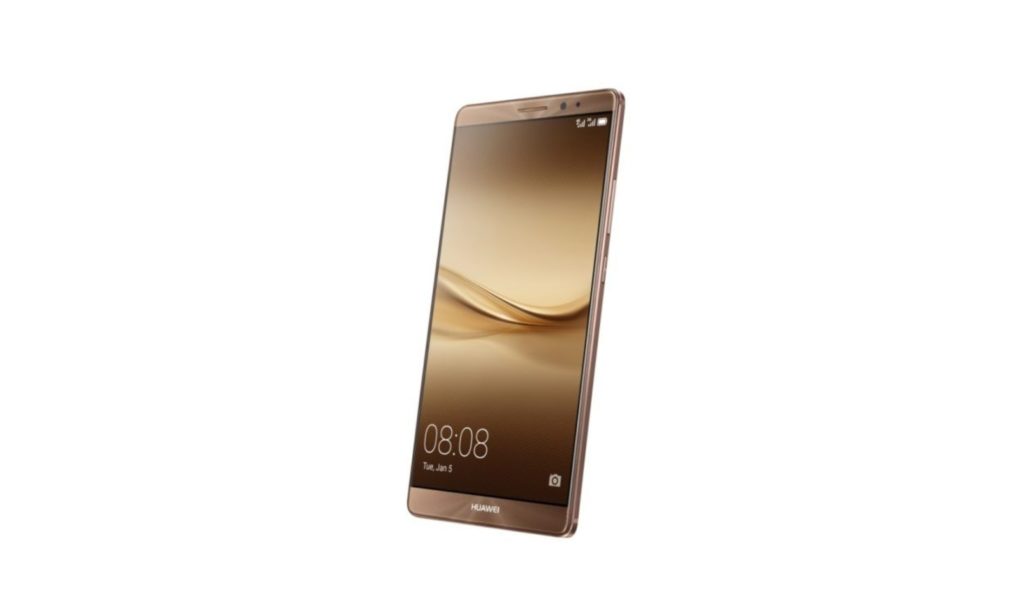
The Chinese telecom giant launched HUAWEI Mate 8 as its flagship smartphone for the second half of 2015. It has been almost 5 years since the handset’s initial release. For context, it debuted around the time when iPhone 6s/6s Plus, Galaxy S6/S6 Edge, and Galaxy Note 5 were the talk of the town. But even after these many years, the phone is getting a new system update, which is unheard in the Android world.
Out of all the smartphones launched in 2015, the Apple iPhone 6s and iPhone 6s Plus are the only devices to get regular software updates. These two are even eligible for iOS 14, which is set to release this fall.
Surprisingly, Huawei is rolling out a new system update to Mate 8 with build number 8.0.0.850 (C00) in China. It is probably the first time a five-year-old Android smartphone is getting an official software update from the company.
This handset currently runs EMUI 8.0 based on Android Oreo. For those unaware, it was the first Huawei device to launch with EMUI 4.0 based on Android 6.0 Marshmallow. It got two major Android and EMUI updates as promised by the firm.
The new update for the HUAWEI Mate 8, which is being seeded out after the end of its software support bumps up the security patch level to July 2020. Most importantly, it adds the “Smart Charge” feature, which reduces battery ageing by adapting and preventing the battery from being continuously charged when full.
That said, the OTA update weighs 222MB in size and is currently limited to the Chinese variant of the phone with model number NXT-AL10. We expect the global variants to get it in the coming days.
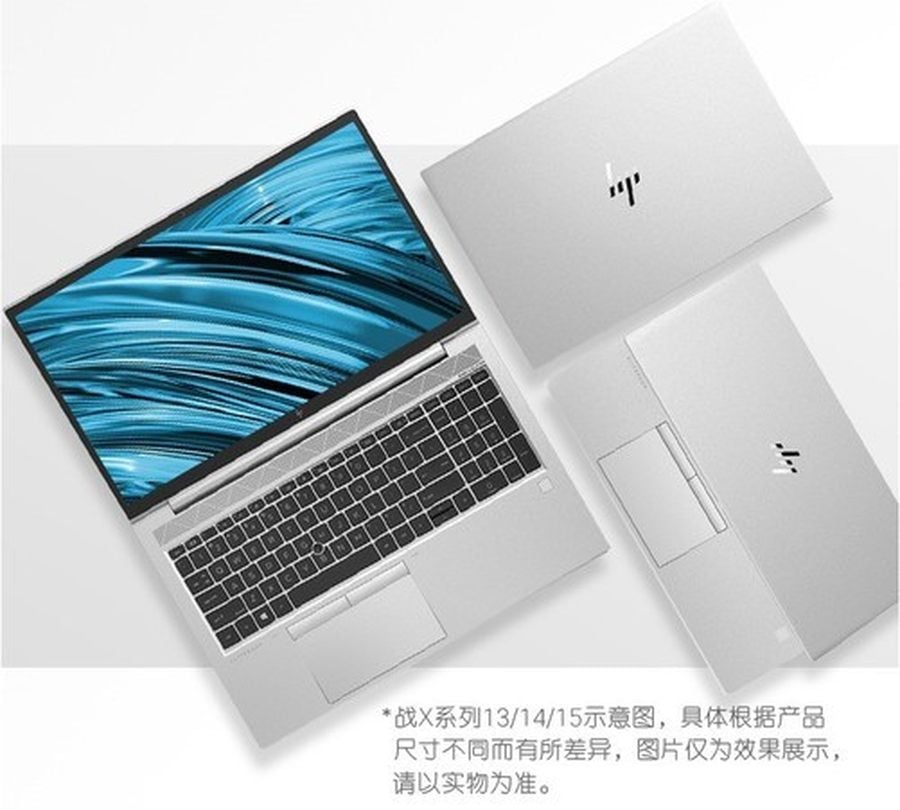
HP has launched a new laptop in China and it is dubbed HP War X. The laptop is a special edition embedded with a Ryzen processor and inspired by the Star Wars Animation. The new laptop model is available in 13, 14, and 15 inches screen sizes.
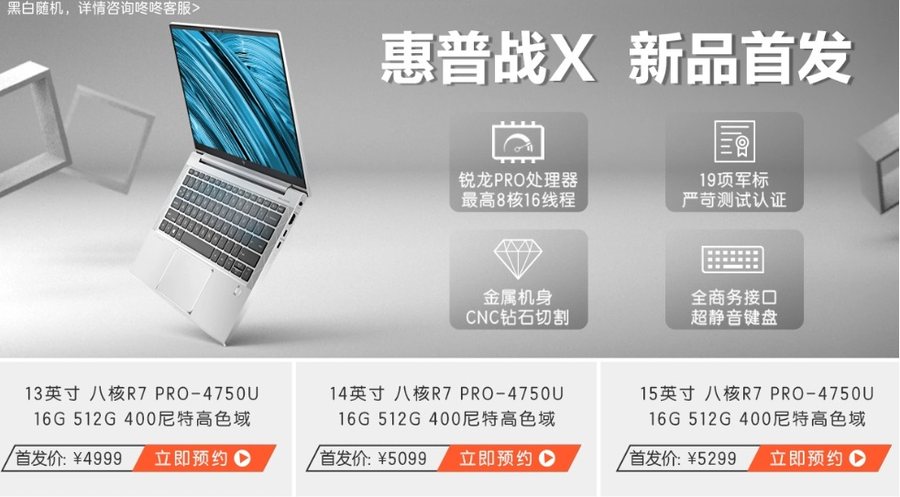
HP first introduced the Wars edition in 2015, and it was targeted at fans of Star Wars. This time around, the company integrated the laptop with AMD’s latest Ryzen 7 Pro -4750U chipset which is an added advantage considering the popularity of AMD’s Ryzen chipsets. There is even a slightly cheaper Ryzen 5 Pro – 4650U-powered model also available for all three screen sizes. The Ryzen 8 provides higher speeds, more memory, and wider bandwidth alongside 1080p to ultra-quality 4K resolution. The laptop comes with 16GB RAM and 512GB of internal storage. It also features the world’s first PCIe 4.0 connectivity, advantageous for the most advanced motherboards, graphics, and storage technologies available.
This HP War X has an all-metal body with the display capable of 400 nit brightness and 100% SRG color gamut. The notebook comes with an ultra-thin size 1.26kg and weighs just 1.69 kg.
As for the prices, the HP War X product carries a starting price of RMB 4,999 (~$722) for the 13 inches version, RMB 5,099 (~$736) for the 14 inches version, and RMB 5,299 (~$765) for the 15 inches version. It is presently on pre-sale on Jingdong and will go on sale from August 31.
HMD Global has scheduled an event for August 25 to launch Nokia 5.3 in India. Now, according to a new leak, the company may also unveil Nokia C3 for the country at the same. For those unaware, it is an entry-level smartphone, which made its debut earlier this month in China.
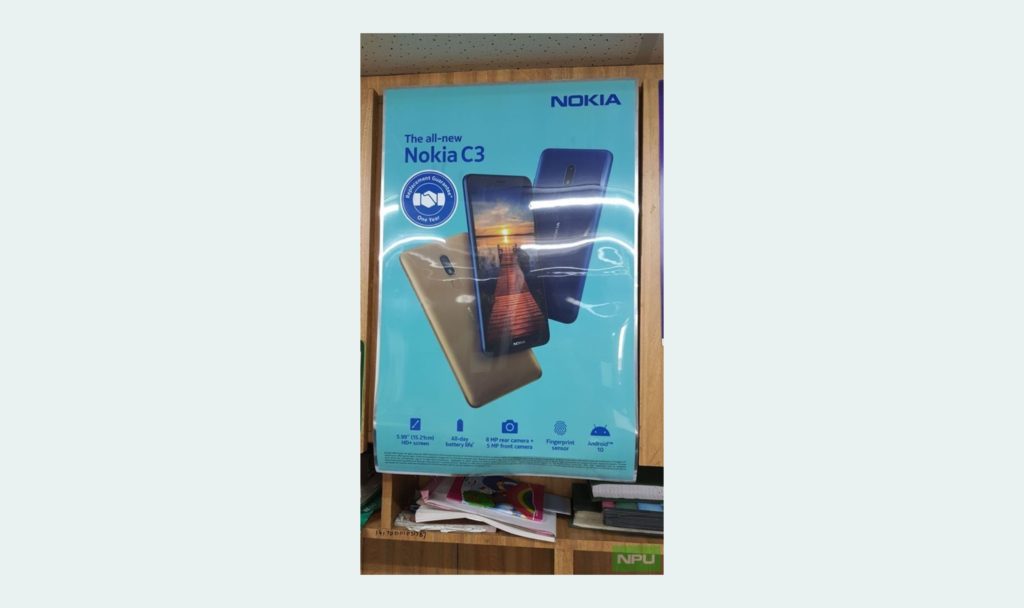
The news regarding the launch of Nokia C3 in India comes from NokiaPowerUser. A reader of the blog had shared a picture of the handset’s poster for offline retailers. This poster not only highlights the specs of the phone but also reveals that it will come with a one-year replacement guarantee.
As for specifications, the Nokia C3 is powered by a 1.2GHz 28nm UNISOC SC9863A octa-core processor paired with 3GB RAM and 32GB internal storage. It features a 5.99-inch HD+ (1440 x 720 pixels) 18:9 LCD panel on the front without a notch or punch-hole. Hence, the 8MP selfie camera sits at the top bezel, whereas the bottom chin houses the Nokia branding.
Other features of this phone include 8MP primary camera, fingerprint sensor, dedicated key for Google Assistant, microSD card slot, 3.5mm headphone jack, MicroUSB port, 3,040mAh battery, and Android 10.
It comes in two colors (Nordic Blue/Sand Gold) and costs 699 yuan ($101/₹7,569) in China.
Huami is expected to announce new Amazfit products soon. Among the expected products are successors to the Amazfit GTR and Amazfit GTS. Today, the manufacturer released an official teaser hinting at the arrival of new products.
The teaser was posted on Weibo and it hints at the new products launching this autumn. Autumn begins in September, which means there should be a series of launches next month.
The Amazfit GTR 2 and Amazfit GTS 2 are expected to come with AMOLED displays like their predecessors. However, it has been reported that the GTS 2 may have a round dial rather than a square one. Other features reported to be present in the 2nd-gen GTS 2 are NFC, Alexa voice assistant, and a new feature called Smart Crown.
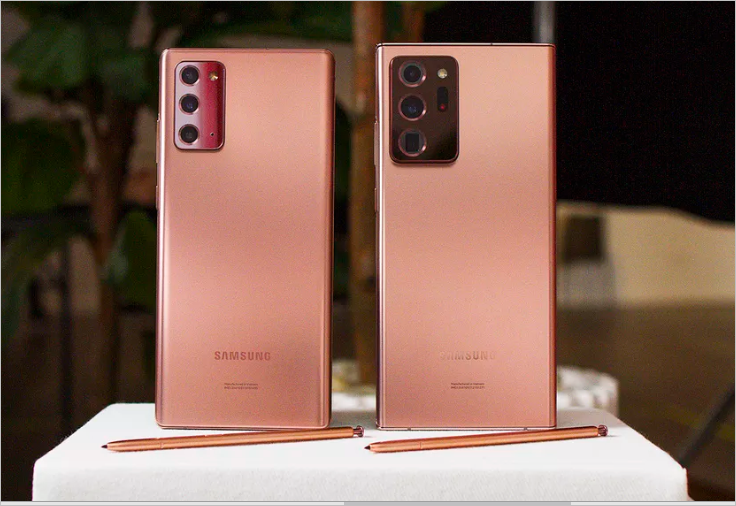
What makes the Galaxy Note series special is the S Pen. It is practically the major difference between the Note series and the S series, and for the Galaxy Note 20 series, Samsung has improved the latency of the Bluetooth stylus such that it practically feels like you are using a real pen.
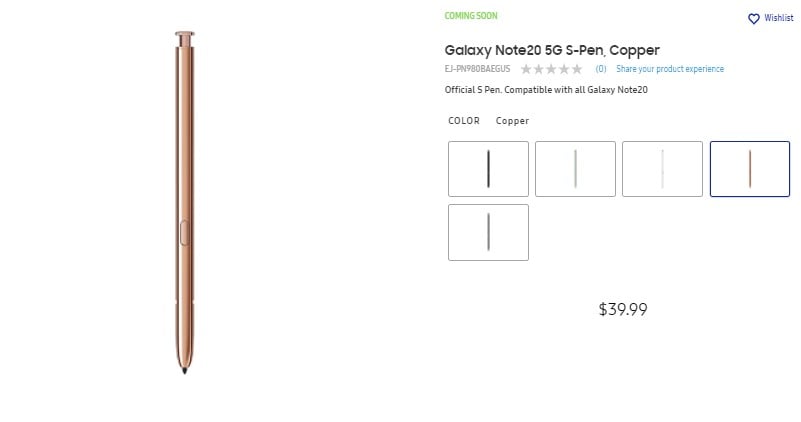
Even though the S Pen has a slot designed for it on the phone, one can still lose it or accidentally break it. If that happens, Samsung says you will be able to pick up a replacement for just $39.99!
Yes, you will be able to purchase an original replacement from Samsung and in the same color as your device. The pen is compatible with all variants of the Galaxy Note 20 and the Galaxy Note 20 Ultra and will work just like the original.
The Galaxy Note 20’s S Pen connects via Bluetooth and charges automatically when you put it back in its slot. It has support for 4096 levels of pressure and can perform a number of off-screen functions such as music playback control, remote for the camera, and as an air remote.
Samsung also sells replacement S Pens for its other devices. The one for the Tab S6 and Tab S6 Lite costs $59.99 and $49.99 respectively while that of the Galaxy Note10 and Galaxy Note9 go for $29.99.
You can purchase a replacement S Pen for the Galaxy Note20 on the official website but it is currently listed as coming soon.
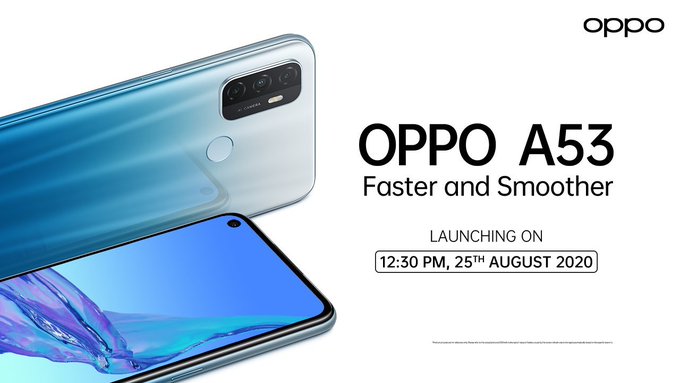
OPPO A53 2020 made its debut in Indonesia on Thursday. The handset costs Rp 2,499,000 ($169) in the country for 4GB + 64GB storage configuration. It is scheduled to launch in India on August 25. Ahead of it, a new leak suggests the world’s second-largest smartphone market will get a different memory variant.
The OPPO A53 2020 is known as the first smartphone to launch with Snapdragon 460. It is probably also the first handset to sport an HD+ (1600 x 720 pixels) LCD panel with 90Hz refresh rate. Also, it is priced competitively, compared to previous devices from the brand.
According to Mukul Sharma (@stufflistings), this phone will be available in 6GB + 128GB combo in India initially. He added that the price of this model could be somewhere between ₹14,000 and ₹15,000. Also, he mentioned that the lower 4GB + 64GB variant that launched in Indonesia will make its way to India sometime later.
At this price, the device will have to compete with POCO M2 Pro, Redmi Note 9 Po, Realme 6, and Samsung Galaxy M21 in the country. But since OPPO is an offline-focused company with a heavy emphasis on marketing, it can definitely manage to push handsome units of A53 2020 edition into the hands of customers.
Anyway, it is not a bad budget smartphone per se as it features a 12MP (wide) + 2MP (macro) + 2MP (depth) triple camera setup, 16MP punch-hole selfie camera, fingerprint sensor, microSD card slot, 3.5mm headphone jack, USB Type-C, 5,000mAh battery, 18W fast charging, and ColorOS 7.2based onAndroid 10.
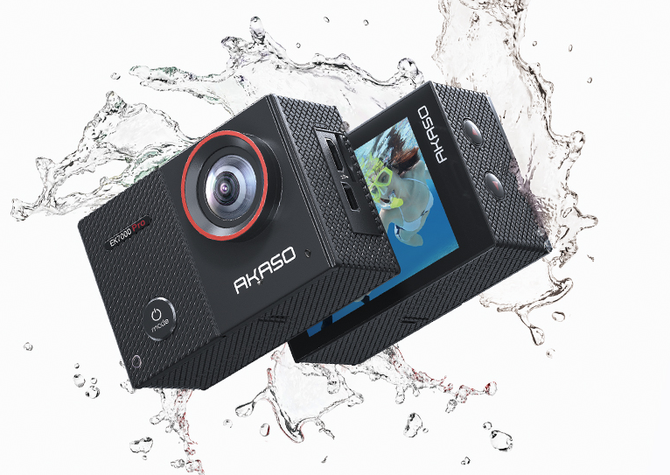
As a world-renowned camera manufacturer, AKASO’s action camera EK7000 Pro ranks as the top-selling action camera on Amazon. Only in July this year, AKASO’s sales of the EK700 Pro on Amazon reached 150,000+ which show the camera is a hot product. In order to expand its market, AKASO has now launched its first product in China and it is the EK7000 Pro.
The EK7000 Pro is a camera focused on sports photography, equipped with a 20.1-megapixel lens. The lens supports 4K 25fps video shooting and a 170° super wide-angle, far exceeding the 120° super wide-angle common to mobile phones. For a sports camera, anti-shake is undoubtedly the most important. AKASO E7000 Pro supports intelligent anti-shake algorithm, which can eliminate screen jitter through EIS+ gyroscope, and can also shoot relatively stable and clear videos under various severe jitter conditions to ensure that there will be no jelly effect.
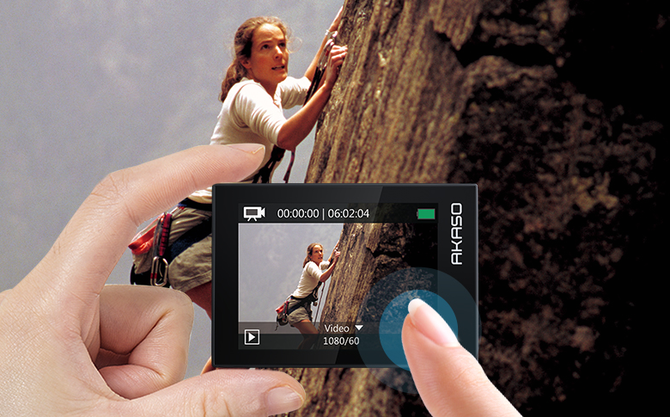
The EK7000 Pro action camera is also equipped with a 2.0-inch high-definition touch screen that supports one-click editing. It can also directly connect to a mobile phone via Wi-Fi and share the captured content on social platforms. In terms of battery life, the EK7000 Pro has a battery capacity of 1050mAh, which can continuously shoot videos for 90 minutes. It comes with two batteries.
As stated earlier, the EK7000 Pro is AKASO’s first product to be launched in its home market of China. It is already on sale on Tmall and is priced at 499 yuan (~$72). The company also promised to launch more products in China in September this year.
Recently, OPPO launched A53 2020 as the world’s first smartphone with Qualcomm Snapdragon 460 beating other phones which leaked with the same chipset. Now, it seems like the next handsets with this SoC will be mostly vivo Y20 and vivo Y20i respectively as their entire specs leak via marketing material.
The upcoming vivo Y20 and vivo Y20i will be identical with only three differences – RAM, charging speed, and color. The specifications of these devices were shared by Mukul Sharma aka @stufflistings on Twitter.
According to the pictures shared by the tech influencer, these two phones will sport a 6.51-inch Halo Full View Display (dew-drop notch). Though the leak does not mention the type and resolution of the panel, we believe it to come with an LCD screen with HD+ resolution.
Both the handsets will be powered by Snapdragon 460 but the Y20 will feature 4GB RAM, compared to 3GB RAM on Y20i. For optics, they will come equipped with a 13MP (wide) + 2MP (macro) + 2MP (depth) triple camera setup aligned vertically on a rectangular module on the rear panel. They will also feature an 8MP front-facing camera for selfies and video calls.
Further, these devices will ship with FunTouch OS 10.5 based on Android 10 and the whole package will be backed by a 5,000mAh battery, However, only Y20 gets 18W fast charging support, whereas, Y20i is mentioned to have normal charging (mostly 10W).
Last but not least, these upcoming vivo budget smartphones will feature a side-mounted fingerprint sensor and will be available Dawn White and Obisidian Black (Y20) / Nebula Blue (Y20i) color variants.
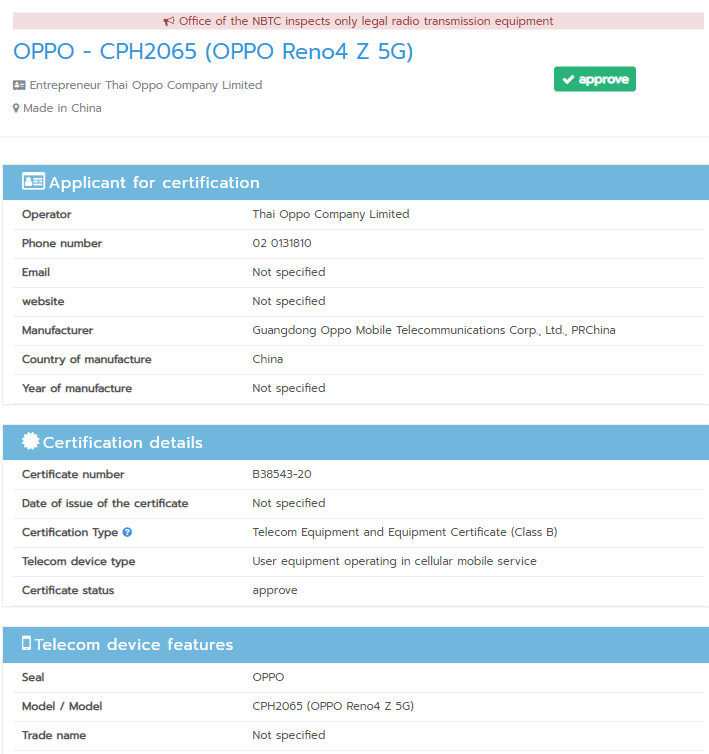
OPPO launched the A92s smartphone in China back in April this year packing a decent specs lineup. The phone has since gone on sale. There have been speculations that he A92s will hit the global turf as Reno4 Z 5G. That was recently touted when the phone was listed as “OPPO Reno4 Z 5G” by the Global Certification Forum. This has now been confirmed as the device has also been certified by Thailand’s NBTC as the Oppo Reno4 Z 5G (via).
The NBTC listing confirms the device will be powered by a MediaTek Dimensity 800 chipset. The processor is a 5G SoC which makes the device a 5G phone. The device is expected to pack an LCD screen with 12oHz refresh rate. However, it comes with support for 18W charging speed instead of the 65W fast charging capabilities of its siblings.
As of now, we don’t know the price of the Reno4 Z 5G or when it will be launched but for reference, the A92s comes with a retail 2,200 yuan (~$320). We expect the phone’s global pricing to be in this range.
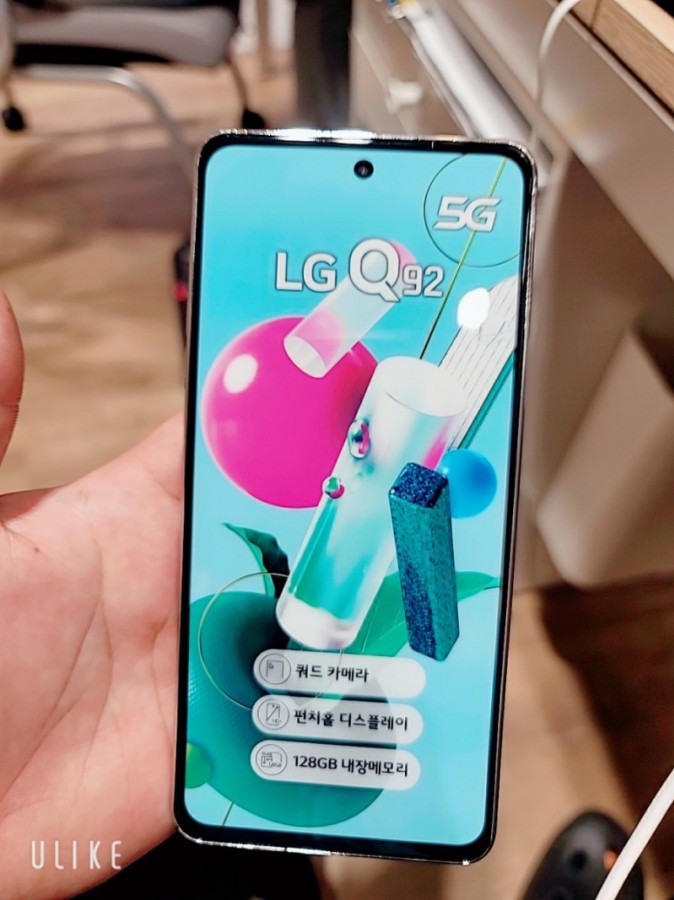
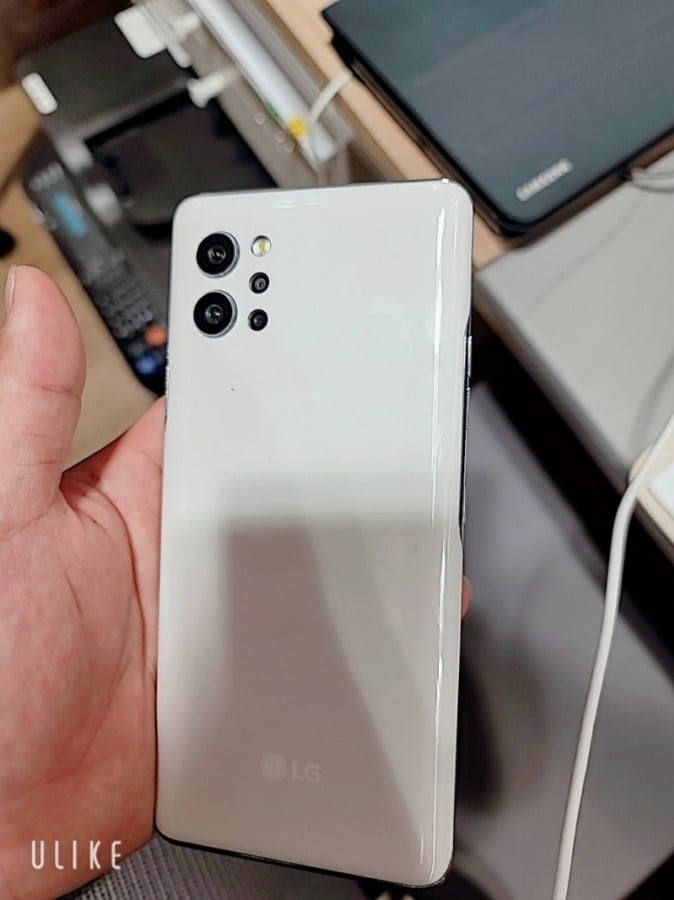
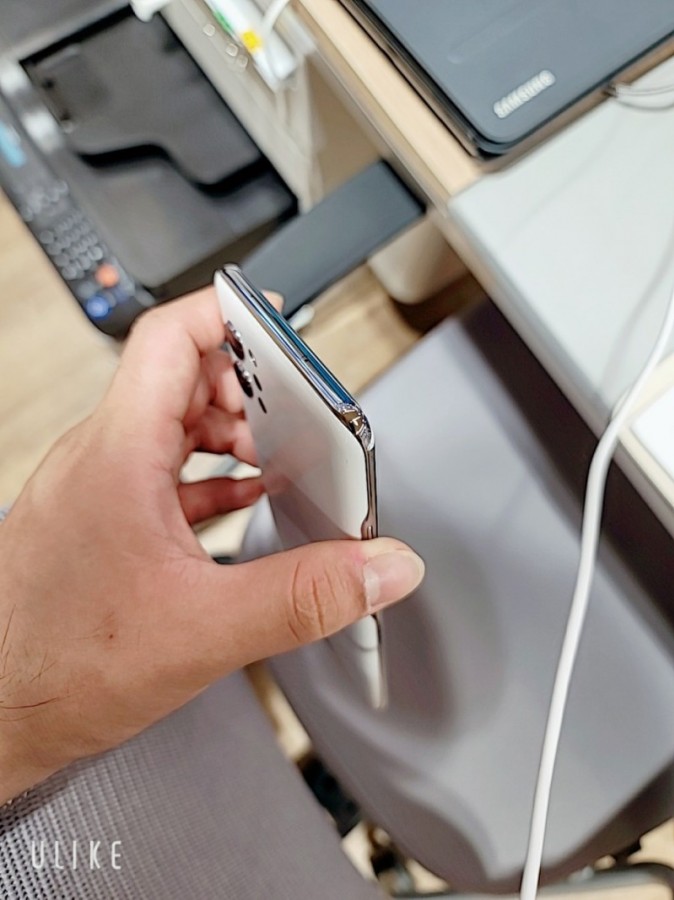
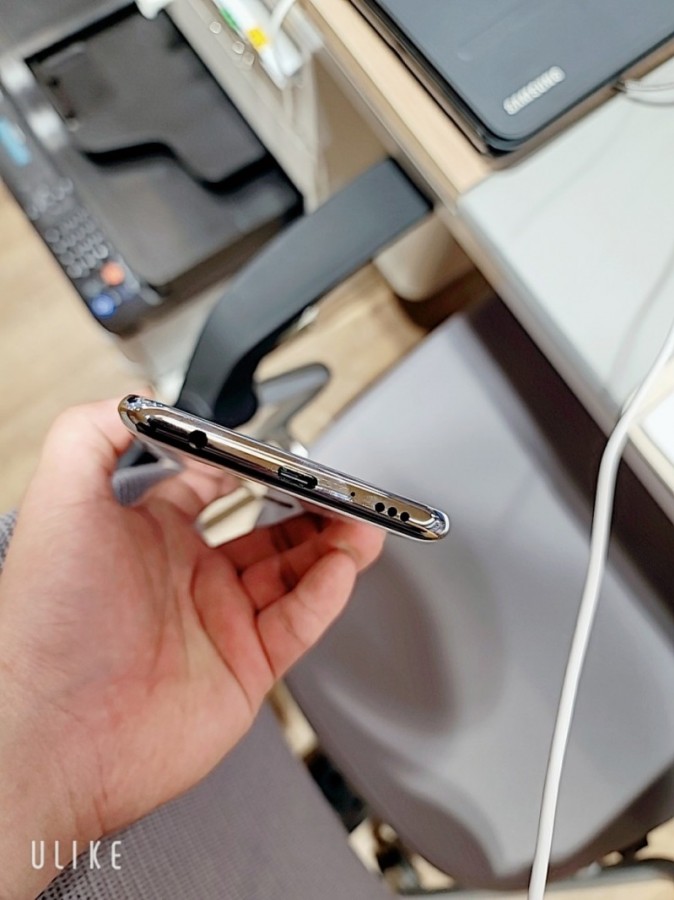
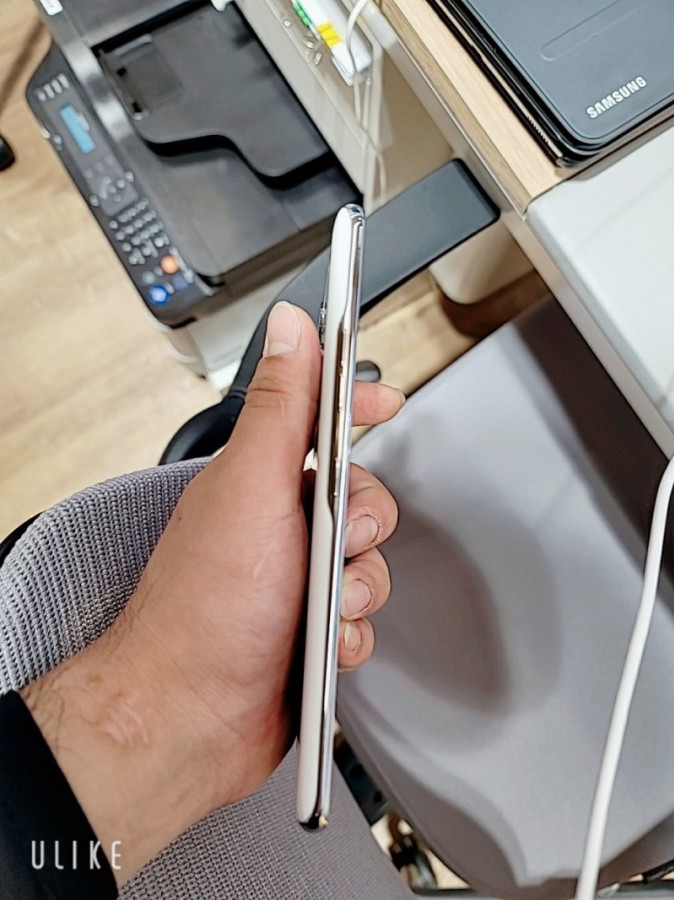
The rumor mill has been spilling information on the LG Q92 5G phone since last month. It was first spotted at the Google Play Console and it also appeared at the Geekbench benchmarking platform. Earlier this week, a leaked had revealed its entire specifications. Now, a South Korean publication has shared a couple of live shots of the LG Q92 5G phone.
The LG Q92 5G can be seen in the Ceramic White version in the live shots. The handset has a punch-hole display and it has four cameras and an LED flash on its curved back. The bottom edge of the phone features a 3.5mm audio jack, a USB-C port, and a speaker grille.
The LG Q92 5G is a MIL-STD-810G certified phone that measures 166.54 x 77.3 x 8.49mm and weighs 193 grams. Apart from Ceramic White, the Q92 5G will come in colors like Mirror Titanium and Mirror Red.
The LG Q92 5G has a Full HD+ resolution supporting display of 6.7 inches. It has a 32-megapixel front camera and its rear has a 48-megapixel + 8-megapixel (ultrawide) + 5-megapixel (depth) + 2-megapixel (macro) quad camera setup.
The Snapdragon 765G fuels the LG Q92 5G with 6 GB of RAM. It has 128 GB of native storage and is loaded with Android 10 OS. The phone is packed with a 4,000mAh battery that will come with fast charging capabilities. The Q92 5G has other features such as a side-facing fingerprint reader, stereo speakers, and NFC. There is no word on the pricing of the LG Q92 5G.
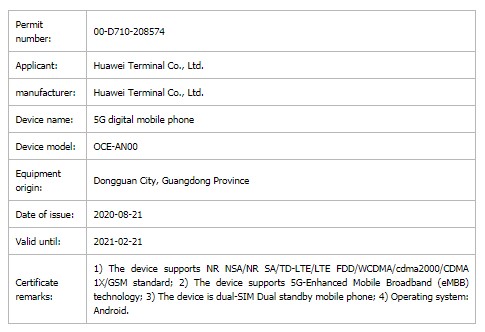
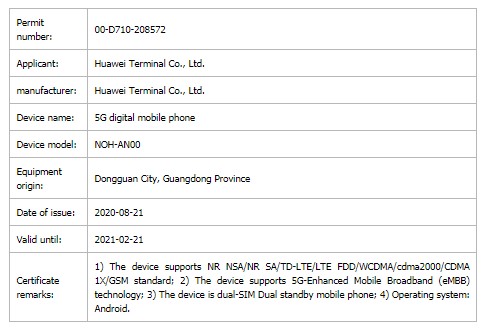
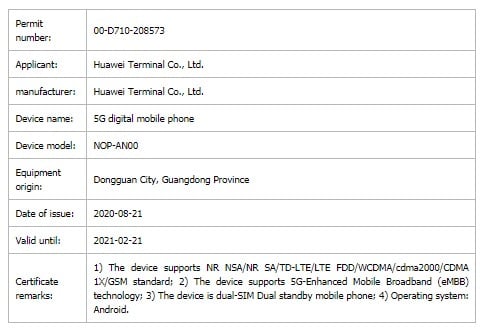
Huawei is expected to launch the Huawei Mate 40 series of flagship phones in September. Ahead of the rumored launch, three smartphones that reportedly belongs to the Mate 40 series has appeared on TENAA’s database. At the same time, display analyst Ross Young has shared some key information on the displays of the three phones.
It is believed that the OCE-AN00 model number belongs to the Huawei Mate 40 handset. The letters ‘OCE’ refers to its ‘Ocean’ codename. The NOH-AN00 Huawei phone could be the Mate 40 Pro smartphone. The ‘NOH’ letters in the model number are the short form of its “Noah’ codename.
1 of 3
The NOP-AN00 phone also seems to belong to the Mate 40 series. It is unclear whether the phone is Mate 40 Pro+ or Mate 40 RS Porsche Design. Hopefully, newer reports will reveal the identity of the NOP-AN00 phone. Unfortunately, the TENAA listings of these phones do not have any information on their specs, except for the fact that they support 5G connectivity and run on Android. These listings are expected to get updated with full specs soon.
In June, display analyst and CEO of Display Supply Chain Consultants (DSCC), Ross Young had claimed that the Mate 40 will come with a 120Hz refresh rate display. However, a tipster claimed at the end of the same month that the Mate 40 series will support a 90Hz refresh rate like the Huawei P40 series. Now, even Young has claimed that the Mate 40 series phones will have 90Hz refresh rate displays. He is of the view that Huawei will offer 120Hz refresh rate displays on its smartphones in the coming year.
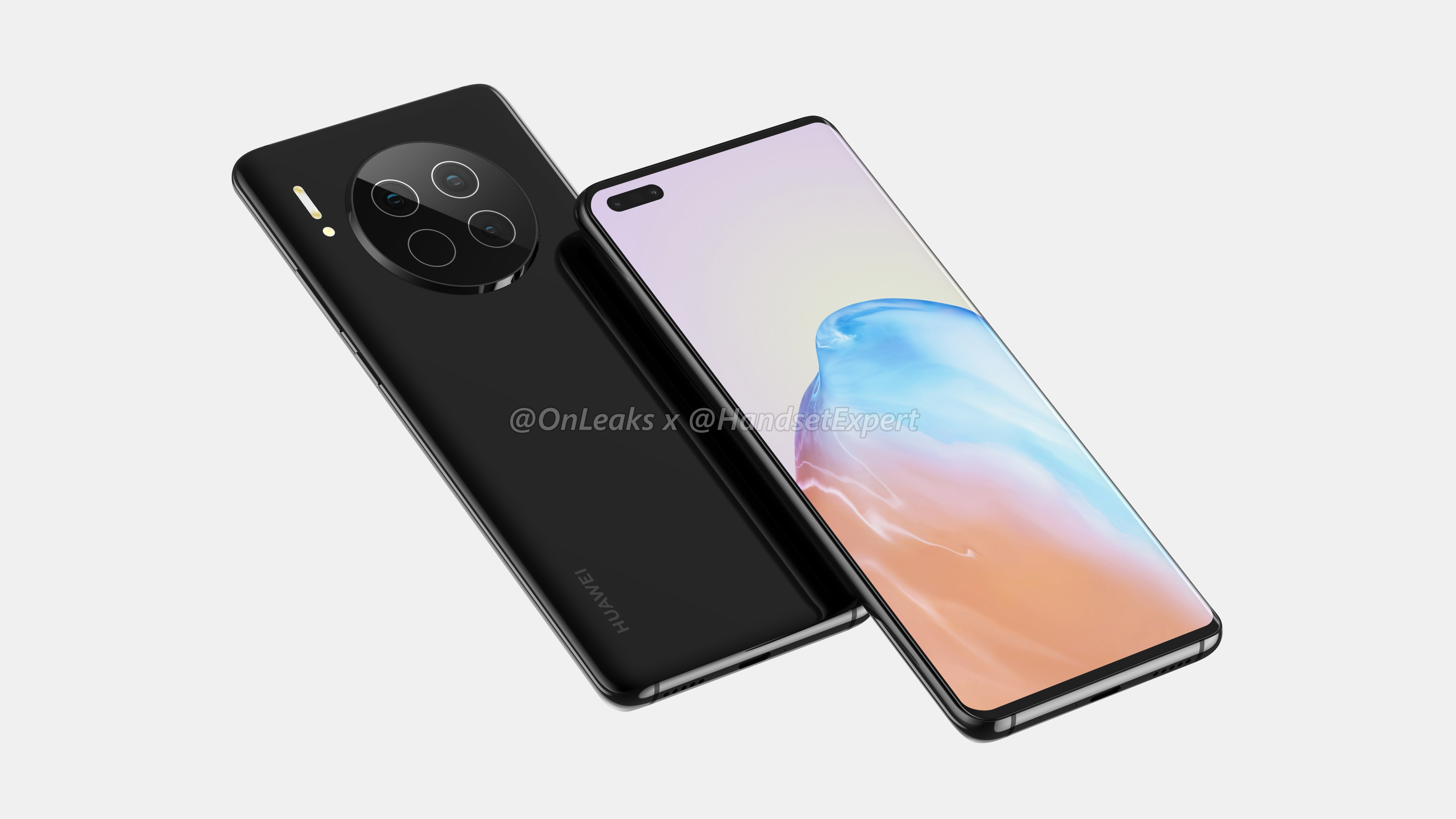
Huawei Mate 40 CAD render
Young further mentioned that the Huawei Mate 40 has a 6.5-inch display that supports 1080 x 2340 pixels Full HD+ resolution. The Mate 40 will have screens supplied by BOE display manufacturer. The Mate 40 Pro will have a larger 6.78-inch QHD+ display supplied by BOE, Samsung Display, and LG Display. He has speculated that Mate 40 series will have waterfall displays with curved edges.
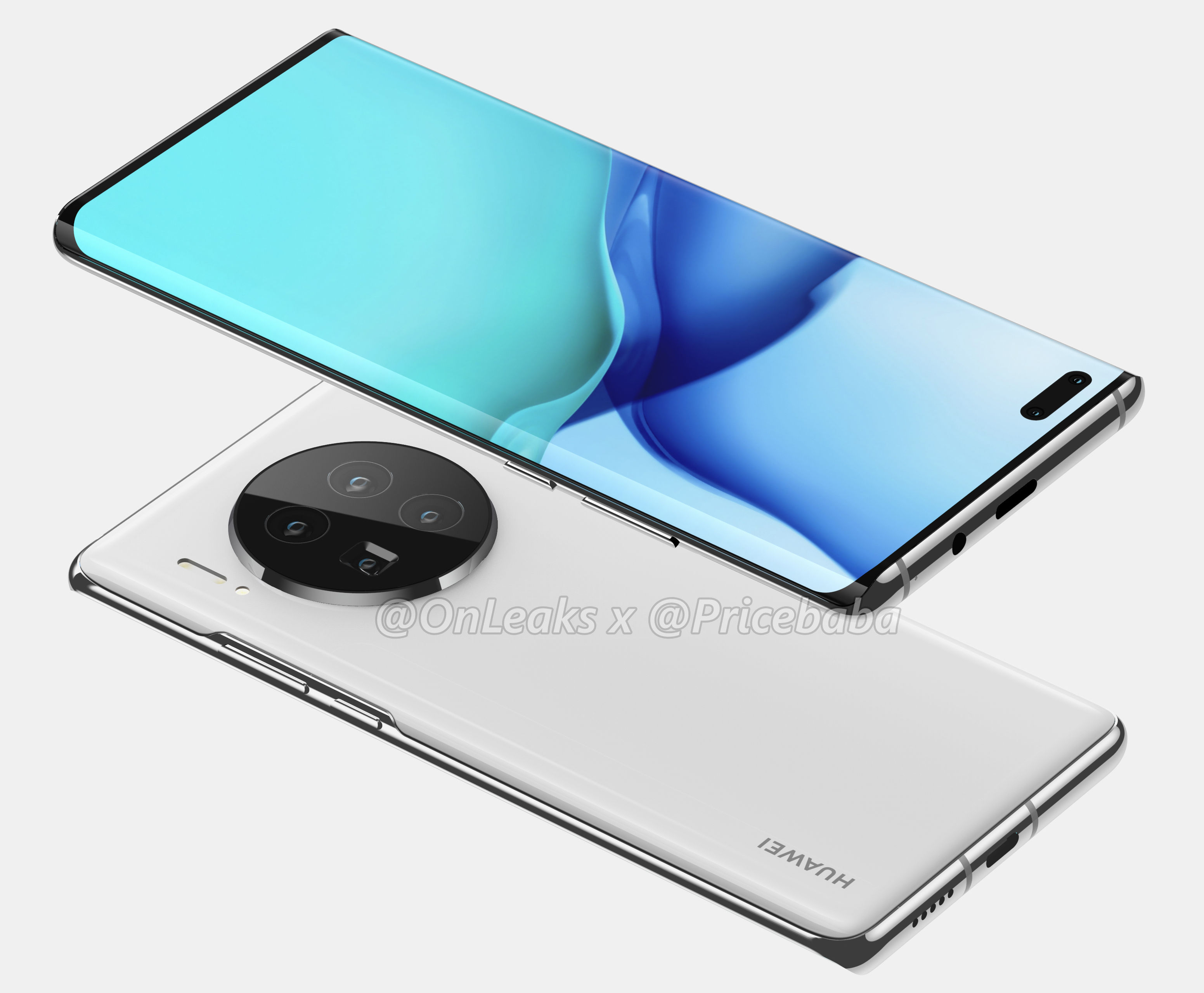
Huawei Mate 40 Pro CAD render
The CAD renders released by OnLeaks in the recent past had revealed that both phones will have a dual punch-hole cutout. Young also claimed that he is not aware of a Pro Plus model. If it exists, it will have the screen that will be available on the Mate 40 Pro.
Multiple reports have revealed that the FRL-AN00a model number belongs to the upcoming Huawei Enjoy 20 Plus 5G smartphone. The handset has now appeared in the product library of China Telecom. The listing has revealed its release date, pricing and specifications. Speculations are rife that this device will be rebranded as Huawei Mate 40 Lite, Huawei Y9a, and Huawei P Smart Pro 2021 in different markets.
Huawei Enjoy 20 Plus 5G price and release date
The listing reveals that the Huawei Enjoy 20 Plus 5G will come in three models such as 6 GB RAM + 64 GB storage for 1,899 Yuan (~$274), 6 GB RAM + 128 GB storage for 2,299 Yuan (~$332), and 8 GB RAM + 128 GB storage for 2,499 Yuan.
Readers are recommended to take the pricing information with a grain of salt as the company is yet to announce the smartphone. The listing further revealed that the Enjoy 20 Plus 5G will be available in multiple colors like Magic Night Black, Emerald Green, Galaxy Silver, Sakura Snow, and Snow Clear Sky. The phone is scheduled to release in the market on Sept. 3. Hence, it appears that the Chinese manufacturer may soon confirm on its launch date.
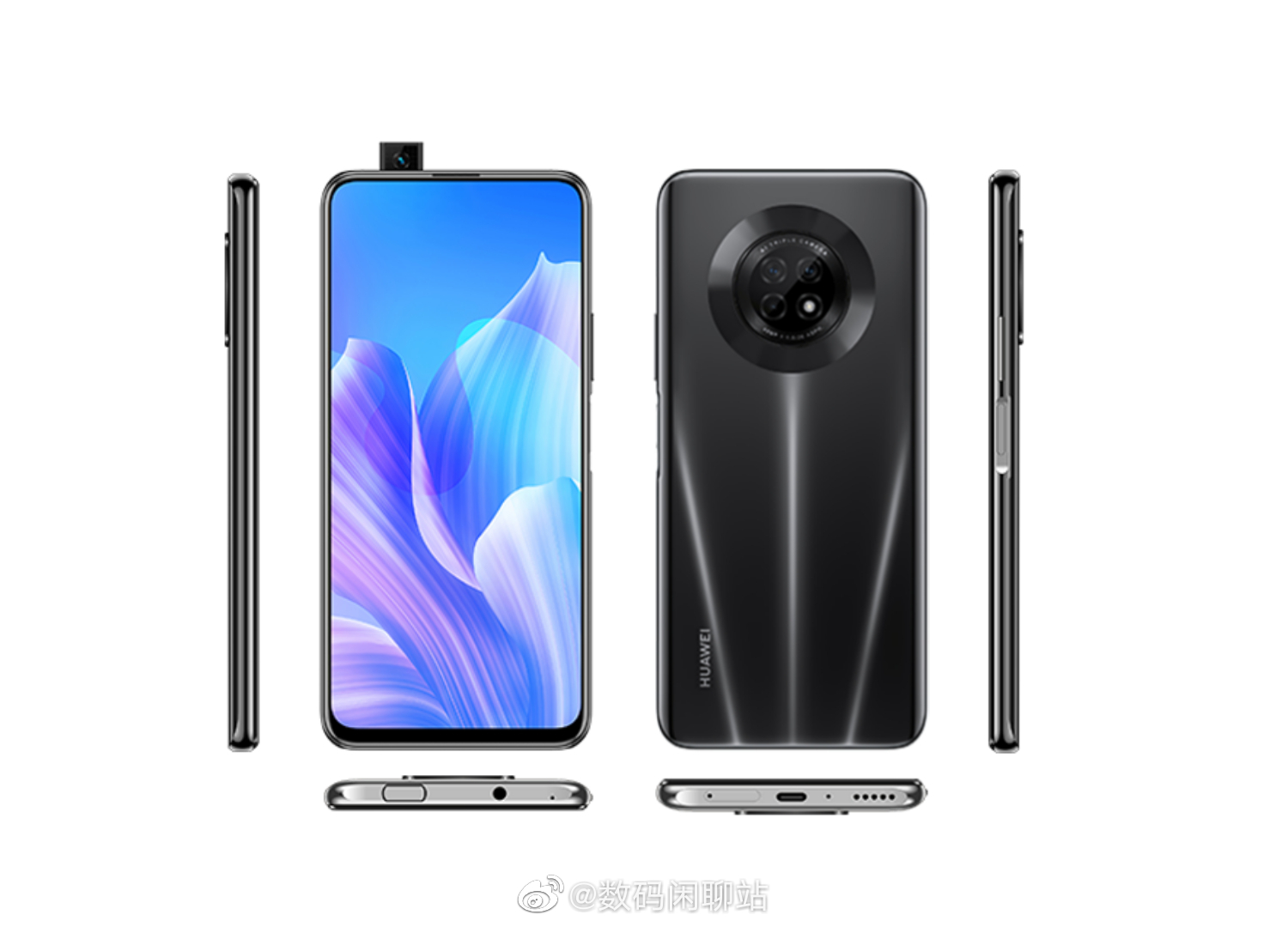
The Huawei Enjoy 20 Plus has a 6.63-inch IPS LCD FHD+ screen with notch-less design. It has a pop-up selfie camera of 16-megapixel and its rear features a round-shaped camera module like the one found on last yea’s Mate 30 Pro. It includes a 48-mgeapixel + 8-megapixel + 2-megapixel triple camera system.
The Enjoy 20 Plus 5G’s render shared by Digital Chat Station. The image shows that the phone has a volume rocker and a fingerprint reader on the right edge, a SIM card tray, a USB-C port, and a speaker grille at the bottom, and a 3.5mm audio jack at the top. The left spine of the Enjoy 20 Plus 5G is barren.
Xiaomi has started rolling out MIUI 12 stable update to Redmi Note 8Pro users in India. This was announced on the brand’s MIUI India social media handles.
The update comes with build number V12.0.1.0 QGGINXM and has a file size of 641MB.
The official changelog shows that the update brings an all-new physically-based animation engine with advanced architecture aimed at providing a refreshed look to the device. The update also brings new dynamic window technology which takes switching screen orientation to a new level.
Further, the new MIUI 12 also brings new System visuals which work for all types of content and languages. Other features include a new control centre, granular permission management for apps, revamped Settings app, Dark Mode 2.0, and more.
To download the new update on your Redmi Note 8 Pro, head over to Settings – About phone – System update and then click on download and update your device.
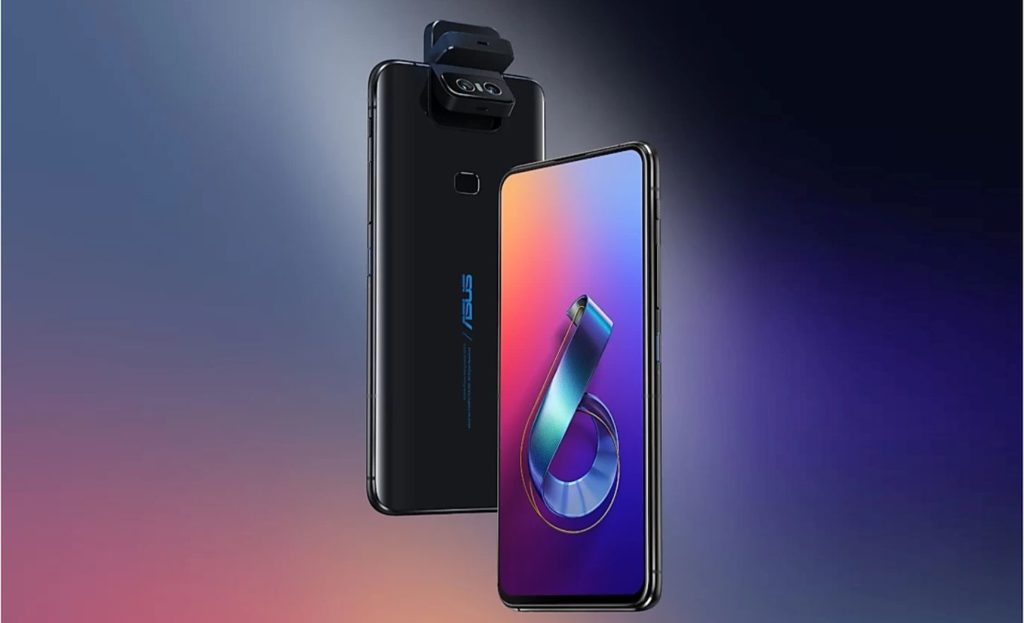
ASUS is gearing up to launch the Zenfone 7 series next week. On the other hand, the Taiwanese company has opened registrations for Zenfone 6 (aka ASUS 6Z) Android 11 Beta. For those unaware, this phone launched with Android Pie and was updated to Android 10 late last year. The forthcoming update will be its second Android update.
The ASUS Zenfone 6 is known for offering stock Android like software experience apart from its signature flip camera. Both are expected to return for its successor, which is slated to launch first in the company’s home country om August 26.
Talking about the Android 11 beta program, users need to be on build number 17.1810.2008.171 to enrol. If you are a Zenone 6 user and want to try out Android 11 on your handset before anyone, make sure you are updated to the mentioned build and then, head over to “System update” in Settings. On this screen, tap on the gear icon present at the top right corner and finally, tap on “Enroll in the Beta Test Program”.
The recruitment is open till September 4 and selected users will be notified on September 9. The only requirement specified by ASUS is that your device bootloader shouldn’t have never unlocked. That means users who previously unlocked and relocked the bootloader may not get recruited for the program.
Three months after the global launch of the A52, OPPO officially announced the OPPO A53 2020 and launched it in Indonesia. While waiting for it to hit the Indian market, we can examine all of its specifications and compare it with the other devices sold in the same price range. For this comparison, we chose the Redmi Note 9 and the Realme 6i. Note that Realme 6i exists in two different variants: the Indian version and the global version. The phone we will talk about in this comparison is the Indian version, while the global version is a more affordable phone with inferior specifications.
Quad 48 + 8 + 2 + 2 MP f/1.8, f/2.2, f/2.4 and f/2.4
13 MP f/2.3 front camera
Quad 48 + 8 + 2 + 2 MP f/1.8, f/2.3, f/2.4 and f/2.4
16 MP f/2.0 front camera
Quad 12 + 2 + 2 MP
16 MP f/2.0 front camera
BATTERY
5020 mAh, fast charging 18W
4300 mAh, fast charging 30W
5000 mAh, fast charging 18W
ADDITIONAL FEATURES
Dual SIM slot, reverse charging, water-repellent
Dual SIM slot, splash resistant
Dual SIM slot
Design
The sleekest handset of this trio is the Realme 6i which sports a smaller camera module and a punch-hole display with a hole placed on the upper left corner. But if we talk about build quality, the Redmi Note 9 looks more interesting because it has a glass back instead of a full polycarbonate body. It is uglier, but it is well-built. Oppo A53 is thinner and lighter than its two rivals, but it is bigger due to its thicker display bezels.
Display
The most advanced display belongs to the Realme 6i: a Full HD+ panel with a 90 Hz refresh rate. It is not a high-end panel and it is an average IPS display, but it is way better than Redmi Note 9 and Oppo A53 2020. Indeed, the former features a Full HD+ display with a standard refresh rate, while the latter has a low HD+ resolution, despite it features a 90 Hz refresh rate just like the 6i. The Realme 6i wins the comparison simply because it has both the features.
Specs & Software
Even when it comes to the hardware, Realme 6i is the champion. It has a more powerful Helio G90T chipset paired with up to 6 GB of RAM. With Redmi Note 9, which gets the second place, you get the Helio G85 paired with max 4 GB of RAM, while Oppo A53 has an inferior Snapdragon 460 SoC built with a better production process, but with lower performance. Oppo A53, Redmi Note 9, and Realme 6i run Android 10 out of the box, highly-customized by proprietary user interfaces.
Camera
On the paper, Realme 6i wins the camera comparison. It has exactly the same rear cameras as the Redmi Note 9, but it features a better chipset as well as a better front camera with a 16 MP resolution. With the Oppo A53, you get the same front camera as the Realme 6i, but the rear cameras are inferior to both its two opponents of the comparison. Realme 6i is able to record 4K videos at 30 fps and 1080p videos at 120 fps with EIS. It has a 48 MP main sensor with an f/1.8 focal aperture, an ultrawide sensor, and two sensors with 2 MP resolutions for macro and depth.
Battery
The biggest battery belongs to the Redmi Note 9, but the OPPO A53 2020 should last more on a single charge because it has a lower resolution for the display and a more efficient chipset (the Snapdragon 460 built at 11 nm). Both feature 18W fast charging, but with the Redmi Note 9, you get 9W reverse charging (wired). Realme 6i has a smaller battery and a shorter battery life, but it has a much faster charging technology with a power of 30W.
Price
Oppo A53 sells for €140/$165, Realme 6i starts from €170/$200, and Redmi Note 9 has a €150/$177 starting price. The Realme 6i is a more advanced device thanks to its Full HD+ 90 Hz display and its better chipset, but unlike Redmi Note 9 and Oppo A53, it is not a battery phone.
Samsung launched the Galaxy Note20, Galaxy Note20 Ultra, Galaxy Tab S7, and Galaxy Tab S7+ with One UI 2.5 out of the box. Even the upcoming Galaxy Z Fold2 will also be debuting with this software. The company’s other smartphones were expected to get his version of One UI in the coming days. But the firm surprised everyone by initiating the rollout to Galaxy S20 series on the first-day sale of Galaxy Note20 series, which happens to be today.
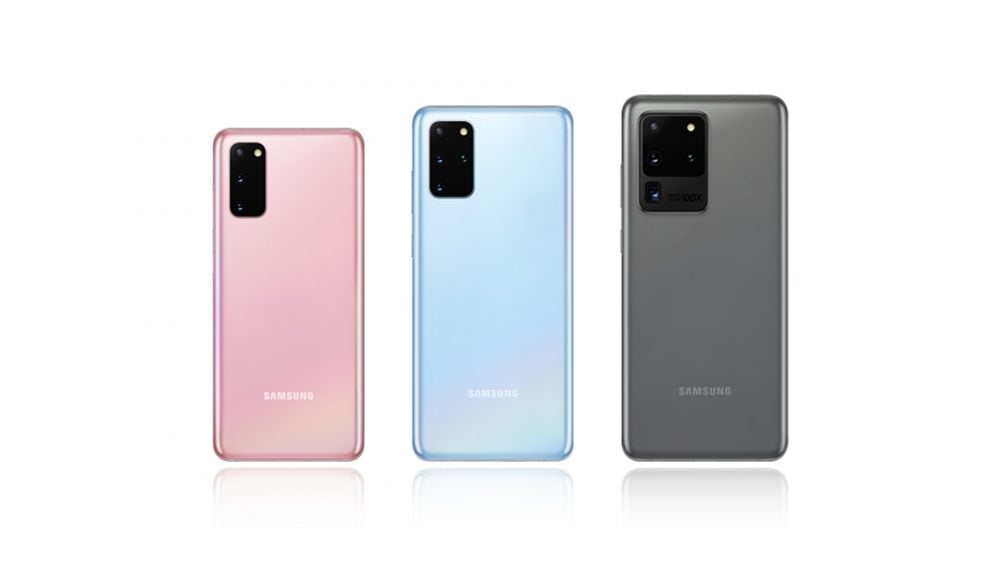
The One UI 2.5 update for Galaxy S20, Galaxy S20+, and Galaxy S20 Ultra is currently live for the 5G variants of these handsets in certain regions. The models that are receiving the update are the following listed below.
Galaxy S20 – SM-G981B
Galaxy S20+ – SM-G986B
Galaxy S20 Ultra – SM-G988B
The above-mentioned variants of Samsung Galaxy S20 series are getting the One UI 2.5 update with build number G98xBXXU4BTH5 in European countries like Spain, Italy, Hungary, Portugal, the Netherlands, Germany, and others. Other models and 4G variants of these phones should also start receiving the update in the coming days.
This update based on Android 10 brings some of the Galaxy Note20 series features like navigation gestures support for third-party launchers, improved Pro Video mode, changes in Single Take, Wireless DeX, and more.
The 2020 Galaxy Note series is made up of the Galaxy Note20 and Note 20 Ultra of which the latter is the topmost variant. While the Galaxy Note20 Ultra has continued to receive rave reviews, the same can’t be said of the Note20. Most complaints are centred around the display lacking a high refresh rate and the presence of a plastic back panel.
Turns out that the internals of the device isn’t one to be happy about. YouTuber channel PBKreviews has shared a video teardown of the vanilla Note20 giving us our first peek at the internals of the cheaper new Note. Sadly, the arrangement of the internal components means the device won’t be an easy one to repair.
The teardown started rolling with the reviewer taking off the back cover, first by applying heat and using the pry tool. Removing the back cover reveals the internal components, prominent of which is the 12MP wide and 64MP telephoto cameras which boast OIS. Heading down, you’ll find the wireless charging pad, earpiece and the 4,300 mAh battery. The S Pen dock is tucked in right next to the battery.
Talking of the battery, there is no pull tabs on the body which makes it difficult to remove the battery should there be any reason to want to do so. The only way to take it out is to heat up the adhesive and then apply alcohol. Then it becomes easy to yank it off using the pry tool.
The Galaxy Note20 features an under-screen fingerprint sensor and it is located under the battery compartment. The sensor is part of the display and is not easy to replace without prior knowledge. The display can be taken off after all the internal components are removed. All that is needed is some heat and the pry tool.
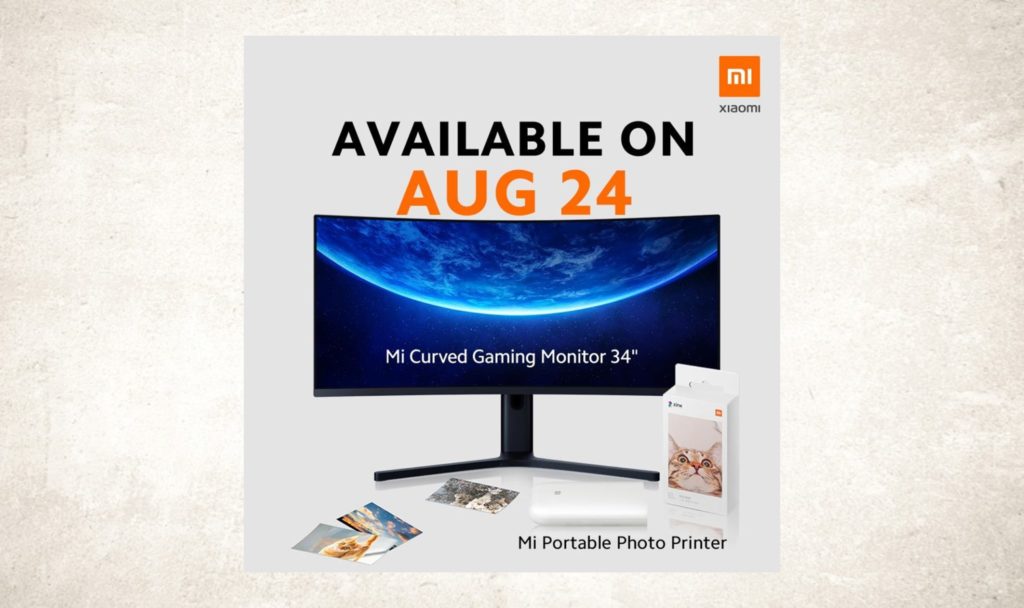
In July 2020, Xiaomi launched Mi Curved Gaming Monitor 34” for the European market. Similarly, in September 2019, the company crowdfunded Mi Portable Photo Printer in China. Now, these two products will be available for purchase in Malaysia on August 24.
Xiaomi Malaysia announced the availability of the above-mentioned two products in the country on its official Facebook page (via Soyacincau). The price for the same will be revealed on Monday whey they will go on sale.
Mi Curved Gaming Monitor 34”
This Xiaomi monitor, as the name suggests, features a 34-inch WQHD (3440 × 1440 pixels) LCD panel with 1500R curvature, 21:9 aspect ratio,144Hz refresh rate, 85% NTSC color gamut, 16.7 million colors (8-bit), 3000:1 contrast ratio, 4ms response time, 300 nits brightness, and AMD FreeSync Premium.
As for ports, it includes 2 x HDMI 2.0, 2 x DisplayPort 1.4, 1 x 3.5mm headphone jack, and 1 x AC power in. Lastly, the monitor can be used with the included stand and can also be wall-mounted.
It costs €399 in Europe but will be mostly priced less than RM2,000 for Malaysia.
Mi Portable Photo Printer
This tiny pocketable printer resembling a power bank is capable of printing photos in 313 × 400 dpi resolution. It can hold up to 10 sheets at a time and takes about 45 seconds for a single print using ZINK (Zero Ink) technology.
The printer features Bluetooth 5.0 to connect with smartphones so that it can be managed via the MIJIA app. Last but not least, it can print a maximum of 20 photos on a full charge with its 500mAh battery, which charges via MicroUSB port.
As for price, the Xiaomi printer launched officially in China for 349 yuan ($50).
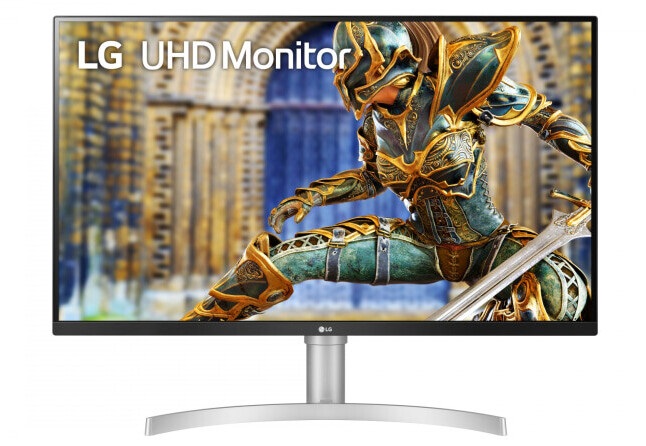
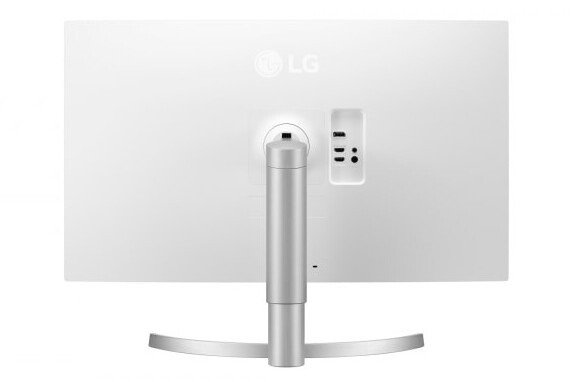
LG Electronics has unveiled a new Ultra-high-definition monitor having the model number 32UN650-W. The monitor features a 31.5-inch LG IPS display panel and has a 4K UHD resolution of 3840 x 2160 pixel. It also has up to 95% DCI-P3 wide colour gamut, 1.07 billion colours and HDR10 support.
In terms of gaming, this monitor supports AMD FreeSync, a response time of 5 ms (GTG), a maximum brightness of 350 nits, and a 1000:1 static contrast ratio. It also comes with anti-blue light, In terms of interfaces, this monitor uses DP 1.2a and HDMI interfaces and has built-in 5-watt stereo speakers. The monitor has a swivel stand and a C-shape base. The height of the stand is also extendable.
LG is yet to announce the price of the UHD monitor but did hint that it will go on sale in the last week of August 2020.
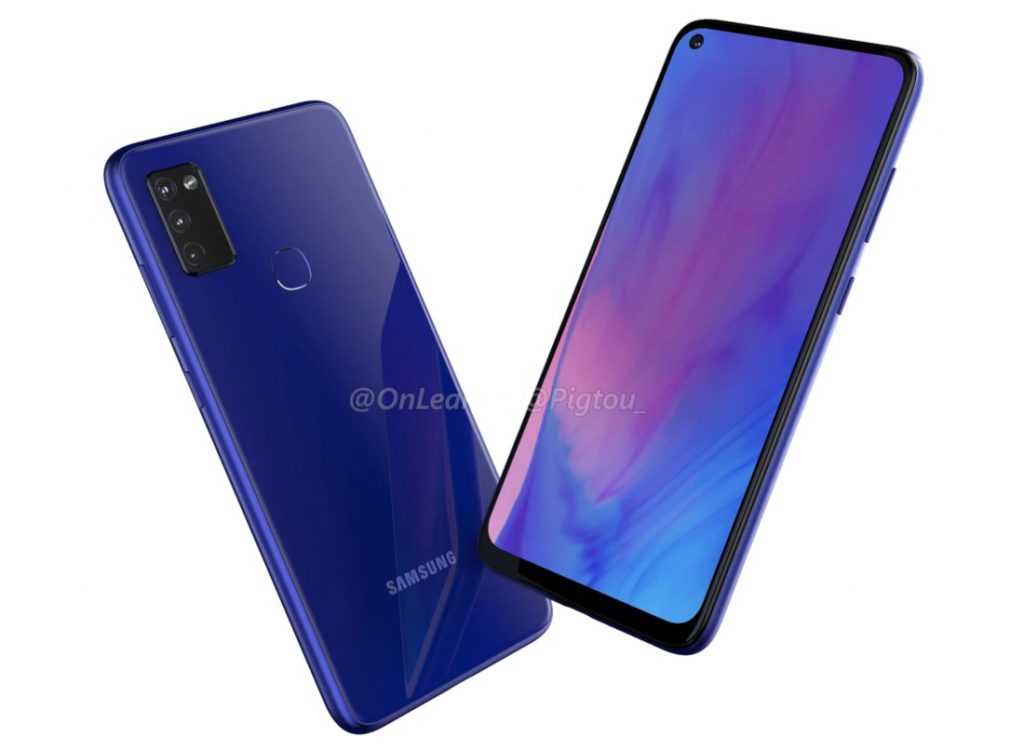
Renders of Samsung’s unannounced Galaxy M51 first surfaced online back in March. Since then, we have had to wait for more details. At the moment, the Galaxy M51 specifications have surfaced online with the leak showing the device will pack a 6.7-inch FHD+ AMOLED screen with a punch-hole design. The device will also have 6GB or 8GB RAM versions with 128GB storage.
Further, the Galaxy M51 is said to feature a 64MP quad-camera setup at the rear but we must note that earlier renders show a triple camera setup. What caught our fancy pretty quickly is the huge 7000mAh battery with support for 25W fast charging. This will likely be the main selling point for the device. For reference, the Galaxy Tab S7 tablet packs a 7,040mAh which puts the M51’s battery in the tablet category. The battery is also 2,500mAh larger than the battery in the Galaxy Note 20 Ultra.
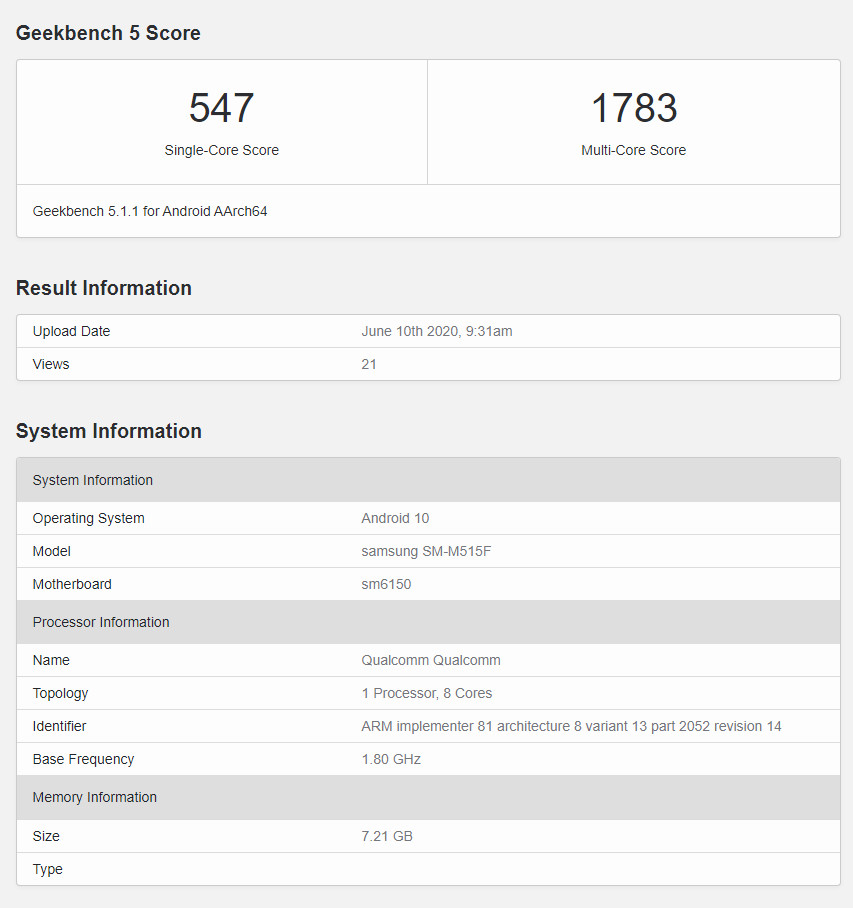
The Galaxy M51 had earlier appeared on GeekBench with the model number SM-M515F. The GeekBench listing shows the device will be powered by a Qualcomm Snapdragon 730 SoCchipset paired with 8GB of RAM. The interface will be provided by Android 10 OS.
In terms of the build, the Samsung Galaxy M51 will likely come with a glasstic body similar to the M31s but we can’t be so sure. We’ll have to wait for further details. The phone will reportedly launch in India soon.
We use cookies on our website to give you the most relevant experience by remembering your preferences and repeat visits. By clicking “Accept”, you consent to the use of ALL the cookies.
This website uses cookies to improve your experience while you navigate through the website. Out of these, the cookies that are categorized as necessary are stored on your browser as they are essential for the working of basic functionalities of the website. We also use third-party cookies that help us analyze and understand how you use this website. These cookies will be stored in your browser only with your consent. You also have the option to opt-out of these cookies. But opting out of some of these cookies may affect your browsing experience.
Necessary cookies are absolutely essential for the website to function properly. This category only includes cookies that ensures basic functionalities and security features of the website. These cookies do not store any personal information.
Any cookies that may not be particularly necessary for the website to function and is used specifically to collect user personal data via analytics, ads, other embedded contents are termed as non-necessary cookies. It is mandatory to procure user consent prior to running these cookies on your website.

 The Amazfit GTR 2 and Amazfit GTS 2 are expected to come with AMOLED displays like their predecessors. However, it has been reported that the GTS 2 may have a round dial rather than a square one. Other features reported to be present in the 2nd-gen GTS 2 are NFC, Alexa voice assistant, and a new feature called Smart Crown.