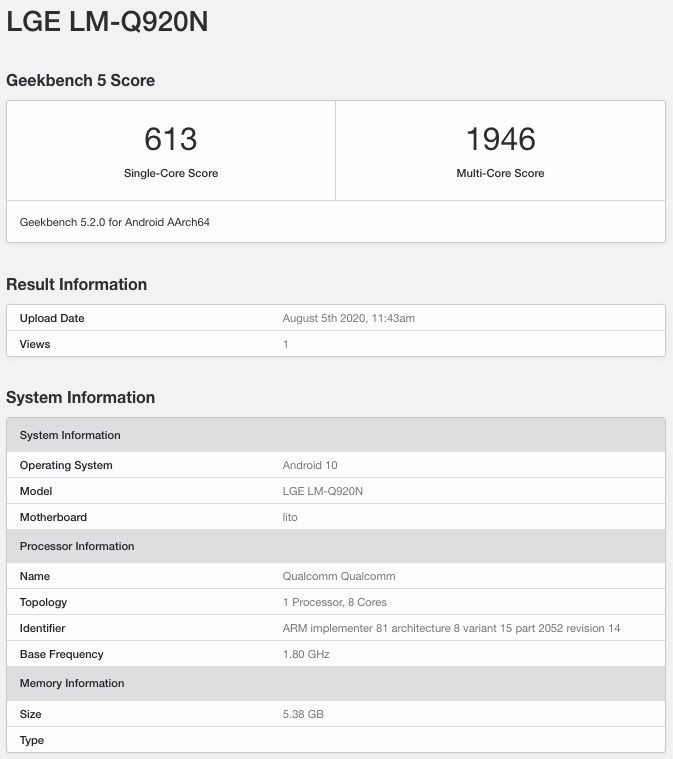
Earlier this month, a rumour emerged that LG was planning to release several 5G smartphones including the LG Q92 5G. That rumour is gathering traction as an LG model listed as LGE LM-Q920N and believed to be the Q92 5G smartphone has been spotted on GeekBench. This comes not too long after the model appeared on Google Play Console.
The GeekBench listing shows the device achieved a multi-core test score of 1946 and a single-core score of 613. This falls in the same performance with the Velvet 5G. That is no doubt due to the presence of the same chipset on both models.
The Q92 is powered by a Qualcomm Snapdragon 765G chipset listed as “lito” which is the mid-range chip’s codename. The processor is a fast mid-range ARM-based SoC. It is one of the first chipsets that integrate a 5G modem- the Snapdragon X5. The modem brings support for speeds of up to 3.7 / 1.6 Mbps (down- and upload), mmWave and Sub-6. The processor also features the Adreno 620 GPU. The SoC is paired with 6GB of RAM on the model that just hit GeekBench but we can’t say if that will be the base model.
The Google Play Console listing shows the smartphone’s display will have an FHD+ resolution of 2400 x 1080 pixels but the screen size is still unknown. Further, the Q92 will boot Android 10 OS out of the box.
LG is yet to officially release any details of the upcoming model. However, the Q92 5G is believed to be a cheaper alternative to the well-received LG Velvet 5G.
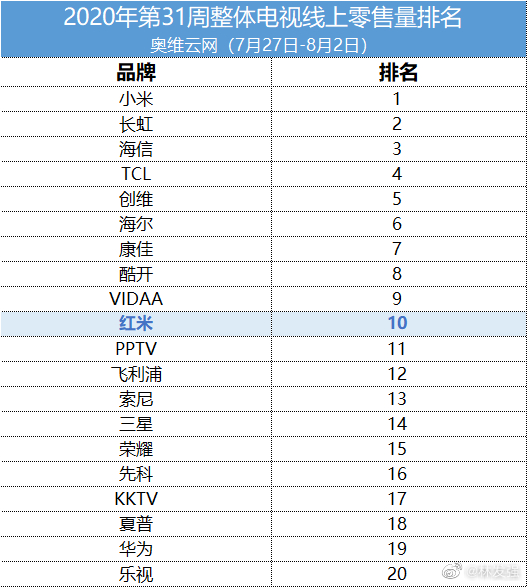
Xiaomi has been leading the China smart TV market for a while now. Following the footsteps, its sub-brand Redmi ranked 10th position (online channel) for the first time in the 31st week of 2020. The data comes from Aowei Cloud Network and it was shared by none other than Lin Faqiang, the operations director of Redmi TV.
Redmi became an independent brand in early 2019. Since then, the brand ventured into various product categories apart from smartphones. It launched its first smart TV in H2 last year and currently has 6 models on sale ranging from 999 yuan ($144) to 19,999 yuan ($2,881).
Due to competitive pricing and feature-rich products, Redmi managed to enter the top 10 TV brands (online) list in China within one year from entering the segment. That’s a great achievement for a new player but it all happened due to backing from its parent company Xiaomi.
On June 25, the brand even likely broke the 100-inch TV segment sales record with its Redmi Smart TV MAX 98. The brand managed to sell over 1,500 units of this TV model in 10 hours, 32 minutes and 18 seconds across all channels.
Having said that, here’s the complete list of top 10 TV brands (online) in China in 31st week of 2020 by Aowei Cloud Network.
Just a few days ago, Google announced the Pixel 4a smartphone. Now, a new leak has revealed we may be getting a new smart speaker this month too. The new speaker should launch under the Nest brand and it has an affordable price tag.
According to a tweet by Roland Quandt, the new Google (Nest) Home smart speaker with the codename “J2” will launch soon. The speaker will cost about €100 which is lesser than the launch price of the original Google Home.
There's a new Google Home launching soon codenamed "J2" and it's supposedly going to cost about 100 Euros. Available from the end of August, retail says.
He adds that the smart speaker will be available from the end of August according to the info from retailers. When it launches, it will be available in Charcoal and Chalk.
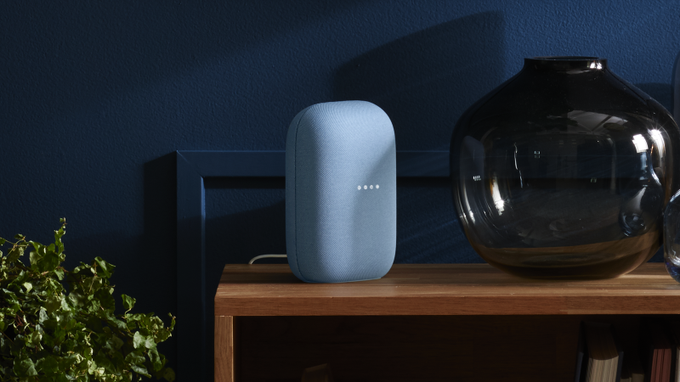
This appears to be a different speaker from the one that leaked last month (pictured below) which is internally known as “prince”. So it seems we will be getting not one but two smart Nest Home smart speakers this year.
Google is also expected to launch a new streaming stick codenamed “Sabrina” which will bring a new Android TV interface. We are not sure if Google will announce all these smart products at the same time or if it will launch some alongside the Pixel 5 and Pixel 4a 5G later.
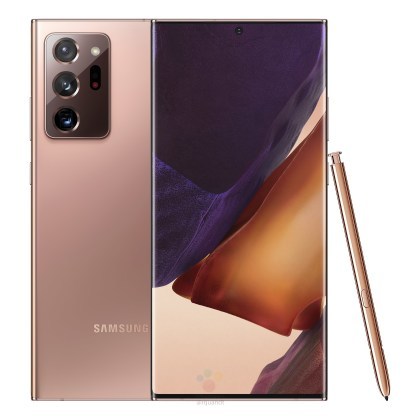
Samsung is expected to unwrap the Galaxy Note 20 models at the Unpacked event holding later today. About the Galaxy Note 20 models, the company has been very generous with details of the upcoming Galaxy Note 20 models. Almos all the design and features are already in the open except for the pricing. That has now joined the list of details unpacked before the Galaxy Unpacked event.
Leakster Roland Quandt who tweets from the Twitter handle @RQuandt has listed the expected prices of the entire Galaxy Note 20 lineup. The leaked pricing starts at €949/959 for the Galaxy Note 20 4G version with 256GB storage. The 5G version of a Note 20 with 256GB storage will retail for €1049/1059.
Note20 4G 256GB = 949/959 Euro Note20 5G 256GB = 1049/1059 Euro Note20 Ultra 5G 256GB = 1299/1309 Euro Note20 Ultra 5G 512GB = 1399/1409 Euro
ouch.
(Prices differ bc of different copyright fees, VAT% and other factors depending on country)#Unpacked2020#GalaxyNote20
The top-end Galaxy Note 20 Ultra takes things even higher with a base price of €1,299/1,309 for the 256GB storage version. Finally, the 512GB version comes in at €1399/1409. The tipster attributes the differences in the prices to variations in copyright fees, VAT percentage and other factors depending on the country.
The Galaxy Note 20 models will be powered by either the Snapdragon 865+ or the Exynos 992. The models are also expected to come with up to 16GB of RAM.
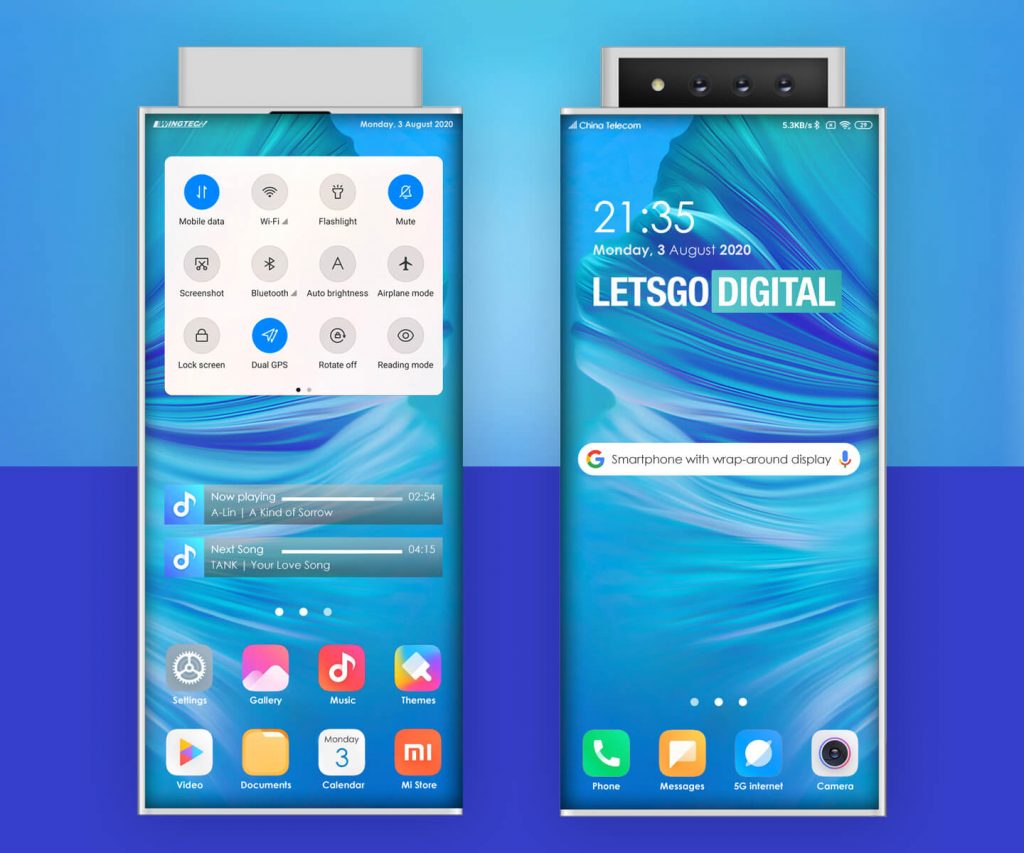
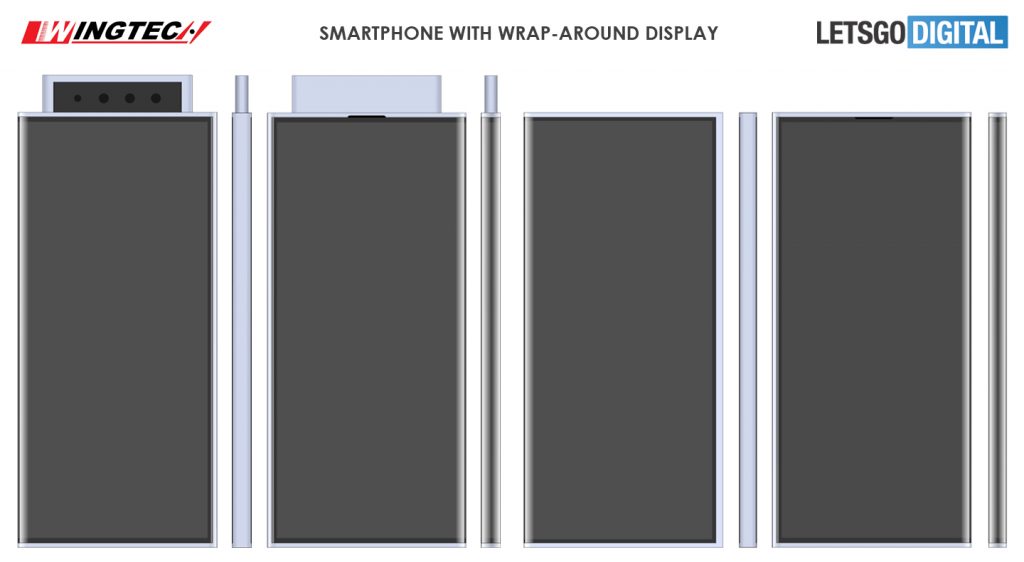
In recent times, many smartphone makers have relied on ODMs to design and produce their smartphone offerings. Known brands like Lenovo, Samsung, Oppo, and more have been known to employ their services. Now, Wingtech, the largest ODM for smartphones and other IoT products has just patented a new device, which could be an upcoming Xiaomi Mi Mix series smartphone, as reported by LetsGoDigital.
Wingtech is a known ODM that has designed and produced smartphone, smartwatches, tablets, and more. Chinese brands like Huawei and Xiaomi are a few of its important customers as well. So, if the device was made for Xiaomi, it would not come as a surprise. Although, this has not been confirmed and is just speculation at the moment.
The reason why it seems to be made for Xiaomi is its form factor and design. It resembles the Mi Mix Alpha from the front, while a recent Xiaomi patent had revealed a Mi Mix device with one curved edge that was completely wrapped by a display that even extends to the rear panel. Interestingly, the front triple selfie shooter is housed on a pop up mechanism along with an LED flash. The patent was filed with the WIPO (World Intellectual Property Office) and has just recently been published.
According to reports, Xiaomi sources over 75 percent of its designs through ODMs. Furthermore, Wingtech and Xiaomi have had a history of cooperation. A design that resembles some of the latter’s concept devices might be an indicator of a commercial launch with the help of the former’s expertise in the field. However, this is still unconfirmed so take it with a pinch of salt for now.
Earlier this year, India’s government banned 59 Chinese applications which include some of the most popular apps such as TikTok, ShareIt, UC Browser, WeChat, CamScanner, and more. The government also subsequently banned 47 more apps, which mostly include the ‘Lite’ versions or clones of the apps banned earlier
Xiaomi’s Mi Browser Pro has now joined the list of banned apps in India as the government widens its offensive against Chinese firms operating in India. The move could affect several millions of persons who use Xiaomi’s smartphones. The most recent data shows that Xiaomi has sold more than 100 million smartphones in India, accounting for nearly 30% of the Indian smartphone market.
Tech experts say the ban could affect the operations of the devices as well as network access. But Xiaomi India has come out to say that the ban “will not impact the performance of the devices”. The company also stated it will reach out to the Indian government in order to seek clarification of its position. Users are also enjoined to download other mobile browsers.
With the rising US tensions leading to the ban of Huawei, Chinese citizens are favoring products from homegrown brands ever more than before. A new report by a research firm reveals the fall of Apple’s market share as Chinese brands continued to grow except Xiaomi.
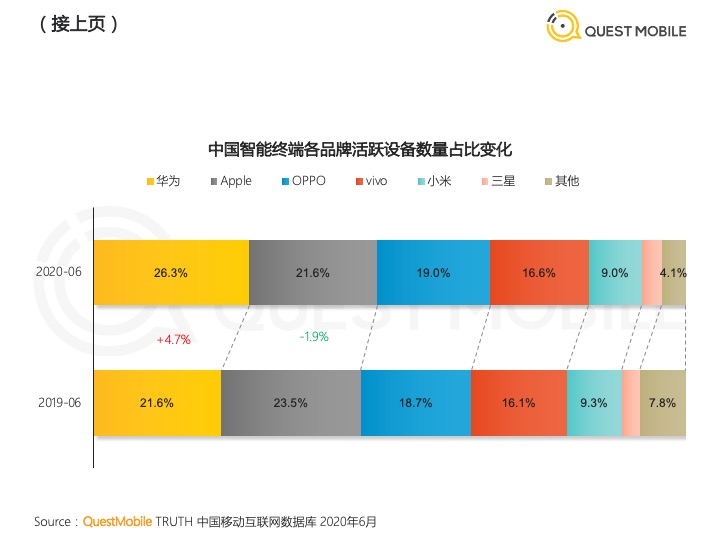
Quest Mobile aka Beijing Guishi Information Technology Limited is one of the well-known research firms. It published a comprehensive report (via SCMP)on China smartphone market as of June 2020.
According to it, Apple’s market share in China dropped to 21.6% from 23.5%. Whereas, Huawei’s share increased to 26.3% from 21.6%. Similar story for Oppo (18.7% – 19.0%), Vivo (16.1% – 16.6%), and even Samsung (negligible – 3.4%). However, Xiaomi witnessed a drop from 9.3% to 9.0% and so did other brands (7.8% – 4.1%).
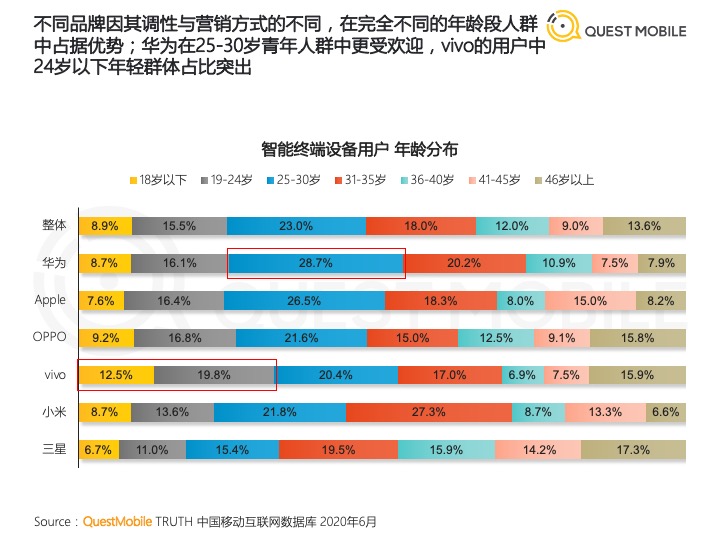
Talking about age groups, Huawei was popular among people aged 25-30. On the other hand, Apple was leading in the 41-45 age group. Whereas, Vivo was popular among both youngsters( 18 and below, 19-24) as well as the old age group(46 and above)
Further, people aged 31-35 used Xiaomi smartphones while Samsung users were mostly aged between 36 and 40.
As expected, Apple was much popular among wealthy citizens in Tier 1 cities. Whereas, Oppo and Vivo together led both mid-tier as well as rural regions of China.
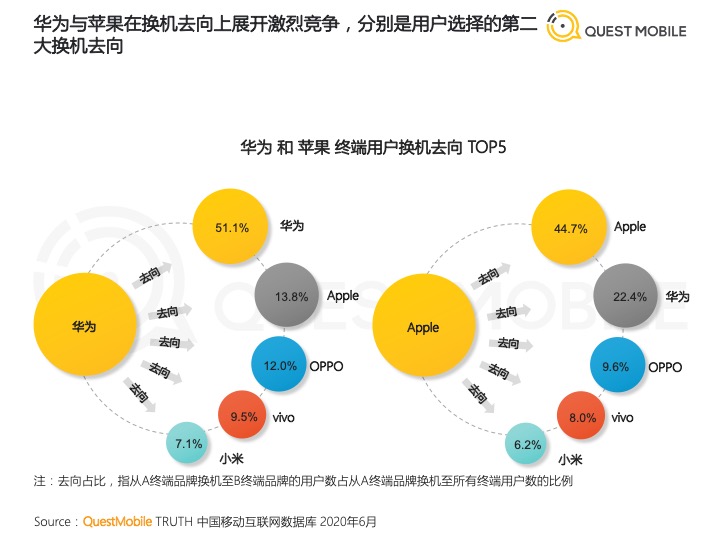
The most interesting data set by Quest Mobile is regarding customers switching brands. In that aspect, Huawei users remained most loyal as 51.1% of them upgraded to a newer model from the company. Whereas, only 44.7% of Apple users upgraded to newer iPhones and above all, 22.4% switched to Huawei.
The above-mentioned data are only basics. To read the in-depth analysis by the research firm, do check out their report from the source link provided at the end of this article.
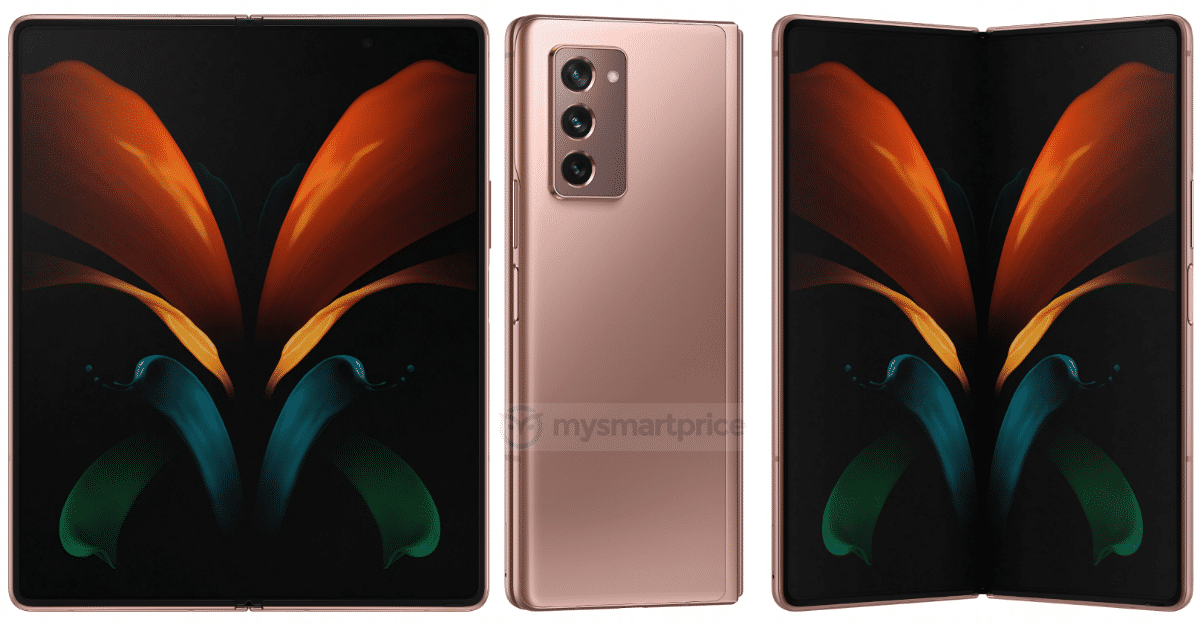
With the Samsung Galaxy Unpacked 2020 event being just a few hours away, the anticipation for the upcoming announcement has been rising. A few leaks have also surfaced, with the latest one being a video teaser for the Samsung Galaxy Z Fold 2 5G.
The leaked video teaser was shared by known tipster Evan Blass (@evleaks) through his Twitter handle. Looking at the video, it seems like the South Korean tech giant has done a commendable job at making the second generation of its somewhat troubled first generation, Galaxy Fold. The secondary front display seems to be a lot more practical now, with slimmer bezels. Meaning, you won’t have to open up the primary large display just for trivial tasks anymore.
The rear camera comprises of three image sensors, which resembles the camera module that has been seen in the Galaxy Note 20. As the rumors had previously suggested, the Galaxy Z Fold 2 features a a larger 6.23 inch external display that features a punch hole selfie camera. The display on the inside has also increased from the Galaxy Fold’s 7.3 inch to 7.7 inch display with UTG and a high 120Hz refresh rate.
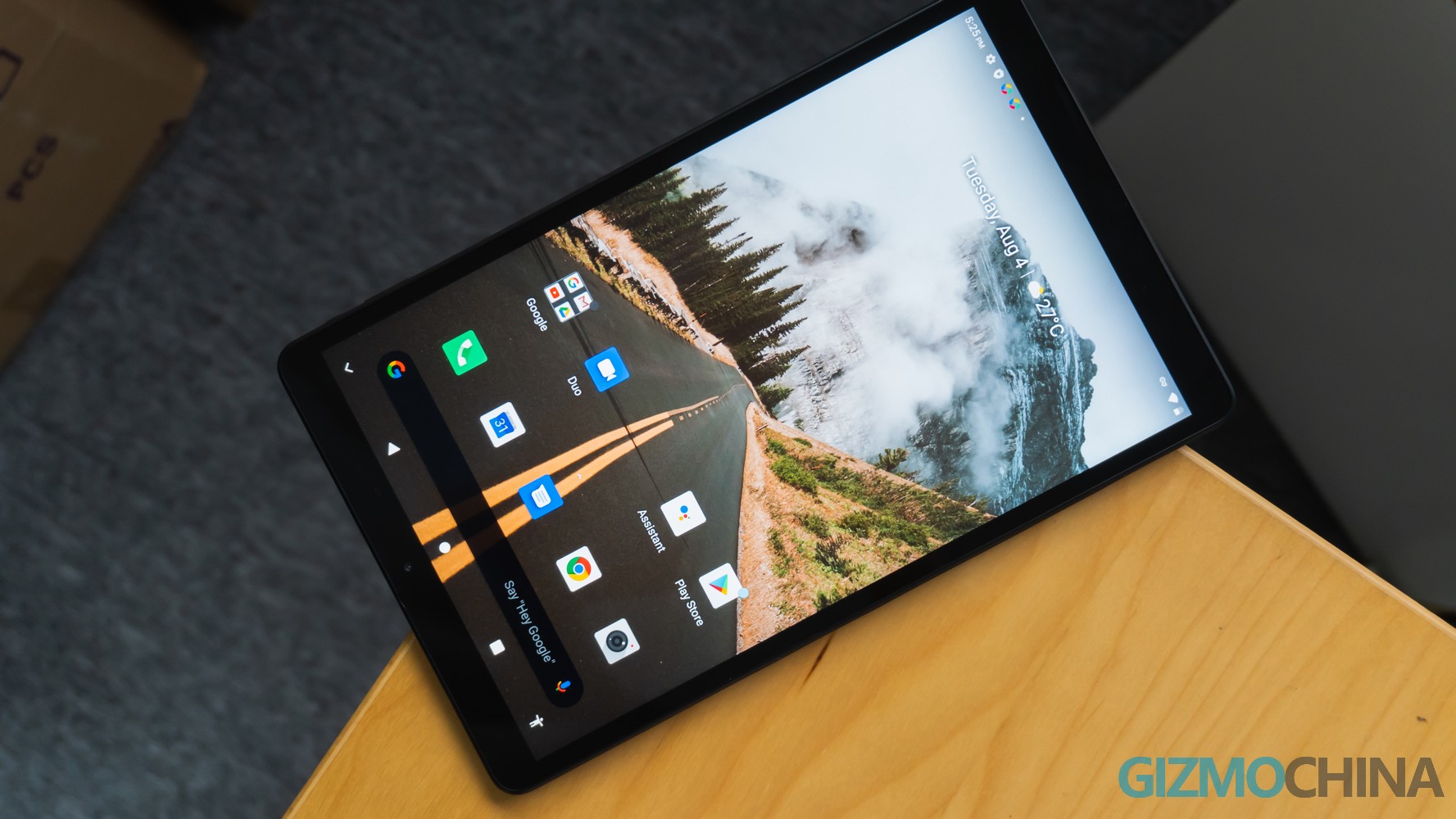
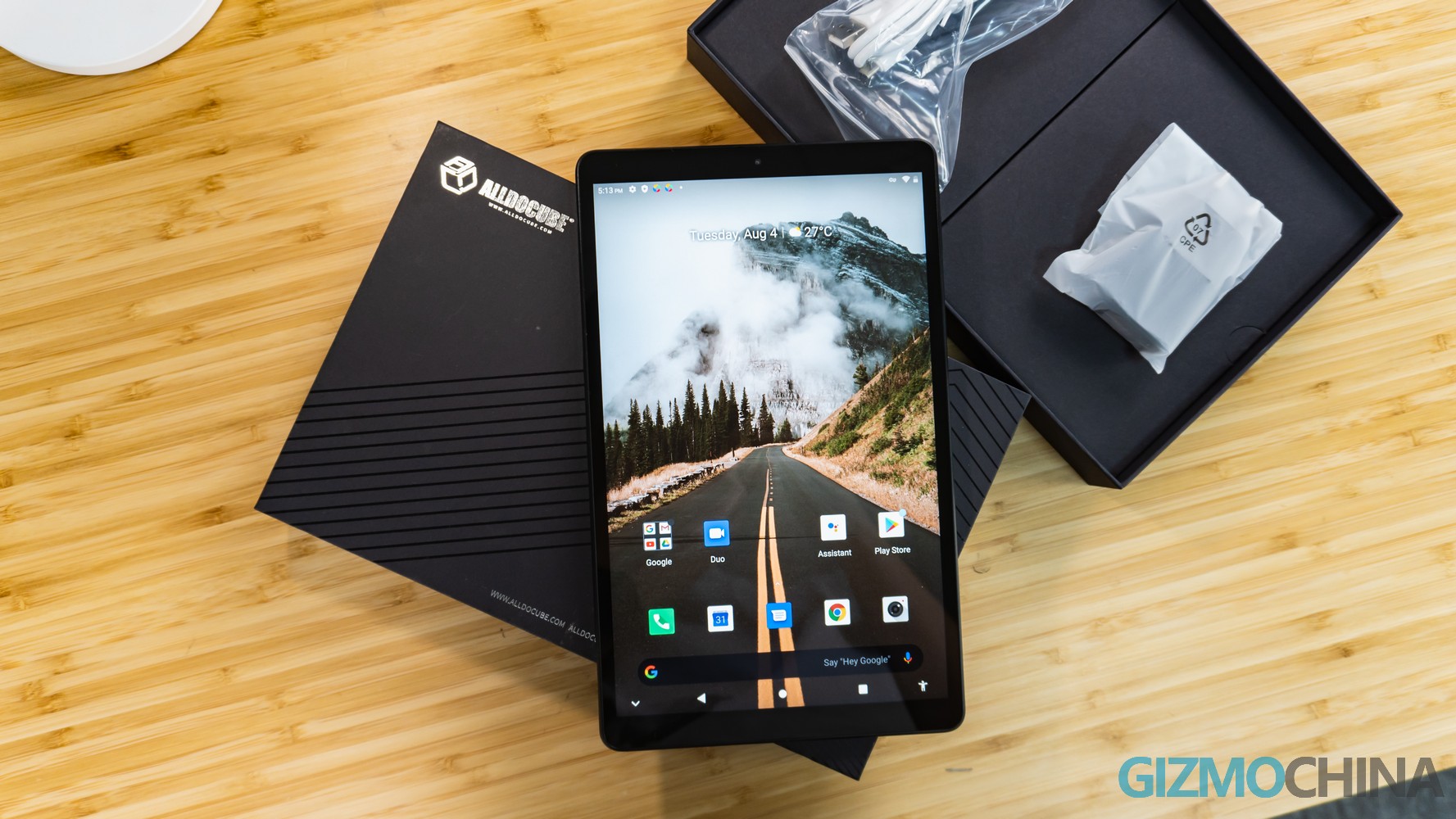
Alldocube is a well-known affordable computer manufacturer from China. The company released its latest affordable tablet product, the iPlay 20, which was met with a warm reception on the global market for its good entertainment functions and attractive price. The Gizmochina Review team got the iPlay 20 4G Tablet several days ago. So let’s find out what exactly it can do with such remarkable pricing.
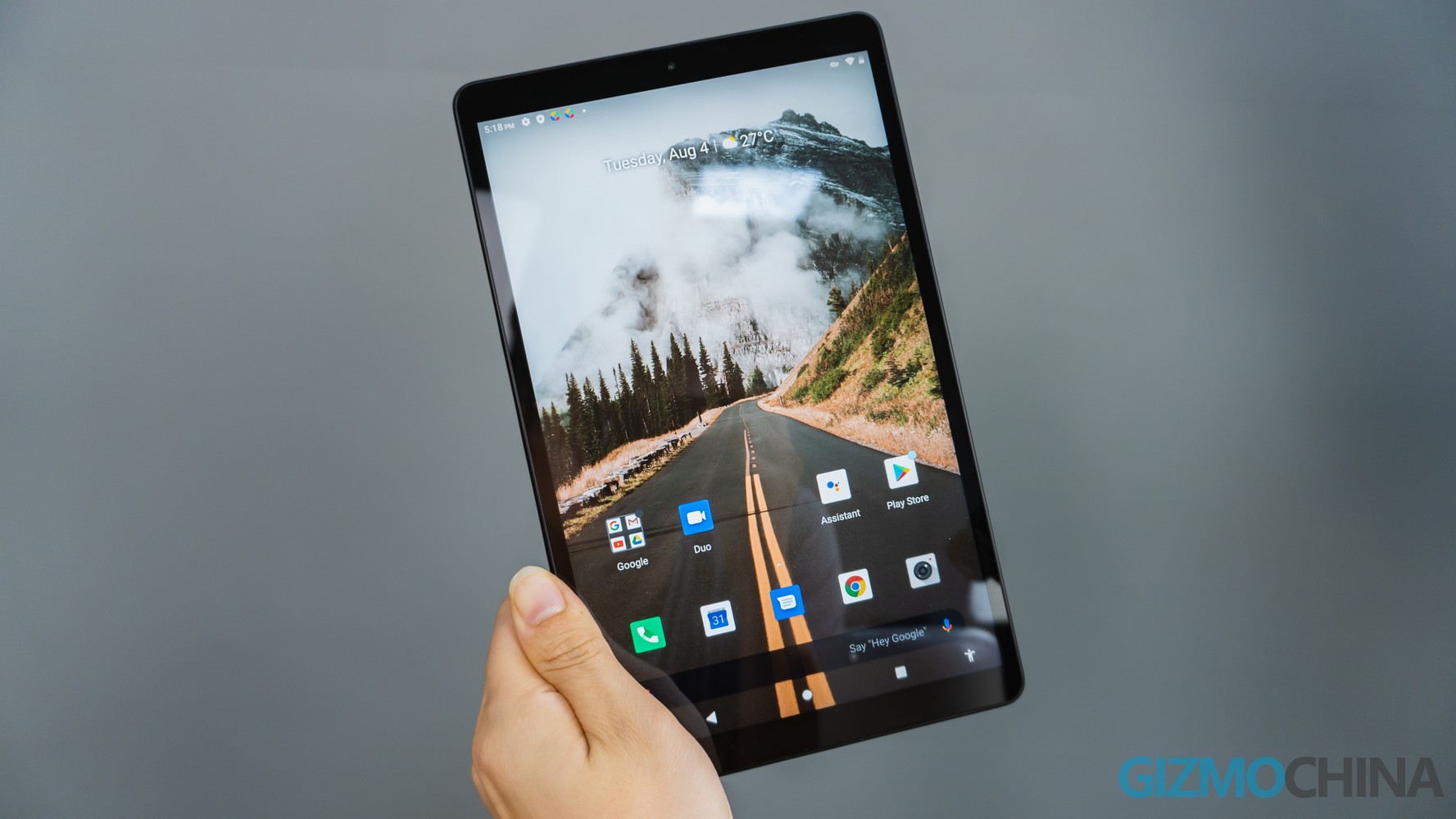
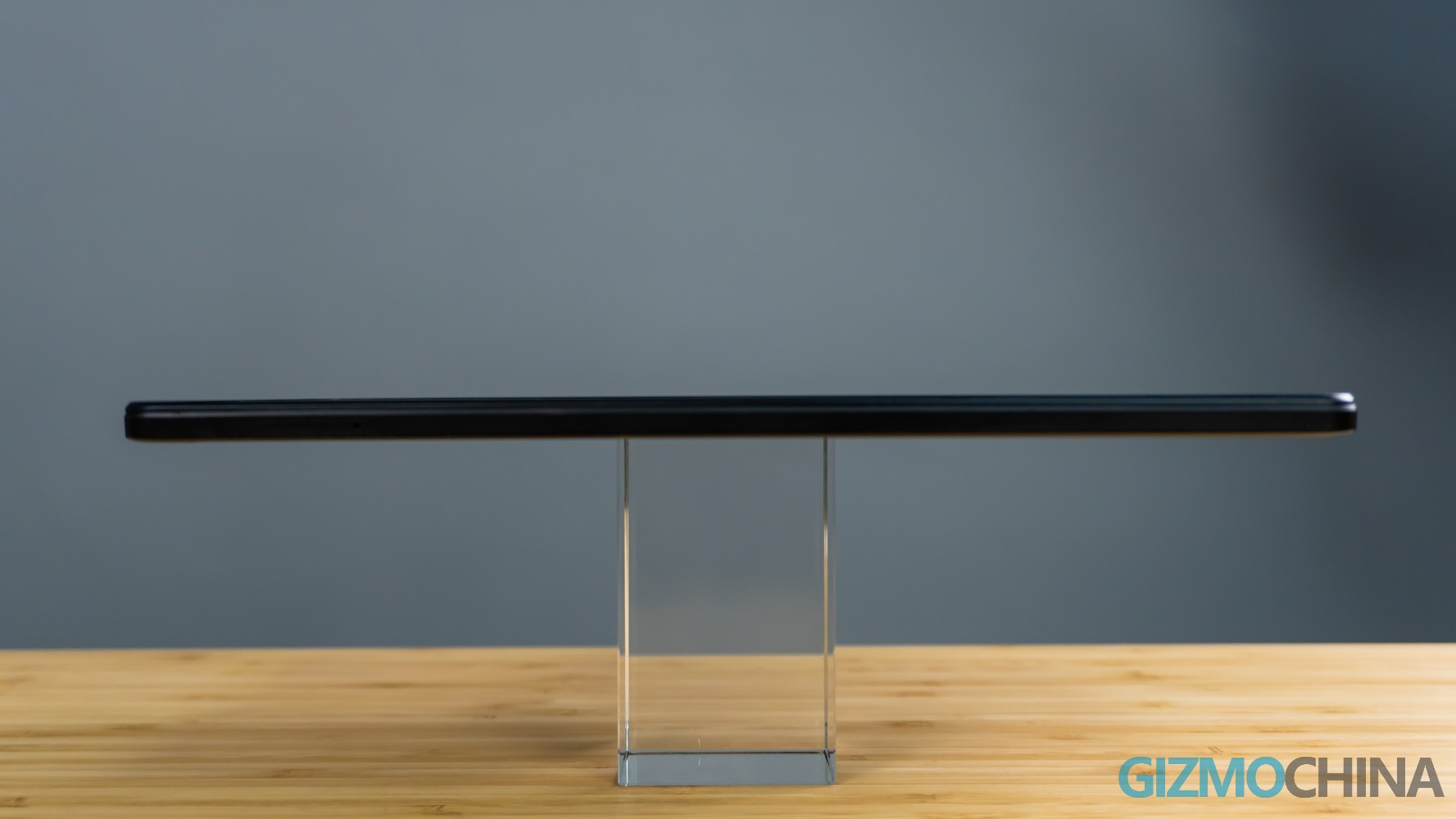
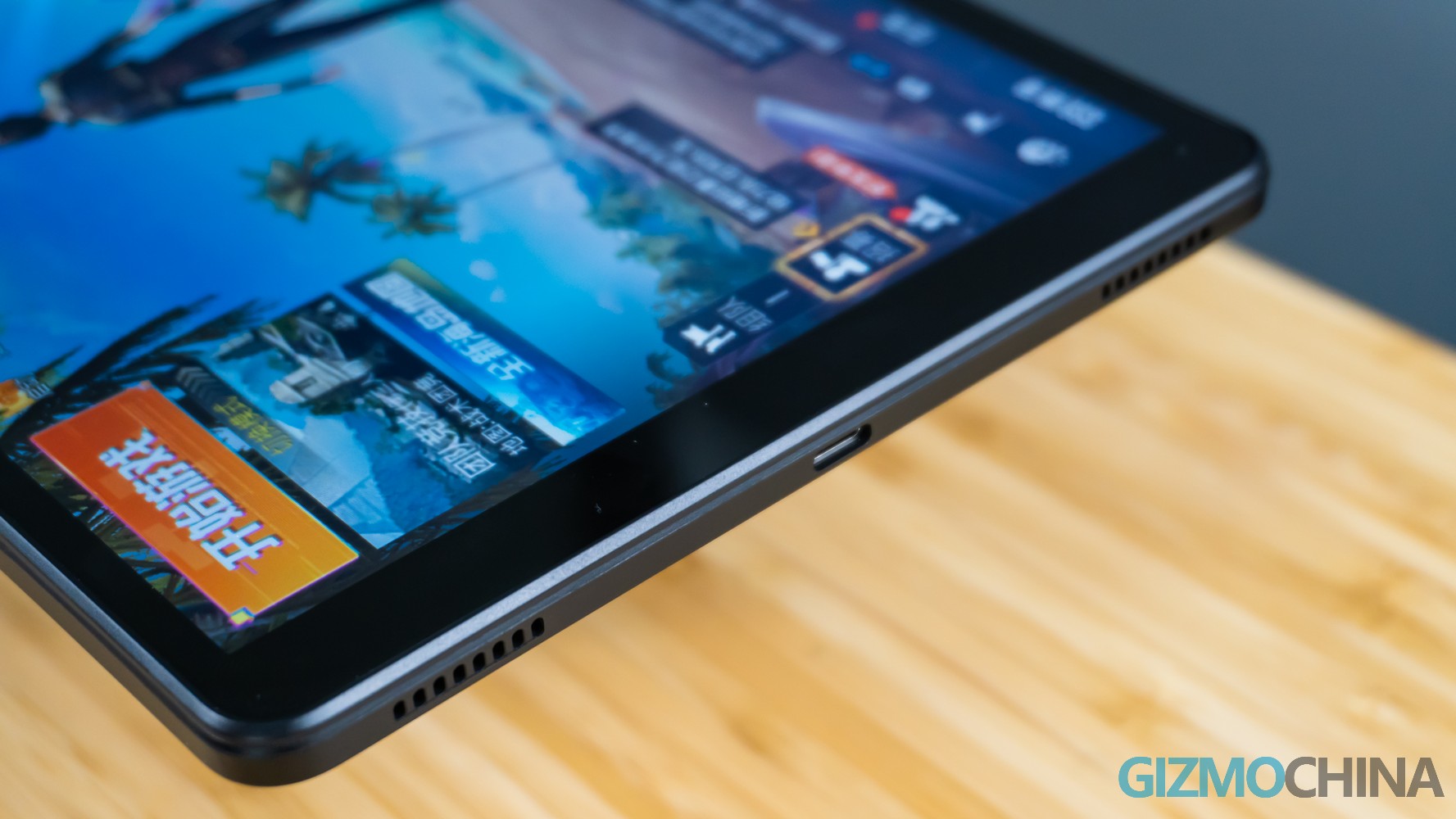
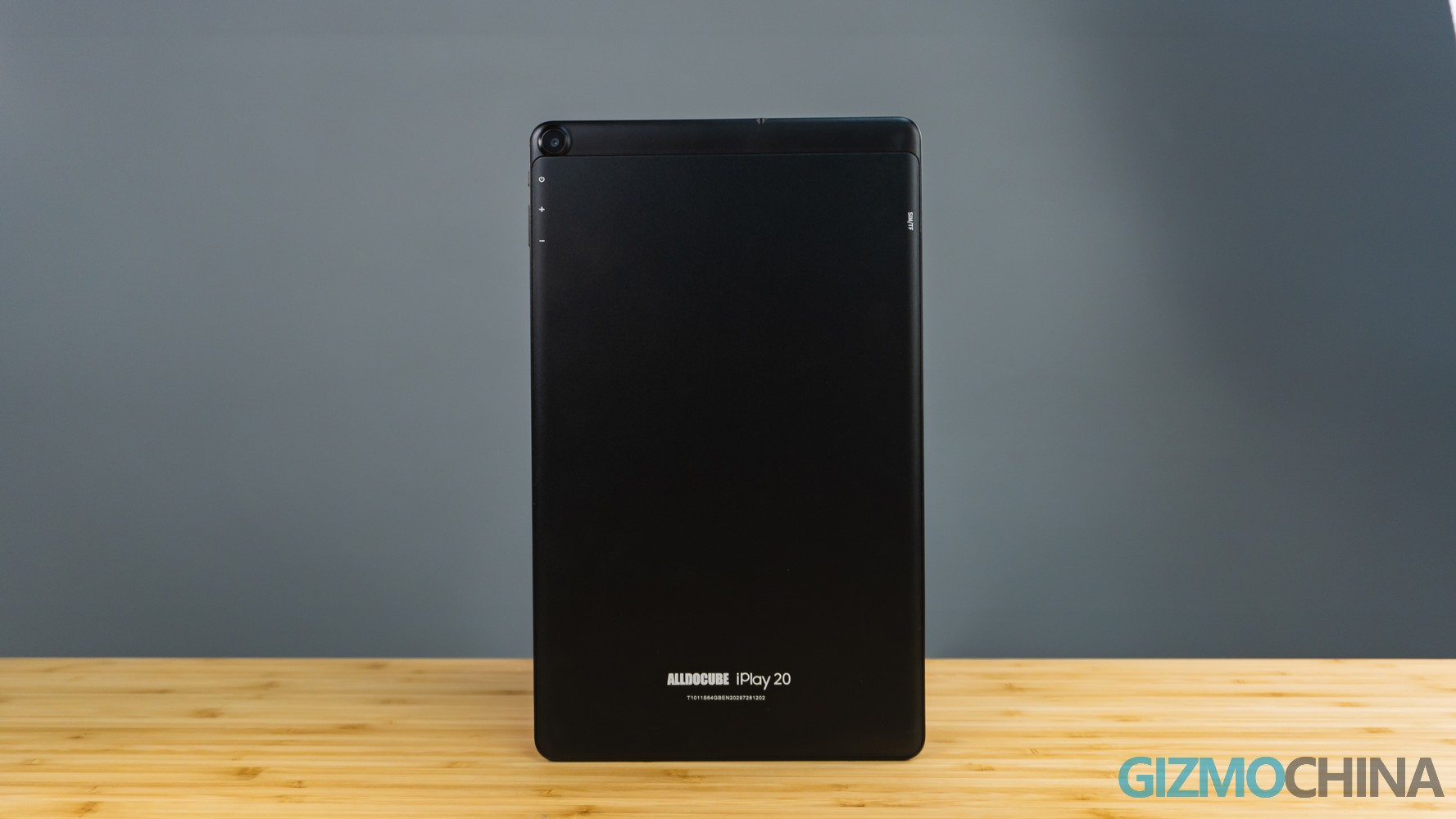
As an affordable tablet, we won’t complain too much about its appearance. However, the iPlay 20 still looks pretty good for its price. Compared to the 2019 iPlay tablet, it comes with a narrower bezel design with a metal back cover. It also results in a better feel with sturdy workmanship. As a 10.1-inch tablet, it’s relatively lightweight and thin too.
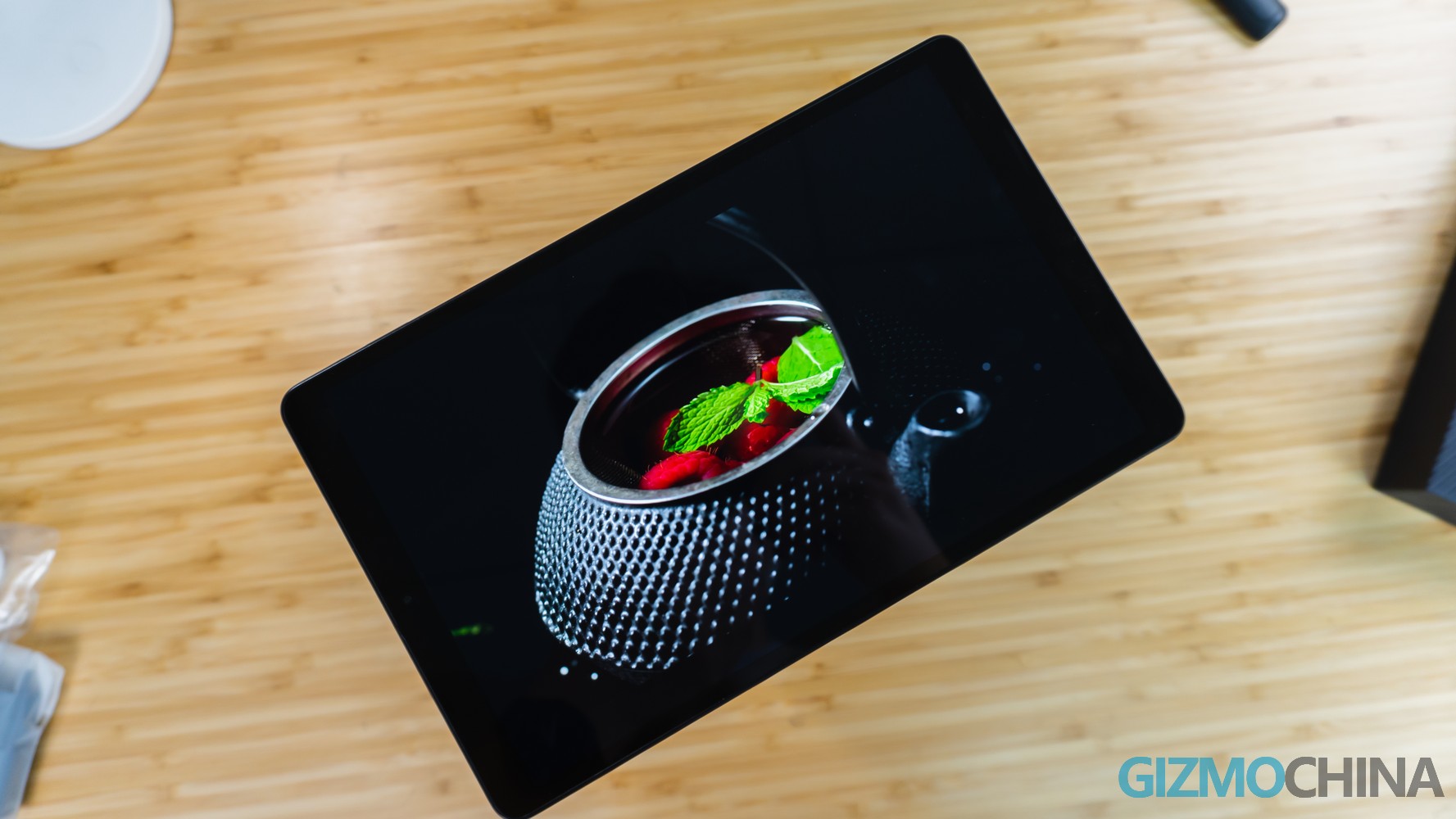
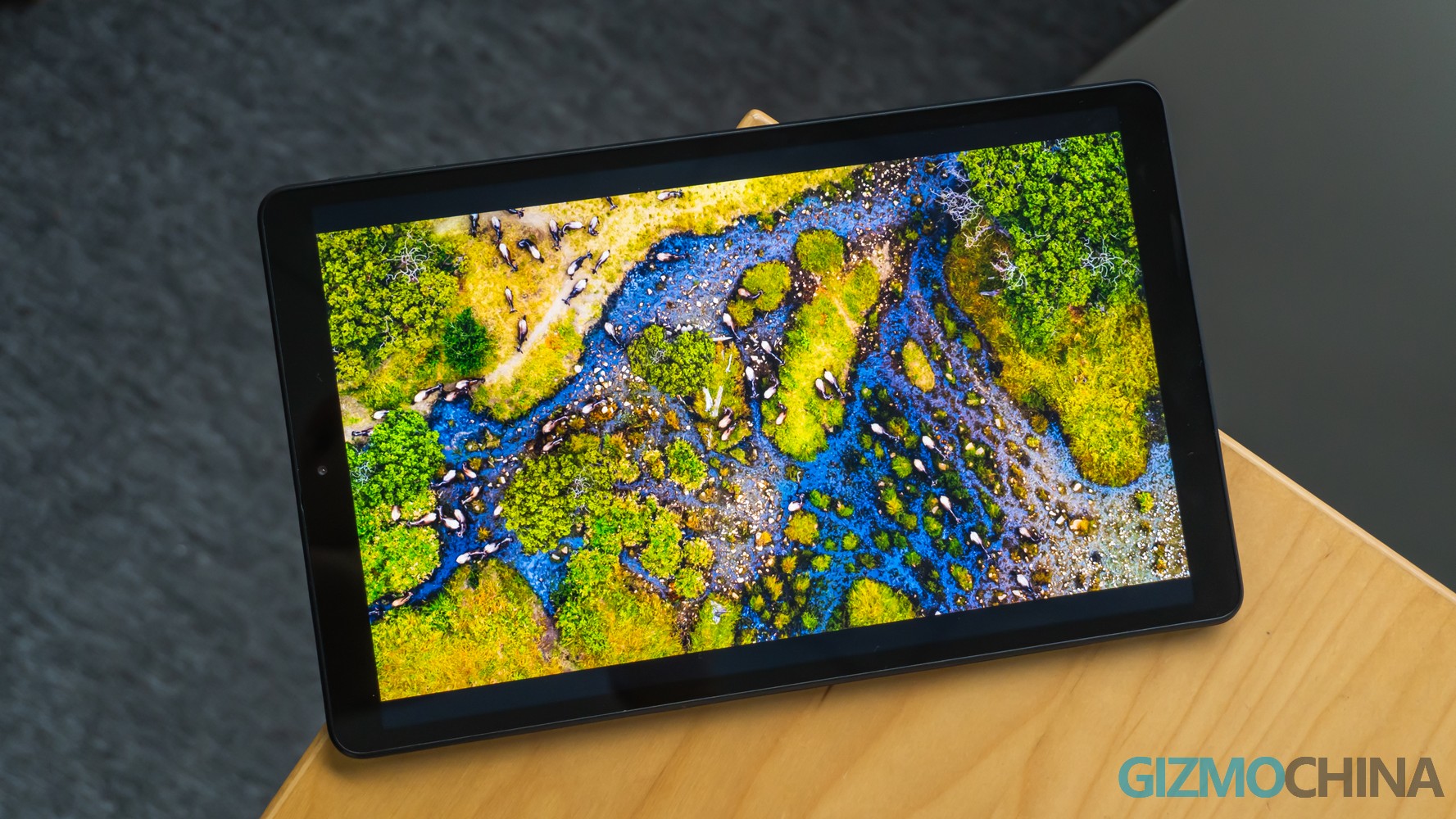
On the front, the Alldocube iPlay 20 adopts a symmetrical design, And the front camera is in the middle of the upper frame for selfies and video chats. The tablet is equipped with a 10.1-inch FHD IPS screen. The screen material used is the same as the Samsung Tab A priced at almost twice the iPlay 20’s price. It supports a 1080P+ (1920 x 1200) resolution with AI algorithms to enhance color reproduction and detail.
In terms of user experience, the display wasn’t a fingerprint magnet and comes with oleophobic coating on top. Like most high-end smartphones, the iPlay 20 tablet display is protected by Corning Gorilla Glass, offering good surface stress-resistance and scratch-resistance.
On the left side, there is a SIMcard Slot for loading dual-4G SIM-cards. It can work in 4G networks and supports VoLTE voice chats. Meanwhile, like using smartphones, the 4G networks also guarantee a high-speed wireless internet anytime and anywhere for reading, playing games, streaming, or any other online activities. Besides 4G networks, Wi-Fi access also works well for internet connection if you are not going to load any SIM-card.
1 of 2
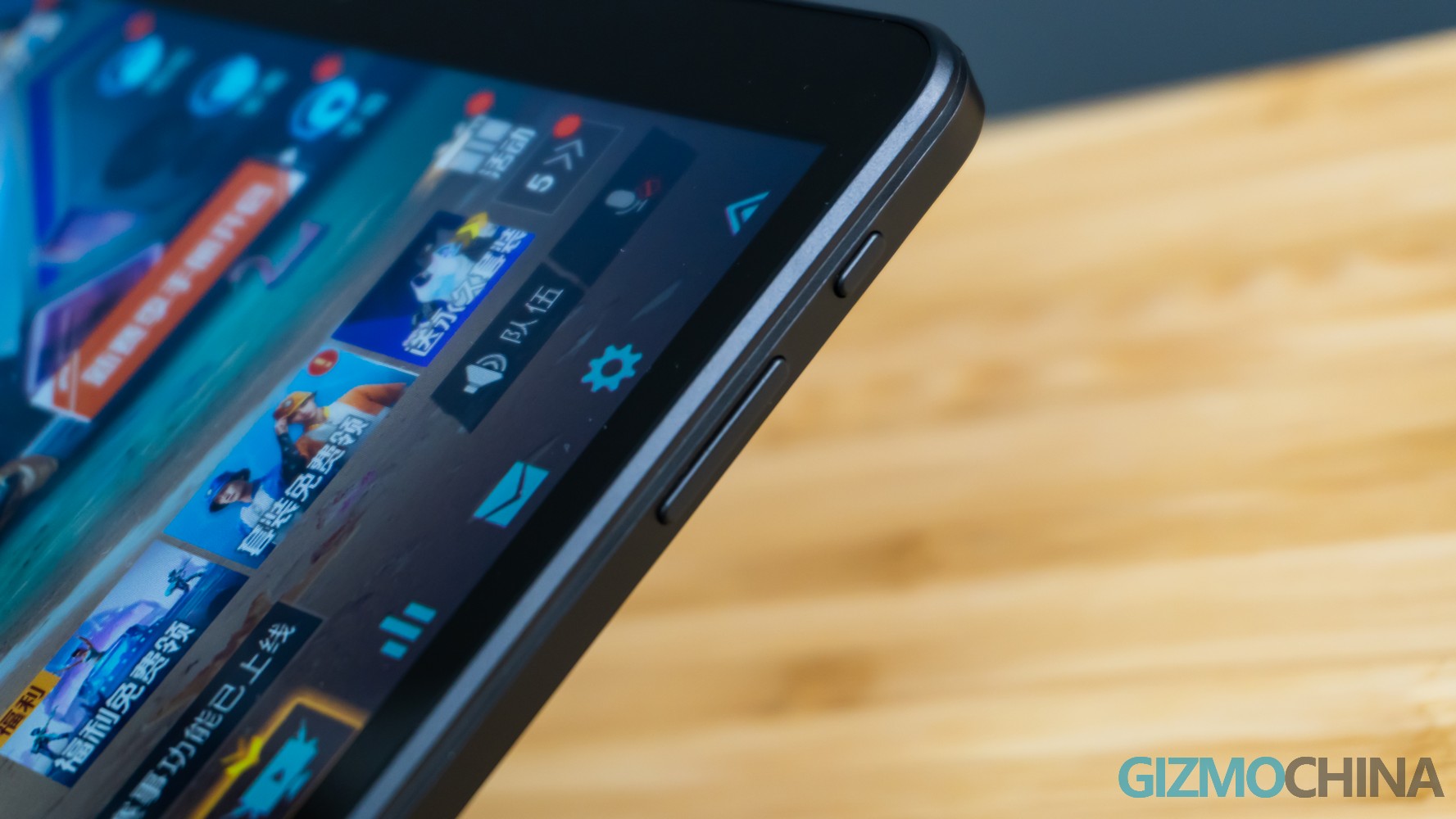
The power button and volume buttons are placed on the upper right sidebar, which is not exactly a comfortable design as it’s located too far up especially when the display is so huge. Coming to the back to its 5MP rear camera, it protrudes a bit but its not wobbly at all when you place it on the table.
Alldocube iPlay 20 4G Tablet Review: Entertainment
The major use of the iPlay 20 is entertainment. As we mentioned above, the high-quality IPS 1080P+ display could provide vivid colors and good detail when enjoying movies or games. Accompanied by great visual enjoyment, the tablet is also equipped with dual-speakers to provide high-quality sound. Although they do not cover both sides of the frame to produce perfect stereo sounds, the dual speakers are still far better for an entertainment tablet comparing to most single-speaker tablets. Or if you’re more in fond of audio that comes out from your headphone, the tablet reserves a 3.5mm headphone jack on the top.
Android 10
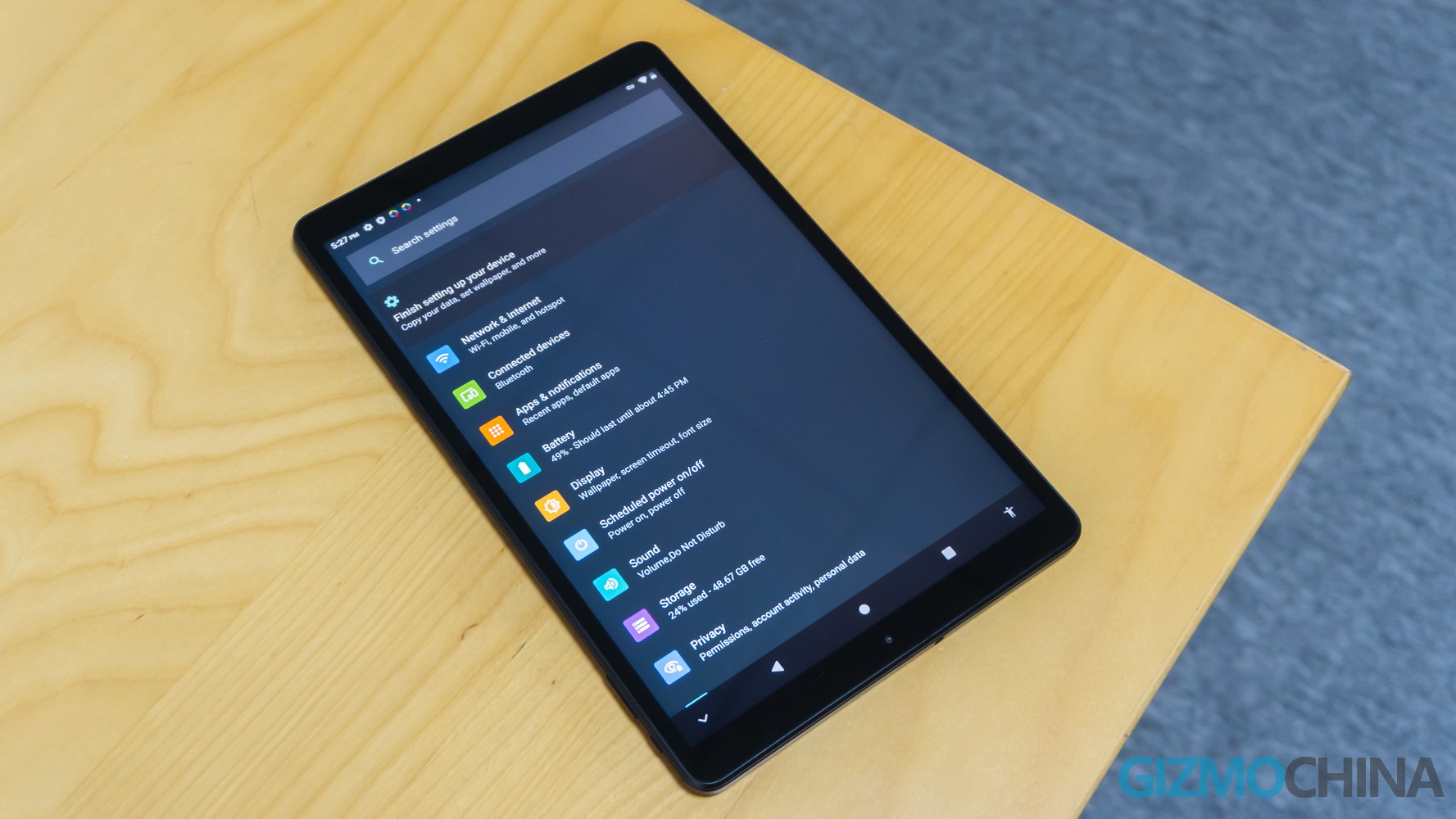
Another highlight of the tablet that we appreciated is the Android 10 OS. It’s not common to see Android 10 running on such an affordable device. Compared to the previous Android version, Android 10 features improved user interface, higher security and privacy, dark theme, text recognition, and many other functions.
Alldocube iPlay 20 4G Tablet Review: Performance
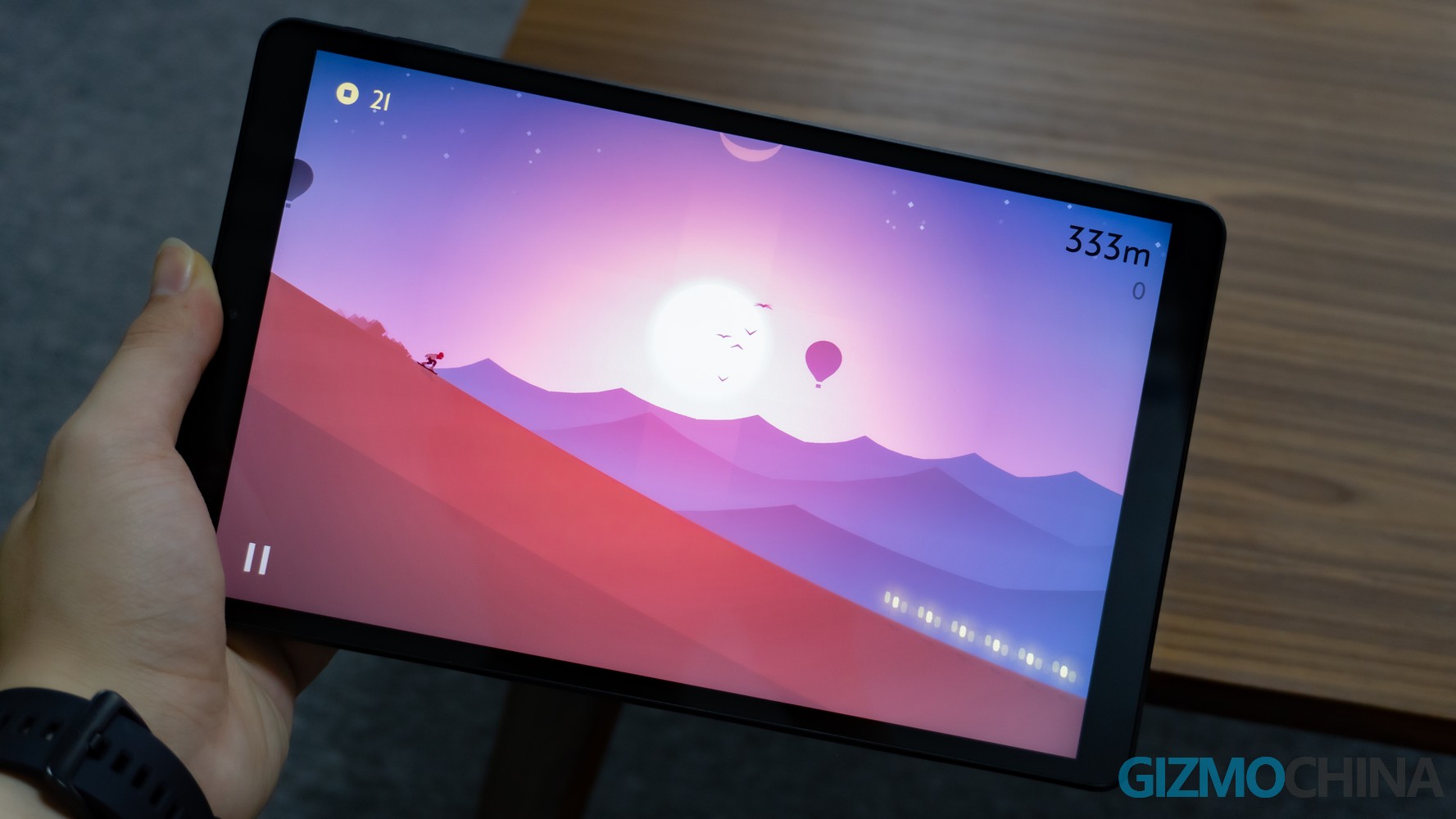
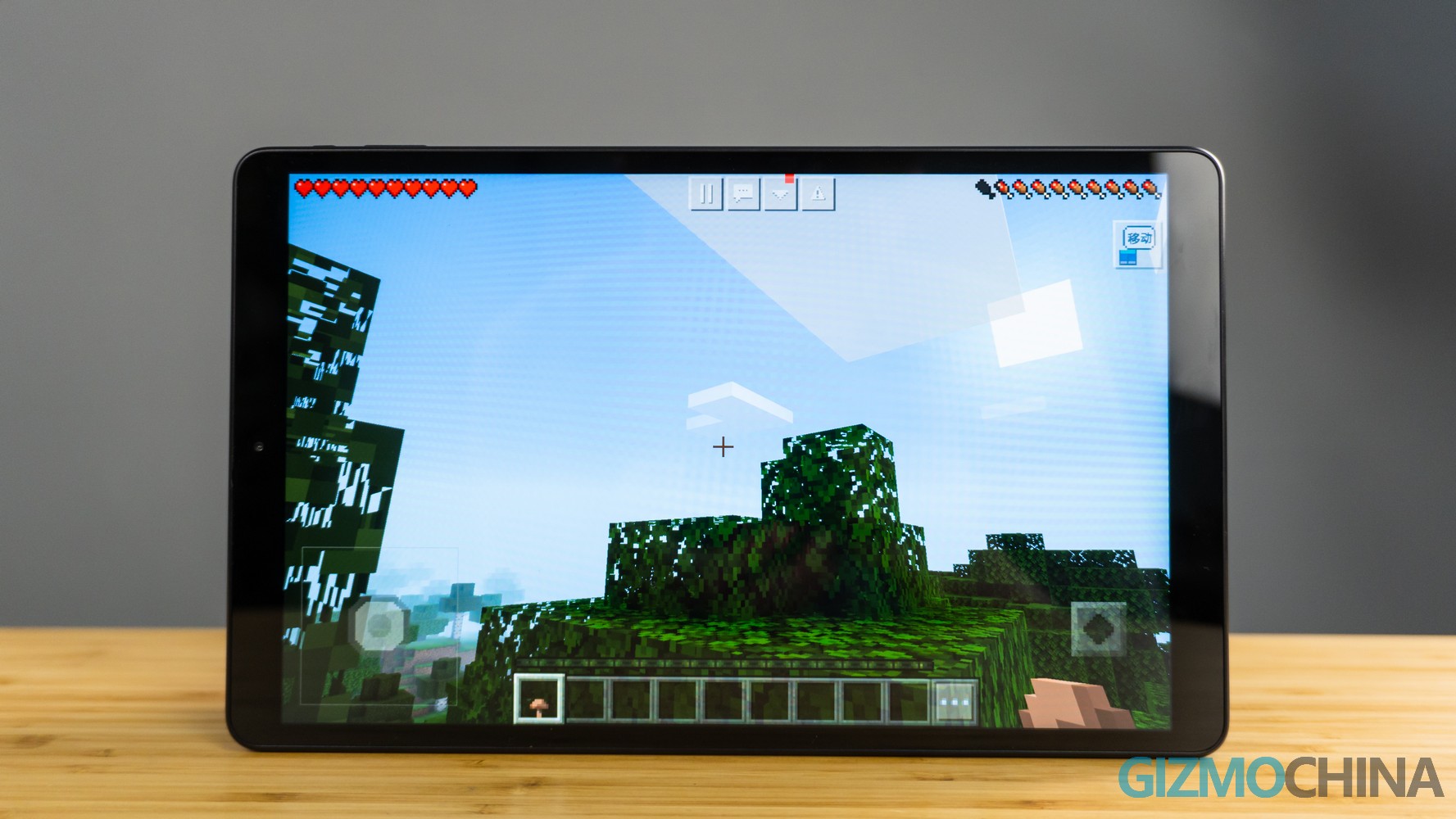
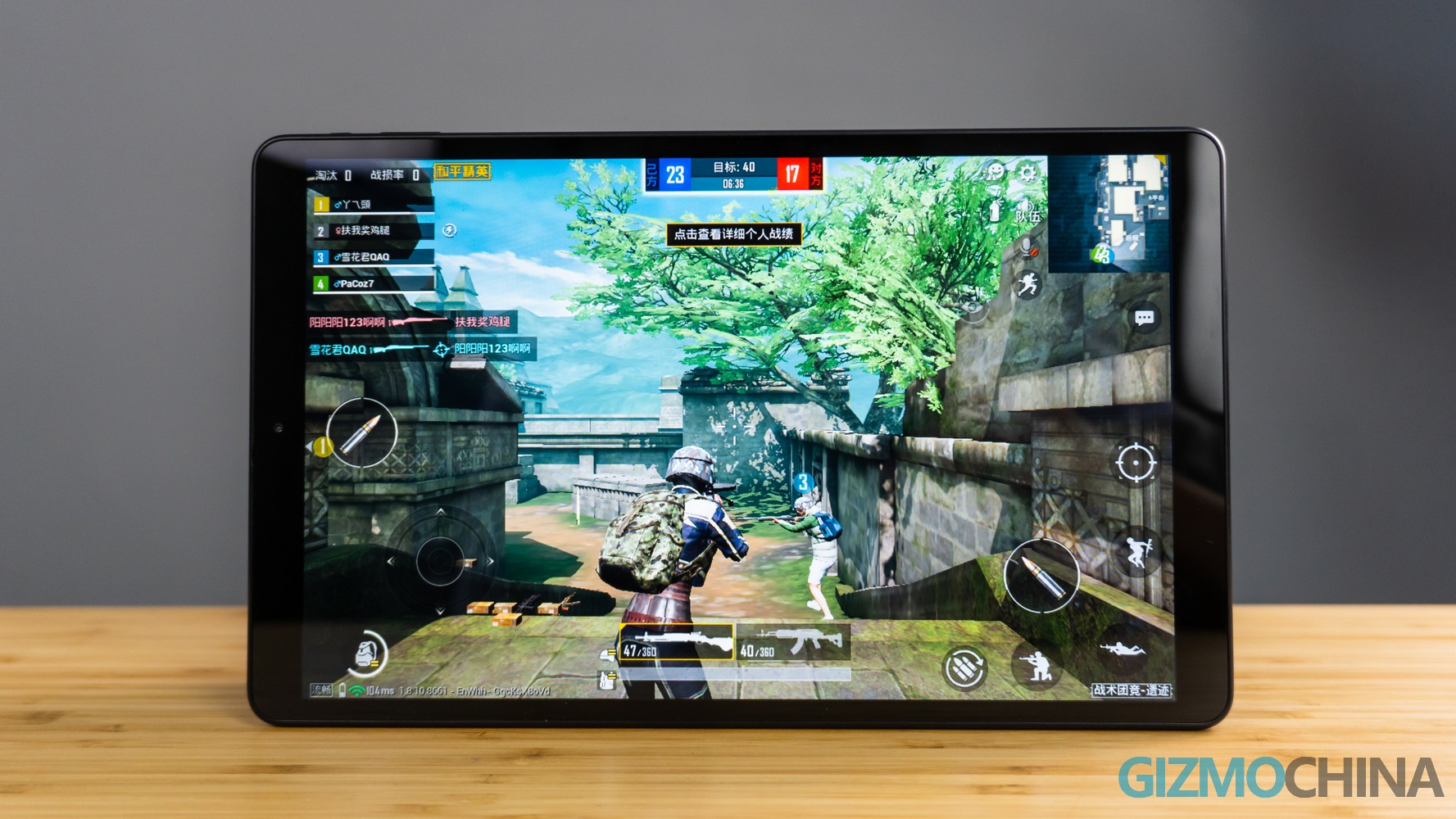
The device we got is the 4GB RAM + 64GB ROM version. And it supports TF card extension (up to 512GB). For performance, the tablet sports an Octa-core processor with 8 ARM Cortex™-A55 (8xA55 Spreadtrum SC9863A). This processor is not exactly designed for gameplay. We still played a few casual gaming to test whether its performance supports basic gaming. For example, in Alto’s Odyssey, Minecraft and Plants vs Zombies 2, the operation and image are smooth enough without fluency problems. And then we tried to play PUBG Mobile on the tablet, and it worked fine. Although the huge display provided a great view of the gaming image, it only supported a relatively low graphic and low framerate settings. So this is not a tablet for gaming.
1 of 4
Apart from gaming, the iPlay 20 can smoothly run most other entertainment apps, such as reading, watching movies, and playing music. The 10.1-inch display ensured a good experience while reading and watching movies.
Tablet devices usually are not good options for photos. So we won’t stress much on the iPlay 20’s camera performance. After all, you don’t buy cheap tablets for its rear camera.
Alldocube iPlay 20 4G Tablet Review: Battery
The Built-in 6000mAh battery generally could support around one-day use with a full charge. More specifically, 30-min gaming consumed 18% of full power (100%-82%), and 1-hour video play consumed around 31% (82%-51%). During these few days, the battery life was remarkable as we did not saw any ‘battery low’ warning. And the iPlay 20 also features a smart power-save mode, which can help it last for a longer time without affecting daily uses.
Alldocube iPlay 20 4G Tablet Review: Conclusion
The Alldocube iPlay 20 is not exactly a high-performance device for gaming, and sometimes the limited fluency of running multi-tasks affected our experience. However, for an affordable entertainment device, it has its own merits like a large battery, a huge display, and excellent media performance. And if you are considering a tablet basically for binge-watching, kid’s entertainment, online classes, and so on, the iPlay 20 is an appropriate choice.
Samsung Electronics has recently set up a new in house coronavirus check up center near its chip production plant in South Korea. The center is installed within the company’s campus in Hwaseong, according to a report from TheLec.
The new check up center comprises two containers, with one taking in samples while the other will run the diagnostics. This center is managed by six trained professionals, including a doctor. The South Korean tech giant has funded this through its own funds with the approval of the Hwaseong City Hall and the local public health center.
With the installation of a check up center near its chip production plant, regular check ups will be faster and would lessen the burden on the local hospitals. According to Samsung, this is just the first center and it plans to install additional ones for its other facilities in the near future as well. In the past, Samsung had to shut a few of its production sites due to on site infections, so these centers will help ensure the maximum safety for the workers and efficiency for the company.
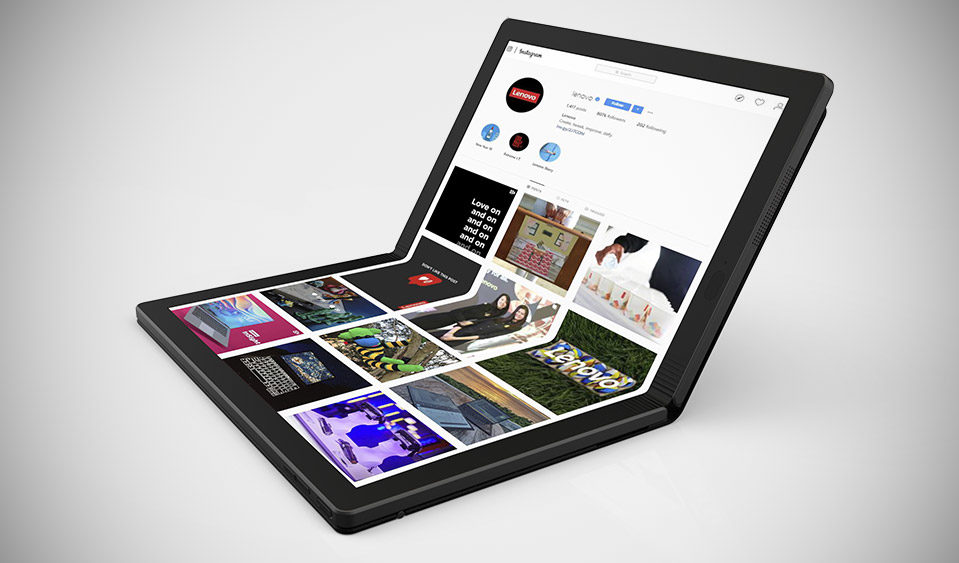
Nokia seeks to block the US imports for Lenovo computers after it allegedly found that the latter had infringed on multiple patents. the USITC (International Trade Commission) has launched an investigation into the matter, which will have Lenovo’s laptops, tablets, and even desktops being blocked from being imported.
According to fresh reports (1,2), Nokia has alleged that Lenovo has violated section 337 of the Tariff Act and has claimed that the latter’s IdeaPad, ThinkPad, and Flex series of laptops have infringed on five patents around the H.264 video compression standard. Thus, Nokia is looking to block the imports of Lenovo computers to the US. Within the next 45 days, the ITC will set a target date for completing its investigation regarding the accusation.
Notably, the complaint arrives a year after multiple “unsuccessful attempts to license Lenovo to the standard essential claims of Nokias H.264 portfolio,” according to the official filing. The infringement is said to be across multiple different platforms including tablets and desktops, although, the investigation is still in its early stages and we will have to wait for official results of the ITC investigation. So stay tuned.
Apple has apparently made no structural improvements with its 2020 iPad Pro since the previous generation. The Durability test from JerryRigEverything saw the latest iPad snap and break just as easily as its 2018 counterpart.
The Cupertino based giant has seemingly skipped any improvements to the build quality, with the 2020 iPad Pro having the same structural flaws as the 2018 model. Similar to the previously launched iPad, the latest version also has the exact same weak point, which is near the microphone that is on the side. During the bend test, the 2020 iPad Pro snapped just as easily as the older variant.
In the video, the YouTuber tested the Magic Keyboard as well, which was found to be pretty durable and rigid. Although, it does arrive with a sizeable price tag. So while the internals and specifications of the new iPad have been improved, Apple has yet to take note of the physical and structural flaw that still persists two years after. For those interested, you can check out the video above.
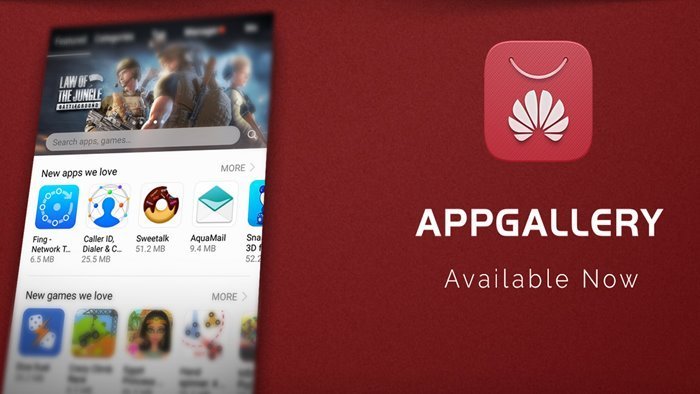
Earlier this week, Huawei announced the launch of its official game service and distribution platform called GameCenter. It will be available in 33 countries and regions across the world and is designed for the mobile gaming community.
Through the new smartphone gaming hub, the Chinese tech giants aim to bring mobile gamers together through “high-quality content and rewards.” This service will connect Huawei users from Asia Pacific, Europe, Latin America, the Middle East, Africa, and more. For those interested, the GameCenter app can be downloaded via the AppGallery.
Huawei GameCenter is essentially a one stop gaming service platform. In other words, it is built primarily for gaming, and its related services. In its core, the hub will work around two services, which are the content service and user welfare. With the new gaming platform, Huawei also plans on rewarding users through exclusive online game packages and online offers.
Furthermore, the GameCenter seems to be influenced by the console and PC gaming industry as well, with the platform offering the premiere launch of certain games before any other platform. This includes Starship Legion-AMG, BORN AS EPIC, Farm Legend, Survival Road, Ellr Land, Dynasty Legends: True Hero Rises from Chaos, Goddess MUA and more. In game special offers will have users receive exclusive package benefits such as gold coins and time-limited props. So, this is clearly another step from Huawei to make its app ecosystem more robust and attractive to the global market.
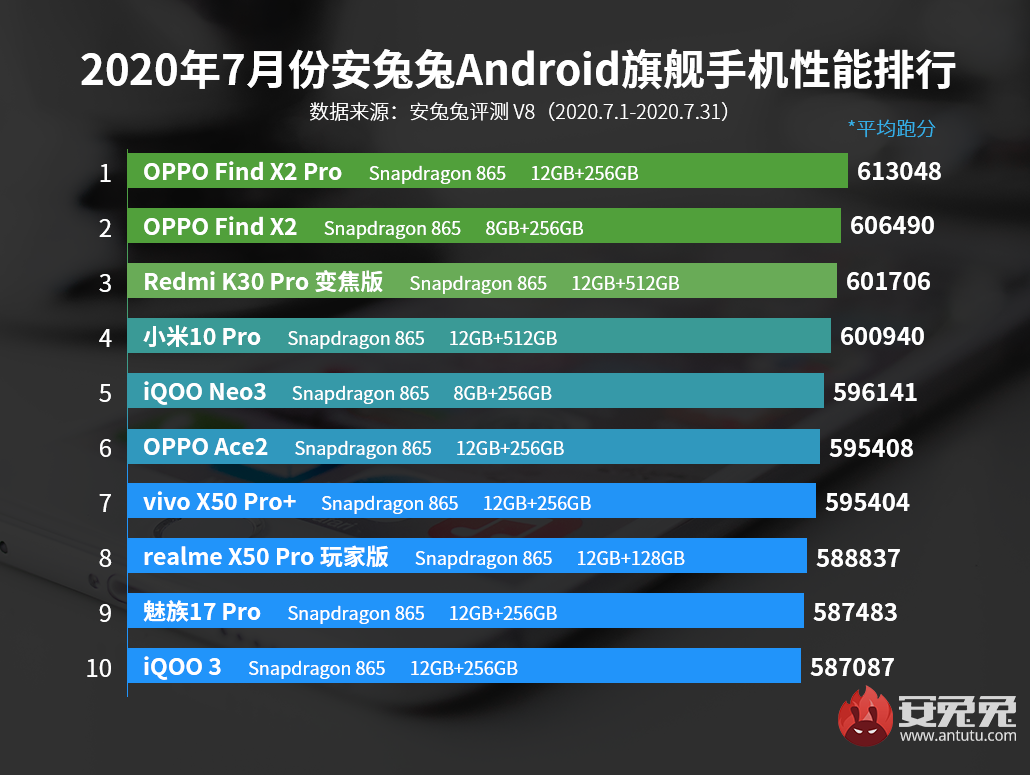
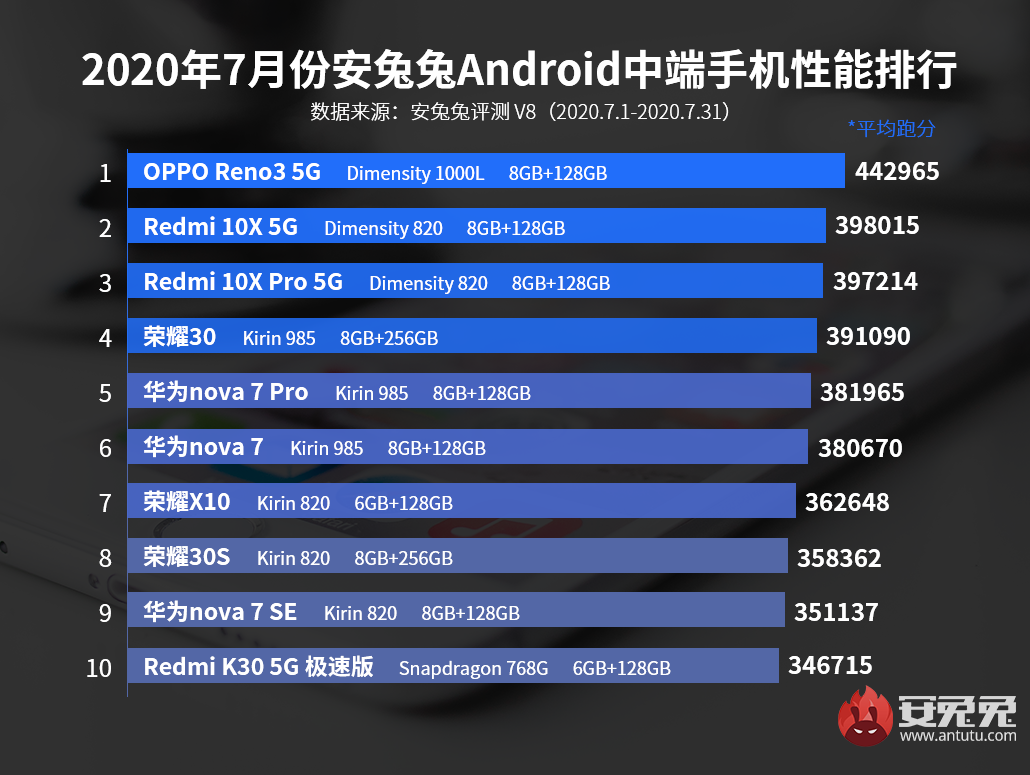
AnTuTu has just released the performance rankings for smartphones in the high end and mid range category for the month of July. This list also rounds up the first half of the year, with notable launches right around the corner or arriving in a couple of weeks.
The flagship performance list is from 1st July to 31st July 2020 and was calculated through an average score of any particular model. In the list, the Oppo Find X2 Pro topped the list with a score of 613,048 points. The Oppo Find X2 arrives in a close second with 606,490 points while the Redmi K30 Pro came in third with a score of 601706 points.
Other notable names down the list include the Mi 10 Pro, Oppo Ace2, Realme X50 Pro, and more. Notably, the list showcases the disparity in scores despite all of the 10 smartphones in this list featuring Qualcomm’s Snapdragon 865 SoC. This shows that software tweaks, optimizations, and more also factor in for performance rather than just new hardware.
Unlike the flagship performance list, the mid range rankings had more diversity regarding the chipsets. The Oppo Reno3 5G which topped the list features MediaTek’s Dimensity 1000L and scored 442,965 points. Redmi 10X 5G and 10X Pro 5G arrived second and third with 398,015 and 397,214 points respectively. Down the list, HiSilicon Kirin 985 chip sporting smartphones like Huawei Nova 7 Pro and Nova 7 can be found. The only Qualcomm chip smartphone in this list arrived 10th in the list, which was the Redmi K30 5G with its Snapdragon 768G SoC.
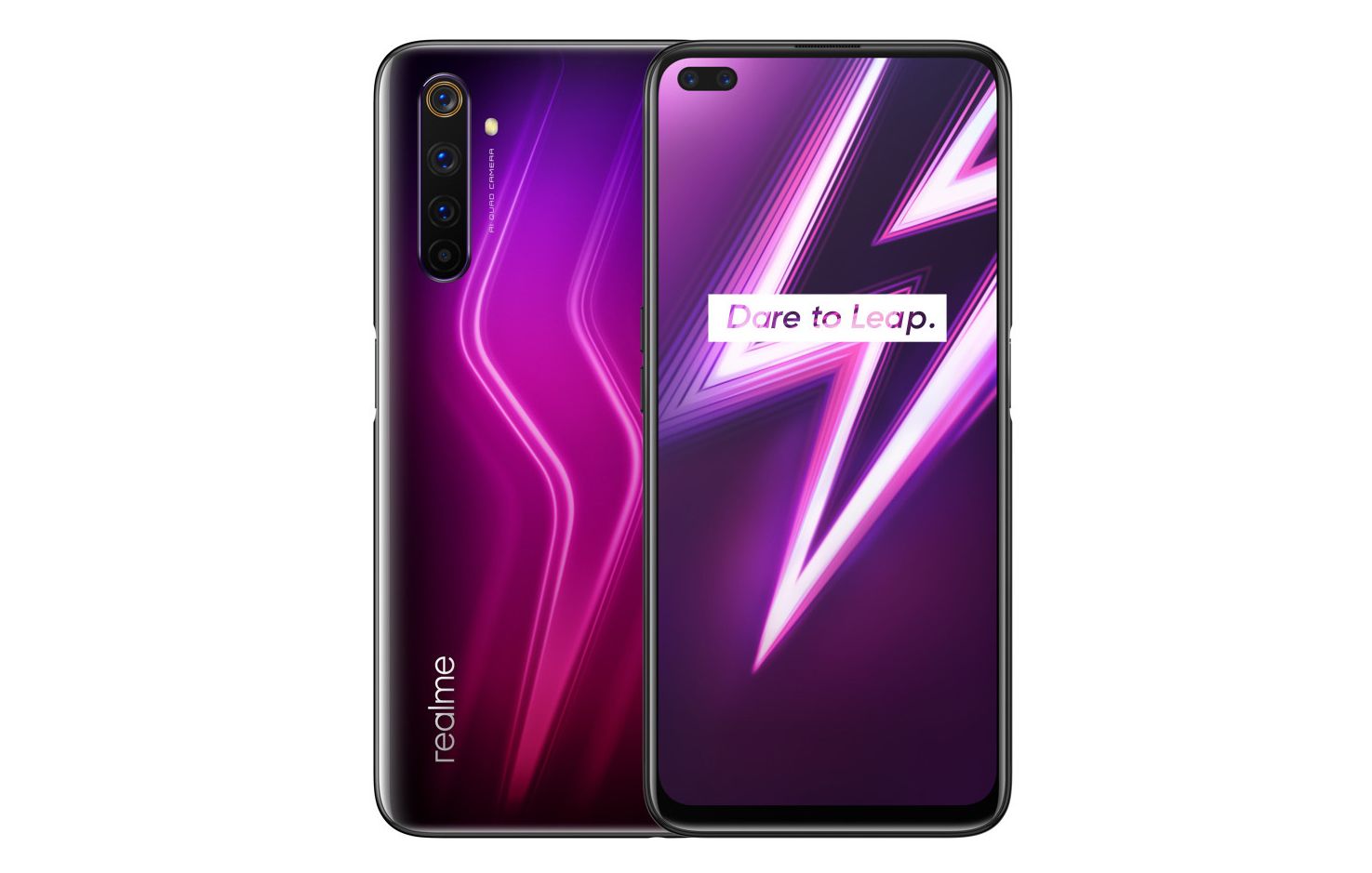
The Realme 6 Pro went official with the Realme 6v phone in India in March. The Pro model was introduced in two colors variants such as Lightning Blue and Lightning Orange. Soon after the launch, Realme India CEO Madhav Sheth had teased the existence of a red color variant for the Realme 6 Pro. The new color variant has debuted in the country.
Like the blue and orange color variants, the Realme 6 Pro Lightning Red comes in three choices such as 6 GB RAM + 64 GB storage, 6 GB RAM +128 GB storage, and 8 GB RAM + 128 GB storage in India. They are priced at Rs. 17,999 (~$227), Rs. 18,999 (~$240), and Rs. 19,999 (~$267), respectively. Flipkart will kick off the Big Savings Days sale at midnight today in India. The Realme 6 Pro Lightning Red variant can be availed through the upcoming shopping sale on the retailer site.
The Realme 6 Pro has a 6.6-inch IPS LCD panel that offers Full HD+ resolution, 20:9 aspect ratio, and 90Hz refresh rate. The pill-shaped cutout on the screen has a 16-megapixel main camera and an 8-megapixel ultrawide lens.
The backside of the device has a quad camera system. It includes a Samsung GW1 64-megapixel main camera, a 118-degree 8-megapixel ultrawide snapper, a 12-megapixel telephoto sensor with up to 2x zoom, and a 2-megapixel macro lens with 4cm focal length. The device houses a 4,300mAh battery that supports 30W VOOC Flash Charge. The Snapdragon 720Gv octa-core processor fuels the device.
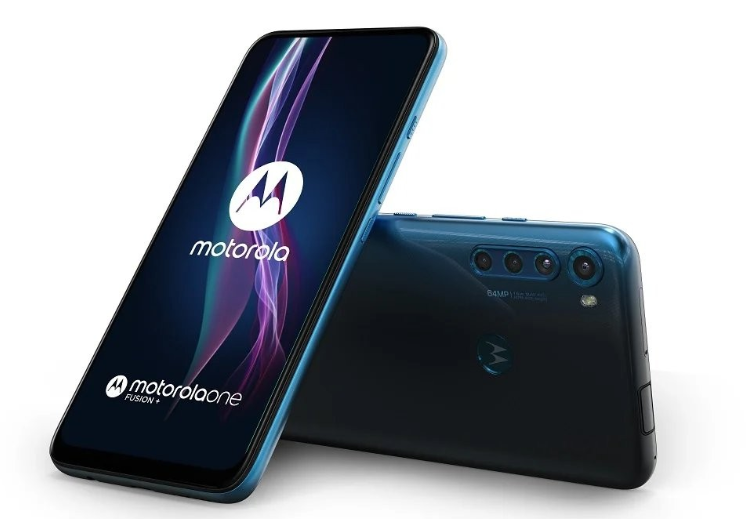
Motorola has confirmed that the company is launching its One Fusion+ mid-range smartphone in the North American market. Till now, the phone was only available in India, Europe, and Latin America.
The company has announced that the Motorola One Fusion+ will be available for purchase in the United States from today, i.e. 5th August, for a price of $399. It will be up for sale through Motorola’s own website as well as AT&T and T-Mobile.
The smartphone features a 6.5-inch IPS LCD display with a Full HD+ screen resolution of 2340 x 1080 pixels. Under the hood, the device is powered by Qualcomm Snapdragon 730 chipset, along with 6GB RAM and 128GB internal storage.
In the camera department, there’s a quad-camera setup on the back that consists of a 64-megapixel primary camera, an 8-megapixel ultra-wide snapper, a 5-megapixel macro lens, and a 2-megapixel depth sensor.
On the front side, the smartphone has a 16-megapixel snapper, housed inside a pop-up mechanism. The phone runs the Android 10 operating system with the company’s own My UX on top that comes with additional settings.
The phone also comes with a dedicated button for accessing Google Assistant. There’s also a rear-mounted fingerprint sensor. The Motorola One Fusion+ is powered by a 5,000mAh battery and has support for 15W TurboPower fast charging technology.
The launch of the Fusion+ in the United States comes just months after the company started selling the Motorola Edge, a mid-range 5G smartphone currently available for $499. It is a watered-down model of the flagship Motorola Edge+ launched in April.
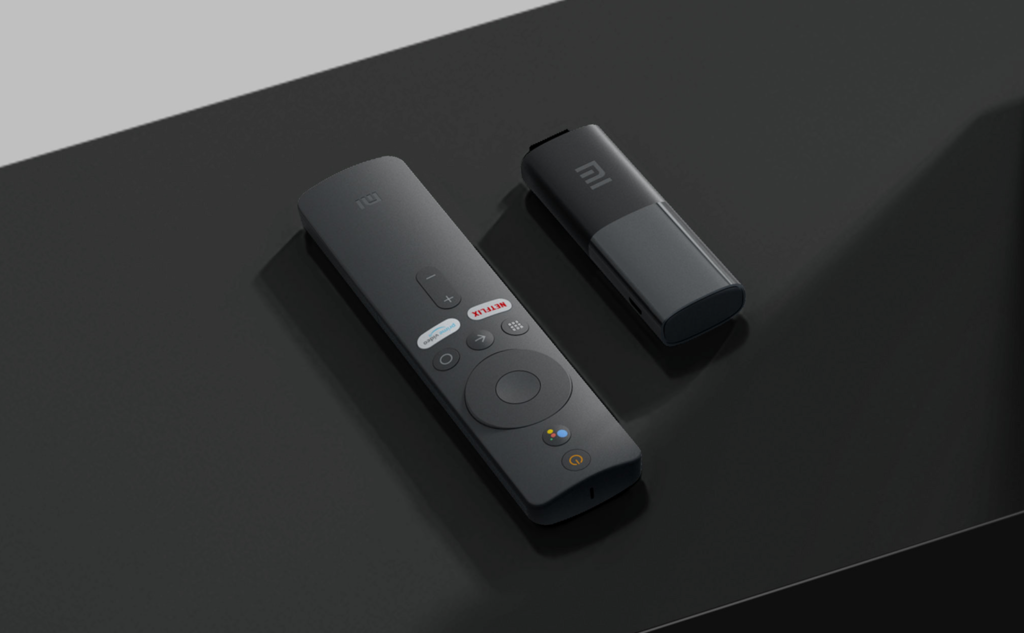
After debuting Mi Box 4K in May for ₹3,499 ($47) in India, Xiaomi has now launched Mi TV Stick in the country for only ₹2,799 ($37). The cheapest streaming device from the company offers Android TV experience in 1080p (FHD) resolution. It will be available for purchase starting August 7 from Flipkart, Mi.com, Mi Home, and other offline retail partners.
The all-new Mi TV Stick is powered by a 2.0GHz quad-core processor with Cortex-A53 cores paired with Mali-450 GPU. The device comes with 1GB DDR4 RAM and 8GB eMMC storage.
As mentioned in the beginning, it only supports output up to 1080p (1920 x 1080 pixels) at 60fps. However, it runs Android TV Pie and supports all leading streaming services like Netflix, Amazon Prime Video, Disney+ Hotstar, and more.
On the connectivity front, the Mi TV stick features 1 x HDMI, 1 X MicroUSB for power input, dual-band WiFi, and Bluetooth 4.2. Other features of the device include Google Assistant, Chromecast Built-in, Data Saver, and Dolby Audio.
The device measures 92.4 x 30.2 x 15.2mm in dimension and weighs 28.5g. Last but not least, It only comes in a single Black color variant with a dual-tone finish and Mi logo.
Having said that, do watch our review of the Xiaomi Mi TV Stick before making a purchase decision.
Samsung is among the leading brands working on several different technologies to offer the full-screen experience to the customers. The South Korean giant has been quite vocal about eventually offering a truly full-screen smartphone.
Currently, several companies are working on under-display camera technology, which is the only thing missing to enable true full-screen experience on a smartphone. Given Samsung’s development process, the company is believed to be actively working on this.
There were reports that Samsung could adopt this technology for its premium flagship offerings of this year — Galaxy S20 lineup and the upcoming Galaxy Note20 lineup. However, as confirmed, that is not the case.
Not only that, but it also seems that the company is playing safe for the next-generation Galaxy S-series flagship smartphones by skipping to adopt this new technology (via Ross Young). We can’t blame Samsung for this given that the under-display camera technology doesn’t seem to be ready yet for commercial use, that too with the desired camera output from a premium flagship-grade device.
Apart from the output, there’s also a costing factor. Integrating such a new experimental technology requires a lot of capital spending because of increased pricing of materials from vendors and low-yield in mass-production.
The next-generation Galaxy S-series flagship, which could be named Galaxy S21 or Galaxy S30, is still months away from launch. It is likely to launch in February next year, so we will definitely come across some exciting new features for the device in the coming months, if not this in-display camera technology.
Meanwhile, Samsung is all set to launch its Galaxy Note20 series smartphones at its Galaxy Unpacked event in just a few hours, along with Samsung Galaxy Z Fold 2 and Galaxy Buds Live TWS earphones.
Recently, Samsung confirmed that it has started mass-production of 5nm chips. At the time, it was believed that the company could have started producing orders from Qualcomm’s next chipset.
However, it looks like that isn’t the case and Samsung might have lost the order to TSMC if the new report coming from China is to be believed. The reason being cited in the report is problems in the development process.
We had recently reported that the Samsung Foundry is struggling with low yields of its 5nm EUV (Extreme Ultraviolet) process. Now, it is being reported that Qualcomm could shift the original order of Snapdragon X60 modem and Snapdragon 875 SoC to TSMC.
It seems that instead of shifting all the orders back from Samsung to TSMC, Qualcomm will distribute the orders among these two companies. Samsung also has an order of Snapdragon 735 SoC on 5nm node and is reportedly working on Exynos 1000 SoC.
TSMC, the world’s largest contract chipset manufacturer has already started mass-production of 5nm chips, starting with Apple‘s A14 chipset which will be powering the upcoming Apple iPhone 12 lineup.
The Taiwanese giant currently has a production capacity of 60,000 chips on a monthly basis on the 5nm process. But the company is looking to expand its capacity to reach around 80,000 to 90,000 units a month.
Samsung has ambitious plans for the future and aims to become the leading semiconductor company in the world by 2030. Apart from starting mass-production of 5nm chips, the company also announced that it has started working on the 4nm process.
Earlier this week, Google announced the much-awaited Google Pixel 4a mid-ranger with a price tag of $349. It does not support 5G connectivity. For people who are looking 5G-enabled Pixel phones, Google will be releasing the Pixel 4a 5G and Pixel 5 5G by fall this year. The specifications of these phones will be confirmed in the coming months. Fresh information reveals suggest that Google Pixel 5 could be arriving with a 120Hz display.
According to display analyst Ross Young, a new Google Pixel phone with 5G support arriving this year will be equipped with a big display 6.6 inches. The screen will carry support for 120Hz refresh rate, and it will be supplied by Samsung Display and BOE.
Next new Google phone, the 5G version, will be 6.67” from Samsung Display and BOE.
The Pixel 5 will come with better specs than the Pixel 4a 5G. Hence, it is likely that Young could be talking about the Pixel 5. However, the 6.67-inch display news for Pixel 5 contradicts previous claims that said that it has a 5.8-inch screen.
The Pixel 5 is rumored to be powered by the Snapdragon 765G chipset. Since the SoC is not as good as the Snapdragon 865 flagship chipset when it comes to power efficiency, the Pixel 5 may house a large-sized battery.
The Pixel 4a 5G will be arriving with a $449 whereas the Pixel 5 5G may cost $649. It is likely that the company will confirm the specs and features of these phones in October. Finally, the sales of these devices may begin in November or December.
We use cookies on our website to give you the most relevant experience by remembering your preferences and repeat visits. By clicking “Accept”, you consent to the use of ALL the cookies.
This website uses cookies to improve your experience while you navigate through the website. Out of these, the cookies that are categorized as necessary are stored on your browser as they are essential for the working of basic functionalities of the website. We also use third-party cookies that help us analyze and understand how you use this website. These cookies will be stored in your browser only with your consent. You also have the option to opt-out of these cookies. But opting out of some of these cookies may affect your browsing experience.
Necessary cookies are absolutely essential for the website to function properly. This category only includes cookies that ensures basic functionalities and security features of the website. These cookies do not store any personal information.
Any cookies that may not be particularly necessary for the website to function and is used specifically to collect user personal data via analytics, ads, other embedded contents are termed as non-necessary cookies. It is mandatory to procure user consent prior to running these cookies on your website.