Advertisement

Xiaomi Redmi K30 Pro is now only $399 for Qualcomm 865 processor

The Xiaomi Redmi K30 Pro series was made available in the Chinese market in March this year. The line up comprises the Redmi K30 Pro and Redmi K30 Pro Zoom Edition.

Xiaomi Redmi K30 Pro Zoom Edition

Touted as one of China’s most reliable e-tailers, Giztop is now offering the Xiaomi Redmi K30 Pro for a considerably lowered price. The 6GB RAM+128GB ROM model would normally set you back $549, but you can get your hands on it for a reduced price of only $499 through Giztop.

If the phone still doesn’t fit inside your budget, all you need to do is to apply coupon code RK30100 at the time of checking out. The coupon helps you save $100 more, by bringing the already lowered asking price of the phone further down to only $399. This variant is available in blue, as well as white color options.Redmi K30 Pro

If you fancy using a more power-packed variant, you might want to check out the next variant that ships with 8GB of RAM and offers 128GB of internal storage space. While you’d normally end up shelling out $649 on the aforesaid model, Giztop is giving you a chance to purchase for only $599.

Those on a tight budget can take advantage of coupon code RK30100 and grab an extra $100 at checkout. In other words, you can bring the original selling price of the model down to only $499 simply by applying the aforesaid coupon before placing your order.

An absolute steal at this price, the Xiaomi Redmi K30 Pro sports a mammoth 6.67-inch AMOLED FHD+ display with a fingerprint scanner embedded under the screen. It packs a powerful Qualcomm Snapdragon 865 processor along with a competent Adreno 650 GPU under the hood.

In the optics department, the Xiaomi Redmi K30 Pro houses a 64MP, 13MP, 5MP, and a 2MP camera at the back, along with a 20M pop-up camera in the front for capturing self-portraits and video calling. The phone is backed by a 4700mAh battery and runs MIUI 11 based on Android 10 OS.

You can follow this link to place your order before the promo comes to an end. Note that the coupon code is slated to expire on June 30.

The Gizmochina Coupons is a community that finds, reports, and evaluates deals and coupons of Chinese products from online shops. Please visit it here to find more coupons to save money on mobiles and smart gadgets.


HTC launches Desire 20 Pro and U20 5G in Taiwan

HTC launches two new smartphones in its home country Taiwan – Desire 20 Pro and U20 5G. The former handset has leaked multiple times over the past few weeks. Whereas, the latter is the first 5G mobile phone from the company.

HTC Desire 20 Pro Specifications

The Desire 20 Pro is just like any other budget smartphone in the market powered by Qualcomm Snapdragon 665 paired with 6GB RAM and 128GB ROM. The storage can be further expanded via microSD card.

HTC Desire 20 Pro

The phone sports a 6.5-inch FHD+ (1080 x 2340 pixels) LCD panel with 19:5:9 aspect ratio and a punch-hole for the 25MP selfie camera. The back of the handset houses a quad-camera setup consisting of a 48MP primary sensor, 8MP ultra-wide unit, 2MP macro shooter, and a 2MP depth sensor.

Other features of the device include WiFi 5, Bluetooth 5.0, dual-frequency GPS, 3.5mm headphone jack, USB Type-C, multifunctional NFC, rear-mounted fingerprint sensor, and Android 10.

Lastly, the handset gets is power from a 5,000 mAh battery with support for Quick Charge 3.0 fast-charging standard.

HTC U20 5G Specifications

The HTC U20 5G is the company’s first 5G smartphone. It features similar design and identical specs like the Desire 20 Pro except for some minor changes like the processor and display size to name a few.

HTC U20 5G

Under the hood, it comes powered by the well-known mid-range 5G SoC, the Qualcomm Snapdragon 765G. Unlike the other phone, it features 8GB RAM and 256GB ROM and still can be expanded via microSD card.

The FHD+ (1080 x 2400 pixels) 20:9 LCD panel on it is slightly larger at 6.8-inch and has a punch-hole for the 32MP selfie snapper. Whereas, the rear camera setup is exactly the same as the other phone. That means it has got a 48MP (primary) + 8MP (ultra-wide) + 2MP (macro) + 2MP (depth) quad-camera setup.

Further, the handset runs Android 10 and features a rear-mounted fingerprint sensor, 3.5mm headphone jack, USB Type-C, WiFi 5, Bluetooth 5.0, dual-frequency GPS, and multifunctional NFC.

Last but not least, it has the same 5,000 mAh battery but supports slightly faster Quick Charge 4.0 fast-charging protocol.

HTC Desire 20 Pro/U20 5G Pricing and Availability

The Desire 20 Pro and U20 5G smartphones are limited to Taiwan for now. Though they have been listed on the official website, HTC is yet to reveal their price. The company might bring them to other markets in the near future.


Hackers can now use Light Bulbs to listen in on your conversations

A new study has resulted in an interesting finding. Using light bulbs, one can now listen in on conversations from a distance. The study was conducted by researches at the Ben-Gurion University of the Negev and the Weizmann Institute of Science in Israel.

In the study, it was found that a conventional light bud can be used to eavesdrop on conversations. If a conversation is in close proximity to a light bulb, then a third party can listen in on it from distances as far as 25 meters away. This method has been labeled as Lamphone and requires a remote electro-optical sensor to achieve the near science fictional results.

Hackers

Explaining how the method works, the remote electro-optical sensor analyzes the changes in the light bulb’s frequency response to sound waves. While recently, methods of eavesdropping on conversations had required just a compromised smart device or other smart home appliances, this process can work from just a regular light bulb.

According to the study, “Lamphone recovers sound optically via an electro-optical sensor which is directed at a hanging bulb.” In other words, the sensor has to be directly pointed at the light source through a telescope and a voice-to-text application like Google Speech. Notably, the range of this method can also be increased by using a larger and more powerful microscope.

The electro-optical sensor analyzes the subtle vibrations on the surface of the light bulb. This data is then run through specially developed algorithms from the researchers to isolate an audio signal from an optical signal. The output is then transcribed through a voice-to-text application, which in turn gives out the end result that is the conversation.

Hackers

Interestingly, this process even works on identifying singing as well, with apps like Shazam and SoundHound being able to recognize the songs from 25 meters away. Now, before you go switching your light bulbs, there are a lot of shortcomings to this process. The bulb needs to be hanging from the ceiling and needs to be in a clear vision of the sensor. Furthermore, the conversation or music being played would have to be loud enough to cause the vibration on the surface of the bulb. So while it does seem scary enough, it is quite difficult to pull off in a real world scenario.


(Via)

Motorola Edge Plus units are suffering from a major display issue

Back in April, Motorola launched its first flagship smartphone in years. This marked the company’s return to the premium segments. But now, reports have been coming in regarding a major issue that is affecting the display of various Motorola Edge+ users.

Motorola
Image Via AndroidAuthority

Users of the flagship device have been complaining about unknown purple blotches and a green tint that appears on the display of the smartphone. This is a major cause of concern for the company since the device costs a hefty $1000 price tag. According to certain Motorola Edge+ owners, purple spots appear on the edges of the display if the device is used for a long while. These eventually disappear, only to come back later on, if the device is still used for a prolonged period of time.

A significant number of users also reported on these purple spots multiplying and even growing in numbers. This isn’t the only issue with the Motorola flagship’s display as certain owners are also experiencing green tints on their smartphones’ display. At the moment, the company has acknowledged the issue and is currently working on a software fix.

Motorola Edge Plus

One forum administrator even stated that a new software update should fix the display issues soon. The administrator also advised people to not go for an immediate replacement as the problem is likely a software issue and not due to faulty hardware. Thus, even newly purchased Motorola Edge+ units could suffer from the same issue. Unfortunately, the initial software fix which was rolled out, only fixed the issue temporarily, with users reporting on the problems of the display coming back soon after.


(Via)

Samsung Galaxy Tab S7+ CAD renders emerge weeks before launch

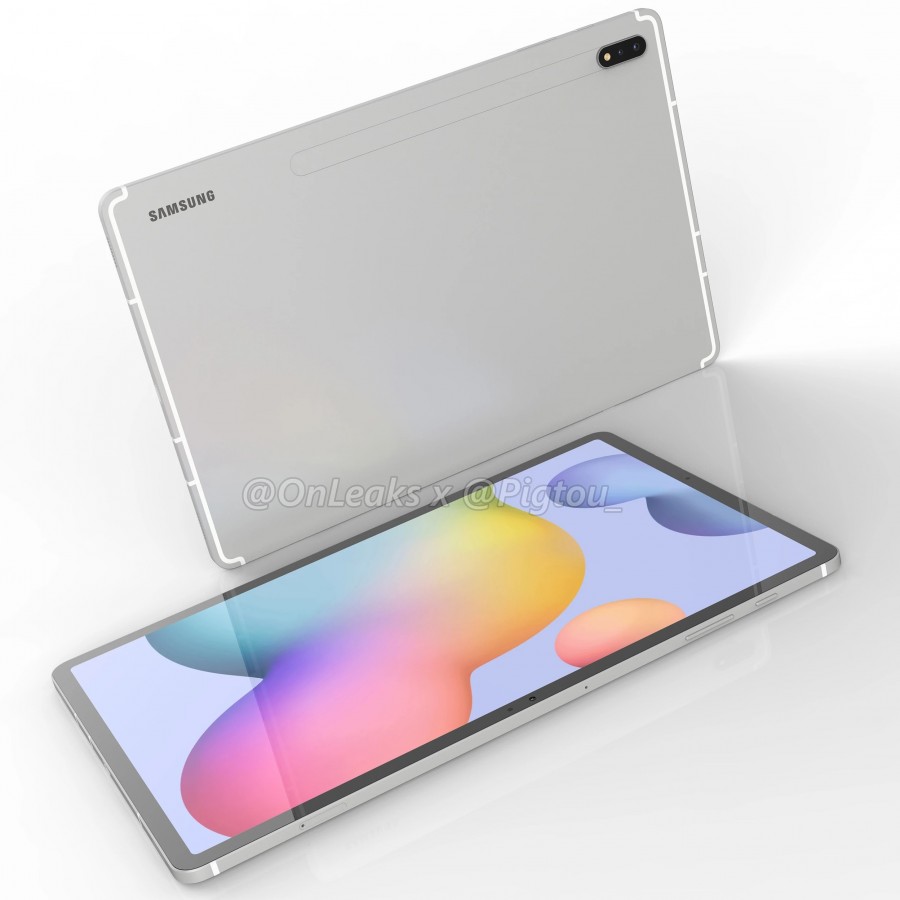
Recently, reliable tipster @OnLeaks had shared the CAD renders of the vanilla Samsung Galaxy Tab S7. Now, the tipster has revealed the CAD renders of the advanced Galaxy Tab S7+.

As can be seen in the CAD renders of the Galaxy Tab S7+, its design is identical to the Galaxy Tab S7 tablet. The Plus edition measures 285 x 185 x 5.7mm. The thickness of the device increases to 6.9mm with the camera bump. A front camera can be seen on the side bezel of the Tab S7+.

Samsung Galaxy Tab S7+ CAD renders 1

Samsung Galaxy Tab S7+ CAD renders 1

It is expected to feature a 12.4-inch display with slim bezels around it. The device is rumored to house a 9,800mAh battery. The backside of the device features a dual camera setup along with an LED flash.

The left edge of the Tab S7+ features a SIM slot, a volume rocker, a power key and a noise cancellation mic. The USB-C port placed between speaker grilles can be seen at the bottom side of the device.

Samsung Galaxy Tab S7+ CAD renders 1 Samsung Galaxy Tab S7+ CAD renders 1In comparison, the Galaxy Tab S7 has 253.7 x 165.3 x 6.3 dimensions. It measures 7.7mm in thickness at the camera bump. It is likely to feature an 11-inch display and it may house a 7,670mAh battery. The Tab S7 also features an LED flash assisted dual-camera system.

The Snapdragon 865 mobile platform along with 6 GB of RAM is expected to power the Galaxy Tab S7 and Galaxy Tab S7+ tablets. Both tablets will come with support for the 120Hz refresh rate and S Pen stylus.


(source)

Samsung may not supply Huawei with chips for its smartphones

After the US government emplaced new sanctions against Huawei, the Chinese tech giant lost its chip supply from TSMC. Since then, the company as invested in various local semiconductor and is reportedly also looking for other alternatives. One of the rumored alternatives was the Samsung, but now, a new report suggests that it South Korean tech giant might not be its new chip supplier.

Samsung

For those unaware, Samsung already supplies Huawei with OLED panels and memory chips for its electronics products. Furthermore, the companies semiconductor department would’ve also benefitted from Huawei’s loss of chip supply, but it is being reported that Samsung might not end up supplying the Chinese company with chipsets.

At the moment, it is unclear as to why exactly Samsung may not supply Huawei, but it does mean that the smartphone vendor will probably have to turn to other companies like MediaTek and Spreadtrum for processors. Huawei’s HiSilicon Kirin processors are found in the company’s laptops and smartphones, although, HiSilicon doesn’t manufacture the processors and depends on TSMC.

Samsung
Huawei’s Kirin chipsets are manufactured by TSMC

TSMC is the world’s largest contract chipmaker and is generally ahead of the market curve, especially in terms of process node sizes and generations. At the moment, the current flagship chips are built on a 7nm while the next generation is expected to be built on an even smaller 5nm process. Unfortunately, finding alternatives with such capabilities will be hard and even Chinese semiconductor firms that Huawei is investing in will take time to reach this stage in technological advancement. So, we may see slower and less power-efficient chips, in comparison to its rivals, in Huawei phones in the near future.


(Via)

Huawei launches 2020 edition of MateBook X Pro, MateBook 13, and MateBook D 15 in Canada

Huawei has launched its 2020 Windows laptop models in Canada. The company has brought three models to the country namely MateBook X Pro 2020, MateBook 13 2020, and MateBook D 15 2020.

Huawei MateBook X Pro 2020

The MateBook X Pro 2020 is the costliest model of all priced at $2,499. The primary specs of this laptop include 13.9-inch 3K FullView display with 91% screen to body ratio, 14.6mm thickness, 1.33Kg weight, 10th Gen Intel Core i7-10510U processor (Comet Lake), 16GB LPDDR3 RAM and 1TB NVMe PCIe SSD.

Consumers buying it between June 15 and 30 will get a two-year manufacturer warranty, one-year Microsoft 365 Personal subscription, Huawei FreeBuds 3 TWS, and a Huawei backpack.

The MateBook 13 2020, on the other hand, is priced at $1,899 for the same processor and RAM as the previous laptop but only 512GB SSD. It features a 13-inch display with 88% screen to body ratio and weighs 1.3Kg.

Freebies on this model include a two-year manufacturer warranty, one-year Microsoft 365 Personal subscription, a Huawei Watch GT, and a Huawei backpack.

As for the last model, the MateBook D 15 2020 comes with a 15-inch display powered by AMD Ryzen 7 3700U processor. It features 8GB DDR4 RAM, 512GB SSD, and costs $949.99.

Customers who pre-order it will be given a two-year manufacturer warranty, one-year Microsoft 365 Personal subscription, a Huawei Band 4 Pro, and a Huawei backpack.

All three of them can be pre-ordered from any of these online retailers – Visions Electronics, Newegg, Canada Computers and Memory Express.


(Via)

iQOO 3 Pro specs and pricing leaked; Snapdragon 865 Plus rumored to fuel it

Tomorrow, Qualcomm will be holding an unveil event to announce new chipsets. It is speculated that the chip maker will take off covers from the Snapdragon 775G upper-midrange SoC. There are speculations that the company will also announce the Snapdragon 865 Plus that is said to be an enhanced version of the Snapdragon 865 that debuted in December last year. The upcoming ASUS ROG Phone 3 gaming smartphone could be the first phone to feature it. The Lenovo Legion gaming phone arriving in July is also expected to arrive with the new SoC. A fresh leak states that the Snapdragon 865 Plus will drive the iQOO 3 Pro smartphone.

According to a tipster who recently the specs of the forthcoming Vivo S6 Pro 5G, the iQOO 3 Pro will be arriving as a gaming version of the Vivo X50 handset that went official recently in China. He revealed the expected specifications and pricing of the smartphone.

iQOO 3 Pro specifications and pricing (Rumored)

The leak states that the iQOO 3 Pro has a 90Hz 6.56-inch S-AMOLED Samsung E3 display that can be found on the Vivo X50 handset. The Full HD+ display will offer a touch sampling rate of 180Hz and in-display fingerprint reader. The display and rear side of the phone is safeguarded by Gorilla Glass 5 panel. It is equipped with a series-6 aluminum alloy frame. The Snapdragon 865 Plus SoC on the device will be assisted by LPDDR5 RAM and UFS 3.1 storage. It will not feature a microSD card slot. The device will be loaded with Android 10 OS.

iQOO 3 5G
iQOO 3 5G

The punch-hole on the display of iQOO 3 Pro will be home for its 16-megapixel selfie camera. The rear side of the device will have a triple camera system comprising of a Sony IMX586 48-megapixel main lens, an ultrawide shooter of 8-megapixel with super macro capabilities, and a Samsung S5K4L6 portrait lens of 13-megapixel. The phone has a 4,500mAh battery with a rapid charging technology that can fuel it just 30 minutes. Other specs of the phone include liquid cooling technology along with graphite sheet heat dissipation, X-axis linear motor, super line dual stereo speakers, and NFC.

The iQOO 3 Pro is expected to arrive in China in three variants. The 8 GB RAM + 128 GB storage will cost 3,998 Yuan. Its 8 GB RAM + 256 GB storage will be priced at 4,298 Yuan (~$607) and the 12 GB RAM + 256 GB storage variant will cost 4,698 Yuan (~$707). There is no confirmation on whether the iQOO 3 Pro specs and pricing leak will come true. Hence, it’s advisable to wait for further reports to know about the iQOO 3 Pro.


(source)

Nokia 5310 XpressMusic launched in India for just 3,399 INR ($45)

Earlier today (16th June 2020), HMD Global launched the Nokia 5310 XpressMusic feature phone in India. The device is a refresh of the original and nostalgic Nokia 5130 XpressMusic that launched back in 2007 and brings with it the classic features that the original was known for.

Nokia
Nokia 5310 XpressMusic

Similar to the 5130, the Nokia 5310 XpressMusic also features an MP3 player and FM radio. Although, the latter can be used wired or wirelessly as well. On the front, a dual front facing speakers can be found, which is the case since the device and its predecessor place an emphasis on listening to your favorite songs on the go. The Nokia 5310 XpressMusic also features dedicated buttons for music, similar to the original.

Through these buttons, the user can adjust the volume, shuffle tracks, and more. The device also boasts expandable storage up to 32GB via a microSD card. Under the hood, a MediaTek MT6260A SoC runs the mobile, which runs Nokia Series 30+ software and also includes the typical physical keypad. It houses 8MB of RAM and an in built storage of 16MB.

nokia 5310

The Nokia 5310 sports a 2.4 inch QVGA colored display and is powered by a 1,200mAh battery pack. Its battery offers an impressive standby time of up to 30 days. The phone is priced 3,399 INR (roughly 45 US Dollars) and will be available online for the first four weeks through Amazon India and then will be available across leading retailers in India.


Next Poco smartphone will launch within 20-25 days in India

Poco came into existence with the launch of Poco F1 in 2018.  For over more than a year, the brand did not announce any new phone. Instead, it was spun-off into an independent brand in early 2020, followed by the release of its second smartphone called Poco X2. A couple of weeks back, the brand posted a teaser for its next phone in India. Now, it has been confirmed that this handset will launch within the next 20-25 days.

Poco’s General Manager (GM) C Manmohan was recently interviewed by Hindustan Times Tech. In which, he confirmed his brand will release its new phone in the next 20-25 days.

He said, “We are definitely going to launch a new phone soon… We want to ensure the philosophy we had is brought to different price ranges.”

Poco had already shared its plans to launch phones in different price segments. It even crowdsourced the name for its first TWS, which was finalized to be called Poco Pop Buds.

Though nothing about this forthcoming phone has been yet officially teased by the brand, we can expect it to be a variant of Redmi Note 9 series going by the previous leaks.

It could be called POCO M2 Pro with model number M2003J6CI and might be powered by Qualcomm Snapdragon 720G.


Motorola One Fusion+ launched in India for Rs. 16,999

Motorola introduced the One Hyper smartphone with a notch-less display and pop-up selfie camera back in December 2019. The One Hyper did not make it to India. However, the Motorola One Fusion+ that sports a recently went official in the European market has landed in India today with an enticing price tag of Rs. 16,999 (~$224). The Snapdragon 730G powered handset also features a notch-less display and a pop-up camera for capturing selfies.

Motorola One Fusion+ price in India

The Motorola One Fusion Plus costs Rs. 16,999 (~$224) and its first sale will be held at 12 PM (local time) on June 24 on Flipkart. The phone will be available in Moonlight White and Twilight Blue color options.

Motorola One Fusion+

[su_notmotorolae note_color=”#ffffff”]Editor’s Pick: Lenovo Legion gaming smartphone will debut in July[/su_note]

Motorola One Fusion+ specifications

The polycarbonate bodied Motorola One Fusion+ features an HDR10 complaint 6.5-inch IPS LCD display that offers a Full HD+ resolution of 1080 x 2340 pixels. It has a pop-up selfie camera of 16-megapixel. The rear side of the device has a quad-camera setup that comprises of a 64-megapixel primary camera, a 118-degree 8-megapixel ultrawide shooter, a 5-megapixel macro lens and a 2-megapixel depth sensor.

The Snapdragon 730G SoC of the One Fusion+ is coupled with 6 GB of RAM. Apart from external storage slot, the phone offers users with a big internal storage of 128 GB. My UX based Android 10 OS runs on the device. The One Fusion Plus includes a massive 5,000mAh battery that fuels up fast with 15W TurboPower charger. The phone features a dedicated button for accessing Google Assistant.


Xiaomi and Samsung accused of favoring online retailers by India’s offline sellers

Offline smartphone retailers in India have accused the industry giants, Xiaomi, and Samsung of bias. They claimed that the Chinese and South Korean vendors have diverted a majority of their devices’ stocks to the online channels to avoid giving margins to physical stores, thereby, making it difficult for them to maintain a profit.

Xiaomi
Samsung Galaxy M31

The offline vendors said that Samsung was not maintaining price parity, particularly for its mid range Galaxy M series, namely M21 and M31 models. Reportedly, the Korean smartphone maker is selling these smartphone models at more affordable rates on online channels, which in turn, is hampering the offline sellers’ business. Furthermore, Xiaomi is also accused of favoring the e-retailing sector as it is apparently supplying more stocks to its online partners and significantly reducing supply to offline channels.

The reason for this is most likely profit for Xiaomi, along with customers’ preferences. According to a Xiaomi spokesperson, “The biggest reason for the increase in online sales is the comfort of door-step delivery which gives the informed consumers a sense of safety, without having the need to step out.” This holds especially true now of all times as the world is suffering from the Coronavirus pandemic.

xiaomi

A leading Indian offline retailer said in a statement that, “only Vivo has been consistent when it comes to maintaining stock supply. Even Oppo brought new stocks via imports for new models. They are supporting us but even their margins have come down.” For those unaware, due to various issues in raising production capacity back up to 100 percent in India, various vendors, especially Chinese companies, have been importing newer models to India, which has raised cost as well. The viral outbreak is affecting various manufacturing sites and their reopening. Thus, the imported smartphone arrives at a higher cost due to import duties.


(Via)

Apple’s foldable iPhone features two separate panels connected by hinge

While companies like Samsung and Huawei are already set to launch their next-generation foldable smartphones this year, Apple is yet to announce its foldable iPhone. But the US-based company seems to be working on its design.

A prototype of a foldable Apple iPhone has been surfaced online. Although it’s a foldable smartphone, the device does not feature a foldable display. Instead of that, the company has two separate display panels which are connected by a hinge.

Foldable iPhone Prototype

Jon Prosser, who shared the leak, says that even though there are two different display panels, it looks fairly continuous and seamless when the displays are extended. He also adds that the phone has a rounded, stainless steel edge like the current iPhone 11 without any kind of notch, but a “tiny forehead” on the outer display for Face ID.

Samsung Galaxy Fold comes with a foldable display where the single screen panel can be folded into two screens or be extended to be used as one larger display. However, the design of the foldable iPhone is different than this.

In fact, the design of the foldable Apple iPhone seems similar to that of Microsoft’s Surface Neo and Surface Duo, both of which have foldable dual display panels which are connected through a hinge.

It remains to be seen if Apple decides to move ahead from the prototyping stage and actually being this foldable iPhone to the market. Even if a foldable iPhone is coming, it’s probably not launching in the near future. But a 5G iPhone will be released this year.

(Source)

US amends ban allowing companies to work with Huawei for 5G standards

Even though the United States continues to crackdown on Huawei and trying to cut it off from its vendors, the U.S. Commerce Department has announced that it will allow American companies to work with Huawei to set standards for the 5G networks.

With this rule change, the companies can disclose U.S. technologies to the Chinese giant without the need for a license but only if the purpose is of 5G standards development. For those who are unaware, Huawei was put on Entity List by the United States last year and now requires any American company doing business with the Chinese company to obtain a license from the government.

Huawei Logo MWC 2019

The announcement from the Commerce Department says that the amendment is meant to ensure that Huawei’s placement on the entity list “does not prevent American companies from contributing to important standards-developing activities despite Huawei’s pervasive participation in standards-development organizations.”

The change in rule follows the U.S. government’s order last month to clamp down on Huawei’s semiconductor supply. It now requires companies to get an export license to sell to the Chinese giant.

Although Huawei has not been able to get permission for the 5G infrastructure development in countries like Canada, Australia, and New Zealand, the company has emerged as one of the leading in 5G development.

Huawei is currently ranked first in the world in contribution to 5G standards development, having 3,147 related patents filed as of January 2020. Following Huawei is Samsung, ZTE, and LG Electronics.

Meanwhile, Huawei became the world’s largest smartphone maker in the month of April 2020, surpassing Samsung for the first time. This is quite impressive given that the development comes despite the company has been banned by the United States.


Samsung Galaxy A71 to launch in USA this week as the cheapest 5G smartphone

Samsung has confirmed that the Galaxy A71 mid-range smartphone will be available for purchase in the United States from 19th June. Initially, the device will up for sale through T-Mobile, Sprint, and Samsung and will later be available widely.

The Samsung Galaxy A71 5G smartphone was announced in April this year for a price of $599.99. With such pricing, it will be the cheapest 5G smartphone in the US, undercutting OnePlus 8 by about $100.

As the name itself indicates, the device is a step-up compared to the Galaxy A51 5G, with the main difference being the camera department. Also, the variant coming to the United States is powered by the Qualcomm Snapdragon 765G chipset instead of Samsung’s own Exynos 980 SoC.

In the camera department, it comes with a quad-camera setup that includes a 64-megapixel primary sensor, a 12-megapixel ultrawide camera, a 5-megapixel depth camera, and a 5-megapixel macro lens.

The phone features a 6.7-inch FHD+ Super AMOLED Plus Infinity-O display with a 32-megapixel selfie shooter housed inside the notch. Under the hood, it is powered by a 4,500mAh battery with 25W fast charging support.

For the price of $599.99, Samsung is offering Galaxy A71 5G with 6GB of RAM and 128GB of internal storage. In the USA, the phone will support sub-6GHz 5G with its initial launch on T-Mobile and Sprint, and AT&T confirmed that its version will also be Sub-6GHz only. The company will reveal more information about mmWave support later this summer.


Redmi laptops with under Rs. 20,000 (~$264) pricing could be coming to India soon

Xiaomi recently unveiled the highly anticipated Mi Notebook laptops in India. The Mi Notebook 14 comes with a starting price of Rs. 41,999 ($554) whereas the Mi Notebook 14 Horizon starts at Rs. 54,999 (~$725). A fresh report on TechPP reveals that Xiaomi India is planning to bring Redmi branded laptops to India with a starting price tag of less than Rs. 20,000 (~$264).

Before Xiaomi introduced the new Mi Notebooks in India, Mi fans were expecting the devices to carry cheaper price tags. Leading laptop brands in India are selling around notebooks that are priced around Rs. 25,000 (~$330). In order to rival with these notebooks, Xiaomi seems to be gearing up to launch new notebooks with Redmi branding in India.

The publications state that the RedmiBooks may start at less than Rs. 20,000 in the country. The report further mentions that the notebook could feature the Intel Core i3 processor and lower. Also, the RedmiBooks may come with the older generation Intel Core i5 processor.

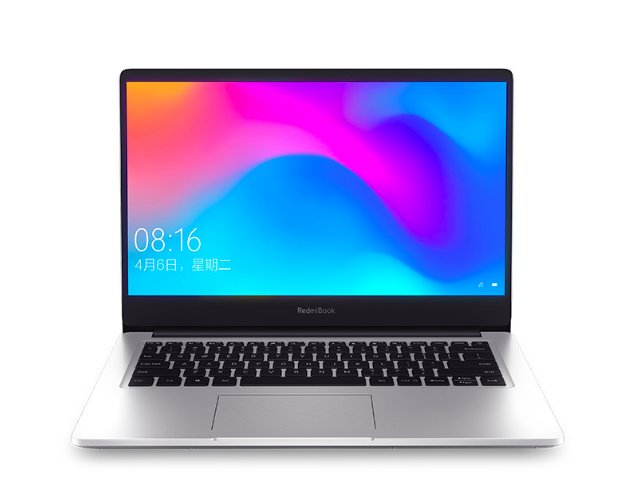
RedmiBook 14 2

The Core i3 RedmiBooks may start at less than Rs. 25,000 while the less powerful models may cost lower than Rs. 20,000. The highest model could be priced around Rs. 33,000 (~$435). The RedmiBooks are expected to be manufactured in India. And also, the Redmi laptops are said to be quite different from the RedmiBooks that have launched in China.

The upcoming RedmiBooks could be aimed towards students and people who are looking for budget-friendly laptops. These devices won’t have premium appeal like the Mi Notebooks since their construction will have more plastic. Also, the RedmiBooks for India may not have the same kind of RAM and storage that are available on the Mi Notebooks. However, the Redmi laptops will have attractive design and color options and they are expected to offer long-lasting battery life of around 10 hours. The Redmi notebooks are also expected to offer users a wide range of connectivity options and ports. Lastly, the Redmi notebooks will be running on Windows 10 Home edition.

The arrival of the RedmiBooks in India could be timed with the re-opening of schools and colleges in the country. Hence, there is a possibility that the Redmi notebooks may launch around mid-July to mid-August.


(source)

OnePlus Nord budget smartphone could feature quad-camera setup

After launching the OnePlus 8 and 8 Pro smartphones, the company is now getting ready to launch a new budget smartphone next month. The phone is expected to be named OnePlus Nord, which was earlier said to have been named OnePlus Z and OnePlus 8 Lite.

When rumors started circulating about the budget OnePlus smartphone, the device was said to have a dual-camera setup on the back. Later, it was said that the phone will feature a triple-camera setup. Now, the latest report claims that it has now been upgraded to a quad-camera setup on the back.

OnePlus Z

Although the exact camera specifications have not been revealed yet, the report indicates that the phone could come packed with a 48-megapixel primary sensor, a 16-megapixel ultra-wide-angle lens, and a 2-megapixel macro lens. The fourth camera sensor in the setup could be a depth sensor or a color filter.

The smartphone will reportedly come powered by the Qualcomm Snapdragon 765 chipset, along with support for 5G connectivity. The device should have up to 8GB of RAM and 128GB of internal storage.

As for the display, we are expecting a 6.4-inch OLED display with Full HD+ screen resolution and a 90Hz refresh rate. Running on Android 10, the device is said to be powered by a 4,000mAh battery with the company’s own Warp Charge technology.

Along with the OnePlus Nord or whatever the company ends up calling this new budget smartphone, OnePlus Pods, the Chinese company’s first true wireless earbuds are also expected t get launched.

Meanwhile, the company has confirmed that a new lineup of affordable OnePlus Smart TVs will be unveiled in India on 2nd July. It has also been confirmed that the starting price of this new lineup will be under ₹20,000. To know more, we will have a wait for a couple of weeks more.

(Via)

Redmi 10X 5G’s variant with 8GB RAM + 256GB storage goes on sale in China

The Redmi 10X series was made official in May. The 4G and 5G editions of the Redmi 10X went on sale at the beginning of this month. In its first sale, the handset met with more than 100 million Yuan in just 5 minutes. The phone comes in multiple variants, but they were not made available on its first sale. Starting from today, the Chinese brand has begun with the sales of the top variant of the Redmi 10X 5G.

The Redmi 10X 5G with 8 GB RAM + 256 GB priced at 2,399 Yuan (~$339) is now available for purchase in China. Deep Ocean Blue, Night Purple, and Hazy Moon Gold are the three color variants of the smartphone.

Redmi 10X 8GB+256GB

Redmi 10X 5G specifications

The Redmi 10X 5G features a 6.67-inch S-AMOLED waterdrop notch that produces Full HD+ resolution and 20:9 aspect ratio. The Dimensity 820 chipset is present under the hood of the device with LPDDR4X RAM and UFS 2.1 storage.

The MIUI 11 based Android 10 OS comes preinstalled on the smartphone. It has a front-facing camera of 16-megapixel. The back panel of the phone has a triple camera system. It is pioneered by a 48-megapixel main lens, an 8-megapixel ultrawide sensor, and a 2-megapixel depth sensor.

The Redmi 10X 5G has a 4,520mAh battery that supports 22.5W fast charging. It is equipped with an under-display fingerprint reader.


Nokia will be providing 5G hardware to China Unicom

China Unicom, which is already using Nokia’s equipment for the 4G technology, will now be expanding the partnership for the new 5G technology as well. The Finland-based Nokia has announced that the telecom network has awarded approximately 10 percent share of the company’s 5G core network.

For those who are unaware, the core network performs a variety of functions, including setting up connections, bandwidth management, scaling and securing the network, and now with 5G, opening up the network to support new, software-enabled use cases such as network slicing.

Nokia Logo

The Nokia Cloud core products selected by China Unicom provides Unified Data Management, Session Management, and User Plane functions, which are complemented by Data Refinery and NetAct, all deployed on Nokia’s CloudBand.

The company says that the deal also includes products from Nokia’s Cloud Packet Core portfolio, including the Nokia Cloud Mobile Gateway. It provides the 5G standalone Session Management Function and User Plane Function, in addition to supporting the 4G Serving Gateway and the Packet Data Network Gateway in China Unicom’s network.

Nokia currently has a 17 percent market share in China Unicom’s rapidly expanding VoLTE network, where it has deployed Nokia’s cloud-based vIMS platform. This deal is expected to further enhance the partnership between China Unicom and Nokia.

China Unicom has already deployed around 130,000 5G base stations across China, in which around 115,000 were built in partnership with China Telecom. As per the company, its 5G base stations would reach 300,000 by the end of this year.

Wang Xiaochu, CEO of China Unicom, says that the growth of 5G could accelerate in the second half of this year after the deployment slowed down and impacted business development in the first half because of the COVID-19 pandemic.


ASUS ROG Phone 3 full specs and AnTuTu listing appear; Listings suggest Snapdragon 865 Plus SoC

ASUS ROG Phone 3 with model number ASUS_I003DD had appeared at the database of China’s TENAA telecom authority with minimal specs. The listing is now updated with its entire specifications. Moreover, the smartphone has been benchmarked on AnTuTu with an impressive score. The Taiwanese company is still silent on the launch date of the ROG Phone 3. These listings are a good hint that it may either launch by the end of this month or early July. Also, these listings suggest that it could be equipped with Snapdragon 865 Plus SoC.

ASUS ROG Phone 3 specifications

The TENAA listing reveals that the ROG Phone 3 measures 171 x 78 x 9.85mm and it weighs 240 grams. Only Bright Black color variant is listed on TENAA. Hence, it is unclear whether it will be available in other color options. The device houses a notch-less 6.59-inch AMOLED display that offers 1080 x 2340 pixels Full HD+ resolution and 19.5:9 aspect ratio. The rated capacity of its battery is 5,800mAh battery. Past reports have revealed that the phone may ship with a 30W fast charger.

ASUS ROG PHone 3 TENAA

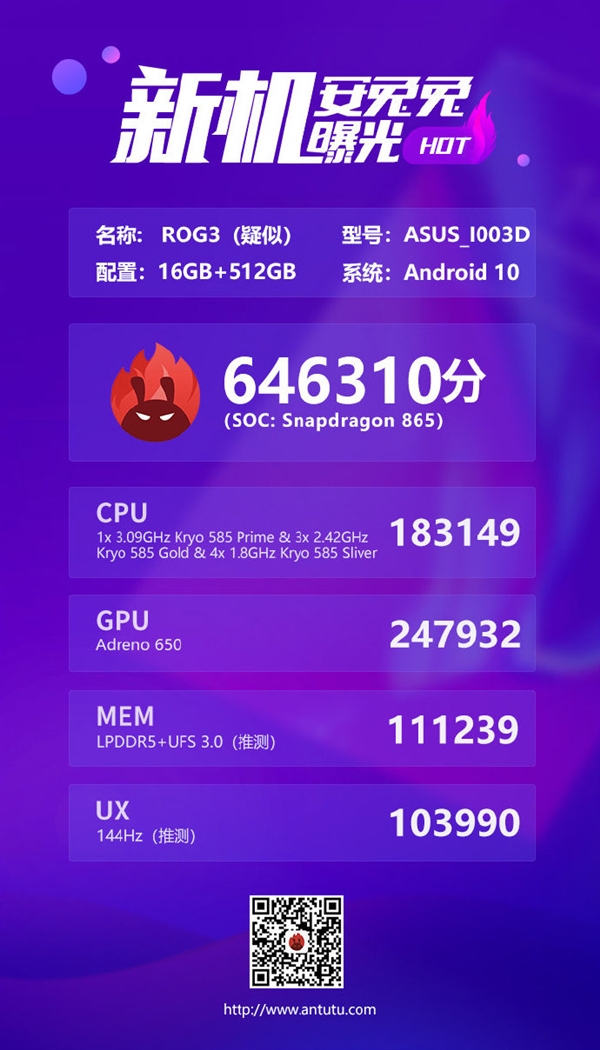
The ROG Phone 3 is powered by a flagship chipset that clocks at 3.091GHz. This clocking speed is faster than that of the 2.85GHz clocking speeds of Snapdragon 865. The increased processing speeds spotted even on AnTuTu listing on the phone indicates it could be fueled by the unannounced Snapdragon 865+ SoC. The variant of the ROG Phone 3 that appeared on AnTuTu has 16 GB of RAM and 512 GB of native storage. The phone is loaded with Android 10 OS. The handset recorded a marvelous benchmarking score of 646,310 on AnTuTu. The benchmarking platform speculates that the ROG Phone 3’s screen supports up to 144Hz refresh rate.

ASUS ROG Phone 3 AnTuTu

The ROG Phone 3 has 8 GB, 12 GB and 16 GB RAM variants, reveals TENAA listing. Its storage variants are 128 GB, 256 GB, and 512 GB. It lacks a microSD card slot. The TENAA images of the phone show that the design of the ROG Phone 3 is almost identical to the predecessor i.e. the ROG Phone 2. The inclusion of an additional rear camera brings slight design changes and at the front, it features dual front-firing speakers.

It has a front camera of 13-megapixel. On it back is a horizontally aligned triple camera setup that includes a 64-megapixel main camera. The other features of the phone include iris recognition and under-display fingerprint scanner.


(source 1, 2)