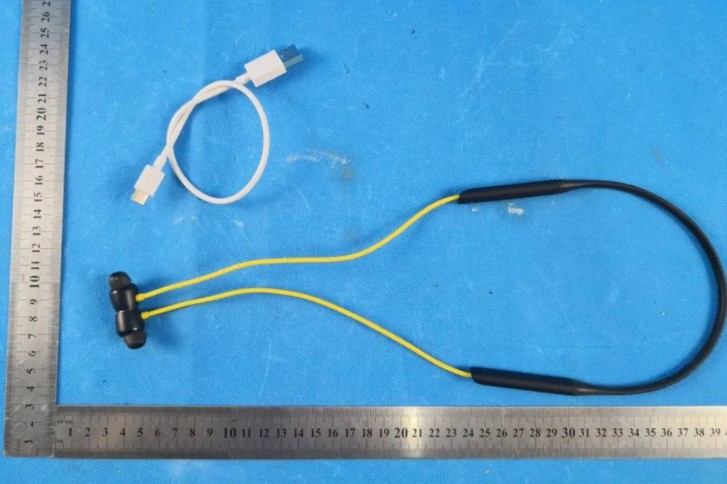
In September 2019, Realme had launched the Buds Wireless Bluetooth earbuds alongside the Realme XT phone. In December, it unveiled the Realme Buds Air (Review) truly wireless earbuds along with the Realme X2 smartphone. The upcoming Realme Buds Wireless Pro has appeared in real images at the database of Taiwan’s NCC certification. It seems that the Chinese firm is quickly expanding its product portfolio to provide users with more options across different price points.
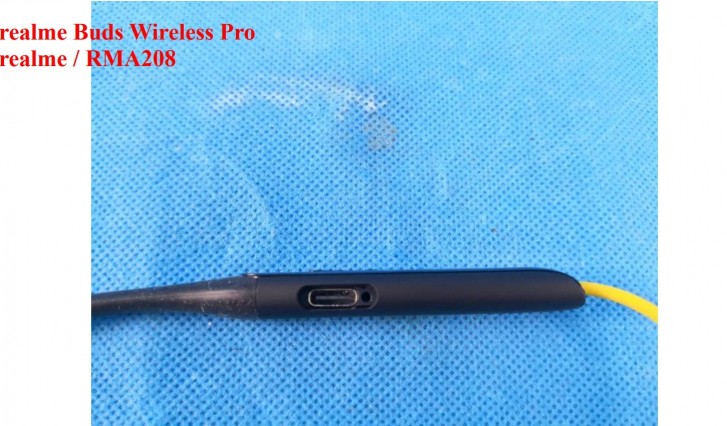
The NCC listing reveals that the Realme Buds Wireless Pro has a model number of RMA208. The images show the device is equipped with a USB-C port for charging. The Realme Wireless Buds from last year featured a microUSB port.
A careful look around the USB-C port on the Buds Wireless Pro reveals that there is a recessed arear around it. This suggests that the device USB-C port could be coming with a protective flap. Last year’s model had the microUSB port present without any cover. As far as the design of the device is confirmed, it is almost identical as the Buds Wireless.
Since the upcoming device carries “Pro” in its moniker, it may come with some enhanced features for better audio output. It is likely to offer users with a better battery performance. Also, the presence of USB-C port suggests that it may support faster charging than the previous model.
In India, the Realme Buds Wireless was introduced with a price tag of 1,799. It comes in Green, Orange and Yellow colors. The Pro model is likely to come with a slightly higher price tag than the Buds Air.
The Realme Buds Wireless produces deep bass output through its 11.2 drivers. It is an IPX4 rated splash-proof product and it comes with support for Bluetooth 5.0. According to the company, once it is charged completely, it can last for up to 12 hours.
Samsung launched its Galaxy S20 Ultra flagship smartphone a couple of months ago and since its official launch, the device has seen a fair share of issues, including display color tint, autofocus, performance, heating, and battery.
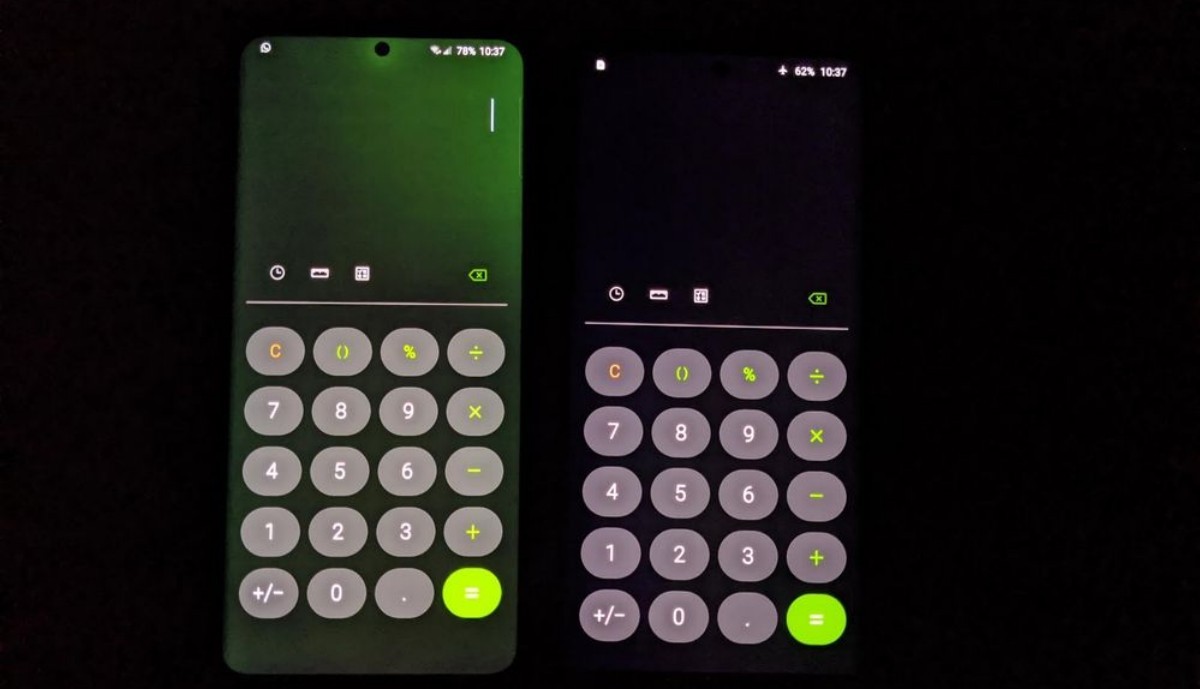
However, the South Korean company has now fixed the issue which produced a green color tint on the smartphone’s display through a new software update. Samsung was aware of the issue and was working on a fix since past couple of weeks.
It remains to be seen if the update also fixes other Galaxy S20 Ultra issues. Users have complained about slower focusing of the camera, heating issues with the 4G model, and poor performance of the phone as well as battery on the Exynos 990-powered model.
Samsung Galaxy S20 Ultra green hue tint on display. (Image: Samsung Community Forum)
The new update, which carries the build number G98xBXXU1ATD3 is the one that comes with the fix for the green-hue tint. The update is now rolling out in Germany, but it is expected to arrive soon for all the Galaxy S20 Ultra users.
While it is understandable that a smartphone may face some issues but having so many issues for a flagship smartphone, that too when the device is priced at around $1,400 is simply not acceptable from the world’s leasing smartphone company.
Recently, DXOMark revealed its camera review for the Samsung Galaxy S20 Ultra and it is nowhere near the leading Huawei P40 Pro in terms of ranking. With a score of 122 points, the device has been ranked at sixth position.
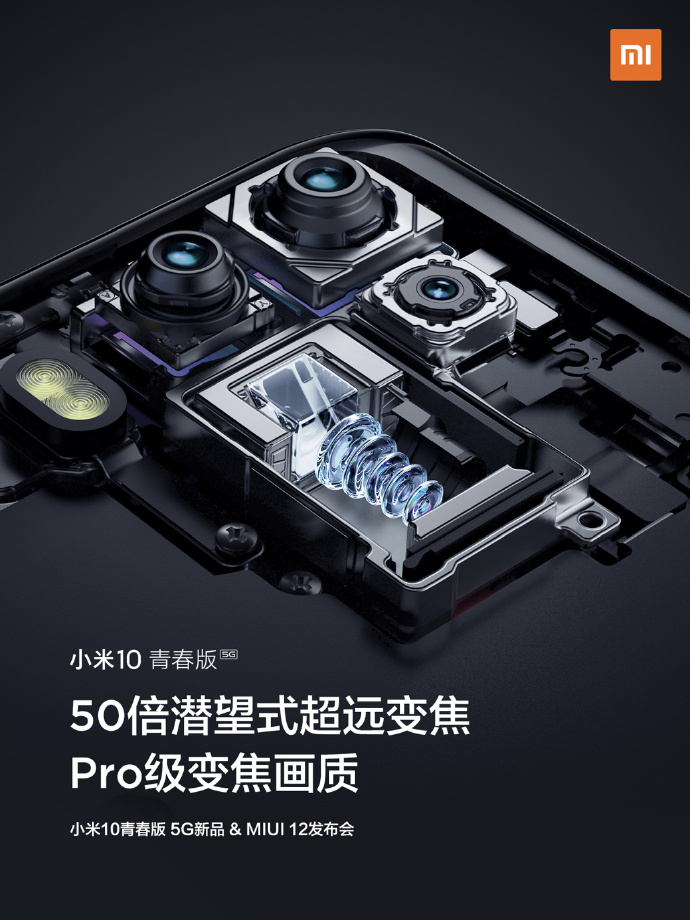
UPDATE: Xiaomi has also shared the camera samples captured using the upcoming Mi 10 Youth Edition smartphone, highlighting the 50x periscope zoom sensor. The company also confirmed that the phone features split OIS which brings more stability.
Xiaomi is all-set to launch its new smartphone as a part of the Mi 10 lineup, dubbed as Mi 10 Youth Edition on 27th April. The company has also sent out media invites in China featuring a Doraemon Mini-Claw machine.
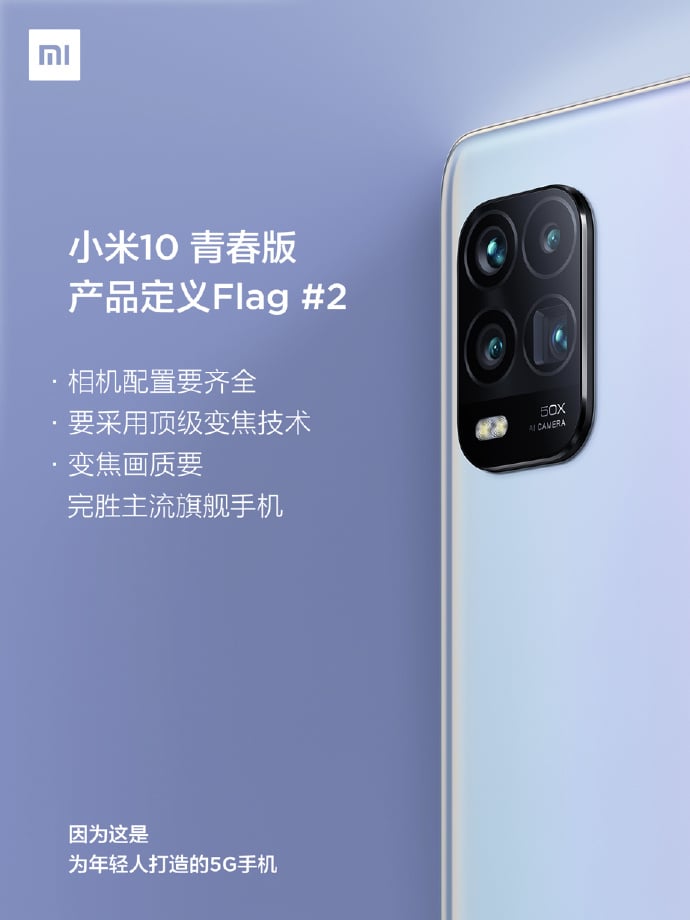
Now, days ahead of the official launch, the company teased the camera module as well as the features of the upcoming Mi 10 Youth Edition smartphone through a promotional poster and a mini promo video.
The phone will feature a quad-camera setup where the sensors will be placed on a rectangular module which will be in the top-left corner. The company has revealed that the setup consists of a high-definition primary camera, a wide-angle lens, a macro lens, and a 50x super zoom periscope sensor.
The highlight of the camera setup is the usage of pro-level 50x periscope zoom camera which offers 5x optical zoom, 10x hybrid zoom, and up to 50x ultra-far zoom. The company is focusing on the camera department for the Mi 10 Youth Edition as Xiaomi believes that mobile phone camera has become a social tool for the younger people to take photos or record videos, create vlogs, and more.
So far, the company has confirmed that the smartphone will have a thickness of 8mm and will weigh about 200 grams. Xiaomi has also confirmed that the 5G smartphone will come in at least four color options — Pink Peach, Orange Storm, Green Tea and Blue Berry.
The specifications of the smartphone still remains under the wraps but we expect the company to tease some key features ahead of the launch. While the device is set to get launched in China on 27th April, it is already up for reservations.
The company has already launched the Mi 10 Lite smartphone in Europe and the upcoming Mi 10 Youth Edition for the Chinese market could be quite similar in terms of key specifications. The phone is expected to come powered by Snapdragon 765G SoC and 22.5W rapid fast charging support.
Also, apart from the launch of Mi 10 Youth Edition, Xiaomi will be unveiling the newer version of its MIUI custom user interface — MIUI 12. The company has also teased some features of the new UI, such as Dark Mode 2.0, custom animates AOD styles, and support for camera layout customisation, among others.
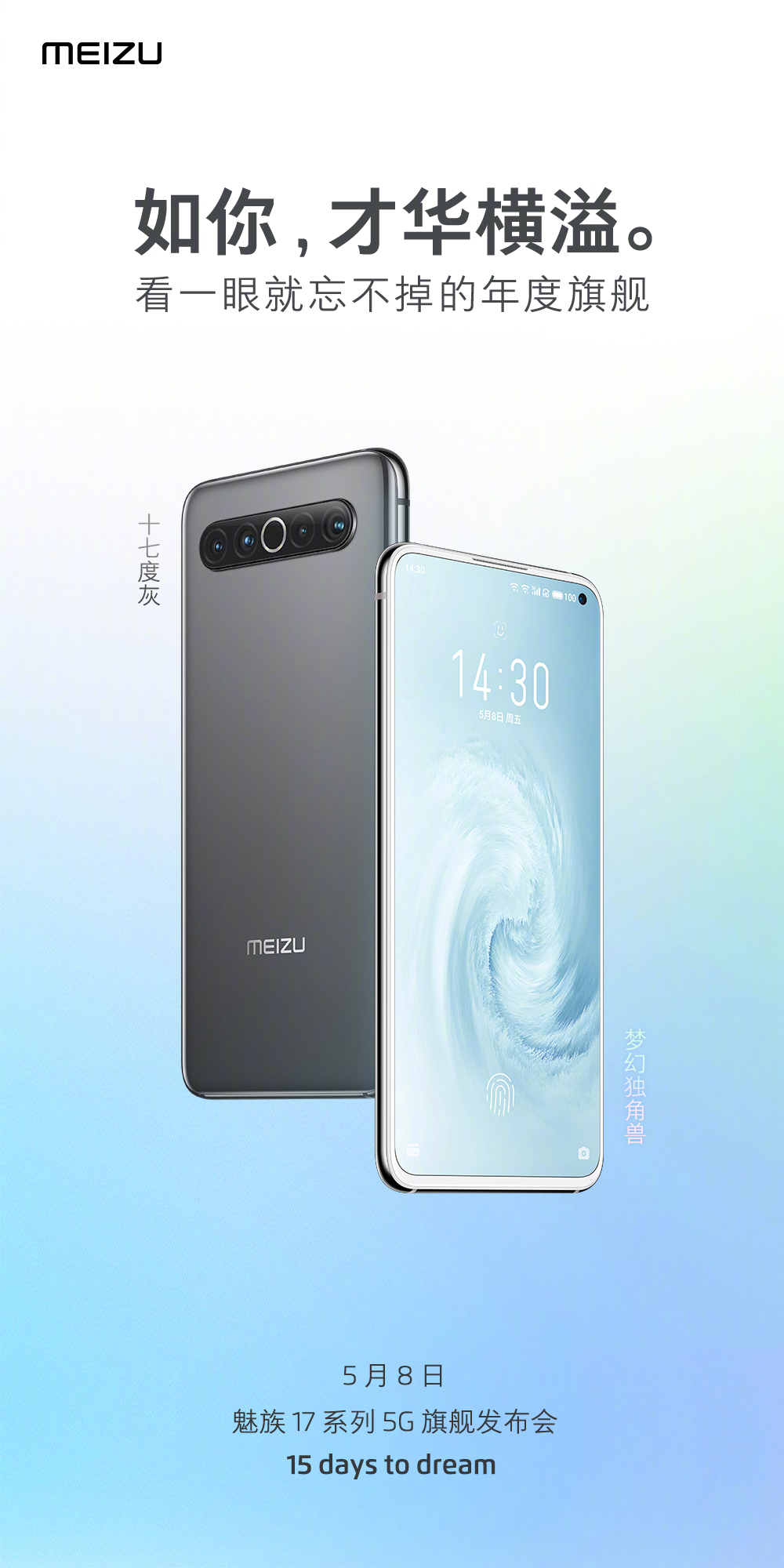
Yesterday, Meizu took to Weibo to confirm that the Meizu 17 series will be made official on May 8. It appears that the company will continue to reveal the key features of the Meizu 17 5G and Meizu 17 Pro 5G ahead of their launch. Today, the company shared a render of the smartphone to reveal the appearance of the Meizu 17 5G and its two color editions.
The official render reveals that the Meizu 17 5G will be arriving in China in at least two color schemes like Fantasy Unicorn White and 17-Degree Gray. The Chinese firm recently claimed that the Meizu 17 is the only 5G-capable flagship smartphone in China to flaunt a white colored front panel. The same can be seen in the official render.
The Meizu 17 5G has rounded corners, a flat display and a curved rear panel. The upper bezel of the device has an earpiece. The bottom bezel seems to be slightly thick than the other bezels of the phone.
A punch-hole is available at the top-right of the Meizu 17 5G’s display. The screen is embedded with a fingerprint reader. The back panel of the phone has a horizontally arranged quad camera system. It consists of an LED-ring flash at the center with a pair of cameras on its left and right sides.
The Meizu 17 5G is speculated to arrive with a 6.5-inch full HD+ display that produces up to 90Hz refresh rate. The Snapdragon 865 mobile platform could be coming with LPDDR5 RAM and UFS 3.0 storage. The handset is rumored to house a 4,500mAh battery. The Flyme 8 UI based Android 10 OS is expected to come preloaded on the Meizu 17 5G. The vanilla variant may arrive with 30W rapid charging technology whereas the Pro model could be equipped with 40W fast charging support. It is speculated that the Meizu 17 5G series will be arriving in China with a starting price of 3,999 Yuan (~$564).
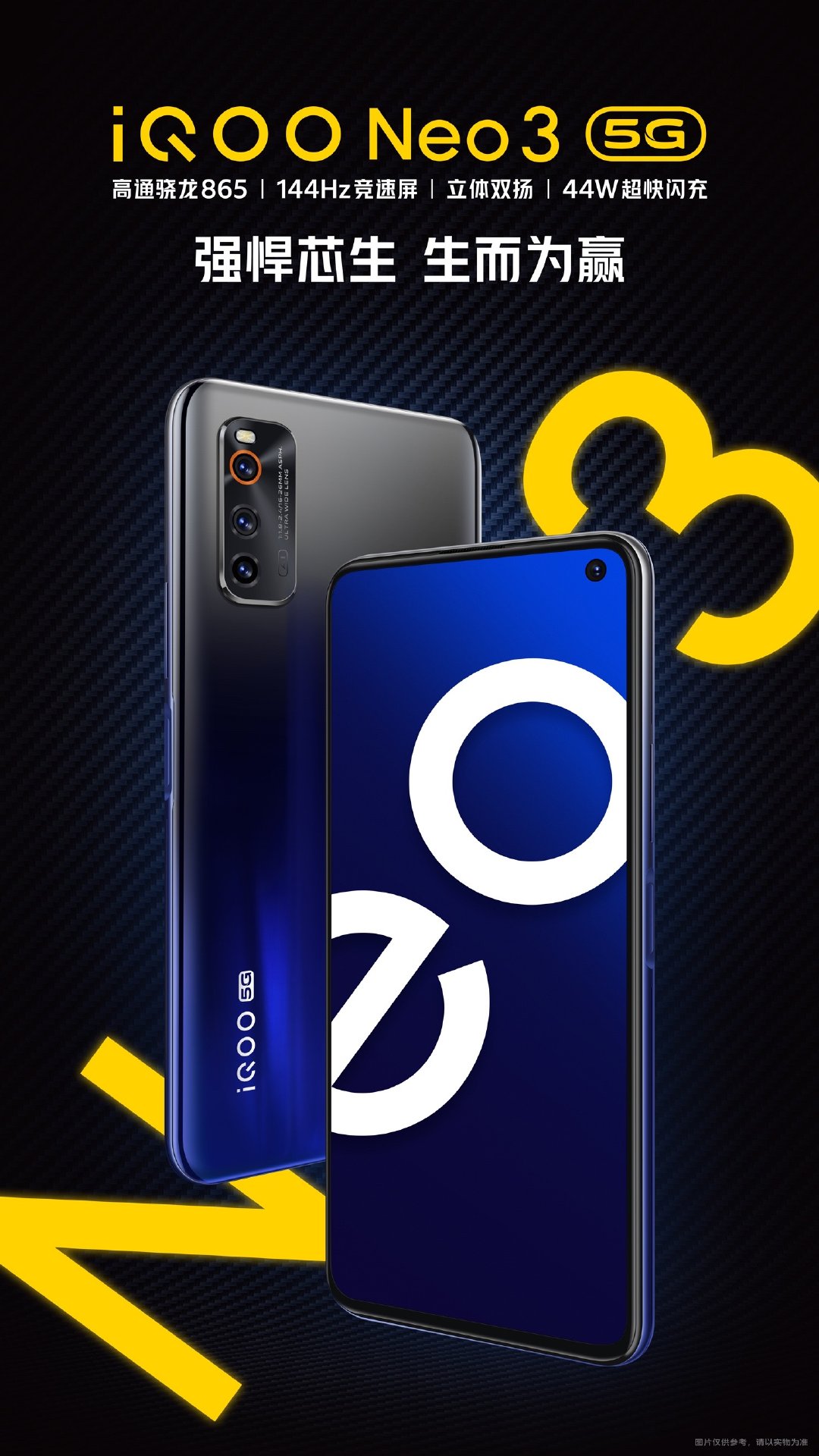
The iQOO Neo3 5G smartphone will go official at 2:30 PM (local time) in China today. Ahead of the launch, the entire specifications have been revealed by a well-known Chinese tipster. Also, the Chinese firm has shared a new poster of the phone to reveal its front and rear design.
iQOO Neo3 specifications
The iQOO Neo3 5G leak reveals that its dimensions are 163.72 x 75.55 x 8.93mm and it weighs 198.83. The phone is equipped with a 6.57-inch display. It is larger than the 6.44-inch punch-hole AMOLED screen that is available on the iQOO 3 5G phone that debuted in February. In comparison, the iQOO Neo3 has an IPS LCD panel with punch-hole design. It supports full HD+ resolution of 1080 x 2400 pixels and a tall aspect ratio of 20:9. The display of the iQOO Neo3 can support up to 144Hz refresh rate.
The Snapdragon 865 that fueled the iQOO 3 5G also powers the Neo3. The phone is backed by a 4,500mAh battery that supports 44W fast charging. The iQOO 3 came with a slightly smaller 4,400mAh battery with 55W rapid charging support. The Android 10 OS will come preloaded on the iQOO Neo3 5G. The Chinese firm has already revealed that the phone has UFS 3.1 storage and dual stereo speakers.
The iQOO Neo3 5G has a front camera of 16-megapixel. Its rear-mounted camera setup has a 48-megapixel main lens that is coupled with an 8-megapixel lens and a 2-megapixel sensor. The quad cameras along with LED flash are housed inside a rectangle-shaped camera module. The device is equipped with a side-facing fingerprint reader. In comparison, the iQOO 3 has the same front camera, 48-megapixel + 13-megapixel + 13-megapixel+ 2-megapixel quad camera setup and an in-screen fingerprint reader.
Past reports have revealed that the iQOO Neo3 may release in China in at least two options such as 6 GB of RAM and 128 GB of storage and 8 GB of RAM and 256 GB of storage. The base model could of the Neo3 could be priced at 2,998 Yuan (~$423).
Recently, the Redmi M2003J15SC smartphone was found listed at the databases of China’s TENAA telecom authority and 3C. These listings had revealed the entire specifications of the smartphone, but the name of the device was not known. A fresh listing of the phone has appeared in the product library of China Telecom. It reveals that the phone will be launching in China as Redmi 10X 4G . Also, it will be debuting as the world’s first smartphone with Helio G85 chipset.
The Redmi 10X may sound like a new moniker. However, the name was revealed first by XDA Developers in March when it came across the moniker along with names of other devices like Redmi K30 Pro Zoom Edition and Redmi Note 9 in the code of MIUI 11 Developer ROM.
Redmi 10X specifications
The Redmi 10X has a 6.53-inch IPS LCD display with a punch-hole at the upper-right corner. It supports full HD+ resolution of 1080 x 2340 pixels and 19.5:9 aspect ratio. The polycarbonate bodied phone measures 162.38 x 77.2 x 8.95mm and it weighs 205 grams.
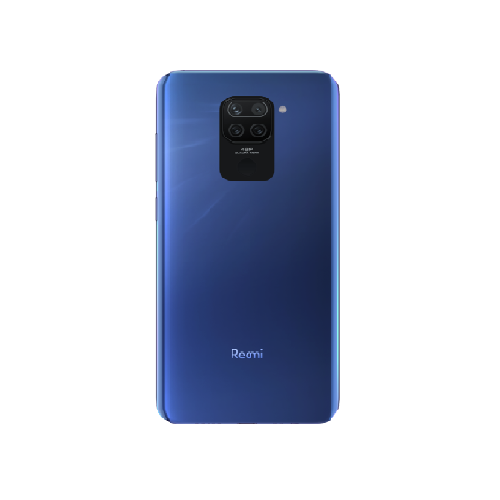
The China Telecom listing states that the Helio G85 powered Redmi 10X 4G has 6 GB of RAM and an internal storage of 128 GB. It has a microSD card slot for additional storage. The MIUI 11 based Android 10 OS comes preloaded on the device. Shown in the post are the two images of the phone that have surfaced in the listing.
There is a 5,020mAh battery inside the Redmi 10X 4G smartphone. It comes with support for 22.5W fast charging. For shooting selfies, the phone possesses a front-facing camera of 13-megapixel. The rear side of the device has a 48-megapixel + 8-megapixel + 2-megapixel + 2-megapixel quad cameras arranged inside a square-shaped module. A fingerprint scanner is also available on the backside of the device.
Redmi 10X 4G price and availability
The Redmi 10X 4G’s availability is not mentioned on the China Telecom listing. However, it states that the phone will be priced at 1,499 Yuan (~$211). It will come in three color choices such as Sky Blue, Pine Morning Green and Ice Fog White.
Realme has introduced a new mid-range 5G phone called Realme X50m in China. It is the third X50 series phone after the Realme X50 5G that went official in January and the Realme X50 Pro 5Gv that was announced in February. The newly unveiled Realme X50m comes with some exciting features like 120Hz refresh rate supporting screen with dual front-facing camera, Snapdragon 765G processor, 30W fast charging technology and 48-megapixel quad rear cameras.
Realme X50m specifications
The Realme X50m is the RMX2142 smartphone that was approved by the TENAA authority in the recent past. The glass bodied phone flaunts a 6.57-inch IPS LCD panel with a pill-shaped cutout at the upper-left corner. The screen supports full HD+ resolution of 1080 x 2400 pixels, aspect ratio of 20:9 and 120Hz refresh rate. It delivers a screen-to-body ratio of 90.4 percent. The phone comes equipped with a side-facing fingerprint reader.
Realme X50m Galaxy White
The Snapdragon 765G octa-core processor powers the Realme X50m with up to 8 GB of LPDDR4X RAM. The device offers users with an internal storage of 128 GB (UFS 2.1). The Realme X50m has a 4,200mAh battery. The 30W Dart charting technology from the Chinese firm allows the phone to gain 70 percent battery by charging it for 30 minutes.
For selfie lovers, the Realme X50m features a main wide-angle camera of 16-megapixel which is assisted by a 2-megapixel depth sensor. The rear side of the device has a vertical quad camera setup. It includes a 48-megapixel primary shooter, a 119-degree 8-megapixel superwide lens, a 2-megapixel macro lens with 4cm focal length and a 2-megapixel black and white lens. The rear cameras can shoot 4K videos at 30fps whereas the front camera support 1080p video shooting at 30fps.
Realme X50m Starry Blue
The Realme UI based Android 10 OS comes pre-installed on the Realme X50m. The other features that are available on the Realme X50m include 1216 ultra-liner speakers with support for Hi-Res audio and Dolby panoramic sound effects, 5G support, dual-SIM, Wi-Fi 802.11ac, Bluetooth 5.0, GPS, NFC and USB-C. The phone’s dimensions are 163.8 x 75.8 x 8.9mm and it weighs 202 grams. The phone lacks a 3.5mm audio jack and a microSD card slot.
The Realme X50m has the same display, processor, and battery that can be found on the Realme X50 5G phone that debuted few months ago. The X50 5G has better front-facing and rear-mounted cameras. At the front, it features a 16-megapixel (main) + 8-megapixel (ultrawide) dual selfie snappers. The rear shell of the device features a quad camera setup with a 64-megapixel main lens, a 12-megapixel telephoto shooter, an 8-megapixel ultrawide lens and a 2-megapixel macro sensor.
Realme X50m pricing and availability
The Realme X50m comes in two models such as 6 GB RAM + 128 GB storage and 8 GB RAM + 128 GB storage. They are priced at 1,999 Yuan (~$282) and 2,299 Yuan (~$324), respectively. Both variants can be availed in color editions such as Starry Blue and Galaxy White. The first sale of the phone will be carried out in China on April 29 at 10:00 AM. There is no word on the availability of the Realme X50m phone outside of China.
What’s your opinion on the Realme X50m smartphone? Share us your views on its specifications and pricing by adding comments.
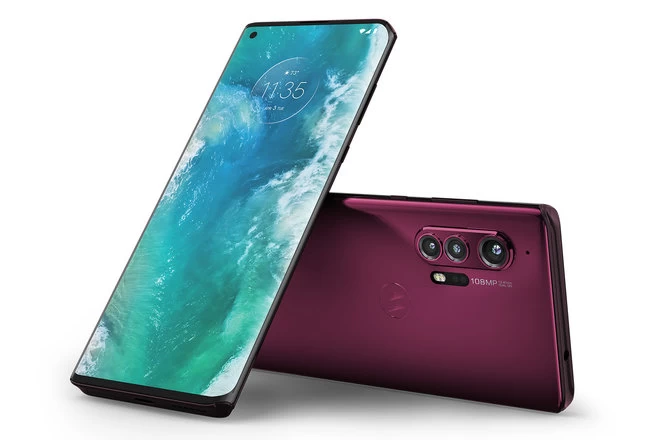
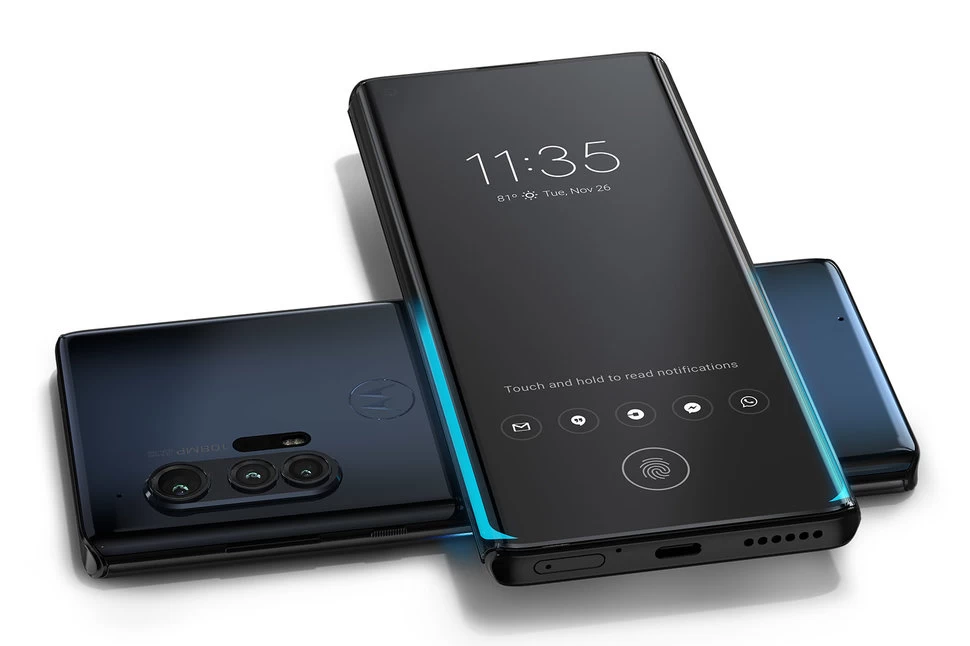
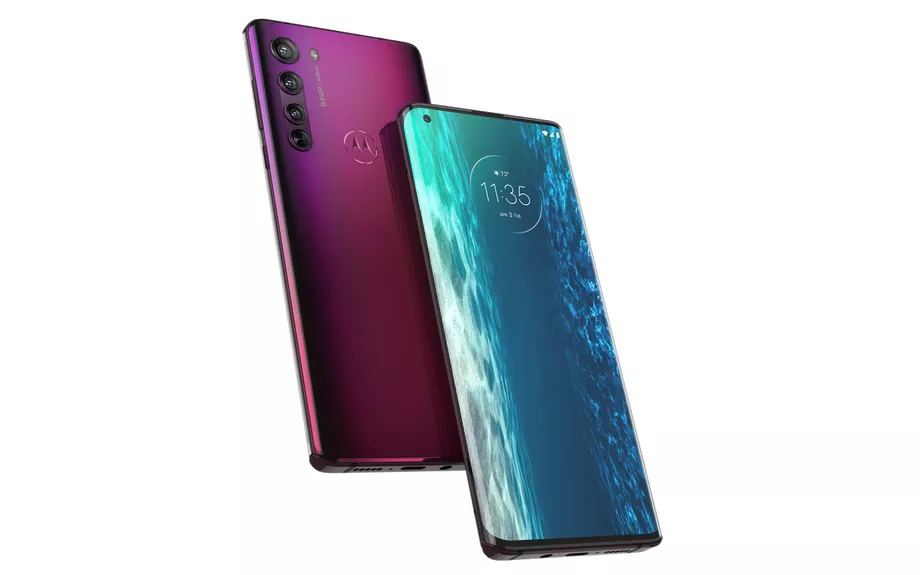
After series of leaks and rumours, Motorola has now finally launched its much-awaited Motorola Edge and Edge+ smartphones, marking the company’s re-entry into the premium flagship smartphone market.
Motorola Edge+
The Motorola Edge+ is the flagship smartphone from the company which comes with a curved 6.7-inch Full HD+ OLED display with 2400 x 1080 pixels screen resolution, HDR10+ support, 90Hz refresh rate and 21:9 aspect ratio. It also comes with in-display fingerprint sensor for added protection.
The curved screen isn’t for the aesthetics purpose but comes with interesting features. It shows incoming call and alarm alerts as well as shows the battery charging levels. It also enables users to switch apps with just a swipe.
Being a flagship product, the device comes powered by the Qualcomm Snapdragon 865 chipset, coupled with 12GB LPDDR5 RAM and 256GB UFS 3.0 internal storage. It packs 5,000mAh battery which supports 18W TurboPower fast charging as well as 15W wireless charging and 5W wireless power charging.
The highlight of the smartphone is the camera configuration which rocks 1 108MP primary camera with support for OIS and 6K video capture. It is coupled with an 8MP telephoto lens with 3X optical zoom support and a 16MP wide-angle lens.
On the front side, the device features a 25MP snapper taking care of selfies and video calling. The phone supports NR mmWave and sub-6Hz 5G bands along with the faster Wi-Fi 6 wireless connectivity. Although the phone isn’t IP-rated, the company claims that it is water repellent.
This one is a mid-range offering from the company which also features a 6.7-inch Full HD+ OLED display with 90Hz refresh rate and 21:9 aspect ratio. However, it lacks the HDR10+ support but comes with in-display fingerprint sensor.
Under the hood, it is powered by Qualcomm Snapdragon 765 SoC, along with 6GB of RAM and 128GB of internal storage. Unlike the Plus variant, this one supports storage expansion using a microSD card slot. On the front, the Android 10-powered smartphone comes with a 25MP selfie snapper.
In the camera department, the smartphone features a 64MP primary camera alongside a 16MP ultra wide-angle camera and an 8MP telephoto lens with 2X optical zoom. The 5G smartphone is powered by a 4,500mAh battery and comes with 18W TurboPower fast charging technology but lacks wireless charging support.
Pricing and Availability
The Motorola Edge comes in two color options — Solar Black and Midnight Magenta while the Plus variant is being offered in Smoky Sangria and Thunder Grey colors. The Motorola Edge+ is priced at $999 and will be available for purchase from 14th May in the United States as Verizon exclusive. The company is yet to reveal pricing and availability details of the Motorola Edge smartphone.
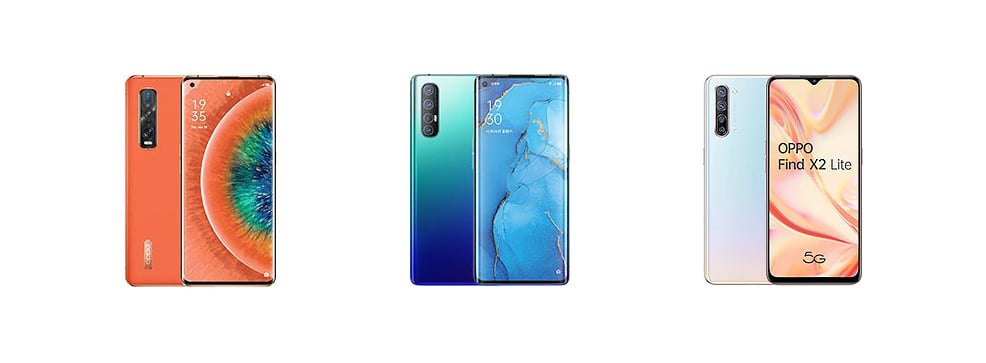
Oppo just launched a trio of devices from its latest flagship series in the European market: it includes Oppo Find X2 Pro, Oppo Find X2 Neo, and Oppo Find X2 Lite. They belong to different price segments ranging from the mid-range one to the top-tier flagship. While it is kinda obvious which device is the best from the trio and which is the inferior one, it is not clear to everyone which one offers the highest value for money and how much it is worth choosing one or another. In this comparison, you will find all the important differences between the handsets from the new global lineup.
Oppo Find X2 Pro vs Oppo Find X2 Neo vs Oppo Find X2 Lite
Oppo Find X2 Pro
Oppo Find X2 Neo
Oppo Find X2 Lite
DIMENSIONS AND WEIGHT
165.2 x 74.4 x 8.8 mm, 200/208 g
159.4 x 72.4 x 7.7 mm, 171 g
160.3 x 74.3 x 8 mm, 180 g
DISPLAY
6.7 inches, 1440 x 3168p (Quad HD+), AMOLED
6.5 inches, 1080 x 2400p (Full HD+), AMOLED
6.4 inches, 1080 x 2400p (Full HD+), AMOLED
PROCESSOR
Qualcomm Snapdragon 865, octa-core 2.84 GHz
Qualcomm Snapdragon 765G, octa-core 2.4 GHz
Qualcomm Snapdragon 765, octa-core
MEMORY
12 GB RAM, 512 GB
12 GB RAM, 256 GB
8 GB RAM, 128 GB
SOFTWARE
Android 10, ColorOS
Android 10, ColorOS
Android 10, ColorOS
CONNECTIVITY
Wi-Fi 802.11 a/b/g/n/ac/ax, Bluetooth 5.1, GPS
Wi-Fi 802.11 a/b/g/n/ac/ax, Bluetooth 5.1, GPS
Wi-Fi 802.11 a/b/g/n/ac/ax, Bluetooth 5.1, GPS
CAMERA
Triple 48 + 48 + 13 MP, f/1.7 + f/3.0 + f/2.2
32 MP f/2.4 front camera
4260 mAh, fast charging 65W Super VOOC 2.0 Flash Charge
4025 mAh, fast charging 30W
4025 mAh, fast charging 30W
ADDITIONAL FEATURES
Waterproof IP68, 5G
5G
5G
Design
With the Oppo Find X2 Neo and the Find X2 Pro, you get a similar form factor, including a punch-hole display and all the camera elements included in the rear camera module for a cleaner design. But with the Oppo Find X2 Pro, you get a more stunning build quality. It comes with unique material as it is available in a Ceramic Black color variant with a ceramic body and one made of vegan leather, while Oppo Find X2 Neo only comes with a glass back and a metal frame like most of the high-end phones out there. Further, Oppo Find X2 Pro is waterproof with the IP68 certification. On the other hand, with a thickness of just 7.7 mm, the Find X2 Neo is the thinnest 5G smartphone. Oppo Find X2 Lite still offers a premium design with a glass back and an aluminum frame, but it lacks a punch-hole display.
Display
Oppo Find X2 Pro packs the most impressive display: it is the only to sport a Quad HD+ resolution, it offers a high 120 Hz refresh rate and a 10 bit panel which can display one billion colors. It also comes with very high brightness (800 nits) and the HDR10+ standard. Right after we got the Oppo Find X2 Neo: it has a lower resolution, but a still high 90 Hz refresh rate. Oppo Find X2 Lite has a display with a standard 60 Hz refresh rate, but it is still a pretty nice AMOLED panel which you should not underestimate.
Hardware/Software
Oppo Find X2 Pro offers way higher performance than Oppo Find X2 Neo and Find X2 Lite thanks to its Snapdragon 865 chipset paired with 12 GB of LPPDR5 RAM and up to 512 GB of UFS 3.0 internal storage. The difference between the performance of Oppo Find X2 Neo and Find X2 Lite (which I reviewed and tried for a long time) is not huge: you only get more RAM and more internal storage with the Find X2 Lite (12 GB). Android 10 is installed out of the box, customized by ColorOS 7. Note that all of these devices feature 5G connectivity (both SA and NSA standards), but Oppo Find X2 Neo and Find X2 Lite pack integrated 5G modem, while Find X2 Pro relies on an external Snapdragon X55 modem.
Camera
There is an important difference even on the camera side between Oppo Find X2 Pro and Find X2 Neo. The former packs two 48 MP sensors and a periscope lens with up to 5x optical zoom, while the latter has a quad camera with just one 48 MP sensor and a 13 MP telephoto lens with 2x optical zoom. But given the great main sensor and OIS, the Find X2 Neo is still an amazing camera phone. Even the Find X2 Lite is pretty nice with its awesome video stabilization and a pretty good main sensor, but it is just a midrange camera phone and it lacks both OIS and a telephoto lens.
Battery
There should not be a big difference between the battery life of these three devices. The Oppo Find X2 Pro has a bigger battery, but it has to manage less efficient components, so we do not believe it will last more than Find X2 Neo and Find X2 Lite which comes with the same 4025 mAh capacity. What makes the difference is the charging speed: you get blazing speeds with the Find X2 Pro with a 65W fast charging technology (the fastest commercial technology), while Find X2 Neo and Find X2 Lite come with slower 30W fast charging.
Price
Oppo Find X2 Pro has a global price of €1,199/$1298, Oppo Find X2 Neo costs €699/$756, and Oppo Find X2 Lite is priced €499/$540. In each case, you get an above-average device with impressive specifications under every point of view. The Find X2 Neo sits in the middle, it is the perfect compromise and it is worth the money asked. Find X2 Pro brings a lot of innovation and it is a top-tier flagship without compromises, but it is recommended only for those seeking the max performance, the most amazing display, and the best camera department. If you just need a well-balanced device which does not disappoint under every point of view, even Find X2 Lite may be enough for your needs.
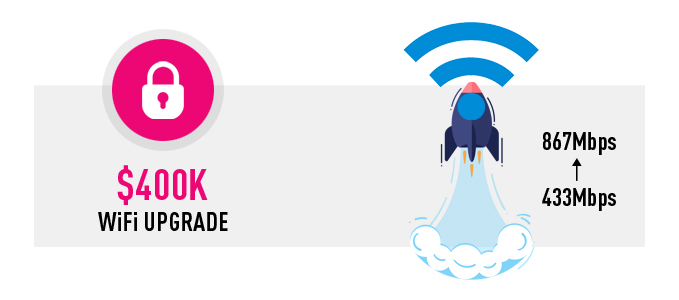
Chuwi recently listed a new AeroBook Pro 15.6 on the Indiegogo funding platform since last month. The ultra-lightweight laptop has already crossed the milestone of $200k with 700 backers interested in the new laptop that features thrilling specifications. But on people’s demand, the company has extended the target to $400k for a better WiFi module.
Chuwi has pledged to integrate the Intel AC 7265 WiFi module instead of Intel AC 3165 which will improve the WiFi speed and overall stability of the network. There are various other advantages of using the newer WiFi module that will really benefit the users.
Improved Wireless Network
The new Intel AC 7265 wireless module supports more devices at a time with better signals and stability. Chuwi AeroBook Pro 15.6 will be able to harness double speed under the 5GHz frequency band. Overall, it will improve wireless connectivity even if multiple devices are connected and using high-speed internet with a maximum downlink of 867Mbps.
Powerful Performance
Chuwi AeroBook Pro smartphone features a high-quality 15.6-inch 4K display providing a clearer and brilliant visual experience. The narrow bezels bring immersive and intuitive experience while watching movies or playing games.
Under the hood, there’s an Intel Core i5 6287U processor with 3.5GHz of maximum clocking speed, 8GB LRDDR4 RAM, and 256 GB SSD. The Iris 550 graphics card is powerful enough to handle graphics-intensive tasks easily. A large 55Wh battery is enough to keep the device running for more than 5+ hours. Moreover, there’s an M.2 SSD storage extension for speeds up to 3Gbps.
The upcoming Chuwi AeroBook Pro listing is live on Indiegogo with the lowest price of $529. You can know more information about the laptop from the official website.
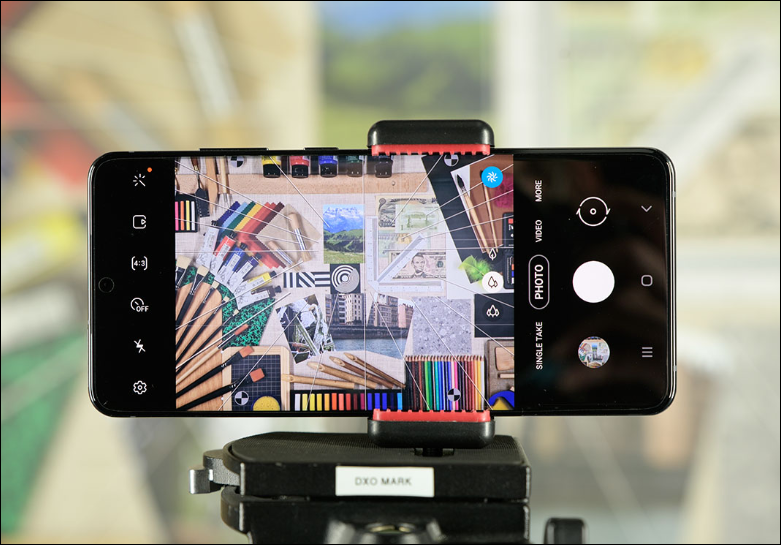
Expectations ran high last week when DXOMark revealed it would release its review of the Samsung Galaxy S20 Ultra camera this week. Indeed, the organisation has published the Galaxy S20 Ultra camera review on its website and it is a disappointing one. The Samsung flagship was nowhere near the Huawei P40 Pro in ranking but came ain’t a distant sixth position.
The Galaxy S20 Ultra was launched in March and since then te Korean tech giant has released a couple of firmware updates aimed at improving the camera’s performance. That obviously didn’t make much of a difference as the camera is ranked behind the Huawei P40 Pro, Honor 30 Pro+, Oppo Find X2 Pro, Xiaomi Mi 10 Pro and Huawei Mate 30 Pro 5G.
The review isn’t all negative as the Samsung flagship’s camera still excelled in some aspects. It scored a very high 132 for its photos but was let down by its 102 video score for a total camera result of 122, which puts it in joint sixth place along with the Honor V30 Pro.
DxOMark also extols the Galaxy S20 Ultra’s lively colours, wide dynamic range and tout it as having nearly the best noise control in the industry. The S20 Ultra’s ultrawide camera was adjudged to be class-leading. The device, however, faltered in the performance of its autofocus in low light. This is said to be slower than the competition. The dynamic range wasn’t as good as that of the P40 Pro even though it was wide. Also, the sharpness was slightly behind that of the Xiaomi Mi 10 Pro which outputs higher-res 25MP images). Further, the zoom shots were noted to have some artefacts.
You can check out the review from the video below.
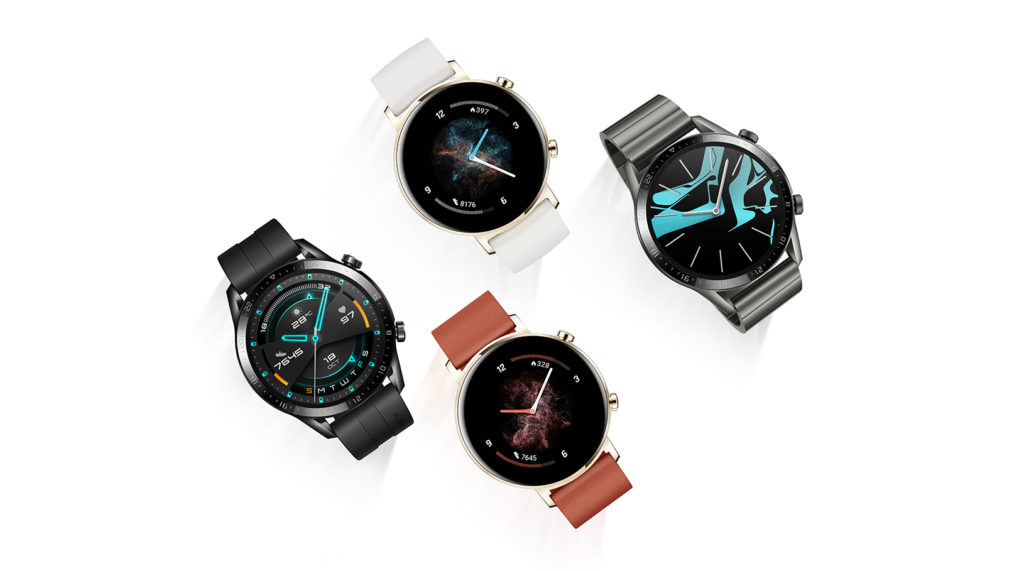
Huawei Watch GT 2 landed the Indian shores in December of 2019 before making its way to Europe alongside the Huawei P40 series in March 2020. But only now the wearable is receiving a firmware update in the country to enable SpO2 sensor.
The Huawei Watch GT 2 is one of the best smartwatches in India for the price. Interestingly, the company had disabled its SpO2 sensor for months. Thankfully, users can now make use of this dormant sensor with the latest firmware version 1.0.6.26.
SpO2 sensors on wearables help in monitoring blood oxygen levels. According to WHO (World Health Organization), the count should be 95-10% in a healthy person.
The newly launched sporty Huawei Watch GT 2e comes with this functionality out of the box. The company might have disabled it on the older model because of optimization issues.
The Huawei Watch GT 2 comes in two sizes (42mm / 46mm) and starts at ₹14,990 in India. It is powered by the company’s in-house Kirin A1 SoC and can be connected with both Android and iOS devices via its Bluetooth 5.1 module.
The GPS built-in wearable features 15 sports modes, 85 custom workout modes, Bluetooth calling, in-device Music, sleep monitor, stress monitor, menstrual cycle management, and a ton of sensors to support the above-mentioned features.
The smaller variant with 1.2-inch display is rated for 7 days of battery life, whereas the larger 1.39-inch model is claimed to last 14 days.
Xiaomi’s ecological chain company ZMI has got a number of impressive products in its catalogue. Since the brand first opened shop in 2012 they have launched several impressive products ranging from power banks, chargers including wireless chargers, data cables, car chargers, to portable speakers. ZMI has now launched a new power bank model with 20,000mAh battery capacity.
The ZMI 20,000mAh power bank has as its major feature, bidirectional fast charging support. This model can charge three devices at the same time including mobile phones, tablets and portable gaming consoles like the Nintendo Switch. It comes with 18W power output which can provide fast charging for iPhones. The battery can deliver a full charge to your mobile phones several times before it will require recharging.
In terms of the build, the new power bank casing is made from a PC + ABS environmental protection material. It adopts a wave pattern design which enhances the grip makes it not slippery. The case is also scratch-resistant. Internally, it makes use of high-precision resistance-capacitance sensing devices which not only makes it safer but also more effectively improves the conversion rate and stabilizes the discharge voltage. It can easily deal with abnormal charging conditions such as overcharge, over-discharge, high temperature, short circuit, etc., providing more secure charging protection.
The power bank features two USB-A interfaces and a single USB-C interface for charging three devices at a go. Both the USB-A ports and USB-C ports each support 18W MAX fast charging. ZMI has a USB-C to Lightning data cable that makes this suitable to deliver 18W fast charge to iPhones. ZMI claims its cable and power bank can reduce the charging time of the iPhone 11 by 53% compared to the original charger and data cable.
Apart from fast charge, the new ZMI power bank comes with a low-current charging mode for charging devices that have lower power ratings such as Bluetooth Headsets and smart bands. It can also be used in combination with USB interface devices such as ZMI USB fan.
As for the pricing, the ZMI Power bank comes in at 149 yuan ($21) and is presently on sale on TMall.
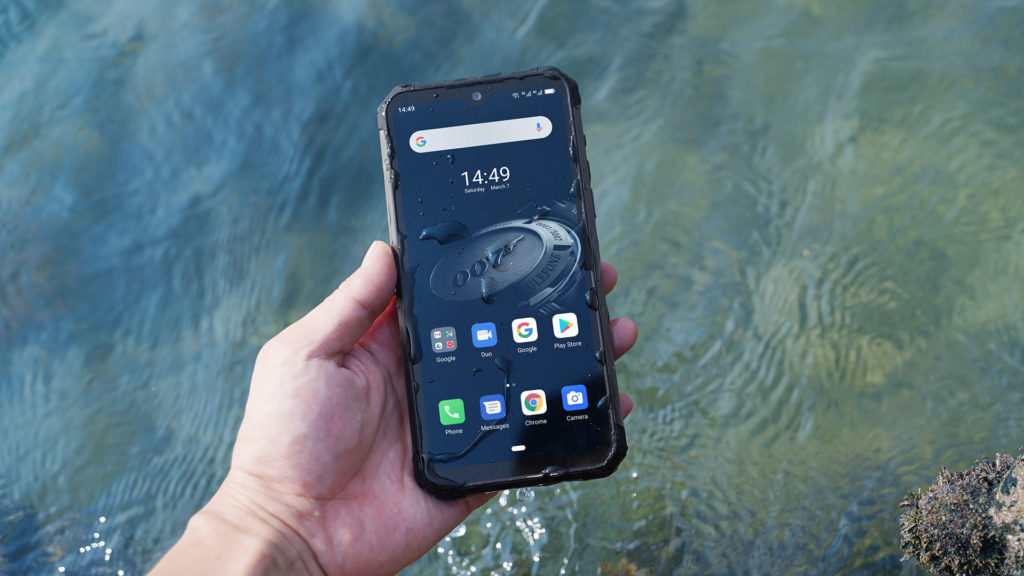
Ulefone is a Chinese rugged smartphone maker with various well-known smartphones featuring compelling hardware. Similarly, Ulefone recently unveiled Armor 7E with powerful hardware and excellent durability in real-life scenarios. Being a rugged smartphone, it becomes equally important for the manufacturer to let users or potential customers know about its durability via different tests. After the drop and performance test, now it’s the time for the waterproofing test of Ulefone Armor 7E. You can know different reasons to grab Ulefone Armor 7E.
The smartphone stands against all the odds in the video and survives the waterproofing test easily. It is thrown in sea and pond, went through multiple splashes in the washbasin, but it kept working without any problem due to premium materials and superior build quality. Surprisingly, it even sustains underwater diving. That’s the reason, the smartphone is IP68/IP69K certified to withstand dust and water.
On the other hand, Ulefone Armor 7E features a powerful Helio P90 AI SoC consisting of an octa-core processor built on the 12nm process and PowerVR GM9446 GPU. It is coupled with 4GB RAM and 128GB internal storage having an expandable storage slot using microSDXC.
Ulefone Armor 7E features a 6.3-inch IPS LCD display having 1080 x 2340 pixels resolution with 409 ppi of pixel density. On the rear side, the smartphone carries a triple camera module with a 48-megapixel primary rear camera, a 2-megapixel macro, and another 2-megapixel depth sensor. A 16-megapixel camera for selfies is present on the front.
The smartphone presale will start on Banggood from 27 April to 3 May with some special offers and discounts. During the presale period, the first 200 users will get the device at a special price of $199, whereas the remaining buyers will also get a limited period discount. However, if you looking to own it for free, then participate in the ongoing Ulefone Armor 7E giveaway. Participating candidates need to perform some activities listed on the event page.
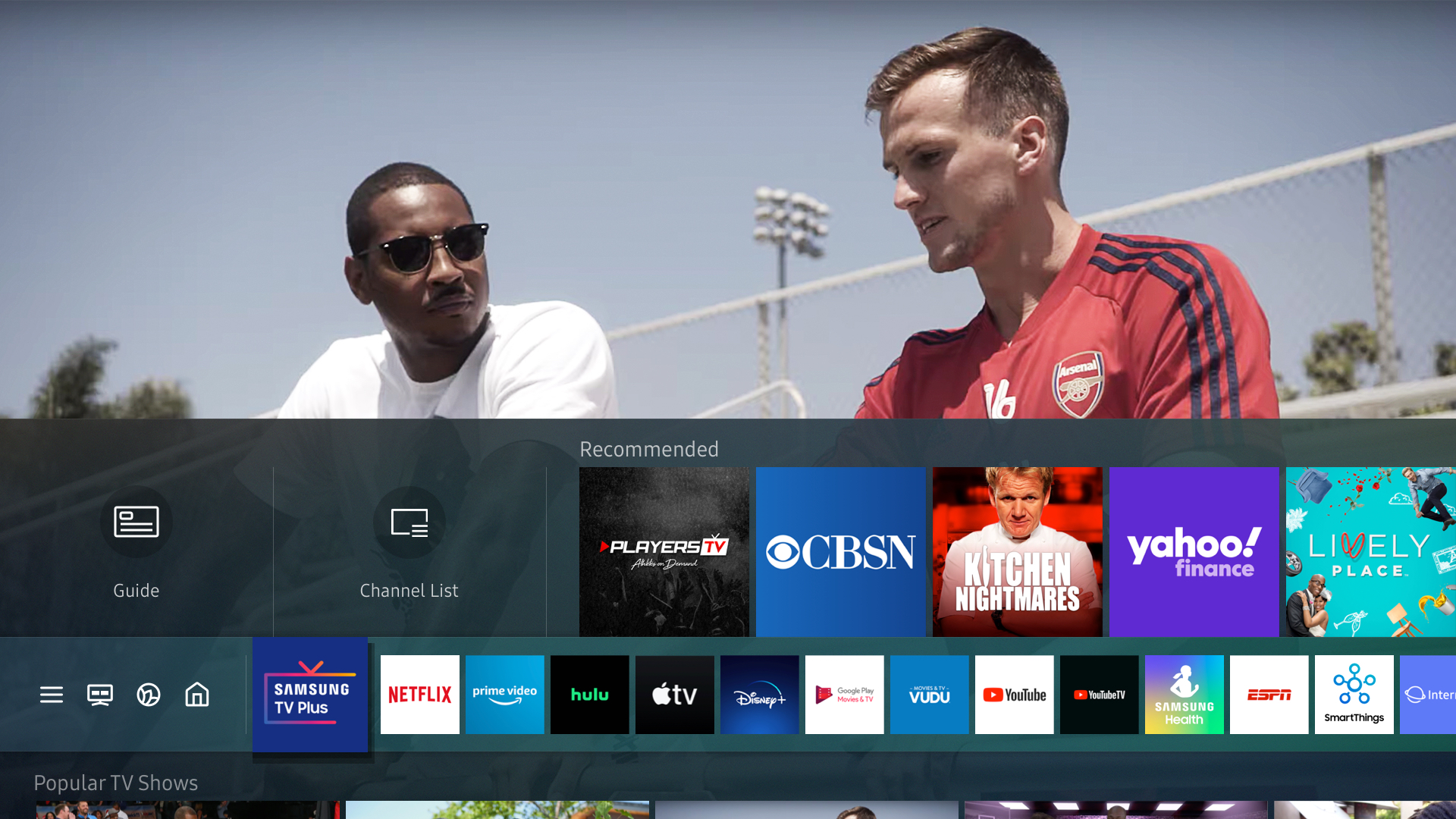
With more and more media streaming platforms coming up and more users switching from cable to streaming services, Samsung launched a service named Samsung TV Plus for its smart TVs.
The service is available for free to the users in the United States and Canada and offers more than 100 TV channels over the internet. However, it seems that the company is now planning to expand it and roll it out to smartphone users.
Samsung TV Plus free service available on Samsung Smart TVs
According to the report, the Samsung TV Plus free streaming service could be made available to smartphone users through a mobile application and is likely to be exclusive to Galaxy lineup from the South Korean giant. This makes sense given that the service for the TVs is also limited to the company’s own smart TVs.
The report goes on to add that the Samsung TV Plus for mobile will come with the same functionality as the service offers on Samsung Smart TVs. Users will be able to watch Live TV channels as well as access Video-on-demand (VOD) content.
It offers channels including beIN SPORTS EXTRA, Bon Appétit, CBS News, Crime 360, fubo Sports Network, Fuse, Kitchen Nightmares, Lively Place, Outside TV+, Reelz, Tastemade, The Design Network, VEVO, Yahoo Finance, and many more. You can access the full list of channels from here.
The Samsung TV Plus service is currently free for the users of Samsung smart TVs and is supported through advertisements and the company is expected to do the same with the upcoming mobile service.
However, do note that there’s no official confirmation regarding this from Samsung. But this seems like a good timing for Samsung to launch the service given that people are stuck at home amid lockdown due to COVID-19 and are more likely to adopt the new free streaming service as media consumption is on the rise.
Before the COVID-19 pandemic shifted the world’s attention from the US-China trade dispute, one hot topic was Huawei‘s provision of 5G infrastructure. Huawei had made several bid to supply 5G infrastructures to several countries who are looking to deploy the next-generation connectivity. However, the US government made tremendous effort to block such deals, enjoining its ally boycott Huawei’s 5G equipment. While some countries went with the US advice and shunned Huawei’s gears, others such as the UK gave Huawei the nod to provide their 5G equipment.
Recently, there were reports that the UK may review its decision to use Huawei’s 5G gears in the wake of the COVID-19 pandemic. Huawei even released an open letter advising the UK government not to do so. Respite may have come Huawei’s way as a senior government official have been quoted to have hinted that the government won’t likely review the decision. TechRadar quotes Simon McDonald, Permanent Under-Secretary at the Foreign and Commonwealth Office and Head of the Diplomatic Service in the UK to have stated that the government position on Huawei’s equipment in network development was considered, but will most likely remain unchanged.
Furthermore, the official disclosed that the UK’s decision to deploy Huawei’s 5G equipment which has strict conditions attached, was a firm one and therefore, is not being reopened.
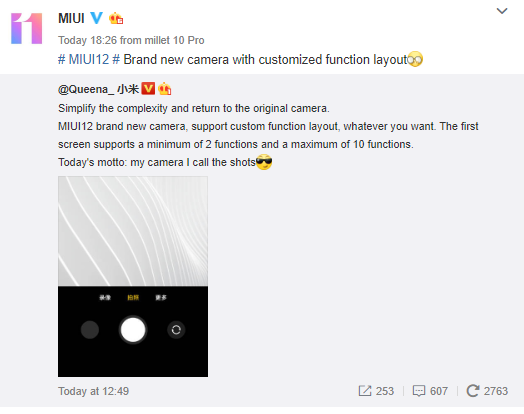
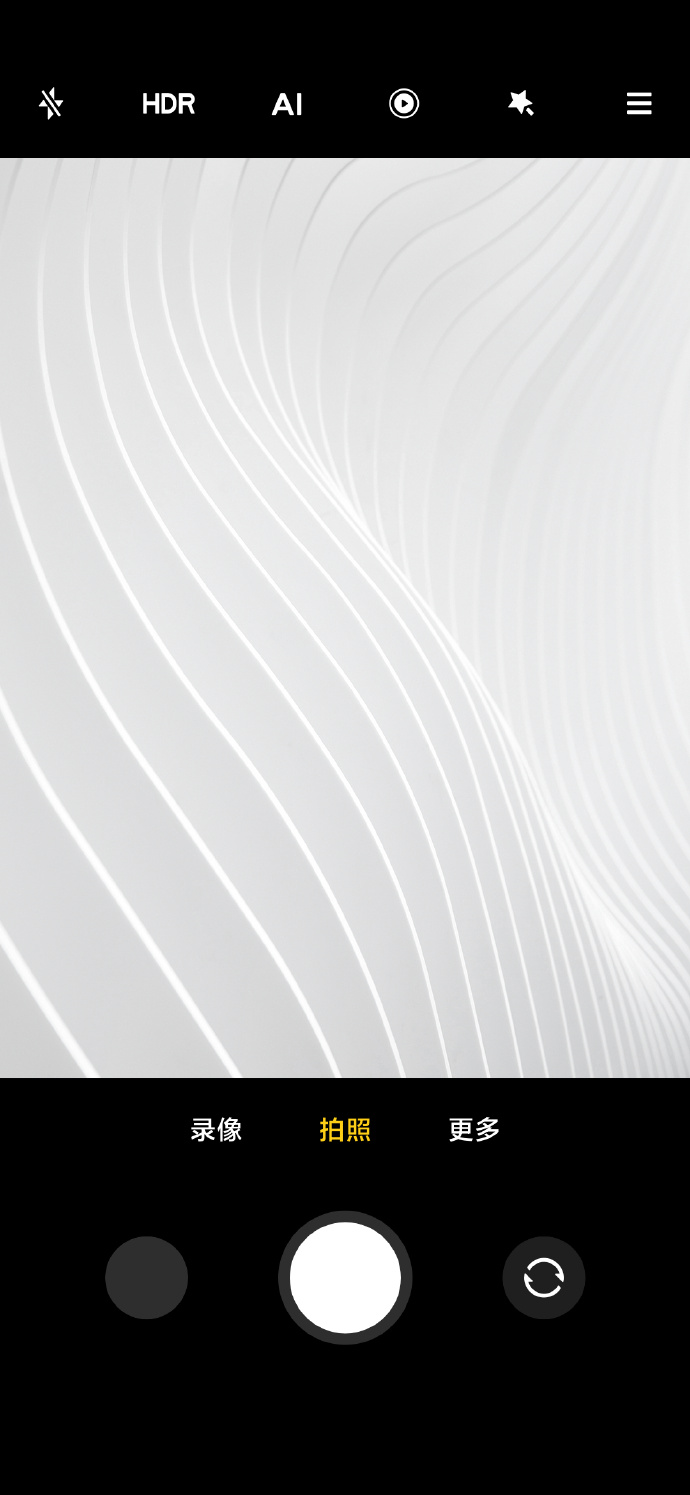
Earlier this week we reported that Xiaomi phones will soon get a new camera UI. Today, the product manager in charge of Xiaomi Camera development has shared a new image of the camera UI along with more details.
According to Queena, the new MIUI camera app will have support for layout customization. This way, users will be able to place what camera options they want at the forefront.
The post says users will be able to add a minimum of 2 camera functions and a maximum of 10 functions to their layout.
MIUI 12 will be announced on April 27 and will bring new features including a new Dark Mode, new themes, and several optimizations.
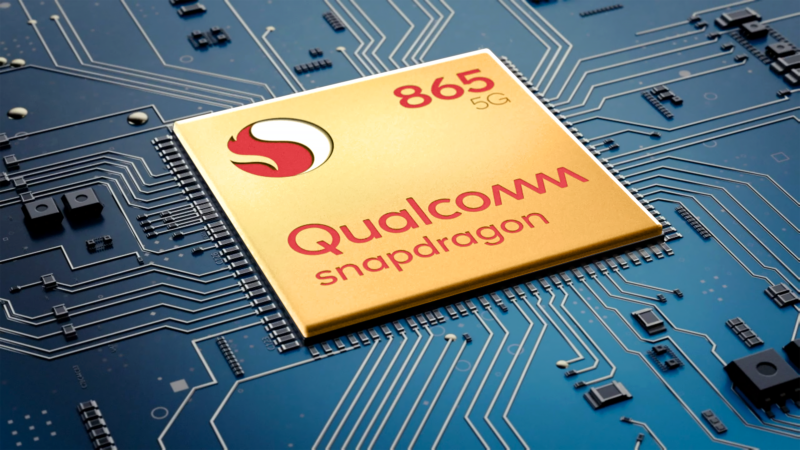
US fabless chipmaker Qualcomm did spring up a surprise last year when it released the Snapdragon 855+ chipset with some upgrade in performance over the Snapdragon 855. There are speculations that we may see a repeat of that this year with a Snapdragon 865+ chipset touted to hit in the second half of the year. That may likely not happen as an industry insider has quashed such expectations.
Qualcomm Snapdragon 865
Meizu’s CMO Wan Zhigiang in a comment on Weibo today stated categorically that there is no Snapdragon 865 Plus this year. Chinese blogger Digital Chat Station was the first to reveal on Weibo that the Snapdragon 865+ should be expected in the third quarter of the year. However, we consider the Meizu official as a more credible source.
The models which launched wit the upgraded Snapdragon 855+ chipset include the Xiaomi Mi 9 Pro 5G, Black Shark 2 Pro, OnePlus 7T, Meizu 16S Pro, Asus ROG Gaming Phone 2, Redmi K20 Pro, OnePlus 7T Pro, Nubia Red Magic 3S, iQOO Pro 5G, Vivo Nex3 5G, OPPO Ace and several others. Most of the models have already gotten upgraded versions powered by Snapdragon 865 SoC. Only a few left like the OnePlus 8T which is expected later this year as an upgrade of the OP7T. We expect OnePlus to utilise the Snapdragon 865 if indeed there won’t an SD 865+. Recall that the OnePlus 6T feature the same Snapdragon 845 chipset that was on the OnePlus 6.
However, we can’t be so certain about this information until Qualcomm official confirms it.
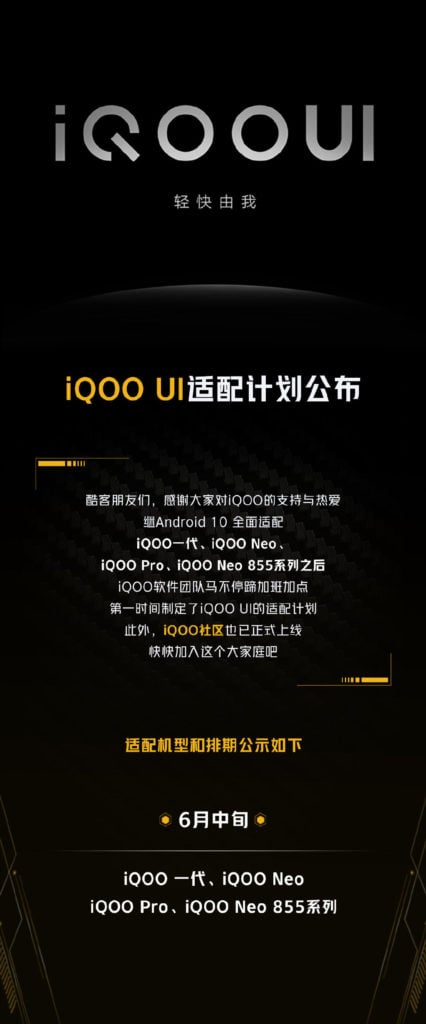
iQOO debuted as a new series of smartphones under Vivo in the year 2019. Within a few months, this series was spun-off into an independent brand of its own. Therefore, initial iQOO-branded smartphones came with Vivo’s FunTouch OS Android skin. Later, the brand shifted to Monster UI followed by iQOO UI earlier this year. Now, according to the brand’s official Weibo account, its older devices will be receiving an update to the new software in mid-June.
iQOO UI is currently only available on iQOO 3 5G, the company’s latest smartphone. The teaser dropped by the company thanks the community and reveals they have been working hard to develop iQOO UI based on Android 10 for its older smartphones.
The first batch of older Android 9 devices that will be receiving the iQOO UI update in mid-June are the ones listed below.
As you can see from the list above, the only handset that is missing is iQOO Pro 5G, the company’s first 5G smartphone, which we think will get the update sometime later.
In other news, the brand is all set to launch its next smartphone called iQOO Neo 3 5G on April 23, which happens to be tomorrow. Although none of the teasers for the device pointed out anything regarding iQOO UI, we expect it to run this software just like the last phone.
Since Huawei and Honor devices are devoid of Google Mobile Services (GMS), the company has been investing more its own Huawei Mobile Services (HMS). The Huawei AppGallery is currently the official destination to explore apps and games on these smartphones.
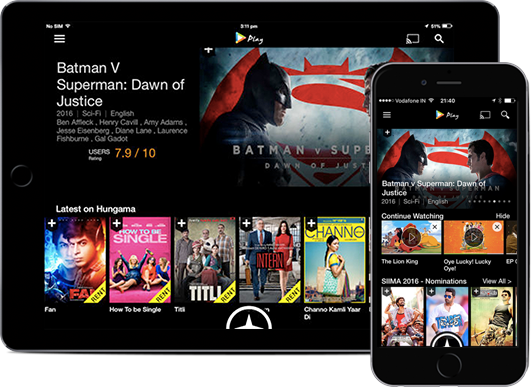
The company has been urging developers to bring their apps to this platform. Additionally, it has been also inking deals with large firms for the same purpose and the latest one to join is India’s Hungama Digital Media Entertainment.
1 of 2
The new Huawei – Hungama deal will enable the entertainment company to list its two popular apps, Hungama Music and Hungama Play on AppGallery. This duo is one of the most popular music and video streaming apps in India.
The above-mentioned Hungama apps offer music in over 20 Indian and international languages, 5,000+ movies in Hindi, English as well as regional languages, 1,500+ short movies, original shows, etc.
Getting these apps onboard is a smart move by Huawei to retain customers. AppGallery already has a number of most used apps in India like Disney+ Hotstar, JioTV, and JioSaavn to name a few. We expect the company to ink similar deals with other companies to rack up its apps selection.
If all goes fine, we might see almost all apps and games on Huawei AppGallery except for Google apps in the near future.
We use cookies on our website to give you the most relevant experience by remembering your preferences and repeat visits. By clicking “Accept”, you consent to the use of ALL the cookies.
This website uses cookies to improve your experience while you navigate through the website. Out of these, the cookies that are categorized as necessary are stored on your browser as they are essential for the working of basic functionalities of the website. We also use third-party cookies that help us analyze and understand how you use this website. These cookies will be stored in your browser only with your consent. You also have the option to opt-out of these cookies. But opting out of some of these cookies may affect your browsing experience.
Necessary cookies are absolutely essential for the website to function properly. This category only includes cookies that ensures basic functionalities and security features of the website. These cookies do not store any personal information.
Any cookies that may not be particularly necessary for the website to function and is used specifically to collect user personal data via analytics, ads, other embedded contents are termed as non-necessary cookies. It is mandatory to procure user consent prior to running these cookies on your website.