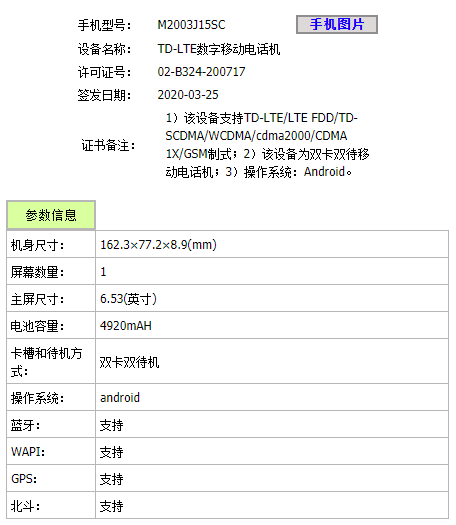
A mystery Redmi phone with model number M2003J15SC has appeared on TENAA. The TENAA listing of the phone currently carries minimum details such as dimensions, screen size and battery capacity. At the same time, a reliable tipster from China took to Weibo to share additional details of the same smartphone.
The TENAA appearance of the Redmi M2003J15SC 4G smartphone has revealed that its dimensions are 162.3 x 77.2 x 8.9mm. It is fitted with a 6.53-inch display and it houses a minimum rated battery of 4,920mAh capacity. The images of the smartphone are not yet available on TENAA.
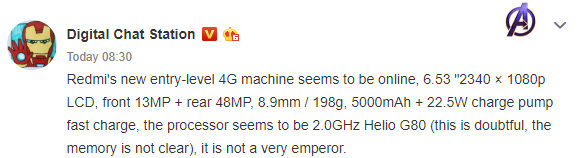
Information leaked by the Chinese tipster reveals that the Redmi M2003J15SC has a 6.53-inch display which produces full HD+ resolution of 1080 x 2340 pixels. The typical size of its battery is 5,000mAh capacity and it weighs 189 grams. The 3C appearance of the M2003J15SC smartphone had revealed that it may ship with a charger that supports up to 22.5W fast charging.
The Redmi M2003J15SC is fueled by 2.0GHz octa-core processor. The tipster has speculated that it could be featuring the Helio G80 chipset by MediaTek. He did not share any details on the RAM and storage capacities of the Redmi M2003J15SC smartphone.
For capturing selfies, the Redmi M2003J15SC possesses a front camera of 13-megapixel. It is unclear whether the phone is equipped with a dual or triple or quadruple camera setup on its back. What’s known is that the setup includes a primary shooter of 48-megapixel. There is no word on the pricing of the Redmi M2003J15SC smartphone.
Xiaomi had recently launched Redmi Note 9 series of smartphones in India. The new M2003J15SC phone does not belong to the Redmi Note 9 lineup. There is a possibility that it could be a Redmi 9 series device. It is recommended to wait for newer reports to appear to confirm on the identity of M2003J15SC.
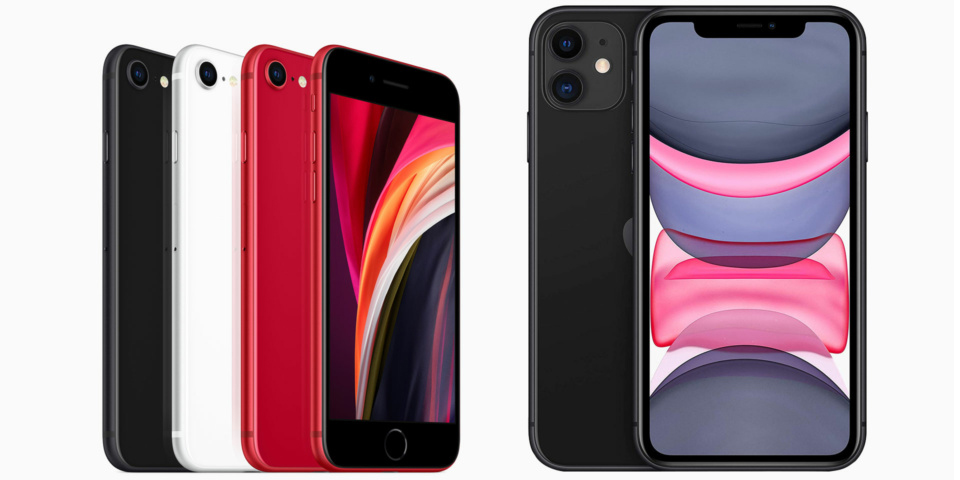
The new affordable iPhone is finally official: it has the same design as the old iPhone 8, but it packs improved specifications in a very compact body. But if you need an affordable iPhone, the iPhone SE 2020 is not the only option out there among the last-generation Apple devices. There is another interesting option: the best-selling iPhone 11, which is the successor of the iPhone XR. It is more expensive than iPhone SE 2020, but it is currently available with very interesting street prices. Should you spend a bit more for the 11 or the iPhone SE 2020 is enough for all of your needs? This specs comparison will clear your ideas in regards.
Apple iPhone SE 2020 vs Apple iPhone 11
Apple iPhone SE 2020
Apple iPhone 11
DIMENSIONS AND WEIGHT
138.4 x 67.3 x 7.3 mm,
148 grams
150.9 x 75.7 x 8.3 mm,
194 grams
DISPLAY
4.7 inches, 750 x 1334p (Retina HD), Retina IPS LCD
Dual 12 + 12 MP f/1.8 + f/2.4
Dual 12 MP + SL 3D f/2.2 front camera
BATTERY
1821 mAh, fast charging 18W, wireless charging Qi
3110 mAh, Fast Charging 18W, wireless charging Qi
ADDITIONAL FEATURES
IP67 water resistant, eSIM
IP68 waterproof, eSIM
Design
iPhone SE 2020 is the most compact last-generation flagship in the whole mainstream smartphone market. But its design is outdated: as we mentioned above, the device has the same aesthetics as the iPhone 8 released back in 2017. There are thick bezels around the display and Touch ID came back, replacing Face ID. But the device is still made of premium materials, including a glass back and an aluminum frame. Further, it is a water resistant smartphone with the IP67 certification. The iPhone 11 has bigger dimensions, but its design is definitely more attractive. The reason is the presence of a borderless display with narrow bezels. iPhone 11 also comes with better protection against water: it has the IP68 certification (up to 2 meters deep for max 30 minutes).
Display
The size is the most important difference between the displays of iPhone SE 2020 and iPhone 11. The iPhone SE 2020 has a display diagonal of just 4.7 inches, so it is not the most suitable device for advanced users and productivity. On the other hand, it is easier for one-handed use and it fits better in a pocket. If we talk about the quality of the display, besides having a wider 6.1-inch diagonal, iPhone 11 provides a more convincing image quality. It even comes with a more reactive touch thanks to a 120 Hz touch-sampling rate. But keep in mind that the differences between the image quality of these displays are not huge.
Specs & Software
Despite it is a way more affordable device than all the other last-generation iPhones, the iPhone SE 2020 has exactly the same chipset as the iPhone 11 lineup. This means that it is able to provide similar performances. The operating system is the same on both the devices (iOS 13 out of the box), and even the internal storage is the same: they both come in configurations with 64, 128 or 256 GB. There is only a single difference in the hardware department: iPhone 11 offers an additional gig of RAM. While iPhone SE 2020 has 3 GB of RAM, the iPhone 11 sports 4 GB of RAM for better multi tasking performances. But one single gig of RAM on iOS 13 is not a very noticeable difference in terms of overall performance.
Camera
On the rear side, the iPhone SE 2020 has just a single camera with a 12 MP resolution, but it is a great camera and it supports OIS. It is even able to calculate depth info by taking advantage of machine learning, without the need for a secondary depth sensor. The iPhone 11 adds a useful 12 MP ultrawide lens on the rear side, for a total of two cameras. And unlike the SE 2020 sporting a dual-LED flash, the 11 has a quad-LED flash. Besides a better rear camera department, the iPhone 11 also comes with a better front camera: a 12 MP sensor accompanied by an SL 3D sensor that enables Face ID.
iPhone 11 has a much bigger battery than iPhone SE 2020 (3110 mAh vs 1821 mAh) and it is able to provide a way longer battery life. The battery life of the iPhone 11 is very satisfying, it is not a battery phone but it can last more than one working day with most of the usage patterns. iPhone SE 2020 debuted yesterday, so we had no chance to test its battery life.
Price
iPhone 11 is priced $699 (€799 in Europe) in its base variant, while iPhone SE 2020 starts from just $399 (€499 in Europe). The iPhone 11 is a way better smartphone, but if you do not need above-average battery life, the most modern design, a wide display, and an ultrawide camera, there are no noticeable differences that justify the price difference between the two handsets. iPhone SE 2020 is a great alternative for the price, even though you can get better specifications with several Android phones in the same price range. But you would never get iOS nor that compact body.
Apple iPhone SE 2020 vs Apple iPhone 11: PRO and CONS
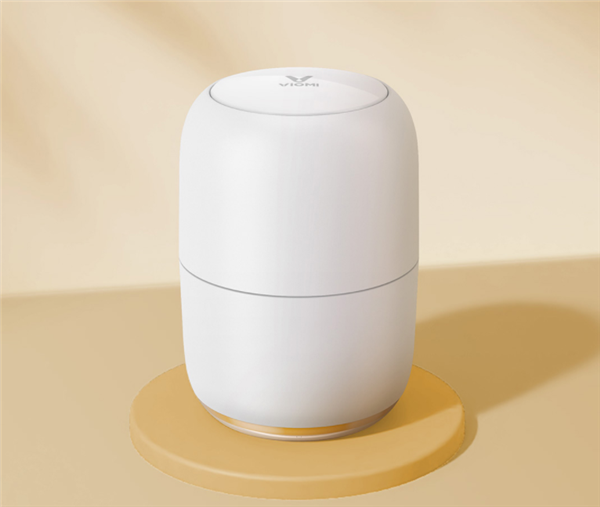
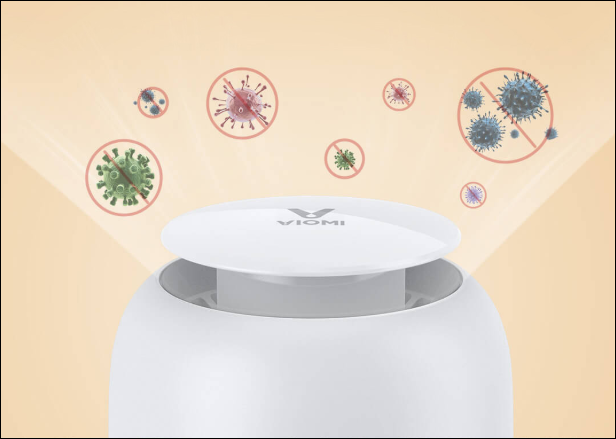
The Youpin crowdfunding platform has played host to yet another product from Xiaomi‘s ecological chain company Viomi. The Viomi Deodorizer and Sterilizer adopt a crowdfunding price of just 59 yuan (~$8).
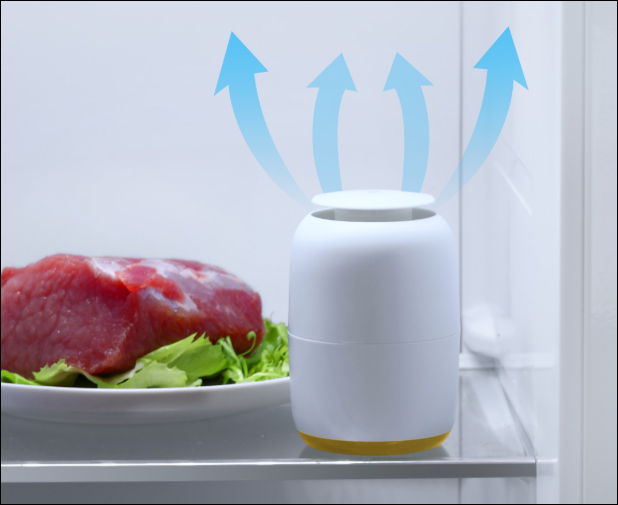
The device is said to have the capability to actively release safe Chlorine dioxide (ClO2) sterilization gas. The vapour can effectively eliminate common bacteria in the refrigerator such as E. coli, Listeria, Salmonella, Staphylococcus aureus, etc. It is effective up to 99.999% against these microbes. Thus, it can help prolong the fresh storage cycle.
In case you don’t know what it is, Chlorine dioxide (ClO2) is a safe disinfectant approved by the World Health Organization (WHO). The compound consists of one chlorine atom and two oxygen atoms. It is used for a variety of antimicrobial uses, including the disinfection of drinking water. It is a common material for food disinfection, sterilization in public environments, and preservation. It is safe for the elderly, children or pets at home.
Compared with disinfection liquid and disinfection powder, Viomi Deodorizer and Sterilizer has a wider range of uses. It can be placed in wardrobes, shoe cabinets, kitchen cabinets, refrigerators and other locations. It not only eliminates bacteria in the enclosed area but also eliminates musty and odour. It equally eliminates the various odours caused by the deterioration of ingredients, such as rotten eggs, rotten vegetables, fish odour, carrion, etc.
The machine adopts a stylish design and doesn’t require electricity. The product works with the Chlorine Oxide gel which brownish-yellow in colour and the gas is circulated via convection. However, as it is used, the gel changes colour to white over time. The white colour is an indication that the gel needs to be replaced. The lid can be closed when not in use in order to prolong the usage.
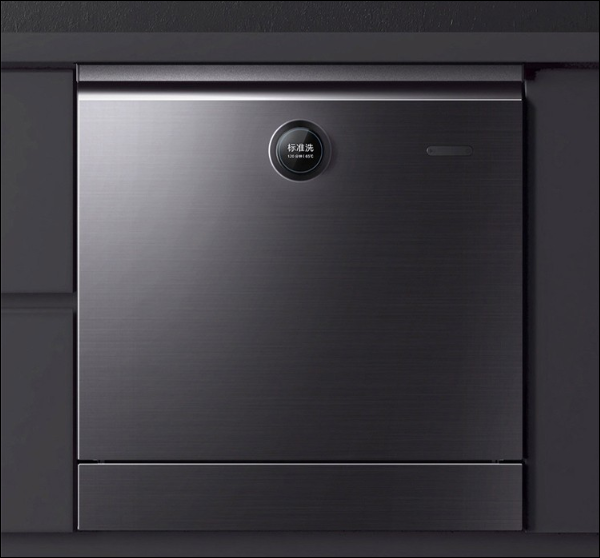
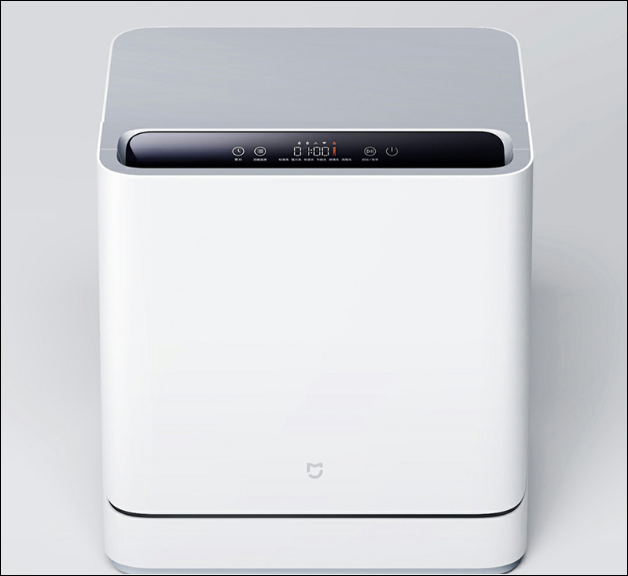
Xiaomi has launched the MIJIA Internet Dishwasher available in 4 sets and 8 sets models. The two models differ in size and prices with the four-set model retailing for 1,299 yuan (around $183) while the 8 set model has a price tag of 2,299 yuan (~$324).
The 8 sets Mijia Internet dishwasher is designed with 8 spray arms. It is equipped with a top spray structure which is unique to high-end models. The spray arms feature 28 outlet holes and 13 outlet angles. This design forms a 360-degree mesh waterway interlaced with each other, covering the dishes in the compartment from all directions.
The bigger model equally has a large liner of 500 (width) × 450 (deep) × 450 (height) mm, and can hold about 64 pieces of tableware. Each dish can be put into the dishwasher for pre-washing. At the end of the day, all the dishes used can then be washed at once. Thus, you only need to wash the dishes once a day, saving time, water and electricity.
Unlike the button panel design of traditional dishwashers, it uses a very simple OLED knob, which can easily control 9 washing modes, one turn and one press, and convenient operation. In the energy-saving washing mode, the single washing water consumption is as low as 9.3L, and the power consumption is as low as 0.75kW / h.
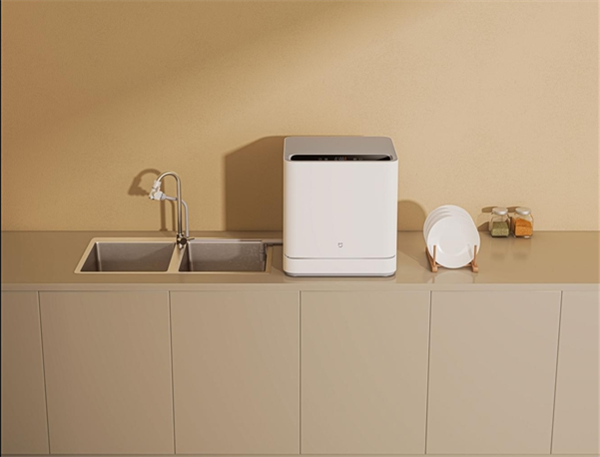
The second version is a portable, countertop dishwasher specially designed with washing and disinfection functions for maternal and child use scenarios. It comes with 6 kinds of refined washing modes, supports high-temperature sterilization at 75 ℃, with sterilization rate as high as 99.99%. It is equipped with a fan blower which dries the tableware, reducing the growth of bacteria.
The Mijia Internet Dishwasher 4 sets can be installed quickly and independently, no need to plan for where the dishwasher will be kept in the kitchen or water inlet in advance. It is equipped with a patented three-way valve, equipped with a variety of adapters of different sizes and shapes, and adapts to a variety of faucets. It can be installed directly on the tap in the home without affecting the use of daily tap water. The portable dishwasher can take 32 pieces of tableware at a time. It adopts top spray + down spray double-layer spray arm design. The 16 flushing ports spray at the same time and rotate alternately. There is no dead angle as it flushes from up, down, left and right, as well as front and back directions. With strong water pressure of 11000Pa, tableware cleaning is more thorough. It also supports voice control via the MIJIA app.
As for the availability, both models are available on Jingdong (JD.com).
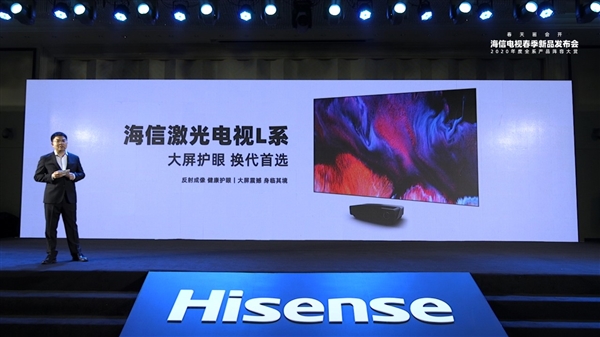
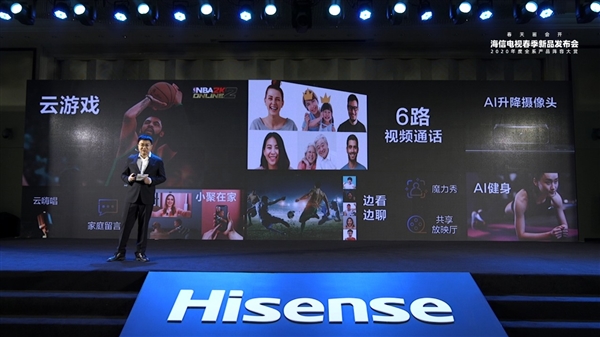
Hisense TV today held a product launch conference in China where it released several smart TV models under four different series. The Chinese company unveiled a new L series of laser TVs, U series of super-quality TVs, models under the X series were also announced. The A series said to be made of AI TVs were also unveiled. In total Hisense unveiled over 30 products under the four different series, including more than 10 large-screen TVs above 75 inches.
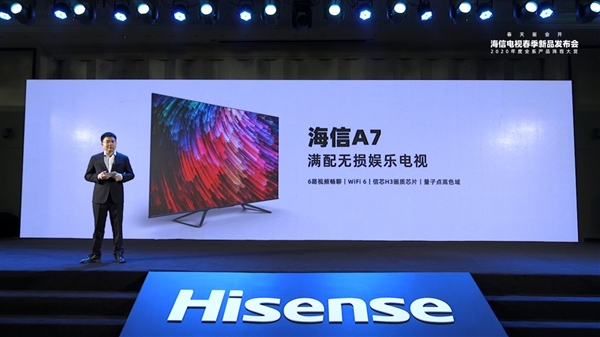
Among the products, the Hisense A7F smart TV was unveiled as China’s first TV to support the new Wi-Fi 6 wireless network connectivity. The speed is said to be 2.7 times that of the previous generation Wi-Fi 5. This will no doubt deliver seamless video and audio streaming without any disruption or drop n sound quality.
In addition, the new Hisense A7F smart TV is equipped with a star-level camera that supports high-bandwidth six-channel video, AI fitness personal education, AR HD magic mirror and other functions.
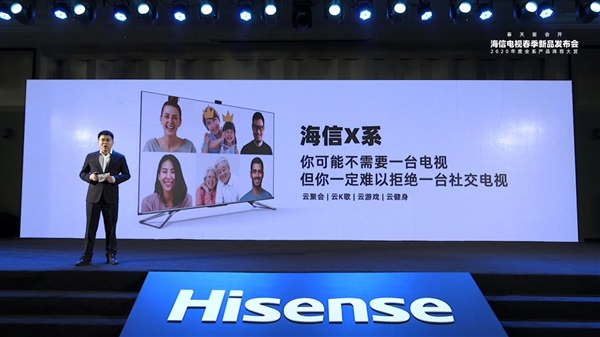
The new X series equally comes with AI technology and comes with features such as multi-channel video calling, cloud fitness, and cloud karaoke, an industry first for the Hisense TV. The smart TV also features Tencent START cloud game service. Tencent Games and NVIDIA in December 2019 announced a collaboration to bring PC gaming in the cloud to China. NVIDIA’s GPU technology will power Tencent Games’ START cloud gaming service, which began testing earlier this year. START gives gamers access to AAA games on underpowered devices anytime, anywhere. The service currently supports popular games such as NBA2K Online 2, FIFA Online 4.
Eleven smart TV models were unveiled under the U series, all equipped with Hisense’s unique image quality chip and AI image quality adjustment technology. Among them, the flagship U9 of 75-inch and 85-inch features 8K HDR super-quality images.
The U8 series mainly features a zero-frame full-screen design with a screen ratio close to 99% and 4K HDR. It also features the self-developed Xinxin H3 image quality chips.
The U7 series is tailor-made for sports and gaming enthusiasts, equipped with 100-level zone light control technology, supports 4K HDR, 120Hz high refresh rate, and HDMI 2.1 interface. It also supports 4K 120Hz signal input, VRR professional game mode.
The largest smart TV is the 88-inch full-screen Hisense laser TV which pioneers the cellular bionic screen sound technology. The technology is said to be equivalent to collecting 100,000-level sound units in the 88-inch screen space, allowing the TV to display a stereo sound field without speakers.
The pricing and availability of the models are yet to be disclosed as at the time of reporting.
The OnePlus 8 series launched in China today. The Chinese company already announced the phones globally on Tuesday, April 14 before announcing them today in its home country. Unfortunately, there wasn’t a surprise product which we thought will be the OnePlus Z/OnePlus 8 Lite.
[envira-gallery id=”317294″]
The OnePlus 8 and OnePlus 8 Pro are different from their foreign variants in terms of software and pricing.
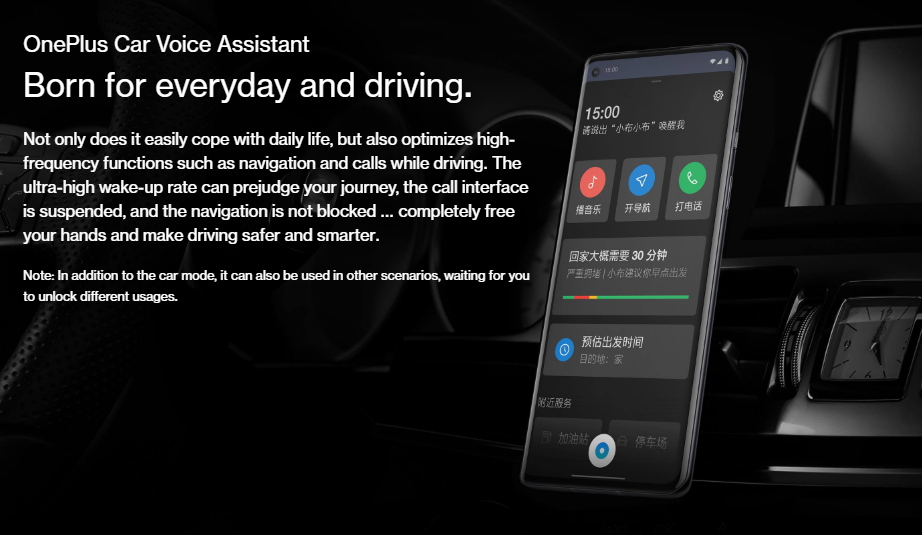
It is known that the Chinese version of OnePlus phones runs HydrogenOS and that remains unchanged on the new variants. One of the new features you get is the OnePlus Car Voice Assistant that allows you to totally control the phone with just your voice, so you can focus on driving and be safe.
There is also no Google One or support for Stadia but OnePlus has partnered with Youku and Tencent for exclusive content that makes use of the 120Hz display.
OnePlus 8 Series Pricing and Availability
The OnePlus 8 will sell for ¥3999 (~$565) for the 8+128GB version and ¥4599 (~$650) for the 12+256GB version. The OnePlus 8 Pro will sell for ¥5399 (~$763) for the 8+128GB version while the 12+256GB version will go for ¥5999 (~$848).
The phones will go on sale tomorrow at 10 AM.
Accessories
OnePlus also announced the OnePlus Bullets Wireless Z earphones in China. It will sell for ¥249 (~$35).
The OnePlus Warp Charge 30 Wireless Charger for the OnePlus 8 Pro is priced at ¥299 (~$42) which is about $28 less than what it sells for in the US.
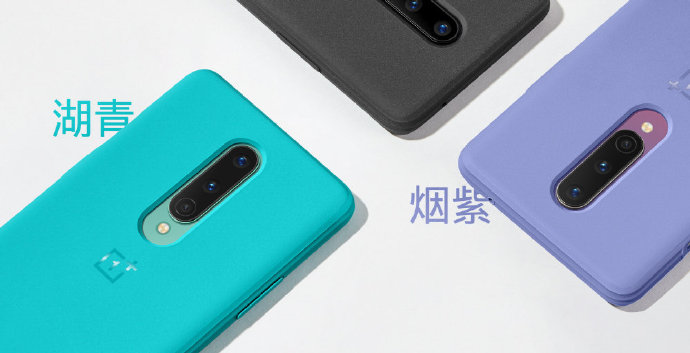
The Limited Edition André cases are priced at ¥149 (~$21) per case while the new Sandstone cases are priced at ¥99 (~$14).
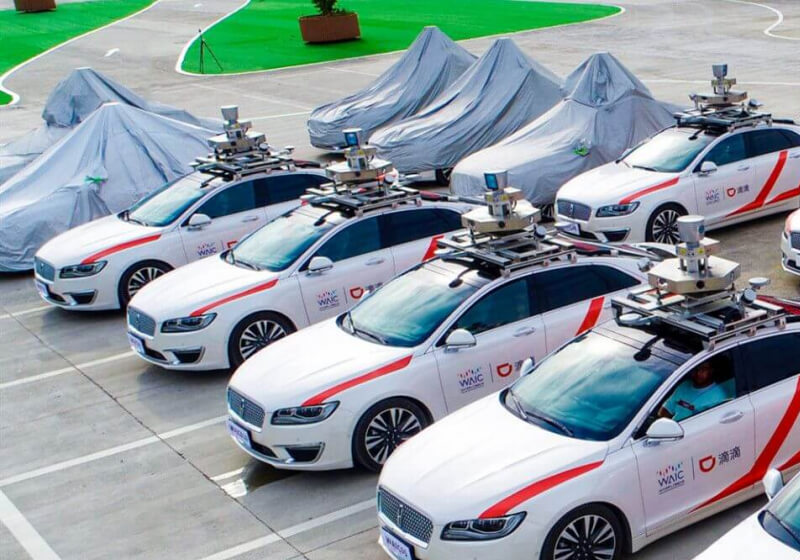
With 5G technology, autonomous vehicles are fast becoming a reality and Chinese firms are at the forefront. Two of China’s leading self-driving car firms Didi Chuxing and AutoX are reportedly set to launch their own autonomous ride-hailing pilot projects. According to a TecNode report, two sources familiar with the matter hinted that the pilot projects will commence in late May in the outskirts of Shanghai.
The projects run separately even though both firms were reported to have commenced their partnerships with the Shanghai government around the same time.
The race to be among the first to launch commercial autonomous ride-hailing cabs have been raging in China with Pony.ai and Baidu at the forefront. AutoX and Didi are aiming to become among the first to get the nod to commercialize its Robotaxi operations.
When contacted to confirm the news, a company representative told TechNode that Didi was actively testing robo-taxi in Shanghai and hopes to launch the pilot service as soon as possible.
On the other hand, AutoX announced Friday, the opening of what it claimed is Asia’s largest robotaxi operations centre in Shanghai. The centre sits in an area spanning 750 square meters and located in the northwestern Jiading district. The operation is expected to collect and process “petabytes” of driving data from road testing in Shanghai each week. In addition, the operation will also be deployed for performance training simulations in a virtual traffic environment. It will also house facilities to test hardware in climate conditions such as high-pressure water and high temperature.
AutoX claims that users “will soon be able to hail a ride” in its autonomous vehicles but the app is yet to be unveiled.
India initially announced a lockdown for 21 days from 25th March to 14th April to minimize the outbreak of coronavirus in the country. But on the last day of the lockdown, the Prime Minister announced the extension till May 3. However, several businesses were given relaxation to start operating after April 20 abiding safety rules. Amid this, smartphone makers like Xiaomi, Realme, and Vivo have started talks with their e-commerce partners to begin the sales in the country.
This is the second time Xiaomi and Realme have come forward to begin sales during the lockdown. Late last month they urged the government to classify smartphones as ‘essential commodity’. Because the government has only allowed e-commerce and retailers to sell only essential goods like groceries, health products, and such.
However, now as the Indian Ministry of Home Affairs (MHA) has announced an unclear relaxation of trades after April 20, Xiaomi, Realme, and Vivo have started discussions to begin sales of smartphones with their strategic online partners.
Realme’s CEO Madhav Sheth has already confirmed his brand will start selling smartphones and audio accessories from April 20 through Flipkart and Realme online store. Whereas, Xiaomi and Vivo are on the verge of finalizing their decision.
In addition to companies, executives from research firms like IDC and Counterpoint Research also agree with the idea of start selling smartphones online as they are essential and the companies could start making up the losses they incurred over the past few weeks. This could further help in increasing the demand from late May and June to the following quarters.
Last month, we wrote an explainer on the latest Wi-Fi standard called Wi-Fi 6 (802.11 AX). Just like Wi-Fi 5, Wi-Fi 6 operates on two frequencies – 2.4GHz and 5GHz. However, some Wi-Fi 6 devices will be able to operate on a third spectrum (frequency) and will go by a different name.
image source: Android Authority
Wi-Fi 6 + 6GHz = Wi-Fi 6E
In January of this year, the Wi-Fi Alliance announced that Wi-Fi 6 devices that can operate on the third spectrum which is 6GHz will be called Wi-Fi 6E devices to distinguish them from those that can only operate on 2.4GHz and 5GHz.
What are the advantages of the 6GHz spectrum?
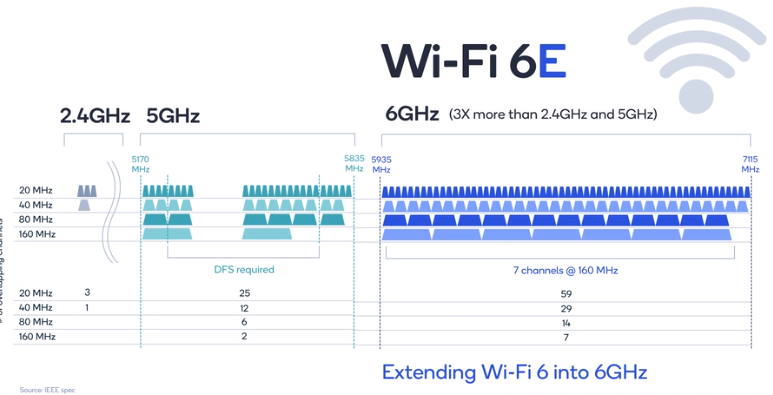
With Wi-Fi 6 operating on the same frequency as older Wi-Fi standards such as Wi-Fi 4 and Wi-Fi 5, there is bound to be interference. However, with support for 6GHz which has wider channel sizes, there will be less interference and faster speeds.
The capacity of 6GHz is enormous and will be efficiently used by Wi-Fi 6 and newer versions of Wi-Fi – Wi-Fi Alliance
Image Source: Qualcomm
The press release by the Wi-Fi Alliance earlier this year said the 6GHz spectrum solves the Wi-Fi spectrum shortage problem by providing contiguous spectrum blocks for 14 additional 80MHz channels and 7 additional 160MHz channels. These additional channels are required by high-bandwidth applications that need faster data throughput such as HD-video streaming, AR, and VR.
Devices with support for Wi-Fi 6E will also be able to support more users at the same time even in very dense and congested areas thanks to the wider channels that 6GHz brings.
When will you be able to buy Wi-Fi 6E devices?
Wi-Fi 6E chipsets need to be made first. Broadcom already has one and says that the chipset will begin shipping to clients by late fall, 2020 which is in time for the holidays. Other manufacturers will most likely follow the same pattern.
Do note that you not only have to purchase a Wi-Fi 6E router, but your devices also have to support Wi-Fi 6E. So while routers may be available soon, devices such as phones and computers may take a bit more time.
Taiwanese Semiconductor Manufacturing Company (TSMC) earlier today announced its quarterly earnings for the first quarter of 2020. The company posted revenue of about 3106 billion Taiwan dollars which is an improvement of 2.1% from last quarter. Compared to the same period last year (Q1 2019), the revenue increased by 42%.
Huawei;s Kirin chipsets are manufactured by TSMC
In the first quarter, TSMC’s advanced process contributed a lot to the company’s revenue. The new 7nm process contributed 35% of the Q1 revenue, the 16nm process contributed 19% of the revenue, and the 10nm contributed 0.5% of the Q1 revenue. Overall, the advanced process is said to have contributed 55% of the entire revenue and became an important growth point.
After the 7nm process, TSMC will also mass-produce the next-generation 5nm process. Previously, mass-production was billed to commence in the first half of this year but due to the COVID 19 pandemic, the mass production has been delayed. Mass production is now expected to commence in the second half of the year. Nevertheless, because TSMC’s 5nm process is the only one in mass production globally, it is expected to account for 10% of its annual revenue.
According to official data, compared to 7nm (first-generation DUV ), the new 5nm chip based on the Cortex A72 core can provide 1.8 times the logic density, 15% faster speed, and 30% lower power consumption. The SRAM process is also very excellent and it has a reduced area.
The 5nm process will be utilised mainly for the Apple A14 and Huawei Hisilicon Kirin 1020 chipsets. The A14 Bionic chipset is said to have a peak frequency of 3.1GHz .
As for the Kirin 1020, the specifications are yet to be confirmed. However, previous rumours tipped the SoC to feature an upgraded Cortex-A77 architecture, but there are also rumours that Huawei will skip the A77 generation and go directly to the future Cortex-A78 architecture, which is an intergenerational upgrade. What can be confirmed at present is that the Kirin 1020 will be featured on the Mate 40 series in the second half of the year.
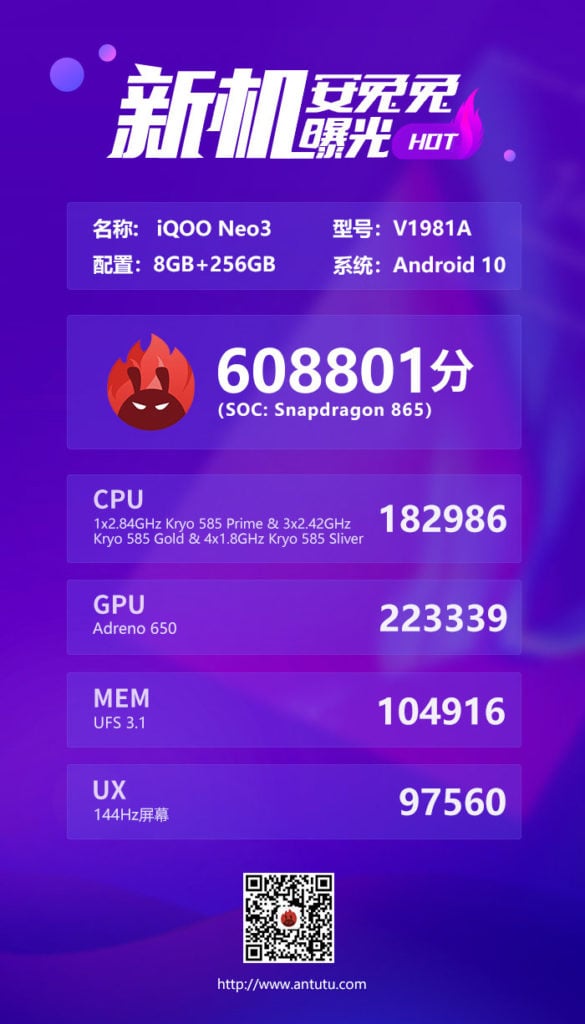
The Chinese smartphone brand iQOO will be launching its Neo 3 smartphone on April 23. The firm has even teased some of the key specs of the device ahead of its release. A couple of days back, the starting price of this handset was also leaked via an advertisement. And now, the official Weibo account of AnTuTu Benchmark reveals the score of the handset.
Unsurprisingly, the forthcoming iQOO Neo 3 with model number V1981A scores a total score of 608801 points as it is powered by the high-end Qualcomm Snapdragon 865 chip paired with 8GB RAM and 256GB UFS 3.1 storage. When we break down the total score, we get to see that the Neo 3 scores 182986 points for CPU, 223339 points for GPU, 104916 points for MEM (memory), and 97560 points for UX respectively.
AnTuTu says that the upcoming iQOO Neo 3 has officially become one of the top smartphones in UX ranking, thanks to its 144Hz refresh rate display. Because higher refresh rate displays play a key role in achieving higher points in the benchmark app’s current testing algorithm.
Anyway, the type of panel used on the Neo 3 is still unknown. But going by its starting price of 2998 Yuan ($425), it will certainly feature an LCD panel compared to 144Hz AMOLED display on the Nubia Red Magic 5G.
As for other specs, the device will Android 10 and is expected to pack a 4,500 mAh battery with support for 44W fast charging as per a leak from last week.
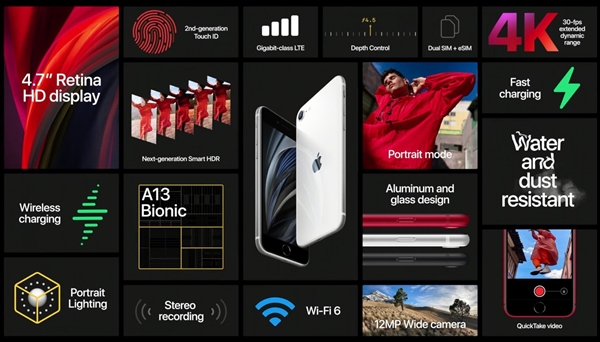
Yesterday, Apple took the industry by storm with the launch of the 2020 edition of the affordable iPhone SE. The new iPhone came with an impressive specs lineup which includes the A13 Bionic chipset that is on the flagship iPhone 11. That is definitely the best perk, coupled with storage options of 64GB, 128GB and 256GB. The phone’s pricing starts at $399 which makes it an impressive offer.
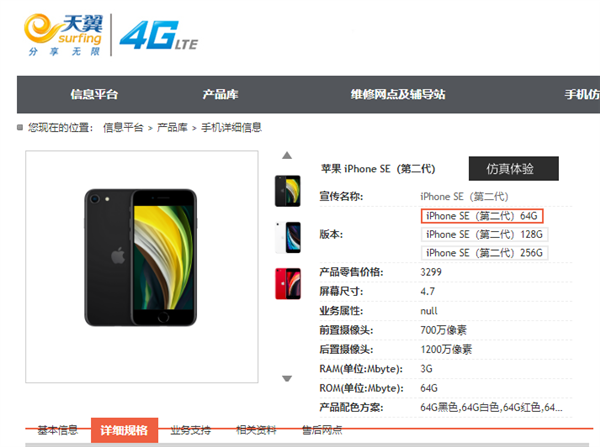
As expected, Apple did not announce the RAM size and battery capacity of the new iPhone. However, details o the iPhone SE 2020 RAM and battery have been revealed by China Telecom. The carrier’s Tianyi 4G terminal database confirmed that the smartphone is equipped with 3GB of RAM and a 1,812mAh battery. It is noteworthy that this is the same battery capacity on the iPhone 8 which Apple has had to discontinue after the iPhone SE launch. The RAM is 1GB less than the iPhone 11 series.
The official data released by Apple showed that the iPhone SE 2020 battery can support 13 hours of video playback and 8 hours of online video streaming. The mobile phone supports 18W fast charging even though there is only a 5W charger inside the box. The 18W charger delivers up to 50% charge in about half an hour. The device also supports wireless charging.
It is well known that the smartphone market has seen slight stagnation in recent times. This also translates to the mobile chip industry as well, with the global cellular baseband processor also seeing a decline of 3 percent (year on year over 2018) in 2019. However, during the overall decline, 5G enabled chipset saw growth to 2 percent market share during this period.
Image Via Strategy Analytics
2019 was the year that 5G networking broke out into the market. In its nascent stages, the premium grade flagships were the only handsets that housed chipsets that supported the newer and faster bandwidth. Despite this, the market saw decent success and even managed to gain an overall market share of 2 percent. Furthermore, the growth was facilitated by early adopters, which includes Qualcomm with its 5G modems in its Snapdragon processors, Huawei with its HiSilicon Kirin flagship processors and even Intel.
Qualcomm held the most dominating position for 5G enabled chipsets, with 41 percent market share. HiSilicon came in second with a 16 percent market share while Intel came in third with 14 percent. The rest was made up of by various other brands, but these three are the major contributors by far. Prior to the Coronavirus pandemic, it was expected that 5G would become more mainstream in 2020. And despite it all, the trends showcase that brands are still placing an emphasis on 5G over 4G, especially new and flagship models.
Qualcomm Snapdragon 865 with the X55 5G Modem
During this same period, 4G LTE baseband shipments have declined year on year for the first time. The only exceptions to this are Intel and Unisoc, while other players in the market all seeing a fall. Only time will tell now regarding just how far reaching the effects of COVID-19 actually is, and what it may mean for the market overall in 2020. So stay tuned.
Samsung becomes the next major company after Oppo, Xiaomi, TikTok, and OnePlus operating in India to contribute funds to fight the coronavirus outbreak in the country. The South Korean conglomerate has pledged ₹20 crores collectively for PM CARES Fund as well as states of Uttar Pradesh and Tamil Nadu.
The company says that it will be donating ₹15 crores to the PM CARES Fund and ₹5 crores to the state governments of Uttar Pradesh and Tamil Nadu to help combat the COVID-19 pandemic. In addition to this, Samsung employees across India are also contributing to the nation. The company says it will match the employee contribution and donate the total amount to PM CARES fund in the coming weeks.
Apart from the donation, Samsung has been also continuously helping local administration and community in Noida. So far the company has provided hospitals with thousands of Personal Preventive Equipment (PPE) kits such as surgeon gowns, face masks, gloves, preventive eye wears, hood caps, and shoe covers.
Samsung is even providing hospitals and other facilities with a large number of infra-red thermometers, public address systems, and air purifiers. The firm has also accelerated the deliveries of its digital X-ray and digital ultrasound machines that it provides to government hospitals under the Samsung Smart Healthcare citizenship program.
Additionally, it has been also helping local administration and police of Noida in providing food packed to the local communities on a daily basis.
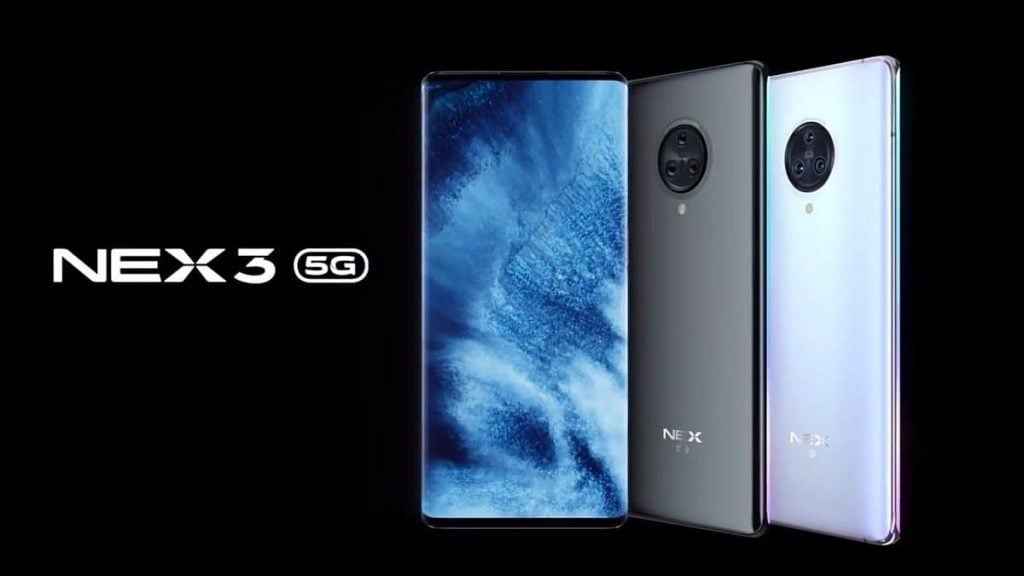
Vivo Nex 3 5G was launched in September of 2019 with Qualcomm Snapdragon 855 SoC paired with Snapdragon X50 5G modem. The phone came with Functouch OS 9 based on Android Pie out of the box. But now, it is finally receiving stable Android 10-based Funtouch OS 10 update.
The Chinese smartphone maker started beta testing Android 10 on Vivo Nex 3 5G last month. Now, within a month, the company has started rolling out stable Funtouch OS 10 update for all the regular users of the phone.
Vivo announced Functouch OS 10 in December and even revealed the list of eligible devices for the update. The Nex 3 5G is one of the devices in the first batch to receive the update. As promised, the company is finally delivering a stable update to all the units of the device.
Anyway, just like any other OTA update, it is being rolled out in a phased manner. Hence, it might take time to reach every unit of the Nex 3 5G. Also, do note that this update is only being seeded out to the devices with model number V1924A.
The Functouch OS 10 stable update based on Android 10 for the Vivo Nex 3 5G bumps up the build version to 6.10.1 with March 2020 security patch.
Xiaomi, the most popular smartphone brand in India, is looking to diversify its home appliances and smart product range in India. The Chinese tech giant already has a strong base for its smartphone department, but it plans on expanding further. The company recently announced that it will be launching its Mi Robot Vacuum cleaner in India tomorrow (17th April 2020).
How many times do you clean your house every day? What if you could do it, without actually doing it yourself?#SmartCleaning solution for your smart home launching tomorrow. Any guesses, Mi fans? pic.twitter.com/w1y6dU22xb
In a tweet from the official Mi India Twitter handle, Xiaomi announced the arrival of its new smart home product for the Indian market. The tweet read, “How many times do you clean your house every day? What if you could do it, without actually doing it yourself? #SmartCleaning solution for your smart home launching tomorrow. Any guesses, Mi fans?”
Xiaomi had originally launched the Mi Robot Vacuum cleaner back in 2016, in its home country, China. It features a Laser Distance Sensor (LDS) that allows it to scan the surroundings with a field of view of 360 degrees about 1,800 times every second. It also SLAM (Simultaneous Localisation and Mapping) algorithm, which helps it map out the layout of the house. Through this, it can smartly calculate the best and most efficient cleaning path.
Xiaomi Mi Robot Vacuum Cleaner
The Xiaomi Mi Robot Vacuum Cleaner also houses 12 sensors and offers other smart features as well, making it a must have for smart homes. This is further supplemented by the fact that the smart product can also be controlled via the Mi Home application, which also connects to other smart home appliances. It is powered by a 5,200mAh battery and can offer up to 2.5 hours of cleaning. If you’re interested in this, stay tuned for the launch.
Samsung, the world’s largest smartphone manufacturer, is facing the lowest operation rate ever in its entire history. Despite being one of the largest consumer grade electronics maker and a major multinational brand, the effects of the Coronavirus pandemic has severely crippled its operations.
According to reports, the South Korean tech giant has halved its smartphone manufacturing. The company even had to temporarily shut down various factories and offline stores across the globe, due to the various government enforcing local lockdowns. For those unaware, a new strand of Coronavirus has caused a global pandemic, leading governments to shut down various factories and production lines. This has affected various fields including the smartphone industry.
ETNews have reported that Samsung might be facing an all time low of its operation rates in the Q2 of 2020. Furthermore, the closed factories will also lead to increased fixed costs, lower production output, lower sales, and dropped revenues. As it stands right now, raising the production will only make inventories pile up, as the company already has stocks remaining from previous months.
At the moment, it seems like the global economy is heading for a recession, which in turn makes people less likely to spend on things that are considered non-essential. Samsung has already closed down its smartphone and home appliances factories in nations like India, Brazil, Mexico, Russia, Slovakia, Vietnam, and even the US. Additionally, it is expected that the closure and lockdowns will extend by another month at the very least.
On the other side, Samsung is also helping wherever it can to combat the COVID-19 virus. The firm has donated about $24.6 million already to its home country, South Korea and $5 million in India. It also offered special schemes that allow disinfecting of smartphone screens for free. So, despite best efforts, the effects of the Coronavirus pandemic are all but devastating right now.
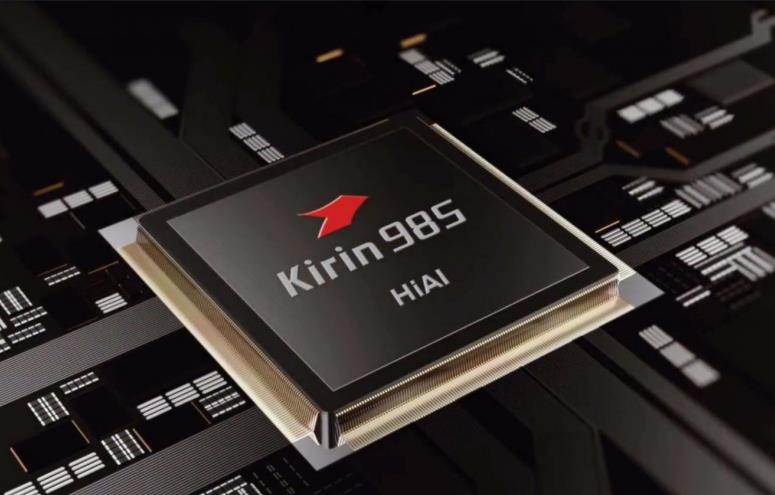
Yesterday (15th April 2020), Honor, the Huawei subsidiary, had unveiled the company’s latest mobile processor, the Kirin 985 SoC. The chipset is an octa core processor and is 5G enabled. Now, George Zhao, the President of Honor, has stated that the chipset will be positioned between the flagship Kirin 990 and mid range Kirin 820 chipset, and will be aimed at device priced under 3000 Yuan (roughly 420 US Dollars).
The HiSilicon Kirin 985 5G chipset has been proprietarily developed and is the third 5G ready mobile processor that the company has launched. In an interview, the senior Honor official answered questions regarding its newly launched chip. According to George, the Kirin 985 SoC is meant to act as a bridge and fill the gap between the Kirin 990 and Kirin 820.
The processor is a flagship unit and will be shipped with devices carrying a price tag under 3,000 Yuan. In other words, it will be a more viable offering in budget flagship smartphones that does not compromise too much on performance over the company’s faster Kirin 990 5G SoC. The Chinese tech giant is placing an increasing emphasis on 5G networking as it is the future of smartphones and cellular data.
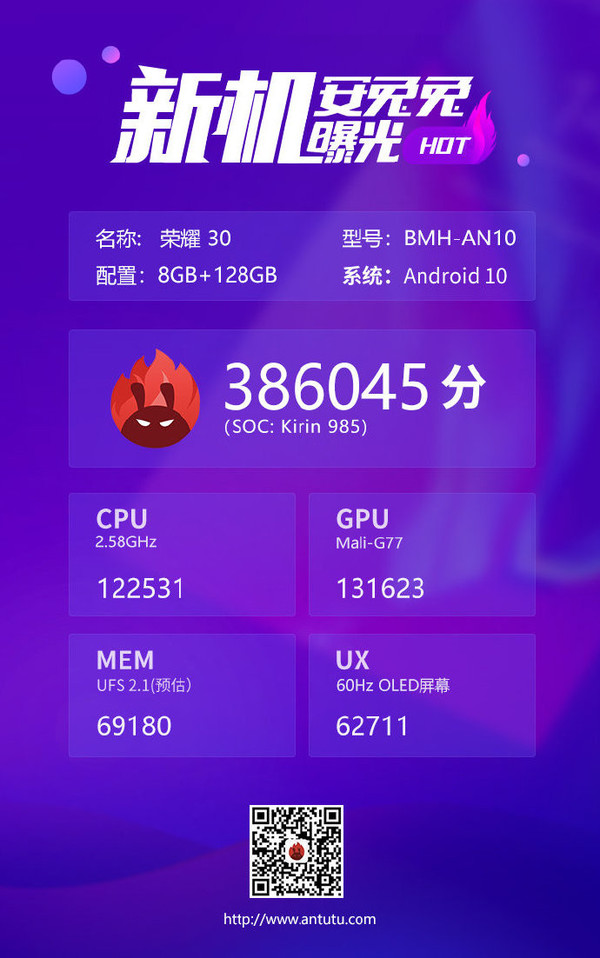
The HiSilicon Kirin 985 houses an integrated 5G modem alongside the new Mali-G77 GPU. It also features the same dual core NPU as the Kirin 990 and has been specifically designed for improvements on “processing power, communication capabilities, thermal and structural design.” Previously, we had reported on the processor crossing the 380,000 mark on AnTuTu benchmark ratings, so it seems that the chip is powerful, to say the least.
Last year, HMD Global became the first company to launch the Nokia 9 PureView as the world’s first phone with penta-lens setup. The camera capabilities of the phone weren’t very impressive, and it was driven by the older Snapdragon 845 chipset. The rumor mill has been consistently spilling information on the successor phone that is expected to debut as Nokia 9.3 PureView. Recent reports have claimed that it may debut along with Nokia 7.3 in Q3 2020. Some of the key details of the phone have also surfaced in the recent weeks. HMD Global Chief Product Officer, Juho Sarvikas has hinted the color variants of the Nokia 9.3 PureView.
I don't know whats going on here (as usual). I'm more like Polar Night and something new bold like we have with copper for lighter color…
A Twitter account that is known for credible leaks on Nokia phones carried out a poll on the expected color editions of the Nokia 9.3 PureView. Surprisingly, Sarvikas not only acknowledged the poll but also, he stated that he prefers Polar Night color and a copper-like light and bold color. Since the CPO of the company is himself is talking about the color variants of the Nokia 9 PureView, the handset may arrive in the suggested colors.
Recent reports have revealed that the Nokia 9.3 PureView could be coming with a screen that supports a refresh rate of 120Hz. The latest Snapdragon 865 mobile platform may power the device and it debut as yet another Android One device running on Android 10 OS.
The penta-lens setup of the Nokia 9.3 PureView could be led by a 108-megapixel primary lens. It may arrive with a 48-megapixel camera on the front. The other details of the smartphone are currently under the wraps.
LineageOS, the most-popular aftermarket Android distribution was recently updated to version 17.1 based on Android 10. When it happened, a number of devices soon garnered official support and we even made an entire list of official devices back then. Now, the Exynos Galaxy S9 / Galaxy S9 Plus and Galaxy Note 9 has been added to the list, in addition to Realme 2 Pro, however, it only supports LineageOS 16 for now.
The Exynos-powered Galaxy S9, Galaxy S9 Plus, and Galaxy Note 9 have been lately receiving unofficial builds of LineageOS 17.1 by a number of developers on the XDA Developers forum. But now, these devices are now finally receiving official builds for the first time. For comparison, the LineageOS project still does not support the Snapdragon variant of these smartphones yet.
The officially supported LineageOS 17.1 Galaxy S9, Galaxy S9 Plus, and Galaxy Note 9 models are as listed below.
As mentioned earlier, the Realme 2 Pro (RMX1801) is also now officially supported by LineageOS project. But unlike the above-mentioned Samsung devices, the builds are limited to LineageOS 16 based on Android Pie. Hopefully, it will gain support for LineageOS 17.1 once the company rolls out the stable Realme UI update to it.
Sadly, the legendary Redmi Note 4, well-known in the custom ROM community has been dropped support for LineageOS as the maintainer no longer has the device with him.
We use cookies on our website to give you the most relevant experience by remembering your preferences and repeat visits. By clicking “Accept”, you consent to the use of ALL the cookies.
This website uses cookies to improve your experience while you navigate through the website. Out of these, the cookies that are categorized as necessary are stored on your browser as they are essential for the working of basic functionalities of the website. We also use third-party cookies that help us analyze and understand how you use this website. These cookies will be stored in your browser only with your consent. You also have the option to opt-out of these cookies. But opting out of some of these cookies may affect your browsing experience.
Necessary cookies are absolutely essential for the website to function properly. This category only includes cookies that ensures basic functionalities and security features of the website. These cookies do not store any personal information.
Any cookies that may not be particularly necessary for the website to function and is used specifically to collect user personal data via analytics, ads, other embedded contents are termed as non-necessary cookies. It is mandatory to procure user consent prior to running these cookies on your website.