OnePlus will be launching the OnePlus 8 series in the coming month. Some reports had claimed that the OnePlus 8 and OnePlus 8 Pro may go official by mid-April. However, some contradictory information claim that the Chinese firm may postpone the launch to the end of April due to the COVID-19 outbreak. The specifications of the OnePlus 8 duo have surfaced in bits and pieces from multiples sources in the recent reports. Few hours ago, reliable tipster Ishan Agarwal shared the specs sheet the upcoming OnePlus 8 and 8 Pro phones.
OnePlus 8 Pro specifications (Rumored)
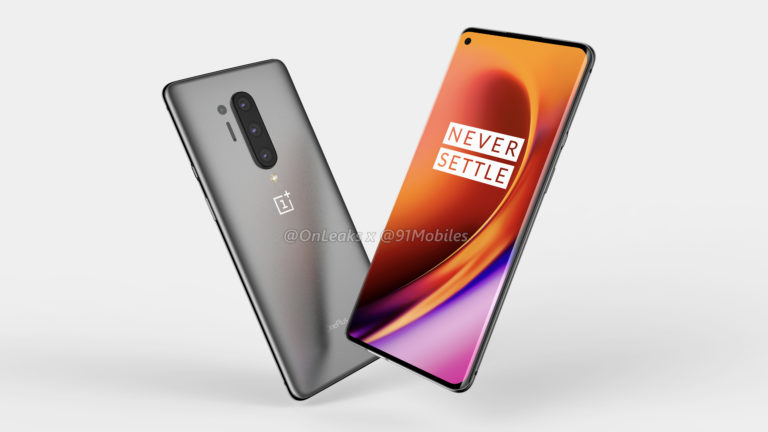
The new leak states that the OnePlus 8 Pro will be coming with a 6.78-inch quad HD+ resolution supporting screen. The S-AMOLED display will carry support for a refresh rate of 120Hz. The CAD renders of the phone that had appeared few months ago had revealed that the phone will be sporting a curved display with a punch-hole for the 16-megapixel selfie snapper. The back panel of the device will feature 48-megapixel + 48-megapixel + 8-megapixel + 5-megapixel quad camera setup.
OnePlus 8 Pro render
The OnePlus 8 Pro will be fueled by the Snapdragon 865 mobile platform. It will come in 8 GB and 12 GB LPDDR5 RAM versions and UFS 3.0 storage options of 128 GB and 256 GB. The handset will draw power from a 4,510mAh battery that will be equipped with 30W Warp Charge 30T, 30W wireless fast charging and 3W reverse wireless charging. It will be an IP68 68 rated dustproof and water-resistant device and it will come in color options like blue, black and green.
The OnePlus 8 will be coming with a slightly smaller 6.55-inch full HD+ resolution supporting S-AMOLED display with 90Hz refresh. It will be flaunting a flat screen with a punch-hole design. It will also feature a 16-megapixel sensor for shooting selfies. The rear side of the phone will have a 48-megapixel + 16-megapixel + 2-megapixel triple camera system.
OnePlus 8 render
The SD865 powered OnePlus 8 will come in 8 GB and 12 GB LPDDR4X RAM versions. It will sell in UFS 3.0 options like 128 GB and 256 GB. The device will be backed by a 4,300mAh capacity battery. The handset will only support 30W Warp Charge 30T. It won’t carry an IP rating. Glow, black and green are the three color variants of the OnePlus 8. There is no word on the pricing of the OnePlus 8 and 8 Pro smartphones.
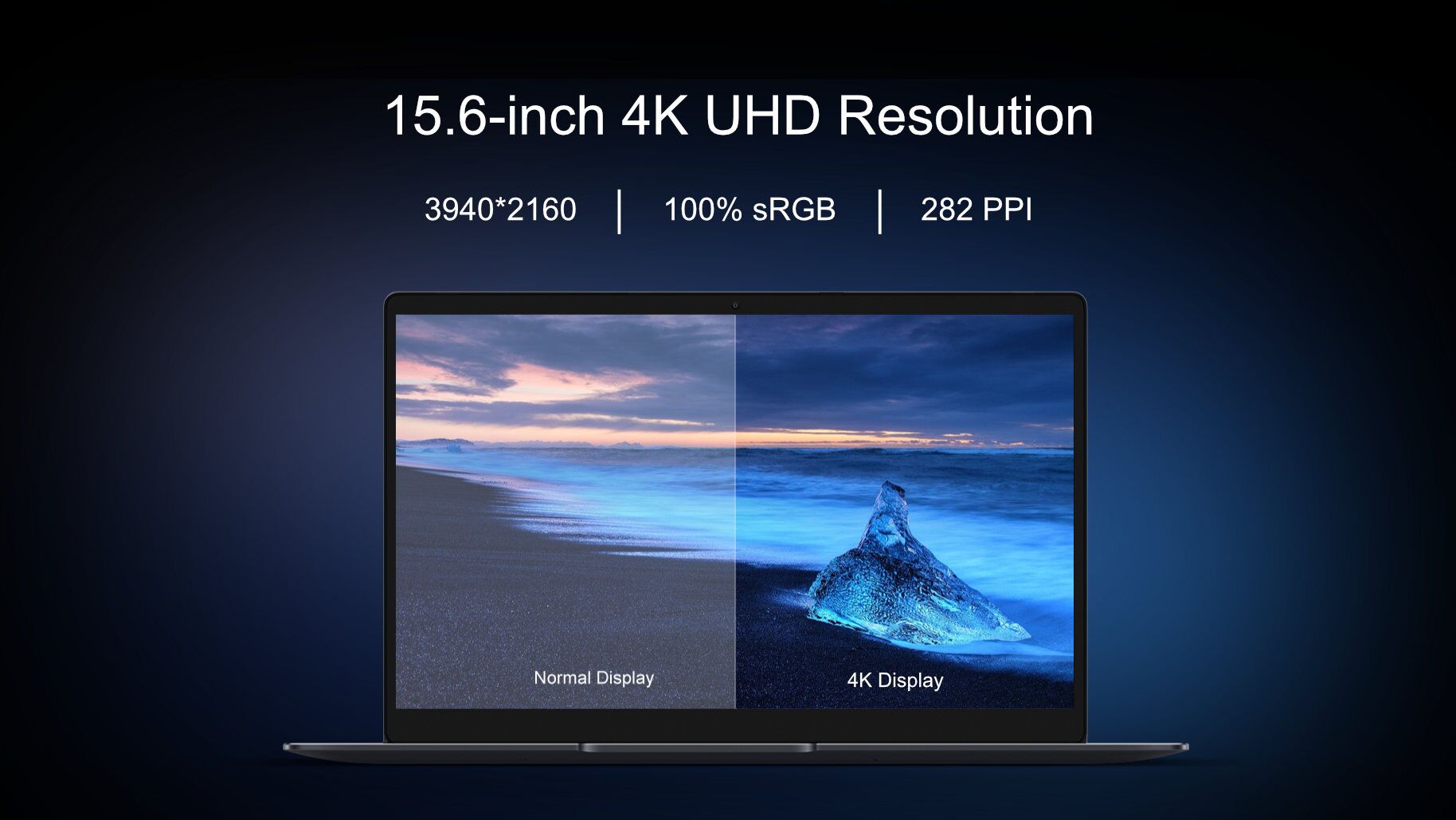
As announced a few days ago, Chuwi AeroBookPro has finally surfaced on the IndieGoGo. The laptop features a 15.6-inch 4K UHD display and is powered with an Intel i5-6287U processor. There’s an 8GB DDR4 RAM and 256 GB SSD that enhances the device performance. The interested users can grab the laptop for $499 via IndieGogo campaign.
Precisely, Chuwi AeroBook Pro is an energy-efficient and loaded performance machine packed with an Intel i5 6287U processor with 3.5GHz clocking speed. The device is capable of diligently supporting the graphics-intensive work or multimedia editing work. Moreover, the 4K Ulta HD display further improves the viewing experience while maintaining the quality. The panel supports 10-bit HDR content along with a 100% sRGB color gamut. Overall, the display features 282PPI of pixel density and achieves maximum brightness of 340 nits.
The laptop carries 256 GB SSD comes via SATA port, meanwhile, the M.2PCIe SSD port remains empty.
Nevertheless, the Chuwi AeroBoook Pro runs on Windows 10 Home and its 60Wh battery offers 8 hours of video playback.
It is among the best Hackintosh laptop available right now in the market. The full-metal design and powerful hardware onboard don’t make it unaffordable. It is available right now from Indiegogo at a cost-effective price of $499 ($100 discount is inclusive of the usual price). More information about the device can be accessed over here.
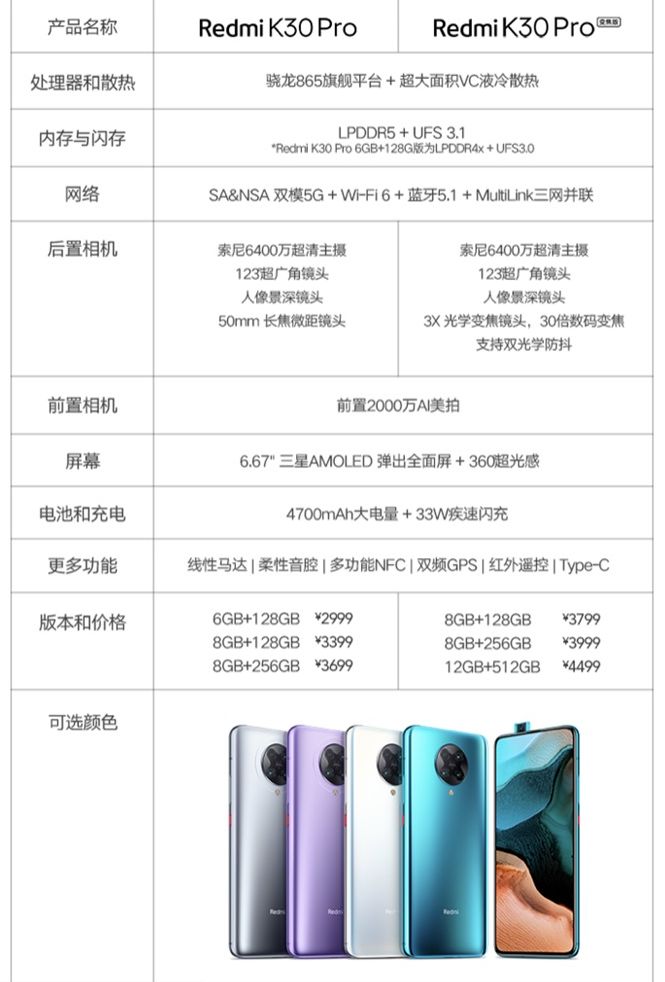
On Tuesday, Redmi announced the Redmi K30 Pro and Redmi K30 Pro Zoom Edition smartphones in China. Both handsets are now up for pre-orders and will be available for purchase in the home market from March 27. The Chinese firm had announced the Zoom Edition in two models. A new third variant has been spotted on the JD.com listing of the smartphone.
At the unveil event, Redmi confirmed that the 8 GB RAM + 128 GB storage and 8 GB RAM + 256 GB storage version of the Redmi K30 Pro Zoom Edition phone are priced at 3,799 Yuan (~$534) and 3,999 Yuan (~$562). Xiaomi’s store listing of the K30 Pro Zoom Edition on JD.com reveals a higher model with 12 GB of RAM + 512 GB storage. It is priced at 4,499 Yuan (~$634). The new variant is not yet available for buying. Probably, it will be listed for purchase sometime later.
Also, the standard Redmi K30 Pro smartphone was announced in three versions such as 6 GB RAM + 128 GB storage, 8 GB RAM + 128 GB storage and 8 GB RAM + 256 GB storage. They are priced at 2,999 Yuan (~$421), 3,399 Yuan (~$478) and 3,699 Yuan (~$520). Only the first two versions of the phone are listed for purchase on the official Xiaomi Mall website. The 8 GB RAM + 256 GB storage edition of the K30 Pro will go on sale in the coming month. Currently, the K30 Pro is the cheapest Snapdragon 865 mobile platform powered phone in the world.
The Redmi K30 Pro and K30 Pro Zoom Edition smartphones comes in four colors such as Moonlight White, Sky Blue, Purple and Space Gray. The Chinese firm is also selling custom cases in partnership with Keith Haring Foundation for the K30 Pro duo. Each case can be bought for 49 Yuan (~$7).
During the launch of the Galaxy S20 series in February, Samsung also announced new TWS earbuds called the Galaxy Buds+. The new earbuds boast nearly double the battery life of last year’s Galaxy Buds without a change in the dimensions. Want to know how Samsung was able to pull it off?
Galaxy Buds+ Thom Browne Edition – same dimensions as the Galaxy Buds but with almost double the battery life
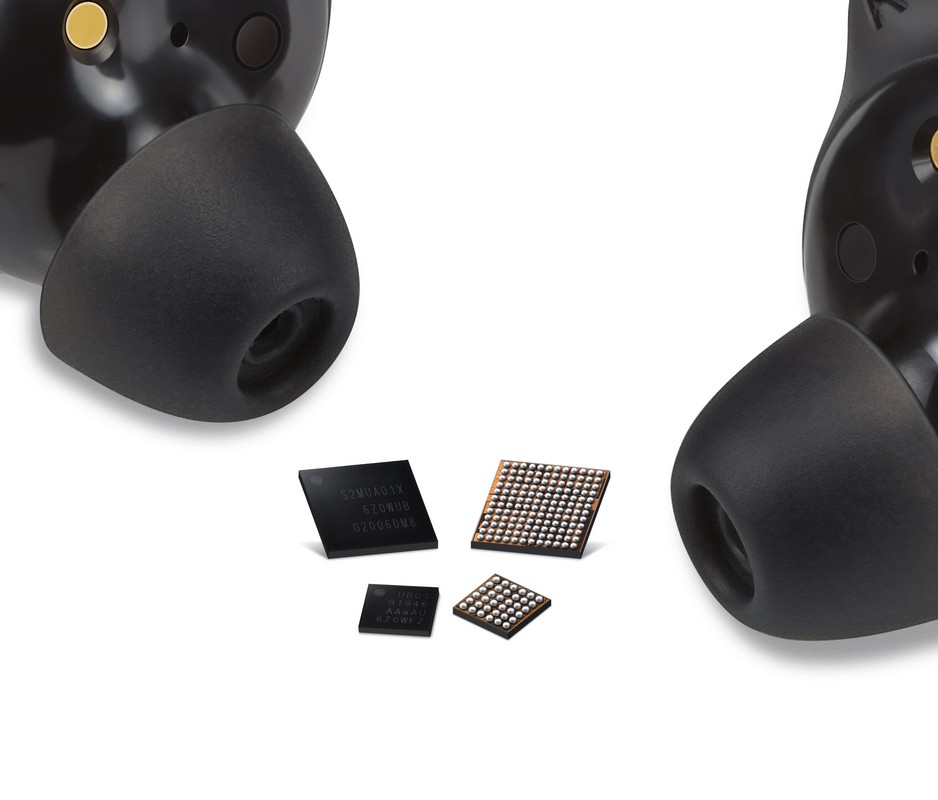
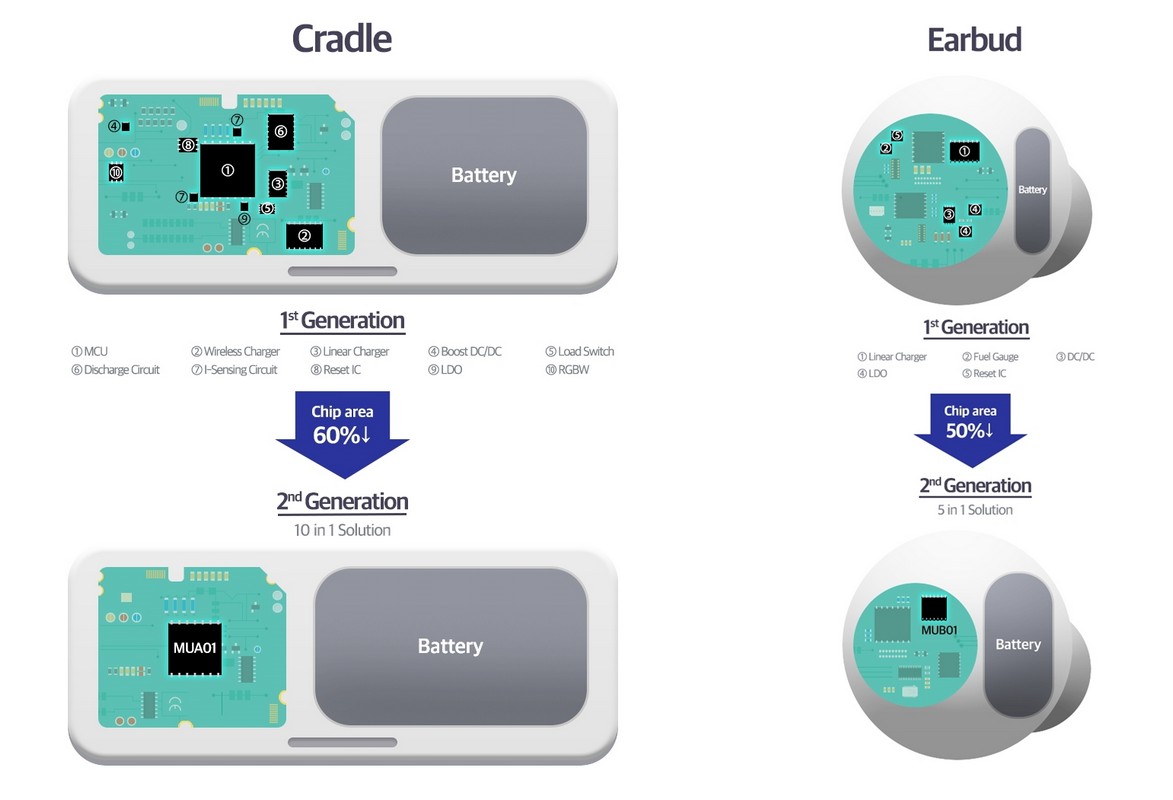
According to a press release by the tech giant, they were able to fit a bigger battery into the Galaxy Buds+ while keeping the dimensions of the 2019 Galaxy Buds as a result of the all-in-one power management integrated circuits (PMIC) they designed for the earbuds.
These all-in-one power ICs, called MUA01 and MUB01, are the first of their kinds in the industry and they have been specifically optimized for use in TWS earbuds.
What Samsung has achieved with the ICs is no small feat. They have been able to combine multiple components (up to 10) into a single chip and thus created more room for a bigger battery for the earbuds. To further understand the scale of what they have done, imagine if Samsung decided not to increase the battery capacity but rather shrunk the size of the earbuds, thus making them even smaller while maintaining the battery life of the previous generation.
Samsung says the MUA01 IC was designed for earbuds while the MUB01 IC was designed for charging cases. Part of the components the PMICs contain include the switching chargers and discharge circuits. By doing this, they freed up more space occupied by components for a bigger battery.
These PMICs are also the first in the world to support both wireless (WPC’s Qi 1.2.4 standard) and wireless charging in a single chip. The MUA01, which is designed for earbuds, even has a microcontroller unit (MCU) and embedded Flash (eFlash) to provide the option of modifying its firmware to work with other applications.
Samsung’s press release also revealed that the ICs support power line communication (PLC) which allows them to talk to each other via the charging pins and share info such as battery levels and whether the earbuds are inside the case.
MUA01 and MUB01 are being mass-produced already, and while they already appear in the Galaxy Buds+, we may see them in other TWS earbuds in the future.
Xiaomi has several affordable flagships and high-end phones sold at very interesting prices in its portfolio. The latest one launched is the Redmi K30 Pro: one of the most affordable smartphones equipped with the best Qualcomm’s chipset. Right before, Xiaomi released the Mi 10, another affordable flagship. Which one to choose between the two flagship killers? Is it worth giving a chance to Xiaomi’s most recent flagships or the latest 2019 high-end camera phone Xiaomi Mi Note 10 is enough for your needs? We will try to answer these questions with an in-depth specs comparison between Redmi K30 Pro, Xiaomi Mi 10 and Xiaomi Mi Note 10.
Xiaomi Redmi K30 Pro vs Xiaomi Mi 10 vs Xiaomi Mi Note 10
Xiaomi Mi 10
Xiaomi Mi Note 10
Xiaomi Redmi K30 Pro
DIMENSIONS AND WEIGHT
162.6 x 74.8 x 9 mm, 208 g
157.8 x 74.2 x 9.7 mm, 208 g
163.3 x 75.4 x 8.9 mm, 218 g
DISPLAY
6.67 inches, 1080 x 2340p (Full HD+), Super AMOLED
6.47 inches, 1080 x 2340p (Full HD+), AMOLED
6.67 inches, 1080 x 2400p (Full HD+), Super AMOLED
4780 mAh, fast charging 30W, Fast wireless charging 30W
5260 mAh, fast charging 30W
4700 mAh, fast charging 33W
ADDITIONAL FEATURES
Dual SIM slot, reverse wireless charging 10W, 5G
Dual SIM slot
Dual SIM slot, 5G
Design
My favourite design is the one of the Xiaomi Mi 10. It has a display with curved edge and a punch-hole selfie camera, as well as the most narrow bezels. Further, its rear side is elegant and minimalistic, compared to the Redmi K30 Pro. Since it has a notch-less and holeless display thanks to its pop-up selfie camera, the second place goes to the Redmi K30 Pro, despite the huge circular camera module on the rear side. But Xiaomi Mi Note 10 is still a pretty beautiful device with its curved display, high screen-to-body ratio and non-invasive camera module.
Display
Besides coming with a more elegant look (at least in my opinion), Xiaomi Mi 10 also boasts the most impressive display. It is a flagship-class HDR10+ compliant AMOLED panel with a Full HD+ resolution, a high 90 Hz refresh rate, a 180 Hz touch-sampling rate, and high DCI-P3 coverage. Right after it, we got the Redmi K30 Pro which still comes with HDR10+ and boasts a complete DCI-P3 gamut, but it lacks a high refresh rate. Xiaomi Mi Note 10 has an inferior panel to both Redmi K30 Pro and Xiaomi Mi 10, but its display is still great since it provides a high image quality thanks to HDR10 and DCI-P3 gamut. In each case, you get an AMOLED panel with an in-display fingerprint scanner.
Hardware/Software
It is a close fight between Redmi K30 Pro and Xiaomi Mi 10. Both are fueled by the Snapdragon 865 that is the best chipset ever launched by Qualcomm. It supports 5G thanks to an external dual-mode Snapdragon X55 modem. While Redmi K30 Pro has a faster UFS 3.1 native storage, Xiaomi Mi 10 offers more RAM (12 GB) in its most expensive configuration. Given the marginal difference between UFS 3.0 and UFS 3.1, the 12/256 GB configuration of the Xiaomi Mi 10 wins. Xiaomi Mi Note 10 has just a midrange chipset: the Snapdragon 730G, but it still provides great performance, including the GPU. The Mi Note 10 is still based on Android 9 Pie, while Xiaomi Mi 10 and Redmi K30 Pro offer Android 10 out of the box.
Camera
Finally, Xiaomi Mi Note 10 takes a gold medal: it is the best camera phone of the trio. The main sensor of the rear camera is the same as the Xiaomi Mi 10, but the secondary sensors are superiors. The handset includes a dual telephoto lens with optical zoom up to 5x, a 20 MP ultrawide sensor and a 2 MP dedicated macro camera, so it boasts a Penta-camera setup. Xiaomi Mi 10 provides a stunning photo quality, but unfortunately, it lacks a telephoto sensor, replaced by a standard depth sensor, a macro camera, and an ultrawide lens. Even the Redmi K30 Pro has a telephoto sensor, but unlike its rivals, it does not have a 108 MP main camera; instead, it comes with a 64 MP sensor supporting OIS.
Battery
Xiaomi Mi Note 10 has the biggest battery and it should also have lower energy consumption thanks to the absence of 5G, so longer battery life. But Xiaomi Mi 10 still comes with a very nice 4780 mAh battery and it is the only to support wireless charging and reverse wireless charging, so do not underestimate it. The 4700 mAh battery of the Redmi K30 Pro should let it be at the same level as the Xiaomi Mi 10; note that Redmi K30 Pro may have a lower energy consumption than Xiaomi Mi 10 because it does not have a 90 Hz display draining more battery.
Price
The starting prices of Redmi K30 Pro and Xiaomi Mi 10 in China are about €390 and about €530, respectively. Xiaomi Mi Note 10 is known as the Mi CC9 Pro in China and it starts from $399, while it is currently available for less than €400 globally. Xiaomi Mi 10 has a lower value for money, but it is the winner of this comparison since it features wireless charging, a better display, and best performance. But if you do not need a 90 Hz display, an astonishing camera, and wireless charging, Redmi K30 Pro is enough for you. Xiaomi Mi Note 10 lacks 5G and it has midrange-class hardware, but it actually offers the best photo quality, the biggest battery, and the most affordable price.
One reason why the coronavirus was able to spread easily is the inability to detect the virus in the asymptomatic stage. The story is told of a reverend in Washington DC who was down with the flu and thought he had recovered. He then went on to give Holy Communion and shook hands with hundreds of parishioners. Unfortunately, he later tested positive for COVID-19 but by then he had already infected several others. Another one, three attendees at a Biogen conference in Boston attendees who showed no symptoms during the meeting later tested positive for COVID-19. Boston currently has 284 confirmed cases as of March 25 and 104 were linked to the conference.
In order to stem the tide, The New York Community Trust has launched a crowdfunding exercise on Indiegogo for a test that could help detect Coronavirus and COVID-19 cases before they start exhibiting any symptoms. The funding could provide testing for a large number of persons who may have been infected in order to quickly identify them before they can expose others. Such patients usually don’t show symptoms like a fever, cough or difficulty breathing.
A recent research conducted by a team led by Jeffrey Shaman, PhD at the Columbia University Mailman School discovered that two-thirds of all documented infections in China were caused by undocumented infections with mild, limited, or no symptoms. According to Dr. Shaman: “Depending on their contagiousness and numbers, undetected cases can expose a far greater portion of the population to the virus than would otherwise occur.”
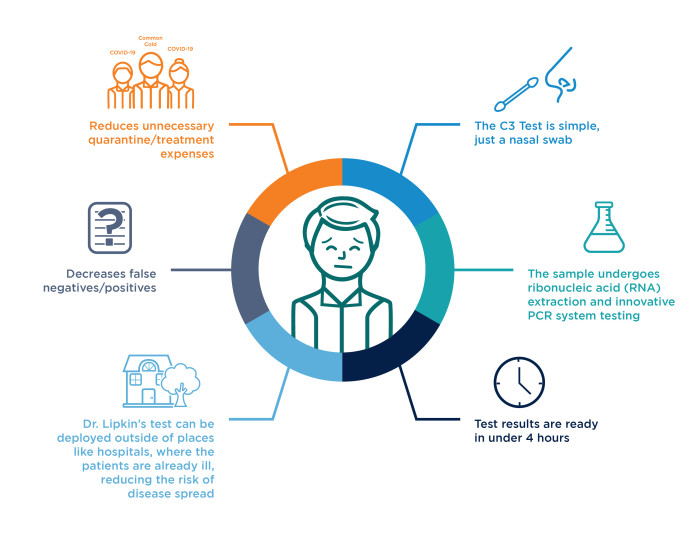
The C3 Test, as it is called, is a multiplex assay with a high level of accuracy, is ultra-sensitive and rapid. The samples can be processed in large quantities, thus speeding up the waiting time for those who may be in line to get tested. The test was created by Dr. Ian Lipkin, an internationally renowned expert on pathogen discovery, and his team at the Columbia University Mailman School’s Center for Immunity and Infection (CII).
Most importantly, the C3 Test can accurately detect coronavirus infection even among patients with low viral loads thus exhibiting no symptoms, with results ready in four hours. the test can also be carried out outside the hospital settings.
Importantly, this new C3 Test can decrease both false negatives and false positives, reducing not only the number of people who unknowingly spread the virus, but also reducing resources spent on quarantining or treating those who are ill due to something else.
In addition, the Lipkin team is working on multiple strategies for prevention and treatment and this diagnostic capability provides the foundation for these parallel efforts. Thus if you back this project, you are also helping find a possible treatment for the disease apart from providing rapid tests to a large number of persons.
Both New York Community Trust and Indiegogo have been magnanimous to waive all fees and costs in connection with the contributions to the fund. If you would like to back this project, follow this link.
The Honor 30S is one of Honor‘s upcoming smartphones. It will likely be the first phone to be powered by the new Kirin 820 5G processor. Ahead of the launch which is scheduled for March 30, a render showing a new color variant has surfaced on the web.
Before this leak, we have seen the phone in orange and gradient blue. Now, we know there will be a green variant of the phone too. The image was shared on Weibo earlier today.
The green variant of the Honor 30S has the same “light streaks” design as the other two colorways. Its camera housing is also black.
This is not Honor’s first green phone and will likely not be the last. Just last month, the manufacturer announced a green variant of the Honor 9X.
The Honor 30S will have a 1080p display with a punch hole. The processor will be paired with 8GB of RAM and 128GB of storage according to an AnTuTu benchmark result and it will run Android 10 out of the box.
EMUI 10.1 has been long tipped to be released soon. Earlier today, Huawei confirmed it to debut on P40 series, whose launch is set for tomorrow. Additionally, the official Twitter account of EMUI has been teasing the new features for a couple of days now.
EMUI 10.1 Official Teasers
1 of 3
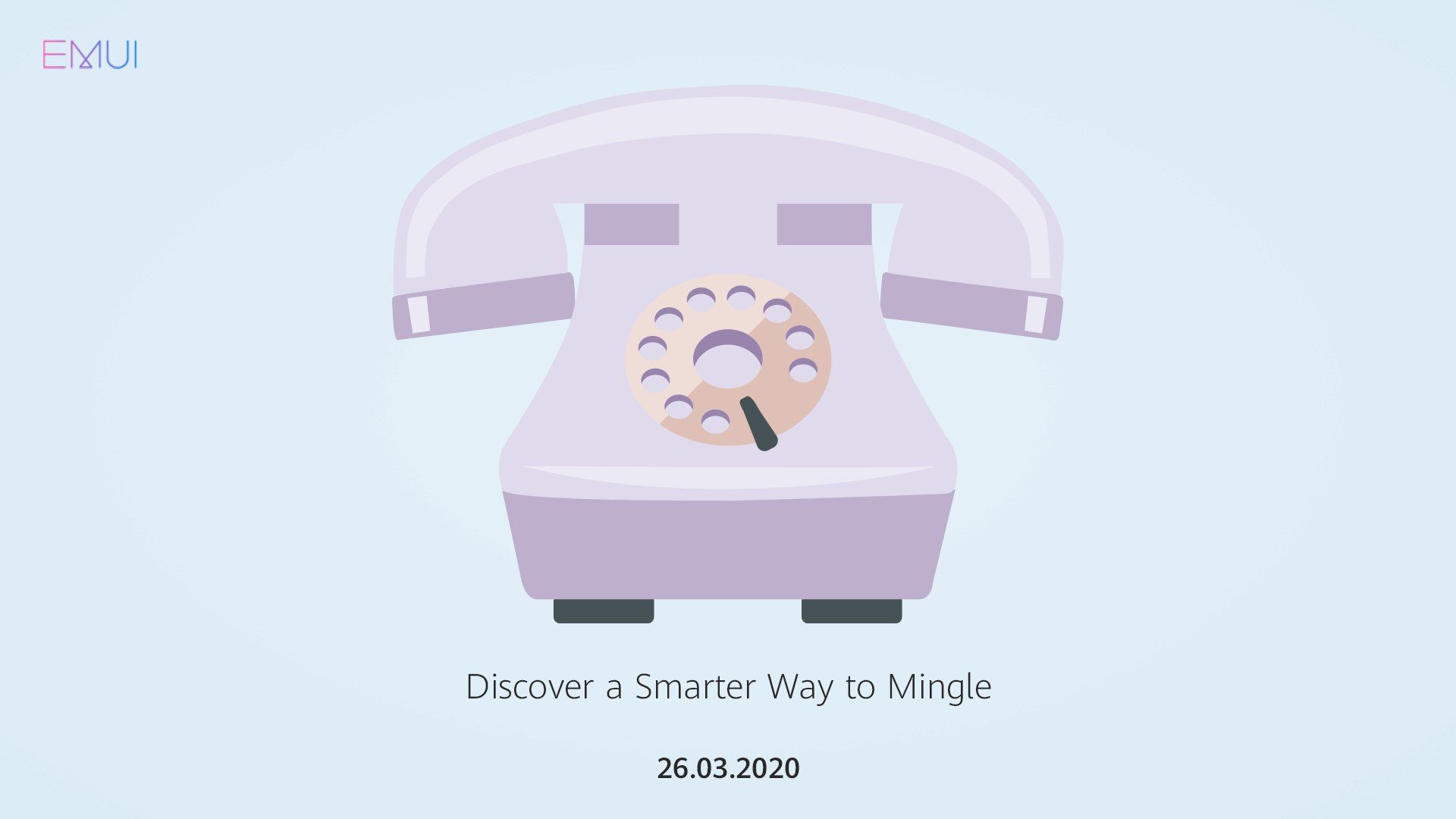
The official EMUI handle on Twitter posted the first teaser picture on March 23. This image displays a telephone with ‘Discover a Smart Way to Mingle’ text written below it followed by the release date, which happens to 26th March (tomorrow). Although the poster does not reveal anything, we expect it to be some new feature to enhance group calls, which might be applicable for both audio and video calls.
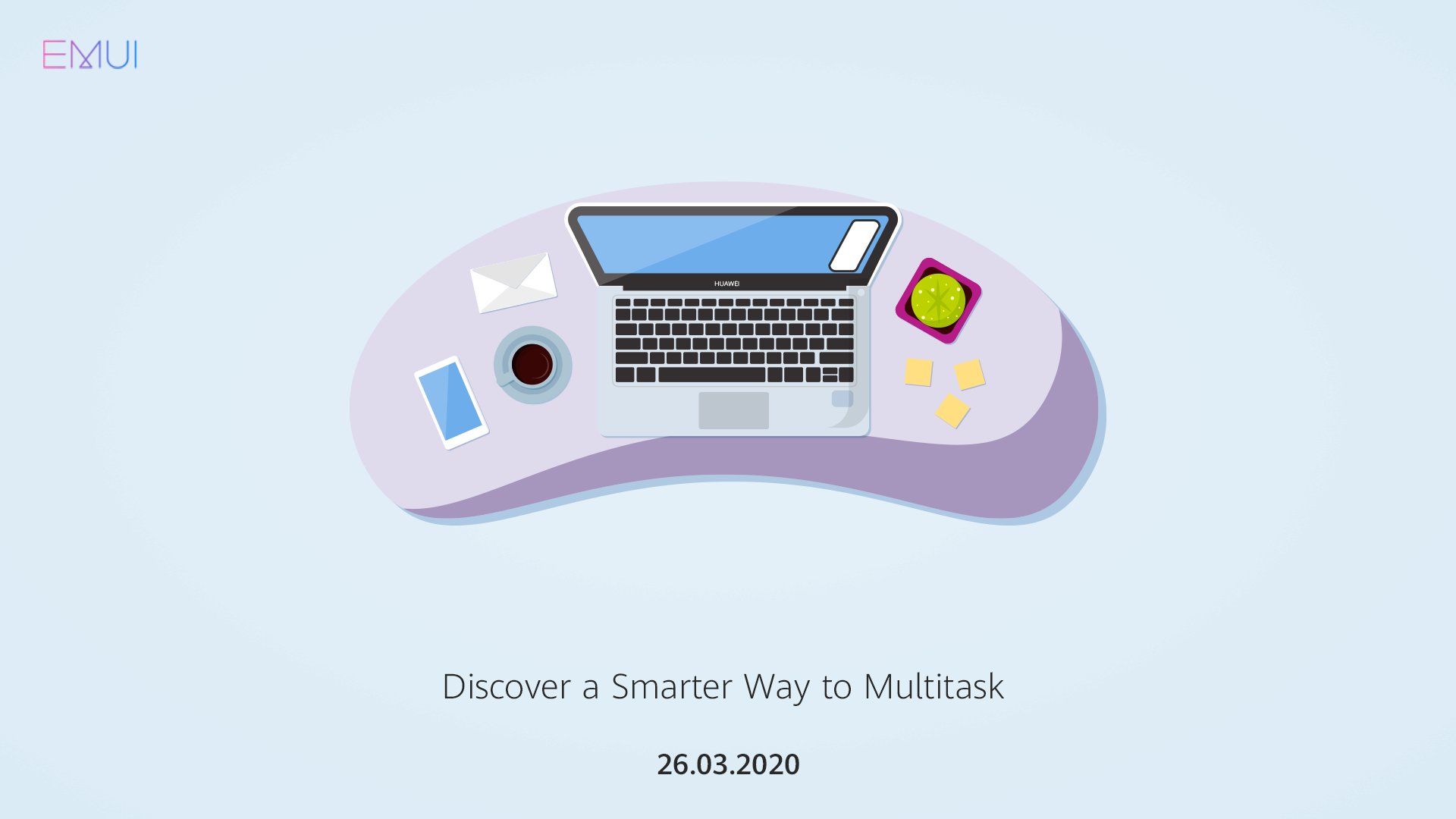
Coming to the second teaser poster, which the account posted yesterday (March 24), has a desk with a laptop, envelope, coffee, snacks and a phone on it. Below that, the text reads ‘Discover a smarter Way to Multitask’. According to us, this teaser has to do with new improvements the company has planned for the already available ‘Multi-Screen Collaboration’ feature, which will further enhance multi-tasking on devices running EMUI 10.1.
Lastly, the third teaser which was posted today is a picture of a handheld gaming console with a quote saying ‘Discover a Smarter Way to Unwind’. Here, the image itself gives away that it is relating to gaming on smartphones. Probably, the new iteration of EMUI will bring an improved GPU Turbo and extra-added features to improve the overall gaming experience.
Anyway, we don’t have to wait too long as everything about EMUI 10.1 will be official tomorrow at the Huawei P40 series launch.
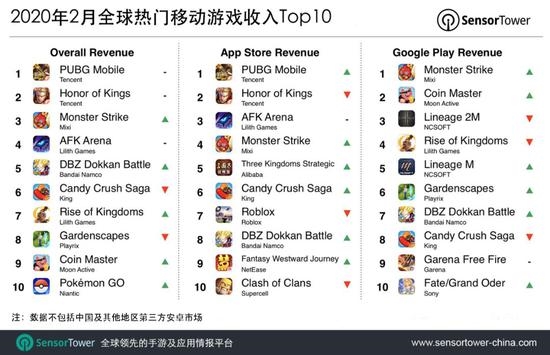
Life in China is gradually returning back to normal but the past few months have been a tough one for the country due to the Coronavirus epidemic. The government had to effect a lockdown which made it impossible for people to move freely and that was highly helpful in curbing the spread. Online gaming and TV came to the rescue of Chinese families who had to adjust their routine in the face of the outbreak and quarantine efforts. That has translated to huge revenue for the game developers, as per a report by Sensor Tower. Although the report is a compilation of data on ap stores globally, most of the revenue came from China.
Data collated by the firm shows that in February 2020, Tencent’s “PUBG Mobile” and “Peace Elite” attracted more than US $191 million in revenue globally, five times that of the same period last year. The two games were ranked first in the global mobile game bestseller list. 71% of the revenue came from the Chinese market while the US market accounted for just 7.3%.
King of Glory and its overseas edition ranked second with $121 million in revenue. The Chinese version contributed 92.6% of revenue, followed by the Thai version “Arena of Valor” which contributed 3.7%.
Mixi’s “Monster Strike” is ranked as the third highest-grossing game which AFK Arena is ranked at the fourth position. DBZ Dokkan Battle came in at the fifth spot and Candy Crush Saga is ranked sixth.
The rest of the top 10 list is occupied by Rise of Kingdoms in number seven spot, Gardenscapes ranked eighth, Coin Mast in ninth position and Pokemon Go complete the top 10.
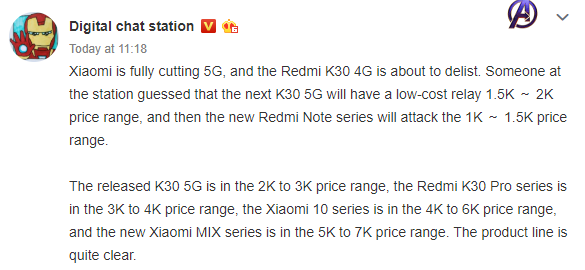
There are big changes coming to the current Redmi lineup according to info from China. The source, who is known for credible leaks, says the changes are based on the manufacturer betting big on 5G.
Redmi K30 4G
According to Digital Chat Station, Xiaomi (Redmi) will discontinue the Redmi K30 4G that it announced in December 2019. There is no news on how soon that will happen but even if its six months after (3 months from now), it sure is a big deal.
The Redmi K30 4G is powered by the Snapdragon 730G processor and is sold in India as the POCO X2. While 5G is yet to be available in India, it is already available in lots of cities in China. However, Redmi decided to launch both a 4G version and a 5G version of the phone in its home country, so those who do not want to pick up a 5G phone have an option.
The leaker adds that Redmi is planning a new Redmi K30 5G that will be cheaper than the current model. This version may be referred to as a “Lite” or “Youth Edition”. The price range is said to be between ¥1500 (~$211) and ¥2000 (~$281). The base model of the Redmi K30 5G is ¥1999, so this “Redmi K30 5G Lite” should sell for less.
The Redmi Note 9 series is yet to launch in China. A few weeks ago, it was reported that the series may not be announced in the country since they are 4G phones and thus do not meet Lu Weibing’s “5G for China” requirement.
The second part of the leak says Xiaomi and Redmi’ current product lineup (will) follow the price range below:
Redmi K30 5G – ¥2000 (~$281) to ¥3000 (~$422)
Redmi K30 Pro – ¥3000 (~$42) to ¥4000 (~$562)
Xiaomi Mi 10 series – ¥4000 (~$562) to ¥6000 (~$844)
New Mi MIX series – ¥5000 (~$703) to ¥7000 (~$984)
There is no info on when the new Redmi K30 5G will launch but we expect more details will surface next month.
According to industry sources, Samsung and LG will send a total of 430 engineers to Vietnam to continue production in their respective manufacturing plants in the country. These workers will be exempted from Vietnam’s quarantine policy.
Samsung logo at Samsung Customer Service Center in Krakow, Poland on 11 January 2019. (Photo by Beata Zawrzel/NurPhoto via Getty Images)
Since the whole world is going through the COVID-19 pandemic, most of the companies have halted producing goods in their manufacturing plants. Some have followed this suit as a precaution, while others were compelled to carry out due to government orders. Despite this situation, Samsung Electronics and LG Electronics have planned to send 430 engineers from their home country South Korea to their manufacturing plants in Vietnam with special permission from the government.
Since February 22, the Vietnamese government has been banning foreigners from entering the country. Additionally, from February 29th, the government has also suspended visa-free travel for South Koreans and it has even stopped issuing new work visas to control the coronavirus outbreak. However, the government will exempt Korea’s top two electronics giants in this regard by allowing them to send a certain number of their citizens to their manufacturing hubs to maintain production lines.
As per industry sources, Samsung will be dispatching 180 engineers to work at its OLED plant, whereas LG will be sending 250 workers to support the production of smartphones, automotive parts, and home appliances. These people will be traveling on a separate chartered Asiana Airlines flight.
Qualcomm‘s latest Snapdragon 865 chipset is already powering some flagship models in the market. One thing to note about the models that have so far been released with the Snapdragon 865 chipset is their hefty price tags. Apart from the Redmi K30 Pro which was announced recently with a sub-$500 starting price in China, several others like the Mi 10, iQOO 3, Black Shark phone and several others are priced expensively in some cases going beyond $1000 like the Galaxy S20 series and Sony Xperia 1 II.
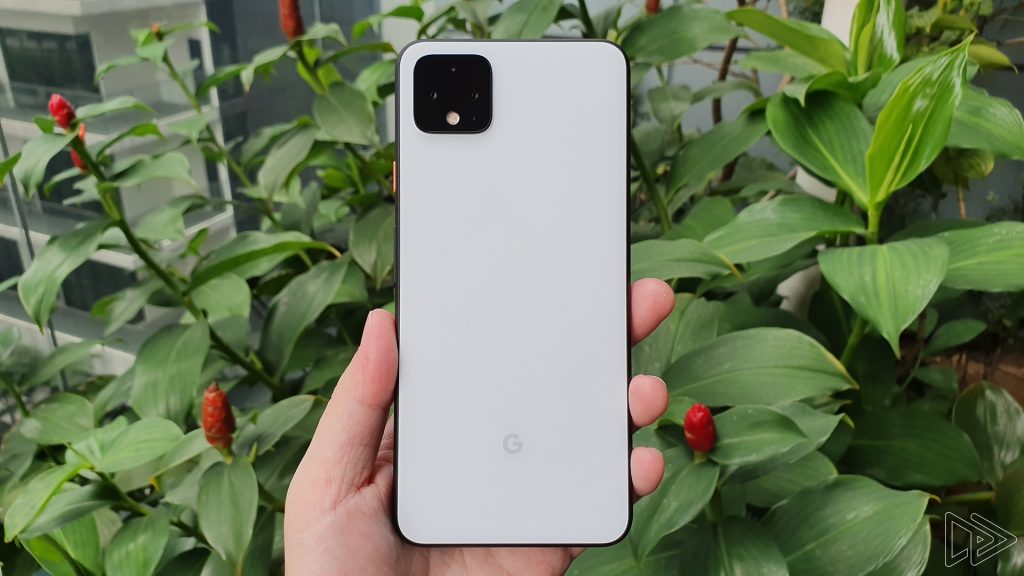
Google Pixel 4
Most of the OEMs, like Xiaomi which is known for its affordable flagship, cited skyrocketing components prices for the high retail prices. The Snapdragon 865 chipset is one of such expensive components. It is more expensive than previous years’ models, partly due to the improvements in the 5G band and others. However, while most OEMs have transmitted the high cost to the end-users, there are reports that Google and LG are both unwilling to use the chipset on their 2020 flagships. Both OEMs are said to have opted for a cheaper chip instead.
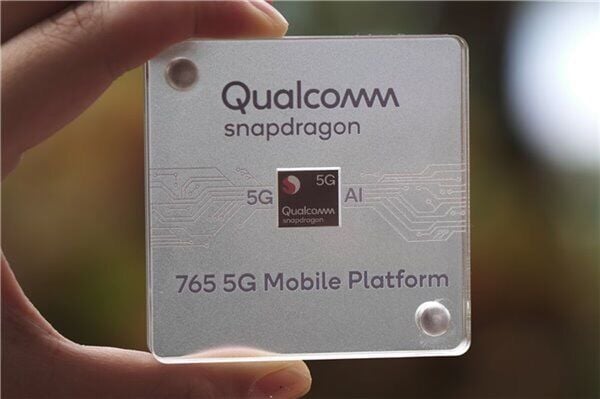
On its part, Google is expected to launch the Pixel 5 series which include the Pixel 5, Pixel 5 XL and Pixel 5a this year. A report by XDA Developers in January had revealed that the Pixel 5 series won’t use a Snapdragon 865 chipset but are equipped with a Snapdragon 765G premium mid-range SoC as seen on the Android repository.
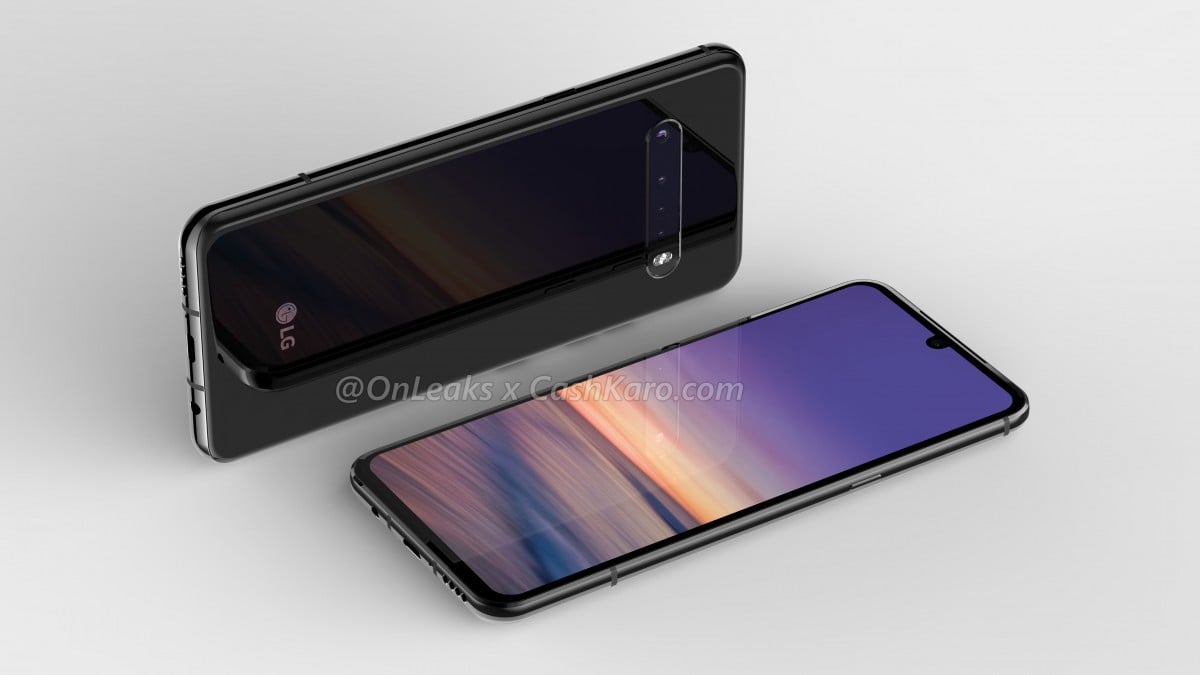
Also, a report by Korean website Naver says that LG is looking to adopt an approach similar to Google’s on the LG G9 ThiQ. The G9 ThinQ will reportedly be powered by a Snapdragon 765G chipset instead of the Snapdragon 865. Recall that this is the same thing HMD global id with the Nokia 8.3 5G which was launched with a Snapdragon 765G chipset. There is also the ZTE Axon 11 5G packing the same Soc. A Vivo model with a Snapdragon 765 SoC had also appeared on GeekBench earlier on.
The Snapdragon 765G is the first Qualcomm modem that is integrated with a 5G. The Snapdragon 865 SoC still has to be bunded with a separate Snapdragon X55 5G modem. Qualcomm is said to have made it compulsory for OEM to integrate the SD865 with the X55 modem. This explains the absence of a 4G version but then, 4G phones won’t fly in the era of 5G. However, this has led to a more delicate motherboard design as well as bigger battery and screen size, thus driving production cost upwards.
In terms of the configuration, the Snapdragon 765G isn’t as fast as the flagship SD 865. It features two Cortex-A76 cores and six Cortex-A55 cores. While the Snapdragon 865 uses four A77 cores and four A55 cores. However, the difference shouldn’t be too noticeable with the right software optimisation in place, something Google can handle.
The coronavirus pandemic keeps throwing a spanner in the works of businesses and individuals alike. Just yesterday, we reported that several phone manufacturers including Apple, Samsung, and OPPO have suspended production in India. Now Xiaomi has announced that its Mi 10 5G launch scheduled for the last day of March has now been postponed.
The announcement was made earlier today by Manu Kumar Jain on Twiter. The MD of Xiaomi India said they had to take the decision after ”careful deliberation”. The official statement added that a new date will be released soon.
We, at #XiaomiIndia, are focusing our energy to support the nation in its fight against #COVID19.
After careful deliberation, we've decided to postpone the launch of #Mi10 in India, which was scheduled for 31st March 2020.
While the Indian launch has been postponed, it appears the global launch scheduled for Friday, March 27 is still on track. The March 27 launch is an online-only event and will be live-streamed.
The Mi 10 5G is the only one of the Mi 10 series coming to India. The more expensive Pro model will not be coming to the country. Manu also revealed last week that the Mi 10 will cost more in India due to the phone being a direct import and an increase in the GST tax on mobile phones. Another reason is the depreciating INR against the USD.
The Xiaomi Mi 10 is a Snapdragon 865-powered phone with a 6.67-inch AMOLED FHD+ display. It has four rear cameras which include a 108MP primary camera. There is a 20MP camera in front for selfies. The phone packs a 4780mAh battery with support for 30W wireless charging and 30W wired fast charging.
Xiaomi Youpin’s official Weibo page has shared a teaser which points to the launch of what looks like an electric scooter. The product is manufactured by Xiaomi’s eco-chain company 70Mai. The brand is best known for its range of smart dashcam and rearview mirrors. The teasers show the product will be launched on March 26 in China.
70 Mai had earlier released a poster which sought to know the feature fans want to see on their electric scooters. The options include keyless ignition, voice command as well as recording function. A sketch of a scooter indeed confirms it is a related product. We can’t say for sure if it will be an electric scooter as other posters have been shared which seems to suggest the product may just be a multifunctional smart display for an e-scooter.
All the same, the display may be the intuitive display that will be on the scooter. The display is shown to support XiaoAI voice assistance, navigation and touch functions. It also supports 4G. In one of the pictures, we can see the handlebar and front wheel of a scooter.
However, the posters tease the display more than the scooter so, it may just be a smart touchscreen display with several functions. Whatever the product will be, 70Mai has got a good record so we expect it to be an awesome product.
YouTube has announced it will default the video playback on its platform to SD quality for the next 30 days. The company is considering this measure to reduce bandwidth usage and relieve networks from unnecessary strains amid COVID-19 global pandemic.
Almost all the coronavirus-affected countries in the world have issued shutdowns to fight back the spread of the virus. Due to this, people have started binge-watching their favorite content on popular video streaming services like Netflix, Amazon Prime Video, YouTube, and others. Thus, the EU, as well as other governing bodies, had previously requested OTT service providers to limit their streams to SD quality to avoid stressing on networks, which might affect critical services like healthcare, banking, businesses, education, and others.
Following the request, Netflix lowered its stream quality to SD (standard) in Europe and also reduced bitrates in countries like India and Australia without compromising on quality. Also, YouTube defaulted its video playback to SD in Europe around the same time. But now, the Google-owned video streaming giant announces to roll out this new change globally. According to the statement given by YouTube, this new change will be active for the next 30 days.
Users can still watch YouTube videos in the quality they prefer by simply changing it from the option. That is because the company has merely ‘defaulted the playback to SD quality, not restricted it to’. As for India, the company said the change will be only limited to users on mobile data till April 14, which is the last date of the country’s official shut down order. Also, Indian users will be welcomed with a pop-up card on the homepage suggesting them to visit the official website of the country’s Ministry of Health and Family Welfare.
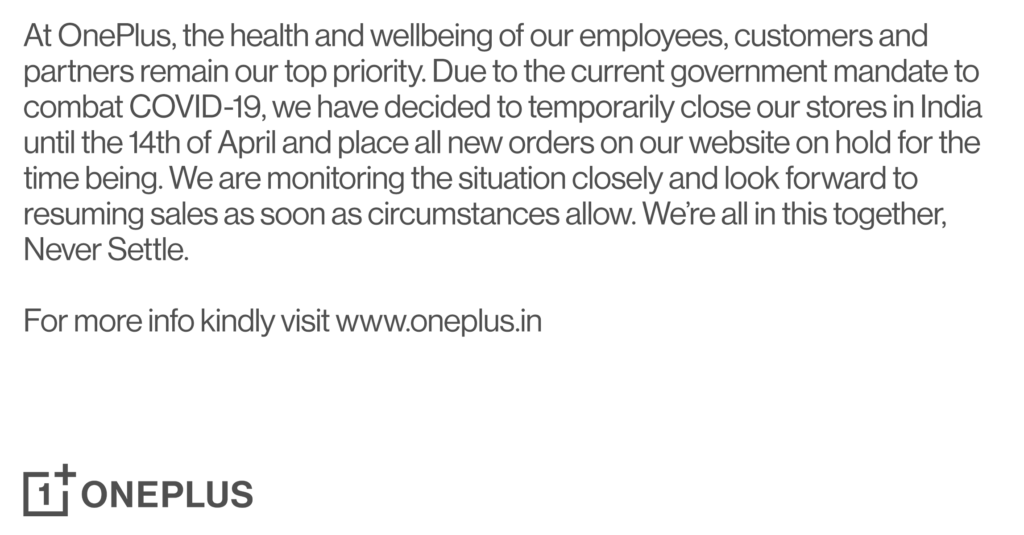
The Indian government announced a nationwide shutdown for 21 days starting today to fight the outbreak of coronavirus in the country. Even before that, almost all the smartphone companies operating in India shut down their manufacturing facilities, postponed the launches of their new smartphones, and some of them even started helping the government by donating necessary aids. Now, OnePlus also joins this bandwagon by closing all its retail stores across the country till April 14. The company has also placed a hold on new orders on its website for the time being.
OnePlus is one of the most popular smartphone brands in India. In fact, it is the country’s top premium smartphone brand for a few quarters now. However, it took more time than any other well-known brand in India to announce its measures to counter the COVID-19 pandemic.
OnePlus India took it to Twitter to announce that it is abiding the mandate issued by the government of India by closing its official retail stores across the country till April 14. Additionally, it also says that it will stop taking all new orders placed on its official website. That means even if you order a OnePlus product online from the official website, it will be shipping post-April 14, i.e. after the end of 21 days shut down ordered by the government or even later depending on the situation.
Lastly, OnePlus also assures that it is monitoring the situation closely and will resume sales as soon as it will be able to.
The Redmi K30 Pro is the latest flagship in town and practically the cheapest Snapdragon 865 phone at the moment. But the price is not the only thing people consider when purchasing a phone. Redmi‘s major competitor is Realme whose Realme X50 Pro 5G is also a flagship phone and one that buyers will also consider.
This post pits both devices against each other and will help you decide which one to get.
Design
Design is subjective but that doesn’t mean we cannot have opinions. Some love the pop-up selfie camera of the Redmi K30 Pro while others do not mind the pill-shaped punch hole of the Realme X50 Pro. I do not lean towards one as both are cool. However, I wish Realme used another design for the rear, so the phone stands out from its other devices. This is their top smartphone and the rear looks similar to that of its cheapest phones.
Display
The two phones have AMOLED FHD+ displays and they are high-quality E3 panels with HDR10+ certification. Redmi says their 6.67-inch screen has a peak brightness of 1200 nits while Realme’s 6.44-inch screen has a peak brightness of 1000+.
The Redmi K30 Pro’s screen misses out on the high-refresh-rate trend which means that buttery-smooth scrolling 90Hz and 120HZ displays have is missing. The Realme X50 Pro 5G, on the other hand, has a 90Hz refresh rate which is a plus for it.
Both phones are powered by the same Snapdragon 865 processor so performance should be the same, right? Not really. The base model of the Redmi K30 Pro (6GB RAM + 128GB) has LPDDR4X RAM and UFS 3.0 storage while the 8GB RAM variants have LPDDR5 RAM and UFS 3.1 storage. All the Realme X50 Pro variants have LPDDR5 RAM and UFS 3.0 storage.
Other than the base model of the Redmi, the phone should be faster than the Realme X50 Pro 5G with respect to app load times and general usage thanks to its faster storage.
Cameras
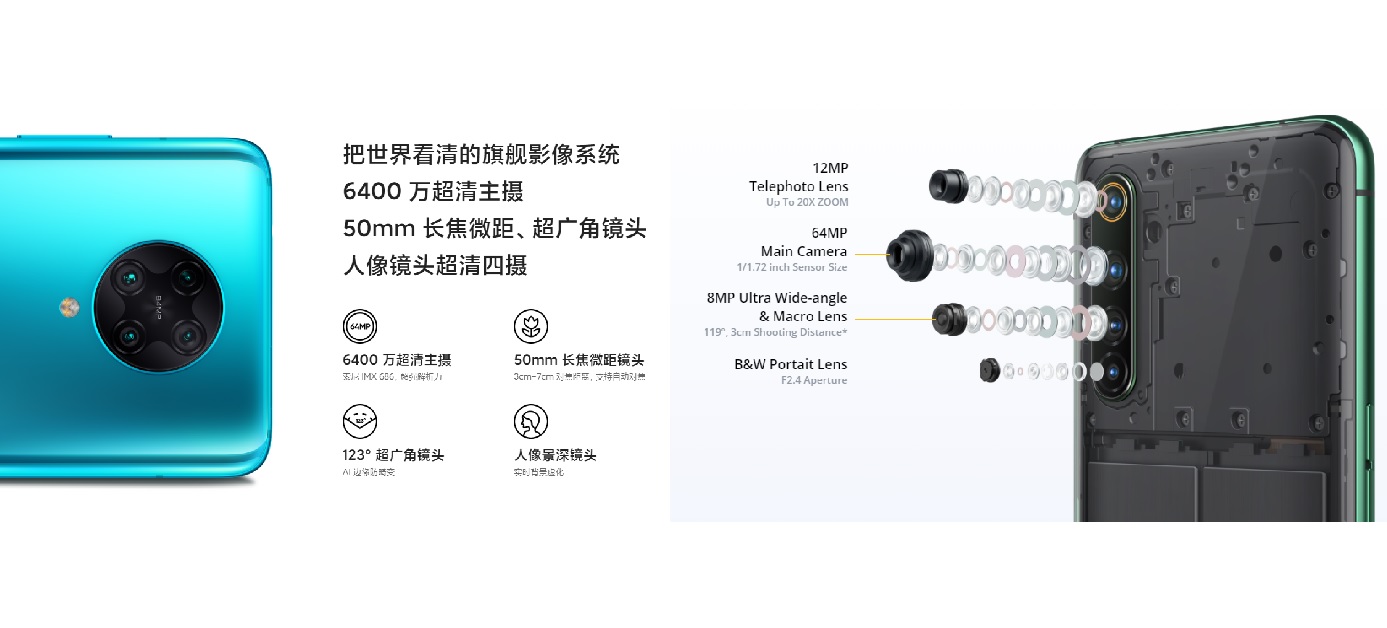
The Redmi K30 Pro and Realme X50 Pro both have four rear cameras but of different configurations. Below are the specs of the two phones:
Redmi K30 Pro
64MP Sony IMX686 1.6 μm primary camera with 6P lens and OIS
5MP 50mm telephoto macro camera
13MP 123° ultrawide angle camera
2MP depth sensor
Camera features – 8K video recording, 960fps slow-motion recording at 1080p, real-time video blur
♦ 20MP selfie camera with video blur and slow-motion selfies
Realme X50 Pro 5G
64MP Samsung GW1 primary camera with 6P lens
12MP telephoto camera
8MP 119° ultrawide angle camera
2MP Black and White portrait camera
Camera features – Real-time bokeh videos, 20x hybrid zoom, ultrawide angle selfies, Super Nightscape 3.0, Ultra Nightscape, and Ultra Macro Mode.
♦ 32MP IMX616 selfie camera + 8MP ultrawide angle selfie camera with video stabilization, real-time bokeh videos, slow-motion selfies, ultrawide angle videos
Reviews have revealed the Realme X50 Pro 5G isn’t the best camera phone out there. It does take decent photos but we doubt it will be able to measure up to the Sony IMX686 of the Redmi K30 Pro. Nevertheless, we won’t give a final verdict until there is a review of the Redmi flagship or a camera comparison of both phones.
Battery Capacity and Fast Charging
The Realme X50 Pro 5G has a 4200mAh battery capacity with support for 65W SuperDart Fast Charging while the Redmi K30 Pro 5G has a 4700mAh battery capacity with support for 33W fast charging.
When it comes to recharging in the shortest time possible, the Realme X50 Pro 5G is clearly the winner here as it charges from empty to full in 46 minutes according to reviews (the advertised figure is 35 minutes) while the Redmi K30 Pro 5G takes 63 minutes (advertised) to charge to full.
However, the Redmi should offer better battery life not only because it has a bigger capacity but also because it doesn’t have a high-refresh-rate display (although bigger) that consumes battery, unlike the Realme X50 Pro.
This category is somewhat a draw for both devices as you can charge one device faster while the other lasts longer on a single charge.
Other Features
The Redmi K30 Pro 5G has an audio jack, an IR blaster, and Hi-Res Audio. While the Realme X50 Pro doesn’t have an audio jack, it does have stereo speakers which the Redmi K30 Pro 5G doesn’t have. The Realme flagship also has Hi-Res Audio and Dolby Atmos.
While both phones have their own fast-charging technology, they also support Power Delivery while the Redmi K30 Pro 5G also has support for Quick Charge 4+.
Price
Redmi K30 Pro is priced as follows:
6GB (LPDDR4X) + 128GB – 2999 yuan (~$424)
8GB + 128GB – 3399 yuan (~$480)
8GB + 256GB – 3699 yuan (~$523)
Realme X50 Pro 5G is priced as follows:
8GB + 128GB – ¥3599 (~$507)
8GB + 256GB – ¥3899 (~$549)
12GB + 256GB – ¥4199 (~$591)
Conclusion
The Redmi K30 Pro 5G wins hands-down based on price only. So if you are trying to spend the least amount possible on a flagship, the Redmi K30 Pro 5G is the device to get. And it does offer a lot, from support for 8K video recording to OIS in two of its cameras to a big battery. There is also an audio jack that you won’t find on a lot of flagship phones this year.
The Realme X50 Pro 5G is also an awesome choice. It has a 90Hz display, really fast charging, and stereo speakers which are pretty important features that justify the extra price you pay if you decide to choose it over the Redmi K30 Pro.
Huawei Technologies Co, the Chinese tech giant, is planning on utilizing its advanced technology in the fight again the Coronavirus pandemic. The electronics brand will be offering AI assisted viral diagnosis tools to various hospitals outside of China to aid in combating the virus.
The primary weapon against the COVID-19 is Huawei Cloud, the cloud computing unit of the Chinese company. Through this artificial intelligent assisted tool, the known smartphone maker plans on aiding hospitals in countries like Ecuador and Philippines in collaboration with the AI enabled intelligence company Huiying Medical Technology Co Ltd.
Medical team members from the Baguio General Hospital seen with the CT scanner equipped with Huawei’s new diagnostic tool. (Image via Rappler)
The AI powered diagnosis tool for effective Coronavirus detection will be equipped in Baguio General Hospital in the Philippines with more to be confirmed soon after. Similarly, a hospital in Ecuador also received the technology, which took just 14 hours to install. Since then, dozens of countries have been contacting Huawei Cloud, looking for possible cooperation regarding the same issue.
As of right now, Ecuador is the first country in Latin America to receive an AI assisted auxiliary diagnostic system in two local hospitals. Now, the Baguio General Hospital also had the new AI enabled COVID-19 scanner earlier this week, which will help the doctors detect cases of infection using a CT scan of the patient. Reportedly, through the new AI assisted systems, the accuracy of the test results could be boosted to 98 percent.
The new technology could also help doctors distinguish between early, advanced and severe late stages of infection. Thus, providing medicals teams more details of the issue and treat them accordingly with respective medicines and procedures. This will also help track a patient’s progress, helping in finding out whether the treatment prescribed is actually working or not. The system uses “computer vision and medical image analysis technologies,” as stated by Huawei, to evaluate a patient’s lungs.
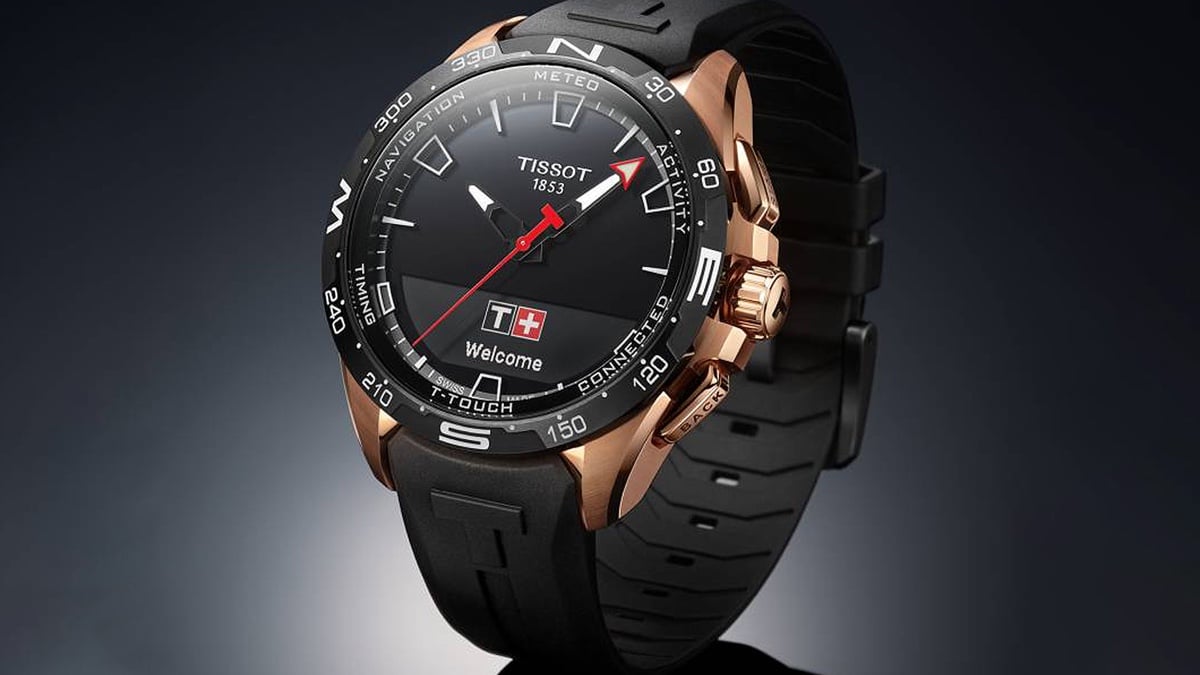
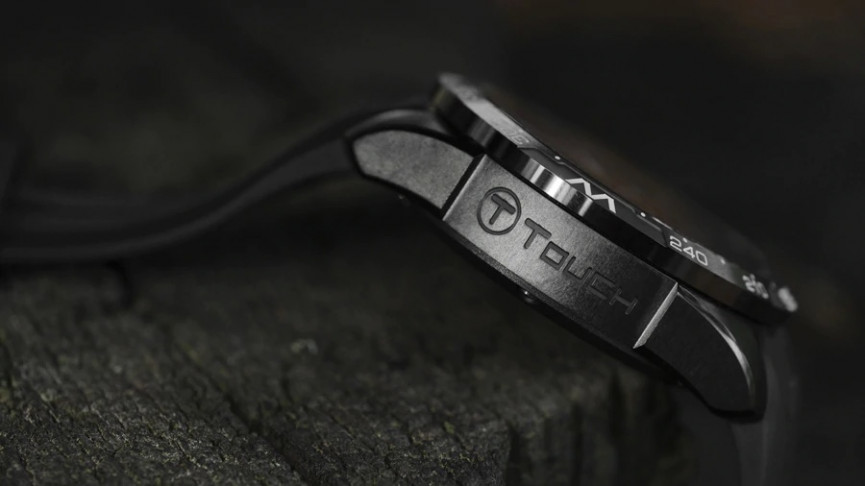
World-renowned Swiss wristwatch manufacturing company, Swatch has got a couple of smartwatches to its name but they were not as successful as the company would have hoped. However, the brand has launched another offensive in the smartwatch market with the launch of the Tissot T-Touch Connect Solar.
As the name implies, the smartwatch is a hybrid watch which utilises solar power in addition to having a battery. The solar energy gives the device an extended battery life said to last up to six months.
Just like most smartwatches, the Tissot T-Touch Connect Solar can be paired with a smartphone. It equally has tracking functions such as fitness tracking, notifications and the traditional watch function – time check. Further, the smartwatch is said to run on Swatch’s propriety Swiss Autonomous Low Power System (SwALPS) operating system. The company also promised GPS Navigation on the watch.
The smartwatch features a 47mm circular body which looks big and may not be suitable for anyone who doesn’t like a big watch. The body is made from either titanium or ceramic. The watch also comes with compatibility with iOS and Android as well as Huawei Harmony OS. The inclusion of HarmonyOS support will definitely aid adoption in China. Other details are scanty but we expect the presence of a heart rate sensor among others.
Swatch recently saw its revenue drop and the Apple Watch strong market dominance was fingered among reasons for such. The new smartwatch may be the company’s effort to mount some pressure in that segment so as to grab a slice of the pie.
As for the price, the Swatch Tissot T-Touch Connect Solar hybrid comes in at 1,000CHF (about $1,000). This is pretty expensive when compared to other competitors like Apple, Xiaomi, and Huawei. The product is expected to launch in June or July.
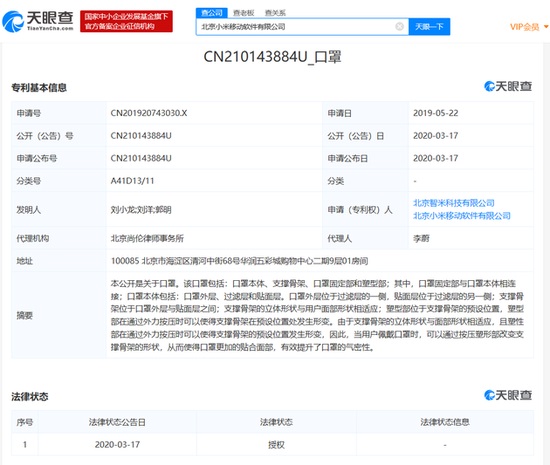
Earlier this month, Xiaomi, the known electronics company, was granted the license for a new patent license. The patent was initially applied for back in 22nd May 2019 and was granted on 17th March 2020.
According to the patent description, the license is for a new face mask. The notable thing about this particular mask is that it features a 3 dimensional support skeleton that better fits a wearer’s face. In other words, it is more ergonomic in terms of use and should theoretically better sit on a user’s face. This skeletal support is made from plastic and can also be adjusted when force is applied in a certain area, meaning it is probably flexible and moldable for a comfortable fit.
The other function this new Xiaomi face mask could potentially offer is a better air restriction. In other words, it could effectively improve air seal around one’s face. This helps by offerings a better protection, even in compromised areas where infection by air borne diseases can be contracted. So, in today’s time where the coronavirus outbreak is a real threat, this face mask could potentiall save lives and help curb the chances of infection.
For those unaware, a new strand of Coronavirus started to spread like wild fire in China. Now, confirmed cases of the COVID-19 have been found in upwards of 170 different countries, while the WHO (World Health Organization) has officially classified the virus as a pandemic. Hence, users are asked to exercise a reasonable amount of caution and take proper steps to reduce the risk of infection.
We use cookies on our website to give you the most relevant experience by remembering your preferences and repeat visits. By clicking “Accept”, you consent to the use of ALL the cookies.
This website uses cookies to improve your experience while you navigate through the website. Out of these, the cookies that are categorized as necessary are stored on your browser as they are essential for the working of basic functionalities of the website. We also use third-party cookies that help us analyze and understand how you use this website. These cookies will be stored in your browser only with your consent. You also have the option to opt-out of these cookies. But opting out of some of these cookies may affect your browsing experience.
Necessary cookies are absolutely essential for the website to function properly. This category only includes cookies that ensures basic functionalities and security features of the website. These cookies do not store any personal information.
Any cookies that may not be particularly necessary for the website to function and is used specifically to collect user personal data via analytics, ads, other embedded contents are termed as non-necessary cookies. It is mandatory to procure user consent prior to running these cookies on your website.