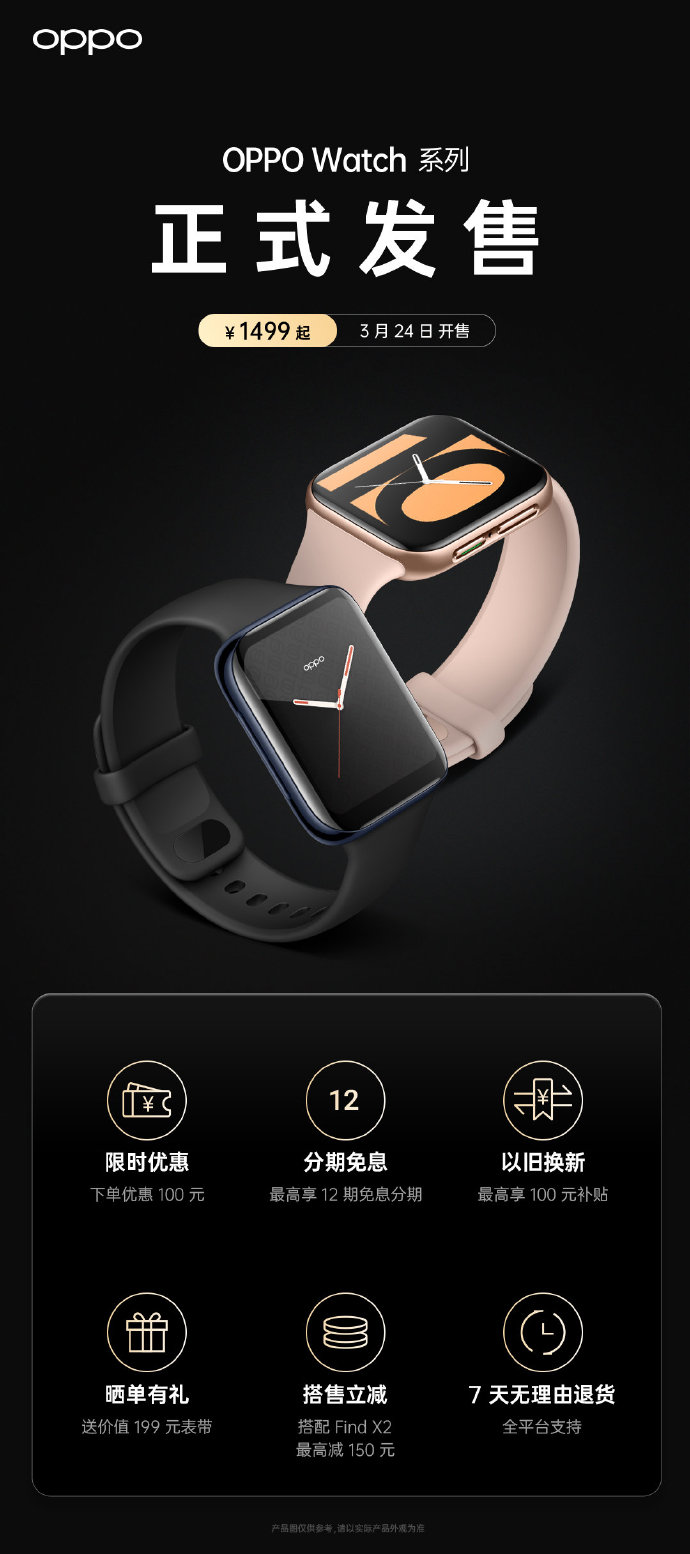
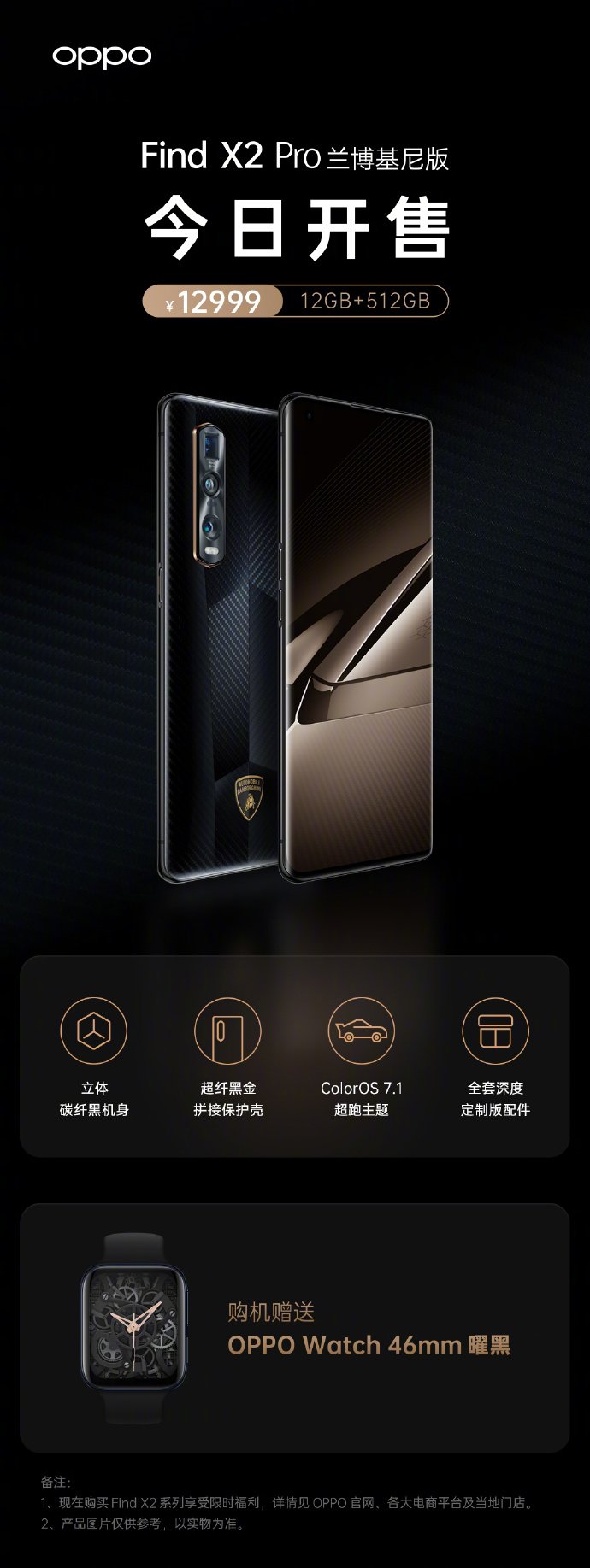
On March 6, OPPO had held an unveil event to announce the Find X2, Find X2 Pro, Find X2 Pro Lamborghini Edition and OPPO Watch. While the vanilla and Pro models were made available for purchase soon after launch in the home market, the Lamborghini Edition was slated to be available for purchase from March 24. The Chinese firm did not confirm the availability of the OPPO Watch at its launch. As promised, the company commences sales of the Find X2 Pro Lamborghini Edition from today along with the OPPO Watch.
OPPO Watch
The OPPO Watch listing on its official online store shows that the retailer is currently selling the 41mm and 46mm aluminum editions. The 46mm stainless edition is yet not available for buying. The 41mm OPPO Watch is priced at 1,499 Yuan (~$212) and its 46mm edition costs 1,999 Yuan (~$282). The smartwatch comes in Black and Pink colors. The device is also available through Tmall, Jingdong Mall and Suning. The smartwatch comes with a free Italian calf leather strap.
The Find X2 Pro Lamborghini Edition which is inspired from the limited edition Aventador SVJ Roadster car. It comes in a special package that includes couple of accessories such as earbuds, protective case, charging adapter and more. These items along with the handset carry Lamborghini branding.
In terms of specs, the Find X2 Pro Lamborghini Edition offers users with 12 GB of RAM and 512 GB of native storage. The rest of the specs of the phone are identical with Find X2 Pro smartphone.
The OPPO Watch comes for free with the Find X2 Lamborghini Edition that is priced at 12,999 Yuan (~$1,849). The Lamborghini Edition was made available for reservations in China from last Friday. Also, from today, the company is also selling the Find X2 Pro in Elegant Gray hue and Find X2 in Tea Orange color.
Last year’s upper mid-range phones from Huawei and Honor in China such as Nova 5, Nova 5i, Honor 9X, Honor 20S and Nova 6 SE were all fueled by the 7nm Kirin 810 chipset. Honor recently confirmed that the Honor 30S smartphone that will debut on March 30. It will be the first ever device to feature the successor of Kirin 810 i.e. the all new 5G-capable Kirin 820 chipset. Today, AnTuTu shared the benchmarks results of the Honor 30S smartphone. It revealed that the performance of the Kirin 820 5G is better than the rivaling Snapdragon 765G processor from Qualcomm.
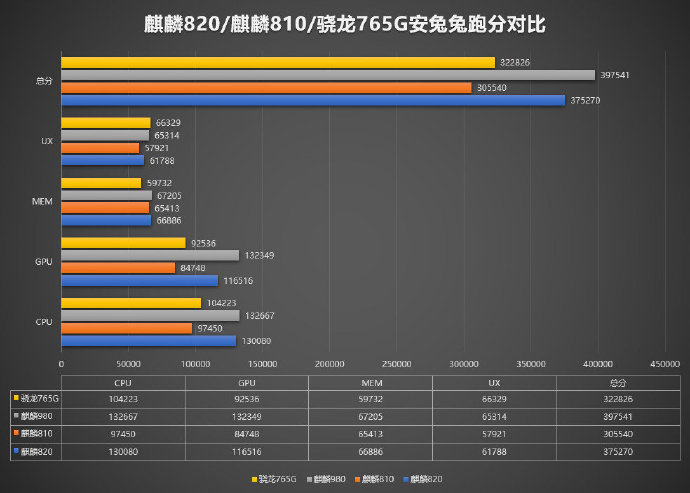
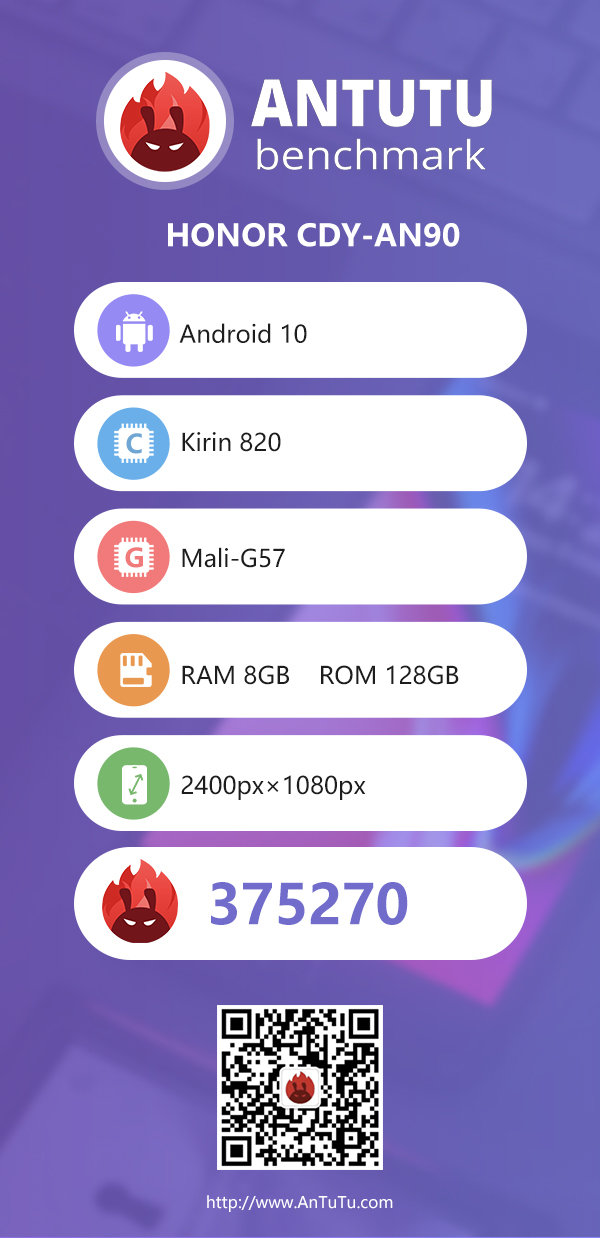
The AnTuTu listing reveals that the Honor 30S (model number CDY-AN90) is powered by Kirin 820 chipset. It is an octa-core SoC with quad-core Cortex-A76 and quad-core Cortex-A55 with maximum clocking speeds of 2.3GHz. The SoC also includes Mali G57 graphics. It scored 130,080 in CPU test, 116,516 in GPU test, 66,886 in memory test and 61,788 in the UX test of the benchmarking platform. Hence, it managed to reach an average benchmarking score of 375,270.
The above shown graph shows that the Kirin 820 5G manages to beat the SD765G in CPU, GPU and memory tests and it scored slightly less in the UX test. Its performance is better than last year’s Kirin 810 chipset. Also, it scored around 22,000 points less than the Kirin 980 chipset which fueled most of the Huawei and Honor flagship phones last year. Hence, Kirin 820 5G powered phones are expected to deliver flagship-like experience at lesser cost.
AnTuTu used Redmi K30 5G (SD765), Honor V20 (Kirin 980) and Nova 6 SE (Kirin 180) phones to compare the performance of the Kirin 820 powered Honor 30S. The benchmarking platform claims that the Kirin 820 is a very good 5G SoC and its performance is on par with MediaTek’s Dimensity 1000L. The latter was first seen on the Reno3 5G phone that debut in December last year.
Coming to the key specs of Honor 30S that leaked through its AnTuTu listing, it was found running on Android 10 OS along with 8 GB of RAM and 128 GB of storage. The size of the display did not appear on AnTuTu. However, it revealed that the screen of the Honor 30S supports 1080 x 2400 pixels full HD+ resolution. The rear-facing quad camera setup has a 64-megapixel primary shooter. A variant of the same phone with model number CNY-AN00 was approved by 3C authority of China in the recent past. It revealed that the Honor 30S may ship with a 40W fast charger.
Yesterday, Honor confirmed that it will be announcing the Honor 9A smartphone on March 30. However, the main focus of the event will be the unveiling the Honor 30S which will be arriving as the first ever phone powered by the 5G ready Kirin 820 chipset. The specifications of the Honor 30S are currently under the wraps, but all the important details on the Honor 9A have leaked today through its appearance at the database of China Telecom.
Honor 9A specifications
The Honor 9A has a waterdrop notch display that features noticeable bezels along with a thick-sized chin. The rear panel of the phone seems to be made out of polycarbonate material. It features a rectangle camera housing at the upper-left corner. It houses two cameras. A fingerprint scanner is also fitted on the backside of the Honor 9A.
The Honor 9A has 159.07 x 74.06 x 9.04mm dimensions and it weighs 185 grams. The phone features a 6.3-inch screen that offers HD+ resolution of 720 x 1600 pixels. The handset promises a screen-to-body ratio of 88.4 percent. The modest Helio P35 chipset that works at 2.3GHz is at the helm of the device.
The Honor 9A’s processor is supported by 4 GB of RAM. The native storage of the phone is 64 GB and it has an external storage slot for more storage. The Magic UI 3.0.1 based Android 10 OS will come preloaded on the Honor 9A. The handset houses a 5,000mAh battery that will last for up to 3 days. The phone is equipped with loudspeakers that can output “shocking high volume,” reveals the China Telecom listing.
The front notch of the Honor 9A features an 8-megapixel selfie camera. The back panel of the smartphone is fitted with a 13-megapixel + 2-megapixel dual camera system. The phone is packed with usual connectivity features such as dual SIM support, 4G VoLTE, Wi-Fi, Bluetooth, microUSB and 3.5mm audio jack.
Honor 9A Pricing
The Honor 9A is listed with an expected price tag of 899 Yuan (`$127). Dark Night Black, Green Jasper and Blue Water Emerald are the color editions of the smartphone.
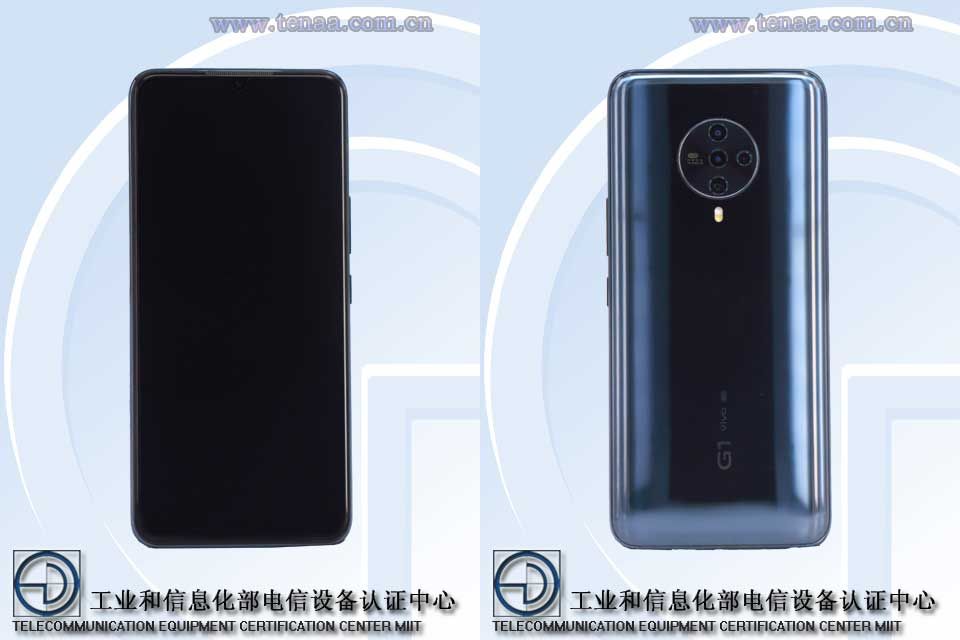
The Vivo S6 5G smartphone will be debuting in China by the end of this month. In recent past, a Vivo phone that has a model number of V1962BA was approved by the 3C authority of China. The handset was spotted with an 18W fast charger. It was speculated at that time that it could be the forthcoming Vivo S6 5G smartphone. Today, the Vivo V1962BA along with its network variant with model number Vivo V1962A have surfaced on TENAA with full specifications.
Vivo S6 5G specifications
The Vivo S6 5G (V1962A/BA) TENAA listing states that it measures 161.16 x 74.66 x 8.68mm and it weighs 181 grams. Vivo has already revealed that the phone will be sporting a lightweight and thin design. While the rumor mill had speculated that the Vivo S6 5G has a dual punch-hole screen, the TENAA images reveal that it is equipped with a waterdrop notch screen.
The TENAA listing shows that the Vivo S6 5G is equipped with a 6.44-inch AMOLED screen that delivers 20:9 aspect ratio and 1080 x 2400 pixels. The Android 10 OS coupled with the latest FunTouch OS 10 will come preinstalled on the device.
The Vivo S6 5G is driven by 5G-ready chipset that clocks at 2.2GHz. The phone will be hitting the Chinese markets in 6 GB and 8 GB RAM choices. It will be available in internal storage editions of 128 GB and 256 GB. A microSD card slot will be onboard for more storage.
The Vivo S6 5G has a 4,390mAh battery. It is a minimum rated capacity and its typical size could 100mAh more. The front notch of the phone has a 32-megapixel selfie camera. The smartphone has a round-shaped camera module on its curved glass rear. It includes a 48-megapixel + 8-megapixel + 2-megapixel + 2-megapixel quad camera system. An LED flash is placed below the camera housing.
It has been more than a week following the launch of the Redmi Note 9 Pro and the Redmi Note 9 Pro Max in India. While the former has gone on sale, the “Max” is yet to go on sale. Scheduled to go on the first sale on March 25, the date has now been postponed.
The announcement was made by Manu Kumar Jain, the CEO of Xiaomi India. The top executive said they have no choice but to postpone the first sale of the phone due to the multiple state lockdowns as a result of the Coronavirus pandemic. However, a new date is yet to be announced.
Mi fans, due to recent state lockdowns, we will have to postpone the 1st sale of #RedmiNote9ProMax to a later date.
I would like to confirm that the sale of #RedmiNote9Pro will still happen as scheduled, tomorrow (24th) at 12 noon.
The tweet also added that the Redmi Note 9 Pro sale slated for today at noon (IST) will still hold.
The Redmi Note 9 Pro Max has a 6.67-inch FHD+ DotDisplay with a centered punch hole. There is a 32MP selfie camera inside the punch hole in the screen.
Powering the device is a Snapdragon 720G processor with up to 8GB of RAM and 128GB of storage which can be expanded via a dedicated MicroSD card slot.
There are four cameras on the rear of the phone – a 64MP primary camera, a 119° 8MP ultrawide angle camera, a 5MP macro camera, and a 2MP depth sensor. The camera housing is covered with Gorilla Glass 5 just like the rest of the phone’s back and the front of the phone.
Redmi has also added a side-mounted fingerprint scanner, an IR blaster, and an audio jack. The phone also comes with support for India’s NavIC positioning system. There is a 5020mAh battery inside the phone with support for 33W fast charging. The Redmi Note 9 Pro Max ships with Android 10 out of the box and has a starting price of INR 14,999 (~$193).
Tomorrow March 24 will be the day: Xiaomi’s brand will finally take the wraps off the Redmi K30 Pro, its most affordable flagship with top-tier hardware specifications. But we already know almost everything about the new flagship killer. Thanks to a huge amount of leaks and rumors, almost nothing is still shrouded into the mystery. According to reports, there will be two variants: Redmi K30 Pro and K30 Pro Zoom Edition. Here you can find a rumor roundup with all the info about the new K30 Pro based on the latest leaks, official info unveiled by the Chinese giant, and the most reliable rumors.
Redmi K30 Pro Rumor Roundup
Design
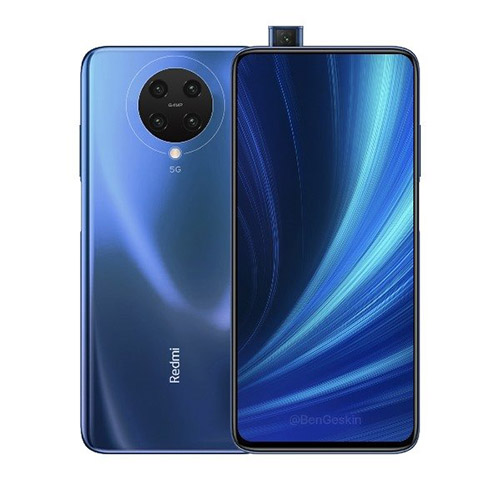
Despite it will be sold at a very competitive price for a flagship, the Redmi K30 Pro is still expected to come with premium materials, including a glass back and an aluminum frame. According to renders, the device will have a notch-less and holeless display thanks to the presence of a motorized pop-up camera. The bezels around the display will be very narrow, while on the rear side there will be a big and circular camera setup (similarly to OnePlus 7T) with a LED flash underneath. K30 Pro will be launched in at least four color options: Moonlight White, Sky Blue, Purple and Space Gray. There will be a notification LED and it will be placed near the pop-up camera. And there will even be a headphone jack, haptic engine, and 4D vibration. Last but not least, the phone will be splash resistant with the IP53 certification.
Official images confirmed that Redmi K30 Pro will have an AMOLED display made by Samsung (E3) with a 5,000,000:1 contrast, a brightness of 800 nits (1,200 nits peak brightness), the support to the HDR10+ standard, and a 180 Hz touch-sampling rate. Unfortunately, K30 Pro will have a standard 60 Hz refresh rate, unlike most of the latest flagships. If you expected smooth animations and more advanced viewing experience during gaming sessions, you will be left disappointed. The display will be protected by Gorilla Glass 5 just like the rear side.
Redmi K30 Pro will be powered by Snapdragon 865 mobile platform and it will support 5G connectivity thanks to the external 5G modem Snapdragon X55. Alongside the best Qualcomm’s chipset there will be LPDDR5 RAM and UFS 3.1 internal storage (with writing speeds up to 750 MB/s) in various configurations, as well as a VC liquid cooling technology. According to rumors, the base variant will provide 6 GB of RAM and 128 GB of native storage. But the phone should also hit the Chinese market in other configurations, including one with 8 GB of RAM and 128 GB of storage, a 8/256 GB version and even a 12/512 GB configuration.
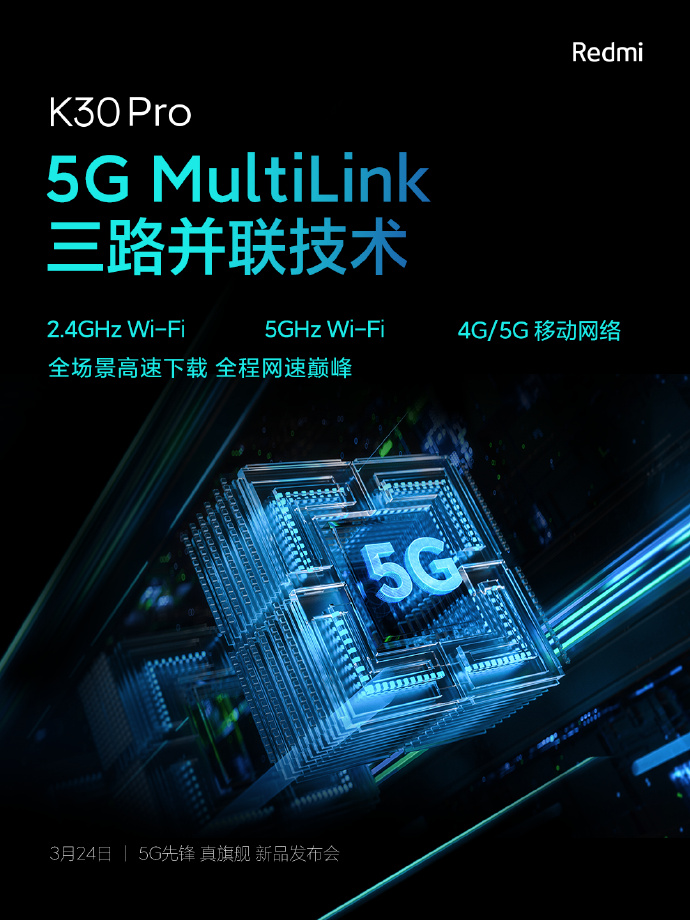
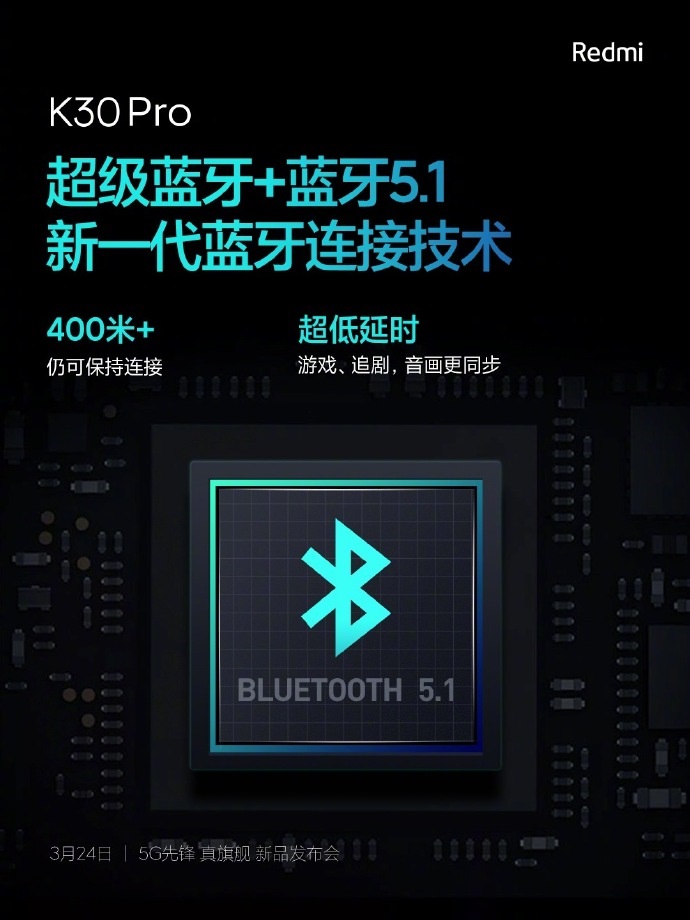
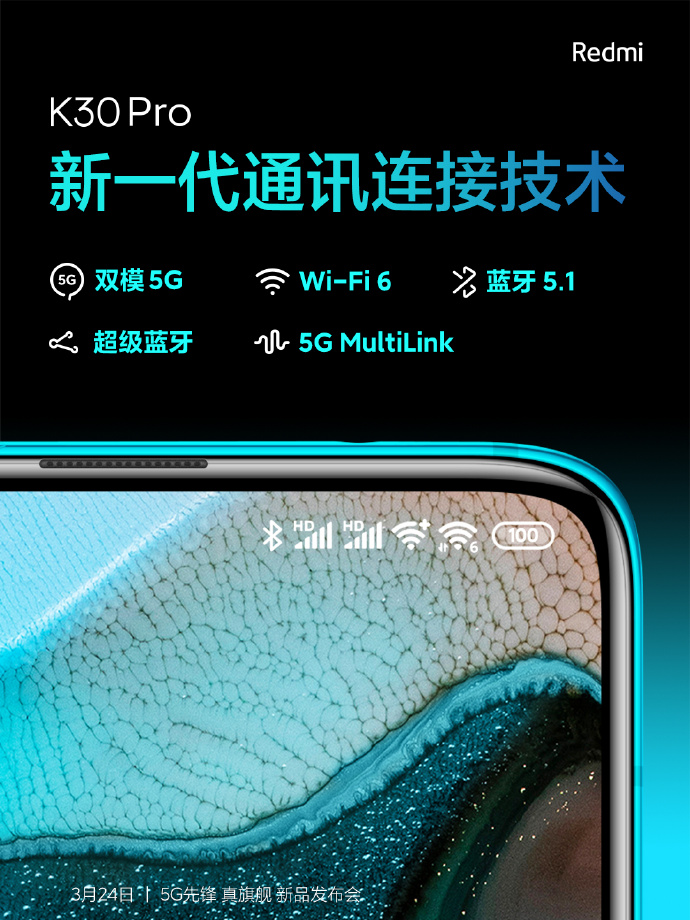
The phone is said to score a similar result to the higher-end Xiaomi Mi 10 on AnTuTu benchmark. There will be a very big vapor chamber for heat dissipation (3,435 mm²) and the support to Super Bluetooth with a range up to 400m. The range for Bluetooth 5.1 is about 243 meters. Thanks to the 5G MultiLink feature, K30 Pro will be able to connect to three networks at the same time, including a 2.4 GHz WiFi connection, a 5GHz WiFi connection, and a 4G or 5G mobile network. The operating system installed will obviously be Android 10 customized by MIUI 11. On the software side, you will find the Game Turbo 3.0 technology. We will even get a Stacked Motherboard design with 61 components per sq centimeter.
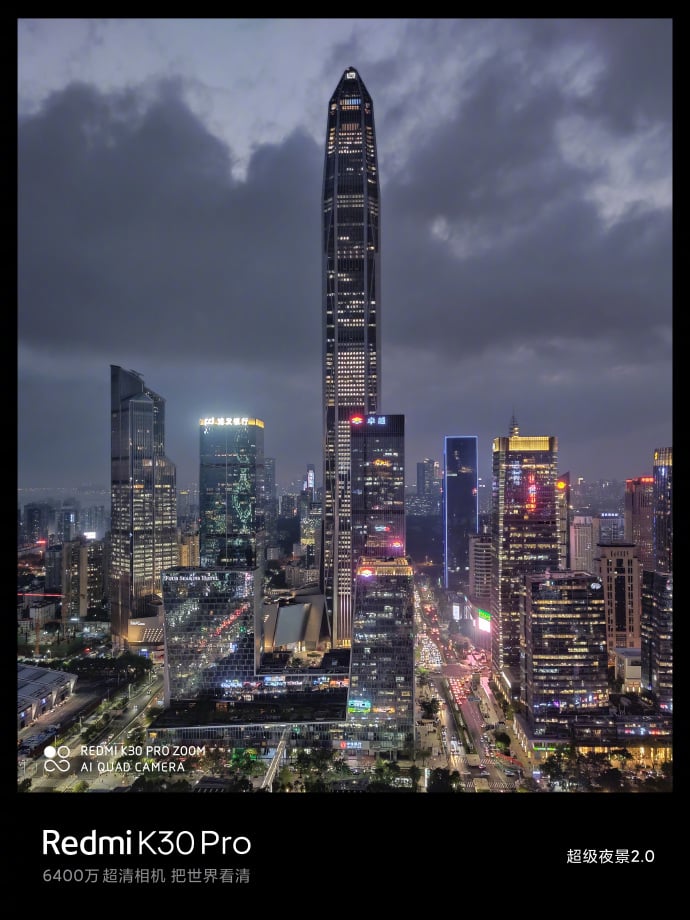
Redmi K30 Pro will sport a quad rear camera with a 64 MP Sony IMX686 main sensor, 7P lens, and dual-OIS. The phone will support 3x optical zoom and digital zoom up to 30x (the advanced zoom might be only for the Zoom Edition), it will be able to record 8K videos (with a high resolution of 7680 x 4320 pixels) and it will provide a great photo quality even in dark scenes with Super Night Scene 2.0. The feature will unlock super-bright HDR photos at night even in low-light conditions by clicking several photos at different exposures and combining them into a single one with as little noise as possible. There will obviously be an ultrawide lens as well. Thanks to dual OIS, even the telephoto sensor will have OIS to shoot sharp photos even while zooming.
Rumors suggested that Redmi K30 Pro and K30 Pro Zoom Edition will offer a 4700 mAh battery with the support to 33W fast charging. Unfortunately, the company did not reveal the battery capacity, so we got no official info about it. We expect K30 Pro and K30 Pro Zoom Edition to come with the same battery capacity.
Redmi K30 Pro and K30 Pro Zoom Edition will be unveiled tomorrow March 24 for the Chinese market, but their official prices are still unknown. Xiaomi Product Director Wang Teng Thomas had earlier hinted that the Redmi K30 Pro 5G would be priced between 3,000 Yuan (~$423) and 3,599 Yuan (~$507). The phone was recently spotted on the official Xiaomi store on Suning with a 3,299 Yuan price tag, but it has been taken down. There is still no info about the global launch of the new flagship killers. Its predecessor K20 Pro hitten the global market with a different name: Xiaomi Mi 9T Pro. According to speculations, the K30 Pro might come globally as the Pocophone F2, but for now, it is just a remote hypothesis.
Huawei‘s launch event where the P40 series will be unveiled is only a few days away. The series is expected to be made up of the Huawei P40, P40 Pro and P40 Pro Plus. We have seen official renders of the models that would make up the series but one aspect that has often been elusive is the camera configuration of the models. Today, the likely camera specs of the Huawei P40 Pro has appeared online.
Huawei P40 Pro engineering machine
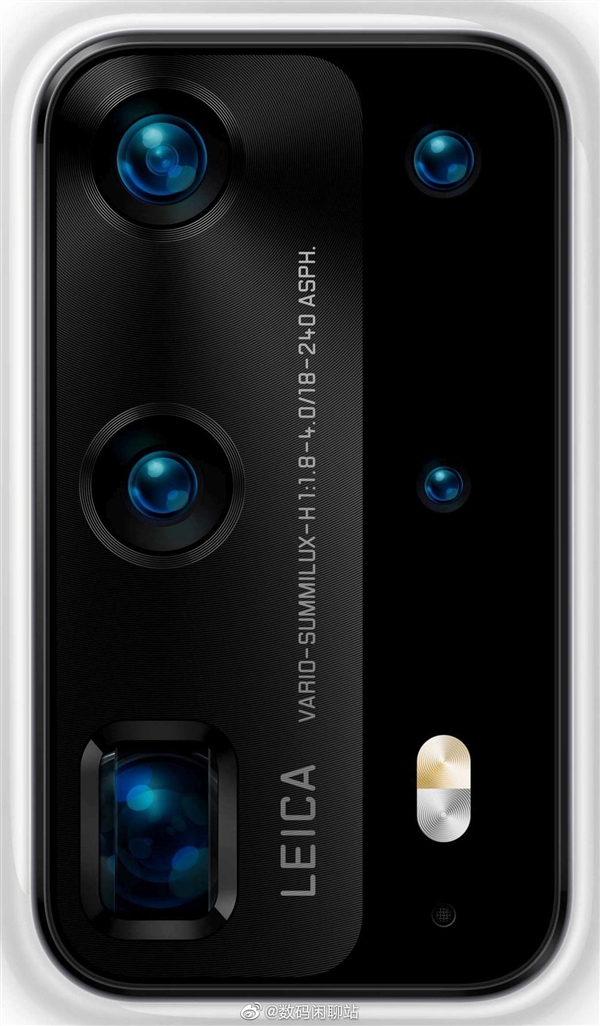
The Huawei P40 Pro engineering machine was recently leaked by a blogger on Weibo. The prototype has a covering for the rear camera but the design is consistent with what we have seen on renders. The P40 Pro is expected to come with a Penta-camera setup made up of five lenses. The main lens is said to be a Sony IMX700 sensor which supports up to 5x optical zoom. The rear camera also includes a 10X optical zoom supporting periscope lens, a telephoto lens, an ultra-wide-angle lens and ToF lens. The front camera is said to be a dual punch-hole camera.
We are not so sure of the five camera setup and it may be for the P40 Pro Plus which the P40 Pro will have a Quad-camera setup. However, the expected Penta-camera setup i given as a 52-megapixel main camera (Sony IMX700 1 / 1.28-inch RYYB), a 40-megapixel lens (Sony IMX650 1 / 1.5-inch RGGB), an 8-megapixel telephoto lens, a 20-megapixel periscope lens, and a ToF lens.
Huawei P40 Pro camera sensors
We’ll have to wait until the launch to find out the exact camera setup. Whatever it is, though, the Huawei P40 series will have a powerful setup that will likely rattle the current DXOMark ranking. A couple of camera samples said to have been captured by the Huawei P40 Pro appeared online and they are just stunning. Check them out below.
The month of April is the period premium smartphone manufacturer OnePlus usually unveils its flagship products for the year. The company is expected to tow the same line with this year’s OnePlus 8 series. The OP8 series should feature the OnePlus 8 and OnePlus 8 Pro which would launch in the first half of the year. The second half of the year will see the company launch a T version with an incremental upgrade in design and features.
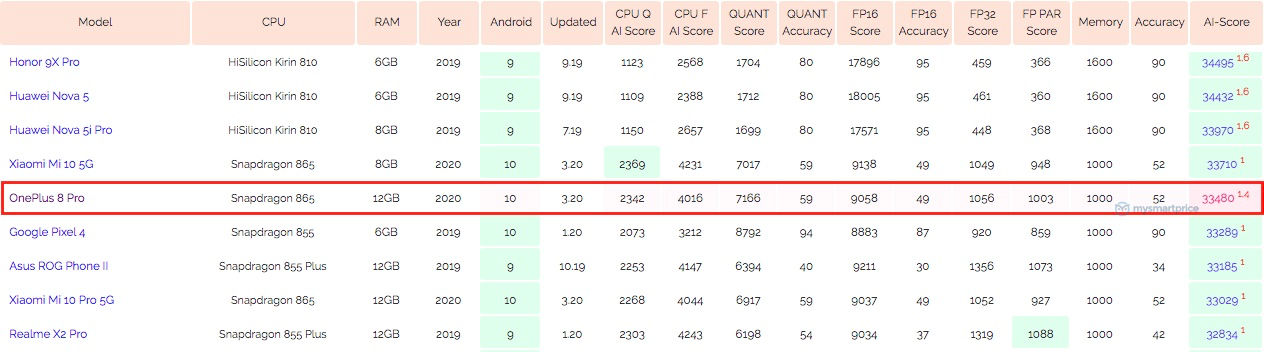
The OnePlus 8 series has been the subject of a couple of leaks in recent times and that is just normal as the launch draws closer. One of the latest leaks we are seeing is the AI Benchmark ranking of the OnePlus 8 Pro. In case you are in doubt, AI benchmark is a website that keeps track of AI performance statistics of mobile and desktop CPUs.
The OnePlus 8 Pro is listed below the Galaxy S20, Honor 9X Pro, Nova 5, Nova 5i Pro, Xiaomi Mi 10 5G and a couple of other models. The phone is listed above the Google Pixel 4, ASUS ROG 2, Mi 10 Pro 5G and the Realme X2 Pro. However, we must note that all the models had AI scores of over 30,000 points which shows they all have impressive AI performance.
However, the OPPO Find X2 which is not captured on the list above has an AI score of 39,638 points which is significantly higher than the OP8 Pro’s. Also, Huawei’s Kirin 990-powered flagship tops the chart with over 76,000 AI points. That is some massive disparity with the OnePlus’ model.
The benchmark listing is an indication that the Snapdragon 865-powered device may be launched soon.
As a reminder, the OnePlus 8 Pro is expected to feature a 6.5-inch AMOLED display with 120Hz refresh rate. The device will equally be powered by a Snapdragon 865 SoC teaming up with several RAM and storage options. The battery capacity is yet to be revealed but the device is said to come with support for up to 50W fast charging.
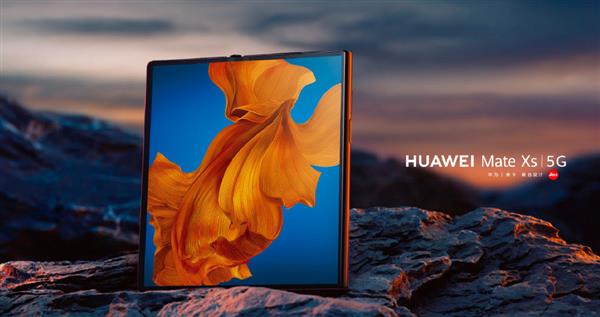
Huawei announced Mate Xs, its second foldable smartphone late last month. Now, the Indian official Twitter handle of the company teases the camera specs of this device. Is the Chinese telecom giant planning to launch it in the country? Well, we will have to wait and see as the company hasn’t sent out media invites yet.
The Mates Xs by Huawei is one of a kind folding smartphone. Unlike other foldable in the market like the Galaxy Fold, Galaxy Z Flip, and Moto Razr, the panel on this handset folds outside opposed to inside on the above mention devices. It is worth noting that the Mate Xs follows the same design of the original Mate X from last year but with better hardware specs.
As the Huawei India official Twitter handle teases, the Mate Xs feature a quad-camera setup, which has become common these days. The cameras on this phone are placed vertically on the elongate bump which also houses the volume rockers and the power key with an integrated fingerprint sensor. The camera sensors on this foldable include a 40MP primary unit with f/1.8 aperture, an 8MP telephoto camera (up to 30x digital zoom) with f/2.4 aperture as well as OIS, a 16MP ultra-wide camera with f/2.2 aperture, and a Huawei made TOF (Time-of-Flight) sensor. Like the previous premium Huawei phones, the camera system on this is also co-engineered with Leica.
#Huawei is here to unfold a new chapter of smartphones with the #HuaweiMateXs5G. Its quad-camera system, co-engineered with #LEICA is beyond brilliant & lets you capture things with 30x digital zoom! Now, never miss out on any details with the finest lens of Huawei.#HuaweiIndiapic.twitter.com/kEX8MY3Ljt
For now, the Indian division of Huawei has only teased the camera specs. If they happen to tease more of it in the company days, we are certain that they will launch it in the country just like how Samsung and Motorola made their foldable smartphones available in the worlds’ second-largest smartphone market.
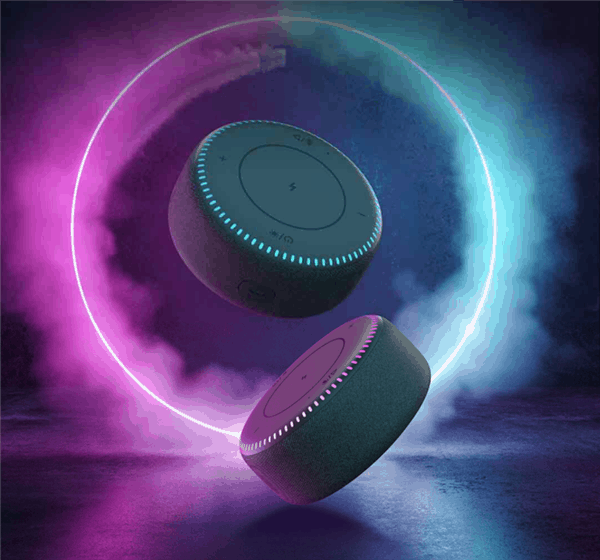
ZMI, a subsidiary of Xiaomi launches a new Bluetooth speaker cum wireless charger in China for only 149 Yuan (~$21). Just last month, the company developed a similar product for Xiaomi. However, that one is priced higher at 249 Yuan (~$35) since it can hold phones both vertically and horizontally as well as charge them at a rate of 30W compared to 20W on this newly launched cheaper model.
The new ZMI Bluetooth speaker with 20W wireless charging support is different from the Xiaomi-branded product the company designed. This model comes in a short cylindrical shape similar to Amazon Echo Dot, whereas the expensive model comes in a rectangular form. It features Bluetooth 5.0 to connect with smartphones and other products to output 360-degree audio from its 5W speaker unit. Though it lacks NFC from the previous model, it comes with a ring of RGB LED lights on the top which can be customized as well as controlled by using the Xiaomi Home app.
As per the company, this Bluetooth speaker can wirelessly charge almost all smartphones with support for the Qi wireless standard. Since it is a 20W charger, it supports fast wireless charging on Xiaomi’s Mi 9, Mi 9 Pro, Mi 10, and Mi 10 Pro smartphones. It is capable of charging 50% of Mi 10 Pro’s battery within 39 minutes. Also, it can charge phones with cases of up to 4mm thickness. Hence, no need to remove the case off the phone whenever the user wants to charge it wirelessly.
Priced at 149 Yuan (~$21), the ZMI Bluetooth speaker cum 20W wireless charger is already available to purchase from Xiaomi, JD.com, and TMall.
Redmi will officially take the wraps off the Redmi K30 Pro 5G tomorrow in China. The Xiaomi‘s nurtured brand has in the past few weeks thrilled us with several teasers that practically reveal all there is to know about the device. Well, except for the retail price and availability.
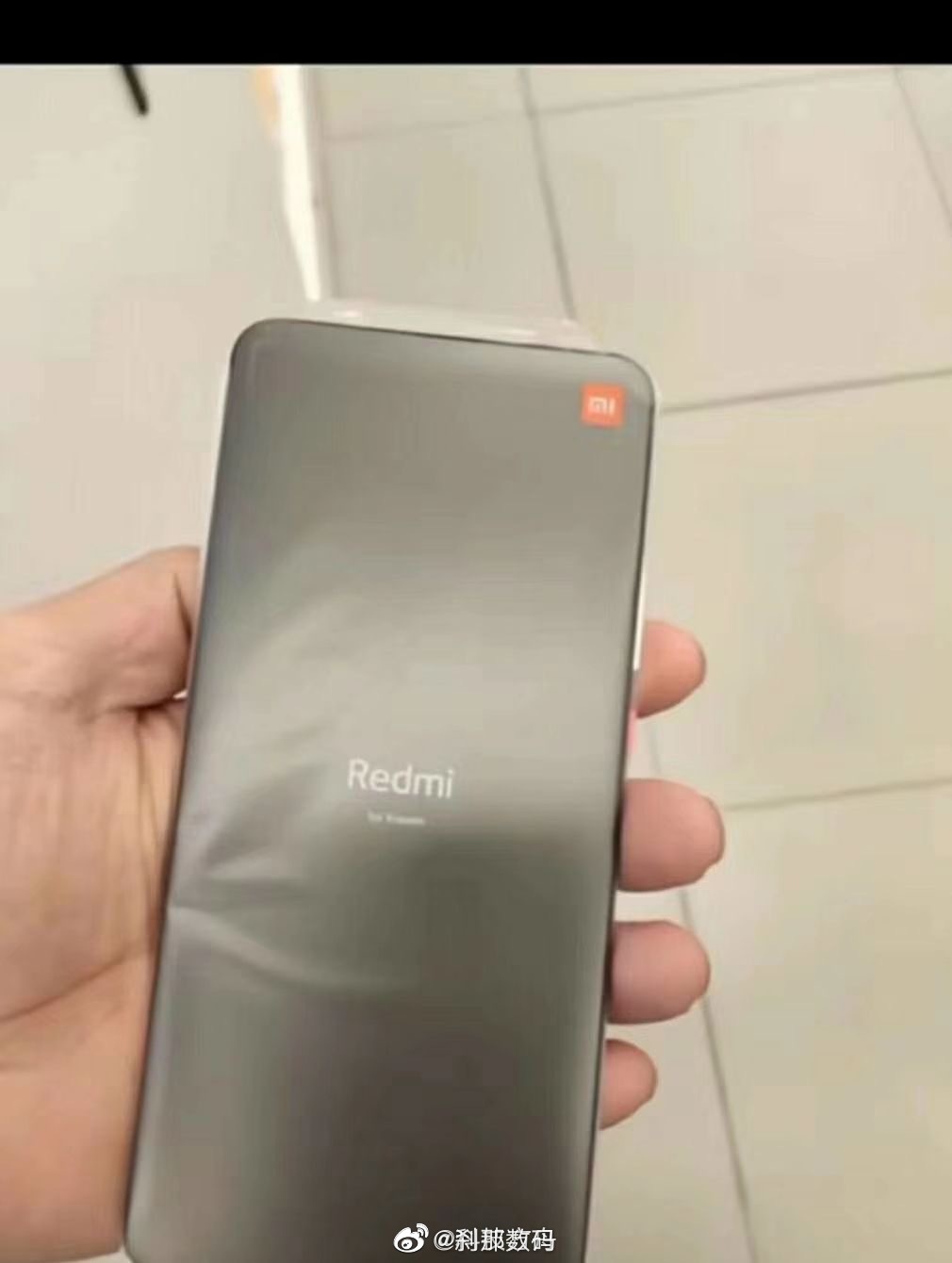
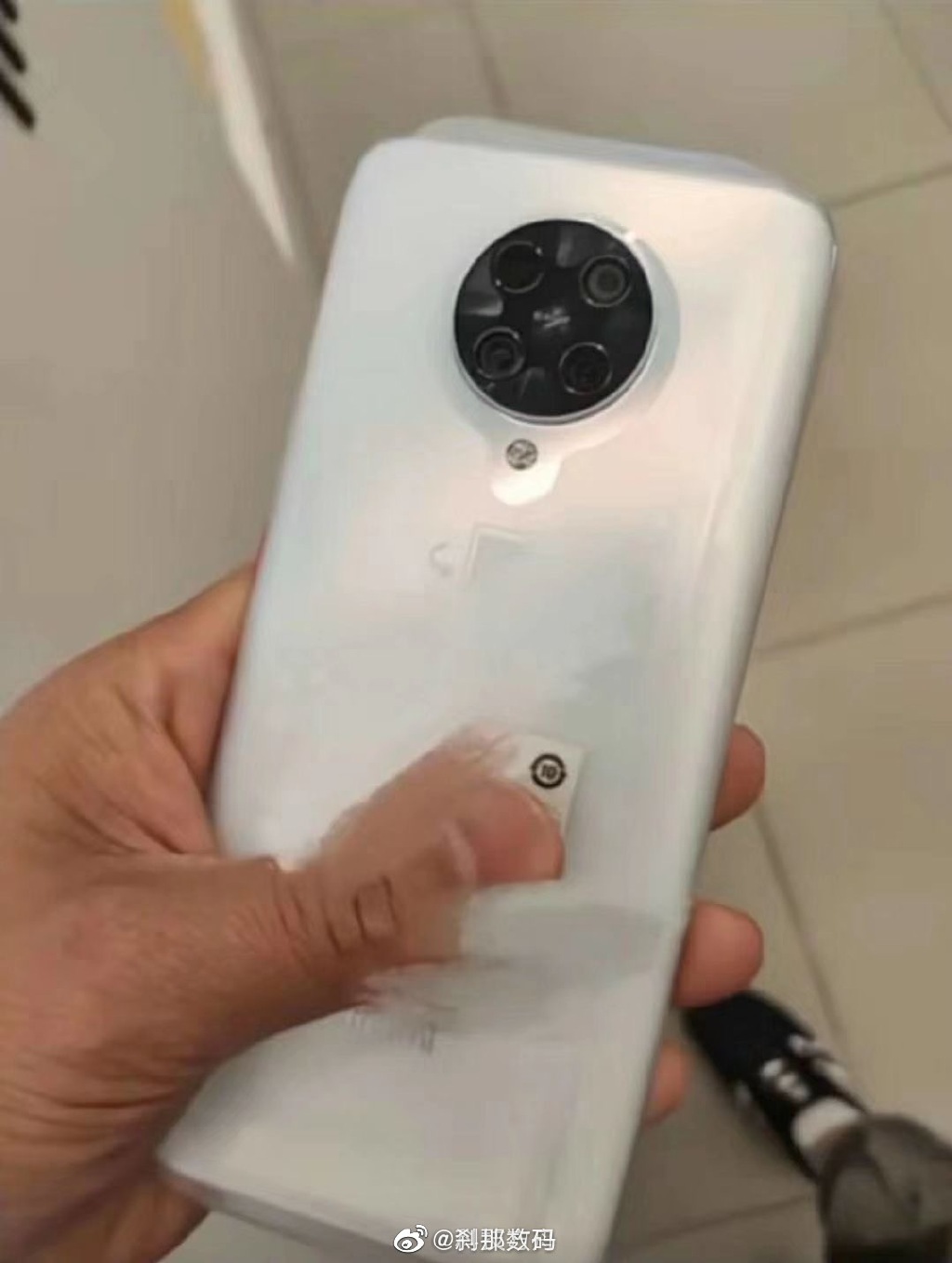
Ahead of the launch, the real-life photos of the Redmi K30 Pro 5G white variant have leaked on Weibo (via Twitter). The pictures are in synchronisation with the leaked renders that have formed part of Xiaomi’s official teasers.
The Redmi K30 Pro display seems to have a curved edge design on all sides and should be covered by a Gorilla Glass protection. We can’t make out any notch on the display since the phone uses a pop-up camera design.
At the rear, the Redmi K30 Pro packs a Quad-camera setup housed in a round module. The four sensors also seem to be located in an X-shaped module giving it a resemblance to the letter X. The LED flash is situated just under the circular module. Earlier teasers show the device will have a 64MP Sony IMX686 main sensor. It will come with several features for vivid camera and video shooting including 8K video recording support.
The phone is also expected to have support for 33W flash charge. There will also be a 3435mm² VC liquid-cooled heat sink which is officially claimed to bring “extremely cool” heat dissipation performance.
We’ll bring you all the details of the Redmi K30 Pro 5G tomorrow when the device is officially launched.
Manu Kumar Jain, the Global Vice President of Xiaomi and Managing Director of Xiaomi India announced on Twitter that his company will be donating lakhs of N95 masks to state governments and hospitals across India. Also, he assured that his company has taken necessary measures towards sanitation in their stores, offices, service centers, and manufacturing plants all over the country to tackle the spread of coronavirus.
Xiaomi has already donated an unknown number of masks to various countries where they operate over the past few weeks. Now, as the COVID-19 outbreak has begun in India, which is the company’s largest market outside China, it has imported lakhs of N95 masks to the country. As per Manu Janin, the head of Xiaomi India, it will be donating these masks to government hospitals, state police, and a number of state / UT governments such as Karnataka, Punjab, and Delhi. Additionally, the company will be also donating hazmat suits to doctors at a few hospitals like AIMS and St. Johns.
Further, the company has also canceled business travels, external meetings, and even asked their office employees to work from home and maintain social distancing amidst the current situation. Also, Xiaomi India has introduced new ‘Delivery on Call’ service to let customers order their favorite products from nearby Mi Home retail stores. Likewise, the company’s 2,000+ service centers across the country will only let in 4 customers at a time via an online token system. Plus all the employees at stores, as well as service engineers, will be provided with protective gear.
Besides that, Mr. Jain also assures that all the products manufactured and shipped by his company are safe as their manufacturing plants and operational warehouses follow high standards of caution of hygiene. He also says that all the facilities of the company will follow the lockdown orders issued by state and UT governments.
Indian telcos request OTT services like Netflix, Prime Video, Hotstar, YouTube, and others to reduce the burden on their infrastructure networks. They are appealing this so that they can offer stable services to healthcare, banking, education, businesses, and others amid lockdown across India due to coronavirus outbreak.
The Cellular Operators Association of India (COAI) which comprises of the country’s telecom operators such as Bharti Airtel, Reliance Jio and Vodafone Idea has requested the popular video streaming services in the country to temporarily offer SD playback over HD and above quality for a certain period of time till the lockdown persists. The association has also asked them to avoid feeding high-bandwidth consuming advertisements and pop-ups to users.
Rajan Mathews, the director-general of the Association told Economic Times that they have appealed Department of Telecommunications (DoT) as well as Home Ministry to urge ‘video streaming service providers/broadcasters’ to manage their traffic distribution pattern in a way that they don’t stress the networks of telcos. By this, the network infrastructure can be used for other critical needs such as healthcare, online/digital education, digital banking transactions, and other important purposes.
Almost all the streaming services have already started taking steps to avoid using more bandwidth without compromising on the quality of the stream by using their proprietary software and algorithm. However, we are not sure whether or not they will limit playback to SD quality like the popular international services such as Netflix and Prime Video have done in other markets.
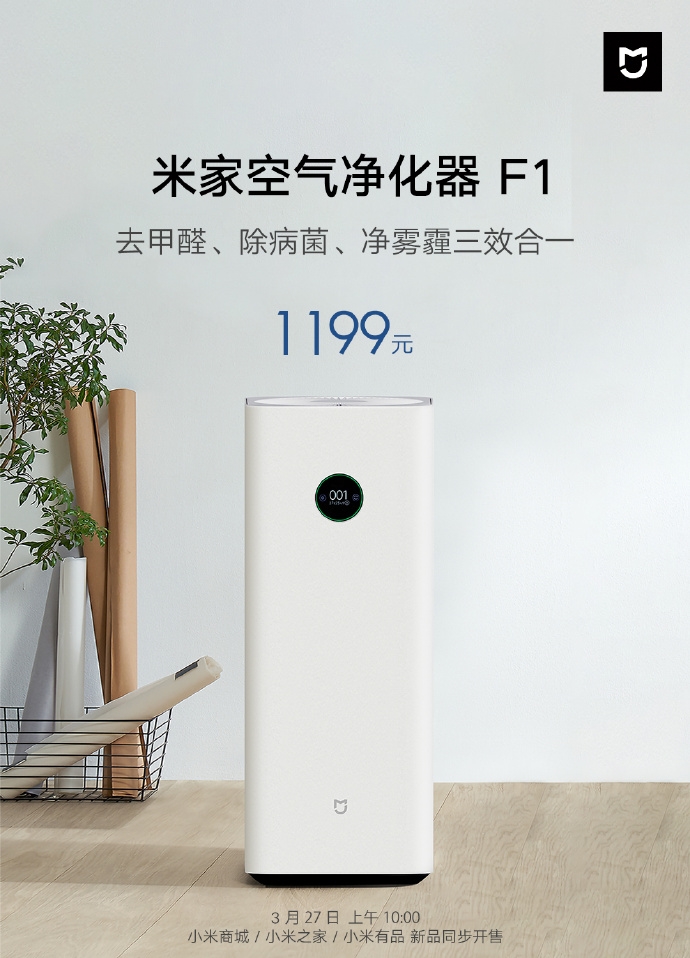
Today, Xiaomi’s Mijia brand announced a new air purifier. The new Mijia F1 Air Purifier is one of the few air purifiers in the market that can effectively remove H1N1 influenza viruses.
The Mijia F1 Air Purifier has a tower design with a circular AMOLED screen in front that displays info such as air quality. It supports voice control via the XiaoAI assistant, so you can control it from any of your other smart home devices such as phones, smart TVs, smart speakers, and smart displays that have XiaoAI built-in.
It has a clean air delivery rate (CADR) of 400m³/hr and delivers up to 6,660 liters of clean air per hour. Mijia says it has a high-quality DC motor that is quieter and more energy efficient compared to the previous generation. It also has a sleep mode which further reduces the sound of the motor to as low as 34.8dB
The filter has three layers that remove different sizes of impurities including hair, pollen, and PM 0.3 to PM2.5 particles. The replacement cycle for the filter is between 3 to 6 months.
The Mijia F1 Air Purifier is priced at ¥1199 (~$) and will go on sale on March 27 at 10 AM.
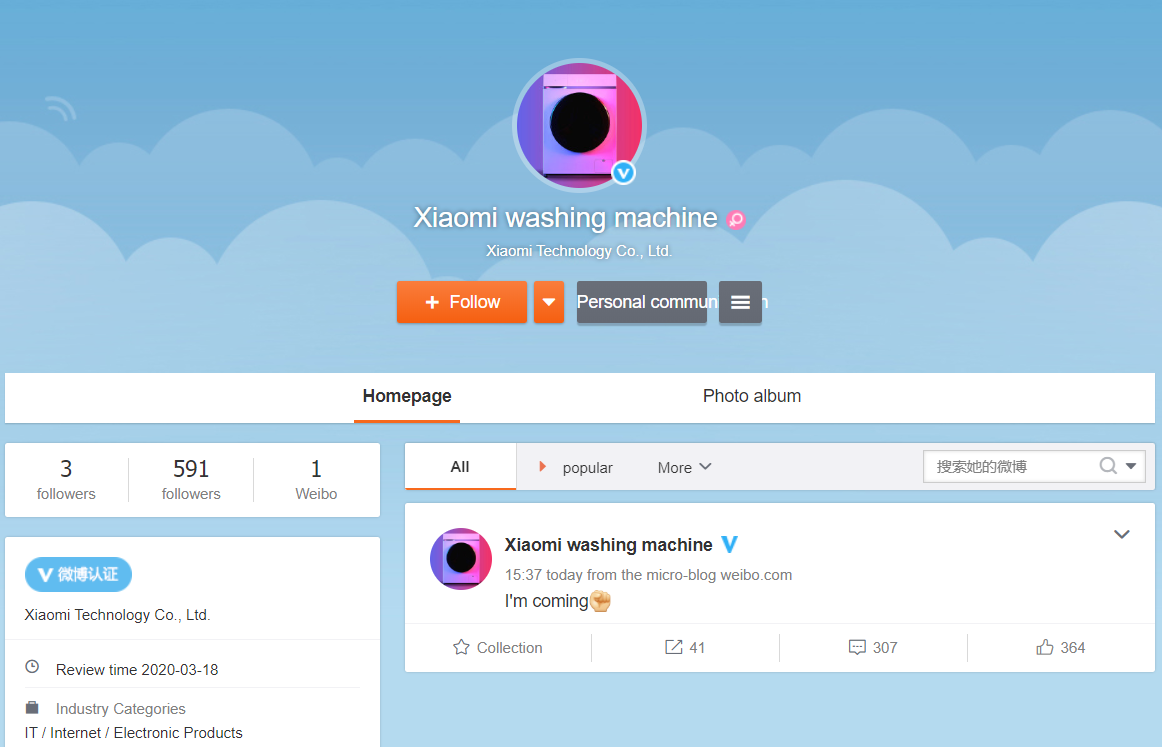
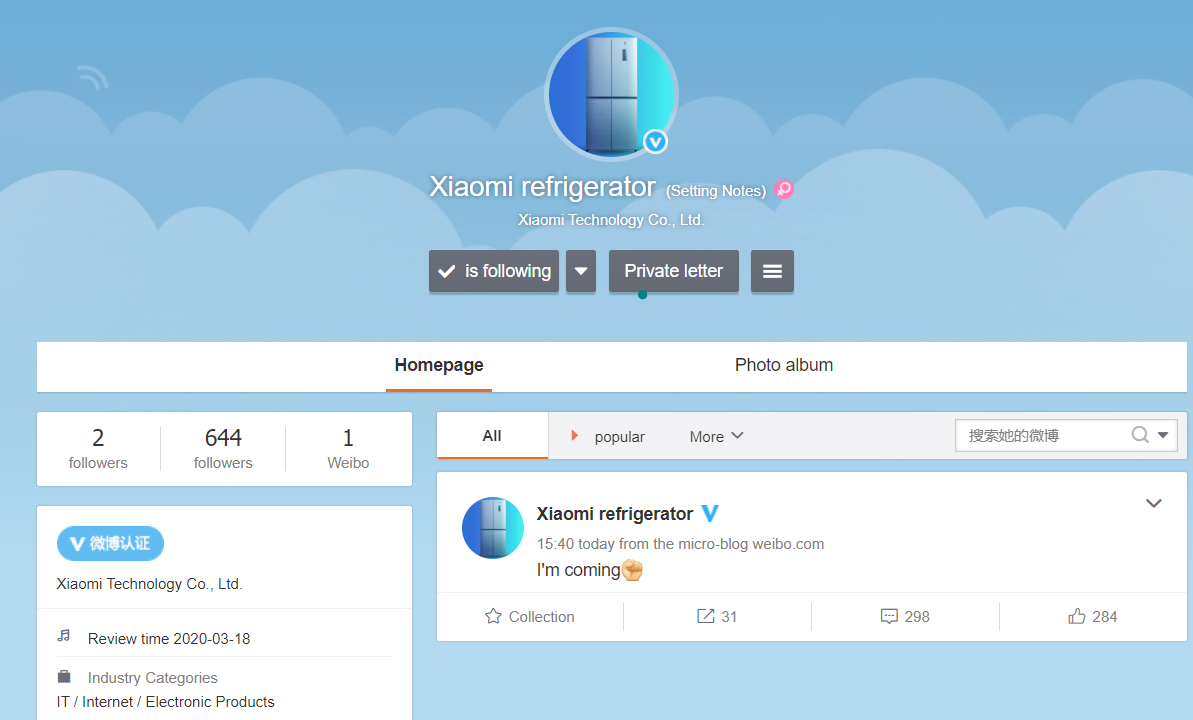
In related news, Xiaomi has created official Weibo accounts for its washing machines and refrigerators lines and both pages have shared posts that hint at first models coming soon.
While there are several washing machines and refrigerators made by companies under Xiaomi’s ecosystem, Xiaomi doesn’t have its own branded washing machines and refrigerators but that should change soon since it has created Weibo accounts for the two product lines.
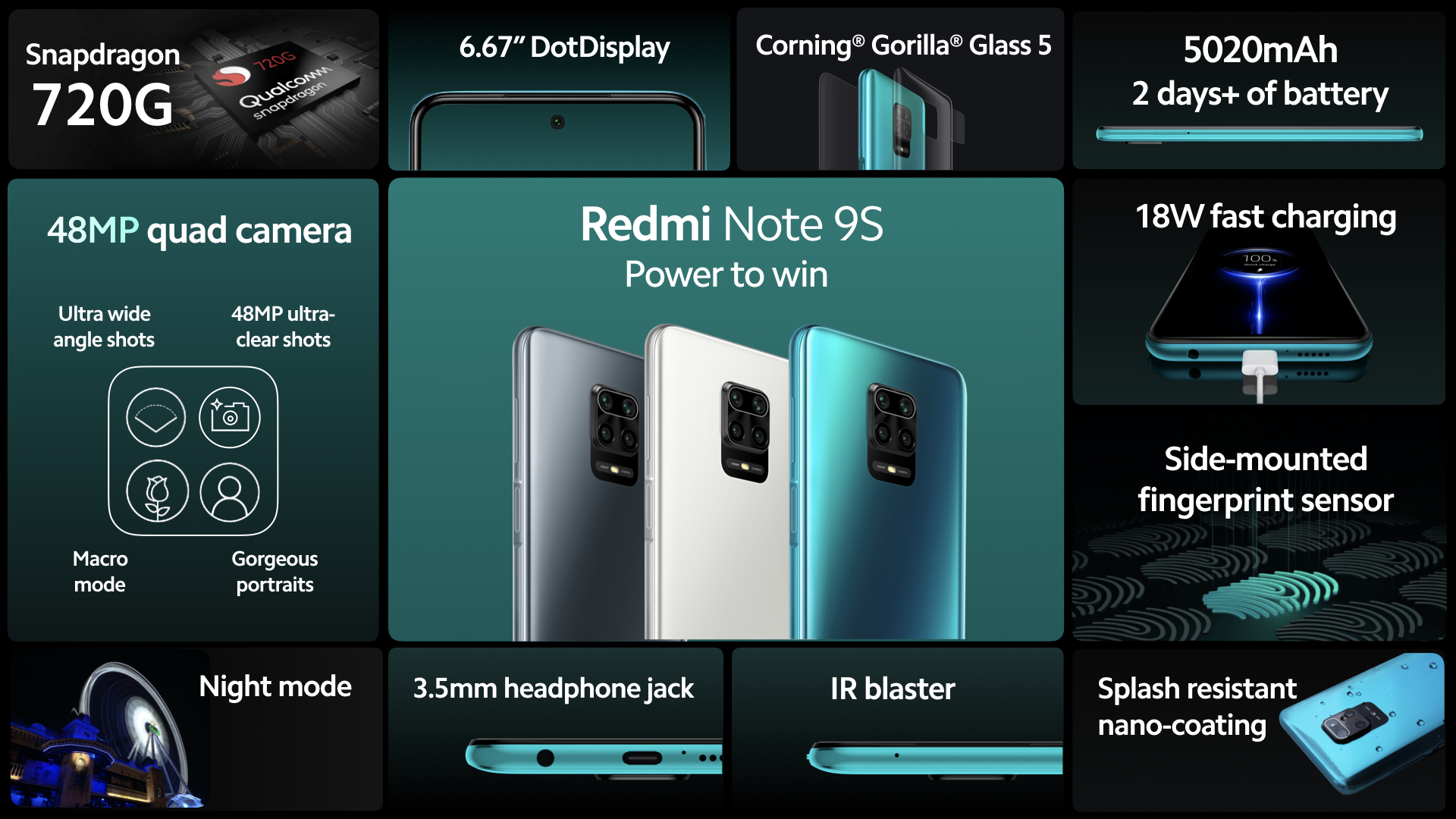
Xiaomi has officially launched the Redmi Note 9S for the global market. The Redmi Note 9S recently popped up online after the launch of the Redmi Note 9 Pro and Redmi Note 9 Pro Max in India. The Note 9S takes after its predecessors with a similar design but just some minor differentials in the camera configuration. Basically, the device is the same as the Redmi Note 9 pro but with just some minor differences.
DESIGN & DISPLAY
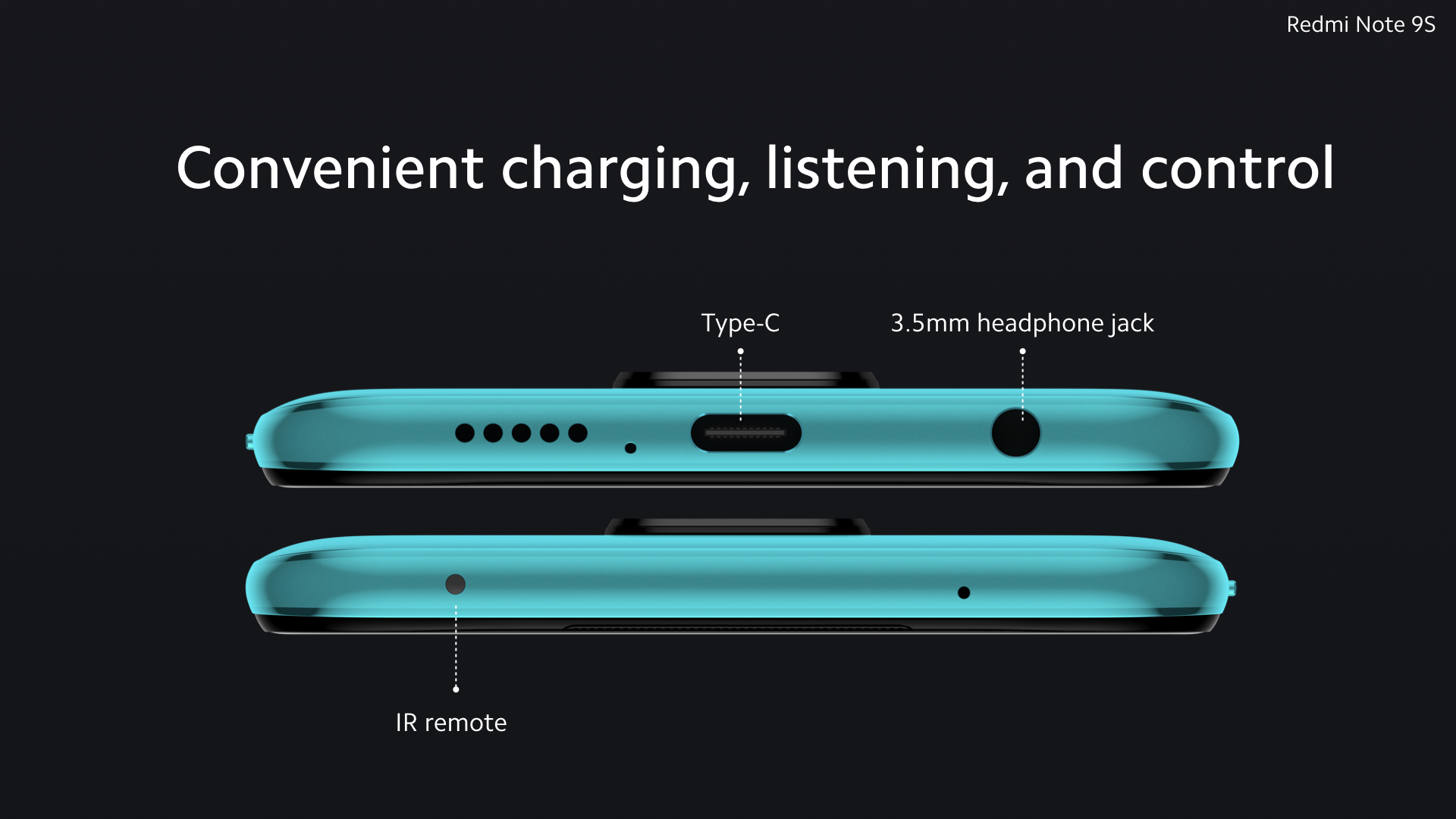
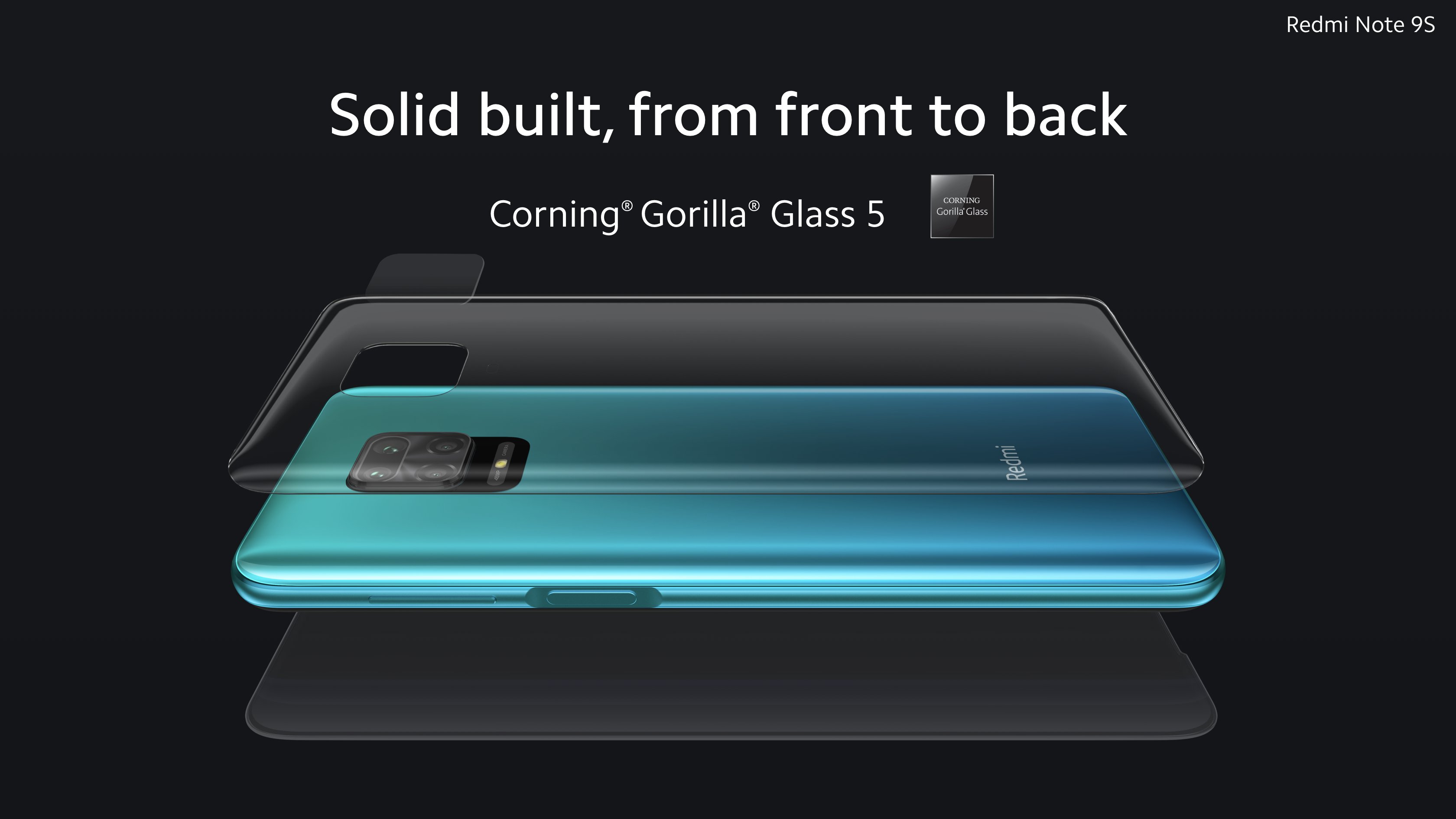
The Redmi Note 9S features a 6.67-inch IPS LCD display with FullHD+ resolution of 2280×1080 pixels. The display is covered by a Corning Gorilla Glass 5 protection and that extends to the rear panel giving the entire body some ruggedness. As stated, the Note 9S has the same design as the Redmi Note 9 Pro and this includes a side-mounted fingerprint, USB-C port, 3.5mm audio jack and an IR blaster.
PROCESSOR AND MEMORY
For the internals, the Redmi Note 9S is powered by a Qualcomm Snapdragon 720G processor. The SoC was recently released by Qualcomm and it is built on an 8nm processor. It offers several performance upgrades over the Snapdragon 730G released last year. The Note 9S shares the same processor with the Realme Redmi Note 9 Pro and Redmi Note 9 Pro Max. The processor is paired with 4GB/ 6GB of RAM as well as 64GB and 128GB of storage. The storage is expandable up to 256GB via microSD card.
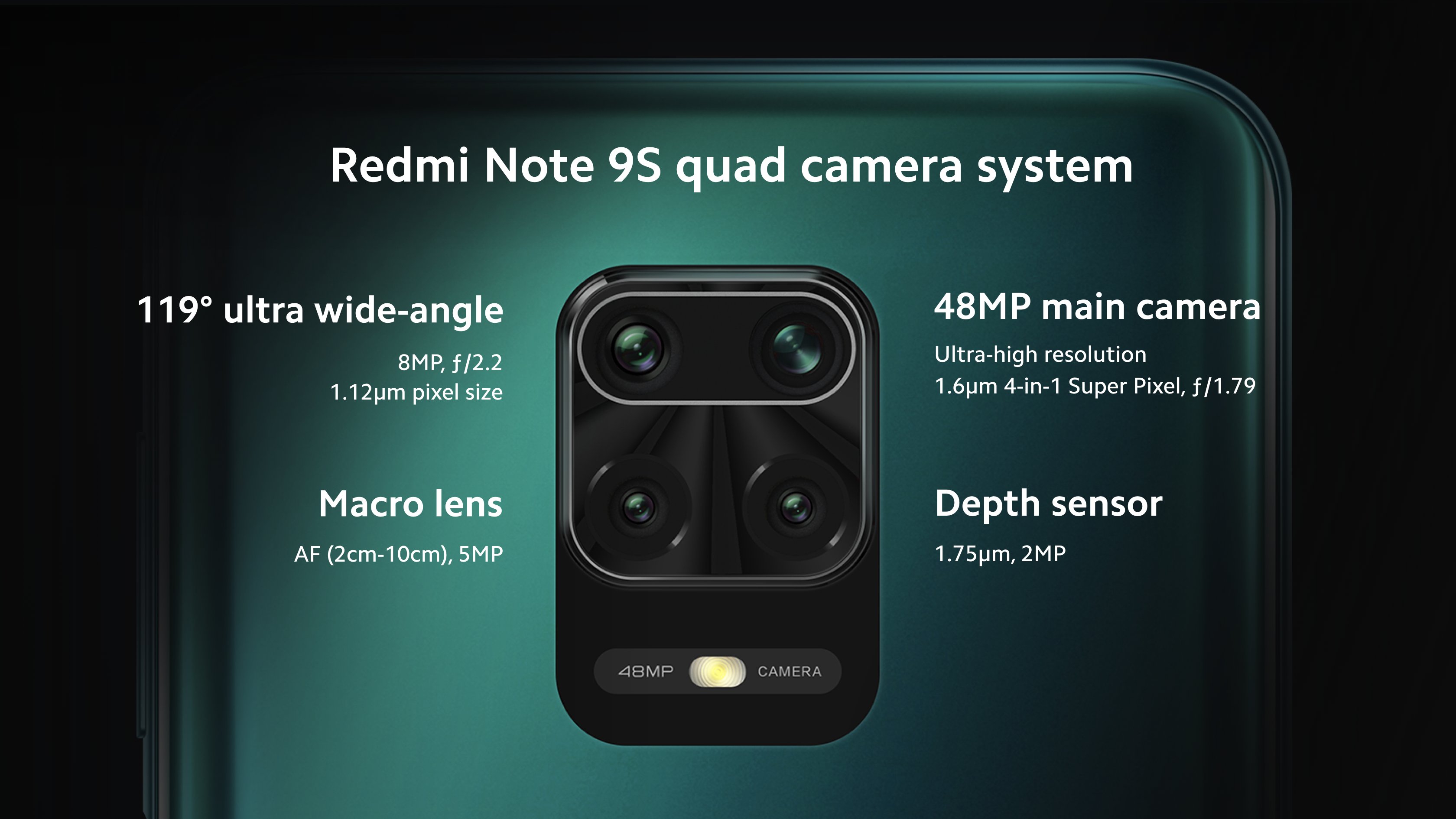
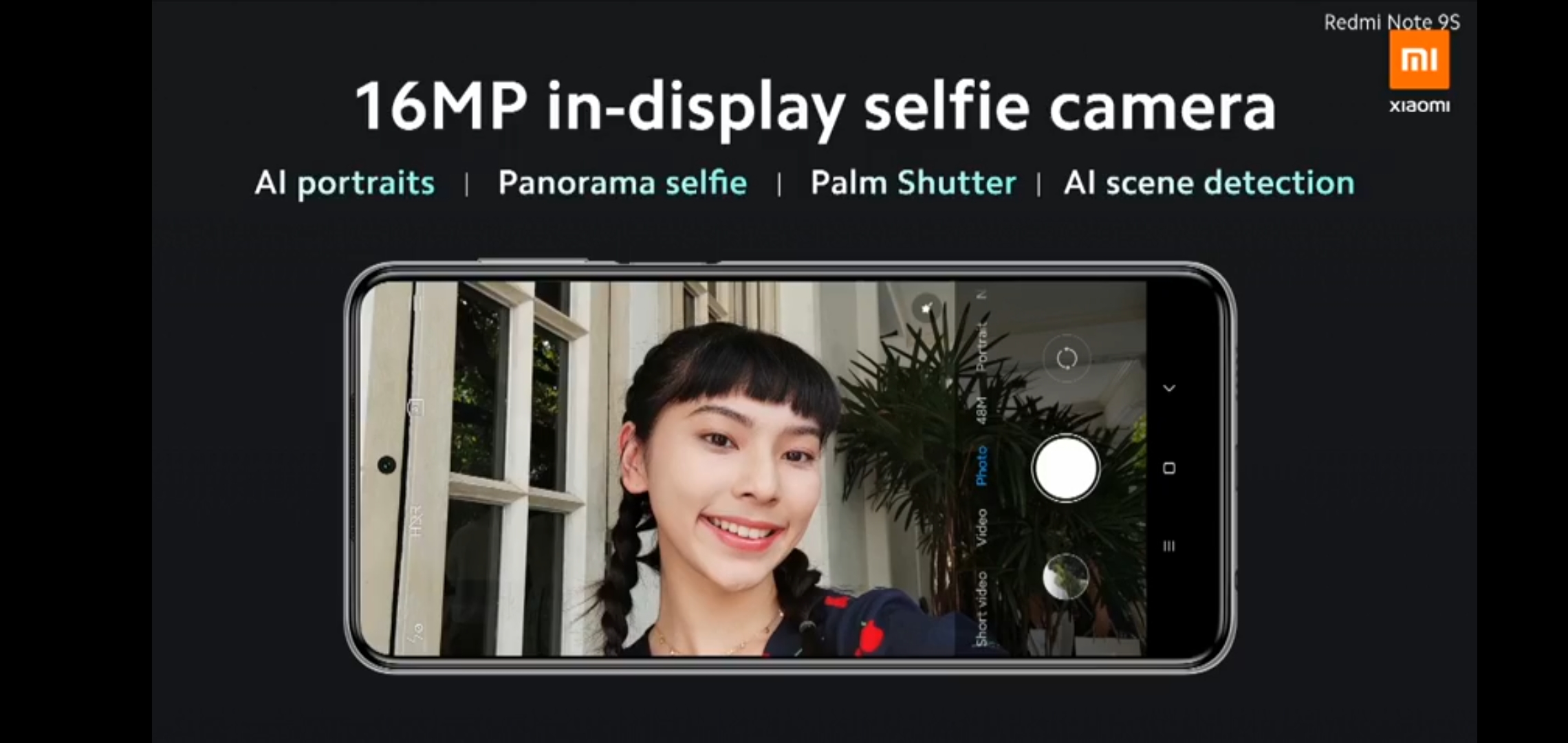
For photography, the Redmi Note 9S packs a quad-camera setup headlined by a48MP Sony sensor with 1.6um 4-in-1 Super Pixels and f/1.79 aperture. There is also a 119-degree ultra-wide-angle 8MP lens with f2.2 aperture. The phone also packs a 5MP Macro lens with auto-focus and finally, a 2MP depth sensor. At the front, there is a 16MP selfie shooter house in the display punch-hole. The selfie shooter comes with features such as AI portraits, Panorama selfie, palm shutter and AI scene detection. Do note that the Redmi Note 9 Pro packs a 32MP selfie shooter housed in a similar punch-hole.
Keeping the lights on is a massive 5020mAh battery with 18W fast charging support.
PRICING AND AVAILABILITY
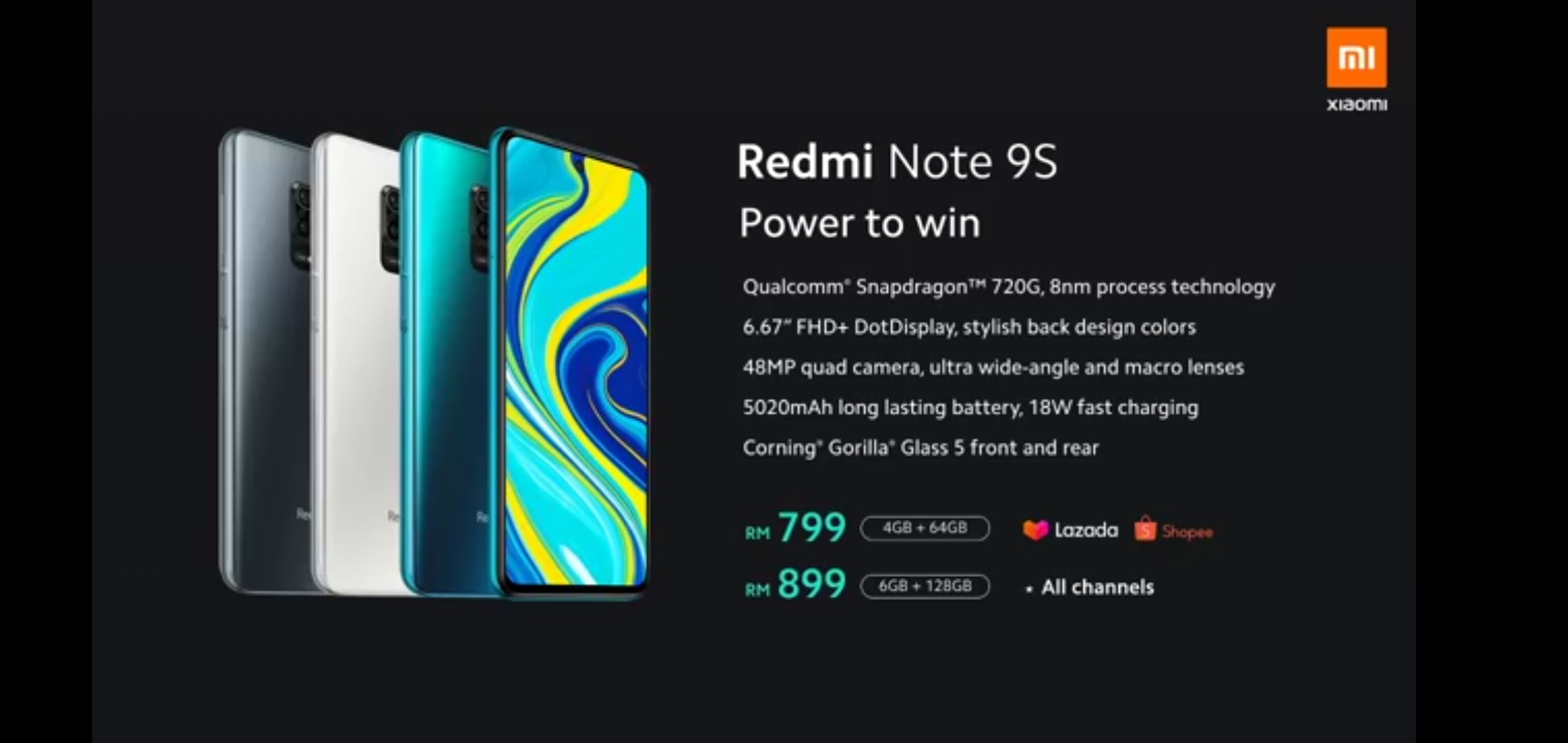
The Redmi Note 9S 4GB+64GB version comes in at RM 799 in Malaysia while the 6GB + 128GB version will retail for RM 899. The 4GB version will be sold exclusively on Lazada and Shopee while the 6GB version will be available on all channels in the country.
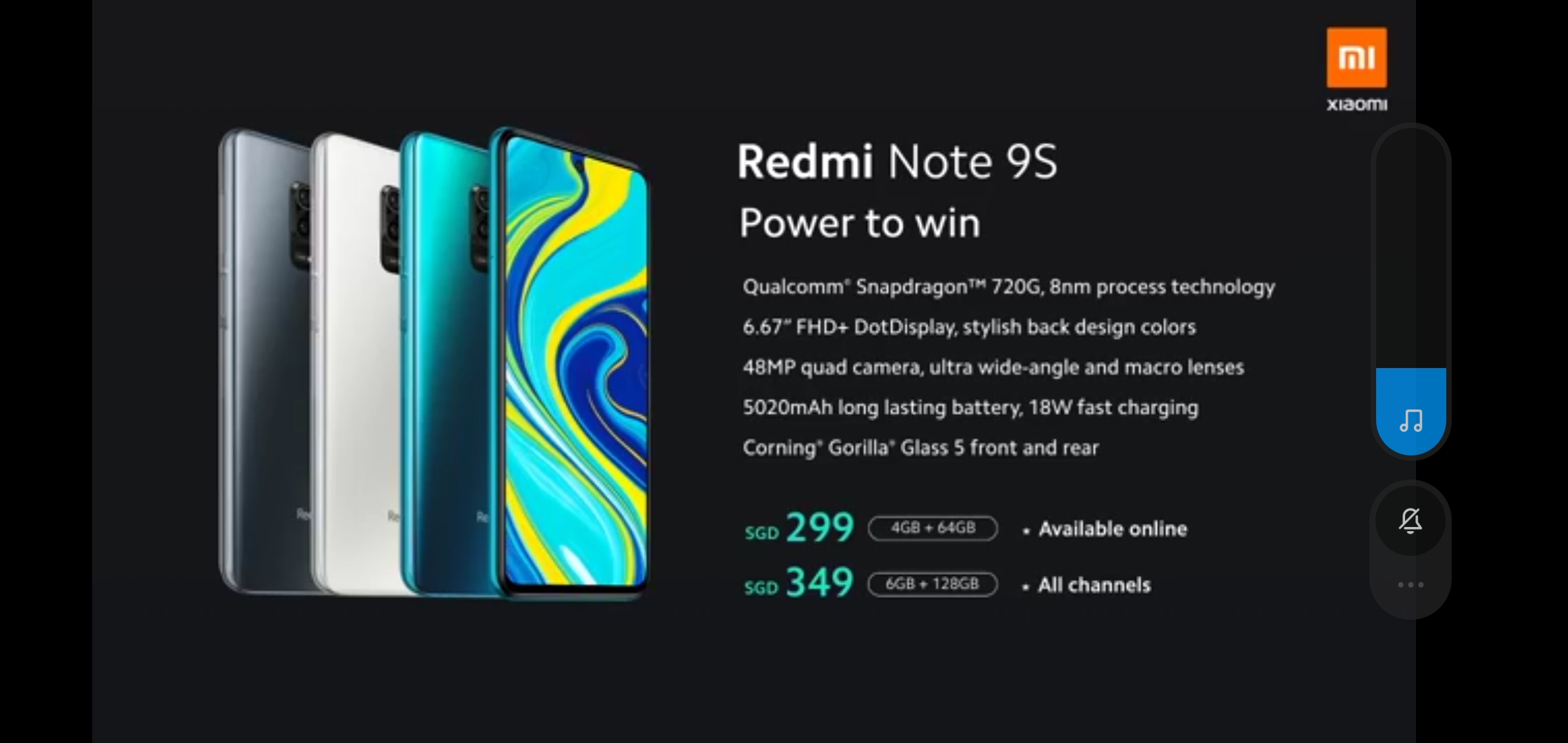
In Singapore, the Redmi Note 9S 4GB+64GB version will retail for SGD 299 ($204) while the 6GB + 128GB version will retail for SGD 349 ($239).
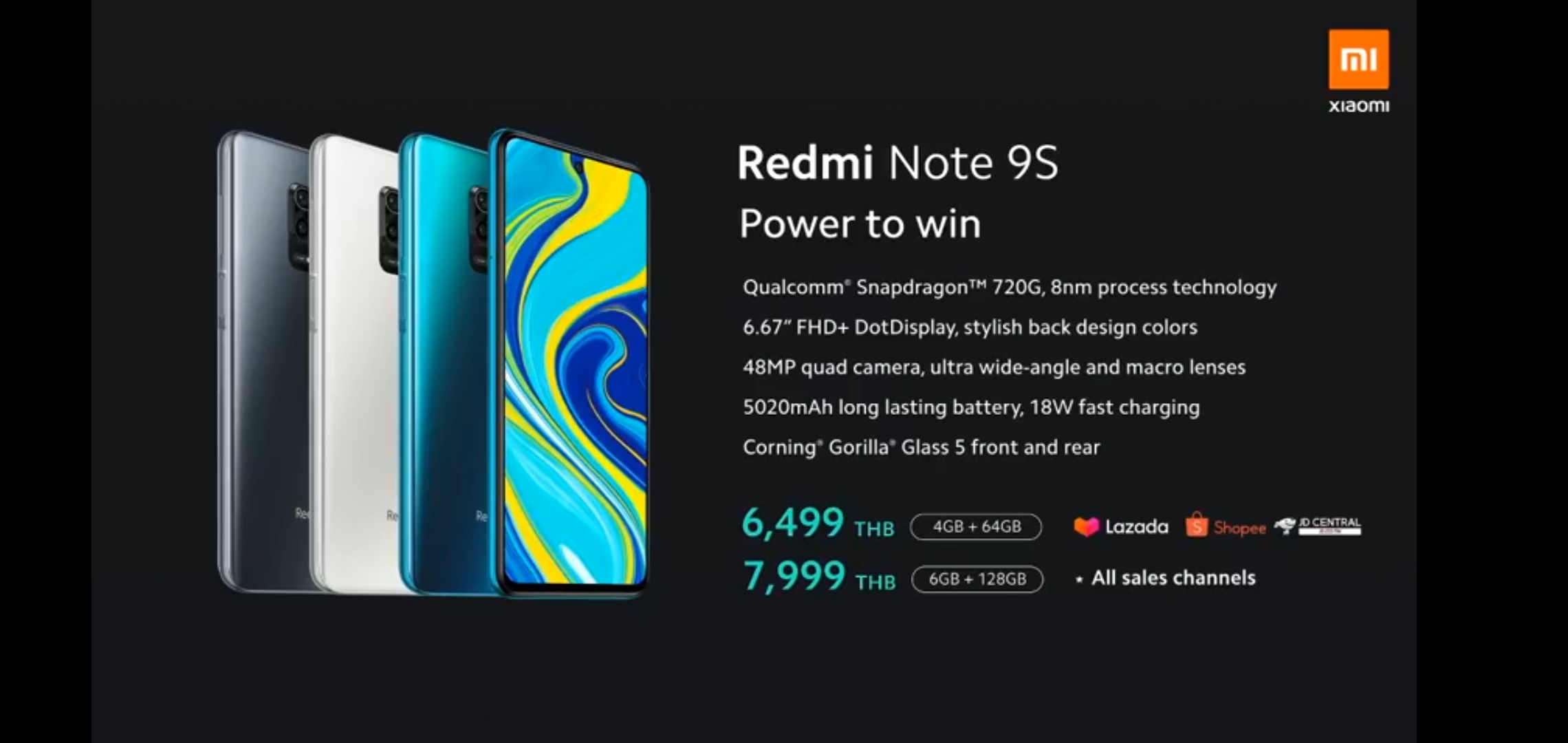
As for the Thai market, the 4GB + 64GB variant will sell for 6,499 THB (~$197) while the 6GB + 128GB version will adopt a retail price of 7,999 THB ($243).
For the global market, the Redmi Note 9S will be available on AliExpress for $249 USD for the 4GB +64GB variant while the 6GB+128GB version will be available for $279. The models will be available for the first time for the global market on April 7 at 00.00 AM PT.
The Nova 7 series launch is drawing closer. Two of the phones in the series – the Nova 7 Pro and Nova 7 – have been spotted at TENAA. While the full spec sheet remains unknown, TENAA does reveal that the two devices have 5G support.
According to the agency, the Nova 7 has model number JEF-AN00 while the Nova 7 Pro’s model number is JER-AN10. The two phones support NSA and SA 5G networks. The two phones are expected to come with the Kirin 990 5G chipset powering them based on a leak from last month.
[envira-gallery id=”312136″]
The Nova 7 phones will also support 40W fast charging according to a 3C certification page. We expect the complete specifications of the two phones will be published in a few days by TENAA.
Huawei is also expected to announce a Nova 7 SE which may come with the new Kirin 820 5G chipset. The chipset has been confirmed to power the soon-to-be-announced Honor 30S.
There is no specific launch date for the phones yet but April seems like the best bet.
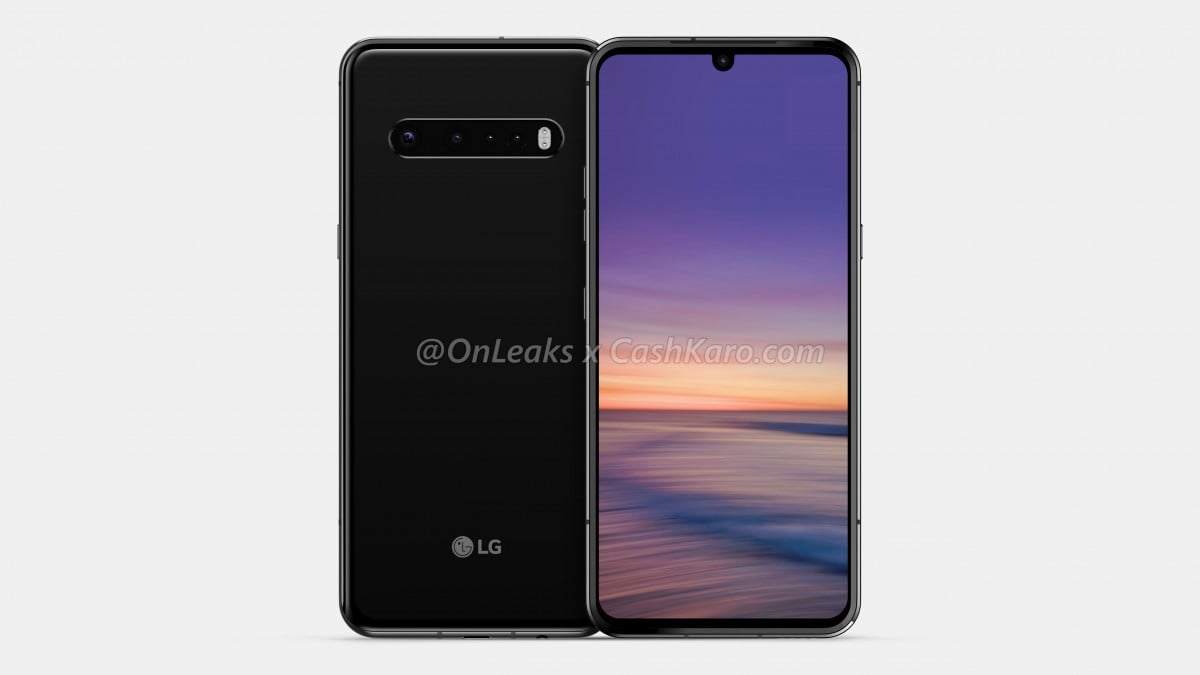
LG’s G-series of smartphones are known to be flagships but that might change according to a new report. It is said that LG has revamped its mobile phone line and will launch the LG G9 ThinQ as a mid-range phone rather than a flagship.
The source says the LG G9 ThinQ will launch with a Snapdragon 765G 5G processor under the hood rather than the Snapdragon 865 mobile platform.
LG is said to have made this decision after reviewing the market and the success of its phones. If the company launched the phone with a Snapdragon 865 processor, it will cross the $1000 mark and at that price range, folks will rather purchase an iPhone or a Samsung phone. With the Snapdragon 765G inside and probably some other tradeoffs, the LG G9 ThinQ can be more affordable.
The phone is expected to arrive this month which means it may be announced before the end of the week. We have no idea what it will cost but we will advise you brace up for similar pricing to that of the recently-announced Nokia 8.3 5G which starts at €599.
Leaked renders of the phone from early January show it has a waterdrop notch in its OLED display, an in-display fingerprint scanner, and four rear cameras. It will also have a dedicated Google Assistant button and an audio jack.
Huawei has just announced that its global update for its Android 10 OS based EMUI 10 custom skin, has officially crossed over 100 million users. The update brought the new generation of Android OS and is now fairly distributed amongst the company’s smartphone offerings.
The EMUI 10 first arrived back in September 2019. It was first launched with the Huawei Mate 30 series before being more widely rolled out. Over the past couple of months, developers from the Chinese tech giant have worked to include a total of 33 different smartphone models for the EMUI 10 update. For those unaware, EMUI 10 is a proprietary custom skin from Huawei and brings the latest Android 10 major updates as well.
Since it is a custom skin, it arrives with various unique functions, features and other newly developed technologies from Huawei. This includes the company’s latest GPU Turbo, EROFS file system, Ark compiler, and an AI assistant amongst many other new inclusions. It also featured many system wide improvements for the user interface that made for a more comfortable and smoother user experience and also added the highly appreciated dark mode.
EMUI 10.1
Unlike the monotonous black and white displays on most OLED screens, Huawei’s update brought support for colored always on displays with bright backgrounds and patterns. One of the notable features that made it in the major update included the better cross connection between the Huawei ecosystem. In other words, it was more seamless to bring files and data over from one’s smartphone to the company’s Matebook series of Windows laptops. This is again just a few examples of the various upgrades, and it is a great moment for Huawei that has achieved a great new milestone even amidst the Coronavirus outbreak.
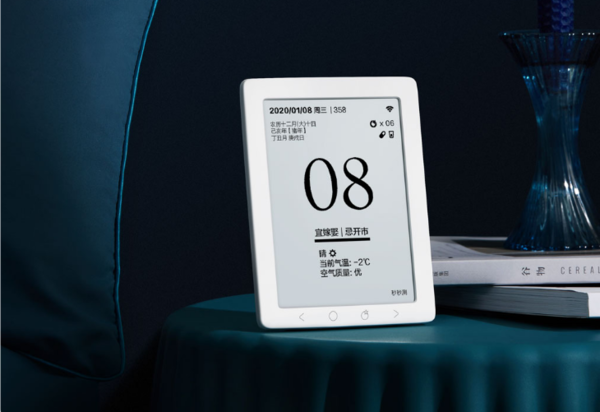
In January this year, Xiaomi crowdfunded a health calendar dubbed Youpin & Seconds Smart Health Calendar. The smart health calendar has now been launched for open sale on the Youpin website. The device comes in at 299 yuan ($41), higher than the 199 yuan ($28) price tag it adopted during the crowdfunding exercise.
The smart health calendar is made of ABS + PC material, with ceramic fire pattern. The material is healthy and environmentally friendly while delivering an aesthetic appearance. The gadget features a large 5.83-inch e-ink screen with dot-matrix display to make the display more similar to the printed text texture. The display also retains a high quality of visibility from different angles. It also comes with WiFi connectivity, bringing internet connectivity to the mix.
The Youpin & Seconds Smart Health Calendar has the functions of displaying weather information, air quality, famous quotes, calendar and so on. The smart calendar is embedded with a variety of China-popular online calendar channels such as one-way calendar, Zhihu calendar, Weiyi health calendar, workplace black box calendar, black chicken calendar, traditional yellow calendar, etc. With such a wide array of calendar channels, users can switch as often as they like. There are also regular functions such as reminders including one for medications, birthdays/anniversary, alarm, countdown etc.
As for the power supply, the smart calendar is powered by four replaceable No. 7 batteries. There is a low battery icon which reminds you when the battery is too low. The product comes in white only.
The new strand of Coronavirus has recently been classified as a pandemic by the World Health Organization (WHO). The outbreak began from the Wuhan province in China and has since spread and has confirmed cases in upwards of 170 countries. Now, amidst the various government implemented lockdowns, smartphone brands like Samsung, Oppo and Vivo are now temporarily suspending production in India.
Samsung’s Greater Noida Production Site
As of right now, the production lines will remain closed at least till the 25th of March 2020. For those unaware, the Coronavirus outbreak has been adversely affecting the Indian subcontinent, with the country’s capital city of Delhi being on a strict lockdown till the 31st of March 2020. During this time and growing fears, the major smartphone brands including Samsung, Oppo, and Vivo have taken the outbreak into consideration have closed its production lines for now.
The viral outbreak has already majorly affected various factories and manufacturing sites for any and every industry, especially those present in China. But now, it seems the shutdowns are becoming more rampant with South Korean sites temporarily shutting down previously this month and now India seeing a rising number of confirmed infected cases as well.
LG India’s Manufacturing Site
According to Samsung’s Greater Noida factory, the largest manufacturing facility from the South Korean tech giant in the world, “following the Indian government’s policy, we will temporarily halt operations of our Noida factory until the 25th. We will work hard to make sure there is no setback in supplying our products.” This production site is also known to produce home appliance products like air conditioners, refrigerations and washing machines and more, so more than just the smartphone industry is in dire straits.
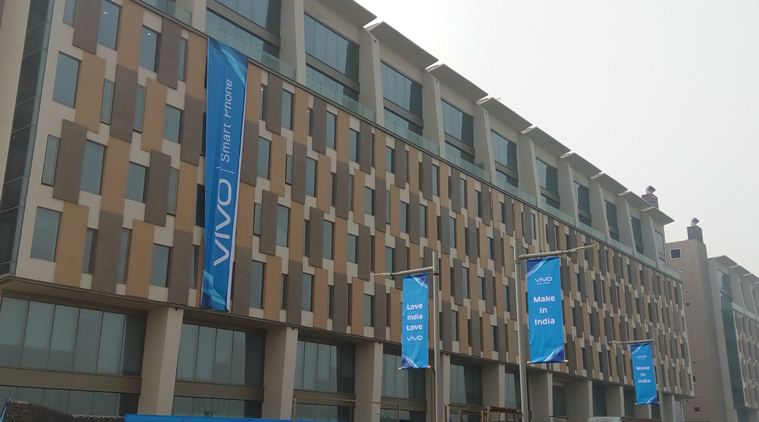
Similar to Samsung, LG has also reportedly shut down the production of its home appliances plant in Greater Noida and Pune, Maharashtra. On the other hand, Vivo has instructed all non-factory workers to work from home, which is an increasingly popular alternative these days. This shut down has occurred due to confirmed COVID-19 infected cases being found in the various production sites.
Vivo’s First Manufacturing Site in India
There have been a few exceptions, including Ericsson and Nokia, the two largest telecom equipment providers in India, that still have their factories running. Although, production has been scaled down by 50 percent while both companies have received this exception from proper authoritative bodies. However, these are just special cases and you can expect more smartphone brands with production lines in India to follow suit with temporary closures.
We use cookies on our website to give you the most relevant experience by remembering your preferences and repeat visits. By clicking “Accept”, you consent to the use of ALL the cookies.
This website uses cookies to improve your experience while you navigate through the website. Out of these, the cookies that are categorized as necessary are stored on your browser as they are essential for the working of basic functionalities of the website. We also use third-party cookies that help us analyze and understand how you use this website. These cookies will be stored in your browser only with your consent. You also have the option to opt-out of these cookies. But opting out of some of these cookies may affect your browsing experience.
Necessary cookies are absolutely essential for the website to function properly. This category only includes cookies that ensures basic functionalities and security features of the website. These cookies do not store any personal information.
Any cookies that may not be particularly necessary for the website to function and is used specifically to collect user personal data via analytics, ads, other embedded contents are termed as non-necessary cookies. It is mandatory to procure user consent prior to running these cookies on your website.