Advertisement

Viomi Internet Refrigerator with a 21-inch IPS display, voice control launched

Xiaomi‘s ecological chain company Viomi has launched the Viomi Internet Refrigerator with a design that reminds us of the Samsung Family Hub smart refrigerator. The fridge is said to adopt a two-door multiple cabin design with a total space of 450L.Viomi Internet Refrigerator

The most spectacular feature on the internet refrigerator is definitely the large 21-inch IPS Full-HD wide-angle display at the front. The touchscreen display brings onboard touch control. The fridge is also equipped with Viobrain AI which brings voice control to the mix. Users can ask how the weather is, listen to the news, or ask the temperature of the refrigerator freezer. In addition, users can also order a variety of fresh food on the courier and get home delivery. Since the fridge is only on sale in China, the feature is also restricted to the Chinese market.

In addition, the Viomi Internet Refrigerator also provides users with 1 million+ online recipes. Users can also listen to songs and watch dramas with access to 17 million+ songs thanks to iQiyi app. This while sure make users no longer bored while cooking.

The fridge also comes with support for MIJIA app which will make it possible to link up with mobile phones as well as other smart homes and IoT home appliances. Users can control the linked smart homes through voice.

The Viomi Internet Refrigerator comes with a retail price of 5999 yuan ($857) but is presently available on Xiaomi Youpin for a special promo price of 3,499 yuan ($500). The price will even go down to 2999 ($424) yuan for a limited-time flash sale on December 30.


(source)
 

ZTE Axon 10 Pro receives Android 10 based MiFavor 10 update

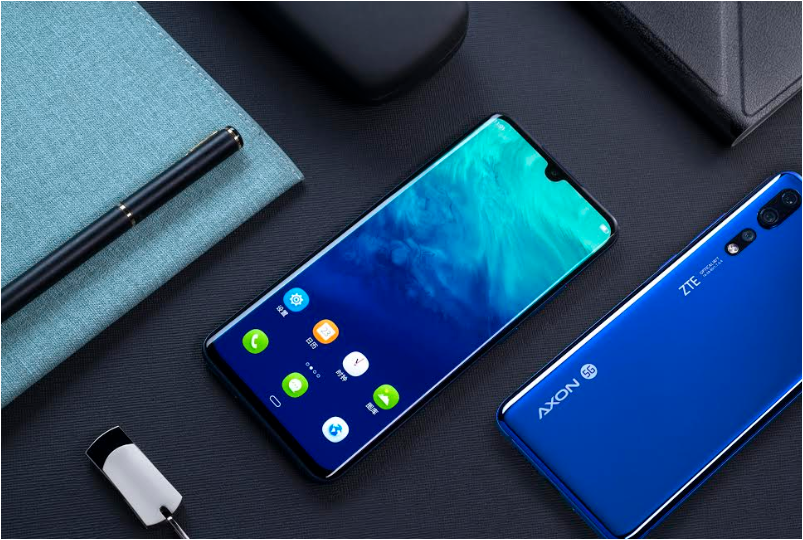
ZTE is finally rolling out Android 10 for its flagship smartphone, Axon 10 Pro. The new update brings the MiFavor 10 UI which is based on the latest version of Android OS. Earlier this month, we had reported that the company had announced the new update which is now being rolled out.

ZTE Axon 10 Pro 5G
ZTE Axon 10 Pro 5G

According to past reports, many new features and functions had been mentioned. However, a few additional features are also present that were compiled in the form of lists by the company itself. These include:

New Visual Design

A new visual design with motion gestures and elegant and flowing wallpapers and themes.

System

  • A new generation system optimization engine Z-Booster 2.0, with AI algorithm support to achieve smooth payment inspection.
  • Added SOS emergency help function.
  • Added system-wide dark mode to reduce power consumption and protect users’ eyes.
  • New full-screen small window reply option.
  • Optimized built-in ringtone resources.
  • Optimized split screen windows. Now, supports three levels of adjustments.

Lock screen, Status bar, Notification bar

  • Users can blindly press the fingerprint area to unlock while the next button on the black screen enters standby.
  • Added one-finger direct function to quickly launch application functions through fingerprints.
  • Added face recognition access to private space function, optimized off-screen display, and provided multiple clock backgrounds.

ZTE Axon 10 Pro 5G

Communication

  • Added group ringtone setting function.
  • Optimized harassment blocking mechanism and increased blacklist MMS blocking.

Voice Assistant

  • The power button can now activate voice assistant.
  • New voice shortcut function. Automatically execute multiple functions.
  • Optimized common functions of WeChat via voice assistant.

Smart Screen

  • Optimized Smart Screen Home.
  • Added intent recognition after text recognition.
  • Optimized text recognition mechanism for automatic recognition and word segmentation.

Gallery

  • Added document correction that automatically recognizes skewed documents, and manual stretching and fine-tuning.

Game Assistant

  • Added an automatic call rejection function.
  • Optimized the control panel with “add shortcut” function entry and instant application entry.

File Management

  • Improved the scene and classification with an increase in the exclusive entrance of WeChat and QQ applications.
  • Improved the display rules of downloaded content.

Safety

Updated Google security patch package to the latest to improve smartphone system security.


Buy Xiaomi Redmi Note8 Pro for Just $213.99 from Gearbest [Coupon]

Still riding high on the success of its Redmi Note 7-series, Xiaomi unveiled the Redmi Note 8 series featuring the Redmi Note 8 and the Redmi Note 8 Pro smartphones earlier this year. The phones were announced during a launch event held in Beijing, China in August.

Xiaomi Redmi Note 8 Pro Global Version

There is a possibility that Xiaomi might introduce more phones in the recently unveiled series, just like it did with the previous generation Redmi Note 7 series, by launching the Note 7S. While there’s still no confirmation about Xiaomi’s plan to release more devices under the Note 8 series, it might interest you to know that you can now get your hands on the Redmi Note 8 Pro for a lowered price through Gearbest.

Equipped with 6GB of RAM and 128GB of onboard storage space, the global version of the Xiaomi Redmi Note 8 Pro usually retails for $299.99. If you aren’t willing to shell out that kind of money, all you need to do is to apply coupon code GBNOTE8P3 at checkout.

Xiaomi Redmi Note8 Pro Global Version 6+128GB Pearl White EU- White 6+128GB

The coupon enables you to get $86 off. In other words, you can bring the retail price of the Xiaomi Redmi Note 8 Pro smartphone down to just $213.99 simply by applying the aforesaid coupon during the checkout process. An absolute steal at this price, the Xiaomi Redmi Note 8 Pro offers the following features:

  • 6.53-inch waterdrop notch screen FHD+ display with 2340×1080 pixels resolution
  • A rear-mounted ultrasonic fingerprint sensor for faster unlocking
  • MediaTek Helio G90T Octa-core gaming processor
  • Samsung GW1 64MP+8MP+2MP+2MP quad cameras at the back
  • 20MP selfie camera
  • 4500mAh battery with 18W fast charging
  • MIUI 10 base on Android 9 Pie OS

You can visit this link to check out more details about the Redmi Note 8 Pro, and take full advantage of the coupon which will be valid for a limited period.

Vivo X30 Pro 5G camera samples showcase vivid zoom photos including 60X zoom

Vivo finally took the wraps off the X30 models earlier this month with both models having spectacular features that distinguish it from the pack. The Vivo X30 Pro 5G is the high-end variant and even though the 5G connectivity may be the biggest feature onboard, the device comes with an impressive camera setup including a periscope lens. We have now laid our hands on a couple of camera samples which showcases the prowess of the zoom levels on the periscope camera on the device.

Vivo X30 Pro 5X zoom

The first picture highlights a building at some distance which is barely visible without zooming. The camera sample at 5X zoom, 10X zoom, 20X zoom and 60X zoom. What makes this amazing is the lack of photographic noise on the samples as the object is zoom closer. Even though the 60X zoom sample is a little blurry, the text on the wall of the building can be seen clearly.

Vivo X30 Pro 10X zoom

The device packs a 13MP periscope lens that enables 5x optical zoom and up to 60x digital zoom. The device also comes with a powerful 32MP selfie shooter with f/2.0 aperture. At the rear, there is a triple camera setup in addition to the periscope lens. The setup includes an OIS-enabled 64-megapixel main lens with f/1.8 aperture, a 122-degree 8-megapixel ultrawide lens with f/2.2 aperture as well as an OIS-assisted 32-megapixel portrait lens with f/2.0 aperture.

Vivo X30 Pro 20X zoom

In other aspects, the X30 Pro has a 6.44-inch S-AMOLED display with punch-hole design. It offers 1080 x 2400 pixels full HD+ resolution and is integrated with a fingerprint sensor. The phone is powered by a Samsung Exynos 980 chipset paired with 8GB of RAM and up to 256 GB of UFS 2.1 native storage without external storage. The latest FunTouchOS 10 based Android 9 Pie OS comes preloaded on the device.


(source)
Vivo X30 Pro 60x zoom

Best Mid-Range Smartphones of 2019

Mid-range smartphones are no longer budget devices with a bunch of higher-end features. In 2019, the best mid-range devices were essentially high-end smartphones sans a couple of premium features.

If last year’s mid-rangers were all about good processors, big batteries, and dual cameras, in 2019 brands upped their game by adding high-end chipsets, flagship-grade fast charging, quad-cameras, AMOLED displays, and even in-screen fingerprint sensors. We are spoiled by the number of good mid-range choices we have this year that costs less than €299 or Rs. 20,000 or $300.

Like our Best Budget Smartphones of 2019 article, compiling this list wasn’t easy, but the following smartphones stood out for us for their excellent quality and value for money.


REdmi Note 8 Pro

It wouldn’t be fair to compile the Best Mid-Range Smartphones list without a Redmi Note model, right? The Note lineup is extremely popular among mid-range buyers and the company has already sold 10 million units of the Redmi Note 8 series across the globe within three months of launch. That’s an average of over 110,000 units in a day!

The Redmi Note 8 Pro brought in the perfect blend of imaging prowess, gaming-oriented processor, and a large battery, packaged inside a beautiful body. It might be a bit heavier and bulkier than some competitors but overall, the Note 8 Pro is a well-balanced mid-range smartphone of 2019.

The Redmi Note 8 Pro comes with a MediaTek Helio G90T processor with a quad-camera setup consisting of a high-resolution 64MP primary camera, 8MP wide-angle camera, and a couple of 2MP shooters for macro and bokeh. There’s a large 4500mAh battery on board with 18W fast charging too!

All this for a competitive price tag of Rs. 14,999 in India or €259 in Europe for the 6GB + 64GB variant. Pretty solid deal indeed!


Realme X2

Realme has absolutely embraced the motto: If Redmi can do it, we can do it too! So if there’s a Redmi Note model in this list, there’s an equivalent (or even a better) Realme model to take it on. And Realme X2 is the mid-range phone to beat in 2019! The phone offers more value than any other smartphone in its price segment.

  • Gaming processor  ✔
  • Super AMOLED display  ✔
  • In-screen fingerprint  ✔
  • Quad-cameras with a wide-angle lens  ✔
  • Large battery  ✔
  • Super-fast charging  ✔
  • Beautiful design  ✔

If you had doubts about my earlier statement of how ‘2019 mid-rangers were high-end devices sans a few premium features’, this phone should help you to cast them away.

The Realme X2 comes with Snapdragon 730G (8nm), a 6.4-inch FHD+ Super AMOLED display, up to 8GB of RAM, 64MP primary camera with three other supporting cameras including an 8MP wide-angle lens, and a 4000mAh battery with 30W fast charging. You get all this for a starting price of just Rs 16,999 (4GB + 64GB), Rs. 18,999 (6GB + 128GB) in India or up to 289 € (8GB +128GB) in Europe. That’s incredible value for money!


redmi k20

If there was a phone that can take on the Realme X2, it would be the Redmi K20. It comes with the non-gaming Snapdragon 730 (8nm) processor with a full-screen AMOLED display, a pop-up camera that houses a 20MP selfie camera and a capable rear camera setup featuring three useful sensors, a 48MP primary shooter, an 8MP telephoto lens, and a 13MP wide-angle camera.

In case you are wondering, the K20 has the same camera setup as the K20 Pro, which we all so loved! So despite having one camera less than the two smartphones mentioned above, the triple camera setup on the Redmi K20 is more useful than those quad-cameras (let’s not talk about the quality of those 2MP shooters) on the Realme X2 and Redmi Note 8 Pro. Also, the K20 is one of few phones in this price segment to feature a telephoto lens that offers up to 2X optical zoom!

It’s a shame that the Redmi K20 was overshadowed by its more expensive ‘Pro’ sibling this year. So, it shouldn’t be surprising to see that it makes it to our Most Underrated Smartphones of 2019 list.

The Redmi K20 is highly discounted right now. You can find the 6GB + 64GB model for under Rs. 20,000 in India or around €279.90 in Europe. 


Lenovo-Z6

The Lenovo Z6 is yet another underrated smartphone in this list but offers immense value for your money. The phone comes with Snapdragon 730 (8nm) like the Realme X2 with a 6.4-inch AMOLED display with in-screen fingerprint, a triple camera setup featuring a 24MP main camera (f / 1.8 large aperture) + 8MP 2x optical zoom camera (f / 2.4 aperture) + 5MP bokeh camera, and a 4000mAh battery with 18W fast charging.

These specs are pretty amazing but it looks very similar to the models mentioned above right? And Lenovo is not really known for its software support either. So why does this phone make it to our Best Mid-Range Smartphones of 2019 list?

The three smartphones mentioned above: Realme X2, Redmi Note 8 Pro, and Redmi K20 weigh over 180 grams and measure over 8.6mm in thickness. In comparison, the Lenovo Z6 weighs just 159 grams and measures 7.7mm in thickness! It might well be one of the most comfortable mid-range smartphones of 2019.

And how much does it cost? 1199 yuan in China, which comes to just $171 or €154! It’s a shame that Lenovo Z6 didn’t get a widescale release and I blame Lenovo for that. But for its price, it offers outstanding value (including 2x Optical zoom)! You can get it for around $200 or €180 via sites like Aliexpress in Europe.


mi 9 se

2019 was all about 6-inch+ displays, large batteries, and multiple cameras. But these features come at a cost and that’s the bulky form factor. Some users don’t mind if their phones are a bit heavy or thick, but for others, it’s a definite deal-breaker. The Lenovo Z6 was a pretty lightweight phone, but if you are in the market for something smaller, lighter, and more compact, the Mi 9 SE is your best bet.

With the dimensions of just 147.5 x 70.5 x 7.5 mm, it’s smaller, thinner, and lighter than all the smartphones in this list. However, despite its compact form factor, the Mi 9 SE doesn’t sacrifice any major features. It comes with a 6-inch FHD+ Super AMOLED display, 6GB RAM, Snapdragon 712 (10nm octa-core 2.3GHz) processor, a 48MP triple cameras with ultra-wide and telephoto lens (2x optical zoom), and a 3070mAh battery with 18W fast charging. The battery is small but given its compact size and fast charging support, for those who want a capable smartphone that’s also comfortable to hold, the Mi 9 SE turns out to be a competitive option.

The Mi 9 SE wasn’t launched in India but it is available for around € 349.90 or £300 (6GB + 64GB) in Europe!


So these were our picks for the Best Mid-Range Smartphones of 2019! Do you think any other device deserves to make it to this list? Let us know!


Chinese Hacker group circumvents Two-Factor Authentication security methods

In recent times, many developers and publishers ranging from online service providers to even gaming studios have started offering two-factor authentication. And what they all stated and everyone is led to believe is that it makes one’s account, system, smartphone, etc, more secure. However, it seems like that is not the case.

According to a new report, a Chinese hacker group called APT20 has managed to bypass the commonly used security methods without settings off any alarms. In other words, the group has circumvented the means for two-factor authentication which makes the security method vulnerable.

Two-Factor Authentication

Reportedly, APT20 used what Fox-IT has labeled “Operation Wocao” to achieve this feat. Previously, the group managed to hack web servers but have now shifted focus. APT20 used an RSA SecurID software which was stolen from a hacked account to circumvent through the two-factor verification methods. In simpler terms, the group used a stolen and modified key from a hacked account to make their hack seem valid to the security systems.

Through this method, APT20 also managed to fool other systems to show valid results. Since two-factor authentication relies on different systems, it means that if the group manages to hack one side, then they can manage to make the other system agree to its modified key as well. Thus, allowing them to either steal or not need a key in the first place.

Two-Factor Authentication
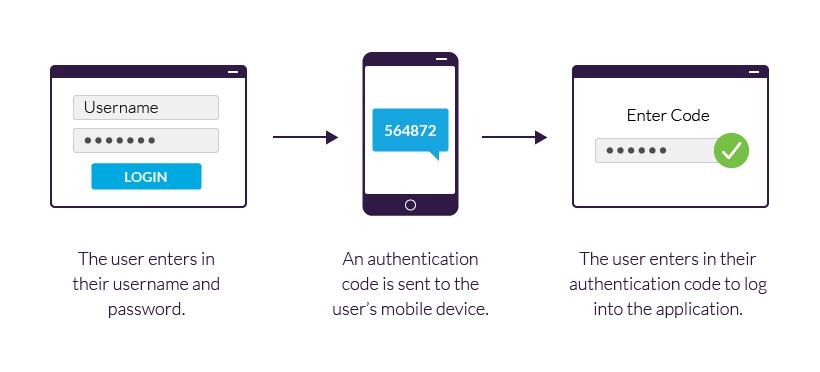
How Two-Factor Authentication works

As of right now, no solution for the latest exploit is currently available. But, it does not mean that the system is completely flawed and insecure. The report also details various methods through which the dual verification process can be made more independent and less reliant on one another.

Notably, Chinese citizens are at higher risks apparently due to the group being allegedly linked to the Chinese Government. It seems more plausible now as the group is actively targetting VPN systems. A VPN is basically used to access outside data or websites that the nation censors or doesn’t allow its people to access freely.


(Source)

WhatsApp to add disappearing messages feature for group chats

WhatsApp, the popular online messaging application, is adding another new feature in its latest beta. The Facebook owned service was previously rumored to have been testing a sort of “disappearing messages” but what it actually did was unknown up until now.

WhatsApp
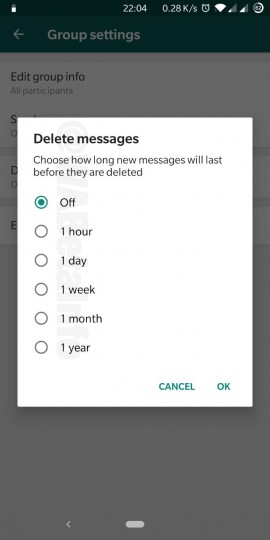
WhatsApp Beta with Disappearing Messages features (Image via WABetaInfo’s)

The new expiring messages features will be added to its latest beta build. For those unaware, a beta build is basically an early version of apps that carry new features that need to be tested before being available globally in the form of live builds. The latest version 2.19.275 of WhatsApp Beta, for Android, carries the upcoming feature for group chats.

It has been dubbed as “Delete messages” and allows the user to chose when their texts expire or disappear after a predetermined amount of time. This could be anywhere between an hour, a day, a week, a month or even a year. According to a report, the upcoming feature is being implemented to keep group chats’ conversations from taking up too much storage on smartphones.

whatsapp dark mode
WhatsApp’s upcoming Dark Mode feature is also being tested in the Beta program

Currently, a single WhatsApp group can have up to 256 different participants. Thus, the feature might turn out to be quite useful in the long run; though, there are also many different reasons for users to utilize this feature. The “Delete messages” feature is exclusively for a group chat, for now, and can only be accessed or set by the group chat’s administrators. So, a setting once applied will affect every member of the said group chat.


(Source,Via)

Vivo S1 Pro teased on Amazon, India launch nearing

Vivo plans to bring the S1 Pro to India next month. The mid-range smartphone has just been listed on Amazon India with the caption ‘Coming Soon’. Some of the key specifications have been confirmed through the Amazon listing.

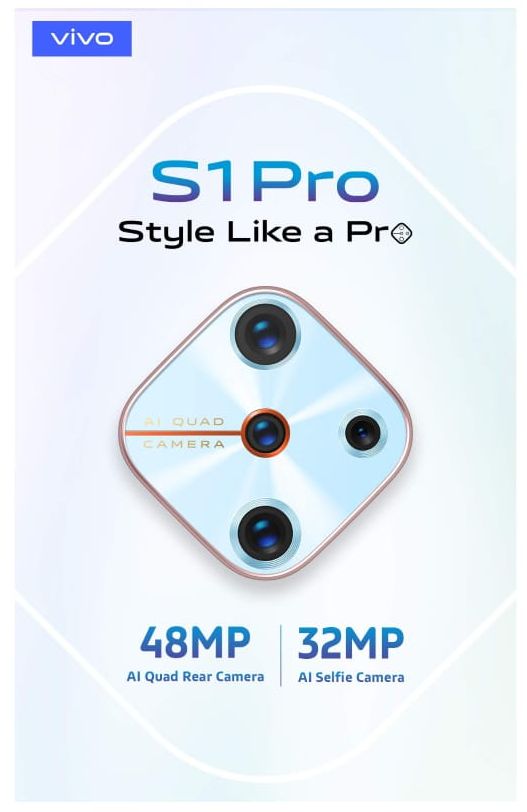
The teaser page of the Vivo S1 Pro on Amazon India has revealed that it has a diamond-patterned camera system on its rear which includes a 48-megapixel main lens. The quad camera system also includes a superwide lens and a macro lens. For capturing selfies, the S1 Pro has a 32-megapixel camera on the front

Vivo S1 Pro India teaser

A previous report on 91mobiles stated that the device is expected to arrive by mid-January 2020 at a price point of Rs. 19,990 (~$280). Vivo is expected to launch the 8GB + 128GB variant in India shortly, although, a 6GB variant could be introduced sometime in the future. The MSRP of the 6GB variant is currently unknown. The Vivo S1 Pro headed to arrive in India is the same smartphone that was unveiled earlier in Southeast Asian markets including Thailand, Malaysia, Indonesia, and the Philippines.

Vivo S1 Pro Specifications and Features

The Vivo S1 Pro flaunts a 6.38-inch full HD+ Super AMOLED display with a waterdrop notch that offers a resolution of 1080 x 2340 pixels. Powering the Vivo S1 Pro is a Snapdragon 665 SoC with 8GB of RAM and 128GB of native storage.

Vivo S1 Pro Fancy Sky

The primary camera setup on the smartphone features a 48-megapixel Samsung GM1 sensor, along with an 8-megapixel superwide sensor, a 2-megapixel macro lens and a 2-megapixel depth sensor. The S1 Pro is equipped with an in-display fingerprint scanner for security. The smartphone draws power from a 4,500 mAh battery that supports 18W fast charging through USB-C.


Realme Buds Air launching in China on January 7

OPPO‘s independent Realme brand started in India before expanding to other regions including China. It wasn’t any surprise that Realme entered the Chinese market considering the market size and what it can offer OEMs. The Chinese market has become one of the main focus of the Realme brand. The brand is now set to launch its first earbuds in China. A launch poster has been released showing the Realme Buds Air, as it is called, will be launched in China on January 7.

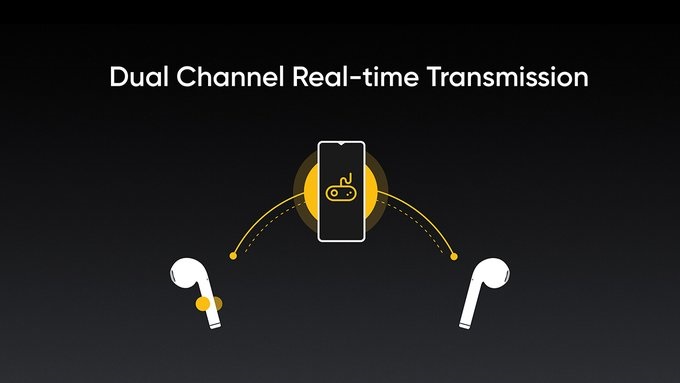
The Realme Buds Air was first launched in India earlier this month. Asaeminder, the wireless headset is equipped with a high-performance R1 processor supporting Bluetooth 5.0, which can ensure the effective transmission of audio and further reduce the sound delay. The two earbuds of the realme Buds Air true wireless headset can be connected to the phone simultaneously to ensure that audio is transmitted seamlessly and in sync with the lowest possible latency.

In addition, Realme Buds Air true wireless headphones reduce the sound delay in the game mode by 51%. Realme Buds Air’s delay is only 120ms which is far lower than the Apple Airpod’s 205ms delay.

Realme Buds Air true wireless earphones are equipped with two built-in microphones in a single earphone to eliminate dual-microphone noise: one to eliminate environmental noise and one to eliminate vocal noise. In addition, Realme Buds Air true wireless headphones algorithms are synthesized to offset ambient noise and provide clear call quality during a call.

Realme Buds Air true wireless headphones are equipped with imported LCP advanced multilayer composite diaphragms, 12mm large speakers, and use customized Dynamic Bass Boost solution to provide powerful bass effects, enhancing the immersion of watching movies and listening to music. The true wireless headset has built-in, intelligent wear detection and built-in distance sensor, which can detect wear and tear.

In terms of gestures, the realme Buds Air true wireless headset provides three quick operations-double-tap play/pause, triple-tap next song, long-press to call out Google Assistant. It also comes with support for wireless charging.


(via)


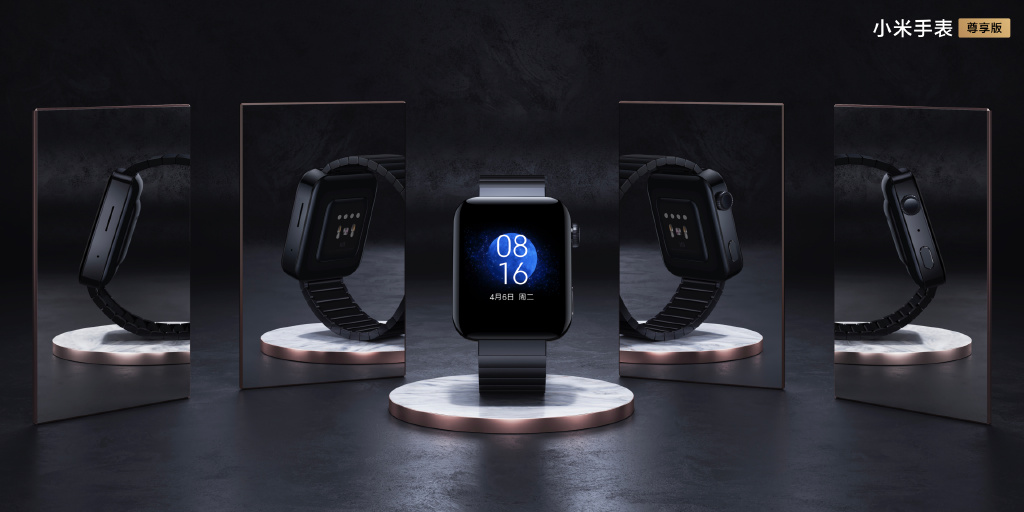
Xiaomi Mi Watch Exclusive Edition launch delayed, company apologizes

Earlier today (27th December 2019), Xiaomi went on its official Weibo account to share an apology. The show of sincerity was made after the Chinese tech giant stated that it had to delay the launch of the Mi Watch’s Exclusive Edition.

Xiaomi’s Mi Watch Exclusive Edition had an official launch date set in December 2019. However, the company has now said that the launch will be delayed due to certain reasons that include, insufficient stocks and more emphasis on improving the user experience in the UI department.

Xiaomi Mi Watch Exclusive Edition
Xiaomi Mi Watch

Reportedly, the delay of the Mi Watch Exclusive Edition will have it see a new launch date which is in February 2020, about two months from now. It gives the smartphone manufacturing company enough time to prepare as this move indicates that it expects a healthy sales number regardless of the fact that only limited units will be shipped.

In the official apology shared on the Chinese microblogging website, the company stated that it regretted the delay; but the smart watch will be available early next year and launch in Xiaomi Mall, Xiaomi Yuopin and Xiaomi Tmall’s official flagship store simultaneously.

Xiaomi Mi Watch Exclusive Edition

For those interested, Xiaomi’s Mi Watch Exclusive Edition is functionally similar to the original variant, but features improved aesthetics. It is made of four curved sapphire glass, 9H ultra-high hardness fully polished stainless steel frame alongside a stainless steel strap. In terms of price, the smart watch will be available for 1999 Yuan or roughly 285 US Dollars.


(Via)

Huawei trademarks a true wireless earphones called the NovaBuds

According to a new report, Huawei, the smartphone manufacturer, has applied for a new trademark for what seems to be a pair of bluethooth earphones. The name Huawei Novabuds was registered with the EUIPO (European Union Intellectual Property Office) in the headset category.

Huawei
Huawei Technologies Co Ltd’s trademark application with the EUIPO for NovaBuds

Notably, the Huawei NovaBud’s trademark application includes certain tags like virtual reality gaming augmented headset, mobile phone headset, in-ear headset and more. As of right now, the application for the trademark is still undergoing review and it is expected that the NovaBuds are truly wireless earbuds from the Chinese tech giant.

Unfortunately, additional information is currently unknown and finer details like design and specifications have not been revealed. We will have to wait for an official announcement to see if this is Huawei’s entry to capture the popular wireless earphones market. Currently, Apple with its AirPods series is at the top of the wireless hearables category, so the trademarked NovaBuds could soon be a viable alternative in the near future.

Nova smart products Nova Smart products

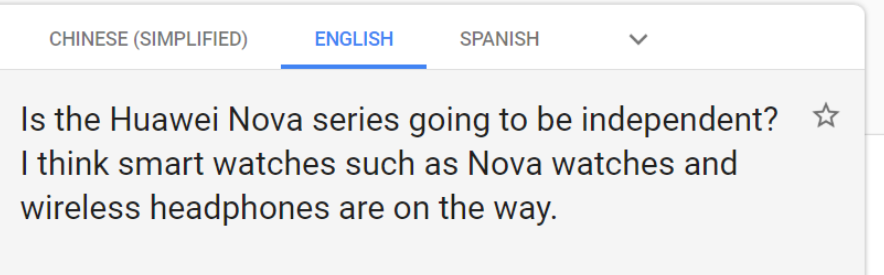
Interestingly, we had also previously covered a report which detailed that the Nova subbrand might become an independent entity from Huawei. The Nova brand includes the popular Nova series of smartphones and, in the future, wireless headphones, smart watches and more. Thus, Huawei’s NovaBuds could also be one of the first Nova products launched after it achieves operational independence.


(Via)

Video of Huawei Mate X foldable phone with broken screen surfaces online

Huawei recently started selling its first foldable smartphone Huawei Mate X after delaying the launch by a few months to make sure the device is durable. The company will also be launching an upgraded Mate Xs in the coming months and later the second-generation Mate X2 is expected to get launched.

Now, a video of the Huawei Mate X smartphone has surfaced online which shows the device with a broken screen. However, it is not yet known what happened to the smartphone or whether it was due to user’s fault or some issues with the device.

As said, we have not idea what has happened to this broken unit of the Huawei Mate X foldable smartphone. The phone could have fallen down or maybe exposed to a sharp object and these are just assumptions as we have no idea what has caused this.

Given that we have not heard or come across reports related to the display issue on the Huawei Mate X smartphone, it seems likely that the unit shown in the video has its display broken because of the user’s fault and the device.

However, the smartphone could be blamed for the design as the outward folding design has a major drawback that the screen is exposed all the time. So there’s a significant risk if the phone drops from your hand.

Earlier, Samsung had to postpone the launch of its first foldable smartphone — Samsung Galaxy Fold after the review units started experiencing issues with the display and many criticised the build quality. Eventually, the company postponed the launch of Galaxy Fold and made changes to the phone’s design before it started selling them in the market.

(Source)

Android 11 might get support for video recording larger than 4GB in size

Android is the most widely used mobile Operating System followed by iOS at present. But there are certain limitations that have been continuing to exist on this platform for years. One of which is not able to record videos in size more than 4GB. Yes, you heard it right, your Android smartphone can record videos only up to 4GB in size. But thankfully, this limitation will be eroded out in the next release Android which will be simply called Android 11.

Android 11

Must see: Android 11 expected to debut with fully secure Wireless ADB

Today’s Android smartphones can do lots of things but still can record videos only up to 4GB in size. Once your recording hits 4GB size limit, it will get stored without your consent but the recording will continue by splitting into consequent 4GB files depending on how long you record. Which means your gallery will be filled with a number of videos instead of a one single piece video. Although you can mux the independent video files into a single video as you intended to be while recording, it is not the ideal way to go.

This limitation was first introduced by Google in 2014 when 4K video recording on smartphones just started popping up. So, it makes sense back then when smartphones had lower internal storage and almost all of them could only record videos up to 1080p. But now, it is a silly drawback that should have been reverted at least a couple of years back since even budget smartphones these days can record 4K videos.

Now as new phones from Samsung and Xiaomi are expected to feature 8K video recording, Google is finally removing the 4GB limitation after years of requests from developers. This change was spotted by XDA Developers in a description of a new commit in the AOSP Gerrit. During testing, the developers have managed to store a video of 32GB and even filled the entire internal storage of a phone with a single recording.

Anyways, this commit has not been merged but if it does, this feature will most likely debut on Android 11 beta which could be released in March like Android Q.

Related: Android 11 could feature Dark mode scheduling

Samsung Galaxy A30s 128 GB variant goes official in India, claims report

Samsung had launched the Galaxy A30s in September in India. The South Korean company had launched the smartphone with 64 GB of internal storage. The handset is currently available in the country a price tag of Rs. 14,999 (~$210). A fresh report on 91mobiles has launched a new variant of the phone that comes with a massive storage of 128 GB. The pricing of the new model has also been revealed.

The 64 GB storage variant of the Galaxy A30s featured 4 GB of RAM and the newly introduced 128 GB model also features the same amount of RAM. The price tag of the new variant is set at Rs. 15,999 (~$225). The publication has claimed that the variant is available for purchase in the offline markets across India. Samsung’s online store and third party retailers are yet to list the 128 GB edition of the Galaxy A30s. The new model can be bought in colors like Prism Crush White, Prism Crush Violet, and Prism Crush Black.

Samsung is yet to release an official statement on the arrival of the 128 GB edition of the Galaxy A30s. Talking about the 64 GB variant, it had cost Rs. 16,999 (~$238) at launch. However, its pricing has been now reduced to Rs. 14,999 (~$210).

Samsung-Galaxy-A30s

Samsung Galaxy 30s Specifications

The Galaxy A30s is fitted with 6.4-inch S-AMOLED display with Infinity-V notch. It offers HD+ resolution of 720 x 1560 pixels. The screen is integrated with a fingerprint sensor.

The Exynos 7904 powers the smartphone along with 4 GB of RAM. The 64 GB / 128 GB editions of the phone offers a dedicated microSD card slot for expanding its storage. The device is backed by a 4,000mAh battery that supports 15W fast charging. The Android 9 Pie OS comes preloaded on the Galaxy A30s. The handset will be soon treated with One UI 2.0 based Android 10 OS ugrade.

The Galaxy A30s has a triple camera system on its back. It comprises of a 25-megapixel main lens, a 5-megapixel depth sensor and an 8-megapixel ultrawide sensor along with LED flash. It has a front-facing camera of 16-megapixel. The smartphone comes with connectivity features like dual SIM support, 4G VoLTE, Wi-Fi 802.11ac, Bluetooth 5.0, GPS, NFC and USB-C.


(source)

Realme X50 5G live shots appear; 3C certification reveals 30W fast charger

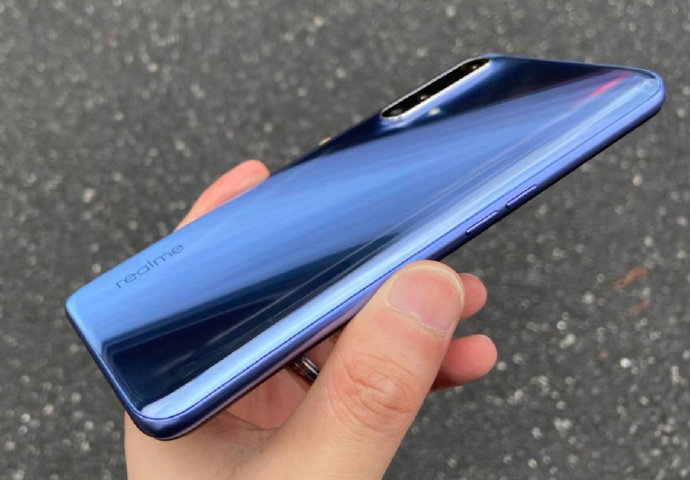
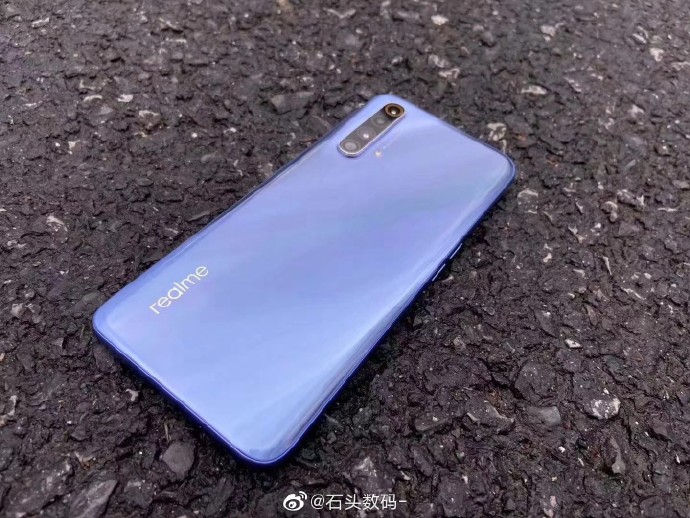
On Jan. 7, Realme will be unleashing the Realme X50 as its first 5G smartphone. Ahead of the launch, the company has revealed the rear design of the smartphone. Couple of real-life images of the Realme X50 smartphone have appeared on Weibo. Also, the purported X50 has received approval from the 3C authority of China.

The new images show the Polar White edition variant of the Realme X50 phone in real. The left edge of the phone can be seen sporting buttons for volume up and down. The upper-left corner of the glass back of the Realme X50 has a vertical quad camera setup that is assisted by an LED flash. The rear design of the X50 has a different positioned LED flash compared to the Realme XT and Realme X2 smartphones.

The right side of the Realme X50 phone and its connectivity ports are not visible in the new images. However, the official render of the phone has confirmed that it is equipped with a side-mounted fingerprint sensor. It could be integrated with the power button of the phone.

A new Realme phone that has model number variants such as RMX2051 and RMX2025 has received certification from China’s 3C authority. The RMX2051 / RMX2025 is a 5G ready smartphone which suggests that it could be the upcoming Realme X50 5G phone. The 3C certification has revealed that the device may ship with a charger that supports up to 30W charging.

Realme had recently confirmed that the Realme X50 5G will be arriving with support for enhanced edition of its VOOC 4.0 40W charging technology. With improved charging, the Realme X50 will be able to gain 70 percent battery power by charging for only 30 minutes. However, the battery size of the smartphone is currently under the wraps.

Reports surrounding the Realme X50 have revealed that it could be coming with a 6.6-inch IPS LCD display with dual punch-hole design. The Snapdragon 765G with dual-mode 5G support will fuel the smartphone. Its rear-facing quad camera setup could be featuring the Sony IMX686 64-megapixel primary lens. It could be featuring 32-megapixel + 8-megapixel dual front-facing cameras.

The Redmi K30 5G will be soon hitting the Chinese markets as the cheapest 5G phone as it is priced at 1,999 Yuan (~$280). The Realme X50 5G appears to be a good rival for the Redmi K30 5G. It remains to be seen whether it manages to snatch the cheapest 5G phone title from the Redmi smartphone.


(source 12)

China’s wearables market grew 45.2% in Q3 2019 compared to last year

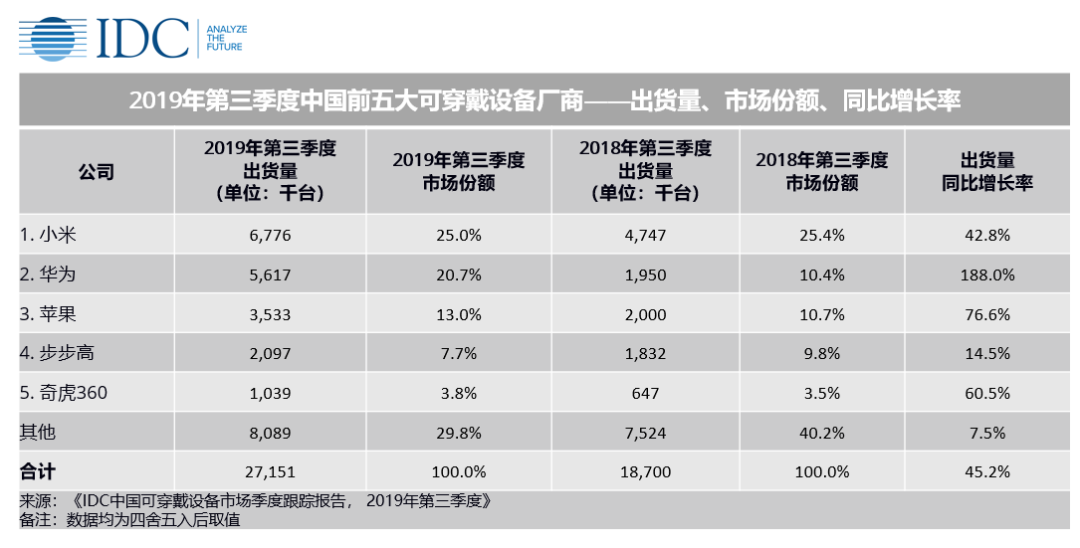
Wearables are getting more and more popular thanks to the innovative products and unique use cases offered by companies. Now, according to a report from market research firm IDC, Chinese market witnessed shipments of 27.15 million units for wearable devices in the third quarter of this year.

The shipments for the Q3 2019 represents a growth of 45.2 percent compared to the shipments of 20.97 million units during the same period in the previous year. Further, the report also predicts the market to reach 200 million units in 2023.

China Wearables Shipments Q3 2019

The report shows that shipments of basic wearable devices (wearable devices that do not support third-party applications) were 20.97 million units, representing a year-on-year increase of 38.2 percent while the shipments of smart wearable devices were 6.18 million units, a year-on-year increase of 75.5 percent.

Coming to the companies, the report shows that Xiaomi is leading the wearables market and the report is attributing this to the Mi Band 4 fitness tracker and its aggressive pricing leading to high-scale shipments. Xiaomi holds 25 percent market share while Huawei and Apple have grabbed 20.7 percent and 13 percent market share respectively.

As for the growth, Huawei saw its shipments almost double as the company’s market share has reached from 10.7 percent in the third quarter of 2018 to 20.7 percent in the third quarter of 2019.


Huawei denies WSJ allegations of receiving $75 billion in state support

Yet another chapter is being added to the Huawei vs US saga, this time courtesy of WSJ. According to them, Huawei’s rise to the top of global telecommunications was fueled by tens of billions of dollars in financial assistance from the Chinese government, a scale of support that in key measures dwarfed what its closest rivals got from their governments.

In fact, according to the piece published by WSJ, Huawei reportedly had “access to as much as $75 billion in state support.” That massive figure is culled from poring over various forms, including grants and tax breaks. 

Huawei Technologies said on Thursday that its relationship with the Chinese government was “no different” from any other private company operating in China. This should be no surprise as Huawei has long denied close links with the Chinese government and maintained that Washington has no evidence to support accusations of spying.

Huawei also disputes The Wall Street Journal allegation that it had received as much as 75 billion dollars in assistance from the Chinese government. The article says state support helped Huawei “undercut rivals,” but says nothing about tax breaks for U.S. tech companies. Amazon, for example, is paying zero taxes for a second consecutive year.

“Like other tech companies that operate in China, including those from abroad, Huawei receives some policy support from the Chinese government,” Karl Song, vice-president of the company’s corporate communications department, said in a statement. “But we have never received any additional or special treatment.”

In the statement on Thursday, Song said the company’s working capital primarily comes from its own business operations – which make up 90 per cent of its working capital – and external financing rather than government subsidies. “Huawei’s external financing follows all market rules, and our cost of debt aligns with market standards,” Song added.

(Source 1, Source 2, Source 3)

Xiaomi Mi 10 Pro with 66W fast charging said to charge in around 35 minutes

This year, Xiaomi had launched the Xiaomi Mi 9 series in February. Hence, the rumor mill is speculating that the Chinese firm may unveil the Xiaomi Mi 10 series in February in the coming year. The series may include Xiaomi Mi 10 and Mi 10 Pro smartphones. According to a reliable tipster from China, the top version of the Mi 10 lineup which could be the Xiaomi Mi Pro will be able to charge completely in around 35 minutes.


In the above shown Weibo post, the tipster has claimed that the fast charging feature on the Mi 10 top series version has been greatly improved. In test, the device could be completely in charged in nearly 35 minutes. Xiaomi’s 50W wireless charging is not completely ready yet. It is unlikely to be made available to the users in the first half of 2020.

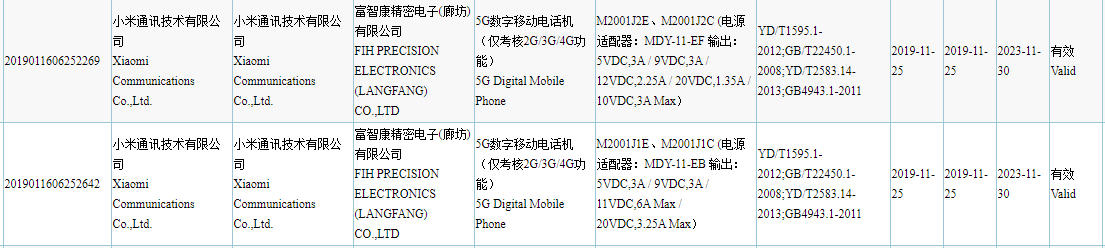
Around a month ago, two new Xiaomi devices with 5G capabilities had surfaced on the database of China’s 3C authority. Foxconn insiders have revealed that J1 and J2 are the codenames of the Xiaomi Mi 10 series smartphones. The J1 phone could be the 3C certified M2001J1E/C 5G phone that was seen with MDY-11-EB charger that supports 66W fast charging. This device could be the Xiaomi Mi 10 Pro. The said moniker has already been confirmed by Xiaomi President Lin Bin.

The 3C certification of the M2001J2E/C 5G smartphone had revealed that it could be shipped with an MDY-11-EF charger that supports 30W fast charging. This handset could be the Xiaomi Mi 10. The MDY-11-EF is the same charger that ships with Xiaomi Mi CC9 Pro / Mi Note 10. The exact size of the batteries of both phones are not known yet. The Xiaomi Mi 9 Pro 5G phone that gone official in September this year had arrived with a 4,000mAh battery. The Chinese manufacturer may pack the Mi 10 and Mi 10 Pro phones with larger batteries.

Being flagship devices, both smartphones are expected to be driven by the Snapdragon 865 mobile platform. The presence of the SD865 will bring support for dual-mode 5G connectivity on the Mi 10 series. It remains to be seen whether the Mi 10 devices sport 108-megapixel camera. The MI 10 series could be coming with LPDDR5 RAM. Also, the smartphone could be equipped with a 90Hz or 120Hz display. The rumor mill is expected to actively reveal more information on the Mi 10 lineup starting from the coming year.


(source)

Apple AirPods suppliers are seeking funding to expand production in Vietnam

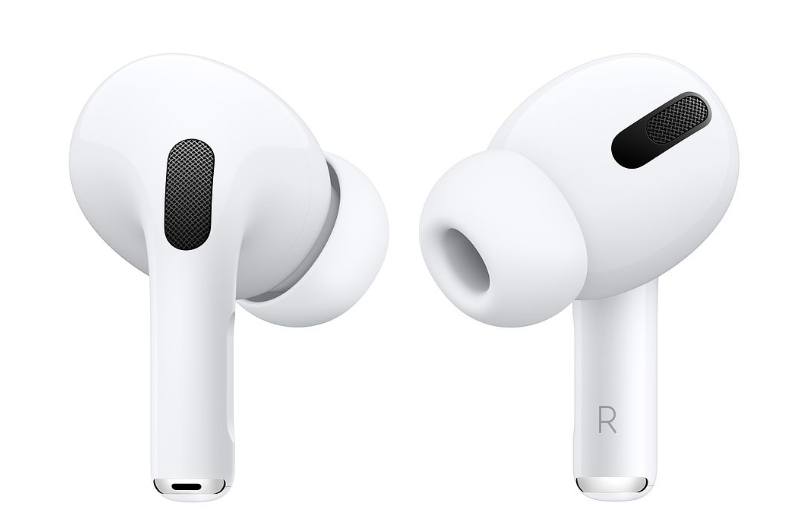
Apple AirPods true-wireless earbuds have been well-received in the market and are currently the best-selling TWS Earbuds worldwide. The newly launched AirPods Pro are so popular that the company had to increase its production.

The US-based company reportedly turned towards Luxshare-ICT to double the production of the AirPods Pro earphones at its Chinese facility. The production units will see an increase to 2 million units a month. Furthermore, the company has also asked another Chinese company GoerTek to boost production at their Vietnam-based factories for the base AirPods variant.

AirPods Pro featured

Now, it is being reported that both Goertek and Luxshare are  seeking hundreds of millions of dollars to grow AirPods and AirPods Pro production. This is in part to diversify Apple’s supply chain as well as to shift manufacturing outside of China, in case the trade deal collapses and tariffs are reinstated.

In July, Goertek began manufacturing of Apple’s AirPods began on a trial basis and Apple had asked components suppliers to support Goertek’s efforts, even though initial production runs were small. Now, it is reported that assembly of the AirPods would increase following the trial run. The report notes that components sourced in China are easy to ship to Vietnam, and Vietnam’s labor costs are about one-third of China’s.

Analysts believe that the AirPods are headed towards mass-market domination, which could soon result in quarterly revenue over $4 billion during the holiday season. Industry analyst Asymco believes that Apple will witness 50% YoY growth for wearables.

According to Bernstein analyst Toni Sacconaghi, Apple sold $6 billion worth of AirPods this year and is set to rake in $15 billion in revenue from the true wireless earbuds in 2020. It is said that Apple could sell as many as 85 million AirPods next year, making AirPods the company’s third-largest business after iPhones and iPads by 2021.

(Via)
Xiaomi Mi CC9 Pro smartphone gets price cut of up to 300 yuan in China

Last month, Xiaomi launched the Mi CC9 Pro smartphone in its home market China, making it the first commercially available smartphone to feature 108-megapixel primary camera sensor. The smartphone was launched in three variants — 6GB + 128GB, 8GB + 128GB, and 8GB + 256GB Premium Edition, costing 2,799 Yuan (~$399), 3,099 Yuan (~$442), and 3,499 Yuan (~$499) respectively.

Now, Xiaomi has announced a price cut on the Mi CC9 Pro in China, bringing down the cost of the base model with 6GB RAM and 128GB storage to 2,599 Yuan (~$371) while the 8GB RAM and 128GB storage model is now priced at 2,799 Yuan (~$400).

Xiaomi Mi CC9 Pro Price Cut China

The Mi CC9 Pro Premium Edition smartphone that packs 8GB RAM and 256GB internal storage is now available for purchase in China for 3,199 Yuan (~$457). The smartphone comes in three color options — Magic Green, Ice and Snow Aurora, and Phantom Black.

The smartphone features a waterdrop notch enabled edge-to-edge curved AMOLED display of 6.47 inches. It delivers 1080 x 2340 pixels full HD+ resolution, 19.5:9 aspect ratio with 400000:1 contrast ratio, HDR, 600-nits brightness and DCI-P3 wide color gamut.

Under the hood, it is powered by Qualcomm Snapdragon 730G processor. The smartphone draws power from a humungous 5,260mAh battery and the company has also added support for 30W fast charging, allowing the phone to completely charge in 65 minutes.

Xiaomi Mi CC9 Pro curved display-

It comes with 108-megapixel penta-lens camera system. The first lens in the rear-facing camera system of the phone is a 4-axis OIS assisted 5-megapixel super telephoto lens that supports 5x optical zoom, 10x hybrid zoom and 50x hybrid zoom. Next is a 12-megapixel portrait sensor with a pixel size of 1.4micon. The third sensor is the Samsung-made 108-megapixel main sensor with f/1.7 aperture and 4-axis OIS. The regular edition has 7P lens, but the Premium Edition has 8P lens.

Next comes a 20-megapixel ultrawide lens with 117-degree field-of-view. The fifth one is a 2-megapixel macro lens with a focal length of 1.5cm. Assisting the five cameras are the pair of dual LED flash units (one is hard light and the other one fires soft light). On the front side, the device comes with f/2.0 aperture 32-megapixel selfie camera.

Connectivity options on the device include Dual 4G VoLTE, Wi-Fi 802.11 b/g/n/ac, Bluetooth 5.0, GPS, multi-functional NFC, GPS, IR blaster, USB-C and 3.5mm headphone jack. The Android 9 Pie OS flavored with MIUI 11 skin runs the phone and comes with Game Turbo 2.0 technology onboard for accelerated GPU performance while gaming.