Earlier this week, the Russian Government announced that it had conducted a series of tests that allowed the country to completely disconnect from the global internet. The test started out last week and went on for a couple of days and involved multiple local internet service providers and telecom companies alongside the Government.
The main objective of the long series of tests was to see if the RuNet system worked properly. It is a Russian internet infrastructure capable of functioning without access to the global DNS system or external internet. In other words, the RuNet from Russia network is the world’s largest intranet system.
Russia’s RuNet
Unfortunately, the Government did not reveal any technical or finer details regarding the tests and how they were carried out. The official spokesperson only mentioned that several disconnection scenarios were tested by the Russian Government. One of the scenarios even included a simulated cyber attack from a foreign country or any hostile entity.
In a press conference today (26th December 2019), Alexei Sokolov, the Deputy head of Ministry of Digital Development, stated that both “authorities and telecom operators are ready to effectively respond to possible risks and threats and ensure the functioning of the Internet and the unified telecommunication network in Russia.” He aso went on to mention that the test results will be presented to President Putin next year.
Russian President Vladimir Putin
The initial testing of the RuNet systems was planned to take place back in April 2019 but had got delayed till now. It was delayed to give the Government time to pass supporting and supplementing laws in the country. This includes the “internet sovereignty” law, which grants the Russian Government power to disconnect the entire country from the rest of the world at will with little reasoning. The grounds on which this drastic measure will be undertaken is apparently for emergencies and “national security.”
OPPO announced the Reno3 and Reno3 5G a few hours ago. Now that some users have gotten their hands on the phones, more details are surfacing. A Weibo user has shared the AnTuTu results of both phones and the results are surprising.
Prior to the release of the phones, Master Lu shared benchmark results of the two phones, pitting the Snapdragon 765G against the Dimensity 1000L. In that comparison, the Snapdragon 765G-powered Reno3 Pro 5G came out on top. For AnTuTu, the reverse is the case.
[envira-gallery id=”297366″]
The Reno3 5G is the winner with a total score of 337,669 points as against the Reno3 Pro 5G’s score of 320,822 points.
A breakdown of the score shows the Dimensity 1000L-powered Reno3 5G recorded a CPU score of 126,692 points while the Reno3 Pro 5G scores 102,230 points.
Just like in the Master Lu benchmark results, the Dimensity 1000L also grabs the higher GPU score for AnTuTu as well. It scored 99,250 points as against the Snapdragon 765G’s 93,977 points. However, the Reno3 Pro 5G is the winner in the memory and UX categories.
Both the Reno3 and Reno3 Pro 5G support dual-mode 5G networks. However, the latter is more expensive, has a curved display, and comes with more camera features.
On 26th December 2019, Oppo unveiled new products which included the Oppo Reno 3 series of smartphones alongside its Oppo Enco Free first truly wireless earbuds. After the launch event, Wu Qiang, the Vice President of Oppo and Global sales President, talked about the current state of smartphone manufacturers and their positions.
According to the senior executive, the top smartphone OEMs are unlikely to die out soon or go out of business but the rankings are expected to change soon. In other words, the current South Korean leader, Samsung, might be dethroned while other companies may also rise higher.
OPPO Reno3 5G
Wu Qiang also mentioned that the rankings and its changes will depend on which smartphone maker makes the least number of mistakes. He believes that the rapid development of 5G smartphones makes 2020 seem unpredictable. Thus, the Vice President stated that no major mobile OEM will die out but the rankings will change, judging from the current momentum.
Currently, Samsung sits at the top with a total market share of 22.9 percent while Huawei follows close behind with 17.7 percent market share, according to data from Q2 of 2019. Apple arrives in third with 10.2 percent market share while Xiaomi and Oppo are in the fourth and fifth positions with 9.7 percent and 8.9 percent respectively.
Wu Qiang, Oppo VP, discusses 5G smartphones and smartphone rankings
Since notable advancements in 5G networking are still limited to a few countries like China, Chinese OEMs like Xiaomi and Oppo may be able to bring a change in the rankings in 2020. According to Wu Qiang, Oppo will have to “return to its duty” and insists on doing “the right thing” that will help it adapt better in the volatile industry. The company is set to launch 5G smartphones next year and is also looking into diversifying to include IoT (internet of things) devices to further its expansion.
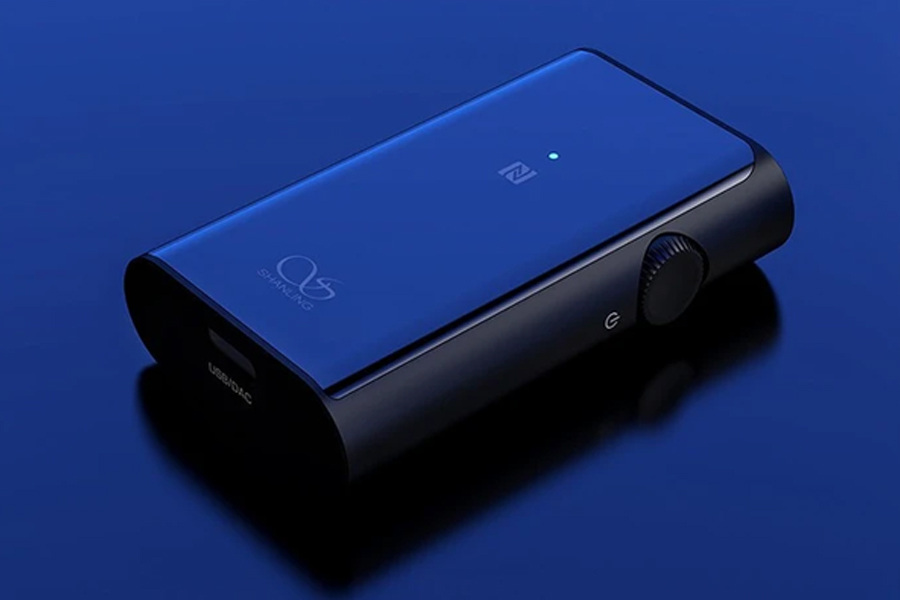
The Shanling UP4 Balanced Hi-Res Portable Bluetooth Amplifier has gone up for sale bearing a price tag of $99.99 through popular online e-tailer HiFiGo, that sells top quality products targeted at audiophiles for unbeatable prices.
Equipped with World’s latest Bluetooth wireless DAC/amplifiers, the Shanling UP4 supports the latest wireless audio codecs including aptX Low Latency, aptX HD, LDAC, LHDC, aptX, AAC, SBC, and HWA such as Hi-Res audio. It features the CSR8675 Bluetooth 5.0 chipsets, which is touted as a premium low-power solution for improved audio applications that supports 24-bit transmission and processing with the help of 120MHz DSP.
The micro-USB has now been replaced by USB-C, which is an important addition, particularly for future-proofing and faster charging from devices such as power banks. Moreover, you can use the USB-C connection for USB-DAC output directly from your PC in a wired configuration.
Furthermore, the Shanling UP4 comes with a 3.5mm single-end and 2.5mm balance end output. It generates 91mW@32Ω (SE) and 160mW+160mW@32Ω power. It has received high resolution certificated for Wire, as well as the wireless mode. Unlike the UP2, the UP4 supports NFC paring upgraded, which is already featured in BTR5, and the BTR3.
You can follow this link to check out more details about the Shanling UP4 Balanced Hi-Res Portable Bluetooth Amplifier and place your order. Note that the sale will come to an end shortly.
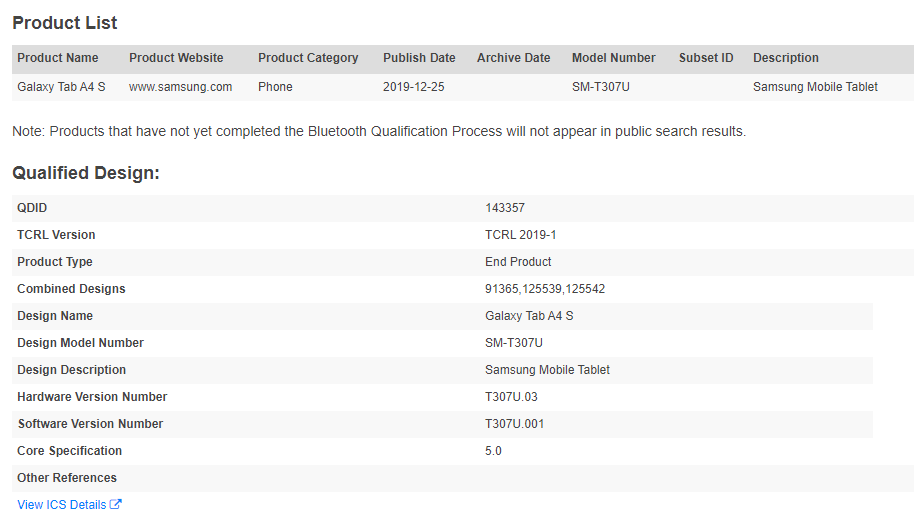
A new Samsung tablet called the Galaxy Tab A4 S was certified yesterday by the Bluetooth SIG. The certificate reveals the tablet’s model number is SM-T307U and which has actually surfaced online before.
About a month ago, Sam Mobile, reported that a Samsung tablet with model number SM-T307U was certified by the Wi-Fi Alliance. The WiFi certificate revealed the tablet runs Android Pie and supports 2.4GHz and 5GHz WiFi networks.
The post also said the tablet has support for cellular connectivity due to the “7” in the model number. And that it has 32GB of internal storage and will be available in just one color variant – brown.
It is unknown if the Galaxy Tab A4 S will be limited to Samsung’s home country or if it will be available in other countries. However, we are pretty sure it will be a mid-range tablet due to its small built-in storage and older version of Android. It most likely will be powered by an Exynos processor too. We just have to wait for a Geekbench result to surface.
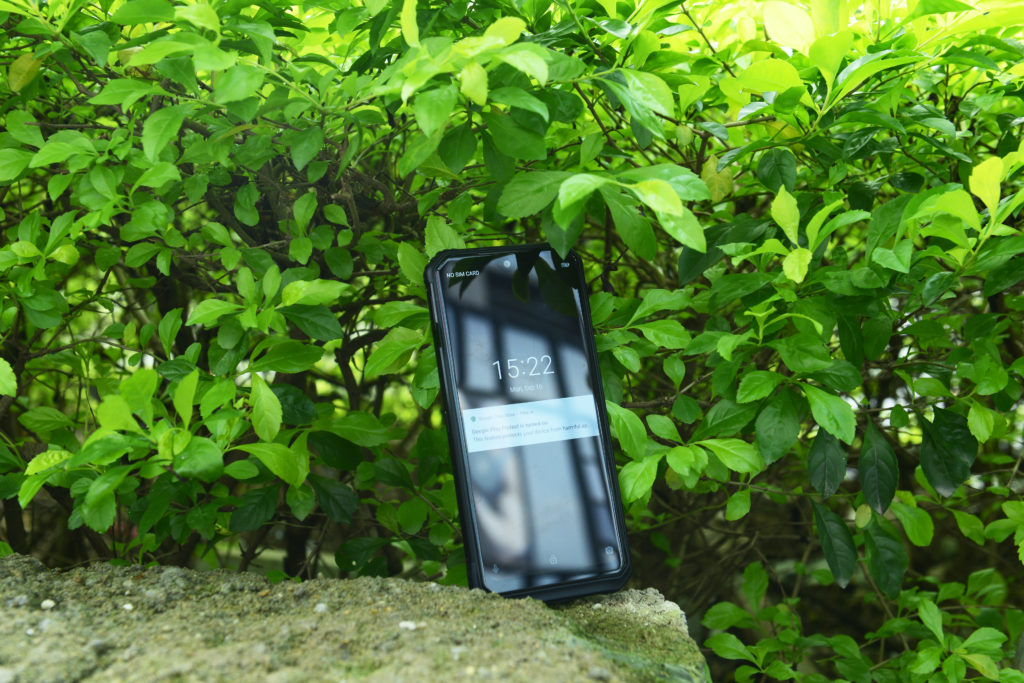
DOOGEE is a renowned mobile phone maker that boasts an exciting portfolio of affordable smartphones.
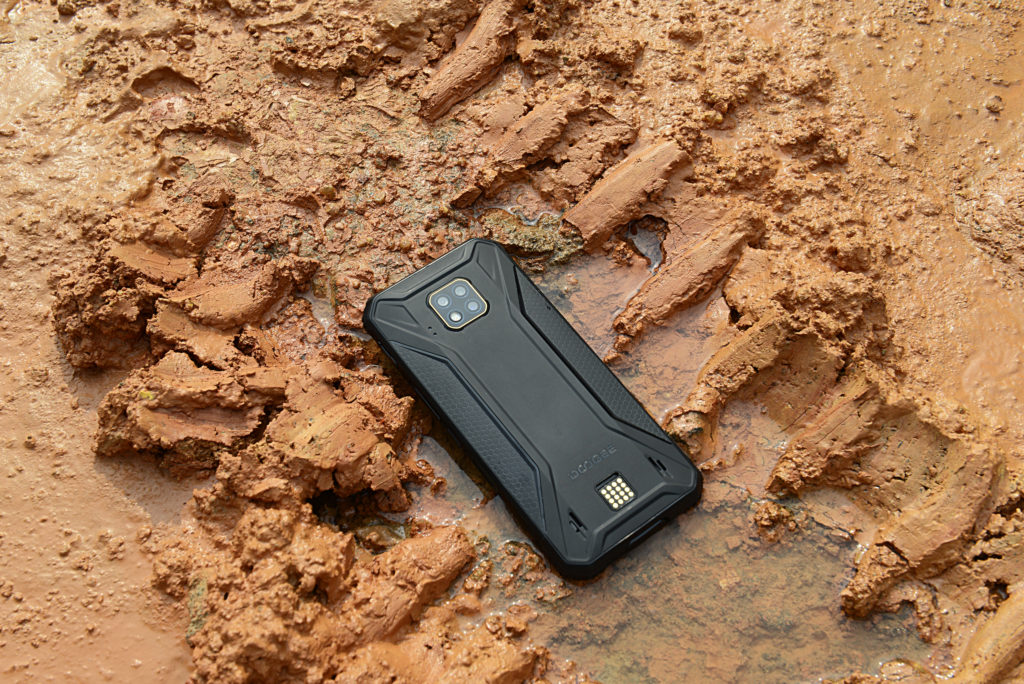
Still riding high on the success of the DOOGEE S90 modular phone, which was launched earlier this year, the Spanish high-performance products manufacturer recently launched the much-awaited Doogee S90 successor dubbed the S95 Pro.
While the DOOGEE S90 boasts a robust 5000mAh power bank, digital walkie-talkie, night vision camera, and various other modules, the DOOGEE S95 Pro offers a slew of awe-inspiring features. Before we dive into details about these features, it might interest you to know that the S95 Pro is now available for a lowered price through Gearbest.
Moreover, the phone comes with a coupon code that can be used to save more money at the time of checking out. The 8GB RAM+128GB ROM S95 Pro variant would normally set you back $499.99, but if you can purchase it for a considerably reduced price of just $369.99 through Gearbest.
On top of that, you can extend this 26 percent discount by applying coupon code M3EEAB64429EB000 before placing your order. The coupon enables you to bring the original selling price of the DOOGEE S95 Pro down to just $299.99, which means, you get an extra $70 off.
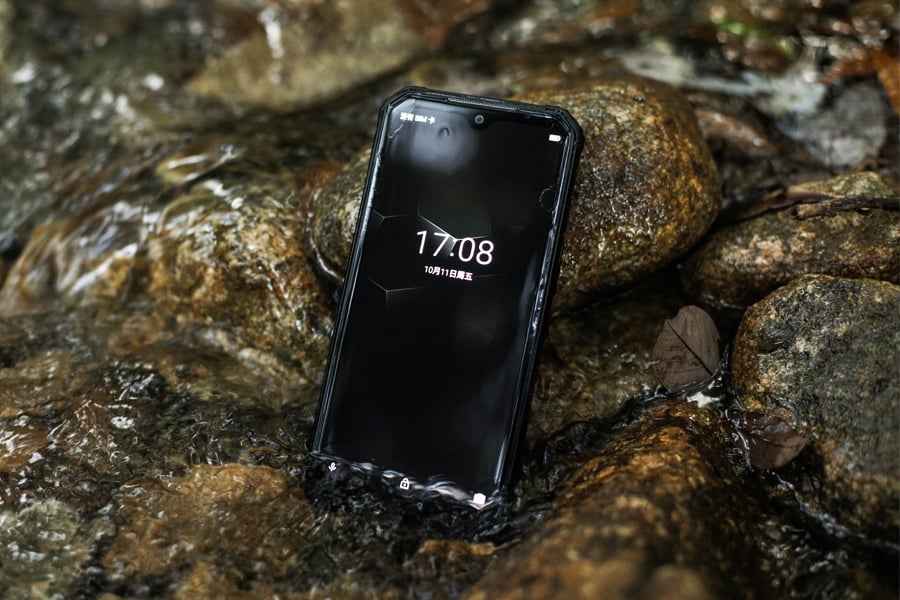
Touted as the world’s top-notch rugged smartphone, the S95 Pro sports a 6.3-inches IPS Waterdrop Full-Screen FHD+ display with Corning Gorilla Glass that offers additional protection against accidental scratches and other damages. Furthermore, it is powered by MTK, Helio P90 Octa-Core processor and packs IMG PowerVR GM 9446 GPU under the hood.
The phone offers a 50 percent faster performance than its precursor, the P60/70. The native storage can be expanded up to 256GB using a Micro SD Card (T-Flash Card). On the optics front, the S95 Pro features SONY IMX586 48MP+8MP+8MP with Wide-angle LED Flash, and f/1.8+f/2.4 aperture at the back, and 16MP wide-angle sensor with f/2.0 80 aperture front shooter for selfies.
Moreover, it runs the Android 9.0 Pie operating system and is backed by a 5150mAh battery that offers wireless charging support. In terms of connectivity, the phone comes with Type-C. It also supports GPS, Beidou, Galileo, and Glonass.
For more details about the DOOGEE S95 Pro, you can head straight to this link. With 79 pieces sold at the time of writing, the promo is slated to end in five days. Note that the coupon will expire on December 30th, and it will be valid for the first 100 pieces only.
ByteDance, the parent company behind TikTok, is reportedly looking into options to address the concerns regarding the alleged national security allegations from the US Government.
According to a report, ByteDance selling the majority stake in TikTok could have it rake in about 10 Billion US Dollars. This evaluation was calculated after the app’s valuation surged in 2019 as it gained popularity on a global scale. A few news agencies have also stated that the company is currently one of the world’s most valuable startups. Unfortunately, the tensions between the US and China in the form of trade disputes are threatening its operations and future growth.
If ByteDance were to sell TikTok, the most logical option would be to offer up a majority stake in TikTok to financial investors. Notably, companies like SoftBank, Sequoia Capital, and Susquehanna International are large financial firms that were one of the early investors in the social media app. Thus, a sale of its majority stake could allow the parent company to cash in when the app is extremely popular and avoid any future difficulties.
A meeting where the US Army Chief of Staff visited China
Recently, the US Army has even launched an investigation into the app stating its handling of user data puts military information and practices at risk as well. Additionally, there is an abundance of evidence regarding the app censoring data in accordance with Chinese censorship standards which also point towards its accused allegiance.
With more and more mobile phone makers offering the full-screen 18:9 display on their devices, Asus has decided to follow suit.
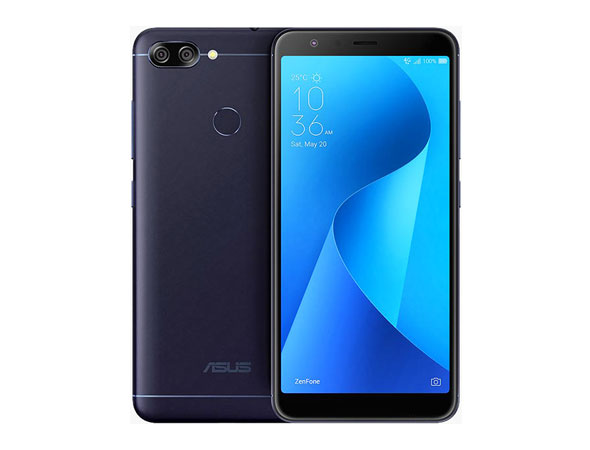
Keeping in line with that, the Taiwan-based phone manufacturer has launched the Asus Zenfone Max Plus (M1) smartphone. It can be recalled that Asus had launched the Pegasus 4S smartphone with a full-screen display earlier, but the company restricted its availability to China only.
While mobile phones boasting a full-screen display are usually found carrying steep price tags, that’s not the case with the ASUS Zenfone Max Plus M1 mobile phone, which has gone up for sale for a lowered price through Gearbest. We will not only reveal more details about the discount but also show how you can save more money at checkout.
The 4GB RAM+64GB ROM Zenfone Max Plus M1 variant would normally set you back $144, which is a reasonable price for a full-display device. To extend the phone’s availability to those on a tight budget, Asus is now offering the aforesaid model for a lowered price of only $102.69 via Gearbest.
In addition to getting this 29 percent discount, Gearbest users can grab an extra $89 off by applying coupon code T3F011161CA1D001 at the time of checking out. In short, you can reduce the original asking price of the phone to just $102.99 with the help of the coupon, provided you place your order latest by January 8th.
Available in Navy Blue, as well as Silvery color options, the Zenfone Max Plus M1 sports a 5.7 inches IPS display with 1080 x 2160 pixels resolution and an aspect ratio of 18:9. It packs a powerful MT6750T Octa-Core processor under the hood.
In the photography department, the mobile phone houses a dual-camera setup comprising a 16MP camera and an 8MP camera at the back. Upfront, it accommodates an 8MP selfie camera that can also be used for making video calls.
The dual-SIM smartphone runs Android 7.0 Nougat OS and is backed by a 4130mAh battery that offers up to 26 days of standby and about 26 hours of 3G talk time, along with up to 13 hours of video playback and about 21 hours of Wi-Fi browsing.
You can follow this link to check out more details about the Asus Zenfone Max Plus M1 mobile phone and avail of the discount. Note that the promo is slated to end in five days. Also, the coupon code will expire on January 8th.
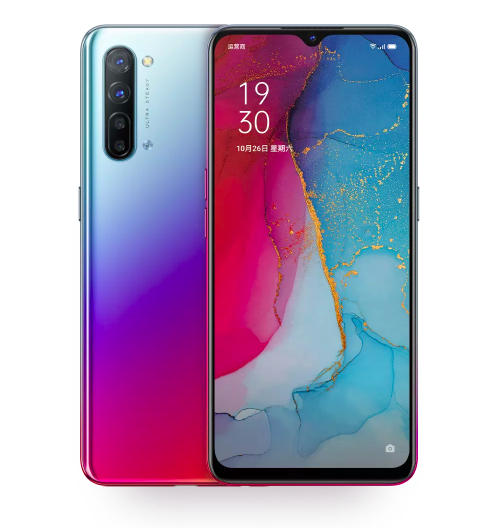
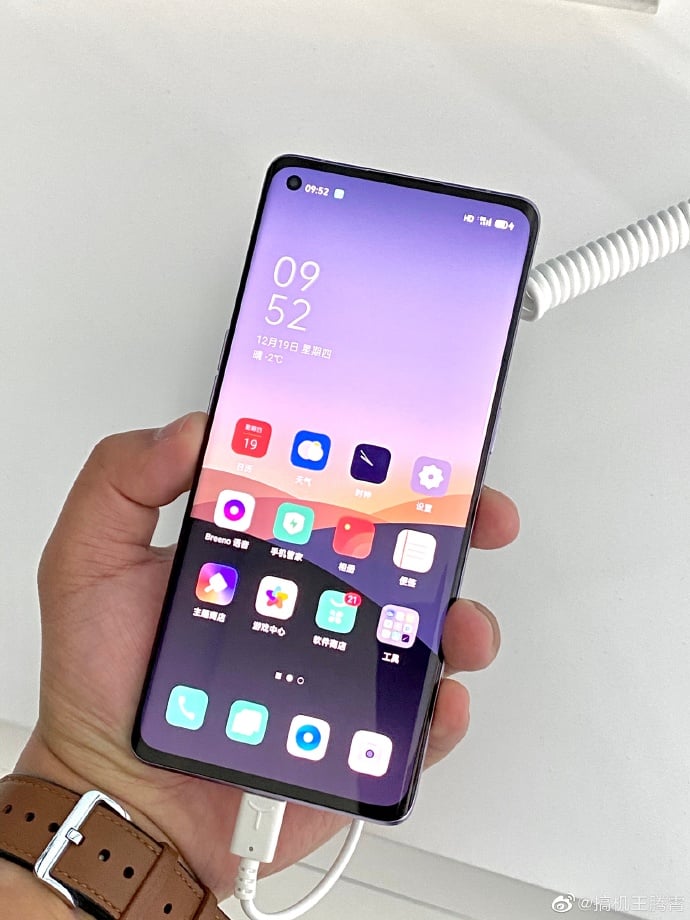
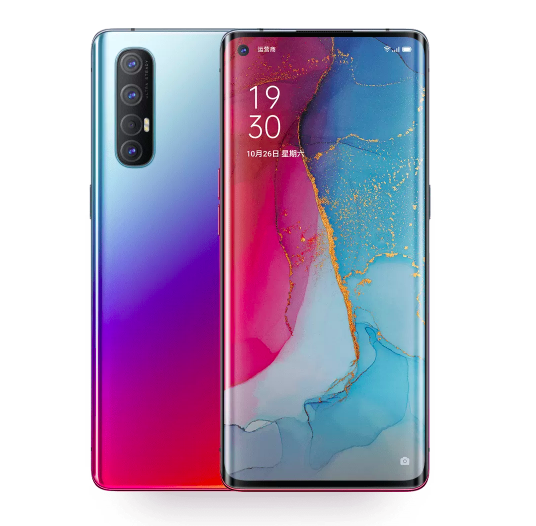
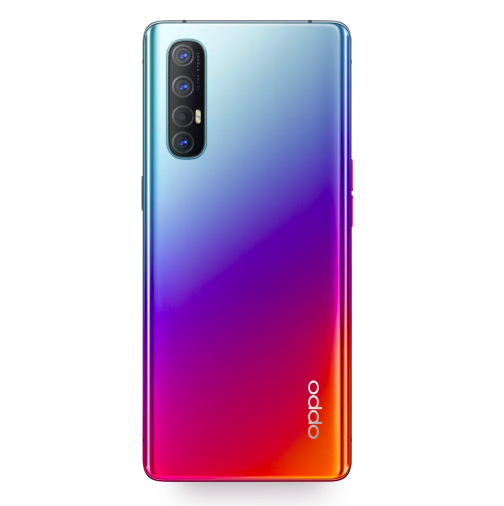
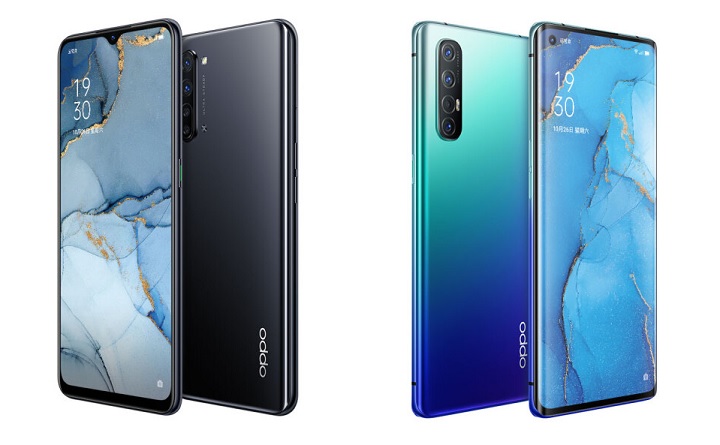
OPPO has officially taken the wraps off its new 5G smartphones: the OPPO Reno3 5G and the Reno3 Pro 5G. Just like I mentioned yesterday, the Reno series officially has one of the shortest product cycles in the market this year, with the new Reno3 models replacing Reno2 models that were announced just a few months back. The third generation Reno3 models come with 5G, a large battery with fast charging, and a quad-camera setup and most of all, a slim and relatively lightweight body.
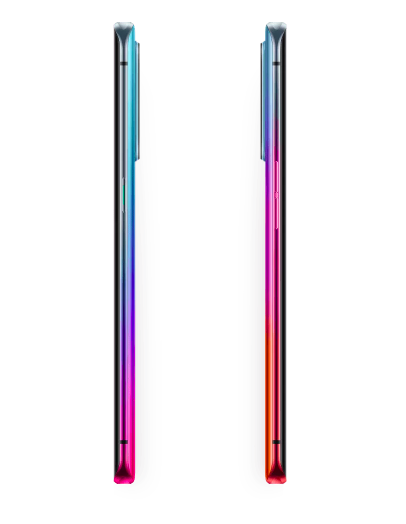
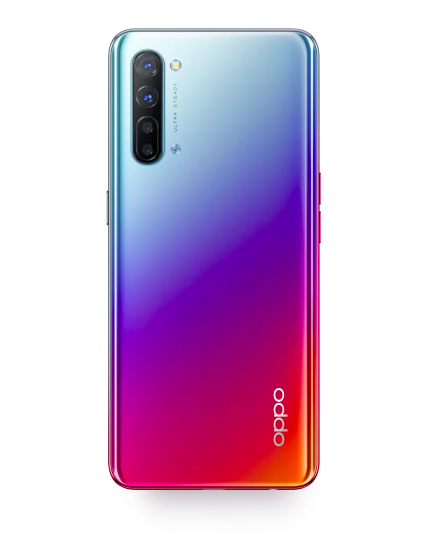
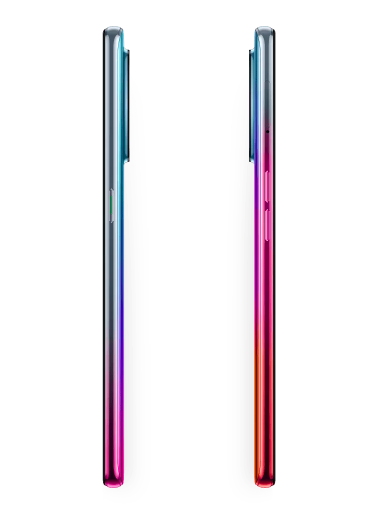
OPPO seems to have given priority to form factor for the new Reno3 models, which is a big shift from the bulky and heavy Reno 5G and Reno2 models. Both the models are relatively lightweight, weighing only around 180 grams and featuring 8mm bodies. In fact, the Pro version, even with the curved display, is slimmer and lighter than the standard Reno3.
Let’s take a closer look at both the devices in detail.
The OPPO Reno3 Pro 5G is the star product of today’s event, powered by the Snapdragon 765G octa-core processor. It is an important phone, for OPPO as well as Qualcomm, since its the first integrated 5G SoC from the chipmaker. Thanks to the integrated 5G chipset, the phone supports up to 3.7Gbps download speeds and 1.6Gbps upload speeds. The Reno3 Pro comes with Smart 5G that regulates the 5G connectivity to improve battery life by up to 30 percent. The phone features two storage options: 8GB RAM and 128GB storage and 12GB RAM and 256GB storage.
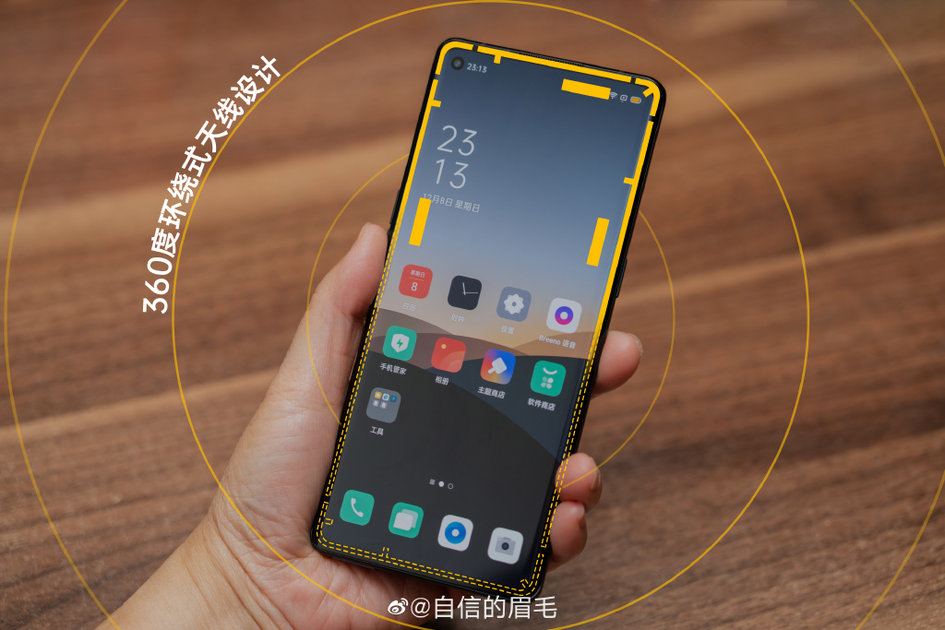
REno3 360-degree antenna design
OPPO has employed a unique 360° surround antenna design that ensures the Reno3 models can smartly match different antenna groups to ensure consistent data speeds. So you don’t have to worry about the smartphone death grip that comes in between you and your streaming/ gaming experience. There’s also a special 5G + Wi-Fi 5GHz dual connectivity model that combines the two networks to boost your overall network speeds. OPPO claims this mode can increase download speeds by up to 28 percent!
The display is one of the highlights of the Reno3 Pro 5G. The phone comes with a flexible AMOLED display that’s curved on the two sides, similar to the Galaxy S10. On the top-left corner of the display, you’ll find a small punch-hole camera measuring 3.92mm in diameter, making it smaller than the S10’s punch hole. The 6.5-inch curved display also supports 90Hz refresh rate, joining the likes of the OnePlus 7T Pro with such high refresh rates.
The Reno3 Pro 5G also employs a three-dimensional cooling system with a double layer graphite sheet to ensure effective heat dissipation. The phone comes with an in-screen fingerprint module that measures just 0.26mm in size, which is a significant (nearly 90%) reduction as compared to a traditional 2.6mm module. OPPO adds that the fingerprint recognition area has increased by 5mm to 54mm.
1 of 3
OPPO REno3 Pro 5G
Coming to the camera setup, the OPPO Reno3 Pro 5G features a quad-camera setup that consists of a 48MP Sony IMX586 primary sensor paired with a 13MP telephoto lens that supports 5X hybrid optical zoom, an 8MP wide-angle camera with 116-degree field of view and a 2MP black and white camera sensor. As revealed in the teasers before, the OPPO Reno3 and Reno3 Pro support Ultra Steady cameras that utilize the ultra-wide camera along with ultra-steady algorithms and high-precision gyroscope to stabilize videos.
The OPPO Reno3 Pro 5G features a 4025mAh battery with VOOC 4.0 30W fast charging technology. OPPO claims that the device can charge from 3% to 50% in just 20 minutes, up to 70% in 30 minutes and 100% in 56 minutes. The phone features stereo speakers with Dolby Atmos support. Note that there’s no headphone jack on both the models.
As for software, the Reno3 5G and the Reno3 Pro 5G will come with ColorOS 7 out of the box, making them the first set of devices to feature the new OS.
OPPO Reno3 Pro 5G Pricing
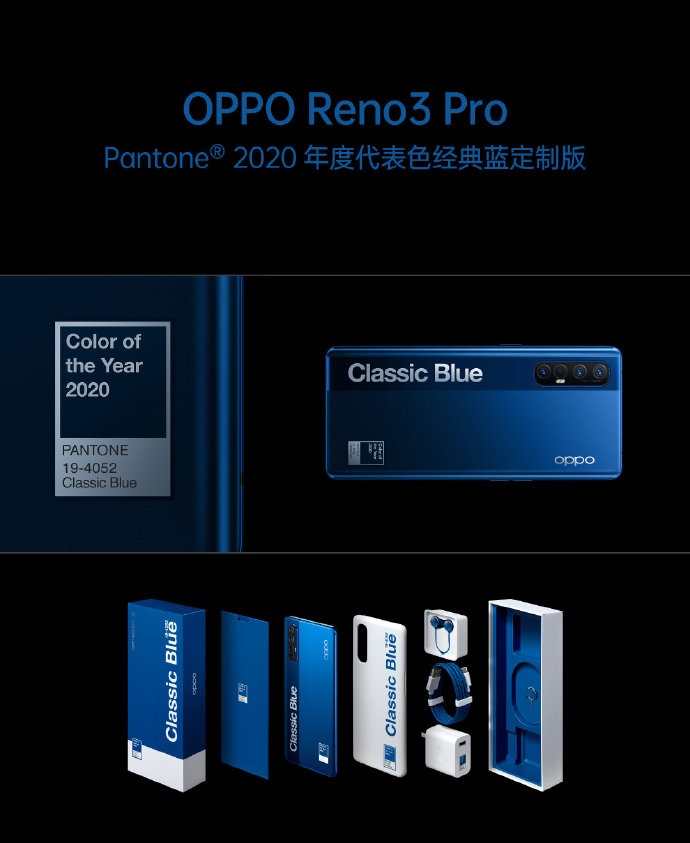
The OPPO Reno3 Pro 5G starts at 3999 yuan ($571) for the 8GB +128GB variant and goes up to 4499 yuan ($643) for the 12GB + 256GB variant. The 8GB RAM model goes on sale on December 31 while the 12GB model goes on sale on January 10, 2020. There’s a special OPPO Reno3 Pro 5G Classic Blue edition (Pantone’s color of the year 2020) as well that costs 4199 yuan ($600) (8GB+128GB) and goes on sale on January 10.
OPPO Reno3 5G will be the cheaper option in the Reno3 series, featuring the new Dimensity 1000L 5G chipset. The phone supports SA/NSA dual-mode 5G networks and comes with a 6.4-inch FHD+ waterdrop display. Note that the Reno3 features a regular flat display instead of the curved one found on the ‘Pro’ model. The phone is slightly heavier than the ‘Pro’ version at 181 gram (vs 171gm) but it’s still relatively lighter than competitors.
The OPPO Reno3 5G comes with a slightly different setup than its more expensive sibling. The phone features a 64MP primary camera with an 8MP wide-angle lens, 2MP macro lens, and a 2MP Black & White sensor. So, you don’t get optical zoom on the Reno3 as it skips the telephoto lens. There’s a 32MP front-facing shooter just like the Pro model.
1 of 3
OPPO REno3 5G
Just like the Reno3 Pro 5G, the Reno3 comes with ColorOS 7 with Android 10 out of the box with features such as Gameboost 2.0, Wi-Fi, NFC, Dolby Atmos speakers, Smart 5G and Bluetooth 5.0.
OPPO Reno3 5G Pricing
The OPPO Reno3 5G starts at 3399 yuan ($486) for the 8GB RAM and 128GB ROM variant and goes up to 3699 yuan ($528) for the 12GB RAM and 128GB variant.
Earlier this month, Oppo had announced on social media that it would be releasing its first truly wireless earbuds. Now, the Oppo Enco Free has finally been unveiled alongside the Oppo Reno 3 series of smartphones in China.
Design
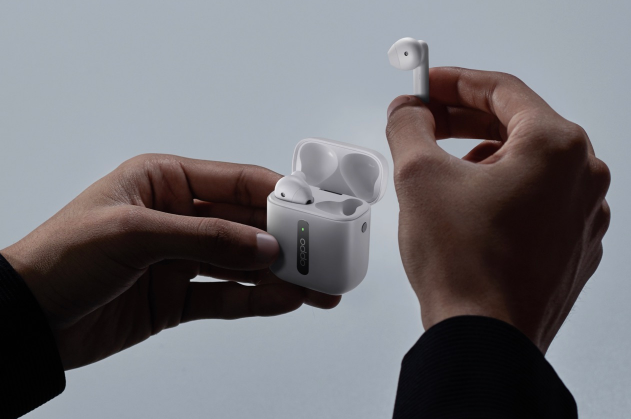
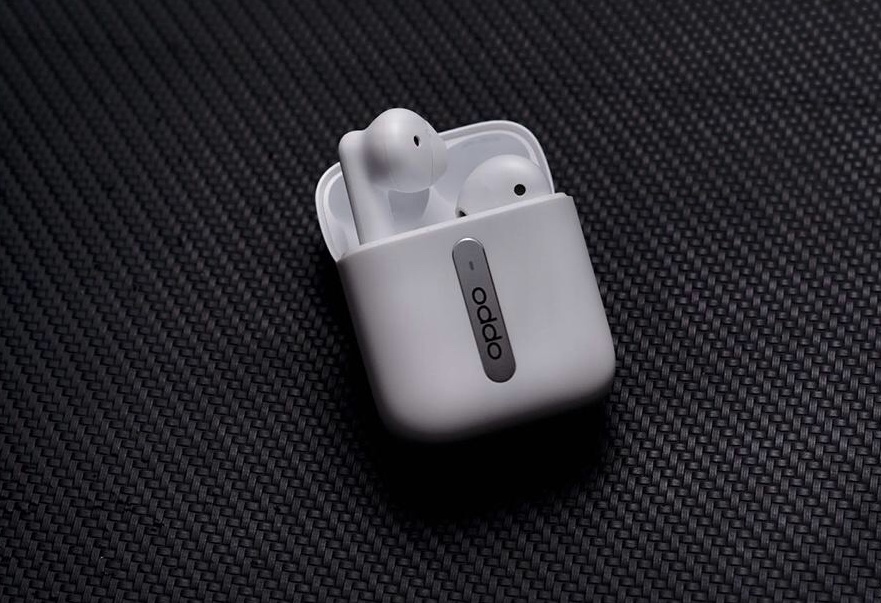
The design and form factor of the new TWS (true wireless) earbuds from Oppo is similar to Apple’s AirPods which also arrives with a charging case. However, the strip on the front carved with radium sets it apart by featuring the smartphone manufacturer’s branding. This strip also features an LED status indicator for the charging case and the case itself is charged via a USB Type-C charging cable.
OPPO Enco Free in white with the charging case
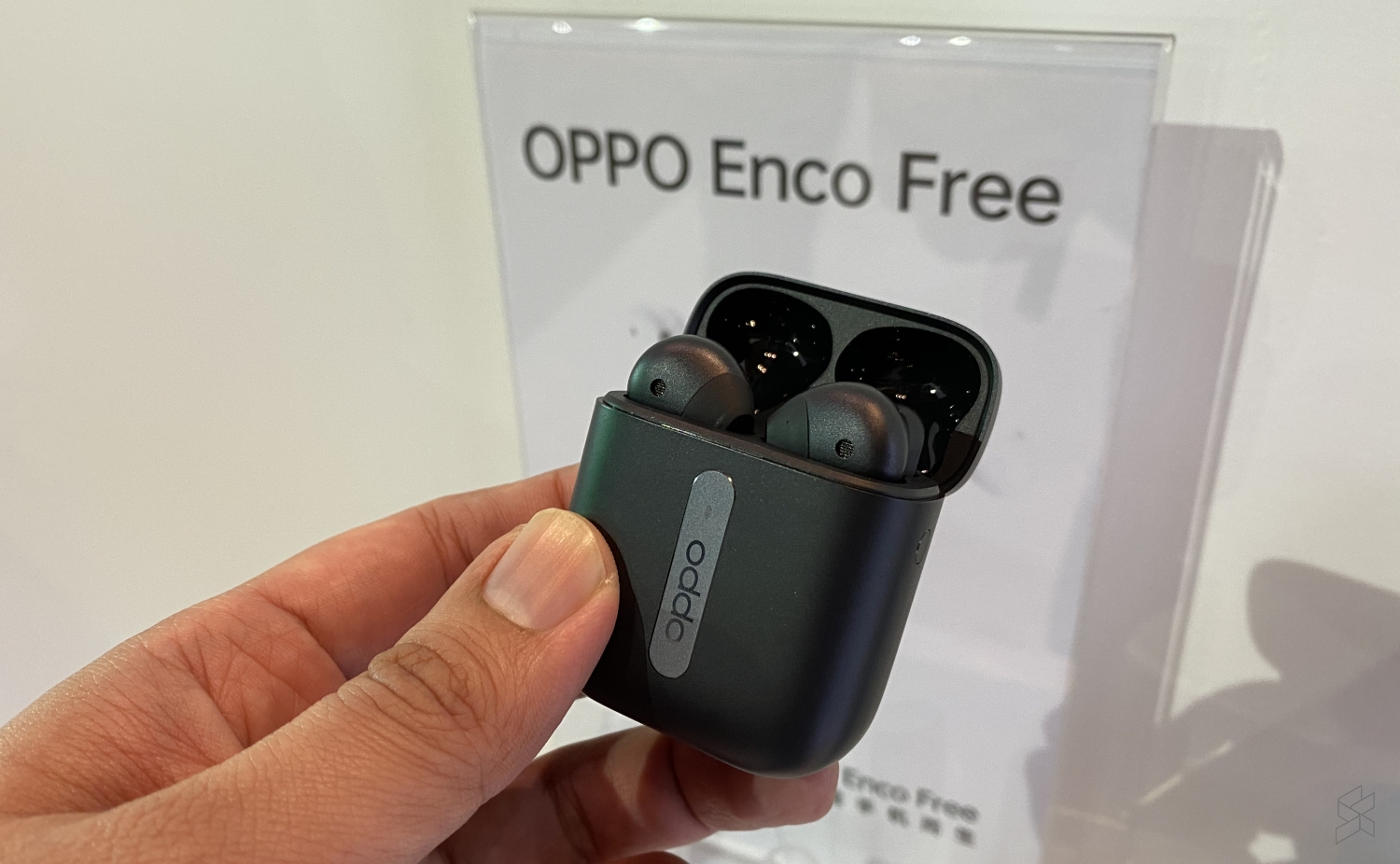
The earbuds arrive in an identical cover to its carrying case and have a matte finish. Furthermore, a noise reduction microphone can be found on the outside which will allow for a better audio experience for users. Similar to the case, the earbuds also feature the iconic grey strip at the rear of its body.
Specs & Features
Oppo Enco Free weighs in at about 4.6 grams and holds the title of being the first true wireless earphones that utilize ultra-dynamic speakers. These speakers are equipped with dual magnetic circuit design and an FPC arm balance system that allows for a superior sound quality output. Notably, the earbuds can be used up to 25 hours in total if used alongside its charging case.
The wireless earbuds are also equipped with “Bluetooth low-latency dual-pass” technology. In other words, both individual earbuds connect to a smartphone via Bluetooth simultaneously. According to official notes, this enables the wearables to achieve better audio-visual synchronization effect and reduce the latency by 76 percent during gaming in comparison to traditional Bluetooth earphones.
OPPO Enco Free (Black variant)
Price & Availability
Oppo Enco Free is available in three colors, namely white, black and pink variants, and offers three different sized silicone tips for better fit adjustments. The earbuds are priced at 699 Yuan or roughly 100 US Dollars. The white and black variants will be available for purchase from the 31st of December 2019 while the pink version will be launched on Valentines next year (14th February 2020).
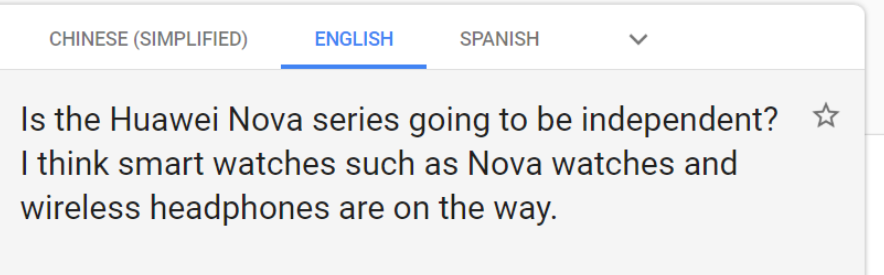
Huawei’s Nova line of smartphones is pretty popular but there is a possibility it could become an independent brand in the future as Huawei is planning to launch non-phone products under the Nova brand.
According to a Weibo post by Digital Chat Station, Nova (smart)watches, wireless headphones, and other smart devices are on the way, prompting him to ask if Nova will become an independent brand. There is no info yet on the exact date but we expect some of these products will be announced next year.
This year Huawei launched a Nova-branded speaker called the Nova Mini. So it is no surprise that they plan to launch Bluetooth headphones too. However, we are pretty more excited about the smartwatches and the other smart products that will be announced.
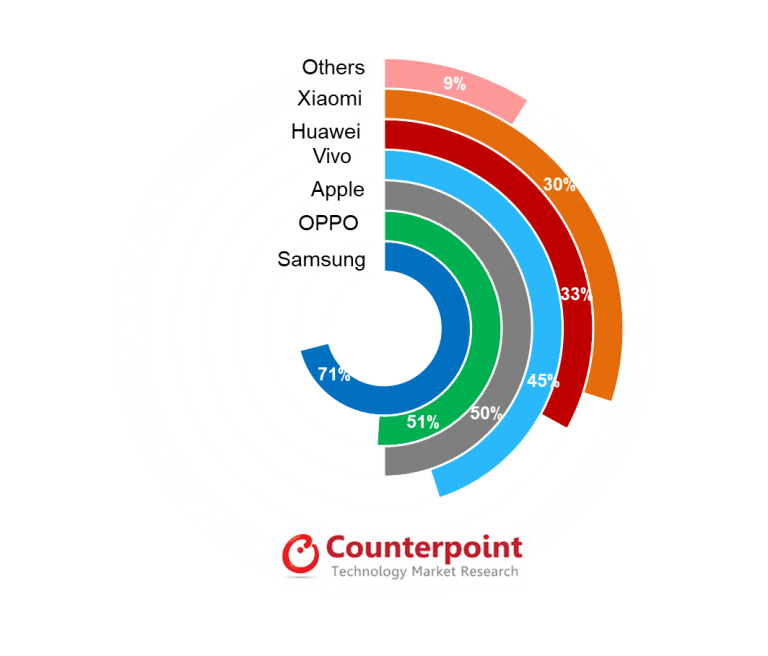
According to a new report, smartphones with an AMOLED display (Active-matrix organic light-emitting diode) are expected to surpass 600 million units in sales in 2020. This is indicative of the displays explosive popularity in the past couple of years which is still on a steep rise.
Based on a Counterpoint research note, the global sale of smartphones with AMOLED screens will exceed the 600 million shipment mark by the end of 2020. It is a sizable YoY (Year-on-Year) growth of 46 percent from 2019. This rise is expected to arrive with the inclusion of AMOLED display panels in mid range segment of smartphones. Certain Chinese brands like Huawei, Vivo, Oppo, Realme, and Xiaomi are a few of the OEMs that will be making this move.
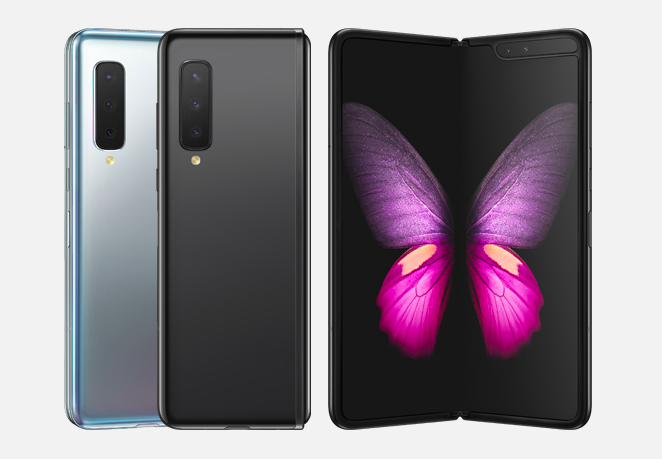
Samsung Galaxy Fold with a flexible display
Displays are one of the most crucial parts of the overall user experience. In 2019, smartphone displays received a lot of attention in terms of features and advertising. This was done to facilitate people in replacing their older handsets for the newer and upgraded versions that had thinner bezels, smaller screen to body ratio, increased refresh rates and more. It also quickly became one of the most promoted part of a smartphone.
Furthermore, the inclusion of certain features like in-display fingerprint scanner and and a punch-hole camera led to further growth of the AMOLED panels; which is touted to be better over its LCD counterpart due to its superior image quality, lower power consumption and even flexible form factor. Counterpoint believes that AMOLED smartphones will see increased demand, especially in China, which will lead to Chinese brands aggressively pricing their handsets.
This would bring the AMOLED screen that is generally seen in flagship models to also be found in mid tier smartphone of 2020. Currently, Samsung is the leading OEM with 45 percent of the total AMOLED smartphone shipments. The South Korean giant is followed by Apple with a 16 percent market share and Oppo with an 11 percent share. Lastly, a smartphone with OLED displays are generally placed between the $300-400 price segment but might soon be seen in sub-$200 segments as well.
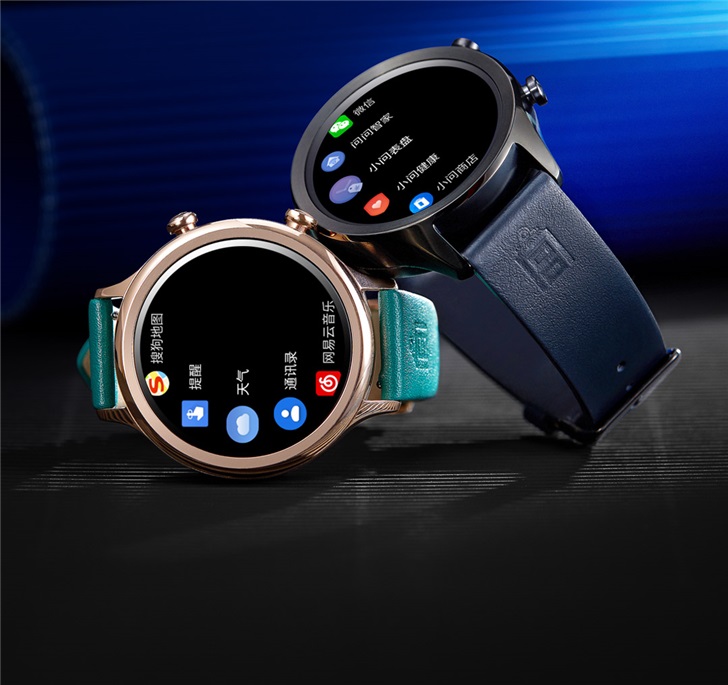
Xiaomi recently launched its first smartwatch named Mi Watch and now the company has announced another smartwatch, dubbed Mi Watch Forbidden City. This new product is now available on the company’s crowdfunding platform.
As for the pricing, the Mi Watch Forbidden City edition is priced at 1,699 yuan which roughly converts to $243. However, during the crowdfunding campaign, it can be purchased for 1,299 yuan that is roughly $186. It can be ordered through Youpin (link) and Xiaomi will start shipping it from 31st January 2020.
Coming to the design of the smartwatch, it comes with a circular dial which has a 1.3-inch OLED anti-scratch display and offers 71 percent screen-to-body ratio. The product is said to have been made of 316L stainless steel and is embossed from the classic palace standard using forged carving process.
It features an exclusive custom-made Forbidden City dial and also comes with a smart voice assistant, allowing users to operate it through voice commands. The strap of the smartwatch is also made of cowhide leather imported from Italy. The straps are made available in two color options — Green and Black.
As for the features, the Mi Watch Forbidden City edition comes with support for mobile push notifications, quick notifications, payments via QR code, NFC, fitness tracking, GPS, 24-hour heart rate monitoring, swimming-grade waterproof, and AI personal assistant, among others.
It supports Bluetooth 4.1 and Wi-Fi 802.11 b/g/g/n as connectivity options and comes packed with 512MB of RAM and 4GB of internal storage. As for the software, the device is running on Google‘s WearOS and comes pre-installed with a few applications such as WeChat, QQ, Keep, and Netease Cloud Music.
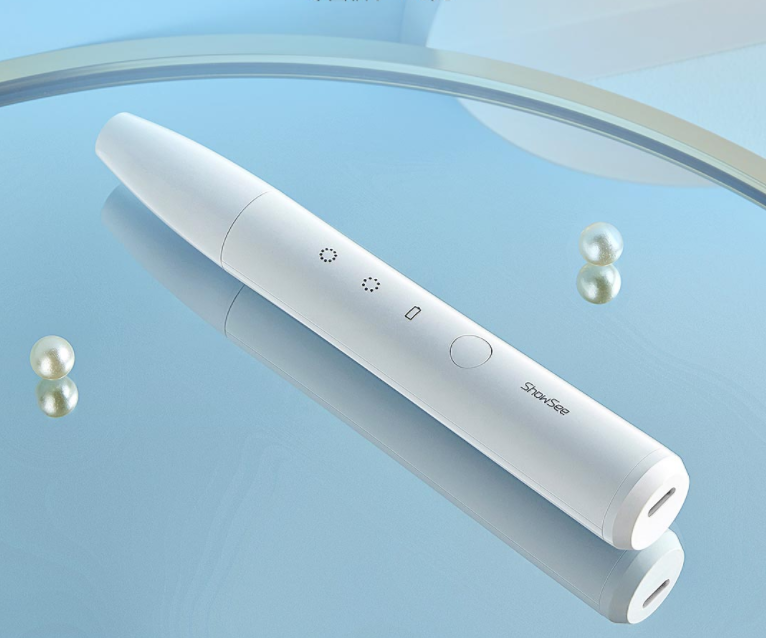
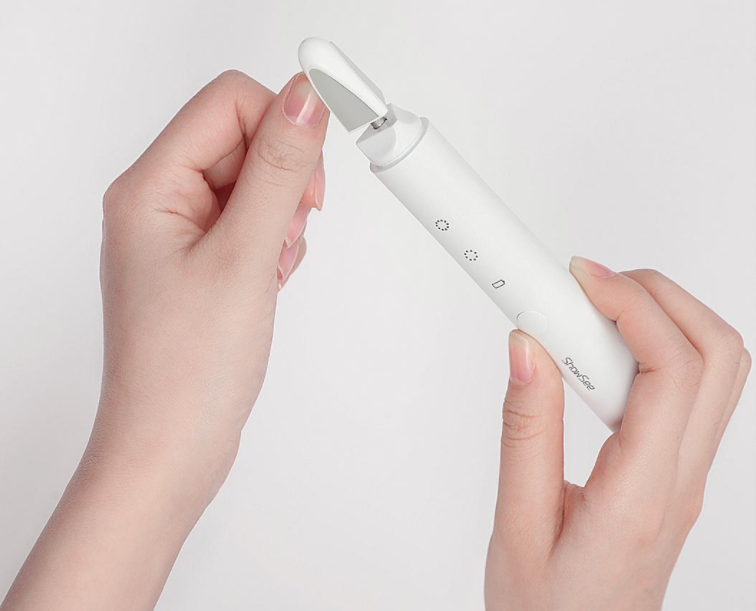
Xiaomi Youpin crowdfunding is back once again, and this time they have an electric nail polisher on board. The Xiaoshi Electric Nail Polisher isn’t just a simple polisher, but also integrates trimming, grinding, polishing, and general nail care into its design. It has a unique shock-absorbing and noise-reducing structure designed to not hurt the nail.
The grinding head is made of a skin-friendly EVA material, with a white corundum and metal grinding surface. The soft particles of these materials allow the Xiaoshi Electric Nail Polisher to gently work on the surface on the nail. Because of this, over-exerting physical pressure won’t ruin or hurt the nail, which is a good feature for a nail polisher.
The Xiaoshi Electric Nail Polisher provides two sets of different heads for different applications. One is for general nail care, while the other is a full-on manicure set. Each set comes with a slew of tools for different types of nails. There are tools for thicker and thinner nails, as well as tools for shaping nails into nicer shapes.
In terms of power, two gear modes are provided. The first mode is soft, which is logically for gentle polishing and trims that require precision and finesse. The second mode is strong and fast, for when you really need to cut down those nails. The device also supports intelligent shutdown, automatically turning off after being left for 15 minutes.
The Xiaoshi Electric Nail Polisher comes with a USB Type-C port with fast charging capabilities. It takes about 2 hours for a full charge, which gives the user about 45 minutes of prolonged use. For those interested, the device retails normally for 119 yuan ($17), but as usual, there’s a special crowdfunding price of 79 yuan, which is about $12.
Huami Technology, which is known for making smart wearable devices under its Amazfit brand, has today announced that the company will be launching a new Amazfit T-Rex series in China on 1st January.
Apart from the launch date and the series name of the upcoming products, the company has not yet revealed anything. It is now yet known which products will be a part of this Amazfit T-Rex series and what does this series signify.
However, there’s a possibility that the products getting launched in China on 1st January will make their global debut on 7th January during CES 2020 in Las Vegas where the company will be hosting its Amazfit Global New Product Launch Conference.
Previously, Huang Wang, CEO of Huami Technology had revealed that along with the TWS Earbuds, the company will also bring a new category of products at launch event during the upcoming CES 2020 trade show.
He had also confirmed that the Amazfit TWS Earbuds will come equipped with heart rate sensor. The feature could come in handy for users who are into sports or similar high-energy activities. Further, it has been revealed that the device will also have sound insulation and noise reduction features.
The company has also teased a new product category which is said to have been designed for “sports and fitness enthusiasts, bringing a new kind of sports and lifestyle, helping users challenge themselves and push the limits.”
Huami Technology is among the world’s leading smart wearable devices maker and the company says that it is committed to offer health-related products with technology connection. In December this year, Huami announced that the company’s “end + core + cloud” strategy has been fully implemented.
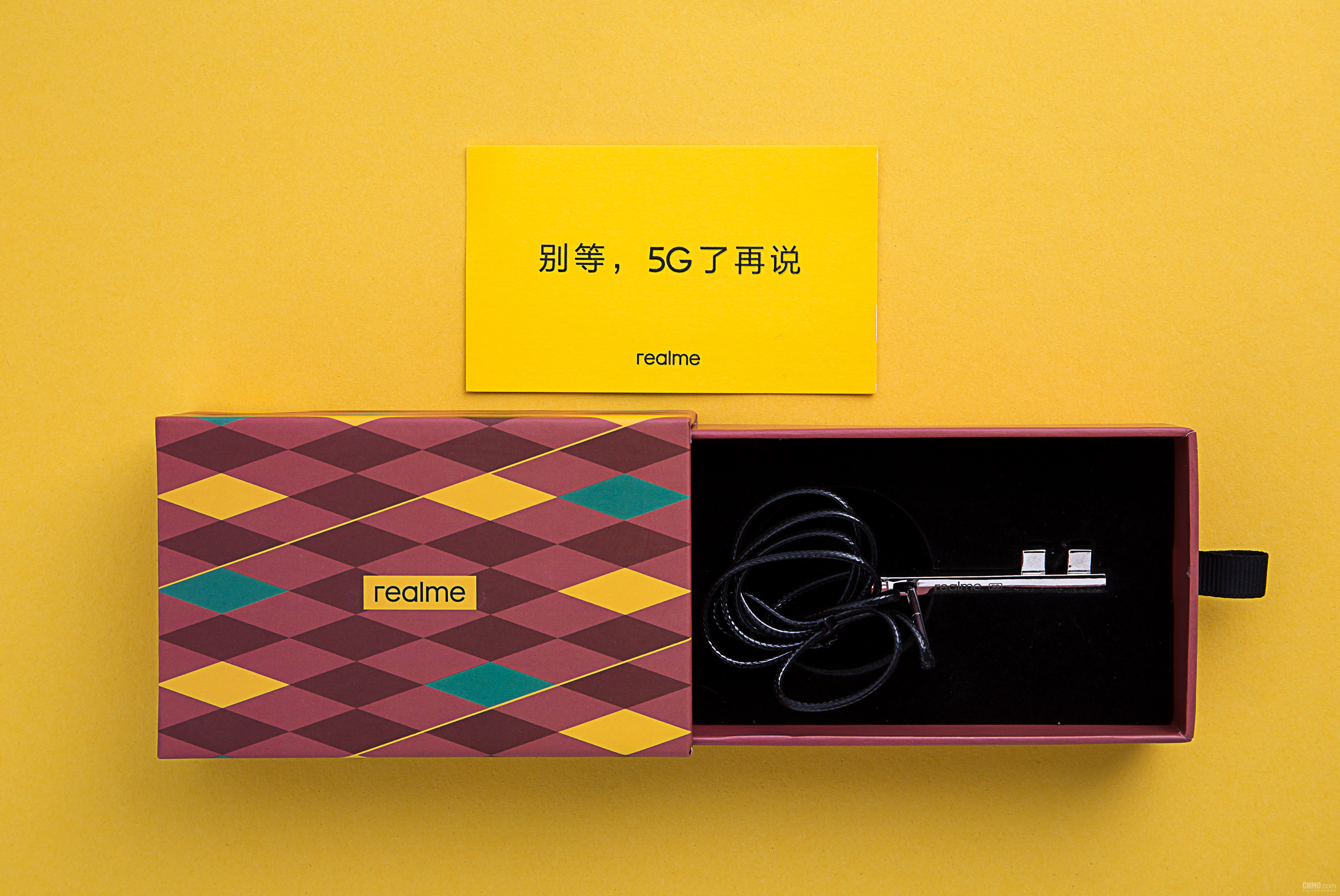
Realme has already confirmed that the launch event for the Realme X50 5G smartphone in China will be hosted on 7th January. Now, the company has started sending out official invitation for the launch event to media.
The invitation for the Realme X50 5G launch event comes in a mysterious Christmas gift box, which is filled with all kinds of strange items and candy. It has a pull-out design which brings out a letter from the company.
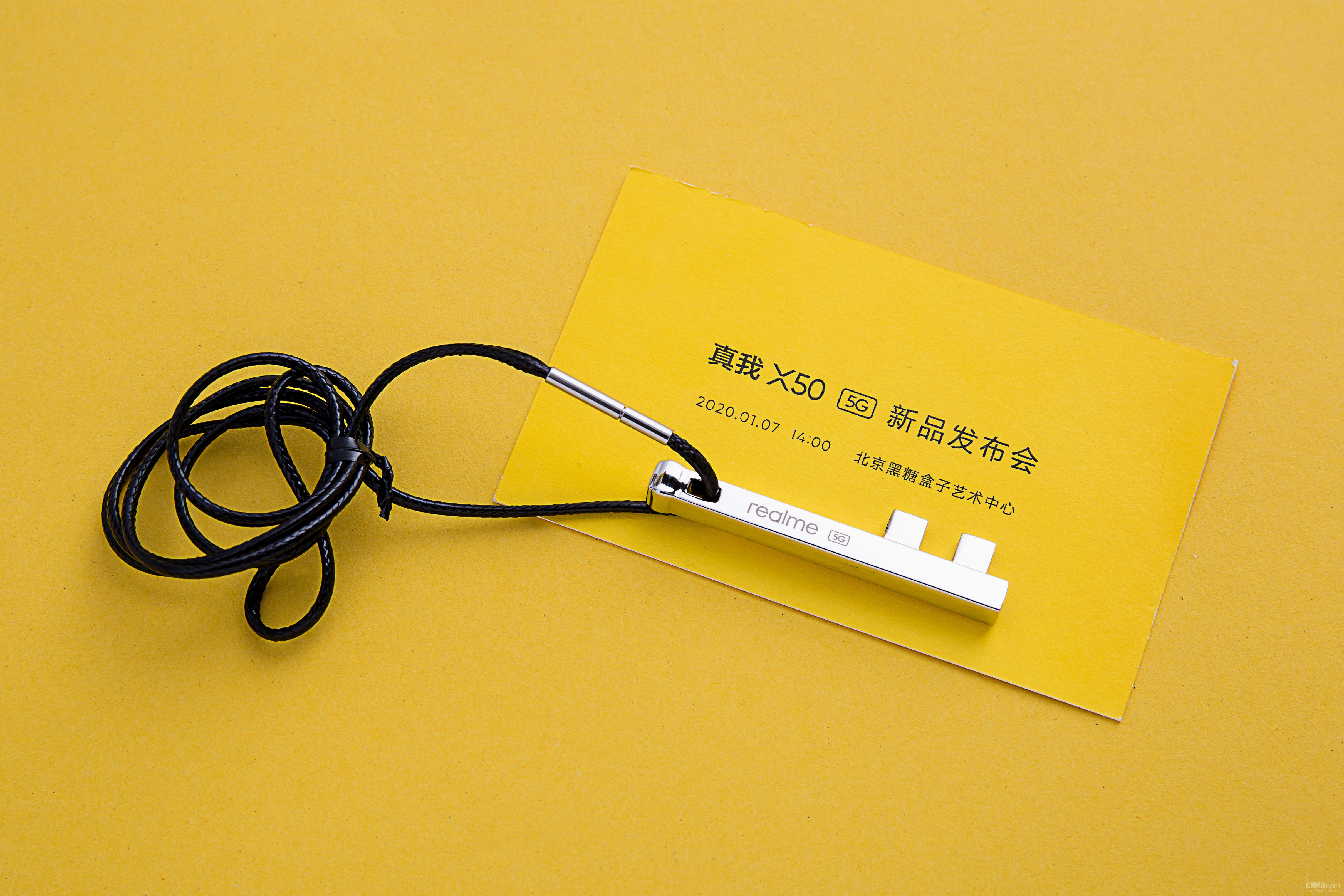
It reveals a small card which reads “Don’t wait, let’s talk about 5G” and also carries a 5G as well as Realme branding. The back side of the card mentions the venue for the launch event as well as other details, including the timing of the event.
The box also comes with a mysterious key necklace, which is engraved with “Realme 5G” and “Real Self X50 5G”, which means that this is the company’s first 5G smartphone. The key must have some signification which we hope to find out at the launch event.
The company has confirmed that the Realme X50 will come with dual punch-hole cameras like the Redmi K30 5G. It will support dual-channel Wi-Fi and 5G for online connectivity at the same time, which can smartly increase the network speed under all scenarios.
Realme has also revealed that the smartphone will cover all the mainstream frequency bands for 5G connectivity, including n1, n41, n78, n79 and will support both SA and NSA dual-mode networking with 5G.
The Chinese company has confirmed that the Realme X50 will come powered by the newly launched Qualcomm Snapdragon 765G chipset. This is the same SoC that powers the Redmi K30 5G smartphone and will power the upcoming Oppo Reno3 Pro.
Recently, Realme had revealed that the phone uses 8mm ultra-large diameter liquid-cooled copper tube, 410 cubic millimeters of ultra-large volume and with the liquid-cooled copper tube heat dissipation 3.0, it offers five-dimensional ice-cooled heat dissipation which covers 100 percent of the core heat source.
The company has also shared a teaser poster that reveals that the Realme X50 5G smartphone will come with support for Enhanced VOOC 4.0 Flash Charge technology that can charge the device up to 70 percent in just 30 minutes.
Rumors indicate that the phone will be equipped with a 6.44-inch AMOLED display. It could be coming with Sony IMX686 60-megapixel + 8-megapixel + 2-megapixel + 2-megapixel quad rear cameras and 32-megapixel + 8-megapixel dual front facing cameras.
The handset may come with up of 12GB of RAM and 256GB of internal storage. We expect Android 10-based custom ColorOS 7 running the smartphone. The company has also revealed that the phone will come in “Polar” color variant inspired by snow and ice.
The company will also be launching Realme Buds Air TWS earbuds along with the X50 5G smartphone on 7th January at a launch event in China.
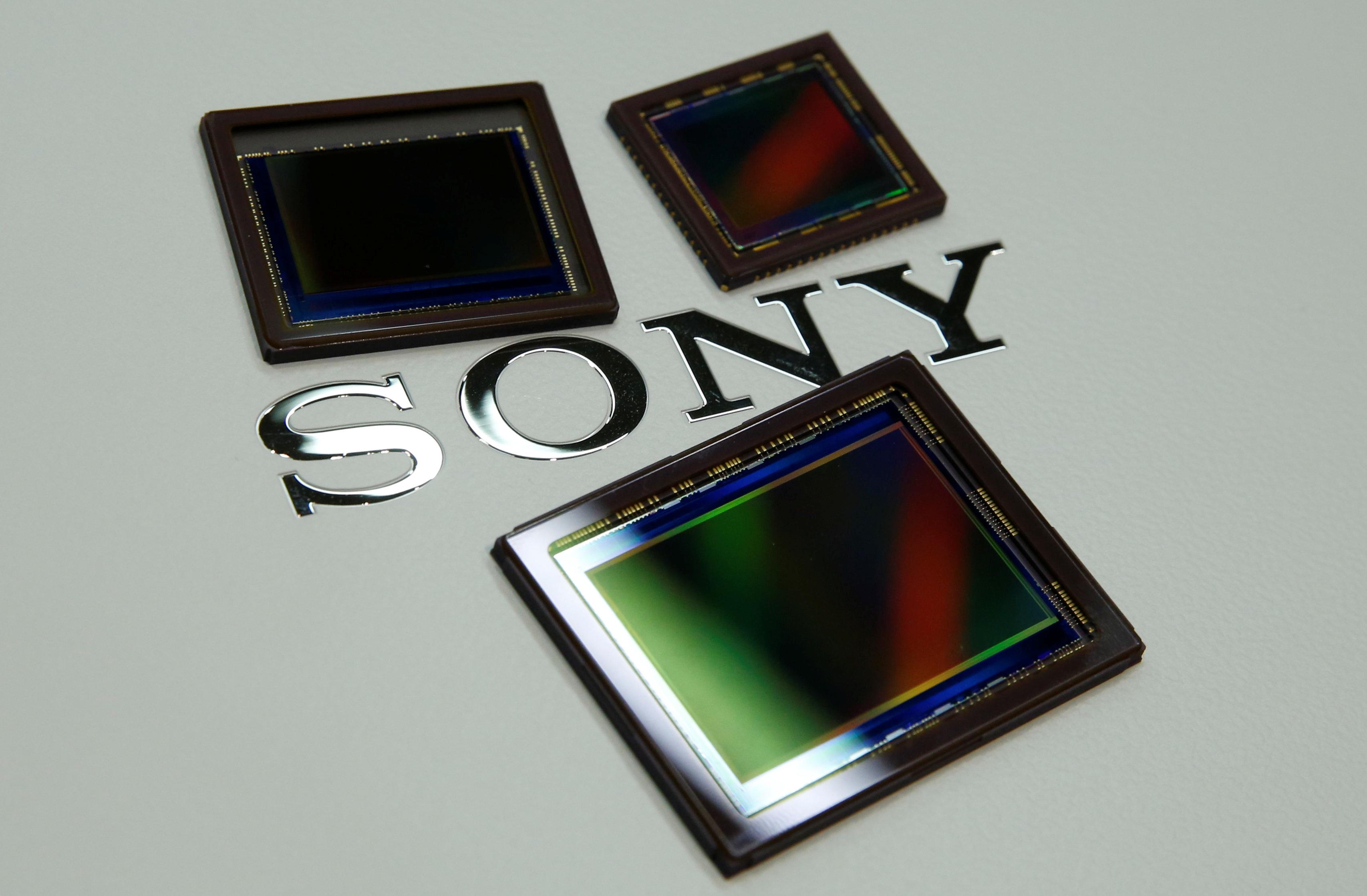
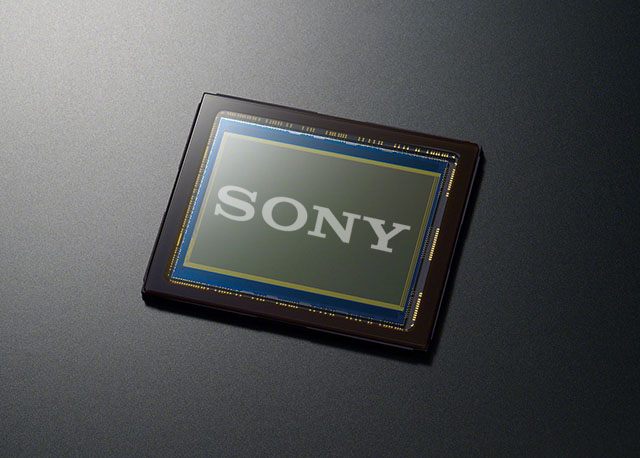
Sony Corp is working around the clock to manufacture its in-demand image sensors, but even a 24-hour operation hasn’t been enough. For the second straight year, the Japanese company will run its chip factories constantly through the holidays to try and keep up with demand for sensors used in mobile phone cameras, according to Terushi Shimizu, the head of Sony’s semiconductor unit.
“Judging by the way things are going, even after all that investment in expanding capacity, it might still not be enough, ” Shimizu said in an interview at the Tokyo headquarters. “We are having to apologise to customers because we just can’t make enough.” Apparently despite the already high projected numbers, Sony is STILL struggling to keep up.
Sony controls over 50 percent of the smartphone image sensor market and supplies them to various smartphone makers including Xiaomi and Apple. In an attempt to cope with demands, the company has invested into increasing its production capacity by building a new factory in Nagasaki that is scheduled to open in April 2021.
“The camera has become the biggest differentiator for smartphone brands and everyone wants their social media pictures and videos to look nice, ” said Masahiro Wakasugi, an analyst with Bloomberg Intelligence. “Sony is riding that wave of demand very well.” We can’t argue with that, seeing how so many devices come with Sony sensors these days.
The company is also seeing increased demand for a new generation of image sensors that can see the world in three dimensions. Those sensors use a method known as “time of flight” that sends out laser pulses and measures how long it takes for them to bounce back in order to create more detailed depth models.
Sony is the manufacturer behind the 48MP IMX586 sensor which was, very easily, the most popular flagship camera sensor this year, featuring on several devices including the Redmi K20 Pro and OnePlus 7 line. Its successor, the IMX686, will compete with Samsung’s 108MP behemoth head-on featuring a 64MP resolution and will be featured on 2020 phones such as the Redmi K30.
Just a week ago we heard that the US were planning to apply new limits when it comes to hardware sales on Huawei devices. Now, it seems like it’s finally happening as. Plans for new measures by the United States could threaten the supply of 14-nanometer chips by Taiwan Semiconductor Manufacturing Co. (TSMC) to China’s Huawei.
Huawei has been accused by several countries of maintaining close ties to China’s military establishment and of functioning as an arm of the communist government, leading to its 5G and other electronic systems becoming the focus of suspicions. Due to this, the Trump Administration was preparing a maximum limit of 10 percent U.S. technology for products to be supplied to Huawei, the Liberty Times reported earlier yesterday.
Of TSMC chips, the 7-nm products only contain for 9 percent U.S. technology or parts, so they would not pose a problem, but for the 14-nm semiconductors, the U.S. content rises to 15 percent. This means that if the restriction comes into play, TSMC will no longer be able to ship 14nm chips to Huawei.
When reached out to for a comment on the likelihood of such a restriction, TSMC said that at present, the U.S. had not changed its rules. The company would not answer questions about purely hypothetical situations, according to the Liberty Times. This means that for now, all we can really do is wait and see what happens.
Oppo is all set to launch its next-generation Reno lineup of smartphones — Oppo Reno3 and Reno3 Pro in China in a couple of hours. Now, ahead of the launch, the company has shared yet another teaser video, highlighting the Reno3 Pro smartphone’s key features.
The video basically highlights and compiles what the company has already teased about the upcoming smartphone. It shows that the phone will come with a full-screen design with a punch-hole display at the top-left corner for housing front-facing cameras.
It also highlights that fact that the bezel around the display is very narrow and thus it offers higher screen-to-body ratio. On the back side, the smartphone features a gradient color scheme to make its look attractive.
The smartphone comes equipped with a quad-camera setup on the back and the company has also confirmed that the device measures just 7.7mm in thickness. Further, all the models in the series will come with support for 5G connectivity.
As per the leaks, the Reno3 5G has a full HD+ 6.4-inch AMOLED display with waterdrop notch. On the other side, the Reno3 Pro 5G has a full HD+ curved AMOLED punch-hole display with 90Hz refresh rate support. Both phones feature in-display fingerprint scanner. The MediaTek Dimensity 1000L chipset powers the Reno3 5G while the Qualcomm Snapdragon 765G SoC is fuelling the Reno3 Pro 5G.
Coming to the camera configuration, both devices have 32-megapixel selfie cameras. The Reno3 5G is fitted with a 48-megapixel + 8-megapixel + 2-megapixel + 2-megapixel quad camera setup whereas the Reno3 Pro 5G features a 64-megapixel + 8-megapixel + 2-megapixel + 2-megapixel quad camera system.
Both phones have 4,025mAh battery and they carry support for the enhanced version of 30W VOOC 4.0 Flash Charge technology. The Android 10 operating system with ColorOS 7 custom user interface will come loaded on the Reno3 series.
According to the leaks, the base model of the Reno3 Pro 5G will be priced at 3,699 Yuan (~$529) and its higher model will cost 4,199 Yuan (~$601). However, we advise you to take the pricing leak with a grain of salt as there is no concrete evidence to prove if the reports are authentic.
We recently reported that the reservations for both the devices are already up in China and have crossed 500,000 registrations already. Check out the roundup of everything that is known about the Reno3 series here.
The likes of Razer, Black Shark, Nubia Red Magic from ZTE, and Asus ROG have started a new trend of gaming smartphone which has now become a thing. The gaming smartphones come with powerful set of specifications to offer smoother gaming experience.
Now, joining the list of companies launching gaming smartphones is Lenovo. The company has recently set up a new Weibo page and it seems that the Lenovo Legion branded gaming smartphone is coming soon.
The company’s Legion brand has been working on gaming products for some time and seems to have grasp over the users’ need in this field. Thus, it makes sense for the company the gaming smartphone filed under this brand.
Earlier, in April this year, Chang Cheng, Vice President of Lenovo had revealed that the gaming smartphone from the company could be launched as early as next year. While it is not clear that the company is gearing up to launch this device, nothing is known about upcoming smartphone’s specifications and features.
While gaming smartphones keep on growing in the market, it remains to be seen how this new category of devices manage to establish itself in the market given that premium flagship smartphones are now adopting some of the features of the gaming series such as cooling solutions, higher memory configurations, etc.
We use cookies on our website to give you the most relevant experience by remembering your preferences and repeat visits. By clicking “Accept”, you consent to the use of ALL the cookies.
This website uses cookies to improve your experience while you navigate through the website. Out of these, the cookies that are categorized as necessary are stored on your browser as they are essential for the working of basic functionalities of the website. We also use third-party cookies that help us analyze and understand how you use this website. These cookies will be stored in your browser only with your consent. You also have the option to opt-out of these cookies. But opting out of some of these cookies may affect your browsing experience.
Necessary cookies are absolutely essential for the website to function properly. This category only includes cookies that ensures basic functionalities and security features of the website. These cookies do not store any personal information.
Any cookies that may not be particularly necessary for the website to function and is used specifically to collect user personal data via analytics, ads, other embedded contents are termed as non-necessary cookies. It is mandatory to procure user consent prior to running these cookies on your website.