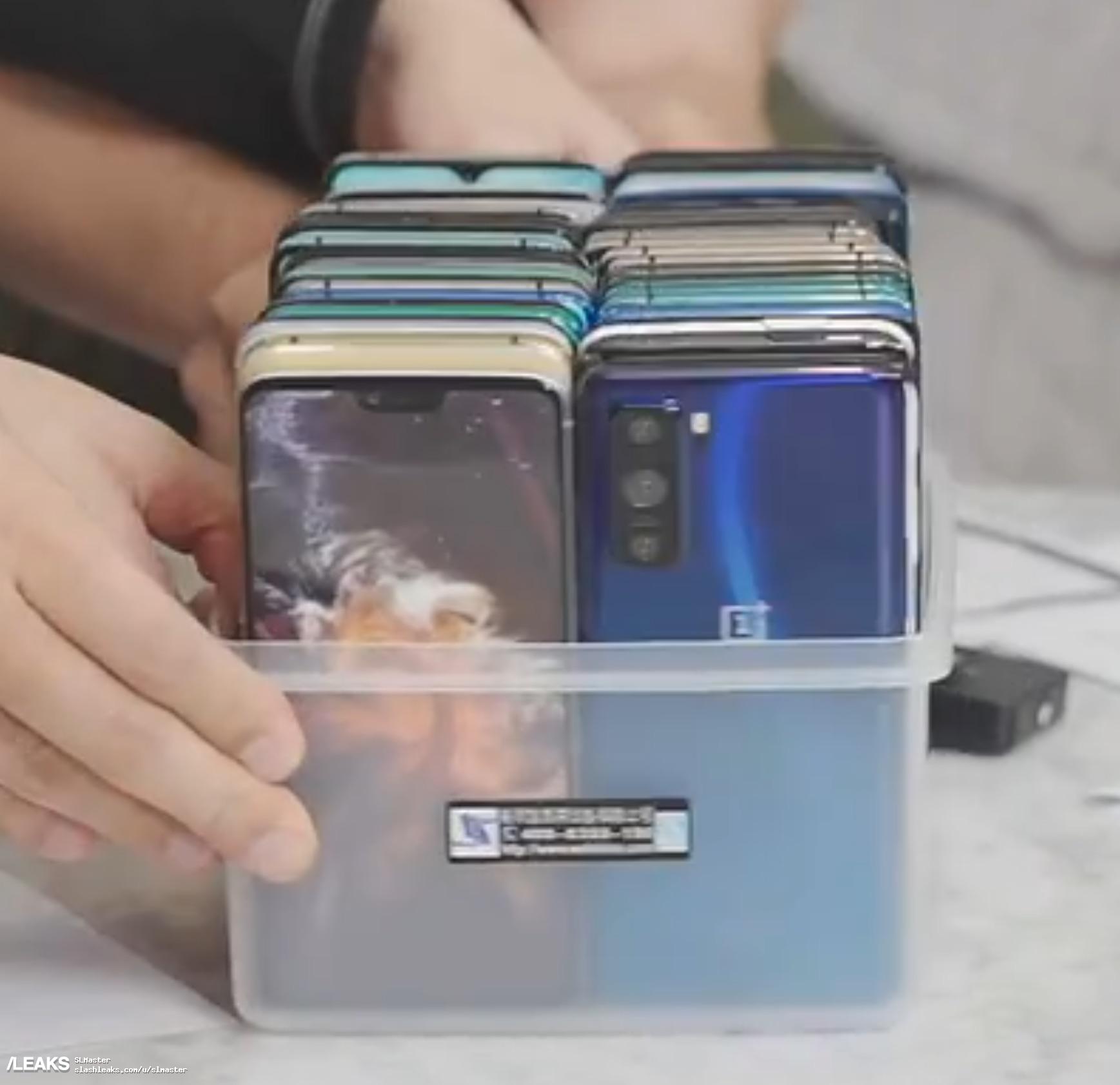
New info has revealed that both Huawei and Honor have more 5G devices on the way. According to the source, both brands have more than twenty 5G smartphones combined which have all received 5G certification. The devices are said to belong to the flagship category.
The source of the info is Chinese blogger and leaker who goes by Digital Chat Station on Weibo. A post he made on Weibo revealed the details along with an image showing the model numbers of the phones.
None of the model numbers are familiar but they should begin to surface in the coming months. We believe a number of them will be announced next year when the second generation of 5G phones will enter the market.
As more houselholds pick up their first smart speaker or smart TV, others are purchasing a second or a third or more. If you belong to the latter category, Google has a new feature that will make playback easy among your devices. Called Stream Transfer, you will be able to move playback (podcasts, music, and videos) between compatible smart devices.

Stream Transfer is easy to use, the easiest way is to call up the Google Assistant and tell it to move what you are watching or listening to the speaker or smart TV where you want it. For example, you can say “Hey Google, play it on living room TV” and what you are watching in the bedroom or on your Nest Hub Max will begin to play on the living room TV. The same applies to audio playback.
Another way to use stream transfer is to go to the Google Home app, tap the cast button to show a list of your devices and select which device or group you want to move playback too.
Stream Transfer works with YouTube for videos and YouTube Music, Spotify, Pandora and more for music. The feature began rolling out to all Chromecasts, Google Home, and Nest smart speakers and displays yesterday.
OnePlus has today launched OnePlus Care, the company’s own post-purchase program for its consumers. Making the announcement, the company said: “The OnePlus Care program was envisioned with the community in mind and is another step towards enabling a superior experience for users.”
As you’d guess, OnePlus Care is an after-sales service program for all OnePlus products. The service will be applicable on all OnePlus phones ever sold. Yes, even if you own the very first OnePlus One, you are eligible for this service from the company. And the best part is that the offers will change for all devices in phases.
Essentially, OnePlus customers will have to download the OnePlus Care app from the Google Play Store and register with their device’s IMEI number. Once that is done, all the offers meant for that particular OnePlus phone will automatically be applied and if there’s a need for after-sales service, the customer will be eligible to avail the benefits.
To celebrate the launch of the OnePlus Care program in India, users of OnePlus smartphones can enjoy OnePlus Care benefits of up to Rs 3,000. OnePlus is offering free 1-year extended warranty, or up to 50% off on battery replacement and extra discounts of up to Rs 3,000 on upgrade plans.
The 1-year extended warranty program is applicable to the following devices – OnePlus 6T, 7, 7 Pro and 7T, while the 50% off on battery replacement is applicable to the OnePlus 6, 5T, 5, 3T and 3. The additional discount of up to Rs 3,000 is applicable on the OnePlus 1, 2, X, 3, 3T, 5, 5T, 6 and 6T.
Xiaomi just expanded its entry-level smartphones line-up with the Redmi 8 which followed the launch of the lower-end Redmi 8A that is currently the most affordable Xiaomi phone if we exclude the Redmi Go. Both these devices are among the best options for people who have a very limited budget and they want to spend max €100/$110 for a new device. There is also another low-end phone released by Xiaomi that is currently available in the most affordable price range: the selfie-centric Redmi Y3. This is a specs comparison which will let you find out who is the Xiaomi entry-level phone with the highest value for money in its current 2019 line-up.
Xiaomi Redmi 8 vs Xiaomi Redmi 8A vs Xiaomi Redmi Y3
Despite Redmi 8, 8A and Y3 are just low-end devices, Xiaomi put a lot of effort in their aesthetics. All of them have elegant design schemes as well as a splash resistant body. Redmi 8 and Y3 have definitely the most impressive bodies in terms of look, due to their reflective backs. However, none of these devices is made of premium materials: all of them have a plastic body. Despite Redmi 8 boasts the more recent Aura Mirror design, Redmi Y3 remains a very elegant and minimalistic phone: given that they are both beautiful and well-built, choose by basing on your tastes. I personally prefer the Redmi Y3 due to its cleaner back and the U-shaped waterdrop notch.
Display
On each of these devices, you will get more or less the same display size, as well as the same resolution and the same display technology (IPS LCD). Due to their resolution, they are below-average panels, but still sufficient for most of the users. We do not suggest you focus on the display quality as they all offer more or less the same thing. Note that Redmi 8A does not have a fingerprint scanner, while Redmi 8 and Redmi Y3 do (but it is not in-display).
Specs & Software
Redmi Y3 wins the performance comparison because it is equipped with a better chipset: the Snapdragon 632 running at a max frequency of 1.8 GHz. It provides smoother and more stable performance thanks to more powerful custom cores, while the Snapdragon 439 found on Redmi 8 and 8A is less powerful but more efficient thanks to its 12 nm production process. Between Redmi 8 and 8A, the former is better since it has a higher memory configuration with 4 GB of RAM and 64 GB of internal storage, but you obviously have to spend more for it. Android 9 Pie is out of the box on each of these devices, but Redmi 8 and 8A already come with MIUI 10 while Redmi Y3 is still based on MIUI 9.
Camera
The best rear camera setup belongs to the Redmi 8 which comes with a 12 MP dual camera boasting a bright f/1.8 aperture and a depth sensor. But if you want the best selfies, then Redmi Y3 is your choice as it is definitely one of the best affordable phones ever for taking selfies, thanks to its 32 MP front camera. Redmi Y3 has a dual rear camera too, while Redmi 8A does not, that is why we would not recommend the Redmi 8A if you asked us about the best camera phone here.
Battery
Redmi 8 and 8A are equipped with bigger 5000 mAh batteries as well as very efficient SoCs, so they have a longer battery life than Redmi Y3. They even support a faster charging technology with a max power of 18W.
Price
Redmi 8 starts from just €100/$110 in China, Redmi 8A costs €90/$100 in India and Redmi Y3 had a starting price of about €130 in India but it is now available for just €100/$110 thanks to online street prices. Whatever you choose, the differences will be just marginal. Overall, I would go for the Redmi Y3 due to the better front camera and the higher performance, but some may not have the same opinion since Redmi 8 and 8A offer a much bigger battery, as well as a better main camera sensor.
OPPO has unveiled a new smartphone for the Japanese market. The phone which is the Reno A is its second Reno smartphone in the country. Renders and specs of the phone already leaked back in August before its launch.
The Reno A has a 6.4-inch 2340 x 1080 display with a waterdrop notch and a 91% screen-to-body ratio. There is Gorilla Glass 5 covering the display. The phone is powered by the Snapdragon 710 processor and is paired with 6GB of RAM and 64GB or 128GB of expandable storage. The product page says the 128GB version is exclusive to Rakuten Mobile.
There are dual cameras on the rear of the Reno A – a 16MP primary camera and a 2MP depth sensor. The phone has up to 22 scene recognitions and 416 automatic scene settings, so that your photos can turn out well. The selfie camera is a 25MP AI camera with a beauty mode and a portrait mode.
The Reno A has an in-display fingerprint scanner and also has NFC with support for FeliCa mobile payment. There is dual-SIM support (nano only), Bluetooth 5.0, dual-band WiFi, and OTG. The Reno A also has an IP67 waterproof and dustproof rating.
The phone packs a 3600mAh battery and charges via a USB Type-C port. It runs ColorOS 6.0 and brings software features such as Game Boost 2.0 which includes Touch Boost and Frame Boost for faster touch response and smoother gaming respectively.
[envira-gallery id=”281671″]
The Reno A has a price tag of 35,800 Japanese yen (~$333). The phone will come with a protective film already attached, a pair of earphones, and a protective case. It is already available for pre-order and will go on sale on October 18. Interested buyers will be available to purchase one on Amazon Japan, Rakuten Mobile, Fiimo, LinksMate, Yamada, Joshin, Simseller, Nojima, etc,.
Today, UMIDIGI officially announced the price of its latest budget flagship smartphone the UMIDIGI F2 and it is a truly unbelievable price: just $179.99 on a limited deal from October 14th to October 16th! The device is the successor to the successful UMIDIGI F1 and it will hit the market on October 14th, 7 AM GMT on Aliexpress. The company also released a first look video of the device.
The killer feature is the quad-camera setup of course. Since the Xiaomi’s sub-brand, Redmi, released the Note 8 Pro recently, it’s easy to tell that the F2 is the perfect competitor. Considering the overall quality and performance, which one has a higher value for money?
Display
Design is subjective and since both come with a 6.53″ FHD+ IPS panel, the F2 has an advantage since it drops the annoying notch and adopts a hole-punch front camera.
Camera
Until we see real-life reviews of the camera we can’t be totally sure about which is better. On paper, the UMIDIGI F2 is better since it comes with a 32MP flagship-category selfie shooter while the Note 8 Pro hosts a 20MP sensor. One the back, both have a multi-function quad camera setup. The Note 8 Pro sports a higher resolution main camera but the F2 has a better ultra-wide camera.
Performance & Battery
The Note 8 Pro comes with the more powerful Helio G90T SoC but the Helio P70 on the F2 is no slouch either. Also, both come with the same 6GB/128GB memory configuration but the F2 costs more than $100 less than its rival. Definitely, the CPU power difference doesn’t justify the huge price difference.
In terms of battery, the UMIDIGI F2 has a bigger battery (5150mAh) than Redmi Note 8 Pro (4500mAh) while both support 18W fast charging as well as NFC with Google Pay.
Design
Both phones come with a beautiful glass back cover but the F2 has a cleaner and more consistent design thanks to the side-mounted fingerprint sensor. The Note 8 Pro still comes with the old-fashioned back-placed fingerprint sensor.
Operating System
Only a handful of devices have adopted Android 10 which is Google’s latest OS. UMIDIGI F2 is one of them and comes with stock Android 10 while the Redmi Note 8 Pro features MIUI 10 based on Android 9.0.
Price
The promotional price of the UMIDIGI F2 at $179.99 is amazing during the global sale that starts on Monday. After the promotion, it will go up to its original price of just $199.99. On the other hand, the Note 8 Pro 6GB/128GB version costs $299.99, making the UMIDIGI F2 a better VFM device. UMIDIGI is also running a 10-unit giveaway which you can join here. Also, don’t forget to add the F2 to your cart so that you won’t miss the offer and you will receive a free pair of UPods as well.
Earlier today, the alleged Honor 20 Lite was spotted at the Chinese regulatory website, TENNA which had revealed its full specifications. While the listing also included images of the handset, they were very dark and it was hard to divulge details about its looks. Having said that, a set of HD renders have surfaced on Twitter that has revealed a lot more design details about the upcoming handset.
According to the renders, the Honor 20 Lite will be offered a couple of gradients finish rear panels that seem to be made out of glass. The rear panel houses the company branding and a vertically aligned triple camera module which protrudes slightly from the surface. Overall, the rear of the handset has a minimalist design, in spite of that, it looks very attractive.
Even though the official name of these colour options will be revealed at the time of launch, for now, we can refer to them as pink/violet and peach/cyan. Undoubtedly, both the colour options look vivid and they will provide the Honor 20 Lite with a Chic appearance
Honor 20 Lite (Waterdrop notch visible after adjusting colour of image)
This render set does not reveal any details about the front fascia of the handset but they can be obtained from the previously mentioned TENNA listing. Unlike the Honor 20 and Honor 20 Pro, that sport a punch-hole display, the affordable Honor 20 Lite has a waterdrop notch type of display revealed images on TENAA listing after some colour adjustment.
The specifications of the Honor 20 Lite acquired from TENAA are listed below:
Dimensions: 157.2 x 73.2 x 7.65mm
Weight: 172 grams
Display: 6.3 Inch, OLED, Full HD+
Battery: 4000 mAh, 22.5 W fast charging
Front Camera: 16 MP, Punch-hole
Rear Camera: 48 MP + 8 MP + 2 MP
CPU: Octa-Core, 2.2 GHz (Possibly Kirin 810)
Connectivity Options: 4G VoLTE, 802.11 a/b/g/n/ Wi-Fi, USB Type C, Bluetooth 5.0
RAM: 4GB/6GB/8GB
ROM: 64GB/128 GB, expandable via microSD
Security: In-display fingerprint sensor
Android: Android 9, EMUI 9.1
Honor is expected to hold a launch event by the end of this month to announce the Honor V30 series of smartphones in its home country. Corresponding to the fact, it can be assumed that the launch of Honor 20 Lite will also happen the same event.
The rate at which OEMs churn out new smartphones could be traced to the fact that the smartphone makers depend on sales not just from new buyers but from current owners who upgrade to the latest model. Each new model comes with a unique feature which some might find interesting but unfortunately, within the next couple of months, a better model is usually launched.
Apple and Samsung have the most loyal fanbase globally who retain the brands’ models in succession. However, a new report showing the top 10 Android phone brands with the highest retention rate in China has emerged. Of course, the list is devoid of the likes of Apple and Samsung which are struggling in the world’s second-largest market presently. Instead, Huawei‘s Mate series emerged as the phone model with the highest retention rate of 55.01%. The Mate series has seen tremendous improvement in design and hardware over the years. The flagship model sells massively even outside China.
The Mate series is followed by Xiaomi‘s Mi Max series with a retention rate of 47.49%. The Huawei P series comes in at the third position with a retention rate of 47.06%. Also in the top ten is the Xiaomi Mi Note Series, Xiaomi Digital Series, Huawei Maimang Series, Xiaomi MIX Series, Redmi Note Series, Vivo Y Series and Vivo X Series. Interestingly, Xiaomi is yet to update the Mi Note and Max series for a while now and may not do so this year.
The list is dominated by just three brands and it is no surprise that the three brands are currently among the top 5 Chinese phone makers in terms of shipment volume.
HMD Global is lauded for its impressive software support for its Nokia-branded smartphones. When the Android 10 stable update was announced last month, the company released an infographic showing the update schedule for its devices. Keeping to its promise of starting in Q4 2019, the Nokia 8.1 is now the first to receive the update.
Juho Sarvikas who is the Chief Product Officer at HMD Global posted a tweet announcing the update is rolling out to the upper mid-range phone.
Android 10 upgrade for Nokia 8.1 starts today! First on SD710 to bring new features such as Dark theme, Gesture Navigation and more. Staying the course to be the first across the portfolio! Nokia phones #Keepgettingbetter#nokiamobilepic.twitter.com/U9g1jZHtA6
It is no surprise that the Nokia 8.1 is the first Nokia device to get the stable update seeing as it was part of the Android Q beta program.
Below is the change-log for the update which is over 1.4GB in size:
Dark Mode – Take it easy on your eyes
Smart reply – Save more time with recommended actions
Gesture Navigation – Get around with a swipe and a pull
Additional controls for privacy and location
Google Security Patch (2019-09)
The other Nokia devices scheduled to get the update this year are the Nokia 7.1 and the Nokia 9 PureView. HMD Global says they will be updated this quarter which means the update should arrive between now and December on both phones.
However, we believe the Nokia 7.2 and Nokia 6.2 will also get the update this year as both phones were announced after the update schedule was published. Seeing as they are new devices, they should be high-priority.
OnePlus is experimenting with its launches this year. For the first time in its history, OnePlus announced two flagship-grade models, the OnePlus 7 and the OnePlus 7 Pro in May 2019. Then in September 2019, it released the OnePlus 7T alongside the OnePlus TV in India with no mention of the 7T Pro. Now we know that the 7T and 7T Pro are getting a global launch on October 10.
While the two models are yet to debut internationally, the OnePlus 7T is already available in India. And I have been using the OnePlus 7T for the past week. So, here’s my first impressions of the new model.
OnePlus 7T Hands-On: Design
The OnePlus 7T brings on a familiar design on the front but there are some significant changes at the back. Gone are the dual cameras and the pill-shaped camera housing from the OnePlus 7. The new model brings in a circular camera module that houses three camera sensors inside. There’s no doubt that this camera arrangement stands out from the crowd. In fact, I had a few people immediately recognize the OnePlus 7T, all thanks to this weird camera module at the back.
At first glance, the OnePlus 7T’s Glacier Blue might look similar to the Blue shade on its predecessors. However, let me be clear here, the Glacier Blue color on this model is quite different from what we’ve seen before. This Blue changes its shade like a chameleon and you’ll often be surprised by how dark and light it gets under different lighting conditions.
For example, if you look at the image above, it looks like the OnePlus 7T comes in a soft light blue shade. You might feel there’s a bit of a gradient finish as well. But then, look at the image below. See how dark it gets when the lighting gets low? Honestly, when you are using the phone indoors, the OnePlus 7T has such a dark tint that you might even call it frosted blue or gray. That’s how dark it can get.
It’s like the phone has two different colors when you are using it indoors and outdoors.
Same Phone but different colors.
Can you imagine all these pictures are of the same Glacier Blue color variant?
The built quality of the OnePlus 7T is pretty solid. You have tactile buttons, a smooth polished metal back, a glass camera housing that doesn’t get scratched easily and gorilla glass 5 protection on both sides. You get volume buttons on the left and the power button and alert slider on the right. The bottom part of the phone is pretty crowded featuring a USB Type-C port, dual SIM card slots, and a speaker grill.
OnePlus 7T is its most recent flagship
Alert slider and power button are on the right
Bottom portion of the OP7T is pretty crowded
Camera Bump is significant
Overall, the phone has a symmetric design language, except for that totally random single antenna band at the bottom that separates the SIM card slot. The OnePlus 7T isn’t the most beautiful phone that I have seen lately, but the design definitely grows on you. And if you are someone who likes your phones to stand out, the 7T definitely won’t disappoint.
OnePlus 7T Hands-On: Display
The OnePlus 7T has one of the most beautiful displays in its price segment. The phone features a 6.55-inch 90Hz Fluid AMOLED panel with a small waterdrop notch on top. The high refresh rate display is definitely pleasing to the eyes and translates to a better browsing and gaming experience. For Rs. 37,999 ($534), I don’t think you’ll find a better display panel on a smartphone.
If you are coming from a non-notch smartphone, it might take some time getting used to the notch. But it’s not something that’ll bother you in the long run.
Snapdragon 855 Plus and 8GB of RAM with OxygenOS on top is the perfect recipe for a smooth UI experience. Just as expected, the OnePlus 7T handles everything with ease and there won’t be a single app that’ll trouble the device.
I’ll talk more about the hardware performance in my review but know that the OnePlus 7T is one of the fastest smartphones in the market today. The phone handles even graphic intensive games like Call of Duty Mobile very smoothly. I have spent hours playing COD Mobile and I haven’t had a single hiccup so far. Even the thermals are pretty well controlled.
So apart from that gentle notification from the UI saying that “you’ve been using your phone for too long”, nothing else will come in between you and your long hours of gaming and entertainment. You can check out the complete specs of the OnePlus 7T here.
As for the battery, it has been pretty good so far. The 3800mAh isn’t exactly very large but the OnePlus 7T should last an entire day on a single charge. Not to mention, Warp Charge 30T is really fast and you can top up your smartphone in no time at all! I mean you can charge your phone up to 70% in just over 30 minutes! That’s really cool!
OnePlus 7T’s camera is also on par with its predecessors. The wide-angle and macro cameras are really my favorites as you can do a lot with those lenses. Portrait mode could use some fine-tuning but overall, the OnePlus 7T’s cameras won’t disappoint you. I’ll share more details about the phone’s camera in my detailed review soon.
The first OxygenOS 10 build did have a few bugs but things have improved after the first update that was rolled out a few days back. I’m expecting OnePlus 7T’s UI to get even better in the upcoming updates.
Overall, the OnePlus 7T is turning out to be a worthy upgrade to the OnePlus 7. The phone has all the bells and whistles that you want in a flagship device (except for wireless charging) and it brings the best of the OnePlus 7 Pro at an affordable price point.
So what do you think of the OnePlus 7T? If you have any specific questions, please share them via the comments section below. I’ll try to answer each one of them personally.
MIUI 11 was announced last month during the Mi MIX Alpha and Mi 9 Pro 5G launch event. Just a few weeks after and Xiaomi is already rolling out a stable update and the Redmi K20 and Redmi 7.
The update is rolling out as MIUI V11.0.3 (V11.0.3.0.PFJCNXM) for the Redmi K20 and is just shy of 700MB in size. For the Redmi 7, the update has version number 11.0.1.0.PFLCNXM The update brings a number of new features including a focus on sounds and colors. The update for the Redmi 7 comes with September’s security patch. The update brings new features as well as fixes for both phones.
MIUI 11 brings a dark mode to Xiaomi and Redmi phones and uses true black rather than gray or blue. There is also a new font called MiLan Pro, new ambient display features that are highly customizable. There is also a dynamic sound system that uses ambient sounds from nature. The sounds change throughout the day too.
There is also Mi Work Suite which includes productivity features such as large document transfer between multiple devices, smart screencast, and wireless printing. Another new feature is the Mi Go Suite which includes a smart travel assistant. MIUI 11 also brings a new file transfer feature that works with phones from OPPO and Vivo too. There is also a built-in document viewer, so you don’t need to install additional apps for that.
With the Redmi K20 and Redmi 7 out of the way, we expect more devices will get the MIUI 11 stable update in the coming days or weeks.
Google is set to launch its latest flagship smartphones, the Pixel 4 lineup which will be unveiled on the 15th of October. In addition to the 4G variant, Google could also unveil 5G variant of these smartphones at the same event claims a report published by Nikkei Asia.
If this turns out true, Google will not only beat Apple but it will also defeat Microsoft who has recently re-entered the smartphone market with the Surface Duo, and every other corporation in the race of launching first 5G compatible smartphone made by an American company.
According to the source, Google has started test production of its first 5G smartphone which is currently ongoing in China. However, taking the US-China trade war into consideration and to avoid any sort of tarriffs, Google will ultimately esatablish a manufacturing unit outside of China. The leading option for the location is a Vietnamese facility which is currently under construction and will be ready by the end of this year.
The 5G compatible Pixel 4 or whatever Google’s first 5G phone will be named is expected to be commercially available in spring of 2020. Accordingly, the 5G handset could go on sale between 1st of March and 31st May next year. At the time of its commercial launch, the company is also reported to lift covers from an affordable variant of Pixel 4 which is presumed to be the Pixel 4A.
The source also revealed that the alleged 5G smartphone from Google will be equipped with Snapdragon 855 mobile platform of chipsets which is supplied by Qualcomm.
While Asia Nikkei questioned Google about the authenticity of these claims, as of now the Global search giant has refrained from responding. Nonetheless, 15th of October is approaching fast, therefore, we wont have to wait for long to know whether Google will actually be crowned the title of “first American company to launch a 5G compatible smartphone” or not.
Besides the flagship devices of the company that recently gained another member -UMIDIGI F2- with excellent specs and price tag, the Chinese manufacturer is also very famous about its entry-level Power series that comes with a massive battery and pretty affordable price. Currently, there is only one member in the Series but according to leaked information, the company is getting ready to add another.
Strangely, the new model isn’t going to be named Power 2 but they will skip a number going straight to UMIDIGI Power 3. As you can see in the photo, the 6000 mentioned should be the capacity of the battery and it’s going to sport a quad-camera setup on the back. The rest of the specs are still undisclosed so we’ll have to wait until UMIDIGI officially announces the device or another leak surfaces. Until that happens, you can visit their official website to check out their latest flagship UMIDIGI F2 and their new smartwatch and wireless headset.
Realme has been working on its new premium flagship smartphone named Realme X2 Pro, which will reportedly make its debut in Europe on 15th October. Now, the company has confirmed that the smartphone will get launched in India in December this year.
Madhav Sheth, CEO of Realme India has taken to Twitter to make this announcement. This will be the second smartphone from the Chinese company to launch in India in December as Realme has already confirmed that the launch of Realme XT 730G in India will take place in December this year.
Coming to the Realme X2 Pro, the company has so far confirmed that the device will feature 90Hz Fluid AMOLED display with 135Hz touch sampling rate and 20:9 aspect ratio. It has also been confirmed that the display will be protected by a layer of Gorilla Glass 5.
Under the hood, the smartphone will be powered by the latest Qualcomm Snapdragon 855 Plus octa-core processor clocked at 2.96GHz. As for the cameras, the device will come equipped with a 64-megapixel quad-camera setup.
It's official now! We are bringing #realmeX2Pro to India in Dec. Time to rethink flagships. Get ready for #FasterSharperBolder. 2K RT in 30mins – to win one SD 855+, 90hz display flagship 5K RT in a day & I will giveaway one more
The TENAA listing has revealed that the device will pack 64-megapixel + 13-megapixel + 8-megapixel + 2-megapixel quad camera system and it has a frontal shooter of 16-megapixel. Realme China CMO Xu Qi has also shared camera samples of the device.
The phone will feature 50W SuperVOOC Flash charge, compared to 65W SuperVOOC fast charging support in OPPO Reno Ace that will be introduced on October 10th in China. It will feature dual Stereo Speakers with Dolby Atmos and Hi-Res audio certification.
The ColorOS 6.1-based Android 9 Pie operating system is expected to come preloaded on the device. TENAA revealed that it has 6GB of RAM and 64GB of native storage. However, the phone is expected to come in 8GB RAM variant and storage options of up to 256GB.
The official announcement from the company regarding the launch of Realme X2 Pro in India in December comes just days after the smartphone was certified by BIS in India, which suggested that the phone should not be far away.
Essential Inc. slowed down things following the launch of its first smartphone, the Essential PH-1. Two years after it announced the PH-1, it is yet to announce another phone.
Prior to releasing details about its new smartphone, the official Essential Twitter account tweeted earlier this week that the company is recruiting for a number of positions in Bangalore, India. Yes, Essential has an office in India and its hiring.
We're looking for talented engineers and designers based in Bangalore, India to join our team.
Essential says it is recruiting for talent to work on Android and Cloud technology. Those who get hired “will work closely with HQ in Palo Alto” to build and design future products and platforms.
The company says workers will get perks such as flexible time off, catered meals, and fresh fruit, in addition to a competitive salary and health benefits.
Below is a list of the openings at the Indian office:
All the positions are full-time and are located in Bangalore. Do check here for full details on the positions and their requirements.
This is the second time this year Essential is recruiting for multiple positions. Back in February, it put up listings for 21 positions, however, some were not full-time jobs unlike the ones in India.
Rumors surrounding the upcoming Meizu 16T have claimed that it will be arriving as a gaming-focused smartphone. However, the camera sample of the Meizu 16T that was shared by Meizu Technology Vice President Huahai Liang reveals that the Meizu 16T will be also offering amazing night scene photography experience.
The below shown camera sample shows that the phone was able to capture it with rich details and impressive color reproduction. The image is quite bright and has no obvious noise. The TENAA listing of the smartphone has revealed that its rear-mounted triple camera system has a 12-megapixel main lens, an 8-megapixel secondary shooter and a 5-megapixel sensor.
The Meizu 16T is fitted with a 6.5-inch AMOLED screen with super-slim bezels. It offers full HD+ resolution of 1080 x 2232 pixels and an aspect ratio of 18.5:9. The display of the phone is integrated with an in-screen fingerprint reader. The Meizu 16’s top bezel is the home for its 16-megapixel selfie camera.
The Snapdragon 855 chipset that clocks at 2.84GHz powers the Meizu 16T. The 6 GB RAM + 128 GB storage edition of the smartphone was recently spotted on AnTuTu with an average benchmarking score of 418,909. TENAA has revealed that the phone may come in 8 GB RAM option. This model may feature an internal storage of 256 GB. There is no support for additional storage on the device.
The Meizu 16T is loaded with Android 9 Pie OS. It remains to be seen whether it comes with the latest Flyme 8 UI. The mCharge rapid charging technology powered 4,400mAh battery is present inside the device.
The Meizu 16T is scheduled to go official on Oct. 23. As of this writing, there is no information available on the pricing of the smartphone.
Avi Cloud (AVC) has shared new monitoring data which reveals that the Xiaomi has been named the leading company for the Smart TV segment in the Chinese market for the month of August 2019.
As per the list, Xiaomi was followed by Skyworth, Hisense, TCL, Changhong, Haier, Konka, Cool, Philips, and Samsung to make the top 10 smart TV companies of the Chinese market for August this year.
Prior to this, the data coming from three research institutions — Aoweiyun.com, Qunzhi Consulting, and Zhongyikang showed Xiaomi Smart TVs as to be leading in the first half of this year in terms of shipments in China.
For such success in the Smart TV segment, Lei Jun, CEO of Xiaomi attributed it to “continuous innovation”. He cites the example of a 65-inch TV which won the “Color TV Innovation Product” award at the China Intelligent Display and Innovation Application Industry Conference.
Previously, the company won several awards, including “2019 Top Ten TV Awards”, “High-end Smart Product Award”, “Disp Grand Prize-AIoT Technology”, and has managed to establish its presence in budget as well as premium smart TV market.
Lu Weibing, President of Redmi brand said that the reason behind Xiaomi’s success in the Smart TV market is mainly four — easy to use system, rich content library, interconnected IoT appliances, and high quality.
The Xiaomi Smart TVs come with MIUI TV operating system based on Android TV and have the company’s own custom user interface named PatchWall which provides an interactive experience to the users.
It’s noteworthy that Xiaomi’s success in the smart TV segment isn’t limited to its home country China. The company is also the leading brand in the Indian market, where it started selling televisions just few years ago.
Each month AnTuTu releases a list of best smartphones that top its benchmarking results for a month prior. Accordingly, the list of handsets with highest AnTuTu scores for the month of September has been published. Noteworthy, statistics for each model have been collected from at least 1000 units which helps in providing reliable data figures.
The pole position is held by the 8 GB + 256 GB variant of the VivoNex 3 that has scored 483,427 points. Suprisingly, the second place is also held by a Vivo smartphone which is the 8 GB + 256 GB variant of iQOO Pro 5G that has scored 481,211 points.
The Vivo handsets are followed by Asus’ latest and greatest Gaming centric smartphone which is the ROG Phone 2. The average of 1000 units, with 8 GB RAM + 128 GB ROM is 473,917. Next in line is another Gaming focused device, the Black Shark 2 Pro from Xiaomi whose 12 GB + 256 GB variant has scored 464953.
The number five spot is enjoyed by yet another Xiaomi smartphone which is the 8 GB + 256 GB variant of the Mi 9 Pro 5G. It has secured a score of 464,807 points. Next in order is the lesser known Meizu 16S Pro whose 8 GB + 128 GB variant have scored 460,076 points.
At number seven we have the third and last handset from Xiaomi which is the aggressively priced Redmi K20 Pro. The 12 GB + 512 GB variant of the device scored 456,237 points in this month of the year.
Finally, at position eight, a Samsung smartphone makes an appearance. Its 12 GB + 256 GB storage variant of the Galaxy Note 10+ manages to score 449,269 points. Following Samsung, we have the high-end offering from Vivo’s sister company OnePlus whose 12 GB + 256 GB OnePlus 7 Pro have registered a score of 448,488 points.
Lastly, we have the Huawei Mate 30 Pro. Out of all the devices, this is the only handset to not feature the Snapdrgaon 855 or 855+ chipset. Instead, it is kitted with Huawei’s in-house developed Kirin 990. The 8 GB + 256 GB variant of the device registers a score of 445,446 points.
China’s commercial 5G rollout is still a few months away but the top three Chinese carriers are already accepting pre-subscriptions for 5G in the country. Unsurprisingly, this pre-subscription drive seems to be successful with over 9.3 million users signing up for 5G even before they are officially rolled out.
All three carriers in China are offering pretty good discounts for their pre-subscribers. China Mobile, China Unicom, and China Telecom operators are giving out 5G subscriptions for up to 30 percent discount to early adopters. For example, China Mobile customers who have been with the carrier for more than 5 years get a solid 30 percent discount on 5G plans for the first six months. New customers get a 20 percent discount on the official price at launch. China Telecom and Unicom users are also getting a similar discount scheme.
China Mobile has reportedly secured around 5.6 million 5G pre-subscriptions already while the figure for China Telecom and China Unicom is said to be around 1.9 million and 1.8 million respectively. What’s even more interesting is that the Chinese carriers have not really disclosed the pricing for their 5G plans. Only China Unicom has given out a figure, which starts at 190 yuan (~$27) but it could change since the carrier states that this is just the phase one of its promotional offerings.
Looks like China will be at the forefront of 5G adoption. So, it would be interesting to see how fast the new generation network grows once it is rolled out in the market.
Xiaomi has officially confirmed that the Redmi Note 8 Pro will be announced in India on October 16. After its launch in China back in August, the phone has been slowly expanding to markets in Asia and Europe. But the phone’s launch has been most awaited in India where the Redmi Note series has always been a best seller.
At the end of the Redmi 8 launch event today, the company confirmed the launch date for the Redmi Note 8 Pro. It also revealed some of its features such as a 64MP sensor in a quad-camera setup at the back, MediaTek’s gaming-centric SoC, and powerful cooling. Expect the Redmi Note 8 Pro India version to be identical to the global versions, except for its memory configurations.
Both models namely the Redmi Note 8 and Note 8 Pro should meet us at the October 16 event in India. The Redmi Note 8 will come with Snapdragon 665, a 48MP triple camera setup, and a 4000mAh battery. On the other hand, the Redmi Note 8 Pro will be targeted at heavy users with MediaTek G90T gaming-centric processor, a 64MP quad-camera setup, and a larger 4500mAh battery. MediaTek had earlier revealed that the G90T will change the perception of the company in India with the Redmi Note 8 Pro. In this regard, the chipmaker was also quick to release the kernel source for the device.
With the Redmi Note 8 series releasing on October 16, the independent brand would have released four smartphones in India in a span of 20 days! The timing is actually perfect given how all these new models will be available before the Diwali season in India.
The Redmi Note 8 series is already available in European markets like Ukraine, Germany, and Spain, alongside Asian markets like Malaysia. The Indonesian launch is scheduled a day after the India launch, on October 17.
We use cookies on our website to give you the most relevant experience by remembering your preferences and repeat visits. By clicking “Accept”, you consent to the use of ALL the cookies.
This website uses cookies to improve your experience while you navigate through the website. Out of these, the cookies that are categorized as necessary are stored on your browser as they are essential for the working of basic functionalities of the website. We also use third-party cookies that help us analyze and understand how you use this website. These cookies will be stored in your browser only with your consent. You also have the option to opt-out of these cookies. But opting out of some of these cookies may affect your browsing experience.
Necessary cookies are absolutely essential for the website to function properly. This category only includes cookies that ensures basic functionalities and security features of the website. These cookies do not store any personal information.
Any cookies that may not be particularly necessary for the website to function and is used specifically to collect user personal data via analytics, ads, other embedded contents are termed as non-necessary cookies. It is mandatory to procure user consent prior to running these cookies on your website.