Advertisement

OnePlus 7 Pro Geekbench listing confirms 12 GB RAM and Snapdragon 855

OnePlus 7 Pro is scheduled to go official along with OnePlus 7 smartphone on May 14. Around two weeks ahead of its launch, the OnePlus 7 Pro has appeared on Geekbench benchmarking platform. The listing again reveals that the smartphone will be hitting the market in 12 GB RAM edition apart from other RAM variants.

Recent reports have revealed that GM1917, GM1915, GM1913 and GM1911 model numbers belong to the OnePlus 7 Pro smartphone. The GM1917 has appeared on Geekbench to reveal some of its key specs. The Geekbench listing of the OnePlus 7 Pro confirms that it is fueled by the 7nm Snapdragon 855 mobile platform. The SoC is mentioned with its “msmnile” codename on the listing.
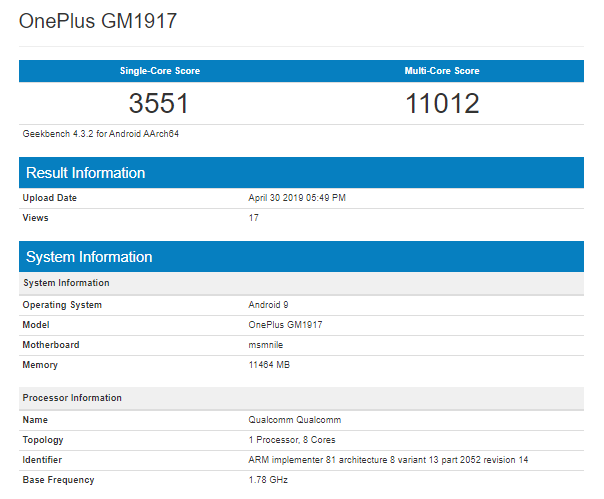
OnePlus 7 Pro Geekbench

The OnePlus 7 Pro smartphone is loaded with the latest Android 9 Pie OS. The SD855 chip is supported by 12 GB of RAM. In the single-core test of Geekbench, the OnePlus 7 Pro has scored 3551 points and it has recorded a score of 11012 in the multi-core test.

OnePlus 7 Pro Variants and Price (Rumored)

Recent reports have revealed that the OnePlus 7 Pro will be hitting the market in variants like 6 GB RAM + 128 GB storage, 8 GB RAM + 256 GB storage and 12 GB RAM + 256 GB storage. In Europe, the last two variants are expected to be respectively priced at 749 euros and 819 euros. There is no information available on the pricing of the 6 GB + 128 GB base model.

OnePlus 7 Pro Specifications (Rumored)

The OnePlus 7 Pro will be arriving with a curved and notch-less AMOLED display of 6.7 inches. The smartphone will offer quad HD+ resolution of 1440 x 3120 pixels and an aspect ratio of 19.5:9. It is equipped with an in-screen fingerprint reader.

The OnePlus 7 Pro will be the company’s first smartphone to arrive with triple rear cameras. It is rumored to include an f/1.6 aperture 48-megapixel primary sensor with EIS and OIS, an f/2.4 aperture 8-megapixel telephoto lens with 3x optical zoom and a 117-degree 16-megapixel wide-angle lens. For capturing selfie shots, the smartphone is equipped with an f/2.0 aperture 16-megapixel pop-up selfie camera.

Oneplus 7 Pro

The OP7 Pro smartphone will come packed with a 4,000mAh battery that supports 30W Warp Charge rapid charging. The handset is expected to arrive in the market in color variants like Blue, Grey and Brown. The Chinese firm will be also launching the OnePlus 7 Pro 5G version.
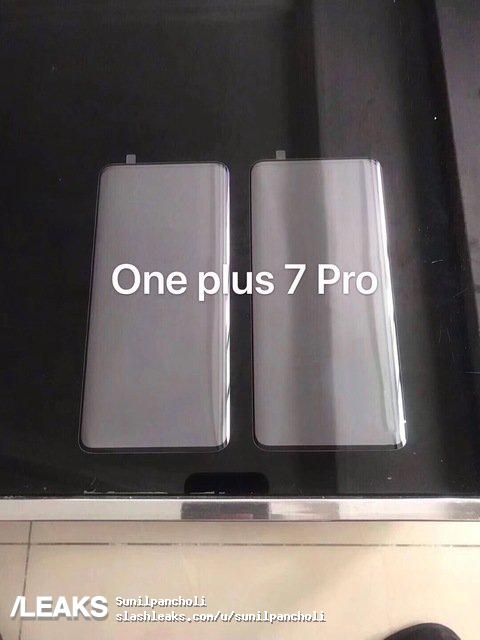
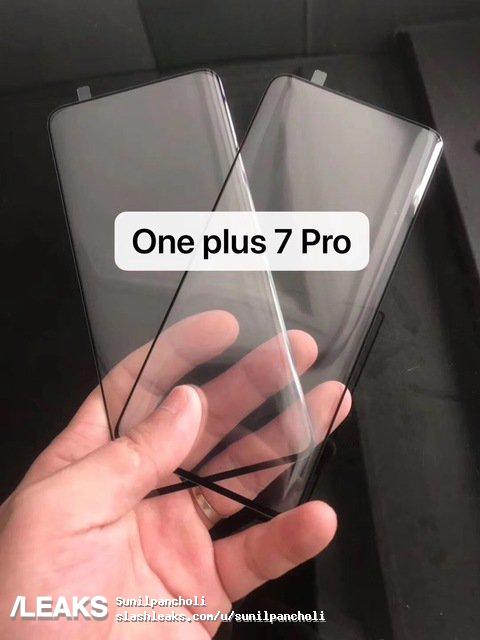
OnePlus 7 Pro tempered glass leak showcases the curved screen design

Recently, a full-page advertisement of the OnePlus 7 Pro appeared on the New York Times, revealing some key features of the upcoming flagship smartphone. It confirmed that the phone will come with a notch-less display.

Now, ahead of the phone’s launch on 14th May, the tempered glass panel for the protection of display from minor scratches has surfaced online, revealing that the smartphone will come with a curved screen.

OnePlus 7 Pro Screen Protector

It shows that the screen curves towards the left and right edges, similar to Samsung’s Galaxy S-series flagships. The leaked screen protector also shows that the upcoming flagship smartphone will have minimal bezels surrounding the display. However, the bottom chin is a bit thicker compared to the other sides.

Earlier, the advertisement of the OnePlus 7 Pro shows the illustration of the phone’s internals, which confirms that the phone will come with a pop-up front-facing camera. Prior to that, the company had shared a small video teaser on its social media profiles which confirmed that the smartphone will come with a triple rear camera setup, with sensors placed vertically in the top-center position.

Recently, the company revealed that the display of the OnePlus 7 Pro has been rated ‘A+’ by DisplayMate, making it the best display in any smartphone at this point in time. The full report of the same will be published on 14th May.

As per the reports, the OnePlus 7 Pro will feature a 6.7-inch Super AMOLED display that is curved towards the left and right edges. It will support Quad-HD+ resolution of 1440 x 3120 pixels and will have a refresh rate of 90 Hz.

On the back side, the smartphone is expected to come with a 48MP primary camera paired with an 8MP f/2.4 telephoto lens and a 16MP f/2.2 ultra-wide angle lens. Running on Android Pie-based Oxygen OS, the phone is said to pack 4,000mAh battery with 30W Warp Charge fast charging support.

Read More: OnePlus 7 Pro’s camera can compete with “first tier” phones, claims OnePlus imaging director

Most of the details regarding this flagship smartphone has already leaked online or the company has confirmed through teasers. But to know for sure what the phone offers, along with its pricing and availability, we’ll have to wait for the official launch event on 14th May.

(Via)

Huawei shows off Mate X foldable smartphone at a 5G conference in China

Huawei had announced its first foldable and 5G compatible smartphone a couple of months ago, named Huawei Mate X. While the phone is yet to go on sale, the company is now showcasing the smartphone at various events.

Recently, during a 5G conference in Sichuan, China, Huawei showcased the Mate X smartphone for the first time in China. After the debacle of Samsung Galaxy Fold regarding the phone’s display issues, eyes are now on the Huawei Mate X.

The company has already confirmed that the phone is not just a concept and has already started mass producing the Huawei Mate X. In fact, the device has now been listed on the company’s website and is set to go on sale from June.

Huawei Mate X featured

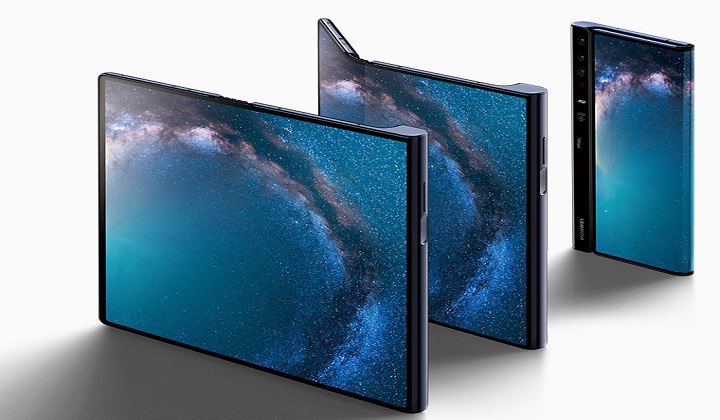
The Huawei Mate X features a large 8-inch screen with a 2480 x 2200 pixels screen resolution and an 8:7.1 aspect ratio when unfolded with pretty thin bezels. When folded, it transforms into a dual display phone – one side is a 6.6-inch (2480 x 1148 pixels) 19.5:9 display while the other is a 6.38-inch (2480 x 892 pixels) 25:9 display.

The phone is powered by the company’s own Kirin 980 chipset, paired with 8GB of RAM and 512GB of storage. It has dual SIM support (nano only) but only SIM 1 supports 5G. You can also swap out the second SIM card for Huawei’s NM card (256GB max.). It comes with the 7nm Balong 5000 modem which brings 5G support to the device.

It features three cameras on the back, which also double as the selfie cameras. The cameras were co-developed with Leica and are made up of a 40MP wide-angle lens, a 16MP ultra-wide angle lens, and an 8MP telephoto lens.

The phone runs the EMUI 9.1.1 custom interface, which is based on Android 9 Pie operating system out-of-the-box. As for the connectivity options, the device supports NFC, dual-frequency GPS, Bluetooth 5.0, Wi-Fi 802.11 b/g/n/ac, and USB Type-C port.

Read More: Huawei once again insists on its “employees ownership” story but doubts still persist

The device comes with two built-in batteries, which offers a total capacity of 4,500mAh. Huawei has also debuted its new SupercCharge fast charging technology which supports up to 55W. The company claims that the new SuperCharge allows users to charge the device from empty to 85% in just 30 minutes.

(Via)

Nokia 4.2 is now up for pre-order in the US for just $189

The Nokia 4.2 was unveiled at the Mobile World Congress 2019 alongside the Nokia 3.2, the penta-lens enabled Nokia 9 PureView as well as the budget-friendly Nokia 1 Plus and Nokia 210  feature phone. Two months after unveiling the smartphone at MWC 2019, HMD Global has announced that the Nokia 4.2 will debut in the United States in two weeks’ time, precisely on May 14.

Ahead of the release, pre-orders for the smartphone have already begun at Amazon and B&H. The model is expected to b available on Best Buy as well but the pre-order page is not yet active. The model is expected to start shipping on May 14. In addition, you can find the 4.2 to buy in-store at select Best Buy stores starting June 9.

Read Also: Giveaway – Win a Xiaomi Redmi AirDots Wireless Earbuds

The Nokia 4.2 packs a 5.71-inch IPS LCD display with a water drop notch and HD+ resolution. The display also appears in the 19:9 aspect ratio. The Nokia 4.2 is powered by a Snapdragon 439 chipset and will be available in 3GB+32GB memory variants in the US, although there is a 2GB+16GB variant. The phone is fuelled by a 3,000mAh battery while there is equally a dedicated Google Assistant button. The budget model comes with top features such as NFC with Google pay support and Bluetooth 4.2. It is available in Pink Sand and Black. It adopts a retail price of $189 in the US.

NCC gives us first look at Mi Band 4, sports new design and new cable

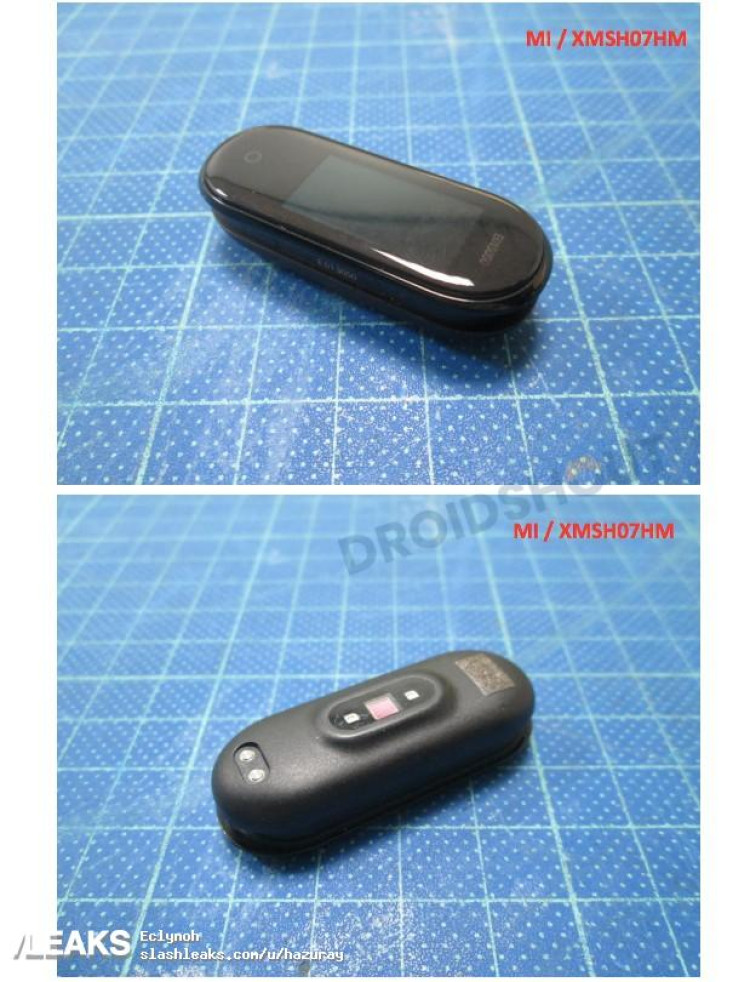
The Mi Band 4 is the name of Xiaomi‘s next fitness tracker. After more than a month since we saw it get its Bluetooth certification, fresh details have surfaced, and this time they are images of the device. The photos are from Taiwan’s NCC where the Mi Band 4 has been certified.

The 4th-gen Mi Band will have a rectangular screen with thick bezels around it and a piece of curved glass covering it. There is a circular halo capacitive button below the screen that replaces the recessed one from the Mi Band 3. The heart rate sensor makes a comeback but the sensor might be a better one.

Another big change is the position of the charging pins. They have been moved from the side on the Mi Band 3 to the bottom. This means the Mi Band 3’s charging cable won’t work for it. This is the same thing Xiaomi did with the Mi Band 3 as it also doesn’t work with the Mi Band 2’s charging cable.

[envira-gallery id=”250894″]

Thankfully, there is a picture of the new charging cable. The cable is designed like a cradle such that the tracker sits inside to charge. With the design of the Mi Band 4 changed, it will probably not also work with the straps of the Mi Band 3.

READ MORE: Xiaomi launches the DDPAI miniONE Dashcam with improved Night Vision camera

LG posts operating loss in Q1, smartphone division still struggles

LG’s financial report for the first quarter of 2019 (Q1 2019) has been released and it shows the mobile division continues to struggle. The company’s revenue continues to decline with just KRW1.51 trillion ($1.34 billion) generated between January and March. This is 30% less year on year (YoY) and 11% less when compared with the previous quarter.LG K50 As indicated by the official statement, the LG Mobile Communications Company figured out how to limit its operational liabilities to KRW203.5 billion ($181 million) while in a procedure of reconstructing its cell phone business. It is expected that the launch of the LG V50 ThinQ 5G will make a positive impact in the second quarter, while the migration of the assembling plants from South Korea to Vietnam will improve productivity and aggressiveness in the second half of the year.
Read Also: LG will reportedly halt mobile phones production in its Korea plant this year

Apart from the mobile business, the other divisions ensured that the organization, in general, is in a solid state. The total income generated in the quarter was KRW14.92 trillion ($13.27 billion) and operational cost remained at KRW900.6 billion ($801.25 million). So the uplifting news is LG can bear to deal with its weak mobile division until it discovers its way back to gainfulness.

(source)

Vodafone allegedly found hidden backdoors in Huawei’s equipment – Bloomberg

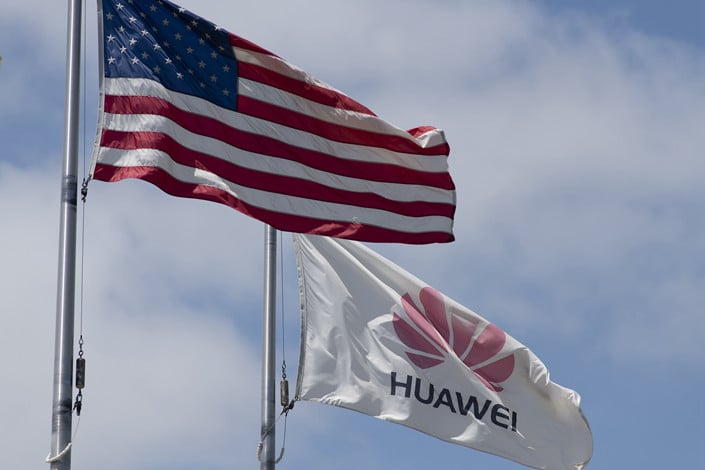
Huawei‘s image continues to come into question repeatedly as it bothers on whether the Chinese giant can be trusted or not. Bloomberg has released a report which claimed that Vodafone Italy confirmed it found “hidden backdoors”  in Huawei hardware that might have enabled the Chinese company to access clients’ home systems.

Huawei logo
THe US government has been at the helm of efforts to stop the use of Huawei technology globally

The vulnerabilities were found sometime between 2009 and 2011 in Huawei’s home internet routers, as well as its equipment used in parts of Vodafone’s network infrastructure. There was no proof of users information being compromised. Bloomberg reports that both the switch and system vulnerabilities kept on existing past 2012, and furthermore existed in the organization’s systems in the UK, Germany, Spain, and Portugal. Sources state that Vodafone kept on utilizing the hardware since it was less expensive than the challenge and the expenses to evacuate it.

In a statement given to Bloomberg, Vodafone recognized the vulnerabilities but challenged the timetable, saying they were settled in 2011 and 2012. Huawei says it was educated regarding the vulnerabilities in 2011 and 2012, and that they were fixed at the time.

The disclosures come as Huawei’s job in future 5G systems is under exceptional investigation worldwide over fears that its hardware could be abused to help in China’s knowledge endeavours. Numerous nations are at present investigating Huawei’s security protocols, as governments choose which parts of their 5G systems to allot to the Chinese tech giant. The US is moving to boycott the utilization of Huawei gears and is campaigning for its allies to do likewise. In the interim, the UK has apparently settled on a fundamental choice to permit the utilization of Huawei’s gear in non-core aspects of its systems, yet is experiencing pressure from US authorities to boycott it totally.

Read Also: Huawei once again insists on its “employees ownership” story but doubts still persist

In an official statement, Huawei labelled Bloomberg’s report “misleading” and said that the story “refers to a maintenance and diagnostic function, common across the industry, as well as vulnerabilities, which were corrected over seven years ago.” It added that “there is absolutely no truth in the suggestion that Huawei conceals backdoors in its equipment.”

(source)

Samsung Galaxy Fit and Fit-e pre-booking goes live in Portugal, full specs in tow

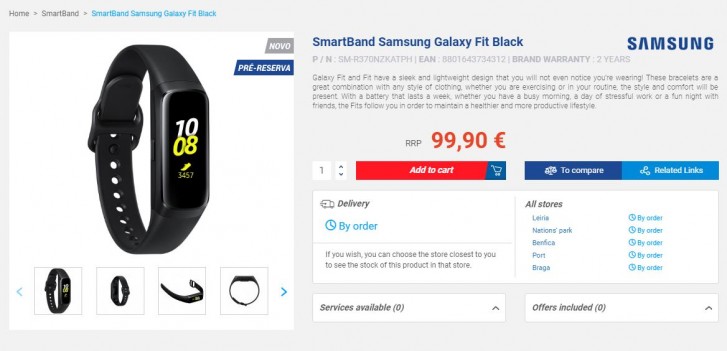
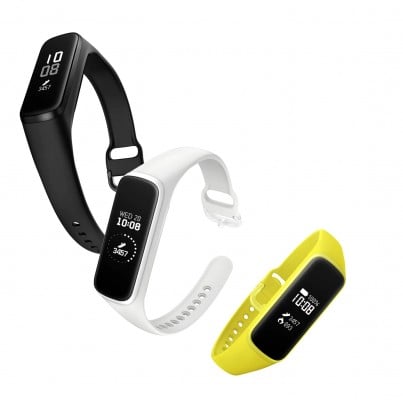
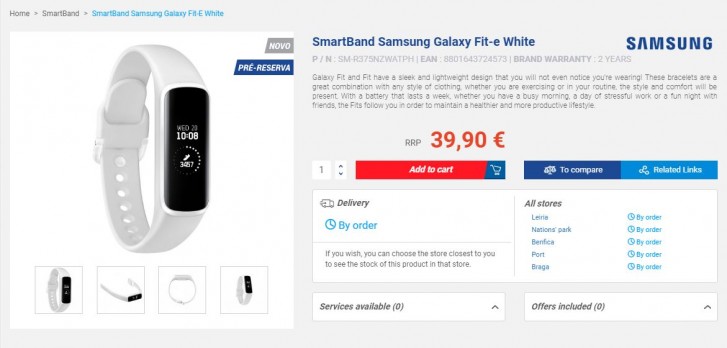
Samsung has been working on a fitness tracker designed for fans who don’t need the full user experience smartwatch offers but at the same time want a fitness tracker for basic parameters like heart rate, pulse etc. The device dubbed Galaxy Fit-e was spotted last week on Samsung Albania’s site. The device has again reappeared on the company’s Portugal website where the Galaxy Fit-e and Galaxy Fit are open for pre-booking.Samsung Galaxy Fit-e

The website also gives us an insight into some of the key specs of the Galaxy Fit models. According to the details available, the Fit-e will feature a 0.74-inch monochrome PMOLED display. It will run on the Cortex M0 processor with only 128KB of RAM and 4MB of internal storage. The fitness tracker only supports incoming notifications without the option to respond. In addition, the Galaxy Fit-e features automatic motion detection, sleep analysis and heart rate tracking.SamsunG Galaxy Fit-e

The battery cell is 70 mAh and Samsung claims that it is sufficient for 10 days of utilization on a solitary charge. The band weighs only 15 grams and features MIL-STD-810G durability and Bluetooth 5.0 support.Samsung galaxy Fit

The more costly Galaxy Fit will pack a 0.95-inch full-screen AMOLED display. It will be powered by a Cortex M33F SoC with 2MB RAM and 32MB of storage. Among the features onboard include notification interactions, automatic motion detection as well as sleep, stress, and heart-rate tracking thanks to its accelerometer, gyroscope and heart rate sensors. The device will pack a 120 mAh battery which will last as long as 7 days of autonomous use. The tracker weighs 23 grams and features the same MIL-STD-810G ruggedness and Bluetooth 5.0 support as the cheaper Fit-e.

Read Also: Samsung unveils the Sero TV which can be used in a vertical or horizontal orientation

The two models will get their interface from the new Realtime OS. As for the pricing, the Galaxy Fit-e starts at €40/$45 while the regular Gear Fit will set buyers back €100/$110. The Gear Fit-e will come in White, Black, and Yellow while the Gear Fit will be available in Black and Silver only. The two fitness trackers are expected to arrive in more markets soon.

(source)

Remember the 18000mAh battery Energizer P18K? Its crowdfunding was a colossal flop

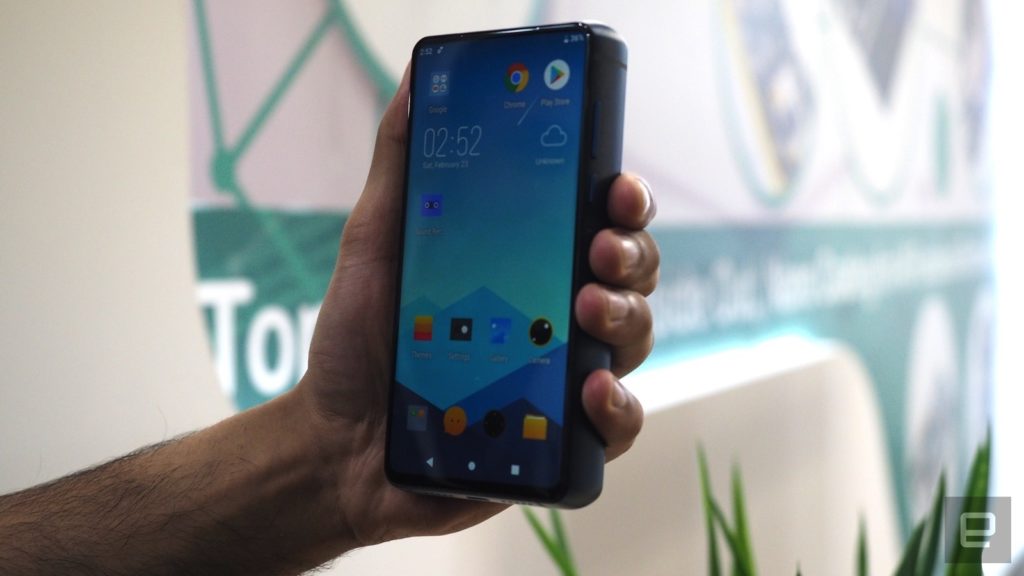
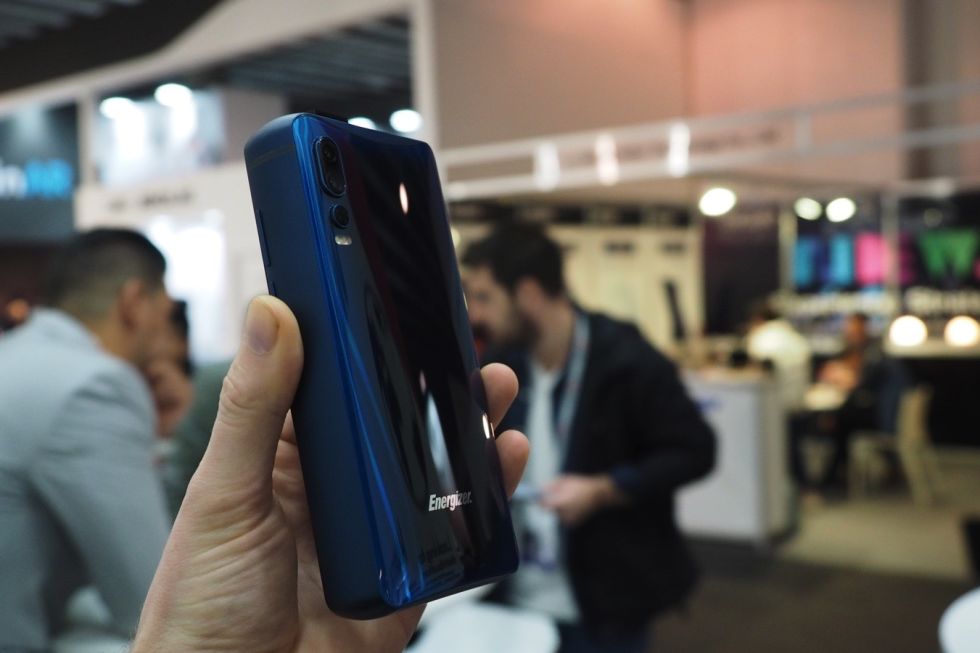
The recent Mobile World Congress 2019 saw a lot of new gadgets get unveiled. Among them was the Energizer Max Power 18K also known as P18K which was spectacular because of the 18,000 mAh battery it packs. The big battery came with a price and that was the size of the phone.Energizer P18K Pop

The company didn’t reveal many details about the model but it later launched for crowdfunding on IndieGoGo. The producer Avenir Telecom set a $1.2 million objective, however, just 11  backers showed interest in the phone, raising only $15,005 before the campaign came to an end. Obviously, the company overestimated the social media attention it courted when the P18K was unveiled at MWC. No doubt, the big battery onboard was attractive but then no one wants to move around with a weighty phone.Energizer P18K Pop

Avenir Telecom said it will continue working towards improving structure and thickness of the phone as it acknowledged that “there is a rising interest for smartphones with incredible battery life, which can also be used as power banks”.Energizer P18K

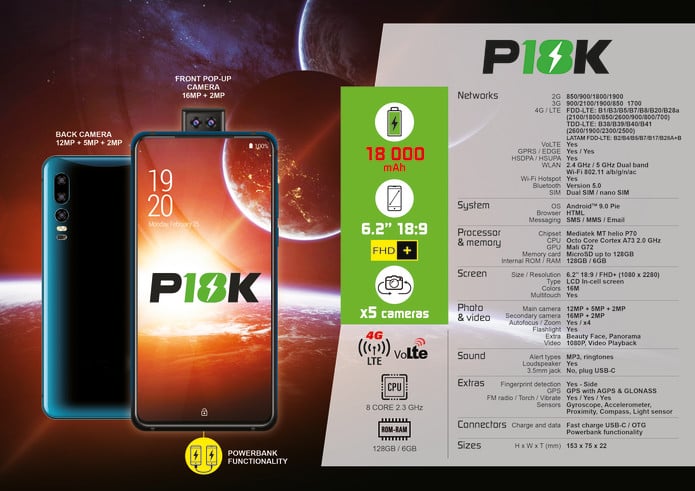
The P18K comes with a size that is almost three times that of an iPhone in terms of thickness. It is 18mm thick compared to 7.7mm on the iPhone X. Despite the thickness, the device still has a protrusion on the rear camera. The device comes with a USB Type C port and can charge from zero to full in just 8 hours. That’s an overnight charge but we believe the battery won’t be needing to be recharged so often. The device will likely also support OTG function. The device also presents with a bezel-less display and dual pop-up camera. The phone is powered by an Helio P70 chipset combined with 6 GB RAM and 128 GB storage. The 18,000 mAh control cell is said to have 18W quick charging and USB-PD 2.0.

(source)

Google Pixel 3a and Pixel 3a XL certified by Bluetooth SIG

It is certainly beyond doubt at the moment that Google will soon launch the much-anticipated Pixel 3a and Pixel 3a XL at the organization’s 2019 I/O event holding on May 7. We’ve seen essentially everything there is about these new gadgets going from cases to pricing and as of late, observed the two models spring up on Geekbench itemizing the key specs.Google Pixel 3a

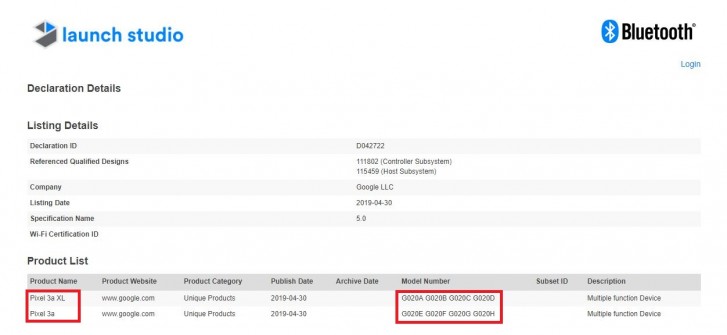
Today, the Pixel 3a and 3a XL got their Bluetooth certifications as we inch nearer to the launch date. An aggregate of eight variations went through SIG – four for the Pixel 3a and another four for its bigger sibling the Pixel 3a XL. Alongside the model numbers, we likewise discovered that the two mobile phones will highlight Bluetooth 5.0 and will keep running on Android Pie from the go.Google Pixel 3a

Read Also: Google Pixel 3a appears on GeekBench ahead of official launch

However, neither of those is news. Previous leaks showed the Pixel 3a will pack a 5.6-inch FHD+ screen combined with a mid-range Snapdragon 670 and 4GB RAM. The bigger Pixel 3a XL will feature a 6-inch FHD+ display with the slightly improved Snapdragon 710 chipset paired with 4GB RAM. Both phones will come with 64GB internal storage. The 3a packs an 8MP selfie camera and a solitary 12MP main sensor around the back. Regarding the estimated pricing, the 3a is said to go for $500/€450 while the 3a XL should start at $600/€530.The two phones will come in White, Black, and Purple with accents on the power buttons.

(source)

Samsung releases Q1 2019 financial report with weak chip orders driving record profit decline

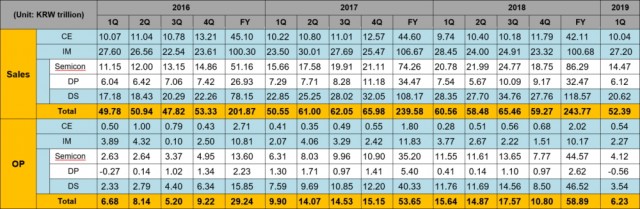
Samsung today released its Q1 2019  financial result and just as anticipated back in late March, the performance is dismal. The report detailed a combined sales of KRW52.4 trillion, which is 13% lower on a yearly premise. The decrease in profit is significantly more prominent. The company raked in just KRW6.23 trillion, down 60% when compared to the profit generated during the same period last year.

Samsung expressed in its public statement the fundamental explanation behind the poor result and identified a weak order for its memory chip. Be that as it may, the Samsung Galaxy S10 sales are “strong”, with a declared quarterly increase in revenue despite a decrease in smartphone sales globally.  The revenue from the Galaxy S10 sales is mainly due to an increase in the price of the model. Samsung’s phone shipments were limited due to a reorganization of the mid-range and low-end segments.

The tech giant has assured that it will “strengthen its product lineup through innovations and continued reorganization of its product offerings”. These reorganizations gave us the Galaxy S10 5G and the Galaxy A80 with a rotating camera.

Read Also: Samsung mobile shipments reach 78 million mark in Q1 2019

Since the demand for OLED panels is declining, while the LCD business is remaining at a similar dimension, Samsung expects increased interest for premium television panels like UHD, 8K and ultra-HD televisions. The company also plans to continue to expand its execution of 5G commercialization abroad. Samsung will continue providing 5G hardware to South Korea and the US.

(source)

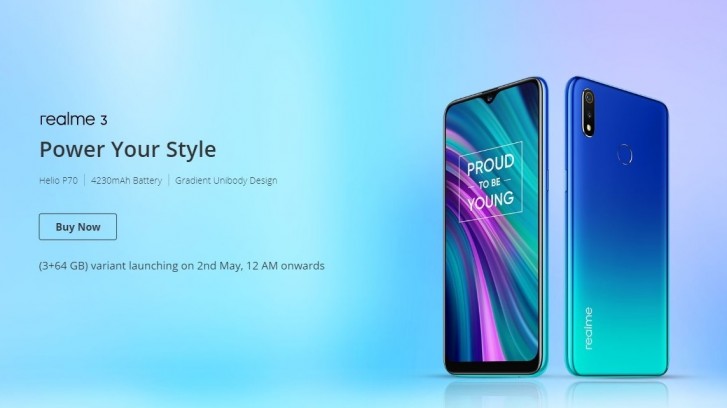
Realme launching a 3GB+64GB variant for the Realme 3 in India on May 2

OPPO’s Realme brand is surely getting it right in India. Apart from the affordable pricing of its smartphones, they are always available to buy. Also, Realme seems to feel the pulse of fans by releasing variants that are likely going to be hot-selling ones. The Realme 3 was launched in March and went on its first sale a couple of days later. The device was a hot-selling one with over 500,000 units sold in just three weeks. Realme has now rejigged the Reame 3 lineup with the addition of a 3GB AM+64GB storage variant. realme 3

The Realme 3 was launched in two variants – 3GB RAM + 32GB storage and 4GB RAM + 64GB storage. This third variant will launch in India on May 2 and will be on sale from 12 AM onwards local time. Realme didn’t disclose the sales channel but we expect the device to be sold through Flipkart and Realme online store. The price wasn’t also revealed but looking at the prices of 3GB/32GB and 4GB/64GB models, this variant will likely sell for around Rs. 10,000 ($143).

Read Also: Redmi 7 vs Asus Zenfone Max (M2) vs Realme 3: Specs Comparison

The announcement of a new variant is coming just days after Realme 3 Pro was announced with a new 4GB+64GB variant. Earlier on, the Realme U1 got a similar 3GB+64GB variant with an Rs. 10,999 ($157) price tag.

(source)

OnePlus Bullets Wireless 2 and Warp Charge 30 Car Charger leaked

The OnePlus 7 and OnePlus 7 Pro will not be the only products that will be unveiled at the OnePlus event on May 14. We should also see some new accessories. The good thing is we don’t have to wait that long to know what these accessories are thanks to a new leak.

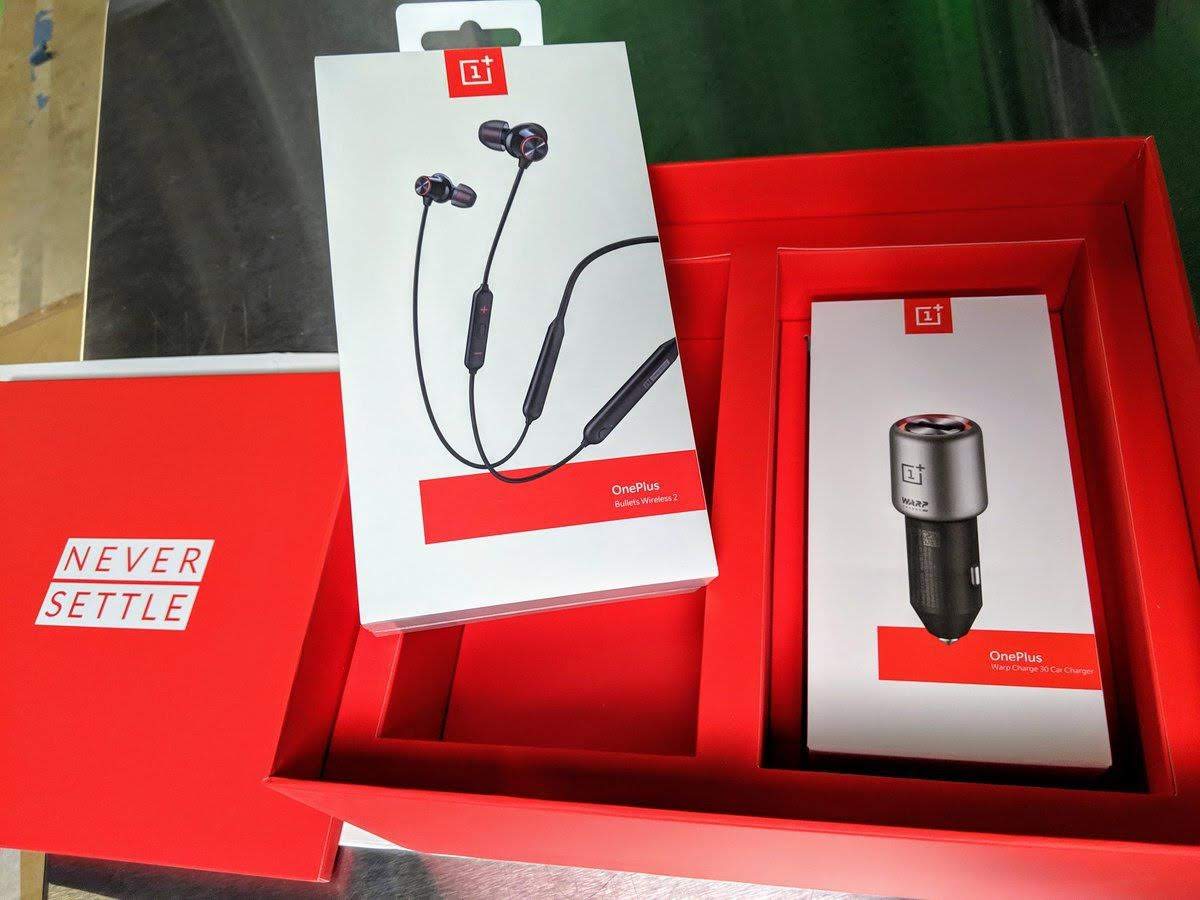
The source of the leak is said to be YouTuber LinusTechTips, and it appears he got a special package from OnePlus ahead of the official release. He shared pictures of the contents of the package, in a now-deleted tweet, which include the OnePlus Bullets Wireless 2 Headphones and the Warp Charge 30 car charger.

OnePlus Bullets Wireless 2 and OnePlus Warp Charge 30 Car Charger

The OnePlus Bullets Wireless 2 in-ear headphones have a similar design to the original Bullets Wireless save for the earbuds which have been redesigned. The headphones sit on your neck and there is a remote control attached to the left side. The headphones are expected to sound better and maybe even have improved battery life. There are also live images of the headphones which were posted on the OnePlus forum.

[envira-gallery id=”250843″] [envira-gallery id=”250838″]

There is also the Warp Charge 30 Car Charger. OnePlus announced a new fast-charging technology when it launched the OnePlus 6T McLaren Edition last year. Called Warp Charge 30, it charges the phone at 30W. The OnePlus 7 Pro will also support the same fast charging technology. With the car charger, owners will be able to get the same fast charging speed in their cars as they do when using the Warp 30 Wall Charger.

READ MORE: OnePlus 7 Pro gets an early camera review, has 3x optical zoom

Redmi Snapdragon 855 might surface without the on-screen fingerprint sensor

Xiaomi is working hard to bring the new Redmi Snapdragon 855 device by May or June. Multiple teasers from Lu Weibing, Redmi’s general manager already revealed a lot about the device. According to the recent conversation by Lu Weibing on Weibo, it appears Redmi may drop on-screen fingerprint sensor from the device. It is obvious that the company will shed some features to make it budget friendly.

Lu Weibing dubiously replied that the on-screen fingerprint sensor is very expensive when asked about the presence of a rear fingerprint sensor on the upcoming flagship device by a user on Weibo. He kind-of affirmed the absence of on-screen fingerprint sensor on the new device.

The on-screen fingerprint sensors are the norm for every flagship device. Many Chinese smartphone makers like Oppo, Vivo, Huawei and even OnePlus facilitated the users with an on-screen fingerprint. However, it has started appearing on some affordable devices too. Oppo K1 recently launched as the most budget-friendly device sporting the in-screen fingerprint sensor in India.

Recent reports suggest Redmi SD855 will carry a pop-up camera module embracing a 32-megapixel sensor. On the rear side, there will be a triple camera module equipped with 48-megapixel primary camera + 8-megapixel + 13-megapixel. Moreover, there will be a 3.5 mm audio jack and NFC for safe, secure and quick payment transfers.

The cheapest Snapdragon 855 device is likely to launch anytime soon. Some reports cite that the same phone will launch as Redmi Pro 2 or Poco F2. We expect some more information to surface before its actual launch. Although, the company started preparing abundant stocks of the phone to meet the demand.

(via)

Wiko Y80 is an Android Go phone with 2GB of RAM

Android Go was built for devices with 1GB of RAM or less but there is no written rule that says a phone with more RAM can’t run Android Go. The Wiko Y80 might just be the first of such devices.

The full specs and price of the Wiko Y80 were revealed in a tweet by Roland Quandt. The phone has a 5.99-inch HD+ IPS display. There is no notch and the bezels are fairly thick. The Wiko Y80 is powered by the Unisoc SC9863A (Unisoc was formerly known as Spreadtrum), the same chip inside the Alcatel 1s. The SoC is a 28nm Cortex-A55 octa-core chipset clocked at 1.6GHz with a PowerVR IMG8322 GPU. There is 16GB or 32GB of storage.

The Wiko Y80 has dual rear cameras – a 13MP primary sensor and a 2MP depth sensor. There is a 5MP sensor in front for selfies. The cameras are arranged vertically with an LED flash below the setup. Unfortunately, there is no fingerprint scanner. The phone packs a 4,000mAh battery and runs Android Pie (Go Edition).

The Y80 should support 4G LTE, have a dual SIM slot, and support for memory expansion. There is a Wiko Y60 and it has the aforementioned features.

READ MORE: Samsung launches Galaxy A2 Core Android Go phone in India

Redmi Y3 sold out on Amazon India and Mi.com within a minute in first sale!

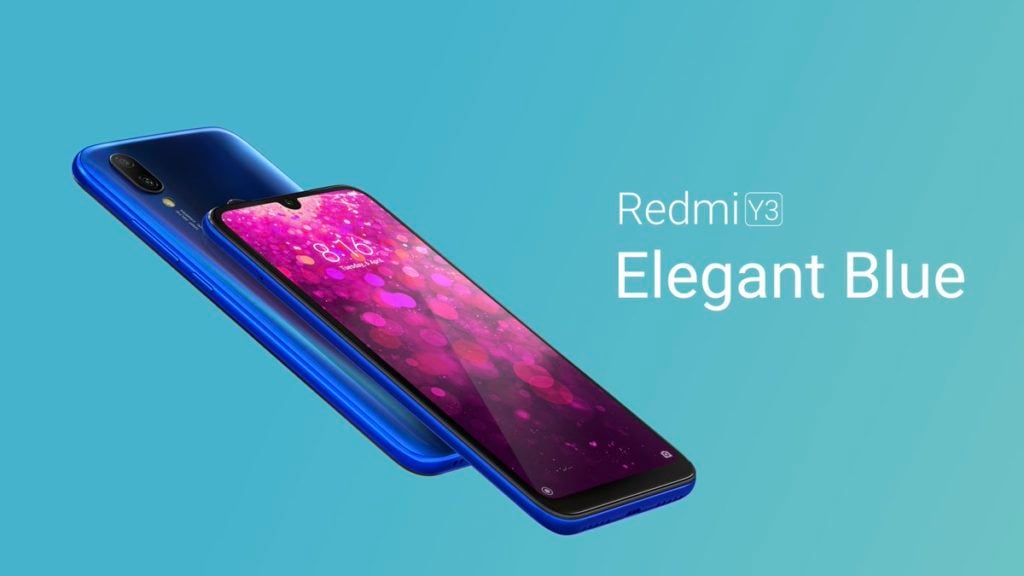
Xiaomi unwrapped the Redmi Y3 in India last week and went on its first sale today. The flash sale took place simultaneously on Mi.com and Amazon India at noon local time. The flash sale only lasted for a minute before all available units were sold out.Redmi Y3

Xiaomi India’s CEO Manu Kuma Jain who disclosed this didn’t mention the number of units made available. The Redmi Y3 flash sale is coming a day after the Realme 3 Pro went on its first sale with fans snagging over 170,000 units. We’d prefer Xiaomi mention the number of units that were sold during the flash sale so as to rule out the possibility of such news being just hype. Amazon.in has announced that the next flash sale for the Redmi Y3 will be on May 3.

The Redmi Y3 has almost similar specs with the Redmi 7 except for a more powerful 32MP selfie camera. It packs a similar 12MP+2MP dual camera setup at the rear as the Redmi 7. The device packs a Snapdragon 632 SoC under the hood paired with 3/4GB RAM and runs Android Pie with MIUI 10 atop. It sports a 6.26-inch HD+ notched display and ships with a 4,000 mAh battery that fuels the entire package.  The device comes in Prime Black, Bold Red, and Elegant Blue colors. The Y3 is priced at Rs9,999 ($143) for the 3GB+32GB variant and Rs. 11,999 ($172) for the 4GB+64GB model.

Meizu 17 will be based on the Meizu Zero with a special focus on 5G

The Meizu 16s is still fresh out of the oven and the Meizu 17 is already in the news. An image shared online from a 5G event reveals key details about Meizu’s next flagship.

The image shows Meizu’s stand at the event which has the Meizu 16s on display, but there is also an “artwork” on the wall that reads “Meet the new 5G era, Meizu 17 is coming”.

Meizu 17

This is the first “official” confirmation of the name of Meizu’s next flagship. It is also proof that the device will support 5G. Meizu already said at the beginning of the year it wasn’t jumping on the 5G train. Now, we know it will do so next year.

There are reports that the Meizu 17 will be based on the Meizu Zero hole-less phone which launched this year. The phone failed to reach its crowdfunding goal so it didn’t make it out of concept but that doesn’t mean Meizu has abandoned the design. It may modify the design and use it for the Meizu 17 next year.

READ MORE: Meizu launches POP 2 earbuds, EP63 Noise Cancelling Headphones and more

Xiaomi sets up technical committee to build an engineering culture

Xiaomi, which is currently the world’s fourth largest smartphone manufacturer, has time and again said that it’s an internet company and not a hardware company. Now, moving a step forward in that direction, Xiaomi is embracing AI technology and is transforming into an AI-driven company.

In efforts of that, the company has announced that it will set up a technical committee that will comprise 19 members and Cui Baoqiu, the company’s recently promoted vice-president, will be the chairman of that committee.

Further, it has been revealed that the committee will be responsible for technical strategy, collaboration with governments and universities, recruiting and encouraging tech talent and building an engineer culture in the company.

Xiaomi Logo

As per the report, in an internal meeting of the company, Lei Jun, founder and CEO of Xiaomi told that “exceptional and innovative” engineers will be rewarded “millions” of yuan in cash. He also said that Xiaomi plans to set up two research and development (R&D) centers in Nanjing and Wuhan with tens of thousands of researchers and engineers.

This will be in addition to the company’s existing Research & Development center in Beijing, where the company also has its headquarters. The formation of this committee comes after the company announced three AI-related departments in February — New AI, Big Data, and Cloud Computing.

Xiaomi had recently said that it would invest at least $1.5 billion on AI and smart devices over the next five years. The company’s R&D spending surged 83 percent to 5.8 billion yuan ($860 million) in 2018.

However, Xiaomi’s spending is still lower than gaming and social media giant Tencent’s $3.4 billion in R&D expenses, and the $15 billion to $20 billion annual spending that telecom equipment giant Huawei has pledged to maintain.

Read More: China’s 2nd-tier phone vendors looking to expand as they take on first-tier brands like Xiaomi overseas

The development comes at a time when Xiaomi is facing a slowing domestic smartphone market. The company saw its sales shrunk by more than 34 percent in its home country over the fourth quarter ended last December. On the other hand, its rival — Huawei, keeps on growing despite being a target of several allegations and criticism over security risks.

(Source)

Xiaomi launches a desktop fan with up to 12 hour battery life priced at 99 yuan ($14)

Xiaomi has launched a portable desktop fan with an affordable 99 yuan ($14) price tag. The fan which isn’t a Xiaomi branded product is being sold on Mi Home. Xiaomi desktop fan

The portable fan adopts a minimalistic design. The body is made of ABS+PC material with the toughness to withstand pressure and fall. The body is prayed using Skin spray technology giving it a feel of the skin. It comes in three colour options; black, white, and pink. The fan also comes with three adjustable speeds and packs a battery that can last up to 12 hours. That’s like a whole day of freshness on a hot summer afternoon.

Read Also: Redmi Y3 vs Redmi 7 vs Xiaomi Mi Play: Specs Comparison

Further, the portable desktop fan has three-speed levels which can be adjusted as desired. The head can also rotate up to 60° automatically while manual adjustment will only see the head turn by 27°. Internally, the Desktop fan uses a brushless copper core motor, which is only 522g in size. The built-in battery capacity is 4000mAh. At full power, the first gear can continue to supply air for 12 hours. That means at full blast, the battery time will be less than 12 hours. In addition, the fan support USB charging mode using a Type-C port and can be connected to a desktop PC, notebook, powerbank etc. The front grill is also removable, making it easy to clean the fan.

(source)

Xiaomi to implement DC Dimming on all of its OLED smartphones

DC dimming is gradually gaining popularity in the smartphone industry especially as there is a shift to AMOLED displays. Always striving to be at the forefront of emerging trends, Xiaomi earlier disclosed that it would implement DC dimming on the Mi 9 before May 1. The company has kept to its promise as the Mi 9 has gotten an update that ushers DC dimming on the device. Xiaomi Mi 9

Zhang Guoquan, director of Xiaomi’s mobile phone system software department announced the new DC dimming on the Mi 9 Development version only. He hinted that the stable version will become available on other MIUI versions after May 1, all things being equal. The DC dimming mode will be turned on under low brightness. He also disclosed that the new DC dimming feature would be included on all its OLED display-packing phones. Xiaomi’s hasn’t got a whole lot of them, just the Mi 9, Mi Mix 3, Redmi Pro, Mi 8 Pro and a few more. So the rollout may not get delayed for too long. Xiaomi Mi 9

Related: What is DC Dimming & Why it’s Important for AMOLED Smartphones?

With the rise of LED technology, DC dimming control has been gaining a lot of attention as a more effective way of controlling the light output of an LED fixture. The technology uses a DC voltage between 0 and 10 to control the light output of the LED fixture. As the voltage goes up or down, the corresponding 0-10V dimmable driver matches the light output of the fixture to increase or decrease up to a certain percentage. DC dimming is one of the simplest and most popular dynamic lighting controls used in offices, retail spaces, and homes but the feature is just gaining traction in smartphones. Apart from the Mi 9, OPPO’s latest Reno also comes with DC dimming. However, we must point out that those of the Mi 9 and Reno are not hardware DC dimming but a software pattern to reduce the low-brightness strobe. Xiaomi is reportedly still developing a new pure hardware DC dimming. In the future, Xiaomi Mi 9 will also switch to this new solution, which will bring users no visual fatigue at low brightness.

(via)