The Xiaomi 18 Pro models are already on the global stage, and a first live look at the standard Xiaomi 18 recently appeared in Lei Jun’s hand. Offline retailers in China also started taking early deposits last week. The base phone is still waiting for its own launch, which is expected next month. A new teaser poster now points to reservations opening, and here is what buyers can expect.
Xiaomi 18 reservations are now open in China
Xiaomi 18
A teaser poster circulating in China shows a white box under a red drape, the Xiaomi 18 logo, and a Leica co-engineered badge. The Chinese line on the artwork invites people to reserve the phone for a chance to win gifts.
Reports in China say Xiaomi Home stores have started taking reservations, with a refundable 100 yuan deposit. Perks mentioned with those bookings include a 365-day replacement-only warranty and interest-free installments. According to previous reports, the standard model is still expected in China in December, following last week’s dealer blind orders and a 3C listing that showed 100W charging.
What to expect from the Xiaomi 18
Leaks have revealed that the Xiaomi 18 will house a 6.4-inch flat 1.5K display, a Snapdragon 8 Elite Gen 6 chip, and a triple camera with a 200-megapixel main sensor, a 50-megapixel ultra-wide, and a 200-megapixel 3x telephoto. Reports also tip a 7,200mAh battery with 100W wired charging, plus HyperOS 4 based on Android 17. A top configuration is rumored to include 16GB of RAM and 1TB of storage.
For international buyers, the picture is less clear. The Pro models are already on sale globally, and a global Xiaomi 18 variant has shown up in certification databases, but Xiaomi has not confirmed a worldwide launch or date for the vanilla phone.
Xiaomi has launched the Mijia Portable Electric Shaver Pro Straight Handle Multi-Effect Edition in China. The shaver is listed on Xiaomi Youpin for crowdfunding, set to begin on December 2 at 10 AM. It will be available for 329 yuan (around $47) during the campaign.
Unlike those models, the new shaver has a slim, straight handle with an alloy body. The body is precision-cast, went through 15 manufacturing processes, and comes in Glacier Silver and Twilight Gray.
Explained
The Xiaomi Mijia Electric Shaver Pro Set offers up to 95 days of battery life.
On top, the shaving head uses a metal injection molding (MIM) mesh with a corrugated surface. Curved grooves guide beard hair toward concave blades, which hold each strand in place before cutting. Xiaomi has patented this wraparound beard-locking structure, though MIM blades are common in Mijia shavers like the Mijia Electric Shaver S101 Cloud Pattern Blade Edition.
Shaving system and features
Behind the shaving head is an 8,500rpm motor, paired with a smart chip that monitors beard density while you shave. It adjusts the motor’s power and speed in real time, so the shaver can respond to thicker patches of facial hair rather than running at the same speed throughout.
The handle itself can tilt 10 degrees in either direction. This gives the shaving head some room to follow the curves around your jawline and lips, rather than requiring you to adjust your hand as much. Xiaomi has also covered the surface with high-density microbeads to create a smooth, water-like finish that reduces friction and skin pulling. The mesh uses low-nickel steel, which should help keep irritation down during shaving.
You can use the shaver for both wet and dry shaving, and its IPX8 rating means you can rinse the whole device under running water when you’re finished. The magnetic connections between the protective cover, shaving head and main body also make taking it apart for cleaning fairly simple.
One less thing to worry about is charging. The built-in battery is rated for up to 60 days of use, with a full recharge taking around two hours through the Type-C port. You can even keep shaving while it’s plugged in, so there’s no need to wait for a recharge if the battery runs out.
Xiaomi is also including a portable storage bag with separate spaces for a sideburn trimmer and a nose hair trimmer.
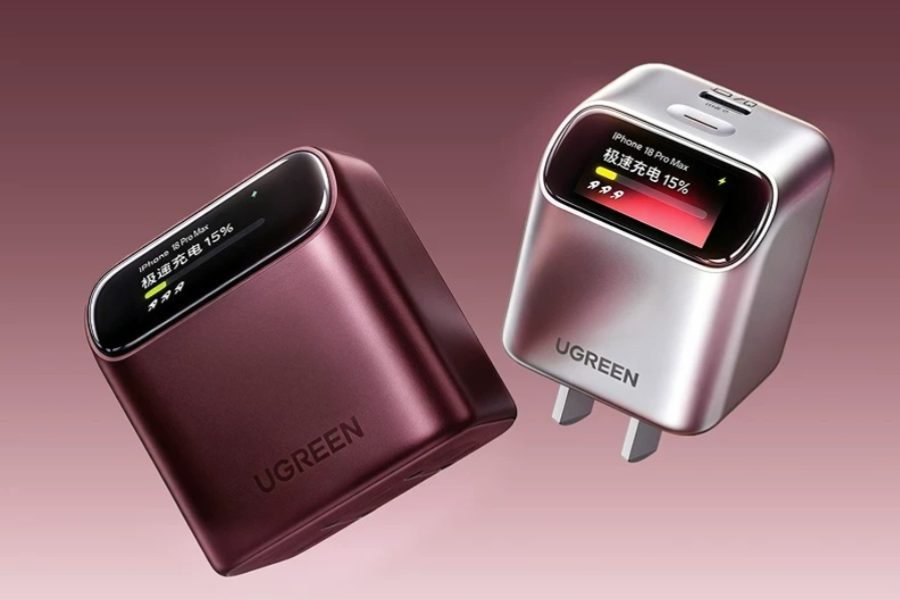
Ugreen is following its 45W USB-C GaN Fast Charger with an angled display with a 60W version. The new model comes six months after the 45W version and retails for 109 yuan (~ $16) on a Chinese commerce platform.
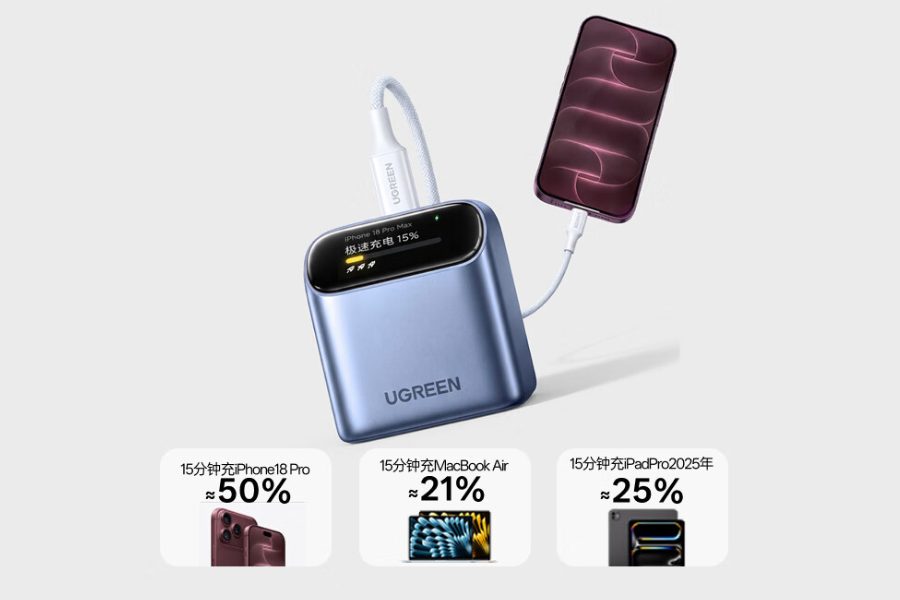
The charger carrying the model X740 is Ugreen’s first 60W AVS display charger. Introduced with the iPhone 18 Pro and Pro Max, AVS allows the phones to reach 50% charge in about 15 minutes when paired with a compatible 60W adapter. Ugreen claims its new charger can deliver the same charging speed.
It also supports other Apple devices, and with obvious difference in changing speed. Ugreen says 15 minutes of charging adds around 21% to a MacBook Air and 25% to a 2025 iPad Pro.
The charger can also recognize connected devices, including the iPhone 18 Pro, iPhone 18 Pro Max, iPhone Duo, iPhone 17, 16 and 15 series, iPads, and MacBook Air models. The screen shows the device name once you plug it in.
Screen, heat and specs
The X740 monitors the connected device’s power requirements throughout the charging process and adjusts voltage in 100mV steps. You can choose between ultra-fast, high-efficiency and gentle modes.
Aside from the device name, the front display also shows real-time information such as output power, charging protocol, voltage, current, temperature and charging status.
For Android users, you can enable PPS priority directly from the charger by holding its control for two seconds. The adapter is compatible with Huawei, Xiaomi, Samsung and iQOO phones.
Under the hood, the charger uses seventh-generation GaN technology alongside Ugreen’s Thermal Guard system. This combines graphite sheets with potting compounds for heat management.
The company claims the system takes 10.8 million temperature readings per day. It also says the charger’s surface temperature stays around 23.5°C below the national standard during a two-hour load test.
The X740 has a single USB-C port with a maximum output of 60W. It supports 5V, 9V, 12V, 15V, and 20V outputs, each at up to 3A. The charger weighs around 96g and measures 44 x 40 x 38mm. It has received 3C certification and passed 10 safety tests. Ugreen also provides an 18-month warranty.
Casio has announced the release of the GM2110HDN-8A, a new G-Shock watch designed in partnership with the New York-based design collective and digital archive brand, Hidden.
Design Details
Built on the framework of the GM2110 series, a line recognized for its octagonal metal bezel, the new model pairs a stainless steel and resin case with a matching metal band.
Hidden, originally known for curating 1990s and 2000s streetwear, tech, and design imagery on social media, brings a specific visual identity to the hardware. The watch features a predominantly silver colorway, which is broken up by Hidden’s signature green at the 3, 6, 9, and 12 o’clock index markers.
Casio has integrated several custom details into the GM2110HDN-8A to mark the collaboration. The 9 o’clock inset dial features the lowercase Hidden “h” logo, while the case back and the clasp of the stainless steel band are both engraved with the Statue of Liberty. The packaging also leans into the New York theme, designed to mimic the look of items found in Canal Street tourist shops.
On the technical side, the watch maintains the standard durability metrics expected from the G-Shock lineup. It measures 49.3 x 44.4 x 11.8 mm and weighs 146 grams. It offers shock resistance and 200 meters of water resistance, and the dial is protected by mineral glass.
The analog-digital display is illuminated by a double LED setup for visibility in the dark, and the watch runs on two SR726W batteries, which Casio estimates will provide about three years of battery life.
Standard digital features like world time across 31 time zones, a 1/100-second stopwatch, a countdown timer, a hand-shift feature to view the digital display, and five daily alarms are all present.
Pricing and Availability
The GM2110HDN-8A carries a price tag of $385 and is scheduled to go on sale on November 25. It will be available directly through the Casio G-Shock website, at the G-Shock SoHo store in New York, and through select third-party retailers.
Xiaomi has launched a new electric toothbrush in China, the Mijia Sonic Sweep Electric Toothbrush 2. It is priced at 199 yuan ($30), with an introductory price of 175 yuan ($26).
Mijia Sonic Sweep Electric Toothbrush 2 Specs
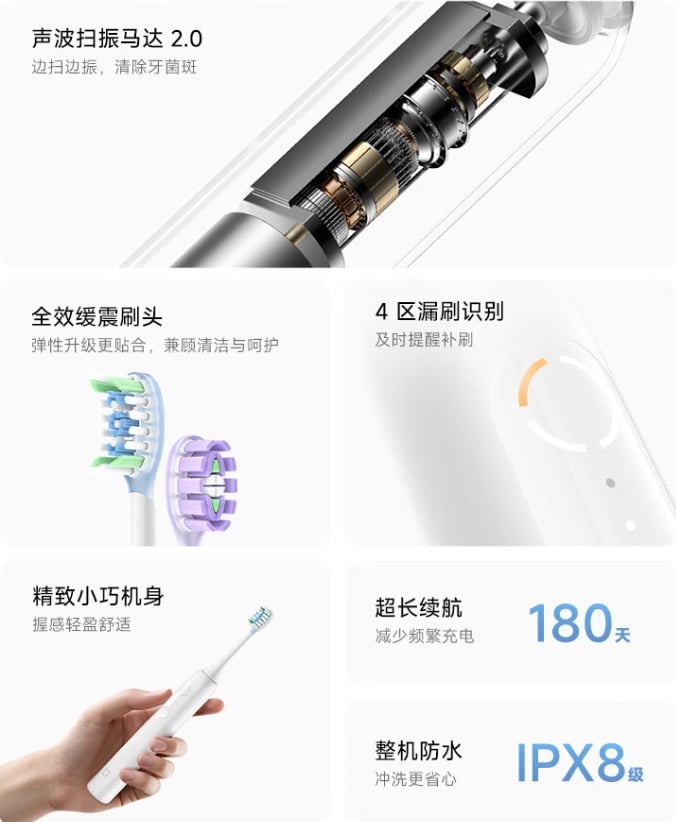
Inside, the toothbrush uses a motor that operates at 24,000 vibrations per minute. Instead of just vibrating in place, the brush head uses wide-angle sweeping motions to mimic the Bass brushing technique, which is what most dentists recommend for removing plaque.
It has three basic settings: Gentle, Cleaning, and Whitening. It remembers your last used mode and features a three-second fade-in when you turn it on, which stops toothpaste from flying off the bristles before the brush is actually in your mouth.
The most useful feature is a built-in three-axis sensor that tracks how you brush. Instead of making you open a companion app on your phone to see your brushing data, a common annoyance with smart toothbrushes, the device gives you feedback right on the handle using an LED ring. As you brush, white lights show the areas you have adequately covered, while orange lights point out the spots you missed. It also includes the standard 30-second haptic buzz to remind you to move to the next section of your mouth.
The toothbrush comes with two different brush heads. One is for standard cleaning with diamond-shaped bristles, and the other is for sensitive gums, using thinner 0.02mm bristles. Xiaomi added a soft rubber coating to the back of the brush heads so it doesn’t clatter uncomfortably if you accidentally bump it against your teeth. The bristles are copper-free to prevent rust and will fade in color after about three months to remind you to swap them out.
Physically, the device is slightly smaller than the previous version, measuring 236mm long, and comes in white, pink, green, and blue. For charging, it uses a standard USB-C port.
Xiaomi says the battery lasts up to 180 days on the Gentle setting or 100 days on the standard Cleaning mode, assuming you brush twice a day for two minutes. It takes about six hours to fully charge and has an IPX8 water resistance rating.
In related news, Xiaomi has recently launched a new Sand Gold variant of its 1,000-lumen flashlight for just $14, along with the Mijia ergonomic cushion featuring lumbar heating and smart sitting reminders.
Xiaomi has released a new orange color option for its Walkie Talkie 2S in China. The device is priced at 299 yuan (roughly $45), keeping the same price tag and internal hardware as the original gray model, but swapping in a brighter shell that is easier to spot outdoors or in a gear bag.
Xiaomi Walkie Talkie 2S Specifications
It’s a relatively compact two-way radio, weighing just 130 grams with a 15mm-thick body. It features a 1.77-inch color LCD screen, a 36mm speaker driver, a top-mounted power button, and a side-mounted push-to-talk button. The device also comes with a flame-retardant plastic shell and an IP54 rating for protection against dust and water splashes.
As a radio, the Walkie Talkie 2S operates on the 430-440MHz frequency band with 4W transmission power, offering a claimed communication range of 1-5 kilometers depending on terrain and interference. You get 100 channels, including 20 standard long-distance channels and 80 customizable ones, along with 258 privacy codes to help reduce unwanted interference.
The device includes a few modern quality-of-life features that bridge the gap between standard analog radios and smartphones. It charges via USB-C, has a 3.5mm headphone jack, and supports Bluetooth so you can pair wireless earbuds.
You can program frequencies directly on the screen, but it also connects to a companion smartphone app. The app lets you manage channels, copy configurations to multiple radios at once, and share your location with other users on your channel even if you don’t have cell service.
For power, the Walkie Talkie 2S packs a 2,190mAh battery that delivers up to 15 hours of continuous use and 120 hours of standby time. It also supports charging via a power bank while in use and features a built-in FM radio for listening to broadcasts when you’re not using it for communication.
In related news, Xiaomi has recently launched the Watch S5 41mm globally with a 3,000-nit AMOLED display and up to 14 days of battery life, alongside the Smart Band 11, which features a 1.72-inch AMOLED display and heart rate monitoring.
An unannounced phone carrying the model number XT2765-1 has received FCC certification. Spotted in the database, the listing confirms support for Wi-Fi 6E, 5G, Bluetooth, NFC and wireless charging. While those features are standard for a modern flagship, the model number itself is more revealing.
Motorola’s recent Razr generations have followed a clear pattern. The 2025 models used XT255x designations, while the 2026 series moved to XT265x. The Razr Ultra 2026, for example, carries the XT2655 model number, and the 2025 Ultra used XT2551. An XT276x series therefore aligns with a 2027 release, making the XT2765-1 a strong candidate for the flagship Razr Ultra 2027.
The same model has appeared before. In September, a list of upcoming Motorola codenames linked Raptor27 to multiple XT2765 variants, with the “-x” suffix likely indicating region-specific versions. The Raptor27 codename also showed up earlier in Australian carrier records. This FCC appearance is the latest confirmation that development is progressing.
Separate rumors have pointed to a different foldable, sometimes referred to as the Razr Flex 27, that could challenge devices such as Samsung’s Galaxy Z Fold series. The XT2765-1, however, fits the flip-phone Ultra line rather than that broader form factor. Motorola has not commented on the filing or confirmed any names or launch plans.
Based on the company’s recent schedule, a full 2027 Razr lineup could arrive around April. For now, the FCC documents provide only connectivity details and the model-number clue. Photos and deeper specifications remain under confidentiality, but the appearance of XT2765-1 suggests Motorola is steadily preparing its next generation of clamshell foldables.
XElectron has launched the CineLux 4K, a new smart projector in India, expanding its home entertainment lineup. It is priced at ₹49,990 ($535) and offers native 4K resolution, built-in speakers, and an Android operating system. The projector is now available for purchase through Amazon India, Flipkart, and XElectron’s official website.
XElectron CineLux 4K Specifications
The projector uses LTPS display technology to output a native 4K Ultra HD (2160p) image. According to XElectron, the CineLux 4K can reach a brightness of 4,000 ANSI lumens.
Our picks
Many portable projectors now include built-in batteries, auto-focus and native Google TV with Netflix support.
For a projector in the sub-₹50,000 price range, this is a relatively high brightness rating, which should make the projection visible even in living rooms that are not completely dark. The device supports projection sizes up to 300 inches and includes standard HDR support alongside a 10,000:1 dynamic contrast ratio.
As a smart projector, the CineLux 4K functions independently without requiring an external streaming stick. It runs on Android 13 and is powered by a 64-bit A55 quad-core processor, paired with 2GB of RAM and 32GB of internal storage.
To simplify the setup process, XElectron has included several automated adjustment features. The projector handles focus, keystone correction, obstacle avoidance, tilt correction, and screen fit automatically, reducing the need to align the image to a wall or screen manually.
The company also says that the projector features a dust-proof optical engine, which is intended to prevent debris from accumulating inside the unit and help it reach its rated 50,000-hour lamp life.
For audio, the CineLux 4K features dual 10W speakers delivering a combined 20W output, along with support for Dolby Audio and DTS decoding. Connectivity options include Wi-Fi 6 and Bluetooth 5.0, while the port selection consists of two HDMI inputs, including one with HDMI ARC support for external audio devices, a USB port, a LAN port, and a 3.5mm audio jack.
The projector also supports AirPlay and Miracast, allowing users to wirelessly cast content from compatible smartphones and tablets.
Swedish House Mafia member and DJ Sebastian Ingrosso shared a dimly lit image of a compact rectangular device on social media, tagging Nothing. The photo aligns with earlier teases from Nothing CEO Carl Pei and has been confirmed by leaker Yogesh Brar as the upcoming AI product. The gadget appears screenless and features multiple physical buttons, marking a deliberate step away from traditional smartphone-centric designs.
In the image, the small device shows a split design. One side displays the red and green status lights and a record button previously glimpsed in Pei’s teaser. A large button labelled “Talk” is also visible, along with what may be a pogo-pin connection on the underside, though any accompanying accessories remain unknown. The overall form is compact enough to sit easily on a desk or fit in a pocket.
Very little official information has been released. What is known points to a voice-first experience focused on recording, with potential support for live translation and note-taking. Pei previously described the product as an “AI-native” tool that “couldn’t have been an app” and emphasised that it has no screen. The December shipping window was confirmed in his earlier posts, positioning the device as Nothing’s entry into the growing category of dedicated AI hardware.
The absence of a display and the presence of dedicated physical controls suggest the company is prioritising always-available, low-friction interaction over screen-based interfaces. This approach aims to capture real-world context more seamlessly than a phone app could. While exact features, pricing and availability details are still under wraps, the first visual confirmation has intensified interest just weeks before the planned reveal.
Nothing has framed the product as a purposeful tool rather than a general-purpose companion, distinguishing it from earlier attempts in the space.
Casio has released a trio of sushi-themed G-Shock watches in the US, following their initial launch in Japan last month. The collection takes three of the company’s standard watch silhouettes and updates them with colorways and design elements based on salmon, tuna, and ikura (salmon roe).
Rather than just changing the colors of the resin bands, Casio incorporated specific food motifs into the hardware. All three models feature a case back engraved with a yunomi teacup pattern, which is a reference to the hot tea typically served at the end of a sushi meal.
The watches also ship in custom paper packaging designed to resemble folded takeaway containers. Inside the box, there is a hidden wasabi graphic that changes depending on the watch: a small amount for the salmon model, extra for the tuna, and none for the ikura.
The first model in the lineup is the GA2100SSH-4A, which is priced at $145 and based on salmon nigiri. It is an analog-digital watch featuring an orange, marbled texture across its bio-based resin band and bezel. The dial includes hour and minute hands shaped like sushi knives, along with a small inset dial molded into the shape of a piece of nigiri. It uses Casio’s Carbon Core Guard structure and runs on two SR726W batteries that provide an estimated three years of battery life.
The second watch is the DW5600SSH-4, priced at $155. Based on the standard square 5600 series, this model is designed to look like lean tuna. It uses a translucent red bio-based resin, and the dial features a pattern meant to replicate the cut of the fish. It includes wasabi green text accents and a small tuna silhouette on the display. It is powered by a CR2016 battery with an estimated five-year lifespan.
The final model is the $165 DW6900SSH-1, which takes its design from ikura gunkan-maki. The watch uses a standard black resin bezel to represent the nori (seaweed) wrap, while the underside of the watch band is white to mimic sushi rice. The digital display is surrounded by a translucent section printed with salmon roe graphics. Like the 5600 model, it has a five-year battery life.
All three watches include standard G-Shock specifications, such as shock resistance, 200-meter water resistance, a 1/100-second stopwatch, a countdown timer, and multi-function alarms. The collection is currently available for purchase through Casio’s US website.
In related news, Casio has recently launched the G-Shock GD350S-1 in the US, offering an attractive $60 pre-order deal.
Obsbot just announced the Tail Air 2, the next version of its automated tracking camera. It’s mainly aimed at solo creators and streamers who need a camera that can follow them around while they work. The two main updates this time around are a larger 1-inch sensor and a new roll axis on the gimbal.
Obsbot Tail Air 2 Specifications
The 1-inch sensor (paired with an f/1.9 aperture) should help out in lower light compared to older models. It shoots 4K video at up to 60 frames per second, or 1080p at up to 120 fps if you need slow motion.
For people who like to color grade their footage, it now includes an 8-bit log profile and lets you load custom LUTs so you can preview the look in the app. It also uses phase-detection autofocus and has an LOFIC HDR mode for dealing with tricky lighting.
The new roll axis is a practical addition. In the past, if you wanted vertical video for platforms like TikTok or Instagram, the camera would just crop the horizontal image, which lowers the resolution. Now, the camera lens can physically rotate 90 degrees to shoot full 4K vertical video. Because of this new axis, the camera can also automatically level the horizon if you happen to set it down on a slanted surface.
The tracking software has been updated as well to AI Tracking 2.0. Obsbot says it can now track humans, over 30 animal species, and more than 200 object categories. The companion app also lets you set up preset camera movements and framing, so the camera can handle the camera work while you just focus on recording.
For connectivity, the Tail Air 2 includes dual USB-C ports, a welcome addition that separates data and power, alongside a Micro HDMI output, a microSD slot, and Wi-Fi 6. It supports streaming protocols like SRT, RTSP, and RTMP.
For multi-camera productions, the camera now features built-in timecode support and Precision Time Protocol (PTP) network synchronization, making it easier to align footage from multiple angles in post-production software.
Pricing and Availability
The standard Tail Air 2 costs $799 and is expected to ship on December 8, 2026. If you need NDI HX3 for network video setups, there’s a version with that feature pre-activated for $999 (though it’s $899 if you catch the pre-order window).
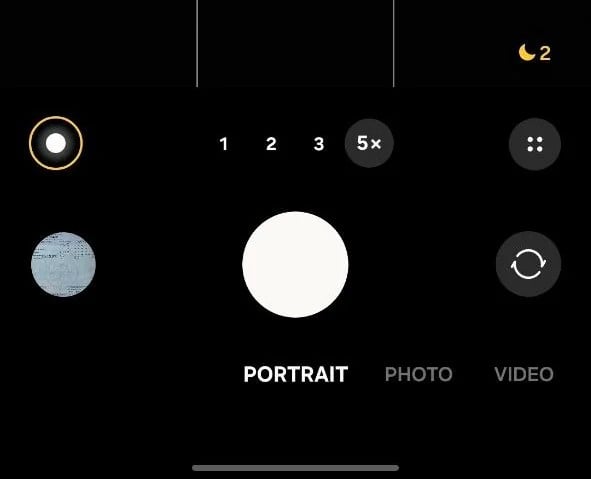
The One UI 9.5 Beta introduces a 5x magnification option in Portrait mode, expanding beyond the previous 1x, 2x and 3x limits available in One UI 9.0. Galaxy S26 Ultra owners now gain an extra framing choice that makes fuller use of the phone’s existing dedicated 50MP telephoto camera with 5x optical zoom.
This addition is useful for tighter compositions. Photographers can stand farther from their subjects while still filling the frame, which helps with candid shots or situations where moving closer is impractical. Samsung has kept the original 1x, 2x and 3x options intact, so users who prefer more conventional portrait framing lose nothing.
The update also refreshes parts of the Camera app interface with a new circular toggle design across its tools. The change gives controls a cleaner look and alters the overall feel of the photography experience without requiring users to relearn core functions.
Because the 5x Portrait mode relies on hardware already present in the Galaxy S26 Ultra, it demonstrates how software can unlock additional value from current sensors and lenses. Camera improvements do not always demand a new module or an entirely new device; targeted updates can make existing capabilities more accessible and flexible.
The One UI 9.5 Beta is currently available to Galaxy S26 series owners in select markets including the US, UK, Germany, India, South Korea and Poland. While image quality still depends on processing, sensor performance and subject separation algorithms, the expanded portrait options strengthen the S26 Ultra’s camera feature set as Samsung continues to refine its software after the phone’s launch. For current owners, the update is a practical reminder that meaningful photography enhancements can arrive long after the hardware ships.
DJI announced the change in an official statement, noting that sustained significant increases in the cost of key components such as semiconductors and storage had prompted a careful evaluation. The new prices took effect from 00:00 on November 18, 2026. Multiple kits of the Osmo Pocket 4, Osmo Pocket 4P and Osmo Nano saw increases, with the largest reaching 560 yuan, which roughly translates to $83.
For the Osmo Pocket 4P, the standard kit rose from 3,799 yuan to 4,099 yuan (~$615), while the Vlog kit climbed from 4,299 yuan to 4,859 yuan (~$730).
The Osmo Pocket 4 standard kit increased from 2,999 yuan to 3,199 yuan. Its all-inclusive kit moved from 3,799 yuan to 4,299 yuan and the Meipai package from 4,098 yuan to 4,598 yuan. The Enjoy Shooting package rose more modestly from 3,498 yuan to 3,638 yuan.
On the Osmo Nano standard kit, the 64 GB version stayed at 1,998 yuan, but the 128 GB version went from 2,298 yuan to 2,498 yuan.
These models remain among DJI’s recent flagship offerings in the compact camera category. The Osmo Pocket 4, launched in April 2026, features a one-inch CMOS sensor, 14 stops of dynamic range and 10-bit D-Log support, with an original starting price of 2,999 yuan.
Comparison
The DJI Osmo Pocket 4 launched at around £445 in the UK.
The higher-end Osmo Pocket 4P followed in June, adding a 60 mm mid-telephoto lens alongside the main camera, 17 stops of dynamic range, D-Log 2 colour accuracy and up to 4K/240 fps slow-motion recording; it originally started at 3,799 yuan.
The Osmo Nano, a split-type action camera released in September 2025, uses a magnetic dual-sided design that switches quickly between selfie and outward shooting and launched from 1,998 yuan.
DJI’s notice did not list every affected product in advance, directing customers to official store pages for the exact figures. The adjustments apply to the Chinese market’s suggested retail prices; reports indicate other regions had not immediately followed with matching changes at the time of the announcement. The move reflects broader pressure on electronics makers from elevated semiconductor and memory costs.
A webcam can make or break the way you appear on screen. Whether it is a live stream, a client presentation, or a video recorded for an online audience, sharp visuals, reliable autofocus, and consistent lighting can separate an ordinary setup from a professional-looking one. As webcams become more capable, features once associated with dedicated camera equipment are making their way into compact USB devices. When discussing the webcam category, there’s one brand we simply can’t ignore: EMEET. You’ll always find their models on the best-of lists. Their products cover every segment, offering the best fit for different types of users.
EMEET Brand
Founded in 2016, EMEET is a global AI imaging brand combining advanced audio‑video processing with AI for live streaming, content creation, and video conferencing. Its lineup includes webcams, speakerphones, and headsets, with best‑sellers such as the PIXY series, C960 Ultra, and S600L. EMEET holds over 200 core patents and has won iF, Red Dot, Good Design (G Mark), and IDEA awards. Its webcams have topped Amazon Best Sellers, including No. 1 in the webcam category, and IndexBox ranks EMEET as the No. 2 webcam brand with a 23% market share.
Higher resolution alone does not guarantee a better experience. AI tracking, sensor size, autofocus performance, and lighting can each have a greater impact depending on how a camera is used. So, which features are worth prioritizing, and which webcam offers the best balance of performance and value? Simply recommending the most expensive one from EMEET does not mean much. This guide examines the key differences to help you find the right fit.
EMEET PIXY: Best for AI Tracking and Presentations
The EMEET PIXY is designed for creators who need freedom to move without constantly adjusting their camera. Its dual-camera system combines a primary imaging camera with an AI-assisted camera for facial detection and exposure optimisation. A two-axis mechanical gimbal adds pan-and-tilt movement, while AI tracking follows the subject around the frame. Gesture controls and three configurable camera-position presets make it particularly useful for demonstrations, online teaching, and dynamic livestreams.
PIXY records in 4K at 30fps or Full HD at up to 60fps. Its BlinkFocus autofocus system focuses in 0.2 seconds. Three microphones and AI-powered noise cancellation, with three selectable audio modes, round out the feature set. The webcam also supports Nintendo Switch 2 camera use.
Who should buy it? At $109.99, the EMEET PIXY is the most specialised option here — and the design accolades back that up. It’s a Red Dot Award: Product Design 2026 recipient, a MUSE Design Awards Gold Winner 2025, and has also earned a Good Design Award 2025 and a Golden Pin Design Award 2025. Those awards aside, it makes the most sense for presenters, educators, and creators who move around while speaking or regularly demonstrate products. For someone who stays seated during routine video meetings, its tracking and gimbal capabilities may be more than necessary.
The EMEET SmartCam C960 Ultra puts the emphasis on imaging hardware. Its 1/1.5-inch Sony CMOS sensor is larger than the sensors in the PIXY and S600L, making it an appealing choice for users who prioritise image capture, especially in challenging lighting. EMEET also has natural background separation, although actual results will depend on the scene and recording conditions.
The webcam features a 48MP sensor with DRC (Dynamic Range Control) for balanced image quality across different lighting conditions. It supports 4K video recording at 30fps and 1080p at up to 60fps. EMEET’s BlinkFocus autofocus technology delivers fast, precise focusing in as little as 0.2 seconds. Through EMEET STUDIO, users can adjust the field of view (FOV) from 40° to 73° to suit different framing needs. In 4K mode, the FOV remains fixed at 73°.
An aluminium-alloy body gives the camera a premium appearance, while a manually operated rotating privacy switch makes it easy to cover the lens. Two built-in microphones handle voice capture, and the included monitor clip and tripod thread offer flexible mounting.
Who should buy it? With a price of $99.99, the C960 Ultra suits remote professionals, video-call users, and creators who want a large sensor and adjustable framing without paying for a moving gimbal or integrated ring light. Users in consistently dim rooms may still benefit from a separate light.
In addition, EMEET has recently launched the C960 UltraX, which features a larger 1/1.3″ sensor and supports 3D noise reduction (3D NR) and HDR. For users with higher professional image-quality demands, the C960 UltraX is also worth considering.
The EMEET SmartCam S600L combines a 4K webcam with an integrated ring light, addressing two common home-recording challenges in one device. Its adjustable lighting offers cool, warm, and mixed settings, alongside additional lighting modes. Brightness can be changed using a physical control, making it convenient to adapt the illumination without adding another device to the desk.
A 1/2-inch CMOS sensor supports 4K recording at 30fps and Full HD at up to 60fps. PDAF autofocus is designed to keep subjects sharp, while EMEET advertises a 0.2-second focus time. The field of view can be adjusted from 40 to 73 degrees through EMEET STUDIO, although it is fixed at 73 degrees when recording in 4K or 1080p at 60fps.
Two built-in microphones support calls and streaming. A physical privacy shutter and tripod mount add everyday practicality, while software features include Beauty Mode and background-removal tools.
Who should buy it? At a price of $79.99, the S600L is the most affordable of the three. It is a practical choice for streamers, online educators, and remote workers who want better control over their lighting without investing in a separate light. The ring light is its key advantage, though users seeking elaborate studio lighting may still need additional equipment.
The EMEET PIXY is the best fit for creators who need automated tracking and a camera that moves with them. Its two-axis mechanical gimbal and AI tracking do something none of its rivals here can replicate, and gesture controls plus position presets make it feel purpose-built for presentations and livestreams. For a standard desk-bound video call, though, it’s more camera than you need.
The C960 Ultra is the more suitable choice for users who prioritise sensor size, image detail, and adjustable framing. That 1/1.5-inch Sony sensor is meaningfully larger than the competition’s, and the adjustable 40–73° field of view gives you real control over framing. The aluminium body and manual privacy switch round out a package aimed squarely at remote professionals who care about how they look, not how much the camera moves.
The S600L offers the most straightforward upgrade for people whose biggest problem is inconsistent lighting. Bundling an adjustable ring light with a 4K sensor removes a device from your desk and a headache from your setup — at the lowest price of the trio.
All three provide 4K recording at 30fps and Full HD at up to 60fps, so resolution alone is unlikely to settle the decision. Instead, consider how you use your webcam: movement favours PIXY, imaging hardware favours C960 Ultra, and convenience favours S600L. Match the camera to your workflow, and any of the three will be a genuine upgrade over the webcam built into your laptop.
For creators looking for more advanced livestreaming tools, EMEET has also recently launched the Prime series, comprising the EMEET Prime and Prime SE. Both streaming cameras feature a 1-inch sensor and 0.2-second BlinkFocus autofocus, and are designed for livestreamers, content creators, and professional broadcasters. The flagship EMEET Prime adds a dedicated telephoto lens, 4K at 60fps, and up to 12× hybrid zoom. Its Aurora Color Technology uses multispectral imaging to help reproduce colours closer to their real-life appearance, while DaVinci-inspired real-time colour grading gives creators more control over their visuals. Dual-frame HDR helps preserve detail in both bright and dark areas. The EMEET Prime SE offers 4K at 30fps, single-frame HDR, and up to 12× hybrid zoom, providing a simpler option for everyday streaming and content creation.
Huawei‘s new sub-brand OSTA, known in China as Xingmang, or Starlight, is the company’s first new smartphone line since Honor was spun off. Earlier reports described it as an online, cost-effective brand aimed at bringing Kirin chips and HarmonyOS to more buyers. Official materials now position its first product as a HarmonyOS AI phone.
Initial reports suggested the initial lineup would include two models, the OSTA O1 and the OSTA O1 Pro. But only the Pro variant has been confirmed, and it is already up for pre-order ahead of its Nov. 20 launch. Continue reading to know everything about it.
Huawei OSTA O1 Pro design, colors, and configurations
Huawei OSTA O1 Pro
The official Vmall listing shows a wide-screen bar phone with a horizontal dual-camera module and an OSTA logo on the back. It comes in Starry Black, Nebula White, and Starburst Purple. Starry Black and Nebula White are offered in 12GB+256GB and 12GB+512GB, while Starburst Purple is reserved for the 16GB+512GB and 16GB+1TB configurations, leaving the 16GB memory options exclusive to the purple model.
Real-life photos that surfaced before the listing showed a plain back finish, rather than the textured rear on Huawei’s earlier wide-screen phone. Tipster Digital Chat Station puts the OSTA O1 Pro at 6.68mm thick and 200 grams, making it a slim, relatively light wide phone.
Huawei OSTA O1 Pro display and chip
Huawei OSTA O1 Pro
Huawei has not published a full specification sheet yet, but Digital Chat Station has outlined a 6.39-inch 1.5K LTPS flat display with a 16:9.5 aspect ratio and 1.05mm bezels on all four sides, plus a Kirin 9030S chip. Those figures match the size, ratio, and bezel width of the Huawei Pura X View, whose official panel also has a 120Hz refresh rate and 6,500-nit peak brightness. Those extra display details have not been confirmed for the O1 Pro.
Huawei OSTA O1 Pro cameras, battery, and software
Huawei OSTA O1 Pro
On cameras, the same tipster lists a 200-megapixel 1/1.28-inch RYYB main sensor, a 50-megapixel 3.7x RYYB periscope telephoto, and a Red Maple lens. Official renders show only two rear cameras, which lines up with reports that the O1 Pro drops the ultra-wide camera found on the Pura X View.
He also lists a 7,000mAh battery with 66W wired charging and wireless charging, plus a side fingerprint sensor. The wireless charging wattage has not been confirmed. Official materials describe the O1 Pro as a HarmonyOS AI phone, but Huawei has not detailed the software version or AI features yet. Those answers are expected at the November 20 launch.
Huawei OSTA O1 Pro price and availability
Huawei OSTA O1 Pro
Pre-orders are open on Huawei’s official online store, Vmall, and the company has set the brand and phone launch for Nov. 20 at 2:30PM China time. The product page still shows no price and no sale start time.
The earlier online, cost-effective pitch suggests the O1 Pro could come in below the Pura X View, which starts at 5,999 Yuan (~$900) for the 12GB+256GB model. Until Huawei names a price, that remains only a reasonable expectation, not a confirmed figure.
How the OSTA O1 Pro differs from the Huawei Pura X View
Huawei OSTA O1 Pro
The OSTA O1 Pro sits very close to the Pura X View. They share the Kirin 9030S, the 6.39-inch 16:9.5 panel with 1.05mm bezels, the 200-megapixel main camera and 50-megapixel 3.7x periscope, the Red Maple sensor, the 7,000mAh battery, 66W wired charging, a side fingerprint sensor, and a 6.68mm-thick body.
The Pura X View adds an 8-megapixel ultra-wide camera and a 50-megapixel front camera, plus official 50W wireless charging, IP68 and IP69 protection, and BeiDou satellite messaging. The O1 Pro appears to drop the ultra-wide, adds 16GB memory options the Pura X View does not offer, and is about a gram lighter if the leaked 200-gram figure holds. It also uses different colors, branding, and a plainer back. With the Pura X View already past 750,000 sales in China, this looks like a closely related wide-screen design rather than a confirmed rebadge, possibly aimed at a lower price.
What about the Huawei OSTA O1?
Early reports claimed the OSTA O1 could be based on the existing Huawei Mate 70 Air. That phone measured 6.6mm, used a 7-inch OLED screen, packed a 6,500mAh battery, and started at 4,199 yuan. At present, there is no clarity on whether the O1 will launch alongside the O1 Pro, and it has not appeared on Vmall.
Huawei is also holding a launch event on November 24 to unveil the Mate X8 foldable, alongside the Mate 90 Air, billed as the thinnest Mate bar phone yet, and the Watch Air. It will be interesting to see how the OSTA O1, said to be based on the Mate 70 Air, is positioned when the Mate 90 Air is set to debut.
The Mijia Tri-Drum Washer Dryer Pro 12 kg lets you wash sportswear, everyday shirts and delicate silk in parallel without mixing loads or colours. Xiaomi presented it as the first three-drum washer-dryer sold outside China, with a European starting price of €1,499. It first appeared at IFA in Berlin, where it drew strong visitor interest and earned an honorary recognition in the IFA Innovation Awards for home appliances.
The main lower drum holds 10 kg. According to Xiaomi, it’s enough for 44 T-shirts, 16 pairs of jeans or four sets of bed linen. Above it sit two smaller 1 kg drums suited to items such as a yoga outfit, swimsuits or baby clothes.
Total capacity is 12 kg. Each drum has its own water circuit, so laundry stays completely separate even when all three run together. Four auto-dosing compartments allow different detergent amounts for each drum, and users can start a small load immediately rather than waiting to fill a full machine.
Features include a 12-minute quick wash and a 32-minute intelligent deep-clean cycle. Xiaomi’s internal tests claim simultaneous use of the three drums cuts washing time by 68 %, electricity by 49 % and water by 48 % compared with running the same loads one after another in a single-drum machine. The washing cycle carries European energy class A and is said to use 40 % less energy than the class minimum requires. Control is via a touchscreen supporting 25 languages or the Xiaomi Home app.
Oxygen Care technology generates active oxygen through water electrolysis. It helps break down more than 20 types of stains, protect colours, reduce yellowing on whites and remove 99.99 % of bacteria, dust mites, pollen and pet dander. The machine also dries.
Nine temperature sensors monitor progress and end the cycle automatically. Delicate items can dry at 35–40 °C in the small drums; the main drum handles bulkier items such as duvets at higher but still controlled temperatures. Dedicated programmes cover silk, wool and down. The direct-drive motor carries a 12-year warranty.
Exact country roll-outs and availability dates beyond the announced European pricing have not been fully detailed, though some markets are expected to see the machine in early 2027. Alongside the washer-dryer, Xiaomi also introduced a 546L multi-door fridge and a new robot vacuum cleaner.
The RedMagic 12 Pro went on sale on November 18, starting at $949 in the US. At that price, you may want to protect it and get the most out of its gaming features. RedMagic has a handful of accessories listed for the phone, including a few new additions for this generation.
We covered theRedMagic 12 Pro’s global launch earlier this month. In Europe, the base model costs €200 more than the RedMagic 11 Pro, and RedMagic has dropped the 24GB RAM option. The phone packs an 8,400mAh battery with 120W wired charging, the Snapdragon 8 Elite Extreme Gen 6 chip, and RedMagic’s own RedCore R5 gaming chip. It also has a G1 display chip for its 185Hz screen.
The phone already has an internal fan and AquaCore Cooling System 3.0, so an external cooler isn’t essential. Still, a few accessories are worth considering. Prices below are from RedMagic’s global store as of November 19.
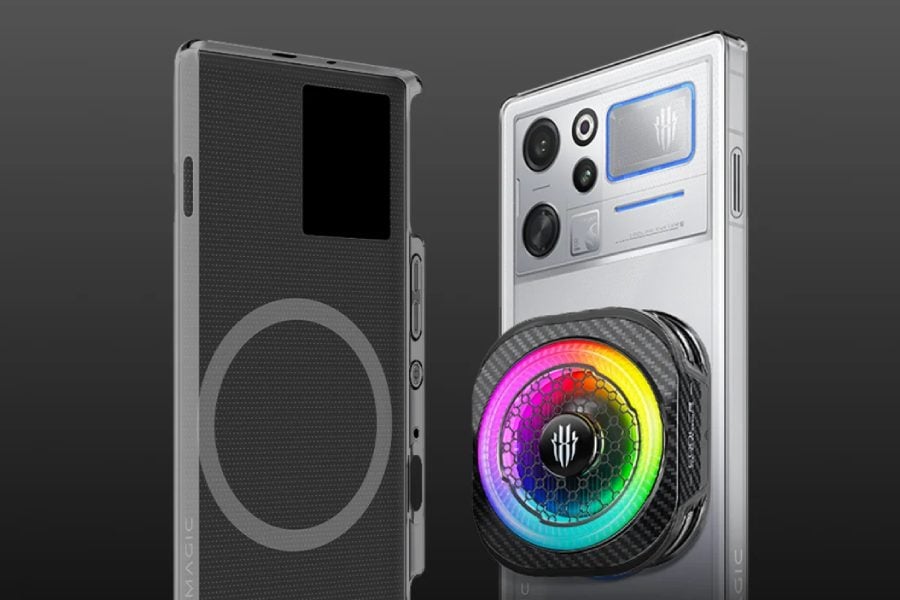
A case is a must for a phone, whether you like it or not. RedMagic has a magnetic protective case specifically for this phone and supports magnetic attachment for a RedMagic cooler.
The box already includes a transparent full-coverage case, so you don’t need to buy another one immediately. The magnetic version makes sense if you plan to use an external cooler or want a different finish.
However, RedMagic’s buying guide does suggest against using thick cases, as they can keep the outside cool while the phone’s internal temperature rises. A thinner case is better for gaming. Also, avoid cases made for the RedMagic 11S or 11 Pro, as the 12 Pro is thinner and narrower.
2. RedMagic 12 Pro Screen Protector
Price: $14.90 / $19.90
The case is for the back, and for the front, you can get an official screen protector for $14.90 and an Anti-Reflective Tempered Glass version for $19.90.
The launch page also lists tempered glass and anti-reflective protectors as bundle options when ordering the phone. RedMagic says customers can get up to $10 off when adding accessories to the same order. The discount covers cases, screen protectors, and the Shadow Blade Gamepad 3.
The anti-reflective version is worth considering if you often play outdoors or under bright lights. Otherwise, the standard protector should do the job at a lower price.
3. RedMagic Cryo Cooler 8 Pro
Price: $59
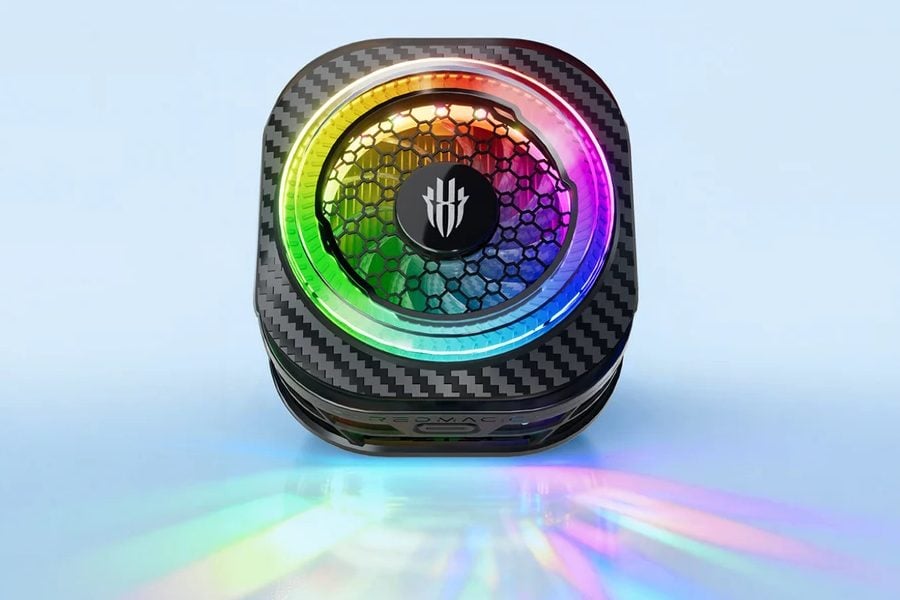
The Cryo Cooler 8 Pro is RedMagic’s newest external cooler. It’s listed for $59. The cooler has a 36W peak output, a 124-pair semiconductor cooling module, and an 11-blade fan. It also includes RGB lighting.
RedMagic claims the cooler can reduce temperatures by up to 80°C under a heat load, with a minimum temperature of -25°C. These are laboratory figures, though, and the company tested them on the RedMagic 8 Pro rather than the newer 12 Pro.
There are two versions to choose from. The standard model attaches magnetically, while the two-in-one version adds a back clip for phones without magnetic support. The latter also has a quarter-inch thread for mounting on a tripod, which could be useful if you stream your gameplay.
The cooler has a 36dB quiet mode and three operating modes that you can adjust through the RedMagic app. It also includes temperature sensing to help prevent condensation.
If $59 is more than you want to spend, the Cryo Cooler 8 Air is another option. It starts at $29.
You can probably skip an external cooler if you mostly play in short sessions. And the RedMagic 12 Pro already has its own cooling system to start with. However, an additional cooler may be useful if you regularly play for hours, particularly in a warm room.
4. RedMagic Shadow Blade Gamepad 3
Price: $129 / from $119 on the accessories page
Comparison
The RedMagic 12 Pro and Honor Win 2 both use the Snapdragon 8 Elite Extreme Gen 6, built on a 2nm process.
The Shadow Blade Gamepad 3 is a clamp-style controller that connects to your phone over Bluetooth 5.3. Its extendable clamp can accommodate devices up to 213mm, while three silicone pads support different case thicknesses. It also works with Android phones, foldables, and small tablets.
The controller has Hall-effect joysticks and triggers, along with a mechanical D-pad and two programmable shoulder buttons. It also packs an 800mAh battery. You can adjust RGB lighting, vibration, and button mapping through the Goper app. The gamepad weighs around 184g.
RedMagic sells it for $129, although the accessories section shows a starting price of $119. We covered the Shadow Blade Gamepad 2 back in 2023, when it also carried a $119 price tag. There is also a separate version bundled with a wired cooler, although its price isn’t available.
The RedMagic 12 Pro already has touch-sensitive shoulder triggers built into its frame, so a separate controller isn’t essential for every game. It makes more sense for shooters and action games with several on-screen controls. For racing games, the built-in shoulder triggers may be enough.
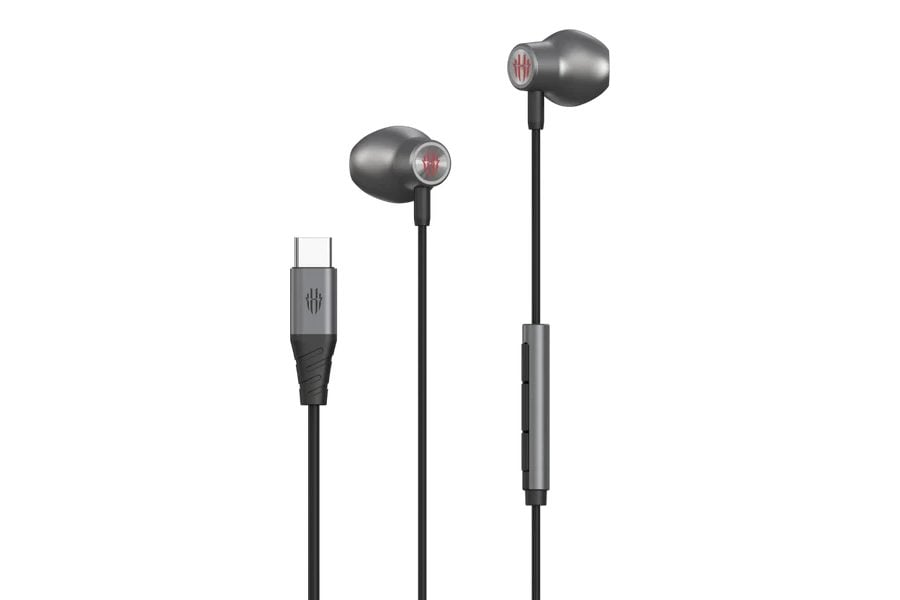
RedMagic sells its Magic Sound Earphones in USB-C and 3.5mm versions, both starting at $21.90. Check which connection you need before ordering. The USB-C version is the safer choice unless you have confirmed your phone has a 3.5mm headphone jack.
The phone’s stereo speakers should be fine for casual gaming, but wired earphones can be more useful in team-based games where hearing footsteps and voice chat matters. They also don’t need charging, which is one less thing to worry about.
6. RedMagic Type-C to Type-C 6A Cable
Price: From $12.90
RedMagic’s Type-C to Type-C 6A Cable starts at $12.90. If you plan to use high-wattage charging, a cable rated for 6A helps avoid a potential bottleneck.
That said, the RedMagic 12 Pro already comes with a Type-C cable in the box. You only really need another one if you want a spare or have noticed slower charging with a cable from another device.
7. Which RedMagic 12 Pro accessories should you buy first?
A case and screen protector are the easiest accessories to justify, especially if you plan to keep the phone for a while. The Cryo Cooler 8 Pro makes more sense for people who play demanding games for extended periods, while the Shadow Blade Gamepad 3 is worth considering if you prefer physical controls in shooters and action games.
The earphones and extra cable are less essential, particularly since the phone already comes with a cable and has built-in stereo speakers. You can always pick them up later if needed.
OpenAI has spent much of this year teasing a broader hardware push, from a speaker and a desk keypad to reports of an AI agent smartphone. Analysts have also weighed in on when that phone could enter mass production. Now, a new supply-chain report offers a clearer picture of who may assemble the device.
Foxconn’s FIH Mobile tipped to assemble the OpenAI phone
A Securities Times report on November 19, citing the supply chain, said Foxconn subsidiary FIH Mobile (02038.HK) has secured orders for OpenAI’s phone project and will assemble the finished devices. FIH designs, manufactures, and assembles phones and other electronics, and Foxconn is also a major iPhone assembler. The report did not disclose the product design, order volume, or mass production schedule.
A separate supply-chain report from Cailian Press put the first OpenAI phone in late 2027 or 2028, and said iPhone suppliers including Luxshare Precision, Lingyi iTech, and AAC Technologies would also be involved in components.
That assembly role differs from earlier reporting. In April, Kuo said Luxshare could handle manufacturing, with MediaTek and Qualcomm in the mix for a custom chip, and production possibly starting in 2028. In May, he said OpenAI might bring mass production forward to the first half of 2027, using a customized Dimensity 9600-based processor. Neither OpenAI nor Foxconn has confirmed the order.
Foxconn and OpenAI already announced a partnership last year on AI data center equipment, and chairman Young Liu said in late October that they were discussing new joint projects.
If the phone does ship, OpenAI would compete more directly with Apple, Samsung, and other phone brands on the AI interaction experience. Earlier leaks described an agent-first phone that could handle tasks without the usual app hopping, unlike today’s app-centric iPhones and Galaxy flagships. OpenAI has also been linked to a doughnut-shaped speaker and the Codex Micro keypad, so a phone may not be its first consumer device. For global buyers, a late 2027 or 2028 window would still put the device more than a year out, and OpenAI has not shown a design, a price, or even confirmed that a phone is coming.
4K triple-laser projectors have come a long way, and in 2026, you no longer need a dedicated home theater to enjoy a massive screen with excellent picture quality. The latest models offer higher brightness, deeper contrast, wider color coverage, and gaming features that were previously limited to high-end TVs.
If you’re planning to upgrade your living room entertainment setup, RGB triple-laser projectors are worth considering. They use separate red, green, and blue laser light sources to deliver vibrant colors and impressive brightness. Some models also support 4K at 120Hz, ultra-low input latency, and advanced optical adjustments.
Here are five of the best 4K triple-laser projectors for living rooms and gaming in 2026.
The Horizon series has been a reliable option for a few years, and the Horizon 30 Ultra Max builds on that foundation by focusing on versatility. Designed as a straightforward, rectangular unit, it fits easily onto most media consoles or ceiling mounts.
Its primary strength is its light output, rated at 6,000 ISO lumens. This level of brightness means you can comfortably watch sports or television shows during the day without needing to draw heavy blackout curtains.
To balance this brightness during darker movie scenes, XGIMI has included a Dual Intelligent Iris system. This mechanism physically adjusts the amount of light passing through the lens, providing a 10,000:1 native contrast ratio that helps maintain deep black levels and shadow details.
It is also well-equipped for gaming. The projector supports a 4K resolution at a 120Hz refresh rate, along with Variable Refresh Rate (VRR) and Auto Low Latency Mode (ALLM). With an input lag as low as 1ms (when playing at 1080p 240Hz), it responds just as quickly as most dedicated gaming monitors.
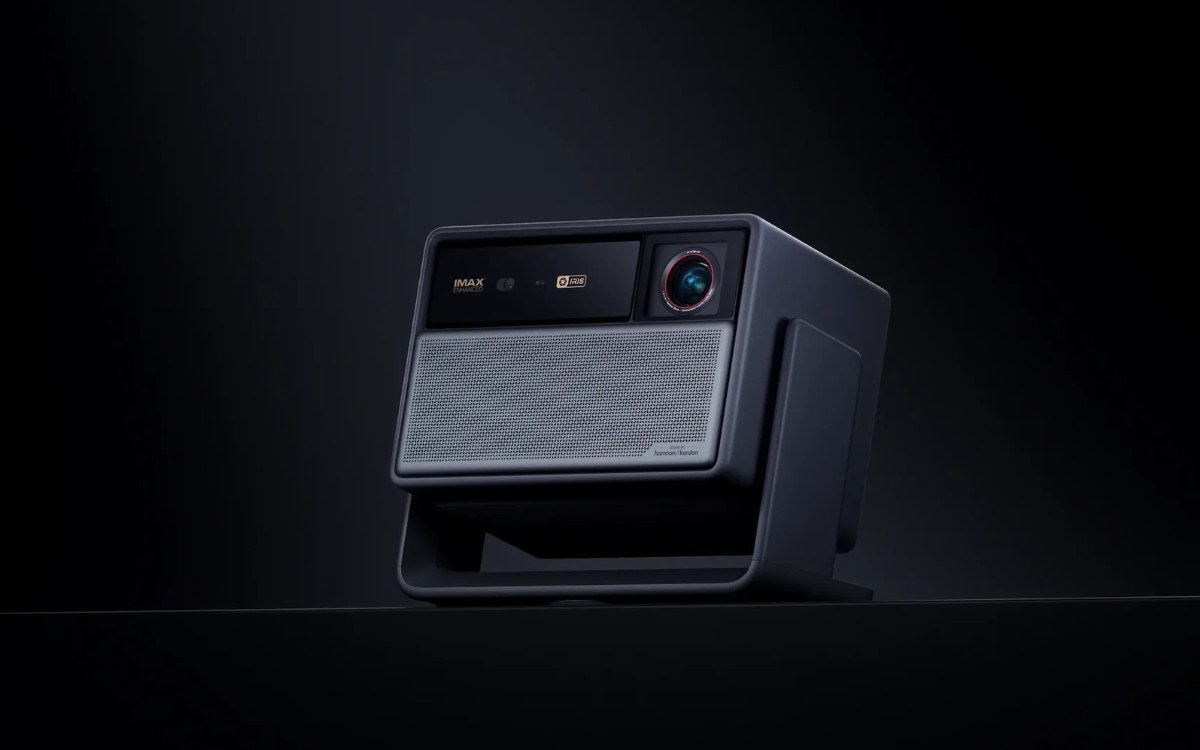
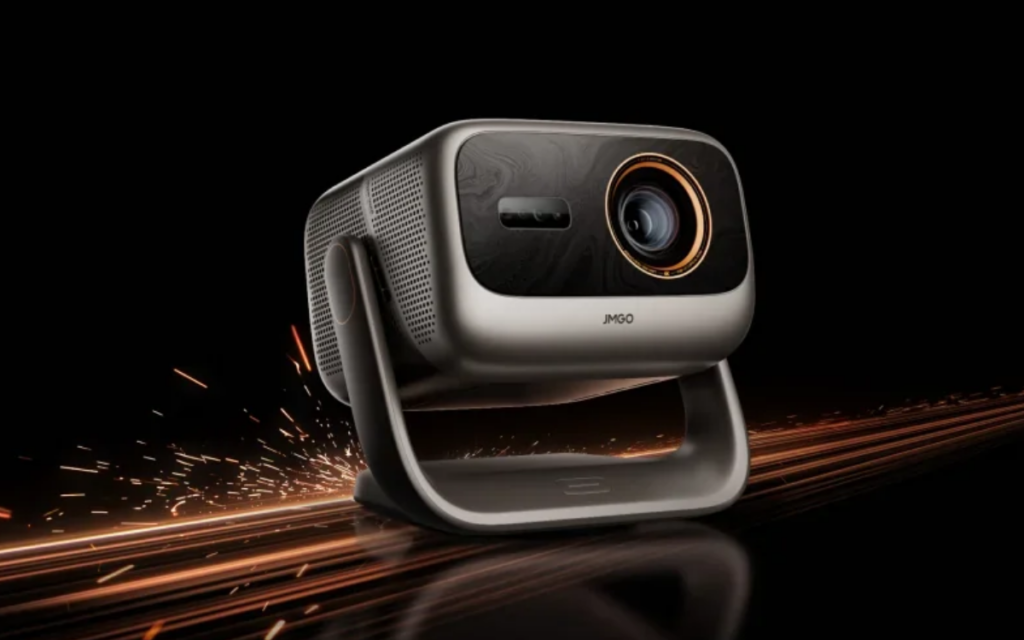
The JMGO IRIS Ultra Max (full review on YouTube) takes a slightly different approach to hardware design by integrating an AI-controlled motorized gimbal. This is particularly useful for rooms where placing the projector perfectly dead-center to the wall isn’t an option.
Historically, placing a projector off-center meant relying on digital keystone correction, which crops the image and reduces the overall resolution. The IRIS Ultra Max avoids this by using a four-way optical lens shift combined with its gimbal system. It can physically move and align the lens to frame the image perfectly without sacrificing any of its 4K resolution or brightness.
Internally, it uses a MALC 6.0 Triple Laser Engine to produce 6,500 ISO lumens. Like the XGIMI, it features a dual-iris system (using 15 blades for precise light suppression) to achieve a 10,000:1 native contrast ratio. It also matches the standard for modern gaming with 4K at 120Hz and 1ms latency, making it a highly adaptable option for difficult room layouts.
The Titan Noir Ultra is a professional-grade projector aimed at dedicated home theaters or exceptionally large, bright living spaces.
Interestingly, it does not include a built-in smart operating system. XGIMI assumes that buyers in this price range will prefer to connect their own high-end streaming devices, like an Apple TV or Nvidia Shield. By omitting the OS, the focus remains entirely on the optical hardware.
The projector delivers a very high 8,000 ISO lumens and a 12,000:1 native contrast ratio, ensuring the image remains rich and detailed even when projected at its maximum 300-inch size.
It offers a wide 0.98-2.0:1 throw ratio and extensive lens shift capabilities (V ±130%, H ±50%), giving custom installers plenty of flexibility. It also includes a Gigabit Ethernet port for a stable, high-speed connection when streaming high-bitrate content.
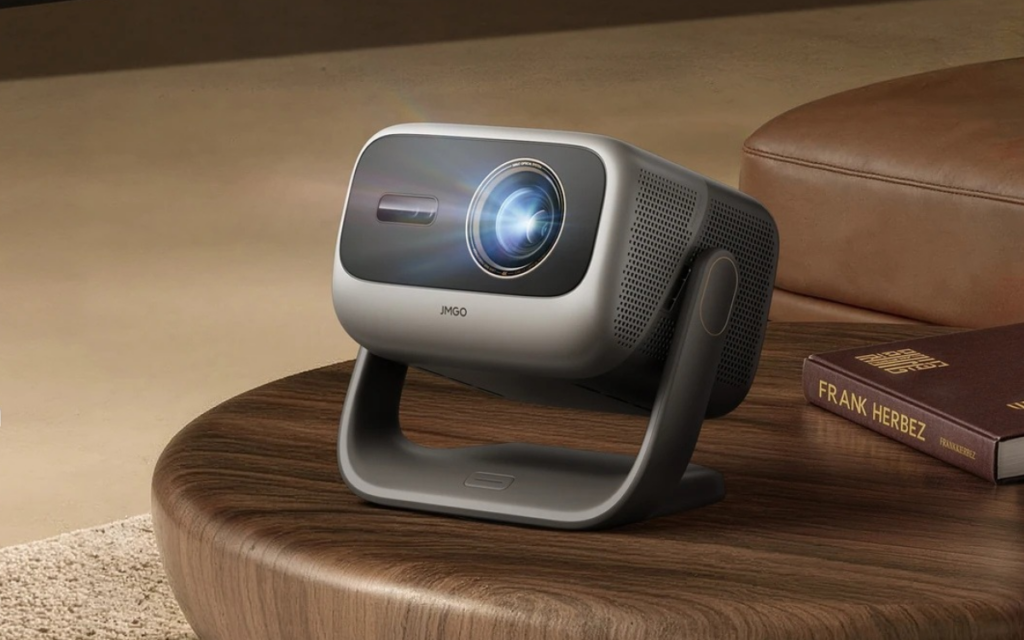
For those who like the automated setup of the IRIS Ultra Max but want to stay under the $3,000 mark, the JMGO N3 Ultimate is a very practical alternative.
It outputs 5,800 ISO lumens using the slightly older, but still highly capable, MALC 5.0 laser engine. It also boasts a 20,000:1 FOFO contrast ratio, providing excellent depth for darker content.
Similar to the IRIS Ultra Max, it combines optical zoom, lens shift, and the AI Gimbal. This allows you to place the projector on a side table and let the hardware automatically adjust the lens to create a properly proportioned screen.
While some brands focus heavily on automated smart features, the Valerion Max is tailored more toward home theater enthusiasts who prioritize color accuracy and film presentation.
Rather than chasing the highest possible brightness numbers, the Valerion Max focuses on image refinement. It utilizes a Dynamic Iris and an Enhanced Black Level (EBL) system designed to keep shadow details stable and natural.
For viewers who are sensitive to the rainbow effect sometimes seen on DLP projectors, AWOL has integrated a specific Anti-RBE technology to make viewing more comfortable during high-contrast scenes.
For film purists, the projector includes a native 24fps Film Mode to preserve the original cadence of movies, as well as support for 21:9 anamorphic formats. Installation is straightforward thanks to a generous +105% vertical lens shift. It also integrates smoothly into smart home setups, offering compatibility with Apple HomeKit and AirPlay 2.
Honor launched the Watch 6 in global markets in June, after the Watch 6 Plus first arrived in China. The Watch 6 Pro then debuted in China in late September as a more premium follow-up to last year’s Watch 5 Pro. Honor has now taken the Watch 6 Pro global, with pre-orders opening in Europe and the UK.
The Honor Watch 6 Pro measures 46.3 x 46.3 x 11.6mm, weighs 50.9g without the strap, and uses a 316L stainless steel front case with a nanocrystalline ceramic bezel. The 1.5-inch dual-layer OLED, or Ultra-Bright Tandem Display, has a 466 x 466 resolution and a peak brightness of 5,500 nits, up from 3,000 nits on the Watch 5 Pro.
Honor’s Intelligent Sense System can run a Quick Health Scan of heart rate, blood oxygen, and stress, plus a Healthy Morning Report for sleep, Body Energy, and HRV. There are more than 120 sports modes, including an AI running coach, trail running with route-back navigation, and football and badminton tracking, with AccuTrack dual-band L1+L5 GNSS.
Honor Watch 6 Pro
A 515mAh battery is rated at up to 18 days in Ultra-Long Battery Mode, 10 days in typical use, and seven days with always-on display. The watch is rated 5ATM, IP68, IP69, and IP69K, supports NFC payments through Fidesmo, and works with Android 9.0 or later and iOS 15.1 or later, including dual-phone notifications from an Honor phone and an iPhone. Honor’s global materials do not list the cardiac arrest detection featured at the China launch.
Pre-orders opened November 19 in Europe and the UK, in black with a fluoroelastomer strap and silver with a steel strap. The black model is €379.90 / £329.99, and the silver model is €429.90 / £379.99, or €279.90 / £229.99 and €329.90 / £279.99 with a €100 / £100 early-bird discount. That offer runs through December 31 in Germany and Italy, and through December 7 in France.
Shipping starts from November 25 in France, November 26 in the UK, and November 27 in Italy and Spain. Early-buyer extras can include Honor Choice clip-on earphones, an extra 22mm leather strap, and a 12-month care package.
We use cookies on our website to give you the most relevant experience by remembering your preferences and repeat visits. By clicking “Accept”, you consent to the use of ALL the cookies.
This website uses cookies to improve your experience while you navigate through the website. Out of these, the cookies that are categorized as necessary are stored on your browser as they are essential for the working of basic functionalities of the website. We also use third-party cookies that help us analyze and understand how you use this website. These cookies will be stored in your browser only with your consent. You also have the option to opt-out of these cookies. But opting out of some of these cookies may affect your browsing experience.
Necessary cookies are absolutely essential for the website to function properly. This category only includes cookies that ensures basic functionalities and security features of the website. These cookies do not store any personal information.
Any cookies that may not be particularly necessary for the website to function and is used specifically to collect user personal data via analytics, ads, other embedded contents are termed as non-necessary cookies. It is mandatory to procure user consent prior to running these cookies on your website.