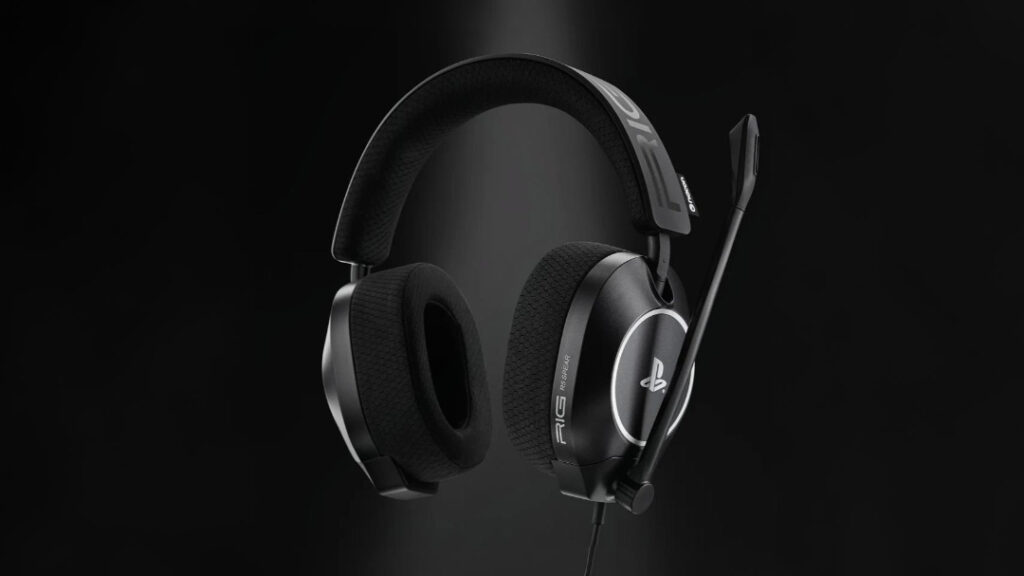
Nacon has launched its new PS5-licensed wired gaming headset, the Rig R5 Spear Pro HS. The headset comes in Black and is now available for purchase at €79.90 in Europe. In the US, the headset carries a retail price of $69.99.
Nacon Rig R5 Spear Pro HS Specs
The Rig R5 Spear Pro HS is designed to deliver precise and immersive in-game sound. It features 40mm drivers with laminated graphene diaphragms, which help minimize harmonic distortion to less than 0.5%.
The headset supports Sony’s Tempest 3D AudioTech and is optimized for spatial audio on PlayStation 5 consoles. Nacon claims the headset can reproduce subtle audio details like footsteps and distant gunfire with high accuracy, enhancing player awareness during gameplay.
The headset uses a wired connection with a 1.5-meter cable and a standard 3.5mm jack. It supports a wide frequency response of 20Hz to 40kHz and has an impedance of 32 ohms. Inline volume control is available for easy adjustments during gaming sessions. The headset is compatible with PS5, PS4, PC, and mobile devices.
Nacon has included a flexible boom microphone with a cardioid pickup pattern, a metal mesh pop filter, and flip-to-mute functionality. The microphone delivers a frequency response of 50Hz to 15kHz and maintains a signal-to-noise ratio above 42dB.
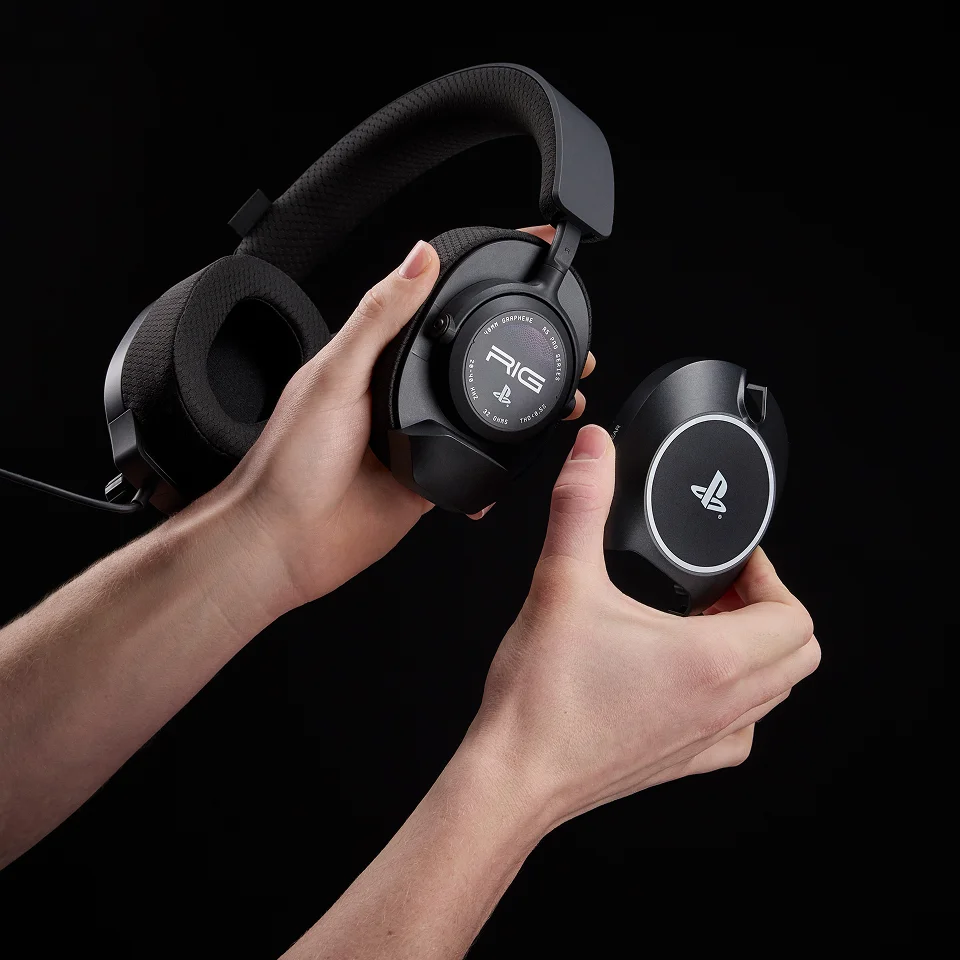
The Rig R5 Spear Pro HS focuses on both comfort and customization. It uses Nacon’s proprietary Snap+Lock magnetic system, allowing users to swap side plates and replace ear cushions. The headband and earcups are lined with memory foam padding. The headset also features adjustable arms and flat-folding earcups for better portability and storage.
In related news, Logitech recently introduced the Zone Wireless 2 ES and Wired 2 headsets, both equipped with AI-powered noise cancellation for clearer voice performance.
For more daily updates, please visit our News Section.
Anker has launched a new range of Nano series chargers and powerbanks in Singapore. The lineup includes the Anker Laptop Powerbank, Nano Retractable Powerbank, Nano Wireless Powerbank, and new Nano chargers for cars and home use.
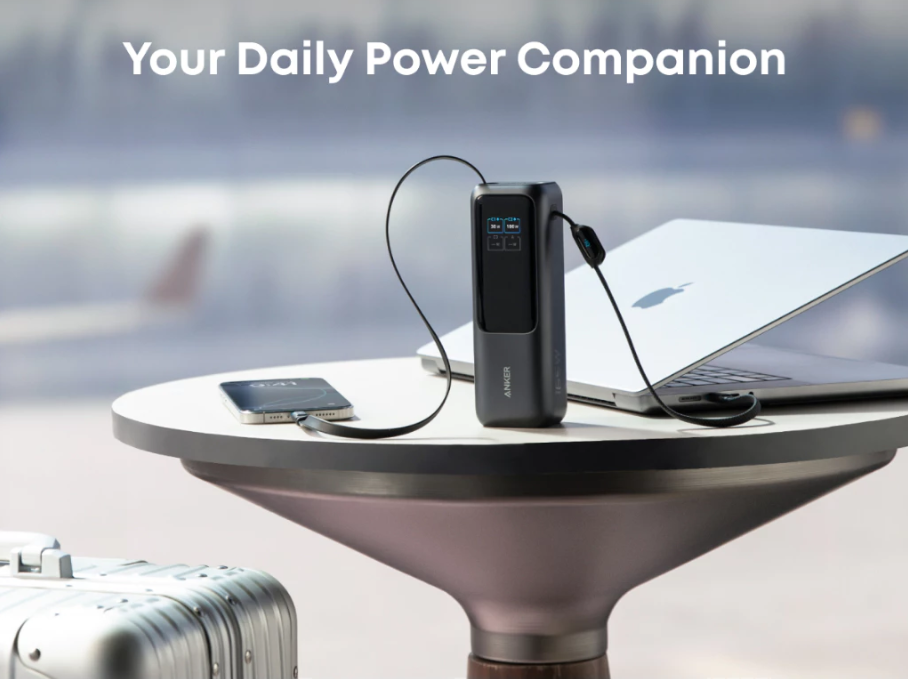
The Anker Laptop Powerbank (A1695) features a 25,000mAh battery with 165W total output across four ports, allowing users to charge up to four devices simultaneously. It includes two built-in USB-C cables: one 30cm for quick charging and one 70cm retractable cable that adjusts to the required length. Each port supports up to 100W output and can charge a MacBook Air (M3) to 50% in 21 minutes.
Anker Laptop Powerbank (A1695)
The powerbank includes a TFT color screen showing output, temperature, and estimated charging time, while pulling the retractable cable triggers animated icons on the display. With enough capacity to charge an iPhone 16 up to 4.5 times or a MacBook Air (M3) 1.3 times, it is flight-approved and built for both work and travel.
The Anker Nano Retractable Powerbank (A1638) offers 45W fast charging with PPS 2.0 support in a 10,000mAh compact body. Its 70cm retractable cable stretches for use and retracts fully for neat storage. It can charge an iPhone 16 Pro to 50% in 27 minutes and has three ports: two USB-C and one USB-A, allowing up to three devices to charge at once. A TFT display provides real-time charging and power status updates.
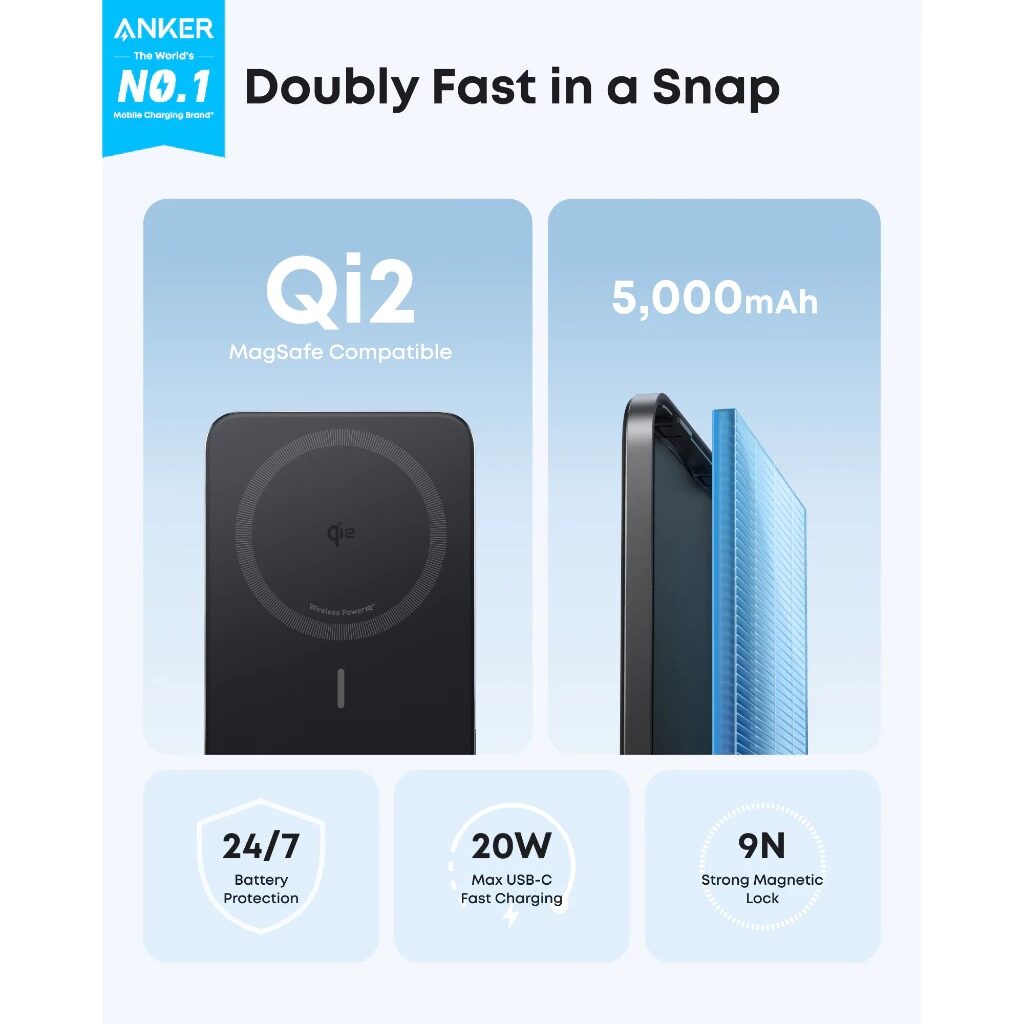
Anker Nano Wireless Powerbank (A1665)
The Anker Nano Wireless Powerbank (A1665) delivers 15W Qi2 wireless charging for iPhone 12 to 16 models and supports 20W wired input and output. Measuring 102 × 70.6 × 8.6 mm, about the size of a credit card, it features temperature control that keeps the shell below 40°C during use.
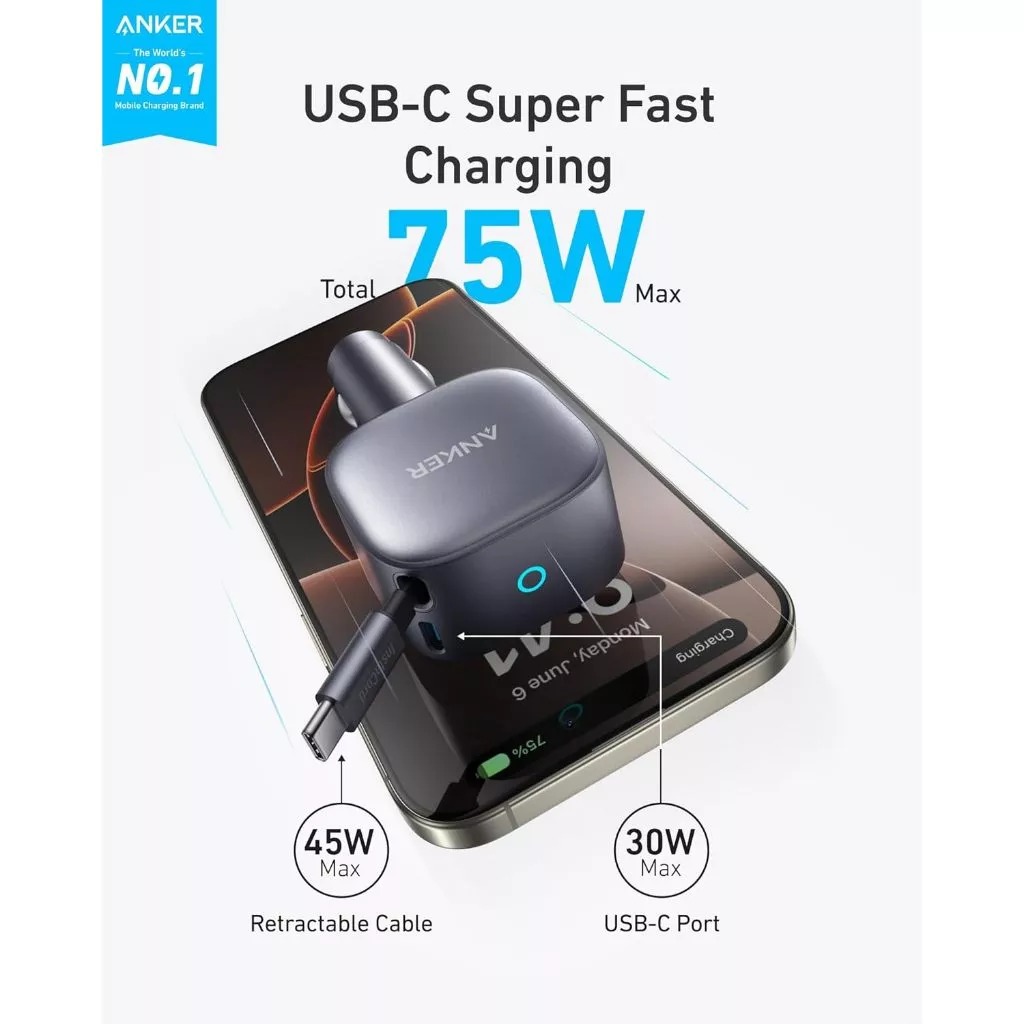
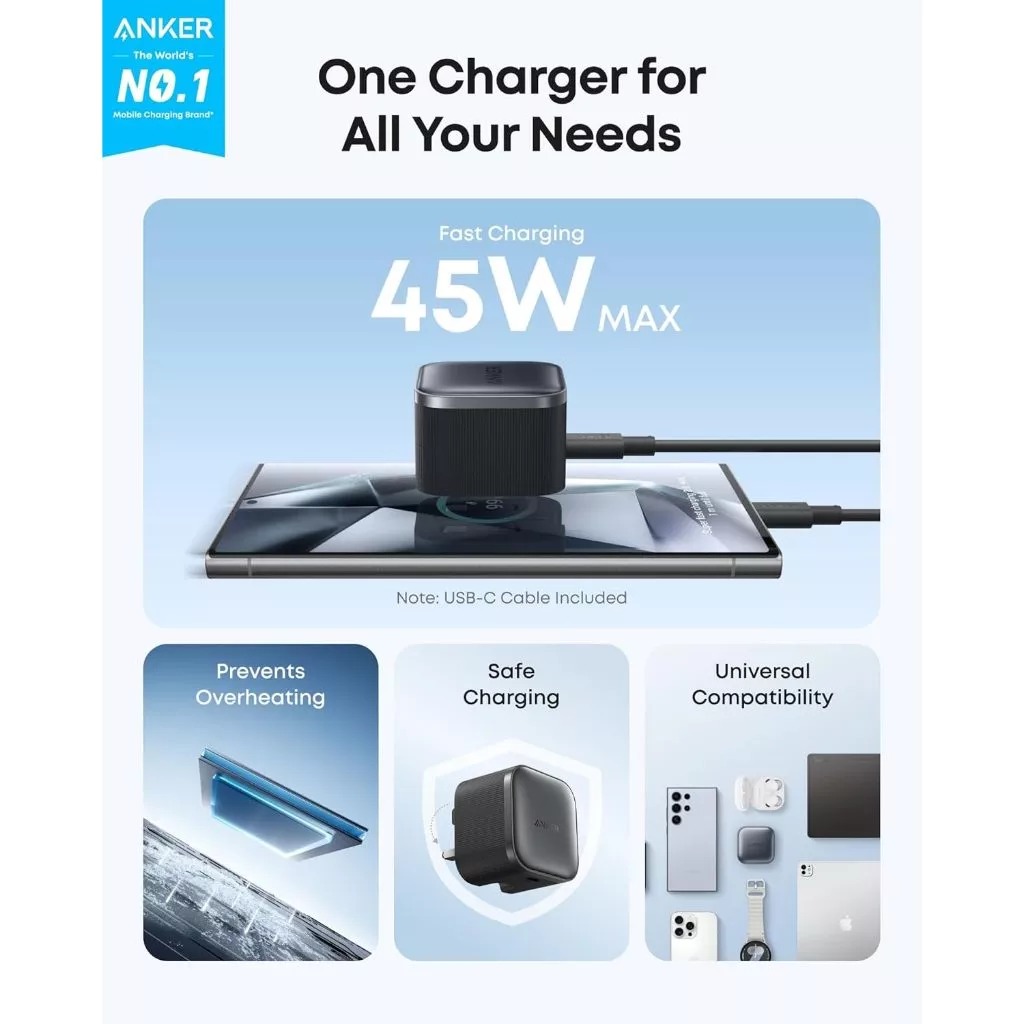
Anker also introduced the Nano Retractable Car Charger (A2738), offering 75W dual-port output with a retractable cable for clutter-free charging inside the car, and the Nano 45W Charger (B2692), featuring PowerIQ 3.0, PPS, and Samsung Super-Fast Charging 2.0 with over 6 million temperature checks per day to ensure safe performance.
Pricing & availability
All new Anker Nano products are now available in Singapore on Anker’s official website, Shopee, and Lazada. The Anker Laptop Powerbank (A1695) is priced at SGD 159.99 (US$123) in Black and Grey. The Nano Retractable Powerbank (A1638) is priced at SGD 79.99 (US$62) and comes in Black, White, Blue, and Pink. The Nano Wireless Powerbank (A1665) is priced at SGD 89.99 (US$69) in Black and White. The Nano Retractable Car Charger (A2738) costs SGD 39.99 (US$31), and the Nano 45W Charger (B2692) is priced at SGD 49.99 (US$39).
Hisense is expanding its TV lineup in the U.S. with two new large-sized Mini LED models. The company has confirmed the launch of the Hisense 116U75QG from the U75QG series and the Hisense 100UX, both offering high-end performance and visual quality.
Hisense 116U75QG specifications
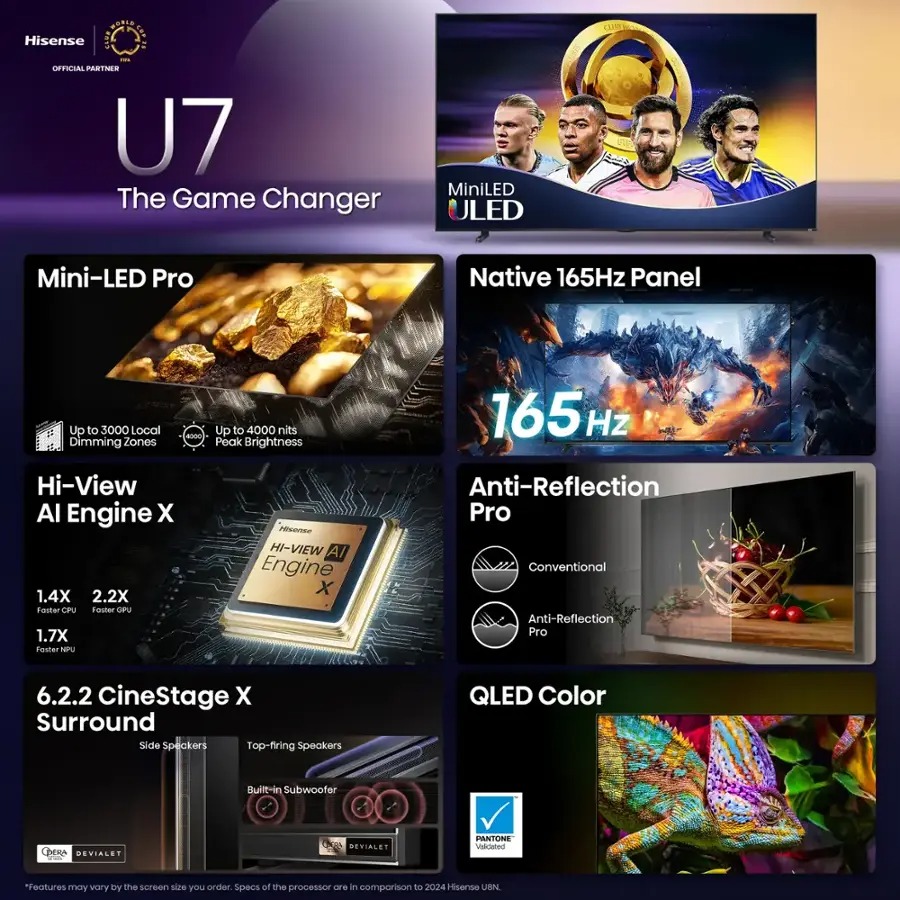
The Hisense 116U75QG features a 116-inch VA panel with a Mini LED Pro backlight. It combines Wide Color Gamut and Quantum Dot Color technologies to achieve 90 percent DCI-P3 color coverage. The panel also includes Anti-Reflection technology and supports HDR10+, Dolby Vision, Dolby Vision IQ, and HLG. It is Pantone Validated, IMAX Enhanced, and Filmmaker Mode certified.
For gaming, the TV supports a 165Hz refresh rate with AMD FreeSync Premium Pro certification, Game Mode Ultra, and a Game Bar offering up to 288Hz VRR.
The 116U75QG runs on the Hi-View AI Engine Pro powered by the MediaTek Pentonic 800 (MT9655) system-on-chip. It includes a 1.8GHz quad-core Cortex-A73 CPU and Mali-G57 GPU. The AI Engine adds several features such as AI Picture, AI Sound, AI Scenario, AI Energy, AI Light Sensor, AI 4K Upscaling, AI Detail Enhancement, AI HDR Enhancement, AI Smooth Motion, and AI Sports Mode.
Audio output is handled by a 2.1.2 channel speaker setup. The TV uses Google TV and includes four HDMI 2.1 ports, a USB 2.0 port, a USB 3.0 port, a LAN port, a headphone jack, optical audio out, an AV composite input, a 3.5mm jack, and a cable or antenna input. It supports Bluetooth 5.3 and Wi-Fi 6 (802.11ax).
Hisense 100UX specifications
The Hisense 100UX uses RGB-MiniLED technology developed by the company to improve light and color control. The display can reach up to 8000 nits of peak brightness and reproduces 100 percent of the BT.2020 color gamut. It also supports advanced local dimming and high-bit precision for better contrast and color accuracy.
This model runs on the Hi-View AI Engine X, which is based on the same MediaTek Pentonic 800 system-on-chip. The AI Engine X controls brightness and color together, dynamically adjusting red, green, and blue lighting for precise image reproduction. It optimizes every frame for picture, sound, and overall settings.
For gaming, the 100UX includes a 165Hz Game Mode Ultra with native VRR support for smoother performance.
At IFA, Hisense partnered with Dolby to show Dolby Vision 2 for the first time. This new version of Dolby Vision focuses on image intelligence, detail, and environmental awareness. Dolby Vision 2 will first be available on Hisense’s RGB-MiniLED TVs through an over-the-air update.
Pricing and availability
According to Best Buy’s U.S. listing, the Hisense 116U75QG is priced at $14,999, while the Hisense 100UX will retail for $11,999.
For more daily updates, please visit our News Section.
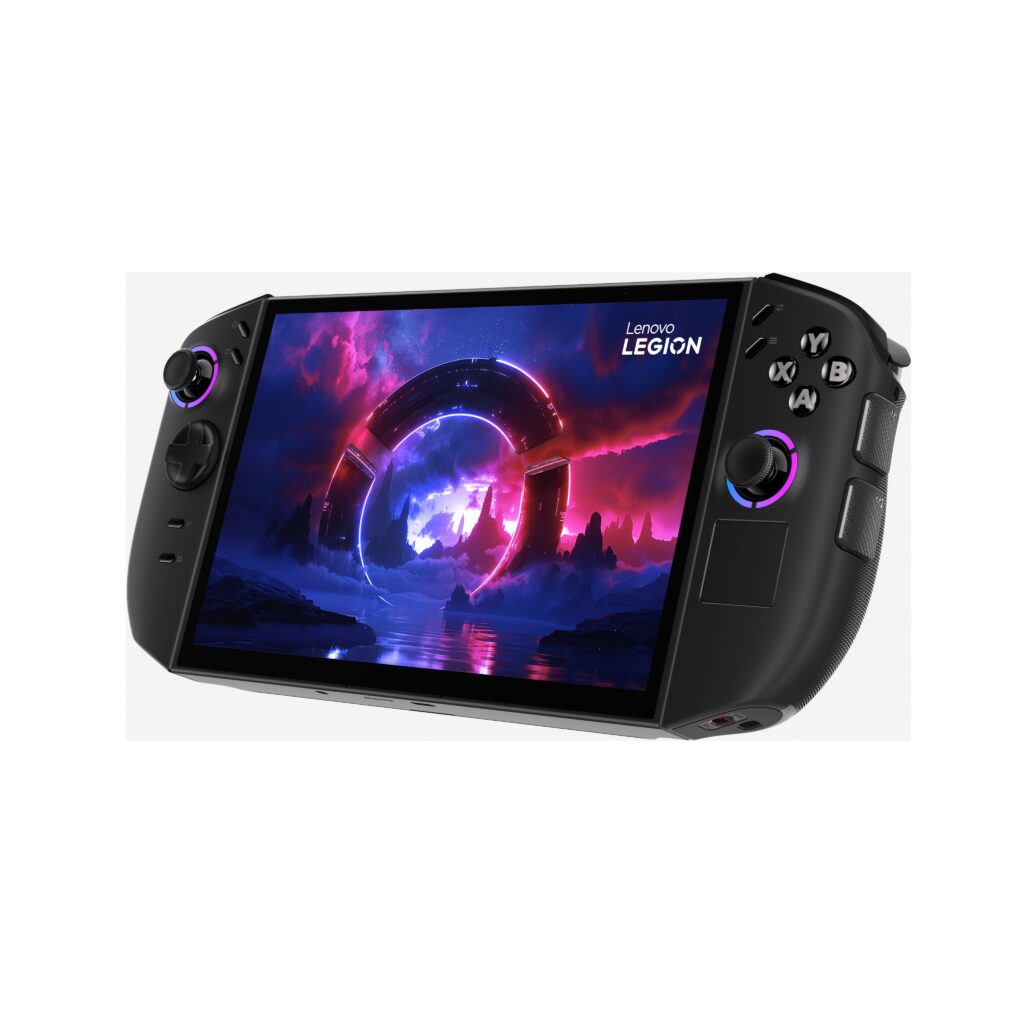
Lenovo has just announced an exciting giveaway for its newly launched Legion Go 2 handheld gaming console. The company is offering gamers the chance to win its latest portable consoles for free. So here’s everything you need to know to win one.
Lenovo’s Latest Giveaway Lets You Win Its New Legion Go 2
The Chinese tech giant has just confirmed that it has launched this giveaway for its Lenovo Creator Community. It is offering two of its new Legion Go 2 handheld consoles to participants. One of these is for the US and Canada, while the other is being given away in the EU and UK. As of right now, Lenovo has already started taking applications for this giveaway, with the last entries ending on 9th November 2025.
Lenovo Legion Go 2
For those interested, one must first make an account on the Lenovo Creator Community website. Following this, confirm your Creator Community username to officially enter the giveaway. You will also be assigned simple tasks to earn additional entries, like following Lenovo’s X account, joining the official Legion Discord server, and others. The higher entries basically improve your chance of winning the Legion Go 2 gaming handheld. So it is worth taking these extra steps.
Lenovo will confirm the winners after the giveaway ends. To recall, the Legion Go 2 was recently unveiled with an improved display, a newer and faster Ryzen Z22 Extreme APU, up to 32GB of RAM and 2TB of SSD storage. A large 74Wh battery pack powers this device, which supports 65W fast charging. In other words, the handheld console is faster and offers better endurance.
For more daily updates, please visit our News Section.
Vivo has launched OriginOS 6, based on Android 16, and it brings numerous exciting features and tons of upgrades, including a redesigned interface, cross-device integration, performance improvements, security enhancements, and new AI capabilities. Here are the top six features in OriginOS 6 that you shouldn’t miss.
1. Refreshed visuals with better user interaction
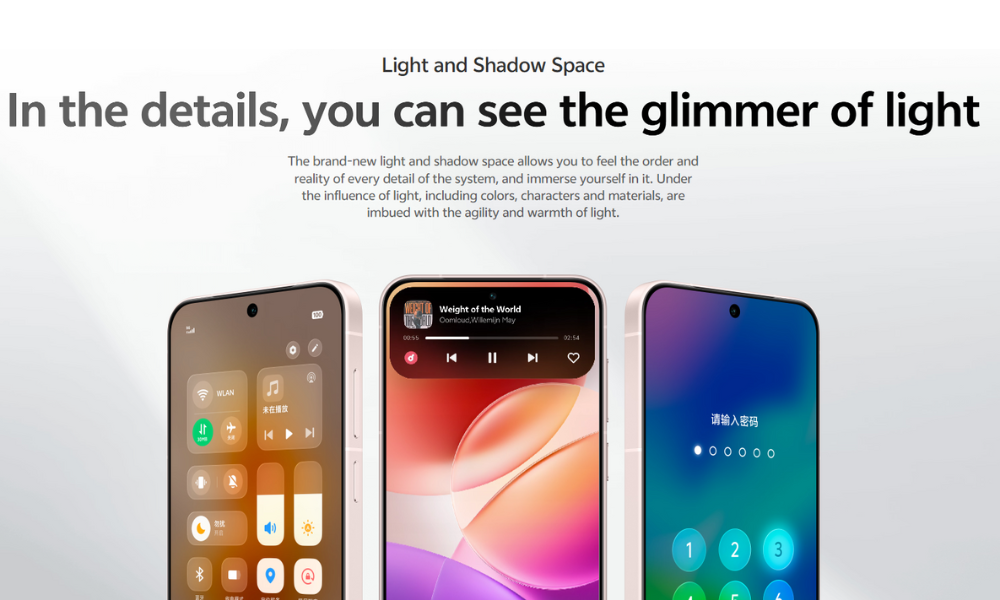
OriginOS 6 introduces “Light and Shadow Space,” a new design language that simulates natural lighting and depth that feels more intuitive to use. It uses translucent materials, realistic shadows, and subtle blur to make elements feel physically layered.
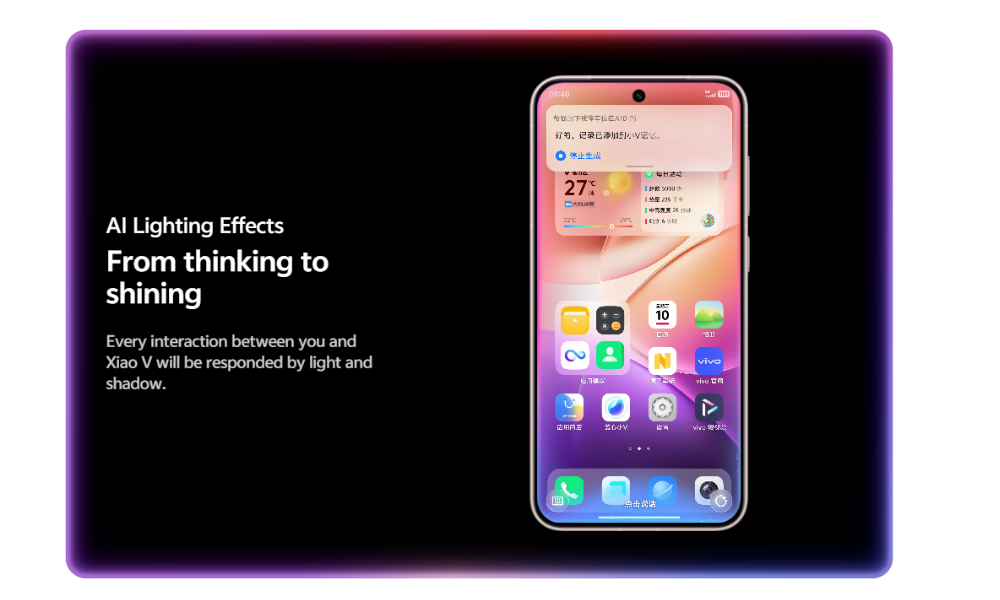
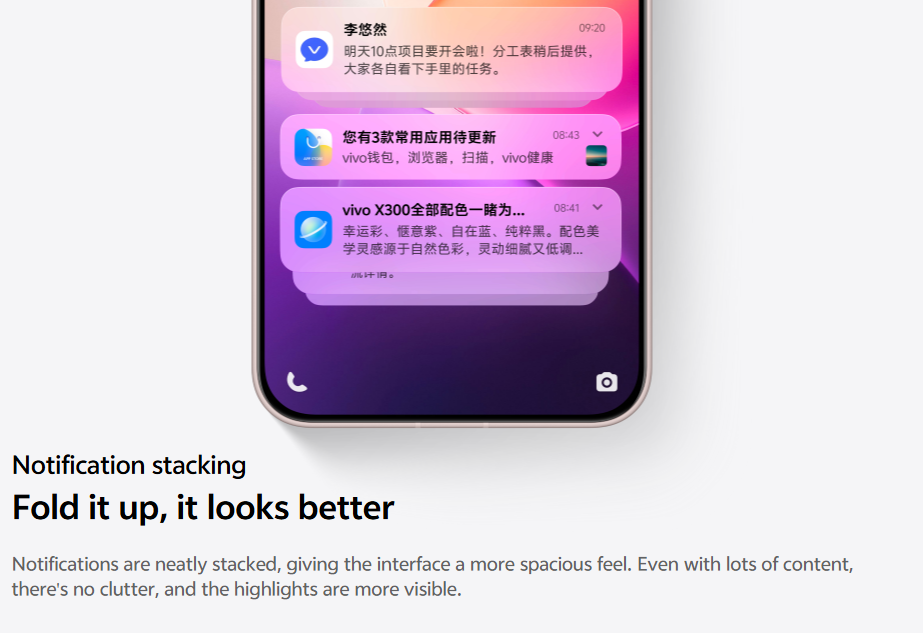
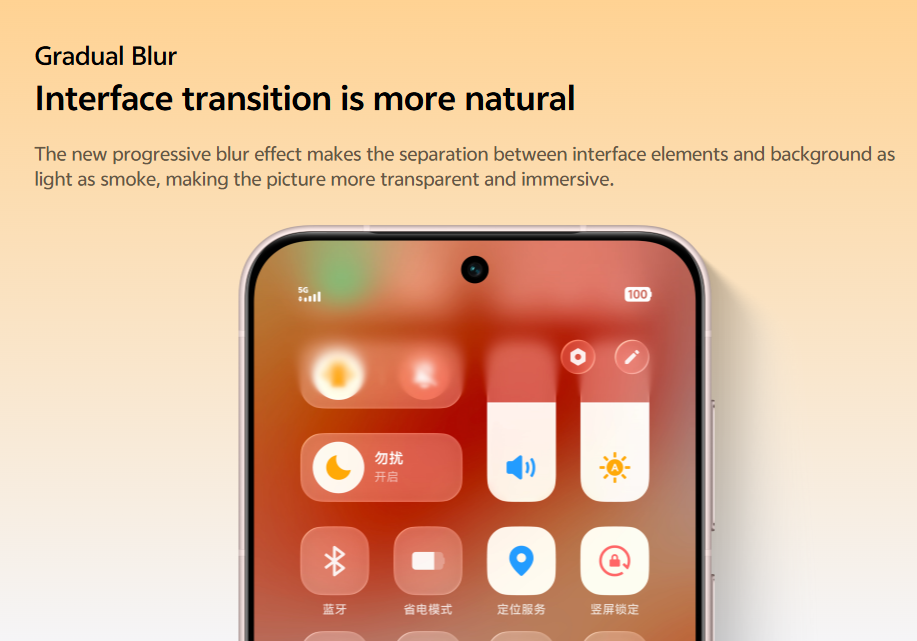
There are also Gradual Blur effects that separate elements from the background for smoother visuals. Vivo has also added AI Lighting Effects to Xiao V (Vivo’s AI assistant) interactions. The new Notification stacking feature groups notifications for easier finding and a less cluttered experience.
The interface switching is now more pleasing as the new screen gradually appears, and the blurred background makes the transition more comfortable and improves the focus. The Android 16-based update also includes numerous features like Elastic Motion and Frame Morphing to further improve animations and user interactions.
2. Lock screen is now more fun and customizable
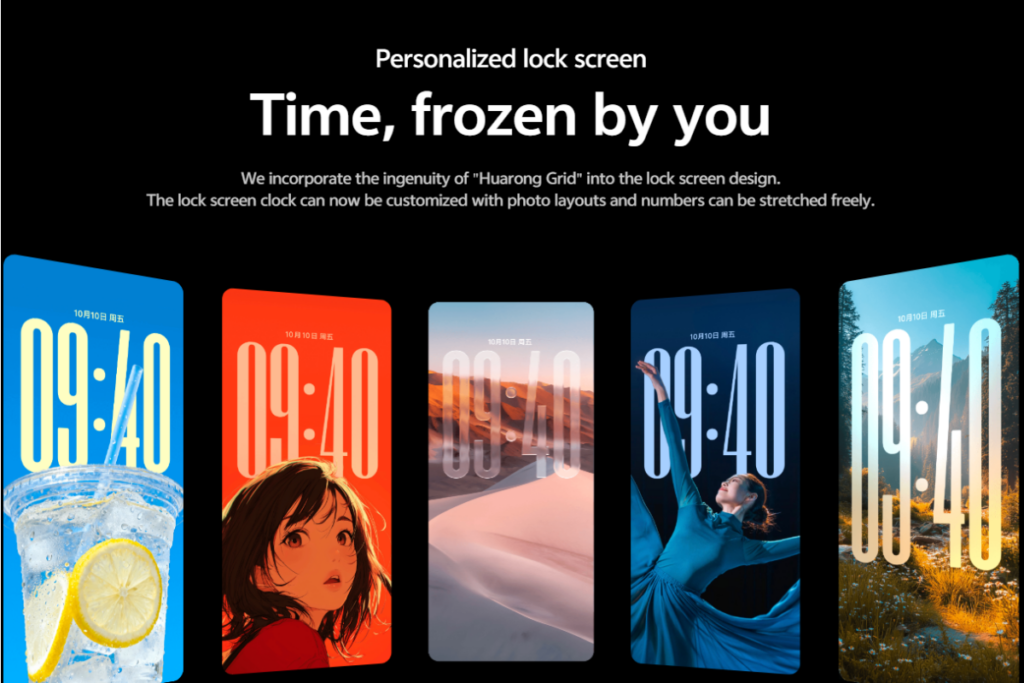
OriginOS 6 brings some nice and useful upgrades to the lock screen, making it super fun to play with. The Mirror Screen Effects provide dynamic changes from different viewing angles, aligning with the new Light and Shadow Space visual system that simulates natural lighting and depth. Combined with the updated blur and layering on the lock screen, the result is a lock screen that’s animated and “material,” rather than flat.
The clock can now be moved anywhere on the lock screen, and the photo modules can be aligned or rearranged for a more personalized experience. OriginOS 6 also adds new clock styles and layout presets.
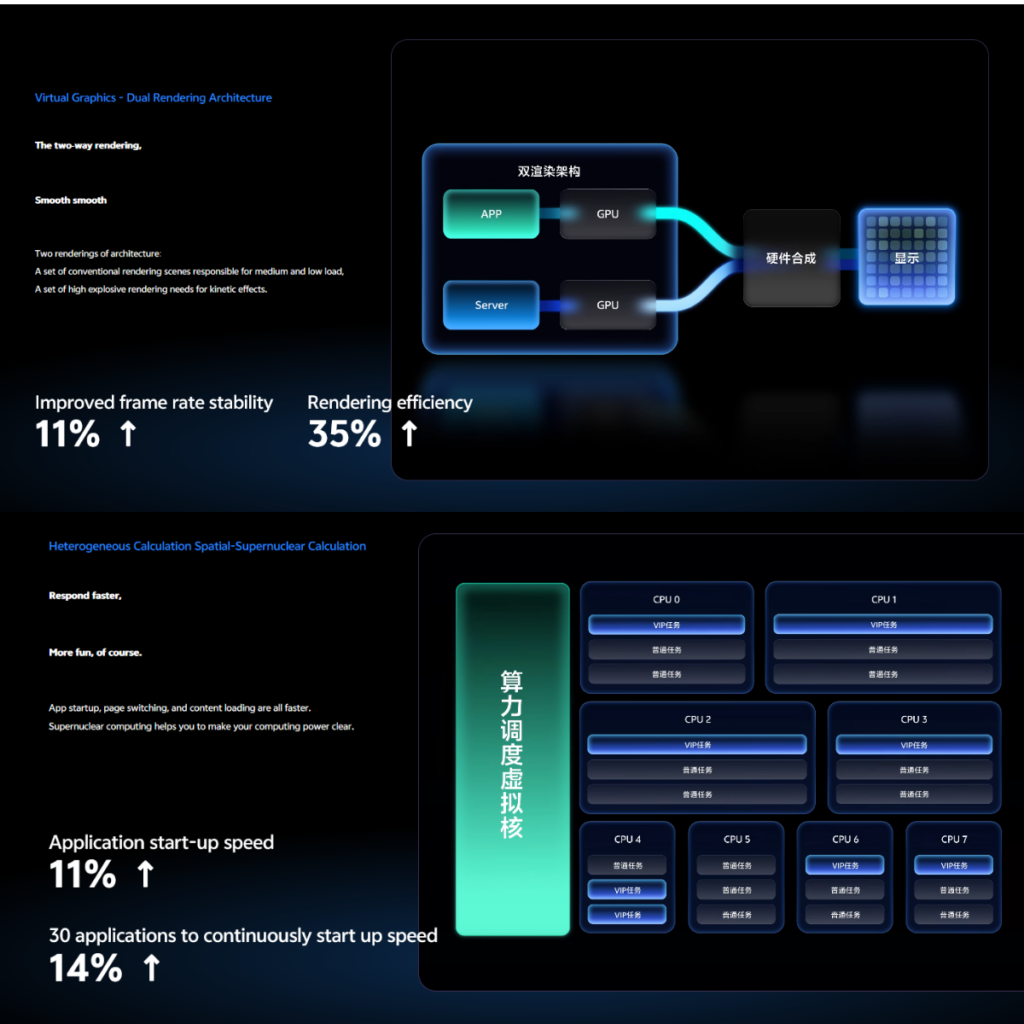
OriginOS 6 achieves 11% improved frame rate stability and 35% improved rendering efficiency by using a dual rendering architecture. One is designed for handling regular rendering scenes with medium to low loads, while the second is specifically tailored for high-load rendering tasks, such as motion effects.
Hypercore computing enables applications to launch 14% faster. It also improves page switching and content loading speed. The Photonic Storage architecture further contributes to improved performance by efficiently utilizing CPU cache, memory, and storage. It achieves a 230% improvement in scene data loading after reloading and a 15% boost in memory recycling speed.
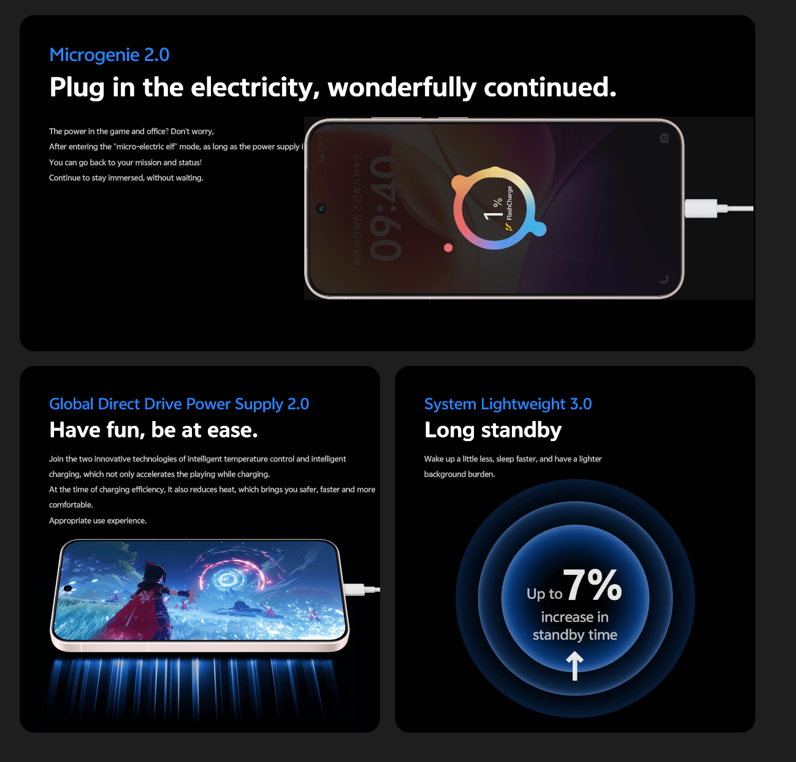
Furthermore, Scenario Energy Efficiency 2.0 utilizes six energy efficiency algorithms to enhance performance and extend battery life. More specifically, this results in 7% improved battery efficiency during video calls, or 18% higher battery life with continuous short videos, or 14% more battery life when gaming. Gamers can now enable the Micro Power Wizard mode and plug in the power supply to instantly return to the previous task, without waiting.
OriginOS 6 also includes Global Direct Drive Power Supply 2.0 for intelligent temperature controlling and smart charging, and System Lightweight 3.0 for up to 7% increase in standby time.
4. Shake to share in a group
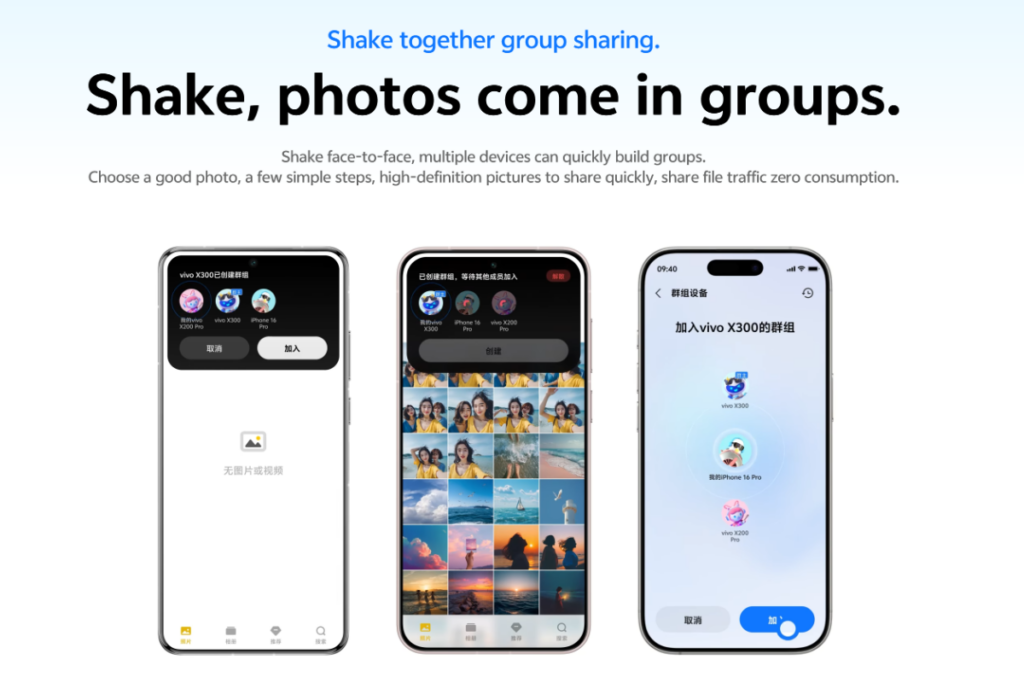
Sharing photos with multiple devices is now a lot easier. Using the Shake to share feature, users only need to shake their phones face-to-face, and it will quickly create a group to share photos without consuming any internet data.
5. AI gets smarter and more useful
OriginOS 6 users can instantly remove unwanted people or objects from live photos with the help of AI. The Xiao V circle search feature can intelligently identify links, products, and addresses on the screen. Vivo phones outside China already have a Circle to Search feature from Google. So, the Xiao V circle search feature may remain limited to China.
Users can long-press the screen to add information to Xiao V Memory, which intelligently categorizes information along with schedules and addresses. The synced details can be imported into Vivo input method’s common phrases to make the keyword personalized.
OriginOS 6 enables natural language search, so that you don’t have to remember the exact name. Simply describe what you’re looking for and let the AI do the job. It works with file management, email, Atomic Notes, and many other apps.
6. Improved cross-device integration
The new Vivo Office Suite enables faster file sharing across smartphones, PCs, and web platforms. Users can send any number of files in any format, or even an entire folder. Devices must be logged into the same account to use this feature. OriginOS 6 enables iPad users to view and download audio, videos, and files from Vivo phones. The Vivo phone can also be projected to the iPad.
Vivo also makes it easier to control other devices. With OriginOS 6, users can issue commands to Lanxin Xiao V to control multiple smart home devices, including air conditioners, air purifiers, and more. The Mirror Window 2.0 enables screen mirroring, while also offering full phone capabilities to the car’s screen, such as chatting, watching TV series, navigation, and more.
For Vivo and iQOO devices outside of China, the OriginOS 6 will be a much bigger upgrade, as those devices will switch from Funtouch OS. Users will get a completely redesigned Quick Settings panel, new icons, and a host of new features. The global launch is set for October 15, where the brand will reveal all the changes, alongside the eligible devices list and rollout schedule.
You can regularly visit our Android 16 section for the latest updates. Also, don’t forget to join our Telegram channel for instant updates about the latest happenings in tech.
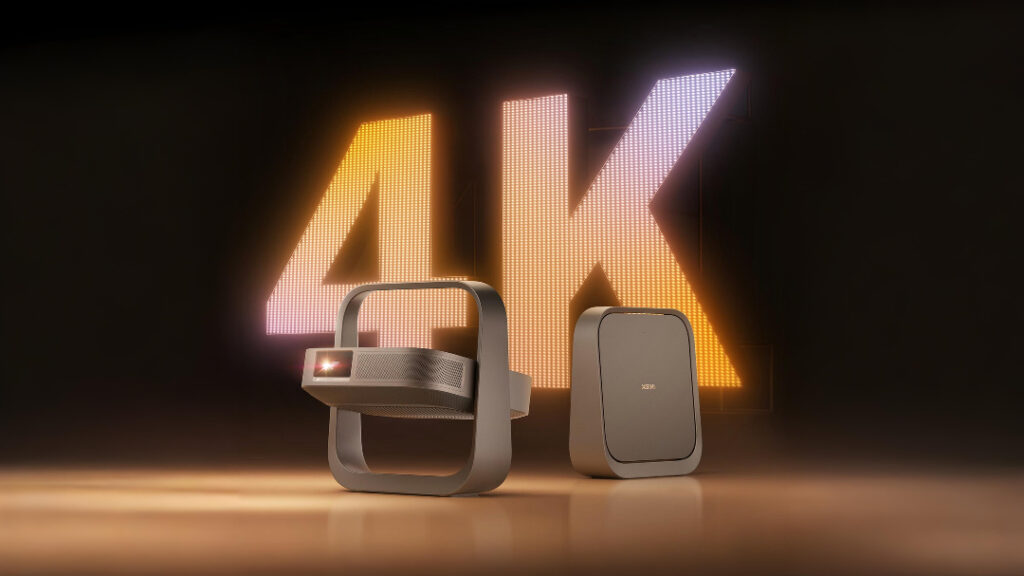
Xgimi has introduced its new ultra-slim 4K projector, the Z9X, in China. It is currently open for pre-orders on JD.com at 4,124 yuan ($580) and will officially go on sale on October 15. The global version is expected to debut under the Elfin Flip series.
Xgimi Z9X Specifications
The Z9X comes in a Mocha Brown finish, weighs 1.5 kg, and has a thickness of just 7.8 cm. It includes a gimbal-style hinge that allows 150-degree tilt adjustment for projecting onto walls or ceilings.
The projector uses a 0.39-inch DMD chip to deliver native 4K resolution with 1300 CVIA lumens brightness. Its optical zoom lens offers a 0.98-1.3:1 throw ratio, enabling a sharp 100-inch projection from 2.17 meters.
Xgimi has equipped the projector with the MT9681 flagship chipset, which is used in the company’s high-end models. It includes a G57-MC1 GPU clocked at 816MHz, 3GB of RAM, and 64GB of storage. The system supports 240fps gaming at 1080p, VRR (variable refresh rate), and ALLM (auto low-latency mode).
The Z9X uses the new Qualas 32 laser light engine. Xgimi claims an 18% improvement in light efficiency and a 20,000:1 dynamic contrast ratio. The projector supports HDR10, HLG, and HDR Vivid. It also features Xgimi’s AI-based processing, which includes AI-HDR, AI-PQ, and AI-SR upscaling. The lens module uses a 10-layer optical stack with LSR coating to reduce speckle and chromatic aberrations.
The projector supports four color gamuts: 110% BT.2020, DCI-P3, Rec.709, and Adobe RGB. Its color accuracy is rated at ΔE < 1, ensuring precise reproduction. Xgimi has integrated a human-eye bionic color algorithm and collaborated with professional cinematographers to fine-tune color modes tailored for portraits, films, and documentaries.
The Z9X includes dual 7W speakers tuned by Harman Kardon, delivering immersive audio with Dolby Audio and DTS:X support. It runs on Xgimi’s AI operating system, which works seamlessly with Xiao Ai voice control and the Mi Home smart ecosystem. The projector also includes several intelligent functions such as automatic focus, keystone correction, screen alignment, color wall detection, and obstacle avoidance.
The I/O options include two HDMI ports (one with eARC), USB 3.0 and 2.0, DC input, Wi-Fi 6, and Bluetooth 5.4. The projector operates under 28 dB and consumes around 100W of power.
In related news, Xgimi has unveiled the Horizon 20 series featuring up to 5,700 ISO lumens brightness and a 1ms gaming mode, alongside the Titan 4K projector equipped with 5,000 ISO lumens and a dual-laser engine.
For more daily updates, please visit our News Section.
Japan is turning to cutting-edge drone technology to protect its poultry farms from devastating bird flu outbreaks. In one of the most ambitious biosecurity moves in recent years, authorities have deployed laser-equipped drones to scare away virus-carrying wild birds before they can spread the disease.
source: nttedt.co.jp
A Serious Threat to Poultry Farms
Avian influenza is one of the biggest threats to the global poultry industry. A single outbreak can wipe out entire farms and lead to massive economic losses. Earlier this year, a major outbreak in Chiba Prefecture forced the culling of more than 3.3 million birds in just two months. Nationwide, around 4.6 million poultry were lost.
The main culprits are wild birds, especially crows, pigeons, and migratory waterfowl, that can carry the virus without showing symptoms. They spread it through droppings, saliva, or nasal fluids. Once the virus reaches domestic flocks, it can spread rapidly, forcing farms to take drastic measures like culling.
NTT Leads the Innovation
To prevent such disasters, Nippon Telegraph and Telephone (NTT) has developed a new drone-based solution. In collaboration with NTT e-Drone Technology, NTT East, and the Chiba Prefectural Government, the company has created an autonomous bird-repellent system using its BB102 drone model.
Unlike typical drones used for spraying or mapping, these drones patrol poultry farms day and night. They are equipped with red and green laser projectors that flash intermittently, an approach designed to make birds uncomfortable without harming them.
How the Laser Drones Work
The BB102 drone flies above poultry farms, scanning for wild birds. When birds are detected, it flashes multiple red and green laser beams to drive them away. These colors have been scientifically proven to deter animals, including pigeons, crows, and deer.
The flashing pattern plays a crucial role. Continuous light can lose its effect over time as birds adapt, but intermittent flashes prevent this. In short, the drones build an “aerial protective net,” keeping wild birds and the virus they may carry at a distance.
source: nttedt.co.jp
A Clean, Quiet, and Smart Solution
Unlike gas cannons or netting, the drone system is fully automated and silent. It works in all weather conditions and doesn’t rely on chemicals, making it an environmentally friendly alternative. This shift also reduces dependence on reactive measures like mass culling, helping farmers protect both their flocks and their livelihoods.
Traditional Methods
Limitations
BB102 Drone Advantages
Gas cannons
Loud and requires a manual reset
Silent and automated
Nets
Labor-intensive and limited coverage
Wide aerial coverage
Chemicals/pesticides
Polluting and costly
Eco-friendly deterrence
Backed by Science and Policy
Studies have linked bird flu outbreaks in Japan to migratory bird movements in late winter and spring. By scaring away potential carriers before they land, the drones address the problem at its source.
The program is supported by the Japanese government, which offers subsidies to encourage farmers to adopt this technology. It also fits into the country’s broader strategy of precision agriculture and AI-based farm management.
A Model for the World
Laser deterrent systems are already used at airports in Europe and North America to keep birds away from runways. Japan’s innovation goes a step further by combining mobility, automation, and farm-level integration.
Experts believe that if successful, countries like the Netherlands, South Korea, and the United States could adopt similar solutions. This could mark a global shift from reacting to outbreaks through culling to preventing them through smart deterrence.
A New Era of Farm Protection
The BB102 laser drones are more than just a technological upgrade; they represent a smarter, cleaner way to protect food supply chains. By keeping wild birds at bay without harming them, Japan is setting a new standard in farm biosecurity.
With this innovation, poultry farmers can focus on raising healthy flocks while reducing the risk of another devastating bird flu season.
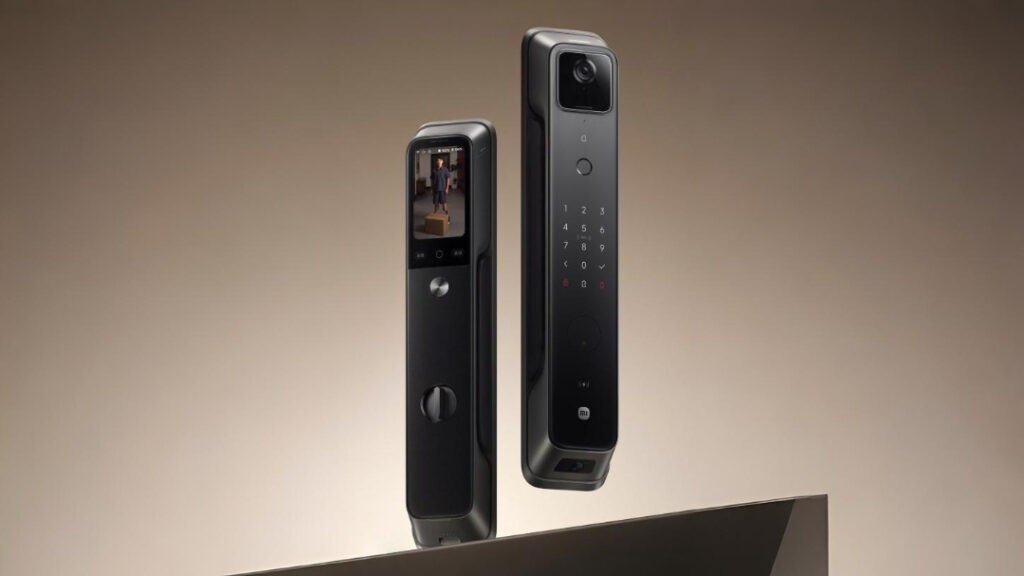
Xiaomi has launched the Smart Door Lock 4 Pro Dual Camera Edition in China. This upgraded version builds on the Smart Door Lock 4 Pro that debuted earlier this year, adding improved hardware. It is priced at 2,899 yuan ($407) and is now available for pre-orders on Xiaomi Youpin.
Xiaomi Smart Door Lock 4 Pro Dual Camera Edition Specs
The lock features AI palm vein recognition technology, which uses near-infrared light to detect unique palm vein patterns. Xiaomi claims the system has a false rejection rate of less than 0.001% and can unlock in under one second. The lock also supports AI 3D face recognition, which is certified by the BCTC Financial Security Test. The facial recognition system works in low light and includes 3D liveness detection to prevent spoofing attempts with photos or videos.
Xiaomi has equipped the lock with a dual-camera peephole setup. The main 3MP camera offers a 160° ultra-wide view, while the secondary 2MP camera covers a 128° angle. This design allows users to see both people standing at the door and packages or objects left on the ground.
The system supports dynamic night vision with five infrared LEDs and switches between color night mode and infrared imaging based on lighting conditions. It comes with a built-in 24GHz millimeter-wave radar sensor that detects motion near the door and automatically records video when someone stays nearby.
Inside the home, the lock includes a 3.97-inch display for real-time video monitoring. It can connect with Xiaomi TVs, smartphones, and smart displays, allowing users to answer calls, view visitors, and unlock remotely through the Mi Home app. It supports up to twelve unlocking methods, including palm vein, 3D face, fingerprint, NFC, Bluetooth, remote unlocking, long-term and temporary passwords, access cards, and mechanical keys. The NFC function works with compatible Xiaomi and Redmi phones, watches, and smart bands.
The lock runs on a dual power system combining a 6,870mAh lithium battery and four AA batteries, offering up to six months of use. Both indoor and outdoor units include USB-C ports for emergency or continuous charging. It also features a quiet automatic lock, C-level anti-pry cylinder, full-door state sensors, and alerts for tampering or failed unlocks.
The Xiaomi Smart Door Lock 4 Pro Dual Camera Edition works with HyperOS Connect for smart home automation. It supports features such as automatic lights, welcome voice prompts, and away-mode security settings.
For more daily updates, please visit our News Section.
Sony India has announced the RX1R III, the third-generation model in its RX1R compact camera lineup. The camera was initially announced globally back in July 2025. It features a 61-megapixel 35mm full-frame Exmor R CMOS image sensor, the latest BIONZ XR image processor, and a ZEISS Sonnar T 35mm F2 lens.
Sony RX1R III features
The RX1R III combines a 61-megapixel back-illuminated sensor with the BIONZ XR engine to deliver high resolution, wide dynamic range, and low noise. The sensor has an anti-reflection coating and no optical low-pass filter, producing sharp and detailed images. The built-in ZEISS lens is tuned to the sensor at the micron level to ensure excellent sharpness and contrast across the frame.
The camera features an AI processing unit used in Sony’s top Alpha models. It detects and tracks eyes, faces, heads, and human bodies even when they are partially hidden. It covers around 78 percent of the frame with 693 phase-detection autofocus points. The Step Crop Shooting function lets users switch between focal lengths equivalent to 35mm, 50mm, and 70mm, and reselect them during RAW editing. The macro mode allows focusing as close as 20 cm, with a maximum magnification of 0.26x.
There are twelve built-in Creative Looks for photos and videos. FL2 gives muted, nostalgic tones, while FL3 produces bright and vivid images.
The RX1R III has a magnesium alloy body that is light and strong. It features a flat top, embedded dials, a comfortable grip, and a 2.36-million-dot XGA OLED electronic viewfinder with 0.70x magnification. The NP-FW50 battery offers up to 300 still shots and can be charged via USB Type-C.
Pricing & availability
The Sony RX1R III is priced at ₹4,69,990 and will be available across Sony Centers, Alpha Flagship stores, authorized retailers, and major e-commerce sites in India from October 10, 2025.
For more daily updates, please visit our News Section.
Red Magic is set to launch its next-generation gaming laptop, the Red Magic Gaming Laptop 16 Pro 2026, in China on October 17. The device is now open for pre-orders on JD.com. The is also expected to be launched globally as the Red Magic Titan 16 Pro (2026).
What to expect?
The laptop was first revealed at the Red Magic Gaming Universe event that happened earlier this year, where the company confirmed that it would feature Intel’s top-tier Core Ultra 9-275HX processor and the Nvidia RTX 5090 GPU. The previous generation, released in July 2024, came with a CNC aluminum alloy chassis, Intel Core i9-14900HX, and GPU options of RTX 4060 and RTX 4070.
According to the teaser, the laptop features a sleek and minimalist design that closely resembles its predecessor. The chassis uses a two-tone grey and black color scheme, giving it a clean and professional look. The overall build appears sturdy with refined edges and a symmetrical form.
Inside, the laptop includes a full-sized keyboard with per-key customizable RGB backlighting. The layout features full-height arrow keys and a dedicated numeric keypad. The large precision touchpad sits below the keyboard and feels spacious for comfortable navigation. The display features slim bezels, allowing for a more immersive view while maintaining a compact footprint.
Red Magic will also launch the Red Magic 11 Pro. The phone is powered by Qualcomm’s Snapdragon 8 Gen 5 Elite processor, paired with an 8,000mAh battery and an under-display 50MP selfie camera. It also features an ultrasonic fingerprint sensor beneath the display and supports IPX8 water resistance.
The device uses a hybrid cooling system with a visible water-cooling ring, circulating blue coolant, and a Wind 4.0 fan spinning at 24,000 RPM. Its custom waterfall air duct improves airflow and maintains stability during long sessions.
For more daily updates, please visit our News Section.
Every year, Samsung rolls out a more luxurious version of its Z Fold lineup exclusively for China, and 2025 is no exception. The company just unveiled the Samsung W26, a reworked version of the Galaxy Z Fold 7 with golden accents all around the phone.
The W26 features an armored aluminium frame and a new hinge design that makes the foldable slim and trim. It measures just 4.2mm thick when unfolded and 8.9mm when folded, matching the Fold 7’s 215-gram weight.
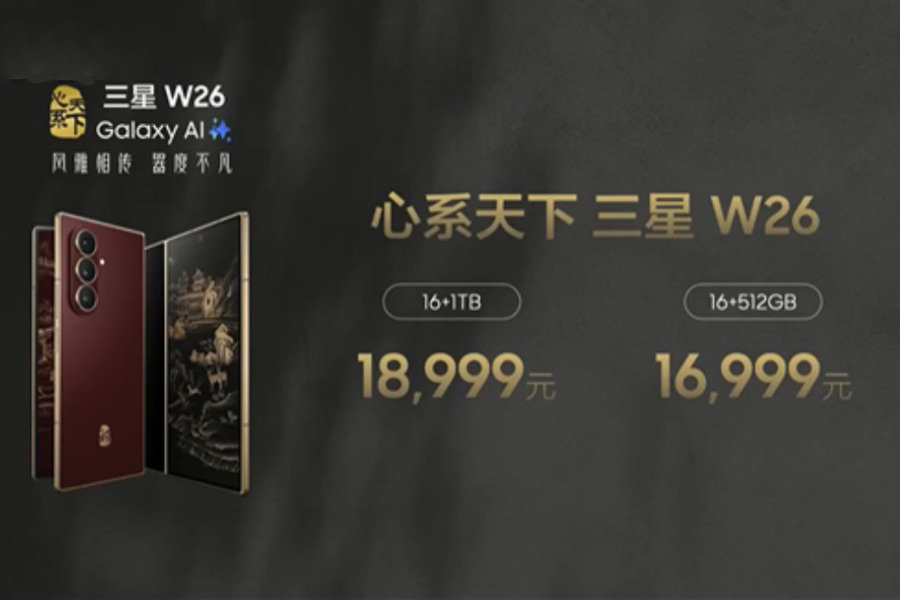
Design-wise, the W26 continues the W series’ signature flair. The triple-camera setup is accented with gold rings, complemented by a golden hinge and frame. It’s available in two finishes: Danxi Red and Xuan Yao Black.
Samsung W26 Specifications
Internally, this thing is no different than Fold 7. It comes loaded with a Snapdragon 8 Elite chip and Android 16-based One UI 8. However, since it’s a premium device, it’s only available in a 16GB RAM variant paired with 512GB or 1TB storage.
The foldable features a 6.5-inch cover display and an 8-inch inner AMOLED screen, both supporting 120Hz LTPO refresh rates. The outer display also gets Corning Gorilla Glass Ceramic 2 protection for extra durability.
For cameras, Samsung hasn’t made any big changes. The W26 inherits the 50MP f/1.8 main sensor with OIS, a 12MP ultra-wide, and a 10MP telephoto camera with 3x optical zoom. On the front, there’s a 10MP selfie camera on the outer display and a 4MP under-display sensor inside.
Powering it all is a 4400mAh battery with 25W wired charging—again, identical to the Z Fold 7.
Price and availability
The Samsung W26 starts at CNY 16,999 (around $2,390) for the 16GB + 512GB model, while the 1TB variant goes for CNY 18,999 (about $2,670). Like previous W-series models, it’s expected to remain exclusive to China.
For more daily updates, please visit our News Section.
Nubia recently confirmed that the Snapdragon 8 Elite Gen 5-powered gaming phones, the Red Magic 11 Pro series, will be unveiled on Oct. 17 in China. Now, the brand has also confirmed that its next flagship, the photography-focused Nubia Z80 Ultra, will debut on Oct. 22 in the country. The official teaser not only confirms the launch date but also gives a first look at its sleek design and finish.
Nubia Z80 Ultra design and color options
Nubua Z80 Ultra launch date
The Nubia Z80 Ultra continues the brand’s tradition of a true full-screen experience, thanks to its under-display front camera, leaving the display completely notch-free. The front panel maintains a minimalist design with ultra-thin bezels, while the back design refines what was seen on last year’s Z70 Ultra.
The phone will be available in three colour variants: Phantom Black, Glacial White, and Starry Collector’s Edition.
Nubia Z80 Ultra specifications (rumored)
It is speculated that a Nubia device bearing model number NX741J, which was spotted on Geekbench with the Snapdragon 8 Elite Gen 5, could be the upcoming Nubia Z80 Ultra. The listing also revealed that the device is equipped with 16GB of RAM and runs Android 16 out of the box.
For imaging, the Nubia Z80 Ultra will feature a triple rear camera system, including a 50-megapixel 35mm main lens, a 1/1.55-inch ultra-wide camera, and a periscope telephoto sensor. The ultra-wide sensor offers f/1.8 aperture and 1μm pixels, promising improved edge distortion control.
On the display front, it will support a 144Hz flat AMOLED screen with an under-display camera. Powering the phone is a large 7,100mAh battery that supports 90W fast charging, though its 3C certification lists a 94.5W charger in the box.
For more daily updates, please visit our News Section.
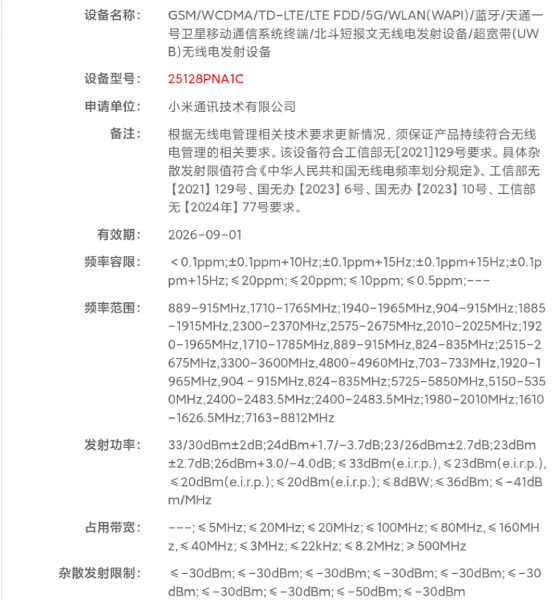
Xiaomi 17 Ultra’s satellite version has now received China’s Radio certification under the model number “25128PNA1C.” It was also previously spotted on the same certification site; however, that was the regular variant of the phone.
According to the listing, this version will support Tiantong-1 and Beidou connectivity for satellite calls and messages. It also has UWB (Ultra-Wideband) support for seamless connectivity across its ecosystem devices.
This Radio certification adds to the growing list of approvals for Xiaomi 17 Ultra. Previously, the global and Indian versions of the phone were spotted on the IMEI database with model numbers 2512BPNDAG and 2512BPNDAI, respectively. It could launch in China in Q1, 2026.
Xiaomi 17 Ultra specifications (rumored)
As always, the talk of the Ultra is the cameras. The Xiaomi 17 Ultra is expected to feature a quad-camera system with the following setup:
Main: Omnivision OV50X, 50MP (1-inch sensor)
Ultra-wide: Samsung JN5, 50MP
Telephoto: Samsung JN5, 50MP
Periscope telephoto: ISOCELL HP5, 200MP
If true, this would be the first time Xiaomi has used a 1-inch main sensor from Omnivision. It has a 1.6μm pixel size and 110dB single-exposure HDR, promising exceptional clarity and dynamic range.
The front could get a 6.85-inch LTPO OLED display with 2K resolution and ultra-narrow bezels, reportedly thinner than the iPhone’s. Powering it all is Qualcomm’s Snapdragon 8 Elite Gen 5, paired with fast wired and wireless charging, IP-rated water resistance, and a large battery.
Xiaomi is also expected to launch its first NAS (Network-Attached Storage) device alongside the 17 Ultra.
For more daily updates, please visit our News Section.
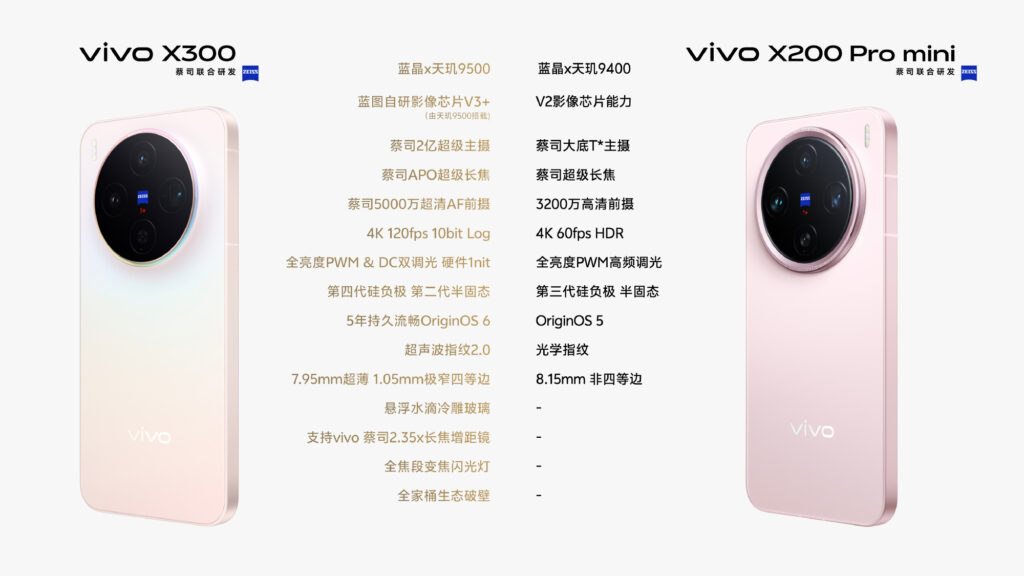
Last year, Vivo unveiled the Vivo X200 Pro Mini, a compact flagship with a 6.3-inch display that remained exclusive to the Chinese market but was well received. This year, there is no Vivo X300 Pro Mini, but the Vivo X300 featuring a 6.3-inch screen is arriving as its successor. The company has rolled out a detailed poster that highlights the range of upgrades the new model brings over its predecessor.
Vivo X300 key specifications
Vivo X300 vs Vivo X200 Pro Mini
The Vivo X300 is powered by the all-new Dimensity 9500 chipset and integrates Vivo’s in-house BlueImage V3+ image chip, which enhances overall imaging capabilities. It now features a Zeiss 200-megapixel ultra main camera alongside an APO telephoto lens and a 50-megapixel autofocus front camera. The device supports 4K 120fps 10-bit Log video recording, making it a clear step up from the X200 Pro Mini’s 4K 60fps HDR capture.
Design-wise, the X300 has a 7.95mm ultra-thin body with uniform 1.05mm bezels and a suspended waterdrop curved glass finish. It also incorporates an ultrasonic fingerprint sensor 2.0, a 4th-generation silicon negative battery with semi-solid technology and runs on OriginOS 6 for long-term fluidity.
How it compares to the X200 Pro Mini
The X200 Pro Mini, launched with the Dimensity 9400 chip, had a 32-megapixel front camera, 8.15mm non-symmetrical design, and OriginOS 5. While it offered strong imaging, the X300 extends the compact flagship philosophy with notable improvements in imaging, power efficiency, and design refinement. Together, these upgrades make the X300 a capable successor that strengthens Vivo’s compact flagship lineup in 2025.
For more daily updates, please visit our News Section.
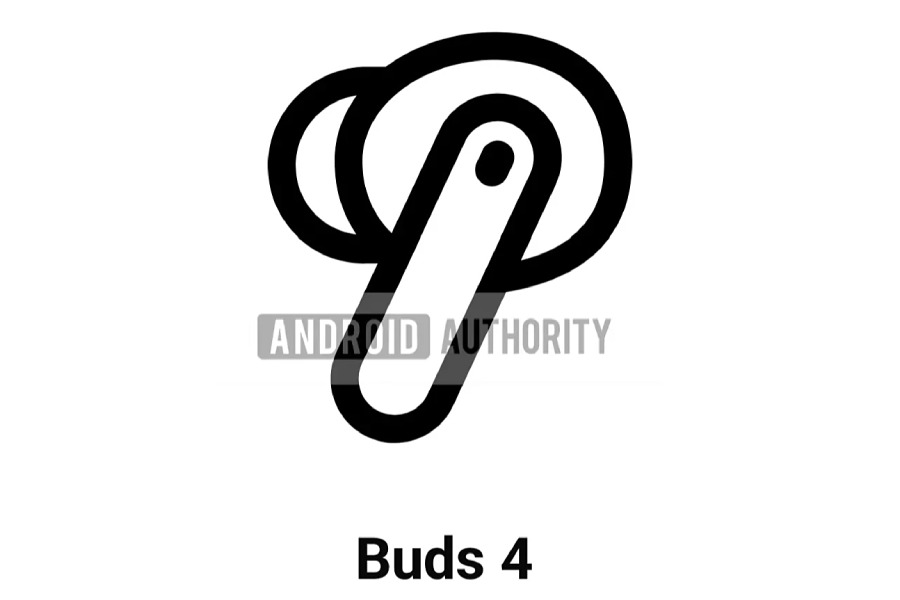
A new leak suggests Samsung might refresh the look of its upcoming Galaxy Buds 4. According to a report from Android Authority, the design was spotted inside icon files from Samsung’s One UI 8.5, and it reveals a somewhat different design from its predecessor.
The report mentions that it found an icon named “list_ic_earbuds_buds4” within the system firmware. This particular file is the same kind of Samsung uses to show earbuds in the device connection menu, which often gives away how a product will look before launch.
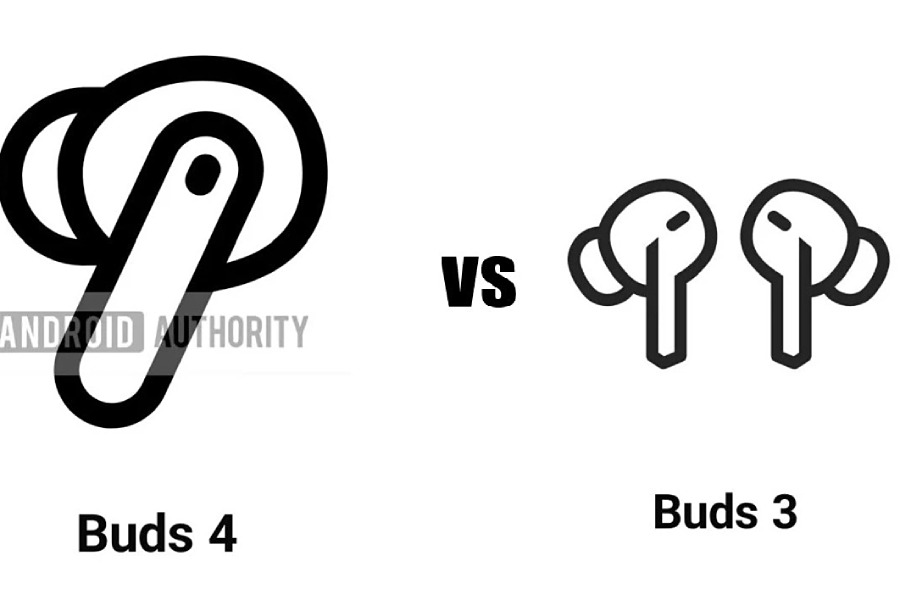
Based on that, the Galaxy Buds 4 will reportedly keep their stem-style design, but Samsung seems to be moving away from the sharper, triangular form factor that defined the Galaxy Buds 3.
Instead, the new earbuds appear more streamlined, giving them a less angular look. Here’s a side-by-side comparison of the Buds 3 and Buds 4 icons.
There’s no confirmation yet from Samsung about when the Galaxy Buds 4 will launch, but this leak suggests that design changes are well underway. Considering the Buds 3 debuted earlier this year, Samsung may be preparing the new model to accompany its next wave of Galaxy devices, maybe alongside the Galaxy S26 lineup in early 2026.
To recap, the Buds 3 come with an 11mm speaker unit and three microphones on each side working in tandem for audio reception, while also analysing the ambient sound for noise cancellation.
It also has Galaxy AI baked into it for features such as Interpreter. The earbuds come with a 48 mAh cell on each side and a 515 mAh unit in their charging case. With this, it delivers up to 6 hours of independent and 30 hours of combined playtime when ANC is turned off.
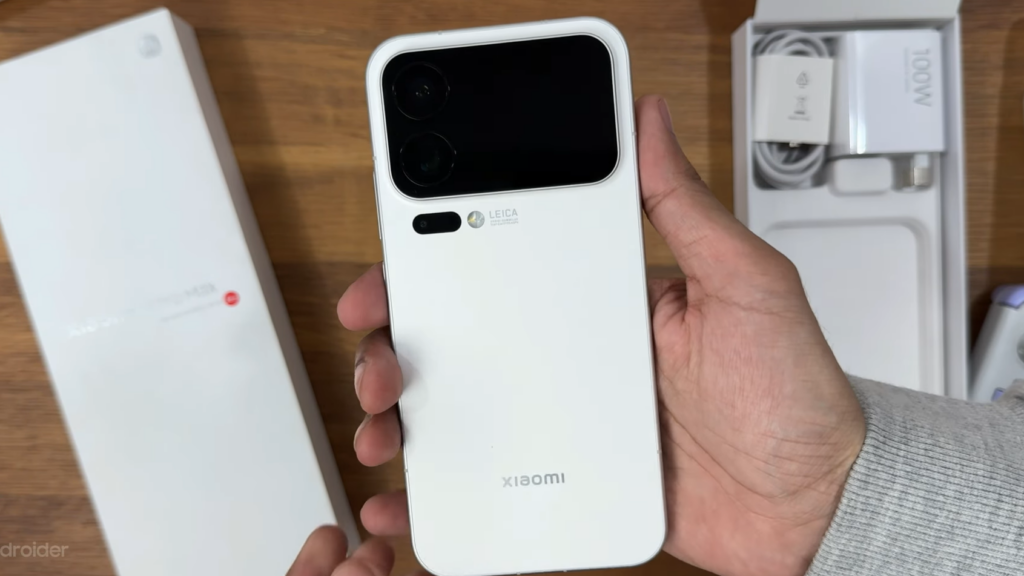
The energy density of smartphone batteries is rapidly increasing, which should contribute to longer runtimes. While the iPhone 17 Pro Max packs a 4,823 mAh battery, Xiaomi’s 17 Pro Max includes a much larger 7,500 mAh cell, yet remains lighter (219 g) than Apple’s largest flagship (233 g). So it’s easy to assume that the Xiaomi 17 Pro Max would outlast the iPhone 17 Pro Max by a significant margin. But a recent battery drain test from TechDroider proved otherwise.
Xiaomi 17 Pro Max
The test included the following phones:
Xiaomi 17 Pro Max – 7,500 mAh
iPhone 17 Pro Max – 4,823 mAh
Galaxy S25 Ultra – 5,000 mAh
Xiaomi 15 Pro – 6,100 mAh
Pixel 10 Pro XL – 5,200 mAh
OnePlus 13 – 6,000 mAh
The test consisted of a heavy gaming session, YouTube playback, web browsing, Instagram usage, and finally 4K video recording until the phones shut down.
While the Xiaomi did outlast every other phone in the test, the iPhone 17 Pro Max died only five minutes earlier, coming second despite having a 36% smaller battery. While the power efficiency of the A19 Pro and Snapdragon 8 Elite Gen 5 cannot be compared directly (as the two devices run on different platforms and are optimized differently), the major difference in energy content versus runtime suggests Apple has again done an incredible job with its tightly integrated hardware-software approach. Another battery drain test, involving the iPhone Air and Galaxy S25 Edge last month, also suggested the same.
The complete results were as follows:
Xiaomi 17 Pro Max – 13 hours 36 minutes
iPhone 17 Pro Max – 13 hours 31 minutes
Xiaomi 15 Pro – 12 hours 31 minutes
OnePlus 13 – 11 hours 56 minutes
Pixel 10 Pro XL – 11 hours 28 minutes
Galaxy S25 Ultra – 11 hours 20 minutes
While runtimes may vary depending on factors like platform-specific app optimization (for example, a game running better on iOS than Android) or network conditions (such as using a weak 5G connection instead of Wi-Fi), the test gives a good idea of where the Android phones stand relative to each other—and reinforces that the iPhone 17 Pro Max remains one of the top performers in battery endurance.
The race to 2nm chips is heating up, and Samsung seems ready to take another swing at TSMC’s dominance. According to a new report from South Korea’s New Daily, Samsung Foundry has shipped test samples of Qualcomm’s Snapdragon 8 Elite Gen 5 built on its latest 2nm Gate-All-Around (GAA) process.
Samsung has reportedly been offering aggressive pricing to win Qualcomm back, potentially setting the stage for a new foundry price war.
Qualcomm explores dual sourcing once again
The Snapdragon 8 Elite Gen 5 was officially unveiled at the Snapdragon Summit in late September 2025 and has already entered mass production at TSMC. But Qualcomm’s decision to test Samsung’s 2nm process looks like a strategic move to diversify its supply chain and reduce dependency on a single foundry.
Over the next few months, Qualcomm engineers will test Samsung’s samples for yield consistency, thermal management, and long-term reliability. If the results hold up, production could begin in time for future flagships like the Galaxy Z Flip 8 in 2026.
This is not Samsung’s first attempt at making Qualcomm chips. The company’s previous outings with the Snapdragon 888 and Snapdragon 8 Gen 1 were marred by yield and thermal issues, which ultimately pushed Qualcomm to switch back to TSMC. Since then, however, Samsung appears to have stabilized its process technology. The South Korean giant was confident enough to equip its foldables with an Exynos chip for the first time this year, powering the Galaxy Z Flip7 with the Exynos 2500 — and so far, the device hasn’t shown any major performance issues.
With wafer costs at TSMC’s advanced nodes climbing by as much as 24% year over year, Samsung’s lower pricing could make it an attractive alternative.
If Qualcomm does greenlight the partnership, the first 2nm Snapdragon chip could debut in Samsung’s Galaxy Z Flip8 by mid-2026. For those wondering, the Exynos 2600 is expected to power the Galaxy S26 series in most markets, provided it enters mass production before January 2026.
A healthy rivalry between Samsung and TSMC could benefit consumers too, helping keep chip prices in check while accelerating efficiency improvements for upcoming flagship devices.
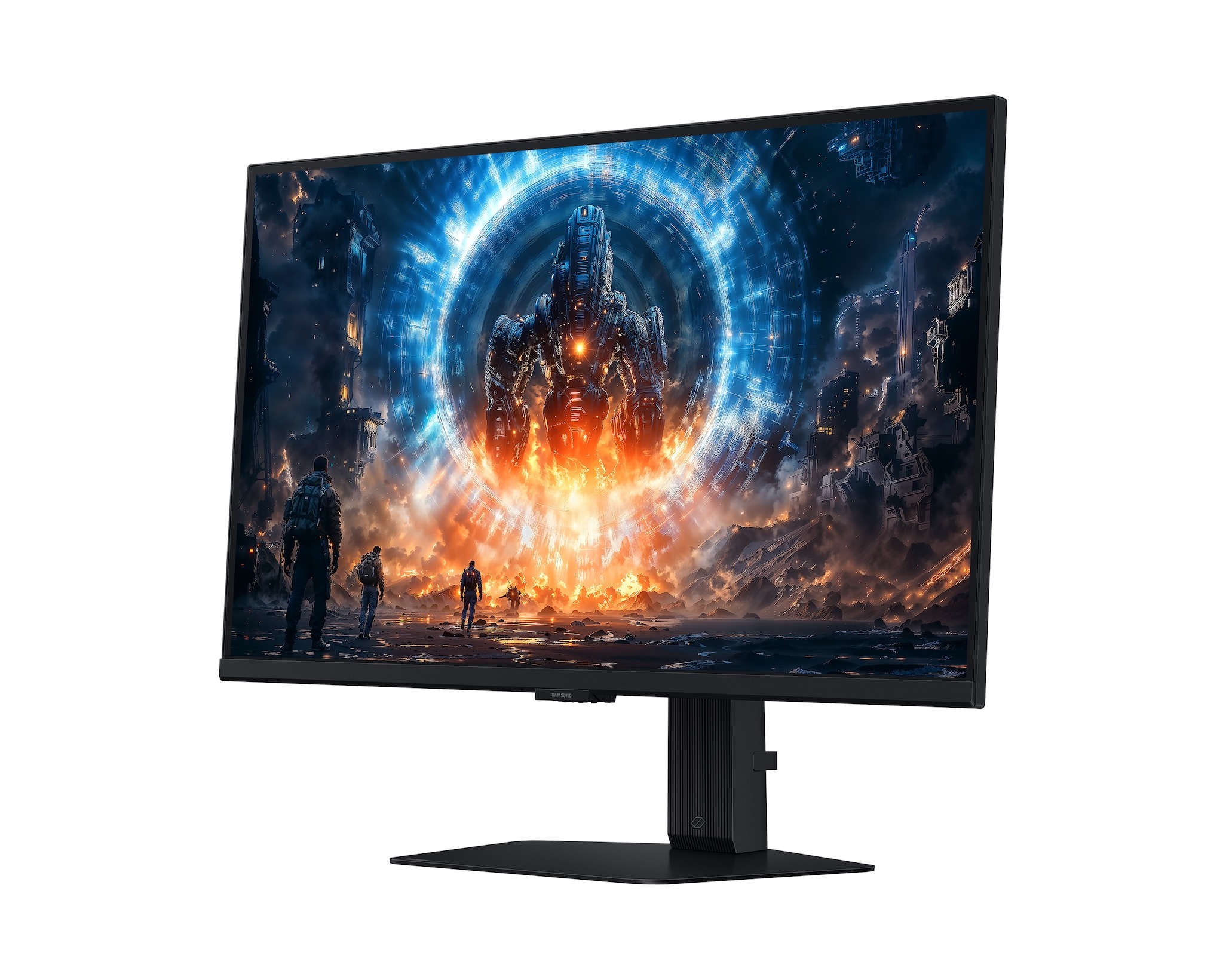
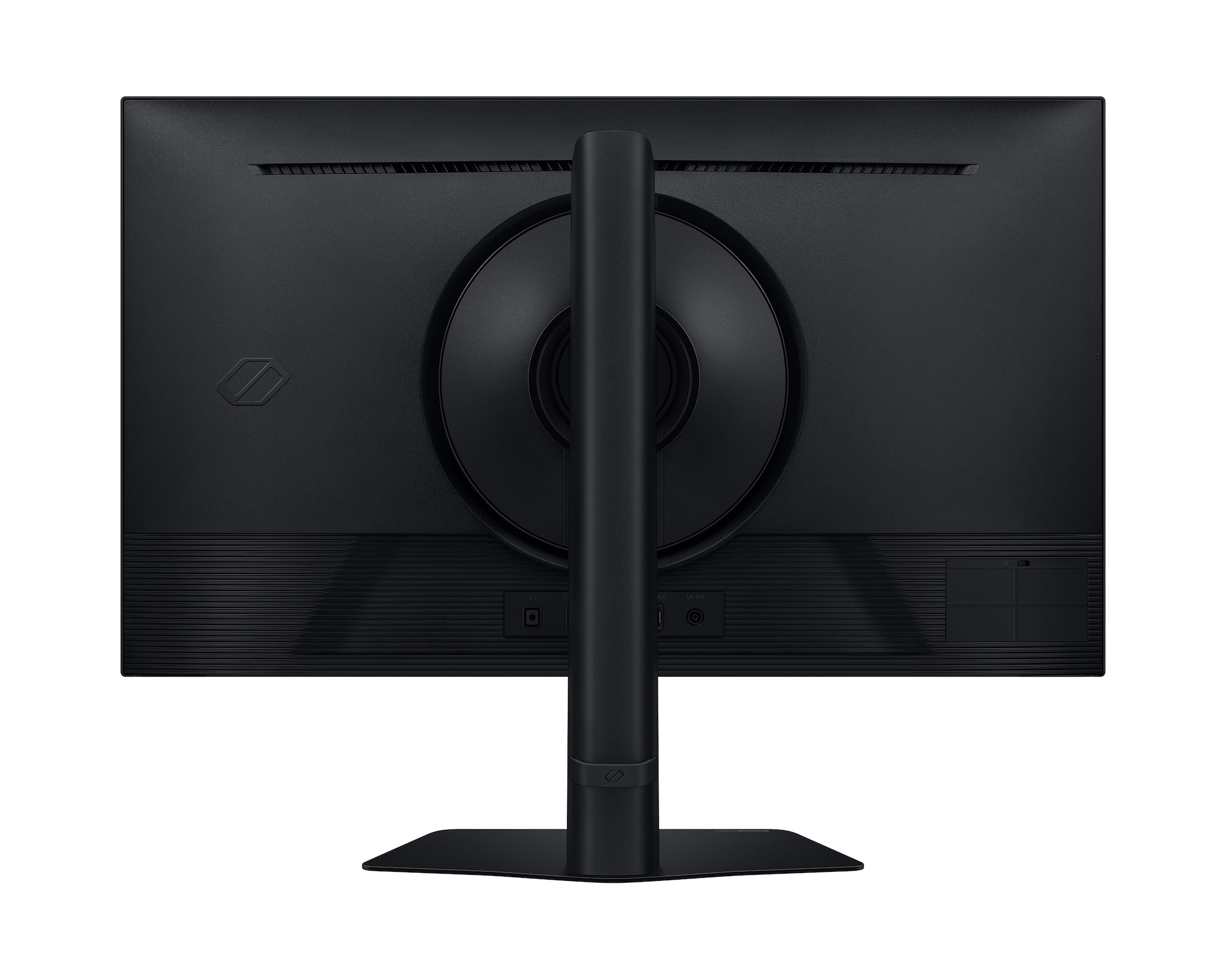
Samsung has launched the Odyssey G60F gaming monitor worldwide after introducing it in China earlier in September 2025. The monitor is now listed on Amazon for $499.99, but Samsung has not yet confirmed when it will go on sale.
Samsung Odyssey G60F Gaming Monitor
The Odyssey G60F comes with a 27-inch Fast IPS panel that offers a 1440p resolution and a 350 Hz refresh rate. It also has a 1 ms gray-to-gray response time, which helps deliver smooth and responsive gameplay. The monitor supports both NVIDIA G-Sync and AMD FreeSync Premium to reduce screen tearing, lag, and stuttering during fast action scenes.
It carries a VESA DisplayHDR 400 certification, which improves brightness, contrast, and depth. The screen also covers 99% of the sRGB color space, providing accurate and consistent colors.
The design of the Odyssey G60F is simple and modern. It has slim bezels and comes with a stand that allows for height, tilt, and swivel adjustments, making it easy to set up for comfort. For connectivity, the monitor includes HDMI 2.1, DisplayPort 1.4 with Display Stream Compression (DSC), and VESA mount support. It also features a flicker-free WLED backlight to reduce eye strain during long gaming or work sessions.
Samsung is expected to announce its availability soon as it is already listed for global markets.
In other news, Gigabyte has unveiled the MO32U2, a 31.5-inch 4K QD-OLED gaming monitor that builds on the MO27U2 with enhanced size and performance. It offers a 3840×2160 resolution, 240Hz refresh rate, and certifications for DisplayHDR True Black 400 and ClearMR 13000.
For more daily updates, please visit our News Section.
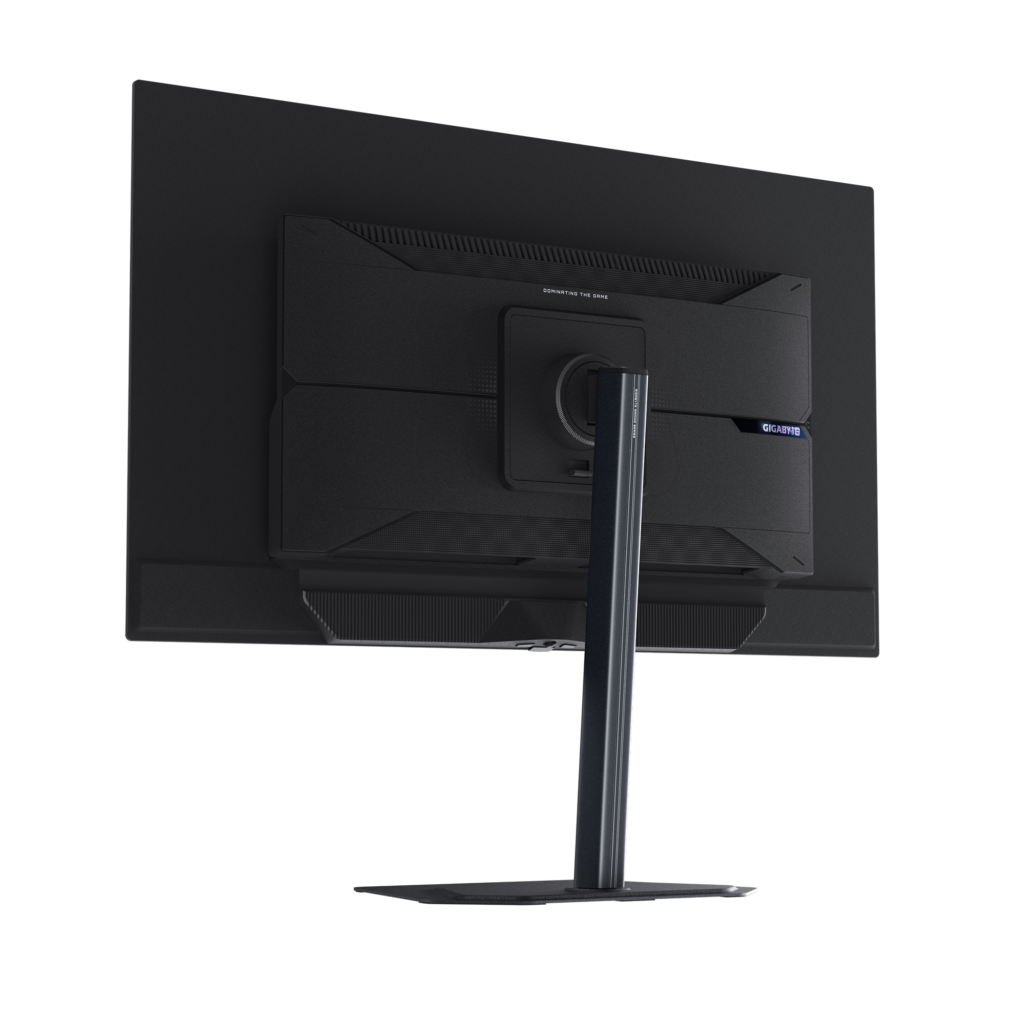
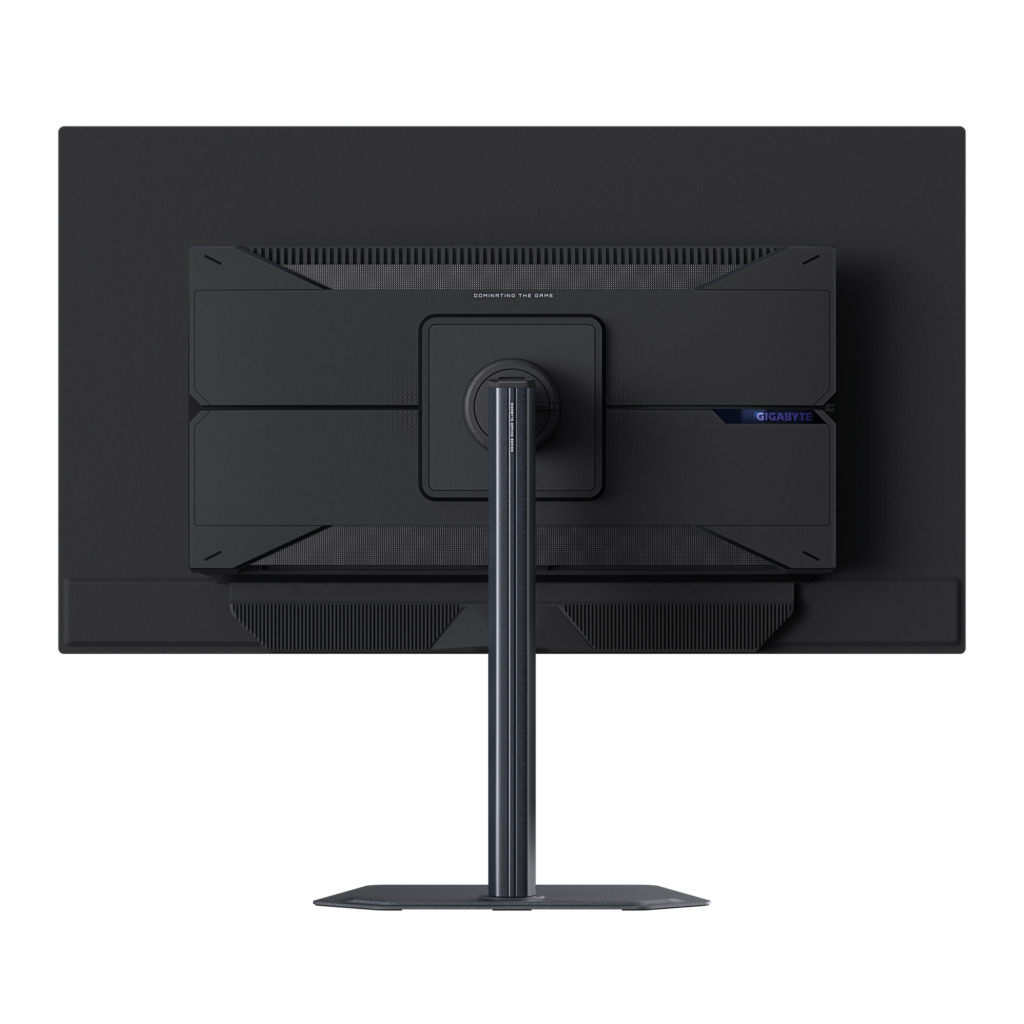
Gigabyte has launched the MO32U2, a 31.5-inch QD-OLED gaming monitor and a larger version of the MO27U2. It features a 4K resolution of 3840×2160 pixels with a 16:9 aspect ratio and supports a 240Hz refresh rate. The monitor comes with DisplayHDR True Black 400 and ClearMR 13000 certifications for better contrast and motion clarity.
The MO32U2 has a contrast ratio of 1,500,000:1, a response time of 0.03ms (gray to gray), and supports 10-bit color depth. It offers 99 percent DCI-P3 color coverage and a DeltaE value below 2 for color accuracy. Brightness levels reach 250 cd/m² in SDR and up to 1,000 nits in HDR. It supports FreeSync Premium Pro and G-Sync for smooth visuals without tearing. A VRR anti-flicker feature helps reduce screen flickering during variable refresh rate operation.
The monitor includes picture-in-picture and picture-by-picture modes, a built-in KVM switch, firmware update support, and two 5W speakers. Gigabyte’s Tactical Switch 2.0 allows users to switch to lower resolutions to improve frame rates. Connectivity options include two HDMI 2.1 ports, one DisplayPort 1.4, a USB-C port with DP Alt Mode and 18W power delivery, a USB 3.0 hub, and a headphone jack.
The MO32U2 offers full ergonomic adjustments including tilt, swivel, height adjustment up to 130mm, and pivot rotation. It also supports 100x100mm VESA wall mounting. The monitor weighs around 6kg without the stand, operates without a fan, and comes with a three-year warranty covering OLED burn-in.
In the box, buyers get a power cable, HDMI 2.1 cable, DisplayPort cable, USB cable, warranty card, quick start guide, and a color calibration report. Pricing and availability have not yet been announced.
Xiaomi has shared its latest weekly report on the current problems affecting HyperOS across different devices. The update lists common bugs, temporary fixes, and the status of ongoing solutions.
The most reported issue this week is that full-screen gestures are not working. The problem affects all devices and all versions of HyperOS. Xiaomi has confirmed that the team is working on it. As a temporary fix, users can switch to button navigation by going to Control Center → Settings → Home screen → System navigation → Buttons.
Another major issue is random reboots on the Xiaomi 12X running version V816.0.1.0.TLDRUXM. The company has identified the cause and says the fix will come in a future version. Redmi Note 13 users are also facing no sound output on several builds including V14.0.9.0.TNGMIXM, V816.0.2.0.UNGMIXM, V14.0.5.0.TNHIDXM, and V816.0.1.0.UNHIDXM. This issue has also been acknowledged and will be corrected in an upcoming update.
Xiaomi has also listed other issues that will be fixed soon. These include random reboots on POCO X4 Pro 5G, Redmi Note 11S, and POCO M4 Pro. Launcher crashes on the Xiaomi Pad 6S Pro 12.4. The microphone not working on the Xiaomi 14 Ultra. System UI not responding on the Redmi 11 Prime 5G and POCO M4 5G. Contact names not showing in the Messaging app on the POCO X6 5G. Inability to download the clock widget on the Redmi Note 13 Pro 5G. The front camera not working on the Redmi Pad SE. Frame drops while gaming on the Xiaomi 13T Pro. Random call drops on the Redmi Note 13 5G. And repeated random reboots and sound issues on the Xiaomi 12X and Redmi Note 13.
Users who face other problems can report them through the Feedback App or post in the ROM subforum to help Xiaomi improve HyperOS with future updates.
For more daily updates, please visit our News Section.
We use cookies on our website to give you the most relevant experience by remembering your preferences and repeat visits. By clicking “Accept”, you consent to the use of ALL the cookies.
This website uses cookies to improve your experience while you navigate through the website. Out of these, the cookies that are categorized as necessary are stored on your browser as they are essential for the working of basic functionalities of the website. We also use third-party cookies that help us analyze and understand how you use this website. These cookies will be stored in your browser only with your consent. You also have the option to opt-out of these cookies. But opting out of some of these cookies may affect your browsing experience.
Necessary cookies are absolutely essential for the website to function properly. This category only includes cookies that ensures basic functionalities and security features of the website. These cookies do not store any personal information.
Any cookies that may not be particularly necessary for the website to function and is used specifically to collect user personal data via analytics, ads, other embedded contents are termed as non-necessary cookies. It is mandatory to procure user consent prior to running these cookies on your website.