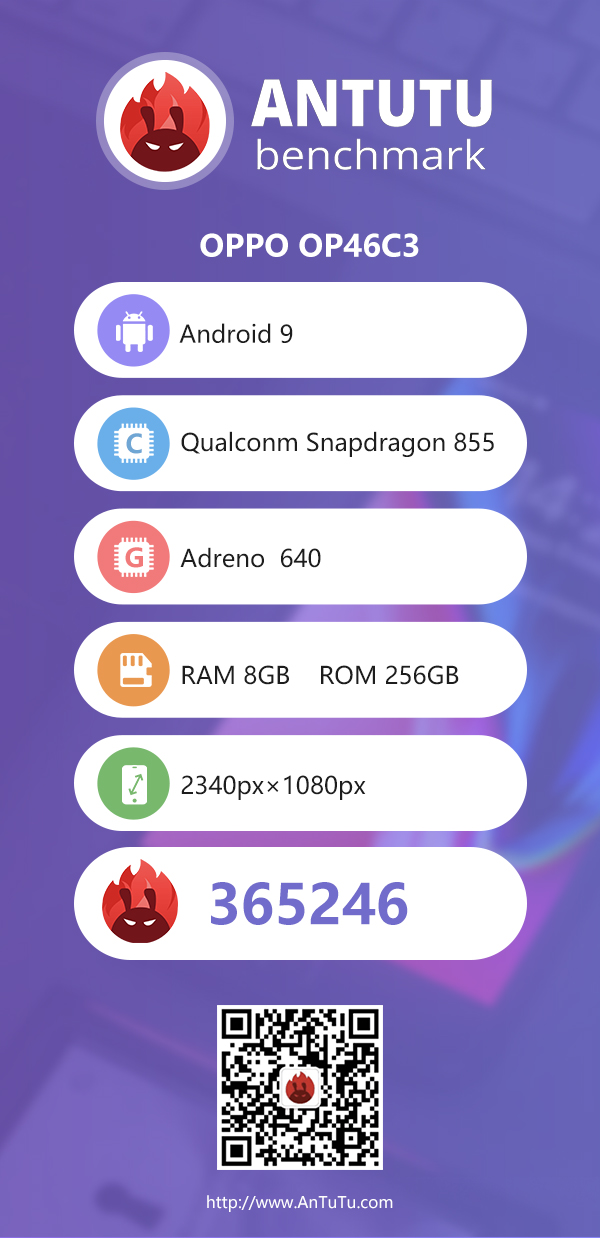
A device which might just be OPPO‘s upcoming flagship has been benchmarked on AnTuTu. The benchmark tool identifies the device as the OPPO OP46C3 and it also lists some of its key specifications.
The OPPO OP46C3 runs Android 9 Pie and is powered by the Snapdragon 855 processor. It also has 8GB of RAM and 256GB of storage. The screen size is unknown but its resolution is 2340 x 1080. This is the same screen resolution as the new OPPO F11 Pro, so this phone most likely won’t have a notch.
Its AnTuTu score is 365,246 which is expected for a Snapdragon 855 phone.
We are not sure but this might be the same flagship phone OPPO’s vice president talked about yesterday. In the Weibo post, he revealed the phone will be powered by the Snapdragon 855 processor, have a 4065mAh battery and 10x hybrid zoom.
Xiaomi launched the premium Redmi Note 7 alongside the Redmi Note 7 Pro on February 28 in India. The Redmi Note 7 was billed to go on sale yesterday (March 6) and it did go on sale. As was expected, the first sale didn’t even last for long before all units were sold out. Xiaomi’s India head Man Jain has revealed via a tweet that the Chinese tech giant had produced over 200,000 unit of the model since production commenced in India till date. He also disclosed that all 200K+ units were sold out in just a few minutes.
#RedmiNote7: we had produced 200K+ units till this week, all of which went out of stock in just a few mins yesterday! 👊
The Redmi Note 7 is not as popular as the Note 7 Pro going by the response from fans before the models were launched. But the device has turned out to be a hot-selling model perhaps buoyed by not selling at the same time with the Redmi Note 7 Pro. The Xiaomi India head hinted that the firm is working hard to increase production for both models. The Redmi Note 7 Pro will go on sale for the first time on March 13 and we expect the sales to be even hotter.
As a reminder, Xiaomi Redmi Note 7 packs a 6.3-inch Full-HD+ “dot notch” display with 2340 x 1080 pixels screen resolution, 19.5:9 aspect ratio, and 409ppi pixel density. Under the hood, it packs Qualcomm’s Snapdragon 660 octa-core processor, clocked at 2.2 GHz and coupled with Adreno 512 GPU. The phone comes in two variants — 3GB RAM and 4GB RAM. The 3GB RAM model has 32GB internal storage while the 4GB RAM model comes with 64GB internal storage. There’s a microSD card slot for expanding the phone’s storage capacity up to 256GB. The camera specs on the Indian variant is quite different as you get a modest 12MP+2MP combo at the back with support for PDAF, Super Night Mode, EIS, Portrait Mode, AI Scene Recognition, and HDR. Guess Xiaomi reserved the 48MP sensor for the Redmi Note 7 Pro. The device comes with a 13MP selfie camera. The phone is powered by a 4,000mAh battery and supports Quick Charge 4.0 fast charging technology.
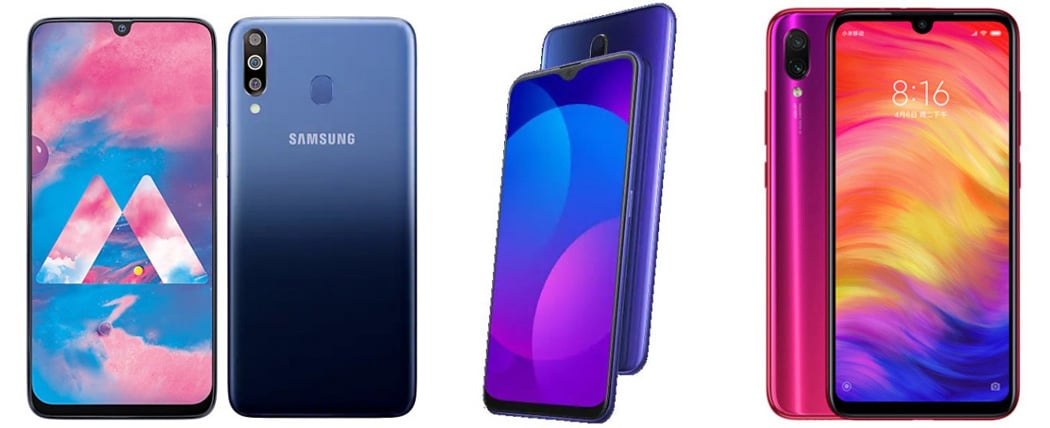
Samsung just launched in India another midrange that will try to cannibalize the sales of its main Chinese concurrence. The Korean giant is struggling at keeping its market share in the midrange segment in the last years, but it does not stop trying. We are talking about the Galaxy M30 which combines a great price with a huge battery and an interesting camera department. In this comparison, the new mid-rangers challenges the Redmi Note 7 Pro that is expected to become one of the best-sellers of 2019 and the newly-announced Oppo F11. Did Samsung release a more interesting mid-ranger than the main Chinese ones? This comparison will help you find out.
Samsung Galaxy M30 vs Oppo F11 vs Xiaomi Redmi Note 7 Pro
Samsung Galaxy M30
Oppo F11
Xiaomi Redmi Note 7 Pro
DIMENSIONS AND WEIGHT
159 x 75.1 x 8.4 mm
161.3 x 76.1 x 8.8 mm, 190 grams
159.2 x 75.2 x 8.1 mm, 186 grams
DISPLAY
6.4 inches, 1080 x 2340p (Full HD+), 394 ppi, Super AMOLED
Triple 13 + 5 + 5 MP f/1.9 and f/2.2 and f/2.2
16 MP f/2.0 front camera
Dual 48 + 5 MP f/1.8 and f/2.4
16 MP f/2.0 front camera
Dual 48 + 5 MP f/1.7 and f/2.4
13 MP front camera
BATTERY
5000 mAh, fast charging 15W
4000 mAh, fast charging with VOOC 3.0
4000 mAh, Fast Charging with Quick Charge 4
ADDITIONAL FEATURES
Hybrid Dual SIM slot
Dual SIM slot
Hybrid Dual SIM slot
Design
The design of the Samsung Galaxy M30 did not convince me so much, unlike its other specifications. The one I prefer more is the Redmi Note 7 Pro with its reflective glass back, pretty compact size and even good build quality. It is not among the most resistant phones out there, but it is water resistant, unlike most of the midrange devices. The reflective glass back can be chosen in stunning gradient color variants making it even more magnetic.
Display
We appreciated the fact that Samsung chose to use a Super AMOLED display even for a midrange from the M series. AMOLED panels provide more vivid colors and this particular one is very brilliant. While the quality of the display of Samsung Galaxy M30 attracts me, someone may prefer the Oppo F11 because it has a bigger and more phablet-like display. With a size of 6.53 inches, it is more suitable for advanced users and productivity. Even if you are a gamer you will find it more comfortable. Redmi Note 7 Pro has a classic midrange-class display which offers nothing exciting, so Samsung Galaxy M30 wins the display comparison.
Specs & Software
Thanks to the powerful Snapdragon 675 and its great GPU, Redmi Note 7 Pro is the king of performances here. It is the best device for you if you like gaming and multi-tasking, because its chipset is faster and it is very performing with high-demanding tasks. The second place should go to the 12 nm Helio P70 found on the Oppo F11. This device alongside the Redmi Note 7 Pro comes with Android 9 Pie out of the box, while Galaxy M30 is still based on Oreo. It does not make the difference as every device comes with a highly customized Android version, but it is good to know. Each of these devices comes in the same memory configurations, so the chipset makes the difference. Note that Oppo F11 has no expandable storage, unlike its rivals which come with a hybrid micro SD slot.
Camera
While Oppo F11 and Redmi Note 7 Pro are equipped with a rear dual camera composed of a main 48 MP sensor and a secondary depth sensor, Samsung Galaxy M30 opts for a triple camera including a 13 MP main sensor, a 5 MP ultrawide sensor and a depth sensor. Oppo F11 and Redmi Note 7 Pro should deliver a better photo quality, while Samsung Galaxy M30 will click more original shots thanks to its wide-angle sensor. Which one do you prefer? The front camera battle should be a hard fight between Samsung Galaxy M30 and Oppo F11. Note that we still did not test all the cameras of these devices, so we can not give you a definitive opinion about them. Despite its photo quality may be inferior, I would personally pick the Samsung Galaxy M30 for its ultrawide sensor. Mid-rangers are far away from flagships when it comes to camera quality, so I would focus on the innovation and original shots instead of camera quality when getting a midrange phone.
Battery
The battery of the Samsung Galaxy M30 is the biggest ones, even though Redmi Note 7 Pro and Oppo F11 are among the best battery phones in their segment. Thanks to its 1000 mAh more than its opponents and its efficient AMOLED display, the Galaxy M30 will surely provide a longer battery life. There should be no challenge and the Galaxy M30 should be able to last up to three days with a moderate usage pattern. Oppo F11 and Redmi Note 7 Pro should last more or less the same, but Redmi Note 7 Pro may offer something more due to its smaller display and its efficient Snapdragon 675 SoC.
Price
In the Asian market, you can get a unit of the Samsung Galaxy M30 or the Oppo F11 for about €250/$280 in the base configuration, while Redmi Note 7 Pro, that is the winner of this comparison because of its better chipset and a higher value for money, can be found at just €200/$225.
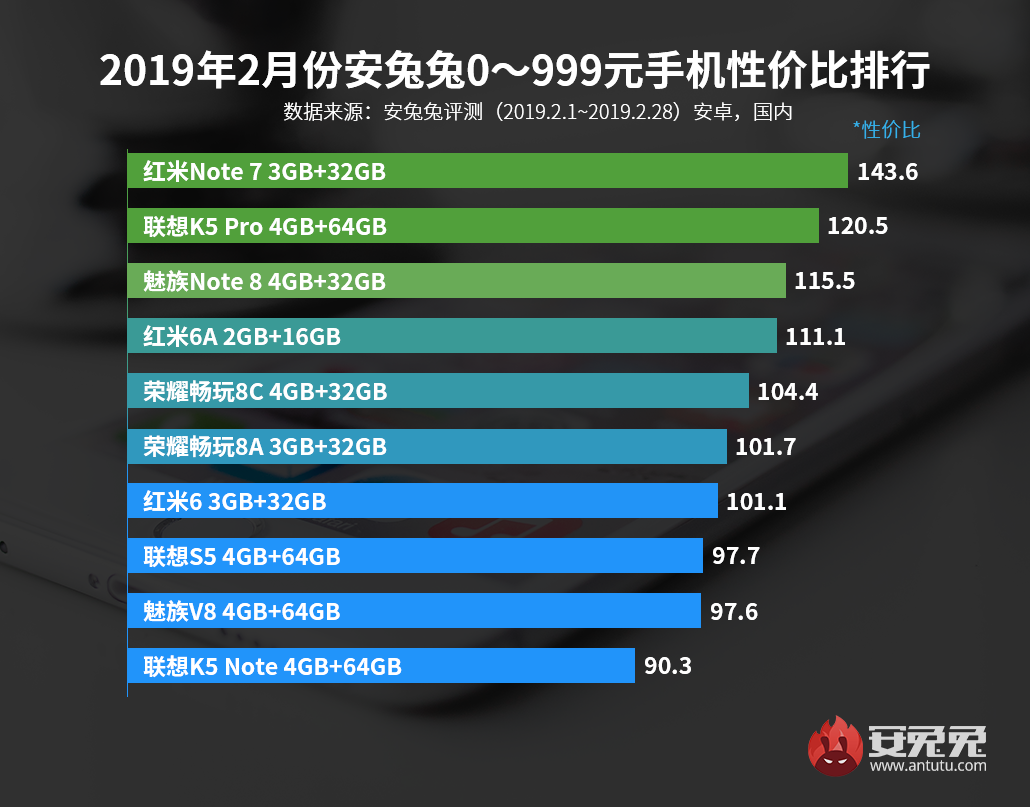
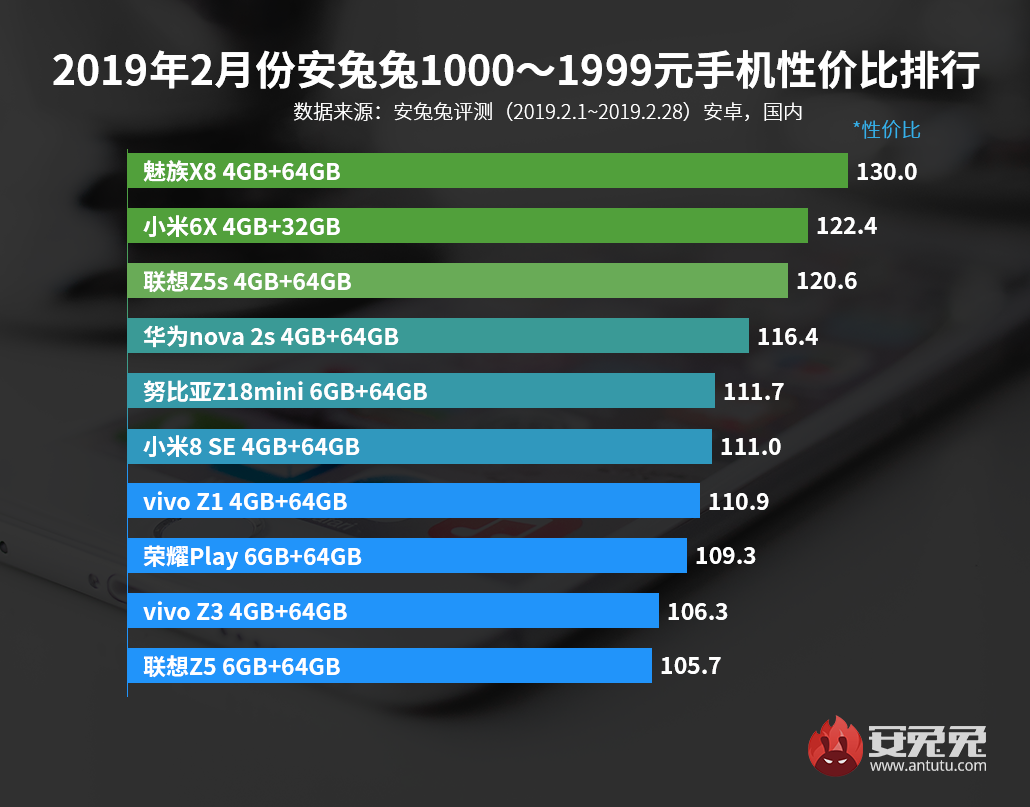
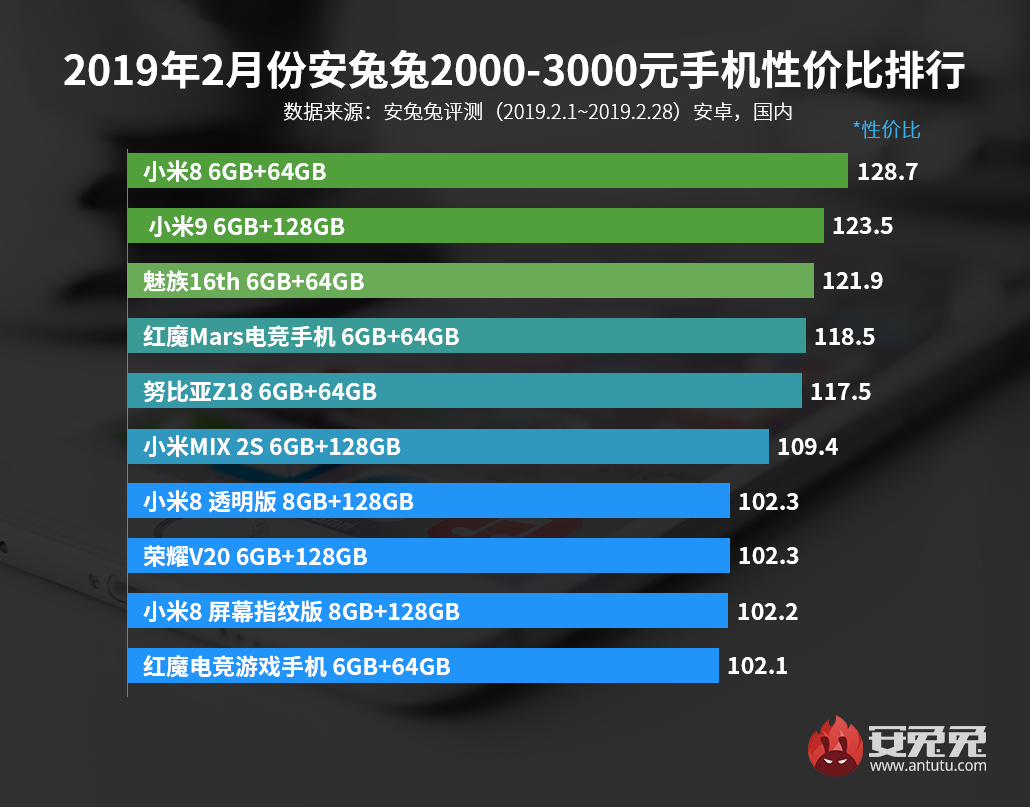
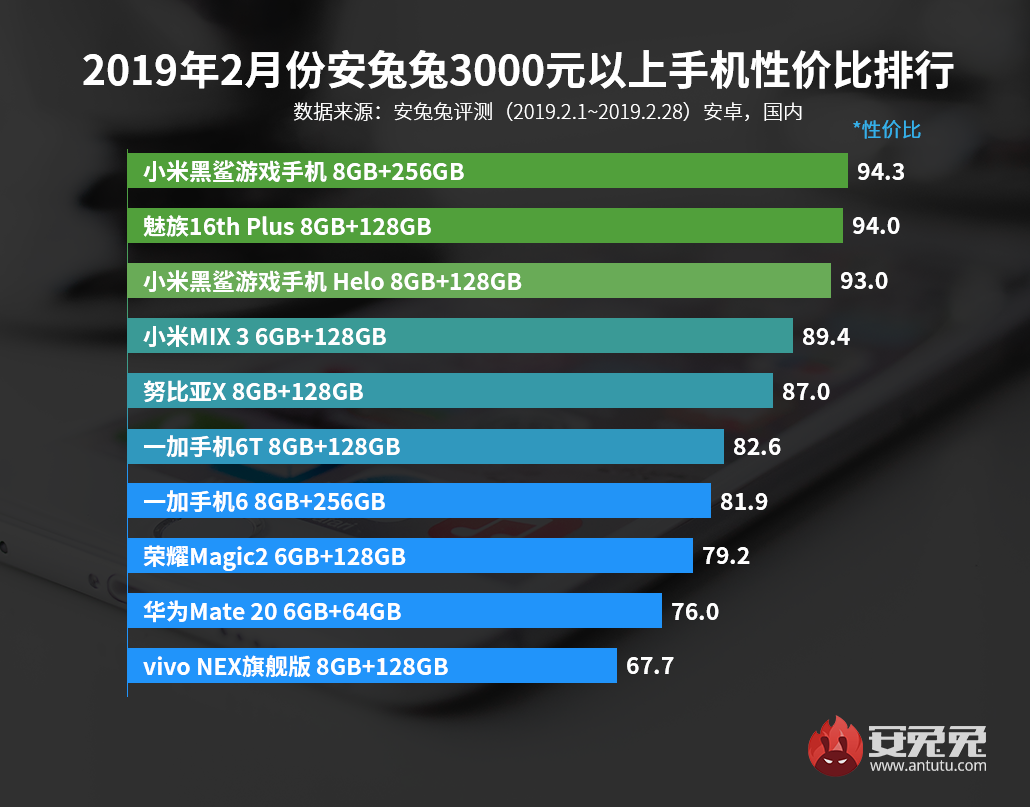
In order to help smartphone buyers to make the right decision, AnTuTu has released the list of the most value for Android phones list for February 2019. The list is divided into three price segments such as 0 to 999 Yuan, 1000 to 1999 Yuan, 2000 to 3000 Yuan and 3,00 Yuan and above. The price-performance lists have been compiled on the basis of average benchmarking score on AnTuTu and current pricing on Jingdong Mall for each smartphone.
The 0 to 999 Yuan (~$150) list is led by 32 GB + 3 GB edition of Redmi Note 7 that is priced at 999 Yuan (~$150). Its value for money (VFM) score is 143.6 and it has scored 143,466 points on AnTuTu. The second place goes to 4 GB + 64 GB Lenovo K5 Pro with 120 VFM score and 114,242 AnTuTu score. It carries a price tag of 948 Yuan (~$140) on Jingdong Mall. The 4 GB + 32 GB Meizu Note 8 that cost 899 Yuan (~$135) is placed on the third position. Its AnTuTu score is 103,813 and VFM score is 115.4.
The other phones that have made it to the list include 2 GB + 16 GB Redmi 6A, 4 GB RAM + 32 GB Honor 8C, 3 GB + 32 GB Honor 8A, 3 GB + 32 GB Redmi 6, 4 GB + 64 GB Lenovo S5, 4 GB + 64 GB Meizu V8 and 4 GB + 64 GB Lenovo K5 Note.
The 1000 to 1999 Yuan (~$150 to ~$300) category has 4 GB + 64 GB Meizu V8 on the number one position with 130 VFM score and 168,757 AnTuTu score. It is priced at 1,299 Yuan (~$193). The 4 GB + 64 GB Xiaomi Mi 6X priced at 1,149 Yuan (~$170) is placed second. Its VFM score is 122.3 and AnTuTu score of 140,634. The 4 GB + 64 GB Lenovo Z5s that costs 1,398 Yuan (~$210) is on the third. Its VFM score is 120.5 and AnTuTu score is 168,543.
The other phones that are included in the list are 4 GB + 64 GB Huawei Nova 2s, 4 GB + 64 GB Nubia Z18 mini, 6 GB + 64 GB Xiaomi Mi 8 SE, 4 GB + 64 GB Vivo Z1, 6 GB + 64 GB Honor Play, 4 GB + 64 GB Vivo Z3 and 6 GB + 64 GB Lenovo Z5.
The 2000 to 2999 Yuan (~$300 to ~$450) segment is led by 6 GB + 64 GB Xiaomi Mi 8 that costs 2,299 Yuan (~$343). Its VFM score is 128.7 and AnTuTu score is 295,784. The 6 GB + 128 GB Xiaomi Mi 9 has 123.5 VFM score and 370,459 AnTuTu score. It is priced at 2,999 Yuan (~$450). The third place goes to 6 GB + 64 GB Meizu 16th with 121.9 VFM score and 292,206 AnTuTu. It carries a price tag of 2,398 Yuan (~$360).
6 GB + 64 GB Nubia Red Magic Mars, 6 GB + 64 GB Nubia Z18, 6 GB + 128 GB Xiaomi Mi MIX 2S, 8 GB + 128 GB Xiaomi Mi 8 Explorer Edition, 6 GB + 128 GB Honor V20, 8 GB + 128 GB Xiaomi Mi 8 Screen Fingerprint Edition and 8 GB + 128 GB Nubia Red Magic are the remaining phones that are present in the list.
The 3,000+ Yuan (~$450+) list includes 8 GB + 256 GB Xiaomi Black Shark with 3,099 Yuan (~$460) price tag, 94.3 VFM score and 292,136 AnTuTu score on the first position. The 8 GB + 128 GB Meizu 16th Plus is second with 94 VFM score and 291,264 AnTuTu score. It carries a price tag of 3,098 Yuan (~$460). The 8 GB + 128 GB Black Shark Helo that costs 3,199 Yuan (~$477) is placed on the third position. Its VFM score is 93 and AnTuTu score is 297,473.
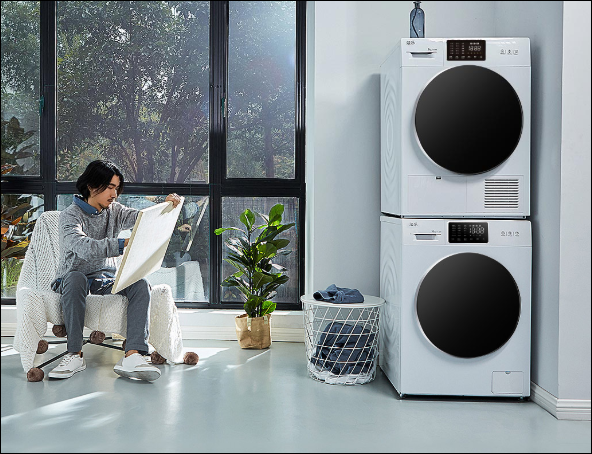
Xiaomi keeps increasing the number of products under its crowdfunding platform. The latest product is a washing machine bundled with a heat pump dryer which can be sold separately. Dubbed Fa Le Wash set, it includes a 10kg inverter drum washing machine and a 9kg heat pump dryer. The set comes with a hefty price tag of 5499 yuan ($727) but the washing machine alone costs just 1999 yuan ($297). The dryer can also be purchased separately for 3999 yuan ($529).
The Fa Le washing machine and dryer set comes with similar size and design. However, they are so light that they can be stacked on top of each other in other to conserve space. Both appliances can also be placed side by side. The French-styled dryer uses heat pump drying technology to make the drying better and faster. The two-layer filter has better water vapor and dander treatment. Compared with the traditional condensing dryer, the French pump dryer heat pump drying technology can output about 3 times of heating efficiency under the same energy consumption, with an innovative silent fluid design. The washing machine up to A+ level drying energy efficiency and can dry clothes as fast as 35 minutes. The dryer also provides up to 99.99% sterilization rate. It equally has built-in ironing feature that reduces wrinkles for easy direct ironing.
The entire dryer machine adopts a silent fluid design with an optimized impeller. This increases the cross-sectional area of the hot air duct and reduces the wind speed. The noise detected by the Chinese household appliances test is less than 62dB when drying, which is lower than the normal conversation sound of people. It uses BLDC variable frequency motor with a maximum dehydration speed of up to 1400 rpm.
The product will start shipping on March 21 in China.
What will your reaction be if you bought a brand new phone and it was missing a key feature, like the charging port or a button or maybe even the LED flash? Surprise, bewilderment, anger and maybe even manage a laugh? We bet one or all of these must have been the expression of this unlucky person that just received her brand new Xiaomi Mi 9 and found out it doesn’t have an LED flash.
Weibo user (@飞鸿弄晚) has posted pictures of her new Mi 9 that arrived without an LED flash. It isn’t that the cutout for the LED flash is there but there is no LED, it is actually not there at all. All you have on the back are the triple rear cameras.
[envira-gallery id=”239995″]
She did tag Xiaomi and some of its top executives in her post and the official Xiaomi customer service account responded to it saying she has been sent a private message. The unit will most definitely be replaced for her and she might get compensation for the troubles.
It has been confirmed that the Vivo X27 will launch on March 19. The upcoming phone will be an upper mid-range device with some pretty interesting features such as a pop-up selfie camera.
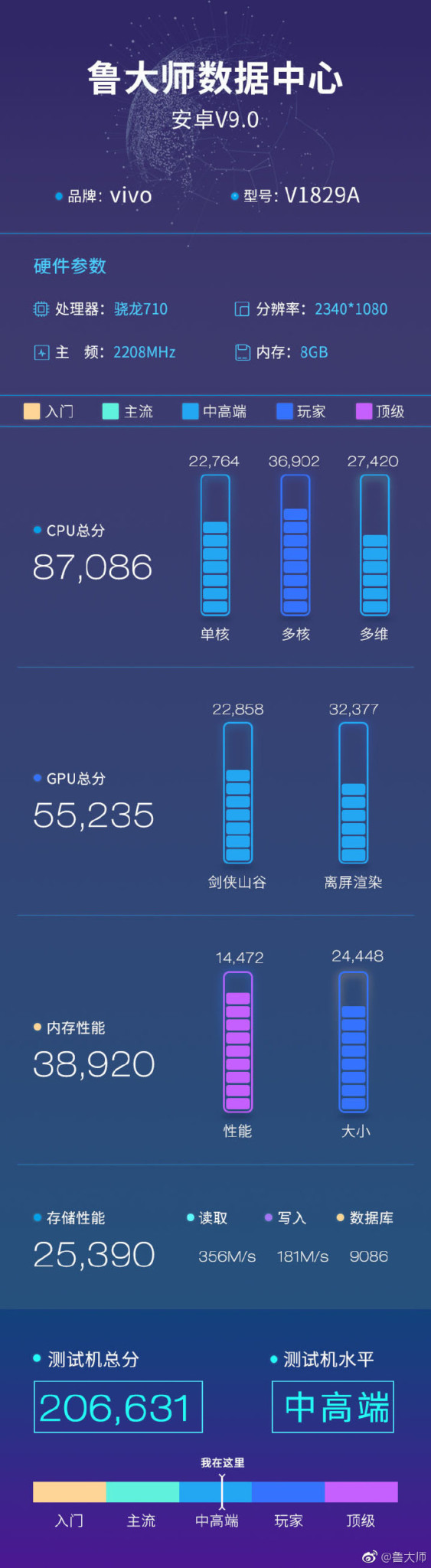
The phone already showed up on TENAA about a week ago baring all its specs, and now Master Lu’s benchmark result has confirmed the processor that powers it.
The benchmark result shows the Vivo X27 (V1829A) will be powered by Qualcomm’s Snapdragon 710 processor which is clocked at 2208MHz (2.2GHz). The chipset will be paired with 8GB of RAM, and according to the TENAA listing, this is the only RAM variant. Its built-in storage will be 128GB or 256GB. The benchmark result also confirms the 6.39-inch display has a 2340 x 1080 resolution.
The Vivo X27 scored 87,086 points in the CPU test, 55,235 points in the GPU test and 38,920 and 25,390 points in the memory test and storage test respectively. Its total score is 206,631 points which put it in the “high-end” category according to Master Lu’s grading.
Apart from the benchmark result, an official render of the Vivo X27 has also surfaced online that shows the front of the phone, its pop-up selfie camera, and the triple rear cameras on its back.
The 16MP selfie camera slides out from the right side of the phone’s frame. The bezels around the sides are pretty slim and of equal sizes and there is a small slit in the frame for the speaker.
It is also nice to see that the triple rear cameras are flush with the rest of the body. In between the first camera and the second is the LED flash. There is no fingerprint scanner on the back as it is buried beneath the display.
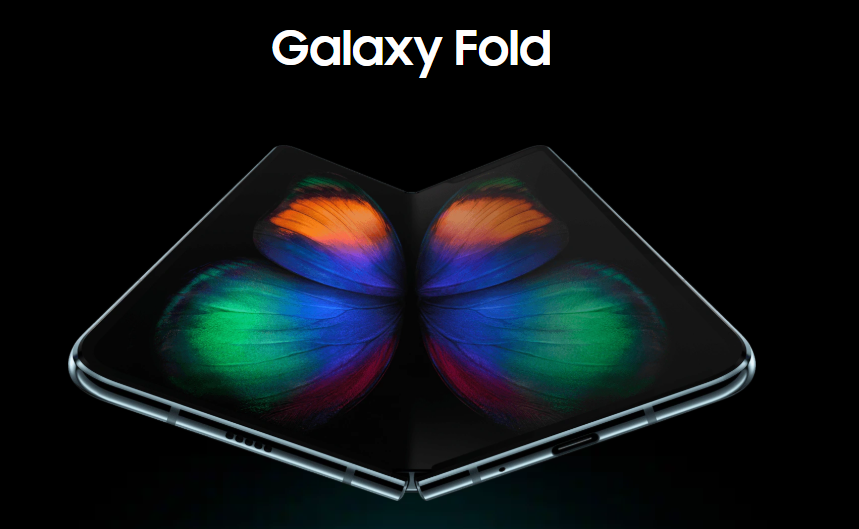
When Samsung held the Galaxy Unpacked event on February 20, the Galaxy Fold was definitely the standout model which was announced on that day. The design of the foldable phone has received both kudos and knocks from various quarters. The analysis of the Galaxy Fold design was further boosted when Huawei unveiled its own foldable phone a few days later. If the Galaxy Fold is beautiful, the Mate X was simply stunning.
The Mate X’s design is a better representation of what many tech enthusiasts believe a foldable phone should be. A recent poll conducted by Android Authority showed that most persons who participated preferred the Galaxy Fold. Some who prefer the Fold cite the hidden nature of the foldable screen which prevents it from getting damaged easily. It may interest such persons to know that Samsung has got other foldable design in the works with one of them having the same design similar to the Mate X.
A recent report on Bloomberg shows the Korean giant is presently working on two new foldable phones. One of the phones is said to feature a clamshell style similar to the Huawei Mate X. Samsung is also said to be thinking along the line of designing a foldable phone that folds vertically with a display on the outside. The company is reportedly still yet to decide if it will keep the outside display. Thee two new designs are being worked on to position the company in a good pedestal to take on the likes of Huawei and Xiaomi who also has a foldable design in the works.
The Chinese smartphone manufacturer has asked Japanese smartphone parts manufacturer to hog up for the upcoming demand. Earlier, Huawei relied on both the US and Japanese suppliers for smartphone parts. Now after US sanctions on Huawei, the company is unable to do business with suppliers based in the US. In order to tackle the situation, Huawei has asked its suppliers in Japan to increase the parts supply to meet the growing demand in summers.
Huawei has made the decision to avoid any supply disruption due to increasing pressure on Chinese firms over security concerns. In detail, the Chinese smartphone maker has requested to increase supply by early summer. They want to ship more devices out of the country to cope up with the growing demand and cover any losses from different businesses.
Particularly, Toshiba Memory has been asked to improve the supply of flash memory components ahead of schedule. Further, Rohm Semiconductor will boost the IC supplies and camera related parts to the Chinese company. Kyocera has also been ordered to manufacturer additional circuit parts and capacitors. Overall, every supplier has received orders from Huawei to cover the deficit of different parts due to the US pressure. The company said that they are planning to increase the trade between both the countries from the current $6.6 billion to $8 billion.
In early 2018, the US government first banned ZTE and later Huawei from doing business in the country. The US alleged that both the companies had violated their sanctions on Iran. Then last year, Huawei was resisted from taking part in 5G telecom apparatus deals due to its closeness with the Chinese government. The US government said that Huawei 5G apparatus carries bugs which will lead the Chinese to spy. They also barred its allies from using the Huawei 5G telecom apparatus. Some countries like Australia, New Zealand, and others denied Huawei for taking part in 5G technology testing.
Now, Huawei has sued the US authorities for banning the company to do business in the country. Huawei has taken legal actions over the National Defense Authorization Act through which the government barred the use of any Huawei device in government institutions.
Despite the facts, Huawei has started preparing to handle the demand in summers. Moreover, many Huawei smartphones are also set to launch in the coming few months.
Back in October 2017, ZTE took the wraps off what it marketed as the world’s first foldable smartphone. Dubbed as the Axon M, the device wasn’t really a foldable phone since it did not come with a flexible display, but simply featured a couple of separate screens.
While the Axon M didn’t live up to the hype, it definitely paved the way for newfangled foldable smartphones including Samsung’s long-awaited Galaxy Fold and Huawei‘s equally anticipated Mate X.
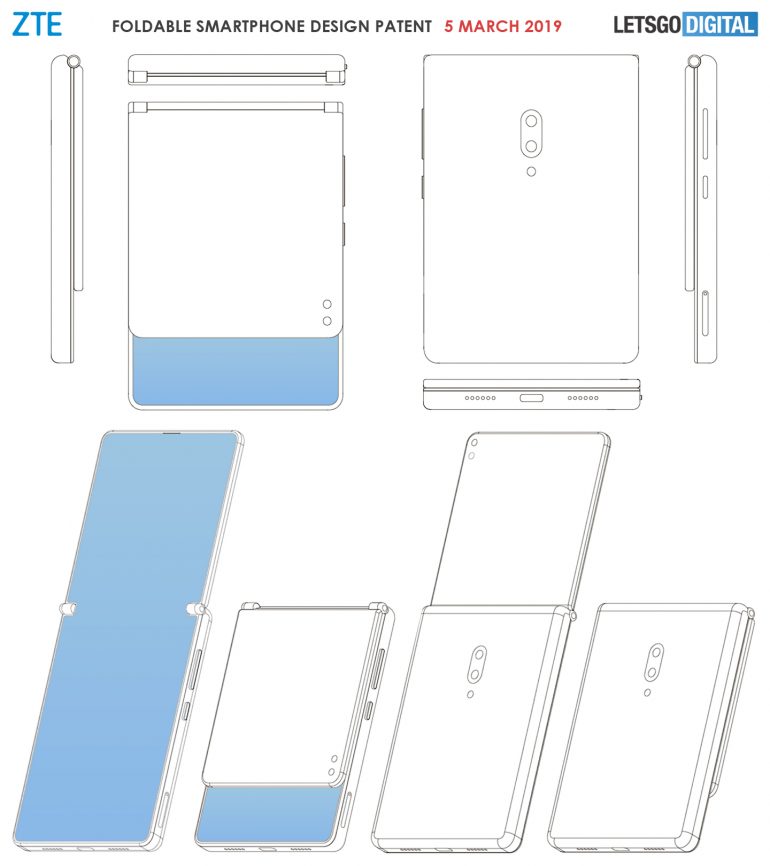
If a recently granted patent to the Shenzhen-based phone manufacturer is anything to go by, ZTE is hard at works on a unique smartphone that’s equipped with a foldable display. Originally spotted by LetsGoDigital, the 3D renders of ZTE’s purported foldable smartphone imply the device will adopt a clamshell design. You can head straight to LetsGoDigital and check out more images of the foldable smartphone from ZTE.
The aforesaid patent was filed with the World Intellectual Property Office (WIPO) back in April 2018, and it was granted on March 5th this year. The patent suggests that ZTE’s foldable smartphone will not look like Samsung’s or Huawei’s foldable smartphones. The ZTE device will reportedly bear a striking resemblance to the yet-to-be-announced Moto RAZR foldable smartphone. The foldable ZTE phone’s clamshell design will enable users to fold it vertically.
The display will feature a disproportional fold with the top section being relatively shorter than the bottom. When folded, a noticeable portion of the larger screen can still be seen. Apparently, this visible portion of the screen could display important notifications such as phone call alerts etc.
The back of the ZTE foldable smartphone is out of the ordinary as well. There’s a dual camera module with an LED flash positioned on the bottom half of the rear. The top half, on the other hand, houses a couple of mysterious circular cutouts.
The volume rockers and the power button are placed on the right side of the device. The connector port, which is bordered grilles on either side, is located at the bottom. Regrettably, details about the foldable ZTE smartphone are still few and far between.
More shreds of information including the phone’s launch date, specifications, and features are likely to surface online ahead of its official unveiling. Watch this space for more news and updates about ZTE’s foldable smartphone.
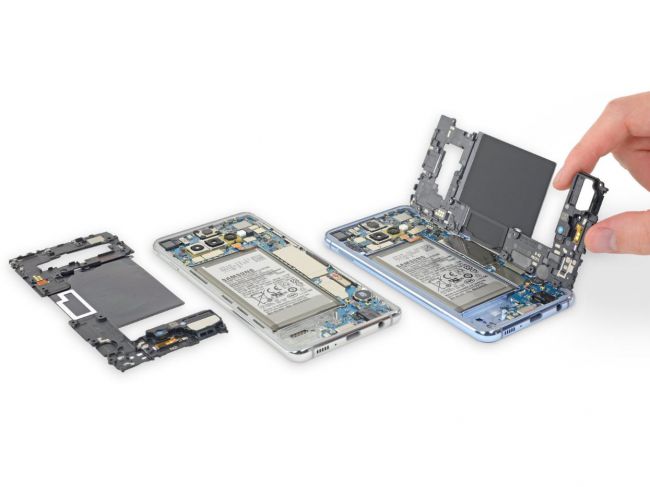
Samsung announced the new flagship devices at Galaxy Unpacked event in February. Namely, Samsung debuted the Galaxy S10, S10+ and S10e at the event. Now, its pre-orders are live, and some users have also started receiving the devices. Although, if you’re planning to buy the new Galaxy S10 device then make sure to handle it carefully as the repairs will be costly. In a new teardown video, iFixit claimed that the Galaxy S10 and the Galaxy S10+ is hard to fix and its repair will be expensive. It will be among the most expensive Android devices to repair.
Our folks at iFixit disassembled all the three editions of the Galaxy S10. They have covered the teardown of both the Galaxy S10e and Galaxy S10 in photos while Galaxy S10+ has got a video of a disassembly.
As in the video below, we can see the Galaxy S10+ carrying a strong adhesive holding the different parts of the device. iFixit has found that all the major components for the device are hidden behind the handset’s glass backplate. The fragile backplate can break if the disassembly is not done accurately. It will obviously make you shell out soaring repair costs if damaged. Past the backplate, a strong adhesive is used to fix its different parts. You can see the teardown video of Galaxy S10+ below:
After, crossing the adhesive portion, all the other parts were quite easy to take off. iFixit used Phillips-head screwdriver to open the majority of the elements assembled on the motherboard. Furthermore, the USB-C charging port is soldered on the motherboard, which would increase the repair cost if got damaged. As the whole motherboard would be changed at that time. Similarly, the battery is also glued making it difficult to replace. Even though, a full display repair would be needed if anything happened to the Ultrasonic fingerprint sensor.
Overall, iFixit has given Galaxy S10+ a disappointing score of three out of ten. Last year, Galaxy S9 earned four points along with its siblings such as Galaxy Note 8 and S8 also in the same boat. Pixel 3 and Huawei Mate 20 Pro are also in the same line with four points out of ten. Essential Phone has received the lowest rating of one out of ten until now.
The Redmi Note 7 Pro that features 48-megapixel dual camera was recently unveiled in India. The smartphone is scheduled to go official on March 18 in China. Ahead of its Chinese launch, Redmi has been teasing the features of the Redmi Note 7 Pro. Lu Weibing has shared a night mode shot that was captured using the Note 7 Pro. The image reveals that the smartphone can capture stunning photos in dim-light conditions.
In the below image, the billboard lights and decorative light appear rich and clear. Even darker areas like the ground are also visible. The overall brightness of the image is a bit low.
Redmi Note 7 Pro Night Mode Camera Sample
Unlike the Redmi Note 7 that features Samsung ISOCELL Bright GM1 48-megapixel sensor in its dual camera setup, the Note 7 Pro is equipped with a more powerful Sony IMX586 48-megapixel lens in its dual camera module. The Sony sensor coupled with Xiaomi’s night mode software optimization makes it possible to shoot brighter images in low-light scenarios.
The Redmi Note 7 Pro will be available for buying in India staring from March 13 at 12 PM (local time). The handset features a 6.3-inch IPS LCD panel with waterdrop notch that delivers full HD+ resolution and 19.5:9 aspect ratio. The Snapdragon 675 SoC powers the phone. The MIUI 10 based Android 9 Pie comes loaded on the device.
The 4,000mAh battery of the Redmi Note 7 Pro is equipped with support for 18W rapid charger. The dual camera setup of the phone includes a 48-megapixel primary sensor and a 5-megapixel depth sensor. The selfie notch is equipped with a 13-megapixel front camera. The other features of the phone include USB-C, microSD card slot and 3.5mm audio jack.
The 4 GB RAM + 64 GB storage and 6 GB RAM + 128 GB storage Redmi Note 7 Pro variants are respectively priced at Rs. 13,999 (~$199) and Rs. 16,999 (~$242) in India. Its color variants are Nebula Red, Neptune Blue and Space Black.
Today, Xiaomi’s co-founder and President of Xiaomi Group China, Wang Chuan, made an announcement through Weibo that the Xiaomi Mi 8 Fingerprint Edition, which was launched last year, will get the new Game Turbo technology that’s present in the company’s new flagship, Xiaomi Mi 9.
In the same post, he said that the introduction of this new feature will improve the phone’s gaming performance. The Mi 8 Fingerprint Edition will be available for purchase in China from tomorrow 10:00 AM in 6GB RAM + 128GB storage model through major online retailers for 2,499 Yuan, roughly $373.
Xiaomi claims that the Game Turbo technology drastically improves the performance as it dynamically adjusts the CPU frequency according to the game rendering load. With intelligent scheduling of CPU frequency, the CPU is operated at a lower frequency in a less loaded scenario which reduces system power consumption.
On the other hand, the company says that in the scenes with large renderings such as multiplayer team battles, more active system resources are invested, which effectively increases the frame rate of the picture and reduces frame dropping.
As the name itself suggests, the Mi 8 Fingerprint Edition is another variant of the Mi 8 which comes with an in-display fingerprint scanner. According to the company, its unlock speed is 29% higher and the success rate has improved by up to 8.8%.
Rest of the phone’s specifications remains the same as Mi 8. It features a 6.21-inch Super AMOLED screen with a 2248 x 1080 resolution and a notch. There is a Snapdragon 845 processor under the hood along with 6GB of RAM and 128GB of storage or 8GB of RAM and 128GB of storage.
Alongside having an in-display fingerprint scanner, the phone also keeps the infrared face unlock of the regular Mi 8. The cameras on the rear are dual 12MP sensors with OIS and optical zoom while a 20MP f/2.0 sensor sits within the notch. The phone runs Android 8.1 Oreo operating system out-of-the-box and is powered by a 3,400mAh battery with support for fast charging technology.
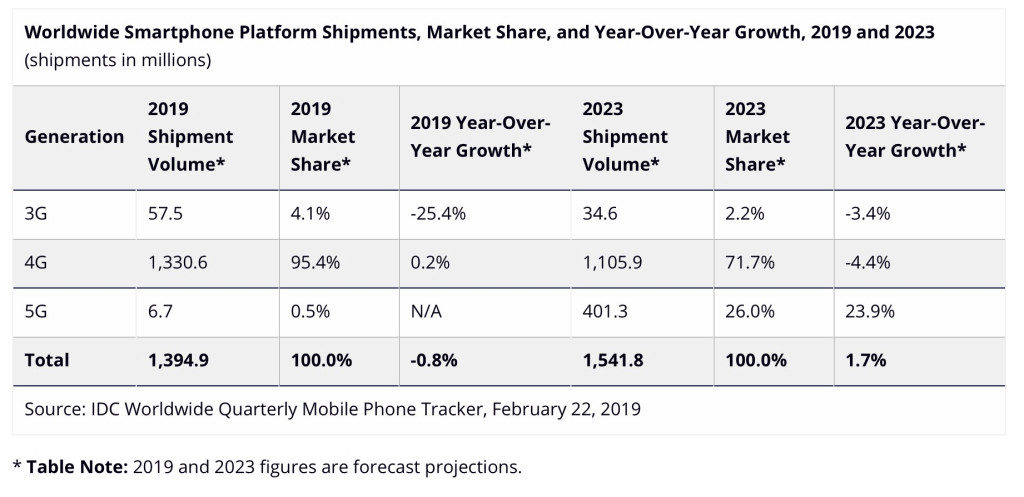
It’s been the third consecutive year since 2017 when we will witness a further decline in the smartphone shipments. As per a new report from IDC, the smartphone shipments will drop by 0.8% in comparison with the last year. The smartphone shipments will dip to 1.39 billion this year. Although, the market seems to recover in the second half of 2019 with the year-on-year growth of 2.3%. Moreover, in the coming years, the smartphone industry will boom with a surge in smartphone volumes to 1.54 billion by 2023.
As per the report, the smartphone market is expected to be back on the growth path by the end of this year. 5G smartphones are also going to cater to the growth in the upcoming few years. IDC’s vice president, Ryan Reith has said that the reason behind the expected growth is still unknown. He further added that many reasons such as longer replacements cycles, competition from the Chinese market and various other reasons are the culprit behind sluggish growth in the past couple of years.
“The biggest question that remains unanswered is what will bring the smartphone industry back to growth,” said Ryan Reith, program vice president with IDC’s Worldwide Mobile Device Trackers. “There is no question industry growth has been down for reasons that have already been identified – longer replacement cycles, a challenged China market, and geopolitical headwinds – but it is shortsighted to overlook the possibilities of some important technology advancements that are within reach with 5G probably being the most significant.”
In the year 2019, the industry is expected to witness new advancements with the introduction of foldable devices and 5G smartphones. Mainly, 5G phones are supposed to represent 0.5 percent of the total smartphones shipments among 1.395 billion smartphone volumes. Although, at snail’s pace the 5G shipments will only grow upto 26% in 2023. In other words out of 1541 billion of total shipments 26% percent will be 5G devices. In 2023, the year-on-year growth of smartphones will be at 1.7 percent.
This year is quite challenging for foldable devices. Speaking on the occasion, Sangeetika Srivastava, senior research analyst with IDC added that “Though the 5G developments and foldable screen buzz is yet to have a reality check from users, 2019 will be surely marked as a year of modernization in the smartphone market.”
Many big manufacturers have already announced 5G smartphones. Samsung has launched its Galaxy Fold with other high-end specs, while Huawei has announced the Mate X foldable phone. Similarly, some Chinese smartphone manufacturers have also come up with foldable devices. These launches will surely cater 5G adoption growth in the upcoming few months. Further, many foldable devices are pending for launch by the end of this year.
Talking about 4G shipments, then it will slowly reduce to 1105 billion shipments in 2023 by -4.4% YoY growth from 1336 billion in 2019. In total, 4G market share will dip from 95.4% to 71.7% in 2023. The ageing 3G technology will shrink to 2% in 2023 from 4.1% current market share.
The stats are quite interesting if we take a look at the growth of the smartphone market. The new generation smartphones will be witnessing a significant growth in the upcoming few years.
As of now, Samsung and Apple are the big OEMs which have witnessed a decline in the smartphone shipments. Despite the slow growth, the Chinese smartphone manufacturers like Xiaomi, Huawei, Vivo, Oppo are still on the top, generating most of the sales. The above informaton is compiled from the current available information by IDC.
Huawei said that it is suing the United States of America in a bid to oppose the country’s decision to bar government agencies from purchasing their equipment citing security threat. The Chinese multinational telecommunications equipment and consumer electronics manufacturer made the revelation on Thursday.
As part of its most aggressive move yet, Huawei has filed a lawsuit in a US District Court in Plano, Texas, throwing down the gauntlet to a 2019 US defense bill that restricts federal agencies from getting their hands on Huawei-branded products as well as its services.
The new US law even prevents US government agencies from collaborating with third parties that buy products or services from Huawei.
In his latest statement, Huawei’s rotating chairman Guo Ping pointed out that the US Congress hasn’t been able to support its decision to ban Huawei products with sufficient shreds of evidence. As a result, the company is left with no choice but to take this legal action.
“If this law is set aside, as it should be, Huawei can bring more advanced technologies to the United States and help it build the best 5G networks,” Guo Ping added.
According to the United States, equipment manufactured by Huawei is highly likely to be exploited by the Chinese Communist government in order to keep other countries under surveillance and interfere with crucial communications.
While the world gears up for the hotly-anticipated arrival of ultra-fast 5G telecommunications, Washington is persuading the government to stand aloof from the company. The 5G telecommunication can be deemed as an improvement that Huawei was slated to lead.
Responding in retaliation, Huawei has initiated an aggressive PR campaign. Keeping in line with that, reclusive founder Ren Zhengfei has been debunking the apprehensions in a slew of foreign media interviews.
Taking its campaign of flattery to the next level, Huawei invited news organizations on a reticent tour of its mammoth production lines along with its research and development facilities that are located in southern Guangdong province.
Huawei’s Chief Financial Officer Meng Wanzhou, Ren’s daughter faces probable deportation from Canada to the U.S. citing charges of Iran sanctions violations.
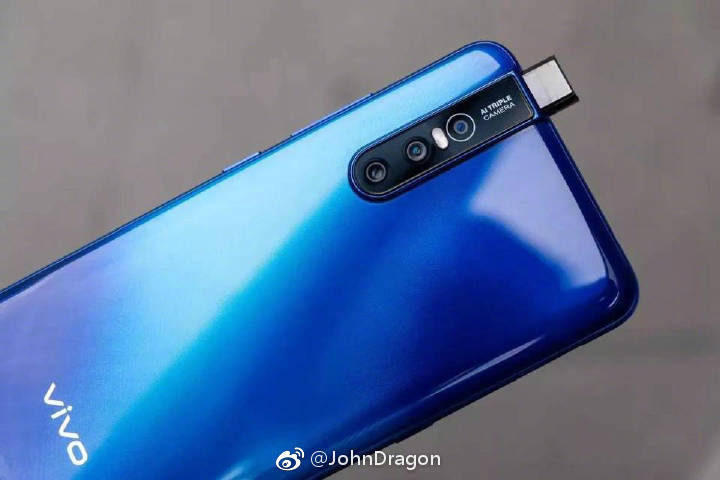
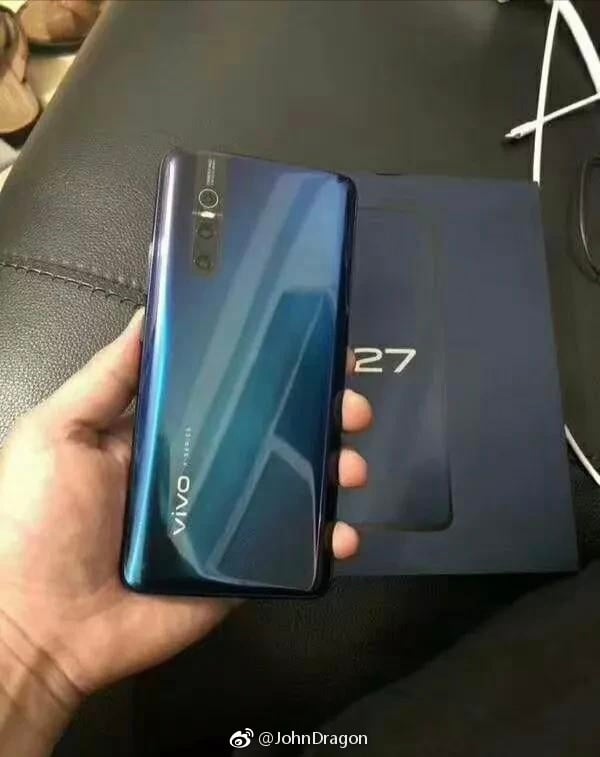
Vivo has confirmed that the Vivo X27 smartphone will be made official on March 19. The handset will be arriving to replace the Vivo X23 smartphone from last year. A few leaked images of the Vivo X27 has appeared on Weibo.
The Vivo X27 leaked images show that its appearance will be quite similar to the Vivo V15 Pro that was recently announced in India. Like the V15 Pro, the upcoming X-series phone from Vivo features a notch-less display. It features a slightly thick chin while the three bezels are quite thin and appear to be of equal size. It features a pop-up selfie shooter.
The back panel of the Vivo X27 seems to be made out of glass. The side edges of the smartphone’s rear shell are curved. The AI triple camera setup featuring an LED flash between the first and second camera lenses is available on the top-left corner of the X27’s launch. There is no fingerprint reader on the backside of the X27. The reason behind it is that it is equipped with an under-display fingerprint scanner.
Through the TENAA listing of the smartphone, it has been found that it will be featuring a 6.39-inch S-AMOLED display that produces full HD+ resolution. The Snapdragon 710 SoC is speculated to be the driving force of the smartphone. The 128 GB and 256 GB editions of the phone are expected to be equipped with 8 GB of RAM.
The triple camera module will feature a 48-megapixel primary senor. There is no confirmation on whether it will be equipped with the Sony IMX586 48-megapixel sensor. The other lenses that are available on inside the Vivo X27’s triple camera setup are a 13-megapixel secondary sensor and a 5-megapixel depth sensor. It is expected to arrive with a 16-megapixel pop-up front camera. The handset includes a battery of around 4,000mAh capacity. It is likely to include 22.5W rapid charging like the Vivo X23 smartphone. As of this writing, there is no information available on the pricing of the Vivo X27.
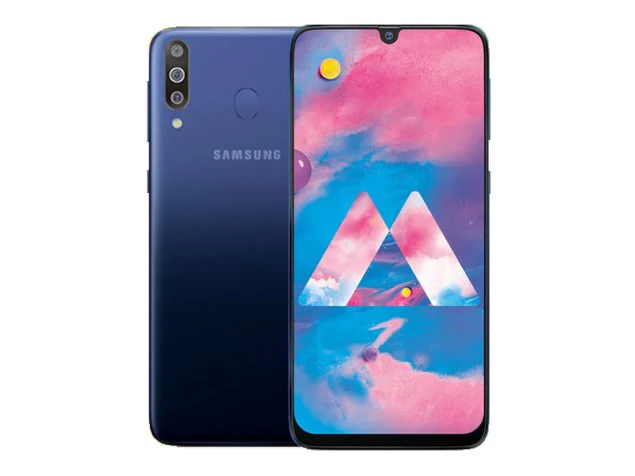
Samsung recently launched the third smartphone in its all-new India-exclusive M series — Samsung Galaxy M30. Previously, the company had launched the Galaxy M10 and Galaxy M20 smartphones under its M-series in India.
Now today, the Samsung Galaxy M30 is all set to go on sale for the first time, exclusively through online marketplace Amazon.in and Samsung Online Store, at 12:00 PM IST. The phone comes in two variants — 4GB RAM and 6GB RAM. It will be available in two color options — Gradation Blue and Gradation Black.
The 4GB RAM + 64GB storage model costs Rs. 14,999 (approximately $214) while the 6GB RAM + 128GB model is priced at Rs. 17,990 (approximately $257). Samsung is offering a 5 percent instant discount on the device when using HDFC cards. Additionally, buyers will get double data from Jio, where the users will get twice the data.
Coming to the specifications, the smartphone features a 6.4-inch Full HD+ Super AMOLED Infinity-U display featuring 2340 x 1080 pixels screen resolution and 19.5:9 aspect ratio. Under the hood, the device is powered by Samsung‘s own Exynos 7904 octa-core processor, coupled with Mali-G71 GPU.
The phone comes in two variants — one packing 4GB of RAM and 64GB of internal storage while the other model comes with 6GB of RAM and 128GB of internal storage. There’s also a microSD card slot that enables you to further expand the phone’s storage capacity up to 512GB.
In terms of camera, the device features a triple camera setup on the back, featuring a 13MP primary sensor, with f/1.9 aperture, a 5MP secondary sensor with f/2.2 aperture, and a 5MP tertiary ultra-wide angle 123-degree lens.
On the front side, the device flaunts a 16MP camera sensor with f/2.0 aperture. Along with the support for Face Unlock feature, the phone also comes with a rear-mounted fingerprint sensor for added security. Connectivity options on the device include Dual 4G VoLTE, Wi-Fi 802.11 b/g/n, Bluetooth 5, and GPS + GLONASS.
It also comes with 3.5mm audio jack, FM Radio, and Dolby Atmos sound. The smartphone is running Android 9 Pie out-of-the-box with Samsung Experience 9.5 UI and is powered by a 5000mAh battery that supports fast charging technology.
Huawei recently teased its upcoming smartphone launch in China — Huawei Nova 4e. The teaser had revealed that the phone will come with a 32 MP front-facing camera. Now, the company has confirmed the phone’s launch date.
The Huawei Nova 4e, which is expected to be the rebranded model of the Huawei P30 Lite for the Chinese market, will be launched on 14th March. The company has taken to its official handle on Weibo to share the announcement of the launch event.
The company has already confirmed that the Huawei Nova 4e will feature a waterdrop notch display and a 32-megapixel front-facing camera for taking selfies and video calling. Recently, the smartphone was spotted on the TENAA in its global avatar, revealing key specs.
The smartphone will feature a 6.15-inch display with Full HD+ screen resolution and will be powered by the company’s own HiSilicon Kirin 710 octa-core processor. On the back side, the smartphone is rumored to come with a triple-camera setup, which is likely to comprise 20MP + 16MP + 2MP camera sensors.
For security, the handset will have a fingerprint scanner on the rear panel. Also, according to the reports, the device will be powered by 3,240mAh battery. Since it will be a non-flagship device, it is likely to be priced around 2,000 Yuan.
Meanwhile, Huawei is hosting a launch event in Paris on 26th March, where the company will be launching its latest flagship smartphones under its Huawei P30 lineup, which includes P30, P30 Pro, and the P30 Lite.
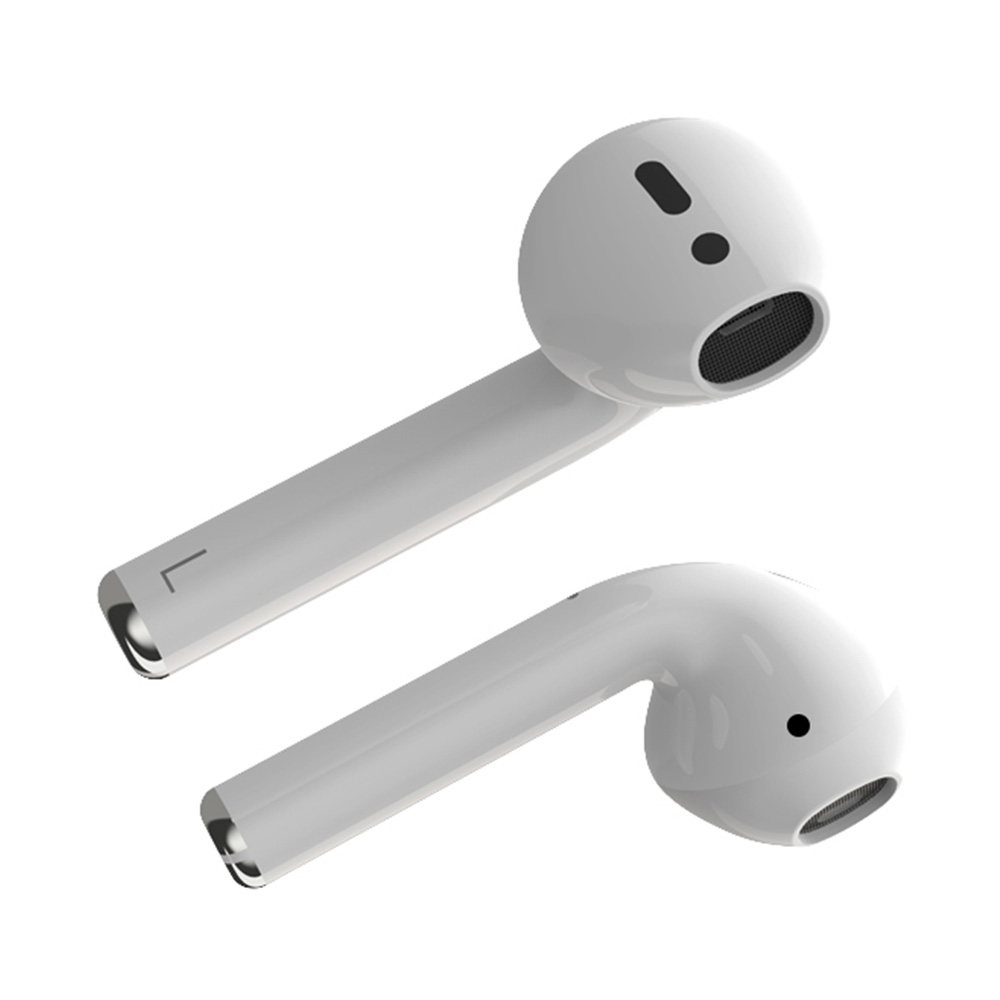
Music lovers, who fancy listening to their favorite songs on the go, usually end up spending a lot of money on top-branded earphones, headphones, and other music accessories. Much to the relief of GeekBuying users who aren’t willing to spend a fortune on devices that allow them to enjoy their best-loved piece while touring, the Chinese online store is offering the i10 TWS Bluetooth 5.0 Earbuds and X8 TWS Bluetooth 5.0 Earbuds at reduced prices.
We’ll not only shed light on the aforesaid discounts but also show how you can save a considerable amount of extra money before placing your order. So without further ado, let’s delve into the details.
i10 TWS Bluetooth 5.0 Earbuds
The standard edition of the i10 TWS earphones would normally set you back $29.99, but you can now buy it for only $22.99 on GeekBuying. This is a 23 percent drop in the device’s original asking price.
Likewise, you can avail a 9 percent off on the upgraded edition of the i10 TWS Bluetooth 5.0 Earbuds that normally sells for $43.99. Thanks to the aforesaid discount, you can now buy it for only $39.99. In addition to taking full advantage of the discounts, you can use coupon code GIZ_XUFDWYTK and get an extra $4 off. In other words, you can bring the already lowered retail price of the i10 TWS earbuds further down to only $18.99 by applying the coupon at checkout.
You can follow this link to avail the discount. Note that the coupon works only for the Standard Edition.
Alternatively, you can avail a significant 40 percent discount on the X8 TWS Bluetooth 5.0 Earbuds that would normally set you back $29.99. Thanks to the discount, you can now buy the feature-laden earbuds for only $17.99 on GeekBuying.
On top of that, you can use coupon code GIZ_FYMKAEVK and save $6 more. The coupon helps you reduce the original asking price of the X8 TWS Bluetooth 5.0 Earbuds to just $16.99 during the checkout process.
An absolute steal at this price, the X8 TWS earbuds come with a 2200mAh charging box that can also be used as a power bank for your mobile phone. Moreover, the device offer left and right channel separation feature, allowing you to use them independently.
You can follow this link if you are interested in checking out more details about the X8 TWS Bluetooth 5.0 Earbuds and taking advantage of the discount. Note that the promo will end in just four days.
Panasonic has launched its latest smartphone in the Eluga Ray series India — Panasonic Eluga Ray 800. The smartphone is now available for purchase in India through online and offline stores for a price of Rs. 9,999, which roughly converts to $143.
The Panasonic Eluga Ray 800 features a 5.5-inch Full HD IPS display with 1920 x 1080 pixels screen resolution and Gorilla Glass 3 protection on top. Under the hood, the device is powered by a 1.8GHz Octa-core SC9853I Unisoc processor with ARM Mali-T820 MP2 GPU.
It packs 4GB RAM and 64GB internal memory, along with a microSD card slot that allows users to further expand the phone’s storage capacity up to 128GB. As for the camera, the smartphone comes with a 13-megapixel rear camera and an 8-megapixel front camera, both with LED flash.
In the software department, the smartphone runs on the older Android 7 Nougat operating system, even after Google has released two major Android versions. It comes with Panasonic’s own AI assistant Arbo Hub that adapts to user-specific needs, interests and provides information.
Connectivity options on the device include Dual SIM, 4G VoLTE, WiFi 802.11 b/g/n, Bluetooth 4.0, and GPS. The phone also comes with a rear-mounted multi-purpose fingerprint sensor. The device is fuelled by a 4000mAh battery.
At this price range, there are way better options available in India, including the recently launched Realme 3, Xiaomi Redmi Note 7 — both of which comes with a way better specifications compared to the Panasonic Eluga Ray 800.
We use cookies on our website to give you the most relevant experience by remembering your preferences and repeat visits. By clicking “Accept”, you consent to the use of ALL the cookies.
This website uses cookies to improve your experience while you navigate through the website. Out of these, the cookies that are categorized as necessary are stored on your browser as they are essential for the working of basic functionalities of the website. We also use third-party cookies that help us analyze and understand how you use this website. These cookies will be stored in your browser only with your consent. You also have the option to opt-out of these cookies. But opting out of some of these cookies may affect your browsing experience.
Necessary cookies are absolutely essential for the website to function properly. This category only includes cookies that ensures basic functionalities and security features of the website. These cookies do not store any personal information.
Any cookies that may not be particularly necessary for the website to function and is used specifically to collect user personal data via analytics, ads, other embedded contents are termed as non-necessary cookies. It is mandatory to procure user consent prior to running these cookies on your website.




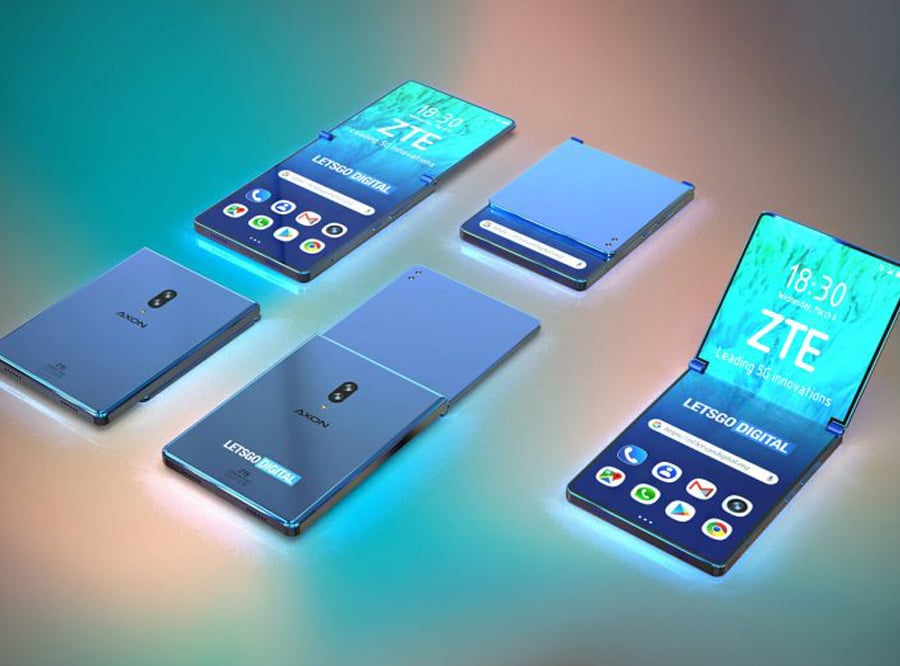
 The ZTE device will reportedly bear a striking resemblance to the yet-to-be-announced Moto RAZR foldable smartphone. The foldable ZTE phone’s clamshell design will enable users to fold it vertically.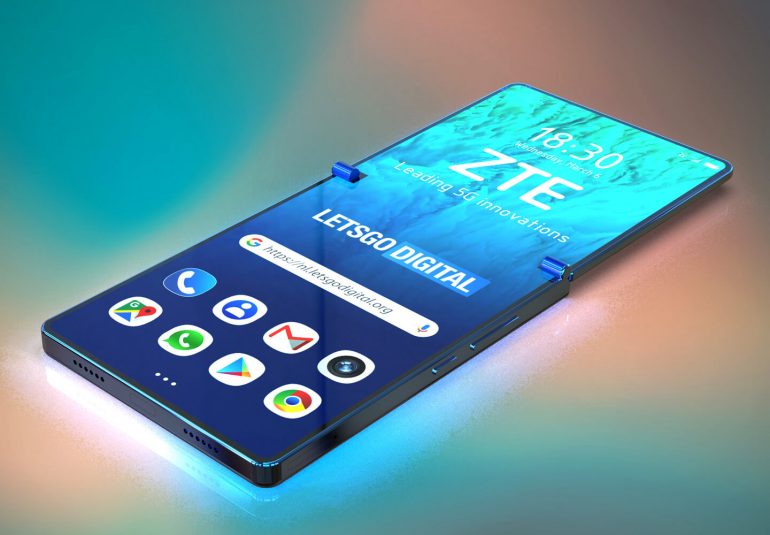






 Much to the relief of GeekBuying users who aren’t willing to spend a fortune on devices that allow them to enjoy their best-loved piece while touring, the Chinese online store is offering the i10 TWS Bluetooth 5.0 Earbuds and X8 TWS Bluetooth 5.0 Earbuds at reduced prices.
 In addition to taking full advantage of the discounts, you can use coupon code GIZ_XUFDWYTK and get an extra $4 off. In other words, you can bring the already lowered retail price of the i10 TWS earbuds further down to only $18.99 by applying the coupon at checkout.