Fresh high-quality images of Motorola’s upcoming Razr Flex have appeared online, offering the clearest view yet of the company’s first wide-style foldable. The renders arrive just as interest builds around book-style foldables with a tablet-like aspect ratio over the traditional tall clamshell shape.
SammyGuru shared what appear to be official-looking renders of the Razr Flex in two finishes: Pantone Dark Botanical Garden and Pantone Coriander. The green Dark Botanical Garden version features a woven, fabric-textured back with a matching frame, while the beige Coriander model has a leather-like finish paired with a champagne frame.
Both show a raised pill-shaped camera island on the rear housing a dual-camera setup and flash. The cover display uses a centered hole-punch for the selfie camera, while the inner display places its punch-hole in the top-right corner. Power and volume buttons sit on the right side.
These images align with earlier leaks and confirm a compact folding form factor designed as Motorola’s answer to the Galaxy Z Fold 8 and the iPhone Duo. Previous reports point to a 4.97″ cover display and a 6.92″ main inner screen, along with a 50 MP main camera, 50 MP ultrawide, and a 5,000 mAh battery.
The dimensions suggest the Razr Flex will be smaller than both the Z Fold 8 and iPhone Duo, which could also translate to a more accessible price. The hinge is said to allow the phone to stand on its own when half-open.
Motorola has not officially confirmed the device, but the consistency across recent image leaks and the level of detail in these renders indicate the design is largely finalized. The company is expected to reveal the Razr Flex next month or in early 2027, likely positioning it as a more compact and potentially more affordable alternative in the growing wide-foldable segment.
HMD may be bringing back one of Nokia’s most recognizable camera brands, but this time on a phone carrying its own name. The company has released a teaser video for a new camera-focused smartphone, opening with the PureView logo before showing off a large circular rear camera module.
The back of the phone features a four-camera setup, including what looks like a periscope telephoto lens. A capsule-shaped LED flash sits beside the circular module, which also carries the Schneider-Kreuznach logo.
The latter is particularly interesting. Schneider-Kreuznach is a German optics company, and its branding suggests HMD could be working with it on the phone’s camera system. However, the company hasn’t explained the partnership or what role it will play in the final imaging hardware.
We’re also not sure whether the PureView branding is for a broader camera system or simply serves as a familiar name on the back of the phone.
Is HMD bringing back Nokia’s PureView legacy?
PureView has a long history with Nokia. The brand first appeared on the Nokia 808 PureView in 2012, which famously packed a 41MP camera sensor. HMD later acquired the PureView trademark from Microsoft in 2018, before using it on the Nokia 9 PureView in 2019.
The Nokia 9 PureView had five rear cameras developed alongside Zeiss optics. Of course, Zeiss is not an option now, so HMD is partnering with Schneider-Kreuznach instead.
There’s also a convenient anniversary connection. HMD is celebrating its 10th anniversary on December 1, as it began operating as the new home of Nokia phones. The company has already held a tenth-anniversary design contest where the winner will get an HMD-branded smartphone. The winner will be announced on HMD India’s official Instagram and Facebook channels.
Prolific insider Digital Chat Station says a certain manufacturer is working on a large-screen flagship phone with the Snapdragon 8 Elite Gen 6 chip. The tipster did not name the brand. The phone is said to have a large camera sensor and a battery above 8,000mAh. It also has a minimalist design.
According to the Chinese outlet MyDrivers, the device could be the upcoming Xiaomi 18 Max. However, Xiaomi has not confirmed any of this.
The Xiaomi 18 Max would follow the Xiaomi 17 Max. Xiaomi released that phone in May at a starting price of 4,799 yuan (~ $720). Here, you get a 6.9-inch screen and an 8,000mAh battery, Snapdragon 8 Elite Gen 5, and a 200MP Leica main camera.
The next model is reportedly getting upgrades to both performance and imaging, alongside a battery larger than 8,000mAh. The minimalist design mentioned by the tipster could also carry over, although there are no further details about its appearance yet.
Where the Xiaomi 18 Max fits in the lineup
Xiaomi has already introduced the Xiaomi 18 Pro and Xiaomi 18 Pro Max in September. The Pro uses the Snapdragon 8 Elite Gen 6, while the Pro Max gets the more powerful Snapdragon 8 Elite Extreme Gen 6. Both processors are built on a 2nm process.
The rumored Xiaomi 18 Max could use the same standard Snapdragon 8 Elite Gen 6 found in the smaller Pro model, rather than stepping up to the Extreme version.
Likewise, the standard Xiaomi 18 is expected to arrive next month, with Chinese retailers already accepting blind orders. The regular model is also expected to use the Snapdragon 8 Elite Gen 6.
Other expected specifications include 12GB of RAM and 256GB of storage in the base version, with a top configuration offering 16GB of RAM and 1TB of storage. The front reportedly features a 6.4-inch 1.5K flat OLED display using Xiaomi’s new M11 emitting material.
Unlike the Pro models, the standard Xiaomi 18 keeps a more compact design for one-handed use. It also misses out on a hardware-level privacy display and a secondary rear screen.
Meanwhile, the Xiaomi 18 Max would sit between the regular model and the Pro Max, much like the Xiaomi 17 Max did last year.
Jackery’s latest portable power station is small enough to carry in a bag but still packs enough capacity to recharge a laptop or phone multiple times. Called the Jackery Explorer 100D, it comes with a 96Wh (30,000mAh) LiFePO4 battery and supports USB-C charging at up to 140W.
The Explorer 100D went on sale in Canada on October 28 through Jackery Canada, Amazon, and Amazon Canada. It has a regular price of CAD 179, although you can currently grab it at CAD 145 from its official website.
Despite its compact size, the Explorer 100D has two USB-C ports, each capable of delivering up to 140W. There’s also an 18W port for smaller devices, bringing the total output to 158W. It supports PD, PPS, and AVS charging protocols, which means it can handle a wide range of phones, tablets, and laptops.
Jackery provides a few examples of what the battery can handle. An iPhone 17, iPhone 17 Pro Max, or iPhone 18 Pro can reach 50% charge in around 20 minutes, while the DJI Pocket 3 can get there in as little as 10 minutes. The battery can also provide more than three full charges for a flagship phone or more than one full charge for a 14-inch MacBook Pro.
The 96Wh battery uses LiFePO4 cells, the same chemistry found in Jackery’s larger power stations. It’s rated for at least 3,000 charge cycles while retaining more than 80% of its original capacity. Jackery says this is 50% more than the Explorer 100 Plus and estimates up to eight years of regular use.
The Explorer 100D measures 11.9 x 8.3 x 8.7 cm and weighs 855g. A soft-touch handle makes it easier to carry, while an optional shoulder strap provides another way to transport it. Its 96Wh capacity also keeps it within the typical 100Wh limit for portable batteries on domestic and international flights, although airline rules still apply.
The power station supports several charging options, depending on where you are. It has a 100W USB PD connection and can take the battery to 80% in around 1.6 hours, with a full charge taking just over two hours. You can also top it up to 100W via solar charging, and it delivers similar charging times under clear skies and direct sunlight.
Likewise, charging through a 12V car outlet takes a little over three hours to reach 80%, while a full recharge takes just over four hours. A 24V DC power source, commonly found in RVs, boats, and commercial vehicles, cuts the full charging time to slightly over two hours.
Nothing is preparing to enter the growing AI hardware market, and we now have a date for its first device. The company has confirmed it will unveil its first AI-native gadget on December 8, but it is still keeping the product’s name and most details under wraps.
The clearest look at the device so far comes from an image DJ Sebastian Ingrosso shared. It shows a rectangular gadget with a split design. One side has red and green status lights alongside a record button, which Nothing founder Carl Pei had previously teased.
There’s also a large button labeled “Talk” and what appears to be a pogo-pin connector on the underside. The device carries the tagline “Be present, it’s noted,” offering another clue about what Nothing has been working on.
Taken together, the physical controls and tagline point toward an AI-powered note-taking device that can record conversations and turn them into notes without needing a phone screen. Nothing hasn’t confirmed its full capabilities yet, though.
Pei has previously described the gadget as an “AI-native” product that “couldn’t have been an app.” He also stressed that it would have no screen, suggesting Nothing wants to build something that works independently rather than simply putting another AI feature inside its existing smartphone software.
The company had already hinted at a December shipping window, but December 8 is the first confirmed date for its official unveiling. More details about its name, features, and availability should emerge at the event.
Most of the device details are still under wraps. The available hints point to a voice-first gadget built around recording conversations, with possible support for live translation and AI-powered note-taking.
Carl Pei has previously described it as an “AI-native” product that “couldn’t have been an app,” stressing that it has no screen.
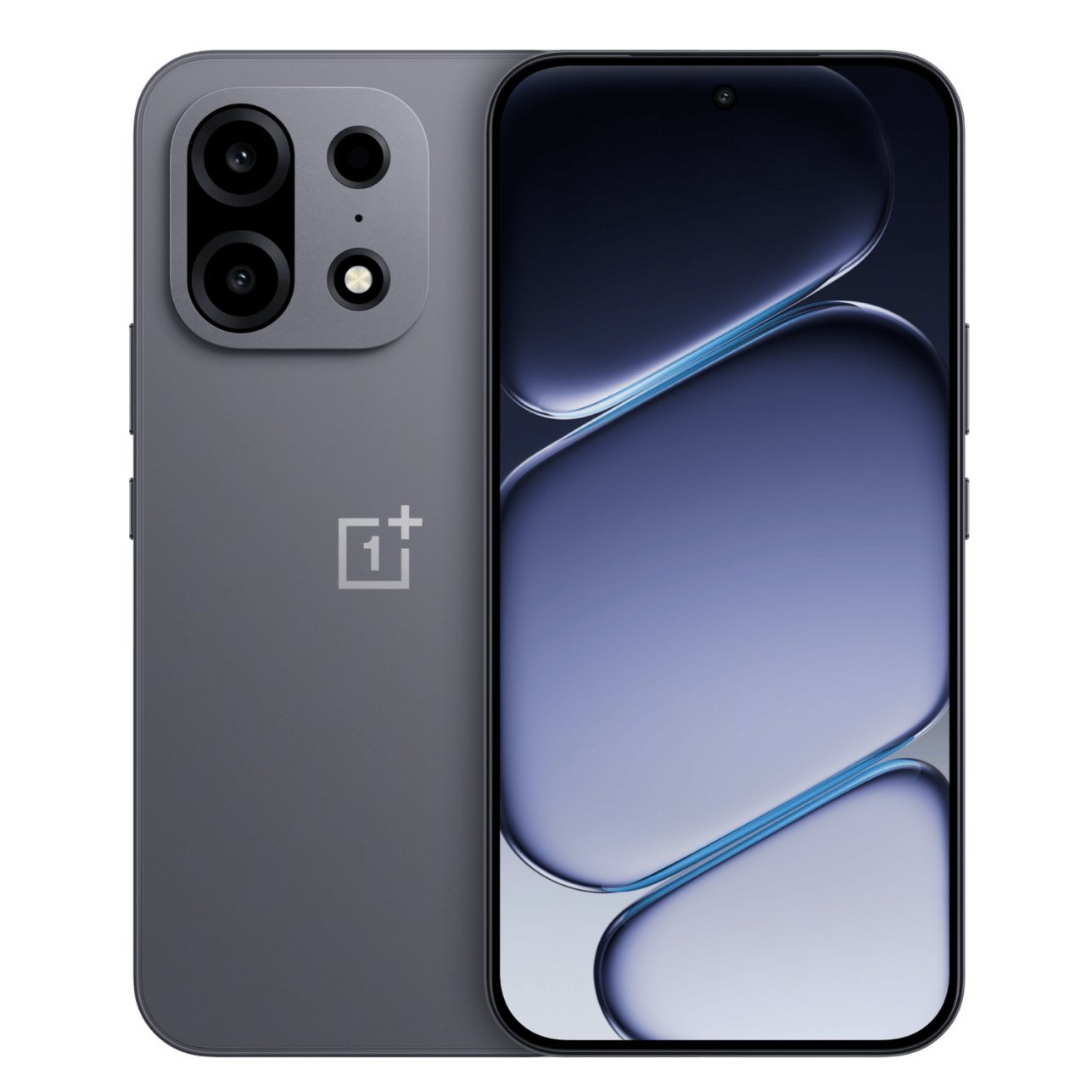
Smartphone batteries are getting bigger, and several manufacturers have more 9,000mAh-plus phones on the way. Honor is up first with three new models arriving on November 23, while OnePlus, Oppo, and Redmi are reportedly preparing phones with even larger batteries, including one that could reach 12,000mAh.
The upcoming lineup includes the Honor 700 series, OnePlus Turbo 7 Pro, an unannounced Oppo phone carrying the model number PNC110, and the Redmi Turbo 6 Max. Some already have confirmed battery capacities, while others are still based on leaks and certification records.
1. Honor 700, 700 Pro and 700S: Launching November 23
Honor 700
Honor is bringing three new phones to China on November 23. The Honor 700, 700 Pro, and 700S will be unveiled at an event in Wuhan at 2:30 PM local time. All three have a confirmed 9,000mAh Qinghai Lake battery.
Honor has also confirmed Snapdragon processors across the lineup. The three phones also reportedly share a 6.57-inch display, a 50MP front camera, and a 7.96mm body. They are also expected to run MagicOS 11 based on Android 17, with 80W wired charging. Their listed weights range from 208g to 213g.
Honor 700 ProHonor 700S
The biggest difference between the models is their hardware. The Honor 700 Pro is said to have the Snapdragon 8 Gen 5, with up to 16GB of RAM and 512GB of storage. The regular model will have a less powerful Snapdragon 8s Gen 4, while the Honor 700S will use the Snapdragon 7 Gen 4 and come with up to 12GB of RAM and 512GB of storage.
All models are expected to feature a 200MP main camera, but the Honor 700 and 700 Pro reportedly add a 50MP periscope telephoto camera with 3.5x optical zoom. The more affordable 700S instead gets a 12MP secondary camera.
There is also a small extra feature across the series: Honor has teased an AI-powered display built into the rear camera module. We should get a better idea of what it can do when the phones arrive next week.
2. OnePlus Turbo 7 Pro
OnePlus Turbo 6 Pro
OnePlus could be the next manufacturer to join the 9,000mAh battery club. Its unannounced Turbo 7 Pro has appeared on China’s 3C certification database under the model number PYP110, with the listing confirming 100W wired charging.
Comparison
The OnePlus Nord 5 runs a Snapdragon 8s Gen 3, while the Turbo 6V uses a Snapdragon 7s Gen 4.
The certification doesn’t reveal the battery size, but tipster Digital Chat Station claims the phone will have at least 9,000mAh capacity.
The rest of the leaked specifications include a 6.78-inch flat display with 1.5K resolution and a refresh rate of up to 185Hz. The camera setup could include a 200MP main camera, along with a 3nm Qualcomm processor carrying the model number SM8845 Pro.
Per reports, the OnePlus Turbo 7 Pro could arrive in China before the end of this year. An international release is possible, particularly given the previous model’s journey to India, but OnePlus hasn’t confirmed anything yet.
3. Oppo PNC110
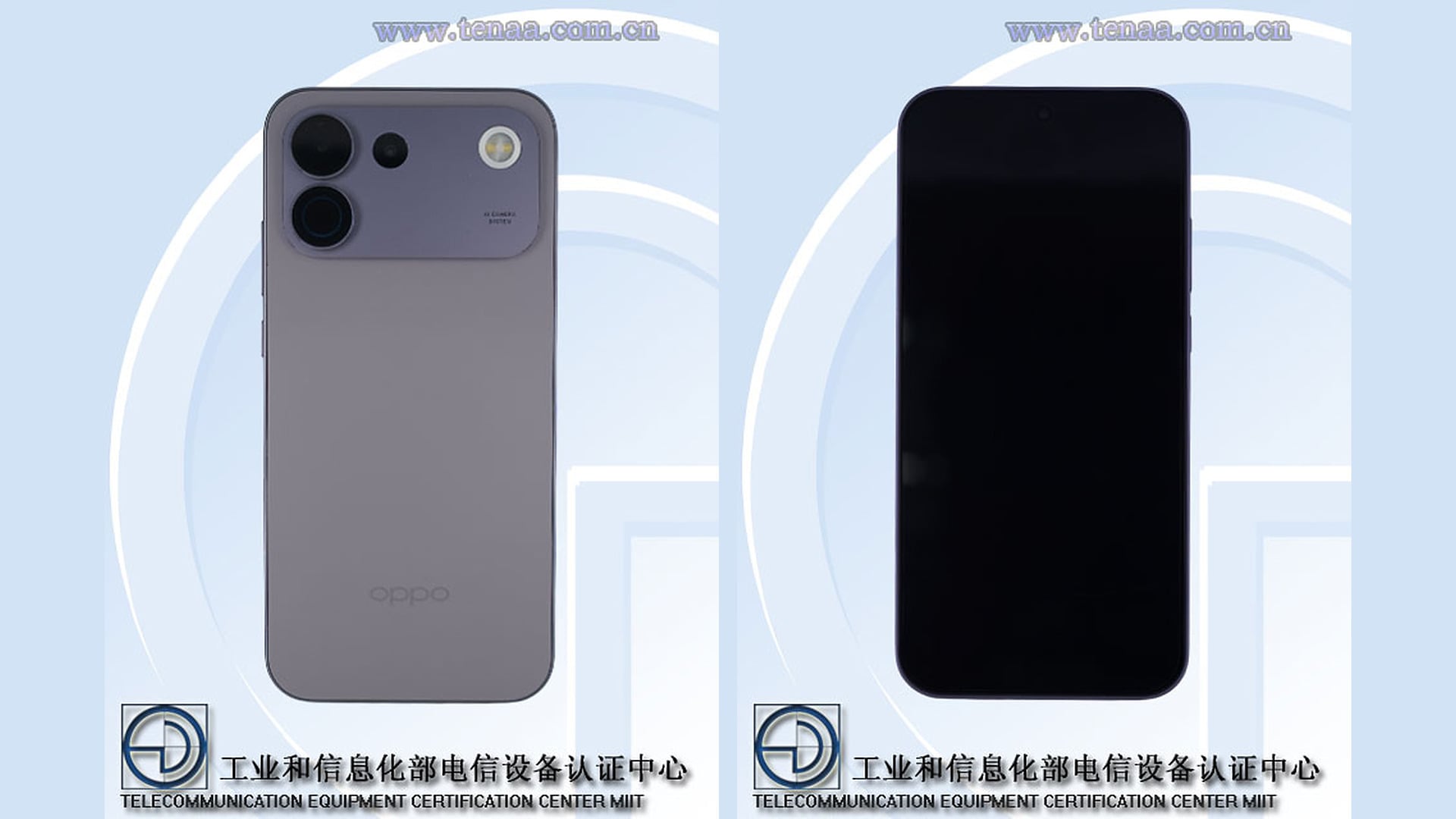
While OnePlus may be testing a 10,000mAh battery, Oppo could have something considerably larger in the works. An unannounced phone carrying the model number PNC110 has appeared in China’s MIIT database, and its reported battery capacity puts it ahead of every other device on this list.
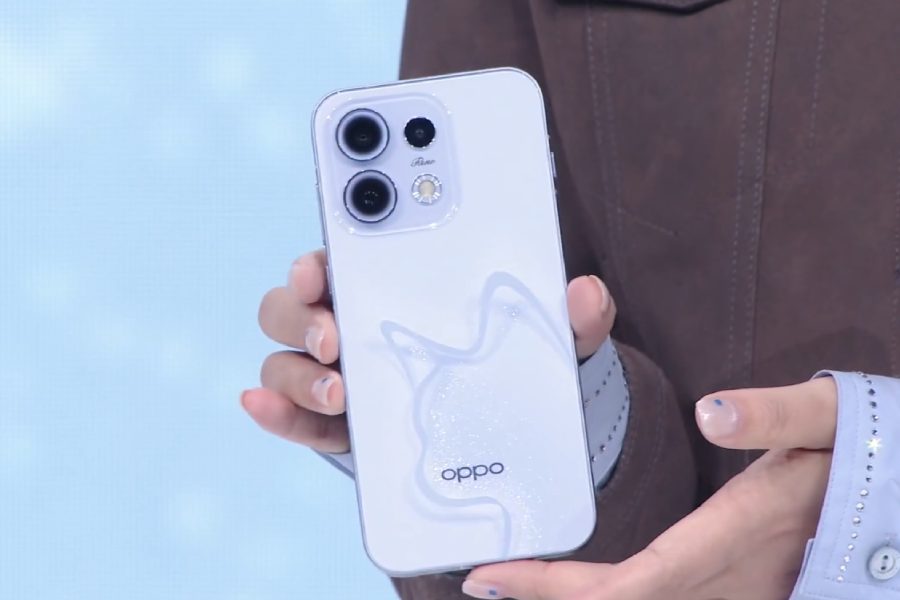
The phone received its network access licence in early November, with official images added to the listing a week later. They show a purple finish, a pill-shaped rear camera module with two cameras, and a flat display with a punch-hole selfie camera. The certification also confirms 5G connectivity and dual-SIM support, but Oppo hasn’t revealed the phone’s commercial name.
According to reports, the phone could have either 11,460mAh or 11,640mAh. Both figures would likely translate into a marketed capacity of around 12,000mAh, although that number hasn’t appeared in the certification itself.
For some perspective, the reported capacity would be considerably larger than the 10,000mAh battery in the Oppo A7 Pro Max. The device could launch in December.
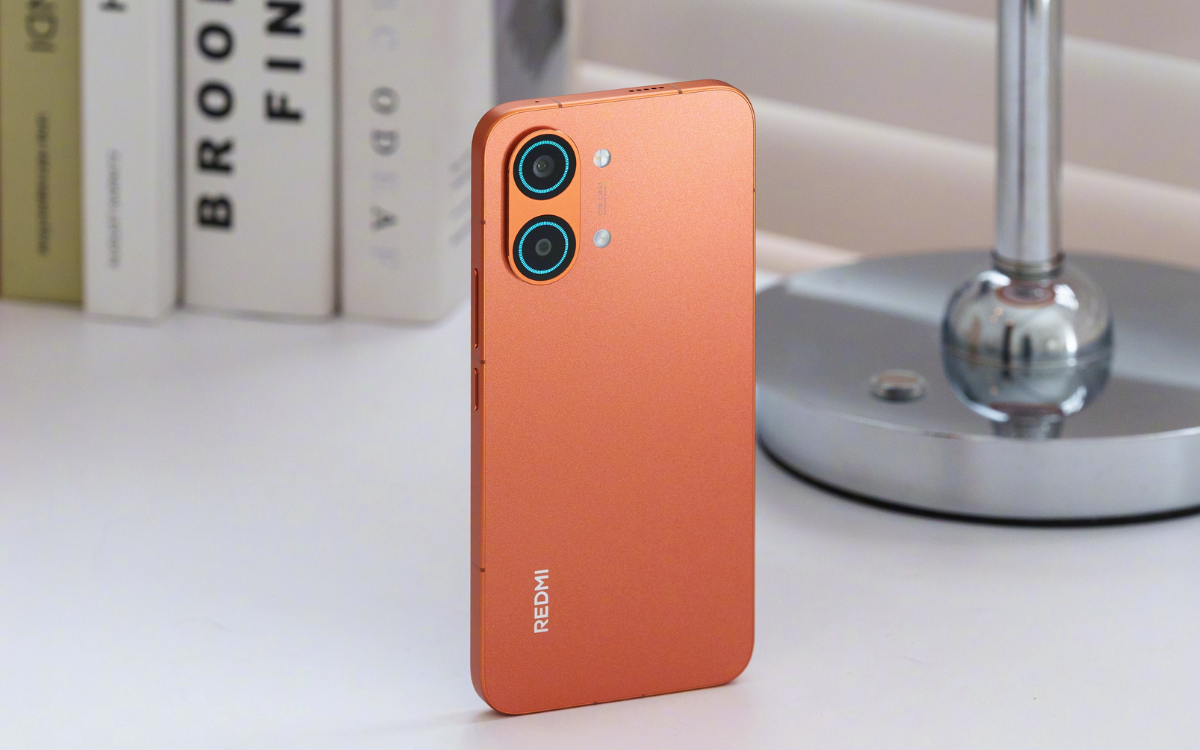
4. Redmi Turbo 6 Max
Redmi’s next big-battery phone is likely the furthest away in this list. The company is reportedly working on Redmi Turbo 6 Max, and it’s said to have a 10,000mAh+ battery. The figure comes from an earlier specification leak, but Redmi itself hasn’t announced the Turbo 6 series yet.
Likewise, the phone is said to have a 7-inch 2K OLED panel, considerably larger than the 6.83-inch 1.5K OLED screen on the Redmi Turbo 5 Max. The upcoming model is also tipped to carry IP68 and IP69 ratings, along with a MediaTek Dimensity 9-series processor.
There’s some disagreement over the chipset. The phone may either use Dimensity 9500s or a newer chip. Redmi could also bring the phone to international markets under a different name, likely the Poco X9 Pro Max.
5. Will These Phones Launch Outside China?
For now, all four upcoming models are expected to debut in China. Honor hasn’t shared international launch plans for the 700 series, while OnePlus, Oppo, and Redmi have yet to confirm whether their respective phones will reach other markets.
Likewise, battery capacities can also differ between Chinese and international versions, so the figures mentioned above should be treated as China-market specifications until the manufacturers announce otherwise.
The first launch is just around the corner. Honor will reveal the 700 series on November 23. OnePlus and Oppo could follow before the year ends, while Redmi’s Turbo 6 Max is expected in January 2027.
Back in August, Motorola published a list of its devices eligible for the Android 17 upgrade. However, there were some missing devices from the list, and so, the list was removed later on. The brand has now released a new list and has provided a vague timeline.
In a new announcement on its Brazilian newsroom, Motorola has listed nine devices that are already receiving the stable Android 17 update, with 20 additional phones eligible to receive the update in the coming months.
Motorola phones already getting the Android 17 update
Motorola Signature
Motorola Edge 70
Motorola Edge 70 Fusion
Motorola Edge 70 Fusion Plus
Motorola Edge 60 Pro
Motorola Razr 70 Ultra (Razr Ultra 2026)
Motorola Razr 50 Ultra (Razr Plus 2024)
Motorola Razr Fold
Motorola Moto G86
Motorola phones set to receive Android 17 in the coming months
Motorola Edge 70 Pro
Motorola Edge 60
Motorola Edge 60 Neo
Motorola Edge 60 Fusion
Motorola Edge 50 Neo
Motorola Edge 50 Fusion
Motorola Edge 50 Pro
Motorola Edge 50 Ultra
Motorola Razr 70 (Razr 2026)
Motorola Razr 60 (Razr 2025)
Motorola Razr 60 Ultra (Razr Ultra)
Motorola Razr 50 (Razr 2024)
Motorola Moto G77
Motorola Moto G75
Motorola Moto G67
Motorola Moto G57
Motorola Moto G56
Motorola Moto G47
Motorola Moto G37
Motorola Moto G Max
Motorola hasn’t mentioned rollout dates for the phones that have yet to receive Android 17. However, it’s welcoming to see the inclusion of models that were previously missing from the list, including the Edge 50 Pro, Edge 50 Neo, Edge 50 Fusion, Edge 60 Neo, Razr 50 (Razr 2024 in the US), Moto G56, and Moto G75.
The announcement comes from Motorola’s Brazilian arm, and the rollout timeline therefore only applies to that region, as some phones, including the Edge 60 Fusion and Edge 70 Pro, have already received Android 17 in other regions.
With Motorola phones, it’s difficult to predict when your phone will get the update. The brand rolled out the Android 17 update to many older phones first, and the nearly $2000 Razr Fold got it just yesterday. When the update arrives, it will bring redesigned Quick Settings, stackable widgets, enhanced HDR brightness control, expanded file-sharing capabilities with iPhones, and improved scam protection. You can read more about the changes on this page.
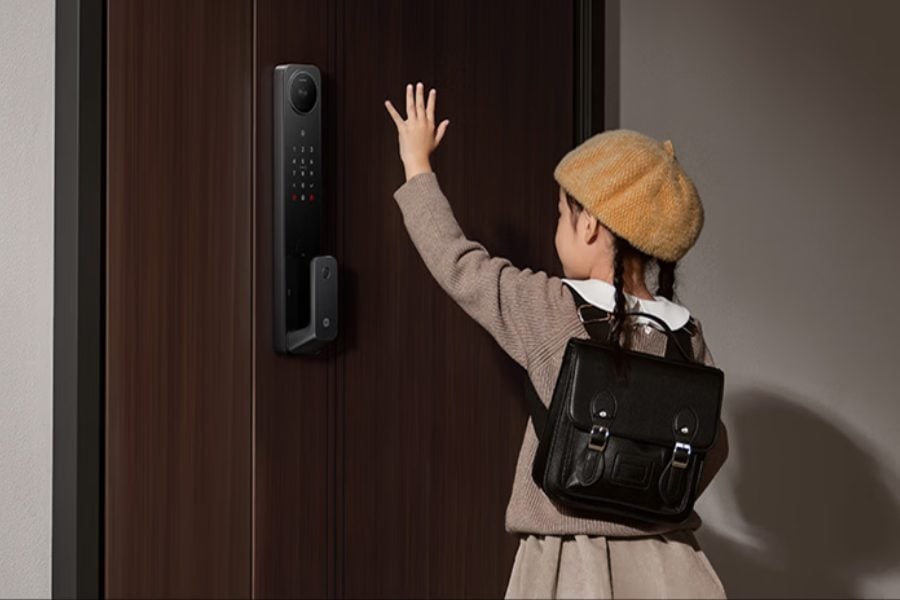
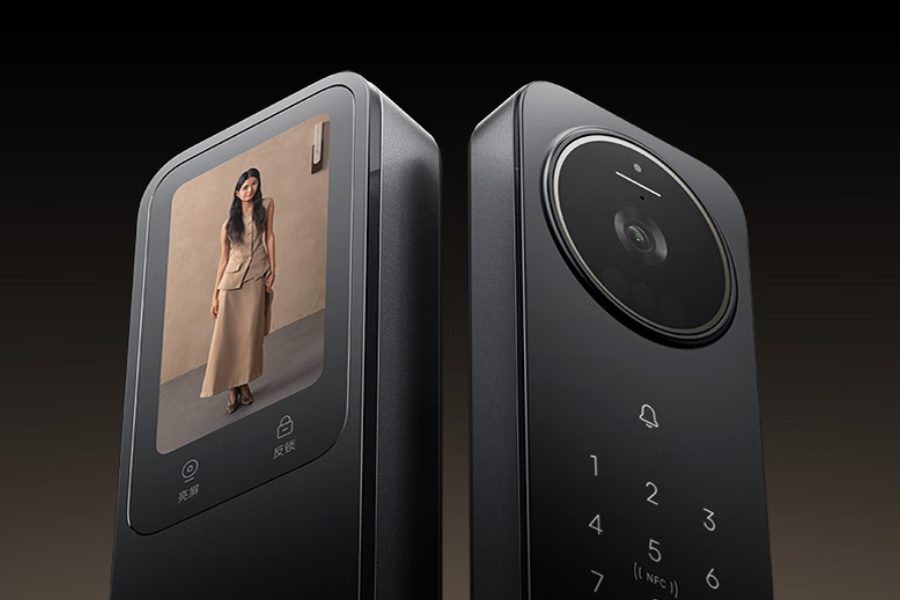
Xiaomi also sells the Smart Lock 5 Max, which supports 12 unlocking methods. The new Face Recognition Edition increases that number to 13. Made by Loock, the new model brings 3D face unlock and is now available for pre-sale at 2,116 yuan (~ $317).
Xiaomi Smart Door Lock 5 Face Recognition Edition Specifications
No prize for guessing, the main draw of the new model is 3D facial recognition. Xiaomi claims the device can identify a person in around one second, has a false recognition rate below 0.0001% and works with people between 1.2 and 2.0 meters tall, provided they are standing 0.4 to 0.8 meters from the lock. It can also recognize faces in dark environments, while 3D liveness detection helps prevent someone from unlocking the door using photos or videos.
More interestingly, the lock even supports palm vein recognition for unlocking. The system uses near-infrared light to scan the palm from a distance of 12 to 20 centimeters.
Xiaomi claims it has a false rejection rate below 1% and a false recognition rate below 0.001%, and recognition reportedly takes less than a second. It works for children taller than 1.1 meters and can also be useful for older family members with worn fingerprints or people whose hands are wet or dirty.
The lock also includes a 2K peephole camera with a 3MP sensor and a 160-degree field of view. There is a 24GHz millimeter-wave radar that detects visitors who approach the door and stay nearby, triggering video recording and a notification on your phone. Cloud storage keeps three days of rolling footage, while a 3.97-inch indoor screen lights up when someone presses the doorbell.
You can check the camera feed remotely through a phone, Xiaomi TV, or smart home screen. The lock also supports WeChat audio and video calls, along with a voice intercom that comes with three voice options: original, clown, and uncle. Once you have confirmed who is outside, you can unlock the door remotely.
Inside, Xiaomi has fitted a fully automatic lock body with a C-level lock cylinder. The door locks automatically when closed, while the new mechanism is quieter than the first-generation version. Xiaomi claims closing noise is reduced by 12dB and opening noise by 13dB.
There are four detection switches that continuously monitor the lock and can send alerts for several situations, including a door left open or ajar, a pried front panel, someone lingering outside, a blocked camera, forced fingerprint entry, repeated failed unlocking attempts, and low battery.
Power comes from a 5,000mAh lithium battery rated for around four months of use. There is also a set of four AA alkaline batteries, which can last approximately six months. If the lithium battery runs out, the lock automatically switches to the AA batteries. You get Type-C ports on both sides of the door for emergency power, while the indoor port can also connect to a power bank or adapter for continuous operation.
The 13 unlocking methods include face recognition, palm vein recognition, fingerprints, long-term passwords, visitor passwords, WeChat mini-programs, phone Bluetooth, remote unlocking, and a mechanical key. Xiaomi phones, watches, and fitness bands are also supported, while NFC cards are available separately.
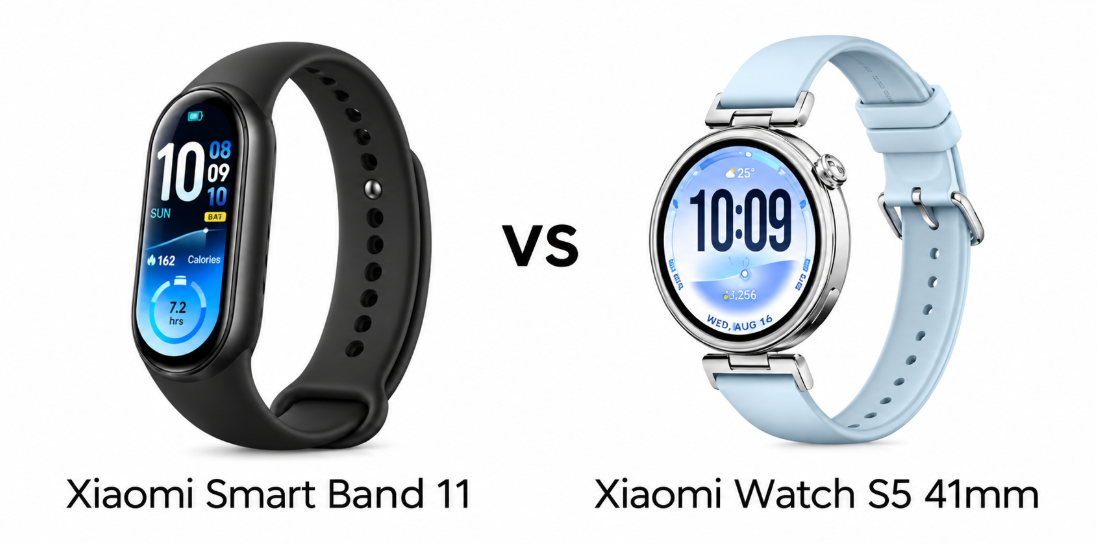
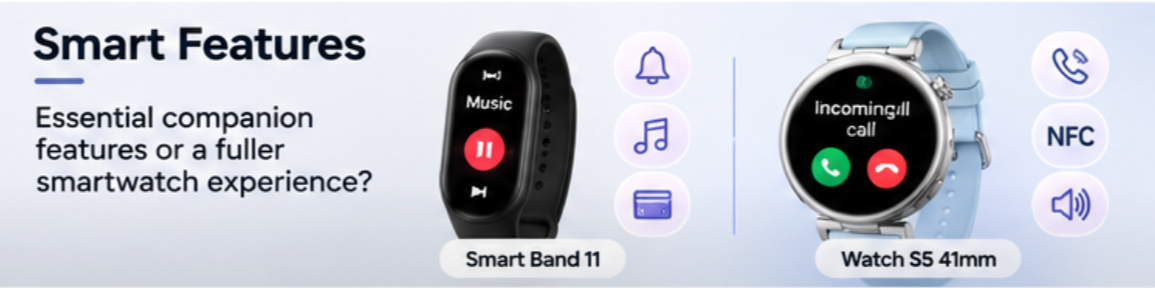
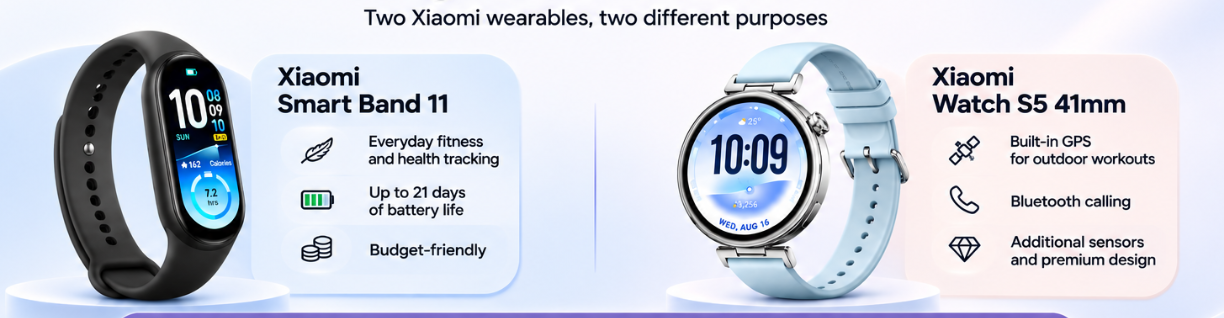
Xiaomi Smart Band 11 and Xiaomi Watch S5 41mm target different wearable needs. The Smart Band 11 focuses on affordable fitness tracking, lightweight comfort, and long battery life, while the Watch S5 41mm offers a more premium design, built-in GPS, additional sensors, and a fuller smartwatch experience.
Although both cover essential health and sports tracking, their functionality goes beyond the basics in different ways. The key difference is what you get for the extra money, particularly if you need phone-free workout tracking, smartwatch features, or simply a comfortable wearable for everyday use.
Notifications, music controls, basic connected features
Calling, NFC, expanded smartwatch functions
Best For
Affordable fitness and everyday tracking
Outdoor workouts and a premium smartwatch experience
Approx. Price
$43 / ₹3,600
$200 / ₹24,000
Disclaimer: Specs are based on available data. Actual performance may vary. Verify details from official sources before buying.
2. Design & Build
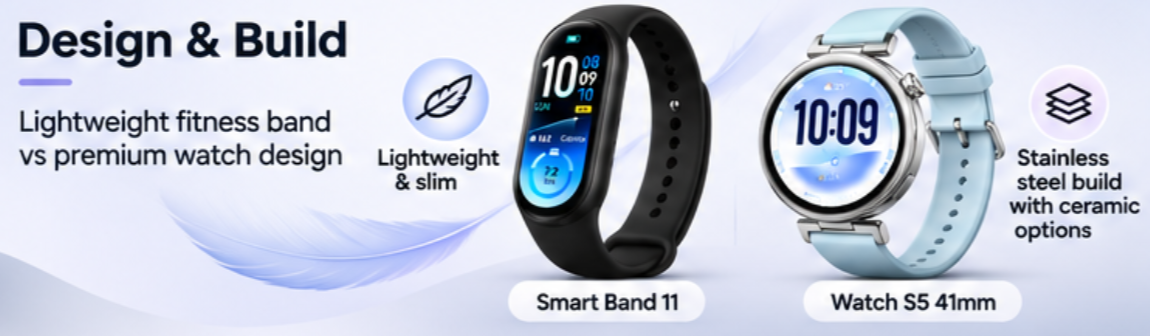
The Smart Band 11 features a slim, lightweight design intended for comfortable all-day wear, including during sleep and workouts. Its interchangeable straps and understated appearance make it practical for everyday use.
The Watch S5 41mm takes a more traditional approach with a stainless steel body, glass back, and stainless steel or ceramic bezel options. It looks and feels more like a conventional wristwatch, but is heavier.
The Band prioritizes comfort and simplicity, while the Watch offers a more premium construction and watch-like appearance.
3. Display
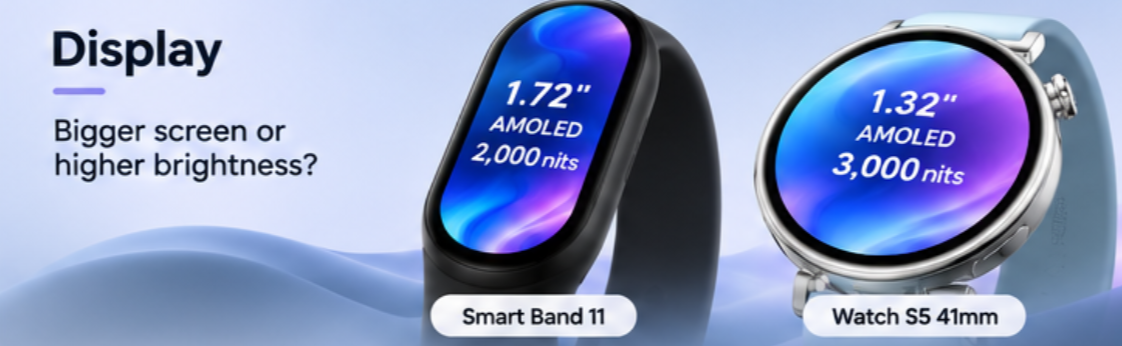
The Smart Band 11 features a 1.72-inch AMOLED display with up to 2,000 nits of brightness, giving it more screen space for notifications, workout information and health data.
The Watch S5 41mm has a smaller 1.32-inch circular AMOLED panel, but offers up to 3,000 nits peak brightness and a sharper 466 × 466 resolution.
The Band is better suited to users who prefer a larger screen for quick information, while the Watch delivers a more traditional watch interface with a brighter, more premium display experience.
4. Battery Life
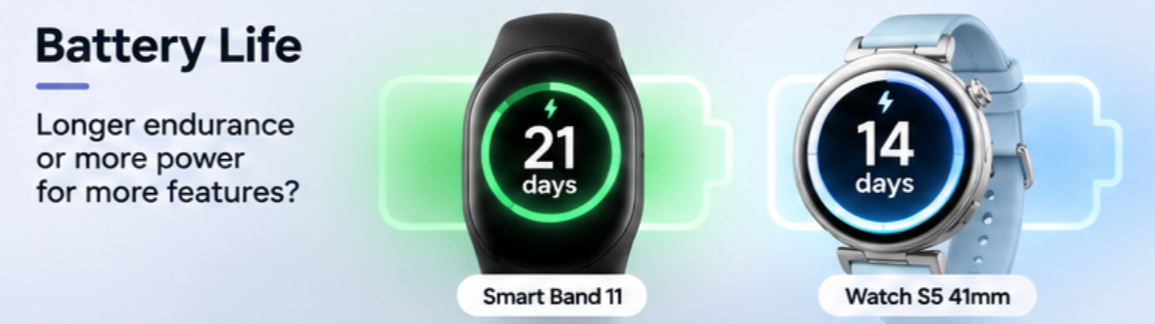
Battery life is a major advantage of the Smart Band 11, which can last up to 21 days on a charge. This makes it particularly convenient for continuous activity and sleep tracking without frequently reaching for the charger.
The Watch S5 41mm offers up to 14 days in light-use conditions, despite its larger 590mAh battery. Its additional hardware and smartwatch functionality come with greater power demands.
The Band is the better choice for users prioritizing fewer charging interruptions, while the Watch still offers strong endurance for a more feature-rich wearable.
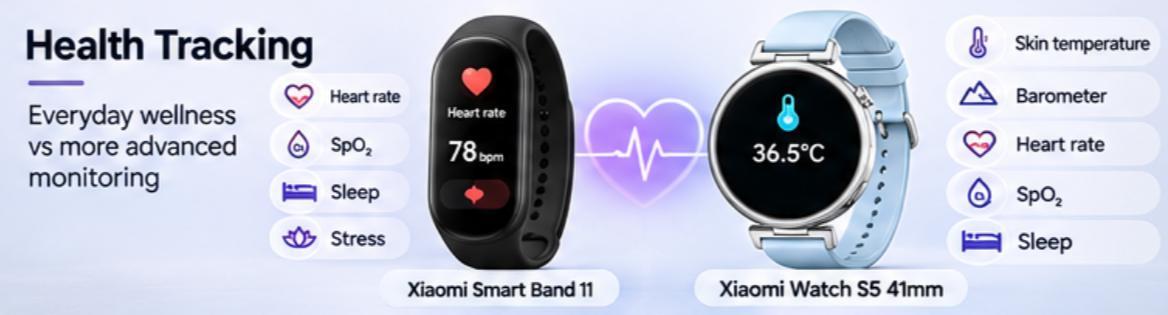
Both wearables cover essential health features, including heart rate, SpO₂, stress and sleep monitoring. The Smart Band 11 focuses on everyday wellness tracking, with HRV-based sleep monitoring and AI-powered sleep insights helping users understand their daily health patterns.
The Watch S5 41mm adds a skin-temperature sensor and barometer alongside its core health sensors, offering more data for users who want a broader monitoring experience. For basic health tracking, the Band covers most everyday needs, while the Watch is more suited to those who want additional sensor capabilities.
6. GPS & Navigation
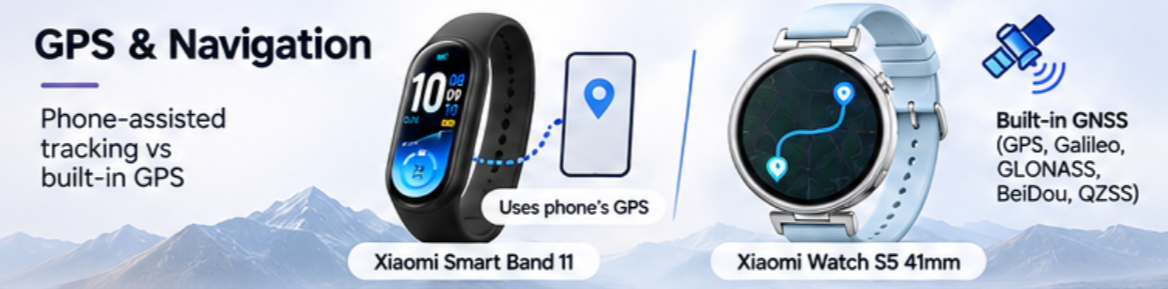
The biggest functional difference is built-in GPS. The Smart Band 11 relies on a connected smartphone for location-based workout tracking, making it less convenient for phone-free outdoor exercise.
The Watch S5 41mm features built-in GNSS supporting GPS, GLONASS, Galileo, BeiDou and QZSS. This allows it to record outdoor routes without relying on a smartphone for positioning.
For running, walking and cycling outdoors, the Watch offers considerably more independence, while the Band is better suited to users who usually exercise with their phones.
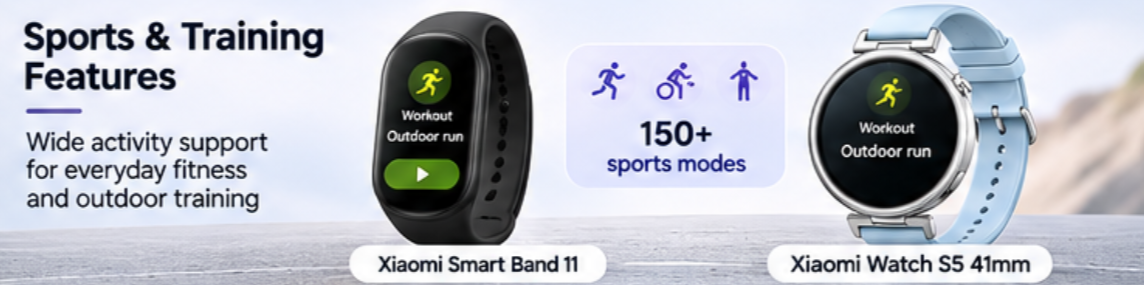
Both devices support more than 150 sports modes, making them suitable for a wide range of workouts, from walking and running to gym sessions. The Smart Band 11 offers straightforward activity tracking for users who want to monitor their exercise without needing advanced smartwatch functionality.
The Watch S5 41mm combines workout tracking with onboard GPS, making it more practical for outdoor training and route recording. The Band is well suited to everyday fitness, while the Watch is more appealing to users who regularly train outdoors and want to track their workouts without carrying a phone.
The Smart Band 11 handles everyday essentials such as notifications, music controls and selected NFC functions on compatible variants. It works primarily as a smartphone companion, keeping basic information accessible on the wrist. The Watch S5 41mm adds a speaker and microphone for Bluetooth calling, alongside NFC and a more comprehensive smartwatch interface. This makes it more useful for handling calls and interacting with features directly from the wrist.
The Band covers basic convenience, while the Watch offers a more independent and interactive experience.
9. Outdoor Features
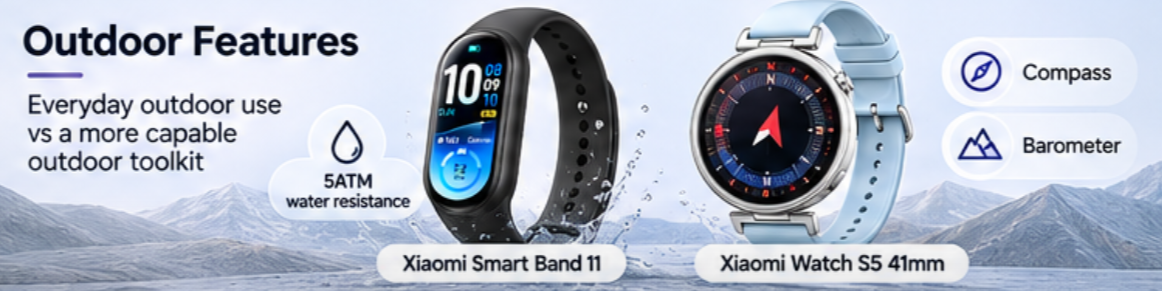
Both devices feature 5ATM water resistance, making them suitable for swimming and everyday water exposure within their intended limits. The Smart Band 11 is a lightweight companion for walking, casual running and general outdoor activity. The Watch S5 41mm goes further with built-in GPS, a compass and barometer, giving it additional utility for outdoor workouts, route tracking and elevation-related information.
The Band is ideal for casual fitness and daily activity, whereas the Watch is better suited to users who spend more time exercising outdoors.
10. Which One Should You Buy?
The Smart Band 11 is the sensible choice for anyone who primarily wants step tracking, sleep monitoring, workout recording, notifications and long battery life without spending much. It is particularly suitable for beginners and users who prefer a lightweight wearable.
The Watch S5 41mm makes more sense for those who want a premium watch design, phone-free GPS workouts, Bluetooth calling and additional sensors. Its higher price is justified mainly when these extra capabilities will actually be used.
Final Verdict
The Smart Band 11 delivers the essentials in a lightweight, affordable and battery-efficient package. The Watch S5 41mm adds a premium build, standalone GPS, more sensors and a fuller smartwatch experience.
The extra cost is primarily for greater independence, outdoor tracking and smartwatch functionality, rather than a dramatic difference in basic fitness monitoring. Choose the Band for everyday fitness and value, or the Watch if you want a more capable wearable that can do more without your phone.
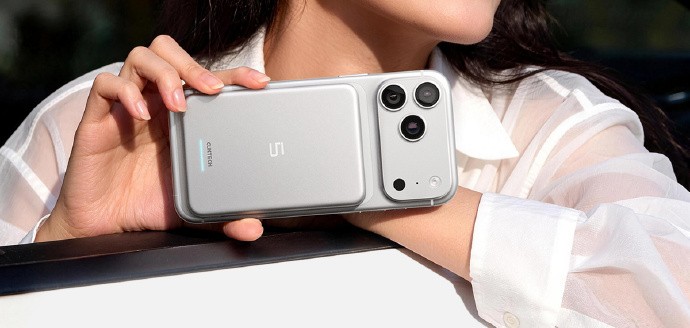
Cuktech has unveiled a new magnetic power bank that prioritizes slimness and everyday convenience. The 5 Air is the company’s first ultra-thin magnetic model, sitting below the larger 10 Air that includes a display and higher wired output.
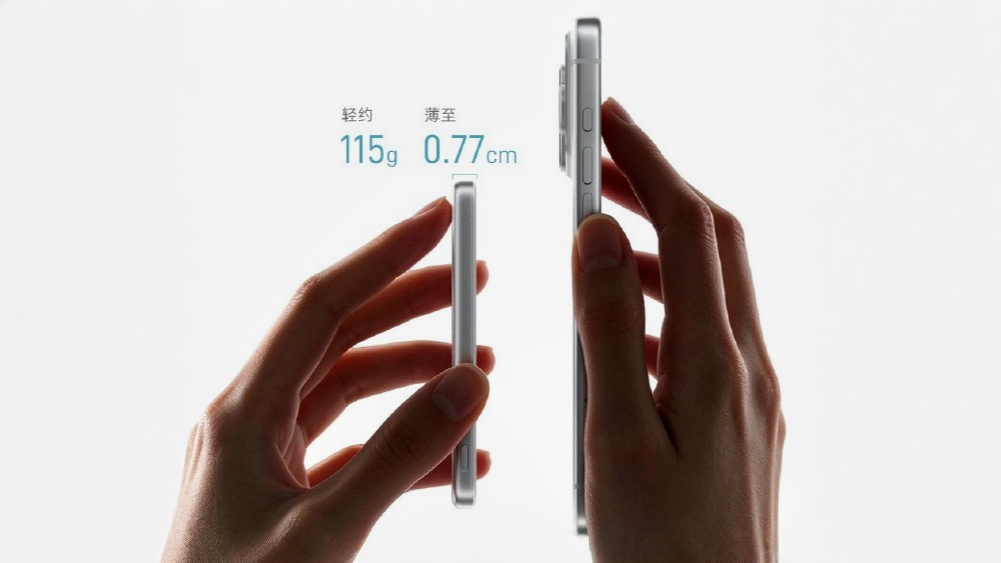
The 5 Air measures about 7.7 mm thick and weighs roughly 115 g. Inside sits a 5,000 mAh cell supplied by ATL, the same company that provides batteries for iPhones. The cell is rated at 19.6 Wh, with a rated output capacity of 3,000 mAh at 5 V and 2 A.
Our picks
The Baseus Blade Power HD Edition 20000mAh is our best-performance power bank under $50.
Cuktech claims the pack can extend a phone’s battery life by up to 34.4 hours. Wireless charging tops out at 15 W, while wired output reaches 25 W. For iPhone 12 through iPhone 18 series models the maximum wireless rate is listed at 7.5 W, consistent with the absence of Qi2 certification. Custom magnets delivering around 13 N of pull force keep the bank securely attached, and a front light strip indicates remaining charge.
Safety and travel practicality receive attention as well. The 5 Air is certified under China’s new GB 47372-2026 power bank standard, which adds nail penetration testing and becomes mandatory on April 1, 2027. At 19.6 Wh it stays well under the 100 Wh limit that applies to most carry-on luggage rules.
Pricing is aggressive for the form factor. The list price in China is 299 yuan (about $45), but the launch price will not exceed 259 yuan (about $39) from November 27 through December 27. Sales begin in China on November 27. Global availability is expected later; Cuktech has so far announced pricing only for the domestic market.
The combination of ATL cells, magnetic attachment, thin profile, and accessible pricing positions the 5 Air as a practical daily-carry option for users who want extra runtime without adding noticeable bulk.
Huawei‘s new OSTA sub-brand, known in China as Xingmang, opened pre-orders for its first phone on Vmall earlier this week, with official images confirming a wide-screen design in three colors. Leaks had also detailed its hardware ahead of the event. The company has now officially launched the OSTA O1 Pro in China at an event alongside the Stelato V8.
Huawei OSTA O1 Pro specifications and features
Huawei OSTA O1 Pro
The OSTA O1 Pro is a wide bar phone with a 6.39-inch 16:9.5 1.5K LTPS flat display, 1.05mm bezels on all four sides, and a 96.1% screen-to-body ratio. It is 6.68mm thick, weighs about 200 grams, and comes in Starry Black, Nebula White, and Starburst Purple. The back has a horizontal dual-camera module and an OSTA logo.
Huawei’s Kirin 9030S chip powers the phone, in 12GB+256GB, 12GB+512GB, 16GB+512GB, and 16GB+1TB configurations. The rear cameras include a 200-megapixel 1/1.28-inch RYYB main sensor, a 50-megapixel 3.7x RYYB periscope telephoto, and a Red Maple lens, with no ultra-wide camera like the Pura X View. A 7,000mAh battery supports 66W wired charging and wireless charging, and the fingerprint sensor sits on the side.
Huawei OSTA O1 Pro
It is also the first phone to ship with HarmonyOS 7 AI Pioneer Edition. Huawei calls it a HarmonyOS AI phone, with a system-level AI screen meant to take you straight to what you need, new AI interactions, and the option to generate a theme from a single image. The company also says the Kirin 9030S is tuned for tighter coordination between the software, hardware, chip, and cloud.
Huawei OSTA O1 Pro price and availability
Huawei OSTA O1 Pro
Introductory pricing in China starts at 5,499 yuan (~$775) for the 12GB+256GB model. The 12GB+512GB version costs 6,499 yuan (~$915), 16GB+512GB is 7,299 yuan (~$1,030), and 16GB+1TB is 8,799 yuan (~$1,240), each 200 yuan below the official list price. Starry Black and Nebula White are limited to the 12GB options, while Starburst Purple is reserved for the 16GB models. Sales start at 6:08 p.m. China time on Vmall and JD, and Huawei has not announced international availability.
The Xiaomi Smart Band 11 first appeared in certification databases in May, launched in China in September, and has now rolled out to international markets with a slimmer body, a brighter display, and upgraded health sensors. If you are thinking about picking one up, there are a few things worth knowing first, from what Xiaomi improved over the Smart Band 10 to the one feature it still leaves out.
Xiaomi Smart Band 11
5New fitness tools for runners, riders, and swimmers
The band supports more than 150 sports modes and is rated 5ATM for water resistance. Xiaomi is highlighting Bluetooth heart rate broadcasting, which streams live heart rate data to compatible cycling computers and third-party apps, along with improved underwater heart rate monitoring for better swim data. The Smart Band 10 already offered both features, so treat them as refinements rather than brand-new tricks.
Beyond workouts, HyperOS 4 brings a redesigned interface. iPhone users also get dual-device notifications, remote camera control, and page turning for e-books, slides, and short videos.
Should international buyers get one?
The Smart Band 11 costs €59.90 in Europe and £49.99 in the UK. Xiaomi has not announced official US availability, which is typical for its wearables.
If you own a Smart Band 9 or older, the brighter screen, slimmer body, and better heart rate sensor make this a sensible upgrade. Smart Band 10 owners can probably skip it unless outdoor visibility really bothers them. Runners who want phone-free tracking should spend a little more on the Smart Band 10 Pro, while bargain hunters can see how it compares in our Redmi Band 4 vs Xiaomi Smart Band 11 breakdown.
Dummy units and renders for Samsung’s next flagship keep contradicting each other on the rear camera arrangement. The disagreement is the strongest public signal yet that the Galaxy S27 Ultra’s final look is still not locked in.
Case and CAD leaks have been unsettled for months. In late September, Ice Universe showed a wide camera island on the Ultra that echoed the iPhone 18 Pro style: two larger lenses on the left and an oval section on the right for another camera, additional sensors, and the LED flash.
An OnLeaks render placed the 5x telephoto above the flash; a later Ice Universe claim put that camera below it. Lens count and exact positions have continued to conflict.
A newer video circulating on X, shared via @Ahmadansari2233 and labelled a Galaxy S27 Ultra dummy measuring 163.93 × 78.42 × 7.97 mm, adds another data point. Those dimensions are roughly 0.17 mm longer and wider than earlier figures, with the same thickness.
The first physical dummy came from Android Headlines, built from CAD details OnLeaks published earlier. It swaps the vertical camera stack of recent Ultra models for an oblong module stretched across the top of the back. The hollow, plain-black unit with no logo measures 163.76 × 78.25 × 7.97 mm. Compared with the Galaxy S26 Ultra’s 163.6 × 78.1 × 7.9 mm, that is a difference of about 0.15 mm in each direction, slightly taller, wider, and thicker.
A second set of images from leaker Sonny Dickson on 10 November showed S27 Ultra and S27 Pro dummies with a rectangular module holding four circular cutouts in a two-by-two grid. Ice Universe quickly replied that “the camera in the upper right corner of the S27 Pro and S27 Ultra does not exist, and this picture is wrong.”
Even though Sonny Dickson’s track record is solid, his dummies conflict with earlier leaks. Several of those point to a single telephoto camera on the Ultra, one fewer rear camera than the S26 Ultra’s four-camera setup.
The persistent mismatch between the Android Headlines CAD-based shell, Sonny Dickson’s four-cutout dummies, and Ice Universe’s insistence on three cameras (plus his later line sketch of a tighter cluster) shows the design is still fluid in public view. Samsung is expected to launch the S27 series in early 2027; until then, the camera layout remains one of the more contested details.
Google Fitbit Edge and WHOOP 4.0 approach fitness tracking from two very different perspectives. Fitbit Edge is a feature-rich fitness band that combines health monitoring, workout tracking, built-in GPS, and smartwatch-like conveniences, making it suitable for both exercise and everyday use. WHOOP 4.0, on the other hand, is primarily a continuous health, sleep, and recovery tracker designed to monitor physiological data with minimal distractions. This distinction directly affects the user experience: Fitbit offers more on-wrist functionality, while WHOOP prioritizes understanding the body’s response to training, sleep, and daily activity.
Fitbit Edge features a conventional fitness-band design with an aluminum housing, silicone Active Band, and a compact profile suited to continuous wear. Its tracker weighs 17.7g without the band and 32g with it, with small and large band sizes included in the box. WHOOP 4.0 takes a more discreet approach with its screenless sensor, SuperKnit band, and Fast Link slider mechanism. It is 33% smaller than WHOOP 3.0 and can be worn on the wrist or with compatible WHOOP Body apparel through Any-Wear technology, allowing users to track their activity beyond the wrist.
Winner: Fitbit – Lightweight aluminum construction and a more conventional fitness-band design.
3. Display & Interaction
The display is one of the most significant differences between these wearables. Fitbit Edge features a 1.3-inch AMOLED color display with always-on functionality, adjustable brightness, backlighting, and Gorilla Glass 3 protection. Users can check workout metrics, notifications, time, and other information directly from their wrist. WHOOP 4.0 has no display, deliberately keeping the device focused on uninterrupted tracking rather than on-wrist interaction. Its health statistics, workout information, sleep analysis, and recovery insights are accessed through the WHOOP smartphone app, making it more dependent on the phone for reviewing data.
Winner: Fitbit – Offers a full AMOLED display and convenient on-wrist access to information.
4. Battery Life & Charging
Fitbit Edge provides up to seven days of battery life from its 65mAh rechargeable lithium-ion battery, making it better suited to users who want fewer charging interruptions. It charges to 100% in approximately 90 minutes, while a five-minute charge can provide up to a day of use. WHOOP 4.0 offers up to five days of battery life and uses a wireless Battery Pack 4.0 that can recharge the tracker while it is being worn. This allows users to charge the device without interrupting sleep or activity tracking, which is particularly useful for people who want continuous health data collection.
Winner: Fitbit – Longer battery life and faster conventional charging.
5. Health Tracking
Both fitness bands monitor important health indicators, including heart rate, blood oxygen, sleep, and temperature-related metrics, but their approach to health analysis differs. Fitbit Edge combines continuous heart rate tracking with resting heart rate, ECG, AFib detection, irregular heart rate notifications, and high and low heart rate alerts. It also tracks skin temperature while accounting for ambient temperature changes. WHOOP 4.0 focuses on HRV, resting heart rate, respiratory rate, sleep stages, and recovery patterns, helping users understand changes in their body and how lifestyle and exercise affect their recovery.
Winner: Fitbit – More dedicated heart-health monitoring and alerts.
6. GPS & Navigation
Fitbit Edge has built-in GPS and Galileo positioning, allowing users to record outdoor running, walking, hiking, and cycling routes without carrying their phones. It can also use Dynamic GPS to select the appropriate GPS source. WHOOP 4.0 lacks onboard GPS and instead relies on a connected smartphone to record routes, pace, and distance during GPS-enabled workouts. This means WHOOP users need to carry their phones when they want mapped outdoor activity records. Fitbit also offers Google Maps turn-by-turn navigation on the wrist when connected to a phone.
Winner: Fitbit – Independent GPS tracking and wrist-based navigation.
7. Sports & Training Features
Fitbit Edge offers more than 50 exercise modes, live workout metrics, automatic activity recognition, cardio load, readiness, VO2 Max, Active Zone Minutes, elevation tracking, and real-time coaching cues. Its workout-focused interface makes it practical for following exercise sessions and monitoring progress in real time. WHOOP 4.0 concentrates on training strain, heart rate zones, cardiovascular effort, and recovery, helping users understand how demanding their workouts are and whether their body is prepared for additional exercise. Its approach is particularly useful for balancing hard training sessions with rest and recovery.
Winner: Fitbit – More exercise modes and practical on-device workout guidance.
8. Smart Features & Everyday Use
Fitbit Edge functions as a more versatile everyday wearable with mobile notifications, quick replies, media controls, alarms, timers, Google Maps, weather, customizable watch faces, and direct access to health and activity information. These features reduce the need to frequently reach for a phone. WHOOP 4.0 keeps interaction minimal, offering a haptic motor, smart wake alarm, and app-based access to health information. It is designed to stay in the background throughout the day rather than function as a notification-focused wearable, making it better suited to users who prefer a distraction-free experience.
Winner: Fitbit – More everyday functionality and convenient on-wrist controls.
9. Durability & Water Resistance
Fitbit Edge combines an aluminum housing, Gorilla Glass 3 display protection, and 5 ATM and IP68 water-resistance ratings. This makes it suited to everyday wear, workouts, and exposure to water while offering additional protection for its screen. WHOOP 4.0 features IP68 protection and is designed for continuous wear during daily activities and workouts. Its compact, screenless construction removes the risk of display damage, although its interchangeable band remains an important part of its overall wearability. Both devices are designed for users who want to keep their fitness tracker on throughout the day and night.
Winner: Tie – Both offer IP68-rated protection for everyday wear.
10. Which One Should You Buy?
Fitbit Edge is the better option for users who want a fitness band that combines health tracking with practical workout tools, GPS, navigation, notifications, and a display. It works well for everyday activity monitoring, outdoor workouts, and users who want information directly on their wrist.
WHOOP 4.0 is more appropriate for fitness enthusiasts who prioritize sleep, recovery, HRV, resting heart rate, training strain, and long-term health patterns. Its screenless design suits people who want to wear a tracker continuously without the distractions of a smartwatch-style interface.
Final Verdict
Google Fitbit Edge is the better everyday choice if you want a screen, built-in GPS, and lower long-term cost without a mandatory subscription, as its core health and workout tracking work indefinitely after a one-time purchase. However, WHOOP 4.0 is better for serious athletic training and recovery, offering deeper strain analytics (including muscular load for weightlifting), faster 1-second heart rate sampling for high-intensity workouts, a 5-day battery that charges right on your wrist via a wireless PowerPack, a lifetime hardware warranty, and a screenless design you can wear on your bicep or alongside a regular watch.
Overall Winner: Fitbit – More complete hardware, fitness tracking, GPS, and everyday features.
Disclaimer: Prices, specifications, and availability may vary by region and retailer. Recommendations in this article are based on editorial opinion, feature-based value, and market positioning at the time of writing. Readers are advised to do their own research before making a purchase.
11. FAQs
1. Which is better for health tracking, Fitbit Edge or WHOOP 4.0?
Fitbit Edge offers ECG-related features and heart alerts, while WHOOP focuses more on recovery, HRV, sleep, and physiological trends.
2. Does Fitbit Edge have GPS without a phone?
Yes. Fitbit Edge has built-in GPS, allowing it to track outdoor routes without your smartphone.
The biggest change in the upcoming Galaxy S27 lineup is the inclusion of a new model called the Galaxy S27 Pro. While Samsung has not confirmed this moniker, it has already appeared in the IMEI database a couple of months ago. So, that means the lineup has four models, the S27, S27 Plus, S27 Pro, and S27 Ultra. The Pro is expected to sit between the Plus and the Ultra, bringing much of the Ultra’s hardware to a smaller phone without an S Pen. Rumors suggest that the S27 series will be announced in January 2027. Well before this, the S27 Pro has surfaced on Geekbench, revealing its key specifications.
Galaxy S27 Pro Geekbench listing
SCOOP: Samsung Galaxy S27 Pro, Indian and European variant, spotted on Geekbench for the first time. 🇮🇳
Model SM-S957B Single-Core: 3061 Multi-Core: 10967
Tipster Abhishek Yadav spotted the Galaxy S27 Pro on Geekbench for the first time. The listing is for model SM-S957B, the Indian and European variant. Samsung’s B suffix usually marks global or international models, including units sold in India and Europe.
Leak
The Galaxy S27 Ultra is tipped to use a 2nm Snapdragon 8 Elite Gen 6 Pro, replacing the 3nm chip in the S26 Ultra.
It identifies the chip as Samsung’s s5e9975, the Exynos 2700, with 10 cores running at up to 4.24GHz and an Xclipse 970 GPU. The tested unit had 12GB of RAM, ran Android 17, and scored 3,061 in single-core and 10,967 in multi-core.
Galaxy S27 Pro specifications (rumored)
The Galaxy S27 Pro is tipped to use a 6.47-inch M16 OLED panel with Privacy Display, in a smaller body than the Ultra and without an S Pen. Leaked CAD models also show a raised camera plateau similar to the one expected on the Ultra.
For photography, it is rumored to pack a 200-megapixel main sensor, a 50-megapixel ultrawide, and a 16-megapixel front camera. The telephoto is less settled, with later reports citing a 12-megapixel 3x lens and earlier ones a 50-megapixel unit with around 3.5x zoom.
TUV filings list the Pro’s cell at a 5,087mAh rated capacity and a 5,240mAh typical capacity, and China’s 3C certification points to 60W wired charging. Wireless and reverse wireless charging are also expected across the series. Earlier reports had already suggested a Snapdragon chip in some regions and the Exynos 2700 in others, which this global listing supports.
The Oppo Reno17 and Reno17 Pro have gone on sale in China today, following their announcement on November 16. Both phones have been available for pre-order since launch. The standard Reno17 starts at 3,599 yuan (about $532).
The new models arrive roughly six months after the Oppo Reno 16 series launched in China. This time, Oppo has made camera capabilities a major part of the lineup, with both phones supporting 4K video recording across all focal lengths.
Oppo Reno17 and Reno17 Pro Price
Oppo Reno17
Comparison
The OPPO Reno16 and vivo V70 both run the Snapdragon 7 Gen 4, but the V70 has the brighter, larger display.
Both phones have flat 1.5K LTPS displays, but the Pro model is actually smaller this year. It has a 6.32-inch panel, compared to the 6.56-inch screen on the standard Reno17. Under the hood, the Reno17 Pro runs on the Dimensity 8550 Super, while the regular model gets Qualcomm’s Snapdragon 7 Gen 4.
As for the battery, the Reno17 packs an 8,000mAh battery, while the Reno17 Pro has a 7,250mAh unit. Both support 80W wired charging. The camera setups share a similar configuration, although the main sensor is different.
The Reno17 Pro has a 200MP main camera alongside a 50MP ultrawide and a 50MP periscope telephoto camera with 3.5x optical zoom. The standard Reno17 swaps the main sensor for a 50MP unit but keeps the other two cameras. Both phones also have a 50MP front camera.
Both models also come with IP69K-rated protection, metal frames, and optical fingerprint sensors. Buyers can choose from four color options: Qiyu Miao, Ice Moon White, Cocoa Brown, and First Snow White.
The Qiyu Miao edition gets a different treatment with the 3D Ice Transparent Floating Process 2.0 finish. Its camera module is also made from a single piece of glass. Singer Song Yuqi serves as the face of the Reno17 series.
Lenovo has spent the past year expanding its handheld lineup, from the Legion Go 2 and a later SteamOS version to more experimental designs. Those devices have stayed in premium territory, and rising memory prices have made flagships harder to recommend. A new leak points to a simpler model that could change that.
Leaked images show a simpler Legion Go Beam with fixed controllers
Windows Latest has exclusively reported that Lenovo is working on a new handheld called the Legion Go Beam, and published three photos of a white unit with lime-green accents around the thumbsticks and along the bottom edge.
Lenovo Legion Go Beam
The layout looks a lot like the Legion Go S, with the left stick above the D-pad, the right stick below the ABXY buttons, and front-facing speakers on each grip. The bezels are thicker than those on the Legion Go 2 and leave room for a Legion logo under the screen. The photos suggest the controllers are fixed, unlike the Go 2’s detachable grips, and there is no touchpad under the right stick. Windows Latest shows textured rear grips, Y1 and Y2 buttons, one USB-C port, a 3.5mm jack, and a top microSD slot. The Go S has two USB-C ports.
A cheaper handheld would be well timed for buyers
Lenovo has not confirmed the leak, and the specs, price, and operating system remain unknown, though the company already sells the Go S and a later SteamOS Legion Go 2. Windows Latest notes that the Legion Go 2 started at $1,099.99 and has since reached $1,999.99 at Best Buy as RAM prices rose, well above earlier Legion Go models.
Fixed controllers, thicker bezels, and one USB-C port all look like cost-cutting, though a lower price is still an assumption. Talk of a low-end Intel Panther Lake chip, an AMD Ryzen Z3, or an older Ryzen Z2 part is speculation only. The Verge has wondered if the Beam name hints at cloud streaming, a path Lenovo already took with the Legion C700, though there is no link.
Windows Latest says it could appear at Lenovo’s Tech World event at CES 2027 on January 6, but Lenovo has not mentioned gaming.
Samsung is expected to unveil the Galaxy S27 series of flagship phones in January 2027. While there is no official word from the South Korean tech giant, the lineup seems to have been confirmed thanks to the early appearance of all four S27 models in the IMEI database a couple of months ago. Now, in a new development, the Galaxy Z Fold 9, which is around nine months away from launch, has made its appearance in the IMEI database, indicating that it is on track.
Two Galaxy Z Fold 9 models appear in the IMEI database
Samsung Galaxy Z Fold 9
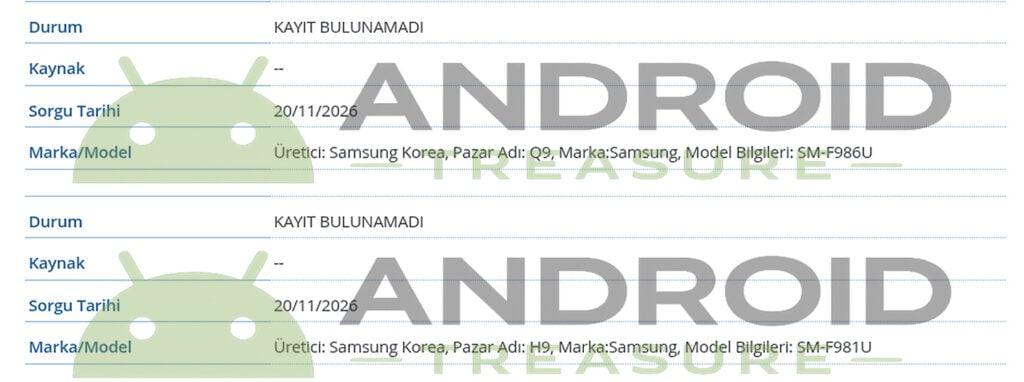
The listings identify two devices: SM-F986U under the Q9 codename and SM-F981U under the H9 codename. Both carry the U suffix that Samsung usually assigns to US carrier models, which suggests a US release is already being prepared. The entries do not include specifications, pricing, or a confirmed launch date.
Comparison
The Galaxy W27 and Galaxy Z Fold8 Ultra both use the Snapdragon 8 Elite Gen 5 for Galaxy processor and Adreno 840 GPU.
Samsung’s recent Fold numbers help decode those codes. The Galaxy Z Fold 8 adopted a wider foldable design, while the regular, taller design was reserved for the Galaxy Z Fold 8 Ultra. The wide Fold 8 used SM-F971 and H8, and the Ultra used SM-F976 and Q8. That sequence makes SM-F981U (H9) the likely Galaxy Z Fold 9 and SM-F986U (Q9) the possible Galaxy Z Fold 9 Ultra, which may launch alongside it.
Likely, the same strategy will apply again, with a wide Fold 9 and a regular-shaped Fold 9 Ultra. Earlier leaks tied Q9 to both a Fold 9 Ultra and a possible TriFold successor, so that reading is not confirmed yet.
An IMEI listing is not a launch announcement. It usually means a manufacturer has reserved identifiers as units move into certification, testing, or carrier checks. Samsung foldables typically debut at a July Unpacked event, so the Fold 9 still has a long road ahead. For buyers, it is a timing clue and little else. Other rumors, including a thinner body and cameras that stay close to today’s models, remain unofficial. Reports also still point to a wider 2027 family that could add a Galaxy Z Flip 9, a second-generation TriFold, and another wide model, though Samsung has not confirmed that set.
Honor seems to be making a case for bigger phones, and it isn’t just about battery capacity anymore. The Honor Power 2 arrived in January with a 10,080mAh battery, and the company has since been linked to even larger cells. Now, a new leak suggests it is also preparing to move beyond the 6.9-inch displays common on today’s flagship phones.
Weibo tipster Digital Chat Station says Honor is planning to launch a new X-series phone before Chinese New Year. It will reportedly have a 6.96-inch or roughly 7-inch display paired with a battery of around 13,500mAh.
The Power 3 is another phone getting a sizable upgrade. Honor is reportedly speeding up its development, with a new 7-inch screen, a large battery, and a more powerful processor.
Reportedly, the phone could have a 12,000mAh battery and a Dimensity 8600 chip, though those details haven’t been repeated in the latest post. Considering the Power 2 already packs a 10,080mAh cell, the next model will need a bigger battery to make the upgrade worthwhile.
Honor is also preparing wider phones
There are two more devices in the leak, although neither is a typical smartphone. According to the leak, Honor’s wide foldable will launch after the Spring Festival. It’s said to have a 200MP camera, a 7,000mAh battery, and Snapdragon 8 Elite Gen 6.
Honor is also working on a wide phone with a regular, non-folding display. Its launch is tentatively scheduled for the first half of the year, but Digital Chat Station hasn’t shared any specifications yet.
The Tensor G6 is Google’s latest and most powerful smartphone chipset that debuted with the Pixel 11 series. It introduces some serious upgrades, such as ARM’s latest C1-Ultra and C1-Pro cores running at higher speeds, a significantly upgraded Tensor Processing Unit (TPU), and advanced imaging pipelines. Still, those weren’t enough to beat the much more powerful Snapdragon 8 Elite Gen 6.
In our testing, the Tensor G6 lagged behind the Snapdragon 8 Elite Gen 5 significantly in terms of performance. So, we’ve now decided to put it against a step-down Qualcomm chipset, the Snapdragon 8 Gen 5, to see if the last-gen Snapdragon chip can still deliver better performance than the latest Tensor chip.
Let’s take a quick look at the spec sheet before we jump to the benchmark numbers.
2× 3.8 GHz (Oryon Gen 3 – Prime) 6× 3.32 GHz (Oryon Gen 3 – Performance)
GPU
PowerVR CXTP-48-1536
Adreno 829 Ray tracing support Snapdragon Elite Gaming features
NPU
5th-gen Tensor Processing Unit (TPU)
Qualcomm Hexagon NPU Agentic AI support
Memory
LPDDR5x Up to 4.2 GHz
LPDDR5x Up to 4.8 GHz
Storage
UFS 4.0, UFS 4.1
UFS 4.0, UFS 4.1
Camera
Up to 200 MP single camera 4K portrait video support Up to 8K video recording at 30 fps Up to 4K video recording at 120 fps 120x Pro Zoom support Real-time semantic segmentation
Qualcomm Spectra triple AI ISP (20-bit) Up to 320 MP single camera Up to 108 MP single camera with zero shutter lag at 30fps Up to 48 MP triple cameras with zero shutter lag at 30fps Up to 4K video recording at 120 fps Real-time semantic segmentation
Note: The benchmark tests were carried out using the Pixel 11 Pro XL (powered by the Tensor G6) and the OnePlus 15R (powered by the Snapdragon 8 Gen 5).
Geekbench performance (v6)
The Tensor G6 almost matches the Snapdragon 8 Gen 5 in single-core performance. The Snapdragon chip is still ahead with about 4% higher score. However, the gap widens to a staggering 23% in the multi-core test.
Tensor G6
Snapdragon 8 Gen 5
Single core
2,731
2,837
Multi core
7,559
9,352
Geekbench 6 results suggest the two chips will deliver similar performance in everyday tasks. However, Snapdragon 8 Gen 5-powered devices will deliver much better performance during high CPU workloads like video editing, rendering, streaming, and heavy multitasking.
AnTuTu performance (v11)
On the AnTuTu benchmark (v11), the Tensor G6 stays below the 2 million mark, but the Snapdragon 8 Gen 5 almost touches 3 million. That’s a solid 53% gain for the Snapdragon chip.
Tensor G6
Snapdragon 8 Gen 5
AnTuTu score
1,932,704
2,961,236
CPU
819,662
914,878
GPU
450,458
974,402
Memory
290,635
382,729
UX
371,949
689,228
The breakdown of the AnTuTu score shows the Snapdragon 8 Gen 5 gets 11% higher CPU score and a massive 116% higher GPU score. Qualcomm’s chips have always been absolutely dominant with GPU performance over Tensor chips, and nothing changes with the newest Tensor G6.
The memory and user experience (UX) performance results also go into Snapdragon’s favor, achieving 31% and 85% higher scores, respectively.
3DMark performance
Wild Life Extreme Stress Test
We also ran the chips through the popular gaming benchmark, 3DMark Wild Life Extreme Stress Test, to better understand how they perform during extensive gaming sessions.
Tensor G6
Snapdragon 8 Gen 5
High score
3,413
5,011
Low score
2,450
3,324
Stability
71.7%
66.3%
The Snapdragon 8 Gen 5 delivers solid numbers, again. The high score is 46% better and the low score is 35% better than the Tensor G6.
If you take a close look at the scores, the low score of the Snapdragon 8 Gen 5 is actually much closer to the high score of the Tensor G6. That itself shows how superior the Snapdragon 8 Gen 5 is.
Performance-wise, the Snapdragon 8 Gen 5 is much better than the Tensor G6. But there are other factors as well, such as camera capabilities, connectivity, and NPU capabilities, you need to consider before making a conclusion.
Tensor G6 vs Snapdragon 8 Gen 5: Key differences that matter
Tensor G6 has a higher peak CPU speed, but less capable CPU setup
Unlike most smartphone chipsets, the Tensor G6 has a 7-core CPU, featuring ARM’s C1-series cores. The Snapdragon 8 Gen 5, on the other hand, uses an 8-core CPU setup, with all cores designed by Qualcomm itself.
The Snapdragon chip features a ‘2+6’ CPU cluster, which is optimized towards performance compared to the Tensor G6 with ‘1+4+2’ configuration, which aims to offer a balanced performance and power efficiency, even though it has a higher peak frequency of 4.11 GHz (vs. 3.8 GHz).
Tensor G6 is a big NO for gamers, but the Snapdragon 8 Gen 5 shines
For gaming and graphics rendering-related tasks, the Tensor G6 is equipped with a PowerVR CXTP-48–1536 GPU, which isn’t well optimized for high-end gaming. Casual gaming sessions should be fine though.
This is where the Snapdragon 8 Gen 5 shines. It features a powerful Adreno 829 GPU with deeper gaming optimizations and Snapdragon Elite Gaming features to deliver an excellent gaming experience, even during long sessions. Game developers also put some extra effort optimizing popular titles primarily for Qualcomm Adreno GPUs.
Tensor G6 has a tighter NPU integration
Google has put more focus on delivering a far better on-device AI experience. The new 5th-gen Tensor Processing Unit (TPU) delivers 50% more compute power and twice the memory bandwidth over the Tensor G5.
The TPU enables Google to offer features such as Instant Night Sight , 4K Portrait Video, Magic Capture, 120x Pro Zoom, Proactive Assistance, and Live Media Translate on Pixel devices without relying on cloud servers.
Qualcomm, on the other hand, takes a different approach with NPUs integrated into their Snapdragon chips. Their chips feature developer-friendly AI engines designed for flexible third-party models and always-on sensing. The Snapdragon 8 Gen 5 features a Qualcomm Hexagon NPU with agentic AI support.
Snapdragon 8 Gen 5 prioritizes raw bandwidth, while Tensor G6 focuses on strong ISP-TPU integration
The Snapdragon 8 Gen 5 packs a Spectra Triple 20-bit AI-ISP, built to handle massive data streams simultaneously across multiple high-resolution sensors. It supports up to 320MP camera sensor and 8K video recording at 60 fps.
The Tensor G6 supports a lower peak resolution of 200MP, but prioritizes a tighter ISP integration with TPU to offer up to 4.5x faster Night Shots capture and 120x Pro Zoom support. The chip has a dedicated hardware accelerator directly into the ISP that unlocks 4K Portrait Video on Pixel phones without overheating or dropping frames. The 8K video recording, though, is limited to 30 fps.
We use cookies on our website to give you the most relevant experience by remembering your preferences and repeat visits. By clicking “Accept”, you consent to the use of ALL the cookies.
This website uses cookies to improve your experience while you navigate through the website. Out of these, the cookies that are categorized as necessary are stored on your browser as they are essential for the working of basic functionalities of the website. We also use third-party cookies that help us analyze and understand how you use this website. These cookies will be stored in your browser only with your consent. You also have the option to opt-out of these cookies. But opting out of some of these cookies may affect your browsing experience.
Necessary cookies are absolutely essential for the website to function properly. This category only includes cookies that ensures basic functionalities and security features of the website. These cookies do not store any personal information.
Any cookies that may not be particularly necessary for the website to function and is used specifically to collect user personal data via analytics, ads, other embedded contents are termed as non-necessary cookies. It is mandatory to procure user consent prior to running these cookies on your website.