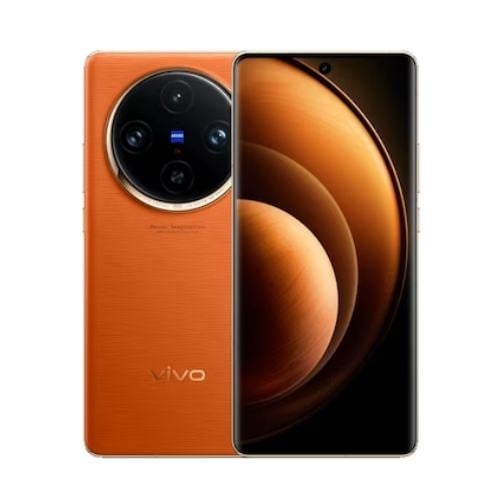
The Vivo X100 series of flagship smartphones were recently unveiled in the Indian market. Now, the base X100 model is receiving a notable discount in the region. So here’s everything you need to know about this.
Vivo X100 Discount Via Flipkart
To recall, the Vivo X100 was first announced in India for a starting price tag of 63,999 INR for its base 12GB + 256GB variant. The higher end 16GB + 512GB variant was released for 69,999 INR. However, the pricing of the premium grade handset now starts from under 60,000 INR thanks to discounts on select bank cards.
Flipkart is even offering no-cost EMI options as well. So the effective price tag of the two X100 models is 58,999 INR and 64,999 INR respectively. It is worth noting that this deal is only available till 15th February 2024 and is applicable on both, Black and Blue color variants. For those unaware, the Vivo X100 sports a tall 6.78-inch LTPO AMOLED display that offers FHD+ resolution, 120Hz refresh rate, HDR10+, and more.
Under the hood, this device is equipped with the MediaTek Dimensity 9300 SoC and is powered by a large 5,000mAh battery pack that supports 120W fast charging. The rear packs a 50-megapixel triple camera setup, while the front houses a 32-megapixel selfie shooter. Other notable features include Bluetooth 5.4, NFC, GPS, WiFi 7, and Android 14 OS based Funtouch OS 14 custom skin out of the box.
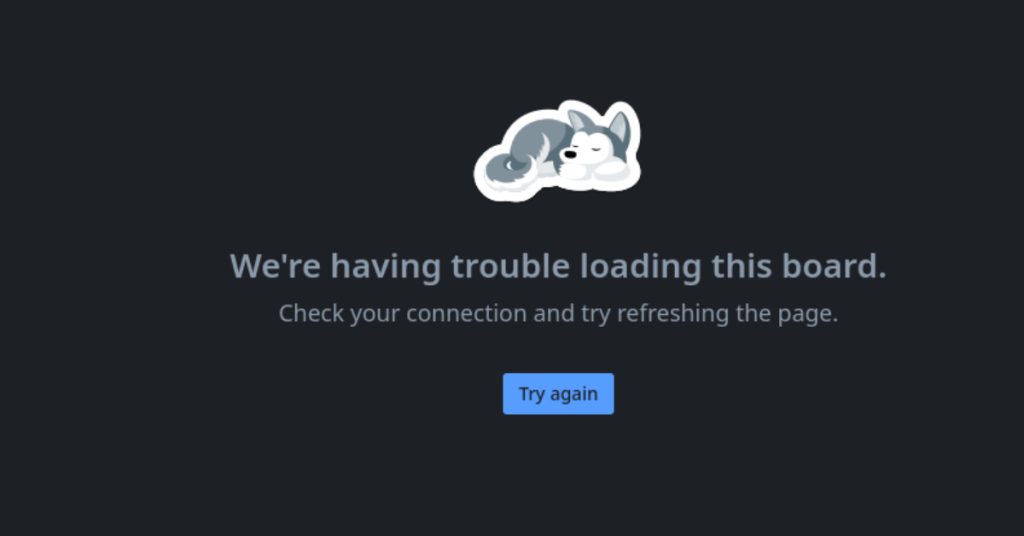
Trello, the popular project management and collaboration tool, is experiencing technical difficulties today, leaving users unable to access their boards. This widespread issue is impacting businesses and individuals globally who use Trello, including the team here at Gizmochina.
Reports of Trello’s unavailability began surfacing earlier in the day, and the company has acknowledged the problem.
We’re unable to access our Boards.
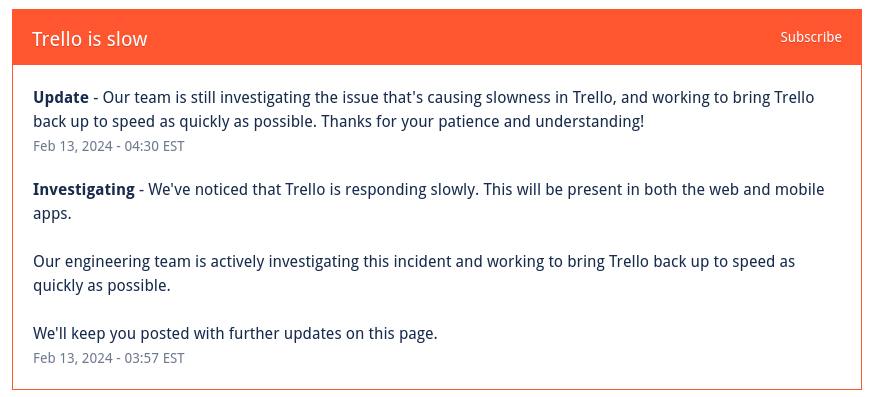
Trello’s official Status site currently displays a “Trello is Slow” message, with a recent update confirming, “Our team is still investigating the issue that’s causing slowness in Trello, and working to bring Trello back up to speed as quickly as possible. Thanks for your patience and understanding!”
Trello service outage status (04:30 EST).
For many, Trello is an essential tool for organizing tasks, tracking progress, and collaborating with teams. This unexpected outage is undoubtedly causing disruptions in workflows. While Trello’s team is working to resolve the issue, there’s no immediate estimate on when the service will be fully restored.
You can stay updated on the status of Trello’s service by visiting the Trello Status site. The site offers real-time information on any ongoing incidents or maintenance of Trello and its other services.
Here at Gizmochina, all our writers rely on Trello to coordinate our editorial calendar and ensure a smooth publishing process. The outage has certainly affected some aspects of our operations. So we, like many other users, are hoping for Trello’s swift restoration.
We’ll continue to monitor the situation and provide updates as more information becomes available.
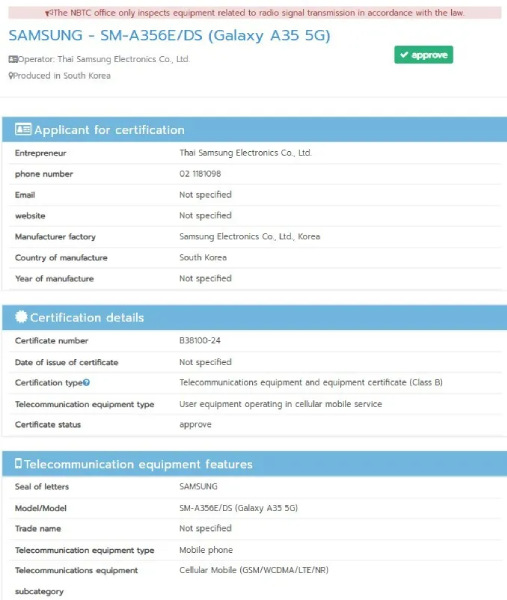
The Samsung Galaxy A35 5G smartphone has been making rounds in various leaks and certifications recently, and it has now surfaced on Thailand’s NBTC certification site.
The smartphone’s appeared on NBTC carrying the model number SM-A356E/DS. While the listing itself doesn’t provide detailed hardware specifications, it signifies approval for its launch in Thailand’s market.
Samsung Galaxy A35 5G NBTC certification.
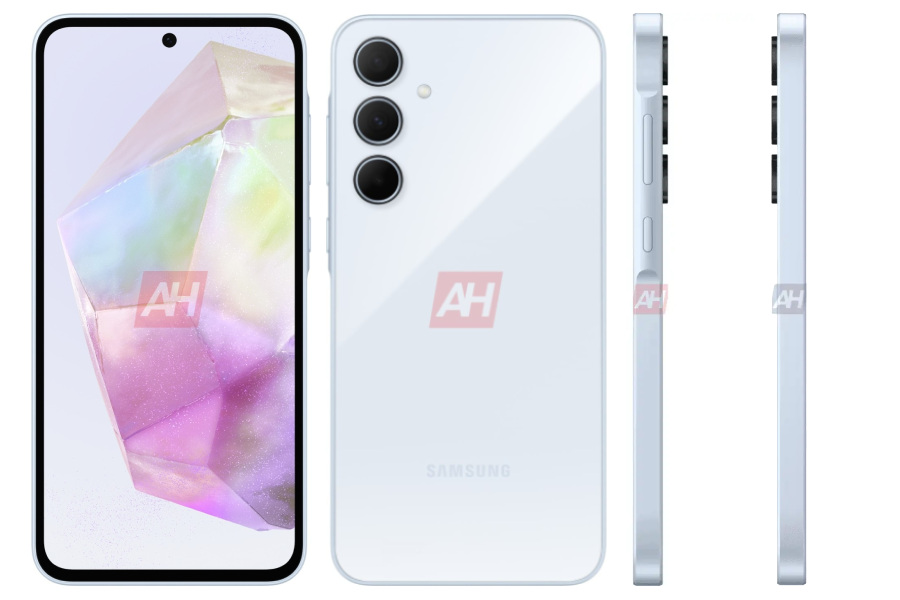
Previously, the Galaxy A35 5G had been the subject of several leaks and renders, showing the new “Key Island” design element (first introduced with the Galaxy A25 5G), making its way to this new device.
The device’s back features a typical Samsung smartphone layout, sporting a vertically arranged camera setup within flat frames all around.
Expected to be equipped with an Exynos 1380 chip, the Galaxy A35 5G is rumored to run on Samsung’s custom One UI 6.0 interface based on the latest Android 14 operating system.
Display-wise, rumors point to a 6.5-inch Super AMOLED screen with FHD+ resolution offering a 120Hz refresh rate for smoother visuals.
Samsung Galaxy A35 5G renders.
The smartphone may come in three color options — icy blue, lilac, and navy blue, catering to various aesthetic preferences.
As for the cameras, it’s expected to house a 50-megapixel primary sensor, accompanied by 8-megapixel and 5-megapixel sensors on the rear, with a 13-megapixel front camera for selfies.
Furthermore, the device is rumored to pack a 5000mAh battery with 25W charging support, as indicated by an FCC listing.
With the device clearing certifications for launch on all the major markets, we can expect Galaxy A35’s global launch pretty soon. We will keep you posted on any further updates on the Samsung Galaxy A35 5G as more information becomes available.
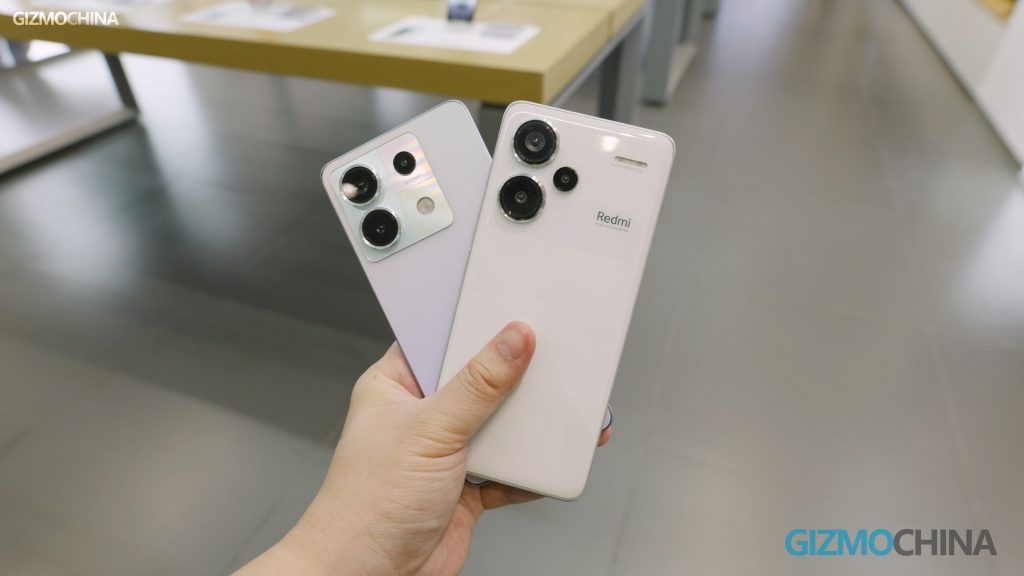
The Redmi Note 13 5G series made its debut in India in early January. The lineup consists of three models ranging across different price segments.
Within a few days from its release, the series generated ₹1,000 crores in revenue. A month later, the company now announces that the revenue from the said smartphones has doubled.
Earlier today, Xiaomi revealed that the Redmi Note 13 5G series crossed ₹2,000 crores in revenue in a month. This is quite an achievement for a brand that has been losing market share in the country.
However, unlike previous years, the company does not mention the number of units sold. The numbers should be comparatively low given the current smartphone market scenario.
So how come the revenue is high? The answer to this is the pricing of the newer Redmi Notes.
The base Redmi Note 13 5G starts at ₹17,999 instead of ₹9,999 as it used to a few years back. On the other end of the spectrum, the top-end Redmi Note 13 Pro Plus retails as high as ₹35,999.
Due to increased pricing and à la carte features from mid-range as well as premium categories, the Redmi Note series is no longer a default recommendation. The devices are still good but they have lost their uniqueness and charm.
Despite all these, Xiaomi managed to clock in crores of revenue in a month. This sort of proves that Indian consumers still trust the ‘Redmi Note’ brand due to its legacy.
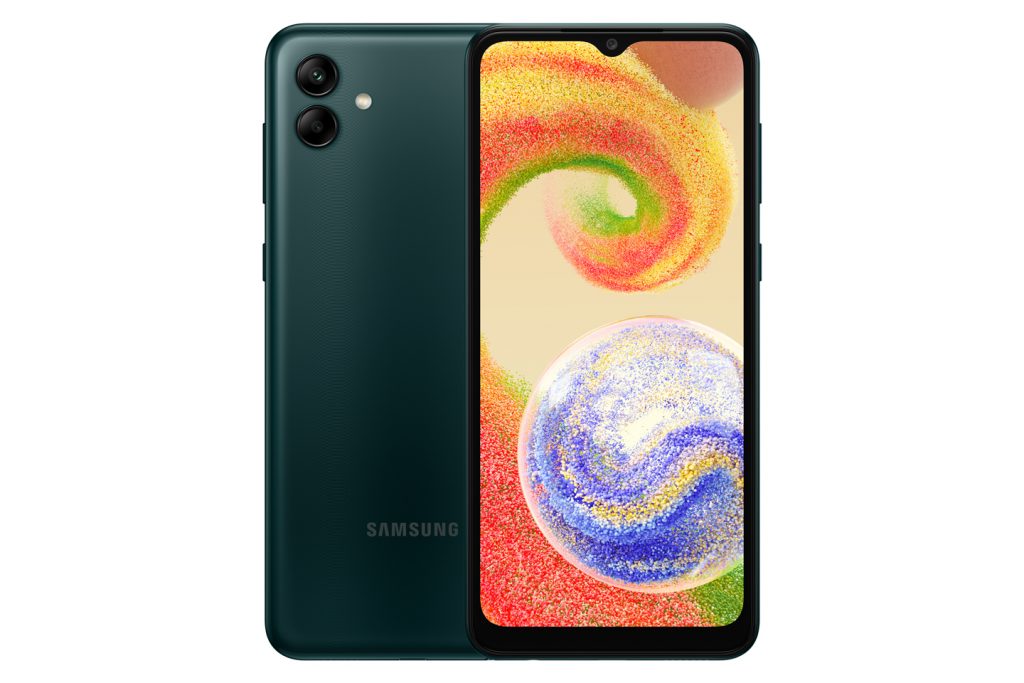
Following the One UI 6.0-based rollout on the flagship and mid-range smartphones, the Korean giant is now pushing the update for compatible remaining smartphones. The latest to get the update is the Samsung Galaxy A04e in India, Nepal, Sri Lanka, and Bangladesh. The new firmware brings plenty of new changes and the luxuries of Android 14.
Samsung Galaxy A04e Android 14 Update
Samsung Galaxy A04e is receiving the firmware version A042FXXU6DXA3, which also includes the December 2023 security patch along with the new Android 14 version. The same update could arrive in other regions within the coming few days. Samsung hasn’t yet revealed the exact date, though.
Currently, the update is rolling out in a staggered way and may arrive on all the units within the coming few days. The users can manually check for the update by heading to Settings > Software Update and tapping Download and Install.
Samsung Galaxy A04e Features
Additionally, the Samsung Galaxy A04e was launched in 2022, featuring a MediaTek Helio G35 SoC, 3/4GB of RAM, and 32/64GB of internal storage. It was launched with a 6.5-inch HD+ LCD PLS display. The smartphone sports a 13MP primary camera with a 2MP depth sensor and a 5MP selfie shooter. It offers configurations with 3GB or 4GB of RAM and options for 32GB, 64GB, or 128GB of storage, expandable up to 1TB via microSD card. In terms of connectivity, the smartphone supports LTE, Wi-Fi 802.11 b/g/n, and Bluetooth 5.0.
Following the Samsung One UI 6.0 update timeline, the smartphone received the update on time. This month, the Galaxy F13, Galaxy F14, Galaxy F23 5G, Galaxy M13, Galaxy M13 5G, Galaxy M14, Galaxy M23 5G, Galaxy Tab A9+ 5G, Galaxy Tab A8, and Galaxy Tab A7 Lite will receive the OneUI 6.0 update.
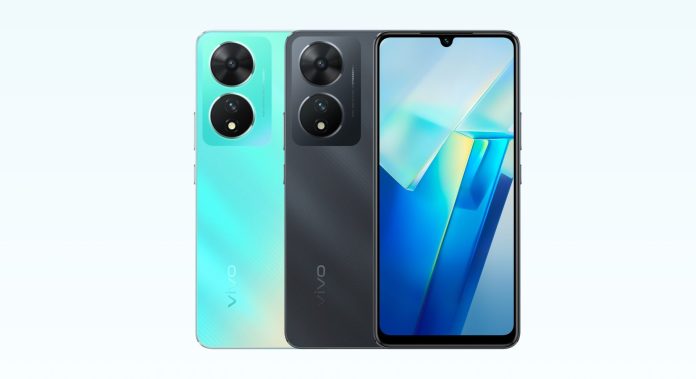
Vivo may soon expand its T series lineup in India with the launch of the T3 5G. The device’s existence has been confirmed through an official BIS certification listing, where it’s identified by the model number V2334.
Vivo T3 5G BIS certification.
While this initial listing didn’t provide specifications, further confirmation and some technical insight came from its appearance on the Bluetooth SIG certification website.
The Bluetooth certification verifies the T3 5G’s name while revealing it will use the latest Bluetooth 5.3 connectivity standard. But besides that, we do not have any other information regarding the device.
The Vivo T3 5G will succeed the T2 5G, which debuted in April of last year. So the company could also launch the T3 5G around the same timeframe. For now, let’s briefly recap what its predecessor came up with.
The Vivo T2 5G features a 6.38-inch FHD+ AMOLED display with a 90Hz refresh rate, offering clear images at 2400×1080 pixels resolution and 1300nits brightness.
It is powered by a Qualcomm Snapdragon 695 SoC with Adreno 619GB GPU. And the smartphone comes with 6GB/8GB RAM and 128GB storage (expandable via microSD card). On the software front, the phone runs on Funtouch OS, based on Android 13.
Vivo T2 5G.
The camera setup is also noteworthy, featuring a 64MP primary sensor with OIS and EIS and a 2MP bokeh sensor on the back. The front camera is a 16MP snapper.
For connectivity, the phone supports 5G, dual-band Wi-Fi, Bluetooth, GPS, and USB Type-C. Lastly, it has a 4,500mAh battery and 44W fast charging.
We can expect the Vivo T3 5G to build up on these features. We will be sure to keep you updated about it if any new information becomes available.
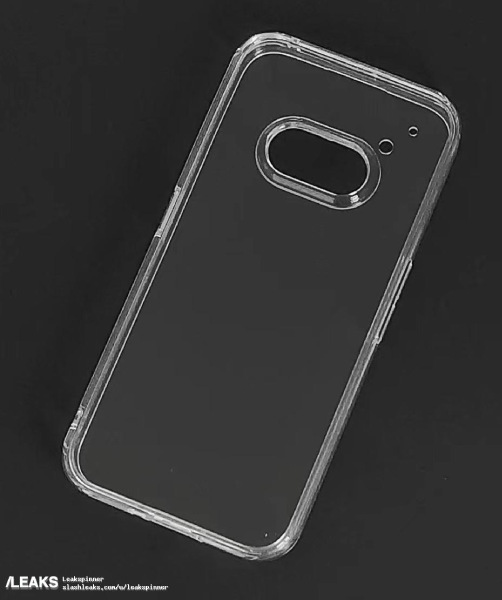
The upcoming Nothing Phone (2a) has been subject to both misleading leaks and potentially revealing ones. Recently, a series of seemingly fake renders added confusion to the speculation surrounding the device.
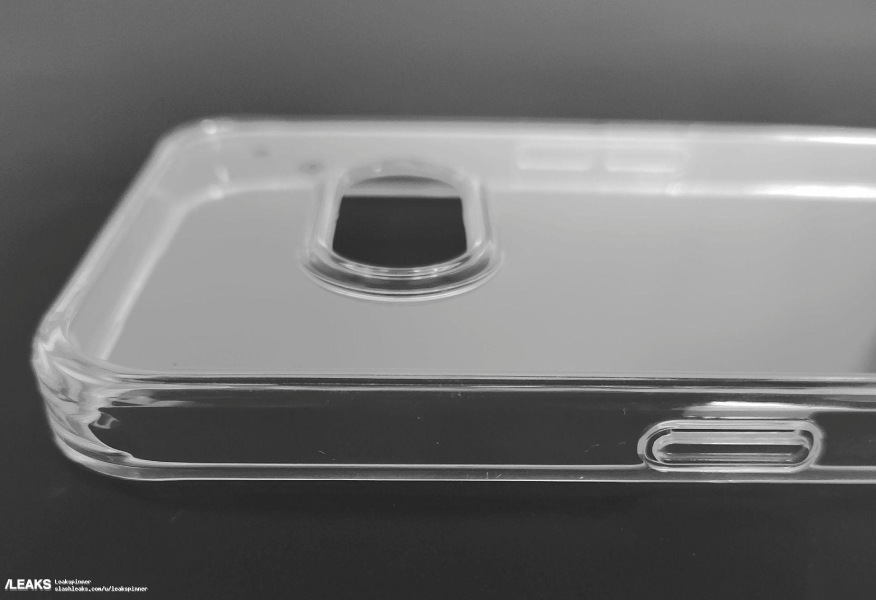
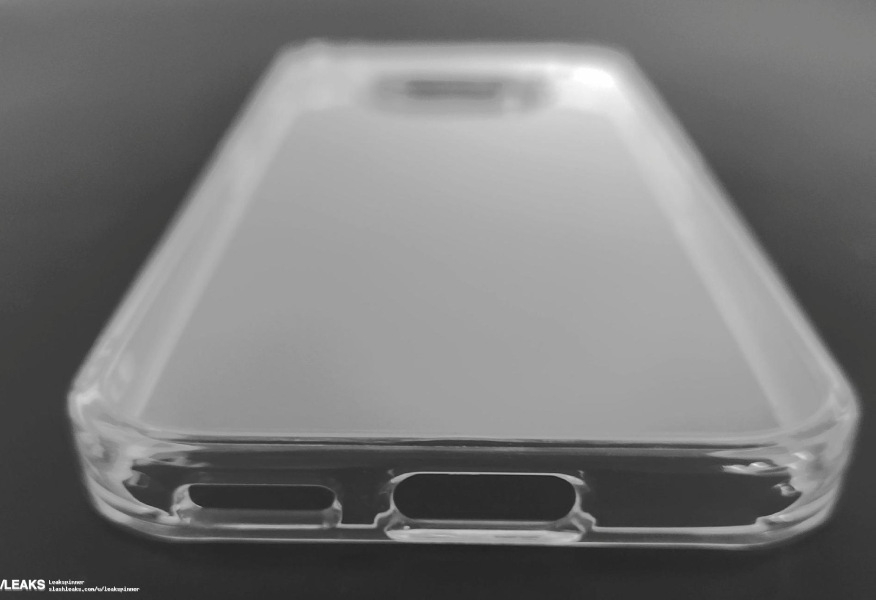
However, a new leak – this time in the form of an alleged phone case – suggests that initial design leaks might have been accurate after all. These case images were shared on SlashLeaks.
We can see the Phone (2a) case featuring a camera setup positioned horizontally. This lines up with previous design speculations, leading us to think they could be on the mark. If accurate, this would be a notable departure from the vertical camera modules seen on previous Nothing Phones.
However, there’s one inconsistency with the case design — it lacks any cutouts for the Nothing Phone’s iconic Glyph LED interface. So we are still not sure if this indeed is a Phone (2a) case.
We may find more concrete answers soon, as Nothing will officially reveal Phone (2a)’s details today at 3:30 PM IST. While it’s unclear exactly what will be revealed, it could shed light on the phone’s design and potentially confirm some features.
The Nothing Phone (2a) is speculated to feature a 6.7-inch AMOLED display with a 120Hz refresh rate. It may be powered by the MediaTek Dimensity 7200 processor, offering up to 12GB of RAM, and a storage capacity of 256GB. All eyes are now on Nothing to see if today’s announcement brings these rumors closer to reality.
Following its recent launch, Apple has released the first software update for the Vision Pro headset. The update, visionOS 1.0.3, arrives two weeks after the previous 1.0.2 version which was released before the headset launch.
While Apple doesn’t disclose all the fixes in this update, it targets a significant issue and includes general bug fixes.
The most notable change in the visionOS 1.0.3 update is the ability to reset a forgotten passcode. Previously, users who forgot their Vision Pro passcode had no recourse other than visiting an Apple store for a reset. Now, if the incorrect passcode is entered enough times, the headset will offer the option to erase the device.
This feature provides additional convenience and control for Vision Pro users. Apple maintains security by keeping the Activation Lock in place; erasing the headset won’t bypass the requirement for the owner’s Apple ID.
Apple’s release notes simply state that the update includes “important bug fixes”. The specific bugs that have been addressed aren’t publicly detailed.
Vision Pro owners can download and install the update directly on their headset. Navigate to the Settings app and locate the Software Update section to begin the process.
As with any device, keeping your Vision Pro software updated is important to ensure you have the latest features, bug fixes, and security enhancements that Apple provides.
In related news, there are mixed reactions from Vision Pro users about the headset. For instance,, Omar Shahine, the head of Microsoft Word, shared his firsthand experience with the Vision Pro while traveling from Seattle to Dubai.
He noted its versatility and how it can turn the entire cabin into a personalized entertainment hub. However, he also pointed out some drawbacks, particularly concerning its weight. You can read about Omar’s experience here.
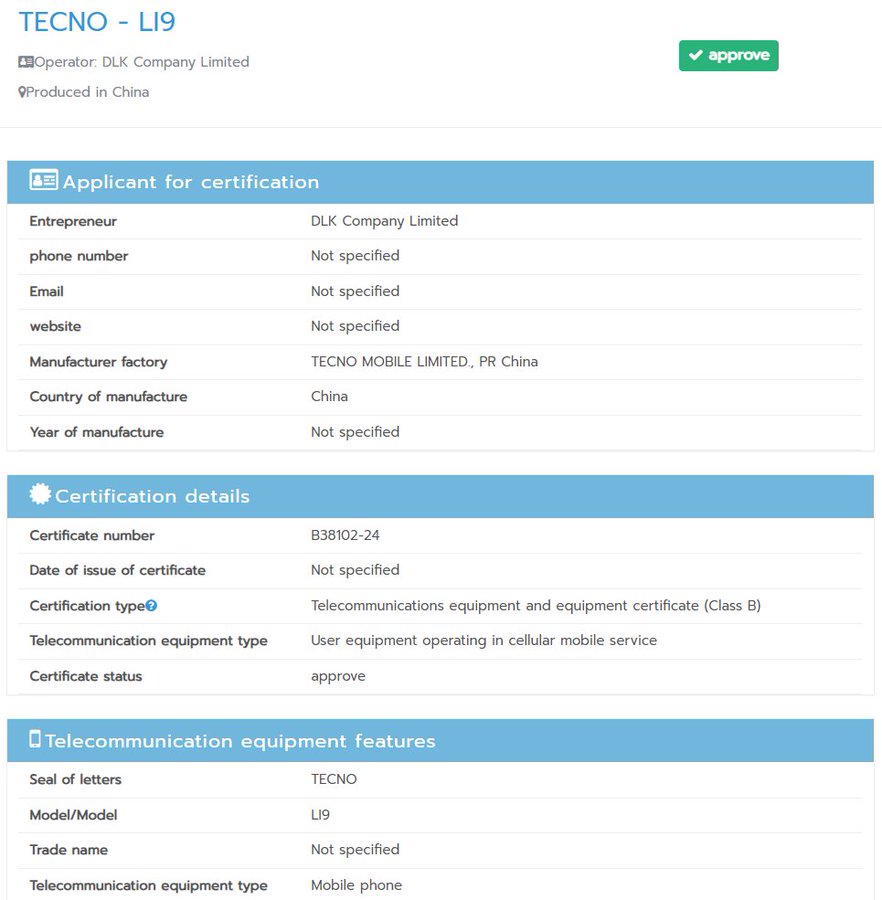
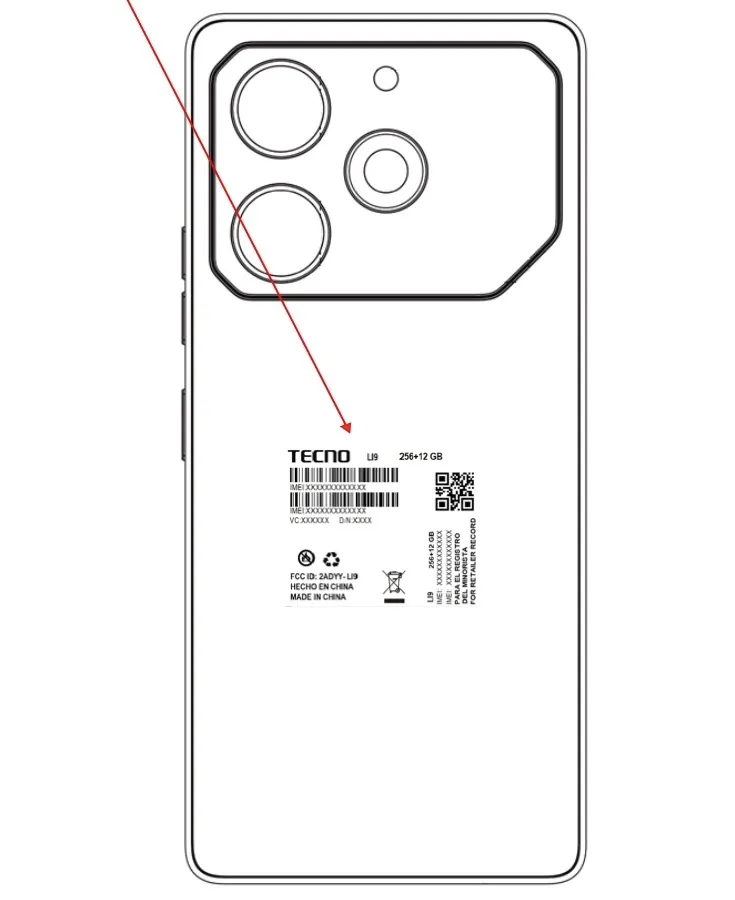
Tecno recently confirmed that it will announce several new tech innovations at the upcoming Mobile World Congress (MWC) 2024 event, which will be held later this month. Among the many announcements, the brand will unveil the Tecno Pova 6 Pro 5G and Megabook T16 Pro 2024 Ultra notebook at the MWC. In a new development, the Pova phone has received approval from the NBTC certification in Thailand, indicating that it could be one of the markets to receive it in the near future.
Tecno Pova 6 Pro 5G NBTC certified
Tecno Pova 6 Pro 5G NBTC
As can be seen, the above screenshot reveals that a Tecno phone with a LI9 model number has been approved by the NBTC authority. The said device has been previously spotted with the Tecno Pova 6 Pro 5G moniker in the databases of the Google Play Console and the Bluetooth SIG certification. Unfortunately, the NBTC listing has no information about the specifications of the device.
Tecno Pova 6 Pro 5G specifications (rumored)
As per the Play Console listing, the Pova 6 Pro has an FHD+ display and the Dimensity 6080 chipset. In addition, the device is equipped with 12 GB of RAM and runs on Android 14. Earlier this month, the device was also approved by the FCC authority., which revealed the phone’s rear design and a few specs.
As per the FCC listing, the device will arrive with 12 GB of RAM, 256 GB of internal storage, and support for 70W wired charging. The device will likely arrive with a 6,000mAh battery.
For security, it appears to feature a side-facing fingerprint scanner. On the back, it hosts a dual-camera system with a quad-LED flash, although specific details regarding the configuration of both the front and rear cameras remain undisclosed.
Phone-maker Nothing is stepping up its light show game! The company, known for its transparent back design and eye-catching LEDs, is opening up its signature Glyph Interface with a brand-new Developer Kit. That means software devs and companies can now create and sync custom LED light patterns that will directly integrate with their apps.
Nothing Glyph Developer Kit
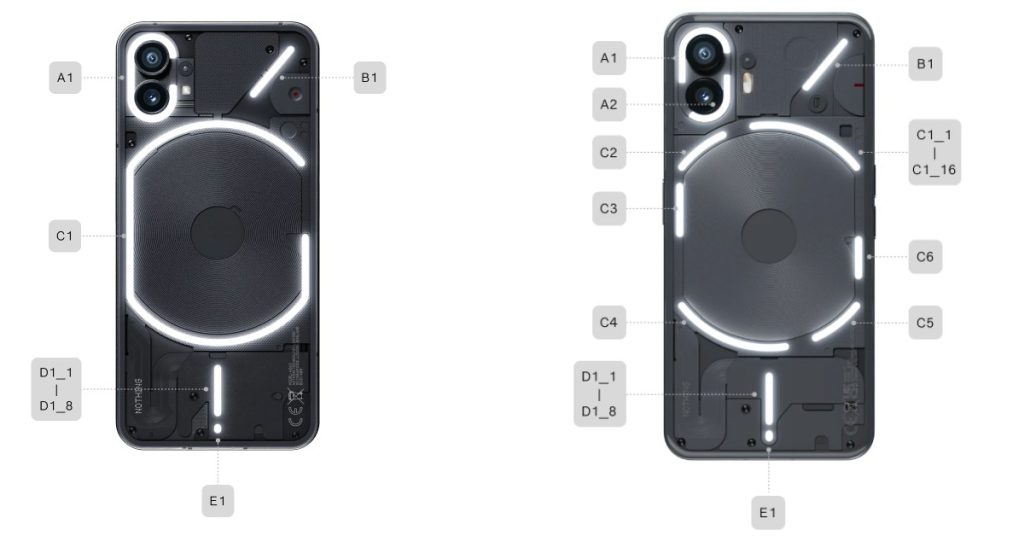
The kit is conveniently available on GitHub and provides all the necessary tools and instructions for developers to tap into the LED zones on the Nothing Phone (1) and the Phone (2).
For the Phone (1), developers can program 12 individual zones. The Phone (2) increases customization potential with a total of 33 programmable LED areas. Below is the image how Nothing is indexing zones of LED lights on both Phone (1) and Phone (2).
The Glyph Developer Kit from Nothing allows developers to fully make use of those fancy LED lights. The kit includes different methods like GlyphFrame, which identifies the Glyph to be used, as well as GlyphFrame.Builder and GlyphManager for controlling the Glyph Interface. Developers can use GlyphManager.Callback to confirm successful connections.
By using the Glyph Kit, developers can create apps with notifications that use unique patterns, or perhaps games that react to user actions. This could lead to a more immersive and enjoyable experience for users of Nothing phones.
The Glyph Developer Kit launch precedes the much-anticipated release of the Nothing Phone (2a). It’s highly likely that the new device will also use the Glyph Interface, with the company likely to add support for it in the Kit after the launch.
Developers interested in the toolkit can start working with it and sign up for notifications to receive API keys as soon as they become available.
iQOO is reportedly working on the iQOO Z9 series of smartphones for multiple markets, including China. The Chinese market may likely receive it first, with an expected launch within Q1 of this year. Last year’s Z-series lineup included the iQOO Z8 and iQOO Z8x for the Chinese market. It is still unclear whether the brand will launch the iQOO Z9x as a successor to the Z8x this year. Ahead of the expected launch in China, tipster Digital Chat Station has leaked the key specifications of the alleged Z9.
Alleged iQOO Z9 key specifications (rumored)
Without specifying the name of the phone, DCS claimed that a Z-branded phone will feature an OLED panel that offers a 1.5K resolution. This will be a major upgrade, as the Z8 series features a 6.64-inch IPS LCD panel that offers an FHD+ resolution and a 120Hz refresh rate. While he seems to be talking about the iQOO Z9, there is no information about its display size and refresh rate.
He further revealed that the SM7550 Snapdragon chip will power the upcoming Z-series phone. The said model number confirms that it will feature the Snapdragon 7 Gen 3 chipset. The same chip powers the Honor 100 and the Vivo S18 smartphones available in the Chinese market. It is speculated that the same chip will also power other upcoming phones, such as the Xiaomi Civi 4, the OnePlus Ace 3V (Nord CE 4 globally), and the Oppo K12.
The new leak contradicts a previous claim, which said that the Z9 is being tested with the Density 8300 chipset. If indeed a Z9 model with the D8300 chipset exists, it might possibly be branded as the iQOO Z9 Pro. However, this is purely speculative, so it is advisable to take this information with a pinch of salt.
The alleged iQOO Z9 leak by DCS further states that it has a 6,000mAh battery. Unfortunately, it does not say anything about its fast-charging capabilities.
In related news, there is an iQOO Z9 5G phone with model number I2309 in the works for India and possibly some other market. However, it is unclear whether it will be the same device as its Chinese edition.
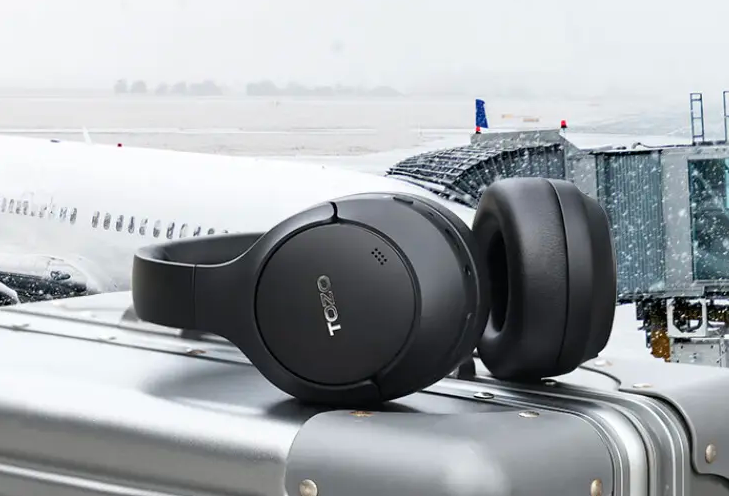
TOZO has unveiled its latest offering, the HT2 noise-canceling headset, now available on JD.com. Boasting “Gold Label Certification” and Bluetooth 5.4 technology, the wireless headset comes with an introductory price of 299 yuan (~$50). One of its standout features is the “intelligent ear canal adaptation” function, which purportedly identifies the user’s ear canal structure and wearing status to optimize noise reduction and audio correction, promising noise reduction of up to 38 dB.
More technical details about the TOZO HT2 headset
Equipped with a 40mm dynamic driver and Hi-Res certification, the TOZO HT2 headset features three microphones dedicated to noise reduction. Its built-in 500 mAh battery offers an impressive battery life of up to 60 hours. The headset’s parameters include Bluetooth version 5.4, a frequency range of 20Hz-20kHz for Bluetooth and 16Hz-44.1kHz for wired connections, and a transmission range of 12 meters. It supports AAC and SBC codecs and takes less than two hours to charge via its Type-C charging interface.
The TOZO HT2 headset aims to provide an immersive audio experience with its advanced noise-canceling technology. With its Hi-Res certification and 40mm dynamic driver, the headset promises high-fidelity sound reproduction across a wide frequency range. The inclusion of three microphones dedicated to noise reduction enhances call quality and minimizes background noise, ideal for both entertainment and professional use.
The headset’s impressive battery life of up to 40 hours with ANC and an impressive 60 hours without ANC ensures extended usage without frequent recharging. Whether for long commutes, work, or leisure, users can enjoy uninterrupted listening experiences.
Overall, the TOZO HT2 noise-canceling headset combines advanced features with a user-friendly design, making it a compelling option for those seeking high-quality audio and effective noise reduction. Its affordability, coupled with its robust specifications, positions it as a competitive choice in the headphone market.
To some, it might not seem logical to do a Galaxy S24 Ultra vs. Galaxy Z Fold5 comparison, but if you look at these devices, they have certain similarities. For instance, both devices support the use of an S Pen for productivity, hence their popularity among creatives. So if you are creative, you might be wondering which of these devices is the better pick for you in terms of productivity.
SPECS TABLE
Galaxy S24 Ultra
Galaxy Z Fold5
Price
$1,299 / £1,249
$1619 / £1599
Display
6.8-inch Dynamic LTPO AMOLED
6.2-inch Dynamic AMOLED 2X for the cover screen.7.6-inch Foldable Dynamic AMOLED 2X for the foldable screen.
Well, while both devices can do certain things alike, they differ in performance and styling. So depending on your taste when shopping for a new device, you can go for either device in this comparison. In this comparison, we will compare these devices side by side with the aim of helping you make a well-informed decision on the pick you’ll go with to better serve your needs.
Galaxy S24 Ultra vs iPhone 15 Pro Max: Design and colours
Galaxy S24 Ultra:
The new Samsung Galaxy S24 Ultra comes with a ton of design upgrades from its predecessor. These updates place it inches ahead of the competition in this comparison. For its design, this new device comes with Gorilla Glass Armor on the front and Gorilla Glass on the back as well as titanium frame which is a new feature. This device weighs 232g and its dimensions are 162.3 x 79 x 8.6 mm (6.39 x 3.11 x 0.34 in).
A standard feature on ths Samsung S Ultra entries is the S Pen which is great for productivity. This flagship device comes with a ton of colour options which are very impressive. The colours available are Titanium Black, Titanium Gray, Titanium Violet, Titanium Yellow, Titanium Blue, Titanium Green, Titanium Orange.
Galaxy Z Fold5:
The Galaxy Z Fold5 comes with a lovely design with cues that carry over to the S24 Ultra. Unlike the S24 Ultra the Z Fold5 comes with a hinge that helps it to fold inwards hence making it a smaller device. This device is heavier than the S24 Ultra as it weighs 253g (8.92 ounces) considering that it has two slabs with a connecting hinge.
Just like the S24 Ultra this device comes with an S Pen in the packaging making it a productive device. For protection this device comes with an armour aluminium frame giving users tougher drop and scratch resistance. Available colours are Icy Blue, Phantom Black, Cream, Gray, and Blue.
Major differences:
Galaxy Z Fold5 is heavier than the S24 Ultra.
Galaxy Z Fold5 is foldable while the S24 Ultra is a slab.
Galaxy Z Fold5 features an under-display front facing camera.
Galaxy Z Fold5 features two front facing cameras.
S24 Ultra comes with a dedicated internal S Pen holder while the Z Fold5 comes with an external holder.
Galaxy S24 Ultra vs Galaxy Z Fold5: Display
Galaxy S24 Ultra:
When it comes to the design, the new S24 Ultra is at the top of its game when it comes to its display. This new device features a 6.8-inch Dynamic LTPO AMOLED 2X panel which supports 120Hz refresh rate. The display supports HDR10+ and maxes out at a display brightness of 2600 nits.
For protection this device comes with the Corning Gorilla Glass Armor which protects it from damage in case of a scratch or a drop. Users will also benefit from the new Always-On display that this device comes with. Samsung also puts to use the new anti-reflective screen coating that makes this device very usable even under bright light.
Galaxy Z Fold5:
Why have one display like on the S24 Ultra when you can have two displays of different sizes? Just like the S24 Ultra the Galaxy Z Fold5 comes with an impressive display although not as impressive as the S24 Ultra’s display. However whatever this device lacks in terms of screen it makes up for with hinges that help its display fold.
Both the cover and main screen on this device support 120Hz refresh rate while the foldable screen supports HDR10+. This device’s cover display also comes with a better screen to body ratio than the S24 Ultra which is a win on its part. For protection users get Gorilla Glass Victus 2 on the cover display to protect it from any impact when this device falls.
Major differences:
S24 Ultra features a special anti glare coating not found on the Z Fold5.
Z Fold5 features a slightly better screen to body ratio.
Z Fold5 has two displays.
Z Fold5 has a larger screen size.
Galaxy S24 Ultra vs Galaxy Z Fold5: Cameras
Galaxy S24 Ultra:
The camera setup on the Samsung Galaxy S24 Ultra features 200MP, 50MP, 10MP, and 12MP sensors. Some of the features it packs include Multi directional PDAF sensor, AI picture enhancement feature, enhanced AI object-aware engine. Up front it features a 12MP sensor that supports up to 4K video recording.
The rear camera on this device supports8K video recording at 30fps. The entire camera system brings a ton of AI features and abilities that users can benefit from. These AI features and abilities help step up the photography experience that this device comes with.
Galaxy Z Fold5:
There is not much to expect in terms of photography from most foldable devices but the Z Fold5 is a decent device. It features a triple rear camera setup and two front facing cameras on each screen. The front facing camera on the folding screen is an under display sensor giving the Z Fold5 a full screen display.
To aid this device’s photography abilities it comes with the Snapdragon 8 Gen 2 processor. This processor is the same as in the S23 Ultra and it helps boost the photography of this foldable device. Despite being a foldable device the Z Fold5 supports 8K video recording on the rear and 4K video recording on the cover display’s front facing camera.
Major differences:
S24 Ultra features a higher resolution main camera.
S24 Ultra features an extra camera.
S24 Ultra comes with a ton of AI features.
Galaxy S24 Ultra vs Galaxy Z Fold5: Performance
Galaxy S24 Ultra:
This new device comes with the Snapdragon 8 Gen 3 processor as well as the Adreno 750 GPU chip. It features a ton of performance improvements in comparison with its predecessor.
Users can get this new device in the following storage configurations: 256GB 12GB RAM, 512GB 12GB RAM, 1TB 12GB RAM.
The storage on this device is not expandable as it offers more than enough storage for most users. Speaking of its performance, a benchmark review will be great to actually see how well this device holds up against the competition. ForGeekbench 6 this device secured a single-core score of 2297 and a multi-core score of 7142. As for its AnTuTu score this performance behemoth secures a score of 1,780,568.
Galaxy Z Fold5:
This foldable device comes with a flagship processor, the Snapdragon 8 Gen 2 processor. Joining this processor is 12GB worth of RAM and up to 1TB worth of storage as well as a Adreno 740 GPU. This processor is great for not only gaming but also other productivity needs.
With 1TB worth of storage this device is more than able to store most of the user’s important documents and apps. The Samsung Galaxy Z Fold5 comes with an AnTuTu benchmark score of 1,492,136 which is impressive for a flagship Android device. As for its Geekbench 6 benchmark score on the single-core 2,058 and for its multi-core score 5,477.
Major upgrades & differences:
Snapdragon 8 Gen 3 on the S24.
S24 Ultra offers more power.
Galaxy S24 Ultra vs Galaxy Z Fold5: Software
Galaxy S24 Ultra:
This new flagship smartphone from Samsung launches with Android 14 out of the box. Following this is Samsung One UI 6.1 software which brings some features that are exclusive to the S24 Ultra. Amazingly this smartphone will be able to boast of seven years of OS update on this device.
Galaxy Z Fold5:
Just like the S24 Ultra and other Samsung devices, the Galaxy Z Fold5 runs on the One UI software. Out of the box Samsung offers Android 14 and One UI 6 on this device but it’s optimised for foldable devices. When it comes to its updates this device will get up to four years of OS update.
Major differences:
Samsung Galaxy Z Fold5 is better optimised for foldable device.
Galaxy S24 Ultra vs Galaxy Z Fold5: Battery life and charging
Galaxy S24 Ultra:
Sasmung gives 5000mAh battery capacity on this new device which is enough for daily usage on a single charge. On a single charge this device can last for hours of heavy usage as proven by various testings. For its wired charging Samsung equips this device with 45W fast charging to get the device from 0-65% in 30 minutes. For those that use wireless charging they get 15W as standard and 4.5W reversed wireless charge.
Galaxy Z Fold5:
Being a foldable device the Z Fold5 comes with a split battery (one on each folding half) with one part sitting in one half of the device. Bringing these two batteries together gives this device a 4400mAh battery capacity. The Galaxy Z Fold5 supports 25W wired charging, 15W wireless charging, and 4.5W reversed wireless charging.
Please Note: When you buy something using the links in our articles, we may earn a small commission at no cost to you.
Galaxy S24 Ultra vs Galaxy Z Fold5: Final Verdict
For our final verdict, it’s clear that these devices are top-of-the-line flagship devices from the S24 Ultra and foldable smartphones for the Z Fold5. However, they both excel in certain areas in close comparison with one another. In terms of design the Z Fold5 takes the crown as it’ll definitely turn a few heads while in use in public.
For productivity and versatility the larger foldable of the Z Fold5 makes it a better pick as it is also S Pen compatible. When it comes to performance the Galaxy S24 Ultra takes the crown in this comparison as it outperforms the Z Fold5. In this area the Z Fold5 packs an older processor despite featuring the same amount of RAM as standard.
If you are also shopping for a device for taking pictures the newer S24 Ultra is also a better bet in this comparison. Overall the S24 Ultra is the better daily driver device, but the Z Fold5 is the better productivity device. So which device to pick depends on what you want to use the said device for as you go about your daily activities.
The Linux Foundation recently made headlines by announcing its collaboration with industry leaders like Google, IBM, and AWS to establish the Post-Quantum Cryptography Alliance (PQCA). This strategic move aims to address the encryption algorithm dilemma posed by the emergence of quantum computing technology.
Quantum computers are a threat to traditional encryption methods for future
Quantum computers have the potential to break existing encryption technologies. In response to this challenge, the Linux Foundation, along with its partners, is spearheading efforts to develop a new generation of encryption algorithms specifically designed to withstand the capabilities of quantum computers.
The Quantum Encryption Alliance, as it’s called, will leverage the collective expertise of founding manufacturers to evaluate and refine quantum encryption algorithm research conducted over the past decade. By consolidating these efforts, the alliance aims to create quantum encryption algorithms that are not only robust but also commercially viable for widespread deployment.
One notable aspect of the Quantum Crypto Alliance’s initiative is its adoption of four algorithms from the National Institute of Standards and Technology’s (NIST) first batch of quantum encryption standardization projects. These algorithms include CRYSTALS-Kyber, CRYSTALS-Dilithium, Falcon, and SPHINCS+, which will serve as the foundation for further development and refinement.
Image: Linux Foundation
In line with its commitment to openness and collaboration, the Quantum Crypto Alliance has launched two key projects: the Open Quantum Safe project and the PQ Encryption Algorithm Project (PQ Code Package). The former is hailed as the world’s first open-source encryption algorithm capable of resisting quantum computer attacks, while the latter aims to establish a series of definable encryption levels in conjunction with the ML-KEM algorithm.
Moreover, to facilitate broader participation and engagement, the Quantum Crypto Alliance has made existing resources readily accessible on GitHub. Interested stakeholders and partners can access these resources to contribute to the development and refinement of quantum encryption algorithms.
In conclusion, the establishment of the Post-Quantum Cryptography Alliance marks a significant milestone in the quest for quantum-resistant encryption solutions. By harnessing the collective expertise and resources of industry leaders, the alliance is poised to advance encryption technology that will safeguard sensitive information in the era of quantum computing.
Honor is introducing its latest addition to the AIoT devices segment with the launch of the Honor Choice Watch, set to debut alongside the Honor Choice X5 Earbuds and Honor X9b smartphone in India on Feb 15. Ahead of the launch, the brand has confirmed the key specifications and features of the upcoming smartwatch. Here is a look at what to expect from the device.
Honor Choice Watch key specifications and features
Flaunting a dazzling 1.95" AMOLED display and effortless one-click Bluetooth calling. ⌚
The Honor Choice Watch comes equipped with an ultra-thin AMOLED panel that measures 1.95 inches. It offers a 75 precent screen-to-body ratio, a 60Hz refresh rate, a resolution of 410 x 502 pixels, and a 332 ppi pixel density. The screen comes with support for 21 dynamic and 8 pre-installed AOD watches.
With 5ATM water resistance, the Choice Watch is suitable for water-related activities, such as swimming and surfing. For accurate positioning, the device offers support for global satellite positioning systems, such as GPS, GLONASS, Galileo, BDS, and QZSS.
When it comes to health tracking, the Choice Watch is equipped with features like heart rate monitoring, stress level tracking, and SpO2 monitoring. The Honor Health app not only allows users to view their health data on a paired device but also offers customized workout modules.
The Choice Watch has a 300mAh battery that can last for up to 12 days on typical usage, including 7 hours of sleep monitoring daily. The smartwatch supports Bluetooth 5.3 connectivity, which enables features such as voice calling and SOS functionality.
At present, there is no information about the price of the Hono Choice Watch.
When Apple unveiled its Vision Pro headset, reactions from users were varied. Initial rumors suggested that the product might struggle to meet sales expectations, but the reality turned out differently.
The spatial computing headset, blending very close to augmented reality, has enjoyed considerable success since its launch, despite its hefty price tag of $3,499. During the pre-sale period alone, approximately 200,000 units were sold. However, along with its popularity, some users have engaged in risky behavior, such as wearing the headset while driving, prompting concerns about safety.
Omar Shahine shares his experience with the Apple Vision Pro
Head of Microsoft Word shares his experience using Apple’s VR headset on flight
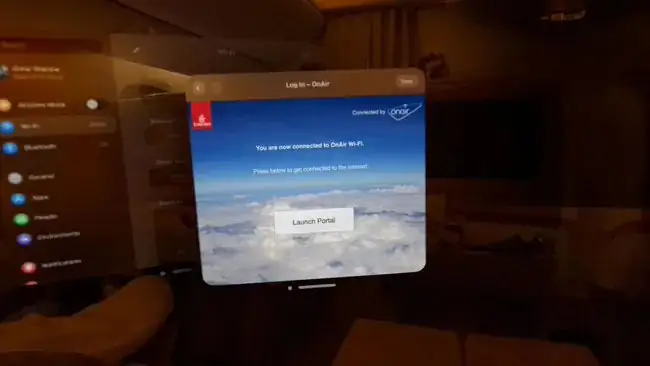
Omar Shahine, the head of Microsoft Word, recently shared his firsthand experience using Apple’s VR headset during a lengthy flight from Seattle to Dubai. He lauded its versatility, noting how it transformed the entire cabin into a personalized entertainment hub. Omar expressed his preference for the Vision Pro over traditional in-flight entertainment systems, citing its superior interface and immersive experience.
Despite its acclaim, Omar highlighted some drawbacks of the Vision Pro, including its weightiness and tendency to cause eye fatigue over extended use. He opted to enhance his audio experience with AirPods Pro during flights, finding them more comfortable than AirPods Max when paired with the already bulky headset.
However, Omar underscored the cost-effectiveness of the Vision Pro compared to a high-end home entertainment setup. He emphasized its superior performance and entertainment value, despite acknowledging the need for gradual adjustment to its physical discomfort.
In conclusion, Apple’s Vision Pro headset has made a significant impact in the tech industry, boasting impressive sales figures and garnering praise for its innovative features. However, user experiences have been mixed, with some embracing its immersive capabilities while others grapple with its physical discomfort.
Infinix Hot 40i launch date has been confirmed. A microsite of the phone, which is now available on Flipkart, confirms that it will be unveiled at 12 pm (local time) on Feb. 16. Here is a look at the Hot 40i specifications that have been officially confirmed so far.
Infinix Hot 40i specifications
Infinix Hot 40i live shots
The Flipkart page reveals that the Infinix Hot 40i has 256 GB of built-in UFS 2.2 storage space. By this, it will offer the biggest memory under the Rs 10,000 category. The device will come with 8 GB of RAM, 8 GB of virtual memory, and a microSD card slot for additional storage. The brand will confirm more details about the Hot 40i tomorrow (Feb. 14).
A previous report revealed that the Infinix Hot 40i will arrive with a 6.6-inch LCD punch-hole display that offers an HD+ resolution and a 90Hz refresh rate. On the front, the device will feature a 32-megapixel camera with an LED flash.
On the back, the Hot 40i will have a 50-megapixel primary camera and a quad-LED flash. For security, the device has a side-facing fingerprint scanner.
There is no information available about the chipset or battery of the Hot 40i. Hopefully, some of the missing details will be confirmed tomorrow. Shown above are the live shots of the phone that surfaced recently.
In related news, Infinix is said to be working on the Note 40 series, which reportedly includes the Note 40 and Note 40 Pro. A recent report revealed that these devices will support 45W and 70W charging, respectively. The series is expected to offer an FHD+ 120Hz display, a Helio G99 chip, up to 12 GB of RAM, up to 256 GB of storage, and a 5,000mAh battery.
According to recent rumors, Vivo is expected to unveil the Vivo V30 Pro either later this month or in March. Speculations suggest that this upcoming device will share similarities with the Vivo S18 Pro, which was launched in China in December 2023. Recently, a device believed to be the V30 Pro, identified as V2319, was spotted on the Geekbench benchmarking platform. Contrary to expectations, the listing indicated that it would feature the Dimensity 8200 chipset instead of the Dimensity 9200+. Furthermore, a new leak from tipster Sudhanshu Ambhore has disclosed additional specifications of the V30 Pro, highlighting differences between it and the S18 Pro.
Vivo V30 Pro specifications (rumored)
Vivo V30 Pro image
As per the tipster, the Vivo V30 Pro has a 6.78-inch curved-edge AMOLED panel that offers a resolution of 1260 x 2800 pixels and a 120Hz refresh rate. It will come preloaded with FunTouch OS 14-based Android 14.
Under the hood, the Vivo V30 Pro will feature the Dimensity 8200 chipset. It will arrive in a single configuration that offers 12 GB of RAM and 512 GB of built-in storage. It has a 5,000mAh battery with 80W charging support.
The leak further claims that the V30 Pro has a 50-megapixel camera on the front. While it is not mentioned in the leak, it may likely have support for autofocus. On the back, the device will feature a ZEISS co-branded camera setup featuring a 50-megapixel main camera, a 50-megapixel ultra-wide lens, and a 50-megapixel telephoto camera.
In comparison, the Vivo S18 Pro’s camera has a 12-megapixel telephoto camera. So, apart from using a different chipset and a different telephoto camera, the rest of the specs could be identical on both phones.
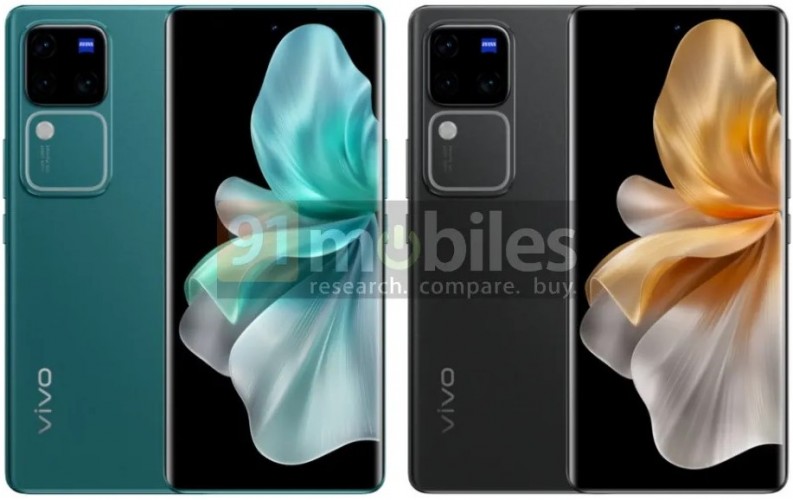
Update: 91mobiles has published a report to reveal the Vivo V30 Pro’s leaked renders and specifications. The leaked images reveal that it will arrive in black and green shades. It will have an IP54-rated chassis measuring 164.4 x 75.1 x 7.5mm and weighing 188 grams. The report further mentions that the device has LPDDR5x RAM, UFS 3.1 storage, and NFC support.
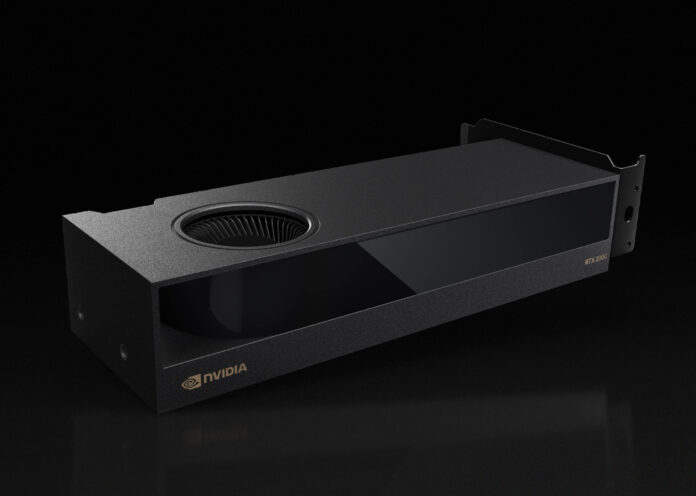
NVIDIA‘s latest entry into the GPU market, the RTX 2000 Ada, is a pleasant surprise for sure. The card seems like a great combination of compact design and robust performance. However, it is noteworthy that the card is aimed at small form factor workstations. Carrying a price tag of $625, it is a pretty good option for those looking to level up their compact setups without compromising on power.
The card, however compact, has solid performance with over 2800 CUDA cores
The RTX 2000 Ada brings significant upgrades over its predecessors, notably with a substantial 16GB of GDDR6 memory, equipped with ECC for added reliability. Despite its smaller size, the GPU does not skimp on performance, boasting 2816 CUDA cores, 88 Tensor cores, and 22 RT cores. NVIDIA claims impressive compute performance, including 12.0 TFLOPS of single-precision performance, making it a formidable tool for a variety of tasks.
Physical attributes also get a notable mention; the GPU supports four mDP 1.4a display outputs, catering to multi-monitor setups in space-constrained environments. Its efficient 70W power draw and utilization of a PCIe Gen4 x8 connection underscore its suitability for systems where power and expansion slots are at a premium.
Particularly noteworthy is the inclusion of AV1 encode and decode capabilities, a feature that’s becoming increasingly demanded in modern GPUs for its efficiency in video processing.
However, it’s essential to note that the RTX 2000 Ada might not be the go-to for those engaged in high-end design work or AI research. Instead, its strengths lie in bringing AI inference and advanced graphics capabilities to settings where larger, more power-hungry GPUs can’t fit. From multi-display workstations to AI-enhanced workflows, it is expected that the RTX 2000 Ada will make its mark as a versatile and energy-efficient option for professionals and enthusiasts alike.
MIT is taking a fresh look at how motorcycles are powered, focusing on hydrogen as a potential game-changer. Their Electric Vehicle Team, known for their innovative work, is now diving into the world of hydrogen-powered electric motorcycles. The project is led by Aditya Mehrotra, a grad student who loves motorcycles and is keen on finding cleaner energy solutions, alongside Professor Alex Slocum. They’re not just building a bike; they’re exploring how to make riding more sustainable.
The bike runs on a mix of a battery and a hydrogen fuel cell
Their motorcycle runs on a mix of a battery and a hydrogen fuel cell. This setup could solve one of the biggest headaches for electric vehicles: long charging times. With hydrogen, refueling could be as quick as filling up a gas tank, making it a convenient option for riders.
What’s cool about their work is that they’re sharing it with the world. They’ve made their design open-source, which means anyone can access their findings and possibly improve upon them. This openness could help speed up innovation in using hydrogen for vehicles.
The team’s efforts are about more than just creating a new type of motorcycle. They’re part of a bigger conversation on how we can use different energy sources to power our vehicles. By bringing their prototype to big events and sharing their progress, they hope to get more people interested in hydrogen power.
This approach by MIT could lead to more discussions and developments around using hydrogen, not just in motorcycles but in other vehicles too. It’s definitely a crucial step towards finding more sustainable ways to get around, showing that the future of transportation might just be powered by hydrogen.
We use cookies on our website to give you the most relevant experience by remembering your preferences and repeat visits. By clicking “Accept”, you consent to the use of ALL the cookies.
This website uses cookies to improve your experience while you navigate through the website. Out of these, the cookies that are categorized as necessary are stored on your browser as they are essential for the working of basic functionalities of the website. We also use third-party cookies that help us analyze and understand how you use this website. These cookies will be stored in your browser only with your consent. You also have the option to opt-out of these cookies. But opting out of some of these cookies may affect your browsing experience.
Necessary cookies are absolutely essential for the website to function properly. This category only includes cookies that ensures basic functionalities and security features of the website. These cookies do not store any personal information.
Any cookies that may not be particularly necessary for the website to function and is used specifically to collect user personal data via analytics, ads, other embedded contents are termed as non-necessary cookies. It is mandatory to procure user consent prior to running these cookies on your website.