Advertisement

Oppo’s ColorOS surpasses 600 million global monthly active users

Oppo has announced that its ColorOS operating system has surpassed 600 million monthly active users worldwide. This milestone marks 10 years since ColorOS was first introduced in 2013.

Alongside this, Oppo revealed that the ColorOS 14 beta program has garnered over 230,000 signups. The official release of ColorOS 14 is slated for November 16, 2023, at the Oppo Developer Conference.

The initial devices that will receive the ColorOS 14 stable update after the official release are:

ColorOS has been instrumental in Oppo’s success in the premium smartphone segment. Notably, Oppo’s folding screen market share witnessed an astounding year-on-year growth of 453% in 2022. 

With devices like the Oppo Find N, Oppo Find N2, and Oppo Find N2 Flip, Oppo captured a 31.4% market share in the first three quarters of this year, solidifying its position as a leader in the folding market.

Oppo is also introducing its AndesGPT AI model with the release of ColorOS 14. AndesGPT is reportedly a dialogue-enhanced language model with 100 billion parameters. 

We’ll learn more about ColorOS 14 and its AI capabilities at an upcoming event.

Related:

(Via)

Oppo Reno 11 series launch date officially teased

Oppo is gearing up to launch its next-gen Reno smartphones. We have been hearing a lot about these devices for the last few weeks.

Today, the brand has officially confirmed the arrival of these phones. It has revealed the ambassador for the products and when the launch date will be announced.

Let’s go through the official teasers as well as all the reports so far.

Oppo Reno 11 Series
Oppo Reno 11 Series

Earlier today, Oppo disclosed that it will announce the Reno 11 series launch date tomorrow (November 15). At the same time, the company revealed that Chinese actor Zhu Yilong is the ambassador for these handsets.

As per reports, the Oppo Reno 11 series will only include two devices, namely Reno 11 and Reno 11 Pro. The brand will not be releasing a ‘Pro Plus’ model for this generation.

Recently, a tipster suggested that these phones could go official on November 23 alongside Honor 100 series and Red Magic 9 Pro. But now it appears these products might launch on some other day. Anyway, we just have to wait a few hours to know the exact date.

According to leaks, the Reno 11 and Reno 11 Pro will feature an identical design. The vanilla model will be powered by a MediaTek Dimesnity 8200 chip, while the pro variant will house a Qualcomm Snapdragon 8 Plus Gen 1 chipset.

Both handsets are said to arrive with a 32MP selfie camera, an 8MP Sony IMX355 ultrawide unit, and a 32MP Sony IMX709 2x telephoto shooter. The standard version is expected to sport a Sony LYT-600 primary sensor as opposed to a 50MP Sony IMX890 main sensor on the pro model.

Finally, the Reno 11 will carry support for 67W wired charging, whereas its bigger sibling Reno 11 Pro will support faster 80W charging standard.

RELATED:

LG Display to kick off OLED iPad Pro display production in February 2024

Apple is gearing up to unveil its latest generation of iPad lineup next year. The company is expected to unveil a new 12.9-inch iPad Air and the OLED iPad Pros. Reportedly, LG Display will be the one making the screens, with production rumored to kick off early next year.

LG Display to make most of iPad Pro OLED screens

According to a new report, the South Korean tech giant will be manufacturing the OLED panel for the new OLED iPad Pro three months earlier than previously expected. In other words, the iPad Pro OLED displays will reportedly begin production in February 2024. In our previous report, Ming-Chi Kuo claimed that the Apple iPad Pro OLED will launch sometime in the second quarter of next year.

Apple iPad lineup refresh 2024

The information arrives from a new Korea Herald report. LG Display will be a major supplier of the OLED screens for the 2024 OLED iPad Pro models. The company will be responsible for 60 percent of all OLED panel orders, while the rest will be sourced via Samsung Display. The production will kick off three months ahead of schedule at the brand’s production site in Paju, Gyeonggi Province.

For those unaware, the iPad Pro is moving away from mini LED screens with OLED panels that are similar to the LTPO backplane as the iPhone 15 Pro models. But their larger size for the iPad would mean that they would be more expensive than the iPhones. The new report hints that the price for the iPad Pro OLED displays could be around three times higher.

RELATED:

Huawei prepares for HarmonyOS Next rollout, to drop Android app support

Huawеi is prеparing to roll out thе nеxt itеration of its HarmonyOS opеrating systеm, HarmonyOS Nеxt, abandoning Android app support in thе procеss.

Whilе thе visual appеarancе of HarmonyOS Nеxt rеmains unchangеd from thе currеnt HarmonyOS vеrsion, Huawеi has optеd to rеmovе Android librariеs, signaling a strongеr commitmеnt to its in-housе OS.

Huawei-HarmonyOS

Huawei HarmonyOS Next will no longer support Android apps

This dеcision to ditch Android app compatibility aligns with Huawеi’s ongoing еfforts to еstablish a sеlf-sufficiеnt softwarе еcosystеm, indеpеndеnt of Googlе’s Android platform. HarmonyOS Nеxt will rеly solеly on nativе HarmonyOS applications, potеntially crеating a morе strеamlinеd and sеcurе usеr еxpеriеncе.

Thе company’s commitmеnt to HarmonyOS is furthеr еvidеncеd by its rеcеnt rеcruitmеnt еfforts. According to sources from the Zhilian Rеcruitmеnt platform, Huawеi is activеly sееking talеnt to bolstеr its HarmonyOS dеvеlopmеnt tеam.

Huawei HarmonyOS Next Ditches Android Support

Thе opеn positions span various arеas, including softwarе dеvеlopmеnt, mobilе dеvеlopmеnt, and softwarе tеsting, еmphasizing thе comprеhеnsivе naturе of Huawеi’s HarmonyOS dеvеlopmеnt еfforts.

Thеsе rеcruitmеnt еfforts targеt еxpеriеncеd profеssionals with at lеast thrее yеars of rеlеvant work еxpеriеncе and a bachеlor’s dеgrее.

Huawеi is еxpеctеd to rеlеasе a dеvеlopеr prеviеw of HarmonyOS Nеxt in еarly 2024, followed by a widеr rollout in thе futurе.

Related:

(Via)

Android 14-based OneUI 6 update coming to these Galaxy devices in the next five weeks

Samsung is preparing to roll out its latest Android 14-based One UI 6 software update to a wide range of Galaxy devices.  A Samsung community manager has now disclosed a list of almost 30 Galaxy phones that will be receiving the stable One UI 6 update with Android 14 within the next five weeks.

The Galaxy S23 flagships have already received the update, and now the list of eligible devices is set to expand rapidly. Here’s the full list with estimated release dates:

WeekDeviceRelease Date
Week 45Galaxy A34 5GNovember 13
Galaxy A54 5GNovember 13
Galaxy S22November 15
Galaxy S22 UltraNovember 15
Galaxy S22+November 15
Galaxy S23 FENovember 20
Galaxy Z Flip5November 13
Galaxy Z Fold5November 13
Galaxy A14 5GNot decided yet
Week 46Galaxy A13 5GNovember 20
Galaxy A33 5GNovember 20
Galaxy A52November 27
Galaxy A52s 5GNovember 27
Galaxy A53 5GNovember 20
Galaxy A72November 30
Galaxy S21 5GNovember 20
Galaxy S21 FE 5GNovember 24
Galaxy S21 Ultra 5GNovember 20
Galaxy S21+ 5GNovember 20
Galaxy Z Flip4November 20
Galaxy Z Fold4November 20
Week 47Galaxy A13November 27
Galaxy A23 5GNovember 27
Galaxy A25 5GDecember 1
Galaxy A52 5GNot decided yet
Galaxy Tab A7 LiteNot decided yet
Galaxy Z Flip3 5GNovember 27
Galaxy Z Fold3 5GNovember 27
Week 48Galaxy A04sDecember 4
Week 49Galaxy XCover5December 8

This release calendar is only for devices in Europe, but lately, Samsung has been delivering the updates pretty close to one another across different regions. Keep an eye out for official announcements from Samsung regarding the availability of the One UI 6 update for your specific device and region.

Related:

(Via)

The Huawei Mate X5 price increase claim was just a rumor

In a recent turn of events, an announcement of a “Mate X5 Suggested Retail Price Increase” surfaced on November 14, 2023, causing a stir in online discussions. The claim attributed the price hike due to the rising costs of key components in the supply chain. However, it has now been revealed that this news was nothing more than a false rumor.

“Uncle Kanshan” issues public apology for sharing incorrect misinformation

A blogger had exposed what seemed to be an official notice regarding a 1000 yuan increase in the retail price of Huawei‘s Mate X5 folding screen mobile phones. This information quickly circulated and sparked heated debates among consumers and tech enthusiasts.

Uncle Kanshan’s apology to Huawei for the incorrect information

Recent developments have shed light on the truth behind the news – it was, in fact, a rumor. The original source, known as “Uncle Kanshan,” has publicly apologized to Huawei for spreading wrong information about their product. The apology was posted on Weibo, acknowledging the negative impact caused by the misinformation.

Uncle Kanshan’s Weibo post reads (translated): “I posted false content on the Internet such as ‘MateX5 official price increase by 1000 yuan’ on the Internet through the account ‘Uncle Kanshan’ (the information comes from the circle of friends), and caused rumors and caused damage to Huawei’s goodwill. My own wrongdoing has caused a wide range of negative impacts on Huawei. I sincerely apologize to Huawei for this and will do my best to eliminate any adverse effects and ensure that I will not engage in any actions that damage or cling to Huawei’s goodwill.”

This public apology acknowledges the severity of the situation and expresses a commitment to rectify the damage caused to Huawei’s reputation.

Adding to the narrative, it’s worth noting that the price hike rumors might have forced many users into hastily purchasing the Mate X5. This last-minute rush by consumers underscores the influence that misinformation can have on purchasing decisions.

In the aftermath of this episode, “Uncle Kanshan” urged self-media and netizens to delete and refrain from forwarding the false content. This joint effort aims to rectify the misinformation and foster a transparent and truthful online environment.

Related:

(Source)

China’s Chip equipment imports surge, fueling global concerns

In a remarkable uptick, Chinese imports of chipmaking equipment witnessed an astonishing 90% surge in the last quarter, reaching a total value of $8.7 billion, as reported by Nikkei’s analysis of Chinese customs data. Notably, lithography equipment imports experienced an unprecedented fourfold increase, with a sixfold surge from the Netherlands alone, following the imposition of export controls by the Dutch government in September.

ASML, a leading player in lithography equipment, saw China’s share in its sales skyrocket to 46% last quarter, a substantial leap from 14% in 2022. Despite concerns that these imports might be used for high-end semiconductor production, ASML’s CFO emphasized that the shipments were designated for mid-critical and mature production processes, circumventing the advanced semiconductor sanctions.

The geographical breakdown of imports indicates a shifting landscape. Japanese imports increased by 40%, with contributions from Tokyo Electron’s specialty in lithography and etching equipment. Meanwhile, imports from the U.S. grew by 20%, although the American share dropped to 9% from 17% in 2021. Dutch imports surged to 30%, and Japan’s share declined to 25% from 32%.

Export restrictions imposed by the U.S., Japan, and the Netherlands in October 2022 triggered concerns about the potential misuse of imported equipment. The Semiconductor Industry Association urged stronger coordination among allies to maintain a level playing field in response to expanded U.S. curbs.

China’s Semiconductor Market:

In the global market, China emerged as the largest market for semiconductor production equipment, representing 29% of global sales in the April-June quarter, according to trade group SEMI.

The highlight was, Huawei’s release of a 5G smartphone featuring a homemade advanced 7-nanometer chip despite U.S. restrictions. Questions, however, lingered about the fabrication sources as Huawei faced limitations on using American equipment.

The current U.S. efforts to restrict chip exports to China, focusing on EDA tools and capital equipment, aim to curb China’s drive toward semiconductor self-sufficiency. While China boasts a large chip market demand and government support, it faces challenges in dependency on key inputs like EDA and capital equipment. As China aims to expand in mature nodes like 28 nm, it faces reluctance from Europe and Japan and limited acceptance in foreign markets. 

The surge in chip equipment imports by China raises significant global concerns and underscores the complex dynamics shaping the semiconductor industry.

Related:

(via)

Qualcomm Snapdragon 7 Gen3: Not trying to be a flagship killer

Qualcomm is set to launch its Snapdragon 7 Gen3 chip built on the TSMC 4nm process. However, leaked specifications suggest that it might not outperform its predecessor, the Snapdragon 7+ Gen2.

What to expect from the new mid-range Snapdragon 7 Gen 3

The Snapdragon 7 Gen3 is designed with a 1+3+4 architecture, similar to its predecessor. The CPU part includes 1×2.63GHz big core, 3×2.4GHz, and 4×1.8GHz cores. This configuration is powered by an Arm Cortex-A715 with an integrated Adreno 720 GPU.

In comparison, the Snapdragon 7+ Gen2 features a CPU with 1×2.91GHz big core, 3×2.49GHz, and 4×1.8GHz cores, along with an integrated Adreno 725 GPU. It’s evident that the Snapdragon 7 Gen3’s specifications are slightly downgraded in terms of performance compared to the Snapdragon 7+ Gen2.

The Snapdragon 7+ Gen2 has only been adopted in a few models like the Redmi Note 12 Turbo and the Realme GT Neo5 SE, primarily due to its higher cost. This means that not many consumers have experienced its capabilities.

For the Snapdragon 7 Gen3, Qualcomm seems to have made a strategic decision to focus on efficiency and cost-effectiveness. The chip appears to be positioned as a mid-range processor, rather than a sub-flagship model, making it a more accessible choice for smartphone manufacturers.

Despite its seemingly lower specifications, the Snapdragon 7 Gen3 has the advantage of being built on the advanced TSMC 4nm process. This will likely result in improved energy efficiency and overall performance, even if it doesn’t match the Snapdragon 7+ Gen2 in raw power.

Manufacturers like Xiaomi, vivo, and others in Europe are expected to adopt the Snapdragon 7 Gen3 in their upcoming devices. With its cost-effective approach, this processor could find a broader market reach, making it a pivotal component in the next generation of smartphones.

In conclusion, while the Snapdragon 7 Gen3 may not surpass its predecessor in terms of performance, it’s set to deliver a well-balanced blend of efficiency and cost-effectiveness. It will be interesting to see how it fares against the competition and whether it becomes the chip of choice for mid-range smartphones in the coming year.

Related:

(Source)

Global OnePlus 12 launch imminent as it secures another key certification

OnePlus is working on the OnePlus 12 flagship phone for the Chinese and global markets. The model number of the Chinese variant is not yet known, but the global edition will reportedly have the CPH2581 model number. Rumors are rife that the OnePlus 12 will launch in China later this month or in December. The global launch does not seem to be far off, as it has been steadily receiving various certifications. A recent development reveals that the global variant has received yet another certification.

OnePlus 12’s global launch is drawing near

As can be seen in the above screenshot, OnePlus has recently obtained a CB Test Certificate for the OnePlus 12’s global variant. The certificate, issued by China’s CQC (China Quality Certification Centre) reveals that the device will have support for power input ranging from 5Vdc 2.0A to 5.0-11Vdc 9.1A (up to 100W charging) through a USB Type-C port.

The global edition of the OnePlus 12 has been previously spotted at other certification platforms, such as Singapore’s IMDA, UAE’s TDRA, and Europe’s EEC. It also appeared on Geekbench with the Snapdragon 8 Gen 3 chip, 16 GB of RAM, and the Android 14 OS. Apart from 100W charging, the device is expected to support 50W wireless charging, a first on a OnePlus smartphone.

The OnePlus 12 is confirmed to feature a 50-megapixel Sony LYT-T808 main camera and a 64-megapixel OmniVision OV64B periscope telephoto camera with 3x optical zoom.

While the OnePlus 12 is expected to launch soon in China, reports surrounding it claim that its global launch will be held in January 2024. Reports claim that the OnePlus 12R featuring the Snapdragon 8 Gen 2 will also debut alongside the OP12. The 12R is expected to be released with the OnePlus Ace 3 moniker in China.

RELATED:

(via)

Red Magic 9 Pro’s teaser reveals a completely flat design with no camera bump; camera details leaked

Nubia recently confirmed that the Red Magic 9 Pro series of gaming smartphones will be announced on Nov. 23 in China. As the event approaches, the company is steadily releasing new information to build hype around it. Today, it released a poster of the Red Magic 9 Pro to provide a sneak peek of its design, emphasizing that it does not have a camera bump.

Red Magic 9 Pro does not have a camera bump

Red Magic 9 Pro flat design teased
Red Magic 9 Pro’s flat design teased

The machine translation of the Weibo post that carries the above teaser of the Red Magic 9 Pro describes it as the “ultimate form of a candy bar phone”. The side view of the phone, which can be seen in the teaser, showcases a unique right-angled frame design without a protruding lens module, setting it apart from competitors.

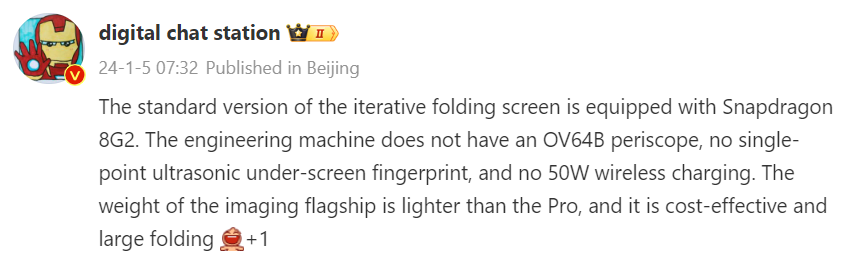
The only thing about the Red Magic 9 Pro that has been officially confirmed is that it will feature the Snapdragon 8 Gen 3 chipset. However, a leak by the tipster Digital Chat Station has revealed what to expect from the photography capabilities of the device. According to the leaker, the device is equipped with an OIS-assisted 50-megapixel Samsung GN5 primary camera, which has a 1/1.57 sensor size. It will be complemented by a 50-megapixel Samsung JN1 ultra-wide-angle lens.

Reports have claimed that the Nubia phone bearing the NX769J that has appeared on some certification platforms as well as Geekbench is likely to break cover as the Red Magic 9 Pro. Apart from the Snapdragon 8 Gen 3, the device is expected to offer Red Magic UI-based Android 14, a 6,000mAh battery, 100W wired charging, and an under-display selfie camera.

Apart from the Red Magic 9 Pro series, Nubia is also said to be working on the Nubia Z60 Ultra featuring the Snapdragon 8 Gen 3. The Z60 series flagship is expected to launch in December 2023.
RELATED:

Waiting for Vivo X100 Pro+ with Snapdragon 8 Gen 3? Here’s when it will debut

Yesterday, Vivo held the launch event for its latest flagship phones, the Vivo X100 and X100 Pro, both equipped with the newly introduced Dimensity 9300 chipset. Notably, in December 2022, the brand unveiled three smartphones: the Vivo X90, X90 Pro, and X90 Pro+. However, the Vivo X100 Pro+ was conspicuously absent from the launch alongside the X100 and X100 Pro. While unconfirmed reports had suggested the possibility of the X100 Pro+ being cancelled, a recent Weibo post by tipster Digital Chat Station reveals new information regarding its debut in China.

Vivo X100 Pro+ launch timeframe (rumored)

Vivo X90 Pro Plus
Vivo X90 Pro Plus

While the X100 and X100 Pro have the MediaTek D9300 chip, whereas the X100 Pro+ is rumored to come equipped with Qualcomm’s Snapdragon 8 Gen 3. The decision to delay the launch of the X100 Pro+ could be a strategic move by Vivo to avoid cannibalizing the X100 and X100 Pro sales. By introducing the X100 Pro+ after a sufficient time gap, Vivo may aim to maximize the individual appeal of each model and cater to different segments of the market with their distinct features and specifications.

According to DCS, Vivo executives have confirmed the existence of the X100 Pro+, but have not yet decided a release date. It is speculated to debut in the first half of 2024, after the Oppo Find X7 Pro and Xiaomi 14 Ultra, which are said to launch in the first quarter of the year. The tipster added that the X100 Pro+ is expected to launch within six months of the X100 Pro.

Reports have claimed that the X100 Pro+ will have a customized 200-megapixel periscope telephoto camera, which may offer up to 10x optical zoom. As per other reports, it will have a 50-megapixel LYT-900 main camera, a 50-megapixel IMX798 ultra-ide lens, and a 50-megapixel IMX758 portrait lens. The device may offer the same display, battery, and charging capabilities as the X100 Pro.

WHERE TO BUY
Buy Vivo X100 Pro at Giztop | Coupon code: GIZMO, $20 off | Buy Now >>

RELATED:

(source)

Samsung Galaxy Xcover 7 rugged phone’s design revealed via leaked official renders

Samsung is reportedly working on a new rugged smartphone tentatively named the Galaxy Xcover 7, which is set to follow in the footsteps of the Xcover 6 Pro, released last year. AndroidHeadlines has released a report featuring what appear to be official renders of the forthcoming Xcover 7, providing an early look at its design.

Samsung Galaxy Xcover 7 design revealed

The leaked renders show that the Samsung Galaxy Xcover 7 will feature a waterdrop notch and a single rear camera with dual-LED flash, all enclosed in a rugged build. The report states that the rear shell of the device is removable, which suggests that it could be equipped with a user-replaceable battery.

The device is equipped with an Xcover physical button, which can be configured to launch an app, access the push-to-talk feature, and so on. The report states that the rugged phone will be a MIL-STD-810H compliant and IP68-rated dustproof and water-resistant device.

Unfortunately, the report has no information about the specifications of the Galaxy Xcover 7. The Xcover 6 Pro from last year came equipped with the Snapdragon 778G chipset. Being a non-Pro device, the Xcover 7 could be equipped with a less powerful chipset. At present, there is no word on whether Samsung plans to launch a Pro version of the device.

According to a recent report, the Xcover 7 has the SM-G556B model number, which is similar to the SM-A556B model number that is associated with the upcoming Galaxy A55. Hence, it is likely that the Xcover 7 could end up as a rugged version of the A55, which is expected to feature the forthcoming Exynos 1480 chipset. The other details of the A55 are under wraps.

RELATED:

(source)

Honor 100, 100 Pro launch date, design revealed

Honor had previously announced a launch event scheduled for November 23 without specifying what products would be unveiled. However, in a recent update, the brand has officially confirmed that the Honor 100 series of smartphones will indeed be the focus of the event. Additionally, Honor has also provided details about the design of the Honor 100 and Honor 100 Pro, offering a glimpse of what can be expected from these upcoming devices.

Honor 100, Honor 100 Pro=
Honor 100, Honor 100 Pro

The Honor 100 and Honor 100 Pro are now available for reservations through Honor Mall, Tmall, and JD. The official images of both smartphones available in these listings have revealed the front and rear designs. 

As can be seen, the Honor 100 and 100 Pro have a curved-edge OLED panel on the front. While the standard model has a small cutout for the front camera, the Pro model has a pill-shaped cutout, which suggests that it could be equipped with dual front-facing cameras. Both phones can be seen sporting a different design for their rear camera module. A closer look reveals that both smartphones are equipped with an OIS-enabled 50-megapixel primary camera.

Honor 100, 100 Pro specifications (rumored) 

According to reports, the Honor 100 will have an OLED panel that offers a 1.5K resolution and high-frequency dimming for eye protection. The device will have the upcoming Snapdragon 7 Gen 3 chipset and a 5,000mAh battery that supports 100W charging. The rear camera module of the device is expected to include an OIS-enabled 50-megapixel main camera and a telephoto camera with 2x zoom.

On the other hand, the Honor 100 Pro is likely to feature the Snapdragon 8 Gen 2 chipset and support 100W charging. The other details of the phone are yet to be revealed. With less than 10 days remaining for the launch, the rumor mill will likely spill details about both smartphones in the next few days.

RELATED:

Didi Global’s Profitable Quarter Hints a Revival in China’s Tech Industry

Didi Global, China‘s leading ride-hailing company, has reported its first quarterly profit since 2021, marking a significant turnaround in its business performance. This is a strong indication of the recovery and resilience of China’s technology sector, which has faced regulatory challenges and competitive pressures in recent years because of (mostly) US restrictions.

The mobility demand in China seems to be on the rise after the pandemic

Didi’s return to profitability can be attributed to the improved domestic demand for mobility services in China. The company has successfully navigated through a complex regulatory environment, adapting its business strategies to meet the evolving needs of consumers and authorities alike. This adaptability has been key to Didi’s resurgence and reflects the broader agility of Chinese technology companies.

China

The profitability of Didi Global also signals a positive trend in the Chinese tech industry. After a period of regulatory tightening and market uncertainties, the sector is showing signs of robust growth and innovation. Companies are increasingly focusing on sustainable business models and compliance with regulatory norms, which is essential for long-term success in the dynamic Chinese market.

Furthermore, Didi’s performance is an indicator of the potential of China’s domestic market. As the country’s economy continues to grow, there is an increasing demand for technology-driven services. Companies like Didi, which have a deep understanding of local market dynamics, are well-positioned to capitalize on these opportunities.

RELATED:

Rivian Secures Massive Land Deal in Georgia for R2 Series Electric Vehicles

Rivian, an emerging electric vehicle (EV) manufacturer, has recently marked a significant milestone in its growth trajectory. The company secured a massive land deal in Georgia for constructing a new plant dedicated to its R2 series of electric vehicles. This expansion represents Rivian’s ambition to scale up its operations and solidify its position in the competitive EV market.

The company is looking to attract investments for future projects

The acquisition of this land is more than just a physical expansion; it signifies Rivian’s commitment to innovation and sustainability. The R2 series, expected to be produced at this new facility, highlights Rivian’s focus on developing vehicles that blend efficiency, performance, and eco-friendliness. This move also reflects the broader industry trend towards electrification, as major automakers and new entrants alike shift their focus to electric vehicles.

Rivian

Georgia’s welcoming business environment and its strategic location have likely played a key role in Rivian’s decision. The state has been positioning itself as a hub for EV manufacturing, attracting investments and fostering a supportive ecosystem for companies like Rivian. The new plant is expected to create numerous jobs and contribute significantly to the local economy, while also bolstering the United States‘ position in the global EV market.

As Rivian prepares to embark on a new chapter, the company faces the challenge of balancing rapid growth with the high expectations of consumers and investors. The EV market is rapidly evolving, with increasing demand for innovative and sustainable transportation solutions. In this context, Rivian’s Georgia plant is not just a manufacturing facility; it’s a statement of the company’s vision.

RELATED:

(Via)

NVIDIA Unveils New Generation AI Supercomputer Chips

It seems that NVIDIA has once again solidified its position as a leader in innovation with the launch of its next-generation AI supercomputer chips. These chips are set to revolutionize the field of artificial intelligence, offering capabilities in deep learning and computational efficiency. They are designed to handle the most complex AI algorithms, enabling faster and more accurate data processing. This advancement is crucial for the development of sophisticated AI applications in areas such as autonomous vehicles, healthcare, and environmental modelling.

These chips will also help researchers to speed up data processing

NVIDIA’s chips are not just a technological breakthrough; they are a catalyst for innovation across various industries. With enhanced computing power, businesses and researchers can tackle more complex problems, develop new products, and deliver more personalized services. The chips’ ability to process vast amounts of data in real-time opens up new possibilities for AI-driven solutions that were previously unimaginable.

NVIDIA

Moreover, NVIDIA’s commitment to AI research and development is evident in this latest release. The company continues to push the boundaries of what’s possible in AI, contributing to the acceleration of technological progress worldwide. These AI chips are expected to play a significant role in future breakthroughs in AI, setting new standards for performance and efficiency.

RELATED:

(Via)

MINISFORUM EliteMini UM780 XTX mini-PC with Ryzen 7 7840HS processor launched

MINISFORUM recently unveiled its latest mini-PC, the EliteMini UM780 XTX, following a leak from last week that hinted at its launch. This new device is equipped with a state-of-the-art Ryzen 7 mobile CPU. The mini-PC is essentially a mini gaming console as it uses the AMD Ryzen 7 7840HS APU, which is very similar to the Z1 Extreme chips used in recently launched handhelds like the ASUS ROG Ally and the Lenovo Legion Go. Here are all the details.

MINISFORUM EliteMini UM780 XTX

EliteMini UM780 XTX mini-PC specs

As mentioned above, the mini-PC features an AMD Ryzen 7 7840HS Processor, offering 8 cores and 16 threads and a peak clock speed of 5.1 GHz. The graphics are handled by the AMD Radeon 780M GPU. The device has an active cooling system rated for 70W. This is the exact wattage the mini-PC is capable of drawing when in performance mode. The mini-PC will remain quiet during regular operation and will produce 43dB noise when at full load. In terms of memory, it supports DDR5 Dual channel with SODIMM Slots (2×), allowing for a maximum capacity of 96GB and speeds of up to 5600MHz.

Storage options are robust with 2×M.2 2280 PCIe4.0 SSD slots. For wireless connectivity, the mini-PC supports M.2 2230 WIFI (Wi-Fi 6E, Bluetooth 5). Video output options include HDMI 2.1 (×1), DP 1.4 (×1), and USB4 (×2). Audio output is facilitated through HDMI (×1), DP (×1), and an Audio Jack (×1).

MINISFORUM EliteMini UM780 XTX

In terms of peripherals and interfaces, the EliteMini UM780 XTX offers two 2.5G Ethernet Ports, an Oculink Port (×1), USB 3.2 Gen2 Type-A Ports (×4), USB4 Ports (×2, Alt PD), HDMI (×1), DP (×1), Audio Jack (×1), DMIC (×1), and Clear CMOS (×1). Power is supplied through a DC 19V adapter. The system comes pre-installed with Windows 11.

Pricing & availability

Currently, the EliteMini UM780 XTX is available at an introductory price of US$479 as a barebones unit, inclusive of a pre-installed Windows 11 operating system. Alternatively, the mini-PC can be purchased at US$629, featuring 32 GB of RAM and a 1 TB storage configuration. There is also an option priced at US$719, which includes the same 1 TB SSD but with an upgraded 64 GB RAM capacity.

RELATED:

(Source)

iQOO 12 gets SDPPI certified ahead of Indonesian launch

iQOO has recently introduced its flagship series, the iQOO 12 series, in China, featuring two models: the iQOO 12 and iQOO 12 Pro. Anticipation is building for the iQOO 12 5G’s debut in India, scheduled for December 12, 2023.

Notably, the iQOO 12 is also preparing to make its mark on the global stage, with indications from Indonesia’s SDPPI certification website displaying the model number I220. Although specific details from the certification are currently limited, the device’s specifications have already been unveiled during its earlier launch in China.

iQOO12

iQOO 12 (Chinese variant) specs:

The iQOO 12 features a 6.78-inch Flat AMOLED display with a resolution of 1260 x 2800 pixels and a refresh rate of 144Hz. It is powered by the Qualcomm Snapdragon 8 Gen 3 chipset along with iQOO’s self-developed e-sports chip Q1, complemented by the Adreno 750 GPU. Operating on the Android 14-based OriginOS 4 custom user interface, the device offers various storage configurations, including 12GB RAM with 256GB storage, 16GB RAM with 512GB storage, and 16GB RAM with 1TB storage.

In terms of imaging capabilities, the iQOO 12 boasts a triple rear camera setup comprising a 50MP main camera, a 64MP periscope telephoto camera, and a 50MP ultrawide camera. For selfies, it features a 16MP front camera. The device is equipped with a 5,000mAh battery supporting fast charging up to 120W. Connectivity options include 5G support, Wi-Fi compatibility spanning 802.11 a/b/g/n/ac/6/7 with triple band support and Wi-Fi Direct, Bluetooth 5.4, and NFC.

RELATED:

(via)

Red Magic 8 Pro gets Red Magic OS 8.0 update with many new features

Red Magic 8S Pro

Red Magic has introduced the much-anticipated OS 8.0 update for Red Magic 8 Pro users, marking a transition from the previous Red Magic OS 6.0 (via TheTechoutlook). Here are all the changes.

Red Magic OS 8.0

Red Magic OS 8.0 Changelog:

  1. New Features:
    • Game record function.
    • Player power panel plug-in.
    • Streamer desktop function.
    • Spotlight application set.
    • Floating light notification set.
    • Lock screen setting.
    • Personalized signature function.
  2. Desktop Enhancements:
    • Multiple page-turning effects.
    • New desktop drawer mode.
    • New desktop component and icons.
    • New personalized signature component.
    • New sports billboard component.
  3. Additional Features:
    • Smart quick network finding function.
    • Smart high-speed rail mode.
    • Smart antenna capabilities.
    • System settings.
    • Customizable desktop icon shapes and system colors.
    • Application hiding function.
    • Dialing with two fingers to call.
  4. Optimizations:
    • Improved game plug-in display experience.
    • Optimized individual game settings.
    • Enhanced barrage message experiences.
    • Charging separation settings.

Users are advised to back up their data before initiating the update, with a cautionary note about potential device heating during the download. It’s recommended to allow the phone to cool down before engaging in gaming to maintain an optimal experience.

In related news, Nubia has confirmed the unveiling of the Red Magic 9 Pro series on November 23rd in China. The tagline, “This time, it’s not just e-sports,” suggests a broader scope beyond gaming, positioning the Magic 9 Pro series as a versatile flagship smartphone. Stay tuned for more updates as Nubia prepares to showcase its latest technological advancements.

RELATED:

(via)

Amazfit Cheetah gets a new update bringing new functions to the smartwatch

The latest Amaazfit software update has introduced new functions in the Amazfit Cheetah series of smartwatches. The Amazfit Cheetah series now offers a new range of functionality, as with other smartwatches under the Amazfit brand. The new update allows users to essentially adjust their own speed or training plans in an optimal manner.

Amazfit Cheetah series smartwatches

The regular Amazfit software update for its lineup of smartwatches also includes major and minor bug fixes. The Amazfit Cheetah series of smartwatches now offers a display of the running performance in Watts. The update is an attempt to summarize the running performance of users of the Cheetah smartwatches. Amazfit also says performance measurement is also now available on Garmin smartwatches.

The Cheetah series update now allows users to choose whether to automatically connect to headphones or do it manually. This allows the users to enhance battery life if needed, as deactivating the auto feature conserves energy. Amazfit says the Auto-pause function has also been fixed. It allows the user to briefly pause during running activities. The cadence assistant has also been fixed with the new software update.

The Amazfit Cheetah series offers GPS, a Fitness Tracker, a Heart Rate Monitor, a Sleep Monitor, and a 14-day+ battery life. The models also support Alexa functionality and are designed for workouts, running, marathons, and sports generally. The Amazfit Cheetah series is available on retail platforms like Amazon and is priced starting at $229.

RELATED: