Advertisement

Moto E13 Appears In Official Looking Leaked Image

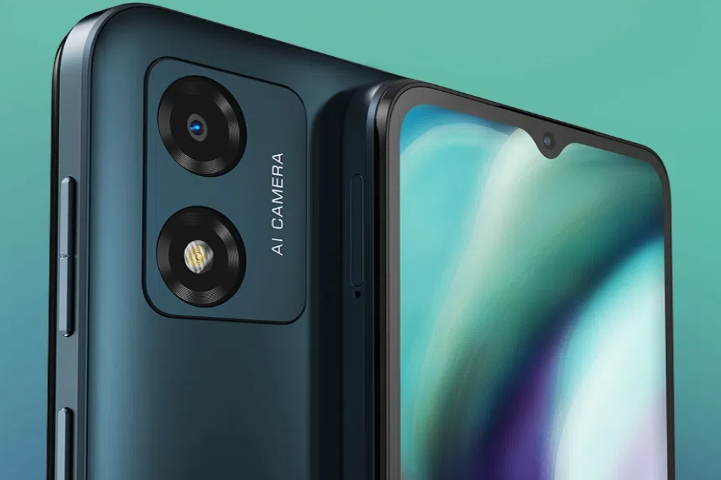
Motorola is expected to launch a new E-series smartphone soon. The upcoming offering is the Moto E13 and earlier this month it was spotted on the Geekbench benchmarking platform. The device had also appeared in leaked renders recently. Now, an official-looking image has surfaced online giving us a better look at the smartphone. It has been shared by Twitter user SnoopyTech. 

The Moto E13 is seen in a Dark Green colour option in the official-looking image. The display has a waterdrop notch and it is surrounded by bezels. The back panel has a squarish camera island which doesn’t protrude. It houses a single camera sensor and an LED flash unit. The left side of the device has a SIM tray whereas the right edge has a volume rocker and power buttons. The power key is expected to double up as a fingerprint scanner. 

Apart from this, the official-looking image does not reveal any additional details about the Moto E13. As per the leaked renders, the upcoming offering is also expected to be available in a Beige colour option. 

The Moto E13 is expected to be an entry-level budget offering. The smartphone’s Geekbench listing reveals that it will be powered by an ARM Unisoc T606 processor. It comprises of eight cores clocked at 1.61GHz. The device will pack 2GB RAM and run on Android 13 OS out of the box. We assume that it will be an Android Go phone since the RAM is less than 3GB. The smartphone scores 318 points in Geekbench’s single-core tests and 995 points in the multi-core test.

We expect the Moto E13 to debut in the coming weeks.

Related:

Twitter users at risk as Hacker claims to have private data of 400 million people

Twitter has been surrounded by a lot of negative press recently and it seems like the unfortunate run is still ongoing. A hacker has claimed to have private data on hundreds of millions of the platform’s users.

A new report has stated that the hacker has acquired sensitive information on 400 million users to be exact, which was illegally captured in 2021. The data was obtained by abusing an API vulnerability that has been fixed since its originally discovery. The hacker goes by the name ‘Ryushi’ has offered Elon Musk and Twitter to purchase this data him for a hefty price of 200,000 US Dollars. If they refuse, they would face an even heavier fine from the GDPR.

Twitter

As per Ryushi on the Breached hacking forum, “Your best option to avoid paying $276 million USD in GDPR breach fines like facebook did (due to 533m users being scraped) is to buy this data exclusively… after that I will delete this thread and will not sell this data again.” To prove this, he even shared a sample data of more than 1,000 users that include a number of celebrities, which was leaked. This information contains sensitive data like email addresses, usernames, follower counts, creation dates, and some users’ phone numbers. 

The hacker further added that if Twitter skips this deal, he is also open to selling this data to multiple buyers for a sum of 60,000 US Dollars for interested parties. Unfortunately, it is still unclear as to what decision Twitter will make regarding this matter or even if the leaked private data is completely accurate. So stay tuned as we will offer updates if there are any notable developments on this matter.

RELATED:

(Via)

OpenEuler OS Reaches 3 Million Installations in Server Systems

Huawei had initially announced the openEuler program back in 2019 and launched in September 2021 as an open-source operating system for enterprise applications. It is based on the Linux kernel and is intended to be used as a platform for building cloud, edge, and IoT applications. OpenEuler offers a range of features, including support for multiple architectures, containerization, and a package manager for installing and managing software. Lastly, OpenEuler OS completes 3 million server device installations. Here are the details..

Huawei’s openEuler operating system has achieved a significant milestone, completing 3 million installations in server system units. Back in Operating System Industry Summit 2022, Huawei revealed that the OpenEuler installations mark reached 2.45 million units, which is equivalent to 22% of the total server operating system market in China.

According to Huawei’s Executive Director of Huawei and director of the ICT Infrastructure Business Management Committee, by the end of December 2022, the number of enterprise members in the open-source openEuler community is expected to exceed 600.

OpenEuler has recently released version 22.09 version. It is the first innovative version after community donation, while the full code version 22.09 reached over 670 million lines and 20.12 million lines of new code. There are a total of 48000 lines of code added to the kernel so far. With the completion of 3 million installations in server system units is a proof to the success of openEuler and its growing popularity in the server operating system market. It is an exciting time for the Huawei, and the future looks bright for its operating system.

RELATED: 

(via)

India pushes for Universal Charging standard for Smartwatches

Back in the 2000s, different phone brands had different chargers for their handsets. However, this soon started to shift with the launch of the Android powered smartphones. Now, it seems like a universal charging standard will also be required for smartwatches as well, with India pushing for this change.

Just recently, the European Union had mandated that Apple will have to drop its Lightning Port and adopt the USB Type C port. For those unaware, the USB Type C has mostly become a standard for most Android smartphones and the iPhone maker was the only major brand that chose to stick to its proprietary charging technology. Although, the same cannot be said for the smartwatch market since different wearables features a dedicated charger even for varying models from the same brand.

Motorola Moto Watch 200

The Indian government apparently has plans to enforce a new mandate to make USB Type C the universal charging standard for smartphones, but is even working on a similar charge for wearable devices as well. The Secretary to the Department of Consumer Affairs, Rohit Kumar Singh told PTI that the BIS might require all upcoming wearables to ship with support for a standard charging solution.

The consumer electronic products that were mentioned for a universal charging solution includes smartwatches, fitness trackers, wireless earbuds, and headphones. Unfortunately, it is still unclear what form the actual universal charging standard might take. Similarly, the timeline for this universal charging solution is also unclear as of right now. So stick around for more, as we will be providing updates when additional information is available regarding this matter.

RELATED:

(Source, Via)

Vivo X90 Bags NBTC Certification, Hints At An Imminent Launch

Earlier this month, Vivo X90 (review) bagged Bureau of Indian Standards (BIS) certification. Now the device has appeared on Thailand’s NBTC certification website. It has the model number V2218. Additionally, the smartphone has also passed SIRIM certification in Malaysia. This suggests that the Vivo X90’s launch in the Asian markets is imminent. The certification websites don’t reveal any key information about the upcoming smartphone. 

As per a recent rumour, the Vivo X90 series launch date poster surfaced online. It seemingly revealed that the smartphones will debut in the global market on January 31st, 2023. The brand is yet to officially announce details about the X90 series’s global availability. It also remains to be seen if Vivo will announce all three X90 models at the same event. 

The Vivo X90 global variant is expected to retain the same specifications as its Chinese counterpart. The Vivo X90 features a 6.78-inch centre-aligned punch-hole AMOLED display with curved edges, 1.5K resolution, 120Hz refresh rate, HDR10+ support, and a fingerprint scanner. The smartphone has a circular camera module housing a 50MP main sensor, 12MP ultra-wide-angle lens and another 12MP third unit. There is a 32MP selfie snapper. 

Internally, the Vivo X90 is powered by a Dimensity 9200 SoC. The device packs up to 12GB LPDDR5 RAM and 512GB UFS 4 onboard storage. The X90 is backed by a 4,810mAh battery with support for 120W charging. 

Related:

How Harmful are Smartphones for the Environment?

Smartphone sustainability is reaching new heights, with Apple and Samsung leading the way in terms of sustainable initiatives, according to a report by Counterpoint Research. The report, called “Smartphones and Circular Economy: Creating a Sustainable Future,” evaluates the top five smartphone original equipment manufacturers (OEMs) based on their efforts to reduce their impact on the environment by reusing materials, recycling devices, and minimizing waste throughout the smartphone’s life cycle, from design and production to power consumption.

Apple and Samsung Lead the Way in Smartphone Sustainability

The report’s scorecard includes a robust metric system that assesses each OEM’s vision and overall approach to sustainability. Apple’s vision appears to be clearer than its competitors, and its actions support this vision. However, each of the top OEMs performs differently across the three major stages of the smartphone circular economy: production, usage, and end of life.

In terms of production, OEMs have focused on eco-friendly components and packaging, as well as water-saving mechanisms in their manufacturing processes. Brands like Samsung, Apple, and OPPO have also encouraged their vendors to adhere to environmental norms. However, revenue and profit remain the primary objectives for these companies.

In terms of usage, OEMs must balance the desire to motivate consumers to upgrade to newer, more technologically advanced devices with the need to protect the environment. Chinese OEMs like OPPO, Xiaomi, and Vivo are working to improve battery life and energy efficiency. Apple excels in terms of overall longevity, updates, and sustainability innovations, while Samsung excels in repair, energy efficiency, and after-sales networks.

When it comes to end of life, OEMs have a significant role to play in reclaiming and responsibly recycling or repairing their smartphones once they reach the end of their usable life. The main objective is to reduce electronic waste (e-waste). The global refurbished market has grown significantly in recent years, but OEM initiatives on reclamation, refurbishment, and e-waste reduction are limited. Even the best brands are not active enough in pulling back devices from the market, and the e-waste crisis continues to grow.

Overall, while Apple and Samsung are leading the way in terms of sustainability initiatives, the efforts of all smartphone OEMs fall short when compared to the volumes of new smartphones being shipped every year. To truly make a difference in the fight against e-waste and other environmental issues, OEMs must do more to encourage the reuse and recycling of smartphones, and prioritize sustainability in all stages of the device’s life cycle.

RELATED:

(source)

Made in India Smartphones see a fall demand in the local market

Smartphones that were Made in India saw a sizeable rise in shipments back in the second quarter of this year. However, in the third quarter, it seems that these devices did not see such a great performance in the local market.

The news arrives from a Counterpoint Research report. The known analytics based firm found that smartphones under the ‘Made in India” category saw an overall decline of 8 percent year on year in Q3 2022. During this period, the Indian smartphone market shipped over 52 million Made in India handset units. However, this marked a noticeable fall in sales, which the report believes is likely due to fall in consumer demand.

Smartphones

This decline in sales is also likely linked to the uncertain geopolitics that could be the primary factor. According to Senior Research Analyst Prachir Singh, “The Made in India smartphone shipments declined in Q3 2022 as compared to Q3 2021. Two major forces impacted the growth of such smartphone shipments. First, the decline in consumer demand, especially in the entry level segment, due to the negative macroeconomic indicators. Second, the high channel inventory at the start of the quarter also impacted the manufacturing during the quarter.”

Despite this, the country’s smartphone manufacturing sector is still seeing expansion with almost 63 percent of shipments arriving from in house producers and just 37 percent from third party sources. BYD and Lava were two of the fastest growing brands in terms of total smartphone shipments. The researched further added that “Overall, the manufacturing trend is witnessing an upward trajectory with multiple partnerships happening in recent months, like the ones between Tata Group and Wistron and between Foxconn and Vedanta.” So this decline might not be permanent.

RELATED:

(Source)

Tecno Seeking Partnerships with Leading Lens Makers to Advance Smartphone Camera Technology

Tecno is seeking partnerships with lens makers to advance smartphone camera technology and enter the premium market. The company has a strong track record of producing innovative smartphone cameras and collaborating with industry professionals. It remains to be seen which big names Tecno will choose to work with. Here are the details…

Tecno Plans to Collaborate with Established Lens Makers to Enter Premium Market

Tecno, a fast-growing smartphone brand that has quickly risen to become a Top 10 global player, has revealed its ambitions to enter the premium market and establish itself as a leader in smartphone camera innovation. The company has a track record of producing high-quality smartphone cameras, as demonstrated by its recent Phantom X2 series, which boasts one of the best portrait cameras on the market, thanks partly to consultation with professional photographer Rankin.

The company is taking its camera ambitions to the next level by announcing that it is in talks with established lens makers to develop future products. Although the company did not mention any specific names, it is clear that Tecno is looking to partner with some of the biggest names in the photography industry to push the boundaries of smartphone camera technology.

Given Tecno’s commitment to collaborating with industry professionals and its track record of producing innovative smartphone cameras, it will be interesting to see which lens maker the company ultimately decides to work with. Companies like Hasselblad, Leica, and Zeiss have already partnered with smartphone makers, so it remains to be seen which big names Tecno will choose from.

Regardless of the lens maker it ultimately partners with, it is clear that the company is serious about its pursuit of smartphone camera excellence. With its commitment to innovation and collaboration with industry professionals, we will likely see some exciting developments from the company in the near future.

RELATED:

(via)

Apple faces lawsuit over alleged racial bias on Apple Watch’s health feature

Apple is facing yet another lawsuit. This time, the company is being sued for its Apple Watch wearable device, which the legal complaint states is racially biased in some of its key health related features.

The Cupertino based giant has been hit with a class action lawsuit in the Southern District of New York. The brand is facing the legal dispute over its smartwatch allegedly having a racial bias on darker tones for its blood oximeter health feature. According to the documents, a New Yorker named Alex Morales is claiming that the Apple Watch that he purchased over a year ago is “purported to measure blood oxygen levels and he believed it did this without regard to skin tone which was relevant to him based on his skin tone.”

Apple

As per the legal filing, Morales “expected the product would not incorporate biases and defects of pulse oximetry with respect to persons of darker skin tone.” He further added that “as a result of the false and misleading representations, the Product is sold at a premium price, approximately no less than $400, excluding tax and sales.” So Morales is filing a class action law suit, which will also cover all New Yorkers who purchased the Apple Watch during the statute of limitations. Furthermore, the lawsuit also listed research notes from a study that was conducted during the pandemic.

This was done to help test COVID-19 cases by checking the blood oxygen saturation percentage. They cited this research and stated that it “confirmed the clinical significance of racial bias of pulse oximetry. For decades, there have been reports that such devices were significantly less accurate in measuring blood oxygen levels based on skin color.” Apple has responded to this lawsuit saying that the Apple Watch is “only designed for general fitness and wellness purposes. Blood Oxygen app measurements are not intended for medical use, including self-diagnosis or consultation with a doctor.”

RELATED:

(Via)

Possible Oppo Reno 10+ Design Revealed Via Leaked Schematic

Reliable tipster Digital Chat Station has shared a schematic of what appears to be an upcoming Oppo smartphone. Yesterday, he leaked the specifications of the alleged Reno 10 Pro+. Hence, the schematic that he shared today gives the first look at the possible design of the Reno 10 Pro+.

In the image shared by DCS, the purported Reno 10 Pro+ can be seen sporting a centred punch-hole display with slim bezels. The top bezel of the phone has an earpiece, its left side is fitted with volume buttons, and on the right is the power key.

The oval-shaped camera island is available on the rear shell of the phone. A squarish periscope zoom lens sits beneath the top two cameras. The camera module also has a dual-LED flash unit and “Powered by MariSilicon X” branding.

Possible schematic of OPPO Reno 10 Pro+

Oppo Reno 10 Pro+ specifications (rumored)

It is speculated that the alleged Reno 10 Pro+ has the PHU110 model number. The rear camera system of the device is said to comprise a 50-megapixel Sony IMX890 primary camera, an 8-megapixel Sony IMX355 ultra-wide lens, and an unspecified periscope camera, which is likely to offer 2x optical zoom.

Its OLED panel is expected to offer a 1.5K resolution, a 120Hz refresh rate, and an under-display fingerprint scanner. The device is said to feature a high-performance chipset that is built with TSMC’s N4 process. It is likely to pack a 4,700mAh dual-cell battery. Speculations are rife that the OPPO Reno 10 series will break cover by mid-2023 in China.

In related news, DCS has claimed that apart from the Find X6 series, there are two other Oppo phones with periscope cameras onboard. While one of them appears to be the Reno 10 Pro+, the identity of the other model remains a mystery.

RELATED:

(source|via)

LG ThinQ UP upgradable home appliances global launch set for 2023

LG Electronics is finally rolling out its ThinQ UP series of upgradable home appliances for the global markets. This includes various series of products for various different functions and the company is set to release them next year.

The ThinQ UP upgradable series includes various products like refrigerators, washers, dryers, oven ranges, and dishwashers. These home appliances were first announced back in January 2022 and were released only in the company’s home market of South Korea. The new appliances from the brand were launched with the aim of meeting the diverse needs of each customers and adapt to their shifting lifestyles. This means that users can try out new features and functions without having to spend money.

LG

The South Korean tech giant also recently released the world’s first 27 inch and 45 inch OLED gaming monitors that also offers 240Hz refresh rate. As per official notes, the company’s ThinQ UP appliances will be capable of bringing new functionalities over the course of their lifespan. In other words, your purchase of products would give customers better value over time. LG claims that these models seek to promote the “evolving with you” philosophy to put the customers first.

All of this will be available through easy to install software upgrades and hardware add ons. The brand would also offer their customers additional customization options. LG will begin rolling out these smart home appliances starting in March 2023 in the US, with availability in other regions following next year.

RELATED:

Leak Suggests Impressive Performance Boost for Upcoming Galaxy S23 series

There have been many rumors and leaks about the new Samsung Galaxy S23 series, and the latest one suggests that they will have impressive performance improvements thanks to the Qualcomm Snapdragon 8 Gen 2 chipset. According to a Twitter user, named “@AhmedQwaider888” the Galaxy S23 series will have a 36% overall performance increase, a 48% improvement in graphics, and a 60% boost in AI tasks compared to the Galaxy S22 series, which used the Snapdragon 8 Gen 1 chipset. Here are the details…

Samsung Galaxy S23 leaked image

As we mentioned above, the Samsung Galaxy S23 series is expected to feature the Qualcomm Snapdragon 8 Gen 2 chipset and an overclocked version with a 3.3GHz Cortex-X3 core and 2.8GHz Cortex-A715 and Cortex-A710 performance cores. These smartphones may also be manufactured using a 4nm manufacturing process by TSMC and include improved cooling solutions to ensure optimal performance.

The Samsung Galaxy S23 Ultra is expected to have a 200 MP primary camera with a special Samsung ISOCELL sensor and a large 6.8-inch Dynamic AMOLED display with a refresh rate of 1-120 Hz and a reported maximum brightness of over 2,000 nits. It is expected to have 12 GB of RAM and will be available in three storage options: 256 GB, 512 GB, and 1 TB. Samsung Galaxy S23 and Galaxy S23 Plus are also expected to come with 3,900 mAh and 4,700 mAh batteries

Unfortunately, the exact launch date and prices for the Galaxy S23 series have not yet been announced, but it is expected to be released in early 2023.

RELATED: 

iQOO 11 Review: Simply put, a Monster Gaming Phone [vs Xiaomi 13]

(via)

Poco C50 Indian launch might happen on January 3, suggests report

Poco is rumored to soon launch the Poco C50 smartphone in India. The device has already appeared on IMEI and Google Play Supported Devices database revealing many details of the smartphone. Now, a new report claims to have information on the exact launch date of the device in India.

The report comes from 91mobiles, claiming that industry sources have informed them that the Poco C50 will launch in India on January 3rd. The C50 will be the first device by Poco in its C series to debut in India since the launch of the Poco C31 back in September 2021.

Previously, Poco had revealed that the Poco C50 would debut in India in November. The release of the phone was nonetheless delayed for an unidentified reason. Our sources indicate that January 3rd will now be the new launch date. Soon enough, Poco is expected to formally confirm this.

Redmi

Going by previous leaks, it is quite clear that the Poco C50 will be a rebrand of the Redmi A1+. Let’s recall the details of the Redmi A1+ to get an idea of what to expect from the Poco C50.

The Redmi A1+ comes with a 6.52-inch HD+ display with a waterdrop notch and a maximum brightness of 400nits. The device’s rear has a leather texture design that is similar to that of the POCO C40.

A MediaTek Helio A22 processor and an IMG PowerVR GPU power the device. Android 12 Go Edition is pre-installed on the gadget.

The 5000mAh battery on the Redmi A1+ supports 10W charging. It contains a depth sensor in addition to an 8MP rear camera. It has a front-facing 5MP camera for taking selfies. On the back of the phone is a fingerprint reader. A dedicated micro-SD card slot and a 3.5mm audio connector are also features of the Redmi A1+.

RELATED:

iQOO Neo 7 Racing Edition Display Specifications Officially Confirmed

iQOO Neo 7 Racing Edition will be iQOO’s last phone for the year 2022 in the Chinese market. The device will debut tomorrow in China. Today, the company confirmed the display specifications of the Neo 7 Racing Edition.

From the official poster, it can be seen that the iQOO Neo 7 Racing Edition will have a 6.78-inch E5 AMOLED screen with a centered punch-hole. It will support a 120Hz refresh rate. The TENAA listing of the device has revealed that it will offer a Full HD+ resolution of 1080 x 2400 pixels.

iQOO Neo 7 Racing Edition
iQOO Neo 7 Racing Edition display specs

The device is confirmed to feature the Snapdragon 8 Plus Gen 1 mobile platform. Its highest configuration will offer 16 GB of LPDDR5 RAM and 512 GB of UFS 3.1 storage. It will house a 5,000mAh dual-cell battery with 120W fast charging. For photography, it will have a 50-megapixel Samsung GN5 primary camera with OIS support.

The other specifications of the device have already surfaced in its TENAA listing. It will arrive with a front-facing camera of 16-megapixel. The phone’s back will have 8-megapixel ultra-wide lens and 2-megapixel macro / depth auxiliary cameras. It is expected to arrive in other RAM variants, such as 8 GB and 12 GB. It is also expected to come in storage choices like 128 GB and 256 GB.

The iQOO Neo 7 Racing Edition will arrive with other features like an in-screen fingerprint scanner, an IR blaster, and OriginOS 3-based Android 13 OS. It will measure 164.81 x 76.9 x 8.85mm and weigh around 197 grams.

At present, there is no word on the global launch of the device. In China, it will rival other Snapdragon 8 Plus Gen 1-powered phones, such as the Redmi K60 Pro, OnePlus Ace 2, and Realme GT Neo 5.

RELATED:

LG announces new Optical Telephoto Zoom Camera with OIS support

LG Innotek has just made a notable announcement with the official reveal of its new ‘Optical Telephoto Zoom Camera Module’ that will be made available for future smartphones soon. So here are all the details.

The South Korean brand’s new optical telephoto camera will arrive with integrated telescopic camera function that is capable of capturing the high magnification of up to 4x to 9x zoom. The company claims that the new image sensor that it will be able to capture these shots without the loss of any image quality. As per official notes, the conventional ‘fixed zoom module’ that exist in the industry offers optical magnification only in the specific zoom sections.

LG

Any other magnification applied on the shot is enabled through the digital zoom. However, LG Innotek stated that it has developed a zoom actuator, which is a component for moving the lens to enable shifting of the focal distance. This enables the telephoto shooter to capture clear images between all sections between the 4x and 9x magnification sections as well and is not limited to just the two levels. Notably, this camera tech is also backed up by OIS support (Optical Image Stabilization).

Thanks to OIS, the devices that feature this sensor will be able to reduce blurring in shots and get steadier recordings as well. Furthermore, since the module is smaller as well, the brands that employ it would also be able to save up space inside their smartphone’s body. Meaning, a smaller camera bump or none at all is technically possible.

Noise Colorfit Pro 4 Alpha smartwatch goes on sale in India – Check price, availability & more

The Indian electronics manufacturer Noise recently launched the Noise ColorFit Pro 4 Alpha in India. The smartwatch is packed with attractive features like an AMOLED display, BT calling support, 100 sports modes, a 60Hz refresh rate, and more. Now, the smart wearable is finally available to purchase in India.

Noise

Noise ColorFit Pro 4 Alpha price & availability

As part of the initial launch promotion, the Noise ColorFit Pro 4 Alpha has a price of Rs 3,799 in India. The watch is offered in the following hues: Silver Grey, Deep Wine, Rose Pink, Vintage Brown, and Jet Black. Starting today, you can buy the wearable on Amazon and Noise online store.

Noise ColorFit Pro 4 Alpha specs

The Noise ColorFit Pro 4 Alpha has a 1.78-inch AMOLED screen with a resolution of 268 x 448 pixels. The watch has a 60Hz refresh rate as well. The ColorFit Pro 4 Alpha offers both a double-tap gesture and palm control for turning the display on and off. With 4 watch faces created exclusively for an Always on Display screen, the inexpensive watch also provides this feature.

Similar to the Apple Watch, the smartwatch sports a digital crown on the right side. It is water-resistant and has an IP68-certified aluminum alloy construction.

A heart-rate monitor, a SpO2 sensor, a sleep and stress tracker, and a menstrual cycle monitor are all included in the Noise Colorfit Pro 4 Alpha. Support for 100 sports modes is included.

A built-in speaker, microphone, and Bluetooth 5.3 capability are all included with the Noise Colorfit Pro 4 Alpha to enable hands-free Bluetooth calling. According to claims, the wearable device has a battery life of seven days and supports quick charging. The smartwatch has practical functions like notifications, stock and weather updates, and more.

RELATED:

Samsung Reportedly Testing One UI 5.1; Could Debut With Galaxy S23 Series

Samsung is gearing up to launch its next-generation Galaxy S-series flagship smartphones under the Galaxy S23 lineup. While the launch date has not been officially revealed, it is speculated to go official on 1st February.

Now, ahead of the launch, new information about the phone’s software has surfaced. The upcoming Samsung Galaxy S23 models will run a newer version of the One UI.

Samsung One UI

As per the latest report, Samsung is currently testing the new One UI 5.1 update for the Galaxy S22 series and carries firmware version S90xEXXU2CVL7. It was spotted on Samsung’s servers and is expected to release for the S22 lineup soon after it debuts with the Galaxy S23 series smartphones.

Currently, there’s no information available about what new features are coming to the One UI 5.1; however, it’s safe to assume that the update will be based on the Android 13 operating system, similar to the One UI 5.0. The South Korean giant had previously teased lock screen customizations, which we expect to see in the upcoming update.

The Samsung Galaxy S23 series, debuting as the company’s next-generation flagship lineup, will come with a slightly updated design, better display, upgraded camera sensors, and bigger batteries. The phones will also come powered by the latest Qualcomm Snapdragon 8 Gen 2 processor and pack a newer version of One UI based on the Android 13 operating system.

RELATED:

Source, Via

Infinix Zero 20 Goes on Sale Today in India, Check Price, Availability & Specs

Infinix recently launched the Infinix Zero 20 smartphone in India. The device comes powered by a MediaTek Helio G99 processor and features a 90Hz AMOLED display. Starting today, the smartphone will be available to purchase in the country. So, let’s take a look at the pricing, availability, and specifications.

Infinix Zero 20

Infinix Zero 20 price & availability

The cost of the 8GB + 128GB option of the Infinix Zero 20 in India is Rs 15,999. The smartphone will be available for purchase on Flipkart starting at 12:00 PM today (December 28).

Infinix Zero 20 specs

The Infinix Zero 20 boasts a 90Hz AMOLED display that is 6.7 inches in size, has Full HD+ resolution, and has a 90Hz refresh rate. The front shooter can fit inside a centered punch-hole notch on the display panel.

A 6nm-processed, octa-core MediaTek Helio G99 CPU powers the most recent Zero series smartphone. The CPU is integrated with a Mali G57 GPU, 8GB of RAM, and 128GB of internal storage. The smartphone has XOS 12, which is based on Android 12.

The Zero 20 features a triple camera configuration, with a 108MP primary shooter at the helm. An LED light, a 2MP depth sensor, and a 13MP ultra-wide-angle lens are added to the device’s high-resolution sensor. A 60MP front camera with OIS capability and a dual LED light on the phone handles selfies and video calls.

The device has a 4500mAh battery and supports 45W fast charging. It uses a Type-C connector to send data and charge the device. It has a side-mounted fingerprint scanner for security. The smartphone includes a stereo speaker configuration with DTS audio and a 3.5mm audio connector as well.

RELATED:

Vivo X Fold 2 Key Specifications Leaked, Launch Timeframe Tipped

Vivo is reportedly working on two new foldable phones for the Chinese market. According to reliable tipster Digital Chat Station, the company is planning to launch the Vivo X Fold 2 and the Vivo X Flip in the first half of 2022. The tipster has shared the key specifications of the X Fold 2.

According to the tipster, the Vivo X Fold 2 will feature a foldable screen that offers a 2K resolution. It seems that the front, as well as inner displays, will be equipped with an under-screen fingerprint scanner.

Vivo X Fold Plus
Vivo X Fold Plus

The X Fold 2 will have an OIS-enabled Sony IMX866 primary camera. The foldable phone will draw power from the Snapdragon 8 Gen 2 chipset. It appears to be a lightweight device. To recall, the Snapdragon 8 Gen 1-powered Vivo X Fold, which debuted in the first half of 2022, weighs 311 grams. On the other hand, the X Fold+, which came equipped with the Snapdragon 8 Plus Gen 1, has the same weight. The Oppo Find N2 foldable phone that debuted earlier this month in China weighs around 235 grams. Hence, it is likely that Vivo could be working on reducing the X Fold 2’s weight.

Nothing much is known about the Vivo X Flip, except for the fact that it will arrive with the Snapdragon 8 Plus Gen 1 chipset. The tipster claimed that Vivo does not intend to launch a successor to the Vivo X Note. To recall, the X Note came equipped with a behemoth 7-inch OLED display, a Snapdragon 8 Gen 1 chipset, 50-megapixel quad cameras, and a 5,000mAh battery.

This year, Vivo released two X-series models, such as the Vivo X80 series and the Vivo X90 lineup. The tipster claimed that the company will launch only one generation of X-series phones starting next year.

RELATED:

(source 1, 2)

Samsung Odyssey Neo G7 43-inch 4K Mini-LED Gaming monitor launched in Korea

Samsung has recently launched multiple Samsung Odyssey high-end gaming monitors in the global market. Whether it be the Odyssey Ark 55-inch 4K monitor in India or the Deagon Knight G7 32-inch monitor in China, which is expected to launch as an Odyssey G7 series monitor in the global market soon.

Adding to the vast lineup, the brand has unveiled a new high-end 43-inch gaming monitor in its domestic market of South Korea called the Samsung Odyssey Neo G7 (G70NC) model. Currently, only a release date for Korea, which falls on January 2, has been announced; however, there are plans to debut the new 43-inch Samsung Odyssey Neo G7 gaming monitor at CES 2023 before moving through with a wider global launch, including the North American market.

The Samsung Odyssey Neo G7 (G70NC) has a price tag of 1.25 million won (US$982) in Korea, however, the US and European pricing are expected to be higher when the monitor eventually launches in these markets.

As for specs and features, the monitor comes with a Quantum Mini-LED display with a 3,840 x 2,160 resolution, a 16:9 aspect ratio, a refresh rate of 144 Hz, and a response time of 1 ms. The Samsung Odyssey Neo G7 also features VESA-certified DisplayHDR 600 capability and a high 1,000,000:1 contrast ratio.

The 43-inch Odyssey Neo G7 display has two HDMI 2.1 ports, one DisplayPort 1.4 port, and two USB 3.0 connections for connectivity. The flat-screen device includes 20 W stereo speakers.

The monitor’s built-in Samsung Gaming Hub streaming tool supports AMD’s FreeSync Premium Pro software for more fluid gameplay. Thanks to OTT integration, the 43-inch Samsung Odyssey Neo G7 gaming monitor can also be utilized for a variety of services (like Netflix) without a linked PC or TV.

RELATED:

(Via)