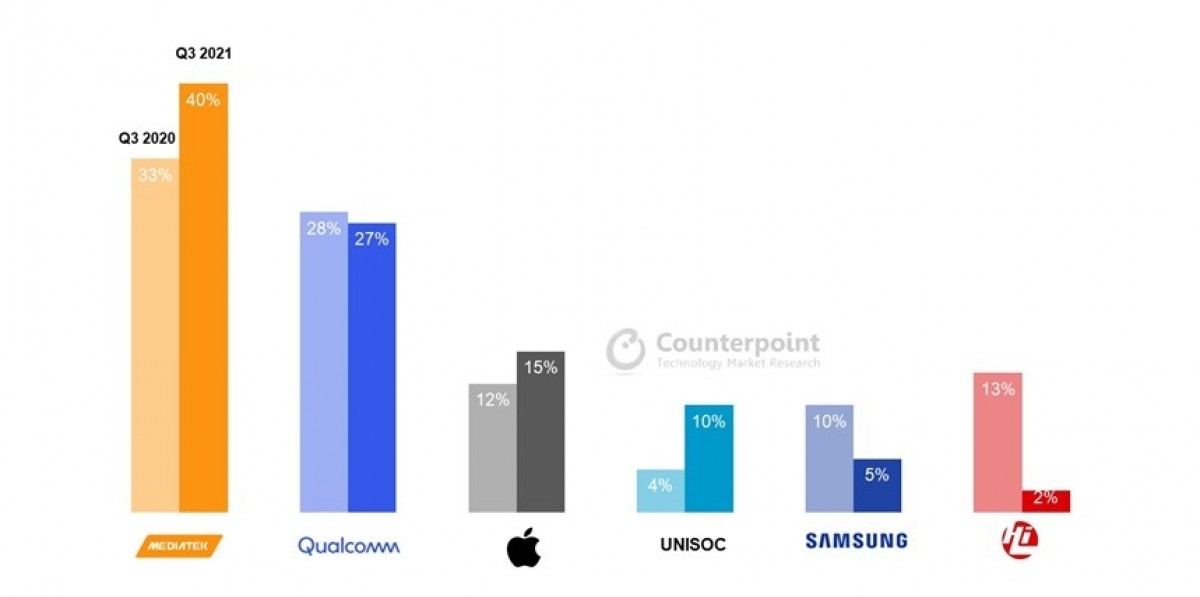
Leading tech research group, Counterpoint Research has released its third quarterly report of shipments and the numbers show that Mediatek led the systems-on-chip shipments. The data indicated a growing gap between Mediatek and Qualcomm in SoC shipments in the third quarter of the year 2021. Unisoc followed the ranking of chipmakers ahead of Samsung. The rise of Mediatek is corresponding to a seemingly steady decline of HiSilicon which now holds about 2% of the market from its lofty heights.
The Counterpoint results indicate a strong performance of Mediatek in the shipments of in-demand 4G chipsets which has seen it garner a massive 40% of the shipments. While some of the chipmakers continue to groan in their inability to meet the growing demand for the 5G chips, the Taiwanese company continues to surge in the numbers. Qualcomm is still the leader in the 5G segment of the market in terms of shipments.
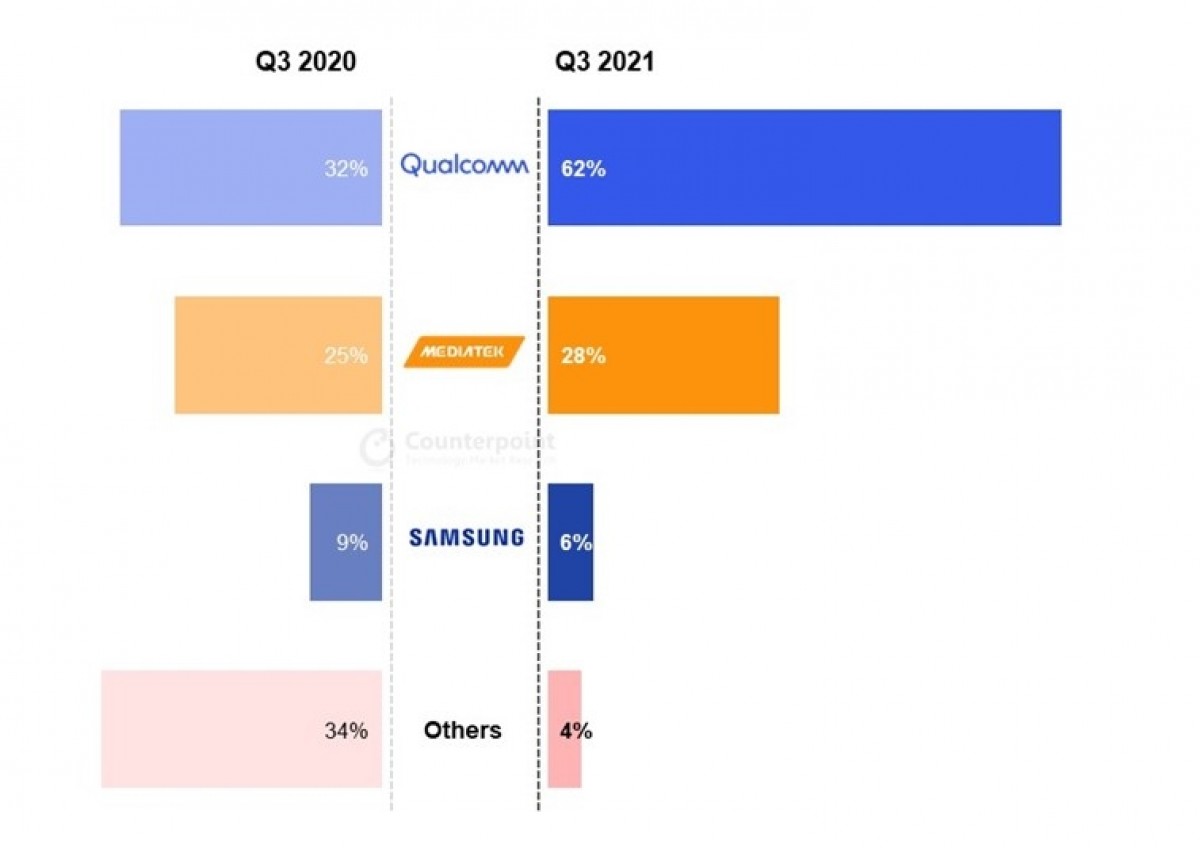
The US company, even with the uncertainty and supply chain difficulties, still retained a commanding 62% of the 5G chips market, mainly driven by its ability to have multiple contractors for the manufacture of important SoCs under its 5G lineup. Qualcomm also enjoyed a surge in its 5G chips shipment numbers due to the massive demand for the iPhone 13 back in September when it was launched. Of course, the iPhone 13 series are powered by Qualcomm Snapdragon chipsets.
Another chipmaker that had a strong Q3 2021 performance was Unisoc, which achieved a double-digit market share and overtook Samsung to the 3rd position. Its overall performance has seen the company having a third consecutive quarter growth. This was mainly driven by its ability to secure partnerships with several phone brands and its snapping of the supply of components to Honor at the expense of HiSilicon.
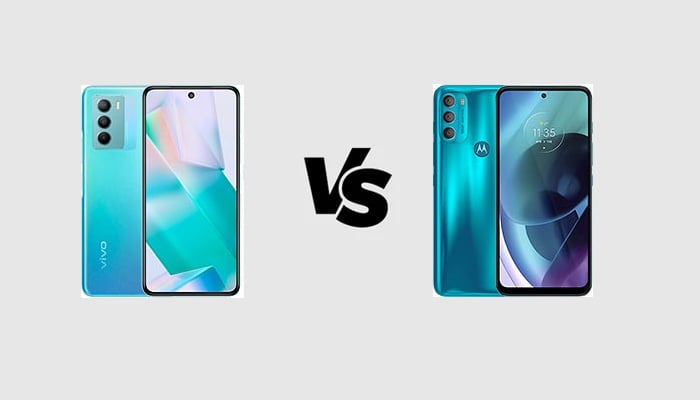
Vivo launched a brand new lineup of phones never seen before: the T series. The first devices from the new series are Vivo T1 and T1x and they are both mid-rangers. The new lineup is born to offer a very high value for money in the mid-range segment and it will compete with a lot of rivals priced around €300 in the Asian market. While we wait for the expansion of this series in other markets outside China, we think it is time to compare the new Vivo T1 with another great concurrent in the same price range. We chose the Moto G71 for this specs comparison because it is one of the latest mid-rangers available in the same price range.
Vivo T1 vs Motorola Moto G71
Motorola Moto G71 5G
Vivo T1
DIMENSIONS AND WEIGHT
161.2 x 73.9 x 8.5 mm,
179 g
164.7 x 76.7 x 8.5 mm,
193 g
DISPLAY
6.4 inches, 1080 x 2400 pixels (Full HD+), AMOLED
6.67 inches, 1080 x 2400 pixels (Full HD+), IPS LCD
Triple 50 + 8 + 2 MP, f/1.8 + f/2.2 + f/2.4
16 MP f/2.2 front camera
Triple 64 + 8 + 2 MP, f/1.8 + f/2.2 + f/2.4
16 MP f/2.5 front camera
BATTERY
5000 mAh, fast charging 30W
5000 mAh, fast charging 44W
ADDITIONAL FEATURES
5G, dual SIM, water-repellent
5G, dual SIM
Design
Vivo T1 and Motorola Moto G71 5G are entirely made of polycarbonate with the exception of the front glass, so they are not built with great materials. Yet they still offer an elegant and modern design, with a minimalistic camera module and a punch-hole display. Between these two handsets, I personally prefer the design of the Motorola Moto G71 5G not only for its great color variants but also because it is more compact and lighter than the Vivo T1. It even offers slight protection against water as its body is water-repellent. On the other hand, the Vivo T1 has a higher screen to body ratio thanks to narrower bezels around the display.
Display
The greatest display when it comes to image quality belongs to the Motorola Moto G71 5G. This handset sports an AMOLED display showing brighter colors and deeper blacks with a Full HD+ resolution of 1080 x 2400 pixels. The display of the Motorola Moto G71 5G is also smaller and easier to use with one hand. Unfortunately, the Vivo T1 has an IPS display with less impressive image quality, but it sports a very high 120 Hz refresh rate and the HDR10 certification which improves the image quality on streaming platforms. The Vivo T1 and the Motorola Moto G71 5G do not have an in-display fingerprint reader but a side-mounted one, as well as a mono speaker and a 3.5 mm audio jack.
Specs & Software
Both Vivo T1 and Motorola Moto G71 5G are mid-rangers, but the latter has a better hardware department. It is fueled by the Snapdragon 778G chipset paired with up to 12 GB of RAM and up to 256 GB of UFS 3.1 internal storage. It is not far from high-end phones in terms of performance and it is good even for gaming, but it remains a mid-ranger. The Motorola Moto G71 5G has an inferior but still pretty nice Snapdragon 695 chipset paired with up to 8 GB of RAM and 128 GB of native storage. None of these devices come with a micro SD slot, and both run Android 11 out of the box. Even though they are both mid-rangers, there is an evident difference between the high-end configuration of the Vivo T1 and the Moto G71, so consider this.
Camera
While both the handsets feature an 8 MP ultrawide camera and a 2 MP macro camera, the main sensor is different and the one of the Vivo T1 is better. We are talking about a 64 MP camera with an f/1.8 focal aperture against a 50 MP f/1.8 sensor, which provides a higher level of detail in a lot of scenarios. It even supports 4K video recording at 60 fps. On the other hand, the Motorola Moto G71 5G seems to have a better front camera with a brighter aperture.
The Vivo T1 and the Motorola Moto G71 5G are equipped with a battery sporting a capacity of 5000 mAh. Despite the capacity being the same, the Motorola Moto G71 5G should last longer because it has a more efficient and smaller AMOLED display, at least in the scenarios in which the display is used. On the other hand, the Vivo T1 is quicker to charge thanks to 44W fast charging.
Price
The starting price of the Vivo T1 is about €300/$340 at the actual change, while Motorola Moto G71 5G starts from €250/$283. If we exclude the better AMOLED display of the Moto G71 5G, the Vivo T1 is a superior device thanks to a better chipset, better camera, 120 Hz refresh rate, wider display, and 44W fast charging.
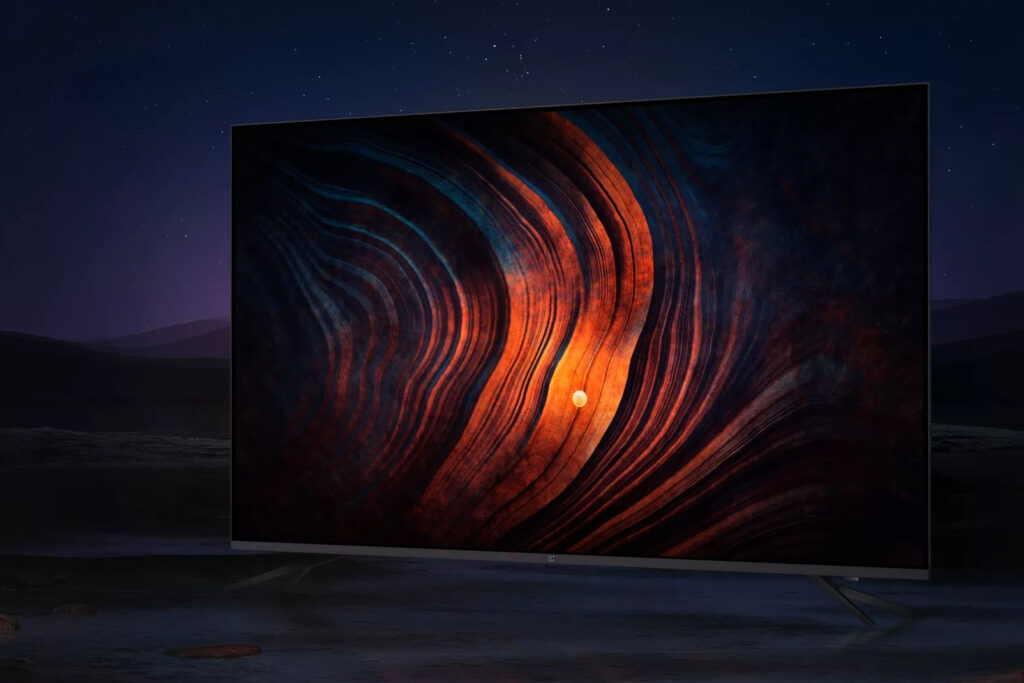
The global technology brand OnePlus has turned 8 years old, and to celebrate this joyous occasion, the company is offering heavy discounts on a large range of their products. Customers can avail discounts up to Rs 8,000 on the OnePlus 9 Series, up to Rs 3,000 on the OnePlus Nord Series, and up to Rs 8,000 on smart TVs, and many more exciting offers on other ecosystem products.
These discounts can be availed on multiple platforms, including the OnePlus Indian website, OnePlus Store App, Amazon India, and the OnePlus partner stores. So let’s take a closer look at these offers.
In addition to the direct discount, buyers can also get Rs 2,000 off on TVs with Kotak Bank and ICICI Debit and Credit Card transactions on OnePlus.in, OnePlus Store App, Amazon.in, and OnePlus partner stores. With the same cards, you also get up to Rs 5,000 instant discount on the OnePlus OnePlus TV U series. A 10% cashback offer on American Express Card can also be availed.
OnePlus Audio, Wearables, and Accessories
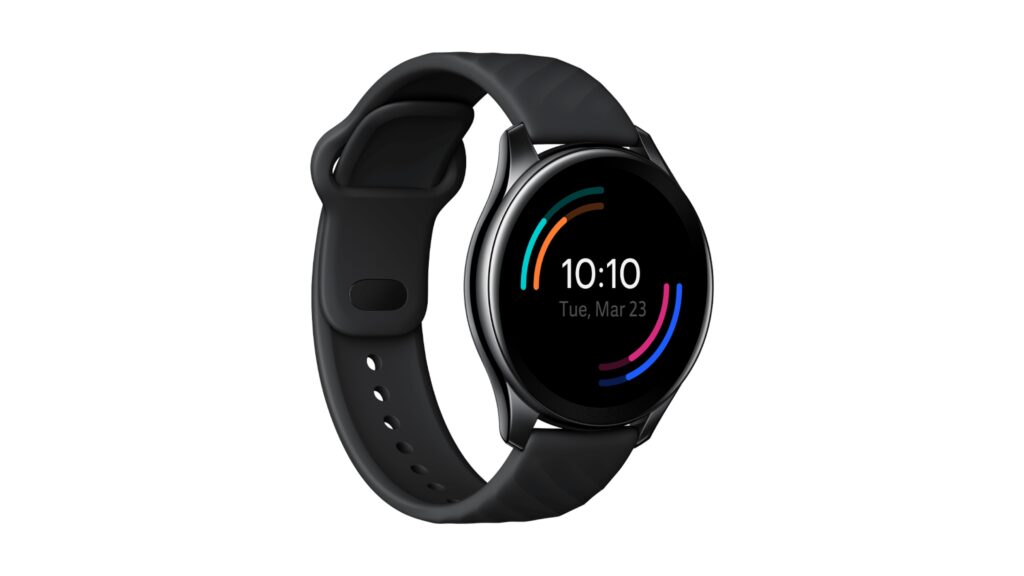
OnePlus Watch – Rs 1,000 off on purchase via Kotak or ICICI bank cards(debit or credit) on OnePlus.in, OnePlus Store App, Amazon.in, OnePlus Experience Stores and partner stores.
OnePlus Watch Harry Potter Edition – Rs 1,000 instant discount with ICICI Bank and Kotak Bank Debit and Credit Card transactions
OnePlus Buds Pro and OnePlus Watch – Rs 1,000 instant discount with ICICI Bank and Kotak Bank Debit and Credit Card transactions
OnePlus Buds Pro – Rs 991 off on Flipkart
OnePlus Band Steven Harrington Edition – Rs 300 off
Apart from these, accessories like mobile cases, covers, adapters, etc. are available at a discount ranging from 20% to 70% on OnePlus.in and OnePlus Store App. Lastly, the annual OnePlus Red Cable Care membership is available for Rs 999 (Rs 500 off).
Note: The ICICI bank card offers are valid till 31st December 2021, while the Kotak bank card offers are valid till 31st January 2022.
Yesterday, Samsung announced the budget Galaxy Tab A8 tablet with some improvements in the design and specifications. The company has also launched a new version of the Galaxy Tab A7 Lite. The tablet dubbed Samsung Galaxy Tab A7 Kids Edition made its first appearance in Russia and as the suggests, it is packed with lots of educational and entertainment content for kids.
The slate is basically the Galaxy Tab A7 Lite but it has a protective pouch out the outside to protect it from damages due to falls. Of course, the tablet is likely going to fall down a lot more frequently since it will be used by kids but the protective case which is soft and chunky will do a good job in preventing any major damage. There is also a big handle on the back of the protective case making it easy to carry around.
The tablet is equipped with an 8.7-inch LCD screen with a resolution of 1,340 x 800 pixels. It is powered by a MediaTek Helio P22T processor that is paired with 3GB of RAM while there is 32GB of internal storage that is expandable via a MicroSD slot. It comes with Wi-Fi only and crams a 5,100mAh battery.
The kid-centric tablet is stuffed with several educational games but there is a more secure parental control feature. Samsung is also partnering with some big games publishers
As for the pricing and availability, the Samsung Galaxy Tab A7 Kids Edition is on offer in Russia for RUB 15,000 (~$205). The slate will be sold in Russia via Samsung Russia and other local authorized dealers.
OnePlus on Thursday, announced the all-new OnePlus Buds Z2 in the US and European markets. The truly wireless pair of earbuds comes with Active Noise Cancellation and has 11mm bass-tuned drivers. It will be a successor to the original Buds Z offering better sound and features at an affordable price.
The OnePlus Budz Z2 is priced at $99 in the US and has a €99 price tag in the European market. It comes in two colours like Obsidian Black and Pearl White. Unfortunately, the former colour variant is not available in Europe.
The OnePlus Buds Z2 offer a similar design to its predecessor. It comes with an 11mm base-tuned Dynamic Drivers. It comes with a 3-mic setup for calibrating the Noise reduction. It has Dolby Atmos support and features Bluetooth v5.1.
One of its major highlights is the 40dB Active Noise Cancellation. It also features a transparency mode. The earbuds come with 94ms Ultra-low latency support. It has Bluetooth v5.2 and Dolby Atmos support.
The Buds Z2 comes with a charging case and has a total battery life of 38 hours. It supports OnePlus’s Flash Charge technology that offers up to 5 hours of music playback with just 10 minutes of charging. It can offer up to 7 hours if the ANC feature is turned off.
The latest update of the Ray-Ban Stories released in partnership with Facebook now Meta has added several features to the smart glasses. After the installation of the software update, users can use the built-in assistant to send texts, make voice calls and read messages via Messenger. The new software update also makes it possible for the user to use his voice to control media playback, like pausing or resuming playback, skipping a track, adjusting the volume, or even requesting the battery life update of the device.
Meta is the transformational name of Facebook, and the company says it is rolling out the update to the accompanying Facebook View app sequentially in phases. Meta also insists that the software should be available to everyone within the shortest period. Owners of the Ray-Ban Stories glasses must first download and install the latest firmware on the glasses before they can download the new update.
The new features that have been added to the Meta Ray-Ban Stories will not be the last. Meta says several other features are also lined up for incorporation into the Ray-Ban Stories and these could come as early as 2022.
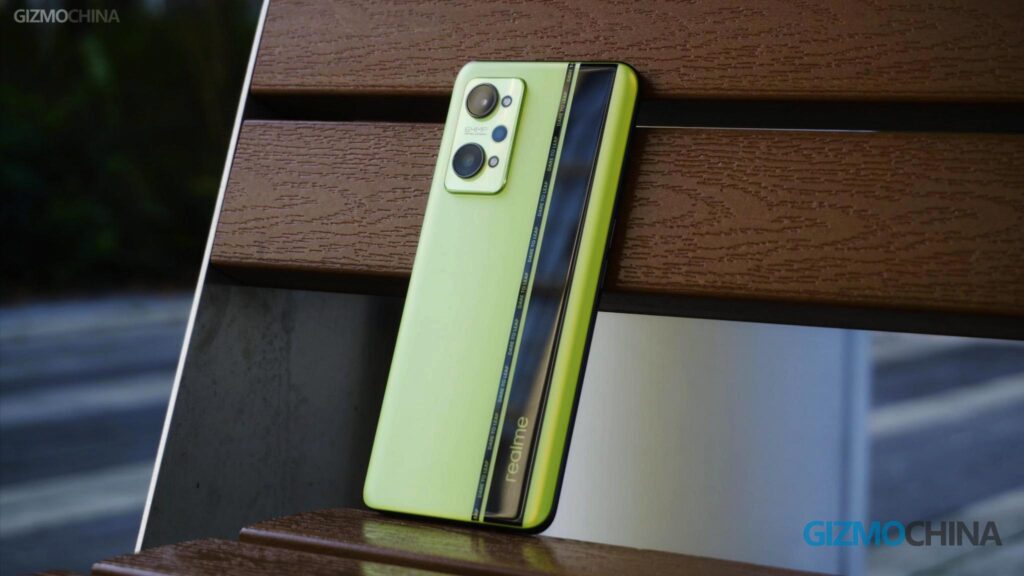
After realme announced their Android 12 based realme UI 3.0 back in October, some of their devices like the Realme GT, GT Master Explorer Edition, and the X7 Max 5G got the option to experience the early access builds of this upcoming OS. Now, realme has brought the same option to their GT Neo 2 devices.
Earlier today, realme took to their community forums to announce that the realme UI 3.0 early access program for the realme GT Neo 2 devices is now live. The beta program has limited seats which you can avail by sending an application of participation to realme(via).
If you own a GT Neo 2 and are interested in trying out the realme UI 3.0 on your phone, you can enroll in the beta program by following the steps given below
Make sure your device is not rooted
Make sure your device is running the RMX3370_11.A.05 stable release
Head over to the Software Update section in the device settings
Click on the gear icon in the top-right corner
Tap on ‘Trial version’ and fill in your details
Hit the Apply Now button
Your application to be inducted into the beta program will be sent to realme. Once it gets approved, you will soon receive an OTA update on your device carrying the latest realme UI 3.0 early access build.
Realme also warns users to make a backup of their personal data to prevent data loss during the update process. It is an early access version of the software and therefore unstable, which can have an unpredictable impact on your phone and affect daily use. Additionally, Some third-party application versions might not be compatible with Android 12 yet. After updating, these applications might not be available or crash on your device.
realme is yet to provide a timeline for when we can expect to see a stable, wide release of the Android 12 based UI, so stay tuned as we will be keeping a lookout for any notable developments.
We’re approaching 2022, almost 9 years since Google made its first and last Google Glass. One might think that the smart glass industry may not be worth venturing, however, Huawei wants to prove otherwise.
In addition to announcing the rumored Huawei Matebook X Pro on the Huawei Winter Flagship Keynote on 23 December 2021, Huawei is also planning to release its first true smart glasses, the Huawei Smart Glass.
The pair of glasses is said to be powered by HarmonyOS, the in-house operating system developed by Huawei. Huawei is calling the glasses “your next smart personal assistant” and from the teaser video that Huawei shared, the glasses feature swappable lenses as well as left and right firing speakers on each arm of the glasses.
This announcement comes in piping hot right after Oppo announcing its first Oppo Air Glass at its Oppo INNO Day 2021 event on 14 December 2021. The glass features futuristic styling with a single lens design and weighs less than 30 grams. The Air Glass is also designed to snap onto custom frames offered by OPPO using magnetic components housed inside the Air Glass frame.
Huawei X Gentle Monster
Huawei previously released two glasses under its name, however, both were in collaboration with spectacles maker Gentle Monster. The upcoming Huawei Smart Glass does not feature any collaboration branding and is rumored to be a brand new series in the Huawei family.
The current Gentle Monster X Huawei Eyewear II is currently still in stores for RMB 2499 to 2699 (393 to 424 USD). It comes in 4 sunglasses design options and 6 optical glasses design options. It also supports music playback and voice assistant reminders.
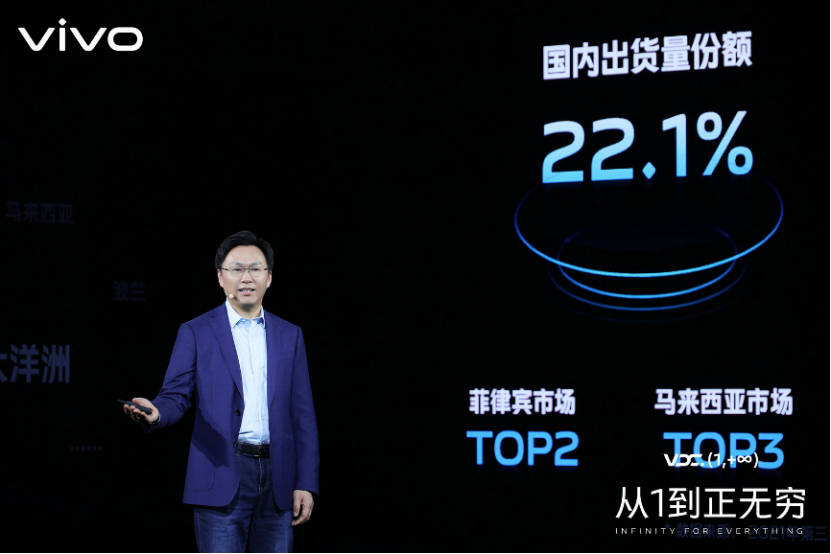
At its annual developer conference today in China, Senior Vice President of vivo, Shi Yujian unveiled the performance results of vivo in the Chinese market over the past year.
He revealed that vivo was one of the Top 3 Premium (More than 4000RMB) Smartphone brands in the Chinese market in Q3 2021, surpassing its sister company OnePlus as well as Samsung in the Chinese smartphone market. It accounts for a surprising 22.1% market share of smartphone shipments in the country, and it has more than 270 million active users currently in China.
On a global scale, vivo has been making strides too, as it is now the Top 3 smartphone brand in high potential developing markets such as the Philippines, Malaysia, and even India.
Shi Yujian, the Vice President also noted that 2021 has been the year of major change for vivo, a “Flywheel 2.0” year you might say. At the same time, vivo has been also expanding its markets overseas into the IoT market, aiming to collaborate and lead the industry, additionally to also advance the greater community.
At the end of the conference, vivo also shares that it has innovations in battery life, memory management, 5G, and Wi-Fi in store for its consumers in the future, especially with the in-house generational leap memory management 2.0 and its upcoming LTPO adaptive refresh rate display 3.0.
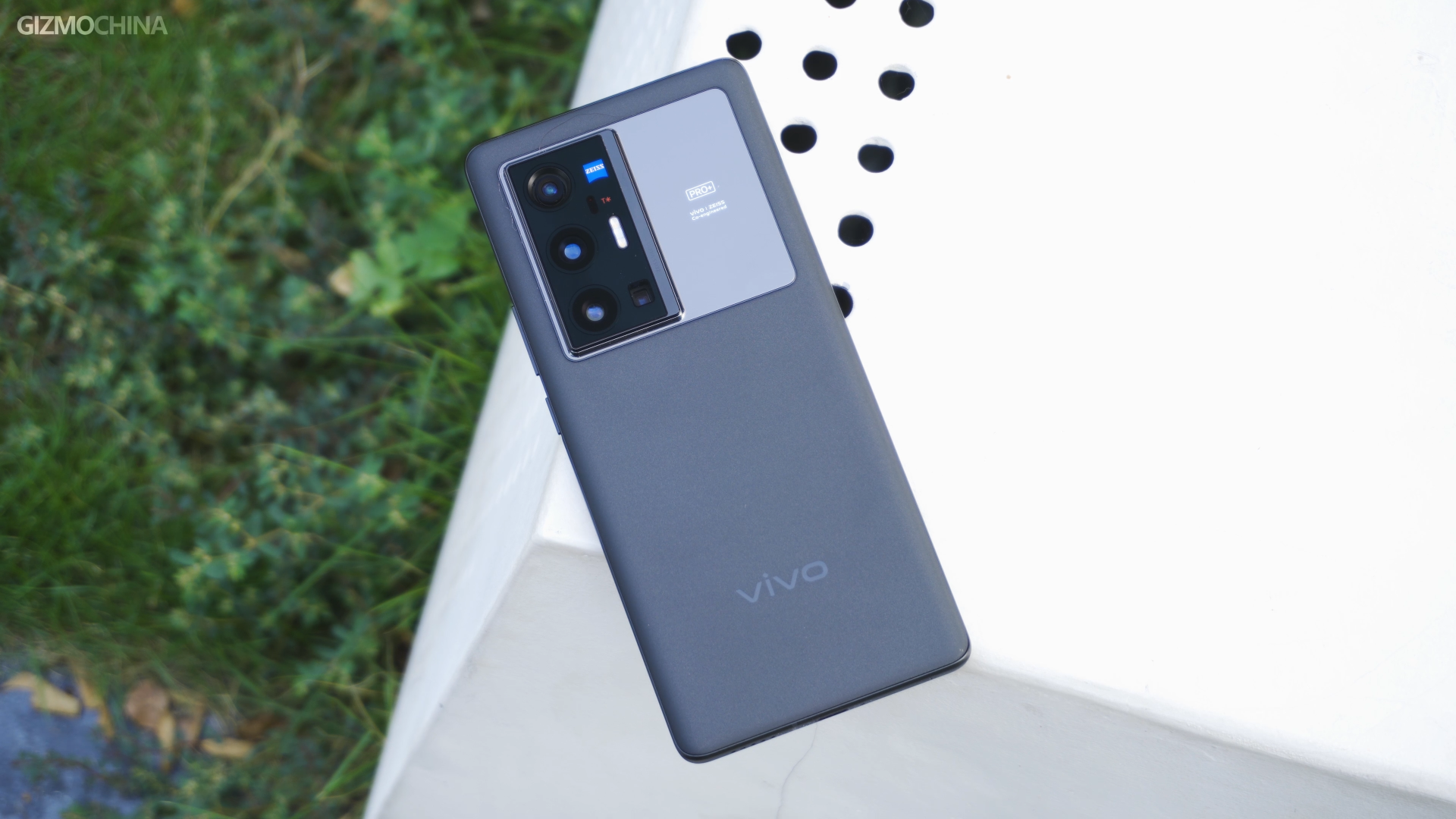
vivo’s current premium flagship is the Vivo X70 Pro Plus, it comes with the Snapdragon 888+ chipset, industry-leading E5 LTPO AMOLED (ranging from 1Hz to 120Hz), as well as 55W fast wired charging and 50W fast wireless charging to juice up its 4500mAh battery. It costs Rs. 79,990(1050 USD) in India and is available in Black Vegan Leather.
Lately, the smartphone market has been flooded with 5G compatible handsets but only a few of them can boast to be rugged devices. Now, the Chinese electronics manufactures HiSense has launched their D50 5G rugged smartphone featuring a thermal camera intended to be used by people who work in extreme conditions like law enforcement.
The D50 5G rugged smartphone boasts a high level of toughness and durability standards with IP69 dust and waterproof capabilities as well as 6-sided armor protection providing shock resistance.
The phone comes in at a net weight of 263 grams and is 173.8mm×81mm×12.4mm in size. It has a 6.53-inch display with a 2340 x 1080 resolution and a waterdrop camera design in the middle of the display.
There is a 2.0GHz octa-core UNISOC T7510 processor under the hood with three RAM variants – 4GB, 6GB, and 8GB – and it will come with 64GB, 128GB, or 256GB of storage. The HiSense D50 has four rear cameras – a 48MP primary sensor, 8MP ultrawide, 2MP macro lens, and 2MP infrared camera which provides users with thermal imaging capabilities. On the software front, the phone runs Android 9 out of the box. There is a fingerprint scanner on the back of the phone too. HiSense offers the device in two battery configurations namely, 5010mAh and the massive 6100mAh. Both the variants support 18W fast charging.
The HiSense D50 5G rugged smartphone is priced at 3,980 yuan (US$617) for its 6GB+128GB model in the Chinese market.
Earlier this week, Tianma Microelectronics announced at the Wuhan Tianma G6 Industrial Base, that it has signed a new partnership deal with Xiaomi Corp. With this new agreement, both companies will seek to study and develop new display technologies through a new joint laboratory.
Xiaomi 11 Pro with its 2K display
This new facility will feature independent labs, which will rely on the Chinese tech giant’s vast resources in consumer electronic products and Tianma’s innovative platform for the next generation of display technology (Via PanDaily). Some of the objectives of the joint laboratory includes research and development into new display technology, along with study and verification of equipment and materials related to these new technologies.
Furthermore, the new lab will also work directly with upstream and downstream of the industrial chain to improve its R&D capabilities. The goal is to develop new slim, lightweight, portable, and energy efficient display panel technology and to commercialize the mass production of this as well. Cheng Wei, Executive Vice President of Tianma Microelectronics, stated that the new joint lab enables the company to gain access to the industry chain ranging from the market, to terminals, and even parts manufacturers as well.
Tianma Flexible display
In other words, it will accelerate the development cycle of new display panels and bring new technologies into the market faster. For those unaware, the smartphone maker and Tianma Microelectronics maintain a close relationship with one another, with the latter supply the displays used in a number of the former’s smartphones and smart wearable products as well. So, it arrives as no surprise that the brands are seeking to further expand on their cooperation in areas like flexible OLED panels in the arriving year.
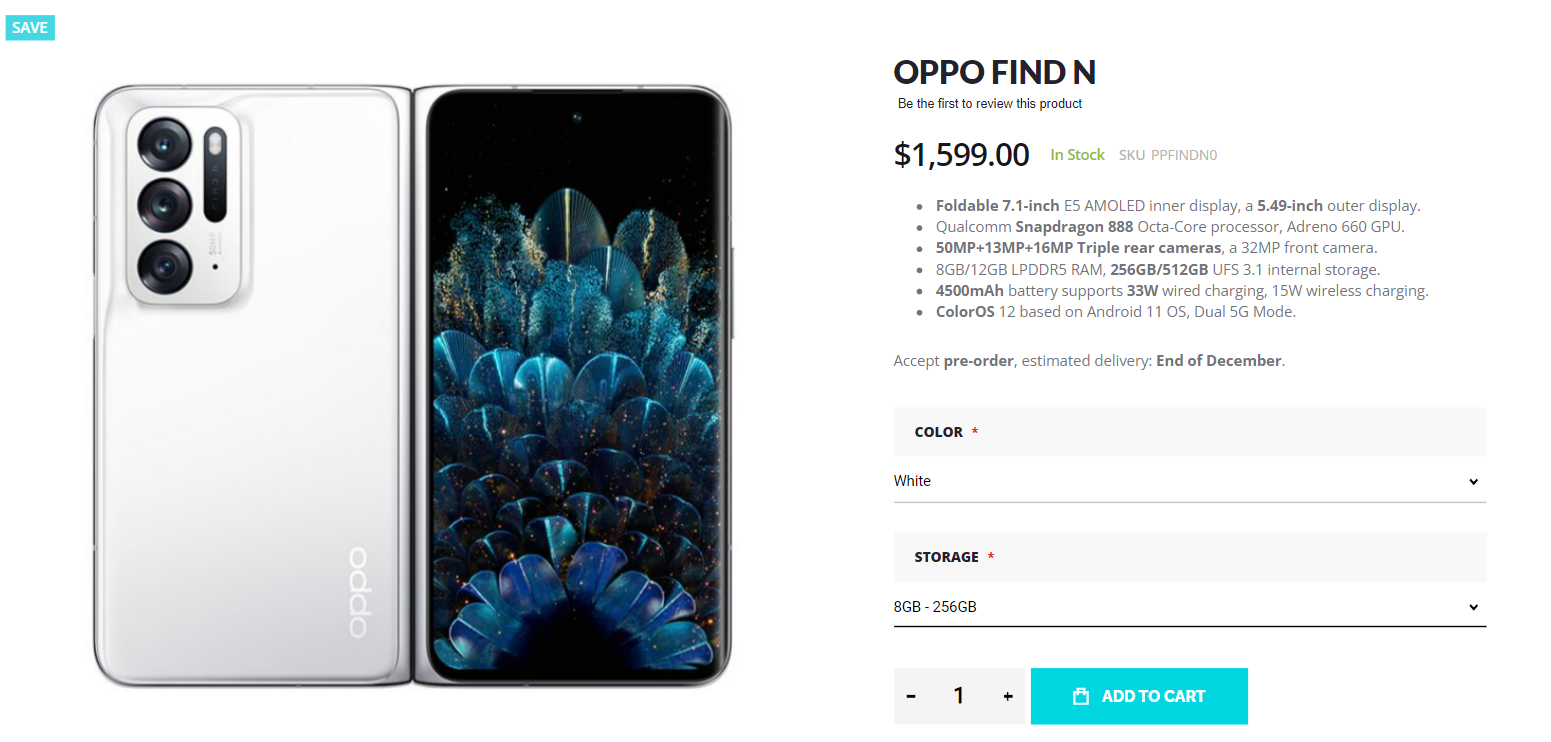
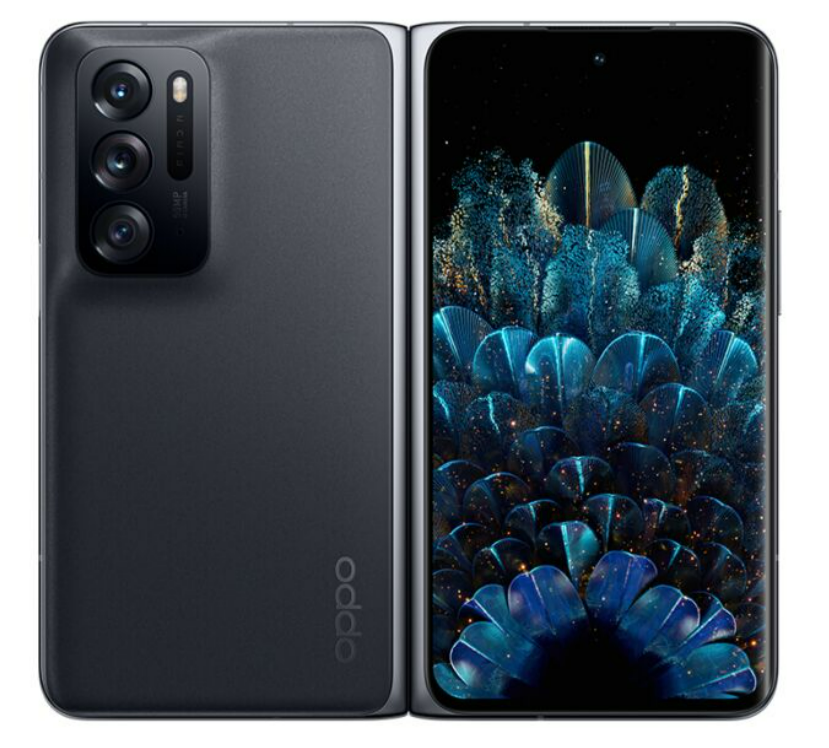
Oppo Find N the latest smartphone from Oppo is now available to all global customers for pre-order at $1599 only at Giztop. Please note that this is a pre-order and the actual shipping will start at the end of December.
Oppo Find N is the first foldable flagship from OPPO. It features a 7.1” E5 AMOLED inner display and a 5.49” outer display. The smartphone runs on the Snapdragon 888 octa-core processor and comes with Adreno 660 GPU. It comes in multiple memory variants viz: 8GB / 12GB LPDDR5 RAM and 256GB / 512GB internal storage.
Oppo Find N comes with a triple rear camera setup with a 50MP main camera and 13MP and 16MP secondary cameras. At the front, you have a 32MP selfie camera on both the inner and outer display. The smartphone is fueled by a 4500mAh battery and supports 33W wired and 15W wireless charging. It comes in three gorgeous color variants viz: Purple, White, and Black.
Oppo Find N foldable smartphone runs on Android 11 based Color OS 12 and supports Dual 5G mode. Giztop is now accepting pre-orders for Oppo Find N at $1599 only. Please note that this price is applicable to the 8GB + 256GB White and Black color variants. However, you can also get the Purple color variant and higher memory variants at a slightly higher price.
For more information on such exciting deals and offers check out our deals hub.
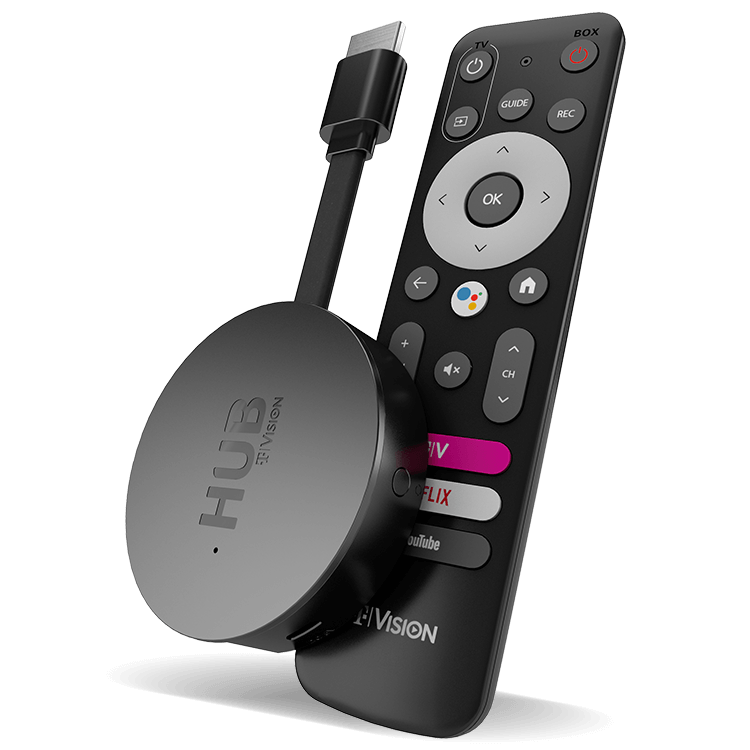
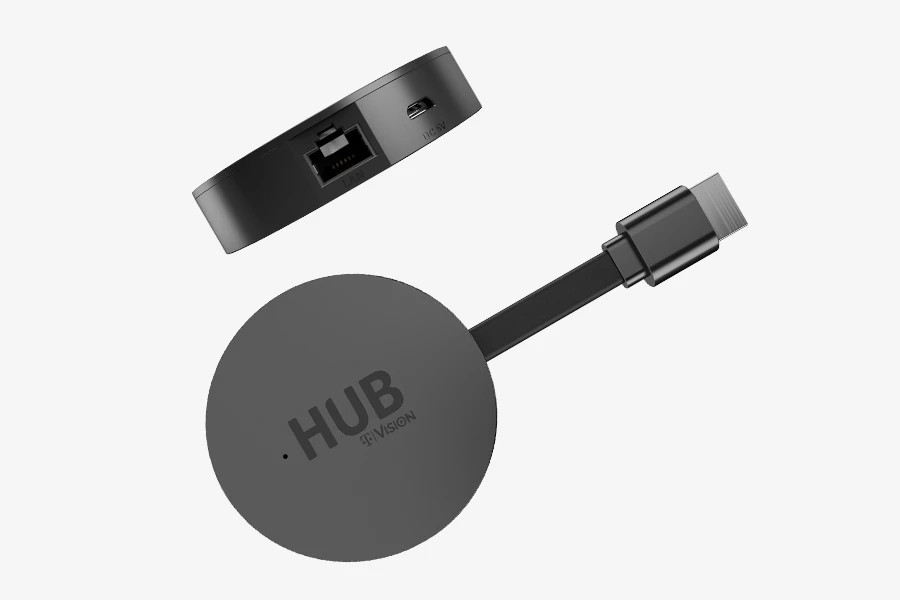
T-Mobile has quietly announced the TVision Hub – a streaming dongle with essentially the same design as the Chromecast with Google TV, but with a couple of changes. It would be the second Google TV streaming stick to be sold in the United States.
Coming to the changes, firstly, there’s a clear difference between the remotes of the two dongles, with the one for the TVision having a dedicated power and input controls for the TV, a live TV guide shortcut, and three app shortcuts to YouTube, Netflix, and a T-Mobile-branded TV app (via 9to5Google). It’s unclear what the app exactly is for but it could be possible that T-Mobile has created it for supplying curated content by itself.
The other notable change is that TVision Hub features a built-in Ethernet port that’s seemingly paired with a micro-USB port for power. But T-Mobile’s website does state that USB-C is also available.
The dongle makes use of the Amlogic S905Y4 chip, which is a newer and more powerful chip than the one found in the Chromecast with Google TV and even comes with AV1 decoding. And on top of that, it boots into Android TV OS 11 out of the box, which is something the Chromecast is yet to see.
It remains to be seen if T-Mobile has made any changes to Google TV’s UI but the product page does mention 4K HDR support.
If interested in purchasing the TVision Hub, it could cost you just $50, although T-Mobile Home Internet customers can even get it for free.
After the launch of their premium mid-range smartphone the HONOR X30, the Chinese tech company has now announced their plans to launch a new upgraded MagicBook 16 series notebook lineup. According to a report by ITHome, HONOR has announced that the company will be releasing an upgraded line of MagicBook 16 series laptops on December 30th. The brand has also hinted that the upcoming MagicBook 16 series will have the multiscreen collaboration feature compatible with smartphones, tablets, and smart screens.
The multiscreen collaboration functionality provides seamless integration between the laptop and other smart screens like a smartphone. The feature will enable you to use any mobile app present on your smartphone via your laptop. The functionality also allows you to drag and drop any file, text, images, music, etc., from your smartphone to your laptop.
Additionally, the laptops will also come with the latest Microsoft Windows 11 pre-installed.
HONOR MagicBook 16 Pro 2021 specifications
For those unaware, the current-gen HONOR Magic 16 Pro models were released back in September and feature a 16.1-inch FHD IPS screen with 144Hz refresh rate and anti-glare feature, 5.1mm narrow bezels, and an impressive 87.3% screen-to-body ratio. The screen also features a 100% sRGB color gamut.
The MagicBook 16 Pro comes with an AMD Ryzen 5800H processor, 16GB dual-channel memory + 512GB PCle SSD. In graphics support the device comes with NVIDIA GeForce GTX 1650 and NVIDIA GeForce RTX 3050 dedicated GPU variants. It features a 720p HD webcam, a fingerprint sensor and comes with dual speakers, dual microphones, and NFC for HONOR Magic-Link.
On the connectivity front, the computers arrive with dual-band WiFi 6, Bluetooth 5.1, 1 x HDMI, 2 x USB 3.2 Gen1 (Type-A), 2 x USB 3.2 Gen1 (Type-C), and a 3.5mm headphone jack.
Last but not least, the HONOR MagicBook 16 series runs Microsoft Windows 10 Home Edition and is backed by a 56Whr battery with support for 65W fast charging.
A number of tech analysts have looked at Intel CEO’s, Pat Gelsinger, visit to Taiwan as a means for the American chip giant to pressure TSMC over its chip orders. Apparently, the former is urging the latter to confirm its chip orders for cutting edge latest 3nm process.
Pat Gelsinger
According to a TaiwanNewsreport, local media reports in Taiwan and analyst believe that the American company is looking to “berate then buy” from the world’s largest contract chipmaker. As per tech analyst Chai Huan-shi, Gelsinger’s visit to Taiwan is not just to acquire chip orders from Taiwan Semiconductor Manufacturing Company but to also put pressure on the chip manufacturer.
Notably, Chai added that Team Blue’s current product line is not advanced enough as of right now for the 3nm process. Furthermore, he believes that TSMC’s 3nm process has already been booked out by other tech giants, with Intel currently having no order allocation at the moment. So, Chai stated that the CEO arrival in Taiwan could also be the company’s efforts in interfering with TSMC’s corporate strategy. The analyst believes the move is in the best interest of his own company, or possibly even the US government as well.
He noted that while receiving 3nm chip orders might be a symbolic victory for the American company, TSMC’s other customers (including Apple, Nvidia, AMD, MediaTek, and others) could in turn begin pressuring Intel. On the other hand, Intel’s entire efforts could also very well be to interfere in the rivalry between TSMC and Samsung as well.
Japanese automaker Toyota is on course in its pursuit of churning out 30 electric vehicle models by the turn of this decade. The company is making massive investments in EV technology and is gradually transiting its production facilities to EV plants in pursuit of its goals. Toyota plans to spend up to $17 billion in developing its capacity in electric vehicle manufacturing.
Toyota is ramping up its efforts across several fronts and pursuing a robust production schedule that will see it delivering 15 EVs by 2025 (the initial target) and going further to release 15 more EVs by 2030. The target also includes the production of 3.5 million EVs by 2030 for its global market. The Toyota Lexus brand will be transformed into an all-electric lineup by 2035 as part of the broad goals of the Japanese automaker.
Toyota was among the early pacesetters in the shift towards electric vehicles, but it lagged significantly, allowing Tesla and others to dictate the pace and hold substantial market shares globally. Toyota now intends to roll back the clock and position itself for the future of sustainability-oriented vehicles with varying levels of autonomous driving. Toyota had long held the view that the shift towards electric vehicles as an alternative to traditional automobiles was overhyped. However, the official view of the company on EV technology has seemingly changed as the company now says that it is pursuing EV production to reduce tailpipe emissions from its gas-powered automobiles.
No details were released about the lineup and features that will be present in the models. Toyota will be doing catchup even with several traditional carmakers like Honda, Nissan, Volkswagen, and Mercedes-Benz among several others who had embraced EV production, with some having plans to transit to all-EV production within the next decade.
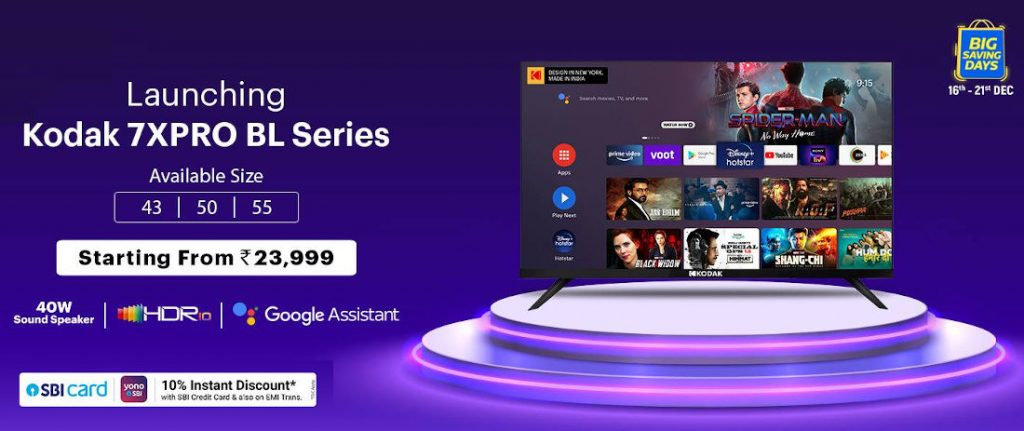
Kodak has launched three 4K smart TVs with 40W speakers in India. The launch of the new lineup under the Kovak brand is another realization of the made in India initiative as the models are wholly produced in the subcontinent. The new models are the outcome of investments in technology and research in pursuit of a massive share of the Indian TV market. The company continues to pursue its goal of becoming the leading premium Android TV brand in the country.
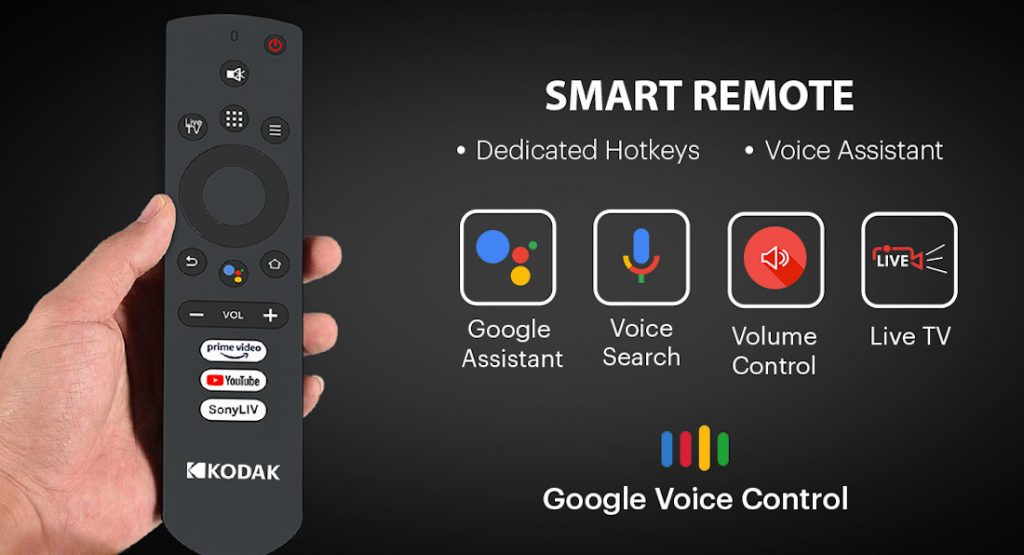
The models include the Kodak 7XPro BL series with sizes 43”, 50”, and 55”, respectively. The sound system of the three new Kodak 7XPro BL TVs includes double box speakers and surround sound. The TVs also feature HDR 10, dual-band Wi-Fi, Google Assistant voice control, and multiple connectivity options. The user-friendly remote of the Kodak 7XPro BL lineup has dedicated shortcut keys for Prime, YouTube, and other options. The TVs also provide options for an enhanced gaming and sports experience. The TVs in the lineup have 2GB of RAM and 8GB storage, with Android TV Chromecast functionality built-in.
The Kodak 7XPro BL TVs are priced at Rs. 23,999 ($314), Rs. 30,999 ($406), and Rs. 33,999 (445), respectively for the 43-inch, 50-inch, and 55-inch models. The models will be available from Flipkart during the Big Saving Days sale, with some discounts up to 10% also available.
Earlier today (16th December 2021), MediaTek officially launched its latest flagship chipset, the Dimensity 9000 SoC. It will power top end smartphones, with various brands already confirming that their upcoming handset offerings will feature this new chip.
Talking about the chipset first, it is based on the 4nm process from TSMC and features an ARMv9 CPU architecture. The SoC sports eight cores, with one Cortex X2 super core that clocks in at 3.05GHz, paired with three performance Cortex A710 cores and four efficiency based Cortex A510 cores. Furthermore, it also supports LPDDR5X memory along with an 8MB L3 cache and 6MB system cache. For graphics, it features a Mali G710 GPU, which supports the brand’s HyperEngine 5.0 with AI-VRS along with raytracing software development kit (SDK) using Vulkan for Android.
The Taiwanese chipmaker’s Deputy General Manager, Yenchi Lee stated that “the Dimensity 9000 is the most powerful and energy efficient chip to date, delivering a number of industry firsts and a full suite of features for the most discerning tech enthusiasts.” With the official launch, smartphone brands took to social media to announce that their upcoming handsets will feature this new chipset.
This includes Redmi, who stated that an upcoming model within its K50 series will feature the new flagship chipset from MediaTek. Similarly, OPPO also revealed that its next gen Find X series model will also feature Dimensity 9000 SoC as well. Other brands like Vivo, Xiaomi, and even Honor will be launching their smartphones with this chip in the first quarter of next year as well. So stick around as we will be providing updates when additional information is available regarding this matter.
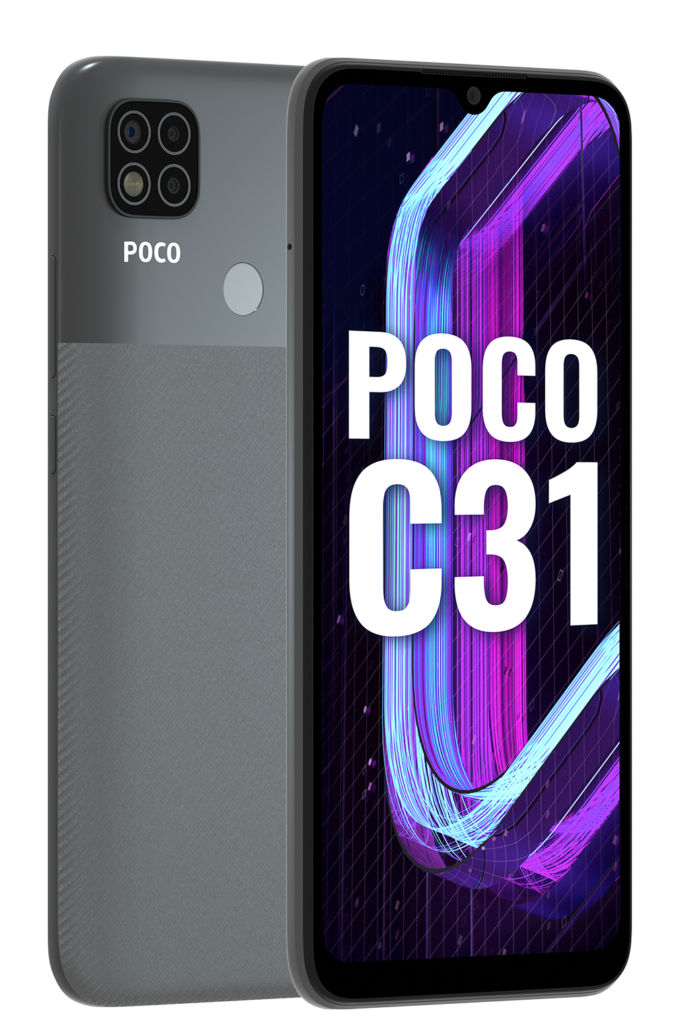
POCO, continuing to ride upon its success in India, today announced that it has managed to sell over 3 million units of its entry-level C series through Flipkart since its launch. The series is currently comprised of the POCO C3 and C31, both priced under Rs 10,000, and has played a key role in making the company the third-largest online smartphone brand in the country.
To recall, the POCO C31 is the newer iteration of the POCO C3, bringing along a slightly larger HD+ display and restoring the missing fingerprint sensor hardware. While the C3 came with a 6.43-inch display, the C31 bumped the size up to 6.53-inches for a better viewing experience. Apart from this, both are powered by the MediaTek Helio G35 octa-core processor and pack 5000mAh batteries with 10W charging support.
For photography, both come with 13MP primary cameras at the rear, joined by a 2MP macro and a 2MP depth sensor. And on the front, you get a 5MP selfie shooter.
POCO also promises a clean UI with a no-ads experience, so that’s another thing to consider. Both phones are up for grabs for Rs 8,499 on Flipkart. To purchase the POCO C31, head over to this link. The POCO C3, on the other hand, can be availed from here.
A slightly pricier but great alternative to the POCO C series can be the POCO M3 for those looking for a bump in the specifications. This one is listed for Rs 11,499 on Flipkart and comes with an FHD+ display, 48MP camera, and Snapdragon 662 processor.
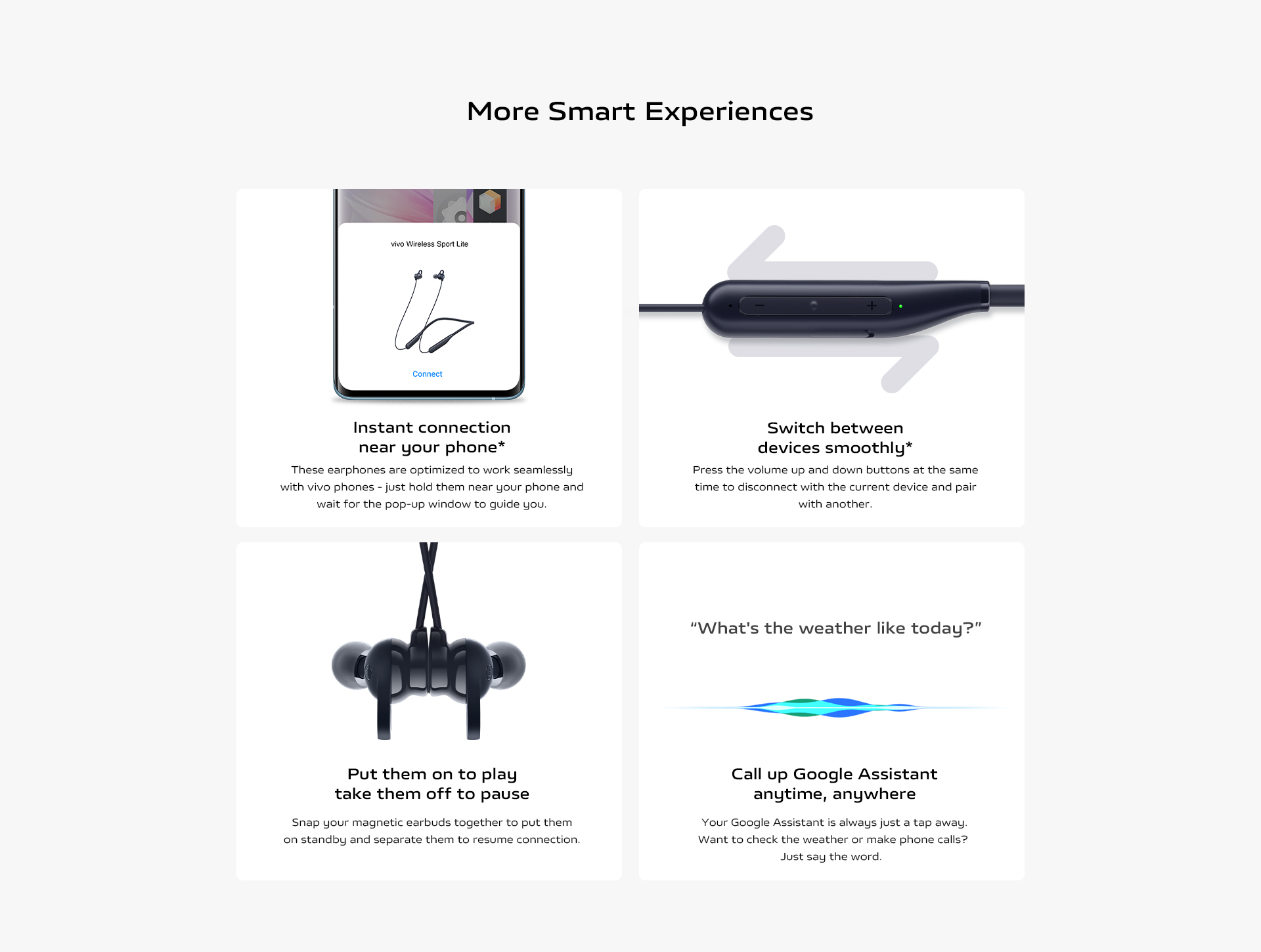
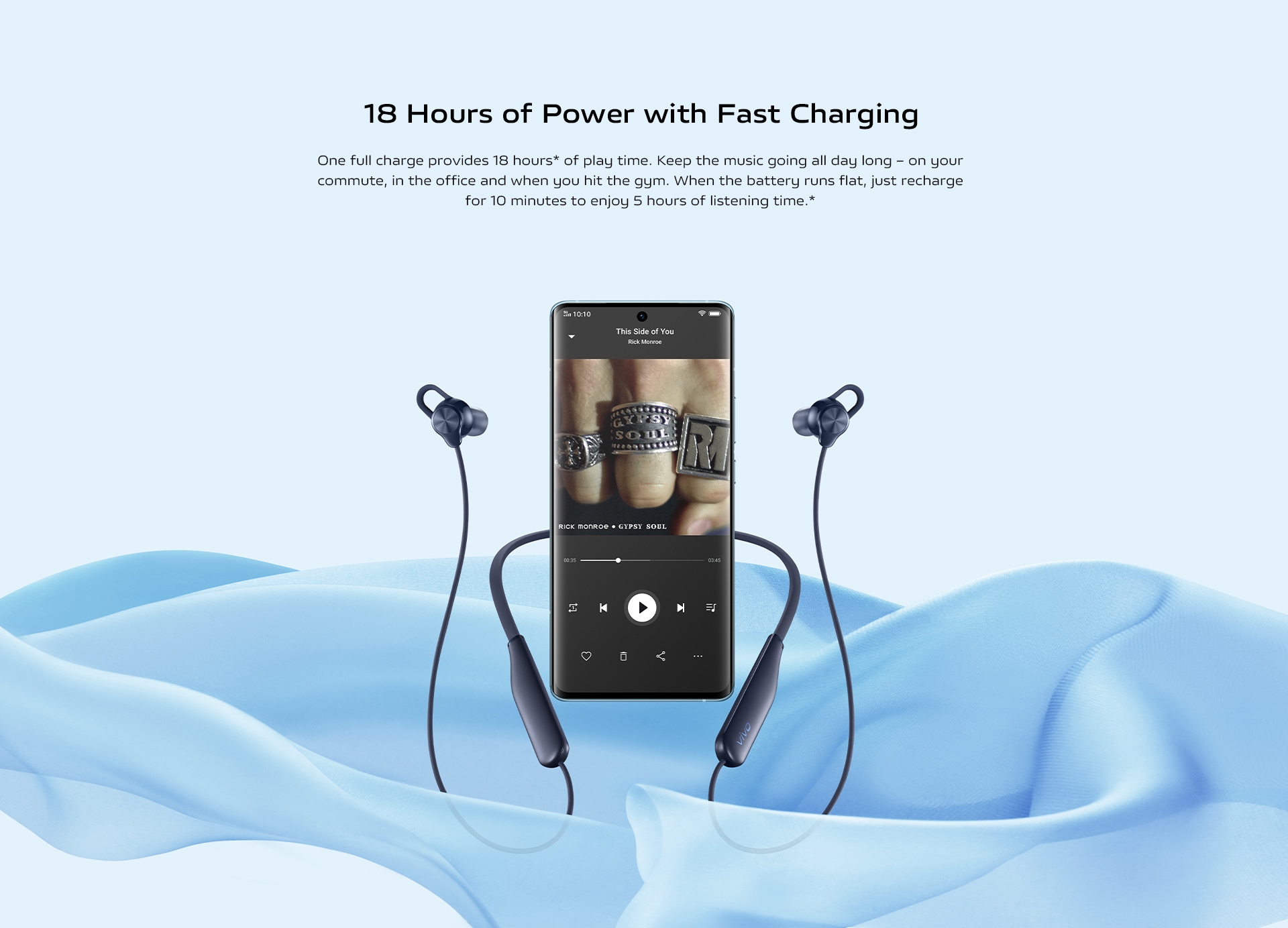
vivo Wireless Sport Lite neckband earphones were launched in India for an affordable price of Rs. 1,999 ($27) on Wednesday with headlining features that include 18-Hour Battery Life, Fast Charging, “Call Noise Cancellation”, as well as IPX4 sweat and water resistance.
Starting with the build quality, these neckband earphones are made up of Daikoku aluminium-coated bronze coil, which vivo says will help to reproduce high frequencies. In conjunction, the pair has a lightweight ergonomic design as well, coming in at only 23.9 grams. Next, the vivo neckband earphones have a magnetic switch and controls that offer a quick pair feature for hassle-free connection with devices and the controls also have support with voice assistance through Google Assistant. Lastly, the earphones are IPX4 rated for sweat and water resistance.
For the specs, the new Vivo wireless earphones are powered by an 11.2mm dynamic driver that Vivo claims to deliver strong bass quality. The driver has a frequency response range of 100–8,000Hz, a sensitivity rating of 95dB, and an impedance of 32Ohms. They also come with a low-latency rate of up to 80ms. The microphone sensitivity rating is -42dB.
The earphones come with Bluetooth v5.0 support for pairing with nearby devices and offer support for the AAC Bluetooth codec. vivo has also provided a ‘Call Noise Cancellation’ feature on the latest earphones, which help to improve call quality for users.
The vivo Wireless Sport Lite neckband earphones are packed with a 129mAh battery and use USB Type-C for charging. It is advertised to be charged within one hour. The neckband is claimed by the company to deliver up to 12 hours of talk time, and 300 hours of standby time. It is also said to offer 18 hours of music playback time with AAC codec at 50% volume. Finally, the earphones offer fast charging where a 10-minute charge gives the earphones up to 5 hours of playback time.
Availability of the new earphones is currently only in India. The new earphones will go on sale via the vivo India e-store and across all partner retail stores starting Wednesday itself. It comes in two subtle colour options, Black and Blue.
We use cookies on our website to give you the most relevant experience by remembering your preferences and repeat visits. By clicking “Accept”, you consent to the use of ALL the cookies.
This website uses cookies to improve your experience while you navigate through the website. Out of these, the cookies that are categorized as necessary are stored on your browser as they are essential for the working of basic functionalities of the website. We also use third-party cookies that help us analyze and understand how you use this website. These cookies will be stored in your browser only with your consent. You also have the option to opt-out of these cookies. But opting out of some of these cookies may affect your browsing experience.
Necessary cookies are absolutely essential for the website to function properly. This category only includes cookies that ensures basic functionalities and security features of the website. These cookies do not store any personal information.
Any cookies that may not be particularly necessary for the website to function and is used specifically to collect user personal data via analytics, ads, other embedded contents are termed as non-necessary cookies. It is mandatory to procure user consent prior to running these cookies on your website.















 According to a report by
  Additionally, the laptops will also come with the latest Microsoft