The Motorola Edge S launched as the first Snapdragon 870-powered phone in the world. This flagship killer packs some pretty impressive specs at a price tag of just a little over $300. Now, Motorola is rolling out an update that brings new features.
A Weibo post shared by the official Motorola account says that a new update for the month of May is rolling out to the phone. The post highlights four of the key features the 270MB update brings. There are also several optimizations.
Hellomoto voice wake-up function – owners will be able to wake up their device with the “Hello Moto” wake word.
Hellomoto classic ringtones – Motorola has also brought its classic Hellomoto ringtones to the Edge S with this update, so if you are feeling nostalgic, you should check your ringtone settings for these classic tunes.
Qualcomm aptX Adaptive – Qualcomm aptX Adaptive was designed to improve the audio quality when using wireless audio devices. Yes, even though the Motorola Edge S has an audio jack, that doesn’t mean your wireless audio experience should be meh. The feature not only brings hi-res audio quality to wireless audio devices but automatically adjusts depending on if you are watching a video, playing a game, or listening to an audio file. It also adjusts performance based on the environment and has a low-latency mode.
Ready For PC – Ready For is a software feature that Motorola introduced this year. The feature allows users to connect their Motorola Edge S phone to an external display and use it in a variety of ways, one of which is as a desktop computer complete with a desktop UI. Think of it as their answer to Samsung DeX.
If you have not received a notification for the update, you should go check for it under your phone settings.
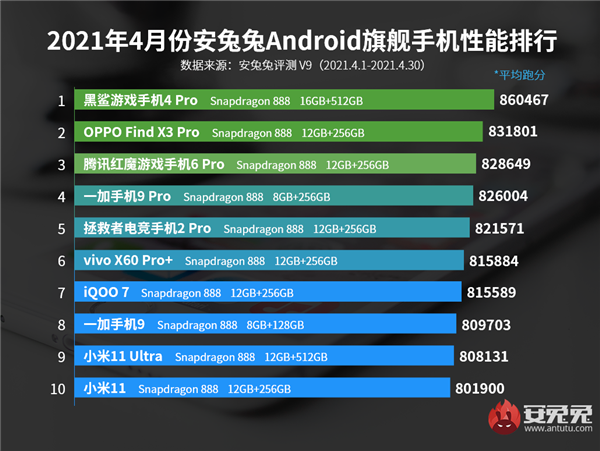
Benchmarking outfit AnTuTu has released the ranking of the top 10 smartphones in the month of April 2021. Just as was announced earlier, the models on the list were benchmark using the new AnTuTu V9 for the first time.
The list is entirely dominated by Snapdragon 888 flagship models which are pretty interesting. The ranking saw the Black Shark 4 Pro retain its number position on top of the chart with an average score of 860467, continuing its strong run-in from last month. However, six of the models that were on the list in March were edged out of the April rankings. The models include the ASUS ROG Phone 5, Vivo X60 Pro+, iQOO 7, Redmi K40 Pro,Meizu 18, and Meizu 18 Pro.
The second spot is occupied by the OPPO Find X3 Pro with an average score of 831801. On the top position is the Nubia Red Magic 6 Pro which averages 828649. Other models on the list include the OnePlus 9 Pro, Lenovo Legion Gaming Phone 2 Pro, Vivo X60 Pro+, iQOO 7, OnePlus 9, Xiaomi Mi 11 Ultra, and the vanilla Mi 11.
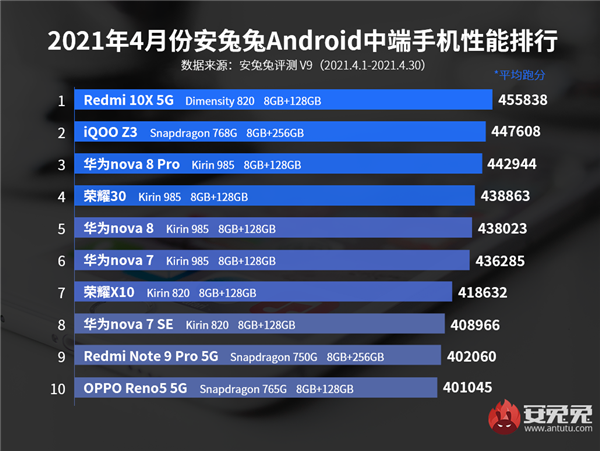
AnTuTu also released a ranking of the top 10 best-performing mid-range smartphones. Just like in March, the Redmi 10X with a MediaTek Dimensity 820 chip leads the pack with an average score of 455,838.
The top 10 mid-range models also include the iQOO 3, Huawei Nova 8 Pro, Honor 30, Huawei Nova 8, Huawei Nova 7, Honor X10, Huawei Nova 7 SE, Redmi Note 9 Pro 5G, and OPPO Reno 5 5G. It is instructive to note that there are six Huawei models on the list of top-performing mid-range models. We expect the ranking to change when that of May is listed, considering the emergence of more premium mid-range models.
ASUS Zenfone 8 series is expected to be launched on May 12 in China. The series is primed as a compact flagship and according to rumors, includes a Zenfone 8 Mini variant. Ahead of the launch, the key specs of the Zenfone 8 Mini have leaked on Twitter, thanks to tipster Mukul Sharma. The leak basically confirms some of the specs that have leaked in the past.
The tipster revealed the Zenfone 8 Mini will pack a 5.9-inch Samsung E4 AMOLED screen with Full HD+ resolution. The display also supports a 120Hz refresh rate and the Under-display fingerprint scanner. There is equally a Gorilla Glass Victus protection onboard. The dimension of the device is given as 148 x 68.5 x 8.9mm and it weighs just 169g.
According to the leak, the Mini will be powered by the flagship Qualcomm Snapdragon 888 processor paired with up to 16GB RAM and 256GB UFS 3.1 flash storage. The phone will get its power supply from a 4000mAh battery with support for 30W fast charging.
For photography, there will be a 64MP Sony IMX686 main sensor onboard. Earlier leaks point to triple camera sensors and these include a 12MP wide-angle camera and a macro sensor. The device will also have a selfie camera and won’t be using the pop-up camera mechanism that heralded the Zenfone 7 series.
The tipster also revealed that the ASUS Zenfone 8 Mini will come with three microphones as well as OZO audio. These details align with previous leaks but we’ll still have to wait until the launch which is just a few days away, for some confirmation.
Last November, a budget ZTE phone called the Blade A51 was spotted on the Bluetooth SIG database and the FCC. While we expected an official announcement shortly after, that didn’t happen. Now, the device has been officially listed on ZTE’s global website along with some key specs.
The listing reveals the ZTE Blade A51 has a 6.52-inch full view HD+ display with a waterdrop notch. ZTE has adopted what it calls a diamond geometric division design for the back of the phone and also given it a textured finish for a comfortable feeling and better grip. The phone is available in Steel Blue and Pearl Gray.
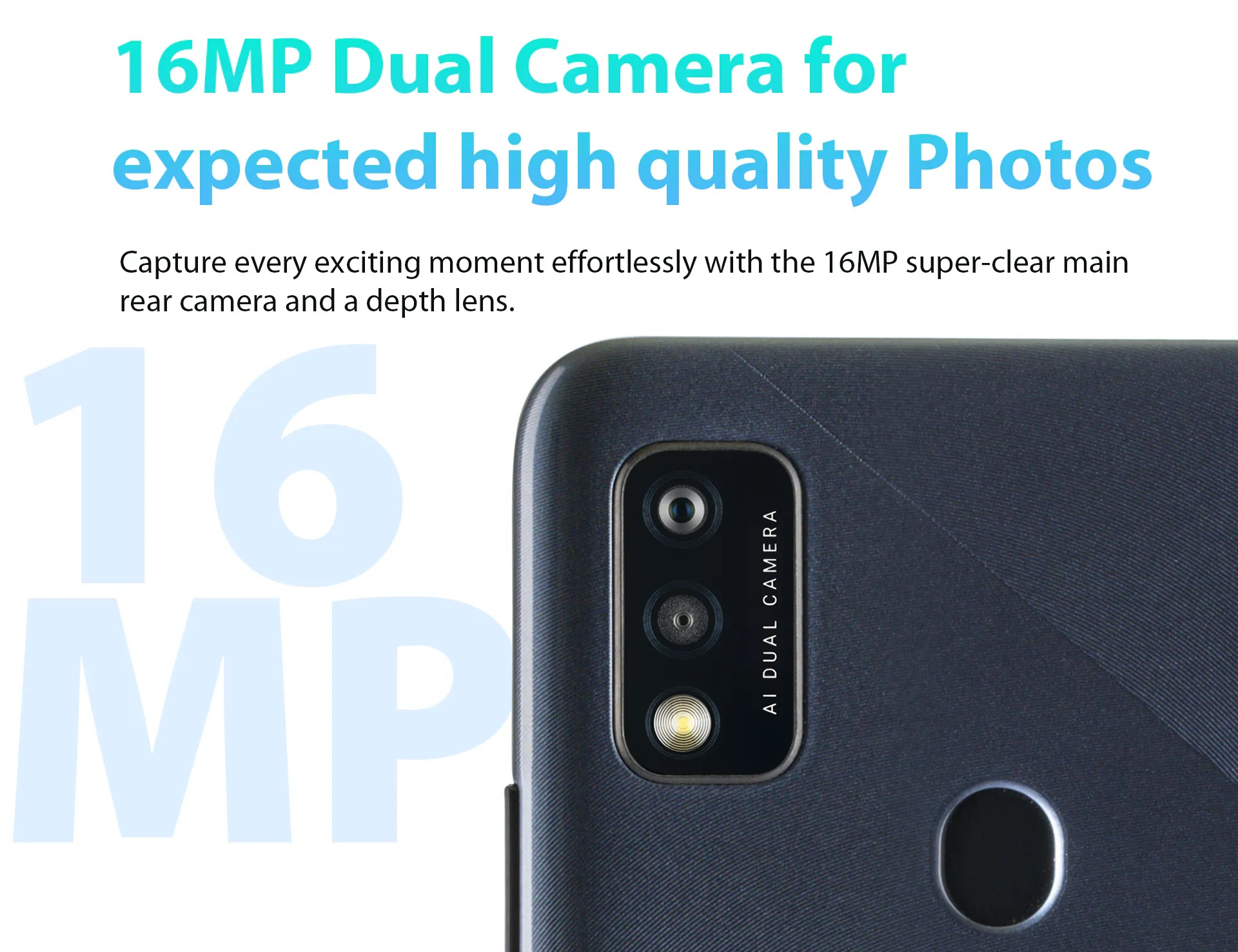
The back of the phone is home to two rear cameras – a 16MP sensor and a depth lens. Both sensors and an LED flash are housed in the same housing. There is a fingerprint scanner on the back of the phone and you also get face recognition.
1 of 5
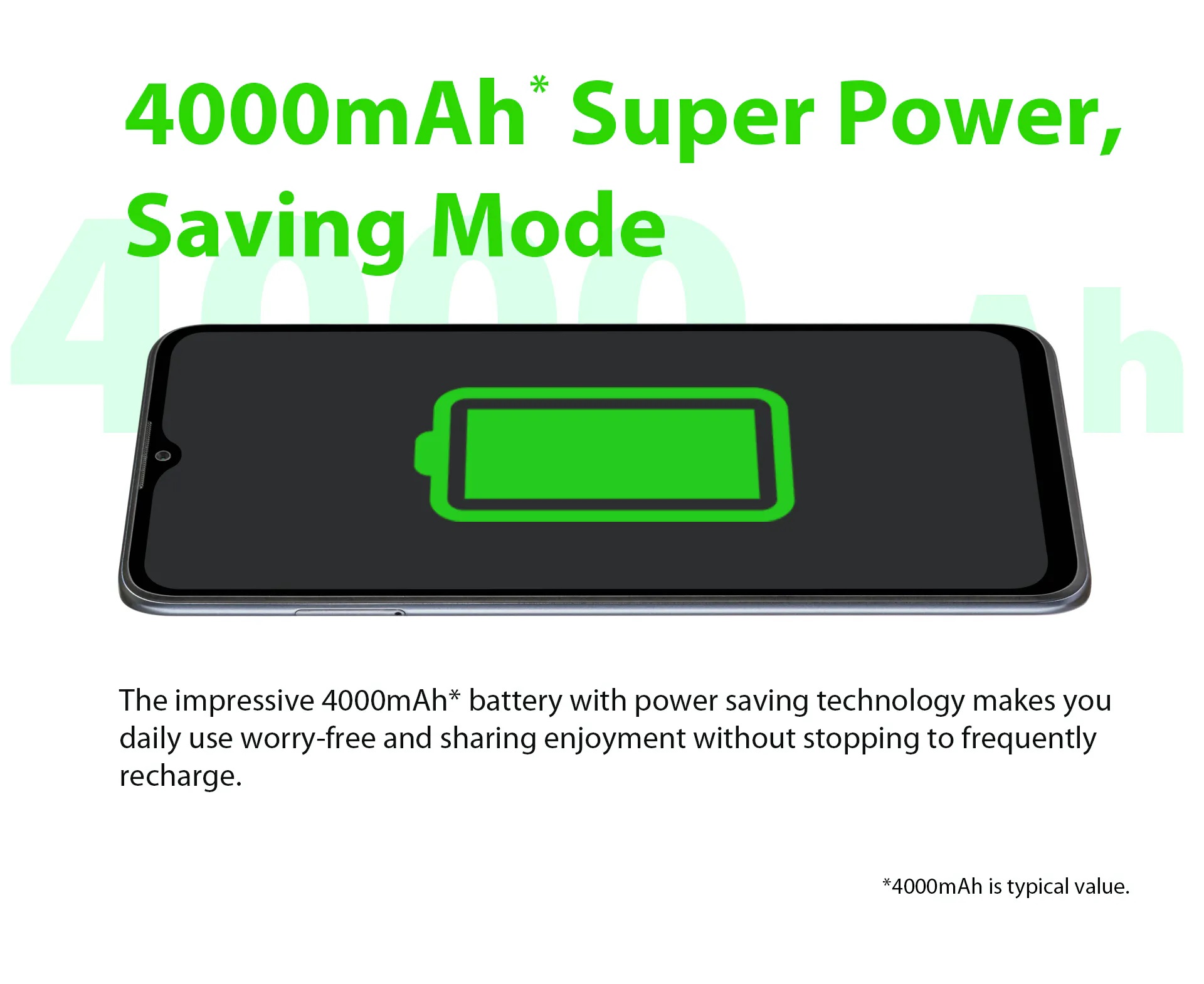
The listing does not say the chipset powering the phone neither does it state the RAM, storage capacity, and front-facing camera specification. However, it is revealed that the phone has a 4000mAh battery capacity which is different from the 3200mAh capacity the FCC listing.
We don’t know when the Blade A51 will be available for purchase, which countries will get it, and how much it will cost but we hope more details will be revealed soon.
It is a tough call sustaining software support for most smartphones beyond two years due to a raft of issues needed to make the extra update a success. Fast-rising Chinese brand Oppo is staking claims that there will be a minimum of three years of software support for its Find X3 series of premium smartphones. The trend out there in the market is that smartphone manufacturers progressively provide extended support for their models, and Oppo will not be left out
Two years of software updates are available generally, but Oppo says its Find X3 models will have an additional year of support for security patches. According to reports from Android Planet, the Chinese company ultimately says it hopes to further extend software support for the Find X3 series to four years. However, Oppo says that research is still ongoing to see how viable four-year extended software support for the series is.
According to the statement, the Oppo Find X3 series would be viable for up to three Android system updates, although the current Oppo policy remains two updates. Since the high-end Oppo FindX3 series originally came with Android 11, they will get Android 12 and Android 13 updates when available. It is observed that there are sometimes sharp differences between manufacturers on the number of system updates that would be available for their products.
The Find X3 Pro is the current flagship model from Oppo and comes well-kitted to compete with other high-end models from the market leaders. The flagship was unveiled together with the Find X3 Neo and X3 Lite and cost about $1,400. Oppo hopes to square up to its flagship model with Samsung’s Galaxy S21 Ultra, Xiaomi’s Mi 11 Pro, and OnePlus 9 Pro. The Find X3 Pro has an excellent design, powerful hardware and camera system, and other impressive features. Qualcomm’s Snapdragon 888 chipset powers it with 5G support available. The 4500mAh battery of the X3 Pro has 65W super-fast charging and wireless charging.
OnePlus just rolled out OxygenOS 11.2.4.4 update for the OnePlus 9 and the OnePlus 9 Pro. But the company is already pushing another system update with build number OxygenOS 11.2.5.5 for these smartphones. The new software build brings updated security patches, improvements, and a couple of fixes.
OnePlus 9 Pro
The latest system update for the OnePlus 9 and the OnePlus 9 Pro arrives in the form of OxygenOS 11.2.5.5. First and foremost, this update bumps up the security patch level to May 2021.
Secondly, the fresh software build brings improvements for charging performance, HDR effect in some shooting scenes, rear camera white balance performance, network communication stability, and WiFi connection performance.
Last but not least, this OxygenOS update also fixes keyboard lagging issue and other known issues for better system stability.
OnePlus 9/9 Pro OxygenOS 11.2.5.5 Official Changelog
System
Improved charging performance
Fixed the small probability lagging issue of the keyboard
Fixed known issues and improved system stability
Updated Android security patch to 2021.05
Camera
Improved the HDR effect in some shooting scenes
Improved the white balance performance of the rear camera
Network
Improved the stability of network communication
Improved the performance of Wi-Fi connection
Like any other OTA system update, this one is also being seeded out in batches. Hence, it may take some time to reach every unit around the world.
Chinese handset maker vivo is known for selling devices at various price segments. The brand’s vivo Y series is the most affordable lineup of the lot. Though these smartphones don’t offer a better price to performance ratio when compared to phones from Xiaomi and realme, they are still popular in the offline markets. According to multiple agencies, vivo Y76s and vivo Y53L could be the next devices in the series.
Two new vivo Y series budget smartphones called vivo Y76s and vivo Y53L have been spotted on online databases. The two handsets have been found listed on IMEI and CEIR databases.
For those unaware, CEIR (Central Equipment Identity Register) is developed by India’s DoT (Department of Telecommunications) to track and find lost mobiles. Hence, we can expect these phones to debut in India.
According to these listings, the vivo V76S will bear the model number V2111A. Further, CEIR reveals these handsets to be limited to 4G connectivity.
Additionally, the vivo Y76s (V2111A) has been certified by China’s 3C certification bureau as well. According to that, this smartphone will support 18W fast charging and the charger will be bundled in the box, at least in China.
Unfortunately, nothing else is known about these phones other than the above-mentioned details. But we expect to learn more about them before their launch sometime in the near future.
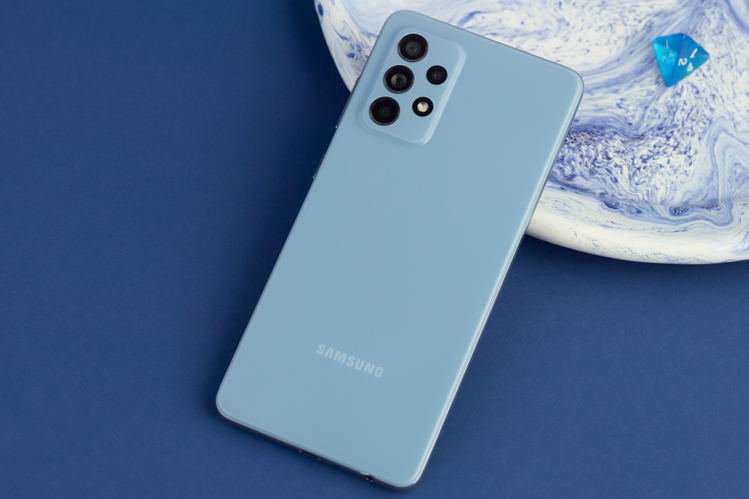
Earlier this week, we reported that Samsung has started developing firmware for the Indian variant of the Galaxy A52 5G. Now. within a few days, the official support page for this smartphone goes live on the Samsung India website.
Samsung Galaxy A52 / A52 5G
The upcoming Samsung Galaxy A52 5G for India will bear the model number SM-A526B/DS. Going by the model number, just like any other Samsung smartphone sold in the country, this one will also come with dual-SIM functionality.
As far as specs are concerned, we expect it to be similar to the variants sold in other markets. Hence, it will feature a Qualcomm Snapdragon 750G SoC and a 120Hz display instead of the Qualcomm Snapdragon 720G chipset and a 90Hz display on the regular Galaxy A52.
Apart from these two differences, the Galaxy A52 5G coming to India will be Galaxy A52 inside out. Talking about the price, we expect Samsung to price it between the Galaxy A52 4G variant and the Galaxy A72.
In other words, the Samsung Galaxy A52 5G should be around ₹30,000 in India. At that price, it will be competing with the budget flagship smartphones like the Xiaomi Mi 11X and iQOO 7. Another notable competitor will be the selfie-centric vivo V21 5G.
Unfortunately, the launch date of this handset in India is still a mystery.
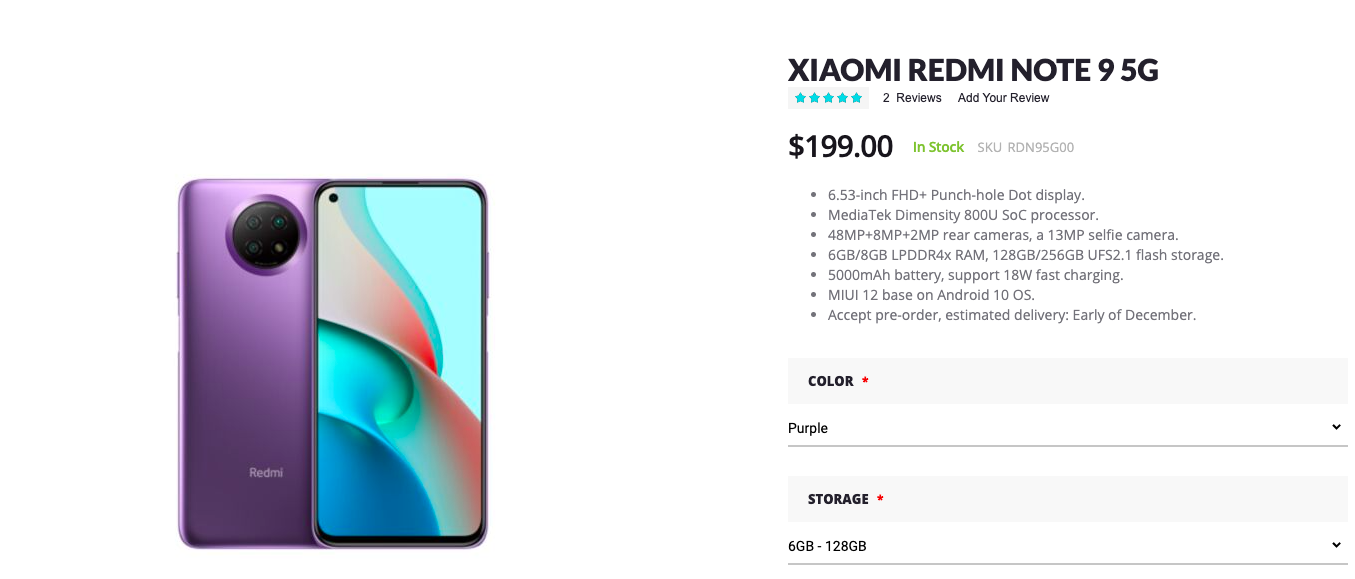
The 6.53 inch FHD+ Punch-hole Dot display smartphone is powered by MediaTek Dimensity 800U SoC processor and comes in multiple storage variants viz: 6GB + 128GB, 8GB + 128GB and 8GB + 256GB.
The smartphone features 48MP+8MP+2MP rear cameras and a 13MP selfie camera. This means great Instagram shots and videos and a better presence on social media. The phone is fueled by a massive 5000mAh battery and supports 18W fast charging.
Xiaomi Redmi Note 9 5G is available in Green, Purple, and Gray colors and can be shipped across the globe. The smartphone is available at $199 only at Giztop. Please note that this is a Chinese Edition smartphone but comes with full Google Mobile Service and Google Play store installed, and supports OTA updates.
For more information on such exciting deals and offers check out ourdeals hub.
Xiaomi will be announcing the Redmi Note 10S smartphone in India on May 13. The company will also be unleashing the Redmi Watch smartwatch alongside it. Ahead of the launch, the product page of the Redmi Note 10S has gone live on Amazon India. At the same time, the handset has also appeared on Google Play Console with key specs.
Apart from Xiaomi India’s online and offline platforms, the Redmi Note 10S will be available through Amazon India. The features mentioned on the Amazon listing states that the Redmi Note 10S has an IP53 rated chassis, an S-AMOLED display with Gorilla Glass protection, smoother haptics, dual stereo speakers with Hi-Res Audio support, a 5,000mAh battery with an in-box 33W charger, Helio G95 chipset, and a 64-megapixel quad-camera system.
Redmi Note 10S
The specifications of the Redmi Note 10S are not secret, since it has already launched in global markets. The Indian variant of the phone, which has a model number M2101K7BI has appeared in the database of Google Play Console with key specs.
The listing shows that the Redmi Note 10S supports HD+ resolution, 6 GB of RAM, and Android 11 OS. Recent reports have claimed that it will ship with MIUI 12.5 preinstalled.
A report that appeared last month claimed that India will be receiving the Redmi Note 10S in three options such as 6 GB RAM + 128 GB storage, 8 GB RAM + 128 GB storage, and 8 GB RAM + 128 GB storage. The handset is expected to arrive in multiple colors such as white, grey, and blue. At present, there is no word on the pricing of the Redmi Note 10S. The specs of the phone suggest that it will be slotted between the Redmi Note 10 and Redmi Note 10 Pro in the Indian market.
Sharp is not a known smartphone brand in many markets, but it is certainly popular in Japan. Fresh information shared by a camera leaker reveals that the Japanese manufacturer is gearing up to launch the Sharp AQUOS R6 phone on May 10 in the home market. The official renders shared by the leaker reveals that Sharp has teamed up with Leica to offer optimized camera performance.
As can be seen in the renders shared by @nokishtia_c, the AQUOS R6 has a curved edge display with a centrally aligned selfie camera cutout. The backside of the phone has a chunky camera module, which seems to house two cameras. The official renders show that the AQUOS R6 has a thick device.
At present, there is no information available on the camera specs of the AQUOS R6. Since 2016, Huawei has been launching flagship phones with Lecia-engineered cameras. Huawei is expected to announce the Huawei P50 series of flagship phones in June. Now that Leica has reportedly partnered with Sharp, it remains to be seen whether it will continue its collaboration with Huawei.
The AQUOS R6 is expected to arrive as a successor to the AQUOS R5G phone, which debuted last year. The AQUOS R5G has a 6.5-inch IGZO display that offers a Quad HD+ resolution of 1440 x 3168 pixels and supports Dolby Vision and U-NEXT HDR output. The Snapdragon 865 chipset powers the AQUOS R5G with 12 GB of LPDDR5 RAM and 256 GB of UFS 3.0 storage.
The AQUOS R5G has a front camera of 16.4mgeapixel and its rear camera setup has a 12-megapixel main camera with OIS support, a 12.2-megapixel telephoto lens with OIS support, a 48-megapixel super-wide lens, and a ToF sensor. The device houses a 3,730mAh battery and it sports an IP68 rated dustproof and water-resistant chassis.
UPDATE: Another source has revealed that the device will come with 12 GB of RAM, 256 GB of storage, and a 4,400mAh battery.
Original story continues…
While there is no official confirmation yet, the OPPO Reno6 series is expected to launch on May 22. It is believed that the PEPM00 and PENM00 OPPO phones that have recently appeared in the database of the TENAA regulatory body could be the Reno6 series. Fresh information reveals that there is another phone with model number PEQM00 in the works. This handset is expected to arrive with a brand new Dimensity chip.
According to a well-known Chinese tipster, the mysterious OPPO phone will feature a 6.43-inch OLED display with a punch-hole at the upper-left corner. The screen will support a Full HD+ resolution and a 90Hz refresh rate.
For selfies, it will feature a 32-megapixel front-facing camera. The back panel of the phone will have an OmniVision OV64B main camera. However, it is unclear whether the phone features a quad or triple camera system.
What is unique about this phone is that it has a new MT6877 Dimensity chip by MediaTek. At present, there is no information available on the specifications of the MT677 SoC. It is speculated that the model number of this mysterious phone is PEQM00. This model is yet to appear on any of the certification platforms of China. Readers are advised to digest the leak related to PEQM00 with a grain of salt and wait for newer information to confirm its existence.
In related news, OPPO has recently launched the OPPO K9 5G phone in China. Priced at 1,999 Yuan (~$311), the handset brings features like a 6.43-inch FHD+ AMOLED screen with a 90Hz refresh rate support, an in-display fingerprint scanner, Snapdragon 768G chipset, 8 GB of RAM, 128 GB / 256 GB of storage, ColorOS 11.1 based Android 11 OS, and 4,300mAh battery with 65W rapid charging support. It has a front camera of 32-megapixel and a 64-megapixel + 8-megapixel + 2-megapixel rear-facing triple camera system.
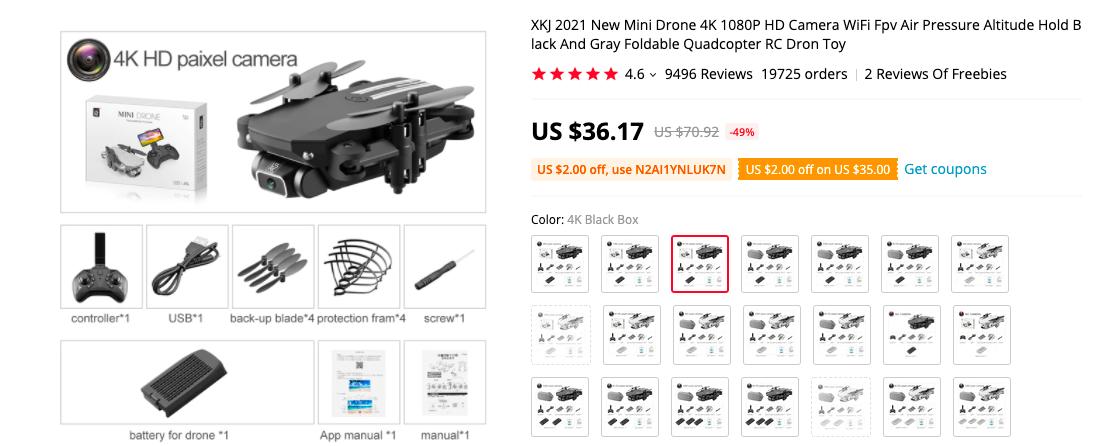
XKJ Mini Drone is a simple and easy to handle mini drone with a 4K HD camera. The drone is designed in such a way, that it is can be controlled and operated by even amateur flyers.
KEY FEATURES:
4K HD camera
360-degree free rolling
Foldable body
VR 3D Experience
One Key – Auto Return and Landing
Orbital flight
Live photo and video transmission
Hand Gesture mode
Beauty Filter
APP control
XKJ Mini Drone generally retails for $40. But for a limited period, AliExpress is giving out this device for $36.17 only. Please note that this price is only for the 4K variant with the box.
You can get different variants with add-on accessories for an additional cost from AliExpress. So be sure to check out the product variant before you place the order.
For more information on such exciting deals and offers check out ourdeals hub.
* Please Note: When you buy something using the links in our articles, we may earn a small commission at no cost to you.
OPPO K9 5G and Xiaomi Mi 11 Lite 5G are the most powerful midrange phone released in 2021 with Qualcomm chipsets. Indeed, they feature the best processors from the Snapdragon 700 series. That is why they are among the best options for those who need high performances at an affordable price, alongside the 5G connectivity. But which one is the best and which offers the highest value for money? We hope to give you the answer with this specs comparison between OPPO K9 5G and Xiaomi Mi 11 Lite 5G.
OPPO K9 5G vs Xiaomi Mi 11 Lite 5G
OPPO K9 5G
Xiaomi Mi 11 Lite 5G
DIMENSIONS AND WEIGHT
159.1 x 73.4 x 7.9 mm, 172 g
160.5 x 75.7 x 6.8 mm, 159 g
DISPLAY
6.43 inches, 1080 x 2400p (Full HD+), Super AMOLED
Triple 64 + 8 + 2 MP, f/1.7 + f/2.2 + f/2.4
32 MP f/2.4 front camera
Triple 64 + 8 + 5 MP, f/1.8 + f/2.2 + f/2.4
20 MP f/2.2 front camera
BATTERY
4300 mAh, fast charging 65W
4250 mAh, fast charging 33W
ADDITIONAL FEATURES
Dual SIM slot, 5G
Dual SIM slot, 5G
Design
The OPPO K9 5G has a more compact design and this is an important added value for those who want a device that is easy to use with one hand and to keep in a pocket. But the Xiaomi Mi 11 Lite 5G is thinner and lighter; further, it has a glass back. These things make the Xiaomi Mi 11 Lite 5G slightly more attractive, alongside the Gorilla Glass 6 protection and the IP53 certification which makes it splash resistant and dust resistant. That is why Xiaomi Mi 11 Lite 5G wins the aesthetic comparison.
Display
On the paper, the Xiaomi Mi 11 Lite 5G has a superior display. We are talking about an AMOLED panel that is able to show up to one billion colors and it also features the HDR10+ certification allowing for better image quality on streaming platforms. With the Xiaomi Mi 11 Lite 5G, you also get a higher brightness: it has a 500 nit typical brightness and a peak brightness up to 800 nits. Unfortunately, despite coming with an AMOLED panel, the Xiaomi Mi 11 Lite 5G does not feature an in-display fingerprint scanner, while the OPPO K9 5G does.
Specs & Software
If you need the best hardware department, then you should go for the Xiaomi Mi 11 Lite 5G without thinking twice. It has a more powerful Snapdragon 780G, while the OPPO K9 5G is fueled by the Snapdragon 768G which is actually an upgrade of the Snapdragon 765G. Further, with the Xiaomi Mi 11 Lite 5G you get faster UFS 2.2 native storage. Xiaomi Mi 11 Lite 5G runs MIUI 12 based on Android 11, while OPPO K9 5G runs ColorOS 11.1 based on Android 11.
Camera
The Xiaomi Mi 11 Lite 5G and the OPPO K9 5G are similar when it comes to the rear cameras. They both come with a 64 MP main camera, but the OPPO K9 5G has a brighter f/1.7 focal aperture which should allow shooting better photos in low light conditions. On the other hand, the Xiaomi Mi 11 Lite 5G has a better macro camera with a 5 MP resolution. The ultrawide sensors are the same with an 8 MP resolution, but the OPPO K9 5G wins the selfie comparison with a way better 32 MP front camera.
The OPPO K9 5G has a slightly bigger battery with a capacity of 4300 mAh and it may offer a longer battery life not only due to the capacity but also because it has a smaller display. However, the Xiaomi Mi 11 Lite 5G has a processor built with a 5 nm production process which has lower energy consumption, so the bigger capacity of the OPPO K9 5G does not necessarily mean it will always last more than the Xiaomi Mi 11 Lite 5G. But the real difference between these phones’ battery sides is the charging speed: the OPPO K9 5G features the SuperVOOC 2.0 fast charging technology with 65W power, while the Xiaomi Mi 11 Lite 5G supports 33W fast charging. The OPPO K9 5G charges a lot faster.
Price
The Xiaomi Mi 11 Lite 5G starts from about €289/$352 in China, while the OPPO K9 5G costs €260/$316 in its base variant. While the OPPO K9 5G offers faster charging speeds and a better front camera, the Xiaomi Mi 11 Lite 5G has a superior hardware department and a better display. On the paper, we consider the Xiaomi Mi 11 Lite 5G a slightly superior phone, but it costs a bit more as well.
Global business solutions provider IBM has announced that it has created a 2nm chip using Gate-All-Around (GAA) nanosheet device architecture. The new transistor setup will enable IBM to fit 50 billion transistors in a tiny space the size of a fingernail. Current high-end chips like Qualcomm’s Snapdragon 888 and Apple’s A14 Bionic, use the 5nm process. However, the number of transistors that these chipsets can pack in a fingernail space does not exceed 12 billion.
This milestone by IBM could prove to be a game-changer in the semiconductor industry. The company says battery life in smartphones deploying the 2nm technology will be greatly improved up to four times the current lifespan of batteries inside phones using the 7nm process. The implication is that, according to IBM, your smartphone will only need charging once in four days, on average.
The number of transistors that can fit in a square-mm space is an indicator of the strength and efficiency of the chip. The more powerful and energy-efficient chipset is the one that has a higher rating in this regard. There is a substantial performance increase and power savings using chips with a higher number of transistors per square mm.
The IBM concept is driven by the Extreme Ultraviolet Lithography technology. The process produces lines outside the visible light spectrum, which are used to create the patterns used to build circuits. The GAA architecture also enables superior electrical signals to pass through and between other transistors on a single chip.
IBM also says that it is actively pursuing research along the 2nm process and a rollout of the chips produced through the process is not likely in the next few years. TSMC last year revealed it is working on 2nm chips but the rollout is scheduled for 2025.
The upcoming realme narzo 30 4G is said to come with model number RMX2156, thanks to Indonesia Telecom. This phone has been now certified by SIRIM, in addition to FCC, BIS, TKDN, and EEC.
Hence, we can expect the brand to debut this handset in Malaysia. In this country, it will feature NFC for contactless payments.
As per the above-mentioned certifications, the realme narzo 30 4G will be backed by a 5,000mAh battery with support for 30W fast charging. Last but not least, it will measure 162.36 x 74.46 x 9.45mm in dimensions and weigh 198g.
Unfortunately, nothing else is known about this smartphone. But we expect to learn more about it before its launch sometime in the near future.
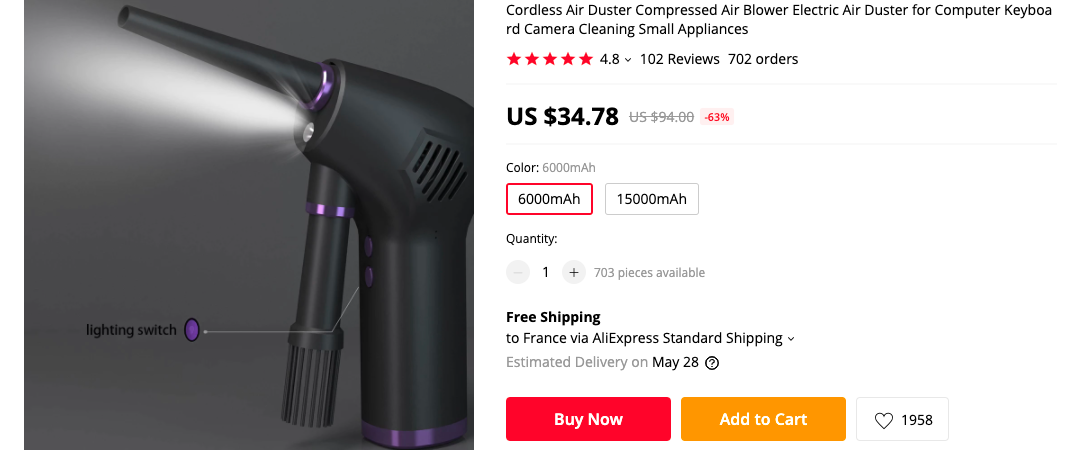
If you are in the market to buy a small and portable cleaning device to clean small appliances like your computer, camera, etc, then check out this Cordless Air Duster on AliExpress. The Air duster which generally retails for $60 is now available at a discounted price of $34.78only.
This beautifully designed compressed air duster is lightweight and highly portable, making it easy to carry around while cleaning your appliances. The device features a 3600RPM motor which provides ultra-strong airflow, perfect for cleaning microscopic dust. It also features a built-in flashlight that can be used to clean dark corners and hard-to-reach places.
The compressed air duster can be used to clean a variety of products like computers, camera lenses, PS5, laptops, air conditioners, sofa, printed circuit boards, electronic devices, medical instruments, etc.
With a 6000mAh lithium battery, the Air Duster can work for 30 minutes continuously on one single charge. The device can be easily charged with a Type -C chord, generally used for your phone and tablets.
Generally retailing for $60, you can now buy the Cordless Air Duster for $34.78 from AliExpress. Please note that this price is applicable to the 6000mAh battery variant. You can also get a 15000mAh variant for a higher price at AliExpress.
For more information on such exciting deals and offers check out ourdeals hub.
* Please Note: When you buy something using the links in our articles, we may earn a small commission at no cost to you.
The upcoming Galaxy Tab S7 Lite was recently revealed to be called Samsung Galaxy S7+ Lite. We know the design of this tablet, thanks to leaked renders. We also know some of its specs. Now, the charging speed of this forthcoming slate has been exposed as well.
Samsung Galaxy Tab S7+ Lite 5G | Source: Evan Blass via Voice
The Samsung Galaxy Tab S7+ Lite is reported to come in WiFi-only, 4G LTE, and 5G variants. These versions will bear the model numbers SM-T730, SM-T735, and SM-T736B (SM-T736N) respectively.
The former two models (WiFi-only and 4G LTE) have been now certified by China’s 3C regulatory. According to their certifications, these two variants of the Galaxy Tab S7+ Lite will support 44.5W fast charging.
However, the South Korean tech giant will be only bundling a 15W charger in the box, at least in China. Hence, interested customers will have to spend extra cash to get the Samsung 45W charger to experience the maximum charging speed on this tablet.
Samsung Galaxy Tab S7+ Lite Book Cover | Source: Evan Blass
According to previous reports, the Galaxy Tab S7+ Lite will sport a 12.4-inch display with support for S Pen. The stylus can be magnetically attached to the back of the tablet, just like on the Galaxy Tab S7 and Galaxy Tab S7+.
Further, this slate will be powered by a Qualcomm Snapdragon 750G SoC coupled with 4GB/6GB RAM and 128GB internal storage. As for software, it will run Android 11 but the exact version of One UI is still a mystery. But it is expected to support Galaxy Continuity, a feature that turns a Galaxy tablet into a secondary screen for a Galaxy smartphone.
Last but not least, the Samsung Galaxy Tab S7+ Lite is said to launch in June in four colors (Black, Silver, Pink, Green).
OPPO has been rolling out Android 11-based ColorOS 11 builds to eligible smartphones worldwide since September 2020. From the beginning of 2021, the company has been sharing its update rollout plan every month. Hence, as we have entered a new month, the firm has revealed the ColorOS 11 update rollout plan for May 2021.
According to the official ColorOS Twitter account, the following OPPO smartphones are receiving as well as will receive ColorOS 11 (Android 11) beta/stable builds in the month of May 2021.
ColorOS 11 Beta
OPPO is currently seeding ColorOS 11 beta builds for the following devices.
Ongoing
OPPO Reno Z
Saudi Arabia
UAE
OPPO A5 2020
India
Indonesia
OPPO A9 2020
India
Indonesia
OPPO A73 5G
Australia
Saudi Arabia
UAE
OPPO A53
India
Indonesia
Further, the beta program will begin on the following date for the below-mentioned handsets.
May 25
OPPO F17
India
OPPO A73
Thailand
Malaysia
ColorOS 11 Stable
The Android 11-based ColorOS 11 stable update is currently live for the following smartphones in different regions.
Ongoing
OPPO Find X2
Europe
Spain
Switzerland
Netherlands
Turkey
Ukraine
Romania
Asia and Others
OPPO Find X2 Pro
Europe
Switzerland
Belgium
France
Italy
Spain
Germany
United Kingdom
Netherlands
Asia and Others
OPPO Find X2 Pro Automobili Lamborghini Edition
All Regions
OPPO Find X2 Lite
Europe
Netherlands
Switzerland
France
Germany
Portugal
Spain
Italy
United Kingdom
Asia and Others
OPPO Find X2 Neo
Europe
Netherlands
France
Spain
Switzerland
Italy
Germany
United Kingdom
Asia and Others
OPPO F17 Pro
All Regions
OPPO Reno4 F
All Regions
OPPO A93
All Regions
OPPO Reno4 Pro 5G
Europe
Portugal
Italy
Switzerland
France
Germany
Spain
Belgium
Netherlands
United Kingdom
Luxembourg
Ireland
Moldova
Romania
Poland
Russia
Asia and Others
OPPO Reno4 5G
Europe
France
Switzerland
Italy
Portugal
Spain
Germany
Netherlands
United Kingdom
Belgium
Asia and Others
OPPO Reno4 Pro 4G
Europe
Ukraine
Turkey
Asia and Others
OPPO Reno4 4G
Europe
Poland
Turkey
Asia and Others
OPPO Reno4 Z 5G
Europe
France
Italy
Germany
Netherlands
United Kingdom
Switzerland
Belgium
Portugal
Luxembourg
Ireland
Poland
Romania
Asia and Others
OPPO Reno4 Lite
Europe
Turkey
Ukraine
Poland
Romania
Moldova
Asia and Others
OPPO Reno3 Pro 4G
Europe
Ukraine
Turkey
Romania
Poland
Russia
Asia and Others
OPPO Reno3 4G
Europe
Turkey
Poland
Ukraine
Russia
Asia and Others
OPPO Reno3 Pro 5G
All Regions
OPPO Reno3 A
All Regions
OPPO Reno 10x Zoom
All Regions
OPPO Reno2 F
All Regions
OPPO Reno2 Z
All Regions
OPPO Reno2
All Regions
OPPO A72
Europe
Netherlands
Belgium
Luxembourg
Portugal
Germany
France
United Kingdom
Italy
Spain
Ukraine
Poland
Russia
Romania
Turkey
Asia and Others
OPPO A92
All Regions
OPPO A52
Europe
Italy
Spain
Netherlands
Germany
Belgium
Ukraine
Turkey
Russia
Poland
Asia and Others
OPPO F11
All Regions
OPPO F11 Pro
All Regions
OPPO F11 Pro Marvel’s Avengers Limited Edition
All Regions
OPPO A9
All Regions
OPPO F15
All Regions
OPPO A91
All Regions
Lastly, the following phones will start receiving ColorOS 11 stable update from the below-listed dates.
From May
OPPO Reno2
Germany
Belgium
Switzerland
Spain
OPPO A91
United Kingdom
Germany
Portugal
May 11
OPPO Reno Z
Saudi Arabia
UAE
May 25
OPPO Reno2
Russia
Ukraine
May 26
OPPO A5 2020
India
Indonesia
OPPO A9 2020
India
Indonesia
OPPO A73 5G
Australia
Saudi Arabia
UAE
May 27
OPPO A91
Russia
Kazakhstan
Ukraine
Unfortunately, the company will not be releasing the ColorOS 11 (Android 11) update for the 3GB RAM variant of OPPO A5 2020 and OPPO A9 2020.
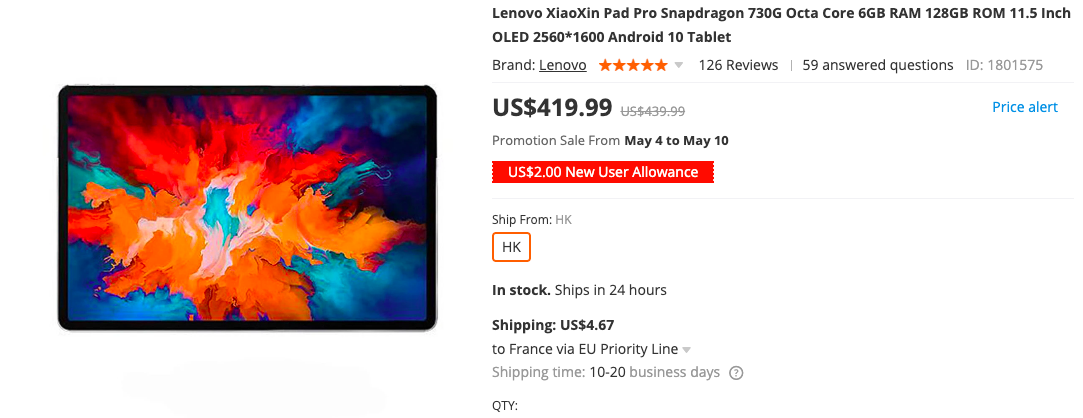
Lenovo XiaoXin Pad Pro is a premium tablet that features an 11.5 inch, Full HD OLED display and is powered by the Snapdragon 730G Octa-Core Processor. The tablet comes with 6GB RAM and 128GB ROM and supports Dual Band 2.4GHz/5.0GHz WiFi. With dual-band support, you can either choose the 2.4GHz band for obstacle penetration or a 5.0GHz band for faster connection over long distances.
XiaoXin Pad Pro is fueled by a powerful 8600mAh battery that gives you 8 hours of non-stop usage on one single charge and supports 20W fast charging. The tablet features 4 JBL certified speakers and an 8MP front and 2MP rear camera.
Generally retailing for around $450, Banggood under its Promotion Sale is giving out Lenovo XiaoXin Pad Pro for $419.99 only. Please note that this offer is valid only till 10 May 2021. So place your order asap.
For more information on such exciting deals and offers check out ourdeals hub.
* Please Note: When you buy something using the links in our articles, we may earn a small commission at no cost to you.
We use cookies on our website to give you the most relevant experience by remembering your preferences and repeat visits. By clicking “Accept”, you consent to the use of ALL the cookies.
This website uses cookies to improve your experience while you navigate through the website. Out of these, the cookies that are categorized as necessary are stored on your browser as they are essential for the working of basic functionalities of the website. We also use third-party cookies that help us analyze and understand how you use this website. These cookies will be stored in your browser only with your consent. You also have the option to opt-out of these cookies. But opting out of some of these cookies may affect your browsing experience.
Necessary cookies are absolutely essential for the website to function properly. This category only includes cookies that ensures basic functionalities and security features of the website. These cookies do not store any personal information.
Any cookies that may not be particularly necessary for the website to function and is used specifically to collect user personal data via analytics, ads, other embedded contents are termed as non-necessary cookies. It is mandatory to procure user consent prior to running these cookies on your website.