Realme has announced the 10th round of Realme UI 7.0 closed beta recruitment, adding a total of eleven new smartphones to the list. The latest wave includes a couple of Narzo models, P-series phones, and a couple from the number series. We’ve included the complete list below, along with details on how to sign up for the beta program and other important instructions.
Through a post on the Realme community forum, the company announced the Realme UI 7.0 beta availability for 11 new devices. It reveals the firmware versions that the devices must be running on to participate in the beta program. So, here’s the list of devices along with the required firmware versions:
Realme 15 Lite 5G – RMX5000_15.0.0.1360
Realme 13 Pro+ 5G – RMX3921_15.0.0.1400
Realme 13 Pro 5G – RMX3990_15.0.0.1400
Realme 13+ 5G – RMX5000_15.0.0.1360
Realme 12+ 5G – RMX3867_15.0.0.1300
Realme P2 Pro 5G – RMX3987_15.0.0.1400
Realme P1 5G – RMX3870_15.0.0.1300
Realme P1 Speed 5G – RMX5004_15.0.0.1360
Realme NARZO 70 Turbo 5G – RMX5003_15.0.0.1360
Realme Narzo 70 Pro 5G – RMX3868_15.0.0.1300
Realme Narzo 70 5G – RMX3869_15.0.0.1300
The beta applications are already live and will be available until the slots are filled. According to the community post, there are a total of 2,000 applications for each model. So, you must hurry up to grab your spot as these are usually filled up in no time.
How to sign up for the Realme UI 7.0 beta program?
First things first, ensure that your Realme phone is running on the required firmware version. You can check the version details from the About device page. Now, you need to enable the developer settings (if you haven’t already).
To do this, go to Settings > About device > Version > Version number, and then tap the build version seven times in quick succession.
Now, go to Settings > About device > and tap on the Realme UI 7.0 banner at the top. Next, tap the three dots button in the upper-right corner and choose the Beta program. Now, go to Early Access > Apply Now and submit the required details to complete your application.
You may receive the Realme UI 7.0 beta update instantly on your phone as the beta rollout is already live, or in some cases, it may take a few days. Before downloading the update package, ensure that your Realme phone has at least 10GB of storage and 40% battery charge left for a smooth upgrade to Realme UI 7.0.
Please note that this is a beta update, and therefore, some features or apps may not function properly. Realme recommends backing up important data, just in case anything goes wrong during the installation, although it rarely happens.
We’ll keep you updated with the latest news about Realme in our Realme section. You can also join our Telegram channel to get instant news about the latest launches, software updates, and tech breakthroughs.
Apple could be preparing a new entry-level MacBook aimed at buyers who want portability without flagship pricing.
According to TrendForce, the company is working on a compact MacBook with a 12.9-inch display, expected to launch sometime in spring 2026. If accurate, it would sit below the current MacBook Air lineup and mark Apple’s return to smaller notebooks after discontinuing the 12-inch MacBook years ago.
The display size would be slightly smaller than the 13.6-inch MacBook Air, though slim bezels could keep the overall footprint close to a standard keyboard. That approach would echo the ultra-light 12-inch MacBook Apple sold between 2015 and 2017, which was praised for portability but often criticized for weak performance.
This time, performance may not be the problem. TrendForce claims the new MacBook could use the Apple A18 Pro, the same chip found in the iPhone 16 Pro series. While it’s not an M-series processor, benchmark estimates suggest a large jump over the Intel chips used in the old 12-inch model. Single-core performance is reportedly several times higher, while multi-core results could approach the original M1 in lighter workloads.
Thermal efficiency could also be a strong point, as the chip is designed to run inside an iPhone’s much smaller chassis without active cooling. The device would likely prioritize battery life and silent operation over sustained heavy performance. That could make it a better fit for travelers and everyday productivity rather than power users.
Pricing is still unclear. However, TrendForce suggests Apple could position the model below the MacBook Air, which currently starts around $799 in some markets. Using iPhone-class silicon may help Apple control costs, especially as memory prices continue to rise.
The timing may not be accidental. Analysts expect laptop prices to climb sharply in 2026, driven by DRAM shortages linked to AI server demand. A lower-cost MacBook could help Apple stay competitive as PC makers struggle with supply and pricing pressure.
For now, nothing is official. But if the report holds up, Apple may be revisiting a compact MacBook formula—this time with far fewer compromises than before.
A Reddit user has accused Corsair of cancelling a confirmed prebuilt PC order and then relisting the same system at a higher price, triggering criticism online.
The issue was shared by Reddit user u/Senior_Ball_9068, who said he ordered a Corsair Vengeance a5100 on December 31st. The system was priced at $3,499.99 and included an AMD Ryzen 9 9900X3D, an NVIDIA RTX 5080, 32GB of DDR5 RAM, and a 2TB SSD. According to the post, an invoice was issued, and everything was set.
Surprisingly, he received an email the next day saying the order had been cancelled. When he checked Corsair’s website to place another order, he noticed the same configuration listed again, but now priced at $4,299.99. He posted a screenshot of the new listing on Reddit, confirming the price and specifications.
The post gained attention quickly, with many users speculating that rising DDR5 memory prices may have played a role. Memory pricing has been volatile in recent months, with supply tight as manufacturers prioritize higher-margin enterprise and AI products.
Corsair’s terms allow orders to be cancelled before shipping, but several users criticized how the situation was handled, pointing out that the system appeared to be relisted almost immediately at a higher price.
After the discussion spread, a Corsair employee, u/CorsairLucky, replied in the Reddit thread, saying the company was looking into the case. “Hey there, I’m so sorry to read that! Can you get me your order number (DM is fine!) and I’ll see who can take a peek at that,” the employee wrote. The response suggested the customer could still receive the PC at the original $3,499.99 price. So far, neither Corsair nor the affected user has shared any further updates on the thread.
The incident adds to growing frustration among PC buyers as component prices continue to fluctuate.
Xiaomi has announced a significant expansion of its software support commitment, offering up to five years of HyperOS updates to a group of its devices across the Xiaomi, Redmi, and POCO families. This move extends both major operating system upgrades and ongoing feature improvements for eligible phones and tablets. So here are all the details.
Xiaomi, Redmi, and POCO Devices Getting HyperOS 3 Update
Xiaomi 15 Ultra
Based on a XiaomiTime report, the devices mentioned below are eligible for the extended five years of HyperOS updates:
Xiaomi
Xiaomi 15T/Xiaomi 15T Pro: Till 2031
Xiaomi 15 Ultra: Till 2031
Xiaomi 14T/Xiaomi 14T Pro: Till 2029
Xiaomi 14 Ultra: Till 2029
Xiaomi MIX Flip: Till 2029
Xiaomi 13T/Xiaomi 13T Pro: Till 2028
Xiaomi 13 Ultra/Xiaomi 13: Till 2028
Xiaomi 13 Lite: Till 2027
Xiaomi 12T/Xiaomi 12T Pro: Another 9 Months
Xiaomi 12/Xiaomi 12 Pro: Another 2 Months
Xiaomi Pad 7: Till 2031
Xiaomi Pad 7 Pro: Till 2029
Redmi
Redmi 15: Till 2031
Redmi 13C: Till 2031
Redmi 15 5G: Till 2031
Redmi Note 14: Till 2031
Redmi 14C: Till 2028
Redmi Note 13 Series: Till 2028
Redmi A5: Till 2029
Redmi 12: Till 2027
Redmi Note 12 5G: 2 Months
Redmi 12C: 2 Months
Redmi Pad 2: Till 2032
Redmi Pad 2 4G: Till 2032
Redmi Pad 2 Pro/Redmi Pad 2 Pro 5G: Till 2029
POCO
POCO F8 Ultra: Till 2031
POCO F8 Pro: Till 2031
POCO C85: Till 2031
POCO M7: Till 2031
POCO F7: Till 2031
POCO F7 Pro: Till 2031
POCO F7 Ultra: Till 2031
POCO M7 Pro 5G: Till 2029
POCO C75: Till 2028
POCO Pad M1: Till 2029
For more daily updates, please visit our News Section.
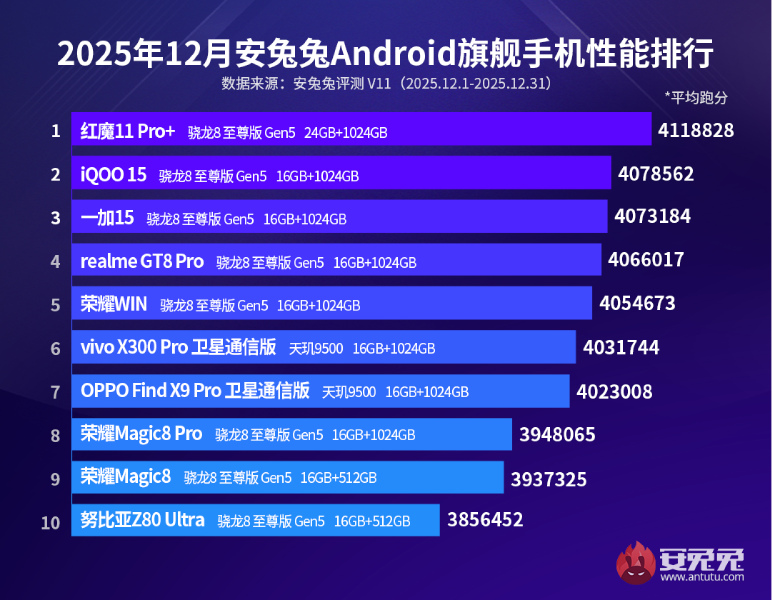
AnTuTu’s December Android performance rankings are in, and as expected, the charts are dominated by Qualcomm and MediaTek’s latest flagship processors.
The results are based on average benchmark data collected between December 1 and December 31, 2025, and only include devices with more than 1,000 valid test entries. It’s also worth noting that all data comes exclusively from China, and scores can vary depending on factors like temperature, system version, and background usage.
Of course, Red Magic means a gaming-first approach, and it clearly shows in the benchmark data. It has aggressive performance tuning, active air cooling, and even a water cooling system to keep thermals in control.
Close behind is the iQOO 15, which also runs the same Snapdragon chip. iQOO 15 is also a performance-focused device with an in-house Q3 e-sports chip. The latter adds features like super-resolution, frame interpolation, and limited ray tracing in supported games.
The OnePlus 15 ranks third with an average score of 4,073,184. It’s slightly less aggressive in tuning, but that seems intentional. OnePlus leans into an all-around flagship identity with good cameras, good performance, and good battery life. The highlight of the phone is its 165Hz display and Fengchi Gaming Kernel that enables making full use of that refresh rate.
Mid-range phones and tablets ranking
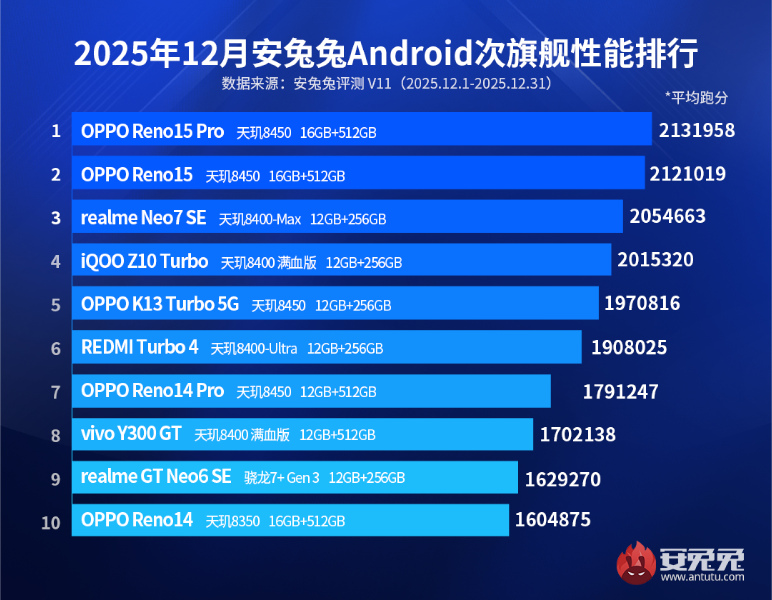
While Qualcomm dominates the top, MediaTek crushes hard in the mid-range segment.
The Oppo Reno15 Pro and Reno15, both powered by the Dimensity 8450, take first and second place with scores just over 2.13 million. The Realme Neo7 SE, running the Dimensity 8400-Max, follows closely behind.
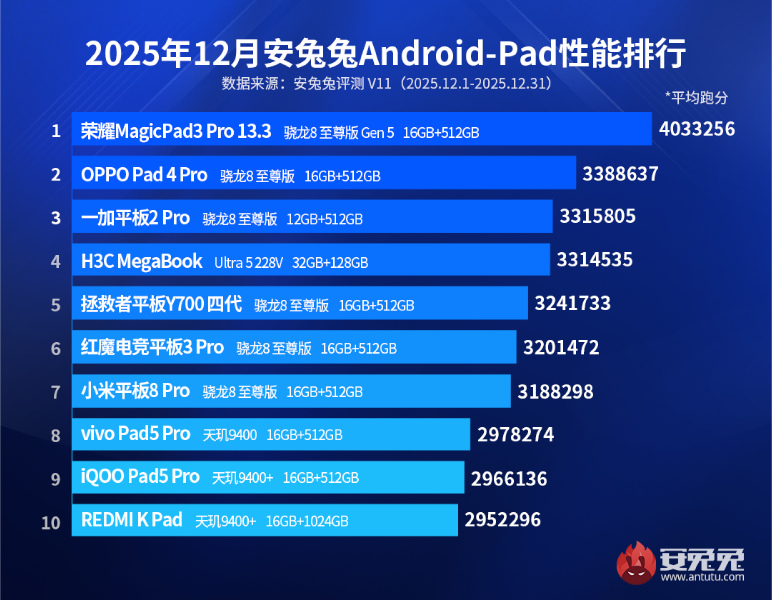
As for the tablets, the Honor MagicPad 3 Pro 13.3 with Snapdragon 8 Elite Gen 5 leads the table with a score of 4,033,256. In the second and third place are the Oppo Pad 4 Pro and OnePlus Pad 2 Pro.
A Ukrainian soldier has shared images of an Apple MacBook Air that was struck by artillery shrapnel and still managed to function.
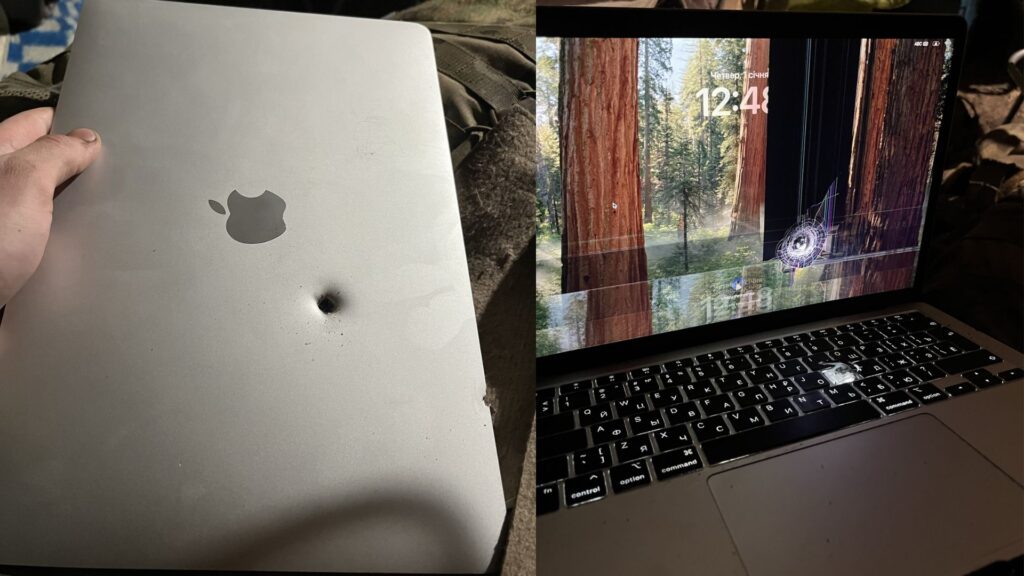
The incident was posted on X by a member of Ukraine’s Azov brigade, who goes by the handle @lanevychs. In his post, the soldier showed photos and a short video of a heavily damaged 2020 M1 MacBook Air, jokingly asking about the laptop’s “ballistic protection level.” He claimed the device had taken a direct hit from a fragment of an artillery shell.
The images show a clear hole punched through the aluminum body of the laptop, consistent with a high-speed fragment impact. While the soldier did not provide details about the exact circumstances—such as where the laptop was positioned at the time—the damage suggests the fragment struck the device directly.
Despite the impact, the MacBook Air was not completely destroyed. As seen in the photos and a follow-up video, the laptop still powers on, with parts of the display remaining responsive. The screen appears damaged around the point of impact, but the system itself remained usable to some extent. The soldier later noted that repairing it would likely cost nearly as much as buying a new one.
Apple’s MacBook Air uses a unibody chassis made from recycled aluminum, a design intended for lightness and rigidity rather than protection. Apple does not market its laptops as safety equipment, and there is no indication the device was designed to withstand impacts of this kind.
Similar stories have surfaced in the past. In 2017, a MacBook Pro was reported to have stopped a bullet during the Fort Lauderdale airport shooting, an incident that also gained widespread attention online.
While these cases are extreme and rare, they highlight how everyday electronics can sometimes withstand far more abuse than expected—especially in situations far outside their intended use.
Researchers working on China’s Experimental Advanced Superconducting Tokamak (EAST) say they have managed to operate the reactor beyond a plasma density limit that has constrained fusion experiments for decades. This achievement could help improve the efficiency of future fusion reactors.
EAST, often referred to as China’s “artificial sun,” is a tokamak located in Hefei that uses superconducting magnets to confine ultra-hot plasma. In simple terms, higher plasma density allows more fusion reactions to occur. The problem is that, in most tokamaks, pushing density too far leads to instability, causing the plasma to break down and interact with the reactor walls. This boundary is commonly linked to the Greenwald limit.
The team behind EAST believes the issue is not just how dense the plasma becomes. According to researchers at the Institute of Plasma Physics, Chinese Academy of Sciences, the density limit is closely tied to impurities entering the plasma, especially metal particles released from the reactor’s inner walls. Tungsten, which is widely used in fusion devices, was identified as a major contributor.
To better understand and control this effect, the researchers developed a model called Boundary Plasma-Wall Interaction Self-Organization (PWSO). They then tested the theory on EAST using electron cyclotron resonance heating along with a pre-charged gas startup method. These changes helped reduce the impact of tungsten at the plasma edge.
With impurity levels better controlled, the plasma was able to move into what researchers describe as a stable “density free zone,” operating beyond the traditional limit without triggering disruptions. The experimental results closely matched the predictions of the PWSO model.
The findings, published in Science Advances, offer new guidance for designing future high-density fusion reactors. While commercial fusion power remains a long-term goal, the work addresses one of the practical challenges that has slowed progress in magnetic confinement fusion.
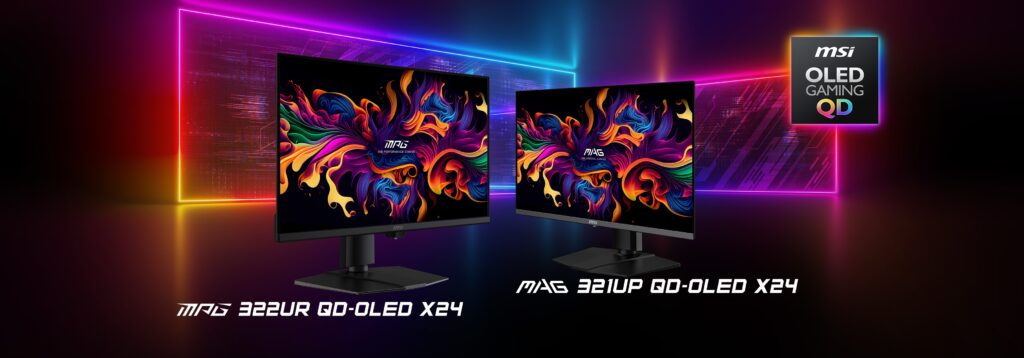
Ahead of CES 2025, MSI has unveiled two 32-inch 4K QD-OLED gaming monitors targeting different user needs. The MPG 322UR QD-OLED X24 and MAG 321UP QD-OLED X24 both utilize 5-layer Tandem OLED architecture with EL Gen 3 technology, advancing luminous efficiency and panel lifespan.
Both monitors feature DarkArmor Film technology, addressing common QD-OLED weaknesses. This coating eliminates purple and reddish tints that appear on standard QD-OLED panels under ambient lighting. The film increases pure black levels by 40%, enhancing contrast and overall image quality. It also raises screen surface hardness from 2H to 3H, providing 2.5 times greater scratch resistance against daily use.
The MPG 322UR QD-OLED X24 includes an AI Care Sensor that the other model doesn’t have. This NPU-based chip runs human detection algorithms in real time to check if someone is using the monitor. When it detects no one is there, it automatically adjusts power settings and turns on panel protection. This helps prevent burn-in and extends the panel’s life without interrupting your gaming sessions.
The MAG 321UP QD-OLED X24 is the standard version. It has the 5-layer Tandem OLED display and DarkArmor Film but skips the AI Care Sensor. This makes it a good option if you want the core display technology without the automated protection features.
The 5-layer Tandem OLED design is different from regular single-layer OLED panels. It stacks multiple light-emitting layers to reach higher brightness while spreading the electrical load across more area. This reduces stress on individual pixels and should make the display last longer. That matters for OLED technology since static images can cause burn-in over time.
QD-OLED technology combines quantum dots with OLED panels. This produces wider color ranges and better color accuracy than WOLED displays. The 32-inch 4K format gives you 140 pixels per inch, which balances screen space with sharpness for gaming and work.
MSI hasn’t shared pricing or exact release dates yet. Both models will launch sometime in 2026. The company will announce full specs, including refresh rates, response times, and ports, closer to launch.
For more daily updates, please visit our News Section.
OnePlus has been a reliable brand when it comes to software updates. The brand consistently releases updates to its devices, incorporating exciting new features and useful upgrades. However, for a long time, the brand has offered just three major Android updates to its phones, particularly mid-range phones and several tablets. Newer devices, though, come with longer software update promises.
Here, we’ve curated a list of OnePlus smartphones and tablets that are eligible to receive three major Android OS updates, which also means three generations of OxygenOS upgrades.
OnePlus devices eligible to receive three major Android updates
OnePlus 12R (last update: Android 17)
OnePlus 11R (last update: Android 16)
OnePlus 10R (last update: Android 15)
OnePlus 10T (last update: Android 15)
OnePlus Nord 3 (last update: Android 16)
OnePlus Pad (last update: Android 16)
OnePlus Pad 2 (last update: Android 17)
OnePlus Pad 3 (last update: Android 18)
[Note: We’ll regularly update the list to keep it fresh and up-to-date.]
To keep the list relevant and short, we’ve only included devices starting from the OnePlus 10 series. As for the Nord series, just the Nord 3 is eligible for three OS updates. Also, we haven’t included devices that haven’t been released outside China.
In recent years, OnePlus has improved its software update policy to offer a maximum of four Android OS updates, and that’s not just exclusive to high-end phones. Even mid-range phones, such as the Nord CE 5, Nord 4, and Nord 5, promise the same software support.
To keep yourself updated with the latest stories around OnePlus and OxygenOS, visit our OnePlus section regularly. Or, you can join us on Telegram to get notified about the latest happenings in tech.
While Xiaomi is gearing up to unveil a new Redmi Note 15 in the Indian market, the brand is also planning on releasing another affordable phone from its POCO sub-brand. A fresh teaser for the POCO M8 has just been shared, confirming some of its key specs and features. So here’s what we know.
POCO M8 Specifications
In a fresh Flipkart landing page, the Chinese tech giant confirmed some of the internal hardware of the POCO M8. The upcoming budget phone is equipped with the Qualcomm Snapdragon 6 Gen 3, which will be coupled with 8GB of RAM. Although, you can hit 16GB with 8GB of virtual RAM expansion. POCO shared the AnTuTu benchmark scores as well, with the device achieving more than 825,000 points.
Apart from this, the company also confirmed that this model will run on the Android 15 OS based HyperOS 2 custom skin out of the box. Unfortunately, this device doesn’t get the latest HyperOS 3 (Android 16) software, but the brand does promise 4 years of OS updates along with 6 years of security patches. So we can expect the POCO M8 to get the HyperOS 3 update soon after the Indian release.
Based on what we know so far, the POCO M8 sports a tall 6.77-inch curved AMOLED display with an FHD+ resolution and a 120Hz refresh rate. A large 5,520mAh battery pack could power this model, which may support 45W wired fast charging. For optics, the rear has a 50MP dual camera setup, while the front houses a 20MP selfie shooter. Other notable features include an IP68 or IP65 rating for water and dust resistance, a slim 7.35mm body, and a dual tone design.
For more daily updates, please visit our News Section.
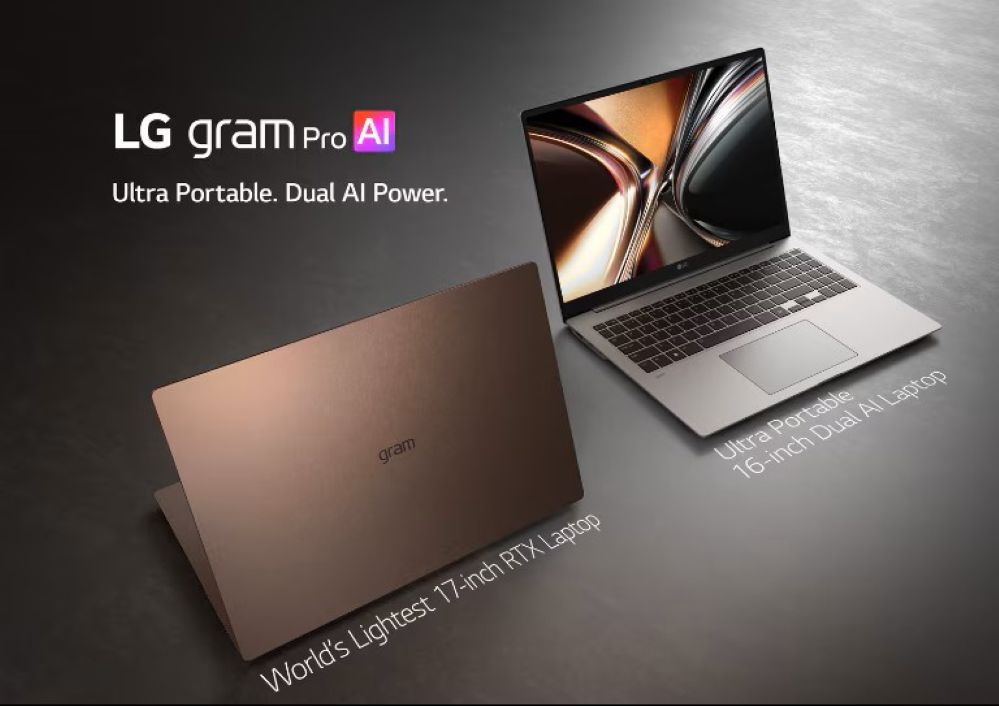
LG has announced its 2026 Gram laptop lineup ahead of CES, and the company is once again doubling down on what the series is best known for: extremely light designs. This time, though, LG is also putting more emphasis on durability and AI-powered features.
A key change comes in the form of Aerominum, a new magnesium-aluminum alloy developed using aerospace-inspired techniques. According to LG, the material “reduces the laptop’s weight while reinforcing its structural strength”. Scratch resistance is said to be improved, and several models have reportedly cleared military-grade durability tests.
AI plays a larger role across the 2026 lineup. Select models qualify as Microsoft Copilot+ PCs and feature what LG describes as a “dual AI” approach. This combines on-device AI processing with cloud-based features. LG’s own gram chat runs on the EXAONE 3.5 small language model (sLLM) and is designed to work even without an internet connection, focusing on everyday productivity and creative tasks.
LG has also refreshed gram Link, improving connectivity between Gram laptops and other devices. The feature now supports easier file sharing and screen mirroring across Android and iOS phones, as well as LG’s webOS products such as TVs and monitors.
The lineup includes multiple options, including the LG gram Pro AI in 17-inch and 16-inch sizes, the 16-inch gram Pro 360 AI, gram AI models in 14-inch and 15-inch sizes, and the gram Book AI.
One of the more notable models is the North America-exclusive LG gram Pro AI 17 (17Z90UR). LG claims it is the lightest 17-inch laptop with discrete graphics, featuring an NVIDIA GeForce RTX 5050 and a 2560×1600 LCD display in a body closer to a 16-inch machine. The 16-inch gram Pro AI is also impressive, weighing just 1,199g while packing a 77Wh battery and a 2880×1800 OLED panel.
LG will showcase the new Gram series at CES 2026 starting January 6, with wider availability expected shortly after.
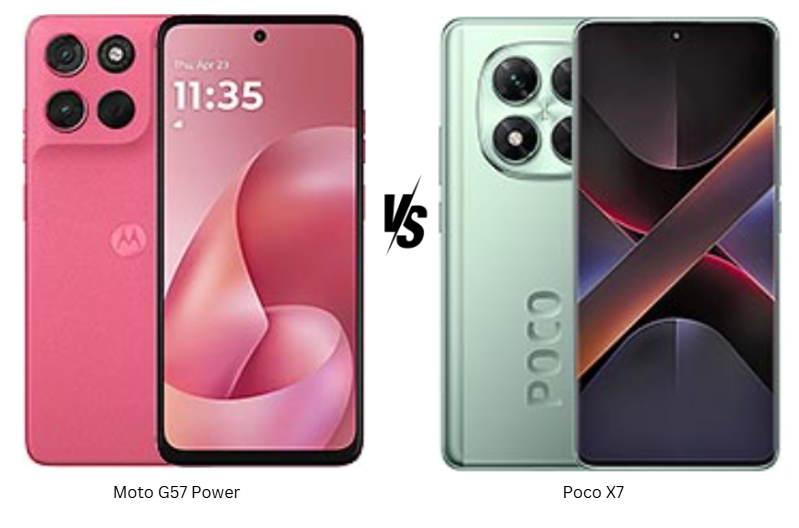
Moto G57 Power and POCO X7 5G appeal to buyers who want strong value at the mid-range price point, but with very different priorities in mind. One phone attracts users who prioritize long battery life and everyday durability, while the other draws those who want a more premium experience for entertainment and performance. Comparing them is important because both target the same budget-conscious audience, yet serve distinctly different usage styles and expectations.
Moto G57 Power leans toward durability and practicality with its IP64 rating, drop resistance, eco-leather back, and slightly heavier 7000 mAh build. It feels purpose-built for long-term everyday use, especially for users who value rugged assurance over sleek finesse. POCO X7 5G, meanwhile, delivers a more premium vibe with Gorilla Glass Victus 2, a slimmer profile, a lighter frame, and higher IP68/69 protection. Its design appears more refined and lifestyle-oriented, appealing to users seeking a modern, polished look.
Display Quality
Moto G57 Power offers a large 6.72-inch IPS LCD 120Hz panel with strong brightness for casual gaming and outdoor use. It feels functional and balanced for media and reading. POCO X7 5G elevates the experience with a 1.5K AMOLED, HDR10+, Dolby Vision, and significantly higher peak brightness, making movies, social content, and gaming look richer and more immersive.
Verdict
Moto G57 Power favors strength and utility, while POCO X7 5G stands out as the more premium and visually engaging option.
2. Specifications
Performance
Moto G57 Power runs on Snapdragon 6s Gen 4, delivering dependable mid-range performance suited for day-to-day multitasking and efficient battery-friendly usage. It feels tuned for stability rather than speed. POCO X7 5G, powered by the Dimensity 7300 Ultra, comes across as the more performance-focused device, offering stronger processing headroom and smoother handling of gaming, camera processing, and heavy apps.
Battery and Charging
Moto G57 Power takes a commanding lead in endurance with its massive 7000 mAh battery and 30–33W charging, making it ideal for long outdoor or travel-heavy usage. It feels like a phone built for users who hate frequent charging. POCO X7 5G counters with a 5110–5500 mAh battery (market-dependent) and faster 45W charging, offering a balance of speed and practicality.
Verdict
Moto G57 Power wins on sheer battery longevity, while POCO X7 5G feels more performance-oriented and efficiency-balanced for active multimedia users.
3. Camera
Main and Secondary Lenses
Moto G57 Power features a 50 MP main camera with ultrawide support, tuned for natural daylight shots and consistent color tones. It feels reliable for social photography and everyday usage, though video tops out at 1440p. POCO X7 5G steps ahead with its 50 MP OIS-enabled main camera, 4K recording, ultrawide lens, and macro support. The stabilization and sharper recording give it a more polished imaging character, especially for content creation and travel photography.
Selfie Camera
Moto G57 Power offers an 8 MP selfie camera focused on balanced skin tones and simple video calling. POCO X7 5G delivers a sharper 20 MP selfie camera with higher-quality recording and better detail, making it more appealing for users who share photos and reels frequently.
Verdict
Moto G57 Power keeps things practical and consistent, while POCO X7 5G emerges as the stronger option for creators and camera-centric users.
4. Pricing
Both smartphones sit around the $300 price point, making this a value-centric matchup where priorities decide the better buy. Moto G57 Power offers massive battery life, rugged build assurance, stereo audio with a headphone jack, and a clean Android with a planned Android 17 upgrade. The value feels centered around endurance, utility, and long-term usability.
POCO X7 5G, at the same approximate price, delivers a noticeably more premium experience, brighter AMOLED display, stronger chipset, higher-grade water resistance, in-display fingerprint sensor, and a more capable camera system with OIS and 4K video. The package feels performance-driven and multimedia-focused.
At equal pricing, Moto G57 Power appeals more to users prioritizing extreme battery backup and durability, while POCO X7 5G feels like the better all-rounder for performance, display quality, and camera capabilities.
Disclaimer: Prices are approximate and may vary based on country, region, and applicable taxes.
5. Conclusion
Moto G57 Power stands out with its 7000 mAh battery, drop-resistant design, stereo audio with Hi-Res support, and practical everyday durability. It feels ideal for travelers, outdoor users, heavy media consumers, and those who prefer charging as little as possible. POCO X7 5G distinguishes itself with premium AMOLED display quality, higher protection rating, stronger chipset, in-display fingerprint sensor, and OIS-enabled camera performance.
Verdict
For most users, POCO X7 5G makes more sense; it delivers a better display, stronger performance, more capable cameras, and a more premium overall experience at the same price point. Moto G57 Power excels in battery life and ruggedness, but POCO X7 5G offers a more balanced and future-ready phone overall.
Honor has been dropping teasers for its upcoming Power 2 smartphone ahead of its 5th January 2026 debut. The brand confirmed that the handset will be powered by a new MediaTek Dimensity chipset and has even revealed its AnTuTu benchmark scores. So let’s check it out.
Honor Power 2 Performance
In a fresh teaser, the Chinese brand has confirmed that the Power 2 will be equipped with the Dimensity 8500 Elite SoC. With this chip, the upcoming smartphone managed to achieve an AnTuTU score of over 2.4 million points, which likely puts it near the top end of the performance charts for its class. This is in line with a previous GeekBench sighting. Honor also confirmed that the Power 2 will arrive with a Snowman Airbag Stand, which attaches to the back of the phone as a part of a limited winter edition accessory.
Recent teasers have confirmed that the device will pack an IP68 + IP69 + IP69K rating for water and dust resistance and a massive 10,080mAh battery pack that likely supports 80W wired fast charging. But based on the leaks, the Honor Power 2 sport a tall 6.79-inch LTPS OLED screen that offers a 1.5K resolution, a 120Hz refresh rate, 16MP selfie camera, and 8,000 nits of HDR brightness. For optics, the rear may pack a 50MP (Main) + 5MP (Ultra Wide) dual camera setup.
Honor Power 2
Official image posters have also revealed that the Power 2 will arrive in three color options, namely Snow White, Midnight Black, and Sunrise Orange. Other notable features include 12GB of RAM and up to 512GB of internal storage, along with 12GB of virtual RAM expansion. This is all the information we have at the moment, so stick around for more.
For more daily updates, please visit our News Section.
Oppo India has confirmed the India launch of the Reno 15 series on Jan.8. The new lineup centres, which includes the Reno 15, Reno 15 Pro, and Reno 15 Pro Mini, on AI-assisted photography and video, targeting users who frequently shoot portraits, travel scenes and social content on the go.
Oppo Reno 15 series’ camera details confirmed
Oppo Reno 15 series India launch date
The Oppo Reno 15 Pro 5G and Reno 15 Pro Mini 5G are built around a 200-megapixel ultra-clear main camera, aimed at capturing high detail across varied environments. Oppo’s PureTone Technology plays a key role here, balancing the subject with surrounding light and colour instead of aggressively isolating faces. The idea is to keep images clean and vivid without making them look artificial, even when lighting conditions change.
Supporting the main sensor is a 50-megapixel 3.5x telephoto portrait camera, close to the classic 85mm focal length. This lens helps maintain natural facial proportions while adding gentle background compression, making it suitable for both portraits and distant subjects. A 50-megapixel ultra-wide camera with a 100-degree field of view completes the setup, handling landscapes, architecture and group shots while keeping colour and exposure consistent across the frame. Group photos also benefit from face-aware processing that sharpens each subject individually.
Beyond still photography, the Reno 15 Pro models support 4K HDR video recording at up to 60fps across all cameras, including telephoto and front-facing units. This allows creators to switch focal lengths mid-shot without visible jumps in colour or exposure. Features such as enhanced stabilisation, dual-view recording and multi-output capture are designed to make handheld shooting more reliable.
The Reno 15 series also introduces AI Editor 3.0, which includes tools like AI Portrait Glow and motion-based editing features that help refine photos after capture. Creative options such as Popout add depth-driven effects without relying on third-party apps. The standard Reno 15 5G carries several of these AI features forward, making the overall experience more accessible across the lineup.
For more daily updates, please visit our News Section.
Xiaomi has kicked off the 2026 season with a fresh rollout of Chinese New Year Edition models in its popular Redmi Note 15 lineup. The company’s popular budget lineup is now on sale in China with new festive color options and look. The special edition colorways are available for the standard Note 15 as well as the higher end Note 15 Pro and Note 15 Pro+ options.
Redmi Note 15 Series Chinese New Year Edition Pricing
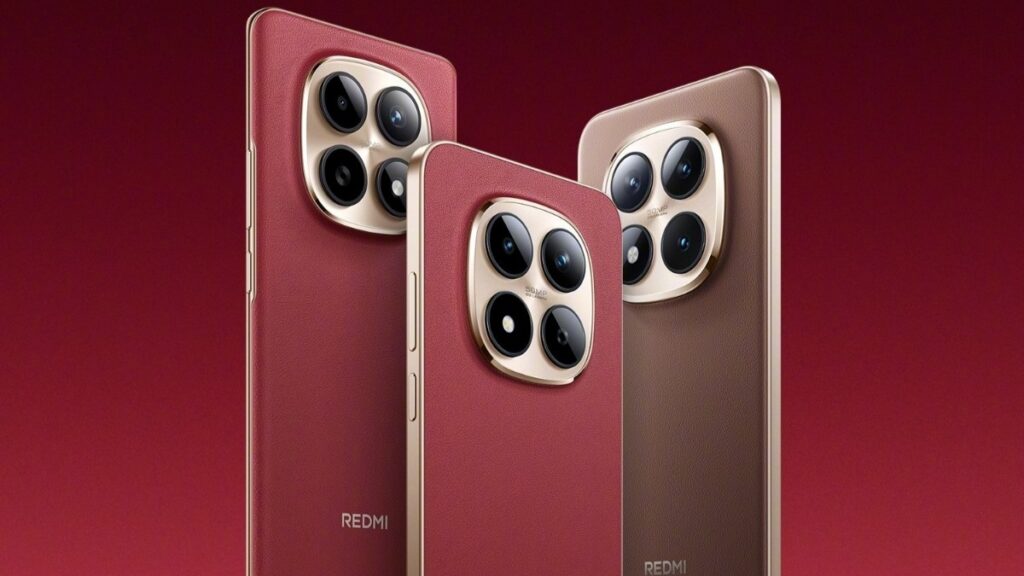
The Chinese tech giant just announced the new Chinese New Year Edition for the Redmi Note 15 lineup. So now, the Redmi Note 15 and Redmi Note 15 Pro are available in China in the new Cherry Red colorway, while the Redmi Note 15 Pro+ model is available in Mocha Brown. These hues bring a more elegant look to the affordable smartphones.
Redmi Note 15 & Redmi Note 15 Pro in Cherry Red, Redmi Note 15 Pro+ in Mocha Brown
So here are the pricing details:
Redmi Note 15 Cherry Red
8GB + 128GB- 999 Yuan
8GB + 256GB- 1,199 Yuan
12GB + 256GB- 1,399 Yuan
Redmi Note 15 Pro Cherry Red
8GB + 256GB – 1,349 Yuan
12GB + 256GB – 1,599 Yuan
12GB + 512GB – 1,799 Yuan
Redmi Note 15 Pro+ Mocha Brown
12GB + 256GB – 1,799 Yuan
12GB + 512GB – 2,099 Yuan
16GB + 512GB – 2,199 Yuan
16GB + 512GB Satellite Messaging Edition- 2,199 Yuan (Special Discount During Chinese New Year)
The limited edition Note 15 lineup is arriving with leather rear panels and golden side panels, and camera modules. In related news, the brand has started teasing the Redmi Note 15 in the Indian market, with its launch set for 6th January 2026.
For more daily updates, please visit our News Section.
Xiaomi‘s latest flagships could be arriving in India soon. The company’s Xiaomi 17 and Xiaomi 17 Ultra just had their Indian release timeline revealed, while another new model is reportedly in the works. So here’s everything we know so far.
Xiaomi 17 and Xiaomi 17 Ultra India Launch Timeframe
The Chinese tech giant’s latest premium devices are apparently launching in the same timeline as last year’s Xiaomi 15 and Xiaomi 15 Ultra. According to Abhishek Yadav on X (formerly Twitter), Xiaomi may unveil the Xiaomi 17 and Xiaomi 17 Ultra model in March 2026. So despite the Xiaomi 17 Ultra making its debut a couple of months earlier, the global release is still a while away.
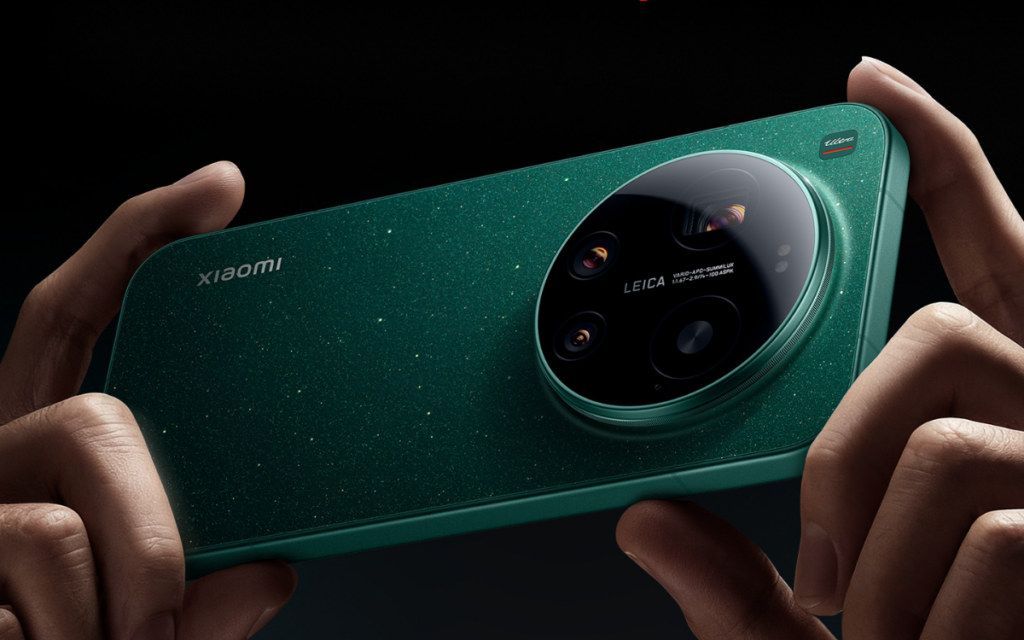
Xiaomi 17 Ultra
In the tweet, the known tipster further added that a new Xiaomi 17T model is also arriving soon. Just recently, rumors surfaced of another Xiaomi 17 series phone, which features the Snapdragon 8 Elite Gen 5. While the details are still at large, the Xiaomi 17T could be this new model. Abhishek Yadav stated that his sources believe this device could arrive in India in April 2026. Although, the tipster did state that this is still unconfirmed, so take this report with a pinch of salt as well.
Based on what we know so far, the Xiaomi 17 is confirmed for an Indian release. Xiaomi’s new flagship just surfaced on the BIS certification database. In related news, Xiaomi 17 Ultra Leica Edition buyers are complaining of the zoom ring feeling loose and making a sound. You can also click hereto check out our unboxing and hands-on for this device.
For more daily updates, please visit our News Section.
We’ve already covered plenty of Lenovo products set to be unveiled at CES 2026. A few of them are concepts, while some products are set to debut later in 2026. There’s a new product to add to that growing pile: the Lenovo AI Glasses Concept.
Publication Windows Latest has revealed the first look at the new AI glasses, along with details on what they are capable of.
The idea behind these concept glasses is to make an everyday wearable work as a personal AI headset. And on paper, Lenovo has a few interesting features to make that vision feel plausible.
Lenovo AI Glasses Concept Overview
According to the report, the Lenovo AI Glasses Concept has a built-in teleprompter for presentations or speaking engagements. It’s the kind of feature that could be genuinely useful for presenters, streamers, or anyone who spends a good chunk of their day talking to a camera.
The glasses also have basic features like touch and voice controls built into the frame. They can handle calls, control music, or access information as a standalone device.
Lenovo is also bundling the glasses with Lenovo Qira, its AI assistant. Interestingly, Qira doesn’t run directly on the glasses. Instead, it relies on the processing power of a connected smartphone or computer.
That offloaded approach means the glasses themselves don’t need to handle heavy AI workloads—but it also means you’ll need to keep a paired device nearby to use the assistant. When connected, Qira is said to support sub-millisecond real-time live translation and image recognition. There’s also a camera mounted on the front of the frame to enable those features.
AI also powers another feature called Catch Me Up, which summarises notifications across multiple devices at the start of the day.
Last but not least, the Lenovo AI Glasses Concept reportedly weighs around 45 grams and promises up to eight hours of battery life.
For more daily updates, please visit our News Section.
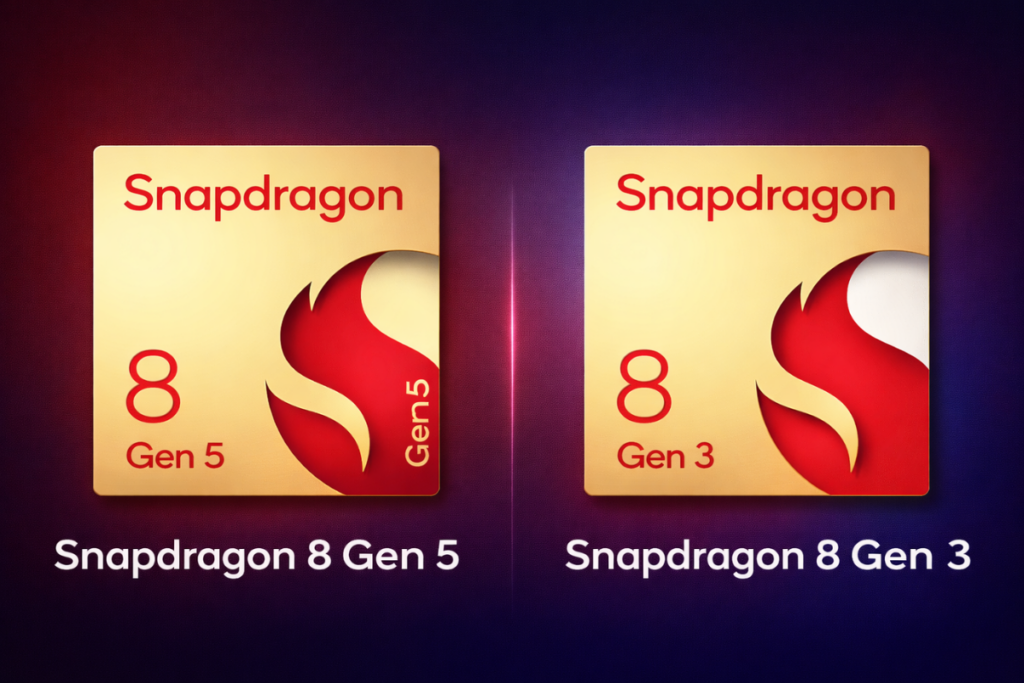
The Snapdragon 8 Gen 5, announced in November, features powerful and power-efficient Oryon cores for the first time in a non-Elite chipset. It borrows more features from the flagship 8 Elite Gen 5 chipset, including the Adreno 840 GPU with sliced architecture, agentic AI, and a 20-bit triple ISP. It’s indeed a powerful smartphone chipset with flagship capabilities.
On the other hand, the Snapdragon 8 Gen 3 was announced two years ago, but it’s still a capable chipset that offers smooth performance and flagship-grade specs. From the name itself, it’s clear that the 8 Gen 5 has better capabilities, but the real question is: how significant an upgrade is the 8 Gen 5 over the 8 Gen 3? Let’s dive into benchmarks and real-world differences to find out.
Snapdragon 8 Gen 5
Snapdragon 8 Gen 3
Announced
November 2025
October 2023
Process node
TSMC’s 3nm (N3P)
TSMC’s 4nm (N4P)
CPU
2 x 3.8GHz — Oryon (3rd gen) 6 x 3.32GHz — Oryon (3rd gen)
1 x 3.3 GHz — Cortex-X4 3 x 3.15 GHz — Cortex-A720 2 x 2.96 GHz — Cortex-A720 2 x 2.27 GHz — Cortex-A520
GPU
Qualcomm Adreno 840 GPU ray tracing support Snapdragon Elite Gaming features
Adreno 750 ray tacing support Snapdragon Elite Gaming features
NPU
Qualcomm Hexagon NPU agentic AI support
Qualcomm Hexagon NPU
Memory
LPDDR5x, up to 4.8GHz
LPDDR5x, up to 4.8GHz
Storage
UFS 4.1
UFS 4.0
Camera
Qualcomm Spectra triple AI ISP (20-bit) up to 320MP single camera up to 108MP single camera with zero shutter lag up to 48MP triple cameras with zero shutter lag real-time semantic segmentation (limitless) 4K/120fps video recording 1080p/480fps slow-mo video recording
Quacomm Spectra triple AI ISP (18-bit) up to 200MP single camera up to 108MP single camera with zero shutter lag up to 36MP triple cameras with zero shutter lag real-time semantic segmentation (up to 12 layers) 8K/30fps or 4K/120fps video recording 720p/960fps slow-mo video recording
Note: The benchmark tests were performed on the OnePlus 15R (powered by the Snapdragon 8 Gen 5) and the OnePlus 13R (powered by the Snapdragon 8 Gen 3).
Geekbench score
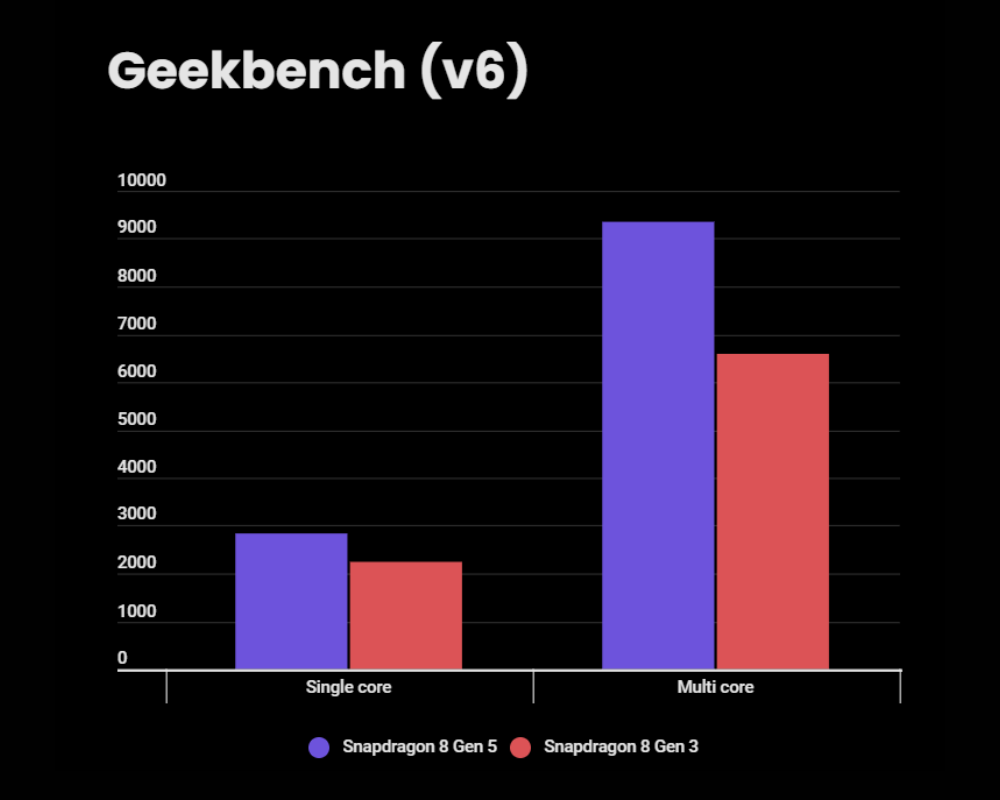
Thanks to powerful third-gen Oryon cores, the Snapdragon 8 Gen 5 is able to pull off much higher Geekbench scores than the 8 Gen 5. In the single-core test, it achieves 2,837 points, whereas the 8 Gen 3 touches 2,243. That’s a 26% uplift for the newer chip. The difference only widens in multi-core performance.
The 8 Gen 5 achieves 9,352 multi-core points, while the 8 Gen 3 gets 6,591 points, resulting in a 42% performance boost for the former chip in tasks that require multiple cores to work together, such as multitasking, video editing, and other demanding workloads.
Snapdragon 8 Gen 5
Snapdragon 8 Gen 3
Single core
2,837
2,243
Multi core
9,352
6,591
AnTuTu score
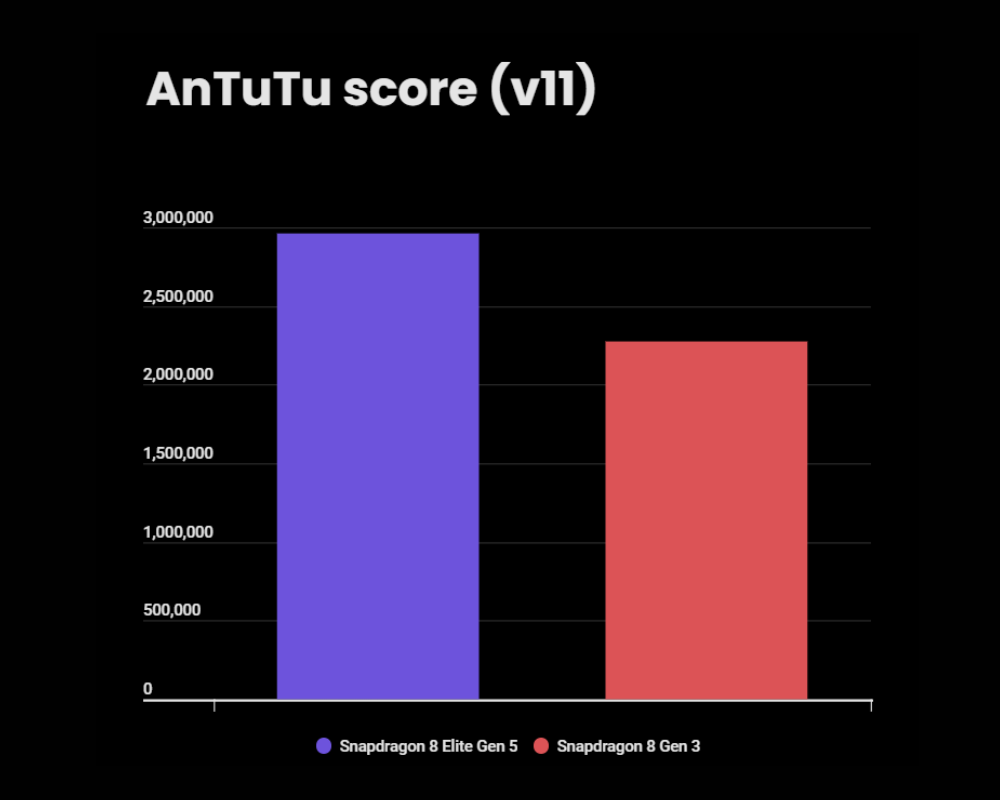
On the AnTuTu v11 platform, the Snapdragon 8 Gen 5 achieves nearly 3 million points, whereas the 8 Gen 3 only reaches 2.27 million points. That’s a 30% boost for the newer chip.
The breakdown reveals a 50% higher CPU score and a 22% increase in the GPU score for the 8 Gen 5. It also gains higher scores in memory and UX tests.
Snapdragon 8 Gen 5
Snapdragon 8 Gen 3
AnTuTu score
2,961,236
2,274,520
CPU
914,878
607,409
GPU
974,402
796,782
Memory
382,729
353,279
UX
689,228
517,050
In short, the Snapdragon 8 Gen 5 strongly outperforms the 8 Gen 3 on benchmarks. However, there’s more to consider than just benchmark scores to get the complete picture, such as connectivity and camera quality. (more on that below)
Snapdragon 8 Gen 5 vs 8 Gen 3: Major differences
The 8 Gen 5 uses an advanced TSMC’s 4nm (N3P) process node, which offers better performance and power efficiency over the 8 Gen 3’s 4nm (N4P) node. Furthermore, the chip benefits from Qualcomm’s latest Oryon cores (third-generation), the same cores found in the flagship 8 Elite Gen 5 chip.
On the other hand, the 8 Gen 3 features ARM cores: 1 x Cortex-X4, five Cortex-A720, and two Cortex-A520. Qualcomm claims a 36% performance boost for the 8 Gen 5 compared to 8 Gen 3. Further, the 8 Gen 5 features an upgraded Hexagon NPU that delivers 46% faster performance.
The 8 Gen 5 features an Adreno 840 GPU (with sliced architecture) that offers greater capabilities than the Adreno 750 inside the 8 Gen 3. It uses the new GPU architecture with dedicated memory per slice. The 8 Gen 5’s Adreno 840 GPU promises 11% faster graphics rendering and a 13% improvement in power efficiency. Additionally, it also offers improved ray tracing and Snapdragon Elite Gaming features.
The camera also receives notable upgrades. The Gen 5 chip uses a 20-bit Spectra Triple ISP with AI capabilities. It offers features like real-time tone control and Night Vision 3.0. Additionally, it features Snapdragon Audio Sense, which can record HDR audio while eliminating background wind noise.
Both chips offer the same peak download/upload speed over 5G and Wi-Fi connections, but the underlying hardware has been upgraded. The newer X80 5G modem, part of the 8 Gen 5 upgrades, enhances the Sub-6GHz configuration to 4×6 MIMO, improving speed and reliability compared to the 4×4 MIMO in the Gen 3’s X75 modem.
The newer chip also offers AI-assisted beam management, Bluetooth 6.0 (vs 5.4), and a newer FastConnect 7900 connectivity suite (vs FastConnect 7800).
Snapdragon 8 Gen 5 vs 8 Gen 3: Which one should you choose?
The Snapdragon 8 Gen 5 offers clear advantages over the 8 Gen 3 in almost every aspect. It’s got a faster CPU, a reliable GPU with higher rendering and battery efficiency, an improved ISP with AI-assisted features, and enhanced connectivity features.
Between the two, the choice isn’t difficult: the Snapdragon 8 Gen 5 does everything better, and therefore is an easy pick. But the 8 Gen 3 still delivers excellent performance and power efficiency. You’ll hardly notice any performance difference in day-to-day usage. It also offers excellent gaming performance, but for longer sessions, you may want a more powerful chip. If you can find a Snapdragon 8 Gen 3 phone that’s significantly cheaper than the 8 Gen 5 phone, the deal would be hard to ignore.
HMD may be preparing to expand its product lineup beyond phones with what looks like a very budget Bluetooth speaker. A new leak suggests that the company is working on a portable speaker called the HMD Boom E1, which is a basic sound piece.
The leak comes from a known HMD tipster on X who goes by the name HMD_MEME’S, who shared both the specifications and images of the upcoming speaker.
HMD Boom E1 Specifications (Rumored)
According to the information, the HMD Boom E1 uses a 4-ohm horn paired with a 52mm driver. It is capable of delivering a maximum output of 5W. That’s modest power by today’s standards, but fairly typical for compact speakers.
One notable feature is its IPX7 waterproof rating, so the speaker should be good to survive splashes, rain, and even brief submersion in water. This makes it suitable for outdoor use, whether that’s at the beach, near a pool, or during a short hike.
Connectivity options appear simple but practical, with Bluetooth 5.0 for wireless audio and an AUX line-in for wired playback. There’s also a built-in microphone, which could allow the speaker to double as a basic speakerphone.
Moreover, the Boom E1 is said to pack an 800mAh battery and charges via a USB Type-C port.
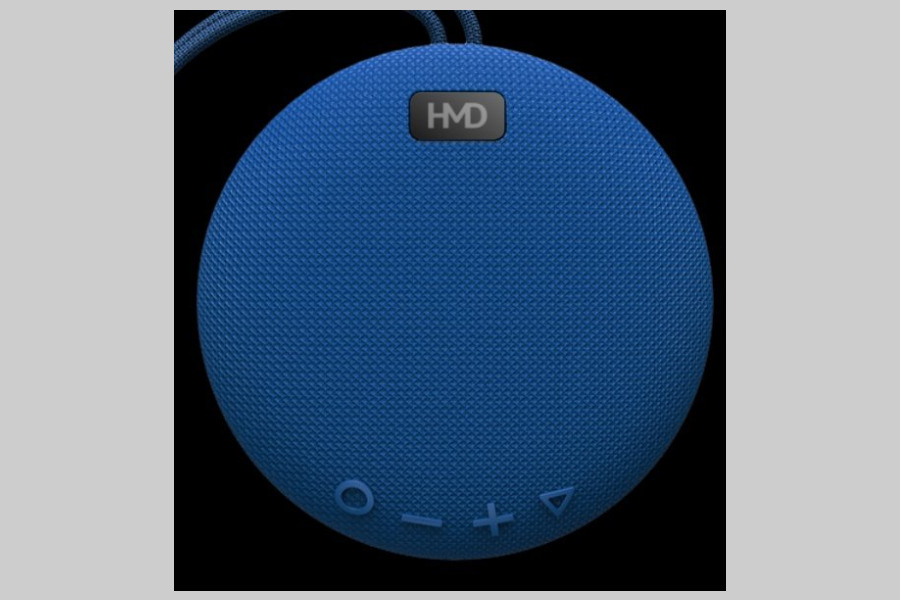
The leaked images show a fully blue, circular design. The front is covered by a fabric mesh, while the top carries the “HMD” logo. We can also spot physical controls — including power, volume up and down, and play buttons — on the bottom. There’s also a lanyard on the side to add a bit of portability.
Unfortunately, there’s no word yet on pricing or launch timing. Based on specs, the HMD Boom E1 looks like a no-frills speaker aimed at the budget segment.
Motorola’s upcoming premium phone, the Motorola Signature, has appeared in a leaked promotional image ahead of its India launch on January 7. The device was previously linked to the Edge 70 Ultra name, but the new material suggests Motorola may be positioning it a bit differently.
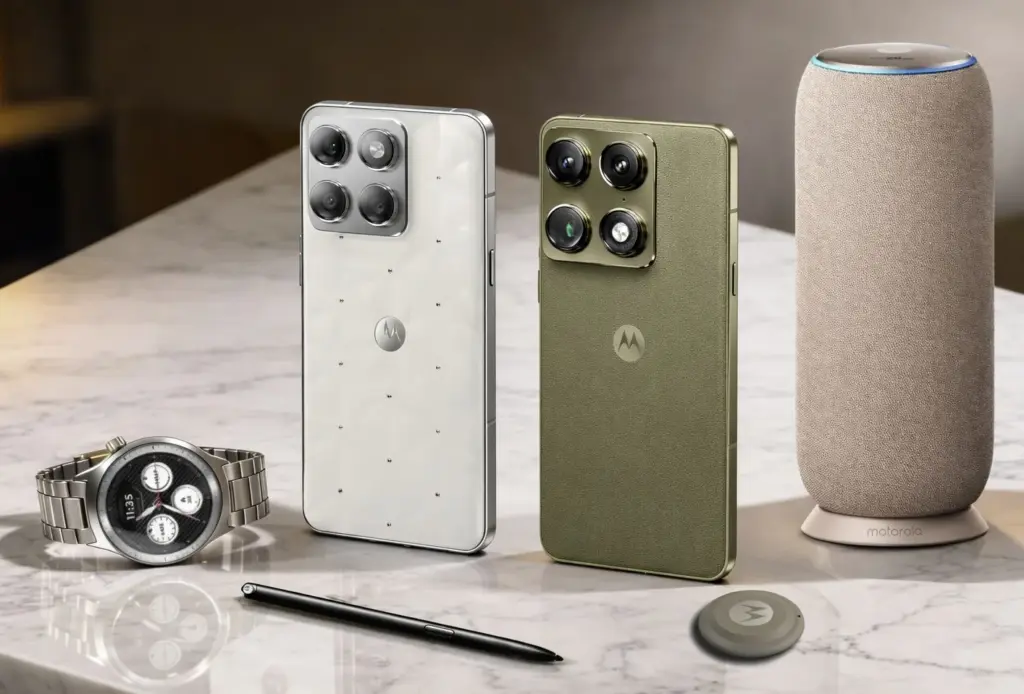
The image, shared by YTECHB, shows the phone in a green color option, reportedly called Martini Olive. What stands out most is a stylus placed next to the device, hinting that Motorola could finally bring pen support to its flagship lineup. So far, stylus features have mostly been limited to the G Stylus series. In some regions, including China, the phone is expected to launch as the Moto X70 Air Pro.
The same promotional poster also includes several other Motorola products, including a smartwatch, a tracking device (possibly the rumored Moto Tag 2), a speaker, and a special Edge 70 Swarovski Crystal Edition. This suggests Motorola may use the event to highlight its wider product ecosystem rather than focusing only on the phone itself.
On the performance side, a Geekbench listing spotted earlier indicate the Motorola Signature could run on Qualcomm’s Snapdragon 8 Gen 5 chipset, paired with up to 16GB of RAM. The CPU configuration shown in Geekbench aligns with what’s expected from a 2026 flagship from Motorola. Separately, leaker Evan Blass has shared wallpapers believed to be made for the device, adding to the growing list of pre-launch details.
Other specifications, including camera hardware, display details, and battery size, haven’t been revealed yet. However, stylus support alone could help the Motorola Signature stand out in a crowded premium segment. With the official launch just around the corner, more concrete details should surface soon.
We use cookies on our website to give you the most relevant experience by remembering your preferences and repeat visits. By clicking “Accept”, you consent to the use of ALL the cookies.
This website uses cookies to improve your experience while you navigate through the website. Out of these, the cookies that are categorized as necessary are stored on your browser as they are essential for the working of basic functionalities of the website. We also use third-party cookies that help us analyze and understand how you use this website. These cookies will be stored in your browser only with your consent. You also have the option to opt-out of these cookies. But opting out of some of these cookies may affect your browsing experience.
Necessary cookies are absolutely essential for the website to function properly. This category only includes cookies that ensures basic functionalities and security features of the website. These cookies do not store any personal information.
Any cookies that may not be particularly necessary for the website to function and is used specifically to collect user personal data via analytics, ads, other embedded contents are termed as non-necessary cookies. It is mandatory to procure user consent prior to running these cookies on your website.