Advertisement

More than a Billion iOS and Android smartphone are vulnerable by a flaw in the Wi-Fi Chip

A major flaw has just been discovered in the Wi-Fi chips of a couple of smartphone models that potentially affect over a billion people. Reportedly, attackers are now capable of decrypting data that was sent to these handset models, even if the messages were encrypted in the first place.

The flaw in question has been traced back to Wi-Fi chips that have been manufactured by a particular company called Cypress Semiconductor and Broadcom. As the name suggests, the company deals with Wi-Fi components and Cypress had initially acquired Broadcom’s Wi-Fi operations back in 2016. The recently uncovered Wi-Fi flaw affects both the WPA2-Personal and WPA2-Enterprise protocols on the affected smartphones.
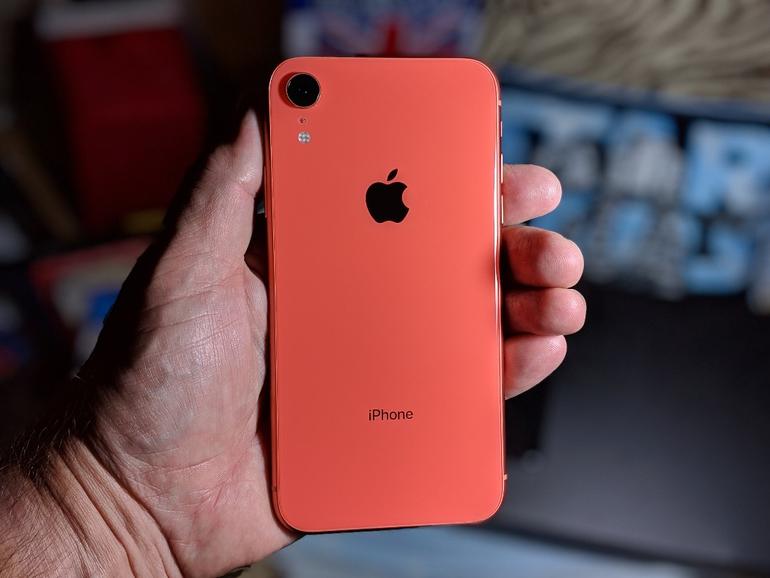
Apple iPhone XR

The list of devices that are affected is found to be in both iPhones and Android smartphones. Furthermore, they are also found to be affecting certain models of iPad from Apple, Amazon Echo, Kindle readers, and Wi-Fi routers manufactured by Asus and Huawei. The vulnerability was first uncovered by a Slovakian security firm named Eset, which has also dubbed it as KrØØk when reporting it earlier today (27th February 2020).

As of right now, the manufacturers whose smartphones are affected have already started issuing patches to fix the issue, but it remains to be seen regarding the damage already done. Another difficulty being that the user might not read the crucial patch notes, so if your smartphones are one of the affected devices in the list down below, check for any pending software update and upgrade immediately.

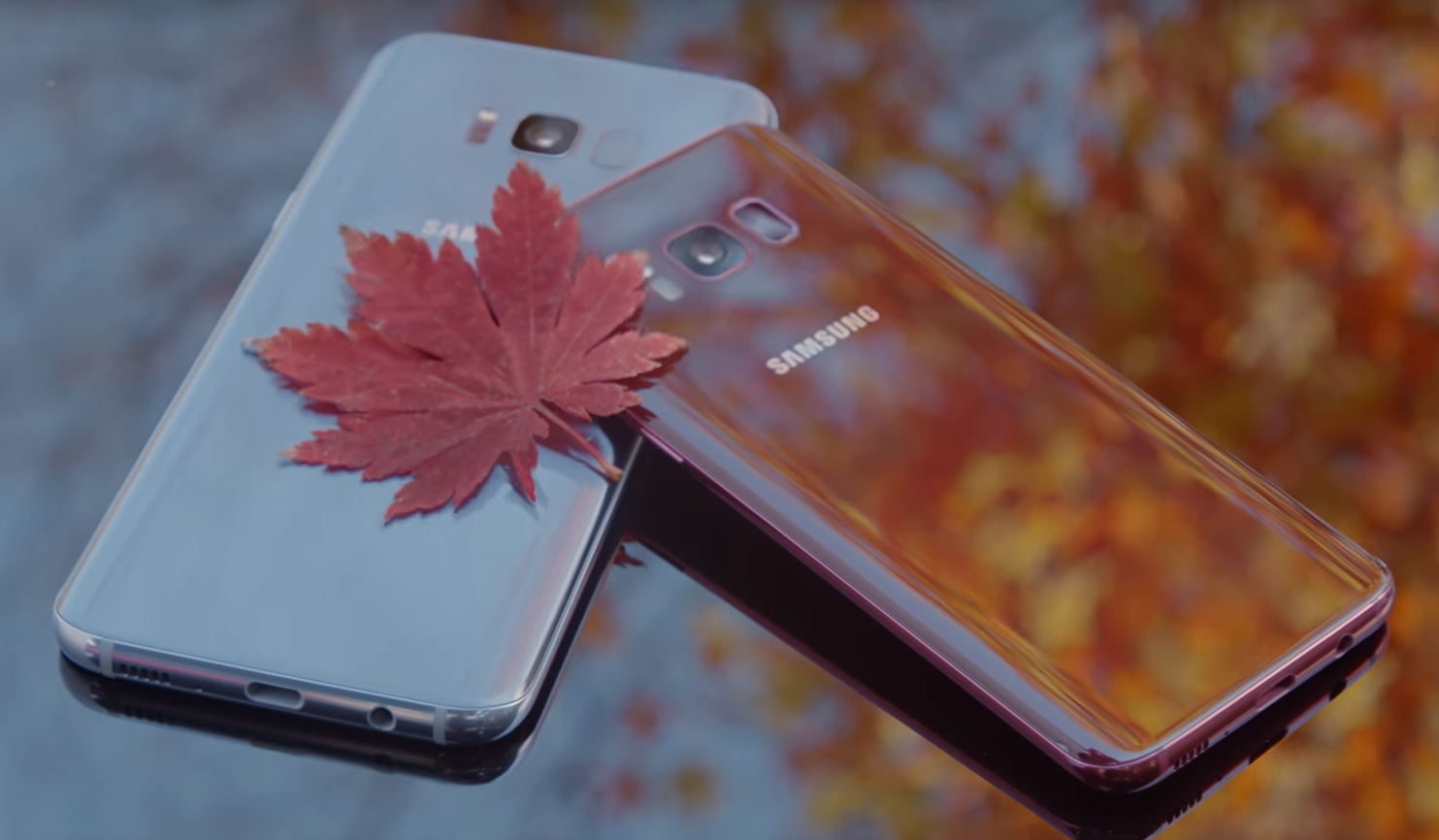
Galaxy S8 Burgundy Red
Samsung Galaxy S8 Burgundy Red Edition

Unfortunately, Eset stated that it has yet to test a lot of smartphones from other OEMs and there is a great chance of the vulnerability being more widespread. Many companies have yet to respond to the issue but so far, the above mentioned handset models are confirmed to have the issue. Similarly, the affected routers would also require the installation of the latest firmware with the required security patches to be secured.


(Via)

OPPO patent showcases 6 unique Sliding Smartphones

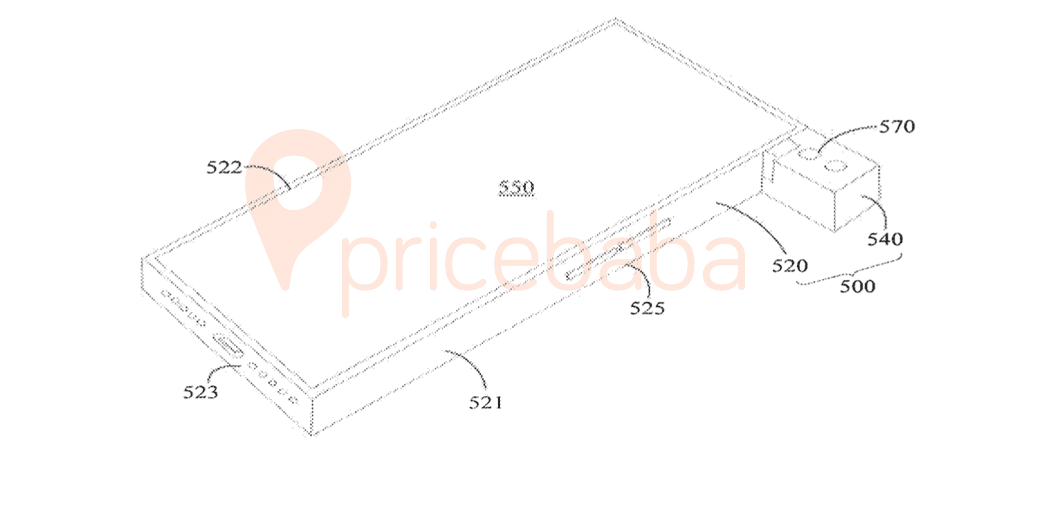
In recent years, notches in a smartphone have become a thing of the past. Nowadays, it is much more common for most smartphones in any category, ranging from budget to premium flagship, to arrive with bezels, chins, and notches, which are a lot less apparent than what was previously the norm. However, this, in turn, has also led to the development of supplementing technologies like mechanised pop up cameras and in display fingerprint readers. Now, Oppo is seemingly taking the new developments to another level with 6 next designs of sliding smartphones.

(Images Via PriceBaba)

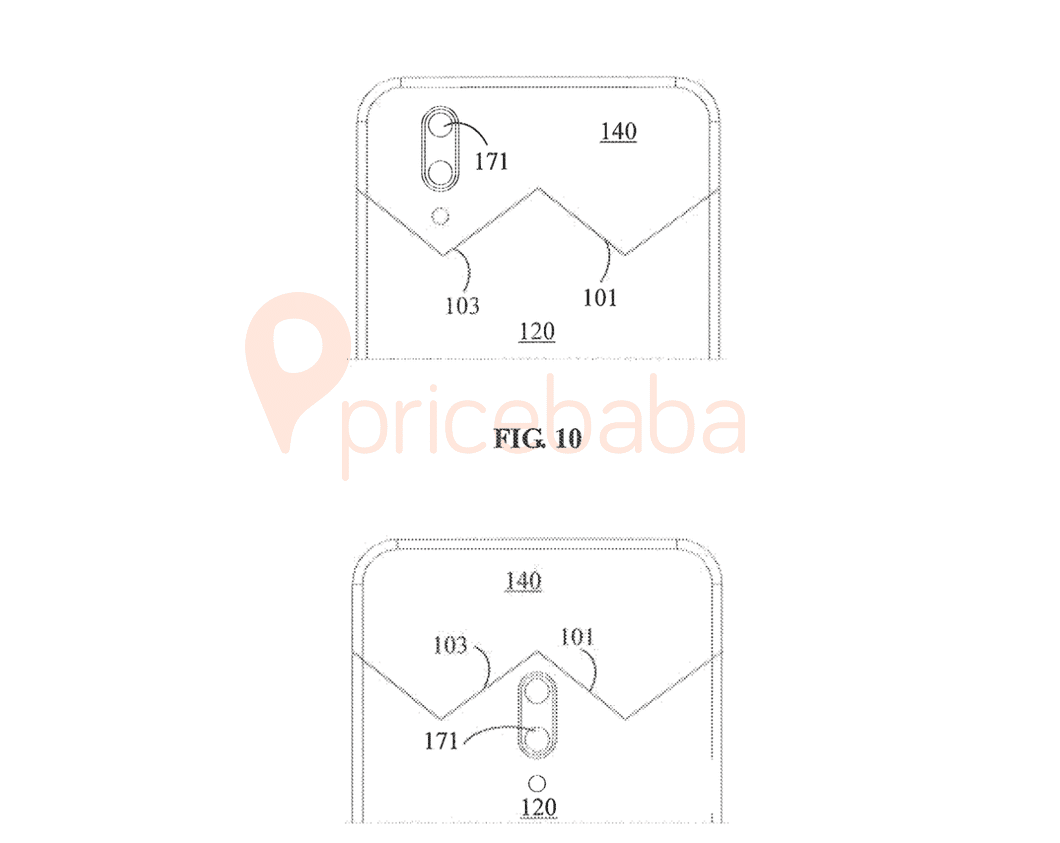
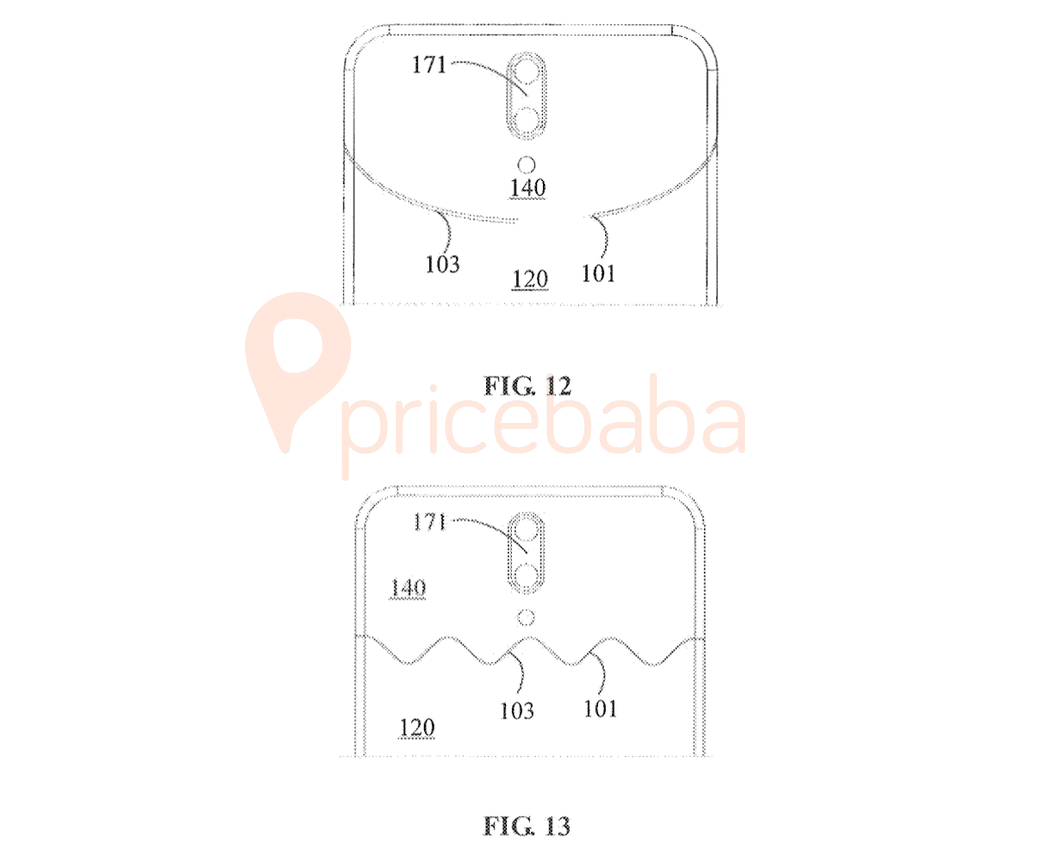
In the patent, multiple images can be found that detail the schematics of 6 different smartphones with a unique sliding mechanism. The design isn’t completely out of this world and new, and seems more like an extension of what we originally saw with the Oppo Find X. In other words, unlike the prominent curve on the top portion of the smartphones, various different patterns are found in place of it.

Oppo

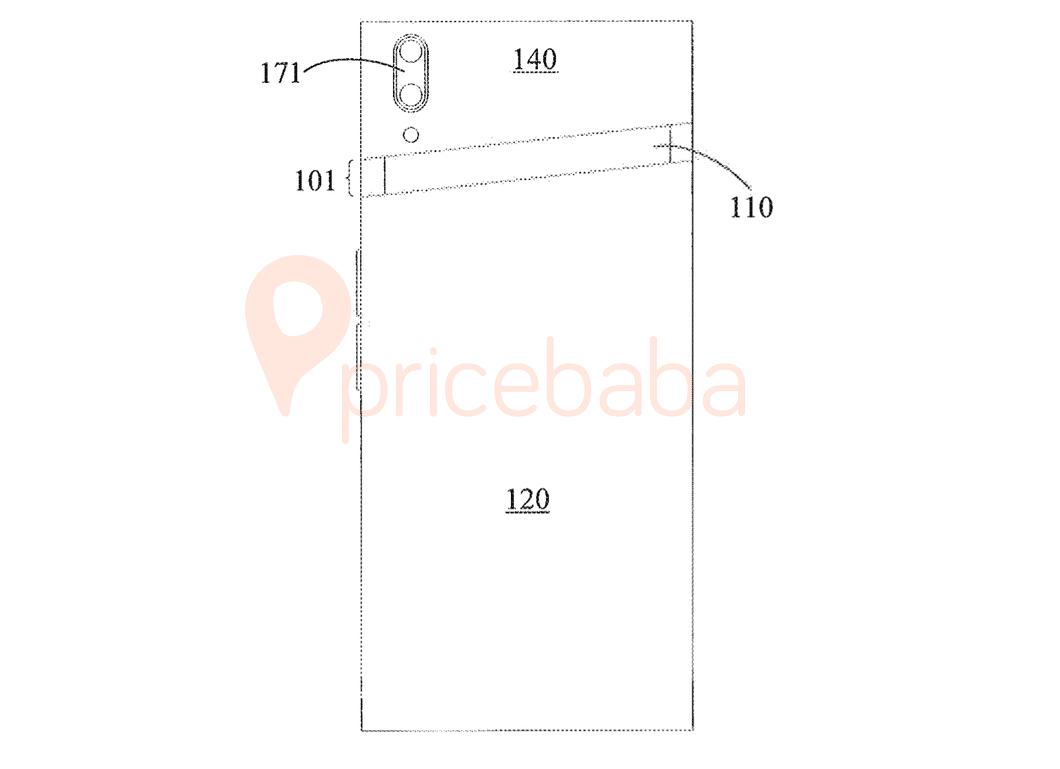
Examples of this include a zigzag pattern, a triangular pattern, a semi circle curve, a wavy structure and even a slanted straight line that highlights the portion that slides out. What unique functions these distinct designs hold are unknown and maybe more aesthetical in nature than in function. Meaning, it could possibly just be a variation of the Find X and not serve any purpose in and of themselves.

Oppo

Notably, the patented designs each sport a dual camera setup with a third cutout for the LED flash. On the front, an additional four more cutouts, which is likely for crucial sensors and another dual camera setup for selfies. One particular smartphone that stood out in the Oppo patent revealed a very interesting design. Its pop up mechanism for the dual camera module for both the front and rear slid out from the side rather than the upper regions.

Oppo

Apart from this, the only other discernable elements are the USB Type C charging port flanked by two speaker grills on the bottom of the device. Unfortunately, finer details and more information regarding these patents are currently unknown. The smartphones in the Oppo patent might just be an attempt to cover every base by the company rather than being actually seeing official development, meaning they might not ever be launched.


(Source)

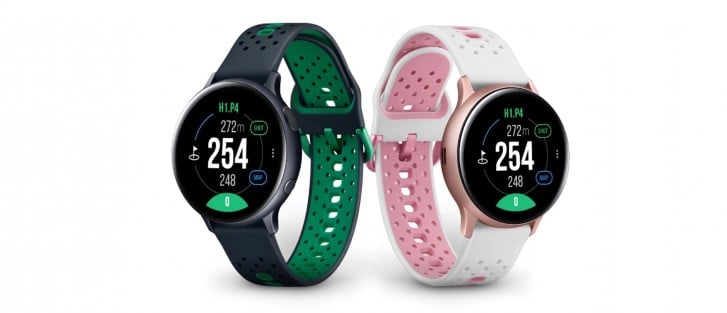
Samsung Galaxy Watch Active 2 Golf Edition announced in South Korea

Samsung just unveiled two new variants of the Galaxy Watch Active 2 in South Korea. The devices are part of the new Golf Edition, and as the name suggests is marketed towards fans of the sport. The South Korean company also unveiled the LTE variant of the aluminum Watch Active 2.

Some of the key highlights of the Golf Edition smartwatch include updated golf shot distance measurement and an in-built Smart Caddie app that stores information on over 40,000 golf courses from around the world. Samsung unveiled the Watch Active 2 Golf Edition in two variants sporting different dial sizes. While the larger 44mm variant comes in Aqua Black, the 40mm variant is available in Pink Gold.

The Galaxy Watch Active 2 Golf Edition flaunts a lightweight fluorine rubber golf strap. The device is waterproof but ventilated, offering better resistance against sweat and rain, without compromising on comfort and fashion.

Samsung Galaxy Watch Active 2 Golf Edition

Samsung Galaxy Watch Active 2 Golf Edition price and availability

While the 40mm variant of the Galaxy Watch Active 2 Golf Edition is priced at KRW 359,700 (~$295), the 44mm variant is priced at KRW 393,000 (~$323). The devices are currently listed on Samsung’s official South Korean website and are expected to be available in certain international markets including the US and UK in the near future.

Samsung Galaxy Watch Active 2 LTE price and availability

The LTE aluminum variant of the Samsung Galaxy Watch Active 2 comes in 44mm and 40mm variants. Both products flaunt three color options including Aqua Black, Pink Gold, and Cloud Silver. The Aluminum LTE variant is priced at par with the Golf Edition and will be available in Europe and some Asian countries in the near future.


Microsoft Surface products encounter a range of issues

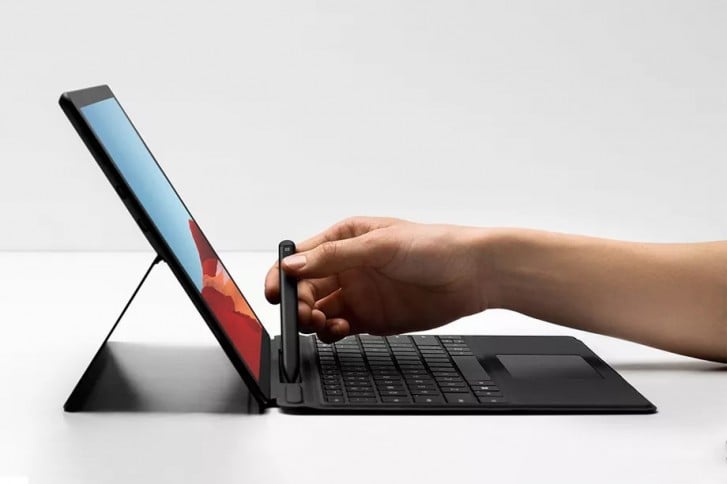
Microsoft is going through a rough patch with its range of expensive Surface products. While some Surface Pro 7 and Surface Pro X users complained of extreme accuracy problems plaguing the Surface Pen. The screens on a few Surface Laptop 3 began cracking rather mysteriously. Microsoft is yet to officially acknowledge the problem, which is swiftly turning out to be a widely reported issue.

This is one of the most widely discussed topics on Reddit and Microsoft forums, with users documenting their problems with expensive Surface devices. According to an initial assertion, the Surface Pro 7 and Pro X suffer from a software glitch causing inaccurate detection of the Surface Pen when the palm rests on the screen.

According to some users, as soon as the Surface Pro 7’s display makes contact with the human skin, the stylus starts experiencing accuracy problems, detecting between 5 and 20 pressure points instead of the intended 4096. Microsoft initially replaced a few units of the Surface Pro 7 upon receiving complaints. However, the issues soon started appearing on the replacement units.

According to one user who posted on the Microsoft forum last year, “I am having to deal with this issue quite frequently. Sometimes the stylus jumps around for more than 5mm, which makes it extremely annoying to work with. The service staff have been unable to identify the issues despite filing multiple complaints. The guys have been very cooperative, even sending me a replacement unit for other issues in the past. Unfortunately, the problems appeared in the new unit too”.

While another user wrote, “Surface Pro 7 user here. Facing the exact issues with the staircase pressure curve when touching the display simultaneously with the stylus and bare skin. Had this problem since Day 1. The issue persists on battery power and when connected directly to the power source. This is a major turnoff. Hope Microsoft comes up with a solution soon”. Judging by these reports, it seems as though the problem could be fixed with a software update. However, Microsoft is yet to acknowledge the issue.

The company is, however, dealing with the other problem quite vigorously. According to official communication, company representatives stated, “a few Surface Laptop customers have contacted Microsoft support with complaints regarding mysterious cracks appearing through the display with no fault on their part. We are investigating the claims and evaluating the probable reasons that could lead to such an outcome”.

Although this is not the first time a major manufacturer is investigating a design flaw. It presents the perfect opportunity for the company to highlight the key features of the laptop’s design. Starting with how easy it is to replace components in general. Microsoft uses screws at easily accessible joints, magnets at strategic positions, and a few pop connectors for ribbons that can easily be replaced.

Although Microsoft is not going to hand out replacement screens and a screwdriver to every customer complaining of a cracked display. The company is hunting for reasons why such a problem might arise. We might encounter an official solution addressing the issue soon.


(via)

Samsung reveals the Galaxy S20 series has a special security chip

It is not unusual that certain features of a phone only become public knowledge after the device’s launch. One example is the Pixel Visual Core chip in the Pixel 2 which we did not know about until after its launch. Now, Samsung has revealed that the Galaxy S20 series has a special security chip solution called Secure Element (SE).

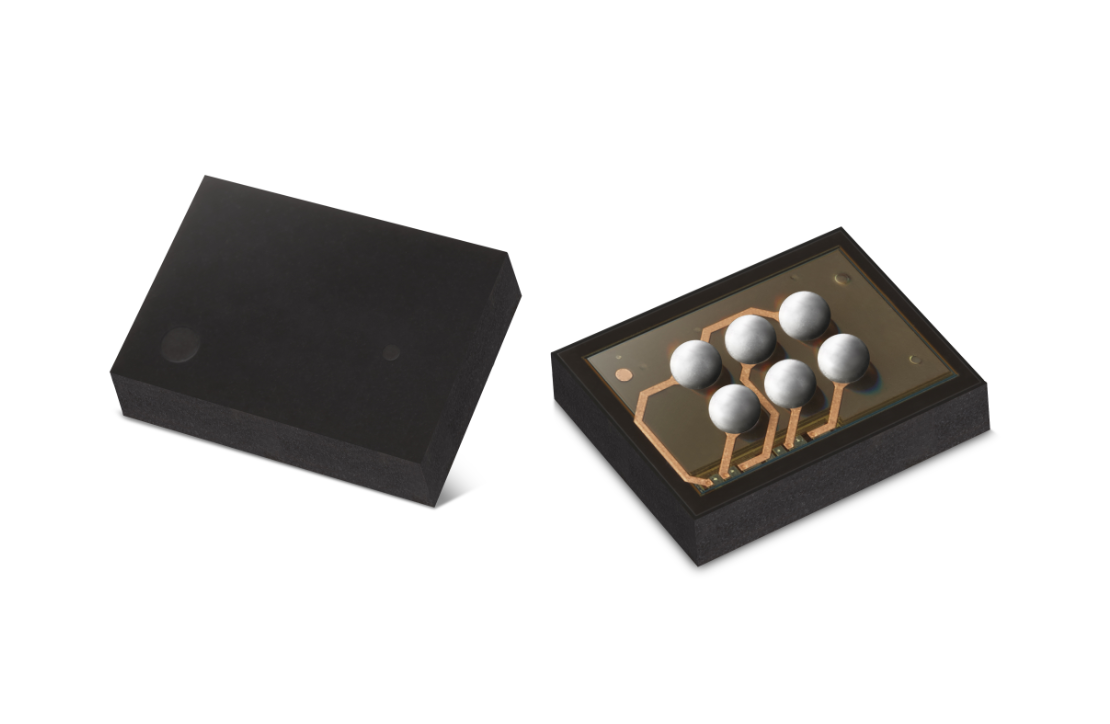
Samsung's Secure Element
Samsung’s Secure Element

The info became known when Samsung released a press statement yesterday. According to the statement, the security solution is a mix of hardware (the S3K250AF security chip) and optimized software and it is a Common Criteria Evaluation Assurance Level (CC EAL) 5+ certified hardware turnkey solution for mobile devices.

The security solution is referred to as a “tamper-resistant strongbox that stores users’ confidential data such as PINs, passwords, and cryptocurrency credentials” rather than storing it on the device’s embedded storage.

Samsung says the S3K250AF chip adds extra countermeasures to defend against possible attacks such as reverse engineering, power glitches, and laser attacks, thus making it really difficult for hackers to access or copy stored confidential data.

The press statement says the new Secure Element solution is in mass production and is present in the Galaxy S20 series. It is expected to show up in other Samsung phones and might even be adopted by other manufacturers too.

Samsung’s SE solution can be likened to Google’s Titan-M security chip present in the Pixel 3 and Pixel 4 phones. Late last year, Google announced a bug-bounty program of $1 million for anyone that can exploit the chip. We hope Samsung has something similar in the pipeline.


(Source, Via)

Black Shark 3, Black Shark 3 Pro monikers confirmed

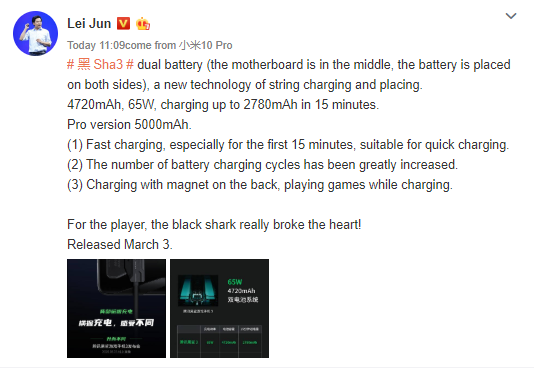
Two model numbers of the upcoming Black Shark phone such as KLE-A0 and MBU-A0 were recently spotted on the database of 3C authority in China. The same models recently surfaced on Geekbench and AnTuTu benchmarking platforms. Hence, rumors started swirling that there could be two devices in the Black Shark 3 series. Finally, an official confirmation came from Xiaomi CEO Lei Jun today. He revealed that the company will be announcing Black Shark 3 as well as a Pro model.

While there is no official confirmation yet, it is believed that the KLE-A0 phone is the Black Shark 3 and MBU-A0 is the Black Shark 3 Pro model. The latter was seen on the AnTuTu benchmarks with 12 GB of RAM and 512 GB of massive storage.

The Black Shark 3 series is all set to go official on March 3. Jun said that the Black Shark 3 Pro will be arriving with a massive battery of 5,000mAh capacity whereas the Black Shark 3 will be equipped with a 4,270mAh battery. Both models will arrive with support for 65W fast charging technology. On the Black Shark 3 handset, the 65W fast charging will allow it to gain 2,780mAh capacity in just 15 minutes. The batteries on both phones will be a two-cell construction.

As confirmed earlier today, apart from the regular way of charging the phone through USB-C, the Black Shark 3 series will feature a special magnetic connector on the rear which will let the user charge the handset while playing games. The Black Shark 3 and Black Shark 3 Pro are both expected to arrive with 3.5mm audio jack.

The Black Shark 3 duo will be coming with 120Hz refresh rate screens that will deliver quad HD+ resolution along with 270Hz touch sampling rate. The Snapdragon 865 mobile platform will be present under the hood of both smartphones. At present, it is unclear what sort of benefits the Pro model will be arriving with. With few more days remaining for the launch event, the Chinese firm is expected to reveal more details on the Black Shark 3 series.


(source)

Huawei Mate Xs reservations to soon cross 400K mark on Vmall

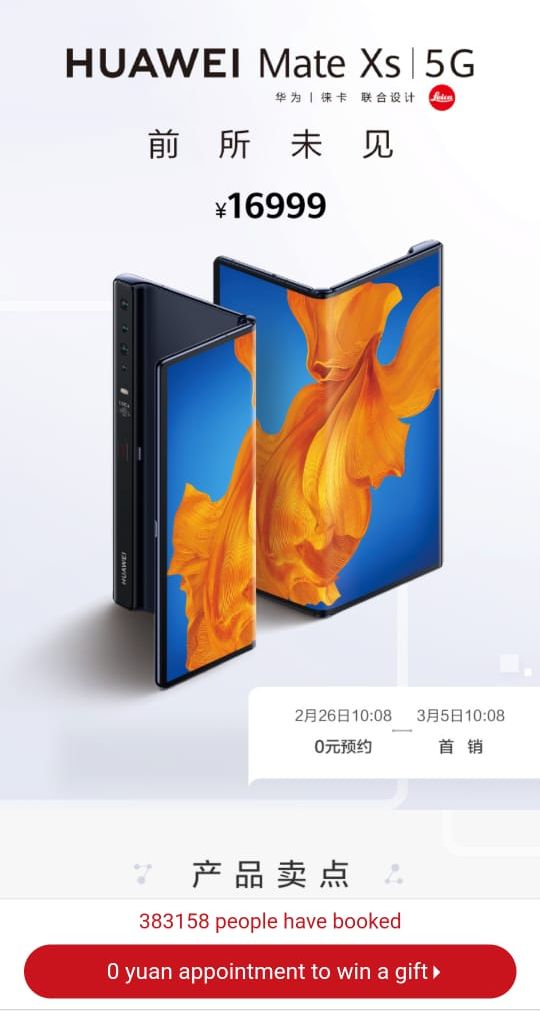
On Monday, Huawei had unveiled the Huawei Mate Xs foldable phone which arrived as the successor for the original Mate X from last year. Since yesterday, the Mate Xs is available for reservations in China through leading online retailer sites including Huawei’s Vmall. It appears that the Mate Xs will be receiving stupendous response in the home market as its reservations crossed 383K mark at the time of writing.

On JD.com, nearly 150K people have registered for Mate Xs and Suning received around 105K reservations at the time of writing this post. The reservations are soon to cross 500K mark on Vmall. Such is the popularity of the Mate Xs that comes with an improved processor and refined design along with an improved hinge mechanism over its predecessor.

The Huawei Mate Xs will be available for purchase starting from March 5. The device is priced at 16,999 Yuan (~$2,424) in China. The China pricing of the foldable phone is same as its predecessor model. In Europe, the Mate Xs will be costing 2,499 euros (~$2,732) and it is scheduled to be available for pre-orders from March 2. Other global markets are also expected to receive the Mate Xs in the coming month.

Huawei Mate Xs specifications

The Mate Xs is a Kirin 990 5G and 8 GB RAM powered foldable phone with a flexible OLED display of 8 inches that offers 2200 x 2480 pixels. The camera setup of the device includes a 40-megapixel main sensor, an OIS enabled 8-megapixel telephoto sensor, a 16-megapixel ultrawide shooter and a ToF sensor. The 4,500mAh battery of the Mate Xs supports 55W rapid charging. The phone does not feature Google apps, but comes with latest EMIU 10 based Android 10 OS. The phone offers a massive native storage of 512 GB.


(source 1, 2, 3)

Patent reveals Samsung wants to Reimagine how you close, minimize apps on your smartphone

Although smartphones have been increasing in power recently, however, the software behind it, while not stagnant, has still been largely untouched. Take Android for example, apart from various different custom UI skins, the vanilla Android OS has been featuring the same few buttons to minimize, close and relaunch apps for multitasking. But now, a recently surfaced patent from Samsung reimagines the entire functionality.

Samsung
Samsung patent reveals a Windows like multitasking/minimizing and closing function

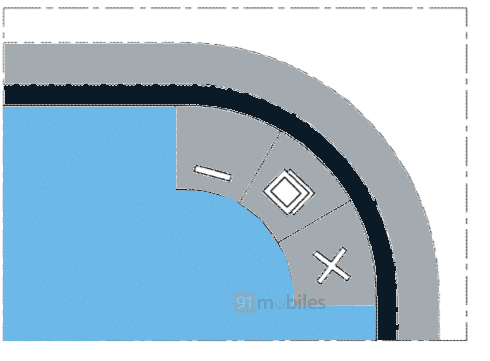
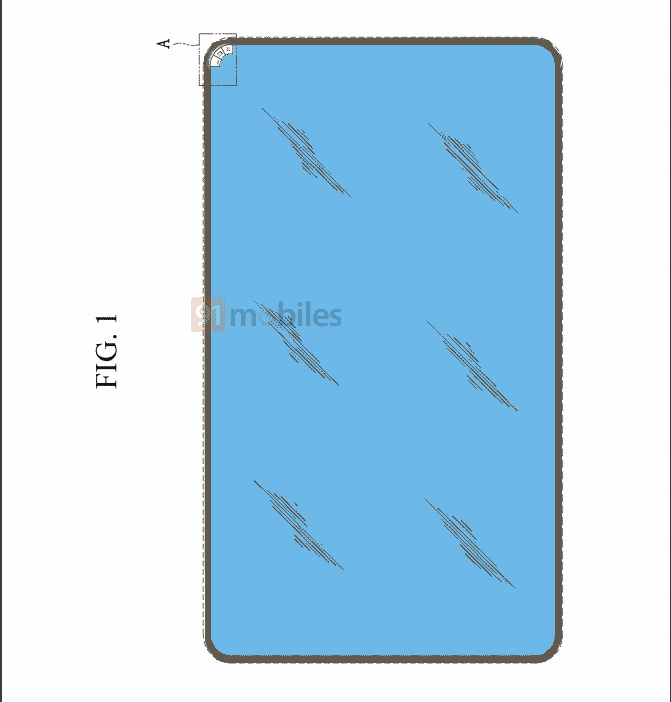
The new patent details of a new method which bears a striking resemblance to Microsoft’s Windows functions. Looking at the images provided in the patent, the iconic Windows close and minimize keys can be seen alongside a multitask function. Samsung had initially filed this patent with the United States Patent and Trademark Office (USPTO) on 16th October 2017, which has now been finally granted.

According to the patent, the South Korean tech giant may be working on a Windows like buttons on the top corners of a smartphone. Three distinct buttons can be observed that line the round edges and serve the purpose of closing an app, minimizing it or even bring up other apps in the background. The device that carries such a feature in the patent seems like a tablet device. Meaning, that such a UI could potentially be seen in the near future on Galaxy Tab devices or other large screen products.

Samsung
The patent reveals the new UI feature on a larger screen device

Currently, Samsung uses the proprietary One UI skin on its Galaxy smartphones and tablets. This was an upgrade from its TouchWiz UI. So, a future version or successor to the One UI could possibly arrive with such a feature on both smartphones and tablets. This could potentially raise the productivity on either category of gadgets and will make switching between apps much more smooth, potentially.


(Via)

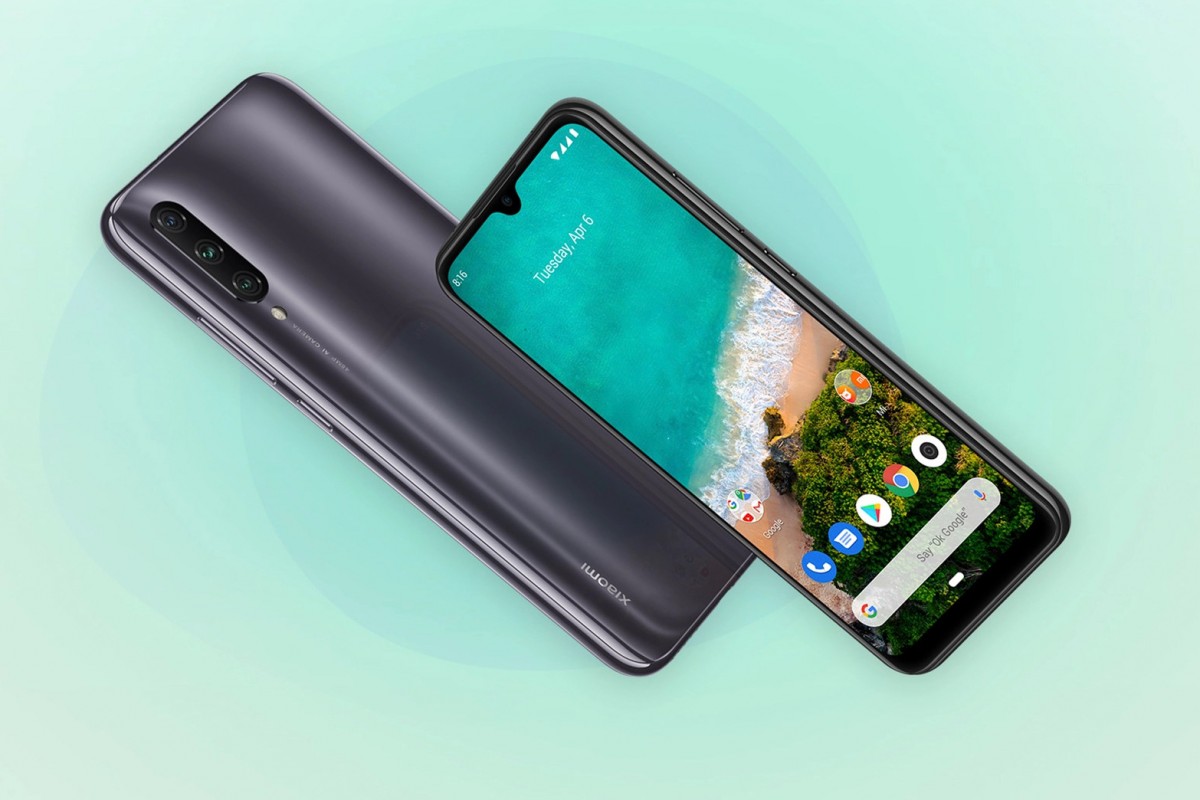
Xiaomi delays Android 10 update for Mi A3 due to the Coronavirus Outbreak

Xiaomi had initially planned on rolling out the Android 10 update for the Mi A3 sometime in the middle of February 2020. However, since then, the month is almost over and no signs of the update were seen, and now a Xiaomi executive has revealed that Android 10 has been delayed due to the ongoing Coronavirus outbreak.

The Xiaomi India executive broke the news earlier today (27th February 2020) on his official Twitter account. According to him, many had reached out to the Chinese tech giant regarding the update which was due. Although rather than a specific date, it has been confirmed that the update has been pushed back due to the recent epidemic being faced by China.

The tweet from Sumit Sonal, Brand Lead for Xiaomi India, arrived in two parts to better explain the situation. The delay was caused due to the Chinese Government’s mandatory shutdown, something which was unavoidable. Furthermore, the tweet carried no specifics date for the update but does mention that the company is working on gaining the final certification for Android 10. This means that a rollout is not far off.

For those unaware, China has recently been facing one of the worst epidemics in history. The new strain of Coronavirus is highly contagious and has already spread to numerous countries worldwide, although the harm as mostly contained in foreign nations. It is known to cause symptoms similar to cold and leads up to pneumonia and has already caused a death toll of over 2,000 with thousands more suffering from the same.

Xiaomi Mi A3
Xiaomi Mi A3

The virus originated from the Wuhan province in China, which has since been quarantined while the local government put a ban on various factories, offices, and various other regions with a high number of workers. So the delay arrives as no surprise and we will have to wait for an official company announcement for an actual date for the update rollout.


Upcoming Redmi smartphone to support NaVIC

Upcoming smartphones from Xiaomi will feature NaVIC (NAVigation with Indian Constellation) support, according to the latest rumors floating around the internet. This is not surprising since just last year Xiaomi was in talks with the Indian Space Research Organization (ISRO) to implement their navigation system in handsets sold in India. The Managing Director of Xiaomi India, Manu Kumar Jain recently confirmed that Xiaomi’s upcoming Redmi smartphone in the country will support NaVIC. 

The device is also the first globally to flaunt the technology. Xiaomi did not reveal what they plan on naming the device. The MD had posted a picture with ISRO Chief Dr. K Sivan after a meeting regarding NaVIC last month.

Soon after the meeting, Xiaomi confirmed it will be using the Qualcomm Snapdragon 720G SoC on its upcoming smartphone. The SD720G is the world’s first chipset to feature NaVIC support. Rumors suggest that the handset could be placed under the Redmi moniker, judging by Xiaomi’s release cycle.

Xiaomi launched the Redmi Note 5 and the Note 7 previously in February. If it aims for a similar launch, the Redmi Note 9 or any of its variants might be the likely candidate to arrive with NaVIC support. The said SD720G powered Redmi phone could be arriving as a rival for the Realme 6 Pro which is said to be equipped with the same SoC. The Realme 6 series will be made official on March 5.

Xiaomi will be looking at announcing its own entrants to counter Realme’s rising influence in the segment. Additionally, the SD720G fits the bill as the chipset is designed for mid-range Android handsets, an area the Redmi brand specializes in. If Xiaomi’s NaVIC-supported smartphone is indeed placed under the Redmi banner, the company might make a surprise announcement soon.

ISRO created the NaVIC, short for Indian Regional Navigation Satellite System or IRNSS, for aerial, marine, and terrestrial navigation, vehicle tracking, fleet management, and quick response to disasters. The system can easily be integrated with smartphones. While the advanced features will be locked for the general public, available only to special permit holders. NaVIC is capable of providing location accurate to 20 meters and less within its operating zone, which is the Indian subcontinent and its bordering regions. Allied neighbors like Nepal and Bhutan will benefit from NaVIC.


Huawei and Samsung smartphones may use GaN to charge smartphones even faster in the near future

As of right now, various industries related to electronics and technology utilize silicon as the primary choice for the semiconductor materials. However, a new report suggests that a new more efficient material might arrive soon as multiple smartphone OEMs are expected to adopt this new material for future products.

According to the report, major smartphone brands like Huawei, Apple, Vivo, Oppo, Samsung, and Xiaomi are all preparing for the adoption of a new breed of chargers. Its big news considering the new products that will be sold may be equipped with gallium nitride (GaN). This compound is a semiconductor material that offers certain notable advantages over silicon, thanks to its higher bandgap.

Huawei
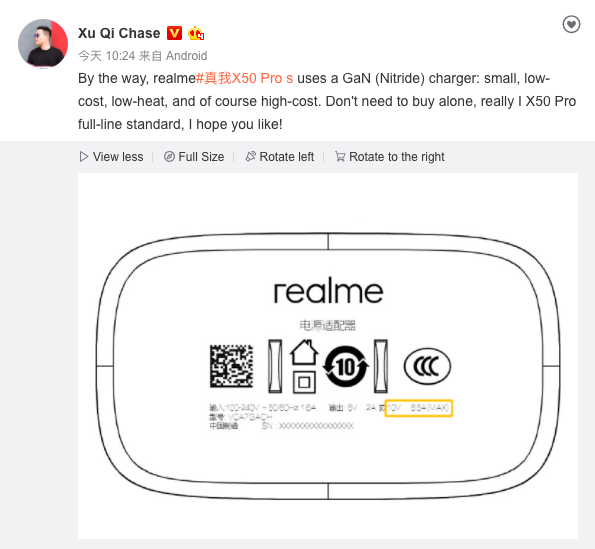
Realme GaN 65W fast charger

In simpler terms, each atom in the GaN can hold and provide more energy than its silicon counterparts. This results in a much higher power delivery capacity in an even smaller charger size, making it both efficient and portable at the same time. Reportedly, the new improvements in technology could see new generations of fast chargers capable of outputting 65W of power, resulting in a vast improvement of fast charging standards compared to today’s technology.

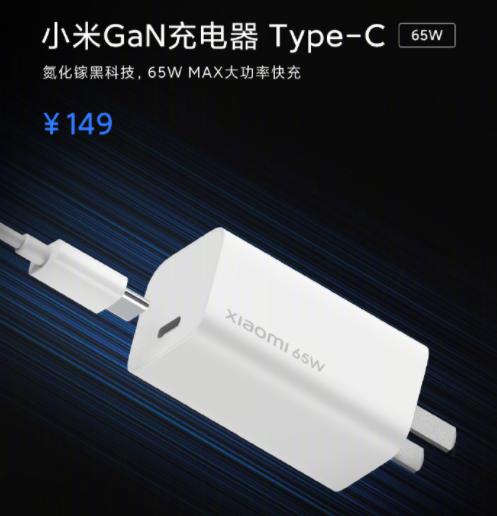
Although the technology is yet to see widespread adoption, a Chinese company, Xiaomi, has already started offering such chargers. The Mi 10 Pro arrives with a 65W GaN fast charger, so it is safe to assume that the industry will catch up soon. The smartphone market is a highly volatile market and staying up to date and innovative is what keeps OEMs from being left behind by the competition. Thus other Chinese brands like Huawei or Oppo will quickly adopt the new technology and material as well.

Huawei
Xiaomi’s 65W GaN fast charger

Apple is an interesting addition to the list of near future adopters. The Cupertino based giant is infamous for being slow in the integration of technologies it has not developed on its own. This holds especially true in the fast charging fields. The best example of this is the meager 5W charger the iPhone 11 still ships with out of the box. So it may seem like a significant jump from the company to 65W, especially for a relatively new technology.


(Via)

India’s first Apple Store to open in 2021, confirms CEO Tim Cook

Apple Inc. has been operating in India for the greater part of the last decade through third-party resellers. The scenario is set to change very soon with CEO Tim Cook announcing that the company plans to establish its first retail outlet in the country by 2021. Cook went a step ahead answering questions about Apple’s India strategy, which also includes online reselling starting later this year.

Tim addressed the shareholders at the Apple annual conference on Wednesday, confirming plans of setting up an online store by Q3 2020, and a brick-and-mortar store by the next year. Speaking on the topic, Cook said, “I am a firm believer in the opportunities in India. The vibrancy here and the demographics are simply unparalleled”.

According to Cook’s official statement, Apple’s decision to operate in India is largely due to the fact that the company did not want third-parties to run the brand. Apple has been running its Indian franchises through third-party resellers due to the government’s restrictions on stores owned by non-India firms. Forcing them to depend on local resellers for sales and after-sales services.

Cook further stated, “We are not the best firm for partnership. We like to do things our way”. The Indian government has recently loosened the rope around foreign companies operating independent stores in the country. This coupled with the fact Apple recently set up an assembly point in the country, opening up avenues for export, adding to its 30% local resource collection, which has worked in its favor.

Rumors around Apple purchasing a 25,000 sq ft property in Mumbai’s Maker Maxity mall surfaced late last year. While one floor is expected to be Apple’s experience center, another would be dedicated to sales, and a third for after-sale service.

This is a strategic decision by Apple as they have been looking for ways to indulge the growing audience with its array of products for a long while. The road was challenging due to the high prices associated with Apple products. According to a Counterpoint Research, the average price of smartphones sold in India is around $150. While Apple has continuously been requesting the government to offer tax respite for quite some time, nothing materialized until its two major suppliers, Foxconn and Wistron, started assembling products in India.


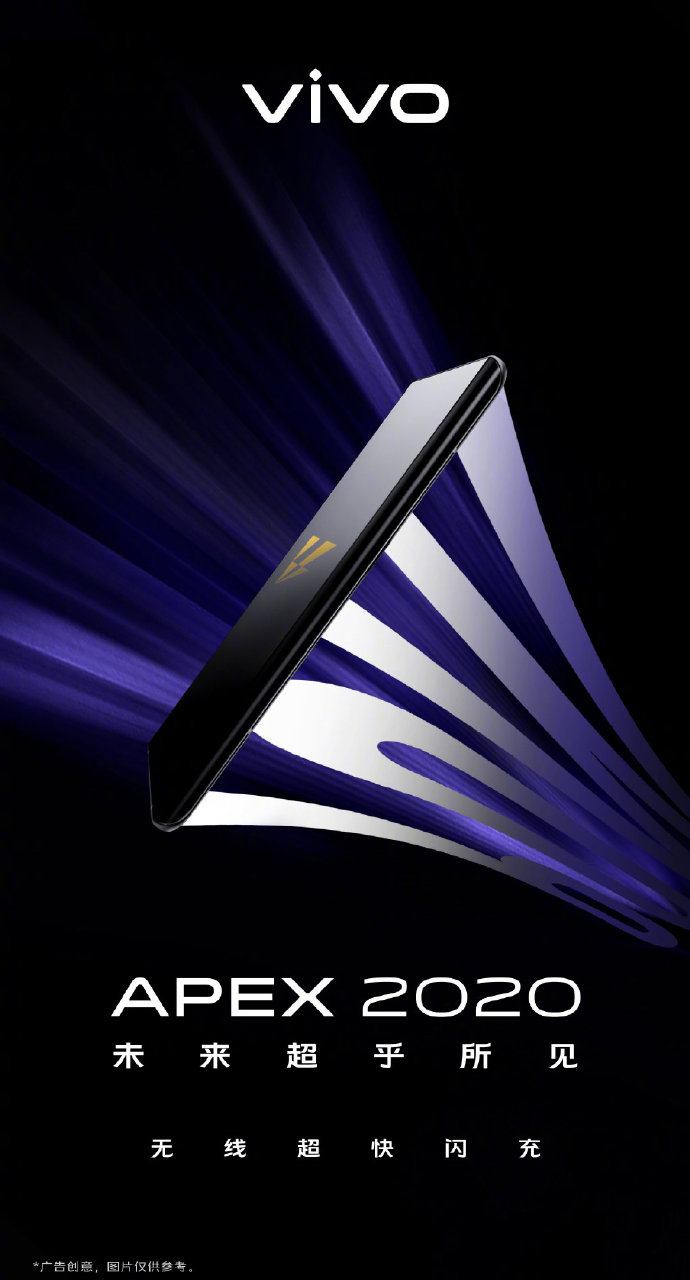
Vivo APEX 2020 to arrive with ultra-fast 60W wireless charging

Vivo APEX 2020 will be unveiled tomorrow at 4 PM (local time) in China. Ahead of the launch, the Chinese firm has been consistently spilling information on the innovative features that will arriving on the APEX 2020 concept phone. Today, the company released a new poster which hints that the phone will possess crazy 60W fast wireless charging technology.

Vivo has shared a new poster on Weibo which showcases the APEX 2020 phone with “60W” mentioned behind it. The machine translated text of the Weibo post reads that the APEX 2020 will not amazing display and imaging capabilities, but also it will offer ultra-fast flash wireless charging. There is no information available on the battery size of the APEX 2020.

Vivo APEX 2020 60W

In theory, the blazing fast 60W wireless charging technology seems twice faster than 30W wireless charging feature available on Xiaomi Mi 10 series. The other phones that come with rapid wireless charging are 30W on Huawei Mate 30 Pro and 25W on Samsung Galaxy S20 series. Considering the fact that the APEX 2020 will come with 60W wireless charging, it may offer even faster wired charging capabilities.

Past reports have revealed that the Vivo APEX 2020 may come with a marvelous curved display that will offer full screen experience. It may support a high refresh rate of 120Hz. The teasers of the smartphone have revealed that it will be equipped with a round-shaped camera module that will house first of its kind PTZ (Pan Tilt Zoom) camera. The APEX 2020 is expected to offer 5x to 7.5x optical zoom capabilities. The Snapdragon 865 mobile platform will be powering the device. The other specifications of the smartphone are still a mystery.


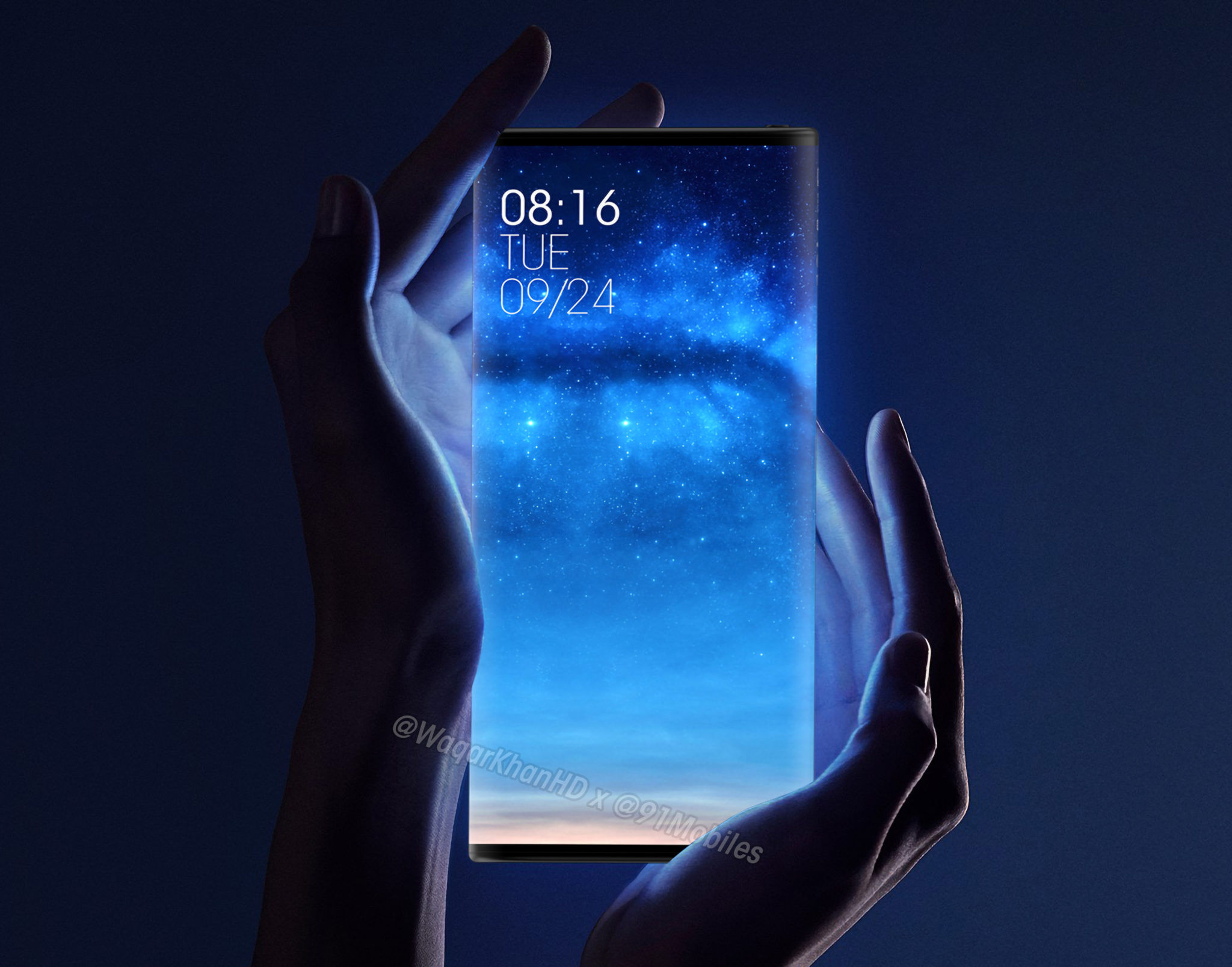
New Xiaomi Concept Renders reimagines a practical version of the Mi Mix Alpha

Back in 2019, the world was introduced to Xiaomi‘s Concept smartphone, the Mi MIX Alpha. It was one of the first of its kind from the brand and arrived with a very unique and interesting design. However, the smartphone was never intended to be mass produced, even though an executive claimed it was possible and was only going to be sold in limited quantities. But a new concept render reveals, that may be a more practical version might be in the works.

Xiaomi
Image Via 91Mobiles

The Xiaomi Mi MIX Alpha arrived with a futuristic aesthetics and a flexible display that almost completely wrapped around the entire smartphone’s body. This allowed it to achieve one of the highest screen to body ratio and also forego physical buttons, with the volume rockers being added on the touch capacitive sides. Notably, we have previously covered the patented design of this concept render.

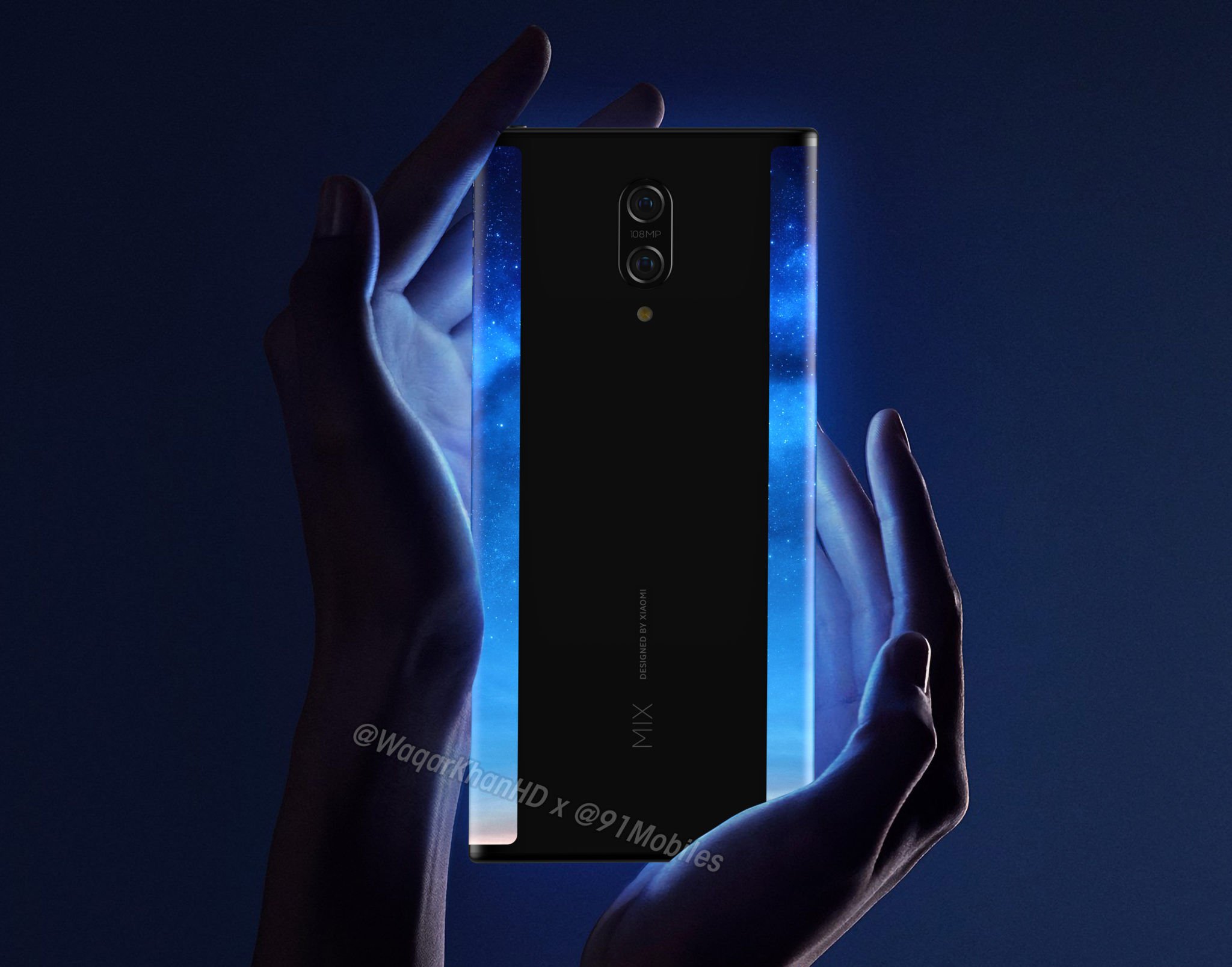
Xiaomi
The rear panel is what makes the Xiaomi Mi MIX concept render a lot more practical than the original Mi MIX Alpha

However, its highlighting feature, which was the display, is also what makes it technically impractical, as laying it on the back could still make it prone to scratches on the display. Thus, the new concept renders reveal a more practical solution, with the screen still wrapping around the edges but not as prominently as the Mi MIX Alpha.

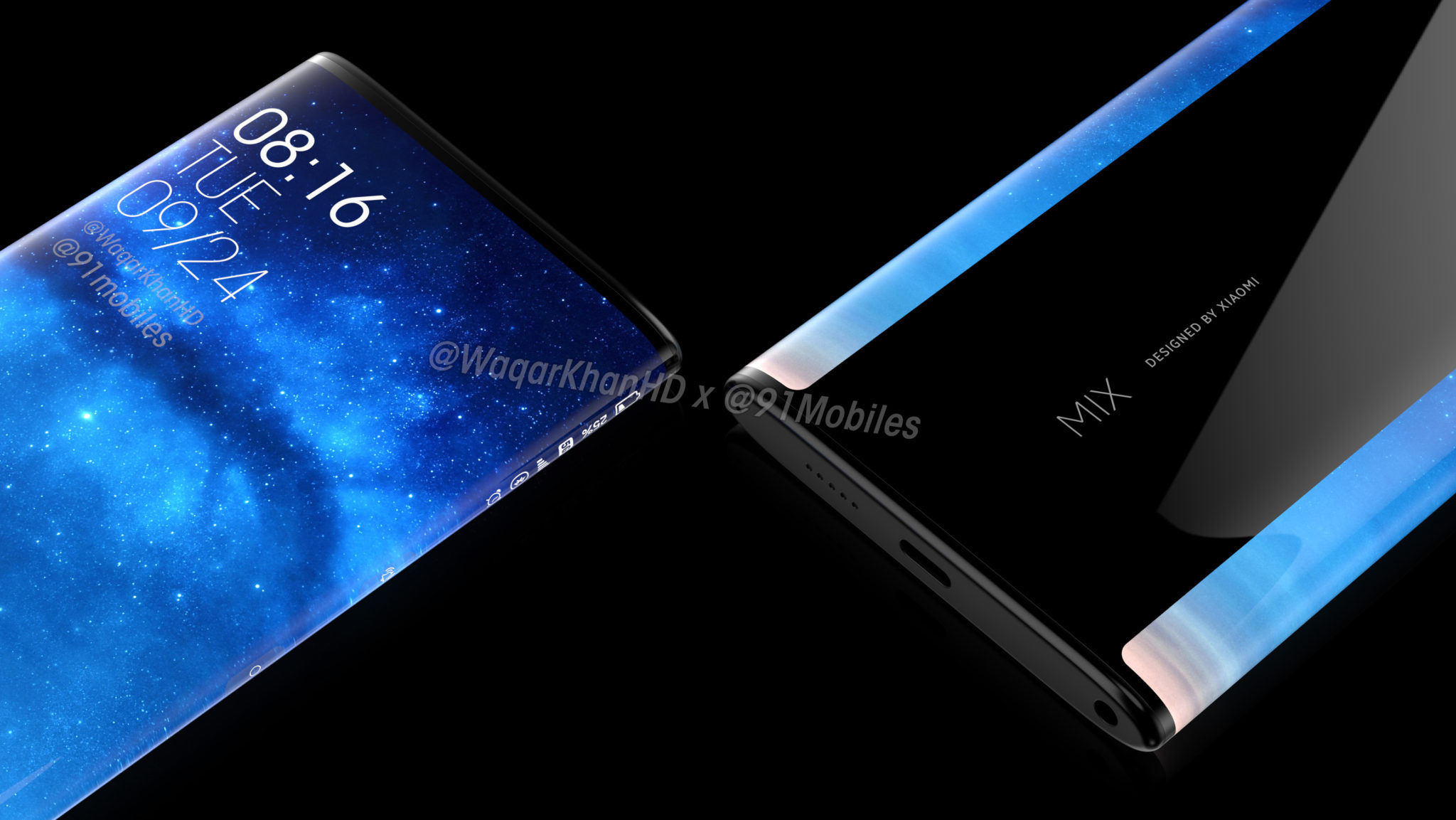
Reports have touted it to be both the commercial version of the same or another altogether, namely the Mi MIX 4. Looking at the renders, it can be observed that the front is mostly covered by the display with a minimal notch at the top and bezels at the bottom. On the rear, the device features a dual camera setup in the top middle and has a lot more rear coverage than the concept smartphone.

Xiaomi

Under the hood, the leaked specifications claim that the Mi MIX device in question will sport Qualcomm’s Snapdragon 865 SoC. Furthermore, it will feature up to 12GB of RAM and up to a whopping 1TB of UFS 3.0 or 3.1 storage. The handset will be powered by a 4,500mAh battery which will support 45W fast charging alongside 30W wireless charging as well. For photography, a 108 megapixel image sensor is rumored while the front will feature a pop up camera of unknown make.


(Via)

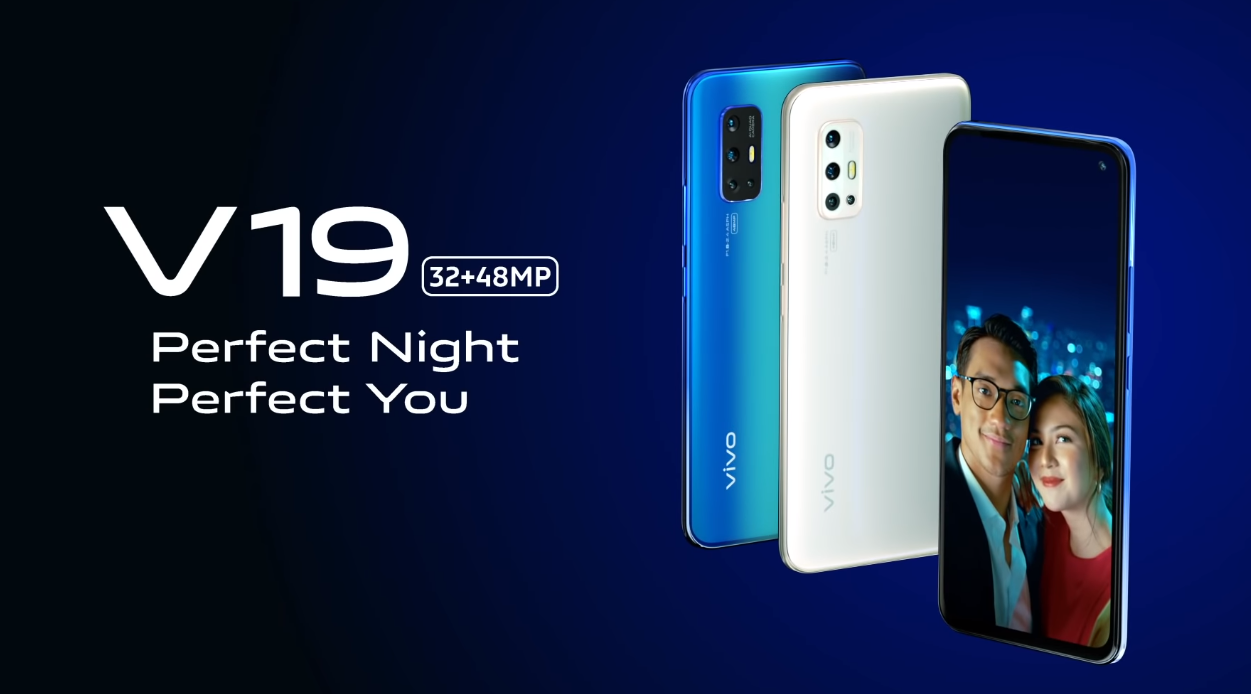
Vivo V19 to launch date confirmed as March 10 for Indonesia; Promo video reveals full design

Past reports had claimed that the Vivo India will be launching the Vivo V19 smartphone by early March. However, the company hasn’t officially confirmed on its arrival in the country. The Indonesian division of Vivo has now confirmed that the Vivo V19 smartphone will go official on March 10 in Indonesia. The promo video of the smartphone showcases the design of the Vivo V19 phone.

Vivo V19 10th March Launch

The Vivo V19 smartphone promo video reveals that it is equipped with a punch-hole screen. The display of the phone is surrounded by super-slim bezels. The bottom edge of the device has a USB-C port placed between a 3.5mm audio jack and an external speaker. The volume rocker and a power key.

The promo video further reveals that the key features of the smartphones such as gaming capabilities, AR stickers for selfies, low-light selfie photography and more. The glass rear of the smartphone has a rectangle-shaped camera setup that includes four cameras in L-shape arrangement along with an LED flash. The main sensor in the camera setup is a 48-megapixel lens. For shooting selfies, the phone possesses a 32-megapixel. The other specifications of the smartphone are currently under the wraps. The phone can be seen in blue and white colors.

The Vivo V19 for Indonesia seems to be a rebranded version of the Vivo V17 that went official with 32-megapixel selfie and 48-megapixel quad cameras in December 2019 in India. In fact, the design of Indonesia’s upcoming Vivo V19 matches with that of India’s Vivo V17. Hence, it appears that Vivo will be rebranding India’s Vivo V17 in Indonesia as Vivo V19. It is advisable to wait for further reports to confirm on it. A recent report had revealed that the Vivo V19 for India will be equipped with a dual punch-hole display.

Vivo V17 (India edition) specifications

The Vivo V17 has a 6.44-inch S-AMOELD punch-hole display that offers full HD+ resolution and 20:9 aspect ratio. The FunTouch OS 9.2 based Android 9 Pie OS runs on the device. The Snapdragon 675 mobile platform, 8 GB of RAM and 4,500mAh battery with 18W fast charging technology powers the Vivo V17.

The Vivo V17 possesses a front-facing camera of 32-megapixel. It has a 48-megapixel + 8-megapixel (ultrawide) + 2-megapixel (macro) + 2-megapixel (depth) quad camera setup. The smartphone is selling with a price tag of R. 22,990.


Huawei opens a brand new retail store in Barcelona, right in front of Apple’s store

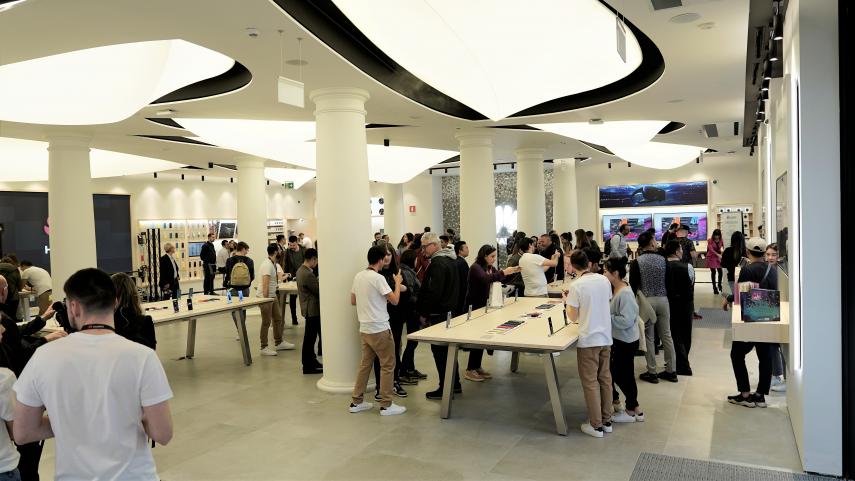
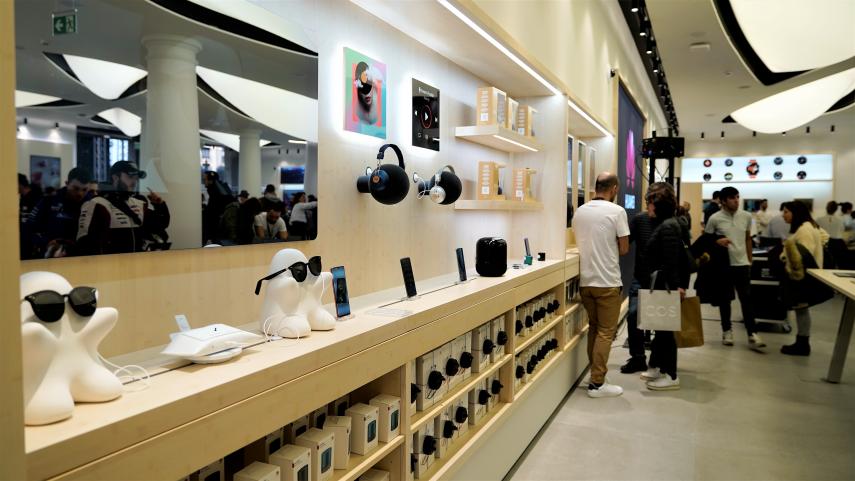
Huawei has just opened a brand new retail store in Barcelona. It is the second physical outlet from the company and has also opened directly opposite to an Apple store. However, one of its most noteworthy aspects is that its interior aesthetics are remarkably similar to Apple stores.

Huawei
Huawei recently opened a retail store in Barcelona, Spain, which resembles the design and aesthetics of an Apple store (Images via Computer Hoy)

The new Huawei store officially opened earlier this week, on 22nd February 2020, since it was supposed to launch with the MWC 2020 event in the same region. Although the major event was canceled, the Chinese tech giant has proceeded to inaugurate the store regardless. The area of the new store is a sizeable 750 square meter space of retail store which is spread over two floors.

Huawei
Many drew out the similarities in design and and product placement

Furthermore, the Huawei store offers many different and unique equipment that allows users to experience the company’s technology. It arrives with artificial intelligence, multimedia tools, workshops, exhibitions, and even thematic experiences. All of this is to attract more people into the Huawei electronic ecosystem. The store also has various experts and employees that specialize in the area one is present in and the gadgets around them, with a total team of about 20.

Notably, this makes the store the second Huawei outlet in the region and marks the company’s strategy of further expanding in the European regions. However, since its official launch, many customers and others have noted its peculiar similarity to Apple’s aesthetics and interior design. According to certain netizens, there is a blatant “theft” in identity which is clear as day.

Huawei
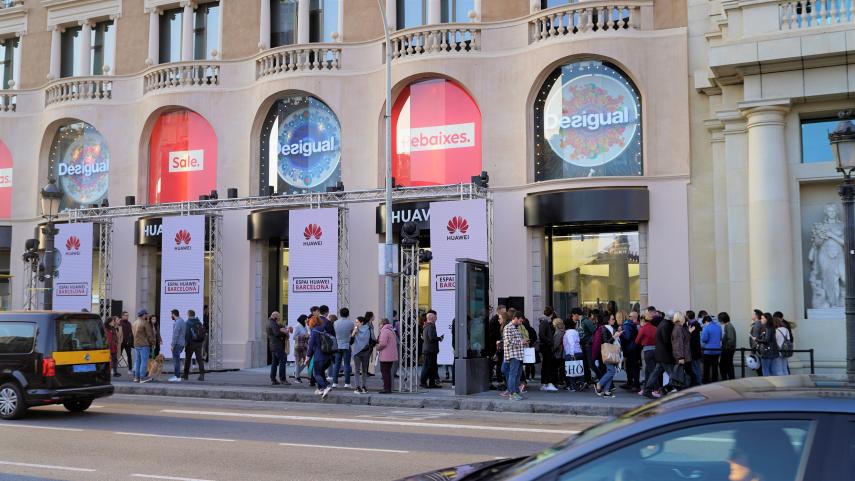
The brand new Huawei store has been inaugurated directly opposite to an Apple store

Another interesting point is that Huawei has opened the store directly opposite to an Apple store. This also signifies a rivalry of sorts, since historically, Huawei has been known to be “inspired” by the Cupertino based giant’s products and interior designs as well. Another good example of this is the Huawei Global flagship store in Shenzhen, China, that looks a lot like an Apple store from the inside. Lastly, the store isn’t the only one that has bee inaugurated in the country as Huawei already has plans to open a third store later on during the first half od this year in the La Gavia shopping center in Madrid.


(Via)

Buy Deerma DEM – SJS600 Purifying Humidifier for a Lowered Price of Just $61.99 from Gearbest

Touted as one of China’s most reliable e-tailers, Gearbest offers a wide range of products across multiple categories at unbeatable prices.  Staying true to its reputation, the Chinese online store is currently offering the Deerma DEM – SJS600 Purifying Humidifier for a lowered price.

Deerma DEM - SJS600 5L Large Capacity Purifying Humidifier

A product from one of Xiaomi’s ecological chain companies Youpin, the Deerma DEM – SJS600 usually retails for $103.32, but Gearbest is giving its loyal users a chance to purchase this purifying humidifier for a dropped price of just $61.99. This 40 percent discount is specifically valid for the white color version.

A combo of air purifier and humidifier, the Deerma DEM – SJS600 offers three easy ways to add water. You can add water directly, or to the cover or simply lift the tank to add water. It has a large 5L capacity, which is equivalent to 20 pieces of 250ml mineral water.

Deerma DEM - SJS600 5L Large Capacity Purifying HumidifierThe Deerma DEM – SJS600 can efficiently continue to moisturize for twelve hours. Aside from offering three adding water methods and 5L large capacity, the device comes with UV lamp purification, and patent electromagnetic hydration.


Furthermore, it uses triple protection of the water tank to keep users safe from contamination. It has an easy-to-clean large caliber, a dirtless flat bottom and activated carbon that eliminates impurities.

There is an aromatherapy box with essential oil filter cotton placed on the side that can be pulled out easily, allowing you to make your favorite aroma. On top of that, it has an ambiance light, including an orange light that indicates a humidification state and a red light that hints at water shortage.

You can visit this link to check out more details about the Deerma DEM – SJS600 Purifying Humidifier and place your order. It is worth noting that the flash sale is slated to end in just one day.

The Gizmochina Coupons is a community that finds, reports and evaluates deals and coupons of Chinese products from online shops. Please visit it here to find more coupons to save money on mobiles and smart gadgets.

Honor Magic Watch 2 Sakura Gold is now up for reservation in China

Huawei’s sub-brand Honor had launched its new smartwatch named Honor Magic Watch 2 in China last year. Today, the company has launched a new variant of the same device, dubbed Honor Magic Watch 2 Sakura Gold.

The newly launched color scheme has simple and elegant look and gives the smartwatch a luxurious, young and energetic feel. The device, which seems to be targeted at women, is now up for reservation in China.

It carries a price tag of 1,399 yuan which roughly converts to $199 but the company is currently offering 100 yuan (~$14) discount and thus, it is currently available for 1,299 yuan, which is about $185.

Honor Watch 2 Sakura Gold Sale China

The Honor Magic Watch 2 Sakura Gold Edition comes with a 1.2-inch AMOLED touchscreen display offering a screen resolution of 390 x 390 pixels and 326 PPI pixel density along with support for personalised watch faces. Under the hood, the device with 42mm dial is powered by the company’s own Kirin A1 chipset.

Fitness-related features on the smartwatch include GPS and GLONASS tracking system, 15 goal-based fitness modes, 13 different running courses, and real-time VoiceOver guidance. Further, it comes with a few health related features like heart-rate monitor, sleep monitoring, and stress monitoring.

The device, which is rated 5ATM for water resistance, also supports storage and playback of over 500 songs. As for the battery life, the company claims that the smartwatch can last for about seven days on a single charge.


Xiaomi expanding into chip industry with stakes in two chipset makers

Xiaomi has expanded its business well beyond the limits of a smartphone brand. Apart from smartphones, the company has products in various categories, including laptop, power, smart home, lifestyle, wearable, among others.

The company also holds stakes in several other companies, including the likes of Huami which makes Amazfit smart wearable devices; Black Shark which makes premium gaming smartphones; Roborock which makes smart cleaning robots; among others.

Now, Xiaomi is expanding its presence in the chipset industry by becoming a shareholder of two chipset companies. As per the report from 36Kr, Xiaomi is investing in these two chip companies through its investment arm Hubei Xiaomi Yangtze River Industrial Fund.

Xiaomi logo

It is being reported that Xiaomi took 1.38 percent stake in Shanghai-based ASR Microelectronics. And just a few days before that, the company had become the third-largest external shareholder of OnMicro Corporation with 6.98 percent stake.

Founded in 2015, ASR Microelectronics focuses on chips for a variety of consumer electronics uses, including mobile intelligent terminals, Internet of Things devices, and navigation. The biggest shareholder of the company is the eCommerce giant Alibaba, which holds about 21.75 percent stake.

As for OnMicro Corporation, it is a developer and researcher of high-performance integrated circuit and peripheral products for various electronics. It specialises in developing RF integrated circuit chips and analog integrated circuit chips utilized in wireless communication, power management, and RF front-end modules.

The development hints that the company could have given up on its efforts to develop its own chipset for smartphones. Xiaomi has previously launched Surge S1 mobile processor but there has no follow up after that. Now, instead of developing its own, the company seems to have taken the route of strategic investments.

Prior to investment in these two companies, Xiaomi had last year made a strategic investment in VeriSilicon Holdings Co Ltd, acquiring roughly 6 percent stake and becoming the second-largest external shareholder of the company.

(Source)

Vivo Z6 quad camera configurations revealed

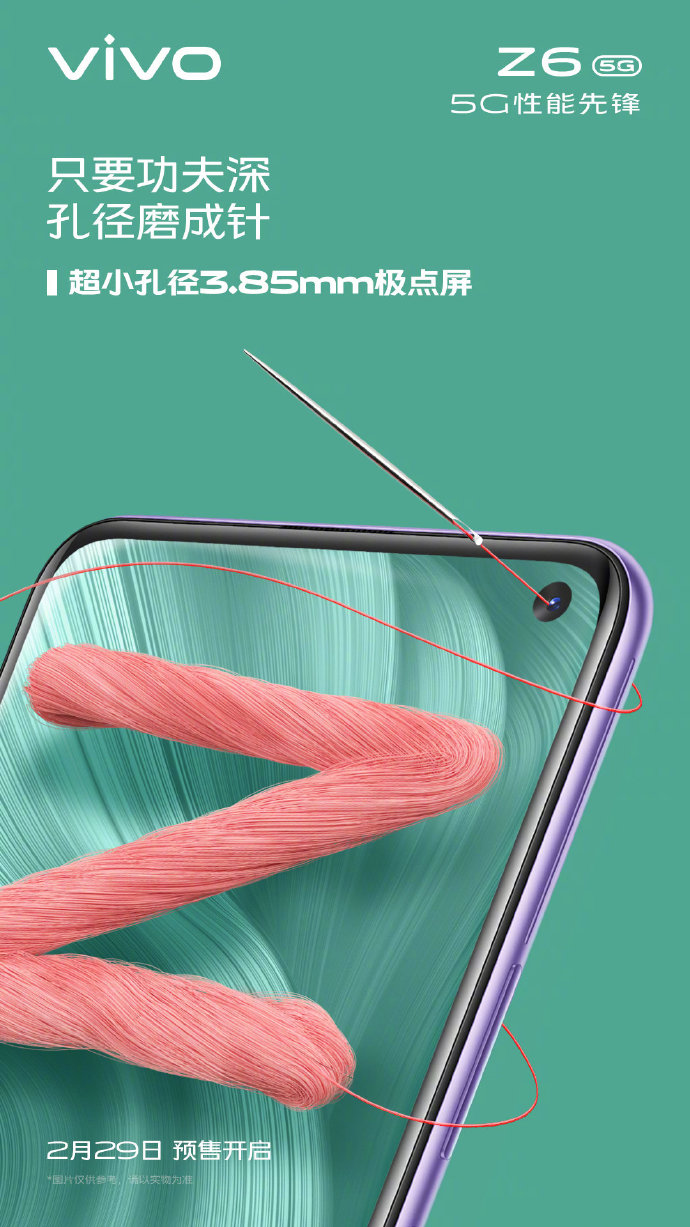
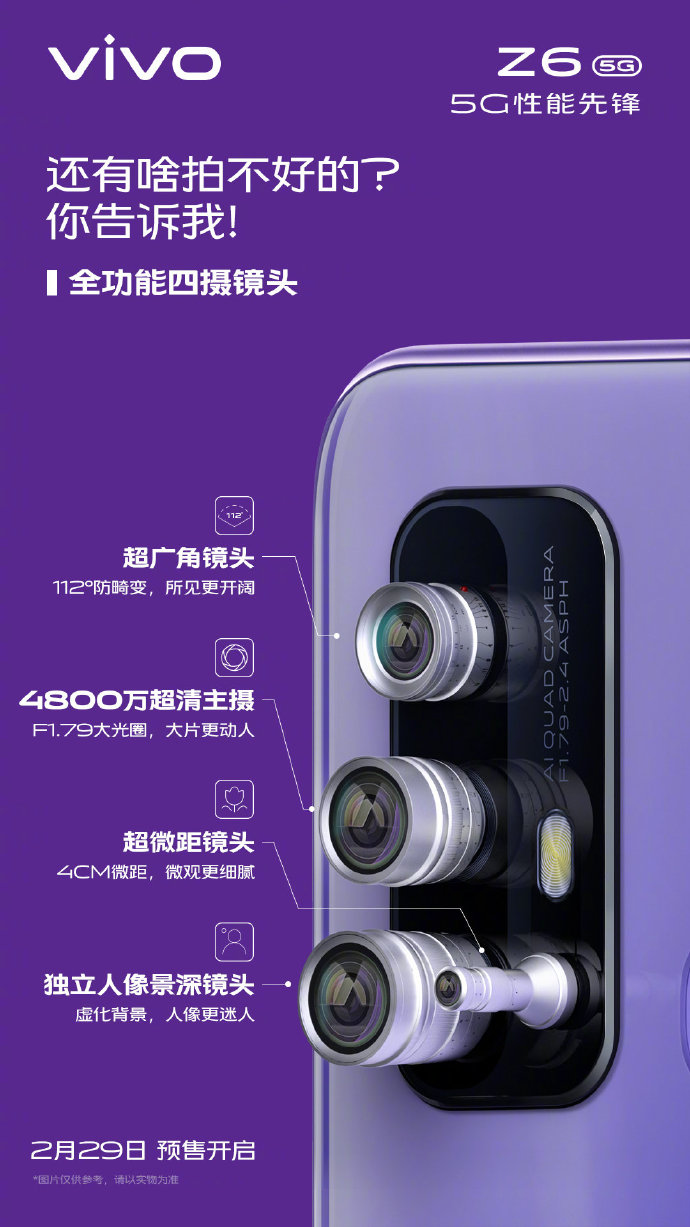
Vivo is all set to announce the Vivo Z6 5G smartphone on Saturday. Ahead of the launch, the Vivo Z6 5G that has a model number of V1963A has been spotted at TENAA with full specifications. Ahead of the Feb. 29 launch, the company is now receiving reservations of the smartphone in China. Today, Vivo shared two posters to reveal the camera configurations and display features of the Vivo Z6 5G phone.

The rear shell of the Vivo Z6 5G features a rectangle-shaped camera setup. The new poster that gives a closer look at the setup reveals four cameras and a pill-shaped LED flash unit. While the TENAA listing confirmed that the Vivo Z6 5G confirmed that the phone has a 48-megapixel + 8-megapixel + 2-megapixel + 2-megapixel quad camera system, the poster only reveals the megapixel count of the main sensor.

Vivo Z6 5G camera configurations

The image shows that the first lens in the setup is a 112-degree ultrawide lens of 8-megapixel with a wide aperture. It is followed by the 48-megapixel main shooter with f/1.79 aperture. Next comes the 2-megapixel depth sensor and a below the LED flash is a 2-megapixel macro lens with 4cm focal length.

The other poster showcases the punch-hole display of the Vivo Z6 5G. The circular cutout at the top-right of the screen is of 3.5mm. The phone promises a tall aspect ratio of 20:9. The TENAA listing revealed that the phone offers full HD+ resolution of 1080 x 2400 pixels. It has an in-display selfie camera of 16-megapixel. The phone promises a screen-to-body ratio of 90.74 percent.

Vivo Z6 5G display cutout

Vivo has already confirmed that the Vivo Z6 5G will be arriving with Snapdragon 765G mobile platform and it will carry support for dual-mode 5G. The phone is expected to arrive with gaming capabilities as it features PC level liquid cooling system and Multi-Turbo 3.0. The handset is backed by a 5,000mAh battery that supports 44W rapid charging. The handset can be completely charged in just 65 minutes, claims the company.

The Android 10 OS will come preloaded on the Vivo Z6 5G smartphone. It will come with up to 8 GB of RAM and up to 256 GB of native storage. The phone will be available in three colors like black, purple and light blue.