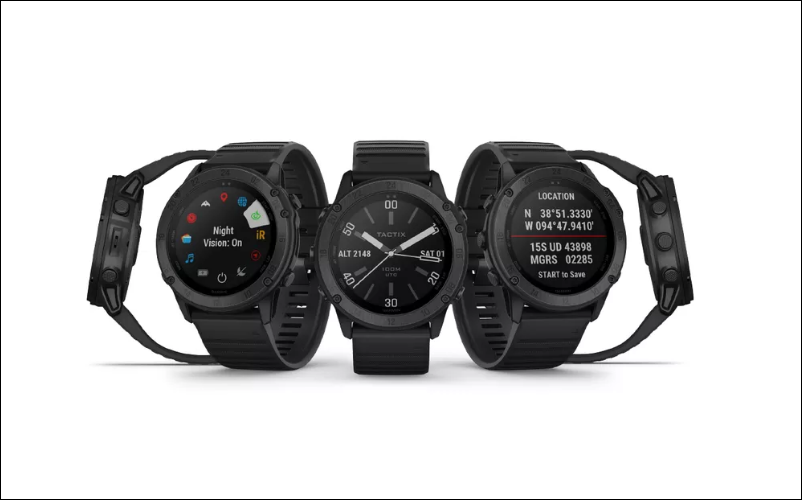
Smartwatch maker Garmin has launched the Tactix Delta smartwatch. The smartwatch is the latest in its lineup of rugged smartwatches touted to have been built to military standards.
The Garmin Tactix Delta is a features a huge 1.4-inch display similar to what was used on the Fenix 6 last year. The watch equally comes with a power manager feature which gives you battery life predictions based on which settings you turn on and off. The watch also comes with a new stealth mode which completely disables storing and sharing of your information. There is also a kill switch that can be set to erase all device memory.
The Tactix Delta smartwatch equally comes with a range of “tactical features” that are making a return from its previous Tactix smartwatches. There’s Jumpmaster mode, which is designed to help guide skydivers to their objective, and dual-position GPS, which can display two sets of coordinate systems on a single screen.
There’s also a more typical set of smartwatch features included. The Garmin Tactix Delta can store up to 2,000 songs, supports Garmin Pay, and can be set to receive notifications from a paired smartwatch. Garmin says you’ll get 21 days of battery life when the device is in smartwatch mode or 80 days in battery saver watch mode.
As for the price, the Garmin Tactix Delta comes with a huge price tag of $899.99.
Huawei announced the EMUI 10 version last year and since then they update has been pushed to several models in China. While several models in China have already gotten the update, there has been little information about the availability of the update outside China. The company only released a beta update for a few international models.
Huawei has now released a press statement confirming the full list of devices that are available on the global market that are eligible for the refreshed user interface, based on Android 10. The release itinerary shows that the Mate 20 and P30 flagship lineup will start receiving the OTA update, with more devices to follow “in later months”. Here’s the full list:
The models that will get the update includes all those sold outside China. Do note that models that were imported from China running Chinese version which doesn’t have Google Services preinstalled are getting a different schedule and will likely get the updates earlier.
EMUI 10 is an important update for Huawei phones as it improves smoothness and performance on existing devices. The company has even added a system-wide dark mode which even forces apps that don’t have a dark mode to comply. The system settings are better organized in this new version and the OS is designed to offer a better experience when working other devices like a Windows 10 laptop. EMUI 10 allows the smartphone to cast its screen directly on to the Windows 10 device, offering a seamless working experience. The update equally brings Android 10-inherent features.
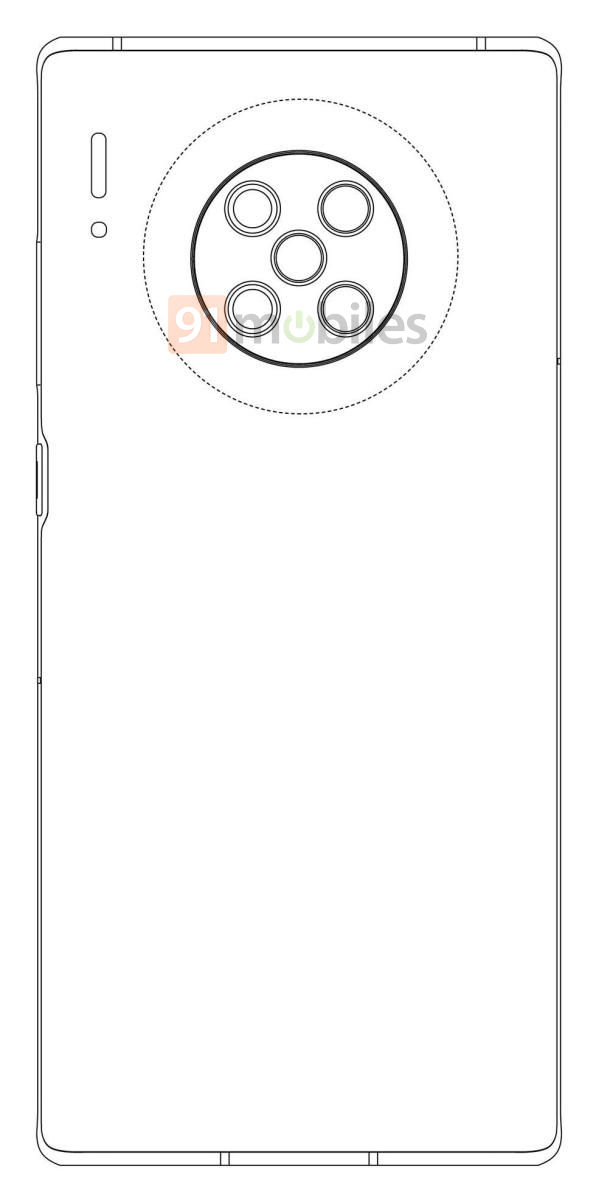
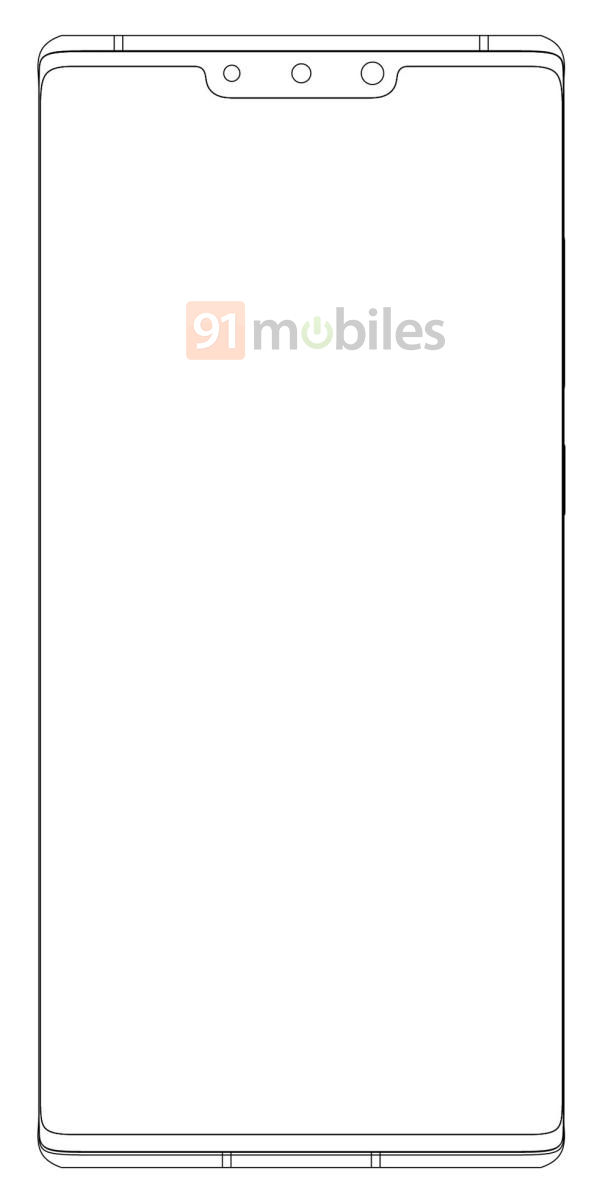
A design patent regarding the Huawei Mate 40 Pro has revealed that the smartphone will arrive with a Penta camera set up on the rear. The patent as filed by the Chinese tech giant in Germany and showcases a smartphone that could have a total of eight cameras.
Huawei Mate 40 Pro with a Penta Camera setup on the rear (Image Via 91mobiles)
Huawei’s Mate 40 series is an upcoming flagship smartphone lineup from the company which is expected to arrive in the fourth quarter of 2020. It is possible for no drastic changes are made to the successor of last year’s Mate 30 series in terms of design (circular camera module), but could arrive with the additional imaging sensor. According to the design patents the Mate 40 Pro houses three front facing cameras and five rear facing ones. This adds up to a large total of 8 image sensors in one smartphone body, highest yet.
Penta camera setup isn’t exactly a new never before seen feature but its implementation and adoption in modern flagships are still low. However, Huawei has seemingly filed a patent with DPMA, a German patent agency. The patent reveals a few interesting aspects regarding the flagship, like a design similar to the Mate 30 Pro but with one additional image sensor on the rear, between the four.
Front of the supposed Huawei Mate 40 Pro reveals a triple camera module
Notably, the patent does not reveal the name of the smartphone seen in the designs. So, it is quite likely that it is not the Mate 40 Pro but another offshoot or variant within the same series. However, considering that the patent has appeared this early in the year might suggest that it is still possibly the Mate 40 series. Unfortunately, no official statements or announcements have been made by Huawei, yet.
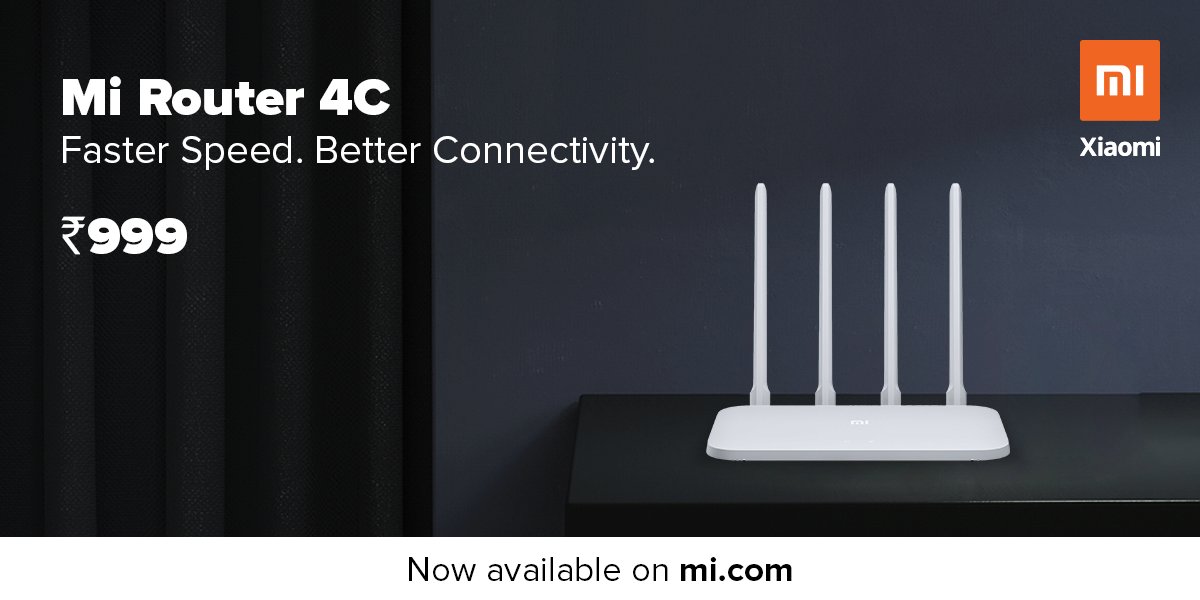
Yesterday, Xiaomi India shared a teaser poster for a new product. It was easy to see the teaser was for a WiFi-related product which is why we were not surprised when it announced the Mi Router 4C today.
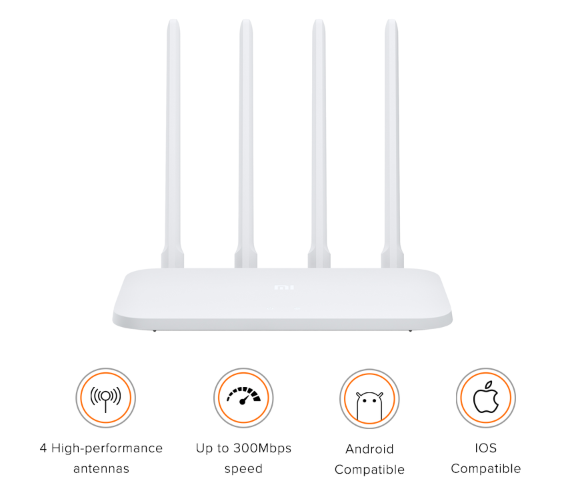
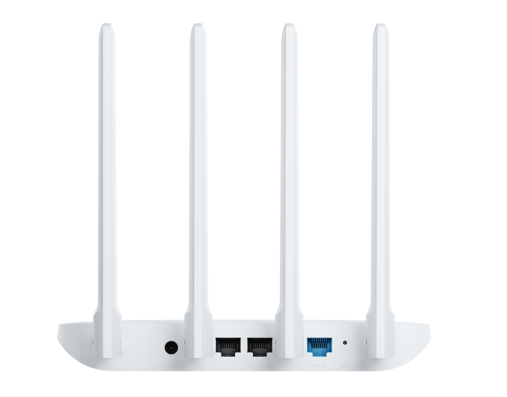
The Mi Router 4C comes in white with four high-performance omnidirectional antennas. It has a MediaTek MT7628N processor inside with 64MB of DDR2 RAM and 16MB flash storage. There are three ethernet ports on the back along with a reset button and the power jack.
Xiaomi says the router can connect up to 64 devices at a time, boasts speeds of up to 300Mbps, and provides a low-latency connection for video streaming and online gaming. It has a repeater mode in case you want to use it to extend the network of another router you already own.
Setting up and connecting is easy and you can manage connections and devices using the Mi WiFi app which is available on iOS and Android. With the app, you can blacklist unwanted internet activity, block suspicious devices, and set time limits for your children’s devices. There is also a WiFi optimization feature that can be activated with just a tap.
The Mi Router 4C is priced at ₹999 (~$14) and is available on mi.com. The only disadvantages it has are its support for only 2.4GHz networks and lack of a USB port for connecting a storage device. But we can’t complain, seeing how affordable it is.
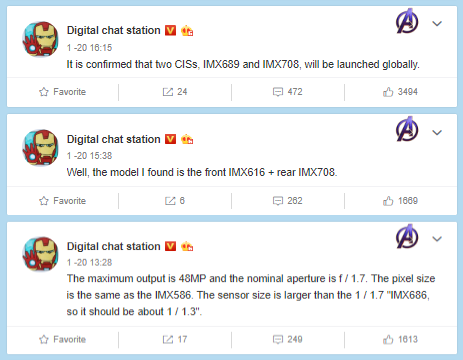
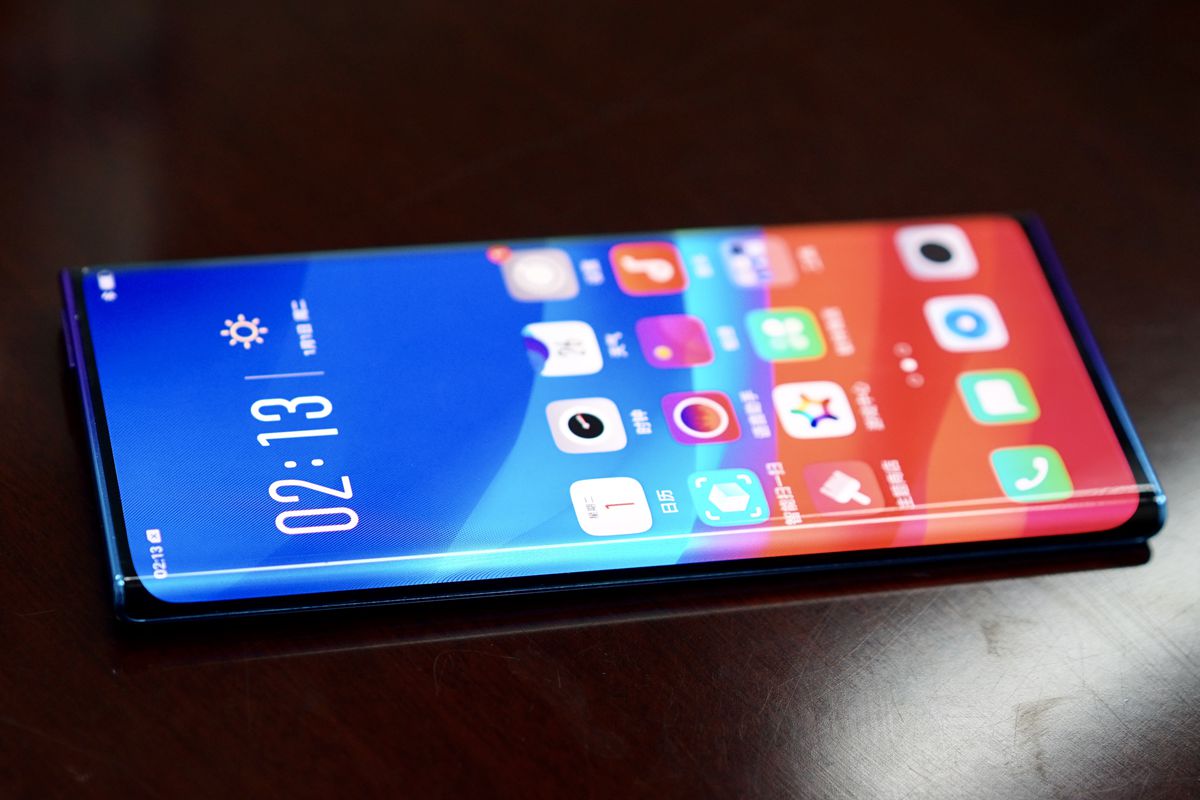
Yesterday, a reliable tipster from China revealed that Sony will be launching Sony IMX689 and IMX708 sensor will be made official globally in the coming days. He shared some details of on the specs of the IMX708 and said it is a customized sensor. Companies like Huawei, OPPO and OnePlus are also expected to use the sensor on forthcoming phones. It is speculated that the OPPO Find X2 that is expected to debut in Q1 this year with the latest Sony sensor could be one of the first devices to feature the Sony IMX708 lens.
According to the leakster, the sensor size of the Sony IMX708 could be around 1/1.3-inch. It could be able to capture images of up to 48-megapixel like the Sony IMX586 lens. He added that he came across a device that has a Sony IMX708 lens on the back and a front-facing camera of Sony IMX616 lens. The latter is said to be a 32-megapixel lens.
The Huawei P40 series are expected to go official in March and rumors surrounding it have claimed that it could be coming with a 52-megapixel lens. OnePlus will be launching the OnePlus 8 series in Q2. Hence, it appears that the OPPO Find X2 could be the best candidate to feature the Sony IMX708 48-megapixel lens on the rear and a Sony IMX616 32-megapixel selfie snapper. Recently, OPPO VP Brian Shen had hinted that the Find X2 has an exclusive custom sensor.
Moreover, in December, it was officially revealed that the Find X2 will be arriving with Sony’ latest image sensor that is called All Pixel Omnidirectional PDAF that will be accompanied with the new 2×2 On-Chip Lens (OCL) solution. The new Sony sensor has on-ship lens for two pixels instead of one lens on each pixel. The new lens will allow the phone to capture photos with faster and accurate autofocus and it will be also well able to focus efficiently in low-light conditions.
There is no concrete evidence yet that the OPPO Find X2 will be equipped with Sony IMX708. Hence, it is advisable to take this report with a grain of salt.
So far, it is known that the OPPO Find X2 will be powered by the Snapdragon 865 mobile platform. It will support NSA and SA dual-mode 5G networks, but there won’t be support for mmWave 5G. The SoC could be accompanied by LPDDR5 RAM and UFS 3.0 storage.
It is speculated that the Find X2 will arrive with a 6.5-inch curved OLED display by Samsung that supports 120Hz refresh rate and quad HD+ resolution of 1440 x 3168 pixels. The display will have a punch-hole at its top-left corner. Irrespective of full HD+ and quad HD+ resolution, users will be able to switch between 60Hz and 120Hz refresh rate on the Find X2. The other details of the phone are currently under the wraps.
Reportedly, Oppo Reno 3 Pro might be arriving with a 44 megapixel dual punch hole selfie camera for India. The news arrives from a leakster that shared the information on his Twitter handle.
Notably, Arun Maini (AKA Mrwhosetheboss), a popular tech Youtuber, had shared an image of a smartphone with dual front facing cameras on his official Twitter page. This was retweeted by Mukul Sharma, a leakster from India, who suggested that the device in the image is the Oppo Reno 3 Pro.
I saw @Mrwhosetheboss talking about the world's first 44MP +2MP selfie snappers touting smartphone and I could not sleep. I wished it to launch in India first. And then I thought, wait, the Oppo Reno 3 Pro is launching soon right? 😉 Feel free to retweet.#OppoReno3Pro
Furthermore, the leakster’s post also talked about the image resolution of both the selfie shooters. The primary lens is a 44 megapixel sensor while the secondary camera is a 2 megapixel lens. Although the rumor has not been confirmed officially from Oppo or any other source, the Reno 3 series for India is expected to be unveiled soon. So, the device may just arrive with the dual punch hole selfie camera module.
As of right now, finer details regarding the smartphone are still unknown. However, a few speculations can be made based on previous coverage of the Oppo Reno 3 series. The smartphones are expected to arrive in two variants, a base and Pro version. The former is expected to arrive with a MediaTek 5G chipset while the latter will sport Qualcomm Snapdragon 765G processor, which features an X52 5G Modem.
Reportedly: Oppo Reno 3 Pro with a 44MP + 2MP Dual punch hole front facing camera
Under the hood, it is expected to be packed with 12GB of RAM, house 48 megapixel quad camera setup on the rear and support fast charging up to 30W. It is also likely to feature an in-display fingerprint scanner for security and offer a 90Hz refresh rate and 180Hz touch sampling rate on its 6.5 inch FHD+ display panel. For color variants, Blue, Red, Black, and White are reportedly planned for the device.
Earlier today, Qualcomm announced three new mobile processors and one of them is the Snapdragon 720G. This new chipset is the successor to the Snapdragon 710 Mobile Platform. Following the announcement, Realme’s CEO, Madhav Sheth took to Twitter to announce that they will launch a Snapdragon 720G phone. Now, Xiaomi has also announced it will launch one too.
CEO of Xiaomi India, Manu Kumar Jain, posted a tweet revealing that Xiaomi will be one of the first brands to launch the latest Snapdragon processors from Qualcomm. He then listed the Snapdragon 865, Snapdragon 765G, and the Snapdragon 720G, thus confirming that there will be a Xiaomi (or Redmi) phone powered by the new Snapdragon 720G processor.
Excited! @Xiaomi will be one of the first brands to launch the latest #Qualcomm#Snapdragon high-end premium chipsets!
We already know the Mi 10 and Mi 10 Pro will be powered by the Snapdragon 865, and Redmi already announced a phone powered by the Snapdragon 765G processor called the Redmi K30 5G. However, our guess is as good as yours when it comes to the Snapdragon 720G phone. Nevertheless, we have a couple of guesses.
While there has been no report of a Mi 10 SE, we cannot rule out the possibility of it launching. The Mi 8 SE and the Mi 9 SE are powered by the Snapdragon 710 and Snapdragon 712 mobile platforms respectively, so it is not far fetched that the Mi 10 SE will have the new Snapdragon 720G inside.
Another possible device is the Mi 10 Lite which should be the successor to the Mi 9 Lite. However, that may not launch until the third quarter of the year.
The Snapdragon 720G brings new features such as WiFi 6, Bluetooth 5.1, and support for 90Hz and 120Hz displays. Unlike the Snapdragon 712 and Snapdragon 710 that are 10nm processors, the Snapdragon 720G is an 8nm chipset with more powerful cores. The smaller node size will translate to an improvement in performance and efficiency.
Are you excited about the Snapdragon 720G? Which manufacturer do you think will announce a phone powered by the new processor first, Realme or Xiaomi? Do let us know your guesses in the comment box.
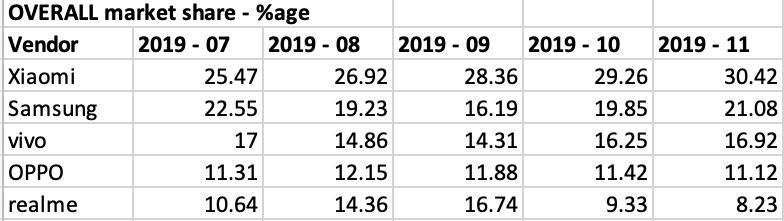
A new report from the IDC (International Data Corporation) brings the market share of various smartphone manufacturers. It suggests that Realme‘s market share has plunged whilst Xiaomi and Samsung still maintain growth after the festive season’s sale.
IDC is known for providing data statistics for various different categories in various different industries. In its recent report, it details the market share of smartphone OEMs. According to the data provided, Realme’s shipments peaked in September which is around the festive month. The company saw a market share of 16.74 percent which has since declined to 9.33 percent in October and 8.23 percent in November.
Overall Market Share via IDC
Upasana Joshi, Associate Research Manager at IDC, stated that the bulk of the purchases of Realme smartphones were from online e-retailing platforms especially during the festive month. Realme has a focus on being an online focused brand with over 80 percent of all sales originating from the internet. The company saw a rise up to September which was its peak, before falling in the following months.
On the other hand, Xiaomi in the same time frame launched its much anticipated Redmi Note 8 series through its subsidiary brand. This was soon followed by price cuts for other handsets and more attractive offerings during the festive season which helped the brand. Unlike Realme, Xiaomi also markets its products through offline channels as well, including official stores and authorized sellers. Furthermore, a Xiaomi spokesperson also mentioned that the final quarter of 2019 was successful for the company, which saw over one million Redmi Note 8 units being sold in India within just a month.
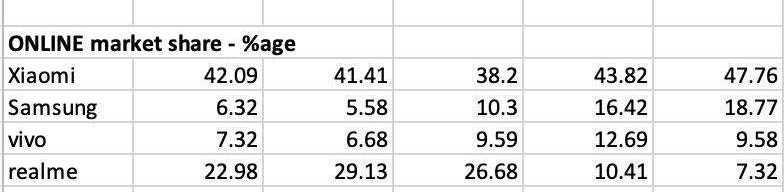
Online Market Share
Samsung too saw a similar slight increase in market share like Xiaomi. The South Korean tech giant went from a 16.19 percent market share in September to 19.85 percent in October and 21.08 percent in November, during 2019. Notably, its online market share saw a sizable rise as well, from 10.3 percent in September to 18.77 percent in November. Reportedly, the launch of the Galaxy M30 was accredited for Samsung’s growth in the online category.
Recently, the Vivo V1955A smartphone on was spotted on the dataset of China’s 3C authority. It revealed that the phone could be shipping with a 55W fast charger. Rumors surrounding it claimed that it could be forthcoming Vivo iQOO 3 smartphone. Today, a popular tipster from China shared the specifications of a smartphone that will arrive with a 55W rapid charger. He seems to have leaked the specifications of the upcoming iQOO 3 gaming smartphone.
Vivo iQOO 3 specifications (Rumored)
The leaked reveals that the mysterious smartphone has a display of 6.44 inches. It is a Samsung OLED panel with a punch-hole at its upper right corner. The display supports 1080 x 2400 pixels which indicates it offers a tall aspect ratio of 20:9.
Vivo’s recent smartphones such as Vivo X30, Vivo X30 Pro, Vivo S5 and Vivo V17 (Indian version) are all equipped with 6.44-inch Samsung OLED display with 1080 x 2400 pixels full HD+ resolution support. Hence, it appears that the iQOO 3 will be arriving with the same screen that are available on the aforementioned phones. The disappointing thing about this display is that it only supports 60Hz.
Vivo V17 India edtion
The iQOO 3 gaming phone will be rivaling with other gaming phones such as Black Shark 3 and Red Magic 5G phone. The Xiaomi gaming phone is expected to come with a 120Hz refresh supporting display that offers quad HD+ resolution. On the other side, the Nubia gaming phone will be equipped with a display that supports a maximum refresh rate of 144Hz. All the iQOO phones that were unveiled in 2019 were equipped with waterdrop notch screens. There is a possibility that the forthcoming iQOO phones may also feature iQOO 3 smartphone.
The Snapdragon 865 mobile platform is present under the hood of the purported iQOO 3. The presence of the new chip could mean that the phone may support dual-mode 5G networks in China.
The Chinese tipster has revealed that the smartphone will be featuring a quad camera setup with a 48-megapixel main lens. The camera system will be positioned at the top-left corner of the device. The phone may house a 4,410mAh battery and as 3C revealed, it could be fueled by using a 55W fast charger.
iQOO is yet to reveal any details on its upcoming smartphone. The Vivo V1950A may soon appear on TENAA with its entire specifications. Until then, it is advisable to digest the iQOO 3 specs leak with a pinch of salt.
While it seems like AMOLED displays are quickly becoming the norm for Chinese smartphone developers when it comes to flagship devices, the good old TFT-LCD still dominates the mid-range and budget markets. It’s very rare to find a cheap device with an AMOLED display, and the sales reflect this as TFT-LCD remains as the most popular choice for smartphones in China.
The latest statistics show that TFT-LCDs still account for 64.3% of China’s smartphone display market, giving it the lion’s share when it comes to shipments. AMOLED screens on the other hand, while definitely growing in popularity, account for less than 20% of the market. We’re definitely going to see this number grow in the future, but for now AMOLED will have to settle for a lower spot.
The China Academy of Information and Communication Technology (yes, it’s a mouthful) issued the “Monitoring Report on the Characteristics of Domestic Mobile Phone Product Interactive Carriers (2019 Issue 4)”. The report reveals that the display market in China has reached a stable point in terms of screen size and resolution, with the last big change being the adoption of full screen displays.
According to statistics, in the fourth quarter of 2019, smartphones with displays 5 inches and above accounted for 55.0% of the mobile phones listed in China, thanks to the influx of 18:9 displays. On top of this, 75.9% of these devices were 4G smartphones, which means that the 3G market is slowly disappearing as 5G becomes the new high-end flagship standard and 4G becomes the new average.
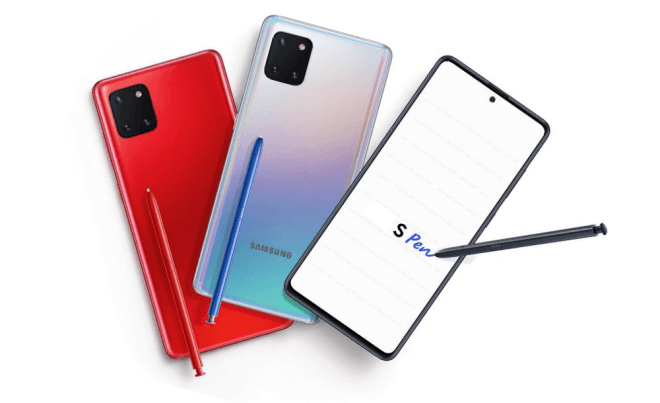
The Galaxy Note 10 Lite smartphone has gone official in India. The handset was first announced by Samsung at the beginning of the year along with the Galaxy S10 Lite for the European markets. The smartphone has today landed in India with a starting price of Rs. 38,999 (~$548). With this pricing, the handset will be rivaling with budget-friendly flagship devices like OnePlus 7T and Realme X2 Pro.
Samsung Galaxy Note 10 Lite price in India
The 6 GB RAM + 128 GB storage edition of the Galaxy Note 10 Lite is priced at Rs. 38,999 (~$548). The higher 8 GB RAM + 128 GB storage model costs Rs. 40,999 (~$576). The color variants of the Note 10 Lite include Aura Black, Aura Red and Aura Glow. The smartphone can be pre-ordered through Flipkart and Samsung’s online store starting from today. The sales of the phone will kick off from Feb. 3.
As far launch offer is concerned, Samsung is providing a discount of up to Rs. 5,000 for existing owners of Galaxy phones who purchase the new Galaxy Note 10 Lite smartphone.
Samsung Galaxy Note 10 Lite specifications
The Galaxy Note 10 Lite wears a massive display of 6.7 inches. The S-AMOLED display has an Infinity-O punch-hole that houses a front camera of 32-megapixel with f/2.2 aperture. The display of the phone supports full HD+ resolution of 1080 x 2400 pixels and a tall aspect ratio of 20:9. The phone is equipped with an on-screen fingerprint reader.
The only disappointing thing about the Galaxy Note 10 Lite is that it does not feature a flagship chipset. The rival phones in the same price category are powered by Snapdragon 855+ flagship SoC from last year. The Galaxy Note 10 Lite ships with Exynos 9810. It is a processor that fueled the Galaxy S9 series and Galaxy Note 9 series in 2018. This does not mean that is a sluggish phone. It should be good enough for regular usage. However, intensive tasks like gaming will be better on phones with newer processors.
The Galaxy Note 10 Lite comes in 6 GB and 8 GB RAM versions and both carry 128 GB of built-in storage. There is a microSD card slot onboard for additional storage. The Android 10 OS along with One UI 2.0 comes preloaded on the device. For security, the smartphone is equipped with Samsung Knox. The device is backed with a 4,500mAh that supports superfast charging.
The Galaxy Note 10 Lite has an S Pen stylus that is integrated with Bluetooth, accelerometer and gyroscope. The glass rear has a square-shaped camera setup that consists a 12-megapixel primary shooter with OIS and Dual Pixel AF, a 123-degree 12-megapixel ultrawide lens with f/2.2 aperture and a 12-megapixel telephoto lens with OIS and 2x optical zoom. While the Galaxy Note 10 series lack support for 3.5mm audio jack, the feature has been made available on the Note 10 Lite. Dual 4G VoLTE, Wi-Fi 802.11ac, Bluetooth 5.0, GPS, NFC and USB-C are the other features available on the device.
Let us know your thoughts on the Galaxy Note 10 Lite by posting your comments below.
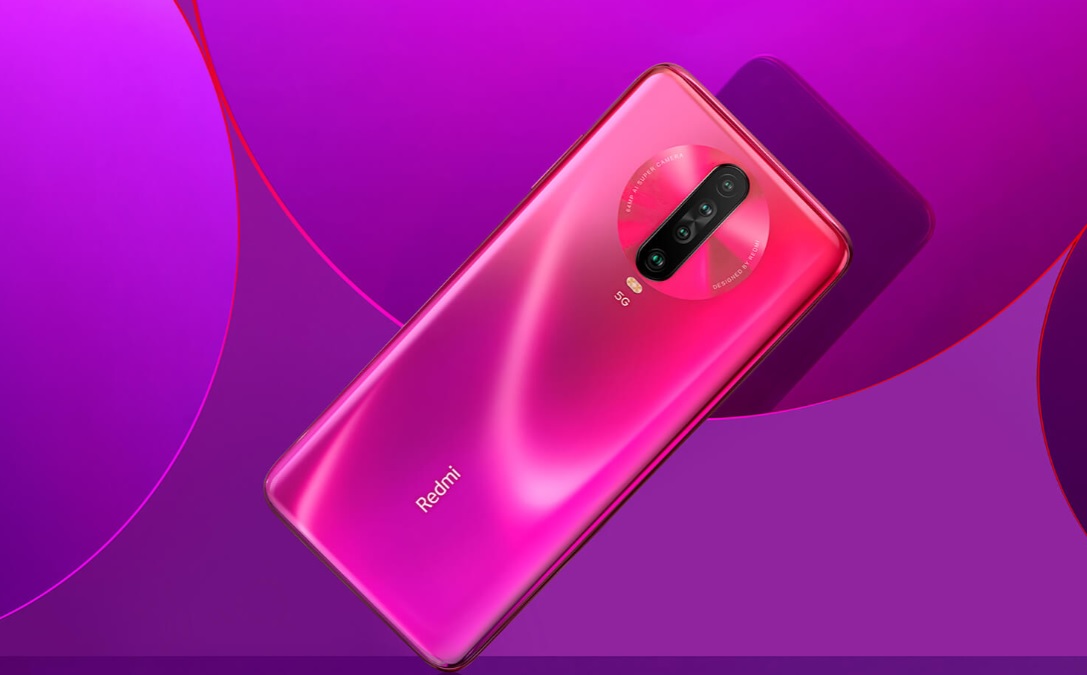
Xiaomi‘s subsidiary Redmi unveiled the Redmi K30 series in December 2019. The series was a successor to the popular Redmi K20 lineup and is also the company’s first 5G enabled smartphone. Now, the Redmi K30 5G is finally on open sale and is available in all color variants.
Redmi K30 5G in all four color variants including Blue, Purple, White and Red
The Redmi K30 5G is currently available and can be found in most RAM and memory configurations from various online vendors and offline physical stores, including Xiaomi’s official website and stores. Furthermore, it will also have all of its color variants available, which include Blue, Purple, White, and Red.
Its most basic variant carries a price tag of 1,999 Yuan or roughly 285 US Dollars for 6GB of RAM and 64GB internal storage. The more beefed up variant arrives with 8GB of RAM and 128GB of storage and costs 2,599 Yuan or roughly 370 US Dollars. Unfortunately, we will have to wait for an official announcement for the highest 8GB RAM and 256GB storage variants availability.
Redmi K30 is an upper mid range smartphone and boasts Qualcomm’s Snapdragon 765G which is a 5G processor with an integrated X52 modem. Its display is a 6.67 inch LCD panel with an FHD+ resolution and a high 120Hz refresh rate as well. For photography, it boasts a 64 megapixel primary camera on the rear and is powered by a large 4,500mAh battery which supports up to 30W fast charging. It also arrives with Android 10 based MUIU 11 out of the box.
Qualcomm has announced three new mobile platforms for the mid-range category. The new chipsets are the Snapdragon 720G, the Snapdragon 662, and the Snapdragon 460. Based on the names, we already know which processors they are succeeding. The three new processors were announced today at an event in New Delhi.
Snapdragon 720G (SM7125)
The Snapdragon 720G is the successor to the Snapdragon 710 and the Snapdragon 712 SoCs. The new 8nm chipset has eight cores arranged in the 2 + 6 format. There are 2x Kryo 465 performance cores that are based on the Cortex-A76 clocked at 2.3GHz and 6x Kryo 260 efficiency cores (based on the Cortex-A55) clocked at 1.8GHz.
By now, you should already know G is for gaming when it comes to Qualcomm processors. The G in the name means the processor features Qualcomm’s Elite Gaming features such as HDR gaming, Qualcomm aptX Adaptive Audio, and smoother graphics.
The Snapdragon 720G has the same Adreno 618 GPU present in the Snapdragon 730 with support for OpenGL ES 3.2 and Vulkan 1.1. It has a new Hexagon 692 DSP and a new Spectra 350L image signal processor. For connectivity, there is a Snapdragon X15 LTE modem with peak download speeds of up to 800Mbps. It also has Bluetooth 5.1 (aptX Adaptive Audio), WiFi 6, and support for USB 3.1. Qualcomm has also added support for Dual Frequency GNSS (L1 + L5) and support for India’s NavIC
The Snapdragon 720G supports UFS 2.1 storage and a maximum of 8GB of RAM. It has a maximum display support of 2520 x 1080 at 90Hz or 120Hz with HDR10. It also supports Quick Charge 4.
Snapdragon 662 (SM6115)
The Snapdragon 662 sits in between the Snapdragon 660 and the Snapdragon 665. Qualcomm says it is the first in the Snapdragon 6-series to support storing images in the HEIF format which allows for higher quality photos at half the size.
The new SoC is an 11nm processor with 8x Kryo 260 (based on the Cortex-A73) cores clocked at 2GHz and in a 4 + 4 arrangement. It has an Adreno 610 GPU, an Hexagon 683 AIE DSP, and a Spectra 340T image signal processor.
It supports FHD+ (2220 x 1080) displays at 60Hz only. It also supports emmC and UFS 2.1 storage. There is a Snapdragon X11 LTE modem with downlink speeds of up to 390Mbps and uplink speeds of up to 150Mbps. It also has support for WiFi 6, Bluetooth 5.1, dual-frequency GPS, and NavIC.
Qualcomm says the Snapdragon 662 Mobile Platform supports Quick Charge 3.0.
The Snapdragon 460 is the successor to the Snapdragon 450, so we should see this powering affordable phones in the $150 category. We should also see it power some tablets from manufacturers such as Samsung. According to Qualcomm, the Snapdragon 460 provides twice the system performance of the Snapdragon 450.
The new processor is built on the 11nm node. It has 8x Kryo 240 cores clocked at 1.8GHz paired with an Adreno 610 GPU with support for Vulkan 1.1. Qualcomm says it provides a 70% boost in performance compared to previous generation.
There is support for displays with a maximum resolution of 2220 x 1080 and a 60Hz refresh rate. It also supports eMMC and UFS 2.1 storage. It has an Hexagon 683 AIE DSP and a Spectra 340 ISP with support for HEIF photo capture.
The Snapdragon 460 is the first 400-series processor to have Qualcomm’s FastConnect 6100 which provides maximum performance and better battery life with respect to connectivity. It supports WiFi-6, Bluetooth 5.1, and has a Snapdragon X11 LTE modem too with the same upload and download speeds as the Snapdragon 662. Just like the other two new processors, it also has support for Dual-frequency GPS and India’s NavIC satellite system. The chipset also supports Quick Charge 3.0.
Realme CEO, Madhav Sheth, announced on Twitter that a Realme smartphone will be among the first to feature one of Qualcomm’s latest mobile processor, dubbed the Snapdragon 720G.
The senior executive took to the popular social media website to share this information through his official Twitter account. He stated that one of its upcoming smartphones will arrive with the Snapdragon 720G which is a mid range SoC (systems on chip) which was just revealed earlier today (21sr January 2020) unveiled by Qualcomm. Madhav also shared an image in the post which showcases a smartphone with a dual selfie camera module on the front, which is likely to be in a punch hole format.
It’s time for the big reveal!#realme will be among the first smartphone brands to launch the @qualcomm_in Snapdragon 720G in the upcoming smartphones.
Qualcomm Snapdragon 720G is a mid range processor and arrives to fill the gap between the Snapdragon 600 series (Snapdragon 665) and the upper 700 (Snapdragon 765 series) and the flagship 800 series (Snapdragon 865). The processor will also arrive with other entry level chipsets like the Snapdragon 460 and 662 chipsets.
According to official listings, Qualcomm’s Snapdragon 720G is a processor that will aim to deliver a superior gaming experience. The new chipset features Qualcomm Snapdragon Elite Gaming functionalities and is designed to provide HDR during gameplay alongside dynamic color range and contrast and improved audio output via Qualcomm aptX Adaptive technology.
Realme is a smartphone brand that has its target audience set in the youth demographic. It heavily advertises in a similar manner with its smartphone arriving with attractive colors and lucrative pricing. Thus, it is a great move considering mobile gaming has become an increasingly popular field in the smartphone industry. Previously, MediaTek unveiled the first gaming centric chipset, the Helio G90 series, so this could be Qualcomm’s version of the same.
Unfortunately, information regarding the upcoming Realme smartphone that will feature the gaming chipset is currently scarce. Madhav has only teased the upcoming smartphone and provided a small first look at its front panel. Finer details and specification are still at large, so stay tuned for information which is expected to arrive soon.
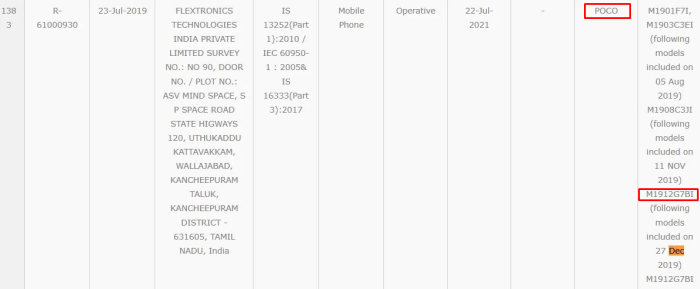
New POCO phones are coming to India. The brand is now separated from Xiaomi, the parent company. Now, the first POCO phone has surfaced on the database of the Bureau of Indian Standards (BIS). Its model number is M1912G7BI. The Redmi K30 4G model that was announced in December has M1912G7BE and M1912G7BC model numbers. It is likely that M1912G7BI will be rebranded as a POCO phone in India. Meanwhile, POCO India has released the first tweet of the year 2020. It indicates that the company will be soon teasing on the arrival of its new smartphone.
Xiaomi Global VP and Managing Director for India, Manu Kumar Jain had recently said that POCO will be very soon launching its first phone of the year. It remains to be seen whether the upcoming POCO phone will be the rumoured POCO F2 Lite or POCO X2 smartphone. It is said that the POCO will launch three smartphones along with some other products in India.
The M1912G7BI smartphone has cropped up on the database of BIS. Based on the model numbers of the Redmi K30’s China variant, it can be said that the M1912G7BI could be its Indian variant. Interestingly, the M1912G7BI model number had appeared first in December on BIS as a Redmi device. However, after the establishment of POCO as a separate brand, the M1912G7BI is now listed as POCO device. Hence, M1912G7BI Redmi K30 will be coming to India as a POCO phone.
It is not clear whether the M1912G7BI Redmi K30 will be debuting as POCO F2 Lite or POCO X2 smartphone in India. The reason behind it is that the Redmi K30 is a Snapdragon 730 powered handset whereas the POCO F2 Lite is said to be equipped with Snapdragon 765 and the processor of the POCO X2 is not known yet. In fact, there are doubts whether the POCO X2 phone really exists since the name has only appeared on Geekbench and it is not too difficult to create a fake listing on the benchmarking platform.
The POCO F2 Lite leak that surfaced yesterday revealed that it has a waterdrop notch screen. The Snapdragon 765 powered phone has 6 GB of RAM, 5,000mAh battery and it is preinstalled with Android 10 OS. The phone could be equipped with a 48-megapixel or higher main camera on its back. The other specs of the phone are currently under the wraps. The POCO X2 Geekbench listing had carried ‘phoenixin’ codename in the motherboard field which suggested that it could be Redmi K30’s rebranded version. The listing further revealed that it has 1.8GHz octa-core processor, 8 GB of RAM and Android 10 OS.
POCO fans will be eagerly waiting for the successor of the POCO F1. Rumors are rife that the POCO F2 could be arriving as the cheapest smartphone featuring the Snapdragon 855 or Snapdragon 855+ chipset.
Zong Changqing, China’s Director of the Foreign Trade Department of the Ministry of Commerce, recently did an interview regarding the country’s commercial performance. He reveals a few interesting details, including that many foreign companies like SK Hynix, Corning and even Samsung have increased their investments in manufacturing in China, which is a bit of a surprise.
In manufacturing, foreign investment in electrical machinery and equipment manufacturing, and instrumentation manufacturing increased by 41.2% and 48.2%, respectively. According to the First Financial Report, Zong Changqing also stated that Samsung, SK Hynix, Corning Display, Caterpillar, Ineos, Panasonic, Exxon Mobil and other manufacturing giants have increased their investment in China by over $100 million.
The reason why it’s somewhat surprising is because a lot of companies were pulling out slightly from production in China since the whole Huawei debacle last year. The biggest example of this was Apple opening up new production plants in companies like India and Vietnam. To see the industry regain confidence in manufacturing in China could mean that things between US and China are calming down.
Along with this, in terms of attracting investment structure, China’s service industry will absorb 681.77 billion yuan of foreign capital in 2019, an increase of 12.5%. Foreign investment in information transmission, software and information technology services increased by 29.4%, and foreign investment in the leasing and business services industry increased by 20.6%.
A former national security adviser to UK’s former PM Theresa May, Sir Mark Lyall Grant has stated that Boris Johnson may likely defy the US clamour and give approval to the use of Huawei technology in the UK’s new 5G network.
The former national security adviser also stated that the security services had repeatedly concluded over several years that they were able to mitigate any potential threats posed by Chinese technology.
Recall that the US had repeatedly advised the UK government and other allies about using Huawei’s 5G technology over security concerns. A US official even branded the move to use Huawei’s equipment for 5G as “madness”. Senior Washington officials have said numerous times that the Trump administration would reassess intelligence sharing with the UK in light of such a move.
UK security officials have disputed the claim and Britain have already used some Huawei technology in previous mobile networks. A final decision is expected later this month. But the dispute is seen by experts as a sign that Britain would be repeatedly asked to take a side in disputes between the US and China, Lyall Grant added. “The interesting thing about Huawei is that it is the first, but by no means the only issue on which the risk is over the next decade, we are going to be pressured to choose,” he said. “And that is a choice that on some issues the UK government is not going to want to make.”
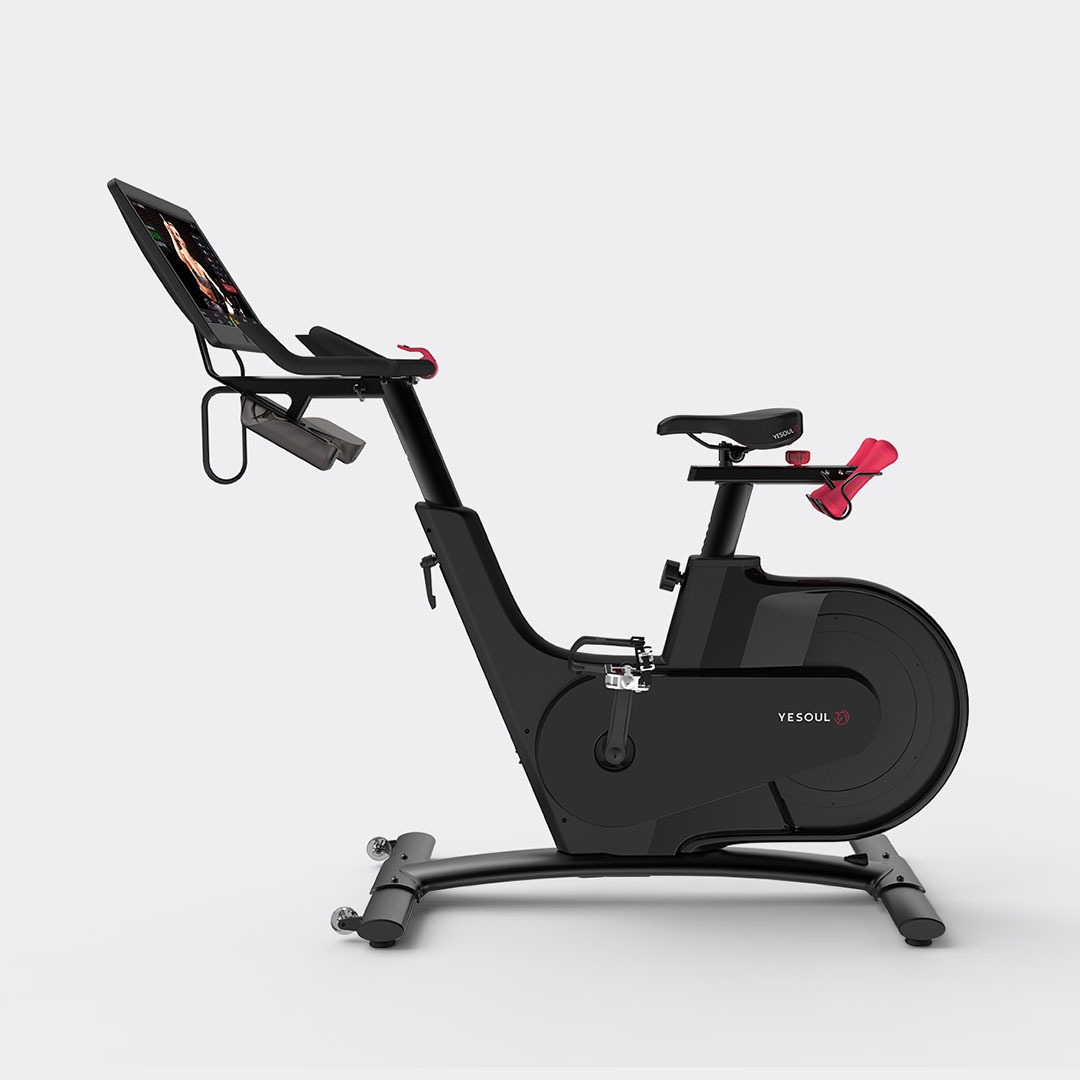
Xiaomi Youpin has today launched a new gym/fitness related product in its home market which is YESOUL Beast 19.5-inch Smart Bike V1-PLUS. The device is priced at 9,999 yuan (~$145) and is now available for pre-order in China. It is offered in two color options — Black and White. The shipping date for this is not yet known.
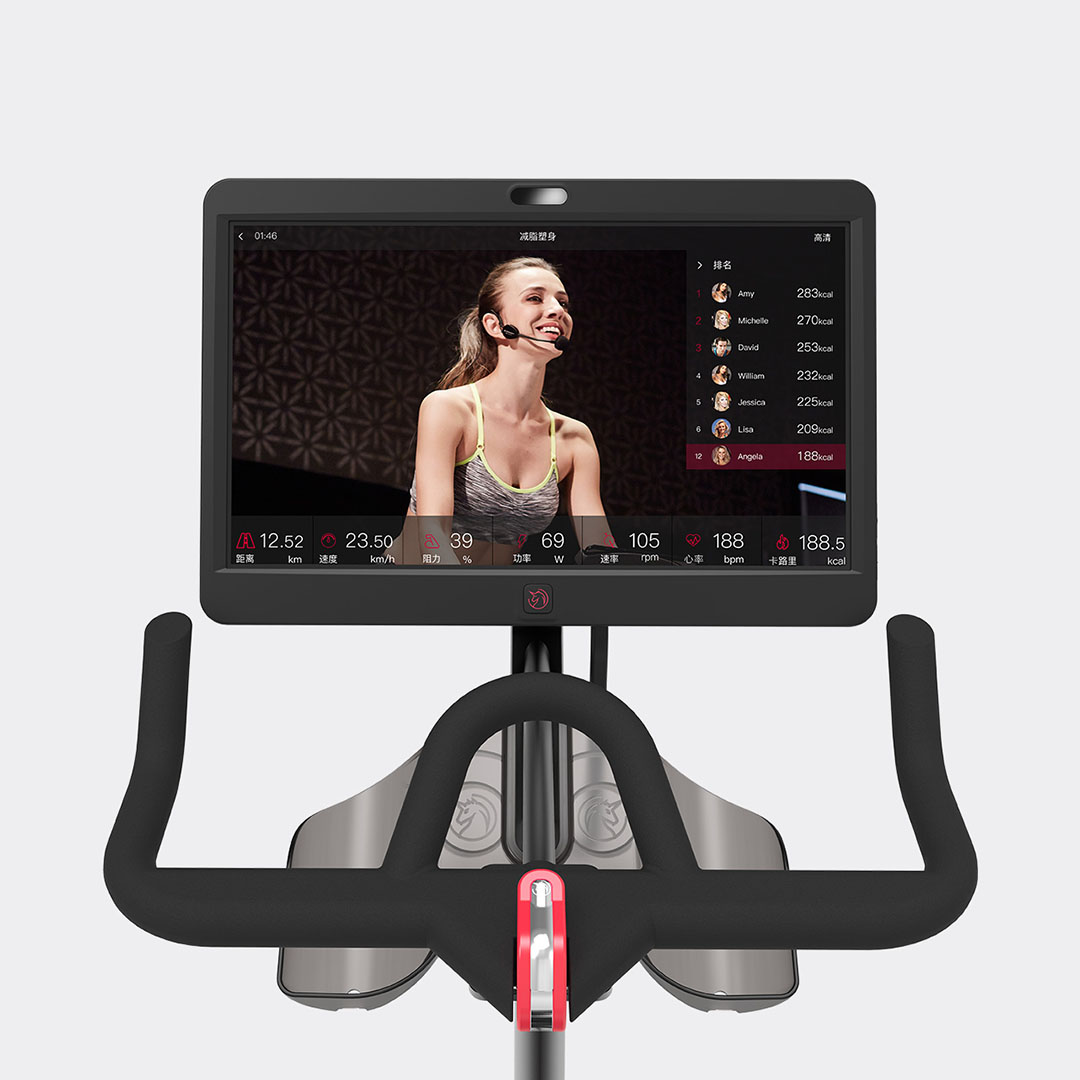
The highlight of the smart personal training device is that it comes equipped with a 19.5-inch touchscreen display which the company says is anti-sweat. The display shows live lessons as well as real-time fitness and sports data through the Yesoul app.
Along with the dynamic cycling lessons, the display also shows live lessons every morning, mid-night, and evening. Further, the company says that the lessons are not repeated everyday. Additionally, it also offers over 3,000 course which can ordered on-demand.
Thanks to the real-time data showcase on the display, user can take feedback and understand the routine and purpose of the exercise and get tips from the coach to make further improvements.
The company says that the device, which is professionally designed, is 145cm long, 53cm wide, and 130cm high. As for the working mechanism, the V1-PLUS ditches the traditional brake pads and instead uses magnetic resistance and belt-drive system to ensure that the cycling process is as silent as possible.
Today, Nubia co-founder Ni Fei has shared a new video on Chinese microblogging platform Weibo in which he claims that using the upcoming Red Magic 5G smartphone, one can wirelessly cast to a large-screen television at a very low latency.
He used the upcoming gaming smartphone to try out several games across different categories, including fighting, racing, and shooting and wirelessly cast every game to a large TV screen. The video shared on the platform shows that the mobile screen display and the TV screen display are almost in sync, without any major screen delay, which is quite impressive.
Recently, the Nubia Red Magic 5G smartphone which carries model number NX659J, bagged approval from the 3C authority in China. It reveals that the 5G-ready smartphone will come with 55W fast charger.
Since the phone has already passed through the 3C certification process, we expect the phone to soon appear on TENAA database. Given that the phone is going through necessary approvals, the launch date of the device is not far away.
The brand had recently confirmed that its next Red Magic gaming phone will be equipped with a display supports 144Hz refresh rate. Combined with the latest Qualcomm Snapdragon 865 chipset, the phone is expected to offer top-notch experience.
It is also known that the smartphone will come equipped with a triple camera setup. The predecessor, Nubia Red Magic 3S came with a 30W charger for its 5,000mAh battery and now the upcoming Red Magic 5G is expected to be packed with a 5,000mAh or higher battery that will be coupled with 55W charger.
While the launch date is not yet known, we expect the Red Magic 5G gaming smartphone to go official in the first quarter of 2020. We also expect to know more about the device in the coming weeks, as the launch nears.
India’s one of the leading food delivery platform Zomato has today announced the acquisition of UberEats’ business in India in an all-stock deal. While the company has not revealed the value of this transaction, report indicates that acquisition of Uber’s food delivery business is at around $350 million.
As a part of this deal, Uber will now get around 9.9 percent stake in Zomato. Also, UberEats, which operates in 41 cities, will now redirect its customers to Zomato. The deal comes days after Zomato raised $150 million funding from existing investor Ant Financial, valuing the company at $3 billion.
While delivery partners associated with UberEats India will on-board Zomato’s fleet, around 245 employees of UberEats will be affected by this deal as they will not be absorbed by Zomato as part of the transaction. However, it is being said that Uber is trying to find ways to absorb them within its business.
With Uber Eats, Zomato will now collectively have a 55 percent share of the food delivery market in India and compete largely with homegrown Swiggy. Zomato currently delivers to over 550 cities across the nation.
The move to sell UberEats India, which had been in works since months, is aimed at cutting losses at the ride hailing company’s food delivery business that has been a drag on the company’s earnings.
UberEats entered the Indian market in 2017 and scaled business to 41 cities with over 65,000 riders who deliver food from 26,000 restaurant partners. The company, which was once seen as a major competitor to Zomato and Swiggy, started struggling in India’s hyper-competitive market.
With the sale of the food business in India, Uber can now focus on the rides business and driving it towards profitability. Besides cutting losses in India, Uber is now taking a stake in a startup that was valued at $3 billion earlier this month.
We use cookies on our website to give you the most relevant experience by remembering your preferences and repeat visits. By clicking “Accept”, you consent to the use of ALL the cookies.
This website uses cookies to improve your experience while you navigate through the website. Out of these, the cookies that are categorized as necessary are stored on your browser as they are essential for the working of basic functionalities of the website. We also use third-party cookies that help us analyze and understand how you use this website. These cookies will be stored in your browser only with your consent. You also have the option to opt-out of these cookies. But opting out of some of these cookies may affect your browsing experience.
Necessary cookies are absolutely essential for the website to function properly. This category only includes cookies that ensures basic functionalities and security features of the website. These cookies do not store any personal information.
Any cookies that may not be particularly necessary for the website to function and is used specifically to collect user personal data via analytics, ads, other embedded contents are termed as non-necessary cookies. It is mandatory to procure user consent prior to running these cookies on your website.