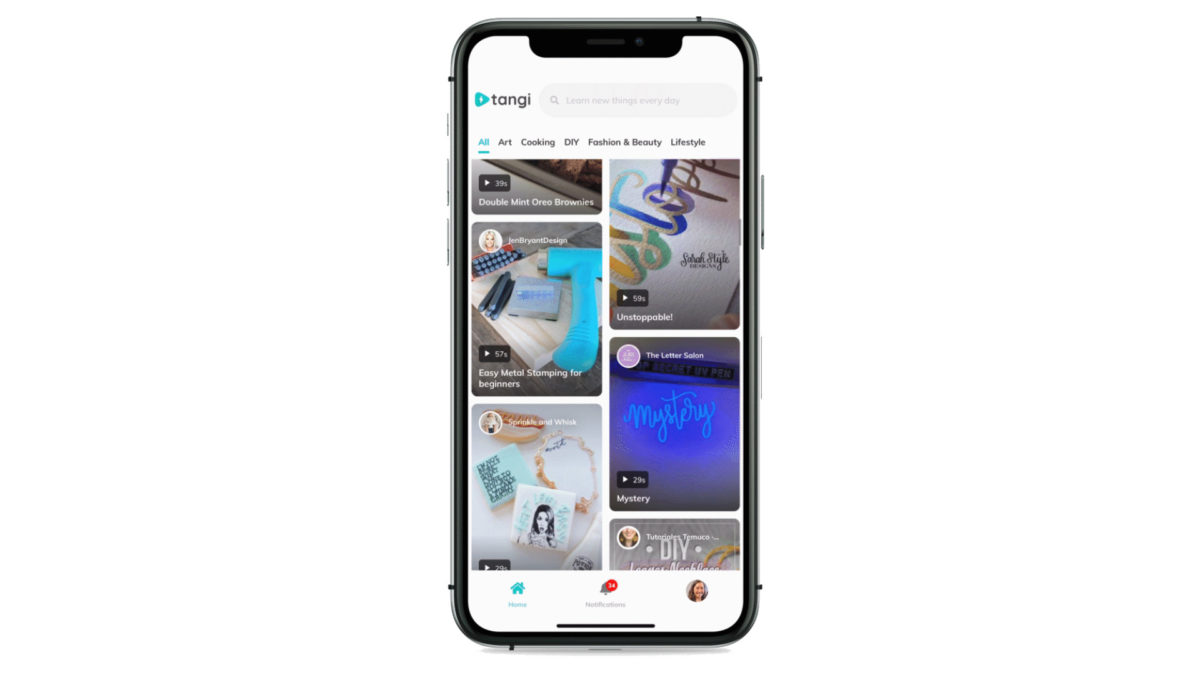
YouTube is presently the hub for tutorials and other guide covering various subjects and facets of life. The app is presently owned by Google but the tech giant has developed another app which it hopes will replace YouTube. The app is called Tangi and will solely host tutorial videos and similar contents.
Tangi is an experimental app born out of Google’s Area 120 lab. The app hosts short-form video guides and how-to clips. The search giant says Tangi’s name comes from “the words TeAch aNd GIve and ‘tangible’ — things you can make.” The videos will have to have a maximum of 60 seconds in duration. This may be applauded by some while others may find it a turn off. However, we believe where there is a need to upload a 15 minutes video, for instance, users can split it into 15 different 60-seconds videos. That again may become tiresome to watch except there will be a feature to play the next video automatically after each one ends.
Tangi is categorized into different categories such as Art, Cooking, DIY, Fashion and Beauty, and Lifestyle. Tech is believed to be one of the most popular categories on YouTube but Tangi doesn’t have a Technology section just yet. So, you may have to stick with YouTube or any other source for tech-related tutorials.
Do note that the mobile version of the app is only available for mobile phones running iOS. In other words, it is not available on the Google Play Store presently. If you own an Android phone, you can only gain access to the web version.
It is doubtful if Tangi can exist successfully alongside YouTube considering the large supply of resources available on the tube. This may end up as one of those apps that Google launched only to discontinue them a short while later. But then, this is an experimental app. It might just turn out to be a tremendous success just like TikTok, another short video app.
Samsung Electronics on Wednesday unveiled a new washing machine and dryer featuring artificial intelligence (AI) technology. The AI-powered device is built to offer more “effective ways” for consumers to do their laundry. It is also believed to accelerate Samsung’s drive to attain leadership of the market over arch-rival LG Electronics.
The device dubbed Grande AI Washer and Dryer was showcased at Samsung’s Digital Plaza retail store in Gangnam, southern Seoul. With the AI technology, Samsung said the front-loading washer offers an “all-in-one” function, enabling users to control their dryer via the washer. The company said it also improved the appliances’ self-hygiene feature so consumers do not need to worry about dust inside the machine, water residue or rust.
Samsung claimed to have run more than 12 million laundry cycles for the AI feature, demonstrating it could get smarter, as the machines remember frequently used cleaning and drying cycles and suggest optimal settings. The company also highlighted the appliances’ eco-friendly functions that use less water and detergent compared to previous models.
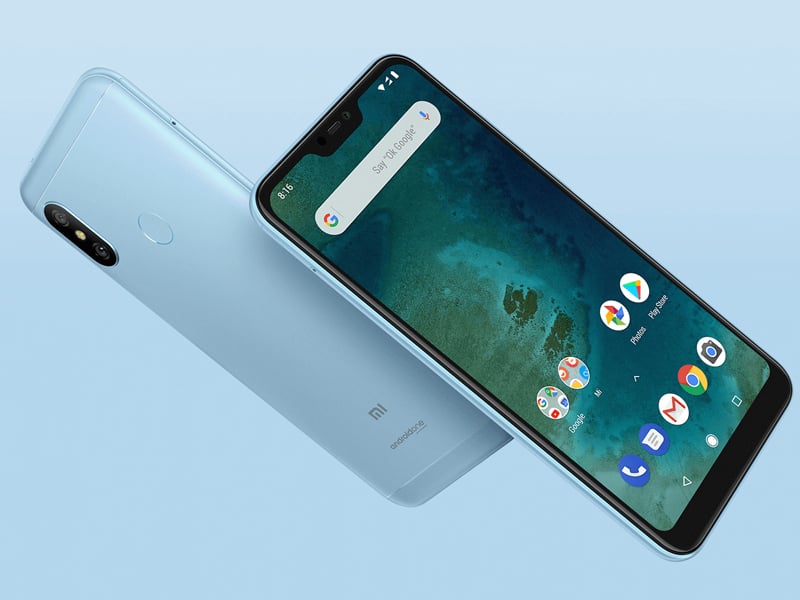
Chinese electronics conglomerate Xiaomi had announced the Android 10-based MIUI update for the Xiaomi Mi A2 earlier last month. The same has now been confirmed for the Mi A2 Lite this week. However, the confirmation has arrived after disgruntled users filed a petition for not receiving Android 10 update on Change.org.
Xiaomi had earlier mentioned that there were no plans to bring the Android 10 update to the Mi A2 Lite, causing mass criticism from the fans and the users. According to the company’s official statement on the Mi forum, a spokesperson said, “There is no tentative deadline for the rollout of the new Android 10 update for the A2 Lite. We can only assure users at the time that development is underway”.
The company has just rolled out an update for the Xiaomi Mi A3, although, it is said to be plagued with unknown issues. Xiaomi plans to take its time with the Mi A2 Lite, as to avoid further controversy with the OTA. If early reports are to be believed, the new update brings a host of additional features including gesture guidance, dark mode, smart reply, location controls, and additional privacy, etc.
The Xiaomi Mi A2 Lite flaunts a 5.84-inch IPS LCD display with a resolution of 2280 x 1080 pixels along with an aspect ratio of 19:9. The device flaunts a dual-camera setup at the rear comprising of a 12-megapixel primary sensor along with a 5-megapixel depth-sensing unit.
The smartphone draws power from a 2.0 GHz octa-core Snapdragon 625 SoC with Adreno 506 GPU and packs a 4,000 mAh battery. The smartphone packs 4GB of RAM along with 64GB of native storage. It comes with Android 8.1 Oreo with MIUI out-of-the-box, upgradable to Android 9. The device sports a fingerprint scanner for additional security. In terms of connectivity, the Mi A2 Lite gets Bluetooth 4.2, dual-band Wi-Fi, microUSB 2.0, and 4G LTE.
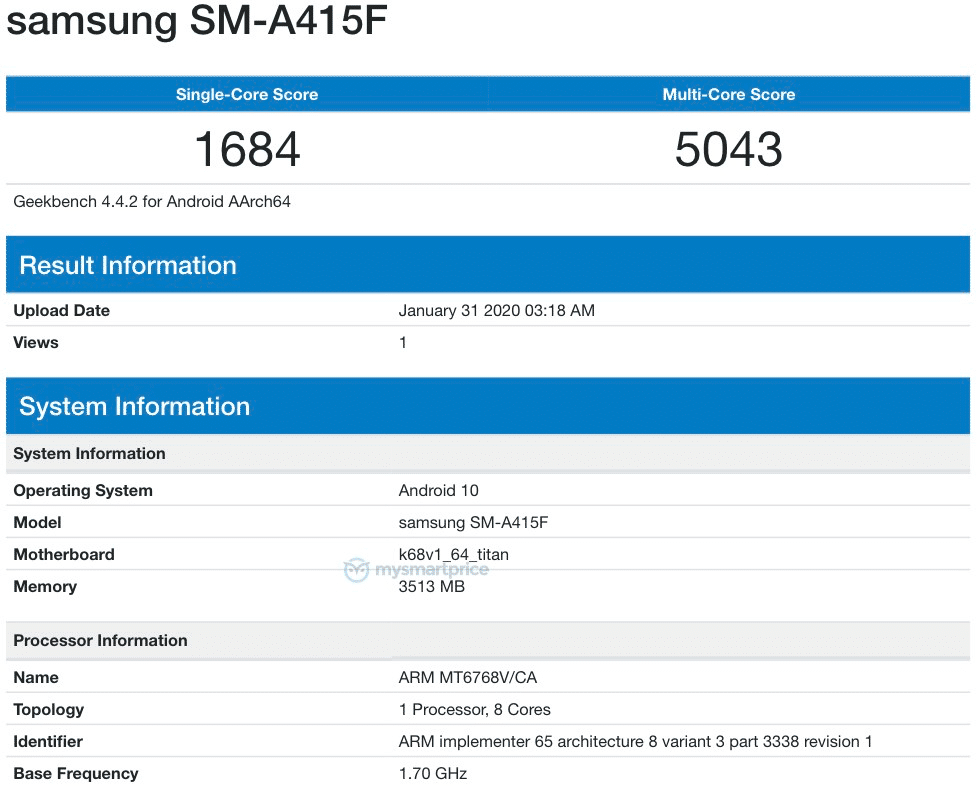
The purported Samsung Galaxy A41 with model number SM-A415F has appeared on Geekbench. The appearance of Samsung Galaxy A41 on the benchmarking platform today hints at Samsung’s plan of expanding its 2020 Galaxy A-series. Last year, Samsung’s Galaxy A-line was a huge success and the company would certainly want to cash on it with newer additions that would continue to impact in the budget and mid-range smartphone segments. Prior to this, the company had launched the Galaxy A40 model in March 2019.
According to the Geekbench listing, the SM-A415F phone has recorded 1684 and 5043 in the single-core and multi-core tests of Geekbench 4. Like its predecessor, the Galaxy A41 would run on Android 10 OS. It could be overlaid with Samsung’s latest One 2.0 UI.
The handset is powered by MT6768V octa-core chipset that has a 1.70 base frequency. It is nothing but the MediaTek Helio P65 processor. The Geekbench listing further states that it will be equipped with 4 GB of RAM.
The appearance of the Galaxy A41’s battery on South Korea’s certification website SafetyKorea suggested a battery pack certified with model number EB-BA415ABY. The Galaxy A41 phone may come with have a slightly higher battery life than Galaxy A40 at 3500mAh and rumours also suggest a 15W fast charging support
An upgrade over Galaxy A40, the Galaxy A41 phone may sport a triple rear camera setup with a 48-megapixel primary camera and an unknown secondary lens. The third lens could be a 2-megapixel macro sensor. The job of taking selfies would however be handled by a high resolution 25MP front camera. The device may come with a 64 GB native storage. Samsung is yet to confirm on the existence of Galaxy A41. The predecessor smartphone had launched in March last year. This hints at a first-quarter launch for its successor as well.
The South Korean company may also unveil the Galaxy A31 smartphone alongside the Galaxy A41. Rumors have so far revealed that the Galaxy A31 has a 5,000mAh battery and a 48-megapixel + 5-megapixel + macro triple camera setup. It could be arriving in 64 GB and 128 GB storage choices.
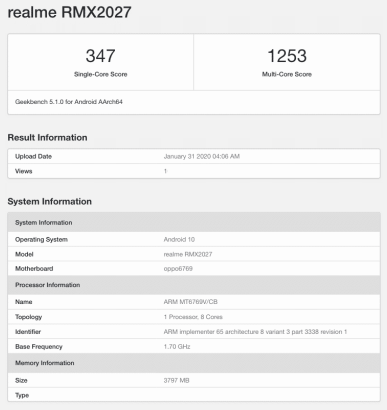
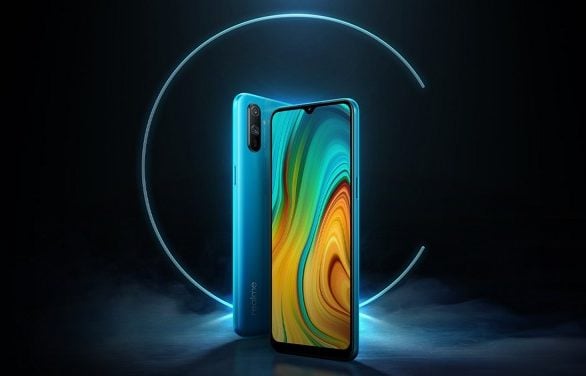
Realme India has recently confirmed that it will be announcing the Realme C3 smartphone in the country on Feb. 6. The smartphone will be arriving as the successor of the Realme C2 from last year. The Chinese firm has revealed that the Helio G70 will be the driving force of the smartphone. The SoC was unveiled earlier this month mainly to bring gaming capabilities on entry-level smartphones. Today, a Realme phone with model number RMX2027 has been spotted on Geekbench. It is speculated that it could be the Realme C3 phone.
The Realme RMX2027 phone has recorded a score of 347 in the single-core test of Geekbench. On the others side, it reached 1253 in the multi-core test of the benchmarking platform. The octa-core processor that powers the device is a MediaTek with 1.70GHz base frequency. The Helio G70 has the same base frequency. Hence, it appears that the RMX2027 could be the forthcoming Realme C3 smartphone.
The SoC of the Realme RMX2027 is coupled with 4 GB of RAM. The handset is preloaded with Android 10 OS. It is unclear whether the phone will ship with the latest ColorOS skin. Recently, the RMX2020 phone was certified by Thailand’s NBTC body as Realme C3. The RMX2027 appears to be its country variant. The Realme RMX2027 has also been approved by BIS (Bureau of Indian Standards) and Eurasian Economic Commission (EEC) in the U.S.
The landing page of the Realme C3 on Flipkart states that it will be arriving with a 6.5-inch display with mini dewdrop notch. It is likely to support only HD+ resolution. The predecessor phone came with a smaller 6.1-inch display with teardrop notch and it housed a 4,000mAh battery. The successor phone is confirmed to come with a massive battery of 5,000mAh capacity.
The Realme C3 does not seem to be equipped with a fingerprint sensor on its back. It has a vertical dual camera setup that uses a 12-megapixel lens as a primary shooter. It is confirmed that the Realme C3 will be arriving in India in two options such as 3 GB RAM + 32 GB storage and 4 GB RAM + 64 GB storage. The pricing of the phone is currently under the wraps. Like the predecessor, it may arrive as the cheapest Realme phone in the market.
Google Camera App is popularly known for its overwhelming and mystical features. Pixel smartphones are blessed to have official support for the Google Camera App with features like Astrophotography mode and more. Google has recently pushed the Google Camera App v7.3 with several new features and enhancements. There are specific bug fixes that improve the overall stability of the app.
Despite any official support for Google Camera on different devices, there are several other ways through which users can enjoy the prowess of the camera app. The open-source nature of the Android ecosystem has allowed third-party developers to extend Google Camera for smartphones other than Pixels. Different GCam MODs are available for various popular smartphones. The users can choose between different MODs based on usability. Similarly, developers have unleashed the Gcam 7.3 APK mod for all the Android devices.
Features of Google Camera 7.3
Automatic Do Not Disturb mode during video recording.
Brings rearranged settings UI.
Ability to record video at 24 frames per second.
Added exposure controls to adjust brightness and HDR of your photo.
Added Astrophotography to Night Sight to allows you to take a picture of the Milky Way with a single tap.
Received Frequent Faces to help you capture Top Shot photos.
Added Touch and hold the shutter button to capture Top Shot photos.
Download Gcam 7.3 APK for all Android Phones
We have first modded Gcam 7.3 APK made available by parrot043. The new mod is almost available for every Android smartphone. The interested users can head over to the download section below to get the compatible Gcam 7.3 APK.
Note: The Gcam 7.3 APK is compatible with Android 10 or later versions. If you wish to enjoy the Google Camera MOD on any old device, then you are free to get any Gcam MOD based on version 7.2, 7.0, 6.1, 5.2.
Pixel 4 Google Camera 7.3
The new Gcam 7.3 APK Mod is compatible with Android 10 running smartphones, including OnePlus 7, 7 Pro, OnePlus 7T, 7T Pro, Essential Phone, Poco F1, Galaxy S10e, S10 series, Note 10 series, Nokia and more.
The interested users can download the apk from the link below.
It is quite easy to sideload third-party apps easily on an Android phone. Follow the steps if you want to sideload the app.
Download the APK from the above.
Now, head over tot he Settings>Security>Enable Unknown sources to install the APK from any external source.
Now, tap the downloaded apk and follow th ongoing prompts.
Done!!
You’ve successfully installed the GCam 7.3 APK on your Android smartphone. If you still get any problem, then don’t forget to hit the comments section below.
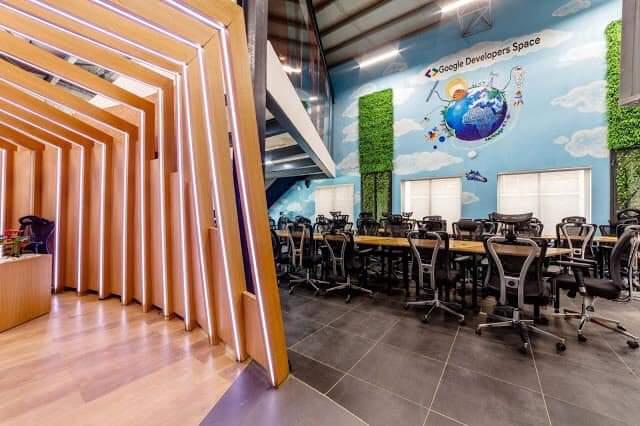
Tech giant Google has officially opened the doors of its first Google Developer Space that would be set up in Africa. The tech hub was unveiled in Nigeria and is in line with the tech giant’s vision to grow Africa’s tech space. The company had made a commitment in 2017 to start the Launchpad Accelerator Africa program to grow Africa’s tech space.
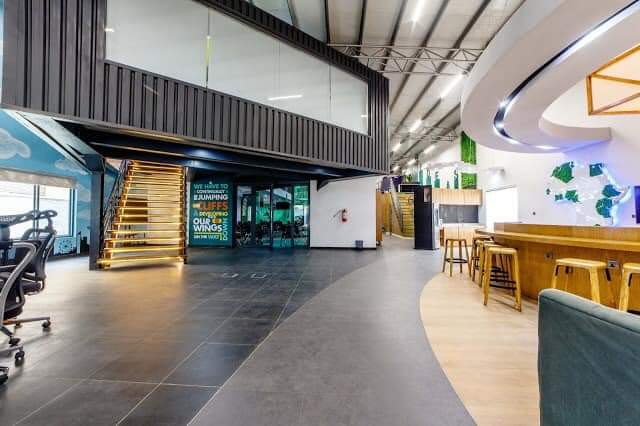
The Developers Space is Google’s flagship hub to aimed at supporting startups and developers in Africa. It is located in Ikoyi, Lagos, Nigeria. The hub provides the tech community in Africa with access to Google’s resources, programs, tech and business mentors. It is also a venue for entrepreneurs, developers, VCs and investors to connect and collaborate with each other.
At the unveiling event, Google’s Country Director, Juliet Ehimuan threw more light on the value the hub offers and the strides of Google in Sub-Saharan Africa. She noted that the centre stands to create an enabling environment for tech in Africa. While also acknowledging that the African continent is blessed with great talent and immense human resources, she iterated that the hub would provide access to facilities, mentors, infrastructure, coaching, investors and support for business.
“The space is custom-built for a myriad of activities which include general workspace area, Hackathons, Code Labs, and Bootcamp’, Onajite Emerho head of Google’s Launchpad Accelerator Program explained. She also disclosed that the Developers Space is open to anyone around the continent that may need it, in as much the need is related to tech and digital skills.
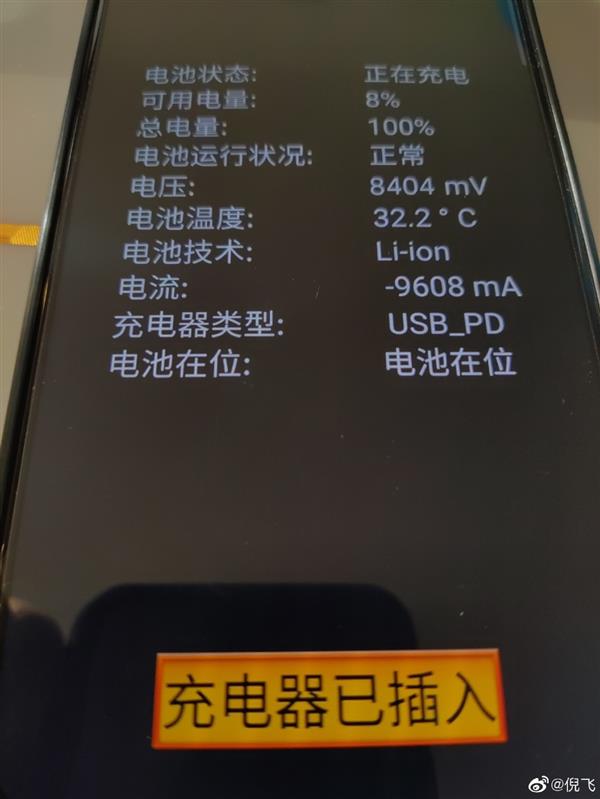
Earlier today (31st January 2020), Ni Fei, the CEO and Co-Founder of Nubia, shared a post on Weibo, a Chinese microblogging website, to tease an upcoming 5G smartphone with an impressive 80W fast charging capabilities.
In the Weibo post, Ni Fei shared an image as well which contained certain details and statistics regarding a smartphone being charged. Looking at the details, Voltage can be observed at 8.4 Volts while the current is at 9.6 Ampere. In simpler terms, this translates to a fast charging rate upwards of 80W that is higher than 65W but a bit lower than true 100W charging rates.
Previously, Xiaomi, a Chinese smartphone giant, had revealed a 100W fast charging technology. It was called Super Charge Turbo and utilized a special dual cell series design which adds two strings of battery technology. Through this and other expensive materials, the company managed to charge a 4,000mAh battery in only 17 minutes. So, we can expect the upcoming Nubia 5G smartphone to arrive with capabilities close to this benchmark.
So far, no company has commercially launched a fast charger of 100W but Nubia arrives the closest if the device in question launches soon. It is still an expensive technology to include in a device so it is unlikely that a smartphone will debut with the technology any time soon.
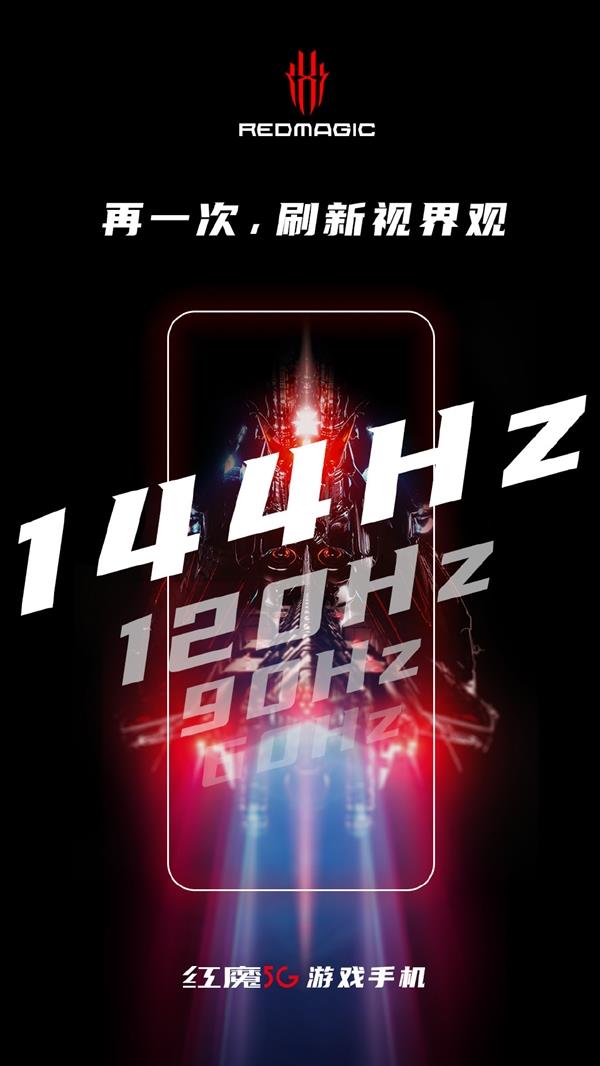
However, Nubia’s executive teasing the charging capabilities just before the launch of its latest Red Magic gaming smartphone with 144Hz display, implies that the company might include an 80W fast charger in the upcoming device. Unfortunately, this is still speculation and Nubia has yet to officially confirm this. So we cannot provide any concrete statements at the moment.
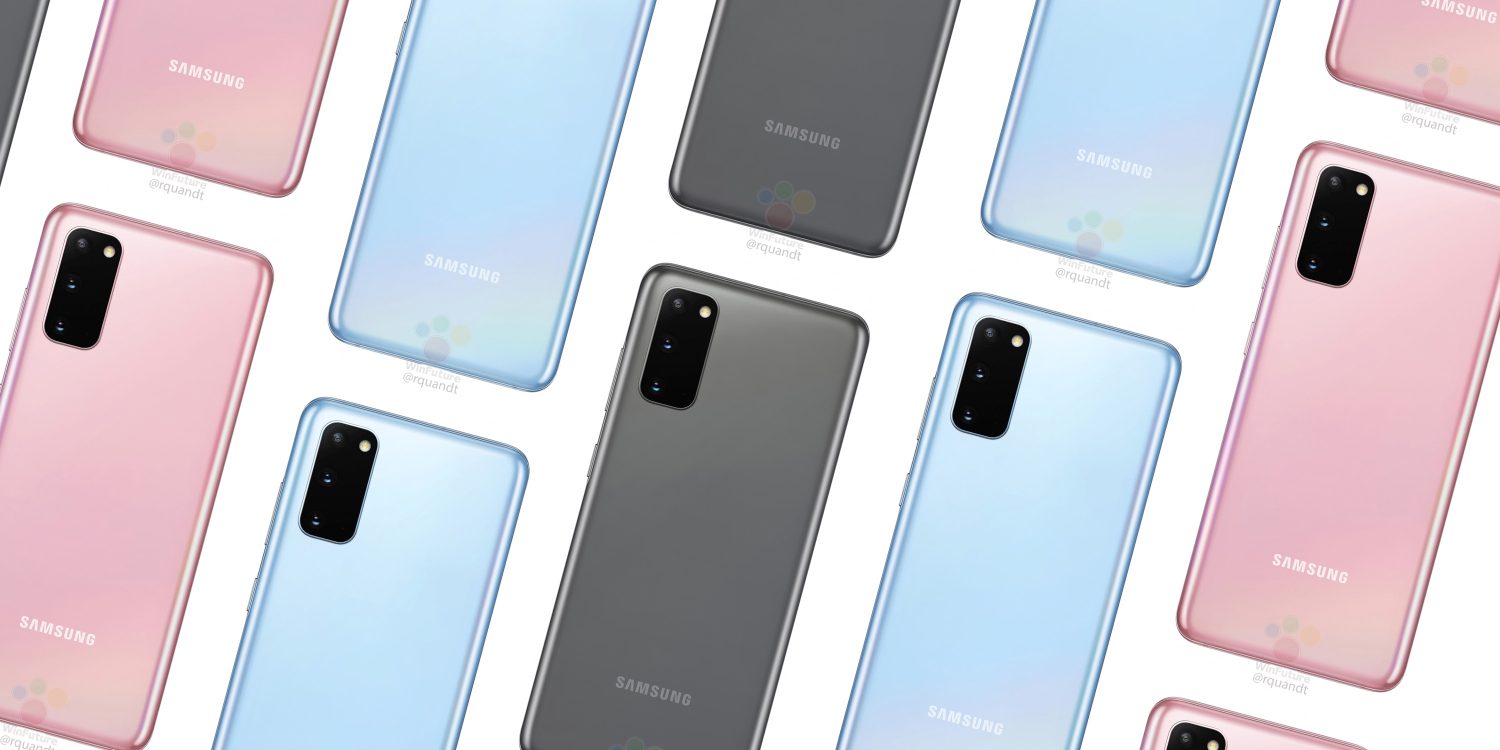
Samsung‘s flagship series of smartphones is just around the corner. The 2020 premium grade handsets are expected to be unveiled at Samsung Unpacked event on 11th February 2020 and will bring new features and improvements over its predecessor. One of these improvements will likely be in the camera department as the upcoming series is reported to feature a new Samsung Super ISO technology.
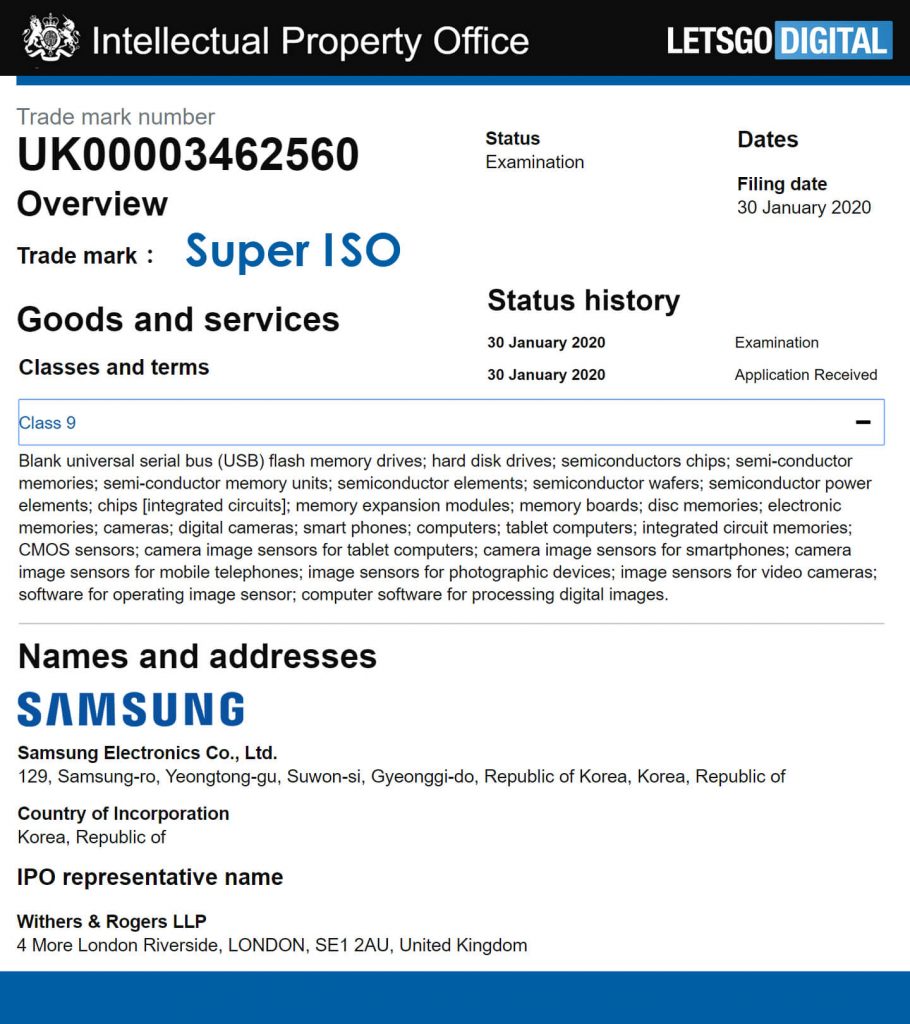
The South Korean tech giant recently applied for a trademark in Great Britain at the UK IPO (Intellectual Property Office) for the name Super ISO. The description of the trademark carries terms for “camera sensor for smartphones; image sensor for video cameras; computer software for processing digital images.” Meaning, that the Galaxy S20 series will feature an improved image sensor.
Image Via LetsGoDigital
The new sensors will be better in terms of light sensitivity range than its previous iterations, the Galaxy S10 which received an ISO range of 50 – 800 and later extended to 3200. According to a known leakster, Ice Universe, it was also revealed that the ISO in the Galaxy S20 will be in the 6400 ISO range which is double in value over its previous iteration.
Higher ISO value translates to a better low light performance from a camera sensor. With values as high as 6400, the sensors become more sensitive and are able to gather more light for capturing an image. The end results are images which are better exposed than lower ISO values and, with a good noise reduction algorithm, can manage to offer better details even in bad lighting conditions as well.
Samsung Galaxy S20
Unfortunately, the exact specifications of the Samsung Galaxy S20 series cameras are unknown. However, it is expected that one device in the series will feature the 108MP primary camera (probably the Galaxy S20 Ultra) alongside a wide angle and ultra wide angle lens. Similarly, a telephoto lens is also expected to make an appearance along with a 3F ToF camera.
POCO will be unveiling the POCO X2 smartphone in India on Feb. 4. The smartphone is most likely coming to country as a renamed version of the Redmi K30. China had received Redmi K30 in 5G and 4G flavors in December. Multiple evidences have suggested that the Redmi K30 4G model is coming to India as POCO X2. The 8 GB RAM variant of the phone was spotted earlier on Geekbench this month. Now, its 6 GB RAM edition has been surfaced on the benchmarking platform.
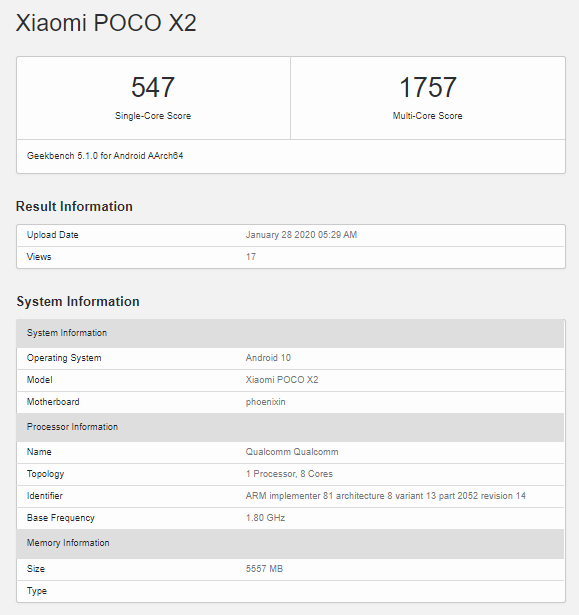
The Xiaomi POCO X2 phone’s Geekbench screenshot shows that it will be also available in 6 GB RAM version. Recently, Indian publication Hindustan Times had also released a leaked render that carried the key specs and pricing of the POCO X2. It had stated that the phone will be coming in 6 GB RAM edition.
The name of the processor that powers the POCO X2 phone is not mentioned on the Geekbench listing. However, it seems that the 1.80GHz octa-core processor that powers the POCO X2 could be Snapdragon 730G mobile platform. The Redmi K30 4G also features the same SoC. The phone is loaded with Android 10 OS. It scored 547 in the single-core test of Geekbench and it recorded a score of 1757 in the multi-core test.
The leaked poster on the Hindustan Times report had revealed that the 6 GB RAM + 64 GB storage edition will be priced at Rs. 18,999. The higher 8 GB RAM edition may come with 128 GB storage. Hopefully, it could be priced lower than Rs. 20,000.
The POCO X2 product pages on POCO India website and Flipkart online retailer site have revealed that it will be coming with a 120Hz refresh rate supporting screen. For heat dissipation, it will be equipped with liquid cooling technology. The phone will carry support for 27W fast charging. It is equipped with a side-mounted fingerprint sensor.
The Redmi K30 has a 20-megapixel + 2-megapixel dual camera setup in its pill-shaped display cutout. It has a 64-megapixel (Sony IMX686) + 8-megapixel (ultrawide) + 2-megapixe (macro) + 2-megapixel (depth) quad camera setup. The device is backed by a 4,500mAh battery. These specs are also likely to be available on the POCO X2.
LG has recently revealed its financial report for the Q4 of 2019. In the final quarter, the company saw a massive loss as its mobile division continues to deteriorate in the smartphone industry.
According to the report, the South Korean tech giant saw a loss of over $850 million in Q4 of 2019 as sales of smartphones continued to decline and show little sign of recovering in the near future. LG generated KRW 1.32 trillion in revenue between October and December 2019. The figures translate to roughly 1.12 billion US Dollars, which is a sizable amount, but still noticeably lower than its revenue of 1.41 billion US Dollars in Q4 of 2018.
Furthermore, the mobile division suffered huge setbacks in the final quarter as well, measuring about KRW 332.2 million. Meaning, about 280 million US Dollars was lost during this period of time, which is also higher than the 270 million US Dollars lost in the same quarter of 2018.
Despite LG’s best efforts to reduce cost and operational expenditures, the company is still showing negative growth. Looking at the overall report for 2019, the electronics brand’s declining mobile division generated 5 billion US Dollars but experienced a large sum of 858.34 million during the same time. This also highlights LG further declining over 2018, where the company lost just 650 million US Dollars in the same quarter. From a multinational corporation’s point of view, the financial figures are terrible for any company.
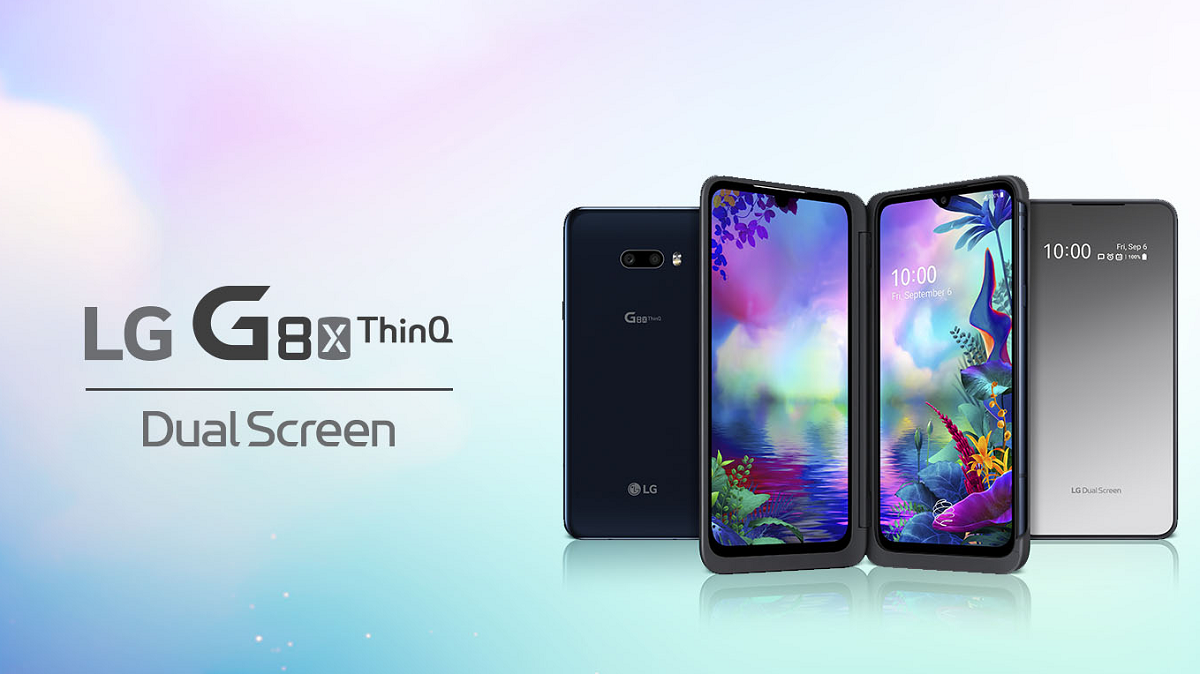
LG G8X ThinQ
However, a silver lining does present itself to the company. LG, similar to Samsung, hopes that the newer and faster bandwidth, 5G network, will help improve its sales figures for 2020. As of right now, the adoption of 5G is still low and confined to a handful of countries including, South Korea and China. The former is the home country for both LG and Samsung through which both seem to benefit the most. Notably, other brands like Xiaomi are also quickly catching up in these regions and LG stated that it is expecting “severe competition” in the mid range smartphone segment.
LG said that the decline in sales of its smartphone in Q4 of 2019 is due to its stagnant sales in the overseas market, especially in the mid-range segment of smartphones. Additionally, the company attributed the higher expenditure to clearing existing inventory and the launch of new products.
Mike Pompeo, US Secretary of State, has urged the British government to reconsider its decision allowing Chinese telecom giant Huawei a limited role in building the country’s 5G and fibre networks.
During his visit to the United Kingdom, Mike Pompeo talked with Prime Minister Boris Johnson and Foreign Secretary Dominic Raab on the Huawei issue. As per the reports, he has described the Chinese company as “real risk” to cyber security.
He has also warned that the US intelligence information would not be allowed to pass across untrusted networks, which includes any networks running hardware sources from Huawei or ZTE, both Chinese brands.
In May last year, the United States said that it considers Huawei a national security threat without showing any proofs and also alleged that the equipment supplied by the firm could be used by China’s government to spy. The U.S. also added Huawei to the Department of Commerce’s Entity List in May 2019, effectively banning it.
A few days ago, Boris Johnson, Prime Minister of UK, gave Huawei the go-ahead for building 5G networking in parts of the country. However, the Chinese company can only develop “non core” parts of the newer and faster bandwidth and its market share is hard-capped at 35 percent.
Following UK’s decision, the European Union has also allowed the Chinese telecommunications manufacturer to help build its 5G network. Similar to the UK, this decision comes with a set of guidelines for its member nations which suggests to omit high-risk vendors like Huawei from the ‘core’ 5G network infrastructure.
Xiaomi‘s fitness band has always been known for its cheap pricing, solid build and good performance. Since the Mi Band 4 was released, the units have sold massively. A survey of wearable devices in China by IDC for Q3 2019 had revealed that Xiaomi’s wearables command 25% of the market. Of course, most of the wearables sold were the Mi Band series.
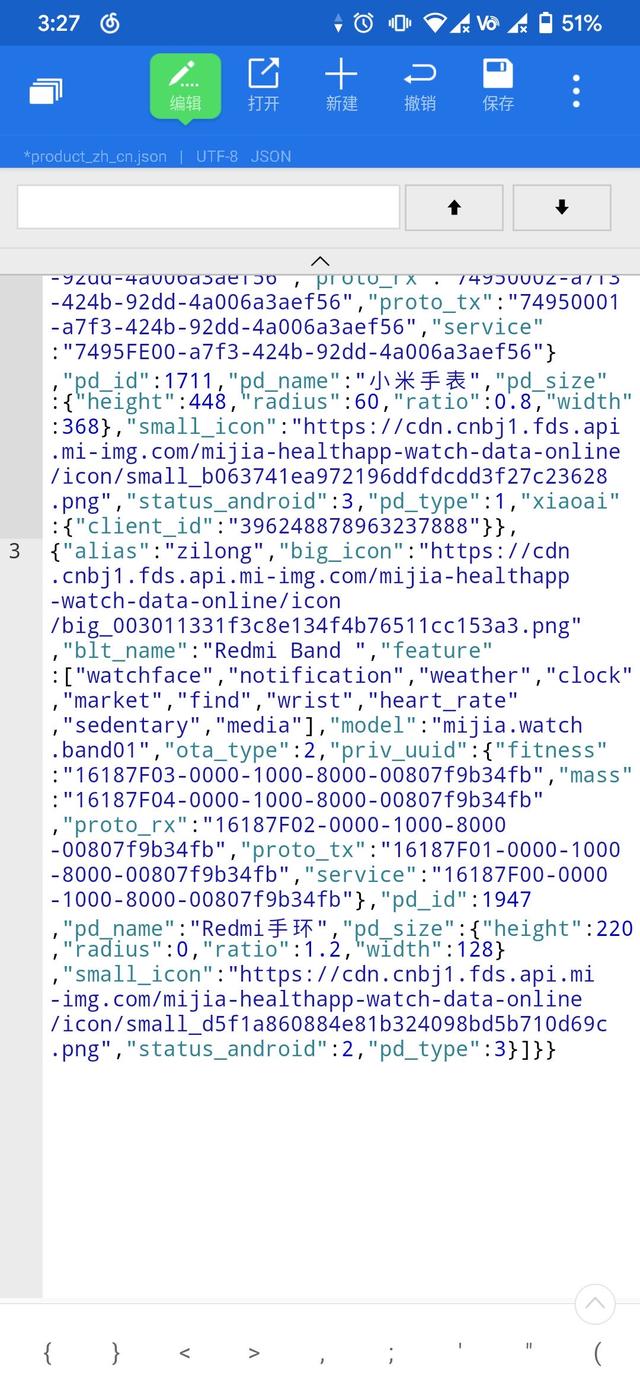
New information has emerged showing that Xiaomi’s Redmi brand may be trying to replicate the success of the Mi Band. In other words, Redmi has got a new wearable device, specifically, a fitness band in the works. The keyword”Redmi band” was spotted on the source code of the latest version of the Xiaomi Wear app. The code shows the device will be equipped with features such as watch faces, notification, weather alert, alarm clock, payment, find band, heart rate, music control and other functions. Judging from these functions alone, the Redmi band seems to cram more features than the current Mi Band 4.
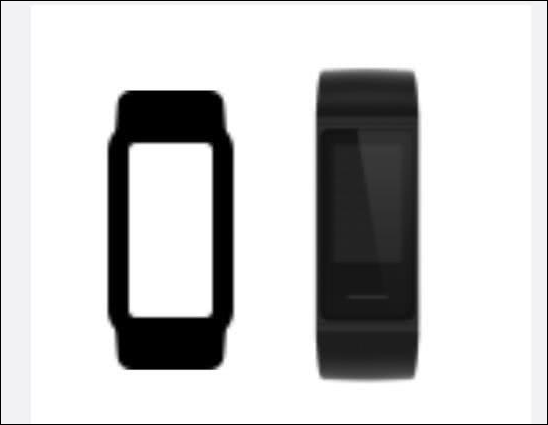
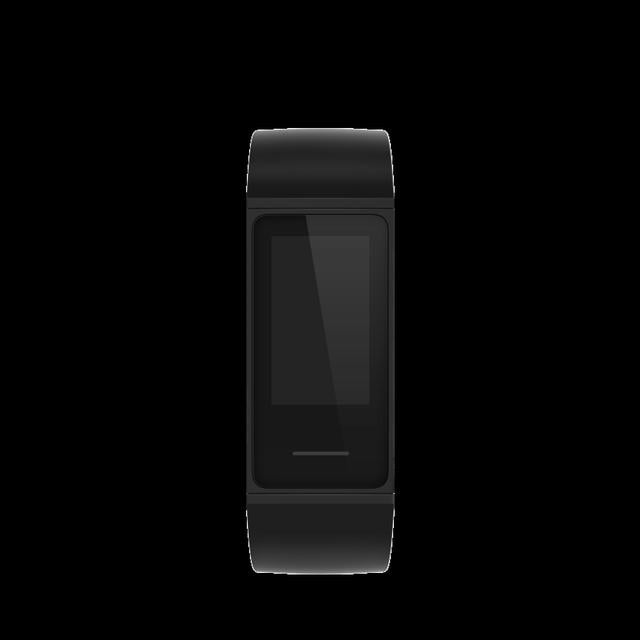
In addition to these features, some persons have also dug up the schematics of the Redmi Band on Xiaomi’s CDN server. In terms of the appearance, the Redmi Band will completely deviate from the design style of the Mi Band. The shape is simpler, more like a bracelet. Maybe this is also one of the means of reducing the cost of the wearable.
We expect the device to be cheaper than the Mi Band. However, Redmi is yet to release any information on the purported Redmi Band.
BT (British Telecom) has stated that Britain’s decision to limit Huawei‘s involvement in building 5G infrastructure would have increased the cost of its gigabit-communications plan by about 500 million pounds over five years.
British Telecom is the largest mobile broadband network provider and its Chief Executive, Philip Jansen, said he welcomed the use of vendors such as Huawei. Both companies have been known partners in the region for a while now and this further extends their collaborations.
The senior executive also revealed that the company is ” in the process of reviewing the guidance in detail to determine the full impact on our plans and at this time estimate an impact of around 500 million pounds over the next 5 years.” in other words, the company stands to lose roughly $657 million over the course of the next 5 years, since the local government has put a hard cap on the company’s total involvement in the 5G market.
On the other hand, BT is on similar sides with the government’s decision by stating that the security of the UK’s communications infrastructure should be the top priority. As or right now, Huawei is allowed to develop only “non core” 5G infrastructure and can only have a market share of 35 percent in the local 5G market.
Recently, BT had unveiled its financial report for 2019 which had the company see a weak performance in Q3 of 2019, dropping by 3 percent or 5.78 billion pounds lower than initial expectations. The company is also witnessing a fall in core earnings which is estimated to be around 1.98 billion pounds. BT has blamed higher spectrum fees, investment in customer experience and rising operating costs as reasons for the decline.
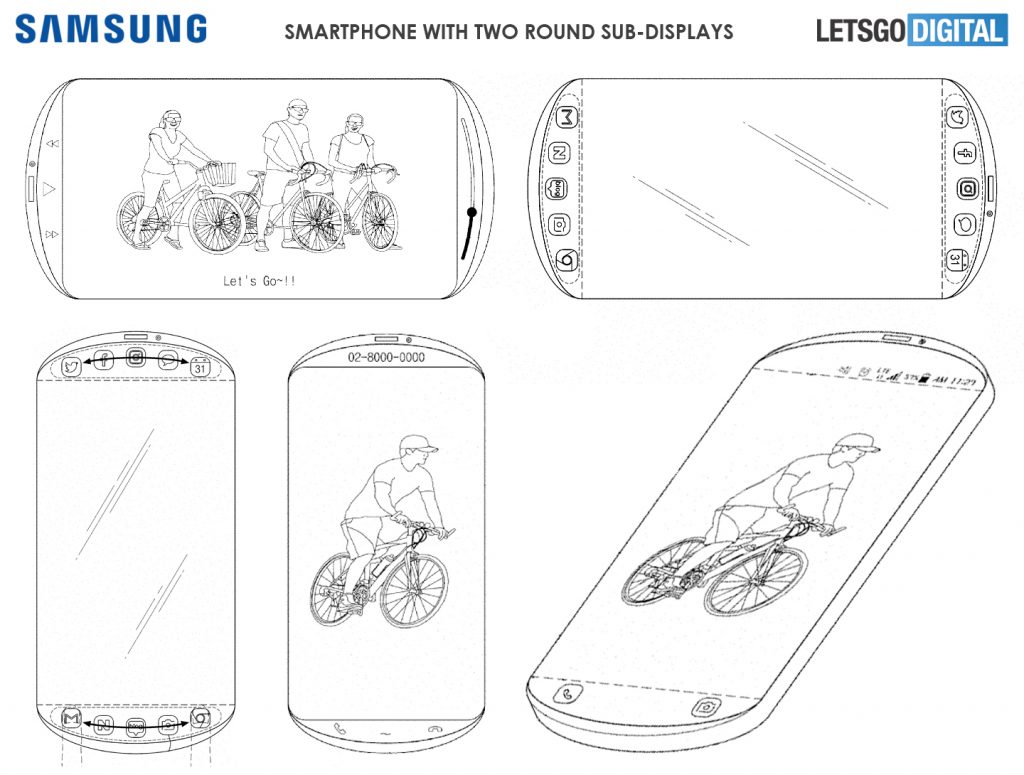
A new Samsung patent has surfaced which showcases a unique and futuristic design. The patents revealed a Galaxy smartphone with a round edge/notch and comprise of three separate displays.
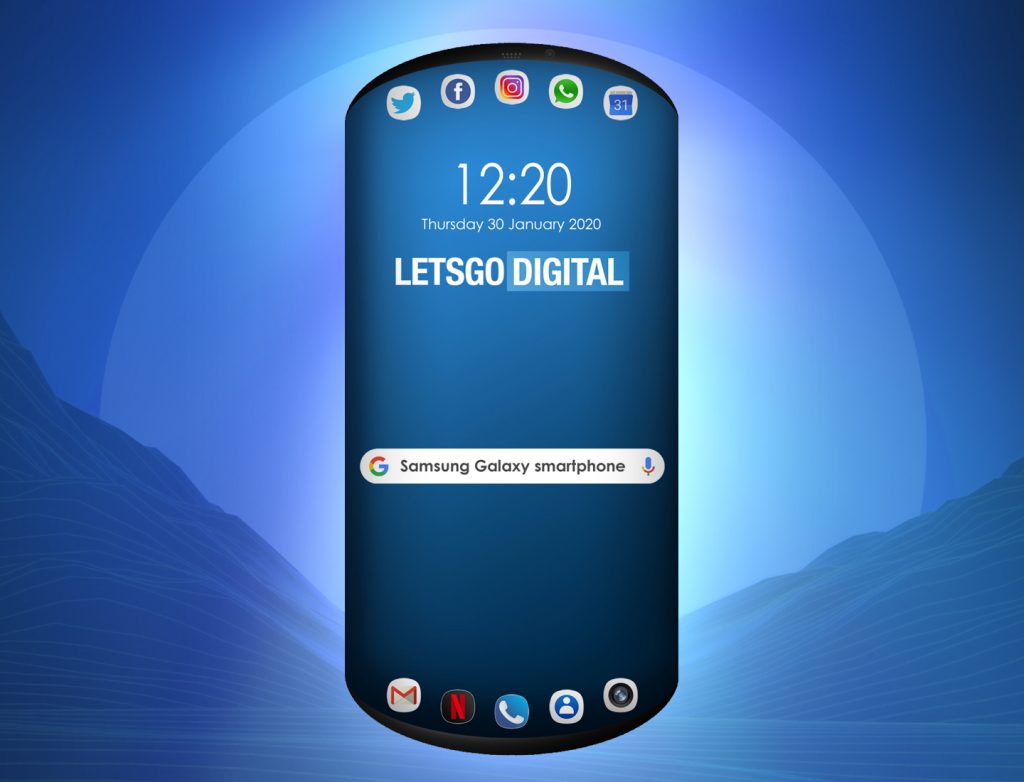
Looking at the images provided, the Samsung smartphone is made of two round sub-displays that are placed at the bottom and at the top of the primary display unit. The main screen is noticeably larger than the other two and the three combined to showcase a “squircular” display which mix of square and circular on the edges, according to the patent description.
Samsung’s patent reveals the smartphone featuring a primary display with sub-displays on the top and bottom
The sub-displays serve a functional purpose alongside its unique appearance. The top and bottom rounded displays contain various app icons that can be interacted with via touch input and will also allow wheel scrolling to get to the users’ desired choice of applications. This has also led to a smartphone with a futuristic design.
The smartphone portrayed in the patent arrives with a rounded notch while the sides reveal minimal bezels. Unlike other OEMs that have their offerings feature waterdrop notch, bar notch or even a punch hole camera, this rounded has never been seen before. Since the sub-displays also offer some unique functionality, the new design seems to benefit from the new hardware which could arrive with specialized software optimizations as well.
Image via LetsGoDigital
Samsung is known to uniquely brand the notches on its Galaxy smartphone offerings. These include names like “Infinity-O,” “Infinity-U,” and “Infinity-V.” The O refers to punch hole and is generally seen in flagship handsets, while the U and V are different forms of a waterdrop notch display typically found in Galaxy A series and M series of smartphones. Thus, with the prior focus on notches, an upcoming Galaxy smartphone with such a futuristic design doesn’t seem far fetched.
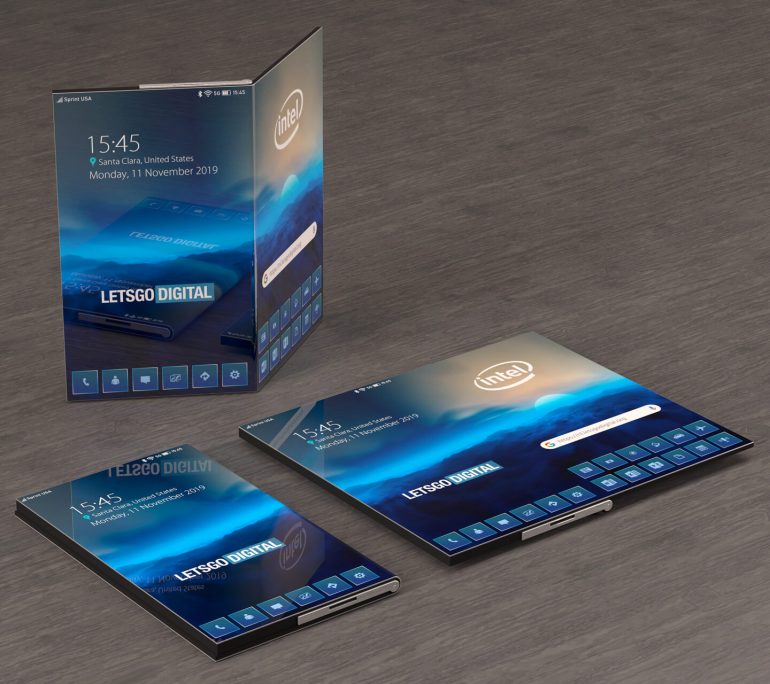
With so many smartphone brands working on a foldable smartphone or a patent related to a similar design, yet another company has joined the list — Intel. The chipset maker has patent a new foldable smartphone design that become a tablet when unfolded.
Further, it is said that the company is looking at the future progressive technology along with various display manufacturers, including LG Display, Boe Technology, Sharp and Samsung Display, among others.
If the research shows that these new types of displays actually contribute to a positive user experience, then Intel says that it will accelerate the development of such products, which is currently steadily continuing in the background.
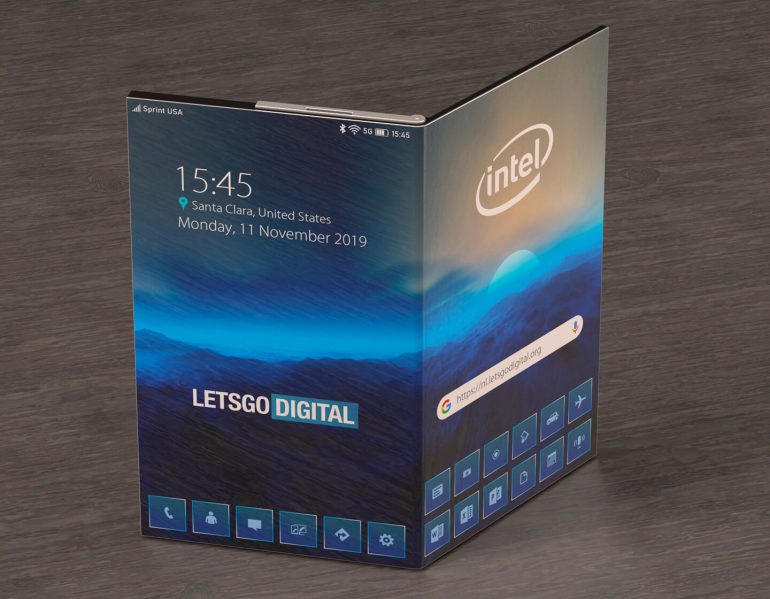
The design of the phone is a bit similar to the wrap-around display as the screen folds around the housing. The patent shows that the phone consists of one large flexible screen and when folded, the screen remains exposed.
The display extends through the right-hand side to the entire rear. It seems that majority of the surface on the device is covered by the screen, giving it a modern look. At the bottom there is a wide button, which can be used to unfold the smartphone.
The left-hand part of the device seems a bit thicker given that it houses all the necessary components. However, it looks like the housing is pretty thin but the images doesn’t reveal where and how the company will place the camera module.
Earlier this month, during CES, Intel had demonstrated its first prototype of a foldable laptop, nicknamed Horseshoe Bend. It features a 17.3-inch foldable OLED screen and appears like any other clamshell laptop.
Recently, China has been affected by one of the worst viral outbreak to have ever plagued the country. The Coronavirus has been a cause for global alarm and has become a major epidemic in China’s Wuhan district. This, in turn, has also affected the supply chain or various different industries, including electronics. Now, it is being reported that the Samsung Galaxy S20 series’ accessories supply will also be delayed.
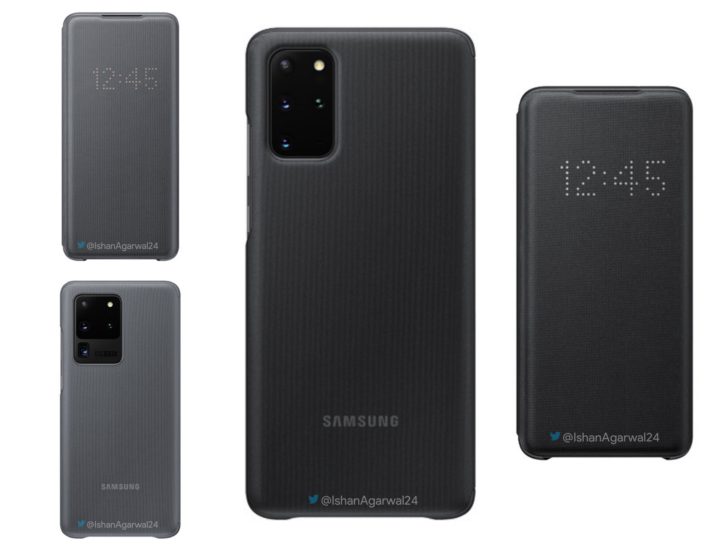
Samsung Galaxy S20 series LED covers (Unconfirmed leaks)
According to the source, various manufacturers sent letters that address delays in accessories shipment due to the ongoing viral outbreak. Furthermore, due to this, the local government has also extended the Chinese New Year holidays as a method to combat the spread of the infection. In other words, areas like factories that generally have a large number of people are seeing their operations suspended as a means of precaution.
Notably, the products made in China that are being sold in the western markets will go through stricter control, which will inevitably delay shipments. Samsung’s Unpacked, where the South Korean tech giant is expected to reveal its 2020 flagship lineup, is less than two weeks away. Keep in mind, this is during a time of extended Chinese New Year holidays and Coronavirus spreading. So, it comes as no surprise that smartphones being released at this particular time frame will see delays in certain cases.
Coronavirus outbreak in the Wuhan region has people wear face masks for added precaution
Thus, one would be considered lucky if they manage to get their hands on a Samsung Galaxy S20 series accessory early during its launch. Currently, it is expected that the shortage of stocks and delays in shipment will persist for an unavoidable short period of time, but should recover in the month to follow.
We are all eagerly waiting for the Huawei P40 series which is confirmed to launch sometime in March 2020. The lineup has pretty big shoes to fill this year after the P30 series garnered a great response from consumers in 2019. And just like the P30 lineup, the camera will continue to be a strong point of the new P40 series as well.
The biggest change in the Huawei P40 series this year is the number of flagship devices in the lineup. Last year, the Huawei P series featured three main devices, the Huawei P30 Pro, the Huawei P30, and the Huawei P30 Lite. This year, there seems to be an additional high-end model called the Huawei P40 Pro PE or Huawei P40 Pro Premium Edition. As the name suggests, this is expected to be the most powerful model in the series featuring a Penta-camera setup at the back. The other P40 series devices will have fewer cameras on board.
Since we expect four different models in the P40 series this year, let’s take a closer look at each one of them down below.
Note that this information is based on the available renders and leaked information over the past couple of months. So we can’t guarantee 100% accuracy. However, in our experience, we are at a stage where most of the information mentioned below should turn out to be true at launch. Also, we have added an * if a particular feature mentioned below is based on pure speculation rather than any credible leak or rumor.
Huawei P40
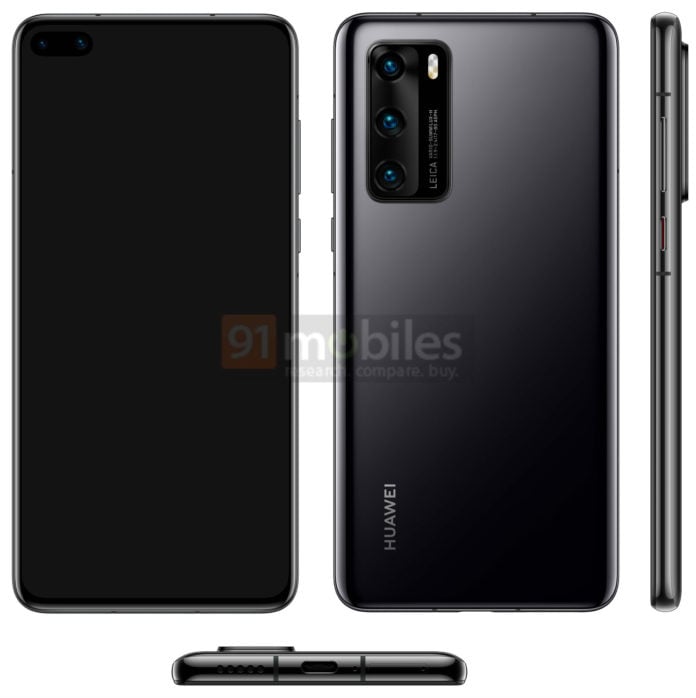
The Huawei P40 aka the standard edition will be the cheapest model in the flagship range. It will cut down on a few features like a curved display and a couple of cameras to keep the price lower than the Pro and Premium editions.
Huawei P40 – standard edition – via 91mobiles
The P40 is expected to feature a flat OLED display with a size ranging between 6.1-6.2-inches. The front camera solution on the new model will be different than its predecessor. The phone will come with dual punch-hole cameras on its OLED display, placed on the top left corner. To remind you, these dual punch-hole cameras are common among all the three flagship models (P40 Pro and P40 PE) this year.
At the back, there will be a rectangular camera housing, much like the Pixel 4 series. Being a standard edition model, the P40 will only feature three cameras at the back. The volume buttons and the power button with an orange accent will be placed on the right. At the bottom, you’ll get the speaker and the USB-C port. Note that the placement of the ports and the buttons are common among the other two models as well.
The expected specs of the Huawei P40 are as below.
Triple Leica camera setup: 40MP cine shooter (1/1.5″) + 52MP primary (1/1.3″) sensor + 8MP telephoto lens with 3x optical zoom
5000mAh battery (*)
NO 3.5mm headphone jack
HMS services instead of Google services
IP53 certification (*)
Currently, we have no word on the pricing of the Huawei P40. However, rumors state that the entire lineup might launch at a cheaper price tag than its predecessor. The P30 started at 3,988 Yuan (~$593) in China last year, so we can expect the starting price for the P40 to be cheaper than this figure at launch.
The Huawei P40 Pro will reportedly come with a curved OLED display, much like the P30 Pro. There’ll be dual punch-hole cameras on the top left corner of the curved-screen – same as the standard P40. However, the Pro model’s display will likely get a high refresh rate.
At the back, the basic rectangular housing remains the same, but there should be two major changes in the Pro variant’s camera setup. First, there’s an additional fourth sensor, expected to be a 3D ToF camera. Second, the Pro version should swap the telephoto lens with a redesigned periscope lens offering up to 10x optical zoom on the device. There are conflicting reports about this model’s zoom capability. Some say that the 10x optical zoom will be limited to the Premium edition. So, the Pro version will only get 5x optical zoom.
Quad Leica camera setup (Possibility I): 40MP cine shooter (1/1.5″) + 52MP primary (1/1.3″) sensor + Periscope lens with 5x optical zoom + 3D ToF sensor OR
Quad Leica camera setup (Possibility II): 64MP Sony IMX686 +20MP ultra-wide lens + Periscope lens with 10x optical zoom + 3D ToF sensor
5500mAh battery
NO 3.5mm headphone jack
HMS services instead of Google services
IP58 certification (*)
Fast Wireless Charging (*)
Huawei P40 Pro PE (Premium Edition)
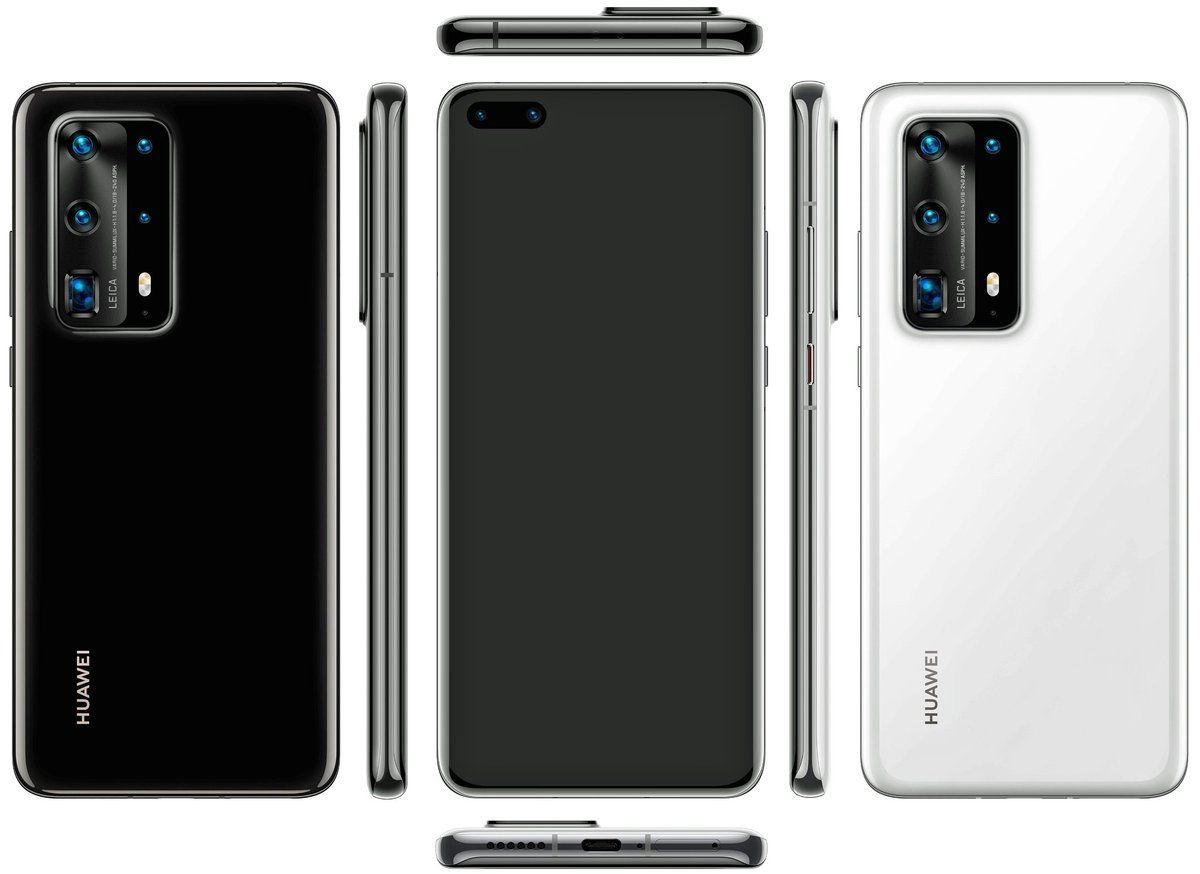
Huawei P40 Pro PE render by Evan Blass
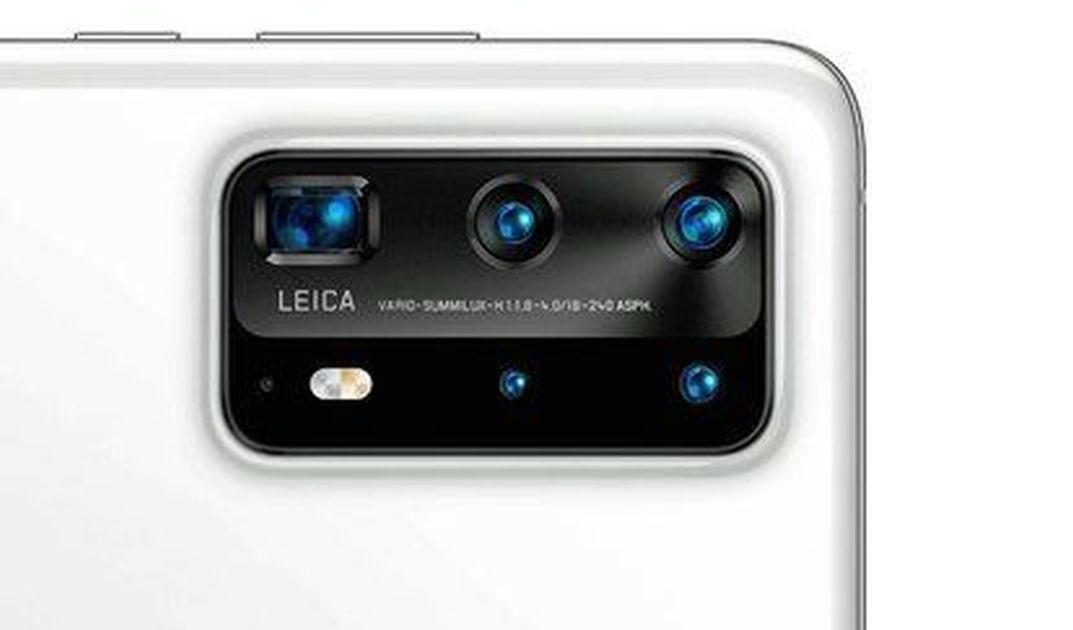
This will be the top-end model in the P40 lineup. The phone is expected to retain all of the features of the P40 Pro with two major additions. First, the Premium edition will reportedly feature a ceramic back. Secondly, there should be an additional camera at the back, making for a Penta-camera setup.
Huawei P40 Pro PE camera arrangement
A closeup of the possible camera arrangement at the back can be seen above. We could also see a couple of feature additions on this model. For example, it could support faster wired and wireless charging speeds as compared to the Pro version.
The expected specs of the Huawei P40 Pro Premium Edition are as follows.
Kirin 990 5G (*)
12GB RAM + 256/512GB ROM (*)
6.5-6.7 inch OLED QHD+ display with 120Hz screen refresh rate
We are also expecting a cheaper and stripped-down version of the P40 dubbed as the Huawei P40 Lite for the international markets. It’s being said that it will be a rebranded Nova 6 SE model that was launched in China in December 2019.
Nova 6 SE could be launched as the Huawei P40 Lite
If that’s the case, the Huawei P40 Lite should feature a quad-camera camera setup in a square housing at the back and a single punch hole camera on its LCD display.
The expected specs of the Huawei P40 Lite (based on Nova 6 SE) are as follows.
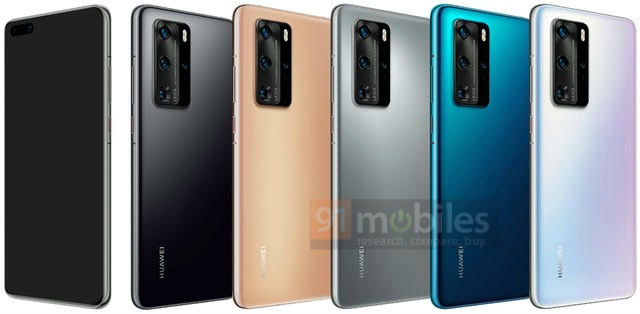
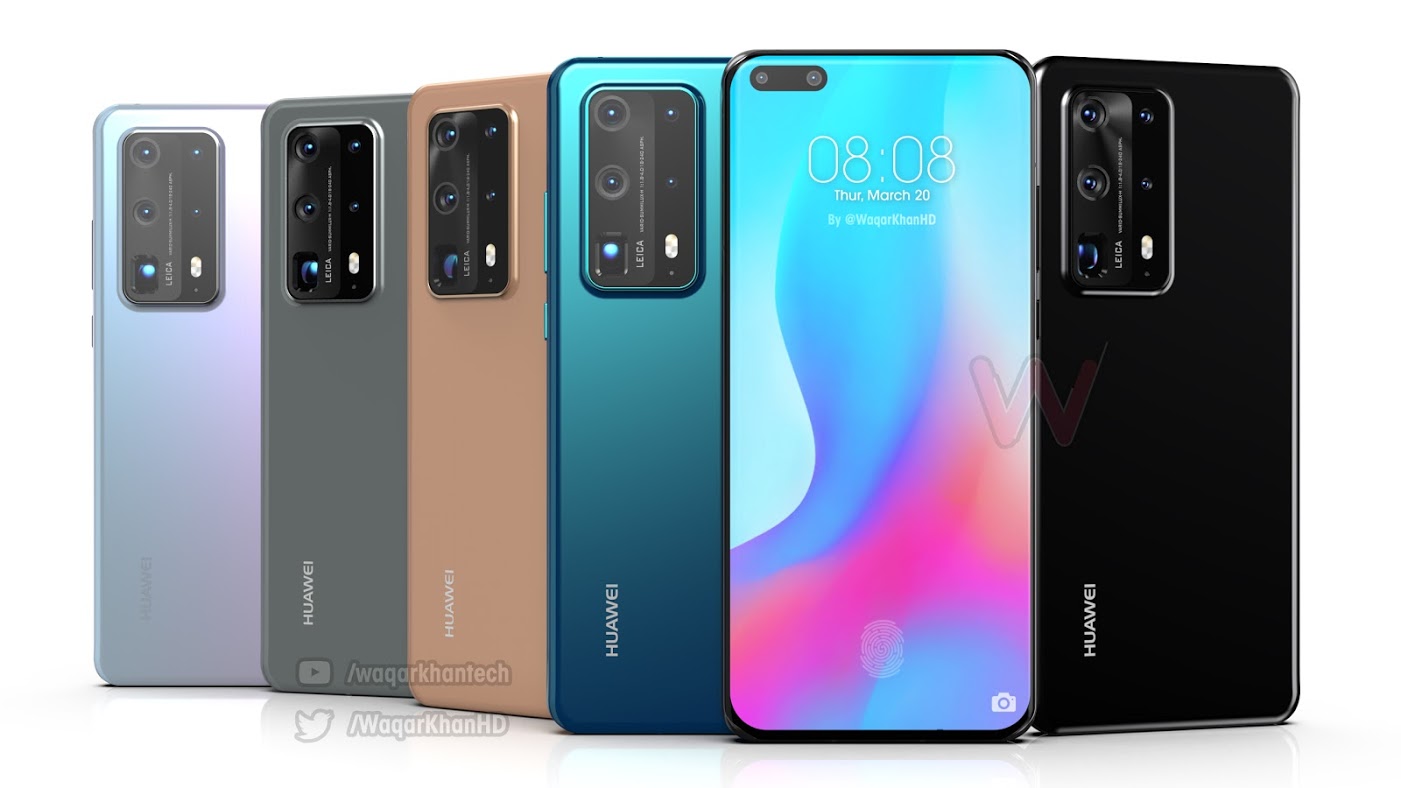
The Huawei P40 series is expected to come in colors such as Black, Blush Gold, Silver Frost, Deep Sea Blue, & Ice White. Leaks point to March 26 launch event for the P40 series but we are still awaiting official confirmation from the company.
Huawei P40 Pro Premium concept render by Waqar Khan
The P40 series will define Huawei’s strategy in 2020. The last generation model sold pretty well in China as well as overseas. But without Google apps, the company will have a hard time convincing users to go for Google App replacements like TomTom maps and its own HMS core services, even if the entire lineup is cheaper than competitors like Samsung and Apple.
City of Wuhan in Central China’s Hubei Province remains under quarantine because of the coronavirus outbreak. Despite this, chipmakers Yangtze Memory Technologies (YMTC) and its 12-inch foundry subsidiary Wuhan Xinxin Semiconductor Manufacturing (XMC) claims to have been unaffected in terms of production and shipments.
The companies say that the deliveries of their chip remains normal despite coronavirus outbreak in their locality. The company’s spokesperson has said that it is maintaining normal production and operations, and its raw material supplies and shipments are also running smoothly.
YMTC says that it has undertaken a number of scientific preventive measures to ensure that its employees remain safe. The measures taken by the company include publicising quarantine procedures, offering medical masks, temperature checks, enhanced disinfecting, and remote meetings.
There are numerous reports claiming that the production and supply chain of several smartphones in the China could get hit amid coronavirus outbreak. Recently, it was reported that supply chain of the upcoming Samsung Galaxy S20 lineup could be affected. Prior to that, it was said that production of the upcoming Apple iPhone 9 as well as AirPods might face issues but Foxconn claimed that everything is working smoothly.
Apart from coronavirus outbreak and the extended Chinese New Year holidays, the Chinese government has officially extended the holiday season as a way to battle the spread of infection. Thus, a lot of factories have already suspended operations and will stay out-of-business for a while.
Huawei has been actively working to reduce its dependence on American companies since May last year when the United States put the Chinese giant on the “Entity List”, effectively banning the company from doing trade with the US-based firms without explicit permission.
With this, the company has also lost the license to use Google Mobile Services (GMS) on Huawei as well as Honor devices. While this isn’t a major concern for the Chinese market, but GMS is essential for every other market.
As Huawei was left without a stable app ecosystem, it started working on its own operating system and launched the same within months — HarmonyOS. The company also doubled down on app development and recently launched its own Huawei Mobile Services (HMS) and is luring developers to use its platform, spending billions of dollars in the process.
Now, in a press conference in Vienna, Wang Fei, Head of Huawei’s Consumer Business Group in Austria, clearly said that Huawei does not plan to go back to using Google services even if it regains the license.
However, soon after this news started making headlines, Huawei responded to this and issued this statement: “An open Android ecosystem is still our first choice, but if we are not able to continue to use it, we have the ability to develop our own.”
The words in the statement are crafted in such as way that it neither confirms nor deny Wang Fei’s statements. It also doesn’t mention Google or its Play Services at all. It said that open Android ecosystem is the company’s first choice, which is already what the company is using for HarmonyOS.
Earlier, when the rumors about Huawei developing its own mobile operating system as HongMong OS started surfacing online, it was said that Huawei plans to get rid of Android OS from its smartphones and will instead use its own operating system.
However, soon after the launch of HarmonyOS, the company’s executives claimed that Google’s Android still remains Huawei’s first choice of mobile OS and it will continue using it as long as possible. The executive also added that if the company doesn’t get to use Android, they already have an alternative in place.
With Huawei having its own solution, Google had urged the U.S. government to allow doing business with the Chinese company as the company could lose around 700-800 million users. If Huawei’s plan for its own OS takes off and if the company manages to convince other Chinese mobile makers to use its operating system, then Google could lose its monopoly in the mobile OS market.
We use cookies on our website to give you the most relevant experience by remembering your preferences and repeat visits. By clicking “Accept”, you consent to the use of ALL the cookies.
This website uses cookies to improve your experience while you navigate through the website. Out of these, the cookies that are categorized as necessary are stored on your browser as they are essential for the working of basic functionalities of the website. We also use third-party cookies that help us analyze and understand how you use this website. These cookies will be stored in your browser only with your consent. You also have the option to opt-out of these cookies. But opting out of some of these cookies may affect your browsing experience.
Necessary cookies are absolutely essential for the website to function properly. This category only includes cookies that ensures basic functionalities and security features of the website. These cookies do not store any personal information.
Any cookies that may not be particularly necessary for the website to function and is used specifically to collect user personal data via analytics, ads, other embedded contents are termed as non-necessary cookies. It is mandatory to procure user consent prior to running these cookies on your website.