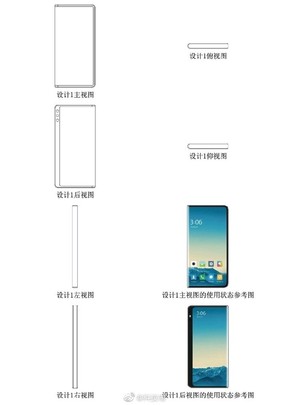
The smartphone industry saw some very notable innovations in the year 2019. 5G advancements saw the inclusion of the newer and faster bandwidth while foldable handsets became a reality. Now, Xiaomi is reportedly making a smartphone with a display that almost completely covers the smartphone body, according to patents.
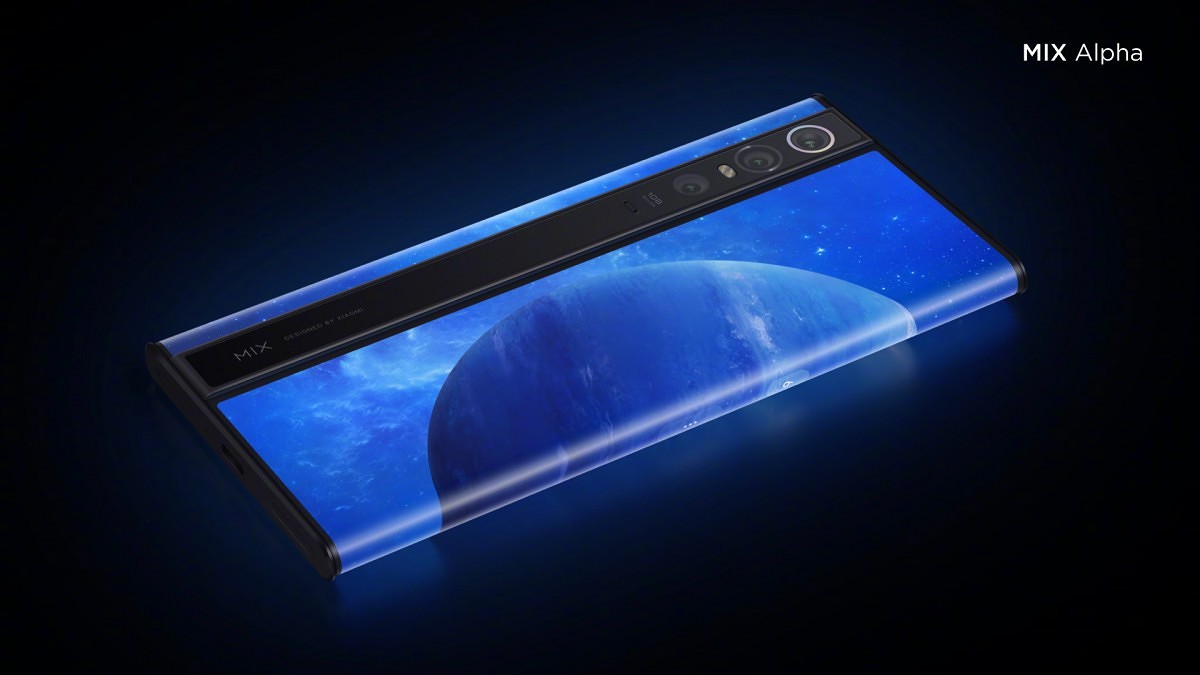
Xiaomi Mi Mix Alpha is a concept smartphone with a similar design to the patents that were recently uncovered. However, a few points can be discerned while looking at the patents. Unlike the Mi Mix Alpha, the patented device has yet to be produced and is still unconfirmed or at conceptual stages at best.
Xiaomi secretly patented a smartphone with a surround screen
The Mi Mix Alpha was the first smartphone to have a surround display that covered most of the handset’s body. Hence, the newer device could follow the same philosophy but could be made for mass-producing; since the Mi Mix Alpha will only be offered in limited numbers since it is a concept smartphone.
Looking at the design patents, the handset is visually distinct from the Mi Mix Alpha but also has the display cover the front panel and most of the rear panel. The patented device also carries a form factor that resembles that of a book. To further differentiate the device from the already existing Mi Mix Alpha, different materials could be used to manufacture it.
Xiaomi Mi Mix Alpha with a surround screen
Earlier builds of the Xiaomi Mi Mix Alpha had plastic materials for its display. Since then, the Chinese tech giant has confirmed that future iterations will arrive with flexible glass display technology. But as it stands right now, the design of the unique screen of the smartphone still needs work and improvements to be made on viability, strength and more.
A new report has surfaced which suggests that MediaTek, the chip making company, will soon launch a low-end G-series SoC that is aimed at gaming for affordable smartphones. The news arrived after Yenchi Lee (Senior Director in MediaTek) stated in an interview that the upcoming processors will be placed below the G90 series chipsets for both power and performance.
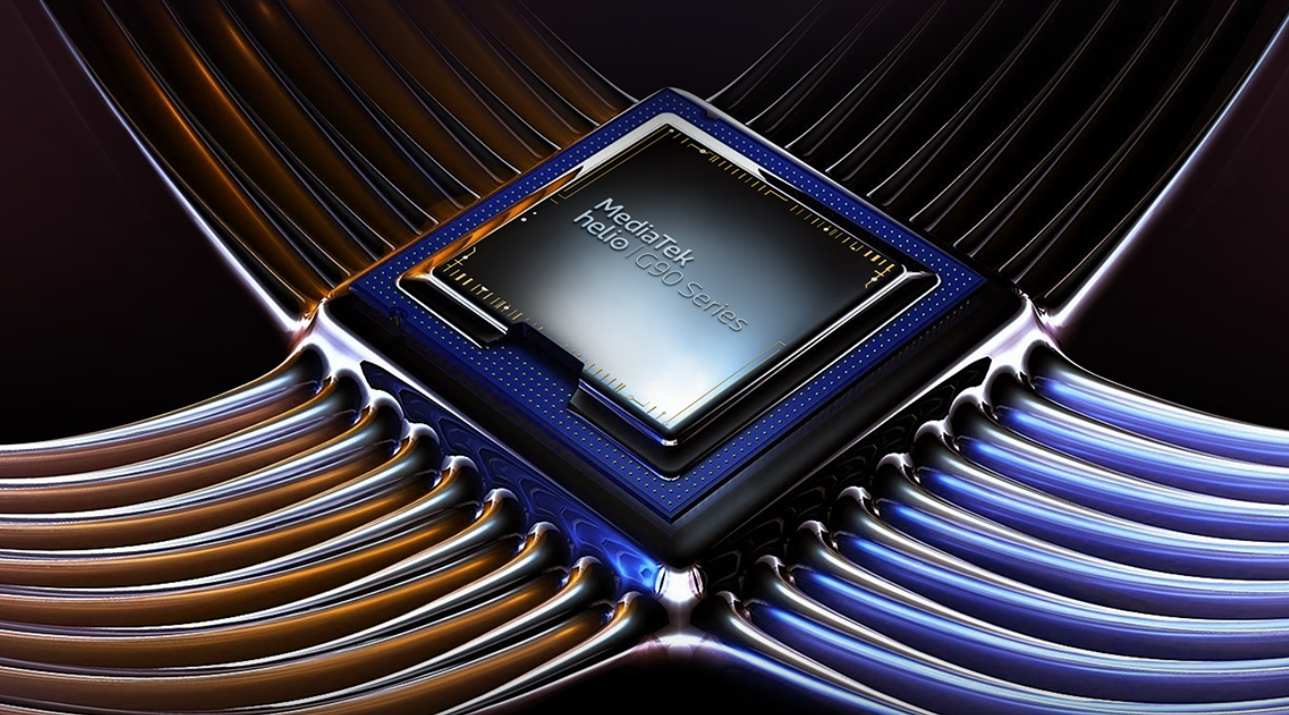
MediaTek’s Helio G90 series was one of the first smartphone chipset produced with mobile gaming as a focus. Following this line, the new entries will target the same audience but will be featured in more affordable smartphones. Although unconfirmed, the new chip series could be the Helio G70 series that is expected to power the Redmi 9 smartphones.
MediaTek Helio G90 Gaming Series SoC
As of right now, the senior executive from MediaTek has only given out a vague estimate. So, an official release date is still unknown. Furthermore, finer details like specifications of the upcoming low-end gaming SoC is also unknown. However, a leak has suggested that the chipset would be an octa core processor with two Cortex A-75 and six Cortex-A55 cores coupled with Mali-G52 MC2 GPU.
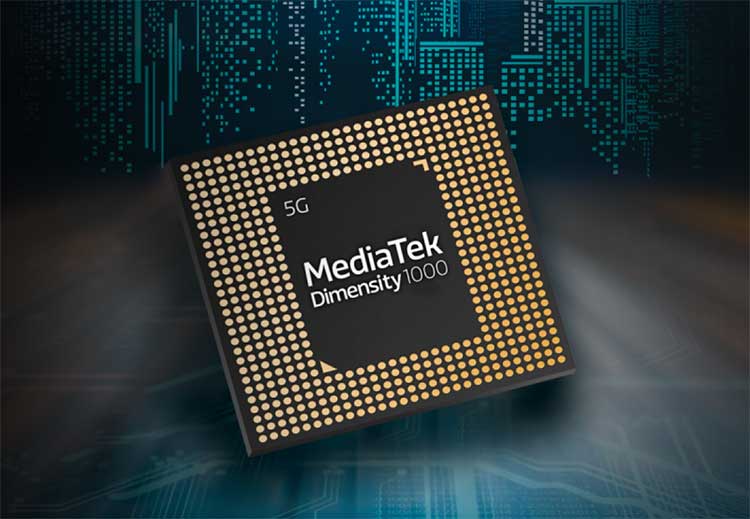
Notably, current flagship processors arrive with a tri-cluster or triple power domain CPUs. In other words, they feature a big, medium and little core, unlike MediaTek’s dual cluster. Even the Dimensity 1000 and Dimensity 800 chipsets did not feature this architecture while Qualcomm’s Snapdragon SoC’s have been for a while now. According to Yenchi Lee, the company is looking into this technology for the future and these chipsets would start shipping soon.
MediaTek Dimensity 1000 SoC
Lastly, the Senior Director also mentioned that MediaTek is looking into offering GPU updates via Google Play Store as well, something Qualcomm announced last month. However, an ETA on this is unavailable as well, at least for now.
In June last year, a MIUI community member had developed a mod that could allow the standard 60Hz display of the Xiaomi Mi 9 to deliver a faster refresh rate of 84Hz. Last month, Redmi had launched the Redmi K30 4G and Redmi K30 5G smartphone. Both phones are currently selling as the cheapest phones with 120Hz refresh rate displays in China. Today, Redmi General Manager Lu Weibing confirmed that the company successfully tested 144Hz refresh rate support on the Redmi K30 5G.
Weibing has released a video on Weibo to demonstrate the support for 144Hz refresh rate on the Redmi K30 5G. As it can be seen, the 120Hz display of the Redmi K30 5G can seamlessly support 144Hz possibly through a software update. Hence, there is a possibility that the company bring support for 144Hz refresh rate through an update in the near future.
Weibing has shared the above video at a time when major companies are getting ready to launch flagship phones like Galaxy S20 series and OnePlus 8 lineup with 120Hz refresh rate screens. Weibing’s Weibo post appeared few hours after Nubia President Ni Fei confirmed that the forthcoming Red Magic 5G phone has a 144Hz refresh rate display. It appears that many smartphone OEMs will launch handsets with higher refresh rates in this year.
In related news, Redmi will be starting with the sales of the 6 GB RAM + 64 GB storage and 6 GB RAM + 128 GB storage models of the Redmi K30 5G from tomorrow in the home market. These variants are currently priced at 1,999 Yuan (~$290) and 2,299 Yuan (~$333_. These models will be available in two color choices such as Deep Sea Blue and Deep Ocean Glitter.
The Redmi K30 5G houses a 6.67-inch IPS LCD display with punch-hole design. It offers 20:9 aspect ratio and full HD+ resolution of 1080 x 2400 pixels. The Snapdragon 765G chipset with support dual-mode 5G powers the device. It comes with up to 8 GB of RAM and up to 256 GB of native storage. It is equipped with a microSD card slot for additional storage.
The Redmi K30 5G has a 20-megapixel + 2-megapixel dual camera system on the front. On its rear, it is fitted with a 64-megapixel + 8-megapixel + 2-megapixel + 2-megapixel quad camera module. The Android 10 OS skinned with MIUI 11 comes preloaded on the device. The phone houses a 4,500mAh battery that supports 30W fast charging.
According to a new report, Huawei subsidiary, HiSilicon, has placed an order from SMIC’s (Semiconductor Manufacturing International Corporation) new 14nm process, and has received orders from TSMC (Taiwan Semiconductor Manufacturing Company) as well.
The former started the research and development regarding 14nm processes back in 2015 and has begun mass producing 14nm FinFETs successfully since the third quarter of 2019. Thus, it also makes the SMIC factory the most advanced integrated production base in Mainland China.
On the other hand, TSMC is an established industry supplier with a bulk of its operations concentrated in the Nanjing plant that was put into operation at the end of 2018. It has an investment in 3 billion US Dollars that enables it to produce 20,000 12 inch wafer fabs on a monthly basis. In simpler terms, the plant is able to consistently manufacture a large number of smartphone based circuitry.
Previously, HiSilicon’s primary orders for 16nm and 14nm were mainly taken up by TSMC. Now, Huawei subsidiary brand is placing orders to the newer SMIC for the same technology. For those unaware, HiSilicon develops the Chinese smartphone manufacturer’s proprietary Kirin smartphone chipsets.
A known project taken up by SMIC in regards to smartphones was for Qualcomm’s Snapdragon 400 series SoC (system on chip). Unfortunately, it is currently unclear as to which device the 14nm SMIC will be made for, but Huawei smartphones (or even tablets) might be the obvious choice here.
Notably, TSMC is facing certain issues since the US Government has plans to lower the standard of “Derived from US technology” from 25 percent to 10 percent. This move will create a barrier to TSMC’s supply to companies not based in the US, affecting market trends and orders for 16nm processes.
The fifth generation of mobile communication technology, referred to as 5G, is the latest generation of its kind, and 2019 marks the first year of commercial 5G use in China. This doesn’t mean technology has been slow to grow however, as companies are all scrambling to get their 5G smartphones out of the gate. With that in mind, let’s take a closer look at the 5G devices that released in 2019.
It’s been a wild year for 5G development, though it hasn’t been progressing as fast as it could be. Thankfully, things are looking really good for the future. “2020 is the year 5G goes mainstream,” according to Qualcomm President Cristiano Amon, and he expects more than 200 million 5G smartphones will ship in 2020. Whether we hit that remains to be seen.
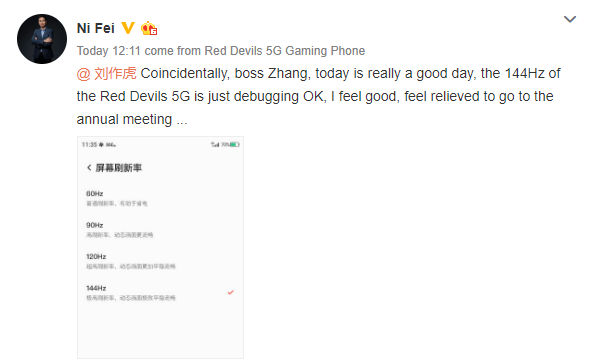
Major smartphone OEMs are preparing to launch their next flagship phones with 120Hz refresh rate displays. The Redmi K30 5G that went official last month is currently the cheapest phone with 120Hz screen. Samsung’s upcoming Galaxy S20 series and the OnePlus 8 are going to arrive with 120Hz displays. Nubia co-founder and President Ni Fei has confirmed through a Weibo post that the company’s next gaming smartphone will support 144Hz refresh rate.
Ni Fei has shared a screenshot of its upcoming Red Magic 5G smartphone on Weibo. It seems to show that the phone will provide refresh rate options such as 60Hz, 90Hz, 120Hz and 144Hz. Hence, Nubia fans who are eagerly waiting for the next Red Magic phone can expected to deliver topnotch gaming and viewing experience through its 144Hz refresh rate display.
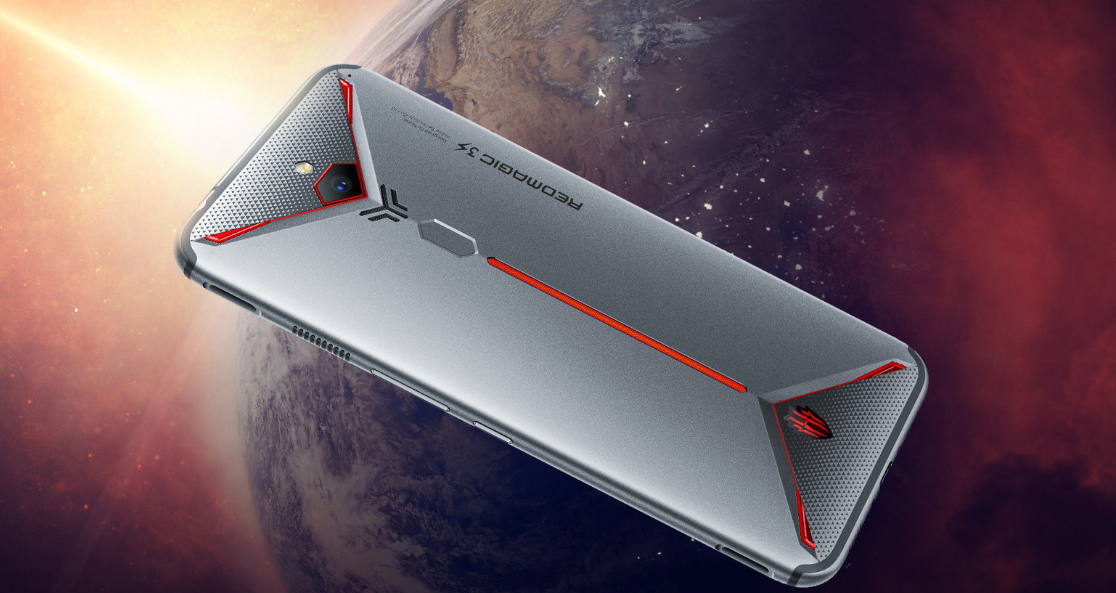
In comparison, the predecessor Red Magic 3S gaming phone was made available with 90Hz refresh rate screen. The predecessor phone had featured an AMOLED display. It is likely its successor could be also coming with an AMOLED panel.
Not many details of the next Red Magic 5G phone have been revealed. At the beginning of this year, Nubia confirmed that the next Red Magic phone will be its 5G ready gaming smartphone powered by the Snapdragon 865 mobile platform. Also, Fei had confirmed last week that shared a camera sample of the Red Magic 5G phone which revealed that is possesses triple rear cameras. Based on the recent reports, it can be said that the smartphone has a model number of NX651J. The Red Magic 3 was announced in May last year. However, with teasers of the next Red Magic 5G phone emerging early this year, it may get announced in Q1 this year.
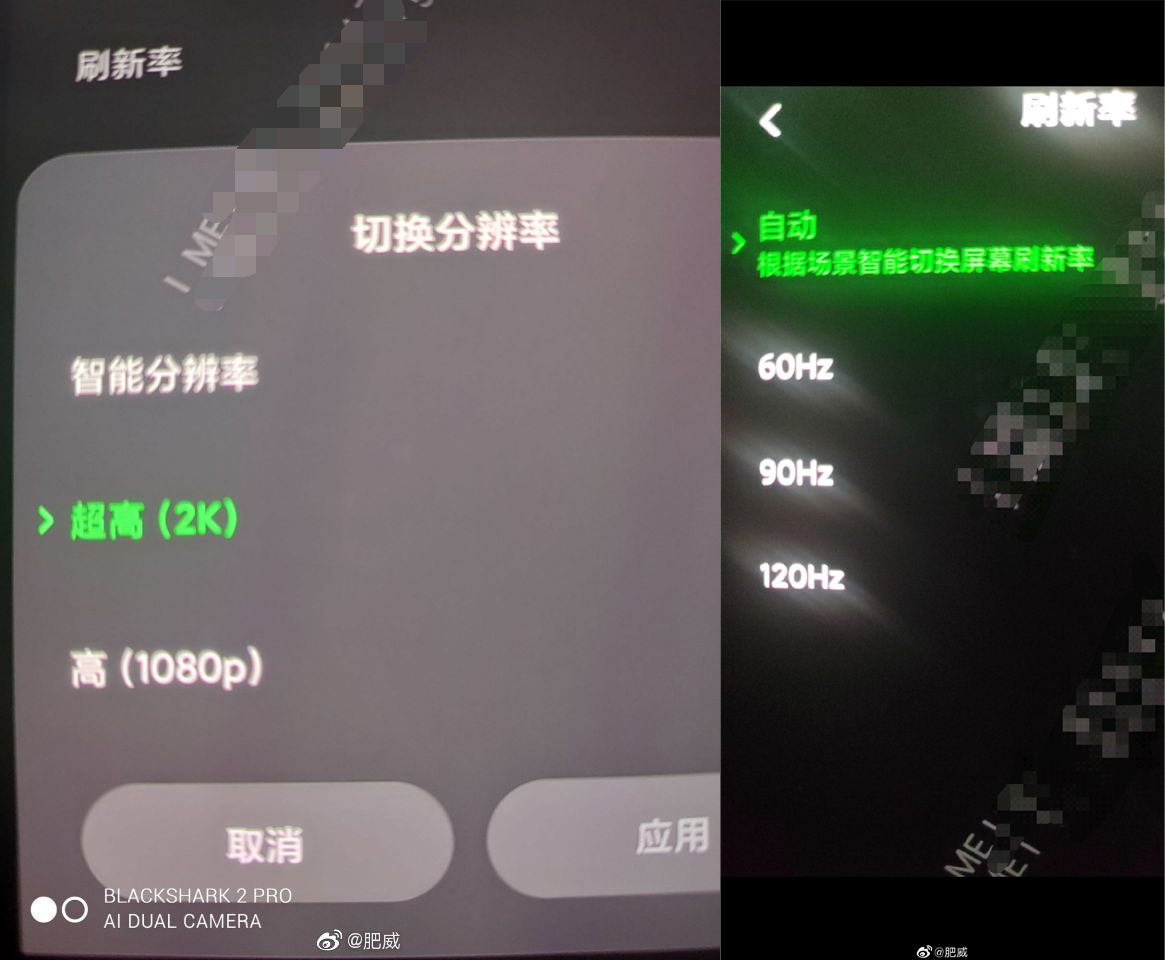
Rival brand Xiaomi is also stirring up the Black Shark 3 smartphone. A recent leak revealed that it could be coming with a 2K resolution supporting display that will carry support for 120Hz refresh rate. Also, is speculated to debut as the first smartphone with 16 GB of RAM! It may house a 4,700mAh battery that may support 3W charging. The Black Shark 2 was announced in March in China. Hence, there is a possibility that the Black Shark 3 could be announce in the same month this year.
Gaming smartphones have become a new category in itself and many manufacturers have launched their own gaming smartphones, even some of them are now launching second-generation and third-generation devices.
One such is Xiaomi-backed Black Shark which has already launch a few devices, is now gearing up to launch Black Shark 3 gaming smartphone. Now, a new leak related to the phone has surfaced online, which reveals its display specs.
The leak shows that the Black Shark 3 will come with 2K resolution display and will be offering 120Hz refresh rate. Earlier, it was said that the phone will come powered by the newly announced Qualcomm Snapdragon 865 SoC.
Previous reports indicate that the phone could come equipped with 16GB of RAM. The smartphone has been certified for radio transmission under model number KLE-A0. It shows that the device supports dual mode 5G connectivity.
If the reports are true, then the Black Shark 3 gaming smartphone will be the first to come with 16GB of RAM. So far, the highest memory configuration that any smartphone offers stands at 12GB.
The upcoming phone will be the successor to Black Shark 2 Pro which was announced back in July last year. It features a 6.39-inch FHD+ screen, a Snapdragon 855+ processor, and packs a 4000mAh battery with support for 27W fast charge. We don’t expect anything lesser from the Black Shark 3 and a recent leak says it will have a bigger 4700mh battery.
While not much is known about the smartphone yet, we expect to come across more details about the Black Shark 3 in the coming weeks and we also expect to know everything about the phone before it goes official.
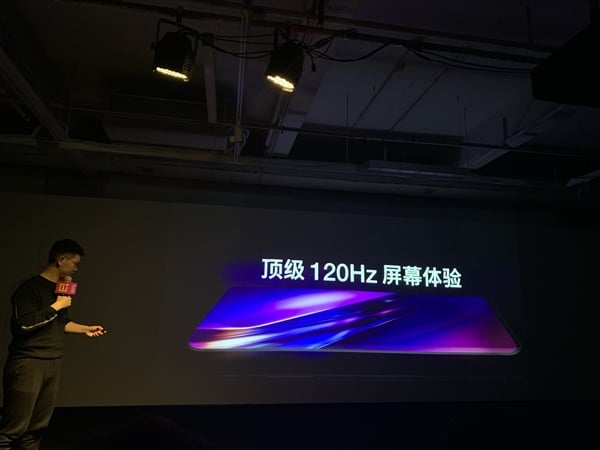
Earlier today (13th January 2020), OnePlus held a media conference meeting in Shenzhen, China. Here, the company unveiled its developments in the screen technology area and revealed the completion of a 120Hz display.
OnePlus screen technology conference 2020
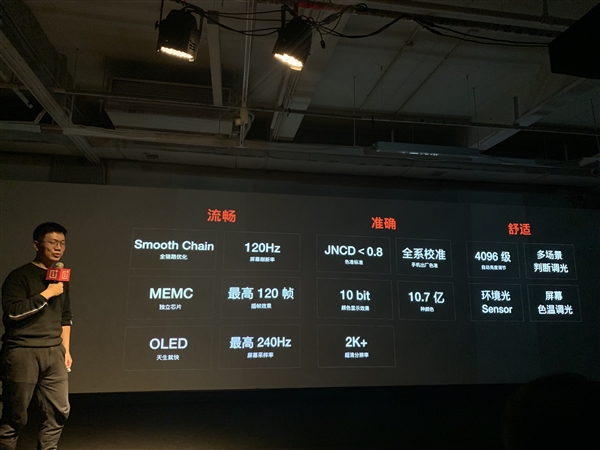
In the conference, OnePlus’ upcoming flagship smartphone series, the OnePlus 8, had one of its highlighting aspects revealed. It will feature a 2K OLED display with a refresh rate of 120Hz and a screen sampling rate of 240Hz, the highest in the industry. Furthermore, it was also revealed that OnePlus’ new screen has the highest color reproduction standard of JNCD <0.8, which beats the iPhone 11 Pro Max‘s JNCD <0.9 and the industry average of JNCD <2.
Notably, the company has even claimed that it was made a few unique optimizations to the 120Hz display; all of which to enable three major user-friendly factors, namely smoothness, accuracy and comfort. The exact details are as follows:
Details regarding the new display technology and its class leading specs
Smooth Chain Optimization
MEMC Independent Chip
Up To 120Hz refresh rate
240Hz screen sampling rate
JNCD <0.8
Color calibration of smartphones being manufactured
It is a big deal considering the display was one of the areas where the company had received criticism on initially. Starting from the OnePlus 7 series, the company has started giving importance to the display of its smartphones, which now arrive with a higher refresh rate and better resolution. This has even led to the feature almost becoming a standard in the premium grade segment of mobile phones.
OnePlus 8 series will arrive with a 2K OLED display with 120Hz refresh rate
OnePlus is also very active in the gaming community and even optimizes its handset offerings to better perform in games; thus, it comes as no surprise that the higher refresh rate will even work to further improve on the mobile gaming experience the company has to offer.
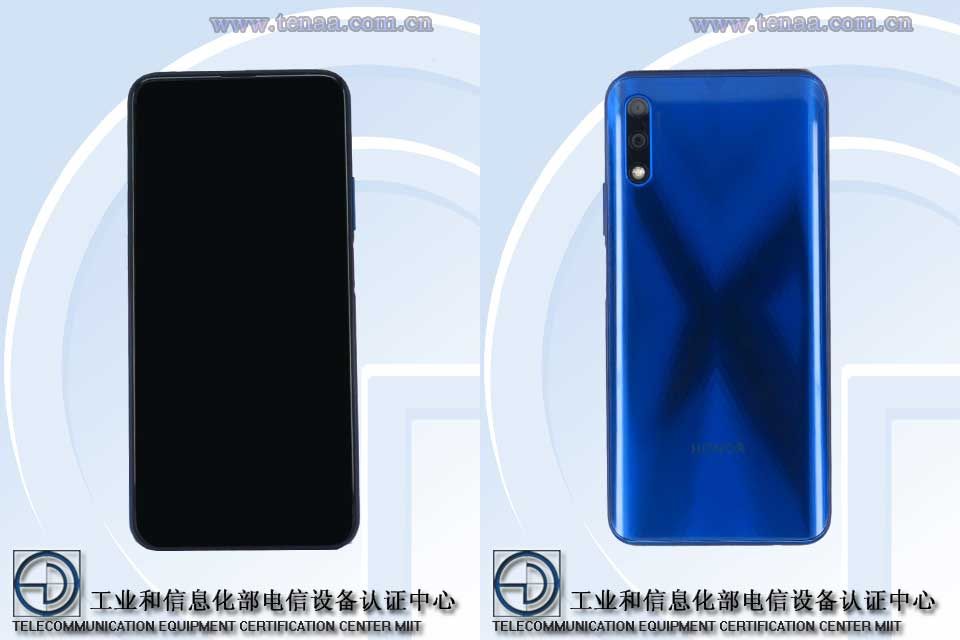
Honor had launched the Honor 9X smartphone that has a model number of HLK-AL00/TL00 in China in July last year. A new listing for HLK-AL00a Honor phone has appeared on TENAA with its entire specifications. With a model number similar to the Honor 9X, the newly spotted HLK-AL00a seems to be a new variant with a different processor.
Honor HLK-AL00a Specifications
The Honor HLK-AL00a smartphone has 163.1 x 77.2 x 8.8mm dimensions and it weighs 206 grams. Its color variants are listed as black, blue, red, gradient purple, gradient blue, etc. The device houses a notch-less screen that of 6.59 inches. The phone offers full HD+ resolution of 1080 x 2340 pixels. A minimum rated battery of 3,900mAh capacity is present under the hood of the HLK-AL00a. Its typical capacity could be 4,000mAh battery. There is no support for fast charging on the device.
An octa-core processor that clocks at 2.0GHz is at the helm of the Honor HLK-AL00a smartphone. The phone is expected to release in China in 4 GB and 6 GB RAM options. Its storage sizes listed on TENAA are 64 GB, 128 GB and 256 GB.
There is a microSD card slot on the Honor HLK-AL00a for more storage. The phone is loaded with the Android 9 Pie OS. A fingerprint integrated with the power button is fitted on the right edge of the device. Above it is the volume rocker.
The back panel of the Honor HLK-AL00a has a vertical dual camera setup. It includes a 48-megapixel main lens and a 2-megapixel secondary shooter. For capturing selfie shots, the phone possesses a pop-up selfie snapper of 16-megapixel.
As it can be seen, the specs and design of the Honor HLK-AL00a are exact match with Honor 9X. The only major difference is that the Honor 9X is driven by the Kirin 810 2.27GHz octa-core processor whereas the HLK-AL00a has a 2.0GHz octa-core CPU onboard.
The HLK-AL00a to be a new variant of the Honor 9X. The TENAA certified phone is expected to break cover as the first Honor phone of 2020. The Chinese firm is yet to confirm on the arrival of a new phone. Hopefully, the HLK-AL00a will be made official within this month.
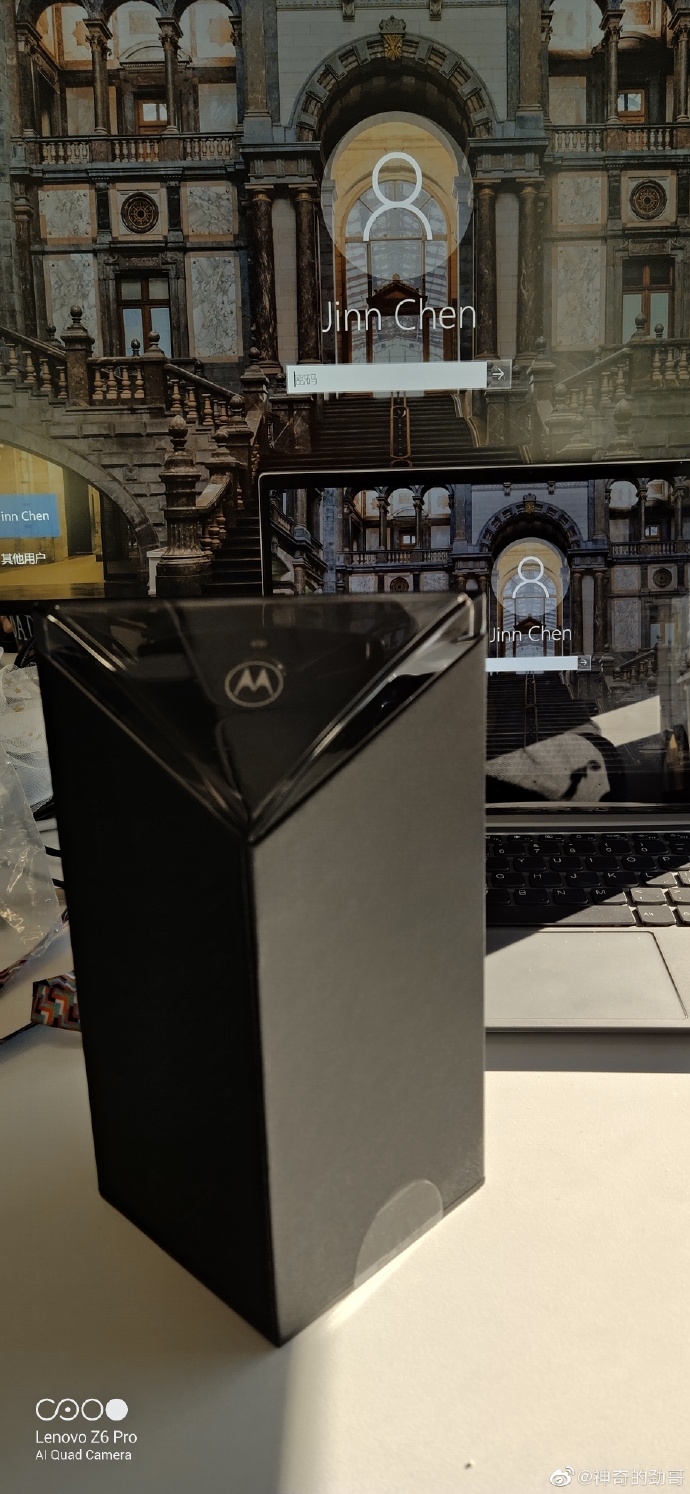
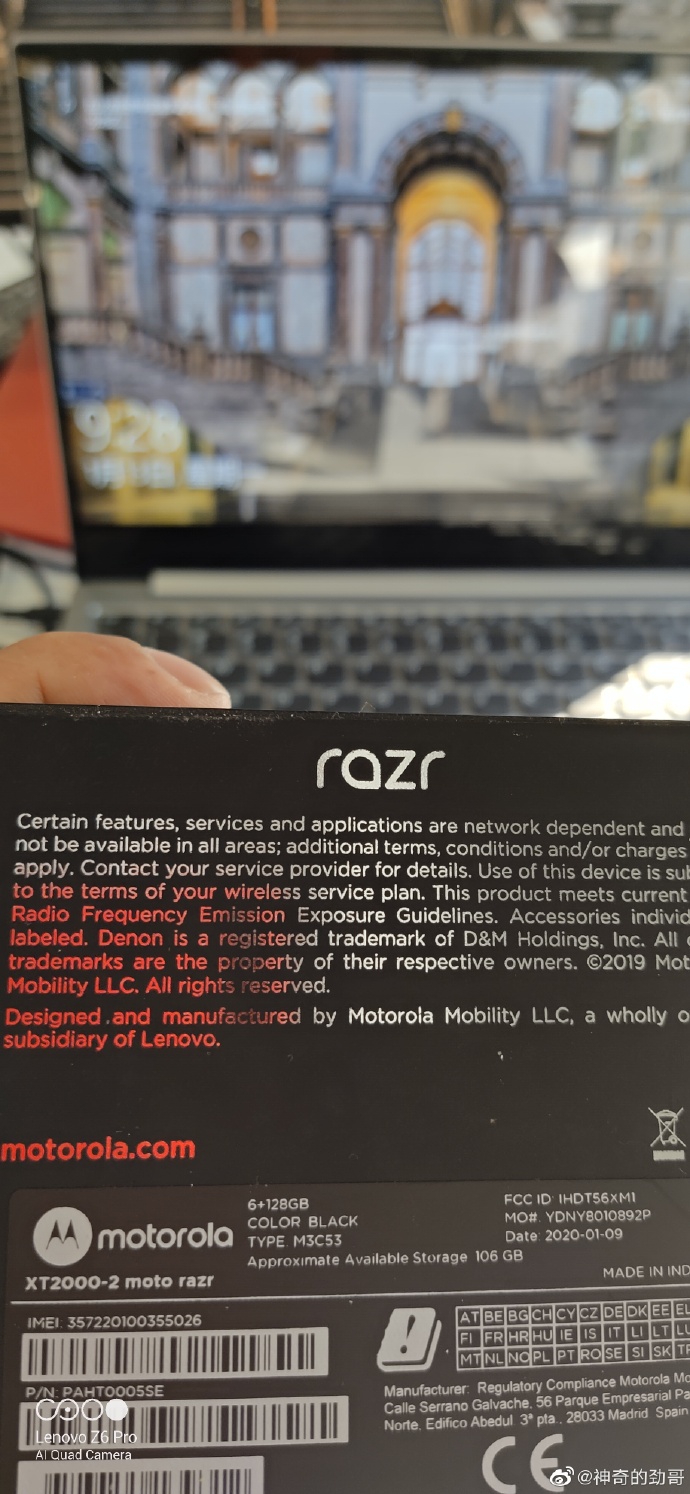
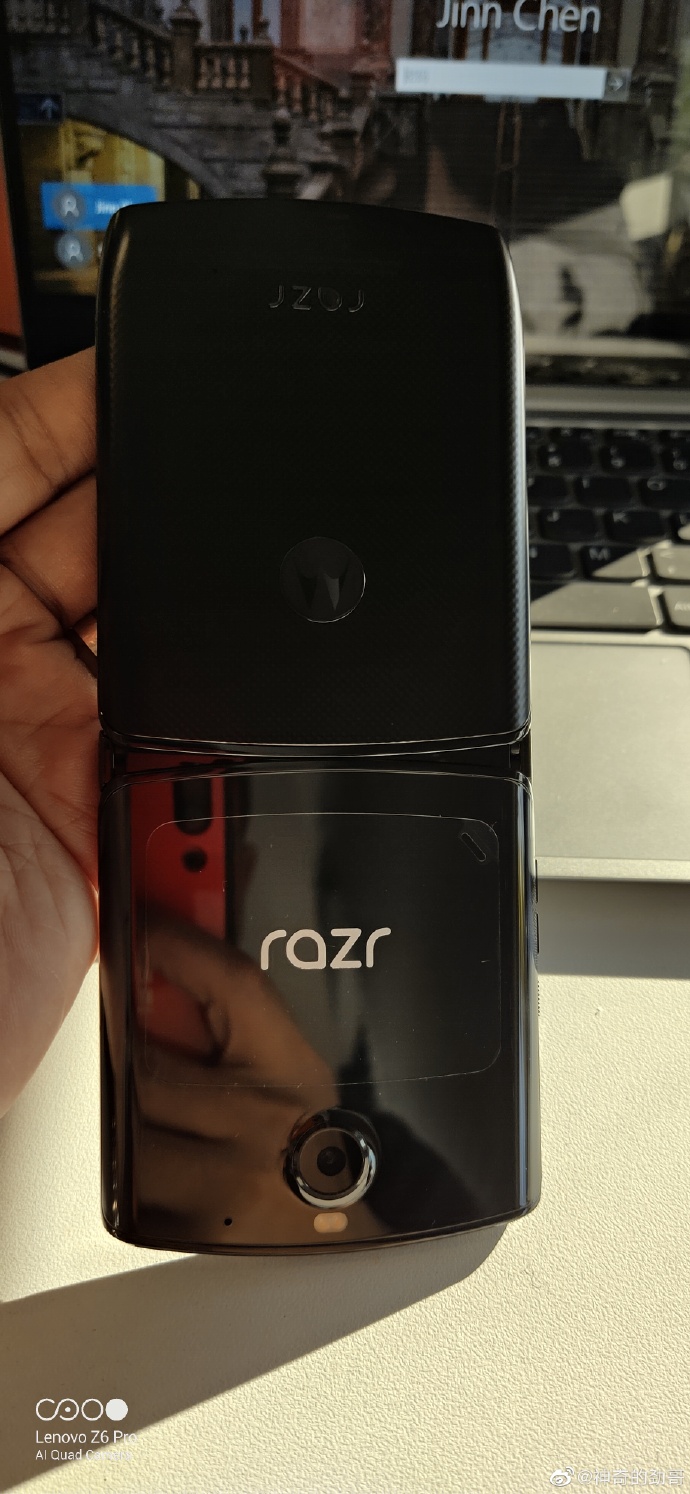
The Motorola Razr, despite discussions and criticisms, is still one of the hottest smartphones coming soon, and with the device’s Chinese launch coming soon, the company has been drumming up hype for it on Weibo with pictures of the production unit and the device’s box.
The box is rather unique next to the plethora of other boxes in the smartphone market. It’s triangular in shape, and stands tall instead of flat on the ground. There’s still all the information you expect on the back, showing us the device’s name, specifications and details. It’s very good looking box, and it complements the device very well.
After launching the Motorola Razr smartphone in November in the United States, Yang Yuanging, Chairman and CEO of Lenovo Group confirmed that the phone’s sale in the U.S. has been postponed due to demand and supply issues.
The Motorola Razr has a 6.2-inch Flex View P-OLED display with a 21:9 aspect ratio and a notch for a 5MP selfie camera. When folded, there is a smaller 2.69-inch 800 x 600display on the back that displays notifications and caller IDs.
Inside the Razr is a Snapdragon 710 processor with 6GB of RAM and 128GB of storage. Due to its design, the Razr packs a measly 2510mAh battery capacity but has support for 15W TurboPower fast charge. There is a 16MP camera on the back of the phone as well as a fingerprint scanner under the Motorola logo.
The Motorola Razr also has NFC, Bluetooth 5.0, and an eSIM. It runs Android 9 Pie though but we hope an Android 10 update is released shortly after it goes on sale because asking for $1499 for a device that doesn’t run the latest version of Android is a bit outrageous.
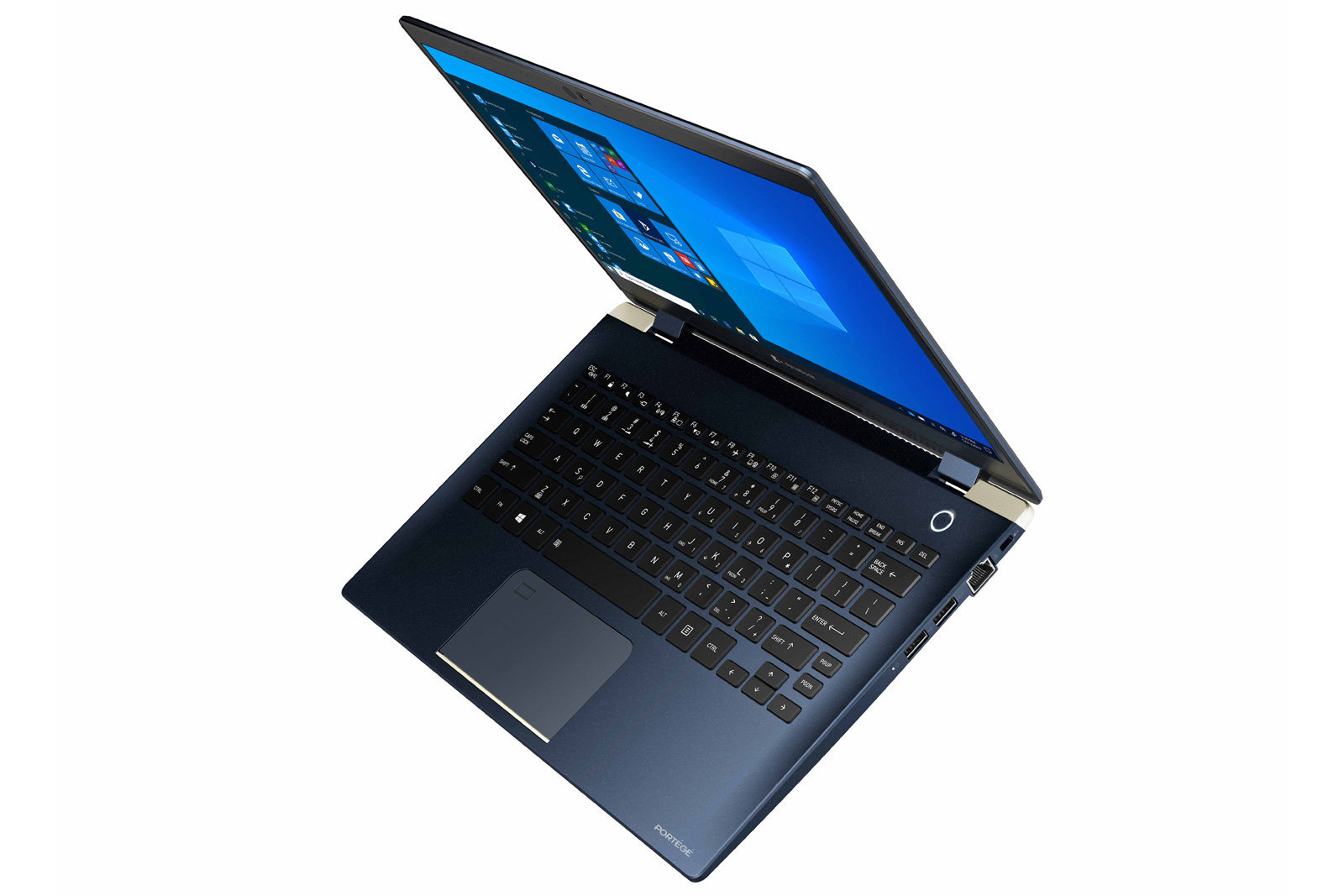
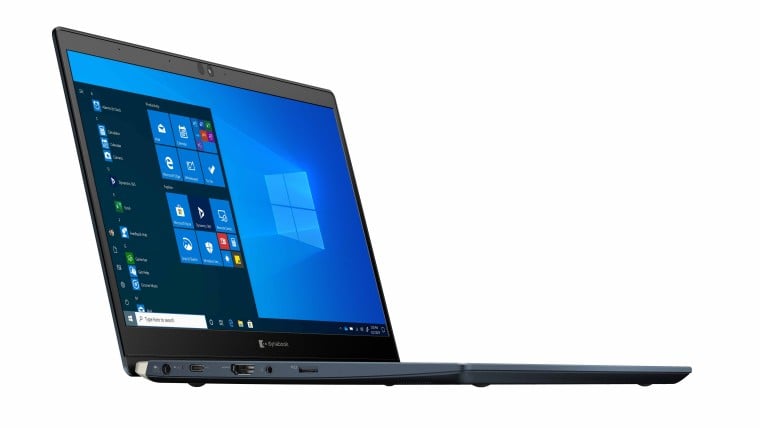
Sharp‘s Dynabook series of laptops have just received a new entry in its lineup. It is a 13 inch laptop which is one of the lightest PC currently available. The notebook is dubbed the Portégé X30L-G and arrives with notable specs in a very light package. It was revealed at the Consumer Electronics Show of 2020 (CES 2020)
Sharp’s (Dynabook series) Portégé X30L-G is one of the lightest laptop ever made
Portégé X30L-G
Sharp Dynabook lineup (formerly Toshiba’s) have made an entry in the notebook market with a light and portable laptop that doesn’t compromise on performance. One of the notable aspects of the device is its processor and weight, which is the 10th Generation Intel Core Processor in a 1.9 pounds (860 grams) form factor. Notably, Sharp’s latest Dynabook laptop achieved its featherweight feature since it was manufactured using a light magnesium alloy (avoiding the heavier aluminum).
Despite its incredibly lightweight, the laptop still features a U-series processor (low power consuming chips from Intel), an IGZO display with a maximum brightness of 470 nits, WiFi 6 and a generous offering of ports; including one USB Type C, two USB Type A, an Ethernet port and an HDMI. Additionally, Sharp Dynabook Portégé X30L-G also arrives with a military grade dust and drop resistance and a battery life ranging around 14.5 hours on a full charge.
The Portégé X30L-G is made from magnesium alloy that helps achieve its feather weight
Price and Availability
Due to its unique and extreme light weight design, people interested in buying Sharp Dynabook Portégé X30L-G have to shell out 1,600 US Dollars (roughly 11,000 Yuan). The laptop will be available for purchase sometime in February 2020.
For more coverage on CES 2020 launches and event, click here.
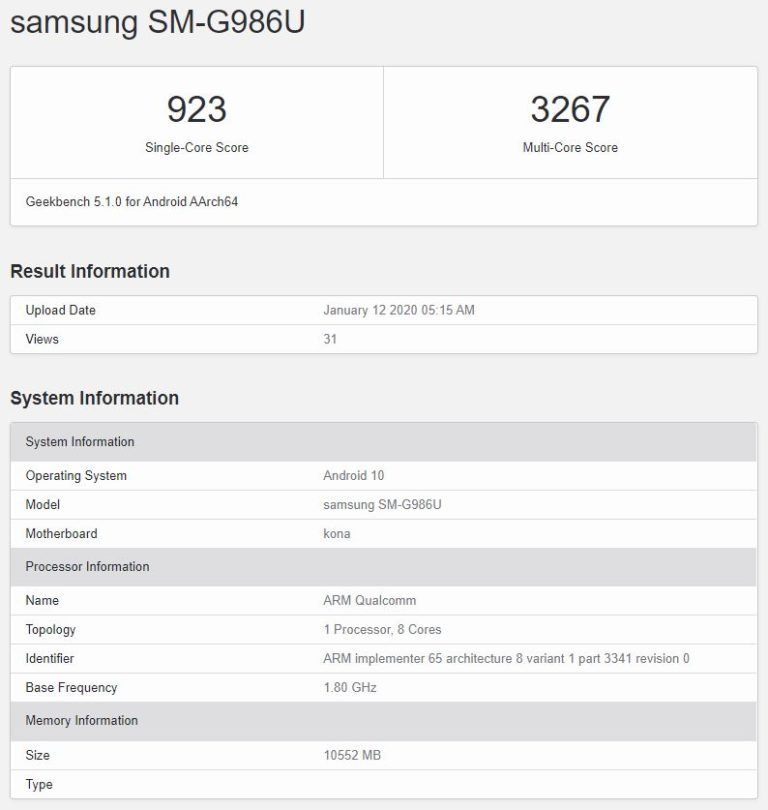
Samsung will be debuting the Galaxy S20 series of smartphones in the coming month. Ahead of the launch, the rumor mill is actively working on revealing vital information on the S20 smartphones. The live shots of the Galaxy S20+ 5G had appeared over the weekend. The images corroborated with the renders of the phone that had appeared in the last month. The Galaxy S20+ 5G smartphone that is believed to have a model number of SM-G986U has been benchmarked on Geekbench. As usual, the benchmarking platform has revealed some of the details of the device
The Geekbench 5 listing of the Galaxy S20 reveals that it is preloaded with Android 10. The handset is expected to feature the latest One UI 2.0 custom interface. The phone is powered by a processor that is mentioned as ‘kona’ which is the codename of the Snapdragon 865 mobile platform that was made official last month. The base frequency of the processor is 1.80GHz.
The SoC is assisted by 12 GB of RAM. The device could be equipped with the latest LPDDR5 RAM. On Geekbench 5’s single-core test, the phone has scored 923 and in the multi-core test, it has reached a score of 3267.
Rumors surrounding the Galaxy S20+ 5G is expected to house a 6.7-inch resolution S-AMOLED display with Infinity-O design. The display is expected to deliver 120Hz refresh rate. Some markets are expected to receive the Exynos 990 chipset version of the Galaxy S20+ 5G smartphone. It may come equipped with an internal storage of 256 GB. The phone could be housing a 4,300mAh battery. It could be coming with a 25W fast charger. The rear-facing quad camera setup of the phone could be housing a 108-megapixel main lens.
The Galaxy S20 series is rumored to include five devices such as Galaxy S20, Galaxy S20 5G, Galaxy S20+, Galaxy S20+ and Galaxy S20 Ultra 5G. The South Korean tech giant confirmed in the last week that it will be holding the Galaxy Unpacked Event 2020 on Feb. 11 in San Francisco at 11 AM (PST). At the same event, the company is expected to unleash its clamshell foldable phone called Samsung Galaxy Z Flip. Rumors have it that it could be a Snapdragon 855 mobile platform powered device.
A few months ago, in September 2019, HMD Global launched the Nokia 7.2 mid-range smartphone which has now been reviewed by DxOMark. While the result seems similar to the Nokia 9 PureView, the report says that the performance differs widely.
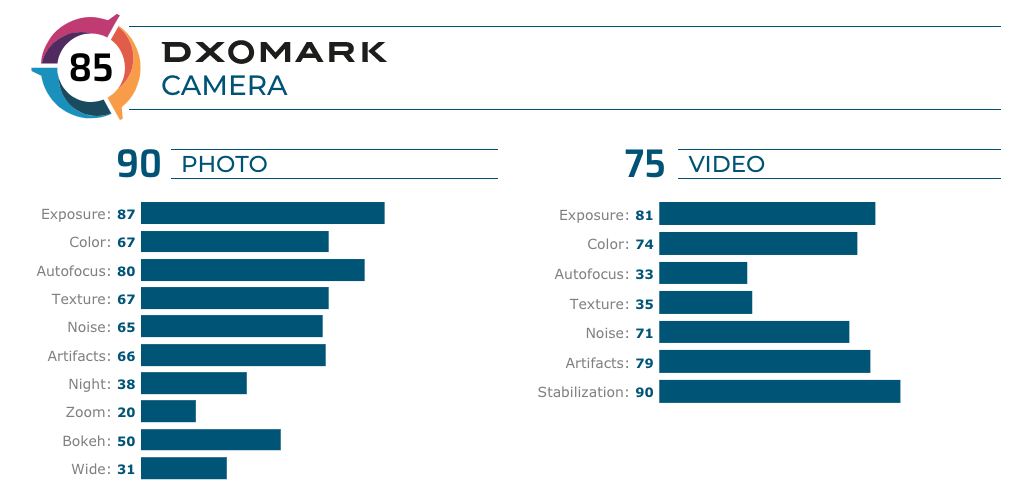
Nokia 7.2 smartphone has secured an overall DxOMark Camera score of 85, showing a notable improvement over the older Nokia 8. The result of this smartphone is broadly comparable to the Nokia 9 PureView launched earlier in 2019.
The smartphone has hit a photo score of 90 points, witnessing very modest improvement for still images over the Nokia 9 PureView at 88. The company adds that while the scores are very similar across the board, there are some notable differences in the performance of the two rival Nokia devices.
It also says that the addition of an ultra-wide lens helps boost the final score for the Nokia 7.2 but the phone isn’t quite as good as Nokia 9 PureView when it comes to color, autofocus, or night shots. In the video category, the phone has scored 75 points.
The device comes with a triple-camera setup on the back. The primary camera uses a 1/2-inch 48Mp Quad-Bayer sensor with 0.8µm pixels coupled to a standard wide-angle f/1.8-aperture lens with PDAF autofocus. It also has an ultra-wide second shooter built around an 8MP sensor with a 13mm-equivalent f/2.2-aperture lens and a 5MP dedicated depth sensor for Portrait mode.
It comes with bokeh effects such as ZEISS Modern, ZEISS Swirl, and ZEISS Smooth for adjusting several features when you take a portrait photo. There is also a Night Mode which uses a combination of advanced image fusion and multiple exposures for brighter images with rich details.
The Nokia 7.2 features a 6.3-inch FHD+ PureDisplay with the same PixelWorks processor for real-time HDR conversion. It also has a notch at the top which houses a 20MP camera with Carl Zeiss lens. It is powered by Snapdragon 660 processor with 4/6 GB RAM and 64/128 GB of expandable storage.
The phone runs Android 9 Pie operating system out-of-the-box and is promised by the company to get 2 years of OS updates and 3 years of security updates. The device has a 3500mAh battery and with AI features like Adaptive Battery and HMD Global has promised a 2-day battery life.
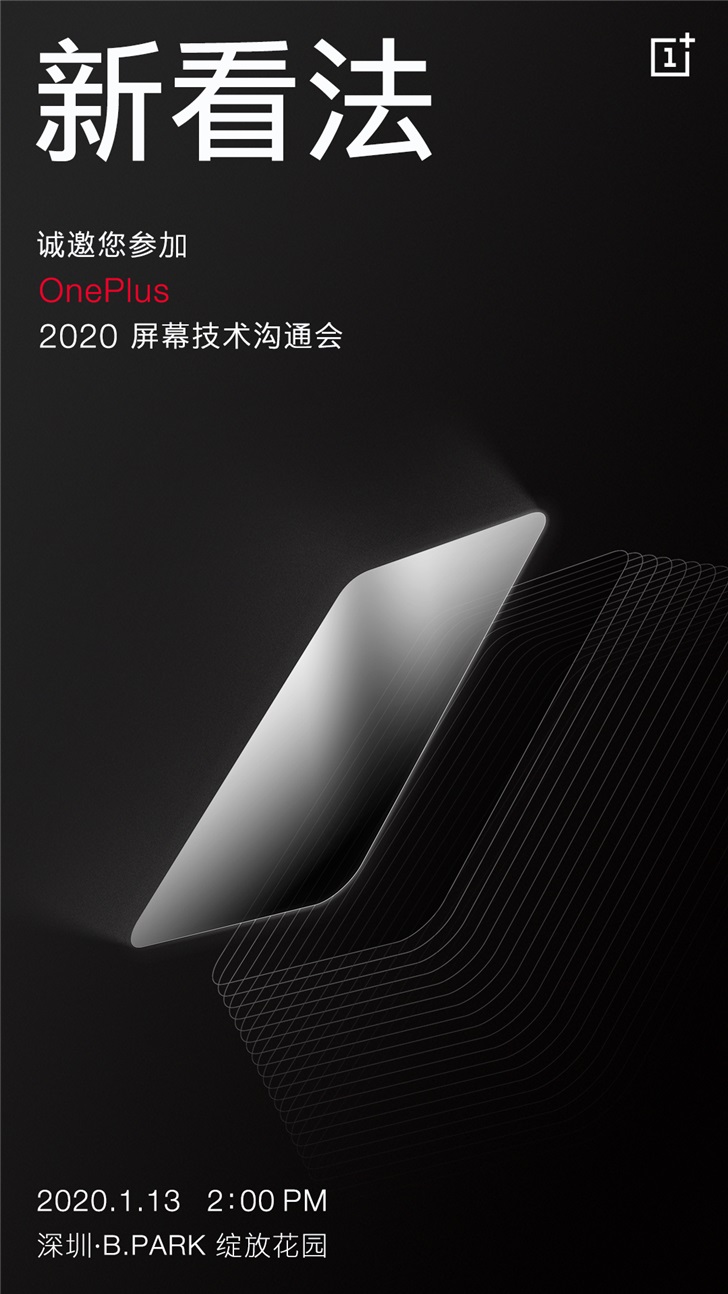
OnePlus has scheduled an event in China today named “OnePlus 2020 Screen Technology Communication Meeting” where the company is expected to unveil and showcase its next-generation screen technology.
Now, just hours before the event, OnePlus CEO Pete Lau has confirmed on Chinese microblogging platform Weibo that the company has completed development of 120Hz screens. He also added that more details about the same will be shared at the Screen Technology event planned for later today.
The said event will be held today, i.e. on 13th January at 14:00 local time in Shenzhen B.PARK bloom garden. The development of 120Hz refresh rate display is yet another major step forward for the company as it now focusing on offering premium specs and features.
There are lots of major developments happening when it comes to smartphone displays — from in-display fingerprint sensors to in-display camera modules to higher refresh rate. With OnePlus 7T series coming with 90Hz refresh rate display and the company having completed development of 120Hz screen, it’s safe to assume that the next-gen flagship device from the company will have this new screen technology.
Earlier, Pete Lau had confirmed that all the future smartphones from the company will now come with 90Hz refresh rate display or a more advanced technology. This new development from the company seems to in line with that promise.
The news about this new screen technology comes just days after OnePlus showcased its OnePlus Concept One smartphone at CES 2020 in Las Vegas. It features a vertical triple camera system that is neatly tucked under an electrochromic glass. When a current is applied, the glass can swiftly change from opaque to transparent.
In this smartphone, when the camera is turned on, the three sensors become instantly visible. When the camera app is closed, the triple cameras again become invisible. The company claims that it takes only 0.7 seconds for the glass to transition from transparent to opaque or vice versa.
OnePlus will be revealing more details about the 120Hz refresh rate display at the “2020 Screen Technology Communication Meeting” in a few hours and we’ll be bringing all the details from the event here for you. Stay tuned!
It has been more than three months since Android 10 was officially released. Since then, manufacturers have been working on rolling out the update to users. However, there are several devices still stuck on an older version of Android. Some may not even get the update at all even with the new mechanisms put in place for upgrades to be available much faster such as Project Treble.
It has also been more than seven months since Google updated the Android Distribution Board, thus we do not know the percentage of devices running the latest version of Android.
So for this week’s poll, we want to know what version of Android your phone is on. Are you running Android 10 already or you are still stuffing yourself full with Android 9 Pie or Android 8 Oreo? Do take the poll and let us know. We also want to know if you will be switching brands in the future due to the manufacturer’s attitude to updates, so please drop a comment too.
In roughly a month, Samsung will announce the Galaxy S20 series. According to a tweet by XDA Developers writer, Max Weinbach, we will be getting five Galaxy S20 phones. The five phones are the Galaxy S20, Galaxy S20 5G, Galaxy S20+, Galaxy S20+ 5G, and the Galaxy S20 Ultra 5G. Since all the phones that will be powered by the Snapdragon 865 will have a 5G modem, it is safe to say the non-5G versions of the Galaxy S20 are the ones powered by the Exynos 990 chipset.
Ahead of the release, Max has also posted live photos of the Galaxy S20+ 5G and they confirm what we already know about the design of Samsung’s upcoming flagship.
The biggest change is the display which no longer has a pill-shaped punch hole at the top left corner for dual front-facing cameras but a centered one for a single camera. Max says in a separate tweet that the display is not as curved as that of its predecessor, the Galaxy S10+. The reason for this is because Samsung is using 2.5D glass for the display.
The Galaxy S20+ also has fewer buttons as the Bixby button is now gone, hopefully for good.
As I mentioned in the article, the Galaxy S20+ isn't very curved. It actually feels flat in the hand. This is because Samsung is using 2.5D glass. For those who hate curved screens, you all will be very excited.
2.5D glass is the same type of curve as the Pixel 2 XL.
Another of the live images show the phone’s rear with the now-familiar rectangular camera housing. There are four cameras – three vertically arranged on the left while the fourth is nestled between the LED flash and a microphone on the right.
Other than a difference in the processors, we don’t know if there will be any other significant differences between the Galaxy S20+ and the Galaxy S20+ 5G.
Max said he has more details about the phone including videos of the device. So keep your eyes peeled for more Samsung leaks this week.
Xiaomi-backed Redmi had introduced the Redmi K30 series smartphones in China in December 2018. While the 4G edition had released in the company’s home market last month, the Redmi K30 5G was made available for purchase for the first time in China on 7th January.
In the sale, which lasted for just two hours, only the 8GB RAM + 128GB storage model was made available. However, the company has now revealed that the 6GB RAM model will be available for purchase tomorrow.
The 6GB + 64GB model is priced at 1,999 yuan (~$289) while the 6GB + 128GB model costs 2,299 yuan (~$333). Both these variants can now be pre-booked with a deposit of 100 yuan (~$14).
As for the specifications, the smartphone features a 6.67-inch punch-hole display and Gorilla Glass 5 panels for protection on its front and rear. The HDR 10 complaint display produces a tall aspect ratio of 20:9 and offers Full HD+ screen resolution of 1080 x 2400 pixels. It is also the first Redmi phone to arrive with support for 120Hz refresh rate.
Under the hood, the device is powered by the new 7nm Qualcomm Snapdragon 765G chipset and comes with up to 8GB of LPDDR4x RAM and 256GB UFS 2.1 inbuilt storage. There’s also a microSD card slot on the device for expanding the storage capacity.
The back panel of the phone features a vertical quad camera setup which is placed inside a glossy round pattern. It comes with Sony IMX686 64-megapixel primary lens with an f/1.89 aperture and a 1/1.73″ sensor size. The other sensors on the device include an 8-megapixel ultra-wide lens with 120-degree field-of-view, a 5-megapixel macro lens and a 2-megapixel depth assist lens.
The company claims that the Redmi K30 5G has the same camera algorithms that is available on the Xiaomi Mi CC9 Pro that features 108-megapixel penta-lens camera setup. On the front, the Redmi K30 5G features an AI powered dual camera setup that includes a 20-megapixel main lens and a 2-megapixel depth sensor.
It is the company’s first phone to arrive with Android 10 OS which is overlaid with the latest MIUI 11 user interface. The Mi Turbo 2.0 optimised the system performance whereas Game Turbo 2.0 enhances the device for gaming. It is powered by a 4,500mAh battery and carries support for 30W fast charging technology.
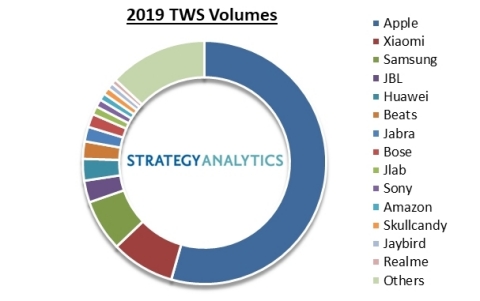
Strategy Analytics has published a report on the TWS headset market for 2019. According to the report, Apple is at the top with a market share of more than 50% while Xiaomi and Samsung follow in second and third positions respectively.
It is no surprise that Apple has the largest market share seeing as the Cupertino-based company practically created the category with the launch of the AirPods in 2016. Ken Hyers, the head of Strategy Analytics said: “Apple’s AirPods are the dominant Bluetooth headset in terms of sales volumes and revenues in the TWS segment”. He added that Apple will continue to dominate the category through the middle of the next decade.
In 2019, the revenues from the sales of TWS headsets grew by more than 200% and Apple took 71% of the total. It is predicted that wholesale revenues will grow beyond $100 billion by 2024 and new players in the market should be able to make their own share of the money.
Xiaomi and Samsung who are the second and third largest respectively each have a market share of less than 10%. One of Xiaomi’s TWS headsets, the Redmi AirDots is one of the cheapest headsets in the market and a popular alternative for those who can’t afford premium ones from manufacturers such as Samsung, JBL, Beats, and Sony.
Samsung will announce a follow-up to its Galaxy Buds on February 11 and it will launch as the Galaxy Buds+. We also expect the Redmi AirDots will get a successor this year.
Based on this report, it is safe to say TWS headsets are here to stay, and with the new features Bluetooth will bring with LE Audio, they should even get better.
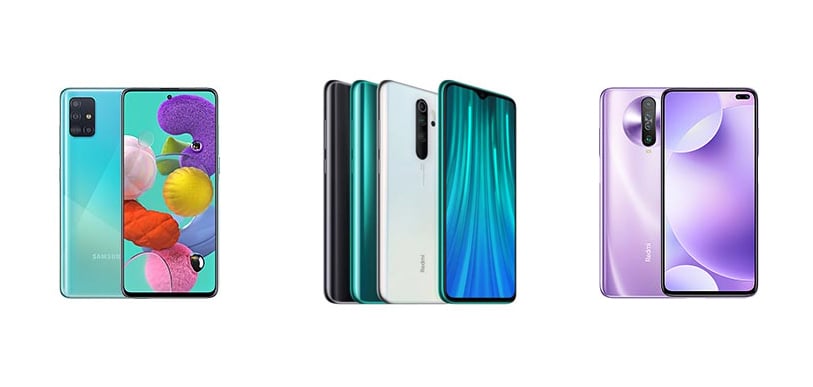
Never listen to people who say you need a flagship to get everything you need from a smartphone. A lot of users can grab the perfect device without spending a lot of money, thanks to actual mid-rangers. Among the latest high value for money, smartphones announced there are Samsung Galaxy A51 and Redmi K30. Given their well-balanced specs sheets, we think it is worth including them in a comparison to establish which one is the best. We also added Redmi Note 8 Pro to the comparison since we believe it is one of the most amazing smartphones you can get at a very affordable price.
Samsung Galaxy A51 vs Xiaomi Redmi Note 8 Pro vs Xiaomi Redmi K30
Quad 64 + 8 + 2 + 2 MP f/1.8, f/2.2, f/2.4 and f/2.4
20 MP front camera
Quad 48 + 12 + 5 + 5 MP f/2.0, f/2.4, f/2.4 and f/2.2
32 MP f/2.2 front camera
Quad 64 + 8 + 2 + 2 MP f/1.9, f/2.2, f/2.4 and f/2.4
Dual 20 + 2 MP f/2.2 and f/2.4 front camera
BATTERY
4500 mAh, fast charging 18W with Quick Charge 4+
4000 mAh, fast charging 15W
4500 mAh, fast charging 27W
ADDITIONAL FEATURES
Hybrid Dual SIM slot
Dual SIM slot
Hybrid Dual SIM slot
Design
While Redmi Note 8 Pro comes with a classic waterdrop design, Redmi K30 and Samsung Galaxy A51 offer something more innovative. They come with punch-hole notch-less displays. I personally prefer the Samsung Galaxy A51 because it has a single punch hole, a thinner profile, more compact dimensions, and an in-display fingerprint scanner. Both the fingerprint scanners of the Redmi Note 8 Pro and Redmi K30 are side-mounted.
Display
A lot of people might initially think that Samsung Galaxy A51 has a better display since it is the only one sporting an AMOLED panel in this trio. But despite having an LCD display, Redmi K30 is way more interesting as it features both the HDR10 certification and a high 120 Hz refresh ratio. And actually there is just a limited amount of mid-rangers with a 120 Hz display. The 120 Hz refresh rate provides smoother user experience and it is amazing for gamers. Further, Redmi K30 has a wider display diagonal.
Specs & Software
On the paper, the most powerful hardware department is on board of the Redmi Note 8 Pro. The device boasts an Helio G90T chipset paired with up to 8 GB of RAM and up to 256 GB of UFS 2.1 internal storage. The silver medal goes to the Redmi K30 with its Snapdragon 730G, despite a lot of people actually prefer to buy a device with a Qualcomm’s chipset due to the higher reputation of the San Diego-based chipmaker. Android 10 is installed out of the box on Redmi K30 and Samsung Galaxy A51, while Redmi Note 8 Pro is based on Android 9 Pie. Samsung Galaxy A51 has a lower-end chipset and it only comes with 6 GB of RAM in its most expensive variant.
Camera
While there is no way Samsung Galaxy A51 can compete with its opponents in terms of hardware and performance, its cameras are all but bad. But we will have to test them thoroughly to give a definitive opinion, as the device is still not in the market. Redmi K30 and Redmi Note 8 Pro come with the same rear camera department, but Redmi K30 is the only with a dual front camera including a depth sensor.
Battery
The best battery phone here is the Redmi K30 and the reason si very simple: it has the biggest battery with a 4500 mAh capacity and the most efficient chipset. Further, it even features a faster charging technology.
Price
Samsung Galaxy A51 is going to hit the global market with a €379,90 price tag, Redmi Note 8 Pro actually costs less than €250 globally, while Redmi K30 is available for €255, but only in China. The amazing, wider display, the good hardware department and the long-lasting battery would let me go for the Redmi K30 which we choose as the winner of this comparison.
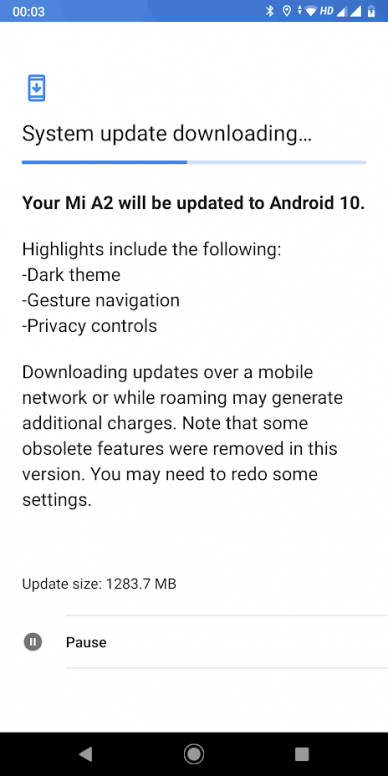
A few days ago, we reported that there is a petition by owners of the Xiaomi Mi A3 to force Xiaomi to release the Android 10 update for the phone. In what can be termed a surprise, Xiaomi has now released the Android 10 update…..for the Mi A2.
Yes, the Android 10 update is now available for the older Mi A2 that was released in 2018. However, there is a chance the Mi A3 will follow shortly as Xiaomi released the Android 10 kernels for both devices simultaneously.
Image source: laviniuc (Mi Community)
The Mi A2’s update weighs in at almost 1.3GB in size. Along with all the new features Android 10 has to offer such as Smart Replies, Dark Mode, Family Link parental controls under Digital Wellbeing, and the new gesture navigation; the update also comes with December 2019’s security patch and the camera app has a new icon.
There are a few issues reported by those who have updated already. Some say there are UI glitches in a few places and VoWiFi is missing. While another user said Google Services stopped working for a while before things returned to normal. There are also a few bugs in the camera app and there is still no support for camera2api.
It appears Xiaomi rushed the update. We advise you to wait for more users to post their feedback. And if you are going to update, make sure you back up your data.
The Mi A2 launched with Android Oreo out of the box and was updated to Android 9 Pie the same year. There is a high chance this is its last major OS upgrade.
We use cookies on our website to give you the most relevant experience by remembering your preferences and repeat visits. By clicking “Accept”, you consent to the use of ALL the cookies.
This website uses cookies to improve your experience while you navigate through the website. Out of these, the cookies that are categorized as necessary are stored on your browser as they are essential for the working of basic functionalities of the website. We also use third-party cookies that help us analyze and understand how you use this website. These cookies will be stored in your browser only with your consent. You also have the option to opt-out of these cookies. But opting out of some of these cookies may affect your browsing experience.
Necessary cookies are absolutely essential for the website to function properly. This category only includes cookies that ensures basic functionalities and security features of the website. These cookies do not store any personal information.
Any cookies that may not be particularly necessary for the website to function and is used specifically to collect user personal data via analytics, ads, other embedded contents are termed as non-necessary cookies. It is mandatory to procure user consent prior to running these cookies on your website.