Advertisement

OnePlus Concept One’ color-shifting glass technology explained

Yesterday, OnePlus released a teaser video showing a feature of the OnePlus Concept One smartphone it wants to show off at CES 2020 next week. A part of the video showed the triple rear cameras of the phone invisible at first and then visible the next second. OnePlus said they were able to achieve that using color-shifting glass technology. Now there is an explanation of how the technology works.

How it works

In an exclusive story by Wired, we learn that the technology actually uses electrochromic glass. This special type of glass changes from opaque to transparent when a current is applied to the glass. It is used to make the sunroofs of some luxury cars, airplane windows and can even be found in some buildings where it is used as walls and windows. Now, OnePlus is bringing it to phones with help from McLaren.

The OnePlus Concept One has taken a piece of this special glass and used it to cover up the rear cameras of the phone. So at first look, the phone appears not to have cameras on the back but when you launch the camera app, a charge is sent to the glass that makes it transparent and then the sensors become visible. When you exit the app, the glass becomes opaque.  It sure makes for a nice party trick, however, there is a lot of work behind it as well as challenges.

Challenges

First, OnePlus had to work on the time it takes for the glass to change between opaque to transparent. You don’t want to miss out on that perfect shot because the glass is yet to shift. For a company obsessed with speed, this is definitely a big deal but OnePlus’ CEO, Pete Lau, says the OnePlus Concept One is able to shift between opaque and transparent in less than a second.

Second, the glass requires power to function, so another thing they had to work on was how to minimize power consumption, so there is no impact on battery life.

Pete Lau said another challenge was the thickness of the phone as the electrochromic glass is said to require the addition of another material on the rear glass of the phone. They were able to do so successfully with just an increase of 0.1 millimeters to the overall thickness of the phone.

Last but definitely not least is reliability. No one wants a phone whose cameras can’t be used probably because there is an issue preventing the glass from shifting. It has also been reported that electrochromic glass can degrade after a number of years when switching between modes and is also not easily replaceable. OnePlus doesn’t really have to worry much since it says this is just a concept device and it has no plans to go into mass production anytime soon.


OnePlus Concept One sketch
Design

The Wired post also revealed details about the OnePlus Concept One. A model that was on display at a briefing in San Francisco last month is reported to be covered in leather that has the same papaya-orange color MacLaren uses. However, the one we saw in the teaser video appears to be all glass.

Based on some sketch diagrams of the product, the OnePlus Concept One appears to have a display unlike the curved one in the teaser video.

OnePlus Concept One sketch

The OnePlus Concept One is said to have the same rear camera specifications as the OnePlus 7T Pro McLaren Edition. That means it has a 48MP primary rear camera paired with an 8MP telephoto camera and a 16MP ultrawide angle camera. The electrochromic glass technology covering the cameras is the same used as an option for the McLaren 720S and the 2018 McLaren 570GT.

According to Xi Zeng, creative director at OnePlus, it was the McLaren 720S they saw on a tour of McLaren’s headquarters that inspired them to bring the technology to phones. By the end of 2018, there was a dedicated group of engineers working on the project already.

It remains to be seen if the mobile industry will adopt the use of electrochromic glass but it is interesting to see OnePlus is experimenting with a new design.


(Sources: 1, 2)

Samsung Galaxy Note 10 Lite unveiled with the Note 9’s Exynos 9810 SoC, S-Pen & more!

Soon after the launch of the Galaxy Note 10 and Note 10+ last year, it emerged that Samsung was working on a Lite version of the flagship. The tech giant has now gone official with the Galaxy Note 10 Lite alongside the Galaxy S10 Lite.  The smartphone is designed as a cheaper variant of the Galaxy Note series. Even though the company is yet to announce the price, we expect it to be cheaper than the latest Galaxy Note 10.Samsung Galaxy Note 10 Lite

Samsung Galaxy Note 10 Lite is powered by an Exynos 9810 processor which is the same chip used by the Galaxy Note 9 launched in 2018. This is a far cry from the Snapdragon 855 SoC crammed inside the Galaxy S10 Lite. Despite being an old SoC, the Exynos 9810 is still a powerful one that can compete with the top flagship SoCs around.

In other aspects, the device sports a 6.7-inch Full HD+ Infinity-O display, slightly smaller than the Galaxy Note 10+’s 6.8-inch QHD+ display. The Note 10 Lite is available in 6GB/8GB RAM options and 128GB storage which is expandable up to 1TB via microSD card.

For photography, the Galaxy Note 10 Lite features a triple camera setup. The primary 12-megapixel rear sensor is from the Galaxy Note 8 so it doesn’t have variable aperture while the 12-megapixel telephoto f/2.4 2x optical zoom sensor is from the Galaxy Note 9. It does have the same 16-megapixel f/2.2 super wide-angle camera like the Galaxy Note 10/10+, though. At the front, the device packs a 32-megapixel f/2.2 sensor.Samsung Galaxy Note 10 Lite

The Galaxy Note 10 Lite equally comes equipped with an S-Pen which the Galaxy Note series is known for. While its S Pen does have Bluetooth Low-Energy support, it doesn’t have a 6-axis sensor, so you can’t do any of the cool gestures that you can with the Galaxy Note 10/10+’s S Pen. But Samsung did add the Text Export feature which allows users to transfer handwritten notes into text for quick sharing.Samsung Galaxy Note 10 Lite

As for the interface, the Galaxy Note 10 Lite runs on Android 10-based One UI 2.0 out of the box. It also has features like Bixby, Samsung Pay, AR Emoji, and facial recognition. There’s a fingerprint sensor embedded in the display as well. Keeping the lights on is a massive 4500mAh battery which is even bigger than the Galaxy Note 10+’s 4,300mAh battery. The battery supports 25W super-fast wired charging.

The device comes in Aura Black, Aura Glow and Aura Red colours. It is expected to be available later this month. The pricing is also expected to be announced at a later date.


Sony schedules CES 2020 launch event for January 6 – PS5 coming?

Sony has officially announced that it would be holding a launch event at CES 2020 where products whose identity are yet unknown would be unveiled. The statement released by the company hints that it will be ‘unveiling a unique vision of the future, bringing creativity and technology together like never before.’

Sony is expected to launch an Xperia 3 flagship this year but going by precedence, the company usually launches its phones at MWC, and not at CES.

Also, Sony’s next-generation game console, PlayStation5, will have a great chance to appear at this conference. At last year’s CES, Sony revealed that it sold 91.6 million PS4 game consoles worldwide. The company’s first 8K TV supporting Airplay 2 was also shown. The company also focused on Bluetooth accessories, such as its new external woofer and its WH-1000 headset, which will receive Alexa support. However, there was no mobile phone in all the new products unveiled last year. In the same vein, we may see a new TV, a new version of its external woofer and the WH-1000 headset.

The tech giant’s CES 2020 event will be live-streamed on the company’s official website.


Vivo phone powered by Snapdragon 765G appears on Geekbench

The Snapdragon 765G has already appeared in two phones – the Redmi K30 5G and the OPPO Reno3 5G. On Tuesday, January 7, the Realme X50 5G will join the list. We expect more phones powered by the processor will be announced in the coming months and one should be from Vivo.

A Vivo phone with the model number V1963A and a Snapdragon 765G processor has been spotted on Geekbench. The phone was benchmarked yesterday, January 3.= and it has 6GB of RAM and runs Android 10.

Vivo V1963A Geekbench

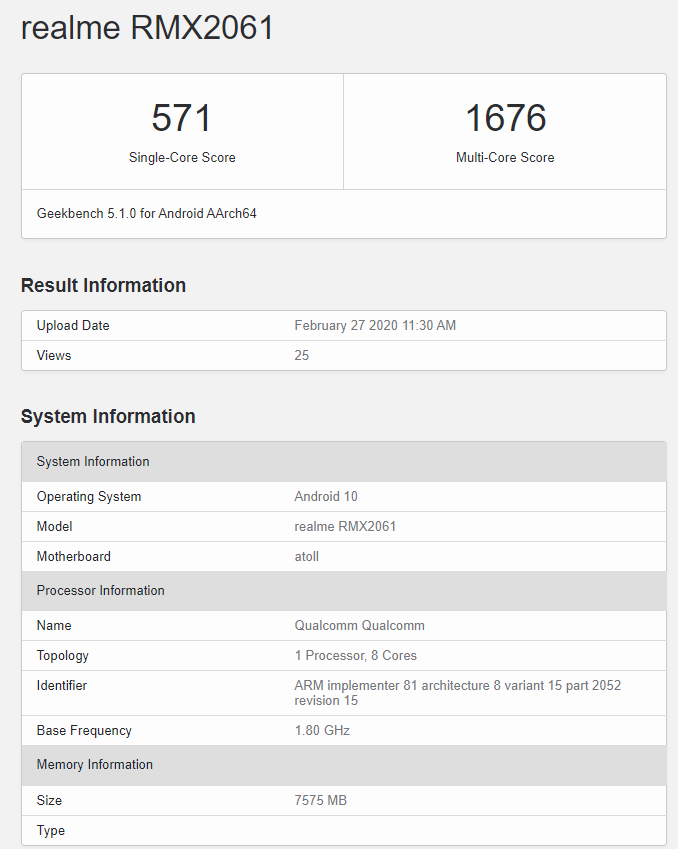
The device has a single-core score of 2129 points and a multi-core score of 5279 points. They are actually quite low when compared to the scores of the Reno3 Pro 5G but when you compare the processor information of both results, they are actually the same chipset. This is definitely a test device which explains why the scores are low.

We do not know which series this new Vivo phone will launch under. However, Chinese blogger @Digital Chat Station said it may launch under the S or Z series.

A few weeks ago, Vivo announced the X30 and X30 Pro. Both phones support 5G networks and are the only devices powered by the Exynos 980 processor. This upcoming Snapdragon 765G-powered phone may not arrive anytime soon. However, Vivo may surprise us and announce it this January but it probably will be close to the end of the month.


(Source, Via)

[Updated] TENAA publishes full specifications of the Realme X50 5G

Update: Images from TENAA have been added. Screen type and fingerprint scanner’s position have also been corrected.

The Realme X50 5G launches in a few days and while some of the specifications have been released, the full spec sheet has not been published until now.

According to TENAA, the Realme X50 5G (RMX2051) has a 6.57-inch display with a 2400 x 1080 resolution. The display has a punch hole at the top left corner for two selfie cameras.

[envira-gallery id=”299122″]


Inside it is a Snapdragon 765G processor clocked at 2.4GHz. There will be at least three variants – 6GB RAM + 64GB, 8GB RAM + 128GB, and 12GB RAM + 256GB version. There is no mention of storage expansion like the Redmi K30 5G, so it seems buyers will be stuck with whatever storage they purchase.

The Realme X50 5G will have four rear cameras – a 64MP primary camera paired with an 8MP ultrawide angle camera, a 12MP telephoto camera with 2x optical zoom, and a 2MP depth sensor. Up in front will be two cameras – a primary 16MP camera and an 8MP ultrawide angle camera.

The phone has a side-mounted fingerprint scanner, packs a 4100mAh battery, and runs Android 10 out of the box. The TENAA spec sheet says it supports the following SA and NSA 5G networks – Band 41, Band 78, and Band 79.

The Realme X50 5G weighs 202 grams and measures 163.8 x 75.8 x 8.9 millimeters. Realme will announce the phone in blue, purple, black, and gold. TENAA has included images of the blue variant.

The Realme X50 5G will be announced on January 7, the same day the Redmi K30 5G is set to go on sale.


Buy FIIDO D2 Folding Electric Moped Bike for Just $435.99 from GeekBuying [Coupon]

The market is teeming with all sorts of EVs (electric vehicles) and electric bikes, among them are most widely used. A great choice for those looking for an eco-friendly mode of commute, e-bikes boast an array of exciting features and useful functions.

FIIDO D2 Folding Electric Moped Bike

Popular manufacturer of electric scooters and e-bike accessories, FIIDO has established a partnership with GeekBuying to offer the FIIDO D2 Folding Electric Moped Bike for a considerably lowered price. We will take a look at the discount and also show how you can save more money during the check out process.

The FIIDO D2 would normally set you back a pretty penny, but thanks to the company’s collaboration with the Chinese e-tailer, the feature-laden electric scooter can now be yours for a lowered price of just $499.99. This is a noteworthy 38 percent drop in the electric scooter’s original selling price of $799.99.

FIIDO D2 Folding Electric Moped Bike Three Riding Modes 16 Inch Tires 250W Motor 25km/h 7.8Ah Lithium Battery 20-35KM Range - Black

Moreover, if this is your first order through GeekBuying, you can take advantage of the 2% OFF New User Coupon for an extra discount. The rest of the users can apply coupon code GKB250S for an extra $64 off. In short, you can bring the retail price of the FIIDO D2 down to only $435.99 simply by applying the aforesaid coupon at checkout.

The D2 is an irresistible electric scooter that features a 52-tooth large chain along with 12-tooth flywheel for a stable and safer ride on various types of roads. The unique built-in large-capacity battery design of the D2 helps the manufacturer to keep the overall appearance of the e-bike simplistic, yet appealing.

The portion accommodating the USB phone holder has been adorned with beautiful lines. Just like the D1, the FIIDO D2 provides three different riding modes i.e. pure electric, riding, and electric assist.

FIIDO D2 Folding Electric Moped Bike Three Riding Modes 16 Inch Tires 250W Motor 25km/h 7.8Ah Lithium Battery 20-35KM Range - BlackThere are two 16-inch inflatable rubber tires, which have double disc brakes. These inflatable tires are water-resistant, shockproof and have an anti-slip texture to provide a reliable riding experience on any kind of road.

Furthermore, the D2 is powered by a 250W motor and can easily withstand a load of up to 120 kgs. You can follow this link to check out more details about the FIIDO D2 and place your order. The promo is slated to end in just two days.

Source

Leaked promo video reveals Samsung Unpacked set for Feb. 11

The Galaxy S20 series will be arriving earlier than its predecessors did last year. A leaked promo video shared on Twitter has revealed the date the event will take place.

The fifteen-second video was shared on Twitter by Max Winebach, a writer for XDA Developers, and it reveals the Samsung Unpacked event is set to hold on February 11. This is nine days earlier than the Galaxy S10 series’ unpacked event that was on February 20, 2019.

With the launch happening earlier, it should also mean that the new flagships will go on sale earlier too. The Galaxy S10 series went on sale on March 8, 2019, so we expect the Galaxy S20 series to go on sale on February 28.

Although there is no mention of the location, venue and time, another popular leaker who goes by @MMDDJ_ tweeted that the launch will hold in New York. However, the venue and time remain unknown.

Samsung will announce at least four phones at the event. We expect the Galaxy S20, the Galaxy S20 Plus, and the Galaxy S20 Ultra for the S series while the Galaxy Fold 2 with its vertically folding display will follow suit.

Other than phones, Samsung will also announce the Galaxy Buds+, the successor to last year’s Galaxy Buds. The new wireless earbuds will keep the design of its predecessor but come in a new powder blue color variant and also have active noise-canceling. The Galaxy Buds+ may be included for free for those who pre-order the new phones.

Another device that may get announced in New York is the Galaxy Tab S6 5G. The tablet is expected to launch soon in Samsung’s home country and might get a global release at the New York event.

I guess at this point no one is expecting the Galaxy Home smart speaker anymore.


(Sources: 1, 2)

Samsung Galaxy Note 10 Lite vs Xiaomi Mi Note 10 vs OnePlus 7T: Specs Comparison

For the first time, the Galaxy Note series includes a Lite version. Samsung just unveiled the Galaxy Note 10 Lite, a smartphone offering the key feature of the Note line-up at a finally affordable price. We are talking about the S Pen, for which finally people will not be forced to spend a fortune. But if we exclude the S Pen, are its other specifications nice enough for the money asked? Let’s try to find it out together by comparing it with other high-end devices in a similar price range: Xiaomi Mi Note 10 and OnePlus 7T.

Samsung Galaxy Note 10 Lite vs Xiaomi Mi Note 10 vs OnePlus 7T

Samsung Galaxy Note 10 Lite Xiaomi Mi Note 10 Pro OnePlus 7T
DIMENSIONS AND WEIGHT 163.7 x 76.1 x 8.7 mm, 199 g 157.8 x 74.2 x 9.7 mm, 208 grams 160.9 x 74.4 x 8.1 mm, 190 g
DISPLAY  6.7 inches, 1080 x 2400p (Full HD+), Super AMOLED 6.47 inches, 1080 x 2340p (Full HD+), Super AMOLED 6.55 inches, 1080 x 2400p (Full HD+), Fluid AMOLED
PROCESSOR Samsung Exynos 9810, octa-core 2.7 GHz Qualcomm Snapdragon 730G, octa-core 2.2 GHz Qualcomm Snapdragon 855+, octa-core 2.96 GHz
MEMORY 6 GB RAM, 128 GB – 8 GB RAM, 128 GB – micro SD slot 8 GB RAM, 256 GB 8 GB RAM, 128 GB – 8 GB RAM, 256 GB
SOFTWARE  Android 10, One UI Android 9 Pie, MIUI Android 10, Oxygen OS
CONNECTIVITY  Wi-Fi 802.11 a/b/g/n/ac, Bluetooth 5.0, GPS Wi-Fi 802.11 a/b/g/n/ac, Bluetooth 5.0, GPS  Wi-Fi 802.11 a/b/g/n/ac, Bluetooth 5.0, GPS
CAMERA  Triple 12 + 12 + 12 MP, f/1.7, f/2.4 and f/2.2
32 MP f/2.2 front camera
Penta 108 + 5 + 12 + 20 MP, f/1.7, f/2.0, f/2.2 and f/2.4
32 MP f/2.0 front camera
Triple 48 + 12 + 16 MP, f/1.6, f/2.2 and f/2.2
16 MP f/2.0 front camera
BATTERY  4500 mAh, fast charging 5260 mAh, fast charging 30W 3800 mAh, fast charging 30W with Warp Charge 30T
ADDITIONAL FEATURES Hybrid Dual SIM slot Dual SIM slot Dual SIM slot

Design

If you need the most futuristic and trendy design, you should go for the Samsung Galaxy Note 10 Lite. It is the only to boast a punch-hole display, while Xiaomi Mi Note 10 and OnePlus 7T both come with a waterdrop notch. But you should not underestimate the beauty of the Mi Note 10 with its amazing curved screen. In each case, you get a glass + metal premium design, but none of these devices is water resistant.


Display

Samsung is usually known for making the best display, but it did not opt for one of its best panels with the Galaxy Note 10 Lite. With a 90 Hz refresh rate and the HDR10+ certification, OnePlus 7T has a better panel and Samsung Galaxy Note 10 Lite takes the silver medal. But the Samsung Galaxy Note 10 Lite’s display supports something you will never find on an affordable flagship: the S Pen for handwriting and drawing. A must for many professional users. Xiaomi Mi Note 10 still has a very nice display.


Hardware/Software

The only real flagship when it comes to the performance here is the OnePlus 7T. It is one of the fastest smartphones you can currently find in the market, thanks to a Snapdragon 855+ chipset and an amazing software optimization. The second place goes to the Samsung Galaxy Note 10+ boasting an Exynos 9810 chipset and up to 8 GB of RAM, as well as expandable internal storage. Xiaomi Mi Note 10 is just a mid-ranger with its Snapdragon 730G, OnePlus 7T is a lot faster and smoother. Samsung Galaxy Note 10 Lite and OnePlus 7T offer Android 10 out of the box, while Xiaomi Mi Note 10 is still based on Pie. Samsung Galaxy Note 10 Lite is a better device for professional users not only because of the S Pen but also due to Samsung DeX providing a desktop experience while the phone is connected to an external monitor.


Camera

The camera award goes to the Xiaomi Mi Note 10 and its 108 MP penta-camera. There is no chance its opponents can compete with it. It supports OIS, up to 5x optical zoom and even a dedicated macro camera. In most of the situations, Xiaomi Mi Note 10 is able to capture stunning photos with a high level of detail, a low amount of digital noise and a high dynamic range. Right after, there is Samsung Galaxy Note 10 Lite with an amazing optical stabilization and a bright focal aperture. OnePlus 7T is all but the best camera phone, however, it still offers a pretty nice photo quality thanks to a high-end sensor and OIS.


Battery

Xiaomi Mi Note 10 has a huge 5260 mAh battery, one of the biggest found on high-end smartphones. And it lasts a lot on a single charge: it reaches two days even with pretty intensive usage. Samsung Galaxy Note 10 is right behind with its 4500 mAh battery, while OnePlus 7T is not among the best battery phones due to its 3800 mAh unit.


Price

Samsung Galaxy Note 10 Lite will land in the market before the end of Q1 2020 with a starting price of €599/$669. That is the same price as the Xiaomi Mi Note 10, but now the Mi Note 10 is available for about €450/$502 thanks to online street prices. With a bit of luck, you can find the OnePlus 7T for less than €450/$502. If we exclude the S Pen, Samsung Galaxy Note 10 Lite does not have a lot more to offer if compared to the Xiaomi Mi Note 10. Just slightly better performance and a few other minor things. So if you do not care about the S Pen at all, choose the Xiaomi Mi Note 10 if you want the best camera and battery, or go for the OnePlus 7T if you prefer having the best performance and display. But do not forget that Samsung Galaxy Note 10 Lite offers a way better camera and longer battery life than OnePlus 7T. I would personally prefer the Samsung Galaxy Note 10 Lite for the S Pen, but I admit it will be a definitely more interesting choice when its price will drop like the ones of its rivals.


Samsung Galaxy Note 10 Lite vs Xiaomi Mi Note 10 vs OnePlus 7T: PRO and CONS

Xiaomi Mi Note 10

PROS

  • Amazing cameras
  • Huge battery
  • Good price
  • Nice display

CONS

  • Lower-end hardware


Samsung Galaxy Note 10 Lite

PROS

  • Good cameras
  • S Pen
  • Nice battery life

CONS

  • Price


OnePlus 7T

PROS

  • Amazing display
  • Higher performance
  • Nearly stock Android

CONS

  • Inferior cameras


Xiaomi’s latest teaser suggests the Mi Notebook is getting a redesign

At exactly 0.00 hours on new year’s day, Xiaomi Notebook arm posted a teaser poster on its official Weibo page. The poster suggests the Mi Notebook series will be getting a redesign this year.

The Mi Notebook series launched its first product in 2016 and since then, there has not been a major change in the design of the laptop models that have been launched so far. It is usually confusing knowing which of the model is the first, second or third-gen Notebook model since they all kinda look alike. That will likely change this ear going by the teaser poster.

Apart from changes and upgrade in the hardware aspect, the new Notebook may see a big change in its design. The bezels around the display may likely get trimmed down in such a way that all four sides are equal and at their barest minimum level.Xiaomi

This design style has already been put to use by Xiaomi on the RedmiBook giving it a full-screen-like design. The full-screen design makes the computer look smaller but give some extra viewing space to the screen. We expect the optimization and hardware to be higher than the RedmiBook, though. We expect more details of the upcoming Mi Notebook 2020 model to emerge in the coming days.


Xiaomi Mi 10 Tempered glass leaks bearing a curved edge design

Xiaomi Mi 10 is expected as the company’s first flagship for 2020. Not only that, but the device is also expected to be the first Snapdragon 865-powered model to be launched. The Axon 10s Pro is justling to snatch that potential crown from the Mi 10. Ahead of its launch, the screen protector for the Xiaomi Mi 10 has been leaked on China’s Weibo.XIaomi Mi 10

The tempered glass screen gives us an idea of how the Mi 10’s display will look like. It shows the presence of a curved edge design and narrow frame. However, we couldn’t see an opening at the top of the display for the selfie cameras and other sensors but the device is said to feature a punch-hole design for the selfie shooter. The screen looks big and that is as a result of the 6.5-inch OLED panel that the Mi 10 packs. The display is also said to come with 90Hz refresh rate.


The rear aspect of the flagship Mi 10 is said to house four camera sensors aligned vertically. The sensors include a 64-megapixel Sony IMX686 main sensor, a 20-megapixel ultra-wide-angle sensor, a 12-megapixel telephoto and a 5-megapixel depth sensor.Mi 10

The Xiaomi Mi 10 phone will use a 4500mAh battery and support 40W fast charging, 30W wireless charging, and 10W reverse wireless charging.


Samsung Galaxy S10 Lite launched packing an SD855 SoC, centralized punch-hole

Samsung was rumoured to have got a Lite version of the flagship Galaxy S10 in the works right from January last year. The rumour was rekindled a couple of months back with renders and leaks of the device appearing online. The tech giant has now officially unveiled the Galaxy S10 Lite today, ending several months of speculations. The device was launched alongside a Galaxy Note 10 Lite, both bringing flagship-level quality to mid-range models.Samsung Galaxy S10 Lite

As for the specifications, the Galaxy S10 Lite packs a 6.7-inch Full HD+ Super AMOLED Infinity-O display. The display panel has a bigger size than the Galaxy S10+’s 6.4-inch QHD+ screen and is equally embedded with a fingerprint sensor. One major design difference between this model and the Galaxy S10 is that even though both models pack a punch-hole design, the Galaxy S10 Lite’s is centrally placed and not right-aligned like it is on the other Galaxy S10 handsets.

The Samsung Galaxy S10 Lite is powered by a Qualcomm Snapdragon 855 processor and will be available in 6GB/8GB RAM variants with 128GB of internal storage. There’s a 4,500mAh battery keeping the lights on with support for 25W super-fast wired charging. Android 10 and One UI 2.0 come pre-installed with a whole host of other Samsung features like Bixby, AR Emoji, Samsung Pay and more.

For photography, the Galaxy S10 Lite packs a triple camera setup which is the same as the one on the Galaxy A51. The camera setup includes a primary 48-megapixel f/2.0 camera with Super Steady OIS, a 12-megapixel f/2.2 ultra-wide and a 5-megapixel f/2.4 macro camera. The new Super Steady OIS is paired with the camera’s Super Steady mode for higher stability in action-focused photos and videos. The front punch-hole houses a 32-megapixel f/2.2 camera.Samsung Galaxy S10 Lite

The Galaxy S10 series, the Galaxy S10 Lite will be available in Prism Black, White and Blue colors when it goes on sale in the near future. Samsung is yet to announce the pricing and release details but that will be done in the coming days.


Samsung Galaxy Buds+ new render appear to reveal updated design and new color variant

Samsung is expected to launch the highly-anticipated Galaxy Buds+ truly wireless earbuds alongside the Galaxy S20 lineup in February 2020. Its images were recently spotted in the latest version of the Samsung SmartThings app. A clear render of the Buds+ was also posted by 91mobiles, revealing design details ahead of launch.

According to the render, the Galaxy Buds+ is quite similar to the original Galaxy Buds, and comes with a seemingly-similar charging case. The most notable differences include the additional blue variant alongside the black and white color options. Samsung claims to have included active noise cancelling in a bid to take on the recently-launched Apple AirPods Pro.

Samsung Galaxy Buds+  Design

Despite being similar to Its predecessor, the Galaxy Buds+ features smaller silicone ear-tips that offer better seal. Samsung has also added a touch-sensitive glossy panel for controlling music playback, activating voice assistants, and answering calls. Like the previous-generation charging case, the new one still features a pill-shaped design. Additional features include wireless charging and USB Type-C support.

The only visible difference, as evident from the renders, is the addition of physical left and right buttons below the LED indicator that monitors the battery level on individual buds. Samsung is expected to have improved the overall sound quality of the Galaxy Buds+. The presence of active noise cancellation might increase the overall price compared to the first-generation earbuds. Additional information should be available as the tentative launch date approaches.


(source)

Realme X50 5G TENAA listing with key specs appear

Realme X50 5G is scheduled to go official on Jan. 7 along with Realme X50 5G Youth Edition smartphone. Past reports have revealed that model number of the Realme X50 5G is RMX2051. The model number was recently spotted at the database of 3C and CMIIT authorities of China. The same model number has been spotted today on TENAA. The listing at the Chinese telecom authority has revealed some of the key specs of the phone. Unfortunately, the TENAA listing does not include any images of the phone.

The TENAA appearance of the Realme RMX2051 has revealed that its dimensions are 163.8 x 75.8 x 8.9mm. The smartphone is fitted with a 6.57-inch display. As it is already known, the top-left corner of the screen has an elliptical cutout for dual selfie cameras.

The smartphone is equipped with a minimum rated battery of 4,100 mAh capacity. Its typical capacity could be 4,200 mAh. The 3C listing of the smartphone has revealed that it will be equipped with 30W fast charger. Realme has already confirmed that the Realme X50 5G will feature 30W VOOC 4.0 Flash Charge technology that will let it gain 70 percent battery juice in just 30 minutes. The TENAA listing of the Realme X50 5G will be soon updated with its images and specs in the next few days.

The Snapdragon 765G mobile platform is present under the hood of the Realme X50 5G. The SoC will bring support for dual-mode 5G networks on the device. The handset will be able to connect to Wi-F and 5G networks at the same time. The company has also revealed that the smartphone will be arriving with liquid cooling system for heat dissipation. The phone is fitted with a quad camera setup on its rear. It is rumored to include a 64-megapixel lens and a ultrawide shooter. The phone will come preloaded with Android 10 OS. Lastly, it is equipped with a side-facing fingerprint sensor.


(via)

Vivo S1 Pro Launched in India for INR 19,990 ($278)

Vivo has just launched the S1 Pro in India. It is the first smartphone to be launched in India this year from the Chinese company and is packed with notable features for a lucrative price.

Specs and Features

The Vivo S1 Pro arrives with a 6.38 inch FHD+ Super AMOLED display with a 90 percent screen to body ratio. Being an AMOLED panel, it also supports the Always on Display feature that consumes very little power. An in-display fingerprint scanner can also be found under the screen, which is protected by a sheet of Schott Xensation 3D display protection.

Vivo S1 Pro Fancy Sky
Vivo S1 Pro with a unique diamond shaped quad camera arrangement

Under the hood, Vivo S1 Pro is equipped with Qualcomm’s Snapdragon 665 SoC which is a mid range chipset. It is paired with 8GB of RAM and 128GB of internal storage. For photography, the smartphone features a quad camera setup that is arranged inside a unique diamond shaped camera bump. Its primary sensor 48 megapixel shooter, while the front camera is a 32 megapixel sensor for selfies.

Price and Availability

The Vivo S1 Pro is designed to stand out from the crowd and brings notable specs and features all for the price of INR 19,990 or roughly 278 US Dollars. It arrives in a single variant and is available in three different color variants, which include Mystic Black, Jazzy Blue, and Dreamy White.

Vivo S1 Pro Knight Black
Vivo S1 Pro in Mystic Black color

It is available on major online retailer websites like Flipkart, and Amazon and more. Vivo S1 Pro will also be sold from the company’s many physical outlets and multiple affiliated stores as well. Special offers are also being made available for people that buy the smartphone either online and offline, with the common ground being a free one time screen replacement.


Xiaomi likely to launch phone with India’s NaviC GPS tech

Chinese tech giant Xiaomi is in advanced stages of negotiations with the Indian Space Research Organization (ISRO) for the development of chipsets supporting Navigation with Indian Constellation (NaviC). NaviC is India’s very own Global Positioning System (GPS) initiative. The announcement was made by an ISRO spokesperson in Bengaluru on Wednesday.

Xiaomi will likely emerge as the first tech company to use NaviC-supported chipsets. The company is likely to use the new NaviC-enabled processors developed by Qualcomm for the venture. According to an earlier statement by ISRO, NaviC is designed to provide accurate location information primarily to Indian users, and areas that lie within 1,500 km from the Indian borders.

During the Indian Mobile Congress back in September 2019, Qualcomm revealed that some of its future chipsets might support NaviC. “Qualcomm has just announced that its upcoming chipset will support NaviC. Xiaomi is believed to be in talks with the American supplier to acquire the chipset for its next smartphones headed to India”, an ISRO spokesperson revealed. Xiaomi is yet to make a formal statement at the time of publication.
Xiaomi Logo

NaviC uses a network of seven satellites covering the entire Indian landmass and extending 1,500 km around the borders. It is capable of displaying positional data accurate to 10 meters. NaviC is the operational moniker of the Indian Regional Navigation Satellite System (IRNSS) and is designed for aerial, terrestrial, and marine navigation, apart from fleet management, vehicle tracking, and disaster management.

NaviC will provide Standard Positioning Service (SPS) to all and Restricted Service (RS) only to authorized users. NaviC is formally approved by international standards organization 3GPP, allowing ISRO to collaborate with Qualcomm.


Redmi K30 5G can connect to three networks simultaneously to boost data speeds

Lu Weibing, President of Xiaomi Group and General Manager, introduced a new feature on the Redmi K30 5G. The feature is a 5G MultiLink that allows the smartphone to connect to 3 networks simultaneously to boost data speeds.

According to the statement from the senior executive, Redmi K30 5G is capable of connecting to three networks at the same time, including 2.4GHz WiFi + 5GHz WiFi + 5G / 4G mobile network. In simpler terms, the device can connect to two different WiFi Modem networks and use mobile data together. Lu Weibing also mentioned that the feature is being included to maintain a stable and consistent experience while using the smartphone.

Redmi
Redmi K30 5G capable of connecting to 3 networks simultaneously with the 5G MultiLink feature

Redmi K30 5G is the first 5G handset from the Xiaomi subsidiary and is aimed to bring a the newer and faster networking bandwidth to mid range smartphones. The device will be officially launched on 7th January 2020 and starts from a price tag of 1999 Yuan or roughly 286 US Dollars for the 6GB RAM and 64GB internal storage variant.

It runs Qualcomm’s Snapdragon 765G SoC (system on a chip) which has an integrated X52 5G Modem. Redmi K30 5G is the successor to the popular K20 series and brings improvements all across the board, especially with the improved networking, and better camera sensors. The handset also supports NFC and is powered by a large 4,500mAh battery that supports wired fast charging up to 30W.

Redmi K30 5G
Redmi K30 5G

Redmi K30 5G also arrives in an 8GB RAM and 256GB internal storage variant, which is the high end model. The launch of the smartphone is being highly anticipated in the company’s home market, China, and is expected to arrive in other countries like India as well, albeit only the 4G version might be available.


(Via)

Huawei announces plans to start selling Hisilicon chipsets to other OEMs

Huawei’s integrated circuit design subsidiary HiSilicon has announced at ELEXCON 2019 tradeshow that it would be selling 4G chips on the open market, making it available to a broader client. The company, founded in 1991, had before now only provided components for its parent company – Huawei. However, the fabless semiconductor brand is now hoping to expand its horizons with new partnerships and new products.Hisilicon

The chipmaker also explained that while it would still be designing components for Huawei, it’s able to do business with other firms. The firm also unveiled several products that showed off its versatility as a semiconductor fabless supplier.

To start, the firm reintroduced its Camera line of products under the revamped Smart Vision brand. The series will provide perception computing products for consumer and automotive electronics. The line’s core product is a processor called the Hi3559C, which supports 8K HEVC video at 30 frames per second.

Further, HiSilicon also announced the merger of its set-top box and television lines into a new umbrella brand called Smart Media. The segment will be home to a host of high-performance Linux-based System-on-Chips and 4K/FHD display processors.

Finally, the Huawei subsidiary announced plans to establish a significant presence in the emerging Artificial Intelligence of Things (AIoT) sector. The AIoT sector has several players such as Xiaomiwith a growing range of products. Huawei’sentrance will indeed fast track the growth of the sector.


(source)


Samsung shipped more than 6.7 million 5G Galaxy smartphones in 2019

Samsung Electronics, the tech giant from South Korea, has just announced that the company has shipped upwards of 6.7 million 5G smartphone units with its Galaxy lineup. The figures are from a global scale and were made public to throw light on the company’s impact on the 5G handset market.

In the announcement, Samsung presented numerical data that stated that the OEM accounted for 53.9 percent of the global 5G smartphone market. It has a massive lead in the industry with 5 successful devices that include Samsung Galaxy S10 5G, Note 10 5G, Note 10+ 5G, and the recently launched Galaxy A90 5G and Galaxy Fold 5G.

Samsung Galaxy Fold 5G

Notably, one of the main contributing factors to Samsung’s success in the 5G market is undoubtedly its home country advantage. South Korea is currently a leader in 5G networking advancements with other countries like China following suit. Hence, Samsung and LG have had a noticeable lead in the market while Huawei arrives close behind the two as China is also quickly advancing in 5G networking fields.

In the official statement, Samsung Electronics also mentioned of the upcoming 5G Galaxy portfolio being expanded. According to the South Korean company, the year 2020 will be a major year for 5G smartphones, with the newer and faster bandwidth also making an appearance in the Galaxy Tab series, with Galaxy Tab S6 5G. The 5G tablet will be launched in the first quarter of this year in South Korea.

Samsung Galaxy Tab S6 5G

As of right now, 5G smartphone has only contributed 1 percent of the total smartphone sales worldwide but are expected to see a major breakout this year. According to multiple senior executives from Samsung, 2020 is going to an important and innovative year for the brand and its 5G galaxy lineup.


(Source)

Huawei may sell desktop computers soon, company begins market research

According to a new report, Huawei has begun market research for desktop computers. Huawei is already well known for its wide array of consumer grade electronics products which include smartphones and even laptops. So, desktop computers might be another area the company plans on investing in.

Huawei’s MateBook series laptops have successfully been received by many customers. Currently, these are one of the only products that are compatible with Microsoft’s Windows OS. Notably, Huawei has previously launched desktop computers in the past but those have been exclusive for commercial enterprises. So, the upcoming Huawei desktop computers might be the first from the company that is aimed at mainstream consumers.

Huawei MateBook D15
Huawei MateBook D15

The news about Huawei’s market research was shared online by a Weibo user. It also mentioned that the company is performing surveys. These survey reports are made by inviting multiple volunteers and asking for their views and requirements on Huawei building a desktop computer. Thus, it can be surmised that the company might have already started with building prototypes of such PCs.

The post on the Chinese microblogging website also shared the technical specifications of Huawei’s desktop computers. The PC is equipped with Kunpeng 920S processor (an indigenously built processor from Huawei) and supports up to 64GB of RAM. It also features a dedicated graphics card which indicates it might a gaming desktop or be offered in variants specialized for gaming.

Huawei
Rumored: Huawei’s upcoming Desktop PC

Since commercial computers have been successful in various corporations, the company is also planning on increasing the production capacity to meet the market demand. Unfortunately, the news has yet to be made official by Huawei and there are no concrete confirmations. So, readers can take this with a grain of salt.


(Via)

First video teaser for OnePlus Concept One shows “invisible” triple rear cameras

OnePlus announced a few weeks to the end of 2019 that it will be attending CES 2020. This will be the manufacturer’s first official attendance at CES and they are ready to blow our minds away. Today, OnePlus has released a teaser video for the device which is called the OnePlus Concept One.

The OnePlus Concept One, as shown in the video has a curved display. However, the screen appears to be curvier than that of the OnePlus 7 Pro. The curved display meets a gold-painted metal frame which is home to the familiar textured Alert Slider.

Why all these do not seem out of the ordinary, it is the rear design that is actually quite magical. The OnePlus Concept One has triple rear cameras arranged vertically in the middle with an LED flash beneath the last sensor but they do not become visible at first and giving off the impression that they are invisible. This illusionary trick is as a result of OnePlus’ groundbreaking color-shifting glass technology.

There is no camera bump but there is a thin line that shows the perimeter of the camera housing which is shaped like a champagne flute. That is all the teaser reveals but we expect there will be more before the event next week.

When OnePlus announced that it will be showing off a concept device, we were already pretty excited but this video teaser takes our excitement level a notch higher.

What do you think about the video, meh or pumped?