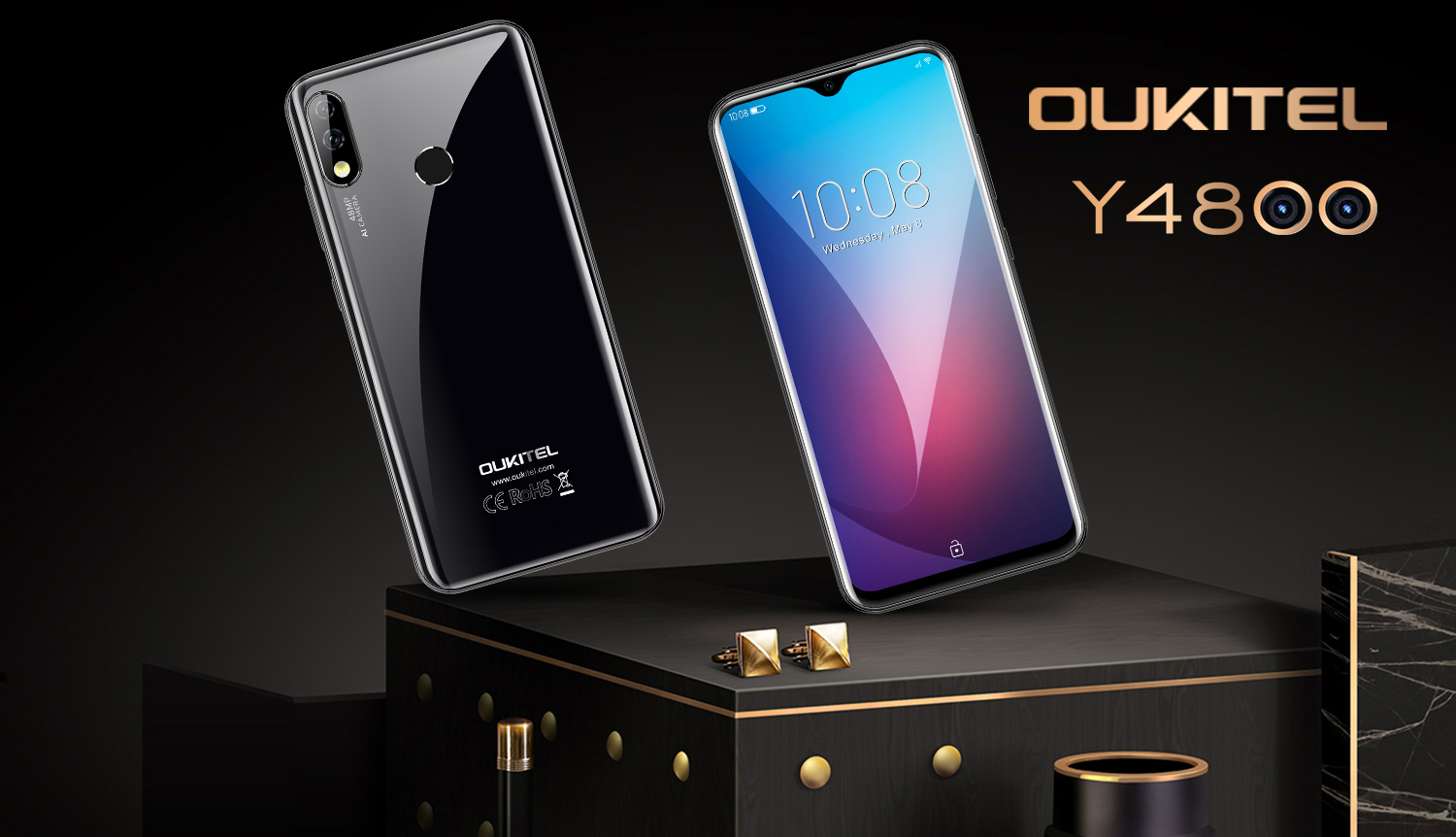
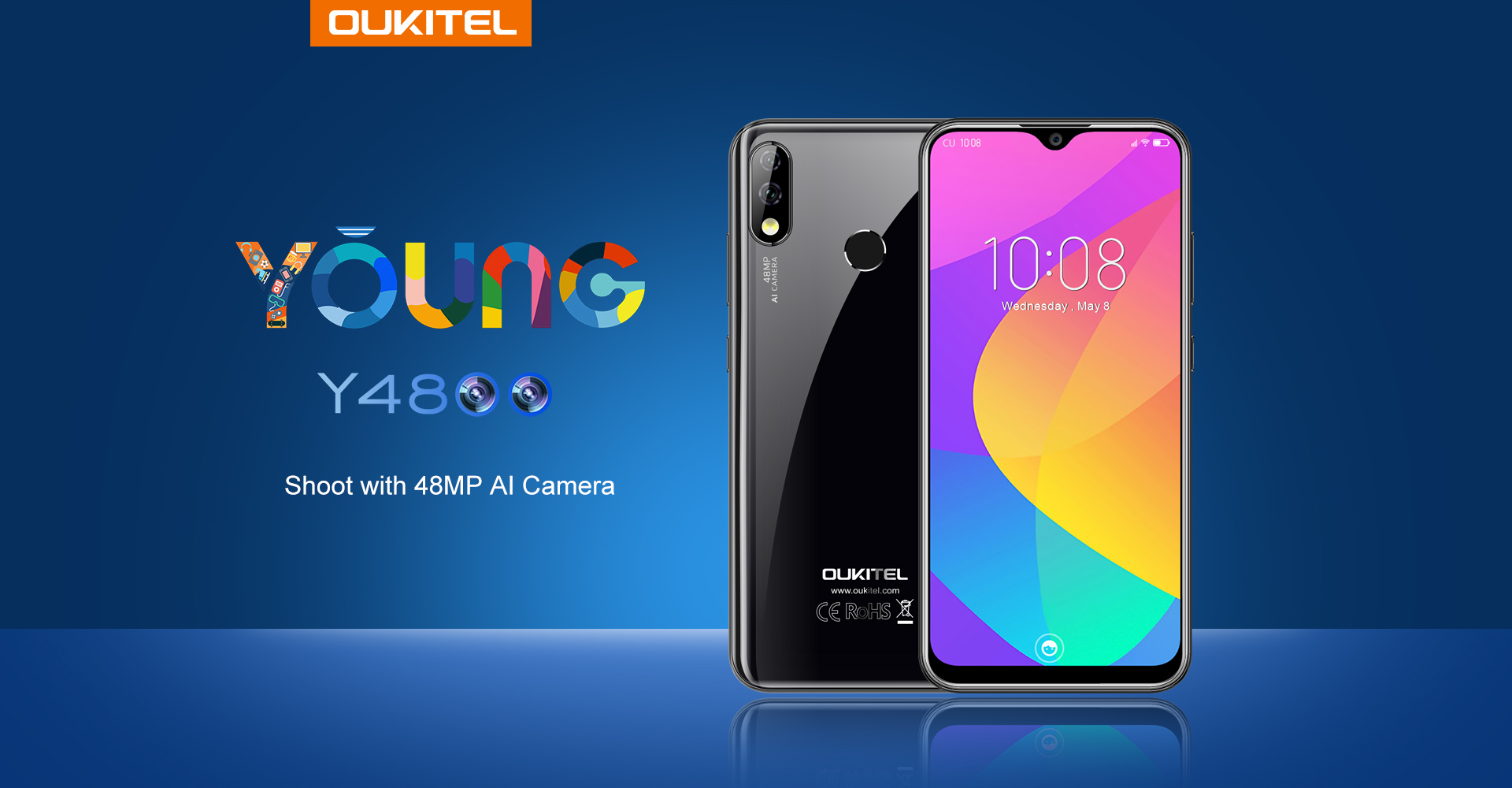
Oukitel Y4800 is was announced back in May and is the first member of the new “Young Series” (Y stands for Young). The device comes with a Samsung 48MP AI camera and the powerful mid-range SoC Helio P70 together with Young OS based on Android 9 Pie. The Global 1st presale will be held from July 22nd to July 29th offering early buyers $50 off the retail price of $249.99. Of course, the killer feature is the 48MP camera, so let’s take a look at the test conducted by Oukitel Lab between the Y4800 and Redmi Note 7.
The Y4800 sorts the Samsung GM1 48MP sensor with f/1.8 aperture. That’s 4 times higher than the mainstream 12MP sensors. When in 48MP mode, the single pixel is 0.8µm which allows you to take wonderful photos with better resolution. As always, the MP count don’t matter a lot if the sensor itself is small in size and for that reason, Samsung made it big enough to take advantage as more light as possible. The sensor size of the GM1 48MP sensor reaches to 1/2 inch, 56% larger than normal 1/2.8inch sensors. Also, 48MP mean large resolution and that becomes handy when cropping or zooming in photos. The front camera also adopts a Samsung 16MP sensor with f/2.0 aperture.
No one will claim that a $250 phone shoots better photos than a $1K flagship but the difference between these two isn’t that big. The Oukitel Y4800 takes comparatively good photos with the rear camera. No matter the exposure, white balance, or sharpness, Y4800 handles quite good. The color is improved to be brighter to a certain degree, and due to the 1/2 inch large sensor size, the dynamic range is excellent.
As for the rest of the specs, there is a 6.3″ FHD+ waterdrop display and the Helio P70 SoC is backed by 6GB of RAM plus 128GB of storage. This combination is unprecedented in this price category and that makes the Y4800 unbeatable. Also, there is a 4000mAh battery that the Young OS takes perfect advantage of, resulting in excellent battery performance. If you are looking for a long standby smartphone with a good camera, go ahead and add it to your wishlist before the presale starts to be informed when it goes live.
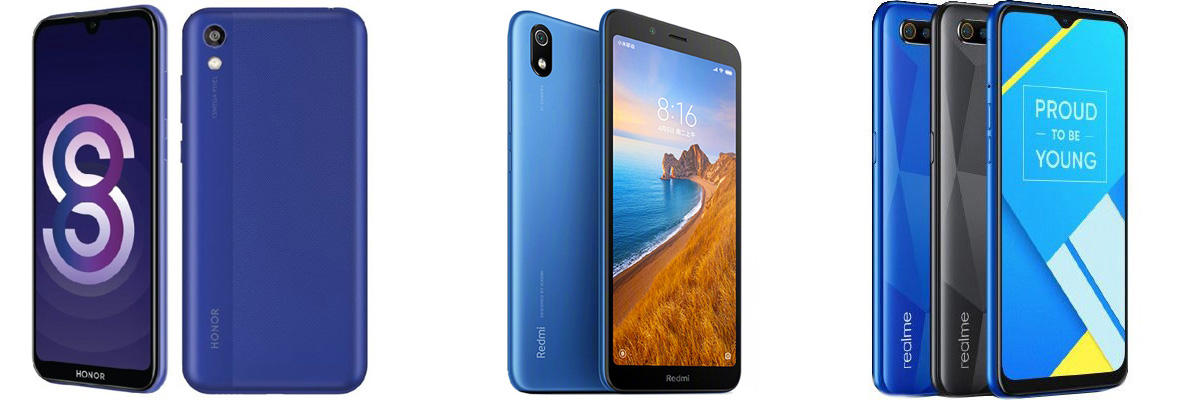
While the midrange segment is the best-selling segment in the smartphones market, the most famous manufacturers are actually not giving the same weight to entry-level phones. Still, we think there is a sufficient amount of low-end device for every basic user with a low budget. If you want to get an entry-level phone right now, three of the best alternatives are Honor Play 8,Redmi 7A and Realme C2. In my opinion, two of them are definitely in the podium of the best value for money phones under €100. That is why this comparison, which will let you meet the best among these devices in our personal opinion, was all but easy to write.
Huawei Honor Play 8 vs Xiaomi Redmi 7A vs Oppo Realme C2
Dual 13 +2 MP f/2.2 and f/2.4
5 MP f/2.0 front camera
BATTERY
3020 mAh
4000 mAh, fast charging 10W
4000 mAh
ADDITIONAL FEATURES
Dual SIM slot
Dual SIM slot
Dual SIM slot
Design
The design is one of the weakest points when it comes to cheap phones. Under €100, you almost always get a cheap polycarbonate body. And that is exactly the case with this trio. Redmi 7A has definitely too thick bezels around the display, so it is not recommended if you want stunning aesthetics. But it has an awesome build quality and it is splash resistant. With their waterdrop displays and slimmer bezels, Realme C2 and Honor Play 8 are more beautiful with the latter being the most compact and lightweight one.
Display
Classic IPS displays with a pretty small size and an HD+ resolution, in each case. The quality of the display is not the key feature of these devices, despite they still offer a sufficient level of detail. So do not judge them basing on the display, just choose the display size which mostly fits your needs. Realme C2 has a wider panel, so if you love multimedia, navigation or productivity it may be better for you.
Specs & Software
The Mediatek Helio P22 chipset on board of the Realme C2 and the Qualcomm Snapdragon 439 found on the Redmi 7A have pretty similar performances, while the Helio A22 of the Honor Play 8 is inferior under every point of view. I personally prefer the Snapdragon 439 due to its more interesting Adreno GPU, but differences are very marginal. In each case, you get Android 9 Pie out of the box and pretty nice software optimization, so you should not worry so much about performance if you are a basic user. All of these devices have a dual SIM slot and a micro SD dedicated slot (you can use both dual SIM and micro SD at the same time). Note that Honor Play 8 is the only with Bluetooth 5.0 (the latest Bluetooth standard).
Camera
If you are seeking the best camera quality, Honor Play 8 should be the best in low light scenarios due to its bright focal aperture which helps to capture more detail with less digital noise. On the other hand, Realme C2 is also nice because it has an additional depth sensor on the back and it makes a better bokeh effect. Forget to get a camera phone if you are going to buy one of these phones, but for emergency shots, they are not so disappointing.
Battery
The big disadvantage of the Honor Play 8 is the presence of an average 3000 mAh battery, while its opponents have much bigger 4000 and 4230 mAh battery, respectively. The Realme C2 has the longest battery life and it can last up to three days if you do not stress it so much. Right after, there is Redmi 7A which even supports fast charging in its version for the Chinese market (the power is 10W).
Price
The main reason why it makes sense to buy these devices is obviously their incredibly affordable price. Realme C2 starts from just €78, Xiaomi Redmi 7A costs €100/$112 in its base variant, and Honor Play 8 carries a €107/$120 price tag. At the end of the day, Realme C2 looks like the most complete device with its wider display, a huge battery, a dual camera, great performances, and a very nice design. I would not go for the Honor Play 8 due to its smaller battery, but note that it comes with a pretty interesting rear camera.
Just a week before the Amazfit GTR launches, Mobvoi will be announcing a new smartwatch under its Ticwatch line. The new Ticwatch smartwatch, according to teasers we have seen will be a hybrid smartwatch.
A teaser video shows the watch has a circular dial with a tachymeter scale etched around it. There are two buttons on the right side and underneath the watch is a set of four pogo pins which we are sure are for charging. It also has a heart rate sensor too.
We believe the Mobvoi watch is a hybrid smartwatch much like the Withings Steel HR Sport. If you look closely, you will see that there is a small screen inside the main dial that will display info such as your heart rate, notifications, steps taken, and calories burned. It should also show details such as battery capacity.
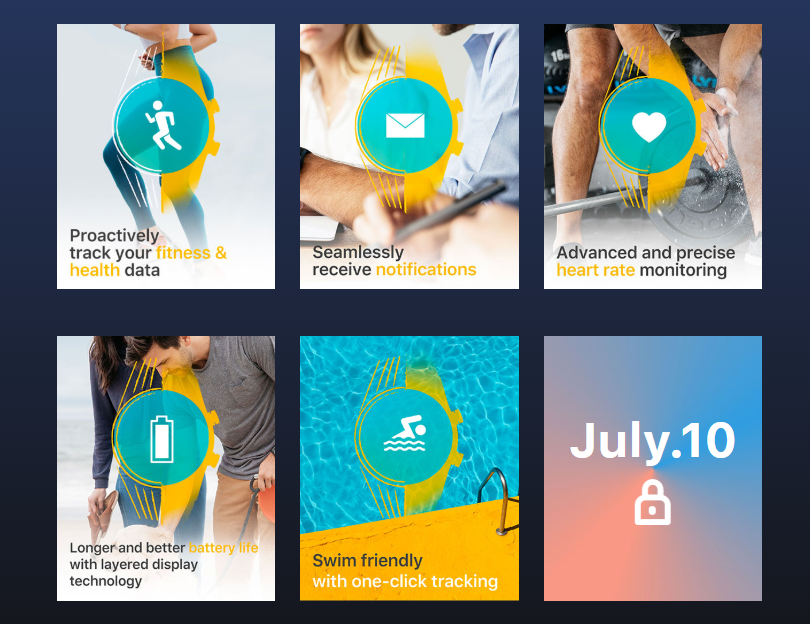
Mobvoi has also confirmed some of the watch’s features on its official website. It will be able to track your fitness and health data including swimming activities, display notifications, monitor your heart rate precisely, and will have better battery life.
More details about the watch will be available when it launches tomorrow.
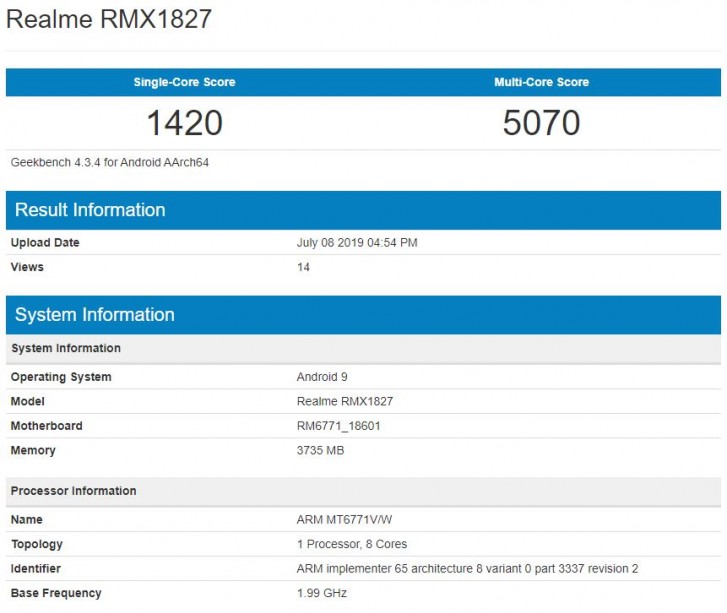
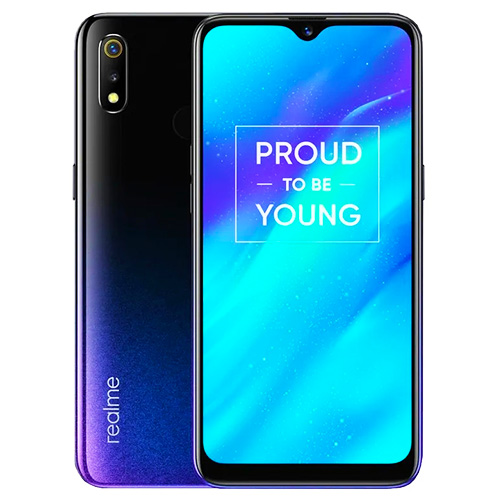
Apart from launching the Realme X smartphone on July 15 in India, Realme will be also soon unveiling another phone called Realme 3i. It is speculated to be positioned between the entry-level Realme C2 and mid-range Realme 3 smartphone. A new Realme smartphone that has a model number of RMX1827 has appeared on Geekbench. Since it is powered with a processor that is weaker than the chipset that fuels the Realme 3, it could be the Realme 3i phone.
The RMX1827 Geekbench listing has revealed that it is fueled by MediaTek MT6771VW octa-core processor. It is nothing but the Helio P60 chipset. The SoC is assisted by 4 GB of RAM. The handset is loaded with Android 9 Pie OS. In the single-core test, it scored 1420 points and it has recorded 5070 points in the multi-core test.
The Realme 3 is fueled by MediaTek Helio P70 chipset. Since the RMX1827 is equipped with a comparatively weaker processor, it could be the upcoming Realme 3i. Nothing else is known on the other specs of the smartphone. The smartphone will be exclusively available for purchase through Flipkart. A microsite for the phone that is available on Flipkart contains minimum details on the smartphone such as waterdrop notch, big battery, decent camera and stylish design.
The Realme 3 has starting price of Rs. 8,999 (~$131). Hence, it appears that the Realme 3i could be priced around Rs. 7,999 (~$116). Probably, the phone may borrow some of its specs from the Realme 3 phone.
The Realme 3 has a 6.2-inch display with waterdrop notch. It supports HD+ resolution and 19.5:9 aspect ratio. The Helio P70 SoC with up to 4 GB of RAM powers the smartphone. It comes with up to 64 GB of storage. For additional storage, the handset has a microSD card slot.
The smartphone is equipped with 13-megapixel + 2-megapixel dual camera setup. It has a front-facing camera of 13-megapixel. The handset includes a 4,230mAh battery that carries support for 10W fast charging.
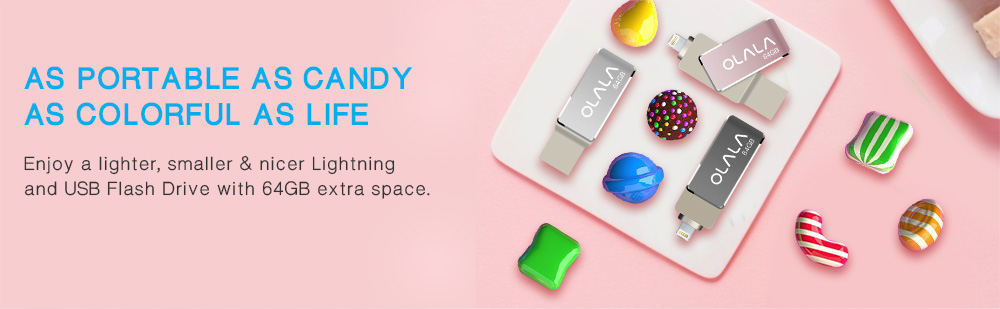
iPhone storage has been a sad story in the past as Apple insisted on releasing 16GB and 32GB versions until recently. This resulted in many users facing problems with full storage messages popping up every now and then. This would be easy to solve with a microSD card but Apple never provided the required slot. Ok, what about a USB stick? Yeah, that you could use to transfer… photos as iOS lacks a file manager. Well, this is what the OLALA 32GB flash drive is here to solve.
The OLALA flash drive features a dual interface to use with a PC and iPhone. On one end there is a classic male USB port while the other end is a male Lightning port. You can easily add contents from your PC and then connect it to your iPhone and see this content with the help of the “iDisk me” app provided by the manufacturer. You can even use the flash drive to record videos as all you have to do is press the Camera button in the “iDisk me” app!
The OLALA 32GB flash drive for iPhone is now available on Amazon US with 70% off that brings the price down to just $10.19! All you have to do is visit the product page and use coupon 1OLALA70 during checkout. The offer ends on Sunday, July 14th.
The Xiaomi Mi 9 will soon receive some new features that will improve the user experience according to info from the official WeChat account. Some of these new features launched with the Xiaomi CC9 series such as Mimoji and the Sky Replacement feature in the gallery app, while others are entirely new. Below are the nine features coming to the flagship:
Panoramic selfie timer mode: this uses a stitching algorithm to take panoramic selfies with undistorted edges. It will come in handy when taking a group photo.
Always on Display Spiral Clock: the Mi 9 uses an AMOLED display and supports Always on Display. Xiaomi has added new AOD features since the phone launched and now it has announced a new clock will be available. The clock has a spiral waveform and is a delight to look at.
3D Smart Gesture: the Mi 9 will support what is called 3D gestures similar to Motorola‘s “Chop Twice for Flashlight“ or “Twist for Quick Capture” Moto Actions. As shown in the gif below, you will be able to launch the camera app or the music app by drawing gestures in the air using the phone.
Mimoji: The Xiaomi CC9e and Xiaomi CC9 saw the return of Xiaomi’s Mimoji feature. It has been revealed that the upgraded feature will also be coming to the Mi 9. Users will be able to create avatars of themselves, take photos, and even record videos.
Sky Replacement Filter: this also launched with the CC9 and CC9e and allows you to change the sky in your photos to any from the preset ones. There is a clear sky filter, sunset sky filter, rainbow sky filter to name a few,
NFC Bus Card support for more cities: the Mi 9 will increase its NFC Bus Card support to 256 cities across China and also increase support for 17 bus cards.
Xiao Ai Garbage Classification: To help keep the environment clean, Xiaomi’s Xiao Ai assistant will get a new feature that will allow it to be able to answer questions related to proper waste disposal.
Increased frame rate: The Mi 9 will support an increased frame rate of 60fps and improved graphics for games like PUBG.
Android Q: The Mi 9 will also get Android Q beta. Xiaomi already began recruiting testers last week and says the closed beta version may be released this week.
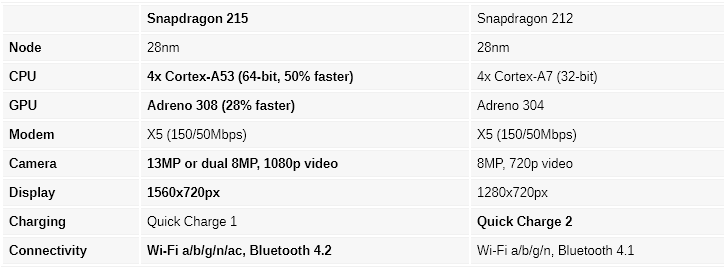
US semiconductor giant Qualcomm has announced a new chipset targeted at entry-level smartphone. The Snapdragon 215 is a significant upgrade over the Snapdragon 212 as it now has a 64-bit CPU, a faster GPU and support for dual cameras.
The new chipset is built on the old 28nm node just like the SDM 212. The difference is in the cores. The new CPU features four Cortex-A53 cores clocked at 1.3GHz, unlike the SD 212 chipset which had four Cortex-A7 cores. According to ARM, the Cortex-A53 cores are 50% faster than the four A7 cores inside the old chipset. Being 64-bit is the bigger upgrade, however, as it should massively improve compatibility with new versions of Android, considering that 32-bit Snapdragon 212-powered models like the Nokia 2 couldn’t make it past Android Oreo.
Snapdragon 212-powered Nokia 2
The new chipset also features the Adreno 308 GPU which is the same GPU on the Snapdragon 425 chipset. Qualcomm claims the GPU delivers a modest 28% boost over the Adreno 304 GPU on the SD212.
In addition, the Qualcomm Snapdragon 215 comes with a dual ISP, the first Snapdragon 200-series model to have such. The dual ISP significantly improves camera support. The Snapdragon 215 can handle one 13MP camera or two 8MP modules, so phones can have a tele cam or a depth sensor. Further, the chipset also supports an upgraded 1080p video recording. The SD212 only supports a single 8MP sensor and 720p video recording.
However, the new processor supports a maximum display resolution of 720p. The aspect ratio isn’t restricted to 16:9 like the SD212 but also includes 19:9 aspect ratio support. There is also some improvement in connectivity with the inclusion of Wi-Fi 5 (802.11ac) and Bluetooth 4.2. NFC is also upgraded making the chipset to have support for Android Pay. Other improvements include; dual VoLTE and EVS Voice calls (“Ultra HD Voice Calls”), yet again the first 200-series model to have such.
On a negative note, the new chipset is listed to support only Quick Charge 1.0 which is a maximum 10W charging power whereas the SD 212 supports QC 2.0 (up to 18W). However, this tone down could be as a result of the several upgrades.
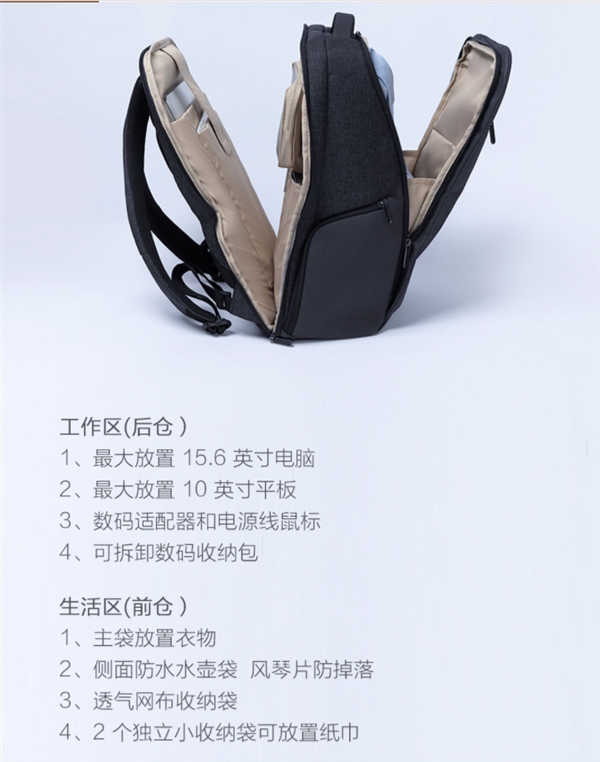
Xiaomi has launched the Mi Business Casual Backpack 2 in China. As the name suggests, this is the second model under the iteration. As for the price, it will sell for 199 yuan ($29).
The Mi Business Casual Backpack 2 is different from the first-gen model in that it has two separate compartments. The main compartment faces the back and can hold a 15.-inch laptop while the outer part can hold small size stuff like magazines. Both compartments can open up to 180 degrees. The entire capacity is also bumped up from 21L to 26L.
The Mi Business Casual Backpack 2 is made of a dark grey 650D oxford cloth. The fabrics are treated with 4 levels of water repellent to provide all-weather protection for the contents of the bag. The backpack measures 325x180x445mm and weigh 0.93Kg, which is about 13% lighter than the 1st generation business backpack. In addition, the backpack is specially designed with a lighter sandwich mesh backing for quick cooling and coolness. The backpack has an arc design which fits the back to reduce shoulder pressure.
The top is provided with a magnetic opening and closing carrying case for passports, boarding passes, bills, etc. Just like its predecessor, it also comes with a portable cart strap that fits the suitcase.
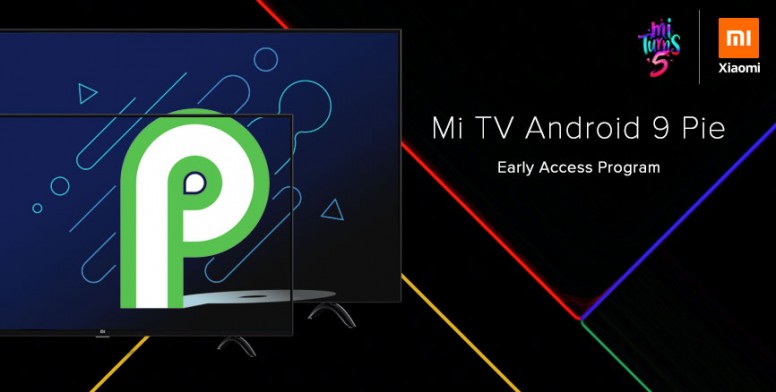
In a post dated yesterday, Xiaomi India revealed it is recruiting 50 fans to join the Mi TV 4A Android 9 Pie Early Access Program. The supported Mi TV 4A models are the 2018 Mi TV 4A 32” and Mi TV 4A 43”.
The update has been long overdue for the TVs which launched with Android TV Marshmallow but Xiaomi explained there are multiple reasons for the delay. One is the chance of a soft brick when updating the ROM (especially one based on Marshmallow) and there is a power cut. Another reason is the Amlogic support issue; a lot of work had to be done to ensure the chipsets supports Android Nougat and above.
Xiaomi also explained that they decided to skip the update to Android Oreo and focus on Android Pie builds instead. This would mean waiting for the Android 9-based images which arrived much later and therefore delayed when the update would be available. However, the advantage is that Mi TV owners will be one of the first in the country to run Android 9 Pie as other manufacturers are releasing new models based on Android 8 Oreo.
If you own either of the two TVs and want to join the early access program, you are required to fill this form. You are also required to have a Telegram account, Mi ID, and state why you want to join the Early Access Program.
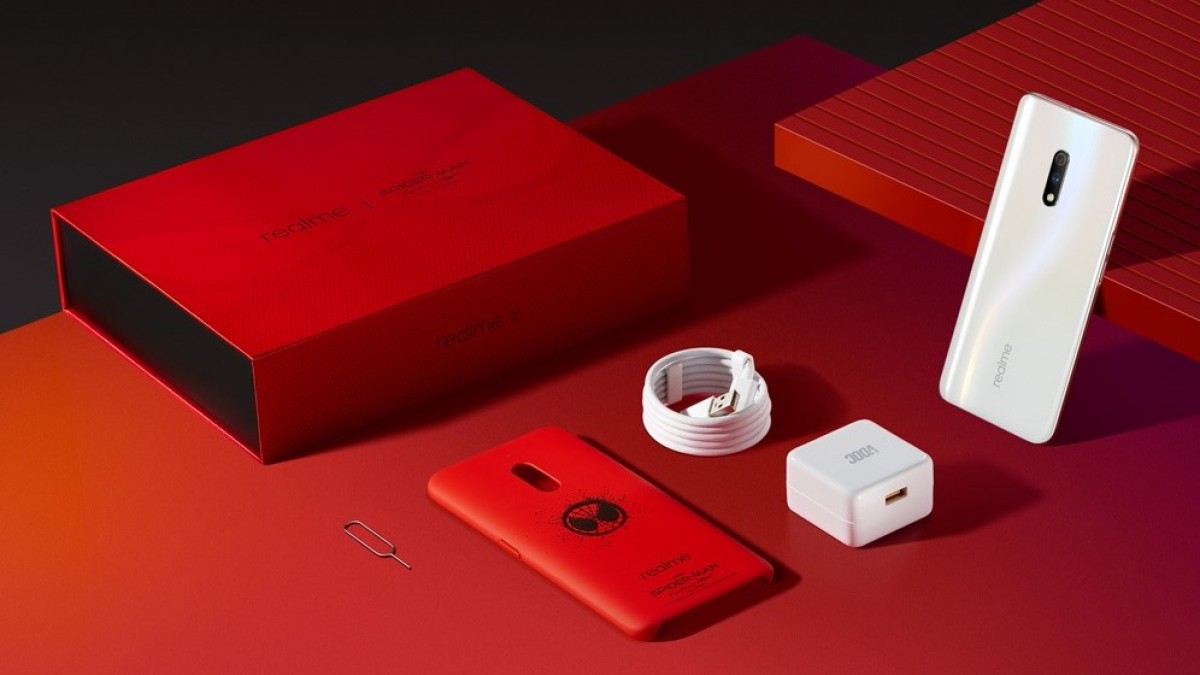
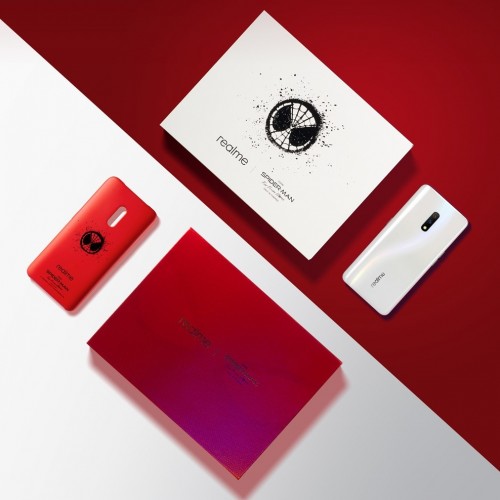
The Realme brand last month unveiled the Realme X Spider-Man Edition in China and the device is billed to go on sale in India on July 15. The customised edition has now gone on sale in China via Realme’s official website. The Realme X Spider-Man edition is offered for a modest 1,799 yuan ($260). For a customized phone with 8GB RAM and 128GB storage, this is a steal. Sadly, we doubt if it will be this cheap outside China. We’ll find out about that when the device is released for the Indian market.
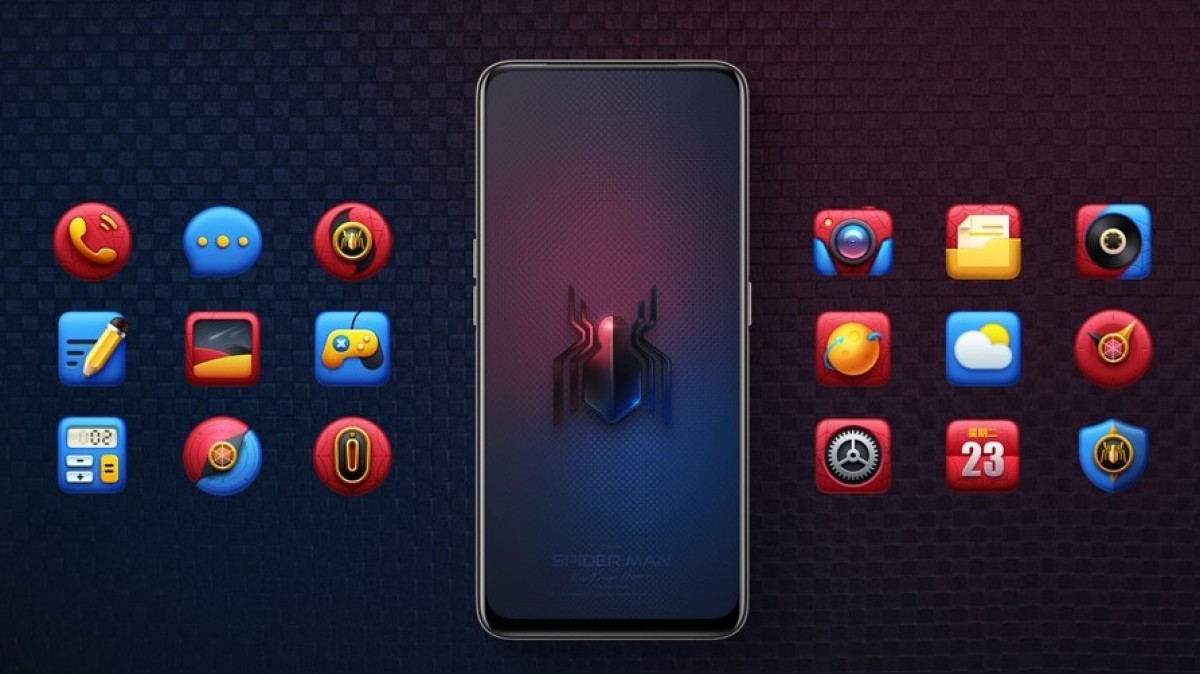
Talking of customization, the Realme X Spider-Man Edition doesn’t have any hardware change in terms of design. However, the phone comes with a Spider-Man-themed UI as well as a red-coloured retail box. The retail box contains a sleek phone case with a Spider-Man logo. The outer jacket is red while the real retail box is white and has the Spider-man logo as well.
Apart from these few customized features, this custom edition seems to be the same as the standard model. As a reminder, the Realme X features a 6.53-inch Full HD+ AMOLED display with 2340 × 1080 pixels screen resolution and Corning Gorilla Glass 5 protection. The phone’s display offers a 91.2 percent screen-to-body ratio, thanks to the pop-up selfie camera design.
Under the hood, Qualcomm’s Snapdragon 710 octa-core processor is powering the device, just like the Realme 3 Pro. It is coupled with Adreno 616 GPU and packs up to 8GB of RAM and up to 128GB of internal storage. The device also comes with a 16MP pop-up selfie camera and dual 48MP+5MP rear cameras. There is also an on-screen fingerprint sensor as well as VOOC 3.0 fast charge support among other features.
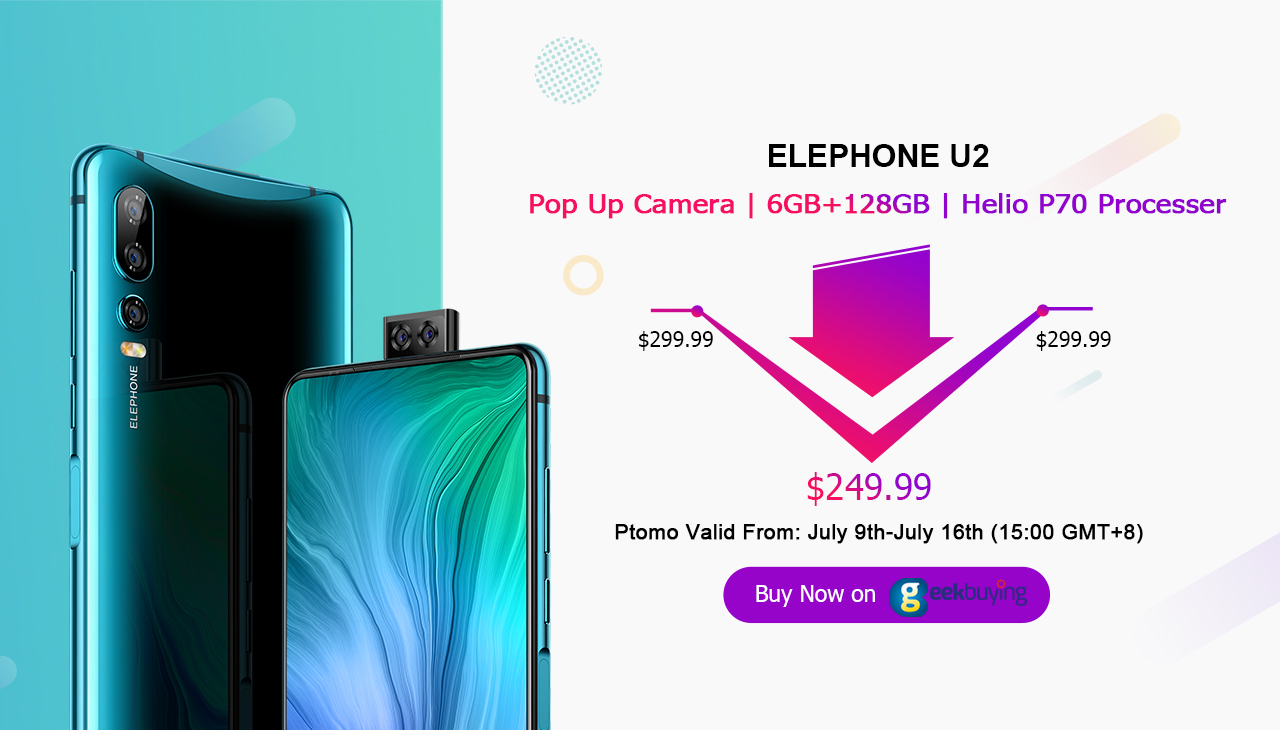
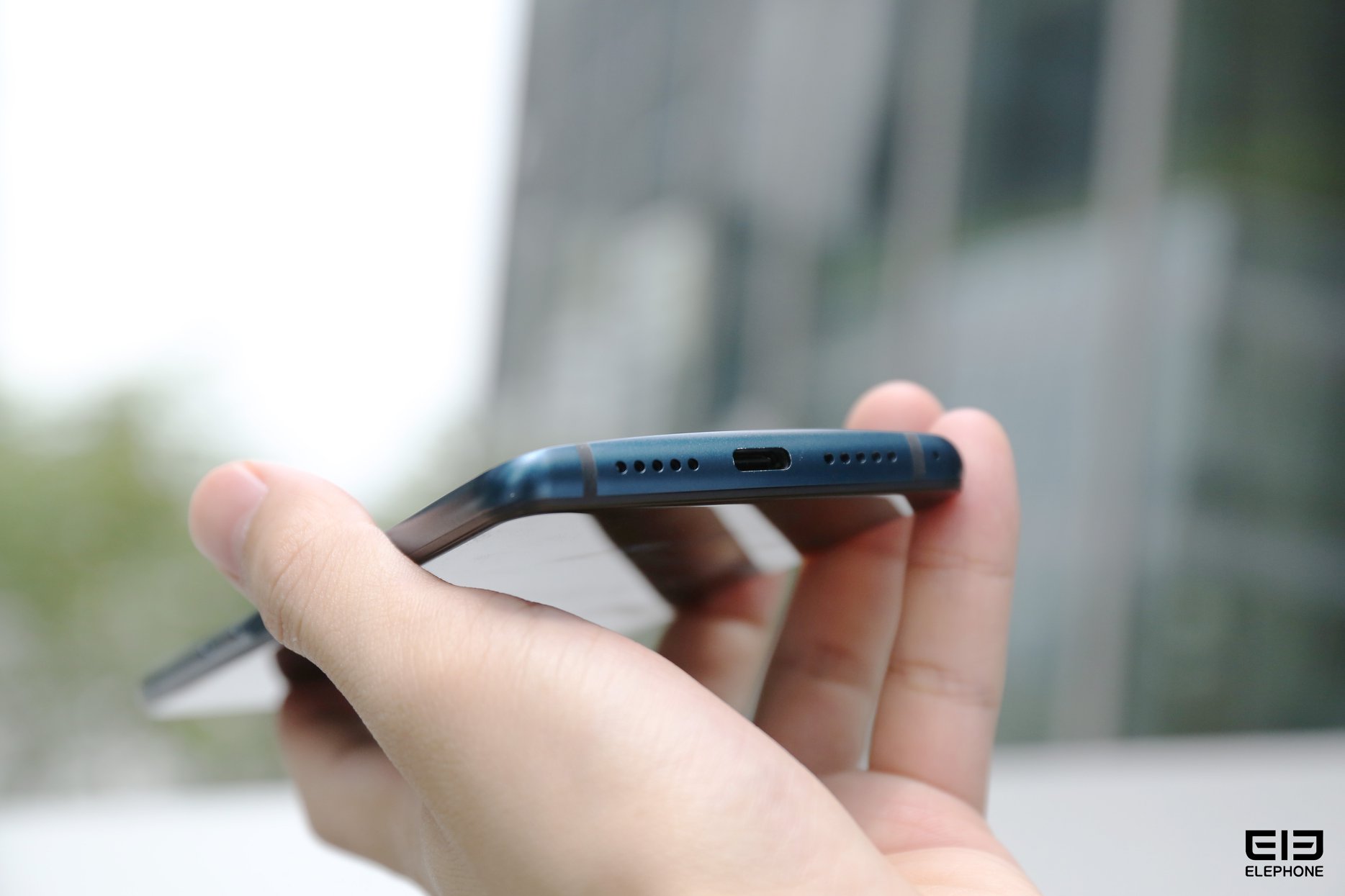
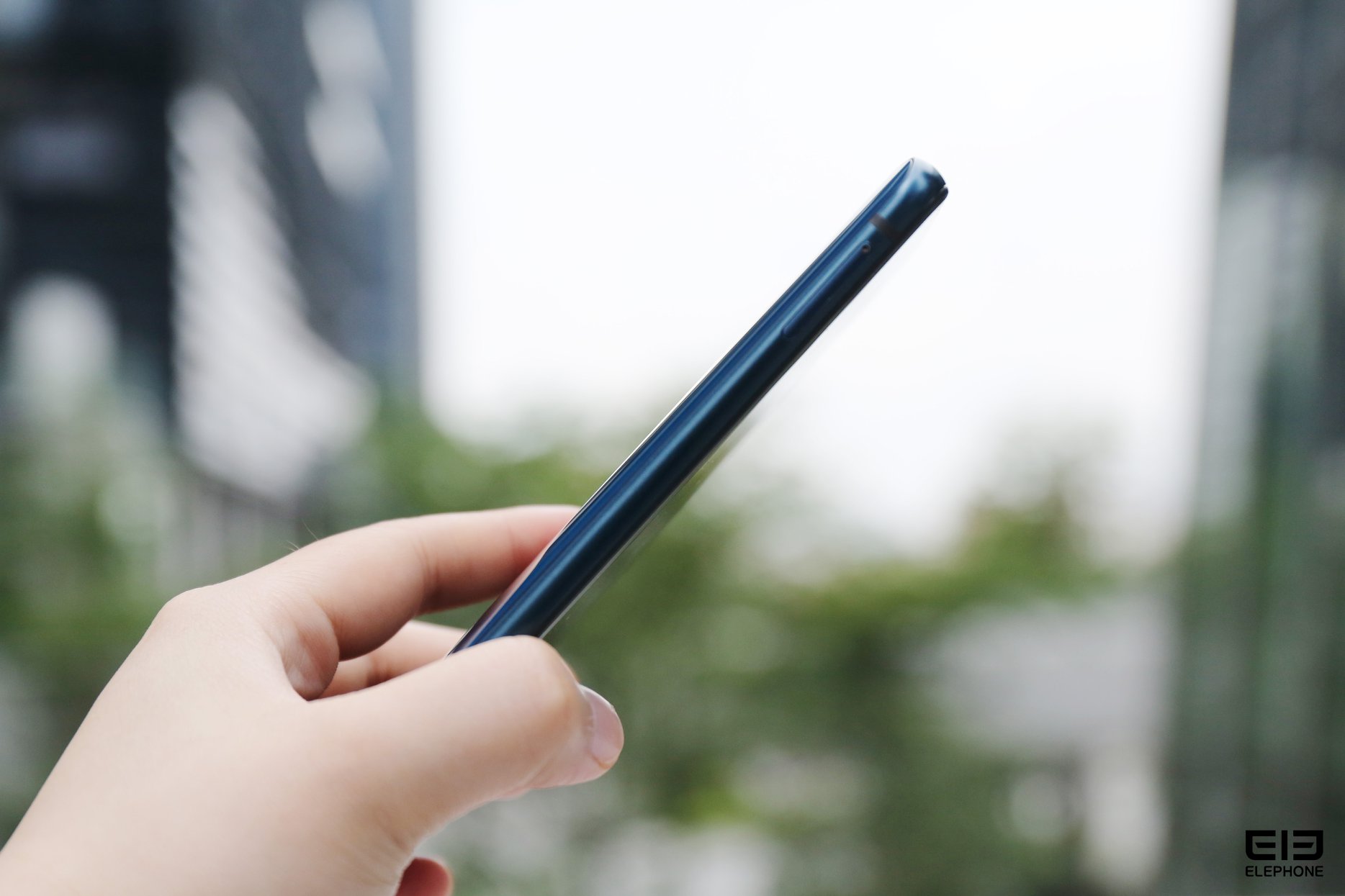
It seems that Elephone is determined to make the Elephone U2 its best-selling device to date as after Aliexpress and Banggood, the company is now offering the pop-up camera mid-range flagship on Geekbuying with a promotional price until July 16th. The activity started today and it is exclusively for the 6GB/128GB version in Black and Gold. The final price is $249.99, unprecedented for this amount of RAM and storage.
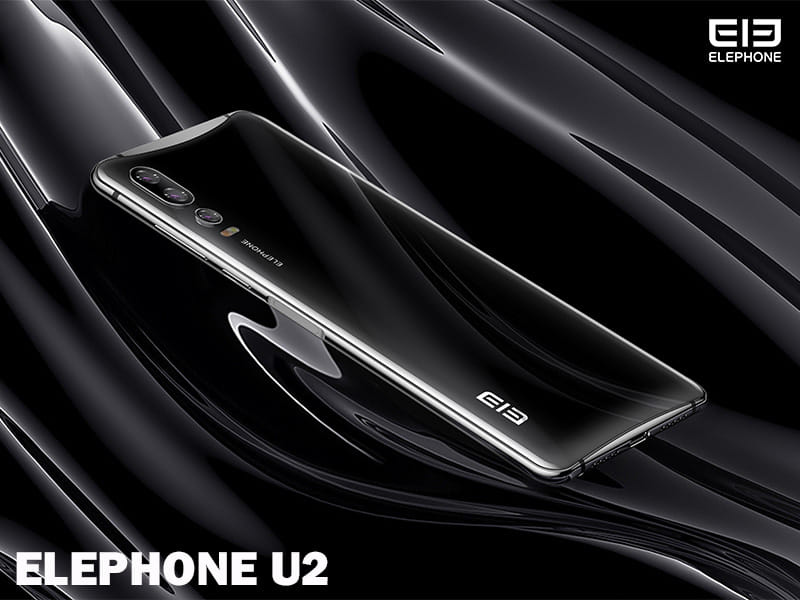
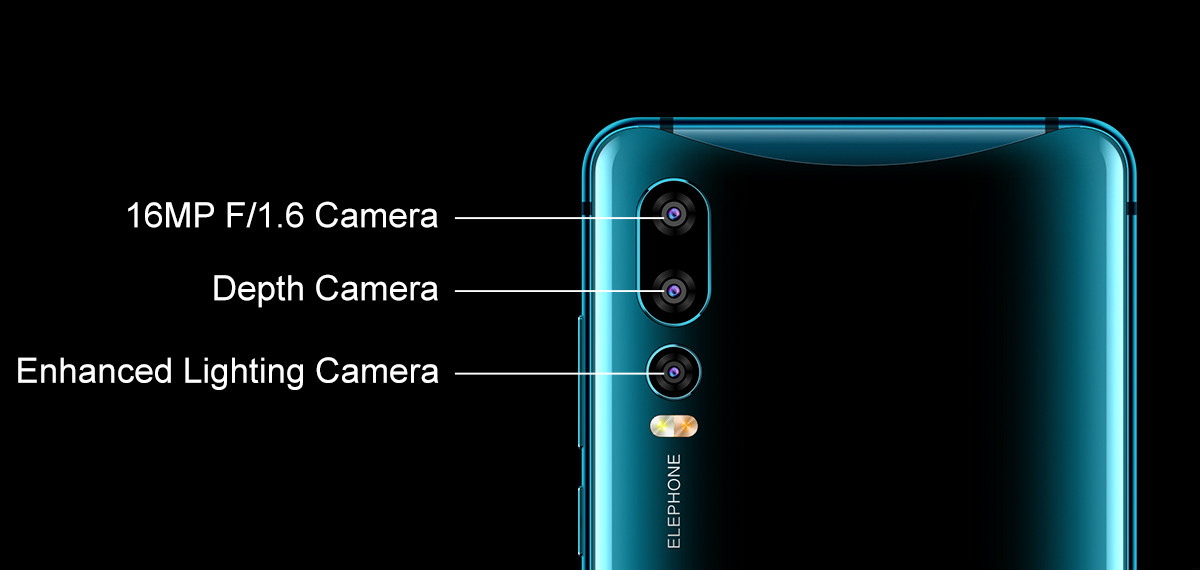
Elephone U2 comes with a 103% Wide-Gamut, 500nit Brightness 6.26″ FHD+ full display with a 93,1% screen/body ratio thanks to the pop-up front camera and ultra-narrow bezels. The pop-up camera hosts 2 sensors with 16MP/2MP configuration while the rear camera is a triple setup with 16MP/5MP/2MP sensors and f/1.6 aperture with Super Night mode.
1 of 5
Also, it is powered by Helio P70 SoC backed by 4GB/64GB or 6GB/128GB memory configuration. The battery capacity is 3250mAh and supports fast charging while there are face & side fingerprint sensors and comes with Android 9.0 Pie. Learn more on about the phone on the official website.
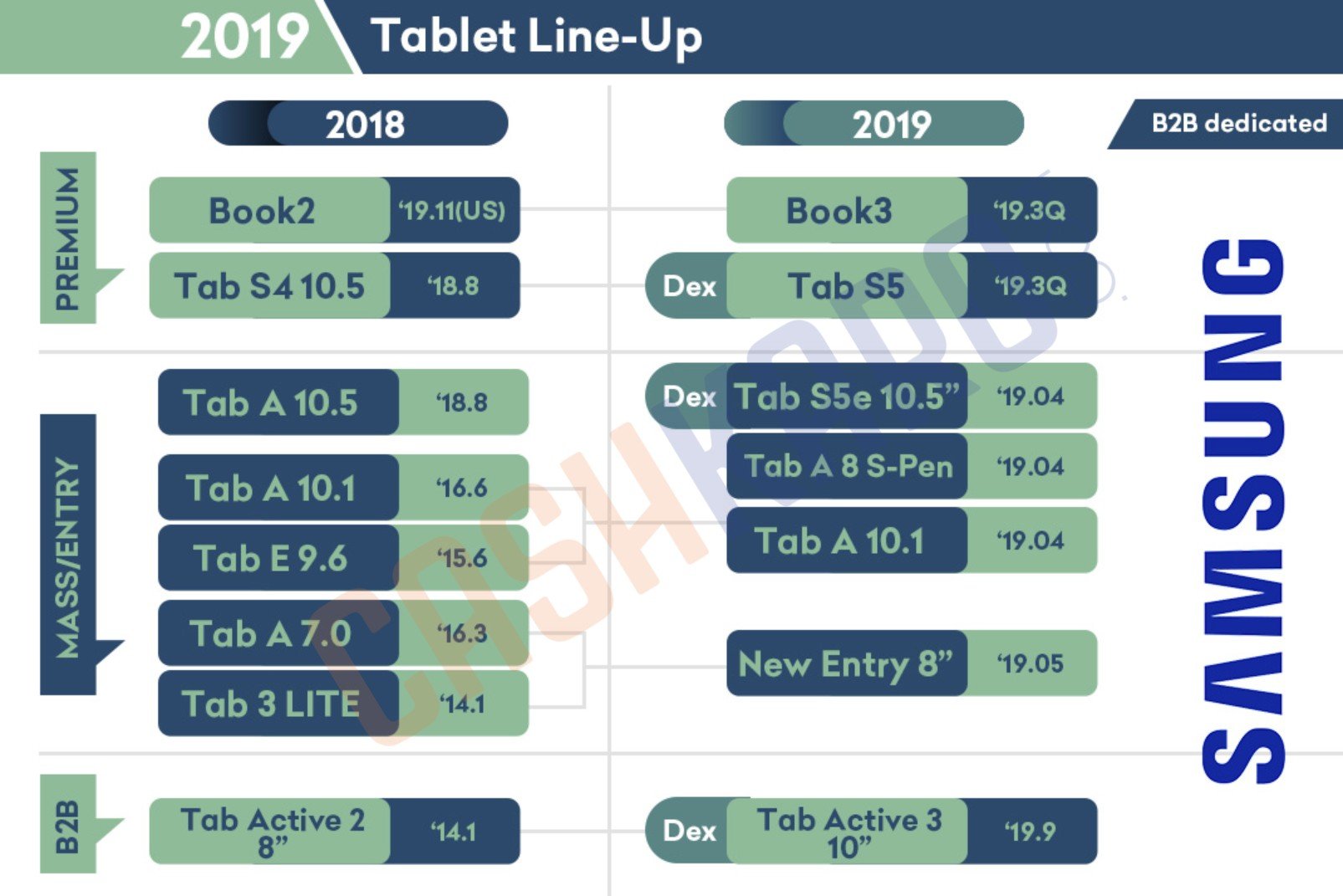
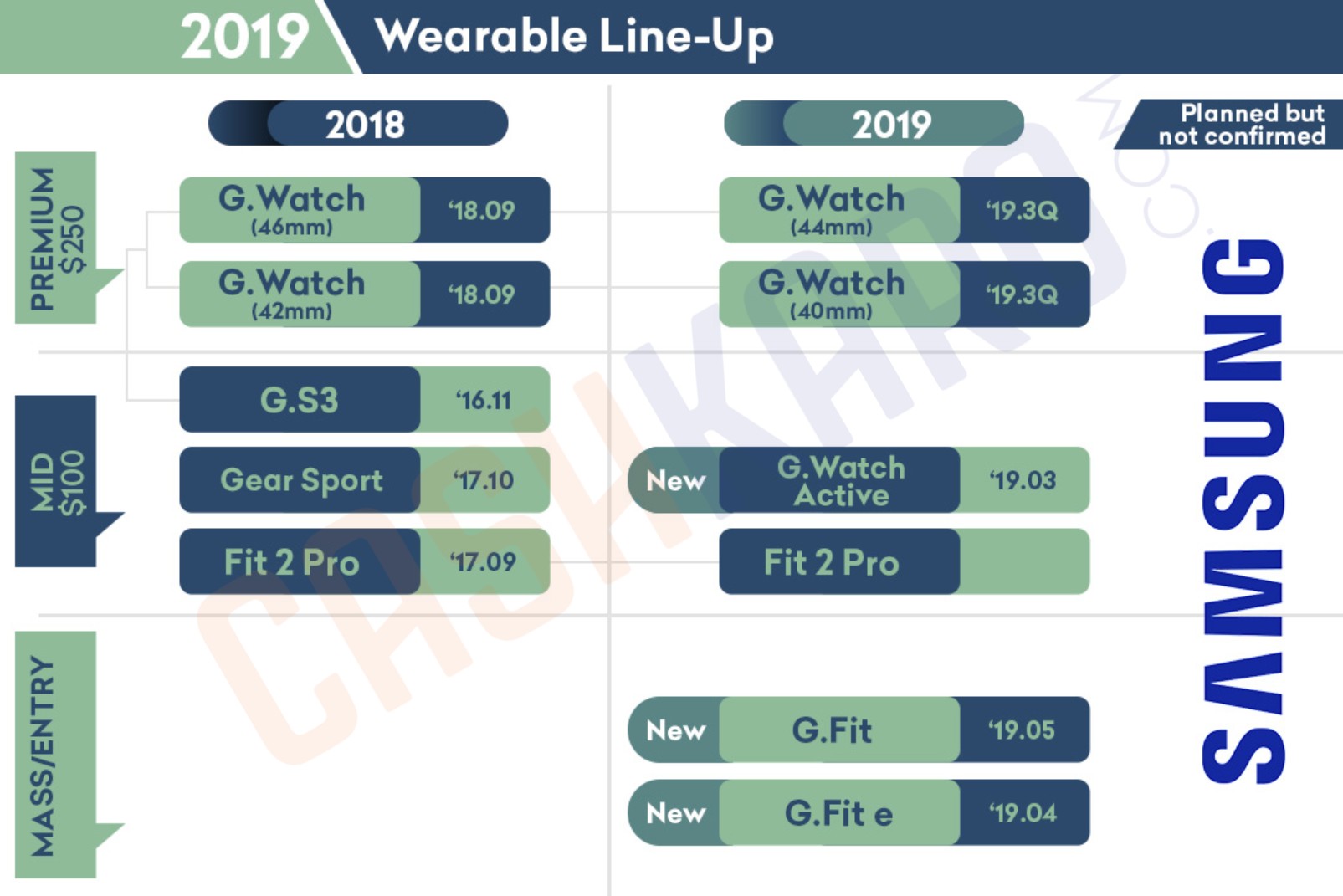
It’s not often we get to see a comprehensive list of Samsung‘s product lineup. That is why this latest leak by Cashkaro containing the company’s full 2019 product lineup is interesting. While we can’t be so sure of its authenticity, the accuracy of the products that have been released so far. The blog claims the source of the information is a highly placed one in the mobile phone industry. So let’s take a look at the details.
The list encompasses the smartphone, tablet, and wearable products lineup. For the tablet lineup, Samsung is expected to launch the Samsung Book 3, a premium tablet in the third quarter of 2019. Not much is known about Book 3 except that it will be a successor to the 12-inch Super AMOLED-packing Book 2 which was released in 2017. The Galaxy Tab S5 will also be released later this year, sometime in Q3. There are speculations the device will be released alongside the Galaxy Note 10 packing a Snapdragon 855 chipset.
Also in Q3 2019, Galaxy Tab Active 3 is listed for release as well as Galaxy Tab A models and a new Tab S5e.
for smartphones, the company has released the Galaxy S10 series and is expected to launch the Galaxy Note 10 series soon. The smartphone lineup is very elaborate and most of the Galaxy A and Galaxy M series models have already been announced. However, the Q3 2019 is laced with some interesting releases like the Galaxy Fold and Galaxy S10 5G.
Finally, for the wearables line up, Samsung is also set to launch a few products, one of which is the Galaxy Watch Active 2. Also, Samsung is expected to update the Gear Fit 2 Pro launched in 2017 with a new model bearing the same name but likely with some new features. The Galaxy Fit and Galaxy Fit e are also listed but those have been launched already.
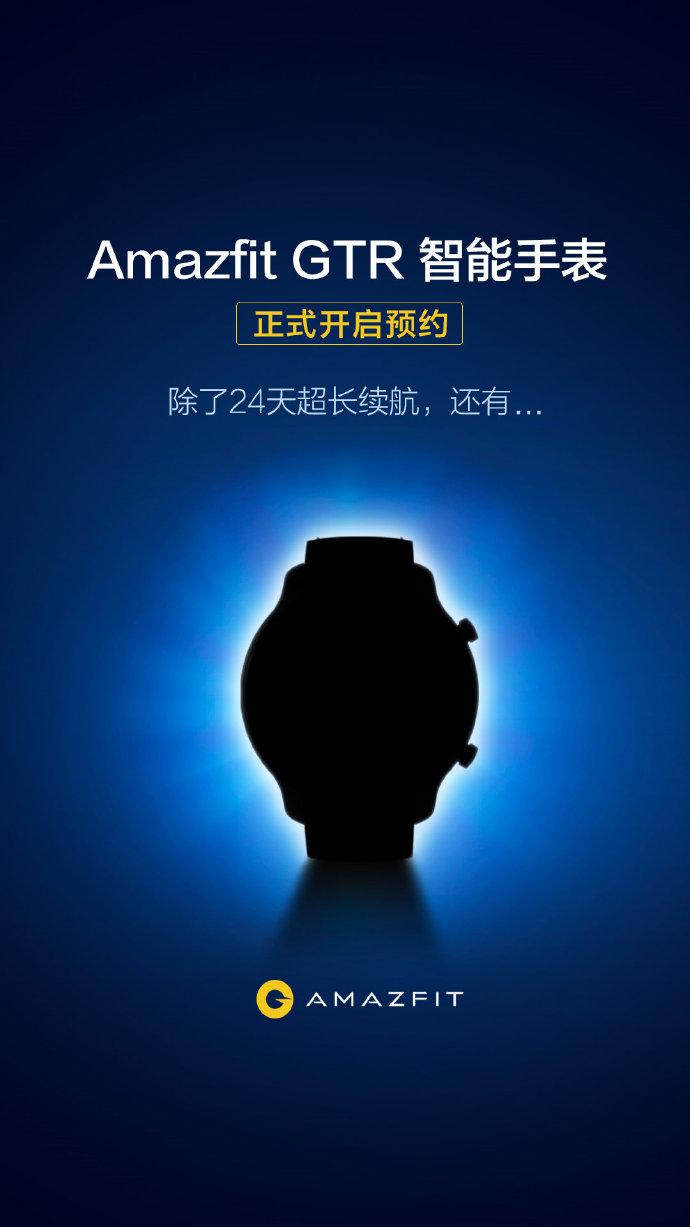
The Amazfit GTR (Grand Tour Racing) will be unveiled in Beijing according to Huami. One of its main features will be its case which will be made from Titanium. Titanium is more durable than stainless steel and has excellent corrosion resistance.
With respect to its design, a silhouette of the watch shown in a teaser poster reveals it will have a circular dial and two buttons on the right. Huami also revealed on Weibo that the watch will have 24-day battery life.
The Amazfit GTR is already available on pre-order on Jingdong, Tmall, and Xiaomi’s official website. Those who pre-order get a ¥60 coupon which they have to use before July 31. There are no images of the watch on the listing which isn’t surprising but the page does say the watch will go on sale the same day it launches.
In early June, Huami revealed its plans to launch over 10 smartwatches in the coming months and it seems set to keep to its words. Counting the GTR will bring the number to 5 which means we should expect at least 5 more watches before the end of the year.
Foldable displays are far from taking over the world but with what we have seen with respect to real devices, we have barely scratched the surface when it comes to designs. Last week, we saw a Google patent for a phone with several displays and a design similar to a book. Today, it is IBM’s turn to show us another unusual device – a smartwatch with multiple displays that can unfold into a phone or a tablet.
According to LetsGoDigital who discovered the patent titled “Variable Display Size For an Electronic Display Device”, IBM filed the application back in 2016 but didn’t get it approved until last month.
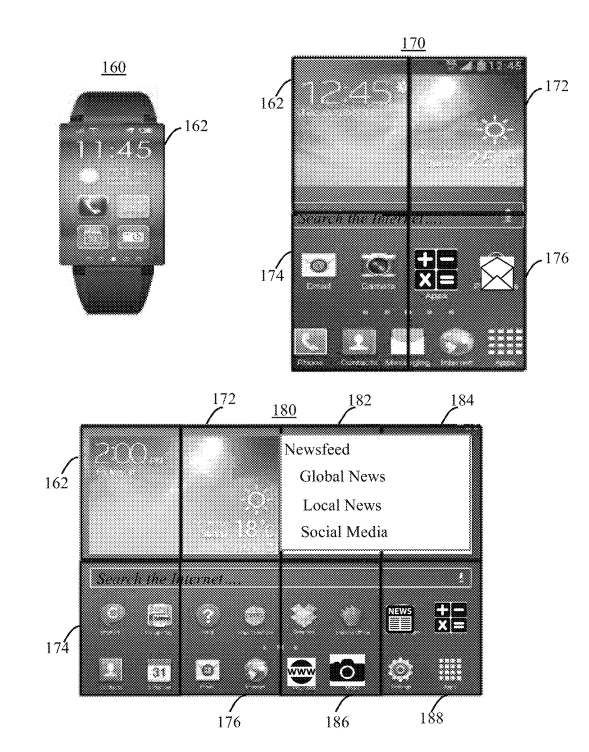
The patent says the electronic device is designed to operate in one or more display configurations with varying screen sizes. In the default mode, it is a smartwatch with a significantly thick case. This case houses secondary displays stacked in layers behind the main display. These secondary displays can then be extended from the housing and positioned adjacent to the main display.
The patent says each display measures 3” x 2”. When you switch to the second configuration, the display size becomes 6” x 4” which means three more displays are added in the second configuration. A third configuration brings the dimension to 12” x 8” which is really big for a tablet. However, based on the patent images shown above, the third configuration will actually be 6” x 8” as only the width seems to have doubled.
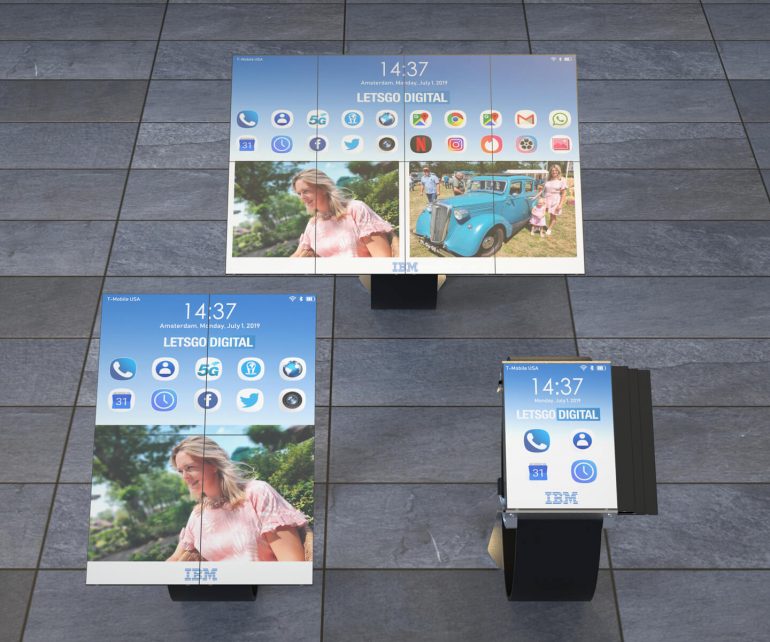
LetsGoDigital has made 3D renders of the device which provide an idea of what it may look like as a final product. Though we are pretty sure the device will never be used in the positions shown as there is no way the strap can support the weight of the extended displays. It will definitely have to lay down flat when needed to be used as a phone or tablet.
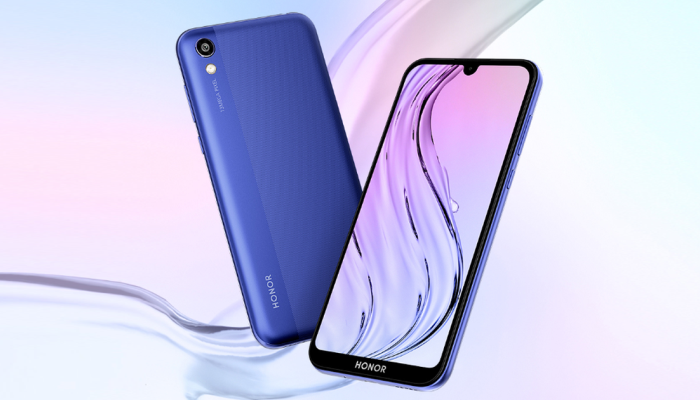
Honor just unveiled an ultra-affordable smartphone dubbed the Honor Play 8 today in China. The smartphone is essentially a rebranded Honor 8S that had released in April in Russia. The company has launched it in the home market in association with D.Phone. The smartphone is available for purchase across all major retailers in China, such as Suning, Vmall and JD to name a few.
Honor Play 8 Specifications and Features
The Honor Play 8 smartphone gets a 5.71-inch HD+ LCD display with an aspect ratio of 19:9. There is a waterdrop notch on top of the screen and thick bezels on three sides. The device is powered by a Helio A22 SoC and is available with 3GB of RAM with 32GB of built-in storage. It storage can be further extended up to 512GB by means of a microSD card.
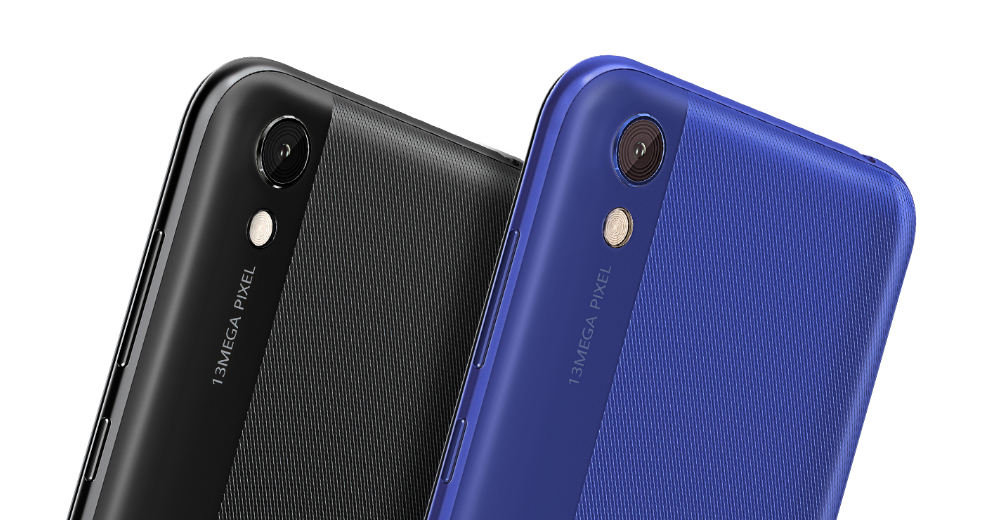
The single 13-megapixel camera on the rear has an aperture of f/1.8 and it carries supports HDR. While the front camera is a 5-megapixel unit with an aperture of f/2.2. The Honor Play 8 misses out on a fingerprint sensor, but uses the front camera for face unlock.
The phone is powered by a 3,020 mAh battery and runs on Android 9.0 Pie OS that is customized with EMUI 9.0. It has two dedicated SIM slots with dual 4G. The device sadly misses out on fast charging. But that is understandable at its price point. There is anti-slip faux leather coating on the plastic rear of the Honor Play 8.
Honor Play 8 Price and Availability
The Honor Play 8 is available for buying in China at a very competitive price tag of 599 Yuan (~$120). It is available in two color variants, namely black and blue. The same phone is selling as Honor 8S in Russia and as Huawei Y5 (2019) in Europe.
Realme has recently confirmed that it will be launching the Realme X smartphone on July 15 in India. The smartphone will be exclusively available for purchase through Flipkart. The retailer giant has added a microsite for another upcoming phone from the company. The microsite site reveals that it will be soon selling a new phone called Realme 3i. It is now being speculated that the Realme X and Realme 3i phones may both go on official through the upcoming July 15 launch event.
The Realme 3i page on Flipkart has information on its specs. The smartphone will be featuring a waterdrop notch enabled display and it will come with some features like big battery, impressive camera and elegant appeal. Hopefully, the Chinese firm will release more information on the smartphone in the coming days. There is a possibility that the smartphone could be positioned between the Realme C2 that is priced at Rs. 5,999 (~$87) and Realme 3 that costs Rs. 8,999 (~$131) in the country.
Realme 3 Specifications and Features
The Realme 3 features a 6.22-inch IPS LCD panel with waterdrop notch. The display carries support for 720 x 1520 pixels HD+ resolution and 19:9 aspect ratio. The MediaTek Helio P70 is present under the hood of the device. It is assisted by up to 4 GB of RAM and it comes with up to 64 GB of native storage. A dedicated microSD card slot is also available on the device.
The Realme 3 boots to ColorOS 6.0 based Android 9 Pie OS. The handset is powered by a 4,230mAh battery. The rear side of the smartphone features f/1.8 aperture 13-megapixel + f/2.4 aperture 2-megapixel dual camera setup. It has a front-facing camera of 13-megapixel with f/2.0 aperture. It also features a fingerprint scanner and face unlock.
Realme 3 in rumored Diamond Red color
The Realme 3 smartphone comes in color choices like Dynamic Black, Radiant Blue and Classic Black. The 3 GB RAM + 32 GB storage, 4 GBR AM+ 64 GB storage and 3 GB RAM + 64 GB storage variants of the phone are respectively priced at Rs. 8,999 (~$131), Rs. 9,999 (~$145) and Rs. 10,999 (~$160).
A recent leak had revealed that the company is also gearing up to introduce a Diamond Red color edition for the Realme 3 smartphone. Shown above is the leaked image of the new color variant.
OPPO has recently started teasing on the arrival of OPPO K3 smartphone in India. The handset will be launching on July 19 and it will be exclusively available through Amazon India. It is not the only OPPO phone launching this month. A fresh report from 91mobiles reveals that the Chinese firm will be launching OPPO A9 smartphone as early as next week in India. The handset is expected to arrive in the market with a starting price of Rs. 15,990 (~$232).
The OPPO A9 is not an entirely new smartphone since it has already launched in China in April. However, the publication has shared an image (visit source) that confirms the specs and features of the smartphone. It reveals that the smartphone features a 6.53-inch display with waterdrop notch that offers 19.5:9 aspect ratio and 1080 x 2340 pixels full HD+ resolution. It offers a screen-to-body ratio of 90.7 percent.
The 12nm MediaTek Helio P70 chipset with 2.1 GHz octa-core processor powers the smartphone with up to 4 GB of RAM. It has an internal storage of 128 GB. the smartphone houses a 4,020mAh battery that offers a battery performance of 15.5 hours in normal usage. For additional storage, it features a microSD card slot.
The front notch of the OPPO A9 features a selfie camera of 16-megapixel with f/2.0 aperture. The rear side of the phone features an f/1.8 aperture 16-megapixel + an f/2.4 aperture 2-megapixel dual camera setup. The photography features available on the handset include premium portrait styles, ultra night mode, AI scene recognition, dazzle colour mode and HDR with AI 2.1.
The ColorOS 6.0 based Android 9 Pie OS runs on the device. It comes with features like game space, game assistant and hyper boost. The other features that are included on the phone are smart driving, app rearrangement, drawer mode and smart assistant. When it comes to appearance, the OPPO A9 features a 3D Infinite Design with rounded corners. The thickness of the handset is 8.3mm. It will be available in unique color gradient options such as Fluorite Purple and Marble Green.
While the features image (check source) states that the OPPO A9 has only 4 GB of RAM, the publication has claimed that it will be launching with a starting price of Rs. 15,990. This indicates that there could be a higher edition of the phone. In China, the 4 GB RAM and 6 GB RAM (both having 128 GB of storage) are respectively priced at 1,399 Yuan (~$203) and 1,799 Yuan (~$261).
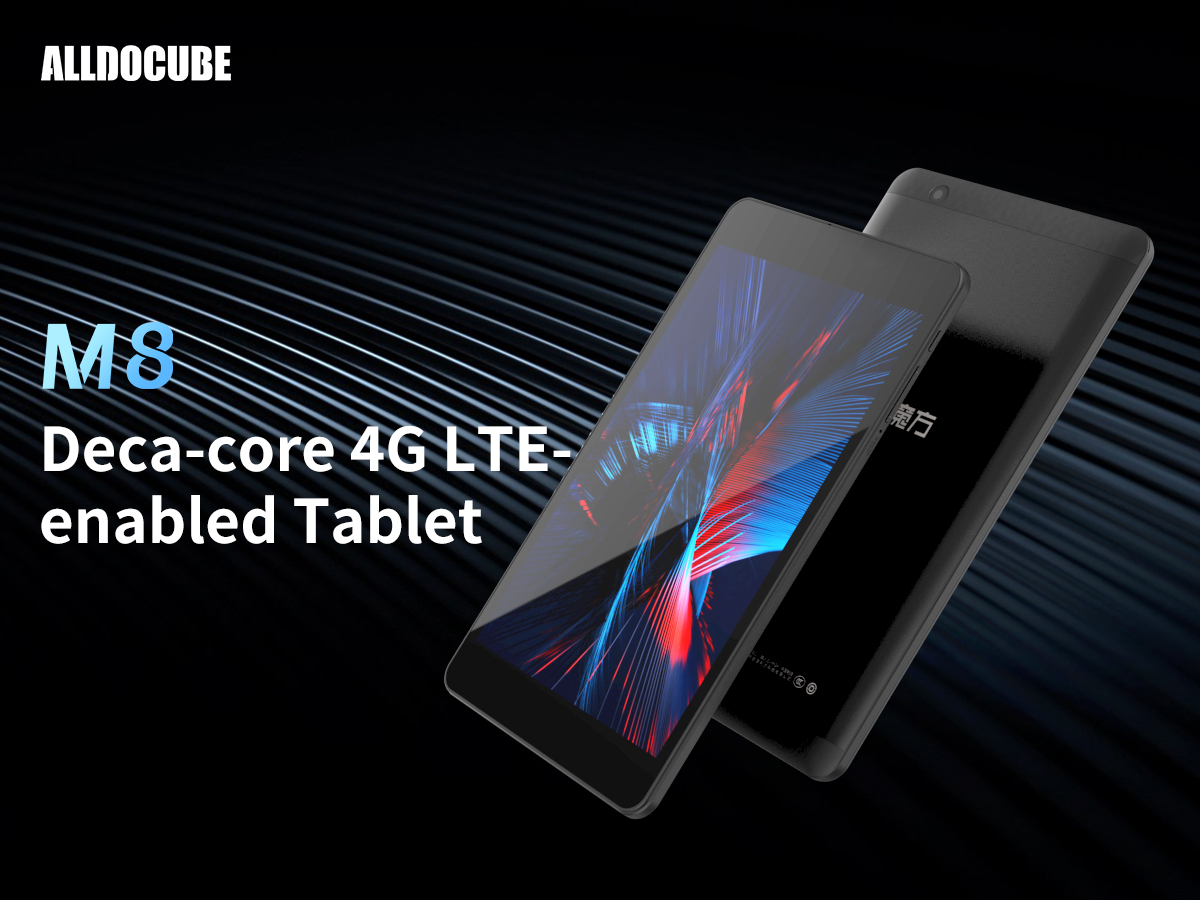
Alldocube made an impressive step forward in the Android tablet market in 2018 with the AMOLED Alldocube X being the flagship model of the company. But apart from top models, the Chinese manufacturer also released several models taking advantage of the Helio X27 SoC that provides LTE support for data and phone calls. The Alldocube M8 is one of these models and it is now available on offer over at Amazon US for $139.99.
In terms of hardware specs, the M8 features an 8″ display and is the first of the company’s products to sport the Helio X27 10-core SoC. Of course, it is a 64bit SoC while the Mali T880 MP4 GPU is powerful enough for almost every game out there. The device also runs on Android 8.1 Oreo OS out-of-the-box. In addition, the M8 packs a big 5500mAh battery which certainly makes it stand out among other affordable 8″ tablets in the market. The battery power is 20% more than its predecessor and could take you through a day’s usage. Also, the tablet supports phone calls as well as dual SIM and 4G/LTE. In terms of storage, there are 3GB of RAM and 32GB of internal storage.
What’s more, Alldocube will hold Prime Day Promotion from July 15th to July 16th, and you can get the Alldocube products at the lowest price of all the year!
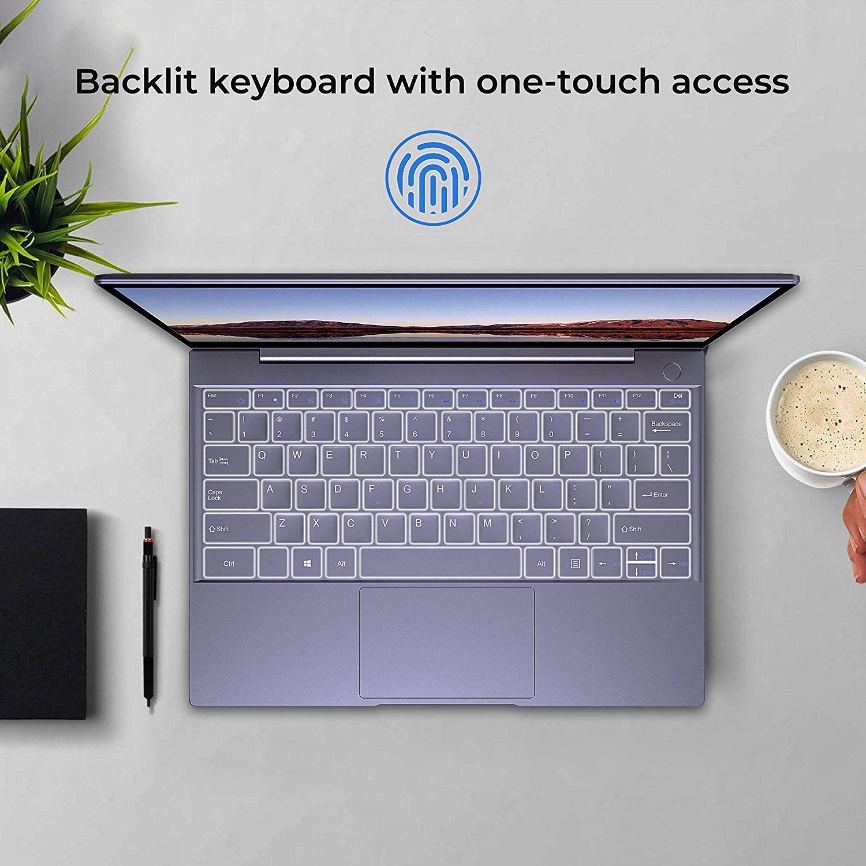
XIDU Tour Pro is among the 3 new models that the Chinese manufacturer announced this month and it is mostly business-oriented as it comes with a 12.5″ display for maximum portability and a full-sized backlit keyboard for working in low-light conditions. The design is clearly inspired by Apple’s design language and the 2K display is a feature mostly found in expensive models. So, let’s see what it brings to the table in terms of design and hardware.
Design and Hardware
The Tour Pro is a slim metallic laptop with a 180° convertible hinge and it’s just 0.62″ thin while its weight barely reaches 3.5 pounds. The 12.5″ 2K display features very thin bezels that allow for 88% screen-to-body ratio while the 2K resolution and 10-point touchscreen along with the full-sized backlit keyboard make it look and act professionally. The large screen/body ratio and those thin bezels offer an immersive visual experience for all kinds of users. Weight and thinness are impressive and make it convenient to carry at any time!
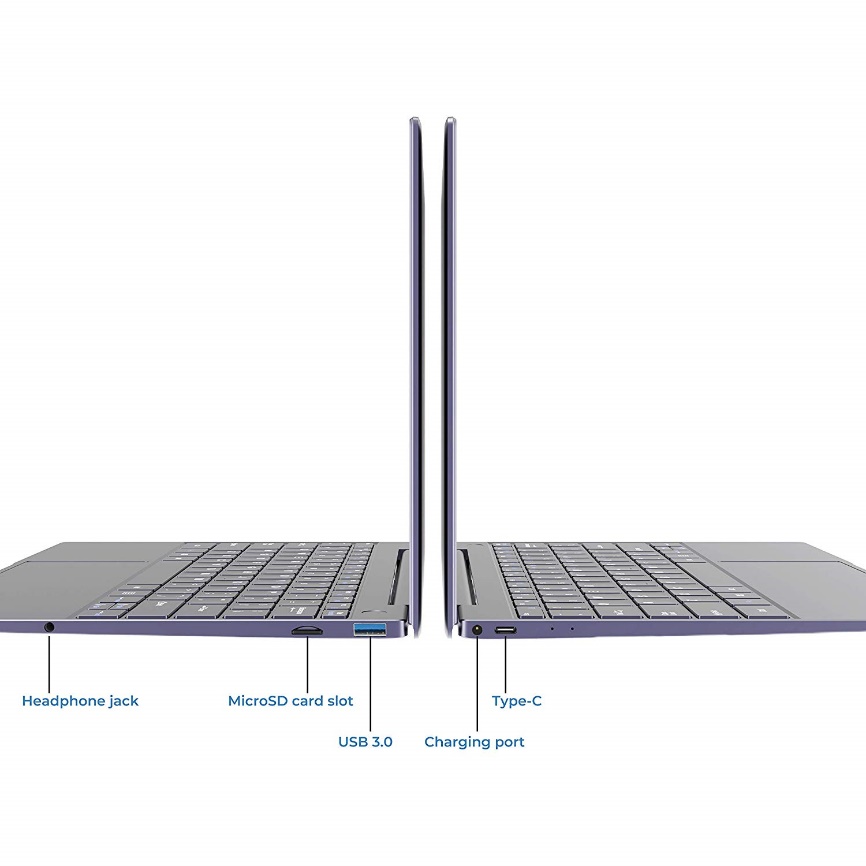
Moving on to the hardware specs, the Tour Pro is interesting both on the inside and outside. The laptop is powered by the 8th Intel Kaby Lake R 3867U 1.8GHz CPU with a top clock speed of 4.0GHz. The CPU is backed by 8GB of LPDDR4 RAM and 256GB m.2 SATA SSD which can be expanded up to 512GB more through SSD expansion. The ports included are plenty for a small ultrabook and include 1 x USB Type-C, 1 x USB 3.0, 1 x MicroSD reader, 1 x Headphone jack, and 1 x Charging Port. Of course, the top feature is the 2K resolution on such a small display as most users are used to work on bulky laptops with HD or FHD resolution.
Performance
Performance-wise, the Tour Pro is an ideal choice for consuming media content (videos/music) and doing office work. The relatively strong CPU combined with the 8GB of RAM and fast SSD offers smooth performance and stable multitasking experience. For example, streaming 2K videos on YouTube while performing other tasks at the same time was flawless.
Moving on to the display, it is crisp thanks to the 2K resolution and the brightness is pretty high so that outdoor use is possible. The positioning of the speakers allows for sound to pump out loud and the full-sized, backlit keyboard is great for typing. What’s more, it is capable of some gaming as well as 2K video editing, with lower performance than gaming or workstation laptops of course. Lastly, the one-touch power button enables users to power on the notebook while at the same time performing the fingerprint authentication using Windows Hello platform. The desktop is accessible in just 7 seconds.
If you’ve been looking for a portable laptop with 2K display and good overall performance, then you should seriously consider the XIDU Tour Pro. You can see more details on Amazon US as well as on the official XIDU Store.
2019 is turning out to be one of the most innovative years for technology, especially when it comes to mobile devices. Just a few months into the year, we saw first 5G smartphones hitting the shelves along with a foldable phone. And these are only some of the many technologies launched this year for mobile phones at the half-year mark!
That is why we think it is time to recap the most important products in the mobile sector and select the best phones launched in the first half of 2019. If you are searching for the best and most innovative device out there which have hit the shelves this year, you will find it in this post. If you think there is any other phone which deserves a paragraph in this article, let us know by using the comment box below.
Note that the phones listed in this article are in no particular order.
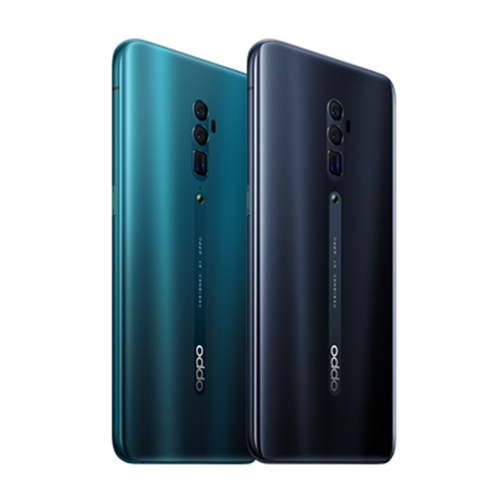
Reno 10x zoom is currently the most popular Oppo flagship and it is the first phone to come with the revolutionary 10x hybrid zoom, an amazing proprietary technology showcased for the first time a few months ago. The phone is equipped with a periscopic sensor which is able to zoom up to 10x with minimal loss in detail. The 10x hybrid zoom technology combines 5x optical zoom and digital zoom in order to obtain the satisfying results that we all have seen in Oppo Reno 10x zoom’s camera samples. The handset is also equipped with a wide 6.6-inch display, a huge 4065 mAh, and the best chipset by Qualcomm: the octa-core Snapdragon 855 running at a max frequency of 2.84 GHz. Last but not least, it has a revolutionary bezel-less design with a shark fin pop-up camera.
2Huawei P30 Pro
With the P30 Pro, Huawei totally reinvented the world of photography on mobile devices. This flagship is not only equipped with a quad camera setup, but it totally redefines the RGB paradigm by replacing the green color with yellow (RYYB). Thanks to this solution, the P30 Pro is able to capture a huge amount of light in order to shoot incredibly bright photos even in very low light conditions. Just in case it was not enough, Huawei P30 Pro also features 5x optical zoom which pushes the digital zoom up to 50x. Another advantage of the Huawei P30 Pro is the huge 4200 mAh battery which even supports reverse wireless charging (it can be used as a power bank to charge other devices).
3Samsung Galaxy S10 5G
The Galaxy S10 5G is the first Samsung’s device to support 5G connectivity, but it is also one of the most powerful beasts in today’s market. It has a huge 6.7-inch display with stunning quality, in my opinion, the best display you can see on a phone in terms of image quality. It comes with a 5G modem (a multi-mode modem in the European version, supporting 4G too) and one of the biggest battery you can find on a flagship phone (4500 mAh) with the support for reverse wireless charging. Alongside all these beautiful things, there is also an amazing camera department with the most amazing selfie camera I personally have ever seen on a mobile phone and a variable focal aperture for the rear camera which helps to capture good photos in low light.
Another device which deserves a honourable mention in this list is the Galaxy S10e: it is not the most expensive flagship from Samsung, but it is the only real compact flagship from this year (it is powered by either Snapdragon 855 or Exynos 9820 depending on the market), and its price is relatively affordable considering its specs sheet and features. It even supports some innovative features of its costlier siblings Galaxy S10 and S10+, such as reverse wireless charging and it comes with a very nice punch-hole design, especially in the Canary Yellow color variant.
4OnePlus 7 Pro
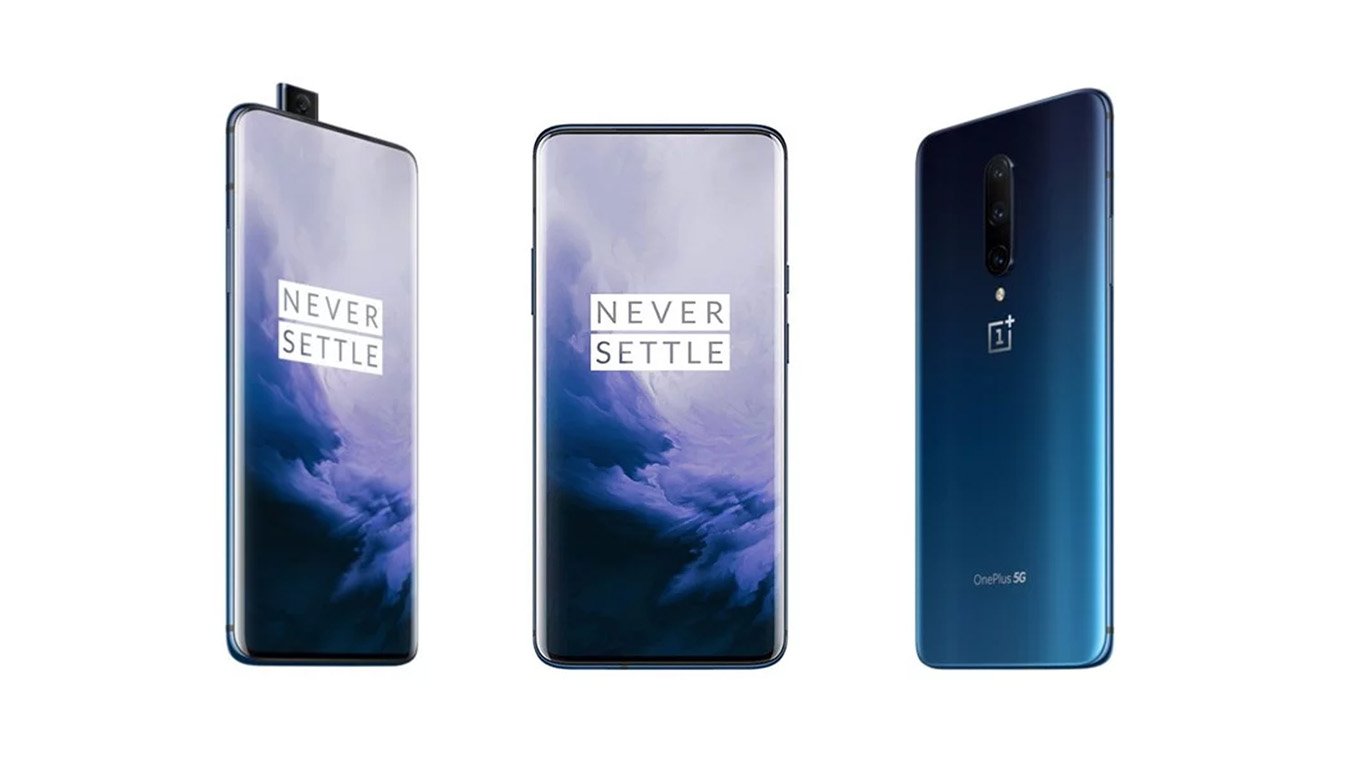
With the OnePlus 7 Pro, the Chinese company OnePlus stopped releasing just affordable flagship and moved to the top-tier segment. This flagship comes with features that take on top-tier smartphones at a cheaper price segment. It is one of the fastest handsets in the market thanks to the Snapdragon 855 chipset paired with up to 12GB of RAM and a very smooth user interface. It has one of the most stunning displays with a QHD resolution and a 90 Hz refresh ratio, as well as the HDR10+ standard and a wide 6.67-inch diagonal. Even its camera is amazing with a bright f/1.6 aperture and OIS.
5Asus Zenfone 6
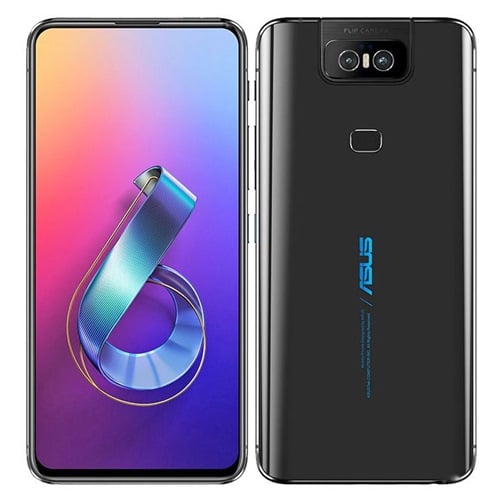
Asus Zenfone 6 is another camera innovator, but not mainly for its camera quality. It is the first smartphone with a flip-up camera and it allows the user to adjust the position of the rear cameras to click photos comfortably at any angle. Asus Zenfone 6 is also the latest-gen flagship with the biggest battery: it is equipped with a mammoth 5000mAh unit which lasts up to three days with moderate use and supports reverse charging (non-wireless). Despite coming with a Snapdragon 855, a great camera department and a huge battery, it still carries an affordable price tag.
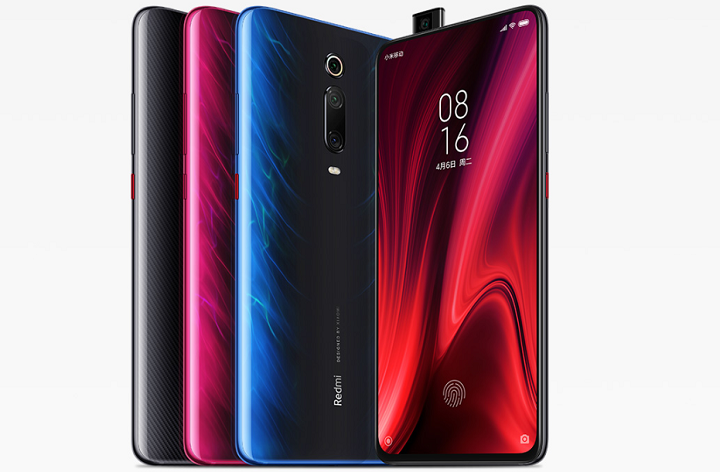
Launched in the European market as the Xiaomi Mi 9T Pro, the Redmi K20 Pro could become the most loved affordable flagship of the year due to its amazing price tag and its perfect specs sheet. It has almost everything an advanced user needs while still being cheaper as compared to the other flagships. You get an HDR display, an elegant design, a pop-up camera, the Snapdragon 855 SoC and even a big battery at a ridiculous price.
Last but not least, even the camera setup is amazing, with a triple sensor and very fast and accurate autofocus. As for now, if we had to recommend an affordable flagship for its value for money, we would surely go for the Redmi K20 Pro.
7Honor 20 Pro
Honor 20 Pro
Honor is Huawei’s sub-brand that focuses on quality-price ratio, but the Honor 20 Pro is a bit more than a simple affordable flagship. On its rear side, it sports one of the most advanced camera department we have ever seen, including four sensors with a dedicated macro camera, OIS and 3x optical zoom. There is obviously a flagship-class hardware side with the Kirin 980 chipset and 8 GB of RAM, as well as a big 4000 mAh battery. The Honor 20 Pro also comes with a punch-hole display minimizing the bezels without the need of a notch or a pop-up slider.
Overall, the first half of 2019 was a really good year for the smartphone industry. From punch hole displays to pop-up cameras, smartphone manufacturers have worked hard to minimize the bezels around the display and offer maximum screen real estate.
Do you think we missed an amazing smartphone in this list? Let us know down below!
We use cookies on our website to give you the most relevant experience by remembering your preferences and repeat visits. By clicking “Accept”, you consent to the use of ALL the cookies.
This website uses cookies to improve your experience while you navigate through the website. Out of these, the cookies that are categorized as necessary are stored on your browser as they are essential for the working of basic functionalities of the website. We also use third-party cookies that help us analyze and understand how you use this website. These cookies will be stored in your browser only with your consent. You also have the option to opt-out of these cookies. But opting out of some of these cookies may affect your browsing experience.
Necessary cookies are absolutely essential for the website to function properly. This category only includes cookies that ensures basic functionalities and security features of the website. These cookies do not store any personal information.
Any cookies that may not be particularly necessary for the website to function and is used specifically to collect user personal data via analytics, ads, other embedded contents are termed as non-necessary cookies. It is mandatory to procure user consent prior to running these cookies on your website.