Samsung‘s smartphone business has been on the decline in China, no thanks to local OEMs who offer premium smartphones at affordable prices. OnePlus isn’t helping the Korean giant’s plight in the Chinese market with its latest OnePlus 7 Pro flagship. The OnePlus 7 Pro sales have literally crippled that of Samsung’s latest Galaxy S10+ going by data from one of China’s biggest e-tailer Jingdong (JD.com)
In https://t.co/1ErT3bc3ke, One of the largest shopping sites in China, we can see that the sales of OnePlus 7 Pro are more than ten times that of the Galaxy S10+. The 90Hz 2K AMOLED screen has become the biggest weapon to kill Samsung in China. pic.twitter.com/mEF2ZRI2Br
We didn’t verify the data independently as it was shared by popular tipster @Universelce on Twitter who claims the sales is ten times that of the Galaxy S10+. He disclosed also that the 90Hz 2K AMOLED display is the most potent weapon which the OP7 Pro has over the Galaxy S10+.
OnePlus 7 Pro and Galaxy S10
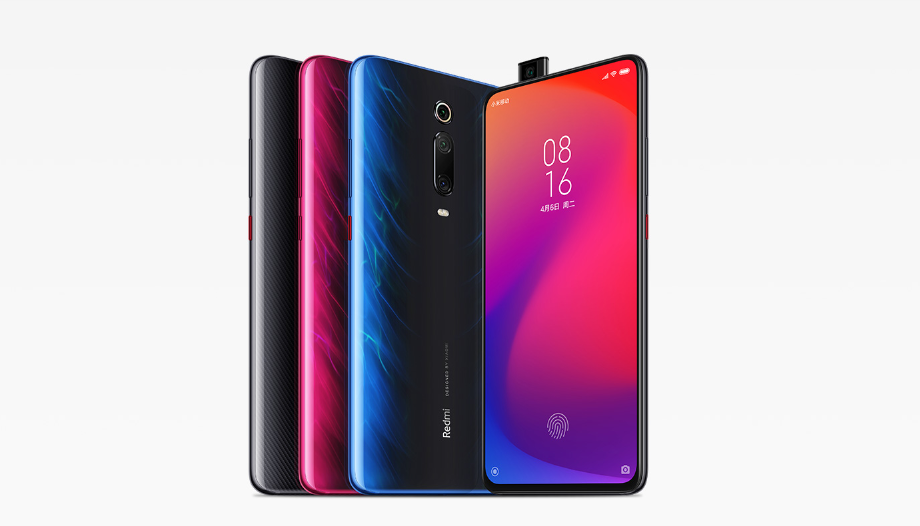
The information is consistent with earlier official disclosure by Jingdong which termed the OnePlus 7 Pro as the ‘best selling product on the whole platform.’ When it went on its first sale, it garnered huge sales within few minutes in China and went out of stock in a short while. OnePlus CEO Pete Lau later hinted that the company was redistributing the supply of other regions to meet the demand in China. Apparently, sales have not slowed down since then, despite a handful of fans still undecided and waiting to see what the Redmi K20 Pro will offer. DO you think, the Redmi K20 Pro will a real challenger to the OnePlus 7 Pro? Let us in on your thoughts in the comment section.
Xiaomi India has practically been trolling OnePlus for a while and the reason isn’t difficult to find out. OnePlus and Samsung controls India’s premium smartphone market. The OnePlus 7 Pro launch was yet another opportunity for Xiaomi India to resume its demarketing tactics against the OnePlus 7 Pro but this time the Redmi brand takes the front seat.
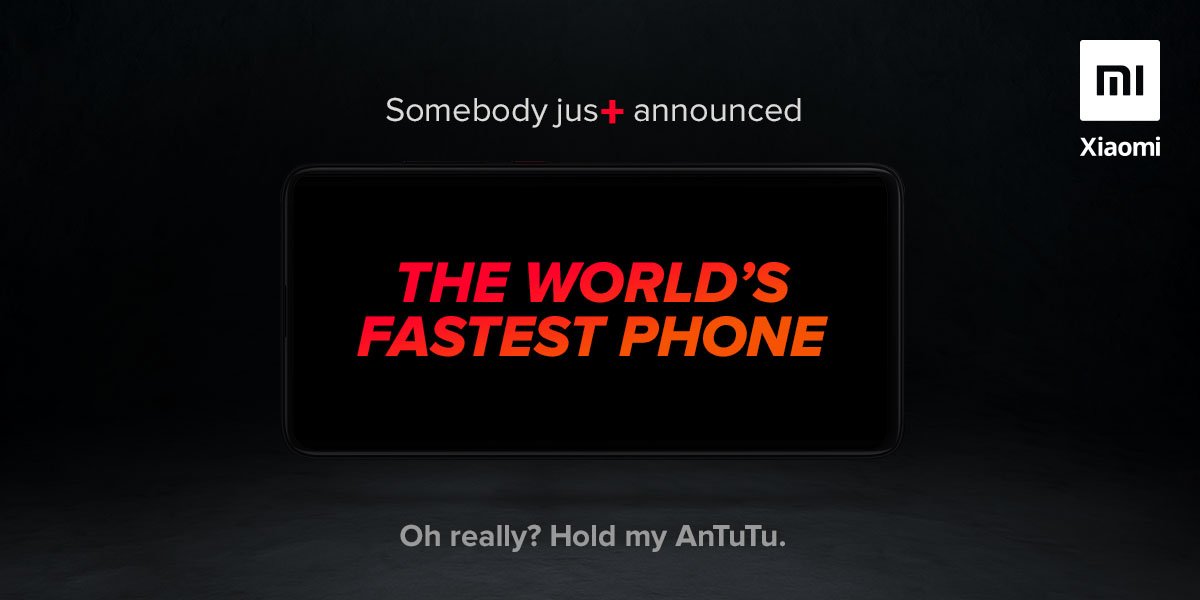
In a tweet posted a couple of days back, Redmi India shared a poster which practically disses the OnePlus 7 Pro. The poster has the text “Someone jus+ announced the World’s Fastest phone. Oh really? Hold my AnTuTu.” Notice the + sign used in place of letter T in “just”? That is a clue, the OnePlus model is referenced. Besides, OnePlus projects the model as the World’s Fastest phone. Definitely, Redmi India thinks otherwise, hence the cheeky reference to AnTuTu which we understand to mean the OnePlus 7 Pro will be floored by Redmi’s upcoming flagship Redmi K20 Pro.
The Redmi K20 Pro is expected to debut with a Snapdragon 855 chipset just like the OP7 Pro. Both models will square up with each other in other departments but we’ll need more than an AnTuTu benchmark score to be convinced as to which is better.
Xiaomi India has been a thorn in the flesh of smartphone rival OnePlus and it did not just start today. We could recall Xiaomi attended the OnePlus 6T India launch in October last year and reportedly shared calculators to fans at the event with the boxes having the inscription “You Do The Math” in comparison with the Pocophone F1 that was also launched around that period. The company later took to its Twitter handle to post a tweet which borrowed OnePlus’ slogan “Never Settle” but instead, it read “Never Settle for OverPriced” apparently comparing the OP6T price tag to that of the Poco F1. The tweet also had the hashtag #DoTheMath. In addition, Xiaomi also placed an outdoor billboard advert close to the OnePlus 6T conference venue with the same theme.
China’s BOE is a display company and one of Samsung Display’s main rivals. The Chinese company is the supplier for the flexible display used in Huawei‘s P30 Pro flagship.
BOE seems to have been hard at work thinking of the next phase for its displays. At a display show that was held recently, the display manufacturer demoed a petty neat rollable display alongside several other products. However, it is the rollable display that we are really excited about.
Tech Blog – armdevices was at the event and they were able to get a look at the rollable display and the other cool products on display.
When unrolled, the prototype screen becomes a 12.3-inch device and when rolled back, its form factor is similar to that of a 7-inch tablet. The prototype doesn’t support touch-input but BOE says they will be working on one with touch-support in the future.
Rollable displays are not entirely new, though they are not yet in mass production. LG demoed a rollable TV at CES 2019 that was the star attraction of the show. It will take a while before it becomes mainstream and a little more time before it comes to smartphones and other portable devices.
BOE also demoed HUDs and in-car displays at the event. The prototype car is shown to have a single long display for its dashboard which stretches from the driver’s side to the other end of the dashboard. The display shows the usual car parameters on one side, navigation details in the middle and an entertainment section for the front passenger. On the far ends are side mirrors which are also part of the single display.
We also see a foldable smartphone with a flexible display that folds outward. When folded it becomes a phone with a 6-inch display and a 7.7-inch tablet when unfolded.
Another interesting device seen at the show is a TV with a display technology made to rival OLEDs. BOE worked with Hisense on a new type of display called BD Cell. The display is a combination of two types of cell – the main cell which is the main color panel for the pictures and a sub-cell which is a black and white cell that provides the backlight and pixel-level local dimming.
When combined, the result is the BD Cell which offers up to OLED-level quality for a cheaper price. The contrast and picture quality are significantly better than LCD while still managing to be pretty slim.
There was also a 27-inch monitor with the same BD Cell technology on display. It has a resolution of 3840 x 2160, a contrast ratio of 20,000:1, 460 nits of brightness, and is just 10.8 millimeter’s thick.
A new report says Sony may launch new phones in its home country of Japan next month. At the moment, the name of the phones aren’t confirmed but there are speculations they will arrive as the Xperia 1s/Xperia S and Xperia 1v/Xperia V.
The source is ZACKBUKS, a Japanese leaker; and the news was first reported by Japanese blog – Sumahoinfo. According to ZACKBUKS, Sony has a launch on July 9 in Tokyo. The post also says “S and V” leading to the guesses about their names.
Sony has been reported to be working on a flagship phone exclusive to Japan. This phone will have an LCD panel and not an OLED panel like the Xperia 1 but will be powered by the same Snapdragon 855 processor. It is unclear if any of these upcoming devices is the LCD flagship phone.
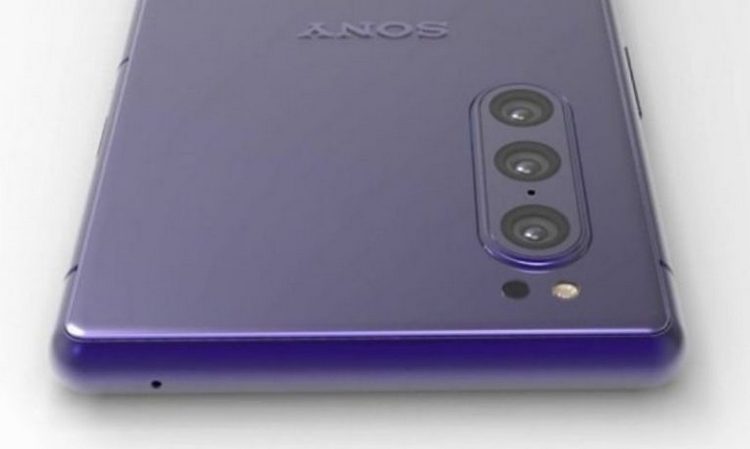
In other news, an image of an unknown Sony phone with triple rear cameras have also surfaced. Unlike the Xperia 1, the triple rear cameras are on the left side of the phone and not the middle Above the sensors are the LED flash and laser focus module.
There is no fingerprint scanner on the back of the phone and we can’t tell if there is one on the sides. The Sony phone has a purple finish, is covered in glass and appears to be a bit thick. There are also antenna lines on the sides.
The identity of the phone is still unknown but we hope more details will surface in the coming days or weeks.
It is no longer news that Huawei was recently handed a trade ban by the US government. Although the company had initially downplayed the effect of the ban, recent reports show it will have some effect not just on Huawei’s revenue but also on those of chipmakers like Broadcom. A report by Bloomberg says Huawei is preparing for a slump in global shipments of its phones to a tune of 40%-60%.
The report hints that the Chinese tech giant is already exploring the option of pulling its latest model the Honor 20 off the international market. The gadget will start selling in parts of Europe, including Britain and France, on June 21, the report said. The company will evaluate the sales and possibly cut off shipments if sales are poor, Bloomberg reports.
The company is expecting a drop in volumes at a region between 40 million and 60 million units this year. An earlier report had already disclosed that Huawei was expecting a dip in revenue of up to $100 billion between now and 2020. In order to mitigate the effect of the slump in overseas sales, the Chinese giant will reportedly focus on capturing a large chunk of the local smartphone market over there in China.
Xiaomi is betting a lot on the Mi 9 series by releasing several variants. In case you missed our posts in the last days, we recently learned that the next ones will be the Mi CC9 and the Mi CC9e. A lot of variants means more choice for consumers, but also a lot of confusion for those who are not familiar with Xiaomi line-ups and its complicate naming schemes. That is why, after the Xiaomi Mi 9T (the global variant of the Redmi K20) debuted in the global market, we decided to make a comparison between the most wanted variants of the Mi 9 (which are also the ones mostly creating confusion). So here is a complete specs comparison between the Mi 9T, the vanilla Mi 9 and the Mi 9 SE.
Xiaomi Mi 9T vs Mi 9 vs Mi 9 SE
Xiaomi Mi 9T
Xiaomi Mi 9
Xiaomi Mi 9 SE
DIMENSIONS AND WEIGHT
156.7 x 74.3 x 8.8 mm, 191 g
157.5 x 74.7 x 7.6 mm, 173 g
147.5 x 70.5 x 7.5 mm, 155 g
DISPLAY
6.39 inches, 1080 x 2340p (Full HD+), Super AMOLED
6.39 inches, 1080 x 2340p (Full HD+), Super AMOLED
5.97 inches, 1080 x 2340p (Full HD+), Super AMOLED
Triple 48 + 12 + 16 MP, f/1.8 and f/2.2 and f/2.2
20 MP f/2.0 front camera
Triple 48 + 8 + 13 MP, f/1.8 and f/2.4 and f/2.4
20 MP f/2.0 front camera
BATTERY
4000 mAh, fast charging 27W with Quick Charge 4.0
3300 mAh, fast charging 27W with Quick Charge 4.0
3070 mAh, fast charging 18W
ADDITIONAL FEATURES
Dual SIM slot
Dual SIM slot
Dual SIM slot
Design
Despite it is not the most expensive handset of this trio, Xiaomi Mi 9T has the most attractive and innovative design. It sports a full borderless display with no holes, neither a notch, thanks to its pop-up front camera. It even has a beautiful rear side with a liquid finish and amazing gradient hues. Xiaomi Mi 9 and Mi 9 SE share a pretty similar design with a waterdrop notch and the same color variants, but they have an important advantage in terms of aesthetics. The former comes with a better build quality thanks to a 7000 series aluminum frame and a Gorilla Glass 5 glass back, while the latter has a more compact and thinner body. Xiaomi Mi 9 is as thin as the Mi 9 SE, but it is bigger than its toned down variant.
Display
When it comes to the quality of the display, Xiaomi Mi 9 wins the comparison with a higher-end AMOLED screen that sports a better color reproduction. If you had all of these devices on your table, you probably wouldn’t notice a huge difference, but it is worth noting that Xiaomi Mi 9 has higher DCI-P3 coverage and it is HDR10-compliant. On the other hand, the Xiaomi Mi 9 SE comes with smaller display size, so it is easier to use with one hand. Each of these devices integrates an in-display fingerprint reader and the Gorilla Glass protection, but Xiaomi Mi 9 is the only one with Gorilla Glass 6.
Hardware/Software
The hardware side is what really makes the difference here. With the Xiaomi Mi 9, you get a much more powerful chipset, that is the best Qualcomm’s flagship SoC of 2019. We are talking about the Snapdragon 855 running at a max frequency of 2.84 GHz. Xiaomi Mi 9 is also the only to be available with up to 8 GB of RAM. At the second place of the ranking, we put the Xiaomi Mi 9T which is powered by the best chipset from Qualcomm’s Snapdragon 7xx series: the Snapdragon 730. Each handset is equipped with Android 9 Pie out of the box, customized by the MIUI 10.
Camera
If you are searching for a very affordable camera phone, then grabbing a unit of one of these three devices is among your best choices. But which one shoots the photos in the best way? Xiaomi Mi 9 is the best on the paper, and it manages to click amazing shots in every light condition. It has higher resolutions for the secondary sensors and even a laser autofocus mechanism. Last but not least, it is able to record 4K videos at 60 fps.
Battery
Battery life is the weakest point of both the Xiaomi Mi 9 and the Mi 9 SE, while it is a strong point when it comes to Xiaomi Mi 9T equipped with a big 4000 mAh battery. It lasts one day in almost every scenario, but it does not feature wireless charging, unlike the vanilla Mi 9.
Price
Xiaomi Mi 9 SE starts from €280/$314, Xiaomi Mi 9T costs €300/$336 in its base variant and Xiaomi Mi 9 starts from €450/$505. The best choice for me would be the Xiaomi Mi 9 due to its higher performance and better cameras, as well as wireless charging. But for those who want to save some money, Xiaomi Mi 9T is the best, it should be definitely better than Mi 9 SE for most people.
Last week, a new Honor smartphone called the Honor 9X Pro was certified by Russia’s communications agency. Now, what might be the phone’s full specifications have leaked ahead of its release.
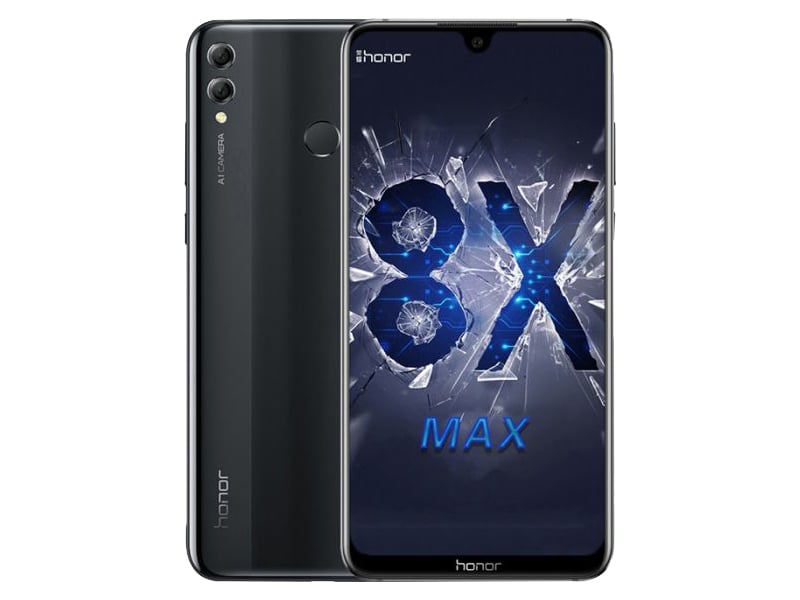
The successor to the Honor 8X Max (shown above) may ditch the “Max” and adopt the “Pro” suffix
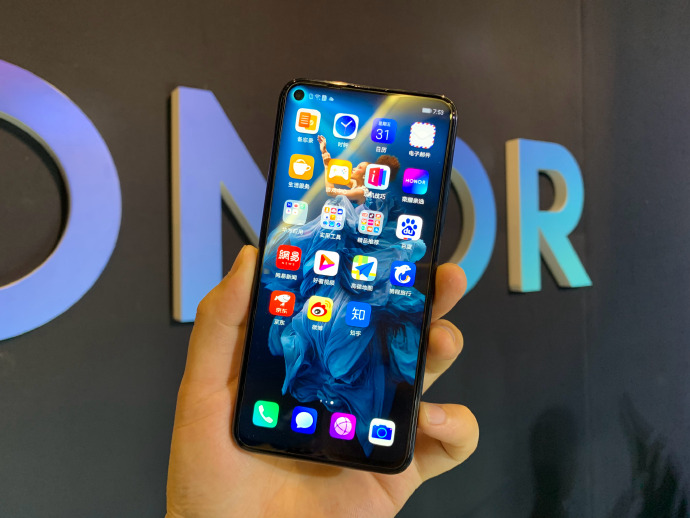
The Honor 9X Pro is packing some pretty interesting specs according to the source – @RODENT950. The phone’s display is expected to be between 6.5” and 6.7” and will be an LCD panel. The display may have a punch hole which will house a 25MP camera.
This is second device which uses new Kirin 810 soc
Like most phones released this year, the Honor 9X Pro will have a 48MP camera. This is a Sony IMX582 sensor and it will be paired with an 8MP super-wide angle camera, a 2MP macro lens, and another 2MP depth sensor for a quad camera setup.
Honor will include a 4000mAh battery which should suffice for the large display. It will also have 20W fast-charge technology to allow you to refill in the shortest time possible. The back of the phone will have a 3D glass design. It is too early to say which colors will be available but we expect at least one will have a gradient finish.
In a follow-up tweet, it is revealed the Honor 9X Pro will be powered by the new Kirin 810 SoC and will be the second phone to come with the chipset. The first is the Nova 5. The info about the chipset was first posted by Huawei Club (@ClubHuawei) and their tweet even reveals more details about the SoC.
Kirin 810 is Huawei's upcoming mid range 7nm SOC with its self developed integrated NPU & will be used in Nova 5(standard version) & Honor9XPro.
Kirin 970 & 980 use Cambrian NPU from Cambricorn Technolgy.
The Kirin 810 will be a 7nm SoC mid-range chip (the first) and will have a self-developed and integrated NPU. The NPU part is a big deal as Huawei’s Kirin 970 and Kirin 980 processors use Cambricon’s NPU. We sure are excited to know the features of Huawei’s in-house NPU.
We have no idea when the Honor 9X Pro will hit the market but it sure will be after the announcement of the Nova 5 which will be the first Kirin 810-powered chipset. If we were to take a guess, we will say July at the earliest. It should launch alongside the Honor 9X which has already received certification in China.
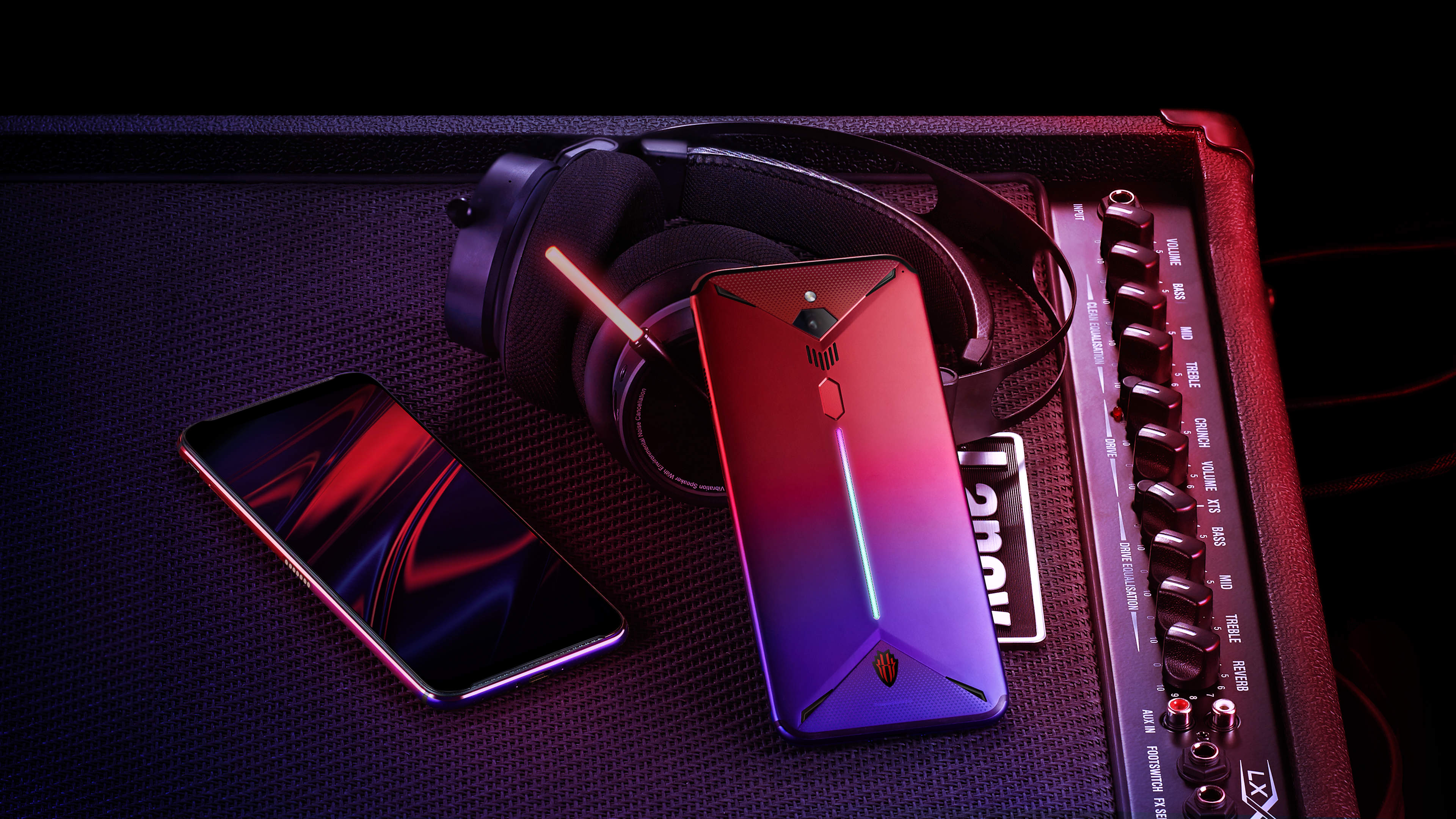
China-based ZTE’s Nubia had launched the Nubia Red Magic 3 gaming smartphone in China a few months ago. Today, the company has launched its latest gaming smartphone in the Indian market.
The Nubia Red Magic 3 will compete against other premium gaming smartphone in the Indian market, which includes Asus ROG Phone and Black Shark 2. The Red Magic 3 will be available for purchase in India exclusively through online market Flipkart from 27th June.
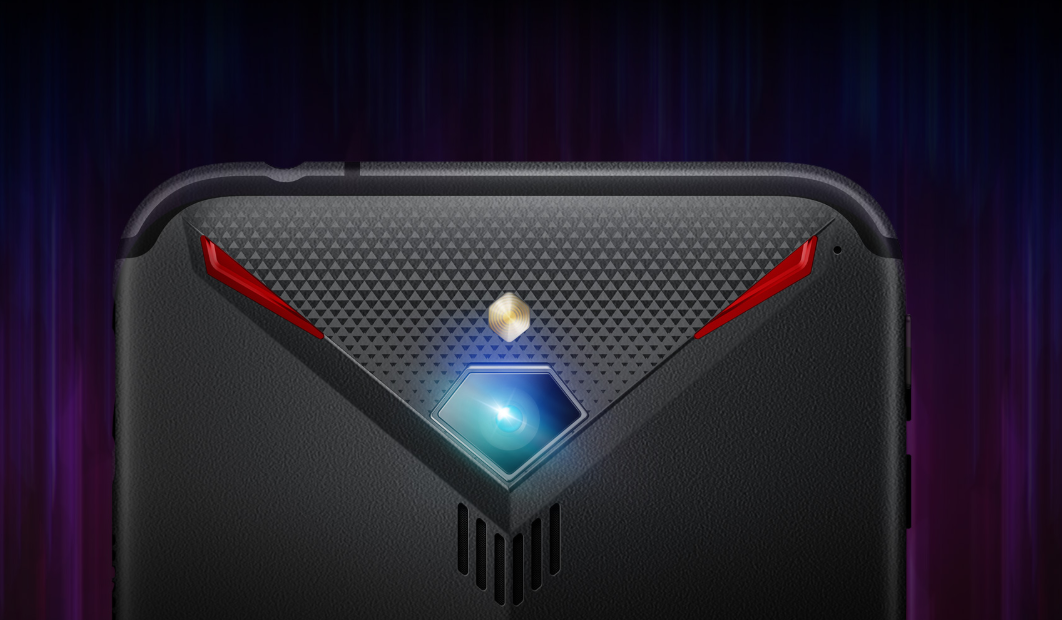
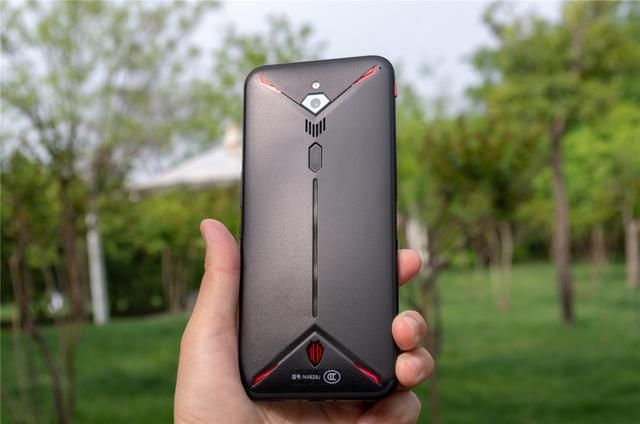
No gaming device is complete without the use of LED lights and this Nubia Red Magic is no exception. It comes with an RGB LED accent lighting system and has V-shaped elements on its back, making it look like a hardcore gaming device.
Coming to the specifications, the smartphone boasts a 6.65-inch Full HD Super AMOLED display with 2340 x 1080 pixels screen resolution, a fast 90Hz refresh rate and a 19.5:9 aspect ratio. It also allows you to choose between 60Hz and 90Hz refresh rate or you can let the phone decide it automatically.
Under the hood, the device is powered by the Qualcomm‘s flagship Snapdragon 855 octa-core processor, coupled with up to 12GB of RAM and up to 256GB of internal storage. The device is fuelled by a 5,000mAh battery with 27W fast charging support.
In the camera department, the smartphone features Sony IMX586 48-megapixel single camera sensor at the back and comes with 8K recording and world’s first 1920 fps Super Slo-mo recording. On the front side, it comes equipped with a 16-megapixel shooter.
The smartphone features the industry’s first cooling fan inside which doesn’t use any physical bearings and is made out of nanomaterials. The company says that the fan runs at 14K RPM and consumes very little power. It is supported by a liquid-cooled copper tube to keep the temperature inside cooler.
Being a gaming smartphone, it comes with a lot of gaming-centric features. There’s a new dedicated noise-canceling gaming mic for better conversations with your fellow teammates. Apart from the two shoulder button on the top of the device, the phone also uses the fingerprint sensor as an added button during gameplay.
It comes with 4D smart shock, which is a smart system that adds vibrations to match different scenes in the game, enhancing your overall gameplay experience. It has a special gaming dock pins on the left side that support a number of accessories.
The Nubia Red Magic 3 gaming smartphone is offered in two color options in India — Black and Flame Red. It comes in two variants in India — 8GB RAM + 128GB internal storage and 12GB RAM + 256GB internal storage. Both the variants are priced at Rs. 35,999 (~$515) and Rs. 46,999 (~$673) respectively.
You can check out our review of the Nubia Red Magic 3 here.
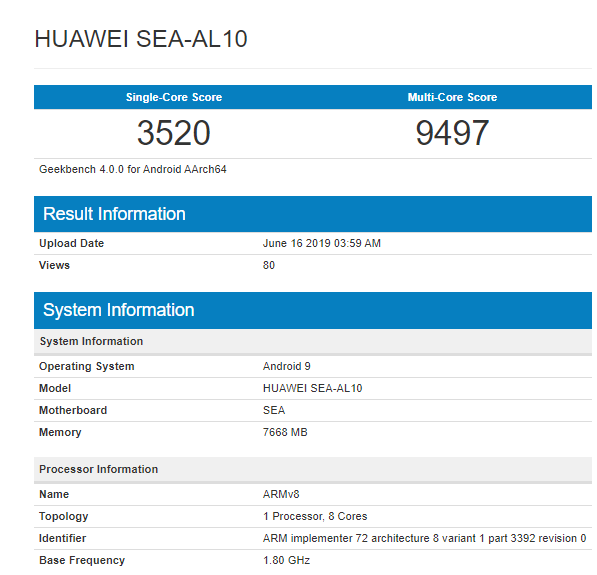
A new Huawei device has been spotted on Geekbench. The Huawei SEA-AL10 is believed to be the Nova 5 Pro and the benchmark results confirm some key specs.
The Huawei SEA-AL10 was benchmarked yesterday. It runs Android 9 Pie, has 8GB of RAM and is powered by an octa-core processor. The benchmark scores – 3520 and 9497 – are similar to those of Kirin 980-powered devices, hence the conclusion that it uses the same chipset.
The Huawei Nova 5 Pro will have quad rear cameras and an AMOLED display with a waterdrop notch and a 32MP selfie camera. It will arrive alongside the Nova 5i which will also have quad rear cameras but a punch hole display and will be powered by the Kirin 710. There will also be the Nova 5 which will also have a waterdrop notch, quad rear cameras, and be the first device powered by the yet-to-be-announced Kirin 810.
All three phones along with the MediaPad M6 tablet are scheduled to arrive on June 21.
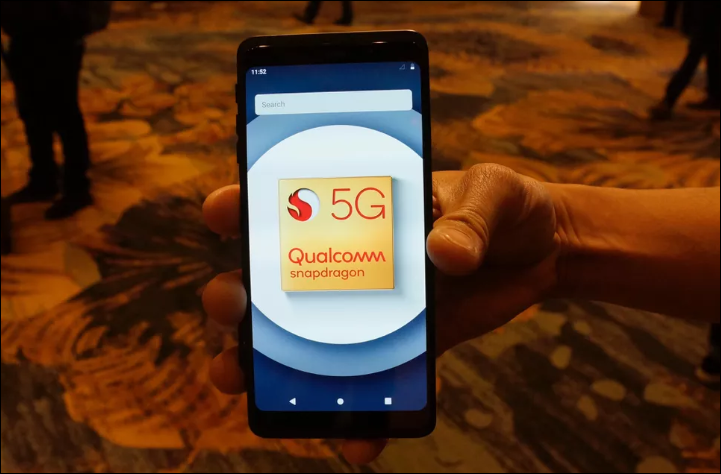
US chipmaker Qualcomm is expected to mount the rostrum later this year to announce its next-generation flagship chipset. The chipset isn’t expected to find its way into smartphones until next year but going by last years activities, the next-gen Snapdragon chipset should be announced later this year. Some details of the flagship SoC expected to go by the name Snapdragon 865 has been shared by popular tipster Roland Quandt on Twitter.
Snapdragon 865 is what Qualcomm employees call the next gen high-end SoC (SM8250). There are two variants: Kona + Huracan. Both with support for LPDDR5X RAM and UFS 3.0. One likely with, one without integrated 5G modem (SDX55) – I guess. Also no clue which is the one w/ 5G in it.
According to the tipster, the next-gen chipset is referred to as Snapdragon 865 by Qualcomm employees and has the model number SM8250. He also disclosed that the chipset will come in two variants that go by the codenames- Kona and Huracan. Both variants will have support for LPDDR5X RAMand UFS 3.0 flash storage.
The major difference between both variants is that one is likely integrated with the 5G model (SDX55) while the other isn’t. But this isn’t a confirmed assertion but we believe it is taking a cue from the present-gen Snapdragon 855. The SoC which is Qualcomm’s first 7nm SoC comes with a 5G variant and another without the 5G modem. The Snapdragon 855 modem is an upgrade over the Snapdragon X50 used on the SD 855 5G version. The chipset is expected to find its way first into the Galaxy S11 next year and it will be mass produced by Samsung.
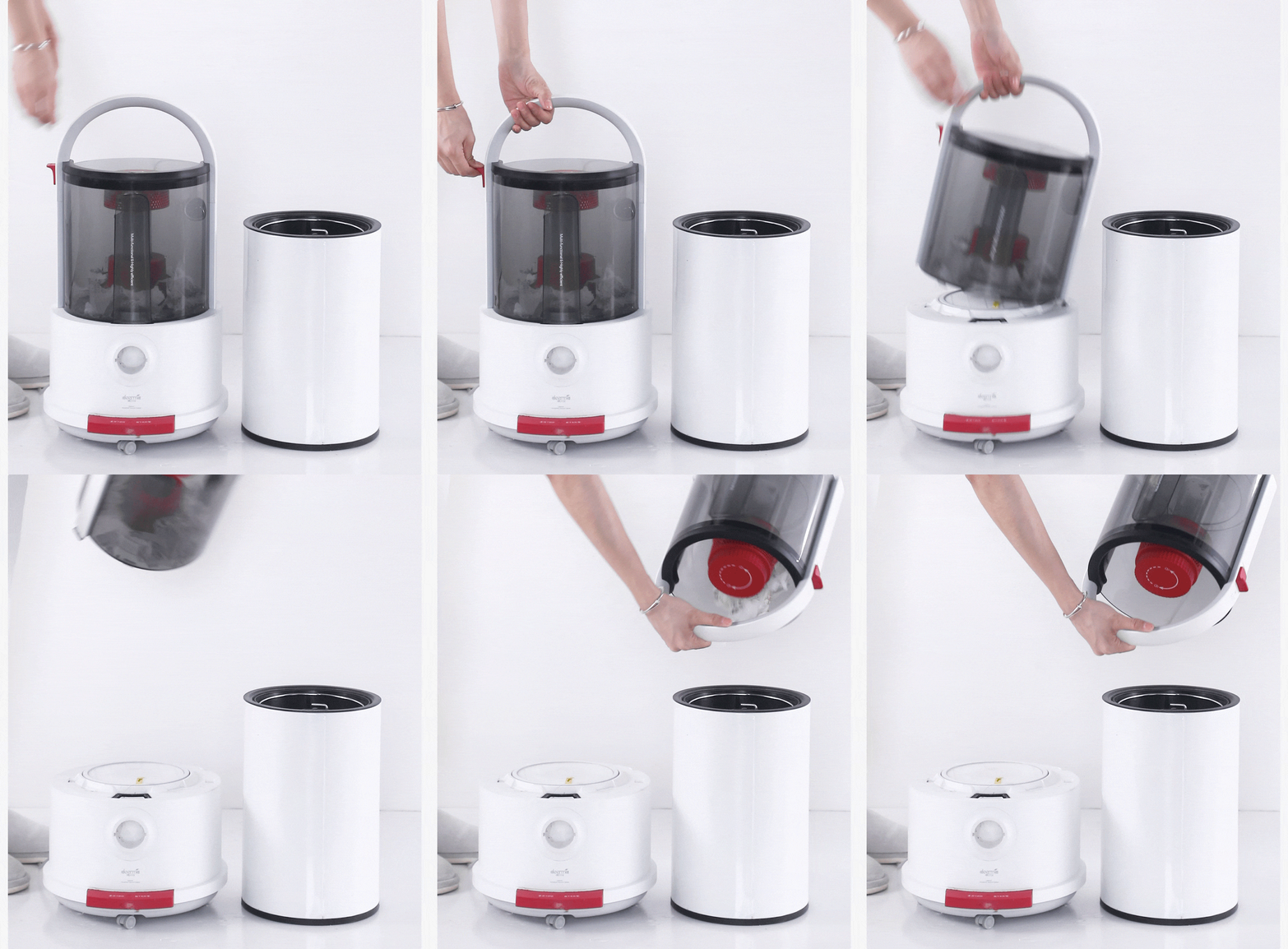
Xiaomi has launched yet another product under the Youpin crowdfunding platform. The product is the Deerma Wet and Dry Bucket Vacuum Cleaner and it comes with wet and dry vacuum functions. The device is priced at 399 yuan ($57) and is scheduled to start shipping on July 31, 2019.
The Deerma Dry and wet bucket vacuum cleaner can absorb dry and wet mixed garbage and can dry the floor and thus, can keep the entire house clean regardless of the type of dirt. Whether it is spilt Ketchup, Yoghurt or rice paste, the Deerma Vacuum is up to the task. It not only cleans up the floor but also dries it.
The Deerma Wet and Dry Bucket Vacuum Cleaner use a 1200W wet and dry motor with up to 33000 rev/min, and a large 18kPa suction. The suction is so powerful that it can absorb the water in a bucket in an instant and even easily suck the bucket as well. The device also uses a single-piece floor carpet dual-purpose brush head. The floor brush fits the ground and absorbs dust and garbage easily. The brush can also absorb the deep dirt in the carpet, even the “difficult” wet hair in the bathroom can be sucked and cleaned.
It also comes standard with two small brush heads, which can be extended into the corners, window sill gaps, keyboard gaps, etc. The vacuum cleaner comes with a dust bucket that is separate from the motor. It can be detached with a single push. The bucket and brush are connected by an aluminium tube which is durable and corrosion resistant, and also lightweight. There is also a 1.5m hose which makes it easy to cover a large area unhindered. The power cord is also 5m long.
When ZTE announced the Blade A7 in China last month, we were surprised at its price. The phone which is powered by MediaTek’s Helio P60 chipset has a starting price of ¥599 (~$87) for the base model with 2GB of RAM and 32GB of storage. The Blade A7 now has a global version but it comes with a different chipset.
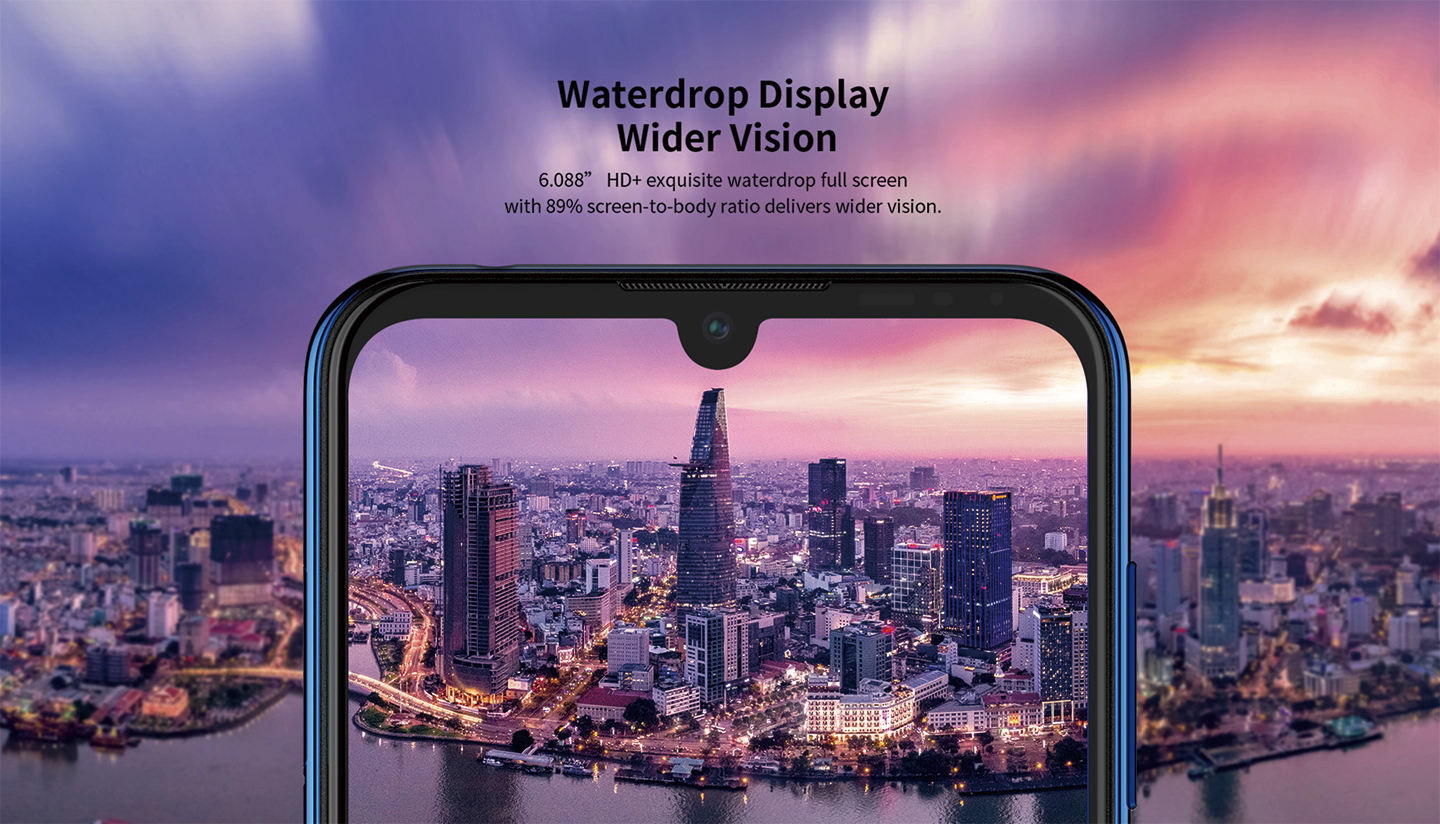
The Blade A7 2019 has a 6.088” HD+ display with a waterdrop notch and an 89% screen-to-body ratio. ZTE says its 7.9mm thin body, 2.5D curved edge glass, and narrow bezel provides a more comfortable grip. The phone comes in three color variants, all with red-painted power buttons.
It has 2GB of RAM and 32GB of storage but swaps the Helio P60 for the Unisoc SC9863A. This is an octa-core processor with 4 Cortex-A55 cores clocked at 1.6GHz and another four clocked at 1.2GHz. The phone has a MicroSD card slot for adding up to an extra 256GB of storage.
The Blade A7 2019 has a 16MP f/2.0 rear cameras with an LED flash while a 5MP camera with support for Face Recognition (unlocks in 0.6s) is housed inside the notch. The phone runs Android Pie out of the box, but unlike the Chinese version which specifically says it runs MiFavor 9 based on Android Pie, this doesn’t. We have a feeling it is running a stock-like version of Android Pie like the global version of the Axon 10 Pro.
[envira-gallery id=”259438″]
The European version supports LTE bands B1/3/5/7/8/20(B28AB) and TD-LTE B38 or B40 or B41(2610-2630) while the version for Latin America supports LTE bands B2/B4/B5/B7/B28AB. It has Bluetooth 4.2, VoLTE, a MicroUSB port, an audio jack, and single band Wi-Fi. Its battery capacity is 3200mAh.
The Blade A7 2019 has a price tag of €150. We don’t have info about pricing for other countries yet as well as availability.
Last week, Qualcomm announced it has a brand new audio codec. The Qualcomm Aqstic WCD937x family is the latest codec designed for smartphones so users can listen to music and movie audio just as the producers intended. Qualcomm says the new codec is special as it was developed in collaboration with a group of people referred to as “Golden Ears”.
The Aqstic WCD937X family includes the Qualcomm WCD9370 & Qualcomm WCD9375 and is built using the same high standards as the flagship Aqstic WCD9341 audio codec.
To make the audio better, Qualcomm decided to work with a group of audiophiles referred to as Golden Ears. These are people who are able to “identify the slightest distortions in music, the characteristics of different digital filters, reverb, colorization, panning, harmonics, and more”.
This is actually a very rare skill and you either have it by training or naturally. There are programs you have to take to get certified as having Golden ears and they usually take years to complete. Most manufacturers that employ Golden Ears or those who manufacture really expensive audio products that sell for over a $100,000. Qualcomm has now brought that same high-quality to its codecs for smartphones.
Qualcomm was able to fine-tune the WCD9375 codec using feedback from a group of Golden Ears. They designed a digital audio filter to do this. This filter is also customizable so OEMs can design it to meet different needs and have their own signature sound.
Redmi K20
The Golden Ears-tuned Qualcomm Aqstic WCD937x series will be available in phones powered by the Snapdragon 730 and Snapdragon 730G. Qualcomm expressly states the Redmi K20 has it but we are not sure if the Samsung Galaxy A80 has it. Phones with the new codec should provide “far better audio quality” for users. Qualcomm also said the flagship WCD9341 codec will also support the Golden Ear filter.
After Google urged the United States government to ease the ban on Huawei, it’s now the turn of US-based chip makers. As per the reports, American chip suppliers, including Qualcomm and Intel, are quietly pressing the U.S. government to ease its ban on sales to the Chinese tech giant.
This is interesting given that Huawei itself is avoiding typical government lobbying, while several US-based companies are urging its government to ease the ban on Huawei which bars US companies to do business with Huawei.
A report, which cites a person aware of the develop, suggests that executives from top U.S. chipmakers Intel and Xilinx Inc attended a meeting in late May with the Commerce Department to discuss a response to Huawei’s placement on the blacklist. Apart from them, Qualcomm has also pressed the Commerce Department over the issue.
They are arguing that Huawei units selling products such as smartphones and computer servers use commonly available parts and are unlikely to present the same security concerns as the Chinese technology firm’s 5G networking gear.
One of the people aware of this development said that “this isn’t about helping Huawei. It’s about preventing harm to American companies.” Huawei spent about $70 billion in 2018 to buy components out of which about $11 billion went to U.S. firms including Qualcomm, Intel, and Micron Technology Inc.
Trade group Semiconductor Industry Association (SIA) has acknowledged that it arranged consultations with the U.S. government on behalf of the companies to help them comply and brief officials on the impact of the ban on the companies.
As said, the Chinese giant itself has done very little traditional lobbying in Washington on the matter, but people aware of the matter says that it has considered sending a letter to the Commerce Department. Even after a month from being blacklisted, Huawei has not spoken to the United States government about the matter so far.
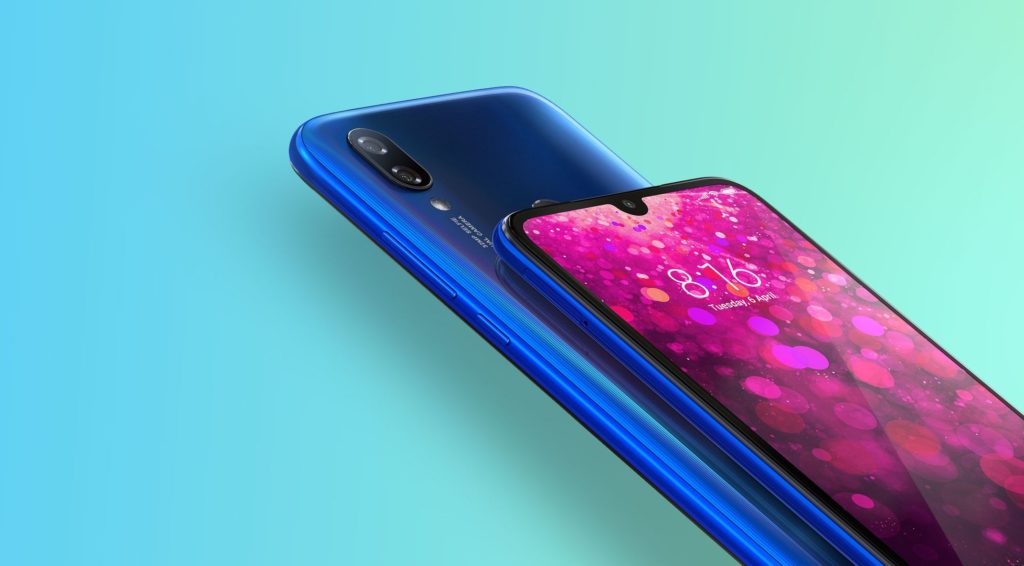
Lasts week, a vague report that aomi CC9 is an upcoming selfie-focused smartphone from the company. Some details of the phone were also leaked in the report. A fresh leak has revealed the key specifications of the Xiaomi Mi CC9 phone. The leak has also revealed that the different variants and pricing of the Xiaomi Mi CC9 smartphone. It is speculated that there could be a cheaper model of the phone that may arrive as Xiaomi Mi CC9e.
Xiaomi Mi CC9 Specifications and Price (Rumored)
According to the leak, the Xiaomi Mi CC9 will be featuring a waterdrop notch enabled AMOLED display that will come embedded with an in-screen fingerprint scanner. However, the exact size of the display has not been mentioned in the leak. For capturing selfies, it will be sporting a 32-megapixel selfie snapper and a 48-megapixel rear camera. Probably, it could be equipped with a triple camera module.
The Xiaomi Mi CC9 will be packed with a 4,000mAh battery with 27W fast charging support. It will be featuring the Snapdragon 730 chipset that powers the Redmi K20 phone. The Mi CC9 may hit the Chinese market in three models such as 6 GB RAM + 128 GB storage, 8 GB RAM + 128 GB storage and 8 GB RAM + 256 GB storage. They are expected to be respectively priced at 2,499 Yuan (~$361), 2,799 Yuan (~$404) and 3,099 Yuan (~$447).
The leak has no mentioning on the display design and size of the Xiaomi Mi CC9e smartphone. However, leaked details that had surfaced last week had claimed that it will be featuring a full HD+ 6.3-inch IPS LCD display with waterdrop notch. It will have a front-facing camera of 32-megapixel and on its rear will be a 48-megapixel snapper. Last week’s report had claimed that it will be equipped with 48-megapixel + 8-megapixel + 13-megapixel triple camera module.
The Mi CC9e will have a 4,000mAh battery that will carry support for 18W rapid charging. The Mi CC9 and CC9e are both expected to be equipped with NFC connectivity. It will be sporting a rear-mounted fingerprint scanner. The 6 GB RAM + 64 GB storage edition of the Mi CC9e could be priced at 1,599 Yuan (~$231).
In November 2018, Xiaomi had acquired China-based Meitu’s phone business. The latter that is known for its selfie beautifying apps had also sold some selfie-centric smartphone in China. It is speculated that the Xiaomi Mi CC9 series could be a product born out of marriage between Xiaomi and Meitu. Readers are recommended to take the report with a pinch of salt since there is no concrete on the existence of Xiaomi Mi CC9 and Mi CC9e smartphones.
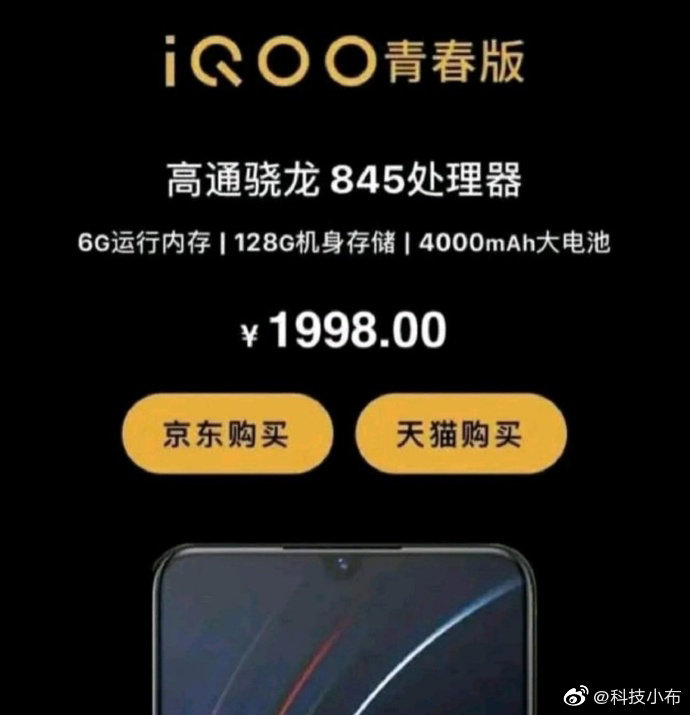
At the end of the previous month, a new Vivo phone with model number 1914A was spotted on Geekbench benchmarking platform with Snapdragon 845 chipset. The model number has bagged 3C approval in China. It is speculated that it could be the purported Vivo iQOO Youth Edition smartphone.
The Vivo V1914A smartphone that has been spotted on the database of 3C has appeared along with V2323A-CN and V2323B-CN chargers that were also spotted during Vivo X27’s 3C certification. The 3C listing of the Vivo V1914A suggests that it may carry support for 22.5W rapid charging.
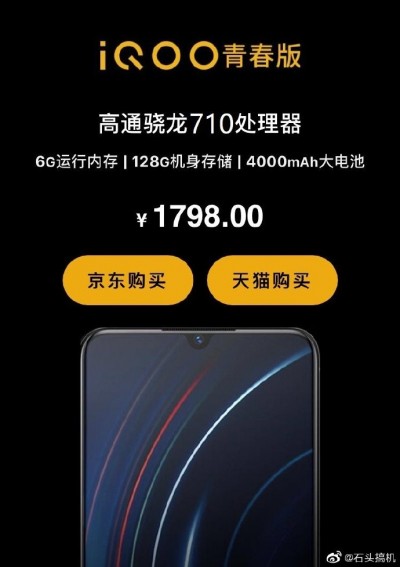
Could the Vivo V1914A be the rumored iQOO Youth Edition gaming phone? In the recent past, two posters claiming that the phone will be arriving in Snapdragon 845 and Snapdragon 710 versions have been spotted. Both posters have claimed that these variants will be coming with 6 GB of RAM, 128 GB of inbuilt storage and 4,000mAh battery.
The posters had revealed that the SD845 and SD710 iQOO Youth Edition are respectively priced at 1,998 Yuan (~$288) and 1,798 Yuan (~$259). Also, the images of the phone on the poster shows that it is fitted with a waterdrop-style notch screen. As of this writing, Vivo’s iQOO gaming sub-brand is yet to confirm on the existence of the iQOO Youth Edition.
The Vivo V1914A model number was also spotted on Geekbench last month. Apart from SD845, it was spotted with Android 9 Pie OS and 6 GB of RAM. In the single-core and multi-core tests of Geekbench, the smartphone has respectively scored 2321 and 8041 points. In March, a report had claimed that the iQOO gaming phone will be debuting in India in June. The report had claimed that another iQOO phone may also debut in the country alongside it. While Vivo is yet to confirm the arrival of iQOO gaming phone in India, the report did the developments on the second iQOO phone. Readers are advised to wait for concrete information on the iQOO Youth Edition to confirm on its existence.
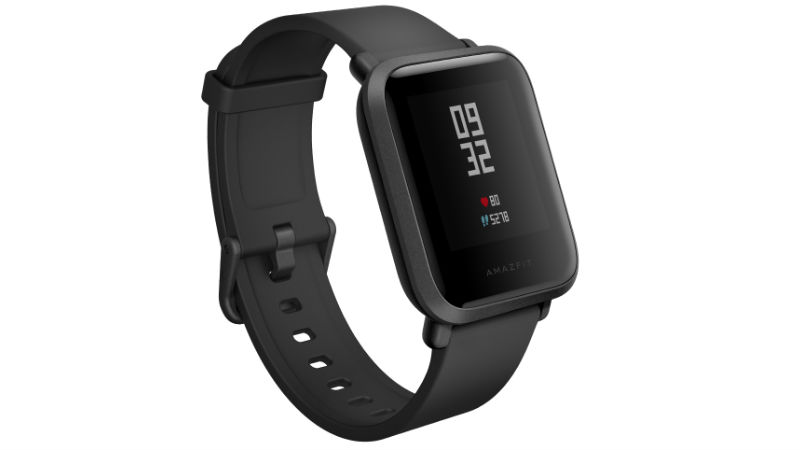
Gizmochina along with Banggood is conducting 1 unit Xiaomi AMAZFIT Bip Smartwatch as giveaway gift to a lucky reader. Like always, you just have to follow the steps mentioned on the Gleam widget to get a chance to win this amazing gift.
If you want to win the free Xiaomi AMAZFIT Bip Smartwatch, the most important thing for you is to Follow and Like the BanggoodUSA and BanggoodCanada Facebook page.
Xiaomi AMAZFIT Bip Smartwatch comes with a 1.28-in screen with 2.5D Corning Gorilla Glass, which shows information clearly. The smart watch features sleep and heart rate monitor, which can monitor your sleep quality and take care of your health anytime. Xiaomi AMAZFIT Bip is built-in Sony 28nm GPS and GLONASS module to detect location more accurate. After activity, the phone APP MiFit will synchronize and map your run and track your progress. What’s more, the Xiaomi AMAZFIT Bip can act as a call and SMS reminder. The smart watch also comes with IP68 rating which assures water and dust resistance. The watch is fueled by 190mAh making the watch work for 45 days.
Share this giveaway contest on Facebook, Twitter and Reddit.
Terms & Conditions:
1. The giveaway is an international giveaway. 2. We are not responsible for lost shipments. 3. We are not responsible for any duties, import taxes that you may incur. 4. We reserve all rights to make any changes to this giveaway. 5. The prize will be shipped in a month when the giveaway end.
Just follow the steps mentioned in the Gleam widget to participate in the giveaway.
Last year, Huawei had set a goal of becoming world’s number one smartphone brand by 2021. However, the recent ban that restricts it from carrying out business with U.S. based companies has affected its business to such an extent that it has decided to hold its plans of becoming the world’s top smartphone manufacturer. During an event at Huawei’s Shenzhen headquarters with two U.S. tech experts, Huawei Technologies Co. Ltd CEO Ren Zhengfei said that the company expects a sales declines to around $100 billion this year and in 2020.
In 2018, Huawei had recorded a revenue of 721.2 billion Yuan (~$104.16 billion). Its revenue had increased by 19.5 percent compared to the year 2017. Ren is of the view that Huawei’s business will be revived in 2021. He added that even though the company’s finances have been affected, it will continue to spend on research and development.
Some of the leading companies such as Google, ARM, Qualcomm, and Intel have severed ties with Huawei. A recent report had revealed that the ban has not just affected Huawei’s business in the U.S., but also across regions in Europe and Asia.
A recent report had claimed Huawei’s own HongMeng OS is 60 faster than Android OS. The Chines firm is reportedly working on its self-developed OS for its devices since it isn’t allowed to use Android OS with Google services on upcoming devices.
Soon after announcing the trade ban on Huawei in May, the US government had eased the situation by delaying it by 90 days. It remains to be seen whether the U.S. authorities extend the ban or cancels it. If the ban continues, the Chinese firm may announce its own OS by the third quarter of the year.
Earlier this year, during the Mobile World Congress 2019 in Barcelona, Huawei announced its first foldable 5G smartphone — Huawei Mate X. The phone was expected to go on sale later this month, but the launch has been postponed till September to avoid a fate similar to the Samsung Galaxy Fold.
While both Samsung and Huawei have postponed the launch of its first foldable smartphones, the companies aren’t backing down when it comes to the development of foldable smartphones.
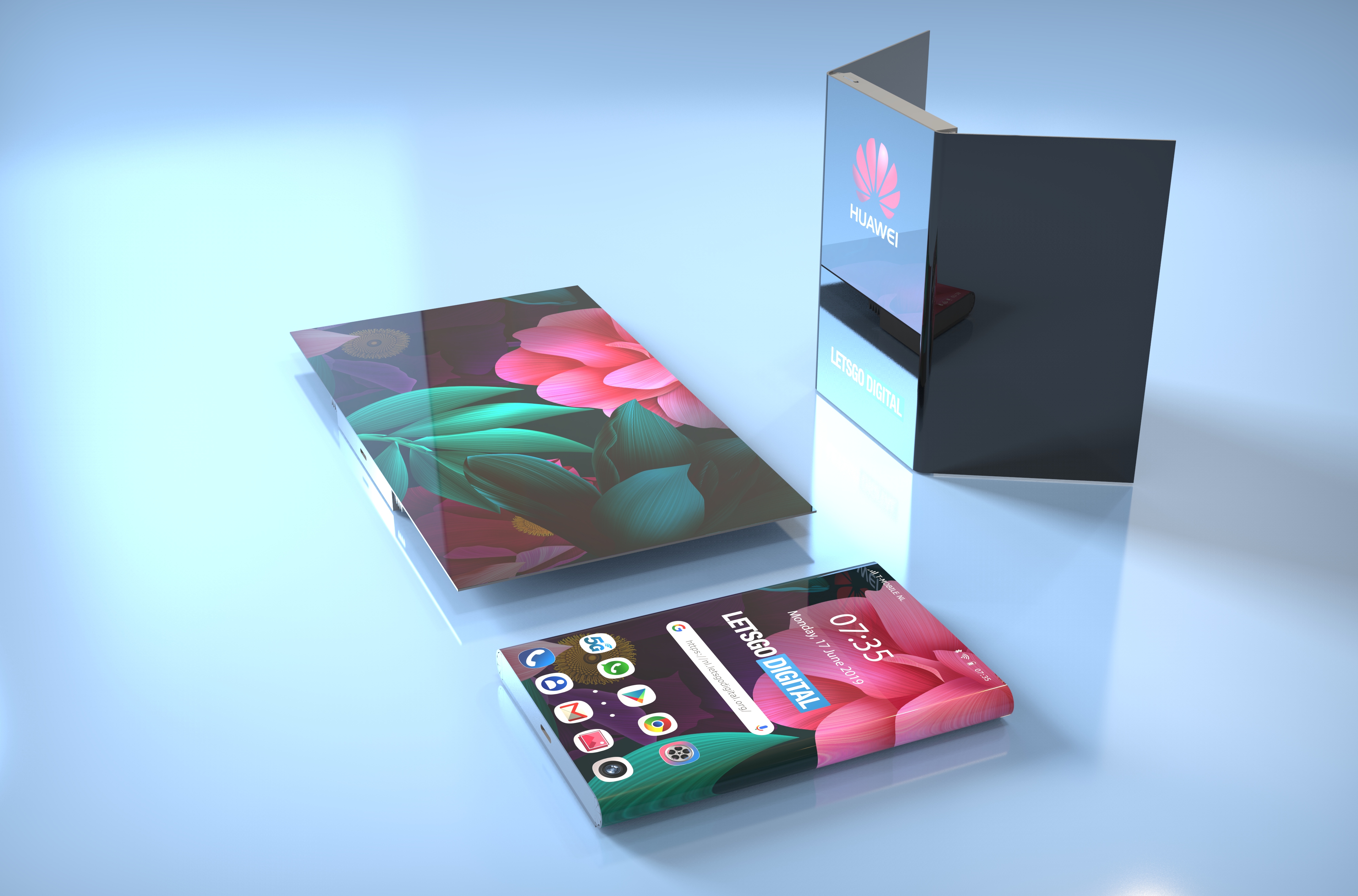
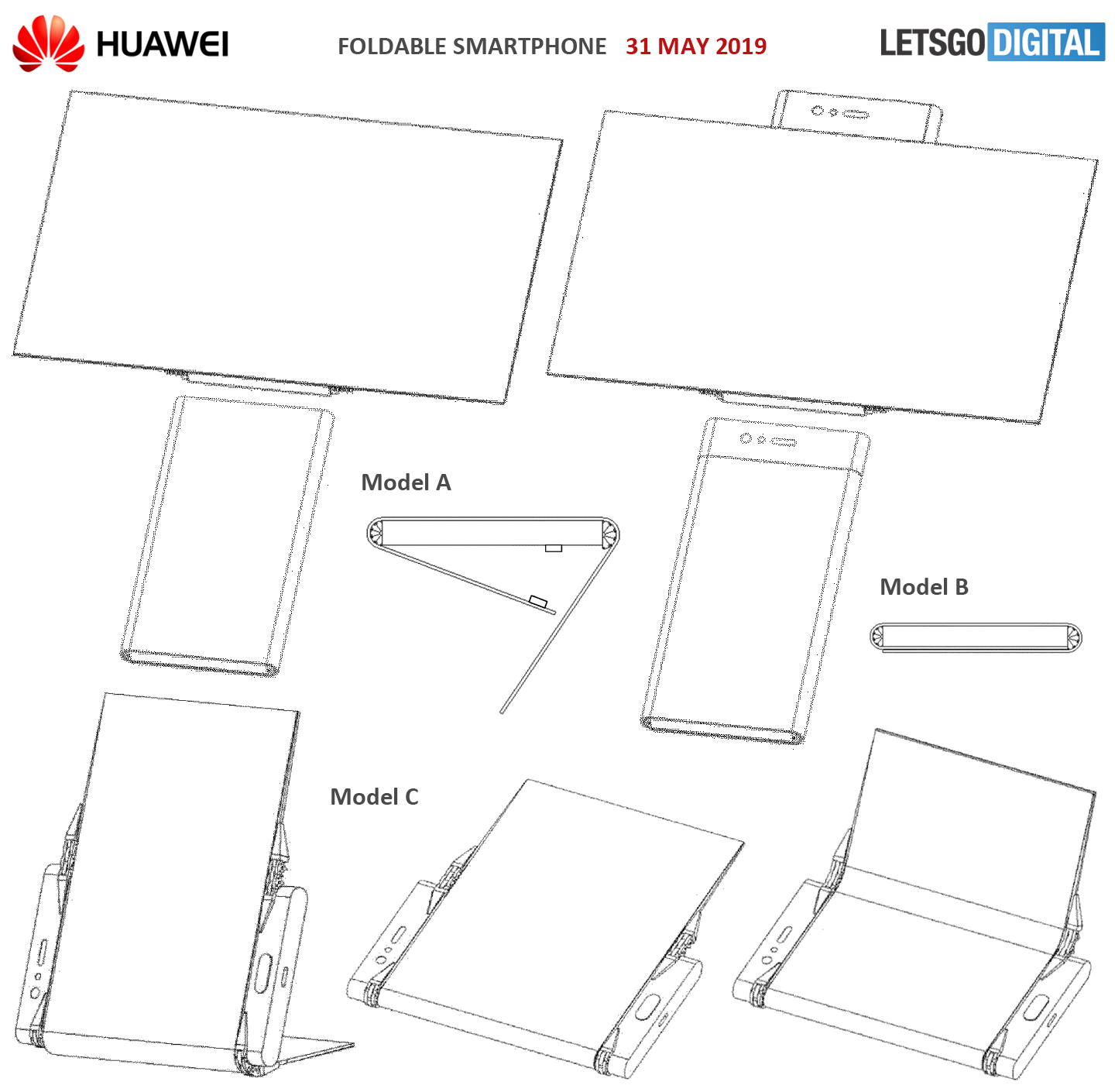
We recently learned that Samsung is working on a new smartphone design with the rollable display while Oppo is working on a foldable smartphone having a pop-up front-facing camera sensor. Now, we have learned about Huawei’s new foldable smartphone design thanks to a patent filing, first reported by letsgodigital.
The patent shows the phone’s display on the outside which can be folded twice. Also, unlike the current Huawei Mate X design, there’s no sidebar visible. In total, the company has three models with this patent design, as shown in the image below.
It is revealed that the flexible screen of the Huawei phone is held in place by magnets. The folding mechanism looks ingenious where the unit has two hinges attached to the sides of the enclosure.
The user will reportedly have the ability to configure the display panels on the device. For example, when all three display sides are opened, the user can configure it to use all three screens for a single layout mode having one large display.
Currently, there’s no information about the phone’s software but it won’t be surprising if the company decides to use its own HongMeng OS in the Chinese market (could be named Ark OS for the international markets) as the company is facing a ban from using Google-backed Android on its devices.
As said, apart from the likes of Samsung and Huawei, several other smartphone manufacturers are working on its own version of the foldable smartphone, including Xiaomi and Oppo. These new smartphones are expected to get announced by the end of this year.
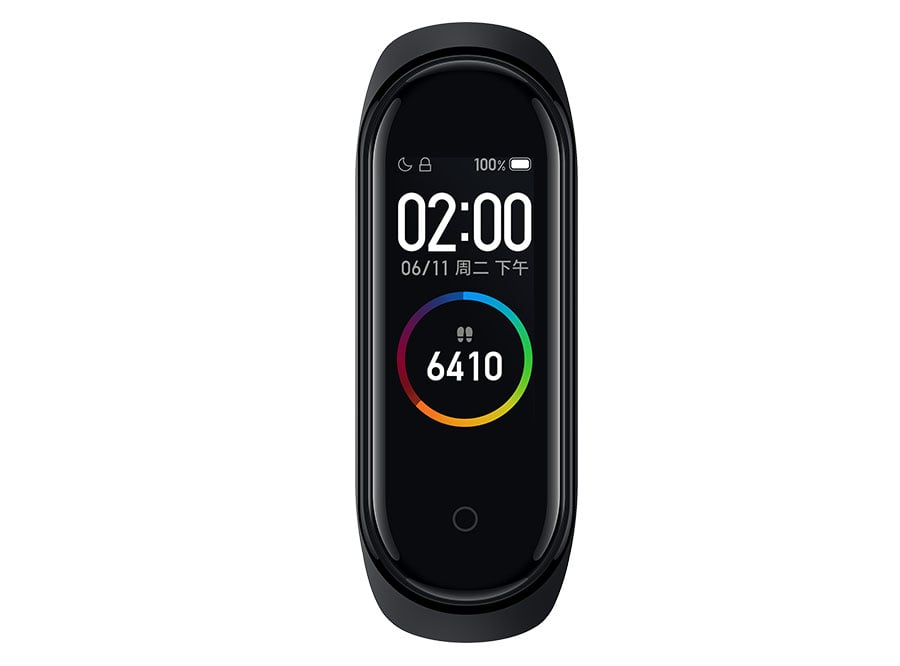
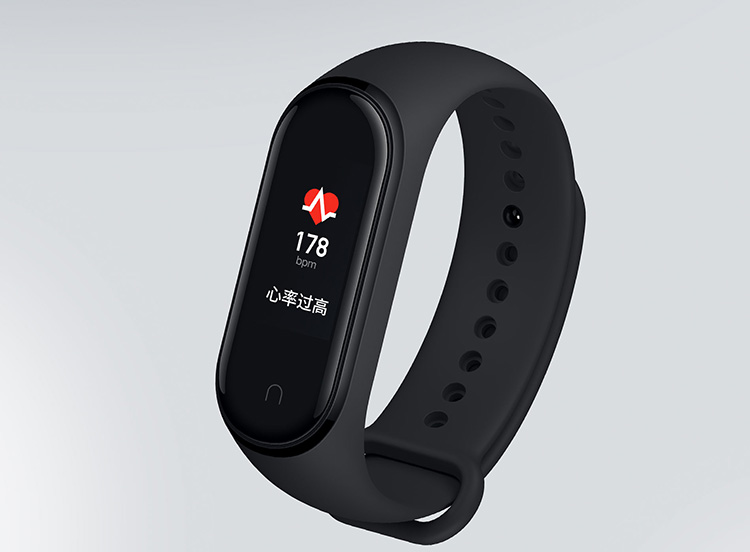
Chinese electronics giant Xiaomi took the wraps off the long-awaited Mi Band 3 successor on June 11 in China. Dubbed as the Mi Band 4, the recently unveiled smart bracelet comes with radically overhauled features, and improved hardware.
There are two variants of the feature-laden smart bracelet including the Standard and the NFC versions. Much to the delight of Xiaomi fans, the black-tinted Standard version of the Mi Band 4 has gone up for sale bearing a $42.99 price tag on Giztop.
This Mi Band 4 boasts an impressive array of features that makes it an irresistible smart bracelet from Xiaomi. First off, it sports an easily readable 0.95-inch AMOLED color touch screen with 120X240 pixels resolution and has a 2.5D scratch-resistant tempered glass on top for added protection.
The Mi Band 4 adopts Bluetooth 5.0 BLE technology, allowing you to connect it with top smartphones with Bluetooth functions. Moreover, it supports Xiao AI voice assistant for controlling Xiaomi’s IoT products.
On top of that, the Mi Band 4 global version comes with a heart rate monitor that provides accurate data at any time. Aside from that, it offers an accurate pedometer algorithm, along with information regarding your daily heart rate changes.
Its caller ID feature lets you reject an incoming call from callers you do not wish to answer simply by long pressing. The Mi Band 4 is also capable of effectively monitoring your total effective sleeping time along with motions time every night, while the App offers you periodical evaluation for better living habits.
In addition to that, the Mi Band 4 has the ability to keep a track of six different sport modes that include running, outdoor running, exercise, swimming, cycling, and walking. It provides accurate sports data so that you can adjust your exercise program and lead a healthier lifestyle.
The Xiaomi-branded smart bracelet is certified to 5ATM standards, which makes it water resistant to up to 50 meters. Furthermore, it features an enhanced 6-axis high-precision sensor that intelligently identifies various types of swimming strokes like Medley, Butterfly stroke, Backstroke, etc.
You can visit this link to check out more details about the Xiaomi Mi Band 4 and buy the Standard version of the smart bracelet from Giztop.
We use cookies on our website to give you the most relevant experience by remembering your preferences and repeat visits. By clicking “Accept”, you consent to the use of ALL the cookies.
This website uses cookies to improve your experience while you navigate through the website. Out of these, the cookies that are categorized as necessary are stored on your browser as they are essential for the working of basic functionalities of the website. We also use third-party cookies that help us analyze and understand how you use this website. These cookies will be stored in your browser only with your consent. You also have the option to opt-out of these cookies. But opting out of some of these cookies may affect your browsing experience.
Necessary cookies are absolutely essential for the website to function properly. This category only includes cookies that ensures basic functionalities and security features of the website. These cookies do not store any personal information.
Any cookies that may not be particularly necessary for the website to function and is used specifically to collect user personal data via analytics, ads, other embedded contents are termed as non-necessary cookies. It is mandatory to procure user consent prior to running these cookies on your website.