Advertisement

Buy Top Variants of Xiaomi Mi 9 Smartphone at Lowered Prices on GeekBuying [Coupons]

Xiaomi launched the Mi 9 in March this year. Following in the footsteps of its well-received predecessors, the device became an instant hit among Xiaomi’s huge fanbase.

If you’ve restlessly been waiting to get your hands on the recently unveiled handset without spending a lot of money, GeekBuying’s got your back. The Chinese online store is offering the 6GB RAM,128GB ROM, and 6GB RAM, 64GB ROM variants at lowered prices.

On top of that, GeekBuying users can use specific coupons to save a considerable amount of extra money at checkout. We’ll talk about that in just a bit.

Xiaomi Mi 9 (6GB RAM, 128GB ROM)

Powered by Qualcomm Snapdragon 855, Octa-core, 2.84GHz processor, this Mi 9 variant offers 128GB of internal storage capacity.  While it usually retails for $706.99, you can get your hands on this model for a lowered price of $523.99 on GeekBuying.

You can extend this 26 percent discount by applying coupon code NNVUUCBW. The aforesaid coupon helps you save $4 more by reducing the retail price of the phone to just $519.99 before placing your order.

Xiaomi Mi 9 6.39 Inch 4G LTE Smartphone Snapdragon 855 6GB 128GB 48.0MP+12.0MP+16.0MP Triple Rear Cameras MIUI 10 In-display Fingerprint NFC Fast Charge - GrayYou can follow this link to grab the discount, which is available on the piano black color version. Note that the promo is slated to end in just two days.


Xiaomi Mi 9 (6GB RAM, 64GB ROM)

Alternatively, you can go for the slightly smaller variant of the Mi 9 that ships with 6GB of RAM and offers 64GB of onboard storage capacity for you to save your favorite multimedia content. This model usually sells for $687.99, but you can buy it for only $498.99 on GeekBuying.

This is a noteworthy 27 percent drop in the device’s original asking price, but there’s more for you to cheer about.

Xiaomi Mi 9 6.39 Inch 4G LTE Smartphone Snapdragon 855 6GB 128GB 48.0MP+12.0MP+16.0MP Triple Rear Cameras MIUI 10 In-display Fingerprint NFC Fast Charge - GrayYou can get an extra $10 by applying coupon code CKQGHZLK at the time of checking out. In other words, you can bring the already lowered retail price of the phone to just $488.99 simply by applying the aforesaid coupon at checkout.

You can visit this link to take advantage of the discount and use the coupon before it expires. The promo was on the verge of wrapping up at the time of writing.

OPPO Reno reportedly uses Nokia’s OZO audio recording technology

Nokia is gaining global popularity once more as a result of the resurgence of the Nokia smartphone brand. This seems to have made us forget that Nokia has other core technology business concerns including the manufacture of network equipment and gears. Nokia also owns the OZO brand which manufactures advanced camera and audio technology. Turns out the new OPPO Reno smartphone that launched with several revolutionary features also had OZO’s audio recording technology known as OZO Audio.Nokia Logo

This was disclosed by Nokia in its Q1 2019 report, where it announced that at the beginning of the second quarter of 2019, OPPO released its new flagship smartphone, OPPO Reno, which uses Nokia’s OZO Audio technology. Nokia did not reveal if the OZO Audio is on the Reno or the 10X zoom version or both.

Read Also: Nokia Shuts Down OZO VR Division, Cuts Workforce By 35%

Interestingly, OPPO never mentioned this audio feature during the launch of the Reno models. This may be due to brand strategy since Nokia is a direct competitor in the smartphone terrain. The company may also not want the feature to overshadow the 10X zoom capable periscope camera which is the main feature of the Reno 10x zoom edition and Reno 5G that was unveiled in Europe recently.

(source)

Samsung Galaxy A60 and Galaxy A40s pre-order goes live ahead of first sale

Samsung is intent on reclaiming its lost market share in the Chinese market ad one series it is using to achieve that is the rebranded Galaxy A series. Just last week, Samsung announced the Galaxy A60 and A40s in China. Pre-orders for the models have now gone live on Samsung China’s official website. The Galaxy A60 pre-order will end on May 10 while the A40s’ will end on May 5 when sales will commence. Samsung Galaxy A60As a recap, the Galaxy A60 packs a 6.7-inch FHD+ LCD display with a punch hole housing a 32MP selfie camera. The punch-hole design gifts the A60 a screen-to-body ratio of 92%. The punch hole as a diameter of 4.8mm and so is smaller than those of the Honor View 20 and Galaxy A8s. The phone also ditches the design of a traditional speaker at the top for sound-on-display technology just like the Galaxy A80.Samsung Galaxy A60

On the camera end, Samsung Galaxy A60 has triple rear cameras – a 32MP primary camera, an 8MP super wide-angle camera, and a 5MP depth sensor. It is powered by the Snapdragon 675 processor and has 6GB of RAM and 128GB of storage. The phone gets its juice from a generous 3,500mAh battery. One outstanding feature is the presence of NFC. The device equally packs a fingerprint scanner. The A60 is priced at ¥1999 ($299).Samsung Galaxy A40s

On the other hand, the Galaxy A40s is basically a rebranded Galaxy M30 which was launched in India not too long ago. The device packs a 6.4-inch FHD+ Infinity U display. The notch houses a 16MP selfie camera. The phone is powered by the 14nm Exynos 7904 processor and it is paired with 6GB of RAM and 64GB of storage. The A40s comes with triple rear cameras – a 13MP primary camera, a 5MP super wide-angle camera, and a 5MP depth sensor. The phone also packs a huge 5000mAh battery with 15W fast charging and a rear-mounted fingerprint scanner. As for the pricing, the Galaxy A40s has a price tag of ¥1499 (~$224). You’ll agree the prices of the phones are spot on, putting them in positions to wrestle some of the market shares from competitors.

(source)

Samsung Galaxy A60
Samsung Galaxy A60
Samsung Galaxy A40s
Samsung Galaxy A40s

Chinese smartphone makers retain a solid 66% market share in India for Q1 2019

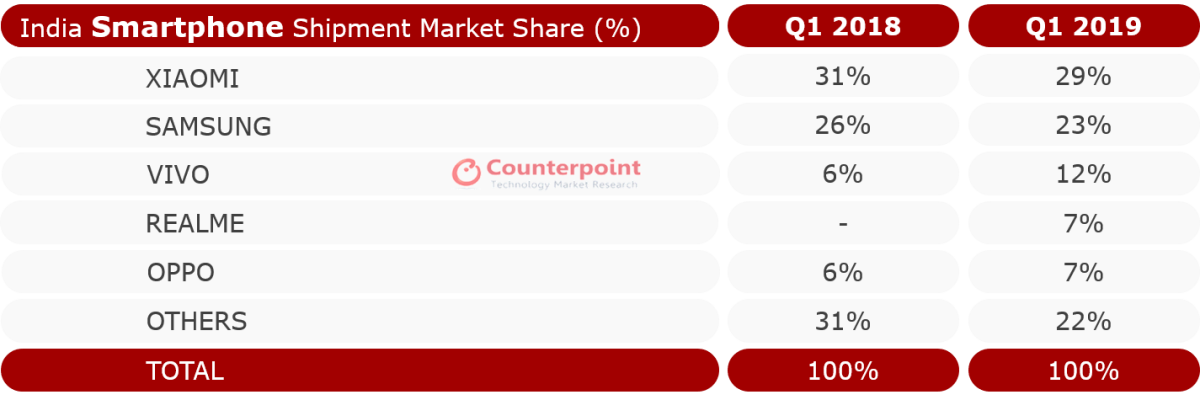
Chinese smartphone makers have increased their dominance over the Indian market in Q1 2019. Counterpoint research report reveals that four of the top five smartphone companies in India are Chinese and they have captured a solid 66% market share in the previous quarter of the year.

Source: Counterpoint Research

Xiaomi’s market share dropped slightly from 31% in Q1 2018 to 29% in Q1 2019, while Vivo saw a significant rise in its market share during the same period. It went up from just 6% last year to a staggering 12% in the first quarter of this year. Even Realme saw a quick rise in its market share, capturing a decent 7% share of this highly competitive market. OPPO’s market share increased slightly to 7%.

Source: Counterpoint Research

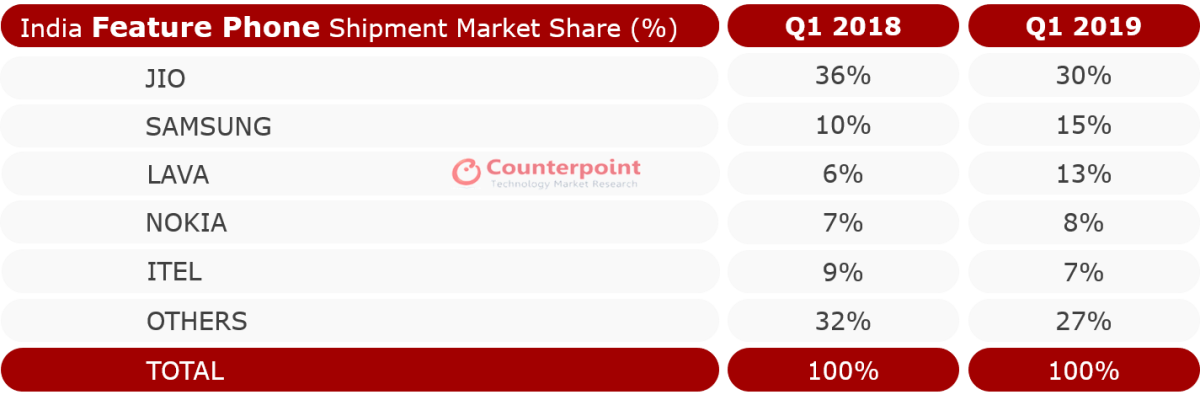
Samsung’s smartphone shipment market share dropped slightly to 23% in the previous quarter, down by 3% YoY. However, the company gained some moment in the feature phone market with an increase from 10% in Q1 2018, to 15% in Q1 2019. Jio still dominates the feature phone segment with 30% market share. The report further notes that the company’s Galaxy S10 series is doing well in the country, driving up its Average Selling Price (ASP) in the region.

Other brands which managed to do well in the Indian market include ASUS, especially in the budget segment, thanks to its Zenfone series. Tecno, and Nokia HMD are doing well too. The rise in the market share of Chinese brands has naturally led to the decline of the Indian brand shipments. The previous quarter recorded the lowest ever market share of shipments from local Indian brands.

OnePlus 7 Pro
onePlus 7 Pro leaked

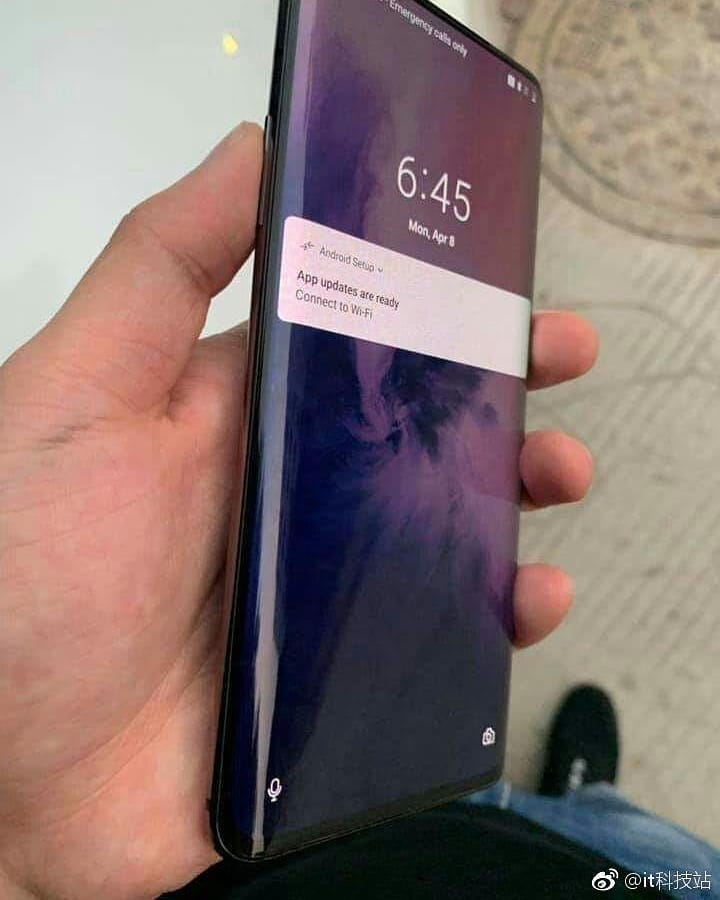
Another important point mentioned in the report was that Samsung has surpassed OnePlus in Q1 2019 to become the number one smartphone maker in the premium segment. Given that OnePlus 7 Pro is slated to release on May 14, we could see some changes in this particular segment in the coming quarters.

Finally, most smartphone companies are making a strong push into retail sales. Xiaomi, OnePlus, and even Realme benefitted from an increased focus on brick and mortar stores. So, we could expect the strategy to continue in the coming quarters.

(Source)

Couple of Realme phones certified in China, Pop-Up Camera design expected

Realme has already confirmed that it will land in China sometime in the coming days. Ahead of its official launch, a couple of Realme smartphones have been certified by TENAA. One of the two models features a full-screen design up front, hinting at a pop-up camera design.

The two models certified on TENAA are RMX1901 and RMX1851. The first model seems to be a premium offering. According to the official pictures uploaded on TENAA, the RMX1901 model will come with a full-screen display and a dual camera module placed vertically at the middle of the back panel. The certification website mentions the thickness as 9.4mm, which further hints at a pop-up mechanical camera solution for selfies. Other specs include a 6.5-inch display and 3680mAh battery. We couldn’t find a physical fingerprint sensor on board, so it’s likely that it comes with an in-display fingerprint scanner.

The second model in question, the Realme RMX1851 looks very similar to the recently launched Realme 3 Pro. So, it’s likely that the phone will launch with similar specs as the Indian version of the new Realme mid-ranger that was announced a couple of days back.

To recap, the Realme 3 Pro comes with a 6.3-inch IPS LCD FHD+ display with Corning’s Gorilla Glass 5 protection. There’s Snapdragon 710 processor inside with a 16MP + 5MP dual camera module at the back. We will soon post the review of this model on the site, so stay tuned!

Nokia 3.2 and Nokia 4.2 India launch imminent as the models get listed on official India website

HMD Global Oy could be prepping the launch of the Nokia 3.2 and Nokia 4.2 for the Indian market. The company has now listed the two models on its official India website. The listing did not reveal the price nor the launch date of the models but they act as clues that the duo would soon hit India. The Nokia 3.2 16 GB and 32 GB editions are respectively priced at $139 and $169 in Europe while the 4.2 starts at $169. We don’t expect the prices in India to be too different.

Nokia 3.2 and Nokia 4.2

The Nokia 3.2 and 4.2 were both launched at the Mobile World Congress (MWC) in February this year. The phones were dropped alongside the penta-lens enabled Nokia 9 PureView as well as the budget-friendly Nokia 1 Plus and Nokia 210  feature phone.

The two models are the first Nokia phones to feature the Water drop notch design. As a reminder, the Nokia 3.2 sports a 6.26-inch a-Si TFT LCD display with a waterdrop notch that delivers 720 x 1520 pixels and 19:9 aspect ratio. It is powered by a Snapdragon 429 processor paired with 2GB or 3GB of RAM while there is the 16GB and 32GB storage onboard respectively. Interestingly, there is a rear-mounted fingerprint sensor on only the 32GB variant. The handset is fueled by a 4,000mAh battery. There is equally a dedicated button for Google Assitant and Nokia included the now patented LED notification light on the power button. Nokia 4.2 featured

Read Also: HMD trademarks Nokia 4.2 and 3.2’s notification LED power button design

On the other hand, the Nokia 4.2 packs a slightly smaller 5.71-inch IPS LCD display with a water drop notch and HD+ resolution. The display also appears in the 19:9 aspect ratio. The Nokia 4.2 is powered by a Snapdragon 439 chipset and it is available in 2GB+16GB and 3GB+32GB memory variants. The phone is fuelled by a 3,000mAh battery while there is equally a dedicated Google Assistant button. The budget model comes with top features such as NFC with Google pay support and Bluetooth 4.2. It is available in Pink Sand and Black.

(source 1, 2)

Nubia Red Magic 3 hits Geekbench sporting SD855 ahead of its launch

Nubia is all set to release its new gaming flagship, the Nubia Red Magic 3 on April 28. Ahead of its official unveiling, the phone has hit a couple of benchmarking platforms. Yesterday, the phone was spotted on Master Lu benchmark with a very high score. Today, the same model has been spotted on a much more familiar benchmarking platform, Geekbench.

Nubia Red Magic 3 Geekbench

The new listing confirms that the phone will have Snapdragon 855 under its hood along with 8GB of RAM. With such powerful internals, the Nubia Red Magic 3 (NX629J) managed to score 3513 in single core and 11309 in multi-core tests. The multi-core score is impressive in particular and the phone’s hybrid cooling setup could have further enhanced its performance. Note that this is the 8GB RAM model. But we know that there’s a 12GB RAM model as well, thanks to yesterday’s Master Lu listing.

The Nubia Red Magic 3 is said to come with a 90Hz gaming display. While it may not be as high as Razer phone’s 120Hz display, it’s still better than most smartphone displays out there, especially for gaming. We also know that the phone will feature a 5000mAh+ battery, for long hours of gaming.

The phone is already up for reservations on JD.com.

(Via)

Oppo Reno 5G vs ZTE Axon 10 Pro 5G vs Xiaomi Mi Mix 3 5G: Specs Comparison

It is finally time for Europe to get its first 5G smartphone and, unlike what a lot of people could expect, it is not from Samsung. Its name is Oppo Reno 5G, it is the first 5G-enabled phone to be unveiled in Europe and it will hit Switzerland within the end of May. Besides being a 5G phone, it is also a Chinese flagship which, (despite still being expensive) will carry a not extremely high price tag. At least not as high as the Galaxy S10 5G and Huawei Mate X. That is why we think there is nothing better than comparing it with all the other Chinese “affordable” flagships sporting a 5G modem. So here we go: Oppo Reno 5G against ZTE Axon 10 Pro 5G and Xiaomi Mi Mix 3 5G.

Oppo Reno 5G vs ZTE Axon 10 Pro 5G vs Xiaomi Mi Mix 3 5G

Oppo Reno 5G ZTE Axon 10 Pro 5G Xiaomi Mi Mix 3 5G
DIMENSIONS AND WEIGHT 162 x 77.2 x 9.3 mm, 215 g 159.2 x 73.4 x 7.9 mm, 175 g 157.9 x 74.7 x 9.4 mm
DISPLAY  6.6 inches, 1080 x 2340p (Full HD+), Super AMOLED 6.47 inches, 1080 x 2340p (Full HD+),  AMOLED 6.39 inches, 1080 x 2340p (Full HD+), Super AMOLED
PROCESSOR Qualcomm Snapdragon 855, octa-core 2.84 GHz Qualcomm Snapdragon 855, octa-core 2.84 GHz Qualcomm Snapdragon 855, octa-core 2.84 GHz
MEMORY  8 GB RAM, 256 GB – micro SD slot  6 GB RAM, 128 GB – micro SD slot 6 GB RAM, 128 GB – 6 GB RAM, 64 GB
SOFTWARE  Android 9 Pie, Color OS Android 9 Pie Android 9 Pie, MIUI
CONNECTIVITY  Wi-Fi 802.11 a/b/g/n/ac, Bluetooth 5.0, GPS Wi-Fi 802.11 a/b/g/n/ac, Bluetooth 5.0, GPS  Wi-Fi 802.11 a/b/g/n/ac, Bluetooth 5.0, GPS
CAMERA  Triple 48 + 13 + 8, f/1.7, f/3.0 and f/2.2
16 MP f/2.0 front camera
Triple 48 + 20 + 8 MP, f/1.8
20 MP front camera
Dual 12 + 12 MP, f/1.8
Dual 24 + 2 MP front camera
BATTERY  4065 mAh, fast charging with VOOC Flash Charge 20W 4000 mAh, fast charging with Quick Charge 4+ and wireless charging 3800 mAh, fast charging with Quick Charge 4+, wireless charging
ADDITIONAL FEATURES  Hybrid Dual SIM slot, 5G Dual SIM slot, 5G, waterproof IP68 Dual SIM slot, 5G, slider design

Design

If you want the most amazing design with the most stunning aesthetical features, your best choice is either the Oppo Reno 5G or the Xiaomi Mi Mix 3 5G. While the ZTE Axon 10 Pro comes with a classic waterdrop design, Oppo Reno 5G and Xiaomi Mi Mix 3 have a display with a screen-to-body ratio close to 100 percent without a notch. Instead, they rely on pop-up cameras. I personally prefer the Oppo Reno 5G because it has a motorized pop-up mechanism, while Xiaomi Mi Mix 3 5G has a manual pop-up slider. However, if we consider the whole design, I would go for the Xiaomi Mi Mix 3 5G due to its amazing ceramic body and its sturdier 7000 series aluminum frame. On the other hand, ZTE Axon 10 Pro 5G remains quite interesting because it has incredibly narrow bezels and it is waterproof with the IP68 certification.


Display

Judging from the specs on the paper, ZTE Axon 10 Pro 5G and Xiaomi Mi Mix 3 look like the devices with the best displays due to a higher color accuracy provided by the HDR technology. On the other hand, Oppo Reno 5G has a slightly bigger display with a 6.6-inch diagonal that is not easy to find in affordable flagship phones. All come with an AMOLED display, but the Oppo Reno 5G seems to have the most resistant one as it features a Gorilla Glass 6 front panel. However, Xiaomi Mi Mix 3 5G is not far away with its Gorilla Glass 5 protection. In each case, you get an in-display fingerprint reader.


Hardware/Software

Coming to the hardware, Oppo Reno 5G is the winner, but only for a slight margin. Indeed, they all come with the Snapdragon 855 chipset, but the Oppo Reno 5G sports 8 GB of RAM instead of just 6 GB like the Xiaomi Mi Mix 3 and the ZTE Axon 10 Pro. Further, its internal storage is 256 GB and it is furtherly expandable with a micro SD, while Xiaomi Mi Mix 3 and ZTE Axon 10 Pro stop at 128 GB and the former does not even have a micro SD slot. Android 9 Pie is installed out of the box, customized with a proprietary user interface for Oppo Reno 5G and Xiaomi Mi Mix 3 5G.


Camera

We doubt that Xiaomi Mi Mix 3 5G and ZTE Axon 10 Pro 5G are as amazing as the Oppo Reno 5G in terms of camera potentialities, but we can not tell it for sure as we did not test all of these handsets’ cameras thoroughly. Oppo Reno 5G is the first phone to come with a 10x hybrid zoom technology, and it also comes with an optically-stabilized main sensor sporting a 48 MP resolution and a bright f/1.7 focal aperture. The third sensor is a useful ultrawide lens.


Battery

We see quite big batteries on each of these devices, with Xiaomi Mi Mix 3 5G having a slightly smaller 3800 mAh unit. What makes the real difference on the battery side is the support to Qi wireless charging that is present only on the ZTE Axon 10 Pro 5G.


Price

Oppo Reno 5G will soon be available in Switzerland with a €900/$1000 price tag, Xiaomi Mi Mix 5G will cost just €600/$670, while the price of the ZTE Axon 10 Pro 5G is not known yet. In conclusion, Oppo Reno 5G looks like the most amazing handset because of its innovative design, a more powerful hardware side and better camera potentialities. But some may prefer the ZTE Axon 10 Pro 5G due to its waterproof certification and Qi wireless charging.


Oppo Reno 5G vs ZTE Axon 10 Pro 5G vs Xiaomi Mi Mix 3 5G: PRO and CONS

Oppo Reno 5G

PROS

  • Amazing design
  • Faster charging technology
  • Big battery
  • 10x zoom
  • Bigger display

CONS

  • Big dimensions

Xiaomi Mi Mix 3 5G

PROS

  • Revolutionary slider design
  • Front-facing LED flash
  • Nice display
  • Smaller

CONS

  • No micro SD


ZTE Axon 10 Pro 5G

PROS

  • Good display
  • Great cameras
  • Big battery
  • Wireless charging
  • Waterproof

CONS

  • Standard design

Mi LED Smart Bulb goes on Crowdfunding in India via Mi.com

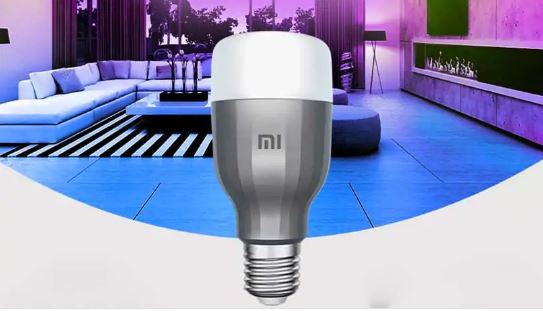
The Mi LED Smart Bulb was introduced during the Mobile World Congress 2019 in February this year. Earlier this week, Xiaomi India launched the Mi LED Smart Bulb in India. The company has now announced the price of its latest IoT product as the crowdfunding went live at 12 noon IST via Mi.com.

The Mi LED Smart Bulb supports 16 million colors with a life span of almost 11 years. The IoT device can be controlled using the Mi Home app and carries an added functionality wherein you can control the device using voice assistants like Google Assistant and Amazon Alexa. According to the company, it doesn’t require a bridge or hub for wireless connectivity. Mi Home app will facilitate the users to get full control of the Mi LED Smart Bulb including options to turn on and off, set schedules, brightness, and color changes. Mi LED Smart Bulb supports 16 million colors and sustains for straight 11 years.

Xiaomi has set the price of Mi LED Smart Bulb for Rs. 999 in India up to the first 4,000 orders, with 10 days to go. As indicated on the listing page, after the first 4,000 units, the price will go up to Rs. 1,299. Note that the shipments for the first orders will begin from May 20.

Alongside the Mi LED Smart Bulb, the company has also launched its latest Redmi Y3 and Redmi 7 smartphones in India.

(source)

HTC’s first cinema grade VR Movie ‘7 Miracles’ is now available

VIVE Studios, which is a VR content development and publishing initiative from HTC Vive, has today announced the release of an award-winning VR firm — 7 Miracles, which has been developed in partnership with Panogramma and Film Production Consultants.

The company has announced that the feature-length VR film is now available on VIVEPORT for the HTC VIVE for $19.99. It is also available for all Android devices via the Google Play Store for $9.99.

HTC Vive 7 Miracles

HTC has also revealed that additional headsets and platforms, including iOS and the VIVE Wave platform, will be compatible at a later date. New 3D room-scale scenes are also to be added in future updates to further immerse viewers in the PC-VR experience.

7 Miracles movie is an immersive VR adaptation of the seven miracles of Jesus Christ based on the Gospel of John. With the combination of storytelling and the latest technology in virtual reality, the company aims to connect the audience in a novel and stirring way.

Chris Chin, Vice President & General Manager of Vive Studios, said:

“This celebrated story has been retold over and over, yet through VR, we’ve developed an experience that allows the audience to connect with this epic in a brand new way. HTC VIVE has engaged the newest methods in VR filmmaking and editing for 7 Miracles, pioneering the next generation of cinematic content.”

Read More: Mysterious HTC phone powered by Snapdragon 710 chipset and 6 GB RAM visits Geekbench

The company says that using state-of-the-art VR capture technology, the film was created using photogrammetry and volumetric video capture, producing images in 8K. The seven-part episodic feature runs over 70 minutes, making it the first feature-length cinematic experience from Vive Studios.

Xiaomi CEO reveals Snapdragon 730-powered phone is coming soon

Just a few days ago, Redmi India announced two new smartphones – the Redmi Y3 and the Redmi 7. Today, Xiaomi India’s MD has revealed a more powerful phone is coming to the market very soon. The exciting part is that the phone will be powered by Qualcomm’s latest Snapdragon 700 series – the Snapdragon 730 or Snapdragon 730G.

In the tweet which was posted earlier today, the MD of Xiaomi India, Manu Kumar Jain, shared a photo he took with two Qualcomm India executives. He talked about the partnership between the two companies and then teased the arrival of the Xiaomi phone.

The only info he revealed about the device is that it will come with the latest “Snapdragon 7_ _ (announced just 2 weeks ago)”. The Snapdragon 730 and Snapdragon 730G are the two Snapdragon 700 chipsets Qualcomm released this month, so it’s one of the two. However, we believe it is the Snapdragon 730.

A little over a week ago, key specs of a Redmi phone leaked. The leak revealed the device is powered by a Snapdragon 730 processor, packs a 4000mAh battery, and has a triple camera setup (48MP + 8MP + 13MP). This is most likely the same device heading to India but it may launch in China first. We have no info about the name of the phone but we strongly believe it will launch in India as a Mi phone and not a Redmi phone.

Redmi SD730 phone leak 1

If we want to be specific, this might actually be the Mi A3 Android phone. There is no specific date for the launch yet but we won’t be surprised if Xiaomi wants to announce its next Android One phone a little early this year.

READ MORE: Xiaomi launches Redmi Note 7 and Redmi 7 in Nigeria

Best Wireless Car Chargers that Suit your Fancy

While people with low battery anxiety tend to juice up their phone batteries just about everywhere they go, focusing on charging your phone battery before it reaches zero while driving can prove to be unsafe. That’s exactly where car wireless chargers come into the picture.

There all sorts of wireless car chargers available on the market today, but they don’t come cheap. If you’re looking for an inexpensive alternative to keep your mobile phone’s battery juiced up, you’ve come to the right place.
Gocomma Car 10W Qi Wireless Charger Phone Holder

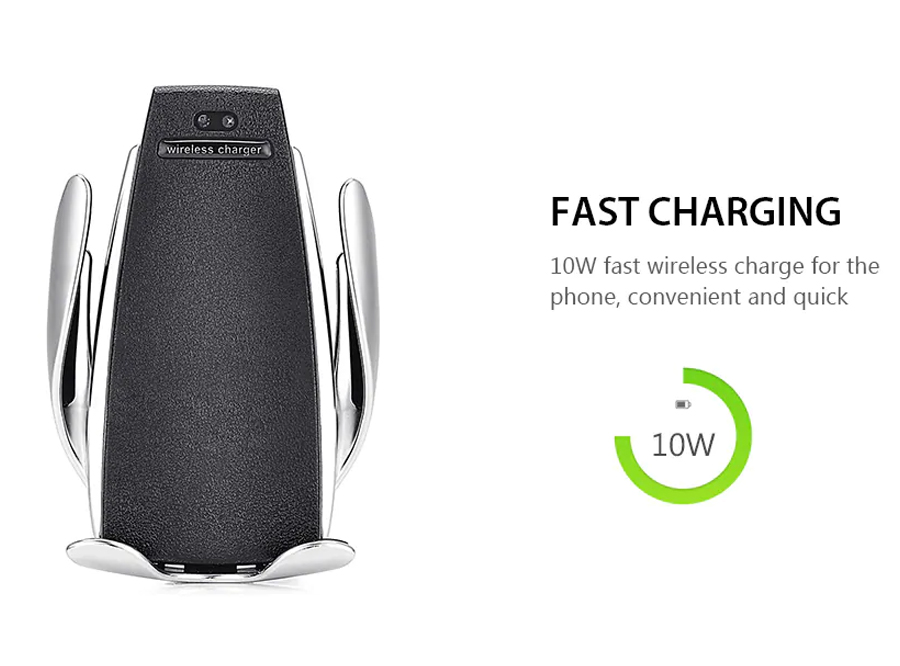
Equipped with advanced infrared sensing, the Gocomma Car 10W Qi Wireless Charger Phone Holder can lock and release the phone automatically. Moreover, it facilitates one-hand operation in a bid to make your journey safer and pleasant.

This Gocomma-branded wireless car charger usually retails for $14.76, but much to the relief of cost-conscious buyers it is now available for a lowered price of just $13.99. This is a significant 5 percent drop in the device’s original asking price. Aside from that, those who order more than two items will get 10 percent off. With only 232 pieces remaining, the promo is slated to end in just three days. You can to visit the promotion page and avail the discount.
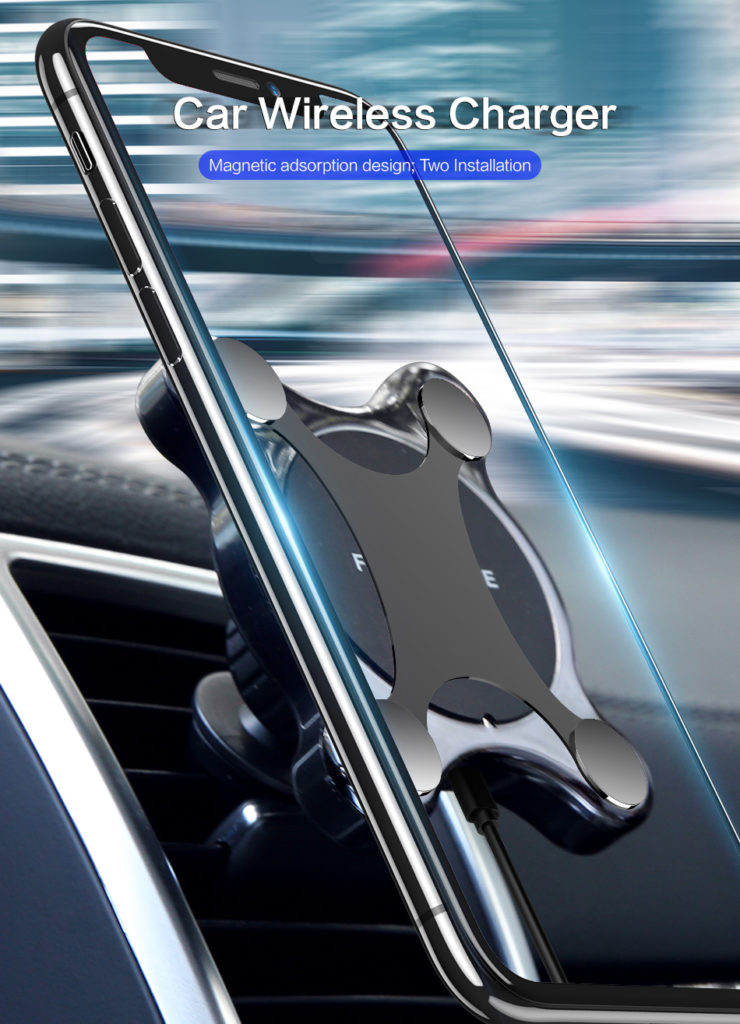
 

FLOVEME 2 in 1 360 Degree Rotation Magnetic Wireless Car Charger

The FLOVEME 2-in-1 wireless car charger adopts a magnetic absorption design. Its 360-degree rotation feature allows you to conveniently use it in both horizontal and vertical places.

Moreover, it supports well-received Apple iPhone models, Samsung Galaxy-branded handset, the Google Nexus 4/5/6, and Nokia Lumia 820/1020 and more. The FLOVEME 2-in-1 wireless car is currently up for grabs bearing a $28.24 price tag on Banggood. You can visit this link to place your order.
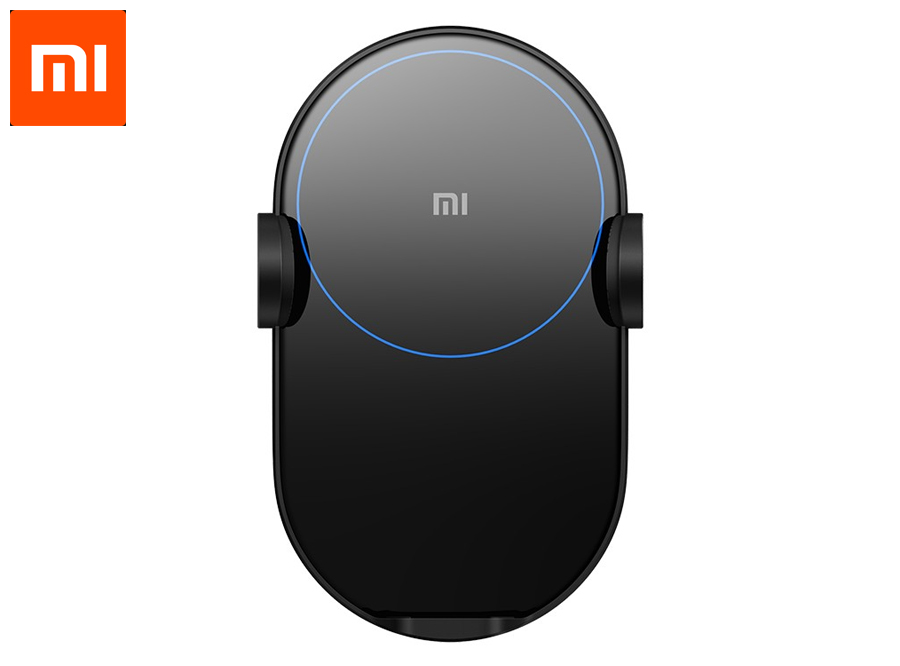
 

Xiaomi 20W Wireless Car Charger

Capable of supporting electric deformation and wireless charging, the Xiaomi 20W Wireless Car Charger is quite a practical and easy-to-use car bracket. Much to the delight of Xiaomi Mi9 users, this device can charge the phone to 45 percent in mere 30 minutes as it supports 20W MAX high-power output. It takes 90 minutes to fully charge the Mi9.
The feature-rich Xiaomi 20W Wireless Car Charger has gone up for sale bearing a $39.99 price tag on Giztop. You can follow this link to check out more details about this wireless charger and place your order without wasting time.
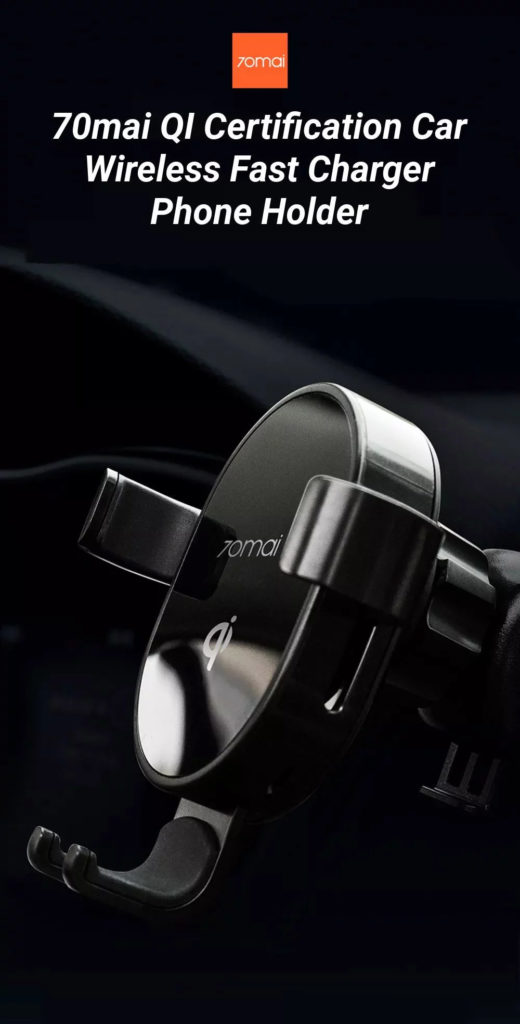
 

Xiaomi 70mai 10W Qi Wireless Charger Car Phone Holder

The Xiaomi 70mai 10W Qi Wireless Charger Car Phone Holder employs a gravity linkage design that locks the phone automatically. Moreover, the device is Qi-certified, making it compatible with most top-branded smartphones.

More importantly, the Xiaomi 70mai 10W Qi Wireless Charger Car Phone Holder doesn’t cost a fortune. You can buy this Xiaomi-branded wireless charger car phone holder from GearVita if you’re willing to shell out only $25.99. You can visit this link to buy it.


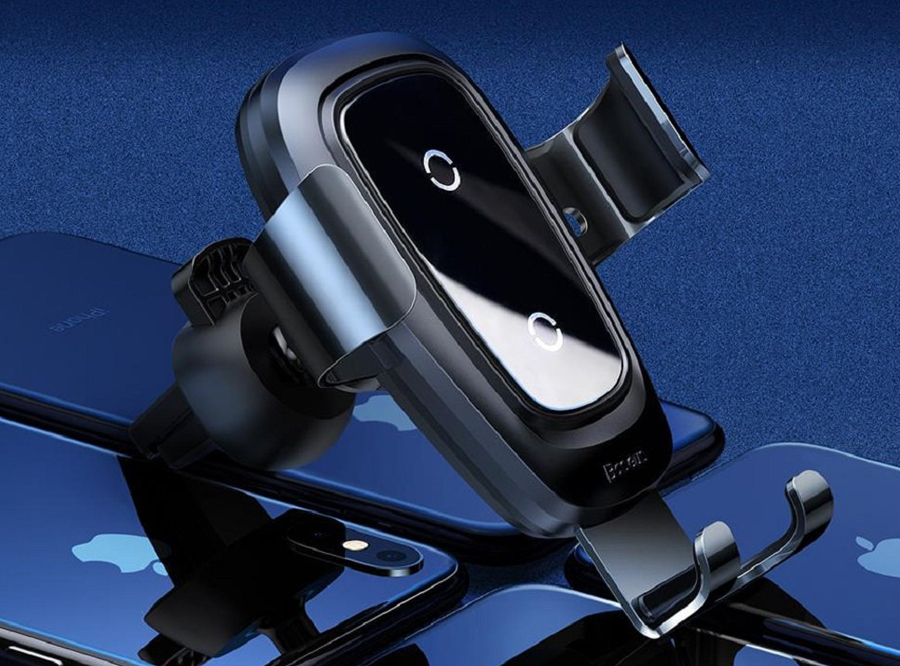
Baseus Qi Wireless Car Fast Charger

The Baseus Qi wireless car fast charger adopts a 360-degree rotary design that provides a wider perspective. It is powered by a high-power upgrade chip for safer and improved charging speed. The device features a strong suction cup and absorbs shocks and provides steadiness and durability.

Baseus Qi Wireless Car Fast Charger Gravity Sucker Bracket 10W 360 Degrees Rotary For 4-6.5 Inch Phone - BlackWhile the aforesaid features completely justify the $29.99 price tag the Baseus Qi Wireless Car Fast Charger usually carries, you can now buy it for a lowered price of only $23.99 from GeekBuying. The Chinese online store is doling out a noteworthy 20 percent discount on the device’s original asking price.

You can visit this link to grab the discount before the promotion sale comes to an end.

Mario Kart Tour closed beta arrives for Android users

The very popular Japanese video game company – Nintendo today announced the closed beta for much-awaited Mario Kart Tour game for Android users (excluding certain devices). At this time, only users in the US and Japan are eligible to register for the closed beta. The registrations are already live from April 23, 2019, and will remain active till May 7, 2019, 07:59 PM PT.

Mario Kart closed beta testing will continue from May 22, 2019, to June 04, 2019. However, the dates may change according to the need without prior notice.

Interested users may register for the closed beta by linking their Nintendo Account to a valid Gmail account. Once done, users just need to wait until Nintendo selects some random users who would be able to download the closed beta via Google Play Store. The selected users would be among the first individuals to get hands-on the closed beta testing aimed to improve the quality of the game.

Moreover, Nintendo had already announced about the delay in Mario Kart Tour’s official launch until summers. The company did not reveal any features of the upcoming game. Even though the feature of online racing against friends is not confirmed too.

Mario Kart is the fifth title Nintendo developed in collaboration with mobile developer DeNA. However, Nintendo is independently developing Dr. Mario World for iOS and Android scheduled for release in 2019.

Just like everyone, we’re excited too for the official release scheduled for this summer.

(Source)

Samsung to infuse $115 Billion in Foundry & Chipset Businesses by 2030

Along with smartphones, Samsung is among the largest semiconductor manufacturers around the globe. To meet the ever-increasing demand and evolve further, the Korean giant is investing $115 billion (133 trillion won) in its Samsung LSI and Samsung foundry business by 2030. Samsung wants to become the world’s leader in semiconductors by taking on Intel and Qualcomm.

Samsung Exynos 9710

According to plan, Samsung will invest $63.7 billion (KWR 73 trillion) in R&D in South Korea. Whereas, the remaining $52.1 billion (KWR 60 trillion) is dedicated to the upliftment of production facilities and infrastructure. It will result in creation of 15000 additional jobs. The investment will dispense at $9.5 billion a year until 2030.

Samsung will collaborate with fabless companies – who design chips but don’t have production facilities in South Korea. It will help the Korean giant to manufacture more refined products within a lesser period.

The new plan to become the largest semiconductor player will help the company to diversify its portfolio. Samsung is eyeing to tap business from increasing opportunities like 5G, VR, AR, cloud gaming, IoT, etc.

Currently, Samsung’s multiple business units are helping each other to resist the ongoing economic slowdown. Unlike other companies, Samsung is still managing to keep up with the long term goals without any cost-cutting.

Whereas the Samsung LSI deals in processors and modems production, while the Foundry business manufacture chips for clients. Once, both the companies were under one roof, but Samsung split both in 2017 to expand the production

(source)

iFixit takes down Samsung Galaxy Fold teardown report

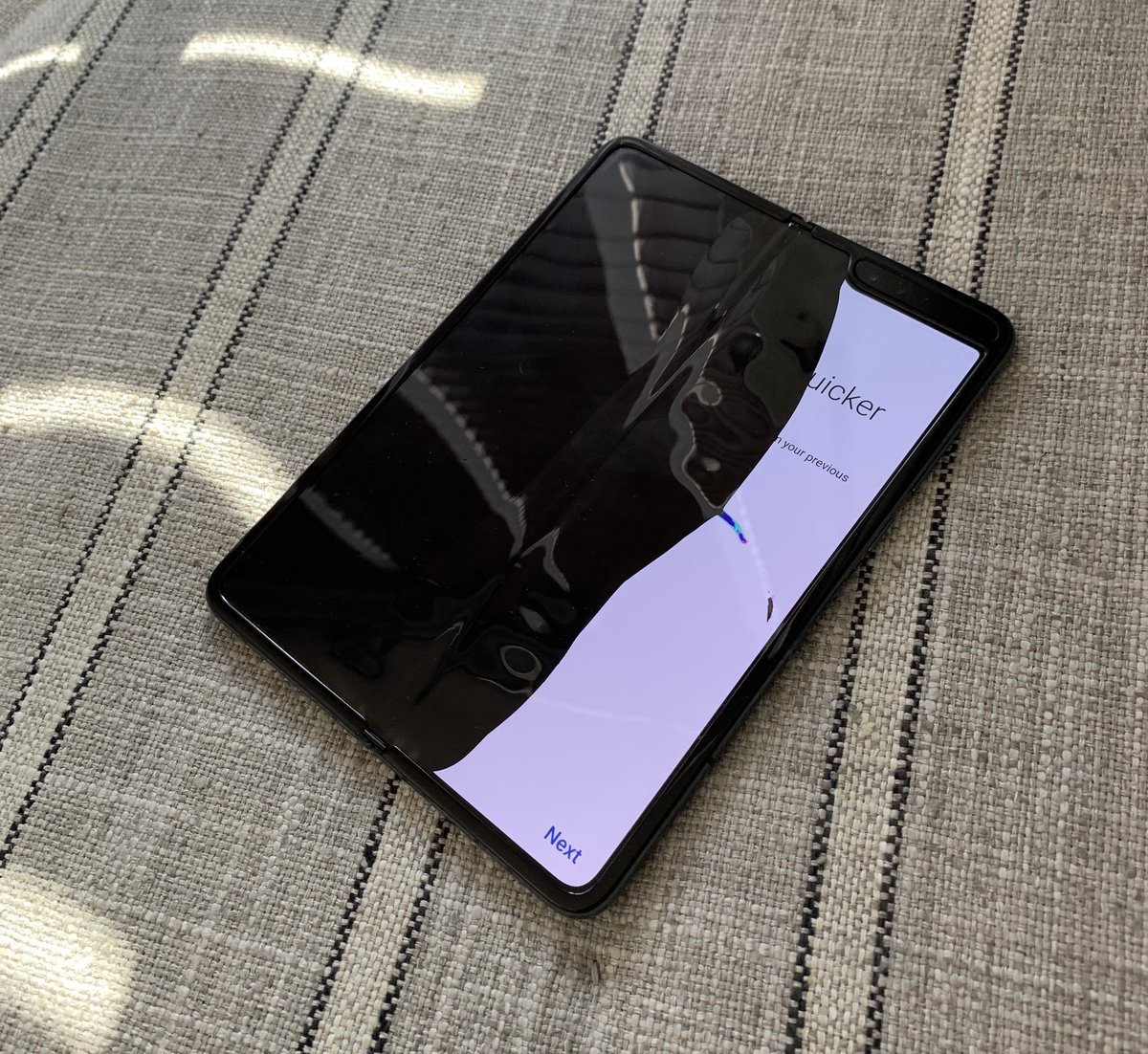
Samsung’s ambitious smartphone — Galaxy Fold, which was recently launched as the company’s first foldable smartphone, was about to go on sale this week but it has now been postponed.

After the smartphone was provided for early access to select reviewers, the phone’s display issues started emerging within a day or two. Based on that feedback, the company postponed the planned launch of the smartphone.

Samsung Galaxy Fold Display Issue

Now, iFixit has taken down the Samsung Galaxy Fold teardown report from its portal, honoring the request of Samsung. In a statement, iFixit said that a partner provided them with a unit of Galaxy Fold and Samsung requested through that partner to take down the teardown report. The statement reads:

“We were provided our Galaxy Fold unit by a trusted partner. Samsung has requested, through that partner, that iFixit remove its teardown. We are under no obligation to remove our analysis, legal or otherwise. But out of respect for this partner, whom we consider an ally in making devices more repairable, we are choosing to withdraw our story until we can purchase a Galaxy Fold at retail.”

The report from iFixit hinted at the OLED display being at the heart of the Galaxy Fold’s troubles as it doesn’t have a protective layer like a Gorilla Glass. OLED displays are said to be very fragile such that even the smallest dust particles can cause problems. The Fold is said to have plenty of areas where dust can easily enter sensitive areas.

We don’t know yet what the reason behind Samsung wanting to take down the teardown report but whatever it may be, this doesn’t look good on Samsung’s part which is already fighting the negative impact with the failure of the initial Galaxy Fold reactions.

Read More: Samsung Galaxy View 2 renders leaked; Arriving with a 17.5-inch massive display and hinged stand

When postponing the launch of the Galaxy Fold, Samsung said that it will announce the new launch date in the coming weeks. While the new launch date has not been confirmed officially, AT&T recently revealed that the new shipping for the foldable smartphone is July 13th. However, there’s no official confirmation regarding this.

(Source)

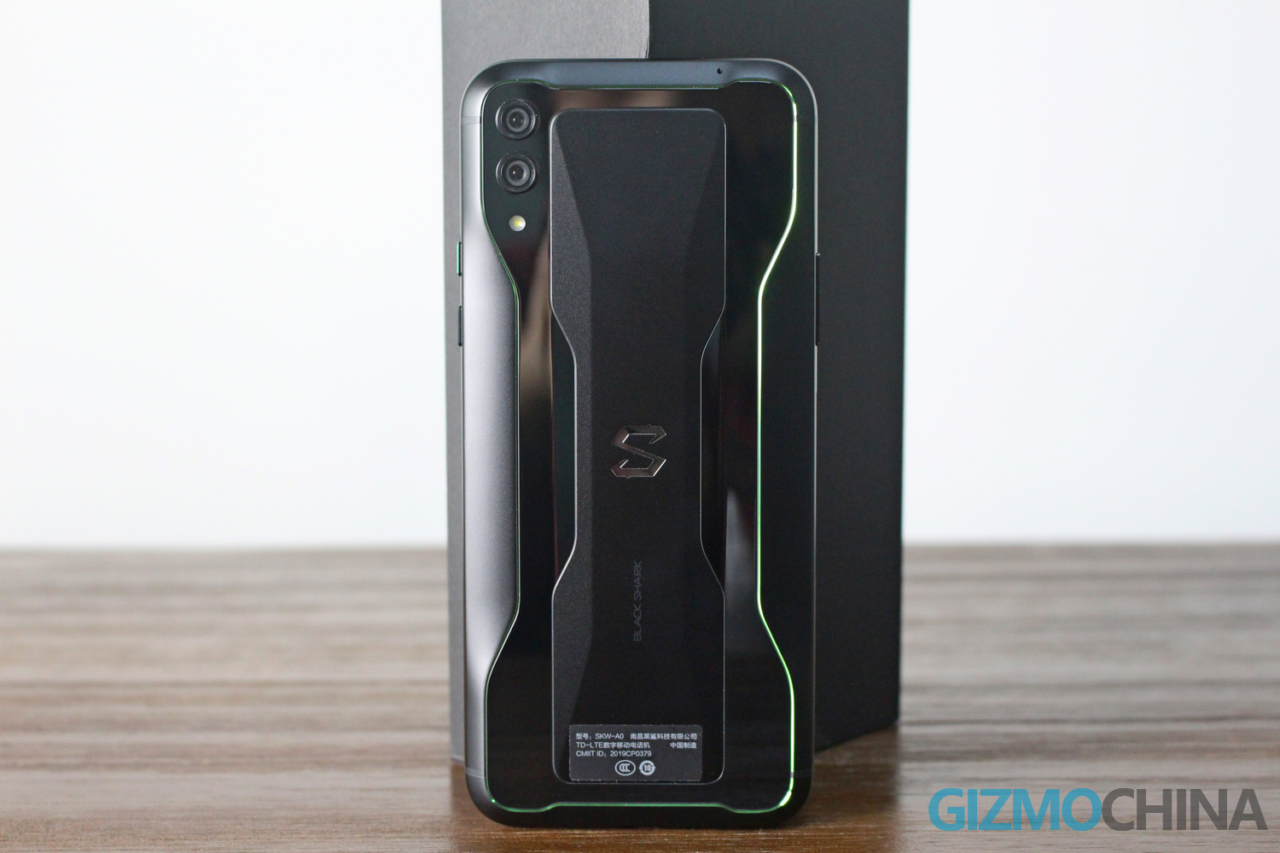
Xiaomi’s Black Shark 2 gaming smartphone performs well in the durability test

Xiaomi’s second-generation gaming smartphone — Black Shark 2, has landed in the hands of YouTuber JerryRigsEverything and now we have the information about the phone’s durability based on the tests done by the YouTuber.

The smartphone has its front and back panel with a glass layer while the body is made up of metal with anodized finish on top and the buttons are also made up of metal. In the scratch test, it appears that while the phone doesn’t get easily scratched, but the grooves are quite prominent.

Because of the metal build, the smartphone passes through the bend test. Even when the pressure is applied, the phone hardly bends, thanks to the better structural integrity because of metal build.

The phone comes with dual back camera sensors, which are protected by a layer of scratch-resistant glass. As for the display, in the heat test, it took around 20 seconds before the screen started turning white, but seems like it never fully recovered.

Black Shark 2 rear panel

As for the specifications, the Xiaomi Black Shark 2 comes with a 6.39-inch AMOLED 1080×2340 HDR display featuring a pressure-sensitive system for mapping the buttons on its sides. The device is powered by a Qualcomm Snapdragon 855 Soc, 8/12GB RAM and a vapour chamber cooling system for keeping its temperature low while in gaming mode.

Read More: Master Lu Q1 2019 Best Performing Smartphones: Xiaomi’s Black Shark 2 steals the show

The phone has a 48MP f/1.75 0.8μm primary camera paired with a 12MP f/2.2 telephoto lens with 2x optical zoom. On the front above the display is a 20MP 0.9μm f/2.0 sensor covered with a 5P lens. Running on Android 9 Pie OS, the phone embeds a 4,000mAh battery with 27W fast charging.

(Source)

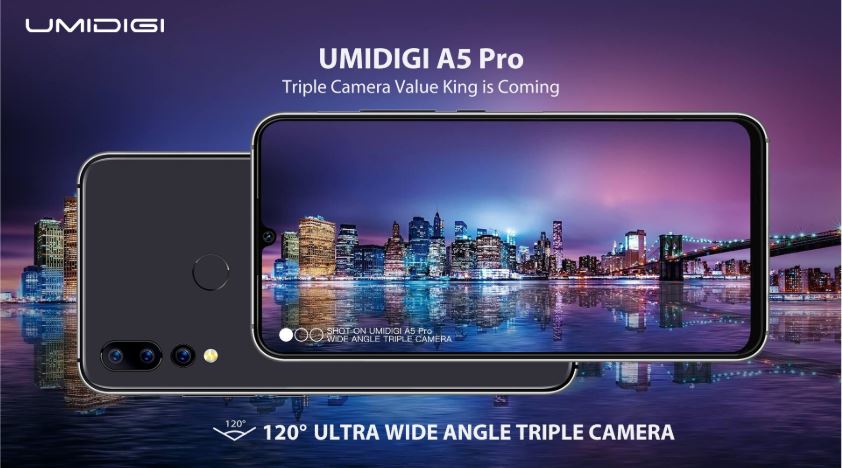
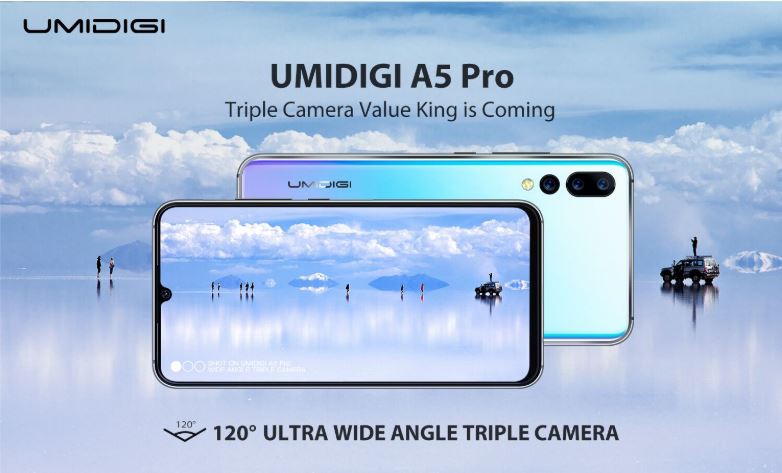
UMIDIGI A5 Pro with Ultra-Wide triple camera coming soon for $150

UMIDIGI, a Chinese smartphone maker is coming with a new Ultra-Wide triple camera smartphone for $150 – UMIDIGI A5 Pro. After announcing two premium camera smartphones – UMIDIGI S3 Pro and UMIDIGI F1 Play last month, now, the successor of UMIDIGI A3 and A3 Pro will debut next week. It would be another entry-level smartphone under affordable A-series.

The smartphone is expected to bring amazing features along with improved camera and processor. It will be the world’s first cheapest smartphone to feature 120° ultra-wide angle triple lens with LED flash. On the front, there will be an 8-megapixel camera for selfies. A rear fingerprint sensor is also encased for faster authentication as appeared in the image.

The new smartphone will have a high screen-to-body ratio as like of OnePlus 6T and UMIDIGI S3 Pro. Moreover, the device carries 6.3 inch IPS FHD+ display, 32GB Internal storage and a 4150 mAh battery. The full view display will facilitate users with a broader viewing experience. Whereas, Octa-Core processor powers it, and is coupled with 6GB RAM and 128 GB internal storage.

Users would be delighted to get hands-on the beautiful ‘Breathing Crystal’ gradient coloured device. UMIDIGI is launching the A5 Pro globally with a giveaway by next week. Users can keep an eye on the UMIDIGI official website to keep posted about the giveaway details.

Huawei P Smart Z fresh render reveals notch-less display, two-tone design and pop-up selfie camera

Few hours ago, the Dutch-based MobielKopen publication had shared the leaked renders and specifications of the upcoming Huawei P Smart Z smartphone. What’s interesting about this phone is that it is the company’s first phone to features a notch-less display as well as a pop-up selfie camera. Now, reliable tipster and industry expert Evan Blass has shared high-resolution official render of the same phone to give a clearer of its design.

The new render shows that there are three attractive things about the design of the Huawei P Smart Z. First, it features a large-sized display without a notch. It allows the phone to offer a very high screen-to-body ratio. Second, it is equipped with a pop-up selfie camera. Lastly, the rear panel of the P Smart Z sports a two-tone design like the Google Pixel phones.

The first-generation Pixel phones had the fingerprint scanner placed in the upper shiny portion of the back panel. However, on the Pixel 2 and Pixel 3 series, the size of the shiny portion was reduced, and the fingerprint scanner was placed on the matte potion on the rear panel. The Huawei P Smart Z’s two-tone design is similar to the original Pixel series. A dual camera setup with LED flash and a fingerprint scanner is placed in the upper glossy portion whereas the matte portion is almost barren as it features only a Huawei logo at the bottom-left corner. The volume buttons and power key are placed on the right edge of the smartphone.

Huawei P Smart Z Renders by Evleaks

Huawei P Smart Z Specifications and Price

The Huawei P Smart Z is a big-sized phone since it measures 163.5 x 77.3. Its thickness is 8.9mm and it weighs 197 grams. The handset houses a 6.59-inch IPS LCD display that offers full HD+ resolution of 1080 x 2340 pixels and 19.5:9 aspect ratio. The Kirin 710 SoC is present under the hood of the device. The chipset will be supported by 4 GB of RAM. For storage, the P Smart Z will offer users with a native storage of 64 GB and a microSD card slot.

The P Smart Z features a pop-ups selfie camera of 16-megapixel with f/2.0 aperture. The dual camera setup has f/1.8 aperture 16-megapixel main sensor and an f/2.4 aperture 2-megapixel depth sensor. The handset will be drawing power from a 4,000mAh capacity battery.

The P Smart Z phone will boot to EMUI 9 based Android 9 Pie. It is speculated to release in Europe with a price tag of 210 euros (~$234). There is no confirmation on the launch date of the smartphone.

(source)

Huawei P30 Pro Camera Review: We test out its incredible camera performance!

A few days ago, Huawei P30 Pro, one of the best flagship smartphone in the first half of the year, was released worldwide. Huawei P series is famous for its excellent camera module, and the DxOMark Mobile score of Huawei P30 Pro has reached up to 112, which is the best score till date. I got the P30 Pro a couple of days ago, and it was so exciting to test the camera.

So, let’s check out the Huawei P30 Pro camera review! In case you missed, we have already reviewed the Huawei P30 and the Huawei P30 Pro models separately. In this post, we’ll focus on reviewing its powerful camera module.

First, let’s have a look at the indoor samples.

These images were shot in low light and the sample with HDR mode turned on is noticeably brighter than the regular mode. The wide-angle image with the normal mode is also brighter than the normal image. Take a look at the second image, there’s a slightly purple cast. Although the brightness is different, the details are rendered well.

I do like the bokeh performance. I focused on the sashimi dish, and the background bokeh is noticeably good. So much that the sashimi looks delicious in the image!

[envira-gallery id=”249762″]

At 2x zoom factor, the details of images still came out well. However, at 5x zoom, it’s not so clear. Actually, compared to the other images with 5x zoom factor, I think the dimly lit room didn’t help much with the amount of details in these samples.

[envira-gallery id=”249769″]

Overall, the Huawei P30 Pro camera performs well in low light, and the HDR mode renders are brighter than the normal mode.

Look at the outdoor images at night.

Looking at the McDonald’s neon sign, the normal and HDR images are overexposed. Compared with them, the night mode image keeps the original color and has more details. What’s more, the control of noise reduction is better than the other two modes.

[envira-gallery id=”249774″]

At 5x magnification, the detail retention and the color are good. The Huawei P30 Pro camera amazes me because of the color reproduction and detail retention, even at the 10x zoom factor. I find that this camera module can triumph over most of the flagship smartphone camera modules.

[envira-gallery id=”249778″]

The sample below was shot in daylight.

Looking at the sky color, the normal mode image has a warmer tint, and the HDR mode is inclined to its original color. The performance of magnification is really good in ample lighting conditions. The Huawei P30 Pro camera is capable of capturing more details and keeping the noise levels low.

[envira-gallery id=”249782″]

Take a look at the 5x zoom factor and 10x zoom factor samples below, the images are clear and sharp. And the difference between normal mode and HDR mode is in the hue and brightness. The HDR mode is brighter than the normal mode.

[envira-gallery id=”249787″]

Look at the super macro sample. The image is taken in the close distance, and it still shows more details. The image is more saturated than in reality.

[envira-gallery id=”249792″]

Selfies look nice too, and they are sharp and detailed. There are three adjustable options in the portrait mode, and I took selfies in the default portrait camera mode. Noticeably, the skin is smoother, the face is thinner and the facial color has a warmer tone. I like the portrait mode, but if you like natural and real images, you should take selfies from its normal mode.

[envira-gallery id=”249795″]

The rear panel of Huawei P30 Pro comes with 40MP wide angle lens with f/1.8 aperture, 20MP ultra wide angle lens with f/2.2 aperture, 8MP telephoto with f/3.4 aperture and HUAWEI Time-of-Flight (TOF) camera. And there is a 32MP front-facing camera with f/2.0 aperture.

Overall, I do love the Huawei P30 Pro’s camera module. The performance of zoom magnification, background bokeh, detail retention, and noise reduction is incredible. No doubt the P30 Pro deserves the number one spot in the DxOMark ranking.


Huawei’s EMUI OS crosses 470 Million Daily Active Users

Huawei has been on a roll lately, quickly climbing up to become the world’s second largest smartphone company. It has managed to sell hundreds of millions of smartphones worldwide in the past couple of years. All of the company’s smartphones (including Honor phones) run on its own EMUI OS based on Android. With the tremendous growth of its smartphone division, EMUI has also seen a growth spurt.

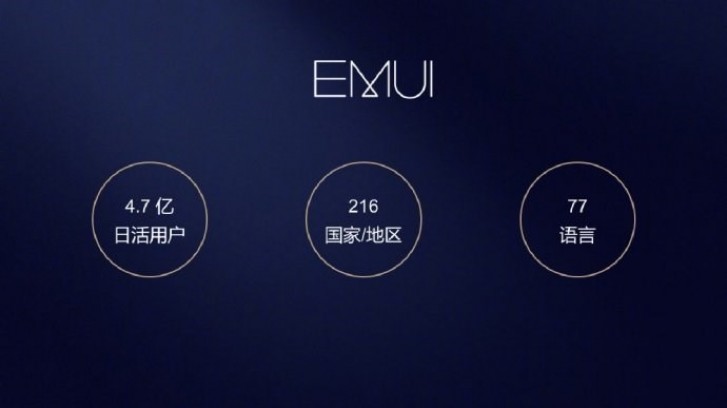
At a media event yesterday Huawei’s President of Consumer BG Software, Dr. Wang Chenglu revealed that EMUI has surpassed 470 Million Daily Active users! As of now, the OS is available in 77 languages and is available in 216 regions.

After giving some key figures of its EMUI OS, Dr. Wang further revealed Huawei’s commitment to the system. He mentioned some of the significant upgrades in the recent editions of the EMUI OS, like GPU Turbo in EMUI 8.2, Link Turbo with EMUI 9.0, and even its new Huawei Ark Compiler in the EMUI 9.1 update. In the presentation, he further revealed the development of the OS over the past few years.

With Huawei shipping over 59 million smartphone units in the first quarter of this year, the company is set to break the 250 million total shipments target for the year. As more and more Huawei and Honor smartphones make it to the market, expect EMUI to grow pretty quickly in the coming years.

(Via)