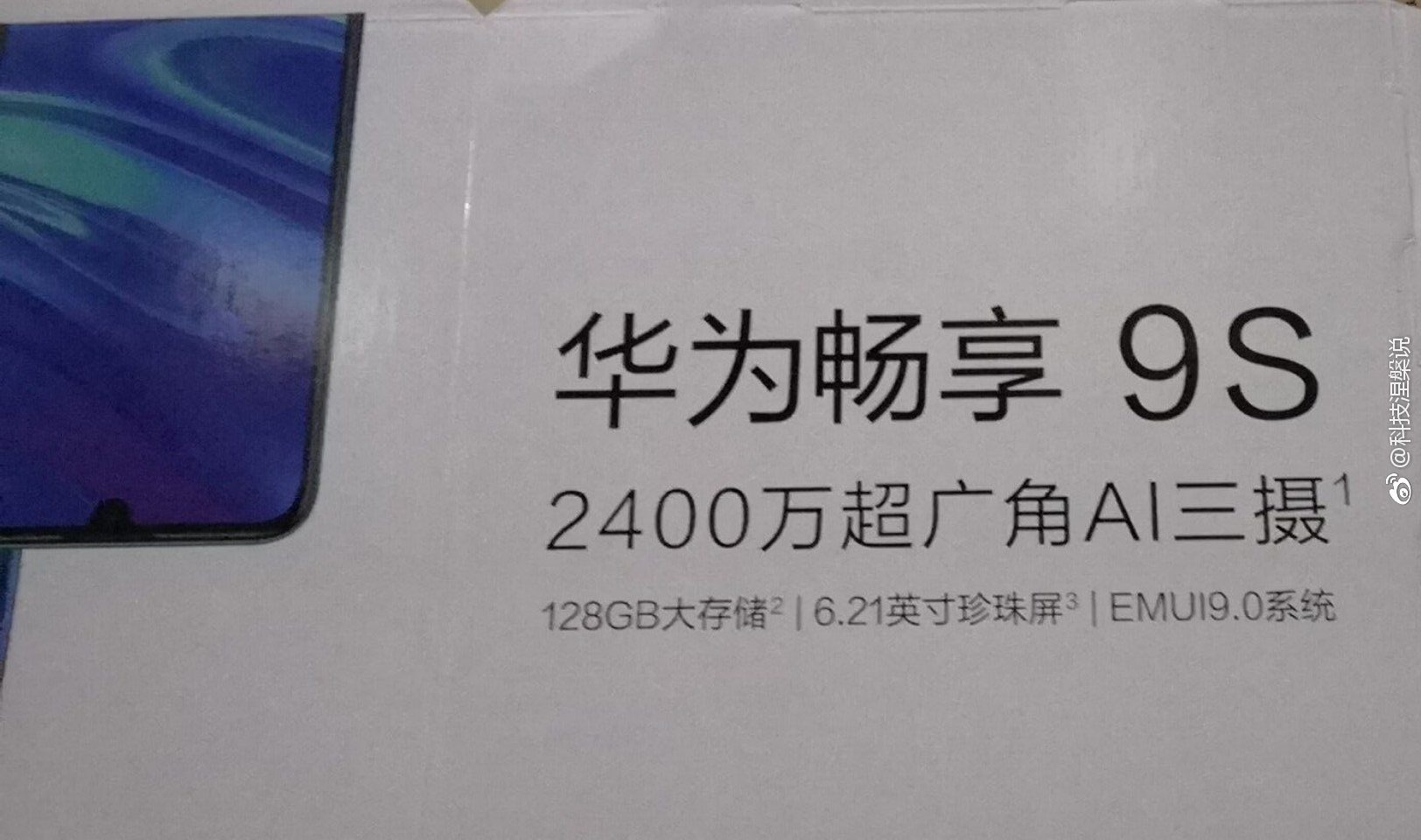
The Huawei Enjoy 9 is a mid-range phone that was released in December 2018. Now a leaked poster has revealed it is set to get a new sibling called the Enjoy 9s.
The photo was shared on Weibo and it shows the upper part of the phone’s display and a few key specs. The Huawei Enjoy 9s will have a Dewdrop display just like the Huawei Enjoy 9. There is no mention of the screen resolution but the screen is 6.21-inches in size.
The poster also reveals the phone will come with an AI triple camera setup one of which is a 24MP ultra-wide sensor. The Enjoy 9s will have 128GB of storage and run EMUI 9.0 out of the box.
Relaxing is another mode of recharging yourself. For many people, relaxing is a word for listening to music; they always keep hogging for good earphones. Although there are many premium and excellent earphones available in the market but only a few fall in the category of being affordable. Today, Alldocube F40 Quad Driver has appeared as best affordable yet powerful earphones available in the market. The new headsets carry three dynamic drivers making the sound more deep and realistic. Similarly, there are many other refinements which make it sound more pragmatic.
Mainly talking about the Alldocube F40, it carries three dynamic drivers and one balanced armature to output a wide range of sound frequencies. All these non-destructive 4 frequency division technology has its own functionality in the earphones as detailed below:
NanoFiber Diaphragm Driver Handles The Bass
Composite Diaphragm Driver Responsible For The Midrange
Graphene Diaphragm Driver Handles The Treble
Exclusive Custom FLT K3 Handles Ultra High Frequency
The new accessory is quite affordable if we compare its features to the other competitors. For example, a similar model from 1more can burn a hole of $200 in your pocket. While you can get the same features at an affordable price of $71.99 with Alldocube F40 Quad Driver Earphones. Despite the facts, the company has revealed a new video of the accessory, which you can check below:
Its design will have a natural feel as the company is working to bring a unique and elegant pattern inspired by nature. Further, the device will carry the anti-oxidation copper core around the neck to keep vibration isolated from your ears. Users can use it with any Android or iOS devices such as tablets, laptops, and smartphones. It just needs a 3.5 mm headphone jack to fit in the port for smooth functioning of the earphones.
It would be better if you could use the earphones with Alldocube X tablet as it carries AKM HiFi sound chip. Its huge impressive display can make the experience more indulging. Although, users can buy the Alldocube F40 earphones for the price of $71.99 from Aliexpress once it gets available.
After learning about various new advancements at MWC 2019, Ulefone is here with a slew of new smartphones. Ulefone always stuns customers with different kind of devices. Recently, they have announced the Ulefone Power 3L with a huge 6350 mAh battery. In order to cater to a different set of users, the Chinese smartphone maker keeps on evolving new devices with a different set of features. Today, Ulefone S11 has leaked in a video flaunting its design and other specifications. just before its official launch.
As per the new video of Ulefone S11, the new device carries information about the triple rear camera module. If we believe the video, then it is sure that its predecessors purely inspire the new Ulefone S11 design. It is carrying the heritage of perfectly designed Ulefone S series.
Although, we can see a triple camera sensor along with an LED flash on the rear side of the devices. There’s also a speaker grill present on the bottom side of the device along with the Ulefone branding. Its camera module is firmly embedded into the middle of the device as like of various high-end devices. Ulefone S11 carries a gradient color on the rear side which is giving it a premium. From the video, it appears that the S11 will carry a glossy back which will surely make it more appealing.
On the front side, the device hosts a 6.1-inch ultra waterdrop display with a earphone grill on the top. Its huge display is undoubtedly going to provide users a vivid viewing experience. Ulefone S11 has got a rounded display with “chin” bezels on either side of the device
Moreover, we can see the User Interface of the device which seems to be fully refined. The physical keys can be seen on the right of the device.
Additionally, the video also showered some light on the hardware specs. Ulefone S11 will come with 6.1 inch HD display carrying high screen-to-body ratio. It is powered by an MT6580 processor and carries 1 GB RAM with 16 GB ROM. In the absence of a fingerprint sensor, the device incorporates face-unlock for secure and fast authentication. It carries NFC and Google Pay integration feature along with the usual WiFi, Bluetooth, and WiFi direct connectivity options.
In the camera section, the device carries a triple rear camera module of 12-megapixels + 5-megapixels + 5-megapixels sensors. Its camera devices are said to carry the ArcSoft algorithm for more clear and vivid photos. For selfies, Ulefone S11 comes with an 8-megapixel sensor.
It runs on the Android 9.0 Pie and will come in Black, Blue, and Twilight color options. The company has not stated anything regarding its launch, but we expect that it could happen soon.
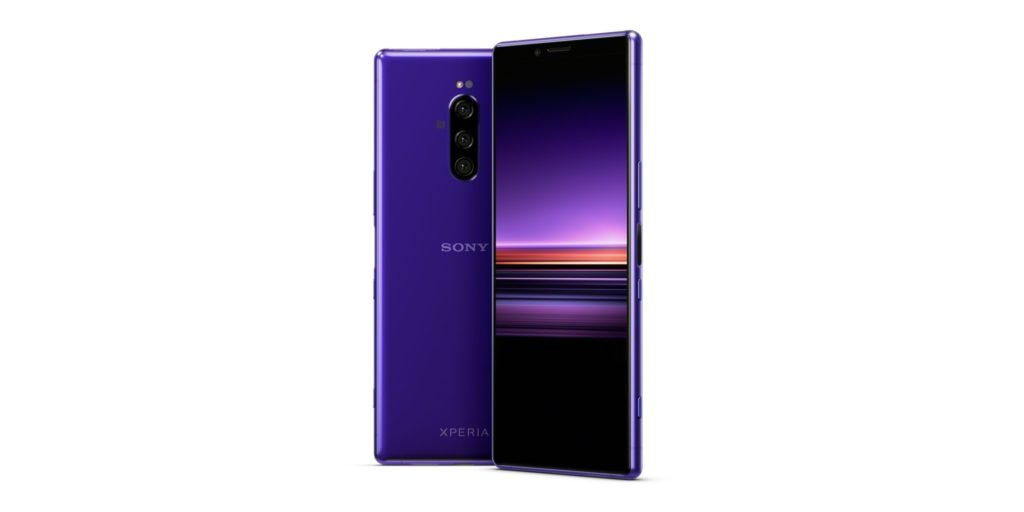
Sony has garnered a towering reputation as a supplier of camera sensors used on many smartphones, including flagships till date. Despite this, the company has never really released a smartphone with powerful cameras that could compete with the best ones around in the past few years. Sony’s senior manager of global marketing, Adam Marsh, has now revealed the reason for this.
The Sony exec disclosed in a recent interview with Trusted Reviews that a rivalry between the mobile and Alpha mirrorless camera divisions of the company was responsible for the disappointing results. Marsh stated that “Even though we’re one company, there are still sometimes barriers that Alpha doesn’t want to give Mobile certain things because all of a sudden you have the same as what a 3,000-pound camera’s got.” He further disclosed that the barrier is gone to some extent, as the camera division now acknowledge that having a smartphone and camera that gives you the same experience was a good thing.
Marsh also disclosed that the change is connected to a recent reshuffle that saw Kimio Maki, formerly head of the Alpha division, take over as the head of Sony Mobile. The new mobile chief reportedly halted work on the expected Xperia XZ4 with the aim of revamping the company approach to smartphone design. The new approach saw Maki fostering collaboration between the various brands and the mobile division. As a result of this, experiences are now being shared across the Cybershot, Alpha and Xperia brands, the executive explained. He equally touted the possibility of software features from the Alpha cameras to come to the Sony Xperia line. Perhaps, Sony may just be the first to give us that DSLR camera experience on a smartphone we all crave for. Will we ever see that happening?
When the Redmi 7 showed up on TENAA earlier this week, the listing revealed it will come with an octa-core processor clocked at 1.8GHz. There have been guesses as to which processor that is and now two hands-on videos have revealed the chipset under the hood.
The hands-on videos are from the Vietnamese YouTube channels Tony Phùng Studio and Dương Dê. The former is actually a comparison between the Redmi 7 and the Redmi Note 7 but both videos reveal the phone is powered by the Snapdragon 632 as shown by the AIDA64 app.
https://youtu.be/2-G3RnAuhSM
The 14nm Snapdragon 632 has eight Kryo 250 cores clocked at 1.8GHz and an Adreno 506 GPU. It has a Snapdragon X9 LTE model and a Hexagon 546 DSP. It is the same chipset inside the Honor 8C. The second video shows the Redmi 7 scored 101949 points on AnTuTu.
With respect to design, the Redmi 7 in both videos is the blue variant. It has a waterdrop notch but its bezels are thicker than that of the Redmi Note 7. It also has a triple card slot which allows you to use a MicroSD card and two SIM cards at the same time.
The dual cameras are arranged vertically with an LED flash below the setup while a fingerprint scanner sits in the middle. The Redmi 7 also has a MicroUSB port at the bottom and an audio jack at the top.
If you thought that the long-awaited Redmi Note 7 Pro is the only 2019 upper-midrange that really deserves attention, you were wrong. Today, Oppo and Meizu announced their perfect answer to the new Xiaomi’s best-buy and they look impressive if compared to their prices. We are talking about the Oppo F11 and the Meizu Note 9: two incredible rivals that not everyone would easily expect this year. Which of these three devices can really be the dominator of the midrange segment? You can discover it and learn about all the differences between these handsets by going ahead with this hard but exciting comparison.
Oppo F11 vs Meizu Note 9 vs Xiaomi Redmi Note 7 Pro
Dual 48 + 5 MP f/1.8 and f/2.4
16 MP f/2.0 front camera
Dual 48 + 5 MP f/1.7
20 MP f/2.0 front camera
Dual 48 + 5 MP f/1.7 and f/2.4
13 MP front camera
BATTERY
4000 mAh, fast charging with VOOC 3.0
4000 mAh, fast charging with mCharge
4000 mAh, Fast Charging with Quick Charge 4
ADDITIONAL FEATURES
Dual SIM slot
Dual SIM slot
Hybrid Dual SIM slot
Design
Just choose depending on your tastes, because each of these phones offers a futuristic design with a waterdrop notch and a wonderful back available in gradient color variants. I would personally discard the Oppo F11 due to its bigger dimensions making it less usable with one hand and harder to keep in a pocket. Instead, I would award the Redmi Note 7 Pro for its water resistance. Despite its specs sheet does not mention any IP certification, teardowns revealed that it is indeed water resistant and the company confirmed it.
Display
We discarded the Oppo F11 from the design comparison because of its dimensions, but that goes in favor of the display. This device has a huge 6.53-inch panel that is much more comfortable for advanced users, gamers and productivity. Further, it comes with the LTPS technology that should help to deliver a better experience. Oppo F11 wins the display comparison, but given that we are talking about mid-rangers and usually there are very marginal differences between the displays of midrange phones, do not give too much importance to this.
Specs & Software
You get exactly the same hardware department for the Meizu Note 9 and Redmi Note 7 Proo: a Snapdragon 675 chipset paired with up to 6 GB of RAM and up to 128 GB of internal storage. Instead, Oppo F11 comes with a slightly less impressive Mediatek Helio P70. So, just like displays, it will even hard to notice the differences between the speed and reactivity of these phones, in every scenario. In each case, you get high-end performances as these devices are equipped with an upper-midrange SoC that is able to handle every task in a very good way. I would personally go for the Redmi Note 7 Pro because it is the only one to boast a micro SD slot allowing to expand the internal storage. Most of the people like its customized user interface more, even though this does not count so much.
Camera
The new Samsung’s ISOCELL Bright GM1 sensor with its resolution of 48 MP became mainstream among midrange devices and it allows a stunning level of detail even on phones that are a lot far from top camera phones, for both performances and prices. We still did not test all the cameras of these handsets, but we do not expect significative differences in photo quality, regarding the rear camera setup. What will probably change more is the selfie experience, in which Oppo F11 and Meizu Note 9 should offer something more. Oppo F11 may be the real selfie master here.
Battery
The huge batteries of these devices are probably what will distinguish these devices from most of their concurrence. All feature a huge 4000 mAh unit and all support a fast charging technology. Judging from the specs on the paper, Meizu Note 9 and Redmi Note 7 Pro may last slightly more than Oppo F11 due to their smaller and more efficient displays. But the software optimizations will have the last word here.
Price
With incredibly similar specs sheets, what makes the difference is the price, and this is a point for the Redmi Note 7 Pro and Meizu Note 9. They start from about €200/$225, while Oppo F11 starts from €250/$280. Overall, I would go for the Redmi Note 7 Pro.
Meizu went officially with the affordable and premium mid-range Meizu Note 9 today in China. The device happens to be the second model after the Redmi note 7 Pro to feature Qualcomm’s latest Snapdragon 675 chipset. until recently, Meizu phones hardly feature Qualcomm chipset so the Meizu Note 9 is a special phone. This is the most powerful Qualcomm chipset we’ve seen on a Meizu phone since the company settled its dispute with the US chipmaker.
On AnTuTu, the Meizu Note 9 recorded a lofty score of 180,381 which is pretty impressive for a mid-range model. The score is even higher than the AnTuTu score which the Snapdragon 675 posted when it was benchmarked a few months back. Back in January, AnTuTu posted a score of 174,402 points for the SD675. Thus, this new score is plain surprising.
We can’t tell why the score is higher now but it is possible the SD675 chipset onboard the Meizu Note 9 is clocked at the highest frequency. The Snapdragon 675 chipset is surprisingly more powerful than the Snapdragon 710 which had an AnTuTu score of 170K. It is equally more powerful than the Snapdragon 670 SoC which managed to score 150,000 points. In addition, Meizu’s Hyper Gaming technology for optimized gaming experience through GPU acceleration is also on the Note 9. This may also be responsible for the higher benchmark score.
As a reminder, the Meizu Note 9 features a 6.2-inch IPS LCD display with a waterdrop-style notch. It adopts the 19.5:9 aspect ratio with a screen ratio of 89.23%. The display has a full HD+ resolution of 1080 x 2244 pixels. The device comes with 6GB of RAM with 64 GB/128 GB storage options which can’t be expanded. There is a big 4000Ah battery onboard with support for 18W mCharge rapid charging technology. Meizu even included an 18w charger in the retail box. The phone runs Android 9 Pie OS customized with the latest Flyme 7.2 UI.
Today Xiaomi announced its new mid-range phone, the Redmi Note 7, is now available in Spain. It also launched the Mi Smart Sensor Set in the country.
The Redmi Note 7 first launched in China and was then unveiled in India last week. Now it has landed in Europe and Spain is its first destination.
The Redmi Note 7 has a 6.3-inch FHD+ notched display and is covered with Gorilla Glass 5 on both sides. It has a waterdrop style notch which is home to the selfie camera. Powered by a Snapdragon 660 processor, it has 3GB of RAM and 32GB of storage.
The Redmi Note 7 has a 48MP camera on its back which is paired with a 5MP depth sensor. Its front-facing camera is a 13MP sensor. The phone has a rear-mounted fingerprint scanner and an IR blaster. Its battery capacity is 4000mAh and it has support for Quick Charge 4.
The phone also has a USB-C port at the bottom, an audio jack at the top and Bluetooth 5.0. It is available in Neptune Blue, Red Nebula, and Space Black.
The Redmi Note 7 will sell for €149 (probably for a limited time) instead of its original price of € 179. It will go on sale on March 14 at 1 pm (local time) and be available on Mi.com and AliExpress Spain. You can visit the official site to register to be notified.
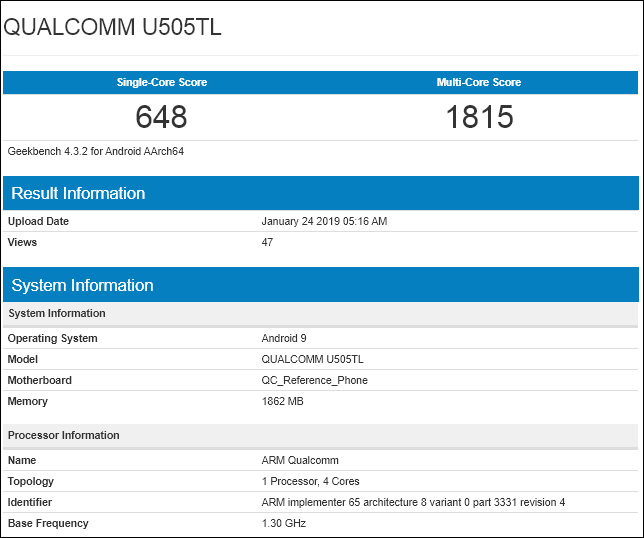
Recently, Twitter leakster Roland Quandt had reported that Qualcomm was working on a new super low-end chipset that would power Android Go smartphones. The chipset which is known as Qualcomm Mobile 215 (QM 215) has now made an appearance on GeekBench aboard what is apparently a test model.
The GeekBench listing confirms a few details of the low-end processor as revealed earlier by Mr Quandt. These details include a Quad-core CPU clocked at 1.3 gigahertz and a GPU at 650 megahertz. This is almost on par with the present entry-level Snapdragon 410 and 425 chipsets. The chipset is basically for phones packing 1/2GB RAM and 8/16GB of storage and running Android Go. The test phone runs Android 9.0 Pie and is perhaps one of the next-gen Android Go devices.
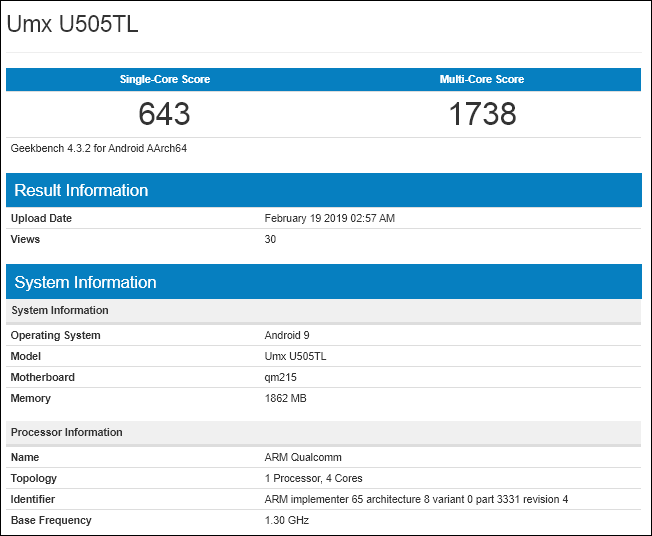
A second GeekBench listing for a device with the codename UMX U505TL was also spotted. The device is powered by the QM215 chipset, paired with 2GB of RAM. It equally runs on Android 9.0 Pie, Android Go version obviously. The processor will likely bring more energy efficient to the low-end models. Apart from that, the processor may likely be cheaper and thus could bring down the pricing of Android Go phones in emerging economies such as India, South America, Africa etc.
Qualcomm is yet to officially announce the QM215 but we expected the US fabless chipmaker to do that soon.
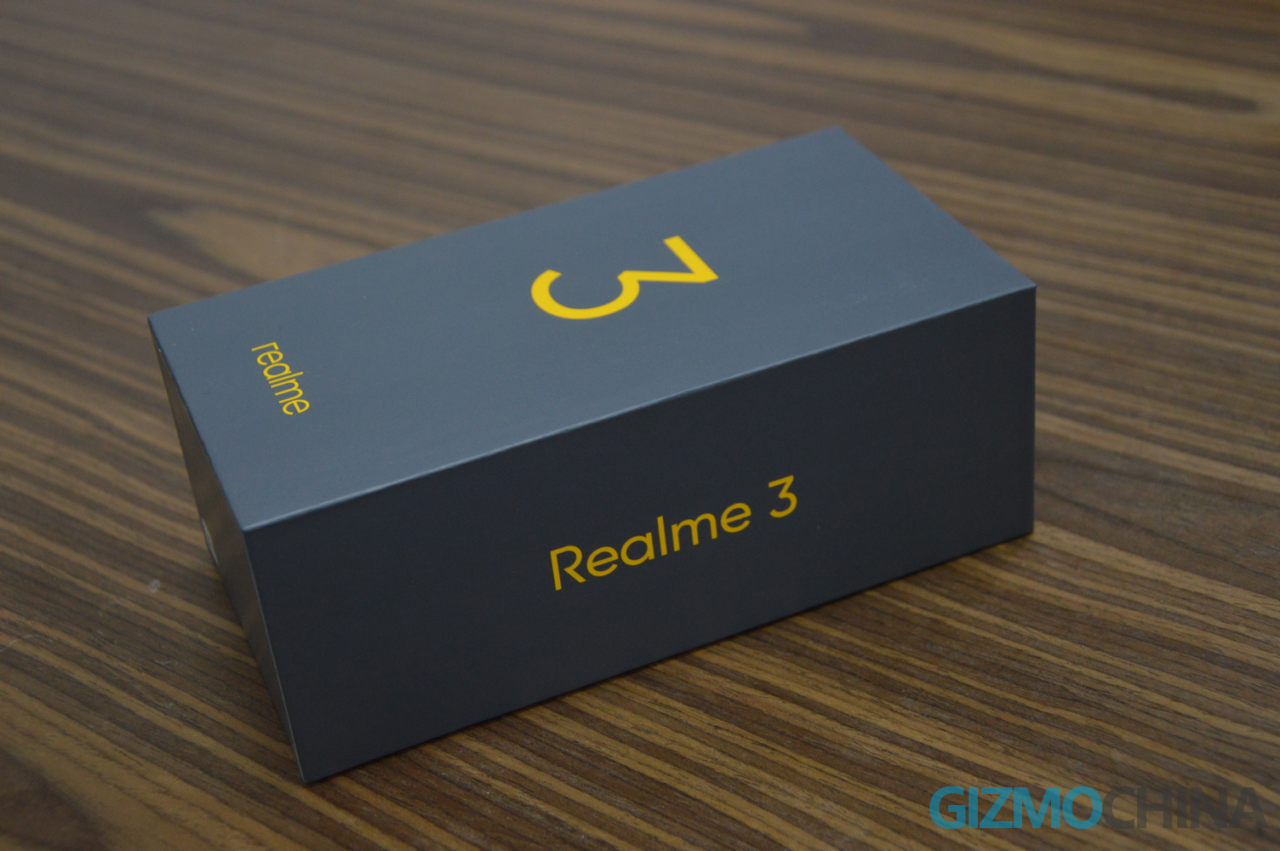
Realme, the independent mobile phone brand of OPPO, announced a number of smartphones in 2018 like Realme 1, Realme 2 and Realme 2 Pro. These smartphones have clicked well with people living in Southeast Asia. Now, the latest release, Realme 3 is finally out. Let’s see what the phone has to offer in the mid-range segment.
Realme 3 Review Video
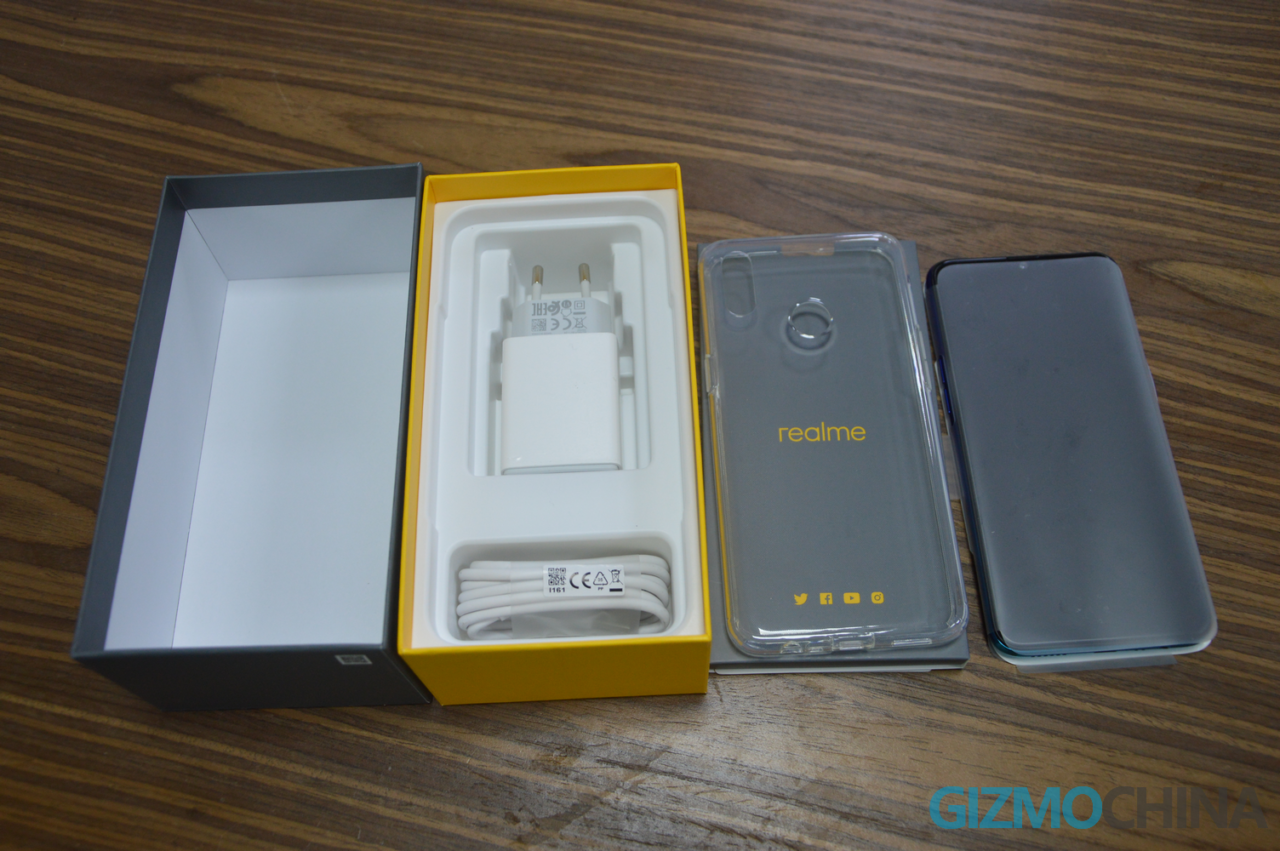
Contents of the box
The phone ships with a charger, USB cable, SIM ejector pin, and a soft TPU case.
Realme 3 Design
The Realme 3 has adopted a unibody design which has a pleasant feel to touch. The back is made out of plastic but comes in a premium gradient finish. I have got the gradient blue variant for review and the transition from dark blue to light blue is seamless and natural.
On the back, Realme 3 ships with dual cameras and a flashlight set up vertically on the left top corner. On the left bottom corner, there’s the realme logo. The phone also comes with the fingerprint sensor on the back of the device. For me, I prefer a rear placed fingerprint scanner as the sensor’s placement is convenient for my index finger to touch. What’s more, the Realme 3 carries support for facial unlock too.
[envira-gallery id=”239534″]
Like most smartphones, the handset’s speaker is placed at the bottom. The charging port and 3.5mm earphone jack are at the bottom as well. From left to the right lie the headphone jack, microphone, MicroUSB port, and speakers. I do like the fact that the phone ships with a 3.5mm earphone jack, as it gives me a choice to use Bluetooth earphones or a wired headset. For those who hate charging their Bluetooth headphones, a wired option is always a welcome addition
However, it is a pity that the box doesn’t come with headphones. But it is not surprising given that’s the standard these days. Unlike Vivo smartphones, OPPO places the volume buttons on the left edge side, where you also have a SIM card slot. The power button is placed on the right side.
[envira-gallery id=”239542″]
Realme 3 Display
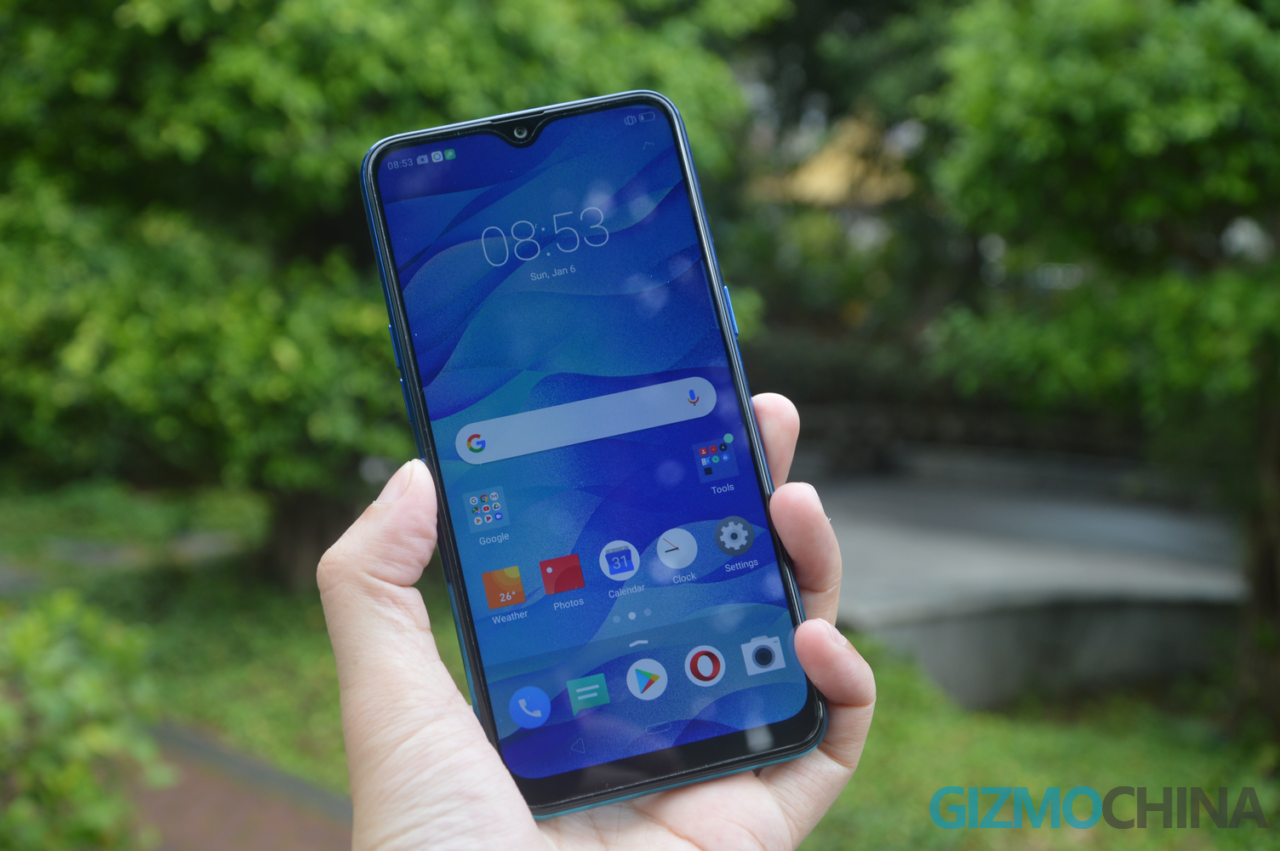
Realme 3 comes with 6.22-inch of HD Full screen with Gorilla Glass 3, having the resolution of 720 x 1520 pixels. The display isn’t as sharp or detailed as higher-end models, but it does offer good colors and viewing angles. It comes with 19:9 aspect ratio, and offers a comfortable experience viewing the screen. So, most of you won’t miss a full HD display at its price.
With the popularity of the notch rising, most smartphones have followed notched design liked the iPhone X, or went with a water drop notch. The Realme 3 adopts the water drop screen which is like the OPPO R17 Pro. Compared to the big notch, I prefer this screen better because it’s much more compact. But there’s one weakness with this type of display — there’s no notification LED light on the Realme 3.
Realme 3 Performance
Powered by the 12nm Helio P70 processor and Mali-G72 MP3 GPU, the phone comes with 4GB RAM and 64GB internal storage. What’s great is that you can further expand this storage via MicroSD. The Helio P70 chipset, which performs close to Qualcomm Snapdragon 660 processor, ensures the Realme 3 is smooth and stable. You won’t find any visible lags or issues in performance, all thanks to this chipset.
Realme 3 could be described as a middle-range smartphone and the benchmark scores reflect this. It scores around 130,500 on the AnTuTu benchmark. The benchmark scores of most SD660 smartphones are about 130K, so the Realme 3 can be considered as good as an SD660 phone. In everyday use, launching applications and running tasks work well. Everything is smooth and quick. The 4GB of RAM is enough for daily use. I often launched several applications one by one, and everything was stable. As a budget handset, the 64GB of internal storage is fine with the external storage expansion option.
[envira-gallery id=”239546″]
CAMERA
The Realme 3 is equipped with 13MP+2MP AI dual rear cameras with f/1.8 aperture and a 13MP selfie camera with f/2.0 up front. There’re plenty of camera modes on the device but I still use prefer to stick to the auto mode as usual. The main reason being, the photos in auto mode looks sharp and detailed enough. With object recognition, the camera does a pretty good job of analyzing the subject and tweaking the great color balance accordingly. If you want to change the image’s style, you can always go for a filter.
[envira-gallery id=”239475″]
What’s more, Realme 3 features two new special modes that are marketed on the phone —Chroma Boost mode and Nightscape mode. Chroma Boost is the advanced version of HDR mode that makes the image more colorful. If you think the colors of the images taken by normal mode or HDR mode are darker than they should be, you could select the Chroma Boost to take a shot. Take a look at the comparison, the third image is brighter than the other pictures on the whole. However, the image taken by Chroma Boost is not as detailed as the image taken by HDR mode. I also took the picture with Chroma Boost + HDR mode to compare, and that turned out to be the best image of the lot. As the image is not overexposed, the details come out better than other modes.
[envira-gallery id=”239454″]
The following images are shot separately at 1x, 2x and 4x zoom. Focusing on the four words in the image, as a whole, the performance is not bad, however the photo did come out a bit blurred.
[envira-gallery id=”239483″]
The following images were shot in sunny daytime. As you can see, the pictures look great and show excellent details and focus at a close range. The background blur is pretty decent too. Also, the color balance is good. If you are going to take a picture on a sunny day, you might have to adjust the brightness in the viewfinder in order to avoid overexposure. But in general, the auto mode does pretty well on most occasions.
Take a look at the samples down below.
[envira-gallery id=”239490″]
Selfies look nice too, and they are sharp and detailed. The front-facing camera is amazing, the following images are taken separately at natural mode, smoothen mode and portrait mode respectively. Compared to the first photo, dark circles and the skin blemishes were eliminated in the second photo. As the name suggests, smoothen mode really makes my face skin smooth, even the scar beside my lips is fading. The object in focus stands out quite nicely from the background, giving it more prominence.
However, among these three modes, personally, I like the smoothen mode that makes me look like I am wearing foundation to cover the blemishes on my face. The portrait mode is good but I’m not used to giving more prominence to my face when I take a selfie. In the front-facing camera department, the performance of Realme 3 is similar to Redmi Note 7 in my view.
[envira-gallery id=”239498″]
The following photo was shot indoors (daytime).
[envira-gallery id=”239506″]
The following one is shot indoors in the evening. After zooming in, you notice that the photo isn’t really sharp. But in general, on the small screen, it looks pretty decent.
[envira-gallery id=”239509″]
The following photos were taken outdoors at night. The low-light image quality is not bad but there’s definitely room for improvement. Also, the exposure is not handled very well. For example, in the image below, the signboard lights are barely visible. In fact, Honor 8X night camera samples turned out to be better than Realme 3.
[envira-gallery id=”239512″]
The new feature on the Realme 3 is the Nightscape mode. Realme was excited to point out that its the first budget phone to feature hand-held night mode. But personally, I feel it needs a bit more work. You need to wait for at least five seconds after tapping the screen for the capture to complete. Personally, I found it hard to get a good blur-free shot in this mode.
However, if you can keep your hands steady, its definitely a must-have feature. Since the overall brightness is turned up, details can be seen in low light. You do lose a bit of color, with the addition of a little bit of noise, but on most occasions, you’d be happy with the result. It definitely gives this phone an edge over its budget competitors.
I find HDR mode pretty great too as the exposure is balanced. However, the images from the Chroma Boost mode were a bit overexposed.
The Realme 3 is running on ColorOS 6.0 version on top of Android 9 Pie, which is different from the Realme 2 model that runs ColorOS based on Android 8.1.0 Oreo. The user interface of Realme 3 is close to the Oneplus 6T. For example, go to the application page with all apps just through swiping up the screen from the grey line with the white arrow pointing upward. There is a transparent tool which is set on the right side of the screen edge, which offers you to choose between Quick Tools and Quick Apps. It is a terrific tool for me. For example, when I’m traveling and I grab the handrail with my left hand, I can use this feature to easily select the application I want to use. Sliding the screen down brings the Notification Center and the simple setup center. The phone is definitely easy to use, even with one hand.
[envira-gallery id=”239517″]
BATTERY
The Realme 3 is equipped with a large 4230 mAh battery, and it takes around 3 hours to charge from zero to full. Actually, I think the charging time is too long, but the low power consumption and large battery capacity serves me well. Battery life on this phone is quite good — no issues for daily use. You can easily go on for 1.5-2 days of moderate usage with its huge battery. It’s definitely a plus point for people who hate carrying a power bank or charger with them.
But if you compare, the Redmi Note 7 takes only around 125 minutes to charge from zero to full. Its fast charging version with 18W takes only about 103 minutes! So, despite its huge battery, 3 hours is quite long to charge completely.
CONCLUSION
The Realme 3 is priced at Rs. 8,999 ($127.00) for 3GB+32GB and Rs. 10,999 ($155.23) for 4GB+64GB. For this price, the phone offers a lot of value!
Personally, Realme 3 has offered much more than what I was expecting. I love the design, lightweight body, great overall performance, and the cameras. I also love the fact that holding the handset in one hand is comfortable enough. The camera is also not bad, especially considering its price. Daylight photos are sharp and colorful. Also, nightscape, when used appropriately, makes a big difference in night time photography.
But I do wish that charging wasn’t this slow. But at least the huge battery won’t have me looking for my charger often! Also, I might be probably asking too much when I say I would have been happier with an FHD display.
Hopefully, these two drawbacks of Realme 3 can be improved in the next generation Realme 3 Pro, which will be released in April.
By the way, Gizmochina is giving away 1 unit of the Realme 3 as a giveaway gift to one lucky reader. You can click here to get a chance to win this amazing phone!
We are looking forward to the launch of OPPO’s first flagship phone which we believe will be a successor to last year’s Find X. There have been speculations about the specifications of the phone. OPPO itself has announced new technologies which we believe will come with the phone.
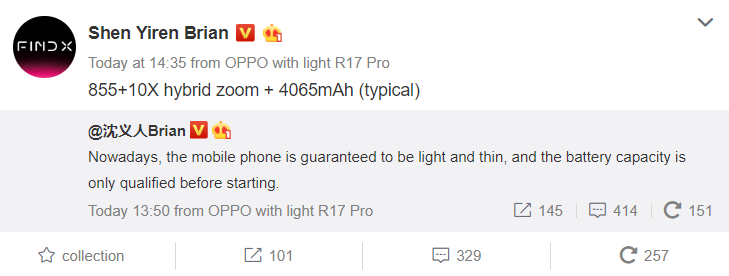
Today, OPPO’s vice president, Brian Shen took to Weibo to reveal some specs of the upcoming device. In his post, he revealed the phone will be powered by a Snapdragon 855 processor which actually isn’t surprising. He also added that it will come with 10x hybrid zoom. This is most definitely its new 10x zoom technology with a periscope design which it showed off at MWC.
Last but not least is the phone’s battery capacity which is revealed to be 4,065mAh. The Find X has a 3,730mAh battery which is paired with a 6.42-inch AMOLED display. If the screen size remains the same size on this new flagship, then there should be a significant increase in battery life compared to its predecessor.
While Mr. Brian Shen didn’t mention support for wireless charging, it is a feature we think the phone will have as OPPO is now a member of the Wireless Power Consortium. OPPO is one of the top manufacturers when it comes to innovations, so we might see them announce a wireless charging technology that rivals Xiaomi‘s 20W wireless charging technology which is currently the fastest for now.
When Xiaomi first rolled out its IPO last year, there were speculations the company will have to increase the prices of its phone in other to make the company more profitable. The company was quick to debunk such speculations and assured fans that it would not increase the profit margin of its phones above 5%. There have been doubts as to how the company will keep its phone prices low and still make some profit for its investors. Those doubts are turning out not to be unfounded but we are not surprised because it was expected.
Tech Node reports that Xiaomi’s CEO Lei Jun has warned that Xiaomi phones could get more expensive in future releases. This is as a result of attempts by the Chinese company to sed off the reputation for producing cheap hardware. Lei is quoted to have stated; “Actually, we want to get rid of this reputation that our phones cost less than 2,000 Yuan. We want to invest more and make better products.” H went further to disclose that he had informed the staff internally that this might be the last time the company’s phone prices will be under 3,000 Yuan, apparently referring to the flagship Mi brand. “In the future, our phones might get more expensive—not a lot, but a little more expensive,” he added.
Xiaomi has subtly been hinting at a change in its pricing pattern for a while now. Earlier in January after the Redmi Note 7 launch, Xiaomi had promoted the base model of last year’s flagship Mi 8 for 2099 yuan ($310). Xiaomi’s product director, Wang Teng Thomas had hinted back then that after the cost-focused Redmi series, there won’t be any such crazy cheap deals anymore as the Mi brand will go high end. For now, the innovative phone maker seems to be taking things slowly in that regard. The Mi 9 which was launched on February 20 came with several innovations such as three rear cameras, a powerful Qualcomm Snapdragon 855 chip, and wireless charging but the pricing was barely higher than its predecessor. The Mi 9 starts at 2,999 yuan (around $446), while the Transparent Edition sells for 3,999 yuan. The Mi 9 SE which is a trimmed down variant starts at 1,999 yuan. The Mi 9 price is just 300 yuan ($44) higher than the Mi 8 which starts at 2,699 yuan ($355).
OnePlus is currently working on its next flagship device OnePlus 7. It has been leaked in multiple reports and rumors over the past few months. Along with the smartphone launches, OnePlus is also famous for it’s out of box marketing techniques and competitions. The Chinese company actively organize various activities to facilitate its fans and build a new audience. Similarly, this time, OnePlus has come up with a short film contest which can win you a whopping prize of $10000.
It’s a perfect time for new filmmakers who also love OnePlus to make a mark and win the grand prize of $10000, 2 OnePlus devices and a gimbal. There are multiple steps that you need to follow before entering into the competition. The procedure is quite intricate, but with the right understanding, you can easily enter and compete in the contest. The company has followed a different path to make users understand how to do filmmaking using a smartphone.
OnePlus has partnered with a filmmaker, Giacomo Mantovani to help users understand the process of filmmaking with a mobile device via a series “Master class” videos. Here’s the first and foremost Introduction video of “Masterclass” series:
Now, you have to submit your idea with a title and a story. You need to explain every aspect of the story from the initial phase to the final phase in a very precise and essential manner within 250 -200 words. Later, the OnePlus will select the finalists, and they will move to the next round.
Now, after various rounds, OnePlus will select the 10 semi-finalists which will be given OnePlus 6T to shoot their film. Out of these semi-finalists, the winner will be selected with undisclosed criteria. The first prize will be of $10000 along with two OnePlus devices and a gimbal. The runner ups at the second and third position will receive $4000 and $2000 prizes respectively.
Make sure that you send entries in English only. The punctuality aka completion of tasks should be on time and in an honest manner. OnePlus holds the right to publish and use your story in any production materials. Those who are interested can head over to the source below to enter the contest before March 11th, 2019.
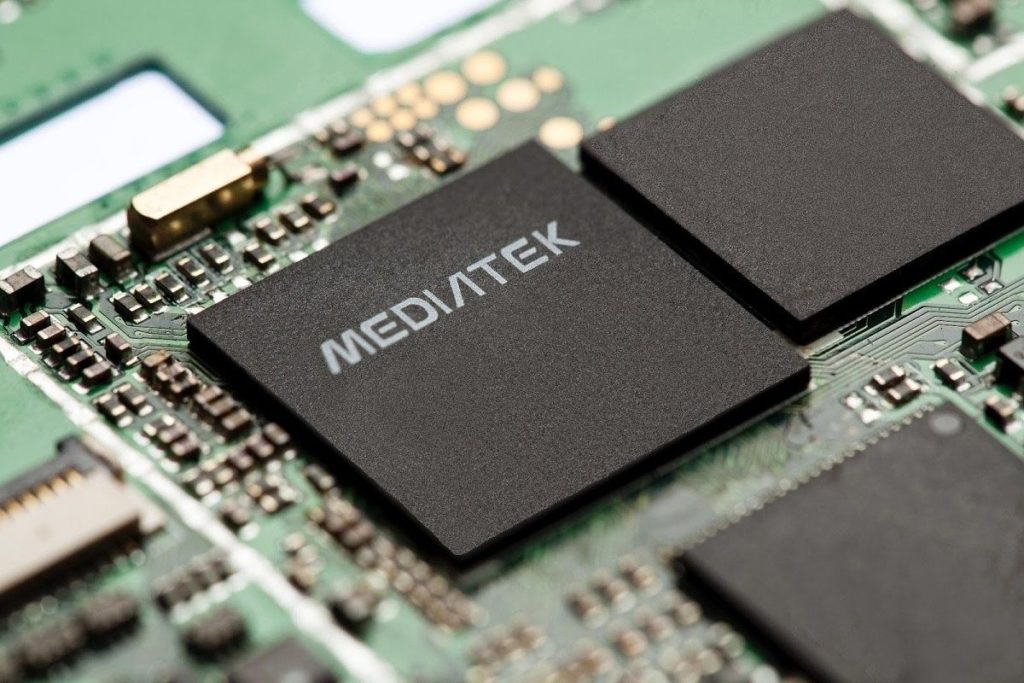
Almost, all the major chipset manufacturers have already revealed their 7nm chipsets this year. Qualcomm announced its Snapdragon 855 built on the 7nm process. Similarly, Apple and Huawei have also launched A12 Bionic and Kirin 980 7nm chipsets respectively. There are significant improvements that these 7nm mobile SoCs carry over the traditional 12 nm chipsets. The 7nm chipsets have now become standard for high-end smartphones. In order to match the new standards, MediaTek is also going to debut 7nm chipset in the market soon. As per the Finbarr Moynihan, MediaTek’s vice president of corporate sales and business development, the company is eagerly working on the 7nm 5G chipset.
In an interview with our folks over at the Android Authority, Finbarr Moynihan claimed that MediaTek is working on the 7nm 5G chipset. He further added that the new chipset is mainly designed for the higher end market and would be better and more capable than the Helio P90 chipset. Although, he didn’t confirm any specifications for the upcoming 5G chipset but confirmed that it wouldn’t be as expensive as like of its competitors.
In a related question regarding Helio X series, Finbarr replied that “I think you’ll see something moving up-tier from us.” He further added that “How we brand it and what it shows up as, I’m not sure. But you’ll certainly see more high-end capability than, say, we’ve exhibited on the P90.”
Along with 5G compatibility, the new chipset could come up with recently announced M70 5G modem. Although if we match some past revelations, then the new chipset would become available by the end of this year as the 5G modem is slated to debut by the end of this year. So as per developments, next year will be a game-changing year for MediaTek. As most of the high-end devices running the new chipset will come by the first half of 2020.
Although, its too early to comment whether on which devices the new chipset will debut. On the basis of Finbarr sayings, the new chipset will be affordable aka it won’t be carrying a hefty price tag. Overall, the total build cost of the devices using it will significantly reduce. In other words, the devices running the MediaTek 7nm 5G chipset won’t be as expensive as like of Samsung, Huawei and Apple devices.
Over the previous two years, full-screen design, as well as different styles of screen notch, have been the trend in the smartphone industry. This year seems to be for 5G and foldable smartphones. Already, we are starting to see a few smartphones getting launched with 5G technology. While we expect a few other flagships to join the train, it is our opinion that 5G may not pick up fully this year due to the lack of infrastructure. However, since the Galaxy Fold and Mate X are already released, we expect to see a lot more foldable phones in the course of the year.
Corning is definitely gearing up for the emerging trend with reports that the company is working towards manufacturing a screen protector for foldable phones. Foldable phones like the Mate X use plastic polymers which enables the display to bend. However, plastic tends to crease after a certain number of folds and is also more prone to scratches. Now, the Galaxy Fold and Mate X are priced around $2000. Nobody would want to take such risk, especially when it is certain that the replacement screen won’t be anywhere near cheap. On the other hand, a foldable glass display would be able to retain its structure regardless of the number of folds and it would hold up against scratches from keys and coins repeatedly. Thus, the company is working on glass-based protective screen.
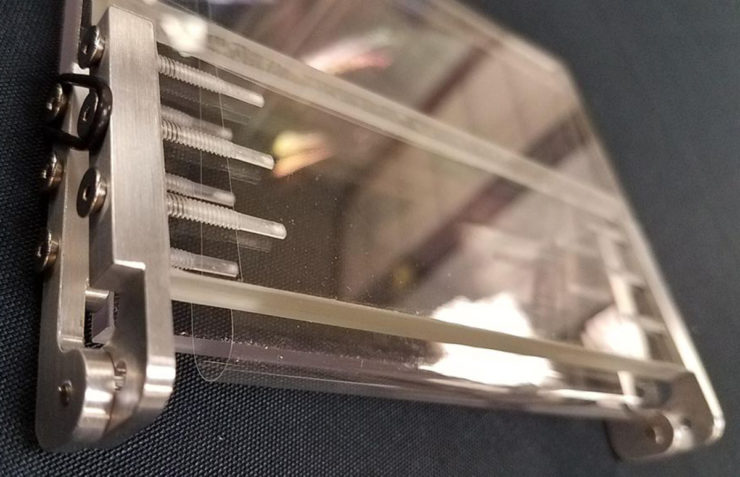
Corning has been able to make a glass that’s just 0.1mm thick and can fold to a radius of 5mm. However, since this glass is too thin, it can’t be used on smartphones as it will easily shatter if dropped. Increasing the thickness of the glass without veering out of the 3-to5-millimetre bend radius range is a technical challenge and the company is currently working on improving it. The company is reportedly experimenting with the fusion of the rollable Willow Glass and Gorilla Glass presently. The technology involves immersing the glass into a molten salt solution. Unfortunately, this corrodes the transistors found in the display so Willow Glass is currently not suitable for smartphones. Corning believes a solution will pop-up in a few years time that would be drop-resistant and have a tighter bend radius.
Xiaomi is rolling out a new update to the global version of its Mi 9 flagship. The OTA update brings optimizations and new camera features according to Roland Quandt (@rquandt) who has already received it.
The update comes as MIUI 10.2.12.0 and is about 456MB in size. The changelog says the UI has been optimized for displays with a notch. You also get new camera features such as “Moon Mode for AI camera” and the ability to track moving objects while recording a video. Xiaomi says the image quality has also been improved.
The Mi 9 has a 6.39-inch 2340 x 1080 AMOLED display protected by Gorilla Glass 6. It comes with a Snapdragon 855 processor, 6GB of RAM and up to 128GB of storage. A triple camera setup graces its back which includes a 48MP primary sensor, a 12MP telephoto sensor with 2x optical zoom, and a 16MP ultrawide-angle sensor.
Over the past few months, Xiaomi was quite busy in rolling out MIUI 10 Android 8.1 Oreo-based updates to the majority of devices. Even though, they pushed the Android 9.0 Pie update to a few devices like Pocophone F1, Mi 8 and Mi Mix 3. In addition, Xiaomi has started rolling out the Android 9.0 Pie based MIUI 10.2.1 stable OTA update to Mi Max 3 in China. There are many improvements and new enhancements in the latest build of MIUI 10 including Android 9.0 Pie features.
Last week, the direct download links of the MIUI 10.2.1.0.PEDCNXM based ROM was made available. Some users have manually flashed the update, but most of them are still waiting for OTA update. Today, Xiaomi has started pushing the OTA update to Mi Max 3. There are major advancements that the new update carries.
Xiaomi Mi Max 3 MIUI 10.2.1 stable update changes
As per changelog, the new MIUI 10.2.1 update optimized the camera and has added various fixes. In detail, they have fixed the problems such as automatic burst shot, crashing while previewing photo, resized the exposure icon while taking photos and has tweaked the full-screen camera reference line issue. Even, it enhances the inbuilt photo editor in the device with the addition of photo frame feature.
Moreover, it has addressed the hotspot glitch in the settings menu. Xiaomi Mi Max 3 has improved the accessibility by adding the desktop shortcuts feature. By default it is turned off, users can turn it on by going into the settings menu of the device.
Particularly in the file manager of the devices, Xiaomi has fixed almost every bug that was reported in the last few months. The Chinese smartphone maker has fixed thumbnail refresh issue which was working abnormally in an unorderly manner. There are many other changes that the file manager has received in the latest update.
Overall, Xiaomi has optimized the overall performance of the device by fixing some significant bugs. User Interface has been improved for much better accessibility.
Users can check for the update by heading over to the Settings>About phone>System Update. The update weighs around 2.1 GB, so we suggest you switch to WiFi networks to save additional costs on the carrier network. Also, make sure, your device is charged above 60% for smooth installation of the update. Xiaomi has just pushed the update, means that it would take few more days to roll out on every Mi Max 3 unit in China.
Xiaomi Mi Max 3 China versions have started receiving the latest Android 9.0 Pie based MIUI 10.2.1 OTA update. We expect that Xiaomi will soon commence the Android 9.0 Pie update for Global variants also.
Over the past few years, DxOMark has turned out to be an important part of smartphone benchmarks. Almost all of the new flagship models that are released in the market are subjected to their thorough camera tests. But there are some smartphone companies who opt out of DxOMark tests, and OPPO is one of them.
Earlier today, OPPO’s VP, Brian Shen, questioned the significance of DxOMark benchmarks in today’s smartphone market. While talking to his followers on Weibo, he said that there was no need to set a specific standard when it comes to smartphone cameras. He questioned whether it was right to tune every smartphone camera to one particular standard.
OPPO’s flagship, R17 Pro has never been featured in DxOMark
“Do you really need DXO? Do all cameras have to be tuned to the same standard?
I mean, there may be a need for rating agencies, but does anything as subjective as taking a picture have to be set to the same standard? Is it right To beautify everyone into one style?” Brian posted on his Weibo earlier today.
Interestingly, OPPO smartphones are never rated on DxOMark’s camera tests. As a result, you won’t find a single flagship from the company on DxOMark’s best smartphone camera list. On the other hand, you’ll find almost everyone else, including Huawei, Xiaomi, Samsung, Sony and even OnePlus on DxOMark’s chart.
This goes on to prove that most companies don’t mind getting their smartphones rated from the benchmarking platform. While I agree one specific standard is never the best way to judge a smartphone camera, what DxOMark gives us is the opportunity to compare the best phones out there on a standard benchmark. Understanding how different smartphone cameras work in a set environment does give us an idea of where it stands among the competition.
That said, some might prefer Google Pixel 3’s camera (DxoMark score: 107) over Huawei Mate 20 Pro (DxOMark score: 109). So there’s definitely a hint of personal preference to a smartphone’s camera performance. But it’s unlikely that you would end up finding Asus Zenfone 5’s camera (much lower down the DxoMark chart at 90 points) better than say something like the Galaxy Note 9 (featuring one of the top DxoMark scores — 103).
What are your thoughts? Should we stop giving too much importance to DxOMark ratings?
The Redmi Note 7 Pro launched in India last week and has been getting positive reviews. It will launch in China on March 18 where it is expected to bring along the Redmi 7. Yesterday, Redmi announced it will give 100 lucky winners in China a unit of the Redmi Note 7 for free. Those who are selected will have to test certain features of the phone and provide feedback.
The giveaway seems to be open only to residents of Mainland China. To apply, you are required to fill a form using your Mi account. You also have to include your name, gender, phone number, mailing address, and your Weibo and Xiaomi accounts’ usernames. It is also required that you state the numbers of followers you have on social media and provide a reason why you should be selected.
Those who are selected will have to test features such as cameras, gaming, and audio performance etc. If you are interested, head to the registration page here and submit your details.
ZTE’s sub-brand Nubia revealed a couple of months ago that the Nubia Z17 will get the Android Pie update. However, after that announcement, there was no news related to that. Now the company has confirmed that the smartphone, which was launched in June 2017, will soon get the latest Android 9 Pie update.
The company has announced that the company will start recruitment for beta testers to test the Android Pie Beta version on the Nubia Z17. Later, the company will officially roll-out the stable version of the Android Pie update to all the users.
This will be second major update for the company’s 2017 flagship smartphone after the Nubia 6.0 update that brought Android Oreo version last year.
Coming to the specifications, the smartphone features a bezel-less design and comes with a 5.5-inch 1080p display panel protected by Corning Gorilla Glass. Under the hood, the phone comes with Qualcomm Snapdragon 835 processor clocked at 2.45GHz.
It packs 8GB of RAM and 128GB of ROM. There are other memory options available, including 6GB RAM with either 64GB or 128GB of internal storage. As for the camera, it comes with a 23MP + 12MP camera sensors with f/1.8 aperture and 1.4um large pixel.
The camera setup supports 2x optical zoom and 10x dynamic zoom. The focus time is also impressive at 0.03 seconds. On the front side, the Nubia Z17 comes with a 16MP sensor with f/2.0 aperture and 80-degree wide angle lens.
As for the software, the phone comes with Android 7.1 Nougat out-of-the-box with Nubia UI 5.0 on top. Connectivity features include Dolby Atmos, Hi-Fi+, NFC, Bluetooth 4.1 and dual-band Wi-Fi b/g/n/ac. The phone is powered by a 3,200mAh battery which charges up to 50% in 25 minutes.
We use cookies on our website to give you the most relevant experience by remembering your preferences and repeat visits. By clicking “Accept”, you consent to the use of ALL the cookies.
This website uses cookies to improve your experience while you navigate through the website. Out of these, the cookies that are categorized as necessary are stored on your browser as they are essential for the working of basic functionalities of the website. We also use third-party cookies that help us analyze and understand how you use this website. These cookies will be stored in your browser only with your consent. You also have the option to opt-out of these cookies. But opting out of some of these cookies may affect your browsing experience.
Necessary cookies are absolutely essential for the website to function properly. This category only includes cookies that ensures basic functionalities and security features of the website. These cookies do not store any personal information.
Any cookies that may not be particularly necessary for the website to function and is used specifically to collect user personal data via analytics, ads, other embedded contents are termed as non-necessary cookies. It is mandatory to procure user consent prior to running these cookies on your website.