Vivo has surprised the smartphone industry last year but launching the Vivo NEX smartphone with a pop-up selfie camera. This allowed the phone to sport a notch-less display. It appears that the company may launch a smartphone with dual pop-up selfie cameras in the near future since it has already filed a patent for such a design.
Vivo has been recently granted by China’s National Intellectual Property Administration. The patent was filed on May 23, 2018 and it was approved in the previous week on March 1. After introducing the pop-up selfie camera design on the Vivo NEX last year, newer phones from the company such as Vivo X27 series and Vivo V15 series can be seen sporting the same design. It appears that the dual pop-up selfie camera design could be reserved for the upcoming flagship phone from Vivo.
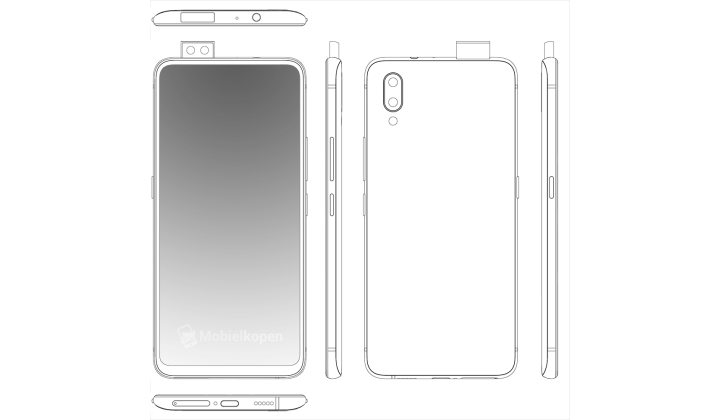
The illustrations present in the patent filing reveals that the phone will be sporting a notch-less display design like the Vivo NEX. The front image of the phone shows that its display is surrounded by slightly thick chin and slimmer bezels. The display could be of AMOLED type and it could be equipped with an in-screen fingerprint reader.
The top-left corner of the top edge of the smartphone has a slightly wider pop-up camera unit as compared to the Vivo NEX. It accommodates two camera sensors. A 3.5mm audio jack also seems to be present on the top edge of the phone. The bottom edge of the smartphone seems to feature a SIM tray, a USB-C port and an external speaker.
The right edge of the phone has a volume rocker and another button that could be the power key. There is a single button available on the left edge of the device. The rear design of the phone is also similar to the Vivo NEX as it features a dual camera setup and an LED flash at top-left corner.
Interestingly, when Vivo had showcased the notch-less screen Vivo APEX 2019 concept earlier this year, people were thinking about the position of its selfie camera since no details on it were shared. The handset is expected to launch with a commercial name in the near future. Could it be arriving with a dual pop-up selfie camera setup as seen in the above illustrations. It is advisable to wait for further reports before drawing coming to any conclusion.
After Huawei teased its upcoming smartphone launch in China — Huawei Nova 4e, which features a 32MP front-facing camera, the company confirmed the phone’s launch date soon after. The smartphone, which is expected to be the rebranded model of the Huawei P30 Lite for the Chinese market, will be launched on 14th March.
Now, before the Huawei Nova 4e gets officially launched in China in a couple of days, the phone has appeared on benchmarking portal Geekbench, confirming the phone’s specifications which were revealed earlier.
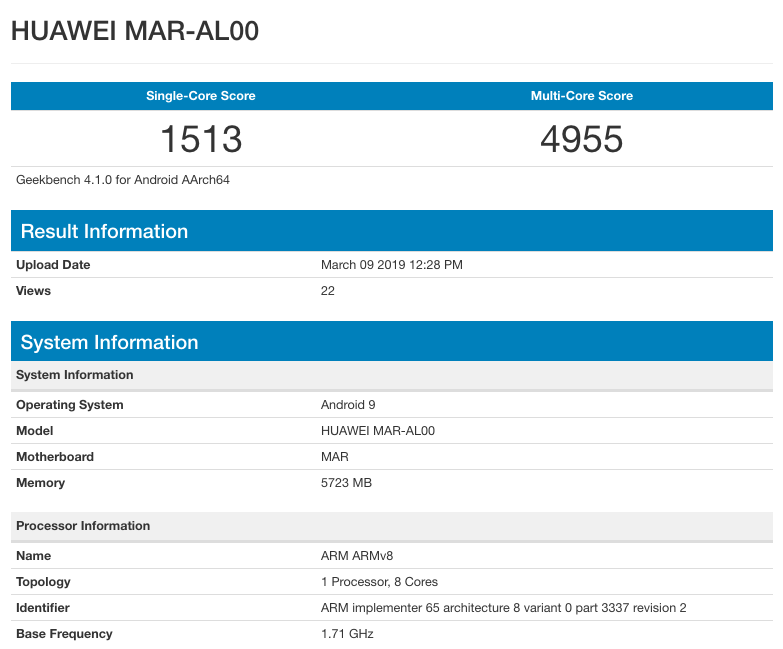
The phone is said to carry model number MAR-AL00 and the listing confirms that the device will be powered by the company’s own Kirin 710 octa-core processor, along with 6GB of RAM. In the benchmark test, the device scored 1,513 in the single-core test and 4,955 in the multi-core test.
The Huawei Nova 4e is already confirmed to come with a waterdrop notch, which will house a 32-megapixel front-facing camera sensor. Now, the listing confirms that the phone will have a 6.15-inch display with 2312 x 1080 pixels screen resolution offering 415ppi pixel density.
It will be running Android 9 Pie operating system out-of-the-box with the company’s own EMUI 9 on top. The device will also come equipped with the company’s GPU Turbo technology that enhances the phone’s performance and graphics processing efficiency by 60 percent.
As for the camera setup on the back side, the smartphone is rumored to come with a triple-camera setup, which is likely to comprise a 20-megapixel primary sensor, a 16-megapixel secondary sensor, and a third 2-megapixel camera sensor. The smartphone will be fuelled by a 3340mAh battery.
Even over a year after hitting the store shelves, the VOYO V3 Pro continues to garner huge popularity among those who fancy using a stylish, yet powerful laptop. Taking the device’s undying popularity into consideration, VOYO is now offering its coveted laptop for a reduced price on GeekBuying. Aside from doling out a noteworthy discount on the V3 Pro in collaboration with the Chinese online store, VOYO is also giving GeekBuying users a chance to avail an extra discount before placing their order. We’ll reveal more details about it in just a bit.
VOYO V3 Pro 10 Notebook
While you’d normally end up spending a lot of money on the V3 Pro that ships with 8GB of RAM and offers a hearty 128GB of onboard storage capacity, this stylus pen-equipped model can now be yours for a reduced price of only $359.99. This is a noteworthy 29 percent reduction in the device’s original asking price of $508.99.
Aside from taking full advantage of the aforesaid discount, you can use coupon code GIZ_HIMWPJVU and get an extra $70 off. In other words, you can bring the already reduced asking price of the feature-laden notebook further down to only $329.99 before placing your order simply by applying the aforesaid coupon.
An absolute steal at this price, the VOYO V3 Pro boasts an impressive array of features that we usually associate with a steeply-priced notebook. Here’s a brief glimpse of what the device has to offer in terms of specs.
13.3 inch 5-point IPS screen with FHD+ resolution of 1920×1080 pixels
Intel Celeron N3450 Quad Core, 1.1GHz processor
8GB DDR3L RAM
128G SSD ROM storage capacity with 128GB TF card expansion
Dual mode touch
Fingerprint identification
Bluetooth 4.0 interface
360-degree adjustable rotatable
You can visit this link to check out the full specification and grab the discount. Regrettably, the promo was on the verge of wrapping up at the time of writing.
Huawei has announced that its current Mate-series flagship smartphones — Huawei Mate 20 series, has shipped more than 10 million units in just 4 and a half months. It also announced that the Mate 20 series has broken the previous Mate-series and P-series sales record for the same time duration in Greater China.
While the numbers obviously suggest the popularity of the Mate 20 series in the region, the company also says that the devices in this smartphone series also continues to sell well in Western Europe, the Middle East, Asia Pacific, and other regions.
Making a statement regarding this milestone, Yu Chengdong, CEO of Huawei’s consumer business said on Weibo: “In four and a half months, Huawei’s Mate20 series shipments broke 10 million units! Thanks to the support, praise and recognition of global consumers, and the pertinence given by everyone. It is suggested that there will be more breakthroughs in 2019 and I look forward to sharing with you the joy of technological advancement !”
In December last year, the Chinese giant had announced that its global smartphone shipments exceeded the 200 million units mark, representing an increase of 66 times in eight years. At that time, the company had reported shipments of Mate 20 series at 5 million units. In January this year, the number increased to 7.5 million units.
In the year 2018, the company’s smartphones shipment crossed 206 million units and it was reported that Huawei’s consumer business revenue has reached $52 billion, which is the largest revenue of Huawei’s BG business.
Earlier, Huawei’s Consumer Business President He Gang had said that the company could be looking to ship around 230 million to 250 million units this year. However, he stressed that everything is dependent on the market conditions and ensuring steady progress with channels and supplier partners. The numbers show that the company is aiming to grow its mobile business by around 30 percent to 50 percent year-on-year.
The company is currently gearing up to launch its new flagship line — Huawei P30 series, which includes P30, P30 Pro, and P30 Lite, on 26th March at a launch event in Paris, France. The Huawei P30 Lite is expected to be launched in China as Huawei Nova 4e, which is scheduled to go official on 14th March.
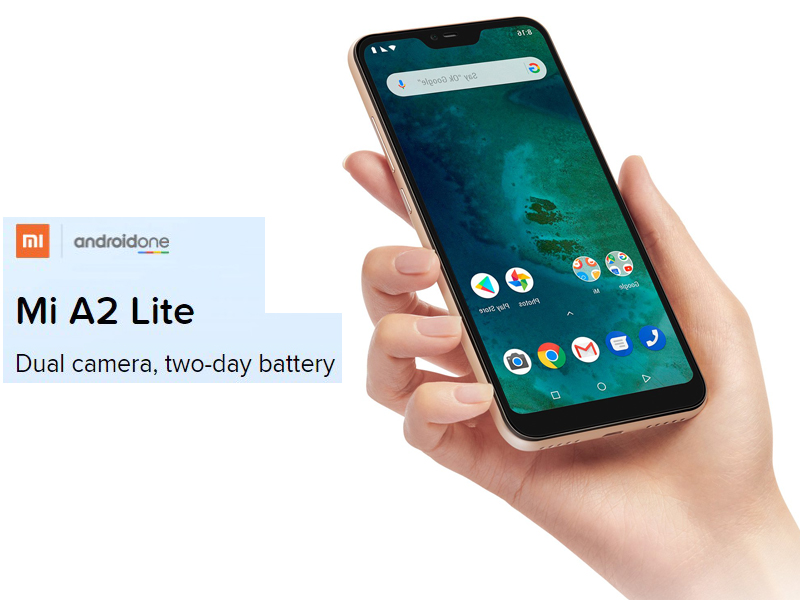
If you’re in the market for a cost-effective smartphone that doesn’t cost a bomb, we got good news for you. Much to the delight of those who aren’t willing to spend a lot of money on a smartphone, Gearbest is now offering the global version of the Xiaomi Mi A2 Lite and the Lenovo S5 Pro phablet at lowered prices. Aside from shedding light on the aforesaid discounts, we’ll show how you can save a considerable amount of extra money at checkout. So without further ado, let’s delve into the details.
Xiaomi Mi A2 Lite (4GB RAM, 64GB ROM)
Xiaomi made its long-awaited Mi A2 Lite available to the public in July last year. The phone grabbed the attention of smartphone lovers with its awe-inspiring features and top-end specs but failed to lure cost-conscious buyers as it carried a relatively steep price tag.
In a bid to make the Mi A2 Lite available to those living on a tight budget, the Chinese handset maker is now offering the well-received smartphone for only $185.99 on Gearbest. This is a noteworthy 24 percent reduction in the phone’s original asking price of $244.10.On top of that, you can coupon code 3219BHUCJM and get an extra $16 off. In other words, you can bring the already reduced selling price of the Xiaomi Mi A2 Lite further down to just $169.99 simply by applying the aforesaid coupon at check out. Regrettably, the coupon will be valid for only a hundred pieces and is slated to expire on March 13th.
You can visit this link to avail the discount, which will be valid for the black color version of the Mi A2 Lite smartphone. With only 57 pieces remaining, the promo is slated to end in just one day.
Launched in October 2018, the S5 Pro is an irresistible phablet that boasts an impressive array of features. On the downside, this Lenovo-branded phablet doesn’t come cheap. In fact, it would normally set you back $238.52 on both online as well as offline stores.
If you have restlessly been waiting to get your hands on the S5 Pro without spending a lot of money, it might interest you to know that the phone is now available bearing a reduced price of only $209.99 on Gearbest. You can extend this 12 percent discount by applying coupon code 321MOZZS7I during the checkout process.The coupon helps you save $20 more by reducing the device’s original asking price to only $189.99. Note that the coupon will be valid until March 13th for the first hundred pieces only.
You can follow this link to grab the discount, which will be valid for the black color version of the phablet for a limited period of time.
UPDATE: Mr. Brian Shen clarified that ‘Reno’ is not a new sub-brand. It’s a brand new series from OPPO.
Today, Oppo’s Vice President Brian Shen has announced a new sub-brand series for smartphones — Oppo Reno. The brand’s logo has also been revealed, which uses lively colors, hinting that the sub-brand could be youth-focused.
Also, the China-based smartphone manufacturer has also announced that this new Oppo Reno’s first smartphone will be launched on 10th April in China. No further information related to this update smartphone is available as of now.
Recently, Oppo had revealed that the company will be launching a new smartphone in April. As the phone’s name was not revealed, there’s a possibility that the said upcoming smartphone could be this Reno-branded smartphone, which is expected to have a different design from the previous Oppo smartphones.
He had also revealed that the smartphone will be powered by Qualcomm’s latest and the most powerful processor so far — Snapdragon 855. In the camera department, the smartphone will come with Oppo’s 10x optical zoom technology, which was showcased by the company at Mobile World Congress 2019 in Barcelona, Spain.
Further, Shen Yiren has also confirmed that the device will be driven by a 4,065mAh battery. While he has not mentioned anything regarding the fast charging support, we expected the smartphone to have a powerful fast-charging technology.
Earlier, he had confirmed that the smartphone, which will be released in April, will have more than one million units in stock. He further added that the company will strive to retain the 3.5mm headphone jack on their smartphones.
While Oppo has now confirmed that the smartphone will go official next month, the phone’s name still remains unknown. While the rumors suggested that it could be the Oppo Find Z — the successor to the Oppo Find X launched last year, there’s a possibility that it could be a Reno-branded smartphone.
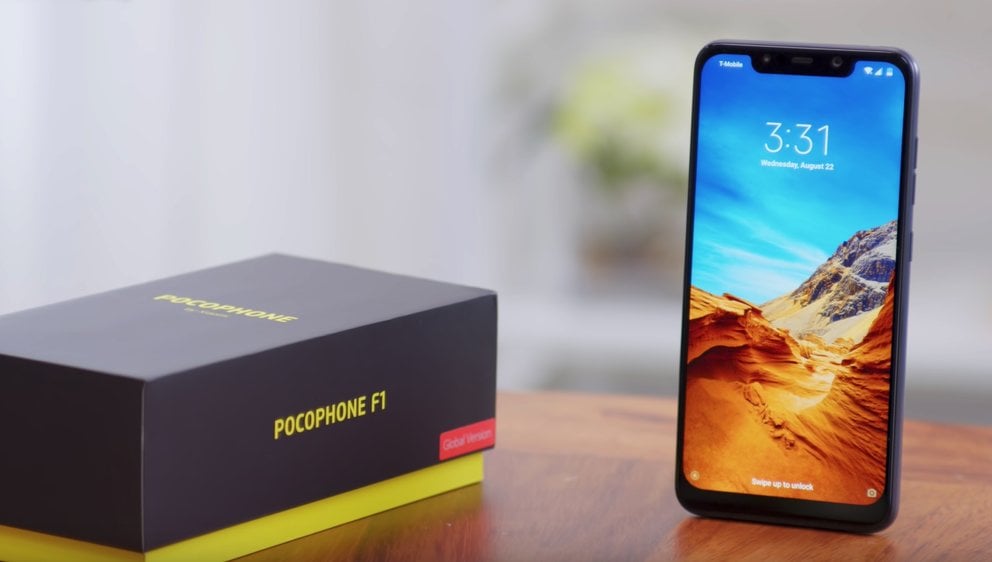
Xiaomi launched its Poco F1 smartphone last year, running Android 8.1 Oreo out-of-the-box and a new MIUI for Poco custom interface. In November 2018, the smartphone received the all-new MIUI 10 update which was also based on Android Oreo.
However, a couple of months ago, in December, the Poco F1 received a new update with Android 9 Pie operating system. Now, the device has received yet another update — MIUI 10.2.3.0, which brings February 2019 security patch and more.
Users of Poco Forum are reported that the device has started receiving MIUI 10.2.3.0.PEJMIXM update which is around 560MB in size. The update is based on Android Pie and also brings February security patch to the device but doesn’t bring Widevine L1 support to the device that was recently enabled in MIUI Global Beta ROM. The support for 4K 60fps video recording is also missing, which was enabled in a recent MIUI Global Beta ROM.
However, C Manmohan, Global Head for Poco, the smartphone will be receiving another MIUI Global Stable update in March to enable 4K 60fps support on the device. The new update for Poco F1 is being rolled out in phases and it will take a few days to roll out for everyone, but you can download the incremental zip and manually flash it.
To remind you of the phone’s specifications, the Poco F1 features a 6.18-inch Full HD+ IPS LCD display which is protected by a layer of Corning Gorilla Glass. The phone is powered by Qualcomm‘s Snapdragon 845 processor and comes with LiquidCool technology.
It has a 12-megapixel Sony IMX363 primary sensor, coupled with a 5-megapixel secondary sensor on the back panel. On the front side, there’s a 20-megapixel selfie camera powered with AI for capturing enhanced selfie shots.
The phone comes with 6GB/8GB of RAM and 64GB/128GB/256GB of internal storage, depending on the variant. It runs on MIUI based on Android 8.1 Oreo and is powered by a 4,000mAh battery that supports Quick Charge 3.0 fast charging.
Much to the delight of its users, Banggood has been offering the best bang for their buck for quite a long time and it looks like the Chinese online store has no plan to stop.
Keeping in line with that, Banggood recently launched the ‘Spring Sale-Home & LED Latest Essentials From $0.99’ promotion, offering a wide range of products for heavily discounted prices. Aside from that, Banggood users can take advantage of an extra 9% off categories coupon 9%margl and save more money during the checkout process.
The aforesaid coupon will be valid for select products that have added to Home & Gardening, Home Appliances, Lights & Lighting categories. It is worth noting that it will not be valid for items that carry discounted prices or are a part of other promotional offers.
The ‘Global Premiere’ section features Xiaomi HUOHOU 15 functions folding knife, BlitzWolf BW-AR182 vacuum cleaner and a slew of other products that you can buy without emptying your pockets.
For the sake of an instance, the BW-AR182 2-in-1 cordless handheld vacuum cleaner has gone up for pre-order bearing a dropped price of only $95.99. This is a noteworthy 20 percent reduction in the device’s original asking price of $119.99.
The products included in the next section called ‘Quarterly Top 10 Champion’ have further been divided into Top 10 Valuest and Top 10 Sale sub-categories. All items featured in the ‘Half-Price Snap Up’ category, on the other hand, have been assigned specific coupons that you can use to get additional discounts before placing your order.
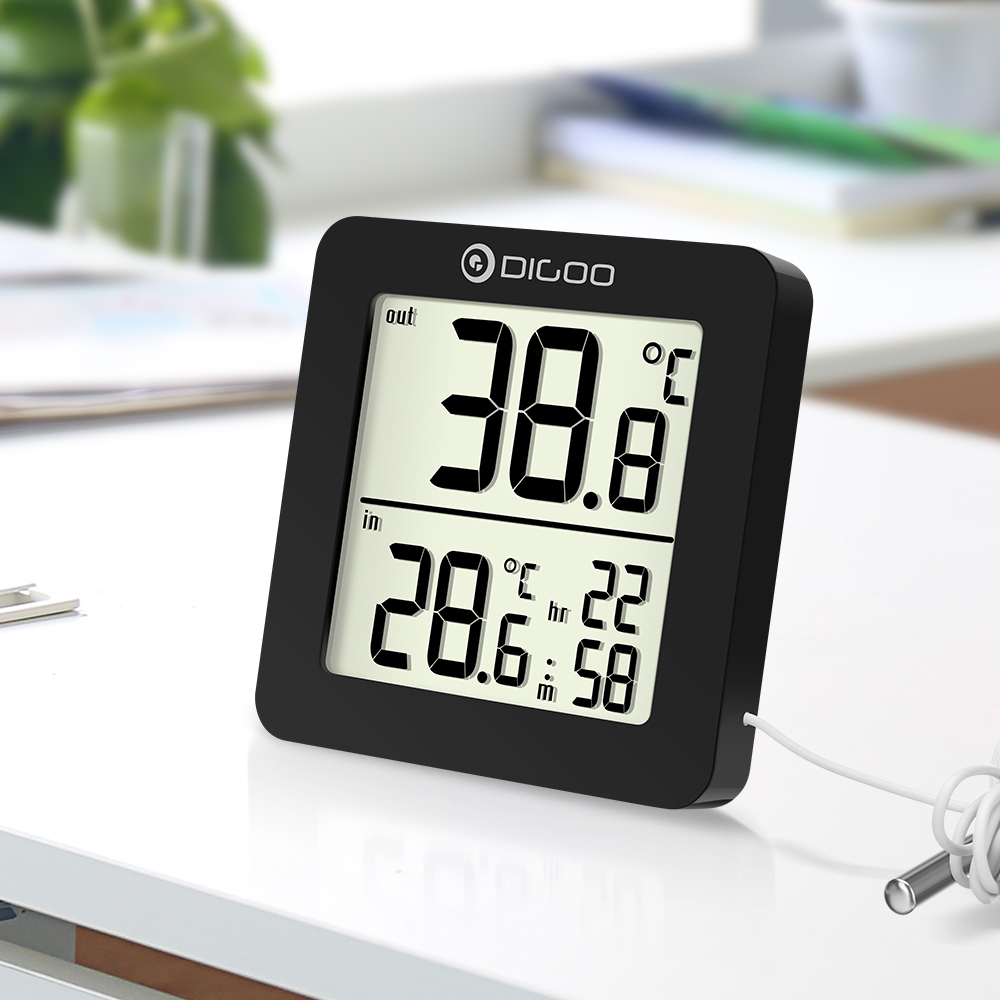
You can use coupon code 30%hld for all products added to the ‘Extra 30% Off Deals’ and save a considerable amount of extra money at check out. For example, the DIGOO DG-TH01 Mini LCD Digital Thermometer that usually sells for $10.05 is now available for a reduced price of just $9.42.
You can extend this 6 percent discount simply by applying the above-mentioned coupon. The coupon helps you get an extra $2.83 off simply by reducing the device’s already lowered retail price to only $6.59.
Brand conscious users can head straight to the ‘Brand Street’ category, wherein they can avail great discounts on various products from leading manufacturers like DIGOO, KCASA, Dibea, and Xiaomi. You can visit the promotion page to check out the rest of the products by following this link.
Xiaomi first made its grand entry into the laptop market in 2016 when the Mi Notebook Air was launched to take on Apple’s iPad Air. Mi Notebook features a sleek design and an equally stunning hardware setup. Since then, Xiaomi has added several models, including one bearing a fingerprint scanner. A device purported to be Xiaomi Mi Notebook has appeared on GeekBench.
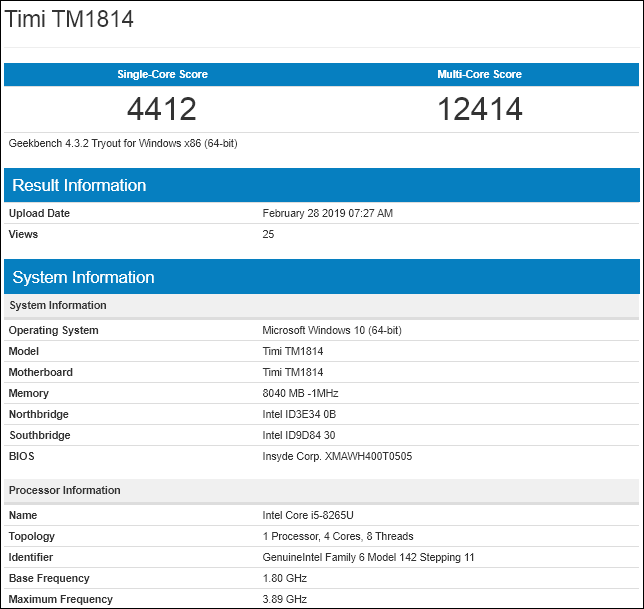
The GeekBench listing comes with the model number Tim TM1814 but popular tipster Roland Quandt hints that it is an upcoming Mi Book model. As listed, the device features the Intel Core i5-8265U Quadcore processor. According to the tipster, the chipset is . the current-gen Intel chipset. The device is also listed to pack 8GB of RAM. As usual, GeekBench listing doesn’t contain any other details relating to the size or model range.
The device score 4412 points on the single core test and 12414 points on the multi-core test. This is consistent with the test score of other Core-i5-powered models.
With the new Mi 9, Xiaomi did not just aim at offering the best flagship out there: the company also cared about the price and released one of the most affordable real flagship phones. That is why it is automatic for us to compare its value for money with the other affordable flagships released from other important manufacturers. Among the latest ones, there are Honor Magic 2 3D and Nokia 9 PureView. Besides carrying a not so high price tag, they also offer a lot of innovation: is it enough to compete with the Mi 9 or the latter will remain the most wanted best-buy of the year? This comparison is here to shed some light on it.
Xiaomi Mi 9 vs Huawei Honor Magic 2 3D vs Nokia 9 PureView
Xiaomi Mi 9
Huawei Honor Magic 2 3D
Nokia 9 PureView
DIMENSIONS AND WEIGHT
157.5 x 74.7 x 7.6 mm, 173 g
157.3 x 75.1 x 8.3 mm, 206 g
155 x 75 x 8 mm, 172 g
DISPLAY
6.39 inches, 1080 x 2340p (Full HD+), Super AMOLED
Triple 48 + 16 + 12 MP, f/1.8, f/2.2 and f/2.2
20 MP f/2.0 front camera
Triple 16 + 16 + 24 MP, f/1.8, f/2.2 and f/1.8
Triple 16 + 2 MP + TOF sensor f/2.0 and f/2.4 front camera
Penta 12 MP + TOF camera f/1.8
20 MP front camera
BATTERY
3300 mAh, fast charging with Quick Charge 4+, wireless charging
3500 mAh, fast charging
3320 mAh, fast charging with Quick Charge 3.0, wireless charging
ADDITIONAL FEATURES
Dual SIM slot
Dual SIM slot
Dual SIM slot, water resistant (IP67)
Design
The most futuristic and interesting design is the one found on the Honor Magic 2 3D which comes with a slider mechanism containing the front cameras. The slider, which you can open manually, allows the display to be fully borderless without needing a notch. Further, it allows the phone to be more compact than average. We like its aesthetics even because it comes with a very clean rear side, thanks to the presence of an in-display fingerprint reader. Nokia 9 PureView is not the most beautiful device due to its thicker bezels and the presence of several holes on the back due to its penta-camera setup, but it is the only with water resistance.
Display
Nokia 9 PureView should have the display with the best view quality. First of all, it comes with a higher resolution: 1440 x 2880 pixels, for a higher level of detail. Further, it is HDR10-compliant, so it should offer a very nice color reproduction. However, Xiaomi Mi 9 and Honor Magic 2 3D still come with wonderful displays. They are just Full HD+, but they are HDR10-compliant as well, and they even have DCI-P3 coverage. All the handsets come with a fast and advanced in-display fingerprint reader.
Hardware/Software
Xiaomi Mi 9 comes with a more powerful chipset and it has a better hardware department overall. It is equipped with a faster Snapdragon 855 SoC and up to 8 GB of RAM. The Honor Magic 2 comes with way more internal storage: up to 512 GB instead of just 128 GB, but its chipset is slightly inferior. Nokia 9 PureView takes the last place of the ranking because it comes with the old-gen Snapdragon 845 chipset released in 2018. On the other hand, it has Android One instead of a customized Android fork, that is a stock Android version supported directly by Google with faster and more constant major updates.
Camera
The most impressive camera department is definitely the one found on the Nokia 9 PureView, that is the first phone with a penta-camera setup. It includes 2x RGB sensors and 3x monochromatic sensors that are able to work simultaneously, alongside a 3D TOF camera which captures depth information. Xiaomi Mi 9 comes right after with its impressive 48 MP rear camera. Honor Magic 2 3D wins when it comes to selfies, thanks to its triple front camera including a 3D sensor.
Battery
Honor Magic 2 3D has the biggest battery but it is not said that it lasts more. Nokia 9 PureView may come with better software optimization and it may surprise you, but we still did not test its battery life, so we can not give a definitive verdict.
Price
I would prefer the Xiaomi Mi 9 in this comparison due to its higher value for money, more powerful hardware and its good cameras. It costs just €450 in the global market, while Honor Magic 2 3D starts from €500 in Asia and Nokia 9 PureView will cost €620.
The Vivo X27 will have a Pro version that will come with a larger display and a selfie-camera with a higher pixel count than the other two non-pro models.
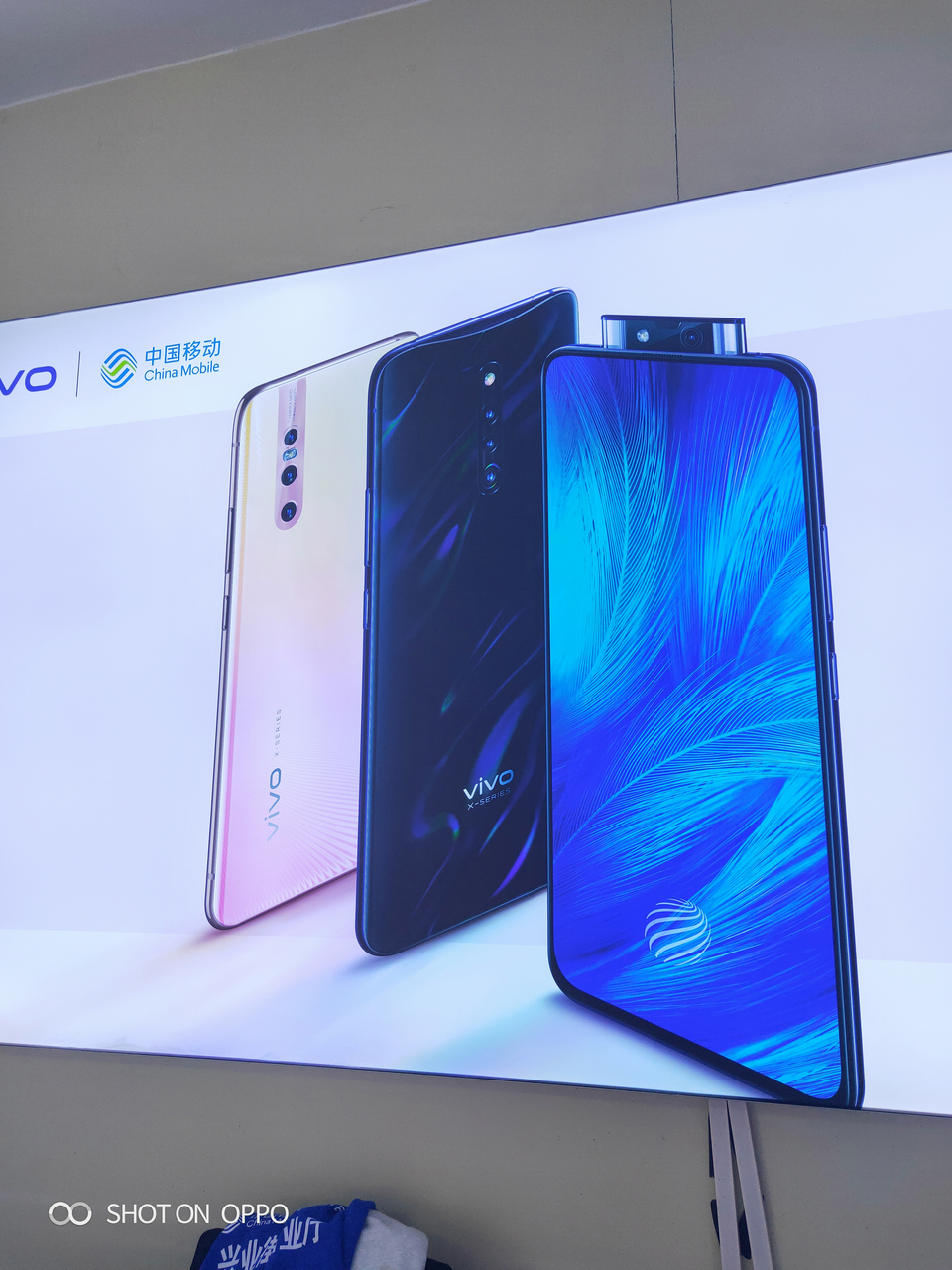
A leaked poster has revealed the Vivo X27 Pro will not only have a large 6.7-inch display but an incredibly large pop-up selfie camera.
Vivo phones with a pop-up selfie camera have the camera sliding out of the left or the right side of the frame and are usually about a centimeter wide. But in the case of the X27 Pro, as shown above, the 32MP selfie camera slides out of the middle of the frame. It is also really wide, nearly four times the size of the regular X27 we saw in leaked live photos.
The Vivo X27 Pro incorporates an LED flash into the slide out mechanism and each side of the setup is flanked by what appears to be clear glass.
The poster also reveals the X27 Pro will come with a different rear camera design. Unlike the regular X27 which has its triple camera setup on the left of the phone, the X27 Pro has its own in the middle. The arrangement is also different. The LED flash which is circle comes first before the sensors. There is also a text at the bottom of the phone that says “Vivo X-SERIES”.
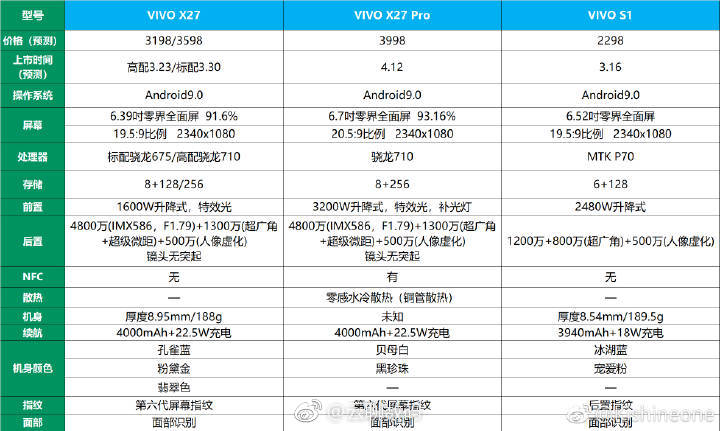
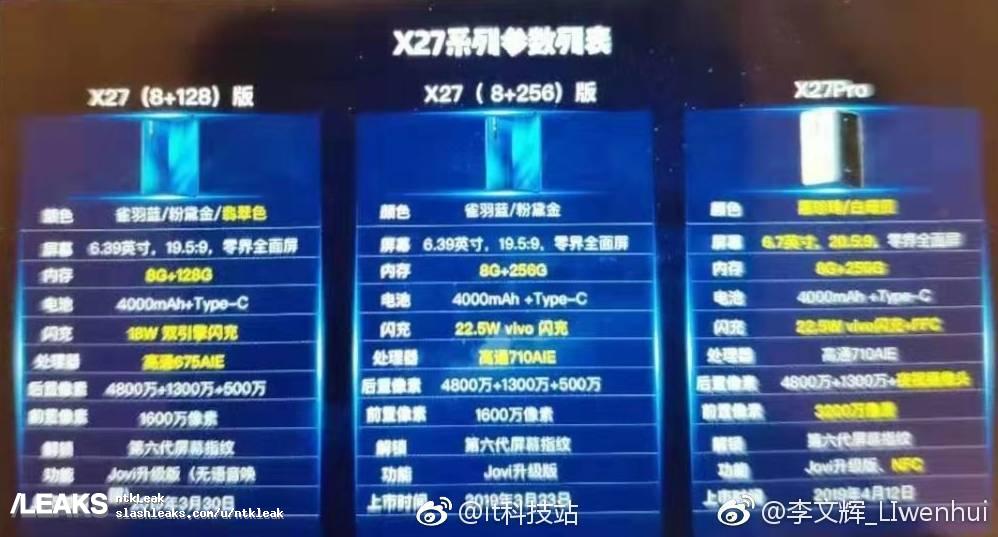
The source of the leak also reveals the Vivo X27 Pro will sell for ¥3998 (~$505) while the non-Pro models will be priced at ¥3198 (~$475) for the 128GB version with a Snapdragon 675 processor and ¥3598 (~$535) for the Snapdragon 710 variant with 256GB of storage.
The Vivo X27 and X27 Pro will launch with Android 9.0 Pie out of the box and have a Sony IMX586 48MP f/1.79 sensor as their primary rear camera.
The Vivo X27 is an upper mid-range flagship scheduled for release on March 19. The device was seen on TENAA’s database a few weeks ago and in the past week, official renders and live photos have been posted online.
A new leak has revealed the Vivo X27 will actually have three variants with the third having the “Pro” suffix. The leak reveals the differentiating features of the three models and when they will be available for purchase.
The first variant is the Vivo X27 itself which has a 6.39-inch display with a 19.5:9 aspect ratio. It is powered by the Snapdragon 675 AIE processor that is paired with 8GB of RAM and 128GB of storage. It will have triple cameras in a 48MP + 13MP + 5MP configuration and a 16MP selfie camera. This model will also have a 4,000mAh battery with support for 18W fast charging via a USB type-C port. There is also the Jovi Assistant on board.
The second variant will also sell as the Vivo X27 but some of its key specs are different. First, it swaps the Snapdragon 675 for the Snapdragon 710 AIE processor. It also has 256GB of built-in storage. Its battery capacity is the same but it supports 22.5W fast charging. The rest of the specs are the same as the 128GB version.
The Vivo X27 Pro will come with a bigger 6.7-inch display with a 20.5:9 aspect ratio. It is also powered by the Snapdragon 710 processor and its RAM and storage capacity is 8GB and 256GB respectively. However, its selfie camera is a 32MP sensor and it swaps out the 5MP depth sensor on the rear for a “night vision camera”.
Redmi President Lu Weibing has confirmed through a Weibo post that the company will be introducing a new product along with Redmi Note 7 Pro that is scheduled to launch in China on March 18. Now that the Redmi 7 has appeared with its entire specifications and images on TENAA, it is being speculated that the handset may go official with Redmi Note 7 Pro on the aforementioned date in the home market. Also, the arrival of the Redmi 7 seems to be close at hand since Xiaomi CEO Lei Jun has begun teasing some of its features. He is expecting tremendous response for the phone as he commented on Weibo that the company “must prepare a large amount of stock.”
Lu Weibing has only confirmed that a new product is launching with Note 7 Pro. However, he has not confirmed the name of the device. Since the launch event is around a week away, newer information is expected to surface this week that will confirm whether the Redmi 7 or some other device will be launching alongside. Since Redmi is now an independent brand, the company may launch a new Redmi device with the Note 7 Pro. Hence, the arrival of the TENAA certified Redmi 7 seems imminent.
Through a Weibo post, Xiaomi CEO Lei Jun has asked Redmi users to share their expectations on the Redmi 7 phone. Jun has also reshared the Redmi 7 pricing information that he had revealed earlier this year. In January, he had claimed the Redmi 7 would be priced 700 Yuan (~$105) and 800 Yuan ($120). Today, Jun has confirmed that the Redmi 7 will come equipped with 3.5mm headphone jack, an infrared blaster and a large battery.
The TENAA appearance of Redmi 7 has revealed that it will come equipped with a 6.2-inch IPS LCD display with waterdrop notch. It will carry support for HD+ resolution of 720 x 1520 pixels. The Snapdragon 632 SoC is expected to power 2 GB RAM + 16 GB storage, 3 GB RAM + 32 GB storage and 4 GB RAM + 64 GB editions of the phone. It will also carry support for external storage.
The Redmi 7 will be running on MIUI 10 based Android 9 Pie OS and it will include a 4,000mAh battery. It may come with a front-facing camera of 8-megapixel and one if its dual rear-mounted cameras is of 12-megapixel. A fingerprint scanner will be available on the backside of the phone.
Vivo has recently launched the Vivo V15 Pro smartphone in India. Its weaker sibling named Vivo V15 has been introduced in the Thailand in the past week. The Vivo V15 is also expected to go official in India on March 15. The Vivo V1831A/T smartphone that has been recently certified by TENAA authority in China appears to be the Chinese edition of the Vivo V15. Leaksters from China are claiming that the Vivo V15 may debut in Chinas Vivo S1. It could be the first S-series phone from the company. The Vivo S1 is expected to be priced around 2000 Yuan (~$297).
The Vivo S1 is expected to arrive with a 6.59-inch IPS LCD display. The notch-less screen is expected to offer full HD+ resolution and 19.5:9 aspect ratio. The MediaTek Helio P70 chipset is rumored to power the handset with 6 GB of RAM.
The Vivo S1 is rumored to arrive with an inbuilt storage of 128 GB. It will be equipped with a microSD card slot for additional storage. The FunTouch 9 UI enabled Android 9 Pie OS will come preloaded on the device. It will feature a 4,000mAh battery to keep the lights on.
The Vivo V15 comes with a pop-up selfie camera of 32-megapixel. However, the TENAA listing of the Vivo V1831A/ET reveals that it comes with a 24.8-megapixel front camera. The handset will be arriving with a triple camera setup that will include a 12-megapixel primary sensor, an 8-megapixel secondary sensor and a 5-megapixel third sensor. It will be also equipped with a rear-facing fingerprint reader.
After the appearance of Vivo V1831A/T on TENAA, some reports had claimed that it may launch as Vivo Z5. However, multiple leaksters are now expecting to launch as Vivo S1. There is no official confirmation on the existence of the Vivo S-series. The Chinese manufacturer has recently introduced the U-series of smartphones by launching the Vivo U1 phone.
Samsung’s Galaxy S10 series is doing pretty well in China. Pre-orders have already ended and quite a number of people already have their shiny new Galaxy S10/S10e/S10+ in their hands.
China’s top stores have released stats of their sales during the pre-order period. Jingdong a.k.a. JD.com says the total number of Galaxy S10 series pre-order surpassed total sales of the Galaxy S9 in January. It also added that the first-hour sales of the S10 series is 2.38 times more than the first-hour sales of the Galaxy S9 series.
Suning Tesco also released data of its own sales. The store says the Galaxy S10 series was sold out in just 10 minutes when it went on sale at midnight on March 8. According to them, the volume of sales is 365% more than that of the Galaxy S9.
The Galaxy S10e is the cheapest of the lot and has been termed Samsung’s response to the iPhone XR. It has fewer cameras than its other siblings and a smaller battery but is powered by the same processor and has a high-quality display.
OnePlus ditched the audio jack when it launched the OnePlus 6. It was officially confirmed the 2018 flagship won’t have the 3. 5mm audio jack even before the phone was launched. OnePlus said the removal would allow for a bigger battery but there was really nothing more, not even an official IP-rating even on its successor (it will survive splashes and an accidental drop in a puddle), the OnePlus 6T.
With the launch of the OnePlus 6 came the OnePlus Bullets Wireless – its first wired earphones. It received lots of positive reviews and boasts features such as fast charging via a USB type-C port and support for Google Assistant.
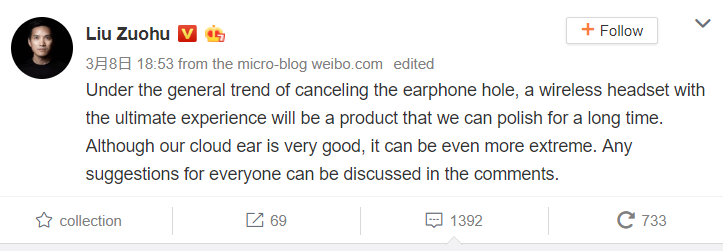
OnePlus CEO, Pete Lau, further expressed his opinion on the removal of the earphone jack in a Weibo post yesterday. He believes the removal of the audio jack will help spur development of wireless earphones. As with each passing generation, the technology should get better. He added that even though the Bullets Wireless is very good, it can still be better. He ended the post by asking for suggestions on how to improve their earphones.
We haven’t found any evidence yet or heard rumors but we won’t be surprised if the OnePlus 7 launches along with a new pair of wireless earphones, maybe even OnePlus’ first truly wireless earbuds. Whichever one it might be, we can be sure it will be better than the Bullets Wireless.
Qualcomm announced aptX Adaptive audio for wireless audio devices last year. The technology will compress audio at variable bitrates depending on the signal strength. The minimum and maximum bitrates of aptX Adaptive are lower than the current bitrate for aptX and aptX HD but have the same quality.
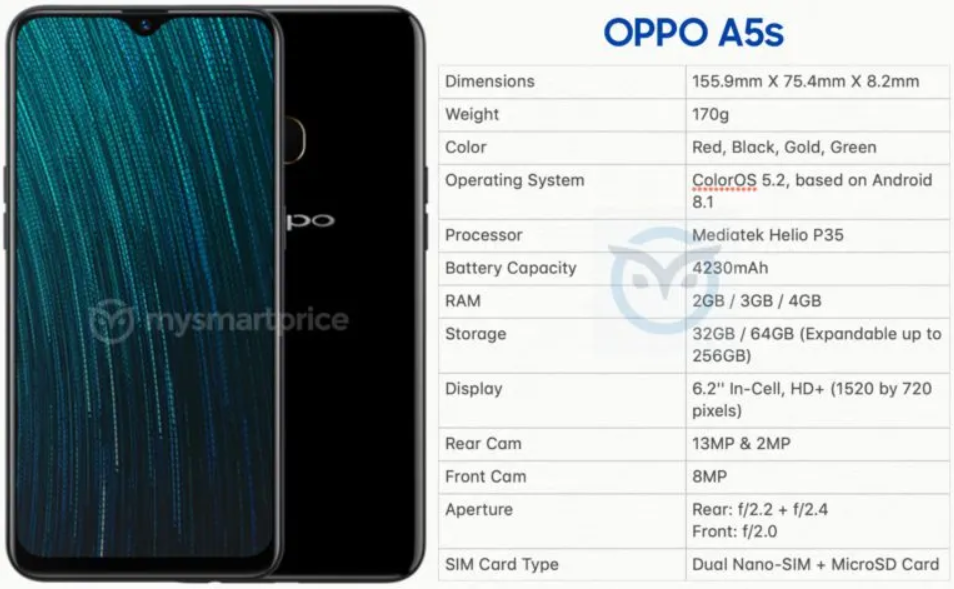
The OPPO A-series line of mid-range smartphone may soon get a new member as the full specs of a phone called the OPPO A5s have leaked. The OPPO A5s will likely be the successor to the OPPO A3s released last year.
Surprised that there is no OPPO A4s? A lot of Chinese manufacturers avoid using the number “4” in the name of their phones because it sounds nearly the same way as the word “death” in Cantonese.
The OPPO A5s will have a 6.2-inch HD+ display (1520 x 720). An attached official render shows the phone has a waterdrop display. The image also shows it has a rear-mounted fingerprint scanner, unlike the A3s. The power button is on the right while the volume rocker is on the left.
The phone is powered by the Helio P35 and will come in 2GB, 3GB, and 4GB RAM variants with 32GB or 64GB of expandable storage. There is an 8MP f/2.0 camera sitting inside the notch and on the rear are dual cameras in a 13MP f/2.2 + 2MP f/2.4 configuration.
The OPPO A5s has a 4,230mAh battery and will run ColorOS 5.2 based on Android 8.1 Oreo out of the box. It will have support for dual Nano-SIM but we are not sure if it is a triple card slot or a hybrid slot.
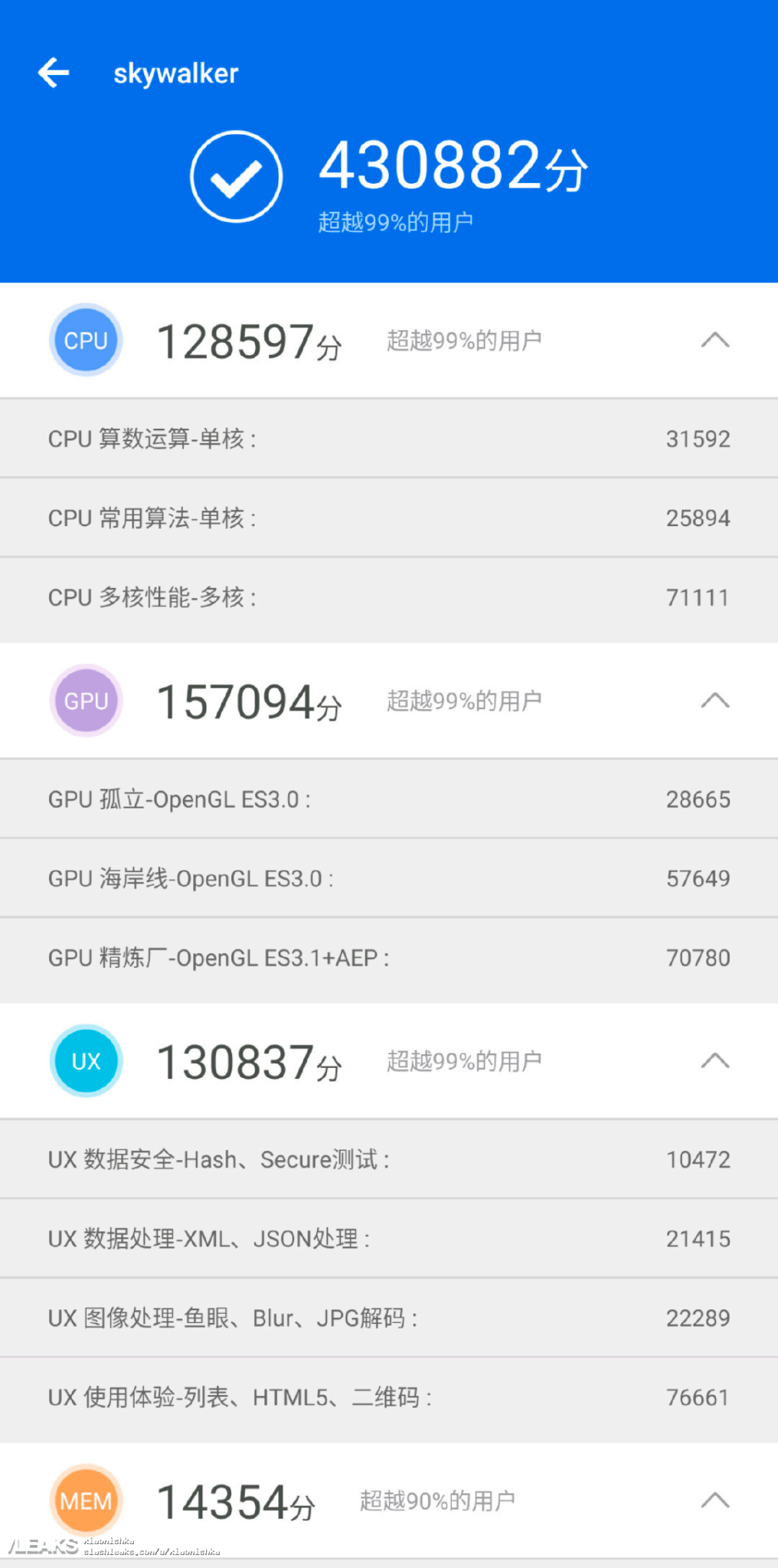
Yesterday, the AnTuTu result of the Black Shark 2 gaming phone surfaced on the web. The result revealed some of its key specs but its overall score is low compared to other Snapdragon 855 devices. A new benchmark result has surfaced and it is higher than any we have ever seen.
The AnTuTu benchmark result confirms the Black Shark 2’s codename as “Skywalker” just like the Geekbench result revealed. Its overall score is 430,882 points, a big leap from the 359,973 points of the first result.
The score is broken down into four – a CPU score of 128,597 points, a GPU score of 157,094 points, a UX score of 130,837 points, and a memory score of 143,54 points.
Huawei will announce its new flagships phones – the P30 and P30 Pro – on March 26 in Paris. We are really excited to see what the Chinese giant comes up with especially in the camera department. Last year’s P20 Pro and Mate 20 Pro rank among the phones with the best cameras and Huawei is set to improve upon that this year.
One feature the upcoming P30 duo are said to have is a Super Zoom feature that trumps that of any phone released so far. Ahead of the launch, Huawei has released nine new teaser posters that show how great the Super Zoom mode is.
So far, the Huawei P30 Pro is the only one confirmed to have the Super Zoom feature thanks to a periscope-type lens that lets it achieve up to a rumored 5x optical zoom with a focal length of 16 – 125 mm but we hope the regular P30 has it too.
[envira-gallery id=”240304″]
Apart from Super Zoom, the P30 phones will also have an enhanced low-light shooting mode which is not only supported by software but backed by hardware too.
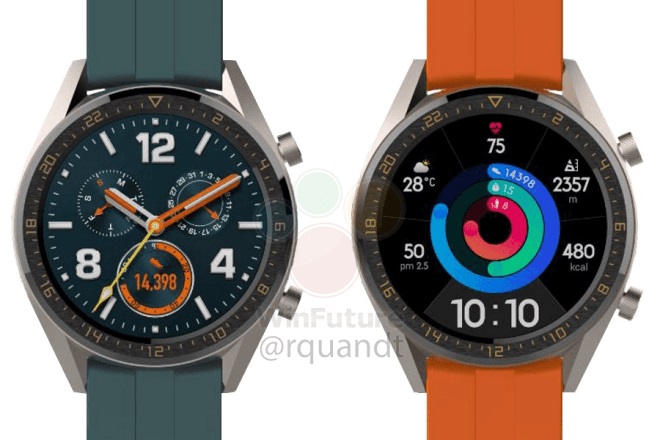
Huawei is continuously working to bring new innovative devices for its consumers. Recently, Huawei has come up with its first foldable smartphone, Mate X at MWC 2019. Now, they are set to launch the new Huawei P30 and P30 Pro at an event in Paris, France. As per the latest reports from our folks at WinFuture, it is revealedthat the Chinese company is allegedly working on two new Watch GT smartwatches. Indeed as like of the Huawei Watch GT, these two new variants will also work on its own Lite OS.
Last year, Huawei announced the first Watch GT smartwatch alongside Huawei Mate 20 Pro. Now, it is speculated that the new variants of the device will make their debut with the launch of Huawei Mate P30 Pro and P30 on March 26 in France.
According to the report, the new models are named as Huawei Watch GT Active and Huawei Watch GT Elegant. Both these smartwatches will have a different set of features and designs. Users can see the “Active” model in the image above in “Dark Green” and “Orange” colours. It will cost 249 Euros which roughly translates to $280 or 1882 Yuan. While for the “Elegant” model you have to shell out 229 Euros (~$ 257 or 1727 Yuan). Moreover, Huawei Watch GT is retailing for 199 Euros aka $224 throughout the world.
These two new smartwatches obviously will elope some new upgrades both in Software and Hardware. Although, we can clearly see some key differences in the new models with respect to the old Watch GT. These new variants of the Watch GT carry a different appearance. Its physical buttons, overall finish and the metal colour, are the key aspects that make it different than its predecessor. Furthermore, there’s no extreme change in the design of new alledged versions of Watch GT.
In the recent past, Wear OS has received new upgrades but some issues remained intact. As like, Qualcomm Snapdragon Wear 3100 chipset is not receiving any incremental updates to fix problems that people are facing in day to day operations. Further, decreasing interest among third-party development companies aiming regular support are the primary concern among smartwatch manufacturers. This behaviour is the main reason for the elevation of big manufacturers not to produce WearOS smartwatches anymore.
We use cookies on our website to give you the most relevant experience by remembering your preferences and repeat visits. By clicking “Accept”, you consent to the use of ALL the cookies.
This website uses cookies to improve your experience while you navigate through the website. Out of these, the cookies that are categorized as necessary are stored on your browser as they are essential for the working of basic functionalities of the website. We also use third-party cookies that help us analyze and understand how you use this website. These cookies will be stored in your browser only with your consent. You also have the option to opt-out of these cookies. But opting out of some of these cookies may affect your browsing experience.
Necessary cookies are absolutely essential for the website to function properly. This category only includes cookies that ensures basic functionalities and security features of the website. These cookies do not store any personal information.
Any cookies that may not be particularly necessary for the website to function and is used specifically to collect user personal data via analytics, ads, other embedded contents are termed as non-necessary cookies. It is mandatory to procure user consent prior to running these cookies on your website.

 Aside from doling out a noteworthy discount on the V3 Pro in collaboration with the Chinese online store, VOYO is also giving GeekBuying users a chance to avail an extra discount before placing their order. We’ll reveal more details about it in just a bit.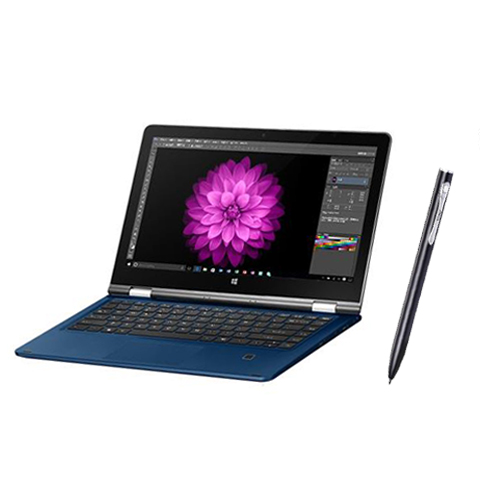

 Aside from shedding light on the aforesaid discounts, we’ll show how you can save a considerable amount of extra money at checkout. So without further ado, let’s delve into the details.
 On top of that, you can coupon code 3219BHUCJM and get an extra $16 off. In other words, you can bring the already reduced selling price of the Xiaomi Mi A2 Lite further down to just $169.99 simply by applying the aforesaid coupon at check out. Regrettably, the coupon will be valid for only a hundred pieces and is slated to expire on March 13th.
 The coupon helps you save $20 more by reducing the device’s original asking price to only $189.99. Note that the coupon will be valid until March 13th for the first hundred pieces only.