TECNO used the stage of IFA ShowStoppers 2025 to present some of its most ambitious product launches yet. Under the theme “The Thinnest Power Duo,” the company revealed the global debut of its TECNO Slim smartphone and also highlighted its new MEGABOOK S14 laptop. The presentation marked not only a step forward in slim device innovation but also confirmed TECNO’s expansion of laptops into Spain and France, two of Europe’s fastest-growing tech markets.
Strong Laptop Push in Spain and France
Spain has become the first major European country where TECNO laptops are now widely available. The lineup includes the MEGABOOK K15S, K16S, and the compact MEGA MINI G1 gaming PC. Reviews from Spanish tech outlets such as Xataka, Topes de Gama and Computer Hoy praised the products for their balance of performance, portability and price. The MEGABOOK K16S AMD version has been highlighted as a strong budget-friendly choice, while the K15S stands out for its premium design and durability.
Partnerships have played a major role in this expansion. TECNO has teamed up with MCR, Spain’s largest technology distributor, as well as retail giants MediaMarkt and Carrefour. This allows the laptops to be sold both online and in stores. The company has also announced that the flagship MEGABOOK S14, the lightest 14-inch OLED laptop at only 899 grams, will reach select European markets in the final quarter of 2025.
TECNO Slim Smartphone Leads Innovation
The star of TECNO’s showcase is the new TECNO Slim, a smartphone that claims the title of the world’s slimmest 3D curved device. Measuring only 5.93mm (4G) and 5.95mm (5G), it manages to pack in a 5160mAh battery with 45W fast charging. It also comes with a 144Hz AMOLED display protected by Gorilla Glass Victus 3 and is built to military-grade durability standards. On the software side, the phone integrates AI features such as real-time translation, AI writing tools, and Circle to Search, offering users both style and advanced intelligence.
Tablets and AIoT Products Join the Lineup
TECNO also introduced the MEGAPAD Pro, a 12-inch AI-powered tablet designed for students and professionals. It has a 2K display, Dolby sound, 90Hz refresh rate and a large 10,000mAh battery. AI features like image-based Q&A, smart screen recognition and a shortcut key for the Ella Voice Assistant make it suitable for work and learning.
In addition, TECNO expanded its AIoT ecosystem with new wearables and accessories. These include the TRUE 2 AI TWS earbuds, the Watch GT AI Smart Watch and several smart home and lifestyle gadgets. All of these products aim to create a connected and seamless experience across devices.
Aiming for a Smarter Digital Lifestyle
According to Ye Yuan, Head of TECNO AIoT, the company’s focus in Europe is to deliver products that balance modern design, powerful performance and affordable value. TECNO follows a “Glocalization” strategy, meaning it combines global innovations with features tailored to local needs.
With its new smartphone, laptops, tablets and AIoT products, TECNO has made it clear that it is ready to compete in Europe’s highly competitive tech market. The company’s entry into Spain and France is not just a regional expansion, but a signal that it is aiming to become a bigger name in global consumer technology.
Lenovo used IFA 2025 to give its ThinkPad X9 Aura Edition a fresh look. After debuting in Silver at CES and later in Moonlight White over the summer, the slim and stylish laptop is now available in a new Glacial White finish.
The hardware hasn’t changed, but the color refresh adds some flair to a model that was designed to break away from the traditional black-and-red ThinkPad aesthetic. The X9 Aura is available in two sizes: a 14-inch version with a WUXGA OLED display (400 nits, HDR 500, 100% DCI-P3) and a 15-inch model with a sharper 2.8K OLED panel (1,100 nits, HDR 600, 100% DCI-P3, 120 Hz VRR). Battery capacity differs as well — 55 Wh on the 14-inch, user-replaceable, versus a larger 80 Wh pack on the 15-inch, which is likely sealed.
Inside, both machines run on Intel’s Core Ultra 7 vPro chip paired with 32 GB of LPDDR5X-8533 RAM, Intel Arc graphics, and a 1 TB SSD. Other features include an 8 MP webcam with IR, Wi-Fi 7, Bluetooth 5.4, and two Thunderbolt 4 ports. The larger 15-inch also adds a USB-A port.
The Glacial White edition will be available from October 2025, priced at €1,619 (about $1,790) for the 14-inch and €1,759 (about $1,945) for the 15-inch.
With its brighter, minimalist design and high-end specs, the X9 Aura Edition is Lenovo’s way of showing that a ThinkPad can be both professional and stylish.
Nothing has officially teased the launch of its next-generation earbuds, the Ear (3). In a typical Nothing fashion, the company made a succinct post on X (formerly Twitter), simply stating, “Ear (3). Soon.”
The more interesting detail is in the name. After briefly shifting to a letter-based system with the Ear and Ear (a) in 2024, the company is reverting to numbers with its next earbud. That puts the new model back in line with the Ear (1) and Ear (2), which launched in July 2021 and March 2023, respectively.
The company explained that user feedback highlighted the importance of this naming approach; as a result, the upcoming model is called the Ear (3). Though it’s technically a fourth-generation product.
Nothing has not shared any details about what the Ear (3) will bring, and there haven’t been leaks yet either. So for now, it’s worth looking back at what the current-generation Ear offers.
The Nothing Ear features a custom 11mm ceramic driver, designed to deliver clearer sound with more pronounced bass. It supports Hi-Res Wireless Audio and comes with up to 45dB of active noise cancellation.
Nothing Ear
The ANC system is adaptive, adjusting in real time to compensate for sound leakage between the earbud and ear canal. Users can also switch between three noise cancellation levels depending on their environment.
On the connectivity side, the Ear supports Bluetooth 5.4 and dual-device pairing, allowing users to connect to two devices at once. Its battery life is rated at up to 8.5 hours of playback on a single charge, or 9.5 hours with ANC disabled. With the charging case, playback extends to around 40.5 hours.
For more daily updates, please visit our News Section.
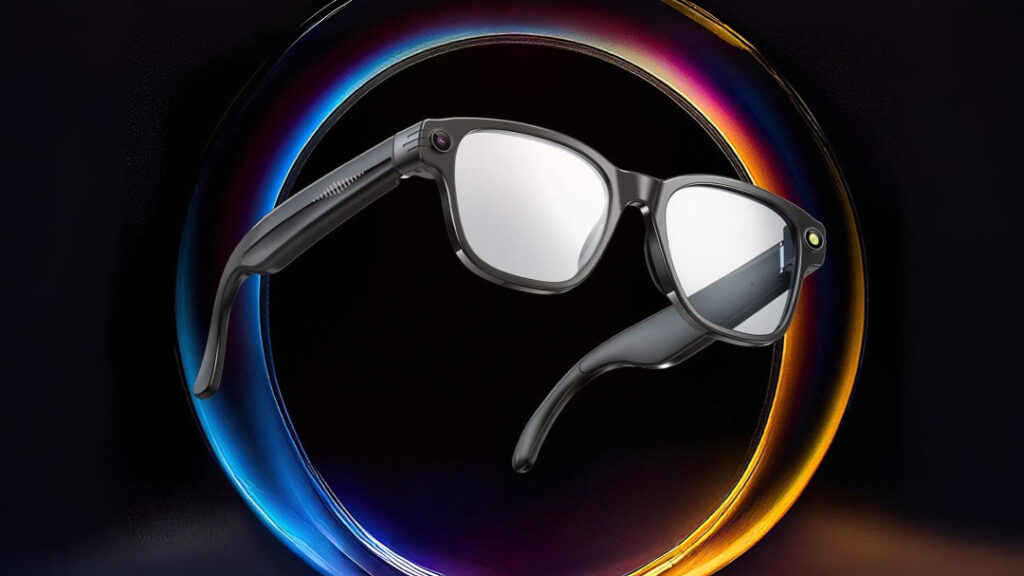
Rollme has launched its latest smart eyewear product, the NeoView AI Smart Glasses, as the successor to the earlier AirView model. The company aims to position the NeoView as a practical and affordable AI-powered accessory for everyday use.
Rollme NeoView AI Smart Glasses Specifications
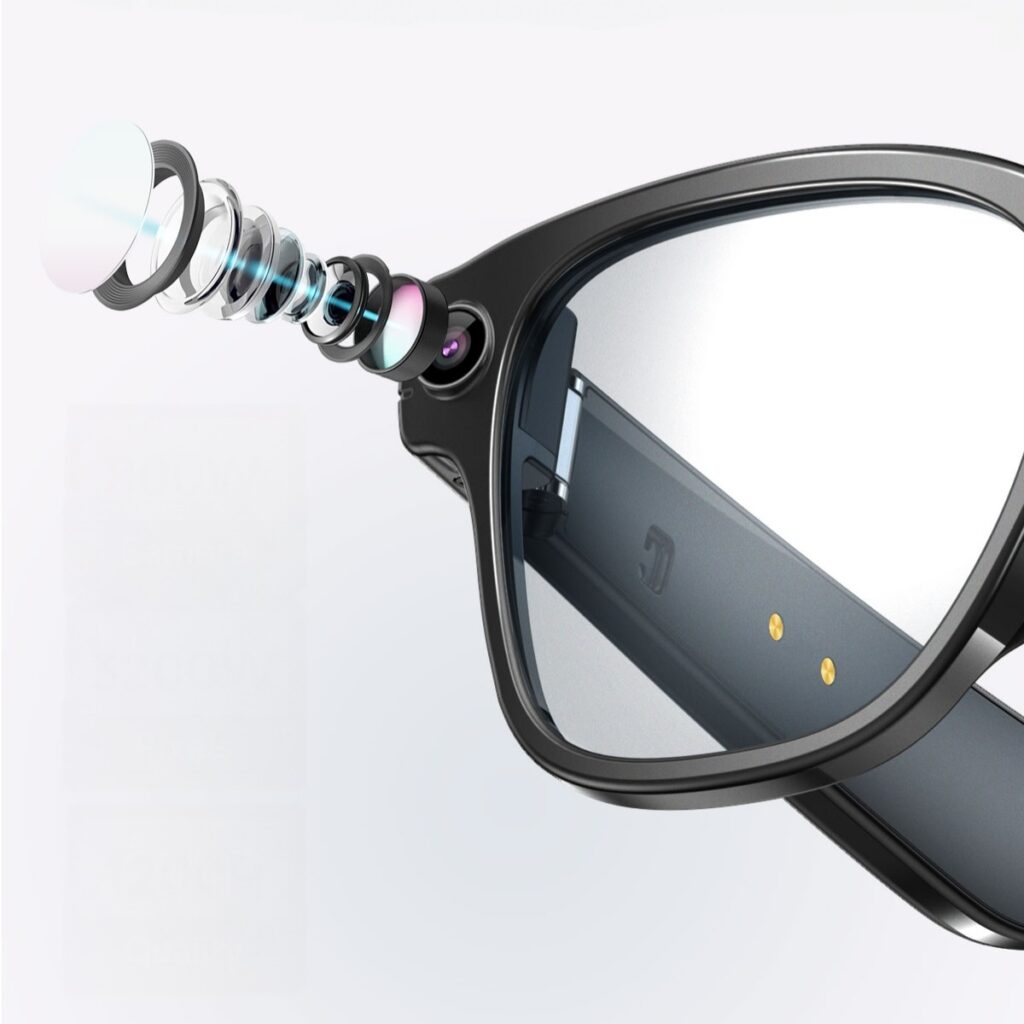
The NeoView features a built-in 8MP camera that uses a Sony IMX219 sensor. It supports photo interpolation up to 32MP and records 1200p videos with electronic image stabilization.
Rollme claims the camera can capture fast-moving scenes with a 0.5-second shutter and stable footage with minimal shake. These features allow users to record first-person video content and take action shots without requiring bulky gear.
For communication, the NeoView includes dual microphones with noise cancellation. The device supports hands-free Bluetooth calling and can sync photos and videos instantly via Wi-Fi and Bluetooth 5.4. The company says users can share content or take calls easily, even in loud environments.
NeoView features an AI voice assistant compatible with models like ChatGPT and Doubao. Tapping the frame brings up the assistant, enabling voice-based control for tasks, questions, and media playback. It also supports real-time translation in several languages and object recognition, turning the glasses into a smart visual aid in unfamiliar surroundings.
The glasses use directional ultrasonic speakers that provide stereo sound while keeping audio private. The NeoView supports music streaming, voice commands, and app integration through a touch-sensitive area on the frame.
Rollme claims the NeoView offers a standby time of up to 168 hours, with talk time ranging between 3 to 6 hours. The device charges via a magnetic connector and is compatible with Android 6.0 and iOS 10.0 or later.
The NeoView comes in two lens options: clear and tinted, making it suitable for both indoor and outdoor use. It also includes six ergonomic detection points that automatically track wearing status for better battery management and functionality.
Pricing and Availability
The Rollme NeoView AI Smart Glasses are now available worldwide through Rollme’s official store at a price of $79.99.
In related news, we recently reviewed the RayNeo Air 3s Pro, which is super bright, lightweight, and surprisingly immersive – check it out.
For more daily updates, please visit ourNews Section.
The Diwali heat is on! Tech enthusiasts in India are eagerly awaiting the massive deals and offers of the season. We can already spot some exciting deals on OnePlus devices, running separately on both Amazon India and the official OnePlus online store. These promotions are perfectly timed to kick off the festive shopping. Blending cashback incentives with exciting lucky draw prizes and more.
Amazon Pay x OnePlus Deal
First, the Amazon Pay x OnePlus is up with a prime-exclusive deal literally hard to resist. Potential buyers can enjoy a 5% cashback, capped at ₹10,000, on OnePlus orders exceeding ₹2,999 when paid via Amazon Pay UPI (non-EMI). The offer is valid until October 31, 2025, though we’d recommend grabbing it before the stocks run out, especially during the peak Diwali rush!
Amazon promises to disburse the cashback within 24 hours of shipment. So, if you have made up your mind to grab a sleek OnePlus smartphone or the latest Nord Buds, this is the deal worth consideration. This deal leverages India’s booming UPI ecosystem of whopping 13.9 billion transactions in July 2025 alone (as per NPCI data) to deliver instant rewards.
For more details, you may visit the Amazon Reward page or start the shopping spree directly from the OnePlus Listing in Amazon.
Please Note: When you buy something using the links in our articles, we may earn a small commission at no cost to you.
OnePlus Spin & Win Lucky Draw Campaign
Adding to the festive excitement, OnePlus’s official site is also out, hosting a festive lucky draw campaign running from September 4 to September 13, 2025. Open to Red Cable Club members, participants can redeem 10 RedCoins for a spin, with up to three daily chances (an extra for Elite/Maestro members). Prizes include 50, 100, or 500 RedCoins, free devices like the OnePlus Nord 5 or OnePlus 13, and a Handy Fanny Pack, redeemable as coupons. With the campaign active now, it’s the perfect time to engage and win, enhancing the Diwali shopping experience.
With this strategically placed campaign, both Amazon and OnePlus strive to lure customers into purchasing their products or services. At the end of the day, it’s a win-win for Amazon, OnePlus, and us as customers.
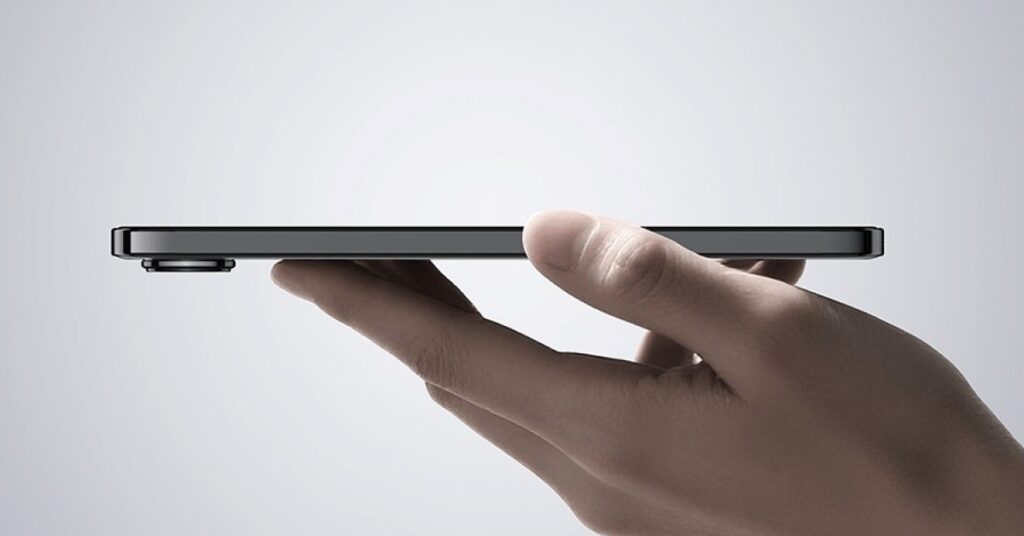
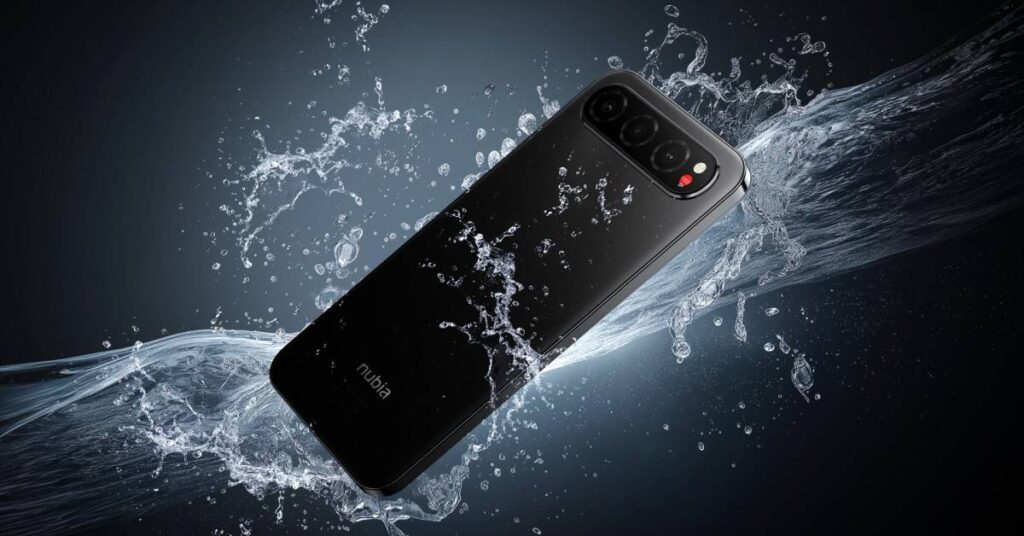
Nubia has officially launched the Nubia Air, a slim and trim smartphone that measures just 5.9mm thick. It arrives only a day after another Chinese maker, Tecno, announced the Pova Slim 5G. What’s interesting is that both are mid-range devices costing less than $300, despite the effort the brands have put into making such slender bodies.
Nubia Air Specifications
The Nubia Air carries a 6.78-inch AMOLED display with 1.5K resolution and a smooth 120Hz refresh rate. The screen also reaches an eye-catching 4,500 nits peak brightness and comes protected with Gorilla Glass 7i.
The display feels flagship-level, but Nubia has cut costs on performance. Inside, the phone runs on an entry-level Unisoc T8300 chip, paired with 8GB of RAM (virtually expandable by another 12GB) and 256GB of storage.
The camera setup on the device includes a 50-megapixel main shooter supported by EIS and joined by two secondary sensors. The front has a 20-megapixel selfie camera. Nubia has also packed in plenty of AI-powered tricks, like AI Super Night, HDR, VLOG mode, Magic Editor, and Magic Eraser, for people who like editing on the go.
What’s surprising is how rugged this thin device claims to be. The Nubia Air has IP68, IP69, and IP69K ratings, meaning it’s protected against dust, water, and even high-pressure sprays. It also includes AI tools for real-time translation during calls, face-to-face conversations, and even AI noise and echo cancellation to improve call clarity.
Powering everything is a 5,000mAh battery, though Nubia hasn’t shared details on charging speeds yet.
Nubia Air Price and Specifications
The Nubia Air is priced at $279 (around Rs. 24,600) for the 8GB + 256GB variant. The sales will begin in Europe this month, followed by Southeast Asia, Latin America, the Middle East, and more regions later this year. Color options include Titanium Black, Streamer Black, and Titanium Desert.
For more daily updates, please visit our News Section.
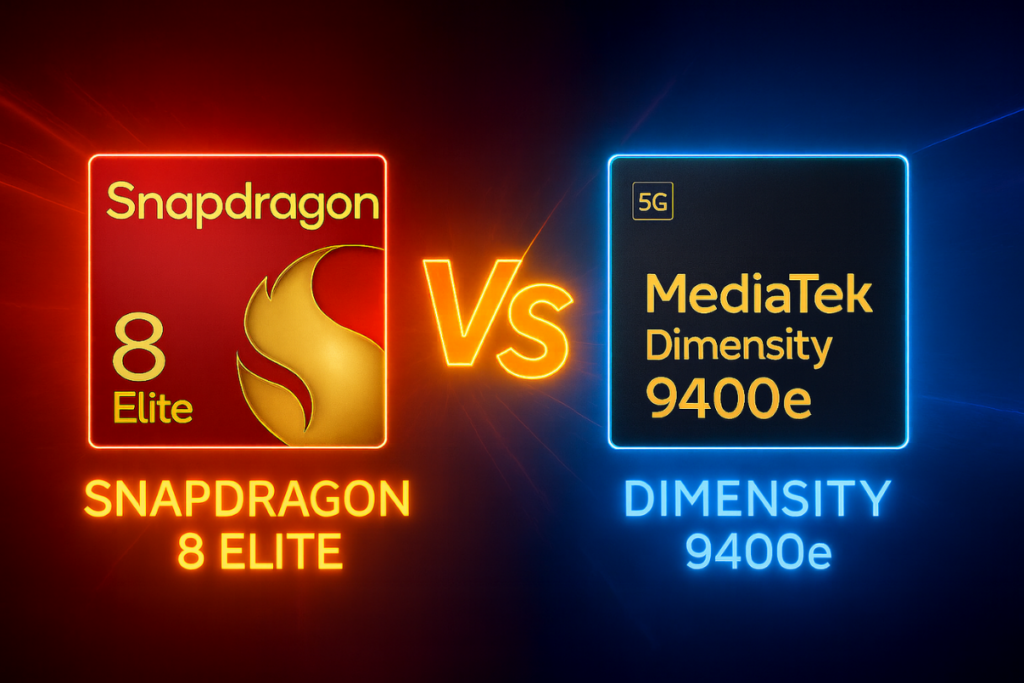
Qualcomm announced the Snapdragon 8 Elite last year, featuring Oryon cores for the first time in a mobile chipset. These are high-performance CPU cores that also offer excellent power efficiency. The Snapdragon 8 Elite quickly became favorite among high-end Android devices, but it continued to face fierce competition from MediaTek.
The Dimensity 9400 flagship lineup competes with Qualcomm’s top-tier chipsets, offering impressive performance and efficiency. The lineup recently got its newest member, Dimensity 9400e, which we will be comparing here with the Snapdragon 8 Elite to see how the two chips stack up against each other.
Snapdragon 8 Elite vs Dimensity 9400e: Benchmark comparison
Note: The tests were conducted on the Realme GT 7 Pro (Snapdragon 8 Elite) and Realme GT 7 (Dimensity 9400e).
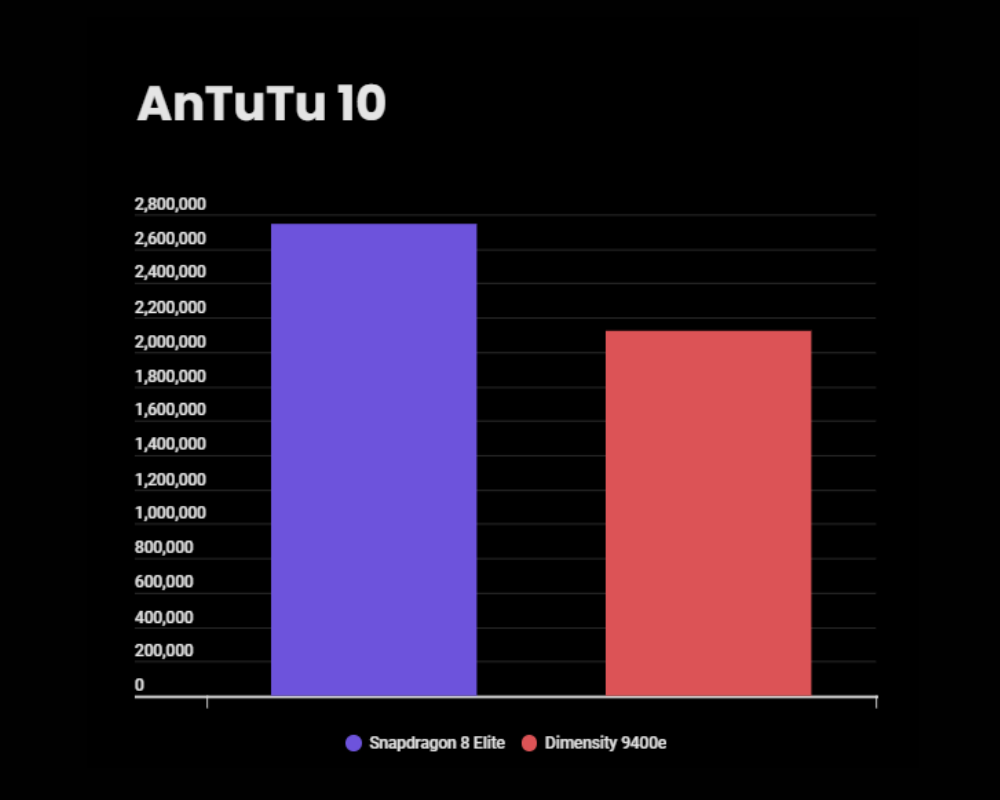
AnTuTu score
The Snapdragon 8 Elite establishes a clear lead over the Dimensity 9400e on AnTuTu, scoring 2,745,602 against MediaTek’s 2,123,428 — a difference of nearly 29% in overall performance.
Qualcomm’s chip has the edge across all categories. The CPU score is about 15% higher, while the GPU shows a significant 35% boost. The Memory and UX scores also greatly favor the Snapdragon chip.
Here’s a detailed look at the breakdown:
Snapdragon 8 Elite
Dimensity 9400e
AnTuTu score
2,745,602
2,123,428
CPU
578,305
502,983
GPU
1,157,741
855,871
Memory
569,580
402,991
UX
439,975
361,583
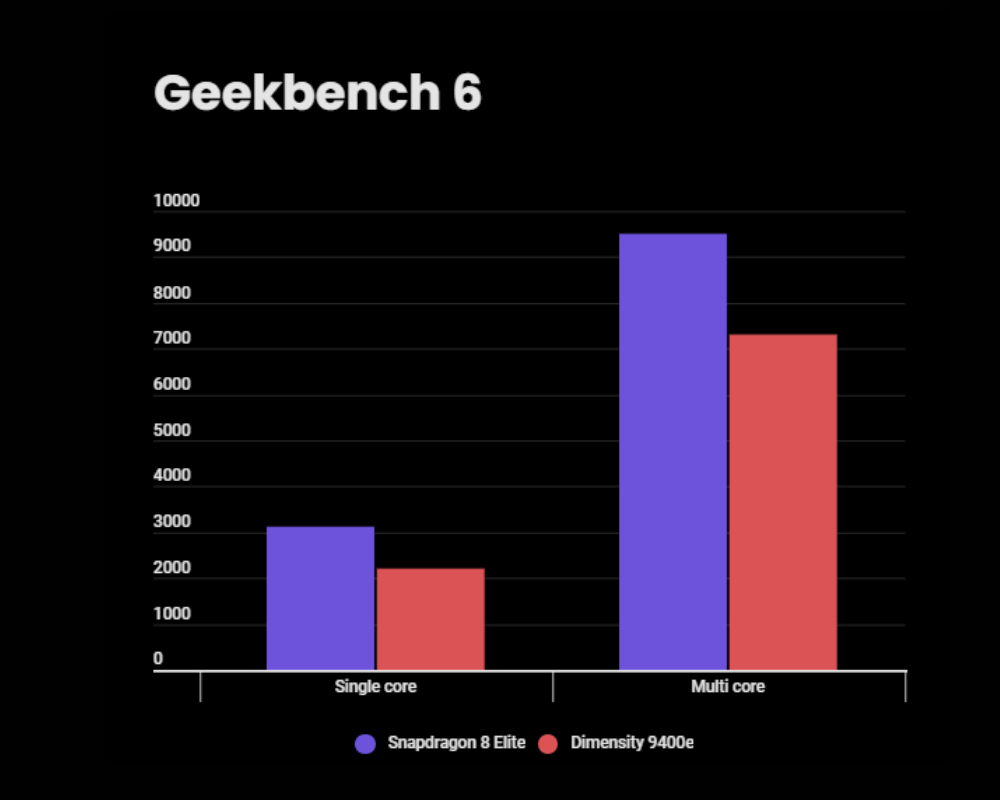
Geekbench score
On Geekbench 6, the Snapdragon 8 Elite once again shows a decisive lead over the Dimensity 9400e. It scores 3,122 in single-core and 9,507 in multi-core, while the Dimensity 9400e could only manage 2,208 and 7,310 in single-core and multi-core, respectively.
This translates to 41% better single-core performance and 30% better multi-core performance for the Snapdragon flagship.
Snapdragon 8 Elite
Dimensity 9400e
Single core
3,122
2,208
Multi core
9,507
7,310
In terms of raw performance, the Snapdragon 8 Elite outperforms the Dimensity 9400e. However, it doesn’t provide the complete picture, including details about the manufacturing process, camera, and connectivity. So, let’s dive into the real-world differences to gain more clarity.
Snapdragon 8 Elite vs Dimensity 9400e: Key differences that really matter
Performance and efficiency
Manufacturing:
Both the Snapdragon 8 Elite and Dimensity 9400e use TSMC’s manufacturing facility, yet they bring notable differences. The Snapdragon chip utilizes a newer and more advanced 3nm (N3E) process node, while the Dimensity chip is built using a 4nm node. This results in notable improvements in performance and efficiency for the Snapdragon chip.
CPU:
The CPU brings major changes. For the Snapdragon 8 Elite, Qualcomm didn’t go with ARM’s Cortex CPU, but instead, it developed its own Oryon cores. The 8 Elite features the 2nd-gen Oryon cores, which have higher clock speeds than the Cortex cores inside the Dimensity 9400e.
Here’s what the CPU cluster looks like:
Snapdragon 8 Elite
2 x Oryon (2nd-gen) at 4.32 GHz
6 x Oryon (2nd-gen) at 3.53 GHz
Dimensity 9400e
1 x Cortex-X4 at 3.4 GHz
3 x Cortex-X4 at 2.85 GHz
4 x Cortex-A720 at 2 GHz
The Snapdragon 8 Elite has more powerful CPU cores. Additionally, they operate at higher speeds, providing an extra performance boost.
GPU:
The Snapdragon 8 Elite features an Adreno 830 GPU, which is one of the most powerful and power-efficient GPUs for mobile chipsets. It features a new “sliced architecture,” which has helped the GPU achieve 40% enhanced performance and 40% improved efficiency over its predecessor.
Additionally, the 8 Elite supports hardware ray tracing, Unreal Engine 5.3 with Nanite virtualized geometry, and a full suite of Snapdragon Elite Gaming features for a better gaming experience.
The Dimensity 9400e, on the other hand, features a 12-core Immortalis-G720 GPU, which is capable of smoothly running high-end games. It also supports ray tracing capabilities and features MediaTek Adaptive Gaming Technology (MAGT 2.0), a suite of gaming optimizations.
The bottom line here is that the Snapdragon 8 Elite has a more powerful and power-efficient GPU.
NPU:
The Snapdragon chip features an improved hexagon NPU that delivers 45% better AI performance and 45% better performance per watt than its predecessor. It brings on-device personalization and multimodal support. The NPU also helps improve the photo quality, gaming, connectivity, and other areas on a device.
The Dimensity 9400e has MediaTek NPU 790 with generative AI capabilities and support for popular LLMs, such as Qwen 1.5B, Llama 7B, and Llama 8B, with on-device processing.
Memory and storage:
Both chipsets support fast UFS 4.0 storage and LPDDR5X RAM. However, there’s a slight difference. The RAM speed can go up to 5.3 GHz on the Snapdragon 8 Elite, while the Dimensity chip peaks at 4.2 GHz. This means faster app loading and slightly better performance for the Snapdragon chip.
Camera
Both chipsets support up to 320MP camera sensors and up to 8K video recording. The Snapdragon 8 Elite supports limitless real-time semantic segmentation for photos and videos with up to 250 layers. Additionally, it offers a range of camera features, including Truepic photo capture, Video super resolution, Multi-frame Noise Reduction (MFNR), and Bokeh Engine.
The Dimensity 9400e also supports semantic segmentation that automatically detects various scenes and objects and applies precise optimizations. It also supports AI-powered noise reduction, real-time AI processing for cinematic video capture and photo enhancements, and features triple microphones with high dynamic range and noise reduction.
Connectivity
The Snapdragon 8 Elite is equipped with an X80 5G modem, which offers up to 10 Gbps download speed and up to 3.5 Gbps upload speed. Over a Wi-Fi 7 connection, the maximum speed the chip can hit is 5.8 Gbps.
On the other hand, the Dimensity 9400e offers a maximum download speed of up to 7 Gbps on a 5G connection (sub-6GHz) and up to 7.3 Gbps on a Wi-Fi 7 connection. This means it has a higher speed on a Wi-Fi 7 connection but lower on a 5G connection than the 8 Elite.
Additionally, both chips offer a range of features to further enhance connection speed, power efficiency, and coverage.
Snapdragon 8 Elite vs Dimensity 9400e: Conclusion
The Dimensity 9400e is a capable high-end chipset, boasting impressive performance, strong AI capabilities, and competitive gaming capabilities. Its high-end CPU, powerful Immortalis-G720 GPU, and AI-driven optimizations make it a serious challenger in the premium segment. However, the Snapdragon 8 Elite remains the stronger all-rounder.
The Snapdragon 8 Elite is significantly ahead of the Dimensity 9400e in almost all aspects. Its newer 3nm process, custom Oryon CPU cores, and Adreno 830 GPU with sliced architecture give it a significant edge in both performance and efficiency. The benchmarks also greatly favor it over Dimensity 9400e.
In short, the Dimensity 9400e is an excellent alternative, but if you’re after the absolute best in performance, gaming, and efficiency, the Snapdragon 8 Elite is an absolute no-brainer pick.
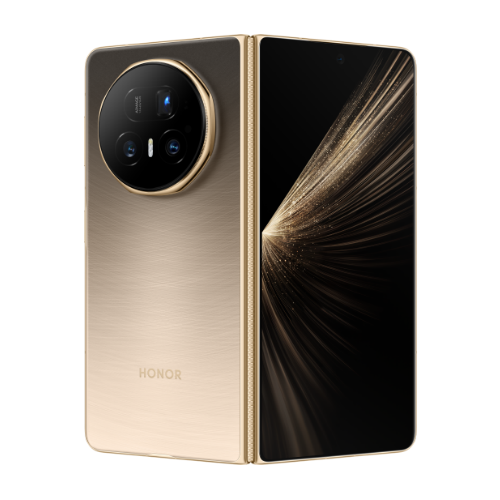
HONOR has announced strong first-week sales for its new foldable smartphone, the HONOR Magic V5, across Western Europe. Sales data from all channels show that sales were 75 percent higher compared to the same launch period of its predecessor, the HONOR Magic V3.
The Magic V5 went on sale on August 28 and has quickly gained attention from buyers. E-commerce platforms and retail partners have reported strong growth since its release. In 2024, HONOR became the fastest-growing book-style foldable brand in Europe, with its market share tripling to 34 percent, according to Counterpoint Research.
“The HONOR Magic V5, with industry-leading slimness and revolutionary AI features, is truly a game changer. We are delighted to see that customers across Western Europe are excited to get their hands on our latest foldable smartphone,” said Adam Cao, President of HONOR Western Europe. “This initial sales momentum not only highlights the HONOR Magic V5’s appeal but also signals a strong market appetite for advanced, AI-powered foldable smartphones.”
The Magic V5 (check out our Magic V5 unboxing and hands-on review) is currently the thinnest book-style foldable smartphone available. It combines portability, durability, and performance. The device has IP58 and IP59 ratings for dust and water resistance. Its strength has been recognized with a Guinness World Record for the heaviest weight lifted by a suspended foldable smartphone.
It comes with a 5,820mAh silicon-carbon battery and HONOR’s upgraded AI Falcon Camera System, which includes a 64MP Ultra Sensing Periscope Telephoto lens. The inner display measures 7.95 inches, and the outer screen is 6.43 inches. Both support stylus input. The Multi-Flex mode allows users to run up to three apps at the same time.
Pricing & availability
The HONOR Magic V5 is available in Ivory White, Black, and Dawn Gold. It is sold through honor.com, network operators, and retail partners. In the UK, the device is priced at £1,699.99 for the 16GB + 512GB version. In Europe, it starts at €1,999 for the same configuration.
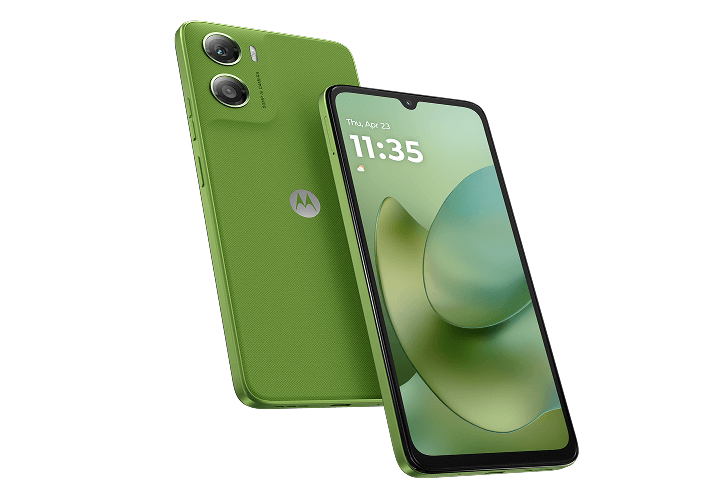
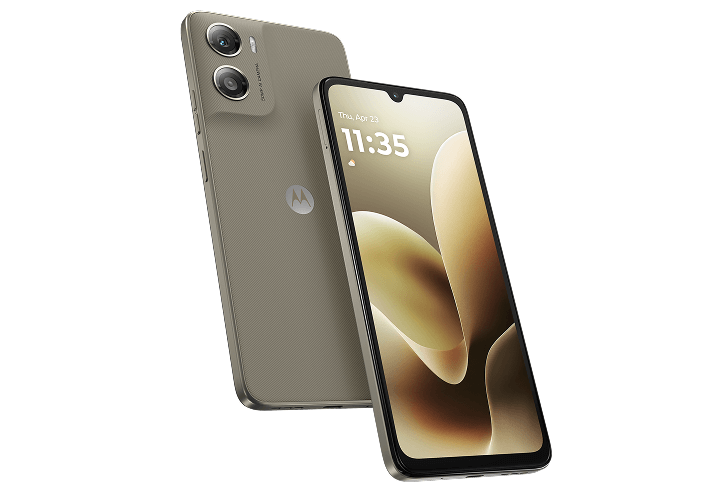
Motorola is expanding its budget lineup with the launch of the Moto G06 Power and the Moto G06. The highlight here is the massive 7,000mAh battery on the G06 Power, while the regular G06 offers a still-respectable 5,200mAh pack. Both models feature smooth 120Hz displays and come in bright, eye-catching colors, and more.
Moto G06 Power & Moto G06 Debut
Moto G06 Power
The two new budget phones from the brand are nearly identical. Both models sport a tall 6.88-inch LCD panel with an HD+ resolution, a 120Hz refresh rate, 600 nits of peak brightness, and Corning’s Gorilla Glass 3. Under the hood, these are equipped with the MediaTek Helio G81 Ultra SoC, which only supports 4G connectivity. This is paired with up to 8GB of RAM and 256GB of internal storage that can be further expanded by up to 1TB via a microSD card slot.
For photography, you get a 50MP camera on the rear, while the front houses an 8MP selfie shooter. The Moto G06 Power packs a massive 7,000mAh battery pack with 18W wired fast charging, while the standard Moto G06 gets a sizeable 5,200mAh cell with standard 10W charging speed. Other notable features include an IP64 rating for water and dust resistance, NFC, Bluetooth 6, dual band WiFi, a side mounted fingerprint scanner, Android 15 OS, and stereo speakers with Dolby Atmos support.
Moto G06
The Moto G06 Power is available in PANTONE Laurel Oak, PANTONE Tapestry, and PANTONE Tendril color options. On the other hand, the Moto G06 gets an additional PANTONE Arabesque variant. Pricing and availability details are still at large, but the first roll out will kick off in the European market with a 129.99 Euros starting price. This release also arrives Motorola’s other announcements, like the Moto Book 60 Pro and Moto Edge 60 Neo.
For more daily updates, please visit our News Section.
OnePlus is offering an early look at what its next flagship phone can capture. The company today shared its first batch of camera samples from the upcoming OnePlus 15, following the announcement that it’s ending its partnership with Hasselblad after five years.
The photos were shot at an 85mm focal length with an f/2.8 aperture and are meant to show the phone’s telephoto camera prowess. The OnePlus 15 also benefits from the LUMO imaging system, which Oppo introduced with the Find X8s series earlier this year.
From the samples, you can see vibrant colors, clear separation between subjects and backgrounds, and impressive detail retention, even in challenging lighting conditions.
Of course, camera samples released by companies are always carefully curated, so the real test will come when reviewers get the device in hand. Still, it will be interesting to see what the new partnership brings for OnePlus devices and their users. Also, the images above are compressed, so we suggest that you navigate to the source to see them in original quality.
The telephoto in question is a 50MP lens with 3x optical zoom, and will be accompanied by a 50MP main camera and a 50MP ultrawide lens. Not just the Hasselblad branding, OnePlus is also rumored to move on from its unique round camera module design on the back. It may feature a square module in the upper left corner instead.
Beyond this
Apart from this, the device is expected to feature a BOE display with 1.5K resolution and a 165Hz refresh rate. It will be one of the first flagships to get the Snapdragon 8 Elite Gen 5 chip, likely paired with up to 12GB of RAM.
Software-wise, the OnePlus 15 will ship with Android 16 out of the box, as confirmed by Geekbench. Fueling the phone will be a 7000mAh battery that supports both 100W wired and 50W wireless charging.
For more daily updates, please visit our News Section.
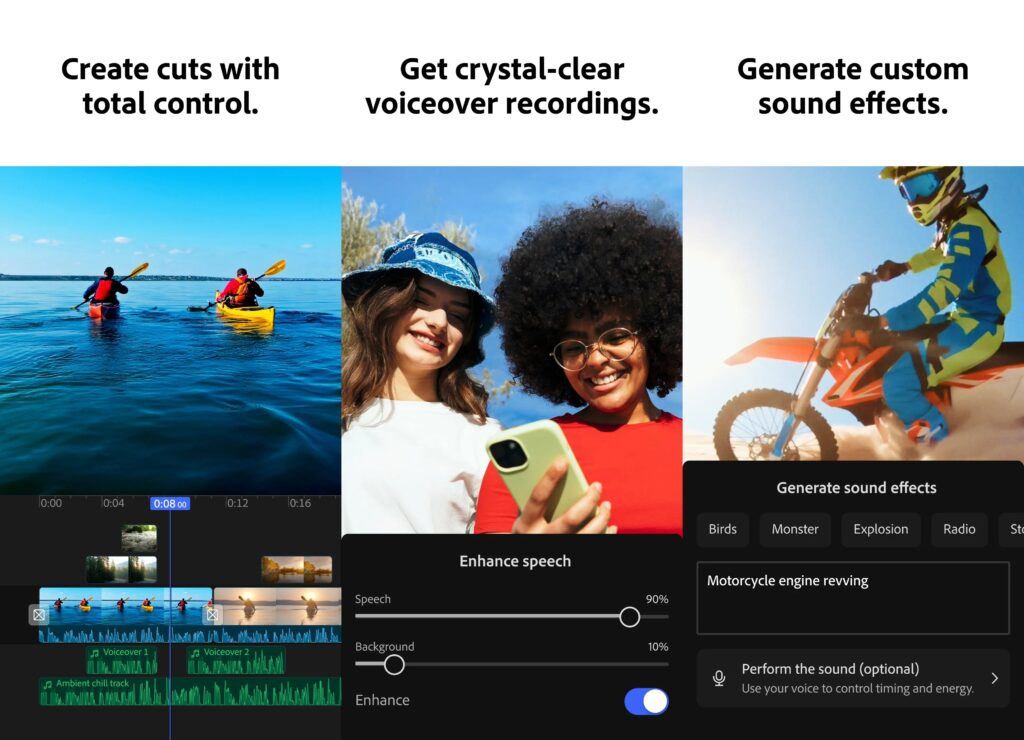
Adobe is finally putting its video editor into your pocket. The company has announced a mobile version of Premiere, reworked from the ground up for phones and tablets, with a focus on creators who live on TikTok, Instagram, and YouTube. The app launches September 30 on iPhones and iPads, with Android support on the way.
This isn’t just a shrunken-down desktop app. The mobile app has a touch-first interface that makes trimming clips, layering audio, and adding effects much easier on smaller screens. Videos can be cut and exported in up to 4K HDR, which should be more than enough for both casual and professional content.
The real draw is Adobe’s AI toolkit. Users can generate sound effects with a simple text prompt, clean up messy audio, or pull free background tracks from Adobe Stock. There are also one-tap exports for Instagram Reels, TikTok, and YouTube Shorts, meaning creators won’t have to wrestle with settings before posting. And here’s the best part: unlike some free apps, Adobe isn’t slapping watermarks on the finished product.
Premiere Mobile projects also sync with Premiere Pro on desktop, so creators can start an edit on their phone and finish it later on a Mac or PC. That flexibility could give Adobe an edge over many of its rivals.
Apple users can pre-register for the September 30 rollout, while Android users will have to wait a bit longer. Either way, Adobe’s move signals a big bet on mobile-first editing at a time when short-form video dominates. If the app lives up to the promise, it could become a go-to tool for anyone serious about creating on the go.
Back in April 2025, Motorola unveiled its first ever laptop with the Moto Book 60. These came with new mid-range Intel chips and gorgeous displays at an affordable price point. Just a few days ago, the company confirmed the arrival of the more powerful Moto Book 60 Pro model, which packs an even faster Intel Core Ultra Series 2 CPUs. After a short wait, this powerful new thin-and-light laptop has finally released in India, so let’s check it out.
Moto Book 60 Pro Launched: Lightweight Laptop with Heavyweight Performance
Lenovo brought its expertise in laptops with the Moto Book 60, which brought a lightweight and premium build. All of this has remained virtually the same with the Moto Book 60 Pro. So you still get the MIL-STD-810H military grade certification, a metallic body, a 1.69cm thick chassis, and a light 1.39 kilogram weight. The vibrant display also makes a return with a 14-inch OLED display with a high 2.8K resolution, 100% DCI-P3 color gamut, 1100 nits of peak brightness, and a 120Hz refresh rate.
Moto Book 60 Pro
Both the design and display were highlights of the Moto Book 60, so no complaints in this regard. But the biggest change comes with the performance. While the Intel Core 5 and Core 7 on the Moto Book 60 sound next-gen, these are older 10nm based chips. Meanwhile, the Moto Book 60 Pro packs the Intel Core Ultra 5 or Core Ultra 7. These processors are not only more powerful, but the 3nm process makes them more power efficient as well. The chip is also paired with up to 32GB of DDR5 RAM and 1TB of SSD M.2 PCIe 4.0 storage.
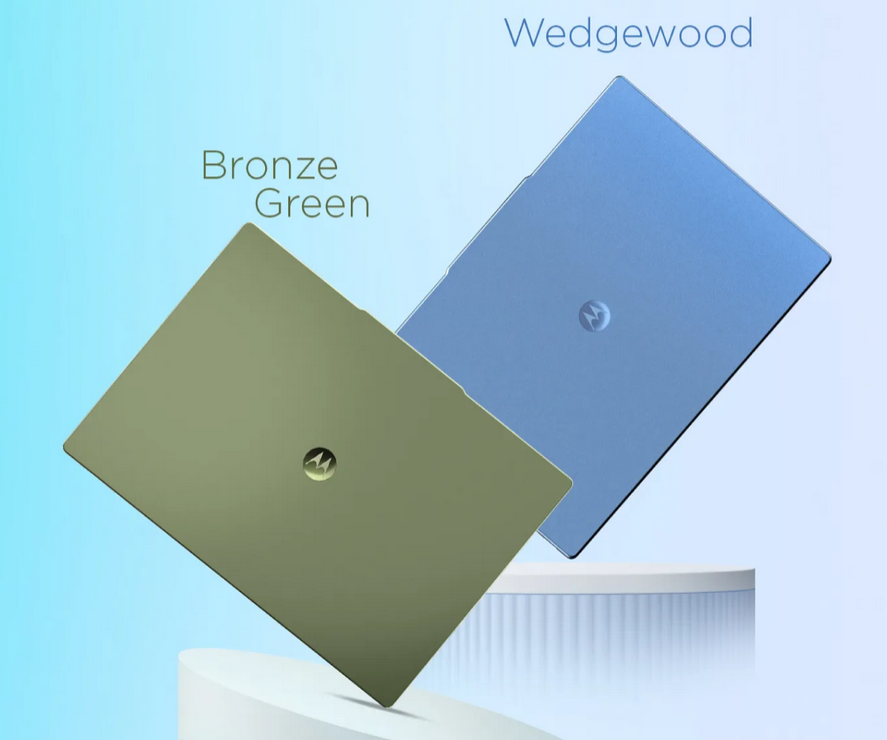
A sizeable 60Wh battery pack powers this laptop, with 65W USB-C charging support. Other notable features include Dolby Atmos speakers, Bluetooth 5.4, WiFi 7, Windows 11 Home, and a Full HD IR webcam. The Moto Book 60 Core Ultra 5 has a starting price of 64,990 INR, while the Core Ultra 7 starts from 80,990 INR. Motorola’s bright and elegant Pantone Bronze Green and Pantone Wedgewood colors make a return as well.
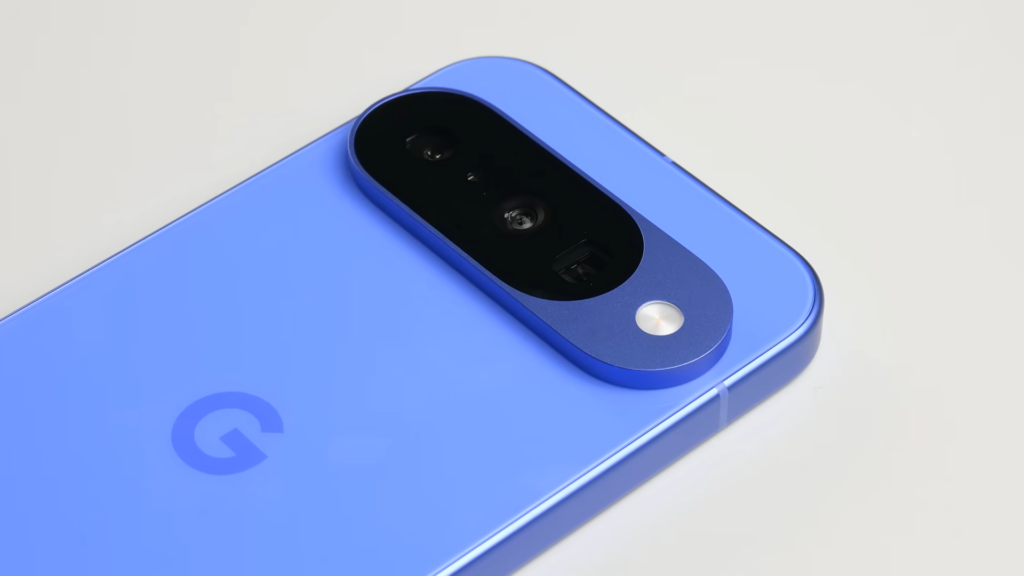
Google’s Pixel 10 may have just launched, but it’s already making headlines for more than its TSMC-made Tensor G5 chip and flashy new software. A teardown from iFixit reveals that the phone is not only powerful but also easier to repair than past models.
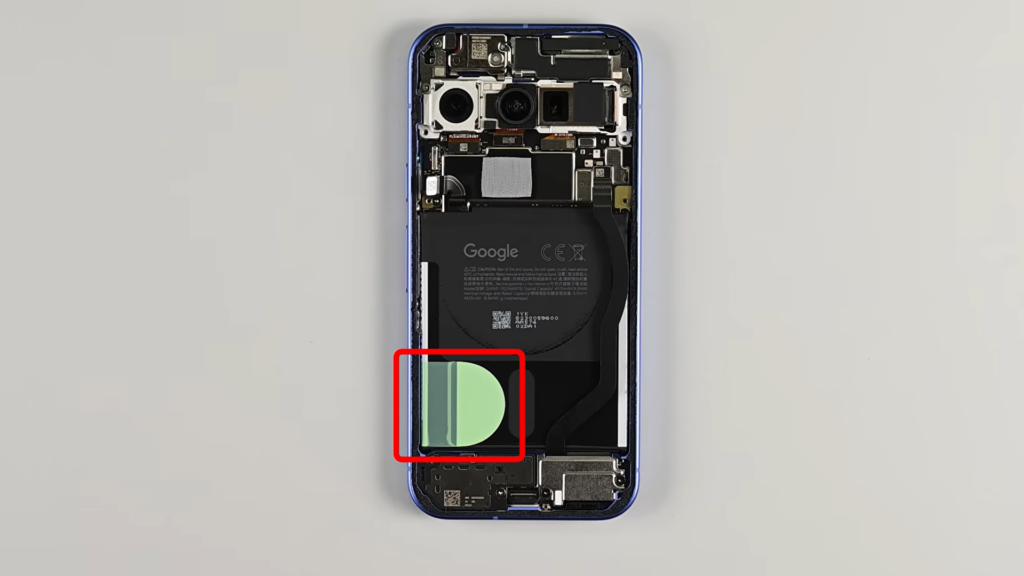
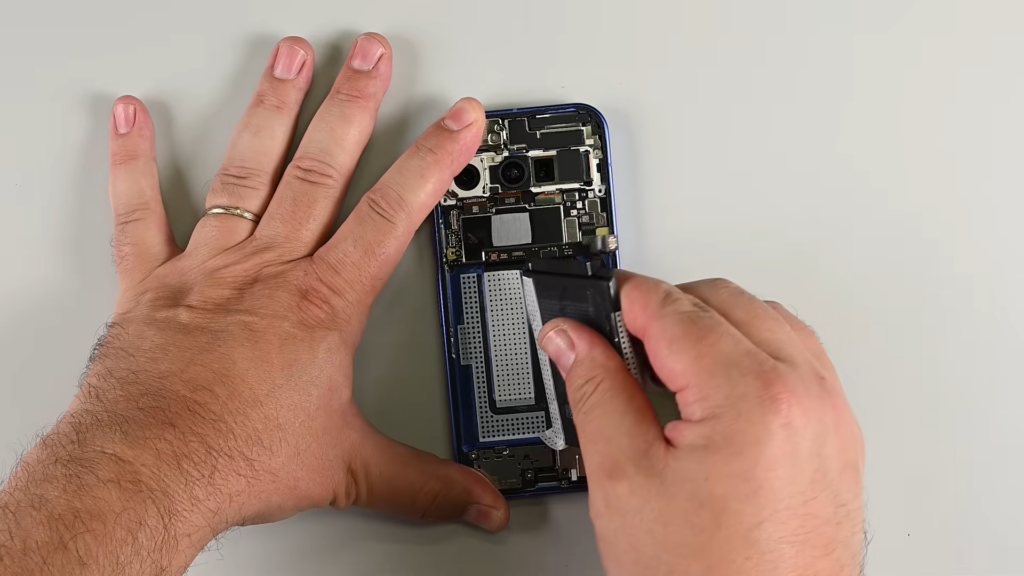
The biggest change is a new “pull jacket” battery system. Instead of fiddly pull tabs that often snapped or required alcohol to loosen, Google has added a green strip that slices straight through the adhesive. It makes swapping out a worn battery quicker, cleaner, and less risky — no need to pry the screen off first. For the most common repair a phone needs, that’s a big deal.
Other touches suggest Google is thinking more about serviceability. The internals use fewer screw types, so you don’t need a toolkit full of bits just to get inside. iFixit also pointed out upgrades like the Pixelsnap magnetic ring for Qi2 wireless charging and, of course, the new Tensor G5 chip at the center of it all.
It’s not perfect — things like the cameras and USB-C port aren’t modular, so those repairs won’t be as simple. Even so, iFixit gave the Pixel 10 a provisional repairability score of 6/10, which is a step up from earlier Pixels. Google is also publishing repair manuals for the lineup, a move that could cut down on repair costs and extend device life.
In short: the Pixel 10 isn’t just about performance and AI tricks. By making it easier to fix, Google is signaling it wants its hardware to last longer — a shift that could push the whole industry in a more sustainable direction.
Motorola has officially launched the Edge 60 Neo, as the latest budget model from the brand’s Edge 60 series. This smartphone brings a durable design, capable performance and AI functionality. The Edge 60 Fusion was the most affordable phone in the lineup, and the Edge 60 Neo is the latest budget entry that brings a relatively compact design as well.
Motorola Edge 60 Neo Launched: What does it offer?
With a display size of 6.4 inches, Motorola’s Edge 60 Neo can be considered a relatively compact phone, as most devices are usually around the 6.7-inch mark. It sports a pOLED panel with a 1.5K resolution, LTPO tech for 120Hz variable refresh rate, up to 3000 nits of peak brightness, and Corning Gorilla Glass 7i for protection. Motorola uses the vegan leather material for the back panel once again, adding a MIL-STD 810H certification and IP68 + IP69 rating for water and dust resistance.
Motorola Edge 60 Neo
Under the hood, the Edge 60 Neo is equipped with the MediaTek Dimensity 7400 SoC, which is paired with up to 12Gb of RAM and 256GB of internal storage. A sizeable 5,000mAh battery pack powers this model, which supports 68W wired fast charging and 15W wireless charging. For photography, the rear has a 50MP Sony LYT700C main camera, a 12MP ultra wide angle lens, and a 10MP telephoto shooter with 3x optical zoom. You get a 32MP shooter on the front for selfies and video calls.
Other notable features include a slim and light chassis (8.09mm, 175 grams), Bluetooth 5.4, Wifi 6, stereo speakers with Dolby Atmos, an in-display fingerprint scanner, and Android 15 OS out of the box. Motorola’s Edge 60 Neo arrives in three distinct color options, namely PANTONE Latte, PANTONE Frostbite, PANTONE Poinciana and PANTONE Grisaille colours. It has a starting price tag of 399 Euros for the 8GB + 128GB model, with the global debut starting with Europe.
For more daily updates, please visit our News Section.
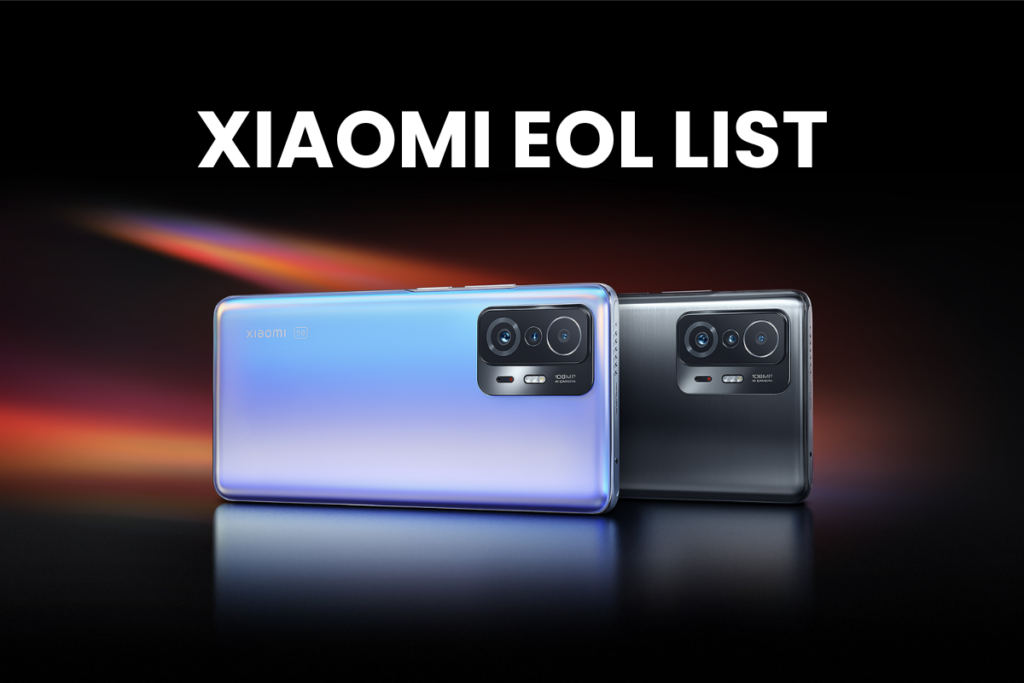
Xiaomi will stop sending software updates to six Xiaomi smartphones this month. This means no more major updates and security patches for them once their update cycle reaches an end. We’ve curated a list of those Xiaomi smartphones along with their end-of-life dates.
If you have an older Xiaomi phone, you may want to review the list, hoping that it’s not mentioned there.
Xiaomi phones reaching the end of software updates this month
Xiaomi 11T (EOL: Sep 23, 2025)
Xiaomi 11T Pro (EOL: Sep 23, 2025)
Xiaomi 11 Lite 5G NE (EOL: Sep 23, 2025)
The Xiaomi 11T, 11T Pro, and 11 Lite 5G NE were launched in September 2021, promising three major Android updates and four years of security patches. Launched with Android 11, these three phones are now running Android 14 after receiving the promised number of major updates.
Fortunately, Xiaomi 11T and 11T Pro also received an upgrade to HyperOS 1 (based on Android 14) that brought loads of new features and improvements. The Xiaomi 11 Lite 5G NE got even luckier as it also received the HyperOS 2 upgrade, based on Android 14. The phones are now close to their fourth anniversary, which also means the end of software support, sadly.
The entry-level Redmi A1 and Redmi A1+ will reach the end of their software cycle later this month. Both smartphones were released in September 2022 with Android 12-based MIUI 12 skin at the top.
The smartphones received an upgrade to MIUI 13, but they haven’t received a single Android update. They are still running Android 12 and will spend the rest of their life on the same Android version. Later this month, the devices would become ineligible for security patches as well.
Poco phones reaching the end of software updates
Poco M5 (EOL: Sep 6, 2025)
The Poco M5 has also reached the end of the road. It was launched back in September 2022 with Android 12 and MIUI 13, promising two major Android updates. Over the last three years, the device has received two major OS upgrades (Android 13 and Android 14) and numerous security patches.
What should these users do?
If your Xiaomi smartphone is on the list, it will probably not get any updates going forward. However, it will continue to function normally, but it won’t receive security fixes for the latest vulnerabilities found in the Android and Xiaomi devices. That means you’ll be putting yourself at risk, especially if your device has confidential data.
Ideally, you should upgrade to a newer model to continue receiving the latest security patches and major updates that bring plenty of exciting features and enhancements. We have a curated list of Xiaomi devices that promise six years of software updates, in case you’re looking for a better upgrade.
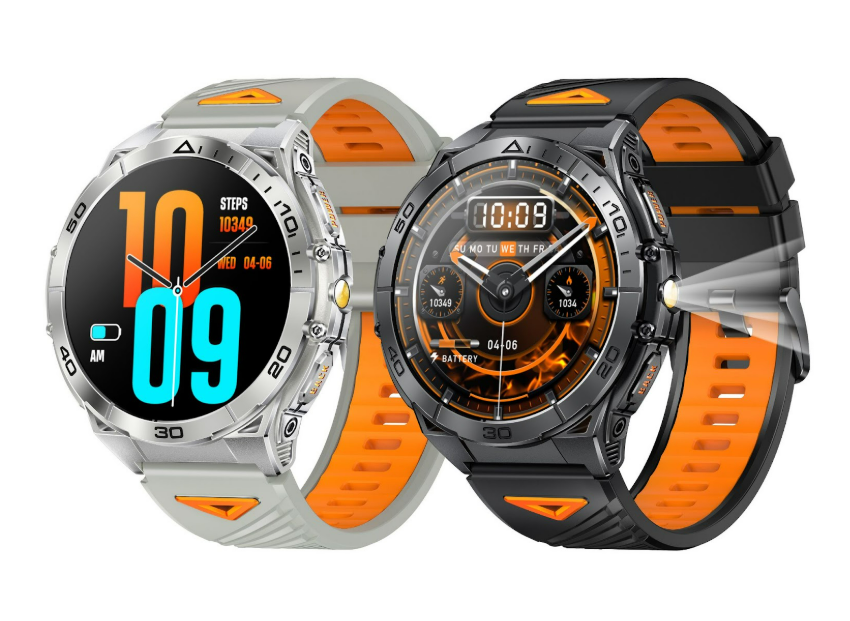
Rogbid has introduced its latest wearable, the Rogbid Titan K, a military-grade smartwatch designed for durability and everyday functionality. The watch comes with an AMOLED display, 5ATM water resistance and a 600mAh battery for long endurance. With rugged styling and fitness-focused features, the Titan K is built for users who want reliability both outdoors and in daily life.
Rogbid Titan K specifications and features
Rogbid Titan K
The Rogbid Titan K’s 1.6-inch AMOLED screen offers bright, sharp visuals even under direct sunlight. On the right, the watch features two physical buttons with a built-in LED flashlight placed between them for quick illumination.
Its military-grade design ensures resistance to harsh environments, while water resistance up to 5ATM makes it suitable for swimming and unpredictable weather. The large 600mAh battery reduces the need for frequent charging.
The Titan K supports over 100 sports modes, including cycling, running and strength training, giving users flexibility across different activities. It also offers health monitoring with heart rate, blood oxygen and sleep tracking, helping users keep a closer check on their overall well-being
For connectivity, it supports Bluetooth calling and instant message notifications, allowing communication directly from the wrist. Additional features include weather updates, alarms and music control for daily convenience.
Rogbid Titan K price and availability
The Rogbid Titan K is available in Silver and Black color options. It is currently listed on the official Rogbid store at an introductory price of $49.99. By using the coupon code CGYSRFGAQAZF, readers can take advantage of a 5 percent discount.
For more daily updates, please visit our News Section.
Vivo started off its new V-line with a sole V60 model, but it looks like the lineup won’t stay a single device affair for long. There’s no indication of a Pro model yet, but rumor says Vivo is working on V60 Lite.
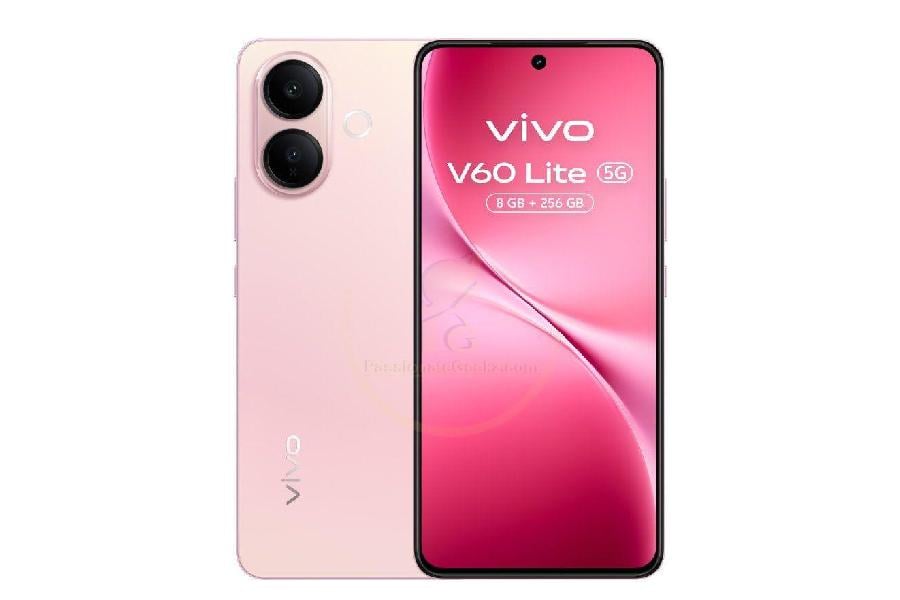
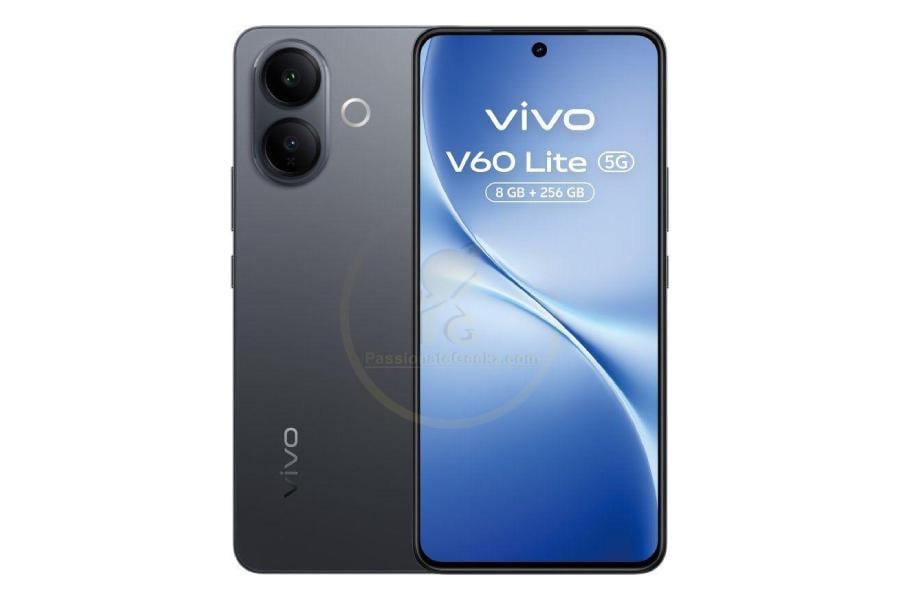
The latter might come in both 4G and 5G flavors, out of which, the V60 Lite 5G has now surfaced in a fresh leak with its full specs and design reveal.
Vivo V60 Lite Specifications
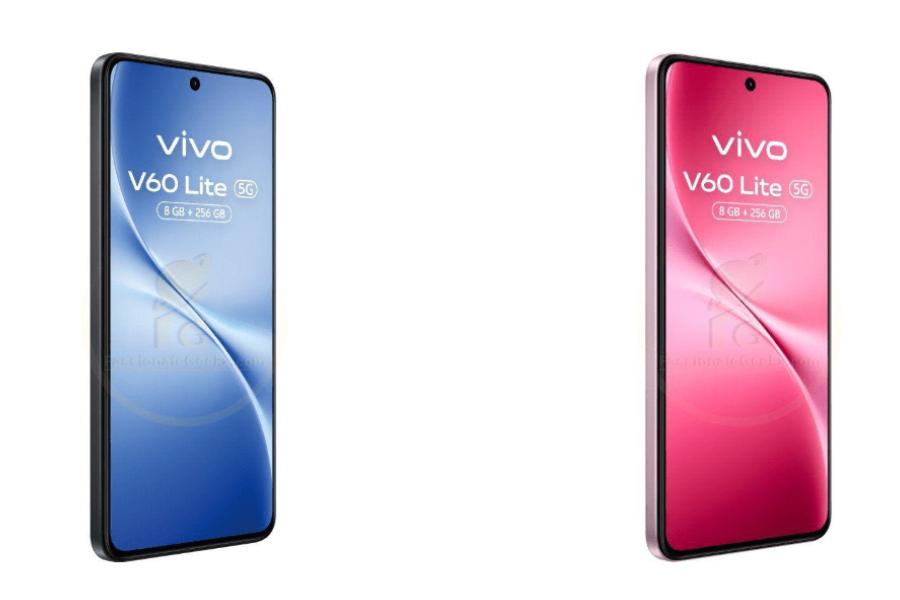
Based on the leaked renders, the V60 Lite 5G closely resembles the standard V60. It has a vertically stacked rear camera module, a punch-hole cutout up front, and slim bezels on all sides.
The display is reportedly a 6.7-inch AMOLED panel with a 120Hz refresh rate and up to 3,000 nits of peak brightness. Under the hood, Vivo is said to be using MediaTek’s Dimensity 7300 chip, which pulled in 939 points in Geekbench’s single-core test and 2,527 in multi-core.
The 4G model appeared on the benchmark with Snapdragon 685 and scored 467 and 1536 points, respectively.
Camera-wise, the Lite edition seems toned down compared to its sibling. It will feature a 50MP main sensor paired with a 2MP secondary, plus a 32MP front-facing camera. Notably, there’s no sign of Zeiss branding or tuning this time around.
Other leaked specs include Android 15 with Funtouch OS 15, support for 5G, dual-band Wi-Fi, Bluetooth 5.4, NFC, an in-display fingerprint reader, and even an IP69 rating.
There’s no word yet on when or where will Vivo launch the V60 Lite. But the device has received multiple certifications, such as SIRIM (Malaysia), EEC (Europe), and Nemko, so the launch shouldn’t be that far off. We will keep you in loop as soon as we hear more on it.
For more daily updates, please visit our News Section.
Samsung has announced the all-new Bespoke AI Washer Dryer in India. It offers 12kg wash and 7kg dry integrated machine designed to meet the changing needs of Indian households. The brand claims that this product is aimed at larger families and urban homes that seek space-saving convenience.
Samsung Bespoke AI Washer Dryer specifications and features
Samsung Bespoke AI Washer Dryer
The Bespoke AI Washer Dryer combines washing and drying in a single appliance, removing the need to transfer clothes between separate units. The AI Wash system uses five-step sensing to detect load weight, fabric softness and soil levels, then adjusts detergent, water and time for optimal cleaning.
The Auto Dispense feature can store enough detergent for up to a month and releases the right amount automatically. AI Control adapts to user habits by suggesting cycles and displaying relevant information.
For energy efficiency, the AI Energy function claims to cut power use by up to 70 percent, supported by digital inverter technology that ensures quieter operation and longer durability. The machine is backed by a 20-year warranty.
A SuperSpeed option can complete a full wash in 39 minutes. The AI Ecobubble technology increases soil removal by up to 20 percent while staying gentle on fabrics. Additional functions include Air Wash to refresh clothes without detergent and SmartThings Wrinkle Prevent to reduce ironing needs. The appliance is built with Corning Gorilla Glass protection, military-grade durability standards and an IP64 rating, offering greater reliability.
Samsung Bespoke AI Washer Dryer: Price and availability
The Samsung Bespoke AI Washer Dryer is available across Samsung.com, major retail outlets and leading e-commerce platforms in India. Pricing starts from Rs 63,990.
For more daily updates, please visit our News Section.
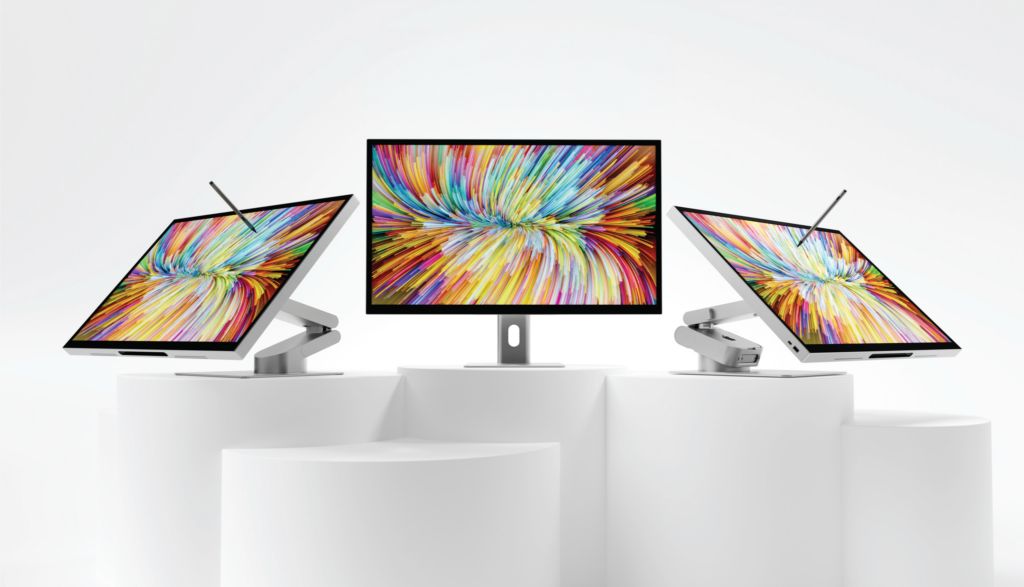
At IFA 2025, Alogic revealed its most extensive portfolio of professional and enterprise-grade displays to date. The lineup includes new docking monitors, ultrawide displays, and a world-first 6K touchscreen, alongside complementary peripherals. According to the company, these additions are designed to expand options for professionals seeking both performance and adaptability in their workspaces.
Aspekt and Edge series monitors unveiled
ASPEKT 32-inch 4K UHD Monitor
with optional Aspekt Fold, Raise and Omni Fold Stands
The highlight of the launch is the Aspekt UHD 4K Docking Monitor, a 32-inch display offered in both touch and non-touch versions. It integrates docking features, offers 145W USB charging, Gigabit Ethernet, and daisy-chaining support for multiple monitors. The touch model supports stylus input with 10-point multi-touch and is compatible with Mac and Windows gesture controls. For ergonomics, users can choose from three stands, including the Omni Fold Stand that can house a Mac mini, effectively creating a compact all-in-one workstation.
Pricing for the Aspekt Touch is £1,599.99, €1,899.99, $1,799.99, AUD 1,999.99, and Can$ 1,999.99, while the non-touch variant is £999.99, €1,299.99, $1,299.99, AUD 1,499.99, and Can$ 1,499.99. The stands will be sold separately from November 2025.
AIogic Edge 5K 40-inch Ultrawide Monitor
Alogic also introduced the Edge 5K Ultrawide Monitor, a 40-inch display delivering 5120×2160 resolution with a 100Hz refresh rate and 400 nits brightness. Designed as a workstation hub, it includes a 90W USB-C docking hub. An optional Elevate Dual Vertical Mount enables stacking two Edge monitors vertically, appealing to users in fields like trading or monitoring where extended screen real estate is critical. The Edge 5K will be available from September 22 at £1,099.99, €1,299.99, $1,499.99, AUD 1,999.99, and CAD 1,799.99.
Clarity 6K Touch and new peripherals
Clarity 6K 32-inch Touch Monitor with Fold Stand
Another major reveal is the Clarity 6K Touch, the world’s first 6K touchscreen monitor for Mac and Windows. The 32-inch display delivers 6016 x 3384 pixels resolution, 99% Adobe RGB/DCI-P3 colour accuracy, and stylus support. It ships with a Fold Stand that lets the monitor switch between upright and drafting-table positions. The Clarity 6K will be available from mid-October at £1,599.99, €1,899.99, $1,999.99, AUD 2,499.99, and CAD 2,499.99.
Hush Keyboard and Crux Mouse
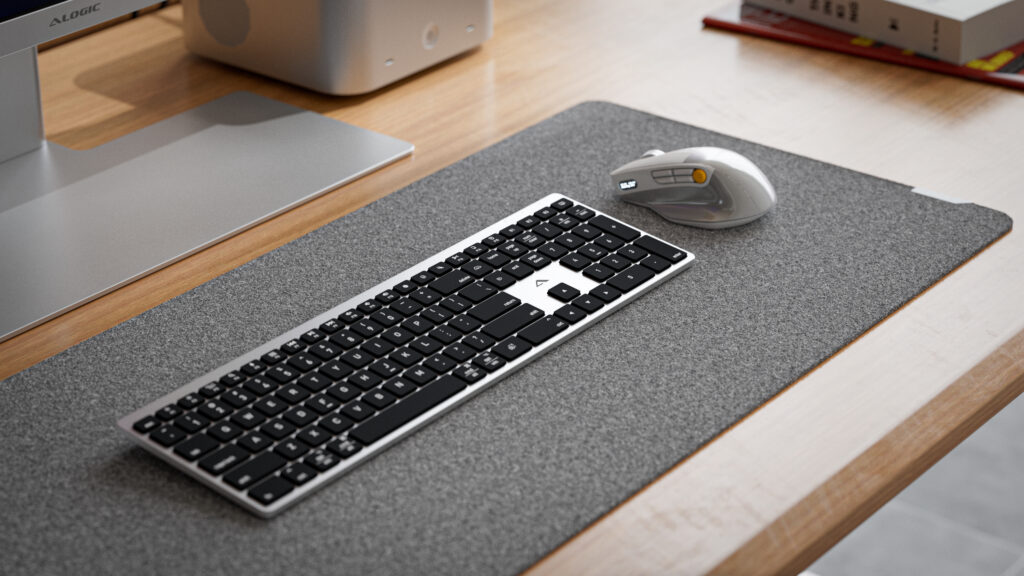
Alongside the monitors, Alogic announced Crux and Hush peripherals. The Crux Mouse comes with nine programmable buttons and silent operation, while the Hush Keyboard, crafted from recycled aluminium, offers hybrid Mac/Windows compatibility. Both are priced at £89.99, €99.99, $99.99, AUD 129.99, and CAD 129.99, with the Hush Mouse available for £29.99, €39.99, $39.99, AUD 49.99, and CAD 49.99 from November 2025.
For more IFA 2025 announcements, please visit our IFA 2025 section.
In 2025, Chinese brands aren’t just catching up in the foldable race. They’re dictating the pace. From Huawei’s pioneering tri-fold concept to Honor’s slim engineering marvels, this year’s best Chinese foldables are redefining what mobile hardware can do, from displays that break brightness records to battery tech that feels pulled straight from the future.
If you’re ready to invest in a foldable phone that pushes boundaries in meaningful ways, these are the must-buy Chinese foldables that deserve your attention.
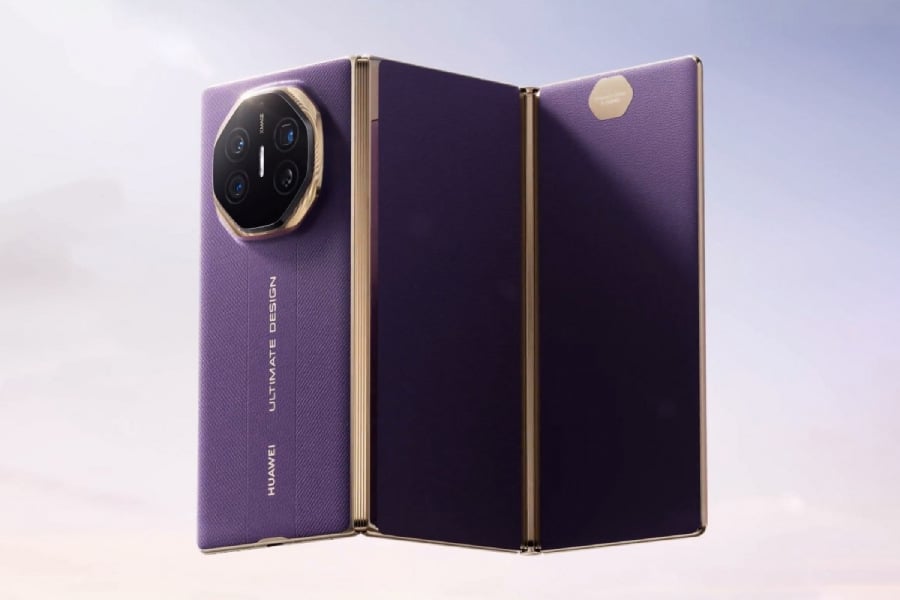
Huawei introduced the Mate XTs as a follow-up to last year’s Mate XT. It remains the only production-ready tri-fold phone available for purchase in 2025. The device switches between three usable form factors: a 6.4-inch folded phone, a 7.9-inch mini tablet when half-open, and a full 10.2-inch tablet when completely unfolded. The display features COE pixel technology, which reduces power consumption by 13%.
The tri-fold mechanism uses a Tiangong hinge with dual-track linkage, aerospace-grade steel, and an 8-layer buffer. Huawei claims 30% higher impact resistance, and the thinnest part of the display is just 0.02mm. The Kirin 9020 chip replaces the previous Kirin 9000 and improves performance by 36%.
The camera system includes a 50MP variable aperture main sensor, a 40MP ultra-wide with macro support, a 12MP periscope lens, and a 1.5MP multispectral sensor. It runs on a 5600mAh silicon-carbon battery with 66W wired and 50W wireless charging support.
Prices start at 17,999 yuan (around $2,520) for the 256GB variant and go up to 22,499 yuan ($3,150) for the 1TB stylus bundle.
2. Xiaomi Mix Flip 2
Xiaomi launched the Mix Flip 2 with significant hardware and design upgrades. The device features a triple-curve foldable build and weighs just 199g. It comes with a redesigned hinge structure that improves durability with certifications for 200,000 folds.
The 4.01-inch outer AMOLED screen supports a 120Hz refresh rate, 3200 nits brightness, and app functionality across more than 500 apps. The inner 6.86-inch AMOLED screen also offers 1.5K resolution, Dolby Vision, and a dynamic refresh rate between 1Hz and 120Hz.
The Snapdragon 8 Elite powers the device with up to 16GB LPDDR5X RAM and 1TB UFS 4.1 storage. Leica has co-developed the camera system, which includes a 50MP main sensor, a 50MP ultra-wide lens with macro focus, and a 32MP front camera with 4K video recording.
Xiaomi priced the base 12GB+256GB variant at 5,999 yuan ($840), while the top-end 16GB+1TB version costs 7,299 yuan ($1,022).
3. Huawei Pura X
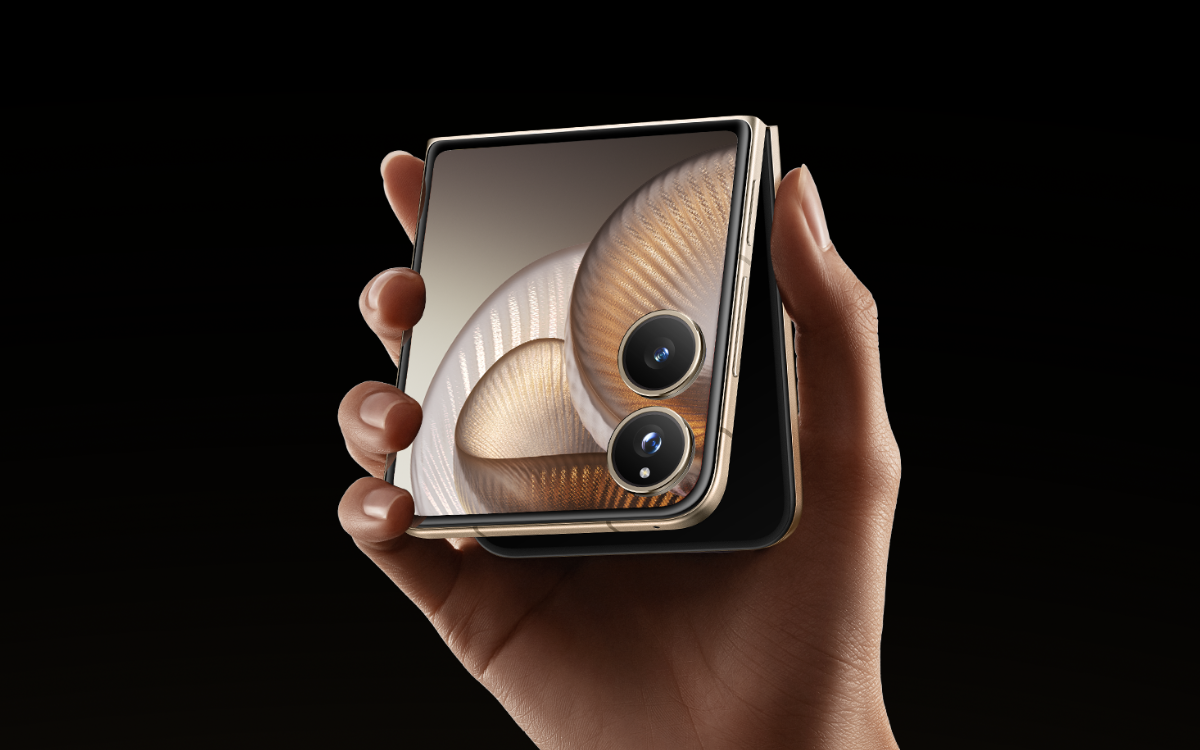
Huawei also launched the Pura X flip phone earlier this year with a unique 6.3-inch foldable OLED screen that uses a 16:10 aspect ratio. The outer 3.5-inch OLED display adopts a square 1:1 ratio. Both screens feature LTPO 2.0 technology, 1–120Hz adaptive refresh rate, and 1440Hz PWM dimming.
The device uses the Kirin 9020 processor, according to reports, and offers up to 16GB RAM and 1TB storage. The rear camera setup features a 50MP RYYB main sensor, a 40MP ultra-wide, and an 8MP 3.5x telephoto lens. It also adds a 1.5MP multispectral color camera.
The 4720mAh dual-cell battery supports 66W wired and 40W wireless charging. The Pura X starts at 7,499 yuan ($1,050) and goes up to 9,999 yuan ($1,400) for the premium 1TB Collector’s Edition.
4. Oppo Find N5
Oppo launched the Find N5 globally with a focus on display quality and hinge engineering. The phone features an 8.12-inch 2K LTPO AMOLED foldable screen with a peak brightness of 2100 nits and 2160Hz PWM dimming. The outer 6.62-inch AMOLED screen peaks at 2450 nits and uses ceramic guard protection.
The titanium flexion hinge is now 36% stronger and 26% slimmer than the previous generation. Both displays support stylus input. The phone runs Android 15 with ColorOS 15 and brings new features like AI call summaries and cross-platform file access.
The camera system includes a 50MP main sensor with Hasselblad tuning, a 3x telephoto lens, and an ultra-wide sensor. Under the hood, it comes with a 5600mAh battery that powers the device with 80W wired and 50W wireless charging.
In China, prices start at 8,999 yuan ($1,260), while the international model costs 2,499 SGD (around $1,937).
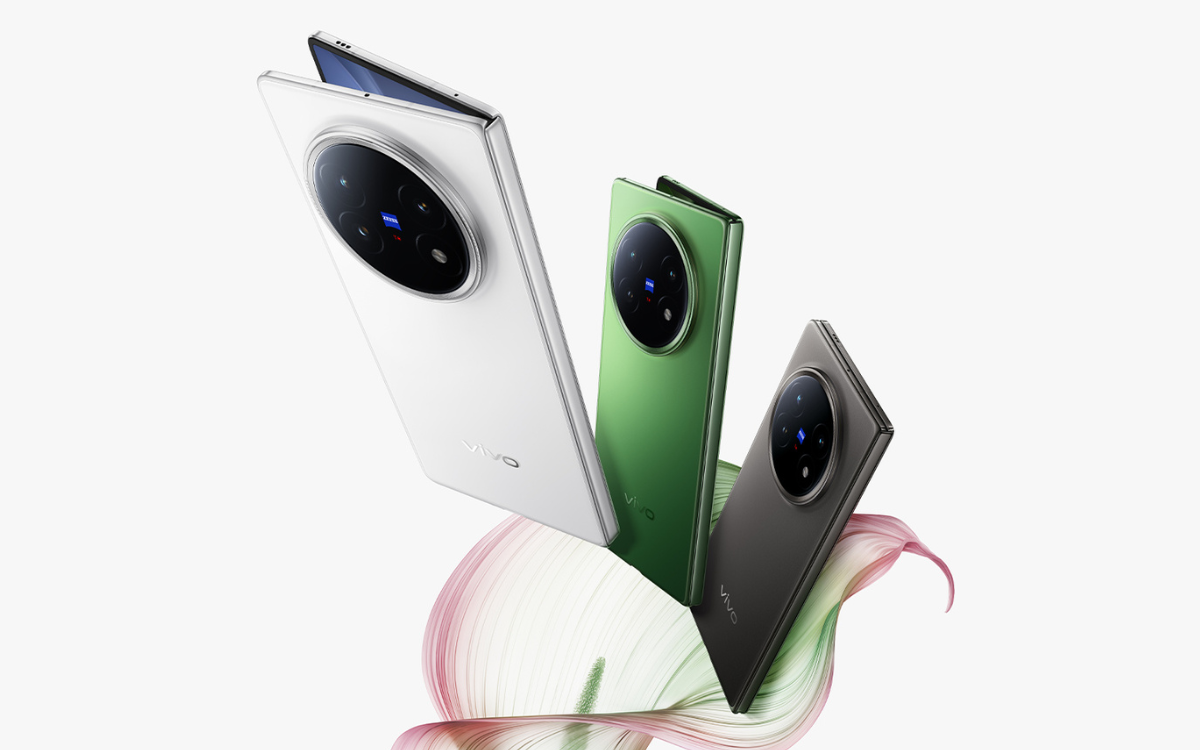
5. Vivo X Fold 5
Vivo released the X Fold 5 with a focus on battery tech and display brightness. The inner 8.03-inch 2K+ LTPO panel and the outer 6.53-inch FHD+ screen both reach up to 4,500 nits. Both screens also support Dolby Vision and UTG glass protection.
The device is powered by the Snapdragon 8 Gen 3 chipset and includes a VC + graphite cooling system. The hinge uses an antenna structure to save internal space and supports up to 600,000 folds.
The triple rear camera system includes a 50MP main shooter, a 50MP periscope lens, and a 50MP ultra-wide camera. It also features dual 20MP front cameras. The 6000mAh battery supports 80W wired and 40W wireless charging.
Vivo priced the X Fold 5 at 6999 yuan in China and Rs. 1,49,999 in India (around $1,700).
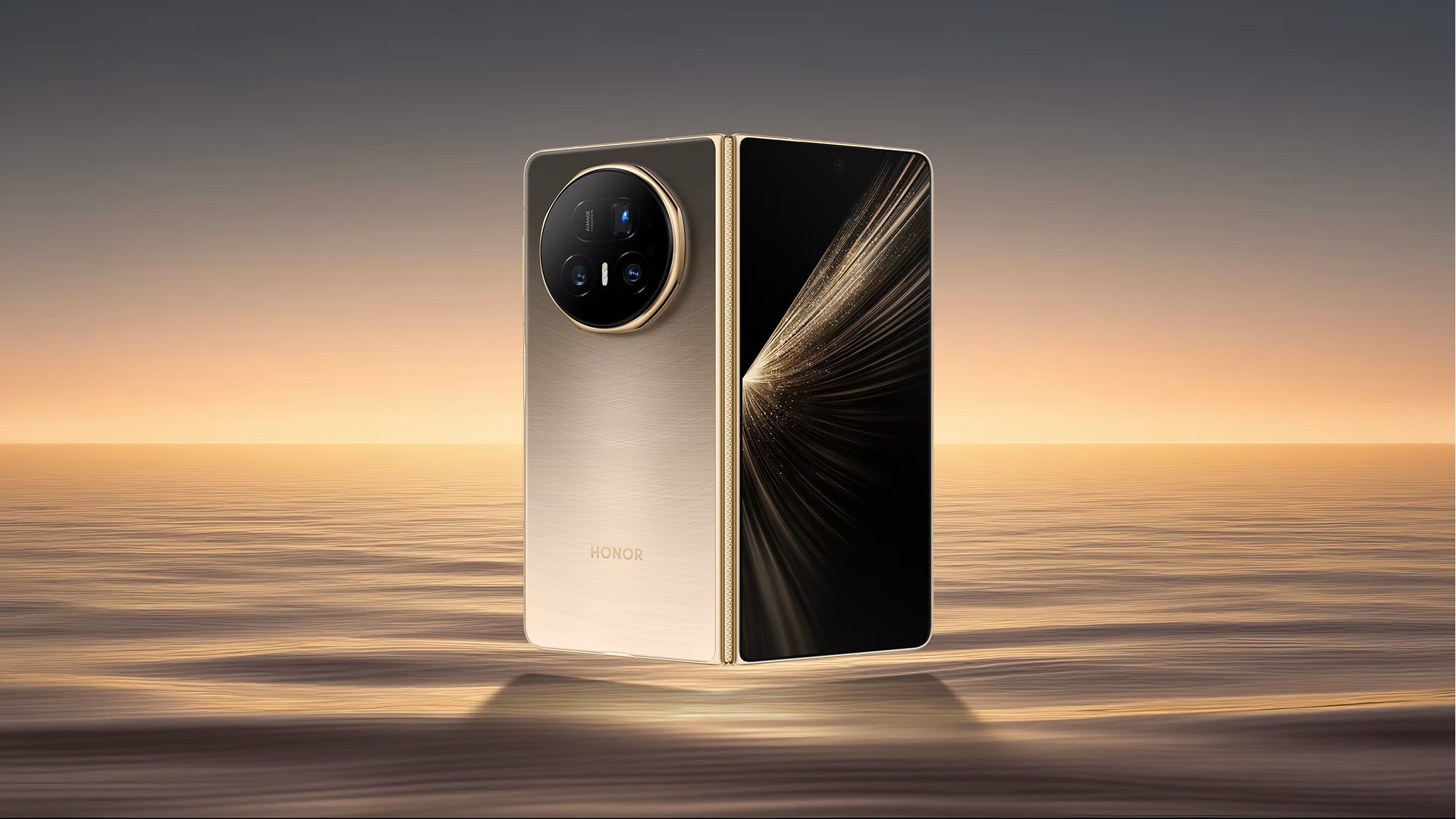
6. Honor Magic V5
Honor introduced the Magic V5 as its most durable and premium foldable to date. The design features an eight-curve frame and King Kong Giant Rhino Glass for superior drop resistance. The hinge uses aerospace-grade materials and supports 500,000 folds. The phone also carries IP58 and IP59 ratings.
The 7.95-inch inner and 6.43-inch outer OLED screens support 120Hz refresh rate and peak at 5000 nits. The display also supports HDR Vivid and Dolby Vision. The camera setup includes a 50MP wide lens, a 50MP ultra-wide lens, and a 64MP periscope with 3x optical zoom and up to 100x digital zoom.
It runs on the Snapdragon 8 Elite with up to 16GB RAM and a 6100mAh silicon-carbon battery on the 1TB variant. Charging support includes 66W wired and 50W wireless fast charging.
Honor priced the base model at 8,999 yuan ($1,260), and the top-end variant at 10,999 yuan ($1,540).
For more daily updates, please visit ourNews Section.
We use cookies on our website to give you the most relevant experience by remembering your preferences and repeat visits. By clicking “Accept”, you consent to the use of ALL the cookies.
This website uses cookies to improve your experience while you navigate through the website. Out of these, the cookies that are categorized as necessary are stored on your browser as they are essential for the working of basic functionalities of the website. We also use third-party cookies that help us analyze and understand how you use this website. These cookies will be stored in your browser only with your consent. You also have the option to opt-out of these cookies. But opting out of some of these cookies may affect your browsing experience.
Necessary cookies are absolutely essential for the website to function properly. This category only includes cookies that ensures basic functionalities and security features of the website. These cookies do not store any personal information.
Any cookies that may not be particularly necessary for the website to function and is used specifically to collect user personal data via analytics, ads, other embedded contents are termed as non-necessary cookies. It is mandatory to procure user consent prior to running these cookies on your website.