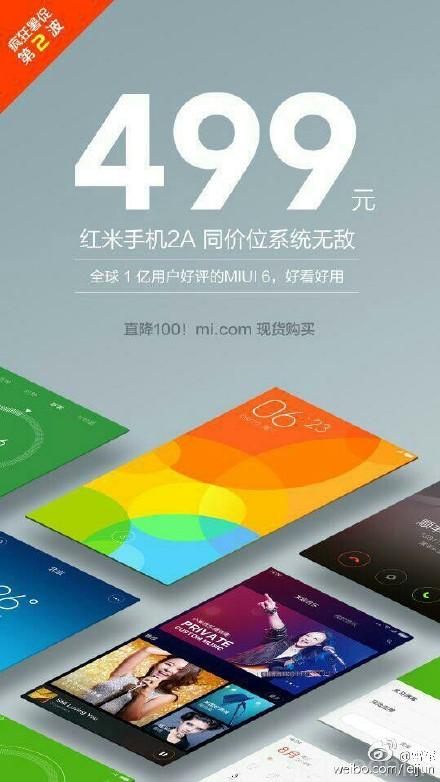
On August 16, Xiaomi will formally launch the long-awaited MIUI 6 OS and as of today, users may not enlist to participate in its beta tests.
Xiaomi announced in MIUI’s official Weibo account that users can sign up to participate in beta tests for the MIUI 6 in WeChats from today until the 15th.
Please note that when you register, you have to provide information such as your profile name in the MIUI forum or your Xiaomi account number, your real name, your IMEI number, and a basic introduction of yourself. Xiaomi will select users to participate in the beta tests. Do not miss any important news about the MIUI 6 at this time.
The first batch of phones that Xiaomi will use for beta testing on August 16 includes the China Unicom and China Telecom versions of the Mi 3 and Mi 4. Other phones will be announced later.
Furthermore, users should remember that they will not get the MIUI 6 when it is launched on the 16th as it will only go through beta testing. Open beta testing should start at around September.
Finally, after a series of teasers, IUNI has announced the release date for the IUNI U3. Today, IUNI CEO Frank announced on his Weibo account that IUNI will launch the U3 on August 26.
The only information that has been revealed so far about the U3 is that it sports a 5.5-inch display screen with 2K resolution, runs on an octa-core processor (most likely the MT6595), supports dual-4G network as well as dual-SIM and other networks.
IUNI’s latest teaser for U3 challenged the Mi 4. Can they really do it? We will just have to wait and see.
Lei Jun once said, “When many of our counterparts compare themselves to us, then, that means that Xiaomi has already become the gold standard.” In June, the Mi 4 was released keeping Xiaomi as the gold standard. The writer cannot just come to conclusions but the Mi 4’s specs and power consumption are disappointing but also a pleasant surprise. I will not talk about what is disappointing about it for now and just focus on why it is a pleasant surprise.
Just as the title mentions, the pleasant surprise is that the Mi 4 is Quick Charge-supported. Does this function work for the Mi 4 as well as Lei Jun said? Let’s take a look.
Why does the Mi 4 need Quick Charge?
It makes sense to say that today’s smart phones are growing more powerful at an astronomical rate. Take their processing chips, for example. In just a few years, we have gone from using single-core processors to eight-core processors. Unfortunately, there has not been any real improvement in battery charging.
Although there has been improvement in cell phone batteries, it has only been limited to battery safety and charge cycles. The level of power supply has none grown a lot. The only way to improve battery performance is to increase the battery supply or use Quick Charge.
Until now, Xiaomi has only used the former but although the Mi 3’s battery supply grew from the 2000mAh in the Mi 2 to 3050mAh, it only grew to 3080mAh for the Mi 4. Only 30mAH! This has not been the most effective method given the limited space provided by the phone. Therefore, adding Quick Charge is necessary.
Can the Mi 4 handle Qualcomm Quick Charge?
The Mi 4’s charger is called the Xiaomi Smart Charger and comes in three standards, 5V, 2A/9V, 1.2A/12V, and 1A. This charger can also be used with other devices as well.
We start charging the phone a 0%. For the first 40 minutes the screen glows and WIFI is turned own. Later, we closed the screen and WIFI but still keep the phone on.
After 13 minutes, we can see that the Mi 4 is already 15% charged. After 25 minutes, setting 10 minutes as the standard, we started calculating the rate at which the battery is charged.
Based on the results, when the screen and WIFI are closed, we can see that the MI 4 can be charged up to 49% in one hour and be fully charged in two hours. When the phone is completely turned off, it can charge up to 60% in one hour and be fully charged in two and a half hours. As the graph shows, the results we got in charging the Mi 4 are close to the official results by Xiaomi.
Conclusion
As you can see from this test, the Mi 4’s Quick Charge mode goes well with the Qualcomm Snapdragon 801 and the phone’s power management system, but it might sacrifice battery life. Nevertheless, it will definitely be an asset in future cell phones.
The Xiaomi Mi 4 runs on the Snapdragon 801 quad-core processor which has 2.5 GHz. It has 2 GB RAM, 16/64 GB flash memory, high performance, and low power consumption. It also sports a 5-inch Sharp/JDI OGS display screen with 1080p and is also a ultra-sensitive touchscreen. It is powered by a 3080 mAh lithium ion polymer battery and sports a 8mp/13mp Sony dual-camera.
The Mi 3, though, uses the 2.3 GHz Snapdragon 800 processor, also sports a 5-inch 1080p display screen that is also ultra-sensitive touchscreen-supported, and has 2GB RAM . Users can choose between a 16 GB and a 32 GB version. The TD version uses the 1.8 GHz Invidia Tegra 4 processor. The Mi 3 also sports a 13mp rear-facing camera and 2mp front facing camera. It has a thickness of 8.1mm and is powered by a 3050 mAh battery. The Mi 3 runs on the Android 4.3-customized MIUI system.
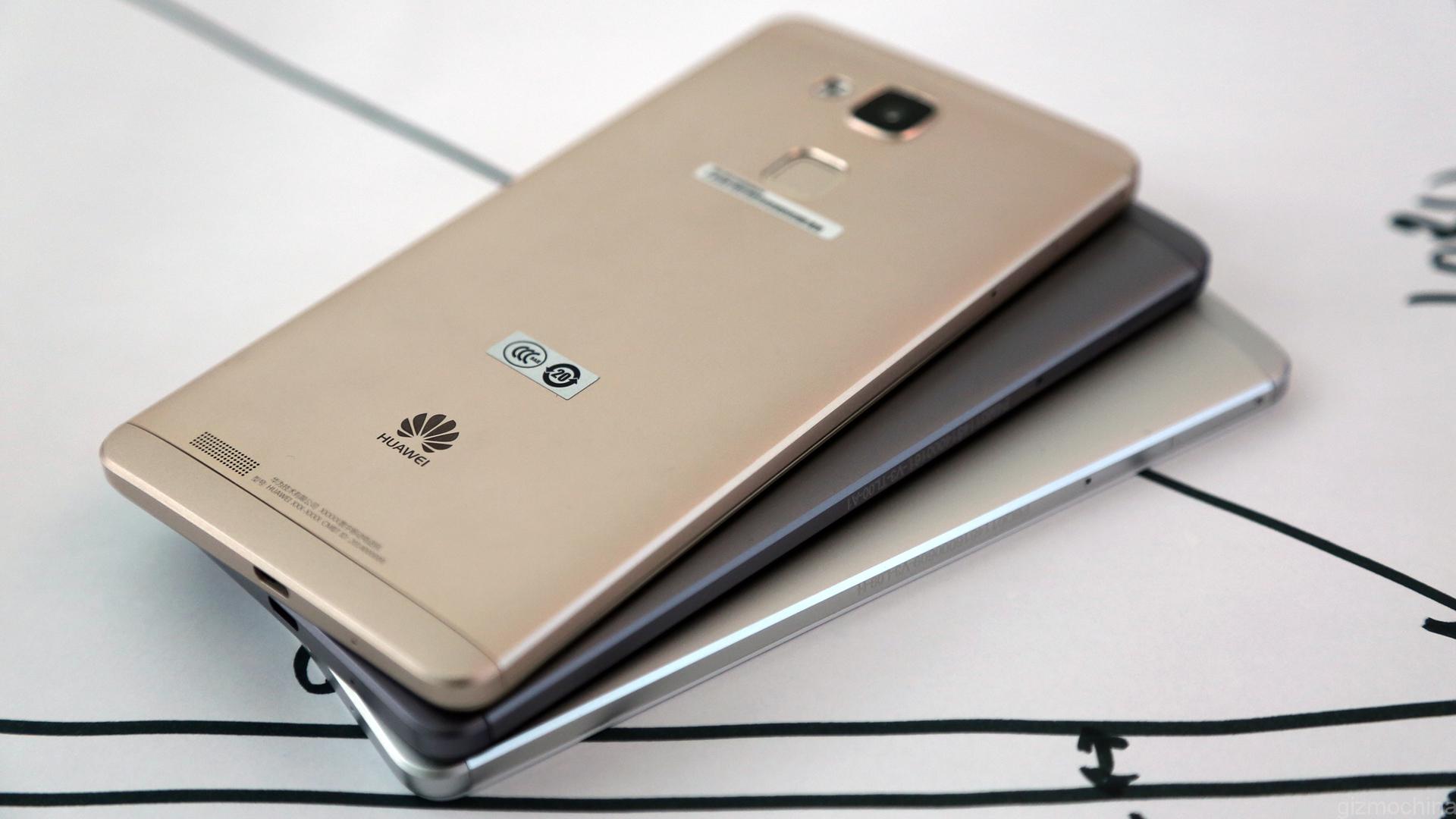
It looks like Huawei will release a new version of the P7. Yu Chengdong said, among other things, in an interview this morning that they will continue to make “shocking” products and will release a version of the P7 phone with a sapphire screen.
We know that the Huawei P7 does not have a sapphire display screen. Could this be the legendary Huawei P7S?
Actually, it is pretty common to see manufacturers release sapphire-screened cell phones. After all, several versions of the iPhone 6 will also have sapphire screens. Also Vivo has implied that they will release one too.
According to insiders, Xiaomi will release a mobile phone aimed at the elderly. This phone will provide smart medical services and help older users make long-distance doctor’s appointments. This is just a part of Xiaomi’s smart home system.
Old people can use this phone to consult with doctors online while relaxing at home. No other services have been announced. So far, there has been no confirmation from Xiaomi.
With the Xiaomi Mi 4 finally released, how long until we see the Mi 5?
According to Lei Jun, the production for the Mi 4 went on for more than 18 months and 6 prototypes were made. It was already in its development stage at the time of the release of the Mi 3 (September 26). Assuming Xiaomi is following the same schedule with the Mi 5, then, it must have been in development already at the time of the Mi 4’s launch.
This afternoon Wang Yang, the Chinese studies chief-inspector of iSuppli Corp. said that the Mi 5 is already at the P2 stage of production. This means that the second prototype is already done, implying that the Mi 5’s design has been finalized. So far, the production of the Mi 5 is going faster than the Mi 4’s. How soon will we get our first glimpse of it?
Mark your calendars! Some insiders have reported that Meizu will hold a launch even on September 2 in Beijing where they will formally launch the MX4 as well as other products. They also released the MX3 at the same date last year.
Regarding the Meizu MX4’s specifications, right now, most people think that this device will sport a 5.4-inch 2K screen, an 8mp front-facing camera, and a 20.7mp rear-facing camera. Many also believe that it will use the Samsung Exynos octa-core chipset, have 3GB ROM, and that its operating system is the Flyme 4.0.
Furthermore, it looks like Meizu may release a low-end version with a lower screen resolution and RAM. Its other specs are expected to remain the same.
Recently, Coolpad launched a new cell phone in collaboration with China Unicom, the Coolpad 7275 which is obviously an upgraded version of the 7270 based on the number.
An entry-level product, the Coolpad 7275 is another low-end device with a big screen but its design is not so bad. It has a completely white body and sports a 5.5-inch screen. It is 78mm wide and 151mm long which gives a pretty good screen ratio. Its thickness is a bit more average though, measuring about 9mm.
The Coolpad 7275’s 5.5-inch FWVGA display screen is its main selling point as its other specifications are only so-so. It carries the MT6589 quad-core chip which few phones carry now and has 512M RAM, 4GB ROM, a .3mp front-facing camera, a 5mp rear-facing camera, and a 2500ma battery. Its operating system is the Android 4.2. It also supports WCDMA/GSM dual-SIM and China Unicom 42M high-speed 3G internet.
While the 7275’s specs are far from great, it is very affordable as its official price is 799 RMB (129.61) while its above-the-line price is 560 RMB (90.84 USD).
Today, IUNI has release its fourth teaser poster for its latest flagship hone, the IUNI U3 which is expected to come out no later than August. The latest poster simply shows “3>4.”
The first two posters show a clear outline of the IUNI U3, while in the third and fourth posters, IUNI hints at what the U3 is capable of using puns and word games. Many guessed from the “2×4” poster that the U3 will support 5 modes and 16 channels of TDD/FDD dual 4G. Some even think that it might support dual-SIM.
Based on what has been happening recently in the Chinese mobile phone industry, we can probably make the following conclusion….that the “3” represents the U3 white the “4” represents the Xiaomi Mi 4 which got the attention of many users since its release last month. Therefore, the “3>4” poster is basically IUNI’s declaration of war against Xiaomi saying that the IUNI U3 will definitely surpass the Mi 4. Can they put their money where their mouth is?
On July 22, during the launch of the Xiaomi Mi 4 held in the International Conference Center, Lei Jun announced that the MIUI V6 will be launched on August 16. Xiaomi has already posted an invitation poster in their Weibo account saying that the launch will be held at D.Park in Beijing’s 798 art district. The slogan in the poster says “Better-looking and more useful.” That day also happens to be the fourth anniversary of the release of the first MIUI.
Ever since Intel started collaborating with Huanan Tablets to produce tablets for the Chinese market, Windows tablets have quickly improved due to their entertainment and business functions. Many companies are releasing tablets that use Windows not just overseas but in China as well where, together with Intel, many companies have released Win8 tablets. Recently, Teclast released the X89HD, a tablet that uses Win8 and Android and has a 7.9-inch screen. Its processor is the Intel’s BayTrail-T Z3735D quad-core chip. There are not a lot Win8 tablets that have good display screens right now especially those with a 7.9-inch screen. This time, however, Teclast is incorporating a Retina display screen on their tablets. The following is the writer’s experience with this tablet.
Basic information:
CPU:Intel 64-bit Bay Trail-T Z3735D
GPU:Intel Gen7 HD Graphic
Display screen:7.9-inch (2048×1536)
RAM:2GB DDR3L
ROM:32GB
Battery:6000mAh
OS:Windows 8.1
The Micro USB cable, OTG cable, and battery charger
For a Win8 device, an 8-inch screen with 1280 x 800 resolution is almost standard. Theoretically, the resolution for a screen of a Win8 device cannot be too high but the X89HD also supports Android. This device comes with a Retina display screen with 2048 x 1536 resolution. The X89HD can be considered the first tablet to use such a screen.
The tablet’s compatibility with Flash is excellent and should make it easier for users to play browser games without worrying about problems like the device crashing.
Users can also access Microsoft’s app store where they can download games by buying or getting them for free.
Battery life and overheating:
Regarding battery life, I started using the tablet at 9:30 AM after recharging it. I would just try downloading and installing software, games, etc. Meanwhile, the screen’s brightness is never stable. At 1:15 PM, the tablet automatically shut down. Overall, it could not last more than hours which is alright for a device that has a 6000mAh battery like the X89HD.
As for overheating, this tablet heats up fast when downloading and playing games. The temperature in the middle back reaches 50 degrees, while in other parts of the back, it goes more than 42 degrees.
Conclusion:
Overall, the X89HD is much better than I expected and its game compatibility is impressive. Personally, I am really interested in Win8 devices as beside being able to install PC software, it also offers a lightweight experience (ex. Web browsing) that is superior to the ones offered by Android devices. 2GB RAM is a bit small for a Win8 platform and it is hard to play games with high specs as well as use other programs with such RAM. When the processor is always at high frequency, the increase in temperature is more noticeable and the tablet will be scorching hot. I suggest that you do not open many software at once or play large-scale games for such a long period of time. The Teclast X89HD currently costs 1099 RMB (178.44 USD).
Veaka Mobile which gained fame after releasing the 128GB OnlyU phone is on the move again. This time, they are releasing a phone that stands out due to its design and camera specs called the iFeel. They recently revealed the phone’s specs, price, and release date.
The standard version of Veaka iFeel will hit stores in September. Veaka will consecutively release a 16GB version (1999 RMB), a 32GB version, and 64GB version. The prices for the latter two have not been revealed.
The iFeel will be Veaka’s second release. It is only 7.0 thick and is available in red, yellow, blue, green, white, and many other colors. Its processor is the 1.7GHz MT6592 octa-core processor and it uses the 2G DDR3 RAM. It also sports a 5-inch 1080p Sharp screen covered by Corning Gorilla Glass 3. It is powered by a 2300ma battery and can be quickly recharged. It also supports WCDMA and GSM dual-SIM, USB OTG, dual-Microphone, a gyroscope, and other features. What is most notable about the Veaka Ifeel is its front camera which has 8mp and uses a second generation Sony CMOS sensor.
Like many cellphone brands, BIRD has started aiming for the 4G market. Recently, they revealed their newest 4G phone, the BIRD L600.
The BIRD L600 does not have specs that are as good as the L7 4G phone which, like the L600, also uses China Mobile. The L600 can support TD-LTE/TD-SCDMA and GSM internet, and its processors are the MT6582 (1.3GHz) quad-core processor and the MT6290.
The BIRD L600 sports a 5-inch display screen with qHD resolution (960 x 540) and also has 1GB RAM and 4GB internal memory space. Its cameras are also weaker than the L7’s. Its front-facing camera only has .3mp while the rear-facing camera has 5mp.
As of now, all devices that use 4G chips from MTK use the Android 4.42 OS. The BIRD L600 is no exception and uses the KitKat system. As the photo shows, there is a small hole above the main camera which means that this phone may support dual-microphone noise-cancellation.
Besides upgrading to a 4G network, the TCL Momoda 4G phone also sports a OGS display screen and its cameras were upgraded to 13mp/5mp. All in all, it only costs 899 RMB (145.87 USD). How is the craftsmanship?
Top: When you open the rear case, you can see where the battery is located.
Bottom: There is a graphite strip on the shielding case.
A strong vibrating motor is located at the bottom.
High integration is one of the MTK platform’s strengths and leaves a lot of space for the battery.
Top (left to right): MT6169V radio frequency chip, MT6592 octa-core chip; the MT6290 baseband chip supports FDD/TD-LTE
Bottom (left to right): SKY77590 4-way RF transceiver IC; the processing and baseband chips are covered by a thermal conducting gel; Samsung memory chip (8GB)
The Goodix GT9157 touch-screen chip (HotKnot-supported)
Having released a China Mobile version, it has been reported that Huawei will release a high-end China Unicom 4G version of the Honor 6 phone in stores this December.
Huawei will officially launch the China Unicom version (H60-L12) on August 12. The high-end version will have 32GB internal memory space and have an NFC feature which the low-end version does not have. As a result, it will cost 2299 RMB.
The rest of the China Unicom high-end version’s specifications are still the same as the other versions. It will still sport a 5-inch JDI display screen (in-Cell) with 1080p resolution. Its processor is the Kirin 920 chipset (four 1.7GHz Cortex-A15 and four 1.3GHz Cortex-A7, supports a heterogeneous multi-processor/LTE Cat6 standard) and it has 3GB RAM. In addition, the Honor 6 is powered by a 3100mAh battery and sports a 5mp/13mp camera.
There are a lot of Chinese phones that offer high performance but not a lot of them have such an elegant design. One such phone is the ZTE XingXing 1 Pink Edition which has just got on sale.
The Xingxing 1 Pink Edition has dual-glass surface and a very thin body measuring only 6.58mm. It is worth pointing out that the pink version has already received the attention of women and its popularity continues to soar.
As for its specs, the ZTE Xingxing 1 Pink Edition sports a 5-inch 1080p Full-HD display screen and runs on the Qualcomm Snapdragon MSM8928 processor which has a main frequency of 1.6GHz. It also has 2GB RAM and 16GB ROM and its operating system is the Android 4.4-customized MiFavor 2.3. It also sports a 5mp/8mp camera. It can be bought at JD for 1399 RMB (226.71 USD).
UMI will soon release a new flagship phone with a 5.5-inch display screen. The UMI C1 can also be called the Big Red Bull Mini. This phone is only 7.9mm thick.
Many users should enjoy the UMI C1’s display screen as the phone sports a 5.5-inch LTPS display screen with HD resolution that uses OGS technology. It is also coated with Corning Glass 3. Such specs surpass many phones that also have 5.5-inch screens.
Unfortunately, the UMI C1/Big Red Bull Mini is not 4G-supported. It uses the MT6582 quad-core processor which has a main frequency of 1.3GHz and supports WCDMA+GSM dual-SIM. Its memory is not as great as the X3/CROSS’ as it only has 1GB RAM and 16GB ROM. It also sports a 3.2mp/13mp OV dual-camera and is powered by a 2430ma battery. Its operating system is the Android 4.42 OS. With such specs, do not expect a lot of apps.
The UMI C1 will first be sold in T-mall flagship stores for 899 RMB (145.68) and is available in black and white.
Another company has joined the 4G race as ASUS will soon release the T45.
However, a lot of may become disappointed with this phone as it is only an entry-level 4G cellphone. This time, ASUS will not use a chip from Intel but a MTK processor, specifically, the MT6582 LTE which supports TD-LTE/TD-SCDMA/GSM internet. This phone uses China Mobile.
The ASUS T45 sports a 4.5-inch display screen with FWVGA resolution (854 x 480) and a .3/5mp camera. It also has 512M RAM and 4GB ROM, and is powered by a 1750ma battery. Its operating system is the Android 4.42 and also supports dual-microphone noise-cancelation.
Despite its average specs, the ASUS T45 has a pretty nice design. Unlike many entry-level 4G phones, itt is available in black, white, red, gold, and many other colors. No price has been confirmed at this time but we can expect it to be cheaper than the ZenFone 5.
The Huawei P7 sports a 5-inch thinly-framed display screen with 1080p resolution, uses the HiSilicon Kirin 910T processor (1.8GHz), and has 2GB RAM and 16GB ROM (expansion card-supported). The P7 also sports a 13mp rear-facing camera and 8mp front-facing camera, is powered by a built-in 2500mAh battery, runs on the Android 4.4.2-based Emotion 2.3 UI, and supports TD-LTE 4G internet.
The ELIFE S5.5 smartphone is only 5.5mm thick, supports WCDMA/TD-SCDMA China Mobile and China Unicom dual-3G, sports a 5-inch Super Amoled display screened with 1080p resolution, uses the MTK MT6592 octa-core chipset (1.7GHz), and has 16GB ROM and 2GB RAM. In addition, it also has a 5mp 95 degree wide-angle front-facing camera and a 13mp rear-facing camera. Its OS is the Amigo 2.0 and it is powered by a 2300mAh battery.
We use cookies on our website to give you the most relevant experience by remembering your preferences and repeat visits. By clicking “Accept”, you consent to the use of ALL the cookies.
This website uses cookies to improve your experience while you navigate through the website. Out of these, the cookies that are categorized as necessary are stored on your browser as they are essential for the working of basic functionalities of the website. We also use third-party cookies that help us analyze and understand how you use this website. These cookies will be stored in your browser only with your consent. You also have the option to opt-out of these cookies. But opting out of some of these cookies may affect your browsing experience.
Necessary cookies are absolutely essential for the website to function properly. This category only includes cookies that ensures basic functionalities and security features of the website. These cookies do not store any personal information.
Any cookies that may not be particularly necessary for the website to function and is used specifically to collect user personal data via analytics, ads, other embedded contents are termed as non-necessary cookies. It is mandatory to procure user consent prior to running these cookies on your website.