Ai+ Smartphone, led by former Realme CEO Madhav Sheth, has officially entered the Indian market with the launch of its first two smartphones, the Ai+ Pulse and Ai+ Nova 5G. These devices not only mark the brand’s debut in India but also showcase the homegrown NxtQuantum OS, built entirely in India. Both models promise an affordable smartphone experience backed by Android 15, localized data storage, and AI-powered features.
Ai+ Pulse
Ai+ Pulse and Nova 5G Specifications
The Ai+ Pulse and Nova 5G both sport a 6.7-inch HD+ TFT IPS display (1600×720 pixels). The Pulse features a 90Hz refresh rate and 450 nits of brightness, while the Nova 5G ups the refresh rate to 120Hz, offering smoother visuals. The Pulse delivers a pixel density of 260ppi, compared to 265ppi on the Nova 5G.
Under the hood, the Ai+ Pulse is powered by the Unisoc T615 processor, while the more advanced Ai+ Nova 5G uses the Unisoc T8200 chipset. The Nova variant also supports 5G networks, giving it a clear advantage in terms of connectivity. Both phones offer expandable storage support up to 1TB via microSD.
Both smartphones run NxtQuantum OS, a custom Android 15-based system developed entirely in India by nxtQ. The OS features a NxtPrivacy Dashboard for tracking app data access, along with its own NxtQuantum PlayStore, NxtSafe Space, NxtQuantum Community App, Theme Design Tool, and the NxtMove App. It stores user data in MeitY-approved Google Cloud regions and follows a zero-trust security architecture.
In terms of optics, both the Ai+ Pulse and Nova 5G are equipped with dual rear cameras, led by a 50MP primary sensor with AI enhancements. For selfies and video calls, it features a 5MP snapper.
Both the Ai+ Pulse and Nova 5G come with a 5,000mAh battery. The Pulse supports 10W charging, whereas the Nova 5G offers faster 18W charging through a USB-C port.
Connectivity features on both phones include dual-band Wi-Fi, Bluetooth 5.0, GPS, a 3.5mm headphone jack (very rare these days), and USB Type-C. They are equipped with a side-mounted fingerprint reader. While the Pulse supports dual 4G connectivity, the Nova 5G provides dual 5G support.
Pricing & Availability
The Ai+ Pulse is priced at Rs. 4,999 ($60) for the 4GB+64GB variant and Rs. 6,999 ($84) for the 6GB+128GB model. The Ai+ Nova 5G costs Rs. 7,999 ($96) for 6GB+128GB and Rs. 9,999 ($120) for 8GB+128GB. The Pulse goes on sale July 12 and the Nova 5G on July 13 via Flipkart.
For more daily updates, please visit our News Section.
The OnePlus Nord 5 has officially launched in India, bringing a powerful Snapdragon 8s Gen 3 chipset, OnePlus AI features, and a host of upgrades over its predecessor. OnePlus aims to dominate the mid-range segment with this new device, so here’s everything you need to know about its specs, features, pricing, and more.
The new Nord 5 makes a surprising downgrade from an aluminium back and aluminum frame on the Nord 4 to a glass/polycarbonate build. Furthermore, the IP65 rating remains unchanged from its predecessor. Meanwhile, the front sports a tall 6.83-inch AMOLED display with a 144Hz refresh rate, FHD+ resolution, 1400 nits of peak brightness, and Corning Gorilla Glass 7i for protection. It measures 8.1mm in thickness and weighs around 211 grams.
2. Mid-Range Phone with Sub-Flagship Performance
OnePlus Nord 5
One of the biggest upgrades on this year’s Nord is with the processor. Under the hood, OnePlus equips the Nord 5 with the Snapdragon 8s Gen 3 chipset, which is paired with up to 12GB of LPDDR5X RAM and 12GB of UFS 3.1 storage. A massive 6,800mAh battery pack powers this device, which supports 80W wired fast charging.
It runs on the OxygenOS 15 based Android 15 OS out of the box. Another notable inclusion is the OnePlus AI with the Plus Key (with AI Plus Mind), which first debuted on the OnePlus 13s. Other notable features include 5G, Wi-Fi 6, Bluetooth 5.4, NFC, an in-display fingerprint scanner, and an IR blaster.
3. Camera
Even the photography experience is getting a noticeable upgrade with the Nord 5 arriving with the same camera used on the Oppo Find X8 and OnePlus 13s. The main camera is a 50MP Sony LYT700 sensor, which is paired with an 8MP ultra wide angle lens. For selfies and video calls, there is a 50MP Samsung ISOCELL JN5 shooter. Unfortunately, there is no telephoto shooter this year either.
4. Pricing and Offers
The OnePlus Nord 5 has just made its debut in India in multiple color options, namely Dry Ice, Marble Sands, and Phantom Grey. It has a starting price tag of 31,999 INR for the base 8GB + 128GB variant, while the 12GB + 256GB version costs 34,999 INR and the 12GB + 512GB option costs 37,999 INR.
This model will go on sale on 9th July 2025 at 12PM IST via Amazon India, the brand’s official website, and offline retailers. OnePlus is offering customers an instant bank discount of 2,000 INR on non-EMI transactions and a 2,250 INR off on selected bank EMI transactions.
For more daily updates, please visit our News Section.
Rumors regarding Samsung‘s next budget flagship phone have been making the rounds online. Now, the latest report offers us more insight regarding the design refinements that are arriving on the Galaxy S25 FE. So here’s everything you need to know.
Is the Galaxy S25 FE following S25 Edge’s footsteps?
The news arrives from a ZDNet report, which revealed the changes arriving in the body of the new FE smartphone. The South Korean tech giant is apparently planning on making the Galaxy S25 FE thinner than its predecessor. To recall, Samsung’s Galaxy S24 FE measured a respectable 8.0mm, but the Galaxy S25 FE may have a slimmer 7.4mm chassis. This is reportedly being achieved thanks to Samsung using a flexible OLED panel on the newer model.
Samsung Galaxy S25 FE Leaked Renders
That’s not all, the front is also getting some improvements as the bezels surrounding the screen are getting thinner as well. The report adds that the Galaxy S25 FE could sport a 6.7-inch screen with a 120Hz refresh rate with slimmer bezels on all four sides. Similar to its predecessor, this is an OLED panel which likely brings an HFD+ resolution. Unfortunately, this was all the information that was shared in this report.
But earlier this week, the Galaxy S25 FE was spotted on the GeekBench platform with the Exynos 2400 SoC, 8GB of RAM, and Android 16 OS out of the box. A 4,700mAh battery pack is expected to power this device, which could support 45W wired fast charging. For photography, the rear is said to pack a 50MP (Main) + 12MP (Ultra Wide) + 8MP (Telephoto) camera setup, while the front houses a 12MP shooter.
For more daily updates, please visit our News Section.
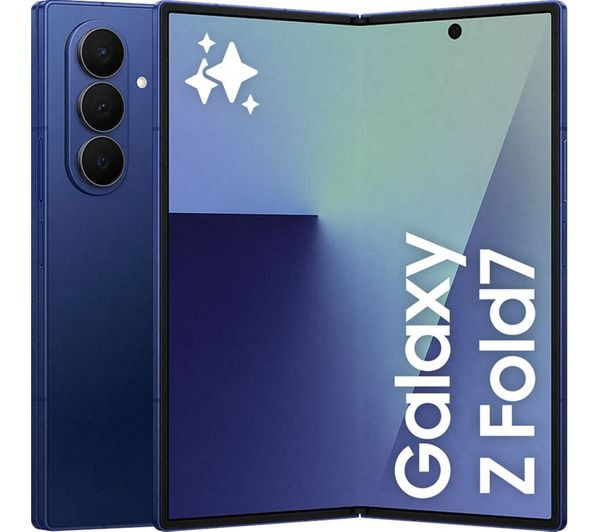
We are only hours away from the official unveiling of the Galaxy foldables and the Galaxy Watch 8 series. But ahead of the big reveal, a leak has seemingly confirmed some key specs and official renders of the devices we’ve all been waiting for.
The Galaxy Z Fold7 is indeed packing a 200MP main camera — a long-awaited upgrade over the aging 50MP sensor many users had hoped Samsung would replace last year. While the device itself isn’t labeled as an “Ultra” in the materials, the main camera does get that tag: “a 200MP Ultra camera for the first time in Galaxy Z Fold.” For image processing, it will rely on Samsung’s “ProVisual Engine,” also featured in the S25 series and mentioned during the launch keynote. So, at least in terms of the main sensor, the Fold7 is getting closer to the S25 Ultra in imaging capabilities.
The battery is disappointing many, and here’s why
The book-style foldable will be powered by the Snapdragon 8 Elite chip. However, the relatively small 4,400mAh battery could limit performance in demanding tasks. Sure, Samsung may optimize system functions to reduce power consumption, but as long as you’re not just navigating app opening and closing animations (which are fully under Samsung’s control) and instead are using third-party apps — like browsing or editing videos — the Fold7 may struggle to match rivals like the Honor Magic V5 (5,820mAh globally, 6,100mAh in China) in both performance and battery life.
Another noticeable omission in the marketing materials is any mention of S Pen support. There’s no sign of an S Pen case either, prompting tipster Ronald Quandt to speculate: “My guess would be… no S Pen.”
That said, the Z Fold7 still brings meaningful upgrades over the Z Fold6 — especially the slimmer 4.2mm unfolded thickness and the long-awaited 200MP camera that many users had been asking for. Check out the details on the Z Flip7 and Flip7 FE here.
No joke, the author is a big fan of Oneodio’s headphones. Simply because the team is very dedicated to sound quality and noise cancellation in a good balance with budget. We reviewed Oneodio Focus A5 before and were impressed. The new Oneodio Focus A6 has come to the Review studio for comprehensive testing.
To draw a brief conclusion first: the results were surprising; both the frequency response curves and the comparisons from the tests were excellent. It’s hard to believe that it somehow even surpasses my SONY WH-1000XM4 in sound quality.
For Amazon buying, Coupon Code: A6GIZMOCHINA Get 15% off, valid 7/12 – 8/30
For OneOdio Shop buying, Coupon Code: GizmoChina Get 15% off, valid 7/07 – 9/30
Unboxing & Appearance
Before the test, let’s do unboxing. The packaging features a black minimalist design. The first layer reveals the headphones, along with a User Manual and a USB-C to C cable for charging and audio.
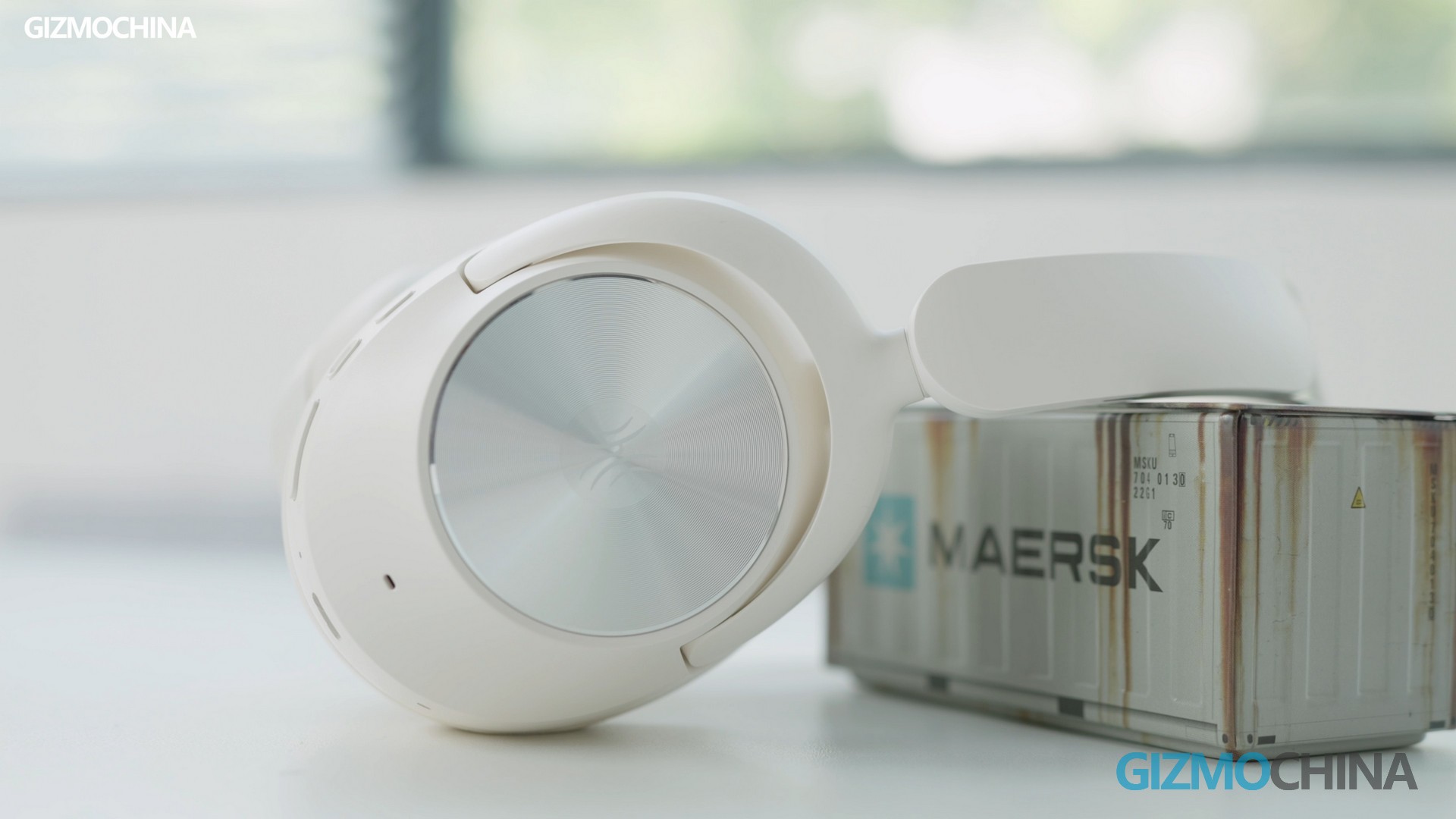
This headphone is in a slightly warm white, with a simple and modern design. The ear cup is relatively large, providing good sound insulation and wearing comfort. And the headband is adjustable. The metal-like cover of the ear cup has a circular decoration with the logo. The ear cup appears to be made of memory foam or protein leather, very soft, and offers a good fit. It doesn’t press on the temples, even for those who wear glasses, wearing comfort is excellent even after long-term use. They are lightweight, approximately 248g, feel no awful pressure, and consequently, are very comfortable.
The control buttons are located on the lower right side of the headphone, including the power switch, multi-function button, ANC button, volume control, and USB port. Overall, the design is minimalist, which I like. The headphones can rotate 90 degrees and are foldable. Very compact size after folding, so convenient for travel.
Sound Quality
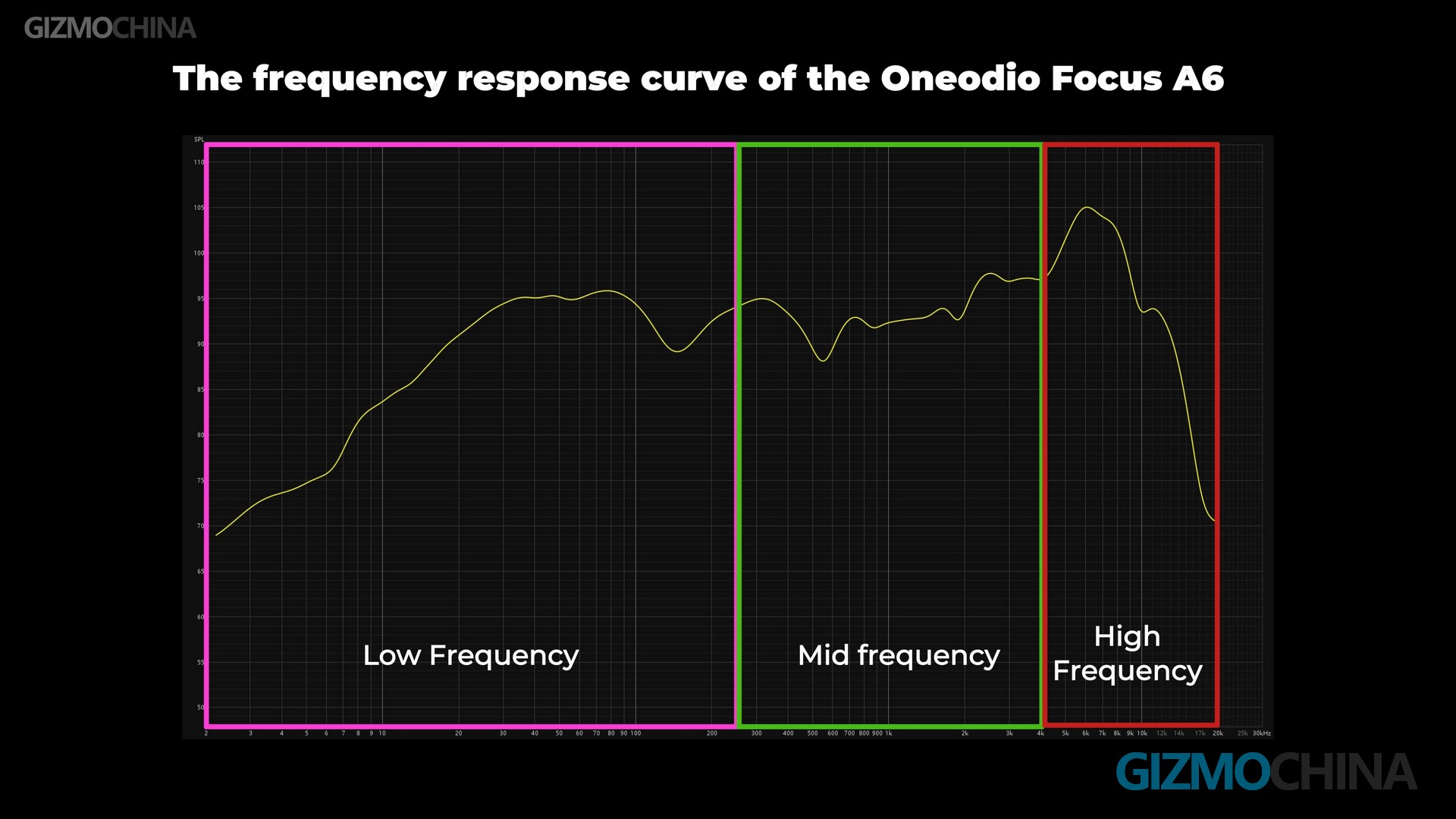
Other than the design, the sound quality is also very important. We tested its frequency response, see if it can reproduce different frequencies, and check for balance or discrepancies.
From the chart, there’s an upward trend in the low-frequency area, reaching about 90dB, indicating strong low-frequency performance with rich bass. The mid-frequency response is relatively stable with minor fluctuations, suggesting a balanced mid-range that can accurately reproduce vocals and instruments. The high-frequency response peaks between 4 kHz and 10 kHz, demonstrating good high-frequency extension and a delicate treble.
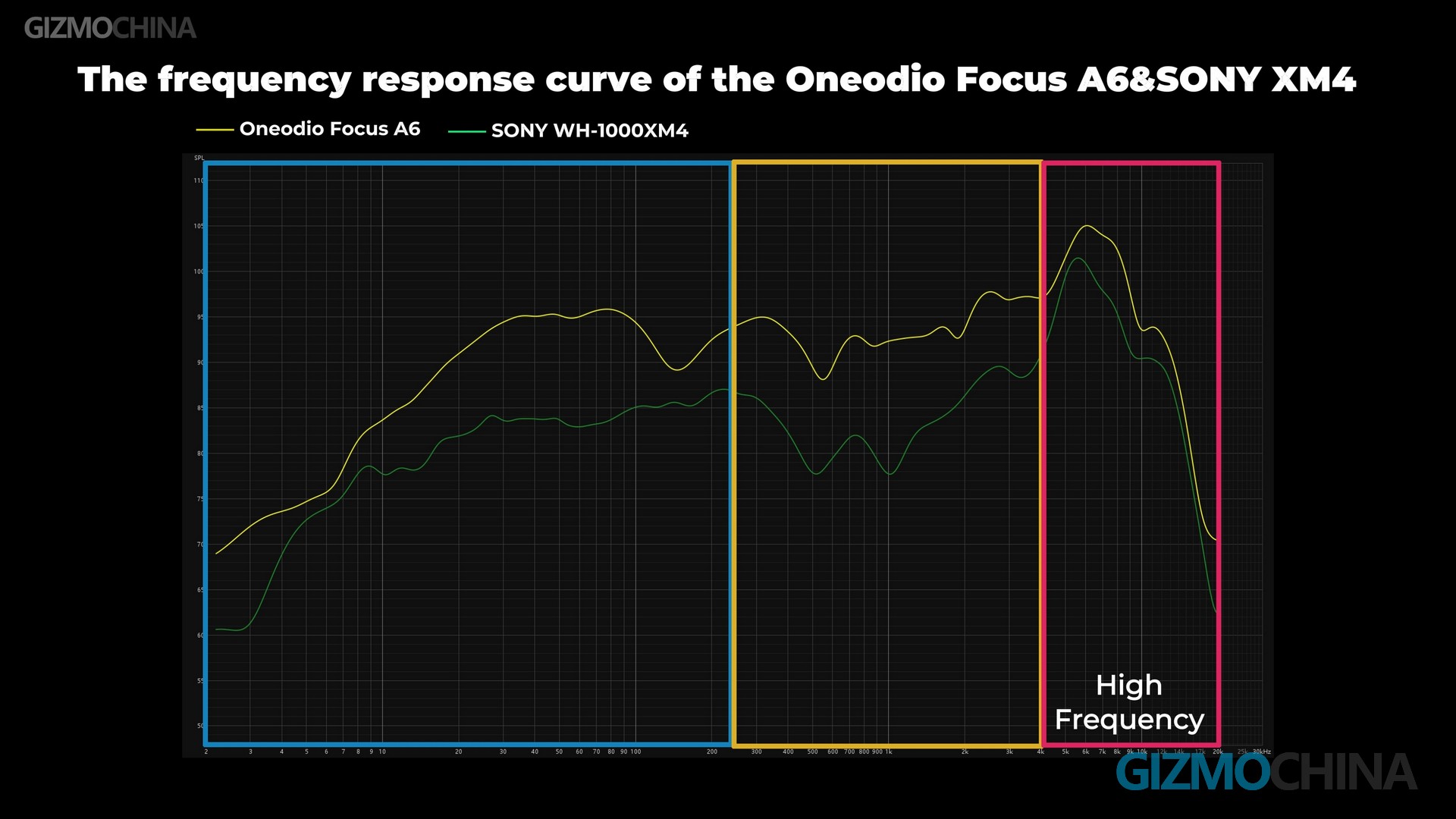
We also compared it with the SONY WH-1000XM4. The Oneodio Focus A6 is no less impressive than the XM4 in real-world listening in the lows, mids, and highs. The A6 has a stronger low-frequency response. Here it also matches my hearing experience on these two, as the XM4 headphones are less emphasizing bass. In the mid-frequency range, the A6’s curve is more stable than the XM4’s lower response. Considering mid-frequencies are crucial for vocals and instruments, the A6 likely offers more natural and clear vocals, while the XM4 may need a boost in this range. Similarly, the A6’s high-frequency response surpasses the XM4’s.
The curves are for rough reference only. Legends with unaligned datums may be affected by headphone sensitivity
We used the microphone to record the actual performance of both headphones for a comparison in the video. The A6’s vocals are very mellow and well-balanced with instruments. Even when mixed up with the XM4’s sound, you can still tell them apart.
Noise Cancellation
We tested the noise cancellation in different noisy environments, such as subways and airplanes. Let’s experience background noise suppression together. It can capture and silence up to 98% of low-frequency noise, blocking out external chaos, subway rumbles, and office chatter, leaving you with just your music, focus, and calm.
APP
We can also use the Oneodio app for customization, including ANC ON, Transparency, ANC OFF, Wind ANC, and Wind Transparency. Although we can adjust the equalizer according to our preferences, the preset modes are somewhat limited, with only Pop Mode, Bass Mode, and Super Bass Mode. We still have high expectations for the Oneodio team, hoping they will introduce more modes suitable for different music genres in the future.
The app also offers features like headphone location, wearing duration reminders, and automatic power-off. Additionally, it has a movie sound effect mode.
Battery Life
With noise cancellation enabled, the playback time is approximately 40 hours, and around 75 hours with it turned off. In addition to the long battery life, it also supports wired fast charging. Charging speed is pretty impressive. We can quickly collect back almost ten hours of playback time in just a 10-minute charge (just get yourself a proper charger).
Additional Features
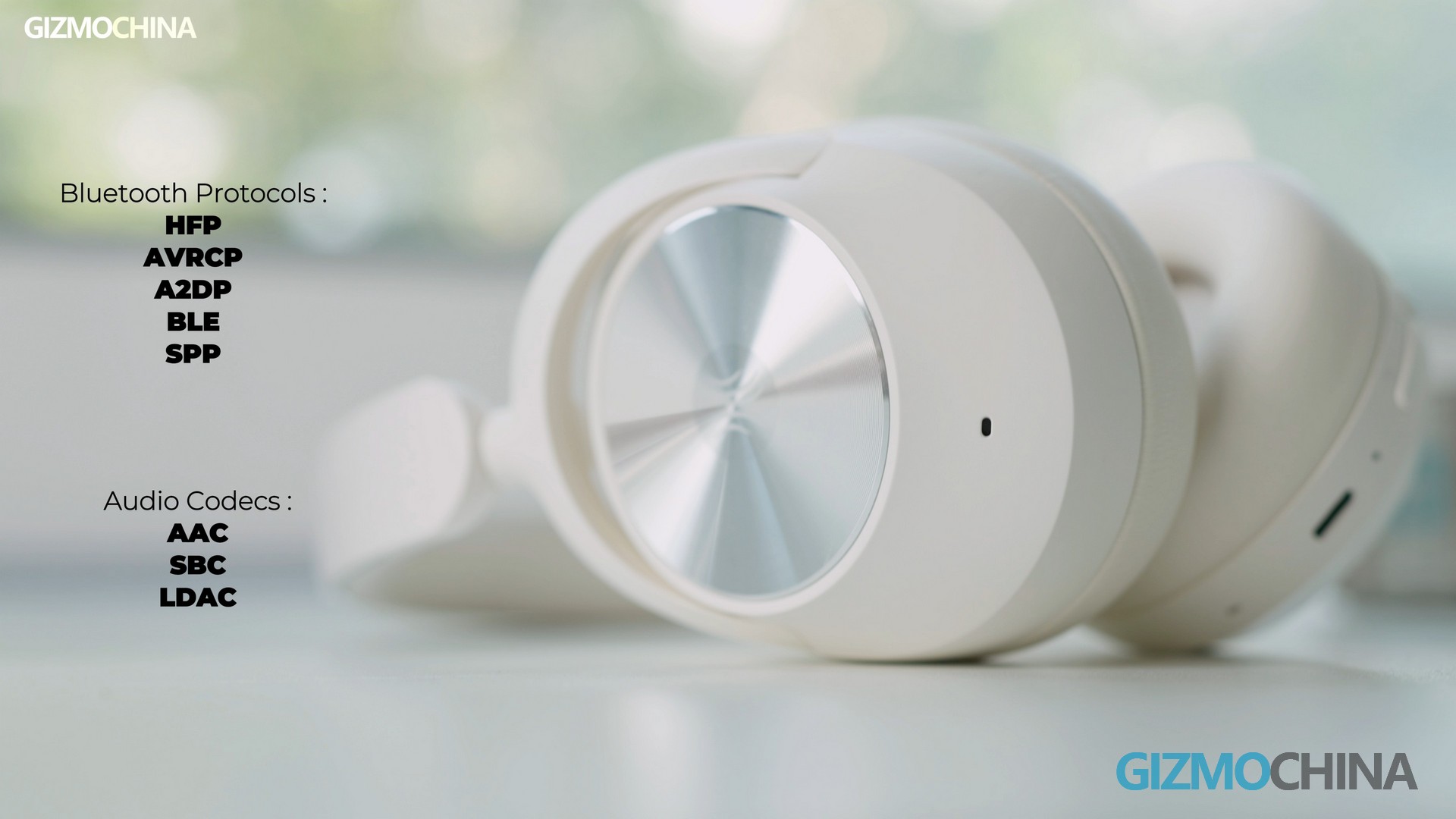
Regarding Bluetooth connectivity and compatibility, the Oneodio Focus A6 supports Bluetooth protocols such as HFP, AVRCP, A2DP, BLE, and SPP. For audio codecs, it supports AAC, SBC, and LDAC. However, despite its excellent sound quality, it lacks some smart features like optical wear detection.
Summary
In summary, the OneOdio Focus A6 are currently the most shockingly good ANC wireless headphones at a similar price range, in terms of sound quality and noise cancellation. For those who take budget into account, it offers exceptional value. If you are interested in trying it out, do not forget to add the code we applied for our audience (get 15% off).
Lenovo is getting ready to drop a new tablet from its popular Xiaoxin series. But this model isn’t a typical tablet as it caters to mobile gaming enthusiasts. Now, a fresh teaser was just shared that showcased the upcoming Xiaoxin Pro GT’s high end specifications. So let’s check it out.
Lenovo Xiaoxin GT Pro: What makes it a gaming tablet?
The Chinese tech giant shared a new image poster that confirms a bunch of features of the new Lenovo Xiaoxin Pro GT. This model will sport a tall 11.1-inch LCD display with a high refresh rate and a high 3.2K resolution. This resolution has often been seen in premium laptops, so we can expect a sharp picture quality. For flagship level performance, the tablet is equipped with the Snapdragon 8 Gen 3 SoC.
Lenovo Xiaoxin Pro GT Gaming Tablet
All of these high end specs are packed in an ultra slim 5.99mm body, with the tablet weighing around 458 grams. A thin and light chassis also helps in removing physical fatigue when playing on such a large screened device. Looking at the design of the tablet, the Xiaoxin Pro GT packs a dual camera setup on the rear. Previous teasers have also confirmed support for both Dolby Atmos tuning for the speakers and Dolby Vision for the display.
Lenovo will ship this tablet with stylus support, with the body of the tablet including a dedicated magnetic dock to house the pen. As of right now, the Xiaoxin Pro GT appears to be a China exclusive gaming tablet. In other words, there is no word regarding its global release. Other finer details are still at large as well, so stick around for more. This teaser also arrives after the Lenovo Yoga Tab Plus was listed on Amazon with a 3K display.
For more daily updates, please visit our News Section.
One UI 8, based on Android 16, is still under development, but Samsung may have already started working on its next iteration — One UI 8.5. Yes, you read that right. Samsung is skipping over versions like One UI 8.1 or 8.1.1 and returning to its older naming convention, at least for the next year. The last x.5 build was One UI 2.5, which was released four years ago.
While Samsung hasn’t confirmed One UI 8.5, references to it have been found in early beta builds of One UI 8.0. More recently, a Samsung community moderator acknowledged the update on the official forum, which further solidifies the ongoing speculation. While official details are under wraps, reports have revealed when One UI 8.5 might be released and which devices are likely to receive it. So, here’s everything we know about Samsung’s One UI 8.5 update.
When will Samsung release One UI 8.5, and what to expect from it?
One UI 8.5 will be based on Android 16 and is expected to debut on the Galaxy S26 series in early 2026. The update will then gradually roll out to eligible Samsung devices, starting with recent flagship models, including the Galaxy S25 series, Galaxy S24 series, Galaxy Z Fold 7, Galaxy Z Flip 7, and other high-end devices. It will eventually make its way to mid-range and budget devices.
There are currently no details on the features or changes One UI 8.5 will bring, but given how small an upgrade One UI 8.0 is, we are not expecting groundbreaking changes. Still, it could bring some new Galaxy AI features, system-wide optimizations, and improved software stability.
Which Samsung phones and tablets are eligible for One UI 8.5 update?
The One UI 8.5 update list will likely include all Galaxy phones and tablets that are eligible for One UI 8.0. That means all flagship Galaxy phones launched since 2022, many mid-range and budget phones, and some tablets.
One UI 8.5 update list (expected):
Galaxy S series
Galaxy S25, S25+, S25 Ultra
Galaxy S25 Edge
Galaxy S24, S24+, S24 Ultra
Galaxy S24 FE
Galaxy S23, S23+, S23 Ultra
Galaxy S23 FE
Galaxy S22, S22+, S22 Ultra
Galaxy S21, S21+, S21 Ultra
Galaxy S21 FE
Galaxy Z series
Galaxy Z Fold 7 (upcoming)
Galaxy Z Flip 7, Z Flip 7 SE (upcoming)
Galaxy Z Fold Special Edition
Galaxy Z Fold 6, Z Flip 6
Galaxy Z Fold 5, Z Flip 5
Galaxy Z Fold 4, Z Flip 4
Galaxy Tab series
Galaxy Tab S10+, Tab S10 Ultra
Galaxy Tab S10 FE, Tab S10 FE+
Galaxy Tab S9, Tab S9+, Tab S9 Ultra
Galaxy Tab S9 FE, Tab S9 FE+
Galaxy Tab S8, Tab S8+, Tab S8 Ultra
Galaxy Tab S6 Lite (2024)
Galaxy Tab A9, Tab A9+
Galaxy Tab Active 5, Tab Active 5 Pro
Galaxy A series
Galaxy A73
Galaxy A56, A55, A54, A53
Galaxy A36, A35, A34, A33
Galaxy A26, A25, A24, A12
Galaxy A16 (LTE/5G), A15 (LTE/5G), A14 (LTE/5G)
Galaxy A06 (LTE/5G)
Galaxy M series
Galaxy M56, M55, M55s, M54, M53
Galaxy M35, M34, M33
Galaxy M16, M15
Galaxy M06, M05
Galaxy F series
Galaxy F56, F55, F54
Galaxy F34
Galaxy F16, F15, F14 (LTE)
Galaxy F06, F05
Galaxy XCover series
Galaxy XCover 7, XCover 7 Pro
Galaxy XCover 6 Pro
Samsung’s primary focus right now is on finalizing and rolling out One UI 8.0. The company is aiming to push the update as quickly as it can — especially after delays with One UI 7, which ultimately led Samsung to cancel One UI 7.1 and 7.1.1.
If you own a Galaxy S25 device, you can already join the One UI 8 beta program and get an early look at Android 16. In the meantime, we’ll keep tracking One UI 8.5 news and will update this article as more details become available. Be sure to check out our One UI for the latest updates.
Earlier this year, Vivo expanded its V-series lineup with the launch of the Vivo V50, V50e, V50 Lite 5G, and V50 Lite (4G). However, there has been no indication of a “Pro” model in the series. Instead, the company appears to be skipping straight to the next generation. As per a report by XpertPick, the Vivo V60 has now been certified by multiple regulatory platforms, signalling its possible arrival in the coming weeks.
Vivo V60 receives certifications ahead of expected launch
Vivo V60 SIRIM certified
Vivo V60 TUV certified
The Vivo V60, carrying the model number V2511, has received approval from Malaysia’s SIRIM and Germany’s TUV certification bodies. Prior to these, the same device had also appeared in Europe’s EEC database.
While the SIRIM listing confirms that the device will be officially marketed as the Vivo V60, the TUV certification reveals that it will feature support for 90W fast charging. The other specifications of the phone are yet to be revealed.
Vivo V60 specifications, launch timeframe (expected)
Vivo-S30
Based on Vivo’s previous strategy, the V60 is likely to be a tweaked version of the Vivo S30, which debuted in China in May 2025. If that holds true, the V60 could sport a 6.67-inch OLED display with 1.5K resolution and a 120 Hz refresh rate. It may come powered by the Snapdragon 7 Gen 4 chipset. In China, the S30 is available with up to 16GB LPDDR4x RAM and 512GB of UFS 2.2 storage.
Camera specifications might include a 50-megapixel autofocus front camera and a 50-megapixel (main with OIS) + 50-megapixel (ultra-wide) dual rear camera system. A 6,000mAh battery with 90W fast charging is also expected. With the Vivo V50 debuting in February, the V60 could likely launch by August.
For more daily updates, please visit our News Section.
At the beginning of this month, Oppo introduced its latest Reno14 series in India. The lineup brings significant enhancements in photography, performance, and durability, with a strong focus on AI-powered creativity and long-lasting battery life. Starting today, the Reno 14 and 14 Pro are available for purchase through various platforms in the country.
Oppo Reno 14, 14 Pro price in India, and offers
Oppo Reno 14 series
The Oppo Reno14 series is now available for purchase across Amazon, Flipkart, offline retailers, and the Oppo E-store starting today (July 8. The Reno14 5G starts at Rs 37,999 for the 8GB+128GB model, going up to Rs 42,999 for the 12GB+512GB variant. Meanwhile, the Reno14 Pro 5G is priced at Rs 49,999 (12GB+256GB) and Rs 54,999 (12GB+512GB).
Buyers can avail of up to Rs 5,000 exchange bonus, zero down payment offers, and no-cost EMI options. Cashback of up to Rs 5,000 is available with select credit cards, and there’s also a 3-month Google One 2TB plan with Gemini Advanced, worth Rs 5,200, bundled with the phones.
Please Note: When you buy something using the links in our articles, we may earn a small commission at no cost to you.
Oppo Reno 14, 14 Pro key specifications
The Reno 14 Pro is powered by the MediaTek Dimensity 8450 chip, delivering significant gains in performance and efficiency, while the standard Reno 14 runs on the Dimensity 8350. The standard model has a 6.59-inch OLED LTPS panel, whereas the Reno 14 Pro houses a larger 6.83-inch OLED LTPS screen. Both phones support a 1.5K reoslution and a 120Hz refresh rate.
In terms of optics, the Reno14 series features with a 50-megapixel Hypertone camera featuring a 3.5x telephoto lens and 120x digital zoom. The Reno14 Pro packs a 6,200mAh battery with 50W wireless charging, while the Reno14 gets a 6,000mAh unit with 80W wired charging. Both models are IP66, IP68, and IP69 rated and ship with ColorOS 15 with built-in Google Gemini AI for task automation.
For more daily updates, please visit our News Section.
Dreame Technology has introduced a new smart home cleaning solution to the Indian market. According to the brand, the Dreame F10 robot vacuum that has gone official today is designed to handle the unique needs of Indian households. The F10 brings segment-leading features in suction power, mapping technology, and dual cleaning functions.
Dreame F10 key specifications
Dreame F10
The Dreame F10 is powered by the Vormax Standard system, delivering up to 13,000Pa of suction for deeper and faster cleaning. Its Carpet Boost function automatically adjusts suction based on surface type, ensuring thorough dirt removal even from dense carpets. The robot features Smart Pathfinder technology for accurate mapping, obstacle detection, and route planning. It can climb over 20mm thresholds, detect stair edges using cliff sensors, and map multi-room homes for uninterrupted cleaning.
Equipped with a 5200mAh battery, the Dreame F10 can clean for up to 300 minutes on a single charge, covering spaces up to 270m². It automatically returns to its dock to recharge and resumes cleaning from where it paused.
Dreame F10
The F10 also supports voice control via Alexa, Google Assistant, and Siri. Through its mobile app, users can customize no-go zones, cleaning schedules, and map multiple floors. The robot combines vacuuming with mopping through a 570ml dust bin and a 235ml water tank with adjustable flow levels. Its floating rubber brush is especially effective in homes with pets, preventing tangles and maintaining suction across different surfaces.
Dreame F10 price in India, availability
The Dreame F10 is priced at Rs 21,999 and will be available on Amazon India. As part of the Amazon Prime Day sale from 12th to 14th July, the vacuum will be offered at an introductory price of Rs 19,999. The product comes with a one-year warranty and customer support in over 165 cities.
Xiaomi and its sub-brand Redmi are gearing up to launch their next-generation flagship smartphones in China. While the Xiaomi 16 series is expected to debut by September, the Redmi K90 and K90 Pro are likely to be announced in October. Today, well-known tipster Digital Chat Station shared a new post on Weibo revealing key details about the Redmi K90 Pro.
Redmi K90 Pro key details leaked
Redmi K90 Pro leak by DCS
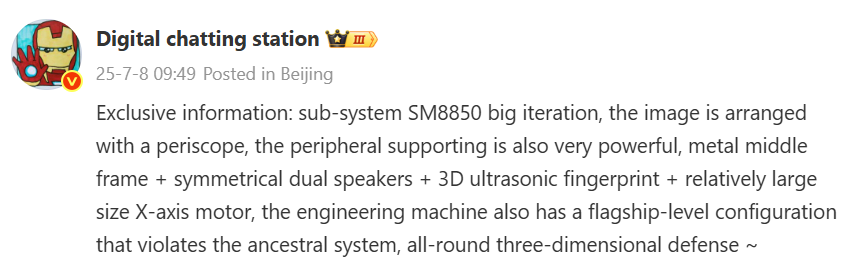
According to the tipster, the Redmi K90 Pro will be a significant upgrade, powered by the Snapdragon 8 Elite 2 (SM8850) platform. One of the standout changes is the addition of a periscope telephoto camera, which is a first for the K-series. To compare, last year’s Redmi K80 Pro featured only a standard telephoto lens.
Design-wise, the K90 Pro is said to feature a metal frame, symmetric dual speakers, a 3D ultrasonic in-display fingerprint sensor, and a large X-axis linear motor, all aimed at delivering a premium flagship experience.
Redmi K80 Pro
A recent leak by DCS also revealed that the device will feature a 50-megapixel OmniVision OV50Q periscope sensor with a 1/1.3-inch sensor size. In addition, reports suggest the K90 Pro will sport a 6.59-inch RGB OLED LTPS flat display with 2K resolution and a 120Hz refresh rate.
After teasing the arrival of the Realme 15 series for the past few days, Realme has finally confirmed its launch date. Today, the brand officially announced that the Realme 15 5G and Realme 15 Pro 5G will be unveiled on July 24 in India. The image shared also provides a first look at the Realme 15 series.
Realme 15 series design revealed
Realme 15 series launch date
As seen in the poster, popular Bollywood actor Vicky Kaushal will endorse the Realme 15 series. Based on a leaked image that surfaced earlier, the handset shown in the official teaser appears to be the Realme 15 Pro 5G.
In addition to Flowing Silver, the device will also be available in colors like Velvet Green, Silk Pink, and Silk Purple. The brand has not yet disclosed the full technical specifications of the Realme 15 series. However, the Flipkart microsite confirms that the lineup will feature six key upgrades in areas such as AI, design, display, chipset, battery size, and camera.
The Realme 15 Pro 5G is confirmed to feature AI Edit Genie, a new tool that allows users to enhance or modify photos using voice commands. In terms of design, it sports a new camera module instead of a round camera module seen on previous generations.
According to leaks, the Pro model could be powered by the Snapdragon 7 Gen 4 chipset and pack a 6,000mAh battery. It is also expected to come with a 50-megapixel periscope telephoto camera offering 3x optical zoom.
A recent report revealed the Realme 15 Pro may arrive in four configurations: 8GB+128GB, 8GB+256GB, 12GB+256GB, and 12GB+512GB. The device is likely to launch in India with a starting price of around Rs 25,000 (~$290).
For more daily updates, please visit our News Section.
Oppo has introduced a new “Sun & Moonlight” color edition for its Reno 14, with the sale date set for July 11 in China. According to Oppo, this edition stands out with a unique temperature-sensitive finish that shifts colours based on the surrounding heat. Pre-orders are already live, with pricing starting at 2,699 Yuan (~$376).
Oppo Reno 14 Sun & Moonlight edition
The Oppo Reno 14’s Sun & Moonlight edition features a heat-reactive back that changes from Moonlight Silver to Sunlight Orange depending on the temperature. At around -15°C, the device reveals a vibrant orange tone, while temperatures over 70°C shift it back to silver.
Oppo claims both colors can coexist during the transition, giving the device a visually dynamic appearance. Unlike earlier electrochromic designs, this process is automatic and reacts directly to the environment.
The Oppo Reno 14 Sun & Moonlight variant comes in several configurations:
12GB + 256GB: 2,699 Yuan (~$376)
16GB + 256GB: 2,999 Yuan (~$417)
12GB + 512GB: 2,999 Yuan (~$417)
16GB + 512GB: 3,299 Yuan (~$459)
1TB variant yet to be listed
It is unclear whether Oppo will make this color edition available for the global market in future.
Oppo Reno 14 specifications
Oppo Reno 14 Sun and MoonlightOppo Reno 14 Sun and Moonlight
Launched in May in China, the Oppo Reno 14, launched in May, is powered by the MediaTek Dimensity 8350 processor. It features a 6.59-inch flat narrow-bezel display and a 6,000mAh battery with 80W fast charging. The device is IP66/68/69 rated for water and dust resistance and has a metal frame with a soft-touch glass back.
For imaging, it packs a 50-megapixel main camera, a 50-megapixel periscope telephoto lens with 3.5x zoom, and an 8-megapixel ultra-wide sensor. The phone runs on ColorOS 15-based Android 15.
For more daily updates, please visit our News Section.
Honor has officially confirmed the arrival of its latest X-series phone — the Honor X70. The launch event is scheduled for 7pm (local time) on July 15 in China. As per the official teasers, the highlight of the device is its exceptional battery capacity and charging speeds. Here’s a look at all that is known about the smartphone so far.
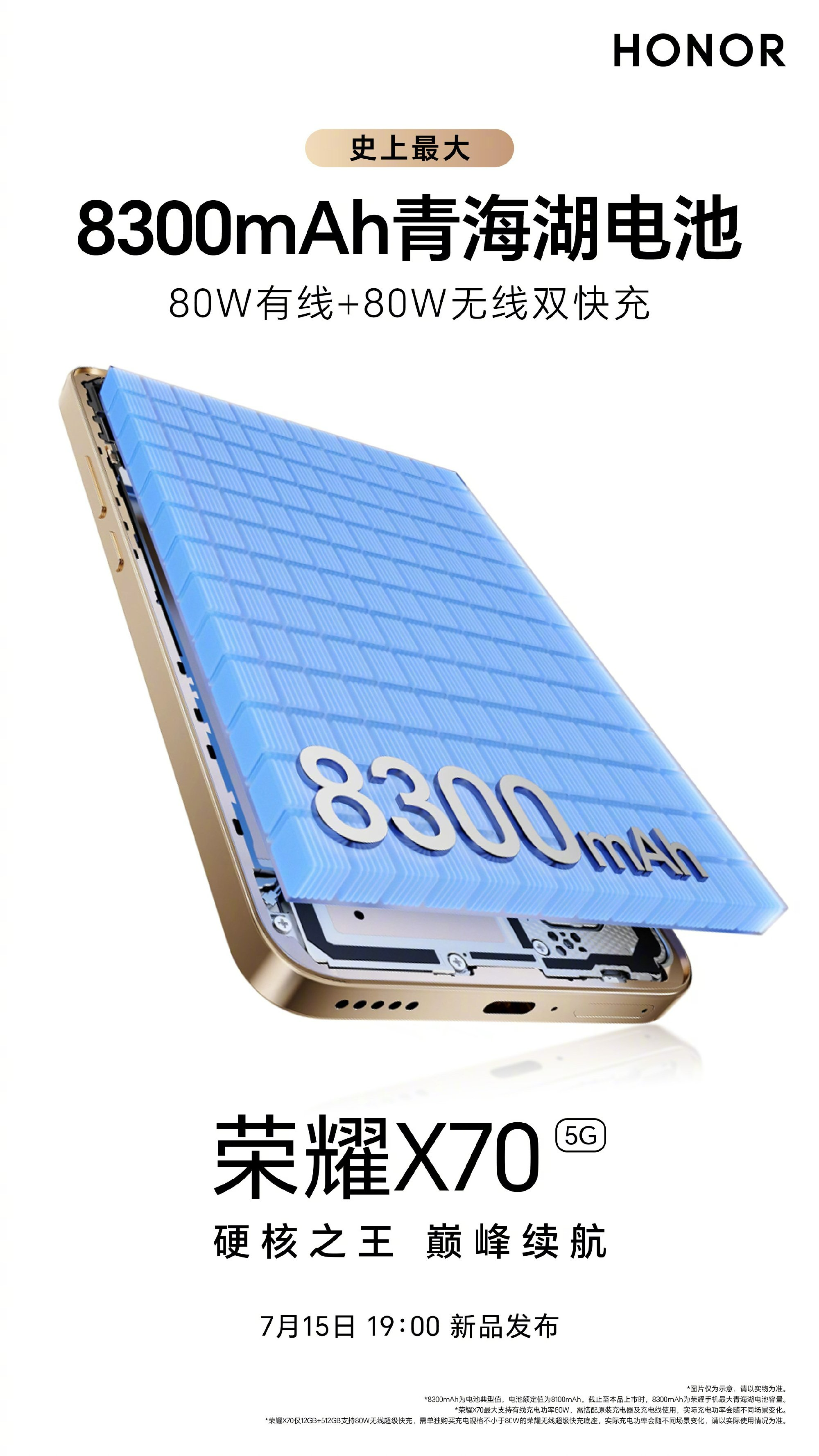
The Honor X70 will arrive with an industry-leading 8,300mAh “Qinghai Lake” battery — the biggest battery seen in a mainstream smartphone to date. It is no slouch in the charging department, as it is confirmed to support 80W fast charging.
The fine print of the second image confirms that the 12GB+512GB edition of the Honor X70 will support 80W wireless charging. The launch date image confirms that the device has a flat display on the front and a round camera module on the back. It will be available in white, green, and red shades.
As per reports, despite packing a huge battery, the X70’s standard version measures 7.7mm in thickness and weighs 193 grams. On the other hand, the top model measures 7.9mm thick and weighs 199 grams.
A recent leak revealed that the X70 features a 6.79-inch 1.5K flat display with a resolution of 2640×1200 pixels. It is powered by the Snapdragon 6 Gen 4 chip and comes with up to 12GB RAM and 512GB storage. The 50-megapixel rear camera supports optical image stabilization, while the front houses an 8-megapixel sensor. It is expected to run on MagicOS 9-based Android 15.
Rumors have claimed that Honor X70 Max is also in the works and will be arriving later, while no “Pro” version appears to be in the pipeline. Pricing details will be announced during the official unveiling, but it is expected to follow the accessible strategy of its predecessors, starting around 1,199 Yuan (~$167).
For more daily updates, please visit our News Section.
Xiaomi’s next flagship series is beginning to take shape outside of China. A new device, believed to be the Xiaomi 16, has surfaced in Europe’s EEC (Eurasian Economic Commission) certification database, indicating that a global release is on the horizon, although not immediately.
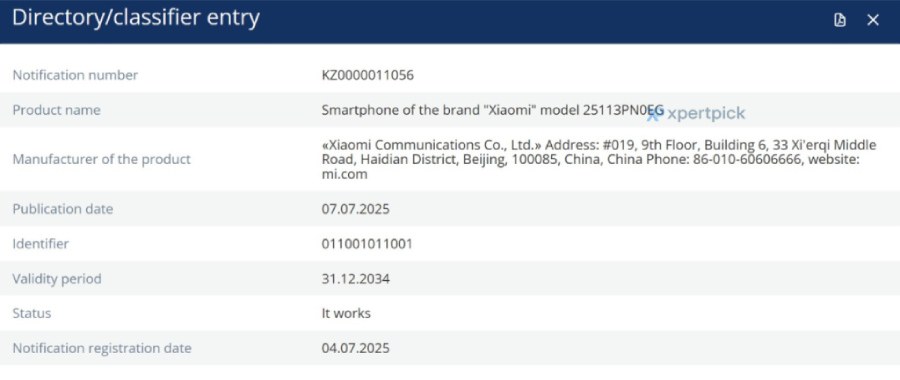
It appears on the certification site with the model code 25113PN0EG. This confirms that the device is indeed the Xiaomi 16, as it has also appeared in the IMEI database with the same model number.
The G suffix at the end indicates it’s the global version, while Xiaomi is also preparing a separate China (25113PN0EC) and India (25113PN0EI) variants of the phone.
Historically, Xiaomi’s EEC listings don’t always point to imminent launches. The Xiaomi 15, for instance, received certification in May 2024 but didn’t debut globally until March 2025, alongside the Xiaomi 15 Ultra.
In the case of the Xiaomi 16, it is expected to launch in China as early as September 2025 alongside Xiaomi 16 Pro and 16 Ultra. Globally, it might not hit shelves until Q1 2026.
What to expect from the Xiaomi 16?
According to reports, the Xiaomi 16 will be the first smartphone to feature the Snapdragon 8 Elite 2 chipset. It is said to sport a 6.3-inch RGB OLED panel with 2K resolution and a battery capacity close to 7,000mAh.
It will include a trio of 50MP sensors, covering wide, ultra-wide, and periscope telephoto roles. The device is also expected to ship with HyperOS 3.0, layered over Android 16.
While no official word has come from Xiaomi yet, the EEC filing adds to mounting evidence that the company’s next flagship is gearing up for a broader launch. Just don’t expect it too soon.
Realme’s next mid-range phone, the 15 Pro 5G, is nearing its launch in India. Ahead of its official debut, the device has surfaced in an official-looking render.
Shared by 91Mobiles, the new image reveals the phone with a design different from its predecessor, and it will likely ship with some AI-focused features.
The render shows the Realme 15 Pro 5G in what appears to be a silver finish, possibly the “Flowing Silver” color that’s been rumored. According to reports, the phone will also be available in Silk Purple and Velvet Green shades.
Realme 15 Pro 5G will bring a new design
On the back, the 15 Pro 5G sports a dual-camera setup, arranged vertically in two separate rings. A third circular cutout beside them houses the LED flash. One of the engravings on the camera island points to a 50-megapixel main sensor, though details about the second lens remain unclear.
Up front, the phone features a flat display with slim bezels and a centered punch-hole cutout for the front-facing camera. The volume rocker and power button remain on the left edge. The fingerprint sensor is not visible on the frame; it’s likely embedded under the display.
Realme 15 series with AI Edit Genie
In terms of software, the 15 Pro 5G is expected to lean on AI-based features like AI Edit Genie and AI Party. The more interesting of the two is AI Edit Genie, which allows photo editing through voice commands.
The device will come in storage configurations starting from 8GB RAM and 128GB storage, going up to 12GB + 512GB for higher-end users.
The Realme 15 Pro 5G will launch alongside the vanilla Realme 15 5G. The two phones will succeed the Realme 14 series, which launched earlier this year. While Realme hasn’t shared an exact release date yet, the steady stream of leaks suggests an announcement may be just around the corner.
For more daily updates, please visit our News Section.
Amazon is holding a Prime Day Sale 2025 in the US from 8 – 11 July. As compared to previous years, this time the Amazon Prime Sale 2025 is four days long. So this year, interested buyers will have a longer period of time to get discounts on their potential purchases. Moreover, the Prime users will have early access to deals with discounts of up to 50%. This year, Amazon relaunched Prime for Young Adults, which offers 6 months of Prime at no cost, a 50% discount thereafter, and other perks, including 10% additional cashback on select products during the sale.
The deals are available on products from all the categories. We have listed some of the best ones for you.
Top Picks Amazon Prime Day 2025 US Sale
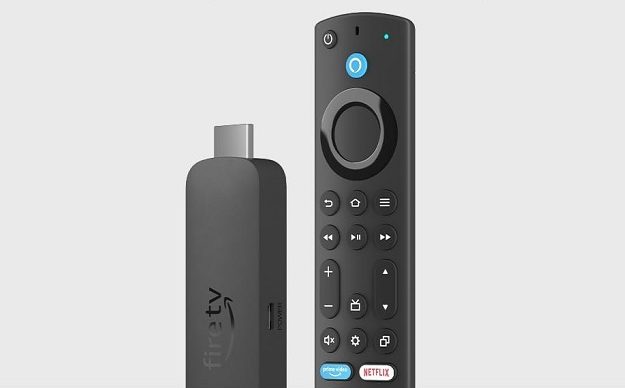
Amazon Fire TV Stick 4K Max
It is the most powerful Fire TV Stick yet. The Fire TV Stick 4K Max is 40% faster than the standard 4K model. The streaming stick features seamless 4K streaming—even across multiple devices, Dolby Vision, HDR10+, and Dolby Atmos audio for a true cinematic experience. It comes with an Alexa Voice Remote, which helps in smoother navigation. Amazon Fire TV Stick 4K Max also comes with the latest WiFi 6E. However, at the Prime Day Sale, you will get the Amazon Fire TV Stick 4K Max for just $34.
Please Note: When you buy something using the links in our articles, we may earn a small commission at no cost to you.
OneOdio Studio Max 1 Wireless Over-Ear DJ Headphones
Tailored for DJs and audio professionals, the OneOdio Studio Max 1 offers an impressive 120-hour Bluetooth battery life and delivers studio-grade sound with powerful 50mm drivers. Perfect for mixing, mastering, or casual listening, it features multi-scenario connectivity, a Dual-Mic ENC system for crystal-clear calls, and rapid 5-minute charging for 5 hours of playback.
OneOdio Studio Max 1 Wireless Over-Ear DJ Headphones’ regular price is $169, and the company is giving a 20% discount for a limited time from 8 – 11 July, 2025. If you’re looking for a headphone, then OneOdio Studio Max 1 Wireless Over-Ear DJ Headphones for just $135.99 is the best deal.
Please Note: When you buy something using the links in our articles, we may earn a small commission at no cost to you.
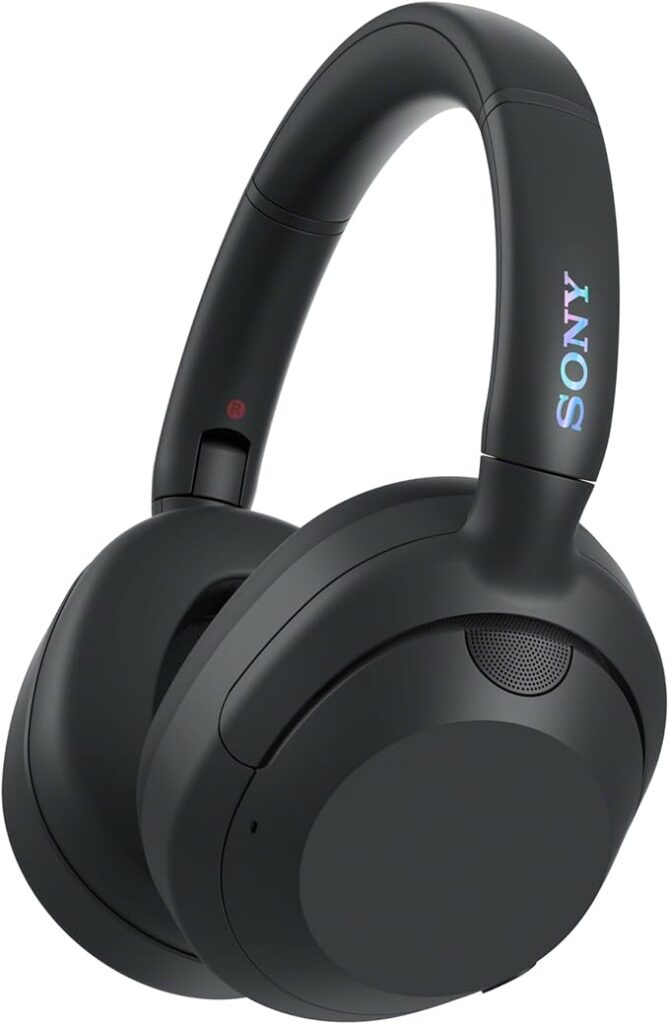
Sony ULT WEAR Over-Ear Noise Cancelling Bluetooth Headphones
It is packed with powerful bass and immersive noise cancellation. The Sony ULT WEAR over-ear headphones are perfect for music lovers on the move. With a ULT bass boost button, 30-hour battery life, and built-in Alexa, these travel-friendly headphones offer premium sound, comfort, and smart voice control. The Headphones have a comfortable foldable design, eco-conscious materials, and quick charge support, making them a top pick for both daily use and travel.
It’s very useful for students who want to focus and be quiet on campus. Sony ULT WEAR Over-Ear Noise Cancelling Bluetooth Headphones are available for just $128 ($71 OFF).
Please Note: When you buy something using the links in our articles, we may earn a small commission at no cost to you.
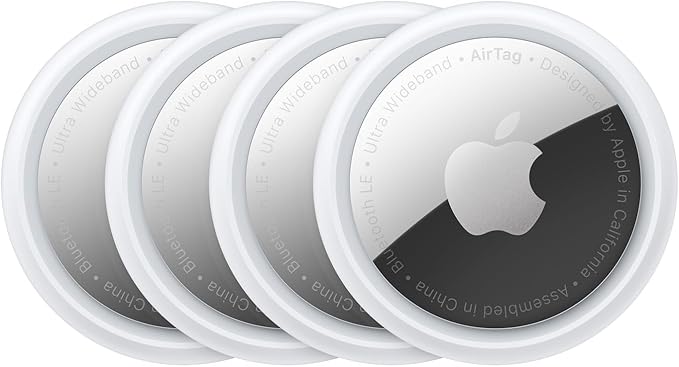
Apple AirTags, 4-Pack
You can effortlessly track your essentials—wallets, luggage, backpacks, and more—with the Apple AirTag 4 Pack. Apple’s AirTag is integrated with the Find My app, and these tiny trackers offer Precision Finding using Ultra Wideband technology (on select iPhones). The Tracker is packed with a built-in speaker that helps you locate items and Lost Mode for remote alerts.
It is very easy to set up, Apple AirTag is packed with over a year of battery life, IP67 water and dust resistance, and encrypted privacy features. AirTags are the ultimate solution for keeping tabs on your valuables, especially when shared with friends or family. In Prime Day Sale 2025, you will get an Apple AirTag 4-pack for just $67.
Please Note: When you buy something using the links in our articles, we may earn a small commission at no cost to you.
Hisense 65″ Class QD6 Series (65QD6QF, 2025 Model)
You will experience vibrant, lifelike visuals with the Hisense QD6 Series 65″ 4K TV. It features a QLED Color powered by quantum dots for over a billion rich hues. Hisense TV is also packs Dolby Vision and Dolby Atmos, delivering a cinematic picture and immersive sound. Enjoy smooth gaming with Game Mode Plus (VRR & ALLM), AI 4K Upscaling, and Motion Rate 120. Built-in Fire TV with Alexa voice control, this smart TV puts your favorite content front and center, while extras like Filmmaker Mode, AirPlay 2, and AI Sports Mode elevate your viewing experience for every genre. In Prime Day Sale 2025, the Hisense QD6 Series 65″ 4K TV is available for just $369.
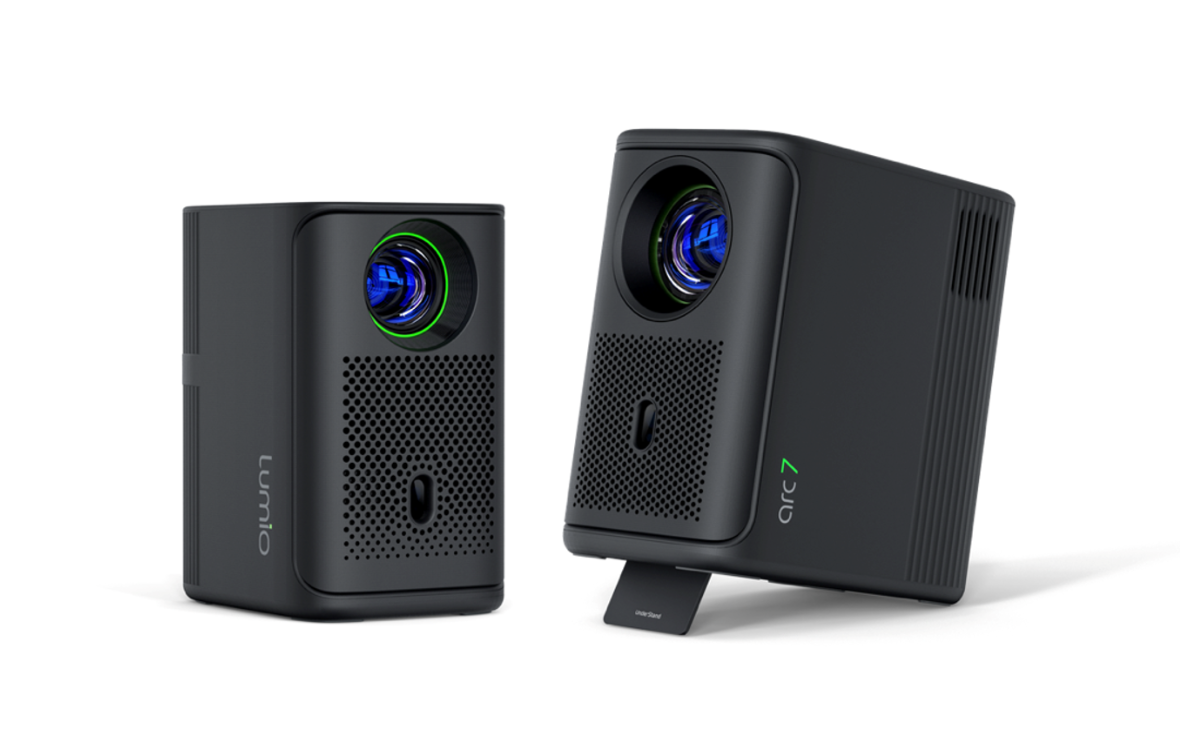
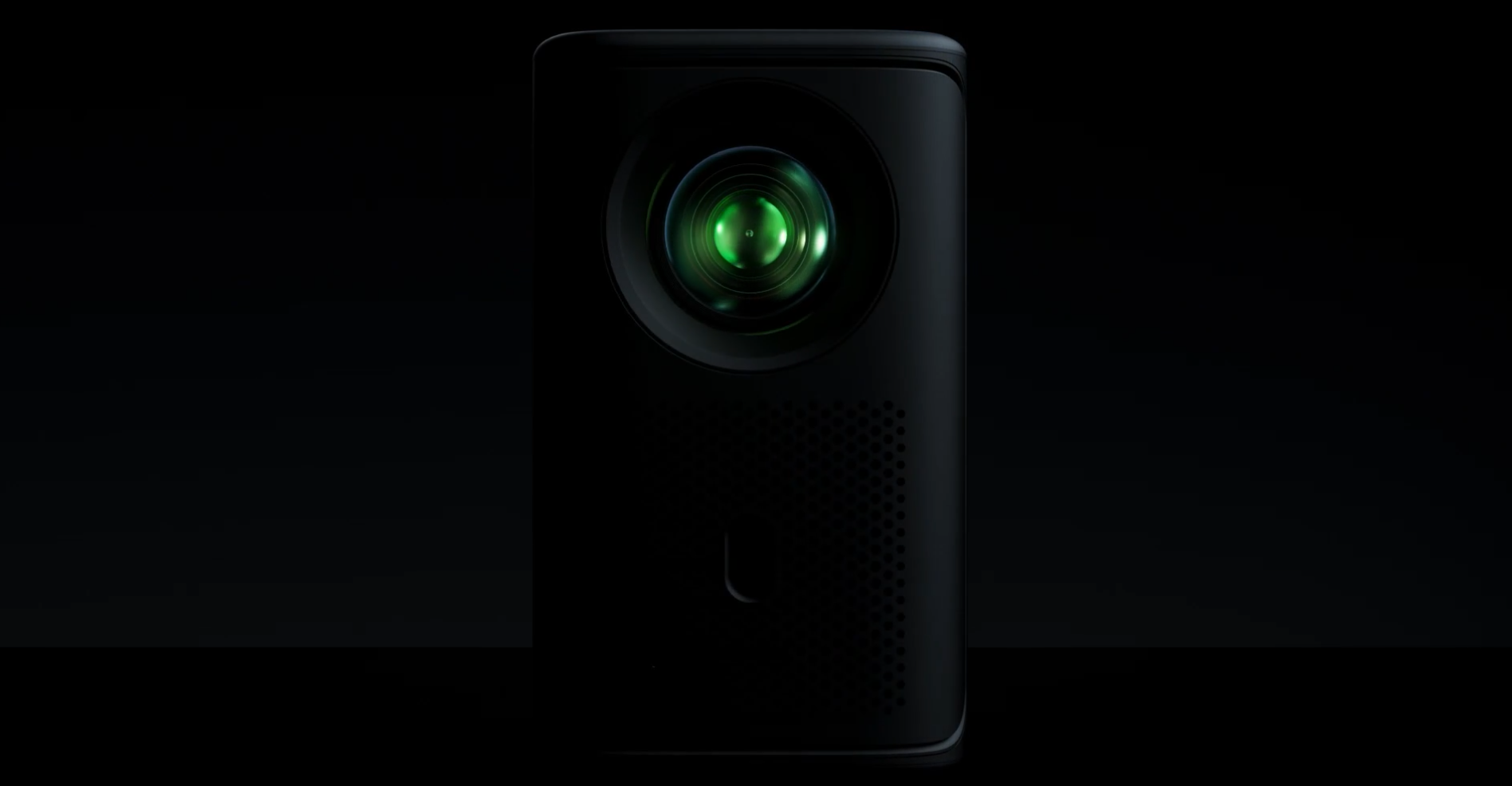
If you’re considering a new projector, the newly launched Lumio Arc 7 and Arc 5 models are two strong contenders worth looking at. Both offer solid specs for home entertainment, but they have slightly different specs and arrive at distinct price points. So here’s a comparison that breaks down the key differences to help you decide which projector best suits your needs.
Between the two Arc models, Lumio’s Arc 5 is positioned as a portable option (112 x 142.5 x 185mm). Weighing just 1.33 kilograms, this smart projector can easily be carried around since it has a heft similar to that of a thin-and-light laptop. On the other hand, the Lumio Arc 7 is the larger projector (127.6 x 197.2 x 214.8mm), which has a heavier 2.36 kilograms weight.
So if you’re looking for a smart projector that you can carry around or take out every once in a while, the Arc 5 might be the better fit for you. Although, the Arc 7 isn’t a lot heavier and can still be taken out as well. Both models also offer the “Under-Stand” that lets users achieve elevated projection in various home settings.
Please Note: When you buy something using the links in our articles, we may earn a small commission at no cost to you.
2. Projection Size, Brightness, and More
Out of the box, the Lumio Arc 5 can output 200 ANSI Lumens of screen projection. It can display images ranging from a size of 40 inches to 100 inches, with a contrast ratio of 1000:1. Meanwhile, the Lumio Arc 7 has a more powerful projection output that doubles the brightness with 400 ANSI Lumens. This projector has a higher 1500:1 contrast ratio and can even project a larger picture, ranging from 45 inches to 120 inches.
3. Audio
Under the hood, the larger Lumio Arc 7 packs two 8W stereo speakers with a large passive radiator unit. This is louder than the single 5W driver with dual passive radiator found on the Arc 5. While you’re probably using a dedicated speaker with the projectors, the audio experience is clearly better on the Arc 7. Notably, both variants have Dolby Audio support.
4. Pricing
Lumio announced its brand new projectors at different prices to target a larger audience. The Arc 5 has a more affordable 19,999 INR price tag, while the Arc 7 is priced at 34,999 INR. But it is worth noting that Arc 7 has an effective price tag of 29,999 INR for customers who purchase this model between July 12 and July 14.
So the preference here clearly depends on your budget. Projectors are handy for a home theatre experience, but not everyone aims to spend a lot. The Arc 7 is clearly a better model overall, but the Arc 5 gets the job done for a more affordable price.
For more daily updates, please visit our News Section.
Jsaux has announced a new accessory for Nintendo Switch 2 users who prefer handheld gaming. The company has launched a dedicated clip-on cooling fan designed to reduce the heat buildup that many users have reported during graphically intensive sessions.
Jsaux Cooling Fans for Switch 2 Specifications
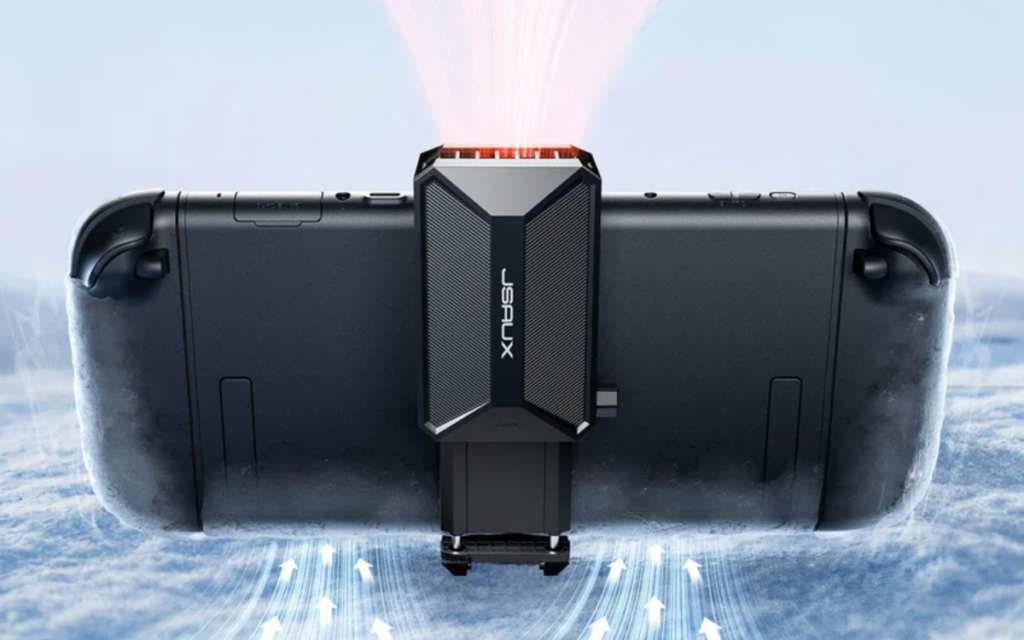
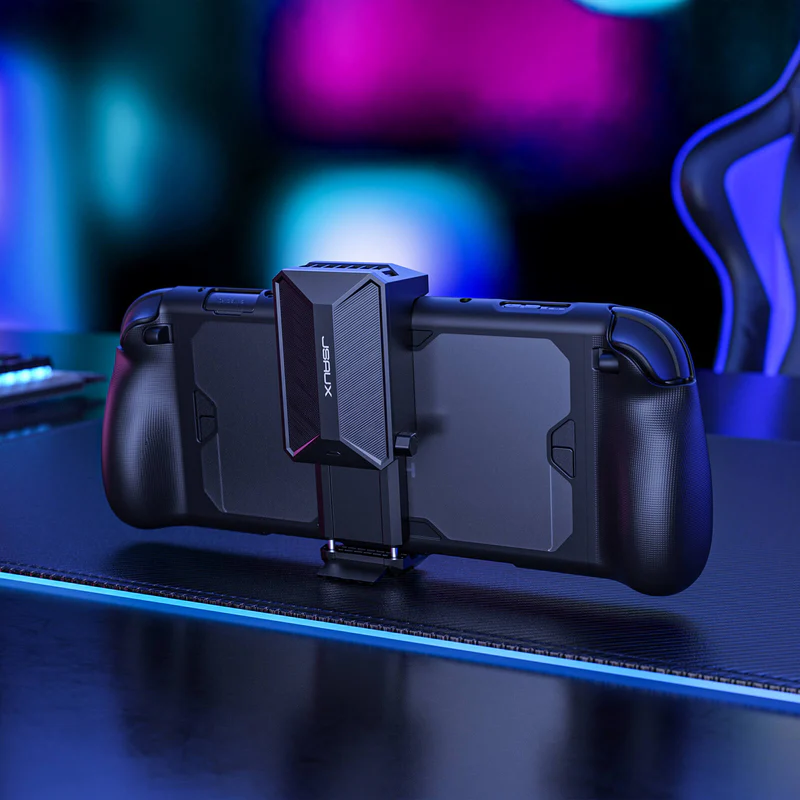
The new cooling fan, model number GP0201A, attaches directly to the back of the Switch 2 using the bottom USB-C port. It is compatible with slim protective cases and is designed to work seamlessly in handheld mode without affecting grip comfort. The fan features a stepless knob-based control that allows users to adjust fan speed with precision, depending on the thermal load and gameplay intensity.
Jsaux claims the fan can lower the device’s temperature by 2 to 8 degrees Celsius within 4 to 8 minutes, helping the console maintain stable performance and reduce the chances of frame drops or crashes. During operation, it keeps the temperature in the range of 30 to 32°C, compared to reports of the Switch 2 reaching up to 40°C without cooling support.
The fan also includes a USB-C PD-in port rated at 18W, allowing users to charge the console while using the cooling module. Jsaux states that the charging speed through the fan is comparable to direct charging, so users will not need to compromise between thermal performance and battery life.
In terms of noise, the fan stays relatively quiet at low to medium speeds. However, it becomes more audible at higher settings, which the company notes is normal for the increased airflow. The lightweight design ensures the accessory doesn’t add much bulk, making it suitable for long handheld gaming sessions.
Pricing and Availability
The Jsaux Cooling Fan for Nintendo Switch 2 is priced at $39.99. It will be available at a 25% discount during Amazon Prime Day (July 8-11) and at a 10% discount afterward. The accessory aims to solve one of the most discussed early issues of the new Switch 2, heat management during demanding gameplay.
In related news, check out our recent review of the Jsaux FlipGo Horizon, a modular triple-screen setup built for portable productivity.
For more daily updates, please visit our News Section.
Casio has released a new G-Shock watch collection in collaboration with Marvel Studios to mark the upcoming film The Fantastic Four: First Steps, which will be in UK cinemas from July 24. The limited edition set includes four models inspired by the Fantastic Four characters: Mister Fantastic, Invisible Woman, Human Torch, and The Thing.
The watches follow a white-and-blue theme and include G-Shock’s standard features like shock resistance, 200-meter water resistance, and durability against heat and cold. Each model reflects the traits of a specific character, combining functionality with a superhero-inspired design.
G-Shock GA-2100HDS-7AER-F4G-Shock GA-110HDS-7AER
The GA-110HDS is designed for exploration. It has a multi-layered dial, magnetic resistance, and a 1/100th second stopwatch. It is made for those who need precision and toughness in one package.
The DW-6900HDS offers a clean, rounded bezel and a minimal layout. It keeps things simple but solid, with shockproof and temperature-resistant features. This model is suitable for users who want a reliable watch with minimal bulk.
The GA-2100HDS is slim and lightweight. It uses a Carbon Core Guard for strength and includes glow-in-the-dark elements. It is built for users who prefer a sharp, modern look with strong resistance to impact and pressure.
The GA-700HDS has a bold front-button design and a large case structure. It includes a glow-in-the-dark dial and is built to handle heavy use in rough environments. This model is aimed at those who want a standout watch with high durability. All watches come in retro-style packaging with glow-in-the-dark details and include a collectible Fantastic Four pin badge.
Pricing & availability
The GA-110HDS-7AER-F4 is priced at £119.00, while the DW-6900HDS-7ER-F4, GA-2100HDS-7AER-F4, and GA-700HDS-7AER-F4 are each priced at £99.90. Global availability has not been confirmed.
For more daily updates, please visit our News Section.
We use cookies on our website to give you the most relevant experience by remembering your preferences and repeat visits. By clicking “Accept”, you consent to the use of ALL the cookies.
This website uses cookies to improve your experience while you navigate through the website. Out of these, the cookies that are categorized as necessary are stored on your browser as they are essential for the working of basic functionalities of the website. We also use third-party cookies that help us analyze and understand how you use this website. These cookies will be stored in your browser only with your consent. You also have the option to opt-out of these cookies. But opting out of some of these cookies may affect your browsing experience.
Necessary cookies are absolutely essential for the website to function properly. This category only includes cookies that ensures basic functionalities and security features of the website. These cookies do not store any personal information.
Any cookies that may not be particularly necessary for the website to function and is used specifically to collect user personal data via analytics, ads, other embedded contents are termed as non-necessary cookies. It is mandatory to procure user consent prior to running these cookies on your website.