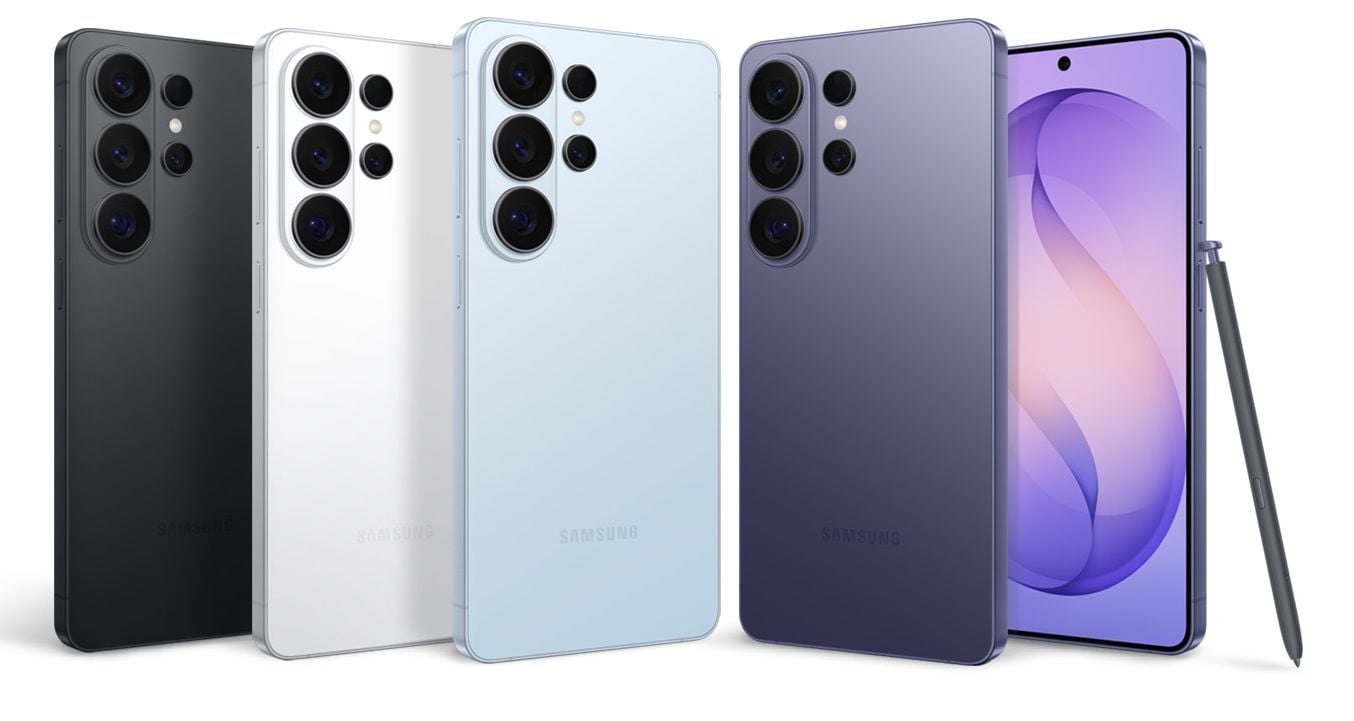
This week, a report emerged from South Korean media, citing industry sources, that said the Snapdragon 8 Elite Extreme Gen 6 caused overheating issues on the Galaxy S27 Ultra during internal testing, and the processor speed also dropped while performing high-load tasks. A Qualcomm’s representative has declined these rumors entirely saying these are “100% NOT accurate.”
When asked to elaborate on his earlier response, Qualcomm’s CMO, Don McGuire, replied on X “There are no systemic thermal issues with the 8 elite gen 6. OEMs are consistently tuning their platforms as they launch their products. Always trying to balance performance and power to optimize their value props around different use cases. We work together to deliver the best for users.”
McGuire’s response isn’t 100% convincing as he mentioned the standard Snapdragon 8 Elite Gen 6 in his reply on X, not the higher-clocked Snapdragon 8 Elite Extreme Gen 6 which is reportedly causing heating issues on the Galaxy S27 Ultra. The “Extreme” variant packs a much more powerful GPU with a boosted peak speed and faster memory.
One might think McGuire’s response applies to both chip variants, since they offer identical design and architecture. However, when the alleged problem is linked to a higher end variant of a SoC, explicitly mentioning the Extreme variant would have been a lot more convincing.
Snapdragon 8 Elite Extreme Gen 6 facing troubles lately
Snapdragon 8 Elite Extreme Gen 6 has run into rough waters lately. Users in China have reported unexpected crashes, black screens, and random reboots in their phones powered by the same chip. The exact problem isn’t unknown, but some reports suggest this may be due to low voltage tuning in the firmware, not because of the chip.
The Snapdragon 8 Elite Extreme Gen 6 wasn’t reportedly at fault, but since all affected devices are powered by the same chip, the brand’s reputation may be hurt indirectly. McGuire was again quick to respond to these reports saying “wonder who stands to gain from perpetuating negative narratives, unsubstantiated claims and sensationalized headlines. Basically, just plain lying….I wonder.”
Vivo X Fold6 and Xiaomi 18 Fold approach the premium foldable market differently, combining flagship performance, versatile cameras, and large inner displays. Vivo focuses on Zeiss-tuned photography, a larger internal screen, and a substantial battery, while Xiaomi counters with Leica optics, Dolby Vision video, and a distinctive compact design. The differences extend to charging, software, and pricing, making this comparison useful for buyers deciding which foldable delivers the better overall experience.
Major Features:
Category
Vivo X Fold6
Xiaomi 18 Fold
Winner
Design and Build
Aluminum frame, glass-fiber-reinforced plastic back
The Vivo X Fold6 combines an aluminum frame with a glass front when folded and a glass-fiber-reinforced plastic back. Its IP58/IP59 rating provides protection against dust and water, making it suitable for users who want a premium foldable without sacrificing durability. The Xiaomi 18 Fold uses Dragon Crystal Glass 3 on its cover, a glass back, and an aluminum frame, with a plastic front when unfolded. It carries the same IP58/IP59 rating. Xiaomi’s reinforced cover glass is appealing, while Vivo’s glass-fiber construction offers a different approach to managing the demands of a foldable design.
Display Quality
Vivo has an advantage in screen real estate with its 8.02-inch inner LTPO AMOLED panel, which supports 120Hz refresh rates, HDR10+, HDR Vivid, and Dolby Vision. Its 6.51-inch cover display also supports 120Hz and boasts a claimed 5,000-nit peak brightness. Xiaomi offers a 7.58-inch inner LTPO AMOLED display with the same major HDR formats and a 120Hz refresh rate. Its 5.38-inch cover screen reaches a claimed 4,000 nits. Vivo’s larger panels make multitasking and reading more comfortable, while Xiaomi’s smaller format may appeal to users who prefer a more compact cover screen.
Verdict
Vivo X Fold6 wins this round with its larger inner and outer displays, higher claimed cover-screen brightness, and equally strong water and dust resistance.
2. Specifications Including Battery
Performance
The Vivo X Fold6 uses the MediaTek Dimensity 9500 Super, a 3nm chipset paired with a Mali-G1 Ultra MC12 GPU. The Xiaomi 18 Fold runs on Xiaomi’s 3nm XRing O3 processor, featuring a 10-core CPU and Arm G2-Ultra NX MC16 graphics. Both devices offer up to 16GB of RAM and 1TB of UFS 4.1 storage, giving them a strong foundation for demanding applications, multitasking, and large files. However, direct performance comparisons require reliable independent benchmarks, particularly because these chipsets use different architectures. Vivo’s MediaTek platform is an appealing choice, while Xiaomi’s in-house silicon could deliver tighter integration with HyperOS 4.
Battery and Charging
Vivo packs a silicon-carbon battery rated at 6,900mAh or 7,000mAh, depending on the version, with 80W wired and 40W wireless charging. It also supports reverse wired and 5W reverse wireless charging. Xiaomi has a 6,000mAh silicon-carbon battery, 67W wired charging, and faster 50W wireless charging, plus reverse wired charging. Vivo’s larger battery and quicker wired charging should suit users who spend long hours working or travelling. Xiaomi counters with higher wireless charging output, which is convenient for compatible charging accessories. Actual endurance will depend on software optimisation, display usage, and network conditions.
Verdict
Vivo X Fold6 wins for battery capacity and wired charging speed, while Xiaomi 18 Fold offers faster wireless charging. Vivo is the more practical choice for heavy users.
3. Camera
Main and Secondary Lenses
The Vivo X Fold6 features a 200MP main camera with optical image stabilisation, a 50MP periscope telephoto camera offering 3x optical zoom, and a 50MP ultrawide lens. Zeiss optics, T* lens coating, laser autofocus, and a colour spectrum sensor strengthen its photography credentials. Xiaomi counters with a 200MP main camera, a 50MP telephoto camera with approximately 3x optical zoom, and a 50MP ultrawide lens. Leica lenses, laser autofocus, and a colour spectrum sensor provide a distinct imaging approach. Vivo’s dedicated periscope system is promising for zoom photography, while Xiaomi’s Leica collaboration could appeal to users who prefer its colour science. Both offer flagship-level versatility, but real-world image quality depends on processing and lighting.
Vivo equips both the inner and cover displays with 20MP selfie cameras, while Xiaomi uses 16MP cameras on both screens. Vivo’s higher resolution could retain more detail in selfies and video calls, although sensor quality and image processing matter just as much. Both phones support HDR, and their front cameras record at 1080p. Xiaomi offers 1080p recording at up to 60fps, whereas Vivo lists 30fps recording. Xiaomi therefore has an advantage for smoother front-camera video, while Vivo looks stronger on paper for still-image detail. Neither specification alone guarantees superior skin tones or low-light selfies.
Verdict
Vivo X Fold6 takes the camera round for its periscope hardware, Zeiss optics, and higher-resolution selfie cameras. Xiaomi remains compelling for Leica-inspired imaging and smoother selfie video.
4. Pricing
The Vivo X Fold6 is priced around $1,200 (₹111,000), positioning it as the more affordable option in this premium foldable comparison. The Xiaomi 18 Fold is priced around $1,600 (₹155,000), commanding a considerable premium. That difference gives Vivo a stronger starting position for buyers who want a high-end foldable without moving into the most expensive segment. Both devices offer 200MP main cameras, advanced LTPO AMOLED displays, flagship-oriented processors, and generous storage configurations. However, regional taxes, import costs, availability, and variant differences can affect actual retail prices. Buyers should verify local pricing and warranty coverage before making a purchase, especially if either device is sold through unofficial channels.
Is the price justified?
Xiaomi’s premium may appeal to buyers who specifically want Leica camera tuning, HyperOS 4, Dolby Vision video recording, and 50W wireless charging. Its compact cover-screen approach also provides a different everyday experience. However, Vivo offers a larger inner display, a higher-capacity battery, faster wired charging, and Zeiss-branded camera features for substantially less. Those advantages are more immediately useful to a broad range of foldable users. Xiaomi could justify its higher price through software refinement and imaging performance, but those benefits need real-world testing. On the supplied specifications alone, Vivo provides the more balanced package for the money.
Verdict
Vivo X Fold6 wins on value, delivering larger displays, a bigger battery, and versatile cameras at a lower price. Xiaomi suits buyers prioritising its specific software and imaging features.
Disclaimer: Prices are approximate and may vary based on country, region, launch timing, and applicable taxes. Always check whether the listed price is for a China unit or a global/international variant when purchasing.
5. Conclusion
Vivo X Fold6 stands out with its 8.02-inch inner display, 6.51-inch cover screen, 200MP main camera, 3x periscope telephoto lens, and battery rated up to 7,000mAh. Its 80W wired charging and Zeiss camera collaboration further strengthen its flagship credentials. The Xiaomi 18 Fold offers its own distinct advantages, including Leica optics, Dolby Vision video recording, 50W wireless charging, Ultra Wideband support, and HyperOS 4. Its Dragon Crystal Glass 3 cover glass also adds to its appeal.
Both devices support 120Hz inner displays, IP58/IP59 protection, and up to 1TB of storage. The deciding factor is how those features translate into everyday use. Vivo’s larger screens and battery favour productivity and extended use, while Xiaomi offers an attractive alternative for buyers who value its camera partnership and software ecosystem.
Verdict
Overall winner: Vivo X Fold6. It offers the stronger all-round package with larger displays, a bigger battery, faster wired charging, versatile camera hardware, and a significantly lower starting price. Xiaomi 18 Fold remains a capable alternative for Leica photography enthusiasts and users who prioritise faster wireless charging, Dolby Vision video, and HyperOS 4.
However, based on the supplied specifications and pricing, Vivo delivers more practical flagship features for the money. Unless Xiaomi’s software experience or camera processing proves substantially better in independent testing, the Vivo X Fold6 is the more sensible choice for most premium foldable buyers.
FAQs: Vivo X Fold6 vs Xiaomi 18 Fold
1. Which phone is better for photography, Vivo X Fold6 or Xiaomi 18 Fold?
The Vivo X Fold6 offers a periscope telephoto camera and Zeiss optics, while Xiaomi features Leica-tuned imaging and Dolby Vision video.
2. Which foldable has better gaming performance?
Both feature 3nm flagship chipsets, but independent benchmarks are needed to determine which delivers better gaming performance and sustained thermals.
3. Which phone lasts longer on a single charge?
The Vivo X Fold6 has a larger 6,900mAh or 7,000mAh battery, giving it a potential endurance advantage over Xiaomi’s 6,000mAh battery.
4. Is the Xiaomi 18 Fold worth its higher price?
It may suit buyers prioritising Leica imaging, Dolby Vision recording, Ultra Wideband, and faster wireless charging, but Vivo offers better value on paper.
5. Which foldable should you buy in 2026?
The Vivo X Fold6 suits most buyers, while the Xiaomi 18 Fold is worth considering for its camera features and software ecosystem.
Disclaimer: Prices, specifications, and availability may vary by region and retailer. Recommendations in this article are based on editorial opinion, feature-based value, and market positioning at the time of writing. Readers are advised to do their own research before making a purchase.
Visionox has confirmed that the Honor Win 2 series will feature a 2K display with a 185Hz refresh rate, which the company says is the first for smartphones. The panel will be available across an entire lineup, meaning buyers won’t have to choose the top model to get the same screen.
Running a 2K panel at 185Hz puts considerable demands on a phone’s display hardware. The screen needs to refresh millions of pixels 185 times per second, making power consumption, pixel driving, and signal stability important challenges. Phone makers often lower the resolution to achieve higher refresh rates or reserve their best displays for top-end models.
Visionox says it worked with Honor throughout the panel’s development to address these challenges and keep the display stable during demanding gaming sessions. The same screen will be used across the Win 2 series.
The display also supports a 5,000Hz instantaneous touch sampling rate, a 520Hz reporting rate for ten-finger touch, and an 800Hz gyroscope.
The panel maintains its 2K resolution across different scenes and uses an AI super-resolution algorithm to upscale content. According to Visionox, more than 40 popular games support the screen’s native 185Hz refresh rate. The bezels measure just 0.93mm on all four sides, leaving more room for the display on the front of the phone.
For eye comfort, the screen uses 5,920Hz PWM dimming across all its high-refresh-rate settings. Visionox also says it has passed TÜV Rheinland’s Global Eye Protection 6.0 and flicker-free certifications. The company describes Global Eye Protection 6.0 as the first certification of its kind to cover a high dynamic range standard.
Beyond the display, the Honor Win 2 will run a Snapdragon 8 Elite Extreme Gen 6 and feature a dual-fan cooling system. The company also confirmed the starting price of 5,499 yuan after national subsidies.
Ahead of launch, Honor has also listed five memory and storage configurations for the Win 2 series. The lineup has so far remained exclusive to China, and Honor has yet to announce plans for an international release.
Xiaomi has launched the Mijia High-Speed Hair Dryer Mini in China. It is priced at 299 yuan, or about $45, and will open for pre-orders on October 20 via Xiaomi Youpin.
The Mijia High-Speed Hair Dryer Mini weighs 270g without the power cord. Xiaomi says that makes it 30% smaller and 20% lighter than the Mijia High-Speed Hair Dryer H501, which weighed 345g when it launched in 2023.
Xiaomi built the hair dryer around a micro brushless motor, which is 1.8mm smaller in diameter than the H501. However, you still get the same speed of 110,000 rpm and wind speeds of up to 62 m/s as the old model.
Xiaomi’s own tests put drying time at about one minute for short hair, three minutes for medium-length hair, and five minutes for long hair. There’s also a built-in NTC sensor that checks the air temperature 200 times per second to keep heat from damaging your hair.
Dual ion system for hair and scalp
The dryer uses a plasma system that releases both positive and negative ions. The company says this reduces static and frizz, and it claims the following improvements:
Xiaomi also says the ions clean the scalp and help with Malassezia and scalp mites. It even claims 100% mite removal.
Moreover, you get two wind speeds and four temperature levels. There is also a child mode with a lower air temperature and a low-radiation design. Together, that gives you 10 drying combinations. The dryer remembers your last setting and restores it the next time you switch it on.
It comes in pink, purple, and beige, all in low-saturation pastel shades. The air intake filter is magnetic. You pull it down to remove it, and it snaps back into place. It uses a double-layer micro-mesh to keep hair out of the motor. The power cord has a built-in tie strap for storage.
Early design details for Samsung’s next Ultra flagship are starting to firm up. Trusted leaker Ice Universe has shared some precise measurements of the Galaxy S27 Ultra. The upcoming flagship is expected to have 1.28 mm display bezels, a small step down from the 1.32 mm on the S26 Ultra.
While Samsung is chipping away at the borders for a more immersive screen, it’s lagging behind some Chinese rivals. The Xiaomi 18 Pro Max and Oppo Find X10 Pro Max have already pushed bezels down to 0.99 mm and 1.15 mm. Any bigger visual jump might end up coming from the new AMOLED panel with improved Privacy Display tech rather than the bezel trim itself.
The camera module, on the other hand, is getting a bit thicker. Ice Universe’s numbers put the bump at 4.69 mm, up from roughly 4.5 mm on the S26 Ultra and a touch higher than the 4.56 mm suggested in earlier OnLeaks CAD renders.
Previous leaks have linked the main sensor to a new ISOCELL HP6. It’s still in the 1/1.3-inch class, but the lens module could be physically thicker than that of the Galaxy S26 Ultra, which might help with light gathering or optics. A bigger battery is also expected.
These small dimensional changes sit alongside broader design rumors, including a move to a wider rectangular camera housing that stretches more across the back instead of the older vertical setup.
The Galaxy S27 series is still expected in the usual early-2027 window (January or February). The tweaks are minor on paper, but they suggest Samsung is carefully balancing a familiar design with the need to fit better cameras and a larger battery inside.
The tea-and-water separation mug Xiaomi showed off in late September is now open for crowdfunding on Youpin. The crowdfunding ends on October 21—four days from now. The Xiaomi Mijia Titanium Insulated Mug Tea and Water Separation Edition 500ml costs 199 yuan (about $28), and you can choose between Moonlight Silver and Space Gray.
The mug uses gravity to control the brewing process. Turn it upside down and water flows into the tea compartment, allowing it to steep with the leaves. Return the mug to an upright position, and the water separates from the leaves, stopping the brewing process. You can adjust the strength of your tea by deciding how long to leave the mug inverted.
The tea compartment is also removable, so you can use the mug as a regular thermos when you don’t want to brew tea. Simply unscrew the compartment and attach the lid directly to the cup. Its 500ml capacity makes it suitable for brewing tea or carrying water throughout the day.
Xiaomi uses pure titanium for the cup body, filter, and inner lining of the lid. The cup body is also BPA-free. Xiaomi has introduced several titanium products under its Mijia brand this year, including an electric kettle with a titanium steel interior launched in May.
The removable filter makes cleaning easier, allowing users to take it out and rinse the mug and its components separately. However, Xiaomi advises against boiling the clear tea chamber or soaking it in very hot water, as the heat could deform the plastic.
The mug is currently available through Youpin, Xiaomi’s crowdfunding platform in China, for 199 yuan. Its titanium construction and detachable tea compartment set it apart from a standard insulated mug, although Xiaomi has yet to announce a global release.
For more daily updates, please visit our News Section.
Seven years of Android updates are no longer limited to Google and Samsung. Motorola, Honor, and Fairphone have joined them, with newer phones promising long-term software support, giving buyers more options to choose from.
This list covers recent models rather than older phones that still qualify for extended support, such as the Pixel 8 and Galaxy S24. There is also an important detail to keep in mind when comparing them: the seven-year period starts when a phone first goes on sale, not when you buy it.
Google counts from the Pixel’s first sale through the US Google Store, while Samsung counts from the first sale date. A phone released several months ago will therefore have less support time remaining than a newer model.
The Google Pixel 11 starts at $899 and gets seven years of Android OS upgrades, security updates, and Pixel Drops, with support scheduled to continue through August 2033.
It ships with Android 17, Google’s Tensor G6 chip, and a Titan M3 security chip. Google also promises seven years of spare parts, giving owners the option to replace components such as the battery rather than buy a new phone when the original starts wearing out.
The phone keeps the familiar 6.3-inch design of its predecessor instead of introducing a major redesign. Its software support is another advantage, as Google delivers Android updates and security patches directly without waiting for a carrier or another manufacturer to approve them.
2. Best big-screen Pixel
The Google Pixel 11 Pro XL starts at $1,299 for the 12GB/256GB model, making it $100 more expensive than the Pixel 10 Pro XL was at launch. Its larger 6.8-inch LTPO OLED display supports a 120Hz refresh rate and has a claimed peak brightness of 3,600 nits.
It is powered by a 5,115mAh battery with 45W wired charging, while its rear camera system combines a 50MP main sensor with a 48MP telephoto camera. The Pro models also include Wi-Fi 7 and ultra-wideband connectivity.
As you can guess, software support matches the smaller Pixel 11, with updates scheduled through August 2033. That makes the Pro XL worth considering if you want a larger screen without giving up Google’s full update commitment.
3. Best premium Samsung
Samsung Galaxy S26 Ultra
Samsung promises seven years of updates on the Galaxy S26 Ultra, making it eligible for OS upgrades until Android 23—security patches follow suit. Samsung also delivers smaller One UI updates between major Android releases.
The phone has a 6.9-inch display, a Snapdragon 8 Elite Gen 5 processor, and an S Pen for writing, drawing, and other tasks. Its privacy display mode limits visibility from off-axis viewing angles, adding another feature for people who regularly use their phones in public. The Galaxy S26 Ultra starts at $1,299.
Samsung launched the phone in February, meaning its seven-year support period began roughly six months before the Pixel 11’s. Its support will therefore end around February 2033, earlier than Google’s August 2033 deadline. Our Galaxy S26 vs S26+ vs S26 Ultra breakdown covers the differences between Samsung’s flagship models.
4. Best Samsung value
Samsung announced the Galaxy S26 FE in August and began selling it in markets in September. It has a 6.7-inch AMOLED display with a 120Hz refresh rate, an Exynos 2500 processor, and 8GB of RAM. A 4,900mAh battery supports 45W wired charging.
The phone runs One UI 9 based on Android 17 and qualifies for seven years of OS upgrades and security patches. Samsung has priced it $50 higher than the Galaxy S25 FE in international markets, but it remains a more affordable way to get Samsung’s extended software support than buying the S26 Ultra.
5. Best budget
At $499, the Google Pixel 10a is the least expensive phone on this list. It went on sale in March and qualifies for seven years of OS upgrades, security updates, and Pixel Drops, much like the Pixel 11.
The phone has a 6.3-inch Actua display, a 5,100mAh battery, IP68 water and dust resistance, and Gorilla Glass 7i protection. Much of its hardware carries over from the Pixel 9a, so the extended software support is one of the main reasons to consider it.
Its camera performance is less impressive, however. DxOMark’s testing placed the Pixel 10a below the Pixel 8a and iPhone 15. If camera quality is a priority, we recommend going through reviews before making the decision.
6. Best flagship outside the US
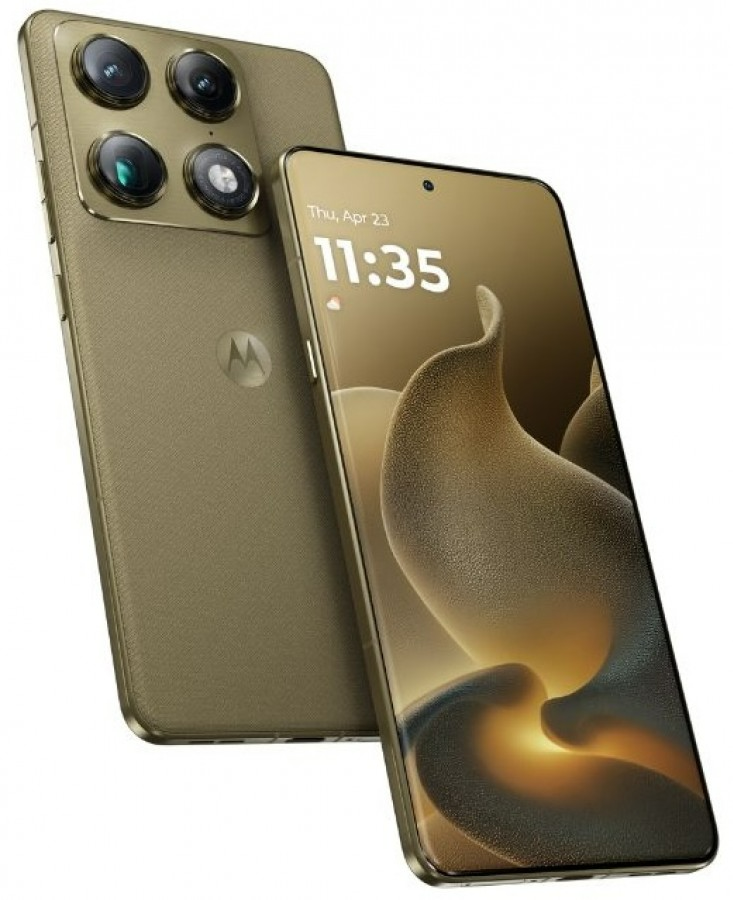
Motorola Signature – Martini Olive
The Motorola Signature is the company’s first phone with a seven-year update commitment, covering seven Android OS upgrades and seven years of security patches through early 2033. It starts at €999 in Europe and £899 in the UK, although Motorola does not sell it in the US.
Its specifications include a 6.8-inch display, a Snapdragon 8 Gen 5 processor, and a 5,200mAh battery. It also supports fast 90W wired charging and 50W wireless charging. The phone also carries IP68 and IP69 ratings for protection against dust and water, along with a near-stock version of Android.
The Snapdragon 8 Gen 5 sits below the Snapdragon 8 Elite Gen 5 in the Galaxy S26 Ultra. In Motorola’s defense, the price is lower too.
7. Best foldable in Europe
The Honor Magic V6 has a 6.52-inch cover display and a 7.95-inch inner screen, giving it a large display for multitasking when unfolded. It runs on the Snapdragon 8 Elite Gen 5 and packs a 6,660mAh battery. The phone also carries IP68 and IP69 ratings.
In Europe, Honor sells it in a 16GB/512GB configuration for €2,299.99. The UK price is £1,999.99.
What’s interesting in this case is that Honor commits to seven years of software updates for Magic phones sold in the EU and UK. However, support in other markets depends on the region or market. For instance, Malaysia and Singapore get six years of commitment.
Fairphone launched the Fairphone Gen 6+ in August for €649, and you can now buy the smartphone officially in the US too. It ships with 12GB of RAM, a Snapdragon 7s Gen 4 processor, plus the modular design of the Fairphone Gen 6. The device boots on Android 16 and comes with a five-year warranty. The company promises software updates until at least 2033.
As is usual for every Fairphone, its main appeal is repairability rather than raw performance. The replaceable components and long warranty may help owners keep the phone for longer, particularly if they prefer fixing individual parts instead of replacing the entire device.
9. Which one should you buy?
The best choice depends on how much you want to spend and which features matter most. The Google Pixel 11 series has support scheduled through August 2033, giving it the latest end date among the phones listed here. The standard Pixel 11 is the more affordable flagship option, while the $499 Pixel 10a brings the same seven-year update commitment to a lower price, with some compromises in camera performance.
Samsung’s Galaxy S26 Ultra and Galaxy S26 FE also qualify for seven years of updates. The Ultra is better suited to buyers who want the S Pen and Samsung’s premium features, while the FE provides a more affordable entry point.
Outside the US, the Motorola Signature is another premium Android option, and the Honor Magic V6 brings extended support to foldable phones in Europe and the UK.
Finally, the Fairphone Gen 6+ is the choice for people who want to repair their phones rather than replace them when a component fails. Whichever model you choose, check the actual support end date and local update policy before buying. Seven years of promised updates can mean different amounts of time remaining, depending on when and where you purchase the phone.
For more daily updates, please visit our News Section.
More leaks about Samsung’s next mid-range phones are rolling in. Right after similar details surfaced for the Galaxy A58, fresh info suggests the more affordable Galaxy A38 will follow a very familiar path when it launches next year.
According to Dutch site GalaxyClub, the A38 is expected to carry the same camera setup as the current Galaxy A37: a 50MP main camera, 12MP ultrawide, 5MP macro, and a 12MP front shooter.
As usual with these early leaks, we’re only getting megapixel counts for now. It’s still unclear whether Samsung plans to put newer sensors behind those figures.
This fits the broader pattern Samsung seems to be following with its 2027 A-series cameras: keep the hardware familiar and let any real improvements come from software, better processing, or image tuning. Upgrades are more likely to show up elsewhere, maybe the processor, battery, display, or overall system feel, though solid details on those parts haven’t leaked yet.
Pricing has been creeping up too. In Europe, the Galaxy A36 launched in 2025 starting around €379. The A37 arrived this year at €429 and has since seen its official price climb to €469 in some markets. Some people are already guessing the A38 could edge closer to the €500 mark when it arrives, partly because of rising component costs (especially memory).
Both the A38 and A58 are expected sometime in the March–April 2027 window, right after the Galaxy S27 series drops. The repeated camera setup might feel underwhelming if you were hoping for a bigger hardware jump, but it lines up with how Samsung has been handling this segment lately, focusing more on software support, build quality, and smaller refinements elsewhere. Clearer specs should start appearing as development moves along and the launch gets closer.
Apple’s first foldable has been generating a lot of hype since it was announced last month, but the official repair prices for India just dropped, and they’re raising some eyebrows.
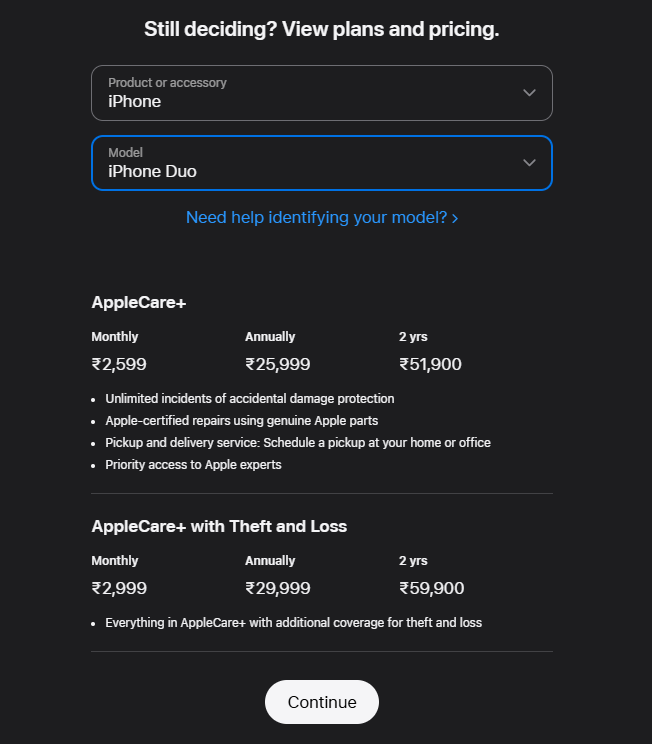
The biggest shock is the inner display. If you crack the foldable screen and you’re out of warranty (and don’t have AppleCare+), Apple wants ₹1,49,900 to replace it. That’s nearly half the phone’s ₹2,99,900 starting price, and only a little less than what an iPhone 18 Pro costs at launch. There’s also an “other damage” category that goes even higher, at ₹2,24,900, roughly 75% of a brand-new Duo.
Here’s the rest of the list:
Outer display: ₹42,900
Outer display + back glass: ₹55,900
Rear camera: ₹26,900
Battery: ₹24,900
Back glass: ₹20,900
Cover layer: ₹5,900
AppleCare+ does soften the blow quite a bit. The plan itself costs ₹51,900 and drops an inner-display repair to ₹8,900. Outer display or back glass incidents fall to ₹2,500 each, the cover layer is ₹1,900, and battery service is free. If you buy the phone, add AppleCare+, and grab a first-party case, you’re looking at roughly ₹3.5–3.6 lakh out the door. Even then, every covered incident still comes with a service fee, and the plan doesn’t cover theft or loss.
For comparison, Samsung’s published spare-part prices for the Galaxy Z Fold 8 are noticeably lower in several areas. The main screen assembly is listed at around ₹54,130 (or ₹35,490 for a component-level repair), while the back glass/cover and battery are both around ₹2,300. Motherboard prices vary by storage, but nothing comes close to Apple’s highest “other damage” figure.
Pre-orders for the iPhone Duo start today (October 16), with sales beginning on October 23.
Display replacements within the first few months of regular use are surprisingly common on Galaxy foldables, even after years of hinge and backplate refinements. The iPhone Duo is a big step forward for foldables, but it’s still a first-generation product. Getting AppleCare+ might be the smarter move instead of just hoping for the best.
Xiaomi just added another budget-friendly option to its REDMI monitor lineup. This one’s clearly aimed at competitive gamers who want smooth performance without spending a fortune.
The REDMI G27Q 240Hz 2026 Standard Edition is a 27-inch monitor with a Fast IPS panel. It runs at 2560×1440 (2K) resolution, hits 240Hz, and claims a 1ms GTG response time. You’re also getting 178° viewing angles, 500 nits of full-screen brightness, and HDR support. On the color side, it covers 95% DCI-P3 and 100% sRGB, uses 10-bit color (8-bit + FRC), comes factory calibrated, and aims for ΔE<2 accuracy.
For gameplay, it supports AMD FreeSync Premium across the full refresh range, with automatic compensation to help reduce tearing when frame rates dip. There’s also a dynamic overdrive feature that adjusts the gray-to-gray response based on the current frame rate.
Xiaomi packed in a few gaming extras too: Dark Field Enhancement Pro for brightening dark areas without blowing out the rest of the image, a dynamic crosshair with five modes and smart color adjustment, a night vision mode for shadowed spots, and the option to simulate a 24.5-inch screen size for different esports setups (just note that FreeSync Premium doesn’t work in that mode).
Eye comfort gets some attention as well. The monitor uses Xiaomi’s Green Mountain Eye Protection Solution, which picked up an S++ visual dimension certification from the China Quality Certification Center. It also has TÜV Rheinland hardware-level low blue light certification, which Xiaomi says cuts harmful blue light by 50% without turning the image yellow.
Design-wise, it goes for the usual esports look with three-sided ultra-narrow bezels. The stand is fully adjustable for height, pivot (so you can rotate the screen), left-right swivel, and tilt, and you can wall-mount it with a separate VESA arm if you prefer. Ports include two DisplayPort 1.4, two HDMI 2.0, and a headphone jack, so connecting multiple devices should be straightforward.
Price and availability
It goes on sale on JD.com on October 21. The launch promo price is capped at no higher than 799 yuan (around $119), while the regular price sits closer to 999 yuan (around $149).
Recent reports have revealed that the OnePlus Ace 7 series will be announced later this month in China. A recent report claimed that the lineup will include two models, the Ace 7 and Ace 7 Pro, with both expected to be powered by Snapdragon 8 Elite Gen 5 series chipsets. So far, OnePlus has remained silent about the Ace 7 series, but it has now opened reservations through its official online store in China.
OnePlus Ace 7 series reservations begin ahead of launch
OnePlus Ace 7 series reservations begin
The reservation listings suggest that OnePlus is preparing two performance-focused smartphones for the Chinese market. According to tipster Digital Chat Station, both models will feature a 200-megapixel primary rear camera. The phones are also rumored to offer a 185Hz display and an integrated active cooling fan, potentially helping them maintain performance during demanding gaming sessions.
The standard Ace 7 is tipped to feature the Snapdragon 8 Elite Gen 5 V Series chipset, while the Ace 7 Pro could use the regular Snapdragon 8 Elite Gen 5, similar to the Redmi K100 Pro series.
Digital Chat Station further revealed that the OnePlus Ace 7 Pro will feature a 50-megapixel periscope telephoto camera with 3.5x optical zoom, alongside the 200-megapixel primary sensor. The tipster also claims that the device will use imaging algorithms found in Oppo’s flagship camera phones, potentially giving it an advantage over other performance-focused smartphones.
It appears that the standard Ace 7 will not have a periscope telephoto camera. Also, there is no certainty yet that the Ace 7 will have a built-in cooling fan like the Pro edition. The brand is expected to confirm the Ace 7 series’ launch date in the next few days.
Fresh details on Samsung’s next mid-range phone are starting to surface, and the camera setup looks… familiar.
According to Dutch site GalaxyClub, the Galaxy A58 5G is expected to stick with the exact same megapixel count as the current A57: a 50MP main camera, 12MP ultrawide, 5MP macro, and a 12MP selfie shooter. Just to be clear, this is only about resolution numbers so far, no confirmed sensor sizes, apertures, or actual hardware changes. Samsung could still upgrade or even downgrade the sensors behind those numbers. That said, no groundbreaking change is expected.
The part that stands out is that 5MP macro lens. That exact type of camera first showed up on the Galaxy A51 all the way back in 2020. If the A58 launches in early 2027 like most sources are predicting (March or April), Samsung will have been using basically the same low-res macro shooter on its mid-rangers for around seven years. And once again, there’s no dedicated telephoto in the mix, just the main, ultrawide, and that close-up lens.
For context, the Galaxy A57 launched this spring with a 50MP main sensor (1/1.56-inch class with OIS), 12MP ultrawide, 5MP macro, and 12MP front camera. So the A58 matching those numbers feels like a clear “don’t fix what isn’t broken… or at least don’t spend more money” strategy. Reports say Samsung started hardware work on the A58 a couple of months ago and has recently moved into software development. It’s expected to ship with Android 17 and One UI 9.5, which would at least give it a software advantage even if the cameras stay the same.
Rising component costs, especially memory chips, are being blamed for manufacturers holding back on upgrades in this price range. For buyers, the leak basically suggests the A58 will offer a known photographic experience rather than anything transformative. Some improvements are more likely to come from better processing and new One UI features.
Casio just added three new versions of its MDV106 dive-style watch to its US online store. The new models, the MDV106C-1AV, MDV106C-3AV, and MDV106C-5AV, are priced at $110 each and are available to purchase right now.
Design Details
If you are familiar with Casio’s lineup, the MDV106 series is known for being a basic, functional watch that looks like a traditional diver but doesn’t cost a lot of money. These three new variants stick to that exact formula.
The main difference with the C models is the strap. Instead of the usual resin or metal bands, Casio is shipping these with a cloth band. The band is designed to fit wrist sizes ranging from 175 to 215 mm, which gives it a slightly more casual look and feel compared to the standard models.
As for the hardware, the watches feature a stainless steel case paired with an aluminum bezel. The case measures 48.5 x 44.2 x 12.1 mm. That is on the larger side for a standard analog watch, but the switch to a cloth strap keeps the total weight down to a very manageable 96 grams. The dial itself is protected by standard mineral glass.
Despite the relatively low price, Casio includes the standard durability features you would expect from this specific line. The watches have a screw-lock crown and a screw-lock back plate.
Together, these help give the watches a 200-meter water resistance rating, meaning you can comfortably wear them while swimming without worrying about water damage. They also feature an anti-reverse rotary bezel, which is a standard hardware tool on dive-style watches used for tracking elapsed time.
Internally, there are no smart features or complex mechanics here. These are straightforward analog watches. The dial has three hands for the hour, minute, and second, along with a small cutout for the date display.
They run on a standard quartz movement, which Casio says is accurate to within 20 seconds per month. Power comes from a single SR626SW battery, and you can expect about three years of battery life before you need to open the case back and replace it.
Tecno has launched a new smartphone in India, targeting buyers looking for a feature-packed device for everyday use. The latest addition to its Spark series combines connectivity-focused features with a durable design. It also brings several AI-powered tools and Google services to the budget segment.
Tecno Spark 50s 5G specifications and features
Tecno Spark 50s 5G
The Tecno Spark 50s 5G features a 6.78-inch LCD with HD+ resolution of 720 x 1576 pixels, a 120Hz refresh rate, a 240Hz touch sampling rate, and up to 560 nits of brightness. It runs Android 16-based HiOS 16 and uses the MediaTek Dimensity 6400 processor, built on a 6nm process. Memory options include 6GB or 8GB of LPDDR4x RAM and 128GB of UFS 2.2 storage, expandable by up to 2TB using a microSD card.
A 50-megapixel rear camera with an f/1.85 aperture and LED flash handles photography, while an 8-megapixel front camera takes care of selfies and video calls. The 6,500mAh battery supports 45W wired fast charging. Connectivity options include dual-SIM 5G, Wi-Fi 5, Bluetooth 5.3, GPS, USB Type-C, and a 3.5mm headphone jack. A side-mounted fingerprint sensor provides biometric security.
Tecno Spark 50s 5G
Tecno has included 4×4 MIMO antenna technology, which it claims can improve download speeds by up to 82%, alongside UPS 3.0 for faster UPI transactions in congested locations. FreeLink enables voice calls, text messages, and image sharing between compatible devices over distances of up to 1.5km in unobstructed conditions without cellular coverage or Wi-Fi. Its IP64 Pro rating and MIL-STD-810H certification offer protection against dust, splashes, and everyday physical stress.
The Tecno Spark 50s 5G costs Rs 19,999 (approximately $225) for the 6GB+128GB variant, while the 8GB+128GB model is priced at Rs 22,999 (approximately $260). Color options include Burgundy Red and Breeze Blue. Sales are scheduled to begin on October 20, 2026, although reports differ on whether the phone will be available through Amazon or offline retail stores.
Xiaomi has launched the Mijia Pocket Photo Printer Pro Gift Box in China for 799 yuan (~$119). The bundle includes the Mijia Pocket Photo Printer Pro itself—finished in an exclusive light purple color—along with a couple of accessories.
The standard Mijia Pocket Photo Printer Pro originally launched at 599 yuan (~ $90), making the Gift Box 200 yuan (~ $30) more expensive.
Mijia Pocket Printer Pro Gift Box Overview
The photo frame can sit on a desk or attach to a refrigerator using its built-in magnet. It also doubles as a small photo holder, with room for up to 20 prints. The included bag has separate compartments for the printer and its consumables, keeping them apart when you’re carrying everything around.
Photo PrinterFrame
The printer uses dye-sublimation technology to produce images at 313 dpi, with support for 16.7 million colors and 256 gray levels. Xiaomi says the combination helps reproduce photo colors accurately. Each print is automatically laminated as it comes out, which helps protect it from everyday moisture and slows aging and fading.
You connect over Bluetooth 5.2, and up to three people can use the printer at the same time. Through the app, you can attach a video or audio clip to a printed photo. Friends and family then scan a QR code to watch or listen. You can also add custom borders and watermarks, and pick from several filters and collage templates before you print.
The app also includes options for adding custom borders and watermarks, along with several filters and collage templates to adjust photos before printing.
Since AR video support and the main printing features were already available on the standard model, the new color and included accessories are the main differences in the Mijia Pocket Photo Printer Pro Gift Box. Xiaomi hasn’t shared details about availability outside China.
Honor has announced its global rollout plans for MagicOS 11. The Android 17-based software is already available to some users via the Open Beta program, which is now confirmed to expand to more devices until November. The stable rollout will be carried out beginning this month, with a target rollout completion by March 2027.
Honor MagicOS 11 Open Beta rollout timeline
September to November 2026
Honor Magic7
Honor Magic V5
Honor 600
Honor 600 Pro
Honor 200 Pro
Honor 400 Pro
Honor 400
Honor Magic7 Lite
Honor 600 Lite
Honor X9d
Honor X8d
Honor X7d
Honor X5c / X5c Plus
Honor X5d / X5d Plus
Honor X7c
Honor 200 Smart
Honor X7C 5G / X6b 5G
Honor Magic Pad4
Honor Magic Pad3
Honor MagicOS 11 stable rollout timeline
October 2026 to March 2027
Honor Magic series
Honor Magic V6
Honor Magic V5
Honor Magic V2 RSR
Honor Magic V2
Honor Magic V3
Honor Magic Pad4
Honor Magic Pad3
Honor Magic8 Pro
Honor Magic8 Lite
Honor Magic7 Pro
Honor Magic7 RSR
Honor Magic7
Honor Magic7 Lite
Honor Magic6 RSR
Honor Magic6 Pro
Honor Magic5 Pro
Honor Magic5
Honor number series
Honor 600 Pro
Honor 600 Lite
Honor 600 Lite s
Honor 600
Honor 600S
Honor 600e
Honor 600 Elite
Honor 600 Smart
Honor 600 Smart 5G
Honor 200
Honor 200 Pro
Honor 200 Smart
Honor 400 Pro
Honor 400 Lite
Honor 400
Honor Pad series
Honor Pad 20 Pro
Honor Pad 20 Pro Paperlike Edition
Honor Pad 20
Honor Pad 20 Paperlike Edition
Honor X series
Honor X9d
Honor X9c
Honor X9e Pro
Honor X9e s
Honor X7e Plus 5G
Honor X8d
Honor X8c
Honor X8c 5G
Honor X7d
Honor X7c
Honor X7c 5G
Honor X6b 5G
Honor X5d
Honor X5d Plus
Honor X5c
Honor X5c Plus
Other Honor devices
Honor Turbo
Honor Play9S
Honor Play9T
Honor Play10A
Unfortunately, the timeline doesn’t provide exact rollout dates. Even guessing the MagicOS 11’s rollout month for an Honor device is quite difficult unless you have a recent flagship phone such as the Magic V6, which should receive the update this month.
Based on previous rollouts, we expect to see a few more Honor Magic phones getting the update in October, while the remaining phones should get it next month. Soon, the Honor 600 Pro and other number series models will start to receive the update alongside Honor tablets, while the Honor X series models are likely to join the party towards the end of the year, or early 2027.
You can read about the changes in MagicOS 11 in our China’s launch coverage on this page.
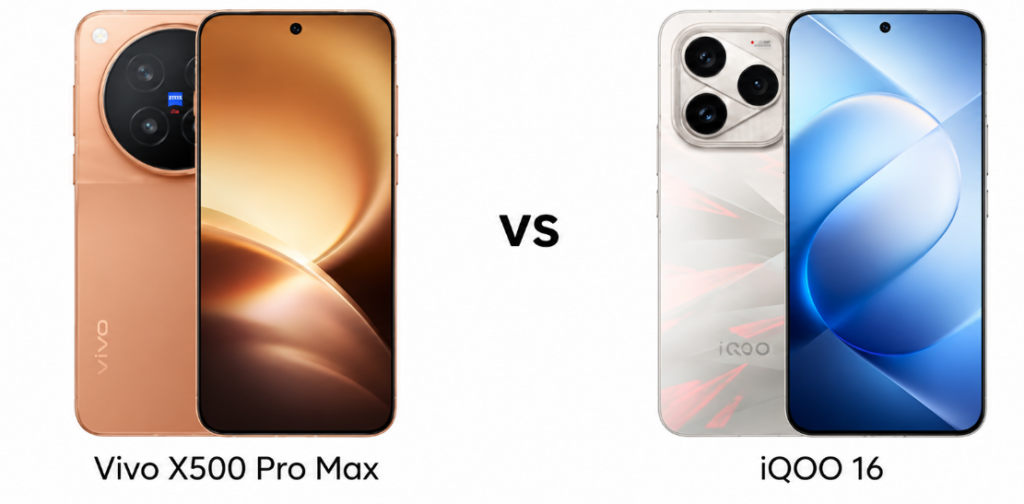
Vivo X500 Pro Max and iQOO 16 target users who want flagship performance, premium displays, powerful cameras, and large batteries. However, their priorities differ. Vivo focuses on advanced photography, Zeiss camera technology, and versatile imaging tools, while iQOO emphasizes processing power, gaming performance, and faster charging. Both offer impressive hardware, but the better choice depends on whether camera versatility or raw performance matters more.
Major Features:
Category
Vivo X500 Pro Max
iQOO 16
Winner
Build
Glass front, aluminum frame, glass or glass-fiber reinforced plastic back
Glass front, aluminum frame, glass or glass-fiber reinforced plastic back
Tie – Both offer premium construction
Water and Dust Resistance
IP68/IP69
IP68/IP69
Tie – Both provide strong protection
Display
6.85-inch LTPO AMOLED, 144Hz
6.85-inch AMOLED, 165Hz
iQOO – Higher refresh rate
Display Resolution
1440 x 3168 pixels
1440 x 3168 pixels
Tie – Both offer equally sharp resolution
Peak Brightness
4,400 nits
10,000 nits (isolated spot during video playback)
iQOO – Higher advertised peak brightness
Operating System
Android 17, OriginOS 7
Android 17, OriginOS 7
Tie – Same software platform
Processor
MediaTek Dimensity 9600 Pro (2nm)
Snapdragon 8 Elite Extreme Gen 6 (2nm)
iQOO – Stronger gaming-focused hardware
GPU
Mali-G2-Ultra-NX
Adreno 850
iQOO – Better gaming-oriented platform
RAM
Up to 16GB
Up to 16GB
Tie – Same maximum RAM
Storage
Up to 1TB, UFS 4.1
Up to 1TB, UFS 4.1
Tie – Same storage technology and maximum capacity
Main Camera
50MP, f/1.6, OIS
50MP, f/1.7, OIS
Vivo – Wider aperture
Telephoto Camera
200MP periscope, 3.5x optical zoom, OIS
50MP periscope, 3x optical zoom, OIS
Vivo – Higher resolution and greater optical zoom
Ultrawide Camera
50MP, autofocus
50MP, autofocus
Tie – Similar core specifications
Camera Features
Zeiss optics, T* coating, laser AF, colour spectrum sensor
LED flash, HDR, panorama
Vivo – More advanced imaging features
Rear Video Recording
Up to 8K at 30fps, 4K at up to 240fps in listed modes
Up to 8K at 30fps, 4K at 60fps
Vivo – More high-frame-rate recording options
Selfie Camera
50MP with autofocus
32MP
Vivo – Higher resolution and autofocus
Selfie Video
4K at 60fps
4K at 60fps
Tie – Same maximum recording capability
Battery
8,000mAh silicon-carbon
8,400mAh silicon-carbon
iQOO – Larger battery capacity
Wired Charging
90W
100W
iQOO – Faster wired charging
Wireless Charging
40W
40W
Tie – Same rated charging speed
Additional Charging Features
Reverse wired and reverse wireless charging
Bypass charging
Tie – Different useful extra features
Connectivity
Wi-Fi 7, Bluetooth 5.4/6.0, NFC, IR blaster
Wi-Fi 7, Bluetooth 5.4/6.0, NFC, IR blaster
Tie – Similar connectivity features
Audio
Stereo speakers, Hi-Res audio
Stereo speakers, Hi-Res audio, Snapdragon Sound
iQOO – Additional Snapdragon Sound support
Price/Value
Priced around $1,000 / ₹1,00,000
Priced around $800 / ₹83,000
iQOO – Lower price and strong flagship hardware
Overall Winner
Camera-focused flagship
Performance-focused flagship
iQOO – Better overall value for most buyers
Disclaimer: Specs are based on available data. Actual performance may vary. Verify details from official sources before buying.
Design and Display
Build and Feel
The Vivo X500 Pro Max features a glass front, aluminum frame, and either a glass or glass-fiber reinforced plastic back. Its IP68/IP69 rating provides strong protection against dust and water. The iQOO 16 offers similar construction options and the same durability rating, making both suitable for premium everyday use. Their overall build quality appears closely matched, although the selected back-panel material can influence the finish and feel. Vivo’s emphasis on premium imaging complements its flagship positioning, while iQOO maintains a more performance-focused identity.
Display Quality
Both phones feature 6.85-inch displays with 1440 x 3168 resolution, delivering sharp details and plenty of screen space. Vivo uses an LTPO AMOLED panel with a 144Hz refresh rate, HDR10+, Dolby Vision, and a reported 4,400-nit peak brightness. The iQOO 16 raises the refresh rate to 165Hz and advertises up to 10,000 nits peak brightness under specific conditions. These figures are not directly comparable because the iQOO brightness figure applies to an isolated spot during video playback.
Verdict
The iQOO 16 wins on refresh rate, while Vivo offers LTPO technology and strong display specifications. Both deliver excellent visuals, but iQOO better suits competitive gaming.
Specifications Including Battery
Performance
The Vivo X500 Pro Max runs on the 2nm MediaTek Dimensity 9600 Pro, paired with a Mali-G2-Ultra-NX GPU. The iQOO 16 uses Qualcomm’s 2nm Snapdragon 8 Elite Extreme Gen 6 processor and Adreno 850 GPU. Both platforms target demanding workloads, but iQOO’s high-clocked CPU configuration and gaming-oriented positioning make it particularly appealing to performance enthusiasts. Actual differences in gaming stability, heat management, and sustained performance will depend on testing. Both devices offer UFS 4.1 storage, configurations with up to 16GB RAM, and capacities reaching 1TB, providing ample room for demanding applications and large game libraries.
Battery and Charging
Vivo packs an 8,000mAh silicon-carbon battery with 90W wired charging, 40W wireless charging, and reverse wireless and wired charging. The iQOO 16 increases capacity to 8,400mAh and supports 100W wired charging, 40W wireless charging, and bypass charging. Its larger battery and faster wired charging give it an advantage for intensive gaming and frequent top-ups. Bypass charging is especially useful during supported gaming sessions because it can power the device directly while reducing battery stress.
Verdict
The iQOO 16 wins for its larger battery, faster wired charging, and gaming-focused bypass charging. Vivo remains competitive, but iQOO offers the more compelling performance package.
Camera
Main and Secondary Lenses
The Vivo X500 Pro Max features a 50MP main camera with optical image stabilization, a 200MP periscope telephoto camera offering 3.5x optical zoom, and a 50MP autofocus ultrawide camera. Zeiss optics, T* lens coating, laser autofocus, and a colour spectrum sensor further strengthen its photography credentials. The iQOO 16 also includes three rear cameras, but its configuration consists of a 50MP main sensor, a 50MP periscope telephoto camera with 3x optical zoom, and a 50MP autofocus ultrawide camera. Vivo’s higher-resolution telephoto sensor and specialised imaging features make it the more versatile choice for distant subjects, detailed portraits, and photography enthusiasts.
Vivo equips its front camera with a 50MP sensor, autofocus, and 4K video recording at up to 60fps. The iQOO 16 uses a 32MP selfie camera with HDR and the same maximum 4K recording frame rate. Vivo’s higher-resolution front sensor and autofocus offer greater flexibility for group selfies, portraits, and video calls where framing changes. Both phones provide capable front-facing video options, but Vivo’s hardware looks more ambitious for content creators who regularly record themselves.
Verdict
The Vivo X500 Pro Max wins for its 200MP telephoto camera, Zeiss enhancements, advanced video tools, and autofocus selfie camera. It is the stronger choice for photography enthusiasts.
Pricing
The Vivo X500 Pro Max is priced around $1,000 (₹1,00,000), placing it firmly in the premium flagship category. The iQOO 16 is priced around $800 (₹83,000), making it the more affordable option. This creates a meaningful difference for buyers deciding between camera-focused hardware and gaming-oriented performance. Vivo’s higher price reflects its specialised photography system, premium display technology, and extensive video capabilities.
Meanwhile, iQOO combines a powerful Snapdragon processor, a high-refresh-rate display, and a larger battery at a lower entry price. These figures are approximate, and actual retail prices may vary by market, storage configuration, taxes, and availability.
Is the price justified?
Vivo’s premium is easier to justify for users who regularly shoot telephoto photos, record advanced video, or value its Zeiss camera features. However, those who primarily game, stream, multitask, and browse may find little reason to spend more. The iQOO 16 delivers an impressive collection of flagship features while preserving a noticeable portion of the budget. Its larger battery and faster wired charging strengthen its value proposition.
Verdict
The iQOO 16 offers better overall value with its lower price, powerful processor, and larger battery. Vivo justifies the premium mainly through its superior camera hardware.
Disclaimer: Prices are approximate and may vary based on country, region, launch timing, and applicable taxes. Always check whether the listed price is for a China unit or a global/international variant when purchasing.
Conclusion
The Vivo X500 Pro Max distinguishes itself with a 200MP periscope telephoto camera, Zeiss optics, advanced video recording options, and a 50MP autofocus selfie camera. Its support for 8K recording, high-frame-rate 4K video, Dolby Vision HDR, and 10-bit Log recording also makes it attractive to serious mobile creators.
The iQOO 16 counters with its Snapdragon 8 Elite Extreme Gen 6 processor, 165Hz display, 8,400mAh battery, 100W wired charging, and bypass charging. These features make it particularly appealing for gaming, extended usage, and demanding everyday workloads. Both phones offer IP68/IP69 protection, ultrasonic fingerprint sensors, UFS 4.1 storage, wireless charging, and premium displays.
Their strengths are distinct rather than interchangeable. Vivo is designed to appeal to users who want a more advanced imaging system, while iQOO focuses on delivering speed and endurance without pushing the price as high. The better purchase therefore depends on which capabilities will genuinely be used most often.
Verdict
iQOO 16 is the overall winner for most buyers, thanks to its stronger value proposition, larger battery, faster charging, and gaming-focused performance. Choose the Vivo X500 Pro Max instead if photography and advanced video recording are your priorities.
1. Which phone is better for gaming, Vivo X500 Pro Max or iQOO 16?
The iQOO 16 is better suited to gaming, with its Snapdragon processor, 165Hz display, and bypass charging support.
2. Which phone has better zoom photography?
The Vivo X500 Pro Max offers better zoom hardware with its 200MP periscope camera and 3.5x optical zoom.
3. Which smartphone has longer battery life?
The iQOO 16 has a larger 8,400mAh battery, although actual battery life depends on usage and testing.
4. Is the Vivo X500 Pro Max worth the extra money?
Yes, for photography enthusiasts who value advanced telephoto imaging, Zeiss optics, and professional-grade video recording options.
5. Which phone should you buy for everyday use?
The iQOO 16 is the more practical choice for most users seeking flagship performance, long battery life, and better value.
Disclaimer: Prices, specifications, and availability may vary by region and retailer. Recommendations in this article are based on editorial opinion, feature-based value, and market positioning at the time of writing. Readers are advised to do their own research before making a purchase.
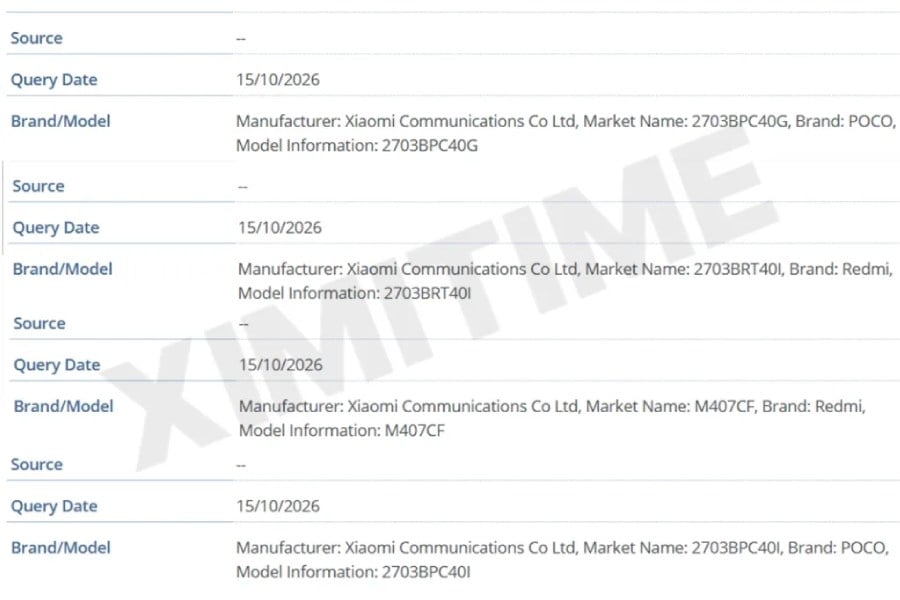
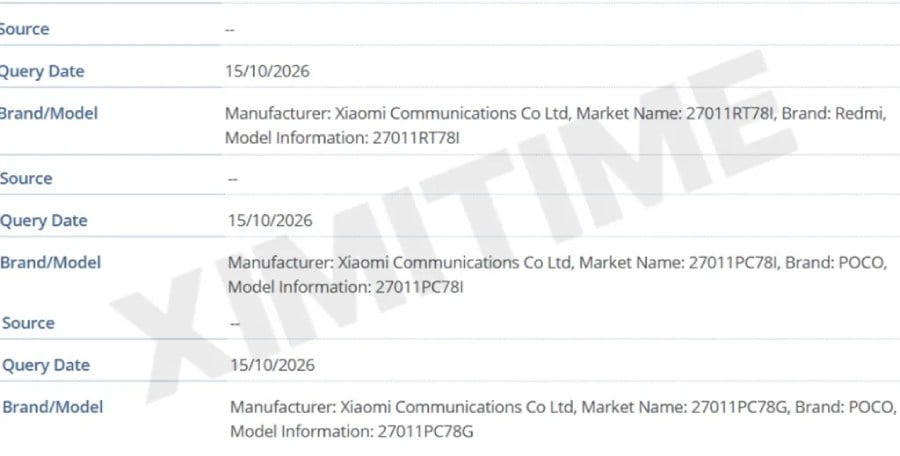
Xiaomi’s next Redmi Turbo phones may have turned up in the IMEI database. Ximitime shared model numbers of two phones, claiming they belong to the Redmi Turbo 6 and Redmi Turbo 6 Max. The code also suggests what they may be called outside China.
The Redmi Turbo 6 carries the internal codename Sofia and is also tagged Q10. The database lists four models: 2703BPC40G, 2703BRT40I, 2703BPC40I, and M407CF. Outside China, the phone is expected to be sold as the POCO X9 Pro.
Redmi Turbo 6 Redmi Turbo 6 Max
The Redmi Turbo 6 Max goes by denver, or Q10U, and carries model numbers 27011RT78I, 27011PC78I, and 27011PC78G. Its international release could be under POCO X9 Pro Max.
Based on how the model numbers are structured, the leak suggests the phones could launch as early as January to March 2027. The Turbo 5 series went on sale in January, by comparison.
The Redmi Turbo 5 uses the Dimensity 8500-Ultra, while the Redmi Turbo 5 Max was the first phone to ship with the Dimensity 9500s. Xiaomi priced them at 2,299 yuan and 2,499 yuan.
For the Redmi Turbo 6 Max, you’re looking at a 7-inch screen and a 10,000mAh battery if the earlier leaks hold. A render of the phone also surfaced in July. The processor could be the Dimensity 9500s.
Xiaomi hasn’t confirmed any of this, so treat the names, chips, and dates as unconfirmed for now.
Earlier this year, iQOO unveiled the iQOO 15R for the global market. This device was a tweaked version of the China-bound iQOO Z11 Turbo. Now, a reliable tipster has shared some key details about what appears to be the Z12 Turbo. There is a possibility that a tweaked version of this device could hit the global market with the iQOO 16R moniker.
iQOO Z12 Turbo’s key specs tipped
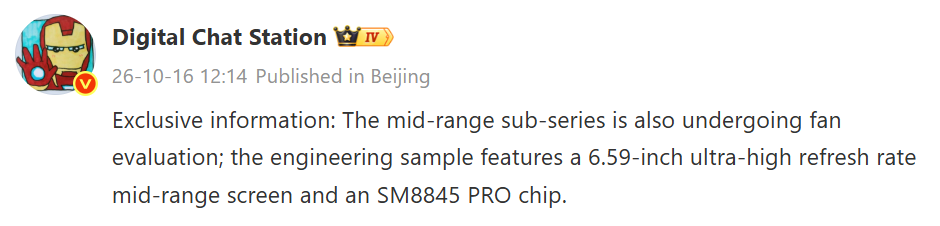
As per the tipster, iQOO is evaluating a built-in cooling fan for its mid-range Z-series phone, which will feature the Qualcomm SM8845 Pro chip. In the comments section, the tipster revealed that this chip will be called the Snapdragon 8 Gen 6.
To recall, the iQOO Z11 Turbo / iQOO 15R was one of the early adopters of the Snapdragon 8 Gen 5 chip. Hence, it is likely that the Snapdragon 8 Gen 6-powered iQOO phone the tipster is referring to could be the iQOO Z12 Turbo / iQOO 16R.
The leak further reveals that the iQOO Z12 Turbo’s engineering prototype has a 6.59-inch display with support for an ultra-high refresh rate. To recall, the Z11 Turbo has a similarly sized display with support for a 144Hz refresh rate.
The iQOO Z11 Turbo houses a 7,500mAh battery, but its successor may pack a considerably larger battery. Back in July, DCS hinted that the Z12 Turbo could feature a battery with a capacity of around 10,000mAh.
The iQOO Z11 Turbo was announced in January 2025, followed by the iQOO 15R’s India launch in February. It remains to be seen whether the iQOO Z12 Turbo and iQOO 16R will follow a similar release schedule.
On Oct. 21, Honor will unveil the Honor Win 2 series of smartphones. Among the Win 2, Win RT 2, and Win Turbo 2, only the Win 2 is expected to feature Qualcomm’s latest and most powerful Snapdragon 8 Elite Extreme Gen 6 chipset. Ahead of the launch, the device has appeared on AnTuTu, revealing its performance score and key hardware details.
Honor Win 2 AnTuTu listing
Honor Win 2 AnTuTu listing
According to the AnTuTu V12 listing, the Honor Win 2 (model number RTW-AN00) achieved an overall score of 5,702,964 points. The benchmark identifies the Snapdragon 8 Elite Extreme Gen 6 as its chipset, paired with an Adreno 850 GPU. The tested configuration includes 16GB of RAM, 1TB of storage, and Android 17.
Breaking down the benchmark results, the GPU scored 2,072,221 points, while the memory and user experience (UX) tests returned 755,729 and 1,372,277 points, respectively. The listing also mentions LPDDR5X memory and UFS 4.1 storage.
Honor Win 2 specifications (rumored)
According to a recent DCS post, the Honor Win 2 is tipped to feature a 6.89-inch flat OLED display with 2K resolution and a 185Hz refresh rate. The panel could feature ultra-narrow 0.93mm bezels on all four sides and support 5,920Hz high-frequency PWM dimming for brightness control.
The device will pack a huge 10,100mAh single-cell battery. The phone is also expected to support 100W wired charging and wireless charging. A dual-fan cooling system could help manage temperatures during extended gaming sessions, while dual 1216 large-cavity speakers may improve audio output.
Other rumored features include a 200-megapixel main camera paired with a secondary camera. While the original Honor Win featured a telephoto camera, it will be absent on the Win 2. The device could also feature an ultrasonic fingerprint sensor, USB 3.2 Gen 1 connectivity, and IP68, IP69, and IP69K ratings for dust and water resistance.
Surprisingly, the brand has already confirmed that the phone will cost 5,499 Yuan in China after the national subsidies. It will be available in shades, such as Quick Black, Designated Win, and Red/Blue Buff.
We use cookies on our website to give you the most relevant experience by remembering your preferences and repeat visits. By clicking “Accept”, you consent to the use of ALL the cookies.
This website uses cookies to improve your experience while you navigate through the website. Out of these, the cookies that are categorized as necessary are stored on your browser as they are essential for the working of basic functionalities of the website. We also use third-party cookies that help us analyze and understand how you use this website. These cookies will be stored in your browser only with your consent. You also have the option to opt-out of these cookies. But opting out of some of these cookies may affect your browsing experience.
Necessary cookies are absolutely essential for the website to function properly. This category only includes cookies that ensures basic functionalities and security features of the website. These cookies do not store any personal information.
Any cookies that may not be particularly necessary for the website to function and is used specifically to collect user personal data via analytics, ads, other embedded contents are termed as non-necessary cookies. It is mandatory to procure user consent prior to running these cookies on your website.