Samsung is inching closer to launching its first Galaxy-branded over-ear headphones, with a new certification in India signaling that the product is advancing through the final pre-release stages. The development points to an imminent market push for the long-rumored audio accessory.
The headphones, carrying the model number SM-U700 and internally codenamed H1, have appeared on the Bureau of Indian Standards (BIS) website. The listing confirms regulatory approval in India but does not disclose design details, specifications, or pricing. This certification indicates that the Galaxy Studio will be available in the Indian market alongside other regions.
The same model has already secured clearances from multiple international bodies, including the FCC, TÜV Rheinland, and South Korea’s National Radio Research Agency (RRA). The accumulation of these approvals suggests Samsung is methodically preparing the headphones for a global rollout.
Expected features include Active Noise Cancellation (ANC), an Ambient Sound mode, and 360 Audio with head tracking. Earlier reports have also pointed to an 870mAh battery, though official battery life figures remain unconfirmed. These capabilities would position the Galaxy Studio as a premium offering aimed at competing in the high-end over-ear segment.
Samsung has yet to make an official announcement. Industry reports, however, suggest the company could introduce the headphones in January 2027 at its Galaxy Unpacked event, potentially alongside the Galaxy S27 series. Price and exact availability details are still unknown.
With certifications stacking up across key markets, the Galaxy Studio appears to be moving steadily toward launch. Further details on design, sound performance, and pricing are likely to emerge in the coming weeks as Samsung finalizes its plans.
The first One UI 9.5 beta is out and it brings a surprisingly good number of upgrades than we initially thought. While most of them are minor incremental upgrades, there are seven upgrades that I found to be a lot useful.
1. A native app lock, finally
Samsung is finally bringing the native app lock feature to its devices with One UI 9.5. The feature has been added into the first beta, and should eventually make it to the final build.
Almost all other Android brands have had this feature on their phones for a long time, and now it’s coming to Galaxy phones. That said, Samsung phones already have Secure Folder, which is technically more secure than an app lock. It creates a completely isolated space with separate logins.
An app lock basically adds another authentication layer to chosen apps on top of your screen lock, which is what we often need for some apps, and so it’s welcoming to see a native app lock.
To lock an app, press and hold an app icon and click the lock icon from the pop-up window. Once done, you’ll need to authenticate yourself every time you open locked apps.
2. Live effect gives lock screen wallpapers a 3D-like effect
The new Live effect feature adds depth to a lock screen wallpaper by making different elements in the image shift as you tilt your Galaxy device. It gives regular wallpaper a 3D-like effect, making the lock screen feel more lively.
Samsung already lets users apply Live effect to an image via the Gallery app, and use the result as a wallpaper. However, the result is a video that’s played on the lock screen, and the movement doesn’t follow how you move the device.
The Live effect feature is available directly in the lock screen wallpaper editor. To access it, you can press and hold the lock screen wallpaper, and you’ll find the option sitting in the bottom-right corner.
Unfortunately, the feature is only supported on high-end devices, including Galaxy S-series (FE models too), Galaxy Z foldables, and Galaxy tablets. Only Galaxy S26 owners are currently able to access it via the One UI 9.5 beta program.
Explained
One UI 9.0 is built on Android 17 and debuted in July on Samsung’s latest foldables.
One UI 9.5 makes it easier to navigate through camera shortcuts. The first beta brings a redesigned camera quick controls section with all the options visible together. You no longer need to scroll through the controls to find your desired camera control.
The redesigned panel includes icons for flash, timer, aspect ratio, resolution, exposure, and white balance. There’s also a shortcut for camera settings.
The update also brings more customizations in Pro and Pro video modes. Users can now put frequently used controls on either side of the shutter.
In Pro mode, the available options include Camera settings, exposure lock (AEL), Timer, Aspect ratio, Metering, Histogram, Focus peaking, and autofocus area selection (AF area). In the Pro video mode, users get to choose from Camera settings, Smooth zoom, Ratio, Histogram, Focus peaking, and AF area.
4. Quick Share gets Tap to Share feature
The new software brings Tap to Share capability to Quick Share. It works similar to the AirDrop on Apple iPhones. You tap the back of your compatible Galaxy phone against another phone you want to share files with.
Both phones must have NFC, Bluetooth, and Wi-Fi features, and must be unlocked for this feature to work. Once you are done with file selection, select Quick Share from the sharing menu, and then tap the phone against a compatible phone. The receiver must tap Accept on their phone for the transfer to begin.
Samsung has added a new Mindful note feature inside Samsung Health. You can use it to write about your day, describe your feelings, or whatever you want to.
The interface has a Everyday moments section where you can write whatever you want. You can also choose from available prompts such as About yourself, Relationships, Work and goals, and What if…?
You’ll be given a question along with a short explanation to help you reflect more on the topic. You can always click the refresh button at the top to switch to another prompt in the same category.
These features were spotted in the first beta build of One UI 9.5. There will be more beta builds in the coming weeks, which will further polish the software experience and could introduce more exciting features. It’s also very much likely that Samsung may be hiding some exciting changes behind the curtains to show up at the Galaxy S27 launch early next year.
I recently got my hands on the iPhone 18 Pro, and I’ve been enjoying my time with Apple’s latest flagship. But not everything has been as rosy as I’d hoped. I’ve encountered a few annoying issues, particularly with network connectivity, Wi-Fi, and Face ID. I’ll save those complaints for my dedicated iPhone 18 Pro review, though. Despite these hiccups, I genuinely like the phone.
About two weeks ago, I received a collection of iPhone 18 Pro accessories from ESR, including several protective cases, a silicone leather case, and a tempered glass screen protector. I’ve been switching between them since then, testing their build quality, comfort, and everyday usability.
Of course, I’m not going to deliberately throw my expensive new iPhone onto concrete to verify the advertised drop protection. So, while I’ll touch on the technical specifications, my impressions are based primarily on how these accessories perform in everyday use.
ESR Classic Hybrid Magnetic Case
The first accessories I tried were ESR’s Classic Hybrid Magnetic Cases, which I received in four finishes: Clear, Clear Black, Frosted Deep Burgundy, and Frosted Misty Blue. I’ve been using the completely transparent version most frequently, although I’ve spent time with the others as well.
The Clear and Clear Black versions have transparent backs, while the Burgundy and Misty Blue variants feature frosted finishes. All four look quite attractive, but I personally prefer the transparent version because it lets the iPhone’s original design show through.
The build quality is excellent. The cases feel sturdy without adding unnecessary bulk, thanks partly to their slim 1.5mm backs. The corners are reinforced with ESR’s Air Guard technology, with 4x military-grade protection and a rated drop resistance of up to 16 feet.
One detail I particularly appreciate is the slightly raised bumper sections near the bottom corners. These provide additional contact points when placing the phone on a surface, helping the case take the contact rather than the phone itself.
The camera area is also covered by the case, providing additional protection around the camera section while retaining the integrated metal Flex Stand.
The stand works in portrait and landscape orientations and feels sturdy enough for regular use. It protrudes slightly from the back, but that’s hardly a major inconvenience.
I’ve had some disappointing experiences with inexpensive transparent cases, including one that started yellowing within a week. ESR uses UV-resistant materials to help prevent discoloration, and after two weeks, I haven’t noticed any yellowing. That’s encouraging, although it’s too early to judge long-term durability.
The cases also feature a dedicated Camera Control button, Qi2 25W wireless charging compatibility, and magnets rated for 1,500g of holding force. During my testing, I found the magnets to be incredibly strong. Once attached, magnetic accessories stay firmly in place and require a deliberate amount of force to detach. I haven’t had any issues with accessories coming loose during everyday use.
The Clear version of the case starts at $28.99, while the Frosted Misty Blue and Frosted Deep Burgundy variants cost $30.99. For the build quality and features on offer, I think they’re pretty reasonable options.
ESR Atelier Silicone Leather Magnetic Case
Moving on to the Atelier Silicone Leather Magnetic Case, this one feels noticeably different from the transparent models.
I received the Deep Burgundy version, and it’s easily one of the most premium-looking cases I’ve tried. The silicone leather exterior has a soft, smooth texture that feels great in the hand while providing a comfortable grip.
What I particularly like is that it doesn’t stick to my jeans pockets. I’ve used leather-style cases before that make pulling the phone out of tight pockets unnecessarily frustrating. Thankfully, that hasn’t been an issue here.
The case also has a soft microfiber lining inside to protect the phone’s finish, while an oleophobic coating on the exterior helps resist stains.
In terms of protection, ESR lists 3x military-grade protection and drop resistance of up to 11 feet. There’s also a protective TPU frame around the edges.
Unlike the Classic Hybrid, which covers the camera section, the Atelier leaves the camera lenses exposed within the surrounding camera area. That’s an important design difference between the two cases, particularly if you prefer additional coverage around the cameras.
It also features an integrated metal Flex Stand, adjustable between 15 and 69 degrees. The mechanism feels solid and holds the phone comfortably while watching videos. Like the transparent cases, the camera stand protrudes slightly from the back, although I don’t consider that a significant drawback.
The dedicated Camera Control button works well, including the touch-sensitive sliding gestures for adjusting zoom. The other buttons are equally responsive.
Just like the transparent cases, ESR has included magnets rated for 1,400g of holding strength, and they’re seriously powerful. During my testing, magnetic accessories stayed firmly attached to the case, and I had to apply a fair amount of force to pull them off. The connection feels extremely secure, and I haven’t experienced any issues with accessories accidentally detaching.
The Deep Burgundy Atelier case costs $38.99, compared with its regular price of $42.99. It’s more expensive than the Classic Hybrid, but if you prefer a softer, more premium finish, the additional cost makes sense.
The UltraFit Armorite Pro Screen Protector was probably the accessory that made the most immediately noticeable difference to my experience.
When I first purchased the iPhone 18 Pro, I installed a local market tempered glass protector. Unfortunately, it wasn’t particularly good. The display collected fingerprints and smudges easily, touch responsiveness felt noticeably worse, and I also encountered some Face ID-related frustrations.
After switching to ESR’s Armorite Pro, the improvement in how the display felt was immediate.
The package includes three tempered glass protectors, an UltraFit installation tray, and cleaning accessories.
Installation is ridiculously simple. You first clean the display using the included cleaning kit, which comes with wet and dry wipes. Then, you place the screen protector into the installation tray, position your iPhone inside, close the tray, and pull the attached ribbon. The mechanism automatically applies the tempered glass to the display.
You just need to wait around five to six seconds for the protector to adhere evenly before removing the phone from the tray. That’s pretty much it. No complicated manual alignment or frustrating attempts to position the glass perfectly.
I found the process extremely straightforward, and I genuinely think even someone installing a screen protector for the first time could manage it without much trouble.
Once installed, the glass feels remarkably close to the original display. My fingers glide smoothly across the surface, touch responsiveness feels natural, and fingerprints and smudges are far less noticeable than with my previous protector.
Display clarity is equally impressive. I haven’t noticed any difference in colors, sharpness, or visibility compared with the original screen. It essentially feels like using the iPhone’s display without an additional layer of glass.
The protector uses reinforced Corning glass, with rated impact absorption up to 10x better, scratch performance up to 2x better, and up to 25% fewer visible scratches. There’s also an anti-reflective coating to reduce glare and an oleophobic coating to resist fingerprints.
I haven’t independently verified those durability figures, so I can’t say how well it would survive a serious impact. But the everyday experience has been excellent, particularly compared with the local market protector I was using previously.
The three-pack costs $32.99, down from $35.99. It’s a reasonable investment, especially since you’re getting three screen protectors in one package.
ESR Cyclone 25W Magnetic Charging Pad with CryoBoost
Next up is the ESR Cyclone 25W Magnetic Charging Pad with CryoBoost, which is easily one of the more interesting wireless chargers I’ve tested recently. I received the Deep Burgundy version, and the build quality is absolutely fantastic.
It feels premium, has a reassuring amount of weight, and features a sturdy metal stand that can be adjusted from 0 to 150 degrees. You can position your iPhone in portrait or landscape orientation, making it convenient for watching videos or using StandBy mode while charging.
The charger supports Qi2-certified 25W wireless charging, and during my testing with the iPhone 18 Pro, I saw power readings peak at around 31W. That’s the input power reading rather than necessarily the power delivered wirelessly to the phone. The charging speeds have been quite impressive, with the iPhone taking roughly 25-35 minutes to go from 0% to 50%.
What impressed me the most, however, was the CryoBoost active cooling system. I’ve used several magnetic wireless chargers before, and some of them caused my iPhone to overheat, temporarily stopping the charging process until the device cooled down. Thankfully, I haven’t experienced anything like that with the Cyclone. Using an infrared thermometer gun, I recorded surface temperatures of around 33°C. Of course, this can vary depending on the surrounding temperature.
The cooling fan is also incredibly quiet. Even when sleeping beside the charger, I could barely hear it. You would practically have to bring your ear close to notice the sound. The included 5.9-foot cable feels good quality, too.
The magnets are incredibly strong and hold my iPhone 18 Pro firmly in place, even when I adjust the stand or use the phone while it’s charging.
The Deep Burgundy version is currently priced at $49.99, down from $56.99. It’s certainly not the cheapest magnetic charger, but considering the premium construction, adjustable stand, fast charging, and excellent cooling performance, I think it’s a worthwhile option.
ESR Xtend 45W Retractable Charger
The final accessory I’ve been testing is the ESR Xtend 45W Retractable Charger, also in Deep Burgundy. This one immediately caught my attention because of its compact design and built-in retractable USB-C cable. The burgundy finish looks absolutely gorgeous, while the rounded body, premium construction, and foldable plug make it particularly convenient for travel.
It features a 3.1-foot braided USB-C cable that retracts directly into the charger. The cable feels sturdy and is long enough to comfortably use my iPhone while charging. ESR rates the mechanism for over 20,000 pull-and-retract cycles and the cable for over 10,000 bends, which sounds promising for long-term durability.
Under the hood, the charger uses GaN technology and supports PD 3.2 AVS and PPS, with 45W rated charging and advertised dynamic power adjustment up to 60W. During my testing with the iPhone 18 Pro, I recorded charging power reaching 45W, and the phone went from 0 to 50% in approximately 15 minutes.
It also features a secondary USB-C port, which allows charging two devices simultaneously. The charger did get mildly warm during use, but it never became uncomfortably hot, even when charging two devices together.
The Xtend 45W Retractable Charger is priced at $47.99, down from $53.99.
Final Thoughts
If you’re thinking about kitting out your iPhone 18 Pro, ESR’s stuff feels like the kind you won’t regret picking up. The cases feel sturdy without being bulky, the tempered glass feels genuinely tough, and the chargers don’t come across as flimsy or gimmicky. Nothing here feels cheap or rushed.
Even if you’re not planning to buy everything, it’s worth checking out. Especially if you care about long-term protection and solid day-to-day usability rather than flashy claims. It’s not the cheapest route, but the overall quality makes it feel like money sensibly spent.
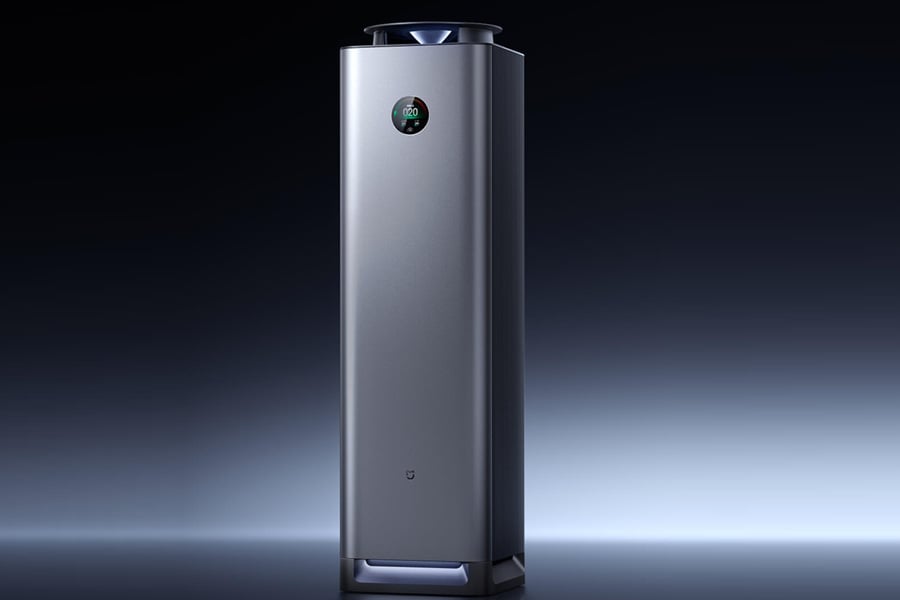
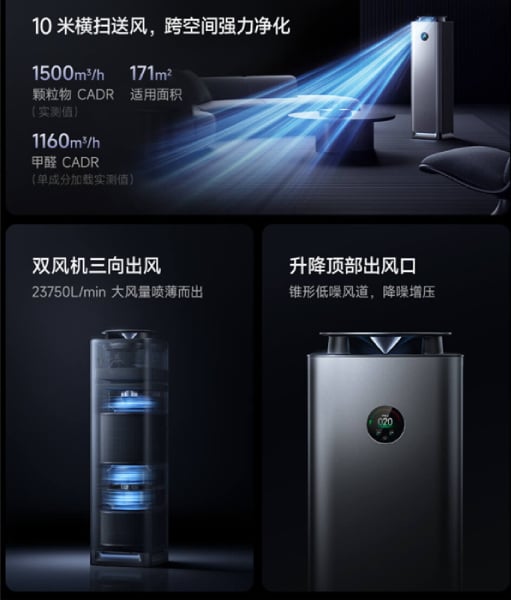
Xiaomi has been making its Mijia air purifiers increasingly powerful, and the new All-Effect Air Purifier 2 Ultra is a considerable jump over its predecessors. The latest model can move 23,750 liters of clean air per minute, compared to 13,333 liters per minute on the Mijia Air Purifier 5 Pro.
The extra performance, however, comes at a price. The purifier has a retail price of 7,499 yuan (~ $1125), considerably more than the Mijia All-Effect Air Purifier Ultra, which launched at 4,799 yuan (~ $720).
The new model also has a different look. It has a taller silver-gray body, a round color display on the front, and vertical air grilles running along the sides. The top air outlet automatically rises when the purifier starts and retracts when it shuts down.
Inside, Xiaomi has fitted two fans to feed a three-way air outlet that can distribute clean air across a 180-degree area, and up to 10 meters. A cone-shaped air duct helps keep noise down, while two millimeter-wave radars can detect people within six meters and a 180-degree range.
Five-layer filtration and pollutant detection
The purifier can reportedly deal with 147 types of air pollutants, including 108 types of odors from sources such as pets and cooking fumes. It also targets pollen, dust mites, and pet dander, while its Aldehyde Decomposition 2.0 system uses an alloy catalytic layer to break down aldehydes and acid gases. Xiaomi says the catalytic layer does not need regular filter replacement.
The filtration setup has five layers covering odor removal, a full-width light curtain, aldehyde decomposition, all-effect composite filtering, and antibacterial desensitizing. A seven-fold carbon matrix is also part of the system.
For sterilization, the purifier has a full-width UVC light curtain working alongside a dual anti-corrosion coating. Xiaomi claims this arrangement delivers 14 times the sterilization intensity of a single UVC module and increases the disinfection area by 90%.
There is also a ten-dimensional sensing system that monitors formaldehyde, VOCs, dust, PM1, PM2.5, temperature, humidity, CO2, microbial risk, and particulate concentration. It can detect particles as small as 0.5μm, while sleep mode keeps operating noise at 33.6dB(A).
Like other recent Mijia appliances, the purifier connects to Xiaomi’s Surge Smart Connect ecosystem. Users can control it through the Xiaomi Home app, smart speakers and smart home displays, including through voice commands. It can also work alongside air conditioners, humidifiers and fresh-air systems to manage indoor air quality across multiple devices.
For now, the launch is limited to China, and there’s no word yet on whether and when it will hit the international market.
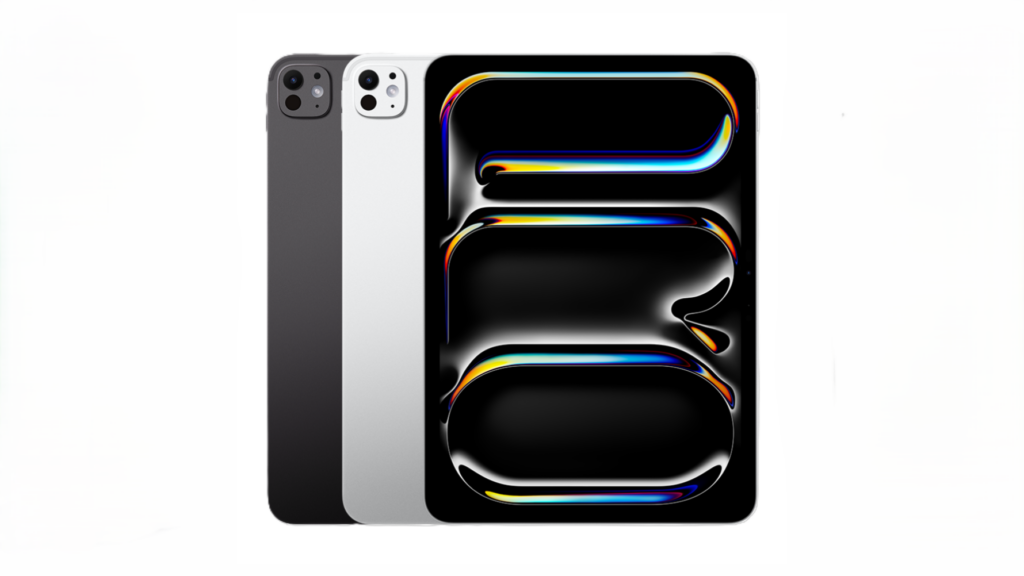
A fresh claim from a Chinese leaker suggests Apple’s upcoming iPad Pro could jump straight to the M7 processor, bypassing the recently introduced M6 generation. The report adds another layer of uncertainty to the tablet’s long-rumored spring 2027 refresh.
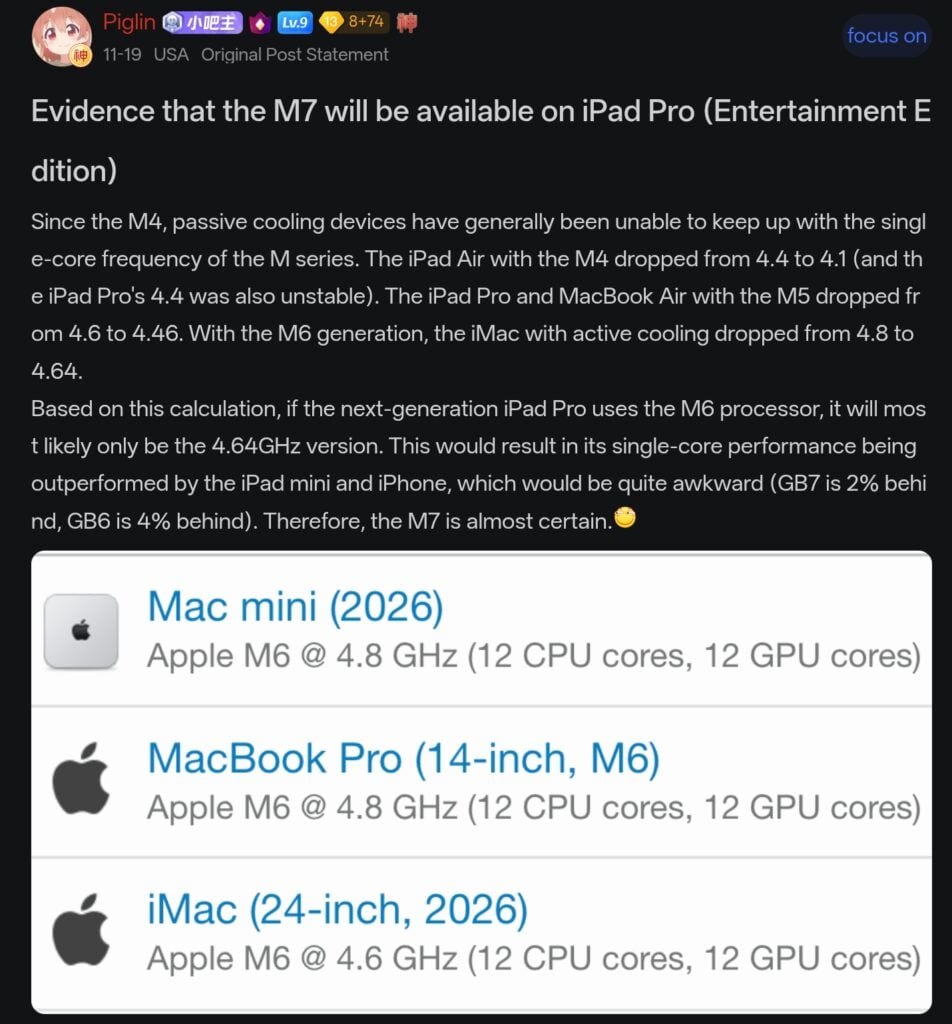
Littertree66, a leaker known for sharing details on upcoming Apple silicon, made the claim in a reply on Baidu Tieba on November 19. The original thread, which its author described as being for entertainment purposes, examined thermal limits on passively cooled Apple devices. It noted that recent M-series chips in fanless products often run below their peak single-core clocks, with the M4 iPad Air running at 4.1 GHz instead of 4.4 GHz and the M5 iPad Pro at 4.46 GHz instead of 4.6 GHz.
Following that pattern, the post estimated an M6 iPad Pro would likely settle around 4.64 GHz and trail the A20-powered iPhone 18 Pro Max and iPad mini by a few percentage points in single-core Geekbench scores.
Littertree66 responded that the next iPad Pro “will be M7,” though the tablet’s version of the chip would lag the Mac version by a wider margin. The gap could come from fewer cores, lower clock speeds, or both. The leaker offered no supporting evidence.
The claim aligns with broader timelines already reported by Bloomberg. The outlet has said Apple plans to refresh the iPad Pro in spring 2027 and aims to introduce the base M7 chip in the first half of that year. Apple has skipped chip generations in the iPad Pro lineup before, most notably moving from the M2 to the M4 in 2024.
Because Littertree66 provided no concrete proof, the report should be treated cautiously until additional sources weigh in. If accurate, an M7 iPad Pro would give the tablet a performance edge over current models while potentially narrowing the gap with higher-end Macs that receive full-power versions of the same silicon. Further confirmation is still needed before the claim can be considered reliable.
Apple’s shifted iPhone schedule is taking clearer shape, with the standard iPhone 18 and second-generation iPhone Air now moving into the display production phase for an expected spring release. After unveiling only the Pro models and the iPhone Duo in September, the company is lining up the remaining devices for the first half of next year.
According to a report from ETNews, Samsung Display and LG Display are preparing to mass-produce OLED panels for both the iPhone 18 and the iPhone Air 2. Manufacturing is set to begin toward the end of December or in January at the latest, a timeline that points toward a March launch window. Suppliers are currently prioritizing higher-value panels for the already-announced Pro, Pro Max, and Duo models through the end of the year before shifting capacity to the spring devices.
Demand expectations differ between the two phones. Apple’s display partners anticipate solid interest in the standard iPhone 18, with both Samsung Display and LG Display expected to supply panels. The outlook for the iPhone Air 2 is more restrained after the original Air saw softer sales. As a result, Apple is reportedly taking a cost-conscious approach: the Air 2 will reuse the same OLED panel from the current model so the company can clear existing inventory. Because of the lower projected volume, Samsung Display will serve as the exclusive supplier going forward.
That decision means the iPhone Air 2 is expected to keep the 6.5″ LTPO OLED display with a 2,736 x 1,260 resolution, 120 Hz refresh rate, and 3,000-nit peak HDR brightness. While the screen itself stays the same, the phone is still rumored to receive meaningful upgrades elsewhere, including a newer processor, an ultrawide camera, and a slightly larger battery.
The staggered production schedule reflects Apple’s new twice-yearly release strategy and gives suppliers a more balanced workload across the year.
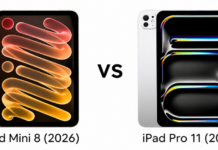
iPad Mini 8 and Samsung Galaxy Tab S12+ are built around two very different ideas of what a tablet should be. Apple’s compact tablet focuses on portability, powerful hardware, and a premium experience in a size that is easy to carry everywhere. Samsung’s Galaxy Tab S12+, on the other hand, is designed for a larger-screen experience, combining an expansive AMOLED display, desktop-style multitasking, and a more versatile productivity setup.
Despite sharing flagship-level ambitions, these tablets aren’t really competing for the same type of user. One prioritizes convenience and handheld use, while the other is better suited to working, entertainment, and multitasking on a larger canvas. The price difference also makes this comparison interesting, with the Galaxy Tab S12+ costing substantially more.
The iPad Mini 8 takes a compact, lightweight approach with its aluminum frame and back, weighing just 255g for the Wi-Fi model. Its 5.4mm thickness and smaller footprint make it particularly appealing for reading, travelling, and using a tablet comfortably with one hand. IP67 protection also provides a respectable level of resistance against dust and accidental water exposure.
The Galaxy Tab S12+ is a much larger device, weighing around 553g and measuring 289.5mm in length. Despite its size, the 5.3mm thickness gives it a remarkably slim profile. Its Enhanced Armor Aluminum construction, IP68 protection, and larger frame make it feel more like a premium workstation-style tablet than a portable reading device.
The iPad Mini 8 is easier to carry around and use casually, while the Tab S12+ feels better suited to desk use, lap-based productivity, and two-handed operation.
Display & Multimedia
The iPad Mini 8 features an 8.5-inch Super Retina XDR OLED display with a 120Hz refresh rate, 1200-nit peak brightness, and anti-reflective coating. Its compact screen, sharp 325ppi density, and 3:2 aspect ratio make it particularly comfortable for reading, browsing, and handheld gaming.
The Galaxy Tab S12+ takes entertainment and productivity further with its 12.6-inch Dynamic AMOLED 2X panel, 120Hz refresh rate, HDR10+, and 1600-nit peak brightness. Its wider 16:10 aspect ratio is better suited to movies, split-screen applications, documents, and creative work.
The iPad’s display is more convenient for personal, close-up use, but the Tab S12+ offers considerably more screen real estate for watching content or running multiple apps simultaneously.
Verdict
The iPad Mini 8 wins in portability and handheld comfort, while the Galaxy Tab S12+ is the better multimedia and productivity display. For everyday convenience, Apple’s compact form is hard to beat; for a tablet that doubles as an entertainment and work device, Samsung’s larger screen makes a stronger case.
2. Performance and Software
Processor & UI Smoothness
The iPad Mini 8 is powered by Apple’s A20 Pro chipset built on a 2nm process, paired with 12GB RAM and a seven-core GPU. Its combination of high-performance cores and efficiency cores should make demanding applications, gaming, editing, and everyday navigation feel exceptionally responsive. The different CPU configurations across storage variants are also worth noting, with the 512GB version getting an additional efficiency core.
The Galaxy Tab S12+ runs on the MediaTek Dimensity 9500 built on a 3nm process, with 12GB RAM and the Mali G1-Ultra MC12 GPU. Its octa-core architecture is designed to handle demanding Android applications, high-end gaming, and sustained multitasking. One UI 9 also brings Samsung’s mature tablet interface, making the larger screen more useful beyond simply running individual apps.
Both tablets are firmly in flagship territory, and neither should feel underpowered for everyday use. The iPad has the advantage of Apple’s tightly optimized hardware-software integration, while Samsung offers a more flexible Android experience with a stronger focus on multi-window operation.
Productivity & Multitasking
The iPad Mini 8 is excellent for quick tasks, note-taking, browsing, editing, and working on the go, but its 8.5-inch screen naturally limits how comfortably multiple apps can be used together. The Tab S12+ has more room for split-screen layouts, floating windows, documents, and simultaneous workflows. Samsung DeX further expands its usefulness by providing a desktop-style environment when needed.
Verdict
The iPad Mini 8 is a powerful compact tablet, but the Galaxy Tab S12+ makes better use of its hardware for productivity. Samsung’s larger display and DeX support give it the advantage for multitasking and replacing a laptop for lighter workloads.
Comparison
The iPad Mini 8 packs an 8.5-inch OLED display and Apple’s A20 Pro chip built on a 2nm process.
The iPad Mini 8 packs a 4,900mAh battery, which is relatively modest considering its powerful OLED panel and flagship processor. However, its compact display and efficiency-focused hardware make the capacity more manageable for daily browsing, reading, streaming, and gaming. Wired charging can bring it to 50% in approximately 30 minutes, making quick top-ups practical.
The Galaxy Tab S12+ features a considerably larger 10,600mAh battery with 45W wired charging. Its larger capacity is better suited to its expansive 12.6-inch display and multitasking-focused design. Samsung also claims a full charge in around 95 minutes, giving it a reasonable charging pace for a tablet of this size.
While the Samsung tablet has significantly more battery capacity, its bigger screen also consumes more power. The iPad Mini 8 benefits from being a smaller device that is easier to use for shorter sessions throughout the day, while the Tab S12+ is better equipped for extended work and entertainment sessions.
Both tablets support stylus-based interaction, but Samsung’s larger screen makes handwriting, sketching, document annotation, and creative work more comfortable. The Tab S12+ also benefits from Samsung’s broader productivity ecosystem, including DeX and keyboard-based workflows. The iPad Mini 8 remains a more convenient companion for quick notes, portable creative work, and casual use.
Verdict
The Galaxy Tab S12+ is the stronger choice for battery capacity and productivity accessories, while the iPad Mini 8 offers a more portable experience that is easier to carry and use throughout the day.
4. Camera & Media
Rear and Front Camera
The iPad Mini 8 comes with a 12MP rear camera featuring an f/1.8 aperture, autofocus, HDR, panorama, and LED flash. Its ability to record 4K video at up to 60fps and slow-motion 1080p footage at up to 240fps makes it a surprisingly capable camera for a compact tablet. The 12MP ultrawide front camera with a 122-degree field of view is particularly useful for video calls, allowing more people to fit into the frame.
Samsung’s Galaxy Tab S12+ features a 13MP rear camera with autofocus and a 12MP ultrawide front camera with a 120-degree field of view. Its rear camera supports 4K recording at 30fps, while the front camera can also record 4K video at 30fps. The setup is practical for scanning documents, capturing reference images, and attending video meetings.
Neither tablet is intended to replace a smartphone camera, but the iPad Mini 8 has a more versatile rear-camera video specification, particularly for users who want higher frame rates.
Video & Audio Quality
The Galaxy Tab S12+ features a four-speaker stereo system, making it better suited to immersive movie watching and filling a room with sound. The iPad Mini 8 uses stereo audio through its Acoustic Display system, offering a different approach to audio output while keeping the device compact.
Verdict
The iPad Mini 8 has the more versatile rear-camera video capabilities, while the Galaxy Tab S12+ is the more appealing media device thanks to its larger display and four-speaker setup.
5. Pricing
The iPad Mini 8 starts at approximately $700 (₹83,000), with 128GB storage and 12GB RAM. Higher storage options include 256GB and 512GB, with the latter also offering optional nano-texture display glass.
The Samsung Galaxy Tab S12+ starts at around $1,200 (₹1,30,000) for its 256GB configuration with 12GB RAM. It also offers a 512GB version, and both storage options support microSD expansion.
The difference is substantial: the Galaxy Tab S12+ costs roughly $500 more at these starting prices. That premium buys a considerably larger display, a larger battery, four speakers, DeX, a more productivity-focused design, and expandable storage. However, those advantages may not matter much to someone who primarily wants a portable tablet for reading, browsing, streaming, and casual gaming.
The iPad Mini 8 is considerably more affordable and offers flagship performance in a compact package. The Galaxy Tab S12+ is expensive, but its larger display, productivity features, and expandable storage help justify the premium for users who will actually take advantage of them.
6. Conclusion
The iPad Mini 8 stands out because it combines flagship hardware, a high-end OLED display, and an exceptionally compact form factor. It is the type of tablet that can easily become an everyday companion without feeling like an extra device to carry. Its strong camera video capabilities, lightweight construction, and smaller footprint make it ideal for users who value convenience over screen size.
The Galaxy Tab S12+ is more focused on versatility. Its 12.6-inch AMOLED display, four-speaker system, microSD expansion, Samsung DeX, larger battery, and more comfortable multitasking experience make it a better fit for people who use their tablet as more than just a consumption device. It can handle entertainment, productivity, document work, and desktop-style tasks in a way the Mini simply cannot match comfortably.
Verdict
iPad Mini 8 is the better compact tablet, especially for reading, travel, handheld gaming, and everyday convenience. The Galaxy Tab S12+ is the better all-round large tablet, offering more room for productivity, entertainment, and multitasking.
The decision ultimately comes down to what matters more: having a powerful tablet that fits almost anywhere, or a large-screen device that can take on considerably more work. The iPad Mini 8 is built around convenience and portability, while the Galaxy Tab S12+ shines in productivity and entertainment.
Disclaimer: Prices, specifications, and availability may vary by region and retailer. Recommendations in this article are based on editorial opinion, feature-based value, and market positioning at the time of writing. Readers are advised to do their own research before making a purchase.
Fresh high-quality images of Motorola’s upcoming Razr Flex have appeared online, offering the clearest view yet of the company’s first wide-style foldable. The renders arrive just as interest builds around book-style foldables with a tablet-like aspect ratio over the traditional tall clamshell shape.
SammyGuru shared what appear to be official-looking renders of the Razr Flex in two finishes: Pantone Dark Botanical Garden and Pantone Coriander. The green Dark Botanical Garden version features a woven, fabric-textured back with a matching frame, while the beige Coriander model has a leather-like finish paired with a champagne frame.
Both show a raised pill-shaped camera island on the rear housing a dual-camera setup and flash. The cover display uses a centered hole-punch for the selfie camera, while the inner display places its punch-hole in the top-right corner. Power and volume buttons sit on the right side.
These images align with earlier leaks and confirm a compact folding form factor designed as Motorola’s answer to the Galaxy Z Fold 8 and the iPhone Duo. Previous reports point to a 4.97″ cover display and a 6.92″ main inner screen, along with a 50 MP main camera, 50 MP ultrawide, and a 5,000 mAh battery.
The dimensions suggest the Razr Flex will be smaller than both the Z Fold 8 and iPhone Duo, which could also translate to a more accessible price. The hinge is said to allow the phone to stand on its own when half-open.
Motorola has not officially confirmed the device, but the consistency across recent image leaks and the level of detail in these renders indicate the design is largely finalized. The company is expected to reveal the Razr Flex next month or in early 2027, likely positioning it as a more compact and potentially more affordable alternative in the growing wide-foldable segment.
HMD may be bringing back one of Nokia’s most recognizable camera brands, but this time on a phone carrying its own name. The company has released a teaser video for a new camera-focused smartphone, opening with the PureView logo before showing off a large circular rear camera module.
The back of the phone features a four-camera setup, including what looks like a periscope telephoto lens. A capsule-shaped LED flash sits beside the circular module, which also carries the Schneider-Kreuznach logo.
The latter is particularly interesting. Schneider-Kreuznach is a German optics company, and its branding suggests HMD could be working with it on the phone’s camera system. However, the company hasn’t explained the partnership or what role it will play in the final imaging hardware.
We’re also not sure whether the PureView branding is for a broader camera system or simply serves as a familiar name on the back of the phone.
Is HMD bringing back Nokia’s PureView legacy?
PureView has a long history with Nokia. The brand first appeared on the Nokia 808 PureView in 2012, which famously packed a 41MP camera sensor. HMD later acquired the PureView trademark from Microsoft in 2018, before using it on the Nokia 9 PureView in 2019.
The Nokia 9 PureView had five rear cameras developed alongside Zeiss optics. Of course, Zeiss is not an option now, so HMD is partnering with Schneider-Kreuznach instead.
There’s also a convenient anniversary connection. HMD is celebrating its 10th anniversary on December 1, as it began operating as the new home of Nokia phones. The company has already held a tenth-anniversary design contest where the winner will get an HMD-branded smartphone. The winner will be announced on HMD India’s official Instagram and Facebook channels.
Prolific insider Digital Chat Station says a certain manufacturer is working on a large-screen flagship phone with the Snapdragon 8 Elite Gen 6 chip. The tipster did not name the brand. The phone is said to have a large camera sensor and a battery above 8,000mAh. It also has a minimalist design.
According to the Chinese outlet MyDrivers, the device could be the upcoming Xiaomi 18 Max. However, Xiaomi has not confirmed any of this.
The Xiaomi 18 Max would follow the Xiaomi 17 Max. Xiaomi released that phone in May at a starting price of 4,799 yuan (~ $720). Here, you get a 6.9-inch screen and an 8,000mAh battery, Snapdragon 8 Elite Gen 5, and a 200MP Leica main camera.
The next model is reportedly getting upgrades to both performance and imaging, alongside a battery larger than 8,000mAh. The minimalist design mentioned by the tipster could also carry over, although there are no further details about its appearance yet.
Where the Xiaomi 18 Max fits in the lineup
Xiaomi has already introduced the Xiaomi 18 Pro and Xiaomi 18 Pro Max in September. The Pro uses the Snapdragon 8 Elite Gen 6, while the Pro Max gets the more powerful Snapdragon 8 Elite Extreme Gen 6. Both processors are built on a 2nm process.
The rumored Xiaomi 18 Max could use the same standard Snapdragon 8 Elite Gen 6 found in the smaller Pro model, rather than stepping up to the Extreme version.
Likewise, the standard Xiaomi 18 is expected to arrive next month, with Chinese retailers already accepting blind orders. The regular model is also expected to use the Snapdragon 8 Elite Gen 6.
Other expected specifications include 12GB of RAM and 256GB of storage in the base version, with a top configuration offering 16GB of RAM and 1TB of storage. The front reportedly features a 6.4-inch 1.5K flat OLED display using Xiaomi’s new M11 emitting material.
Unlike the Pro models, the standard Xiaomi 18 keeps a more compact design for one-handed use. It also misses out on a hardware-level privacy display and a secondary rear screen.
Meanwhile, the Xiaomi 18 Max would sit between the regular model and the Pro Max, much like the Xiaomi 17 Max did last year.
Jackery’s latest portable power station is small enough to carry in a bag but still packs enough capacity to recharge a laptop or phone multiple times. Called the Jackery Explorer 100D, it comes with a 96Wh (30,000mAh) LiFePO4 battery and supports USB-C charging at up to 140W.
The Explorer 100D went on sale in Canada on October 28 through Jackery Canada, Amazon, and Amazon Canada. It has a regular price of CAD 179, although you can currently grab it at CAD 145 from its official website.
Despite its compact size, the Explorer 100D has two USB-C ports, each capable of delivering up to 140W. There’s also an 18W port for smaller devices, bringing the total output to 158W. It supports PD, PPS, and AVS charging protocols, which means it can handle a wide range of phones, tablets, and laptops.
Jackery provides a few examples of what the battery can handle. An iPhone 17, iPhone 17 Pro Max, or iPhone 18 Pro can reach 50% charge in around 20 minutes, while the DJI Pocket 3 can get there in as little as 10 minutes. The battery can also provide more than three full charges for a flagship phone or more than one full charge for a 14-inch MacBook Pro.
The 96Wh battery uses LiFePO4 cells, the same chemistry found in Jackery’s larger power stations. It’s rated for at least 3,000 charge cycles while retaining more than 80% of its original capacity. Jackery says this is 50% more than the Explorer 100 Plus and estimates up to eight years of regular use.
The Explorer 100D measures 11.9 x 8.3 x 8.7 cm and weighs 855g. A soft-touch handle makes it easier to carry, while an optional shoulder strap provides another way to transport it. Its 96Wh capacity also keeps it within the typical 100Wh limit for portable batteries on domestic and international flights, although airline rules still apply.
The power station supports several charging options, depending on where you are. It has a 100W USB PD connection and can take the battery to 80% in around 1.6 hours, with a full charge taking just over two hours. You can also top it up to 100W via solar charging, and it delivers similar charging times under clear skies and direct sunlight.
Likewise, charging through a 12V car outlet takes a little over three hours to reach 80%, while a full recharge takes just over four hours. A 24V DC power source, commonly found in RVs, boats, and commercial vehicles, cuts the full charging time to slightly over two hours.
Nothing is preparing to enter the growing AI hardware market, and we now have a date for its first device. The company has confirmed it will unveil its first AI-native gadget on December 8, but it is still keeping the product’s name and most details under wraps.
The clearest look at the device so far comes from an image DJ Sebastian Ingrosso shared. It shows a rectangular gadget with a split design. One side has red and green status lights alongside a record button, which Nothing founder Carl Pei had previously teased.
There’s also a large button labeled “Talk” and what appears to be a pogo-pin connector on the underside. The device carries the tagline “Be present, it’s noted,” offering another clue about what Nothing has been working on.
Taken together, the physical controls and tagline point toward an AI-powered note-taking device that can record conversations and turn them into notes without needing a phone screen. Nothing hasn’t confirmed its full capabilities yet, though.
Pei has previously described the gadget as an “AI-native” product that “couldn’t have been an app.” He also stressed that it would have no screen, suggesting Nothing wants to build something that works independently rather than simply putting another AI feature inside its existing smartphone software.
The company had already hinted at a December shipping window, but December 8 is the first confirmed date for its official unveiling. More details about its name, features, and availability should emerge at the event.
Most of the device details are still under wraps. The available hints point to a voice-first gadget built around recording conversations, with possible support for live translation and AI-powered note-taking.
Carl Pei has previously described it as an “AI-native” product that “couldn’t have been an app,” stressing that it has no screen.
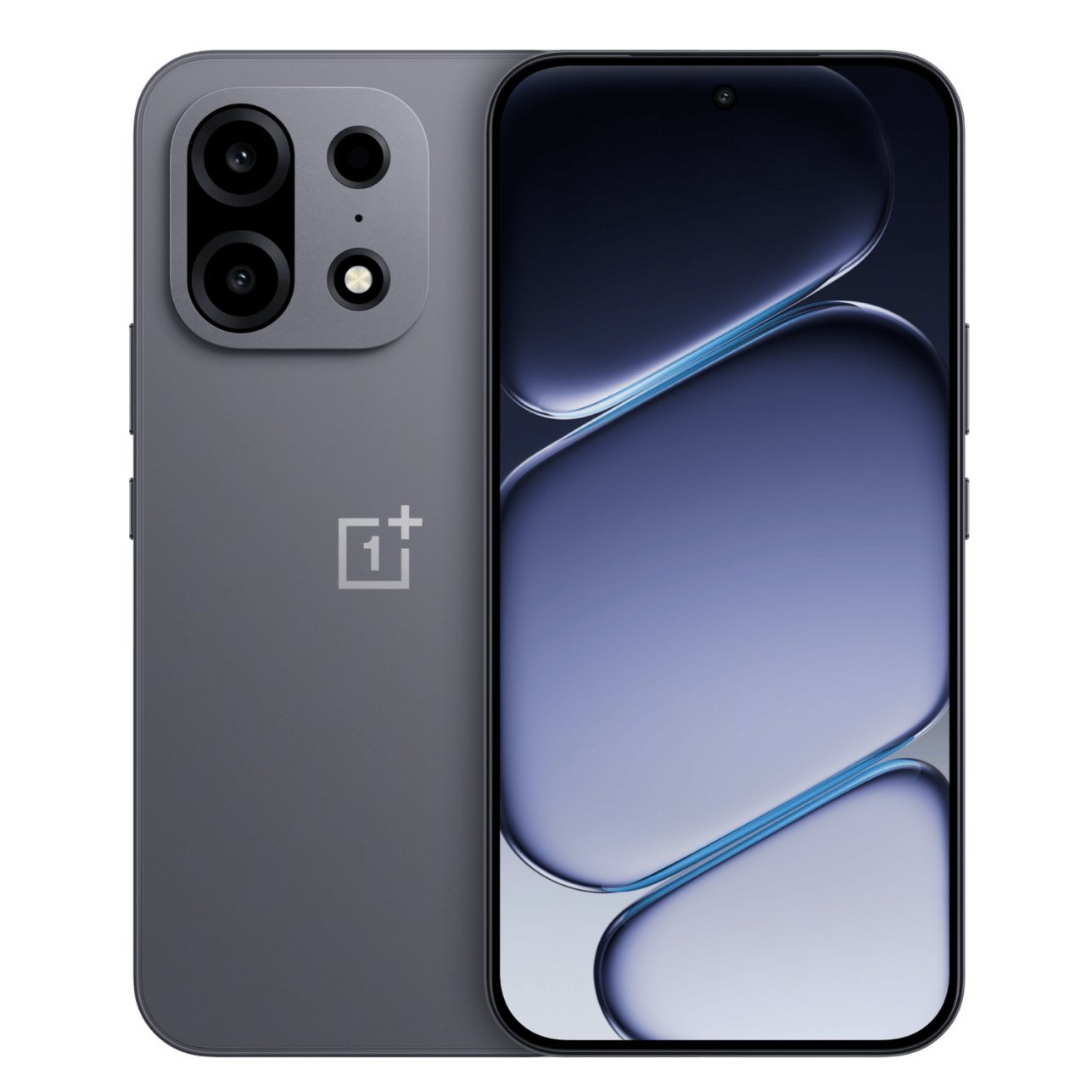
Smartphone batteries are getting bigger, and several manufacturers have more 9,000mAh-plus phones on the way. Honor is up first with three new models arriving on November 23, while OnePlus, Oppo, and Redmi are reportedly preparing phones with even larger batteries, including one that could reach 12,000mAh.
The upcoming lineup includes the Honor 700 series, OnePlus Turbo 7 Pro, an unannounced Oppo phone carrying the model number PNC110, and the Redmi Turbo 6 Max. Some already have confirmed battery capacities, while others are still based on leaks and certification records.
1. Honor 700, 700 Pro and 700S: Launching November 23
Honor 700
Honor is bringing three new phones to China on November 23. The Honor 700, 700 Pro, and 700S will be unveiled at an event in Wuhan at 2:30 PM local time. All three have a confirmed 9,000mAh Qinghai Lake battery.
Honor has also confirmed Snapdragon processors across the lineup. The three phones also reportedly share a 6.57-inch display, a 50MP front camera, and a 7.96mm body. They are also expected to run MagicOS 11 based on Android 17, with 80W wired charging. Their listed weights range from 208g to 213g.
Honor 700 ProHonor 700S
The biggest difference between the models is their hardware. The Honor 700 Pro is said to have the Snapdragon 8 Gen 5, with up to 16GB of RAM and 512GB of storage. The regular model will have a less powerful Snapdragon 8s Gen 4, while the Honor 700S will use the Snapdragon 7 Gen 4 and come with up to 12GB of RAM and 512GB of storage.
All models are expected to feature a 200MP main camera, but the Honor 700 and 700 Pro reportedly add a 50MP periscope telephoto camera with 3.5x optical zoom. The more affordable 700S instead gets a 12MP secondary camera.
There is also a small extra feature across the series: Honor has teased an AI-powered display built into the rear camera module. We should get a better idea of what it can do when the phones arrive next week.
2. OnePlus Turbo 7 Pro
OnePlus Turbo 6 Pro
OnePlus could be the next manufacturer to join the 9,000mAh battery club. Its unannounced Turbo 7 Pro has appeared on China’s 3C certification database under the model number PYP110, with the listing confirming 100W wired charging.
Comparison
The OnePlus Nord 5 runs a Snapdragon 8s Gen 3, while the Turbo 6V uses a Snapdragon 7s Gen 4.
The certification doesn’t reveal the battery size, but tipster Digital Chat Station claims the phone will have at least 9,000mAh capacity.
The rest of the leaked specifications include a 6.78-inch flat display with 1.5K resolution and a refresh rate of up to 185Hz. The camera setup could include a 200MP main camera, along with a 3nm Qualcomm processor carrying the model number SM8845 Pro.
Per reports, the OnePlus Turbo 7 Pro could arrive in China before the end of this year. An international release is possible, particularly given the previous model’s journey to India, but OnePlus hasn’t confirmed anything yet.
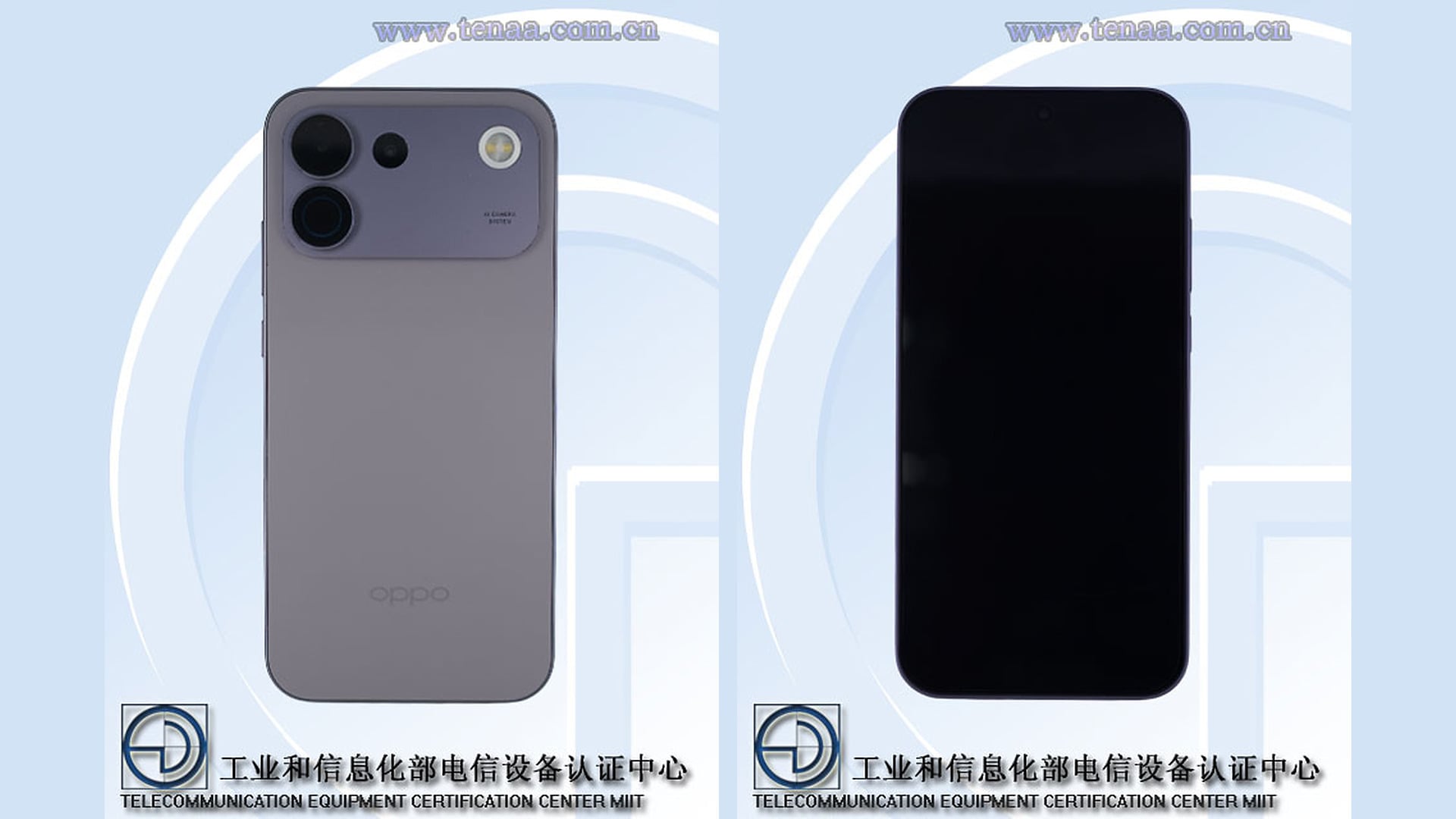
3. Oppo PNC110
While OnePlus may be testing a 10,000mAh battery, Oppo could have something considerably larger in the works. An unannounced phone carrying the model number PNC110 has appeared in China’s MIIT database, and its reported battery capacity puts it ahead of every other device on this list.
The phone received its network access licence in early November, with official images added to the listing a week later. They show a purple finish, a pill-shaped rear camera module with two cameras, and a flat display with a punch-hole selfie camera. The certification also confirms 5G connectivity and dual-SIM support, but Oppo hasn’t revealed the phone’s commercial name.
According to reports, the phone could have either 11,460mAh or 11,640mAh. Both figures would likely translate into a marketed capacity of around 12,000mAh, although that number hasn’t appeared in the certification itself.
For some perspective, the reported capacity would be considerably larger than the 10,000mAh battery in the Oppo A7 Pro Max. The device could launch in December.
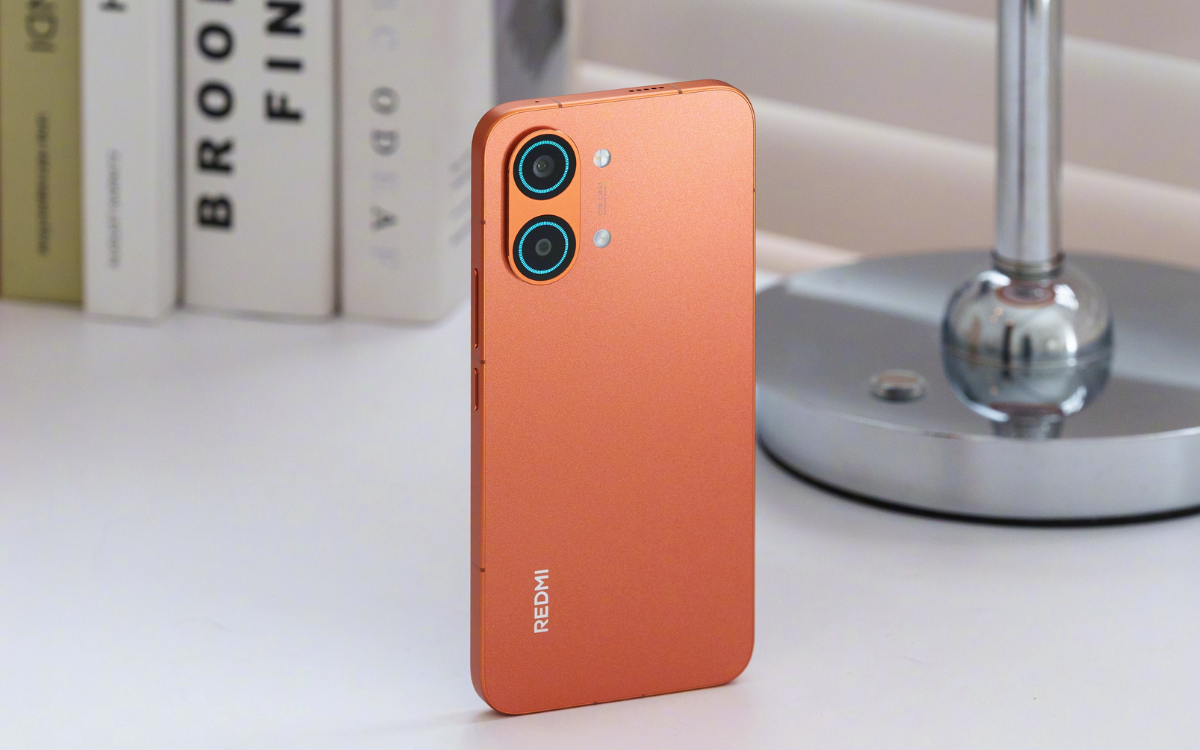
4. Redmi Turbo 6 Max
Redmi’s next big-battery phone is likely the furthest away in this list. The company is reportedly working on Redmi Turbo 6 Max, and it’s said to have a 10,000mAh+ battery. The figure comes from an earlier specification leak, but Redmi itself hasn’t announced the Turbo 6 series yet.
Likewise, the phone is said to have a 7-inch 2K OLED panel, considerably larger than the 6.83-inch 1.5K OLED screen on the Redmi Turbo 5 Max. The upcoming model is also tipped to carry IP68 and IP69 ratings, along with a MediaTek Dimensity 9-series processor.
There’s some disagreement over the chipset. The phone may either use Dimensity 9500s or a newer chip. Redmi could also bring the phone to international markets under a different name, likely the Poco X9 Pro Max.
5. Will These Phones Launch Outside China?
For now, all four upcoming models are expected to debut in China. Honor hasn’t shared international launch plans for the 700 series, while OnePlus, Oppo, and Redmi have yet to confirm whether their respective phones will reach other markets.
Likewise, battery capacities can also differ between Chinese and international versions, so the figures mentioned above should be treated as China-market specifications until the manufacturers announce otherwise.
The first launch is just around the corner. Honor will reveal the 700 series on November 23. OnePlus and Oppo could follow before the year ends, while Redmi’s Turbo 6 Max is expected in January 2027.
Back in August, Motorola published a list of its devices eligible for the Android 17 upgrade. However, there were some missing devices from the list, and so, the list was removed later on. The brand has now released a new list and has provided a vague timeline.
In a new announcement on its Brazilian newsroom, Motorola has listed nine devices that are already receiving the stable Android 17 update, with 20 additional phones eligible to receive the update in the coming months.
Motorola phones already getting the Android 17 update
Motorola Signature
Motorola Edge 70
Motorola Edge 70 Fusion
Motorola Edge 70 Fusion Plus
Motorola Edge 60 Pro
Motorola Razr 70 Ultra (Razr Ultra 2026)
Motorola Razr 50 Ultra (Razr Plus 2024)
Motorola Razr Fold
Motorola Moto G86
Motorola phones set to receive Android 17 in the coming months
Motorola Edge 70 Pro
Motorola Edge 60
Motorola Edge 60 Neo
Motorola Edge 60 Fusion
Motorola Edge 50 Neo
Motorola Edge 50 Fusion
Motorola Edge 50 Pro
Motorola Edge 50 Ultra
Motorola Razr 70 (Razr 2026)
Motorola Razr 60 (Razr 2025)
Motorola Razr 60 Ultra (Razr Ultra)
Motorola Razr 50 (Razr 2024)
Motorola Moto G77
Motorola Moto G75
Motorola Moto G67
Motorola Moto G57
Motorola Moto G56
Motorola Moto G47
Motorola Moto G37
Motorola Moto G Max
Motorola hasn’t mentioned rollout dates for the phones that have yet to receive Android 17. However, it’s welcoming to see the inclusion of models that were previously missing from the list, including the Edge 50 Pro, Edge 50 Neo, Edge 50 Fusion, Edge 60 Neo, Razr 50 (Razr 2024 in the US), Moto G56, and Moto G75.
The announcement comes from Motorola’s Brazilian arm, and the rollout timeline therefore only applies to that region, as some phones, including the Edge 60 Fusion and Edge 70 Pro, have already received Android 17 in other regions.
With Motorola phones, it’s difficult to predict when your phone will get the update. The brand rolled out the Android 17 update to many older phones first, and the nearly $2000 Razr Fold got it just yesterday. When the update arrives, it will bring redesigned Quick Settings, stackable widgets, enhanced HDR brightness control, expanded file-sharing capabilities with iPhones, and improved scam protection. You can read more about the changes on this page.
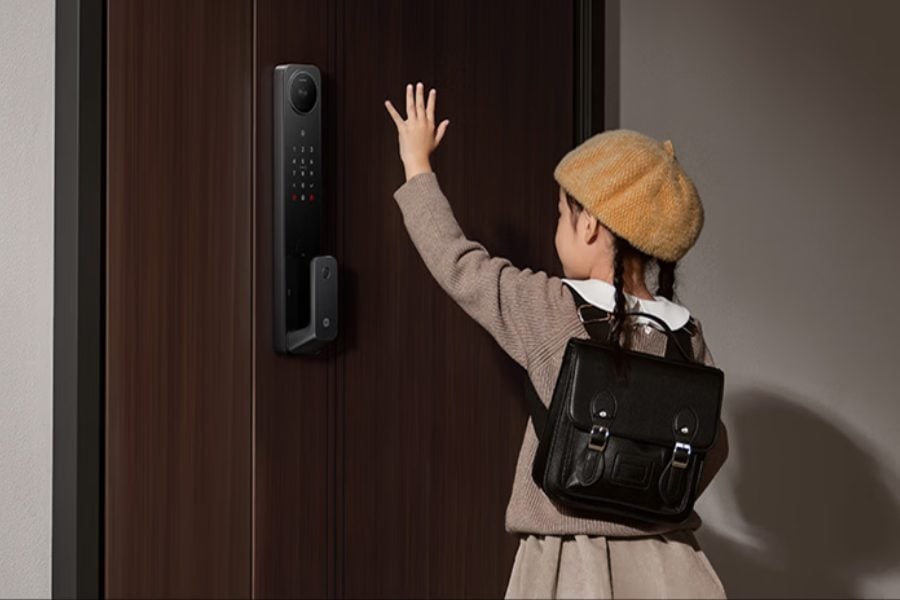
Xiaomi also sells the Smart Lock 5 Max, which supports 12 unlocking methods. The new Face Recognition Edition increases that number to 13. Made by Loock, the new model brings 3D face unlock and is now available for pre-sale at 2,116 yuan (~ $317).
Xiaomi Smart Door Lock 5 Face Recognition Edition Specifications
No prize for guessing, the main draw of the new model is 3D facial recognition. Xiaomi claims the device can identify a person in around one second, has a false recognition rate below 0.0001% and works with people between 1.2 and 2.0 meters tall, provided they are standing 0.4 to 0.8 meters from the lock. It can also recognize faces in dark environments, while 3D liveness detection helps prevent someone from unlocking the door using photos or videos.
More interestingly, the lock even supports palm vein recognition for unlocking. The system uses near-infrared light to scan the palm from a distance of 12 to 20 centimeters.
Xiaomi claims it has a false rejection rate below 1% and a false recognition rate below 0.001%, and recognition reportedly takes less than a second. It works for children taller than 1.1 meters and can also be useful for older family members with worn fingerprints or people whose hands are wet or dirty.
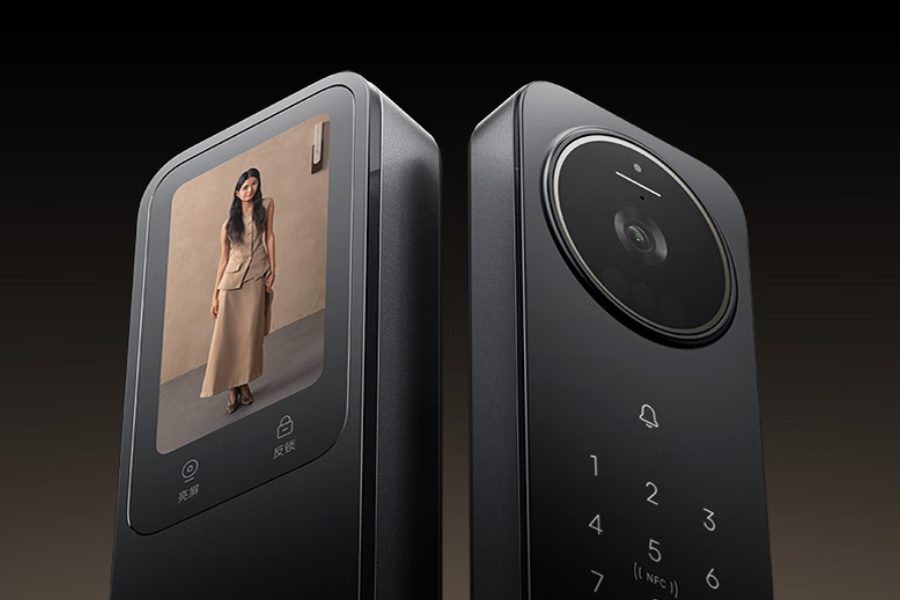
The lock also includes a 2K peephole camera with a 3MP sensor and a 160-degree field of view. There is a 24GHz millimeter-wave radar that detects visitors who approach the door and stay nearby, triggering video recording and a notification on your phone. Cloud storage keeps three days of rolling footage, while a 3.97-inch indoor screen lights up when someone presses the doorbell.
You can check the camera feed remotely through a phone, Xiaomi TV, or smart home screen. The lock also supports WeChat audio and video calls, along with a voice intercom that comes with three voice options: original, clown, and uncle. Once you have confirmed who is outside, you can unlock the door remotely.
Inside, Xiaomi has fitted a fully automatic lock body with a C-level lock cylinder. The door locks automatically when closed, while the new mechanism is quieter than the first-generation version. Xiaomi claims closing noise is reduced by 12dB and opening noise by 13dB.
There are four detection switches that continuously monitor the lock and can send alerts for several situations, including a door left open or ajar, a pried front panel, someone lingering outside, a blocked camera, forced fingerprint entry, repeated failed unlocking attempts, and low battery.
Power comes from a 5,000mAh lithium battery rated for around four months of use. There is also a set of four AA alkaline batteries, which can last approximately six months. If the lithium battery runs out, the lock automatically switches to the AA batteries. You get Type-C ports on both sides of the door for emergency power, while the indoor port can also connect to a power bank or adapter for continuous operation.
The 13 unlocking methods include face recognition, palm vein recognition, fingerprints, long-term passwords, visitor passwords, WeChat mini-programs, phone Bluetooth, remote unlocking, and a mechanical key. Xiaomi phones, watches, and fitness bands are also supported, while NFC cards are available separately.
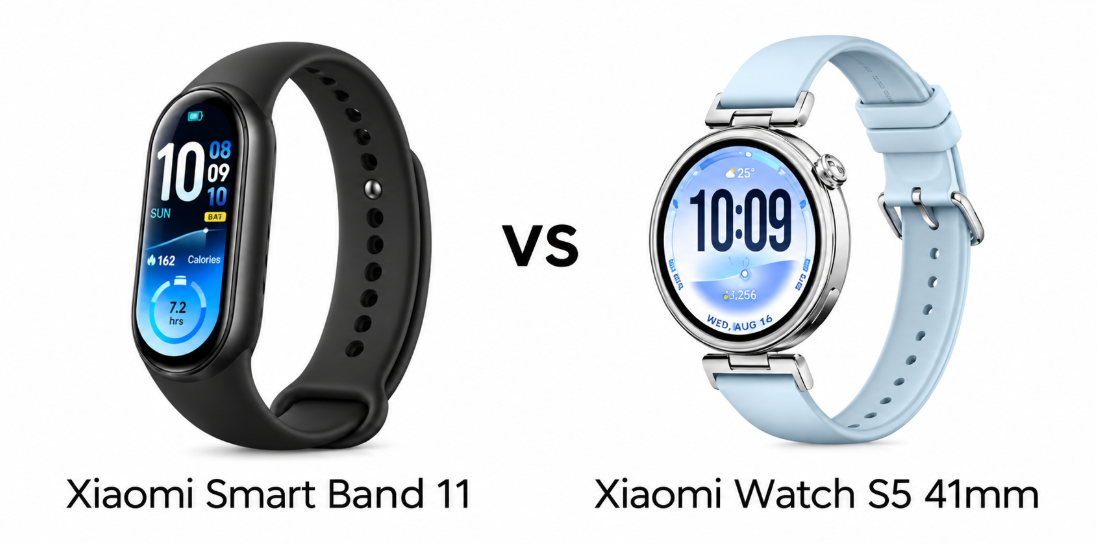
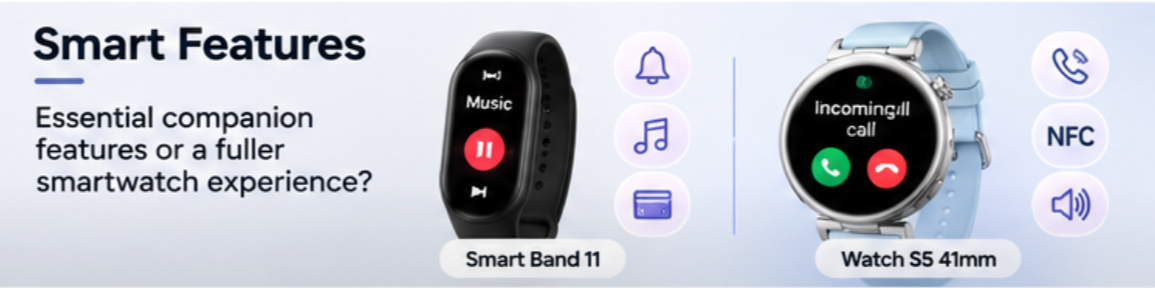
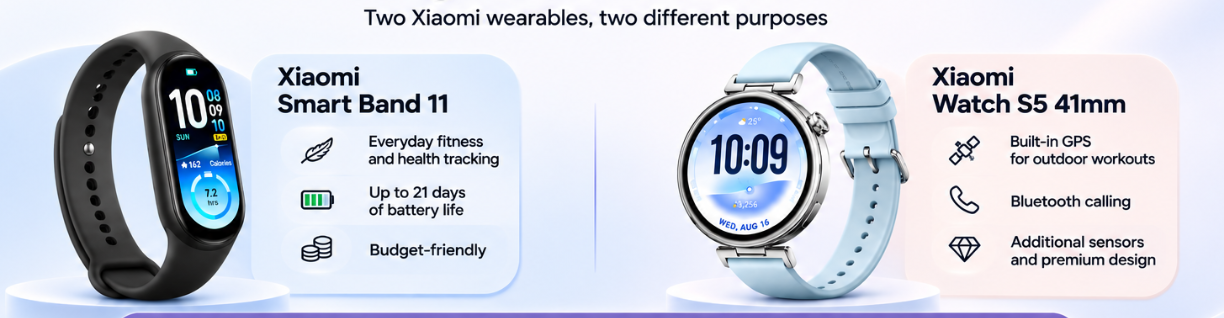
Xiaomi Smart Band 11 and Xiaomi Watch S5 41mm target different wearable needs. The Smart Band 11 focuses on affordable fitness tracking, lightweight comfort, and long battery life, while the Watch S5 41mm offers a more premium design, built-in GPS, additional sensors, and a fuller smartwatch experience.
Although both cover essential health and sports tracking, their functionality goes beyond the basics in different ways. The key difference is what you get for the extra money, particularly if you need phone-free workout tracking, smartwatch features, or simply a comfortable wearable for everyday use.
Notifications, music controls, basic connected features
Calling, NFC, expanded smartwatch functions
Best For
Affordable fitness and everyday tracking
Outdoor workouts and a premium smartwatch experience
Approx. Price
$43 / ₹3,600
$200 / ₹24,000
Disclaimer: Specs are based on available data. Actual performance may vary. Verify details from official sources before buying.
2. Design & Build
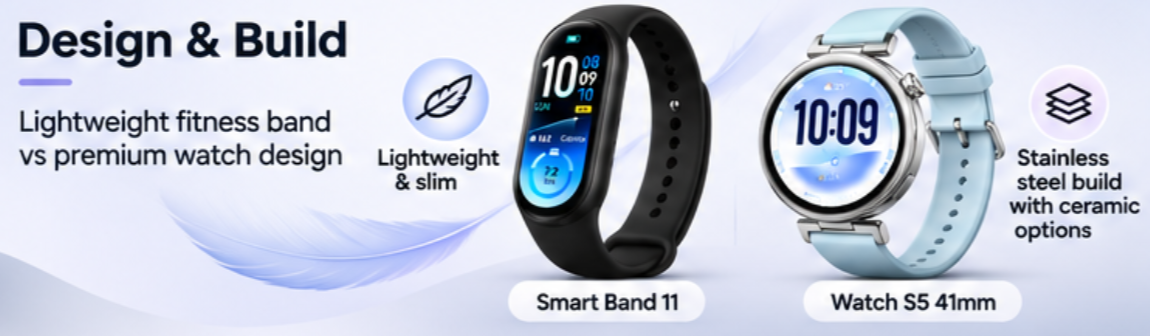
The Smart Band 11 features a slim, lightweight design intended for comfortable all-day wear, including during sleep and workouts. Its interchangeable straps and understated appearance make it practical for everyday use.
The Watch S5 41mm takes a more traditional approach with a stainless steel body, glass back, and stainless steel or ceramic bezel options. It looks and feels more like a conventional wristwatch, but is heavier.
The Band prioritizes comfort and simplicity, while the Watch offers a more premium construction and watch-like appearance.
3. Display
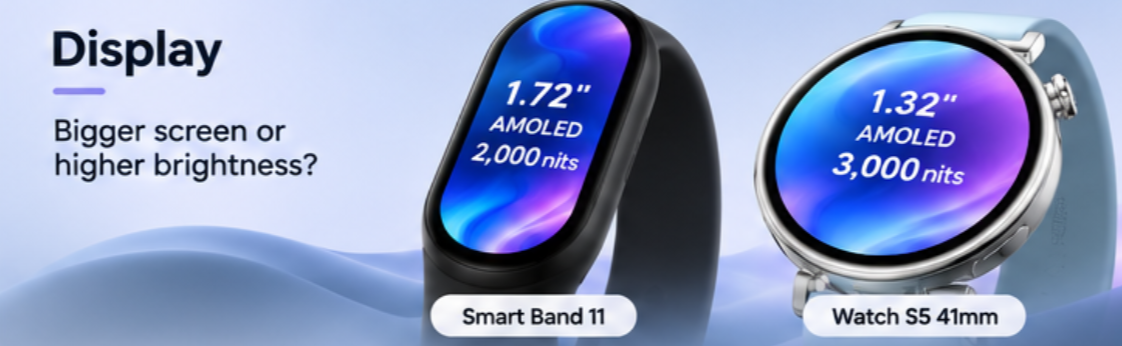
The Smart Band 11 features a 1.72-inch AMOLED display with up to 2,000 nits of brightness, giving it more screen space for notifications, workout information and health data.
The Watch S5 41mm has a smaller 1.32-inch circular AMOLED panel, but offers up to 3,000 nits peak brightness and a sharper 466 × 466 resolution.
The Band is better suited to users who prefer a larger screen for quick information, while the Watch delivers a more traditional watch interface with a brighter, more premium display experience.
4. Battery Life
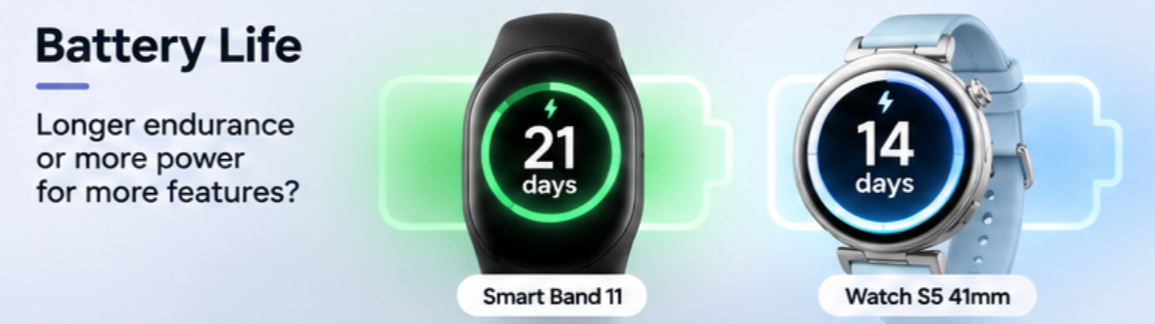
Battery life is a major advantage of the Smart Band 11, which can last up to 21 days on a charge. This makes it particularly convenient for continuous activity and sleep tracking without frequently reaching for the charger.
The Watch S5 41mm offers up to 14 days in light-use conditions, despite its larger 590mAh battery. Its additional hardware and smartwatch functionality come with greater power demands.
The Band is the better choice for users prioritizing fewer charging interruptions, while the Watch still offers strong endurance for a more feature-rich wearable.
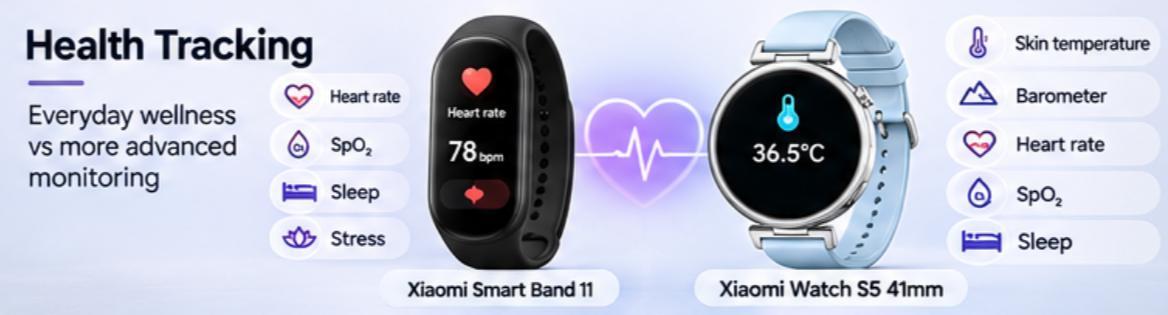
Both wearables cover essential health features, including heart rate, SpO₂, stress and sleep monitoring. The Smart Band 11 focuses on everyday wellness tracking, with HRV-based sleep monitoring and AI-powered sleep insights helping users understand their daily health patterns.
The Watch S5 41mm adds a skin-temperature sensor and barometer alongside its core health sensors, offering more data for users who want a broader monitoring experience. For basic health tracking, the Band covers most everyday needs, while the Watch is more suited to those who want additional sensor capabilities.
6. GPS & Navigation
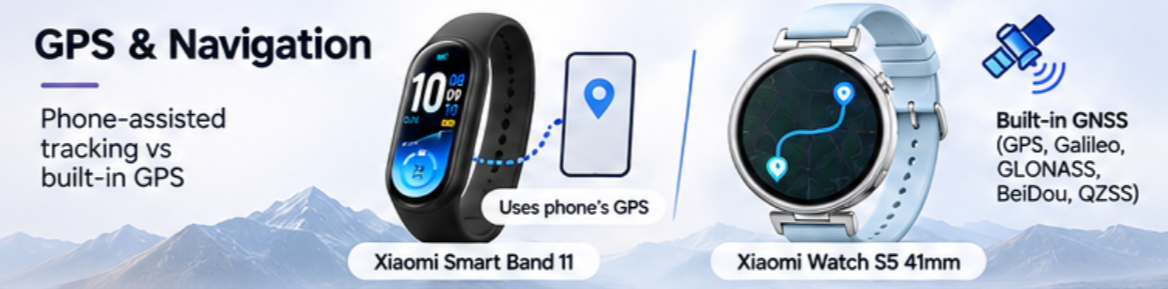
The biggest functional difference is built-in GPS. The Smart Band 11 relies on a connected smartphone for location-based workout tracking, making it less convenient for phone-free outdoor exercise.
The Watch S5 41mm features built-in GNSS supporting GPS, GLONASS, Galileo, BeiDou and QZSS. This allows it to record outdoor routes without relying on a smartphone for positioning.
For running, walking and cycling outdoors, the Watch offers considerably more independence, while the Band is better suited to users who usually exercise with their phones.
Both devices support more than 150 sports modes, making them suitable for a wide range of workouts, from walking and running to gym sessions. The Smart Band 11 offers straightforward activity tracking for users who want to monitor their exercise without needing advanced smartwatch functionality.
The Watch S5 41mm combines workout tracking with onboard GPS, making it more practical for outdoor training and route recording. The Band is well suited to everyday fitness, while the Watch is more appealing to users who regularly train outdoors and want to track their workouts without carrying a phone.
The Smart Band 11 handles everyday essentials such as notifications, music controls and selected NFC functions on compatible variants. It works primarily as a smartphone companion, keeping basic information accessible on the wrist. The Watch S5 41mm adds a speaker and microphone for Bluetooth calling, alongside NFC and a more comprehensive smartwatch interface. This makes it more useful for handling calls and interacting with features directly from the wrist.
The Band covers basic convenience, while the Watch offers a more independent and interactive experience.
9. Outdoor Features
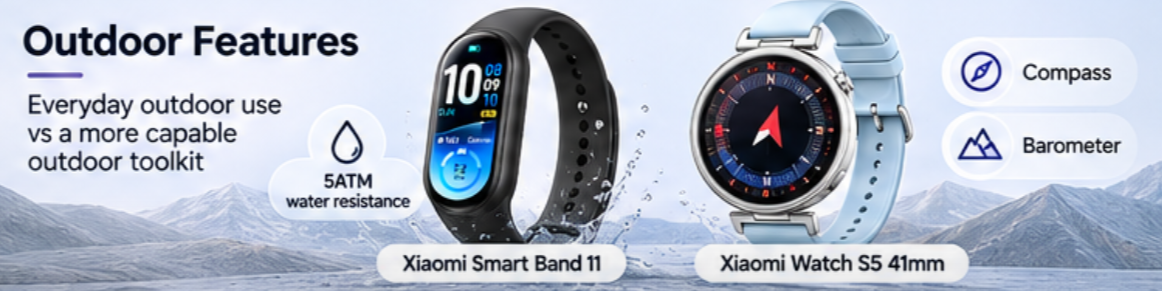
Both devices feature 5ATM water resistance, making them suitable for swimming and everyday water exposure within their intended limits. The Smart Band 11 is a lightweight companion for walking, casual running and general outdoor activity. The Watch S5 41mm goes further with built-in GPS, a compass and barometer, giving it additional utility for outdoor workouts, route tracking and elevation-related information.
The Band is ideal for casual fitness and daily activity, whereas the Watch is better suited to users who spend more time exercising outdoors.
10. Which One Should You Buy?
The Smart Band 11 is the sensible choice for anyone who primarily wants step tracking, sleep monitoring, workout recording, notifications and long battery life without spending much. It is particularly suitable for beginners and users who prefer a lightweight wearable.
The Watch S5 41mm makes more sense for those who want a premium watch design, phone-free GPS workouts, Bluetooth calling and additional sensors. Its higher price is justified mainly when these extra capabilities will actually be used.
Final Verdict
The Smart Band 11 delivers the essentials in a lightweight, affordable and battery-efficient package. The Watch S5 41mm adds a premium build, standalone GPS, more sensors and a fuller smartwatch experience.
The extra cost is primarily for greater independence, outdoor tracking and smartwatch functionality, rather than a dramatic difference in basic fitness monitoring. Choose the Band for everyday fitness and value, or the Watch if you want a more capable wearable that can do more without your phone.
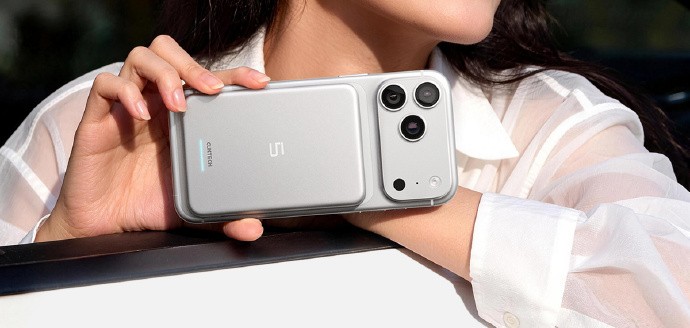
Cuktech has unveiled a new magnetic power bank that prioritizes slimness and everyday convenience. The 5 Air is the company’s first ultra-thin magnetic model, sitting below the larger 10 Air that includes a display and higher wired output.
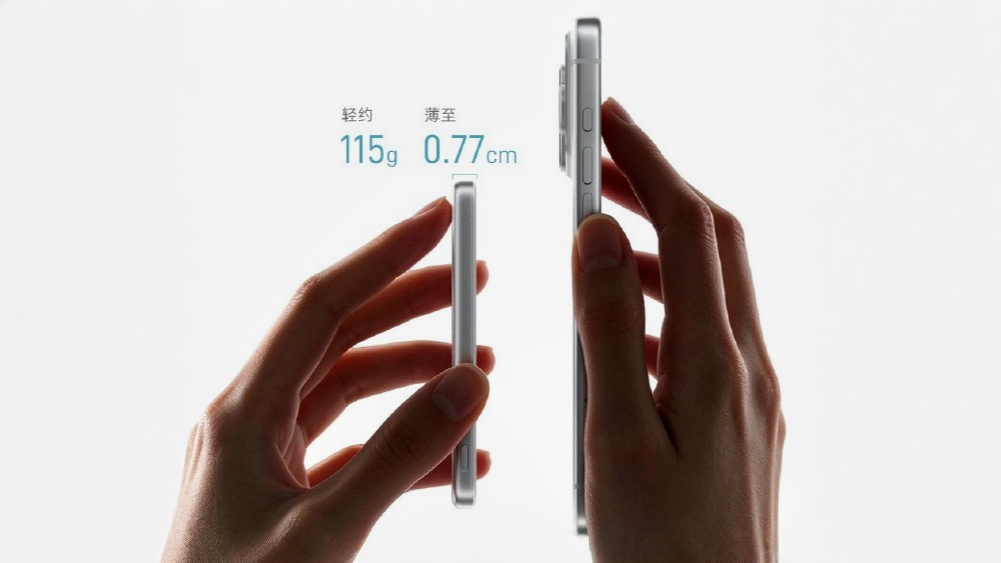
The 5 Air measures about 7.7 mm thick and weighs roughly 115 g. Inside sits a 5,000 mAh cell supplied by ATL, the same company that provides batteries for iPhones. The cell is rated at 19.6 Wh, with a rated output capacity of 3,000 mAh at 5 V and 2 A.
Our picks
The Baseus Blade Power HD Edition 20000mAh is our best-performance power bank under $50.
Cuktech claims the pack can extend a phone’s battery life by up to 34.4 hours. Wireless charging tops out at 15 W, while wired output reaches 25 W. For iPhone 12 through iPhone 18 series models the maximum wireless rate is listed at 7.5 W, consistent with the absence of Qi2 certification. Custom magnets delivering around 13 N of pull force keep the bank securely attached, and a front light strip indicates remaining charge.
Safety and travel practicality receive attention as well. The 5 Air is certified under China’s new GB 47372-2026 power bank standard, which adds nail penetration testing and becomes mandatory on April 1, 2027. At 19.6 Wh it stays well under the 100 Wh limit that applies to most carry-on luggage rules.
Pricing is aggressive for the form factor. The list price in China is 299 yuan (about $45), but the launch price will not exceed 259 yuan (about $39) from November 27 through December 27. Sales begin in China on November 27. Global availability is expected later; Cuktech has so far announced pricing only for the domestic market.
The combination of ATL cells, magnetic attachment, thin profile, and accessible pricing positions the 5 Air as a practical daily-carry option for users who want extra runtime without adding noticeable bulk.
Huawei‘s new OSTA sub-brand, known in China as Xingmang, opened pre-orders for its first phone on Vmall earlier this week, with official images confirming a wide-screen design in three colors. Leaks had also detailed its hardware ahead of the event. The company has now officially launched the OSTA O1 Pro in China at an event alongside the Stelato V8.
Huawei OSTA O1 Pro specifications and features
Huawei OSTA O1 Pro
The OSTA O1 Pro is a wide bar phone with a 6.39-inch 16:9.5 1.5K LTPS flat display, 1.05mm bezels on all four sides, and a 96.1% screen-to-body ratio. It is 6.68mm thick, weighs about 200 grams, and comes in Starry Black, Nebula White, and Starburst Purple. The back has a horizontal dual-camera module and an OSTA logo.
Huawei’s Kirin 9030S chip powers the phone, in 12GB+256GB, 12GB+512GB, 16GB+512GB, and 16GB+1TB configurations. The rear cameras include a 200-megapixel 1/1.28-inch RYYB main sensor, a 50-megapixel 3.7x RYYB periscope telephoto, and a Red Maple lens, with no ultra-wide camera like the Pura X View. A 7,000mAh battery supports 66W wired charging and wireless charging, and the fingerprint sensor sits on the side.
Huawei OSTA O1 Pro
It is also the first phone to ship with HarmonyOS 7 AI Pioneer Edition. Huawei calls it a HarmonyOS AI phone, with a system-level AI screen meant to take you straight to what you need, new AI interactions, and the option to generate a theme from a single image. The company also says the Kirin 9030S is tuned for tighter coordination between the software, hardware, chip, and cloud.
Huawei OSTA O1 Pro price and availability
Huawei OSTA O1 Pro
Introductory pricing in China starts at 5,499 yuan (~$775) for the 12GB+256GB model. The 12GB+512GB version costs 6,499 yuan (~$915), 16GB+512GB is 7,299 yuan (~$1,030), and 16GB+1TB is 8,799 yuan (~$1,240), each 200 yuan below the official list price. Starry Black and Nebula White are limited to the 12GB options, while Starburst Purple is reserved for the 16GB models. Sales start at 6:08 p.m. China time on Vmall and JD, and Huawei has not announced international availability.
The Xiaomi Smart Band 11 first appeared in certification databases in May, launched in China in September, and has now rolled out to international markets with a slimmer body, a brighter display, and upgraded health sensors. If you are thinking about picking one up, there are a few things worth knowing first, from what Xiaomi improved over the Smart Band 10 to the one feature it still leaves out.
Xiaomi Smart Band 11
5New fitness tools for runners, riders, and swimmers
The band supports more than 150 sports modes and is rated 5ATM for water resistance. Xiaomi is highlighting Bluetooth heart rate broadcasting, which streams live heart rate data to compatible cycling computers and third-party apps, along with improved underwater heart rate monitoring for better swim data. The Smart Band 10 already offered both features, so treat them as refinements rather than brand-new tricks.
Beyond workouts, HyperOS 4 brings a redesigned interface. iPhone users also get dual-device notifications, remote camera control, and page turning for e-books, slides, and short videos.
Should international buyers get one?
The Smart Band 11 costs €59.90 in Europe and £49.99 in the UK. Xiaomi has not announced official US availability, which is typical for its wearables.
If you own a Smart Band 9 or older, the brighter screen, slimmer body, and better heart rate sensor make this a sensible upgrade. Smart Band 10 owners can probably skip it unless outdoor visibility really bothers them. Runners who want phone-free tracking should spend a little more on the Smart Band 10 Pro, while bargain hunters can see how it compares in our Redmi Band 4 vs Xiaomi Smart Band 11 breakdown.
Dummy units and renders for Samsung’s next flagship keep contradicting each other on the rear camera arrangement. The disagreement is the strongest public signal yet that the Galaxy S27 Ultra’s final look is still not locked in.
Case and CAD leaks have been unsettled for months. In late September, Ice Universe showed a wide camera island on the Ultra that echoed the iPhone 18 Pro style: two larger lenses on the left and an oval section on the right for another camera, additional sensors, and the LED flash.
An OnLeaks render placed the 5x telephoto above the flash; a later Ice Universe claim put that camera below it. Lens count and exact positions have continued to conflict.
A newer video circulating on X, shared via @Ahmadansari2233 and labelled a Galaxy S27 Ultra dummy measuring 163.93 × 78.42 × 7.97 mm, adds another data point. Those dimensions are roughly 0.17 mm longer and wider than earlier figures, with the same thickness.
The first physical dummy came from Android Headlines, built from CAD details OnLeaks published earlier. It swaps the vertical camera stack of recent Ultra models for an oblong module stretched across the top of the back. The hollow, plain-black unit with no logo measures 163.76 × 78.25 × 7.97 mm. Compared with the Galaxy S26 Ultra’s 163.6 × 78.1 × 7.9 mm, that is a difference of about 0.15 mm in each direction, slightly taller, wider, and thicker.
A second set of images from leaker Sonny Dickson on 10 November showed S27 Ultra and S27 Pro dummies with a rectangular module holding four circular cutouts in a two-by-two grid. Ice Universe quickly replied that “the camera in the upper right corner of the S27 Pro and S27 Ultra does not exist, and this picture is wrong.”
Even though Sonny Dickson’s track record is solid, his dummies conflict with earlier leaks. Several of those point to a single telephoto camera on the Ultra, one fewer rear camera than the S26 Ultra’s four-camera setup.
The persistent mismatch between the Android Headlines CAD-based shell, Sonny Dickson’s four-cutout dummies, and Ice Universe’s insistence on three cameras (plus his later line sketch of a tighter cluster) shows the design is still fluid in public view. Samsung is expected to launch the S27 series in early 2027; until then, the camera layout remains one of the more contested details.
We use cookies on our website to give you the most relevant experience by remembering your preferences and repeat visits. By clicking “Accept”, you consent to the use of ALL the cookies.
This website uses cookies to improve your experience while you navigate through the website. Out of these, the cookies that are categorized as necessary are stored on your browser as they are essential for the working of basic functionalities of the website. We also use third-party cookies that help us analyze and understand how you use this website. These cookies will be stored in your browser only with your consent. You also have the option to opt-out of these cookies. But opting out of some of these cookies may affect your browsing experience.
Necessary cookies are absolutely essential for the website to function properly. This category only includes cookies that ensures basic functionalities and security features of the website. These cookies do not store any personal information.
Any cookies that may not be particularly necessary for the website to function and is used specifically to collect user personal data via analytics, ads, other embedded contents are termed as non-necessary cookies. It is mandatory to procure user consent prior to running these cookies on your website.