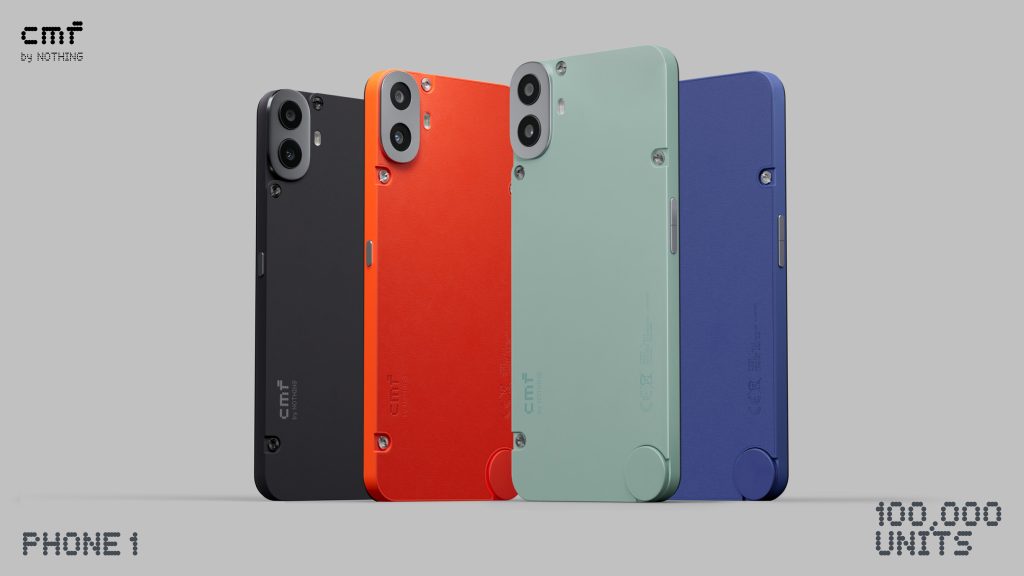
Nothing‘s new CMF Phone 1 went on sale for the first time and achieved impressive sales figures. The company claims it sold over 100,000 units (1 lakh) across various channels in just three hours. This surpasses the Nothing Phone (2a)’s record of reaching the same milestone in 24 hours.
The CMF Phone 1 starts at Rs. 15,999 for the 6GB + 128GB variant and Rs. 17,999 for the 8GB + 256GB version. Launch day promotions offered discounts with select banks and a reduced price on the CMF Power 33W charger for Flipkart buyers. The phone is available on Flipkart, Croma, Vijay Sales, and other partner stores.
CMF Phone 1 specs:
The CMF Phone 1 has a 6.67-inch display with a fingerprint reader. It offers FHD+ resolution, a 120Hz refresh rate, and good brightness for outdoor use.
The phone features a customizable design with a camera module and four screws on the back panel, allowing users to change back covers (Light Green, Blue, or Orange) and attach accessories like a stand or lanyard using a special dial and the included screwdriver.
It is powered by a MediaTek Dimensity 7300 processor with 6GB or 8GB of RAM, expandable with virtual RAM, and 128GB of storage. It has a 5,000mAh battery that supports 33W fast charging and runs on Android 14 with Nothing OS 2.6.
The camera setup includes a 50MP main sensor and a secondary lens for portraits. The 16MP front camera handles selfies, and it can record videos in 4K at 30 fps. It also features Ultra XDR technology, co-developed with Google, for better low-light photography.
Asus’ Vivobook S series of laptops is targeted at working professionals. These notebooks are known to offer lightweight designs and powerful chips.
The company has been regularly updating this lineup ever since it was introduced. The 2024 models were first showcased at CES 2024.
Months later, almost all of these newer laptops are now available in India. However, as always, Asus has only brought select variants to the country spread across different price segments.
The brand sent me an AMD version of the product to try out. The notebook is also offered in Intel and Qualcomm flavors.
The said AMD model is sold in a single trim in India as Asus Vivobook S 14 OLED (M5406). It is the most affordable offering in the region priced at ₹89,990.
Having used it over the past few days, I have shared my thoughts on it in this article.
Before I begin, I want to let the readers know that Asus had no early look or editorial input. The opinions stated in this post are mine alone.
What can you expect from Asus Vivobook S 14 (M5406)?
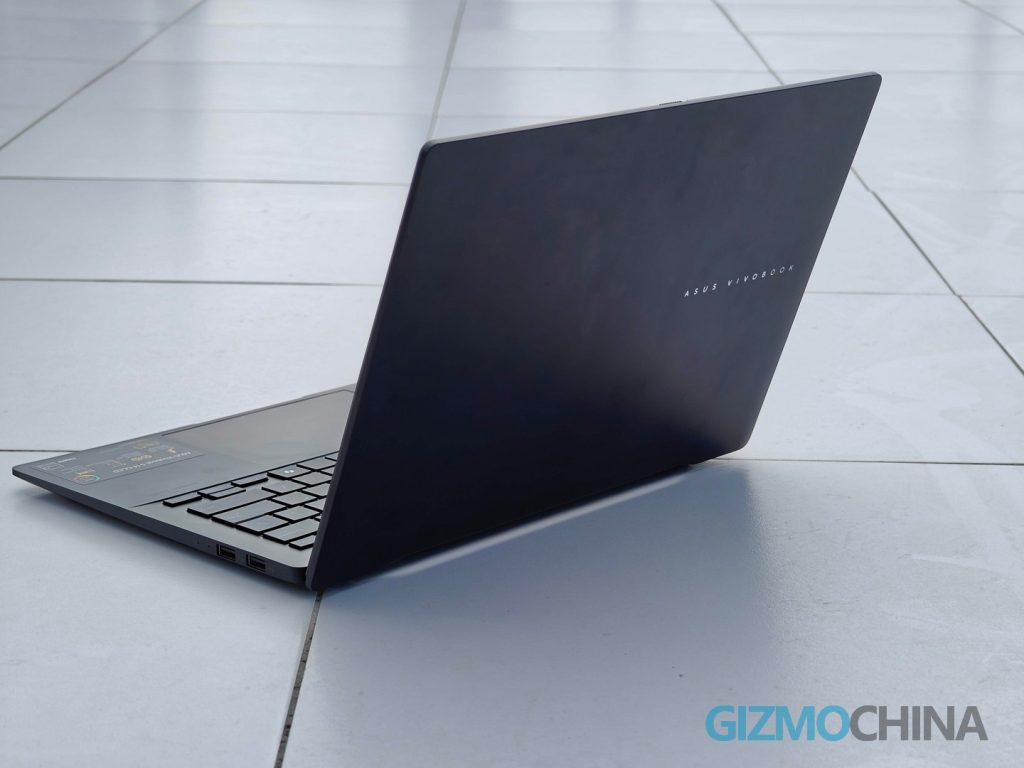
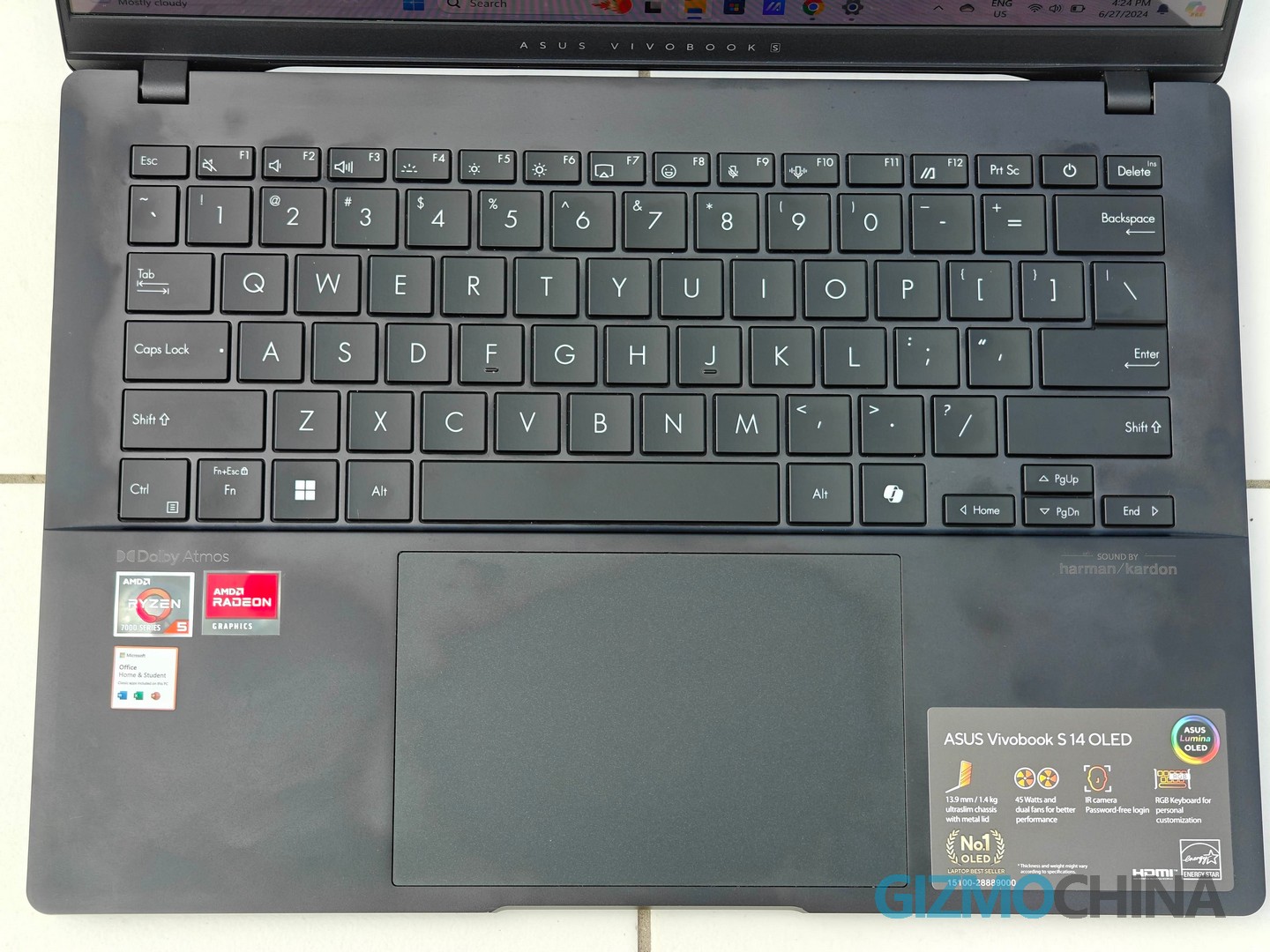
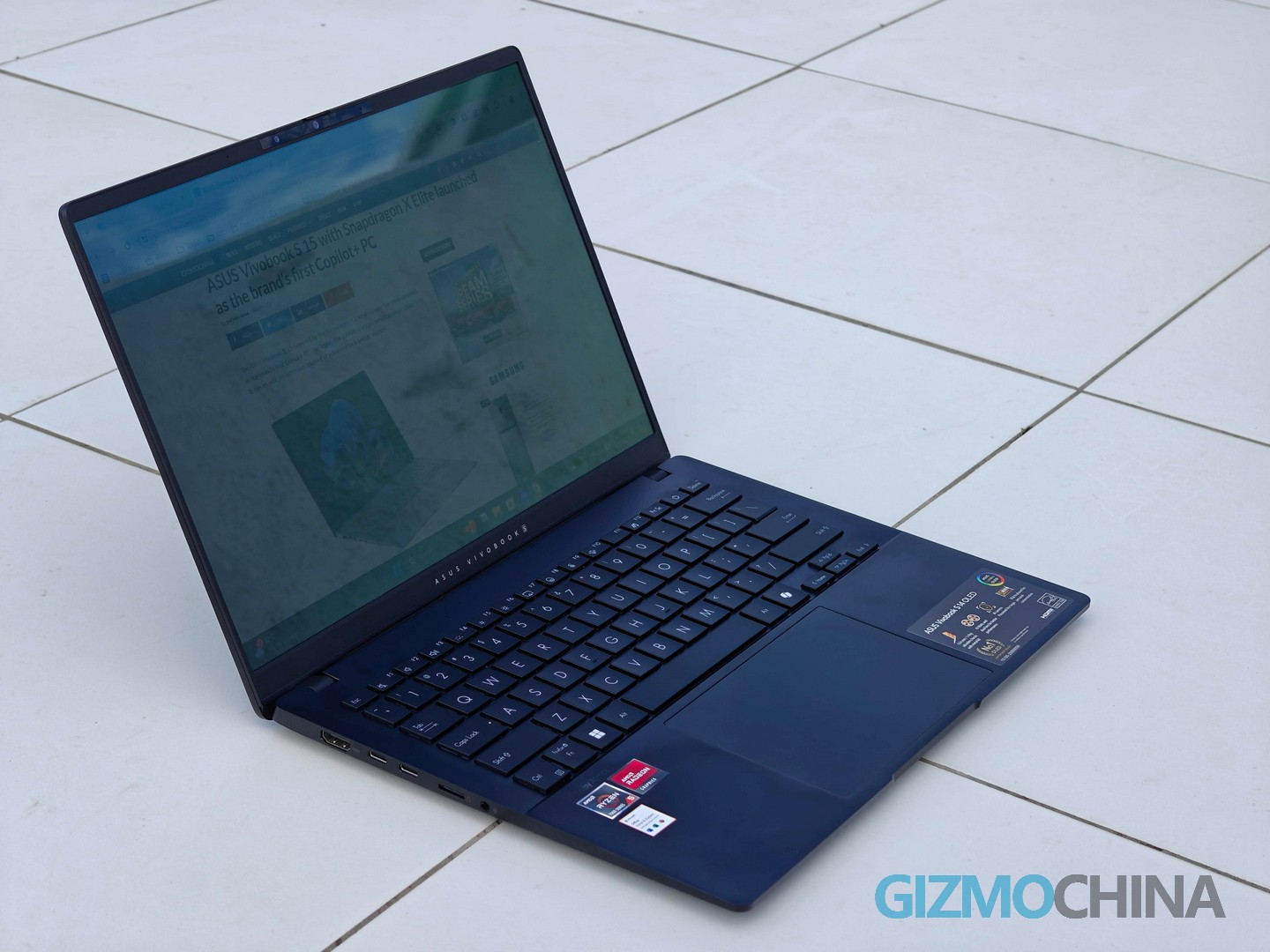
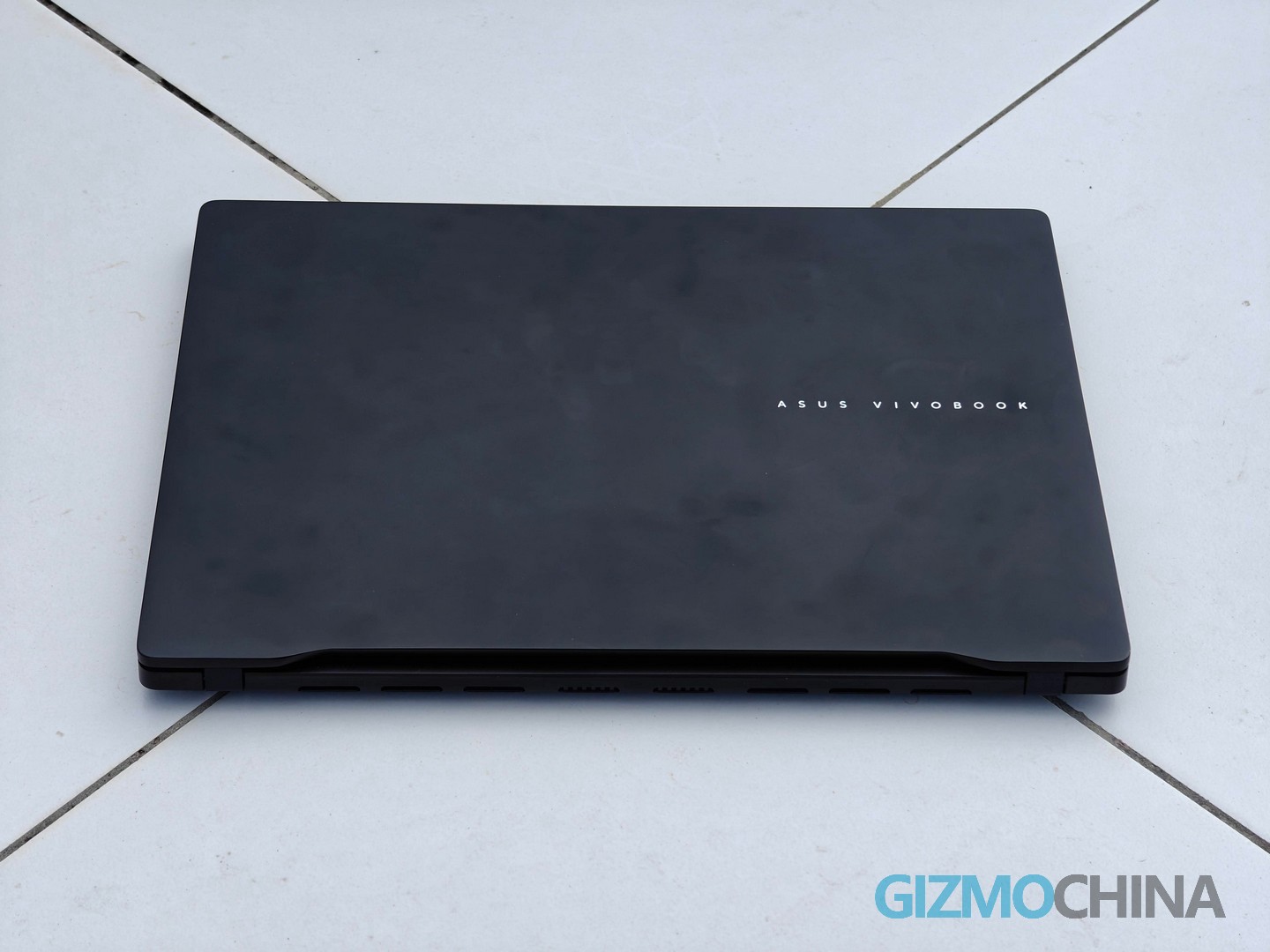
The Asus Vivobook S 14 (M5406) flaunts a design that’s ideal for office goers and likes. Its thin and light body weighing around 1.3 kg makes it suitable for daily commutes.
The metal chassis is sturdy and gives an assurance that it can easily take a beat or two. In fact, the laptop is MIL-STD-810H compliant for durability.
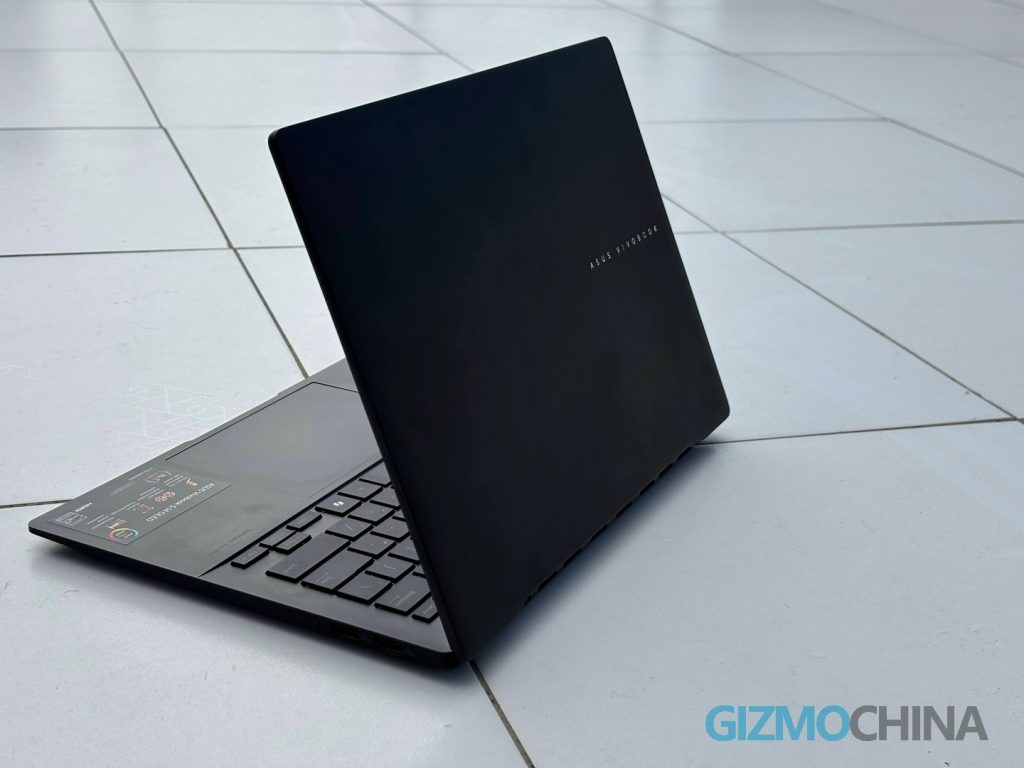
The product is offered in a lone Neutral Black color option. The paint job has a matte finish, which unfortunately makes it a smudge magnet.
As much as the notebook looks classy and durable in stealth black, it is difficult to keep it free of smudges. So you may want to have a fiber cloth with you always.
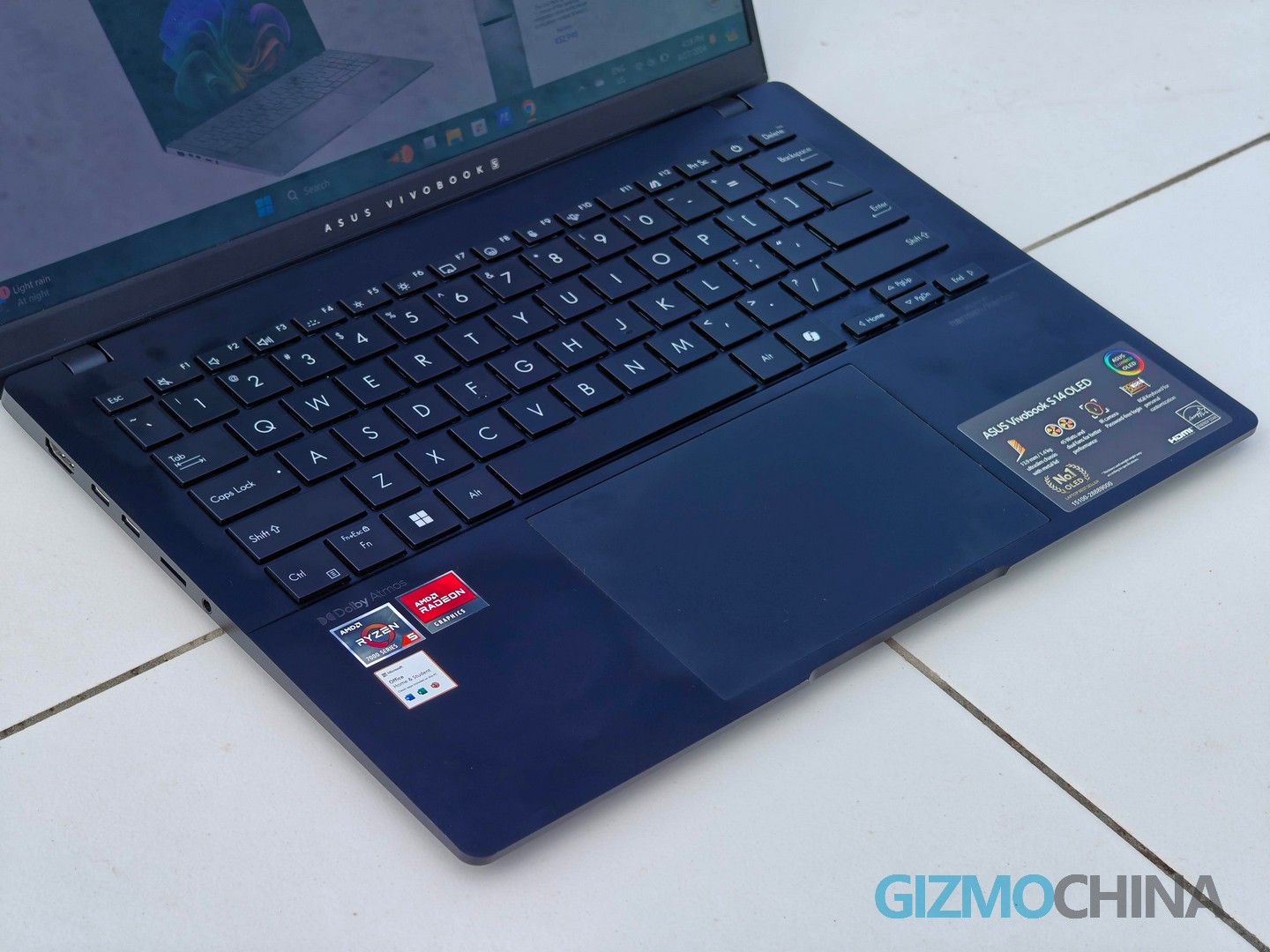
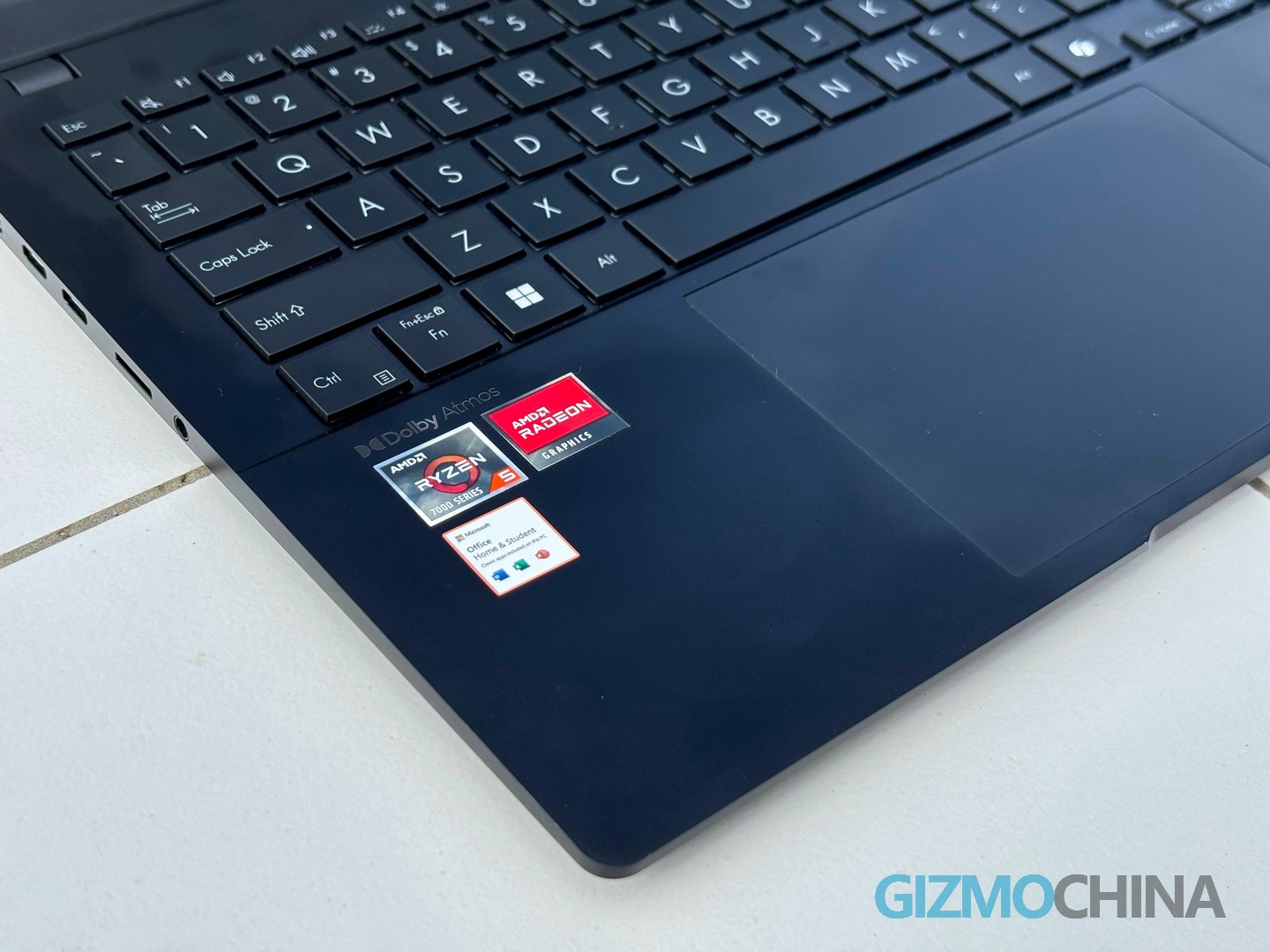
Interestingly, Asus has equipped the computer with an RGB backlight for the keyboard. I can understand the company is providing an option to have some fun.
But personally, I think it is out of place on a laptop targeted at professionals. On the other hand, the large 129 x 84 mm touchpad is quite useful.
2. Average Display
As the name suggests, the Asus Vivobook S 14 (M5406) sports a 14-inch display. This OLED panel offers a resolution of 1920 x 1200 pixels (WUXGA) and a 16:10 aspect ratio.
An FHD-equivalent display on a laptop priced at nearly a lakh does not make sense to me. Having used notebooks with higher resolution at around the same price and more, I could easily notice the lack of details as pixels are visible.
Not everyone can notice this if they are accustomed to only FHD and HD displays on their computers. But if they are coming from a laptop featuring a higher resolution display, they will be disappointed.
Additionally, the panel is limited to a 60Hz refresh rate. It would have been nice to have at least a 90Hz refresh rate. As for brightness, it is fine for indoor usage which is what the notebook is designed for.
The panel is actually good but it does not belong on this product. Asus provides a similar spec’d display on laptops almost half the price of this one.
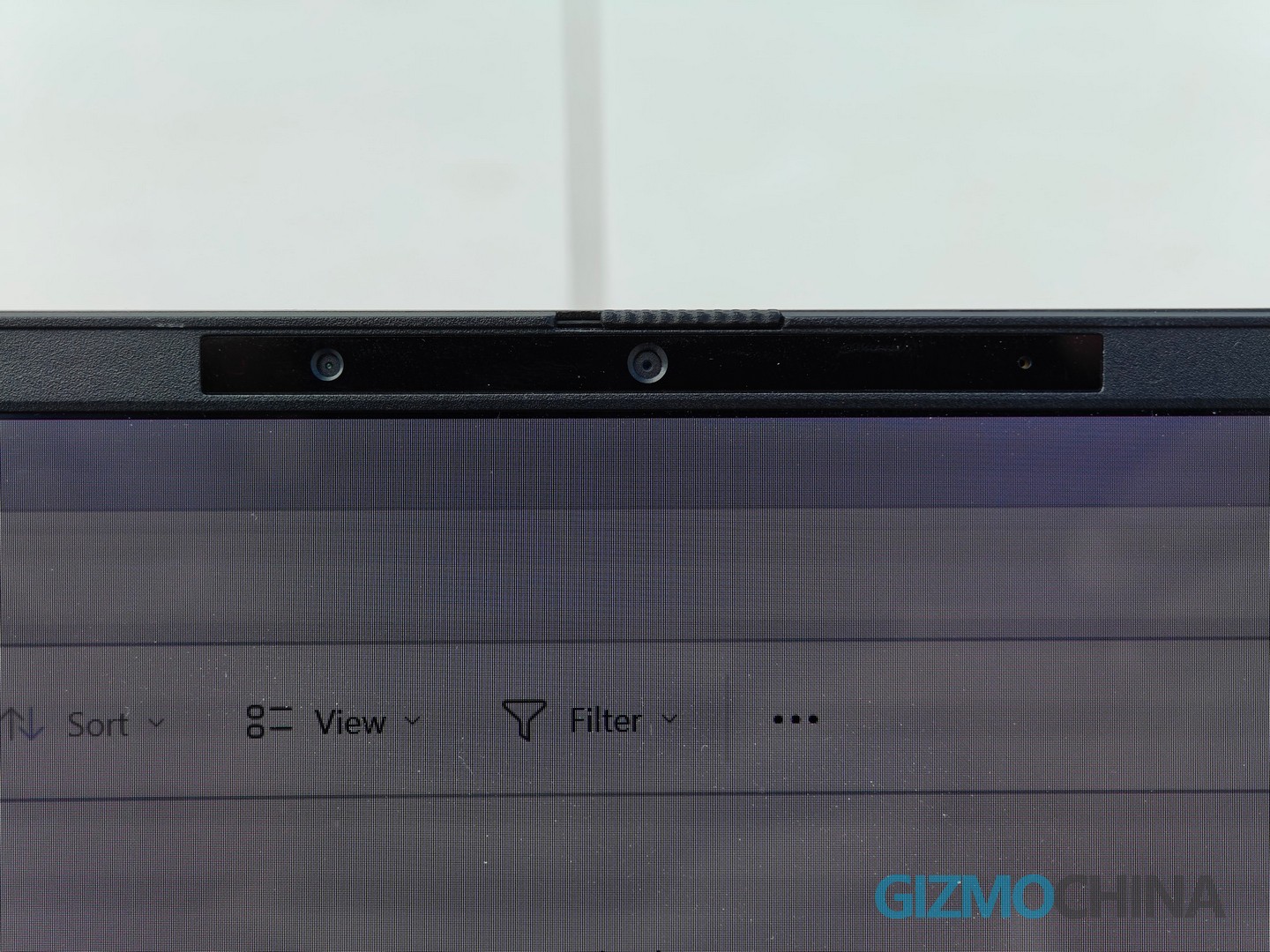
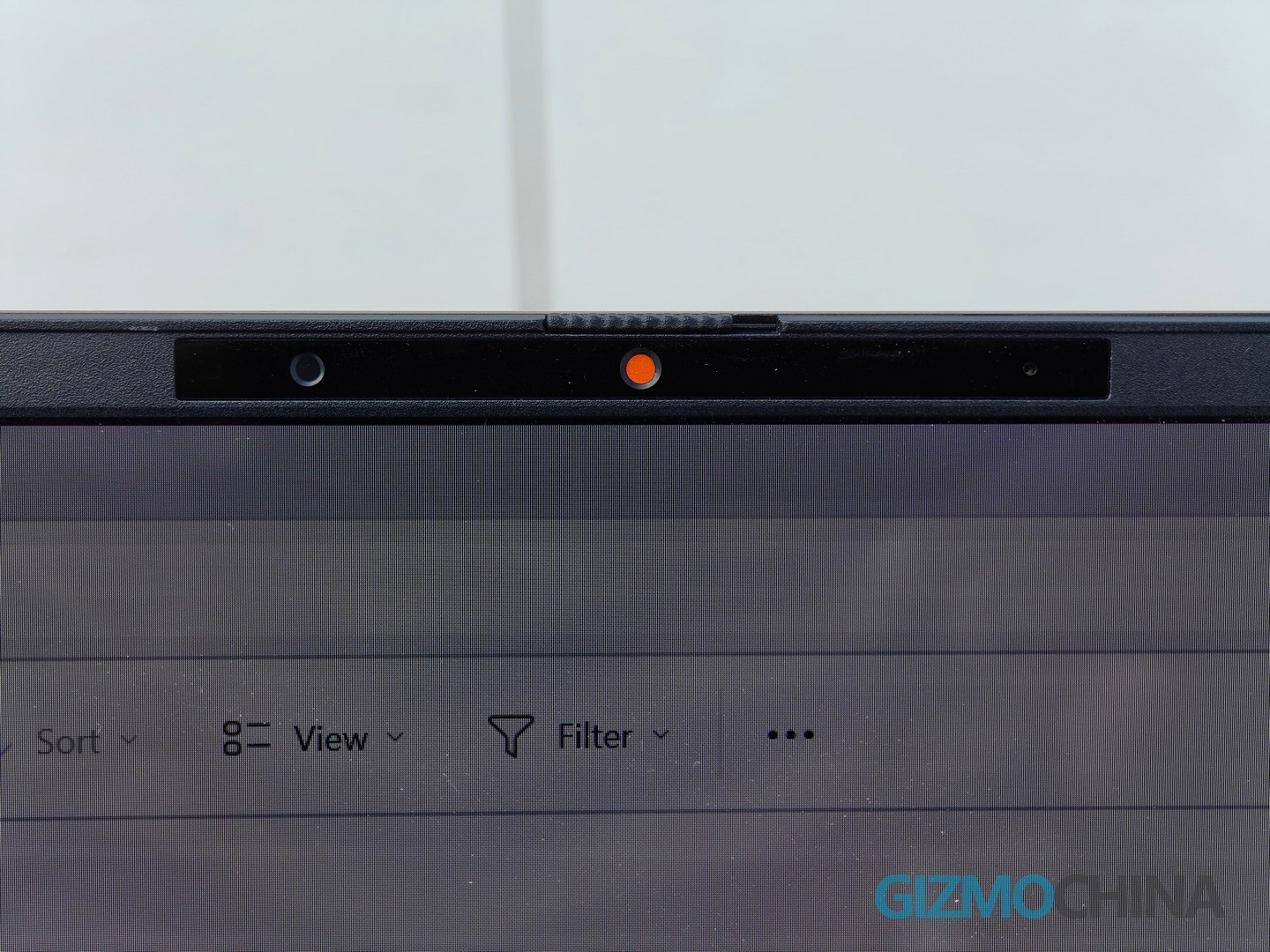
As for speakers, they are loud enough but lack bass due to the notebook’s thin form factor. While the microphone is fine for video calls and so is the physical shutter-enabled web camera, which is accompanied by an infrared sensor for Windows Hello authentication.
3. Adequate Performance
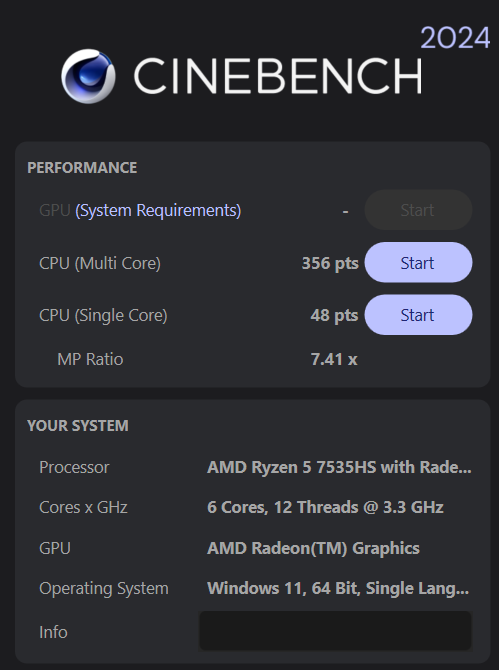
The Asus Vivobook S 14 (M5406) arrives in a single configuration in India. It houses an AMD Ryzen 5 7535HS processor.
This chip consists of 6 cores clocked at 3.3 GHz. It supports up to 12 threads, 12 MB cache, and 4.55 GHz max boost.
The silicon is paired with 6400 MHz 16 GB LPDDDR5x RAM and 1 TB PCIe Gen 4 SSD. There’s an additional M.2 slot to increase the storage size by 1 TB.
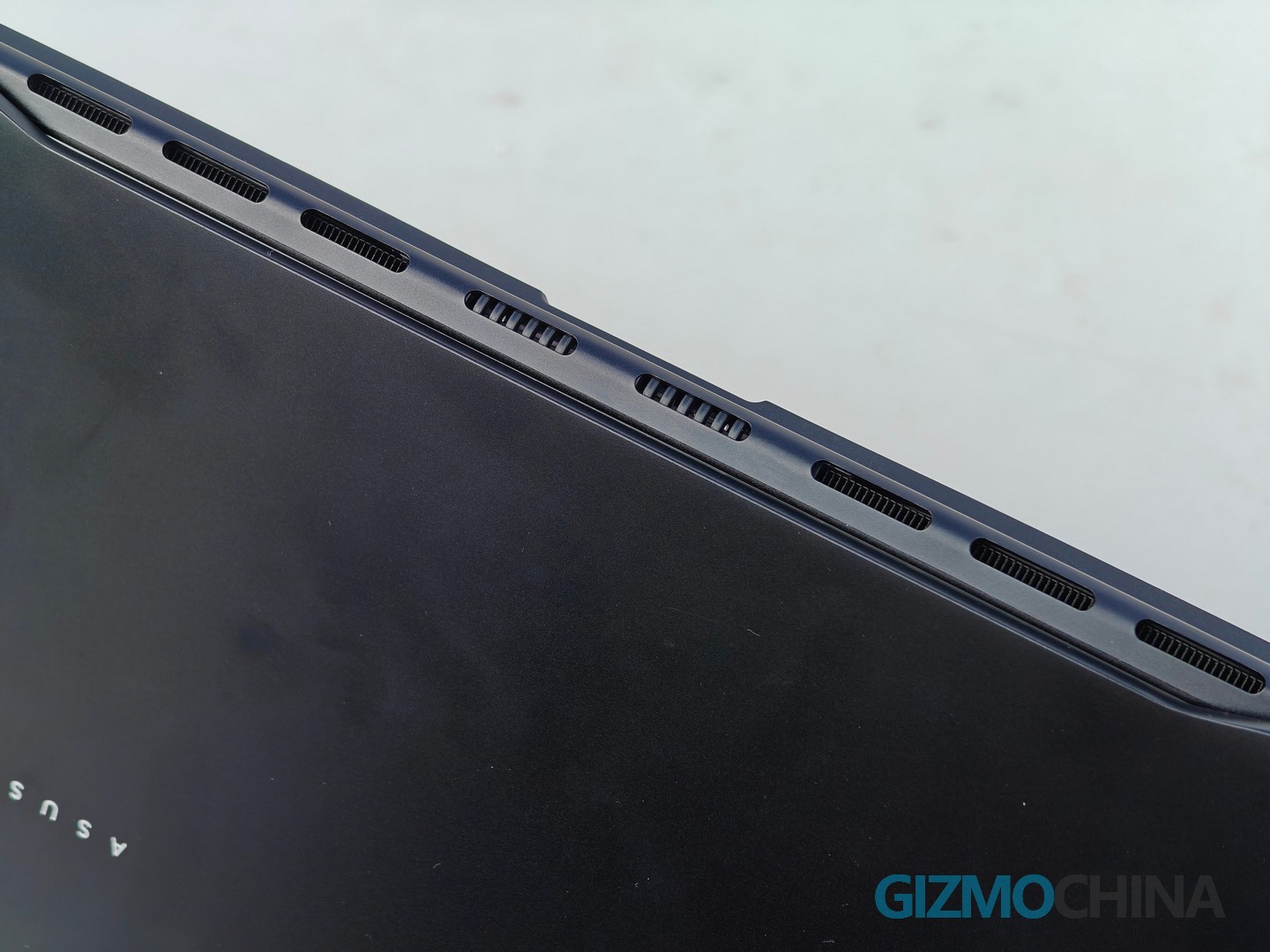
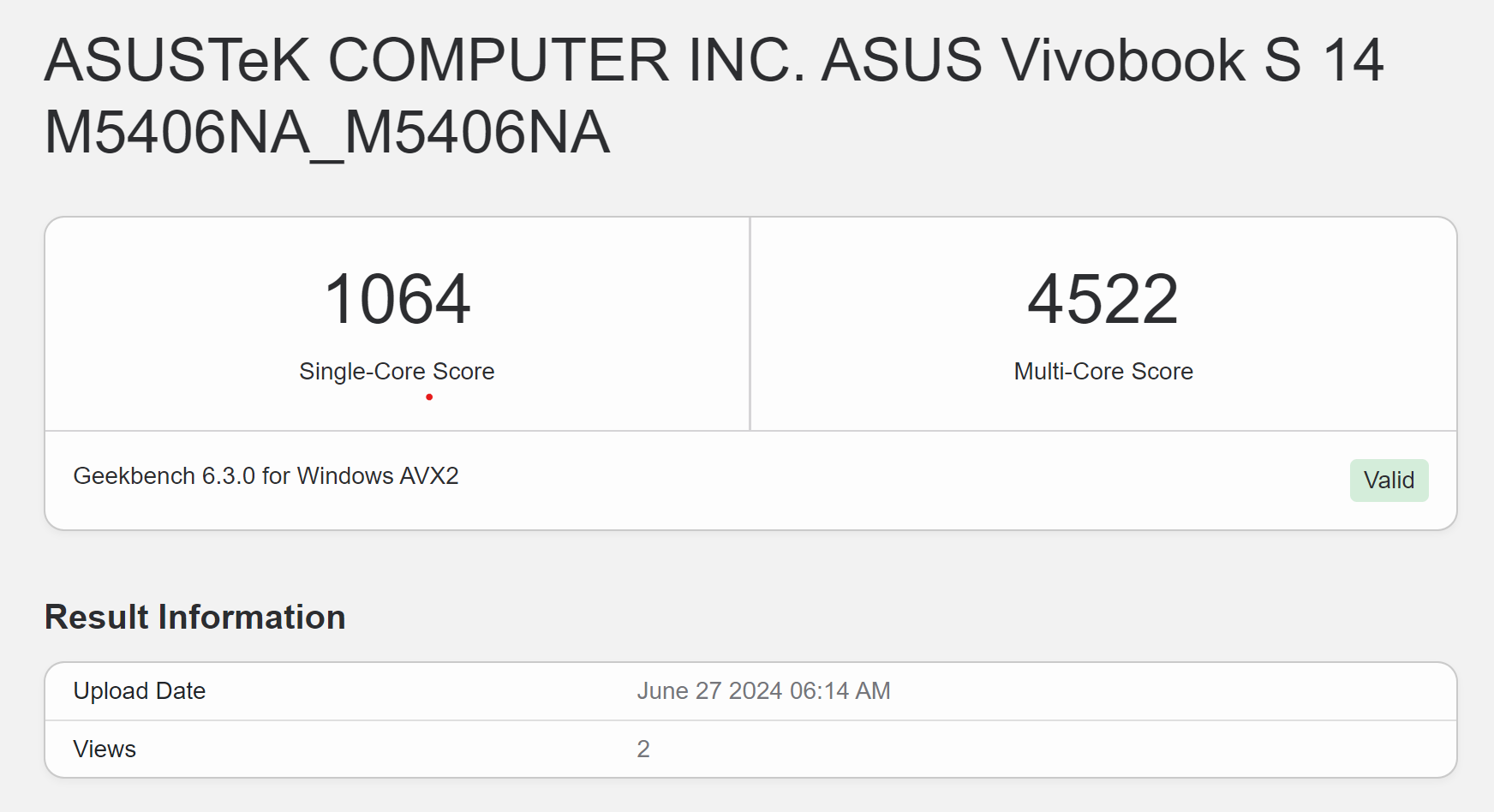
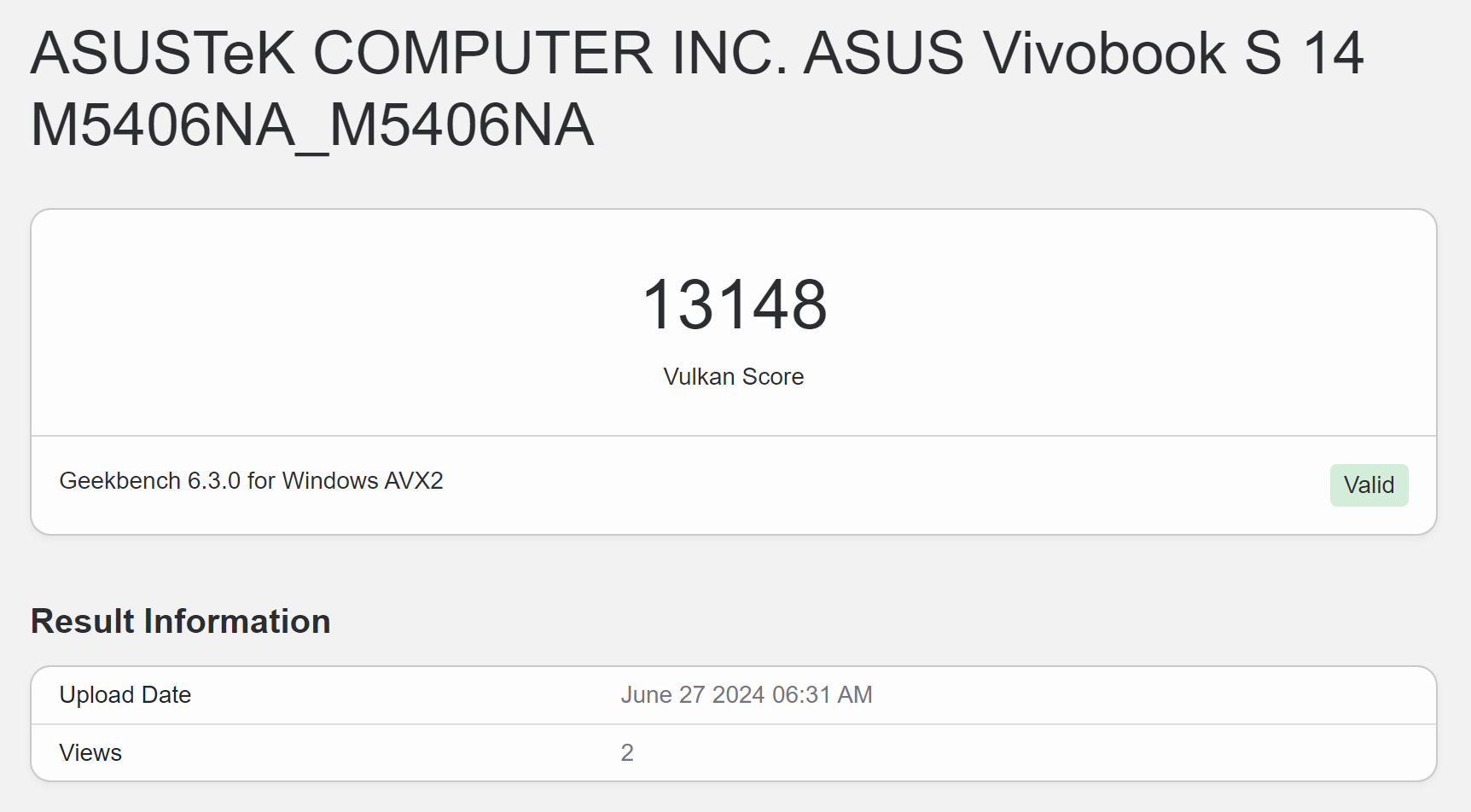
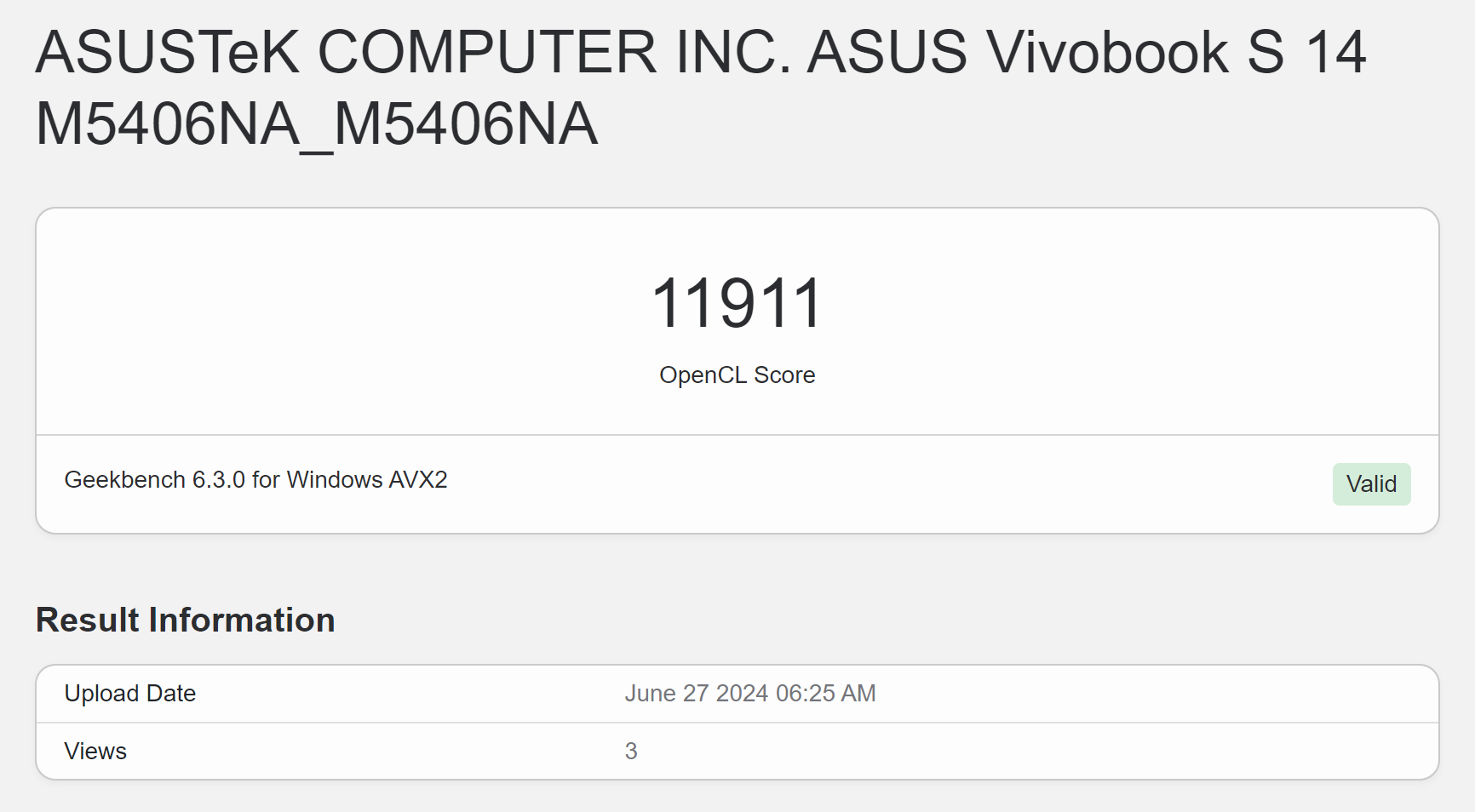
The thermals are kept under control by dual heat pipes and cooling fans. With this hardware config, the computer is capable of delivering adequate performance for day-to-day tasks and some more as you can notice from the attached benchmark scores.
The notebook is not as powerful as many in the price segment, especially those gaming models. But none of them offer a sleek body as this one. And more importantly, this computer is not meant for gaming.
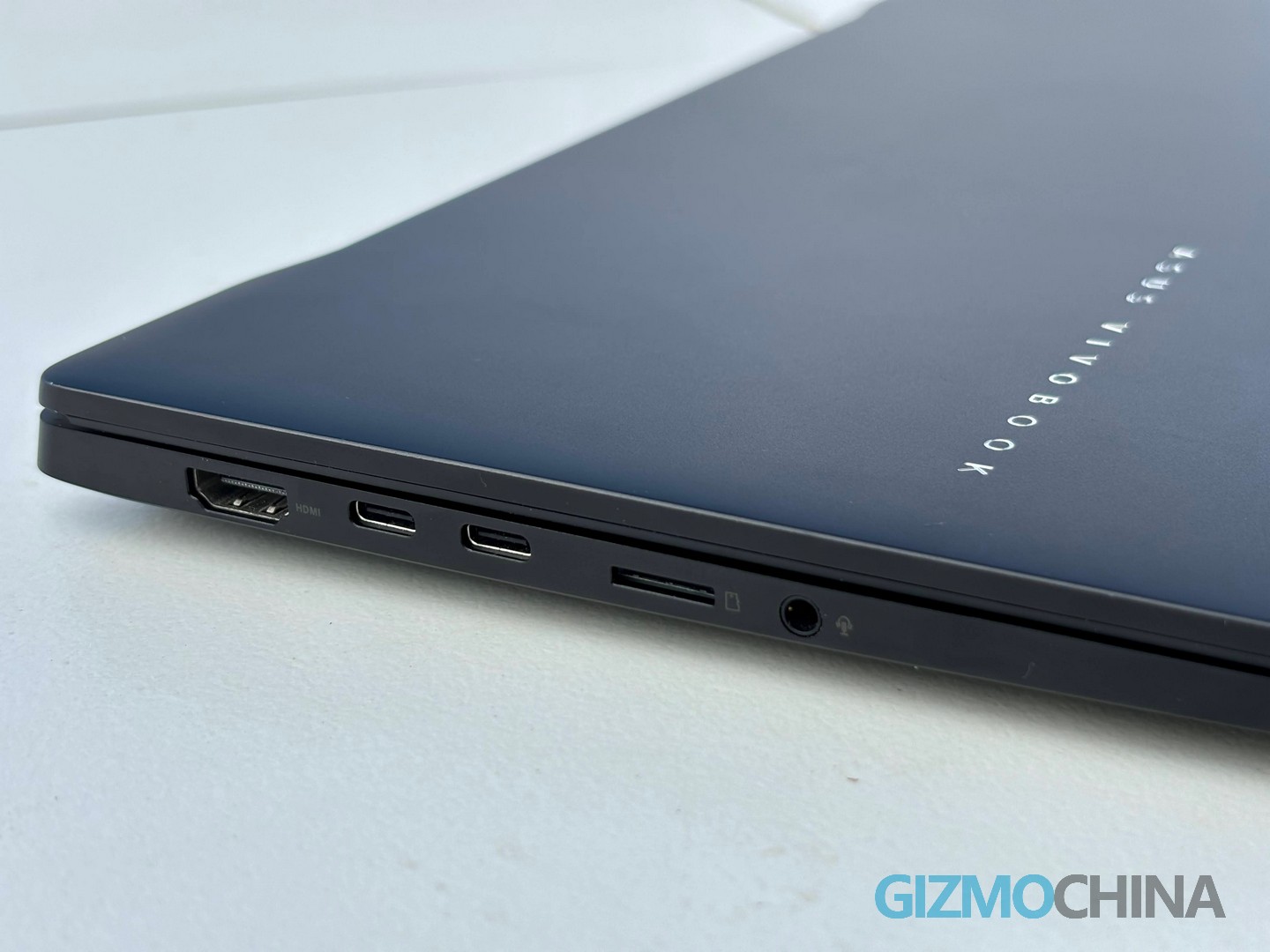
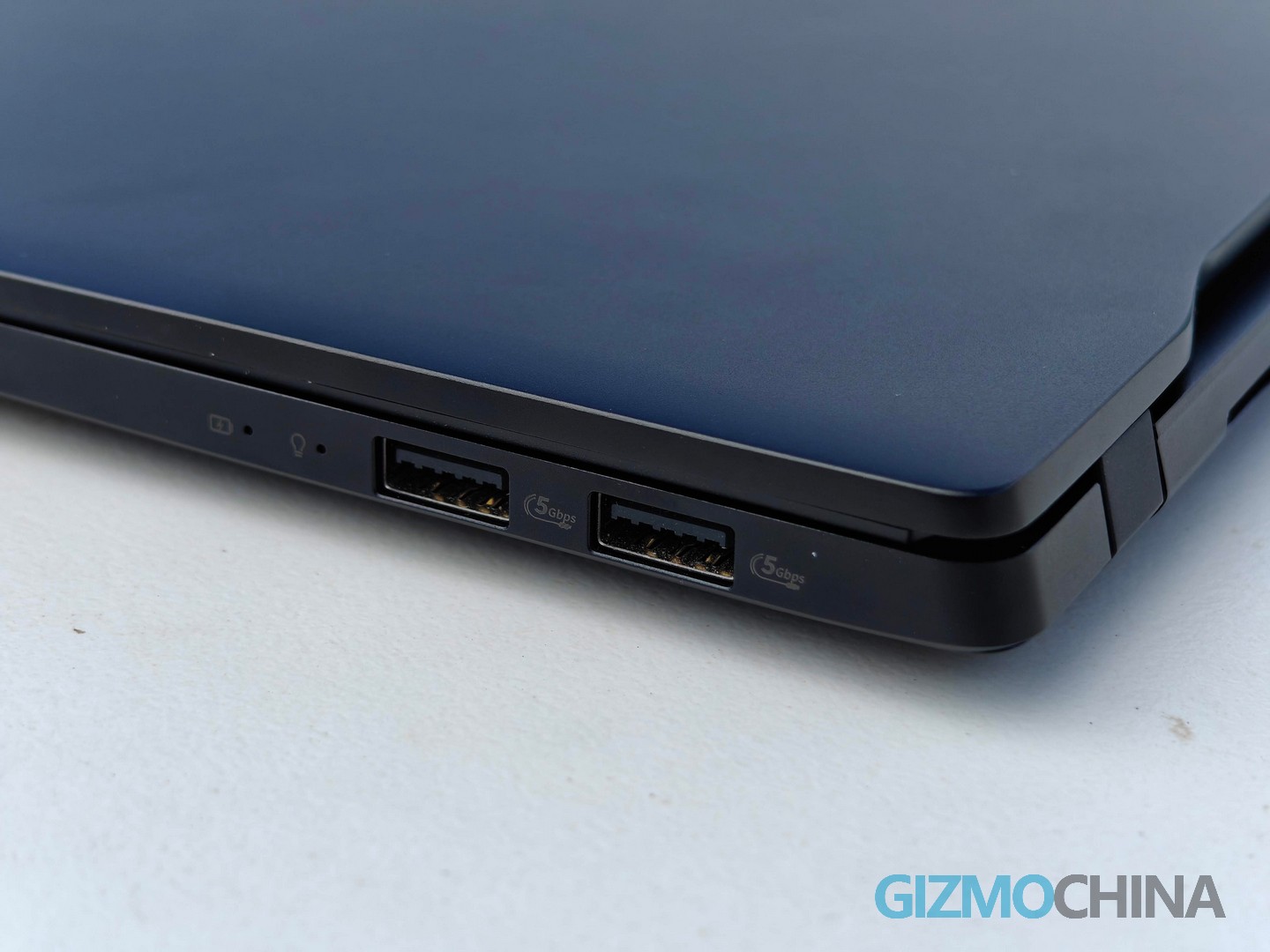
Anyways, Asus still provides several useful ports, such as 2 x USB 3.2 Gen 1 Type-C, 2 x USB 3.2 Gen 1 Type-A, an HDMI 2.1, a MicroSD card reader, and an audio jack.
As for software, the laptop boots Microsoft Windows 11 Home. It comes with a dedicated Copilot key, which could be useful for those who use the app often.
4. Lasts a Work Day
The Asus Vivobook S 14 (M5406) is backed by a 75 Wh battery. In my daily usage, I had to charge it only once a day.
My usage mostly includes web apps on Google Chrome and productivity apps like Microsoft Office. That’s what the targeted customers of this product would use.
So I believe the computer would survive the day for intended users with light to medium usage. If you are a heavy user, you may want to charge in between.
Talking about charging, the notebook takes about an hour and a half to charge fully from 20% with the included charger. Since it uses USB Type-C, it can be charged using any compatible USB PD power adapter and power bank ranging from 5-20V.
5. Should You Buy Asus Vivobook S 14 (M5406)?
At ₹89,990, the Asus Vivobook S 14 (M5406) is a compelling option in India if you could forego the lower resolution display.
But when you compare it with Asus Vivobook S 15 (S5506), that one makes more sense. It is ₹7,000 costlier with a price tag of ₹96,990.
For around a 7% price hike, you get a larger 15.6-inch OLED display offering a 3K (2880 x 1620 pixels) resolution and a 120Hz refresh rate. However, the Intel Core Ultra 5 125H processor underneath is slightly less powerful.
Anyways, if you strictly want a 14-inch notebook, the alternative from Asus is not ideal. So you have no option but to either buy Vivobook S 14 (M5406) if needed urgently or wait for a price drop.
As for competitors from other brands priced below ₹95,000, there are only two models as of writing this article. They are Lenovo Yoga Slim 7 Gen 9 and HP Pavilion Plus 14-ew1082TU.
Both these computers are powered by Intel Core Ultra 5 125H processor.
The HP model has a 14-inch WQXGA (2560 x 1600 pixels ) display with a 48-120 Hz refresh rate, however, the panel is IPS LCD. Also, it comes with only 512GB SSD. On the other hand, the Lenovo laptop is almost the same as Asus’ offering.
Grooves has launched the Delta Gaming TWS earbuds in India featuring a design inspired by spaceships in sci-fi movies.
Grooves Delta TWS specs & features
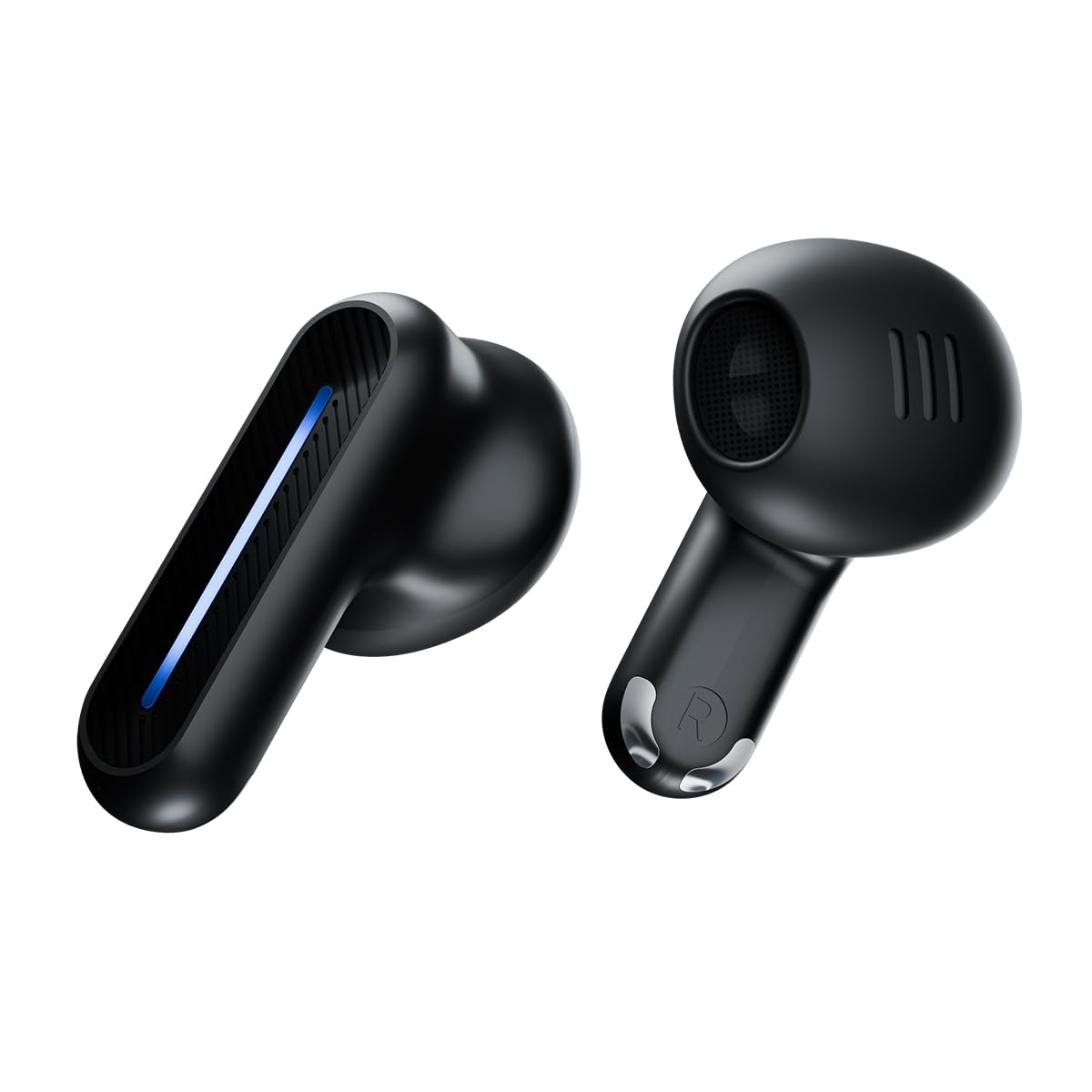
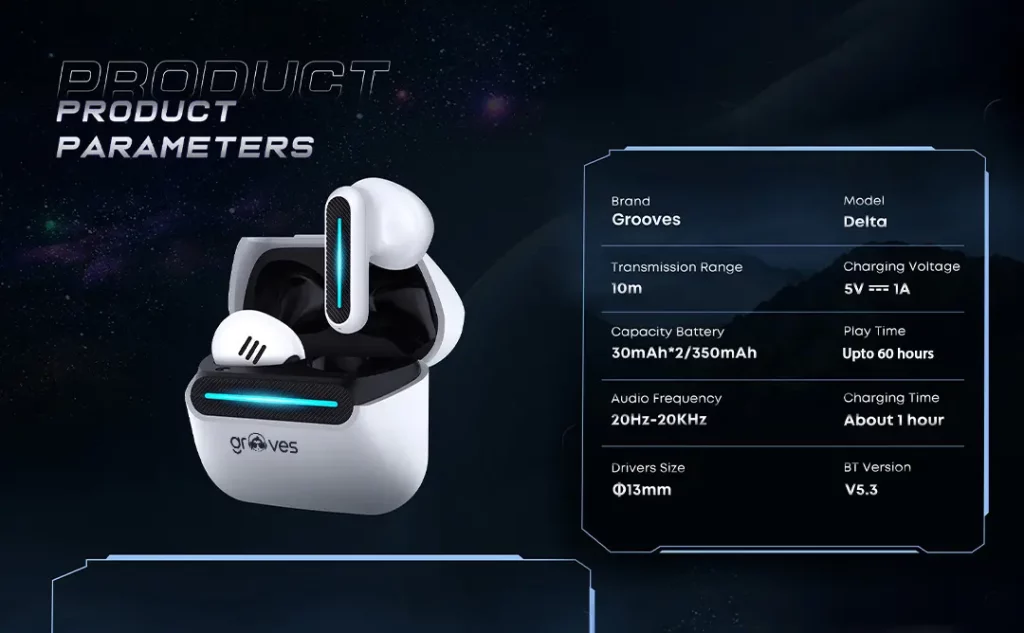
The Grooves Delta TWS targets gamers with its design, featuring colored LED accents on both the charging case and earbuds. As for the earbuds, they come with an open ear design, lacking silicone tips, making them comfortable to wear for people with sensitive ear canals.
The Delta TWS prioritizes performance with Bluetooth v5.3, Beast Mode for low latency (51ms), and powerful 13mm drivers for immersive audio. Dual mics with ENC guarantee clear communication during gameplay, while touch controls provide easy volume management.
It has a 400mAh battery in the charging case, which supports fast charging technology. Users can enjoy up to 120 hours of playtime and an impressive 21 days of standby time. For convenient fast charging, it has a Type-C port.
Pricing & availability
The Grooves Delta Gaming TWS is priced at Rs. 1,699 and is available in Black and White. It can be purchased from major online retailers including Amazon.in, Flipkart, Tata Cliq, JioMart, and Moglix.
In related news, Boult has recently launched three new earbuds in India in collaboration with Ford Mustang. All three earbuds feature Mustang-themed aesthetics and come with 45ms in Combat Gaming Mode along with a battery life of up to 100 hours. Despite their premium aesthetics, these earbuds are quite affordable.
European telecommunications giant Vodafone, chipmaker Qualcomm, and smartphone manufacturer Xiaomi have announced a successful test of new 5G technology that achieved download speeds of nearly 1.8 gigabits-per-second (Gbps).
Conducted in Germany and Spain, the tests utilized a more efficient data transmission method called 1024 quadrature amplitude modulation (QAM), an upgrade from the current 256 QAM system. 1024 QAM reportedly allows for more data to be packed into each transmission, translating to faster download speeds for users.
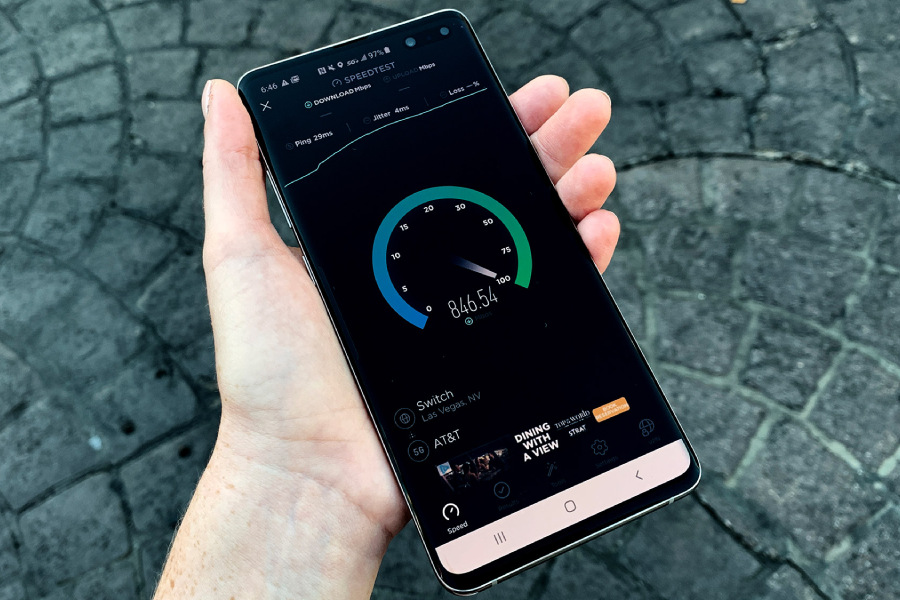
The test device used was Xiaomi’s latest flagship, the 14 Ultra, equipped with Qualcomm’s Snapdragon X75 5G Modem-RF System. The results varied slightly across locations: in Germany, the test showcased a roughly 20% throughput improvement on a commercial network over a distance of 600 meters. However, it was Vodafone’s 5G test center in Ciudad Real, Spain, that witnessed the impressive peak download speed of 1.8 Gbps.
The impact of 1024 QAM may extend beyond raw speed. Vodafone says the increase in speed and data throughput will increase network capacity, allowing it to support more users in congested areas like shopping centers. Theoretically, 1.8 Gbps could provide a capacity gain of up to 25% in ideal conditions, claims Vodafone.
“The successful trials conducted in Germany and Spain with Vodafone and Xiaomi are proof that we are continuing to push the boundaries of what is possible with 5G technology,” said Qualcomm’s Dino Flore in a statement.
Vodafone expects that this new technology will be widely available by 2025. However, it’s important to note that not all current 5G devices may be compatible with it.
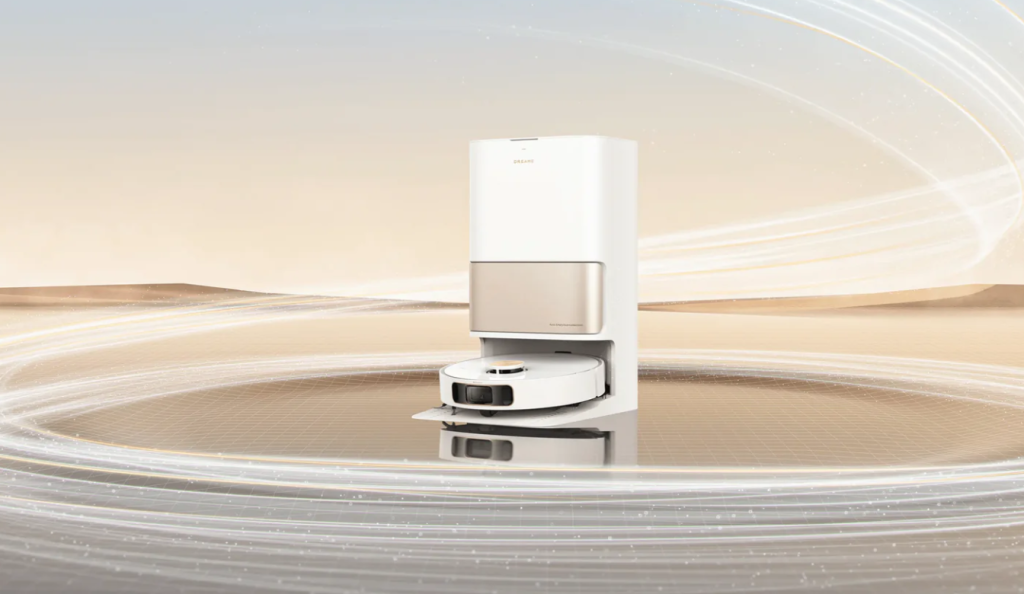
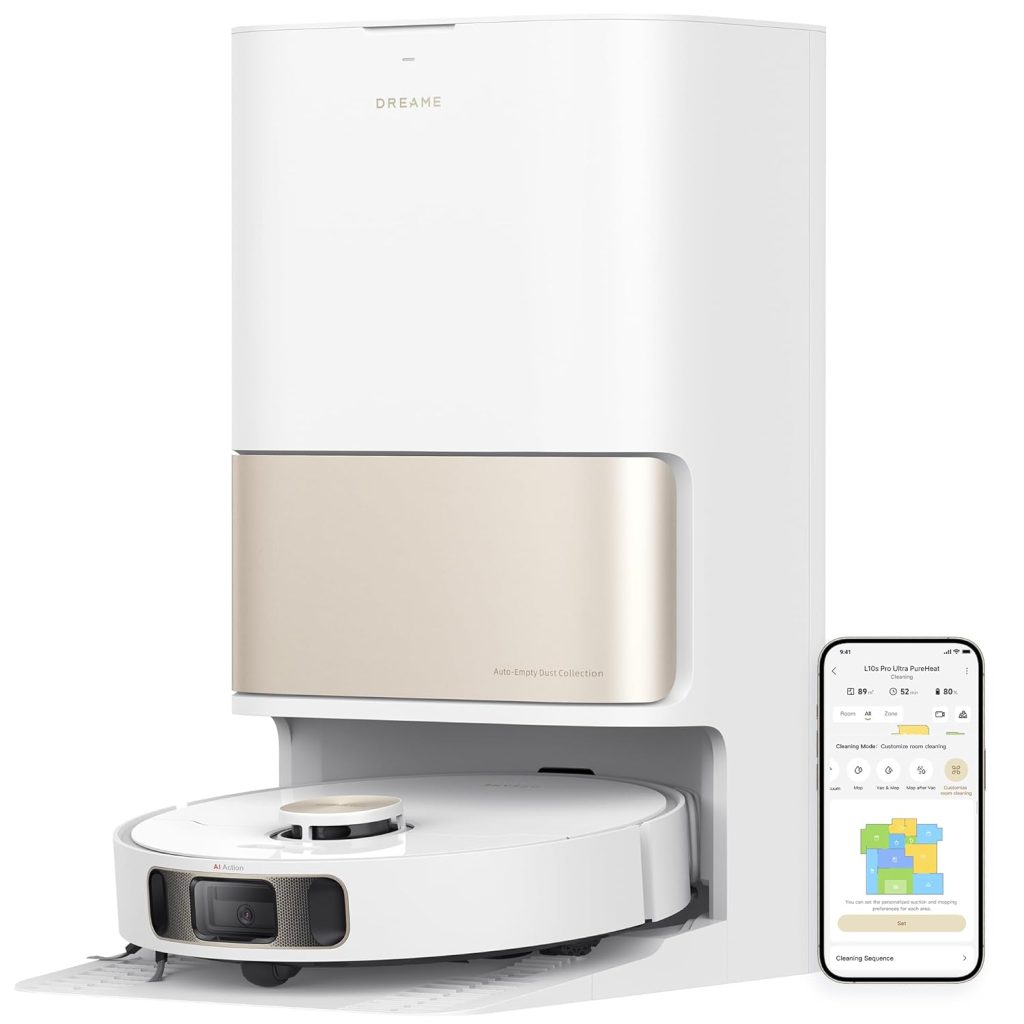
Dreame Technology has introduced the L10s Pro Ultra Heat, a robot vacuum designed for effortless home cleaning in India.
Dreame L10s Pro Ultra Heat robot vacuum specs & features
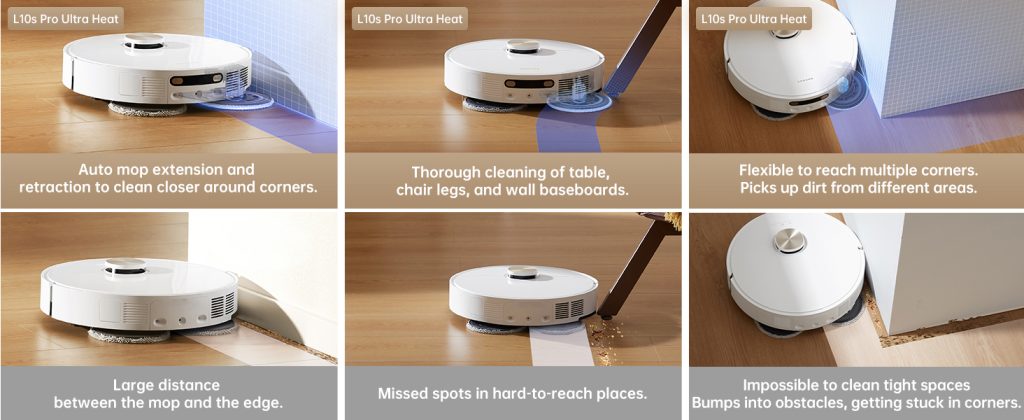
The L10s Pro Ultra Heat comes with MopExtend technology, a first for the Indian market, promising improved cleaning across various floor types. The L10s Pro Ultra Heat boasts a powerful 7,000 Pa suction with a quiet operation, tackling dirt effectively.
The L10s Pro Ultra Heat combines functionality with a sleek design featuring gold accents. Packed with features like auto-empty, mop self-cleaning, and water refilling, it boasts TÜV Rheinland certification for cleaning efficacy. It also has Hot water mopping and smart rewashing capabilities to remove odors and leave floors spotless.
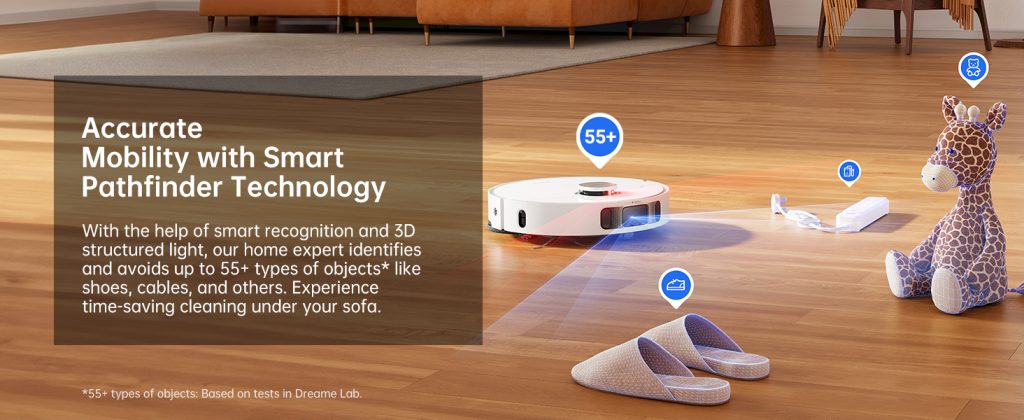
The L10s Pro Ultra Heat learns your home layout with CleanGenius technology, adjusting cleaning strategies for different floor types and furniture placement. It has Pathfinder technology with smart scanning that creates accurate maps and navigates around obstacles, avoiding over 55 object types.
The vacuum also has a DuoScrub mopping system that utilizes dual rotary mops and pressurized scrubbing for a deep clean, while a smart water tank automatically refills for uninterrupted cleaning. Smart carpet cleaning technology adjusts suction for carpets and offers quiet operation on a single charge that lasts up to 220 minutes.
Pricing & availability
The Dreame L10s Pro Ultra Heat has launched in India for Rs. 79,999, available through Amazon. Customers can avail of discounts and No-cost EMI options during the Dreame Prime Day sale from July 16 to June 22.
In related news, Xiaomi has also launched a robot vacuum cleaner in India called the Xiaomi X10. Priced at Rs. 34,999, the X10 has a suction power of 4000Pa and uses smart navigation to clean efficiently. The automatic emptying station has a strong suction of 17000Pa, making dustbin maintenance easier. It can vacuum and mop, with an adjustable water flow system and a 200ml water tank. The battery lasts up to 180 minutes, allowing it to clean areas up to 2500 square feet.
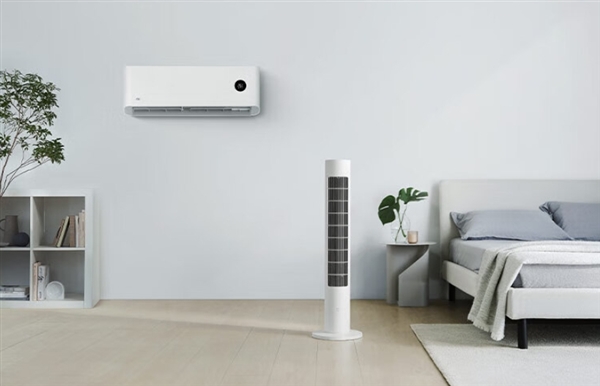
Xiaomi has released a statement in the wake of the Gree Electric patent infringement lawsuit against the company. Xiaomi responded via its official Weibo page, saying it has not received any environmental appliance-related lawsuits. The company didn’t provide any further statement.
It was previously reported that Gree Electric Appliances Co. Ltd instituted a lawsuit and had gotten judgment in its favor against Xiaomi for infringement on the Xiaomi MIJIA electric fan (reportedly the MIJIA DC Inverter Tower Fan). The judgment sum against Xiaomi was specified as 1.85 million yuan ($254,000). However, the court documents indicated that the defendants were Dongguan Jingdong Lisheng Trading Co. Ltd and Zhejiang Xingyue Electric Co. Ltd.
Gree Electric in its earlier statement, noted that it had received the Supreme People’s Court Intellectual Property Civil Final No. 1123 legal document (2023) issued by the Supreme People’s Court on June 18, 2024. The fallout of the judgment, according to Gree Electric, was that The Xiaomi MIJIA electric fan mentioned in the infringement shall no longer be manufactured and sold. The company, based on the reported judgment, warned all infringing entities to immediately stop producing and selling the infringing products. It concluded that it would take legal measures to safeguard its legitimate rights and interests.
It is therefore unclear under what basis is Xiaomi rebutting the Gree Electric claims. The full optics of the verdict will become clear in the coming days. It could be that Xiaomi bought the infringed component from a third party and so, may not be directly liable to the stated judgment.
Huawei has kicked off the second phase of its HarmonyOS NEXT developer beta program, offering another chance for developers and early adopters to test the upcoming operating system on select Huawei devices.
This latest testing phase is open for applications until July 26th, 2024, at 3:00 PM PST. Applications submitted during this window will be reviewed between July 13th and August 5th, with a processing time of 3-7 business days.
The program includes the same devices as the first phase: the Mate 60 series smartphones, Mate X5 foldable phones, and MatePad Pro 13.2 tablets. Those interested in participating, whether developers or regular users, must meet certain requirements.
First, users need to have a compatible device with the latest baseline build installed. Developers must be registered with the Huawei Developer Alliance and complete the real-name verification process. Additionally, everyone needs to sign a confidentiality agreement and pass a registration questionnaire before submitting their details.
This phase offers 5,000 slots for testers, so users are encouraged to register early to increase their chances. Selection will be based on a combination of factors, including the information provided in the application.
Those interested can find the registration links below, but it’s important to remember that this is a beta program. Beta builds can be unstable, may cause data loss, and might not work well with all existing apps. It’s crucial to back up all essential data before installing the beta update, either on a PC, cloud storage, or another external device.
For more information and registration details, please refer to the official Huawei developer resources:
With the second phase of the beta program underway, Huawei is gathering further feedback and testing the stability of HarmonyOS NEXT before its wider release.
Elon Musk‘s Neuralink, a company developing brain-computer interfaces, has set an ambitious target: implanting chips in over 1,000 patients by 2026. This announcement came via Musk’s X (Twitter) platform on July 11th.
Patients who’ve been paralyzed from the neck down can now use devices
The technology appears to be life-changing for some. Noland Arbaugh, the first person to receive a Neuralink implant, publicly shared how it improved his life. Previously paralyzed from the neck down, Arbaugh struggled to interact with technology. After surgery, he can now use devices and even play video games with ease.
However, there have been setbacks. A small wire in Arbaugh’s brain shifted in May. Despite this, a Neuralink executive recently assured that the brain-computer interface chip’s condition is now “more or less very stable.”
During a live broadcast earlier on July 11th (Beijing time), Musk elaborated on Neuralink’s future goals. He aims to implant the chip in thousands of patients within a few years.
Neuralink’s technology allows patients to control robotic limbs with their minds, exceeding the speed of natural brain-limb connections. Musk envisions an even grander purpose: establishing a symbiotic relationship between humans and artificial intelligence to ultimately mitigate the risks AI poses to civilization.
Samsung launched a new display, the ViewFinity S8 (S80D), available in 27-inch and 32-inch models starting at 1799 yuan (approximately US$269) and 1849 yuan (approximately US$275) respectively.
The S80D is available in two sizes, 27-inch and 32-inch
The display boasts a high-resolution 3840 x 2160 picture with 1.07 billion colors, 350 cd/m2 brightness, and 99% sRGB color gamut. It also supports HDR10 for enhanced visuals. Connectivity options include HDMI, DP, USB-A, and USB-B ports.
For user comfort, the ViewFinity S8 (S80D) features TÜV certified intelligent eye protection technology and an ergonomic design. Installation is easy and requires no tools. The adjustable stand allows for tilting, lifting, swivelling left and right, and even rotating the display to a 90-degree vertical position for portrait mode viewing.
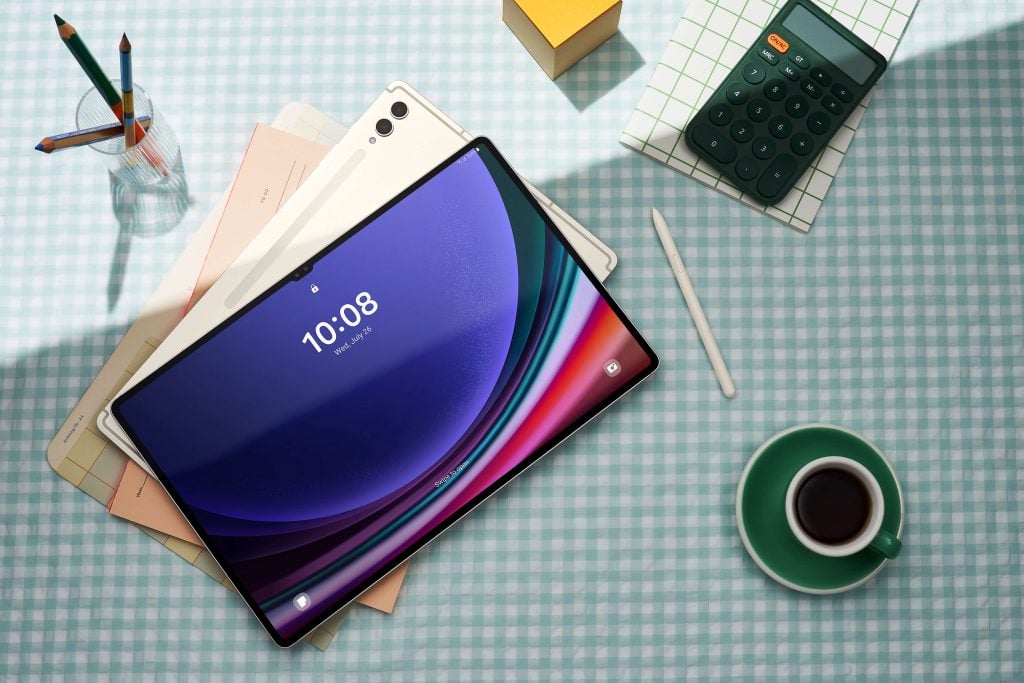
Samsung is expected to make some changes to its high-end tablet lineup starting with the Tab S10 series by dropping the base 11″ model and focusing on the Tab S10 Plus (12.4″) and Tab S10 Ultra (14.6″). But when the lineup is going to launch? The company just launched a bunch of new products in the second Galaxy Unpacked event of the year including the sixth generation Galaxy foldable, the Galaxy Watch 7 series, and the redesigned Galaxy Buds 3 series. But we didn’t see the Galaxy Tab S10 series in the event.
Tab S10 series will launch before the end of this year
Well, a Samsung South Africa representative has revealed that “there will be a Tab S10 series,” which will reportedly launch before the end of this year. For reference, the Tab S9 series was launched in July last year. However, he couldn’t share any more information about the upcoming tablets.
The decision to drop the smallest variant could be aimed at offering better specifications and competing with Apple’s offerings.
What to expect?
Samsung generally offers good quality AMOLED panels, and good design and powers it with a flagship snapdragon chipset. The upcoming tablets are also expected to come with some Galaxy AI features. While rumors and a Geekbench listing have hinted that Samsung will use the MediaTek Dimensity 9300+ chipset to power the Tab S10 series, we can still refer to the other aspects of the predecessor to get an idea of what to expect.
Both the Tab S9+ and Tab S9 Ultra come with an aluminum frame and back, which supports nano SIM, and eSIM. Both of them pack Dynamic AMOLED 2X panels measured at 12.4″ and 14.6″ respectively and Corning Gorilla Glass protection on top. The Tab S9+ offers 256GB 12GB RAM, and 512GB 12GB RAM configurations while the Ultra model comes with additional 1TB 12GB RAM and 1TB 16GB RAM variants.
Speaking of cameras, both of them pack a 13MP main and an 8MP ultrawide on the back alongside a 12MP one on the front for video calling. The tablets support Wireless Samsung DeX through the USB C 3.2 port. The Plus and Ultra models come with 10090mAh and 11200mAh batteries and supports 45W wired charging. Here are the pricing of all the storage variants of the Tab S9 series models at launch.
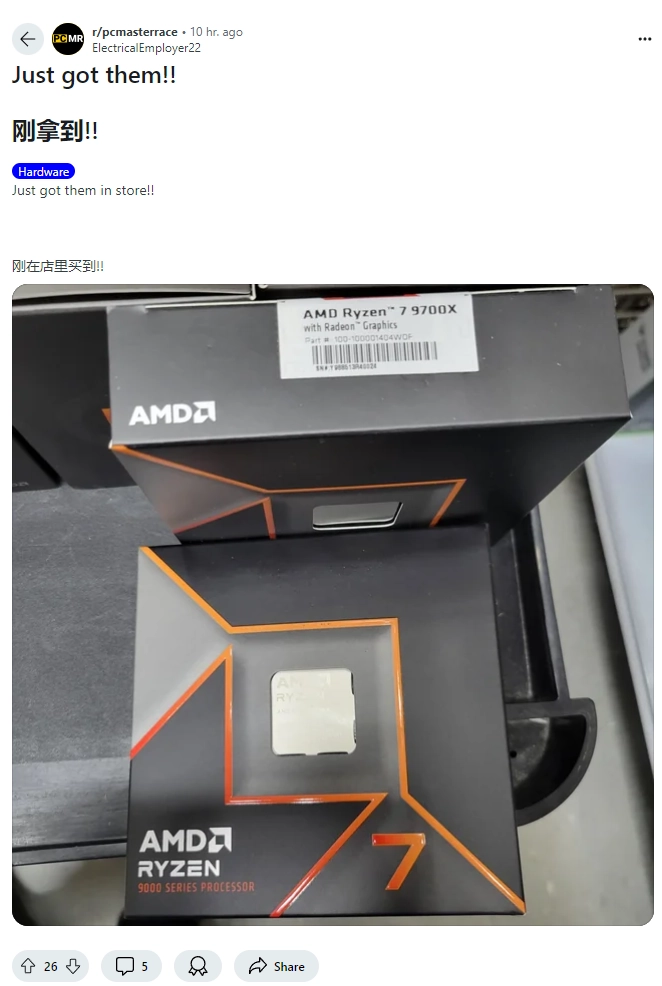
An image of what appears to be a retail box for the unreleased AMDRyzen 7 9700X processor has surfaced online. This CPU is part of AMD’s upcoming Ryzen 9000 series, rumored to be available for pre-order by the end of July according to retailer B&H. Reddit user u/ElectricalEmployer22 purchased the unlisted processor from a dealer, and leaks revealed some details about the new series.
Pricing is expected to be similar to the current Ryzen 7000 series
The Ryzen 9000 series will be built on AMD’s latest Zen 5 architecture. While the new processors will require a new AM5 motherboard, most major manufacturers are expected to have compatible options available at launch, likely requiring a BIOS update. Pricing is expected to be similar to the current Ryzen 7000 series, ranging from $299 to $699.
In terms of performance, the Ryzen 9000 series boasts up to 16 cores and 32 threads, with continued support for SMT (simultaneous multithreading). AMD also claims a significant 16% improvement in IPC (instructions per clock) compared to the previous Zen 3 architecture.
The leaked information mentions four specific Ryzen 9000 CPUs:
It’s important to keep in mind that this information is based on leaks and speculation. We’ll need to wait for AMD’s official announcement to confirm details on pricing, specifications, and availability.
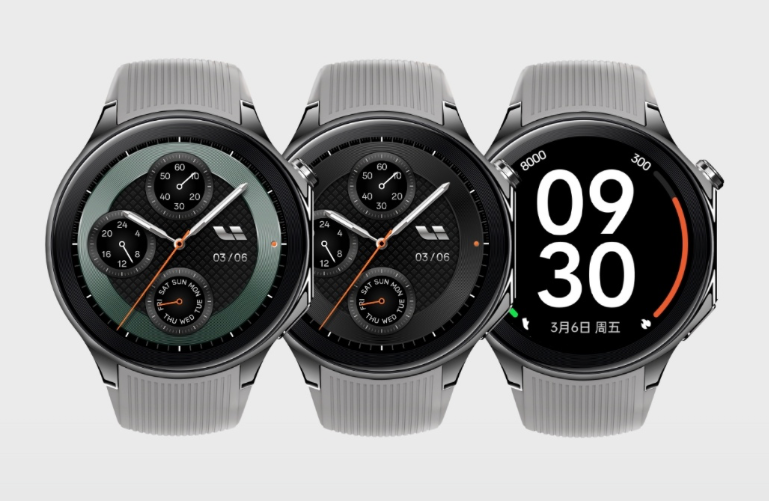
Oppo launched the Watch X smartwatch earlier this year with a price tag of around $300. Today the company launched an Ideal Auto Custom Edition of the Watch X. So let’s take a look at the changes.
Oppo Watch X Ideal Auto Custom Edition
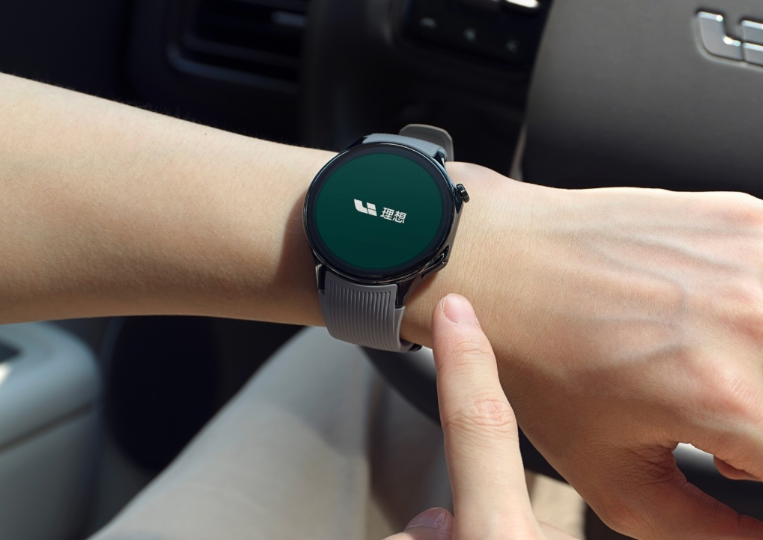
This watch uses the same elephant gray strap as the Ideal MEGA. It also offers a customized buckle with the Ideal LOGO, with an exclusive star ring dial (optional green/black/Baby Blue and other colors). In addition to all of that, the power on-off animation is also customized by Ideal.
The Ideal Auto app comes pre-installed with this watch, which lets you remotely adjust the car windows and air conditioning. The watch features a shortcut key in the lower right corner that allows users to open an app with a single click. It also supports smart car key functionality, enabling the watch to unlock and lock the car as you approach or leave it.
The Oppo Watch X Ideal Auto Custom Edition is equipped with a sapphire crystal mirror and an integrated stainless steel case. The drop resistance is reportedly improved by 4 times. It boasts the Snapdragon W5 wearable chipset. With eSIM support, the watch can send and receive calls and text messages independently without a smartphone. You can also use the WeChat Watch version with this product.
Speaking of battery life, the watch can last up to 4 days in “full intelligent mode” and up to 12 days in “light intelligent mode”. This product supports 8-channel heart rate and 16-channel blood oxygen among some other health-tracking features.
Pricing and availability:
The Oppo Watch X Ideal Auto Custom Edition is currently listed on the Ideal Mall App and is priced at 2,299 yuan, which is equivalent to $320. The product is also available on JD.com for the same price. Notably, the OPPO Watch X was released at the same starting price.
Foxconn, Apple’s main supplier, is ramping up its hiring efforts to prepare for the highly anticipated launch of the AI-compatible iPhone 16 this autumn. Apple expects high demand for the iPhone 16 due to its new AI features and aims to meet these projections.
Foxconn is offering attractive hourly wages and bonuses to attract workers. In Zhengzhou, the hourly rate is 25 yuan (US$3.44), and returning workers can earn bonuses of up to 7,500 yuan. This is an increase from the 6,000 yuan bonus offered just a month ago. Local labor agencies promote these high-paying jobs for temporary and returning employees.
In Shenzhen, Foxconn is also boosting its workforce. Temporary workers are being offered an hourly wage of 21-22 yuan, while returning permanent workers can earn up to 6,000 yuan monthly for the first three months, with potential pay rises for longer stays.
iPhone 16 Features and Expectations
The new iPhone 16 is expected to feature advanced AI capabilities through the Apple Intelligence platform, which was announced at the WWDC in June. This innovation is likely to drive a wave of device upgrades among consumers. Apple aims to ship at least 90 million iPhone 16 units in the second half of the year, targeting a 10% growth compared to the previous generation.
Apple, which led smartphone sales in mainland China in Q4 last year, is currently ranked third behind Vivo and Honor. Despite experiencing a 19.1% sales drop in Q1, Apple saw a 2.7% year-on-year sales increase during the midyear online shopping season, thanks to substantial discounts.
During the 618 e-commerce promotion (May 20 – June 20), overall smartphone sales in China increased by 6.8% year-on-year. Huawei saw a significant 42.4% year-on-year sales increase, while Apple’s sales grew by 2.7% due to discounts of up to CNY 2,350 (US$326).
Foxconn’s intensified hiring efforts are crucial as they gear up for the iPhone 16 launch. With new AI features expected to drive consumer interest, Apple is poised to maintain its competitive edge in the market and meet its ambitious sales targets for 2024.
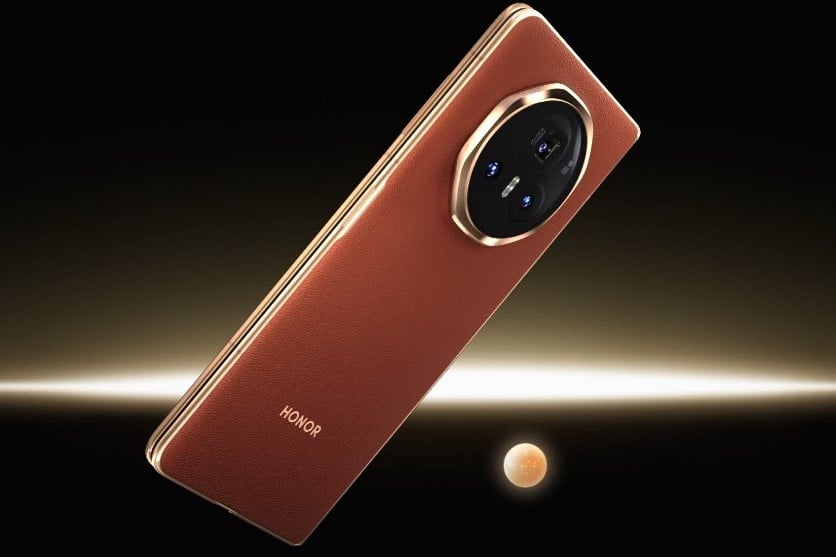
Alongside the launch of the Honor Magic Vs 3, the brand also unveiled the Magic V3 foldable phone. This is the more premium model among the two new devices. It packs premium flagship-level specifications and undercuts the recently released Samsung Galaxy Fold 6 by a big margin. The Magic V3 arrives as the successor to the last year’s Magic V2 which was crowned the world’s slimmest horizontal folding phone. Yet with the latest offering, the brand isn’t stopping as it has made the device more lighter and thinner. Read on to know everything below.
Honor Magic V3 specifications
Honor has beaten itself again by making the Magic V3 lighter than its predecessor. It measures 9.2mm (without including the camera bump) when folded and 4.35mm when opened. The weight has been trimmed to 226 grams only. The reduction in dimensions is quite commendable and puts the foldable phone on par with many slab phones. The brand claims that the device’s hinge is the thinnest to date measuring 2.84mm. It is rated to last 500,000 fold cycle.
The Honor Magic V3 comes with an octagonal-shaped protruding camera island on the back panel. The power button doubles up as an ultrasonic fingerprint scanner. It also has a 7-series aluminum alloy frame. The device is IPX8-certified, making it water-resistant up to 2.5 meters.
Coming to the display, the Honor Magic V3 has a 6.43-inch main screen with curved edges offering an FHD+ resolution, Internally, there is a 7.92-inch display bearing a resolution of 2,344 x 2,156 pixels. Both screens feature a 120Hz LTPO refresh rate, Dolby Vision, HDR Vivid, and support stylus. Honor says that the device offers 5,000 nits peak brightness but it’s unclear whether this figure applies for both screens.
In the photography department, the Honor Magic V3 sports a triple rear camera setup. It consists of a 50MP 1/1.56-inch main sensor with OIS, a 40MP ultra-wide-angle lens, and a 50MP periscope telephoto unit with support for 100x digital zoom and OIS. The device comes with a 20MP sensor housed inside the internal and external screens for selfies and video calling. Honor says that the Harcourt portrait mode will be rolled out in August.
Under the hood, the Honor Magic V3 is powered by a Snapdragon 8 Gen 3 processor. It packs up to 16GB RAM and 1TB storage. The brand has also incorporated a titanium heat dissipation system internally despite a slim profile. The foldable phone is backed by a 5,150mAh battery unit with support for 66W wired and 50W wireless charging. Software-wise, it runs on MagicOS 8 with various AI features, smart private call, parallel space, and more
The Honor Magic V3 also packs two-way satellite communication that lets you send texts over satellite when there is no cellular network. It also has an RF enhancement chip for boosting the network and a security chipset onboard.
The Honor Magic V3 carries a starting price tag of CNY 8,999 ($1,240) for the 12 + 256GB model. The 16GB + 512GB and 16GB + 1TB configuration cost CNY 9,999 ($1,380) and CNY 10,999 ($1,516) respectively. The device is offered in Silk Road Dunhuang (brown), Qilian Snow (white), Tundra Green, and Velvet Black colors. The foldable phone is expected to arrive in international markets just like its predecessor.
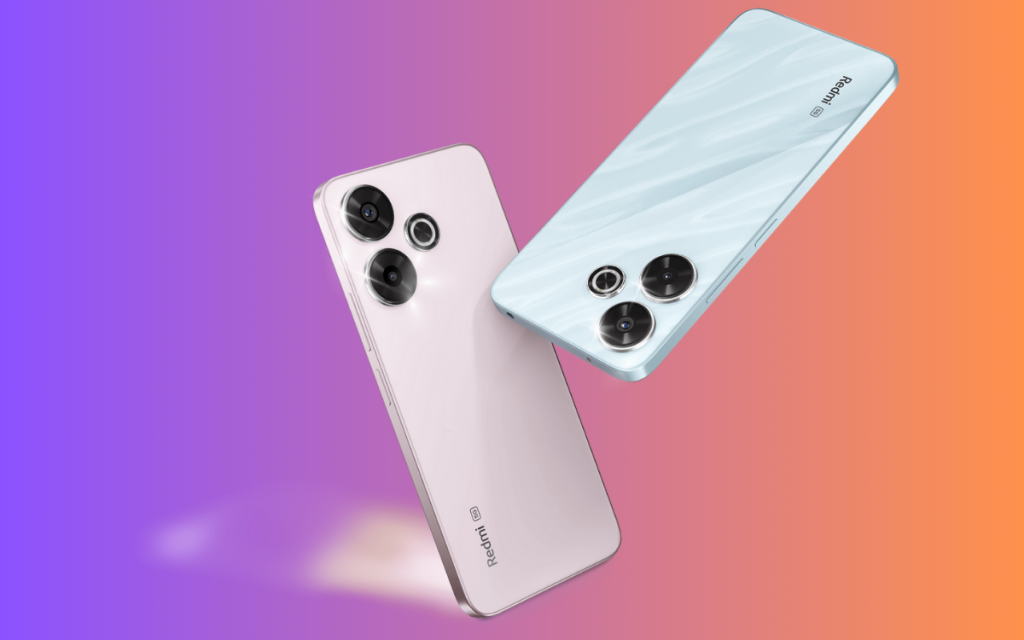
Xiaomi recently unveiled the Redmi 13 5G as an affordable mid-range 5G phone in India. Now, the HyperOS phone has officially gone on sale in the region. So here are all the details, like its specs, pricing, availability, and launch offers.
Redmi 13 First Sale: Pricing & Offers
The Chinese tech giant’s Redmi 13 5G has been officially announced in two storage configurations and multiple color options. You can get your hands on this device in a Black Diamond, Orchid Pink, and Hawaiian Blue. It has a starting price tag of 13,999 INR for the 6GB + 128GB variant, while the 8GB + 128GB option costs 15,999 INR. The company is offering a 1,000 INR discount on checkout for the 6GB version, and a 1,000 INR discount to ICICI and SBI credit card holders for the 8GB model. Redmi 13 is on sale via Amazon, Mi.com, and Xiaomi Retail stores.
Specifications
The brand’s new mid range phone sports a tall 6.79-inch LCD panel that offers FHD+ resolution and a 120Hz refresh rate. It has a center-aligned punch hole cutout on the front with Corning Gorilla Glass 3 protection. Under the hood, Xiaomi has equipped the Redmi 13 with a Snapdragon 4 Gen 2 AE SoC (Accelerated Edition). For optics, you get a 108-megapixel primary camera with a 2-megapixel macro shooter on the rear, while the front houses as 13-megapixel lens for selfies and video calls.
A large 5,030mAh battery pack powers this smartphone, which supports 33W wired fast charging. Other notable features include an IP53 rating for water and dust resistance, a microSD card slot for storage expansion of up to 1TB, Bluetooth 5.1, WiFi 6, a 3.5mm headphone hack, a side-mounted fingerprint scanner for security, and an Android 14 OS based HyperOS custom skin out of the box.
Xiaomi 14 Civi was launched recently, focusing primarily on cameras. It’s a flagship smartphone from the Chinese brand powered by a powerful Snapdragon 8s Gen 3 chip.
With the Xiaomi 14 Civi, the brand aims to capture the sub-Rs 50,000 category. No doubt, it’s a good smartphone at the price point. However, there are some great alternatives to this phone from other brands with comparable or better specs.
If you’re thinking of buying the Xiaomi 14 Civi, take a look at these alternatives to make a better purchase decision.
3,900 mAh battery 25W wired 15W wireless 4.5W reverse wireless
OS
Android 13
Connectivity
5G, Wi-Fi 6E, Bluetooth 5.3, NFC
The Galaxy S23 is an excellent alternative to the Xiaomi 14 Civi smartphone. It packs a more powerful chip and an excellent set of cameras.
The Galaxy device has a 6.1 inches, slightly shorter than the Xiaomi 14 Civi’s 6.55-inch screen. Both are AMOLED screens with 120Hz refresh rate and HDR10+ support. Notably, the Xiaomi phone has a peak brightness of 3000 nits, while it’s only 1750 nits on the Galaxy S23 Ultra. So, the content would look better on the Xiaomi device outdoors.
The Xiaomi 14 Civi has a Snapdragon 8s Gen 3 chipset, whereas the Galaxy S23 5G has a Snapdragon 8 Gen 2. Both are high-performance flagship chipsets that can smoothly handle processing needs for most people. They have comparable CPU performance. However, the Snapdragon 8 Gen 2 has better GPU performance. So, naturally, you can expect better gaming performance on the Galaxy S23.
The Xiaomi 14 Civi has a large circular camera module on the rear side that houses three sensors and an LED flash. The Galaxy S23 also has three camera sensors on the back, but are arranged vertically. It includes a 50MP primary sensor (OIS, f/1.8 aperture, 1/1.56″ sensor size), a 10MP telephoto lens (OIS, f/2.4 aperture, 1/3.94″ sensor size, 3x optical zoom), and a 12MP ultrawide lens (f/2.2 aperture, 1/2.55″ sensor size, 120˚ field-of-view).
For selfies and video calls, there’s a 12MP sensor.
The Galaxy S23 5G can record 8K videos at multiple frame rates, which the Xiaomi 14 Civi can’t. The Xiaomi phone only supports up to 4K recording.
The Galaxy S23 has a 3,900 mAh battery and supports 25W fast charging. Xiaomi 14 Civi, on the other hand, has a 4,700 mAh battery and supports 67W fast charging. Here, the Samsung phone is clearly behind the Xiaomi 14 Civi.
Both smartphones support USB Type-C, although the Samsung phone has a newer generation of USB-C support. This means faster data transfer on the Galaxy S23 compared to the Xiaomi 14 Civi.
2. OnePlus 11
OnePlus 11
Display
6.7″ LTPO Fluid AMOLED 1440 x 3216 px resolution 120Hz, HDR10+, 1300 nits (peak) Corning Gorilla Glass Victus
OnePlus 11 was released last year, though it’s still a great alternative to many flagship phones launched this year, including the Xiaomi 14 Civi.
The smartphone has a slightly bigger screen and more pixels per inch (PPI) than the Xiaomi 14 Civi. Both smartphones support HDR10+ and 120Hz refresh rate, although the Xiaomi phone has more colours and higher peak brightness.
At the core of the OnePlus 11 is the Snapdragon 8s Gen 3, which is less powerful than the Snapdragon 8 Gen 2 (in the Xiaomi 14 Civi), specifically the GPU performance. As a result, the OnePlus 11 handles gaming better than the Xiaomi 14 Civi.
Notably, the 128GB version of the OnePlus 11 supports UFS 3.1, but higher models support UFS 4.0. So, if you care too much about the performance, consider UFS 4.0.
The camera arrangement on the OnePlus 11 is similar to the Xiaomi 14 Civi, although it blends with the frame on the OnePlus 11. The OnePlus phone has a 50MP primary sensor (OIS, f/1.8 aperture, 1/1.56″ sensor), a 32MP telephoto lens (f/2.0 aperture, 1/2.74″ sensor, 2x optical zoom), and a 48MP ultrawide shooter (f/2.2 aperture, 1/2.0″ sensor, 115˚ field-of-view).
The rear camera setup on the OnePlus 11 has Hasselblad colour tuning. The device can record up to 8K videos, while the Xiaomi 14 Civi can record up to 4K videos. For selfies, there’s a 16MP sensor on the front.
The OnePlus 11 packs a 5,000 mAh battery and supports 100W fast charging. According to the brand, it only takes 10 minutes to reach 50% and 25 minutes to 100%. In comparison, the Xiaomi 14 Civi has a lesser battery capacity and supports 67W fast charging only.
Vivo X80 looks strong on the spec sheet and has a similar pricing as that of the Xiaomi 14 Civi. The smartphone has a 6.78-inch AMOLED screen with 120Hz refresh rate support and 1500 nits of peak brightness (half of the peak brightness on Xiaomi 14 Civi).
The Vivo phone is powered by a MediaTek Dimensity 9000 chip, whereas the Xiaomi 14 Civi has a Snapdragon 8s Gen 3. Both are octa-core chips fabricated on a TSMC’s 4 nm process node and look similar on benchmarks.
The giant rear camera module on the Vivo X80 includes a 50MP primary sensor (OIS, f/1.8 aperture, 1/1.49″ sensor), a 12MP telephoto lens (f/2.0 aperture, 1/2.93″ sensor, 2x optical zoom), and a 12MP ultrawide lens (f/2.0 aperture, 1/2.93″ sensor).
The Vivo X80 can record up to 4K videos using its rear cameras and 1080p videos using the 32MP selfie camera. It is backed by a 4,500 mAh battery with support for 80W fast charging. The battery capacity is slightly lesser on the Vivo X80 but the charging speed is higher compared to the Xiaomi 14 Civi.
4. OnePlus 12R
OnePlus 12R
Display
6.78″ LTPO4.0 AMOLED ProXDR 1264 x 2780 px resolution 120Hz, HDR10+, 4500 nits (peak) Corning Gorilla Glass Victus 2
OnePlus 12R is another smartphone that is a good alternative to the Xiaomi 14 Civi.
The OnePlus phone features a 6.78-inch screen, which is slightly taller than Xiaomi 14 Civi. It’s an LTPO4 AMOLED panel with 120Hz refresh rate and HDR10+ support. While other phones in this list have a lower peak brightness than the Xiaomi 14 Civi, this one has a much higher value of 4500 nits.
Like the Galaxy S23 and OnePlus 11, the 12R is also powered by a Snapdragon 8 Gen 2 chipset. It has a better performance than the Snapdragon 8s Gen 3 inside the Xiaomi 14 Civi, especially when it comes to gaming.
The rear camera setup on the OnePlus 12R includes a 50MP primary sensor (OIS, f/1.8 aperture, 1/1.56″ sensor), an 8MP ultrawide lens (f/2.2 aperture, 1/4.0″ sensor, 112˚ field-of-view), and a 2MP macro lens (f/2.4 aperture). It can record up to 4K videos, whereas the 16MP selfie camera can record up to 1080p videos.
OnePlus 12R has a massive 5,500 mAh battery (vs. 4,700 mAh on Xiaomi 14 Civi) and supports 100W fast charging.
The cameras may not be as good as Xiaomi 14 Civi, but the OnePlus 12R definitely has a better display, battery life, and a high-performance chip.
Which one do you think is the best alternative to Xiaomi 14 Civi? Let me know your thoughts in the comment section below.
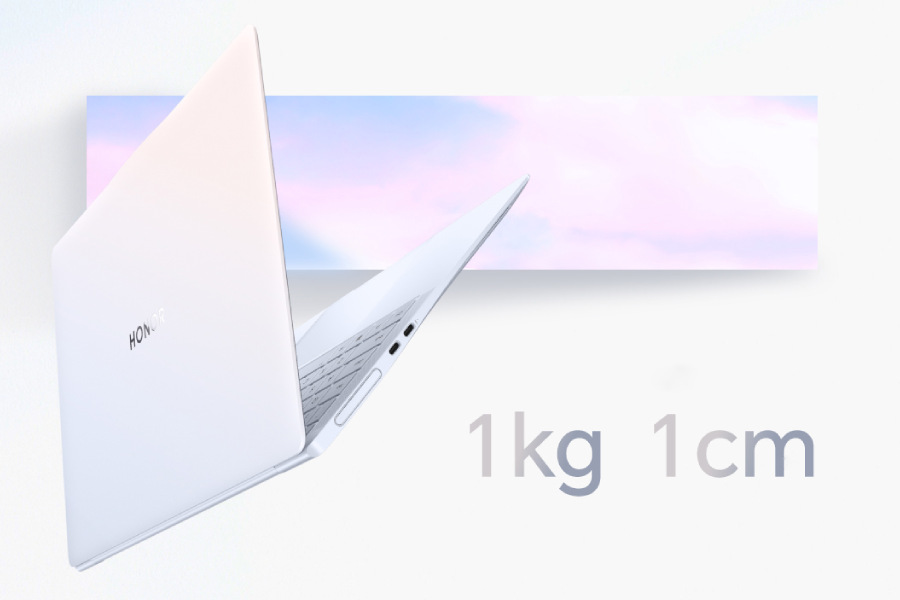
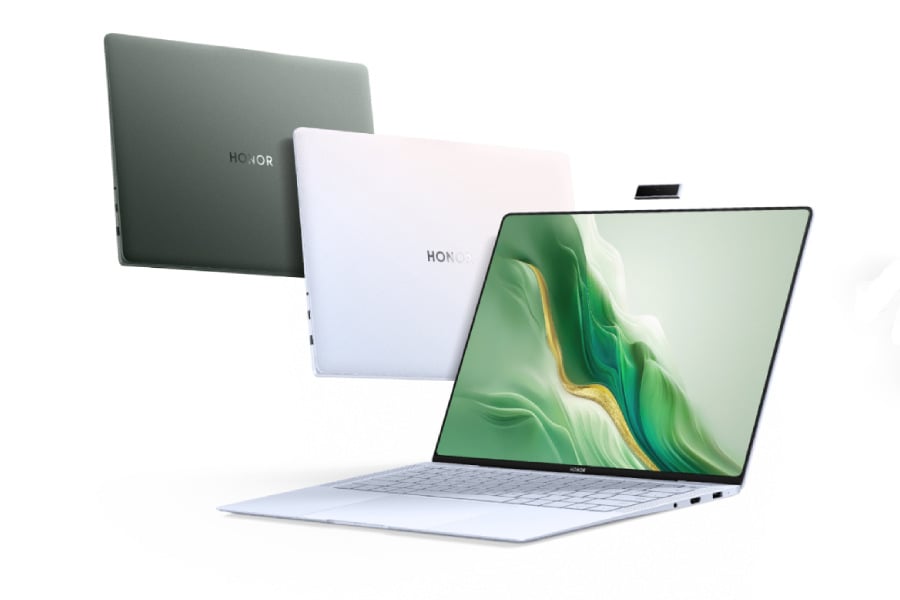
Honor has officially launched its newest addition to the MagicBook series, the Honor MagicBook Art 14, at a press conference today. This ultra-thin AI PC boasts a sleek design and impressive features, targeting users who prioritize portability and performance. Let’s walk through its details here.
Honor MagicBook Art 14 Specifications
Design is the key focus of this laptop, as you can tell by the name. Honor has constructed the MagicBook Art 14 with aerospace-grade materials, making it incredibly lightweight at 1.03kg (2.27 lbs) and only 1cm thick.
Despite its slim profile, it packs a 60Wh battery that can offer up to 9.5 hours of battery life on a single charge. Surprisingly, Honor hasn’t skimped on I/O options either —the laptop includes a comprehensive set of ports such as Thunderbolt 4, full-function USB-C, USB-A 3.2, HDMI 2.1, and a 3.5mm headphone jack.
The centerpiece of the laptop is a 14-inch OLED touchscreen display with a 3.1K resolution and a smooth 120Hz refresh rate. The screen has a peak brightness of 700 nits and covers 100% of the DCI-P3 color gamut for accurate color reproduction.
Most notable of all, Honor MagicBook Art 14 is the world’s first laptop to feature 4320Hz ultra-high frequency PWM dimming technology to minimize screen flickering and eye strain.
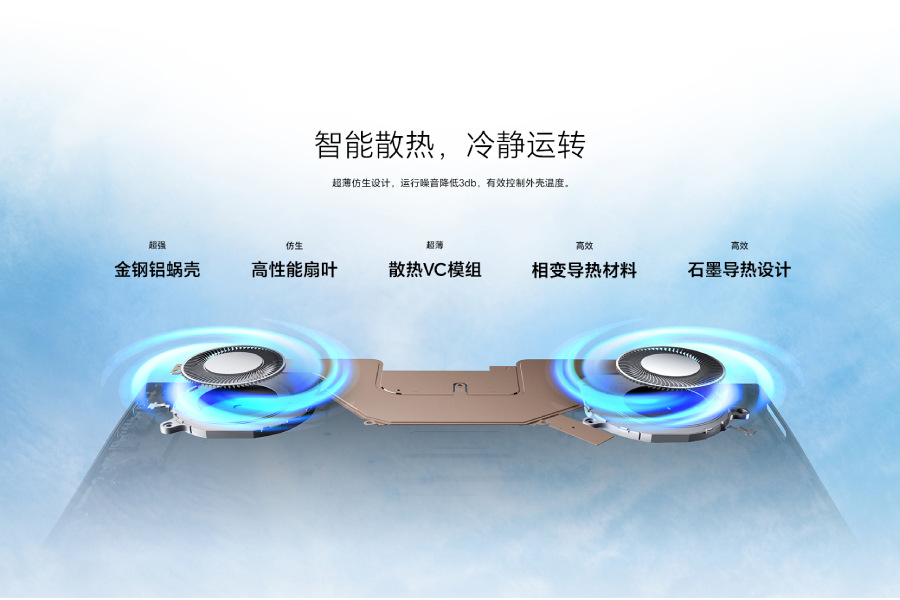
Performance-wise, you can choose between two processor options: Intel Core Ultra 5 and Core Ultra 7. And despite being an ultrabook, Honor has managed to include dual fans for heat dissipation. The memory option includes up to 32GB of RAM and 1TB of storage.
The company is also offering a suite of AI features with the MagicBook Art 14. These include AI smart search, AI knowledge Q&A, AI document summary, and AI-powered audio and video features like scene recognition, sound object separation, background noise elimination, and two-way noise reduction.
The MagicBook Art 14 prioritizes user privacy with a “Smart Eye” magnetic camera, allowing users to physically cover the camera when not in use for added security. On the audio front, the laptop features six professional-grade speakers coupled with Honor’s self-developed spatial audio algorithms.
Price and Availability
The MagicBook Art 14 comes in two color options: Sunrise Impression and Summer Olive. The price starts at 7,999 yuan ($1,105) for the variant with an Intel Core Ultra 5 chip, 16GB of RAM, and 1TB of storage. There’s also a 32GB memory variant of the same configuration, which costs 8,499 yuan ($1,170).
The Core Ultra 7 model is available in a single 32GB/1TB configuration for 9,499 yuan (~$1,310). You can purchase the laptop from Honor’s official site in China.
New information has surfaced regarding the upcoming Garmin Fenix E and Fenix 8 smartwatches, successors to the Fenix 7 series. These details come courtesy of leaks discovered by the publication Fitness Tracker Test (FTT) on authorized Garmin dealer websites.
Previously, a Finnish retailer, Multitronic, listed the Fenix 8 with a release window in September 2024. While we didn’t get a peek at the smartwatch design, the listing did reveal some specifications like size and colors.
The latest leak, from an Icelandic retailer, corroborates the September release timeframe and sheds light on design and display upgrades for the upcoming smartwatch.
The listing reveals that the Fenix 8 will come in a 43mm size at the smallest compared to the 42mm size of the Fenix 7s. But the most notable change could be in terms of display. The leak reveals that instead of the customary Memory In Pixel (MIP) displays, the Fenix 8 might adopt AMOLED technology.
While AMOLED displays will offer richer colors and deeper blacks, MIP displays are known for their excellent battery life. So it remains to be seen if the Fenix 8 can maintain similar endurance as the Fenix 7s on a single charge.
The Icelandic retailer listing also hints at a potential name change for the smaller-sized Fenix model. Traditionally, the smaller variant was designated “Fenix 7s”. The leak suggests Garmin might simply call it “Fenix 8” for the next generation, dropping the “s” moniker altogether.
Meanwhile, FTT speculates that the Fenix E will retain MIP displays, acting as a more direct successor to the Fenix 7 series in terms of screen technology.
While these leaks offer valuable insights, it’s important to remember that official confirmation from Garmin is still pending. We are expecting an official announcement revealing the final specifications, pricing, and release date sometime in late August or early September.
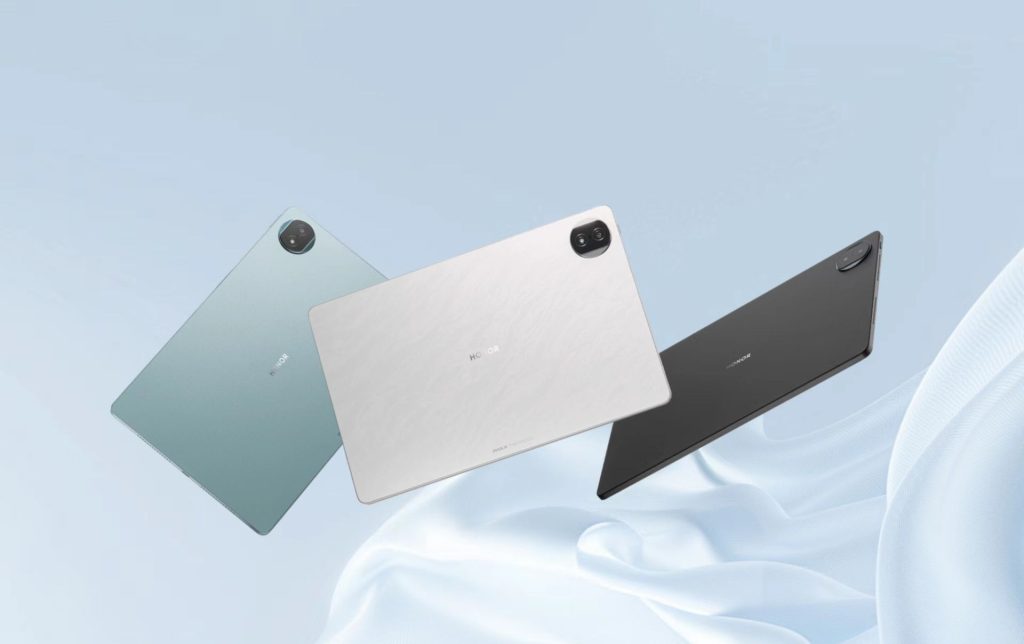
Honor unveiled a bunch of highly anticipated gadgets in China today (12th July 2024). The Chinese brand unveiled its latest generation of foldable smartphones like the Magic Vs3. Now, here’s everything you need to know about its new premium tablet, the MagicPad 2.
Honor MagicPad 2 Specs
The company’s MagicPad 2 sports a tall 12.3-inch OLED display that offers 3000 x 1920 pixel resolution, up to 144Hz refresh rate, and 1600 nits of peak brightness. Under the hood, it is equipped with the Qualcomm Snapdragon 8s Gen 3 SoC, which is paired with up to 16GB of RAM and 1TB of internal storage. The MagicPad 2 runs on the Android 14 OS based MagicOS 8.0.1 custom skin out of the box.
Honor MagicPad 2
It is worth noting that Honor’s new tablet only offers WiFi connectivity despite technically supporting 5G networking. So there’s a chance that a 5G enabled model will launch later on. The company has packed the MagicPad 2 with various AI features like voiceprint noise reduction, Cloud AI Big Model, and multi person conference voice to text conversion.
A massive 10,050mAh battery pack powers this tablet, which supports 66W wired fast charging. Despite such beefy specs, Honor has managed to pack the specs of the MagicPad 2 in an ultra slim 5.8mm body. For optics, you get a 13-megapixel camera on the rear, while the front houses a 9-megapixel selfie shooter. Other notable features include Bluetooth 5.3, three microphones, and spatial sound with an eight speaker crossover combination, and Honor Magic Pencil 3 support (sold separately).
Pricing and Availability
Pre-orders of the Honor MagicPad 2 will start on 19th July 2024. It is available in three color options, namely Moon Shadow White, Starry Black, and Sky Blue. Buyers can get the MagicPad 2 in four storage configurations, so here are their prices:
OnePlus has released the new 12R in a brand new color option in India. The OnePlus 12R was previously released in a Cool Blue and an Iron Gray variant. Now, the OnePlus 12R is available in a shiny Sunset Dune edition in the region.
OnePlus 12R Sunset Edition Price
The Chinese smartphone maker has released the Sunset Edition in a lone 8GB + 256GB option. It has a price tag of 42,999 INR (roughly 515 US Dollars) with its first sale set to kick off on 20th July 2024 during the Amazon Prime Day Sale. There is also a special launch offer with an instant 3,000 INR bank discount for ICICI and OneCard Credit cards and EMI transitions. Buyers can also get a free pair of OnePlus Buds 3 with the new OnePlus 12R Sunset Dune.
OnePlus 12R Sunset Dune Edition
OnePlus 12R Sunset Dune Edition Specs
A large 5,500mAh battery pack powers the OnePlus 12R, which supports 100W wired fast charging. In just 26 minutes, the device can charge from 1 to 100 percent. Other notable features include stereo speakers, Bluetooth 5.3, an Aluminum frame, an IP64 rating for water and dust resistance, Corning Gorilla Glass Victus 2, Android 14 OS based Oxygen OS 14 custom skin out of the box, and up to 4,500 nits of peak brightness.
Apart from the new hue, which blends soft gold and light pink, the Sunset Dune edition packs identical specs as the other two options. So, it also sports a tall 6.78-inch LTPO AMOLED display that offers a 120Hz refresh rate, FHD+ resolution, and HDR10+ support. Under the hood, the smartphone is equipped with the Qualcomm Snapdragon 8 Gen 2 SoC. For optics, you get a 50-megapixel triple camera setup on the back, while the front houses a 16-megapixel selfie shooter.
We use cookies on our website to give you the most relevant experience by remembering your preferences and repeat visits. By clicking “Accept”, you consent to the use of ALL the cookies.
This website uses cookies to improve your experience while you navigate through the website. Out of these, the cookies that are categorized as necessary are stored on your browser as they are essential for the working of basic functionalities of the website. We also use third-party cookies that help us analyze and understand how you use this website. These cookies will be stored in your browser only with your consent. You also have the option to opt-out of these cookies. But opting out of some of these cookies may affect your browsing experience.
Necessary cookies are absolutely essential for the website to function properly. This category only includes cookies that ensures basic functionalities and security features of the website. These cookies do not store any personal information.
Any cookies that may not be particularly necessary for the website to function and is used specifically to collect user personal data via analytics, ads, other embedded contents are termed as non-necessary cookies. It is mandatory to procure user consent prior to running these cookies on your website.