Japan Victor Company (JVC) will release the HA-A110T wireless earbuds in early February for around ¥20,000 (US$129). The earbuds come in four colors: Charcoal Black, Teal Green, Ivory Gold, and Bronze Brown.
The HA-A110T uses hybrid active noise cancelling with two microphones per earbud to block background noise during commutes, work, and calls.
Each earbud has a 10mm dynamic driver with a liquid crystal polymer diaphragm that reduces vibration for better clarity. The earbuds support SBC, AAC, and LDAC codecs. LDAC handles high-resolution audio up to 96 kHz and 24-bit on compatible devices.
Battery life is a key feature. With noise cancelling off, the earbuds last 17 hours and the charging case adds 27 hours for 44 hours total. With noise cancelling on, you get 13 hours from the earbuds and 21 hours from the case for 34 hours total. A 10-minute quick charge gives you 125 minutes of playback. The case supports Qi wireless charging.
The HA-A110T offers five sound modes: Flat, Bass, Clear, Dynamic, and Vocal. You can adjust these through the Victor Headphones app, which also lets you customize the equalizer, remap buttons, and update firmware.
The earbuds use Bluetooth 6.0 with Power Class 1 output and can connect to two devices at once. Low-latency mode reduces delay for videos and games. Wind noise reduction improves outdoor listening. Ambient sound mode lets you hear your surroundings, and sidetone mode lets you hear your own voice during calls. You can mute the microphone for calls and online meetings. The earbuds are rated IPX4 for splash resistance. Each earbud weighs 5.7 grams, and the charging case weighs 38.8 grams.
For more daily updates, please visit our News Section.
Google may soon expand the color lineup of its Pixel Buds 2a. Android Headlines has published official-looking renders showing the earbuds in two new color options, which are expected to be added alongside the existing Hazel and Iris variants. The Pixel Buds 2a have been available in those two colors since their launch in August last year.
While Google has not confirmed the official names, the new shades are expected to align with the rumored Pixel 9a color palette. These are likely to be called Fog and Berry. Visually, the Fog option appears as a light gray finish, while Berry is a soft pink tone. The pink version closely resembles the Peony color seen on recent Pixel devices and is clearly aimed at users who want a more eye-catching look.
Aside from color, nothing else has changed. The Pixel Buds 2a keep the same design and hardware. The charging case remains white on the outside for both new colors, while the interior matches the earbuds themselves, similar to the existing variants.
The Pixel Buds 2a are designed using data from over 45 million ear scans to improve comfort and fit. The earbuds carry an IP54 rating for sweat and water resistance, while the charging case is rated IPX4. Connectivity is handled via Bluetooth 5.4 with Super Wideband support, which improves call quality and connection stability.
Powering the earbuds is the Google Tensor A1 chip, paired with 11 mm dynamic drivers. Features include Active Noise Cancellation with Silent Seal 1.5, Transparency mode, active in-ear pressure relief, stereo spatial audio, and a 5-band equalizer. Voice calls benefit from a wind-blocking mesh and Google AI-powered noise reduction.
Battery life is rated at up to 7 hours with ANC on and up to 20 hours with the charging case. With ANC disabled, usage increases to 10 hours on the earbuds and 27 hours with the case. A 5-minute quick charge provides up to one hour of playback. Charging is done via USB-C, and the case includes a replaceable battery.
Additional features include hands-free Gemini access, tap controls, Pixel-Perfect Pairing, multipoint switching, and Find Hub support. Each earbud includes two microphones, infrared in-ear detection, and capacitive touch controls.
For more daily updates, please visit ourNews Section.
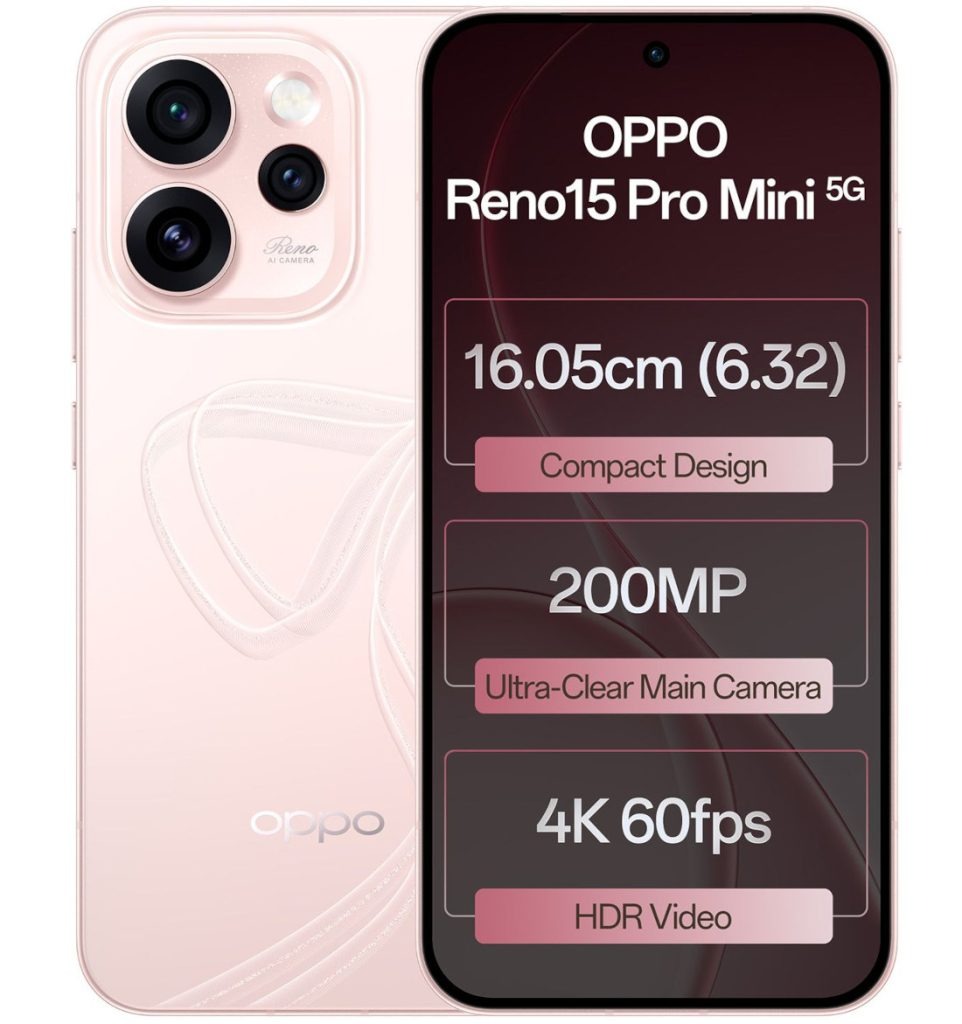
OPPO has introduced a new Crystal Pink color option for the Reno 15 Pro Mini in India. The phone was launched earlier this month in Cocoa Brown and Glacier White, and the new finish expands the lineup without changing the hardware or pricing.
The OPPO Reno 15 Pro Mini will go on sale starting February 1, 2026. It will be available through Amazon, Flipkart, the OPPO E-store, and offline retail stores. The 12GB RAM with 256GB storage variant is priced at Rs. 59,999. The 12GB RAM with 512GB storage model costs Rs. 64,999.
OPPO is offering several launch deals. Buyers can get up to 10 percent instant cashback through select bank partners and UPI. Zero down payment options are available for up to 15 months. The company is also offering a Rs. 2,000 exchange bonus, 180 days of free screen damage protection, and a 50 percent discount on OPPO Enco Buds3 Pro+ with every purchase.
Oppo Reno 15 Pro Mini features
The Reno 15 Pro Mini features a 6.32-inch flat OLED display with a 1.5K resolution of 2640 x 1216 pixels. The panel supports a 120Hz refresh rate, 240Hz touch sampling rate, and up to 3600 nits of local peak brightness. It also includes 3840Hz high-frequency PWM dimming and OPPO Crystal Shield Glass protection.
The phone is powered by the MediaTek Dimensity 8450 processor built on a 4nm process, with clock speeds of up to 3.25GHz and a Mali-G720 MC7 GPU running at 1300MHz. It runs Android 16 with ColorOS 16 and comes with 12GB of LPDDR5X RAM paired with either 256GB or 512GB of UFS 3.1 storage.
On the camera side, the device includes a 200MP main sensor with a 1.56-inch sensor size, f/1.8 aperture, and optical image stabilization. It also has a 50MP ultra-wide camera with a 112-degree field of view and f/2.2 aperture, along with a 50MP 3.5x periscope telephoto camera with OIS and an f/2.8 aperture. The rear cameras support 4K video recording at 60fps. On the front, there is a 50MP camera with an f/2.0 aperture that also supports 4K 60fps video recording.
The Reno 15 Pro Mini includes an in-display fingerprint sensor, infrared sensor, stereo speakers, and USB Type-C audio. It carries IP66, IP68, and IP69 ratings for dust and water resistance. Connectivity options include 5G SA and NSA, dual 4G VoLTE, Wi-Fi 6, Bluetooth 5.4, Beidou, GPS, GLONASS, Galileo, QZSS, and USB Type-C 2.0.
The phone is backed by a 6200mAh battery with support for 80W SuperVOOC fast charging. It measures 151.21 x 72.42 x 7.99mm or 8.13mm, depending on the color variant, and weighs between 187g and 188g.
For more daily updates, please visit ourNews Section.
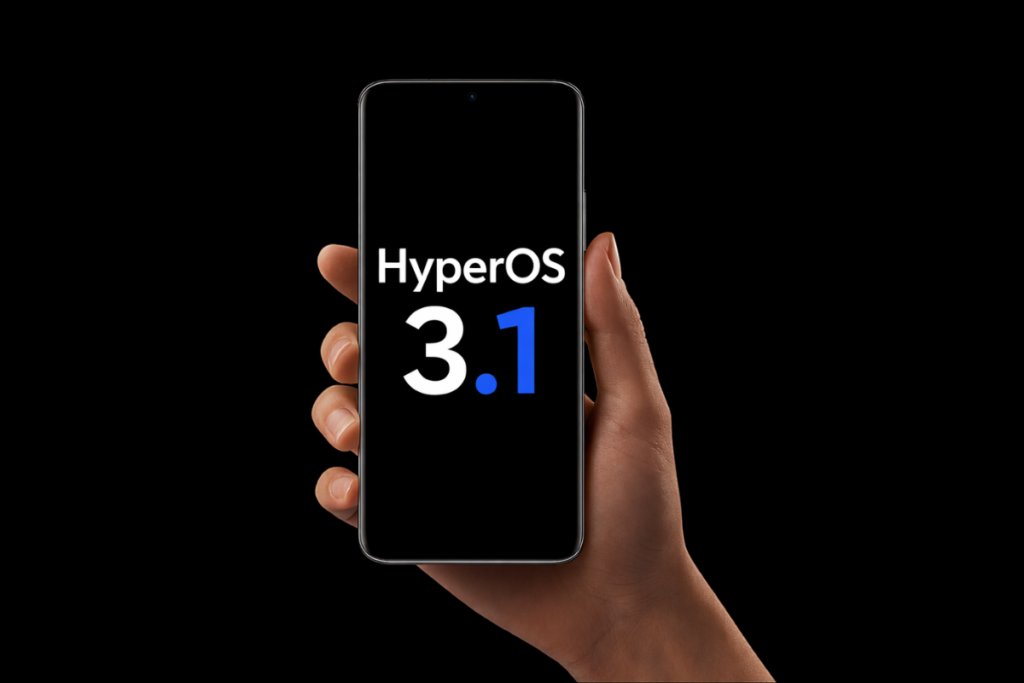
Xiaomi’s HyperOS 3.1 is the next major update of its custom Android skin. This builds on the Android 16 OS based HyperOS 3, bringing an enhanced UI, smarter intelligent features, and improved ecosystem integration. There are also various bug fixes and much more. So here’s everything new and all the devices eligible for the update.
One of the main features of the HyperOS 3.1 update is an upgraded Super Island, which is Xiaomi’s take on Apple’s Dynamic Island. It is more interactive and informative than before, bringing support for Live Updates from third party apps such as music, reminders, and timers. This makes the pill shaped widget a real dynamic hub that is more intuitive than static notification bubbles.
2. Redesigned System Animations & App Interfaces
The update rewrites core system apps such as Gallery and Weather with new animations for smoother interactions. Xiaomi has also introduced iOS-like motion and transition animations, paired with redesigned system elements like the recent apps view and animation curves to make the UI feel more polished and fluid.
3. Lock Screen & Depth Effects
HyperOS has always been a highly customizable Android skin, and the HyperOS 3.1 update builds on this further. The Chinese tech giant is expanding lock screen customization, allowing users to apply depth effects that let subjects verlap the clock, edit wallpapers on the lock screen, and more.
4. Native AirPods Support
Xiaomi is improving the cross platform integration with Apple’s ecosystem, adding native support for Apple AirPods on HyperOS 3.1. So now, supported Xiaomi branded devivicse will get a pop up for pairing Apple’s TWS earbuds along with access to spatial audio, which was initially exclusive to Apple products.
5. iPhone Call Interoperability
Another ecosystem highlight is the ability to answer phone calls on your Xiaomi phones directly from an iPhone when devices are linked.
6. New Accessibility Options
Accessibility settings have also been enhanced with a new primary menu dubbed Assistant. This offers more convenient access to accessibiliy features like Active Visual Perception.
7. Quick Gestures
On certain devices like the Redmi K90 Pro Max, HyperOS 3.1 unlocks quick gesture controls for navigation and shortcuts.
8. Performance & System Improvements
Xiaomi has also made a bunch of enhancements to the performance and stability with HyperOS 3.1:
A redesigned recent apps menu
Improved memory management and multitasking
Smoother animations and reduced frame stutter
Enhanced power and resource optimization
Faster app launch speeds
9. Motion Sickness Reduction
With the new Super Island, Xiaomi has also refined visual cues and added a Motion Sickness reduction feature to help minimize visual discomfort during scrolling and other fast visuals.
10. Eligible Devices List for HyperOS 3.1
Note: Only devices eligible for Android 16 are expected to receive HyperOS 3.1. Older hardware stuck on Android 15 won’t be able to support this update due to stricter system requirements. So here are all the models getting this major update:
A new leak has revealed some key details of upcoming Xiaomi smartphones. This hints at the battery and charging details of the upcoming Xiaomi 17T, which we’ve already covered, along with the new POCO X8 Pro and POCO X8 Pro Max. These models are also expected to pack massive batteries as well, so let’s check it out.
POCO X8 Pro Max with a huge 8,500mAh battery surfaces online
According to recent findings from supply chain and code analysis (via PaperKing13), the POCO X8 Pro Max will be powered by a humongous 8,500mAh battery pack. This is one of the biggest battery capacities on any POCO phone. The large cell is paired with 100W wired fast charging for quick top ups. With such a massive battery, you can easily expect the device to offer two days of battery life on a single full charge.
Redmi Turbo 5 Max
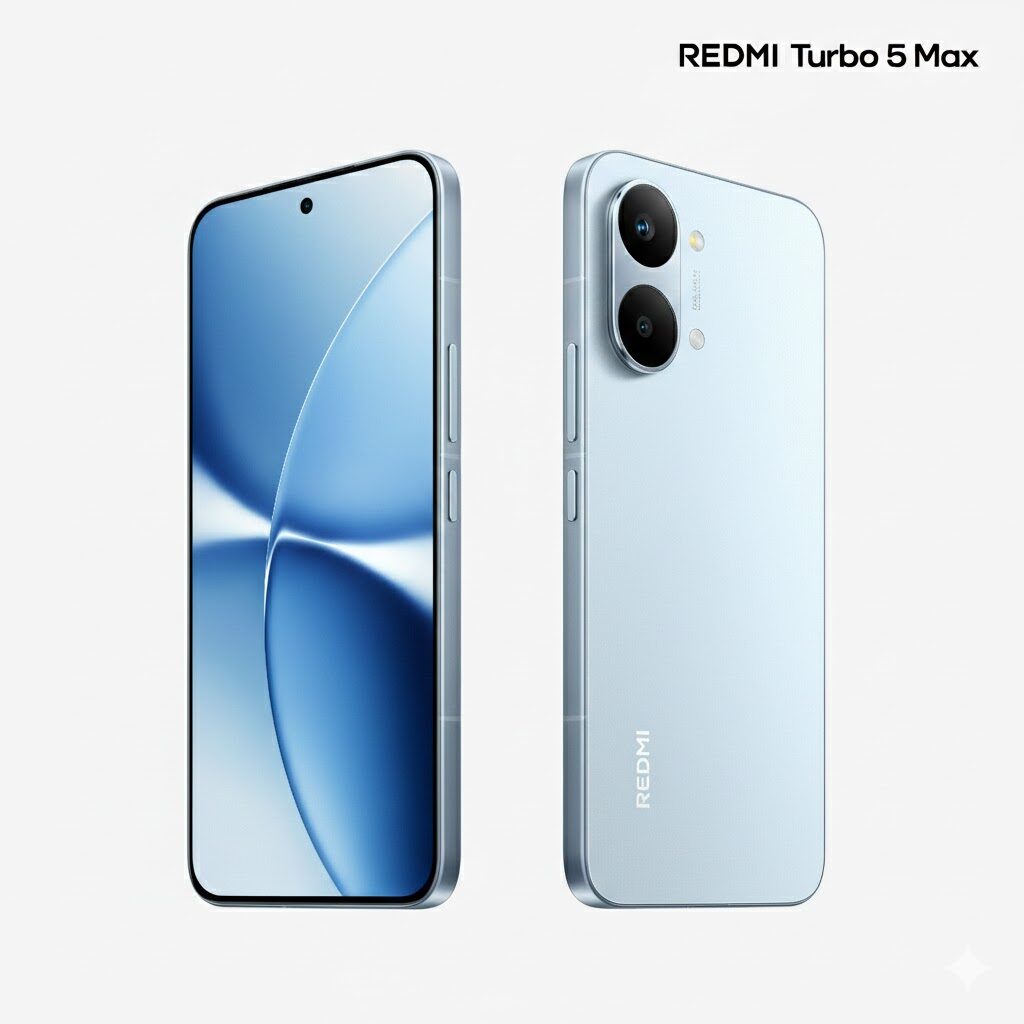
The combination would appeal to heavy users, gamers, and travellers alike. Based on what we know so far, the POCO X8 Pro Max is rumored to be a rebranded Redmi Turbo 5 Max for the global market. To recall, the Turbo 5 Max debuted in China yesterday, with an even larger 9,000mAh cell. Although, this slight downgrade is likely due to regional safety and certification requirements. But this phone is still ahead of the curve compared to most other devices.
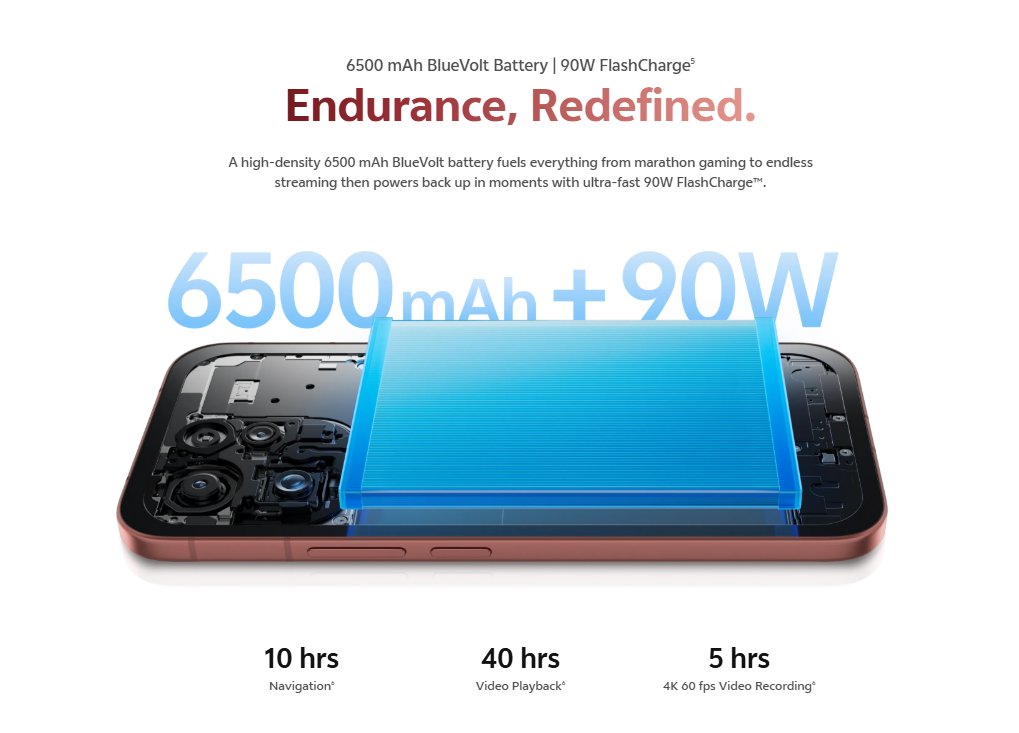
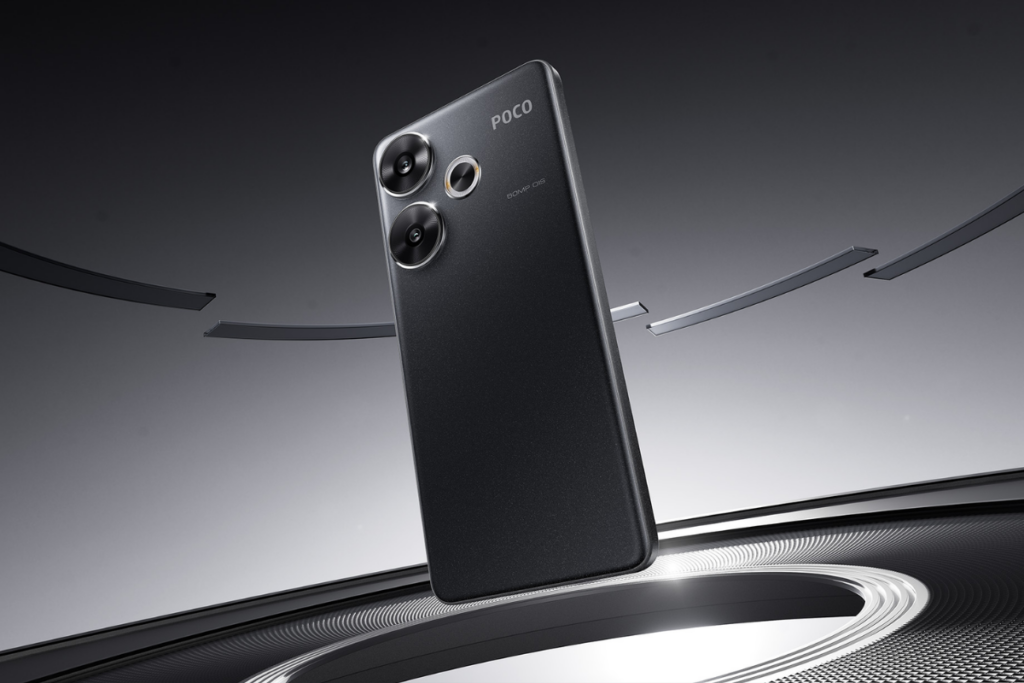
On the other hand, the standard POCO X8 Pro gets a smaller, but still respectable, 6500mAh battery that also supports 100W wired fast charging. In related news, the POCO X8 Pro recently showed in multiple certification databases across the globe, with a special POCO X8 Pro Iron Man Edition also in the works.
For more daily updates, please visit our News Section.
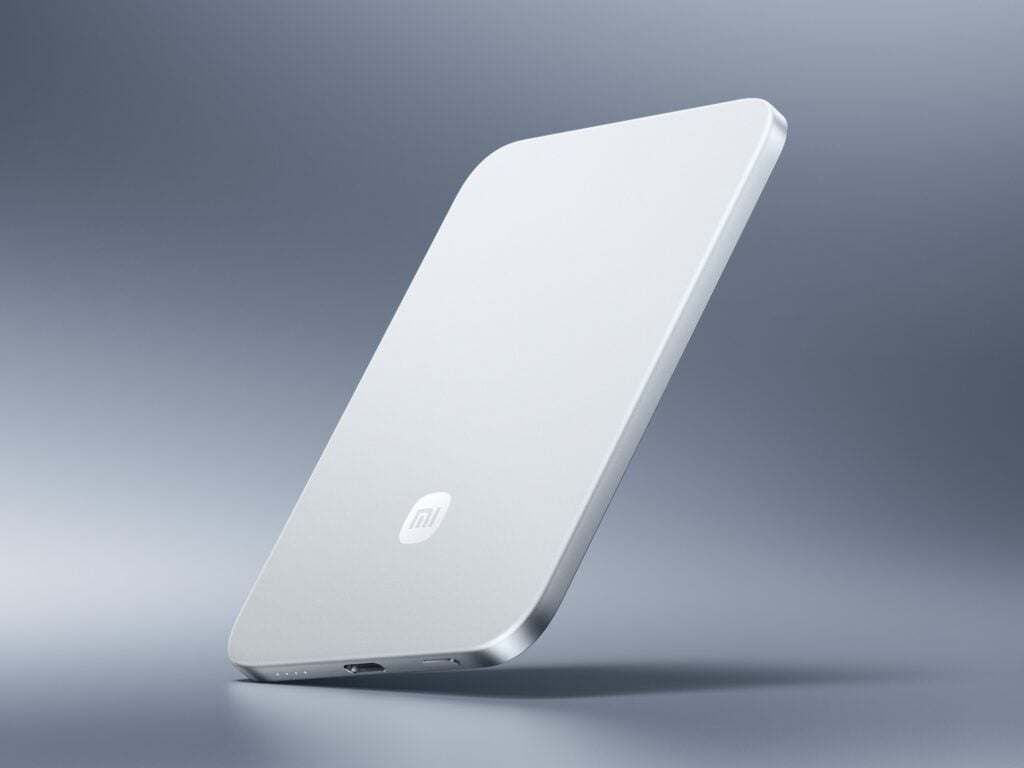
Xiaomi has quietly expanded the availability of its UltraThin Magnetic Power Bank beyond Asia. The wireless power bank with magnets initially debuted in Japan, and is now rolling out in more markets in Europe. So here are its specs, pricing, and availability details.
Xiaomi UltraThin Magnetic Power Bank: Specs & Pricing
True to its name, the UltraThin Magnetic Power Bank measures just 6mm thick. This makes it slimmer than nearly ever smartphone in the market, so it doesn’t feel like a bulky add on when wireless charging your device. It also weighs just 98 grams, making it lightweight and portable. The magnetic back uses a ring-style attachment to stay securely on compatible phones like the latest iPhones or the Pixel 10 series. The added convenience helps users avoid fumbling with cables.
Xiaomi UltraThin Magnetic Power Bank
Xiaomi’s new UltraThin Magnetic Power Bank houses a 5,000mAh battery capacity. It delivers up to 15W wireless charging and up to 22.5W via its USB-C port when a cable is plugged in. Samsung, Xiaomi, Google and other Android flagships are supported at full wireless power, while iPhones are limited to 7.5W wireless output due to platform restrictions, meaning slower magnetic charging for Apple devices.
This makes it ideal for commuters, travellers and anyone who wants a minimalist backup battery that doesn’t add bulk to daily carry gear. In the UK, Xiaomi’s new magnetic power bank is listed at £49.99 on the official Xiaomi website, with similar availability already rolling out in Japan and parts of Europe. The company hasn’t yet announced specific dates for other regions, but this phased rollout suggests wider distribution could follow soon.
For more daily updates, please visit our News Section.
Xiaomi has a lineup of Xiaomi 17 series smartphones set to launch globally. Among them are the Xiaomi 17T and 17T Pro, both of which appeared on the IMEI database back in October. Now, a new post on X has revealed the camera and battery specifications of the vanilla Xiaomi 17T.
The details were unearthed from HyperOS code changes, where the smartphone is listed under the codename “P12A.”
To begin with, the Xiaomi 17T flaunts a 6,500mAh battery. That’s a sizable jump from the 5,500mAh battery from last year’s Xiaomi 15T; however, charging speed remains the same at 67W.
Moving on, the Xiaomi 17T will feature a triple rear camera setup, led by an OmniVision OV50E sensor. It’s joined by an OmniVision OV13B sensor and a Samsung ISOCELL JN5 sensor, covering ultra-wide and telephoto duties. There’s also mention of a Samsung ISOCELL S5KKDS sensor for selfies.
For comparison, the Xiaomi 15T used a 50MP Light Fusion 800 main camera, a 50MP telephoto lens, and a 12MP ultra-wide camera. It has a 32MP camera for selfies.
Under the hood, the Xiaomi 17T could be powered by MediaTek’s Dimensity 9500s chipset. The processor includes a MediaTek NPU designed for generative and agentic AI features and recently made its debut earlier this month.
Interestingly, the same chip is already being used in the Redmi Turbo 5 Max, which gives some context about the performance level users can expect.
Xiaomi 17T series might launch in February
As for the Xiaomi 17T Pro, a listing spotted on the IMEI database back in October 2025 hints at a possible February 2026 launch. If that timeline holds, it would be a shift away from Xiaomi’s usual September release window for its T-series phones.
For more daily updates, please visit our News Section.
The Snapdragon 7 Gen 4 is a fairly new SoC positioned as an upper-mid-range chipset compared to the Snapdragon 8s Gen 3, which is an affordable-flagship chip announced in early 2024. Despite different market positioning, the phones powered by these two chips fall within a similar price range. In fact, some 7 Gen 4 phones cost much more.
So, the real question is: does it make sense to go for the newer Snapdragon 7 Gen 4 or a slightly older but still powerful Snapdragon 8s Gen 3? We’ll be looking at the spec sheet, benchmark scores, and other important aspects of this comparison to find out the answer.
Let’s begin with a spec sheet:
Snapdragon 7 Gen 4
Snapdragon 8s Gen 3
Announced
May 2025
March 2024
Process node
4nm (TSMC)
4nm (TSMC)
CPU
1 x 2.8GHz — Cortex-A720 4 x 2.4GHz — Cortex-A720 3 x 1.84GHz — Cortex-A520
1 x 3GHz — Cortex-X4 4 x 2.8GHz — Cortex-A720 3 x 2GHz — Cortex-A520
GPU
Adreno 722 Snapdragon Elite Gaming features
Adreno 735 Snapdragon Elite Gaming features
NPU
Qualcomm Hexagon NPU
Qualcomm Hexagon NPU
Memory
LPDDR5x, up to 4.2GHz
LPDDR5x, up to 4.2GHz
Storage
UFS 4.0
UFS 4.0
Camera
Qualcomm Spectra triple AI ISP (12-bit) up to 200MP single camera up to 64MP single camera with zero shutter lag up to 32+21MP dual cameras with zero shutter lag up to 21MP triple cameras with zero shutter lag 4K/60fps video recording 1080p/120fps slow-mo video recording
Qualcomm Spectra triple ISP (18-bit) up to 200MP single camera up to 108MP single camera with zero shutter lag up to 64+36MP dual cameras with zero shutter lag up to 36MP triple cameras with zero shutter lag 4K/60fps video recording 1080p/240fps slow-mo video recording
Connectivity
Snapdragon 5G modem (sub‑6 GHz) up to 4.2Gbps download speed Wi-Fi 7 (peak speed: 5.8 Gbps) Bluetooth 6.0
Snapdragon X70 5G modem (sub‑6 GHz) up to 6.5Gbps download speed up to 3.5Gbps upload speed Wi-Fi 7 (peak speed: 5.8 Gbps) Bluetooth 5.4
Snapdragon 7 Gen 4 vs 8s Gen 3: Benchmark scores
[Note: For the benchmark results, the tests were performed on the Vivo T4 Pro (powered by Snapdragon 7 Gen 4) and Poco F6 (powered by Snapdragon 8s Gen 3).]
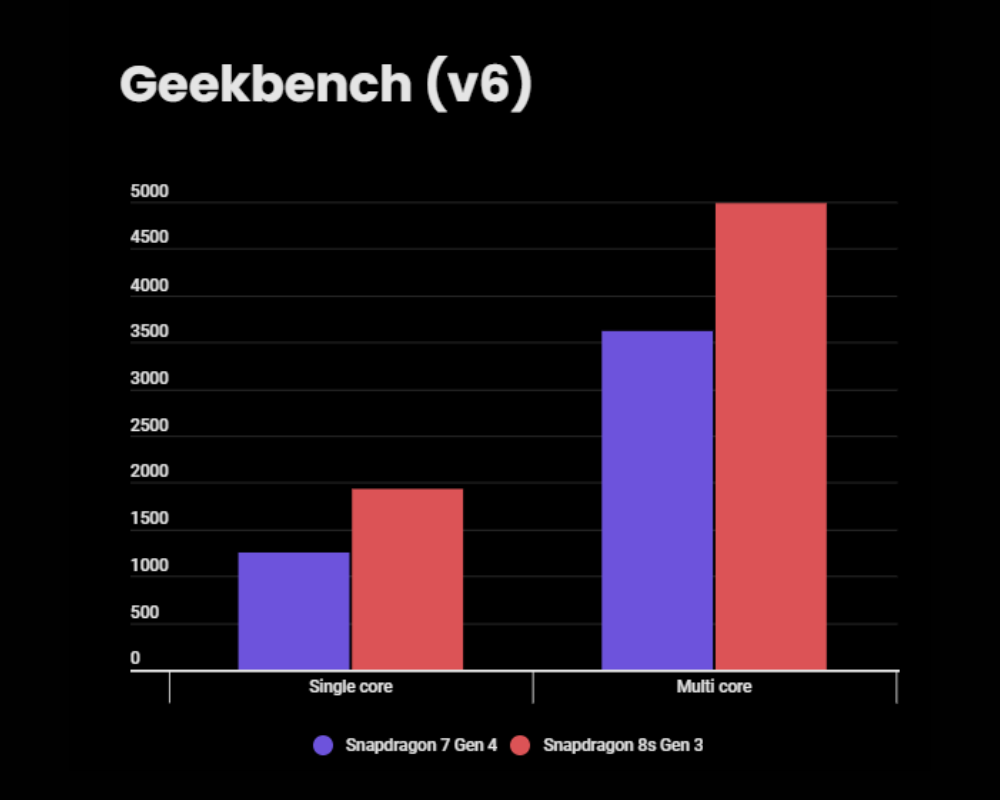
Geekbench score
The Snapdragon 8s Gen 3 comfortably outclasses the Snapdragon 7 Gen 4 in the CPU test on Geekbench. It achieves a 54% higher score in the single-core performance test and about a 38% higher score in the multi-core performance test.
Snapdragon 7 Gen 4
Snapdragon 8s Gen 3
Single core
1,252
1,932
Multi core
3,620
4,986
This should result in higher peak performance on a Snapdragon 8s Gen 3-powered device than on one powered by the Snapdragon 7 Gen 4. However, everyday tasks like browsing the internet, scrolling through social media apps, and watching videos perform smoothly on both chips.
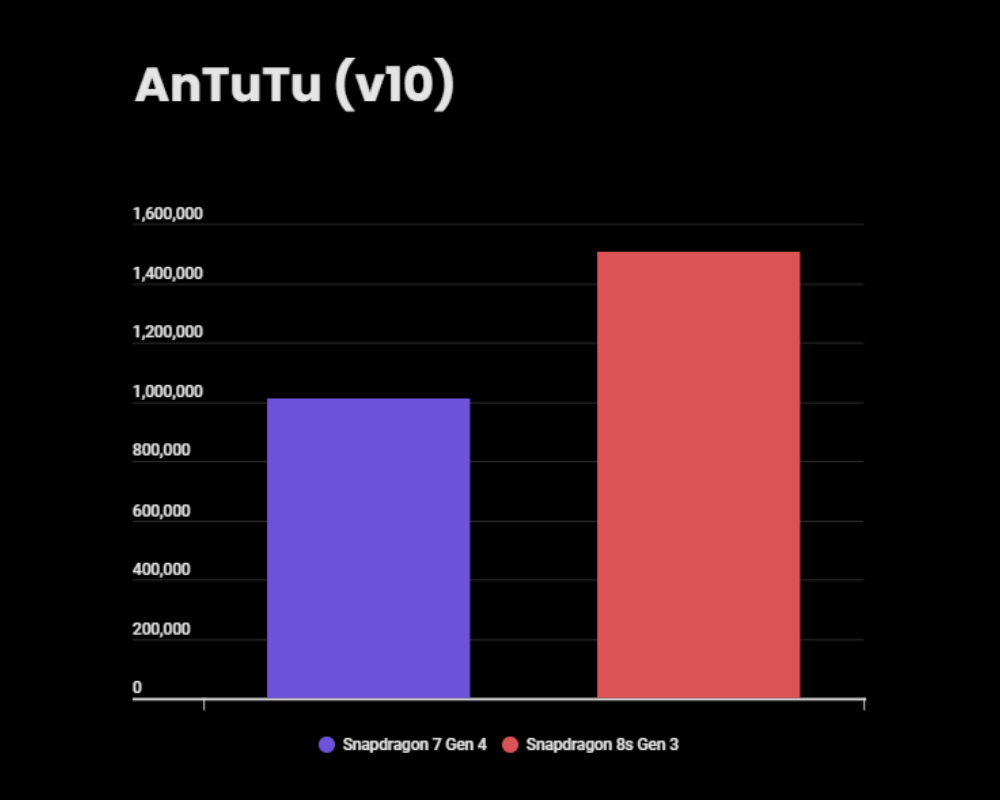
AnTuTu score
The Snapdragon 8s Gen 3 also dominates AnTuTu with a total score above 1.5 million, while the 7 Gen 4 achieves just about 1 million. That’s a 50% uplift for the 8s Gen 3.
The individual scores paint a better picture: a 27% higher CPU score and a 60% higher score for the 8s Gen 3. The memory and UX scores also favor Snapdragon 8s Gen 3 over the 7 Gen 4.
Snapdragon 7 Gen 4
Snapdragon 8s Gen 3
AnTuTu score
1,010,864
1,505,656
CPU
309,273
391,859
GPU
323,797
517,257
Memory
182,776
325,777
UX
195,019
270,763
Benchmark scores alone don’t tell the complete story. They do not discuss other important aspects, such as the camera and connectivity. So, we’ll uncover the key differences in the following section.
Snapdragon 7 Gen 4 vs 8s Gen 3: Key differences
The Snapdragon 7 Gen 4 and 8s Gen 3 feature the same 1+4+3 core configuration, but their core selection differs. The 7 Gen 4 features one Cortex-A720 large core, four Cortex-A720 mid cores, and three Cortex-A520 small cores. In contrast, the 8s Gen 3 has a more powerful Cortex-X4 large core, four Cortex-A720 mid cores, and three Cortex-A520 small cores.
Not only does the Snapdragon 8s Gen 3 feature higher-performance cores, but they also run at higher speeds. That’s the main reason it’s able to beat the 7 Gen 4 in benchmarks by a big margin.
The 8s Gen 3 also features a more powerful Adreno 735 GPU with more pipelines and higher compute throughput than the Adreno 722 GPU on the Snapdragon 7 Gen 4. Additionally, the 8s Gen 3 supports hardware-accelerated ray tracing, which enhances the gaming experience with more accurate lighting, reflections, and shadows.
The Snapdragon 8s Gen 3 also excels in imaging, featuring an 18-bit ISP compared to the 12-bit ISP on the other chip. Furthermore, the 8s Gen 3 supports semantic segmentation (up to 12 layers) and zero shutter lag at higher resolutions. Both chips support up to 4K video recording at 60fps, but when it comes to slow-motion recording, the differences become apparent. The 8s Gen 3 supports 1080p slow-motion recording at 240fps, while the 7 Gen 4 peaks at 120fps.
Both chipsets feature robust connectivity, though some differences remain. The 7 Gen 4 features a newer Bluetooth standard, while the 8s Gen 3 excels in peak download speed over a 5G connection. The peak Wi-Fi speed, however, remains unchanged.
Snapdragon 8s Gen 3 vs 7 Gen 4: Which is a better choice?
The Snapdragon 8s Gen 3 is a no-brainer pick over the Snapdragon 7 Gen 4, featuring faster CPU and GPU with support for hardware-accelerated ray tracing. It also features a robust ISP with better slow-motion video recording and semantic segmentation support.
The Snapdragon 8s Gen 3 also features robust connectivity, with a higher peak download speed over 5G. The 7 Gen 4 offers a newer Bluetooth standard, but that alone can’t make up for everything. Hence, the Snapdragon 8s Gen 4 remains a solid pick over the Snapdragon 7 Gen 4.
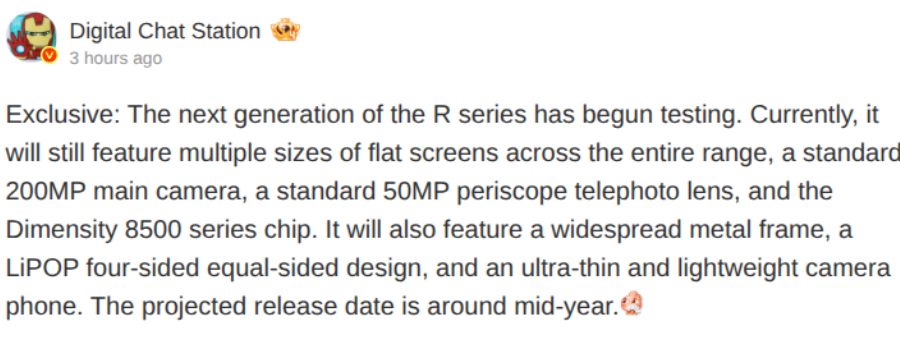
Just a few months after launching the Reno 15 series in China last November, early details about the next-generation Reno 16 lineup are already starting to leak out. Not entirely, as Oppo updates the Reno series roughly every six months.
According to well-known tipster Digital Chat Station, the Oppo Reno 16 series has now entered the testing phase in China. That usually means internal hardware decisions are largely locked in, even if the final product is still weeks away from public view. If Oppo sticks to its usual timeline, the Reno 16 series could arrive sometime around May.
Oppo Reno 16 Specifications (Expected)
The Reno 16 lineup is expected to continue using flat displays across multiple sizes. The Reno 15 series has a compact 6.32-inch and a 6.78-inch model, and Oppo is likely to continue offering the same screen sizes with Reno 16.
The Reno 16 series is also said to feature a 200MP main camera as standard, along with a 50MP periscope telephoto lens. Not an upgrade on megapixel count, as both the Reno 15 and Reno 15 Pro have a similar setup. But Oppo could use a newer camera sensor.
Design-wise, the leak points to a metal frame and LIPO equal bezel layout on all sides. Oppo is also aiming for an ultra-thin and lightweight build to keep the Reno series focused on comfort and everyday usability rather than sheer hardware bulk.
None of this is official yet, and Oppo hasn’t acknowledged the leak. Still, with testing already underway and a mid-year launch window hinted at, the Reno 16 series may not stay a mystery for much longer.
For more daily updates, please visit our News Section.
After the highly anticipated launch, Motorola has just released its latest flagship smartphone outside of its Razr series of flip phones. The Motorola Signature brings powerful hardware packed in a sleek and premium body, so now, here are all the key details you need to know, like its specs, pricing, and special launch offers.
Motorola Signature Price and Launch Offers
The brand has just put up the Signature for sale in the Indian market via Flipkart, Motorola’s official website, and leading retail stores. Positioned as a flagship killer, this model aims to bring premium specs and features at a relatively approachable price tag. It is available for purchase in three configurations, namely:
12GB + 256GB – Rs 59,999
16GB + 512GB – Rs 64,999
16GB + 1TB – Rs 69,999
Motorola Signature
To sweeten the deal, Motorola and Flipkart are offering several price saving offers for early buyers:
Rs 5,000 instant bank discount via HDFC and Axis Bank cards
Exchange bonus up to Rs 5,000 (selected models may offer up to ₹7,500)
No-cost EMI options up to 12 months
Six months of Perplexity Pro free
Free access to 10 premium OTT apps for 6 months on a Jio recharge of Rs 1,199
With just the bank discount alone, the effective price falls to just Rs 54,999.
Specifications
Motorola’s new Signature model sports a tall 6.8-inch 1.5K LTPO AMOLED display with a 165Hz refresh rate and up to 6200 nits of peak brightness. Under the hood, it is equipped with a Snapdragon 8 Gen 5 SoC and is powered by a sizeable 5,200mAh battery pack that supports 90W wired and 50W wireless fast charging. For optics, the rear features a 50MP triple camera setup (Sony LYT828 main sensor, an ultra wide angle lens, and a periscope telephoto shooter.
For more daily updates, please visit our News Section.
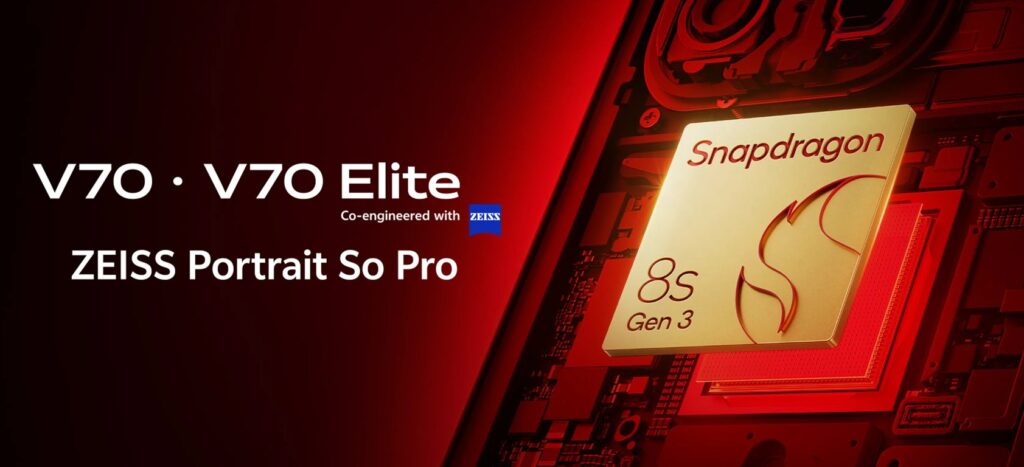
Vivo has started teasing the Vivo V70 series in India. The lineup will include two models, namely the Vivo V70 and V70 Elite. The series’ landing page, available on Vivo India’s official website, has revealed the design and key specifications ahead of what appears to be a February launch in the country.
Vivo V70, Vivo V70 Elite design, key specifications
Vivo V70 series teaser
The official page reveals that the Vivo V70 series will be powered by the Snapdragon 8s Gen 3. However, previously surfaced Geekbench listings of the V70 and V70 Elite revealed that these will be powered by the Snapdragon 7 Gen 4 and Snapdragon 8s Gen 3 chipsets, respectively.
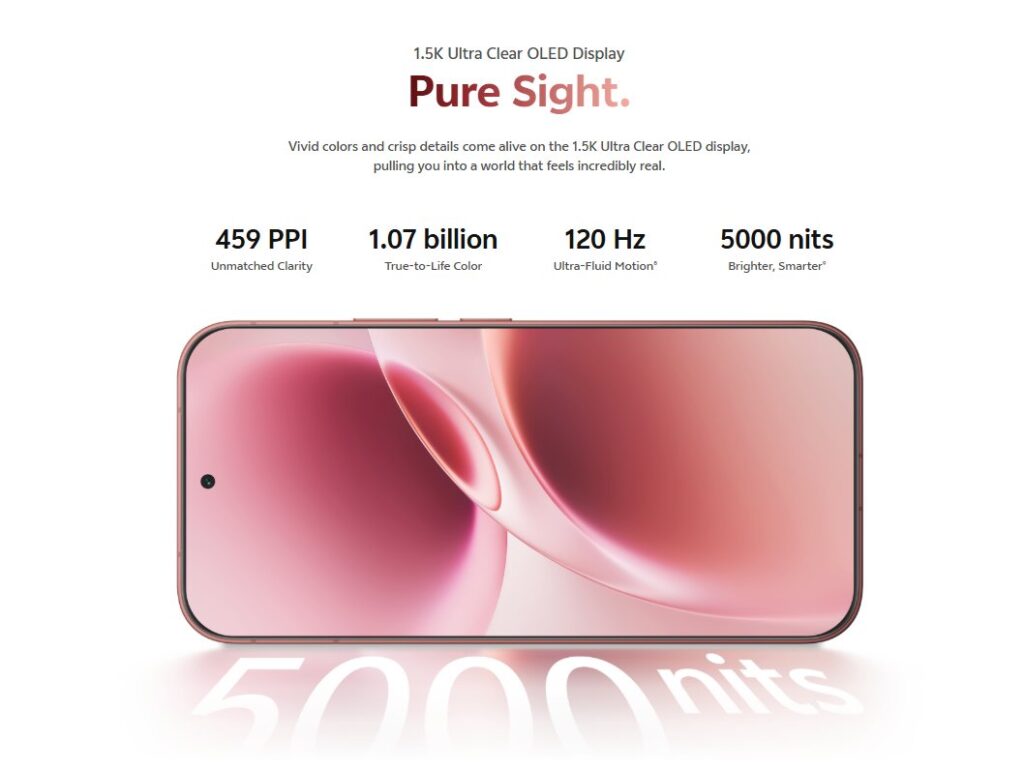
Vivo V70 series display
The series will feature an OLED panel that offers a 1.5K resolution, a 120Hz refresh rate, and a peak brightness of 5,000 nits. It will run on OriginOS 6-based Android 16 and is promised to receive four years of Android OS upgrades and six years of security updates. The series will ship with LPDDR5x RAM and UFS 4.1 storage, with 8GB + 256GB as the starting configuration.
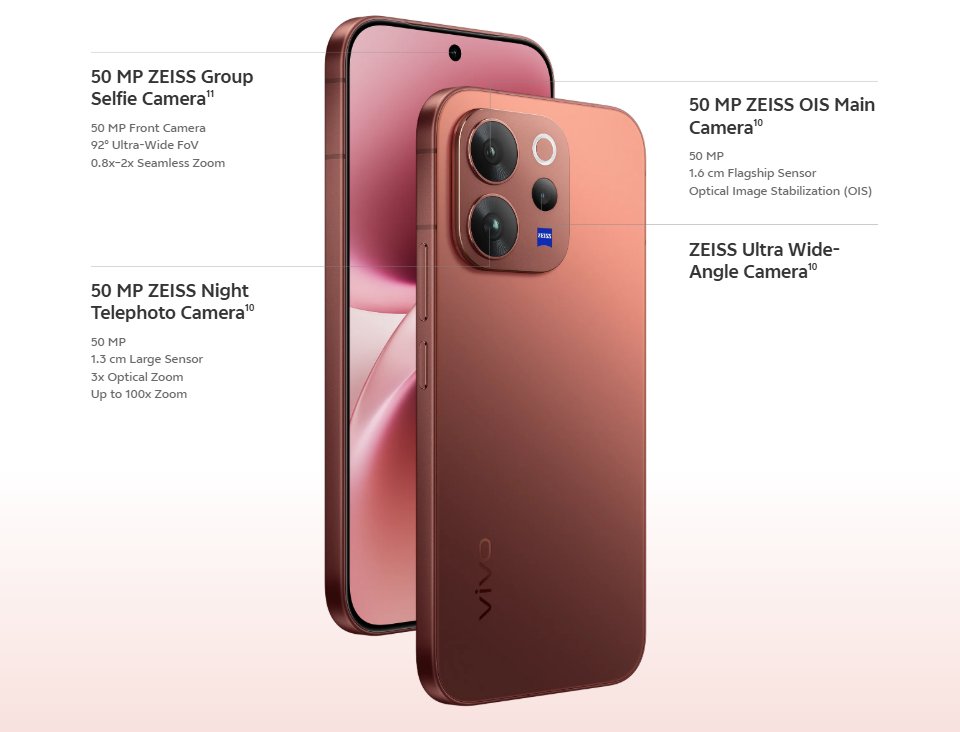
Vivo V70 series cameas
The Vivo V70 lineup will include a 50-megapixel camera with autofocus support on the back. The rear camera setup will comprise a flagship-grade 50-megapixel main camera with OIS support, an ultra-wide lens, and a 50-megapixel periscope telephoto camera with 3x optical zoom and 100x digital zoom. Likely, both phones will feature an identical set of cameras.
Vivo V70 series battery
The Vivo V70 and V70 Elite will pack a 6,500mAh battery with 90W fast charging support. Both phones will also feature an aluminium frame and an IP68/69-rated dustproof and water-resistant body.
For more daily updates, please visit our News Section.
Wearables have spent the last few years bouncing between familiar shapes. Smartwatches keep getting bigger, while smart rings are trying to shrink health tracking down to the bare minimum. Rogbid’s latest device, the Fusion, sits somewhere awkwardly — and intentionally — in the middle.
Rogbid Fusion Specifications
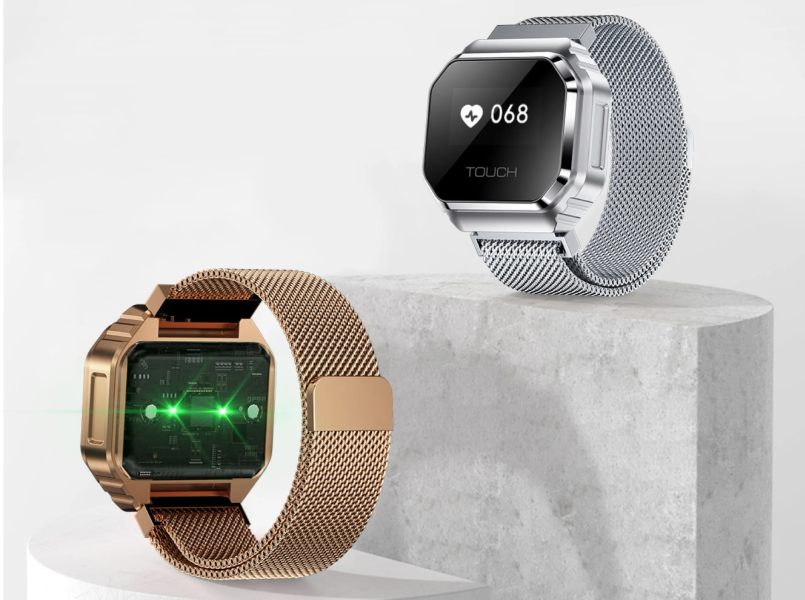
The Rogbid Fusion is a very small smartwatch that borrows ideas from both categories. At just 20.6 x 21 x 8.2mm and weighing a little over 14 grams, it’s closer in size to a chunky ring than a traditional watch.
Out of the box, the Fusion can be worn like a ring using its bundled Milanese-style strap. If that feels too unconventional, Rogbid also includes a nylon strap that lets you wear it on your wrist like a regular watch.
The device itself uses a metal midframe and comes with a 5ATM water resistance rating, which should make it suitable for swimming and daily exposure to water without much worry.
The screen is predictably small. The Fusion uses a 0.49-inch OLED display, which is just enough to show the basics. You can check the time, step count, heart rate, blood oxygen levels, and sleep data directly on the device, though anything more detailed will likely require opening the companion app.
Despite its size, the Fusion is a full fitness wearable. It supports over 100 sports modes, though real-time tracking is limited to essentials like heart rate, steps, and distance.
The Fusion connects to smartphones over Bluetooth and works with both Android and iOS devices. Rogbid claims a battery life of up to five days, which is respectable for its size, though real-world usage will probably depend on how often health-tracking features are enabled.
In terms of design options, the Rogbid Fusion is available in black, silver, and gold. The device retails for $49.99 and is available directly from Rogbid’s official website.
For more daily updates, please visit our News Section.
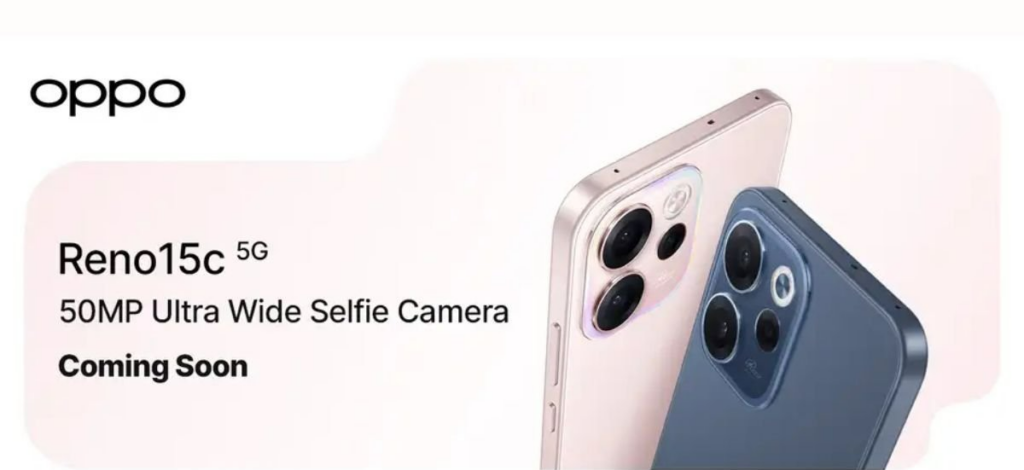
Oppo has started teasing the Oppo Reno 15c in India. This will be the fourth model in the series to hit the Indian market after the Reno 15, Reno 15 Pro, and Reno 15 Pro Mini. Here’s a look at the specifications and price of the 15c.
To recall, the Reno 15c was also announced alongside the above-mentioned models earlier this month in India. So, the specifications and price of the device are already known. While the phone was announced at that time, it is only set to go on sale on February 3 in the country
Oppo Reno 15c specifications and price
Oppo Reno 15c incoming
The Oppo Reno 15c has a 6.57-inch OLED panel that delivers an FHD+ resolution and a 120Hz refresh rate, along with an HBM brightness of 1,400 nits. Under the hood, the device features the Snapdragon 6 Gen 1 chipset, paired with LPDDR4x RAM and UFS 3.1 storage.
The Reno 15c comes preloaded with ColorOS 16-based Android 16. It has a 50-megapixel front camera with autofocus support and a 50-megapixel main camera on the back, coupled with an 8-megapixel ultra-wide lens and a 2-megapixel macro camera.
The Reno 15c comes with other features, such as an IR blaster, dual speakers, and a side-facing fingerprint sensor. It has a slim profile of 8.14mm and weighs around 195 grams.
The Reno 15c has arrived in India in two options: 8GB+256GB for Rs 34,999 (~380) and 12GB+256GB for Rs 37,999 (~$415). It comes in two shades, Twilight Blue and Afterglow Pink. As mentioned above, it is scheduled to go on sale on Feb. 3.
Readers should note that this phone should not be confused with the Snapdragon 7 Gen 4-powered Reno 15c available in China.
For more daily updates, please visit our News Section.
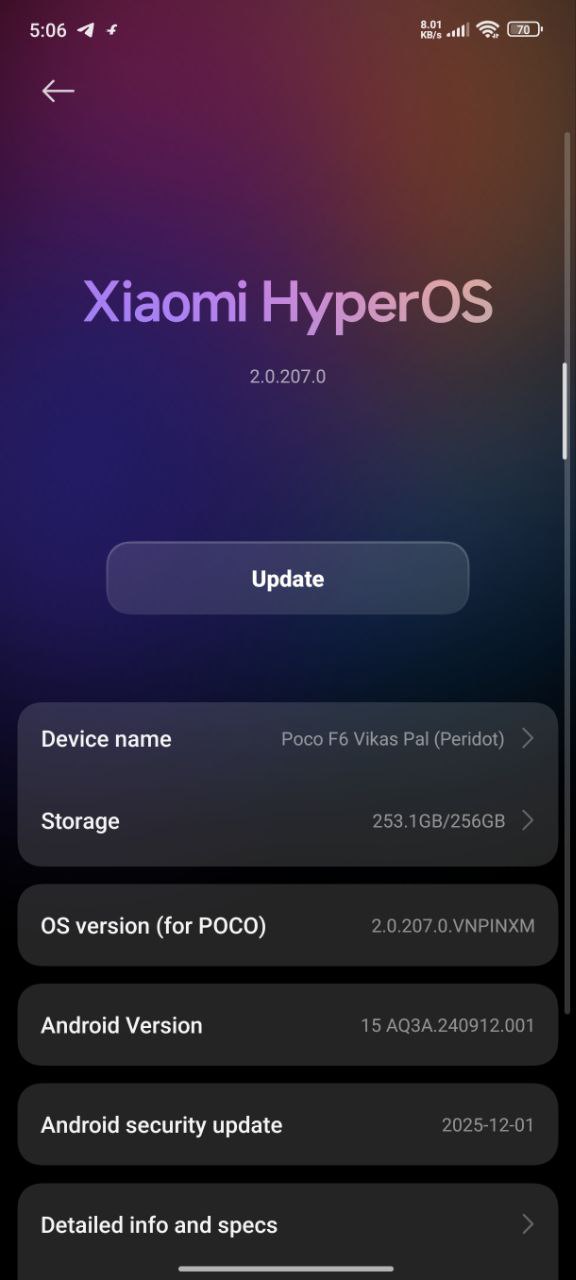
The long-awaited HyperOS 3 update has finally begun rolling out to Poco F6 users in India. It arrived with some delay as it was scheduled to receive the HyperOS 3 update alongside the Poco F6 Pro last month. The Poco F6 Pro received the upgrade as per the schedule, and now the base model has also joined the party as well.
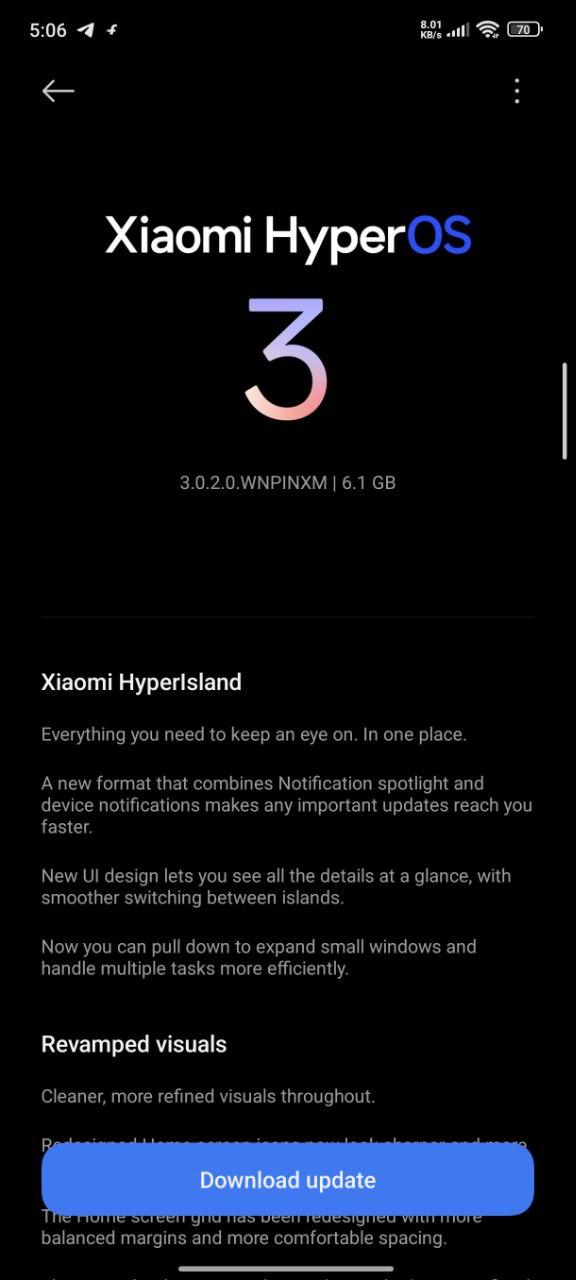
The HyperOS 3 update for Poco F6 carries the firmware version 3.0.2.0.WNPINXM. It’s currently available in India as an initial release, but Xiaomi won’t take long to expand the update to more regions. The update has a massive download size of 6.1GB, so it’s best to use a reliable Wi-Fi connection.
If you’re rocking a Poco F6 in India, you should be able to upgrade to HyperOS 3 via the software update section in the Settings app. Since it’s a hefty update package, you must ensure that the device has sufficient storage before downloading the update, and that it’s charged to at least 50% for a smooth upgrade to HyperOS 3.
The Android 16-based HyperOS 3 is a pretty significant upgrade for Xiaomi and Poco devices, bringing a host of useful features and dozens of improvements to deliver a more useful and stable software experience. It introduces HyperIsland, a pill-style dynamic element that lets users monitor live activities without opening the app, with multitasking capabilities.
The lock screen gets new features like AI Cinematic Lock Screen and AI Dynamic Wallpapers to offer dynamic lock screen experience with the ability to generate cinematic wallpapers from your own photos using AI. The company says HyperOS 3 brings 100+ improvements to deliver a faster, smoother software experience. Improvements have also been made to AI-related features, security, and cross-device experience. Overall, HyperOS 3 is a solid upgrade, and there’s plenty to explore once you have it on your device.
Realme launched the Realme 16 5G and Realme 16 Pro 5G in Vietnam on January 29, 2026. The Pro model already sells in India with identical specs, but the standard Realme 16 5G is new to the region. Both phones prioritize design, battery life, and durability.
Realme 16 5G features
The Realme 16 5G has what Realme calls an Air Design body with a flat frame and curved corners. It measures 158.30 × 75.13 × 8.10mm and weighs 183g. The back has an Aurora Wings finish with a blue to purple gradient that changes in different lighting. A horizontal camera bar sits flush with the surface and holds a 50MP Sony IMX852 portrait camera and a 2MP monochrome sensor.
Realme 16 5G
The bar also has a selfie mirror built in, with the LED flash around the outer edge. The front camera is 50MP with an 86-degree field of view. Photo features include LumaColor processing and AI Edit Genie for quick edits in the gallery.
The display is a 6.57 inch FHD+ AMOLED panel with 2372 × 1080 resolution and a 93 percent screen-to-body ratio. It runs at a 120Hz refresh rate with 240Hz touch sampling. Brightness hits 1000 nits normally, 1400 nits in high brightness mode, and peaks at 4200 nits. DT Star D+ glass protects the screen.
Realme 16 5G
Inside is the MediaTek Dimensity 6400 Turbo chipset with either 8GB or 12GB of LPDDR4X RAM and 256GB of UFS 2.2 storage. You can add a memory card and use USB OTG. The phone runs realme UI 7.0. The battery is the standout feature at 7000mAh typical capacity, rated at 6830mAh. It charges at 60W and supports wired reverse charging. Realme uses an Aircraft Structure layout and high density graphite battery to fit this capacity in the thin body.
Cooling comes from a 6050mm² vapor chamber. The phone has IP66, IP68, IP69, and IP69K ratings for dust and water resistance, including high-pressure water jets.
Realme 16 Pro 5G features
The Realme 16 Pro 5G is for buyers who want more performance and camera features. It has a 6.78 inch FHD+ AMOLED display with 1272 × 2772 resolution and 144Hz refresh rate. Touch sampling goes up to 240Hz. Peak local brightness reaches 6500 nits, with 600 nits in normal use and 1400 nits in high brightness mode. Pixel density is 450 PPI. AGC DT Star D+ glass protects the screen.
Realme 16 Pro
The Pro runs on the MediaTek Dimensity 7300 Max 5G chipset with an octa-core CPU and Arm Mali G615 GPU. It comes with 12GB of LPDDR4X RAM and 256GB of UFS 3.1 storage. There’s no microSD slot, but USB OTG works. The battery is the same 7000mAh (6830mAh rated) but charges faster at 80W. Wired reverse charging is included.
Cameras include a 200MP main sensor with OIS and an 8MP ultra-wide on the back. The front has a 50MP selfie camera. You can shoot 4K video at 30fps, plus slow motion, HDR, time lapse, and pro modes. The phone also has IP66, IP68, IP69, and IP69K ratings and 300 percent Ultra Volume audio.
Other features include an in-display fingerprint scanner, face unlock, and all standard sensors. Connectivity covers dual Nano SIM, 5G, Wi Fi 6, Bluetooth 5.4, NFC, and USB Type C with digital and analog audio. The device measures 162.6 × 77.6 × 7.75mm, weighs 192g, and runs realme UI 7.0.
Pricing & availability
In Vietnam, the Realme 16 Pro 5G is priced at VND 14,490,000. It is offered in Purple Orchid and Gray Gravel color options and is available via Giang Duong.
The standard Realme 16 5G is sold in two configurations. The 8GB/256GB variant costs VND 11,490,000, while the 12GB/256GB model is priced at VND 12,490,000. It comes in White Swan and Black Cloud colors and is available through thegioididong.
For more daily updates, please visit our News Section.
Although we are hearing rumors of a fifth member of the Xiaomi 17 series in China, the company has yet to announce any Xiaomi 17 models globally. Still, the picture outside China is starting to come together.
Certifications have already hinted at an international rollout, and now a fresh set of leaks adds more clarity around colors, storage options, pricing, and even battery differences.
According to a leak shared by tipster Sudhanshu Ambhore, Xiaomi is preparing to launch the Xiaomi 17 series globally, starting with the Xiaomi 17 and the higher-end Xiaomi 17 Ultra.
The standard Xiaomi 17 5G is expected to come in two storage variants: 12GB of RAM paired with either 256GB or 512GB of storage. Color options are said to include Black, Blue, and Green. Meanwhile, the Xiaomi 17 Ultra 5G appears to target power users, with 16GB of RAM and storage options of 512GB or 1TB, available in Black, White, and Green.
Xiaomi 17 price leaks for the Eurozone
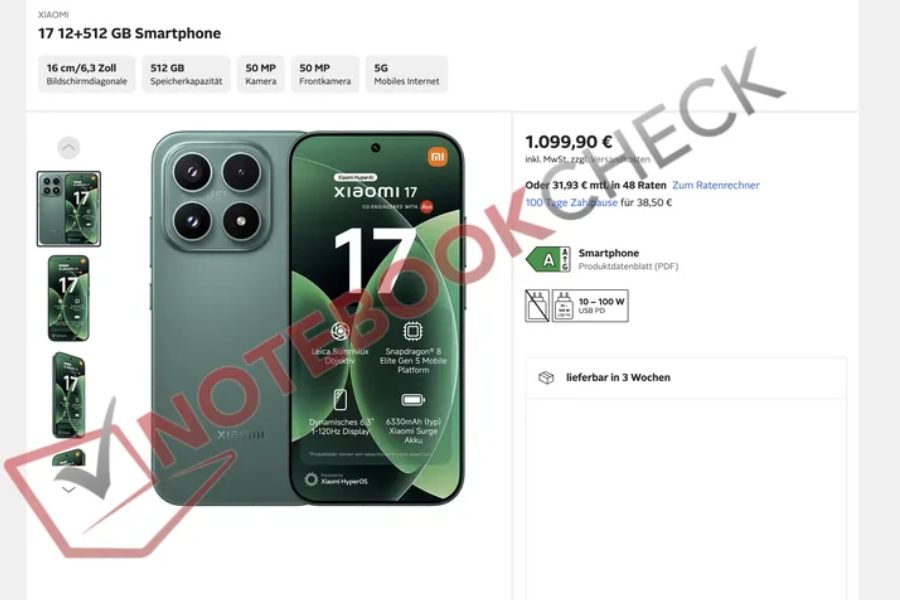
As for the price, a German retailer listing (spotted by Notebookcheck) reveals the Xiaomi 17 could retail at €1,099 for the 512GB variant. However, considering Ambhore’s leak, 256GB is the base for Xiaomi 17. As a result, we can expect a lower starting price, maybe around €999.
The retailer listing also reveals some hardware compromises for global buyers. While the Xiaomi 17 sold in China is expected to feature a massive 7,000mAh battery, the global version reportedly comes with a smaller 6,330mAh battery. That’s still a notable 20 percent increase over the 5,240mAh battery found in the previous global model, and it will support 100W fast charging.
As for timing, Xiaomi is expected to begin selling the Xiaomi 17 and Xiaomi 17 Ultra globally after MWC 2026 wraps up in March.
For more daily updates, please visit our News Section.
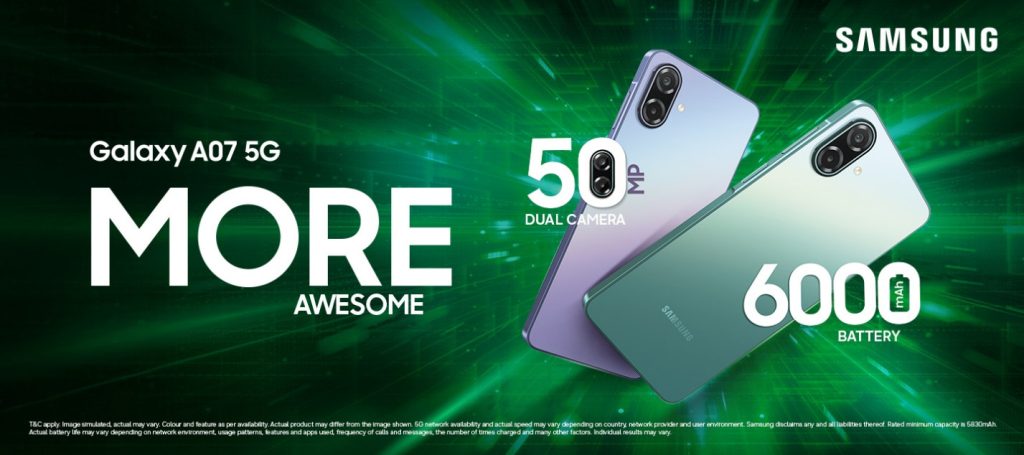
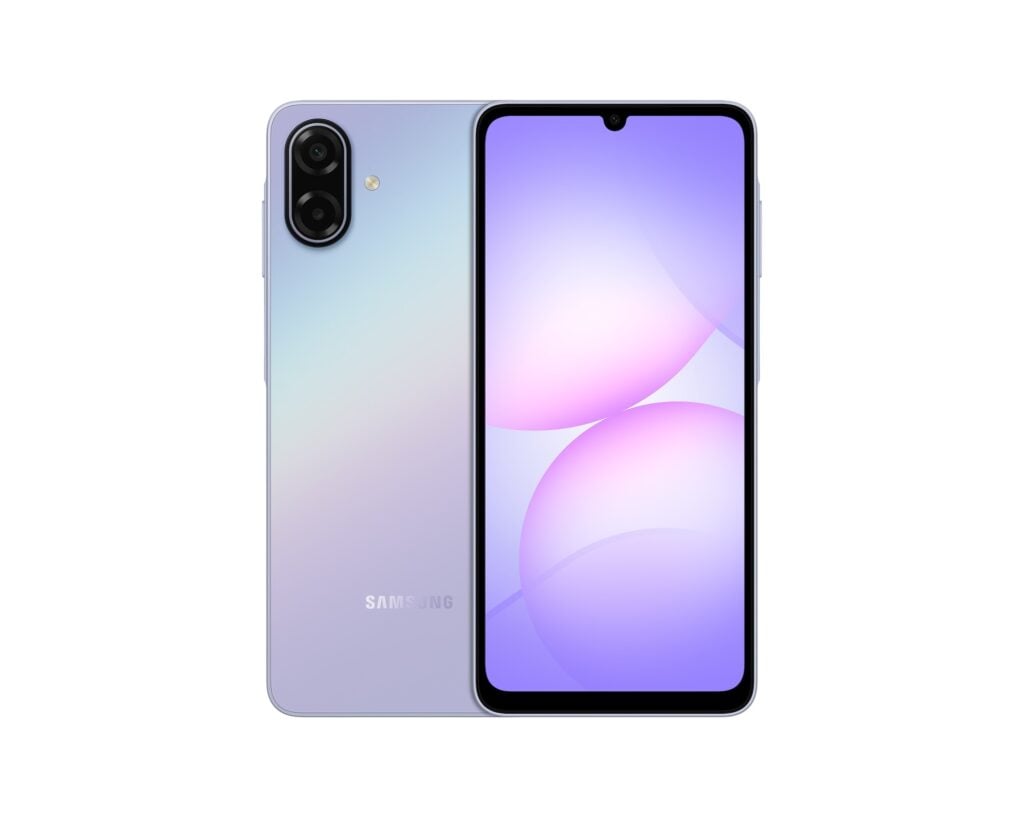
The phone was recently released in a few markets, confirming its specifications. The Galaxy A07 5G features a 6.7-inch display with a 120Hz refresh rate and 800-nit peak brightness for outdoor use. MediaTek’s Dimensity 6300 chipset powers the phone, running One UI 8.0 out of the box.
The standout feature is Samsung’s software commitment: six Android OS upgrades and six years of security updates. This extended support is rare in the budget segment and significantly extends the phone’s usable lifespan.
A 6,000mAh battery provides power for extended use. The rear camera array consists of a 50MP main sensor paired with a 2MP depth sensor, while an 8MP front camera handles selfies and video calls.
Samsung Galaxy A07 5G
The Galaxy A07 5G includes an IP54 rating for dust and water resistance, protecting against splashes and particles. Samsung Knox Vault provides hardware-level security for sensitive data.
Google’s AI features come integrated: Gemini assistant, Circle to Search functionality, and Gemini Live with natural language processing. These additions bring flagship AI capabilities to the budget tier. Construction uses glass fiber reinforced polymer, keeping the 8.2mm-thick body at 199 grams despite the large battery.
Samsung has not yet revealed pricing details or an exact launch date for the first week of February. The phone has already launched in the Philippines, where it is available in two storage variants: a 64GB model priced at Php 8,290 (INR 12,931) and a 128GB option priced at Php 9,990 (INR 15,583).
For more daily updates, please visit our News Section.
Xiaomi released a Harry Potter version of its Redmi Pad 2 Pro tablet in China. The Harry Potter Edition has the same hardware as the standard Redmi Pad 2 Pro, which launched globally last September.
The tablet has a 12.1-inch LCD screen with 2560 x 1600 resolution, 16:10 aspect ratio, and 120Hz refresh rate. The display hits 600 nits of brightness and uses Gorilla Glass 3 for protection. Touch sampling goes up to 360Hz, and stylus input reaches 240Hz. The screen has China Quality Certification Center Visual Dimension S++ rating and TÜV Rheinland certifications for low blue light, flicker-free operation, and rhythm-friendly viewing. The 12GB/256GB variant includes a soft light screen.
The tablet runs on Qualcomm’s Snapdragon 7s Gen 4 processor built on a 4nm TSMC process. The octa-core CPU runs at up to 2.7GHz and works with an Adreno 810 GPU and Hexagon Tensor Processor. You can get it with 8GB of LPDDR4x RAM and 256GB of UFS 2.2 storage. Storage expands up to 2TB with a microSD card.
The battery is 12,000mAh with 33W fast charging. It supports QC2.0, QC3.0, QC3+, PD2.0, and PD3.0 charging through USB Type-C. Four speakers provide Dolby Atmos and Hi-Res Audio. Two microphones are built in.
For connectivity, you get Wi-Fi 6, Bluetooth 5.4, Wi-Fi Direct, Miracast, MU-MIMO, IPv6, 3.5mm headphone jack, and USB 2.0 data transfer. Sensors include an accelerometer, gyroscope, ambient light sensor, Hall sensor, and geomagnetic sensor. The tablet runs Xiaomi HyperOS 3. Both cameras are 8MP: one on the back and an ultra-wide on the front. They record 1080p video at 30fps.
Pricing & availability
The Harry Potter Edition comes in blue with a Hogwarts logo on the back. It includes a themed protective case, a carrying bag with a strap, a wand-styled stylus with a replacement tip, and stickers. The tablet costs CNY 2,599 ($374) for the 8GB/256GB model, about CNY 500 more than the regular version. Xiaomi hasn’t said if it will sell this edition outside China.
For more daily updates, please visit our News Section.
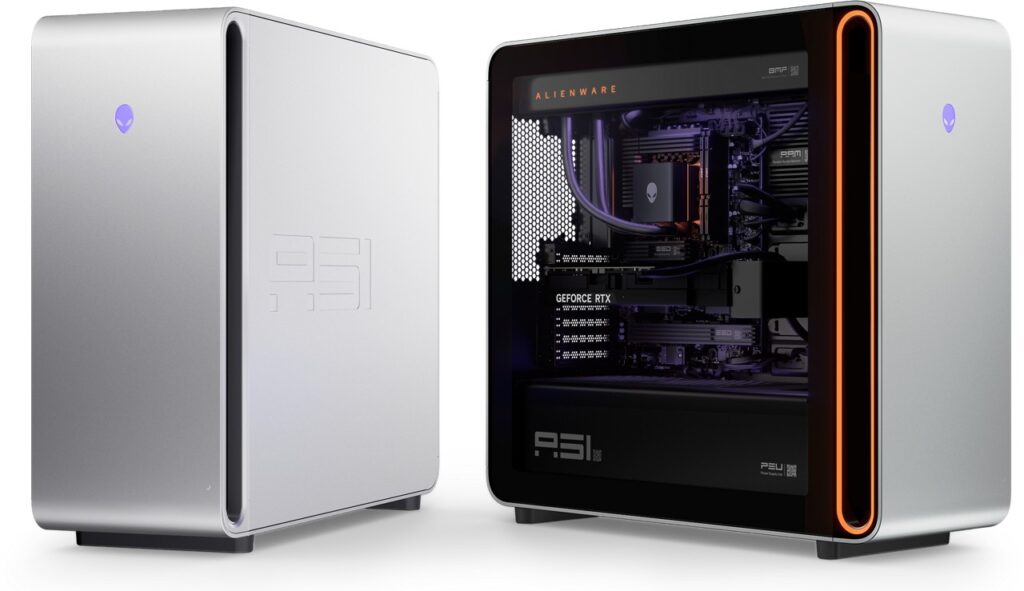
Alienware has started selling the updated Area-51 desktop gaming PC powered by AMD Ryzen 9000X3D processors. The system was first announced at CES in early January, and several configurations are now available through Dell’s official online store.
The base configuration starts at $3,349 after discounts. It includes an AMD Ryzen 7 9700X processor, an Nvidia GeForce RTX 5070 graphics card, 32GB of DDR5 memory, and a 1TB solid-state drive. At the high end, Alienware offers a fully loaded version priced at $7,599. This configuration features the AMD Ryzen 9 9950X3D, 64GB of RAM, an Nvidia GeForce RTX 5090, and up to 8TB of SSD storage.
Alienware Area-51 features
The case has a volume of 80.5 liters and uses a positive-pressure airflow design. Fans pull air into the system, while heat exits through passive rear vents. Alienware claims this layout runs 13 percent cooler, 45 percent quieter, and delivers 25 percent more airflow. It also claims up to 50 percent more processing power compared to systems from five years ago.
The system supports AMD Ryzen 9000 series desktop processors, including the Ryzen 7 9800X3D and the 16-core Ryzen 9 9950X3D with up to 144MB of cache. The X870E chipset motherboard features a 10+2+2 phase voltage regulation design, PCIe Gen5 support, and compatibility with up to 64GB of DDR5-6400 memory. Graphics cards up to 450mm in length and four slots in width are supported.
GPU options include Nvidia RTX 50-series cards ranging from the RTX 5070 to the RTX 5090 with up to 32GB of GDDR7 memory. The system supports over 200W of CPU power and up to 600W of GPU power.
Storage options range from 1TB to 12TB using three M.2 slots and three additional bays for 2.5-inch and 3.5-inch drives. Cooling support includes 240mm and 360mm liquid radiators, with 420mm expansion available after purchase.
Connectivity includes MediaTek Wi-Fi 7, Bluetooth 5.4, 2.5G Ethernet, USB4 Type-C, and multiple USB ports. A tempered glass side panel shows seven programmable AlienFX RGB lighting zones. QR codes inside the chassis link to video guides for upgrades and maintenance. Power supply options include 850W Gold-rated and 1500W Platinum-rated ATX12VO units.
For more daily updates, please visit our News Section.
OPPO has started rolling out the stable ColorOS 16 update based on Android 16 for the Find X5 Pro, beginning in Indonesia. This marks the start of the global rollout. The update is notable because the Find X5 Pro launched in 2022 with Android 12 and was officially scheduled to receive major updates only up to Android 15. Despite this, OPPO has extended software support to include Android 16.
The update is currently available for eligible users in Indonesia. OPPO confirmed that the rollout will expand to other regions in stages, with more users gaining access over time.
This is an official stable release, not a beta build. Applications for the update opened on January 29. To receive the update, the Find X5 Pro must be running firmware version CPH2305_16.0.3.500(EX01). Devices on older builds will not detect the update.
ColorOS 16 features
ColorOS 16 is built on Android 16 and focuses on faster performance, better system stability, and smoother animations. The update introduces the Luminous Rendering Engine along with an upgraded Trinity Engine. According to OPPO, these changes improve overall system stability by 37 percent and make animations smoother across both mid-range and flagship devices.
The interface also gets noticeable changes. ColorOS 16 introduces the new Flux Home Screen, which supports resizable and adaptive icons that adjust more naturally to different layouts. The Always On Display now runs in full screen and transitions directly into the lock screen, making the unlock experience feel more connected.
AI features are more deeply integrated in this version. ColorOS 16 brings tighter integration with Google Gemini. AI Mind Space works as a central place to collect, organize, and revisit saved notes and information. Creative tools such as AI Portrait Glow and Master Cut aim to simplify photo and video editing without the need for manual adjustments.
Connectivity has also been improved. O Plus Connect offers better integration with both Mac and Windows systems. The updated Touch to Share feature makes it easier to transfer files to iOS devices. For privacy, sensitive AI tasks are handled through OPPO’s Private Computing Cloud.
OPPO recommends backing up important data before installing the update. After updating, the system will run background optimization, which may cause temporary heating, lag, or higher battery drain. Some third-party apps may also face compatibility issues with Android 16 until they are updated.
For more daily updates, please visit our News Section.
We use cookies on our website to give you the most relevant experience by remembering your preferences and repeat visits. By clicking “Accept”, you consent to the use of ALL the cookies.
This website uses cookies to improve your experience while you navigate through the website. Out of these, the cookies that are categorized as necessary are stored on your browser as they are essential for the working of basic functionalities of the website. We also use third-party cookies that help us analyze and understand how you use this website. These cookies will be stored in your browser only with your consent. You also have the option to opt-out of these cookies. But opting out of some of these cookies may affect your browsing experience.
Necessary cookies are absolutely essential for the website to function properly. This category only includes cookies that ensures basic functionalities and security features of the website. These cookies do not store any personal information.
Any cookies that may not be particularly necessary for the website to function and is used specifically to collect user personal data via analytics, ads, other embedded contents are termed as non-necessary cookies. It is mandatory to procure user consent prior to running these cookies on your website.