Advertisement

Redmi Band 4 vs Redmi Band 3: What Has Changed Between the Two Smart Bands?

Xiaomi’s Redmi Band 4 and Redmi Band 3 share several fundamental features, including a 1.47-inch display, 60Hz refresh rate, 5ATM water resistance and 50 sports modes. However, the newer Redmi Band 4 introduces changes to its exterior design, health-monitoring capabilities and claimed battery endurance. 

While both devices target users looking for an affordable fitness tracker with everyday smart features, their differences are worth examining before choosing between them. Here is how the two Redmi bands compare across design, display, battery, health tracking and everyday functionality.

Redmi Band 4 vs Redmi Band 3

Design & Build

The Redmi Band 4 introduces a refreshed exterior with a metal-textured unibody design, replacing the Redmi Band 3’s high-strength fiber-polymer construction. Its 2.5D curved cover glass also gives the newer model a different front appearance compared with the reinforced glass on its predecessor. Xiaomi has updated the strap design as well, moving from the Redmi Band 3’s conventional TPU strap to a vertically textured design on the Redmi Band 4.

These changes give the newer model a more refined appearance, although both retain a lightweight fitness-band design intended for everyday use. The Redmi Band 3’s TPU strap provides a straightforward and practical approach to daily wear.

Winner: Redmi Band 4 – Refreshed exterior with a curved-glass finish and updated strap design.

Display

Both fitness bands feature a 1.47-inch display with a 60Hz refresh rate, keeping their screen sizes and refresh performance on equal footing. This means users upgrading from the Redmi Band 3 should not expect a larger viewing area or a higher refresh rate with the Redmi Band 4.

The main distinction lies in the display’s protective glass and overall presentation. The Redmi Band 4 uses 2.5D curved glass, while the Redmi Band 3 features reinforced glass. The curved-glass treatment gives the newer model a different appearance, complementing its redesigned exterior. However, neither model establishes a clear advantage in screen size or refresh rate.

Winner: Redmi Band 4 – Curved-glass design gives it a refreshed display appearance.

Battery Life & Charging

Battery endurance is one of the more meaningful improvements in the Redmi Band 4. Xiaomi claims up to 21 days of battery life, compared with up to 18 days for the Redmi Band 3. This represents three additional days of claimed usage, potentially reducing how frequently users need to recharge the newer fitness band.

The Redmi Band 4 also offers approximately eight days of battery life with regular monitoring enabled. This provides a more practical indication of endurance when health-monitoring features are being used more frequently. The Redmi Band 3 features a 300mAh lithium-ion polymer battery and supports charging in less than two hours.

Winner: Redmi Band 4 – Three additional days of claimed maximum battery life.

Health Tracking

Both models cover essential health-monitoring requirements, including heart rate monitoring, blood oxygen tracking and sleep monitoring. These features make them suitable for users who want basic health insights throughout the day without investing in a more expensive smartwatch.

The Redmi Band 4 expands this functionality with all-day stress monitoring and women’s health tracking. These additions give the newer model a broader health-monitoring package, particularly for users interested in tracking stress levels and menstrual health alongside their regular fitness data.

The Redmi Band 3 already provides optical heart rate and blood oxygen sensors, making it a capable starting point for everyday health tracking. However, the additional monitoring features give its successor an advantage.

Winner: Redmi Band 4 – Adds all-day stress monitoring and women’s health tracking.

GPS & Navigation

Neither model establishes a dedicated built-in GPS advantage. The Redmi Band 3 does not include built-in GPS, and the Redmi Band 4’s feature set does not establish a standalone GPS capability either.

Consequently, users looking for independent outdoor route tracking should consider a fitness band with dedicated satellite positioning instead. Both Redmi models are better suited to everyday activity monitoring, step tracking and general fitness use than advanced navigation.

For users who primarily exercise indoors, walk around their neighbourhood or track general daily activity, the absence of a dedicated GPS system may not be a significant limitation.

Winner: Tie – Neither model offers a confirmed built-in GPS advantage.

Sports & Training Features

The Redmi Band 4 and Redmi Band 3 both support 50 sports modes, giving them similar coverage for everyday workouts and recreational fitness activities. Whether users prefer indoor exercise, walking or other supported activities, neither model offers a numerical advantage in the number of available sports modes.

The Redmi Band 4 benefits from its additional stress-monitoring capabilities, which complement its fitness features with broader health insights. However, the core sports-mode selection remains unchanged between the two generations.

For users primarily interested in workout variety, the Redmi Band 3 remains competitive. Those wanting a more comprehensive combination of fitness and health monitoring will find the Redmi Band 4 more appealing.

Winner: Tie – Both offer the same 50 sports modes.

Smart Features & Connectivity

The Redmi Band 3 supports Bluetooth 5.3 BLE and Xiaomi HyperOS, alongside compatibility with Android 8.0 or later and iOS 12.0 or later. Its smart functionality includes notifications and other everyday fitness-band features.

The Redmi Band 4 focuses on practical everyday conveniences, including notifications, alarms, watch faces and WeChat and Alipay QR payments. These payment integrations make it particularly useful for users who regularly use Xiaomi’s supported payment ecosystem.

The two devices approach everyday functionality differently, with the Redmi Band 4 highlighting convenient payment-related features while the Redmi Band 3 provides a clearly defined connectivity specification.

Winner: Redmi Band 4 – Offers integrated WeChat and Alipay QR payment functionality.

Outdoor Features & Water Resistance

Both fitness bands feature 5ATM water resistance, making them suitable for water-related activities within the limits of their respective water-resistance ratings. This gives the Redmi Band 4 no particular advantage over its predecessor for everyday exposure to water or swimming-related use.

Neither model offers a confirmed built-in GPS advantage, so users who regularly participate in outdoor running or cycling and require independent route tracking may need a more advanced wearable.

For general outdoor activity tracking, however, both bands provide a similar foundation through their sports modes, health-monitoring capabilities and water-resistant construction.

Winner: Tie – Both feature 5ATM water resistance and similar outdoor-tracking capabilities.

Which One Should You Buy?

The Redmi Band 4 is the more appealing choice for users who want the newer design, additional health-monitoring features and longer claimed battery endurance. Its all-day stress monitoring, women’s health tracking and updated exterior give it meaningful improvements over the Redmi Band 3.

However, the Redmi Band 3 remains a practical option for users who primarily need heart rate monitoring, blood oxygen tracking, sleep monitoring and 50 sports modes. Its 1.47-inch display and 5ATM water resistance also remain competitive against the newer model.

Final Verdict

If you are planning to buy a new fitness band, the Redmi Band 4 is the better choice thanks to its refreshed design, additional health-monitoring features and longer battery life. However, if you already own the Redmi Band 3, there is little reason to upgrade, as the core experience remains largely unchanged and the improvements are relatively incremental. 

Disclaimer: Prices, specifications, and availability may vary by region and retailer. Recommendations in this article are based on editorial opinion, feature-based value, and market positioning at the time of writing. Readers are advised to do their own research before making a purchase.

Redmi Band 4 vs Redmi Band 3

CategoryRedmi Band 4Redmi Band 3Winner
Cover Glass2.5D Curved GlassReinforced GlassRedmi Band 4 – Curved-glass design
Frame DesignMetal-textured UnibodyHigh-Strength Fiber PolymerRedmi Band 4 – Refreshed exterior
Strap DesignVertically TexturedTPURedmi Band 4 – Updated design
Display Size1.47-inch1.47-inchTie – Same size
Refresh Rate60Hz60HzTie – Same refresh rate
Battery LifeUp to 21 daysUp to 18 daysRedmi Band 4 – Longer endurance
Regular MonitoringApproximately 8 days—Redmi Band 4 – Additional usage information
Heart Rate MonitoringSupportedOptical SensorTie – Both supported
Blood Oxygen MonitoringSupportedOptical SensorTie – Both supported
Stress MonitoringAll-day—Redmi Band 4 – Additional tracking
Sleep TrackingSupportedSupportedTie – Both supported
Women’s Health TrackingSupported—Redmi Band 4 – Additional feature
Sports Modes5050Tie – Same number
Water Resistance5ATM5ATMTie – Same rating
Wireless Connectivity—Bluetooth 5.3 BLERedmi Band 3 – Defined Bluetooth specification
NFCNot supportedSupportedRedmi Band 3 – NFC support
Smart FeaturesNotifications, alarms, watch faces, WeChat and Alipay QR paymentsNotifications and smart-band functionsRedmi Band 4 – QR payment features
Built-in GPS—NoTie – No established advantage
Disclaimer: Specs are based on available data. Actual performance may vary. Verify details from official sources before buying.

Read More:

Same phone, smaller battery: 5 models that change depending on where you buy

a person holding an Oppo Find X10 series phone in hand

The spec sheets are quietly becoming regional as a growing number of smartphones are launching with different battery capacities for different markets. We see that quite often with devices launched in China or India hitting international store shelves with relatively smaller battery capacities.

Brands do this for various reasons. In most cases, the difference is driven by strict international shipping regulations, local certification delays, and the extra internal clearance required for global 5G bands. So, buying the exact same phone doesn’t mean you’re getting the same spec as users in other regions.

If you’re planning for an upgrade soon, here are the 5 popular phones sold with different battery capacities depending on where you buy them.

1. Oppo Find X10

The high-end Oppo Find X10 comes in two battery versions depending on the region. Most of Asia and global markets get the bigger 8,000 mAh version. This includes regions like India, China, UAE, Singapore, Malaysia, Philippines, and Hong Kong.

There’s also a 7,150 mAh version of the Oppo Find X10 for Australia and European markets, including UK, Germany, France, and Spain.

Oppo hasn’t clarified why it ships the Oppo Find X10 with lesser battery capacities in Australia and European markets. However, some industry reports suggest this was done to comply with regional shipping rules without thickening the chassis.

Australia and Europe enforce a strict 20 Wh per-cell transport threshold. The Oppo Find X10 with 8,000 mAh single-cell exceeds that threshold, and so it comes with a dual-cell design in restricted regions. This design adds extra internal dividers and protection circuitry, and to keep the device thin, brands usually choose to reduce the capacity.

Fortunately, both versions carry the same charging support: 80W wired, 50W wireless, and 10W reverse wireless. You can read the complete specs of the Oppo Find X10 on this page.

2. Nothing Phone (4b)

The Nothing Phone (4b) is a popular mid-range smartphone. It is also available in multiple battery versions depending on the region. Units sold in India get the maximum 6,000 mAh battery, but other regions get a smaller battery.

The Phone (4b) ships in the UK, Europe, and other global regions with a maximum capacity of 5,200 mAh — 800 mAh less than the Indian unit. The reason: to comply with single-cell shipping limits. However, all regions get the same 33W wired charging and 7.5W reverse wired charging.

You can read the complete specs of the Nothing Phone (4b) on this page.

3. OnePlus Nord 6

OnePlus Nord 6 is a solid upper mid-range smartphone that comes with a massive 9,000 mAh battery in India, but other regions get a big cut. In Europe and other global markets, the phone comes with a maximum capacity of 7,500 mAh — that’s a 17% cut and it makes a noticeable difference in total screen-on time.

Brands don’t do it out of choice, but to comply with strict single-cell shipping limits without increasing the phone’s thickness. Even 7,500 mAh is still above the limit for a single-cell. Therefore, the Nord 6 has a dual-cell battery.

The non-Indian OnePlus Nord 6 also compromises on charging speeds. The reverse wired charging is limited to 6.5W, while the Indian model supports much higher 27W speed. The regular wired charging speed, however, is the same 80W for all regions.

You can read the complete OnePlus Nord 6 specs on this page.

4. Redmi Note 17 Pro 5G

Redmi Note 17 Pro 5G is another popular device on the list that is offered in two battery versions. In India and China, the device comes with a massive 9,000 mAh battery, but Europe gets a trimmed version with 8,340 mAh battery.

The difference is not that big when compared to the OnePlus Nord 6, but still the difference impacts the total battery backup. Again, the reason is the same: to comply with the international aviation and European transport laws.

Redmi Note 17 Pro 5G units shipped to India and China have a single-cell battery, while European users get a dual-cell battery (to not exceed the 20 Wh single-cell ceiling). The charging speeds remain the same, though: 67W wired charging and 22.5W reverse wired charging.

You can check out the complete specs of the Redmi Note 17 Pro 5G on this page.

5. iQOO Z11 5G

Unlike other phones on the list, the iQOO Z11 5G gets a smaller 7,050 mAh battery in India, while other regions, including China and Malaysia, get a much higher 9,000 mAh capacity — that’s a solid 22% reduction in total capacity for the Indian buyers, and that could make a big difference, especially if you’re a heavy user.

Charging capabilities are also different, and Indian users are making the compromise again. In that region, the iQOO Z11 comes with 44W charging support, while Chinese and Malaysian units offer a whopping 90W fast charging.

The iQOO Z11 also has different designs and chipsets based on which country you purchase it from. It’s better to take a little extra time and understand the difference to make an informed decision. You can check out detailed specs here: iQOO Z11 (India) and iQOO Z11 (China).

Dareu launches Ultra68 keyboard with a swappable LED matrix screen and 8K polling rate

If you’re into mechanical keyboards, you might want to check out the new Ultra68 from Dareu, which just launched in China. It’s built with a solid aluminum body, but the real standout is its modular design that lets you physically change the layout of the board. You can actually pop off the function row and swap it out for a small LED screen.

Dareu Ultra68 Keyboard

Dareu Ultra68 Keyboard Specifications

Depending on your preference, you can set the board up as a standard 75% layout or size it down to a more compact 68-key footprint. If you decide to remove the Fn key section, you can snap in a 335-LED dot-matrix display instead. It’s a fun addition that lets you show off pixel art, animated GIFs, or scrolling text.

Dareu Ultra68 Keyboard

To manage the screen and tweak your RGB lighting, Dareu uses UniHub. It’s a web-based driver that works right in your browser, which is pretty convenient since it saves you from having to download and install dedicated desktop software.

Under the hood, the Ultra68 packs the kind of features you’d expect from a modern gaming keyboard, especially when it comes to adjustable actuation. Dareu is offering two different switch setups. The wired-only version uses the company’s own Luban magnetic switches.

Dareu Ultra68 Keyboard

These give you an adjustable actuation range from 0.1mm to 3.5mm, a total travel distance of 3.5mm, a light 35gf actuation force, and a 55gf bottom-out force. If you prefer going wireless, the dual-mode version uses Kailh’s Thunder inductive switches.

When you’re plugged in via cable, both models support a fast 8,000Hz polling rate, which Dareu says brings the latency down to just 0.125ms. They also feature Rapid Trigger support with a fine adjustment precision of 0.01mm, along with a 32KHz full-key scanning rate to make sure your inputs register as quickly as possible.

Dareu Ultra68 Keyboard

As for the build itself, it’s put together nicely. You get an aluminum alloy chassis, an FR4 positioning plate, and a gasket-mounted structure. Inside, there are four layers of sound-dampening material to help with acoustics: PORON foam, an IXPE switch pad, a PET layer, and PORON bottom foam. It’s got some heft to it, too, the wired version weighs 1.9kg, while the dual-mode model comes in at 1.7kg.

Dareu Ultra68 Keyboard

Interestingly, the two versions handle the modular swapping a bit differently. The wired model uses a ball-bearing mechanism to lock the modules in place, while the dual-mode version relies on magnetic attachments.

The dual-mode version also gives you 2.4GHz wireless connectivity (which runs at a standard 1,000Hz polling rate) and is powered by a built-in 8,000mAh battery. Whichever one you go with, the box includes the keyboard, the expansion module, a manual, a keycap puller, a switch puller, and a USB cable.

Dareu Ultra68 Keyboard

Pricing

If you’re looking at pricing and colors, the Ultra68 has a few options. The wired Luban magnetic switch version comes in a sandblasted Metallic Black for 799 yuan (about $120) or a brushed Burgundy for 849 yuan ($127). The dual-mode Kailh Thunder inductive switch version is available in a brushed Metallic Silver finish for 999 yuan ($150).

(JD)

Xiaomi Mijia floor lamp launches with RGB and WRGB lighting, 18 effects, 21W rated power

On November 11, crowdfunding opened for the Mijia Floor Lamp (model MJLD01YL). The regular price is listed at 999 yuan (~$149), but the crowdfunding price is 719 yuan (~$107). The design is deliberately simple: tall, slim, and stable enough that it should sit cleanly in a living room, bedroom, or media setup without drawing too much attention to itself.

Xiaomi Mijia floor lamp

What makes it interesting is the dual light system. One source is RGB (custom IC LEDs) and can do the full 16 million colors for pure ambiance. The other uses WRGB high-efficiency LEDs and handles more practical, softer illumination. You can run them separately or together, so you get everything from soft mood lighting to something actually useful for reading or moving around the room.

There are 18 built-in effects in total: 10 static ones (sunset, meditation, reading, night light, and similar fixed looks) and 8 dynamic ones (aurora, flowing light, breathing patterns, etc.). Brightness goes from 1% to 100%, and the color temperature ranges from a very warm 1800K all the way up to 6500K. There’s also a dedicated night-light mode for low-level illumination after dark.

A hand holds a smartphone displaying the Xiaomi Mijia floor lamp control app interface.

Controls are simple. A circular touch ring at the bottom of the light head lets you tap to turn it on/off, slide for brightness, and long-press to cycle through effects. For full customization, schedules, and scene linking, you’ll use the Mi Home app. It also works with XiaoAI voice commands and slots into Xiaomi’s HyperOS ecosystem so it can talk to other devices.

Specs-wise, it’s rated at 21W, connects over 2.4 GHz Wi-Fi, and the base is designed to stay put. Installation is supposed to be straightforward.

This is Xiaomi pushing its smart lighting beyond desk lamps and ceiling fixtures into freestanding ambient lighting. Dual independent sources, lots of color and effect options, and solid app/voice integration make it feel like a flexible atmosphere piece rather than just another smart bulb on a stick. Right now it’s only available through the ongoing crowdfunding campaign on Xiaomi Youpin.

(Source: Xiaomi Youpin)

Google Pixel Tag goes on sale finally

Google‘s first official item tracker, the Pixel Tag, is now available starting November 11. The slim tag works with the Find Hub network to help you locate keys, wallets, and luggage from an Android phone. A single Pixel Tag is priced at $29.99 from the Google Store, while a four-pack is $99.99.

Google Pixel Tag specifications and features

Google Pixel Tag
Google Pixel Tag

The Pixel Tag measures 28 x 46.1 x 5.4 mm and weighs 11.8 grams with the battery, or 8.8 grams without it. Google built it from polycarbonate and metal in a single Fog color, slim enough to slip into a wallet. It is rated IP67, so it can handle dust and up to 1 meter of water for 30 minutes.

Setup uses Fast Pair on phones running Android 9 or later. Find Hub can show the tag on a map and, when it is far away, use a crowdsourced network of more than 1 billion Android devices, with end-to-end encrypted location data. Nearby, Ultra Wideband can show visual direction and distance, while Bluetooth Channel Sounding offers distance guidance on compatible phones running Android 16 and Bluetooth 6.0 or later.

You can play a sound from the built-in speaker, and a button on the tag can ring your phone even if it is on silent. The user-replaceable CR2032 battery is rated for over a year, and you can share a tag with up to 10 people. Left Behind alerts are optional, and you can also ring the tag from a Pixel Watch or ask Gemini through Pixel Buds.

Google Pixel Tag price and availability

Google Pixel Tag
Google Pixel Tag

A single Pixel Tag is $29.99 and a four-pack is $99.99, starting November 11 from the US Google Store. It was first unveiled in August alongside the Pixel 11 series, and now gives Android users a first-party alternative to the AirTag and Galaxy SmartTag2. It comes in Fog, with a one-year warranty in the US, and joins other Bluetooth trackers such as the Moto Tag 2.

Would you buy a Pixel Tag at $29.99, or would you stick with another Find Hub tracker? Let us know in the comments below.

For daily updates, please visit our News Section.

Oppo A7 Ultra to pack huge 12,000mAh battery, here’s when it’s coming

A new Oppo phone is being discussed as the Oppo A7 Ultra, according to tipster Digital Chat Station. The leak points to a launch around December and a massive 12,000mAh battery. Oppo has not confirmed the name, the timing, or the claims.

Oppo A7 Ultra launch window and battery tip

Oppo A7 Ultra
Oppo A7 Ultra

In a Weibo post today, DCS said the Oppo A7 Ultra is expected to be released around December and is being positioned as a 10,000mAh-class phone. The tipster also suggested it may be the model with a horizontal camera matrix and a 12,000mAh cell. The leak did not mention a chipset, display, charging speed, or price.

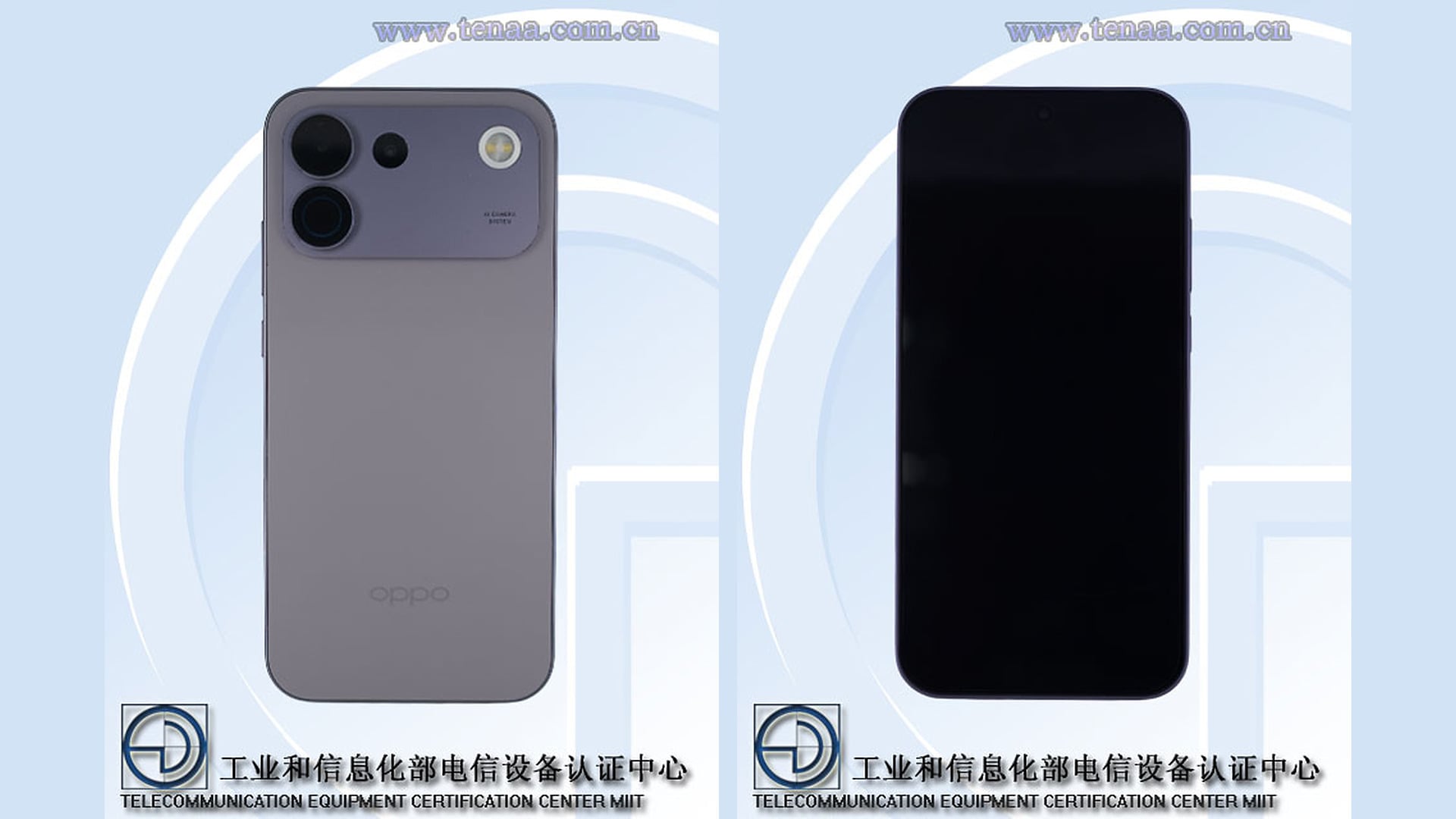
That description matches the Oppo PNC110, which recently appeared on China’s MIIT network access license with official images. Those photos show a purple 5G phone with a pill-shaped horizontal camera island, two lenses, a flash, and “AI CAMERA SYSTEM” printed on the module. The Oppo logo is placed low on the rear panel.

Oppo A7 Ultra design and A-series context

Oppo A7 Ultra
Oppo A7 Ultra

The official set also includes two side views, one of which shows the volume rocker, the power button, and the raised camera module. The front is a flat screen with a punch-hole selfie camera in the center. The license describes a 5G phone with dual-SIM support.

Earlier reports put the PNC110’s rated capacity at about 11,460mAh to 11,640mAh, so the exact number is still unclear. The typical figure is likely to be marketed at around 12,000mAh, which would make this Oppo’s largest phone battery to date and a step up from the Oppo A7 Pro Max. That model launched in China on August 4 with a 10,000mAh battery and later went on sale outside China.

If the name holds, the A7 Ultra would join the current A7 family, which already includes the Oppo A7 Pro and its 8,000mAh battery. Last year’s Oppo A6 series used 7,000mAh cells on its main models. Until Oppo confirms the name and the rest of the specs, this should be treated as an early leak.

Would a 12,000mAh Oppo A7 Ultra arriving around December interest you, or do you want to see the rest of the specs first? Let us know in the comments below.

For daily updates, please visit our News Section.

Citizen’s Doctor Doom watch drops to $425.71, a good $70 discount

Amazon US has the Citizen AW5027-44W Doctor Doom watch at $425, down from its $495 launch price, a $69.29 (14%) saving. It’s worth it if you’re a Doom or Marvel fan who wants a battery-free watch you’ll actually wear.

Is this a good price?

Doctor Doom citizen watch AW5027-44W

Citizen launched the AW5027-44W in the US in October 2026 at $495. At $425.71, Amazon is $69.29 below that, or 14% off list price. It’s a modest saving, but a real one on a watch that’s barely a month old.

Citizen hasn’t made an official price cut on this model. This is an Amazon discount, not a markdown from Citizen. It is the lowest price since its launch, but the watch only launched in October, so that window is short.

Price now$425.71
List price$495
You save$69.29 (14%)
Price as of11 Nov 2026, 1AM EDT

Product prices and availability are accurate as of the date/time indicated and are subject to change.

What you get

  • Mask dial: The gray dial builds Doctor Doom’s metal mask up in relief instead of printing it on. This is what you’re paying for, and gold-tone hands keep it from looking like a toy.
  • Eco-Drive: Citizen’s J810 light-powered quartz runs three hands and a date at 3 o’clock. You never need a battery change.
  • Daily-wear build: The 42.5mm grey stainless steel case weighs 88g, uses 20mm lugs and is rated to 100m. It’s tough enough for swimming and everyday knocks, though the crystal is mineral, not sapphire.
  • Collector extras: A textured green leather strap, a Doom logo etched on the case back, a display box and a double-sided coin. That makes it an easy gift.

What users liked and what they didn’t

Liked:

  • The relief mask dial is the standout, and it reads as more than a printed logo.
  • Gold hands and green accents keep the theme fairly restrained.
  • The coin, box, and etched case back suit collectors and gift buyers.
  • Eco-Drive means no battery swaps.
  • 100 m water resistance makes it practical for daily wear.

Didn’t like:

  • Mineral crystal scratches more easily than sapphire, which stands out at this price.
  • Underneath, it’s a plain three-hand quartz watch, so most of the cost is the character design.
  • Citizen doesn’t say how long the lume lasts.

How it compares

  • CITIZEN Men’s Eco-Drive Fantastic Four 39mm Super Titanium AW0131-66W ($468.75 on Amazon US): The Fantastic Four model suits smaller wrists. It’s a 39mm limited-edition Marvel Eco-Drive in lighter Super Titanium, and it also comes with a coin.
  • CITIZEN Men’s Eco-Drive Marvel’s X-Men 42.3mm Stainless Steel AW5007-17W ($281 on Amazon US): X-Men fans get the same recipe here: Eco-Drive, mineral crystal, and a leather strap, in a near-identical 42.3mm steel case. Choose it if the character matters more to you than the mask dial.
  • CITIZEN Men’s Automatic Tsuyosa 40mm Stainless Steel NJ0151-53Z ($371.25 on Amazon US): If you’d rather have a regular watch than a character piece, the Tsuyosa is the one. It’s a 40mm Citizen with a mechanical automatic movement and a steel bracelet.

Rival prices on Amazon US as of 11 Nov 2026, 1AM EDT. Product prices and availability are accurate as of the date/time indicated and are subject to change.

Should you buy it?

Buy it now if you’re a Doctor Doom or Marvel collector who wants a wearable, battery-free watch or a gift that arrives looking the part. Skip it if you want sapphire, a mechanical movement, or a non-themed design, because that money buys more watches elsewhere.

Where to buy

Oppo Reno 17 series to feature four 50MP cameras, details officially confirmed

Oppo has officially confirmed the camera setup on the standard Oppo Reno 17 ahead of its China launch. The vanilla model uses four 50-megapixel cameras and is promoted as a Live Photo-focused phone. It will be unveiled on November 16 at 7 PM China time, alongside the Reno 17 Pro.

Oppo Reno 17 official camera specs

Oppo Reno 17
Oppo Reno 17

A new official teaser spells out the hardware on the standard Reno 17. It lists a 50-megapixel ultra-clear main camera, a 50-megapixel periscope telephoto, and a 50-megapixel ultra-wide on the rear, plus a 50-megapixel ultra-wide selfie camera.

That is a shift from the Chinese Reno 16 and Reno 16 Pro, which both launched with a 200-megapixel main camera, a 50-megapixel ultra-wide, and a 50-megapixel periscope on the rear, plus a 50-megapixel front camera. The vanilla Reno 17 moves to four 50-megapixel cameras, compared with the 200-megapixel main on its predecessors.

Oppo says the Reno 17 series includes the Reno 17 and the Reno 17 Pro, and that specifications vary by model. The poster notes that the pictured phone is the Reno 17, and that “ultra-clear four main cameras” means all four cameras use 50-megapixel or higher sensors. This list is therefore for the vanilla Reno 17 only. It is not clear yet whether Oppo will also drop the 200-megapixel primary sensor on the Reno 17 Pro.

Live Photo features and the November 16 launch

On official Weibo today, Oppo framed the series as a Live Photo phone that keeps casual shots sharp across every focal length. It highlighted ultra-clear natural-color Live Photos that reproduce the light and color of the moment, plus 4K long Live Photos that run for six seconds.

A new Live Photo color palette is part of the same tease, and Oppo says a light swipe can produce a ready-to-share look. Official creatives show bluer skies, warmer light, and a cinematic grade.

Oppo locked in the November 16 China event last week, when official images of the Reno 17 and Reno 17 Pro went live. Pricing and any camera differences on the Pro should be confirmed at the event.

Which Reno 17 camera are you most interested in trying first, the 50-megapixel periscope or the ultra-wide selfie camera? Let us know in the comments.

For daily updates, please visit our News Section.

Samsung Galaxy W27 vs Samsung Galaxy Z Fold8 Ultra: What’s Actually Different?

Samsung’s Galaxy W27 and Galaxy Z Fold8 Ultra present an unusual comparison. Rather than two competing foldables with substantially different hardware, they represent two regional interpretations of Samsung’s premium foldable flagship. The W27 targets China’s luxury smartphone market, while the Z Fold8 Ultra serves international buyers. Despite their shared hardware, a few exclusive features and regional differences make this comparison interesting.

Did You Know? The Samsung Galaxy W27 belongs to Samsung’s China-exclusive W Series, developed in partnership with China Telecom under the Heart to the World brand. Unlike the globally marketed Galaxy Z Fold series, the W lineup targets China’s premium luxury smartphone segment, bringing exclusive designs, premium packaging and China-specific features such as Tiantong satellite communication. The W27 is therefore more than a regional rename of the Galaxy Z Fold8 Ultra; it represents Samsung’s luxury-focused approach to the Chinese market. 

Samsung Galaxy W27 vs Z Fold8 Ultra

1. Major Features:

CategorySamsung Galaxy W27Galaxy Z Fold8 UltraWinner
Market AvailabilityChina exclusiveGlobal marketsZ Fold8 Ultra – Wider availability
Launch DateOctober 29, 2026August 6, 2026—
DesignPremium dual-tone design with gold accentsConventional flagship designW27 – More exclusive styling
FrameAdvanced Armor AluminumAdvanced Armor AluminumTie
Cover ProtectionGorilla Glass Ceramic 3Gorilla Glass Ceramic 3Tie
Water & Dust ResistanceIP48IP48Tie
Main Display8-inch Dynamic AMOLED 2X8-inch Dynamic LTPO AMOLED 2XZ Fold8 Ultra – LTPO technology
Display Resolution2504 × 2256 pixels2504 × 2256 pixelsTie
Cover Display6.5-inch Dynamic AMOLED 2X6.5-inch Dynamic LTPO AMOLED 2XZ Fold8 Ultra – LTPO technology
Refresh Rate120Hz adaptive120Hz adaptiveTie
Peak Brightness3,000 nits3,000 nitsTie
ProcessorSnapdragon 8 Elite Gen 5 for GalaxySnapdragon 8 Elite Gen 5 for GalaxyTie
GPUAdreno 840Adreno 840Tie
RAM16GB LPDDR5X12GB / 16GBW27 – 16GB standard
Storage512GB / 1TB256GB / 512GB / 1TBZ Fold8 Ultra – More choices
Main Camera200MP, OIS200MP, OISTie
Ultra-Wide Camera50MP50MPTie
Telephoto Camera10MP, OIS, 3x optical zoom10MP, OIS, 3x optical zoomTie
Digital ZoomUp to 30xUp to 30xTie
Inner Selfie Camera10MP10MPTie
Cover Selfie Camera10MP10MPTie
Battery5,000mAh5,000mAhTie
Wired Charging45W45WTie
Wireless Charging20W20WTie
Reverse Wireless ChargingSupported4.5WTie
Satellite CommunicationTiantong satellite communicationNot listedW27 – Satellite connectivity
Operating SystemAndroid 17Android 17Tie
User InterfaceOne UI 9One UI 9Tie
Software UpdatesNot specifiedUp to 7 major Android updatesZ Fold8 Ultra – Confirmed update policy
Wi-FiWi-Fi 7Wi-Fi 7Tie
Bluetooth6.06.0Tie
NFCYesYesTie
UWBYesYesTie
USBUSB Type-CUSB Type-C 3.2Z Fold8 Ultra – Faster USB standard
SIMDual SIMNano-SIM + eSIM + eSIM (up to 2 active)Z Fold8 Ultra – eSIM support
Fingerprint SensorSide-mountedSide-mountedTie
Price (Base Variant)¥18,999 (approx. $2,830)Approx. $2,100Z Fold8 Ultra – Lower starting price
Disclaimer: Specs are based on available data. Actual performance may vary. Verify details from official sources before buying.

2. Design and Display

Build and Feel

The Galaxy W27 stands out with a more extravagant design, featuring gold-coloured accents, a textured frame and two distinctive finishes: Jixia Hong and Jihu Blue. Its premium appearance reflects Samsung’s China-exclusive Heart to the World series, giving it a more luxurious identity than the conventional flagship styling of the Z Fold8 Ultra.

The Z Fold8 Ultra takes a comparatively understated approach, prioritising a familiar flagship aesthetic. Both phones feature Advanced Armor Aluminum construction, IP48 protection and Gorilla Glass Ceramic 3 cover protection. The W27 looks more exclusive, but the Z Fold8 Ultra’s traditional styling makes it the more universally appealing option.

Display Quality

There is practically no reason to choose one over the other for display quality. Both feature an 8-inch Dynamic AMOLED 2X main display with a 120Hz adaptive refresh rate, 3,000-nit peak brightness and HDR10+ support. Their 6.5-inch cover displays also share 120Hz refresh rates and the same resolution.

The Z Fold8 Ultra additionally features LTPO AMOLED technology and an anti-reflective coating in its main display specifications. Both deliver an excellent experience for multitasking, gaming and watching content, although the Ultra has a slight advantage on paper in display technology.

Verdict

The W27 wins on visual exclusivity, while the Z Fold8 Ultra offers a more understated flagship aesthetic. Display performance is virtually identical, making design the primary reason to prefer either model.

3. Specifications Including Battery

Performance

Both foldables use Qualcomm’s Snapdragon 8 Elite Gen 5 for Galaxy processor and Adreno 840 GPU, making their underlying performance practically identical. However, the W27 simplifies the buying decision with 16GB RAM as standard and 512GB or 1TB storage configurations.

The Z Fold8 Ultra offers greater flexibility, starting with 12GB RAM and 256GB storage, while higher configurations provide up to 16GB RAM and 1TB storage. Both run Android 17 with One UI 9, and the global model offers up to seven major Android upgrades. Neither has a meaningful processing advantage, although the W27’s higher starting memory configuration is appealing.

Battery and Charging

Battery performance is another area where Samsung maintains parity. Both smartphones pack a 5,000mAh battery with 45W wired charging and 20W wireless charging. Reverse wireless charging is also available, allowing users to power compatible accessories.

Neither device offers a substantial battery advantage, and their charging capabilities should deliver a similar everyday experience. The Z Fold8 Ultra supports Qi2.2 wireless charging, while the W27 also brings 20W wireless charging. Battery capacity and charging speeds are not meaningful reasons to choose the more expensive model.

Verdict

Performance and battery life are essentially tied. The W27 gets an advantage in its minimum RAM configuration, but the Z Fold8 Ultra offers more affordable entry-level configurations without sacrificing processing power.

4. Camera

Main and Secondary Lenses

Samsung equips both foldables with the same triple-camera arrangement: a 200MP primary sensor with OIS, a 50MP ultra-wide camera and a 10MP telephoto camera with OIS and 3x optical zoom. This gives both devices comparable photographic versatility, from detailed everyday shots to wider landscapes and zoom photography.

Video capabilities are similarly impressive, with support for 8K recording at 30fps and 4K recording at up to 120fps. The identical camera hardware means buyers should not expect the W27 to deliver a significant improvement in image quality. Both are well-equipped flagship camera systems, with no meaningful hardware advantage for either model.

Selfie Camera

The front camera hardware is also unchanged. Both smartphones feature a 10MP inner display camera and a separate 10MP cover camera, providing flexibility for video calls, selfies and content creation.

The cover camera is particularly useful for taking selfies with the rear display preview, while the inner camera accommodates video calls when the device is unfolded. Since the camera specifications are identical, choosing the W27 does not bring an additional photography advantage. The Z Fold8 Ultra remains equally capable for everyday selfies and video communication.

Verdict

Neither smartphone wins the camera battle. Their identical 200MP main, 50MP ultra-wide and 10MP telephoto setups deliver essentially the same photographic capabilities, making camera performance irrelevant to the buying decision.

5. Pricing

The Samsung Galaxy W27 starts at ¥18,999 (priced around $2,830) for its 16GB/512GB configuration, while the 16GB/1TB model costs ¥21,999 (priced around $3,275). The Z Fold8 Ultra has a significantly broader lineup, with its entry-level US pricing starting around $2,100. Higher configurations cost more, with the 16GB/1TB version positioned closer to the W27’s premium pricing. This makes the W27 considerably more expensive at the entry level, despite sharing almost all its core hardware with the global model.

Is the price justified?

The W27’s premium pricing reflects its exclusive positioning, distinctive gold-accented design, satellite communication and higher minimum memory configuration. Samsung also bundles premium accessories, including a Kevlar magnetic case and a 45W charger in China. However, these extras do not fundamentally change the smartphone experience.

The Z Fold8 Ultra offers nearly identical hardware at a lower entry price, with broader regional availability and more flexible configurations. For most buyers, paying extra for the W27 is difficult to justify when its biggest advantages are cosmetic and region-specific.

Verdict

The Galaxy Z Fold8 Ultra is the clear value-for-money winner. The W27 is a luxury alternative, but its premium price is difficult to justify through hardware differences alone.

6. Conclusion

The Galaxy W27’s biggest differentiator is its Tiantong satellite communication, supporting satellite calls and messages when conventional mobile networks are unavailable. It also brings exclusive China-market styling, a premium gold-accented finish, 16GB RAM as standard, and a more elaborate retail package.

The Z Fold8 Ultra counters with wider international availability, more storage and memory configurations, and a more practical buying experience outside China. Importantly, the W27’s satellite functionality is tied to China’s Tiantong network and relevant carrier services, so it should not be considered a universal advantage for international buyers.

Verdict

The Samsung Galaxy Z Fold8 Ultra is the better purchase for most consumers, offering virtually identical flagship hardware, broader availability and better value. The W27 makes sense primarily for buyers who specifically want its exclusive design, China-market positioning and satellite communication features. Ultimately, it is a more luxurious regional alternative rather than a hardware upgrade.

Disclaimer: Prices, specifications, and availability may vary by region and retailer. Recommendations in this article are based on editorial opinion, feature-based value, and market positioning at the time of writing. Readers are advised to do their own research before making a purchase.

Read More:

Redmi is planning a 12000mAh phone, while next stop is 14000mAh

Redmi is already planning a battery bigger than the one in the Redmi K100. We followed the Redmi K100’s 10,000mAh cell from an August leak to its official confirmation before the phone’s official launch in October. A new leak now says a 12,000mAh cell has finished mass-production planning.

The leak further says the cell is meant for a mid-to-high-end phone. However, it does not name the model.

Another claim in the leak is that the company is working on an even bigger cell. A battery of roughly 13,000mAh to 14,000mAh is said to be under active evaluation. It could go into mass production next year, though it’s written in pencil.

Digital Chat Station social media post detailing future Redmi large battery capacity plans.

Redmi’s battery push timeline

Redmi has raised its battery ceiling fast. The Redmi Turbo 5 Max launched in January with a 9,000mAh battery. That was the biggest cell on a Redmi phone at the time. The Redmi K100 reached 10,000mAh by October and pairs it with 100W wired charging. A 12,000mAh phone would add 3,000mAh to the Redmi Turbo 5 Max in under a year.

Other phones are already in the queue. Earlier leaks pointed to more than 10,000mAh for the Redmi Turbo 6 Max. An April leak put roughly 10,000mAh in the Redmi Note 17 Pro Max. The new leak does not say whether the 12,000mAh cell belongs to either phone.

A large smartphone battery rests inside a device with 12000 mAh text displayed above.
AI Altered Image

You can’t tell much else yet. The leak says nothing about charging speed, thickness, weight, or price. For reference, the Redmi K100 starts at about $525 (CNY 3,499). Mass-production planning also comes before a launch. It does not set a date.

Availability is another open question. The Redmi K100 is still China-only and the company has shared no hints of its global release either. The said 12,000mAh Redmi phone could do the same.

Honor’s first wide-screen phone has a battery bigger than 8000mAh, claims leak

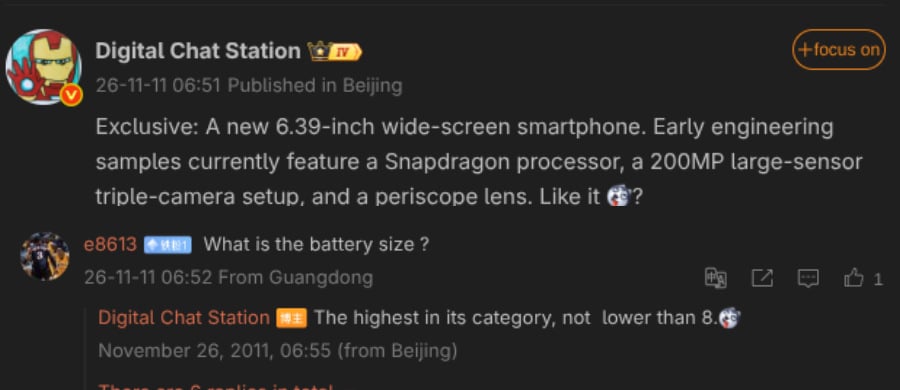
Honor’s first wide-screen phone could have a bigger battery than the Huawei Pura X View that started the trend. According to tipster Digital Chat Station (DCS), the upcoming 6.39-inch phone will pack a battery rated at 8,000mAh or higher. The tipster also claims this would be the largest battery in its category.

The leak follows a report from last month in which DCS said Oppo and Honor would lead Android brands into the wide-screen candybar phone market after Huawei introduced the Pura X View.

Digital Chat Station social media post discussing a new wide-screen smartphone battery capacity.

Same screen size, bigger battery

The Huawei Pura X View has a 6.39-inch OLED display with a 16:9.5 aspect ratio and a 7,000mAh battery. Honor’s phone is tipped to have the same screen size but at least 1,000mAh more battery capacity.

However, fitting a larger battery into a phone this size could affect its dimensions and weight. DCS has not shared either figure, so it remains to be seen how thick the Honor phone will be. For comparison, the Pura X View measures just 6.68mm thick.

The leak also mentions a 200MP triple rear camera system with a large sensor and a periscope lens. DCS has not clarified whether the 200MP sensor will serve as the main camera or the telephoto camera.

Moreover, the leak claims early engineering samples of the phone reportedly run on a Snapdragon processor, although the tipster has not revealed which chip Honor is testing.

Large batteries have also featured in DCS’s recent Honor leaks. The tipster previously claimed the Honor 700 series would come with a 9,000mAh battery and a 200MP main camera.

Honor has made no comments on whether and when it plans to launch a wide-screen phone. The battery, camera, and processor details are based on early engineering samples, so they could change before the device reaches the market.

iPhone 18 and iPhone Air 2 dummy models show rear camera layouts in new leak

A new image claims to show dummy models of the iPhone 18 and iPhone Air 2. It follows the X-ray images of the iPhone 18 and iPhone 18e that surfaced earlier this month. This time, the images show the rear designs of both phones.

The models shown in the video appear to be CNC-machined aluminium. The leak does not explain what they are intended for, although they could be moulds used to make protective cases. That would explain why they only show the phones’ outer shapes without any internal details. Apple has not confirmed any of this, so the designs should be treated as unverified.

Two iPhone dummy models showing different rear camera layouts on a textured surface.

Starting with the iPhone 18, its dummy model shows a rear design similar to the iPhone 17. There are two cameras arranged vertically inside a pill-shaped module. If the dummy is accurate, Apple will keep the same camera layout for another generation.

The iPhone Air 2, meanwhile, has a more noticeable change. Its dummy model shows a raised camera section similar to the original iPhone Air, but with two camera cut-outs instead of one. There is also a smaller circular cut-out beside them, likely for the LED flash. The current iPhone Air has just one rear camera, so adding a second would be a significant hardware change.

Two metal dummy models of the iPhone 18 and iPhone Air 2 showing rear designs.

An earlier supply-chain leak claimed Apple was reworking the iPhone Air 2 with a sleeker design. The report also mentioned plans to address some of the biggest complaints about the first model. Adding a second rear camera would tackle one of the common criticisms of the original iPhone Air.

What the X-ray leak said about the battery

The earlier X-ray images also included some battery information. According to their annotations, the iPhone 18 could get a 4,430mAh battery, up from 3,671mAh in the previous model. That’s an increase of around 20%. The images also suggest Apple may remove the physical SIM tray to make room for the larger battery, although the higher capacity likely applies to eSIM-only versions. For reference, Apple’s listed battery capacity for the iPhone 17 is slightly higher at 3,692mAh.

The iPhone 18e is also expected to share the iPhone 18’s internal layout. Its battery could increase from 4,005mAh in the iPhone 17e to 4,430mAh, a roughly 10% jump.

All three phones, including the iPhone Air 2, are expected to arrive in spring 2027. However, dummy models and X-ray scans don’t always reflect the final hardware, so the camera designs and battery capacities could still change before launch. Apple has yet to announce any of these models, and more leaks are likely to surface in the coming months.

iPhone 18 and 18e could share more than just their looks, X-ray scans suggest

Some fresh X-ray images of two unreleased iPhones have started circulating online. The scans, shared by a known leaker, suggest Apple is reusing a lot of the same internal layout across models while making targeted tweaks. The details point to bigger batteries and closer alignment between the regular iPhone and the more affordable “e” model expected around spring 2027.

iPhone 18, 18e X-ray images

The images were posted on Baidu Tieba’s Qualcomm forum by Littertree66. They show automated X-ray inspection scans of two devices: one codenamed Taycan (V67 K), which the leaker links to the standard iPhone 18, and another called Nevera (V69), said to be the iPhone 18e. Both phones look nearly identical inside. The north and south logic boards sit in the same spots, the battery footprint matches, and even the MagSafe coils line up.

On the Taycan images, annotations claim that dropping the physical SIM tray opened up space for a larger battery. The bottom speaker and haptic motor also switched from a long, narrow design to a wider one. Together those changes are said to push capacity from a baseline of about 3,671 mAh up to 4,430 mAh, roughly a 20% jump. That baseline is actually a bit lower than the 3,692 mAh Apple lists for the current iPhone 17, so the bigger number would likely apply to eSIM-only versions.

The wide camera module also looks physically smaller than the previous generation, though the sensor resolution is described as unchanged. A part labeled “BG1 Array” sits below the dual rear cameras and is thought to support the second lens.

The Nevera scans claim the iPhone 18e uses the same overall design and also jumps to that same 4,430 mAh battery, a roughly 10% increase from the iPhone 17e’s 4,005 mAh. It shows a single rear “Wide” camera sitting where the standard model has its Super Wide unit, with the leftover space filled by what looks like plastic filler.

Pre-production hardware can change before retail, so the final specs could still shift. Even so, the idea of a shared platform and larger batteries across both models lines up with earlier rumors that the standard and “e” iPhones would get closer.

(Source)

AOC launches new 27-inch gaming monitor with 4K 200Hz and 1080p 400Hz dual modes

AOC has released the Agon AG277UXA, a new 27-inch monitor in China that features a dual-mode display. The monitor is designed to run at either a 4K (3840 x 2160) resolution with a 200Hz refresh rate or a 1080p (1920 x 1080) resolution at 400Hz.

AOC AG277UXA Monitor

AOC Agon AG277UXA Monitor Specifications

To switch between the two modes, AOC has included a dedicated hardware button on the monitor. The display also has settings to change the active viewing area. You can digitally shrink the picture to a 24.5-inch size or use a 4:3 aspect ratio at a 1280 x 960 resolution.

AOC AG277UXA Monitor

These specific configurations are often used by esports players who prefer a smaller, more centralized field of view. The monitor uses a Fast IPS panel with a 1ms gray-to-gray response time and a 0.3ms MPRT, alongside custom overdrive tuning meant to reduce motion blur and ghosting.

For color and brightness, the AG277UXA covers 95% of the DCI-P3 gamut and supports 10-bit color. It has a peak brightness of 450 nits and carries DisplayHDR 400 certification. The displays are factory-calibrated to a Delta E of less than 1.

The screen surface uses a three-layer treatment: a standard anti-glare coating, an anti-reflection layer to cut down on ambient light interference, and an oleophobic anti-fingerprint coating to make wiping away dust and smudges easier.

The port selection includes one DisplayPort 2.1 connection with 54Gbps of bandwidth, two HDMI 2.1 ports, and a USB-C port. The USB-C port supports video input but only provides 15W of power delivery, which can charge smaller accessories like a phone but will not power a laptop.

The monitor also features a built-in KVM switch for controlling two computers with one mouse and keyboard, a three-port USB-A hub, and a built-in headphone hook.

AOC AG277UXA Monitor

The included stand adjusts for height, tilt, swivel, and pivot. On the back of the monitor, there is an RGB lighting array that integrates natively with Windows 11 Dynamic Lighting, meaning you can sync the lights with other hardware without downloading extra software.

Pricing and Availability

The AG277UXA is currently available in China with a standard retail price of 2,999 yuan ($450) and an initial launch price of 2,199 yuan ($330).

In related news, AOC has recently launched a 32-inch 4K QD-OLED monitor featuring Samsung’s new five-layer Penta Tandem technology, alongside a new 16-inch OLED portable monitor with a slim aluminium alloy body.

(JD)

Timex is bringing back a 1976 Viscount to mark the 50th anniversary of Rocky

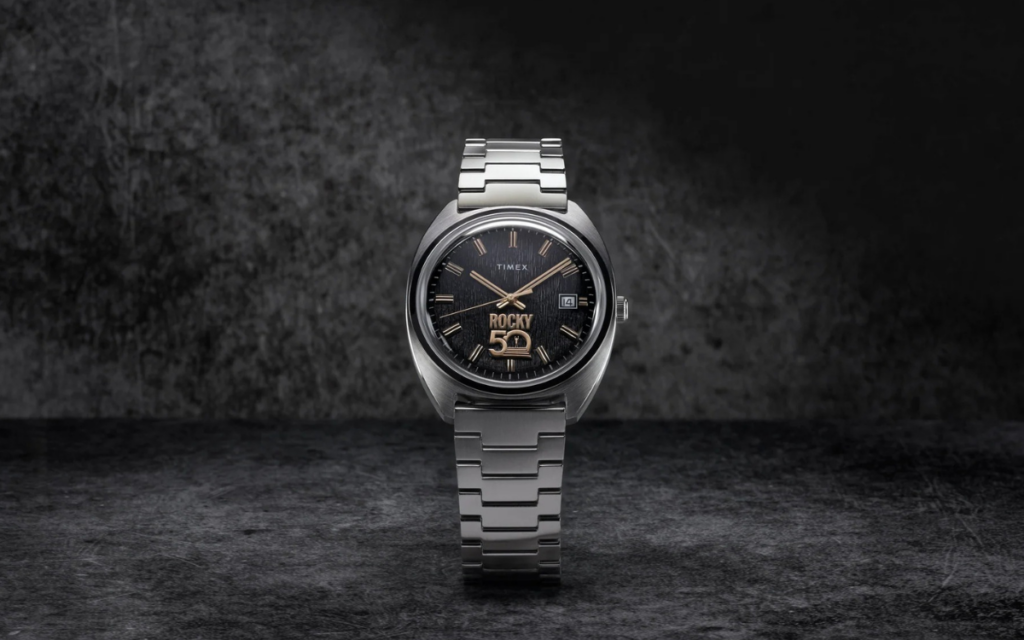
Timex is tapping into 1970s nostalgia with its latest release, a limited-edition watch commemorating the 50th anniversary of the original Rocky film. The Rocky 50th Anniversary Timex Viscount 1976 revives a specific design from the same year the movie debuted, pairing vintage aesthetics with modern automatic internals.

Timex Viscount 1976 Rocky 50th Anniversary

Design Details

From a hardware perspective, the watch leans heavily into its retro roots. It features a 38mm stainless-steel case, a size that aligns well with current trends favoring smaller, more traditional wristwatches over the oversized models of the past decade. The case construction mixes circular brushing with polished edges and a polished bezel.

On the front, there’s a heavily textured dial punctuated by gold-tone hour markers, matching hands, and a standard date window at the 3 o’clock position. Timex also opted for a vintage-style domed acrylic crystal, a design choice that adds period-accurate distortion and character, though buyers should note that acrylic is naturally more prone to scratches than modern sapphire glass.

Timex Viscount 1976 Rocky 50th Anniversary

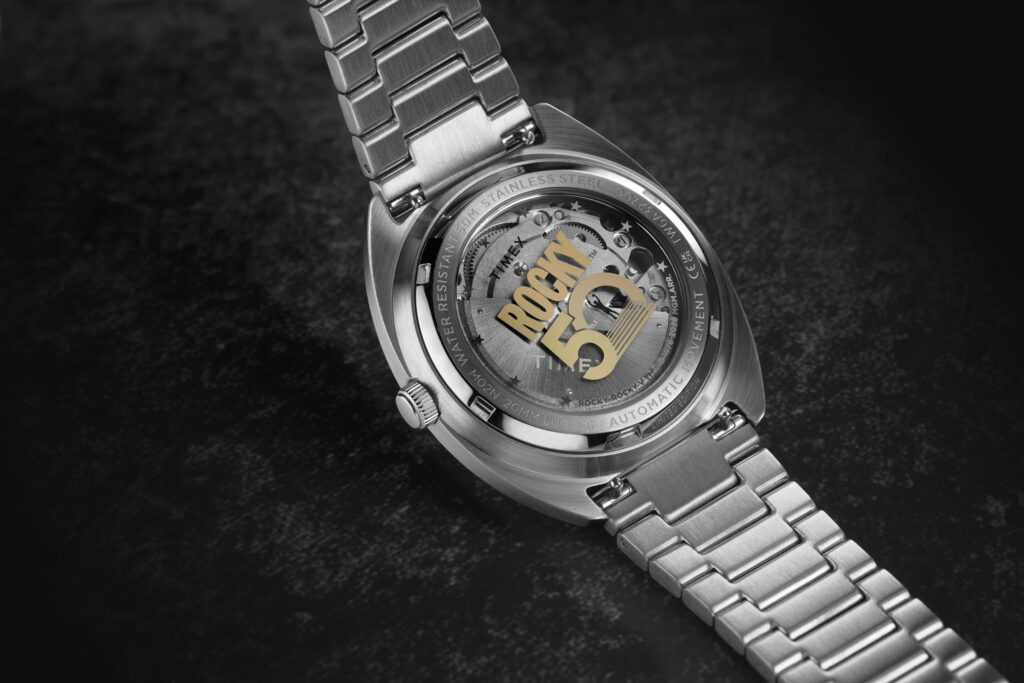
The movie tie-in is handled directly. There is a prominent gold-tone Rocky 50th-anniversary logo stamped on the dial. On the reverse side, an exhibition case back displays a second anniversary logo alongside an engraved unique edition number, confirming this will be a limited production run. The watch ships with a fully brushed stainless-steel bracelet equipped with quick-release spring bars for tool-less strap swapping.

Inside, Timex is using a Miyota 8215 automatic movement. It’s a familiar, reliable Japanese workhorse caliber that relies on the movement of the wearer’s wrist to stay wound, offering a standard 40-hour power reserve.

Timex Viscount 1976 Rocky 50th Anniversary

It’s not a high-end luxury movement, but it fits perfectly within Timex’s usual wheelhouse of accessible, durable timepieces, and you can see the mechanics operating through the rear display window.

Pricing and Availability

Timex hasn’t officially listed the watch on its storefront, and the company hasn’t disclosed pricing or the exact number of units that will be produced. Given the Miyota movement and standard stainless steel construction, it will likely sit in the brand’s mid-tier pricing bracket, but franchise fans and watch collectors will have to wait for the final retail details to drop.

(Timex)

Apple and Samsung turn to Chinese AI partners to compete in the world’s biggest smartphone market

Western and South Korean phone makers are reportedly turning to Chinese AI partners to deliver advanced features in the world’s biggest smartphone market.

Side-by-side app icons for Samsung Bixby and Apple Siri

Apple has formalized a strategic partnership with Alibaba Group to power key parts of Apple Intelligence for users in mainland China. Alibaba’s Qwen model will handle server-side text generation, visual context queries, and more complex Siri processing. On-device tasks like basic photo editing and translation will still run on Apple’s own foundation models. The features are already available for testing in the latest iOS developer beta and are expected to roll out publicly with iOS 27.3 in December.

iPhone lock screen with Siri interface

This setup closely mirrors what Samsung has been doing. The South Korean company has worked with Baidu since the Galaxy S24 series, using the Ernie model to power Galaxy AI features in China, including visual search, Bixby queries, live call translation, document summarization, and related tools. That collaboration has continued and expanded with later models like the S26 series.

These partnerships help both companies meet Chinese regulatory requirements for generative AI services. They also create tighter connections to the major local digital platforms. Integrating generative capabilities with services like Alipay, Taobao, and Baidu Maps delivers contextual usefulness that purely global models often struggle to match inside China.

Industry observers point out that while these alliances solve immediate compliance and localization needs, they also raise longer-term strategic questions. Relying on domestic Chinese LLMs for core AI processing in such a large market can create dependencies and may limit how much these companies can differentiate themselves as local AI capabilities keep advancing. Neither Apple nor Alibaba has publicly detailed the full technical mechanisms used to stay compliant with Chinese content rules, though sources have indicated filtering technology is part of the solution.

Overall, the moves highlight a pragmatic reality for foreign device makers: competing effectively in China increasingly means working closely with the country’s leading AI and internet platforms.

(Source)

RedMagic 12 Pro+ vs OnePlus Ace 7 Pro: Which Flagship Gaming Phone Is Better?

RedMagic 12 Pro+ and OnePlus Ace 7 Pro take different approaches to flagship performance, combining powerful Snapdragon processors with high-refresh-rate displays and advanced cooling systems. Both target demanding users, but their camera hardware, battery technology, charging capabilities, and pricing reveal some important differences. Here is how the two phones compare.

Side-by-side comparison of the RedMagic 12 Pro+ and OnePlus Ace 7 Pro gaming smartphones.

1. Major Features:

CategoryRedMagic 12 Pro+OnePlus Ace 7 ProWinner
BuildGorilla Glass 7i, aluminum frameCrystal Shield Glass, aluminum frameRedMagic – Gorilla Glass 7i on both sides
Water ResistanceIP68/IP69IP68/IP69KOnePlus – Higher-pressure water protection
Cooling SystemBuilt-in cooling fanBuilt-in bi-directional cooling fanOnePlus – Bi-directional cooling
Display TypeAMOLED, 185HzLTPO AMOLED, 185HzOnePlus – LTPO technology
Display Size6.85 inches6.78 inchesRedMagic – Larger display
Resolution1216 x 2688 pixels1272 x 2772 pixelsOnePlus – Higher resolution
Peak Brightness5000 nits2000 nitsRedMagic – Higher peak brightness
PWM DimmingNot specified3840HzOnePlus – Higher-frequency PWM dimming
HDR SupportNot specifiedHDR10+, HDR VividOnePlus – HDR support
Operating SystemAndroid 17, RedMagic OS 12Android 17, ColorOS 17—
ChipsetSnapdragon 8 Elite Extreme Gen 6 (2nm)Snapdragon 8 Elite Gen 5 (3nm)RedMagic – Newer-generation chipset
GPUAdreno 850Adreno 840RedMagic – Newer GPU
RAMUp to 16GBUp to 16GB—
StorageUp to 1TB UFS 4.1 ProUp to 1TB UFS 4.1RedMagic – UFS 4.1 Pro
Main Camera50MP, OIS200MP, OISOnePlus – Higher-resolution primary camera
Secondary Camera50MP ultrawide50MP periscope telephotoOnePlus – 3.5x optical zoom
Optical Zoom—3.5xOnePlus – Dedicated optical zoom
Video RecordingUp to 8K@30fps, 4K@120fpsUp to 8K@30fps, 4K@120fps—
Selfie Camera16MP under-display16MP punch-holeRedMagic – Uninterrupted display
Stereo SpeakersYes, Dolby AtmosYesRedMagic – Dolby Atmos
Bluetooth6.05.4RedMagic – Newer Bluetooth version
Wi-FiWi-Fi 7, tri-bandWi-Fi 7, dual-bandRedMagic – Tri-band connectivity
USBUSB 3.2 Gen 2, DisplayPortUSB 2.0RedMagic – Faster USB and DisplayPort
Fingerprint SensorUltrasonicUltrasonic—
Battery8400mAh9000mAhOnePlus – Larger battery
Wired Charging120W100WRedMagic – Faster wired charging
Wireless Charging80W—RedMagic – Wireless charging support
Reverse Charging22.5W wired—RedMagic – Reverse wired charging
Bypass Charging—YesOnePlus – Dedicated bypass charging
PriceApprox. $1,000 / ₹1,00,000Approx. $720 / ₹69,000OnePlus – More affordable
Disclaimer: Specs are based on available data. Actual performance may vary. Verify details from official sources before buying.

2. Design and Display

Build and Feel

The RedMagic 12 Pro+ features a premium glass-and-aluminum construction with Gorilla Glass 7i protection on both sides. Its built-in cooling fan and pressure-sensitive gaming zones reinforce its gaming-focused identity. It also offers IP68/IP69 protection, making it more than just a performance-oriented device.

The OnePlus Ace 7 Pro adopts a similarly premium approach, combining Crystal Shield Glass with an aluminum frame and either a glass or glass-fiber reinforced plastic back. Its bi-directional cooling fan and IP68/IP69K protection add durability and practical gaming benefits. The OnePlus design feels slightly more conventional, while RedMagic offers a more distinctive gaming experience.

Display Quality

Both smartphones feature impressive 185Hz displays, making them particularly attractive to competitive gamers. However, their display technologies and brightness capabilities differ. The RedMagic 12 Pro+ uses a 6.85-inch AMOLED panel with a 1216 x 2688 resolution, 1900 nits of HBM brightness, and up to 5000 nits peak brightness.

The OnePlus Ace 7 Pro features a 6.78-inch LTPO AMOLED display with a sharper 1272 x 2772 resolution. It also supports HDR10+, HDR Vivid, and 3840Hz PWM dimming. Although its peak brightness reaches 2000 nits, RedMagic has a considerable advantage in brightness figures. OnePlus, however, offers more advanced display technology for everyday viewing.

Verdict

RedMagic wins on peak brightness and gaming-focused controls, while OnePlus delivers LTPO technology, sharper resolution, and better display versatility for everyday use.

3. Specifications Including Battery

Performance

The RedMagic 12 Pro+ is powered by the Snapdragon 8 Elite Extreme Gen 6, built on a 2nm process and paired with an Adreno 850 GPU. Its configurations include up to 16GB RAM and 1TB UFS 4.1 Pro storage. Combined with its built-in cooling fan, it is designed to sustain demanding gaming sessions.

The OnePlus Ace 7 Pro runs on the Snapdragon 8 Elite Gen 5, featuring an Adreno 840 GPU. It also offers up to 16GB RAM and 1TB UFS 4.1 storage. Both phones run Android 17 with their respective software interfaces. RedMagic appears stronger on raw hardware specifications, while OnePlus remains a serious flagship performer with its own active cooling system.

Battery and Charging

The OnePlus Ace 7 Pro packs a larger 9000mAh silicon-carbon battery, compared with the RedMagic 12 Pro+’s 8400mAh battery. This gives OnePlus an advantage in battery capacity, potentially making it the more practical option for extended daily usage and gaming.

However, RedMagic counters with 120W wired charging, 80W wireless charging, and 22.5W reverse wired charging. OnePlus supports 100W wired charging alongside UFCS, PPS, and PD/QC charging protocols. It also includes bypass charging, which is particularly useful during extended gaming sessions. RedMagic offers more charging versatility, but OnePlus has the larger battery.

Verdict

RedMagic takes the performance and charging lead with its more powerful chipset and wireless charging. OnePlus wins battery capacity, but RedMagic offers the more complete gaming hardware package.

4. Camera

Main and Secondary Lenses

The RedMagic 12 Pro+ features a dual rear-camera system comprising a 50MP primary sensor with OIS and a 50MP ultrawide camera. While the primary camera includes optical stabilization and multidirectional PDAF, the absence of a dedicated telephoto lens limits its versatility for distant subjects.

The OnePlus Ace 7 Pro takes a considerably more ambitious approach with a 200MP primary camera featuring OIS and a 50MP periscope telephoto camera offering 3.5x optical zoom. This combination provides greater flexibility for photography, particularly when capturing distant subjects. It also supports an 8K video recording option, alongside 4K recording at up to 120fps. OnePlus is clearly the stronger choice for users who prioritize camera versatility.

Selfie Camera

Both smartphones feature 16MP front-facing cameras, but their implementation differs. The RedMagic 12 Pro+ uses an under-display selfie camera, allowing it to maintain an uninterrupted screen without a conventional camera cutout. This creates a cleaner viewing experience, particularly during gaming and video playback.

The OnePlus Ace 7 Pro uses a conventional 16MP selfie camera with panorama support and gyro-EIS for video recording. Although it does not offer the same uninterrupted display experience, its conventional camera placement is generally a more practical approach for selfies and video calls. RedMagic prioritizes screen aesthetics, while OnePlus takes the more conventional camera route.

Verdict

OnePlus wins the camera department with its 200MP primary sensor and 3.5x periscope telephoto lens. RedMagic’s under-display camera is distinctive, but less versatile.

5. Pricing

The RedMagic 12 Pro+ is priced around $1,000 (₹1,00,000), positioning it firmly in the premium flagship segment. The OnePlus Ace 7 Pro is priced around $720 (₹69,000), making it considerably more affordable despite offering several high-end specifications.

The difference is substantial, with OnePlus costing approximately $280 less. This gives it an immediate value advantage, especially for buyers who want flagship-level performance, a large battery, and versatile cameras without spending as much.

Verdict

OnePlus Ace 7 Pro wins on pricing and overall value. RedMagic justifies its premium for dedicated gamers, but its higher price limits its broader appeal.

6. Conclusion

The RedMagic 12 Pro+ stands out with its 185Hz AMOLED display, 5000-nit peak brightness, pressure-sensitive gaming zones, under-display selfie camera, and 80W wireless charging. Its Snapdragon 8 Elite Extreme Gen 6 and built-in cooling fan further strengthen its dedicated gaming credentials.

The OnePlus Ace 7 Pro counters with a 9000mAh battery, 200MP primary camera, 50MP periscope telephoto lens, LTPO AMOLED technology, and bypass charging. Its bi-directional cooling fan also makes it a compelling gaming device. The combination of a versatile camera system, larger battery, and lower price makes OnePlus a more complete everyday flagship.

Verdict

The OnePlus Ace 7 Pro is the overall winner, offering better camera versatility, a larger battery, and substantially better value. RedMagic 12 Pro+ remains the better specialist gaming phone.

Disclaimer: Prices, specifications, and availability may vary by region and retailer. Recommendations in this article are based on editorial opinion, feature-based value, and market positioning at the time of writing. Readers are advised to do their own research before making a purchase.

Read More:

OnePlus Turbo 6V vs Nord 5: Is a 9000mAh Battery Better Than Flagship Performance?

OnePlus has two interesting options competing in the upper mid-range segment, but they take very different approaches. The OnePlus Turbo 6V focuses on battery endurance, durability and a high-refresh-rate display, while the OnePlus Nord 5 prioritizes processing power, camera versatility and a more balanced experience. With a relatively small price difference, choosing between them comes down to what matters most in everyday use.

OnePlus Turbo 6V vs Nord 5

1. Major Features:

CategoryOnePlus Turbo 6VOnePlus Nord 5Winner & Reason
Display Size6.78-inch6.83-inchOnePlus Nord 5
Display TypeAMOLED, 1B colorsSwift AMOLED, 1B colorsOnePlus Nord 5
Refresh Rate144Hz144Hz–
Resolution1272 × 2772 pixels1272 × 2800 pixelsOnePlus Nord 5
HDR Support–HDR10+, Ultra HDROnePlus Nord 5
Screen Protection–Gorilla Glass 7iOnePlus Nord 5
Water ResistanceIP68/IP69KIP65OnePlus Turbo 6V
Operating SystemAndroid 16, ColorOS 16Android 15, OxygenOS 15OnePlus Turbo 6V
ProcessorSnapdragon 7s Gen 4Snapdragon 8s Gen 3OnePlus Nord 5
GPUAdreno 810Adreno 735OnePlus Nord 5
RAM8GB/12GB8GB/12GB–
Storage256GB/512GB256GB/512GB–
Storage TypeUFS 3.1UFS 3.1–
Rear Camera50MP main camera50MP main + 8MP ultrawideOnePlus Nord 5
Main Camera OISYesYes–
Ultrawide Camera–8MPOnePlus Nord 5
Rear Video Recording4K@60fps4K@60fps–
Selfie Camera16MP50MP with AFOnePlus Nord 5
Selfie Video1080p@30fps4K@60fpsOnePlus Nord 5
SpeakersStereo speakersStereo speakers–
Bluetooth5.45.4–
NFCYesYes–
Infrared PortYesYes–
Fingerprint SensorOptical under-displayOptical under-display–
Battery Capacity9000mAh6800mAh (Global) / 5200mAh (Europe)OnePlus Turbo 6V
Wired Charging80W80W–
Reverse Wired Charging27W5WOnePlus Turbo 6V
Bypass Charging–YesOnePlus Nord 5
PriceApprox. $300 / ₹25,000Approx. $360 / ₹30,000OnePlus Turbo 6V

2. Design and Display

Build and Feel

The OnePlus Turbo 6V and OnePlus Nord 5 feature similar design proportions, dual Nano-SIM support and stereo speakers. However, their durability ratings create a noticeable difference. The Turbo 6V offers IP68/IP69K protection, providing resistance against immersion and high-pressure water jets. The Nord 5 comes with IP65 protection, which covers dust and low-pressure water jets.

The Nord 5 features a Gorilla Glass 7i front, plastic back and plastic frame, giving it a clearly defined construction specification. The Turbo 6V’s higher water-resistance rating makes it more reassuring for users who frequently encounter challenging environments. Both phones offer practical designs, but the Turbo 6V has the advantage in durability.

Display Quality

Both smartphones feature 144Hz AMOLED displays with 1 billion colors and 3840Hz PWM dimming. The Turbo 6V has a 6.78-inch panel with a resolution of 1272 x 2772 pixels, while the Nord 5 offers a slightly larger 6.83-inch display with 1272 x 2800 pixels. Both deliver approximately 450ppi pixel density.

The Nord 5 adds HDR10+ support, Ultra HDR image compatibility and Gorilla Glass 7i protection. Both offer 800 nits typical brightness and 1800 nits peak brightness, although the Nord 5 also specifies 1400 nits HBM brightness.

Verdict

The OnePlus Nord 5 offers a more feature-rich display with HDR10+ and screen protection, but the Turbo 6V counters with stronger water resistance. The Nord 5 narrowly wins the display comparison.

3. Specifications Including Battery

Performance

The OnePlus Nord 5 is powered by the Snapdragon 8s Gen 3, while the Turbo 6V uses the Snapdragon 7s Gen 4. Both processors are manufactured using a 4nm process, but the Nord 5’s flagship-oriented chipset provides a stronger performance foundation, particularly for demanding applications and gaming.

The Nord 5 features a Cortex-X4 performance core clocked at 3.0GHz, supported by Cortex-A720 and Cortex-A520 cores alongside the Adreno 735 GPU. The Turbo 6V uses Cortex-A720 and Cortex-A520 cores with an Adreno 810 GPU. Both offer up to 12GB RAM and 512GB storage with UFS 3.1 technology. The Nord 5 is also listed with up to four major Android updates, while the Turbo 6V launches with Android 16 and ColorOS 16. The Nord 5 is the more established performance-focused choice.

Battery and Charging

Battery capacity is where the Turbo 6V makes a major statement. It packs a massive 9000mAh silicon-carbon battery, considerably larger than either Nord 5 battery configuration. The Nord 5 comes with a 5200mAh battery in Europe and a 6800mAh battery in its global version.

Both phones support 80W wired charging, but their additional charging capabilities differ. The Turbo 6V supports 27W reverse wired charging, UFCS and 55W PPS, while the Nord 5 offers 5W reverse wired charging, 33W PPS and bypass charging. The Turbo 6V is clearly better suited to users who prioritize extended battery life.

Verdict

The Nord 5 wins on processing power, but the Turbo 6V dominates battery capacity and reverse charging. For endurance-focused buyers, the Turbo 6V is the more compelling option.

4. Camera

Main and Secondary Lenses

The OnePlus Nord 5 offers a more versatile rear camera system with a 50MP primary sensor featuring OIS and an 8MP ultrawide camera with a 116-degree field of view. This combination provides greater flexibility for landscape photography, group shots and everyday shooting situations.

The Turbo 6V also features a 50MP primary camera with PDAF and OIS, but its secondary camera arrangement does not offer the same clearly defined ultrawide functionality. It includes a color spectrum sensor alongside its main camera. Both smartphones support 4K video recording at 30fps and 60fps, with additional 1080p recording options. The Nord 5 is the more practical choice for photography enthusiasts because its dedicated ultrawide camera provides greater shooting flexibility.

Selfie Camera

The front camera comparison is particularly interesting because the Nord 5 features a 50MP autofocus selfie camera, while the Turbo 6V comes with a 16MP front-facing sensor. The Nord 5 also supports 4K video recording at 30fps and 60fps, making it more capable for high-resolution video calls and content creation.

The Turbo 6V supports 1080p video recording at 30fps with gyro-EIS, which should be sufficient for regular selfies and video calls. However, the Nord 5’s higher-resolution sensor and autofocus provide a more attractive package for users who frequently capture selfies or record themselves.

Verdict

The OnePlus Nord 5 is the clear camera winner, offering a dedicated ultrawide lens, a 50MP autofocus selfie camera and more flexible video recording capabilities.

5. Pricing

The OnePlus Turbo 6V is priced around $300 / ₹25,000, making it the more affordable option between these two smartphones. Its combination of a 9000mAh battery, 144Hz AMOLED display, IP68/IP69K protection and 80W charging makes it an interesting proposition in this price segment.

The OnePlus Nord 5 is priced around $360 / ₹30,000, positioning it approximately $60 or ₹5,000 higher. For that additional cost, buyers get the Snapdragon 8s Gen 3 processor, a more versatile rear camera setup, a 50MP autofocus selfie camera and a more feature-rich display. Its larger global battery configuration also makes it competitive in endurance.

Verdict

The Turbo 6V offers better value for battery-focused buyers, but the Nord 5 justifies its premium with stronger performance and cameras. The better purchase depends on individual priorities.

6. Conclusion

The OnePlus Turbo 6V stands out with its enormous 9000mAh silicon-carbon battery, 27W reverse wired charging and IP68/IP69K protection. These features make it particularly appealing to users who want fewer charging interruptions and better protection against water exposure. Its 144Hz AMOLED display and Snapdragon 7s Gen 4 chipset further strengthen its everyday appeal.

The OnePlus Nord 5 brings a different set of advantages, including the Snapdragon 8s Gen 3 processor, a 50MP main camera with an 8MP ultrawide sensor, a 50MP autofocus selfie camera and HDR10+ display support. It also offers bypass charging, which is useful for gaming while plugged in. Although its battery capacity is smaller, its hardware delivers a more versatile overall package.

Verdict

The OnePlus Nord 5 is the overall winner thanks to its stronger processor, more versatile camera system, better selfie capabilities and feature-rich display. However, the Turbo 6V is the better alternative for buyers who prioritize exceptional battery endurance, durability and affordability.

Disclaimer: Prices, specifications, and availability may vary by region and retailer. Recommendations in this article are based on editorial opinion, feature-based value, and market positioning at the time of writing. Readers are advised to do their own research before making a purchase.

Read More:

ANTHBOT M9 Robotic Lawn Mower With AI Obstacle Avoidance Is Now on Sale at Amazon (Coupon)

ANTHBOT M9 Robotic Lawn Mower is now available at a discounted price on Amazon, offering an automatic lawn-care solution for small and medium-sized yards. The mower features wire-free operation, AI-powered obstacle avoidance, automatic mapping, and NRTK positioning technology. It is designed to handle different lawn layouts while reducing the need for manual mowing.

With a limited-time promotional offer on Amazon, buyers can get the ANTHBOT M9 for $617 instead of its regular $819 price by applying the discount code: BFUSBOT

ANTHBOT M9 Robotic Lawn Mower

Features and Specs:

The ANTHBOT M9 uses a dual AI vision system combined with NRTK positioning technology to navigate lawns with improved accuracy. Its dual-camera system features a 150-degree HDR field of view and AI algorithms capable of identifying more than 1,000 types of common garden obstacles. This helps the mower recognize objects in its path and navigate around them.

The robotic lawn mower supports slopes of up to 45%, making it suitable for lawns with uneven terrain. It also features five free-rotating blades and an adjustable cutting height ranging from 1.2 to 2.7 inches. Users can select different mowing paths through the ANTHBOT app to customize how their lawn is maintained.

Another useful feature is its automatic mapping capability. The M9 can create a virtual lawn map in approximately 10 minutes without requiring users to manually drive it around the property. Through the app, users can manage up to 30 work zones, create paths between different areas, and set no-go zones.

The mower also supports automatic recharging and resume functionality. When its battery needs charging, it returns to its charging station and resumes mowing afterward. With a maximum mowing area of 0.3 acres, it is designed for small to medium-sized residential yards. Its operating noise level is rated at 58dB or lower.

ANTHBOT M9 Robotic Lawn Mower

Amazon Deal:

The ANTHBOT M9 Robotic Lawn Mower is available on Amazon for a discounted price of $617, down from its regular price of $819. This is a saving of $202, or approximately 25% off the original price. Buyers can use the coupon code BFUSBOT at checkout to claim the promotional price. The deal started on November 3, 2026, at 01:00 PST and will remain available until December 5, 2026, at 23:59 PST. Interested buyers have until the offer’s end date to take advantage of the discount, subject to availability and the terms of the promotion.

Rogbid launches new VitalRing with ECG, SpO2 tracking and titanium alloy build

Rogbid has announced its latest wearable, the VitalRing, a titanium smart ring that leans heavily into cardiovascular health tracking. The device enters an increasingly crowded smart ring market but attempts to differentiate itself with built-in ECG capabilities alongside standard fitness metrics.

Rogbid VitalRing

Rogbid VitalRing Specifications

From a design perspective, the VitalRing is built with a titanium alloy outer shell and an epoxy resin inner lining. It measures 8mm in width and weighs approximately five grams. Rogbid says that the titanium construction makes it roughly 45% lighter than a stainless steel equivalent while maintaining daily durability. It also carries a 5ATM water resistance rating, meaning it is rated to survive swimming, showering, and daily hand washing.

In terms of health monitoring, the VitalRing equips a Nordic 54L15 main control chip and a TI4950 analog front-end chip to process PPG, ECG, and SpO2 measurements. It also supports on-demand ECG readings through its dual-touch contacts, which require a finger from the opposite hand to complete the electrical circuit. The ring continuously monitors heart rate, blood oxygen saturation, HRV, and body temperature. It also features sleep stage tracking, daily stress monitoring, and menstrual cycle tracking.

On the software and smart features side, the VitalRing tracks standard daily activity metrics like step count, distance, and calories burned across various sports modes. It includes a remote care feature for sharing health data with family members, as well as a gesture control function that allows users to trigger their smartphone camera remotely.

Rogbid VitalRing

For battery life, Rogbid claims the ring can last 8 to 10 days on a single charge. To manage charging, the ring comes with a 400mAh magnetic charging case.

Pricing and Availability

The Rogbid VitalRing is available now through the company’s official store in Aura Gold, Lunar Silver, and Obsidian Black, with US sizes ranging from 8 to 13. As part of a current Double 11 promotion, Rogbid is bundling the $129.99 ring with a mystery gift box that includes either a smartwatch or a second smart ring.

In related news, Rogbid has recently launched the Model R5 Android smartwatch with a 2.4-inch display, 4G LTE, and a rotating camera, alongside the VisionMax smart glasses featuring a 20MP Sony camera, 4K recording, and up to 9 hours of battery life.