Advertisement

Honor X50i’s exterior teased with dual-ring lens, feather textured back cover, two colors

Honor has officially teased the first appearance of the Honor X50i, which is set to debut on April 21st. The company has released an image of the phone, showcasing its stunning design and impressive features. The Honor X50i is expected to be an entry-level smartphone with powerful specifications.

The phone boasts an elliptical “8-like design” dual-ring camera module on the back, along with a feather texture pattern on the back cover, and a straight-edge middle frame design, making it both stylish and lightweight. The phone will be available in two new color options named “Willow Wind” and “Apricot Blossom Rain.”

Honor X50i teaser

According to leaks, Honor X50i features a 6.7-inch 90Hz refresh rate ultra-narrow bezel eye-protection full-view display. The device is powered by the Dimensity 6020 processor, an 8-core design, and TSMC’s 7nm process. It also supports LPDDR4X memory and UFS 2.2 flash memory.

The phone comes in three versions: 8GB+128GB, 8GB+256GB, and 12GB+256GB, and offers 7GB of virtual RAM. It also features a 4,500mAh battery that supports 35W fast charging.

The Honor X50i features an 8-megapixel camera on the front and a 100-megapixel (main) + 2-megapixel (depth) dual-camera system on the back, along with a triple LED flash. The device comes preloaded with Android 12 and measures 7.48 mm in thickness and weighs 179 grams.

Currently, the Honor X50i is available for pre-order on various e-commerce platforms, and its expected price range is between 1500-2000 yuan ($218-$290).

RELATED:

Vivo X90 series will be available on Flipkart for Indian customers, checkout specs and features

Vivo recently announced the Indian launch date of its X90 series flagship smartphones. The launch will take place on April 26. So far, rumors say that the brand will be launching the Vivo X90 and the X90 Pro smartphones in India, whereas the X90 Pro Plus will remain exclusive to China.

Ahead of the launch, a micro-site has gone live on Flipkart confirming its availability on the e-commerce platform. Although the monikers of the upcoming smartphones are not disclosed yet, the micro-site mentions the Vivo X90 series, indicating that more than one smartphone will be launched in India. Here’s what you can expect from the Vivo X90 series.

Vivo X90, X90 Pro specs

The Vivo X90 series smartphones boast an impressive 6.78-inch Full HD+ OLED display panel with a 120Hz refresh rate and a peak brightness of 1300nits. Running under the hood of these devices is the MediaTek Dimensity 9200 processor, accompanied by the Immortalis G715 GPU. The X90 series smartphones come equipped with up to 12GB LPDDR5 RAM and up to 512GB UFS 4.0 storage, ensuring optimal performance and storage capacity.

The Vivo X90 series smartphones boot the latest version of Android, Android 13, and feature an in-display fingerprint scanner for enhanced security. They also pack a stereo speaker setup, but do not include a 3.5mm audio jack.

In terms of cameras, the Vivo X90 packs a triple-rear camera setup with a 50MP Sony IMX866 sensor and an f/1.75 aperture. It also features a 12MP ultra-wide-angle lens and a 12MP portrait lens with a 50mm focal length and 2x optical zoom. Meanwhile, the Vivo X90 Pro sports a 50MP Sony IMX 989 sensor with a 1-inch sensor size and OIS support. It also features a 12MP Sony IMX663 sensor for ultra-wide-angle functionality and a 50MP Sony IMX758 sensor with 2x optical zoom.

Both the Vivo X90 and Vivo X90 Pro are equipped with 32MP front selfie shooters and boast powerful battery units, with the X90 having a 4810mAh battery and the X90 Pro having a slightly larger 4870mAh battery. These devices support 120W fast charging, while the Vivo X90 Pro also supports up to 50W wireless charging.

RELATED:

Vivo X90 Plus launch timeline tipped along with key specs

Earlier this month, a reliable tipster revealed that Vivo will soon release a fourth model in the Vivo X90 series lineup in China. As per him, this device will be called Vivo X90S.

However, now, another leaker claims that the Vivo X90S will be actually called Vivo X90+. He has disclosed the model number, launch timeline, and some key features of this smartphone.

Vivo X90

According to Paras Guglani (via PriceBaba), the upcoming Vivo X90 Plus bears model number V2141HA. The device will debut in China in either June or July. There’s no info on this product’s global availability so far.

Further, the tipster says that the phone will be powered by a MediaTek Dimensity 9000 series chipset. As per the earlier leak by Digital Chat Station, the handset will house the unannounced MediaTek Dimensity 9200 Plus SoC underneath it.

Paras also talks about other specs. He mentions that the phone will sport a 120Hz AMOLED display and will pack 12GB RAM. Lastly, he says that it will carry support for 80W fast charging.

The Vivo X90 Plus could be positioned higher than the Vivo X90 and Vivo X90 Pro. If that’s the case, then it should start above ¥5,000 (~$730) in China.

We are looking forward to learning more about this smartphone in the coming days. It should ideally pop up on certification websites revealing its features.

RELATED:

Realme Narzo N55 first sale today, offers 90Hz screen, Helio G88, 64MP dual cameras for Rs 10,999 (~$134)

Last week, Realme unveiled the Realme Narzo N55 as its first Narzo-branded smartphone of the year. As confirmed by the brand, it will be available for purchase for the first time in India today. Here is a look at the specifications, features, and price of the device.

Realme Narzo N55 price in India

Starting today, the Realme Narzo N55 will be available for purchase through Amazon India and Realme India’s website. Buyers of the device can benefit from offers like a Rs 1,000 instant discount on HDFC and SBI debit / credit, and EMI transactions when purchased through Amazon. On Realme’s website, buyers can take advantage of a Rs 1,000 discount when purchasing using ICICI and Axis debit / credit, or EMI transactions.

Realme Narzo N55
Realme Narzo N55

For those who don’t know, other Realme phones are available for purchase through Flipkart. The Narzo-branded phones, including the N55, are only available on Amazon, apart from Realme’s website.

The Narzo N55 comes in two options: 4 GB RAM + 64 GB storage and 6 GB RAM + 128 GB storage. Both variants are priced at Rs 10,999 (~$134) and Rs 12,999 (~$158), respectively. It can be bought in shades like Prime Blue and Prime Black.

Realme Narzo N55 specifications

The Realme Narzo N55 has a massive 6.72-inch IPS LCD panel that offers an HD+ resolution and a 90Hz refresh rate. It has an 8-megapixel front-facing camera and a 64-megapixel (main) + 2-megapixel (depth) dual-camera system on the back.

The Narzo N55 comes with the Helio G88 chipset. The device comes with 4 GB / 6 GB of LPDDR4x RAM and 64 GB /128 GB of eMMC 5.1 storage. To keep the lights on, the N55 features a 5,000mAh battery with 33W fast charging. The N55 has a side-facing fingerprint scanner. It comes preloaded with the Realme UI 4.0-based Android 13 OS. For additional storage, the device features a microSD card slot.

RELATED:

Minisforum Venus UM560XT launched with AMD Ryzen 5600H chipset under the hood

Mini-PCs have become increasingly popular in recent years due to their many advantages. One of the most significant benefits of mini-PCs is their compact size, which allows for easy portability and saves space. They are ideal for individuals who have limited space or need a computer that can be easily transported.

Minisforum, a company known to produce quality mini-PCs has launched a new addition to its lineup called the Minisforum Venus UM560XT. The mini-PC is powered by AMD Ryzen 5 5600H CPU. The Ryzen 5 5600H is a hexacore mobile CPU with base clock speed of 3.3 GHz with a maximum boost clock speed of 4.2 GHz. The CPU was launched back in 2021 and was paired with powerful gaming laptops. So its safe to say that it can easily handel everything one expects from a mini-PC.

The Minisforum Venus UM560XT is a compact computer that supports dual-channel DDR4 memory and has the ability to connect with up to three 4K displays at 60 Hz through its two HDMI ports and USB Type-C port. It also includes a 2.5 Gigabit Ethernet port, two USB 3.2 Gen2 ports, and two USB 2.0 ports. All non-barebone configurations will come with Windows 11 Professional preinstalled. The anticipated shipping date for the Minisforum Venus UM560XT is in mid-May.

Each of the hardware configurations mentioned, including the barebone version, will be shipped with a power adapter suitable for use in the US, AU, or UK, depending on the customer’s location. The prices and specifications for each configuration are as follows:

For the early bird price of US$299 (or US$369 for retail), you can get a Minisforum Venus UM560XT with 16 GB RAM and 512 GB storage. For those looking for more storage, the 32 GB RAM and 512 GB storage option is available for US$339 (early bird) or US$419 (retail).

For the highest level of performance, the 32 GB RAM and 1 TB storage configuration is available for US$379 (early bird) or US$469 (retail). This option provides ample storage for users who need to store large files, such as video or audio content, and ensures that the system will be able to handle demanding applications without any lag or slowdown.

RELATED:

Rolls-Royce Debuts First Pure Electric Car in China

Luxury car manufacturers are shifting towards electric vehicles (EVs) to reinforce their brand image, offer a premium driving experience, innovate with new technology features, meet customer expectations, and comply with emissions regulations. EVs offer superior driving dynamics, advanced technological features, and autonomous driving capabilities that align with luxury car buyers’ expectations. Additionally, EVs present a sustainable and eco-friendly alternative to traditional gasoline-powered vehicles, which is increasingly important to luxury car consumers. By embracing EVs, luxury car manufacturers can differentiate themselves, maintain their position as industry leaders, and meet regulatory requirements while offering an exclusive and advanced driving experience. Rolls-Royce recently joined the EV club, and the company unveiled its first pure electric car to debut in China on 18th April.

Rolls Royce

Rolls-Royce has introduced its first all-electric car, the Shining, at the Shanghai Auto Show. The vehicle was originally launched as the Rolls-Royce Spectre in October 2022. The car is equipped with a 430 kW motor, producing 900 Nm of torque and can reach a top speed of 250 km/h with an acceleration time of 4.5 seconds. The Shining’s 102 kWh battery pack has a range of 585 km. The interior is inspired by the night sky and features starlight doors, a starry sky roof, and Rolls-Royce’s embroidered logo pillows. The car’s starting price in China is 5.75 million Yuan ($8.3 million), with delivery expected in Q4 2023.

The Shining’s exterior follows the brand’s design language, with a classic Parthenon straight waterfall grille, a slip-back shape, and a double-door design, giving it a sporty feel. The car’s parking space features a split taillight design, with integrated turn signals and brake lights. Rolls-Royce has made significant strides to reduce its carbon footprint, and the Shining’s all-electric powertrain is environmentally friendly while providing the smooth, quiet ride expected of a Rolls-Royce.

RELATED:

(Via)

Lava Blaze 2 goes on sale India for Rs 8,999 (~$110) with glass back design, 90Hz display, Unisoc T616

Lava Blaze 2 went official last week in India. Today, the smartphone will be up for purchase through Amazon India. The device is priced at Rs 8,999 and packs interesting specs. Here is a look at what’s in store for the buyers of the Blaze 2.

Lava Blaze 2 price in India

The Lava Blaze 2, which is priced at Rs 8,999 (~$110), can be purchased in three colors: Glass Black, Glass Blue, and Glass Orange. At this price, the device offers a punch-hole display and a glass-back design. It can be bought through Amazon India and Lava India’s website.

Lava Blaze 2 specifications

Lava Blaze 2
Lava Blaze 2

The Lava Blaze 2 houses a 6.5-inch IPS LCD panel that offers an HD+ resolution of 720 x 1600 pixels and a 90Hz refresh rate. Under the hood, the Blaze 2 has the Unisoc T616 chipset and 6 GB of LPDDR4x RAM.

The Blaze 2 offers 128 GB of UFS storage and a microSD card slot for additional storage. It comes preloaded with a near-stock version of Android 12 OS and gives access to the anonymous call recording feature.

The device features an 8-megapixel camera on the front. Its back panel has a 13-megapixel primary camera, a 2-megapixel depth sensor, and an LED flash. For security, it has a side-facing fingerprint scanner.

It packs a 5,000mAh battery that supports 18W charging via a USB-C port. On the connectivity front, the device offers options like dual SIM, 4G VoLTE, Wi-Fi 802.11ac, Bluetooth 5.0, GPS, and a 3.5mm audio jack. It comes with the likes of POCO C55 and Infinix Hot 30i in the Indian market.

In related news, Lava is also said to be working on the Agni 2 smartphone. A recent report claimed that the device will be priced under Rs 25,000 and will come equipped with a 120Hz AMOLED display.

RELATED:

Xiaomi Smart Band 7 NFC starts selling in some global markets

Earlier this month, Xiaomi launched its Smart Band 7 NFC for thr global market. The global launch came almost a year after its official unveiling in China. Now, the smartwartch has gone on sale in select markets around the globe including Poland.

Xiaomi Smart Band 7 NFC price

Retailers in Poland have started selling the Smart Band 7 NFC at PLN 299 (~$71). In comparison, the regular Xiaomi Smart Band 7 sells for PLN 249 (~$59). The Europe-wide price is still under wraps, however, it is estimated that the Smart Band 7 NFC might cost around €69.99.

Xiaomi Smart Band 7 NFC specs & features

The Xiaomi Smart Band 7 equipped with NFC technology boasts two extra features, namely contactless payment support that is compatible with Mastercard and Visa, as well as a built-in microphone enabling the use of Amazon Alexa. Other than these features, the wearable is the same as a regular Xiaomi Smart Band 7.

This means that it boasts a 1.62-inch AMOLED display with touch input support and a peak brightness level of 500 nits. The display resolution is 490 x 192 pixels with a pixel density of 326 PPI. Inside the device, you’ll find a 3-axis accelerometer, a 3-axis gyroscope, a PPG heart rate sensor, and an SPO2 sensor. The Smart Band 7 NFC is packed with over 110 fitness modes, which includes heart rate monitoring, sleep tracking, blood oxygen level monitoring, stress tracking, menstrual cycle monitoring, and much more.

The Xiaomi Smart Band 7 NFC utilizes Bluetooth 5.2 connectivity and pairs with smartphones via the Mi Fitness app, formerly known as Xiaomi Wear. With a water-resistant rating of 5 ATM, the device can last up to two weeks on a full charge.

RELATED:

(via 1, 2)

Is Self-Aware AI the Future? DeepMind CEO Shares His Vision

Artificial intelligence (AI) is a rapidly developing field that has the potential to revolutionize the way we live and work. With each passing year, AI technologies are becoming more sophisticated, enabling machines to perform tasks that were once thought to be the exclusive domain of humans. While many people are excited about the possibilities of AI, others are concerned about the potential risks that it poses. One of the most intriguing questions surrounding AI is whether machines can become self-aware.

Deepmind

DeepMind, a London-based AI company founded by Hassabis and others in 2010, has made significant strides in the field of AI, including developing a computer program that can beat a human Go champion and an AI program that can predict protein structures with a high degree of accuracy, which has implications for medical research. These achievements are a testament to the enormous potential of AI, which Hassabis believes is “the most important invention humanity has ever made.” For AI to become self-aware, it would need to have the ability to perceive and understand its environment, have a sense of identity and self-awareness, and be able to learn and adapt to new situations. Achieving this level of sophistication in Artificial Intelligence would require significant advancements in areas such as machine learning, computer vision, natural language processing, and robotics.

Despite concerns about the impact of AI on jobs and society, Hassabis is optimistic about its potential. He sees it as another technological change, similar to the widespread adoption of smartphones, that humans will adapt to quickly. However, he also recognizes the need for responsible development and deployment of Artificial Intelligence, ensuring that its benefits are accessible to everyone while minimizing its risks. With its remarkable capabilities and potential, the future of AI is indeed exciting, and only time will tell what breakthroughs we can expect to see in the coming years.

RELATED:

(Via)

Realme 11 series confirmed to launch in May, Realme 11 Pro+ with 200MP camera expected

Several new smartphones are expected to launch in May in China. The Vivo S17 series, Oppo Reno 10 lineup, and Honor 90 series are expected to break cover in May and become available for purchase during the 618 online shopping festival in June in the country. Today, Realme released the below poster to confirm that it will announce the Realme 11 series in May.

Realme 11 series in May

The poster does not reveal anything significant about the Realme 11 series. The round design that can be seen in the image suggests that the Realme 11 series will be equipped with a circular camera module. To recall, the Realme 11 Pro was recently seen with a round camera module in the images that surfaced through its TENAA certification.

The specifications of the Realme 11 Pro and 11 Pro+ are already known. The lineup is also expected to include some other models, including the vanilla Realme 11 5G. However, the details of the non-Pro models are not known so far.

Realme 11 Pro
Realme 11 Pro TENAA images

The Realme 11 Pro and 11 Pro+ will arrive with a 6.7-inch AMOLED FHD+ display with curved edges. Both devices are said to be powered by the Dimensity 1080 chipset, up to 16 GB of RAM, 1 TB of storage, and a 5,000mAh battery. These devices will run on Realme UI 4.0-based Android 13.

The Realme 11 Pro will have a 100-megapixel + 2-megapixel dual-camera system, whereas the Pro+ will be equipped with a 200-megapixel + 8-megapixel + 2-megapixel triple camera unit. The Pro model will support 67W fast charging, whereas the Pro+ will offer 100Wrapid charging.

RELATED:

Help Google Save Coral Reefs in Just Three Minutes

Technology and the ease of advancement are boons, but sometimes, it is easy to forget what we’re forgetting in the process. Nature has dwindled over the past few years, with some areas and species reaching endangered status in a matter of decades. Our coral reefs are some of those habitats that have suffered because of human encroachment. Overfishing and destructive fishing practices can kill coral and harm marine life. Pollution from sewage, agricultural runoff, and oil spills can smother or poison coral. Global warming is also a significant threat to coral reefs, as rising temperatures cause coral bleaching, where the coral expels the algae that provide it with nutrients, leading to its death. Additionally, ocean acidification caused by the absorption of carbon dioxide into seawater can weaken the coral’s skeleton and make it more vulnerable to damage. Google, one of the biggest tech giants in the world, has launched an initiative to enable people to contribute three minutes of their time to help save the coral reefs, in quite an interesting manner.

Google

Google’s new project, named Calling in our Corals, is in collaboration with marine biologist Steve Simpson and marine ecologist Mary Shodipo, and it aims to train AI to recognize aquatic wildlife sounds. The goal of the project is to replenish and raise awareness about coral reefs that have been declining at an alarming pace due to climate change, overfishing, and pollution. The public is invited to help by listening to underwater recordings made with an underwater mic and tapping on an onscreen button when they hear fish.

The data collected will help automate the process of monitoring marine wildlife activity and could even help restore damaged habitats. By playing back the sounds of healthy reefs, the researchers hope to attract new fish and other underwater species to conserved reefs or those that have been affected by human industry. The project was made possible with recordings from 10 reefs in countries including Australia, Indonesia, the Philippines, the US, Panama, and Sweden. The creators of the project emphasize that even one three-minute session will contribute to the cause, and the more time spent, the more one can pitch into the effort.

RELATED:

(Source)

Vivo T2 5G with 64MP OIS camera, FHD+ display & 44W fast charging goes on sale in India

Last week, Vivo launched the T2 5G and T2x 5G smartphones in India. These are budget-midrange smartphones that offer powerfuol chipsets, a Full HD+ display and long battery life. Out of the two devices, the Vivo T2 5G will go on sale later today. The brand has confirmed that the device will be available to purchase at midnight on April 18. Let’s checkout the details.

Vivo T2 5G Indian price & availability

The Vivo T2 5G has been released in India with two storage choices. The standard model includes 6GB of RAM and 128GB of storage and is priced at Rs 18,999, while the 8GB + 128GB variant costs Rs 20,999. The phone is available in two colors: Velocity Wave and Nitro Blaze. During the first sale, which begins at midnight on April 18, purchasers can receive a Rs 1,500 discount on the T2 5G. HDFC Bank, ICICI Bank, and SBI are the eligible bank cards for the offer. THe device will be available to purchase on Flipkart and the company’s website.

Vivo T2 5G specs

The recently launched Vivo T2 boasts some impressive features, including 5G network support and a 6.38-inch FHD+ AMOLED display with a 90Hz refresh rate. This delivers crystal-clear images with a resolution of 2400×1080 pixels and a brightness of 1300nits. The front camera is cleverly located in a waterdrop notch, providing an almost edge-to-edge display.

The Vivo T2 is powered by a Qualcomm Snapdragon 695 SoC with Adreno 619GB GPU for graphics, making it a powerful device. It comes with 6GB/8GB RAM and 128GB storage, which is expandable via a microSD card. Running on Funtouch OS, a custom skin based on Android 13, this phone provides a smooth user experience. For added security, the device features an in-display fingerprint sensor.

One of the standout features of the Vivo T2 is its camera setup. The phone has a dual-camera setup on the back, consisting of a 64MP primary sensor with OIS and EIS, providing great image stability. The secondary 2MP bokeh sensor is perfect for capturing artistic shots. The front camera is a 16MP sensor.

For connectivity, the phone supports dual-band Wi-Fi, Bluetooth, GPS, and USB Type-C for charging and data transfer. The phone’s 4,500mAh battery provides ample power, with 44W fast charging support. The device is lightweight at 172 grams and has dimensions of 158.91 X 73.53 X 7.80.

RELATED:

Google’s Phenaki: A New AI Video Generator That Could Revolutionize the Industry

AI video generators use artificial intelligence and machine learning algorithms to automatically create videos from various input data, such as images, text, or audio. These generators can be used for a wide range of purposes, such as creating promotional videos, educational content, or even personalized videos for social media. The technology behind AI video generators is constantly improving, allowing for more sophisticated and realistic videos to be generated with minimal human intervention. While these generators can save time and resources, there are also concerns about their impact on traditional video production and the potential for misuse, such as deepfakes. Google has unveiled its latest addition to the AI race, and it’s exactly what you think it is – an AI Video Generator.

Google is determined to catch up with its competitors in the generative AI field, and it seems that the tech giant has set its sights on video generation. Although AI image generation has seen plenty of progress, video generation is a new frontier with no clear leader. Google hopes to change that with its new AI video generator, codenamed “Phenaki.” With Phenaki, users can input a text prompt, and the AI will create a short video clip that represents the prompt. While the technology is still in its early stages, Google has already put artificial guardrails in place to prevent the generator from creating deep fake videos. Even more surprisingly, Google CEO Sundar Pichai has publicly expressed his support for government regulation of AI-based technologies such as Phenaki.

To prevent the creation and spread of harmful videos using such software, there is a need for constraints on AI video generation. These constraints can take various forms, such as limiting the types of content that can be generated, requiring transparency in the use of the technology, and implementing legal and ethical frameworks to govern its use. It remains to be seen when or if Phenaki will be available to the public, but it’s clear that Google is investing heavily in this exciting new technology.

RELATED:

(Via)

Pixel 7a & Pixel Fold Launch Date Leaked Online

One of the most anticipated smartphones right now isn’t a flagship or a high-end smartphone. It’s the Google Pixel 7a, the follow-up to the more-affordable Pixel device lineup. Over the last few months, leaks regarding the upcoming device have been sprouting left and right in the tech space, which explains the popularity of the device. Now we are quite close to the Google I/O Event 2023, which is expected to be held in May this year. Reportedly, Google plans to unveil the Pixel 7a to the general public on the same day alongside the Pixel Fold, with preorders beginning on the day of the event itself.

Pixel fans can mark their calendars for May 10th, 2023. This is the day when Google is expected to announce its newest devices during its annual Developer conference, Google I/O. The list of anticipated devices includes the Google Pixel Fold, the Pixel 7a, and the Pixel Tablet. Thanks to recent leaks, we now know that the Pixel 7a will be available for pre-order or purchase immediately after the event. Reports have also stated that the Pixel 7a may offer more color options, including Charcoal, Snow, Sea, and Coral, which will be exclusive to the Google Store. On the other hand, those who are looking to get their hands on the Pixel Fold may have to wait a little longer, since the smartphone might not be available until June 27. Preorders for the same will be open on May 10 though, the leak states.

The upcoming Pixel 7a is rumored to be a significant upgrade from its predecessor, the Pixel 6a. The phone is expected to feature 8GB of RAM and a dual-camera setup consisting of a 64MP Sony IMX787 main camera sensor and a 12MP ultra-wide camera sensor, making it ideal for capturing high-quality images and videos. The phone’s sleek design includes a 6.1-inch OLED display with a 90Hz refresh rate and Full HD+ resolution, as well as a signature Pixel metallic visor-like camera module on the back. The Pixel 7a will be powered by Google’s custom-designed Tensor G2 SoC, delivering lightning-fast performance. While details about the battery and charging speed have not been officially announced, the phone is speculated to support 5W wireless charging. Additionally, selfie enthusiasts can rejoice as the phone is expected to feature a 10.8MP front camera, the same as the premium Pixel 7 and Pixel 7 Pro.

RELATED:

(Via)

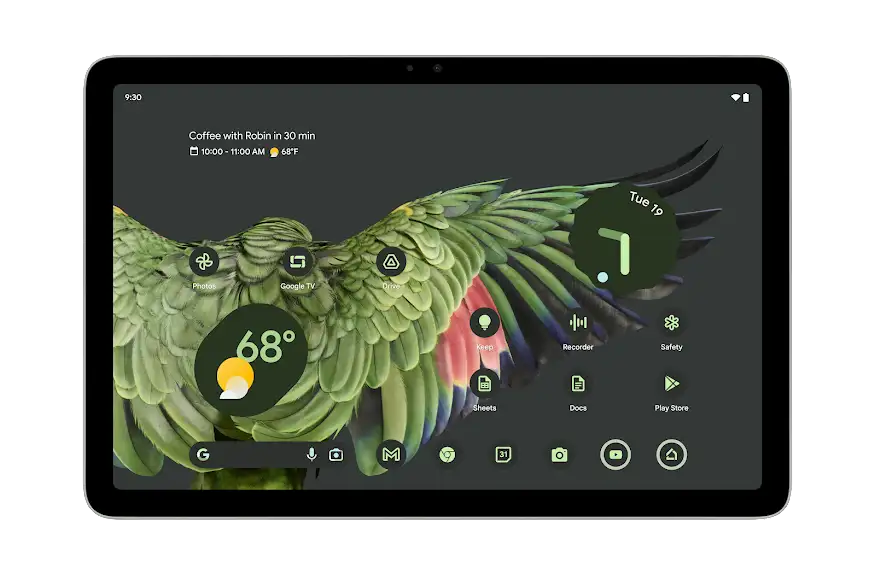
Google Pixel Tablet may be Launched with a Dock in the Box

Google is on a roll right now. The tech community is abuzz with reports and leaks surrounding the company’s upcoming devices, including the Pixel Fold, Pixel 7a and the Pixel Tablet. Enthusiasts are especially looking forward to the launch of the Pixel-branded Android tablet, which has been teased since Google I/O 2022. What sets this tablet apart from the competition is its ability to double as a smart display when docked to a speaker device. This unique feature will open up a world of possibilities for users, allowing them to seamlessly transition between tablet and smart display modes depending on their needs. Whether they are watching a movie, listening to music, or checking their calendar, the Pixel Tablet seems to be a versatile and powerful device that can handle it all.

Google Pixel Tablet

One of the most exciting things about the Pixel Tablet is its rumoured affordability, with leaked specs suggesting that it will be powered by the Tensor G2 processor and come with 8GB of RAM. However, the addition of the dock could push up the price significantly, so it remains to be seen just how accessible this device will be for budget-conscious consumers. Those who have Google Home-compatible devices integrated into their homes will be especially inclined towards purchasing this tablet.

Despite Google’s previous exit from the tablet market, it seems that the company is determined to make a big splash with its new offering. The previously leaked details about the privacy switch and different colour options only add to the excitement surrounding the Pixel Tablet. The Pixel Tablet’s ability to function as both a tablet and a smart display makes it a compelling option for anyone in the market for a new device. It will be interesting to see how the device is received by consumers when it launches in a few months (we hope).

RELATED:

(Via)

Philips PUF8297 Smart TV arrives with 4K HD Display, patented ambient light technology starting at 2699 yuan ($392)

Philips recently launched a new smart TV aptly named PUF8297 in China. The new smart TV comes in four display sizes: 55 inches, 65 inches, 70 inches and 75 inches and is already up for pre-orders in China. The pricing starts at 2799 yuan ($407) but those who pre-order the smart TV can get a discount of between 100 yuan to 300 yuan.

Philips PUF8297 Smart TV

The Philips PUF8297 smart TV is equipped with an high-definition display with HD resolution of 3840 x 2160 pixels and 60Hz refresh rate. The device features Philips’ patented ambient light technology, which can automatically adjust the back LED light according to the content of the TV. This creates a more immersive viewing experience. In addition, it is also equipped with a smart light sensor, which supports smart light-sensing eye protection mode, which can sense changes in indoor ambient light and automatically adjust the screen brightness.

This TV has built-in dual independent speakers and supports Dolby Atmos, supplemented by ultra-wide surround sound, giving users a theater-level listening experience. The new product also supports the far-field intelligent voice control function. Users only need to say the wake-up word “Ding Ding Ding Dang” to activate the function, and operations such as video content search and weather query can be responded to promptly.

Philips PUF8297 Smart TV

In order to further optimize the display effect of the sleek smart TV, Philips has equipped this 4K TV with a P5 image quality enhancement engine, supplemented by MEMC motion image quality compensation technology. Thus, high-speed motion scenes can be clearly captured, reducing image smearing and displaying more clearly.

RELATED:

Huawei Smart Door Lock Series 2.0 with improved AI 3D face recognition launched

Huawei has launched a new smart door lock at the product launch conference held in Shanghai on April 17. The new product dubbed Huawei Smart Door Lock Series 2.0 is an upgrade over the Smart Door Lock launched last year with a plethora of security features. The new door lock was announced alongside smartphones, notebooks, a smart band and smart TVs.

Huawei Smart Door Lock Series 2.0

This new series of smart door locks boasts of enhanced security features and innovative technologies to make unlocking more convenient and efficient. The door lock comes with a new AI 3D face recognition 2.0 which increases the unlocking speed by 20%, and the door lock can be unlocked even in the presence of low light, backlight or strong light. There is also a built-in dual-engine AI fingerprint algorithm which makes it easier for children and elderly people to unlock the door.

In addition, Huawei’s new smart door lock also includes a family care-message memo function, allowing users to leave important messages for their family members, ensuring that essential matters are not forgotten when going out.

Huawei Smart Door Lock Series 2.0

One of the most impressive features of this smart door lock is its high-security certification, which has been evaluated by the Smart Standards Committee and passed the financial-level security of the Hongmeng system (CCRC enhanced security certification). These certifications ensure that the smart door lock meets the highest standards of security and provides maximum protection to users.

The smart door lock series 2.0 is available in two versions – the standard version priced at 2499 yuan and the Pro version at 3699 yuan. The door lock series will be available for sale from 20:00 on April 17, 2023.

Related:

OnePlus 45W Liquid Cooling Back Clip showcased at MWC 2023 hits China for 469 yuan ($68)

Earlier on Monday, Chinese tech giant OnePlus held a launch event where it unveiled the OnePlus Ace 2 Genshin Impact limited edition. The tech giatn equally announced a number of accessories, one fo which is the OnePlus 45W Liquid Cooling back clip. The cooling device is reputed as the first liquid cooling radiator designed for mobile phones.

OnePlus 45W Liquid Cooling Back Clip

Recall that OnePlus first announced the innovative yet minimalist product at MWC 2023 in February but the pricing and availability details were lacking at the time. The product is now available in China and is priced at 469 yuan ($68). We expect the company to release the product for the global market pretty soon.

As a reminder, the liquid cooling back clip from OnePlus is designed to fit perfectly onto the back of the phone in other to discipate heat generated during highly demanding tasks like hardcore gaming.

Flagship smartphones and even high-end mid-range models are usually fitted with powerful CPUs which allow games and other apps with powerful graphics and which uses a considerable amount of resources. These apps are usually power hungry and enerate a lot of heat. Thus, manufacturers have in recent times deploy internal cooling systems of these flagship and mod-range models to dissipate the heat generated during such intense usage. Sometimes, the internal cooling mechanism may not be adequate in cooling the device and that gave birth to external cooling devices. Xiaomi, Razer and even OnePlus have several models under their brand names but they are all air-cooled.

OnePlus 45W Liquid Cooling Back Clip

The new OnePlus 45W Liquid cooling device features two important parts. There is the part that attaches to the smartphone’s back panel and a second part which is a box-shaped cooling pump connected to the first part via a cable. Once the cooling device is snapped onto a smartphone, it starts working automatically. It subsequently stops working if it is detached. The back clip consists of a 40mm x 40mm TEC cooling sheet whie the external cooling pump has a 180,000m㎡ cold radiator with a heat dissipation power of 45W.

OnePlus claims the 45W Liquid Cooling back clip is capable of reducing the device’s temperatures by up to 20°C, which is a significant gap compared to the current air-cooled radiator from OnePlus. While this model may offer better cooling and perhaps longer usage time, the design which sees the back clip attached to a cooling pump via a wire may discourage some.

Related

Vivo Y78 clears 3C certification with 44W charging, appears on Google Play as well

Vivo is preparing to launch new products in China on April 20, including their latest foldable devices and the second generation of their tablet, the Vivo Pad 2. There are also rumors that the company plans to release several mid-range smartphones in the Y series, with the Vivo Y78+ already generating buzz online. Now, it seems that the standard Vivo Y78 is also near, as it has been spotted on the 3C and Google Play websites.

Vivo-Y78-5G

Vivo Y78 might launch very soon

The Vivo Y78 has recently surfaced on the 3C certification website, under the model number V2278A. Interestingly, the same model number has also been linked to two smartphones on Google Play: the Vivo Y78 and the Y78m. This could imply that Vivo plans to market the device under different names in various regions. In fact, Vivo Y78m might be a China-exclusive model.

Further, the 3C certification reveals that this device will offer 44W fast charging. We can expect it to pack a 5,000mAh battery. Other specifications of the handset are unknown. It was recently spotted on the NCC website with a design similar to the previously leaked Vivo Y78+ 5G. It features a sleek design and a sizable camera bump with three camera sensors within two rings. On the front, the Vivo phone flaunts a curved display with a center punch hole cutout for the selfie camera.

While we don’t know its other specifications, we can expect it to debut as a mid-range smartphone with a large display and decent cameras. It should debut in the coming months alongside the Vivo Y78+, which is rumored to feature a Snapdragon 695 processor with up to 12GB of RAM.

RELATED:

(Source)

Xiaomi MIJIA Pulse Water Gun featuring three launch modes, USB-C fast charging released

Xiaomi has released the MIJIA Pulse Water Gun in China. The new Pulse water gun comes with three launch modes and will be available via crowdfunding on Xiaomi Mall. The new MIJIA water gun has a sleek and cool appearance. It is equipped with dynamic lighting effects that can flash synchronously with the shooting rhythm.

The MIJIA Pulse water gun supports automatic water absorption in 10-15 seconds. You can choose from any of the three firing modes. The options are continuous shooting, single shooting, and charged shooting. The water gun has a maximum output of 25 water bombs and a range between 7 and 9 meters. A high-definition tactical display shows the launch mode and activity of the gadget in real-time. The Pulse water gun is useful in many applications including cleaning and entertainment.

Xiaomi has a fast-expanding portfolio of household and consumer electronics. The Chinese tech powerhouse continues to leverage its blossoming customer base in the local market with a raft of new products. The MIJIA Pulse water gun has a 1,800mAh lithium battery with support for 10W charging via USB Type-C.

Xiaomi MIJIA Pulse Water Gun

The Xiaomi MIJIA Pulse water gun will be open for pre-order from April 17. The crowdfunding program will kick off on April 19 and until April 26. The toy will retail in China for 649 yuan (~$94) during the launch period. However, the price will revert to its original at the end of the crowdfunding campaign.

RELATED: