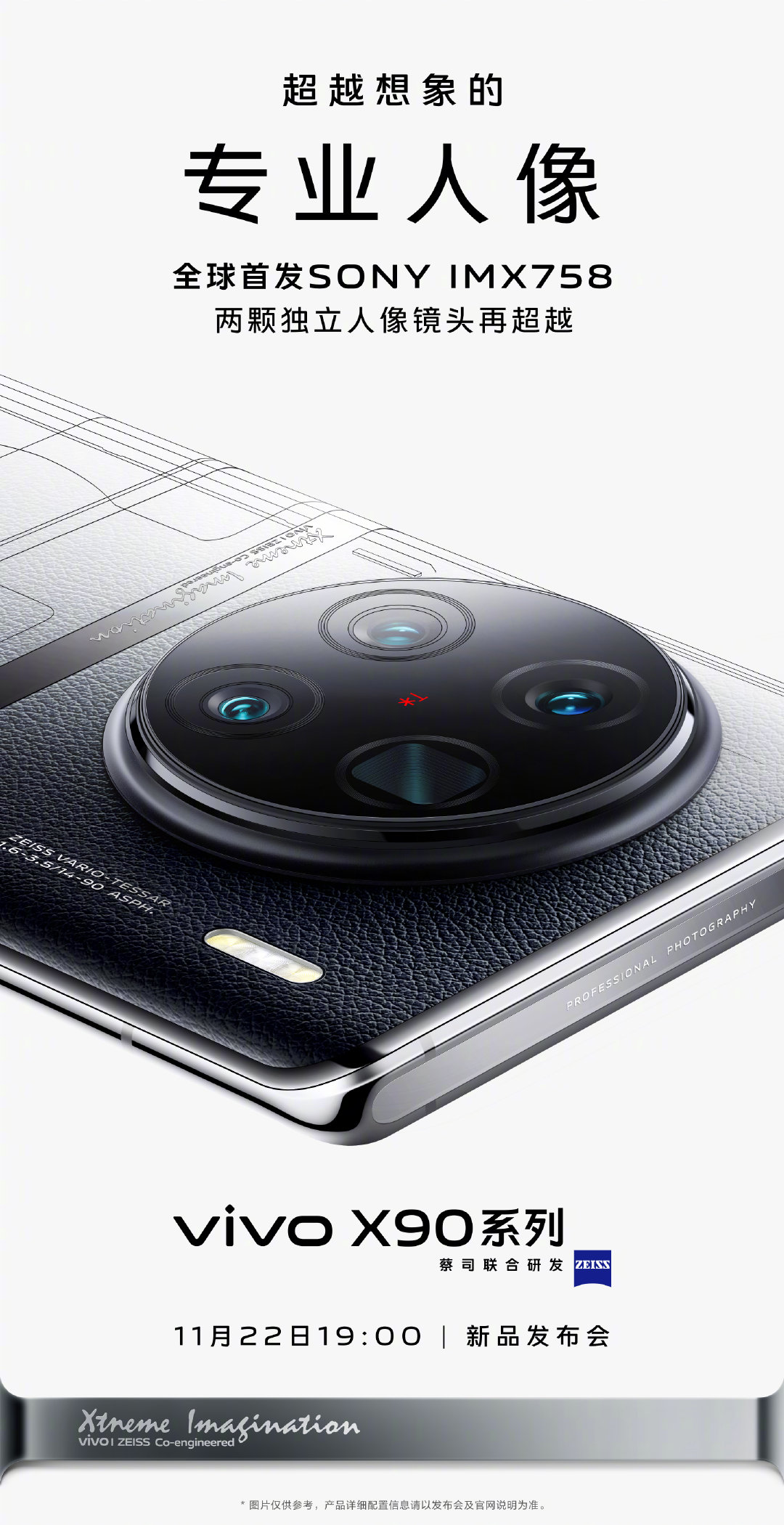
On November 22, Vivo will launch the X90 series in China, which is anticipated to include three models: vanilla, Pro, and Pro+. While the vanilla and Pro variants are officially confirmed to be powered by the Dimensity 9200 SoC, the Vivo X90 Pro+ is expected to use the recently unveiled Snapdragon 8 Gen 2 SoC.
The brand also confirms that a 50MP Sony IMX758 camera will also be included in the X90 series. Furthermore, the image posted by Vivo, which bears the caption “two independent portrait lenses go beyond,” depicts the back of an X90 smartphone with four cameras, the top-right camera likely being a periscope unit. The smartphone’s name has not been revealed, but it is most likely the X90 Pro+. Some camera specs are printed on the right side of the camera island below the LED flash.
Having said that, all the devices in the series will include T* coating and the ZEISS algorithm. The X90 series will include the V2 chip, according to Vivo. So far, rumors suggest that the Vivo X90 series will feature a 50MP Sony IMX989 Wide-Angle lens, a 48MP Sony IMX598 Ultra Wide-Angle lens, a 50MP IMX758 Depth lens, and a 64MP OmniVision OV64B Telephoto lens.
The display is expected to be a 6.78-inch Samsung AMOLED E6 curved panel that will support a 2K resolution, 120Hz refresh rate, and 1440Hz high-frequency dimming. The device might feature up to 512GB of UFS 4.0 storage and up to 12GB of LPDDR5x RAM. A 4,700mAh battery that supports 80W fast charging could be included in the device.
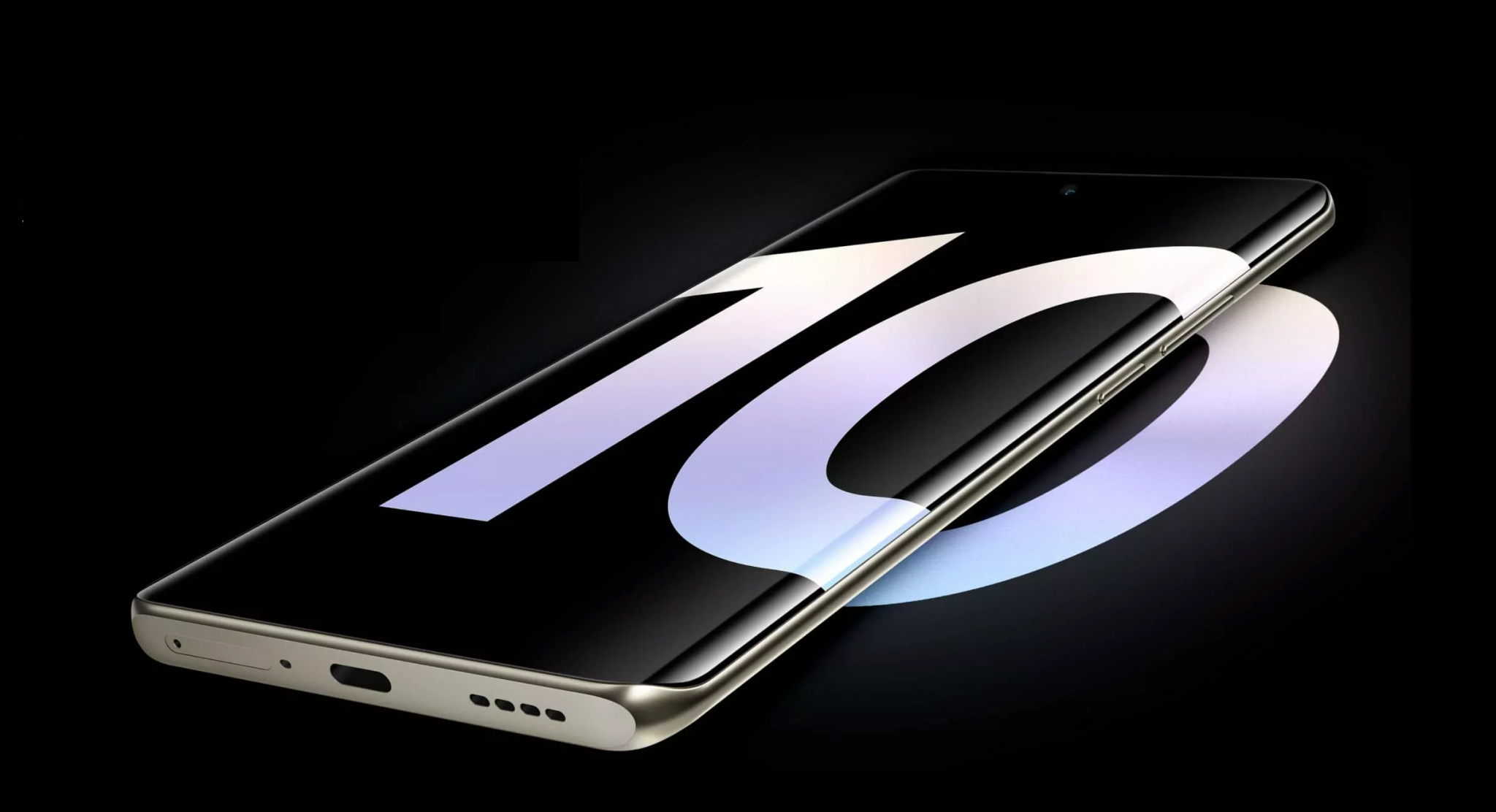
Realme is all set to officially launch its new smartphones under the Realme 10 series. The company is expected to launch two smartphones — Realme 10 Pro and Realme 10 Pro Plus.
The launch event for the Realme 10 series smartphones is scheduled to take place in China on 17th November, i.e., tomorrow. The company will live-stream the event on Chinese streaming platforms and social media websites.
Currently, there’s no live-streaming link available for the launch event to embed here, but we will update this post once that is available. For now, you can follow the company’s own landing page for the event by clicking here.
Although the launch event is set for tomorrow, the company has revealed some of the key features and specifications through teaser posters shared on social media. The smartphones will feature a flat frame design with curved displays.
The Realme 10 Pro will feature a 6.7-inch Full HD+ display with a punch-hole cutout for housing the front-facing camera. On the other hand, the Pro Plus model will have a 6.7-inch Full HD+ curved OLED display with a 120Hz refresh rate and 2160Hz PWM dimming.
Under the hood, Qualcomm Snapdragon 695 processor will power by Realme 10 Pro smartphone, while the Pro Plus model will be powered by the MediaTek Dimensity 1080 chipset. The top-end memory configuration is expected to reach 12GB of RAM and 128GB of internal storage.
In the camera department, the Realme 10 Pro Plus will have a triple-camera setup, including 108MP primary sensor, an 8MP secondary lens, and a 2MP tertiary sensor. On the other hand, the Pro model will have a 16MP primary and 2MP secondary sensor. Both smartphones will have a 16MP snapper on the front for taking selfies and video calling.
Both phones are expected to run the Android 13 operating system out-of-the-box with the company’s own custom user interface on top. As for the pricing, the Realme 10 Pro is expected to start at around 1,500 yuan (~$215), while the Pro Plus model could have a starting price of around 2,000 yuan (~$285). To know for sure, we will have to wait for the official launch event tomorrow.
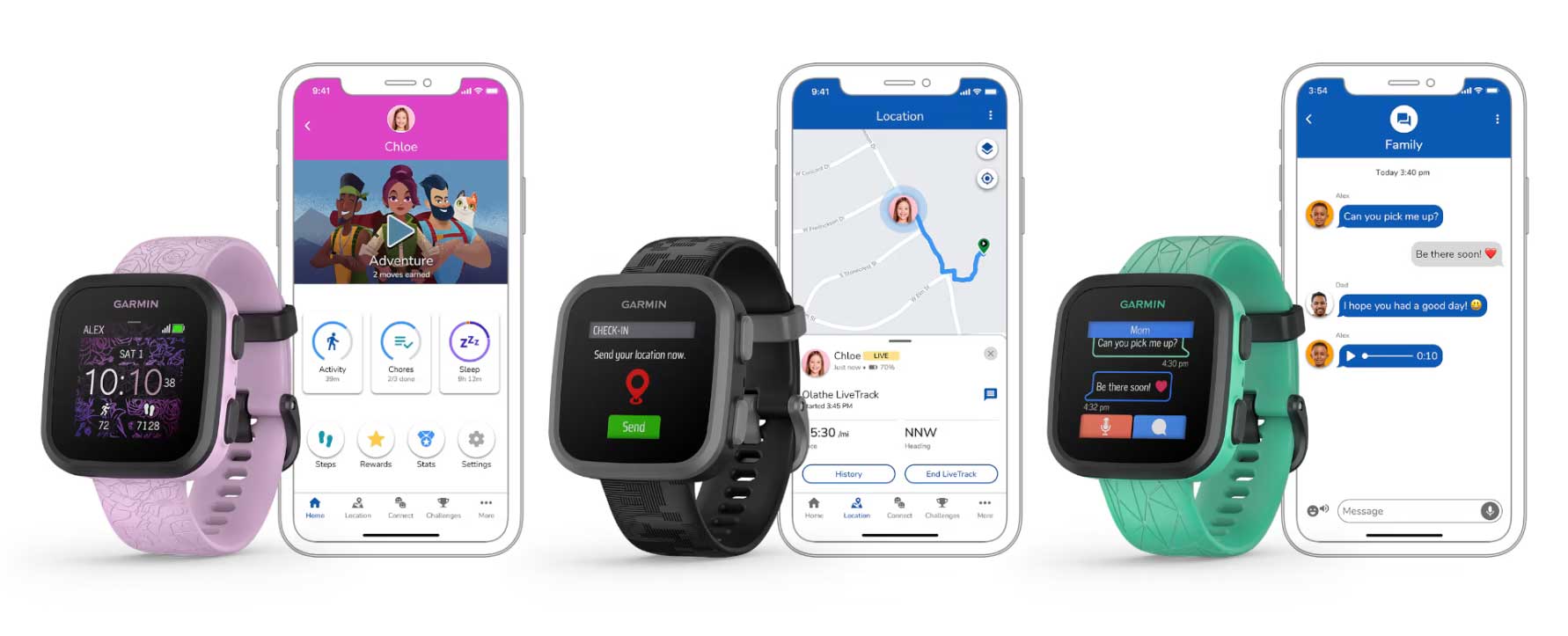
Garmin has launched a new kids-focused smartwatch called the Garmin Bounce. The main highlight of this new smartwatch is that it comes with built-in GPS and 4G LTE connectivity.
Parents can actively track their children’s whereabouts using the built-in GPS and communicate with them via text and voice messaging. The smartwatch is controlled by parents using the Garmin Jr. app, which requires an active Garmin Connect account. A monthly subscription to the LTE features costs $10/€11.
The GPS also enables activity tracking and the brand also has a reward system for achieving various daily activity goals by giving out “collectible gems.” The smartwatch also has games and quizzes onboard which can be played during “parent-approved” time. To reduce distractions, parents can also choose to effectively disable the gadget during school hours or at night. This has no effect on the Bounce’s ability to count steps and track sleep.
Coming to the hardware, the Garmin Bounce has a durable plastic body, a silicone watch band, and a 1.3-inch color LCD display with 240 x 240-pixel resolution. With the default settings, the battery life is rated to last up to two days on a single charge. The watch can track swim sessions and has a 5 ATM water resistance certification.
Garmin Bounce is available in black, green, and lilac and costs $150/€180. It is available for purchase via the Garmin online store.
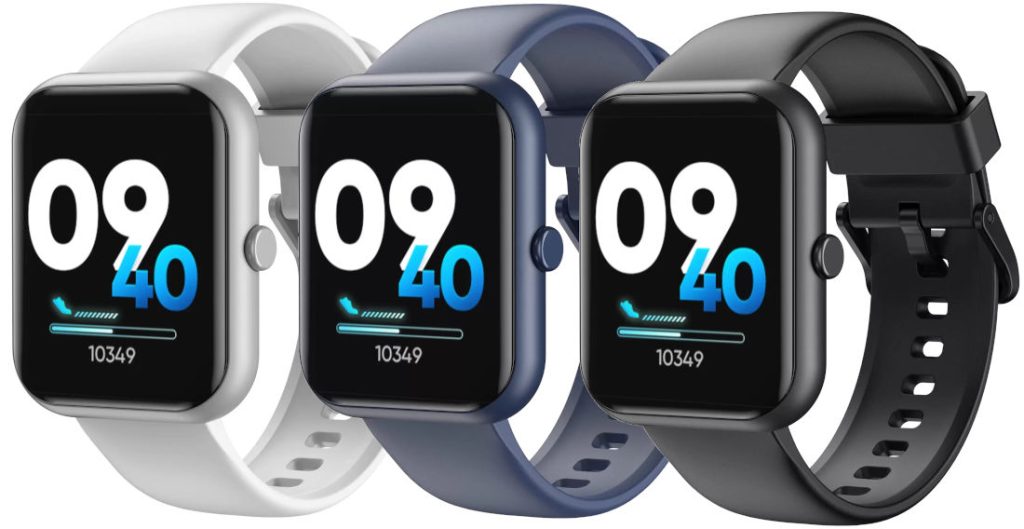
The Realme TechLife brand DIZO recently launched the DIZO Watch D Plus. This is the successor of the Watch D, which the brand launched back in January. Now, the DIZO Watch D Plus is finally available to purchase in India.
DIZO Watch D Plus pricing & availability
The Watch D Plus has a price tag of Rs 1,999 and is available to purchase on Flipkart. It comes in three color options – Classic Black, Silver Grey, and Deep Blue. Customers buying the smartwatch with the Flipkart Axis Bank Card will get 5% cash back on the purchase.
DIZO Watch D specs & features
The DIZO Watch D Plus has a rectangular dial with a 1.85-inch-wide display. It boasts a 240 x 280-pixel resolution and a maximum brightness of 550 nits. The smartwatch has an automatic screen brightness adjustment feature and more than 150 interchangeable watch faces. It is water-resistant up to 30 meters and boasts a superior metal frame. On the right side of the gadget, there is a button to aid UI navigation.
A heart rate monitor, SpO2 sensor, and sleep tracker are included with the DIZO Watch D Plus. Additionally, it can track menstrual cycles and remind users to drink water and do breathing exercises. There are more than 110 indoor and outdoor sports modes supported by the wearable.
With a 300mAh battery, the DIZO Watch D Plus is said to have a 14-day battery life. It includes several practical functions, such as a notification display, weather updates, music and camera control, and more.
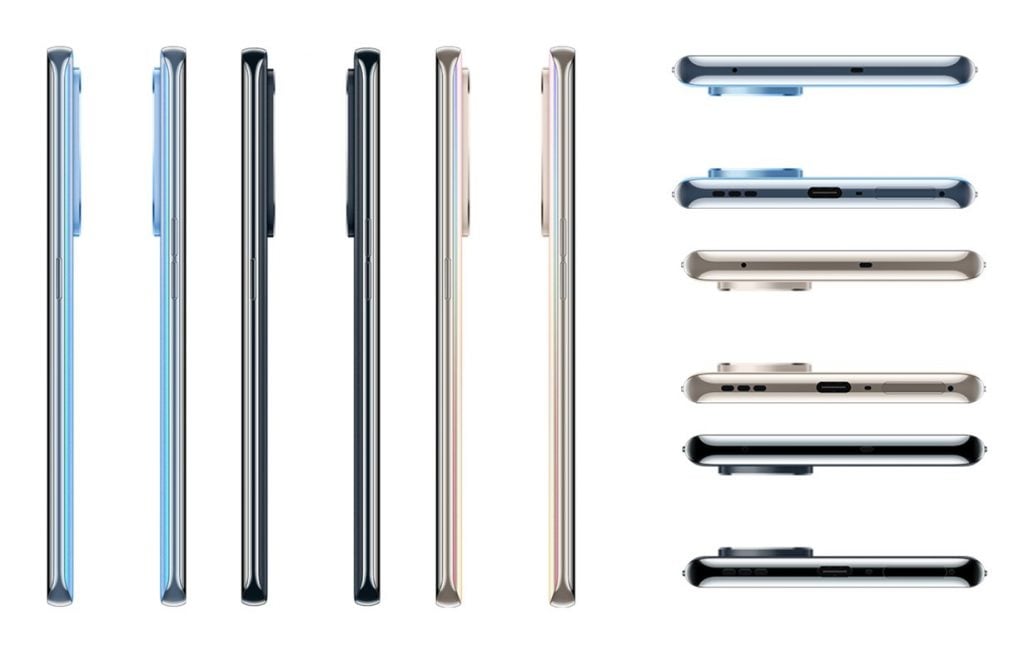
At 6 pm (local time) today, OPPO will announce the OPPO A1 Pro 5G smartphone in China. Rumors surrounding it have claimed that it will be the most advanced A-series phone from the company. Several hours before the launch, the official renders were shared by tipster Sudhanshu Ambhore. The images give a good look at its design from all angles.
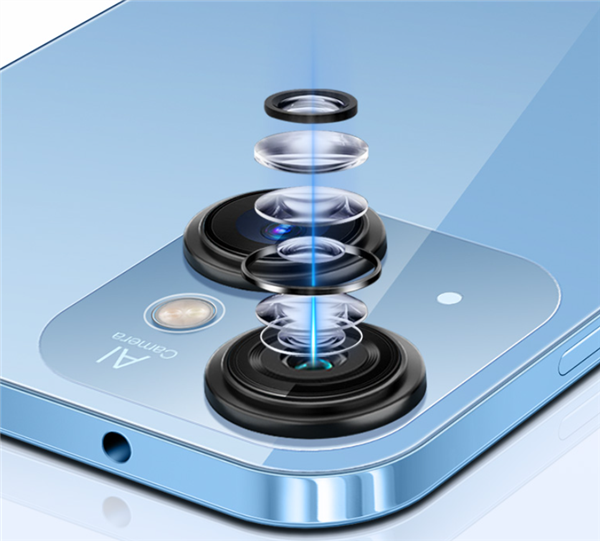
As can be seen, the OPPO A1 Pro will arrive in three colors: blue, gold, and black. On the front, it has a curved-edge display with a centrally positioned punch-hole. An oval camera module housing two camera rings can be seen on the back. The text below the camera module says that the main camera on the OPPO A1 Pro will have a 108-megapixel primary camera.
The top edge of the OPPO A1 Pro has a microphone and an unknown hole. On the opposite side, it has a SIM slot, a microphone, a USB-C port, and a speaker grille. Like other OPPO phones, the A1 Pro has a volume rocker on the left and a power key on the right.
OPPO A1 Pro specifications (rumored)
Reports have revealed that the OPPO A1 Pro will have a 6.7-inch AMOLED display that offers a Full HD+ resolution, a 120Hz refresh rate, 2160Hz PWM dimming, and an in-screen fingerprint scanner. It is expected to run on the Android 13 OS, which will be skinned with ColorOS 13. It will feature the Snapdragon 695 chipset, up to 12 GB of LPDDR4x RAM, and up to 256 GB of UFS 2.2 storage.
The device will house a 5,000mAh battery with 67W fast charging support. For selfies, it will feature a 16-megapixel front-facing camera, and its back will have a 108-megapixel (main) + 2-megapixel dual-camera setup.
LeTV has launched a new budget smartphone in China. The new smartphone is dubbed LeTV Y1 Pro+ and is presently up for pre-order with the first shipment scheduled to roll out of the factory on November 24.
The LeTV Y1 Pro+ is basically a budget phone but the design could pass another message. It actually features a design style that looks like that of Apple’s iPhone 13. The camera lens has the same symmetrical scheme as the iPhone 13. At first glance, the phone may even be confused for an iPhone.
In terms of specs, LeTV Y1 Pro+ sports a 6.5-inch LCD screen with a resolution of 1560 x 720 pixels. The phone is powered by a UNISOC Tiger T610 octa-core processor. The processor uses 12nm process technology. The CPU is made up of a 2.18GHz Cortex-A75 core and six 1.8GHz Cortex-A55 cores. The graphics are powered by a Mali-G52 GPU. The device is available in three memory configurations of 6GB+64GB, 4GB+128GB, and 4GB+256GB.
There is nothing spectacular about the camera aspect. The Y1 Pro+ packs a single 8-megapixel camera with a second dummy sensor just there for decoration. Apparently, the dummy sensor is meant to make it look like an iPhone. At the front, there is a 5-megapixel front camera.
Under the hood, there is a 4000mAh battery with 10W charging support. The phone comes in three colors – Starlight White, Midnight Black, and Starry Blue.
The LeTV Y1 Pro+ starts at 499 yuan ($70) for the 4GB + 64GB variant. The 4GB + 128GB variant is priced at 599 yuan ($85) while there 4GB + 256GB option comes in at 699 yuan ($99).
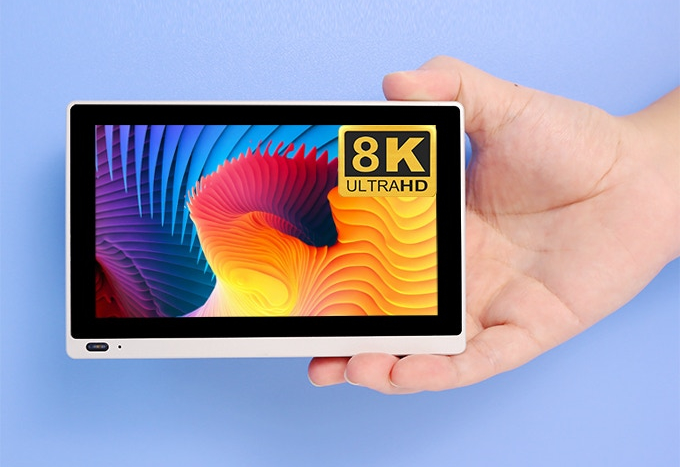
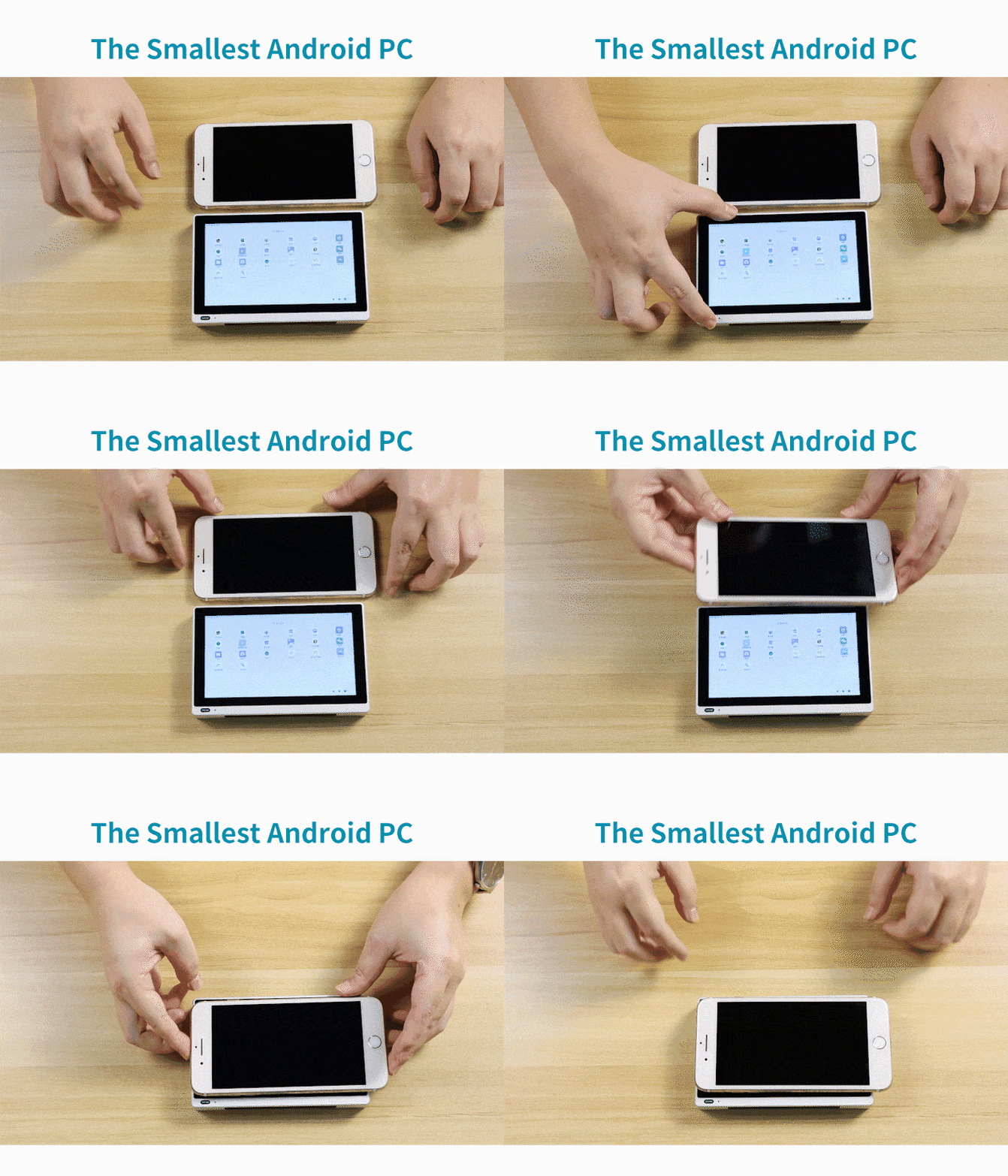
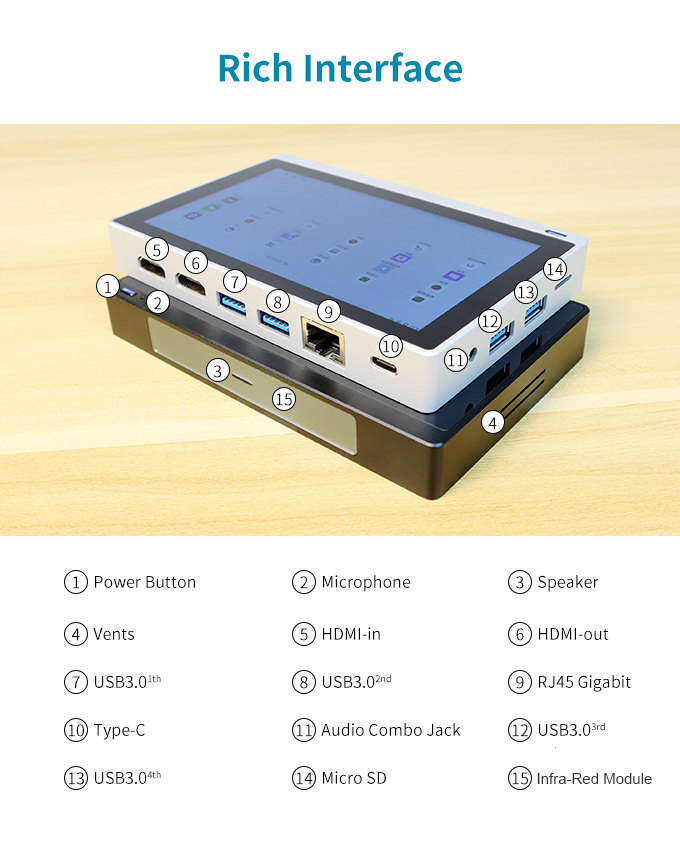
Higole has unveiled the Gole 1 R mini-PC with a built-in 5.5-inch display. It is powered by the Rockchip RK3588 chip with compatibility with Android 12, Linux, or Ubuntu operating systems. The new product is a hybrid of a tablet and a mini-PC. It can be operated without an external monitor but requires an external keyboard or mouse.
The compact credentials of the Gole 1 are being expanded with its small battery. Its 19Wh provides power for the chipset while the RAM/ storage configuration is 8GB/ 128GB. The Rockchip RK3588 can only decode 8K content via the gadget’s HDMI 2.1 port. It is noted that the Rockchip RK3588 is a low-powered solution found in lots of mini PCs.
Apart from the HDMI 2.1 port, the Gole 1 R has a 3.5mm audio jack, a MicroSD card reader, 4 USB-A ports, and a USB-C port. In terms of wireless connectivity, the device supports Bluetooth 5.2 and Wi-Fi 6.
Higole has commenced a Kickstarter campaign for the new device at $353. Higole also retails a version of the Gole 1 R without a battery or display but with M.2 expansion at $300. The early backers of the Kickstarter campaign for the Gole 1 R are expected to get their devices in December 2023. As of this moment, the target for the Gole 1 R has not been reached.
Qualcomm, one of the leading smartphone chipset makers, has today officially announced its next-generation Snapdragon series flagship processor for high-end smartphones — Qualcomm Snapdragon 8 Gen 2.
As the name itself indicates, the newly announced Qualcomm Snapdragon 8 Gen 2 is a successor to the last year’s Snapdragon 8 Gen 1 processor, and it comes with a focus on better and more efficient performance, especially when it comes to AI-related tasks.
The Kryo CPU on the Snapdragon 8 Gen 2 includes one prime core based on the ARM Cortex-X3 clocked at 3.2GHz, as well as four performance cores at 2.8GHz and three efficiency cores at 2.0GHz. Compared to last year’s chipset, these are 200MHz to 300MHz faster. The company says the CPU is 35 percent faster than the previous generation and 40 percent more power efficient.
Its latest Adreno GPU is claimed to offer 25 percent higher performance while being 45 percent more power efficient. It also brings support for hardware-accelerated ray tracing to the Snapdragon platform. There’s support for faster memory technologies, including LP-DDR5X RAM at up to 4,200MHz and new UFS 4.0 storage.
Similar to the SD8 Gen 1, the newly announced Qualcomm Snapdragon 8 Gen 2 is built using a 4nm process. As for the display, the chipset comes with support for QHD+ resolution at up to 144Hz or 4K resolution at 60Hz. It also supports external displays up to 4K resolution at 60Hz with a 10-bit Rec. 2020 color gamut, HDR10+, and Dolby Vision.
Coming to the camera department, it has a triple 18-bit ISP that supports up to three 36MP cameras simultaneously or up to 200MP for a single-camera configuration. It also supports 108MP camera sensors with zero shutter lag. The company has also improved support for the latest Sony and Samsung sensors as Sony sensors with DOL-HDR and Samsung’s 200MP HP3 sensors are optimized to work with the ISP on the Snapdragon 8 Gen 2.
Qualcomm says it has made improvements throughout the Hexagon processor for up to 4.35x faster Artificial Intelligence (AI) performance and claims that the chip can handle more complex tasks, like translating a language into multiple languages in real time. It is also the world’s first chip to have support for Wi-Fi 7 technology.
It packs a Qualcomm Snapdragon X70 modem, which was announced earlier this year at the Mobile World Congress. It has its own AI processor for boosting 5G performance and comes with support for dual active 5G SIMs, which means that users can use two different 5G networks simultaneously.
Qualcomm revealed a list of partners for the Snapdragon 8 Gen 2 processor, which includes Motorola, OPPO, and ASUS ROG, among others. However, Samsung is missing from the list, but we are pretty sure the upcoming Samsung Galaxy S23 series flagship smartphones will come powered by the Snapdragon 8 Gen 2 SoC. The company says that smartphones powered by the Snapdragon 8 Gen 2 will start getting launched by the end of this year.
Stable OxygenOS 13 update based on Android 13 is rolling out to OnePlus 8, 8 Pro, and 8T is rolling out internationally too!
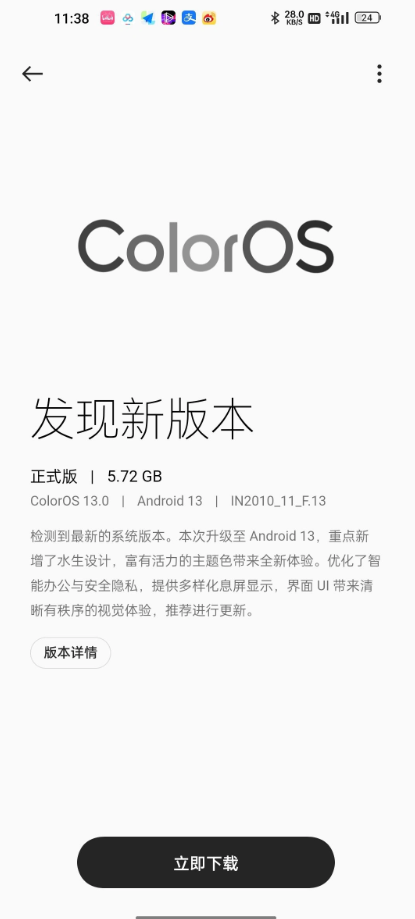
The OnePlus 8 series is no doubt one of the most popular lineups ever introduced by the OnePlus. The lineup includes three different devices; the OnePlus 8, the OnePlus 8 Pro and the OnePlus 8T. It has been recently reported that the rollout of stable ColorOS 13, based on Android 13, has begun for the OnePlus 8 lineup. The Chinese variant of the devices has already started grabbing the update.
ITHomeon Tuesday reported that the OnePlus 8 lineup of smartphones has started receiving the Android 13-based ColorOS 13 update. According to the source, this update is 5.72 GB in size, runs Android 13 and focuses on adding aquatic design, which creates a fresh experience. It offers a choice of screen displays, maximises smart office security and privacy, and the user interface (UI) creates a clean and organised visual experience.
Image credit- ITHomes
On August 30 of this year, during the OPPO Developer Conference 2022, ColorOS was formally introduced. Major updates to the UI have just been made, including an improved quantum animation engine, support for new widgets on the homescreen, and revamped notification panels and icons. New privacy and security-related enhancements are also included in the UI overhaul. Additionally, the newly unveiled UI must support OPPO’s exclusive Omojis and spatial audio.
It is important to note that the OnePlus phones in China run the same version of ColorOS that the OPPO phones do. The smartphones on the global market run OxygenOS, which is essentially just ColorOS with a few very minor tweaks here and there. We expect that worldwide smartphones will get the upgrade in the upcoming weeks as the Android 13 rollout for the OnePlus 8 series has begun in the Chinese market.
Predictive back gesture development began with Android 13 itself. When you are exiting an app and returning to your homescreen, the predictive gesture can serve as a reminder. The predictive back gesture feature will, however, be officially made available beginning with the Android 14 operating system, according to a recent official confirmation from tech giant Google. The company adds that Android 14’s predictive back gesture can operate inside applications and preview the prior home-screen.
In the official Developer Summit event of 2022, Google had discussed “falsing,” which refers to how users may occasionally accidentally quit an application due to the back gesture, impacting the app usage metrics. A user’s comment that reads, “I can’t see that I’m on the last screen before the home screen,” was also displayed by the firm.
The solution to all of these issues is predictive back gesture. When you use the back gestures to immediately exit an application, the homescreen essentially gets a sneak peek. The feature is simply enabled from the developer settings, and certain selected apps have already started testing it. Predictive back will be enabled by default in Android 14, and the forthcoming OS is expected to provide “a similar experience when users swipe within the app.” utilising pre-made or bespoke animations to show viewers where going back will take them.
With Android 14, the predicted back gesture feature will be available. According to the official schedules, the Android 14 developer preview will start sometime in the middle of 2023. The operating system will be formally released in 2023’s fourth quarter. The OS is expected to undergo some significant changes with Android 14 and various privacy and security-related problems will also be further resolved.
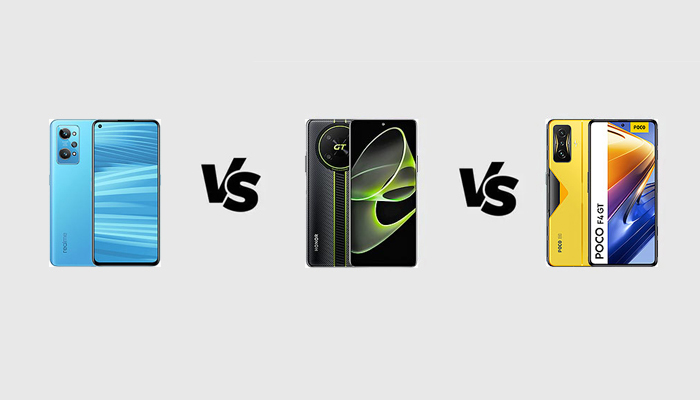
If you are searching for a new phone for gaming with a very high value for money, you should definitely consider the new Honor X40 GT. You should consider almost every phone with the “GT” tag inside its name. This year, we saw several GT phones released by several brands. And they belong to the same price range as the Honor. One of them is the Realme GT 2, a phone from the first brand to create a GT lineup. But Xiaomi released one as wwell: the POCO F4 GT. Which one is the best? We hope you will discover it by reading this comparison between the specifications of the Realme GT 2, the Honor X40 GT, and the POCO F4 GT.
Realme GT 2 vs Honor X40 GT vs Xiaomi POCO F4 GT
Realme GT 2
Honor X40 GT
Xiaomi POCO F4 GT
DIMENSIONS AND WEIGHT
162.9 x 75.8 x 8.6 mm,
194.5 g
166.1 x 75.8 x 8.5 mm,
199.5 g
162.5 x 76.7 x 8.5 mm,
210 g
DISPLAY
6.62 inches, 1080 x 2400 pixels (Full HD+), AMOLED
6.81 inches, 1080 x 2388 pixels (Full HD+), AMOLED
6.67 inches, 1080 x 2400 pixels (Full HD+), AMOLED
Triple 50 + 8 + 2 MP, f/1.8 + f/2.2 + f/2.4
16 MP f/2.5 front camera
Triple 50 + 2 + 2 MP, f/1.8 + f/2.4 + f/2.4
16 MP f/2.5 front camera
Triple 64 + 8 + 2 MP, f/1.9 + f/2.2 + f/2.4
20 MP f/2.4 front camera
BATTERY
5000 mAh, fast charging 65W
4800 mAh, fast charging 66W
4700 mAh, Fast Charging 120W
ADDITIONAL FEATURES
5G, dual SIM slot
5G, dual SIM slot, reverse charging
5G, dual SIM slot, physical gaming trigger
Design
The Honor X40 GT and the POCO F4 GT come with a very gaming-centric design, it is easy to notice. With the POCO, you also get physical pop-up gaming triggers able to enhance your gaming experience. The Realme GT 2 has a traditional design, more elegant and sober, and it comes in two color variants made of a material similar to the paper in terms of touch and feel. If you are a gamer, do you prefer phones with gaming-centric designs or a more traditional device?
Display
The most convincing display belongs to the POCO F4 GT. It has a great AMOLED panel able to show up to one billion colors with a diagonal of 6.67 inches, a Full HD+ resolution of 1080 x 2400 pixels, a 120 Hz refresh rate, HDR10+ certification, and an in-display fingerprint reader. The silver medal goes to the Realme GT 2 packing a 6.62-inch AMOLED display with a Full HD+ resolution, a 120 Hz refresh rate, HDR10+ certification, and an in-display fingerprint scanner. The Honor X40 GT has a higher 144 Hz refresh rate, but it disappoints because it sports an IPS LCD panel instead of an AMOLED display.
Specs & Software
If your goal is to get the most powerful hardware department, then you should opt for the POCO F4 GT. It is powered by the Snapdragon 8 Gen 1 mobile platform running at a max frequency of 3 GHz, paired with up to 12 GB of RAM and up to 256 GB of internal storage. With the Realme GT 2 and the Honor X40 GT, you can get the same memory configuration but with an inferior Snapdragon 888 mobile platform by Qualcomm, running at a max frequency of 2.84 GHz. These devices run Android 12 out of the box and we expect them to get at least two major Android updates (three for the GT 2 by Realme).
Camera
The most advanced camera phone in this comparison is the Realme GT 2. It has a triple camera setup composed of a main 50 MP sensor (a Sony IMX766 sensor) with OIS, an 8 MP ultrawide camera, a 2 MP macro shooter, and a 16 MP front camera. It is the only one from this trio to sport optical stabilization. The Honor X40 GT is disappointing: it has a 50 MP main camera without OIS and it lacks an ultrawide lens, replaced by a pair of 2 MP sensors for macro and depth calculation. The POCO F4 GT sits right in the middle with a 64 MP main camera, an 8 MP ultrawide shooter, a 2 MP macro lens, and a 20 MP selfie snapper.
The Realme GT 2 has the biggest battery, with a capacity of 5000 mAh: it should last more in several scenarios. The POCO F4 GT has the fastest charging technology, with a power of 120W.
Price
The Honor X40 GT starts from €300/$300, the POCO F4 GT carries a €480/$480 starting price, and the Realme GT 2 is available for less than €400/$400 (prices vary depending on the market). Which one would you pick?
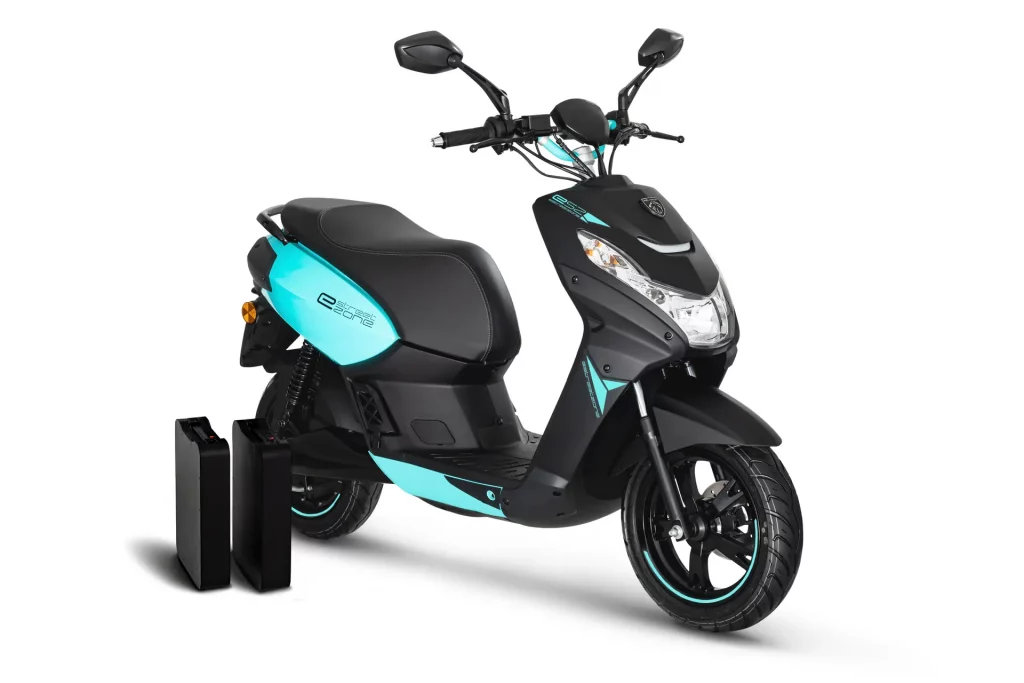
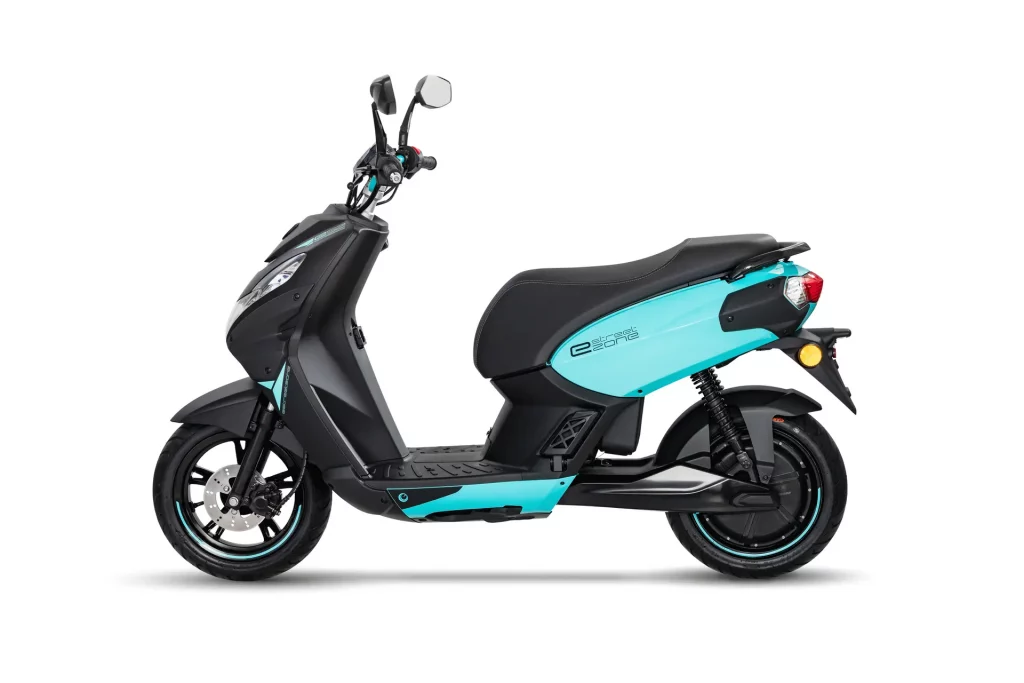
Peugeot Motorcycles has showcased its e-Streetzone electric scooter with dual batteries and a range up to 112km. The e-Streetzone is the electric version of its 500cc Streetzone ICE model released a decade back. A cargo version of the e-Streetzone is also available, as well as the one- and two-battery models.
The e-Streetzone single-battery model has a range of 61km when operated in Eco mode. The range of the battery reduces to 51km in the Boost mode. The e-scooter can reach a top speed of 25km/h and 45km/h respectively. With dual batteries on the electric scooter, the range is 112km with the Eco mode and 96km with the Boost mode. A single battery weighs about 12kg hence the scooter has a weight of 102kg with two batteries and 90kg with a single battery. Remarkably, the battery can be easily removed from the seat compartment and recharged using mains electricity for up to 5 hours. Fast charging is also supported with the e-scooter.
The e-Streetzone delivers maximum torque of 105Nm and is well-suited for urban commutes. It has an hydraulic suspension at both ends with 110/70-12 tires. It has a solid brake system consisting of a disc brake at the front and a drum brake at the rear. An LCD screen provides a quick peek at battery status and other information. There is a USB charging port to help you charge your device while on the go. There is a bag hook in the space under the handlebar.
The cargo version of the Peugeot e-Streetzone can be used for logistics/ food deliveries. It has a single seat and a rear cargo rack that weighs 20kg. The cargo version, according to the company, has been designed to withstand regular and sustained use. Ahead of its release in 2023, Peugeot has not released such information recently.
Xiaomi has unveiled a new toy under the Jupiter Dawn smart building block series. The products in the series include Jupiter Dawn Defender Launcher, Cetus Spaceship, Shepherd Vehicle, Pioneering Engineering Vehicle, and the Orion Hexapod Titan. The Hound Chariot is the latest addition and it will go on sale under crowdfunding on Xiaomi Mall on November 16.
The Hound Chariot has more than 1,000 pieces of building blocks covered with composite armor. The product also has a 360-degree rotating close-up gun and a guillotine-shaped front bumper. It has a fuel storage tank at the rear and an all-around, hard-core sci-fi machine-first shaping. The Hound Chariot armored combat vehicle has a wireless, dual-axis motor with a speed of 220rpm and a Bluetooth 5.0 Mesh protocol wireless remote control. The Hound Chariot features game engine development, low latency, and high response speed, and there is a real-time display of vehicle driving data.
The Hound Chariot has vibration feedback to enhance the driving experience. As per pricing, the Xiaomi Hound Chariot retailed at 299 yuan (~$42) during the crowdfunding period but its original price is 349 yuan (~$50). The original Xiaomi Jupiter Dawn sci-fi building block series features virtual reality (VR) technology with some VR special effects.
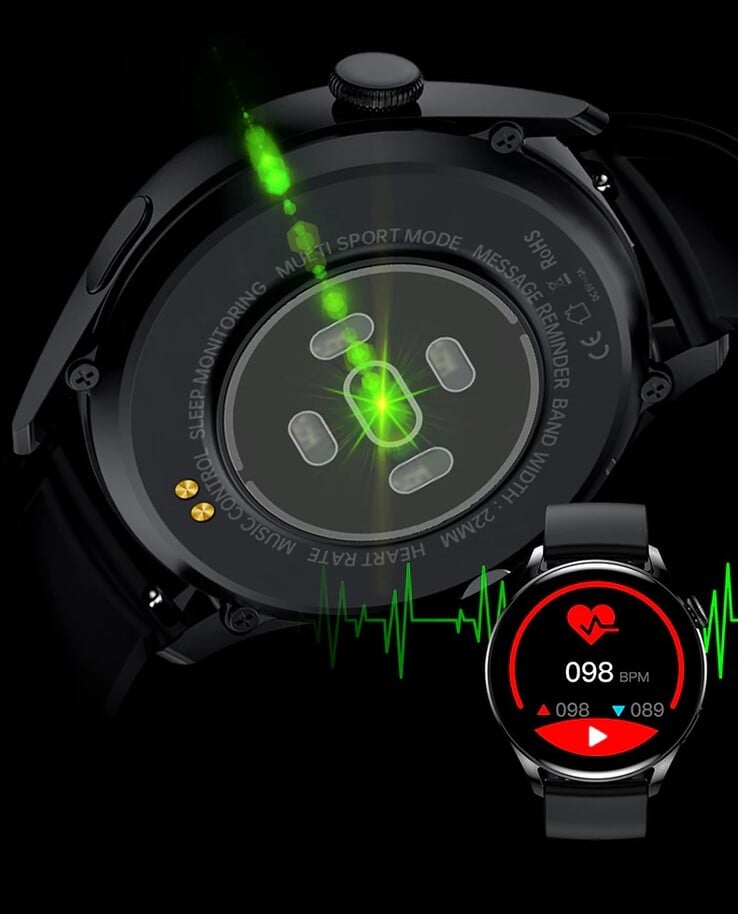
The KESHUYOU GT5 smartwatch has been launched and is now available globally. The new smartwatch will ship from China to the global market and it comes with a blood pressure sensor among its health features. The smartwatch also features Bluetooth calling, music playback, and more.
The GT5 has a 1.28-inch, 240 x 240p display and a 150mAh battery that delivers up to 3 days of activity. It is also equipped with heart rate, blood Oxygen, and sleep monitoring functionalities. The smartwatch can be connected via Bluetooth 5.0 to smartphones with Android 4.4/ iOS 8.0 and higher. While there are still quite a few smartwatches with blood pressure monitoring functions, the GT5 may be less accurate with that function.
The KESHUYOU GT5 offers multiple and customizable watch faces, five exercise modes, and a built-in NFC for unlocking smart doors and locks. The exercise modes available in the GT5 include running and cycling. Other features of the new smartwatch are weather forecasts, the find-watch tool, and sedentary reminders. Its battery can be recharged fully wirelessly in about 3 hours. The watch has a 22mm strap with Silicone, leather, and metal options available.
The KESHUYOU GT5 smartwatch is available for purchase via AliExpress for $15.83. The original price of the product is $28.23 and it ships from China. The first deliveries of the GT5 are expected by December. It is unclear how long the discounted offer will last and shipping times may vary across regions.
The Giant Stormguard E+ SUV e-bike has been announced. The new e-bike comes with a RideDash Evo display, with heart rate monitoring also featured. The e-bike’s display also shows ride information like the speed, battery status, etc, as well as receiving emails on the go.
The Stormguard E+ SUV e-bike is well-suited for difficult terrains and has a full front and rear suspension system. It is fitted with Shimano M6120 or Shimano MT420 brakes for shorter stopping times when braking. The e-bike has a payload of about 156kg which translates to a carrying capacity of 20kg of luggage together with the rider.
The bicycle’s EnergyPak 800 battery with a capacity of 800Wh delivers an assistance range under 200km. The range can be further extended to 200km with an optional 250Wh range extender battery. The e-bike is equipped with a SyncDrive Pro 2 electric motor jointly developed by Giant and Yamaha. The motor delivers a maximum torque of 85Nm, while Giant says the bike’s carbon belt drive can last up to 10,000km.
The Giant Stormguard E+ is equipped with six smart sensors which monitor the pedaling power and adjust the assistance as appropriate. The RideDash Evo display also enables the rider to view fitness data like heart rate, as well as connect to a smartphone to receive emails. The Giant Stormguard E+ SUV e-bike is available for purchase in parts of Europe like the Netherlands, France, and Sweden. It is priced at €6,499 (~$6,716) and different sizes from S to XL are available. There are no details yet on the global availability of the e-bike.
After rolling out the stable OxygenOS 13 update to the flagship OnePlus 10, 9, and 9 Pro, the Chinese OEM is now moving towards its mid-range devices. It has been reported that the OnePlus 9R and OnePlus 10R are now getting a stable build of the OxygenOS 13, based on Android 13. The update is currently rolling out in India and China. Here are the details.
Users have reported that the OnePlus 9R and 10R are receiving the latest Android 13 update with firmware versions LE2101_11_F.16 and CPH2423_11_C.14. The update reportedly comes with a size of 4GB and brings new features and improvements. The software is currently being rolled out in China and India, but we can expect it to reach other regions soon.
Users should be getting an OTA notification for the update. If you have not received it already, you can head to Settings > System > System Updates to manually check whether the update is available for your device.
To recall, the OxygenOS 13 was introduced back in August alongside the OnePlus 10T. The custom skin comes with an updated design, which the company calls “Aquamorphic Design.” It looks very similar to Oppo’s ColorOS 13 and adds water-inspired theme colors for enhanced visual comfort.
OnePlus also added some additional features to the software to improve multitasking effectiveness. The UI brings spatial audio, Dolby Atmos support for selected devices, and improved app streaming. Version 2.0 of Private Safe 2.0 is also available, which allows users to store files and media outside the reach of regular apps.
Samsung is quickly extending its latest custom skin— One UI 5— to its smartphones. The OEM recently rolled out the Android 13-based software to the Galaxy Xcover 6 Pro, the Tab 8 series, and a few A-series smartphones. Now, the firm has released the stable One UI 5 update for the mid-range Galaxy M52 and Galaxy M32 5G. Here are the details.
The One UI 5.0 stable update for the Galaxy M52 5G comes with the firmware version M526BRXXU1CVJ7. In addition to the new Android 13 features, the update also brings the November 2022 Android security patch. The software is currently being rolled out to the M52 5G with model number SM-M526BR in Europe, with a wider rollout projected in the coming days.
The One UI 5.0 stable update for the Galaxy M32 5G is rolling out in India with a firmware version M326BDDU4CVK1. The update also brings along November 2022 security patches. There is no word yet on when the release will be made available in other countries, but we can expect it to spread very soon.
If you own the above two devices and haven’t received the One UI 5.0 stable update yet, proceed to check for it manually by going to the phone’s Settings and tapping on the Software update menu.
To recall, Galaxy M52 5G debuted in September with a 6.7-inch FHD+ AMOLED display with a 120Hz refresh rate. It packs a Qualcomm Snapdragon 778G SoC, triple cameras, up to 8GB of RAM, and a 5,000 mAh battery with 25W wired fast charging. On the other hand, Galaxy M32 5G comes powered by the MediaTek Dimensity 720 SoC and features a quad camera setup and an LCD panel.
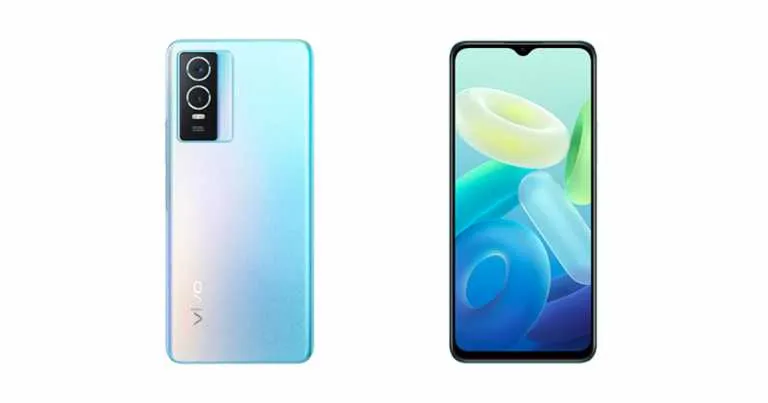
Vivo recently launched the Vivo Y01A in Thailand, and now it seems that the company has another Y-series handset in the works. The smartphone in question is called the Vivo Y76s (t1 Version), and it recently appeared on the China Telecom website with its specs, memory variants, and renders confirming the design. Here are all the details.
Vivo Y76s (t1 version) has been spotted on the China Telecom website (via MySmartPrice). As per the listing, the device will come with a 6.58-inch display with a Full HD+ resolution, and a waterdrop notch. The handset has a curved back and frame, and the bezels on the display are thin, except on the chin. It likely has a polycarbonate back.
The handset will draw power from a MediaTek Dimensity 700 SoC (MT6833) and will run Android 11 out of the box. It will pack a 4100mAh battery, which is a bit too less considering an average mid-ranger comes with at least a 4500mAh battery. The charging speed is yet to be revealed, but don’t expect anything more than 30W.
For photography, the handset has dual rear cameras aligned in a rectangular camera module. It has a 50MP primary camera sensor along with a 2MP secondary sensor and an LED flash. The Y76s (t1 version) has an 8MP selfie shooter on the front.
China Telecom reveals the Vivo smartphone will be offered in three colors— Star Diamond White, Galaxy White, and Starry Night Black. The handset has a lovely 3.5mm headphone jack and a USB Type-C port for charging. It weighs about 175 grams and measures 163.84 x 75.00 x 7.79 mm.
The listing suggests Vivo Y76s (t1 version) will debut with at least 12GB of RAM and 256GB of internal storage. It could cost 2199 Yuan (around $312/Rs 25,400).
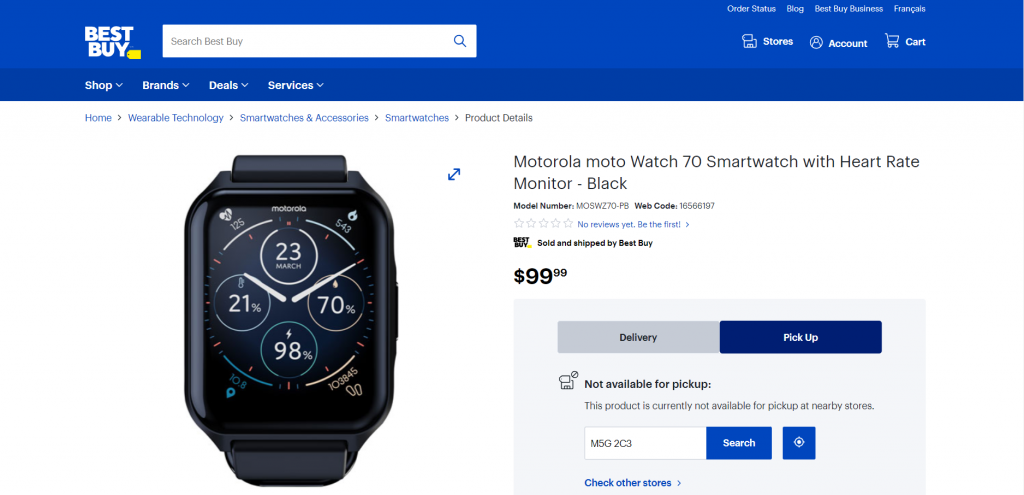
Motorola Moto Watch 70 is in the works, and it seems the wearable may launch very soon. We are saying this because the smartwatch is already listed on Best Buy Canada with its key specs and pricing. The Watch 70 comes with 23 sports modes and has up to 14 days of battery life. It features a 1.69-inch color display offering a 240 x 280-pixel resolution. Here are all the details.
Best Buy Canada listed Motorola’s yet-to-be-announced Moto Watch 70 was announced yesterday, and the product pages are still live, so this is likely no accident. The smartwatch is not available for purchase, but it is priced at CAD 99.99 (around $75). It has the model number MOSWZ70-PB and comes in a single black color option.
The listing reveals the Moto Watch 70 comes with a 1.69-inch color screen with 240×280 pixel resolution. It’s not confirmed whether the watch uses an LCD or AMOLED panel. The case of the wearable is made from zinc alloy, whereas the watch strap is made from silicone.
The smartwatch performs “dynamic health tracking” using an accelerometer, gyroscope, heart-rate monitor, and SpO2 sensor. It comes with support for up to 23 sports modes and uses Bluetooth 5.0 for connectivity. The wearable’s battery life is rated to last 14 hours of continuous usage, and it charges via a proprietary magnetic charging cradle. The watch is also IP-67 rated, making it ideal for swimming and showering.
The Motorola Moto Watch 70 has a single physical button. There is a minimum circumference of 158 mm (6.22 inches) and a maximum circumference of 239 mm (9.41 inches). Motorola is yet to formally announce the smartwatch. We should be getting an official announcement soon.
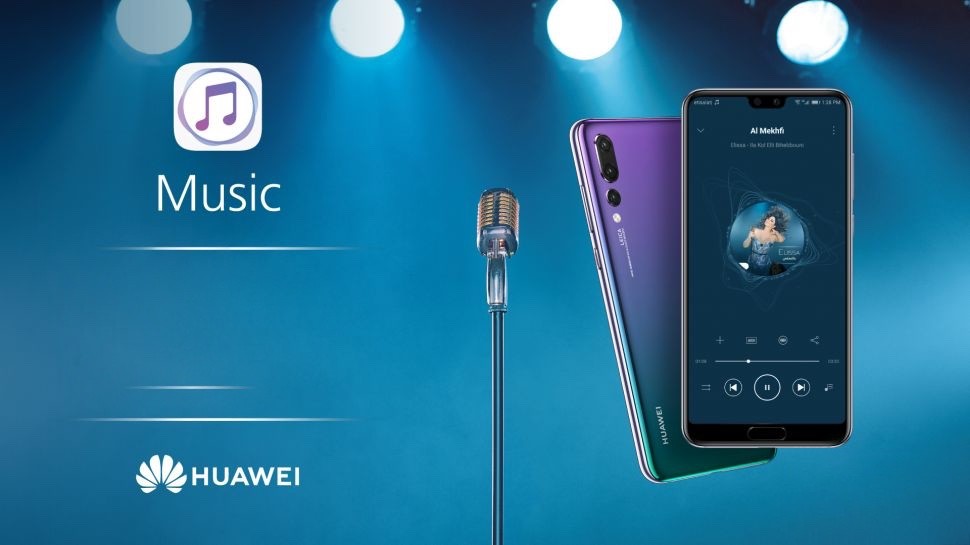
Huawei continues to offer new products and services for its users. However, the company increases the quality by adding new features to its existing services. The last example of this happened recently. The Chinese tech giant has started working on bringing new spatial audio content based on Audio Vivid technology for Huawei Music.
Huawei Music will soon release spatial audio content
‘Audio Vivid’ is the world’s first AI technology-based audio codec standard that supports mainstream 3D sound encoding. This technology co-formulated and published by the World Ultra HD Video Industry Alliance (UWA) and the Digital Audio and Video Codec Standard Working Group (AVS). Audio Vivid can create a three-dimensional environment for sound and make a 3D sound effect like spatial audio.
The way spatial audio works
The company hopes to provide the effect of “being in the song” for the audience. When artists use Audio Vivid-based spatial audio technology to make music, they can customize the position, movement trajectory, sound volume, distance, and other factors. This creates a unique listening experience.
Huawei has made an important partnership agreement for this. The company signed a deal with Universal Music China in July 2021, one of the biggest music companies in Asia. Huawei Music and Universal Music China will join hands to produce new spatial audio content. In addition, Universal Music’s extensive music library will be added to the platform. Unfortunately, there is no further information on the details of the deal at this point.
Huawei Music
In September, we saw some songs being added to Huawei’s platform as the first step of this deal. However, more content is expected to be available soon.
We use cookies on our website to give you the most relevant experience by remembering your preferences and repeat visits. By clicking “Accept”, you consent to the use of ALL the cookies.
This website uses cookies to improve your experience while you navigate through the website. Out of these, the cookies that are categorized as necessary are stored on your browser as they are essential for the working of basic functionalities of the website. We also use third-party cookies that help us analyze and understand how you use this website. These cookies will be stored in your browser only with your consent. You also have the option to opt-out of these cookies. But opting out of some of these cookies may affect your browsing experience.
Necessary cookies are absolutely essential for the website to function properly. This category only includes cookies that ensures basic functionalities and security features of the website. These cookies do not store any personal information.
Any cookies that may not be particularly necessary for the website to function and is used specifically to collect user personal data via analytics, ads, other embedded contents are termed as non-necessary cookies. It is mandatory to procure user consent prior to running these cookies on your website.