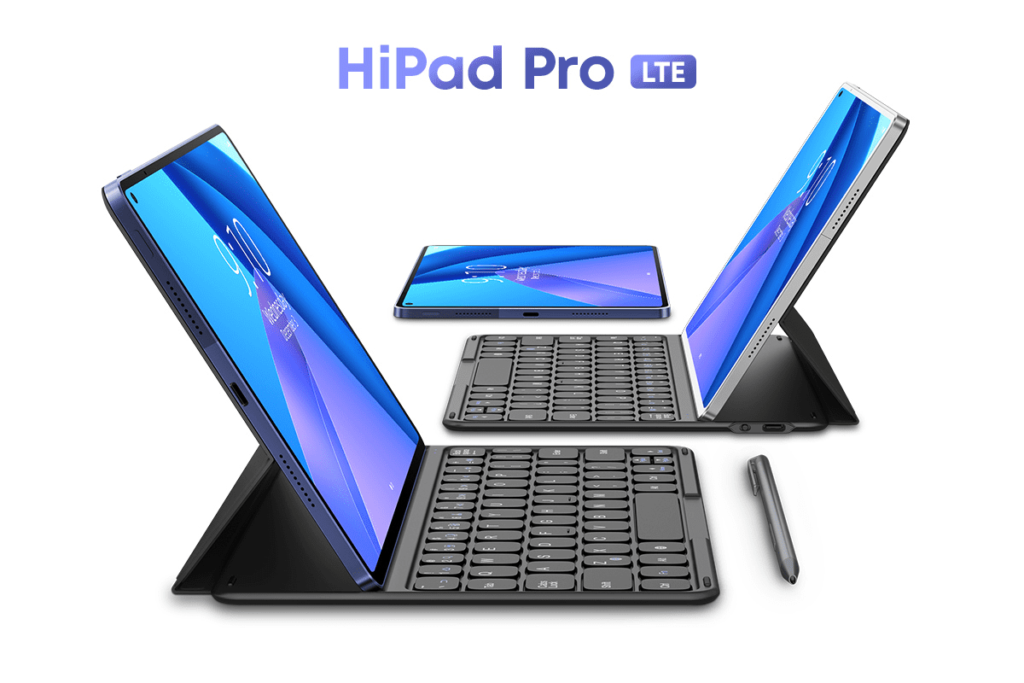
Chuwi is known for its affordable tablets and laptops. The brand has now updated its Chuwi HiPad Pro Android tablet for 2022. The latest model arrives with a better display and a more powerful processor. Let’s check out what all it has to offer.
The original Chuwi HiPad Pro was unveiled in July 2021. Half a year later, the company is back with a successor with the same name.
The new tablet flaunts a similarly sized 10.8-inch display (IPS LCD) with a punch-hole. However, the new screen comes with a 2K resolution (2560 x 1600 pixels) instead of FHD.
This panel has a pixel density of 288 PPI, a 90% screen-to-body ratio, and it can cover 97% of the DCI-P3 color gamut. It also supports Wacom-powered styluses.
Connectivity options on the device include 4G LTE, dual-band WiFi, Bluetooth 5.0, GNSS (GPS, A-GPS, BDS, and a USB Type-C port (USB 3.0). It sports quad speakers, an 8MP rear camera, a 5MP front-facing camera, and essential sensors (accelerometer, ambient light sensor, gyroscope). Interestingly, it also has a MicroSD card slot (up to 128GB).
The tablet runs Android 11 with Widevine L1 certification for popular streaming applications like Netflix, Amazon Prime Video, and Disney+. Despite measuring 7.5mm in thickness and weighing 455g, it houses a 7,000mAh battery.
The Chuwi HiPad Pro costs under $299. Interested customers can purchase it from AliExpress. They can also opt for additional accessories like stylus and Bluetooth keyboard.
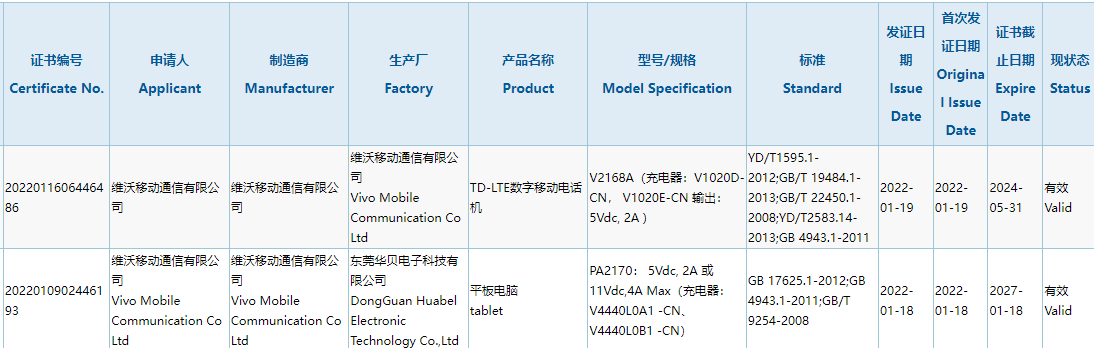
Yesterday, the popular tipster DigitalChatStation took it to Weibo revealing the key specs of the first-ever tablet from Vivo. Now, the tablet has emerged on China’s 3C certification spilling some beans on its fast-charging capabilities.
The Vivo tablet has the model number PA2170 on the 3C website. It has support for 44W fast charging. Furthermore, it is produced by Dongguan Huabei Electronic Technology Co. Ltd. Now if we recall, this is in line with the charging speeds revealed by the tipster.
Vivo Tablet Specifications(Rumored)
In addition to this, the tipster had revealed that the Vivo Tablet will come powered by the Qualcomm Snapdragon 870 SoC. It will feature a battery capacity of 7,860mAh. The device will have an LCD display with a 120Hz refresh rate and Full-HD+ resolution. The screen on the tablet is touted to be a punch-hole panel with the selfie camera placed in the cut-out at the top. Moreover, the Vivo tablet is likely to run on OriginOS based on Android OS.
Apart from this, there are no other details to discuss as of now. But, we expect the tablet to compete with the currently available Xiaomi Pad 5 Pro and Lenovo Xiaoxin Pad Pro 2021 since both of these are powered by similar hardware.
In related news, Vivo’s sub-brand iQOO is also touted to launch a tablet this year. Again, it will be iQOO’s first tablet, just like Vivo’s. As of now, there are no specifications for this tablet, but it may have similarities with the upcoming Vivo tablet.
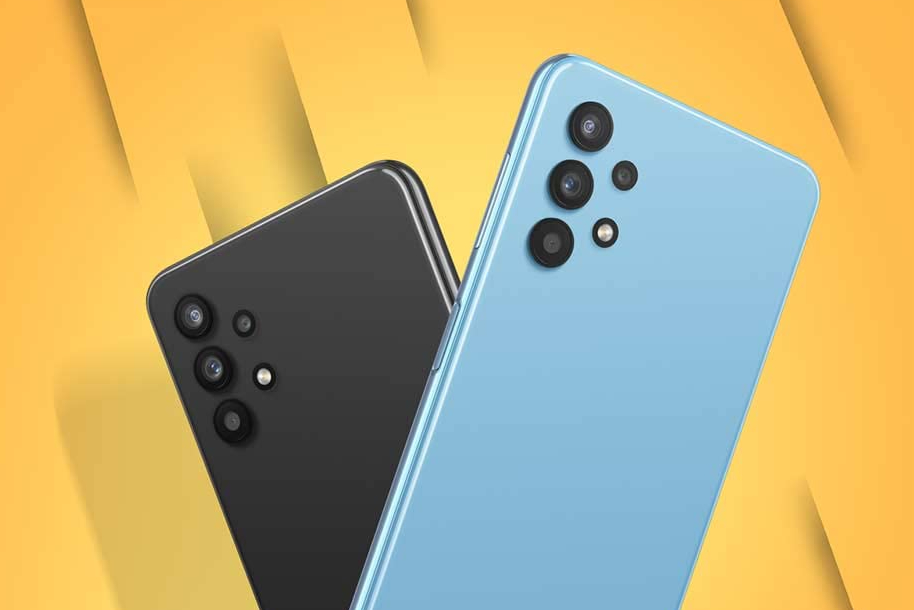
Earlier, Samsung was expected to launch the Galaxy M33 5G in India soon as the phone started getting manufactured locally at the Greater Noida Factory in the region. Now, the tipster Mukul Sharma reveals that the phone’s launch may not be too far for India, and it could be as early as next month.
Mukul said that if things move as planned for the company, then we might see the Galaxy M33 5G by the end of February. Unfortunately, the tipster doesn’t reveal an exact launch date.
Samsung Galaxy M32 5G
Apart from this, the smartphone has already passed a few certification sites, and thus, we know some of its specifications. The Samsung Galaxy M33 5G carries the model number SM-M336BU/DS. As per SafetyKorea, the phone packs a big 6,000mAh battery. On top of this, we expect some sort of fast charging support.
Furthermore, the Geekbench listing revealed that the device is powered by the unannounced Exynos 1200 SoC. It will have 6GB of RAM, which we expect to be the base configuration. It will boot on Android 12 OS out of the box. That being said, the handset should arrive with One UI 4.
Since it will be a superior model of the currently available Galaxy M32 5G, we can expect a high refresh rate AMOLED panel and dual-SIM support. The device may also come with up to 25W fast charging support but do note that Samsung is currently infamous for not providing the maximum supported fast charging adapter in the box. So we may see a 15W fast charging adapter as usual.
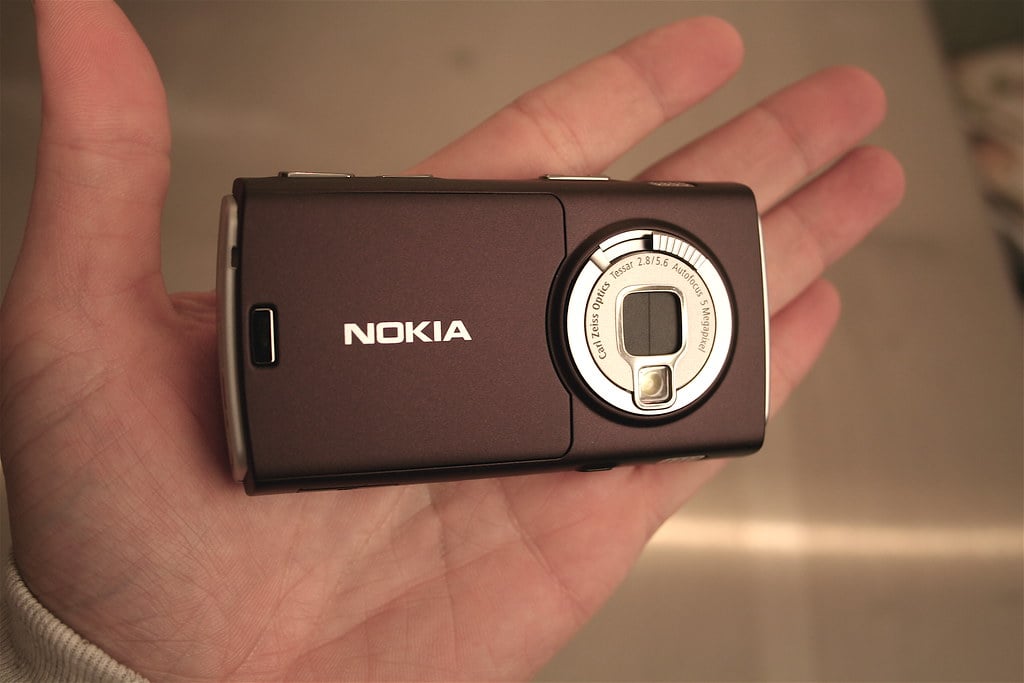
Based on our previous Throwback Tech Thursday‘s voting results, the Nokia N95 has topped the list. So now, lets revisit the device that some considered to be the peak of Symbian and also one of the best early smartphone.
What made it Special?
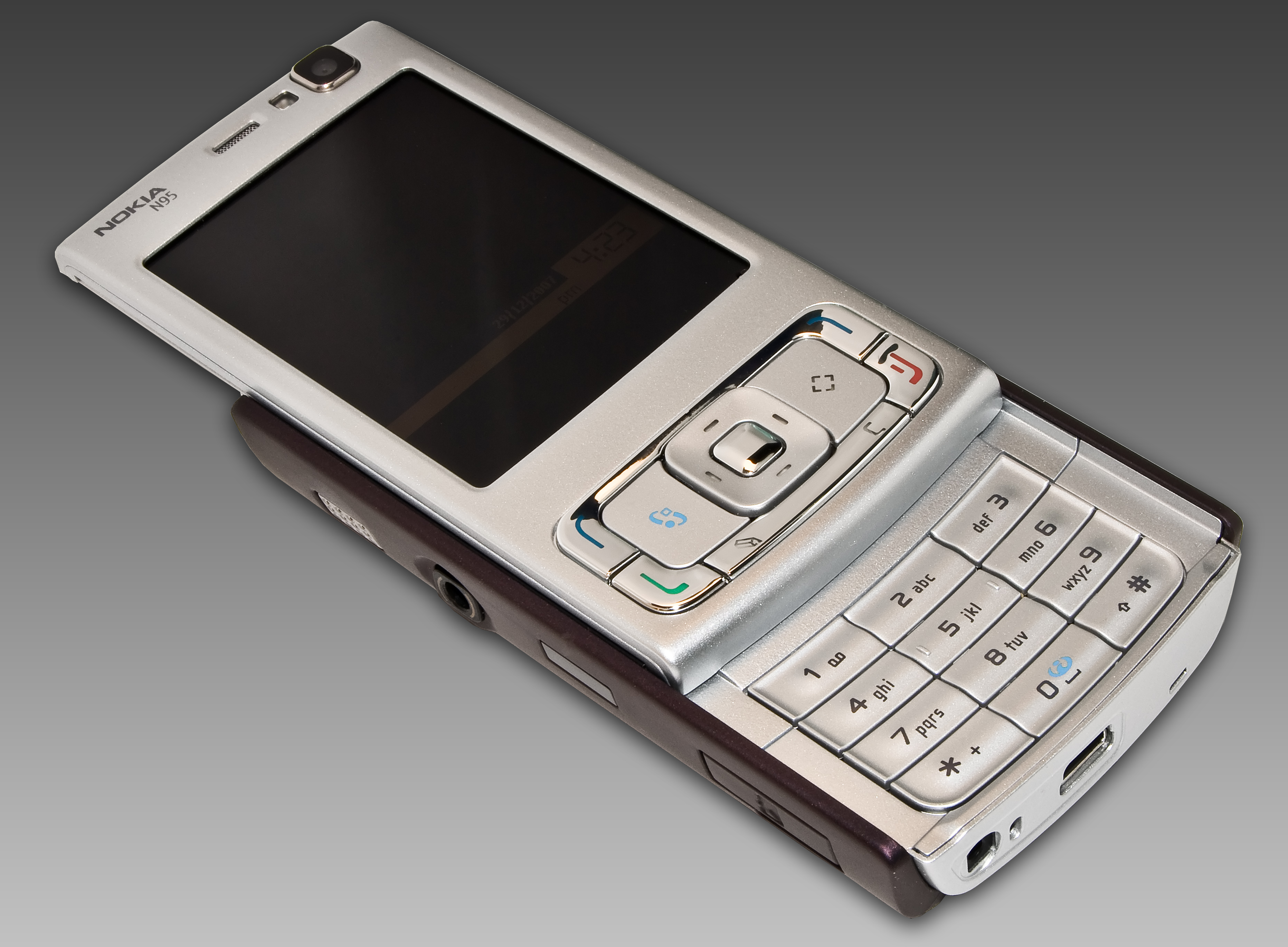
One of the things that made the N95 stand out was that it was packed to the brim with features. The device first launched back in March 2007 and did almost everything that modern smartphones are capable of. While this was also the year that the original iPhone had released, it only turned heads with its full touchscreen design and interface. On the other hand, the N95 launched with a whole suit of features like video recording games library, and more.
The Nokia N95 is also quite memorable as a camera phone as well, with its 5 megapixel sensor with Carl Zeiss Tessar lens offering picture quality that trampled over most of its rivals. Notably, it could even record “DVD quality” video with VGA recordings at 30fps. While this might not seem impressive, only a handful of phones back then were even capable of this feature. Similar to the Nokia 6600, the N95 was a powerhouse in its time and could run 3D games from the N-Gage mobile gaming services. Keep in mind, the iPhone didn’t even have an App Store till a year after its launch, so it was clearly ahead of the curve back then.
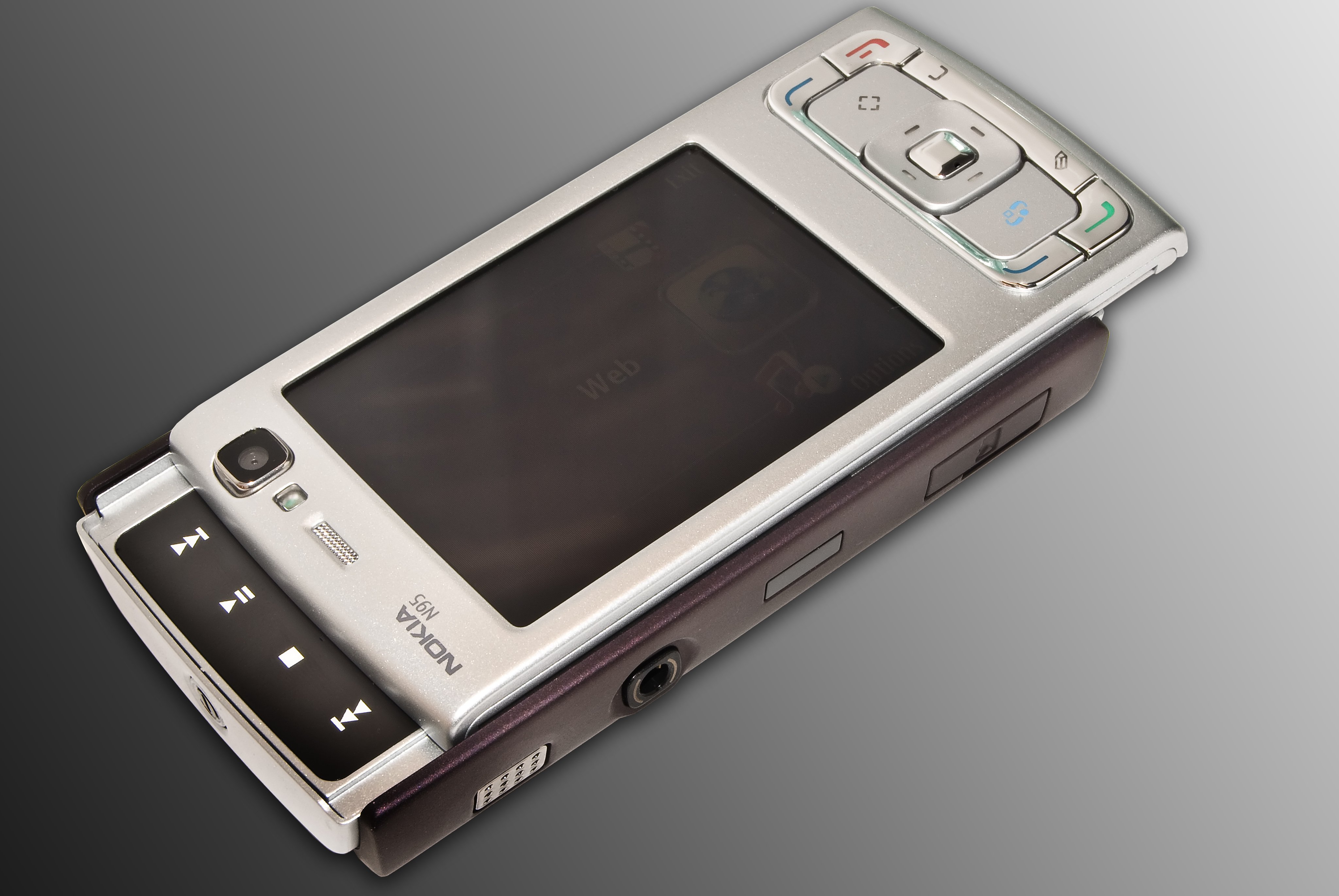
Another major aspect that had it stand out was a selfie camera. Even in the early days of Android smartphones, there were some models that skipped the front camera entirely, so a Symbian phone featuring this technology also showcased how much effort and features the Finnish brand put into the device, and we haven’t even gotten to the slider part yet. Remember iPods, well modern smartphones have basically killed the need for a separate media player, but iPods were still a thing back then and existed alongside the iPhone. But this handset also had dedicated media control buttons that appeared by sliding down, meaning, you didn’t have to buy a separate media player.
Impact & Future Influence
As we mentioned above, the mobile industry was abuzz after its launch. The Nokia N95 was a huge success when it released in most regions. The company managed to sell over 7 million units by the end of 2007. Furthermore, it launched a new 8GB variant in the first quarter of 2008, which also saw 3 million sales. While this doesn’t compare to the behemoth sales of the 6600 over its lifetime, it still managed to outpace everyone of its competitors at the time. It was even crowned as the “best smartphone ever” by AllAboutSymbian.
Some of its features even went on to become industry staples. Always On Display, a feature beloved by many smartphone users today, is something that also made an early appearance with the N95. It even offered wired connections that allowed users to play movies on TVs from the mobile phone itself. Back in 2020, it was revealed that the company was also working on a new N95 model, however, the modern day reboot was never officially launched. This device would’ve also featured the iconic slider design, but for large stereo speakers rather than dedicated media buttons.
Unfortunately, while the phone holds fond memories for many, it is also referred to as the peak of Symbian before its decline. The iPhone with its radical all touchscreen interface and design soon managed to become a market leader and cause a shift in the industry. Additionally, Symbian and Nokia’s dominance slowly started declining after its launch. But the N95 was an undoubtedly impactful device, with modern day features having roots within the phone that is more than a decade old.
Design, Specs, & Price
Just like its predecessors, the N95 featured an iconic design that is immediately recognizable just like the 6600 owing to its popularity at the time. It was a slider phone that offered users two functionalities. Sliding up would reveal the keypad, while sliding down put the device into media mode with dedicated buttons. It also featured its traditional square like orientation for its buttons just under the display, which was a norm for the brand back then.
Talking about its specifications, it housed a 332 MHz Dual ARM 11 CPU, which was paired with up to 8GB of internal storage and 128MB of RAM. The device ran on Symbian OS 9.2 and was powered by a 1,200mAh battery pack (950mAh on the non-8GB variant). It was also one of the first devices to feature an Accelerometer, which was used to wake the device when being shaken and for some games too. Other features include GPS navigation, which again was an impressive feature back then, along with a 3.5mm headphone jack as well.
It sported a 2.8 inch TFT display with 240 x 320 pixel resolution and a 4:3 aspect ratio. Thanks to its PowerVR MBX GPU, the device could also run Quake III, Asphalt 3 or FIFA 2007, and even display it on the TV. The Nokia N95 first launched for a price of 550 Euros or around 730 US Dollars back then. This is a steep price tag even by today’s standards, but it was a premium grade high end handset.
We noticed a number of our readers shared their thoughts on the 6600 Throwback from last week, so we’d love to hear more from those that used the N95 as well in the comments section down below.
A new partnership between the parent company of the boAt brand and Dixon will provide wireless audio solutions in India via an array of audio products. Imagine Marketing Private Limited, which owns the boAt brand of audio accessories, has announced a joint partnership with Dixon to manufacture wireless audio devices in India. Both companies will have equal stakes in the new venture and they hope to evolve an India-centric strategy that will see it producing wholly-made audio products from the sub-continent.
The new partnership will draw from the rich pool of research and development engineers from the boAt brand and continue to design and develop India-centric customized audio products. The new venture will also tap from the manufacturing capability of Dixon which will thus facilitate a vibrant platform for the design and manufacture of smart wireless audio products tailored to the needs of the Indian consumer.
The Indian mobile accessory market is fast evolving with massive investments and innovative products across all segments. The new venture will hope to achieve excellent customer delivery by delivering high-quality and aspirational lifestyle audio wireless solutions that will be driven by a robust research and development strategy. Both boAt and Dixon will focus on IP, product design, and quality assurance, as well as high-quality manufacturing- core principles that key snugly into the Make in India initiative.
The two companies have separately expressed their enthusiasm and massive possibilities in the new partnership. The partnership leverages the quality and excellent processes in both companies and will hope to deliver cutting-edge and affordable products in line with the Make in India initiative.
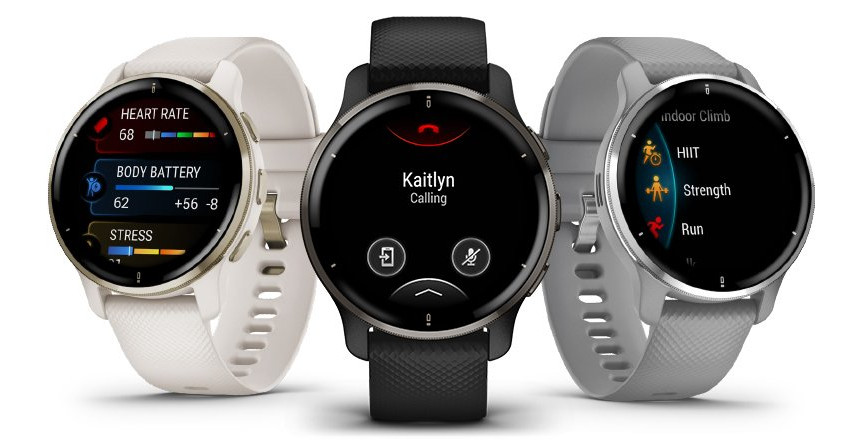
The Garmin Venu 2 Plus smartwatch has been launched in India after making its debut at CES 2022. The latest Garmin smart wearable comes with a 1.3-inch AMOLED screen, Bluetooth calling, up to 9 days of battery life when in smartwatch mode, and other impressive features. The Garmin Venu 2 Plus is already on sale via Amazon India, Flipkart, Tata CLiQ, and several other online retail outlets in India. Its price of Rs. 46,990 ($631) places it on the premium grade in the Indian smart wearables market.
Let us now see whether its specs justify its current price. The Garmin Venu 2 Plus is the company’s first smartwatch integrated with a voice calling function and hands-free voice assistant support. It was introduced during CES 2022 about two weeks ago and joins the growing Garmin lineup in India, following the 2021 launch of the Venu 2S and Venu 2S GPS.
Its 1.3” AMOLED screen has Corning Gorilla Glass 3 protection, as well as stainless steel bezel. The voice calling function will enable users to make phone calls from their wrist conveniently via Bluetooth. Users can also respond to notifications via the voice assistant function without needing to actually type the text or press a button. The voice control in the Garmin Venu 2 Plus is compatible with smart home devices like Siri, Bixby, and other applications.
The Garmin Venu 2 Plus is a health and fitness smart wearable device, so users can tap from the robust suite of health and fitness features available in the device. Users can log a 2-minute session to record an array of health indicators including heart rate, heart rate variability, pulse Ox3, stress, and breathing pattern. A detailed report of the session can then be generated via the Garmin Connect app. This provides an overview of the health status of the user, as per the recorded health and vital statistics. The smartwatch has 25 active sports modes, thus offering a variety of options for exercise and fitness. There are over 75 preset animated workouts that provide an excellent approach to form and technique. The smartwatch is also compatible with Garmin Coach’s free adaptive training plans.
The smartwatch has 5ATM water resistance and offers music downloads of up to 650 songs. It offers up to 9 days of battery life when in smartwatch mode, but this reduces to just a day when in GPS mode and about 8 hours when in GPS with music mode. The innovative features available in the Garmin Venu 2 Plus may justify its price tag, but the coming days and weeks will determine how the Indian market has welcomed the new smartwatch.
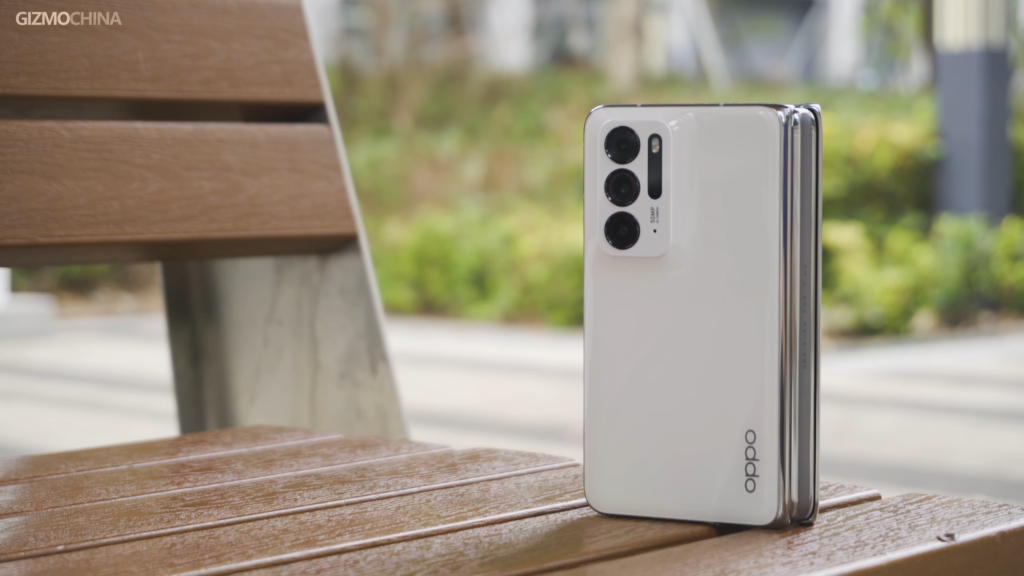
The OPPO Find N is the company’s first foldable smartphone. It was announced in mid-December and has been on sale multiple times since then. The device is so popular that the firm manages to sell the entire stock during every sale. Because the phone is not only cheaper than the competition but also offers an interesting set of features, including a folding screen without a crease. One of the company executives recently bragged about the creaseless nature of the handset.
OPPO Find N with no crease | Source: Pete Lau (Weibo)
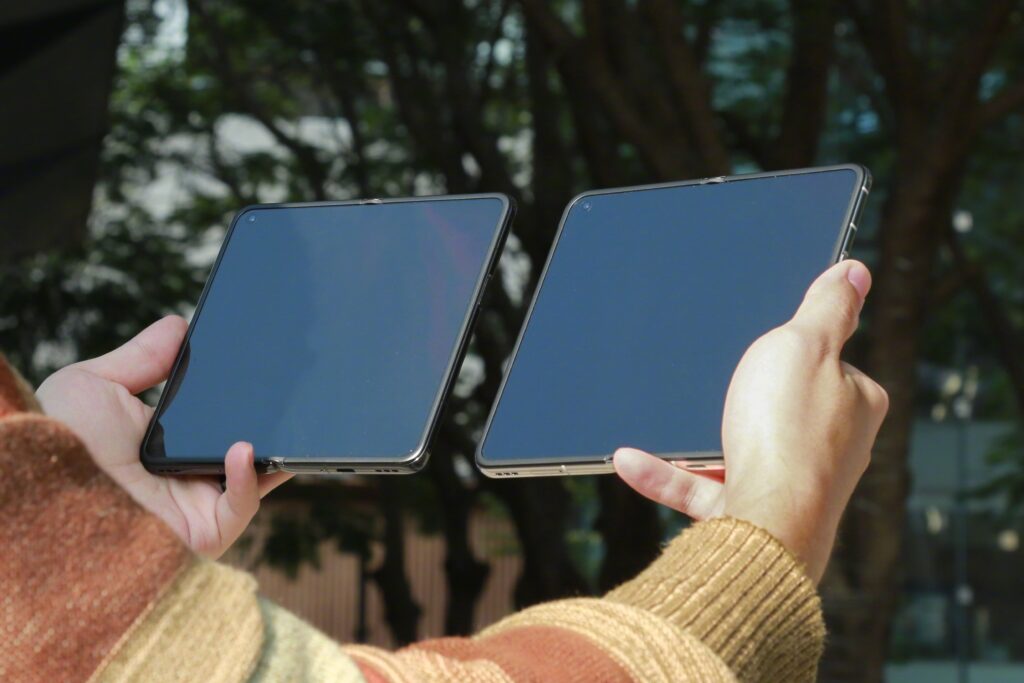
CEO of OnePlus Pete Lau is also the Chief Product Officer of OPPO. Earlier today, he posted a picture containing two OPPO Find N units on Weibo.
According to his post, one of these units is his own, while the other one is from the R&D department. The latter has been folded 100,000 times. He asks his followers to guess the units.
By looking at the image, we don’t see any crease on either of the two units. We get to see similar comments from netizens as well. It is difficult for anyone to spot the odd one out.
The OPPO Find N is devoid of any crease as it uses a teardrop-shaped hinge. Even the Motorola Razr 5G has a similar implementation, however, it happens to develop creases after prolonged usage. Interestingly, that’s not the case with the OPPO model.
OPPO Find N
Additionally, the OPPO Find N’s foldable display has a better 8.4:9 aspect ratio. Hence, it is smaller than the Galaxy Z Fold3 but still houses a slightly larger battery.
If Samsung wants to lead the foldable smartphone market, it is high time the South Korean tech giant improves its devices before the Chinese competitors debut their products in global markets.
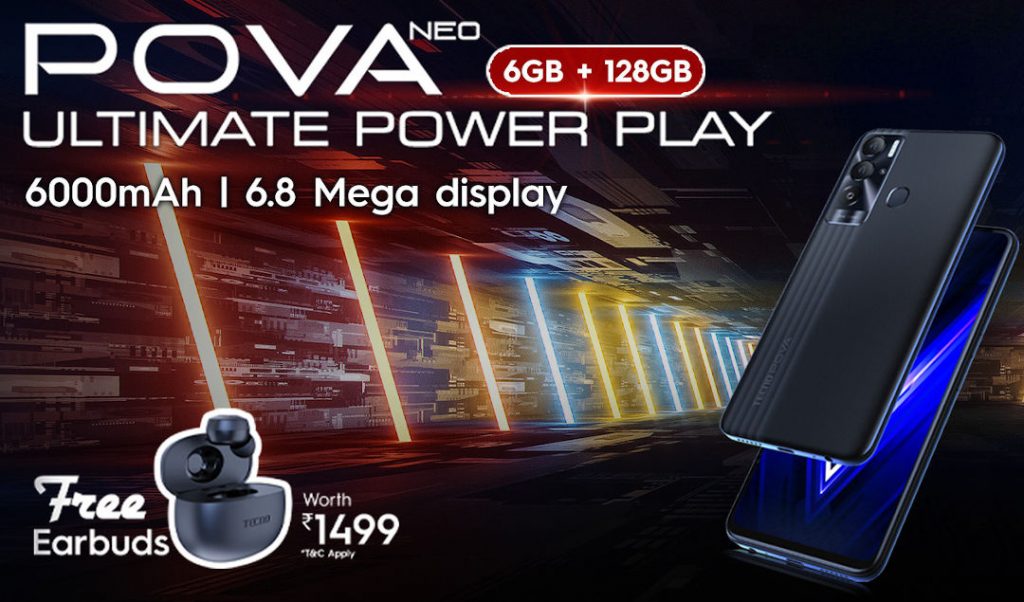
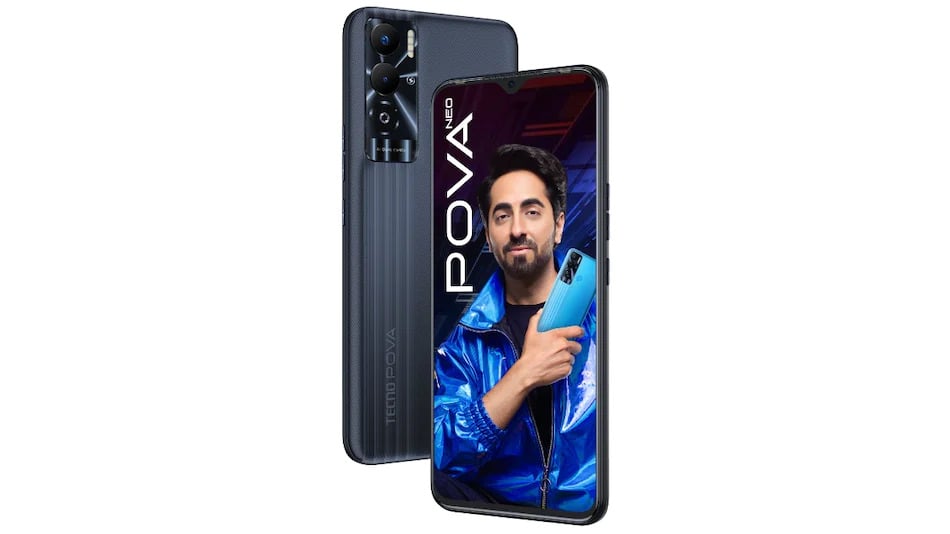
Transsion Electronics’ Tecno has officially launched the all-new Tecno Pova Neo smartphone in the Indian market. The smartphone has the same specs as the previously launched Nigerian model, but on top of that, it comes at a cheaper price in the Indian region.
The Tecno Pova Neo costs Rs 12,999(~$174) for the sole 6GB RAM and 128GB storage variant in India. This is slightly cheaper than the ~$177 price tag of the phone in Nigeria.
The phone comes in Obsidian Black, Geek Blue, and Power Black color variants. The device will go on sale from January 22 via authorized retail stores in India. Interestingly, those who buy the phone in the initial sale will get a free pair of the Tecno Free earbuds worth Rs 1,499.
Tecno Pova Neo Specifications
The Tecno Pova Neo comes with a large 6.8-inch DotNotch display sporting an HD+(720 x 1640 pixels) resolution and 120Hz refresh rate. It has 480 nits of peak brightness and a narrow bezel design. The smartphone has a textured back at the rear, which apparently makes it easy to hold.
It comes equipped with a dual-camera system featuring a 13MP main lens and an unknown secondary lens. It has an 8MP selfie camera with an f/1.8 aperture. The smartphone comes with a quad-LED setup at the rear.
Inside, it is powered by the MediaTek Helio G25 SoC paired with 6GB of LPDDR4x RAM and 128GB of eMMC 5.1 internal storage. Tecno is offering a 5GB of virtual RAM expansion feature where the phone will borrow 5GB from its internal storage to use it as additional RAM. It packs a 6,000mAh battery with an 18W fast charging support. It runs on Android 11 out of the box with HiOS 7.6 on the top.
The company claims that the phone will get up to 43 hours of talk time and up to 55 days of standby on a single charge. It has dual-SIM support with 4G LTE connectivity, WiFi 802.11ac, and Bluetooth v5.1. It features a 3.5mm headphone jack and a USB Type-C port as well.
MediaTek has just announced its Filogic series products that feature Wi-Fi 7 technology. The new standard is said to allow 4K to 8K video streaming and “metaverse grade” connectivity as well.
The Taiwanese chipmaking giant is just announced that it is working on Wi-Fi 7 chips and also held an inaugural tech demo. According to the company, the new standards would be able to sustain improvements through advancements like multi link operation (MLO) technology. Furthermore, the next generation of Wi-Fi should be able to use new 320MHz channels. The brand has also suggested that users looking to purchase Wi-Fi 7 enabled products should look out for specs like 4K quadrature amplitude modulation (QAM).
These product may also offer multi user resource unit (MRU) features, also rated to address interference. The new standard is estimated to offer a 2.4 times jump in speed over Wi-Fi 6 and Wi-Fi 6E. Notably, MediaTek believes that the technology will ship with its latest Filogic Wi-Fi 7 based products sometime next year. In other words, the standard will become the industry norm next year, which is in line with our previous report as well.
According to Alan Hsu, corporate vice president and general manager of the Intelligent Connectivity business at MediaTek, “The rollout of Wi-Fi 7 will mark the first time that Wi-Fi can be a true wireline/Ethernet replacement for super high-bandwidth applications. MediaTek’s Wi-Fi 7 technology will be the backbone of home, office and industrial networks and provide seamless connectivity for everything from multi-player AR/VR applications to cloud gaming and 4K calls to 8K streaming and beyond.”
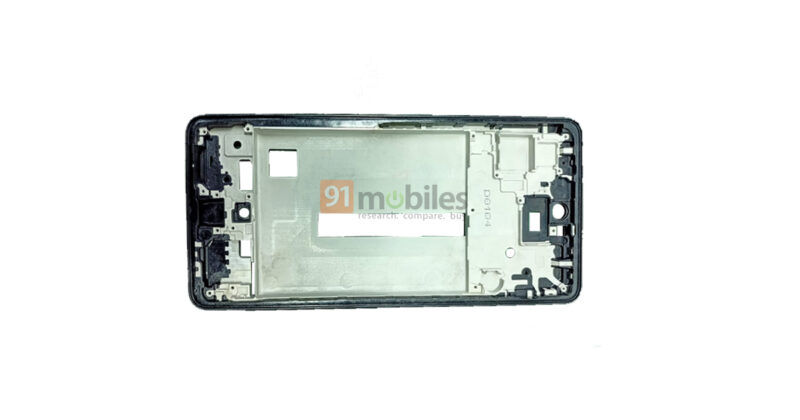
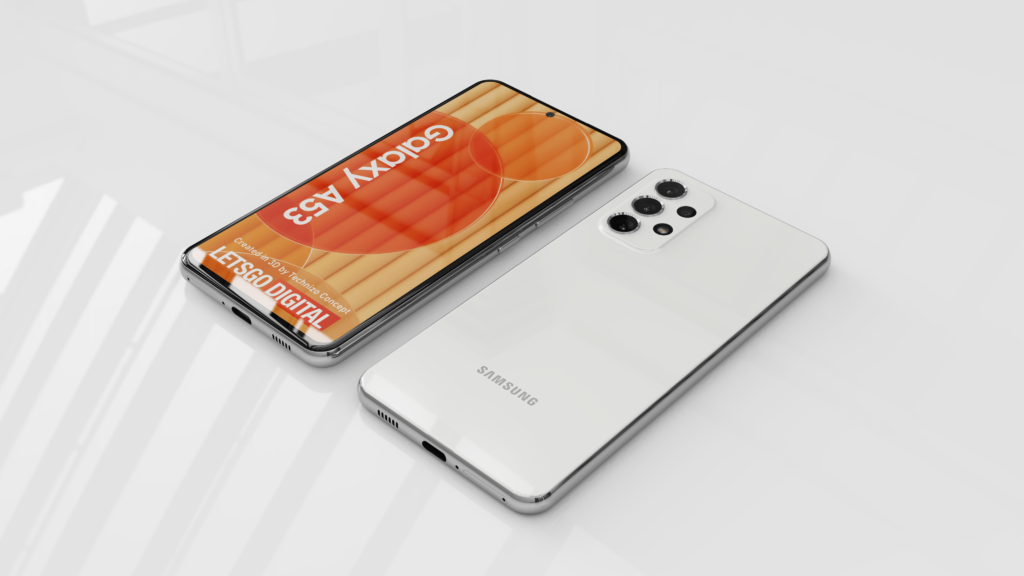
The Samsung Galaxy A53 is an upcoming mid-range smartphone from Samsung. The device is expected to launch soon as it has made an appearance on Geekbench, BIS, and China’s 3C database. Now, live images of the device have surfaced giving us the first looks at its back panel.
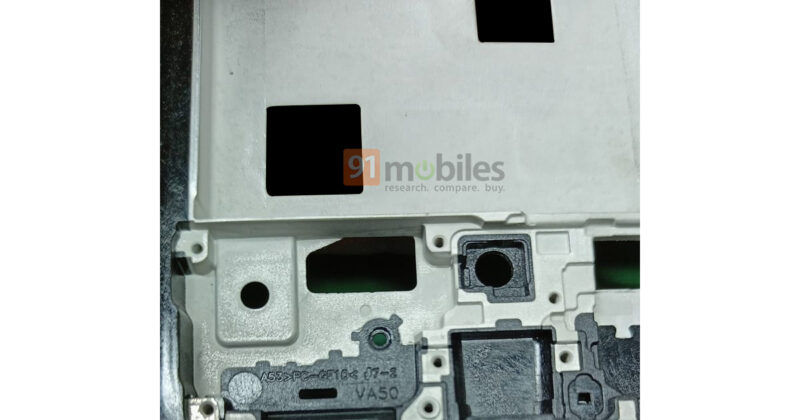
A 91mobiles report has revealed images of the back panel as well as the internal design of the upcoming Galaxy A53.
1 of 3
Image via 91mobiles
Image via 91mobiles
Image via 91mobiles
The new images are in line with the previous Galaxy A53 renders and showcase five cutouts on the camera island. Four of these are expected to hold a quad-camera setup, and the fifth cutout will hold an LED flash.
So far, the device has been tipped to sport a 64MP primary sensor, a 32MP ultra-wide, a 5MP macro lens, and a 5MP depth sensor. on the front, the device is expected to come with a 12MP selfie shooter.
The Galaxy A53 is expected to feature a 6.46-inch FHD+ AMOLED panel with a 120Hz refresh rate. The device has previously been revealed to come in Snapdragon and Exynos SoC variants for different regions.
These chipsets are rumored to be the Snapdragon 778G and the upcoming Exynos 1200. The device will likely offer up to 8GB of RAM and 256GB of internal storage. it is also rumored to ship with a 5000mAh battery with 25W fast charging support, however, the packaging box will only contain a 15W charger. The phone is also likely to omit the 3.5mm audio jack.
The Samsung Galaxy A53 is expected to release in Q1 of 2022 while lower-tier models like the Galaxy A33 and the Galaxy A13 are expected to launch in the month of February.
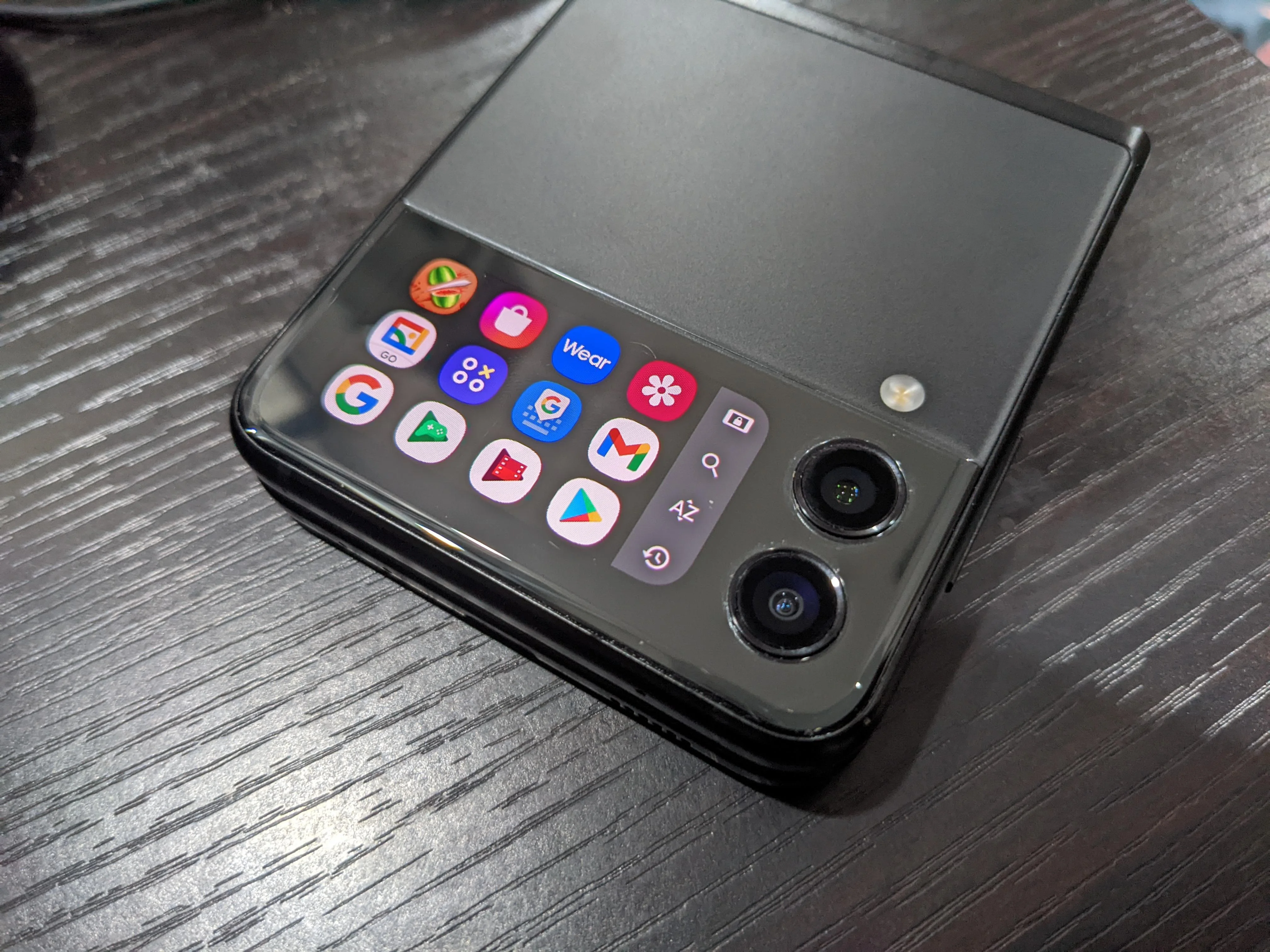
The Samsung Galaxy Z Flip3 is one of the company’s latest foldable smartphone. It adopts a flip phone styled clamshell folding design and features a small cover display. But unlike the large secondary screen on the more expensive Galaxy Z Fold3, this one doesn’t offer complete functionality. Or does it?
According to an AndroidPolicereport, a developer has undertook the task of making the small cover screen, which is usually used to display notifications and other basic information, into a full fledged phone display. In other words, you can use it as the primary screen when the device is in its folded state. The mod was made by developer jagan2 and is currently is available on the XDA forums.
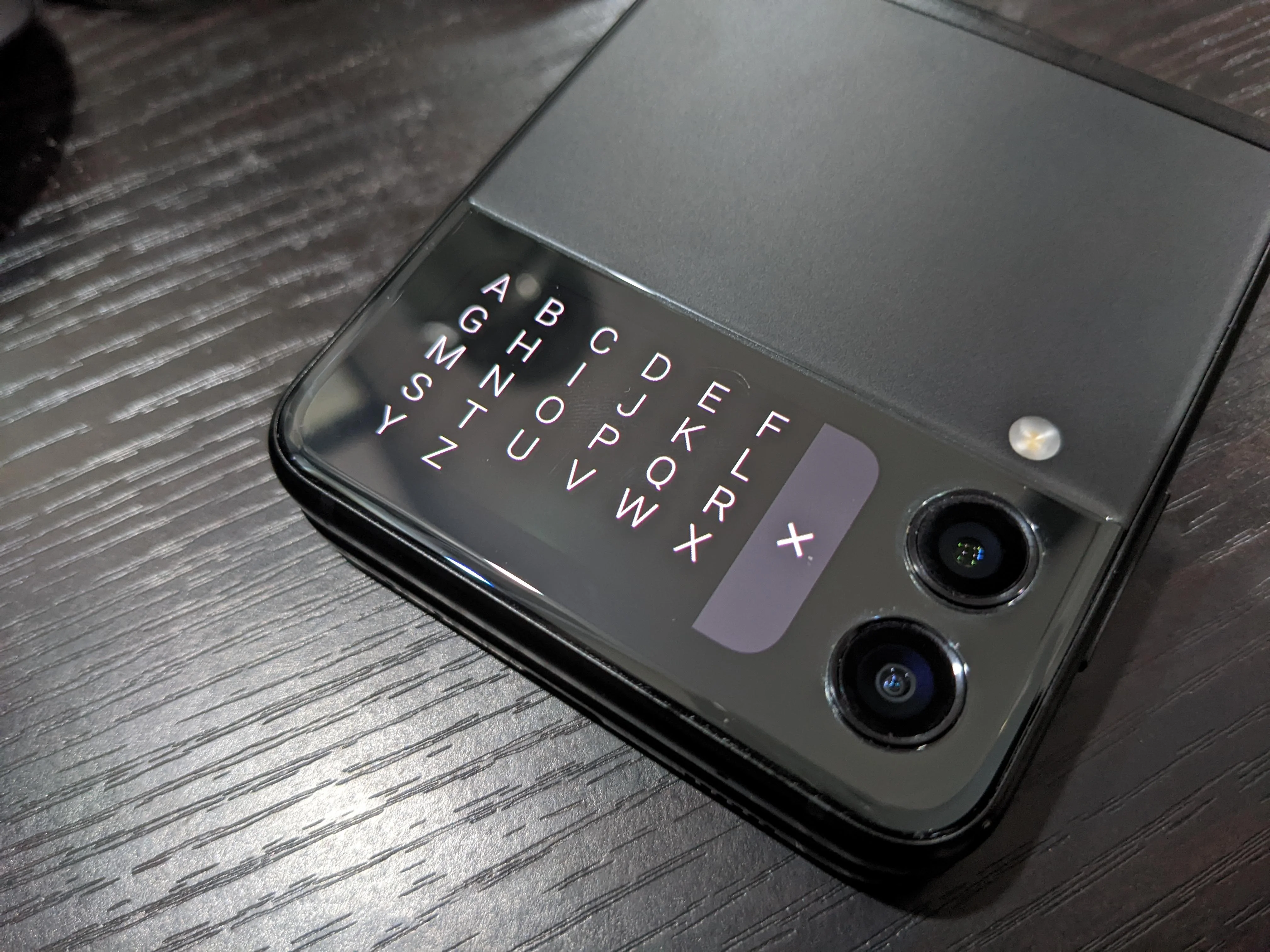
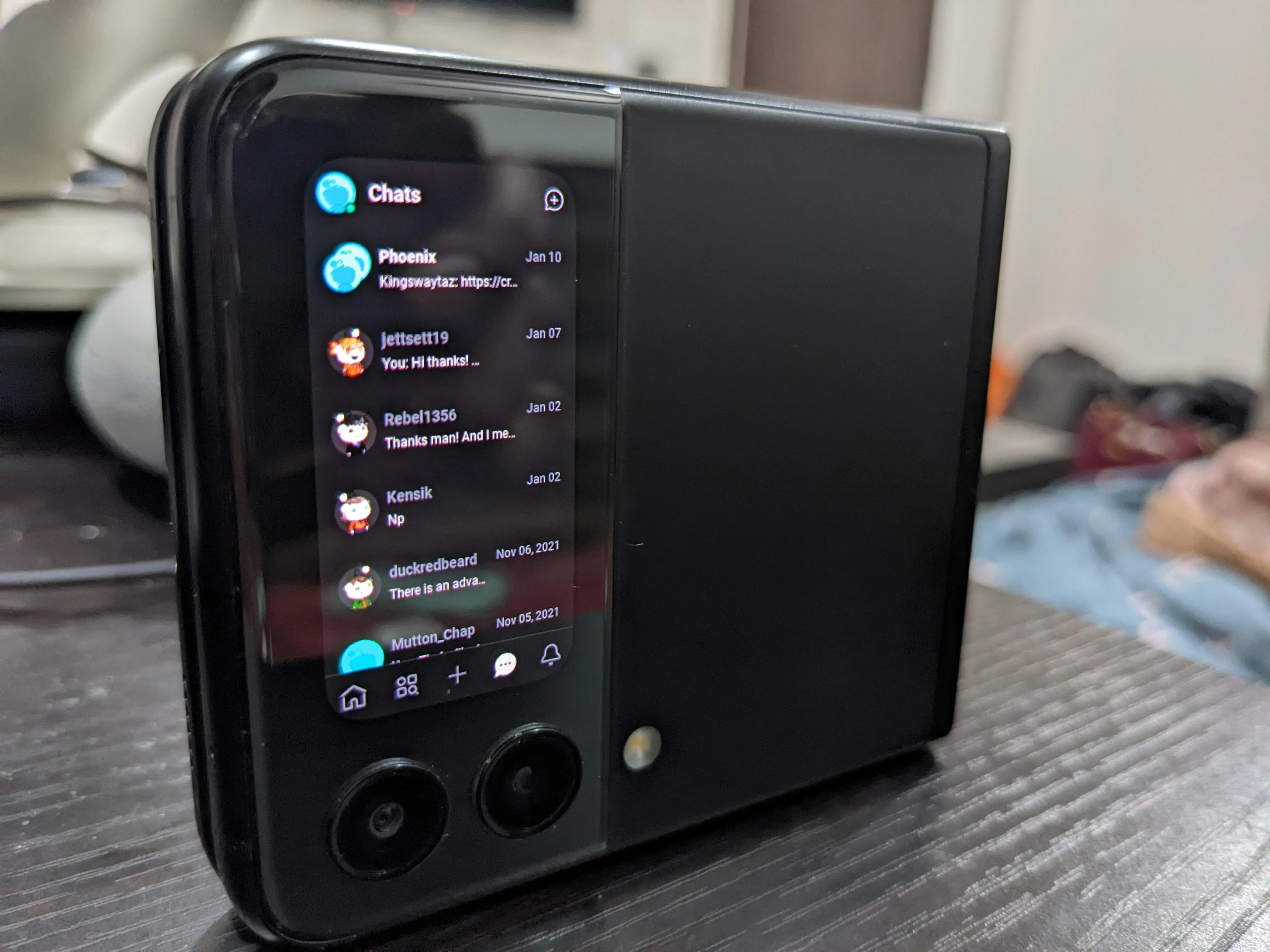
This new solution is dubbed the CoverScreen OS and allows users to access a full app drawer, open apps, and even take actions from notifications right from the cover display. Without the mod, one would have to open up the flip phone and take actions via the larger primary panel. Notably, users can also flip the orientation to portrait to make certain app easier to use.
Looking at the images on the forum, CoverScreen OS does not appear as intuitive to use as the primary display. Meaning, it won’t be replacing the larger screen, however, its still a welcomed addition that expands the functionality of the small cover panel. So for those interested, you can click on the link above and try it out yourself.
Xiaomi officially lifted the curtains on its Xiaomi 12 flagship lineup but the rumored Ultra model was absent with the launch. Previous rumors had set a March or April release for the device, similar to last year’s Mi 11 Ultra, and new details about it keep emerging.
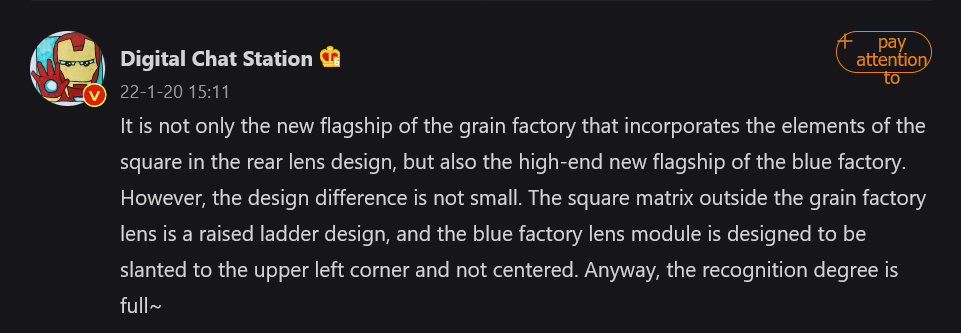
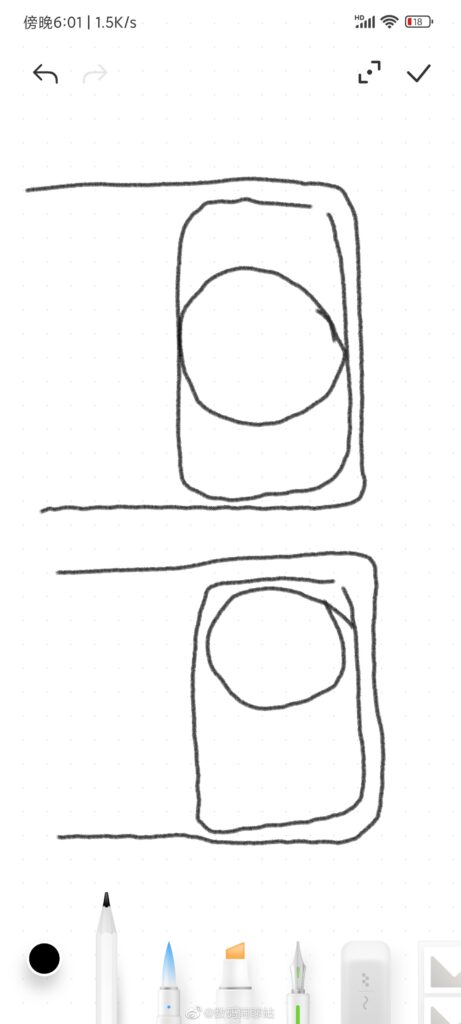
Prominent tipster Digital Chat Station through a post on Weibo has now given some new insight into the rear camera design of the ‘superphone’, and it seems to sit well with previous leaks.
Through an amusing sketch, the tipster revealed that the Xiaomi 12 Ultra will adopt a huge camera module design that will span the entire width of the phone. The outer part will be rectangular while the inner part where all of the camera lenses will reside will be circular.
The same post compares the look of the phone to a “high-end new flagship” from vivo, most likely the vivo X80 series. The Xiaomi 12 Ultra and vivo X80 flagship will feature very similar camera module designs but there is one subtle difference — the vivo phone’s circular camera island will be aligned to the left. The Xiaomi 12 Ultra’s, on the other hand, will be more symmetrical and aligned to the center.
Xiaomi 12 Ultra (top) vs alleged vivo X80 flagship (bottom) by Digital Chat Station
The Xiaomi 12 Ultra is expected to feature a quad-camera setup very similar to its predecessor, with one of the lenses featuring 5x periscope telephoto capabilities. It will be powered by the latest Snapdragon 8 Gen 1 SoC and feature a crazy fast 120W wired fast charging solution.
nubia through a Weibo post today dropped some new details about the next iteration of its flagship phones, and it’s most likely the nubia Z40 series. The company says that the devices will be the “most powerful Z series flagships in history” and that they will be released in February.
The teaser images shared through the same post reveal that the Z40 series will be equipped with the industry’s first custom 35mm optical master lens. This focal length is ideal for events, portraits, street photography, and the like.
On top of that, the nubia Z40 series will feature the top-of-the-line Snapdragon 8 Gen 1 processor that will be cooled by new aerospace-grade heat dissipation materials.
nubia’s current flagship phone is the Z30 Pro, launched in May 2021. It is powered by the Snapdragon 888 processor and features a quad-camera setup at the rear, out of which three sensors have 64MP resolution while the fourth is 8MP. The battery is sized 4200 mAh and supports 120W fast charging (100% in 15 min).
nubia Z30 Pro
It is expected that the Nubia Z40 series will once again be equipped with a periscope telephoto lens and will have rich starry sky photography capabilities.
Just a few hours back, we learned about the primary specs of the global Redmi Note 11. Now, the specifications of the international Redmi Note 11 Pro 5G have also emerged on the internet. Let’s check out the features of this anticipated smartphone from Xiaomi.
Redmi Note 11 Pro Global/International Variant | Source: MySmartPrice
According to tipster Yogesh Brar, the global Redmi Note 11 Pro 5G will sport a 6.6-inch FHD+ AMOLED display with a 120Hz refresh rate. The device will be powered by a Qualcomm Snapdragon 690 SoC paired with 6GB/8GB LPDDR4x RAM and 128GB UFS 2.2 storage.
The phone will house a triple rear camera setup consisting of a 108MP primary sensor, an 8MP secondary sensor, and a 2MP tertiary sensor. On the front, it will have a 16MP shooter for selfies and video calls.
Despite releasing in 2022, the handset will debut with Android 11. However, it will ship with MIUI 13, which is the latest version of Xiaomi’s mobile operating system. Finally, it will be backed by a 5,000mAh battery with support for 67W fast charging.
According to previous leaks, the Redmi Note 11 Pro 5G will be available in three colors, namely Graphite Gray, Polar White, and Diamond Dazzle. The smartphone will have dual stereo speakers, an IR blaster, a 3.5mm headphone jack, a flat frame design, a centered punch-hole display, and a side-mounted fingerprint sensor.
The Redmi Note 11 series is scheduled to launch in international markets on January 26.
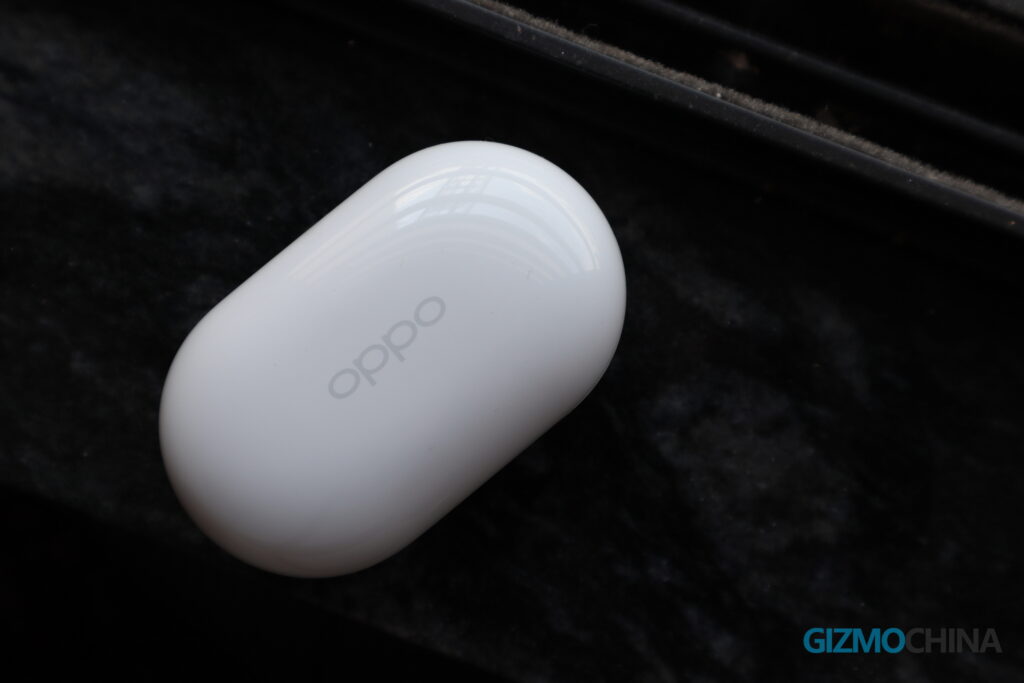
Sure, batteries have grown safer and more efficient than ever before, but OPPO seems to think that they’re not the future, at least for IoT devices. A research paper titled “Zero Power Consumption Communication” published by the company outlines a future full of battery-free IoT gizmos that will instead rely on Bluetooth, WiFi, and mobile phone signals for power.
The paper reveals that OPPO has actually successfully built a zero power consumption communication system, verifying that the technology can work at least in principle. The perks of the system include no battery, a minimal size, ultra-low power consumption, and ultra-low cost.
According to OPPO, IoT devices of the future will be able to obtain energy directly through Bluetooth, WiFi, and mobile phone signals, resulting in smaller, longer-lasting, and lower-cost devices.
At present, most electronic devices are completely dependent on batteries for power, and batteries have multiple limitations associated with them. They take up a lot of space, are expensive to manufacture, and have limited lives, not to mention their environmental impact after they’re trashed.
The zero power consumption tech by OPPO will work by collecting RF (radio frequency) energy from wireless signals sent by RF sources such as TV towers, FM towers, cellular base stations, and WiFi access points. Communication will be achieved by modulating such incoming signals and relaying them elsewhere.
OPPO believes that this would allow devices to act as low-power-using communication beacons in heavy industry, transportation, smart homes, or even wearables. Other potential uses include battery-free location tags and long-distance tracking tech for species like migratory birds.
While the potential of the technology looks boundless, it appears that it will be limited to devices with extremely low energy needs — and that definitely does not include smartphones. Still, OPPO has surely done its bit in inching closer to a battery-free world.
Realme is all set to unleash a number of realme 9 series smartphones in the coming days. It has already debuted the family with the launch of realme 9i. Last week, we learned some details about the realme 9 Pro. Today, the same source is back again with information on realme 9 Pro+. At the same time, the brand has also officially confirmed the existence of this model.
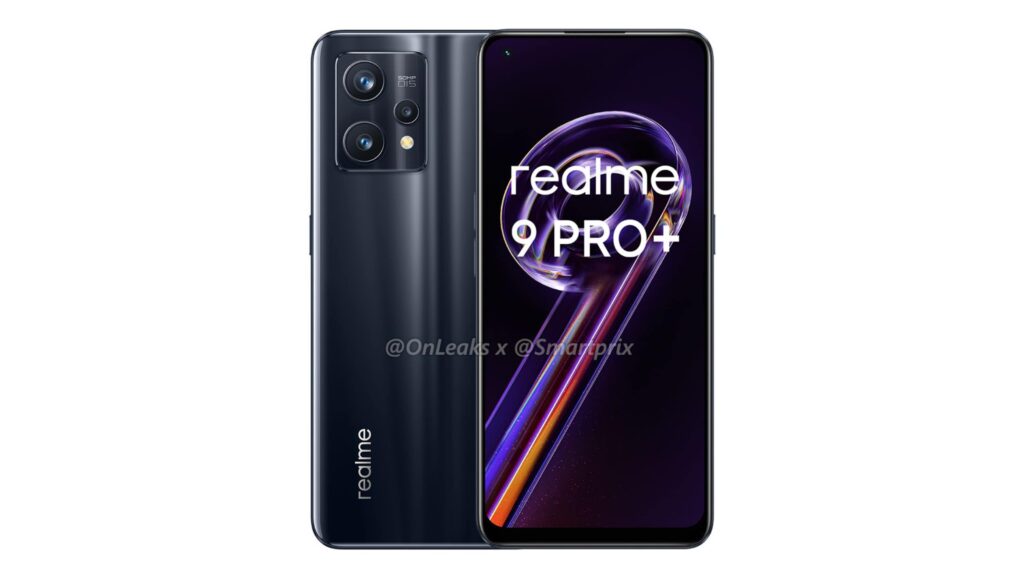
realme 9 Pro+ | Source: @OnLeaks via Smartprix
The renders and primary specifications of realme 9 Pro+ come from @OnLeaks (via Smartprix). According to the images, the Realme 9 Pro Plus will look identical to the Realme 9 Pro and other recently launched Realme smartphones. A few minutes after this story went live, Realme itself confirmed the arrival of the said device.
In other words, the phone’s rear panel will include a rectangular camera island with three sensors arranged in a manner forming a triangle. Wheres, on the front, it will sport a display with a punch-hole at the top left corner.
As far as specs are concerned, the Realme 9 Pro Plus will flaunt a 6.43-inch FHD+ Super AMOLED display with a 90Hz refresh rate and an in-screen fingerprint sensor. It will be powered by a MediaTek Dimensity 920 SoC paired with up to 8GB RAM and 256GB storage.
The device will arrive with a triple camera setup consisting of a customized 50MP Sony sensory with OIS, an 8MP secondary shooter (probably ultra-wide), and a 2MP tertiary sensor. For selfies and video calls, it will use a 16MP shooter.
Last but not least, the handset will be backed by a 5,000mAh battery with support for fast charging.
We expect to learn more about the forthcoming Realme 9 Pro Plus in the coming days.
Wang Jun, who in September 2021 got appointed as the COO of Huawei’s Intelligent Automotive Solution Business Unit, expressed his views on the development of smart cars during the 17th Super Car Forum today.
Wang said that Huawei originally specialized in the telecommunications field and its 30+ years of experience with ICT technology will help it benefit greatly as it forays into the smart car industry.
He also emphasized that Huawei aims is to help other companies build good cars, because of which it has partnered with BAIC, Changan, and GAC, all of which are major players in the EV market in China.
Huawei AITO M5
When the true potential of software-driven cars is achieved, Wang believes that true driverless cars will arrive and “change the current state of cars” forever.
This, in his view, will be realized within the next five to ten years and will eventually lead to a paradigm shift in car design. Cockpits have always favored the driver but after the realization of unmanned driving, the cockpit will be designed around the passenger (via IT Home).
Accordingly, in addition to investing heavily in intelligent driving technologies, Huawei is also investing in intelligent cockpits. The HarmonyOS ecosystem will be playing a major role in this, making it much easier for new companies to adopt smart technologies and communications to build smarter cockpits.
A good example of this already exists in the form of the recently launched Huawei AITO M5, developed jointly by Huawei and SERES. The vehicle offers a 10.4-inch curved LCD instrument cluster and a “semi-floating” 15.6-inch touchscreen infotainment system. The latter runs on HarmonyOS and supports 3D face recognition.
Instagram is testing a new business model in the US. The company has started a new subscription based service that will let its American users subscribe to a small number of creators and influencers on its platform.
In a recent blogpost, the Facebook owned brand announced that it began testing the new subscription model earlier this week. Furthermore, new creators will also be included in this program in the arriving weeks. As the name suggests, ‘fans’ will be able to pay a monthly fee to access the subscriber only content from known influencers and creators. This includes the Exclusive Lives and Stories as well. Back in November 2021, we had covered a report that talked about this new subscriber only feature, and now, it seems that the company has made it official.
Notably, these subscribers will also get a purple badge by their username that signals their status to the creator they are subscribed too. Talking about the pricing, the tiers have range of 0.99 US Dollars to 99.99 US Dollars a month. Although, the creators can select the price point for their subscriptions. Addressing the elephant in the room, this new model is quite similar to another popular website called OnlyFans. However, there is one aspect that sets it apart from OF.
According to Co-head of product Ashley Yuki told TechCrunch (Via TheVerge) that Instagram will not be taking a cut from the creators’ subscription revenues. Although, this will only be in effect “until at least 2023.” As of right now, there are 10 creators that are a part of the early test, which includes basketball player Sedona Prince, Olympian Jordan Chiles, and astrologer Aliza Kelly. CEO of Meta, Mark Zuckerberg also added that “I’m excited to keep building tools for creators to make a living doing creative work and to put these tools in more creators’ hands soon.”
Xiaomi has confirmed to launch the Redmi Note 11 series in international markets on January 26. The company is yet to reveal the models in the family. However, we have already learned about a few of them. In fact, thanks to a retailer listing, we now know almost everything about the vanilla variant.
Redmi Note 11 | Source: Shopee
The baseline Redmi Note 11 has been listed by retailer Shopee on its website with an ₱8,999 ($175) price tag for the 4GB + 64GB variant. The webpage was spotted by Twitter user @swayneverrmind (via Xiaomiui, TechInsider).
The page not only includes the entire spec sheet of the smartphone but also its images and price tag. But what’s bizarre is that the features mentioned in one of the pictures are different than those in the description section.
According to the image, the vanilla Redmi Note 11 will be powered by a Qualcomm Snapdragon 680 chipset. It will sport a 90Hz FHD+ AMOLED display, dual stereo speakers, and a 50MP quad-camera setup consisting of an ultra-wide unit and a macro shooter. Finally, it will be backed by a 5,000mAh battery with support for 33W fast charging.
However, the product description says something else altogether. Taking a closer look at the specifications, we realized that the specifications mentioned here are of Redmi 10, which is also known as Redmi 10 Prime in India and Redmi Note 11 4G (lacks 2MP depth sensor) in China.
If the specs mentioned in the picture are true, then the international Redmi Note 11 will be somewhat similar to its predecessor Redmi Note 10, which was discontinued soon due to semiconductor shortages.
For those unaware, the Search Engine giant had first announced that it would bring Android games to Windows back in December 2021. The company would port these games through the Play Games app, which would use Windows 11’s Android app layer. According to an ArsTechnicareport, this feature is finally being rolled out, although it is currently in a very limited beta only version.
Google stated that it is “excited to announce that some of the most popular mobile games in the world will be available at launch, including Mobile Legends: Bang Bang, Summoners War, State of Survival: The Joker Collaboration, and Three Kingdoms Tactics.” Furthermore, these titles use the Play Games cloud to store achievements as well as progress, which the user will be able to sync their progress across all of your devices like PC, smartphones, and Chrome OS.
Unfortunately, regular apps are currently not available in the beta, but users can download them through the Amazon App Store or through side loading. The company has even launched a beta sign up and a developer site as well. So for those interested, here are the minimum requirements for your system:
Windows 10 (v2004)
Solid state drive (SSD)
Gaming-class GPU
8 logical cores of CPU
8 GB of RAM
20 GB of available storage space
Windows admin account
Hardware virtualization must be turned on
Compatible PC device and configuration
As per Good, the official release will vary based on the region, but beta testings will begin in Hong Kong, South Korea, and Taiwan. Additional regions will soon be included later this year.
We use cookies on our website to give you the most relevant experience by remembering your preferences and repeat visits. By clicking “Accept”, you consent to the use of ALL the cookies.
This website uses cookies to improve your experience while you navigate through the website. Out of these, the cookies that are categorized as necessary are stored on your browser as they are essential for the working of basic functionalities of the website. We also use third-party cookies that help us analyze and understand how you use this website. These cookies will be stored in your browser only with your consent. You also have the option to opt-out of these cookies. But opting out of some of these cookies may affect your browsing experience.
Necessary cookies are absolutely essential for the website to function properly. This category only includes cookies that ensures basic functionalities and security features of the website. These cookies do not store any personal information.
Any cookies that may not be particularly necessary for the website to function and is used specifically to collect user personal data via analytics, ads, other embedded contents are termed as non-necessary cookies. It is mandatory to procure user consent prior to running these cookies on your website.