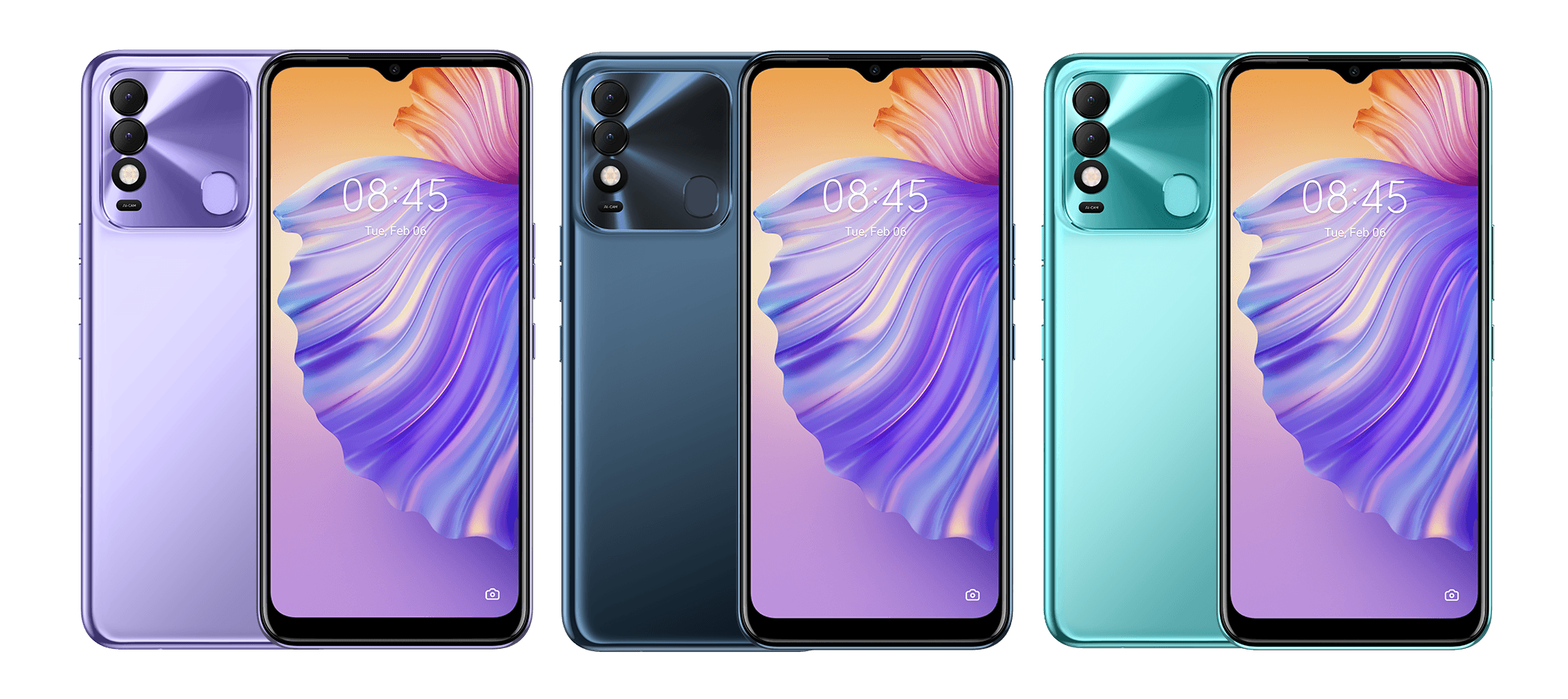
The Chinese smartphone company Tecno has launched an updated Spark 8 in India. The Spark 8 targets the budget segment of the Indian market and has improved features like a MediaTek G25 SoC and increased RAM. The Smartphone also features a waterdrop notch for the selfie cam, narrow bezels, and a rectangular module with rounded edges that houses dual camera sensors, quad-LED flash, and even a fingerprint sensor.
Camera
The Tecno Spark 8 features a dual rear camera setup, It offers a 16MP primary sensor with f/1.8 aperture with quad-LED flash and AI lens. It comes with features like AI Beauty, smile shot, AI portrait, HDR, AR Shot, time-lapse, panorama, slow motion, among others. An 8MP camera is present on the front with dual flash for selfies and video chats.
Specs and Features
Tecno Spark 8 sports a 6.56-inch HD+ Notch display with 480 nits brightness, slim bezels, 20.15:9 aspect ratio, and a standard 60Hz refresh rate. The smartphone is a bit on the bulky side with a 9.2mm thickness, 76mm width, and 165mm height. Under the hood, it houses a MediaTek Helio G25 chipset paired with 3GB of LPDDR4X RAM and 64GB internal storage expandable up to 256GB via a microSD card. HyperEngine technology has been included in the Spark 8 which boasts to deliver a seamless gaming experience.
The Tecno Spark 8 packs a 5000mAh battery and comes with a custom Android 11 OS, the HiOS 7.6. Connectivity features include 4G LTE, dual-band Wi-Fi, Bluetooth 5.0, and GPS. The smartphone also has a fingerprint sensor on the back.
Price and Availability
Tecno Spark 8 is priced at Rs 9,299 ($125) for the 3GB RAM and 32GB internal storage variant in India. The phone will be available in Atlantic Blue, Turquoise Cyan, Iris Purple color.
A new report has revealed the shipments of mobile phone processors in the Chinese market for the month of September as well as the third quarter of 2021, with MediaTek seeing a strong performance in the region.
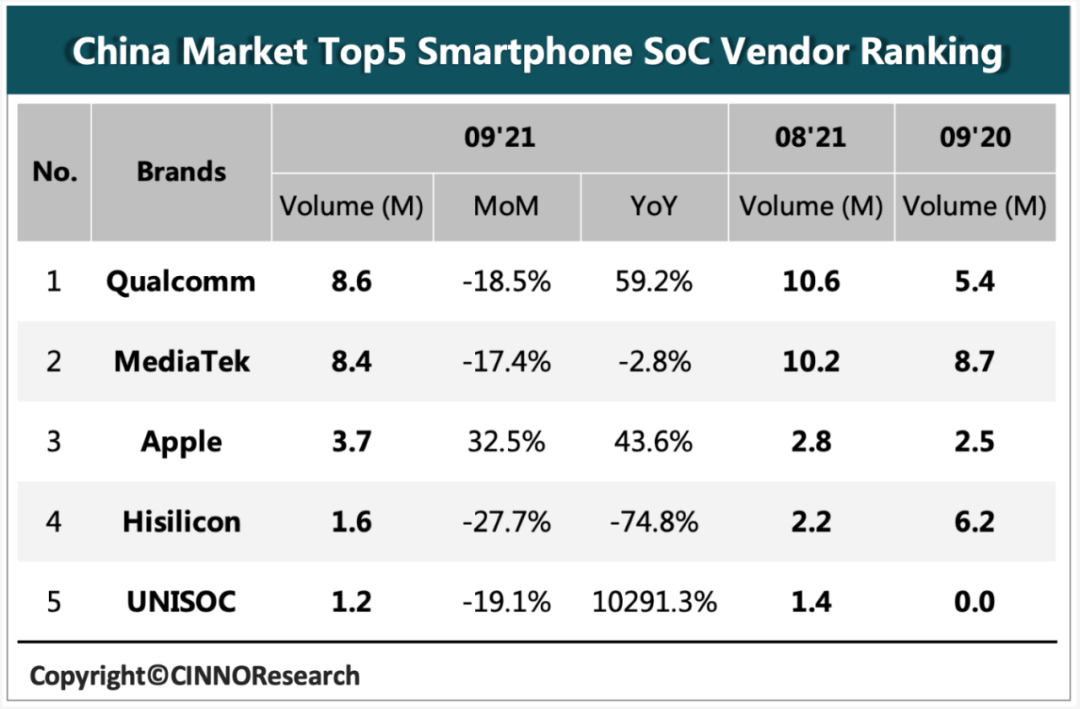
Top 5 Smartphone chipmakers in China – September 2021
According to a report by CINNO on total chip shipments in September 2021, Qualcomm came in at the top with 8.6 million units sold with an amazing increase of 59.2% compared to September of last year. The chipmaker was however down by 18.5% when compared to its sales of august. MediaTek saw lackluster results in September as their sales went down 17.5% compared to August and 2.8% in comparison with September 2020.
With its September release, Apple saw robust demand for the iPhone 13 series. This meant that its A-series chips also saw a rise, with shipments increasing by 32.5% quarter-on-quarter and 43.5% year-on-year. This major release has been attributed as the main factor in the decline of Android-based SoC sales in China for the month of September.
Huawei’s HiSilicon suffered a 27.7% decrease in its September sales compared to August and 74.8% in comparison with September 2020. UNISOC also experienced a decrease in its September sales numbers by 19.1% but soared an astounding 10291.3% in contrast to September 2020.
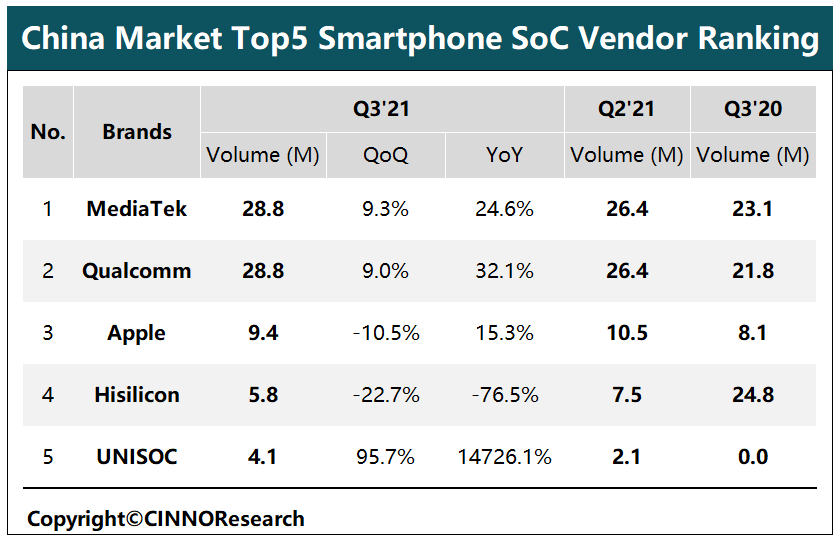
Top 5 Smartphone chipmakers in China – Q3 2021
The CINNO report also analyzed the performance of SoC makers for the third quarter of 2021 with MediaTek matching Qualcomm in sales volume with 28.8 million units shipped, showing a Quarterly Growth of 9.3% in Q3 2021 and a 24.6% growth compared to Q3 of last year. On the other hand, Qualcomm secured the second position with 9% quarterly growth in Q3 2021.
Apple shipments declined by 10.5% quarter-on-quarter with 9.4 million A-series chips shipped, but still showed a steady increase of 15% in shipments when compared to 2020. Huawei HiSilicon saw an overall drop in shipments in Q3, dropping by 22.5% (5.8 million shipped) compared to Q2 2021 (7.5 million shipped). The chipmaker saw a drop of a staggering 76.5% when compared to last year (24.8 million).
The report added that UNISOC witnessed an explosive 14726.1% growth year-on-year compared to Q3 of 2020. Now, the company holds the fifth position in the Chinese smartphone SoC market. UNISOC achieved a 96% growth in Q3 2021 compared to the second quarter, shipping around 4.1 million units. The company also managed to maintain robust sales with its major customers, which included Honor, Nokia, China Telecom, and more. It’s most popular SoC being the UNISOC Tiger T610 which powers the Honor Play 5T and Honor Play 20.
Earlier today, the publisher of Ubuntu, Canonical, released ‘the quickest way’ to run Linux cross-platforms on M1 Macs. Multipass allows users to launch a virtual machine image with a single command and run Linux on an M1 Mac in less than 30 seconds.
While Canonical has claimed to be the first platform to convert the M1 mac on a Linux computer, the Linux Kernel Devs on the other hand have been improving their platform monthly to offer the most pleasant experience possible on the Mac, stating their Linux project is now “Usable as a basic desktop”.
For now, Multipass is probably the easiest and most feature-rich way to use Linux on the M1 Mac. Nathen Hart, the Canonical product manager stated that “Canonical wants to get developers running on Linux faster than any other option on the market, and the Multipass team has helped accomplish that”. In other words, the Multipass would be quite useful for cloud application developers, web developers, and other Linux-based developers looking to get their hands on Apple’s M1 Mac.
Multipass can launch and run virtual machines and configure them with cloud-init like a public cloud. It allows you to prototype your cloud launches locally for free. Multipass version 1.8.0 also allows users to bind commands within a VM to commands on the host OS.
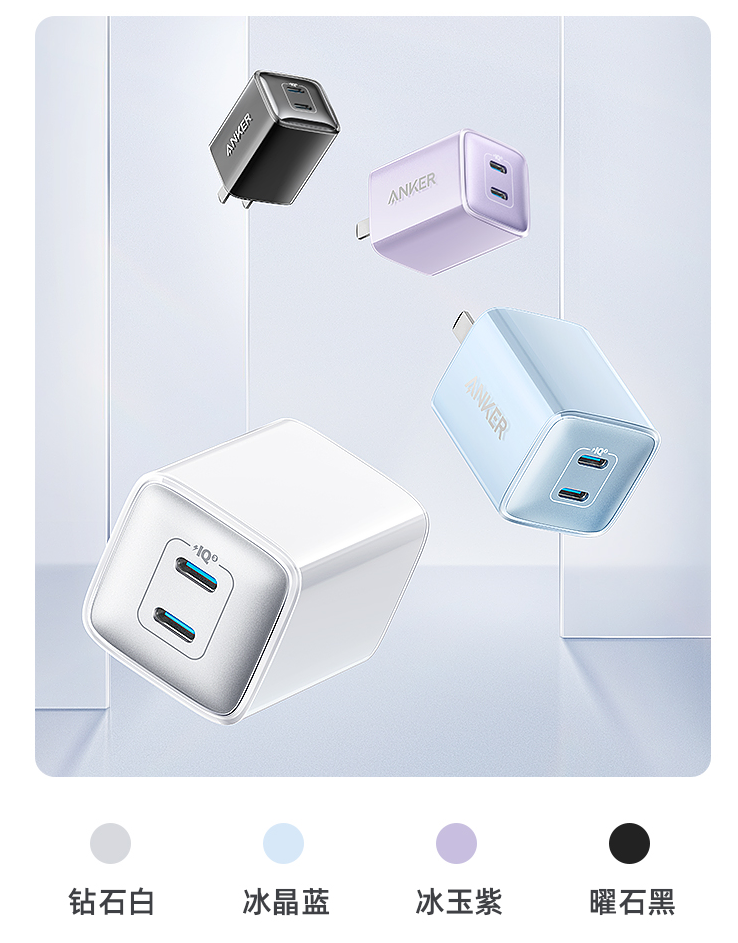
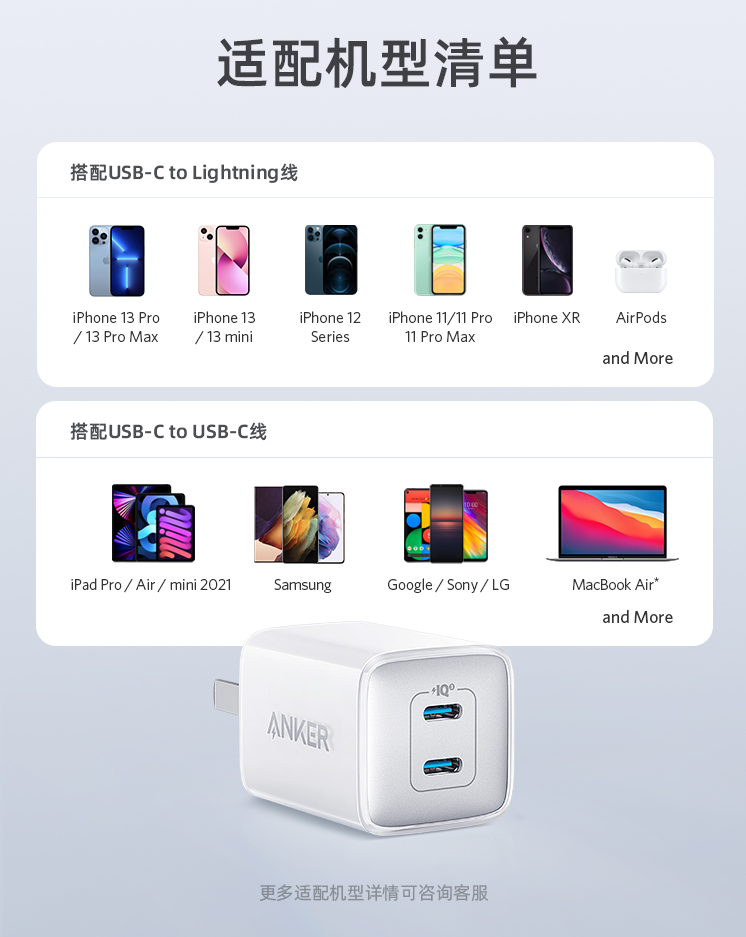
Chinese tech giant Anker, known for its top-notch accessories including charging adapters has launched a new 40W mini charger in China. The product adopts a portable design and features dual USB Type-C ports.
Although the charger has a 40W rating for single port use, the two ports can deliver 20W fast charging at the same time. The Anker mini charger can also provide 27W fast charging for iPhones.
On the design aspect, the Anker 40W mini charger adopts a fixed pin design. The body is round and is made using a flame-retardant material and has a dimension of 34.8×34.1×66.4mm. The charger also has an input rating of 100-240V. The device is available in four colors – Diamond White, Ice Crystal Blue, ice jade Purple, and obsidian Black.
In terms of the internal components, it features a self-developed PowerIQ 3.0 technology which Anker claims have wide adaptability and can charge notebooks, tablets, mobile phones, Bluetooth headsets, smart bands, and other products. Anker claims it can charge the Apple iPhone 13 Pro Max from zero to full charge in just 1 hour and 35 minutes. Also, it claims the iPad Pro 12.9-inch 2018 version can be charged to full in about 2 hours and 8 minutes. The product is equipped with a PI brand chip with a built-in AI smart temperature control system and has multiple protection measures.
As for the price, the Anker 40W Mini Charger is priced at 169 yuan (~$26).
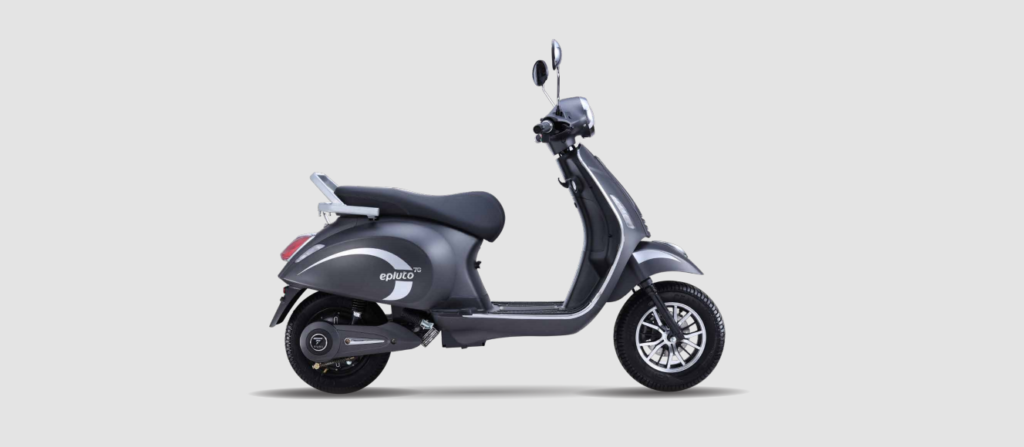
Hyderabad-based electric two-wheeler company PURE had launched the EPluto 7G electric scooter earlier this year but it clearly hasn’t received the recognition it deserves. The scooter’s main highlight is the range of up to 120km it offers on a full charge, coupled with the 2200W power its motor produces.
But perhaps the biggest attraction is the design. It screams retro and is reminiscent of the old Bajaj Chetak models, especially when you look at its tail light. Still, the design borrows the most from the Vespa Notte 125 thanks to a rounded but slender body, circular LED headlamp, and chrome-finished mirrors.
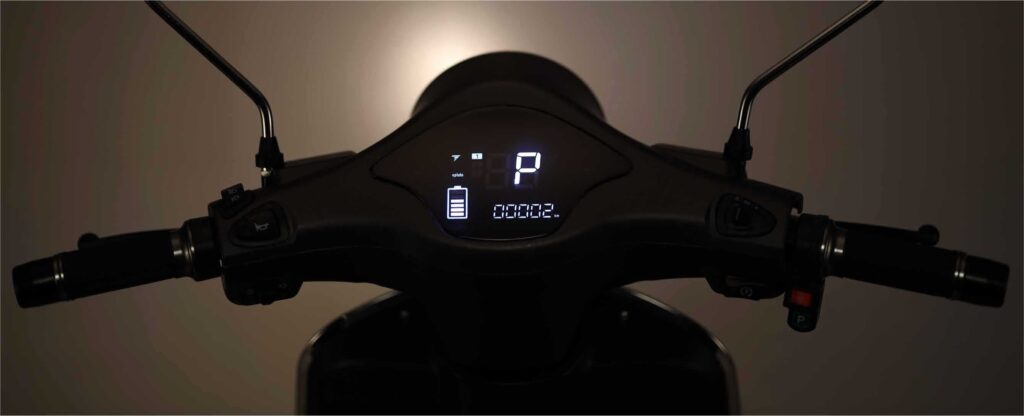
Don’t get too carried away by its old-fashioned looks though as the vehicle is packed with technology. With features such as a 5-inch LCD display, Smart Lock with AntiTheft provision, multiple speed modes, and disc-brakes on the front, it’s clear that the EPluto 7G is no ordinary two-wheeler.
Moving on to the power supply, the scooter packs a portable 60V 2.5kWh battery that can be filled up easily from your home. It is capable of a range of approximately 90-120kms on a single complete charge, which takes up to 4 hours. The electric motor powered by it produces high torque and can run the scooter at a max speed of 60kmph.
Other specifications include an acceleration time of 5 seconds to reach 40kmph, 10-inch alloy wheels, 12-degree gradability, and comfortable seating for two persons.
The PURE EPluto 7G electric scooter comes in multiple color options namely Ruby Red, Shadow Black, Electron Blue, Active Grey, Pearly White, and Stripling Yellow. It sells at a price of ₹79,999 (ex-showroom), with No Cost EMI options starting from ₹2,838 per month.
While the smartphone market in India has already seen the launch of a number of 5G enabled devices, 5G networking is still not commercially available in the region. Now, a new report has revealed that the original plans for 5G auctions might be even further delayed as well.
Previously, we had reported on the Indian government planning on holding the 5G spectrum auction in November 2021. However, this was rumored to have been pushed back to the first quarter of next year. But now, it seems like the auctions have been postponed even further. The reason for the delay is the six month 5G trial extension that the Department of Telecommunications (DoT) has given to a number of telecommunication operators in the country.
This includes the likes of Bharti Airtel, Reliance Jio, and Vodafone Idea (Via ETTelecom). Initially, these telecos were granted permission to conduct trials in the 3500MHz band that was allocated by the government. But while these trials were set to expire later this month on November 26, the Department of Telecommunications has apparently extended the 5G trials by an additional six months. This, in turn, means that the 5G spectrum auctions might be held at a date around May of next year.
The news arrives from sources close to the mater who stted that a lot of works still needs to be done on spectrum availability. Furthermore, even the Telecom Regulatory Authority of India (TRAI) has also yet to provide recommendation on a number of bands. This includes the 700 MHz, 3.3 to 3.6GHz and the millimeter wave.
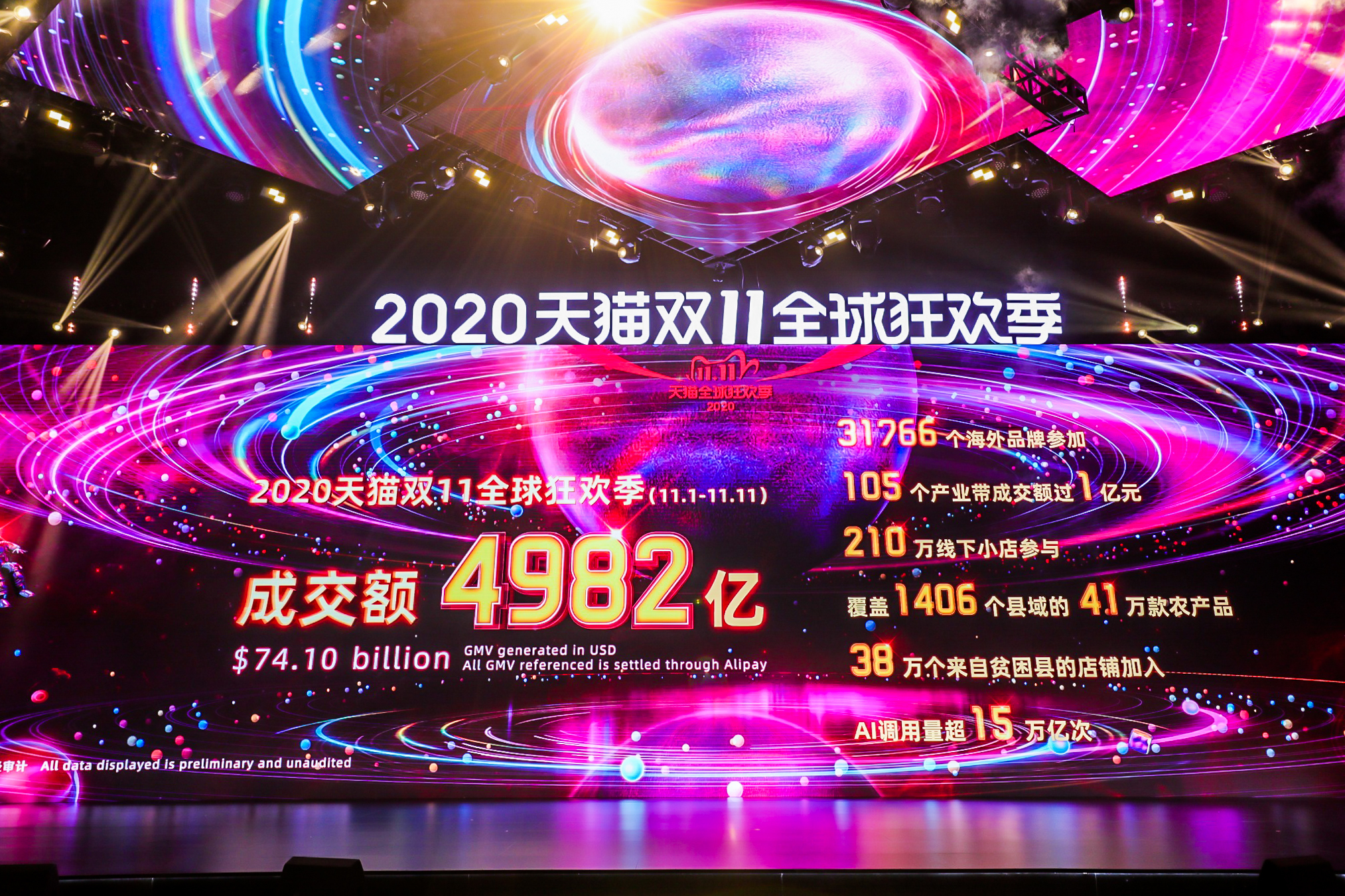
China’s biggest shopping festival is here, and it’s not a coincidence that it’s also the world’s biggest shopping event. To give you a scale of how massive the Singles Day (also known as Double Eleven) event is — in 2020 alone, the total sales during this shopping festival reached 498 billion yuan ($78 billion). In comparison, the Black Friday weekend sale in the US generated only around $22 billion in the same year.
Undoubtedly, China’s massive population is to credit for these humongous figures, but there’s no denying that new-age interactive sales techniques like live stream commerce and a rapid expansion in the country’s logistics network (nearly 3 billion parcels were shippedbetween Nov 11-16 across China in 2020) has magnified the scale of this shopping event.
History of Singles Day Festival in China
Although Singles Day started off as a celebration of bachelors, today, it’s much more than that.
The concept of celebrating the ‘single life’ started gaining traction in the college campuses of 90s China. Eventually, this idea spread across the country via the internet and other media. November 11 is celebrated as Singles Day due to its numerical significance. The date consists of four ‘1’ wherein ‘1’ stands for a ‘single’ person. So November 11 i.e. 11/11 represents four singles together.
But China’s Singles day had nothing to do with shopping until 2009 when Alibaba decided to popularize this day with a huge shopping event, much like the Black Friday in the US. Within a span of a few years, Singles Day went from the biggest shopping festival in China to the world’s biggest shopping spree, dwarfing big international shopping events like Black Friday and Cyber Monday, combined.
And, what was initially a 24-hour shopping window on November 11 has now expanded into a two to three week sales event. And it’s not just Alibaba,but all major retailers across China like JD.com, Pinduoduo, and Suning, participate in this mega sales festival.
Double Eleven in Numbers
To understand the massive scale of this shopping event, let’s take a quick look at some key stats over the past few years.
I mentioned that Singles Day was many times bigger than Black Friday and Cyber Monday combined. So, here’s a simple bar chart comparing Singles Day sales figures to Thanksgiving sales in the US from Statistica.
As you can see in the chart above, the rate at which Singles Day sales have grown is quite astonishing. In 2015, Alibaba generated GMV (Gross Merchandise Value) worth $14.3 billion during the event, but by 2019, this figure grew to $38.4 billion. And last year, Alibaba managed to nearly double this figure, generating a massive GMV of over $76 billion! This dwarfs the GMV of Thanksgiving weekend sales in the US, which was only around $22 billion in 2020.
Singles Day has managed to break records every year, and last year was no exception. Let’s take a quick look at the key figures from the Singles Day festival in 2020.
Singles Day 2020
Alibaba Singles Day sales 2020
2020 (Nov 1 – 11) was the biggest Singles Day event till date for Alibaba and China, breaking all previous records.
Last year between Nov 1 to 11, Alibabaalone generated around $78.1 billion in GMV (RMB 498.2 billion). Alibaba’s rival,JD.com booked around $42.47 billion in GMV (RMB 271.5 billion yuan) during the event.
To give you some context, US’ thanksgiving weekend sales generated around$22 billion in GMV in 2020.
During the first 11 days of the Double Eleven event, couriers processed and shipped over 3.9 billion parcels in China. A further 2.9 billion parcels were delivered between Nov. 11 – 16.
Alibaba’s logistics arm used more than3000 charter flights and cargo ships to bring goods into China for this event last year.
The big 11/11 sale for 2021 is yet to kick off, but here’s what we know about the event so far.
Singles Day 2021 – What to Expect?
This year’s Double 11 shopping event is expected to beAlibaba’s largest to date, with over 290,000 participating brands and more than 14 million discount deals available to the consumers. The mega sale event is expected to cater to over 900 million consumers.
There were some important changes made to the Double eleven sales event this year.
The Double 11 sale event was held in two phases.
The first phase will start from November 1 to 3 (pre-sale starts from October 20), and the second will be on November 11, which is the day of the main event.
Another key change this year was the timing of the sale. Unlike previous years, wherein the pre-sales started at 0:00 AM, this year, retailers kicked off both the stages of pre-sale at 8 PM. So shoppers no longer had to stay up late to snap up their favorite products.
Green and eco-friendly products also got more attention this year.
This year’s Double Eleven is already showing promise of becoming the largest sales event in history. A longer sales window for customers along with a longer list of brands participating in the event should ensure that it turns out to be much bigger than 2020.
Source: Alibaba 2021
In the past two weeks alone, we’ve seen record-breaking sales figures from different brands.
More than 20,000 customers bought green home appliances in the first two hours of sale on Oct. 20, 2021, which reportedly helped save 300 tons of carbon emissions.
Over US$1.7 billion worth of goods were sold by a celebrity host in just 12 hours of his live-streaming session at the start of the 11/11 sale.
Shoppers bought iPhones worth 300 million yuan ($47 million) within a second after the sales kicked off on Nov 1. In just four minutes, the total iPhone sales during Singles Day exceeded the iPhone sales generated in an entire day in 2020.
Singles Day not only generates massive sales for brands, but also indicates products that are gaining popularity among customers. So the first two weeks in November are among the most important periods for retailers in China.
How can you participate in Double Eleven?
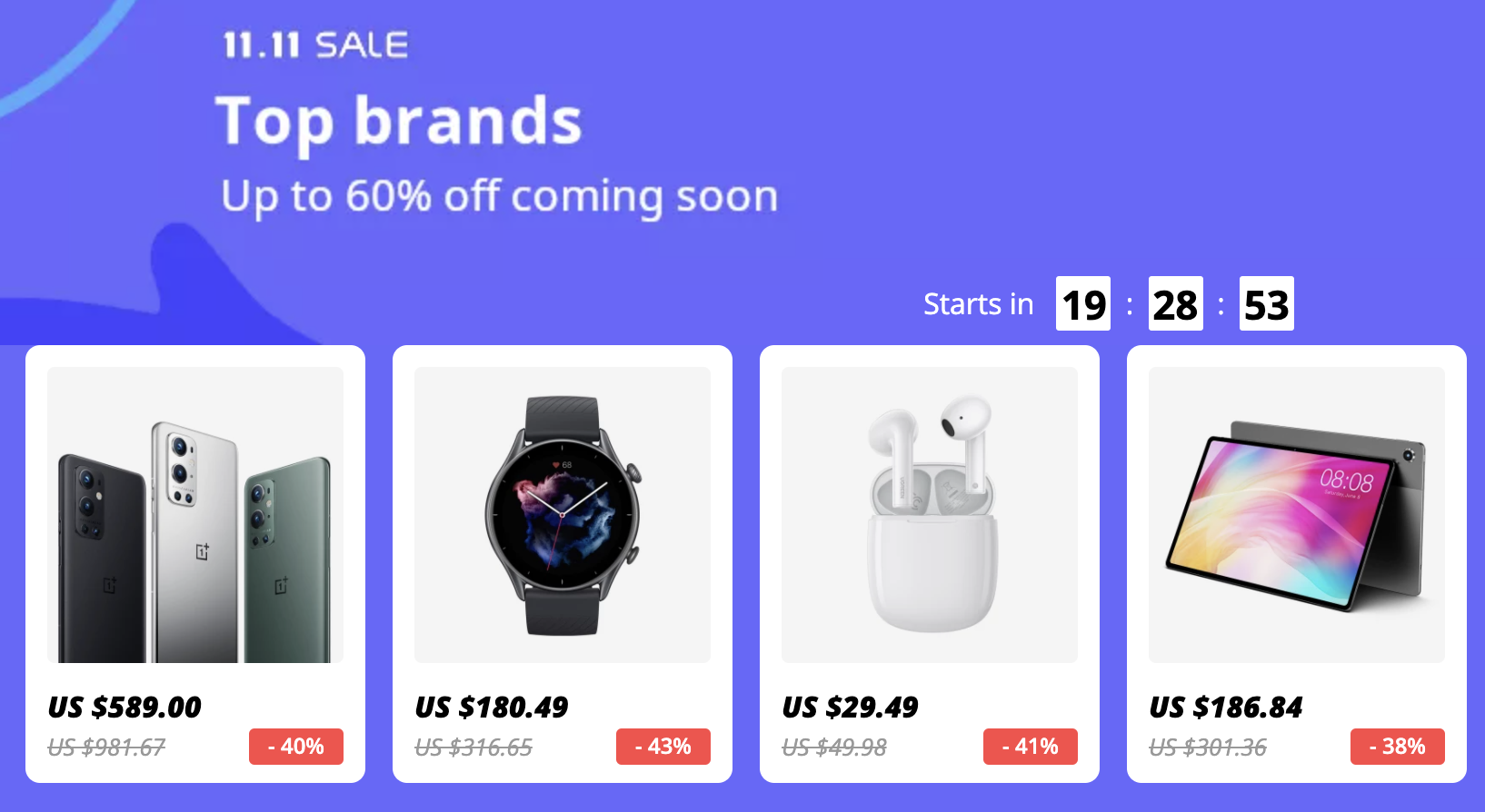
If you feel you are missing out on the fun, don’t worry as Alibaba’s international retail arm, Aliexpress has its own 11/11 sales event. While it’s not as big as the event in China, you’ll still find plenty of good deals and discount coupons on a wide variety of products this week.
Souice: Aliexpress
If you live in South East Asia, you can also participate in the local version of 11.11 events from retailers like Shopee and Lazada.
OmniVision Technologies has just announced a new image sensor. The latest launch is the OV32C 32 megapixel sensor, which is its first RGBC sensor, that is also built specifically for front facing cameras in smartphones.
The OV32C arrives in a compact 1/3.2 inch optical format, which the company states is the “ideal performance/size ratio for next generation front facing mobile phone selfie cameras.” It arrives with built in RGBC technology that lets the sensor offer the best image quality in varying lighting situations. Notably, the OV32C’s low power nodes allows it bring “always on” to the selfie cameras on smartphones. With Always On, the sensor would offer a better user experience by using artificial intelligence (AI) processing to automatically perform various common tasks like face detection, QR code scanning, and much more.
According to Arun Jayaseelan, staff marketing manager at OmniVision, “Mobile phone users need the highest possible image quality and resolution from their cameras, but the design challenge is that there is very limited space for the front facing camera module. Our new OV32C addresses this issue by providing 1/2.8 inch pixel size performance in a compact 1/3.2 inch OF. The OV32C is our first sensor for the mobile phone market to feature RGBC―providing a 50% boost in overall sensitivity to enhance low light image quality. Additionally, we’ve reduced design complexity for OEMs with an on chip RGBC to Bayer fusion algorithm, therefore, a separate RGBC processing unit isn’t required.”
For those unaware, OmniVision is a leading develop of advanced digital imaging technologies that have been featured in many smartphone models. Now, it seeks to further boost its portfolio with an Always On Selfie camera from its first RGBC image sensor. While all of this does seem intriguing on paper, we will have to wait for real world tests to know of its capabilities. The company stated that more information will be shared during the CES 2022 event that is set between the 5th and 8th of January.
Samsung took to Twitter today clarifying that it doesn’t have any Exynos-related events planned for November 19th, laying to rest the rumors about an Exynos 2200 launch on the same date.
Despite the rumors, we don't have any Exynos-related events planned on 11/19, but we do have some changes coming to our social accounts. Stay tuned to the @SamsungDSGlobal account for more!
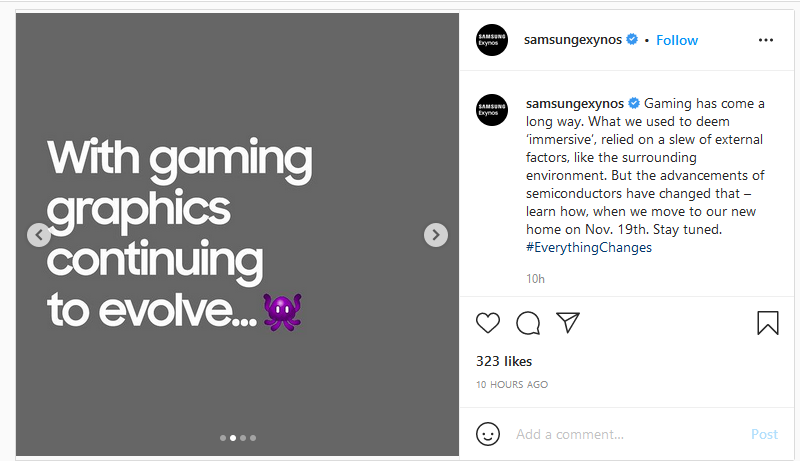
It was speculated earlier that the processor may be launched on November 19th from a post on Instagram that read: “With gaming graphics continuing to evolve, let’s show you what entertainment will look like in the future. Everything changes on November 19, 2021.” The post had also included a new ‘#EverythingChanges’ tag which many took as a reference to the Exynos 2200.
The post was joined by another that seemingly pointed toward the AMD GPU that will be paired with the Exynos 2200. An excerpt from it read, “With gaming graphics continuing to evolve, let’s show you what entertainment will look like in the future.”
With references like these and the fact that both posts came from the official ‘@samsungexynos’ Instagram handle, most were bound to think that they were related to the upcoming processor. So Samsung’s tweet denying the link did come as a surprise.
Nonetheless, Samsung’s upcoming Exynos 2200 chip will be paired with an AMD GPU which will be enabling raytracing support. It will will reportedly be built using the company’s 4nm process, and will feature one Cortex-X2 CPU core, three Cortex-A710 CPU cores, and four Cortex-A510 CPU cores.
The chip will likely be making its debut with the upcoming Samsung Galaxy S22 series given its flagship status.
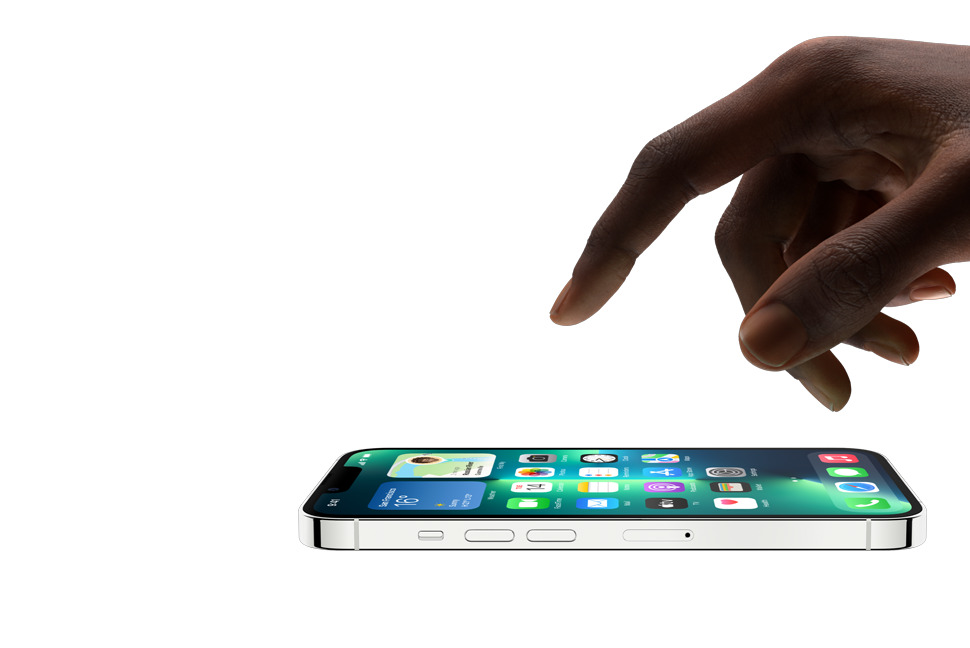
Apple will be rolling out a new update for the iPhone 13 series that will allow screen replacements to be performed without breaking Face ID.
Repair experts had found soon after the iPhone 13 release that swapping screens on the phone would break Face ID, unless a tiny control chip was removed from the original screen over to the new one. The process is quite difficult and made one of the most common types of repairs for independent mobile repair outlets quite tedious.
Apple-authorized repair shops on the other hand have access to a restricted software tool that allows the iPhone to easily accept a new screen.
This is set to change now when the update rolls out, The Verge reports. It will allow screen replacements on the iPhone 13 without requiring a transfer of the microcontroller.
iFixit had earlier noted that removing the microcontroller was so difficult that it would’ve required a microscope. It would have put independent repair shops in a tough spot, but the new update means that they can take a sigh of relief.
It is unclear when the update will be rolling out at the moment – Apple hasn’t announced any release date for it yet.
Regardless, the entire episode does raise questions on why the Face ID function broke in the first place, if it could easily be avoided through something as simple as a tweak in software. Apple has been known to progressively restrict repairability on the iPhones, and the move does come as a surprise. The most plausible explanation for it could be the US government’s push to strengthen ‘right to repair’ rules.
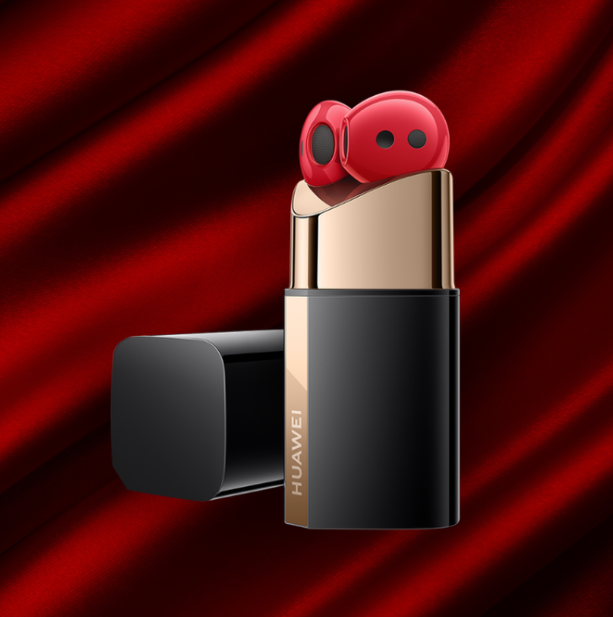
Huawei has just launched a new service in China that is aimed to offer users a way to replace their lost TWS earbuds. The company will now let you buy a single true wireless earphone at a discounted price.
The latest service from the Chinese tech giant is quite an innovative initiative from the company that should be more common in the currently booming TWS hearables market. Huawei will now let those that lost an earbud purchase the a single bud for a 50 percent discount. This new ‘worry/hassle free’ service will be available for products within a 2 year period of their purchase.
As of right now, the company has included three TWS earbuds as part of this new service. This includes the FreeBuds 4i, FreeBuds 4, and FreeBuds Pro. So for those that lost a bud from any of these models can purchase the single FreeBuds 4i bud for 39 Yuan (roughly 11 US Dollars), FreeBuds 4 for 69 Yuan (roughly 6 US Dollars), and the FreeBuds Pro for a reasonable 79 Yuan (roughly 12 US Dollars). To avail this offer, users will have to bring the charging case and the earbuds to a Huawei service store in China.
Unfortunately, the company has only launched this offer/service in its home country alone at the moment. Although, we’d wish for more companies to adopt this offer in markets across the globe. Currently, the Indian market for TWS earbuds is booming, so this would be a great offering in the region as well. But, we will have to wait and see if other brands follow suit.
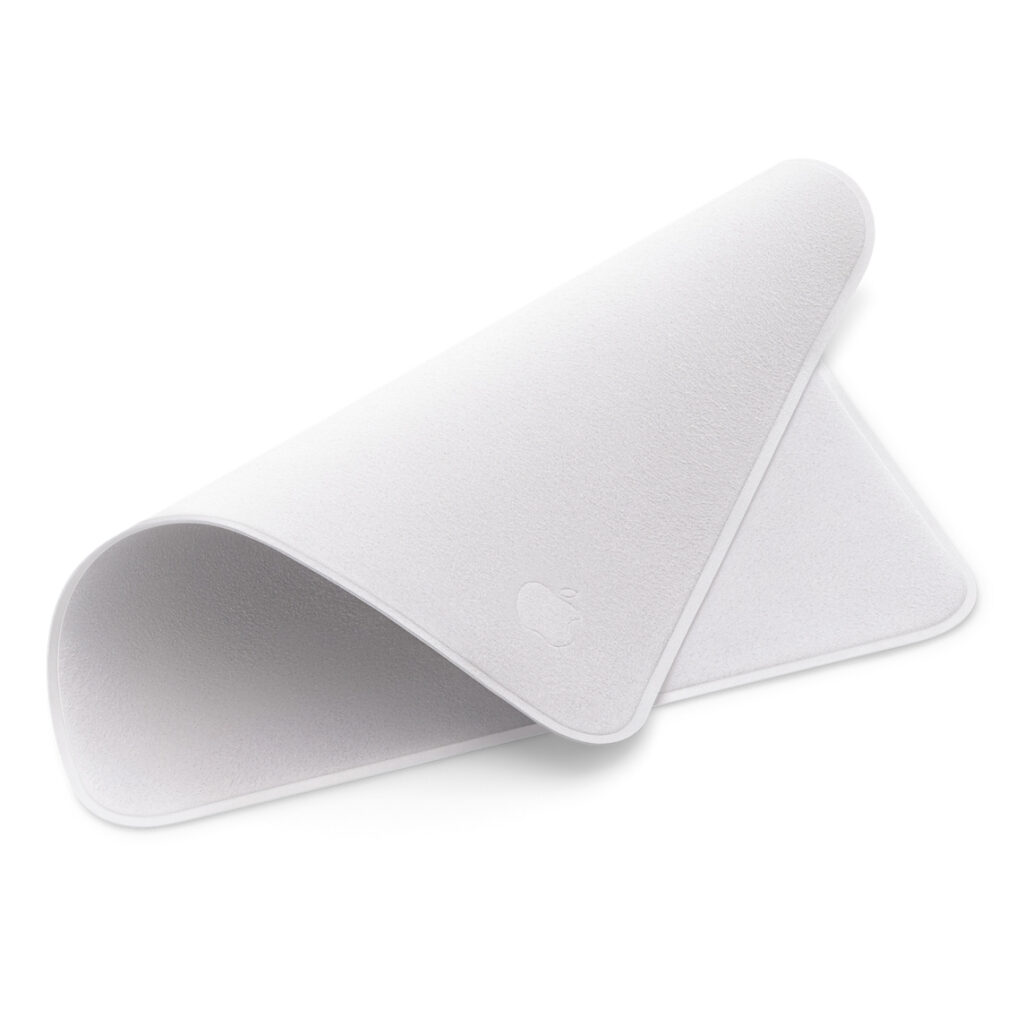
Apple had introduced a $25 Polishing Cloth last month alongside the iPhone 13 series – a cloth that barely offered anything over regular microfibre cloths you can grab for a fraction of the price. It was thus met with quite the mockery despite selling quite well.
Apple Polishing Cloth
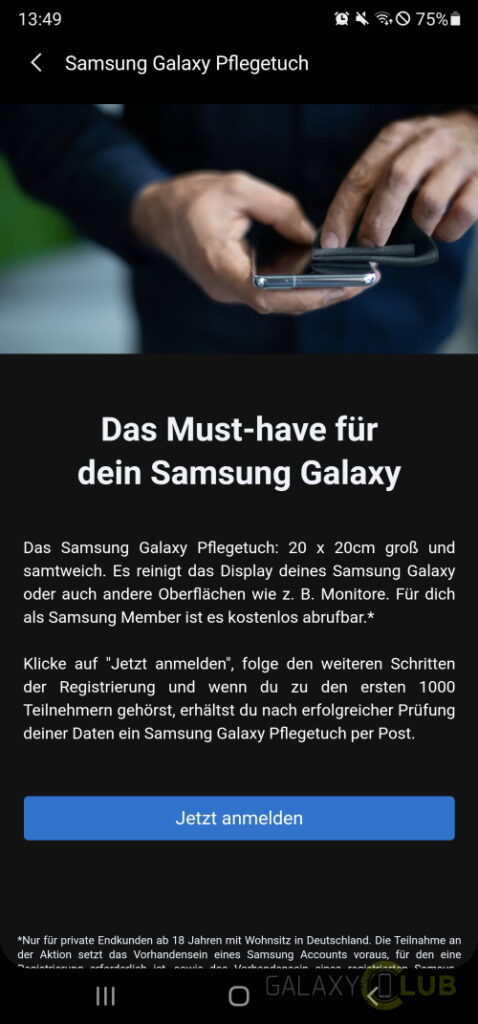
Samsung has now joined in the fun and is offering a cleaning cloth of their own for absolutely free, with an aim of showing how it’s done to Apple. German site Galaxy Club reports that Samsung has been emailing Samsung Members app users to inform them about the said cloth.
The cloth measures larger than Apple’s at 20 x 20cm and can be availed through the Members app. Owners of any Samsung device can grab it and it will be delivered to your address free of cost.
However, there is a catch. The special Samsung cleaning cloth is available in an extremely limited quantity – just a thousand of them will be given out. An on top of that, its reach is extremely limited as the promo is Germany-exclusive. Still, it’s an amusing way to take a jab at Apple.
Following is the translation from Dutch:
“With this promotion, Samsung is once again building on the rivalry with Major Competitor Apple. The latter caused a stir at a recent event with the launch of a polishing cloth for your iPhone. Price tag €25. Apple’s cloth measures 16 by 16 centimeters, so purely on specifications, Samsung’s free cloth wins the comparison. It’s over 50% bigger – and €25 cheaper.”
Samsung has never been shy when poking fun at Apple, even if it’s nonsensical and backfires. The most recent jab came in the form of TV ads comparing the S21 Ultra camera with the one from the iPhone 12 Pro Max.
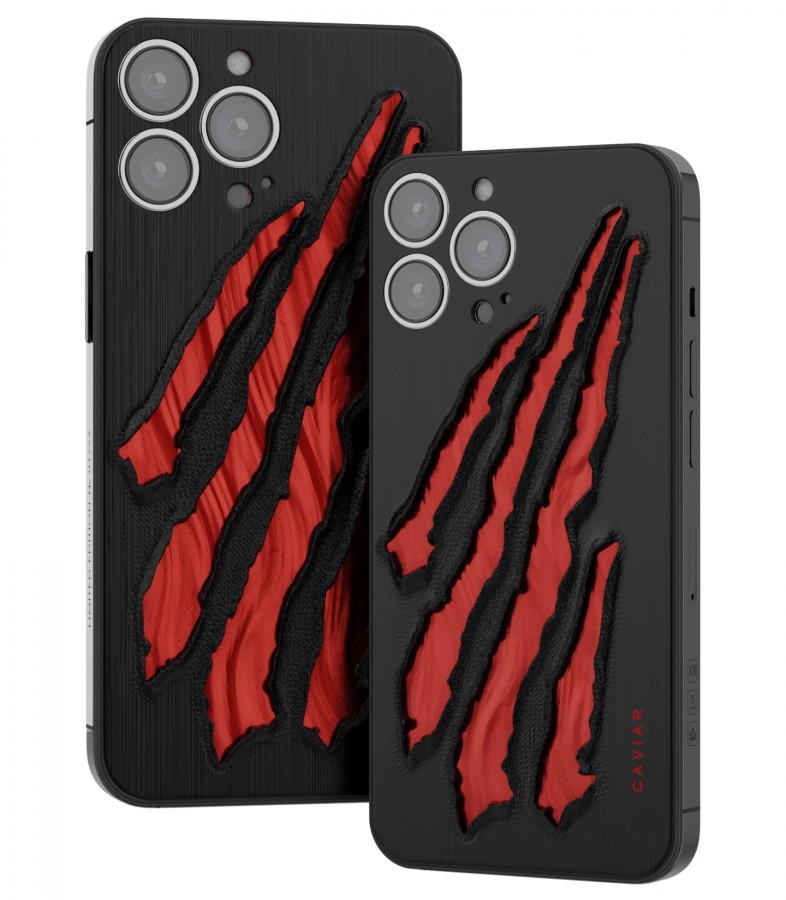
Caviar has just released new ultra high end customized versions of the Apple iPhone 13 Pro series. The company has just unveiled an exclusive iPhone 13 Pro model that costs a whopping 9,000 US Dollars and even features a Dinosaur tooth.
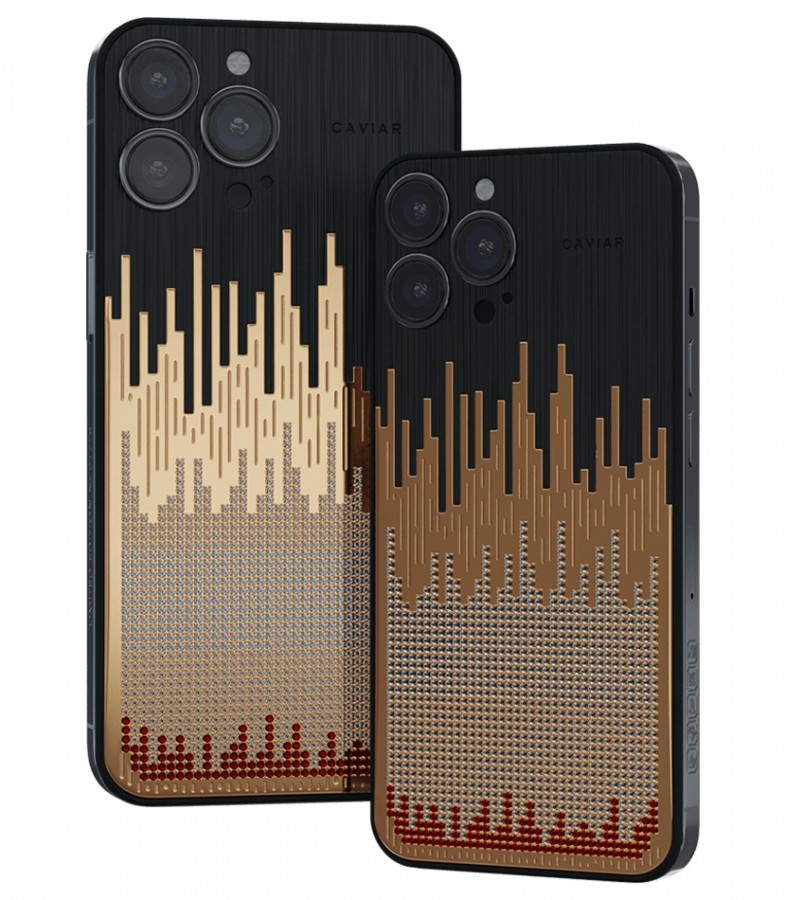
For those out of the loop, Caviar is a luxury goods maker from Russia that makes extreme premium variants of popular electronic products like smartphones, consoles, and more. Now, the brand has shifted its focus to the iPhone 13 series again, specifically the Pro models, and has launched the new Tera Collection. In this series, Caviar has released the iPhone 13 Pro, and 13 Pro Max in Tyrannophone, Monsterphone, and Teradiamond model.
While the Teradiamond is the top end in the series with a whopping 49,240 US Dollar price tag, what caught our eye was the “mid entry” Tyrannophone that features an actual dinosaur tooth fragment. The so called cheapest of the bunch of the Monsterphone, which still costs over 7,000 US Dollars, had features a hardened titanium panel while the Teradiamond variant sports over 1,000 diamonds on the back (hence the price). Arriving at the iPhone 13 Pro Tyrannophone model, it features a tooth fragment from an actual T-Rex, which is estimated to be a whopping 80 million years old.
It even features gold plated jewelry alloy on top of a lightweight composite foundation. The red eye on the back is a made of real amber while the had is made from titanium and a tiny piece of real tooth embedded as well. This model is a limited edition and Caviar plans on selling just 7 units in total to ensure its exclusivity. The Tera models all feature 1 terabyte of storage, with the Teradiamond costing 8,610 US Dollars while the Pro Max variant costs 9,150 US Dollars. So for those that can afford it, welcome to the Jurassic park.
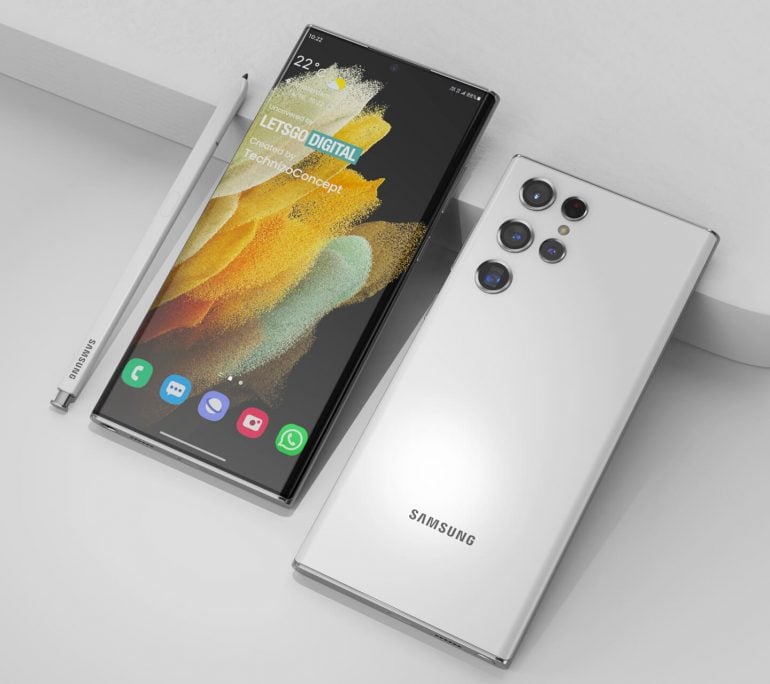
The upcoming Samsung Galaxy S22 and Galaxy S22+ will have a front camera with a resolution of 10 megapixels, making it the fourth year in a row with Samsung not changing the pixel count of its flagship phones. The only exception is the S22 Ultra which is expected to pack a 40MP sensor, just like the S21 Ultra.
Samsung last changed the front camera resolution with the Galaxy S10 series back in 2019. The S9 and S8 series had both come with 8MP sensors and the 2MP boost had brought about an adequate increase in selfie quality. However, the resolution has since remained constant at 10MP with the Galaxy S20 from 2020, Galaxy S21 from 2021, and now the Galaxy S22 series from 2022 (via Galaxy Club).
Image: LetsGoDigital
This obviously doesn’t include the Ultra models though. The Samsung Galaxy S21 Ultra and S20 Ultra came with a much more dense 40MP resolution, and it turns out that the Galaxy S22 Ultra’s front camera will sport the same pixel count.
And as for the rear cameras, the 2022 Ultra model will feature a setup not too different from the S21 Ultra. The primary is a 108MP snapper. It is joined by a 12MP ultra-wide lens, a 10MP 3X telephoto, and another 10MP 10X telephoto lens.
The Samsung Galaxy S22 series is set to make its debut on February 8, with an actual release following 10 days later.
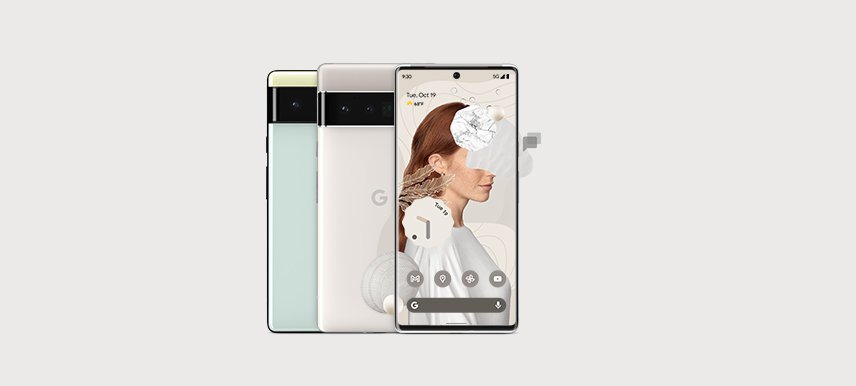
Google has just recently launched its much awaited 2021 flagship series, the Pixel 6 series. But many early buyers found issues with its slow and sometimes unreliable fingerprint sensor. And now, newer reports have pointed at the biometric scanner suffering from even more dire issues.
According to a thread on Reddit, multiple users have had their fingerprint sensor on the Pixel 6 series break entirely, with the reason being quite bizarre. Reportedly, once the Pixel 6 completely runs out of battery, the smartphone somehow permanently disables the fingerprint sensor. Some users noted that the fingerprint scanner had become entirely non functioning even after rebooting after their phone’s had initially died from an empty battery. As of right now, certain Redditors found that a factory reset was the only way to fix this issue, however, this would be quite a hassle.
Interestingly, one Pixel 6 user also commented on the thread, saying that they faced the issue without their handset running out of battery. In other words, the dead battery might be a primary trigger, but certain other factors related to the battery could potentially be the reason for this issue. Notably, While the search engine giant previously stated that the slow scanner is by design, we had also reported on unregistered fingerprints also managing to unlock the device
Fortunately, Google has acknowledged this problem and an official issue tracker has been registered. So for now, we would suggest making sure that your Pixel 6 series smartphone does not run out of battery if you plan on avoiding a factory reset. Stay tuned for more as well, since we will be providing updates when additional information is available regarding this matter.
Samsung is reportedly working on the Galaxy S21 Fan Edition smartphone’s launch. A South Korean publication recently reported that it is scheduled to debut at the Consumer Electronics Show (CES), which will be held in early January 2022. The report also mentioned that it will not be released in South Korea, but it will be heading to European markets by mid-January. The S21 FE has been spotted at the NBTC certification site of Thailand, which indicates that it will be also heading to some markets in Asia. At the same time, the handset has also appeared at the Geekbench benchmarking site.
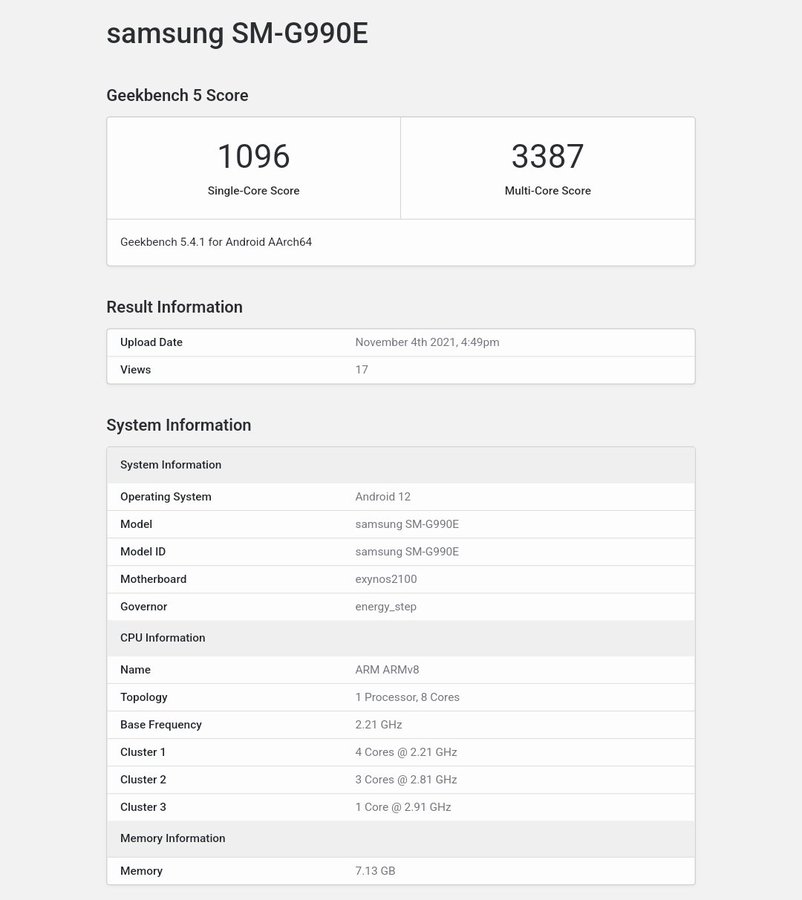
Tipster Tron has shared a screengrab of the Geekbench listing of the Samsung phone with SM-G990E model number. Reports have revealed that this model number belongs to the Galaxy S21 Fan Edition.
The Geekbench listing reveals that the phone is driven by the Exynos 2100 chipset. The CPU information shows that it has one prime CPU core working at 2.91 GHz, three CPU cores clocking at 2.81 GHz, and four CPU cores working at 2.21GHz. The SoC is assisted by 8 GB of RAM. The device runs on the latest Android 12 OS. In the single-core and multi-core tests, the S21 FE scored 1096 and 3387 points, respectively.
Like the S21 series smartphones, the Galaxy S21 Fan Edition is expected to arrive with Snapdragon 888 or Exynos 2100 chip depending on the market. It may come with 8 GB / 12 GB of LPDDR5 RAM and 128 GB / 256 GB of UFS 3.1 storage.
It is expected to come with a 6.41-inch AMOLED display that offers an FHD+ resolution and a 120Hz refresh rate. For selfies, it may feature a 32-megapixel front camera, and its rear camera module may include a 12-megapixel main camera, a 12-megapixel ultrawide shooter, and an 8-megapixel telephoto camera. It could be backed by a 4,500mAh battery, which is expected to support 25W fast charging, wireless charging, and reverse wireless charging.
Earlier this week, Apple had requested a delay over the implementation of new changes in its payment system in a virtual hearing. However, the US Judge denied this request, which gives the company till December 9 to make the changes to its App Store.
For those unaware, the changes in question would allow developers of various apps to add an in app link to an external website. Through this, users will be also be given an option for alternate payment options that do not use the in app payment system. After the initial ruling, the Cupertino based giant was given 90 days to implement the new changes. But back in October, Apple filed a request for more time as it sought to wait until all appeals in the lawsuit against Epic Games were concluded.
As of right now, the iPhone maker’s request has been denied by US Judge Yvonne Gonzalez Rogers and no additional time will be given to add the requested App Store changes. The original ruling also read that the company can no longer restrict developers from including “in their apps and their metadata buttons, external links, or other calls to action that direct customers to purchasing mechanisms” (Via MacRumors).
The Judge believes that the app developers should have the option to choose an in app payment system or an external one, since “Consumer information, transparency, and consumer choice is in the interest of the public.” Although, Apple argued that the new changes might “upset the careful balance between developers and customers provided by the App Store.”
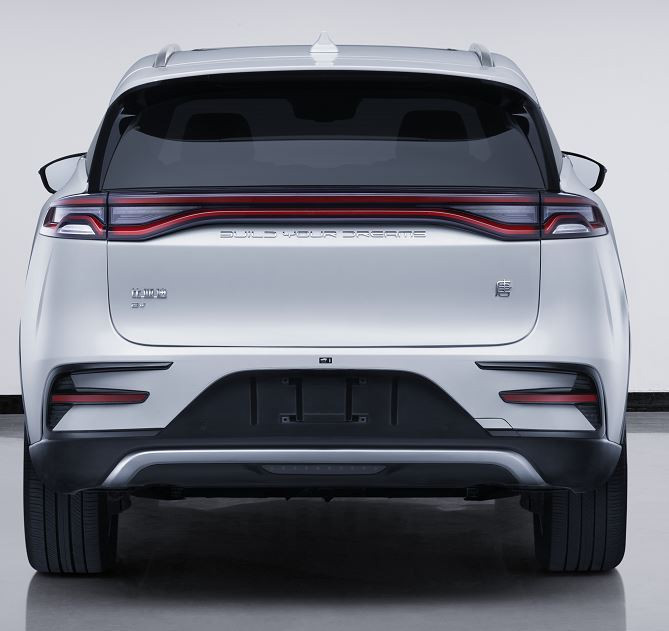
A new model of the BYD Tang EV just made its appearance in the Chinese Ministry of Industry and Information Technology’s catalog with a slightly updated design. The company previously launched the BYD Tang EV internationally in regions like Norway and this new model appears to be its successor.
The most prominent design change is in the front of the vehicle which now comes with a more modern-looking, minimal grille (via IT Home). This year’s model featured a grille that occupied a larger part of the front of the EV but the newer design comes with a smaller one with chrome trim. The newer grille also holds the “Tang” car logo.
Apart from this, the rest of the body hasn’t been changed much. The rear and sides of the vehicle are almost indistinguishable from its older model, although the body length has been increased slightly. As such, the length, width, and height of the new BYD Tang EV are 4900mm x 1950mm x 1725mm, respectively, while the wheelbase stands at 2820mm.
Moving on to the SUV’s engine, it is an electric motor with a power of 168kW (approximately 229 horsepower). The power has in fact been reduced when compared to the current single-motor version of the Tang EV. However, a dual-motor four-wheel-drive version is expected to be launched soon to compensate.
The lithium iron phosphate Blade Battery of the new BYD Tang EV has been upgraded with an increased density, rising from 140wh/kg to 150wh/kg, which is a considerable upgrade. Because of this, the battery life/range of the vehicle will be reaching 700 kilometers.
Current BYD Tang EV models on sale are three in number, namely long-range, four-wheel-drive high-performance, and four-wheel-drive high-performance flagship.
The newer model will be replacing the current single-motor variant and is set to be unveiled at the Guangzhou Auto Show on November 19.
Earlier this week, TSMC (Taiwan Semiconductor Manufacturing Company) has announced that it would be investing a sizeable amount of 7 billion US Dollars for its new chip plant that will be constructed in Japan.
The new chip plant is a major step for the world’s largest contract chipmaker who is shifting its advanced semiconductor production outside of its home country for the first time. Notably, the firm will be investing the large figure along with Sony, who has pledged to invest 500 million US Dollars into this factory as well. As per our previous report. this new chip plant will also be the one that supplies Sony with semiconductors that will be used for its reputed image sensor business.
According to Reuters, the construction of the new chip plant will begin next year, while the production is expected to start by the end of 2024. In a joint statement, Sony and TSMC stated that the “The fab is expected to directly create about 1,500 high tech professional jobs and to have a monthly production capacity of 45,000 12 inch wafers.” Furthermore, the site will also produce 22 nanometer and 28 nanometer chips to address the robust demand for specialty chip technologies.
The project also has great support from the Japanese government, although, whether this support included financial backing is currently unknown. However, we do know that Japanese industry ministry officials are considering this a success since they have sought to bring TSMC’s plant to the country. Amid the global shortage of semiconductors, unsteady supply chains, and even the trade disputes between US and China, the demand for key components for production still grows. So, Japan will likely benefit from this new chip plant.
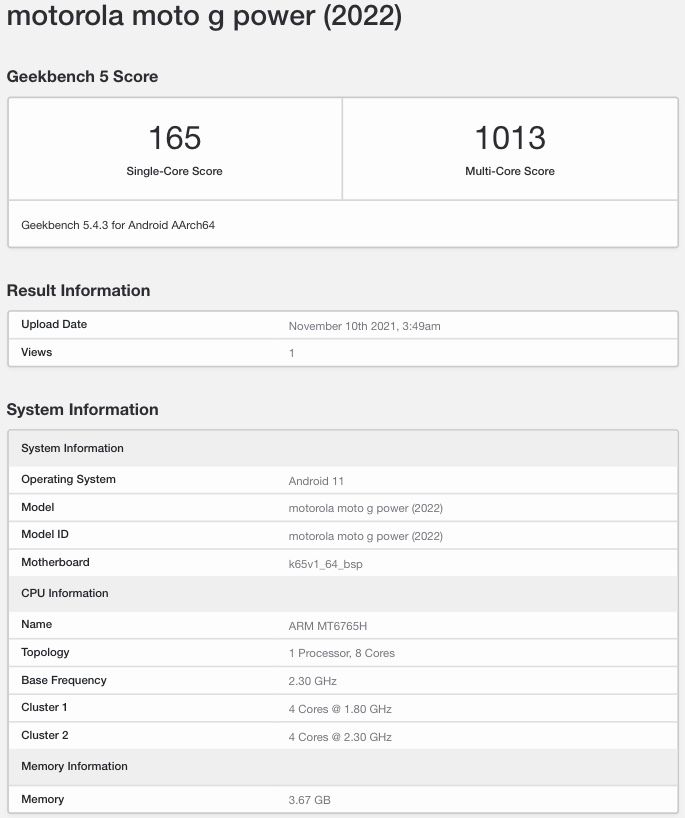
In October, reliable tipster Evan Blass revealed that Motorola is working on two new phones namely Moto G Power (2022) and Moto G200. Both phones are codenamed as Tonga and Yukon, respectively. While the rumor mill has spilt the major specs of the G200, there has been no leak on the G Power (2022). It appears that the launch date of the G Power (2022) could be drawing near as it has been spotted at the Geekbench benchmarking site today.
The Geekbench listing of the Moto G Power (2022) shows that it is powered by a MediaTek chip with an MT6765H model number. The source code of the listing shows that the SoC is equipped with PowerVR Rogue GE8320 GPU. These findings are enough to conclude that the G Power (2022) is driven by the Helio G35 chipset.
The Geekbench listing further reveals that the smartphone is equipped with 4 GB of RAM and Android 11. In the single-core and multi-core tests of the benchmarking platform, the handset scored 165 and 1103 points, respectively. The other details of the smartphone are under wraps.
As far as the Moto G200 is concerned, it is speculated to feature an FHD+ display with support for a 144Hz refresh rate, Snapdragon 888 mobile platform, 108-megapixel + 13-megapixel + 2-megapixel triple camera unit, a 16-megapixel front camera, and Android 11. It is speculated to launch as the Motorola Edge S30 in China.
Motorola is also working on the Motorola Edge 30 Ultra. It is likely to come with specs such as a 6.67-inch OLED FHD+ 144Hz display, Snapdragon 898 chip, 8 GB / 12 GB of LPDDR5 RAM, 128 GB / 256 GB of UFS 3.1 storage, 50-megapixel + 50-megapixel + 2-megapixel triple camera unit, a 60-megapixel front camera, a 5,000mAh battery with 68W fast charging. It is expected to debut as the Moto Edge X in China in December.
We use cookies on our website to give you the most relevant experience by remembering your preferences and repeat visits. By clicking “Accept”, you consent to the use of ALL the cookies.
This website uses cookies to improve your experience while you navigate through the website. Out of these, the cookies that are categorized as necessary are stored on your browser as they are essential for the working of basic functionalities of the website. We also use third-party cookies that help us analyze and understand how you use this website. These cookies will be stored in your browser only with your consent. You also have the option to opt-out of these cookies. But opting out of some of these cookies may affect your browsing experience.
Necessary cookies are absolutely essential for the website to function properly. This category only includes cookies that ensures basic functionalities and security features of the website. These cookies do not store any personal information.
Any cookies that may not be particularly necessary for the website to function and is used specifically to collect user personal data via analytics, ads, other embedded contents are termed as non-necessary cookies. It is mandatory to procure user consent prior to running these cookies on your website.