Advertisement

OnePlus 9RT 5G smartphone goes on sale in China; price starts at 3,199 yuan ($499)

OnePlus had launched three smartphones in its flagship lineup this year — OnePlus 9, 9 Pro, and OnePlus 9R. Just a few days ago, the Chinese company refreshed the OnePlus 9R smartphone with the launch of a new model named OnePlus 9RT.

Today, the smartphone is officially available for purchase in China. There are three memory variants — 8GB RAM + 128GB storage, 8GB RAM + 256GB storage, and 12GB RAM with 256GB storage, costing 3,299 yuan (approx. $514), 3,499 yuan (~$545), and 3,799 yuan  (approx. $592) respectively.

For the first sale, the company is offering a 100 yuan discount on all three models. As for the colors, the smartphone comes in three color options — Dark Matter (Black), Hacker Silver, and Enchanted Sky.

OnePlus 9RT

Coming to the specifications, the OnePlus 9RT features a 6.62-inch E4 AMOLED display with 2400 x 1080 pixels screen resolution, a 120Hz refresh rate, support for sRGB, and P3 color gamut, as well as Corning Gorilla Glass protection.

Under the hood, the device is powered by the Qualcomm Snapdragon 888 chipset, which is an upgrade compared to the SD870 SoC in the OnePlus 9R. It packs up to 12GB LPDDR5 RAM and up to 256GB UFS 3.1 storage. It also comes with a 19067.44 mm² space cooling system to keep the temperature low while gaming.

In the camera department, the phone comes with a 50-megapixel f/1.8 Sony IMX766 sensor with a 6P lens and both optical and electronic image stabilization. There’s also a 16-megapixel ultrawide angle camera with an f/2.2 sensor, 123-degree field of view, coupled with a 2-megapixel 4CM macro camera to complete the triple camera setup.

OnePlus 9RT featured

On the front side, the device is equipped with a 16-megapixel Sony IMX471 snapper with electronic image stabilization for taking selfies and video calling. The phone comes with an in-display fingerprint scanner, Bluetooth 5.2, NFC, Wi-Fi 6, dual Nano-SIM support, USB-C, and stereo speakers with Dolby Atmos.

The device is running the Android 11 operating system out-of-the-box with the ColorOS 12 UI on top. It is powered by a 4,500mAh battery and has support for Warp Charge 65T which is faster than the Warp Charge 65.

In related news, the OnePlus 9RT is also expected to get launched in the Indian market pretty soon and if the recent report is to be believed, then the phone could be priced between ₹40,000 to ₹44,000 ($533-587) in India.

RELATED: 

Foxconn announces three new electric vehicle prototypes

Taiwanese electric vehicle (EV) company Foxconn has unveiled three prototype EV models it aims to release in commercial quantities by next year at the least. The three new prototypes are a culmination of Foxconn’s partnership with Taiwan’s Yulon Motors. The three prototypes were unveiled at Foxconn’s HHTD21 event, and consist of two sedans and a bus.Foxconn

Yulon Motors is the owner of the Luxgen brand. It also manufactures Mitsubishi and Nissan cars for its home market. The three prototypes are a luxury sedan (called the Model E), SUV (Model C), and transit bus (Model T). Foxconn is developing these prototypes as reference designs that could be scaled up and customized for mass production by EV brands. The driving force for the EVs is Foxconn’s MIH Consortium which is an open software and hardware platform.

The prototypes are projected to become actual models from 2022 for Model T. The Model C is projected to be available by 2023. The investment outlay of Foxconn includes the building of EV manufacturing plants in the US. Foxconn says it has plans to acquire Lordstown’s manufacturing plant in Ohio. The expansion plans are quite bold and would need a huge quantum of investment yearly and outlined by the company.

The Model T bus will have a range of 400km and a top speed of 120km/h. It comes with some advanced technologies including pedestrian warning, high crashworthiness, and advanced temperature management. The Model C SUV will be available at about $35,700 in 2023. The Model E will enter the market at an unspecified date and could offer up to 750km range.

RELATED: 


Samsung’s Smart Monitor sales exceed 600,000 units in just one year!

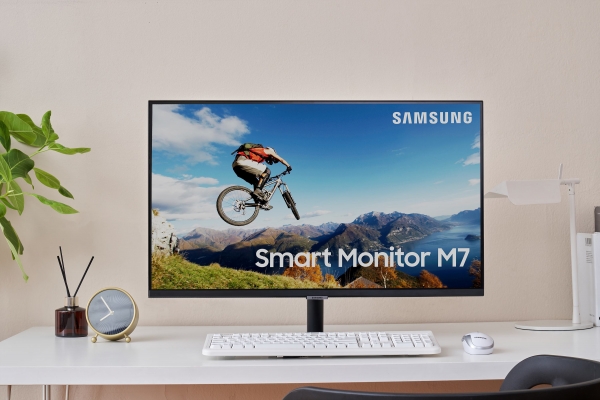
Samsung first introduced its Smart Monitor in December last year and it was targeted at the increasing need for smart displays as a result of the COVID 19 pandemic. The Korean tech giant has now announced that it has sold over 600,000 units of the monitor globally. Samsung's Smart Monitor

The sales translate to the company selling more than one unit every minute since its launch. The Samsung Smart Monitor is a new concept monitor that is equipped with a smart hub based on Tizen OS, allowing you to enjoy various OTT (Over The Top) services such as Netflix, Samsung TV Plus, and YouTube as well as work and study without a PC connection.

The monitors have received positive reviews on YouTube and other online platforms since they were released. This has greatly impacted the sales of its smart monitors. Also, the adoption of work from home and homeschooling increased the demand for Samsung’s smart monitors.

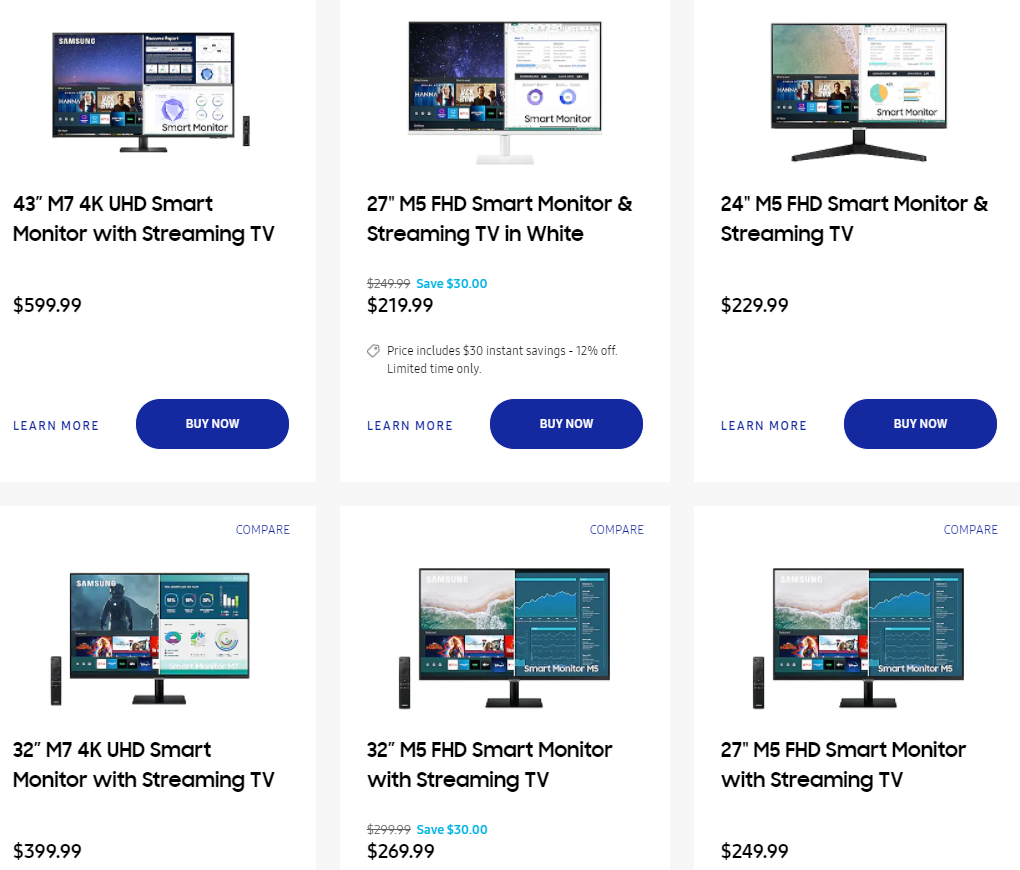
Samsung Smart Monitors are available in two different models – the Smart Monitor M7 and M5. The Smart Monitor M7 is available in 43-inch and 32-inch models with UHD resolution and black color only. On the other hand, the Smart Monitor M5 comes in 32-inch and 27-inch models with FHD resolution. It is available in black and white color options.

“Samsung Smart Monitor is an innovative product that has completely positioned itself as a new category in the ‘home life’ era,” said Hye-Seung Ha, Executive Vice President of Visual Display Business at Samsung Electronics.

RELATED:


(source)


Apple AirPods 3rd generation with Spatial Audio and 6-hour battery life launched for $179

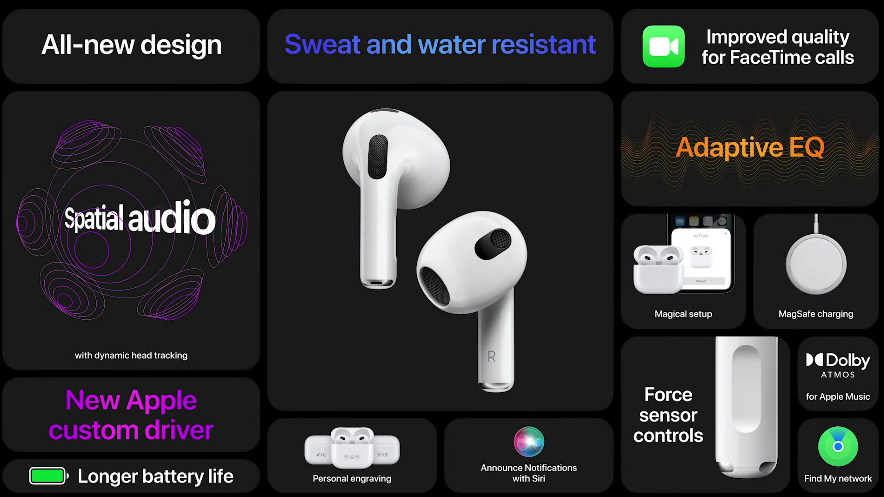
Apple has announced a new pair of wireless earbuds. The AirPods 3rd generation comes with new features such as Spatial Audio, Adaptive EQ, and better battery life.

Apple AirPods 3rd generation

The AirPods 3rd generation or AirPods 3 for short have a new design. The stems are shorter and they are rated IPX4 for sweat and water resistance. They also come in a new case that supports wireless charging and can be charged on a MagSafe charger.

The AirPods 3 have Adaptive EQ which automatically tunes what you are listening to based on the shape of your ears. It works with the aid of an inward-facing microphone which detects what you are listening to and adjusts the low and mid-range frequencies to deliver the details of what you are listening to.

There is a force sensor on the stem for playback controls and for answering and ending calls. Apple says that the new AirPods 3rd generation will provide 6 hours of listening time on a single charge and it goes up to 30 hours with the case. A 5-minute charge in the charging case will provide 1 hour of listening time.

Apple AirPods 3rd generation specs

There is also a new skin-detect sensor that can tell when the AirPods are in the ears or another surface so as to play only when in your ears but pause playback when in your pocket or on a table.

The AirPods 3rd generation is priced at $179.99 and is already available for pre-order before it is available on the 26th of October. Apple has also brought down the price of the AirPods 2nd generation down to $129.


RELATED:

TCL CSOT, BOE could supply OLED panels for Samsung Galaxy A73: Report

Last month, news broke out regarding the upcoming Samsung Galaxy A73. Details on this smartphone’s primary camera emerged. Now, weeks later, we also get to learn about its display.

Samsung Galaxy A72 Awesome White Violet Blue Black Featured
Samsung Galaxy A72

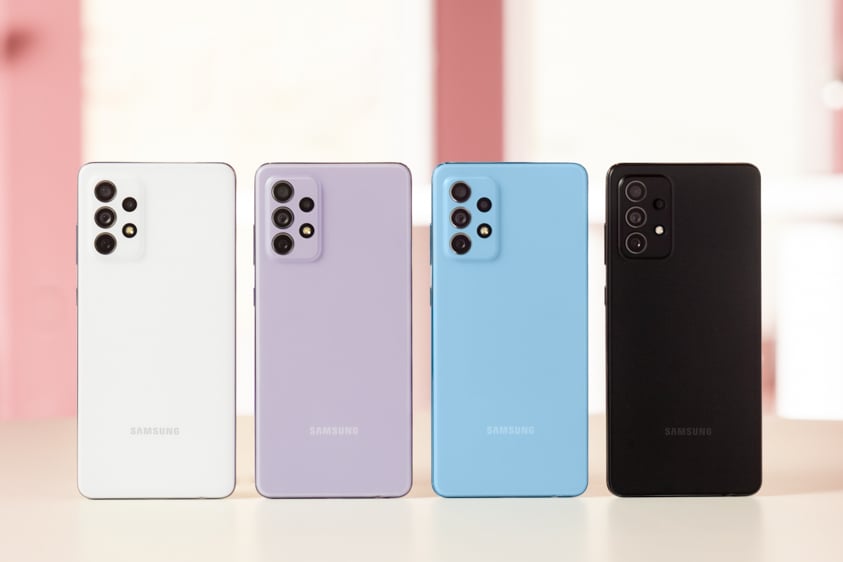
According to a report by The Elec (via SamMobile), Samsung Electronics is testing OLED panels from three different suppliers for the Galaxy A73. One of them is unsurprisingly Samsung Display. Whereas, the other two are China-based BOE and TCL CSOT.

This is not the first time Samsung is testing Chinese displays for its phones. Last year, TCL CSOT became the sole supplier of OLED displays for the Galaxy M41. However, for unknown reasons, this phone was shelved and replaced with Galaxy M51 featuring a panel from Samsung Display.

Anyway, CSOT managed to supply panes in a low quantity for certain legacy models of the Galaxy M series this year. On the other hand, Samsung tested BOE-made displays for the Galaxy S21. But unfortunately, the deal did not go through due to undesired quality.

The two Chinese display makers are back again for Galaxy A73, Nonetheless, only time will tell if they will be successful in inking a deal this time around. 

For those who are wondering, Samsung Electronics has been trying to broaden its supply chain partners for quite a while now. Samsung Display has been the sole supplier of OLED panels for Samsung Galaxy smartphones for more than 10 years.

The South Korean electronics giant wants to reduce its dependency on Samsung Display for OLED panels. By opting for displays from other manufacturers, the company could get them at a cheaper price. The firm could not only make a profit out of this move but could also pass down this as a benefit to customers by lowering the price.

As far as Galaxy A73 is concerned, the device will reportedly be the first Samsung mid-range smartphone with an OIS-equipped 108P primary camera.


RELATED:


Apple announces M1 Pro and M1 Max chips and new MacBook Pro with notches

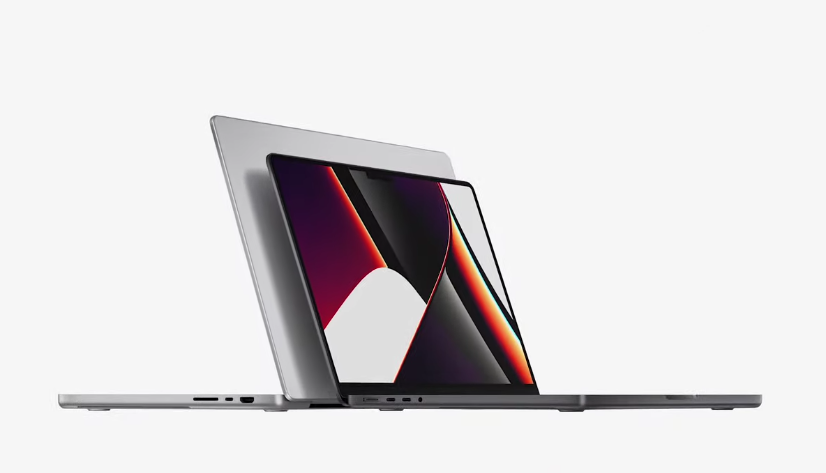
Apple fans can finally rejoice as the long-awaited new MacBook Pro laptops have arrived with incredibly powerful processors….and a notch. Yes, Apple has brought over the notch on the iPhones to its computers but not for the reason you expect.

MacBook Pro 2021

The new MacBook Pro computers are powered by two new Apple processors – the M1 Pro and the M1 Max. The two new processors have 10 cores but the M1 Max is the more powerful one.


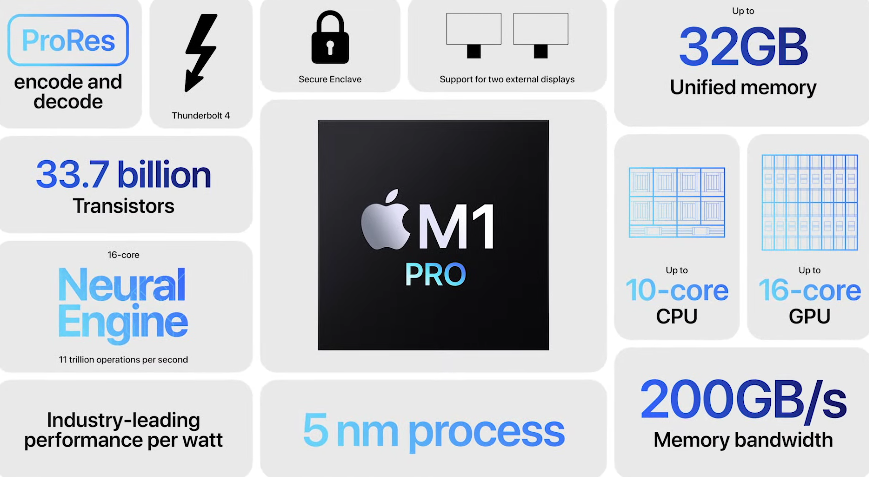
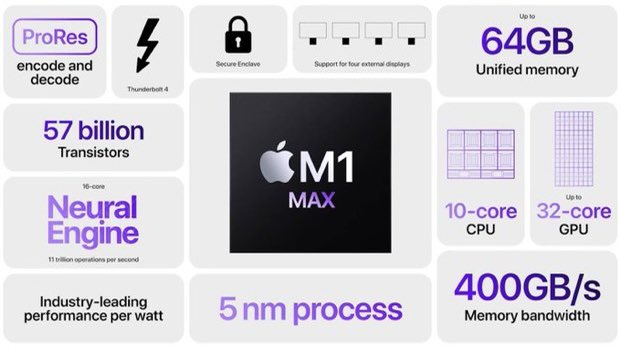
Apple M1 Pro and Apple M1 Max

The Apple M1 Pro has up to 10-core CPU (8 high-performance CPU cores and 2 high-efficiency cores) and up to 16-core GPU. Apple says it has 33.7 billion transistors and a memory bandwidth of 200GB/s.

The Apple M1 Max has up to 32-core GPU, a memory bandwidth of 400GB/s, and 57 billion transistors. It can also be configured with up to 64GB of unified memory while the M1 Pro can be configured with up to 32GB of unified memory.

Apple claims the new processors bring up to 13x faster graphics performance, 3.7x faster CPU performance, 11x faster machine learning, and up to 21 hours of battery life. Apple also claims they deliver more performance and consume less power than a discrete PC laptop graphics and a compact pro laptop with a high-performing discrete GPU.


MacBook Pro 14” and 16”

The new MacBook Pro is available in two sizes – 14” and 16”. They both have a 120Hz ProMotion mini-LED display a.k.a. Liquid Retina XDR display with slimmer bezels and a notch for a 1080p camera. Sorry to disappoint you but Face ID isn’t coming to MacBooks, at least not this year. The 14” version has a 14.2” screen with a 3024 x 1964 resolution while the 16” version has a 16.2” screen with a 3456 x 2234 resolution.

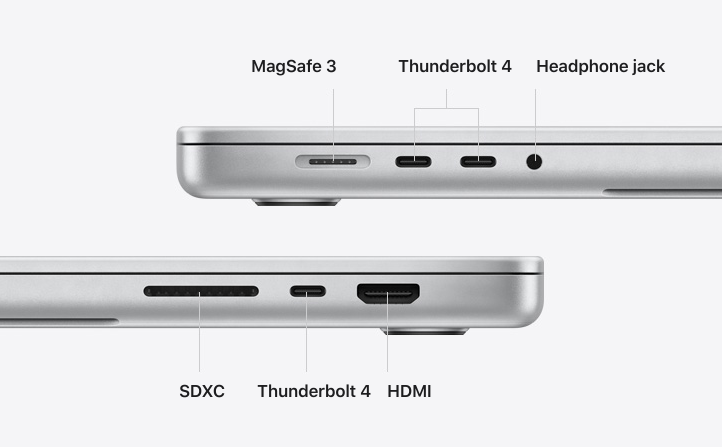
While Apple has added a notch, it has removed the touchbar and replaced it with physical keys. There is a MagSafe three-port but you can also charge the computers through one of the Thunderbolt 4 ports. There is also an HDMI port, headphone jack, and an SDXC card slot. The new MacBooks pack six speakers (four force-canceling woofers and two high-performance tweeters) with spatial audio.


The MacBook Pro 14” starts at $1999 for the base model with an M1 Pro chipset that has an 8-core CPU and a 14-core GPU, 16GB of RAM, and 512GB of SSD storage. The 10-core CPU version with the same RAM, 1TB SSD, and a 96W USB-C Power Adapter is priced at $2499.

The 16” model starts at $2499 for the base configuration with a 10-core M1 Pro processor, 16GB RAM, 512GB SSD storage, a 140W USB-C power adapter. An extra $200 gets you 1TB of storage while an additional $1000 gets you the M1 Max with 32GB of RAM and 1TB of SSD. There are multiple configurations to choose from and you can choose a model with up to 64GB of RAM.

Both laptops are available in Silver and Space Gray. Pre-orders are open today and they will be available next week.


RELATED:


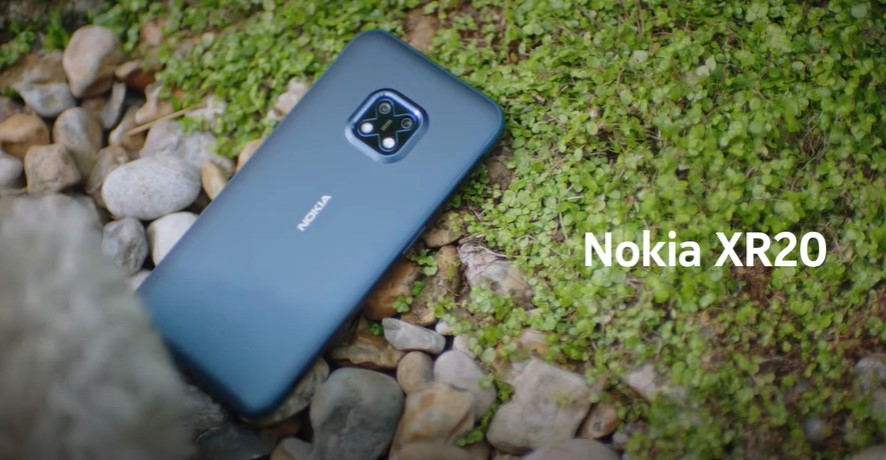
Nokia XR20 officially launched in India for Rs. 46,999 ($638)

HMD Global has finally launched the Nokia XR20 in India for Rs. 46,999 (~$638). The Nokia XR20 draws from the track record of the Nokia brand as makers of rugged phones over the years. The smartphone is waterproof (1P68-rated), has a sleek casing that further enhances its overall durability, and drop protection. The XR20, according to the manufacturer, is built for conditions that are far harsher than the rough and tumble of everyday life.Nokia XR20 featured

The 6.67-inch full HD+ display of the Nokia XR20 is encased in Corning Gorilla Glass Victus protection as part of the rugged design of the smartphone. It is possible to customize the display such that your most frequent tasks are made more accessible, together with the possibility of attaching the smartphone to a lanyard via the accessory loop.

The XR20 is powered by Qualcomm’s Snapdragon 480 5G with Android 11 the operating system of choice from the box. To go with the Android 11 OS, are three years of software upgrades and up to four years of security updates. The XR20 offers a 4630mAh battery with 18W wired and 15W wireless charging. The camera setup is signposted by a 48MP main camera, together with a 13MP ultra-wide camera and 8MP selfie cam. The main camera setup also includes Zeiss Optics. The Nokia XR20 is also well-kitted on the audio side with its OZO spatial audio and SpeedWarp super-stabilization mode.Nokia XR20 featured main

The Nokia XR20 offers 6GB of RAM and 128GB of internal storage, which is expandable to 512GB via the microSD slot. It is a hybrid dual SIM smartphone with a slide-mounted fingerprint sensor. Pre-order of the XR20 will be from 20 to 29 October, while actual sales will commence by October 30 across leading offline and online retail channels including Nokia’s website. The pre-booking will afford customers to get one year of screen protection, as well as several freebies.

RELATED:


(source)


Google Pixel 6 & Pixel 6 Pro prices in the US leak ahead of launch

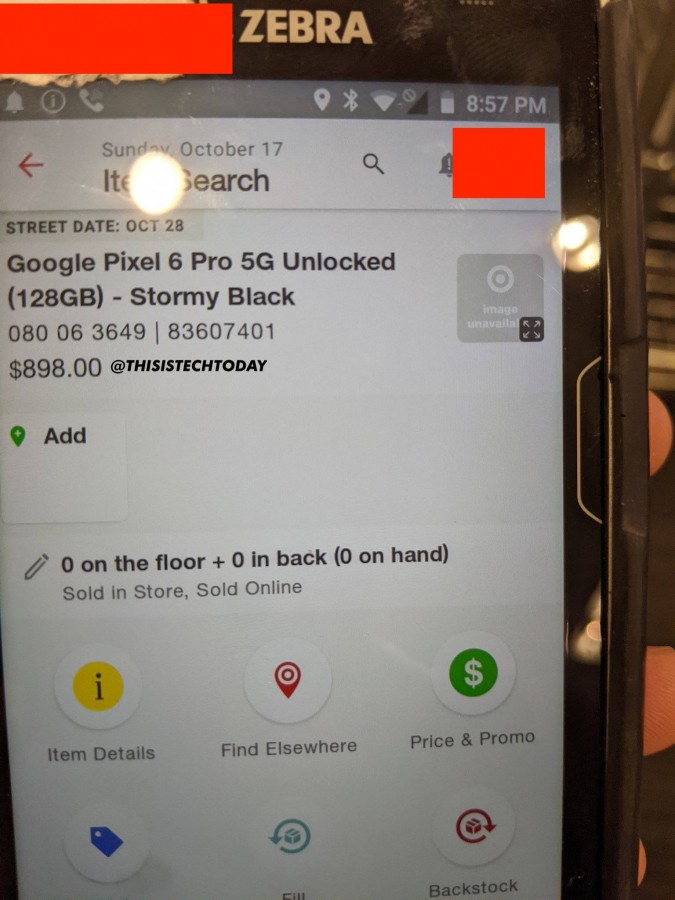
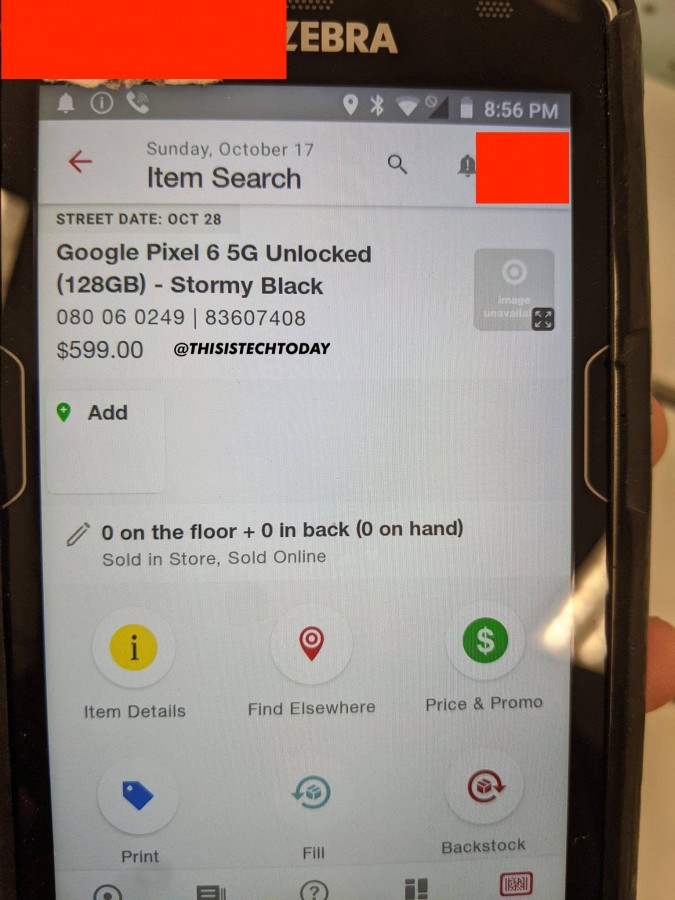
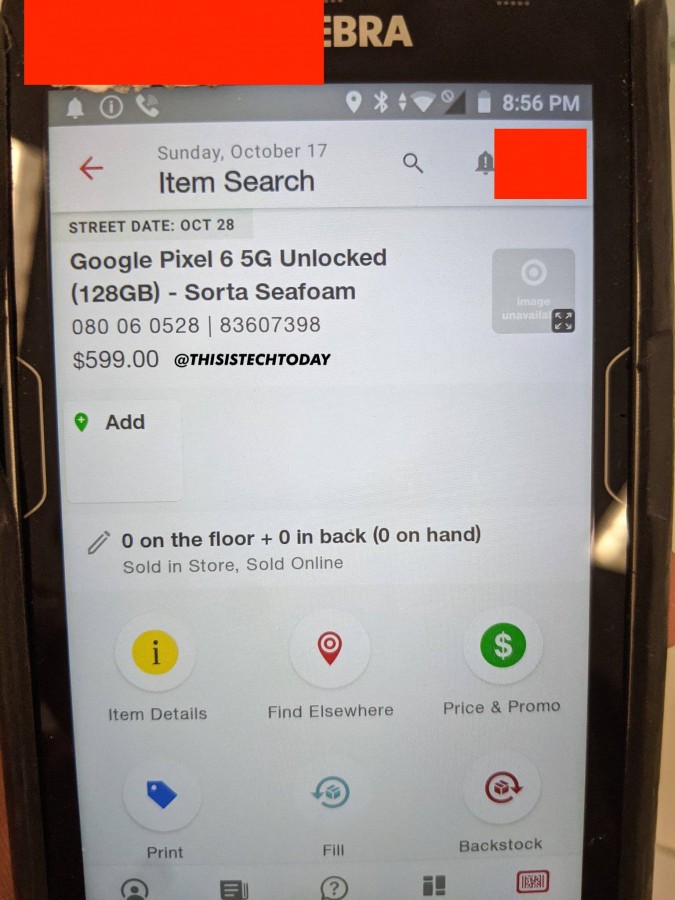
Following the UK leak of the prices of the Pixel 6 and Pixel 6 Pro smartphones yesterday, a new leak has revealed the possible US pricing. The leak indicates that the Pixel 6 will be priced at $599 while the Pixel 6 Pro will go for $898 when they eventually berth in the United States. Google Pixel 6

The Pixel 6 and the Pixel 6 Pro, going by their impressive features and seemingly affordable prices, are the latest flagship offerings by Google in the smartphone segment. They compare with the Samsung Galaxy S21 series and could be a huge hit in the market when they become available. The pricing leak also indicates some degree of parity with the products, as per the leaks for Europe and the UK. The Europe price leak for the Google Pixel 6 is €649 and that of the Pixel 6 Pro is €899.Google Pixel 6

These leaks are coming few hours to the Google event scheduled for October 19 which will herald the release of the Pixel 6 and Pixel 6 Pro smartphones, among other devices. The chipset powering the devices has been touted to be at par with Apple A14 Bionic and Qualcomm’s Snapdragon 888 SoCs. Google partnered with Samsung to deliver the probably Exynos 9855. There are some innovative features available with the new Pixel 6 offerings including Astrophotography and a secure Titan M2 Security as added protection against hackers and cyber-attacks.Google Pixel 6

The battery range of the two flagship models is between 4,600mAh and 5,000mAh. The camera setup is also impressive for the two smartphones. The release of the Google Pixel 6 and Pixel 6 Pro could be the centerpiece of the October 19 event. More details will be released at the launch including confirmation of the pricing details so leaked thus far.

RELATED:


(source)


Vivo Y33s gets 4GB RAM and 128GB storage variant in Nigeria

Vivo has officially launched the all-new Vivo Y33s smartphone in Nigeria. Initially, the smartphone was launched in 8GB of RAM but today, the company has launched a 4GB RAM variant. The smartphone has all the specs same as the previous 8GB variant which includes triple rear cameras, Helio G80 SoC, and a big battery.

The Vivo Y33s’ new 4GB RAM + 128GB variant costs N109,000(~$265) . The device is currently up for pre-orders across Nigeria. It is available in Mirror Black and Midday Dream colour variants.

Vivo Y33s Specifications 

The Vivo Y33s comes with a 6.58-inch water-drop notch display with an FHD+ resolution. The exact resolution of the display is 1080 x 2408 pixels. It has a 90.6% screen-to-body ratio and a 96% NTSC colour gamut.

Vivo Y33s gets 4GB RAM and 128GB storage variant in Nigeria

It boasts a single 16MP camera at the front and three cameras at the rear. It has a 50MP main sensor, a 2MP macro lens, and lastly a 2MP depth-sensing unit. Under the roof, there’s the MediaTek Helio G80 SoC paired with 4GB of RAM and 128GB of internal storage. Vivo has offered virtual RAM support which lets the device use 1GB from the storage like RAM.

It packs a 5,000mAh battery with support for 18W fast charging technology. It runs on Android 11 out of the box with FunTouch 11.1 UI on top of it. It has a side-facing fingerprint scanner and supports Face unlock for security.

RELATED:

(via)

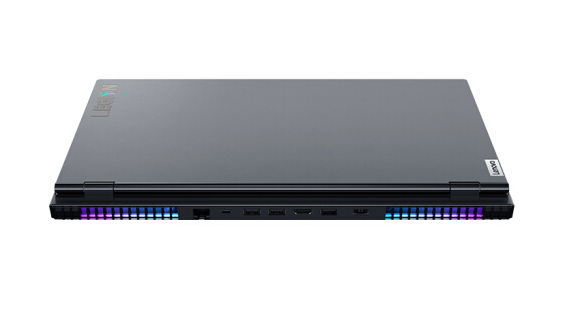
Lenovo Legion Y9000K 2021 Exploration Edition with liquid metal heat conduction unveiled

Chinese electronics manufacturer Lenovo has launched the Legion Y9000K 2021 Exploration Edition. What makes this spectacular is the use of liquid metal thermal conductivity technology which is about 5.9 times the thermal conductivity of the phase-change silicone grease used by the current Legion.Lenovo Legion Y9000K 2021 Exploration Edition


In terms of design, the Lenovo Legion Y9000K 2021 gamebook uses a titanium crystal gray color scheme. It is equipped with the Legion Y-lit logo on the A-side, with an RGB backlit keyboard, and weighs 2.5kg.

In terms of screen, the Lenovo Legion Y9000K 2021 gamebook uses a 16-inch 2560×1600pixels screen, with a 16:10 screen ratio and 92% screen-to-body ratio. It features support for a 165Hz refresh rate and has a maximum brightness of 500nits.Lenovo Legion Y9000K 2021

In terms of the hardware, the Lenovo Legion Y9000K 2021 gaming notebook is equipped with an Intel Core i7-11800H processor (up to 90W) and NVIDIA RTX 3060/3070/3080 independent display (up to 130/140/165W). It equally supports independent display direct connection, and is equipped with 16GB + 1TB storage.Lenovo Legion Y9000K 2021 Exploration Edition

Further, the gaming laptop is equipped with PCIe 4.0 solid-state storage, is equipped with Frostblade Ultra cooling system 3.0, has an 80Wh battery, and supports 100W PD charging.

It is not clear what other improvements have been made to the laptop. The pricing and availability details are also not yet in the open.

RELATED: 


(source)


Apple HomePod Mini gets three new colors

The HomePod Mini launched a little over a year ago as a more affordable version of the HomePod which wasn’t much of a success. The $99 HomePod Mini has seen wider adoption than its bigger sibling which has now been discontinued. For those expecting a successor, Apple has decided against and launched three new colors instead.

HomePod Mini new colors

When it was announced last year, the HomePod Mini was available in two colors – Space Gray and White. Today, interested buyers can pre-order the speaker in Blue, Yellow, and Orange. It is still priced at $99 and will begin shipping in November.

The addition of new colors will provide more options for buyers to pick a color that better matches their apartments or rooms. Apple is taking a leaf out of Google’s book. The Nest Mini is available in Chalk, Charcoal, Coral, and Sky.

The HomePod Mini has an Apple S5 chipset that helps with computational audio. Two speakers can work together as stereo speakers, and if you have more than one HomePod Mini in the house, you can send a message to the other speakers using a feature called Intercom. You can also use Intercom to send and receive messages on your other devices such as your iPhone, Apple Watch, CarPlay, and AirPods.

Like smart speakers from Amazon and Google, the HomePod Mini will answer questions, control smart home devices, set reminders, and play your favorite podcasts. It can recognize up to six different voices and provide personalized responses depending on the user.


RELATED:

Vivo Y3s with an Helio P35 chipset launched in India for Rs. 9,490 (~$126)

Vivo has announced an entry-level smartphone for the Indian market. The Vivo Y3s comes as the latest offering under the Y series but that is just for the Indian market. The device was announced in China last year alongside the Y30. What it brings with it, aside from the decent specs line, is a super-affordable price tag of Rs. 9,490 (~$126). Vivo Y3s

As for the specifications, the Vivo Y3s features a 6.51-inch Halo FullView display with an HD+ resolution of 1600 x 720 pixels and a 20:9 aspect ratio. The device is powered by an Octa-Core MediaTek Helio P35 12nm processor with IMG PowerVR GE8320 GPU. The processor is paired with 2GB RAM while there is 32GB of expandable memory onboard.

For photography, the Vivo Y3s packs a single 13MP main camera with f/2.2 aperture and LED flash at the rear. For selfies, there is a 5MP camera with an f/1.8 aperture. The phone doesn’t have a fingerprint scanner.

For interface, the Y3s runs on Android 11-based FunTouch OS 11. Under the hood, there is a decent 5000mAh battery with 10W charging over a MicroUSB port. It equally packs dual SIM slots and dedicated MicroSD slots. You also get a 3.5mm audio jack, FM Radio, Bluetooth 5, GPS/ GLONASS/ Beidou.Vivo Y3s

The vivo Y3s is available from Vivo India’s e-store, Amazon India, Flipkart, Tata CLiQ, Paytm, Bajaj Finserv EMI store, and across all retail stores right now. The phone comes in Starry Blue, Pearl White, and Mint Green colors with a gradient back design.

RELATED:

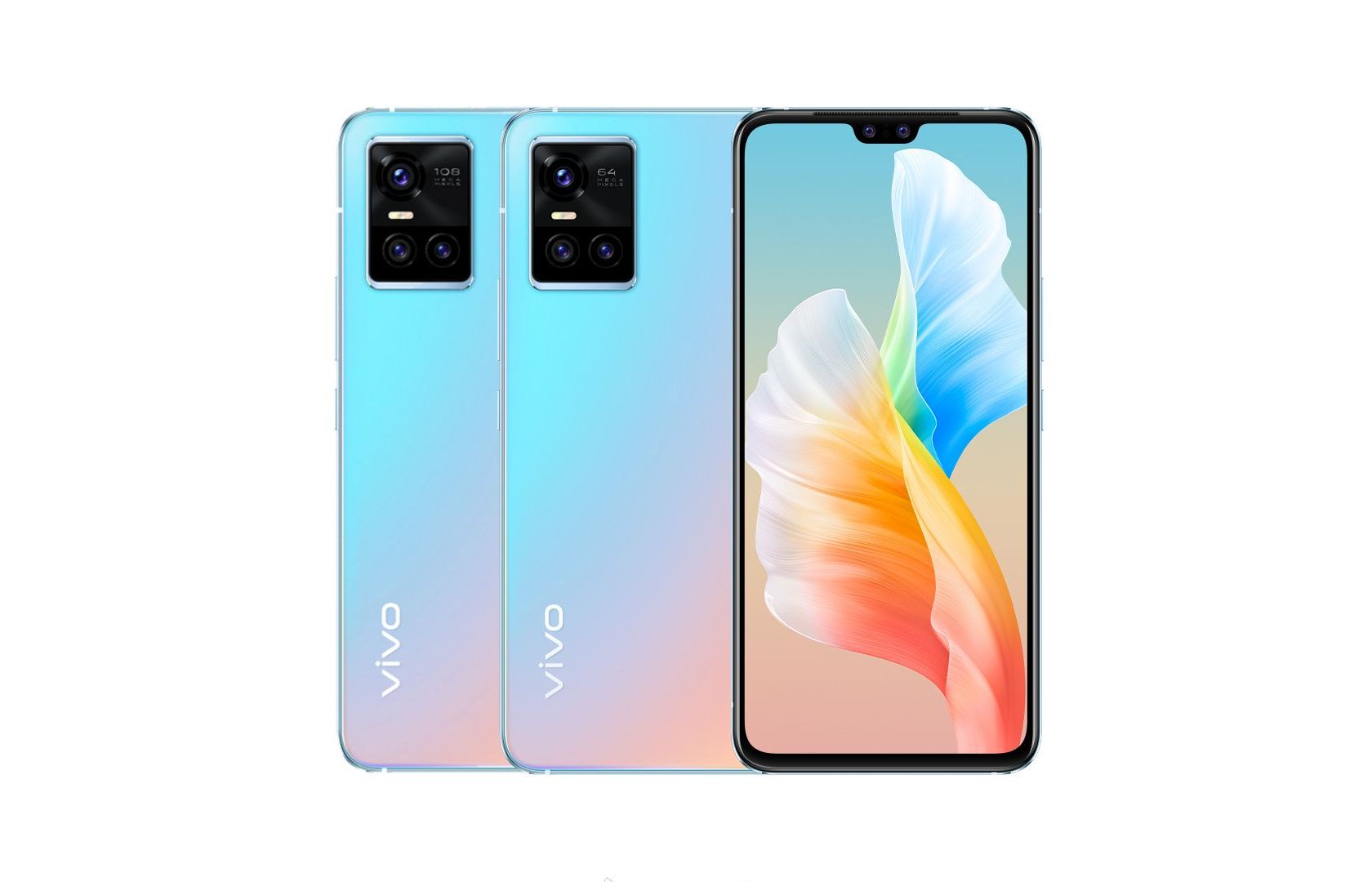
Vivo S12 series may launch next month with a new design

Earlier today, the Vivo S10e was announced in China with no fanfare. It appears the reason for that is because a successor is coming next month. According to a leak from China, the Vivo S12 series is launching next month and it will come with a new design.

Vivo S10 and S10 Pro official renders leaked-
Vivo S10 and Vivo S10 Pro’ successors may drop the notch

The Vivo S10, Vivo S10 Pro, and the Vivo S10e all have a notch albeit of varying sizes. It is a design that can be termed outdated when compared to those from competitors. If you are one of those that don’t like the wide-notch on the Vivo S10 and Vivo S10 Pro, then you should look out for their successor coming next month.

According to the Weibo account @Arsenal, the Vivo S12 will have a flat and rigid display supplied by Samsung. Considering Samsung doesn’t have any display with a wide rectangular notch, we can expect the phone to have a centered punch hole. He also adds that the back of the phone is flat and the frame is metallic and flat.

Vivo S12 series

For the Vivo S12 Pro, the source said the display will be supplied by BOE and it will be curved and flexible. It will also have a 3D curved glass back and a rounded middle frame. He also adds that the Vivo S12 Pro will be launched in three colors when it is available for purchase while the Vivo S12 will be available in only one color.

There is no information about their processors, cameras, and battery capacity. Nevertheless, we won’t be surprised if some of the specifications of the Vivo S10 series are carried forward since the focus seems to be on the design of the new phones.

All of these are unconfirmed, so even though the source has a good track record, we advise the info be taken with a pinch of salt.


RELATED:

Official prices for upcoming Realme products revealed by offline store

Realme has a launch event scheduled for tomorrow in China and it has been confirmed that it is for multiple products including the Realme GT Neo2T and the Realme Watch T1. However, you don’t have to wait until tomorrow to know how much these products will cost as an offline store has revealed their prices.

A photo posted on Weibo which was taken outside a Realme store shows a banner with the prices of the three new products launching tomorrow. The photo was posted on Weibo by the Weibo leaker @Arsenal.

Realme products pricing

The image shows that the Realme GT Neo 2T (stylized as Realme GT Neo2T) will have a price tag of ¥2299 (~$358). The price is just ¥200 (~$31) lower than that of the base model of the Realme GT Neo2 which has 8GB of RAM and 128GB of storage. Unfortunately, the banner doesn’t state the configuration of the phone with that price tag.

The Realme GT Neo 2T will have a 6.43-inch AMOLED display, 64MP triple rear cameras, a Dimensity 1200 processor, and a 4500mAh battery with support for 65W fast charging.

The Realme Q3s which is the second smartphone planned for launch will sell for ¥1899 (~$295). It has been reported that the phone will have a Snapdragon 778G processor, a 6.59-inch LCD display with a 144Hz refresh rate, 48MP triple rear cameras, and a 5000mAh battery capacity.

Realme will also launch its first smartwatch for the Chinese market, the Realme Watch T1, and it is priced at ¥999 (~$155). The watch will have a round dial and be available in three colors one of which matches the Neo Green colorway of the Realme GT Neo2.


RELATED:

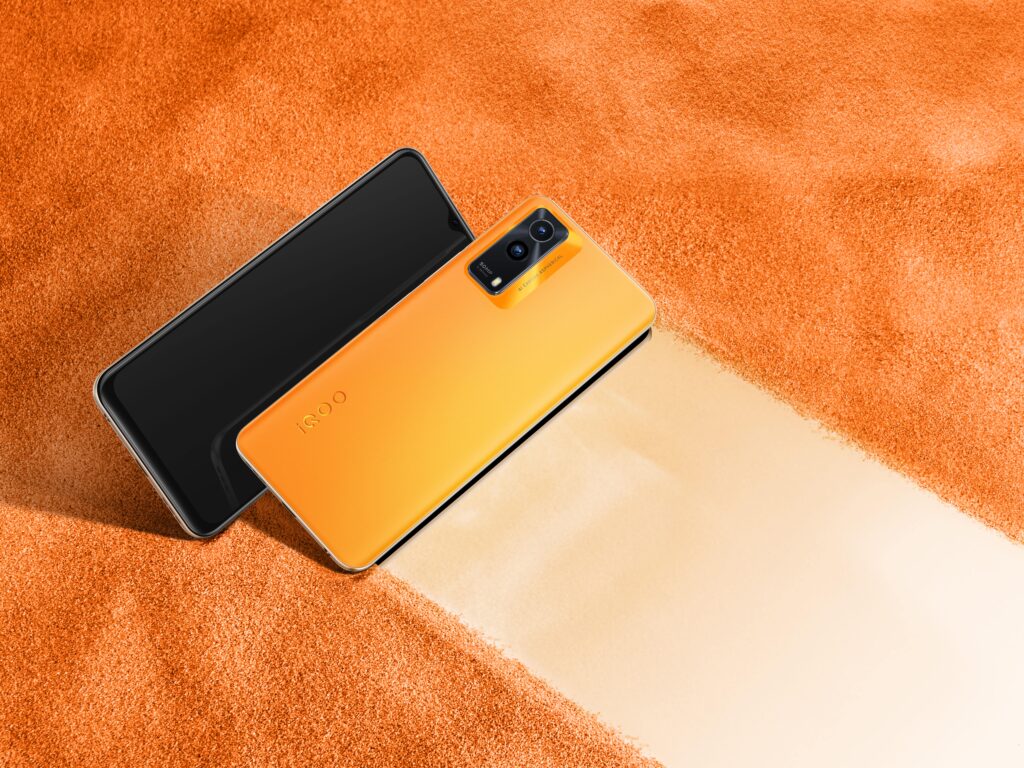
iQOO Z5x will arrive in three colors: Official

Chinese smartphone brand iQOO has confirmed to launch a new handset called iQOO Z5x on October 20. Ahead of that, the company has been teasing the features of the phone. The latest teaser reveals all of its three colors.

According to the official iQOO Weibo account, the upcoming iQOO Z5x will arrive in the following three colors.

  • Lens Black
  • Fog Sea White
  • Sandstone Orange.

The company has even shared the renders attached above. We can see that the device will come with a vertically aligned dual-camera setup and an iQOO branding on the rear. We can also see an embedded fingerprint sensor on its power button.

As per previous reports, the iQOO Z5x will sport a 6.58-inch TFT LCD panel with FHD+ resolution and a punch-hole at the top left corner. The smartphone will be powered by a MediaTek Dimensity 900 SoC paired with up to 12GB RAM and 256GB internal storage.

Further, it is expected to house a dual rear camera setup on the back consisting of a 50MP primary sensor and a 2MP secondary sensor. For selfies and video calls, it will use an 8MP shooter.

Other expected features of the smartphone include Android 11, 5,000mAh battery, and 44W fast charging. Finally, it is said to measure 163.95 x 75.30 x 8.5mm in dimensions and weigh 169g.



RELATED:


Samsung, Qualcomm, & Verizon together achieve 711mbps 5G upload speeds in lab test

Samsung Electronics, Qualcomm Technologies, and Verizon managed to reach 5G upload speeds of 711 Mbps in a lab trial using aggregated bands of mmWave spectrum – the fastest ever for the three. The trio has continued to push the very boundaries of 5G using innovation to achieve more and more from the revolutionary technology.

The record was achieved by combining 400MHz of Verizon’s 5G mmWave frequency and 20MHz of 4G frequency using the latest 5G technologies, including mmWave carrier aggregation and Single-User MIMO (SU-MIMO). Samsung’s contribution was a 28GHz 5G Compact Macro, while the test device was powered by Qualcomm’s flagship Snapdragon X65 5G Modem-RF System.

5g-tower-featured

Samsung’s Compact Macro combines a baseband, radio, and antenna in a single physical factor to deliver 5G mmWave. This tiny and lightweight solution may be easily installed on the sides of buildings as well as on utility poles for the rapid 5G deployment.

The Snapdragon X65 is Qualcomm’s fourth-generation 5G mmWave Modem-RF System for phones, mobile broadband, computers, etc. The first mobile devices with it are expected to go live in late 2021. Current smartphones make use of the Snapdragon X60 5G modem.

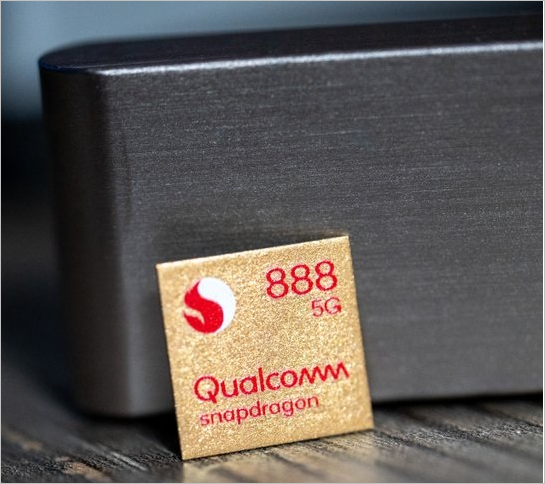
Qualcomm Snapdragon 888
Snapdragon 888 processor comes with X60 5G modem

The implication of the 711mbps uplink speed achievement is seamless, super-fast video and photo uploads to the cloud or social media. Such speeds will also allow students and employees to upload and synchronize massive files, simultaneously edit documents in the cloud, and collaborate with colleagues effortlessly.

These breakthrough uplink speeds will also drive new private network use cases for enterprises. Faster uplink speeds can enable quality control solutions for manufacturers using artificial intelligence to identify tiny product defects in products visible only through ultra HD video feeds. Other upload-intensive solutions such as multi-location, massive security video capabilities and augmented reality-centered customer experiences will also get a boost with these increased speeds.

Further, enterprises will be benefiting from the upload speeds as well. Manufacturers will be able to use AI to identify defects in products visible only through ultra HD video feeds. Other upload-intensive technologies like multi-location, large security video capabilities, and augmented reality will benefit too.

RELATED:

Apple offers 20% bonus on adding funds to Apple ID in India

To promote payments using the Apple ID balance, the company is now offering a 20 percent bonus to users in India who add funds to their ID. Users in the region can now benefit from this incentive by simply adding funds to their Indian IDs.

The news arrives after the Cupertino based giant notified developers regarding a change in Indian’s local payments system. Now, the iPhone maker is asking developers to promote the payments being made through the Apple ID balance, with the company now offering a 20 percent bonus to Indian users that are adding funds on their IDs. This was also shared by developer Mustafa Yusuf on Twitter (Via 9To5Mac).

Furthermore, this promotional offer is valid through 31st October 2021 and will be available when adding 100 to 15,000 INR (roughly from 1 to 199 US Dollars) to the Apple ID. In other words, if a user adds 2,000 INR to their Apple ID, they can avail a bonus of 400 INR on their account. Similarly, if the funds being added amounts to 10,000 INR, then the bonus amount will include an extra 2,000 INR.

Apple App Store Logo Featured

Notably, the move from the brand arrives as a new directive from the Reserve Bank of India (RBI) mandates banks to require user approval through a new authentication system in order to approve recurring transactions using credit and debit cards. The smartphone maker stated that the new directive will impact apps with the auto renewable subscription payment systems, so it has asked developers to promote payments from its the company’s ID balance as it won’t be affected by the new changes from RBI.

RELATED:


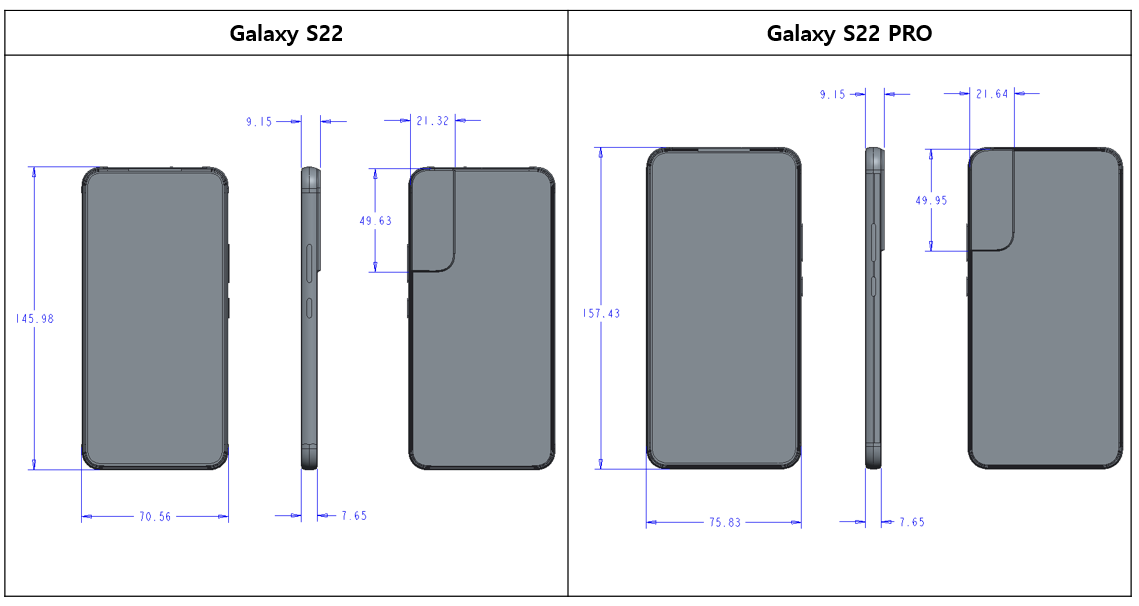
Samsung Galaxy S22 series design revealed in new schematics

Over the last couple of weeks, various rumors and reports regarding the Samsung Galaxy S22 series have surfaced online. Now, a new leak has apparently revealed the official design of the upcoming flagship lineup.

Samsung

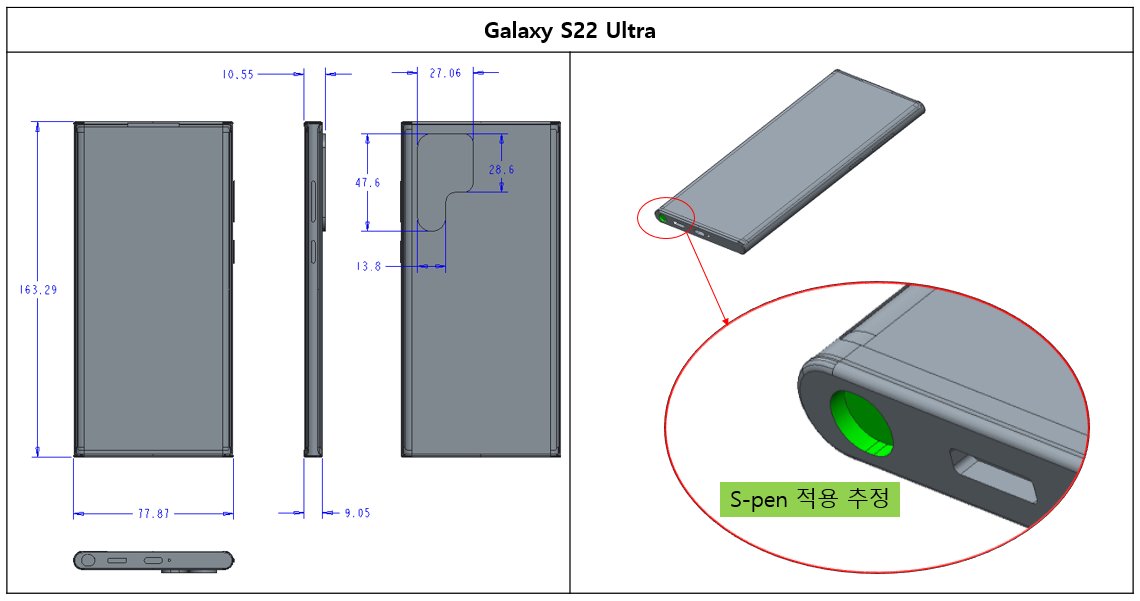
New schematics of the Galaxy S22 series have just surfaced online that reveal certain measurements and port positions on the yet to be launched devices. For those unaware, the South Korean tech giant is expected to launch three models of the Galaxy S22 series next year, which includes the base variant, the high end Ultra model, and a new Pro version that replaces the “+” variant. The new schematics highlight the exact dimensions of all three models.

In other words, we now know how tall, wide, and thick the new flagship lineup will be, as shared by known tipster Tron on Twitter. The schematics further showcases that the Galaxy S22 Ultra will feature a design that is similar to the Galaxy Note series. This is most noticeably highlighted when looking at its camera module, which is different from the base and Pro variant.

Samsung

On the other hand, the Ultra variant even sports a slot for the S Pen that is located on the bottom left side. With Samsung skipping the launch of the Galaxy Note series in 2021, the S22 Ultra might offer loyal Note series a worth device to upgrade to. Keep in mind that this is still an unconfirmed report so take it with a pinch of salt and stay tuned for more updates.

RELATED:


Vivo Watch2 appears on TENAA, more specifications revealed

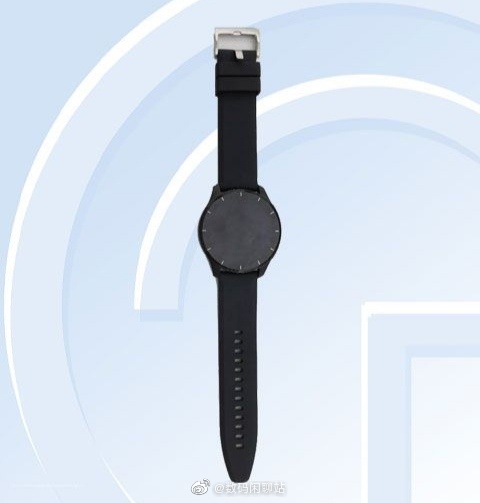
Vivo will be launching a successor to its first smartwatch, the Vivo Watch, soon. The new watch is expected to launch as the Vivo Watch2 and ahead of its arrival, more details have surfaced alongside a photo from its TENAA certification.

The Vivo Watch2 will have a round dial like its predecessor. There are markings on the bezel and the case is black with matching straps. We expect the smartwatch will be available in other color options when it is launched.

Vivo Watch2 TENAA

According to the Chinese leaker, Digital Chat Station, the display is OLED and the watch has a higher screen-to-body ratio than last year’s model. He also mentions that the watch has a 515mAh battery capacity which is an increase from the 478mAh battery inside the 46mm Vivo Watch. The bigger battery is necessary since the Vivo Watch2 will have an eSIM for making calls and sending messages.

There is a possibility we may only get a single size this time as a 42mm version with eSIM support may have poor battery life. The 42mm model released last year has a 226mAh battery capacity and a 9-day battery life as against the 18-day battery life of its bigger sibling.

The leaker goes on to reveal the watch will support three networks with eUICC support. He also mentions that the Vivo Watch2 will support more apps and still have a long battery life as one of its selling points.

There is no info on when the smartwatch will be announced. Last year’s model was launched in September. Regardless, a launch date should not be far off since it has already been certified by TENAA.


RELATED:

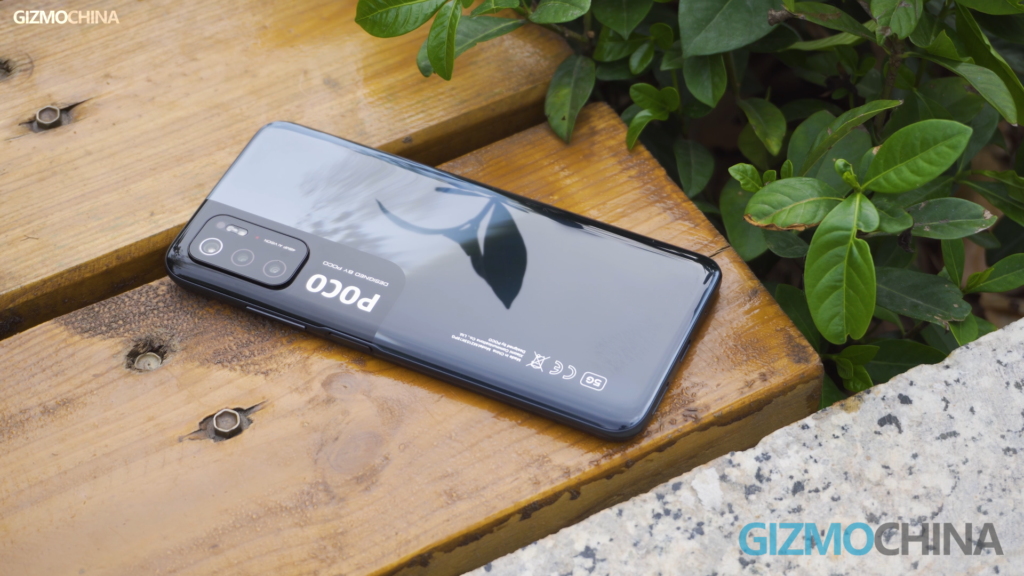
POCO M3 Pro 5G is the first POCO device to get Android Enterprise Recommended certification

The POCO M3 Pro 5G made its initial debut at the end of May. Five months post its launch, the device has been now certified by the Android Enterprise Recommended Program. Most importantly, it is the first-ever POCO smartphone to receive such a certification.

POCO M3 Pro 5G featured 14
POCO M3 Pro 5G

Lately, almost all the popular Mi (Xiaomi) and Redmi-branded handsets from the Xiaomi group have been receiving Android Enterprise Recommended Program certification. Hence, it is not surprising to learn that POCO has also joined the bandwagon.

However, it is interesting to learn that the cheaper POCO M3 Pro 5G is the first to get the certification instead of the POCO F3. Perhaps, the latter model will be also joining the list in the near future.

For those unaware, the Android Enterprise Recommended program by Google helps enterprises to select devices from a vast catalog. These handsets and tablets have a suitable hardware and software update policy to support them longer.

The POCO M3 Pro 5G is the brand’s most affordable 5G smartphone. It is probably the only highlight of this phone other than its capable MediaTek Dimensiy 700 SoC. Apart from these two factors, we can consider its 5,000mAh battery as one of its pros.

In a nutshell, if an enterprise is looking for a cheap 5G smartphone with long battery life, the POCO M3 Pro 5G should be one of their options.


RELATED: